


Behavior in context to individual adaptive
performance in developed countries
Strategic management provides the strategy of scholars rationality agree with the managers
those are limited. At present, strategic management gains the attention of the different
research scholars for managers' rationality for the cognitive strategic decision-making process
in the organizations [1]. At instances, changes in strategies contribute longitudinally to the
formulation of strategic decision those impacts the decision-making process in organizational
top management. The strategy of the organization resulted in effectiveness and reflects the
value and cognitive behavior of the organization persons [2]. With organizational
perspectives, strategic demonstrated the knowledge and learning of the enterprises with
competitive advantages with the changes in the environments as key factors in the
organization with fast learning capability [3]. Strategic correlated with the elements such as
knowledge capacity, structure, mental health, and knowledge-related. The changes in
strategies are undertaken through the integration of obtained knowledge with an effective
mechanism for strategic management to adopt new strategies in the organizations [4]. With
effective implementation of strategic management and employees collects new knowledge in
the organizations. Through the analysis changes in strategy are based on the learning of the
organizational behavior [5].
With changes in the external environment in the organizations through strategy organizational
behavior need to evaluate. In the knowledge economy-based society, productive factors of the
organizations are observed with the modification in the essential productive factors with alteration
in the material changes and human capital considered as productive factors, causes the alteration in
the direction of the organizational behaviors [6]. The modification in the organizational behavior
with strategic management. With the advent of the organizational behavior as per economy with
innovation in the high-speed technology with shorter product cycle to bring competition
environment [7]. The changes in the organizational behavior exhibit dynamic variation in the
organizational main features and deal with the work environment uncertain and requirement to
change job. At instances, the organization requires employees who are flexible for the working
environment. With changes in the organizations based on strategic management organizations also
need to exhibit adaptive behaviors. In this scenario [8]. The performance evaluation of the
organization evaluates the organization's adaptive behavioral characteristics, this leads to the
evaluation of adaptive performance. To evaluate the employees' adaptive behavior with changes in
organizations effective measures are implemented for the transformation of the individual adaptive
performance [9]. The employee individual and group level incorporate different factors such as
learning, self-efficient, personality trait, the difference of individual and cognitive ability. The
adaptive performance comprises predictive effects on leaders based on the atmosphere of
organizations, leadership, and support [10]. With a theory of empowerment, this research
explored the organizations' internal characteristics influence in the environment for adaptive
performance characteristics of an individual. Through the framed hypothesis contribution of
the organizational behavior over the individual performance is measured.
THEORETICAL BASIS FOR STUDY INGSTRATEGIC CHANGE IN THE
PERSPECTIVE OF ORGANIZATIONAL INNOVATION
The theory of cognition and learning based on strategies in the organizational behavior stated
that “how the strategic development in the organizational behavior to withstand problem” [11],
Through cognitive innovation organizational innovation leads to knowledge creation and
learning in the organization. The employee’s empowerment for leadership behavior is
motivated and can impact the performance of the organizational behavior [12]. Through the
empowerment of leaders resulted in the perceived control resulting in the employee
responsibility to perform tasks. With leadership empowerment in the organizational behavior,
the organization atmosphere is engaged to motivate job roles and constraints in the
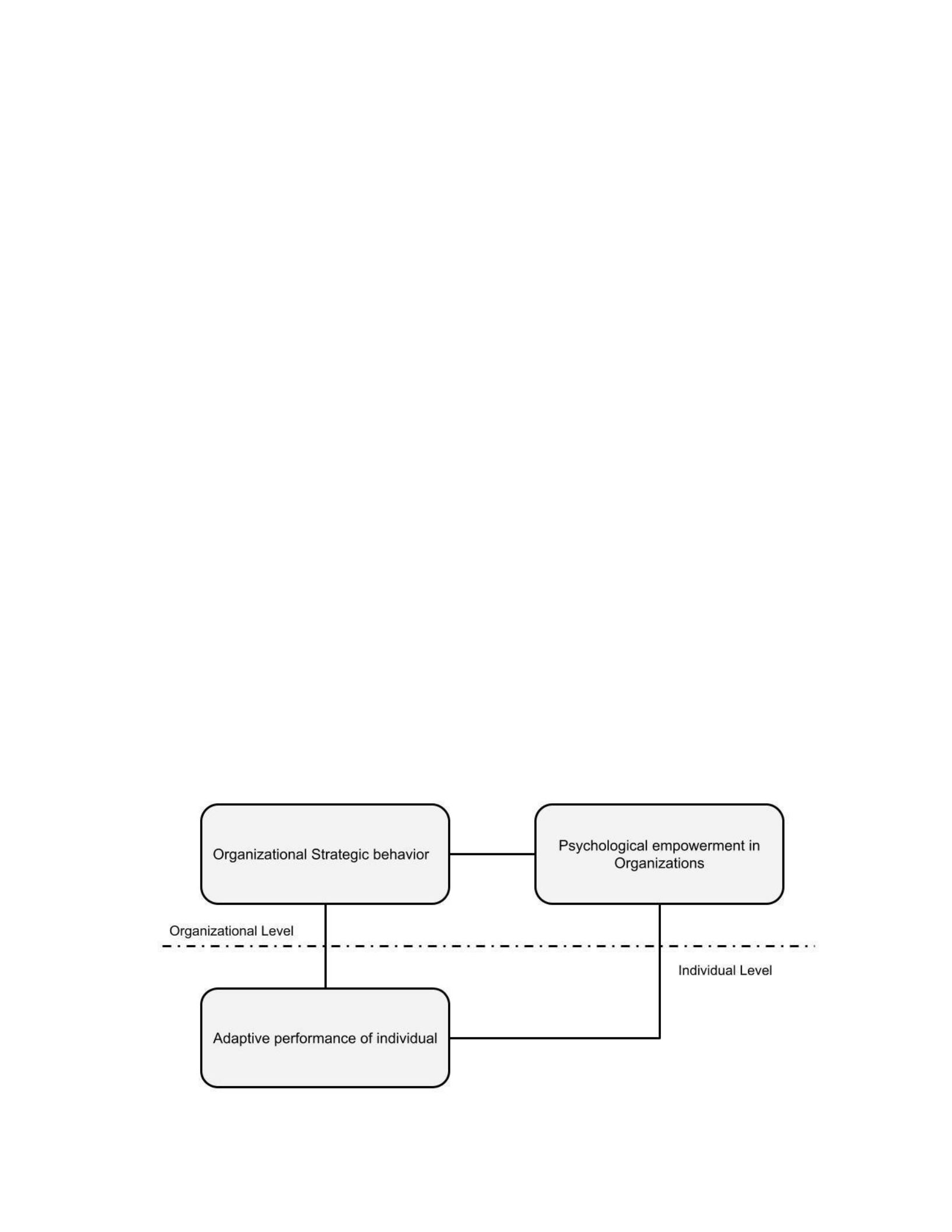
environment. In figure 1 illustrated the strategic management contribution over organizational
behavior with individual performance is evaluated.

Figure 1: Overall Characteristics
The empowerment increases the perception of employees with self-management. In the present
environment, organizational behavior impacts employee self-efficacy in the organization with the
good realization of goals and improvement. The present research concentrated on how
organizational behavior leadership is adaptive in the performance of the employee. With the
examination of the previous research, it is observed that organizational leadership empowerment
positively influences individual and organizational performance. The adaptive performance of
individuals exhibits positive impacts on organizational leadership behavior. The framed
hypothesis for analysis are presented as follows:
H1: Organization behavior empowers leadership behavior which has a significant contribution to
the adaptive performance of the individual.
RELATIONSHIP BETWEEN ORGANIZATIONAL BEHAVIOR AND
ORGANIZATIONAL PSYCHOLOGICAL EMPOWERMENT
In previous research, the leadership behavior expressed that individual psychological
empowerment is closely associated. Leadership empowerment formulates an effective
environment to improve the confidentiality level of the employees, which increases the employee
attitude and results [13]. The empowerment in leadership exhibits a positive impact on the
psychological empowerment of the individual, the organization employees can be highly
engaged for better information [14]. It is effective to increase the self-efficiency of the
employees and improving job engagement. Organizational empowerment leadership is effective
for the cognitive and emotional state of the employee with the organization to improve
leadership. With the increase in the empowerment of organizational leadership and
psychological organizational empowerment is higher. The empowerment in the organization
increases autonomy where employees can provide better performance in self-management and
high gain. Also, it increases psychological empowerment in the organization and the framed
hypothesis are presented as follows:
H2: Empowerment in leadership behavior has a significant impact on the empowerment
of employee psychological in the organizations.
THE CROSS-LEVEL MEDIATION EFFECT OF ORGANIZATIONAL
PSYCHOLOGICAL EMPOWERMENT

To evaluate the organizational behavior on the individual leadership style effectively involved
in the behavior of employees with psychological empowerment those has indirect support in
organization level [15]. The empowerment of organizational behavior leadership behavior of
employees collects awareness and empowerment [16]. Also, empowerment within the
organizational behavior improves the employee psychological empowerment. Under the
leadership atmosphere, the information those are internal scenarios will be increased in the
organization. Generally, the organization adopts the hierarchical level approach for strategic
management. Thus, the intrinsic motivation of the employees senses the motivation and
responsibility to evaluate self-efficiency. In this scenario, the psychological empowerment of
employees is adopted at a high level with strong motivation towards the performance of an
individual. In empowerment of organizational leaders increases the overall self-efficiency
through psychological empowerment organizational behavior, also employees within the
organization exhibit increased perception of self-efficacy, organizational performance, and
employee performance that has been improved. The framed hypothesis is presented as follows:
H3: Empowerment of psychological empowerment act as a mediation effect between
individual adaptive performance for organization and leadership behavior.

REFERENCES
1. Velikorossov, V. V., Genkin, E. V., Balakhanova, D. K., Sidorov, M. N., Maksimov, M. I.,
Sulimova, E. A., &Loshkov, B. D. (2020). Strategic management.
2. Dzwigol, H. (2020). Methodological and empirical platform of triangulation in strategic
management. Academy of Strategic Management Journal, 19(4), 1-8.
3. Makadok, R., Burton, R., & Barney, J. (2018). A practical guide for making theory
contributions in strategic management. Strategic Management Journal, 39(6), 1530-1545.
4. Fuertes, G., Alfaro, M., Vargas, M., Gutierrez, S., Ternero, R., & Sabattin, J. (2020).
Conceptual framework for the strategic management: a literature review— descriptive.
Journal of Engineering, 2020.
5. Ketchen Jr, D. J., & Craighead, C. W. (2020). Research at the intersection of
entrepreneurship, supply chain management, and strategic management: opportunities
highlighted by COVID-19. Journal of Management, 46(8), 1330-1341.
6. Bogers, M., Chesbrough, H., Heaton, S., & Teece, D. J. (2019). Strategic management of
open innovation: A dynamic capabilities perspective. California Management Review,
62(1), 77-94.
7. Gagné, M. (2018). From strategy to action: transforming organizational goals into
organizational behavior. International Journal of Management Reviews, 20, S83-S104.
8. Urinov, B. N. (2020). Theoretical aspects of organizational behavior and corporate culture.
Economics and Innovative Technologies, 2020(2), 15.
9. Kim, Y. (2018). Enhancing employee communication behaviors for sensemaking and sense
giving in crisis situations: Strategic management approach for effective internal
crisis communication. Journal of Communication Management.
10. Grant, R. M., & Baden-Fuller, C. (2018). How to develop strategic management
competency: Reconsidering the learning goals and knowledge requirements of the core
strategy course. Academy of Management Learning & Education, 17(3), 322-338.
11. Bryant, W., & Merritt, S. M. (2021). Unethical pro-organizational behavior and positive
leader–employee relationships. Journal of Business Ethics, 168(4), 777-793.
12. Tasselli, S., Kilduff, M., & Landis, B. (2018). Personality change: Implications for
organizational behavior. Academy of Management Annals, 12(2), 467-493.

13. Stewart, G. L., Courtright, S. H., & Manz, C. C. (2019). Self-leadership: A paradoxical core
of organizational behavior. Annual Review of Organizational Psychology and
Organizational Behavior, 6, 47-67.

