


CHAPTER FOUR
RESEARCH FINDINGS, DATA ANALYSIS AND DISCUSSIONS
4.1 Introduction
This chapter presents the research findings, analysis and discussions of the data obtained. The
chapter combines primary and secondary data.
The study was guided by the following research questions:
1. What are the traditional practices that hinder enrollment t of adolescent girls
of the Somali Community in Garissa County?
2. How does socio-economic factors among the Somali community affect girls’ enrolment in
secondary education?
3. What are the general parental attitudes towards the provision of education to
adolescent girls of the Somali community in Garissa County?
4. What are the mitigation measures that can be taken to increase the enrolment
of adolescent girls in secondary schools in Garissa County?
The study was conducted in Garissa County and involved 135 adolescent school girls
sampled from 1,806 secondary school girls from across the county, 150 adolescent girls
who were not in school. 300 parents, 93 teachers from 11 public secondary schools, 11
head teachers/principals from the 11 schools and 7 QUASO officers as tabulated in Table
4. 1
1

.
Table 4. 1 Summary of respondents
RESPONDENTS Actual size FREQUENCY
ADOLESCENT GIRLS IN
SCHOOL
1,806 135
ADOLESCENT GIRLS OUT OF
SCHOOL
85,504 150
TEACHERS 273 93
PRINCIPALS 18 11
QUASOs 7 7
PARENTS 0ver 290,000 300
4.2 General demographic information on respondents
4.2.1 Response rate
The researcher sought to find out the rate at which his target respondents participated in the study. This would
help to determine whether the number of respondents who participated in the study was within the standard that
could be used to deduce conclusions and recommendations of the study. The response rate is shown in the Figure
4. 1Type of school Table 4. 2
Table 4. 2 Response rate
Category Frequency Percentage
Responses 610 87.64%
Non-responses 86 12.36%
Total 696 100%
A response rate 87.64 was achieved and the data was well used for analysis. According to Creswell and
Kings Lay a response rate of 30-60% in a study is adequate for making conclusions and
recommendations Machiri,( 2020). This response rate therefore qualified the researcher to use the data
2
given by the respondents to draw conclusions and make recommendations.
4.2.2 Type of schools adolescent girls enrolled in.
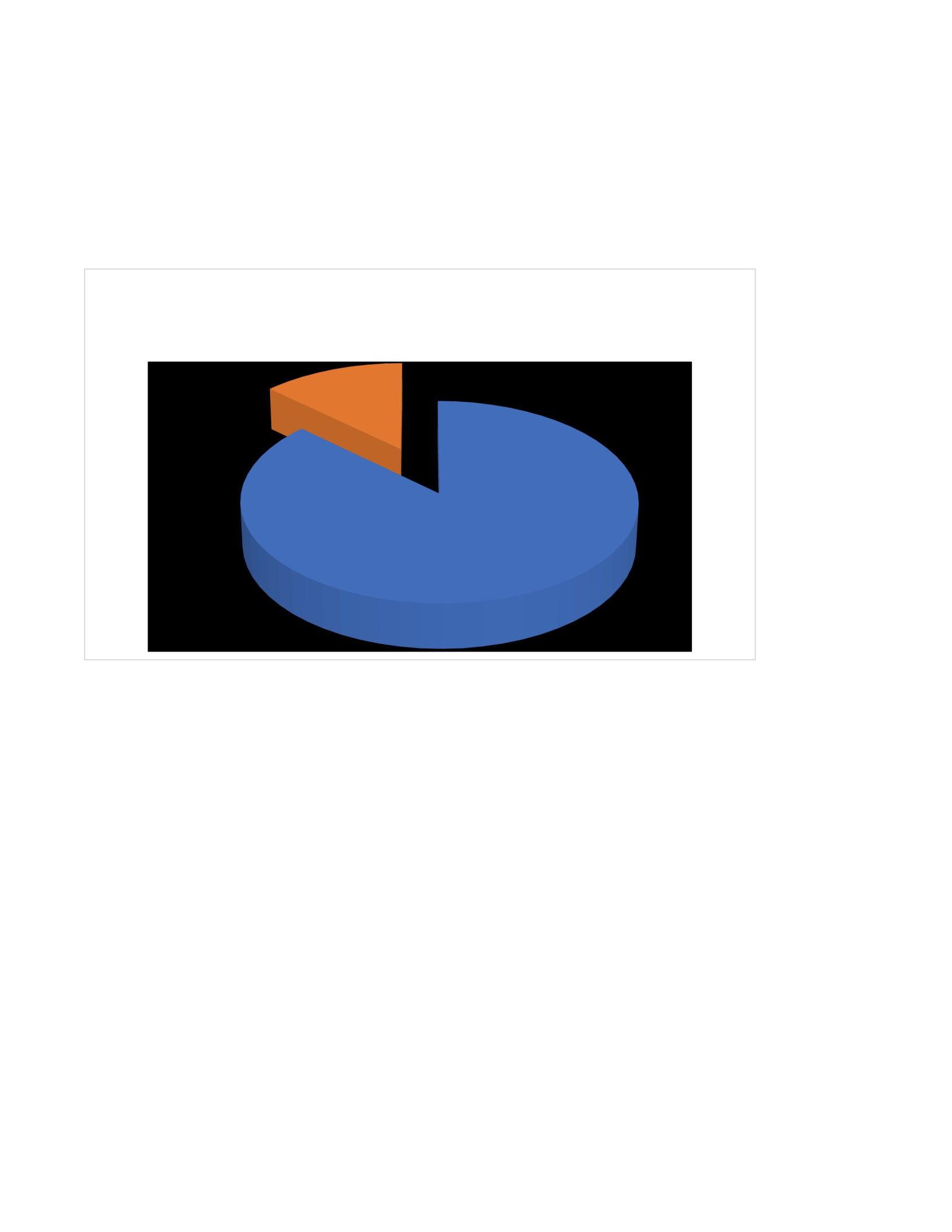
The study sought to establish the type of schools the respondents enrolled in, in Garissa County. The
result is as shown in the pie chart below:
Day
87%
Boarding
13%
Type of School
Figure 4.1: Type of Schools
From the findings above, day schools comprised 87% majority as compared to boarding schools which
comprised 13%. This is because the cost of setting up boarding schools is higher compared to day
schools. Furthermore, family ties in this region are well knit and parents don’t allow their children to be
far from them therefore they are enrolled in day schools.
3
4.2.1.1 Year of establishment of schools
The table below shows responses on when schools were established.
Table 4. 3 Year of establishment
Years since establishment Frequency Percentage
Less than 5 years ago 1 9.1%
5-10 years ago 4 36.3%
Over 10 years ago 6 54.6%
11 100%
From the Table 4. 3 above, schools which were built less than 5 years ago were so few in
comparison to schools which were built less than 10 years ago were 4, equivalent to 36.3% while
those that were built more than 10 years ago were 6, equivalent to 54.6%.
4.2.2 Classes in which adolescent girls were at the time of study.
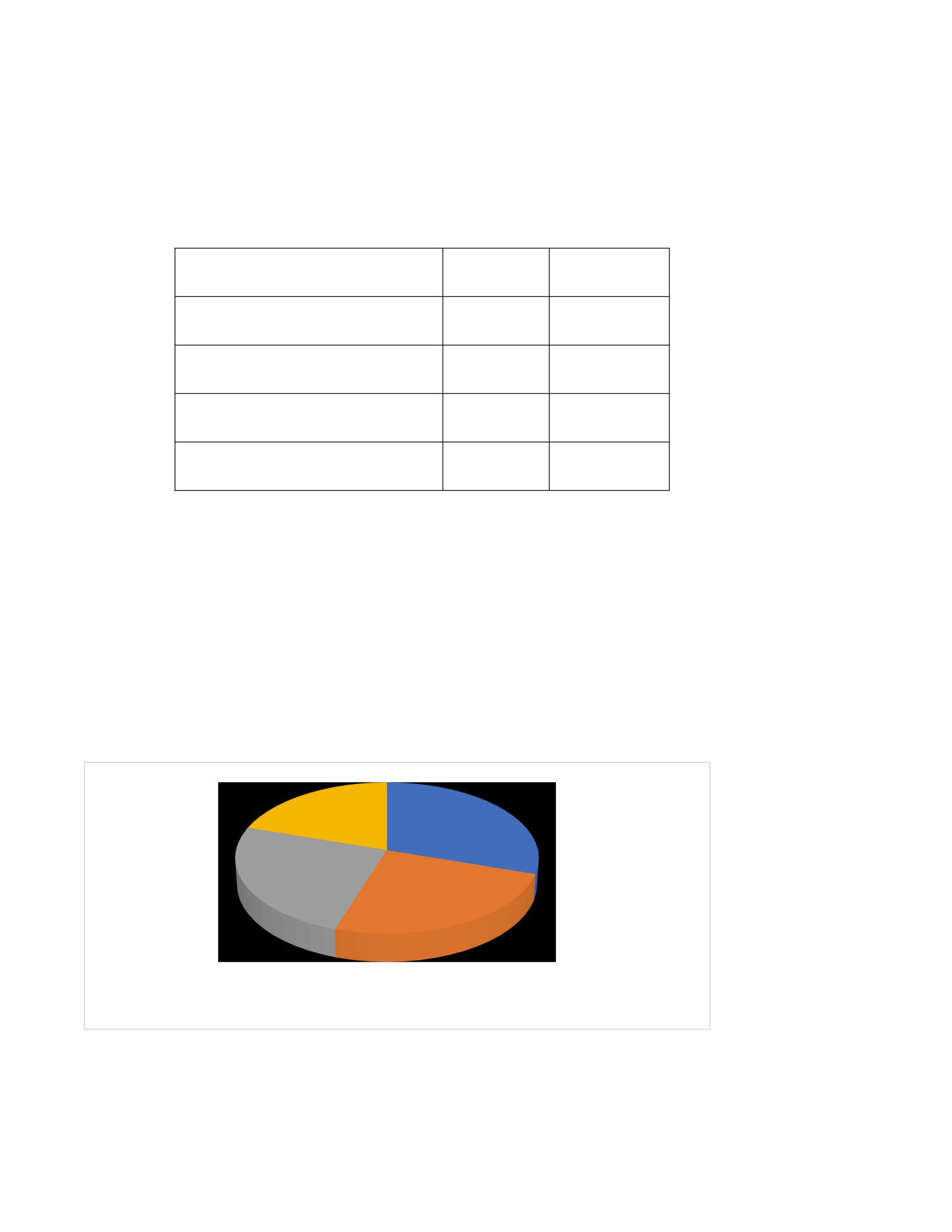
The study also sought to establish the classes of the respondents in this study. The result is as shown in
the pie chart below:
Form One
30%
Form Two
25%
Form Three
25%
Form Four
20%
4

Figure 4.2: Class of Respondents
Out of a total of 135 girls who were sampled, 30% were Form ones, 25% form twos and three
respectively and Form fours comprised 20%.
4.2.3 Age of Parents
The purpose of this was to enquire the demographical information regarding parents’ age as this has a
direct correlation to experience and information to culture and enrollment in secondary schools. The
findings are as presented in :
below 18
5% 19 to 35
20%
36 to 50
40%
51 to 60
25%
61 to 70
10%
Age
Figure 4. 2 Age of parents
From the pie chart above, there were no parents with children above 70years. Those aged below 18
years comprised of 5%an indication that early marriage is practiced in the community, those aged
between 19 and 35 years comprised of 20%, those aged between 36 and 50 comprised 40% majority
while those aged between 51 and 60 years comprised of 25% only.
5

4.2.3.1 Number of children per parent
The study sought to establish the number of children that the parents had. Table 4. 4 below shows the
distribution of number of children that each family had:
Table 4. 4 No of children per family
Number of children Frequency Percentage
1-2 45 15%
3-5 75 25%
6-10 180 40%
More than 10 60 20%
Total 300 100%
Those with 6-10 children were the majority with 40% while those with 3-5 children comprised of 25%.
Those with more than 10 children comprised of 20% while those with between 1-2 children comprised
of only 15%.
The researcher observed that birth rate in the region was high and this could be attributed to refusal of
family planning methods and therefore providing for the children was a difficult endeavor considering
the high cost of living and education and this led to parents not sending all of their children to school.
4.2.4 Distribution of gender of teachers who participated in the study
The following is the gender summary of the teachers sampled to participate in this study:
Table 4. 5 Gender of respondents
Response Frequency Percentage
6

Female 36 38.7%
Males 57 61.3%
Total 93 100%
From Table 4. 5 Gender of respondents female teachers were 36, representing 30.7% while male
teachers were 57 in number comprising of 61.3%. The low number of female teachers could be
attributed to the hot climatic conditions in the area making them not to cope easily and also due to
insecurity in the area making few female teachers apply for teaching opportunities despite the hardship
allowances.
Type of Schools taught by the teachers
The study sought to establish the type of schools that the sampled teacher-respondents taught. The result
is as presented in the Table 4. 6 table below:
Table 4. 6 Type of school
Response Frequency Percentage
Day 74 79.6%
Boarding 19 20.4%
Total 93 100
From the results in Table 4. 6 Type of school, nearly a fifth of teachers sampled were from boarding
schools while nearly four fifths of the respondents who were the majority were teaching in day schools.
Schools in the region are mainly day schools and this implies that to a greater extent education
7

challenges like absenteeism, early marriages and pregnancies are exhibited. This finding agrees with
Ating’a (2019) findings that depicted day schools exhibit more challenges than boarding schools.
4.2.4.1 Highest Level of Education for Teachers
The study sought to establish the highest level of education of the respondent-teachers. The following is
the result as presented in the Table 4. 7 Highest level of education for teachers below:
Table 4. 7 Highest level of education for teachers
Response Frequency Percentage
Diploma 20 21.5%
Bachelors 70 75.3%
Masters 3 3.2%
PhD 0 0.0%
Any Other 0 0.0%
93 100%
From the findings above, 20 teachers had diplomas. This was equivalent to 21.5%. teachers with
bachelors were the majority with 75.3% representing 70 teachers. Those with masters were only 3,
representing 3.2%. There were no teachers with PhD or any other qualification. This informed the
researcher that the information given by teachers is highly reliable.
4.2.4.2 Age bracket of teachers
The study also sought to establish the age bracket of the sampled teachers. The results is as shown in
table .
8
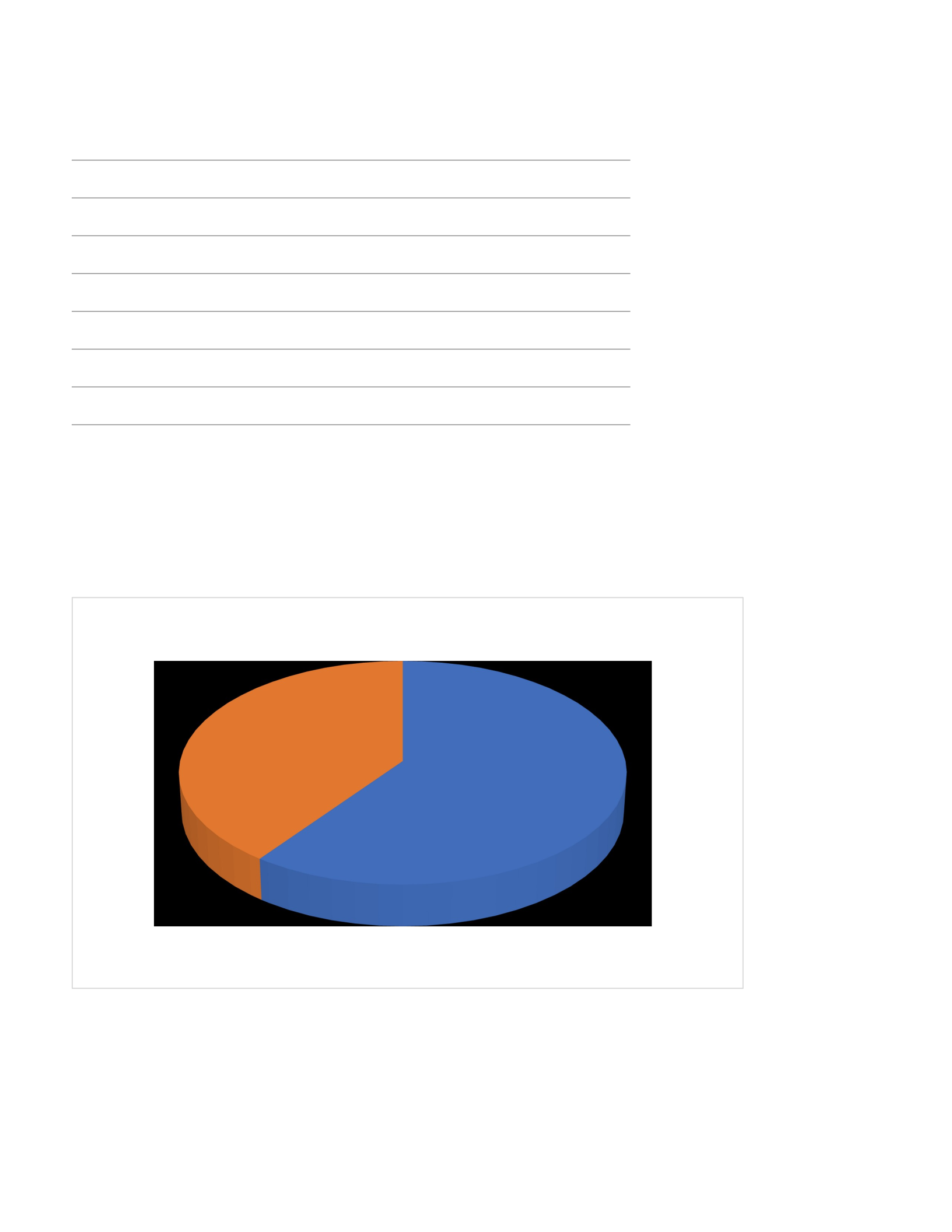
Table 4. 8 Age of Teachers
Response Frequency Percentage
Under 20 years 0 0%
20 – 29years 10 10.8%
30 – 39years 30 32.2%
40 – 49years 30 32.2%
50 and above 23 24.8%
93 100%
4.2.5. Gender of Education officers who participated in the study
The pie chart below shows the gender categorization of education officers:
Males
60%
Females
40%
figure 4. 3 Gender of respondents
9

From figure 4. 3 , 40% were females while 60% majority were males.This also depicts that in Garissa
county few women have meaningful employment compared to their male counterpart. This eventually
translates that the adolescent girls have very few role models whom they can look upto, unlike the boys
4.2.1.1 Period in charge of education officers
The study sought to establish the amount of time (period) in which the said education officers had stayed
in the region. The following is their response in the table chart shown below:
Table 4. 9 Period in charge
Period in charge in years Frequency Percentage
1 -3 years 4 45%
4-6 years 4 45 %
Over 6 years 1 5%
From the Table 4. 9 above, education officers who had served for over six years were fewer(5%) while
those who had served for 1 to 3 years and 4-6 years were equal at 45% .the period of their stay assured
the researcher to vital information they would share during the personal interviews.
4.2.2 Period in charge of head teachers
The study established the period in which the head teachers had served in the region. The following are
their responses in the table shown below:
10

Table 4. 10 Period in charge of the school
Period in charge in years Frequency Percentage
0-5 3 27%
6-10 8 73%
4.3 PRESENTATION OF RESEARCH FINDINGS AND ANALYSIS
4.3.0 Introduction
Questionnaires for adolescent girls, parents, teachers, head teachers and education officers
was designed to record their responses on the cultural beliefs and traditional practices that
hinder the enrollment of girl child in schools.
The questionnaires examined how cultural practices affected the enrollment of adolescent
girls,whether socio-economic factors among the Somali community affect adolescent girls’
enrolment in education, investigating parental attitudes towards the provision of education
and to identify specific interventions that can be applied to increase their enrolment to
schools in Garissa County.
The questionnaire dealt with questions that sought to establish the type of schools in the
county, the the number of adolescent girls that transited to secondary schools and those who
were enrolled but dropped out of school later. The study also sought to establish factors that
contributed to their dropout and whether the respondents felt some cultural practices should
be abolished from their community. The questionnaire also inquired from the respondents
on the commitment of parents towards studies and asked them to suggest the mitigation
measures which if taken could improve enrolment of girls in secondary schools. This
presentation was done from one objective to another. The following is the presentation for
the first objective.
11

4.3.1 Adolescent girls’ response on traditional factors affecting their enrollment in secondary
schools in Garissa County.
Questionnaires for adolescent girls out of school and those who were in school were designed to record
their responses on: the cultural beliefs and traditional practices that hinder adolescent girls enrollment in
Secondary schools, and to identify specific counseling interventions that can be applied to increase the
enrolment to schools in Garissa County. This was in line with the research study objectives. The
following are the study results as recorded in the questionnaires:
4.3.3.4 Level at which majority non-going school adolescent girls dropped out of school
The study sought to establish the level at which majority dropped out . The questionnaire designed was
answered by adolescent girls out of School. The result is as shown in the below:
Table 4. 11 levels at which the girls dropped at
Responses Frequency Percentage
Dropped in Primary 45 30%
Dropped in Secondary 95 63%
Non respondents 10 07%
Total 150 100%
12

Concerning the number of learners not in secondary school, it was established that fewer girls had
dropped out in primary school(30%) while the majority (63%) dropped out in secondary schools. This
informed the researcher that dropout rate is high in secondary schools than in primary schools.
On the traditional practices that led to their drop out, nearly one third of the non going school
adolescent girls indicated F.G.M as the cause of the their drop out. Another one third of the respondents
cited early marriage as a reason for their drop out while male preference was at 15%.A fifth of the girls
informed the researcher that none of the above practices caused them to drop out. They indicated various
reasons including poverty, early teenage caused pregnancies, corporal punishment, negative attitude of
teachers towards them, poor performance, and distance to school. From some of the responses in the
category of girls who dropped out due to non-cultural causes, the researcher cited indiscipline as a cause
of drop out. From the findings majorityof the respondents(80%) indicated that cultural practices
contributed to school drop outs followed by other non-cultural causes attributing to 20% as shown in the
table below.
Table 4. 12 Factors leading to dropout
Cause of drop out Frequency Percentage
F.G.M 52 35%
Early marriage 45 30%
Male preferences 23 15%
Non-cultural causes 30 20%
Total 150 100%
13

4.3.3.5 Major Form of initiation
From Table 4. 12 above, FGM tops the list as the common type of cultural practice that leads to
school dropout. This can also mean that FGM is the most common cultural practice performed
because even those girls who got into early marriages said during private interviews that by the time
they were married they had already undergone FGM. Another form of initiation was nikkah- a
traditional form of marriage, equivalent to engagement and is believed to be inspired by Islamic
teachings. From this finding, it was observed that despite the government’s ban on this retrogressive
practice, FGM is still rampant in Garissa Count.
It was established that other than the practice of FGM culturally as a right of passage and cleansing
measure, to clean their girls in preparation for marriage, the belief that any girl who underwent FGM
had a higher chance of getting married as opposed to those not yet initiated was a major contributor to
this vice.It was also established that those who did not go through FGM were stigmatized and ridiculed
publicly to the extent of labelled as deviants.
4.3.4 Parents’ response on traditional factors affecting enrollment of adolescent girls in secondary
schools in Garissa County.
The researcher sought to establish the views of parents on traditional practices affecting the enrollment
of adolescent girls in secondary schools in Garissa County.
4.3.4.1 Cultural practices
Initiations
The study sought to investigate whether any of the respondents had taken their children through any
form of initiation.
14

Table 4. 13 Conduction of initiations
Responses Frequency Percentage
Yes 270 90%
No 9 3%
Non-respondents 21 7%
Total 300 100
From the study, it was established that majority of the parents had taken their girls through some form
of initiation while very few parents indicated that they had not taken their girls through any form of
initiation. Around one tenth of the respondents declined to respond. It informed the researcher of how
highly the community regarded their cultural practices furthermore the researcher noted the initiations
are practised by both the educated or not, the poor or rich and the women decide when their daughters
will undergo the initiations.
Type of initiations practised.
This study sought to investigate the most common type of initiation practiced in Garissa County. the
parents responded to this and their responses were as tabulated in Table 4. 14 below.
Table 4. 14 Type of initiation carried out
Type of initiation Frequency Percentage
F.G.M 270 90%
Early marriage 138 46%
FGM and Early marriages 122 41%
15

Non respondents 30 10%
Total 300
From Table 4. 14Table 4. 14 Type of initiation carried out, it was noted that some parents only allowed
one type of initiation to be conducted on their children .while it was also observed that other parents
allowed their children to undergo more than one type of initiation and during the interviews, some
parents informed the researcher that according to their community F.G.M is not a violation of rights of a
child and is not not as dangerous as perceived. The parents also informed the researcher the initiations
are a step to raise and protect a girl and make her legible for marriage.
4.3.4.2 Other cultural activities and activities that have come to be cultural practices
The purpose of this part was to establish how cultural practices, and other cultural practices, according
to parents, have come to influence enrollment of adolescent girls in secondary school. On this, parents
were to indicate the extent to which they agreed or disagreed with the pre-designed statements where:
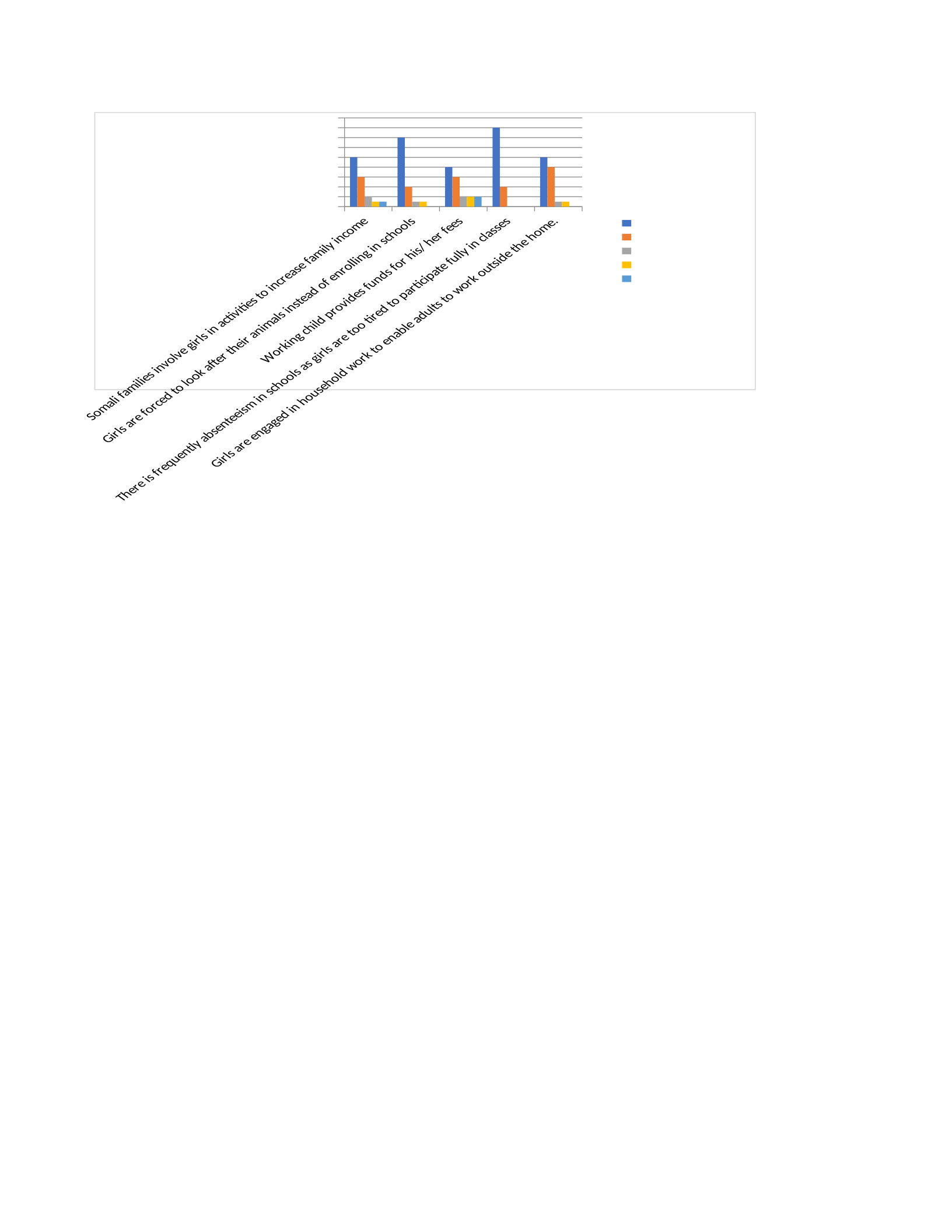
SA = Strongly Agree A = Agree U = Undecided D = Disagree SD = Strongly Disagree. The following is
the findings:
16
0%
20%
40%
60%
80%
Strongly Agree
Agree
Undecided
Disagree
Strongly Disagree
Figure 4. 4 Subtle cultural practices
From the graph above, it was established that four tenths of the respondents agreed that Somali families
involved their girls in activities to increase family income. Majority of the respondents agreed that girls
are forced to work and look after their livestock instead of enrolling in schools.
On the other hand, the researcher observed that four tenths of the respondents cited that working
children provide funds for their fees. Majority agreed strongly that there was frequent absenteeism in
school as girls were too tired to participate fully in classes and half of the respondents also agreed very
strongly that girls were engaged in household work to enable adults to work outside the home. The
researcher concluded that cultural practices were still propagated in the community and these practices
affected the school-going girls negatively.
4.3.4.3 Other Suggested Cultural Practices
Other than the commonly known cultural practices like female genital mutilation, forced marriages,
early marriages and polygamy, parents cited other cultural practices like over-emphasis on Quranic
education, and food taboos as other prominent cultural practices that have been a hindrance to
17

enrollment of adolescent girls to secondary schools. Parents also said during private and confidential
interviews that there are other activities that have come to be cultural practices including school-going
age girls working to increase family income, and working at home to enable parents to work outside the
homes.
4.3.4.4. Reasons for the persistence of some cultural practices
Garissa County is mostly composed of Somali community which is predominantly Muslim. Most of
these cultural practices have a backing of Islamic teachings attached to them. for example, there is a
belief in Muslims that every child must attend Madrasa lessons before considering Western education.
This in Muslim most likely delays the girls from entering school for Western education in good time.
Secondly, the Islamic teachings on marriage require that women and girls alike must always submit
and take a passive position in society. The researcher noted that some parents fear that other families
would not approve of their daughters as adults if F.G.M. was not done on them and their sons will
refuse to marry them. During interview sessions with parents, there were views that a woman was
generally considered unclean if she was not circumcised. Also, it was considered that prayers made by
uncircumcised women were unacceptable before God. Further, parents believed that mutilated girls
were fertile compared to the unmutilated counterparts. These were some of the reasons which justified
the cut.
4.3.4.5. Suggested possible solutions
The suggested possible solutions to the elimination of the above persisted cultural practices included use
of security organs to enforce the policy of 100 percent transition. This would also include the area chiefs
and county commissioners. it was also suggested that parents should be offered alternative
empowerment skills.
18

4.3.5. Teacher’s responses on traditional factors affecting enrollment of adolescent girls in
secondary schools in Garissa County
4.3.5.1 Cultural practices
The purpose of this part was to capture the main cultural practices, according to teachers, that influenced
adolescent girls’ enrollment in secondary schools.
Period served as class teacher
The study sought to establish the number of years the respondents had served as class teachers.
Consequently, the result is as shown below:
Figure 4. 5 Period as
a class teacher
From the pie chart
above, it was
established
that those who had served as class teachers for one year were only one tenth, those who had served for 2
years were nearly one third, those who served for 3 years were a quarter and those who had served for 4
and 5 years were also one tenth . A majority (99%) of the class teachers had already served more than
two years and this implied that they had a vast knowledge of the issue of absenteeism and the factors
leading to it.
4.3.5.2. Record of students who are frequently absent
The study sought to establish from the class teacher if they were aware and indeed had a record of
frequently absent students. The result is as shown in the pie chart below:
19
1 year
10%
2 years
30%
3 years
25%
4 years
10%
5years
10%
over 5 years
15%

yes
98%
No
2%
Frequently Absent Students
Figure 4. 6 Frequently absent students
From the pie chart above, majority of the class teachers indicated that they had records of frequently
absent students. Those who said they did not have such a record were very few and this could be
possibly attributed to the turn over of teachers in the region due to insecurity.
4.3.5.3. Reasons for absenteeism
This study sought to establish reasons for absenteeism. Consequently, a majority indicated that many
students missed school due to school fees and others due to mandatory participation in Islamic religious
activities such as fasting, madras and other celebrations. Others indicated that others decided to just stay
at home for being discouraged by their parents. The class teachers indicated that the top three reasons for
dropping out of school were: early marriages, FGM and Islamic religious activities.
4.3.5.4. Students’ involvement in cultural activities
Class teachers were asked if they were aware their students were involved in cultural practices.
20

yes
95%
No
5%
Figure 4. 7 Students involvement in cultural activities
Majority of the respondents indicated that they were aware that their learners were involved in cultural
practices and this depicts how rooted the cultural practices are in the region. Very few indicated
otherwise and this could be attributed to the other communities living in the region that don’t participate
in the cultural practices.
4.3.5.5. Main cultural practices
The main cultural practices mentioned were FGM and early forced marriages. However, there were
other cultural practices mentioned such as nikah (traditional marriage in Islam), unyago (traditional
ceremony performed with a lot of dances and rites to celebrate the coming of age of a girl for marriage)
and night vigils during weddings.
4.3.5.6. Effects of cultural practices on learners
This study sought to investigate from the class teachers on whether or not the above-mentioned cultural
practices affected enrollment of adolescents. Information was sought through group interviews and
discussions which involved note taking. According to teachers, mothers encourage girls to marry early
thus threatening their education. More often than not girls are married while still teenagers and when
21

they are married, they assume family responsibilities of being housewives and taking care of children,
thus cannot continue with learning as they will inevitably quit school. Child marriage (early and forced)
is a big threat to the enrollment and progression of the girl child in school. Majority of the respondents
were convinced that girls who gave birth at a tender age had a higher chance of low birth weight infants
and this finding concurs with Vilgwan (2010 ) who stated that the weight of newborns was significantly
influenced by the age of the mother and low birth weight is high in adolescent mothers and may lead to
death or frequent visits to hospitals causing delay in enrollment of adolescent girls in schools. From the
researcher’s perspective, low birth weight may inhibit the cognitive development of the child causing
the adolescent mother to seek medical attention and at times become not interested in education but
interested in the health and progress of the child leading to her terminating her education.
Respondents agreed that F.G.M causes trauma and the thought of the expert holding the razor caused
chills to some of the girls. In addition, one of the teachers interviewed attested that when one girl went
to high school in a different county, she realized that she was being stigmatized with other girls and it
taught her a lesson never to say that she was circumcised wherever she is away from Garissa County.
The respondents agreed that f.g.m may lead to urinary tract infection at the same time only very few
disagreed with the statement. A majority of the respondents further agreed that f.g.m led to lack of
concentration in class while and only very few disagreed with the statement during interviews.
4.3.5.9.1 Cultural practices to be abolished
Teachers were asked if there were some cultural practices that should be abolished immediately. Their
response was that most of the cultural practices needed to be abolished immediately. They listed FGM,
Forced marriages and early marriages. This is because in the case of F.G.M. due to excessive bleeding
involved, it may cause anaemia more in girls who undergo the practice at a tender age.
22

Pain was also cited as an impact of f.g.m thus the need to be abolished however the researcher realized
that it was perceived differently by other respondents s who emphatically perceived pain as a normal
experience and one of the teachers was quoted verbatim saying” It is a taboo to cry during the cut
because the girl may not get a man and therefore a sacrifice should be offered. Enduring pain is an
experience in preparing a woman for a role as a wife and mother.”
4.3.5.9.2 Reasons for persistence of cultural practices
Teachers were asked to explain why they thought such cultural practices had persisted for too long.
They observed that Somali community is structured in a patriarchal manner and women have little or no
influence. The young respected community elders as custodians of the culture and are always ready to
protect it. Furthermore, they responded that girls undergo early marriages as a way of enriching their
families with wealth
4.3.5.9.3. Alternative rites of passage for adolescent girls
Teachers were asked to suggest some alternative rites of passage for the adolescent girls
and they responded by suggesting that girls are to be taken to camps and be taught about
health education and intercommunication skills
4.3.6 Education officers’ response on traditional practices affecting enrollment of adolescent
girls in secondary schools in Garissa County.
Education officers play a major role in regard to administration, monitoring, evaluation, management
and implementation of government policies on education. They always ensure that children have access
23
to quality education and have transited to the next level successfully. They were therefore important in
the undertaking of this study. This section captures their responses as presented below:
4.3.6.1 Existence of cultural practices
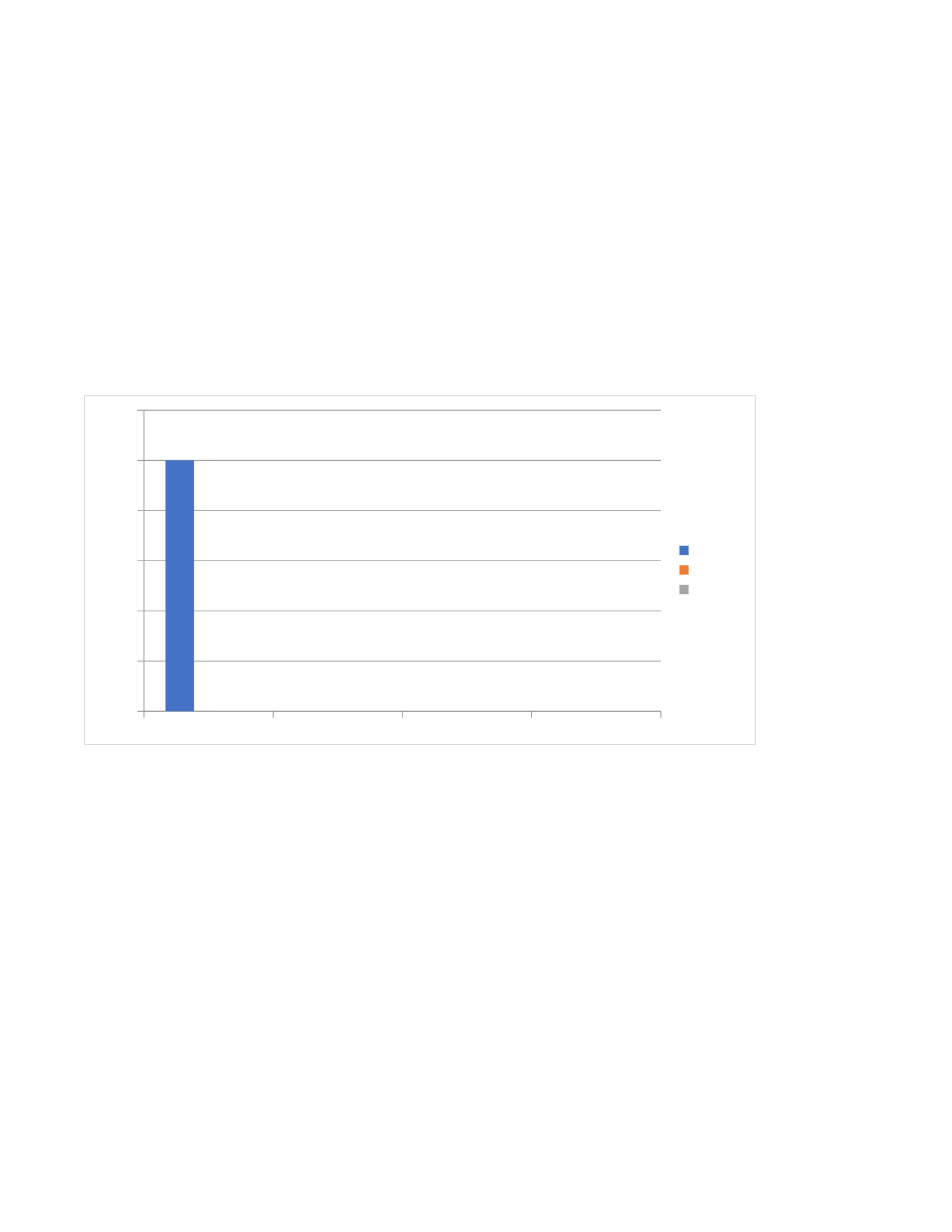
The graph below shows the response of the education officers on whether they are aware of the
existence of cultural practices in their areas of work:
yea no
0%
20%
40%
60%
80%
100%
120%
Series 1
Series 2
Series 3
Figure 4. 8 Existence of cultural practices
From above, all of the officers observed that they were aware of the existence of cultural practices in their areas
of work and this implied that cultural practices are deeply rooted within the county.
4.3.6.2 Cultural practices and factors influencing the practices
The officers were requested to mention some of the cultural practices they were aware of and how they
influenced the enrollment of adolescent girls in secondary schools. FGM was prominently mentioned.
24

Other cultural practices mentioned were early marriages, forced marriages , over-emphasis on Islamic
education on Madrasa and unyago.
4.3.6.3 Suggested mitigation measures by Education Officers
Officers suggested the need for civic education to parents on the impact of such cultural practices like
FGM, Forced marriages and over emphasis on Quranic education instead of western education.
4.3.7 Head teachers’ Response on Traditional Practices Affecting Enrollment of adolescent girls
in secondary schools in Garissa County
A questionnaire was designed to specifically capture the response of Headteachers and principals
regarding the enrollment and transition of adolescent girls in Garissa County. Principals and Head
Teachers play a key role in ensuring that girls are taken care of and are well supported while at school so
as to access quality education, safety and a learning environment. Their input was therefore very
significant in this study. Below is the detailed response from them regarding the subject of this study:
4.3.7.1 Average Class/School enrolment
The purpose of the table below was to establish the average class enrollment rate.
Table 4. 15Average class enrollment
STUDENT
GENDER
FORM 1 FORM 2 FROM 3 FORM 4
BOYS 45 43 42 40
GIRLS 36 32 21 19
From Table 4. 15 above, form one class had an enrollment of 36 girls while boys were 45. Form two
class had an average enrollment of 32 girls while boys were the majority at 43. Form three had an
25

average enrollment of 21 girls while boys were 42. On the other hand, the enrollment rate of girls in
form four was 19 while that of boys stood at an average of 40. The majority of the girls dropped out
between Form Two and Form Three which translates to nearly one third. From the researcher's opinion,
the girls dropped out end of form two because at this age majority have physically developed and can be
married off.
4.3.7.2 Principal’s experience on girls enrollment and retention
It was established that a significant majority of principals indicated that the enrollment of girls in
secondary school had always remained low as compared to that of boys. They also observed that the
retention rate was minimal as the number of drop outs in girls was always constantly higher compared to
that of boys and this was attributed to socio-economic and cultural factors and this revelation agrees
with findings that there are some cultural factors that highly impact girls as much as they impact on the
boys
4.3.7.3 Common cultural practices in the region.
Principals were requested to identify most common cultural practices in the area with the view of
establishing their influence on enrollment of adolescent girls in secondary schools. Majority of
principals observed that the most common socio-cultural practices were FGM, forced marriages and
early marriages. They also mentioned poor parental attitude towards educating girls among the
community members. Over-emphasis on Quranic education was also another practice that was
mentioned.
The study sought to establish whether cultural practices played a major role in influencing the
enrollment and retention of adolescent girls in schools. All principals strongly observed that cultural
practices influenced the enrollment of adolescent girls in secondary school. The researcher also
realized that cultural beliefs and norms have constrained girls' education and this finding
concurs with Shahidul & Karim,( 2015) who examined the claim that many cultures favour education for boys
more than girls
26

4.3.7.4 Suggested cultural practices to be abolished
Most principals suggested that there was an urgent need to abolish early marriages, FGM and forced
marriages among school-going girls.
4.3.7.5 Mitigation measures
School principals suggested several mitigation measures. First, a need for civic education to empower
older members of society so as to enable them to support the abolishing of FGM practices, and early
forced marriages as well as the need to support education for the girl child. The culture of nomadism
should also be replaced by settler farming approaches stemming from irrigation and zero grazing.
27

4.4 HOW DOES SOCIO-ECONOMIC FACTORS AMONG THE SOMALI
COMMUNITY AFFECT GIRLS’ ENROLMENT IN SECONDARY EDUCATION?
4.4.1 Introduction
The researcher sought the responses of his targets on socio-economic factors that hinder
enrollment of adolescent girls of Somali the Community. The responses were sampled out from
different groups of respondents that included, adolescent girls themselves, Parents, teachers,
Principals and QUASOs. The following are the sampled-out responses from various groups.
4.4.2 Adolescent girls’ response on socio-economic factors affecting their enrollment in
secondary schools in Garissa County
Socio-Economic Factors
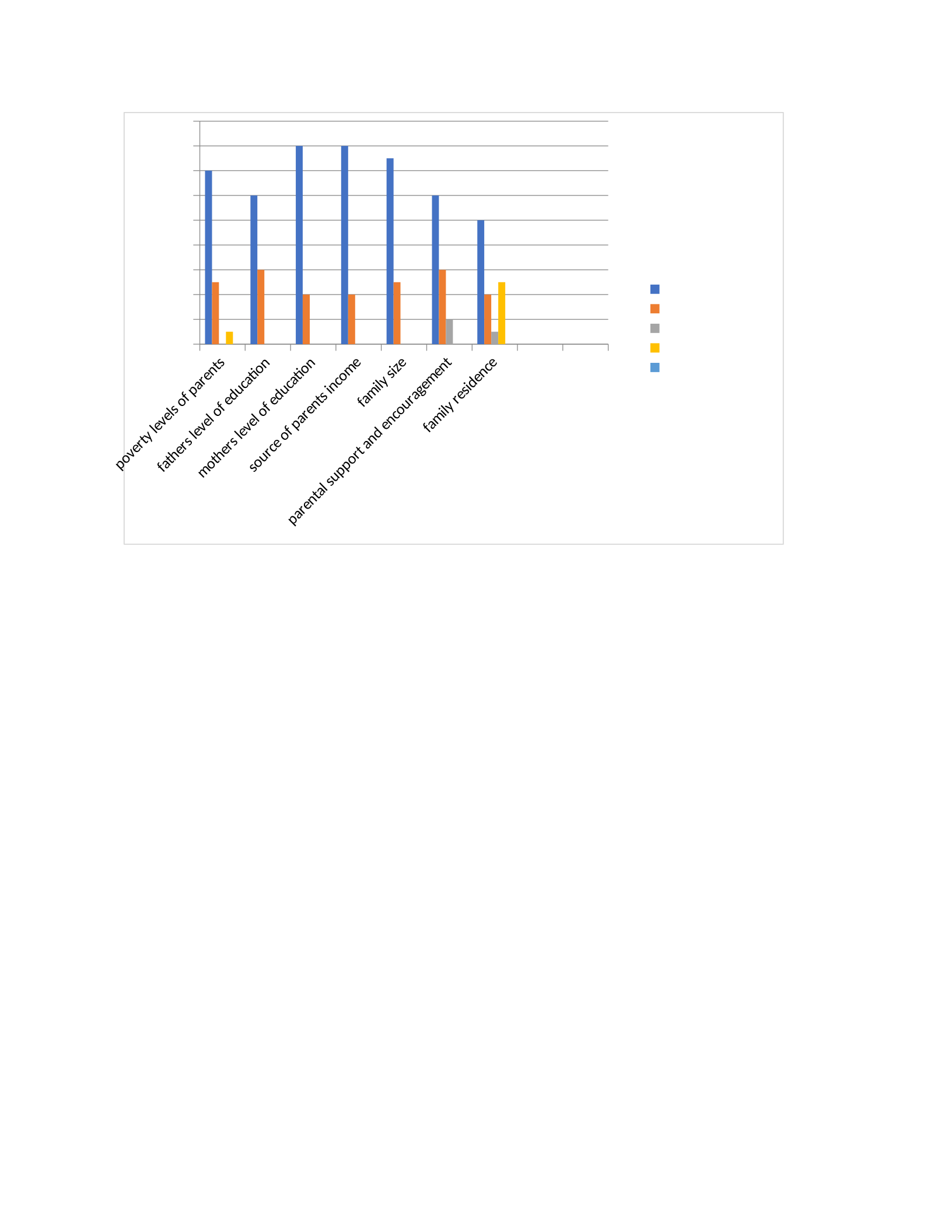
The researcher wanted to establish the influence of socio-economic practices on enrolment of
adolescents. This was through collecting the views of adolescent girls themselves. On a scale of
SA = Strongly Agree A = Agree U = Undecided D = Disagree SD = Strongly Disagree, the
researcher intended to establish the extent to which socio-economic factors such as poverty
levels, father’s level of education, mother’s level of education, source of parents income, family
size, parental support and family residence influenced enrollment. The findings were as shown in
the graph below:
28
0%
10%
20%
30%
40%
50%
60%
70%
80%
90%
Very Great extent
Great Extent
Undecided
Little extent
very little extent
figure 4. 9 Socio-economic factors
From figure 4. 9 above, all the said factors influenced the enrollment of adolescents to a great
extent. It was established that the poverty levels of parents influenced enrollment negatively by
a majority of the respondents. Mothers’ level of education was considered more influential than
fathers’ level of education . majority of the respondents cited that the source of parents’ income
influenced the girls enrollment more than family size, parental support and family residence
area respectively.
Majority of the adolescent girls who had dropped out cited that, the poverty levels of parents
negatively influenced enrollment . Majority of these girls had parents with a low level of
education and this was considered to as some of the factors that affected their enrollment in
secondary education. Mothers' level of education affects the girl's education more than the
fathers education and this finding agrees with Duel (2016) whose realization of mothers'
education is that educated mothers reduce time spent on household activities while increasing
time spent on their children and can monitor their children than the uneducated counterparts.
29

Father’s level of income and how it affects the girls’ education was significantly high this is
because of the patriarchal nature of the community whereby the man is seen as the breadwinner
of his household. Livestock keeping is the main source of income in the community therefore
parents rely on the sale of their livestock to afford the cost of education but in case of drought the
cattle die or don’t fetch good market price therefore parents will struggle to get the fees for their
children. Family size was another factor that affected girls enrollment highly. While families
with large number of children struggle to keep their boys in School, the researcher found out that
resources are overstretched to keep girls in school.
This finding agrees with the study done by Chermichosky, (1997) whereby his findings attribute
that other household members substitute for child labour so that their children attend schooling.
His finding also admits that in smaller households, children are likely to be diverted to offer
family labour and caregivers in times of sickness. Place of residence and long distances to school
also affects girls’ enrollment in schools since they walk for long hours and arrive back home
while tired.
4.4.2 PARENTS’ RESPONSE TO SOCIO-ECONOMIC FACTORS AFFECTING
ENROLLMENT OF ADOLESCENT GIRLS IN SECONDARY SCHOOLS IN
GARISSA COUNTY
This section sought to examine the extent to which social economic factors such as poverty
levels of parents, fathers' education level, mother's level of education, source of family income,
size of family, residence of family and how often parents talk about sex education to their
adolescent girls influence enrollment to secondary education. the findings are as presented in the
table below:
Socio economic factor Frequency Percentage
Poverty level 180 60%
Mothers’ level of education 240 80%
Source of family income 210 70%
30

Family size 180 60%
Residence of family 180 60%
Parents talk on sex education 270 90%
Total 300
Figure 4.13: Socio-Economic Factors
Education level of parents was found to greatly affect girls education more so the mothers
education . This is because they acted as role models to their daughters and could be assisted
easily to academic work.Poverty levels of parents also affected the girls enrollment in that
children from illiterate poor homes were fewer in schools than their rich counterparts. Moreover
students whose parents had higher socioeconomic status and higher levels of education had a
high regard for learning and therefore encouraged the girls to continue with education.
The source of income of parents affected girls' enrollment majorly which implied that low-
income families were more likely to be preoccupied with environmental stressors within their
neighborhood like housing status and this finding agrees with Norm (2004)
Two thirds of the respondents cited that family size affected girls' enrollment, the researcher
observed that family resources are overstretched when family members are many and therefore
girls' enrollment was low due to preference for their male counterparts in the use of the limited
resources available. The researcher also found out that the type of family whether
(monogamous/polygamous) had an impact on enrollment in that children from monogamous
families were able to be fully enrolled in schools, unlike children from polygamous families.
The researcher realized that there exists a relationship between the place of residence of the
family in relation to location of the school and the girls' enrollment. The long distance to school
affected adolescent enrolment and these findings agree with Tabassum, ( 2023)who found out
31
that long distance to school affected students' enrollment. However, the above findings differ
from Camello’s study (2014) whose finding showed that there exists no significant difference in
student enrollment when they were grouped according to the distance of their school from their
place of residence.
4.4.2.1 Suggested Mitigation Measures
Indicate the extent to which you agree or disagree with the following statements using the
following key: SA = Strongly Agree A = Agree U = Undecided D = Disagree SD = Strongly
Disagree
0%
20%
40%
60%
80%
Strongly Agree
Agree
Undecided
Strongly Disagree
Column1
Figure 4. 10 Mitigation measures
: Suggested Mitigation Measures
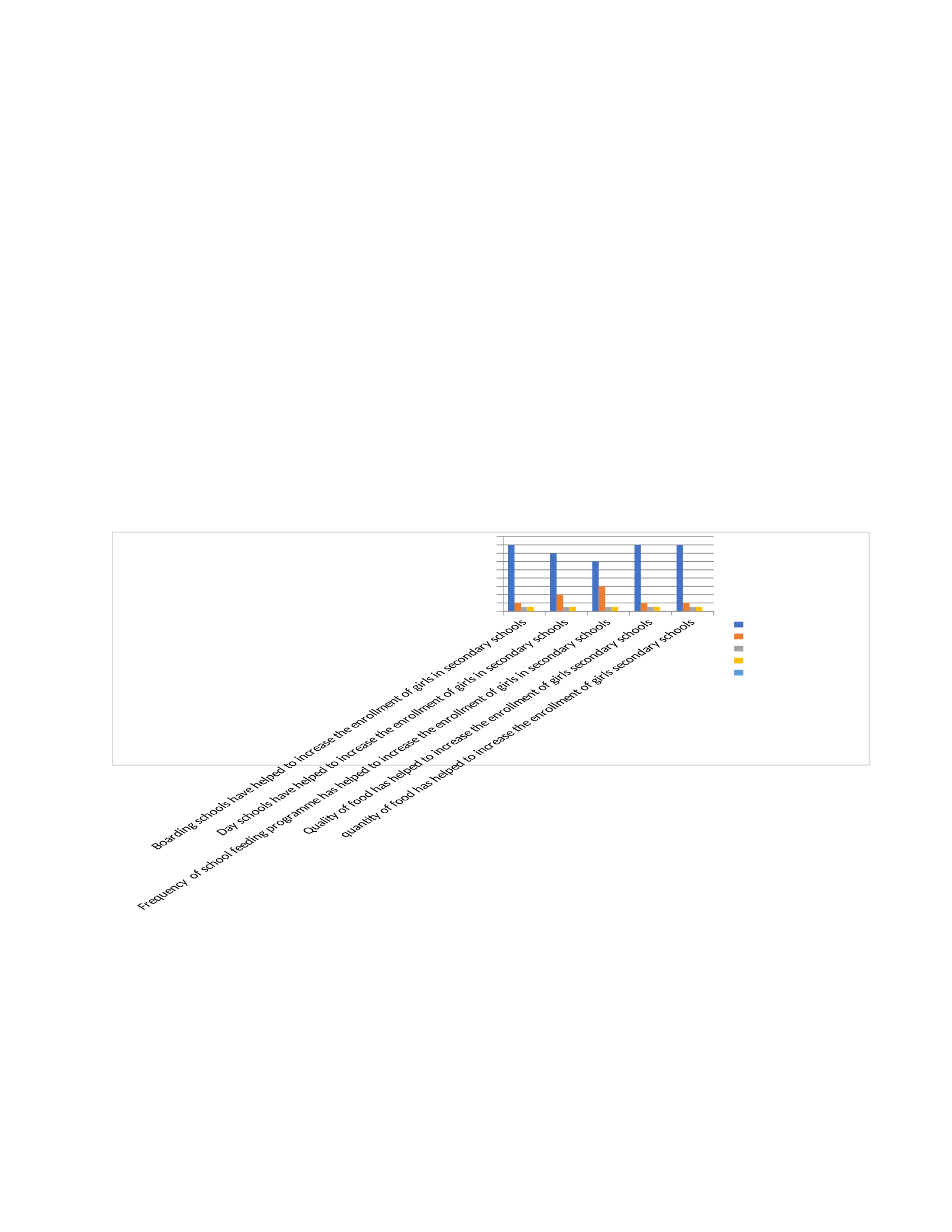
From Figure 4. 10 it was established that majority of the respondents agreed that both boarding
schools and day schools had increased the enrollment rates for girls in secondary education. The
32

frequency of school feeding program as a ,mitigation measure was also cited by majority of
respondents to have increased the enrollment of girls.
Other mitigation measures by the community
Most respondents suggested the introduction of mobile schools for adolescent girls. This would
ensure that students are able to be taught as they move from one location to another in search of
pasture and water for their livestock. Others suggested the need to shift to settlement agriculture
and wished the government provided water for irrigation.
4.4.3 TEACHER’S RESPONSE ON FACTORS AFFECTING ENROLLMENT OF
ADOLESCENT GIRLS IN SECONDARY SCHOOLS IN GARISSA COUNTY
4.4.4 Socio-economic factors.
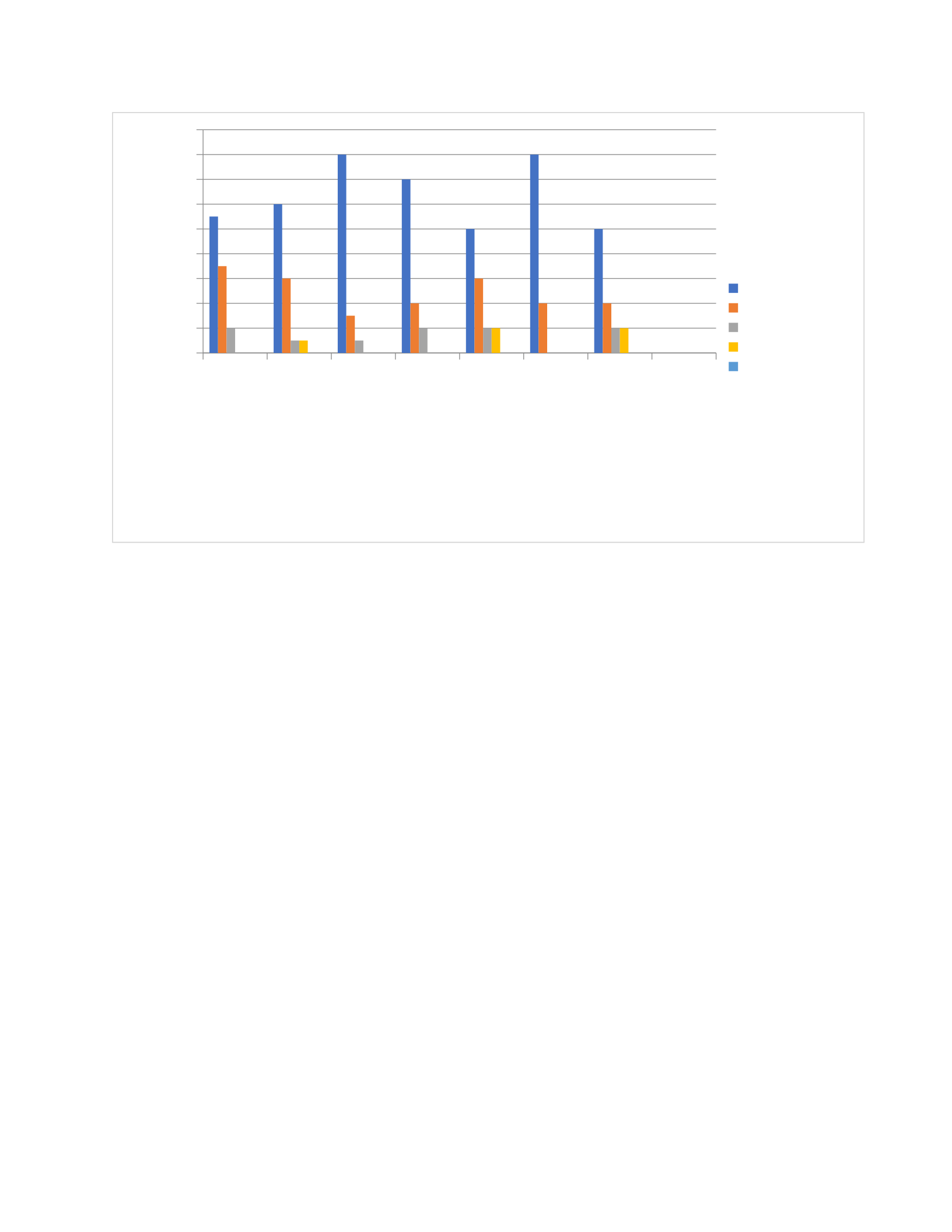
The study sought to examine from teachers, the extent to which socio-economic activities
influenced enrollment of adolescent girls in secondary school. The socio-economic factors
included poverty levels, fathers level of education, mothers level of education, family income,
family size, support and encouragement by parents as well as the residence of the family. The
findings are as presented in the Figure 4. 11
33
Poverty levels of parents
Fathers level of education
Mothers level of education
Source of income of parents
Family Size
Parents support and encouragement
Place of residence of the family
0%
10%
20%
30%
40%
50%
60%
70%
80%
90%
Very Great Extent
Great Extent
Undecided
Little Extent
Very Little Extent
Figure 4. 11 Responses on socio-economic factors
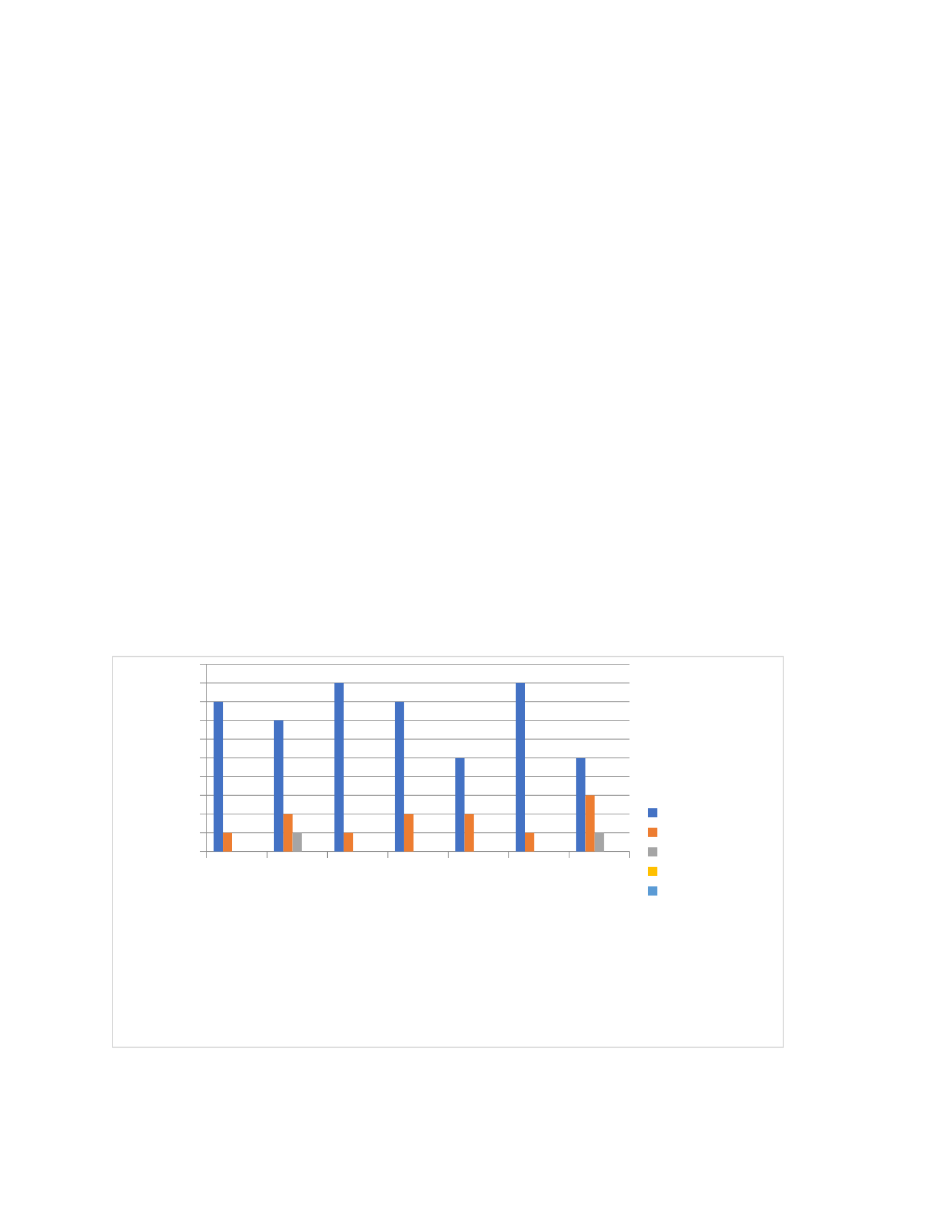
From the Figure 4. 11 above, it was established that mother’s level of education and parental
support were key factors influencing enrolment of adolescents while followed by family source
of income, father’s level of education and poverty levels of parents respectively. Place of family
residence and family size was cited by half of the respondents to have influenced girls’
enrollment. Mothers level of education affected the girls’ enrollment higher than the father’s
education but at the same time some teachers felt that the father’s education level affected girl’s
enrollment more than the mothers education because being a patriarchal society, fathers are
supposed to be the providers of the families. The researcher also realized that place of residence
affected the girls' enrollment and this finding concurs with Baliyan & Khama, (2020) who assert
that walking long distances to school daily has a negative impact on students' enrollment as it
promotes fatigue and absenteeism. At the same time, some teachers didn’t agree with the
statement that place of residence affects girls' enrollment and argued that distance to school is
determined by parents’ school preferences and willingness to travel.
34
4.4.6 EDUCATION OFFICERS’ RESPONSE ON SOCIO-ECONOMIC FACTORS
AFFECTING ENROLLMENT OF ADOLESCENT GIRLS IN SECONDARY SCHOOLS
IN GARISSA COUNTY
Education officers were tasked to provide their views on social-economic factors affecting
adolescent girls enrollment in secondary schools. In line to their management role in education
their views were important in the undertaking of this study. This section captures their responses
as presented bow:
4.4.6.1 Socio-economic factors.
This section sought to find the influence of socio-economic factors on enrollment of adolescent
girls in secondary schools as seen by education officers. Specifically, the researcher was
interested on poverty level of parents, father’s level of education, mothers level of education,
family size, parental support and encouragement and area of residence for the family. The
findings were as shown in Figure 4. 12 :
Poverty levels of parents
Fathers level of education
Mothers level of education
Source of income of parents
Family size
Parents support and encouragement
Place of residence of the family
0%
10%
20%
30%
40%
50%
60%
70%
80%
90%
100%
Very Great Extent
Great Extent
Undecided
Low Extent
Very Low Extent
Figure 4. 12 Responses on socio-economic factors
35
From the Figure 4. 12, majority of the officers agreed that parental support and encouragement
and mothers level of education influenced adolescent girls enrollment at a very great extent
followed by poverty levels and source of family income . majority highlighted fathers’ level of
education had an influence to the girls’ enrollment at great extent while only half of the
respondents cited that family size and place of family residence had an influence on girls
enrollment. The researcher’s findings realized that majority of the officers agreed that socio
economic factors affect girl’s enrollment to a very great extent.
4.4.6.2 Suggestions and mitigation measures
Figure 4. 13 shows the responses on the suggested mitigation measures so as to increase the
enrolment of adolescent girls in secondary schools.
0%
20%
40%
60%
80%
100%
Strongly Agree
Agree
Undecided
Strongly Disagree
Column1
Figure 4. 13 Mitigation measures
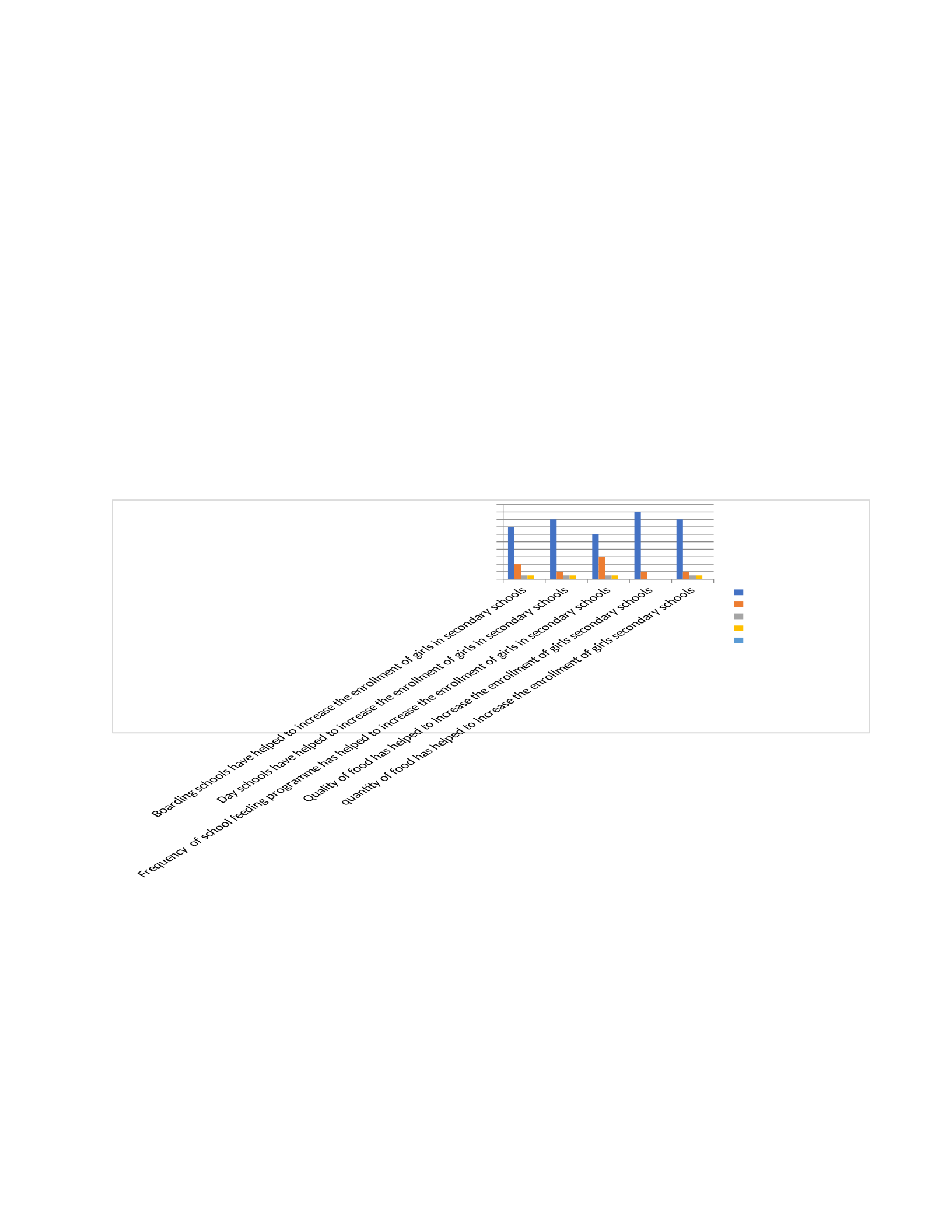
From Figure 4. 13, majority of the education officers agreed strongly that boarding schools have
increased the enrollment rates of girls in secondary schools. They also strongly agreed that day
schools increased the enrollment rates and on the frequency of school feeding programs, almost
all agreed that it helped increase the enrollment of girls.
36

4.4.6.3 Other suggested measures
The education officers suggested that the local administration in collaboration with the relevant
government agencies to develop a follow up networking strategies so as to nab students dropping
from schools. Parents who kept their children at home to be charged in a court of law.
4.4.7 HEAD TEACHERS’ RESPONSE ON SOCIO-ECONOMIC FACTORS
AFFECTING ENROLLMENT OF ADOLESCENT GIRLS IN SECONDARY
SCHOOLS IN GARISSA COUNTY
Head teachers, also referred to as Principals in this study, play a key role in ensuring that girls
are taken care of and are well supported while at school so as to access quality education, safety
and conducive learning environment. Their input on how socio-economic factors affect
adolescent’s enrollment in secondary Schools was therefore very significant in this study. Below
are their detailed responses:
4.4.7.1 Socio-economic factors
The graph below shows the extent to which various socio-economic factors influenced
enrollment of adolescent girls in secondary schools in Garissa County:
37
Poverty levels of parents
Fathers level of education
Mothers level of education
Source of income of parents
Family size
Parents support and encouragement
Place of residence of the family
80%
70%
90%
80%
50%
90%
50%
10%
20%
10%
20% 20%
10%
30%
10% 10%
Very Great Extent Great Extent Undecided Low Extent Very Low Extent
Figure 4. 14 socio-economic factors
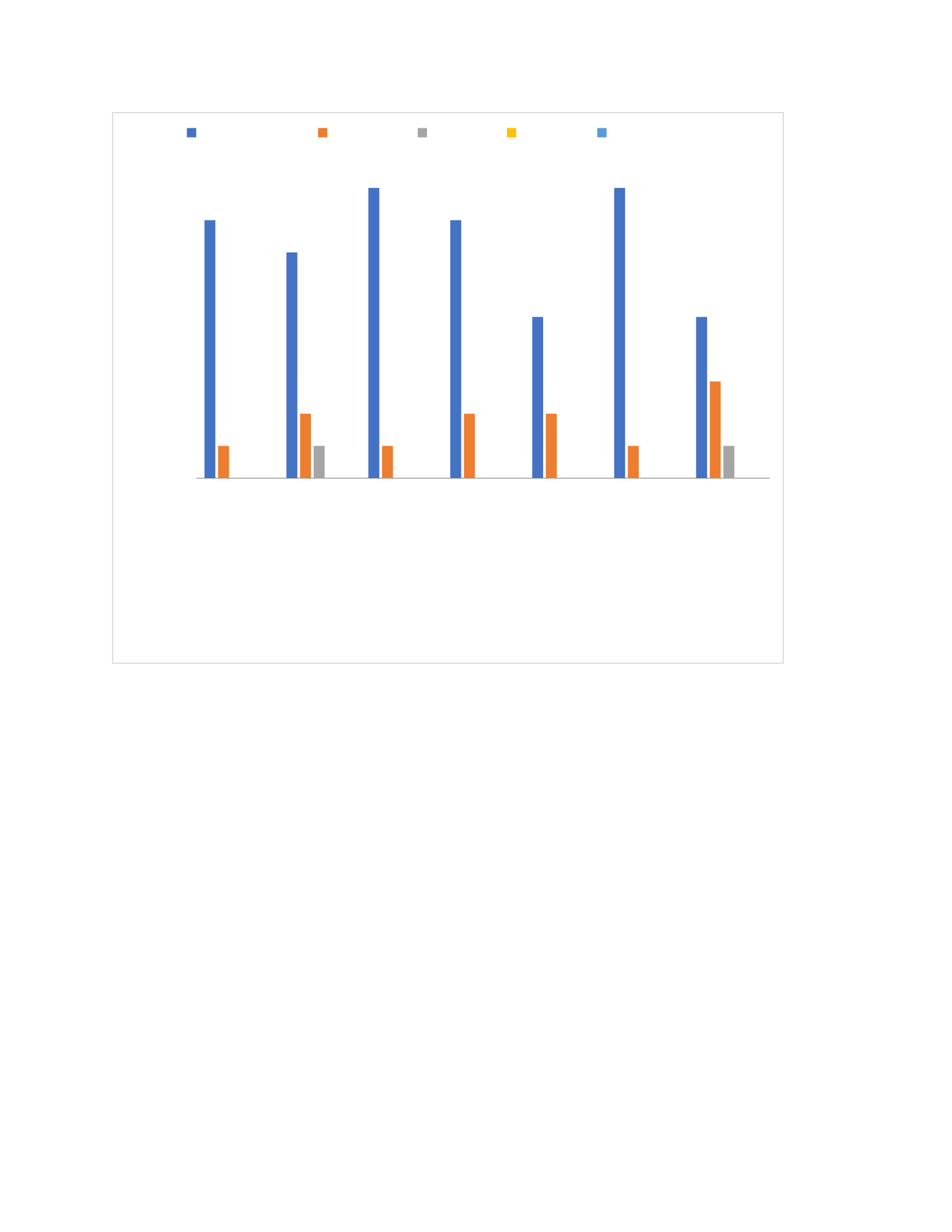
From the graph above, it was established that poverty levels of parents highly contributed to low
enrollment. Fathers level of education had a strong influence compared to mothers level of
education on enrollment of the adolescent girl child.
Socio-economic factors greatly influenced enrollment of girls in secondary schools. Financial
factors constrain to parents, more especially those who have lower socio-economic status face
the difficulty to bear the expense of their daughters’ education despite availability of bursaries.
4.5.1 PARENTS RESPONSES ON HOW THEIR ATTITUDE AFFECTS ADOLESCENT
GIRLS ENROLMENT IN SECONDARY SCHOOLS.
38
This section sought to capture how parental commitment to their girl child education influences
enrollment of adolescent girls in Garissa County. The results were as presented in the graph
below:
All of my children attend school
Secondary school fees payment is a burden
Education is a venture with no immediate benefit
Quraanic education is better for girls
Western education is better for girls
I do assist my girl/s with homework at home
I attend parents meeting when invited
I talk to my girl child about sex education
I first pay fees to my girl child
Culture has influenced my view towards girls education
0%
10%
20%
30%
40%
50%
60%
70%
80%
90%
100%
Strongly Agree
Agree
Undecided
Disagree
Strongly Disagree
Axis Title
Axis Title
Figure 4. 15 Parental attitude
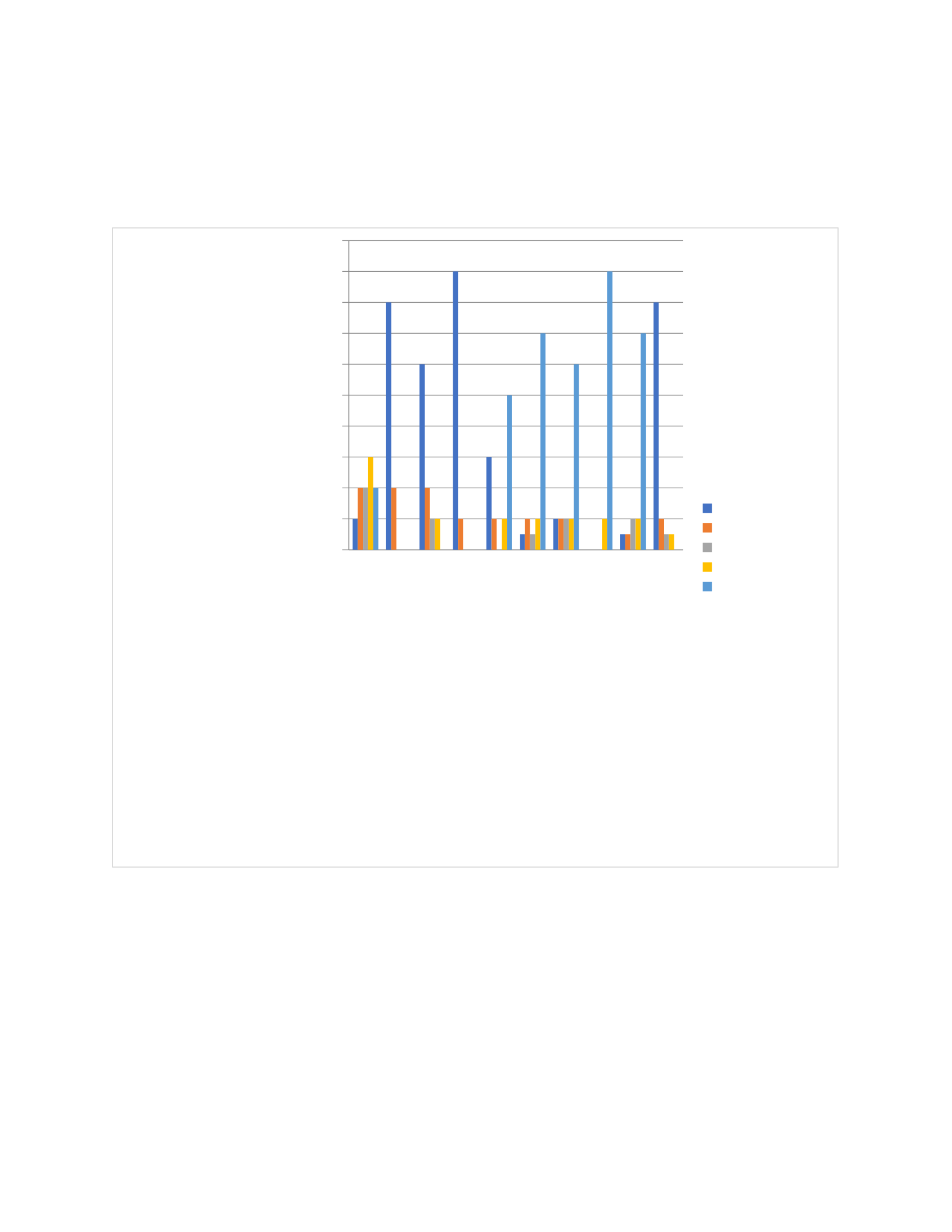
From Figure 4. 15 above, it was established that very few parents had all their children in school
this implied that the majority of parents did not have all their children in school. Some of the
parents suggested that education is a venture without benefit and had no immediate and direct
benefit and therefore unnecessary for girls. On further analysis it was realized that majority of
parents preferred Quranic education to Western education with only few parents assisting their
39

girls to do their homework and this implied that this makes the parents not to be in touch with
their girls’ academic life. This has made parents not to realize their girls challenges which has a
positive correlation with enrollment as also argued by Ehianne (2014).
Nearly two-thirds of the parents do not attend parents’ meetings at school for their girls. This
informed the researcher that the parents don’t want to participate in knowing the progress of their
girls and hence leading to low motivation and enrollment as argued with Bair (2015) who found
out that parents who involve themselves either overt or subtly with the children work show a
positive parental attitude through parent their participation. Furthermore, some live with their
grandparents and relatives who do not attach a lot of priority to schooling.
Around a quarter of the respondents preferred to pay fees for their girls first. This leaves the
majority to prefer paying fees for the boys first because they feel the boys will support them in
future unlike the girls who will be married off. Majority of the respondents further agreed that
culture had largely influenced their view on the education of girls and this informed the
researcher that culture has encroached in their ways of life. Decisions about every aspect of life
is pegged on the cultural knowledge. Consequently, the researcher observed that education of
girls is at a disadvantaged position and discrimination emanates on their attitude that stressed the
value of sons education. As a result girls education is given little or no attention .
A number of suggestions were made to change the negative perception of parents and
commitment towards girl child education. Some of those suggestions include continuous civic
education for parents, use of local authorities to supervise hundred percent transition as well as
provision of alternative livelihood such as agriculture, zero grazing and horticulture. This would
reduce the possibility of girls falling for extraneous work as pastoralists.
4.5.2 TEACHERS RESPONSES ON HOW PARENTAL ATTITUDE AFFECTS
ADOLESCENT GIRLS’ ENROLMENT TO SECONDARY SCHOOL IN GARISSA
COUNTY
Teachers were also requested to indicate parental commitment towards the enrollment of
adolescent girls in secondary education. Under parental commitment, the study sought to
investigate whether;
40
Parents see school fees payment as a burden
Parents prefer paying school fees to boys first
Parents prefer paying school fees to girls first
Parents value Quraanic education for girls
Parents value western education for girls
Parents attend school meetings when invited
Parents assist in their girl’s homework
Parents talk to girls about sex education
Culture has influenced my view towards girls education
10%
80%
60%
90%
30%
5% 10%
80%
20% 20% 20% 10% 10% 10% 10% 10%
0.2 0.1 0.05 0.1 0.05
0.3
0.1 0.1 0.1 0.1 0.1 0.05
0.2
0.5
0.7 0.6
0.9
Strongly Agree Agree Undecided Disagree Strongly Disagree
Figure 4. 16 Teachers Responses on Parental Attitude
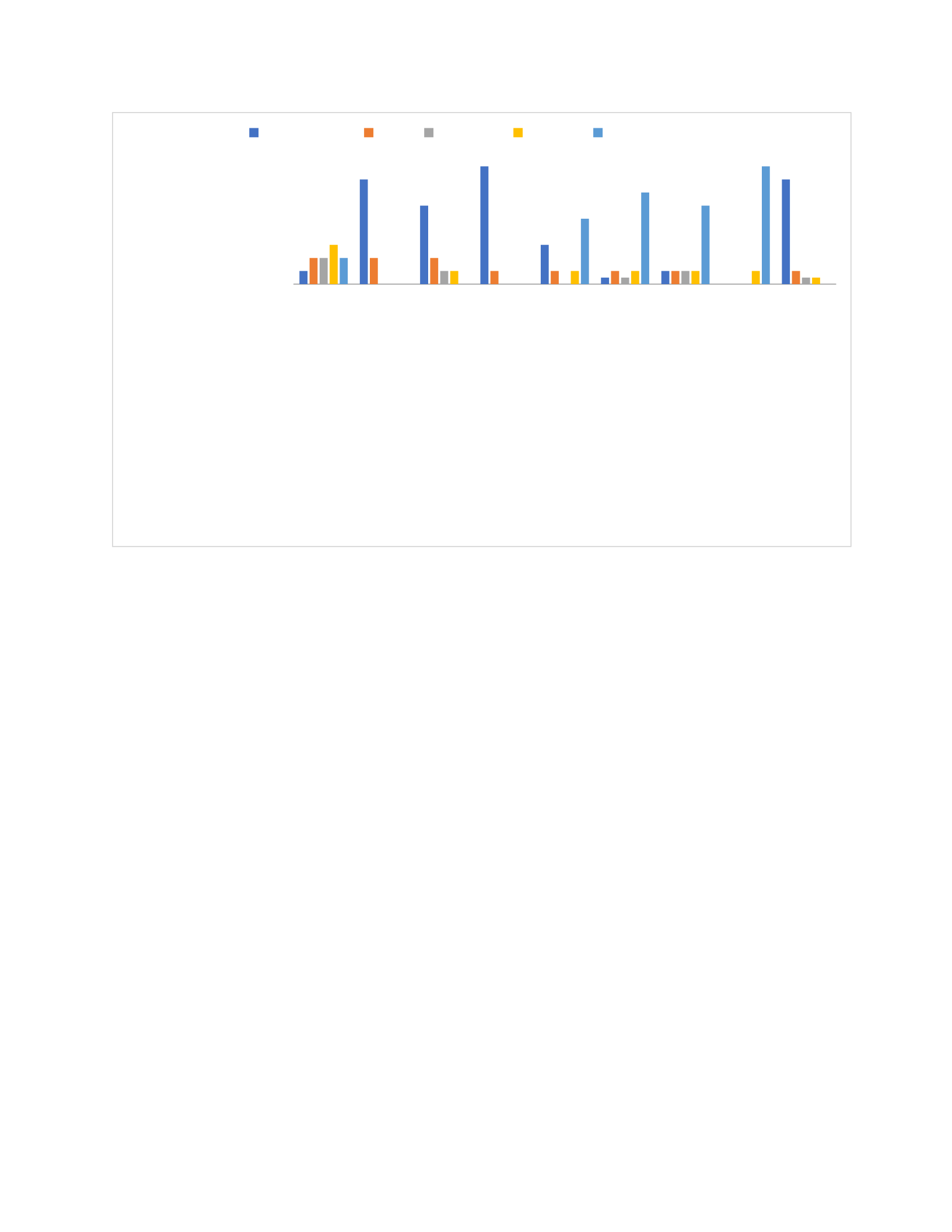
From the findings in Figure 4. 16 above, teachers observed that majority of parents see paying
fees as a burden and that parents preferred paying fees for boys first. One third of respondents
indicated that parents preferred paying fees for girls first. Majority of the respondents observed
that parents preferred Quranic education to western education while only few parents attended
school meetings. Around one tenth of the parents assisted their children to do homework while
none of the parents talked to their girls about sex education. The study also established that
majority of respondents agreed that culture had influenced their view towards girls’ education.
Regarding parents and family income, a study conducted elsewhere in Malawi Newman (2014)
agrees that gender inequality and discrimination affects very much the education of girls in
schools. The researcher found out parental attitude towards education of girls was negative and
hence translating to low enrollment of girls therefore the researcher revealed that positive
parental commitment towards the girls education has a large relation with the enrollment.
41
4.5.3 EDUCATION OFFICER’S RESPONSES ON HOW PARENTAL ATTITUDE
AFFECTS ADOLESCENT GIRLS’ ENROLMENT TO SECONDARY SCHOOL IN
GARISSA COUNTY
The graph below shows the response of education officers regarding the parents’ attitude towards
the enrollment of adolescent girls in secondary school. In this graph, the respondents were
required to indicate the extent to which they agreed and or disagreed with selected statements,
thus; SA = Strongly Agree A = Agree U = Undecided D = Disagree SD = Strongly Disagree
0%
20%
40%
60%
80%
100%
Prental Commitment
Strongly Agree Agree Undecided Disagree Strongly Disagree
Figure 4. 17 Education Officers Response on Parental Attitude
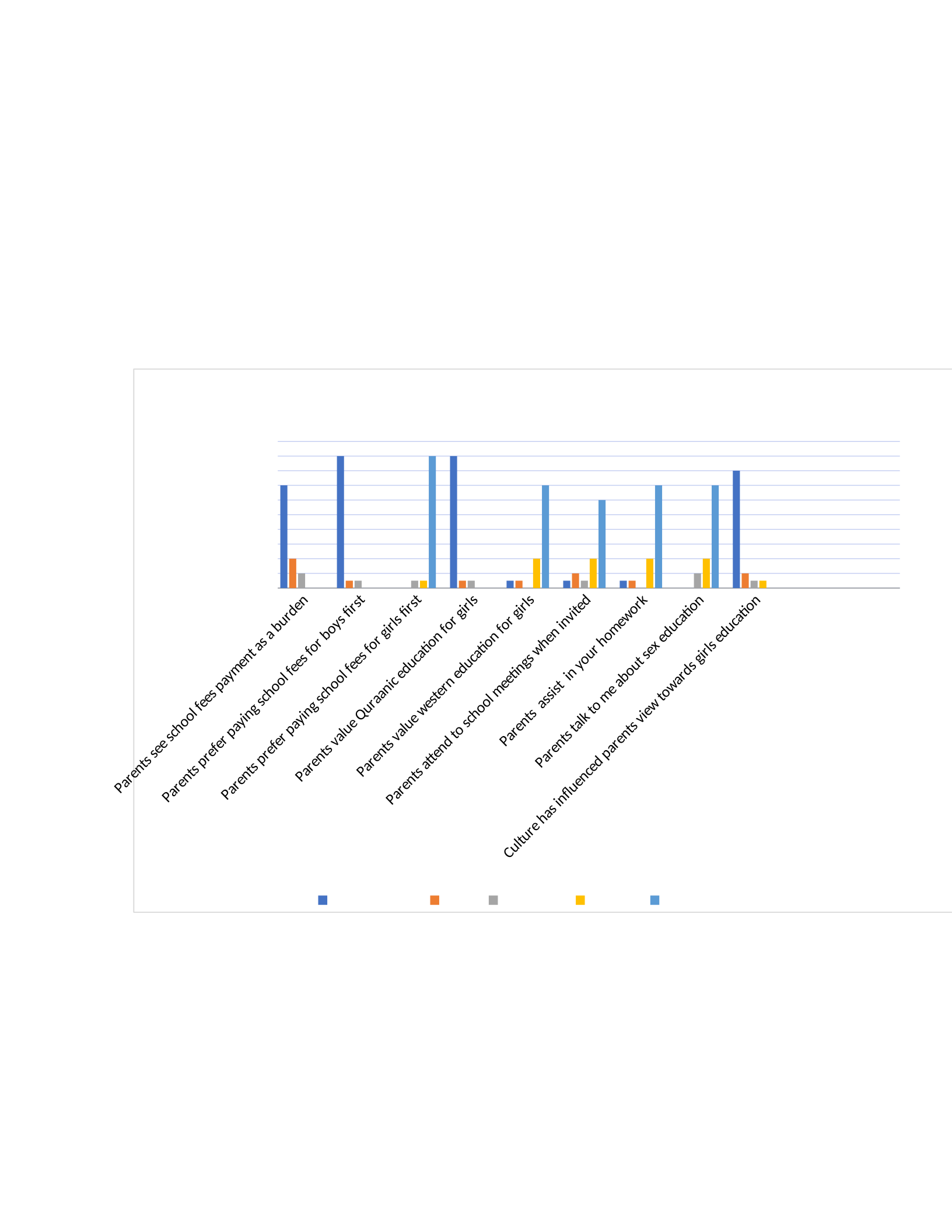
From the findings in Figure 4. 17 , majority of respondents strongly agreed that parents see school fees
payment as a burden and that parents preferred to pay fees for the boy-child first and not for girls. Only
very few parents saw the need to pay fees for girls first before anything else. On the other hand,
majority of the parents preferred Quranic education to Western Education and were willing to pay the
42

fees for them to learn and .this informed the researcher that parents are not willing to invest in the future
of their children because its majorly through formal education that they can gain meaningful
employment and also compete with their peers from different regions. On assisting girls do their
homework at home, very few suggested that parents assisted girls do their homework at home and it
could be attributed to either lack of interest from parents or lack of knowledge. None of the parents
talked to their adolescent girls about sex education this could be attributed to either a taboo. Majority
of the respondents further agreed that culture had influenced their attitude towards provision of western
education to the adolescent girls. The researcher’s finding informed the study that parental
commitment towards the girls’ education is negative and it has a correlation with their
enrollment. This finding is supported by studies conducted by De Wilt et al (2013) but at the
same time the present study contradicted with the studies conducted by Masgoret (2004) as
they did not find relation between the above variables.
4.5.4 Principal’s responses on how parental attitude affects adolescent girls’ enrolment to
secondary school in Garissa County
Principals’ opinion on parental attitude was also sought. Principal were asked in a questionnaire
to indicate the extent to which they agreed or disagreed with the following statements using the
following key: SA = Strongly Agree A = Agree U = Undecided D = Disagree SD = Strongly
Disagree
43
0%
10%
20%
30%
40%
50%
60%
70%
80%
90%
100%
Strongly Agree Agree Undecided Disagree Strongly Disagree
Figure 4. 18 Principals responses on Parental Attitude
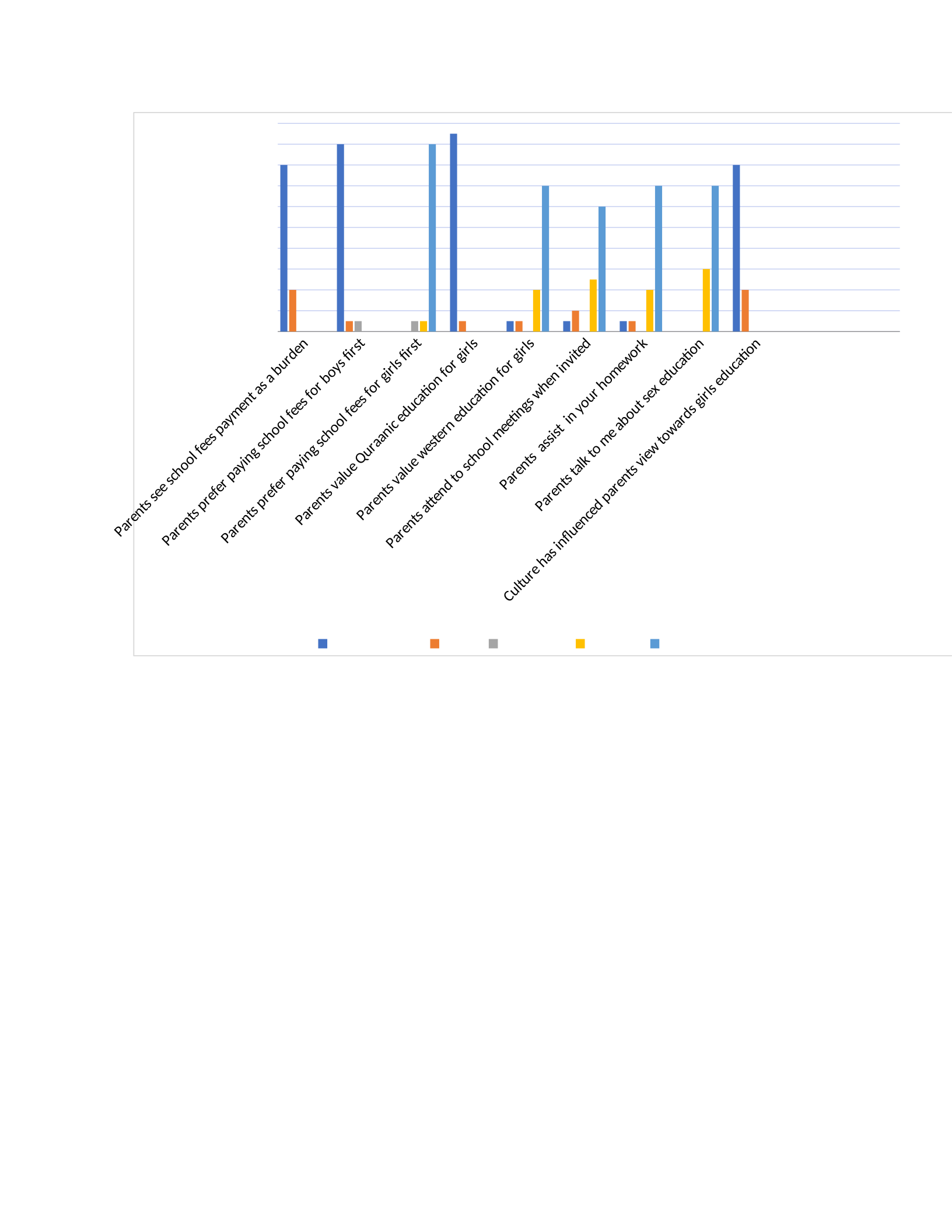
From Figure 4. 18, it was established that majority of the principals observed that parents
preferred Quranic education to western education and also parents preferred paying fees for
boys. Almost all parents from the principals perspective saw paying of fees as unnecessary
burden to them. On the other hand, it was established that only very few parents preferred
western education. Majority of respondents observed that culture had influenced parents view
towards girl child education. None of parents assisted their children do homework and
assignment at home while only very few parents were willing to attend parents meeting at
school. The attitude of the community and parents towards their daughters education was found
to be negative and this findings agrees with Okobia (2015) who asserts that parents who are
Christians have better attitude towards girl education than their Muslim counterparts.
44
Suggested mitigation measures
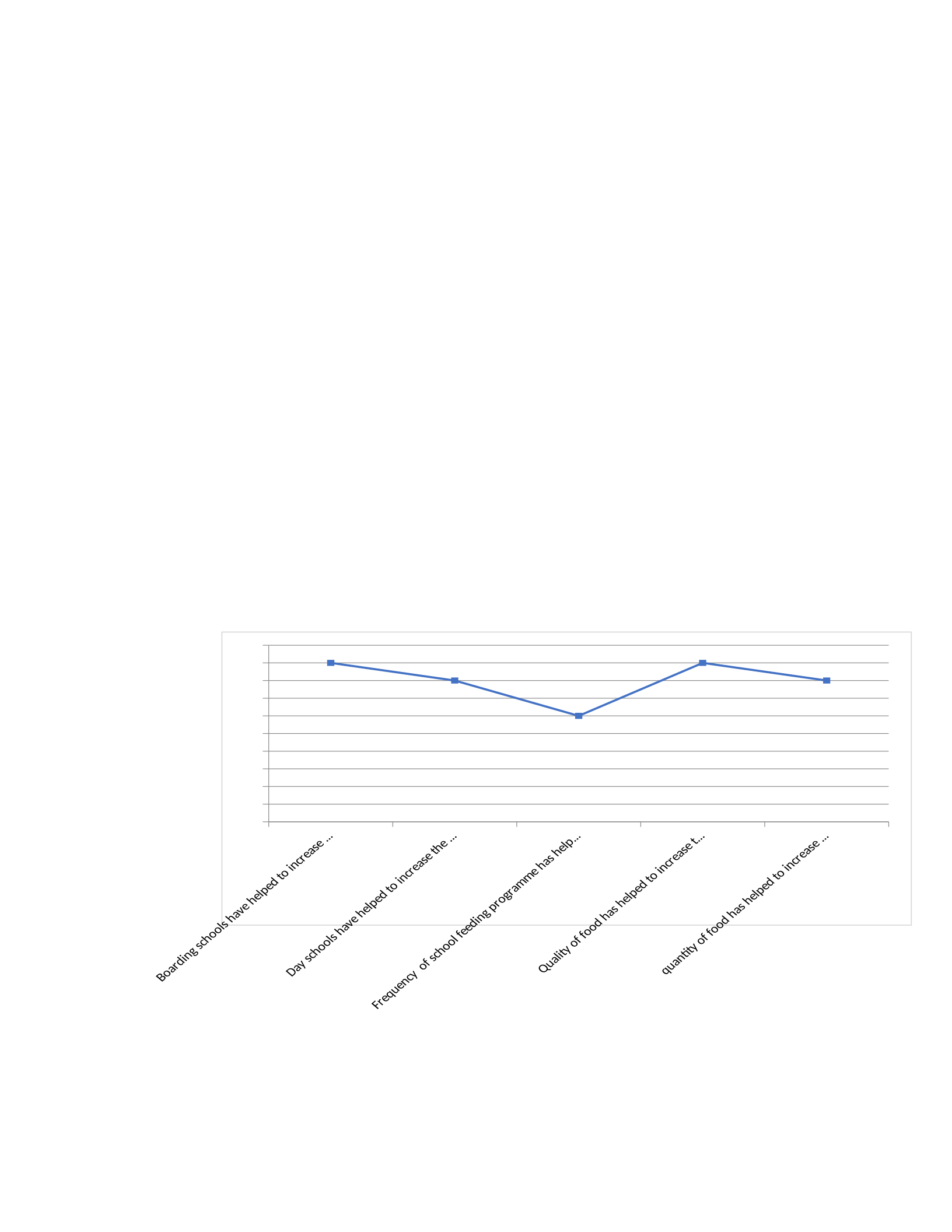
In a questionnaire for principals, it was noted that even though the day schools in the county
scored well in increasing the enrolment of girls in secondary schools , a majority also noted the
boarding schools would be a far much better solution to increasing the enrolment of the
adolescent girls in secondary schools. There were other suggested measures that principlas
generally agreed that could help to increase enrolment of adolescent girls in the county and this
included a regular feeding programme, good food quality in the feeding programme and good
quantity as well. The frequency of feeding program was rated highly in addition to quality and
quantity of food as factors of influence on adolescent girl’s enrollment in secondary schools.
These mitigation measures by the principals were analyzed and presented in figure 4. 19 below.
Other suggested measures to be employed by the community so as to enhance enrollment of
adolescents in secondary schools included the use of mobile schools, the introduction of shift
learning and building of more boarding schools in Garissa County.
0%
10%
20%
30%
40%
50%
60%
70%
80%
90%
100%
figure 4. 19 Principals mitigation measures
45

4.6.0 DISCUSSION OF THE FINDINGS
4.6.1 What are the traditional practices that hinder enrollment of adolescent girls of Somali
Community in Garissa County?
The study examined how cultural practices affected enrollment of adolescent girls
in the county and it was indeed established that cultural practice affected enrolment
of girls in the county. They included initiations, early marriages, forced marriages,
religious beliefs and practices and gender discrimination.
From the study, it was established that there was a high percentage of students’
involment in cultural activities. 96.2% of the students who participated in this
research , had undergone some form of initiation while only 3.8% indicated that they
had not undergone any form of initiation. (Table 4. 13)
Female Genital Mutation (FGM) was top on the list of common types of
initiation. Another form of initiation was nikkah- a traditional form of marriage,
equivalent to engagement and it’s inspired by Islamic teachings. From this finding
it was observed that despite the government ban on this retrogressive practice,
still the community adheres to it. It was established that FGM contributed to
absenteeism. As a result of continued absenteeism, most learners indicated that
they missed exams and other academic undertakings. Other effects attached to it
were the belief that any girl who underwent FGM had high chances of getting
married as opposed to those not yet initiated. This forced them to undergo the
practice. The study found out that a majority of the girls absented themselves
from school and in extreme situation completely dropped out of school due to a
mandatory participation in Islamic religious activities such as fasting, madras
lessons, early marriages, forced marriages. However, there were other cultural
practices mentioned such as nikah and unyago and night vigils during weddings
that contributed to their absenteeism.
It was also realized that the few who did not go through FGM were stigmatized and
ridiculed publicly to an extent of labeling them social misfits and this led to the
46

notion that formal education through school system belongs to the few
uncircumcised ones.
Forced marriages and early marriages below age of eightteen are a human rights
violation that impacts women and girls, along with their families and communities,
in a variety of overlapping ways. Marriage dramatically limits a girl’s access to
education. On the other hand, Education levels are among the strongest predictors of
whether a girl will marry early. The more educated a girl is, the less likely to marry
early.
In Garissa County, societal expectations often hinder a girl who is married from
attending school. Once married or engaged, a husband or future husband may
disapprove of his wife attending school, and stop her from attending. A girl who is
married may also have responsibilities in the home, including housework, caring for
children or other relatives, be sent to work to help support her husband’s household,
or be physically unable to attend school because of pregnancy, or medical
complications associated with pregnancy. When women and girls are barred from
accessing education, their economic opportunities in the modern world are limited,
trapping them in a cycle of poverty, which will, in turn, limit their children’s
educational opportunities and, as a result low economic prospects.
The above practices have contributed to low enrollment of adolescent girls in
Garissa county. This has led the girls to perceive education as worthless and
therefore do not strive to work hard in their academics. Somali girls in Garissa
County have perceived boys as the ones to benefit from secondary education since
those girls who perform well are always viewed negatively. Girls in these
communities lack role models from female teachers. In fact, those who are there do
not come from the same community with them. This becomes a hindrance as
religious beliefs do not allow them to interact freely with any person of a different
faith.
47

The researcher observed that birth rate in the region was high and this could be
attributed to refusal to family planning methods by parents and extreme adherence
to the tradition of polygamy that is highly practiced in the Somali community.
Therefore, providing for the children is a difficult endeavor considering the high
cost of living and also the high cost of education and this leads to parents not
sending all of their children to school more so the girls.
From the views of parents on traditional practices affecting enrolment of adolescent
girls, it was established that girls are forced to work and look after their livestock
instead of enrolling in schools. Parents also agreed very strongly that girls are
engaged in household work to enable adults to work outside the home. This shows
how cultural practices are still propagated in the community and these practices
affect the school going girls negatively. The cultural activities were found to be an
impediment to successful enrollment into secondary education since learners were
fully engaged in them and had inadequate time for learning hence easy to drop out
of school. The findings concurred with the report of G.O.K and UNICEF that
asserted that traditional practices such as early marriage, forced marriages, female
circumcision and other traditional taboos compromised the education of the girl
child Nadialista Kurniawan, (2021)
From the findings,nearly two-thirds of the respondents, indicated that cultural
practices contributed to low girls’ enrollment in secondary schools followed by lack
of fees at two fifths, poor performance in class at one tenth and indiscipline at 5%.
This implies that cultural practices are deeply rooted in this community and
therefore there is a need for well-planned action to change the mindset of the
community. Education officers indicated that they were aware that there existed
high involvement of girls in cultural practices and this implied that cultural
practices are deeply rooted within the county. Learners indicated that other cultural
practices which hinder their enrolment are pastoralism and nomadism as well as
engagement in religious activities such as Madrasas instead of Western education.
48

4.6.2 Reasons why cultural practices had persisted
It was established that cultural practices had persisted for long due to a number of
reasons; first, it was established that such cultural practices were a strong social
heritage that must be passed over to the next generation without any attempt of
interruptions. Secondly, there was general fear of unknown repercussions and
punishment for those who will tend to break away from the cultural systems. There
is also the fear of isolation, stigmatization and persecution. Parents fear that other
families would not approve their daughters’ adult status if F.G.M was not done on
them and their sons will refuse to marry them.
More paramount was the fact that the social structures are complex that it is not easy
to abolish any of the social-cultural practices among the Somali community and also
some practices are seen as a sign of bravery and allows the girls to be respected by
other women. The young respected community elders as custodians of the culture
and are always ready to protect it.
Garissa County is mostly composed of Somali community which is predominantly
Islamic. Most of these cultural practices have a backing of Islamic teachings
attached to them. For example, there is a belief that every child must attend
Madrasa lessons before considering western education. This has most likely
delayed the girls from entering school for western education in good time.
Secondly, the Islamic teachings on marriage require that women and girls alike
must always submit and take a passive position in the society. Prayers made by
girls who have not been initiated are generally not acceptable and that mutilated
girls are considered to be more fertile than unmutilated girls.
4.6.3 Cultural practices proposed to be abolished and alternative rite of passage
49

Learners suggested prominently that female genital mutilation, early marriages
and forced marriages should be abolished completely. This is because of the pain
and trauma the practices impact on the initiate. Early marriages on the other side
were found to contribute to early pregnancy, low birth weight and it also denies
ones opportunity for education Lack of education in turn restricts the girls’
chances of being gainfully employed. They also indicated that there was a need
to treat both males and females equally in regard to support for education. The
researcher observed that there is a willingness of the girls to change their cultural
practices, an indicator that non-material culture is changing though at a very slow
pace.
Learners were asked to mention some alternative rites of passage that they would
wish to undergo, instead of FGM. Majority listed alternative sex education as an
alternative passage of rites. They suggested that this would be done in the form of
symposia, workshops, retreats, short courses or a boot camp. The researcher realized
that there are both long-term and short-term effects of the cultural practices on girls that
may affect their enrollement in secondary school.
4.7.0 How do socioeconomic factors in the Somali community affect girls’
access to education?
Socio-economic factors also affect the enrollment of girls in this region. It was
established that a mother’s level of education and parental support to education
contributed to a very great extent to the enrollment of adolescent girl child in secondary
school in that if the mothers were well educated they would greatly support education of
their girls as well as being role models to their girls.
The researcher realized that there exists a relationship between place of residence of the
family and the girls’ enrollment. Girls’ enrollment is highly affected by the long distance
to school and this finding agrees with Baliyan & Khama (2020) who found that long
distance to school affected girls’ enrollment negatively.
50

Poverty levels of parents also affected the girls’ enrollment in that children from illiterate
poor homes are fewer in schools than their rich counterparts. Moreover, students whose
parents have higher socio-economic status and higher levels of education might have a
high regard for learning and therefore encourage the girls to continue with education.
The source of income of parents affected girls’ enrollment in that low-income families
are more likely to be preoccupied with environmental stressors within their
neighbourhood like housing status. This finding agrees with Aktar (2018).
Family size too affected girls’ enrollment at a higher level. The researcher observed that
family resources are overstretched when family members are many hence low
enrollment of adolescent girls. The researcher also found out that the type of family
(monogamous/polygamous) has an impact on enrollment in that children from
monogamous families are able to be fully enrolled in schools, unlike children from
polygamous families. These findings agree with Considine (2012) about the impact of
the type of families on enrollment. On a general view, the researcher presents that socio-
economic activities therefore affect girls’ education negatively.
4.7.1 How does parents’ educational level affect girls' access to secondary
education in Garissa County?
Garissa County is still very low compared to the rest of the country. Since most of the
parents did not go to school beyond primary level, and attended madrasa more than they
attended formal Western education, they prefer Quranic education for their children
more than formal Western education. The parents who have significantly gained Western
education in the community, know the importance of Western education and they highly
support their girls’ enrolment in formal schooling. To these few families, girl child
enrolment has been significantly positive. Girls from these families have been enrolled
in boarding school to access education,. These findings confirms the findings of Black
(2003) that more educated parents are likely to enroll their children in better schools and
encourage them to enroll in tertiary institutions. Therefore the more educated parents are
the more their children are likely to proceed to the next levels of education.
51

This study found that Mothers’ level of education was considered more influential
compared to fathers’ level of education. This finding agrees with Duel (2016) whose
realization of mothers’ education is that the educated (mothers) reduce time spent on
household activities while increasing time spent on their children and can monitor their
children than their uneducated counterparts.
4.8.0 What are the general parental attitudes towards the provision of education to
adolescent girls of Somali community in Garissa County?
Studies, by Buchmann, C., & Hannum, E. (2014), on the cultural behaviour of head of
the household and cultural beliefs concluded that an attitude towards women's role in
society play an important role in deciding the educational levels of girls in family and
thus the conservative attitude of parents is responsible for less schooling among females.
This study also sought to establish whether parental commitment had any influence on
the enrollment of adolescent girls in secondary school. More than 90% of respondents
indicated that parental attitude played a significant role in the enrollment of the learners.
Factors related to parental commitment indicated that parents saw school fees payment
as a burden. Parents also preferred paying fees for boys compared to girls. Furthermore,
parents preferred Quranic education more as compared to Western education. As to
whether parents talk about sex education to girls and whether culture is a major influence
on parents’ attitudes, the findings indicated that cultural influence informed the parental
attitudes towards girl child education. Parents in this community do not engage their
daughters in matters of sex education and culture has a considerable influence on this.
Generally, all respondents agreed strongly that parents‘ commitment greatly influenced
the enrolment of adolescent girls.
This finding agrees with Newman (2014) that gender inequality and discrimination affect
very much the education of girls in schools. The researcher found out parental
commitment towards the education of girls was negative hence translating to low
enrollment of girls therefore the researcher revealed that positive parental commitment
towards the girls’ education has a large relation with the enrollment.
52

4.9.0 Suggested Mitigation Measures to Increase Enrolment of Adolescent Girls
Several approaches have been employed to ensure that all children deserving education
have accessed education regardless of their culture, social-economic backgrounds,
geographical location, gender or religion. As a result, in 1990, during the World
Conference on Education For All (EFA) there was a need to reinforce and emphasize
the need to ensure that all children access quality education. This conference gave birth
to the objectives of Education For All (EFA- objectives).
Consequently, Article 5 of EFA stresses the need to widen the approaches and scope of
the provision of basic education. Among other programmes that have been established
over time to ensure that learners from marginalized communities access education should
include, the establishment of feeding programmes for nomadic learners as well as the
construction of boarding schools. The provision of mobile Schools as suggested by the
majority of researchers and EFA, 1990, is a practice that already encourages a nomadic
lifestyle of moving from place to place. The researcher proposes a policy approach,
which starts from the premise that pastoralists must settle down and stop being
pastoralists. This should be the approach that should be applied in Garissa County where
fundamentally the demographic reality of the County has more than 70 per cent of the
population continue practising the nomadic way of life moving across the rangelands.
Alternative models exist or can be developed. The suggested possible solutions to the
elimination of persistent cultural practices include the use of security organs to enforce
the policy of 100 per cent transition. This would also include the area chiefs and county
commissioners. The researcher further suggests that parents should be offered alternative
empowerment skills and the culture of nomadism should also be replaced by settler farming
approaches stemming from irrigation and zero grazing. The researcher strongly recommend
that the government should provide water for irrigation by construction of dams and
embark on a major project of piping water on large scale from the Tana River into a
proposed County Reservoir.
53

Respondents suggested that the government should convert all-day schools into
boarding schools. This, according to respondents will enable girls to concentrate in
school more. Also, men are to be sensitized to the impact of these dangerous practices
since they tend to have the final say on any decision in the community. Alternative rites
of passage which, majorly suggested as sex education, which takes away ‘the cut’ while
retaining important cultural aspects should be embraced. The pride in celebration of
one's culture doesn’t have to mean harming girls.
Nomads have not been accessing static social amenities such as formal education and
health nor have these services been availed within their setting due to their mobile
lifestyle, Currently, nomads can only access formal education by either taking their
children to boarding schools or placing children under the care of a relative in the
settled lifestyle. There is a need for the government to take advantage of this and
establish more boarding facilities with subsidized fee. Ezeomah (2006) argues that as it
is now; formal education seems to be inconsistent with the lifestyle of nomads in terms
of curriculum, timetabling and the distance to schools.
4.9.1 Boarding schools
Most respondents suggested that if progress is to be made in the enrolment of
adolescent girls in the County, then construction of more boarding schools was
inevitable. The use of boarding schools has proven to be a working solution in regard to
the provision of education. Several scholars have investigated its effectiveness.
According to the Republic of Kenya (2004), and Bunya (2006) by constructing
boarding schools, nomadic children both in primary and secondary will be encouraged
to learn as they will always remain in schools. This Study recommends the government
invest more in the establishment of more boarding secondary schools so that this
number becomes considerably high and further reduce the fee paid by parents by means
of subsidizing fee.
Sifuna (1991) posits that boarding schools are yet to foster and initiate the anticipated
success as parents are not able to afford the required costs and huge school fees. He
argues further that although the boarding schools’ fees is described as ‘low cost’ by
54

policymakers, it is still a huge burden to the poor parents who are the majority hence,
resulting in poor school attendance by children from these poor families. This breeds an
eventual new breed of dropouts who will end up not being enrolled in secondary
schools, married, victims of FGM as well as trade, business and child labour (MOEST,
2001).
.
4.9.2 School Feeding Programmes
Among other approaches, this was said to be a good approach towards ensuring that all
learners access education. The program is also aimed at improving nutritional standards
of learners, access and sustaining enrolments in poor marginalized parts of the country
like Garissa, which experiences prolonged droughts across the year. In the year 1980,
the program was officially launched by the government of Kenya with the support from
the World Food program (WFP), (MOEST (2005) and Kakonge (2006).
According to MOEST, (2005) the School Feeding Program (SFP) continues to thrive
especially in ASAL regions and has seen a great change regarding access to education
and enrollment rates. Carr-Hill et al (2005) also conclude that SFP has had a significant
impact on access and retention in Northern parts of which are predominantly nomadic
and have been neglected, marginalized and under-developed.
In a study by Teras (2005) proper and frequent provision of nutritious food promotes
better academic performance among candidates. The idea of School Feeding Programs
has indeed shown that nutrition plays a key role in retention and enrolment of learners
hence promoting academic performance. He further says that proper frequency of SFP
improves the performance in schools, minimizes absenteeism as well as tardiness. It
also relieves hunger, improves learner’s ability to succeed at school, improves
academic, behavioural, and emotional functioning which eventually leads to increased
math grades, lowered absenteeism, and improved behavior. There is a serious need to
expand feeding programmes centred in schools along with increasing the boarding
secondary schools. The feeding programmes should be fully sponsored by the
55

government to lift expenses from parents. The researcher posits that the quality of food
and its quantity should be checked and that food should not just be provided but the
quality of food should be at its best with the right quantity. Food taboos appeared to affect
enrollment. This is because chronic malnutrition inhibits growth, retards mental development,
reduces motivation and energy levels. The researcher found out that the Somali community has
some foods that girls are prohibited from eating.
Poor health and nutrition affect education performance and achievement a great deal. According
to Jukes, Drake and Bundy (2007), the major health challenges faced by many infants, pre-
school and school children include pneumonia, malaria, measles, micro and macronutrient
deficiencies. This leads to frequent ailments which in turn inhibit school attendance and
performance among the learners as they grow up. Many of these diseases and deficiencies are
preventable and, among the schoolchildren who bear the greatest burden, the most vulnerable
ones are the poor. The researcher found out that some of the notable effects of poor health and
nutrition include lack of readiness to begin school at the usual age, failure to learn adequately
while at school, unequal participation in school and low enrollment of learners. There is a lack
of cognitive stimulation, a result of poverty which affects the children’s intellectual development
and thus school achievement (Suhrcke & de Paz Nieves, 2011).
4.9.3 Other measures suggested to be employed by the community
The reseacher found out that the following suggested measures should be taken
in Garissa County so as to increase enrollment rates for girls in the County. The
measures should included:
1. Heavy fines and charge to be imposed on parents who will interfer`e with
the enrollment of adolescent girls.
2. Ranching: since there are large tracks of land in Garissa, communities
should dedicate part of the land for pasture and irrigated this will reduce
time spent on finding fodder for cattle and more time to studies.
3. Introduction of follow-up mechanisms to track incidences of any school
drop-out among adolescent girls.
56

4.Continuous civic education for parents to embrace girl child education and
educating the community about the risks and consequences of retrogressive
cultures and inclusion of the knowledge about harmful traditional practices
in school curricula in secondary schools.
References
Baliyan, S. P., & Khama, D. (2020). How distance to school and study hours after school influence
students’ performance in mathematics and English: A comparative analysis. Journal of
Education and E-Learning Research, 7(2), 209–217.
https://doi.org/10.20448/JOURNAL.509.2020.72.209.217
Machiri, N. S. (2020). INFLUENCE OF ORGANIZATIONAL LEARNING ON PERFORMANCE
OF FIRMS LISTED AT THE NAIROBI SECURITIES EXCHANGE. International Journal of
Management and Commerce Innovations, 8, 344–354. www.researchpublish.com
Nadialista Kurniawan, R. A. (2021). Industry and Higher Education, 3(1), 1689–1699.
http://journal.unilak.ac.id/index.php/JIEB/article/view/3845%0Ahttp://dspace.uc.ac.id/handle/
123456789/1288
Norm, H. (2004).RELATIONSHIP BETWEEN SOCIOCULTURAL PRACTICES AND
ENROLLMENT
57

Ngangi, A. M., Cheloti, S. K., & Mwania, J. M. (2023). An assessment of the influence of parents’
role in monitoring learning activities on students’ academic performance in public secondary
schools in Kenya.
Seburg EM, Kunin-Batson A, Senso MM, Crain AL, Langer SL, Levy RL, Sherwood NE. Concern
about Child Weight among Parents of Children At-Risk for Obesity. Health Behav Policy Rev.
2014 May;1(3):197-208. doi: 10.14485/HBPR.1.3.4. PMID: 25364770; PMCID: PMC4213741.
Shahidul, S. M., & Karim, A. H. M. Z. (2015). Factors contributing to school dropout among the
girls: a review of literature. European Journal of Research and Reflection in Educational
Sciences, 3(2), 25–36.
Tabassum, N. (2023). Gender and Regional Differences in Dropout Due to Distance of School in
Sindh. 14(1), 53–70.
WILSON, E. K., EVANS, O., & KANUS, E. EFFECTS OF POLYGAMY ON ACADEMIC
PERFORMANCE OF PUPILS IN PUBLIC PRIMARY SCHOOLS IN TOWNSHIP WARD,
TURKANA CENTRAL SUBCOUNTY, KENYA.
R
58

