


lOMoARcPSD|26658602
ARTS 105 - assignment
Art Appreciation (Liberty
University)
lOMoARcPSD|26658602
Artist Report Assignment
ART-105
By Usama Pervez
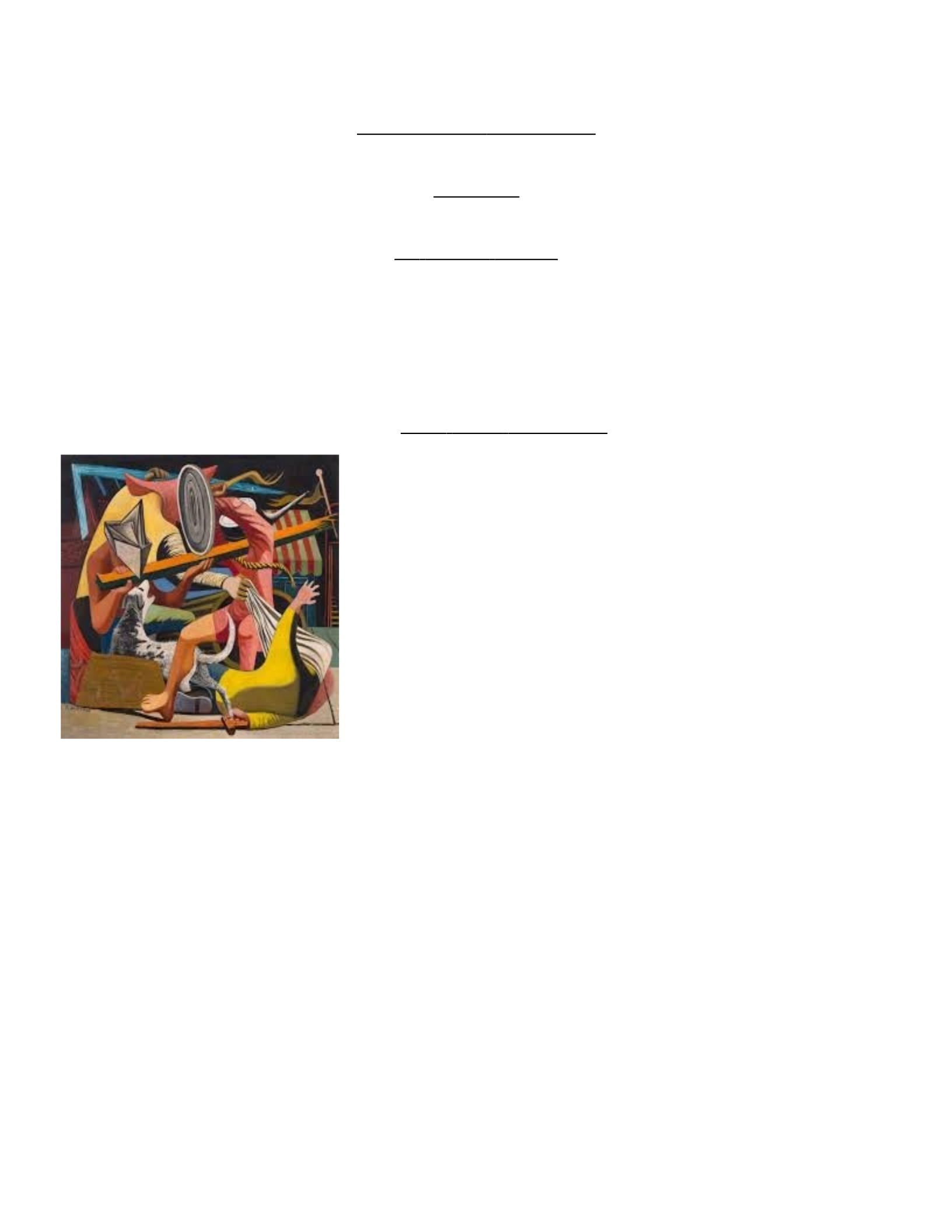
Year 1938- Gladiators
Guston's social realist style, which is on display in Gladiators,
was a constant throughout his time as a WPA muralist. He
explores the hooded figures, fists, and shields that would
eventually turn up in many of his later works; it is one of his
first pieces. It attempts to mimic some of the monumentality he
appreciated in Italian Renaissance artwork.
Painted with oil and pencil. Edward R. Broida's donation to the Museum of Modern Art,
measuring 24 1/2 by 28 1/8 inches.

lOMoARcPSD|26658602
A Jewish couple from Russia came to the United States, and he was the youngest of their
seven children. Even though they were safe from harm in America, the family had difficulty
adjusting to life there. Guston's father was a bartender but had problems finding work in his
chosen profession. In 1919, the family uprooted and headed for Los Angeles for better fortune.
However, they went through more difficulties and had to deal with the prejudice that came with
the development of the Klu Klux Klan. The finding of his father's body after he had committed
suicide by hanging four years later had a profound effect on Guston. When Philip entered his
teenage years and showed an interest in drawing, his mother enrolled him in a correspondence
course at the Cleveland School of Cartooning. Philip started his formal art training at this point.
"(Paintings, Biography, and Concepts by) Philip Guston"
While attending Manual Arts High School in Los Angeles in 1927, Guston was
introduced to Jackson Pollock, and the two became fast friends. Guston also attended that school,
where he learned about Cubism, Krishnamurti, and Ouspensky. In 1930, Guston attended the
Otis Art Institute, thanks to a full scholarship. In 1931, he had his first individual show. He
worked odd jobs and studied anti-war paintings in Mexico between his academic degrees and
moving to New York. His favourite Renaissance masters and Mexican muralists inspired him to
paint thin layers of oil or fresco to create figurative murals. Because of his enthusiasm, he
decided to participate in the Federal Arts Project of the Works Progress Administration
(WPA/FAP) and create murals throughout the United States. At the 1939 New York World's
Fair, he created a mural on the outer wall of the WPA Building.
Pollock encouraged Guston to move to New York permanently in the winter of 1935 and
introduced him to numerous New York School painters. After working on murals until 1942,
Guston switched to easel painting in the early 1940s, creating a unique style that drew from

lOMoARcPSD|26658602
abstract expressionism, realism, and myth. His abstract works from the '50s were
groundbreaking. In Red Painting, the boundaries between foreground and background are hazy,
and the brushstrokes of the figures are discernible. This style was shaped by Chinese calligraphy,
Buddhism, and Mondrian's 1910 "plus-minus" paintings. (“Philip Guston Paintings, Bio, Ideas”)
In the 1930s, Philip Guston became a social realist muralist. He later created a
groundbreaking cartoon realism approach. He became famous as an Abstract Expressionist. He
painted shimmering abstractions with figures floating like mists in the foreground, avoiding
Pollock and Kline's heavy strokes. From the late 1940s till 1970, he painted abstractly. He died
of a heart attack before turning sixty-seven. (Haber)
Guston returned to figuration in the mid-1960s due to political unrest in the U.S. He
debuted his late style at the Marlborough Gallery in New York in 1970. In one of his earliest
pieces as Time's art critic, Robert Hughes made fun of the supposed anachronism of Guston's
Klansmen. He claimed that mathematical analysis of the present could not yield reliable results.
In addition, in a work of parody for the New York Times, Hilton Kramer referred to Guston as "a
mandarin pretending to be a stumblebum." Artists like Red Grooms and Wayne Thiebaud have
popularized a rough, "primitive" aesthetic, and the assumption is that Guston is following suit.
Kramer thought it was so profound that he included it twice in his evaluation of 1,000 words:
"Guston was a colonizer rather than a pioneer." Even Guston's toughest detractors eventually
came around and apologized after his death. Hughes praised him as "a figurative artist of
enormous strength." Not only did he concede that he was wrong about Guston's return to
representation, but he joined a long list of other notable art critics who have done the same. (Arn)
I've come to respect Philip Guston as an artist. I read through his complete body of work,
which amply demonstrates how his style evolved throughout his lifetime. It also discusses how

lOMoARcPSD|26658602
his style changed over time and the main issues he dealt with in his paintings and drawings. His
writing included a political commentary on issues like racism and authoritarianism that troubled
him and a very honest examination of his ingrained prejudices decades before modern concepts
of white privilege appeared. Additionally, he could leave the abstract expressionism "in" and
switch back to a symbolic approach that nevertheless had the same compositional strength as his
previous abstractions. This artist was both ahead of and in his time.
References
1. Arn, Jackson. “Why Philip Guston Abandoned Abstract Expressionism for Figuration | Artsy.”
Why Philip Guston Abandoned Abstract Expressionism for Figuration | Artsy, 10 Oct. 2018,
www.artsy.net/article/artsy-editorial-abex-painter-philip-gustons-return-figuration-enraged-art.
2. “Philip Guston Paintings, Bio, Ideas.” The Art Story, www.theartstory.org/artist/guston-philip.
Accessed 19 Jan. 2023.
3. Haber, John. “Haber’s Art Reviews: Philip Guston.” Haber’s Art Reviews: Philip
Guston, www.haberarts.com/guston.htm. Accessed 19 Jan. 2023.

