


Group Discussion Board 1
Jacob Mitchell
ACCT 301-B03
Liberty University
Dr. Felicia Olagbemi
May 15, 2014

1. Explain the difference between a cash basis and an accrual basis measure of
performance.
2.
3. Cash basis accounting delivers a calculation of the net operating cash flow,
which is defined as, “the difference between cash receipts and cash disbursements
from providing goods and services” (Spiceland, Sepe, & Nelson, 2013, p. 6). On
the other hand, accrual basis accounting yields the net income, which is calculated
by subtracting the revenues and the expenses (Spiceland, Sepe, & Nelson, 2013).
According to Danescu and Rus (2013) in regards to the cash accounting, “the
transactions are recorded only when cash is received or paid, shall not make the
difference between the purchase of an asset and the payment of expenditure –
both of which are considered ‘payments’” (p. 424). On the other hand, in regards
to accrual accounting, accounting transactions are acknowledged immediately
upon receiving (Danescu & Rus, 2013).
4.
5. Why, in most cases, does accrual basis net income provide a better measure of
performance than net operating cash flow?
6.
7. Accrual basis net income typically provides a better measure of
performance than net operating cash flow because accrual basis does not solely
rely on cash flows. Furthermore, accrual basis accounting takes into account the
additional resources that are delivered and depleted by operations during a period
of time (Spiceland, Sepe, & Nelson, 2013). The difference between these two
types of accounting methods is concentrated on the accounting acknowledgment
of revenue and expenses (Danescu & Ruem 2013). Net income is calculated by
the difference of revenues and expenses, while net operating cash flow is
calculated by the difference of cash receipts and cash disbursements acquired
from provided goods and services (Spiceland, Sepe, & Nelson, 2013, p. 6).
According to Danescu and Rus (2013), “in the cash basis, revenues and expenses
are reported in the period in which the payment is made or the income in received,
whereas, and on the basis of accrual-based accounting method, income is
expressing the effect achieved with the effort called expenses” (p. 424).
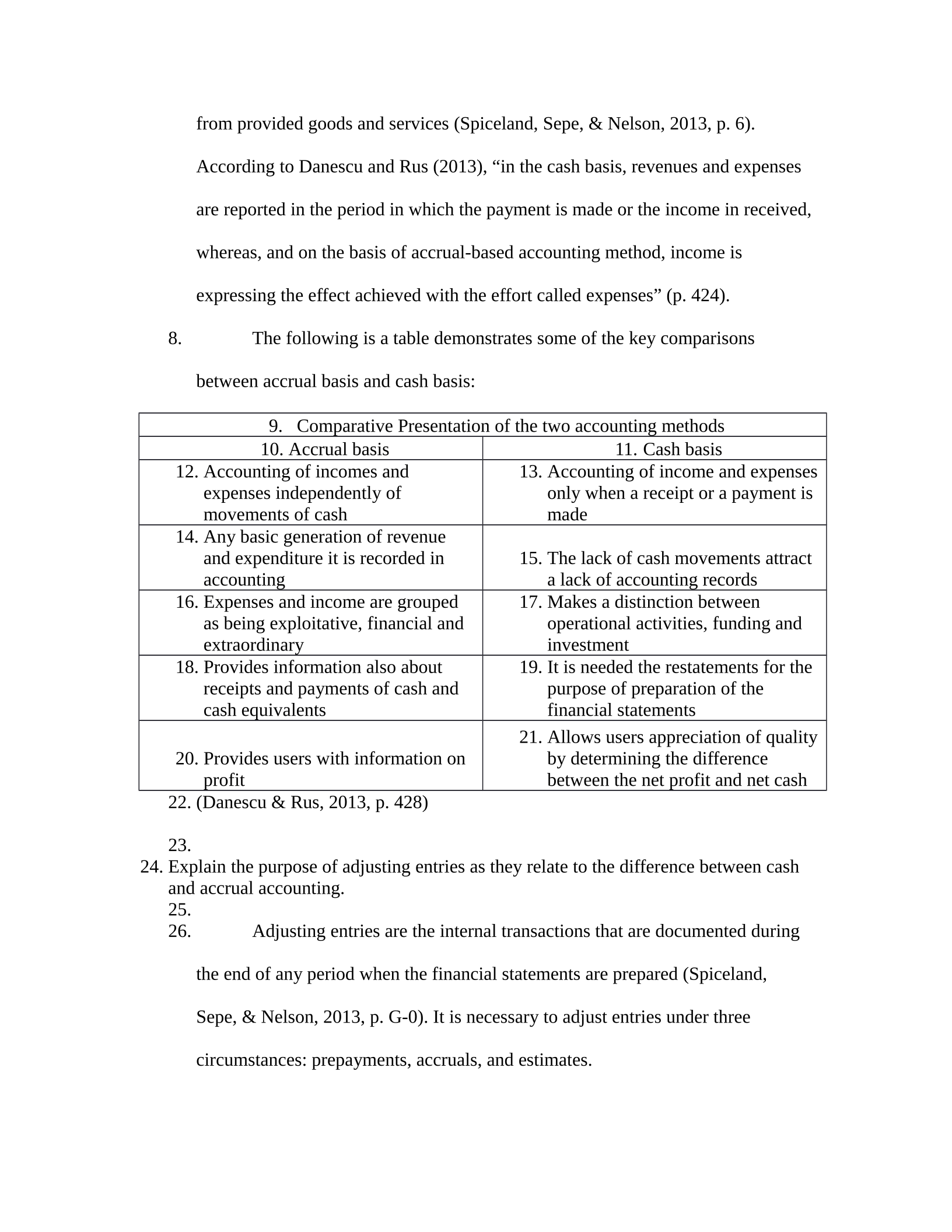
8. The following is a table demonstrates some of the key comparisons
between accrual basis and cash basis:
9. Comparative Presentation of the two accounting methods
10. Accrual basis 11. Cash basis
12. Accounting of incomes and
expenses independently of
movements of cash
13. Accounting of income and expenses
only when a receipt or a payment is
made
14. Any basic generation of revenue
and expenditure it is recorded in
accounting
15. The lack of cash movements attract
a lack of accounting records
16. Expenses and income are grouped
as being exploitative, financial and
extraordinary
17. Makes a distinction between
operational activities, funding and
investment
18. Provides information also about
receipts and payments of cash and
cash equivalents
19. It is needed the restatements for the
purpose of preparation of the
financial statements
20. Provides users with information on
profit
21. Allows users appreciation of quality
by determining the difference
between the net profit and net cash
22. (Danescu & Rus, 2013, p. 428)
23.
24. Explain the purpose of adjusting entries as they relate to the difference between cash
and accrual accounting.
25.
26. Adjusting entries are the internal transactions that are documented during
the end of any period when the financial statements are prepared (Spiceland,
Sepe, & Nelson, 2013, p. G-0). It is necessary to adjust entries under three
circumstances: prepayments, accruals, and estimates.

27. A prepayment is a transaction where the cash flow is collected before
expense or revenue recognition. Also, prepaid expenses signify an asset that has
been recorded when a cash distribution creates profits outside of the current
reporting period. The adjusting entry that is required for a prepaid expense is a
debit to an expense and a credit to an asset (Spiceland, Sepe, & Nelson, 2013).
28. An accrual includes a transaction in which the cash outflow or inflow
takes place in a period of time subsequent to expense to revenue recognition.
When dealing with accrued liabilities the concern is expenses that have been
incurred but not yet paid. The adjusting entry that is required in order to record an
accrued liability is a debit to an expense and a credit to a liability (Spiceland,
Sepe, & Nelson, 2013).
29. References
30. Danescu, T., Rus, L. (2013). Comparative study on accounting models “cash” and
“accrual”. Annales Universitatis Apulensis : Series Oeconomica, 15(2), 424-431.
Retrieved from http://search.proquest.com/docview/1494056986?
accountid=12085
31. Spiceland, J. D., Sepe, J. F., & Nelson, M. W. (2013). Intermediate Accounting
(Seventh ed.). New York, New York: McGraw-Hill/Irwin.
32.
33.
Powered by TCPDF (www.tcpdf.org)

