



p.5
financial accounting, which is chiefly concerned with providing financial information to
various external users
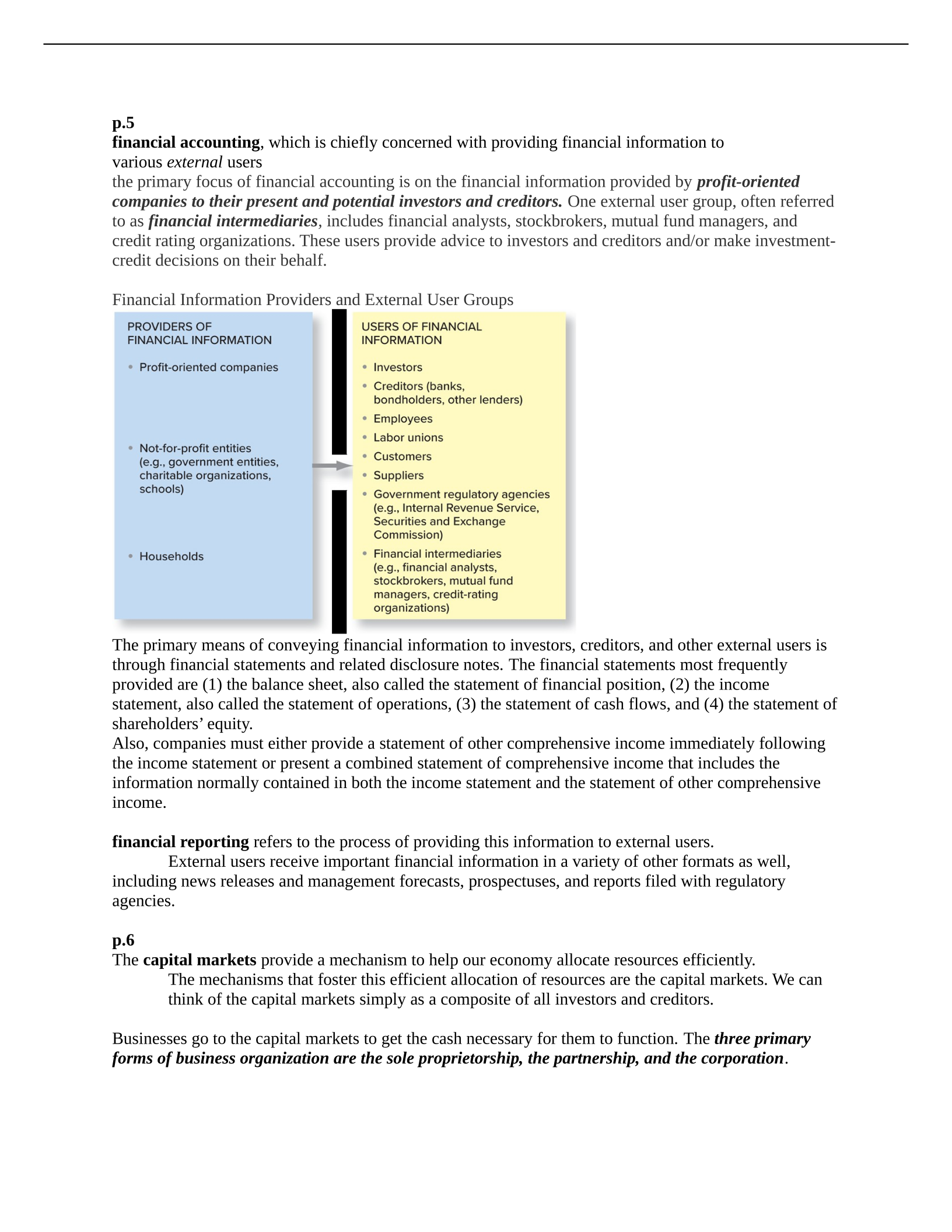
the primary focus of financial accounting is on the financial information provided by profit-oriented
companies to their present and potential investors and creditors. One external user group, often referred
to as financial intermediaries, includes financial analysts, stockbrokers, mutual fund managers, and
credit rating organizations. These users provide advice to investors and creditors and/or make investment-
credit decisions on their behalf.
Financial Information Providers and External User Groups
The primary means of conveying financial information to investors, creditors, and other external users is
through financial statements and related disclosure notes. The financial statements most frequently
provided are (1) the balance sheet, also called the statement of financial position, (2) the income
statement, also called the statement of operations, (3) the statement of cash flows, and (4) the statement of
shareholders’ equity.
Also, companies must either provide a statement of other comprehensive income immediately following
the income statement or present a combined statement of comprehensive income that includes the
information normally contained in both the income statement and the statement of other comprehensive
income.
financial reporting refers to the process of providing this information to external users.
External users receive important financial information in a variety of other formats as well,
including news releases and management forecasts, prospectuses, and reports filed with regulatory
agencies.
p.6
The capital markets provide a mechanism to help our economy allocate resources efficiently.
The mechanisms that foster this efficient allocation of resources are the capital markets. We can
think of the capital markets simply as a composite of all investors and creditors.
Businesses go to the capital markets to get the cash necessary for them to function. The three primary
forms of business organization are the sole proprietorship, the partnership, and the corporation.
In the United States, sole proprietorships and partnerships outnumber corporations. However, the
dominant form of business organization, in terms of the ownership of productive resources, is the
corporation.
Corporations acquire capital from investors in exchange for ownership interest and from creditors by
borrowing.
Investors provide resources, usually cash, to a corporation in exchange for an ownership interest, that is,
shares of stock. Creditors lend cash to the corporation, either by making individual loans or by
purchasing publicly traded debt such as bonds.
We often measure assets and liabilities based on their original transaction value, that is, their historical
cost. Some accountants refer to this practice as applying the historical cost principle.
For an asset, historical cost equals the value of what is given in exchange (usually cash) for the
asset at its initial acquisition. For liabilities, it is the current cash equivalent received in exchange
for assuming the liability.
Stocks and bonds usually are traded on organized security markets such as the New York Stock Exchange
and the NASDAQ. New cash is provided by initial market transactions in which the corporation sells
shares of stock or bonds to individuals or other entities that want to invest in it.
Initial market transactions involve issuance of stocks and bonds by the corporation.
For example, Target first “went public” in 1967, selling shares to finance its expansion. Subsequent
transfers of these stocks and bonds between investors and creditors are referred to as secondary market
transactions
Subsequent transfers of these stocks and bonds between investors and creditors are referred to as
secondary market transactions.
oCorporations receive no new cash from secondary market transactions.
osecondary market transactions are very important to the efficient allocation of resources
in our economy.
ohelp establish market prices for additional shares and for bonds that corporations may
wish to issue in the future to acquire additional capital.
oAlso, many investors and creditors might be unwilling to buy stocks and bonds if they
thought they couldn’t eventually sell those securities to others in the future.
Secondary market transactions involve the transfer of stocks and bonds between individuals and
institutions.
A corporation’s shareholders will receive cash from their investment through the ultimate sale of the
ownership shares of stock. In addition, many corporations distribute cash to their shareholders in the form
of periodic dividends.
For example, if an investor provides a company with $10,000 cash by purchasing stock at the end of
2017, receives $400 in dividends from the company during 2018, and sells the ownership interest (shares)
at the end of 2018 for $10,600, the investment would have generated a rate of return of 10% for 2018,
calculated as follows:
$400 dividends+$600 share price appreciation / $10,000 initial investment = 10%
The expected rate of return and the uncertainty, or risk, of that return are key variables in the investment
decision.
A company will be able to provide a positive return to investors and creditors only if it can generate a
profit from selling its products or services.
The objective of financial accounting is to provide investors and creditors
with useful information for decision making.
That information should help investors and creditors evaluate the amounts, timing, and uncertainty of the
enterprise’s future cash receipts and disbursements.
p.8
Cash verses Accrual Accounting
Even though predicting future cash flows is the primary goal of many users of financial reporting, the
model best able to achieve that goal is the accrual accounting model.
The accrual accounting model, we get a more accurate prediction of future operating cash flows and
a more reasonable portrayal of the periodic operating performance of a company.
Doesn’t focus only on cash flows.
Reflects other resources provided and consumed by operations during a period.
Measure of resources provided by business operations is called revenues, and the measure of
resources sacrificed to produce revenues is called expenses.
The difference between revenues and expenses is net income, or net loss if expenses are greater than
revenues.
Net income is the difference between revenues and expenses.
Net income is considered a better indicator of future operating cash flows than is current net operating
cash flow.
Accrual income attempts to measure the resource inflows and outflows generated by operations during
the reporting period, which may not correspond to cash inflows and outflows. Does this mean that
information about cash flows from operating activities is not useful? No. Indeed, one of the basic
financial statements—the statement of cash flows—reports information about cash flows from operating,
investing and financing activities, and provides important information to investors and creditors.
A competing model is cash basis accounting.
Cash basis accounting produces a measure called net operating cash flow. This measure is the
difference between cash receipts and cash payments from transactions related to providing goods and
services to customers during a reporting period.
Net operating cash flow is the difference between cash receipts and cash disbursements from providing
goods and services.
Over the life of a company, net operating cash flow definitely is the measure of concern. However, over
short periods of time, operating cash flows may not be indicative of the company’s long-run cash-
generating ability. Sometimes a company pays or receives cash in one period that relates to performance
in multiple periods.
Over short periods of time, operating cash flow may not be an accurate predictor of future
operating cash flows.
p.10
Accrual accounting is the financial reporting model used by the majority of profit-oriented companies
and by many not-for-profit companies. The fact that companies use the same model is important to
investors and creditors, allowing them to compare financial information among companies.
To facilitate these comparisons, financial accounting employs a body of standards known as generally
accepted accounting principles, often abbreviated as GAAP (and pronounced gap).
GAAP is a dynamic set of both broad and specific guidelines that companies should follow when
measuring and reporting the information in their financial statements and related notes.
Pressures on the accounting profession to establish uniform accounting standards began after the stock
market crash of 1929.
The 1933 Securities Act and the 1934 Securities Exchange Act were designed to restore investor
confidence.
The 1933 Act sets forth accounting and disclosure requirements for initial offerings of securities (stocks
and bonds).
The 1934 Act applies to secondary market transactions and mandates reporting requirements for
companies whose securities are publicly traded on either organized stock exchanges or in over-the-
counter markets.
The Securities and Exchange Commission (SEC) has the authority to set accounting standards for
companies, but it relies on the private sector to do so.
The 1934 Act also created the Securities and Exchange Commission (SEC). Congress gave the SEC
the authority to set accounting and reporting standards for companies whose securities are publicly traded.
However, the SEC, a government appointed body, has delegated the task of setting accounting standards
to the private sector. It is important to understand that the power still lies with the SEC. If the SEC does
not agree with a particular standard issued by the private sector, it can force a change in the standard. In
fact, it has done so in the past.
Early U.S. Standard Setting
The first private sector body to assume the task of setting accounting standards was the Committee on
Accounting Procedure (CAP).
The CAP was a committee of the American Institute of Accountants (AIA). The AIA was renamed
the American Institute of Certified Public Accountants (AICPA) in 1957, which is the national
professional organization for certified professional public accountants.
From 1938 to 1959, the CAP issued 51 Accounting Research Bulletins (ARBs) which dealt with specific
accounting and reporting problems. No theoretical framework for financial accounting was established.
This piecemeal approach of dealing with individual issues without a framework led to criticism.
In 1959 the Accounting Principles Board (APB) replaced the CAP. The APB operated from 1959
through 1973 and issued 31 Accounting Principles Board Opinion
(APBOs), various Interpretations, and four Statements. The Opinions also dealt with specific accounting
and reporting problems. Many ARBs and APBOs still represent authoritative GAAP.
THE FASB
The FASB was established to set U.S. accounting standards.
Criticism of the APB led to the creation in 1973 of the Financial Accounting Standards Board
(FASB) and its supporting structure. There are seven full-time members of the FASB. FASB members
represent various constituencies concerned with accounting standards, and have included representatives
from the auditing profession, profit-oriented companies, accounting educators, financial analysts, and
government.
The FASB is supported by its parent organization, the Financial Accounting Foundation (FAF), which
is responsible for selecting the members of the FASB and its Financial Accounting Standards Advisory
Council (FASAC), ensuring adequate funding of FASB activities and exercising general oversight of the
FASB’s activities.
In 1984, the FASB’s Emerging Issues Task Force (EITF) was formed to improve financial reporting by
resolving narrowly defined financial accounting issues within the framework of existing GAAP.
The FASB has developed a conceptual framework that is not authoritative GAAP but provides an
underlying structure for the development of accounting standards. The FASB also has issued many
accounting standards, currently called Accounting Standards Updates (ASUs) and previously
called Statements of Financial Accounting Standards (SFASs), as well as numerous
FASB Interpretations, Staff Positions, Technical Bulletins, and EITF Issue Consensuses.
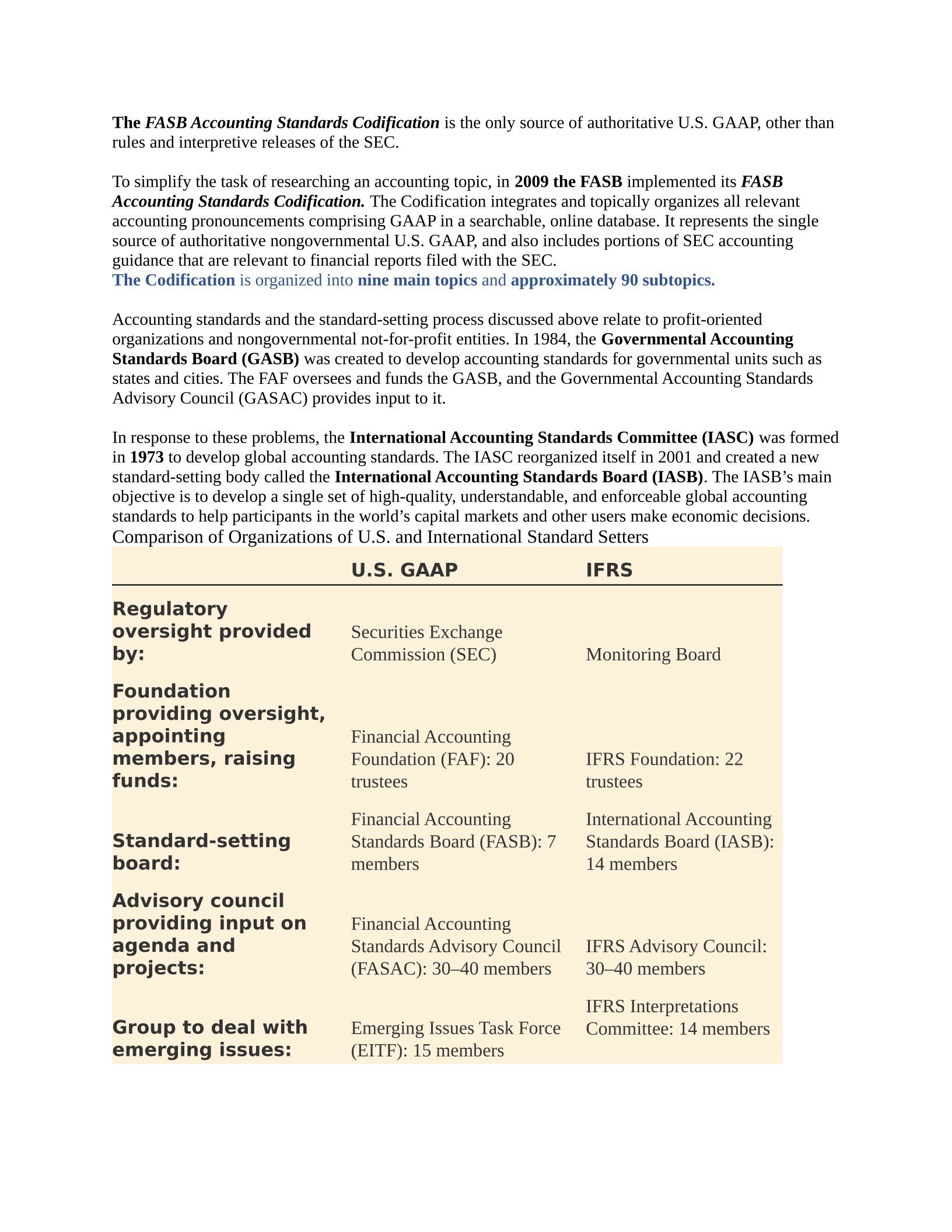
The FASB Accounting Standards Codification is the only source of authoritative U.S. GAAP, other than
rules and interpretive releases of the SEC.
To simplify the task of researching an accounting topic, in 2009 the FASB implemented its FASB
Accounting Standards Codification. The Codification integrates and topically organizes all relevant
accounting pronouncements comprising GAAP in a searchable, online database. It represents the single
source of authoritative nongovernmental U.S. GAAP, and also includes portions of SEC accounting
guidance that are relevant to financial reports filed with the SEC.
The Codification is organized into nine main topics and approximately 90 subtopics.
Accounting standards and the standard-setting process discussed above relate to profit-oriented
organizations and nongovernmental not-for-profit entities. In 1984, the Governmental Accounting
Standards Board (GASB) was created to develop accounting standards for governmental units such as
states and cities. The FAF oversees and funds the GASB, and the Governmental Accounting Standards
Advisory Council (GASAC) provides input to it.
In response to these problems, the International Accounting Standards Committee (IASC) was formed
in 1973 to develop global accounting standards. The IASC reorganized itself in 2001 and created a new
standard-setting body called the International Accounting Standards Board (IASB). The IASB’s main
objective is to develop a single set of high-quality, understandable, and enforceable global accounting
standards to help participants in the world’s capital markets and other users make economic decisions.
Comparison of Organizations of U.S. and International Standard Setters
U.S. GAAP IFRS
Regulatory
oversight provided
by:
Securities Exchange
Commission (SEC) Monitoring Board
Foundation
providing oversight,
appointing
members, raising
funds:
Financial Accounting
Foundation (FAF): 20
trustees
IFRS Foundation: 22
trustees
Standard-setting
board:
Financial Accounting
Standards Board (FASB): 7
members
International Accounting
Standards Board (IASB):
14 members
Advisory council
providing input on
agenda and
projects:
Financial Accounting
Standards Advisory Council
(FASAC): 30–40 members
IFRS Advisory Council:
30–40 members
Group to deal with
emerging issues:
Emerging Issues Task Force
(EITF): 15 members
IFRS Interpretations
Committee: 14 members
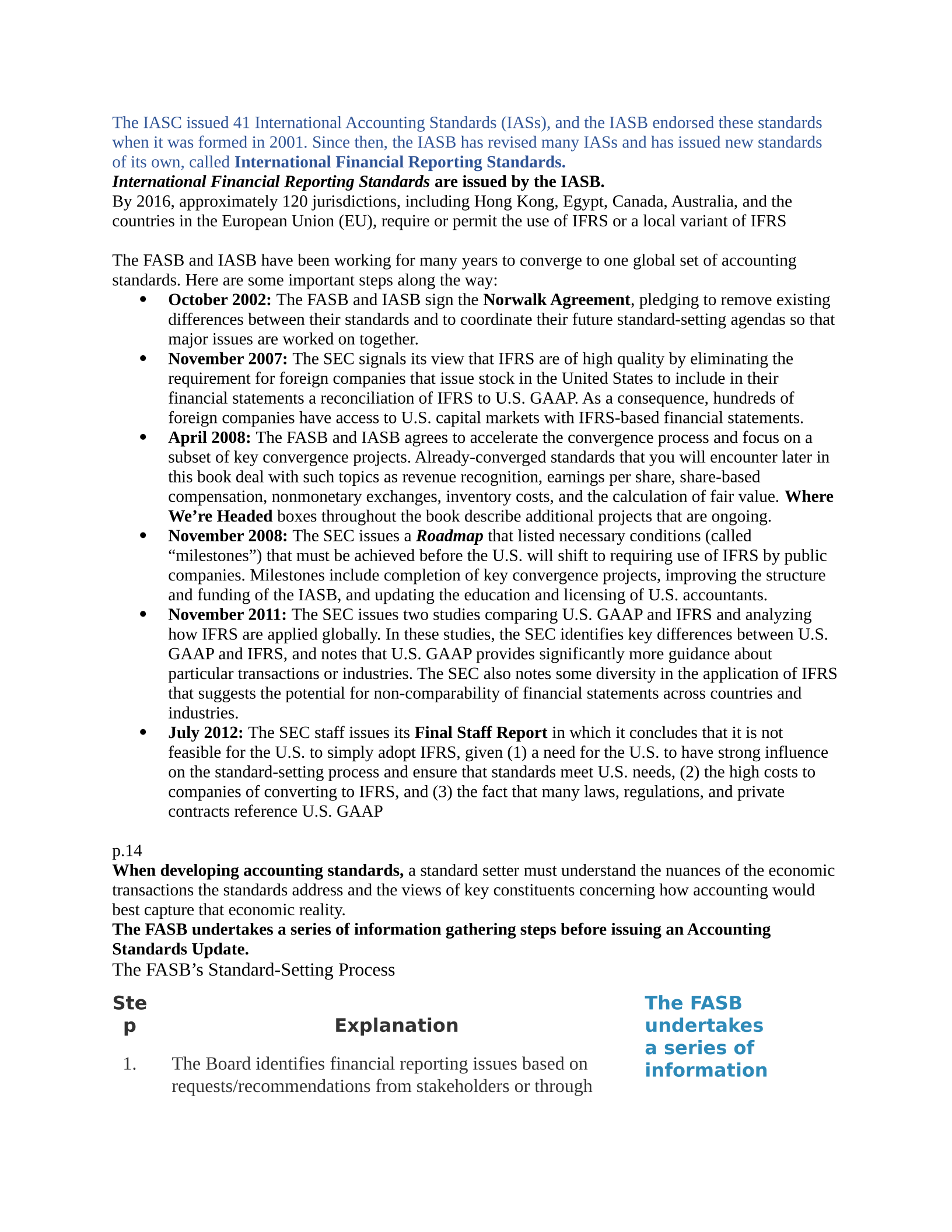
The IASC issued 41 International Accounting Standards (IASs), and the IASB endorsed these standards
when it was formed in 2001. Since then, the IASB has revised many IASs and has issued new standards
of its own, called International Financial Reporting Standards.
International Financial Reporting Standards are issued by the IASB.
By 2016, approximately 120 jurisdictions, including Hong Kong, Egypt, Canada, Australia, and the
countries in the European Union (EU), require or permit the use of IFRS or a local variant of IFRS
The FASB and IASB have been working for many years to converge to one global set of accounting
standards. Here are some important steps along the way:
October 2002: The FASB and IASB sign the Norwalk Agreement, pledging to remove existing
differences between their standards and to coordinate their future standard-setting agendas so that
major issues are worked on together.
November 2007: The SEC signals its view that IFRS are of high quality by eliminating the
requirement for foreign companies that issue stock in the United States to include in their
financial statements a reconciliation of IFRS to U.S. GAAP. As a consequence, hundreds of
foreign companies have access to U.S. capital markets with IFRS-based financial statements.
April 2008: The FASB and IASB agrees to accelerate the convergence process and focus on a
subset of key convergence projects. Already-converged standards that you will encounter later in
this book deal with such topics as revenue recognition, earnings per share, share-based
compensation, nonmonetary exchanges, inventory costs, and the calculation of fair value. Where
We’re Headed boxes throughout the book describe additional projects that are ongoing.
November 2008: The SEC issues a Roadmap that listed necessary conditions (called
“milestones”) that must be achieved before the U.S. will shift to requiring use of IFRS by public
companies. Milestones include completion of key convergence projects, improving the structure
and funding of the IASB, and updating the education and licensing of U.S. accountants.
November 2011: The SEC issues two studies comparing U.S. GAAP and IFRS and analyzing
how IFRS are applied globally. In these studies, the SEC identifies key differences between U.S.
GAAP and IFRS, and notes that U.S. GAAP provides significantly more guidance about
particular transactions or industries. The SEC also notes some diversity in the application of IFRS
that suggests the potential for non-comparability of financial statements across countries and
industries.
July 2012: The SEC staff issues its Final Staff Report in which it concludes that it is not
feasible for the U.S. to simply adopt IFRS, given (1) a need for the U.S. to have strong influence
on the standard-setting process and ensure that standards meet U.S. needs, (2) the high costs to
companies of converting to IFRS, and (3) the fact that many laws, regulations, and private
contracts reference U.S. GAAP
p.14
When developing accounting standards, a standard setter must understand the nuances of the economic
transactions the standards address and the views of key constituents concerning how accounting would
best capture that economic reality.
The FASB undertakes a series of information gathering steps before issuing an Accounting
Standards Update.
The FASB’s Standard-Setting Process
Ste
p Explanation
The FASB
undertakes
a series of
information
1. The Board identifies financial reporting issues based on
requests/recommendations from stakeholders or through
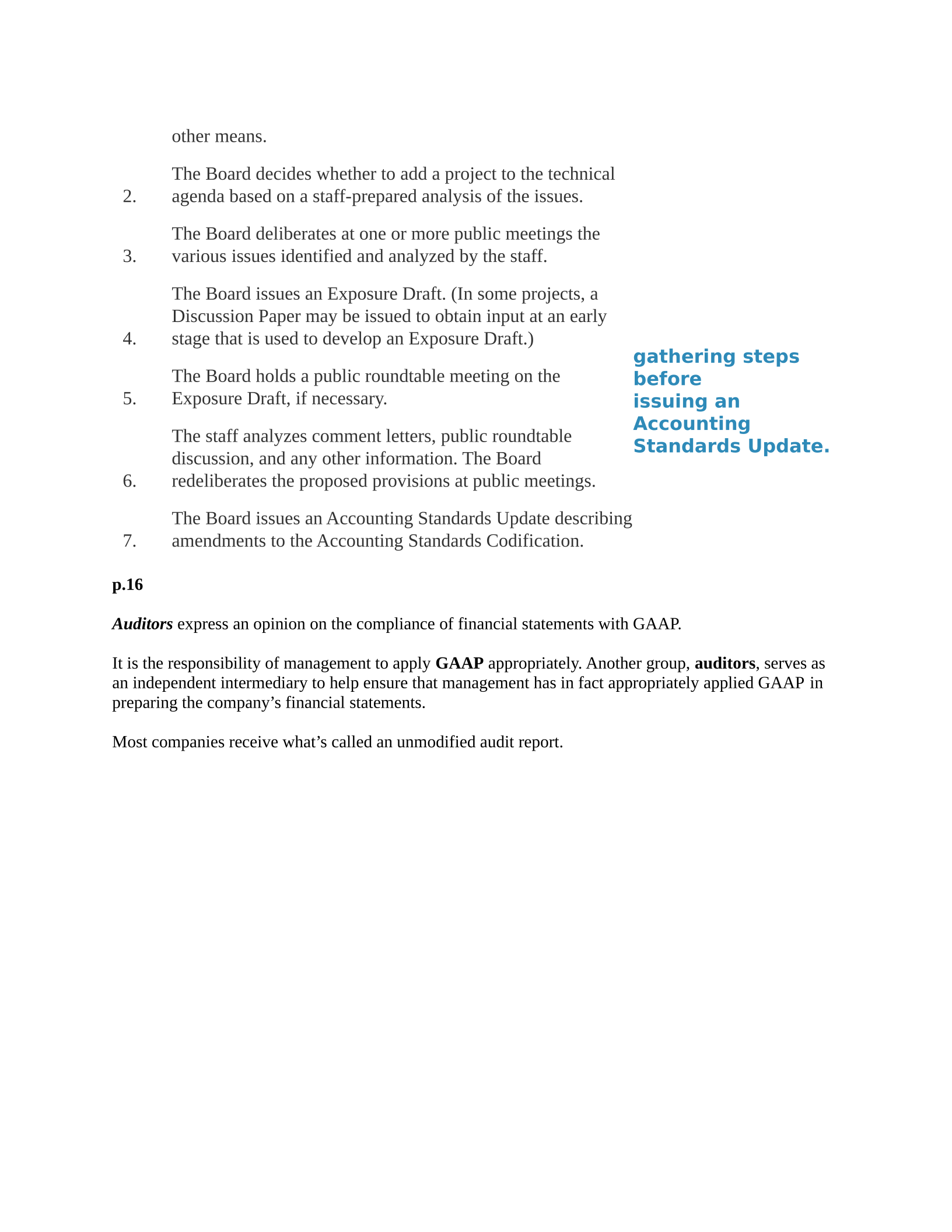
other means.
gathering steps
before
issuing an
Accounting
Standards Update.
2.
The Board decides whether to add a project to the technical
agenda based on a staff-prepared analysis of the issues.
3.
The Board deliberates at one or more public meetings the
various issues identified and analyzed by the staff.
4.
The Board issues an Exposure Draft. (In some projects, a
Discussion Paper may be issued to obtain input at an early
stage that is used to develop an Exposure Draft.)
5.
The Board holds a public roundtable meeting on the
Exposure Draft, if necessary.
6.
The staff analyzes comment letters, public roundtable
discussion, and any other information. The Board
redeliberates the proposed provisions at public meetings.
7.
The Board issues an Accounting Standards Update describing
amendments to the Accounting Standards Codification.
p.16
Auditors express an opinion on the compliance of financial statements with GAAP.
It is the responsibility of management to apply GAAP appropriately. Another group, auditors, serves as
an independent intermediary to help ensure that management has in fact appropriately applied GAAP in
preparing the company’s financial statements.
Most companies receive what’s called an unmodified audit report.
Powered by TCPDF (www.tcpdf.org)

