


What are the main responsibilities of suppliers?
-
Chapter 1: Multi-tier Supply Chain
- Tier one makes big parts or systems that go directly into the cars (engines,
transmissions, etc). Tier two makes smaller parts that go into the parts made by tier one
suppliers (braking systems, fuel injectors, etc)
Chapter 1 — 6: Waste in Supply Chain (pg 19)
-Overproduction: producing more than what is needed or what the customer demands
- Defects: producing defective items or delivering incorrect shipments
- Excess inventory: storing more inventory in warehouses and distribution centers or
manufacturing facility sites that are not required
- Unnecessary transportation: Moving goods more than required or using inefficient
transportation methods
- Inefficient layout: Poor layout of manufacturing facilities, warehouses and distribution
centers could result in excessive movement of workers and materials, which ultimately
causes wasted time, higher labor costs, etc.
- Overprocessing: this occurs when more work is done a production than is necessary,
adding costs and time without creating additional value for the customer
- Waiting: Timing waste in the supply chain refers to the unnecessary delay or waiting time
between different stages or process in the supply chain
- Motion: Unnecessary movement or motion by workers or machinery (ex. Worker has to
walk back and forth between different working stations to find the tools or materials
needed to perform tasks)
Chapter 1: Supply Chain Effectiveness
- How well the product or service meets the customer expectation and needs (ex.
Customers of new iphones are really satisfied with the new phone because its high
quality and has great features)
Chapter 1: Business Model and Supply Chain Structure (pg 14)
- Ross is focused on selling-off price merhcanside from various brands and suppliers.
Supply chain are designed in a way to quickly acquire and distribute their products to its
stores to keep up with demand
- Ralph Lauren designed and manufactures its own brands products. Supply chain model
involves designing and manufacturing its own brands products, which are then
distributed to its own retail stores and department stores. They buy raw material and
then it’s sent to manufacturing facilities
Chapter 1: Supply Chain Structure
II. Manufacturing Storage with Direct Shipping
- The manufacturer produces the item according to the customer’s specifications and
ships to their address without third party logistics providers. Eliminates the need for a
distribution center or retailer and enables the company to have more control over the
supply chain
Chapter 1 — 3: Costs — Procurement (Order) Costs (pg 17)
- Procurement costs are the expenses incurred by a company to acquire goods and
services from exterman suppliers (ex. Zara needs to buy raw materials such as fabric,
threads, buttons and zippers to produce their products. These may be sourced from
different suppliers around the world. Procurement cost of Zara is the cost of buying the
raw materials, administrative costs associated with managing this process, negotiating
contracts, etc.)
Chapter 1: ROI (Rate of Return)
- Ratio of total costs to total investments (ex. Total costs= 450 million, total investments =
200 million. 450 million / 200 million = 2.5)
Chapter 2 — 1: Inventory
- Work-in-Process (WIP) aka semi-finished products refer to the items that are in the
process of being manufactures but are not yet completed
Chapter 2 — 2: Centralized and Decentralized Purchasing (pg 39)
- Centralized purchasing means that all the buying decisions and processes for a
company are handled in one central place or department
- Decentralized purchasing means that each store or location is responsible for making its
own buying decisions and handling the purchasing process. Individual store managers
or regional teams have the authority to choose and buy the products they need
- Direct shipping allows the manufacturer to maintain full control over the production
process and ensures that the customer receives a unique, high-quality product that
needs their specific needs and preferences
Chapter 2: Break-even Analysis
- Break-even analysis allows one to understand how many products a manufacturer
needs to produce in order to make a profit
- Calculate break-even point on pages 33-34
Chapter 2 — 6: Inventory Turnover
- Inventory turnover is a measure of how quickly a company sells its inventory within a
given period.
- Inventory turnover = COGS / average inventory value
- Retail industry experiences high inventory turnover because of fast-moving consumer
goods. Fashion industries that offer affordable clothing experience high inventory
turnover. Food/beverage industry does too. Fine artwork has a low turnover
Chapter 2 — 3: Vertical Integration (pg 37)
- Forward integration refers to the expansion of a company’s activities into downstream
stages of the supply chain, closer to customers (ex. In clothing companies, the forward
integration would involve the company taking control of retail operations and directly
selling their clothing items to customers)
- Backward integration involves the expansion of a company’s activities into upstream
stages, closer to the source of raw materials and components (ex. In the clothing
company, backward integration would involve the company taking control of the
production and sourcing of raw materials of their clothing items)
Chapter 2 — 5: Purchasing Documents (pg 38)
- Purchase requisition is used to request the procurement of goods or services. It includes
details such as item description, quantity needed, required delivery date, and other
relevant information
- Request for quotation (RQF) outlines the requirements, specifications and terms and
conditions that suppliers need to consider when preparing their response
- Supplier contracts/agreements formalize the terms and conditions of a long-term
relationship between the buyer and supplier. It covers aspects such as pricing, payment
terms, quality standards, delivery schedule, etc.
- Invoice is issued by a supplier to request payment for the delivered goods or services. It
includes details such as billing address, supplier information, quantities, taxes, and
payment terms
Chapter 2: Reasons for Outsourcing (pg 35)
- Cost reduction as external suppliers can make the raw materials for a cheaper price
- Access to expertise as external supplier specializing in the production of specific raw
materials often possess deep knowledge, experise and experience in their respective
domain
- Focus on core competencies as outsourcing raw materials allows companies to focus on
their main production process
- Supply chain optimization as outsourcing raw materials can streamline the supply chain
and improve overall operational efficiency
- Flexibility as outsourcing allows companies to scale their production up or down rapidly
based on market demand fluctuations. External supplier often have the capacity and
flexibility to adjust their production volumes quickly
What is pipeline inventory?
- Aka in-transit inventory, it refers to inventory that is in the process of being transferred or
delivered from one location to another within the supply chain
Use this sales data to solve the problem given below, Find the 4-period simple moving
average for period 6:
Period 1 1,150
Period 2 1,065
Period 3 1,905
Period 4 2,300
Period 5 2,000
Ans: (2000+2300+1905+1065)/4 = 1,818
Use this sales data to solve the problem given below, Find the 3-period weighted moving
average for Period 6. Use these weights: 0.2, 0.3, and 0.5 from the oldest to the most
recent period:
Period 1 2,300
Period 2 2,700
Period 3 2,800
Period 4 3,200
Period 5 3,500
Ans: (2800*0.2)+(3200*0.3)+(3500*0.5) = 3,270
Using the givens provided below, find the lot size at which annual holding costs would
be equal to annual ordering cost.
Annual demand = 5000
Unit cost = $50
Ordering cost = $300
Holding cost = $20 per unit
Present lot size = 500
Where AOC=AHC, this equals EOQ
EOQ = sqrt((2*5000*300)/(20))
Ans: 388
Find the annual holding cost if the company is using their present lot size? Do not use
EOQ. Use the present lot size.
Annual demand = 8000
Holding cost = $30 per unit per year
Unit cost = $75 per unit
Ordering cost = $400 per order
Present lot size = 600
AHC = Q/2 * H
Ans: 600/2 * 30 = $9,000
Use the givens provided below to solve this problem. Calculate the average inventory if
the company used the EOQ as their lot size. Be sure to use the EOQ, they will no longer
use the present lot size
Annual demand = 3200
Ordering cost = $1600 per order
Holding cost = 25% of unit cost
Unit cost = $200 per unit
Present lot size = 400
EOQ = sqrt ((2*3200*1600)/(50))
Ans: 453
A company has calculated their cycle time to be 92 seconds. Here is the assembly line
the company designed. What is the effective cycle time for this assembly line? No
calculations are required for this question.
WS #1 – ABC – 45 sec
WS #2 – H – 85 sec
WS #3 – D – 45 sec
WS #4 – FG – 85 sec
WS #5 – JKLM – 55 sec
Ans: WS #2, 85 sec. Effective cycle time is whatever one takes the longest
What is the bottleneck in a production line refer to? What issues could cause a
bottleneck? (pg 52)
- Bottleneck refers to the stage or workstation that limits the overall capacity or output of
the entire process. It is the point in the system where the flow of materials, information,
or work is constrained, causing a slower pace of production.
- Can lead to several issues, such as workstation dile time, WIP buildup, or production
delays
What does cycle time refer to in a production line?
- Cycle time refers to the time it takes to complete the tasks or operations assigned to that
particular workstation. Represents the time interval between the start and completion of
a specific task at the workstation.
- Ex. Assembly line needs to produce 20 cars in an 8 hour work shift. Cycle time would be
24 minutes per car ((8*60)/100). This means that every car must move through the
assembly line every 4.8 minutes to meet production target and keep up with demand
Total task time is the sum of the cycle times for all the tasks performed at each workstation in
the production line. Each task's cycle time represents the time required to complete that specific
task.
Efficiency of the line is a measure of how effectively the production line is operating compared to
its maximum potential. It is calculated by dividing the total task time by the total available time.
The total available time is the time available for production, excluding any planned breaks or
downtime.
Efficiency = (Total task time / Total available time) * 100%
Higher efficiency indicates that the production line is utilizing its available time effectively and
minimizing idle time.
Idle time refers to the time during which a workstation or the entire production line is not
engaged in productive tasks. It can occur due to various reasons, such as machine
breakdowns, waiting for input from preceding workstations, or waiting for resources.
Actual number of workstations refers to the physical count of individual workstations in the
production line. Each workstation represents a specific task or process in the overall production
process.
Chapter 3: Hypercompetitive Market (pg 45)
- Hypercompetitive market refers to an industry characterized by intense competition,
rapid innovation, and constantly evolving customer demands.
According to the textbooks, what are the advantages of a U-shaped layout in
manufacturing? (pg 50)
- U-shaped layout is particularly useful for processes that involve teamwork, collaboration,
and quick problem solving.
Chapter 3 — 2.5: Fixed Position Layout (pg 51)
- Fixed position layout (project layout) is a layout where the product remains fixed while
workers, equipment, and materials are brought to the product. Commonly used in
industries where the product is large, heavy, or complex, making it impractical or
impossible to move it throughout the production process (ex. Airplane manufacturing and
shipbuilding)
Chapter 3 — 5.2: Center of Gravity (CoG) Method (pg 48)
- Center of Gravity determines the best location for a facility based on distribution of
demand or supply point. Example in photos
A company manufactures tables. The factory is open 9 hours each day. The company
needs to manufacture 600 tables each day. There are 12 steps that go into making tables.
What is the required cycle time (in sec/unit) for this company?
Total available production time = 9 hours * 60 minutes * 60 seconds = 32,400 seconds
Total time required = 600 * 12 = 7,200
Ans: Cycle time = 32,400/7,200 = 4.5 seconds
All times are in seconds in the precedence diagram. In this precedence diagram the total
task time is 130 sec. Cycle time is 54 sec/unit The assembly line is as follows:
WS1 – B
WS2 – CD
WS3 – A
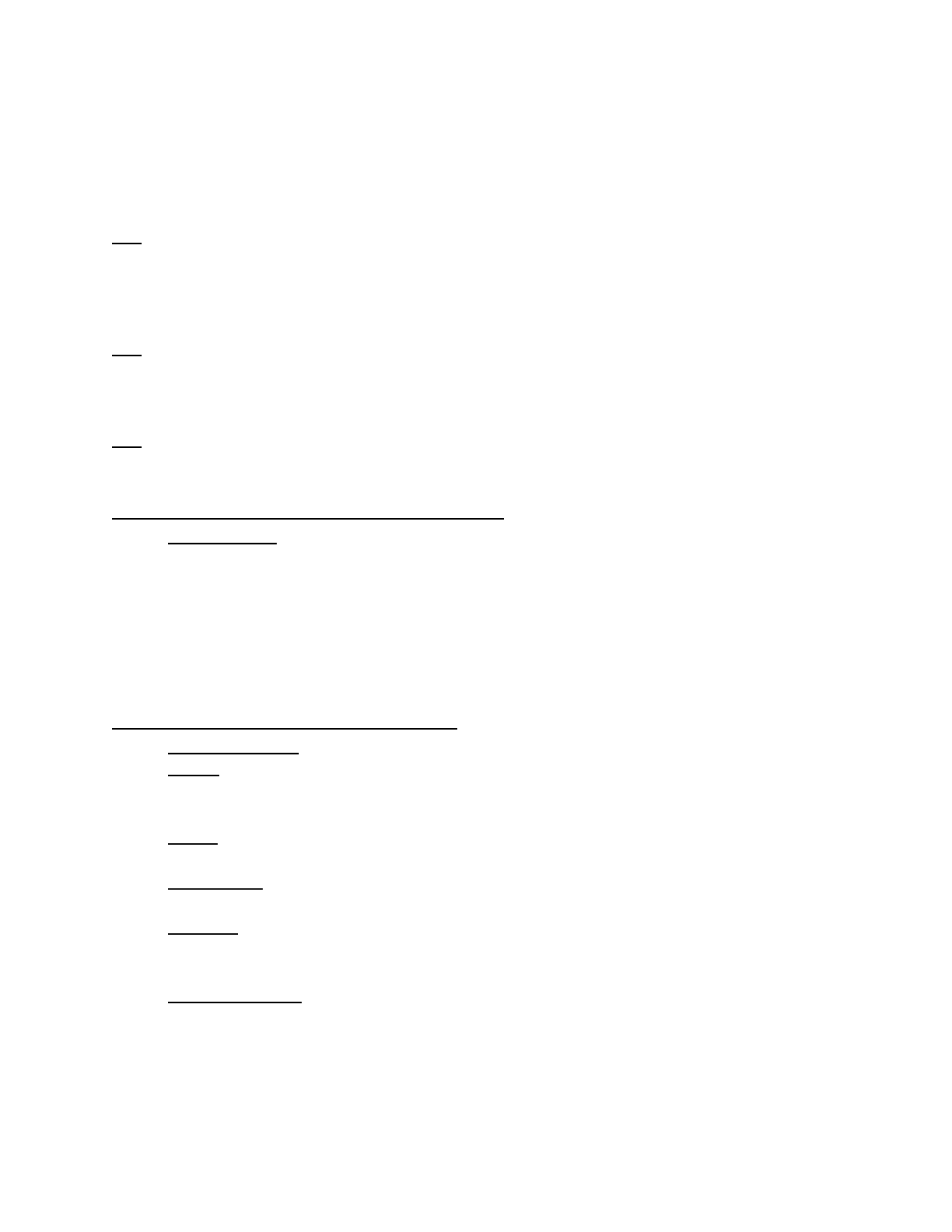
WS4 – E
WS5 – FG
What is the efficiency of this line?
(sum of task times/(no. workstations*cycle time))*100
Ans: (130/(5*54))*100 = 48.15% (0.4815)
What is the idle time of this line?
Actual time= 130, number of workstations = 5, cycle time = 54
Ans: (54*5)-130 = 140 seconds
What is the theoretical number of stations?
Total task time / cycle time
Ans: 130/54 = 2.41 (round up to 3)
Chapter 4 — 5: Cross-Docking (pg 70)
- Cross-docking is used in the supply chain to move products from suppliers to customers
quickly and efficiently. Products don’t stay in a warehouse for a long time. Instead, they
are immediately transferred from incoming trucks (inbound trucks) or containers to
outgoing tricks (outbound trucks) for delivery
- In a distribution center, goods are stored and processed to fulfill customer orders. The
difference is that cross-docking focuses on rapid transfer of goods without storage where
distribution center has storage
Chapter 4 — 1: Packaging (pg 72)
- Cardboard boxes are used for various products and come in different sizes
- Pallets are flat structures made of wood, plastic, or metal used to stack and transport
foods. Often used in distribution centers and are designed to be compatible with lift
trucks
- Crates are stury wooden or plastic containers used to transport heavy or bulky goods.
They provide protection for items that cannot be easily packaged in boxes
- Bubble wrap is a plastic sheet with air-filled bubbles to protect fragile items during
transport
- Dunnage refers to various materials, such as foam, airbags used to fill empty spaces
within a package of a shipping container. Dunnage prevents shifting and movement of
items during transport
- Corrugated board is a type of material made of multiple layers of paper with a wavy inner
layer for added strength. Can be used as custioning material to protect fragile or delicate
items during transit. Can also be used as an edge protector by placing along the edges
of large items or pallets
- Stretch wrap is a plastic film that is tightly wrapped around a pallet of multiple boxes to
secure and stablilize the load. Provides protection against moisture, dust, and tampering.
It’s also used to wrap travel suitcases
Chapter 4 — 1: Cargo Classification (pg 66)
- Bulk cargo refers to large quantities of goods that are transported without individual
packaging or containers. There is no bag, box or packaging for bulk cargo. This includes
grains, coals, minerals, liquids, etc
- Break bulk is used for the items that are packaged in box, bottle, crates, battels, or
drums. This includes reels and rolls, steel grinders, and structural steel
- Neo-bulk are typically oversized goods that cannot be moved in standardized and do nto
fully align with either bulk or break bulk classification. This includes heavy machinery,
luber, and motor vehicles
Chapter 4: Global Logistics (pg 77)
- Freight forwarder is a service provided by companies that specializes in organizing and
managing the transportation of goods on behalf of shippers. They act as intermediaries
between the shipper and various transportation providers, such as airlines, trucking
companies, and custom authorities
Tasks for freight forwarder:
- Documentation, the freight forwarder will help you prepare the required shipping
documents, such of bll oflading, commercial invoice, and packing list.
- Transportation booking, the freight forwarder will coordinate with transportation
providers, such as shipping lines or airlines, to book the most suitable mode of
transportation for your goods.
- Custom clearance, they will handle all of the customs procedures on your behalf
- Logistics coordination, they will organize the movement of your foods from the origin to
destination
- Custom broker is an agent who helps facilitate the customs clearance process by
ensuring compliance with custom regulations and handling necessary documentation.
Specializes in only custom clearance, which is the difference between freight forwarders
- Incoterms is an internation commercial term that define the responsibilities and
obligations of buyers and seller in internation trade, including terms related to shipping,
insurance, and delivery
- Bill of Lading is a legal document that serves and a document between carrier and
shipper
- Custom Clearence is the process of getting goods through customs at port of entry
- Free Trade Zone (FTZ) is a designated area within a country where certain trade and
customer regulations are relaxed or eliminate to encourage internation trade activity
What is dropshipping?
- Dropshipping is used when a retailer sells products online but does not keep them in
stock. Instead, when a customer places an order, the retailer transfers the order and
shipmentdetails to a supplier or manufacturer who ships the product directly to the
customer.
Calculating TEU
- Page 76
Make sure to read and understand different types of containers (20-foot, TOFC, COFC,
Doublestack). What are the advantages and disadvantages? When do we use them? (pg
74)
- 20-foot (more available) is commonly used for smaller shipments, and 40-foot (less
available) is for larger and bulk cargo.
- Doublestack is where two containers are vertically stacked, with one on top of the other.
More can be transported on a single train maximizing cargo capacity and reducing the
number of trains required. However, the trains require specialized infrastructure. They
often require specialized equiptment.
- Trailer on a Flat Car (TOFC) is loading and placing a truck trailer on a rail car. Multimodal
flexibility. Allows for seamless transportation from origin to destination by utilizing both
road and rail networks. Offer time saving for long-distance transportation
- Container on a Flat Car (COFC) are directly loaded and placed into flat railcars.
Common way of transporting containers over long distances by rail. It’s flexible and can
accommodate 20-feet and 40-feet containers.
Make sure to understand the application of each type of container, for example, reefer
containers, flat rack, tank container, and others.
- Open top containers are used for transporting large, bulk, or awkward cargo that cannot
fit into an enclosed container. This includes machinery, construction materials, and other
irregularly shaped items
- Reefer containers (refrigerated containers) are equipped with an internal climate control
system to maintain specific temperate conditions. This includes food, beverage,
pharemceuticals, agriculture, etc.
- Flat rack containers have an open top and don't have side walls, allowing easy loading
and unloading of oversized and irregular items.
- Tank containers are designed for transporting liquids, gasses, or chemicals, featuring a
cylindrical tank structure.

