


PSY 341 Developmental Psychology: In-Depth Study Notes on
Sigmund Freuds Psychoanalytic Theory
I. Learning Insights and Metapsychological Context
As a student navigating the landscape of Developmental Psychology (PSY 341),
encountering Sigmund Freuds Psychoanalytic Theory is a crucial, though sometimes
challenging, exercise. My primary learning insight is to approach Freuds model—
known as Metapsychology—as a monumental, albeit non-empirical, framework that
fundamentally shifted the psychological paradigm. His core radical contribution was
the hypothesis that the vast majority of human motivation, behavior, and
personality is determined by unconscious psychological forces and psychic energy,
primarily the libido (the life instinct, encompassing sexual and creative drives) and
Thanatos (the death instinct, encompassing aggression and self-destructive
tendencies).

We must understand his theory dynamically: personality is not static, but a constant
battleground where the three components of the mind wage conflict, mediating
between primal urges and societal demands. The developmental stages are his
attempt to explain how the interaction between these innate drives and
environmental pressures shapes the final character structure and potential
psychopathology in adulthood. A fixation in any stage represents an unresolved
conflict, requiring a disproportionate amount of psychic energy (cathexis) to
maintain, thus diminishing the
Ego
s resources for managing reality. While criticized
for its lack of falsifiability and reliance on retrospective, unrepresentative clinical
case studies, the theory remains unparalleled in illuminating the profound
significance of early childhood experiences and the mechanisms of psychological
defense.
II. Core Knowledge Point 1: The Psychosexual Stages of Development👶
Freud’s theory posits that personality develops through five stages, each defined by
an erogenous zone—a part of the body that serves as the focus for the reduction of
psychic tension and the source of pleasure for the
Id
’s drives. The successful
resolution of the conflict associated with each stage is necessary for healthy
development. Failure to resolve these conflicts due to excessive gratification or
excessive frustration can lead to fixation, where an individual retains immature,
maladaptive behaviors or personality traits into adulthood.
1. The Oral Stage (Birth to Approximately 18 Months)
Erogenous Zone Focus: The mouth. This is the primary point of interaction with the
world and the source of both sustenance and pleasure.
Libidinal Activity: Centered on oral activities, including sucking, biting, nursing, and
exploring objects by placing them in the mouth. The infant is in a state of narcissism
(self-love), entirely dependent on the mother/caregiver for survival and immediate
gratification of
Id
urges.
Developmental Conflict: Weaning. The transition from total dependency on the
breast or bottle to independent consumption of food, often coinciding with the
emergence of teeth (leading to biting). This introduces the first significant
experience of frustration.
Fixation and Adult Personality (Oral Character): Fixation occurs when weaning is
either too abrupt/harsh (frustration) or too delayed/indulgent (over-gratification).
Oral-Receptive Personality: Marked by excessive dependency, passivity, gullibility,
and a need to "take things in." Manifests as heavy smoking, overeating, excessive
drinking, or being overly talkative and needing constant approval.
Oral-Aggressive Personality: Marked by verbal hostility, sarcasm, cynicism, and
manipulativeness, symbolically related to the aggression associated with biting and
the frustration of unmet needs. This individual attempts to "take" from others
aggressively.

Clinical Example: A patient presenting with chronic anxiety and a pattern of
immediately seeking new relationships after a breakup (receptivity) and exhibiting
highly cynical humor (aggression) might be diagnosed with an oral fixation,
unconsciously seeking the security and gratification of the earliest developmental
phase. The therapeutic goal is to help the
Ego
acknowledge and manage these
dependent and aggressive impulses consciously.
2. The Anal Stage (Approximately 18 Months to 3 Years)
Erogenous Zone Focus: The anus and the process of elimination and retention.
Libidinal Activity: The child derives pleasure from the release of tension associated
with holding or expelling feces. This is the first time the child’s
Id
impulses
encounter external demands (the Reality Principle) enforced by parental figures,
primarily through toilet training.
Developmental Conflict: Toilet Training. This conflict is a battle of wills, involving
the assertion of autonomy and the learning of control. The child must learn to delay
gratification (retention) to meet parental and societal standards. How the parent
manages this training is crucial.
Too Strict/Punitive Training: The child may rebel by defecating at inappropriate
times (messiness) or become excessively retentive and orderly.
Too Lenient Training: The child may not learn to regulate their impulses, leading to
continued sloppiness and irresponsibility.
Fixation and Adult Personality (Anal Character):
Anal-Retentive Personality: Characterized by excessive orderliness, stinginess,
obstinacy, and fastidiousness. The adult is preoccupied with control, organization,
and perfectionism (symbolic retention).
Anal-Expulsive Personality: Characterized by messiness, cruelty, emotional
outbursts, disorganization, and carelessness. The adult is rebellious and prone to
emotional "explosions" (symbolic expulsion).
Clinical Example: An individual diagnosed with Obsessive-Compulsive Personality
Disorder (OCPD) often displays traits highly consistent with the anal-retentive
fixation: rigidity, excessive conscientiousness, emotional constrictedness, and
difficulty delegating tasks due to a belief that others cannot maintain their high
standards of order. The root is interpreted as unresolved conflicts over control and
obedience during the anal stage.
3. The Phallic Stage (Approximately 3 to 6 Years)
Erogenous Zone Focus: The genitals. Pleasure is derived from self-stimulation and
an awareness of anatomical differences between sexes.

Libidinal Activity: Curiosity about sex and gender roles emerges. The focus is on the
discovery of the genitals as a source of pleasure and the recognition of differences,
leading to the central conflict.
Developmental Conflict: The Oedipus Complex (for boys) and the Electra Complex
(for girls, though Freud’s development of the female complex was less consistent
and more controversial).
Oedipus Complex (Boys): The boy develops unconscious sexual desires for his
mother and views the father as a rival. This creates immense anxiety, specifically
castration anxiety—the fear that the powerful father will punish these desires by
removing the genitals. To resolve this intolerable conflict, the boy ultimately
identifies with the father, internalizing his fathers values, morals, and gender role.
This identification is the crucial origin of the
Superego
(the moral conscience).
Electra Complex (Girls): The girl shifts her attachment from the mother to the
father, driven by penis envy—the realization that she lacks a penis and blames the
mother. She seeks the father’s attention and symbolically desires a penis/baby from
him. Resolution involves relinquishing this desire and identifying with the mother,
leading to the development of feminine characteristics and the eventual desire for a
male partner and childbirth. (This concept is heavily criticized today for its clear
bias and the implication that female
Superego
development is inferior).
Fixation and Adult Personality (Phallic Character): Fixation is linked to problems
with sexual identity, exhibitionism, vanity, and excessive striving for success or
power to prove ones masculinity/femininity.
Men: May become excessively boastful, narcissistic, and aggressively competitive to
unconsciously affirm their gender identity and overcome castration anxiety.
Women: May exhibit overly seductive or manipulative behaviors, attempting to
attract powerful male figures to satisfy unresolved
Oedipal
desires (as interpreted
by classic Freudian analysis).
Clinical Example: A pattern of histrionic personality traits—such as excessive
emotionality, attention-seeking behavior, and inappropriate sexualized interactions
—is often interpreted as a residual manifestation of unresolved conflicts from the
Phallic
Stage, where the individual remains fixated on gaining the admiration and
attention denied during the complexs resolution phase.
4. The Latency Period (Approximately 6 Years to Puberty)
Erogenous Zone Focus: None.
Libidinal Activity: The sexual impulses are repressed or sublimated (channeled) into
non-sexual, socially acceptable activities. The psychic energy is diverted away from
biological drives and toward social and intellectual development.

Developmental Conflict: Relatively tranquil period. The
Ego
and
Superego
solidify
their structure, and the child focuses on peer relationships, school, sports, and
cultural learning. The
Id
is temporarily dormant.
Fixation Manifestations: This period is generally considered non-fixating, but poor
resolution (or failure to successfully sublimate energy) can lead to difficulty forming
social bonds or engaging in productive, non-sexual activities later in life.
5. The Genital Stage (Puberty Onward)
Erogenous Zone Focus: The genitals (mature sexuality).
Libidinal Activity: The reawakening of sexual impulses, but the focus shifts from
self-gratification (phallic stage) to the establishment of mature, reciprocal, and
intimate relationships with others outside the family unit. The primary goal is
sexual satisfaction and reproduction.
Developmental Conflict: Achieving a balance between satisfying personal sexual
needs and societal responsibility, including work and family commitments. The
individual must successfully integrate the
Id
s urges with the
Ego
s reality-testing and
the
Superego
s moral standards.
Fixation and Adult Personality: Successful navigation of all preceding stages leads to
the Genital Character—a well-adjusted, mature, and responsible adult capable of
satisfying both "lieben und arbeiten" (to love and to work). Failure to achieve this
stage means the individual remains anchored by fixations from earlier stages,
hindering their capacity for genuine intimacy and productivity.
Clinical Example: The ultimate developmental goal is the ability to form a stable,
heterosexual, reciprocal intimate bond. Lack of this capacity, often manifesting as
promiscuity, fear of commitment, or chronic relationship instability, is interpreted
as a failure to fully resolve the conflicts of the
Phallic
and
Genital
stages, indicating a
reliance on immature defense mechanisms to cope with anxiety related to intimacy.
III. Core Knowledge Point 2: The Structural Model of Personality🏛️
Freuds Structural Model divides the personality into three interacting, hierarchical
systems. These structures are not physical areas of the brain but abstract concepts
representing different functions and motivations within the psyche.
1. The
Id
Function: The oldest and most primitive part of the mind, present from birth. It is
the reservoir of all psychic energy, including the instincts (libido and Thanatos).
Principle: Governed solely by the Pleasure Principle. The
Id
seeks immediate
gratification of all needs and urges, reducing tension regardless of external reality or
consequences.

Process: Operates through Primary Process Thinking, which is illogical, irrational,
fantasy-oriented, and ignores reality (e.g., dreaming and wish fulfillment). It cannot
distinguish between subjective need and objective satisfaction.
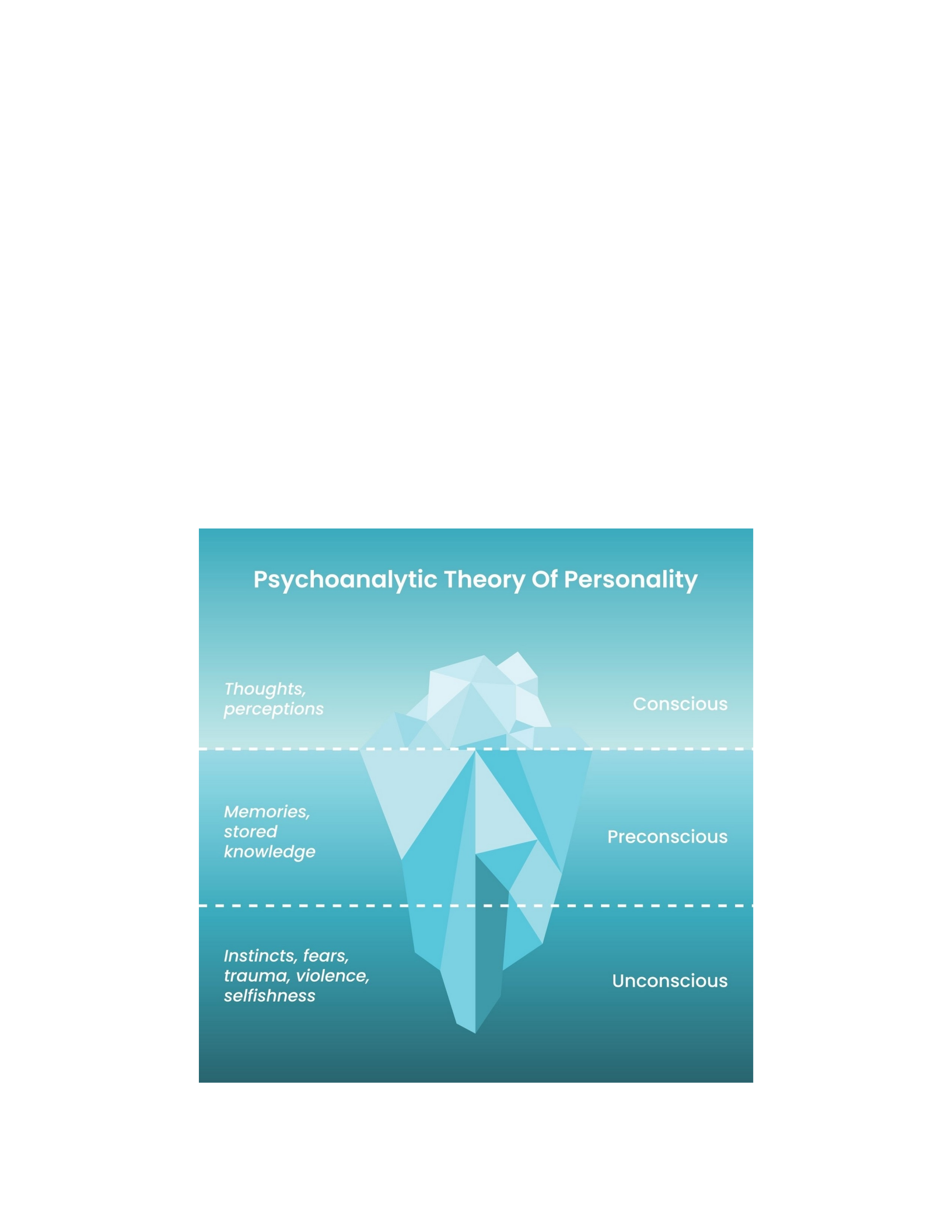
Consciousness Level: Entirely Unconscious.
Core Characteristics: Demanding, impulsive, selfish, and amoral. It represents raw,
untamed biological drives.
2. The
Ego
Function: Develops out of the
Id
in the second half of the first year of life. It serves as
the rational, negotiating, and mediating component of the personality. It exists to
serve the
Id
s drives but in a realistic manner.
Principle: Governed by the Reality Principle. The
Ego
attempts to postpone the
Id
s
gratification until an appropriate object or situation that satisfies the need
realistically can be found. It weighs the risks and benefits of actions.
Process: Operates through Secondary Process Thinking, which is rational, logical,
problem-solving, and reality-oriented. This is the thought process required for
effective problem-solving and interaction with the external world.
Consciousness Level: Operates in the Conscious, Preconscious, and Unconscious
realms. It is the executive of the personality.
Core Characteristics: Rational, practical, organized, and adaptive.
3. The
Superego
Function: The moral arm of the personality, developing around age 5 or 6, primarily
through the resolution of the
Oedipus
/
Electra
complex. It represents the
internalization of parental and societal moral standards.
Principle: Governed by the Moral Principle. It aims for perfection and judges the
Ego
’s actions, resulting in feelings of pride (when moral standards are met) or guilt
(when standards are violated).
Components:
Conscience: Internalized prohibitions (what not to do), resulting in guilt or self-
punishment when rules are broken.
Ego-Ideal: Internalized ideals and moral aspirations (what to do), resulting in pride
when goals are achieved.
Consciousness Level: Operates primarily in the Preconscious and Unconscious
realms.
Core Characteristics: Moralistic, judgmental, rigid, and sometimes irrationally
punitive. It is the internalized voice of authority.
The Dynamics of Psychic Conflict
Anxiety is the signal that the
Ego
is under threat. The dynamic interplay leads to
three types of anxiety:
Neurotic Anxiety: Fear that the
Id
’s impulses will become uncontrollable and lead to
punishment from the external world. (Fear of the
Id
).
Moral Anxiety: Fear of violating the
Superego
’s moral code, resulting in feelings of
guilt or shame. (Fear of the
Superego
).
Reality Anxiety: Fear of tangible dangers in the real world (e.g., fear of a car
accident).
The
Ego
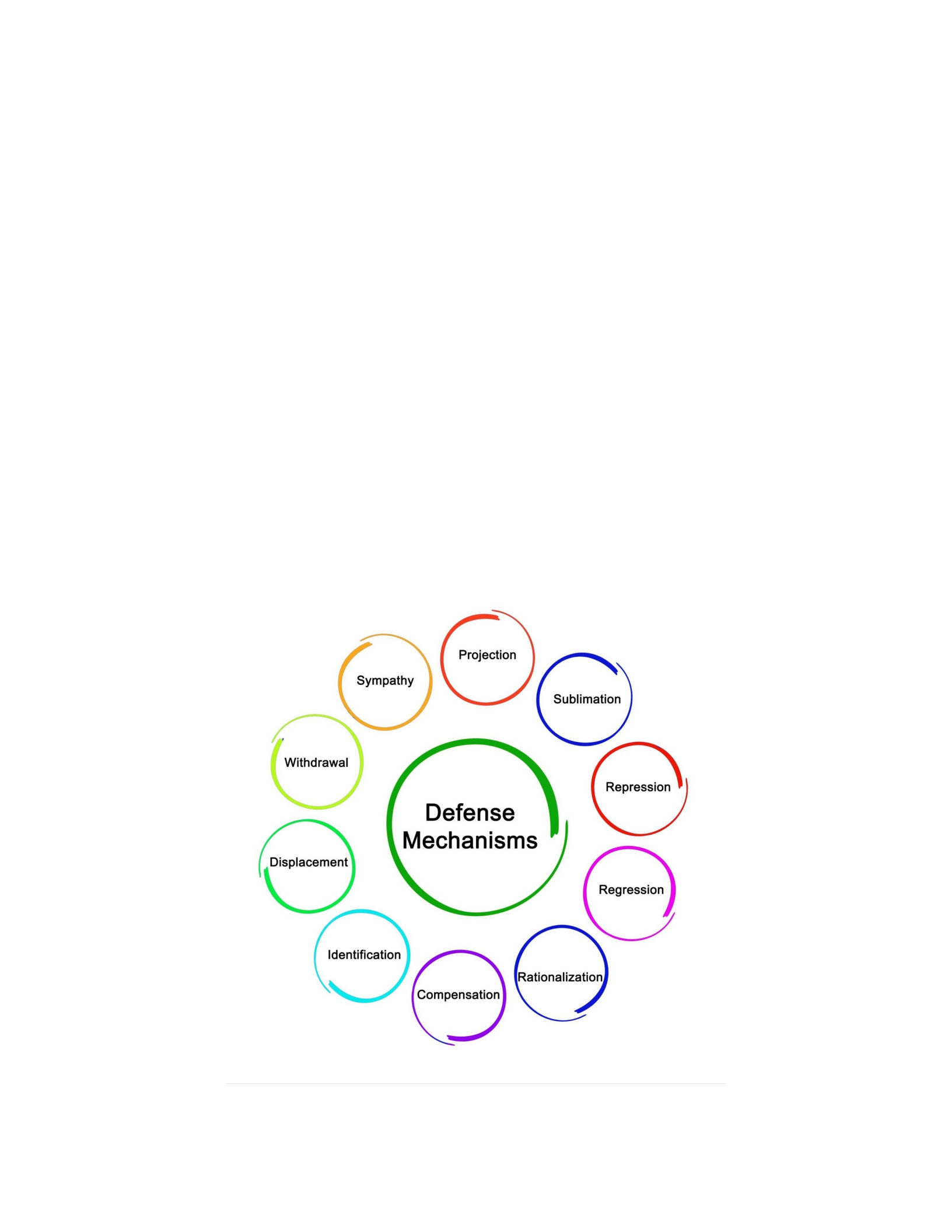
manages the tension caused by these anxieties by deploying Defense
Mechanisms.
IV. Core Knowledge Point 3: Ego Defense Mechanisms🛡️
Defense mechanisms are unconscious psychological strategies employed by the
Ego
to protect the individual from anxiety arising from unacceptable
Id
impulses or
Superego
demands. They distort or deny reality to some extent. While normal and
essential for psychological function, excessive or rigid reliance on any single
mechanism indicates maladjustment.
1. Repression (ä
Verdrängung
)

Definition: The most fundamental defense mechanism. It is the unconscious
exclusion of distressing thoughts, feelings, memories, or wishes from the conscious
mind. These repressed materials are not destroyed but remain in the
Unconscious
,
continuing to influence behavior.
Function: To keep threatening material (e.g., trauma,
Oedipal
desires) out of
awareness.
Example: A survivor of severe childhood trauma who has absolutely no conscious
recollection of the events but suffers from chronic, unexplained anxiety attacks.
2. Denial (
Verleugnung
)
Definition: Protecting the
Ego
from a painful reality by refusing to perceive it. Unlike
repression, the event is usually conscious but the emotional or logical implications
are ignored.
Function: To maintain psychological homeostasis in the face of imminent threat.
Example: A heavy smoker who is told by his doctor he has severe lung damage but
responds, "The doctor must be mistaken; I feel fine and am not going to change
anything."
3. Projection (
Projektion
)
Definition: Attributing one’s own unacceptable, unwanted, or threatening
Id
impulses (thoughts, feelings, motives) to another person or object.
Function: To make internal anxiety seem like an external threat, which is easier for
the
Ego
to manage.
Example: A student who feels hostile toward their professor unconsciously believes,
"Its not me who hates him; its the professor who hates me and is trying to fail me."
4. Displacement (
Verschiebung
)
Definition: Shifting unacceptable impulses or feelings from their original,
threatening object to a safer, less threatening substitute object.
Function: To allow the discharge of
Id
energy without facing punitive consequences.
Example: A man who is angrily criticized by his boss (the threatening object) cannot
lash out at the boss, so he goes home and yells at his partner or kicks the dog (the
substitute, safer object).
5. Rationalization (
Rationalisierung
)
Definition: Creating plausible but false excuses to justify unacceptable behavior or
failures, thereby protecting the
Ego
from feelings of inadequacy or guilt.

Function: To provide a socially acceptable reason for behavior driven by primitive
Id
urges or to soothe a wounded
Ego
.
Example: A student who fails an important exam tells their peers, "That class was
not important anyway, and the grading was arbitrary; my time was better spent on
other things." (The "sour grapes" mechanism).
6. Sublimation (
Sublimierung
)
Definition: The only truly healthy and constructive defense mechanism. It involves
channeling unacceptable sexual or aggressive
Id
energy into highly valued, socially
approved activities or pursuits.
Function: To satisfy
Id
drives productively while simultaneously elevating the
individuals social standing.
Example: A person with intense aggressive impulses channels that energy into
becoming a successful professional boxer, surgeon, or competitive debater. The
aggressive urge is transformed into a socially beneficial skill.
7. Reaction Formation (
Reaktionsbildung
)
Definition: Behaving in a way that is exactly the opposite of one’s unconscious,
unacceptable impulses. The unacceptable feeling is kept out of consciousness by
replacing it with its opposite in exaggerated form.
Function: To convince both the self and others that the unacceptable
Id
impulse
does not exist.
Example: A mother who harbors unconscious resentment toward her child (an
unacceptable
Id
impulse) becomes excessively doting, overprotective, and
smothering, demonstrating the opposite of her true feelings.
8. Regression (
Regression
)
Definition: Returning to an earlier, less mature, and usually safer stage of
development in response to stress or anxiety. The individual reverts to the
behaviors characteristic of the stage where a fixation occurred.
Function: To avoid the current source of anxiety by retreating to a time when life
felt simpler and needs were met more easily.
Example: An older child who starts wetting the bed, sucking their thumb, or
demanding to be bottle-fed after the arrival of a new sibling.
9. Intellectualization (
Intellektualisierung
)
Definition: Dealing with stressful or emotional situations by approaching them in a
purely intellectual, cold, and highly abstract manner, avoiding the emotional
dimension entirely.

Function: To distance the
Ego
from the overwhelming feelings associated with a
threat.
Example: A person who is diagnosed with a terminal illness spends all their time
researching the epidemiology, statistical survival rates, and biomedical mechanisms
of the disease, discussing them with detached, academic terminology, but never
acknowledging the fear or sadness.
10. Isolation of Affect (
Affektabspaltung
)
Definition: Separating an idea or event from the feeling (affect) that originally
accompanied it. The individual remains conscious of the factual event but the
emotional charge is stripped away.
Function: To allow the conscious processing of a traumatic memory without the
associated intolerable pain.
Example: A war veteran recounts a horrifying battle experience with factual
precision and detail, but speaks in a monotonous tone, showing no visible or felt
emotion related to the violence described.
11. Undoing (
Ungeschehenmachen
)
Definition: A ritualistic or compulsive act performed to symbolically reverse or
negate a previous unacceptable thought or action. It is often an unconscious attempt
to "apologize" for the unacceptable impulse.
Function: To magically cancel out guilt and moral anxiety arising from the
Superego
.
Example: After thinking a hostile thought about a loved one, a person compulsively
knocks on wood or repeats a specific phrase to "undo" the perceived harm of the
negative thought.
12. Introjection (
Introjektion
)
Definition: Internalizing the characteristics or values of another person (often a
significant figure) into ones own
Ego
or
Superego
.
Function: To symbolically possess the object that is lost or feared. This is a crucial
defense mechanism in the formation of the
Superego
(introjection of parental moral
standards).
Example: A person who has lost a loved one may unconsciously adopt the
mannerisms, style of speech, or habits of the deceased person as a way to keep them
"alive" internally and mitigate the pain of loss.
13. Identification (
Identifizierung
)
Definition: Similar to introjection, but broader. Taking on the characteristics of
another person, often a perceived aggressor or someone powerful, to increase ones
feelings of self-worth or to avoid being harmed.

Identification with the Aggressor: Adopting the perceived negative or hostile traits
of a feared authority figure.
Function: To feel powerful by becoming like the aggressor, often seen as a protective
strategy against abuse or fear.
Example: A child who is bullied in school starts to act like the bully toward younger
or weaker children, unconsciously seeking to align themselves with power and
distance themselves from the feeling of victimhood.
14. Fixation (
Fixierung
)
Definition: Although primarily a stage outcome, it is also viewed as a defense
mechanism where the individual invests too much
libido
in an earlier stage of
development and resists moving forward, defending against the anxieties of the next
stage.
Function: To prevent the anxiety associated with moving to a more demanding
developmental level.
Example: A young adult who is terrified of the responsibilities of independence and
marriage remains overly dependent on their parents, exhibiting oral-receptive
behaviors and refusing to take a job or move out.
15. Undoing (
Ungeschehenmachen
) and Compensation (
Kompensation
)
Compensation: Masking perceived weaknesses or failures in one area by excelling in
another area.
Example of Compensation: A student who feels intellectually inferior (due to poor
grades in math) becomes an exceptionally talented, dedicated, and socially admired
athlete. The failure in one domain is compensated by overachievement in another.
V. Developmental and Clinical Applications📚
Case Study Example: The Anal-Retentive Student
Scenario: Alex, a
PSY%341
student, exhibits extreme test anxiety. He spends hours
organizing his notes by color-coding, uses three different highlighters to categorize
concepts, and refuses to lend his notes out of fear they will be damaged or
misplaced. He struggles to start writing essays, constantly rewriting the opening
paragraph and delaying submission until the last possible second because he fears
imperfection.
Psychoanalytic Interpretation: Alex is displaying classic characteristics of an Anal-
Retentive Character Fixation.
Fixation Source: Unresolved conflict during the Anal Stage (ages 1.5–3). His parents
were likely overly strict or demanding during toilet training, equating control over
bodily functions with virtue and love.

Manifestation: His need for extreme order, meticulousness, and control (over his
notes, time, and writing) is a symbolic manifestation of retaining and controlling his
excretions. His anxiety about imperfection and delay of action (procrastination)
stems from a deep, unconscious fear of parental disapproval and punishment for
making a "mess" or failing to be perfect.
Defense Mechanism: Alex primarily uses Reaction Formation (masking his
underlying desire for impulsive freedom with exaggerated orderliness) and
Intellectualization (over-analyzing the organization of notes instead of addressing
the emotional anxiety of writing the essay).
Critical Evaluation and Legacy
While its methods are outdated, Freud’s theory holds an undeniable legacy in
developmental psychology:
Positive Contributions:
Acknowledging Sexuality and Development: The first major theory to suggest that
human sexuality and psychological development begin in infancy, not adolescence.
The Unconscious: Established the concept of the unconscious mind, which is a key
component of modern cognitive psychology (e.g., implicit memory, implicit bias).
Defense Mechanisms: The mechanisms remain widely accepted and used in clinical
practice (though often reframed by ego psychologists) to explain coping strategies.
Impact on Psychotherapy: Founded the clinical practice of Psychoanalysis,
emphasizing talk therapy and the therapeutic power of bringing unconscious
conflicts into conscious awareness.
Major Limitations and Criticisms:
Lack of Empirical Support (Falsifiability): Concepts like the
Id
and
libido
are difficult,
if not impossible, to operationally define and test scientifically.
Reliance on Retrospective Data: The theory was based primarily on the subjective
recollections of adult, often wealthy, Viennese patients, leading to poor
generalizability.
Gender Bias: The
Electra
Complex and the concept of penis envy are considered
highly sexist and inadequate explanations for female development, often leading to
the claim that women have less developed
Superegos
.
Overemphasis on Biology: Fails to adequately account for cultural, social, and
environmental factors outside of the immediate family dynamic. Later neo-
Freudians (like Erik Erikson and Karen Horney) addressed these limitations.
VI. Summary of Key Terms for PSY 341📝

Here is a consolidated list of the most critical professional terms derived from
Freuds theory:
Libido (
Libido
): The psychic energy or instinctual drive associated with the life
instincts (
Eros
), primarily centered on survival, pleasure, and reproduction.
Thanatos (
Thanatos
): The unconscious death instinct, manifested in aggressive,
destructive, and self-harming behavior.
Cathexis (
Cathexis
): The investment of psychic energy (libido) in an object or idea
(e.g., cathexis onto the mother during the
Oral
Stage).
Anticathexis (
Anticathexis
): The
Ego
s use of energy to restrain the
Id
s impulses,
fundamentally achieved through the use of defense mechanisms.
Pleasure Principle (
Lustprinzip
): The guiding principle of the
Id
, seeking immediate
tension reduction and gratification.
Reality Principle (ä
Realitätsprinzip
): The guiding principle of the
Ego
, postponing
gratification until an appropriate, realistic object is available.
Primary Process Thinking (ä
Primärprozess
): The illogical, fantasy-driven, non-
reality-based thought processes of the
Id
.
Secondary Process Thinking (ä
Sekundärprozess
): The realistic, logical, problem-
solving thought processes of the
Ego
.
Erogenous Zone (
Erogene Zone
): The specific area of the body (mouth, anus,
genitals) that serves as the focus of the
libido
during each stage.
Fixation (
Fixierung
): The incomplete resolution of a psychosexual conflict, resulting
in the preservation of immature behaviors or personality traits into adulthood.
Oedipus/Electra Complex (Ö
Ödipus/Elektra-Komplex
): The core conflict of the
Phallic
Stage involving sexual attraction to the opposite-sex parent and rivalry with
the same-sex parent.
Castration Anxiety (
Kastrationsangst
): The boys fear that the father will punish him
for his Oedipal desires by removing his genitals. This fear drives the resolution of
the complex.
Identification (
Identifizierung
): The process by which the child takes on the
characteristics of the same-sex parent, leading to
Superego
formation.
Neurotic Anxiety (
Neurotische Angst
): Fear of the
Id
s impulses getting out of control.
Moral Anxiety (
Moralische Angst
): Fear of the
Superego
s punishment (guilt).

