



PSY 341 – Module 3
Perceptual Development
Chapter 5 pp. 173 - 188; 198 – 205
The third dimension depth: distance of us to an object
Light comes through retina of eye (the lens)
Light-sensitive cells, only one cell deep
The classical view: the brain infers depth from 2D depth cues on the retina and
from past experiences
oThe brain first sees which object is larger/smaller on the retina
o2-D cue of relative size
oThen brain uses past experiences/knowledge of seeing object
oBrain infers from 2 dimensional objects on retina
oDepth is NOT something brain can perceive from retina, but it’s something
the brain can infer about
2 dimensional depth cues:
ointerposition - if one hand is overlapping another
oheight & plane - figures farther away are smaller and higher up towards
the horizon
olinear perspective - vanishing point at end of the road, fence post getting
smaller
oRenaissance artists discovered these depth cues
Illusory Cupola in Saint’Ignazio, Rome
JJ Gibson – psychologist that studied depth, worked with Navy in WWII to land
planes on ships
oThere’s a lot of info about your direction of travel and position in space
oThe Gibsonian View: the brain directly perceives depth in the way that
2D images move on the retina
every time object moves around you, image on the retina changes
could brain understand regularities to understand depth?
Hypothesis: the way the object changes on the retina follow
mathematical laws
These laws allowed the navy to program flight stimulators to project
moving images on the screen identical to if you were moving
through space video games (driving a car on a racetrack on a
2D screen)
o“Invariant Property”: a mathematical relationship in the flow of stimulation
on the retina. We used invariant properties to perceive affordances!
i.e. : someone across the room throws a basketball at my looming
face; the brain has to perceive the object moving through 3D and
has to figure out the affordance (relationship between me and the
basketball)
Invariant property = symmetrical expansion (ball getting bigger as
it gets closer)

Affordance: Possibilities of action = “collision is happening” (the
ball is coming directly at me)
o“Affordance”: A fit between an aspect of the environment and organism
specifying action
oIf basketball is coming towards my right shoulder…
Invariant property = asymmetrical expansion
Affordance = “pass by”
oCatching a fly ball: at the point where you catch the ball, you are looking
directly up if you are in the right spot, the image of the ball on your
retina is on a parabola
If the ball is going at a slower rate, it lands in front
If the ball is going at an increasing rate, the invariant property says
it’ll land behind you
Are senses integrated or independent at birth?
Three methods used:
oInter-sensory Agreement
oInter-sensory Disagreement
oCross-Modal (Intermodal) Perception
Gibson felt babies were born with senses already integrated
Piaget felt that babies were born with senses operating independently
Inter-sensory agreement: present info from one sense modality (visual or
audible stimulus) and baby responds with another sense modality
oAuditory stimulus does baby turn head and expect to see something?
oVision stimulus
does baby try to touch?
oIf infant babies can do this, then senses are integrated!
Inter-sensory disagreement: present info from one sense modality, but
contradicting information from other modality does baby show surprise?
oWalking to your car and hear something, but there’s no one there you
would show surprise, and increase exploration to try and discover visual
info
oi.e. see mom talking, but hear it from another part of the room
Cross-Modal Perception: objects that the person has never seen/felt before
reaching into a bag with unfamiliar objects and having examples of items visible
to see if person can figure out which is which
If baby is 1 month or older at testing, how can we tell?
oUse l stimuli: unlikely to have learned that these 2 things go together nove
oNovel = new
Looking and reaching: Inter-sensory Agreement methods:
oNew born infants: if you suspend objects close to them, they will show
more arm movements than if there is no object/it’s farther away

o4 month olds: experimenters set up ball suspended from arm and it
rotated one foot per second can infants catch a moving ball? If the
senses have been coordinated since birth, then the baby should be able to
catch the ball. Take babies who have learned to catch in stationary
position
Infant’s succeeded in first trial of moving ball, they’d reach out
ahead of ball
Reaching and looking were coordinated with moving object
senses coordinated for a long time?
Looking and listening: Inter-sensory Agreement methods:
oNew born infants: some evidence from Brazelton research
Looking and listening: Inter-sensory Disagreement methods:
oMom talking to baby through Plexiglas through microphone, baby hears
voice coming from speaker off to the side baby is surprised
oSenses operated coordinately
Looking and Listening: Cross-Modal Perception:
oTwo video screens and a sound source in between which plays either
video 1 or video 2 sounds
oIf the infant senses were coordinated, then they could match the sound
with the video and look to the corresponding video
o4 months old successful with this baby’s matching auditory and visual
rhythms?
oTHEN they tried novel sounds 4 months old just as successful with this
infants senses are coordinated?
oFINAL STUDY: clanking sound happened when teddy bear was at the top
of the screen baby’s still successful
Looking and listening are coordinated???
Looking and touching: inter-sensory disagreement:
oOne week old infants: fake object used (shadow images); baby’s surprised
Looking and touching: cross-modal:
oMouth touching
oShowed infants small smooth ball, and bumpy ball
oResearchers covered infant’s vision when putting the balls in their mouths
oTaken out of mouth and shown the balls would they recognize which
one was in their mouth?
oThe babies would look at the correct ball
o**This study does not replicate well**
Eleanor Gibson: used stimulus with motion and babies could tell from looking at
the flexible properties
Summary:
Senses are coordinated!
Integration of vision/other senses are present at birth or very soon after
World is “blooming, buzzing confusion” but has coordinated sense modalitiesnot
in order to recognize meaning from it
Infant’s depth perception
oCan infant’s use invariant properties on retina to understand movement in
space?
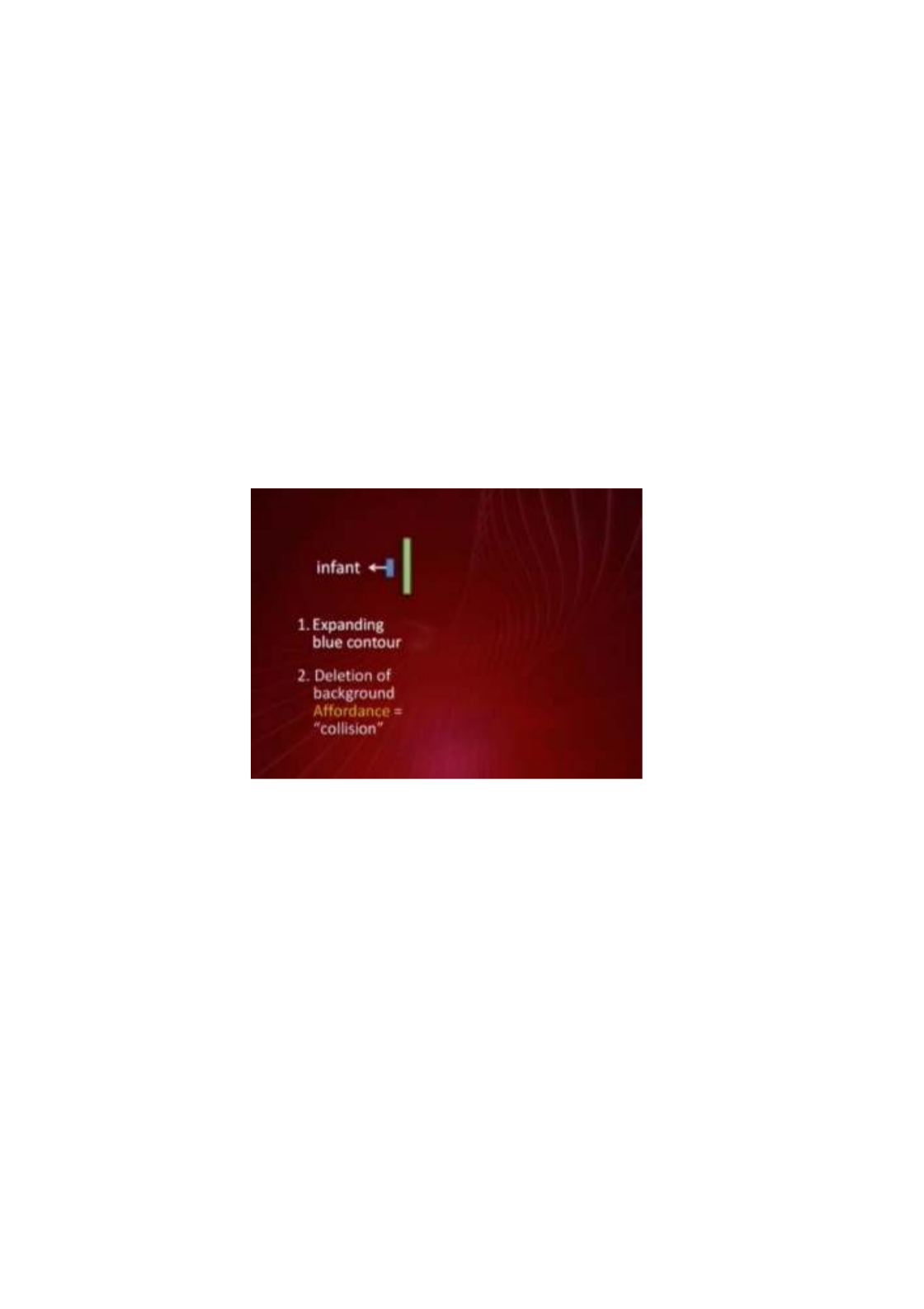
Looming: expanding contour on retinal image that indicates an object is moving
towards them
oTwo weeks old show head movements backward
o3 month olds will discriminate between looming panel and looming window
panel moving towards them vs. wall with cutout
Looming panel: expanding blue contour,
oAffordance = “collision”, deletion of background
oTwo invariant properties: deletion of green background
Looming window: expanding blue contour
oAffordance = “pass by”

No head movement with windows because babies see that as opening moving
towards them
Objects behind other objects
oHabituation vs. non-habituation
oWhat do babies look at more?
4 month olds do not perceive solid stick when looking at image on left (they look
at both pictures equally) when stationary
Objects in motion:
oLateral movement with stick moving behind blue square (invariant property
of object moving behind) babies look at broken stick because they think
it’s solid behind the square

oVertical movement with stick moving up and down babies look at
broken stick because they think it’s solid when behind square
Motion parallax: object moves in opposite direction that you are
Babies moving their own bodies through space: perceive surface of support in
front of you, and perceive your own movement
Visual proprioception: perceiving your own movement in space by how
information is appearing or disappearing at your periphery
The Visual Cliff: one side has solid surface w/ checkerboard pattern; other side is
Plexiglas with checkboard pattern underneath it
oHeart rate increases babies can perceive depth?
oThey show interest but no fear
Summary:
oInfant depth perception: perceptual abilities for locomotion are far in
advance of locomotion
Seeing things coming toward them
Seeing one thing behind another
“Seeing” themselves moving
Seeing surface of support ahead
oYou can’t have one perception without the other: a baby’s movement
through space gives them the info to perceive depth
o(perceptual abilities motor control)
The Real Cliff: infants can’t reach out to touch surface
oA new crawler will crawl over edge
oExperienced crawler won’t crawl over edge BUT as a new walker they will
step out over edge
Reading:
Sensation: processing of basic information from world by sensory receptors (eyes,
ears, skin)
Perception: process of organizing sensory information
Preferential Looking Technique: Robert Fantz; studies visual attention in infants; two
different visual stimuli are displayed on side-by-side screens; if baby looks at one,
researcher infers that baby can discriminate/has preference over them
Visual acuity: how clearly an infant can see
Contrast sensitivity: detecting a pattern with contrasting elements (infants have poor
contrast sensitivity)
One month olds tend to look at outer corners/one area of image

Two month olds scan more broadly
Other race effect (ORE): people can distinguish faces of other races easier than their
own
3 month old White, African, and Chinese infants prefer own-race faces
that the facial–scanning abilities of biracial infants—who are exposed to
the facial features characteristic of two races in the home—are more
mature than those of monoracial infants
Perceptual constancy: perceive constant shape and size
empiricists vs. nativists – empiricists say all knowledge comes from
experience; nativists say that some aspects are innate
Common movement: two segments always move together in same direction
Binocular disparity: the closer the object, the greater the disparity between the two
images
Stereopsis: visual cortex computes degree of disparity between the eyes
Cross-modal (intermodal) perception: combining information from 2+ sensory
systems
initially information from senses is separate, but associations are formed
after a couple months
auditory-visual intermodal perception
Habituation: when learning has taken place already; recognizing something from prior
exposure to it
Differentiation: the relation between events in the environment that are constant (i.e.
learning the association between tone of voice and facial expression)
Affordances: possibilities for action offered by objects and situations (i.e. small objects
afford the possibility of being picked up, liquids can be spilt, etc.)
Classical conditioning: relations between environmental events that have relevance
(i.e. seeing milk bottle makes babies salivate)
Unconditioned stimulus: reflexive thing (nipple in infant’s mouth)
Unconditioned response: unlearned response (sucking)
Conditioned stimulus: like the breast/bottle, initially neutral stimulus
Conditioned response: learned behavior, triggered by exposure to
conditioned stimulus
Instrumental conditioning: learning the relationship between one’s own
behavior and the reward/punishment it results in
oPositive reinforcement: a reward for behavior
Rational learning: integrating the learner’s prior beliefs and biases with what actually
occurs in the environment

1) Explain how J.J. Gibson’s theory attempts to explain the classic problem of how we
see the three-dimensional world by means of information on a two-dimensional retina.
2) Explain and defend your position on whether the research on intersensory
agreement, intersensory disagreement, and cross-modal (or as the book calls it,
“intermodal “) perception favors Gibson or Piaget on the issue of whether the sense are
integrated or separate at birth.
3) (a) Explain the concepts "invariant property" and "affordance" in J.J. Gibson's
theory.
(b) Show how they are used to interpret the findings on infant perception in the
following four areas:
Looming
Proprioception
Perception of objects
Depth perception

