



PHY 361: INTRODUCTORY MODERN PHYSICS -
Equilibrium and Elasticity Practice Material - Set 1
1. A cylindrical steel rod of length Land radius Ris suspended vertically from the top end.
The Young’s modulus of the steel rod is Y. A weight Wis attached to the bottom end of the
rod causing it to stretch by a distance h. Determine the stress and the strain in the rod.
Ans. To determine the stress and strain in the rod, we can follow these steps:
1. Determine the force acting on the rod: The weight Wacts downwards on the rod,
creating a tensile force. The force acting on the rod is equal to the weight W, so F=W.
2. Calculate the stress in the rod: The stress σin the rod is given by:
σ=F
A
where Ais the cross-sectional area of the rod. The cross-sectional area of a cylinder is given by
A=πR2. Thus, the stress in the rod is:
σ=W
πR2
3. Determine the strain in the rod: The strain ϵin the rod is given by Hooke’s Law:
ϵ=∆L
L
where ∆Lis the change in length and Lis the original length of the rod. Given that the rod
stretches by a distance h, we have ∆L=h. Therefore, the strain in the rod is:
ϵ=h
L
2. Question: A 2 kg block of wood is suspended from a spring scale and submerged in a
container of water. The scale reads 15 N when the block is in water. Determine the density of
the wood block.
Ans. Step-by-step solution:
1. The weight of the block in air is given by the equation Wair =mg, where mis the mass
of the block and gis the acceleration due to gravity. Thus, Wair = 2 kg ×9.81 m/s2= 19.62 N.
2. According to Archimedes’ principle, the buoyant force acting on the block when submerged
in water is equal to the weight of the water displaced by the block. Therefore, Wwater =Fbuoyant =
15 N.
3. The weight of the water displaced by the block can be calculated using the formula
Wwater =ρwaterVblockg, where ρwater is the density of water, Vblock is the volume of the block, and
gis the acceleration due to gravity.
4. Since the block is partially submerged, the volume of water displaced is equal to the volume
of the block that is submerged. This volume can be calculated using the formula Vsubmerged =
Wair
ρwaterg.
5. From step 3 and step 4, we have Wwater =ρwater ·(Wair
ρwaterg)·g, which simplifies to
Wwater =Wair. Therefore, we can solve for the density of the wood block:
ρwood =Wair
Vblock
=19.62 N
Vblock
where Vblock =mblock
ρwood . Substituting this into the equation above, we get
ρwood =19.62 N
2kg
ρwood
= 9.81 kg
m3
Therefore, the density of the wood block is 9810 kg/m3.
3. **Question:**
A uniform rod of length Land mass Mis hung horizontally from two vertical walls by two
vertical strings of length d(with d < L
2) attached to the ends of the rod. The walls are a distance
Lapart. If the tension in each string is T, determine the force Fthat each wall exerts on the
rod.
**Hint:** Consider the forces acting on the rod in the vertical direction to establish two
equations of equilibrium.
Ans. **Solution:**
1. Consider the forces acting on the rod:
Let’s denote the force exerted by the left wall on the rod as FLand by the right wall as FR.
At equilibrium, the forces in the vertical direction must balance out.
2. Equations of equilibrium in the vertical direction:
- For the left end of the rod: FLcos(θ) = Tcos(θ) + Tcos(θ)
FL= 2Tcos(θ)
- For the right end of the rod: FRcos(θ) = Tcos(θ) + Tcos(θ)
FR= 2Tcos(θ)
where θis the angle the strings make with the vertical.
3. Using the equilibrium condition:
- Summing the torques about the left end of the rod:
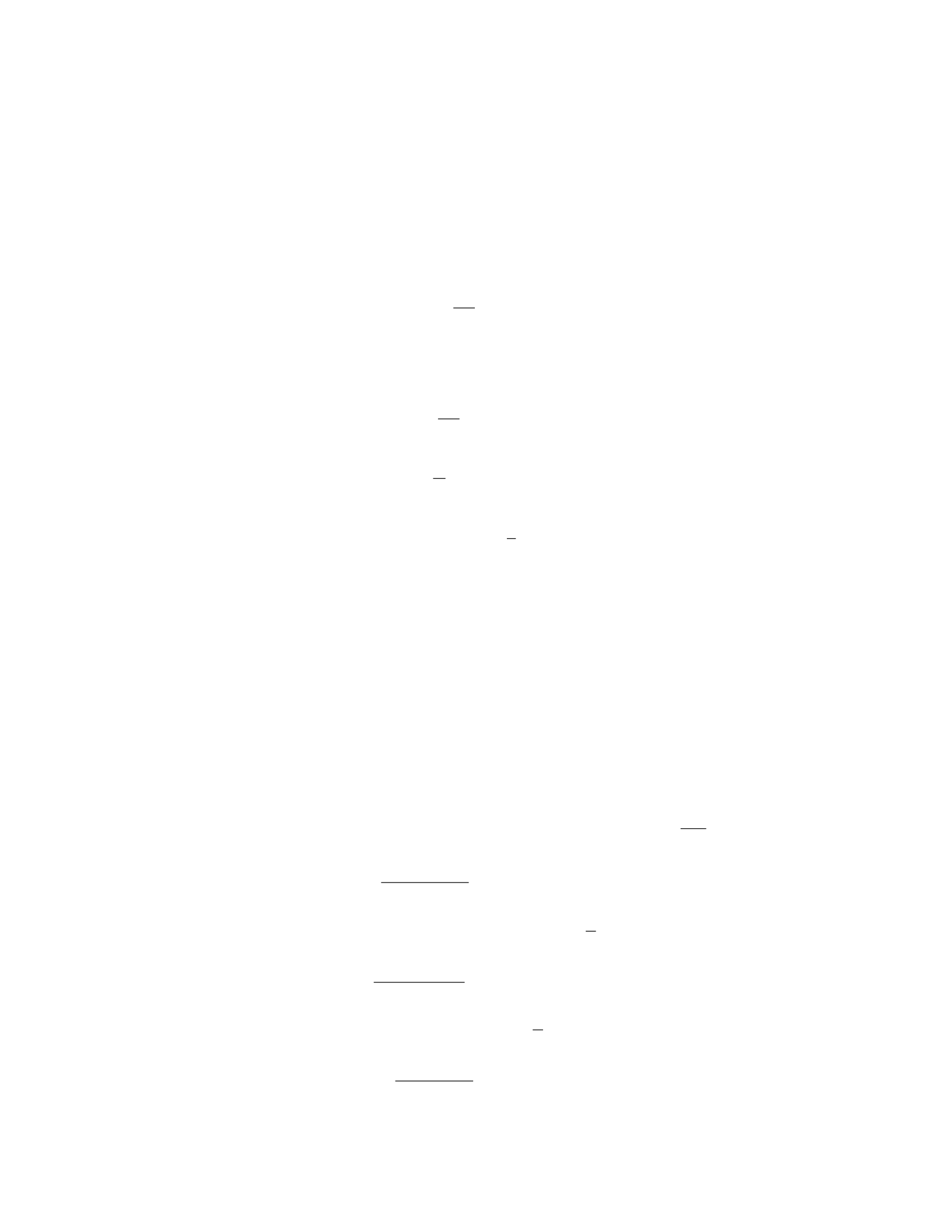
Tsin(θ)·d=FRsin(θ)·L
Substituting FR= 2Tcos(θ)into the expression above:
Tsin(θ)·d= 2Tcos(θ)sin(θ)·L
Solving for T:
T=d
2L·tan(θ)
4. Finding the force F:
- Substituting Tback into FL= 2Tcos(θ):
FL= 2 ·(d
2L·tan(θ))·cos(θ)
FL=d
L·sin(θ)·cos(θ)
Similarly, we can find FRas well.
The force Fthat each wall exerts on the rod is d
L·sin(θ)·cos(θ).
4. Question:
A solid cylindrical rod with a length of 1 meter and a diameter of 2 cm is suspended from
one end. A weight of 100 N is attached to the other end of the rod. If the rod has a Young’s
modulus of 2×10¹¹ N/m2, determine the elongation of the rod.
Ans. Let’s denote the original length of the rod as L, the applied force as F, the cross-sectional
area as A, the Young’s modulus as E, and the elongation of the rod as ∆L. We are given that
L= 1 m, F= 100 N, D= 2 cm, and E= 2 ×10¹¹ N/m2.
1. Calculate the cross-sectional area of the rod using the formula A=πD2
4.
A=π×(0.02)2
4= 3.14 ×10⁻⁴m2
2. Determine the stress on the rod using the formula σ=F
A.
σ=100
3.14 ×10−4= 318471.34 N/m2
3. Find the strain in the rod using the formula ϵ=σ
E.
ϵ=318471.34
2×1011 = 1.59 ×10⁻³
4. Calculate the elongation of the rod using the formula ∆L=ϵ×L.
∆L= 1.59 ×10−3×1 = 1.59 ×10⁻³m
Therefore, the elongation of the rod is 1.59 mm.
5. A 2.0 m long rod is suspended horizontally from the ceiling by two vertical wires. A 20 kg
weight is hung from the center of the rod. One wire is attached at a distance of 0.5 m to the left
of the weight and the other wire is attached at a distance of 0.5 m to the right of the weight. If
the tension in each wire is the same, what is the tension in each wire?
Ans. Let’s denote the tension in each wire as T. To solve this problem, we will first find the
torque produced by the weight and then set it equal to zero to ensure the system is in equilibrium.
1. Calculate the torque produced by the 20 kg weight hanging from the center of the rod.
The weight of the 20 kg mass is mg = 20 kg ×9.81 m/s2= 196.2N. The torque (τ) produced
by the weight about the left vertical wire is given by τ= (0.5m)×(T)−(1.0m)×(196.2N).
2. The torque produced by the weight about the right vertical wire is given by τ= (1.5m)×
(T)−(1.0m)×(196.2N).
3. Since the system is in equilibrium, the sum of all torques must be zero. Setting up
the equilibrium equation: (0.5)T−196.2 = (1.5)T−196.2. Simplifying this equation gives
−T+ 196.2 = 1.5T−196.2.
4. Solve the equilibrium equation for T. Rearranging terms gives 2.5T= 392.4and therefore
T=392.4
2.5= 156.96 N.
Therefore, the tension in each wire is 156.96 N.
6. A block of mass Mis placed on a rough incline of angle θwith the horizontal. The
coefficient of kinetic friction between the block and the incline is µk. The block is then subjected
to a horizontal force Fparallel to the incline. Given that the block is in equilibrium, determine
the expression for Fin terms of M,θ, and µk.
Ans. Let’s consider the forces acting on the block along the incline and perpendicular to the
incline to establish the equilibrium condition.
1. Along the incline: The forces acting along the incline are the component of the gravitational
force pulling the block downhill (Mg sin θ), the normal force from the incline pushing the block
uphill (N), and the frictional force opposing the motion (fk=µkN). The equation of motion
along the incline gives:
Mg sin θ−fk= 0
Mg sin θ−µkN= 0
N=Mg sin θ/µk
2. Perpendicular to the incline: The force acting perpendicular to the incline is the component
of the gravitational force perpendicular to the incline (Mg cos θ) and the normal force from the
incline pushing the block uphill (N). The equilibrium condition perpendicular to the incline gives:
N=Mg cos θ
3. Substituting the expression for Nfrom the second equation into the first equation:
Mg sin θ−µk(Mg cos θ) = 0
F=µkMg cos θ
F=µkMg cos θ
Therefore, the expression for Fin terms of M,θ, and µkis F=µkM g cos θ.
7. Question:
A metal rod of length Land cross-sectional area Ais suspended from the ceiling. A weight
Wis hung from the lower end of the rod. The rod has a Young’s modulus Y. Determine the
elongation of the rod in terms of W,L,A, and Y.
Ans. Solution:
Let’s assume the original length of the rod is L0and the elongation of the rod is ∆L. The
stress in the rod is σ=W
Aand the strain in the rod is ϵ=∆L
L. According to Hooke’s Law for
elasticity, stress is proportional to strain:
σ=Y·ϵ
The stress σcan be represented in terms of force and cross-sectional area:
W
A=Y·∆L
L
From this equation, we can solve for ∆L:
∆L=W·L
Y·A
8. Question:
A uniform rod of length Land mass mis hanging vertically from one end. A particle of mass
m′is attached to the rod a distance xfrom the end where the rod is fixed. The rod and particle
are in equilibrium. Determine the tension force in the rod as a function of x.

Ans. Step-by-step solution:
1. Draw a free-body diagram of the rod and particle. The forces acting on the rod are the
tension force
Tat the point of attachment, the weight of the rod
Wrod =−mgˆ
jacting at the
center of mass of the rod, and the weight of the particle
Wparticle =−m′gˆ
jacting at the particle’s
location.
2. Write the equilibrium equations in the vertical direction. The sum of the forces in the
vertical direction must equal zero since the rod and particle are in equilibrium:
T−mg −m′g= 0.
3. Since the rod is in equilibrium, the rod is not accelerating in the horizontal direction.
Therefore, the sum of the torques about the point of attachment must equal zero:
∑τ= 0.
4. The torque equation for the system about the point of attachment can be written as:
xT −L
2mg + (L−x)m′g= 0.
5. Solve the two equilibrium equations to find the tension force Tas a function of x:
T−mg −m′g= 0 =⇒T=mg +m′g,
xT −L
2mg + (L−x)m′g= 0.
6. Substitute the expression for Tback into the torque equation:
x(mg +m′g)−L
2mg + (L−x)m′g= 0.
7. Simplify the equation to solve for Tin terms of x:
xmg +xm′g−L
2mg +Lm′g−xm′g= 0,
xmg +Lm′g−L
2mg = 0,
T=Lmg
2x+Lm′g.
Therefore, the tension force in the rod as a function of xis T=Lmg
2x+Lm′g.
9. A uniform rod of length Land mass Mis supported at its ends by two strings which make
angles θ1and θ2with the horizontal. The strings are at equal distances from the center of the
rod. Determine the tensions in the strings. Assume the rod is in equilibrium.
Ans. Let’s denote the tensions in the strings as T1and T2, respectively.
Step 1. We start by drawing a free-body diagram of the forces acting on the rod.
Step 2. The forces acting on the rod are the weight Wacting at the center of the rod and
the tensions T1and T2acting at the ends of the rod.
Step 3. The weight Wcan be calculated as W=M g, where gis the acceleration due to
gravity.
Step 4. We can resolve the weight into horizontal and vertical components. The vertical
component is balanced by the sum of the vertical components of the tensions, while the horizontal
component is balanced by the horizontal component of the tensions.
Step 5. The vertical equilibrium equation gives us:
T1cos θ1+T2cos θ2=Mg
Step 6. The horizontal equilibrium equation gives us:
T1sin θ1=T2sin θ2
Step 7. Since the strings are at equal distances from the center of the rod, we have θ1=
θ2=θ. Substituting this into our equations yields:
T1cos θ+T2cos θ=Mg
T1sin θ=T2sin θ
Step 8. Dividing the second equation by the first equation, we get:
T1
T2
= 1
Step 9. Given that the tensions in the strings are the same, we can solve for T1and T2as:
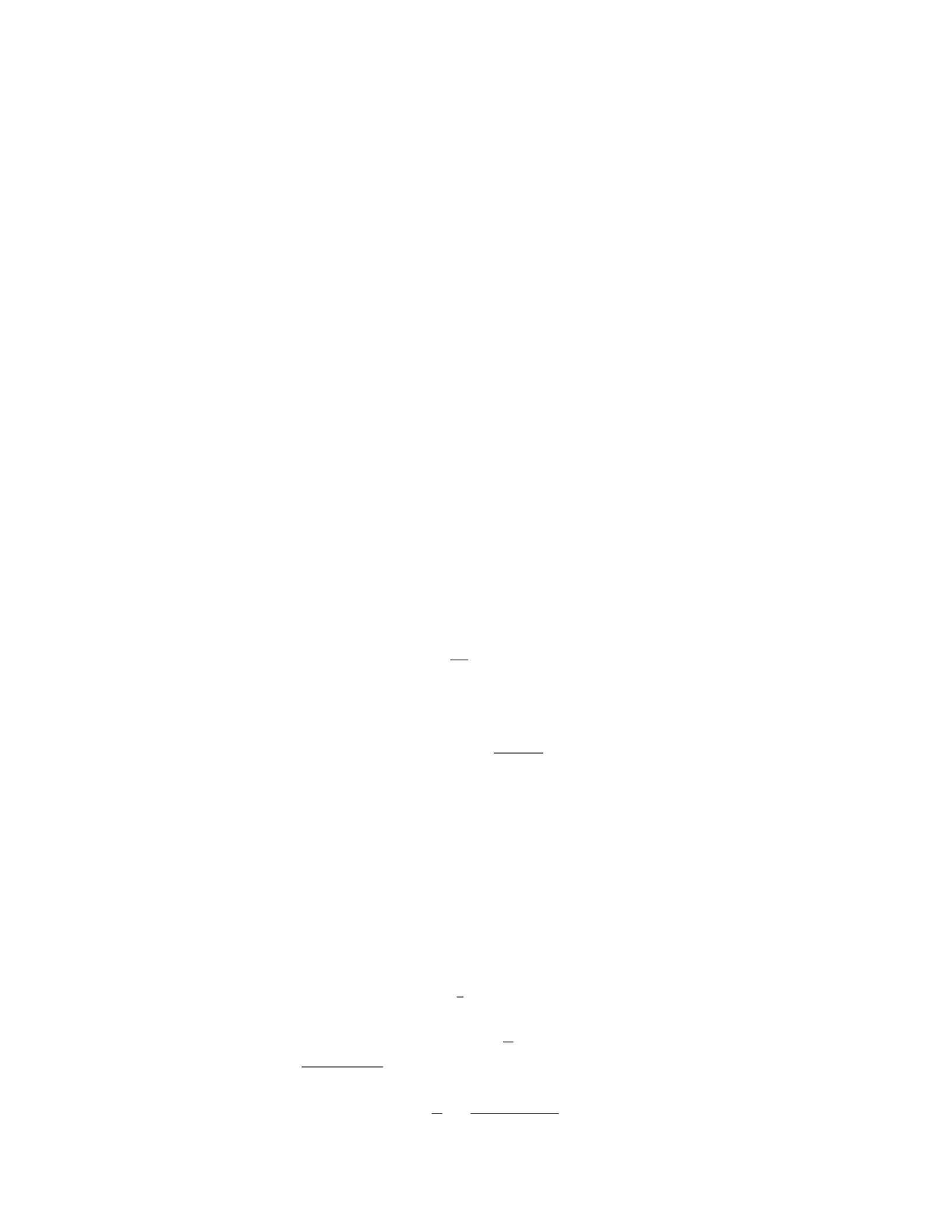
T1=T2=Mg
2cos θ
10. Question: A steel rod of length 2.0 m and diameter 1.0 cm is suspended vertically from
one end. A weight of 1000 N is attached to the other end of the rod. Calculate the stress and
strain in the rod if Y = 2.0×10¹¹ N/m2.
Ans. Step-by-step solution: 1. Calculate the cross-sectional area of the steel rod: Given
diameter = 1.0 cm = 0.01 m Radius, r=1
2diameter = 0.005 m Cross-sectional area, A=
πr2=π(0.005)2≈7.85 ×10⁻⁵m2.
2. Calculate the stress in the rod: Stress, σ=F
Awhere Fis the force applied and Ais the
cross-sectional area σ=1000 N
7.85×10⁻⁵m2≈1.27 ×10⁷N/m2.
3. Calculate the strain in the rod: Hooke’s Law: σ=Y·εWhere σis the stress, Yis the
Young’s Modulus, and εis the strain ε=σ
Y=1.27×10⁷N/m2
2.0×10¹¹ N/m2= 0.0000635 or 0.00635

Therefore, the stress in the rod is approximately 1.27 ×10⁷N/m2and the strain in the rod is
approximately 0.00635
11. A thin cylindrical tube of radius Rand length Lis initially at equilibrium. A force Fis
applied tangentially on the tube causing it to deform slightly. Determine the change in length of
the tube assuming it remains in the elastic regime. The Young’s modulus of the material is Y.
Ans. Let’s denote the change in length of the tube as ∆L. We can use the equilibrium condition
coupled with Hooke’s Law to find the change in length. 1. The force applied tangentially on the
tube will create a torque given by τ=F R. This torque causes a change in the angular position
of the tube given by θ=F R·∆L
Y·πR2. 2. The tangential stress developed in the tube is given by
σ=F
πR2. This stress is related to the strain by Hooke’s Law: ϵ=σ
Y. 3. The strain along the
length of the tube is given by ϵ=∆L
L. Equating the expressions for strain:
σ
Y=∆L
L⇒F
πR2Y=∆L
L⇒∆L=F L
πR2Y
Therefore, the change in length of the tube is ∆L=F L
πR2Y.
12. A uniform bar of length Land cross-sectional area Ais suspended vertically from one of
its ends. The bar has a density ρand Young’s modulus Y. Determine the elongation of the bar
in terms of L,ρ,Y, and acceleration due to gravity g.
Ans. Let’s denote the elongation of the bar as ∆L.
1. The weight of the bar Wis given by W=ρALg.
2. The tension Tin the bar at a distance xfrom the free end is given by T=ρAg(L−x).
3. The infinitesimal force dF on the bar at a distance xfrom the free end is given by
dF =T
Ldx =ρg(L−x)dx.
4. The infinitesimal strain dϵ is related to the infinitesimal force dF by Hooke’s law: dF =
Y A dϵ.
5. Substituting for dF and Ain terms of xand L, we have YA
Ldϵ =ρg(L−x)dx.
6. Integrating both sides over the length of the bar from 0to L, we get YA
L∫∆L
0dϵ =
ρg ∫L
0(L−x)dx.
7. Solving the integrals, we obtain YA∆L
L=ρg [Lx −x2
2]|L
0.
8. Simplifying the right side yields YA∆L
L=ρg (L2−L2
2).
9. Further simplifying gives Y∆L=3
2ρgL.
10. Therefore, the elongation of the bar ∆Lis equal to 3
2
ρgL
Y.

13. Question: A uniform rod of length Land mass Mis supported by a pivot at a distance d
from one end. A load of mass mis attached to the free end of the rod. Find the angle at which
the rod makes with the horizontal when it is in equilibrium.
Ans. Step-by-step solution: 1. First, we need to identify all the forces acting on the rod. There
are three forces: the weight of the rod acting at its center of mass, the weight of the load acting
at the free end, and the reaction force at the pivot. Let θbe the angle the rod makes with the
horizontal. 2. The weight of the rod acts vertically downwards at the center of the rod, i.e.
at a distance of L/2 from the pivot. Its magnitude is Mg, where gis the acceleration due to
gravity. This force can be decomposed into two components: one parallel to the rod and one
perpendicular to the rod. 3. The component of the weight of the rod perpendicular to the rod
will provide the torque required to balance the torques due to the weight of the load and the
reaction force. This component is Mg cos(θ)·L
2. 4. The weight of the load (mg) acts vertically
downwards at the free end of the rod. Its torque about the pivot is mg ·L. 5. The reaction
force at the pivot acts perpendicular to the rod and balances the perpendicular component of the
weight of the rod and the weight of the load. Its magnitude is R. The torque due to this force
is R·d. 6. For the rod to be in equilibrium, the sum of the torques must be zero. Therefore,
we have the equation: Mg cos(θ)·L
2=mg ·L+R·d. 7. Solving this equation for θ, we get
θ=cos−1(2mgL
MgL+2Rd ). Hence, the angle at which the rod makes with the horizontal when it is
in equilibrium is cos−1(2mgL
MgL+2Rd ).
14. A rod of length Land uniform cross-sectional area Ais hanging vertically from a ceiling.
The rod has a mass per unit length λand Young’s modulus Y. Determine the elongation of the
rod due to its own weight.
Ans. Let’s denote the elongation of the rod as ∆L. We will calculate the elongation step-by-
step.
1. First, let’s find the mass of the rod, M. The mass of the rod is given by M=λL.
2. The weight of the rod is equal to the force exerted at the centroid of the rod, which is
1
2Mg =1
2λLg.
3. The stress in the rod is σ=F
Awhere Fis the force due to weight and Ais the cross-
sectional area. Therefore, σ=1
2λLg/A.
4. The strain in the rod is ϵ=∆L
L. From Hooke’s Law, σ=Y ϵ, we have 1
2λLg/A=Y∆L
L.
5. Solving for ∆L, we find ∆L=1
2
λgL2
AY .
Therefore, the elongation of the rod due to its own weight is ∆L=1
2
λgL2
AY .
15. A 2.0 m long steel wire with a cross-sectional area of 2.0×10⁻⁴m2is stretched by a force
of 800 N. The Young’s modulus of steel is 2.0×10¹¹ Pa. What is the change in length of the
wire due to the applied force?
Ans. Let’s use the formula for stress and strain to determine the change in length of the wire.
1. Calculate the stress: The stress (σ) on the wire is given by:
σ=F
A
where Fis the applied force and Ais the cross-sectional area. Plugging in the values:
σ=800 N
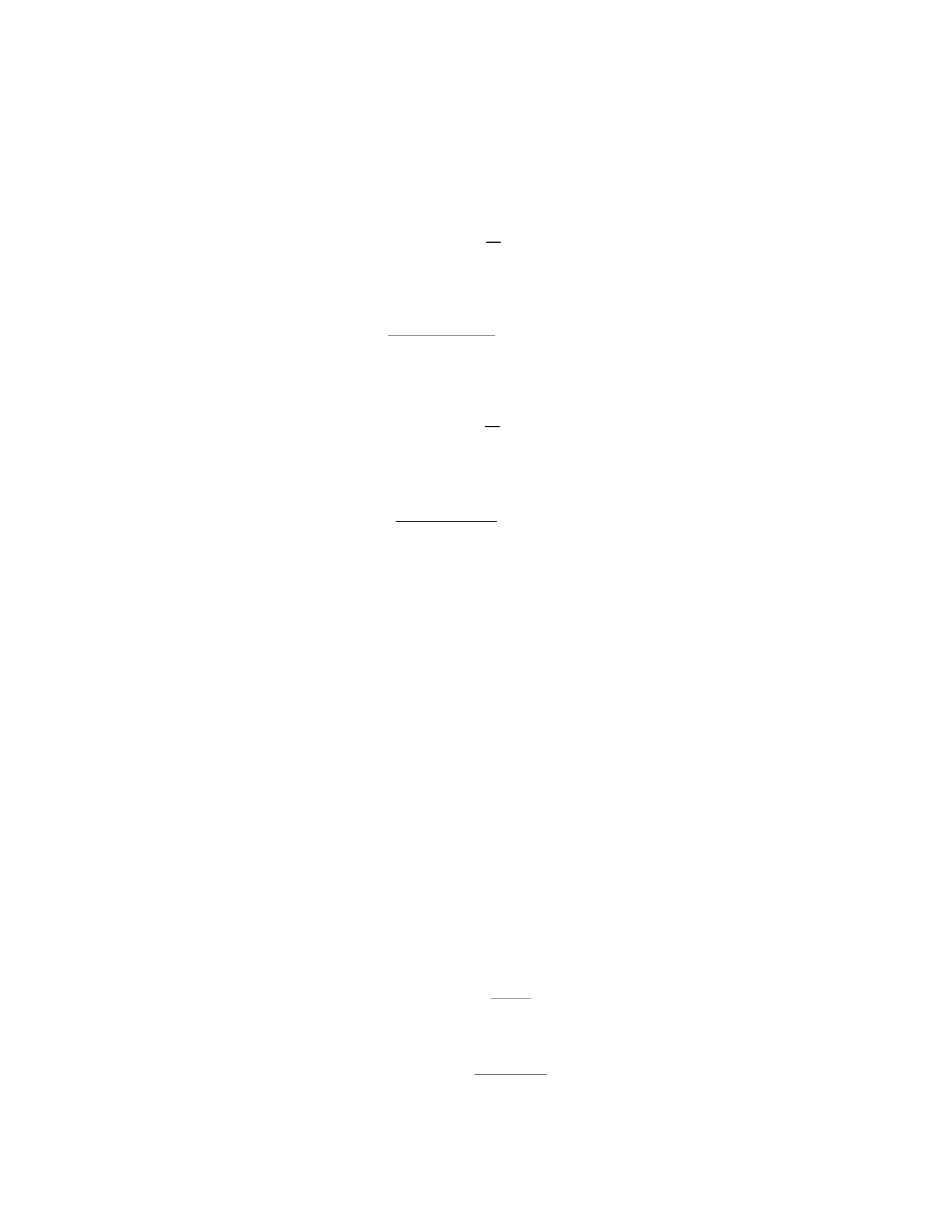
2.0×10⁻⁴m2= 4 ×10⁶Pa
2. Calculate the strain: The strain (ε) on the wire is given by:
ε=σ
E
where Eis the Young’s modulus. Plugging in the values:
ε=4×10⁶Pa
2.0×10¹¹ Pa = 2 ×10⁻⁵
3. Calculate the change in length: The change in length (∆L) of the wire is given by:
∆L=ε·L
where Lis the original length of the wire. Plugging in the values:
∆L= 2 ×10−5·2.0m= 4 ×10⁻⁵m
Therefore, the change in length of the wire due to the applied force is 4×10⁻⁵meters.
16. A steel rod with a length of 2.5 m and a cross-sectional area of 0.005 m2is stretched under
a tensile force of 50 kN. If the Young’s modulus of steel is 2.1×10¹¹ N/m2, determine the stress
and strain on the rod.
Ans. Let’s first determine the stress on the rod:
1. Calculate the stress: The stress on the rod is given by the formula:
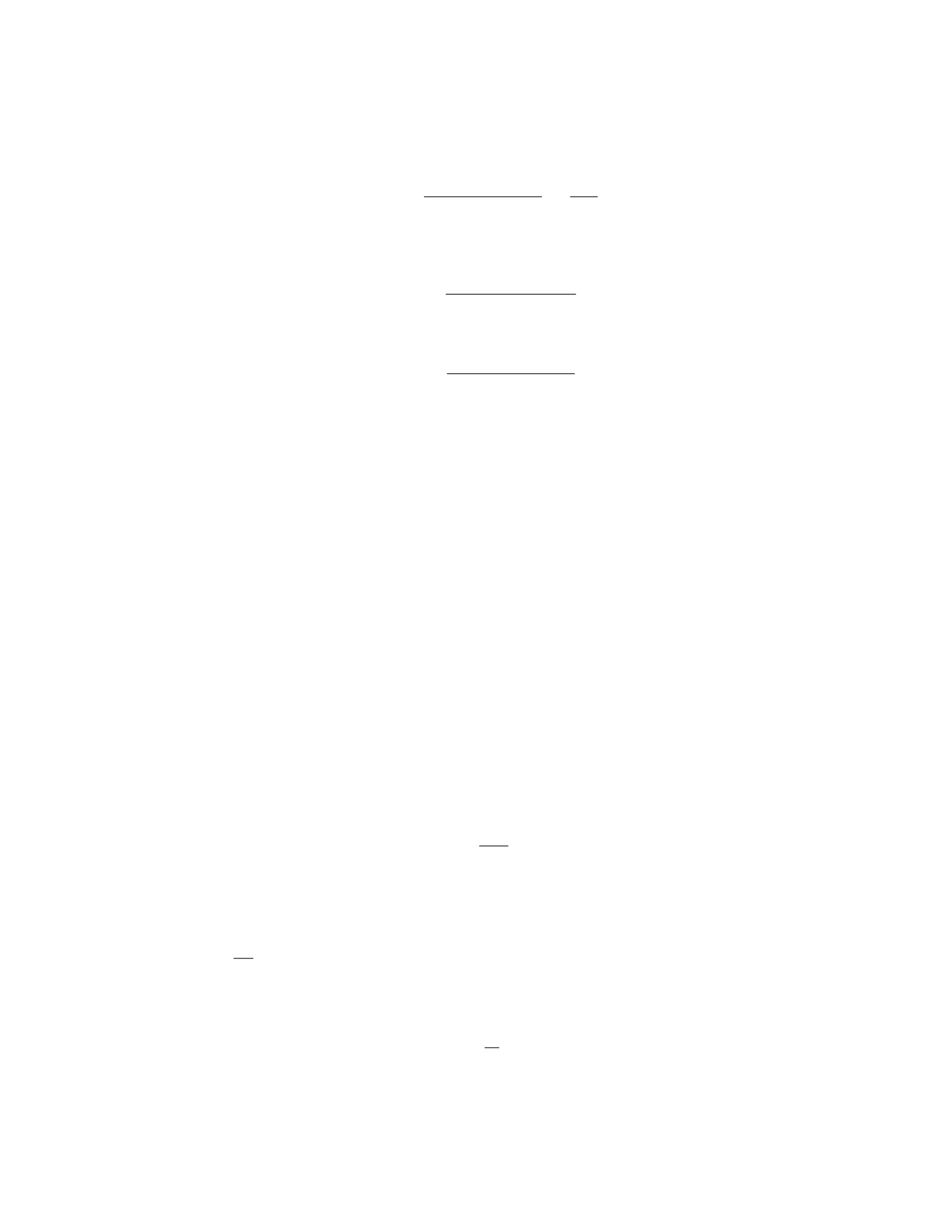
Stress =Force
Area
Plugging in the given values:
Stress =50,000 N
0.005 m2
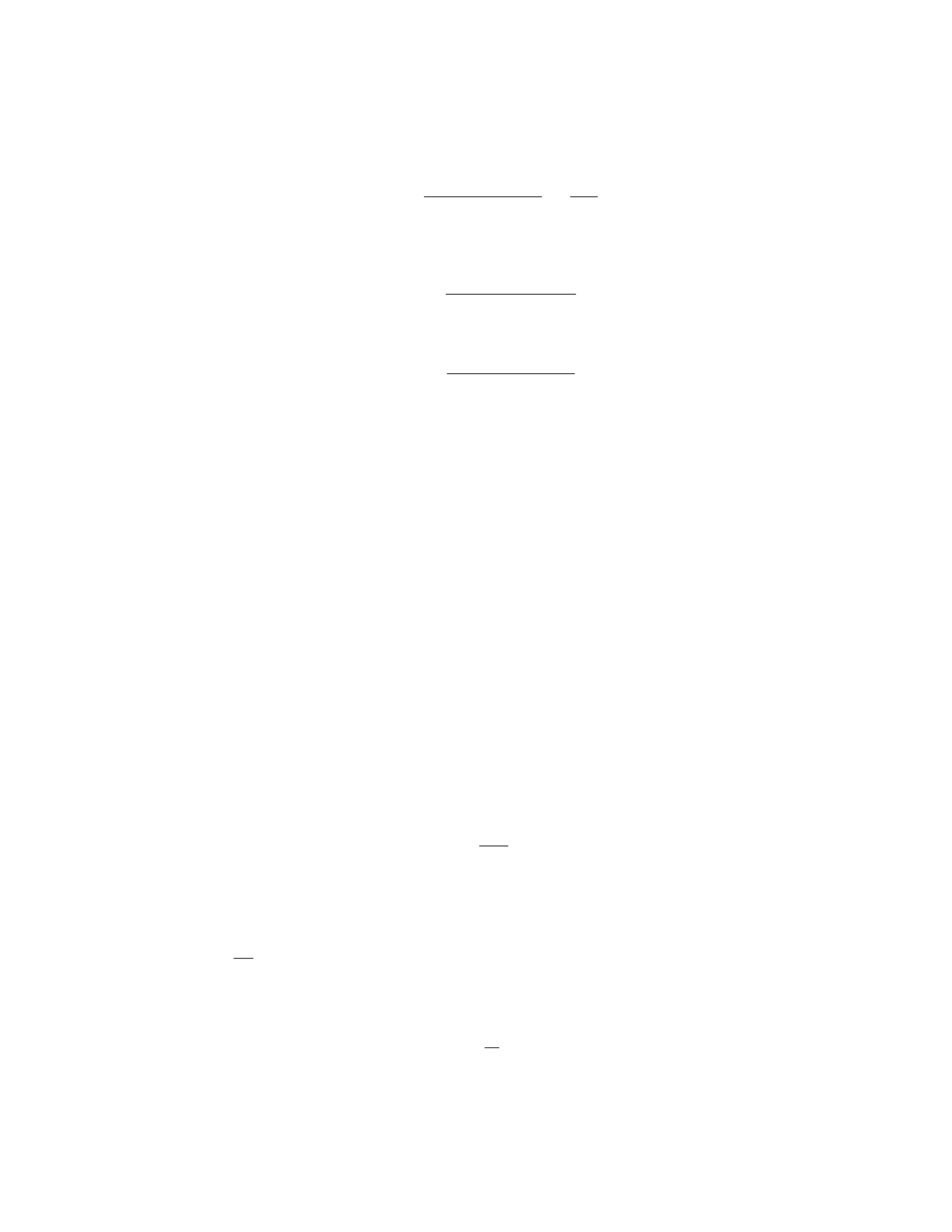
Stress = 10,000,000 N/m2= 10 MPa
Next, let’s calculate the strain:
2. Calculate the strain: The strain on the rod is given by the formula:
Strain =Extension
Original Length =∆L
L
We can relate the strain to stress using Hooke’s Law:
Strain =Stress
Young’s Modulus
Plugging in the given values:
Strain =10 MPa
2.1×10¹¹ N/m2
Strain = 4.76 ×10⁻⁵
Therefore, the stress on the rod is 10 MPa and the strain is 4.76 ×10⁻⁵.
17. Question: A 5-meter long steel beam is fixed at one end and supports a load of 2000 N
placed 4 meters from the fixed end. If the beam has a cross-sectional area of 200 cm2and a
Young’s modulus of 2×10¹¹ N/m2, determine the stress and strain at the fixed end of the beam.
Ans. Step 1. Calculate the moment at the fixed end of the beam.
The moment (M) caused by the load (F) at a distance (d) from the fixed end is given by
the equation:
M=F·d
Substitute F= 2000 N and d= 4 m into the equation to find M.
Step 2. Determine the maximum bending stress at the fixed end of the beam.
The maximum bending stress (σ) in a beam is given by the equation:
σ=My
I
where Mis the moment, yis the distance from the neutral axis to the outermost fiber, and Iis
the moment of inertia. Since the beam is simply supported and the load is applied at the end, y
is equal to the radius of the neutral axis. The moment of inertia for a rectangular cross-section
is given by I=bh3
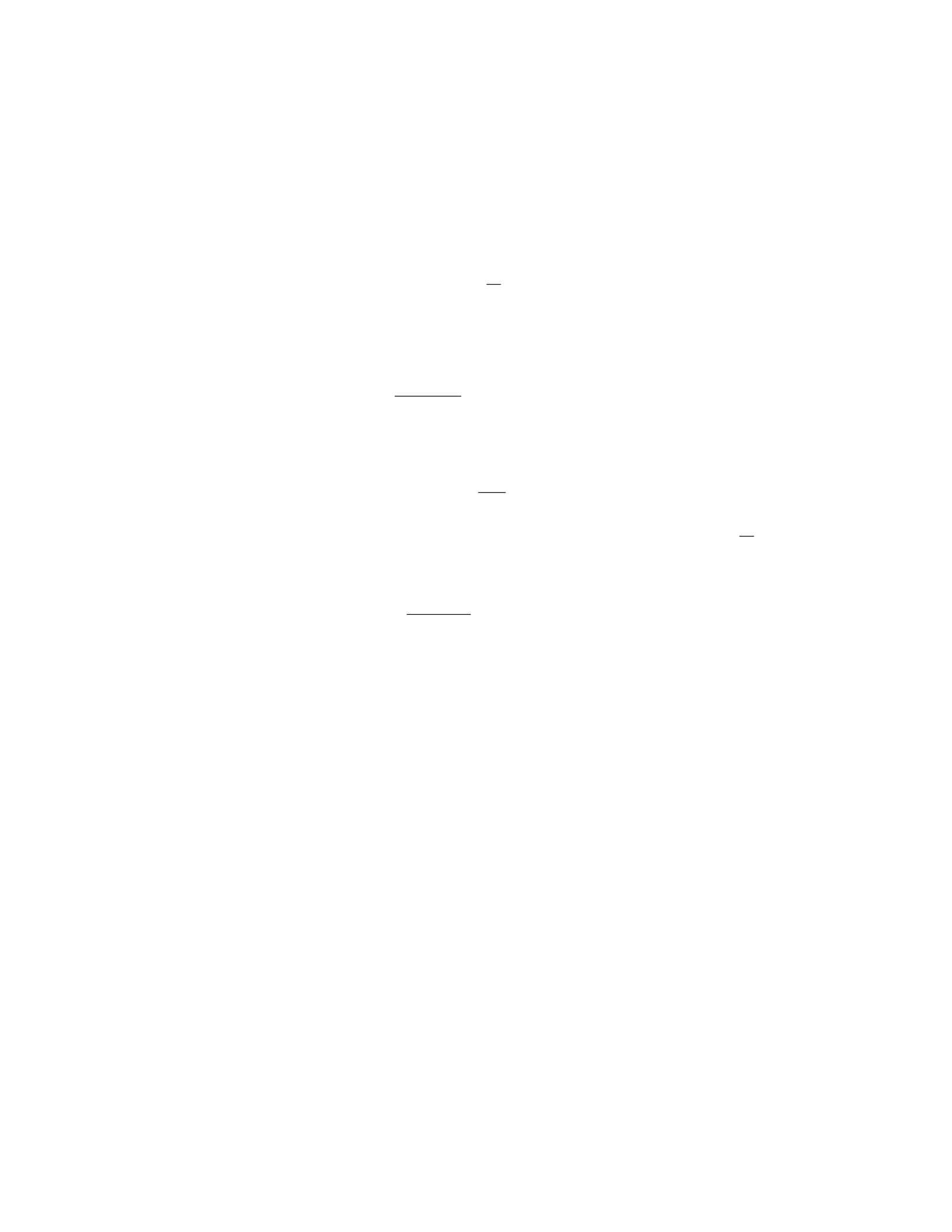
12 , where bis the breadth and his the height of the beam.
Step 3. Calculate the strain at the fixed end of the beam.
The strain (ϵ) in a material is given by:
ϵ=σ
E
where Eis the Young’s modulus of the material. Substitute the calculated stress value and the
given Young’s modulus value into the equation to find the strain.
18. A steel beam with a length of 5 m and a cross-sectional area of 0.01 m2is subjected to a
tensile force of 50 kN. The Young’s modulus of steel is 2×10¹¹ N/m2. Calculate the amount by
which the beam stretches under this force.
Ans. To find the amount by which the beam stretches under the given force, we can use
Hooke’s Law for elasticity, which states that the stress is directly proportional to the strain.
1. Calculate the stress σon the beam: The stress is defined as the force per unit area:
σ=F
A
where Fis the applied force and Ais the cross-sectional area. Given: F= 50 kN = 50 ×103N
and A= 0.01 m2Therefore:
σ=50 ×103
0.01 = 5 ×10⁶N/m2
2. Calculate the strain ϵon the beam: The strain is defined as the change in length per unit
original length:
ϵ=∆L
L
where ∆Lis the change in length and Lis the original length. Using Hooke’s Law: σ
E=ϵGiven:
E= 2 ×10¹¹ N/m2Substitute the values of σand E:
ϵ=5×10⁶
2×1011 = 2.5×10⁻⁵
3. Calculate the change in length ∆L:
∆L=ϵ×L= 2.5×10−5×5 = 1.25 ×10⁻⁴m
Therefore, the beam stretches by 0.000125 m (or 0.125 mm) under the applied force of 50
kN.
19. A block of mass mis suspended by two strings, each of length L, from the ceiling of an
elevator. The elevator is moving upward with an acceleration of a. Find the tension in each
string.
Ans. To find the tension in each string, we need to analyze the forces acting on the block when
it is in equilibrium relative to the elevator.
1. Draw the free-body diagram of the block when it is in equilibrium relative to the elevator.
There are three forces acting on the block: its weight mg acting downward, and the tensions T
in the two strings acting upward at angles θwith respect to the vertical axis. Apply Newton’s
second law in the vertical direction to set up the equilibrium equation:
Tcos(θ) + Tcos(θ)−mg = 0
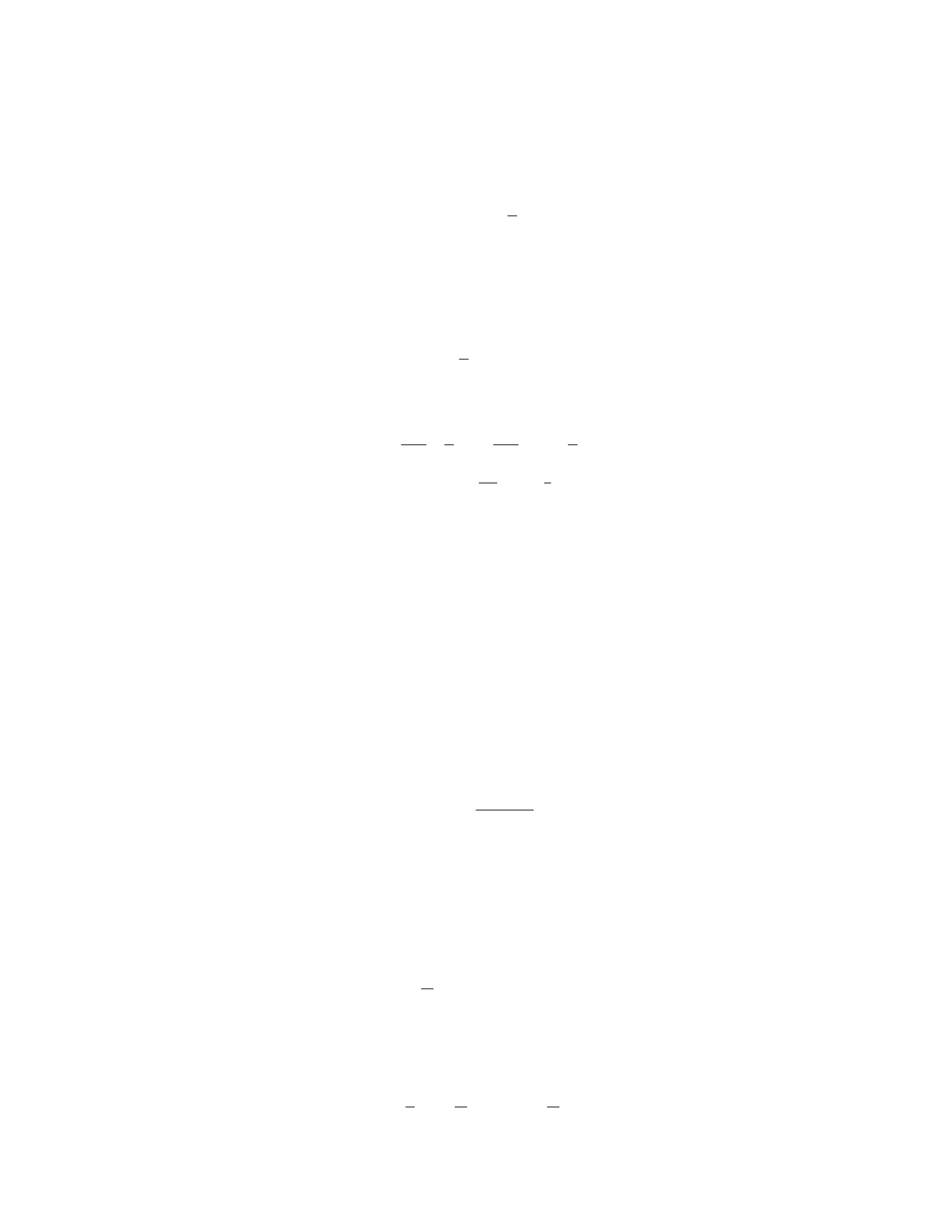
2. Simplify the equilibrium equation by substituting the given information. The angle θcan
be found using trigonometry. Since the elevator is moving upward with acceleration a, the net
acceleration experienced by the block is aupwards. So the angle θsatisfies:
cos(θ) = a
g
Substitute this back into the equilibrium equation:
2Tcos(θ)−mg = 0
2T(a
g)=mg
3. Solve for the tension in each string:
T=mg
2(g
a)=mg
2(1 + g
a)
Therefore, the tension in each string is T=mg
2(1 + g
a).
20. Question: A uniform bar of length Land mass Mis suspended horizontally from a ceiling
by two vertical wires of length L/2 each attached at the ends of the bar. A bullet of mass m
is shot horizontally at one end of the bar with speed v. The bullet gets embedded in the bar.
Determine the speed at which the system swings if the wires are nearly vertical.
Ans. Step-by-step solution: 1. Let vfinal be the final speed of the system after the bullet embeds
in the bar. By conservation of momentum in the horizontal direction, we have:
Mv = (M+m)vfinal
vfinal =Mv
M+m
2. Let θbe the angle of swing of the system from the vertical position. The tension in each wire
is equal to the weight of the bar and the bullet, resolved into components:
T= (M+m)gcos(θ)
3. The net torque about the point of suspension is given by:
2(L
2)Tsin(θ) = Iα
where Iis the moment of inertia of the system about the point of suspension and αis the angular
acceleration. 4. The moment of inertia of the system about the point of suspension is given by:
I=1
3M(L
2)2
+m(L
2)2
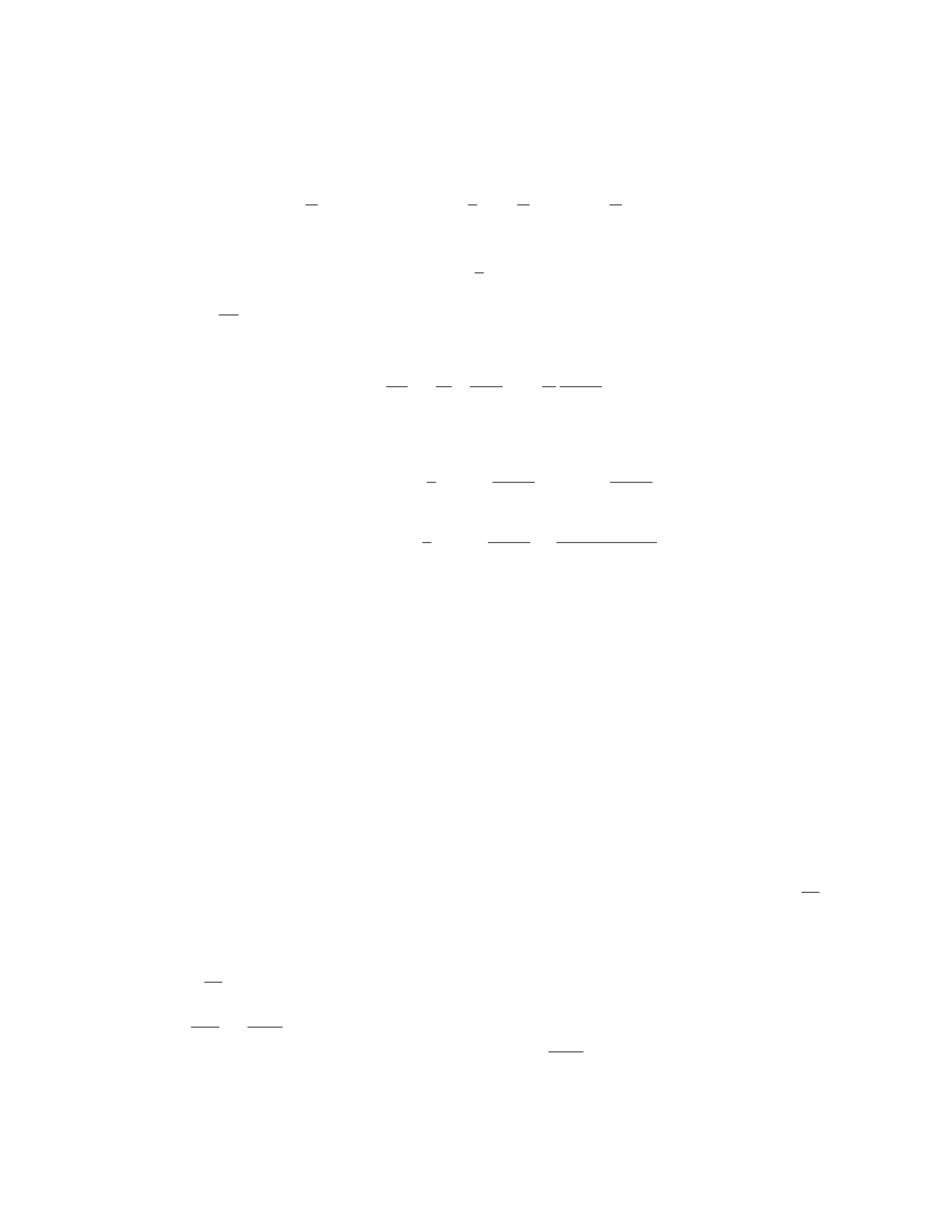
5. Using the small angle approximation sin(θ)≈θ, and substituting in the values, the equation
for angular acceleration becomes:
2(L
2)(M+m)gθ =(1
3M(L
2)2
+m(L
2)2)α
L(M+m)gθ =1
3ML2α+mL2α
6. Since α=d2θ
dt2and vfinal =Rω where Ris the distance from the center of mass of the bar to
the point of suspension, we can relate αand vfinal:
α=dω
dt =d
dt (vfinal
R)=1
R
dvfinal
dt
7. Substituting this into the previous equation and simplifying, we get:
L(M+m)gθ =1
3ML2·dvfinal
dt +mL2·dvfinal
dt
L(M+m)gθ =1
3ML2·dvfinal
dt +3mL2·dvfinal
dt
8. Integrating this equation gives the relation between θand vfinal.
21. Find the vertical displacement of a cylindrical column of height hand radius Rwhen a
heavy block of mass Mis placed on top of it. Assume that the column is made of a material
with Young’s modulus Y.
Ans. Let’s denote the vertical displacement of the column as ∆y.
Step 1. Firstly, let’s determine the force exerted on the column due to the block.
The weight of the block is given by Fblock =Mg, where gis the acceleration due to gravity.
Step 2. Next, we need to find the cross-sectional area of the column.
The cross-sectional area Aof the column is A=πR2.
Step 3. Using Hooke’s Law, we can write the force exerted by the column as Fcolumn =Y∆y
hA.
Step 4. At equilibrium, the forces must balance out. Therefore, we have the equation
Fblock =Fcolumn.
Step 5. Substituting the expressions for Fblock and Fcolumn into the equilibrium equation gives
us Mg =Y∆y
hA.
Step 6. Now, we can solve for ∆y:
∆y=Mgh
Y A =M gh
Y πR2.
Therefore, the vertical displacement of the column is Mgh
Y πR2.

22. Suppose a solid cylindrical rod of length Land diameter dis suspended vertically from one
end. If the rod is made of a material with Young’s modulus Y, what is the extension of the rod
due to its own weight?
23. Question:
A thin cylindrical rod of length Land radius ris clamped at one end and is loaded with a
force Fat the other end. The Young’s modulus of the material is Y. Determine the maximum
stress in the rod.
Ans. Step-by-step solution:
1. The stress σin the rod is given by σ=F
A, where Ais the cross-sectional area of the rod.
The cross-sectional area of a thin cylindrical rod is given by A=πr2.
2. The strain εin the rod is given by ε=δ
L, where δis the displacement at the loaded end
of the rod. Hooke’s Law states that σ=Y ε, where Yis Young’s modulus.
3. Since the strain is given by ε=δ
L, we can rewrite Hooke’s Law as σ=Y(δ
L).
4. By combining equations from steps 1 and 3, we get F
πr2=Y(δ
L).
5. Solving for δ, we find δ=F L
πr2Y.
6. The maximum stress occurs when the displacement is maximized. At this point, the rod
operates at its elastic limit, meaning δ=L. Therefore, the maximum stress σmax in the rod is
given by:
σmax =Fmax
πr2=Y L
πr2
24. A uniform rod of length Land mass Mis supported by a pivot at one end. A weight W is
hung a distance dfrom the pivot along the rod. The rod makes an angle θwith the horizontal.
Given that the rod is in equilibrium, find an expression for the shear modulus of the material from
which the rod is made.
Ans. Let’s denote the distance of the center of mass of the rod from the pivot as x. The
forces acting on the rod are the weight Mg acting at the center of mass, the weight Wacting
at a distance dfrom the pivot, and the force of tension Tacting at the pivot. The torque
about the pivot must be zero in order for the rod to be in equilibrium. 1. Setting up the torque
equation: The torque due to the weight M g is Mg ·x·sin θ, the torque due to the weight Wis
W·(L−d)·sin θ, and the torque due to the tension force Tis T·L·sin θ. Therefore, we have:
Mg ·xsin θ−W·(L−d)·sin θ−T·L·sin θ= 0
2. Finding the expression for center of mass x: The center of mass xis given by x=L
2sin θ.
Substituting this into the torque equation gives:
Mg ·L
2sin2θ−W·(1−d
L)·L
2sin2θ−T·L·sin θ= 0
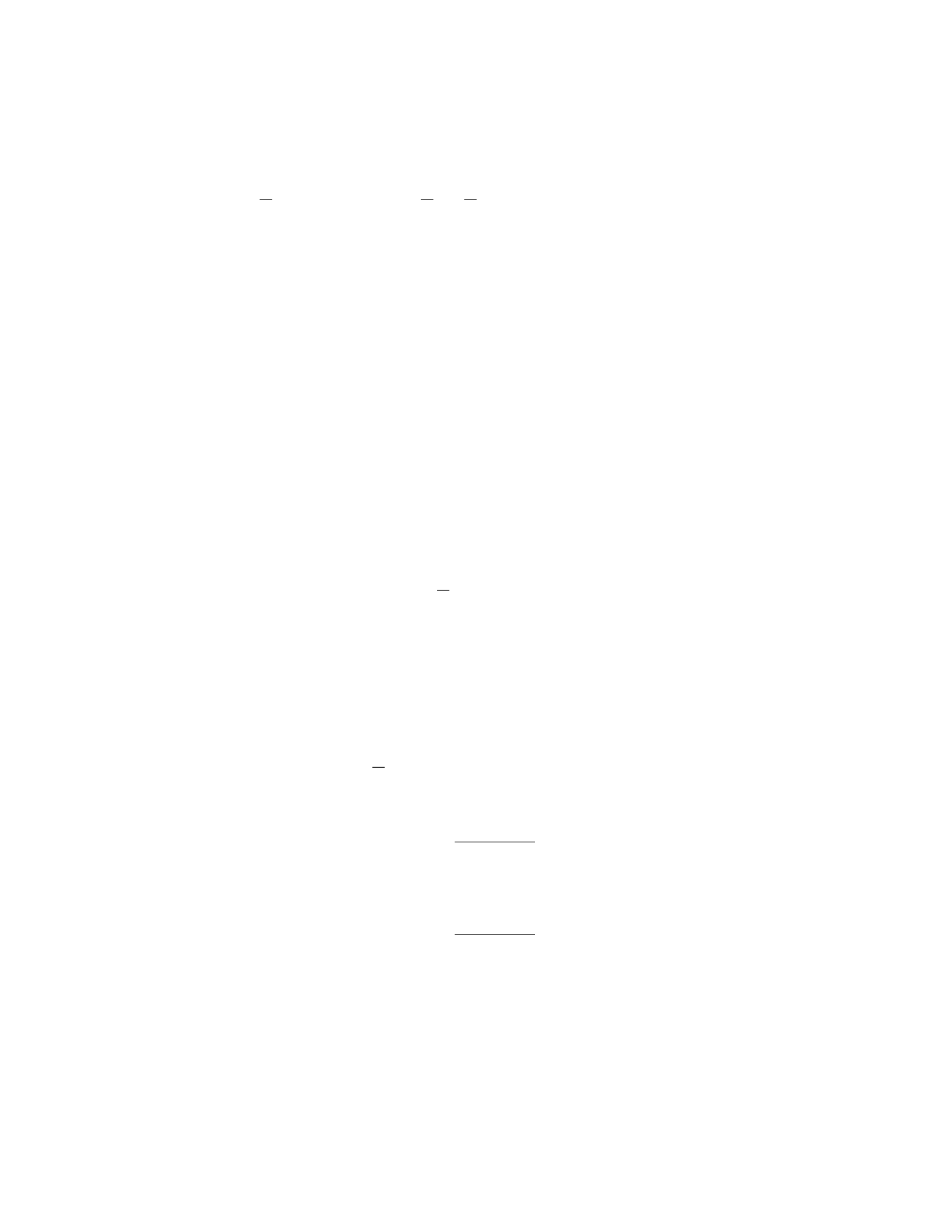
3. Solving for the tension T: We know that the sum of the forces in the vertical direction is zero:
Tcos θ=Mg +W. Substituting this into the torque equation we found earlier:
Mg ·L
2sin2θ−W·(1−d
L)·L
2sin2θ−(Mg +W)·L·sin θ= 0
4. Expression for shear modulus:
From the previous equations, we can find the expression for the shear modulus Gin terms of
L,M,g,W,d, and θ.
25. A uniform bar of length Land mass Mis supported by a pivot at one end and a cable
attached to the other end. Calculate the tension in the cable when the bar makes an angle θ
with the horizontal.
Ans. Let’s consider the forces acting on the bar when it makes an angle θwith the horizontal:
1. Resolve the weight of the bar into components: M g sin(θ)perpendicular to the bar and
Mg cos(θ)parallel to the bar. 2. The torque about the pivot due to the weight of the bar is
−L
2Mg cos(θ)
. 3. The torque due to the tension in the cable is
LT sin(θ)
. 4. Since the bar is in equilibrium, the sum of torques about the pivot is zero:
−L
2Mg cos(θ) + LT sin(θ) = 0
. 5. Solve for the tension T:
T=Mg cos(θ)
2sin(θ)
. Therefore, the tension in the cable when the bar makes an angle θwith the horizontal is
T=Mg cos(θ)
2sin(θ)
.
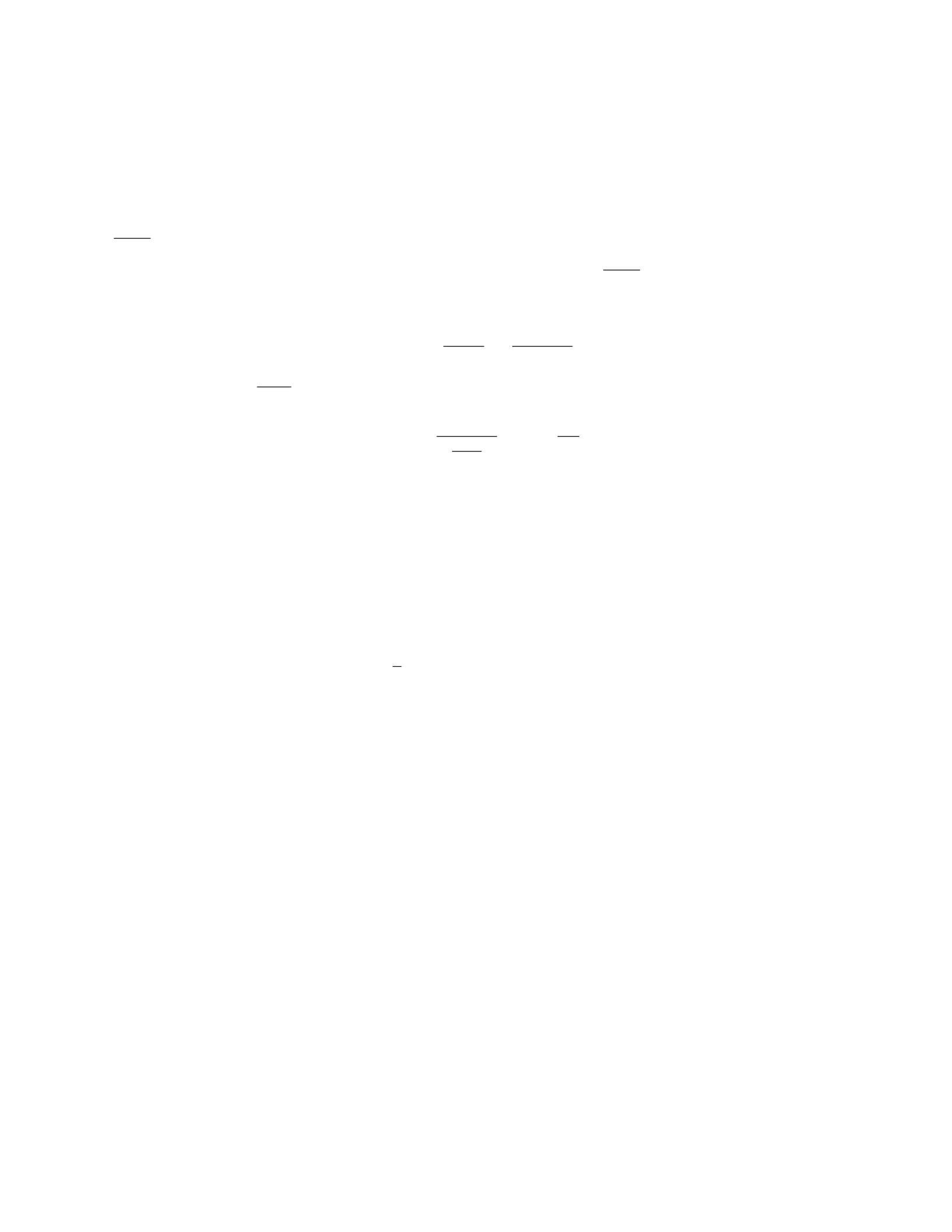
3. The weight of the water displaced by the block can be calculated using the formula
Wwater =ρwaterVblockg, where ρwater is the density of water, Vblock is the volume of the block, and
gis the acceleration due to gravity.
4. Since the block is partially submerged, the volume of water displaced is equal to the volume
of the block that is submerged. This volume can be calculated using the formula Vsubmerged =
Wair
ρwaterg.
5. From step 3 and step 4, we have Wwater =ρwater ·(Wair
ρwaterg)·g, which simplifies to
Wwater =Wair. Therefore, we can solve for the density of the wood block:
ρwood =Wair
Vblock
=19.62 N
Vblock
where Vblock =mblock
ρwood . Substituting this into the equation above, we get
ρwood =19.62 N
2kg
ρwood
= 9.81 kg
m3
Therefore, the density of the wood block is 9810 kg/m3.
3. **Question:**
A uniform rod of length Land mass Mis hung horizontally from two vertical walls by two
vertical strings of length d(with d < L
2) attached to the ends of the rod. The walls are a distance
Lapart. If the tension in each string is T, determine the force Fthat each wall exerts on the
rod.
**Hint:** Consider the forces acting on the rod in the vertical direction to establish two
equations of equilibrium.
Ans. **Solution:**
1. Consider the forces acting on the rod:
Let’s denote the force exerted by the left wall on the rod as FLand by the right wall as FR.
At equilibrium, the forces in the vertical direction must balance out.
2. Equations of equilibrium in the vertical direction:
- For the left end of the rod: FLcos(θ) = Tcos(θ) + Tcos(θ)
FL= 2Tcos(θ)
- For the right end of the rod: FRcos(θ) = Tcos(θ) + Tcos(θ)
FR= 2Tcos(θ)
where θis the angle the strings make with the vertical.
3. Using the equilibrium condition:
- Summing the torques about the left end of the rod:
Tsin(θ)·d=FRsin(θ)·L
Substituting FR= 2Tcos(θ)into the expression above:
Tsin(θ)·d= 2Tcos(θ)sin(θ)·L
Solving for T:
T=d
2L·tan(θ)
4. Finding the force F:
- Substituting Tback into FL= 2Tcos(θ):
FL= 2 ·(d
2L·tan(θ))·cos(θ)
FL=d
L·sin(θ)·cos(θ)
Similarly, we can find FRas well.
The force Fthat each wall exerts on the rod is d
L·sin(θ)·cos(θ).
4. Question:
A solid cylindrical rod with a length of 1 meter and a diameter of 2 cm is suspended from
one end. A weight of 100 N is attached to the other end of the rod. If the rod has a Young’s
modulus of 2×10¹¹ N/m2, determine the elongation of the rod.
Ans. Let’s denote the original length of the rod as L, the applied force as F, the cross-sectional
area as A, the Young’s modulus as E, and the elongation of the rod as ∆L. We are given that
L= 1 m, F= 100 N, D= 2 cm, and E= 2 ×10¹¹ N/m2.
1. Calculate the cross-sectional area of the rod using the formula A=πD2
4.
A=π×(0.02)2
4= 3.14 ×10⁻⁴m2
2. Determine the stress on the rod using the formula σ=F
A.
σ=100
3.14 ×10−4= 318471.34 N/m2
3. Find the strain in the rod using the formula ϵ=σ
E.
ϵ=318471.34
2×1011 = 1.59 ×10⁻³
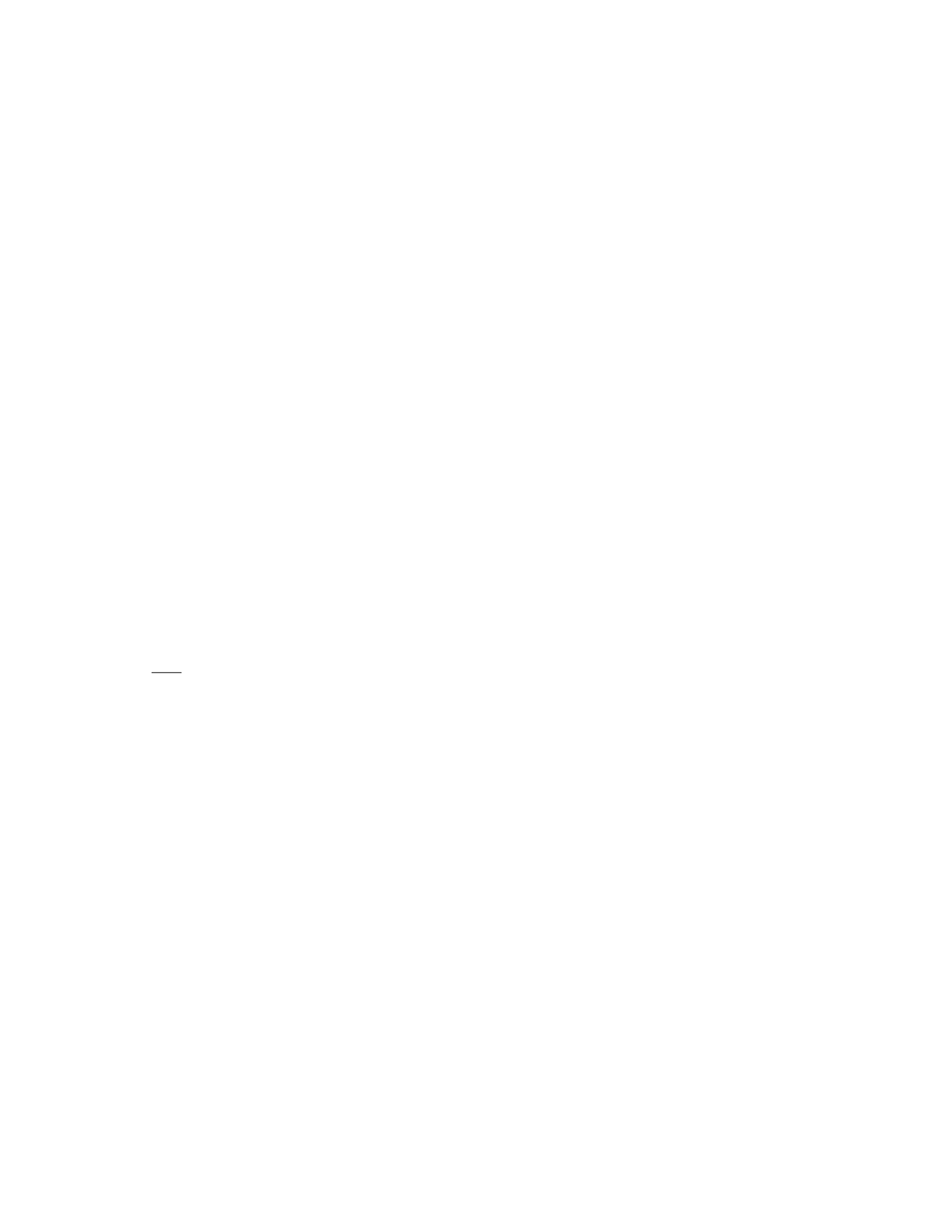
4. Calculate the elongation of the rod using the formula ∆L=ϵ×L.
∆L= 1.59 ×10−3×1 = 1.59 ×10⁻³m
Therefore, the elongation of the rod is 1.59 mm.
5. A 2.0 m long rod is suspended horizontally from the ceiling by two vertical wires. A 20 kg
weight is hung from the center of the rod. One wire is attached at a distance of 0.5 m to the left
of the weight and the other wire is attached at a distance of 0.5 m to the right of the weight. If
the tension in each wire is the same, what is the tension in each wire?
Ans. Let’s denote the tension in each wire as T. To solve this problem, we will first find the
torque produced by the weight and then set it equal to zero to ensure the system is in equilibrium.
1. Calculate the torque produced by the 20 kg weight hanging from the center of the rod.
The weight of the 20 kg mass is mg = 20 kg ×9.81 m/s2= 196.2N. The torque (τ) produced
by the weight about the left vertical wire is given by τ= (0.5m)×(T)−(1.0m)×(196.2N).
2. The torque produced by the weight about the right vertical wire is given by τ= (1.5m)×
(T)−(1.0m)×(196.2N).
3. Since the system is in equilibrium, the sum of all torques must be zero. Setting up
the equilibrium equation: (0.5)T−196.2 = (1.5)T−196.2. Simplifying this equation gives
−T+ 196.2 = 1.5T−196.2.
4. Solve the equilibrium equation for T. Rearranging terms gives 2.5T= 392.4and therefore
T=392.4
2.5= 156.96 N.
Therefore, the tension in each wire is 156.96 N.
6. A block of mass Mis placed on a rough incline of angle θwith the horizontal. The
coefficient of kinetic friction between the block and the incline is µk. The block is then subjected
to a horizontal force Fparallel to the incline. Given that the block is in equilibrium, determine
the expression for Fin terms of M,θ, and µk.
Ans. Let’s consider the forces acting on the block along the incline and perpendicular to the
incline to establish the equilibrium condition.
1. Along the incline: The forces acting along the incline are the component of the gravitational
force pulling the block downhill (Mg sin θ), the normal force from the incline pushing the block
uphill (N), and the frictional force opposing the motion (fk=µkN). The equation of motion
along the incline gives:
Mg sin θ−fk= 0
Mg sin θ−µkN= 0
N=Mg sin θ/µk
2. Perpendicular to the incline: The force acting perpendicular to the incline is the component
of the gravitational force perpendicular to the incline (Mg cos θ) and the normal force from the
incline pushing the block uphill (N). The equilibrium condition perpendicular to the incline gives:
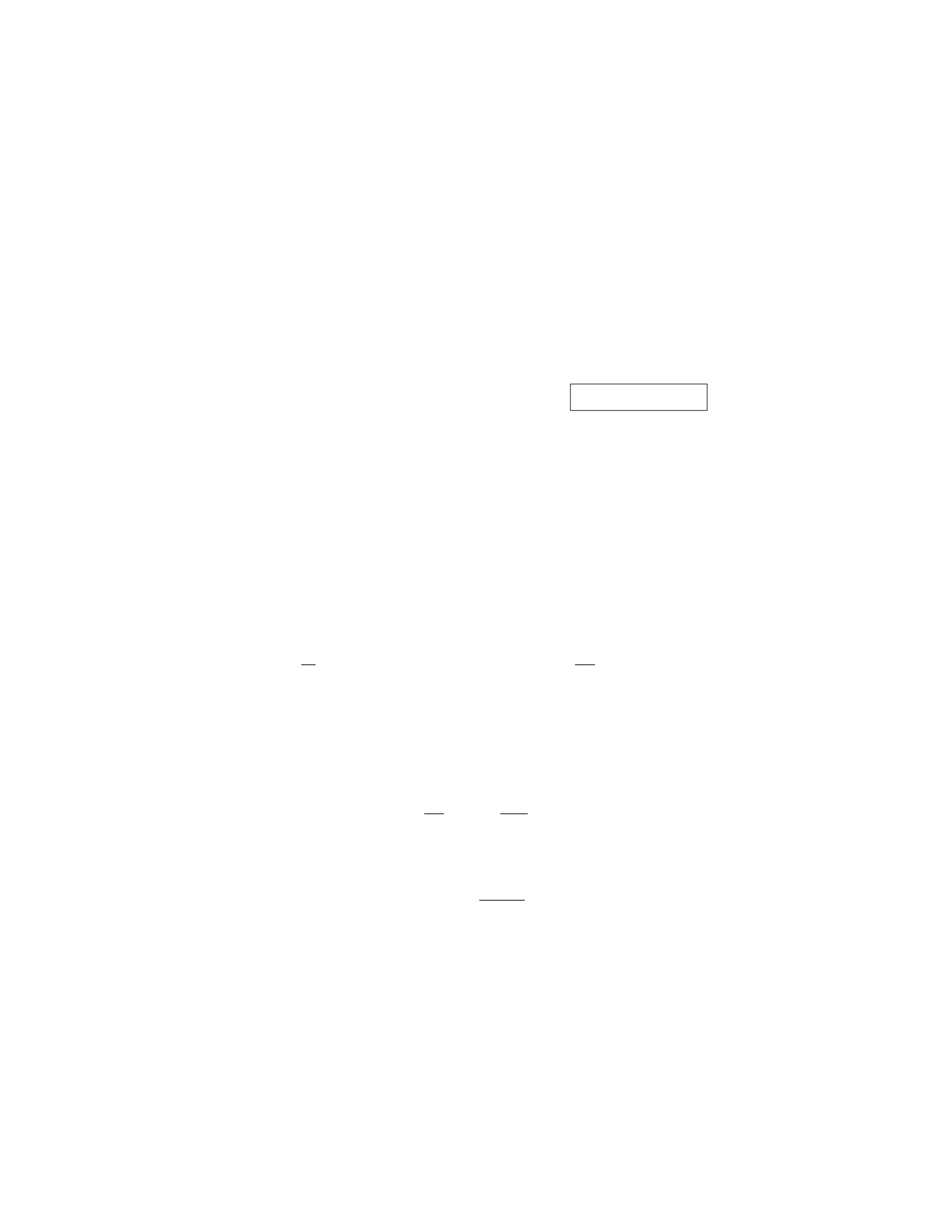
N=Mg cos θ
3. Substituting the expression for Nfrom the second equation into the first equation:
Mg sin θ−µk(Mg cos θ) = 0
F=µkMg cos θ
F=µkMg cos θ
Therefore, the expression for Fin terms of M,θ, and µkis F=µkM g cos θ.
7. Question:
A metal rod of length Land cross-sectional area Ais suspended from the ceiling. A weight
Wis hung from the lower end of the rod. The rod has a Young’s modulus Y. Determine the
elongation of the rod in terms of W,L,A, and Y.
Ans. Solution:
Let’s assume the original length of the rod is L0and the elongation of the rod is ∆L. The
stress in the rod is σ=W
Aand the strain in the rod is ϵ=∆L
L. According to Hooke’s Law for
elasticity, stress is proportional to strain:
σ=Y·ϵ
The stress σcan be represented in terms of force and cross-sectional area:
W
A=Y·∆L
L
From this equation, we can solve for ∆L:
∆L=W·L
Y·A
8. Question:
A uniform rod of length Land mass mis hanging vertically from one end. A particle of mass
m′is attached to the rod a distance xfrom the end where the rod is fixed. The rod and particle
are in equilibrium. Determine the tension force in the rod as a function of x.

Ans. Step-by-step solution:
1. Draw a free-body diagram of the rod and particle. The forces acting on the rod are the
tension force
Tat the point of attachment, the weight of the rod
Wrod =−mgˆ
jacting at the
center of mass of the rod, and the weight of the particle
Wparticle =−m′gˆ
jacting at the particle’s
location.
2. Write the equilibrium equations in the vertical direction. The sum of the forces in the
vertical direction must equal zero since the rod and particle are in equilibrium:
T−mg −m′g= 0.
3. Since the rod is in equilibrium, the rod is not accelerating in the horizontal direction.
Therefore, the sum of the torques about the point of attachment must equal zero:
∑τ= 0.
4. The torque equation for the system about the point of attachment can be written as:
xT −L
2mg + (L−x)m′g= 0.
5. Solve the two equilibrium equations to find the tension force Tas a function of x:
T−mg −m′g= 0 =⇒T=mg +m′g,
xT −L
2mg + (L−x)m′g= 0.
6. Substitute the expression for Tback into the torque equation:
x(mg +m′g)−L
2mg + (L−x)m′g= 0.
7. Simplify the equation to solve for Tin terms of x:
xmg +xm′g−L
2mg +Lm′g−xm′g= 0,
xmg +Lm′g−L
2mg = 0,
T=Lmg
2x+Lm′g.
Therefore, the tension force in the rod as a function of xis T=Lmg
2x+Lm′g.
9. A uniform rod of length Land mass Mis supported at its ends by two strings which make
angles θ1and θ2with the horizontal. The strings are at equal distances from the center of the
rod. Determine the tensions in the strings. Assume the rod is in equilibrium.
Ans. Let’s denote the tensions in the strings as T1and T2, respectively.
Step 1. We start by drawing a free-body diagram of the forces acting on the rod.
Step 2. The forces acting on the rod are the weight Wacting at the center of the rod and
the tensions T1and T2acting at the ends of the rod.
Step 3. The weight Wcan be calculated as W=M g, where gis the acceleration due to
gravity.
Step 4. We can resolve the weight into horizontal and vertical components. The vertical
component is balanced by the sum of the vertical components of the tensions, while the horizontal
component is balanced by the horizontal component of the tensions.
Step 5. The vertical equilibrium equation gives us:
T1cos θ1+T2cos θ2=Mg
Step 6. The horizontal equilibrium equation gives us:
T1sin θ1=T2sin θ2
Step 7. Since the strings are at equal distances from the center of the rod, we have θ1=
θ2=θ. Substituting this into our equations yields:
T1cos θ+T2cos θ=Mg
T1sin θ=T2sin θ
Step 8. Dividing the second equation by the first equation, we get:
T1
T2
= 1
Step 9. Given that the tensions in the strings are the same, we can solve for T1and T2as:
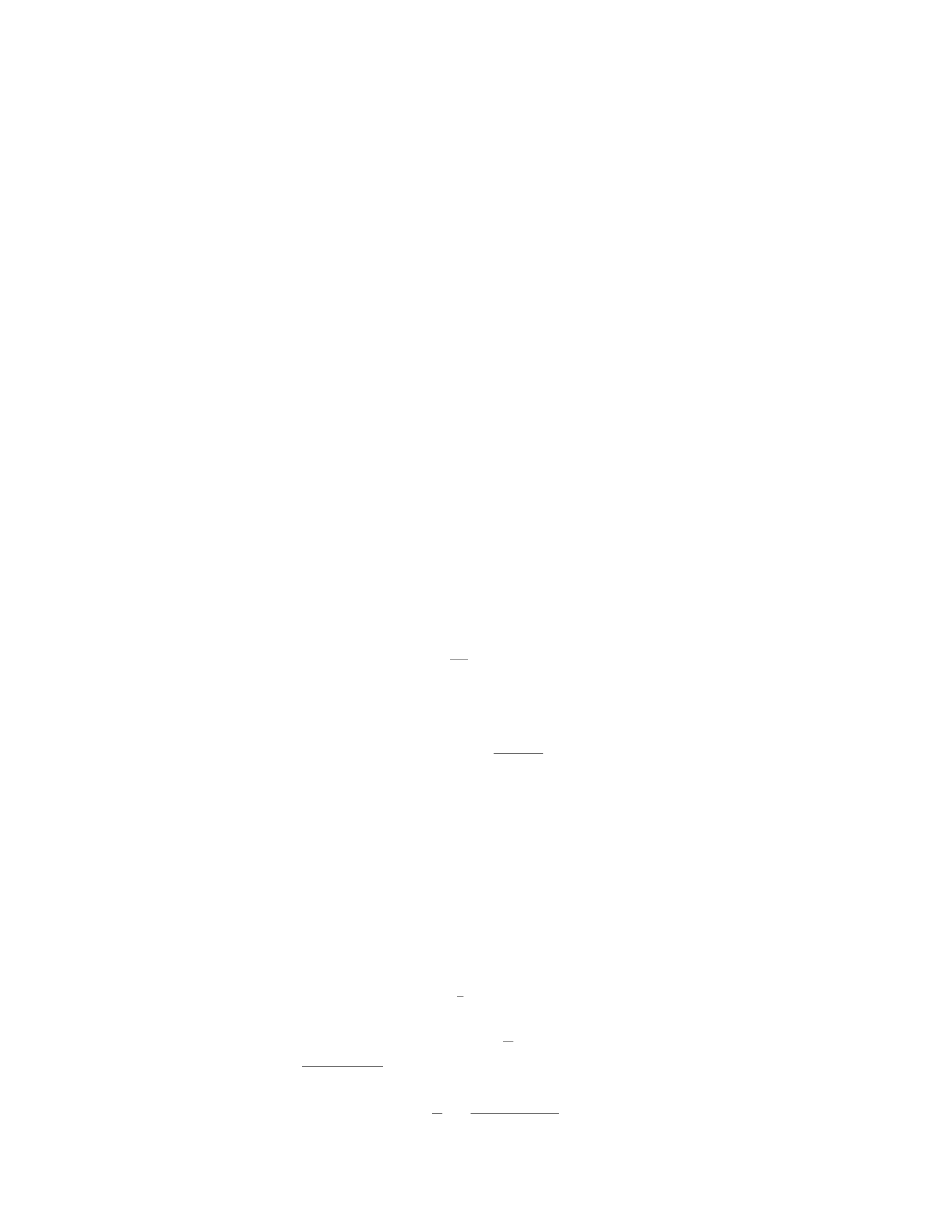
T1=T2=Mg
2cos θ
10. Question: A steel rod of length 2.0 m and diameter 1.0 cm is suspended vertically from
one end. A weight of 1000 N is attached to the other end of the rod. Calculate the stress and
strain in the rod if Y = 2.0×10¹¹ N/m2.
Ans. Step-by-step solution: 1. Calculate the cross-sectional area of the steel rod: Given
diameter = 1.0 cm = 0.01 m Radius, r=1
2diameter = 0.005 m Cross-sectional area, A=
πr2=π(0.005)2≈7.85 ×10⁻⁵m2.
2. Calculate the stress in the rod: Stress, σ=F
Awhere Fis the force applied and Ais the
cross-sectional area σ=1000 N
7.85×10⁻⁵m2≈1.27 ×10⁷N/m2.
3. Calculate the strain in the rod: Hooke’s Law: σ=Y·εWhere σis the stress, Yis the
Young’s Modulus, and εis the strain ε=σ
Y=1.27×10⁷N/m2
2.0×10¹¹ N/m2= 0.0000635 or 0.00635

Therefore, the stress in the rod is approximately 1.27 ×10⁷N/m2and the strain in the rod is
approximately 0.00635
11. A thin cylindrical tube of radius Rand length Lis initially at equilibrium. A force Fis
applied tangentially on the tube causing it to deform slightly. Determine the change in length of
the tube assuming it remains in the elastic regime. The Young’s modulus of the material is Y.
Ans. Let’s denote the change in length of the tube as ∆L. We can use the equilibrium condition
coupled with Hooke’s Law to find the change in length. 1. The force applied tangentially on the
tube will create a torque given by τ=F R. This torque causes a change in the angular position
of the tube given by θ=F R·∆L
Y·πR2. 2. The tangential stress developed in the tube is given by
σ=F
πR2. This stress is related to the strain by Hooke’s Law: ϵ=σ
Y. 3. The strain along the
length of the tube is given by ϵ=∆L
L. Equating the expressions for strain:
σ
Y=∆L
L⇒F
πR2Y=∆L
L⇒∆L=F L
πR2Y
Therefore, the change in length of the tube is ∆L=F L
πR2Y.
12. A uniform bar of length Land cross-sectional area Ais suspended vertically from one of
its ends. The bar has a density ρand Young’s modulus Y. Determine the elongation of the bar
in terms of L,ρ,Y, and acceleration due to gravity g.
Ans. Let’s denote the elongation of the bar as ∆L.
1. The weight of the bar Wis given by W=ρALg.
2. The tension Tin the bar at a distance xfrom the free end is given by T=ρAg(L−x).
3. The infinitesimal force dF on the bar at a distance xfrom the free end is given by
dF =T
Ldx =ρg(L−x)dx.
4. The infinitesimal strain dϵ is related to the infinitesimal force dF by Hooke’s law: dF =
Y A dϵ.
5. Substituting for dF and Ain terms of xand L, we have YA
Ldϵ =ρg(L−x)dx.
6. Integrating both sides over the length of the bar from 0to L, we get YA
L∫∆L
0dϵ =
ρg ∫L
0(L−x)dx.
7. Solving the integrals, we obtain YA∆L
L=ρg [Lx −x2
2]|L
0.
8. Simplifying the right side yields YA∆L
L=ρg (L2−L2
2).
9. Further simplifying gives Y∆L=3
2ρgL.
10. Therefore, the elongation of the bar ∆Lis equal to 3
2
ρgL
Y.

13. Question: A uniform rod of length Land mass Mis supported by a pivot at a distance d
from one end. A load of mass mis attached to the free end of the rod. Find the angle at which
the rod makes with the horizontal when it is in equilibrium.
Ans. Step-by-step solution: 1. First, we need to identify all the forces acting on the rod. There
are three forces: the weight of the rod acting at its center of mass, the weight of the load acting
at the free end, and the reaction force at the pivot. Let θbe the angle the rod makes with the
horizontal. 2. The weight of the rod acts vertically downwards at the center of the rod, i.e.
at a distance of L/2 from the pivot. Its magnitude is Mg, where gis the acceleration due to
gravity. This force can be decomposed into two components: one parallel to the rod and one
perpendicular to the rod. 3. The component of the weight of the rod perpendicular to the rod
will provide the torque required to balance the torques due to the weight of the load and the
reaction force. This component is Mg cos(θ)·L
2. 4. The weight of the load (mg) acts vertically
downwards at the free end of the rod. Its torque about the pivot is mg ·L. 5. The reaction
force at the pivot acts perpendicular to the rod and balances the perpendicular component of the
weight of the rod and the weight of the load. Its magnitude is R. The torque due to this force
is R·d. 6. For the rod to be in equilibrium, the sum of the torques must be zero. Therefore,
we have the equation: Mg cos(θ)·L
2=mg ·L+R·d. 7. Solving this equation for θ, we get
θ=cos−1(2mgL
MgL+2Rd ). Hence, the angle at which the rod makes with the horizontal when it is
in equilibrium is cos−1(2mgL
MgL+2Rd ).
14. A rod of length Land uniform cross-sectional area Ais hanging vertically from a ceiling.
The rod has a mass per unit length λand Young’s modulus Y. Determine the elongation of the
rod due to its own weight.
Ans. Let’s denote the elongation of the rod as ∆L. We will calculate the elongation step-by-
step.
1. First, let’s find the mass of the rod, M. The mass of the rod is given by M=λL.
2. The weight of the rod is equal to the force exerted at the centroid of the rod, which is
1
2Mg =1
2λLg.
3. The stress in the rod is σ=F
Awhere Fis the force due to weight and Ais the cross-
sectional area. Therefore, σ=1
2λLg/A.
4. The strain in the rod is ϵ=∆L
L. From Hooke’s Law, σ=Y ϵ, we have 1
2λLg/A=Y∆L
L.
5. Solving for ∆L, we find ∆L=1
2
λgL2
AY .
Therefore, the elongation of the rod due to its own weight is ∆L=1
2
λgL2
AY .
15. A 2.0 m long steel wire with a cross-sectional area of 2.0×10⁻⁴m2is stretched by a force
of 800 N. The Young’s modulus of steel is 2.0×10¹¹ Pa. What is the change in length of the
wire due to the applied force?
Ans. Let’s use the formula for stress and strain to determine the change in length of the wire.
1. Calculate the stress: The stress (σ) on the wire is given by:
σ=F
A
where Fis the applied force and Ais the cross-sectional area. Plugging in the values:
σ=800 N
2.0×10⁻⁴m2= 4 ×10⁶Pa
2. Calculate the strain: The strain (ε) on the wire is given by:
ε=σ
E
where Eis the Young’s modulus. Plugging in the values:
ε=4×10⁶Pa
2.0×10¹¹ Pa = 2 ×10⁻⁵
3. Calculate the change in length: The change in length (∆L) of the wire is given by:
∆L=ε·L
where Lis the original length of the wire. Plugging in the values:
∆L= 2 ×10−5·2.0m= 4 ×10⁻⁵m
Therefore, the change in length of the wire due to the applied force is 4×10⁻⁵meters.
16. A steel rod with a length of 2.5 m and a cross-sectional area of 0.005 m2is stretched under
a tensile force of 50 kN. If the Young’s modulus of steel is 2.1×10¹¹ N/m2, determine the stress
and strain on the rod.
Ans. Let’s first determine the stress on the rod:
1. Calculate the stress: The stress on the rod is given by the formula:
Stress =Force
Area
Plugging in the given values:
Stress =50,000 N
0.005 m2
Stress = 10,000,000 N/m2= 10 MPa
Next, let’s calculate the strain:
2. Calculate the strain: The strain on the rod is given by the formula:
Strain =Extension
Original Length =∆L
L
We can relate the strain to stress using Hooke’s Law:
Strain =Stress
Young’s Modulus
Plugging in the given values:
Strain =10 MPa
2.1×10¹¹ N/m2
Strain = 4.76 ×10⁻⁵
Therefore, the stress on the rod is 10 MPa and the strain is 4.76 ×10⁻⁵.
17. Question: A 5-meter long steel beam is fixed at one end and supports a load of 2000 N
placed 4 meters from the fixed end. If the beam has a cross-sectional area of 200 cm2and a
Young’s modulus of 2×10¹¹ N/m2, determine the stress and strain at the fixed end of the beam.
Ans. Step 1. Calculate the moment at the fixed end of the beam.
The moment (M) caused by the load (F) at a distance (d) from the fixed end is given by
the equation:
M=F·d
Substitute F= 2000 N and d= 4 m into the equation to find M.
Step 2. Determine the maximum bending stress at the fixed end of the beam.
The maximum bending stress (σ) in a beam is given by the equation:
σ=My
I
where Mis the moment, yis the distance from the neutral axis to the outermost fiber, and Iis
the moment of inertia. Since the beam is simply supported and the load is applied at the end, y
is equal to the radius of the neutral axis. The moment of inertia for a rectangular cross-section
is given by I=bh3
12 , where bis the breadth and his the height of the beam.
Step 3. Calculate the strain at the fixed end of the beam.
The strain (ϵ) in a material is given by:
ϵ=σ
E
where Eis the Young’s modulus of the material. Substitute the calculated stress value and the
given Young’s modulus value into the equation to find the strain.
18. A steel beam with a length of 5 m and a cross-sectional area of 0.01 m2is subjected to a
tensile force of 50 kN. The Young’s modulus of steel is 2×10¹¹ N/m2. Calculate the amount by
which the beam stretches under this force.
Ans. To find the amount by which the beam stretches under the given force, we can use
Hooke’s Law for elasticity, which states that the stress is directly proportional to the strain.
1. Calculate the stress σon the beam: The stress is defined as the force per unit area:
σ=F
A
where Fis the applied force and Ais the cross-sectional area. Given: F= 50 kN = 50 ×103N
and A= 0.01 m2Therefore:
σ=50 ×103
0.01 = 5 ×10⁶N/m2
2. Calculate the strain ϵon the beam: The strain is defined as the change in length per unit
original length:
ϵ=∆L
L
where ∆Lis the change in length and Lis the original length. Using Hooke’s Law: σ
E=ϵGiven:
E= 2 ×10¹¹ N/m2Substitute the values of σand E:
ϵ=5×10⁶
2×1011 = 2.5×10⁻⁵
3. Calculate the change in length ∆L:
∆L=ϵ×L= 2.5×10−5×5 = 1.25 ×10⁻⁴m
Therefore, the beam stretches by 0.000125 m (or 0.125 mm) under the applied force of 50
kN.
19. A block of mass mis suspended by two strings, each of length L, from the ceiling of an
elevator. The elevator is moving upward with an acceleration of a. Find the tension in each
string.
Ans. To find the tension in each string, we need to analyze the forces acting on the block when
it is in equilibrium relative to the elevator.
1. Draw the free-body diagram of the block when it is in equilibrium relative to the elevator.
There are three forces acting on the block: its weight mg acting downward, and the tensions T
in the two strings acting upward at angles θwith respect to the vertical axis. Apply Newton’s
second law in the vertical direction to set up the equilibrium equation:
Tcos(θ) + Tcos(θ)−mg = 0
2. Simplify the equilibrium equation by substituting the given information. The angle θcan
be found using trigonometry. Since the elevator is moving upward with acceleration a, the net
acceleration experienced by the block is aupwards. So the angle θsatisfies:
cos(θ) = a
g
Substitute this back into the equilibrium equation:
2Tcos(θ)−mg = 0
2T(a
g)=mg
3. Solve for the tension in each string:
T=mg
2(g
a)=mg
2(1 + g
a)
Therefore, the tension in each string is T=mg
2(1 + g
a).
20. Question: A uniform bar of length Land mass Mis suspended horizontally from a ceiling
by two vertical wires of length L/2 each attached at the ends of the bar. A bullet of mass m
is shot horizontally at one end of the bar with speed v. The bullet gets embedded in the bar.
Determine the speed at which the system swings if the wires are nearly vertical.
Ans. Step-by-step solution: 1. Let vfinal be the final speed of the system after the bullet embeds
in the bar. By conservation of momentum in the horizontal direction, we have:
Mv = (M+m)vfinal
vfinal =Mv
M+m
2. Let θbe the angle of swing of the system from the vertical position. The tension in each wire
is equal to the weight of the bar and the bullet, resolved into components:
T= (M+m)gcos(θ)
3. The net torque about the point of suspension is given by:
2(L
2)Tsin(θ) = Iα
where Iis the moment of inertia of the system about the point of suspension and αis the angular
acceleration. 4. The moment of inertia of the system about the point of suspension is given by:
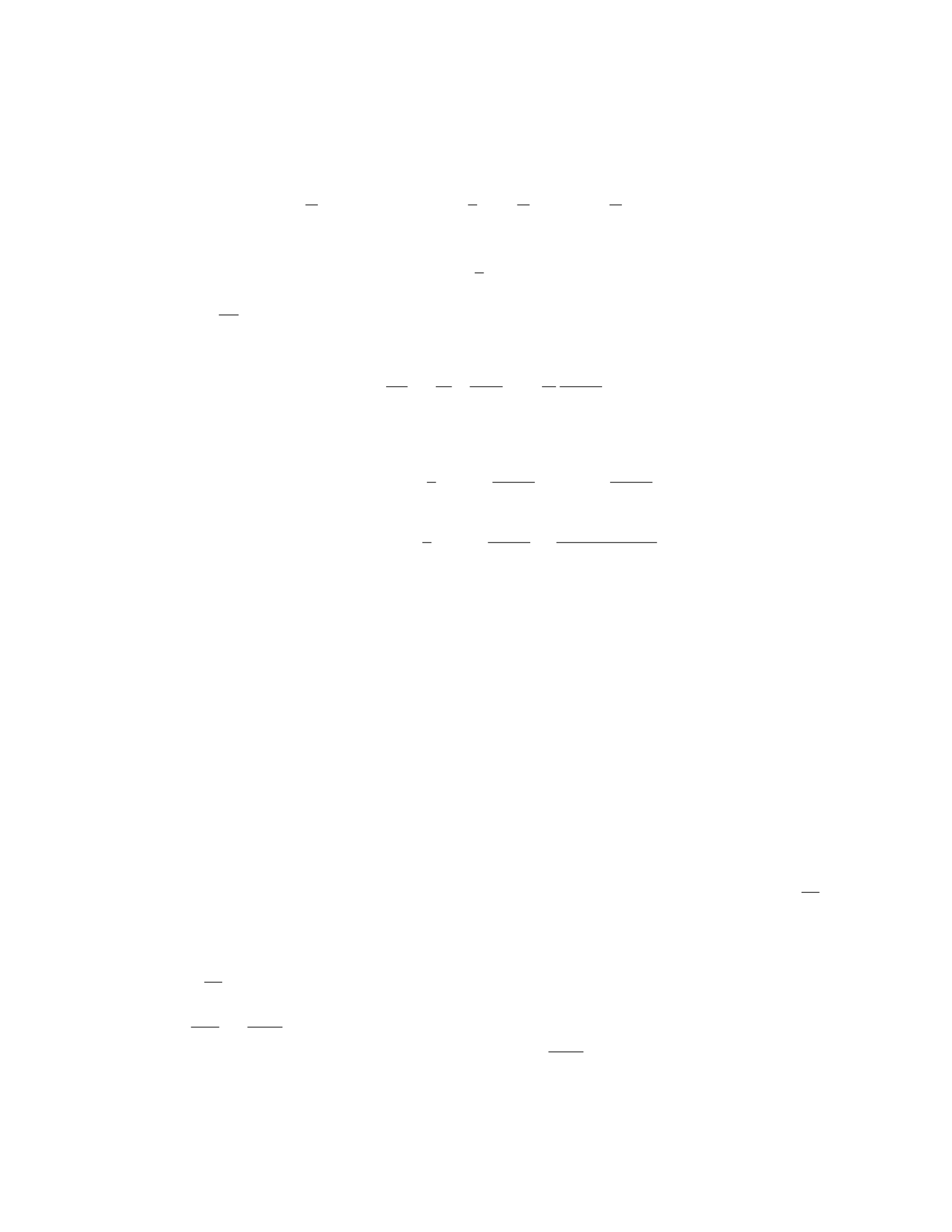
I=1
3M(L
2)2
+m(L
2)2
5. Using the small angle approximation sin(θ)≈θ, and substituting in the values, the equation
for angular acceleration becomes:
2(L
2)(M+m)gθ =(1
3M(L
2)2
+m(L
2)2)α
L(M+m)gθ =1
3ML2α+mL2α
6. Since α=d2θ
dt2and vfinal =Rω where Ris the distance from the center of mass of the bar to
the point of suspension, we can relate αand vfinal:
α=dω
dt =d
dt (vfinal
R)=1
R
dvfinal
dt
7. Substituting this into the previous equation and simplifying, we get:
L(M+m)gθ =1
3ML2·dvfinal
dt +mL2·dvfinal
dt
L(M+m)gθ =1
3ML2·dvfinal
dt +3mL2·dvfinal
dt
8. Integrating this equation gives the relation between θand vfinal.
21. Find the vertical displacement of a cylindrical column of height hand radius Rwhen a
heavy block of mass Mis placed on top of it. Assume that the column is made of a material
with Young’s modulus Y.
Ans. Let’s denote the vertical displacement of the column as ∆y.
Step 1. Firstly, let’s determine the force exerted on the column due to the block.
The weight of the block is given by Fblock =Mg, where gis the acceleration due to gravity.
Step 2. Next, we need to find the cross-sectional area of the column.
The cross-sectional area Aof the column is A=πR2.
Step 3. Using Hooke’s Law, we can write the force exerted by the column as Fcolumn =Y∆y
hA.
Step 4. At equilibrium, the forces must balance out. Therefore, we have the equation
Fblock =Fcolumn.
Step 5. Substituting the expressions for Fblock and Fcolumn into the equilibrium equation gives
us Mg =Y∆y
hA.
Step 6. Now, we can solve for ∆y:
∆y=Mgh
Y A =M gh
Y πR2.
Therefore, the vertical displacement of the column is Mgh
Y πR2.

22. Suppose a solid cylindrical rod of length Land diameter dis suspended vertically from one
end. If the rod is made of a material with Young’s modulus Y, what is the extension of the rod
due to its own weight?
23. Question:
A thin cylindrical rod of length Land radius ris clamped at one end and is loaded with a
force Fat the other end. The Young’s modulus of the material is Y. Determine the maximum
stress in the rod.
Ans. Step-by-step solution:
1. The stress σin the rod is given by σ=F
A, where Ais the cross-sectional area of the rod.
The cross-sectional area of a thin cylindrical rod is given by A=πr2.
2. The strain εin the rod is given by ε=δ
L, where δis the displacement at the loaded end
of the rod. Hooke’s Law states that σ=Y ε, where Yis Young’s modulus.
3. Since the strain is given by ε=δ
L, we can rewrite Hooke’s Law as σ=Y(δ
L).
4. By combining equations from steps 1 and 3, we get F
πr2=Y(δ
L).
5. Solving for δ, we find δ=F L
πr2Y.
6. The maximum stress occurs when the displacement is maximized. At this point, the rod
operates at its elastic limit, meaning δ=L. Therefore, the maximum stress σmax in the rod is
given by:
σmax =Fmax
πr2=Y L
πr2
24. A uniform rod of length Land mass Mis supported by a pivot at one end. A weight W is
hung a distance dfrom the pivot along the rod. The rod makes an angle θwith the horizontal.
Given that the rod is in equilibrium, find an expression for the shear modulus of the material from
which the rod is made.
Ans. Let’s denote the distance of the center of mass of the rod from the pivot as x. The
forces acting on the rod are the weight Mg acting at the center of mass, the weight Wacting
at a distance dfrom the pivot, and the force of tension Tacting at the pivot. The torque
about the pivot must be zero in order for the rod to be in equilibrium. 1. Setting up the torque
equation: The torque due to the weight M g is Mg ·x·sin θ, the torque due to the weight Wis
W·(L−d)·sin θ, and the torque due to the tension force Tis T·L·sin θ. Therefore, we have:
Mg ·xsin θ−W·(L−d)·sin θ−T·L·sin θ= 0
2. Finding the expression for center of mass x: The center of mass xis given by x=L
2sin θ.
Substituting this into the torque equation gives:
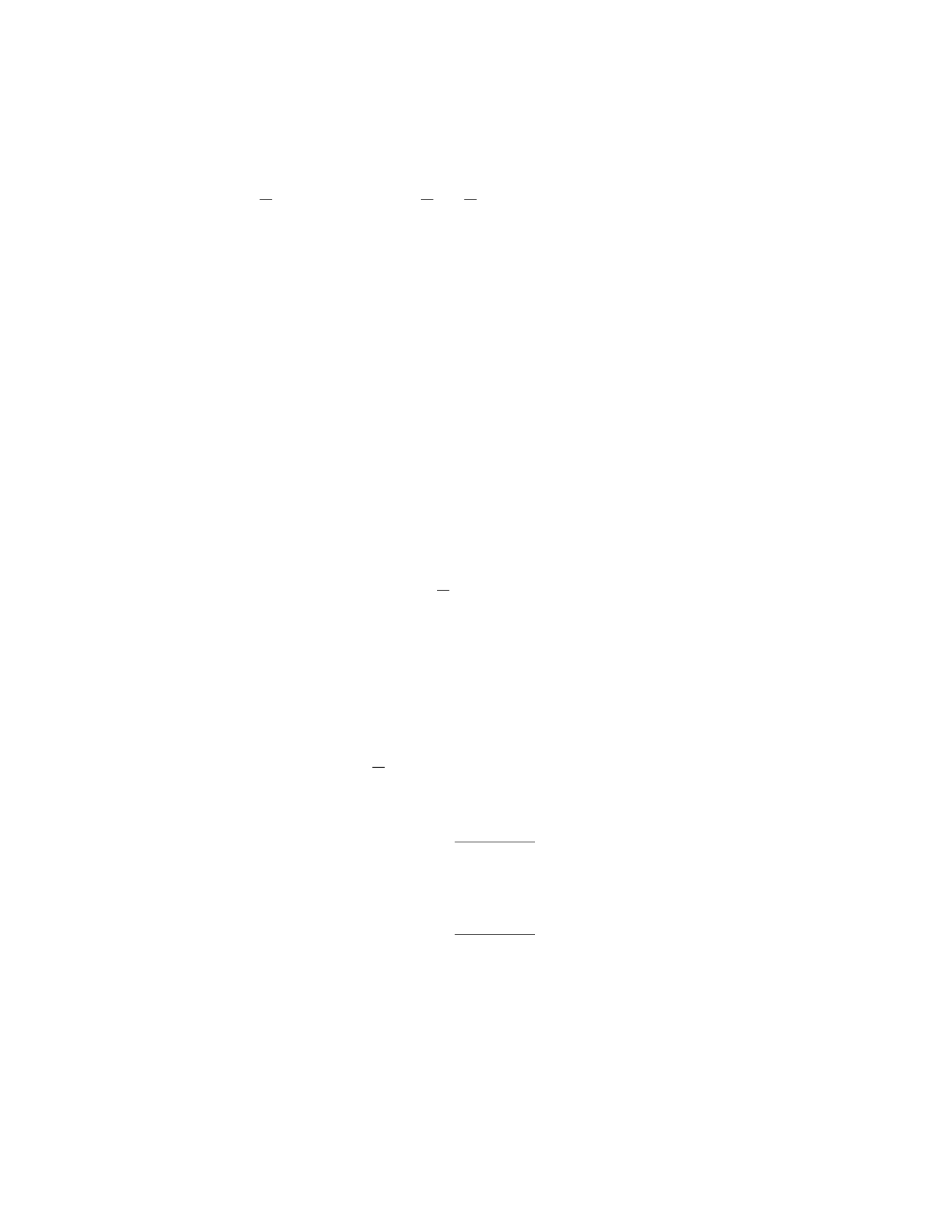
Mg ·L
2sin2θ−W·(1−d
L)·L
2sin2θ−T·L·sin θ= 0
3. Solving for the tension T: We know that the sum of the forces in the vertical direction is zero:
Tcos θ=Mg +W. Substituting this into the torque equation we found earlier:
Mg ·L
2sin2θ−W·(1−d
L)·L
2sin2θ−(Mg +W)·L·sin θ= 0
4. Expression for shear modulus:
From the previous equations, we can find the expression for the shear modulus Gin terms of
L,M,g,W,d, and θ.
25. A uniform bar of length Land mass Mis supported by a pivot at one end and a cable
attached to the other end. Calculate the tension in the cable when the bar makes an angle θ
with the horizontal.
Ans. Let’s consider the forces acting on the bar when it makes an angle θwith the horizontal:
1. Resolve the weight of the bar into components: M g sin(θ)perpendicular to the bar and
Mg cos(θ)parallel to the bar. 2. The torque about the pivot due to the weight of the bar is
−L
2Mg cos(θ)
. 3. The torque due to the tension in the cable is
LT sin(θ)
. 4. Since the bar is in equilibrium, the sum of torques about the pivot is zero:
−L
2Mg cos(θ) + LT sin(θ) = 0
. 5. Solve for the tension T:
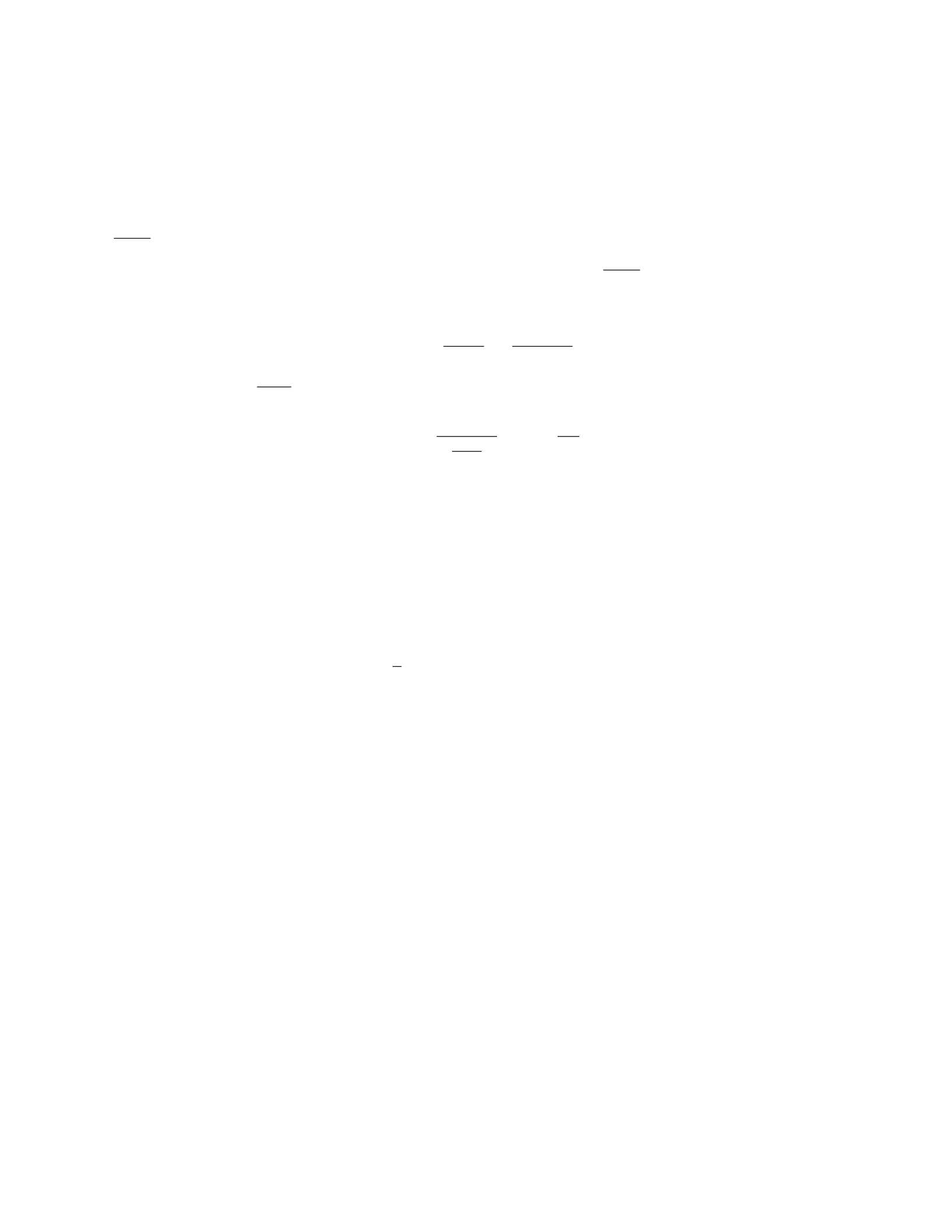
T=Mg cos(θ)
2sin(θ)
. Therefore, the tension in the cable when the bar makes an angle θwith the horizontal is
T=Mg cos(θ)
2sin(θ)
.
3. The weight of the water displaced by the block can be calculated using the formula
Wwater =ρwaterVblockg, where ρwater is the density of water, Vblock is the volume of the block, and
gis the acceleration due to gravity.
4. Since the block is partially submerged, the volume of water displaced is equal to the volume
of the block that is submerged. This volume can be calculated using the formula Vsubmerged =
Wair
ρwaterg.
5. From step 3 and step 4, we have Wwater =ρwater ·(Wair
ρwaterg)·g, which simplifies to
Wwater =Wair. Therefore, we can solve for the density of the wood block:
ρwood =Wair
Vblock
=19.62 N
Vblock
where Vblock =mblock
ρwood . Substituting this into the equation above, we get
ρwood =19.62 N
2kg
ρwood
= 9.81 kg
m3
Therefore, the density of the wood block is 9810 kg/m3.
3. **Question:**
A uniform rod of length Land mass Mis hung horizontally from two vertical walls by two
vertical strings of length d(with d < L
2) attached to the ends of the rod. The walls are a distance
Lapart. If the tension in each string is T, determine the force Fthat each wall exerts on the
rod.
**Hint:** Consider the forces acting on the rod in the vertical direction to establish two
equations of equilibrium.
Ans. **Solution:**
1. Consider the forces acting on the rod:
Let’s denote the force exerted by the left wall on the rod as FLand by the right wall as FR.
At equilibrium, the forces in the vertical direction must balance out.
2. Equations of equilibrium in the vertical direction:
- For the left end of the rod: FLcos(θ) = Tcos(θ) + Tcos(θ)
FL= 2Tcos(θ)
- For the right end of the rod: FRcos(θ) = Tcos(θ) + Tcos(θ)
FR= 2Tcos(θ)
where θis the angle the strings make with the vertical.
3. Using the equilibrium condition:
- Summing the torques about the left end of the rod:
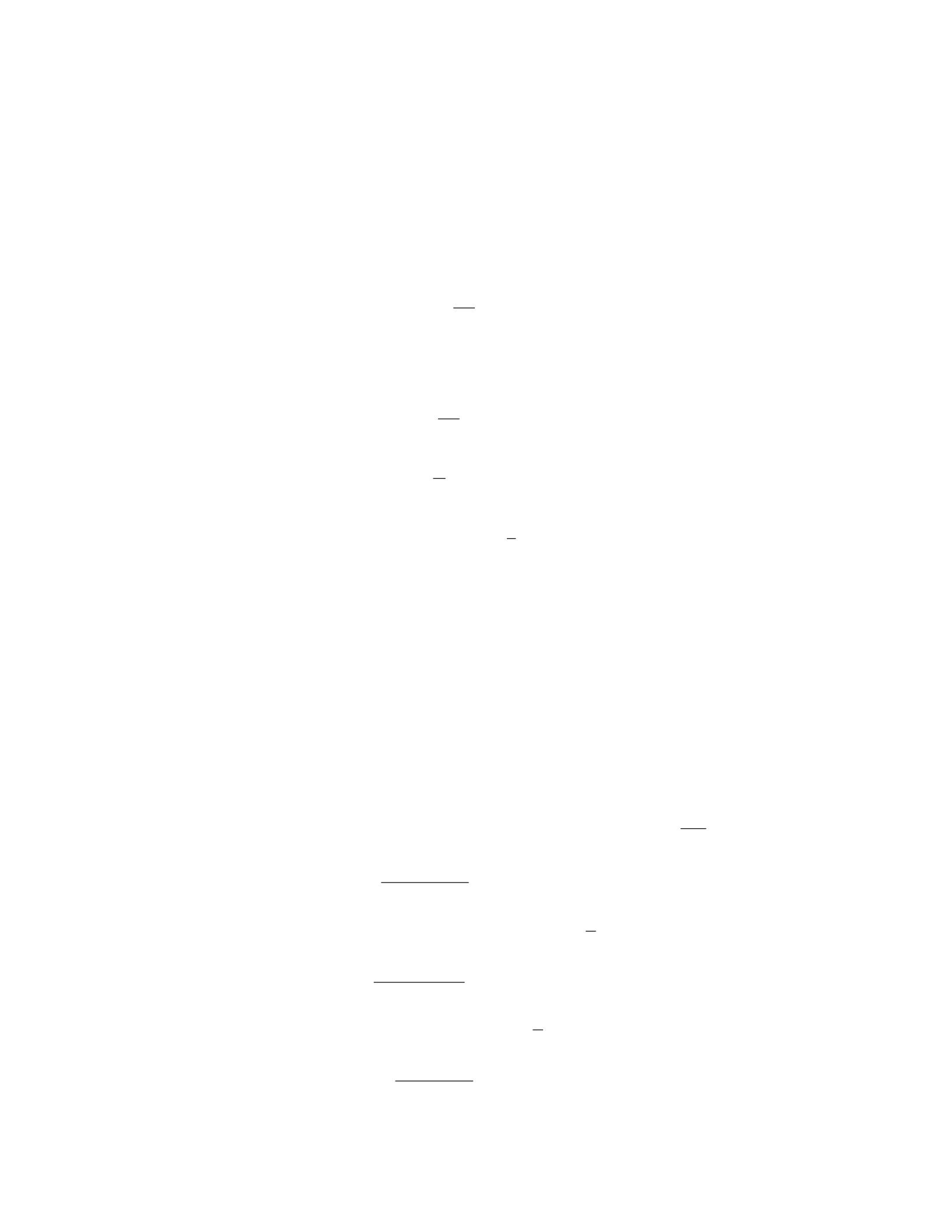
Tsin(θ)·d=FRsin(θ)·L
Substituting FR= 2Tcos(θ)into the expression above:
Tsin(θ)·d= 2Tcos(θ)sin(θ)·L
Solving for T:
T=d
2L·tan(θ)
4. Finding the force F:
- Substituting Tback into FL= 2Tcos(θ):
FL= 2 ·(d
2L·tan(θ))·cos(θ)
FL=d
L·sin(θ)·cos(θ)
Similarly, we can find FRas well.
The force Fthat each wall exerts on the rod is d
L·sin(θ)·cos(θ).
4. Question:
A solid cylindrical rod with a length of 1 meter and a diameter of 2 cm is suspended from
one end. A weight of 100 N is attached to the other end of the rod. If the rod has a Young’s
modulus of 2×10¹¹ N/m2, determine the elongation of the rod.
Ans. Let’s denote the original length of the rod as L, the applied force as F, the cross-sectional
area as A, the Young’s modulus as E, and the elongation of the rod as ∆L. We are given that
L= 1 m, F= 100 N, D= 2 cm, and E= 2 ×10¹¹ N/m2.
1. Calculate the cross-sectional area of the rod using the formula A=πD2
4.
A=π×(0.02)2
4= 3.14 ×10⁻⁴m2
2. Determine the stress on the rod using the formula σ=F
A.
σ=100
3.14 ×10−4= 318471.34 N/m2
3. Find the strain in the rod using the formula ϵ=σ
E.
ϵ=318471.34
2×1011 = 1.59 ×10⁻³
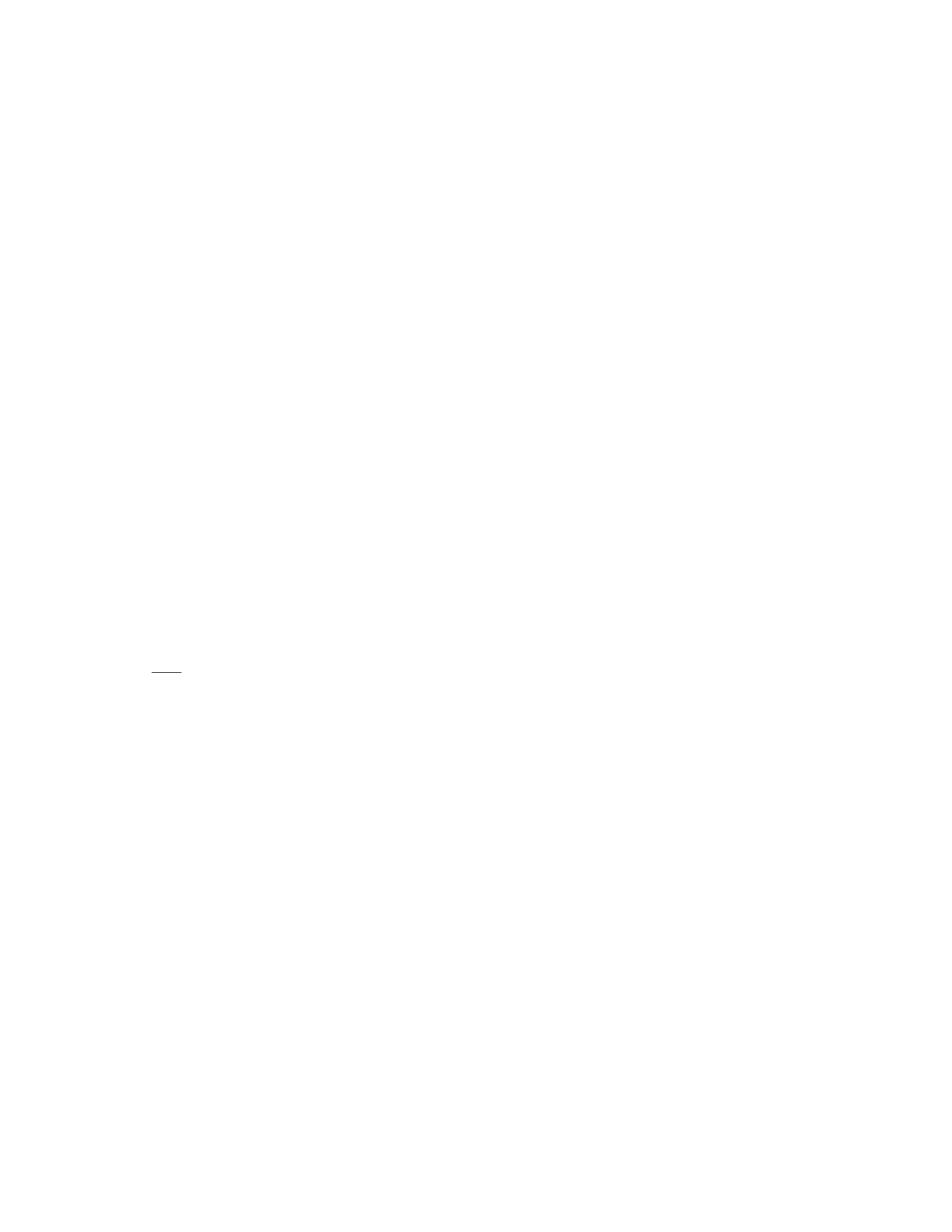
4. Calculate the elongation of the rod using the formula ∆L=ϵ×L.
∆L= 1.59 ×10−3×1 = 1.59 ×10⁻³m
Therefore, the elongation of the rod is 1.59 mm.
5. A 2.0 m long rod is suspended horizontally from the ceiling by two vertical wires. A 20 kg
weight is hung from the center of the rod. One wire is attached at a distance of 0.5 m to the left
of the weight and the other wire is attached at a distance of 0.5 m to the right of the weight. If
the tension in each wire is the same, what is the tension in each wire?
Ans. Let’s denote the tension in each wire as T. To solve this problem, we will first find the
torque produced by the weight and then set it equal to zero to ensure the system is in equilibrium.
1. Calculate the torque produced by the 20 kg weight hanging from the center of the rod.
The weight of the 20 kg mass is mg = 20 kg ×9.81 m/s2= 196.2N. The torque (τ) produced
by the weight about the left vertical wire is given by τ= (0.5m)×(T)−(1.0m)×(196.2N).
2. The torque produced by the weight about the right vertical wire is given by τ= (1.5m)×
(T)−(1.0m)×(196.2N).
3. Since the system is in equilibrium, the sum of all torques must be zero. Setting up
the equilibrium equation: (0.5)T−196.2 = (1.5)T−196.2. Simplifying this equation gives
−T+ 196.2 = 1.5T−196.2.
4. Solve the equilibrium equation for T. Rearranging terms gives 2.5T= 392.4and therefore
T=392.4
2.5= 156.96 N.
Therefore, the tension in each wire is 156.96 N.
6. A block of mass Mis placed on a rough incline of angle θwith the horizontal. The
coefficient of kinetic friction between the block and the incline is µk. The block is then subjected
to a horizontal force Fparallel to the incline. Given that the block is in equilibrium, determine
the expression for Fin terms of M,θ, and µk.
Ans. Let’s consider the forces acting on the block along the incline and perpendicular to the
incline to establish the equilibrium condition.
1. Along the incline: The forces acting along the incline are the component of the gravitational
force pulling the block downhill (Mg sin θ), the normal force from the incline pushing the block
uphill (N), and the frictional force opposing the motion (fk=µkN). The equation of motion
along the incline gives:
Mg sin θ−fk= 0
Mg sin θ−µkN= 0
N=Mg sin θ/µk
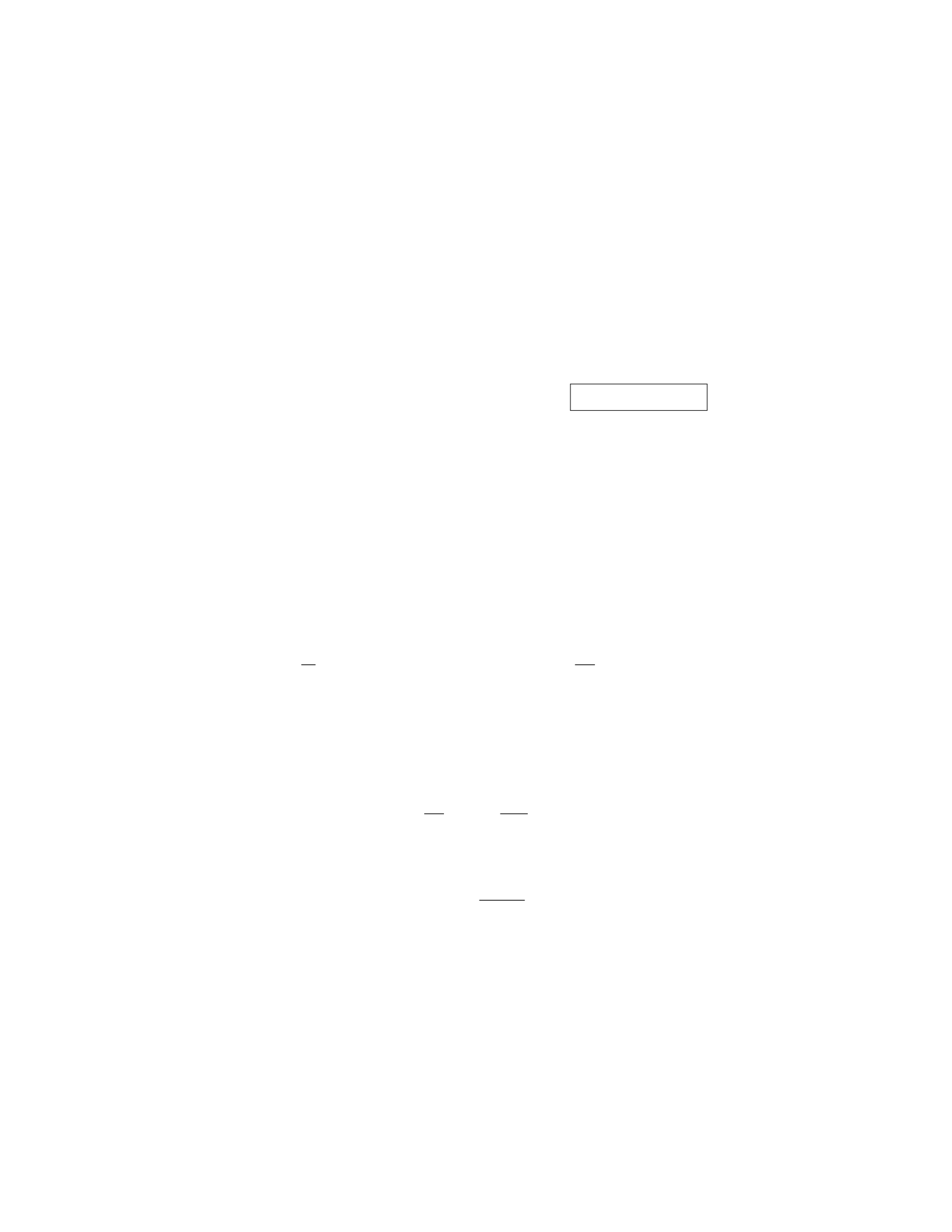
2. Perpendicular to the incline: The force acting perpendicular to the incline is the component
of the gravitational force perpendicular to the incline (Mg cos θ) and the normal force from the
incline pushing the block uphill (N). The equilibrium condition perpendicular to the incline gives:
N=Mg cos θ
3. Substituting the expression for Nfrom the second equation into the first equation:
Mg sin θ−µk(Mg cos θ) = 0
F=µkMg cos θ
F=µkMg cos θ
Therefore, the expression for Fin terms of M,θ, and µkis F=µkM g cos θ.
7. Question:
A metal rod of length Land cross-sectional area Ais suspended from the ceiling. A weight
Wis hung from the lower end of the rod. The rod has a Young’s modulus Y. Determine the
elongation of the rod in terms of W,L,A, and Y.
Ans. Solution:
Let’s assume the original length of the rod is L0and the elongation of the rod is ∆L. The
stress in the rod is σ=W
Aand the strain in the rod is ϵ=∆L
L. According to Hooke’s Law for
elasticity, stress is proportional to strain:
σ=Y·ϵ
The stress σcan be represented in terms of force and cross-sectional area:
W
A=Y·∆L
L
From this equation, we can solve for ∆L:
∆L=W·L
Y·A
8. Question:
A uniform rod of length Land mass mis hanging vertically from one end. A particle of mass
m′is attached to the rod a distance xfrom the end where the rod is fixed. The rod and particle
are in equilibrium. Determine the tension force in the rod as a function of x.

Ans. Step-by-step solution:
1. Draw a free-body diagram of the rod and particle. The forces acting on the rod are the
tension force
Tat the point of attachment, the weight of the rod
Wrod =−mgˆ
jacting at the
center of mass of the rod, and the weight of the particle
Wparticle =−m′gˆ
jacting at the particle’s
location.
2. Write the equilibrium equations in the vertical direction. The sum of the forces in the
vertical direction must equal zero since the rod and particle are in equilibrium:
T−mg −m′g= 0.
3. Since the rod is in equilibrium, the rod is not accelerating in the horizontal direction.
Therefore, the sum of the torques about the point of attachment must equal zero:
∑τ= 0.
4. The torque equation for the system about the point of attachment can be written as:
xT −L
2mg + (L−x)m′g= 0.
5. Solve the two equilibrium equations to find the tension force Tas a function of x:
T−mg −m′g= 0 =⇒T=mg +m′g,
xT −L
2mg + (L−x)m′g= 0.
6. Substitute the expression for Tback into the torque equation:
x(mg +m′g)−L
2mg + (L−x)m′g= 0.
7. Simplify the equation to solve for Tin terms of x:
xmg +xm′g−L
2mg +Lm′g−xm′g= 0,
xmg +Lm′g−L
2mg = 0,
T=Lmg
2x+Lm′g.
Therefore, the tension force in the rod as a function of xis T=Lmg
2x+Lm′g.
9. A uniform rod of length Land mass Mis supported at its ends by two strings which make
angles θ1and θ2with the horizontal. The strings are at equal distances from the center of the
rod. Determine the tensions in the strings. Assume the rod is in equilibrium.
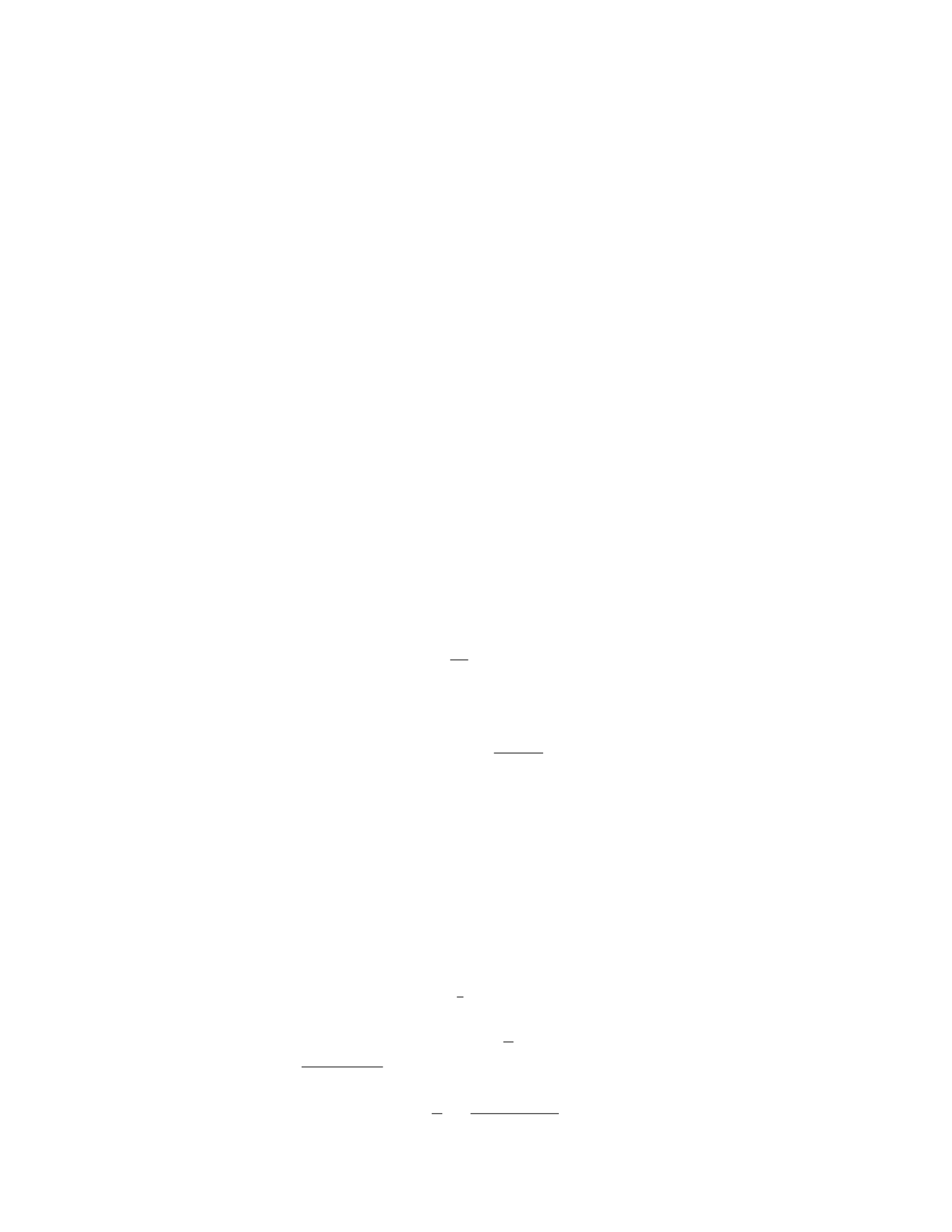
Ans. Let’s denote the tensions in the strings as T1and T2, respectively.
Step 1. We start by drawing a free-body diagram of the forces acting on the rod.
Step 2. The forces acting on the rod are the weight Wacting at the center of the rod and
the tensions T1and T2acting at the ends of the rod.
Step 3. The weight Wcan be calculated as W=M g, where gis the acceleration due to
gravity.
Step 4. We can resolve the weight into horizontal and vertical components. The vertical
component is balanced by the sum of the vertical components of the tensions, while the horizontal
component is balanced by the horizontal component of the tensions.
Step 5. The vertical equilibrium equation gives us:
T1cos θ1+T2cos θ2=Mg
Step 6. The horizontal equilibrium equation gives us:
T1sin θ1=T2sin θ2
Step 7. Since the strings are at equal distances from the center of the rod, we have θ1=
θ2=θ. Substituting this into our equations yields:
T1cos θ+T2cos θ=Mg
T1sin θ=T2sin θ
Step 8. Dividing the second equation by the first equation, we get:
T1
T2
= 1
Step 9. Given that the tensions in the strings are the same, we can solve for T1and T2as:
T1=T2=Mg
2cos θ
10. Question: A steel rod of length 2.0 m and diameter 1.0 cm is suspended vertically from
one end. A weight of 1000 N is attached to the other end of the rod. Calculate the stress and
strain in the rod if Y = 2.0×10¹¹ N/m2.
Ans. Step-by-step solution: 1. Calculate the cross-sectional area of the steel rod: Given
diameter = 1.0 cm = 0.01 m Radius, r=1
2diameter = 0.005 m Cross-sectional area, A=
πr2=π(0.005)2≈7.85 ×10⁻⁵m2.
2. Calculate the stress in the rod: Stress, σ=F
Awhere Fis the force applied and Ais the
cross-sectional area σ=1000 N
7.85×10⁻⁵m2≈1.27 ×10⁷N/m2.
3. Calculate the strain in the rod: Hooke’s Law: σ=Y·εWhere σis the stress, Yis the
Young’s Modulus, and εis the strain ε=σ
Y=1.27×10⁷N/m2
2.0×10¹¹ N/m2= 0.0000635 or 0.00635

Therefore, the stress in the rod is approximately 1.27 ×10⁷N/m2and the strain in the rod is
approximately 0.00635
11. A thin cylindrical tube of radius Rand length Lis initially at equilibrium. A force Fis
applied tangentially on the tube causing it to deform slightly. Determine the change in length of
the tube assuming it remains in the elastic regime. The Young’s modulus of the material is Y.
Ans. Let’s denote the change in length of the tube as ∆L. We can use the equilibrium condition
coupled with Hooke’s Law to find the change in length. 1. The force applied tangentially on the
tube will create a torque given by τ=F R. This torque causes a change in the angular position
of the tube given by θ=F R·∆L
Y·πR2. 2. The tangential stress developed in the tube is given by
σ=F
πR2. This stress is related to the strain by Hooke’s Law: ϵ=σ
Y. 3. The strain along the
length of the tube is given by ϵ=∆L
L. Equating the expressions for strain:
σ
Y=∆L
L⇒F
πR2Y=∆L
L⇒∆L=F L
πR2Y
Therefore, the change in length of the tube is ∆L=F L
πR2Y.
12. A uniform bar of length Land cross-sectional area Ais suspended vertically from one of
its ends. The bar has a density ρand Young’s modulus Y. Determine the elongation of the bar
in terms of L,ρ,Y, and acceleration due to gravity g.
Ans. Let’s denote the elongation of the bar as ∆L.
1. The weight of the bar Wis given by W=ρALg.
2. The tension Tin the bar at a distance xfrom the free end is given by T=ρAg(L−x).
3. The infinitesimal force dF on the bar at a distance xfrom the free end is given by
dF =T
Ldx =ρg(L−x)dx.
4. The infinitesimal strain dϵ is related to the infinitesimal force dF by Hooke’s law: dF =
Y A dϵ.
5. Substituting for dF and Ain terms of xand L, we have YA
Ldϵ =ρg(L−x)dx.
6. Integrating both sides over the length of the bar from 0to L, we get YA
L∫∆L
0dϵ =
ρg ∫L
0(L−x)dx.
7. Solving the integrals, we obtain YA∆L
L=ρg [Lx −x2
2]|L
0.
8. Simplifying the right side yields YA∆L
L=ρg (L2−L2
2).
9. Further simplifying gives Y∆L=3
2ρgL.
10. Therefore, the elongation of the bar ∆Lis equal to 3
2
ρgL
Y.

13. Question: A uniform rod of length Land mass Mis supported by a pivot at a distance d
from one end. A load of mass mis attached to the free end of the rod. Find the angle at which
the rod makes with the horizontal when it is in equilibrium.
Ans. Step-by-step solution: 1. First, we need to identify all the forces acting on the rod. There
are three forces: the weight of the rod acting at its center of mass, the weight of the load acting
at the free end, and the reaction force at the pivot. Let θbe the angle the rod makes with the
horizontal. 2. The weight of the rod acts vertically downwards at the center of the rod, i.e.
at a distance of L/2 from the pivot. Its magnitude is Mg, where gis the acceleration due to
gravity. This force can be decomposed into two components: one parallel to the rod and one
perpendicular to the rod. 3. The component of the weight of the rod perpendicular to the rod
will provide the torque required to balance the torques due to the weight of the load and the
reaction force. This component is Mg cos(θ)·L
2. 4. The weight of the load (mg) acts vertically
downwards at the free end of the rod. Its torque about the pivot is mg ·L. 5. The reaction
force at the pivot acts perpendicular to the rod and balances the perpendicular component of the
weight of the rod and the weight of the load. Its magnitude is R. The torque due to this force
is R·d. 6. For the rod to be in equilibrium, the sum of the torques must be zero. Therefore,
we have the equation: Mg cos(θ)·L
2=mg ·L+R·d. 7. Solving this equation for θ, we get
θ=cos−1(2mgL
MgL+2Rd ). Hence, the angle at which the rod makes with the horizontal when it is
in equilibrium is cos−1(2mgL
MgL+2Rd ).
14. A rod of length Land uniform cross-sectional area Ais hanging vertically from a ceiling.
The rod has a mass per unit length λand Young’s modulus Y. Determine the elongation of the
rod due to its own weight.
Ans. Let’s denote the elongation of the rod as ∆L. We will calculate the elongation step-by-
step.
1. First, let’s find the mass of the rod, M. The mass of the rod is given by M=λL.
2. The weight of the rod is equal to the force exerted at the centroid of the rod, which is
1
2Mg =1
2λLg.
3. The stress in the rod is σ=F
Awhere Fis the force due to weight and Ais the cross-
sectional area. Therefore, σ=1
2λLg/A.
4. The strain in the rod is ϵ=∆L
L. From Hooke’s Law, σ=Y ϵ, we have 1
2λLg/A=Y∆L
L.
5. Solving for ∆L, we find ∆L=1
2
λgL2
AY .
Therefore, the elongation of the rod due to its own weight is ∆L=1
2
λgL2
AY .
15. A 2.0 m long steel wire with a cross-sectional area of 2.0×10⁻⁴m2is stretched by a force
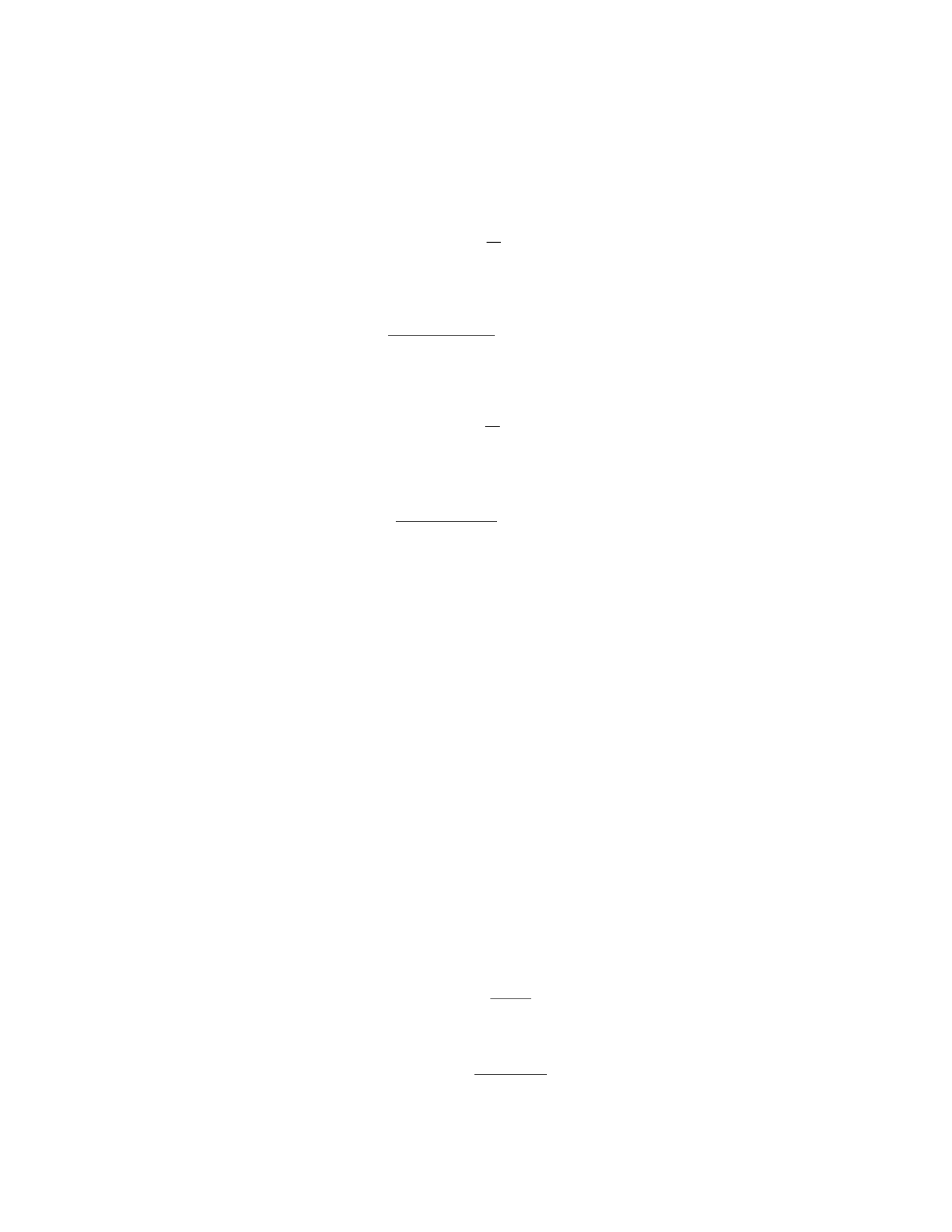
of 800 N. The Young’s modulus of steel is 2.0×10¹¹ Pa. What is the change in length of the
wire due to the applied force?
Ans. Let’s use the formula for stress and strain to determine the change in length of the wire.
1. Calculate the stress: The stress (σ) on the wire is given by:
σ=F
A
where Fis the applied force and Ais the cross-sectional area. Plugging in the values:
σ=800 N
2.0×10⁻⁴m2= 4 ×10⁶Pa
2. Calculate the strain: The strain (ε) on the wire is given by:
ε=σ
E
where Eis the Young’s modulus. Plugging in the values:
ε=4×10⁶Pa
2.0×10¹¹ Pa = 2 ×10⁻⁵
3. Calculate the change in length: The change in length (∆L) of the wire is given by:
∆L=ε·L
where Lis the original length of the wire. Plugging in the values:
∆L= 2 ×10−5·2.0m= 4 ×10⁻⁵m
Therefore, the change in length of the wire due to the applied force is 4×10⁻⁵meters.
16. A steel rod with a length of 2.5 m and a cross-sectional area of 0.005 m2is stretched under
a tensile force of 50 kN. If the Young’s modulus of steel is 2.1×10¹¹ N/m2, determine the stress
and strain on the rod.
Ans. Let’s first determine the stress on the rod:
1. Calculate the stress: The stress on the rod is given by the formula:
Stress =Force
Area
Plugging in the given values:
Stress =50,000 N
0.005 m2
Stress = 10,000,000 N/m2= 10 MPa
Next, let’s calculate the strain:
2. Calculate the strain: The strain on the rod is given by the formula:
Strain =Extension
Original Length =∆L
L
We can relate the strain to stress using Hooke’s Law:
Strain =Stress
Young’s Modulus
Plugging in the given values:
Strain =10 MPa
2.1×10¹¹ N/m2
Strain = 4.76 ×10⁻⁵
Therefore, the stress on the rod is 10 MPa and the strain is 4.76 ×10⁻⁵.
17. Question: A 5-meter long steel beam is fixed at one end and supports a load of 2000 N
placed 4 meters from the fixed end. If the beam has a cross-sectional area of 200 cm2and a
Young’s modulus of 2×10¹¹ N/m2, determine the stress and strain at the fixed end of the beam.
Ans. Step 1. Calculate the moment at the fixed end of the beam.
The moment (M) caused by the load (F) at a distance (d) from the fixed end is given by
the equation:
M=F·d
Substitute F= 2000 N and d= 4 m into the equation to find M.
Step 2. Determine the maximum bending stress at the fixed end of the beam.
The maximum bending stress (σ) in a beam is given by the equation:
σ=My
I
where Mis the moment, yis the distance from the neutral axis to the outermost fiber, and Iis
the moment of inertia. Since the beam is simply supported and the load is applied at the end, y
is equal to the radius of the neutral axis. The moment of inertia for a rectangular cross-section
is given by I=bh3
12 , where bis the breadth and his the height of the beam.
Step 3. Calculate the strain at the fixed end of the beam.
The strain (ϵ) in a material is given by:
ϵ=σ
E
where Eis the Young’s modulus of the material. Substitute the calculated stress value and the
given Young’s modulus value into the equation to find the strain.
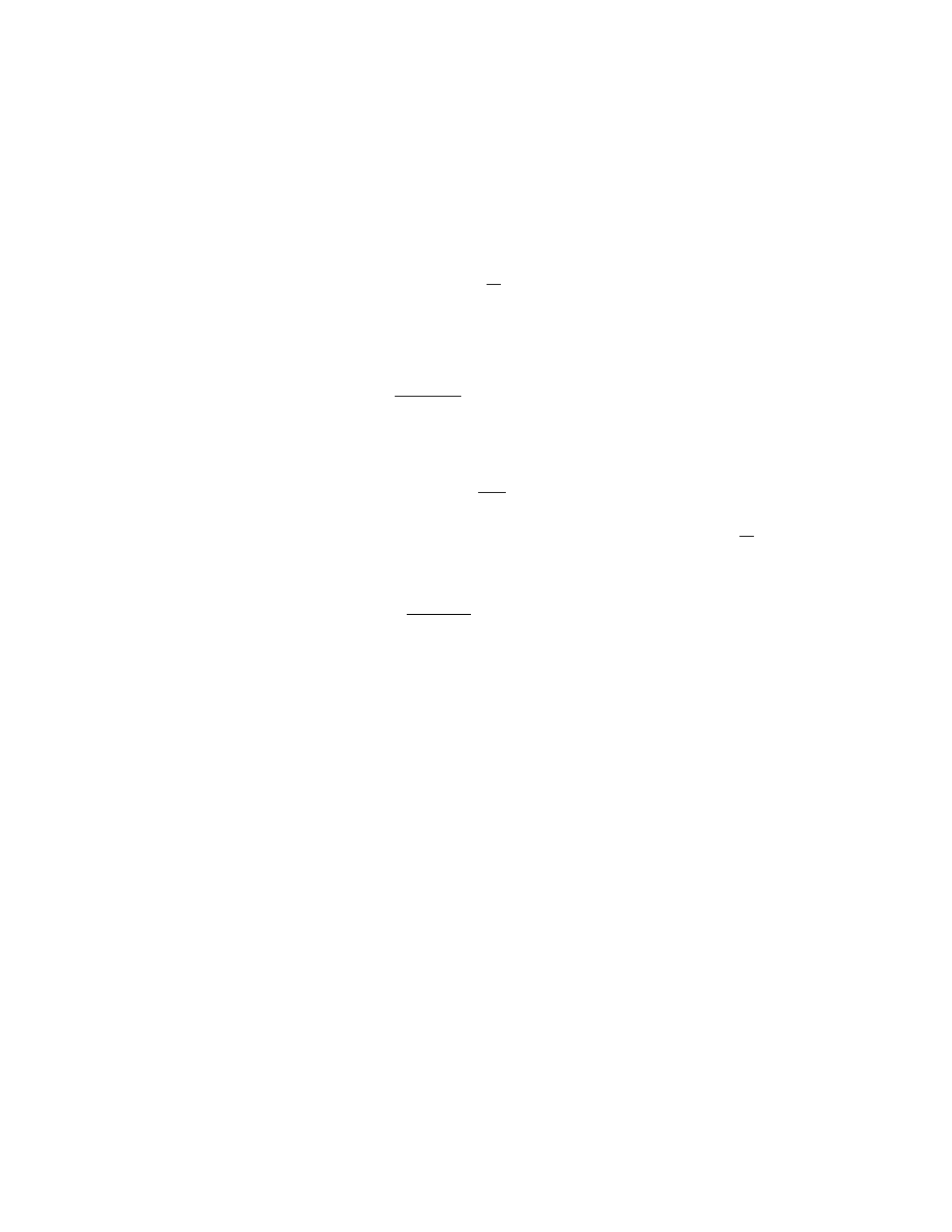
18. A steel beam with a length of 5 m and a cross-sectional area of 0.01 m2is subjected to a
tensile force of 50 kN. The Young’s modulus of steel is 2×10¹¹ N/m2. Calculate the amount by
which the beam stretches under this force.
Ans. To find the amount by which the beam stretches under the given force, we can use
Hooke’s Law for elasticity, which states that the stress is directly proportional to the strain.
1. Calculate the stress σon the beam: The stress is defined as the force per unit area:
σ=F
A
where Fis the applied force and Ais the cross-sectional area. Given: F= 50 kN = 50 ×103N
and A= 0.01 m2Therefore:
σ=50 ×103
0.01 = 5 ×10⁶N/m2
2. Calculate the strain ϵon the beam: The strain is defined as the change in length per unit
original length:
ϵ=∆L
L
where ∆Lis the change in length and Lis the original length. Using Hooke’s Law: σ
E=ϵGiven:
E= 2 ×10¹¹ N/m2Substitute the values of σand E:
ϵ=5×10⁶
2×1011 = 2.5×10⁻⁵
3. Calculate the change in length ∆L:
∆L=ϵ×L= 2.5×10−5×5 = 1.25 ×10⁻⁴m
Therefore, the beam stretches by 0.000125 m (or 0.125 mm) under the applied force of 50
kN.
19. A block of mass mis suspended by two strings, each of length L, from the ceiling of an
elevator. The elevator is moving upward with an acceleration of a. Find the tension in each
string.
Ans. To find the tension in each string, we need to analyze the forces acting on the block when
it is in equilibrium relative to the elevator.
1. Draw the free-body diagram of the block when it is in equilibrium relative to the elevator.
There are three forces acting on the block: its weight mg acting downward, and the tensions T
in the two strings acting upward at angles θwith respect to the vertical axis. Apply Newton’s
second law in the vertical direction to set up the equilibrium equation:
Tcos(θ) + Tcos(θ)−mg = 0
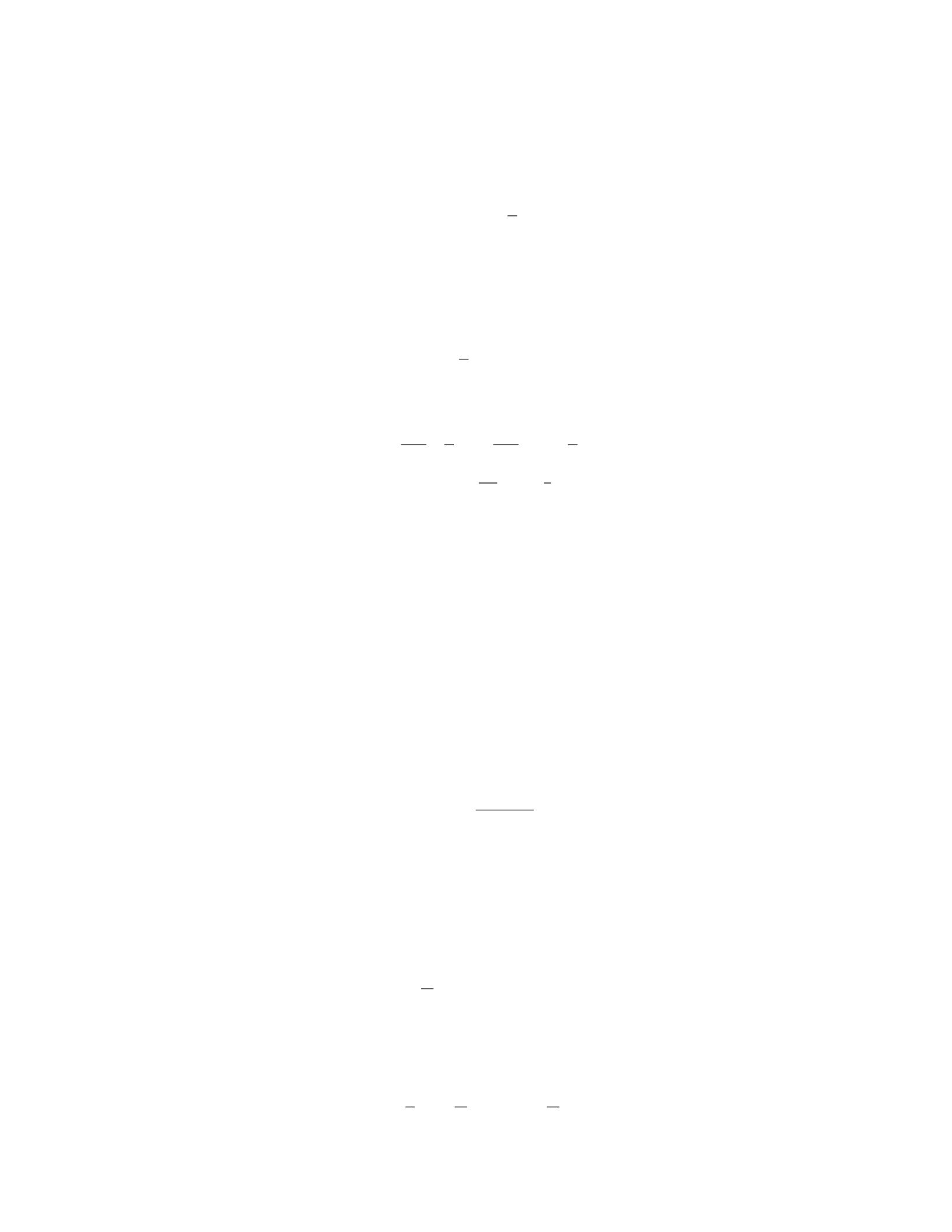
2. Simplify the equilibrium equation by substituting the given information. The angle θcan
be found using trigonometry. Since the elevator is moving upward with acceleration a, the net
acceleration experienced by the block is aupwards. So the angle θsatisfies:
cos(θ) = a
g
Substitute this back into the equilibrium equation:
2Tcos(θ)−mg = 0
2T(a
g)=mg
3. Solve for the tension in each string:
T=mg
2(g
a)=mg
2(1 + g
a)
Therefore, the tension in each string is T=mg
2(1 + g
a).
20. Question: A uniform bar of length Land mass Mis suspended horizontally from a ceiling
by two vertical wires of length L/2 each attached at the ends of the bar. A bullet of mass m
is shot horizontally at one end of the bar with speed v. The bullet gets embedded in the bar.
Determine the speed at which the system swings if the wires are nearly vertical.
Ans. Step-by-step solution: 1. Let vfinal be the final speed of the system after the bullet embeds
in the bar. By conservation of momentum in the horizontal direction, we have:
Mv = (M+m)vfinal
vfinal =Mv
M+m
2. Let θbe the angle of swing of the system from the vertical position. The tension in each wire
is equal to the weight of the bar and the bullet, resolved into components:
T= (M+m)gcos(θ)
3. The net torque about the point of suspension is given by:
2(L
2)Tsin(θ) = Iα
where Iis the moment of inertia of the system about the point of suspension and αis the angular
acceleration. 4. The moment of inertia of the system about the point of suspension is given by:
I=1
3M(L
2)2
+m(L
2)2
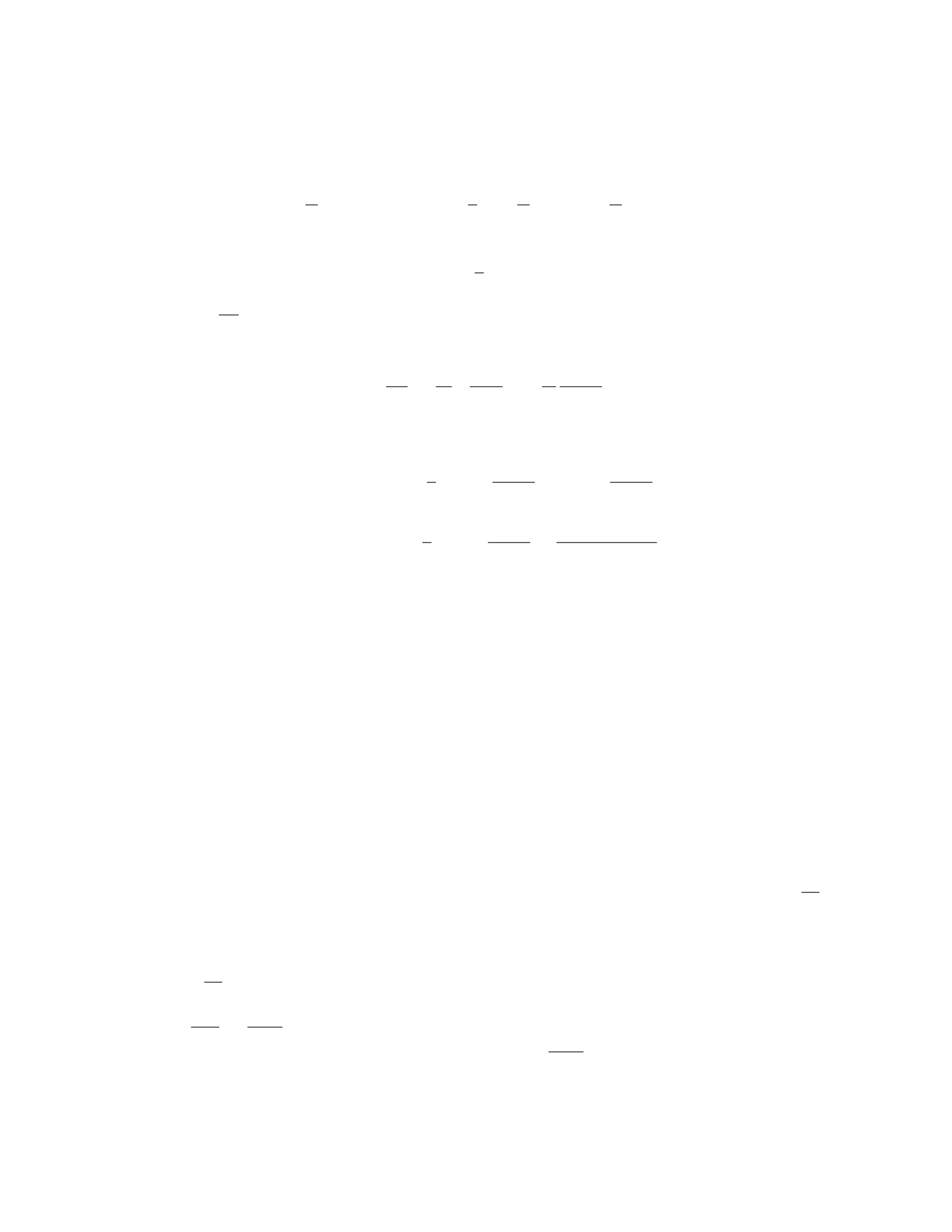
5. Using the small angle approximation sin(θ)≈θ, and substituting in the values, the equation
for angular acceleration becomes:
2(L
2)(M+m)gθ =(1
3M(L
2)2
+m(L
2)2)α
L(M+m)gθ =1
3ML2α+mL2α
6. Since α=d2θ
dt2and vfinal =Rω where Ris the distance from the center of mass of the bar to
the point of suspension, we can relate αand vfinal:
α=dω
dt =d
dt (vfinal
R)=1
R
dvfinal
dt
7. Substituting this into the previous equation and simplifying, we get:
L(M+m)gθ =1
3ML2·dvfinal
dt +mL2·dvfinal
dt
L(M+m)gθ =1
3ML2·dvfinal
dt +3mL2·dvfinal
dt
8. Integrating this equation gives the relation between θand vfinal.
21. Find the vertical displacement of a cylindrical column of height hand radius Rwhen a
heavy block of mass Mis placed on top of it. Assume that the column is made of a material
with Young’s modulus Y.
Ans. Let’s denote the vertical displacement of the column as ∆y.
Step 1. Firstly, let’s determine the force exerted on the column due to the block.
The weight of the block is given by Fblock =Mg, where gis the acceleration due to gravity.
Step 2. Next, we need to find the cross-sectional area of the column.
The cross-sectional area Aof the column is A=πR2.
Step 3. Using Hooke’s Law, we can write the force exerted by the column as Fcolumn =Y∆y
hA.
Step 4. At equilibrium, the forces must balance out. Therefore, we have the equation
Fblock =Fcolumn.
Step 5. Substituting the expressions for Fblock and Fcolumn into the equilibrium equation gives
us Mg =Y∆y
hA.
Step 6. Now, we can solve for ∆y:
∆y=Mgh
Y A =M gh
Y πR2.
Therefore, the vertical displacement of the column is Mgh
Y πR2.

22. Suppose a solid cylindrical rod of length Land diameter dis suspended vertically from one
end. If the rod is made of a material with Young’s modulus Y, what is the extension of the rod
due to its own weight?
23. Question:
A thin cylindrical rod of length Land radius ris clamped at one end and is loaded with a
force Fat the other end. The Young’s modulus of the material is Y. Determine the maximum
stress in the rod.
Ans. Step-by-step solution:
1. The stress σin the rod is given by σ=F
A, where Ais the cross-sectional area of the rod.
The cross-sectional area of a thin cylindrical rod is given by A=πr2.
2. The strain εin the rod is given by ε=δ
L, where δis the displacement at the loaded end
of the rod. Hooke’s Law states that σ=Y ε, where Yis Young’s modulus.
3. Since the strain is given by ε=δ
L, we can rewrite Hooke’s Law as σ=Y(δ
L).
4. By combining equations from steps 1 and 3, we get F
πr2=Y(δ
L).
5. Solving for δ, we find δ=F L
πr2Y.
6. The maximum stress occurs when the displacement is maximized. At this point, the rod
operates at its elastic limit, meaning δ=L. Therefore, the maximum stress σmax in the rod is
given by:
σmax =Fmax
πr2=Y L
πr2
24. A uniform rod of length Land mass Mis supported by a pivot at one end. A weight W is
hung a distance dfrom the pivot along the rod. The rod makes an angle θwith the horizontal.
Given that the rod is in equilibrium, find an expression for the shear modulus of the material from
which the rod is made.
Ans. Let’s denote the distance of the center of mass of the rod from the pivot as x. The
forces acting on the rod are the weight Mg acting at the center of mass, the weight Wacting
at a distance dfrom the pivot, and the force of tension Tacting at the pivot. The torque
about the pivot must be zero in order for the rod to be in equilibrium. 1. Setting up the torque
equation: The torque due to the weight M g is Mg ·x·sin θ, the torque due to the weight Wis
W·(L−d)·sin θ, and the torque due to the tension force Tis T·L·sin θ. Therefore, we have:
Mg ·xsin θ−W·(L−d)·sin θ−T·L·sin θ= 0
2. Finding the expression for center of mass x: The center of mass xis given by x=L
2sin θ.
Substituting this into the torque equation gives:
Mg ·L
2sin2θ−W·(1−d
L)·L
2sin2θ−T·L·sin θ= 0
3. Solving for the tension T: We know that the sum of the forces in the vertical direction is zero:
Tcos θ=Mg +W. Substituting this into the torque equation we found earlier:
Mg ·L
2sin2θ−W·(1−d
L)·L
2sin2θ−(Mg +W)·L·sin θ= 0
4. Expression for shear modulus:
From the previous equations, we can find the expression for the shear modulus Gin terms of
L,M,g,W,d, and θ.
25. A uniform bar of length Land mass Mis supported by a pivot at one end and a cable
attached to the other end. Calculate the tension in the cable when the bar makes an angle θ
with the horizontal.
Ans. Let’s consider the forces acting on the bar when it makes an angle θwith the horizontal:
1. Resolve the weight of the bar into components: M g sin(θ)perpendicular to the bar and
Mg cos(θ)parallel to the bar. 2. The torque about the pivot due to the weight of the bar is
−L
2Mg cos(θ)
. 3. The torque due to the tension in the cable is
LT sin(θ)
. 4. Since the bar is in equilibrium, the sum of torques about the pivot is zero:
−L
2Mg cos(θ) + LT sin(θ) = 0
. 5. Solve for the tension T:
T=Mg cos(θ)
2sin(θ)
. Therefore, the tension in the cable when the bar makes an angle θwith the horizontal is
T=Mg cos(θ)
2sin(θ)
.
3. The weight of the water displaced by the block can be calculated using the formula
Wwater =ρwaterVblockg, where ρwater is the density of water, Vblock is the volume of the block, and
gis the acceleration due to gravity.
4. Since the block is partially submerged, the volume of water displaced is equal to the volume
of the block that is submerged. This volume can be calculated using the formula Vsubmerged =
Wair
ρwaterg.
5. From step 3 and step 4, we have Wwater =ρwater ·(Wair
ρwaterg)·g, which simplifies to
Wwater =Wair. Therefore, we can solve for the density of the wood block:
ρwood =Wair
Vblock
=19.62 N
Vblock
where Vblock =mblock
ρwood . Substituting this into the equation above, we get
ρwood =19.62 N
2kg
ρwood
= 9.81 kg
m3
Therefore, the density of the wood block is 9810 kg/m3.
3. **Question:**
A uniform rod of length Land mass Mis hung horizontally from two vertical walls by two
vertical strings of length d(with d < L
2) attached to the ends of the rod. The walls are a distance
Lapart. If the tension in each string is T, determine the force Fthat each wall exerts on the
rod.
**Hint:** Consider the forces acting on the rod in the vertical direction to establish two
equations of equilibrium.
Ans. **Solution:**
1. Consider the forces acting on the rod:
Let’s denote the force exerted by the left wall on the rod as FLand by the right wall as FR.
At equilibrium, the forces in the vertical direction must balance out.
2. Equations of equilibrium in the vertical direction:
- For the left end of the rod: FLcos(θ) = Tcos(θ) + Tcos(θ)
FL= 2Tcos(θ)
- For the right end of the rod: FRcos(θ) = Tcos(θ) + Tcos(θ)
FR= 2Tcos(θ)
where θis the angle the strings make with the vertical.
3. Using the equilibrium condition:
- Summing the torques about the left end of the rod:
Tsin(θ)·d=FRsin(θ)·L
Substituting FR= 2Tcos(θ)into the expression above:
Tsin(θ)·d= 2Tcos(θ)sin(θ)·L
Solving for T:
T=d
2L·tan(θ)
4. Finding the force F:
- Substituting Tback into FL= 2Tcos(θ):
FL= 2 ·(d
2L·tan(θ))·cos(θ)
FL=d
L·sin(θ)·cos(θ)
Similarly, we can find FRas well.
The force Fthat each wall exerts on the rod is d
L·sin(θ)·cos(θ).
4. Question:
A solid cylindrical rod with a length of 1 meter and a diameter of 2 cm is suspended from
one end. A weight of 100 N is attached to the other end of the rod. If the rod has a Young’s
modulus of 2×10¹¹ N/m2, determine the elongation of the rod.
Ans. Let’s denote the original length of the rod as L, the applied force as F, the cross-sectional
area as A, the Young’s modulus as E, and the elongation of the rod as ∆L. We are given that
L= 1 m, F= 100 N, D= 2 cm, and E= 2 ×10¹¹ N/m2.
1. Calculate the cross-sectional area of the rod using the formula A=πD2
4.
A=π×(0.02)2
4= 3.14 ×10⁻⁴m2
2. Determine the stress on the rod using the formula σ=F
A.
σ=100
3.14 ×10−4= 318471.34 N/m2
3. Find the strain in the rod using the formula ϵ=σ
E.
ϵ=318471.34
2×1011 = 1.59 ×10⁻³
4. Calculate the elongation of the rod using the formula ∆L=ϵ×L.
∆L= 1.59 ×10−3×1 = 1.59 ×10⁻³m
Therefore, the elongation of the rod is 1.59 mm.
5. A 2.0 m long rod is suspended horizontally from the ceiling by two vertical wires. A 20 kg
weight is hung from the center of the rod. One wire is attached at a distance of 0.5 m to the left
of the weight and the other wire is attached at a distance of 0.5 m to the right of the weight. If
the tension in each wire is the same, what is the tension in each wire?
Ans. Let’s denote the tension in each wire as T. To solve this problem, we will first find the
torque produced by the weight and then set it equal to zero to ensure the system is in equilibrium.
1. Calculate the torque produced by the 20 kg weight hanging from the center of the rod.
The weight of the 20 kg mass is mg = 20 kg ×9.81 m/s2= 196.2N. The torque (τ) produced
by the weight about the left vertical wire is given by τ= (0.5m)×(T)−(1.0m)×(196.2N).
2. The torque produced by the weight about the right vertical wire is given by τ= (1.5m)×
(T)−(1.0m)×(196.2N).
3. Since the system is in equilibrium, the sum of all torques must be zero. Setting up
the equilibrium equation: (0.5)T−196.2 = (1.5)T−196.2. Simplifying this equation gives
−T+ 196.2 = 1.5T−196.2.
4. Solve the equilibrium equation for T. Rearranging terms gives 2.5T= 392.4and therefore
T=392.4
2.5= 156.96 N.
Therefore, the tension in each wire is 156.96 N.
6. A block of mass Mis placed on a rough incline of angle θwith the horizontal. The
coefficient of kinetic friction between the block and the incline is µk. The block is then subjected
to a horizontal force Fparallel to the incline. Given that the block is in equilibrium, determine
the expression for Fin terms of M,θ, and µk.
Ans. Let’s consider the forces acting on the block along the incline and perpendicular to the
incline to establish the equilibrium condition.
1. Along the incline: The forces acting along the incline are the component of the gravitational
force pulling the block downhill (Mg sin θ), the normal force from the incline pushing the block
uphill (N), and the frictional force opposing the motion (fk=µkN). The equation of motion
along the incline gives:
Mg sin θ−fk= 0
Mg sin θ−µkN= 0
N=Mg sin θ/µk
2. Perpendicular to the incline: The force acting perpendicular to the incline is the component
of the gravitational force perpendicular to the incline (Mg cos θ) and the normal force from the
incline pushing the block uphill (N). The equilibrium condition perpendicular to the incline gives:
N=Mg cos θ
3. Substituting the expression for Nfrom the second equation into the first equation:
Mg sin θ−µk(Mg cos θ) = 0
F=µkMg cos θ
F=µkMg cos θ
Therefore, the expression for Fin terms of M,θ, and µkis F=µkM g cos θ.
7. Question:
A metal rod of length Land cross-sectional area Ais suspended from the ceiling. A weight
Wis hung from the lower end of the rod. The rod has a Young’s modulus Y. Determine the
elongation of the rod in terms of W,L,A, and Y.
Ans. Solution:
Let’s assume the original length of the rod is L0and the elongation of the rod is ∆L. The
stress in the rod is σ=W
Aand the strain in the rod is ϵ=∆L
L. According to Hooke’s Law for
elasticity, stress is proportional to strain:
σ=Y·ϵ
The stress σcan be represented in terms of force and cross-sectional area:
W
A=Y·∆L
L
From this equation, we can solve for ∆L:
∆L=W·L
Y·A
8. Question:
A uniform rod of length Land mass mis hanging vertically from one end. A particle of mass
m′is attached to the rod a distance xfrom the end where the rod is fixed. The rod and particle
are in equilibrium. Determine the tension force in the rod as a function of x.

Ans. Step-by-step solution:
1. Draw a free-body diagram of the rod and particle. The forces acting on the rod are the
tension force
Tat the point of attachment, the weight of the rod
Wrod =−mgˆ
jacting at the
center of mass of the rod, and the weight of the particle
Wparticle =−m′gˆ
jacting at the particle’s
location.
2. Write the equilibrium equations in the vertical direction. The sum of the forces in the
vertical direction must equal zero since the rod and particle are in equilibrium:
T−mg −m′g= 0.
3. Since the rod is in equilibrium, the rod is not accelerating in the horizontal direction.
Therefore, the sum of the torques about the point of attachment must equal zero:
∑τ= 0.
4. The torque equation for the system about the point of attachment can be written as:
xT −L
2mg + (L−x)m′g= 0.
5. Solve the two equilibrium equations to find the tension force Tas a function of x:
T−mg −m′g= 0 =⇒T=mg +m′g,
xT −L
2mg + (L−x)m′g= 0.
6. Substitute the expression for Tback into the torque equation:
x(mg +m′g)−L
2mg + (L−x)m′g= 0.
7. Simplify the equation to solve for Tin terms of x:
xmg +xm′g−L
2mg +Lm′g−xm′g= 0,
xmg +Lm′g−L
2mg = 0,
T=Lmg
2x+Lm′g.
Therefore, the tension force in the rod as a function of xis T=Lmg
2x+Lm′g.
9. A uniform rod of length Land mass Mis supported at its ends by two strings which make
angles θ1and θ2with the horizontal. The strings are at equal distances from the center of the
rod. Determine the tensions in the strings. Assume the rod is in equilibrium.
Ans. Let’s denote the tensions in the strings as T1and T2, respectively.
Step 1. We start by drawing a free-body diagram of the forces acting on the rod.
Step 2. The forces acting on the rod are the weight Wacting at the center of the rod and
the tensions T1and T2acting at the ends of the rod.
Step 3. The weight Wcan be calculated as W=M g, where gis the acceleration due to
gravity.
Step 4. We can resolve the weight into horizontal and vertical components. The vertical
component is balanced by the sum of the vertical components of the tensions, while the horizontal
component is balanced by the horizontal component of the tensions.
Step 5. The vertical equilibrium equation gives us:
T1cos θ1+T2cos θ2=Mg
Step 6. The horizontal equilibrium equation gives us:
T1sin θ1=T2sin θ2
Step 7. Since the strings are at equal distances from the center of the rod, we have θ1=
θ2=θ. Substituting this into our equations yields:
T1cos θ+T2cos θ=Mg
T1sin θ=T2sin θ
Step 8. Dividing the second equation by the first equation, we get:
T1
T2
= 1
Step 9. Given that the tensions in the strings are the same, we can solve for T1and T2as:
T1=T2=Mg
2cos θ
10. Question: A steel rod of length 2.0 m and diameter 1.0 cm is suspended vertically from
one end. A weight of 1000 N is attached to the other end of the rod. Calculate the stress and
strain in the rod if Y = 2.0×10¹¹ N/m2.
Ans. Step-by-step solution: 1. Calculate the cross-sectional area of the steel rod: Given
diameter = 1.0 cm = 0.01 m Radius, r=1
2diameter = 0.005 m Cross-sectional area, A=
πr2=π(0.005)2≈7.85 ×10⁻⁵m2.
2. Calculate the stress in the rod: Stress, σ=F
Awhere Fis the force applied and Ais the
cross-sectional area σ=1000 N
7.85×10⁻⁵m2≈1.27 ×10⁷N/m2.
3. Calculate the strain in the rod: Hooke’s Law: σ=Y·εWhere σis the stress, Yis the
Young’s Modulus, and εis the strain ε=σ
Y=1.27×10⁷N/m2
2.0×10¹¹ N/m2= 0.0000635 or 0.00635

Therefore, the stress in the rod is approximately 1.27 ×10⁷N/m2and the strain in the rod is
approximately 0.00635
11. A thin cylindrical tube of radius Rand length Lis initially at equilibrium. A force Fis
applied tangentially on the tube causing it to deform slightly. Determine the change in length of
the tube assuming it remains in the elastic regime. The Young’s modulus of the material is Y.
Ans. Let’s denote the change in length of the tube as ∆L. We can use the equilibrium condition
coupled with Hooke’s Law to find the change in length. 1. The force applied tangentially on the
tube will create a torque given by τ=F R. This torque causes a change in the angular position
of the tube given by θ=F R·∆L
Y·πR2. 2. The tangential stress developed in the tube is given by
σ=F
πR2. This stress is related to the strain by Hooke’s Law: ϵ=σ
Y. 3. The strain along the
length of the tube is given by ϵ=∆L
L. Equating the expressions for strain:
σ
Y=∆L
L⇒F
πR2Y=∆L
L⇒∆L=F L
πR2Y
Therefore, the change in length of the tube is ∆L=F L
πR2Y.
12. A uniform bar of length Land cross-sectional area Ais suspended vertically from one of
its ends. The bar has a density ρand Young’s modulus Y. Determine the elongation of the bar
in terms of L,ρ,Y, and acceleration due to gravity g.
Ans. Let’s denote the elongation of the bar as ∆L.
1. The weight of the bar Wis given by W=ρALg.
2. The tension Tin the bar at a distance xfrom the free end is given by T=ρAg(L−x).
3. The infinitesimal force dF on the bar at a distance xfrom the free end is given by
dF =T
Ldx =ρg(L−x)dx.
4. The infinitesimal strain dϵ is related to the infinitesimal force dF by Hooke’s law: dF =
Y A dϵ.
5. Substituting for dF and Ain terms of xand L, we have YA
Ldϵ =ρg(L−x)dx.
6. Integrating both sides over the length of the bar from 0to L, we get YA
L∫∆L
0dϵ =
ρg ∫L
0(L−x)dx.
7. Solving the integrals, we obtain YA∆L
L=ρg [Lx −x2
2]|L
0.
8. Simplifying the right side yields YA∆L
L=ρg (L2−L2
2).
9. Further simplifying gives Y∆L=3
2ρgL.
10. Therefore, the elongation of the bar ∆Lis equal to 3
2
ρgL
Y.

13. Question: A uniform rod of length Land mass Mis supported by a pivot at a distance d
from one end. A load of mass mis attached to the free end of the rod. Find the angle at which
the rod makes with the horizontal when it is in equilibrium.
Ans. Step-by-step solution: 1. First, we need to identify all the forces acting on the rod. There
are three forces: the weight of the rod acting at its center of mass, the weight of the load acting
at the free end, and the reaction force at the pivot. Let θbe the angle the rod makes with the
horizontal. 2. The weight of the rod acts vertically downwards at the center of the rod, i.e.
at a distance of L/2 from the pivot. Its magnitude is Mg, where gis the acceleration due to
gravity. This force can be decomposed into two components: one parallel to the rod and one
perpendicular to the rod. 3. The component of the weight of the rod perpendicular to the rod
will provide the torque required to balance the torques due to the weight of the load and the
reaction force. This component is Mg cos(θ)·L
2. 4. The weight of the load (mg) acts vertically
downwards at the free end of the rod. Its torque about the pivot is mg ·L. 5. The reaction
force at the pivot acts perpendicular to the rod and balances the perpendicular component of the
weight of the rod and the weight of the load. Its magnitude is R. The torque due to this force
is R·d. 6. For the rod to be in equilibrium, the sum of the torques must be zero. Therefore,
we have the equation: Mg cos(θ)·L
2=mg ·L+R·d. 7. Solving this equation for θ, we get
θ=cos−1(2mgL
MgL+2Rd ). Hence, the angle at which the rod makes with the horizontal when it is
in equilibrium is cos−1(2mgL
MgL+2Rd ).
14. A rod of length Land uniform cross-sectional area Ais hanging vertically from a ceiling.
The rod has a mass per unit length λand Young’s modulus Y. Determine the elongation of the
rod due to its own weight.
Ans. Let’s denote the elongation of the rod as ∆L. We will calculate the elongation step-by-
step.
1. First, let’s find the mass of the rod, M. The mass of the rod is given by M=λL.
2. The weight of the rod is equal to the force exerted at the centroid of the rod, which is
1
2Mg =1
2λLg.
3. The stress in the rod is σ=F
Awhere Fis the force due to weight and Ais the cross-
sectional area. Therefore, σ=1
2λLg/A.
4. The strain in the rod is ϵ=∆L
L. From Hooke’s Law, σ=Y ϵ, we have 1
2λLg/A=Y∆L
L.
5. Solving for ∆L, we find ∆L=1
2
λgL2
AY .
Therefore, the elongation of the rod due to its own weight is ∆L=1
2
λgL2
AY .
15. A 2.0 m long steel wire with a cross-sectional area of 2.0×10⁻⁴m2is stretched by a force
of 800 N. The Young’s modulus of steel is 2.0×10¹¹ Pa. What is the change in length of the
wire due to the applied force?
Ans. Let’s use the formula for stress and strain to determine the change in length of the wire.
1. Calculate the stress: The stress (σ) on the wire is given by:
σ=F
A
where Fis the applied force and Ais the cross-sectional area. Plugging in the values:
σ=800 N
2.0×10⁻⁴m2= 4 ×10⁶Pa
2. Calculate the strain: The strain (ε) on the wire is given by:
ε=σ
E
where Eis the Young’s modulus. Plugging in the values:
ε=4×10⁶Pa
2.0×10¹¹ Pa = 2 ×10⁻⁵
3. Calculate the change in length: The change in length (∆L) of the wire is given by:
∆L=ε·L
where Lis the original length of the wire. Plugging in the values:
∆L= 2 ×10−5·2.0m= 4 ×10⁻⁵m
Therefore, the change in length of the wire due to the applied force is 4×10⁻⁵meters.
16. A steel rod with a length of 2.5 m and a cross-sectional area of 0.005 m2is stretched under
a tensile force of 50 kN. If the Young’s modulus of steel is 2.1×10¹¹ N/m2, determine the stress
and strain on the rod.
Ans. Let’s first determine the stress on the rod:
1. Calculate the stress: The stress on the rod is given by the formula:
Stress =Force
Area
Plugging in the given values:
Stress =50,000 N
0.005 m2
Stress = 10,000,000 N/m2= 10 MPa
Next, let’s calculate the strain:
2. Calculate the strain: The strain on the rod is given by the formula:
Strain =Extension
Original Length =∆L
L
We can relate the strain to stress using Hooke’s Law:
Strain =Stress
Young’s Modulus
Plugging in the given values:
Strain =10 MPa
2.1×10¹¹ N/m2
Strain = 4.76 ×10⁻⁵
Therefore, the stress on the rod is 10 MPa and the strain is 4.76 ×10⁻⁵.
17. Question: A 5-meter long steel beam is fixed at one end and supports a load of 2000 N
placed 4 meters from the fixed end. If the beam has a cross-sectional area of 200 cm2and a
Young’s modulus of 2×10¹¹ N/m2, determine the stress and strain at the fixed end of the beam.
Ans. Step 1. Calculate the moment at the fixed end of the beam.
The moment (M) caused by the load (F) at a distance (d) from the fixed end is given by
the equation:
M=F·d
Substitute F= 2000 N and d= 4 m into the equation to find M.
Step 2. Determine the maximum bending stress at the fixed end of the beam.
The maximum bending stress (σ) in a beam is given by the equation:
σ=My
I
where Mis the moment, yis the distance from the neutral axis to the outermost fiber, and Iis
the moment of inertia. Since the beam is simply supported and the load is applied at the end, y
is equal to the radius of the neutral axis. The moment of inertia for a rectangular cross-section
is given by I=bh3
12 , where bis the breadth and his the height of the beam.
Step 3. Calculate the strain at the fixed end of the beam.
The strain (ϵ) in a material is given by:
ϵ=σ
E
where Eis the Young’s modulus of the material. Substitute the calculated stress value and the
given Young’s modulus value into the equation to find the strain.
18. A steel beam with a length of 5 m and a cross-sectional area of 0.01 m2is subjected to a
tensile force of 50 kN. The Young’s modulus of steel is 2×10¹¹ N/m2. Calculate the amount by
which the beam stretches under this force.
Ans. To find the amount by which the beam stretches under the given force, we can use
Hooke’s Law for elasticity, which states that the stress is directly proportional to the strain.
1. Calculate the stress σon the beam: The stress is defined as the force per unit area:
σ=F
A
where Fis the applied force and Ais the cross-sectional area. Given: F= 50 kN = 50 ×103N
and A= 0.01 m2Therefore:
σ=50 ×103
0.01 = 5 ×10⁶N/m2
2. Calculate the strain ϵon the beam: The strain is defined as the change in length per unit
original length:
ϵ=∆L
L
where ∆Lis the change in length and Lis the original length. Using Hooke’s Law: σ
E=ϵGiven:
E= 2 ×10¹¹ N/m2Substitute the values of σand E:
ϵ=5×10⁶
2×1011 = 2.5×10⁻⁵
3. Calculate the change in length ∆L:
∆L=ϵ×L= 2.5×10−5×5 = 1.25 ×10⁻⁴m
Therefore, the beam stretches by 0.000125 m (or 0.125 mm) under the applied force of 50
kN.
19. A block of mass mis suspended by two strings, each of length L, from the ceiling of an
elevator. The elevator is moving upward with an acceleration of a. Find the tension in each
string.
Ans. To find the tension in each string, we need to analyze the forces acting on the block when
it is in equilibrium relative to the elevator.
1. Draw the free-body diagram of the block when it is in equilibrium relative to the elevator.
There are three forces acting on the block: its weight mg acting downward, and the tensions T
in the two strings acting upward at angles θwith respect to the vertical axis. Apply Newton’s
second law in the vertical direction to set up the equilibrium equation:
Tcos(θ) + Tcos(θ)−mg = 0
2. Simplify the equilibrium equation by substituting the given information. The angle θcan
be found using trigonometry. Since the elevator is moving upward with acceleration a, the net
acceleration experienced by the block is aupwards. So the angle θsatisfies:
cos(θ) = a
g
Substitute this back into the equilibrium equation:
2Tcos(θ)−mg = 0
2T(a
g)=mg
3. Solve for the tension in each string:
T=mg
2(g
a)=mg
2(1 + g
a)
Therefore, the tension in each string is T=mg
2(1 + g
a).
20. Question: A uniform bar of length Land mass Mis suspended horizontally from a ceiling
by two vertical wires of length L/2 each attached at the ends of the bar. A bullet of mass m
is shot horizontally at one end of the bar with speed v. The bullet gets embedded in the bar.
Determine the speed at which the system swings if the wires are nearly vertical.
Ans. Step-by-step solution: 1. Let vfinal be the final speed of the system after the bullet embeds
in the bar. By conservation of momentum in the horizontal direction, we have:
Mv = (M+m)vfinal
vfinal =Mv
M+m
2. Let θbe the angle of swing of the system from the vertical position. The tension in each wire
is equal to the weight of the bar and the bullet, resolved into components:
T= (M+m)gcos(θ)
3. The net torque about the point of suspension is given by:
2(L
2)Tsin(θ) = Iα
where Iis the moment of inertia of the system about the point of suspension and αis the angular
acceleration. 4. The moment of inertia of the system about the point of suspension is given by:
I=1
3M(L
2)2
+m(L
2)2
5. Using the small angle approximation sin(θ)≈θ, and substituting in the values, the equation
for angular acceleration becomes:
2(L
2)(M+m)gθ =(1
3M(L
2)2
+m(L
2)2)α
L(M+m)gθ =1
3ML2α+mL2α
6. Since α=d2θ
dt2and vfinal =Rω where Ris the distance from the center of mass of the bar to
the point of suspension, we can relate αand vfinal:
α=dω
dt =d
dt (vfinal
R)=1
R
dvfinal
dt
7. Substituting this into the previous equation and simplifying, we get:
L(M+m)gθ =1
3ML2·dvfinal
dt +mL2·dvfinal
dt
L(M+m)gθ =1
3ML2·dvfinal
dt +3mL2·dvfinal
dt
8. Integrating this equation gives the relation between θand vfinal.
21. Find the vertical displacement of a cylindrical column of height hand radius Rwhen a
heavy block of mass Mis placed on top of it. Assume that the column is made of a material
with Young’s modulus Y.
Ans. Let’s denote the vertical displacement of the column as ∆y.
Step 1. Firstly, let’s determine the force exerted on the column due to the block.
The weight of the block is given by Fblock =Mg, where gis the acceleration due to gravity.
Step 2. Next, we need to find the cross-sectional area of the column.
The cross-sectional area Aof the column is A=πR2.
Step 3. Using Hooke’s Law, we can write the force exerted by the column as Fcolumn =Y∆y
hA.
Step 4. At equilibrium, the forces must balance out. Therefore, we have the equation
Fblock =Fcolumn.
Step 5. Substituting the expressions for Fblock and Fcolumn into the equilibrium equation gives
us Mg =Y∆y
hA.
Step 6. Now, we can solve for ∆y:
∆y=Mgh
Y A =M gh
Y πR2.
Therefore, the vertical displacement of the column is Mgh
Y πR2.

22. Suppose a solid cylindrical rod of length Land diameter dis suspended vertically from one
end. If the rod is made of a material with Young’s modulus Y, what is the extension of the rod
due to its own weight?
23. Question:
A thin cylindrical rod of length Land radius ris clamped at one end and is loaded with a
force Fat the other end. The Young’s modulus of the material is Y. Determine the maximum
stress in the rod.
Ans. Step-by-step solution:
1. The stress σin the rod is given by σ=F
A, where Ais the cross-sectional area of the rod.
The cross-sectional area of a thin cylindrical rod is given by A=πr2.
2. The strain εin the rod is given by ε=δ
L, where δis the displacement at the loaded end
of the rod. Hooke’s Law states that σ=Y ε, where Yis Young’s modulus.
3. Since the strain is given by ε=δ
L, we can rewrite Hooke’s Law as σ=Y(δ
L).
4. By combining equations from steps 1 and 3, we get F
πr2=Y(δ
L).
5. Solving for δ, we find δ=F L
πr2Y.
6. The maximum stress occurs when the displacement is maximized. At this point, the rod
operates at its elastic limit, meaning δ=L. Therefore, the maximum stress σmax in the rod is
given by:
σmax =Fmax
πr2=Y L
πr2
24. A uniform rod of length Land mass Mis supported by a pivot at one end. A weight W is
hung a distance dfrom the pivot along the rod. The rod makes an angle θwith the horizontal.
Given that the rod is in equilibrium, find an expression for the shear modulus of the material from
which the rod is made.
Ans. Let’s denote the distance of the center of mass of the rod from the pivot as x. The
forces acting on the rod are the weight Mg acting at the center of mass, the weight Wacting
at a distance dfrom the pivot, and the force of tension Tacting at the pivot. The torque
about the pivot must be zero in order for the rod to be in equilibrium. 1. Setting up the torque
equation: The torque due to the weight M g is Mg ·x·sin θ, the torque due to the weight Wis
W·(L−d)·sin θ, and the torque due to the tension force Tis T·L·sin θ. Therefore, we have:
Mg ·xsin θ−W·(L−d)·sin θ−T·L·sin θ= 0
2. Finding the expression for center of mass x: The center of mass xis given by x=L
2sin θ.
Substituting this into the torque equation gives:
Mg ·L
2sin2θ−W·(1−d
L)·L
2sin2θ−T·L·sin θ= 0
3. Solving for the tension T: We know that the sum of the forces in the vertical direction is zero:
Tcos θ=Mg +W. Substituting this into the torque equation we found earlier:
Mg ·L
2sin2θ−W·(1−d
L)·L
2sin2θ−(Mg +W)·L·sin θ= 0
4. Expression for shear modulus:
From the previous equations, we can find the expression for the shear modulus Gin terms of
L,M,g,W,d, and θ.
25. A uniform bar of length Land mass Mis supported by a pivot at one end and a cable
attached to the other end. Calculate the tension in the cable when the bar makes an angle θ
with the horizontal.
Ans. Let’s consider the forces acting on the bar when it makes an angle θwith the horizontal:
1. Resolve the weight of the bar into components: M g sin(θ)perpendicular to the bar and
Mg cos(θ)parallel to the bar. 2. The torque about the pivot due to the weight of the bar is
−L
2Mg cos(θ)
. 3. The torque due to the tension in the cable is
LT sin(θ)
. 4. Since the bar is in equilibrium, the sum of torques about the pivot is zero:
−L
2Mg cos(θ) + LT sin(θ) = 0
. 5. Solve for the tension T:
T=Mg cos(θ)
2sin(θ)
. Therefore, the tension in the cable when the bar makes an angle θwith the horizontal is
T=Mg cos(θ)
2sin(θ)
.

