


PHY302 PDE Quiz 60 points - Open tutorial - 60 minutes Spring 2021
Note: This quiz has only two required problems; the second problem is a long problem with a
short bonus. You must show your work on both problems to receive credit! Partial credit will be
given. If you cannot do a calculation but know what calculation you should be doing, describe
it in words.
1. (20pts): A square membrane placed with its edges so that 0 < x < a and 0 < y < a has
all four sides tightly clamped. The solution to the wave equation is thus of the form
Z(x, y, t) =
∞
X
m=1
∞
X
n=1
sin mπx
asin nπy
a[Amn cos(ωmnt) + Bmn sin(ωmnt)] ,
with ω2
mn =π2v2m2+n2
a2for constant v.
Its vibrational modes are also dampened by a clamp placed in the center of the membrane,
at x=a/2 and y=a/2, so the membrane’s position there is Z(x=a/2, y =a/2, t) = 0
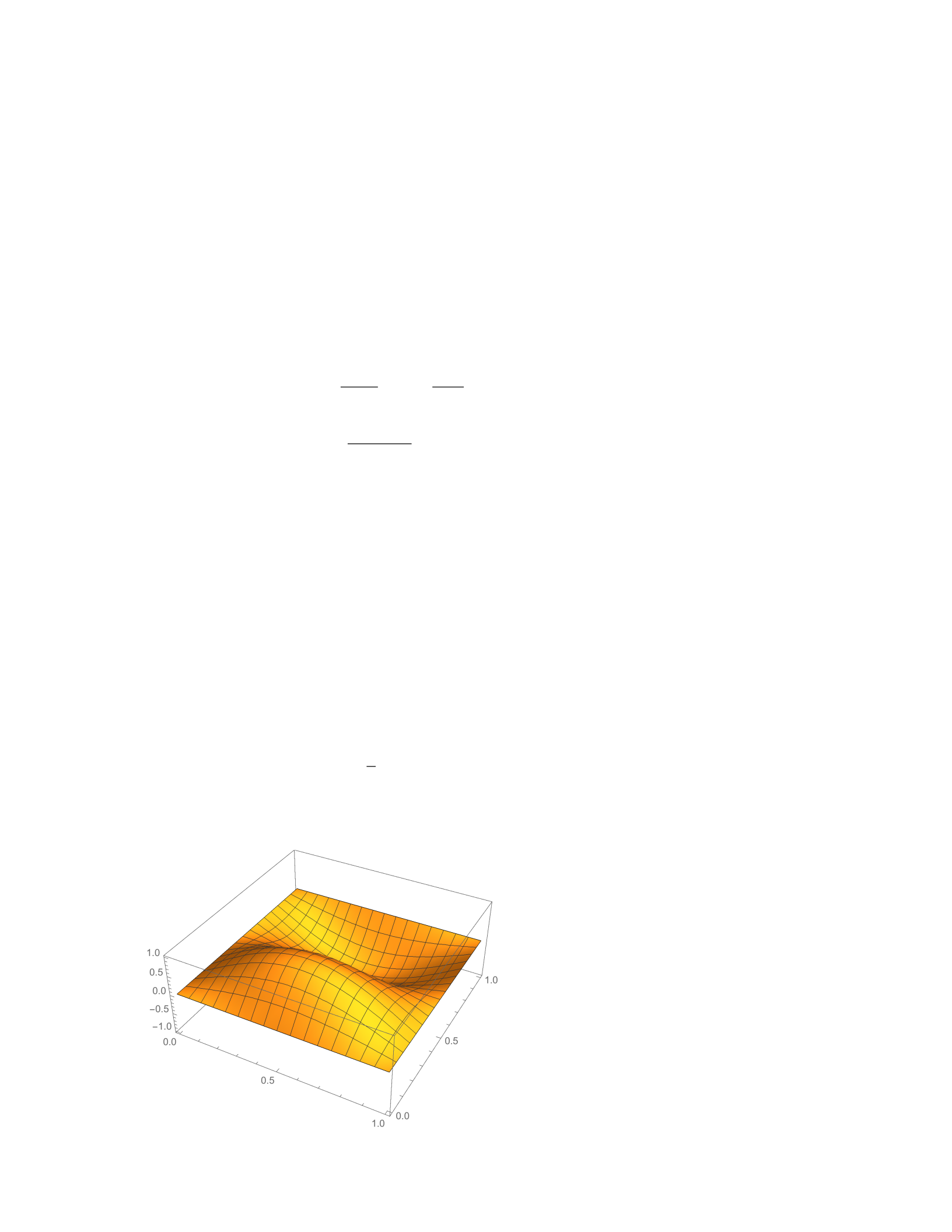
for all time t. Provide an equation for the frequency of, and draw an image of, a/the
lowest remaining allowed mode.
Solution:
The condition that Z(a/2, a/2, t) = 0 for all tmeans that we must have either sin(mπ/2) =
0 or sin(nπ/2) = 0 to have an allowed mode. So, modes are allowed if either mor nis an
even integer. This means there are two lowest possible modes:
m= 1, n = 2; m= 2, n = 1.
Both have frequency ω=√5πv/a. Plotting one of them, with the x, y directions in units
of aand the height in terms of the maximum amplitude of the waveform, we find the
image below.

2. (40 pts) Solve Laplace’s equation in two dimensions
∂2Φ
∂x2+∂2Φ
∂y2= 0
with the boundary conditions
Φ(x, 0) = Φ(x, b) = Φ(0, y) = 0; Φ(a, y)=ΦR,
where ΦLis a constant. You must show your work or otherwise completely justify your
answer.
Bonus (10 pts): Solve the same equation except with the boundary conditions
Φ(x, 0) = Φ(0, y) = 0; Φ(a, y) = ΦR,Φ(x, b) = ΦT.
Solution:
This solution can actually be found from a modified form of PDE Eq 36, recognizing that
switching (a↔b), (x↔y), and replacing Θ0with ΦRproduces the exact same situation.
In that case students needed to check that their answer satisfied the differential equations
and the boundary conditions to get credit.
Instead, we will proceed from first principles. We first ASSUME Φ(x, y) = X(x)Y(y).
Plugging into the differential equation and dividing by Φ, we obtain
1
X
d2X
dx2+1
Y
d2Y
dy2= 0.
Each term is dependent on its own variable, so each must equal to a constant. Since we
have boundary conditions of 0 when y= 0 and again when y=b, we expect oscillatory
solutions in the ydirection. Accordingly we write
d2X
dx2=k2X, d2Y
dy2=−k2Y.
We thus obtain
Xk=Akcosh kx +Bksinh kx, Yk=Ckcos ky +Dksin ky.
Applying the ‘easy’ boundary conditions in the ydirection, we have
Y(0) = Ck= 0, Y (b) = Ckcos kb +Dksin kb =Dksin kb = 0 ⇒k=nπ
b.
The remaining ‘easy’ condition is
X(0) = Ak= 0.
2

So before applying the last boundary condition, we combine constants BnDn=Ento get
the general form
Φ(x, y) =
∞
X
n=1
Ensinh nπx
bsin nπy
b.
We now examine the ‘hard’ boundary condition:
Φ(a, y) = ΦR=
∞
X
n=1
Ensinh nπa
bsin nπy
b.
We then multiply by sin(mπy/b) and integrate over 0 < y < b to use orthogonality to
find the En:
ˆb
0
ΦRsin mπy
bdy =
∞
X
n=1
Ensinh nπa
bˆb
0
sin mπy
bsin nπy
bdy
−ΦR
b
mπ cos mπy
b
b
0
=
∞
X
n=1
Ensinh nπa
bb
2δmn
ΦR
b
mπ (1 −(−1)m) = Em
b
2sinh mπa
b
=⇒Em=2ΦR(1 −(−1)m)
mπ sinh mπa
b.
where we have used OFFS (18) in the second line, and done the sum using the Kronecker
delta in the third. Thus the complete solution becomes
Φ(x, y) =
∞
X
n=1
2ΦR(1 −(−1)n)
nπ sinh nπa
bsinh nπx
bsin nπy
b.
For the bonus problem, we either perform the exchange described in the first paragraph
above to generate the solution for nonzero boundary condition on the bottom (y= 0)
edge, or we can just use the PDE (36) result. Adding to the solution above we obtain
Φ(x, y) =
∞
X
n=1
2ΦR(1 −(−1)n)
nπ sinh nπa
bsinh nπx
bsin nπy
b
+
∞
X
n=1
2ΦT(1 −(−1)n)
nπ sinh nπb
asinh nπy
asin nπx
a.
3

