


The Conceptual Framework
The layout of data analysis in this research presents the same organization of both the
research questions and the conceptual framework. The research questions asked how leaders
approach accomplishing their overall organization's objectives such as those represented in the
vision, mission, and values with an organizational leadership framework and how such a
framework's presence affected their leadership’s approach. The interview questions were related
to the organization's leadership framework philosophy and analyzed for the final theme to create
a comprehensive understanding of the case study through multiple sources providing
triangulation. Creswell and Poth (2018) stated that triangulation with different data sources and
various emerging themes adds validity to the study. This reflects the steps taken in the design
phase ensured research questions were addressed a way that is supported through standards of
scientific qualitative case study research.
The overview of the conceptual framework showed individual leadership strategy
interpretations without an organizational leadership framework and coordinated group
movements with one approach with an organizational leadership framework. Within the first part
of the conceptual framework of this study, the researcher theorized that in environments lacking
the presence of an organizational leadership framework, varying roles and levels would set their
leadership strategies to arrive at the mission, vision, or purpose of an organization and lack
alignment (Figure 6). Kachaner et al. (2016) showed that leadership and executives use a variety
of approaches to understand and develop the strategy of their organizations. This varied approach
could create a lack of alignment within organizations that do not use an organizational leadership
framework as each leader practiced what they would believe is valued most in accomplishing the
overall objectives.
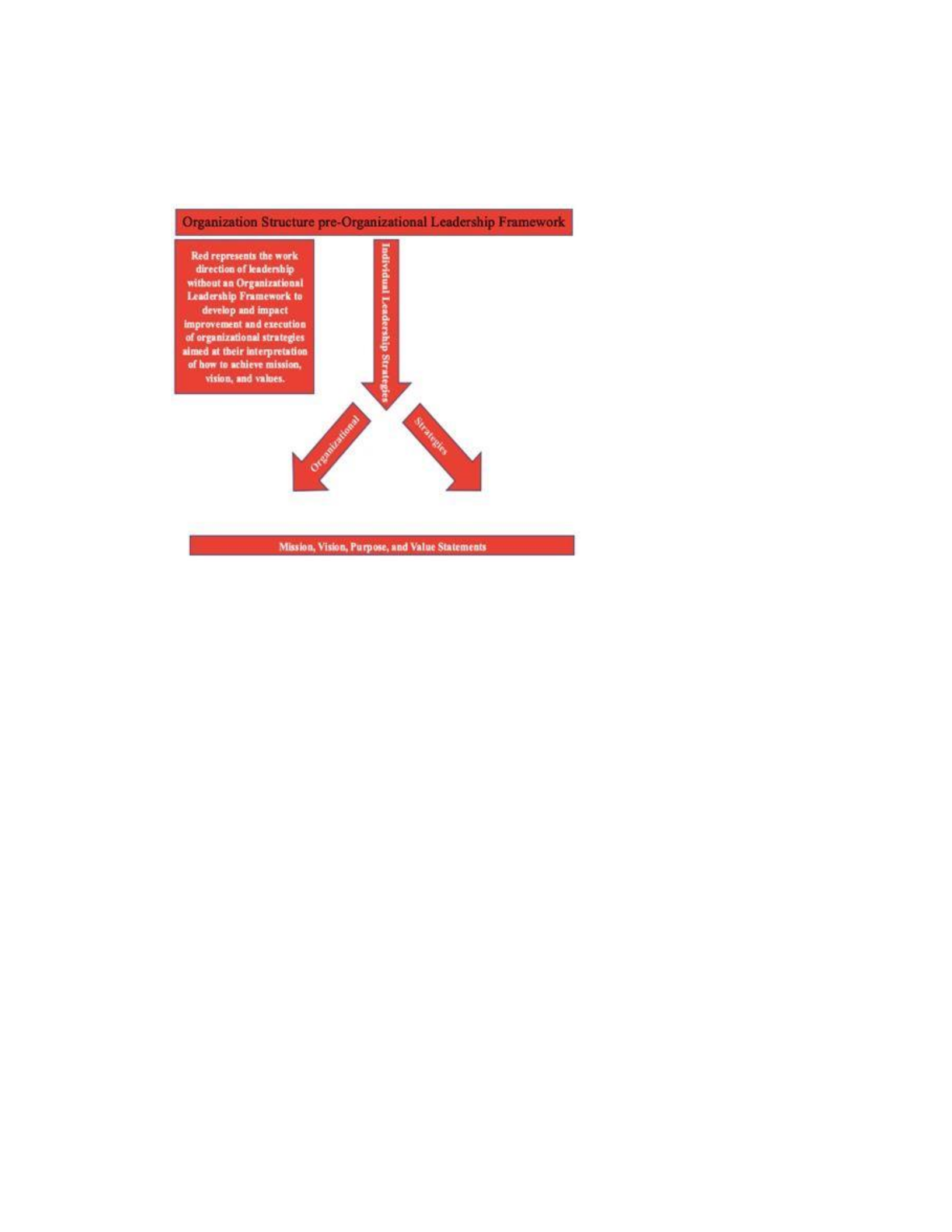
Figure 6
Organization Structure pre-Organizational Leadership Framework
Within the second part of this study's conceptual framework, the researcher theorized that
in environments with an organizational leadership framework, the framework acts as a guide to
interpret the desired leadership behaviors and actions needed to accomplish the mission, vision,
and purpose (Figure 7). The variety of approaches used by leadership and executives mentioned
previously in this research by Kachaner et al. (2016) would be limited. The presence of an
organizational leadership framework aligned to the leadership approach in behaviors and actions
expected high alignment amongst individual leaders while having a high impact on daily
leadership within the organization.

Figure 7
Organization Structure post-Organizational Leadership Framework
The results of the data did reflect that the presence of the participating organization’s
leadership framework created alignment that resulted in participants creating a unified approach
in the creation of a people first culture. Most did not perceive the leadership framework as the
cause of their actions. A few participants did acknowledge that any actions contributed to the
leadership framework may not be conscious. However, information on the presence of the
leadership framework affects within the participants’ role did align with the conceptual
framework. The data revealed that leaders reflected coordinated movements and interpretations

of role priorities. While opportunities presented themselves in the data results, they were
unexpected yet added to information that would make an organizational leadership framework
more impactful.
Anticipated Themes
Two themes were expected around the first central research question seeking data on how
participating leaders approach accomplishing overall objectives of the organization. Here the
researcher anticipated a high degree of alignment amongst participants’ answers in two areas.
The first anticipated theme is how participants prioritize and approach their role. While the
varying participants at each level would have the same job description that creates the same
tasks, decision-making and prioritization left open the possibility of varying individual
perception to approaching their leadership role. Since the participating organization offered a
leadership framework it is also anticipated that in the second theme participants would
collectively point towards the leadership framework as a resource or guide that influenced their
leadership approach.
Three themes were expected around the second central research question which sought to
understand how the organizational leadership framework affected the leadership approach. For
the first theme, a high degree of alignment is anticipated amongst the participants’ answers due to
the presence of a leadership framework when seeking knowledge regarding desired attributes or
leadership behaviors that best make for successful fulfillment of role when accomplishing the
overall objectives of the organization. Here, it was expected that participants point towards the
common language of the leadership framework put in place by the participating organization
when citing their responses. The second theme should have seen a similar high degree of
alignment amongst participants’ answers seeking knowledge around the participants’ transition or

onboarding and development to a working leadership environment with a leadership framework.
The third and final theme should have seen a high degree of alignment amongst participant
answers seeking information on the leadership frameworks impact beyond the boundaries of the
participants’ role. Heightened awareness in a leader’s impact of interactions with others and
needs of the role should maintain a consensus in an environment where desired behavioral
leadership characteristics are funneled through an organizational leadership framework.
It had been anticipated that due to the presence of a leadership framework, themes would
evolve from the results that align leadership in their decision-making and prioritization while
pointing towards the leadership framework as the source of said alignment. However, the results
of the research produced unexpected themes. The first central research question expected two
themes. While leaders did align in their decision-making and prioritization as the first theme
anticipated, results of the participants’ interviews produced a theme that pointed towards
previous mentorships and experiences as the source for their choices. The second central research
question expected three themes. The results of the study produced an unexpected first and second
theme results in this section. The first theme again pointed to previous experience as a resource
while the second theme reflected no formal onboarding or development to the leadership
framework. The third and final theme from the results of the participants’ interviews revealed
that while leaders acknowledged influence of the leadership framework in their interactions, it
may be at more of a subconscious level than proactively worked.
This research revealed that while value may be found in an organizational leadership
framework as the foundation for a leadership strategy within organizations, that value is
dependent on execution. The definition in this research of the organizational leadership
framework reflects that the framework cannot stand alone. The organizational leadership

framework, according to Alenezi (2019), shows that when expertly planned, has potential for
high levels of impact on its participants and its organization. The interview results revealed in
this study opportunity in a lack of onboarding and training to the leadership framework. This is
reflected further in the inconsistent overall anticipated and unanticipated themes of the study. A
missing theme identified by the research results revealed a missed opportunity to study feedback
culture provided to participants that is directly tied to leadership framework performance.
Focusing on the opportunity areas around structure provided by onboarding and development and
further exploring consistent feedback in an organizational leadership framework environment
may provide a more consistent implementation and utilization of the organizational leadership
framework as a resource.
The Literature
Research literature regarding the topic of distributed leadership in an educational setting
is used to thread the learnings from such writings to the learnings found in this study on
organizational leadership frameworks. Latta (2019) referenced distributed leadership and its three
conceptual forms of distribution in leadership as collaborative, collective, and coordinated. The
description of the objective for the participating organization's leadership framework and this
research's definition of an organizational leadership framework aligns closely with this
description of distributed leaderships’ collaborative, collective, and coordinated environment.
The analysis of the participating organization’s leadership framework lacked coordination. While
the leadership framework is introduced to the participants it had not been maintained through
structure such as a coordinated onboarding and training effort on the part of the organization. A
detailed understanding of the feedback environment for the leadership framework is a missed
opportunity within the research that may have revealed further strengths and opportunities.

Latta (2019) shared that structure is a defining dimension of distributed leadership. While
the participants' leadership framework has a structure in its formation, there is a lack of structure
revolving around the onboarding and training or development experience of the leadership
framework. Mifsud (2017) reflected that a lack of structure in distributed leadership leads to
struggle and even tension amongst leaders. This structure insight applies to the organizational
leadership framework. Here, the analysis revealed struggle of the participants to understand
desired behaviors and success in role even with the leadership framework of the participating
organization pointed out desired attributes that make for a successful leader. This left tension
between the participants and the organization as they pointed out the organization’s lack in
commitment or focus and weak training or development around such focuses. The lack of
structure in onboarding, ongoing training and development, and feedback is an opportunity area
that needs addressing for the resource of a leadership framework to be most impactful.
Rao-Nicholson et al. (2020) further described distributed leadership as a shared-goal and
collaborative, driven method that allows for the sharing of leadership across groups and
organizations to achieve common objectives. The participating organization’s leadership
framework offered such an approach, but participants’ data revealed a people first driven culture
that focused on development but lacked behaviors geared towards a collaborative goal driven
environment. Like distributed leadership in which Shani (2020) referred to as plural leadership,
the organizational leadership framework environment is much the same. Klein et al. (2018)
referred to teachers in distributed leadership as either teacher followers or teacher leaders. As
leadership expands and evolves, an organizational leadership framework environment may best
borrow from distributed leadership by viewing plural leadership and individual employees as
leaders of self and people. This suggestion aligns itself in research. Rao-Nicholson et al. (2020)

showed that a distributed leadership environment advances the welfare of employees, allowing
them to participate in the decision-making process and enhancing both engagement and
productivity. The people first driven culture of the participating organization can drive leadership
behaviors such as the plural leadership reflected in distributed leadership and the leadership
framework.
Research literature revealed that the subject of leadership is evolving. Vecchiotti (2018)
showed that as women entered the role of leadership, the definitions morphed from that of
authority to one who recognized followers then reflected as a new, younger generation emerge
value in is placed in definitions such as collaboration, balance, and feedback. The importance of
the individualized approach to leadership is changing. Allio (2018c) stated that the role of
leadership is starting to diminish as the focus of strategy rises. Furthermore, Kellerman (2016)
stated that leadership as an industry needs reconceiving through shedding its obsession with
individual leaders and shift to a focus of learning to create a systemic approach to leadership.
Adding to this thought process within the research literature of leadership, Henry (2018) showed
that management and leadership need to understand the depth, breadth, and inter-connectedness
of problems and address them with a more global approach. In accepting this thought process and
threading the learnings found in both the research literature of leadership, distributed leadership,
and the data analysis of this study provides a platform for this to happen through the foundation
of an organizational leadership framework. The organizational leadership framework offers the
collaborative, collective, and coordinated environment of distributed leadership described by
Latta (2019). This is reflected in the definition of organizational leadership framework offered in
this research and described in the participating organization’s explanation of need for their
leadership framework. The research analysis revealed the importance of a coordinated

environment and how if missing, reduces the impact of an organizational leadership framework
on leaders and the organization.
The Problem
The general problem addressed is the failure of organizations to create a leadership
strategy through an organizational leadership framework, a synthesis of an organization’s
strategies, functions, culture, and individual behaviors into universal guiding principles which all
facets of business reference to create more intelligent and coordinated magnetic like movements.
The general problem statement in this research addresses the failure of organizations to create a
leadership strategy. Cockerell (2018) stated that most organizations’ chief executive officers,
board members, and executives focus solely on creating business strategies around growth or
innovation while failing to realize that they need a leadership strategy. Supporting this view,
Holloway et al. (2018) showed that individual leaders require support, shared values, and vision
that comes through a practical leadership framework. The review of leadership literature in this
study acknowledged the need for a shift in leadership from the individualized approach to
something more collective, however, revealed nothing that offered a solution for this shift. This
research attempts to offer a platform for addressing this failure through an organizational
leadership framework.
The participating organization reflected in their need for a leadership framework that it
desires to create guidelines or a shared global language in which to operate (“The 3 C’s Behind
Great Leadership,” 2018). The framework in which the participating organization exhibited
reflected the Latta (2019) description of distributed leadership as collaborative, collective, and
coordinated in nature. The work of distributed leadership provided the universal guiding
principles as described in this research’s definition of an organizational leadership framework.

The analysis of the data and emerging themes reveal that the leadership framework of the
participating organization did have an impact on participating leaders that coordinated
decisionmaking and prioritization. However, the lack of coordination at the organizational level
lessened the impact of the leadership framework. Onboarding and training to the leadership
framework had been revealed as needed in the data while feedback to the leadership framework
performance of the individual leader appeared as a missed opportunity in the research results.
This qualitative case study reviewed an organization attempting to create an overall
leadership strategy through an organizational leadership framework. The participating
organization’s leadership framework demonstrated a positive impact on the coordination of how
individual leaders approach their role in through decision-making and prioritization.
Inconsistency in how the leadership framework is used and impacts leaders is reflected through
the inconsistency exhibited in onboarding, training, and possible performance feedback
communication directly related to the leadership framework. The research revealed the
leadership framework to be a viable candidate as a platform or solution to the problem with its
effectiveness relating to the coordination at the organizational level. This study, and the
organizational leadership framework offers a foundation to provide future guidance in which
future research may build upon. This knowledge may be used by organizations in the formation
of their organizational leadership frameworks and their respective leadership in how to maneuver
through said framework.
Summary of the Findings
The findings of this study revealed anticipated and unanticipated results along with the
revealing of a missing theme. The leadership framework of the participating organization did
have an impact on participating leaders. Leaders were coordinated in their decision-making and

prioritization across both roles that created a people first culture. Leaders prioritized
conversations with a focus on personal and professional development and is supported through
operational or administrative activities that keep these priorities top of mind. However, this was
only a portion of the participating organizations leadership framework. The impact of the
leadership framework is not fully realized or understood by the participants. Resources cited
involved previous mentors or leadership experiences rather than the leadership framework.
Leaders were not able to recognize desired attributes or behaviors along with if they were
successful in role despite the leadership framework stating this information.
Results revealed that participants were not onboarded or developed to appropriately use
the leadership framework in the way the organization had intended. This left development and
use of the framework up to the individual interpretation of each participant. Participants
recognized that the leadership framework has impact on their interactions with others but often
cite that it is done so subconsciously rather than proactively worked. Furthermore, participants
revealed a need for improved organizational focus, development, and communication. This focus
and development need pointed out by the participants reflected themes within the data analysis
that the leadership framework seemed to be introduced then moved on from without continued
onboarding and development needs being addressed. The need addressed by participants in
improved communication presented a missed opportunity by the researcher to explore this
subject in its direct relation to the leadership framework.
The conceptual framework of this study found support in the resulting data analysis that
with the presence of a leadership framework formed coordinated movement within the
participating organization and its leaders. The unanticipated and missing themes of this research
has revealed opportunities within the organizational leadership framework. However, the

resulting themes of the research reflect that the organizational leadership framework offers a
promising foundation for research and organizations to build upon in addressing the knowledge
gap and lack of practice in leadership and business for an overall leadership strategy within
organizations.
Applications to Professional Practice
This research reflected that there is a need for the field of leadership to transition, or
evolve, to something more practical. Kellerman (2016) reflected that the entire leadership
industry needs reconceiving. This body of work offers the potential to improve the general
business practice of leadership by providing two different approaches that address the need for
leadership to evolve or reconceive. The first approach provides a foundation in research literature
in which to build upon organizational leadership framework studies. The second approach
provides a foundation of learning for organizations. For example, this study attempts to
transform the practice of leadership from that of a traditional approach to leadership as a function
of a collective unit. This transition from a focus on the individual leader to leadership as a
collective unit does not attempt to diminish the role or experience of the individual leadership
experience but rather enhance that experience through an expanded global view of how
leadership functions.
Improving General Business Practice
Within the first approach of general business practice, this study attempts to provide a
foundation through the organizational leadership framework to shift research's literature on
leadership which remains focused on the relationship between the leader and the follower.
Norenberg (2020) reflected individual leadership failures are creating low engagement levels that
create an inability to meet targets and low company growth with this traditional focus.

Approaching leadership as a collective unit offers the potential to strengthen leadership and its
results. Bongiovi (2017) showed there is a need to move away from this leader-follower
approach and not just fix the leader but the leadership system. The participating organization of
this study revealed that leadership needs a framework in which a shared global language offers a
common vocabulary that creates lines within its leadership to operate (“The 3 C’s Behind Great
Leadership,” 2018).
The results of this study reflected that when individual leaders operate under the
boundaries of an organizational leadership framework, only a small portion of their leadership
approach aligned with the organizational leadership framework. Implementation opportunities
produced mixed results. Within this study, a portion of the participating organization placed value
in collaboration (i.e., building and nurturing relationships), confidence (i.e., dedication to lifetime
learning), and creativity (i.e., meaningful engagement with others; “The 3 C’s Behind Great
Leadership,” 2018). Results aligned with these leadership guidelines and reflected that those
leaders at the participating organization created a people-first culture that placed its top priority
in regularly occurring conversations with those they are leading. The topics of these
conversations uncovered the next priority of leaders, individuals' personal and professional
development experience. The development of self and others is a top priority for the leaders
within this organization. Finally, these two priorities found support through the administrative
activities that kept both top of mind. This order of leadership decision-making and prioritization
behaviors remained strong across both roles within the study.
The result of the study revealed that alignment in interpretation of desired leadership
behaviors along with the resulting leadership culture of those behaviors within the environment
of an organizational leadership framework is dependent upon implementation and follow through

processes. The portion of the study’s individual leadership behavior alignment to the
participating organizations leadership framework offers promise as it reflected the potential of an
organizational leadership framework to shift the focus to leadership as collective unit. Further
topic research, including but not limited to improvements in the implementation and processes of
an organizational leadership framework, potentially offers a strong foundation in which to build
future learnings and resources that guide the field of leadership to its next evolutional phase. A
phase that values and understands leadership as more than just a role, but a function and system
made up of individuals in need of an overall strategy that respects the cross-boundary,
crossfunctional, endless reach of its impact.
Potential Application Strategies
The result of the study had not been without its challenges. However, within these
challenges, opportunities for potential application strategies arise to make the implementation of
an organizational leadership framework more effective. Early in the interview process, research
results reflected that those participants could not directly point to their leadership framework as a
resource that influenced their decision-making. Warrick (2017) showed that in environments with
organizational cultures, many leaders are unaware of culture's significant impact on the
individual. This lack of awareness may be due to the next challenge, the lack of onboarding, and
ongoing training in how to lead within the leadership framework of the participating
organization.
Participants in an organizational leadership framework may experience more success
within the leadership framework through a more formal, collaborative, and structured onboarding
and development environment specific to the leadership framework provided by the participating
organization. Leaders in an organization with a traditional approach to leadership may be used to

resources such as competency models and yearly performance reviews for direction. Profiroiu
and Hurdubei (2018) showed that competency models are cascaded to employees through
training, career development, and performance management to contribute to the success of their
organizations. With traditional yearly performance, reviews come feedback. Park and Choi
(2020) described feedback as providing clear communication of the organization's expected goals
and behaviors, improving individual and organizational effectiveness. With these traditional
resources absent from a leader's toolbox under an organizational leadership framework,
onboarding and feedback allows those leaders to execute the new global leadership language
more effectively. As participant D2 reflected, the leadership framework could come across as
"Oversimplifying and somewhat complicated for people to understand" (Personal Interview,
September 7, 2021).
An effective onboarding program geared towards operating within an organizational
leadership framework will help individuals better adjust to their roles. Chillakuri (2020) shared
that effective onboarding programs quickly introduce employees to the organization's values
allowing them to adjust to the organization's culture and social aspects of their role. This
improved adjustment to their role should then help positively impact performance in the role.
Serbes (2017) shared individuals become more familiar with goals through increased awareness
of self and organizational mechanisms, which ultimately increase interactions and destinations.
Increased feedback away from the yearly performance standard will aid in the continued increase
of performance. Park and Choi (2020) showed that with more frequently provided performance
feedback, the more enhanced an employee's performance. Gorbatov and Lane (2018) showed
that too much-increased feedback could lead to a decrease in task effort and performance. This
research is not a case study on performance feedback, but yearly feedback under the

organizational leadership framework is not enough while there may be a tipping point where
feedback becomes overwhelming. The suggestion by this researcher is that a possible quarterly
feedback system that, as Gorbatov and Lane (2018) reflected, provides frequent, structured
feedback that drives consistency across all parts of the organization and makes it easy to identify
and prioritize behaviors. This approach best reflects and mirrors and the design of the
organizational leadership framework.
The make-up or content creation of an organizational leadership framework is vital. The
organizational leadership framework is about removing the individual experience. It is not about
a leader leading other leaders. The participating organization reflected in their leadership
framework that success could not arrive through a single leader but rather a team of leadership
that learns at an organizational level (“The 3 C’s Behind Great Leadership,” 2018). Research
reveals that strategic leadership is for the few, those in top management, like the chief executive
officer of an organization. Meuser et al. (2016) reflected that strategy forming occurs in an
organization's top leadership. When forming the content of the leadership strategy that makes up
an organizational leadership framework, it should come from a collective group of top
stakeholders within the organization creating buy-in from the top down and reflecting the
organization's desires rather than that of a single individual. Taking the advice in this section and
applying the organizational leadership framework to an environment currently lacking one while
taking measurements such as key product indicators and employee net promotor scores before,
during, and well after its implementation would provide a tremendous amount of data.
Summary of Application to Professional Practice
Schroth (2019) reflected that the new generation of workforce is more diverse, highly
educated, and achievement-oriented than any other generational workforce. This evolution is

creating a more capable workforce. Gabrielova and Buchko (2021) reflected the newer
generations desire to manage their projects to demonstrate and develop skill sets. They have both
a need and desire to develop themselves in their leadership skills and the individual leadership
development resources will be plentiful. Allio (2018b) cited individual leaders drove the global
market for leadership education and improvement to over 20 billion dollars in 2017 through
various courses, seminars, and degree programs to improve performance for themselves and their
organizations. However, as noted in this research, the leadership industry needs a shift and must
continue to evolve to be more effective and reflect the current workplace. The work of
distributed leadership in the education industry is moving away from the principal teacher
structure understanding that the leader and their follower relationships are changing. Amar and
Hlupic (2016) reflected that leadership is failing to properly recognize the distribution of power
due to it being legitimized that the leader is the source. The organizational leadership framework
creates an opportunity to distribute power by creating a synthesis of an organization’s strategies,
functions, culture, and individual behavioral efforts create more coordinated movements for all to
follow.
Recommendations for Further Study
This qualitative case study on organizational leadership framework setting took place in a
brick-and-mortar retail organization with a leadership framework within the United States. It
focused on leaders at the store manager and district manager levels who lead those whose
primary responsibilities are a retail store environment. This initial study could not compare this
environment to one without a leadership framework. The researcher recommends that a similar
study, modified appropriately to the environment, takes place in a traditional leadership
environment that lacks an organizational leadership framework and focuses more on traditional

resources such as the annual review, competency models, and job descriptions as directions for
leadership.
As mentioned, modifications need to occur to replicate the study in a traditional
leadership environment. First, the second central research question verbiage needs to be adjusted
to reflect the lack of an organizational leadership framework. Second, interview questions
fifteen, sixteen, and seventeen would need to be modified, changing the verbiage leadership
framework to resources appropriate to the setting such as annual review, competency models, or
job description. According to Human Resource Management International Digest (2019), the
appraisal process is where the employees work with their leaders towards goals or outcomes
while the manager attempts to guide behaviors towards increased performance and the
achievement of organizational objects. In an environment without an organizational leadership
framework, this would seem to be the primary source or tool essentially guiding all leadership
behaviors.
With these changes in verbiage occurring, a new study should be initiated, keeping the
rest of the study the same, including conceptual framework and data sets along with their
respective subsets of data. That information can then receive analysis in the same fashion as this
study, and the results of each study are then compared to one another and analyzed for further
comprehension or understanding of the organizational leadership framework phenomenon. This
data would reveal more detailed insight into leadership environments with and without the
organizational leadership framework.
Those directly impacted by such a study are the study's participants. The risk of the study
would be minimal, meaning that which they would encounter in everyday life. Commitment to
the study would be their time, which averaged one hour. Participants in the new study should

expect to see no direct benefit. In contrast, benefits to society include knowledge from the study,
which can help by addressing gaps in the scholarly literature about leadership as a collective unit
and the need for strategy or a framework that would coordinate efforts amongst leaders while
more clearly communicating desired actions or movements amongst leadership, making the
individual leader more successful in their role. Study results could be shared with participants
while study results published for the benefit of the greater research community.
Utilizing an organizational leadership framework creates a unifying language and
leadership experience to address any potential obstacles. Continued research and resources are
needed to address the skill sets needed by those who work in this new type of environment, and
executives and board members work to create the said environment. Future studies could shift
the focus from how different leadership styles affect their followers to how different leadership
styles affect one another and their approach towards the organizational leadership framework.
This qualitative case study on organizational leadership framework provided a critical
perspective in shifting from leadership as an individual focus to leadership as a collective focus
for the field of leadership research literature. However, the research has opened the doorway for
far more questions than what it could provide in answers. For example, it is a limited sample
provided in the study. Retail leadership represents only one industry or portion of the business
world. Further studies in other industries outside of retail with their leadership would help to
understand further and validate the organizational leadership framework.
The research of organizational leadership frameworks, like the role of leadership itself,
has limitless boundaries. Further research recommended for organizational leadership
frameworks occurs in human resources. This study left unexplored the feedback culture of an
organizational leadership framework. Rivera et al.’s (2021) traditional performance management

may no longer be ideal for the new generation of workers as ongoing feedback provides a more
cohesive picture of actual performance. The content of the organizational leadership framework
serving as the North Star for this ongoing feedback could prove beneficial as a tool to eradicate
the outdated yearly performance review process and help to determine an adequate amount of
feedback sessions throughout a given year.
Finally, the content formation of the organizational leadership framework needs research.
The organizational leadership framework must not become a hierarchy of a single leader leading
leaders. Groups of organizational executives or board members must unite to create their
organizational leadership framework. However, at this early point in the research, they may not
have access to the proper tools or complete knowledge of forming such a framework. This
research reflected through Latta (2019) that distributed leadership is collaborative, collective, and
coordinated. The participants in this study experienced a leadership framework that, through
Gameplan-a (“The 3 C’s Behind Great Leadership,” 2018), reflected the values of collaboration,
confidence, and creativity. While similar themes appeared, these are by no means prescriptive
now. As such, leadership itself may not be prescriptive across the entire field. However, further
research may reveal themes across industries or business approaches.
Reflections
This research began with a desire from the researcher to provide a resource to improve a
leader's ability to perform effectively. The researcher's own experience with leadership and
leading others has not been reciprocal with the experience of being led. In being led, the
researcher has lacked positive, impactful, growth experiences. Instead, the researcher has
experienced a career of individual leaders achieving organizational objectives that positively
positions themselves for success. Often without regard for interest in the success of those they

lead or the organization. The researcher learned that an organizational leadership framework does
more than provide leaders with opportunities to perform more effectively. When properly
executed, it transfers the relationship of power in leadership from individual leaders to the
organization, creating an opportunity for a culture on purpose through a designed leadership
strategy. A strategy that recognizes leadership as a collective group producing a function for their
organization through a specifically designed approach to achieve organizational objectives rather
than reacting to the results of individual interpretations and their efforts.
Through the lens of distributed leadership, this approach allows all participants to lead in
achieving objectives within the guidelines set by their organization. It recognizes that when a
leadership strategy is put in place by an organization through an organizational leadership
framework and executed with excellence, all individuals in the organization exposed to the
leadership framework have the capability to lead. In the end, the researchers shift in this research
exhibited the shift being attempted in this research. Rather than the research simply offering a
resource for a leader's ability to perform more effectively, this researcher hopes that this study
offers a foundation for a complete shift in the field of leadership. A shift that removes the focus
of the individual leader as the focus and difference maker and places a priority on understanding
the perspective of leadership as a collective unit that, when strategized, offers far more success
for both the field of leadership and organizations alike.
Personal and Professional Growth
The researcher expected the study results to reflect complete alignment to the
organizational leadership framework due to its nature and formation. The researcher quickly
learned that the organizational leadership framework, like many other approaches to business and
leadership, is only as effective as the implementation and follow through processes. Additionally,

as the researcher progressed through the study processes, it was observed that there were far
more questions left than what the study would answer. It became clear that the hope and desire
would be not to provide answers but understand the potential of this research to be used as a
platform to create further works that would substantially positively impact the field of leadership.
While the research revealed anomalies, the data reflected potential in providing a platform to
create opportunities for future research that shifts the industry of leadership as experienced from
an individual level to understanding leadership as a collective experience or group in need of a
strategy found in the organizational leadership framework.
As reflected previously in this research, the researcher has biased views on an
organizational leadership framework. The researcher has experience working within retail
settings that both have and do not have a leadership framework. The researcher's personal
experience reflects that the lack of an organizational leadership framework leaves too much to
the interpretation of the individual leader. The leadership framework provides direction or clarity
for the desired leadership approach, creating what the researcher felt is an aligned and united
leadership front making for a more successful leadership environment. The researcher's bias is
addressed in the study through appropriate actions such as triangulation, saturation, revelation of
anomalies, and discussion of all potential biases as suggested when doing scientific research. As
a result of this study, changes to the researcher's ideas about leadership and the organizational
leadership framework were not changed but enhanced. Prior to this work, the researcher viewed
leadership through the lens of a leader-follower relationship. It appeared that a leader's
understanding of the workplace environment and comprehending the best approach to take with
their followers would result in the most success for all parties involved. The presence of an
organizational leadership framework, it seemed, would modify this process, and the focus on the

leader-follower relationship may not bring the most impact. Finding more impactful leadership
results seem to come from understanding the individual leadership experience in perspective to
the larger functional unit of leadership and that success is not found in the hands an individual
leader but rather found in the effectiveness or function of the leadership group.
However, concluding this study, the researcher views leadership reach as endless. In
understanding leadership as a collective group or function rather than a position or role, the
researcher’s perspective of leadership has changed. The researcher arrived at three distinct
perspectives. The first perspective is that leadership as it currently stands is uncoordinated at
best. Individual leaders interpret the best approach to achieve organizational objectives through
their followers, leaving open the possibility for many negative consequences and too few success
opportunities for all parties involved. The second perspective is that an organizational leadership
framework does not simplify but completely changes the process or approach and effects all parts
of the organization. Onboarding, training, development, feedback, performance reviews, all must
change in their approach. The third perspective is that anyone can lead if given the proper
parameters. Distributed leadership and generational leadership studies reflected that leadership as
a role is fading. If organizations take the opportunity to set the parameters of leadership
behaviors through an organizational leadership framework strategy, all participants within the
organization can exhibit those behaviors. It creates a view that there are leaders and leaders of
people and that actions taken are no longer just about the directional relationship with a power
dynamic but had provided the researcher with a global perspective of leadership. It also creates
an understanding that a leadership strategy such as an organizational leadership framework can
proactively create a culture when done correctly. The opportunities and unexpected results in the
researcher's opinion only further supported the possibilities that the organizational leadership

