


Ontological and Epistemological Assumptions
There are multiple approaches to practice-based studies, and it is important to address
the fundamental ontological and epistemological assumptions that underpin my research
attempt (Cunliffe & Hibbert, 2016). Cunliffe (2015) aptly summarized the “problematics” of
objectivism, subjectivism and intersubjectivism in ontology, epistemology, and practice. The
assumptions of the methodology of this study are very much under the categories of
subjectivism and intersubjectivism. An intersubjective ontology is based on the notion of
“we-ness,” that the leaders and the members of the team are always
selves-in-relation-to-others (Cunliffe & Hibbert, 2016).
The leadership practices of MMs and the understanding of such practices by the leaders
and the teams are shaped among them (intentionally and otherwise), under the particular
organizational and situational contexts, in their relationally responsive interactions and
conversations (Shotter, 2008). This reasoning comes very close to the notion of “relational
leadership” (Uhl-Bien, 2006; Uhl-Bien & Ospina, 2012), that is, a perspective on leadership
as social processes of relating, processes that are coconstructed by several interactors. Such
processes are not mechanically reversible and controllable; instead, they are characterized by
a social flow of interacting and connecting, whereby organizations, groups, leaders,
leadership, and so forth are constantly under construction and re-construction (Chia, 1995;
Hernes, 2007). The empirical study of leadership-as-practice therefore should be focused on

leadership practices as constructed in interactions over time (Crevani et al., 2009).
Based on these epistemological assumptions, the organizational ethnography approach
that I will use is categorized as “confessional ethnography” as described by Neyland (2008, p.
54). According to Neyland (2008), the ethnographer is engaged in the construction of
meaning or making sense through “reflexivity” (p. 53) together with the members of the
organization under study. More specifically, the ethnographer plays a reflexive role in the
setting as an adequate member of the setting and forms particular relations with the members
of the site. Such reflexivity, under the confessional mode, become features of ethnographic
analysis. The epistemological approach focuses on the observation and experience of the
ethnographer as a researcher being in and interacting with the members of the setting
(Neyland, 2008). In the next section, I will explain why this study will take on a situational
and multilevel approach to explore the leadership practice questions in organizational change
and multinational setting.
The Situational and Multilevel Approach of This Study
Leadership studies have shifted from the leaders in terms of traits, personalities,
competency, and behaviors to situational factors (e.g., contexts, constraints, interactions
among people), or some combination thereof which determines the behavior and actions of
the individual leaders (Carroll et al., 2008; Yammarino & Bass, 1991). The person views of
leadership argue that personal characteristics, resulting from nature and/or nurture, explain

the leaders’ behaviors, attitudes, perceptions, and leadership styles, which in turn yield
different results in terms of followership, business results, organizational and social impact
(Yammarino & Bass, 1991, p. 122). The situation view, in contrast, advocates that
contextually relevant factors, either created and/or imposed, account for attitudes, behaviors,
and perceptions regarding leadership. The combined view, person-situation, proposes that
neither one of those two views is adequate in explaining the leadership phenomenon. Instead,
the person-situation view sees leadership as the interaction over continuous and reciprocal
influences between the person’s attributes and the situational factors over time (Nye, 2014).
The situational factors in this exploratory study are the organizational change in MNC setting
within the Asia Pacific context.
Yammarino and Bass (1991) thought that a multiple-level approach can be developed
to integrate and clarify the various person, situation, and person-situation views of leadership.
In my study, MMs are the individuals working and interacting with their significant others
(superiors, subordinates, peers, and external stakeholders) under the organizational change in
MNC setting within the Asia Pacific context. To understand the leadership practices of MMs,
I will need to consider the person, situation, and person-situation views of leadership. The
study of leadership-as-practice of MMs requires an assessment of the levels of analysis
involved, and the influences of levels on the leadership practices. Lastly, time and timing of
managerial practices are critical, and depend on levels of analysis.

Maupin et al. (2020) proposed an integrated approach with organizational discourse
analysis, relational event modeling, and dynamic network analysis for the study of collective
leadership with consideration of time, context, and multiple levels. I applied those methods
during my ethnographic study, whenever appropriate, particularly when I needed to
understand the organization context and the relationships or networks between the MMs and
their significant others in the organization.
Sklaveniti (2020) introduced turning points (fleeting moments of change) as one way
of studying collective leadership, which allows to unpack moments that connect and explore
how the leaders and other stakeholders generate co-action and collective leadership processes
(p. 544). The planning and preparation work before the announcement could involve strategic
analysis, discussion, and decision-making processes. The announcement was done by the top
management to address the concerns of the organization members and other stakeholders.
Then, there was a transition before the new organizations, systems, or ways of working were
implemented. Once the change was fully implemented, it was after the change.
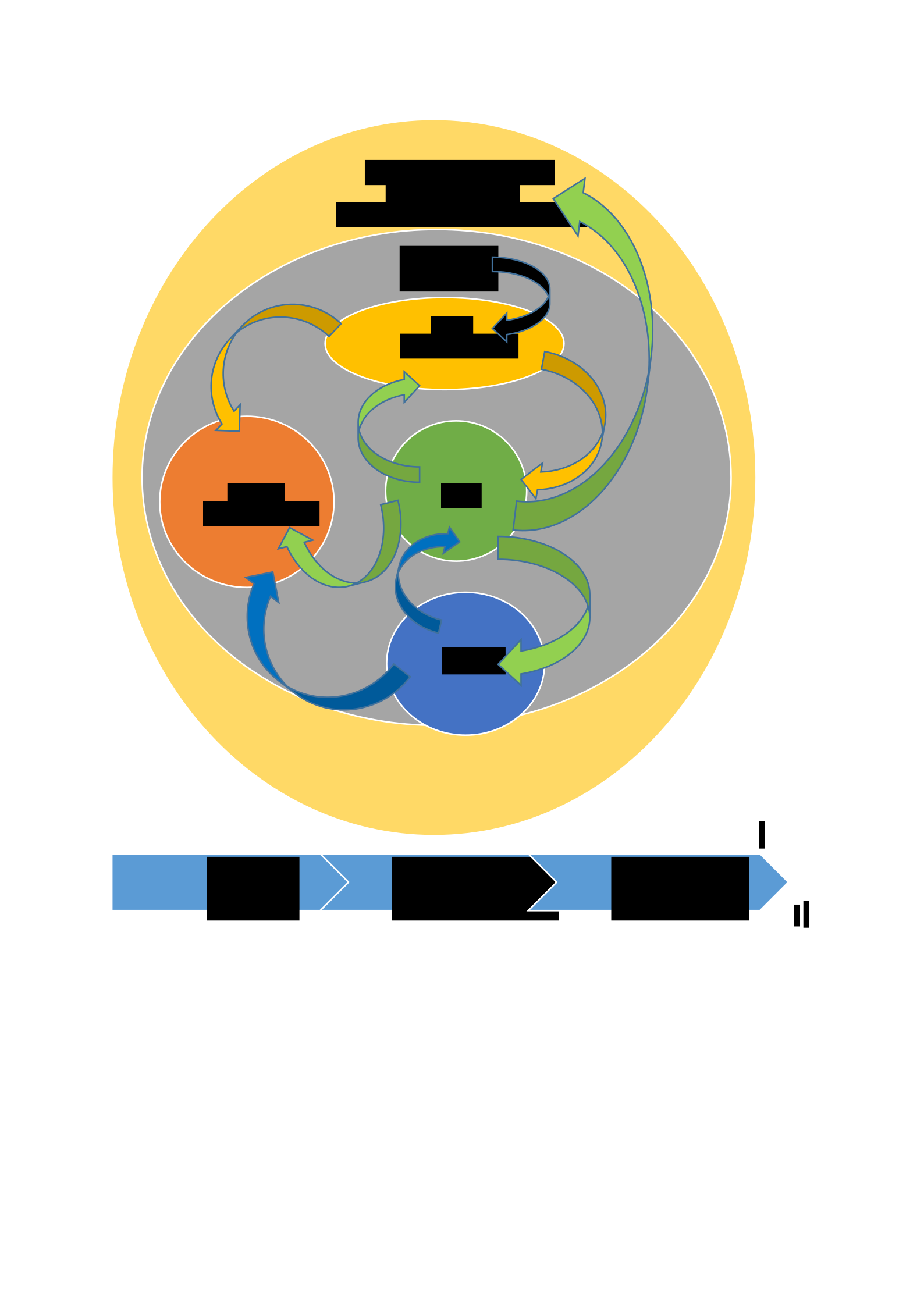
Figure 3.1 describes the multilevel dimensions of this study and the interactions and
dialogues that the MMs had with their significant others in the organization particularly the
top management, peer managers, and their team members. More specifically, in my study, I
tried to understand the thoughts and actions of the individual MMs (person level), the
interactions between the MMs and their team members (team level), the interactions among

the MMs, their superiors, and peers (organizational level) under the organizational change of
the MNC in Asia Pacific (situation) at different stages of change (time) in order to understand
the process. Figure 3.1 also points out that the temporal consideration was important in data
collection, particular at those critical organizational change events or leadership moment
where the MMs had interactions and dialogues with their significant others in the
organization. The processes of the ending, transition, and beginning of the particular
organizational change and other related changes will be the other temporal factors for my
study.
To understand the process of change over time as depicted in Figure 3.1 in this specific
organization, organizational ethnography was used as the research method for this study.
Azambuja and Islam’s (2019) organizational ethnography was particularly relevant to my
study. It offered a blueprint on how ethnography could be used as a research method on
leadership practices of MMs. In the following section I will describe what organizational
ethnography is, why it is relevant for this study, and how it was used in my study.
Figure 3.1
Levels and Contexts of MMs in MNC Settings
Changing Business
Environment
Customers and Suppliers
(
)
MNC
Top
Management
Teams
MM
Other
Departments

Overview of Research Design
The approach I used in this LAP research is a qualitative organizational ethnography.
This organizational ethnography seeks to describe the actions, dialogues, interactions, team
dynamics, and organization context based on the participants’ accounts and the researcher’s
observations. The resulting data will be analyzed through reflexive interpretation, that is, the
researchers consider how they handle empirical material and analyzes how they make their
acts of interpretation and reporting conscious to themselves and their readers with continuous
reflectivity (Gregorzewski, 2021).
Qualitative research is a very broad term that embraces research methodologies that
deal with phenomena by analyzing experiences, behaviors, and relations without the use of
statistics and mathematics, and the processing of numerical data (Hennink et al., 2010;
Merriam, 2009). It can be defined as a sequence of interpretive techniques applied by the
researchers who seek to describe, decode, and translate concepts and phenomena, rather than
to collect quantitative data of certain phenomena in particular research settings (van Maanen,
1983). Qualitative research provides benefits such as: (a) supporting the researcher to
understand the nature and complexity of the phenomenon being considered, (b) enabling
research in relatively new areas of research, and (c) supporting the investigation of a
phenomenon in its natural environment (Benbasat et al., 1987). Because of the multilevel

interactive nature of the questions I am asking in this study, the qualitative approach is best
suited for the study of leadership-as-practice of MMs. The contextual contingencies and
processes of leadership or leader-member interactions must be understood, and their
dialogues and actions interpreted, to identify emergence of themes and categories that explain
how context impacts leadership practices.
Organizational Ethnography
Ethnographic research methods are growing in popularity within the field of
organization studies (Brannan et al., 2007; Neyland, 2008; Yanow, 2009). Indeed,
organizational ethnography can be used to study leadership, particularly LAP, because
leadership involves process and time in a particular context or culture. Ethnographic methods
provide a vehicle to conduct research and to pursue action in ways that resonate with the
goals, values, and core mission of the field of LAP (Cunliffe, 2010; van Maanen, 2010, 2011,
2015; Watson, 2011).
Organizational ethnography in MNC setting could be challenging when the companies
are often concerned about security, reputation, and confidentiality issues. Similar to other
ethnographic research, the organizational ethnographer needs to influence the decision
makers to get their permission to undertake the research on their companies and to manage
the complicated working environment within the organization. Lastly, it is important to

maintain the proper role and identity of the researcher with the concerned decision makers,
MMs, and their team members, when they might perceive the researcher more as a change
management consultant/coach during the data collection process (Case et al., 2014; Neyland,
2008).
To limit the scope of this study, I defined MMs as one to two levels below the top
management in a country or regional levels of MNC settings. The important differentiation is
that MMs are not the ones who initiate the organizational changes, and they are not involved
in the strategic decision-making process. Middle managers are informed by their top tier
executives after the top management make the strategic decision about change, and then they
are expected to execute the change in their respective divisions or departments in the
subsequent weeks and months. On some occasions, they could be impacted by the change
itself. They could be required to communicate with their teams and to execute the change.
They could be caught in the middle, bearing the pressure from the top to deliver change
outcomes and results, while managing the resistance and grievances of their team members
about the change.
Lastly, it is important to note that the theoretical origins of leadership theories, change
management theories, and LAP as outlined in Chapter II only served as initial guiding lights,
not the lenses, for my ethnographic study. I was careful to maintain an open mind to explore
any approaches or practices that were outside the original scope of my understanding about

leadership practices of MMs. Moreover, as I mentioned in Chapter I, it was beyond the scope
of this research to have in-depth exploration into the cultural contexts (corporate, national,
and global levels) of the research site. I only attempted to explore the key cultural elements as
reflected in the ethnographic discovery that could have affected the leadership-as-practice of
the MMs in relation to the organizational change.
Now I will turn to the ethnographic design with the particular research site in mind. I
will briefly introduce the background of the research site and why it was chosen as subject for
my study. Then, I will discuss the ethnographic strategy and access to the site and the target
participants. Research Site
The research site is a European MNC, which manufactures high-tech products for
banking and other industries. The company had three manufacturing facilities in Shenzhen,
China. They planned to move to a new location (within 10 miles of the existing site) in
Shenzhen and to build a bigger site which could accommodate and integrate all the existing
three facilities. The company completed the renovation work and planned to move into the
new location in September to December 2020 by phases. The whole relocation and
integration process was completed by the end of April 2021. The company had also
experienced challenges in the market when their new product had not generated many
demands and their resources were not fully utilized. The COVID-19 crisis had further
impacted the company, but it had also brought new business opportunities to the Shenzhen

site because other worldwide facilities had been badly hit by COVID-19 while the Shenzhen
plant continued its operations.
The MMs of the Shenzhen Site are the eight department heads (DHs), who report
directly to the Plant Director (PD). The focus of this ethnographic study is on exploring the
LAP of the MMs in the European company under the Asia Pacific cultural context during
organizational change. While I observed and analyzed the organization context and the
organizational change situation, those eight MMs were the focal points of my study. The
process and timing of change could require different practices of the MMs. The relocation
itself could be less of an issue since the new location was not far away from the old locations
of different sites. The subsequent integration of the different units and teams in one location
and the possible reorganization of those units and teams could be one big organizational
change to the MMs and their team members. The different units and teams could be impacted
by the organizational change in different ways. Some units might be expanded, while others
might be downsized or dispersed to other units. I explored how those employees reacted or
react to the organizational change, and their actions in relation to their MMs and top leaders.
How did the MMs learn to adapt to change? How did they help their team members learn and
adapt to change? More importantly, I observed how the MMs responded to their team
members, top leaders, peer managers, and other stakeholders during the change.
The advantage of this research site is that the relocation and integration exercise were

conducted in September 2020 to early 2021. In this European company, the top management
consists of the PD and the global Strategic Business Unit heads based in Europe. The
department heads are really the middle managers to carry out the various functions of the
company and to execute the decisions of the top management. Moreover, the MMs are
familiar with the basic change management concepts and the three-step leading change
process (visioning, communicating, and implementing), which could lead to the LAP
phenomena of interest to this study.
Ethnographic Strategy
I spent six months, at least two days per week, at the Shenzhen Site with the
management team, particularly the eight department heads, to understand and observe their
leadership practices and their interactions with their teams, their top management, and other
stakeholders during the organizational change. I could experience and observe the daily
operations and interactions among the MMs with their significant others in the site. The team
meetings, dialogues at the office or plant site, coffee/cafeteria conversations, communications
between the PD and the MMs, and, most importantly, the MMs’ leadership actions could be
observed and analyzed during real time when they happened.
Ethnographic Access
Gaining access to organization and the members of the organization is critical in
organizational ethnography (Neyland, 2008; van Maanen, 2011). Concerning this potential

research site, I conducted transformational leadership training for the relocation exercise for
the top and middle management team in 2018. I became familiar with the PD and the
management team. In 2019, they invited me to conduct a series of leadership training
workshops. Subsequently, I spent a period of four months in coaching the eight department
heads on leadership, people management, and career development issues. Therefore, the PD,
the MMs, and the third-tier managers/supervisors had known the researcher as trainer/coach.
While I was still very much an outsider (Neyland, 2008, p. 16), I could gain the trust of the
PD and the MMs more easily as an insider when they were willing to participate in this
ethnographic study.
Geographically, the potential research site was only 10 miles away from my home and I
could make it to the site on a day trip. However, I needed to cross the China/Hong Kong
border, which became a challenge during COVID-19 border restrictions. Both governments
had imposed 14–21 days quarantine period for any individual crossing the border. Initially I
hoped that I could gain the permit to cross the border without the 14 days quarantine
requirements by the end of December. However, the quarantine policy of the Chinese border
had been tightened and I could only cross the border once into Mainland China with 21 days
of quarantine, in early February till end of February.
Data Collection Methods
My study experienced a two month delay due to the Institutional Review Board (IRB)

process, and the unexpected 21 days quarantine policy brought about by the COVID-19
pandemic extended from 2020 to 2021. Finally, on March 1, 2021, I arrived at the research
site, which I will name as RSX (a fictitious name) for easy reference in the following
sections. I stayed in Shenzhen for the remaining six months until the study was finished on
September 6, 2021.
The data collection methods of this organizational ethnography included direct
observation, interviews, and document analysis available in open forums such as corporate
websites, news reports, and other company records that the PD and the MMs provided to me
for reference and analysis. During my six months of ethnographic study at the research site I
sought to observe as closely as possible the interactions and dialogues between the MMs and
their counterparts during the organizational change process, and to identify those leadership
moments when those moments appeared during the process of change. Such leadership
moments occurred when the MM adapted a positive identity in leading change, when the MM
effectively made sense of the change to his/her team through communicating processes, when
the MM demonstrated entrepreneurship and encouraged his/her members to greater
entrepreneurship in the implementation of the change. Other leadership moments were
observed when the MM showed adaptive leadership and boundary spanning leadership
actions during the organizational change. Finally, leadership moments came about when the
leader and the members of the team made deliberate efforts to foster the positive change team

climate/culture during the organizational change.

