


LEADERSHIP-AS-PRACTICE OF THE MIDDLE MANAGERS
Leadership-as-practice within the MNC context during organizational changes in the
Asia Pacific cultural environment is the main focus of my ethnographic study. This study has
drawn from literature reviews of three theoretical frameworks namely collective leadership,
change management theories, and leadership-as-practice theories of MMs, and related
empirical findings. It applied organizational ethnography as a methodology to explore the
actual leadership practices of MMs at the research site, RSX-SZ, which was a European
MNC operating within the Asia Pacific setting during organizational change. This chapter
will address the following research questions of my study:
• What are the interactions or dialogues between MMs and the top management,
peer managers, and external stakeholders?
• What are the team interactions or dialogues between MMs and team members
during organizational changes?
• What are the thoughts, plans, and actions that MMs have and do during
organizational change?
To achieve that aim I will first discuss the findings of my organizational ethnography
based on the six-month observation, interviews, and research of related documents about
RSX-SZ. I will address the three research questions about the interactions and dialogues of

the MMs with their stakeholders, top management, peer managers, and team members, in the
processes of organizational change, leadership change, and personnel change. I will also
describe and analyze the thoughts, plans, and actions of the MMs during those processes of
change. Finally, I will draw from the ethnographic data and analyze the main leadership
practices that I observed among the MMs during the processes of change over the six months
of time in my ethnographic immersion in the organization (Figure 5.1).
Analysis of Ethnographic Data
The leadership practices of MMs should be understood within the contexts of the changes
that had occurred within the organization during the ethnographic study. Three major changes
were identified at the macro and meso levels which were occurring at the research site (that
is, organizational change, leadership change, and personnel change). I will trace through the
various processes that were experienced and involved by the MMs during those changes—
organizational change, leadership change, and personnel change (Figure 5.2). As summarized
in Figure 5.2, the changes in the organization could bring about the processes that the top
management and the MMs as proactive responses or reactive measures.
C
P
P

Figure 5.2
Changes and the Processes of Leading Change
In organizational change, the MMs were engaged in the processes of being customer centric,
enhancing operational effectiveness through problem solving, enhancing performance
excellence through continuous improvement and learning, and enhancing communication and
coordination with top management, other departments and team members. In leadership
change, there were the processes of managing leadership transition, adapting to the new
leadership style of the PD, and managing cultural change brought about by leadership
change. Finally, to deal with the personnel change at the lower levels, the MMs were involved
in the processes of recruitment and selection, and staff retention and engagement.
•
The process of being customer
-
centric as response to market
changes
•
The process of enhancing operational effectiveness through problem
solving
•
The process of enhancing performance excellence through
continuous improvement and learning
•
The process of enhancing communication and coordination with the
top management, other departments, and team members
O
C
•
The process of managing leadership transition as a result of
leadership change
•
The process of adapting to the new leadership style of the new PD
•
The process of managing cultural change as a result of leadership
change
L
C
•
The process of recruitment and selection
•
The process of staff retention and engagement
P
C

Each of those changes engaged leadership processes that I will seek to articulate and
categorize the main leadership practices applied by the MMs in managing those changes in
the later section of this chapter. To help the identification of those main leadership practices
and subpractices in the analysis, I will use italics to highlight those terms when they first
appear in the analysis.
Lastly, to answer the third research question more specifically, I will point out, at the
individual level, how continuous improvement and learning as a personal value could affect
the MMs’ leadership practice. Moreover, the particular social support network among the key
MMs could sustain their coping and management of the challenges during organizational
change.
To recap the organizational structure of RSX-SZ and to ease the reading of the following
data analysis, I put together a simplified organization chart (Figure 5.3) for better
understanding about the top management and the B5+1 interactions in the subsequent
sections. In Figure 5.3 all the names of the characters are fictitious, but their roles are real.
The top management consists of the VP and the PD. The Big 5 are the five department heads
namely Mary, Ryan, Judy, David, and Rose. Plus one is the CFO-North Asia, Wendy, who
does not report to the PD directly (dotted line accountability).

Figure 5.3
The Top Management and the Big5+1 Relationships
Organizational Changes at Macro and Meso Levels
Leadership-as-practice has its organizational, cultural, and social contexts. Organizational
changes of MNCs at the corporate level could bring about waves of changes across the
company. Some of those changes were well planned, communicated, and executed, whereas
VP
-
Global
Manufacturing
Alex
Plant Director
Joseph
CFO
-
North Asia
Wendy
Supply Chain
Director
Mary
Preproduction
Director
Ryan
QPP Director
Judy
Operations
Director
David
Security & EHS
Director
Rose
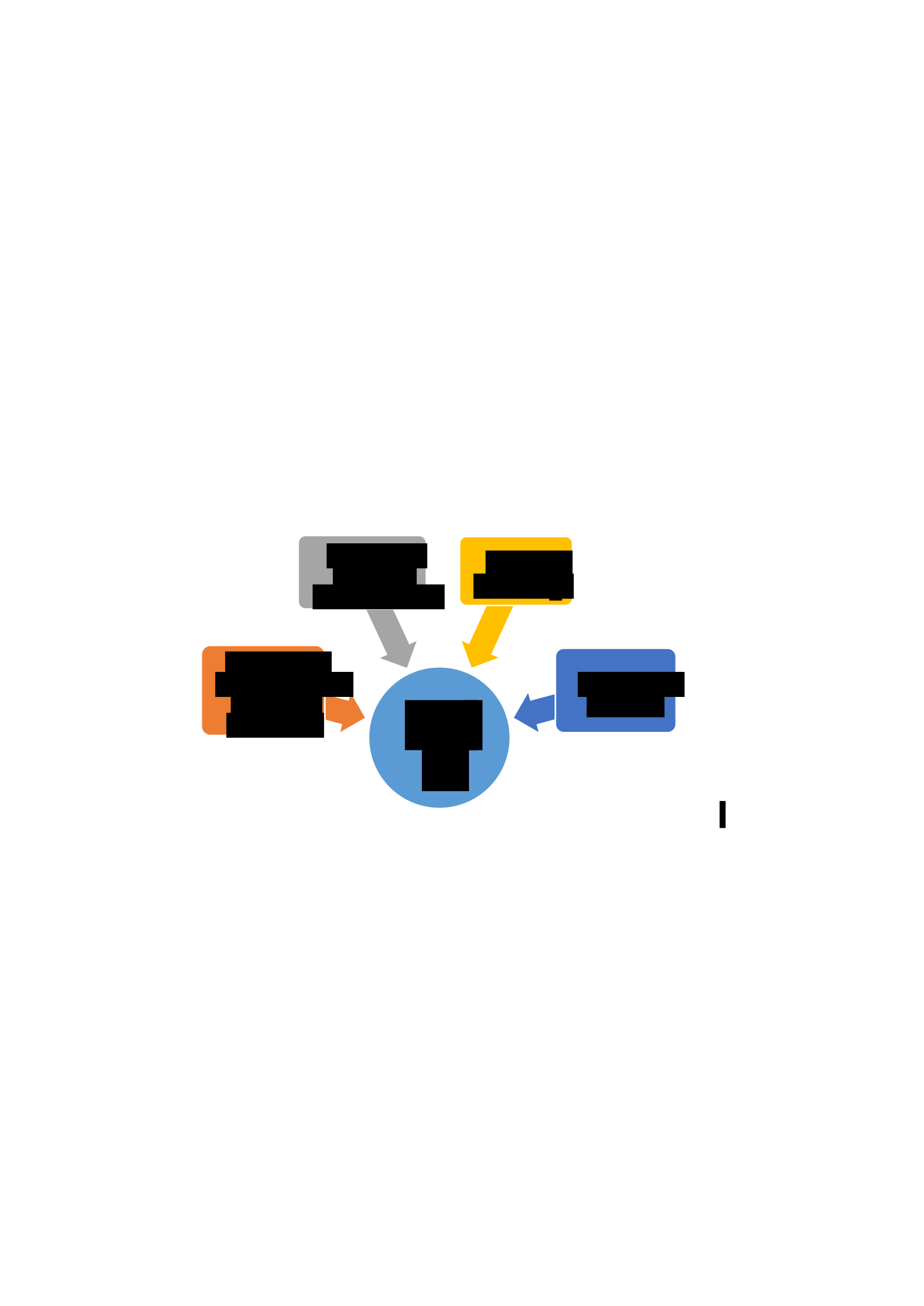
other changes were totally unexpected (Figure 5.4). They came in the form of a crisis that hit
the organization in the middle of the night, with no warning signs or alarms, just like the
COVID-19 pandemic and the US-China trade wars. In Figure 5.4, the four major changes or
crisis are represented as: corporate leadership and business strategies, market and internal
competitions, modern technology, and corporate identity.
Figure 5.4
Historical and Organizational Contexts of RSX-SZ
Corporate Leadership and Business Strategies
In June 2020, a new CEO and a new division head related to RSX-SZ’s business units
were appointed. The corporate leadership change subsequently brought about the changes in
the upper middle levels. It was under this context that Alex Smith (the fictitious name) was
promoted to the VP-Global Manufacturing position in September 2020, and Joseph Chen (the
fictitious name) for was promoted as the new Plant Director (PD) in October 2020.
RSX
-
SZ
Corporate
leadership &
business
strategies
Market &
internal
competitions
Modern
technolog
y
Corporate
identity

Market and Internal Competitions
According to a DH, though RSX-SZ is located in China, the company had not been
able to penetrate into the local markets for various reasons (local competition and intellectual
property consideration). As a result, the SZ site has depended very much on Europe, Middle
East, and USA markets for revenue generation. The US-China trade wars and US bans on
supplying high-technology products to China have directly impacted their business as well as
their supply of semiconductors. In the past two years, RSX-SZ lost all their US-based
customers. Fortunately, they had somehow managed the downtime in 2019–2020, and they
were still able to generate good business results and some profit margins. Moreover, RSX-SZ
had gained new momentum after the relocation because the COVID-19 pandemic had
brought to them new business opportunities. Other RSX manufacturing sites had been
impacted by COVID-19, whereas SZ Site could still operate at its highest efficiency.
The SZ Site was only the manufacturing operation for RSX in the APAC region,
without any local market shares or revenues. According to some DHs, in view of the
transportation costs and other political factors (that is, to avoid USA-China trade war), the
company might consider moving its operations to other more stable and less costly locations
if RSX-SZ loses its competitive edge. The RSX-SZ’s counterpart in India had grown rapidly
and they had a global top executive relocate to India last year. So, RSX-SZ had huge pressure
to compete both in the external markets as well as internally, with their competitive edge in
performance and quality as well as profit margin and innovation.

Modern Technology
Technological changes had impacted RSX-SZ, according to the Operation Director.
The products that they produce for their customers might become obsolete when modern
technology is applied to replace their products. RSX-SZ was under intense pressure to
advance in their innovation and technology so that they could substitute those obsolete
products with more advanced products.
Corporate Identity
Last but not the least, there was a change in the company’s identity. Based on my
observation at the site and conversations with the top management and the MMs, the role of
RSX-SZ had changed from being the top site among all the global facilities to being the
model site exporting their best practices and expertise to the other global facilities. In the past
year the company had moved some of their equipment and huge machines to Europe, India,
and other locations. When those sites had encountered technical problems in operating those
machines, they came back to RSX-SZ for advice and solutions. The change of leadership had
brought about the change of corporate identity for the organization as the model site for the
global manufacturing of RSX.
Processes of Leading Organizational Changes and Practices of the MMs
The top management of RSX-SZ frequently stressed that the critical success factors

were customer centric, processes, systems, cost control, quality assurance, and innovation.
The organizational changes at the macro level were “given” to the leaders of RSX-SZ, that is,
the changes were beyond their control. The organization could only respond to those
macro-level changes with processes to adapt and to compete. Now I will describe those
processes related to the organizational change and analyze how the MMs were affected by
those processes and how they adapted to and managed those processes with their leadership
practices (see Figure 5.5). Based on my observation there were four processes that the MMs
Figure 5.5
Processes of Leading Organizational Change
•The process of being customer-centric as response to
market changes •The process of enhancing
operational effectiveness
O through problem solving
•The process of enhancing performance excellence
C through continuous improvement and learning
•The process of enhancing communication and coordination
with the top management, other departments, and team
members
were engaged in leading organizational changes: the process of being customer-centric as
response to market changes, the process of enhancing operational effectiveness through
problem solving, the process of enhancing performance excellence through continuous

improvement and learning, and the process of enhancing communication and coordination
with the top management, other departments, and team members.
The Process of Being Customer-Centric as Response to Market Changes
The top management of RSX-SZ often emphasized that to respond to the challenges in
the business environment, they had to become customer centric and to retain the valuable
customers with highest quality and innovation instead of just competing in price and cost
control. At RSX-SZ, the “vision” of an Operation department was “Customer Centric—
Through improving our service levels, while continuing to drive competitiveness.” To
achieve that vision, the department focused on “reducing the transaction costs, inventory, and
obsolescence; productivity/wastage, 5% below standard; customer satisfaction, 90% & 98%.”
Being customer centric according to the PD was less about low costs; instead, it was
more about innovation of product and technology, process, production and operation
efficiency, and continuous improvement of quality. Being customer centric at the MM level,
based on my observation of the MMs’ reports and conversations, was often related to catering
to the product specifications and requirements as well as managing customer complaints
efficiently and responsibly. To gain the buy-in from the customers, the MMs needed to
provide solid evidence and data to support their recommendations or solutions. The MMs
needed to work with customers, corporate office personnel (Preproduction and Quality), top
management, other departments, and direct team members to define the customer
requirements or quality complaints, explore solutions, decide on the options, influence the top

management, corporate personnel, the customers, and other stake holders, and then execute
the production plan or complaint solutions.
The Tale of Two Million Defective Chips. On the first day of my ethnographic study I
heard about the big technical problem related to a certain semiconductor chip in a product for
a VIP customer, which could cost the company millions of dollars if the defect issue was not
resolved. According to the Operation Director, the customer applied a different quality
standard to examine the quality of the semiconductor which was much higher than the usual
standard that RSX-SZ was using in the past for their particular product. RSX-SZ could not
object to the customer’s unexpected and unreasonable change of much higher standard. The
Operation Director along with the QPP Team, were working to prove their case to the
corporate office and the customer, in order to avoid a huge loss (they might have to discard
the two million units of expensive component as wastage if such high standard was applied to
test their quality).
It was in the War Room where the concerned teams and technical experts were working
together to identify the problems and to find the solutions as a cross-functional team or task
force. The War Room was meant to be the place for problem solving, communication, and
coordination. I sat at the War Room one day, where the operation and quality teams were
tackling a technical problem related to a product which was rejected by a VIP customer. They
were trying to examine the defects and identify the root causes of the problem. They even
used X-ray to analyze the defects and explored different options to estimate the acceptance

level of the batch of chips in stock. The two teams were debating and challenging each other
about the methodology and results. Then, Judy, as the QPP leader, made the decision with the
team’s consent on how to tackle the problem and set the standards of quality assurance.
The Operation Director and the QPP Director were struggling with the quality problem
for several weeks and finally came up with an acceptable quality standard, and testing
methods were applied to ensure the quality demanded by the VIP customer. When the data
results came back after numerous testing, they confirmed their decision on whether the batch
could be accepted, and whether the defects were acceptable or not. Judy communicated with
the top management and, most importantly, the customer about their solution and
recommendation. The customer was satisfied with their recommendations. The case was
closed, and the VIP customer was retained.
The Process of Enhancing Operational Effectiveness Through Problem Solving
RSX-SZ used a lot of metrics to monitor their production and operations. They printed
standardized notebooks to record data, problems, comments, and actions. There were
dashboards and charts summarizing their output, wastage, downtime, and other metrics
surrounding them at the meeting rooms or cubicles. They also used a standardized
PowerPoint format to present their performance with highlights, lowlights, strengths,
improvements, and actions in one or two slides. They had daily or weekly team briefing
meetings to report progress, identify problems, and find solutions as quickly as possible. The

purpose of the teams was very clear in those meetings: “Process and quality improvement for
performance excellence.” The process and quality improvement for performance excellence
at RSX-SX as I observed was mainly achieved by effective problem solving and continuous
improvement.
My ethnographic study revealed that the top and the middle management at RSX-SZ
used the collective leadership in their problem-solving processes. For instance, I followed
Judy to attend a meeting called by Joseph, the PD. In the meeting, Joseph wanted both David
(the Operation Director) and Judy to help him explore solutions for the wastage challenge.
Apparently, the corporate office has continued to raise the bar to reduce wastage targets year
after year. The new wastage target (5%) seemed like a mission impossible to
RSX-SZ because one big problem was the low volume orders, and they would definitely
incur higher wastage than the target. Judy and David were highlighting some of the key
issues and making some recommendations to Joseph for his consideration. Joseph listened
and asked some questions to clarify the issues and their proposed solutions. The PD and the
two DHs were very engaged in the discussion and took ownership of the problem and tried to
find the solution together. Joseph seemed to be relying on Judy and David to give him the
workable solutions. Both DHs were able to respond to the challenge of execution. They were
able to dialogue and solve the problem together as a team. It was the first time that I
witnessed the PD and the two DHs working together to solve a problem. I also sensed the
leadership moment in the meeting.

It was intriguing to me that in the above instance they never questioned the rationale
behind such target, that is, whether it was reasonable and achievable; they just went on to
solve the problem with any possible solutions. There was no question asked about the policy
itself! They did not consider the option of negotiating with the corporate office about special
provision for the low volume wastage target. The MMs in responding to corporate policies or
targets seemed to be submission and problem solving only. To the local top management and
the MMs, the corporate policies or targets seemed to be nonnegotiable. Submission to
corporate policies and commitment to problem solving could be distinctive in the Chinese
culture as well as in the organizational culture of RSX-SZ.
On another occasion, Joseph, Judy, David, together with the process engineer, the
printing operation manager, and the quality assurance supervisor, were meeting to tackle a
customer complaint about the printing quality of a certain product. Judy was facilitating the
meeting: (a) she first tried to identify the problem, (b) she went on to analyze the possible
causes of the problem, (c) she led the team to explore possible solutions, and (d) she
summarized the investigation and solution management process with an Ishikawa diagram
(fish bone diagram). Joseph commented about the solutions briefly and recommended the
printing operation manager to trace back those stocks which were produced around the same
time as the batch that was complained about by the customer. The team agreed on the action
plan and the meeting was adjourned.
I was surprised by the fact that throughout the meeting no question was asked about

why the problem occurred and who should be responsible or blamed for the problem.
Everybody was focused on finding the solution together. Being solution-focused and adapting
a no blaming approach perhaps seemed to be an important leadership practice in problem
solving at RSX-SZ.
This no blaming practice was confirmed by the Preproduction Director, Ryan. He told
me about a technical problem at the design stage in which one engineer of his team
overlooked a certain specification of the customer, but that specification was never mentioned
clearly in the specification document. The company had the corporate office involved in
verifying the designs and specification, but no one detected the problem in the preproduction
process. Finally, the design problem came out and the cause of the problem was identified.
Though the junior engineer was at fault, he was not blamed on the problem solely because all
other levels of the preproduction team were involved in the verification of the designs. At the
end, no one was blamed.
However, Ryan told me that if someone had to take the blame, as the DH of the
Preproduction Team, he was willing to take the blame to protect his team members.
On the
other hand, Ryan asserted that he negotiated with the concerned departments and corporate
people to defend his team when they should not take the responsibility or the blame. I had
seen him do that at the management team meeting.
Problem solving could be the beginning of leading change because something wrong

had happened in the production processes, and it needed to be resolved and changed. After
the problem was fixed, the organization usually did the post-mortem to understand more
about the underlying causes that had brought about the problem. It was not just about being
solution-focused; it was about the continuous improvement and learning work that the MMs
were required to do. I will turn to this important process in the next section.
The Process of Enhancing Performance Excellence Through Continuous Improvement
and Learning
While some organizational changes such as outsourcing, off-shoring, and digitalization,
require drastic actions and fast adaptation to the new; many companies like RSX-SZ
preferred continuous improvement and incremental changes to avoid the over-reaction or
resistance from the impacted staff and stakeholders. They wanted to improve the quality and
process of their operations through continuous improvement and learning.
RSX-SZ had a 12-member Continuous Improvement (CI) team to look into different
ways to improve the processes, systems, and facility management while the operation and
production teams continue to go about conducting their day-to-day business. The CI team
worked with the frontline workers and managers to understand their issues, to analyze the
problems, and to explore better ways or systems (hardware or software). It was about
incremental change and improvement.
Leading continuous improvement at RSX-SZ often started with a small step with a
small group of people involved in the pilot project. Then they put the change into full
implementation. The process of continuous improvement might work better with small

change plus good feedback and implementation strategy. MMs could act as facilitators or
experimenters to try out the new ways of working, and to give their feedback to the CI team.
When the CI team was presenting their new ideas to the management team, the MMs were
usually very receptive to their proposals, but they could also voice out their concerns and
opinions in open and constructive manners. I seldom saw the MMs resist continuous
improvement projects. That might be attributed to the corporate culture of “Curious,” which
implied innovation, continuous improvement, and learning among all leaders and team
members.
For instance, in the first two months of my study, I observed that the CI team was
testing an elevation platform to put on the desk of the managers for ergonomics and wellness
reasons. The device could enable the managers or professional staffs to stand up while
working with their notebooks and monitors. They first assigned four managers to test out the
new device and to give feedback to the CI team before they decided for full implementation. I
also had one device on my desk after the initial testing. I did not use it for standing up while
working, but I found it useful to have my monitor raised at my eye level with the device.
Other DHs who had the devices installed eventually got used to standing up posture while
they were working at their cubicles. Changing employees’ working posture was in fact a BIG
CHANGE!
On the other hand, the Quality Assurance (QA) team under the QPP department was
responsible to deal with customer complaints, investigate the quality problems, recommend

solutions to deal with the problems, and improve the processes and systems whenever
necessary. They did not just want to solve the quality problems; instead, they wanted to build
a culture of beliefs and practices among the whole organization. At a QA team meeting, I
observed that the team was talking about implementing the P-FMEA (Process-Failure Mode
and Effects Analysis), which is a quality assurance process introduced by the automobile
industry in recent years, and many manufacturing companies started to use the same process
and standards to do QA work. At RSX-SZ the management wanted to rely on the process and
system to monitor the production and to make necessary corrective actions whenever a
quality problem occurs. The quality manager told his team at the team meeting, “It is not just
a method, but most importantly a belief about performance excellence. It is not just an
individual’s work, but the work of the whole organization.”
To put being “curious” as a corporate value into practice, Joseph pushed numerous
learning and development programs in the first six months. He had allocated over one million
RMB for training and development purpose in 2021. Joseph sent the DHs and other middle
managers to attend conferences and exhibitions so that they could be exposed to the new
business trends and technologies instead of just looking at themselves and being complacent.
The DHs were receptive to the new training initiatives, and they participated in those
trainings as much as they could. They also encouraged their middle managers and team

members to join those trainings for development and retention reasons. All the staff had felt
the difference because they had never joined so many trainings before.
The Tale of Lean Sigma. RSX-SZ applied the Lean Sigma methodology to improve
their operations. More importantly, they wanted to foster a new set of beliefs and practices
among their leaders, managers, and operational staff in continuous improvement and
learning. RSX-SZ adapted the Lean Sigma methodology in developing that new culture. The
company hired a process consultant to conduct seven days of Lean Sigma training for all the
DHs, managers, engineers, and supervisors. That was a huge commitment and investment
from the company in terms of training fee and managerial time. After the training, the
participants of the Lean Sigma training formed five project teams based on their different
lines of work, to apply the Six Sigma concepts and methods, to study their various processes,
and to recommend improvements. Judy was facilitating the project teams to guide them in
applying the Six Sigma concepts and methods.
In July, I attended the presentation and coaching sessions of four of those project
teams. The Lean Sigma consultant was invited to hear the presentations and to give feedback
to the project teams. The project team members were mostly N-3 or N-4 supervisors and
engineers. They firstly presented the problems that they sought to solve. Then they explained
the Six Sigma tools that they applied to analyze the problems and why they had chosen those
tools. Finally, they summarized their findings based on the data collected and gave their

recommendation for sustained improvements. The consultant gave his feedback and
suggestions to the project teams to improve on their concepts, methods, and even presentation
skills. Judy also supplemented with her observations and professional input. The project
teams were stimulated and inspired to learn and apply the new knowledge to their work. As
observed, they were much more encouraged when they found that their analysis and
recommendation were valid and useful for problem solving and continuous improvement.
They also seemed to appreciate the company’s effort in training and developing them
professionally while trying to improve on the processes and systems of the plant.
I could see the leadership moment when two project teams were presenting their
findings and recommendations. Both teams were trying to tackle some quality problems in
two different processes of the production line. They applied different Six Sigma methods to
analyze the data collected in the past 12 months. They identified the possible causes of the
problems with scientific evidence. However, the project teams were not confident to present
their solutions because they were afraid that they might be wrong. The QPP Director gave her
approval to their recommendations and guided them in how to present their analysis and
recommendations to the management. The process consultant, after hearing their
presentation, affirmed their effort and result by saying, “That is a black belt project!” In fact,
they were just passing their green belt, the elementary level of Lean Sigma training.
Continuous improvement and learning were essential processes that the organization
was using in managing challenges from organizational changes in the business environment

and internal organization structures. Those processes were mainly focused on operational and
technical matters. Managing organizational change with people, leadership change at the top
management and personnel change at the lower levels could be totally different matters,
which require different processes and practices. Enhancing communication and coordination
with the top management, other departments, and team members was another important
process that I observed at RSX-SZ in managing organizational change and operational issues.
The Process of Enhancing Communication and Coordination With the Top Management,
Other Departments, and Team Members
At the company and department levels the MMs were always faced with the challenges
of customer demands, team integration, motivation for performance breakthrough, and
retention of team members under the organizational changes. While there were many things
that they could not change, the MMs could still communicate and coordinate their business
tasks and targets with the top management, other departments, and their teams, to achieve
their operational objectives.
The DHs at RSX-SZ did a lot of communication and coordination work with the top
management, other departments, and their teams. The daily management team Briefing and
department briefings at different floors were all meant for communication and coordination
purposes. In the shadowing exercise, I could see, during the normal week, both DHs were
trying to communicate and coordinate with other departments to solve different problems and
to manage different projects. In some of those days, they literally had back-to-back meetings

throughout the day with other departments, their superior, and direct reports. They always
talked about some important measures and data analysis. They might highlight what
problems they were facing, but they never spent much time discussing about those problems
or brainstorming solutions together as a management team; they just let the experts do the job
and find the solutions off-line.
With Top Management. The PD is the chairman of the management team meeting. He
relies on the DHs to report to him and the rest of the team about key issues happening in their
departments. For instance, at a management team meeting, Joseph told the DHs, “If you have
sensed any risk in the production process, you need to tell me, because if you do not, I will
not know, whereas Alex could have known about those risks as soon as it happened.”
Therefore, I noticed that at the management team meetings the DHs tried to inform Joseph
about operational and personnel issues proactively and supported Joseph in his management
of the company. The DHs also met with Joseph very frequently on a one-on-one basis or in a
small group, to deal with more complicated issues in the afternoon.
In the transition of the Operation department and the QPP department, the two DHs
needed to depend on the ex-leader (the new PD) to coach their new team members or, if
necessary, handle those technical problems for them. They seemed to recognize that it was
part of the communication and coordination process during leadership transition. They kept
close communication with their direct reports, particularly the middle managers (N-2) and the
team supervisors. They also worked side-by-side with Joseph whenever he was dealing with

those operational or technical matters with their teams. They proactively informed Joseph
about risks in operations and people management.
With Other Departments. The process of communication and coordination with other
departments among cross-functional meetings or operational teams requires taking ownership
of the problem that they needed to solve together, or the purposes of the cross-functional
team and the operational teams. Then, they contributed their knowledge, experience, and
perspectives based on their background and roles in the organization, to achieve the purpose
together as a team. Based on my observation at the cross-functional teams and the operational
teams the DHs in those meetings were listening carefully, facilitating discussion, clarifying
the problems, confronting issues or discrepancies, resolving differences, drawing consensus
for problem solving or decisions, and summarizing for follow up actions. In a nutshell, they
tried to provide feedback and to collaborate with other departments.
For instance, the QPP Director, Judy, had been involved in a few cross-functional
teams, and she attended those task force meetings in the afternoon. One of them was the
Escalation Process meeting. The Escalation Process Team consisted of members from HR,
Quality, and other departments; Judy was the most senior staff in the team. The conveners
were presenting on their proposed process at the RSX-SZ site based on the corporate office
guidelines. However, Judy did not agree to their proposal. She pointed out the problem with it
by drawing a diagram on the white board about the normal escalation process at RSX-SZ. She
then quickly recommended some modifications of their proposal to align the corporate

guidelines with the actual situation of the RSX-SZ. The team agreed, and they revised the
proposal and present to the management team later. In cross-functional teams, very often the
senior executives usually play the supportive role and let the team do the work, and they just
give some general feedback or comment. Judy was different; she did let the facilitator lead
the discussion, but when she saw a problem with their proposal, she did not hesitate to
intervene and point out the problem.
With Team Members. In leading organizational change, how to gain the acceptance of
their leadership and their buy-in of the team members towards change, communication and
coordination with team members often became more complicated than the MMs could have
anticipated. For instance, when the Finance department of RSX-SZ tried to replace the
manual and routine accounting work with artificial intelligence, some of the finance team
members were resisting the change. Though the CFO-North Asia, Wendy, tried to explain to
them about the advantages of the digitalization, from business perspective as well as from
their career development perspective (that is, they could focus on more advance and
professional accounting work), the impacted employees did not accept the change for job
security or other reasons. Some of them might be afraid of change and learning itself, having
been very stable in their existing jobs. In contrast, the operational and technical staff seemed
to be more receptive to technological changes because they were very much involved in the
technical processes, and they knew very well that technology and digitalization impacted on

their works and careers. Finance and accounting staff, on the other hand, were too used to the
traditional manual transactions. They were lacking the mindset to accept and manage
technological changes.
Some of the DHs needed to motivate and coach the teams for performance
breakthrough and team building purposes. Others might need to establish their leadership and
authority among the new team members when they had just taken up some new roles and
responsibilities. For instance, during the daily briefing in the initial months after the
leadership change, David mainly listened and followed the conversations between Joseph and
his team members. When Joseph did not show up at the briefing meetings, David took the
initiative to chair the meeting. He listened and asked questions, but he did not give many
directives to the teams because he realized that he was still learning about the processes, and
he needed to depend on the team leaders to handle some of those issues. He also had
one-on-one sessions with his engineers and coached them on their technical tasks and
projects.
Likewise, Judy empowered the process and product teams to handle the technical
issues. She accepted the fact that Joseph was their ex-supervisor and thus the teams could
consult him about technical issues, which she could not resolve for them. She only expected
the teams to inform her about those issues so she could know how to respond when the
corporate office should enquire her about those issues. She clarified her expectations to her
team at a team briefing during my shadowing exercise in July. In the meantime, Judy

demonstrated her strengths in quality assurance and management, and she knew how to
communicate with the corporate office about those technical issues better than the technical
engineers.
Moreover, at the department meeting where all her team members were present, Judy
pointed out that there were challenges for the new integrated team to have trust on her and
other members. To build a trusted relationship she made an open appeal to the team to work
and communicate together. She promised that she would do her best to help the team grow
and perform better. At the end of the meeting she said, “It is a two-way traffic; I cannot do it
alone without your support.” I sat with the technical team, and I saw that they were thinking
and reflecting seriously. Later, when I was shadowing Judy during the week, I saw that the
atmosphere at the briefing with the team leaders was very pleasant (that is, they could freely
talk and laugh during the meeting). Apparently, Judy’s communicating with her team openly
and honestly had paid off well.
The Tale of Tea Reception. Some organizational changes or new initiatives failed
miserably because of the lack of ownership, communication, and coordination. In the case of
tea reception, Joseph felt that the pantry and common area had been underused, whereas the
staff in general office felt reluctant to stay in the common area to talk and relax (it is right in
front of the top executives’ offices). He wanted to foster a more relaxed and friendly working
environment at the office. So, together with the HR department, Joseph organized a monthly
after lunch “tea reception” on the last Friday of the month. He even approved a generous

budget to prepare food and drinks so people could come together to enjoy and chat.
On that day when the first tea reception was organized, I came back to the research site
just to attend this milestone event of RSX-SZ. The snacks and drinks were very good. Joseph
was very excited, walking around the common area to make sure that things were well
prepared and presented. However, only those staff on the second floor (the general office)
were informed about the party, and the other staff on the first floor, third floor, and fourth
floor did not know anything about the event. Moreover, people on the second floor just came
to the pantry, grabbed the food, and went back to their cubicles to eat without hanging around
at the pantry and common area for casual chats. There were no speeches by Joseph or the HR
Manager to promote the event and to explain the purpose of the event. Last, but not the least,
they ordered fruit punch as drinks, but the taps of the bottles were jammed by the fruits so
that people could not get the drinks. After 10 minutes, all the people disappeared from the
pantry, and it was all quiet again. Joseph looked rather disappointed.
I was thinking that a good wedding or event planner could do a better communication
and coordination job than the HR Manager, who was in charge of the event (even the HR
Manager did not show up at the event himself; it was another HR Manager who filled in the
leadership vacuum and tried to fix things). After all, visioning, communicating, and
implementing are all important steps in leading change—even a small change!
On August 30, I attended the August tea reception, and it was a great success. People

were gathering to enjoy the food and drinks as well as the conversations around the common
area. Interesting enough, it was the new HR team who was organizing the event and they had
done a great job despite the fact that the HR Director was on leave and Joseph became the
acting HRD. The tea reception was supposed to start at 2:00 p.m., but the organizing HR team
(four people) were at the pantry area setting up the food and drinks from much
before-hand. They even prepared a small amplifier to play some background music during the
reception. Music made a big difference in creating a warm and friendly atmosphere. I did not
know who was in charge of the event, but at least I felt that the whole team was leading and
taking ownership of the event. There was a leadership moment at the tea reception.
The tea reception event reflected the need for MMs to have good communication and
coordination as a leadership practice with their top management, their peer managers of other
departments, and their team members. Personnel changes might not be so bad after all.
Moreover, initial failure is not a problem, if only if the organization could learn and improve.
The processes of leading organizational change involved macro and micro changes,
which required MMs to be customer-centric, to enhance their teams in problem solving,
learning, and continuous improvement, and to communicate effectively with the stakeholders
before, during, and after the change. In the next section I will explore processes of managing
leadership change and practices of middle managers.
Processes of Managing Leadership Change and Practices of the MMs
At the meso level the relocation and integration of the three sites did not bring about a

massive reorganization of the departments and teams; it was the leadership change that had
triggered the reorganization of the roles of the DHs and the teams, according to the top
leaders. After the integration and reorganization of the departments in October 2020 some
DHs needed to take over other operations and to supervise new teams whom they had not
worked with before, because of their different background and specialization in the plant
operations. Both David and Judy had inherited new team members into their departments.
Those team members reported to Joseph before he was promoted to the PD position.
Moreover, under the organization change the concerned DHs needed to manage the
relationship with their new top management and to rebuild their relationships with the new
and old team members (Figure 5.6). As described in Figure 5.6, the top leaders could
influence the organizations based on where they came from with their values, perceptions,
expectations, and personalities. MMs could carry cultural paradigms and personal perceptions
to look at their new leadership and the new corporate culture. Organizational change at the
top and below involved both managing up and managing down by the MMs; the MMs were
caught in the middle between the top management and their team members. During
leadership and team transitions, the MMs faced the challenges of team building, and
sometimes unexpected staff turnover, which they could not have any control over.
Figure 5.6
Organizational Change at the Top and Below

Leadership change brought about the processes of managing leadership transition,
adapting to the new leadership style of the new PD, and managing cultural change as a result
of leadership change (see Figure 5.7). Those processes were triggered interactively and
perhaps reflexively as described in Figure 5.7 among the top leaders and the MMs concerned.
Figure 5.7
Processes of Managing Leadership Change
•The process of managing leadership transition as a
L result of leadership change
•The process of adapting to the new leadership style of the new PD
C •The process of managing cultural change as a result of
leadership change
Team Members
& new
plu
s
The
Middle
Manager
Top
Management
&

The Process of Managing Leadership Transition as a Result of Leadership Change
There is a Chinese saying, “Touching one stone at a time while crossing the river.”
While the future path is uncertain, the person who seeks to cross the river should explore the
path one step at a time. That principle could be aptly applied to managing leadership
transition as a result of leadership change and team reorganization.
To gain the acceptance and recognition from the DHs as their new leader, Joseph, told
me that he had deliberately given the DHs much autonomy to run their departments because
he realized that he could never act like Alex who knew every operation inside-out. He needed
the whole management team to support him to lead the operations of RSX-SZ. The DHs
seemed to respond positively to Joseph’s showing of his humility and vulnerability by giving
him their full support and informing him about various issues in the plant.
David, in turn, began to chair the briefing meetings when Joseph was not present
during April to July. By the end of August, David had officially taken over all the operational
teams in the three floors. Likewise, Judy needed to accept the fact that the technical teams
were dealing with Joseph directly about their technical problems even though she was
supposed to be their direct supervisor. She realized that she could not solve those technical
problems with Joseph’s and David’s expertise. On the other hand, she stressed to her
technical teams that they should at least inform her about those important issues lest she
appeared to be ignorant about those issues at the corporate quality team meetings.
As time went by the team members were getting used to the fact that the DHs were

their new leaders and they had begun to take the lead. For instance, one N-2 team leader told
me that in the beginning he was not happy about the reorganization of the QPP department
and having Judy as his new supervisor. After a few months, he realized that the leadership
change would continue regardless of how he felt about it. Therefore, he started to
communicate with the new leader more openly and directly, to sort out the problems and
differences. Mentally, he tried to think more positively about the change and manage his own
career under the new leadership. He also mentioned to me that the communication between
the new DH and him was important and useful to bridge the gap of understanding and
relationship during transition. So, both the leader and the team members needed to understand
and adapt to each other.
For the top management and the MMs in managing leadership change, they needed to
be flexible and fluid in transition management, particularly during leadership transition at the
top. The integration and reorganization of teams had brought about team building issues and
resistance among some team members. Some of the DHs told me that they needed to learn
and adjust to the many challenges during leadership transition in their respective teams. In the
initial months of the integration, both DHs experienced the storming behaviors among some
team members, and the leaders needed to deal with the challenges posed by those members.
For example, some managers (N-2) were upset about their new DH because the DH did
not have strong technical background about their line of products; they felt like they were
following a general who did not know how to fight the battle with them, and the general did

not know how to manage the people either. Other middle managers of another department did
not want their new DH to rock the boat, that is, changing their old ways of doing things in
their units which were beneficial to them. Some of the N-2 managers and N-3 engineers
might still go directly to Alex and Joseph about some technical issues because they were most
familiar with those matters.
The DHs needed to lead and manage the new teams, and deal with any resistance to
their new leadership among some team members. They seemed to understand that the two
extremes of commanding or pacifying them were not effective to establish their authority and
leadership. According to David and Judy, they profoundly realized that they needed to be
patient and sometimes tolerate resistance from the new team members. For instance, Judy
told me that some of the N-3 staff refused to talk to her about certain technical issues and
they insisted that she should ask the N-2 managers. Initially, she felt that they were
disrespecting her and rejecting her. Later, she had the opportunity to check with the N-2
manager concerned and she realized that the N-3 engineer was only being direct with her
because he really did not have any idea what those issues were all about. Moreover, it was his
usual communication style to respond to questions that he did not have an answer to; it was
not meant to be personal or disrespectful towards her. Judy eventually learned that during
leadership and team transitions she needed to communicate with her team more openly and
check her own assumptions about people and their reactions towards her as their new leader.

The Process of Adapting to the New Leadership Style of the New PD
The leadership change at the top level could imply the need for adjustment to the new
leadership style and organizational culture brought about by the new leaders. Managing up
became a challenge because most of the B5+1 had worked with Alex as PD for over 8–20
years. While Alex was a very demanding boss according to the DHs, the B5+1 had adapted to
his management style, and they seemed to like working under him. Some of the DHs thought
that Alex was direct and fair to them. Joseph, on the other hand, had been their peer before.
One DH was Joseph’s boss when he first joined the company. It was observed that Joseph had
kept a distance with the B5+1 even before his promotion. For instance, I never saw Joseph sit
with the B5+1 during lunch, whereas he set with other N-2 or N-3 managers and engineers.
Some DHs confirmed the above observation. They reckoned that probably Joseph was
anticipating taking on the leadership role and thus he deliberately maintained a relatively
distant professional relationship with the B5+1.
According to my observation and conversation with the DHs, most of them were very
much at the wait-and-see mode to adjust to the new leadership style of the PD. They had felt
that the leadership change had also brought about cultural changes at RSX-SZ. As they had
been used to working under Alex’s relatively dominant leadership style, they had no issues in
following Joseph’s instructions and supporting him in his new initiatives of cultural change.
While Joseph tried to apply a more open and participative leadership style, the DHs were still
trying to understand what he wanted to do and how they could work with him as their new

boss.
Some of the DHs expressed that Joseph was less demanding at the management team
meeting compared to Alex, who usually confronted them with all kinds of questions,
expected an immediate response, and demanded very detailed information. They were saying
that in the past the management team meeting could last until 1 p.m. and they could not have
lunch. Joseph, in contrast, was gentler with them and they felt more relaxed at the
management team meetings now. For sure, I had not seen any direct disagreement, not to
mention confrontation, between the DHs and Joseph in the different interaction settings. One
DH told me that she had a different view about some personnel arrangement from Joseph’s
suggestion. She expressed her opinion, but she finally complied to Joseph’s decision about
the final team arrangement. “After all, Joseph is the PD,” she said. In the private and public
dialogues with the top management and their team members, the DHs were careful to
acknowledge the new top leadership and to show their respect to the new PD.
After eight months of leadership change and organizational change, the DHs were
comfortable about the new leadership style of the new PD when I asked them about their
feelings towards Joseph. They were mostly supportive of Joseph’s decisions about operations,
budgeting, and people management issues. However, according to most of the DHs
interviewed, the pressure to deliver performance and quality was no less than in Alex’s time.
Instead, with Alex being the VP-Global Manufacturing, the DHs sometimes felt stressful in

dealing with the tasks and targets imposed by the corporate office under the policy of
improving performance and efficiency.
The Tale of the Two Top Leaders. RSX-SZ’s top management (the VP and the PD)
used to be represented by the expatriate executives, who worked in the HQ, regional offices,
or local sites. In the history of RSX-SZ, the top executives had been predominantly
Europeans. Joseph Chen was the first Chinese PD in the RSX organization. Many MNCs
operating in China could have their corporate culture and values on paper but the actual
organizational cultures of the local sites are shaped by the local ethnic cultures as well as the
local top management. Therefore, it was both leadership change and cultural change to the
organization.
The promotion of the PD was announced in October 2020 at RSX-SZ, but the
leadership transition in terms of role change and team reorganization had extended until April
and the final handover of some departments happened only in June and July 2021. It had been
a gradual process which lasted for more than nine months.
During the initial period of leadership transition, Alex was still very much involved in
the RSX-SZ operation and business issues according to the PD and the DHs. Joseph was
acting as the DH for the Supply Chain department during Mary’s leave of absence until
March 2021. He was also managing the first floor and the third floor operations, while David
was busy tackling another major technical problem with a VIP customer in the beginning of
the leadership transition. By June 2021, both Alex and Joseph had gradually moved away

from their management roles in the departments and let the DHs lead the integrated teams.
Finally, one interesting observation was that the DHs usually referred to Alex as “the
Boss” whereas they called Joseph “Director Chen” or his whole name “Joseph Chen” as if
Joseph was still their peer. So, they were adapting to the new top management with two levels
(Alex and Joseph), whereas in the past the top management was only one person, Alex.
Physically, Alex was sitting next to Joseph. Joseph profoundly realized that Alex still had his
position power as well as personal power over the RSX-SZ business, operational, and
personnel matters. He had been careful to keep Alex involved and informed about major
issues at the plant and the changes that he intended to make in the organization. Alex had
made it very clear to Joseph that he supported Joseph’s initiatives of organizational change
only if RSX-SZ’s business results and performance were achieved above standard.
Psychologically, the DHs were still thinking that Alex was the Boss. Joseph seemed to
be more empowering and delegating in his relationship with the DHs, whereas Alex was
more autocratic, and he maintained an arm’s length with his direct reports. According to some
DHs, Alex might think that Joseph was trusting the DHs too much. Perhaps, that could be one
of the reasons that Joseph had maintained an arm’s length social distance with the DHs. On
the other hand, the DHs were careful to manage the two-level top management at RSX-SZ
and they needed to recognize both Alex and Joseph as their bosses with different levels of
trust and respect.

The Process of Managing Cultural Change as a Result of Leadership Change
The leadership change at RSX-SZ at the top level had brought about cultural changes.
While Joseph was careful in asserting his new leadership among the management team, he
was determined to rebuild the culture of the company. RSX-SZ had the five corporate values
printed in their office pillars and even on their company T-shirts: Trusted, Curious, Together,
Daring, and Caring. Joseph had expressed that he wanted to rebuild or emphasize the
organizational culture to build trust, care, and other corporate values “in practice instead of
just printed on the wall.” One of the cultural changes that he had already put into practice was
starting meetings on time. In the past, the ex-PD often started the meetings 15 minutes late
depending on his availability, and sometimes the meetings dragged on for more than an hour.
To build a trusted organization, Joseph focused on enhancing transparency and
communication. He did this in the following ways: he held monthly all management team
meetings (including all the N-1 and N-2 managers). After the first six months of operation, he
conducted a company-wide review and planning exercise. Each department needed to present
their H1 & H2 reports (Half 1 is the review of the first half of the year in terms of
performance, challenges, and actions ahead; Half 2 is the projection of the future with vision,
targets, and action plans). Joseph invited some DHs to attend the H1 & H2 meetings of
various departments to give their feedback and comments.
I was present at one of those H1 & H2 meetings. Joseph invited Judy to attend the H1
& H2 Review and Planning Meeting of an operation team, so she could give her feedback to

the team. Both Joseph and Judy were sitting at the head of the conference table while the
managers and supervisors of the operation team were sitting around the table. The two
managers were presenting their review and plan with the PowerPoint slides. Joseph invited
Judy to comment first. Judy showed her appreciation to the two managers for their good
work and reports. She then highlighted a few issues that she thought that the team could
continue to work on. Finally, Joseph gave his remarks, and he urged the team to think out of
the box in order to lead and excel in the particular operation, compared with other sites. He
said, “The future competencies of RSX-SZ is no longer be low cost; instead, the competitive
edge is efficiency and quality. India and Columbia sites are catching up fast, and thus the
Shenzhen Site must move faster and get better.” Joseph continued to present that vision for
change to the whole organization in the past several months since he had taken up the PD
role. While Joseph focused more on the visioning part, Judy emphasized the implementing
part by pinpointing certain process and quality or execution issues to the presenting team.
Different from the VP, who usually was the one who gave feedback and comments,
Joseph seemed to apply collective leadership in his strategic communication and coordination
processes. He involved other DHs to give comments or feedback to the reporting department
managers. In Judy’s case, that was an example of how the MM supported the top leader in
communication and coordination work.
Joseph wanted to strengthen the together and caring values of the company as staff
engagement and retention strategies. He requested that the HR department organized a tea-

reception in March after lunch so that staff might come together to chat and enjoy drinks and
snacks. Apart from the tea reception, Joseph also encouraged the staff to join different sports
clubs including soccer, badminton, yoga, dance, etc. He himself participated in the soccer
club and played soccer with the company’s soccer team on every Tuesday evening. The CFO
and the Supply Chain Director joined the dance class. I joined the badminton games in the
last few months as part of my immersion into the organization. Three of the Big Five joined
the badminton games as well, although they did not play regularly. At the game, all the staff
could enjoy playing and they were all equal without ranks during the game. I could see that
sport activities could really draw people together to enjoy the sport together. The DHs’
participation had helped in fostering their relationships with their team members and other
staff from other departments as well as in supporting the new PD’s cultural change.
In the above analysis I have described the processes of managing leadership transition,
adapting to the new leadership style of the new PD, and managing the cultural change
brought about by leadership change. Those processes involved more with the top
management and the DHs at the research site. In the next section, I will look at the MMs’
interactions and dialogues with the lower level staffs, particularly in the context of personnel
change and unexpected high staff turnover.
Processes of Managing Personnel Change and Practices of the MMs
The company did not lose many staff after the relocation because the new location was
only within 10 miles away from the old sites and the employees did not need to quit their jobs

to avoid long distance travel (the original new site was way up north of SZ). According to
Joseph, the integration of the teams in January 2021 only impacted less than 15 employees;
some were redeployed to other work units and only five were laid off because of the
integration. Staff engagement and retention did not seem to be a problem as they originally
had anticipated it in their relocation plan. The global staff engagement survey (Pulse Check)
conducted by RSX in early March 2021 also indicated that staff engagement of RSX-SZ was
very positive. However, reality indicated otherwise one month after the survey was done.
The company experienced high staff turnover after the Chinese New Year, largely
because the general trends in the market had improved and thus other companies were
headhunting their people. Moreover, the increment and the bonus of last year were only very
minimal (less than 3%). According to the DHs, the basic salaries of RSX-SZ had been below
the market rates and many employees could get over 30%–50% increments if they joined new
employers. Subsequently, the Finance department lost 10 staff out of 18 within several weeks
after the Chinese New Year. The whole Human Resources department (more than 10 staff)
except the HR Director had left the company in April to August. Other operational
departments had lost their headcounts as well. As of August 2021, it was estimated that RSX-
SZ, on average, lost two staff members per week! Apart from salary, some of the
leaving staff indicated that lack of promotion prospect and the management styles of their
supervisors were the main reasons for their disengagement with the company.
Ironically, the Pulse Check showed that 94% of the respondents indicated that they

would stay in the company in the next two years. I asked a HR manager before she left the
company about the discrepancy of the Pulse Check result and the actual turnover rate of the
staff after the survey. She told me that some managers required the respondents to fill in their
names on the Pulse Check questionnaire. Culturally, the Chinese workers, without the
assurance of confidentiality, only told the management what they wanted to hear. I was quite
surprised by such arrangement, which is not common among MNCs. I was wondering who
had authorized that practice: the top management, the HR Director, or the line managers.
Whoever authorized that probably had not practiced their corporate value of “Trusted” in the
Pulse Check surveying exercise. Nevertheless, the company had made deliberate effort to
attack the high staff turnover by the processes of recruitment and selection, staff retention and
engagement (Figure 5.8). As outlined in Figure 5.8, the MMs were working very hard with
the support of the HR department to recruit new staff and to retain new and existing
employees.
Figure 5.8
Processes of Managing Personnel Change
P • The process of recruitment and selection
C • The process of staff retention and engagement

The Process of Recruitment and Selection
To fill the vacant positions with new staff, the HR team had worked very hard and engaged
external recruiters to bring in the needed workers. At the management team briefing,
the HR Director or other HR representatives updated about the number of vacant positions
and the percentage of achievement in filling those positions with the right candidates. The
PD, HR Director, and some members of the Big 5 had regular HR meeting in the afternoon to
review the candidates and make selection decisions in the meeting.
I only had the opportunity to observe a DH attending the HR management meeting
once and, thus, I could not say much about the actual process and practice of the MMs in
their recruitment exercises. One of the selection criteria for managerial and professional staff
was English proficiency. A DH later expressed to me that with the low salaries that the
company offered to the candidates, they could hardly expect the candidates to have good
English proficiency. In China it is very rare for electrical engineers, graphic designers, or
even human resources professionals processing good English proficiency. Those who could
master English well are usually on high demand and, thus, expensive in their compensation
package. Nonetheless, RSX-SZ seemed to be able to fill in those vacant positions very
quickly. In the meantime, the company was trying to reduce headcounts across the board.
During the budgeting exercise in July, I observed that RSX-SZ adopted a
top-down and bottom up approach in budgeting of manpower. The corporate office had given

very strict directive of reduction of 10% manpower to streamline their operations. Moreover,
they had stipulated that once a staff had left the company, the new hire’s salary must not be
higher than the departed staff. Joseph instructed the DHs to work on the headcounts and
budgets of their departments based on the corporate directives and their business needs and
plans in the coming year, particularly the headcounts and the organization structures of their
departments. Consequently, the DHs had to mediate between the front-line managers and the
top management about headcounts and salary budgets.
For instance, during the shadowing exercise of a DH, a N-3 supervisor was
complaining about the reduction of headcount in his unit. He argued that he could not manage
the operation if there was any unexpected manpower shortage, e.g., sick leave or annual
leave. He was very angry with the management’s decision. After the meeting, the DH
concerned pulled the supervisor aside and talked to him gently and patiently to resolve the
conflict and to manage his negative emotions. The DH later told me that they could only
reduce the headcount and add more responsibilities to the remaining staff with some minimal
increase of salaries as incentives to take on more responsibilities. The DH needed to juggle
with policies, budgets, headcounts, salaries, workloads, and staff morale issues all the time.
Feeling very helpless and desperate, one DH said to me:
Our hands are tied, and we could only do so much with the limited budgets and
headcounts. I don’t know how to hold my team together any longer. All my experienced
engineers are leaving, and I couldn’t blame them because the new employers offered
them 50% more salaries!

The Process of Staff Retention and Engagement
To retain and to engage the team members, some DHs told me that they tried to teach
their team members new things, to coach them in their new roles, and to protect them from
any blaming or pressures from the corporate office or other departments. The CFO-North
Asia, for instance, was discussing with the Finance Director about how to deal with the
unexpected high staff turnover at the Finance Team. She literally went on to assign who
should mentor/coach each remaining staff and new staff. Likewise, when the Supply Chain
Director was coaching her N-2 manager about people issues at her subteam, the Director was
discussing with the manager how to coach her team based on their potential and performance.
On the other hand, they had to work with continuous shortage of manpower in their teams.
A N-3 engineer in the QPP department told me that he really appreciated that the new
DH had a one-on-one career coaching session with him. He said that his previous DH had
never done that before with him. After the career development discussion, he had a much
clearer idea about his career path and how he could develop himself further. The new DH
made a deliberate effort to have the career development conversations with her new team
members. That seemed to help not only the team transition but also staff engagement.
Perhaps, some of those DHs tended to focus too much on tasks and targets, so much so that
they neglected the need to have a serious and sincere career development coaching with their
direct reports, who might have longed for such an opportunity.

At the end of August, two other engineers in the QPP department resigned, nonetheless
despite the effort that Judy had made to rebuild the team and to engage the new team
members under her supervision. According to a person who understood the issue, the reason
was that those engineers felt that their supervisor was only blaming them for the problems,
rather than supporting and guiding them to solve the problems together. The DH concerned
might have to accept the reality that in the process of leadership and team transitions, no one
could guarantee the final outcome of who would stay and who would leave, for whatever
reasons. Staff engagement was always a two way traffic, and the chemistry factor could be
something that the MMs had no control over after all. As the CEO of my company, I could
certainly echo to that dilemma.
The Tale of Retaining and Engaging Nancy. A more in-depth example of this
retaining and engaging process was observed when the QPP Director, Judy, had to do
one-on-one coaching with a junior staff, Nancy (fictitious name), in the Quality Assurance
Team. Nancy was three levels down in the organizational hierarchy and she was assigned to
manage some of the tasks of the resigned supervisor. She had very little experience in
handling customer complaints. However, she did not have the knowledge and experience to
manage such challenging tasks because any mistakes could imply strong reactions from the
customers, which could bring about serious financial consequences.
According to Judy, the two supervisors above Nancy were not able to support and
coach Nancy, and thus she did not necessarily follow the accountability line in the

organization. Judy told me that she did not bother with the reactions of the two supervisors
because she felt that it was more important to retain and support Nancy. Otherwise, she could
lose Nancy and she could not afford more staff turnover in her team.
The coaching session took place at the end of a long day at 6:15 p.m. I was shadowing
Judy throughout the day meetings after meetings. I was exhausted, but Judy was still very
energetic to conduct the coaching session with Nancy. They were sitting together at the
cubicle of Judy’s office. They were looking at the email correspondence with the customer
while I was sitting two meters away observing the whole process. Judy was very patient to
review the customer complaint emails with Nancy. She showed Nancy in a step-by-step
manner how she could have handled that complaint with good quality assurance concepts and
processes. Nancy was anxious to listen to and follow her DH during the coaching.
It was the first time I saw a DH coach a N-4 staff (usually I could see the interactions
and dialogues between the DHs with their N-2 staff in group or individual sessions).
Management and leadership literature could talk about delegation and empowerment. In
reality, many MMs needed to motivate and coach very junior staff for staff retention,
contingency management, and business continuity reasons. Those were the real-life
leadership practices of MMs.
In the beginning of this data analysis, I argued that leadership practices of MMs should
be understood within the contexts of change and the processes brought about by those
changes. Then, I have described in detail the organizational change, leadership change, and

