



CHAPTER 1 BASIC CONCEPTS OF NURSING
LEADERSHIP AND MANAGEMENT
Nursing is a process in order to complete a job through planning,
organizing, directing, and supervising using existing resources
effectively, efficiently, and rationally. In this process, it is carried out
by providing comprehensive bio-psycho-social-spiritual services to
individuals, families, and communities, both sick and healthy through
the nursing process to achieve the goals that have been set (Asmuji,
2014).
In implementing nursing management, a management principle is
needed, including planning, effective use of time, decision-making,
managers/leaders, social goals, organizing, and change (Supinganto et
al., 2020). In addition, a nursing process is also needed which consists
of five stages, namely: assessment, determination of nursing
diagnosis, nursing intervention, nursing implementation and
evaluation (Mugianti, 2016). Nursing management can be done with a
tendency to be relevant across the health care order. Nursing
management in hospitals, health centers, clinics and other health
service agencies also has a variety of different characters and
leadership models.
The existence of leaders among employees such as nurses is
indispensable. Ideal leadership is formed if goals and decisions are in
accordance with the mission and vision achieved together in the
group and the ability to manage conflict or conflict management
(Julianto, 2016). In nursing managerial, nurses have roles and
responsibilities in nursing care services. The responsibility of a
nursing manager focuses on solving problems related to health
maintenance such as things that cause diseases, organizational
structure, provision of care, communication between individuals,
distribution of materials and employees, public relations with

institutions, thus managers in an organization are more required to
have human skills than technical skills.
1. Definition of Management
Management comes from the word manage which means to
manage or manage or manage. Management is generally
defined as a process to carry out activities through other
people using an approach to management functions including
planning, organizing, directing and controlling (supervision
and evaluation) (Mugianti, 2016). Management is a process to
carry out work through others, functioning to carry out all
activities that need to be carried out in order to achieve goals
within the limits that have been determined at the
administrative level (Gillies, 1996).
Nursing management is the process of completing a job
through planning, organizing, directing, and supervising by
using resources effectively, efficiently, and rationally in
providing comprehensive bio-psycho-social-spiritual services
to individuals, families, and communities, both sick and
healthy through the nursing process to achieve the goals that
have been set (Asmuji, 2014).
From these definitions, it can be concluded that
management is a dynamic process and is constantly changing
along with the demands of development. Nursing management
is a task of nursing management in existing resources, both
resources and funds so that it can provide effective nursing
services to patients, families, and people who are healthy or
sick to achieve goals that are tailored to the vision and mission.
2. Principles Underlying Nursing Management
According to Supinganto et al. (2020) that there are 10 principles
that underlie nursing management, including:
a. Nursing management should be based on a

planning.
1) Nursing management is implemented at an effective
time.
2) Nursing management in decision-making will involve
various situations and conditions and problems that
occur, and are managed at various managerial levels.
3) Nursing managers in meeting nursing care needs
focus on patients by paying attention to what patients
see, think, believe and want. The main point of all
nursing goals is patient satisfaction.
4) Nursing managers must be well-organized.
5) In nursing management activities, it is necessary to
carry out briefings by including the process of
delegating, supervising, coordinating and controlling
the implementation that has been organized.
6) A good nursing manager can motivate employees to
show good work performance.
7) Nursing management can use effective
communication.
8) Employee development is important to be carried out
as an effort to prepare implementing nurses to occupy
higher positions or efforts to increase employee
knowledge.
9) Control is included in the elements of nursing
management which includes assessment of the
implementation of plans that have been made, giving
instructions, establishing principles through
standards, comparing performance according to
standards and correcting deficiencies.
3. Principles of Nursing Management

According to Supinganto et al. (2020) there are 7 types of
nursing management principles. The following is an
explanation of the principles of nursing management:
a. Planning
b. Planning is the main basic function in management
(the first function of management)
c. Effective Utilization of Time
d. Decision Making
e. Manager/Leader
f. Social Goal
g. Organizing
h. Change
4. Scope of Nursing Management
Maintaining health needs to involve various aspects of health
efforts. Health services have become a basic right for everyone
and providing adequate health services will require a
comprehensive improvement of the existing system. Adequate
health services are greatly influenced by the nursing services
in them.
Effective nursing managers need to understand and
facilitate several aspects of the work of implementing nurses
including: using the nursing process in each of their nursing
activities, carrying out nursing interventions based on
established nursing diagnoses, accepting accountability for
nursing activities and nursing outcomes carried out by nurses,
and being able to control the nursing practice environment.
The entire implementation of this activity is always initiated
by nursing managers through participation in the nursing
management process by involving the implementing nurses.
Based on the description above, the scope of nursing
management consists of:
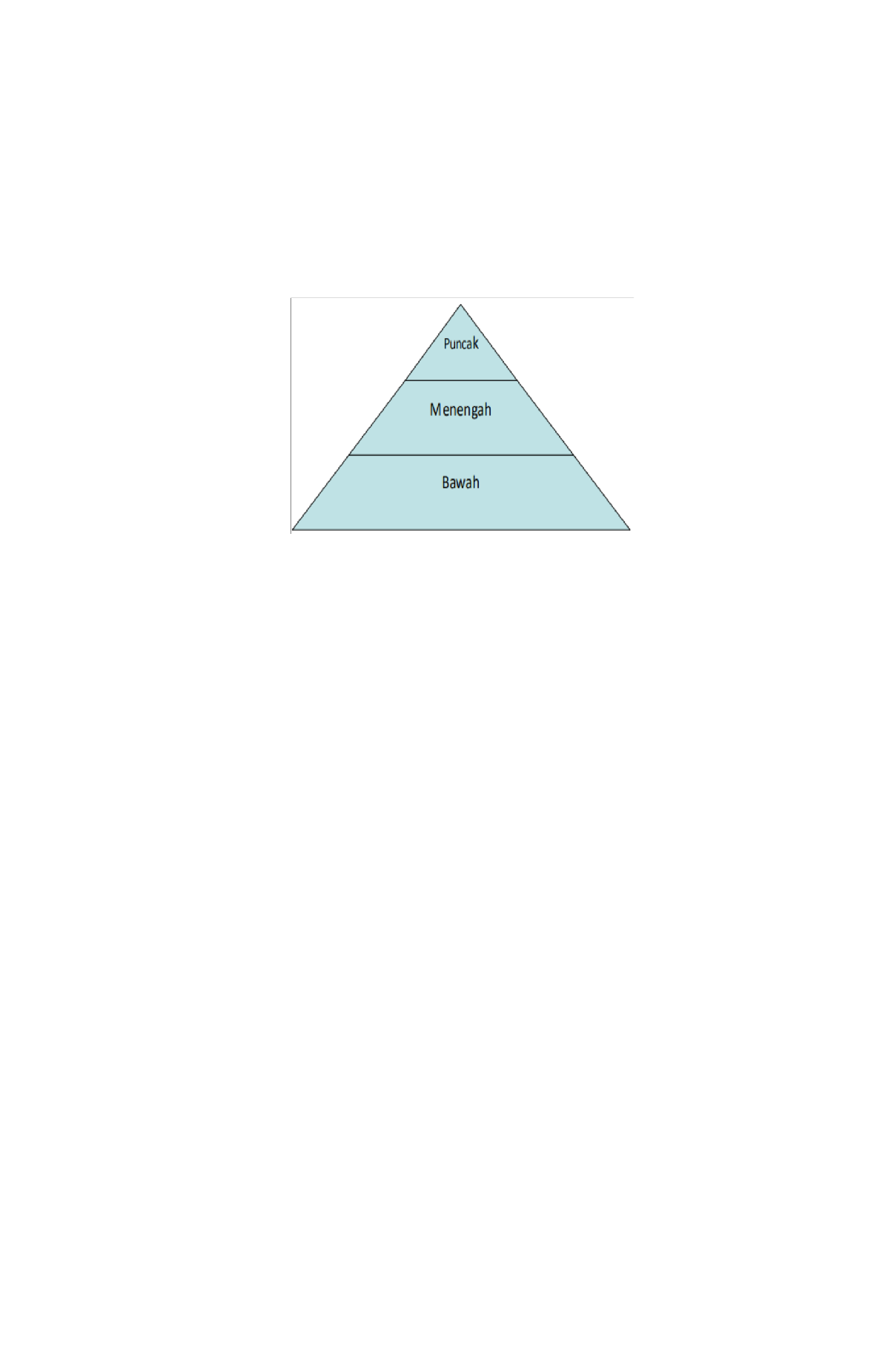
a. Service / Operations Management
Nursing services in hospitals are managed by the field of
care which consists of three managerial levels and each
level is led by someone who has relevant competencies.
The managerial level is:\
Figure 1.1 Managerial Level
In order to achieve good results, there are several
factors that need to be possessed by leaders at each
managerial level. These factors are the ability to apply
knowledge, leadership skills, the ability to carry out the
role of leader, and the ability to carry out management
functions (Mugianti, 2016).
b. Nursing Care Management
It is a nursing process that uses management concepts in it
such as planning, organizing, implementing, controlling
and evaluating. This nursing care management
emphasizes the use of the nursing process and this is
inherent in a nurse. Every nurse in carrying out her duties
must use the nursing process to achieve the goal of patient
nursing care (Mugianti, 2016).
5. Nursing Management Process

Figure 1.2 Nursing Management Process Flow
a. Planning
Planning is the process of determining the best way to
achieve organizational goals. Planning involves making a
decision to take an action from other alternatives. Planning
an initial process that begins with formulating an
organizational goal and then compiling and determining a
series of activities to achieve it (H. Fayol, 1925; Setyawan
and S. Supriyanto, 2019).
b. Organizing
Organizing is a process in grouping activities and grouping
resources. In determining the organization, it is important
to utilize activities efficiently in order to achieve
organizational goals (H. Fayol, 1925; Setyawan and S.
Supriyanto, 2019).
c. Pengarahan (commanding, directing, coordinating)
Briefing is a series of guidance processes for
organizational members to be able to cooperate well and
be able to work optimally by performing their duties in
accordance with their abilities and skills for the benefit of
Planning ( planning )
Organizing
(organizing)
Briefing ( commanding,
directing,
coordinating)
Supervision
(controlling)

the organization (H. Fayol, 1925; Setyawan and S.
Supriyanto, 2019).
d. Supervision (controlling)
Supervision is a process to observe the implementation of
the work plan that has been prepared and evaluate the
deviations that occur (H. Fayol, 1925; Setyawan and S.
Supriyanto, 2019).
6. Management Goals
In carrying out management activities, of course, there is a
goal. The objectives of management are, as follows:
a. Directing all planned activities
b. Preventing/overcoming managerial problems
c. Achieve organizational goals effectively and efficiently by
involving all existing components
d. Improve nursing work methods so that nursing staff work
more effectively and efficiently.
The expected outcomes of nursing management are:
a. Implementation of services
b. Quality nursing care
c. Staff development
d. Research culture in the field of nursing
Nursing Management is more emphasized on how nursing
managers (structurally) manage nursing staff members and
other resources to be able to complete tasks, while nursing
care management is used by nurses in solving patient
problems. Or it can be said that nurses are nursing care
managers.
7. Management Function
The function of management in general is to provide a clear
system so that a goal can be achieved with a systematic

approach. There are 4 management functions in their fields,
including (Julianto, 2016; Mamik, 2014):
a. Management functions in planning activities:
1) Assign the resources needed
2) Setting targets
3) Designing strategies to be carried out
4) Creating success indicators in every activity carried out
b. Management functions in organizing activities:
1) Determination of resources and activities needed
2) Create an organizational structure
3) Grouping and assigning responsibilities according to the
skills of the members of the organization
4) Delegation of authority required to each member to carry
out his or her duties
c. Management functions in briefing activities:
1) Provide direction, motivation, and guidance to members
of the organization
2) Providing a systematic/routine explanation of the duties
and responsibilities that must be carried out
d. Management functions in supervisory activities:
1) Assess and evaluate the results of the work that has been
achieved
2) Taking an action on the achievements that have been
made
3) Providing solutions to shortcomings in achieving
planned targets
Management functions in supporting the nursing
process: a. Assessment : Data collection
management
b. Diagnosis : Planning and organizing

c. Planning: Organizing and manpower
d. Implementation: Manpower and direction
e. Evaluation :Supervision
Leadership Theory
1. Definition of Leadership
Leadership is a skill or the use of skills that can influence
others or people around them to do something optimally and
as best as possible according to their abilities (Sullivan &
Decleur, 1989). Meanwhile, the definition of leadership is also
considered as a person's ability to make someone want to do
what they don't want to do and want to do what they like
(Truman in Gillies, 1996).
Meanwhile, the leader himself is someone who is at the
front, taking risks, trying to achieve the first goal, and
inspiring others to act. Leaders use interpersonal behavior to
motivate members to commit and give their best efforts to
contribute to achieving the group's goals (Marquis, 2015).
2. Characteristics of a Leader
According to Mamik (2015) the characteristics of a
leader include: a. Authoritarian
It is usually also called autotarian leadership, namely the
leader as a dictator over the members of his group, so the
leader thinks that leading is forcing and moving the group
and considers that subordinates are only assistants and
only follow and carry out orders carried out by the leader
and the limitation of power by law (Mamik, 2015).
b. Smooth-do
This leadership characteristic does not give leadership but
only allows his subordinates to follow his will because the

leader will use a little of his power to carry out tasks so
that most of the decisions are taken by his subordinates
because leaders with this type are very dependent on their
subordinates in making certain goals (Mamik, 2015).
c. Democratic
This type of democratic usually leads in the midst of the
members of the group, therefore the democratic leadership
style leads not as an employer with subordinates but like
brothers and also in all his actions all come from common
interests and needs and consider the ability of the group
(Mamik, 2015).
d. Pseudo-democracy
Also called semi-democratic or diplomatic manipulation,
these leaders usually act autocratic even though they
appear to be democratic. These leaders usually adhere to
pseudo-democracy and lead to more authoritarian leader
activities but vaguely so that they are not realized (Mamik,
2015).
e. Charismatic
Usually it has a distinctive characteristic, namely that it
can attract easily so that it gains a large enough following
and makes it difficult for its followers to explain the
reason concretely why the person is admired and usually
the followers do not mind the values adhered to, the
behavior and style of the leader or attitude (Mamik, 2015).
The following is a comparison of autocratic, democratic, and
Laissez-Faire characters (Weiss et al., 2023):
Table 1.1 Comparison of Leader Characteristics
Autocratic Democratic Hands off
Freedom Level A little
freedom
Medium
freedom
Lots of
freedom

Control Level High control Medium control Little control
Decision By the leader
Leaders and
with groups By group
Activity Level
Pemimpin Tall Tall At least
Assumption
Responsibility Pemimpin Shared
sharing
Escape
responsibility
Group Output High quantity,
good quality
Creative,
high quality
Variable
Possible poor
quality
Efficiency Highly
efficient
Less efficient
than autocratic
forces
Inefficient
3. Principles of Leadership
According to Mugianti (2016), the principles of leadership
include: a. Principles of Humanity
Leaders view subordinates as human beings and also pay
attention to subordinates
b. Principles of Efficiency
Leaders can streamline limited resources for the benefit of
their group
c. Principles of more equitable well-being
Leaders seek to reduce gaps and conflicts that can disrupt
the running of the organization.
4. Leadership Theory
a. Teori Sifat (Trait Theory)
A theory that identifies distinctive characteristics in the
form of physical, mental, and personality related to
leadership success, where this theory emphasizes the
personal attributes of leaders (Mamik, 2015).
b. Great Man Theory

In this theory, a great leader is born with special
characteristics that include charisma, intelligence, wisdom,
and have a great impact (Mamik, 2015).
c. Big Bang Theory
According to this theory, a major event that creates a
person to become a leader. A leader is able to integrate
between the situation and the followers. These situations
can be revolutions, chaos/riots, etc. As for the followers
themselves, they are people who are willing to obey and
obey someone who is given a character (Mamik, 2015).
d. Behavior Theory
This theory focuses on how leaders behave in influencing
others towards achieving goals and this is influenced by
their respective leadership styles. This theory views that
leadership can be learned from behavior patterns and not
from the traits of a leader because a person's traits are
more difficult to identify (Mamik, 2015).
e. Situational Theory
A theory that leads to an approach to leadership in which
leaders are encouraged to understand the behavior of
subordinates and situations before using certain leadership
behaviors. This theory focuses on various leadership styles
that are most effectively applied in certain situations. In
this theory, the effectiveness of leadership depends on the
appropriateness of the leader in behaving according to the
situation (Mamik, 2015).
f. Contingency Theory
Leadership is influenced by environmental variables that
determine leadership styles. The success of leadership
depends on a number of variables including leadership
style, the quality of followers, and environmental aspects.

This theory still contains two points of view of success,
on the one hand the leader must be flexible with the
situation, on the other hand there are other variables that
determine success (Mamik, 2015).
Leadership Style
Leadership style is a behavior that can be shown by a person
(leader) when that person can make others influence. A leadership
style is a person (leader) who sees the perception of others with
the leader's behavior to influence the activities of others. Other
people who see the behavior can be from the superiors of the
leader, peers, or subordinates. This is to find out the leadership
style of a leader by using the perception of others or the person
himself (Mamik, 2015). According to Ismainar (2018) that there
are 4 types of leadership styles, namely:
1. Autocratic is a power approach to achieve a decision and the
development of a structure. This leadership uses the power
approach method to achieve a decision and develop a
structure.
2. Participatory is an action that takes more decisions by inviting
subordinates or other members to discuss the authority which
makes the decision taken not seem unilateral.
3. Democratic is an approach in which leaders make decisions
cooperatively and cooperative leaders have high morals in
cooperating.
4. Free control is a leader who gives full power to subordinates, a
loose organizational structure and a passive leader. Where
leaders avoid power and responsibility.

Summary
Nursing Management is a process of working by involving nursing
staff to provide care, treatment and assistance to patients. While the
nursing management process is a series of implementations that are
interconnected, affect and are influenced by the environment, in
each system consists of five elements, including: input, process,
output, control, and feedback mechanism. The managerial process
of nursing in the nursing sphere is led by the head of the room and
will give command to the order below it such as the implementing
nurse. In every nursing managerial must have planning,
organization, direction, and supervision, because the process can be
used as a joint evaluation material of each activity implementation.
Leadership is a skill or the use of skills that can influence
others or people around them to do something optimally according
to their abilities. In his leadership, usually the leader will apply
several leadership styles that help him to achieve an organizational
goal, the leadership style that can be applied is autocratic,
participatory, democratic and free control leadership styles.
Practice Questions
1. Ns. Rika is getting Shift in the morning in the Anggrek inpatient
room. Ns. Rika as the implementing nurse who is compiling daily
tasks to be carried out. From the activities of nurses, it has
entered nursing management, namely... a. Controling
b. Planning
c. Evaluating
d. Organizing

2. Ns. Nur is the head of the inpatient room. In carrying out the
management function carried out by Ns. Nur at the stage of
supervision activities is...
a. Taking an action on the achievements that have been
made.
b. Providing solutions to shortcomings in achieving the
planned targets.
c. Assess and evaluate the results of the work that has been
achieved.
d. Wrong answers/all correct
3. Ns. Dika was on duty at the hospital. Medika. Ns. Dika's
responsibility is to determine medical service activity plans,
determine medical service development plans, and set
standard work procedures in the field of medical services. Ns.
Dika's position is currently included in the level level... a.
First line manager
b. Middle manager
c. Top manager
d. Wrong answers/all correct
4. Ners. Andi who is the head of the room of the rose inpatient
room. According to its members, he is a good leader and has a
well-established performance. In each of his decisions, he
always makes decisions based on joint deliberation or
accommodating the opinions of his subordinates. This makes
its members respect him as a leader and always follow all his
orders. From the illustration above, a suitable leadership
theory is...
a. Big Bang Theory
b. Contingency Theory
c. Trait Theory

d. Behavior Theory
5. The leader is a dictator over the members of his group so that
the leader thinks that leading is forcing and moving the group
and considers that subordinates are only helpers and only
follow and carry out orders made by the leader. The above
explanation is a characteristic of a leader... a. Democratic
b. Smooth Out
c. Charismatic
d. Authoritarian
6. A leader who has a position at the will of his members and has
a good relationship with his members so that their members
can work happily is a leader who is at the level of...
a. Positional Leader Felt konflik
b. Personhood Leader Conflict Resolution
c. Permission Leader
d. People development leader
Discussion Materials
1. Compare the strengths and weaknesses of each leadership style!

CHAPTER 2 PLANNING IN NURSING
Management basically focuses on human behavior to achieve the
highest level of productivity in service in an activity. An agency needs
a manager who is educated in knowledge and skills about human
behavior to manage activities. Management is a series of activities
(planning, decision-making, organizing, leadership and control) that
are directed at organizational resources (human, financial, physical
and information) to achieve organizational goals efficiently and
effectively (Phillips et al., 2018)
Organizing in nursing management has many important
activities, namely how nursing care is managed effectively and
efficiently for a number of patients in hospitals with the number of
nursing staff and existing facilities. For the need for division of tasks,
cooperation and coordination so that all patients get optimal service.

Therefore, nursing managers need to establish a framework, namely
by grouping and dividing the activities that must be carried out,
determining the working relationship between personnel and creating
a relationship between the chief of staff through assignments,
delegation and authority (Phillips et al., 2018)
Planning can be said to be a managerial decision-making process
that includes environmental research, depiction of the overall
organizational system, clarifying the vision, mission and philosophy
of the organization, estimating the organization's resources,
identifying and selecting action steps, estimating the effectiveness of
the action and preparing employees to implement it. So that planning
is the basic function of management and all functions in management
depend on the planning function. This means that other functions of
management will not run effectively without good planning so that
management will also experience obstacles in the process and will
have an impact on the goals that will be achieved in the future
(Mugianti, 2016).
Definition of Planning
Mondy & Premeaux (1995) in (Wijaya & Rifa'i, 2016), explained that
"planning is the procces of determining in advance what should be
accomplished and how it should be realized" which means that in
achieving the goals that have been set, a plan and a procedure to
implement the plan are needed. Planning is the effort of human beings
to consciously choose the desired future alternative and then direct
resources to realize the goal. Planning is a managerial decision-
making process that includes environmental research, describing the
overall organizational system clarifying the vision, mission and
philosophy of the organization, estimating organizational resources,
identifying and selecting action steps, estimating the effectiveness of

actions and preparing employees to implement them (Mugianti,
2016).
Planning is the basic function of management and all functions in
management depend on the planning function. This means that other
functions of management will not run effectively without good
planning. This is in accordance with the definition of planning from
Swansburg and Swansburg (1999, in Mugianti, 2016), that planning is
a continuous process that begins with setting goals, and then
implementing them according to the process, providing feedback and
modifying the plan if necessary. Furthermore, Swansburg and
Swansburg (1999) explained that planning is a thinking process or
mental process in making decisions and forecasting oriented to the
future (Mugianti, 2016). Planning is a thinking process in making
future-oriented decisions. Planning must contain elements of 5W+1H
(What, Why, Where, When, Who, and How) because the steps
determined to achieve the goals can be carried out optimally (Wijaya
& Rifa'i, 2016).
Planning Objectives
Planning begins with the identification of goals. This goal consists of
a general goal and an objective. General purpose is a statement of
desire that is classified as a reflection of the mission or purpose of a
work unit or organization (Asmara, 2020).
Planning is made with the aim of formulating what an
organization really wants to achieve and how something to be
achieved can be realized through a series of formulations of certain
activity plans (Mamik, 2015). According to Mugianti (2016) the
objectives in the preparation of planning in nursing management are
as follows:
1. Increase your chances of success
2. Stimulating analytical thinking

3. Preventing management crises
4. Facilitate critical thinking and flexible decision-making
5. Improve staff engagement and communication
6. Guarantee cost-effective
Elements in Planning
Nursing management planning begins by formulating organizational
goals that will be explained in the vision, mission, philosophy and
objectives as the direction of organizational policy (Mugianti, 2016).
The following are included in the elements of planning (Kurniawan,
2017):
1. Vision Formulation
Vision is the basis for making a plan so that it is prepared briefly,
clearly, and fundamentally and there is a time limit for
achievement. A vision is a short, clear, and fundamental
statement that contains why the organization was formed and
there is a time limit for its achievement.
Example of a vision formulation:
"To be a surgical treatment room that performs professional
care and excels in modern wound care management in 2018".
2. Mission Formulation
Mission is a description that contains an operational statement to
achieve the vision that has been set (Mugianti, 2016). Examples
of surgical treatment room missions that refer to the vision
mentioned above include:
a. Providing nursing care to surgical patients in a holistic, bio-
psycho-socio-cultural and spiritual manner.
b. Perform wound care measures using modern wound care
management.

c. Providing infrastructure to support modern wound care
management.
d. Conduct surgical research based on developments and trends
in surgical care.
3. Formulation of Philosophy
Philosophy is the values and beliefs that concern the beliefs and
practices of nursing in an organization (Mugianti, 2016).
Example:
a. Patients are human beings who are holistic beings
(biopsycho-social-spiritual)
b. Patients are unique and dignified individuals.
4. Formulation of Objectives
A goal is something that is to be achieved as a policy direction
for the organization to determine what to do and how to achieve
it. The absolute goal must be in the nursing service organization.
To formulate good goals, the following conditions must be met
(Mugianti, 2016): a. The goal must be able to explain the
direction
b. Goals must be achievable
c. Measurable means that the goal contains quantitative
provisions
d. There is a time limit for achieving the target
e. The final achievement of each goal is acceptable to all
members of the organization
f. Criteria are created to see how much the goal is achieved
g. Each goal supports the organization's goals Example:
Improving the qualifications of reliable and competent
nursing personnel in surgical nursing through education and
training
5. Target Formulation

Goals in management are measurable targets as an indicator of
the success rate of the goals that have been set.
6. Policy Formulation
Policy formulation is an instruction made by the organization in
terms of decision-making. This aims to regulate the behavior of
individuals in the organization so that the mission can be
achieved. Policies can be in the form of implicit or explicit. In
general, organizations develop explicit policies because workers
can be consistent in behavior and deeds (Marquis and Huston,
2017).
7. Formulation of Procedures
A procedure is a plan in the form of an arrangement of steps for a
specific job description. The purpose of the procedure is to
streamline work, save time, increase productivity, reduce costs.
In general, procedures can be found in certain level units within
an organization (Marquis and Huston, 2017).
8. Cost/Budget Determination
The budget can be said to be the translation of programs into
units of numbers (currencies). If a company does not have a clear
program, then it is very difficult to draw up a budget
Types of Planning in Nursing Management
Planning in nursing management based on its time period is divided
into 3 types, namely short-term, medium-term and long-term
planning. Short-term planning or what is referred to as operational
planning is a plan made for activities with a period of one hour to one
year. Medium-term planning is planning made for activities with a
period of between one year to five years, while long-term planning or
often called strategic planning is planning made for activities of three
to 20 years (Mugianti, 2016).

1. Daily Plan: a plan that contains every nurse's daily activity that
has been made by the head of the room, team leader or primary
nurse and the implementing nurse
2. Monthly Plan: a plan that contains nurse activities for 1 month
and must be in sync with the daily plan, usually created by the
room head and team leader or primary nurse
3. Annual Plan: a plan made once a year based on the evaluation of
the previous year's activities, usually made by the head of the
room only.
According to the time of making planning, it can be classified
into two, namely reactive planning and proactive planning. Reactive
planning is planning that is prepared when there are actual problems
faced today. Meanwhile, proactive planning is planning that is
prepared before problems arise, anticipating changes in needs and
improving organizational capabilities (Mugianti, 2016).
The planning process is also classified based on how the
approach is taken, namely: the Profitable Growth Approach and the
SWOT (Strength, Weakness, Opportunity and Treat) analysis
approach (Mugianti, 2016).
1. Profitable Growth Approach
It is carried out by analyzing the means of production owned and
connected to the needs of the environment (Mugianti, 2016). The
output is that the facilities owned and the needs of the
environment must be balanced. In other words 'MUTUAL
BUILD', which means "SA" (Means of Production), "LING"
(Community Environment), and "BUILD" (Profitable
Development).
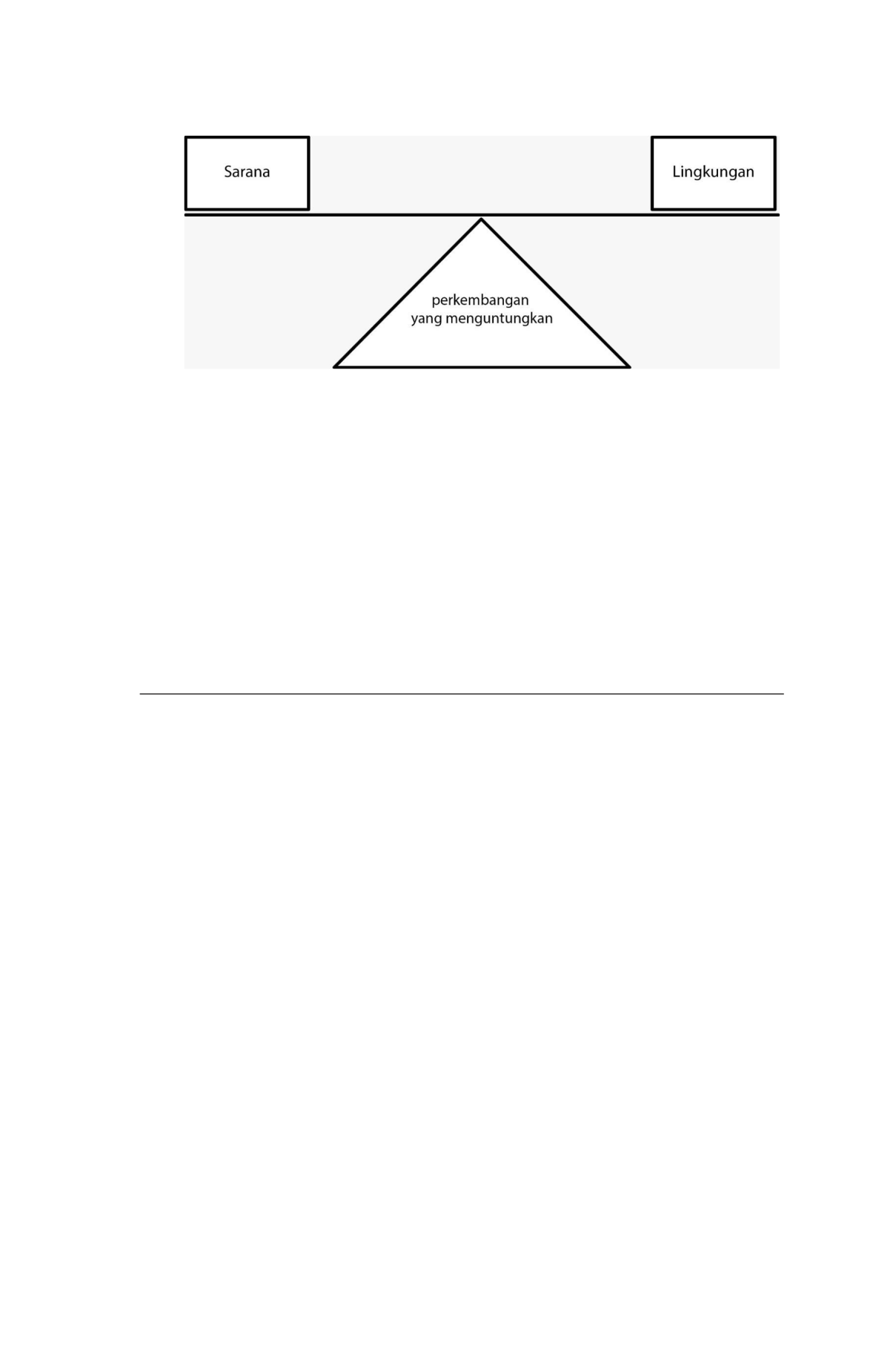
Figure 2.1 Planning Process with a Proper Approach
Auspicious
2. The SWOT (Strength, Weakness, Opportunity and Treat) analysis
approach is prepared through a planning process, which begins
with analyzing internal factors related to strengths and
weaknesses, followed by analyzing external factors related to
opportunities and pressures/threats (Mugianti, 2016).
SWOT Analysis
SWOT analysis is a planning method used to examine internal and
external factors in an organization. Internal factors are things that
come from within the organization that can affect the performance
and achievement of organizational goals, namely strengths and
weaknesses. Meanwhile, external factors are things that come from
outside the organization that can affect the performance and
achievement of organizational goals, namely opportunities and threats
(Pertiwi et al., 2018).
Here are the steps in conducting a SWOT analysis:
1. Determine the goals that the organization wants to achieve. The
goals created must be realistic, that is, goals that are very likely to
be achieved by the organization.
2. Discover every component (internal and external factors) of the
organization through analysis. Write it down briefly.
3. If the goal cannot be achieved by the SWOT method, make
changes to the goal you want to achieve and start the process
from the beginning.
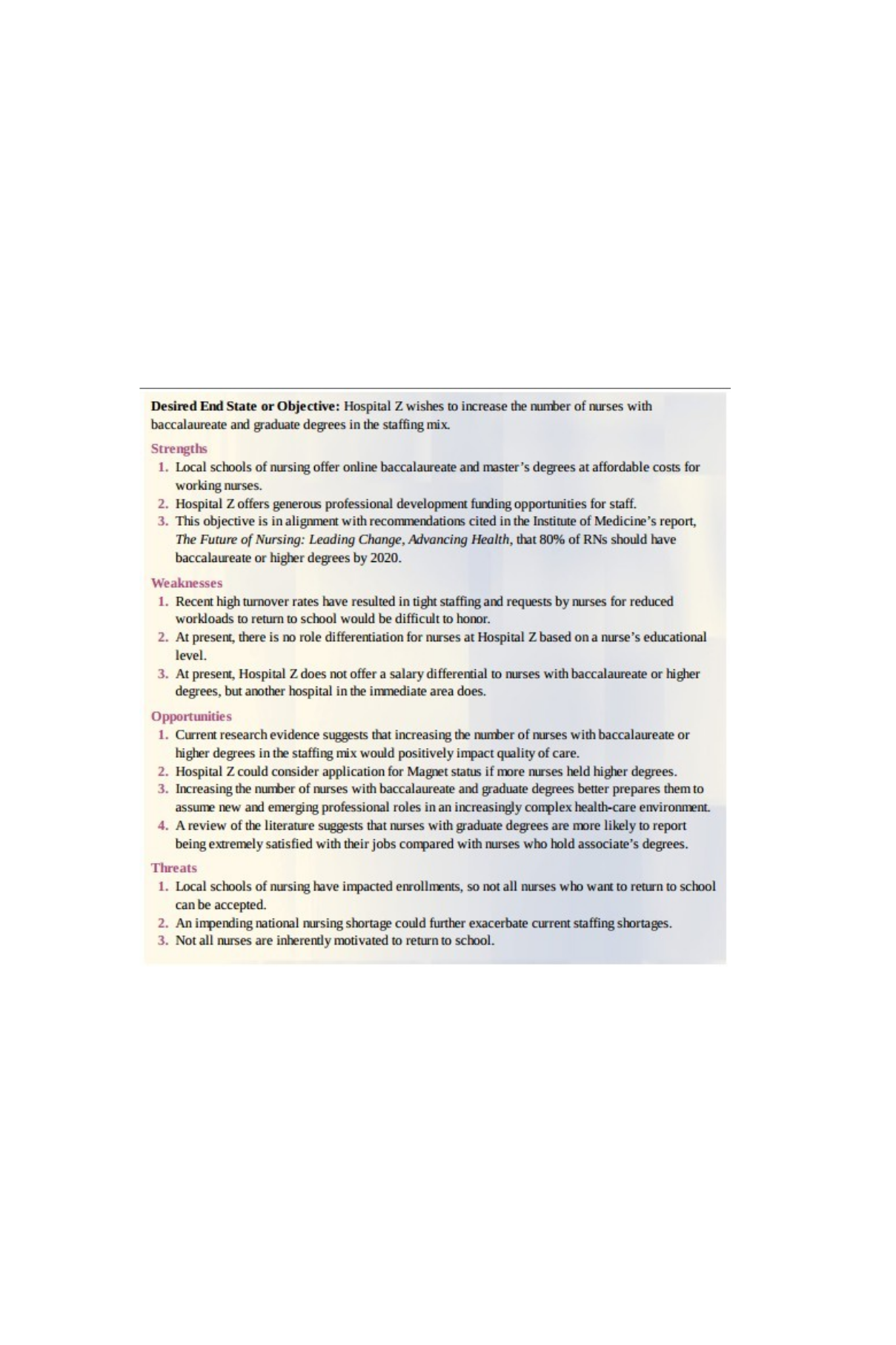
Here is an example of a brief SWOT analysis (Marquis and
Huston, 2017):
Figure 2.2 SWOT analysis according to Marquis and Huston, 2017.

Analisis Fish Bone
Diagam fish bone is used to identify possible causes of problems and
root causes of a problem. The following are the stages of making fish
bones:
Step 1: Deal a problem statement
Step 2: Identify categories using 5M
Step 3: Find the potential cause
Step 4: Study and agree on the most likely reasons
Figure 2.3 Fish Bone Diagram.
Summary
Planning in nursing management begins with the formulation of the
objectives of the institution or organization which are described in the
vision, mission, philosophy, estimating organizational resources,
identifying and selecting action steps, estimating the effectiveness of
actions and preparing human resources to implement them and as the
policy direction of the organization or institution in determining the
standards that will be used in achieving the goals that have been set
by the organization or institution (Jakri et al., 2019).
Category 2
Statement
problem
Category 3 Category 4 Category 5
Becaus
e
Becaus
e
Becaus
e
Becaus
e
Becaus
e
Sub-becaus
e
CAUSE EFFECT
Category 1

Planning in nursing management is indispensable especially in
the face of a dynamically changing external environment. In a health
service agency, planning must rely more on rational and systematic
procedures rather than just on intuition and hunches or conjectures
(Purba, 2019). The planning process in nursing management can be
carried out through two approaches consisting of, profitable
development (profitable growth approach) and SWOT analysis
approach (strength, weakness, opportunity, and treat) carried out in
each unit or room in a health service institution (Mugianti, 2016).
Practice Questions
1. Every nurse must know and understand the vision and mission of
the organization set by the nursing manager in order to jointly
achieve the goals of the organization. What is the management
function that nurse managers perform in setting the vision and
mission of the organization?
a. Mobilization
b. Planning
c. Organizing
d. Controlling
e. Supervision
2. A professional nurse gets the role of managing nursing
management and carrying out the planning management function.
Below is what should be compiled in nursing management
planning, except... a. Vision
b. Mission
c. Philosophy
d. Purpose
e. Supervision
3. Ns. Dea is a manager at Medika Utama Hospital. Ns. Dea wants
to carry out the planning function in nursing management at the
hospital within one year to five years. Based on the time period,

the planning made by Ns. Dea is included in the type of
planning... a. Short-term
b. Medium-term
c. Long-term
d. Operational
e. Strategic
4. Pay attention to the following criteria
1) Short, no more than 3-4 sentences
2) Clearly, it provides an overview of the future of the
organization
3) Achievable with resources, energy, and time
4) Able to arouse positive emotions of members
5) Measurable
Based on some of the criteria above, what is included in the
vision criteria is...
a. 1), 2), 4), and 5)
b. 1), 2), 3), and 4)
c. 2), 3), 4), and 5)
d. 1), 3), 4), and 5)
e. That's all right
5. Pay attention to the types of planning below
1) Short-term planning
2) Reactive planning
3) Medium-term planning
4) Proactive planning
5) Long-term planning
Based on the types of planning above, which include the types of
planning in nursing management based on the time frame,
namely... a. 2) and 4)
b. 1), 3), and 5)

c. 1), 2), and 3)
d. 3), 4), and 5)
e. 2), 4), and 5)
Discussion Materials
1. Make a SWOT analysis of your faculty
2. What if in the SWOT analysis there are more weaknesses?
ORGANIZING IN NURSING SERVICES AND NURSING
CARE

Organizing is one of the management functions that also has an
important role as well as the planning function. Organizing is a series
of management activities that gather all the resources owned and
utilize them efficiently to achieve the goals of an organization. All
resources owned by the organization will be regulated to use them
effectively and efficiently to achieve the goals that have been set
(Munijaya, 2004). Organizing is divided into three organizational
structures, namely: Line organization, staff organization, and line and
staff organization. Through interaction between individuals, it is the
key to the smooth running of the nursing service organization because
of the communication between members that can be used as a tool to
convey information, instructions, orders, reprimands, experience
sharing, coordination, cooperation and others (Mugianti, 2016).
The organization of nursing services is the process of grouping
activities on the duties, authorities, responsibilities and coordination
of activities both vertically and horizontally by nursing personnel in
achieving the goals that have been set. The role of nursing organizing
is an action that involves resolving various tensions related to
professional authority, task priorities, alignment of intra and
interprofessional interests, and internal and external requirements.
The role of nursing organizing is played at four levels: the individual
patient level, the patient group level, the organizational level, and the
policy level. Nurses have an important role in organizing, caring for
and guiding patients through health care (Roekel et al., 2020).
Organizing Concept
1. Definition of Organizing
Organization comes from the Greek term organum and the Latin
term organum which means instrument, part, limb or body.

Organization is the process of managing human resources and
other resources in carrying out strategies to achieve
organizational goals. Organizing is the entire grouping of people,
tools, duties, duties, authorities and responsibilities in such a way
that an organization is created that can be mobilized as a unitary
activity that has been determined so as to achieve goals through
the arrangement of structural patterns, duties, authority, labor and
communication (Juniati, 2014). Organizing is a grouping with the
arrangement of activities carried out to achieve organizational
goals, through supervision, communication and coordination
with other work units vertically and horizontally (Ministry of
Health of the Republic of Indonesia, 2016). Organizing nursing
services is the process of grouping activities into tasks,
authorities, responsibilities and coordination of activities
vertically and horizontally by nursing staff to achieve the goals
that have been set.
2. Organizing Objectives
According to Mugianti (2016), the objectives of organizing in
nursing management are as follows: a. Achievement of
organizational goals
b. Organizing resources effectively and efficiently
c. Carry out an effective division of duties and responsibilities
between individuals and groups.
d. Determine effective communication and coordination
channels through the preparation of a good organizational
structure
e. Make the right decisions
f. Effectively supervise organizational activities through
supervision
g. Anticipating various changes that may occur through
important adjustments (Mugianti, 2016).

3. Organizing Function
Organizing is one of the management functions that also has an
important role as well as the planning function. Through the
organizational function, all resources owned by the organization
(human and non-human) will be regulated to use them effectively
and efficiently to achieve the organizational goals that have been
set. The following are some of the functions of organizing,
including (Mugiarti, 2016): a. Achievement of organizational
goals
b. Organizing resources effectively and efficiently
c. Carry out effective division of duties and responsibilities
between individuals and groups
d. Determine effective communication and coordination
channels through the preparation of a good organizational
structure
e. Make the right decisions
f. Effectively supervise organizational activities through
supervision
g. Anticipating changes that may occur through important
adjustments
4. Organizing Model
a. Line Organization
The form of line organization is the oldest in the world, line
organization is characterized by the division of duties and
authority there is a real difference between the leadership
organizational unit and the implementing organizational unit.
The role of the leader is very dominant, all control is in the
hands of the leader and in carrying out activities the priority
is authority and orders. Line organizations are more suitable
for organizations with a small number of employees, limited
facilities and infrastructure, and simple organizational goals
and activities.

Table 3.1 Advantages and Disadvantages of Line Organization.
No. Excess Deficiency
1 Judgment can be
taken appropriately
It takes a truly authoritative
leader
2 Unity of direction
and command
more
Guaranteed
Results are often immature
3 Coordination and
Easier supervision
Individual rights are
sometimes neglected
b. Staff Organization
Staff organization is a development of a line organization. Staff
organization is characterized by the development of staff
organizational units that play the role of assistant to the
leadership. People who sit in staff organizations are expert
individuals according to the needs of the organization. Decision-
making is in the hands of the leadership.
Table 3.2 Advantages and Disadvantages of Staff Organization
No. Excess Deficiency
1 Better quality of
decision-making
Decision-making takes longer
c. Matrix Organization
The matrix is one of the organizational structures that emerged in
the post-bureaucratic era or called the post-bureaucratical
organization era. The form of matrix organization is described as
coordination between departments or fields or those within an
organization. The form of matrix organization is an approach that
was born to clean up an approach that previously did not provide
convenience and flexibility in handling complex activities and
involved expertise or skills from various multifunctional fields of
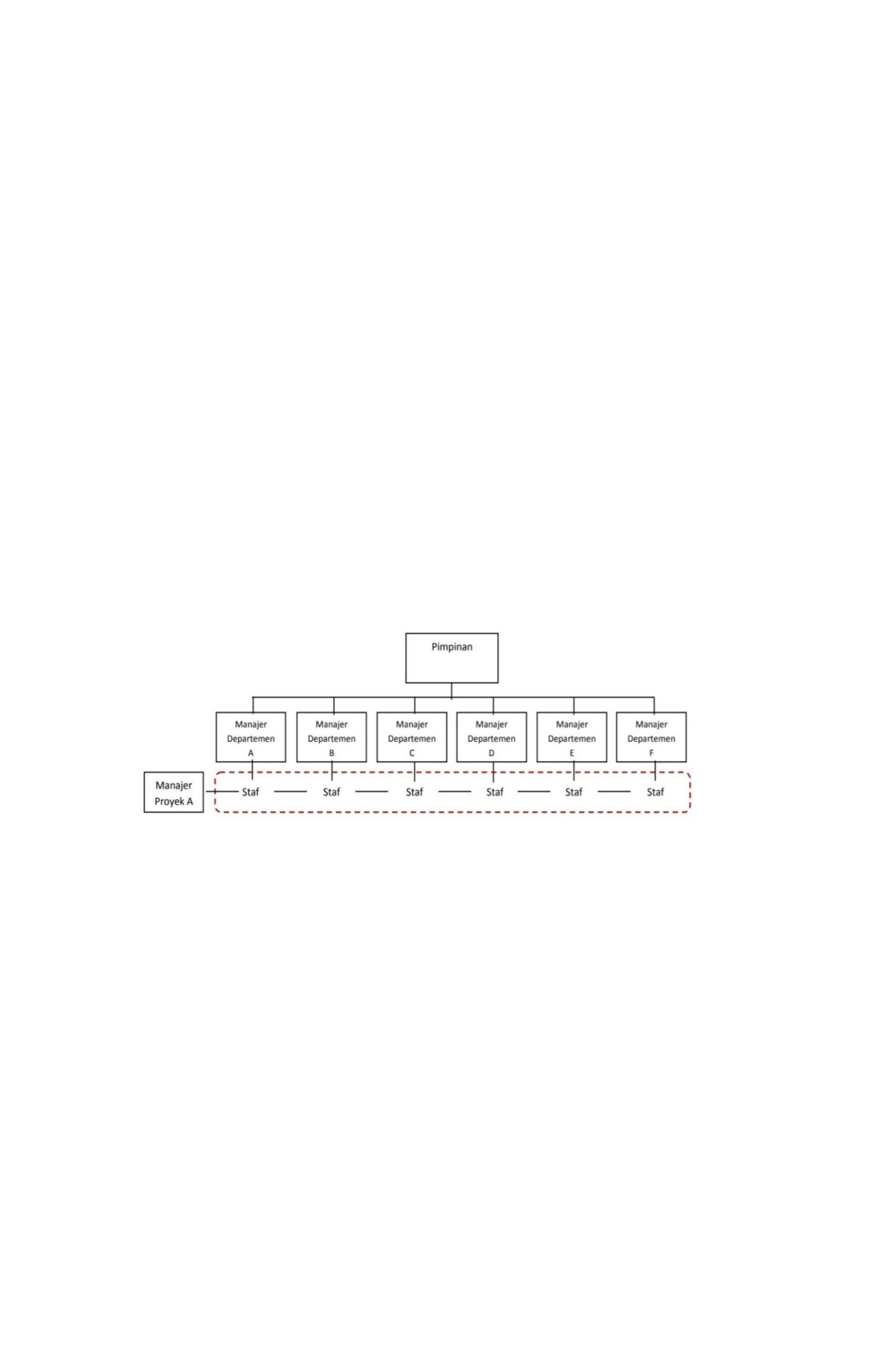
the organization. A matrix organization is an organizational
structure, where each employee is responsible to a functional
manager or division manager and a project manager or group
manager (Wulandari and Wildani, 2019).
Matrix organization includes how to combine organizational
managers with various specializations to complete a task. In a matrix
organization, employees basically have two leaders (under two
leaders or under dual authority). The organizational structure is
divided into several divisions under the president director, where each
division has its own authority and responsibility. With the division of
divisions, tasks and work become easier and more flexible, thus
encouraging cooperation between divisions. The division of divisions
in each section must be carried out with good coordination and
communication to avoid horizontal and vertical conflicts due to the
error of dual responsibility (Winarti, 2020).
Figure 3.1 Matrix Organizational Diagram
The concept of matrix organization is developing and is widely
adopted in organizations that work with many projects that require
high coordination and technical achievement, as well as requiring a
lot of special skills or expertise. Examples of organizations according
to Winardi (2017) that use types of matrices such as advertising
agencies, research and development laboratories, construction
companies, government agencies, universities and hospitals.

The advantages and disadvantages of using matrix organizing are as
follows:
Table 3.3 Advantages and Disadvantages of Matrix Organization
Advantages of the Matrix Disadvantages of the
Matrix

1
.
2
.
3
.
4
.
5
.
6
.
7
.
8
.
Maximizing the effectiveness
of the use of functional and
structural personnel. Provides
flexibility to the organization
and
Aids development
creativity and multiplication of
the use of various resources.
Stimulating work
It is the same between
disciplines and facilitates
various company activities
with a project orientation.
Free top management from
planning.
Engage and challenge
members. Develop the skills of
employees.
Motivate others to pay
attention to the final product.
Allows the transfer
experts according to the fields
needed.
1.
2.
3.
4.
5.
6.
7.
8.
The existence of double
responsibility creates
confusion and contradictory
policies.
Horizontal and vertical
coordination is needed More
skills are needed
Encouraging the emergence
of power conflict Contains
the risk of anarchy.
Can lead to more discussion
than action Requires
significant costs for
implementation
Risk of duplication of efforts
by existing project teams

Organizing Steps
1. Determination and balancing of activities, division, classification,
and arrangement of activities to be carried out so that they
become regular groups based on the same nature in
implementation.
2. The preparation of the structure, this step is intended to create an
orderly organizational structure that is needed to accommodate
all activities that have been arranged. In addition to being guided
by the results of the first step, the formation of this forum should
also be based on an idea, namely an idea and aspiration as well as
a desire for a desired form of organizational structure. Or in other
words, the formation of this forum should also be rooted in the
ideal type of organizational structure.
3. Filling the organ with duties, powers, authorities and
responsibilities, is to incorporate the activities that have been
arranged into the organs that have been formed. In filling out
tasks, they must also be equipped with commensurate authority
and responsibility. In the sense that officials who are assigned
tasks must also be authorized to take the necessary actions, so
that their duties can be carried out properly.
4. Connecting organs with each other with lines of authority and
responsibility, is an activity to determine the relationship of
power and responsibility based on formal authority. The
manifestation of the results of this step is the outline of the power
relationship that is formal.
5. Equipping organs with the necessary tools, tools and or
equipment does not have to be good, because they have a high
value or price. But what is needed is the right tool to use, because
it is in accordance with the pattern of work.
6. Proper placement of people on each organ.

7. Create an organizational chart to depict or illustrate the
organizational structure on paper. Making an organizational chart
is a picture that schematically depicts the arrangement of duties,
powers, and responsibilities as well as the relationships between
units in an organization.
Principles of Organizing
To organize work effectively in achieving organizational goals, there
are four principles that must be considered such as: division of labor,
delegation of tasks, coordination and time management. The
following is an explanation of each principle in organizing that is
important to pay attention to, namely:
1. Division of Work, where all work is divided among all staff.
Every staff has a clear task, to avoid mistakes, the nurse manager
should understand the characteristics of the duties,
responsibilities and authority of his staff. Job description,
development of procedures and descriptions of work results are
needed as signs of division of labor.
2. Delegation, which is the handing over of performance
responsibility for a task from one individual to another while
responsibility remains dependent on the results. Delegation of
duties is the delegation of authority and responsibility to staff to
carry out actions with certain limits of authority where delegation
contains elements of mentoring and regeneration that are good or
natural and have value regarding effective and efficient resource
management with limited capabilities while still paying attention
to tasks/work, the surrounding environment, appointed people,
good direction/communication and supervision or evaluation
(Ministry of Health of the Republic of Indonesia, 2016).

3. Coordination is the activity of communicating and relating to the
parties involved in launching activities so that there is harmony
of actions, efforts, attitudes and adjustments between employees
in the workplace. Effective coordination can be done by:
a. Building two-way communication with both superiors and
subordinates,
b. Getting used to holding formal meetings (official, pre and
post conferences),
c. Conduct regular and continuous reporting and record-
keeping,
d. Make a form that is used in all activities as proof of
responsibility and responsibility.
4. Time management is used by everyone to carry out activities. The
ability to manage time is the achievement of a person's success.
In order to be successful in managing time, effective use of time
is needed by:
a. Analyze the time used by making schedules and categories
of activities,
b. Re-checking each category portion according to the available
time,
c. Determining work priorities according to urgency, urgency,
and non-urgency/routine,
d. Delegate to subordinates, according to the nature of the
work.
Organizing Nursing Activities in the Nursing Room
In carrying out a nursing organization, according to Mugiarti (2016)
there are several methods, including:
1. Functional Nursing Care Model

This functional method is the organization of nursing tasks based
on the division of tasks according to the type of work performed.
Example: Nurse A is in charge of injecting, nurse B is in charge
of checking vital signs and treating patients, and Nurse C is in
charge of treating wounds and so on.
Advantage:
a. Skilled nurses for specific tasks and jobs
b. Easily obtain job satisfaction for nurses after completing
their duties
c. The lack of skilled manpower can be replaced by less
experienced manpower for a simple task
d. Make it easier for the head of the room to supervise staff or
students who practice for a particular skill. Loss:
a. Nursing services are fragmented or not possible to perform
nursing holistically
b. When the work is completed, the nurse tends to leave the
client and carry out non-nursing work.
c. Overall job satisfaction is difficult to achieve and it is
difficult to identify the contribution to service.
d. Nurses only see nursing care as a skill.
2. Team Nursing Care Model
The team nursing care model is the organization of nursing
services by a group of nurses to a group of clients led by
registered and experienced nurses who have knowledge in their
fields. The division of tasks in groups is carried out by the group
leader/Team Leader. In addition, the Team Leader is responsible
for directing his members before the task and receiving reports
on the progress of client nursing services and assisting team
members in completing tasks if they encounter difficulties.
The weakness of this model is that team meetings take time
so that in busy situations team meetings are canceled or rushed so

that communication and coordination between team members are
disrupted and the smooth running of tasks is hampered, unskilled
and inexperienced nurses tend to depend or shelter from capable
team members, and accountability in the team is blurred. The
advantages can facilitate comprehensive nursing services, allow
the achievement of the nursing process, and conflicts or
differences of opinion between staff can be suppressed through
team meetings, and allow the ability of different team members
to be united safely and effectively.
3. Client Allocation Nursing Care Model
The client allocation nursing care model is the organization of
nursing services/care for one or several clients by one nurse on
duty/guard for a certain period of time until the client goes home.
The head of the room is responsible for the division of duties and
receives reports on the client's nursing services.
The advantage and the disadvantage is that the nursing focus
is tailored to the client's needs; providing opportunities to
perform comprehensive nursing; high workload especially if
there are many clients so that simple tasks are missed; It is
difficult for students to acquire special skills that are not carried
out on the clients they manage: for example, catheterization,
NGT, etc.; motivating nurses to always be with clients during
their duties, non-nursing tasks can be carried out by non-nurses;
delegation of certain tasks; supporting the implementation of the
nursing process; the continuation of the client's care is only
partial as long as the nurse in charge of the client is on duty;
overall job satisfaction is achievable; The continuation of the
client's care is only partial during the duty of the nurse in charge
of the client.
For example, nurse B manages 3 patients and is responsible
to the Head of the Room, as well as nurses A and C will have

patients managed. Slightly different from the team, the nurse
members are responsible for nursing care to the team leader. The
allocation model allows nurses to be directly responsible to the
head of the room.
4. Primary Nursing Care Model
The Primary Nursing Care Model is a method of providing
nursing care where professional nurses are responsible and
responsible for the patient's nursing care for 24 hours/day. This
method was developed since the 1970s. Responsibilities include
patient assessment, planning, implementation and evaluation of
nursing care from the time the patient is admitted to the hospital
until the patient is declared discharged, this is the main task of
the primary nurse assisted by the associate nurse. Primary
nursing will create an opportunity to provide comprehensive
nursing care, where nursing care is patient-oriented. Assessment
and preparation of patient nursing care plans under the
responsibility of primary nurses, and associate nurses who will
implement nursing care plans in nursing actions.
The advantages and disadvantages of the primary nursing
care model are that nurse autonomy increases because
motivation, responsibility and responsibility increase, the room
does not require all nurses to be professional nurses, ensures the
continuity of nursing care, the necessary costs are expensive, the
relationship between patient nurses increases, frees nurses from
auxiliary tasks, this method supports professional services, and
the creation of good collaboration.
The Primary Nursing Care Model requires certain
qualifications because primary nurses must be professional
nurses (Register Nurses) who take care of patients, starting from
assessment, diagnosis, making plans, implementing and
evaluating. In the implementation activities, primary nurses are

assisted by associate nurses. So the role of the associate nurse is
to assist during the implementation of actions. Primary nurses
will take care of 4 – 6 clients/patients for 24 hours
5. Modular Nursing Care Model (a combination of primary and
team nursing care models)
That is the organization of nursing services or care carried out by
professional and non-professional nurses (skilled nurses) for a
group of clients from the time they enter the hospital until they
go home, called total or total responsibility. This method requires
nurses who are knowledgeable, skilled and have the ability to
lead. Ideally 2-3 nurses for 8-12 clients.
All of the above models can be used to organize nursing
services/care according to the situation and conditions of the
room, the number of nurses and the ability of existing nurses. The
number of nurses must be balanced according to the number of
clients. In addition, the existing categories of nursing education
need to be considered in accordance with the duties and
responsibilities that will be charged.
Summary
Organizing nursing services is the process of grouping activities into
tasks, authorities, responsibilities and coordination of activities
vertically and horizontally by nursing staff to achieve the goals that
have been set. Effective work organization in achieving
organizational goals is by applying four principles such as division of
labor, delegation of tasks, coordination and time management.
Individual factors in the organization are expected to create a
competitive climate to produce the best for nursing services and
leadership in the management of nursing care. Focus on nursing
according to the client's needs. The high workload of nurses
especially when the number of clients is greater makes simple tasks

missed, hence the need for proper organizing arrangements in nursing
management to create comprehensive nursing services
Practice Questions
1. Mr. Budianto is a personnel manager at a private company in
Jakarta. He plans to accept new employees. For this reason, he
carries out various activities ranging from determining the
committee, assigning the duties and responsibilities of each
individual, as well as delegating authority to subordinates. The
various activities carried out are in accordance with the
management function, namely... a. Actuating
b. Forcasting
c. Planning
d. Controlling
e. Organizing
2. A senior nurse who is on duty in the Melati inpatient room of
Harapan Bangsa Hospital conducts nursing care for her patients
by emphasizing procedures and completing tasks according to her
expertise. From these cases, senior nurses provide nursing care
using the method? a. Case Method
b. Fungional Method
c. Team Method
d. Client allocation methods
e. Primary care methods
3. Ns. A Working in the Jasmine room. In providing nursing care,
Ns. A is responsible and responsible for the patient's nursing care
for 24 hours/day. Ns. A in carrying out her duties is assisted by
other nurses who are vocational nurses. What nursing care service
methods are applied in the Melati room?
a. Primary Nursing Care Model
b. Modular Nursing Care Model
c. Team Nursing Care Model

d. Functional Nursing Care Model
e. Non-Stop Nursing Care Model
4. A 50-year-old male patient named Mr. Y had difficulty in
carrying out his activities. Nurse A who was on duty at that time
provided assistance to Mr. Y to clean herself. From this case,
nurse A played a role as? a. The Role of Advocacy
b. Manager Roles
c. Role Care Provider
d. Role of Facilitator
e. Role of Educator
5. The head of the Mawar room plans to change the organizational
structure model because the Mawar room is now converted into a
children's ward. The head of the room thinks that it will need a
nurse who is skilled and experienced in injecting children so that
the head of the room wants a division of tasks according to
expertise. What model of organizational structure does the head
of the Rose room plan? a. Line Organization
b. Functional organization
c. Team Organization
d. Matrix Organization
e. Expert organizations
Discussion Materials
1. Discuss what type of nursing care model is most effective?
2. Discuss what types of nursing organizations are most effective?


STAFF DEVELOPMENT IN NURSING MANAGEMENT
AND NURSING CARE
Nursing management is a science that must be possessed and applied
by nurse managers in providing and managing nursing resources
effectively and efficiently with the help of nursing staff that has been
set to achieve the goals of nursing services that have been set. This is
in line with the function of management where one of the functions is
staff development (Staffing). Staffing is a human resource (HR)
management process that includes HR planning activities, search,
selection, appointment, training, placement, development,
establishment of management systems (payroll, promotion, mutation,
termination), and staff and employee performance assessments
(Maryono, 2018).
Staffing and organizing are very closely related. Organizing is the
preparation of a legal forum to accommodate various activities that
must be carried out in an organization. Meanwhile, staffing is related
to the application of people who will hold each position in the
organization. In staffing, the main principle applies, namely "The
Right Man in The Right Place and Time" (Mamik, 2015). According
to Firmansyah and Mahardika (2018), the process of staffing is related
to recruitment, selection and orientation or socialization and
placement of new employees through which the organization fulfills
or fills human resources from the manager to employee level. This
aims to create synergy among workers in accordance with their duties
and responsibilities cooperatively in accordance with each field for
maximum results for the organization (Maryono, 2018).
Staffing requires an open systems approach that is implemented
in the organization. Therefore, internal factors such as personnel
policy, organizational climate and reward system are also taken into

account (Firmansyah and Mahardika, 2018). There are several
methods of calculation in staffing , including the Douglas method, the
gillies method, the PPNI method, the Ministry of Health method, the
FTE method and the WISN method.
Nursing Needs/Calculations
Calculation of the need for nursing personnel or staffing is a basic
management function in the implementation of nursing activities.
Accurately predicting the need for nursing personnel is an important
management skill because managers can minimize the occurrence of
labor crises in nursing (Marquis and Huston, 2017).
The effectiveness and efficiency of manpower in nursing is
greatly supported by the provision of appropriate nursing care and
adequate nurse competence. Therefore, it is necessary to carry out
strategic and systematic planning in meeting the needs of nursing
personnel. And good planning considers things like the classification
of clients based on the level of dependency, the method of providing
nursing care, the number and category of nursing staff and the
calculation of the number of nursing staff. For this reason, the
contribution of nursing managers is needed in analyzing and planning
the needs of nursing personnel in a hospital unit (Rakhmawati, 2008).
According to Susilo and Yustiawan (2015), the calculation of
nurses is very related to the workload of nurses. There are several
things that need to be considered in assessing the workload of nurses,
including the following:
1. Number of clients treated/day/month/year in a unit;
2. The condition or degree of dependency of the client;
3. Average days of client care;
4. Measurement of direct and indirect care;
5. Frequency of required actions;

6. Average direct and indirect nursing time; and
7. Granting leave/training/sickness.
In calculating the need for nurses in hospitals, several calculation
methods can be used which are almost the same in principle but have
peculiarities for certain situations and conditions of the nursing care
service delivery system to clients (Rakhmawati, 2008). Some of the
calculation methods include:
1. Douglas Methods
Brown (1984) determined the number of nurses needed in a care
unit based on the classification of clients, each category has a
standard value per shift, namely:
Table 4.1 Number of Nurses Based on Patient Classification
Number
of
Patients
Patient
Classification
At least Partial Total
Mornin
g
Noon Night Morning Noon Night Morning Noon Night
10,17 0,14 0,10 0,27 0,15 0,07 0,36 0,30 0,20
20,34 0,28 0,20 0,54 0,30 0,14 0,72 0,60 0,40
30,51 0,42 0,30 0,81 0,45 0,21 1,08 0,90 0,60
Dst.
2. Ratio Method
Based on the Regulation of the Minister of Health of the
Republic of Indonesia No. 262/Menkes/Per/VII/1979, the
standardization of personnel in hospitals is as follows:
Table 4.2 Standardization of Manpower in Hospitals
Hospital Type TM/TT TPP/TT TPNP/TT TNM/TT
A & B 1/(4-7) (3-4)/2 1/3 1/1
C 1/9 1/1 1/5 3/4

D 1/15 1/2 1/6 2/3
Special Customized
Information:
TM = TT Medical
Personnel = Bed
TPP = Medical Personnel
TPNP = Non-treatment Medical Personnel
TNM = Non-medical personnel
3. Method Gillies
Gillies (1994), explained that the formula for the need for nursing
personnel in a nursing unit is as follows:
𝐴𝐴 × 𝐵𝐵 × 𝐶𝐶
=…
(𝐶𝐶−𝐷𝐷) × 𝐸𝐸
Information:
A = Average number of treatments/patient/day
B = Average number of patients/day
C = Number of days/year
D = Number of holidays for each nurse
E = Number of hours worked by each nurse
4. PPNI Workshop Results Method
Based on the calculation using the Formula for the Results of the
Indonesian National Nurses Association (PPNI) Workshop,
namely:
𝐴𝐴 × 52 𝑚𝑚𝑚𝑚𝑚𝑚𝑚𝑚𝑚𝑚𝑚𝑚 × 7 ℎ𝑎𝑎𝑎𝑎𝑚𝑚 (𝑇𝑇𝑇𝑇 × 𝐵𝐵𝐵𝐵𝐵𝐵)
TTTT = × Ψʹͷ
HHHHHH (41 mmmmmmmm) × JJHHHH (40/mmmmmmmmmmmm)
Information:

TTP = Paramedic Nurses
A = Number of maintenance hours / 24 hours
TT = Bed
DRILL = Bed Occupancy Rate
HKE = Effective Business Days
JKE = Effective Working Hours
a. Component A is the amount of treatment time required by the
patient over 24 hours.
b. BOR is the average percentage of the number of beds used
during a certain period (one semester/one year).
c. Effective Working Days for 41 weeks which are calculated
as follows:
(365 – (52 Sundays + 12 national holidays + 12 annual leave)
= 289 days : 7 days/week = 41 weeks.
d. Effective Working Hours for 40 hours per week which is
calculated as follows:
1) If the effective working day is 6 days, then 40/6 = 6.6 - 7
hours per day. 2) If the working day is effective for 5 days,
then 40/5 = 8 hours per day.
e. The 25% component, namely the level of nurse productivity,
is assumed to be only 75% so that it is multiplied by 25%.
5. Method Depkes
a. Outpatient
b. Delivery Room
c. Operating Room
d. ER Room
6. Ilyas Method Description:
A = Number of maintenance hours/24 hours
B = Daily census
365 = Number of working days in a year

255 = Effective working days of nurses per year
= 365– (12 national holidays + 12 annual leave holidays) x 3/4
= 255 days
7. Metode WISN (Workload Indicator Staffing Need)
The WISN method is a calculation of the amount of labor needs
in a work unit based on workload, so that allocation or relocation
will be easier and rational. The Ministry of Health Number
81/MENKES/I/2004, recommends the use of the WISN method
as one of the recommended methods. The advantages of this
method are that it is easy to operate, easy to use, technically easy
to implement, comprehensive and realistic. The WISN method
has a weakness, which is highly dependent on the accuracy and
completeness of data related to the workload (Soesanto and
Ersyad, 2019).
According to Ernawati et al. (2011) there are five steps of
calculation methods based on WISN, including:
a. Available working hours are determined based on the
number of working days, leave, education and training,
national holidays, absenteeism, and working hours of health
workers for one year.
– ×αȓ ȋΙΙΙȌȔ
– α ȋΙΙΙΙȌ Information:
WKT = Available Working Time
HKT = Available Business Days
A = Possible working days in a year
B = Annual leave
C = Education and training
D = National holidays
E = Absence from work (permit, sickness, etc.)
F = Working time in one day

b. Determine the work unit and the category of human resources to
be calculated. The data and information needed are as follows:
1) Organizational structure, description of main tasks, and
functions of each unit;
2) Decision of the Director of the Hospital on nurses;
3) Employee data based on working education;
4) Law Number 36 of 2014 concerning Health Workers;
5) Regulation of the Minister of Health of the Republic of
Indonesia Number 43 of 2017 concerning the Preparation of
Health Functional Position Formations; and
6) Professional standards, service standards, and SOPs.
c. Workload standards are compiled. The workload includes:
1) The main activities carried out. A collection of various types
of activities according to service standards and SOPs to
produce services carried out by AIK with certain
competencies.
2) The average time it takes to complete each main activity. The
time required to complete activities varies greatly and is
influenced by several things, namely service standards,
SOPs, available facilities and infrastructure, and human
resource competence. It is determined based on observations
and experiences during work and mutual agreement. It
should be determined based on the time needed to complete
each main activity by human resources who have
competence, implementation activities, service standards,
SOPs, and have a good work ethic.
3) The workload standard per year, which is the
volume/quantity of the workload for 1 year. It is arranged
based on the time it takes to complete (average time) and the
time available per

Recruitment is the process of finding, finding, and attracting
applicants to occupy certain positions within the company and has a
continuous process. In a complex company, work must be completed
by a group of people. Therefore, the ability of a company to meet its
goals and objectives is directly related to the quality of its employees.
Before recruitment begins, the company must identify its advantages
over other companies because prospective employees will consider
the company to be chosen as the best place to work for a long period
of time by considering the financial and quality of the company
(Marquis and Huston, 2017).
According to Zainal et al. (2009), the recruitment process begins
when applicants are sought and ends when their applications are
submitted or collected. The result is a pool of prospective applicants
for new hires to be selected and selected. For this reason, a number of
important information and requirements need to be known and
fulfilled by prospective employees. The recruitment principles are as
follows:
1. The quality of the employees to be recruited must be in
accordance with the needs needed to get the appropriate quality.
For this reason, it is necessary to make a job analysis, job
description, and job specifications first.
2. The number of employees required must be in accordance with
the available jobs. To achieve this, it is necessary to forecast labor
needs, analyze labor needs (work force analysis), minimize
necessary costs, planning and strategic decisions about
recruitment, flexibility, and legal considerations.
According to Hariandja (2002), in general, recruitment methods
include:
1. Open Method
The organization announces vacant positions on bulletin boards,
verbal announcements, or other media so as to provide an

opportunity for all employees to submit formal applications. In
this way, you will get several benefits, namely providing equal
opportunities for all employees who are qualified to become
candidates. But the downside may take longer.
2. Closed Method
Employees do not know the vacant positions clearly, so
employees who have the requirements do not have the
opportunity to apply formally. The weakness of this system is the
emergence of aspects of nepotism, the advantage is that it is
faster.
Selection of Nursing Personnel
Selection is the process of selecting among applicants with the best
qualifications for a particular job or position. This process involves
verifying the applicant's qualifications, checking their employment
history, and deciding if there is a match between the applicant's
qualifications and the organization's expectations. When determining
the most appropriate person to accept, leaders must be confident that
the standard of assessment used is the same to evaluate all candidates.
The final selection should be based on established criteria, not on the
assessment of personal values and preferences (Marquis and Huston,
2017).
Vincent (2015) explained that speeding up the selection and
recruitment process is an inappropriate action because it can increase
the risk of hiring the wrong person. Investing time and money in
hiring the right people and implementing an effective onboarding
process tends to yield more significant profits. According to Siagian
(2014), the stages of labor selection carried out by the management of
an organization include:
1. Acceptance of Application Letter

Acceptance of application letters is carried out by collecting files
that are entered in the form of mandatory STRs for nurses,
doctors, midwives, and pharmacists; application letters; legalized
transcripts; legalized diplomas; legalized transcripts; Identity
Card (KTP); Family Card (KK); Birth Certificate; Curriculum
Vitae; marriage certificate if married; and training certificate if
applicable. After that, the files are evaluated if there are still
deficiencies in the completeness of the files. Hospitals and
universities give 1 week to complete it and if the file is complete
and meets the requirements, prospective applicants will move on
to the next stage, namely the test.
2. Admission Tests
a. The psychological test when the applicant or prospective
health worker has been declared to have passed the
evaluation of the file that has been entered previously. The
psychological test used is for example the Minnesota
Multiphasic Personality Inventory (MMPI) series 2 with a
total of 300 questions.
b. The knowledge test or commonly called credentials, is
carried out after the prospective health worker completes the
internship and the one who implements the credential is the
chairman of the sub-credential along with the nursing
committee for nurses and the medical committee for doctors.
c. The performance test is carried out after the orientation of
prospective health workers is completed and the one who
evaluates it is the HRD section.
3. Selection Interview
The type of interview used is according to the policy of each
hospital. The interviewer or the one who conducts the interview
is HRD.
4. Background Check of Applicant

Background checks of applicants are usually carried out by HRD.
Prospective health workers will be asked about their personality,
curriculum vitae, origins, work experience, and most importantly,
they will be asked about the certainty of the applicant's intention
to work.
5. Medical Evaluation (Health Test)
Medical evaluations can be carried out at the end of the
internship and when prospective health workers will enter the
contract period. All health workers and non-health workers must
carry out health tests and carry out at the hospital.
6. Interview
It is carried out by the direct supervisor, the interviewer in this
case is the head of the room, the nursing committee, and the
medical committee. During the interview, he was asked about the
personality of the prospective health worker and the rest was
almost the same as what HRD asked. Through the answers from
the prospective health workers, the interviewer also takes part in
decision-making on applicants or prospective health workers.
7. Admission Decision
Admission decisions can be made by HRD, Head of Office,
Nursing Committee, and Medical Committee. But the highest in
decision-making regarding the acceptance or rejection of
prospective health workers is the Director of the Hospital.
According to Marquis and Huston (2017), after completing the
selection, managers are responsible for doing the following:
1. Follow up with applicants as soon as possible, thank them for
applying and let them know that they will announce the
admission decision.
2. Candidates who were not previously offered a particular position
should be notified as soon as possible. Give the right reasons
(e.g., inadequate education and work experience), candidates

should be informed whether their application will be considered
for future employment or whether they should reapply.
3. Applicants who are offered a particular position must be notified
in writing of benefits, salaries, and placements. This is to avoid
misunderstandings later on about what the interviewer has
promised to the employee.
4. Applicants who accept a job offer must be informed of pre-
employment procedures such as physical examinations and
employment entry dates.
5. Applicants who are offered a particular position must be required
to confirm in writing their intention to accept the position.
Because selection involves a process of reduction (reducing the
number of candidates for a particular position), the person who
determines the final selection result has a great responsibility. This
selection decision has far-reaching consequences, both for the
organization and the people involved. Therefore, the selection process
must be as objective as possible (Marquis and Huston, 2017).
Job Orientation for Young Nurses
Orientation is to provide information related to the new work
environment in an organization, including organizational governance,
policies, duties, functions, responsibilities, and authorities for new
employees (Makarau et al., 2016). The work environment is
important for new employees to know and understand clearly, so that
it is easier to adjust in the implementation of duties and functions
charged to nurses in hospitals. Through orientation at the beginning of
the assignment, it is hoped that new nurses will feel more prepared to
accept responsibilities, and can work with confidence because they
clearly know the situation, conditions, regulations, rights, and
obligations. Thus, the implementation of duties will still lead to
professional service (Marquis and Huston, 2017).

According to Marquis and Huston (2017), orientation programs
for new employees, including old employees who are transferred to
new rooms or units, if well designed, are expected to overcome
various issues that arise and help employees more quickly adjust to
fulfilling their responsibilities and accountability for the tasks
assigned to them. The steps in the orientation program are as follows:
1. Organizational Orientation
a. Organizational structure and governance in hospital services;
b. Mission, vision, principles, and objectives of the
organization and services in the hospital;
c. Types of services or programs available or implemented;
d. Facilities in the hospital;
e. Procedures used for the maintenance of hospital facilities;
and
f. The security and order system includes regulations in
hospitals.
2. Policy Orientation on HR Management
a. Authority and prohibition;
b. Employee rights and obligations (incentives, holidays, leave,
pensions, welfare);
c. Award and sanction system;
d. Staff development system; and
e. Staff performance evaluation system.
3. Orientation of Nurses' Personal Tasks
a. Nursing service program;
b. Describe the work that is his duties and responsibilities;
c. The limits of its authority;
d. Code of ethics for the nursing profession;
e. Support nursing standards;
f. Marketing and consumer satisfaction programs;
g. Healthcare facilities available;

h. Facility maintenance procedures or maintenance; and
i. Various SOPs for care/services, including procedures:
1) Patients in and out of hospitals;
2) Nosocomial infection control system and nosokemistry
cases;
3) Preparation and care of surgical patients (surgical cases);
4) Preparation for medical examinations;
5) Procedures such as resuscitation of cardio pulmonary
(RKT), assisted delivery, installations such as NGT,
catheters, O2, infusions, blood transfusions, and others.
4. Field Orientation
The new employees are given a direct orientation to the field in
all inpatient and outpatient rooms as well as installations in the
hospital environment.
5. Special Orientation to the Room (where they are placed)
a. Organization and spatial layout of treatment rooms;
b. Facilities and equipment available for treatment rooms;
c. Introductions to all staff in the room or service unit;
d. His duties and responsibilities and authority in the new
room;
e. Administrative procedures or clinical nursing actions that
apply in the room/program and its supporting documents;
and f. Assignment model, work procedures and other
applicable matters.
Nursing Skills Development
According to Noprianty (2019) and (Yulianti and Madiawati, 2015),
the government in Indonesia has made efforts to improve the quality
of nurses in Indonesia. Efforts made include improving the quality of

higher education by providing assistance for educators to the budget
to prepare prospective professional nurses and facilitating continuing
education and requiring all health facilities to give nurses permission
to develop their abilities in order to improve the quality of skills. The
efforts made by the government are expected to make patients feel
satisfied with nursing care . In addition, it can increase nurses' job
satisfaction. One of them is related to career improvement.
Career path is a recognition of the experience and performance of
nurses as well as opportunities to develop performance and
professionalism according to existing competencies (Noprianty,
2019). Nurse career paths in Indonesia have been compiled by PPNI
together with the Ministry of Health in the form of nurse career path
guidelines in 2006 and have developed until 2017. The latest
regulations related to the career path of nurses have been regulated in
the Minister of Health of the Republic of Indonesia Number 40 of
2017 concerning the development of professional career paths for
clinical nurses. The career development is used to place nurses at a
level that is in accordance with their expertise and provide better
opportunities according to the ability and potential of nurses. Nurse
professional career development includes four main roles of nurses,
namely, Clinical Nurse (PK), Nurse Manager (PM), Nurse Educator
(PP), and Researcher/Research Nurse (PR). Each nurse's career
development in Hospitals and Primary Services has 5 (five) levels,
namely level I to level V. Each level of career development has
different duties and authorities that allow the transition of career paths
to Nurse Manager, Nurse Educator, or Research Nurse (Kepmenkes
RI, 2017).
The impact of implementing the nurse career path system varies.
According to Suroso's research (2011), there are five positive impacts
based on research that are caused if the nurse career path system can
be implemented properly, namely:

1. Career development, because it can improve nurses' morale
through job satisfaction due to the work done.
2. Recognition, which is by giving employees the opportunity to
participate in the decision-making process.
3. Awards, in the form of level increases and increased income as a
result of the fulfillment of the competencies achieved.
4. Challenging jobs, including support to achieve more advanced
levels and certifications as well as specialist skills and job
transfers.
5. Promotion is closely related to increasing status, changing titles,
more authority and great responsibility.
In addition to the positive impact caused, there is also a negative
impact if the professional career path system for nurses is not
implemented properly. The impact caused if the career path of nurses
in hospitals is not implemented will have an impact on the level of
satisfaction of nurses in hospitals and will affect the work motivation
of nurses (Noprianty, 2019).
According to Uli and Putra (2018), the nursing staff development
process is as follows:
1. Participating in training in their field of work. The main purpose
of the training program consists of two, namely, first, to make
nurses have skills and abilities in accordance with the
requirements of the position. Second, to increase the efficiency
and effectiveness of nurses' work in achieving the work goals that
have been set (Elkel et al., 2011).
2. Competent nurses can be produced through the career
development of nurses based on career paths consisting of
Clinical Nurses (PK), Manager Nurses (PM), Nurse Educators
(PP), and Researcher/Research Nurses (PR).
3. The development of nursing is influenced by changes in the
needs of society, science and technology, the demands of the

times, and demographic trends. Knowledge and technology are
developing rapidly so that education must be made a continuous
process for life.
Job Performance Assessment
Performance appraisal is a systematic study of employee working
conditions that is carried out formally which is associated with the
work standards determined by the company. Employee performance
assessment is a systematic assessment process carried out by direct
supervisors on employee work goals and employee work behavior.
(Ministry of Health, 2019). In the Regulation of the Minister of
Health of the Republic of Indonesia Number 1 of 2019 concerning
Guidelines for Employee Performance Assessment within the
Ministry of Health. Employee performance assessment is carried out
by the Assessment Officer and approved by the assessment official's
superior. The assessment officer as referred to is the direct superior of
the employee being assessed. In the event that an employee who is
considered to be of a higher rank than the assessing official as
intended, the assessment of the employee's work performance is
carried out by the superior of the assessing official, except for civil
servants who occupy functional positions. In the event that employees
who are considered to be employees in non-structural work units
within the technical implementation unit, the assessment of employee
work performance is carried out by other designated officials.
Employee performance assessments are carried out every end of
December in the current year or at the latest at the end of January in
the following year.
Employee performance assessment consists of the following
elements: SKP with a value weight of 60% (sixty percent); and work
behavior with a value weight of 40% (forty percent). The results of
the employee performance assessment are the basis for employee
career development and the basis for providing performance

allowances for the following year in accordance with the provisions
of laws and regulations. For employees who carry out study duties, or
who are employed/seconded to friendly countries, international
institutions, professional organizations, become members of non-
structural institutions, and private bodies determined by the
government and are exempt from their organic positions, work
performance assessments are carried out in accordance with the
provisions of laws and regulations.
In order to evaluate subordinates appropriately and fairly,
managers should observe certain principles.
1. Worker evaluations should be based on work performance
standards, and behavioral orientation for the position occupied.
The description and standards of work implementation are
presented to employees during the orientation period as a goal
that must be pursued
2. A sufficiently representative sample of nurses' behavior should be
observed in the context of evaluating the implementation of their
work. Care must be given to evaluate general behavior or general
behavior or consistency behavior, as well as to avoid unwanted
things.
3. Nurses should be given a copy of their job description, work
performance standards, and evaluation form for review before the
evaluation meeting, so that both nurses and supervisors can
discuss the evaluation of the cooperation framework.
4. In writing an assessment of the implementation of employee
work, the manager should indicate aspects where the
implementation of the work can be satisfactory and what
improvements are needed.
5. If needed, managers should explain which areas will be
prioritized, along with the nurse's efforts to improve work
performance.

6. Evaluation meetings should be held at a time that is suitable for
nurses and managers, and evaluation discussions should be
conducted in sufficient time for both.
7. Both evaluation reports and meetings should be prepared in a
planned manner, so that nurses do not feel that their work is being
analyzed
The benefits of work appraisal can be carried out into 6 (Aswad
& Ferrial, 2016) namely:
1. Improve the work performance of staff, either individually or in
groups by providing opportunities for them to meet the needs of
self-actualization in the framework of achieving hospital service
goals.
2. Improvements in individual staff performance will in turn affect
or encourage HR as a whole.
3. Stimulate interest in personal development with the aim of
improving work and achievements, by giving them feedback on
their achievements.
4. Helping hospitals to be able to develop more versatile staff
development and training programs. So that the hospital will have
capable personnel and appear for the development of nursing
services in the future.
5. Provide tools and means to compare work performance by
increasing salaries or a good reward system.
6. Providing opportunities for employees or staff to express their
feelings about their work, or other related matters through
communication and dialogue, so as to strengthen the relationship
between superiors and subordinates.
Compensation
Compensation is one of the important factors and is a concern for
many organizations in retaining and attracting quality human

resources. Various organizations compete to obtain quality human
resources, because the quality of work results is determined by the
competencies possessed by their human resources. This reason makes
many organizations spend a relatively large amount of funds to
develop their human resources to have compensation as needed.
Some of the compensation provided by organizations is in the
form of money, but some are not in the form of money. Compensation
in the form of wages is generally in the form of money, so it is
possible that the real value will fluctuate. The compensation received
by employees is divided into two types, namely Financial
Compensation and Non-Financial Compensation (Aswad & Ferrial,
2016)
1. Financial Compensation is something received by employees in
the form of salaries, wages, bonuses, holiday allowance
premiums, old age benefits, medical treatment or health
insurance, insurance and others of the same kind paid by the
organization.
2. Non-Financial Compensation, is something that employees
receive in forms other than money. This is done to retain
employees in the long term, such as the organization of service
programs for employees who strive to create pleasant working
conditions and environment.
The purpose of providing compensation is twofold, namely:
1. For workers, the provision of compensation to workers will
obtain financial and non-financial benefits, including:
a. Workers get greater profits, this encourages employees to try
to earn higher wages to improve their lives.
b. Workers can encourage the development of each one. With
compensation, it will encourage employees to analyze their
work well so that their skills improve.

2. For companies. The purpose of providing compensation is to
increase employee job satisfaction and productivity, which will
motivate the workforce to work more enthusiastically, work more
disciplined and work faster.
There are indicators in terms of this compensation. The
compensation indicators developed by Dharmawan in the research
journal Kurnia (2016) are as follows:
1. Allowances
Allowances are a component of indirect financial compensation,
which includes all rewards that are not covered by direct
compensation (salary, wages, commissions).
2. There are several forms of incentives in the provision of
incentives, which are as follows:
a. Piecework is a payment measured according to the number
of units or units of goods or services produced.
b. Production bonus is an award given for achievements that
exceed the target that has been set.
c. Commissions are a presentation of the selling price or a fixed
amount of goods sold.
d. Maturity Curves is a payment based on performance that is
ranked into: marginal, below average, average, good,
outstanding.
e. Merit raises are the payment of wage increases given after
performance evaluation.
f. Pay-for-knowledge/pay-for-skills is compensation because
the ability to innovate.
g. Non-maturity incentives are awards given in the form of
plaques, certificates, vacations and others.
h. Executive incentives, is an incentive given to executives who
need to consider the balance between short-term results and
long-term performance.

i. International incentives, awarded because of a person's
placement for placement abroad.
3. Award awards can be differentiated from extrinsic awards and
intrinsic awards.
a. Extrinsic Awards, which are external awards given to the
performance that have been given by workers, include
financial awards such as; wages and salaries, as well as
social security, interpersonal awards such as: recognition or
recognition, and promotion of positions.
b. Intrinsic rewards, which are part of the job itself, such as the
responsibilities, challenges and feedback characteristics of
the job.
There are also factors that can affect compensation. Some factors
that affect the provision of compensation include the following:
1. Performance Compensation
Seeing the amount of performance contributed by employees to
the company. For this reason, the higher the output level, the
greater the compensation provided by the company to employees.
2. Ability to pay
Logically, the size of compensation depends on the company's
ability to pay salaries or labor wages. Because it is very
impossible for the company to pay compensation above the
existing ability.
3. Willingness to pay
Although the company has the ability to pay compensation, it is
not necessarily the company that has the willingness to pay the
compensation properly and fairly.
4. Labor supply and demand
The supply and demand of labor have an effect on the provision
of compensation. If the demand for labor is large in many
companies, then the compensation will tend to be high, and vice

versa if the labor supply to the company is large (oversupply), the
compensation payment tends to be low.
5. Employee organization
Employee organizations in companies such as labor unions will
also affect the policy of how big or small the compensation is.
6. Regulations and legislation
The existence of existing laws and regulations affects the
company's policy in providing compensation, for example the
enactment of the Regional Minimum Wage (UMR) policy.
SCHEMA
Planning
TBSP
Introduction and
Orientation
Recruitment Selection
Maintenance
security and
health
Training and
development
employee
Valuation
implementatio
n work
Gift
Reply to
Service
and
appreciation
Planning
and
development
Caree
r
STAFFING

Summary
Staffing is a management function in the form of arranging personnel
in an organization starting from labor recruitment, development, to
business so that each officer gives maximum energy and thoughts to
the organization. The main principle in staffing is "The Right Man in
The Right Place and Time" which means that each personnel is placed
in a work unit that is in accordance with their expertise, so that the
goal is that every job can be done by the right person and produce
optimal work. The staffing function (staff management) is an orderly,
systematic, and rational process applied to determine the number and
type of nursing personnel needed to carry out change projects (Sari,
2020).
According to the American Nurses Association (2012), staffing
has several core components including the right nursing staff is
essential to provide quality and cost-effective health care; all series
must have well-developed staffing guidelines; registered nurses are
full partners who work with other health care professionals in
collaborative and interdisciplinary partnerships; registered nurses
must have an important and active role in personnel decisions; staff
needs should be determined based on an analysis of the status of
healthcare consumers and the environment in which care is provided;
the proper placement of nursing staff should be based on the
allocation of the number of competent practitioners into the care
situation; Cost-effectiveness is an important consideration in
providing safe and quality care; and the replacement structure should
not affect the staffing pattern of nurses or the level of care provided.
Practice Questions
1. A room head is busy arranging nursing staff with the aim of
managing nursing resources in his room so that it is hoped that
each nurse can provide maximum usefulness to patients. What is
the management function carried out in the case? a. Planning

b. Budgeting
c. Staffing
d. Directing
e. Controlling
2. In staffing, a room head first conducts resource planning by
accurately predicting the need for nursing staff with the aim of
minimizing the occurrence of a labor crisis in nursing.
At what stage is the staffing process in the case?
a. Calculation of nursing staff
b. Nursing recruitment
c. Selection of nursing staff
d. Introduction and job orientation for nurses
e. Nursing training and skill development
3. After obtaining the required number of nursing staff, the head of
the room recruits by searching, finding, and attracting applicants
to occupy certain positions within the company. After that, the
head of the room makes a selection among the applicants who
have the best qualifications for a certain job or position. At what
stage is the staffing process in the case?
a. Calculation of nursing staff
b. Nursing recruitment
c. Selection of nursing staff
d. Nursing training and skill development
e. Introduction and job orientation for nurses
4. In staffing, a room head first conducts resource planning by
accurately predicting the need for nursing staff with the aim of
minimizing the occurrence of a labor crisis in nursing. At what
stage is the staffing process in the case? a. Recruitment of
nursing staff
b. Calculation of nursing staff
c. Nursing training and skill development
d. Selection of nursing staff

e. Introduction and job orientation for nurses
5. The Merpati Room is an internal medicine room at the Sehat
Sejahtera Hospital. Ruang Merpati has an average number of
clients of 25 people per day. The hours of care needed by the
client per day after calculation are approximately 3 hours. The
working hours of each person in a day are 7 hours.
From the case above, how much is the need for nurses in the
Merpati Room using the Gilles method... a. 12
b. 13
c. 14
d. 15
e. 16
Discussion Material
1. Elaborate, how to calculate the need for nurses?
2. Discuss, how is an effective way to calculate the need for nurses?

CONCEPT OF NURSING CARE DELIVERY MODEL
SYSTEM
The Professional Nursing Practice Model (MPKP) is a system that
encompasses professional structures, processes and values that enable
professional nurses to manage nursing care and set up an environment
to support nursing care. Values in professional services need to be
improved in order to increase patient satisfaction (Arisanti et al.,
2018). Therefore, it is necessary to implement MAKP in nursing
services. The Professional Nursing Practice Model (MPKP) is a
system that includes professional structures, processes and values
which allow professional nurses to regulate the provision of nursing
care, including an environment that can support the provision of
nursing care (Krisnawati, 2017).
There are several steps and efforts that can be used by nurses in
order to improve the professionalism of nurses and also to be able to
prioritize their work, namely by choosing a nursing assignment
model. The selection of a nursing assignment model in a space is one
of the best decisions determined by nursing managers whose own
goal is to make it easier for nurses to prioritize their work (Adelia, et
al., 2019). The chosen nursing assignment model must also be based
on the characteristics of the room used, so that later it is hoped that
there will be suitability and balance in carrying out nursing duties and
also at the same time being able to prioritize work well.
System Concept of Professional Nursing Care Delivery Model

The Professional Nursing Care Model (MAKP) is a framework that
includes four elements, namely standards, nursing processes, nursing
education, and the MAKP system (Nursalam, 2014). Nursing services
will be able to satisfy patients with the application of a professional
nursing care model because patient satisfaction is determined by
optimal nursing services. In assessing the quality of nursing services,
it is necessary to have nursing practice standards as a guideline for
nurses in carrying out nursing care which is manifested in a good
nursing process from assessment to evaluation (Bidjuni & Rompas,
2017).
The professional nursing care model is an effort to improve
nursing care through activities that support systematic professional
nursing activities. The implementation of MAKP can be one that can
improve the quality of service. This method is very focused on the
quality of nursing staff performance, especially in nursing
professionalism, including through the application of nursing care
standards (Dion, 2019).
The Professional Nursing Practice Model (MPKP) is a system
that includes professional structures, processes, and values that allow
professional nurses to regulate the provision of nursing care,
including an environment that can support the provision of nursing
care (Krisnawati, 2017).
In general, the professional nursing care model in hospitals aims
to improve and realize the quality of nursing services. Here are some
of the goals of the professional nursing practice model:
1. Maintaining consistency in nursing care
2. Reduce conflicts, overlaps, and vacancies in the implementation
of nursing care by nursing teams
3. Creating independence in providing nursing care
4. Providing guidelines in determining policies and decisions
5. Clearly explain the scope and goals of nursing care for each
nursing team.
Nursing Care Assignment Model
The success of nursing care for patients is largely determined by the
selection of nursing care delivery methods. The following is a
detailed description of the method of providing professional nursing
care. The following are five methods of providing professional
nursing care that will continue to be developed in the future in the
face of nursing service trends:
1. Functional Models
Figure 5.1 Functional Nursing Care Delivery System
(Nursalam, 2014)
Functional methods were implemented by nurses in the
management of nursing care as the main choice during the
second world war. At that time, because the number and capacity
of nurses was still limited, each nurse only performed one or two
types of nursing interventions (for example, treating wounds) to
all patients in the ward. At that time, because the number and
ability of nurses was still limited, each nurse only carried out 1-2
types of nursing interventions to all patients in the ward. This
model is based on the task orientation of the nursing philosophy,
Head
room
Nurse:
Treatment Nurse:
Woun
d
Client/patient
Nurse:
Instruments

nurses carry out certain tasks (actions) based on the existing
activity schedule (Nursalam, 2014).
While the advantages of this method are as follows:
a. Nurses are more skilled for certain tasks or jobs;
b. Make it easier for the head of the room to supervise staff or
students who practice for certain skills;
c. Classic management that emphasizes efficiency, clear
division of tasks and good supervision;
d. Excellent for hospitals that are short of manpower;
e. Senior nurses can keep themselves busy with managerial
duties, while patient nurses are handed over to junior and/or
inexperienced nurses (Nursalam, 2014).
The disadvantages of this method are (Nursalam,
2014): a. Overall job satisfaction is hard to achieve;
b. Not providing satisfaction to patients and nurses;
c. Nursing services are separate, unable to implement the
nursing process;
d. Nurses' perceptions tend to be actions related to skills only.
2. Model Primer
,,,,,
,,,,,,,,,,,
,,,,,
,,,,,,
,,,,,,,,,
,,,,
,,,,,,
,,,,,,,,,
,,,,,
,,,,,,
,,,,,,,,,,,,,
,,,,,,,,,,
,,,,,,
,,,,,
,,,,,,
,,,,,,,,,,,

Figure 5.2 Primary Model (Marquis & Huston, 1998).
The primary nursing model is a method of providing nursing care in
which the primary nurse is responsible for 24 hours for the planning,
implementation, and evacuation of one or several clients and from the
time the client is admitted to the hospital until the patient is
discharged. During working hours, primary nurses provide total direct
care for clients. When the primary nurse is not on duty, care is
given/delegated to the associate nurse who follows the nursing plan
that has been prepared by the primary nurse (Nursalam, 2014).
This method was developed since 1970. Responsibilities include
patient assessment, planning, implementation and evaluation of
nursing care from the time the patient is admitted to the hospital until
the patient is declared discharged, this is the main task of primary
nurses assisted by associate nurses (Mugianti, 2016).
This nursing model encourages the practice of nurse
independence, so that there is clarity between the creator of the care
plan and the implementer. This model is characterized by a strong and
continuous connection between patients and nurses who are assigned
to plan, conduct, and coordinate nursing care while the patient is
being treated (Nursalam, 2014).
Primary nursing will create an opportunity to provide
comprehensive nursing care, where nursing care is patient-oriented.
Assessment and preparation of patient nursing care plans under the
responsibility of primary nurses and associate nurses who will
implement nursing care plans in nursing actions (Mugianti, 2016). So
that in determining someone to be a primary nurse, it is necessary to
be careful because it requires several criteria, including in
determining assertive skills, self-direction, the ability to make the

right decisions, mastering clinical nursing, being accountable and
being able to collaborate well between various disciplines.
The Primary Nursing Care Model requires certain qualifications
because primary nurses must be professional nurses (Register Nurses)
who take care of patients, starting from assessment, diagnosis,
making plans, implementing and evaluating. In the implementation of
primary nurses, they are assisted by associate nurses. So the role of
the associate nurse is to assist during the implementation of actions.
Primary nurses will take care of 4-6 clients/patients for 24 hours
(Mugianti, 2016).
There are 3 basic concepts of the primary method, namely, the
existence of responsibility and responsibility, autonomy, and order of
patients and families.
Primary nurse duties:
a. Comprehensively assess patient needs;
b. Create nursing goals and plans;
c. Carry out the plans that have been made during his service;
d. Communicate and coordinate services provided by other
disciplines and other nurses;
e. Evaluate the success achieved;
f. Accept and adjust plans;
g. Preparing counseling for going home;
h. Making referrals to social workers, contact with social
institutions in the community;
i. Scheduling clinical appointments;
j. Conducting home visits.
The role of the head of the room/ward in the primary method:
a. As a consultant and quality control of primary nurses;
b. Onboarding and planning new hires;
c. Prepare service schedules and assign assistant nurses;
d. Work evaluation;

e. Plan/organize staff development;
f. Make 1–2 patients for the model so that they can recognize the
obstacles that occur.
Primary method power:
a. Every primary nurse is a bedside nurse or always close to the
patient;
b. The patient caseload is 4–6 people for one primary nurse;
c. The assignment is determined by the ward head;
d. Primary nurses are assisted by other professional nurses as well
as non-professional nurses as assistant nurses;
The advantage that can be obtained from this method is that the
patient feels humanized because individual needs are met. In addition,
the care provided is of high quality, and effective services are
achieved for treatment, support, protection, information, and
advocacy. Doctors also feel satisfaction with the primary model
because they always get information about the patient's condition that
is always updated and comprehensive (Nursalam, 2014).
While the advantages of this method are as follows:
a. Enabling primary nurses to develop themselves through the
implementation of science;
b. The practice model is based on science;
c. Focus on patient needs;
d. Increased autonomy of nurses;
e. Enabling nursing care to be provided comprehensively;
f. Improved continuity and coordination of care.
g. Continuity and comprehensiveness;
h. Primary nurses gain high accountability for outcomes, and allow
for self-development;
i. The benefits include patients, nurses, doctors, and hospitals.
(Gillies, 1989)

The weakness of this model is that it can only be done by nurses
who have sufficient experience and knowledge with assertive criteria,
self-direction, the ability to make the right decisions, master clinical
nursing, be considerate, and be able to collaborate with various
disciplines (Nursalam, 2014). Deficiency:
a. Educated and experienced nurses are needed;
b. Good communication skills are needed between primary
nurses and fellow nurses;
c. Patients who are transferred to other units in critical
condition are likely to have multiple primary nurses;
d. Primary nurses can take on the responsibility of fellow
nurses to implement the nursing care provided;
e. High cost;
f. Los became short.
3. Model Tim
Figure 5.3 Team Model Nursing Care Delivery System
The team method is the organization of nursing services using a
team consisting of a group of clients and nurses. This group is led
by nurses who have a diploma and work experience and have
knowledge in their field (Regestered Nurse) (Nursalam, 2014).
,,,,,,,,,
,,,,,,
,,,
,,,,,, ,,,,,,Ȁ
,,,,,
,,,,,,
,,,
,,,,,, ,,,,,,Ȁ
,,,,,
,,,,,,
,,,
,,,,,, ,,,,,,Ȁ
,,,,,

This method uses a team consisting of different members in
providing nursing care to a group of patients. Room nurses are
divided into 2-3 teams/groups consisting of professionals, technicians,
and assistants in a small group that helps each other (Nursalam,
2014). The division of tasks in groups is carried out by the group
leader/group leader and the group leader is responsible for directing
the group/team members. In addition, the group leader is in charge of
briefing and receiving reports on the progress of client nursing
services and assisting team members in completing tasks if they are
experiencing difficulties and then the team leader reports to the head
of the room about the progress of nursing services/care for clients.
This method is commonly used in nursing services in inpatient
units, outpatient units, and emergency departments. The concept of
the Team method. The concept of the team method is that the team
leader as a professional nurse must be able to use various leadership
techniques, the importance of effective communication so that the
continuity of the nursing plan is guaranteed, team members must
respect the leadership of the team leader, and the role of the head of
the room is important in the team model, the team model will be
successful if supported by the head of the room (Nursalam, 2014).
The responsibilities of the team leader in the team method are as
follows (Nursalam, 2014):
a. Make planning, assignment, supervision, and evaluation;
b. Making assignments, supervision, and evaluations;
c. Knowing/knowing the patient's condition and being able to assess
the patient's level of needs;
d. Developing members' abilities;
e. Organizing conferences.
The responsibilities of team members in the team method are as
follows (Nursalam, 2014):
a. Providing nursing care to patients under his or her responsibility;

b. Cooperation with team members and between teams;
c. Provide reports.
Meanwhile, the responsibilities of the head of the room in this
team method are divided into 4 areas, namely planning, organizing,
supervising, and directing.
While the advantages of this method are:
a. It can give satisfaction to patients and nurses.
b. Harness all the strengths of team members
c. The team supports group development and productivity
d. Communication between good team members
e. Allows to effectively improve the abilities of different team
members.
f. Increased cooperation and communication among team members
can result in a high moral attitude, improve overall staff
functioning, give team members the feeling that they have
contributed to the nursing care outcomes provided
g. Enable comprehensive nursing services;
h. Supporting the implementation of the nursing process;
i. It allows communication between teams, so that conflicts are
easily overcome and gives satisfaction to team members
(Nursalam, 2014).
The disadvantages of this method are:
a. Experience and skills of a team leader are required
b. It can lead to fragmentation of services if the team concept is not
implemented completely.
c. The team leader spends a lot of time coordinating and supervising
team members and must have high skills both as a lead nurse and
a clinic nurse
d. Communication between team members is formed mainly in the
form of team conferences, which usually take time, which is
difficult to carry out during busy times (Nursalam, 2014).

4. Case Model
Figure 5.4 Case Model
The case method is a method in which the nurse is responsible
for a particular patient which is based on the ratio of one nurse to
one patient with constant care for a certain period. Each nurse is
assigned to serve all the needs of patients while they are in office.
Patients will be cared for by a different nurse for each shift and
there is no guarantee that the patient will be cared for by the
same person the next day. The usual case assignment method is
applied one patient per nurse, and this is generally carried out for
private nurses or for special nursing such as isolation and
intensive care (Nursalam, 2014).
The advantages of this model are (Nursalam, 2014):
a. Patients get askep holistically and continuously.
b. Communication between nurse-patients and doctors with
other staff members is continuous.
c. Nurses get satisfaction because they can do everything that is
their authority.
d. Patient needs are met.
e. Patients feel satisfied.
f. The patient's problems can be understood by the nurse.
Head
Room
Nursing staff Nursing staff
Patient
Patient
Patient
Nursing staff
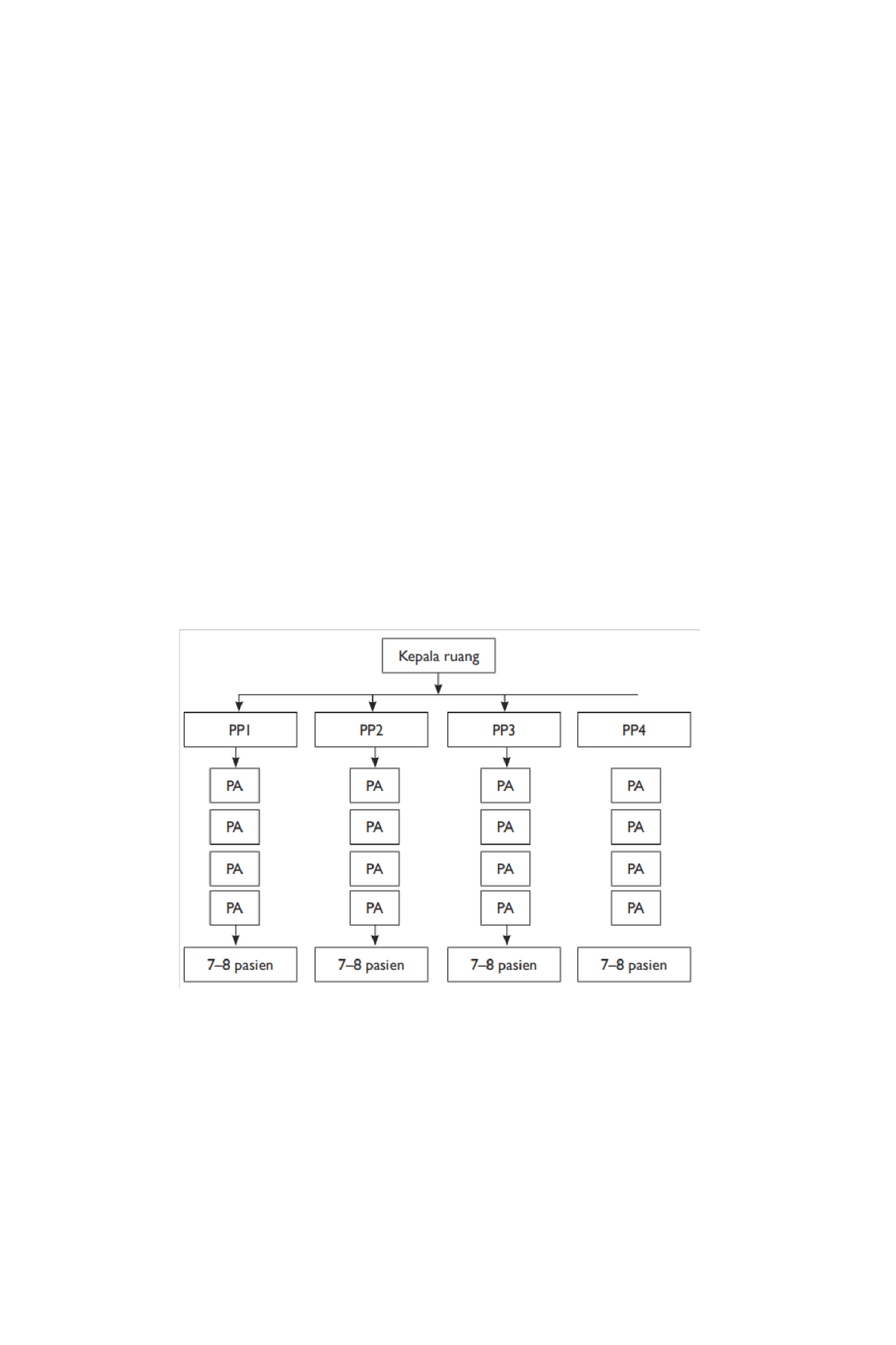
g. Overall task satisfaction is achievable.
h. Nurses better understand each case.
i. The evaluation system from the managerial became easier.
While the disadvantages of this model are (Nursalam, 2014):
a. The ability of the implementing nurses and nursing students
is limited so that they are not able to provide comprehensive
care.
b. Requires a lot of effort.
c. The workload is high especially if the number of clients is
large so that simple routine tasks are missed.
d. The delegation of client care is only partial as long as the
nurse in charge of the client is on duty.
e. The nurse in charge has not been identified;
f. It takes a lot of energy and has the same basic abilities 5.
Modified Models
Figure 5.5 Modified Model (Nursalam, 2014).
The modification model is the use of nursing care methods with
modifications between the team and the primary. If this modified
model requires 26 nurses, then four primary nurses (PP) with

nurse qualifications are needed, in addition to a head of the nurse
who is also a nurse. Implementing nurses (PA) are 21 people, the
educational qualifications of implementing nurses consist of D-3
Nursing graduates (three people) and SPK (18 people). The
grouping of teams in each guard shift is seen in Figure 5
(Nursalam, 2014).
This method is a method of organizing nursing services or care
carried out by professional and non-professional nurses (skilled
nurses) for a group of clients from admission to hospital until
discharge, which is called total or total responsibility. For this
method, a nurse who is knowledgeable, skilled and has the ability to
lead is needed. Ideally 2 - 3 nurses for 8 - 12 clients (Mugianti, 2016).
The determination of the MAKP model system is based on the
following reasons.
a. Primary nursing is not used purely, because primary nurses must
have an educational background in S-1 Nursing or equivalent.
b. Team nursing is not used purely, as the responsibility of patient
nursing care is fragmented across various teams.
c. Through the combination of these two models, it is hoped that the
nursing care community and nursing care accountability will be
found in the primary, because currently the nurses in the hospital
are mostly D-3 graduates, guidance on nursing care is given by
the primary nurse/team leader.
Table 5.1 Differences in Nursing Care Assignment Methods
Type Description Person in Charge

Functional
•Based on the task orientation of the
nursing philosophy.
•Nurses carry out certain tasks
(actions) based on the existing
activity schedule.
•Functional methods were
implemented by nurses in the
management of nursing care as the
main choice during the second world
war. At that time, because the
number and ability of nurses were
still limited, each nurse only carried
out 1-2 types of nursing interventions
to all patients in the ward.
Nurses in charge
of specific actions
Case
•Based on the holistic approach of the
nursing philosophy.
•Nurses are responsible for the care
and observation of certain patients.
•Ratio: 1 : 1 (patient : nurse). Each
patient is delegated to all nurses who
serve all their needs during their
service. Patients will be cared for by
a different nurse for each shift and
there is no guarantee that the patient
will be cared for by the same person
the next day. The case assignment
method is usually applied one patient
per nurse, generally carried out for
private nurses or for special purposes
such as isolation, incentive treatment.
Manager
Nursing
Type Description Person in Charge

Team
•Based on the nursing philosophy
group.
•Six to seven professional nurses and
implementing nurses work as a team,
supervised by the team leader.
•This method uses a team consisting
of different members in providing
nursing care to a group of patients.
Room nurses are divided into 2–3
teams/groups consisting of
professionals, technicians, and
helpers in a small group that helps
each other.
Team Leader
Primary
•Based on the comprehensive actions
of the nursing philosophy.
•Nurses are responsible for all
aspects of nursing care.
•An assignment method in which one
nurse is fully responsible for 24
hours of patient nursing care
starting from the patient entering to
leaving the hospital. Encouraging
the practice of nurse independence,
there is clarity between the creator
of the care plan and the
implementer. This primary method
is characterized by a strong and
continuous connection between the
patient and the nurse who is
assigned to plan, carry out, and
coordinate nursing care while the
patient is being treated
Primary Nurse
(PP)
Type Description Person in Charge

Modification
•Based on the task orientation of the
nursing philosophy.
•Nurses are responsible for all aspects
of nursing care.
•This method is a method of
organizing nursing services or care
carried out by professional and non-
professional nurses (skilled nurses)
for a group of clients from the start of
admission to the hospital until they
go home, called total or total
responsibility. For this method, a
nurse who is knowledgeable, skilled
and has the ability to lead is needed.
Ideally 2 - 3 nurses for 8 - 12 clients
(Mugianti, 2016).
All Nurses
Summary
The Professional Nursing Care Model (MAKP) is a framework that
includes four elements, namely standards, nursing processes, nursing
education, and the MAKP system (Nursalam, 2014). Nursing services
will be able to satisfy patients with the application of a professional
nursing care model because patient satisfaction is determined by
optimal nursing services. In assessing the quality of nursing services,
it is necessary to have nursing practice standards as a guideline for
nurses in carrying out nursing care which is manifested in the nursing
process that is based on the assessment to evaluation (Bidjuni &
Rompas, 2017). In general, the professional nursing care model in
hospitals aims to improve and realize the quality of nursing services.
The assignment method is an alternative method that will be
applied in providing nursing care to clients/patients with the aim of
improving the quality of care and improving the patient's health
status. Basically, all types of assignment methods each have their
advantages and disadvantages. The principle in selecting the

assignment method is consideration of the number of personnel, staff
qualifications and patient classification.
Thus, a manager can determine the right type of assignment
method to be applied to a nursing unit through a situation study that
pays attention to the principle of selecting an assignment method.
Practice Questions
1. A Ns. A is a senior in one of the inpatient rooms of the Jember
Clinic Hospital and he looks brave and manly as the person in
charge of the afternoon shift. Ns. A is dividing the duties to the
implementing nurse to treat patients. In order to distribute the
responsibilities evenly, he divides them based on total care,
partial care, and minimal care patients. What nursing care model
is applied by Ns. A?
a. Transitional MPKP model
b. Model PKP
c. Model modules
d. Model tim
e. Functional models
2. A flamboyant nursing room with 12 beds and a BOR of 85%.
Based on the structure of the workforce, it is known to have a
head of room with an S.Kep. education level, 5 years of work
experience, 4 Nurses with 2 years of work experience, 5 Diploma
in nursing with 3-4 years of work experience. The room has a
nutrition room and is equipped with 1 administrative staff. Based
on the characteristics of existing nurses, the nursing organization
model that is suitable for implementation is... a. Functional
nursing
b. Primary nursing
c. Modular nursing

d. Case Nursing
e. Team nursing
3. ICU nurses carry out nursing focus according to the needs of the
client so that they have the opportunity to perform comprehensive
nursing Types of professional nursing care models applied to the
ICU room are... a. Case method
b. Team method
c. Methods example
d. Functional methods
e. Metode Modular
4. Mrs. A has been in the ICU Room of Hospital B for about 10
days. When the change from night shift to morning shift has
been completed, nurse X gets the task of being able to perform
suction actions on Mrs. A who is fitted with a vantilator, then also
in bathing Mrs. A, nurse X is also in charge of feeding Mrs. A
through a hose, then administering medicine, replacing the IV
tube, etc. Based on this, what nursing assignment model is used
by the hospital? a. Primary Model
b. Functional Models
c. Model Tim
d. Case Model
e. Modified Models
5. Pay attention to the following information.
1) It can give satisfaction to patients and nurses. 2) Utilize
some of the strengths of team members
3) The team supports group development and productivity
4) Individual decision-making
5) Communication between good team members
Based on the information above, which is included in the correct
team nursing assignment model? a. 1, 2 and 3
b. 1 and 3

c. 2 and 4
d. 5
e. All right/all wrong
Discussion Materials
1. Of the several nursing care assignment models above, what types
of assignment models are effective?
2. Discuss the advantages and disadvantages of each nursing care
assignment model.
3. How is the primary assignment model implemented?

CHANGING CONCEPTS AND CONFLICT
MANAGEMENT IN NURSING
Change is the process of switching or moving from one thing or
situation to another, whether it is planned or unplanned ((Nursalam,
2011); Supinganto et al., 2020). Changes are made to anticipate a
threat in the future, solve problems that are being faced, increase
work efficiency and effectiveness, and improve the welfare of
individuals and an organization (Nursalam, 2011; (Rifa'i, 2017). In
making a change in the scope of the organization, it is necessary to
have a change agent as a driving force for the organization in making
changes, starting from planning, implementation processes,
supervisory functions, to producing a change (Nursalam, 2011).
An organization that ignores the concept of change will
experience adverse effects that arise in the future (Hakim et al., 2017).
Change in an organization gives many positive roles and influences
on the performance of employees and the organization. Change also
involves the thinking of individuals, groups within an organization
itself, which ultimately means a change in organizational behavior.
Managing change and the study of change requires an understanding
of a number of social disciplines that are interdisciplinary (Hakim et
al., 2017).
Management is the implementation of business in achieving
business by utilizing available resources that are organized
systematically and planned (Silalahi, 2019). Conflict is an internal
and external dispute due to differences in ideas, values and opinions.
The conflicts caused can be positive and negative (Daniyanti, 2018).
Conflict management is a process that involves conflicts and third
parties develop ways to control and defuse conflicts that occur

(Adventy, 2020). The scope of conflict in nursing is intrapersonal,
interpersonal, and intergroup conflicts (Silalahi, 2019).
The existence of conflicts in health workers can affect the
provision of care services to patients both in treatment and treatment,
so hospitals also need to spend funds both directly and indirectly to
overcome conflicts that occur (Adventy, 2020). Nursing conflict
resolution requires leaders who can overcome and manage conflicts
well. Strategies that can be used in resolving conflicts include:
avoidance, competition, accommodation, cooperation, cooperation,
and negotiation (Silalahi, 2019).
Concept Changes
According to Douglass (1988) in Supinganto et al. (2020), change is
the process of replacing one thing with another that is different from
the previous one (Douglass, 1988). Atkinson (1987) defines change as
an activity or process that makes something or someone different
from the previous state. Meanwhile, Brooten (1978) defines change
as a process that causes changes in the behavior patterns of
individuals or institutions. Change is a part of everyone's life, and
change is a way for a person to grow, develop, and adapt. Change can
be positive or negative, planned or unplanned. Change is the process
of making something different from before (Nursalam, 2011).
So, change is the process of switching or moving from a static
condition to a dynamic condition, that is, being able to adjust to the
environment. Change can include personal, social, and organizational
balance to create improvements or refinements and be able to apply
the latest ideas or concepts in achieving a goal. Changes can be
described in several ways, including planned or unplanned changes.
Unplanned change is a change made without preparation. On the
other hand, planned change is a change that has been planned in

advance, has occurred over a long period of time, and has a clear
purpose. Planned change is easier to manage than changes that occur
in human development, without preparation, or change due to a threat.
The planning process occurs because of complex changes and
involves many people. People who manage change must have a clear
vision in which the implementation process is carried out in the best
direction to achieve the goal. The process of making changes requires
systematic stages, in which everyone will be involved. So, it is
necessary to form a coalition to support change. With the increasing
demands of needs, nurses are required to move and change in a
planned and controlled manner (Nursalam, 2011).
Theory Changes
According to (Nursalam, 2011), there are several theories of change
which include:
1. Teori Lewin (Marquis, B. L., 2017)
a. Unfreezing
This stage is formed from the theory of human behavior and
organizational behavior, by involving several parties to try to
understand the current condition is a condition that needs
change. At this stage, there are three processes related to
change readiness, namely the need for change conditions due
to the large gap between goals and reality, survival anxiety,
and studying defensiveness and resistance in the
organization. In this stage, the leader plays an important role
as an agent who provides an understanding of the adjustment
or adaptation to the change.
b. Movement
At this stage, the gap between the state of desire and the
current state is analyzed and the appropriate change

programs are observed in order to provide the right solution
and reduce resistance to change. At this stage, changes are
made gradually by making new efforts and eliminating old
ways.
c. Refreezing
At this stage, efforts are made to make new behaviors
continue by developing new self-concepts and identities, as
well as new interpersonal relationships. These efforts are
made to strengthen the changes that have been made so that
they run well and stably.
2. Teori Rogers (1962)
Roger (1962) developed Lewin's (1951) theory of the 3 stages of
change by emphasizing the background of the individuals
involved in the change and the environment in which the change
is implemented. Individuals involved in the change process can
accept or reject it. Although changes are acceptable, they may
one day be rejected after they are felt to be hindering their
existence. Roger says that effective change depends on
individuals who are engaged, interested, and striving to always
grow and progress and have a commitment to work and
implement it. There are 5 stages of change, namely awareness,
desire, evaluation, trying, and acceptance or known as AIETA
(Awareness, Interest, Evaluation, Trial, Adoption).
a. The change should have advantages and be better than the
existing methods.
b. Changes must be appropriate and not contrary to existing
values.
c. More complex ideas can be better than simple ones as long
as they are easier to implement.
d. Change can be implemented on a small scale.

e. The easier the change is used, the easier it is for the change
to be propagated.
3. Theory Lippitt (1973)
Lippit (1973) defines change as something that is planned or
unplanned to the status quo of an individual, situation or process,
and in the planning of expected change, is composed by an
individual, group, organization or social system that directly
influences the status quo, other organizations, or other situations.
Lippit emphasized that no one can escape change. Lippitt
revealed that there are seven things that a manager must pay
attention to in a change, namely:
a. Stage 1: Diagnose and establish the problem
Identify all the factors that support or hinder change. At this
stage, every individual involved must open up and avoid a
decision before all the facts can be gathered. Individuals
involved must often think and know what is wrong and try to
avoid inconsistent data. The more information a manager has
about the change, the more accurate the data can be
identified as a problem. Everyone who has power must be
included as early as possible in the process of change,
because everyone has the responsibility to always inform
about the phenomenon that occurs.
b. Stage 2: Assess motivation and ability to change Change is
easy, but change is successful in achieving better goals
requires hard work and high commitment from all parties
involved. At this stage, all parties involved and the available
environment are assessed for capabilities, possible obstacles
and support to be provided. Considering that the majority of
nursing practice is in an organization/agency, the
organizational structure needs to be studied whether the
regulations, policies, and organizational culture, as well as
the people involved, will help the change process or actually

hinder it. At this stage, the focus of change is on identifying
the factors that support and inhibit the change process.
c. Stage 3: Examine the agency's motivation and sources Seek
internal and external support or interpersonal, organizational,
or experiential. At this stage, the commitment and motivation
of the manager is needed in the change process. The
manager's view of change must be acceptable and
trustworthy to the members. Managers must be able to show
high motivation and seriousness in implementing change, by
receiving input from members and always looking for the
best solution.
d. Stage 4: Selecting the final objective of the change
Compile all the results obtained in making plans. At this stage,
the change must have been arranged as an operational, organized,
sequential activity, to whom the change will be impacted, and
when the right time to implement it. Therefore, a time target is
needed and a trial needs to be carried out before determining the
effectiveness of the change.
e. Choosing the appropriate role for the change agent
It is necessary to hold the election of a leader or manager who is
expert and appropriate in his field. The manager will provide the
best input and solutions and can act as a good mentor. Change
will be successful if managers and staff have the same
understanding and ability to implement change.
f. Sustaining change
Change is expanded by requiring a power structure to sustain
it. Once the change has been implemented, it must be
maintained with commitment. Communication must be
carried out openly and continue to be informed so that every
input and problem that occurs can be taken the best solution
by both parties.

g. Ending a relationship of mutual aid
Nurses as agents of change are expected to be able to be
independent with the changes made. During the process of
ending the change, it must be followed by continuous
planning from a manager. This is carried out gradually so
that the individuals involved have increased responsibility
and can maintain the changes that have occurred. In this
case, the manager acts as a consultant and actively continues
to be involved in the change.
4. Havelock's Theory
This theory is a modification of Lewin's theory by emphasizing
planning that will affect change. According to Havelock, the six
stages of change are: a. Building a relationship
b. Diagnose problems
c. Get relevant sources
d. Choosing an exit
e. Increase acceptance
f. Self-stabilization and improvement
5. Teori Spradley
Spradley emphasized that planned change must be constantly
monitored to develop a beneficial relationship between change
agents and change systems. Some of the basic steps of the
Spradley model are: a. Recognizing symptoms
b. Diagnose problems
c. Analyzing the way out
d. Choose changes
e. Plan for change
f. Implementing changes
g. Evaluate changes
h. Stabilizing changes

Conflict Management Concepts
Management is an effort to organize the work of the group to achieve
the expected goals by utilizing resources effectively (Lombogia,
2013). Management is the effective use of existing resources to
achieve goals (KBBI, 2016). Conflict in nursing is defined as a
situation of threat to needs, interests, and attention due to
disagreements between the parties involved (Moeta, 2019). Conflict
can have an impact on members and cause a lack of motivation for
work and a need for low work performance (Gulo, 2019). Conflict
management is a difference in ideas that occurs between leaders and
workers or problems that arise in an organization (Telaumbanua,
2019). Conflict management in a hospital is necessary because it
affects the performance and motivation of nurses and has an impact
on the quality of service to patients. (Gulo, 2019).
The word conflict can be described into 3 traits, namely positive
conflict, negative conflict, and neutral conflict:
1. Positive conflicts are conflicts that are linked to adventure,
innovation, renewal, and the development of change. These
conflicts are constructive;
2. Negative conflicts are destruction, destruction, irrationalism,
emotions, chaos, war. These conflicts are destructive;
3. Neutral conflict is defined as the usual consequences that arise
from the diversity of individuals with different traits and different
life goals (Gulo, 2019).
Conflict Process
Before a manager tries to intervene in a conflict, a manager must be
able to accurately assess the stage of the conflict. According to

Marquis and Huston (2017), the development of conflict includes
several stages, including:
1. The first stage in the conflict process, latent conflict, implies the
existence of a precursor in the past such as short-sighted thinking
followed by rapid change. At this stage, conditions have
supported the occurrence of conflicts even though no conflicts
have occurred. Many conflicts can be prevented or mitigated if
managers conduct in-depth checks related to previous conditions.
For example, changes and budget cuts almost always cause
conflicts. Therefore, such events must be well thought out so that
intervention can be carried out before the conflicts created by the
events escalate.
2. If the conflict continues, it continues to develop into the second
stage: the perceived conflict. Perceived or substantive conflicts
are intellectual in nature and often involve issues and roles.
Individuals feel conflicts logically and indirectly. Sometimes,
conflicts can be resolved at this stage before they are internalized
or perceived. In an environment characterized by open and
supportive communication, many conflicts can be resolved
simply by showing that there is potential or an actual problem.
3. The third stage occurs when the conflict involves
emotionalization. Emotions felt include hostility, fear, distrust,
and anger. This is also referred to as effective conflict. It is
possible to see the conflict and not feel it (for example, there are
no emotions attached to the conflict and the person sees it only as
a problem to be solved). A person may also feel a conflict but not
understand the problem (for example, he or she feels there is a
conflict, but may not be aware of the root).
4. In the fourth stage or often called open conflict. Such actions may
be attracting, competing, arguing, or seeking a resolution to the
conflict. Individuals feel uncomfortable or reluctant to cope with

conflict for a variety of reasons. These include fear of retaliation,
fear of being ridiculed, fear of alienation from others, feelings
that they have no right to speak up, and past negative experiences
with conflict situations. Every individual, especially nurses, often
learns coping patterns to face real conflicts early in life With
family background and experience playing a role in directly
influencing coping and conflict handling. Gender can also play a
role in how we respond to conflict. Historically, men were
socialized to respond to conflicts aggressively, while women
were more likely to be taught to try to avoid conflicts or to calm
them down.
5. The fifth and final stage in the conflict process is the result of
conflict. Positive and negative impacts always exist after a
conflict occurs. If the conflict is well managed, the people
involved in the conflict will believe that their position is getting a
fair check. If conflicts are poorly managed, conflict problems
often persist and can come back later to create more conflicts.
Types of Conflict
The main categories of nursing conflicts are divided into 3, namely
intrapersonal, interpersonal, and intergroup conflicts.
1. Intrapersonal
Interpersonal conflicts occur from within each individual. This
involves an internal struggle to clarify contradictory values or
desires. From the manager's point of view, intrapersonal conflicts
can result from various areas of responsibility with management
roles. Managers' responsibilities to organizations, subordinates,
consumers, professions, and individuals are sometimes
conflicting, and such conflicts can be internalized. The way to
resolve intrapersonal conflicts is to become self-aware and
meticulous in working to resolve conflicts. Intrapersonal

conflicts can affect the intrapersonal physical and mental health
of nurses (Marquis and Huston, 2017).
2. Interpersonal
Interpersonal conflicts involve two or more people who have
different values, goals, and beliefs. Interpersonal conflicts are
more based on the emotional, emotional, and personal turmoil of
each individual. The source of personal conflict can come from
the lack of information that individuals get. Communication is
not always accepted, can be misinterpreted, or
interpretations/conclusions differ based on individual past
experiences. Role mismatches are identified as the cause of
conflict due to differences between the goals, responsibilities
given, and what each individual wants (Marquis and Huston,
2017).
3. Intergroup/Intergroup
Intergroup conflicts involve two or more groups of individuals,
departments, and organizations. Examples of conflicts between
groups are two political affiliations with different or conflicting
beliefs or nurses experiencing conflicts with family and work
problems. This type of conflict is an obstacle in achieving power
and authority (quality of services), as well as limited
infrastructure (Marquis and Huston, 2017).
Conflict Resolution Strategies
Steps taken to resolve a conflict:
1. Assessment
a. Situation analysis
Identify conflicts in depth by collecting data and validating
existing conflicts, as well as observing the roles involved
b. Analyze and kill evolving issues

Prioritizing existing issues and resolving them at once
c. Establish goals
2. Identification
Manage issues. In this phase, avoid emotional responses such as
anger because everyone has different responses in words,
expressions and actions.
3. Intervention
a. Conflicts that can be resolved well and give positive results
b. Selection of methods in resolving conflicts. Because each
problem has a different solution strategy (Nursalam, 2011).
Conflict resolution strategies can be divided into 6, namely:
1. Compromise or negotiation
In compromising, each party gives up something he wants.
Although many see compromise as an optimal conflict resolution
strategy, antagonistic cooperation can result in a lose-lose
situation because one or both parties feel that they have given up
more than the other and therefore may feel defeated. The
completion of this strategy is often interpreted as a "lose-lose
situation". The two elements involved agreed and agreed on what
had been made. In nursing management, this strategy is often
used by middle and top nursing managers (Marquis and Huston,
2017). In order for the compromise not to reach a situation of
loss, both parties must be willing to give up something of equal
value. Compromise is definitely a win-win when both parties feel
they are winning more than the other. It is important that the
parties to the conflict do not adopt compromises prematurely if
collaboration is possible and feasible. For example, the
willingness to accept a salary increase of 10 thousand rupiah per
hour instead of 15 thousand rupiah to accept a partial agreement
with a certain point of view and to admit responsibility for a
violation (Marquis and Huston, 2017).

2. Competence
This strategy can be interpreted as "win/lose" conflict resolution.
This settlement emphasizes that there is only one person or group
that wins without considering the loser. The negative
consequences of this strategy are anger, despair, and a desire for
future improvement (Marquis & Huston, 2017). When a person
tries to fight for his own interests without caring about the impact
on the other party in conflict, we can say that he is competing.
Examples of this behavior include the intention to achieve your
goals at the expense of others' goals, trying to convince others
that your conclusions are right and their conclusions wrong, and
trying to hold others to blame for a problem (Marquis & Huston,
2017).
3. Accommodation
When one party tries to please its opponent, that party will be
willing to put the interests of the other party above its own. In
other words, in order for the relationship to be maintained, one of
the parties is willing to sacrifice. We call this intention
accommodating. Examples include a willingness to sacrifice your
interests so that the other party's goals can be achieved, support
the other person's opinion even if you are reluctant, and forgive
someone for a transgression and open the door to further
transgressions (Marquis & Huston, 2017). Another term that is
often used is "cooperative". This conflict is the opposite of
competition. In this strategy, one tries to accommodate problems
and give others a chance to win. The main problem with this
strategy is actually not solved. This strategy is usually used in
politics to seize power with various consequences (Marquis &
Huston, 2017).
4. Smoothing
This technique is a conflict resolution by reducing the emotional
component of the conflict. In this strategy, individuals involved

in conflict seek togetherness rather than differences with full
awareness and self-introspection. This strategy can be applied to
minor conflicts, but for large conflicts such as competition for
services/production outputs, it cannot be used (Marquis &
Huston, 2017).
5. Dodge
All those involved in the conflict, in this strategy, are aware of
the problem at hand, but choose to avoid or not solve the
problem. This strategy is usually chosen when the disagreement
harms both parties, the cost of resolving it is greater than
avoiding, or it is necessary for a third person to resolve it, or if
the problem can be resolved on its own (Marquis & Huston,
2017). A person may admit that there is a conflict but he or she
wants to withdraw or suppress it. Examples of avaiding behavior
are trying to ignore a conflict and avoid others who disagree with
you (Marquis & Huston, 2017).
6. Collaboration
This strategy is a "win-win solution" strategy. In collaboration,
the two elements involved determine a common goal and work
together in achieving a goal. Because both believe that a goal that
has been set will be achieved, each believes in it. Collaboration
strategies will not work if incentive competition is part of the
situation, the group involved does not have the ability to solve
the problem, and there is no trust from either group or person
(Marquis & Huston, 2017). When each party to the conflict wants
to jointly fight for the interests of both parties, it can be said that
they are working together and striving for mutually beneficial
results. In collaborating, the intention of the parties is to solve
problems by clarifying differences rather than accommodating
points of view. Examples are the attempt to find a win-win
solution that allows the goals of both parties to be fully achieved

and the search for conclusions that state valid insights from both
sides (Marquis & Huston, 2017).
Summary
Change is going from the old state to a new state in order to be able to
adjust to the existing environment. Changes are important in
improving organizational performance and effectiveness. Change is
an important component of nursing practice. Change in nursing is
defined as a way of nursing in maintaining itself as a profession and
playing an active role in order to be able to align with the world's
nursing in facing the challenges of globalization in the process of
nursing professionalization. Changes in nursing make nursing
professionalization faced in two ways, namely innovating and
changing or being changed by circumstances and situations, so it is
important for nurses to manage the change process. This change in
nursing services is a competency in nursing management and
leadership to plan organizational change.
Conflict management in nursing is a difference in ideas that
occurs between leaders and workers or problems that arise in an
organization. Conflicts can be constructive and destructive, the
existence of problems/conflicts in hospitals can cause a decrease in
service quality and reduce the quality of service. Sources of conflict
can be caused by limited human resources, differences in goals
between members of the organization, internal problems and lack of
communication (Nursalam, 2011). Conflict categories can be divided
into 3 intrapersonal, interpersonal, and intergroup. There are 5 stages
of the conflict process, namely latent conflict, felt conflict,
deliberately displayed conflict, conflict resolution and aftermath

conflict (Nursalam, 2011). There are 3 steps in conflict resolution,
namely assessment, identification, and intervention of the problem
(Nursalam, 2011). Strategies in conflict resolution through
compromise, competence, accommodation, smoothing, hiding, and
collaboration (Marquis & Huston, 2017).
Practice Questions
1. An inpatient room organization at hospital X is improving in
dealing with the problems that are happening. After being
identified, the description of the problems in it is in the form of a
weak room management system which results in a decline in the
performance of the implementing nurses and coordination
between leaders and members is still poor. Some of these
problems are used by managers to develop a good change
strategy. From the illustration above, managers seek to make
changes by using strategies... a. Education
b. Facilitative
c. Technostructural
d. Data-Based
e. Communication
2. Medika Hospital is one of the private hospitals in the city of Y.
However, the hospital has inadequate health facilities. In
addition, the management of medical and non-medical waste is
still not optimal, as well as the condition of the room is not clean
and fragrant. With these conditions, the manager wants to make
changes and has identified and determined the problem, what
should the manager do next? a. Diagnose and establish problems
b. Assess motivation and ability to change
c. Examining the agent's motivations and resources
d. Selecting the final objective of the change
e. Choosing the appropriate role for the change agent

3. Here are some of the reasons why managers make a change in an
organization, except... a. Promotion of positions
b. Increase organizational effectiveness
c. Improving the well-being of all levels of the organization
d. Future-oriented
e. Getting closer to customers or users of the organization's
services.
4. The increase in the prevalence of cardiovascular diseases on the
island of Kalimantan has caused one of the hospitals in the area
to increase the number of beds for the ICCU room. However, the
head of the room refused on the grounds that the number of
nurses was unbalanced if the number of beds was increased, and
this would have an impact on nursing care that was less than
optimal. What is the most appropriate conflict resolution strategy
to use in the case? a. Smoothing
b. Negotiation
c. Kompetisi
d. Dodge
e. Accommodation
5. A hospital in Jember Regency inaugurated a special room to
handle COPD cases that are increasing in rural areas. Everything
is prepared like new equipment, new room heads, and new
nursing staff. However, in this situation, there was a conflict
between the head of the room, the team leader, and the
implementing nurse due to differences in beliefs. What conflicts
occurred in the case?
a. Compromise
b. Interpersonal
c. Intrapersonal
d. Intergroup
e. Collaboration

Discussion Materials
1. If you were the head of the treatment room and knew the nurse
who was in conflict with the team leader, what would you do?
2. How to prevent conflict in nursing?
3. Which conflict resolution model do you think is the most
effective
EFFECTIVE COMMUNICATION IN NURSING HAND
OVER
Communication is the process of conveying information in the form
of messages, ideas, ideas between communicators and communicators
with or without using media to influence other people who produce
interactions. Effective communication is the main element for nurses
in carrying out nursing care in achieving optimal results. The
components in effective communication are communicators,
messages, media and communicators. Effective communication is
very closely related to the interpersonal relationship, namely nurse-
patient. The nurse-patient relationship is a means in the nursing care
process, where the interpersonal process displayed by nurses and
patients is influenced by each other's behavior. In addition, effective
communication is also needed by health workers, namely between
nurses. Handover is a technique used to convey and receive
information related to the patient's condition carried out by nurses.
Consideration and acceptance must be carried out effectively and
efficiently by explaining briefly, clearly, and completely about the
nurse's independent actions, collaborative actions that have been or
will be carried out by nurses, and the development of the patient's
condition at that time (Kurniawan et al., 2019).

Definition of Effective Communication in Nursing
Communication is the process of conveying information (messages,
ideas, ideas) between communicators and communicators with or
without using media to influence others and produce an interaction
(Rokmah & Anggorowati, 2017). Meanwhile, effective
communication is the main element for nurses in carrying out nursing
care in achieving optimal results (Hilda, et al., 2017).
Effective communication is the basis for creating interpersonal
relationships between nurses and patients which is used as the main
method in implementing the nursing process (Watson, 2008 in
Syagitta, 2017). According to Arnold & Boggs (2020),
communication
Effective is a form of information exchange or message in two
directions, namely nurses and patients with the desired expectation
that can be achieved.
Effective communication is part of the standard of professional
nursing practice. Professional competence in nursing practice is not
only psychomotor and clinical diagnostic skills, but also abilities in
interpersonal and communication skills (Kourkouta, 2014).
Communication is said to be successful, if we know and learn the
components in the communication process. Effective communication
occurs if the recipient of the message captures and interprets the
message conveyed by the sender of the message (Sarfika, et al.,
2018).
Effective Nurse-Patient Communication
Effective nurse-patient communication is a key component of the care
process. Effective communication between nurses and patients is
related to satisfaction and improvement of patient health (Ardakani,
et al., 2019). This effective communication process involves

collaboration between nurses and patients as well as patients' families
in a professional manner. The communication process will go well if
the nurse and the patient have the same goal in the nursing care
process, namely the patient is able to understand every care provided
by the nurse so that there is a positive response and establish a
relationship of mutual trust with the patient (Pieter, 2017).
Weighing is a technique used to convey and receive information
related to the patient's condition. Consideration and acceptance must
be carried out effectively and efficiently by explaining briefly, clearly,
and completely about the nurse's independent actions, collaborative
actions that have been or will be carried out by the nurse, and the
development of the patient's condition at that time. Submission is
useful so that there is continuity between nursing care that will be
provided and sustainable properly (Kurniawan et al., 2019).
Effective Forms of Communication
1. Pre conference
Pre conference is a discussion conducted by nurses about the
clinical aspect after the pass and before providing nursing care to
patients. The purpose of the project is to prepare things that will
be encountered in the field, help identify problems in patients,
plan nursing care and plan the evaluation of results (Permatasari
et al., 2014).
2. Weigh in with ISBAR
ISBAR (Introduction, Situation, Background, Assessment, and
Reccomendation) is used to communicate the pre-procedure that
will be performed to the patient during the handover process or
if there is an unexpected change to the patient's care. This
communication is a communication that is being developed in the
health sector to optimize patient health (Rachmah, 2018).
3. Post conference

Post conference is a discussion activity carried out by the team
leader and the implementing nurse regarding the activities carried
out during the shift before the next shift pass is made . This
activity is very important to carry out because in carrying out
nursing care, the team leader and members must be able to
discuss the clinical experience carried out, analyze, clarify the
relationship between problems and situations, identify problems,
convey and form a support system between nurses in the form of
formal and professional discussions. If the post conference is not
carried out properly, then the information conveyed during the
pass is also ineffective (Permatasari et al., 2014).
Effective Nurse-Patient Communication Techniques
In order for communication to achieve the expected goals, nurses
must master effective communication techniques. The following are
effective communication techniques according to Stuart & Sundeen
(1998) in the Ministry of Health (2016), including:
1. Good listeners
A good listener is an effort to understand the message conveyed,
both verbal and non-verbal.
2. Indicating acceptance
Showing acceptance is being willing to listen to others, without
showing doubt or disagreement. Nurses should avoid facial
expressions and body movements that indicate disapproval, such
as frowning or shaking their heads in disbelief.
3. Ask related questions
The purpose of the nurse asking questions is to get specific
information about the patient. The type of questions presented are
associated with the topic being discussed and use easy-to-
understand words.

4. Repeating
The technique of repeating the patient's speech. This technique is
used so that the nurse provides feedback so that the patient
knows that his message is received and understood.
5. Clarification
This technique is performed if the nurse wants to clarify the
information submitted by the patient. This technique is used
when the nurse does not understand, is unclear, or does not hear
what the patient is talking about. Nurses need to clarify to
equalize perceptions with patients.
6. Focusing
This technique is carried out with the aim of limiting the material
of the conversation so that it is more specific. The nurse does not
interrupt the patient's conversation when conveying important
information, unless the conversation continues without important
information.
7. Reflecting/Feedback
This technique aims to provide feedback to the client to know if
the message is well received.
8. Informing
Providing information is a technique used to convey important
information. The delivery of information must be thorough
without anything being reduced or exaggerated. After the
information is conveyed, the nurse facilitates the patient to make
a decision.
9. Diam (Silence)
The silent technique gives the nurse and patient the opportunity
to organize their thoughts. The use of this technique requires skill
and time. For the patient silence means providing an opportunity
to think and organize their thoughts, as well as process

information. For nurses, silence means giving patients the
opportunity to think and have an opinion.
10. Offer yourself
This technique aims that if the patient is not ready to
communicate verbally with others, the nurse must offer his or her
presence and interest.
11. Give the patient the opportunity to start a conversation Give the
patient the opportunity to take the initiative in choosing a topic of
conversation. Nurses can play a role in stimulating patients to
take the initiative in opening up conversations.
12. Humour
The humor in question is effective humor. This humor aims to
reduce tension and relaxation. Nurses must be careful in using
this technique because the inaccuracy of the use of time can
offend the patient which results in the patient's distrust of the
nurse.
Principles of Effective Nurse-Patient Communication
In effective communication, you must pay attention to the 5
Inevitable Laws of Effective Communication (The 5 Inevitable Laws
of Effective Communication) abbreviated as REACH which includes
Respect, Empathy, Audible, Clarity, and Humble. This is relevant to
the principle of interpersonal communication, namely as an effort to
gain attention, care, love, and appreciation for oneself from the social
environment (Syagitta, et al., 2017). The following are strategies in an
effort to build effective communication:
1. Respect, effective communication must be built from an attitude
of respect for each individual who receives the message. Respect
and mutual respect are the main thing because in principle,
humans want to be appreciated and considered important. If we
build communication with respect and mutual respect, we can

build synergistic cooperation so as to improve performance.
Likewise with patients, if nurses respect patients, patients will
feel respected and valued.
2. Empathy, the ability to put oneself in situations or conditions
faced by others or feel the feelings of others. A sense of empathy
can be developed if nurses have skills in listening, feeling, and
speaking.
3. Audible, means that it can be listened to or understood well. If
empathy hears first or is able to receive feedback well, then
audible means that the message conveyed can be received by the
recipient of the message.
4. Clarity means openness and transparency so that it does not cause
multiple interpretations or various other interpretations. In
communicating, it is necessary to develop an open attitude
(nothing is covered or hidden) so that it can increase trust.
5. Humble, means humility. This attitude is related to an attitude of
respect to build a sense of respect for others, then based on
by their humble attitude. Humility needs to be done by nurses, in
order to create a sense of affection with patients.
Problems and Barriers in Effective Communication
1. Nurses who are not present at the time of weighing and receiving
2. Nurses who are less concerned about the weighing process
3. Arriving late when weighing in
4. Come to weigh and accept when there is a head of the room only
5. Nurses who do not follow the weigh-in will not be able to meet
the current needs of patients
6. Poorly focused information
7. The time taken is still long

8. Misreceipt of messages that cause misperception (Sudestri et al.
2017).
Effective Communication Methods
1. Conference implementation
a. Led by a team leader
b. Fill:
1) Plan for each nurse (daily plan)
2) Additional plans from the team leader
c. Done after a pass
d. Performed at each team's table
e. Person in charge:
1) The leader of the opening team
2) The team leader asked about the daily plan of each
implementing nurse
3) The team leader provides input and follow-up in
accordance with the current nursing care
2. ISBAR (Introduction, Situation, Background, Assesment,
Recommendation)
a. Introduction: Orientation Phase (nurses who are on duty in
the previous shift and will be working shifts with patients or
families)
1) Greeting before entering the patient's room
2) Introduce yourself
3) Explain the purpose and purpose of the nurse's arrival
b. SBAR Reporting: Interaction Phase (nurses who served on
previous shifts and nurses who will be on shifts with patients
or families)
1) Situation (current condition experienced by the patient)
• Mention the patient's name and age

• Mention the date and day of entry into the room
• Mention the name of the doctor who treats the
patient
• Menyebutkan Diagnosis Medical
and nursing problems that have not been or
will be resolved
2) Background (important information related to the
patient's current condition)
• Describe the interventions that have been carried out
from each nursing diagnosis
• Mention history of allergies, installation of invasive
devices, history of surgery, and medications
(including intravenous fluids)
• Explain and identify patient and family knowledge
of medical diagnosis
3) Assessment (the result of an assessment of the patient's
current condition)
• Fully explain the results of the current patient
assessment
• Describe other supportive clinic conditions
(laboratory, x-rays, and more)
4) Recommendation
• Recommend nursing interventions that have been
given or need to be continued, including follow-up
plans and patient and family education.
c. Termination phase (nurses who were on duty on previous
shifts and will be working shifts with patients or families)
1) Providing patients with the opportunity to ask and
respond to questions
2) Providing positive reinforcement to patients

3) Say thank you
4) Saying the closing greeting
Summary
Communication is the provision of information from the informant to
the recipient with the aim that the message conveyed can be
understood. Effective communication is the development of a
relationship between health workers and patients effectively in well-
maintained social contact that is useful for solving patient health
problems. Nurses as an important profession in carrying out care and
care always communicate with patients and between other health
workers. The form of effective communication that nurses carry out
in the process of providing nursing care is very important. In the
process of effective communication, nurses are divided into pre-
conference, weigh-in, and post-conference. These three things are
interconnected and sustainable. The pre-conference is carried out
before the nurse provides nursing care to the patient, weighs and
accepts, and then the post-conference is carried out to evaluate the
treatment. This communication is carried out by providing accurate
information about the patient's condition in various aspects to nursing
follow-up. In weighing and accepting, there are several obstacles that
may occur so that the weighing and acceptance is not optimal. With
the existence of hospitals that do not implement weight and
acceptance effectively, there is a need for evaluation and development
in accordance with the SOPs that have been implemented.
Practice Questions
1. Nurses in carrying out the nursing care process always
communicate between patients, nurses, and other health workers.
When doing the work of nurses are divided into morning,

afternoon, and night shifts. The process carried out by nurses in
changing shifts to provide information related to the patient's
condition in a comprehensive and sustainable manner is called...
a. Pre-conference
b. Weigh in
c. Post-conference
d. ISBAR
e. Meeting rooms
2. In changing shifts, nurses will provide accurate information about
patients to other nurses on the next shift. Things that must be
considered in doing a handover are...
a. The time required is allowed to clarify information
b. Only the nurses of the previous shift and the next shift are
involved
c. Carried out before and after doing shifts
d. There are no limits to the topics discussed
e. Does not explain nursing diagnoses that may arise
3. It is important for nurses to convey information accurately and
completely in carrying out the weighing process. Therefore
that, what nurses must convey in the process of weighing and
accepting, namely, except...
a. Nursing problems that patients are still experiencing today
b. SATNDINGThe nursing action that has been carried out
c. Collaborative interventions that have been implemented
d. Procedures that are often performed without the need for
reports
e. Past health habits of the patient
Discussion Materials
1. Describe the forms of effective communication in nursing!
2. How is the SBAR communication technique in nursing?

3. Discuss the differences between pre-conference, weigh-in, and
postconference in nursing!
STANDING ORDER, COLLABORATION AND
DELEGATION IN NURSING
The implementation of health services by health workers is influenced
by the availability of health workers. The inequality in the number of
doctors and nurses as part of health workers affects the process of
health services. The limited number of doctors requires nurses to
carry out medical procedures or other medical actions that are not
under their authority. Based on the Ministry of Health Number 1239
of 2001 Article 15 (d) states that in carrying out nursing practice,
nurses are authorized to carry out medical treatment services if they
receive a written request from a doctor. In addition, in the
Constitution No. 38 of 2014 article 29 (paragraph 1) concerning the
Duties and Authority of Nurses states that the delegation of authority
is one of the duties of nurses which means that nurses can carry out
the necessary medical actions if they have been given the authority to
carry it out. Standard operating procedures (SOPs) in carrying out
activities of delegating authority from doctors to nurses can be in the
form of standing orders.
Standing order is a form of written delegation of authority given
by doctors to nurses who have undergone training and are competent

to carry out medical actions that will be carried out for a long period
of time or continuously. Standing orders provide additional
responsibility for nurses in training themselves to make decisions
while on duty. Nurses are given the task of making decisions about
when medication is needed. This can only be done by experienced or
competent nurses so that there are no problems when carrying out
standing orders.
Delegation is a nursing management process in directing nurse
performance completed by managers. Delegation can also be
concluded as a consideration of temporary duties due to several
things. Delegation is used as a formal delegation of authority and
responsibility in
perform a specific task. Leadership and confidence in delegation are
two important explanatory constructs of nursing practice. The
relationship between these constructions, however, is not clearly
understood. In order to succeed in their role as leaders, regardless of
their experience, nurses need to understand how best to delegate
(Saccomano et al., 2011).
Health collaboration is a collaboration between health professions
that have different professional standards and cultures with clients
and their families. The main goal of health team collaboration is to
provide the right service, by the right health team, at the right time,
and in the right place so as to provide the best quality of service.
Health collaboration consists of various health professions such as
doctors, nurses, psychiatrists, nutritionists, pharmacists, and others.
Collaborative practices are related to reducing mortality rates,
complication rates, length of hospital stay, duration of treatment,
reducing treatment costs, improving patient and team satisfaction with
health professionals, and reducing conflicts among health teams.

Standing Order in Nursing
1. Definition of Standing order
A standing order is a document that contains instructions for
routine therapeutic actions or a diagnostic procedure for patients
who have specific clinical problems that have been identified and
in accordance with existing guidelines. Standing orders may
contain the administration of certain medications, such as the
administration of lidocaine or propanol to patients with irregular
heart rhythms.
According to Sutarih (2018), a standing order is a regulation
that regulates the delegation of authority by doctors to nurses
with special skills for a long period of time or continuously.
Based on the two definitions above, it can be concluded that
standing order is a form of rule in the implementation of the
delegation of authority from doctors to nurses who have
undergone special training or have been competent which will be
carried out for a long period of time or continuously.
2. Steps for Standing Order Implementation:
a. Identify the condition of the patient to be treated
b. Explain why standing orders are necessary
c. Determining the scope of the implementation of standing
orders
d. Determine the party who will be responsible for the
implementation of the standing order
e. Determining who is trusted to execute the standing order
(e.g. in the case of administering or administering medicines)
f. Determine the patient to be given medication according to
the order in the standing order

g. Include the type of special care that must be performed on a
particular patient according to the patient's condition (when
needed)
h. Making conclusions about what drugs to give to patients
i. Re-specify whether the standing order requires a second
party signature or requires a monthly audit of the sample
records taken.
j. Ensuring that standing orders are in a valid written format
k. Make sure the standing order contains the date and get a
valid signature
l. Ensure the review date for the standing order has been
written 3. Components in a Standing Order:
a. Conditions and situations in which a standing order is
necessary
b. Review criteria
c. Subjective and objective data
d. Plan of Care
e. Criteria or circumstances in which the doctor as the assignor
will be summoned
f. Date of writing
g. Signature
Collaboration in Nursing
1. Definition of Collaboration
Collaboration is a complex process that is planned to share
knowledge and jointly take responsibility for client care. This
generally lasts for a long time between health workers. The
picture of the relationship between nurses and other health
professionals is in the form of cooperation in equality which is
the basic essence of collaboration. Equality can be realized if

collaborators feel valued and involved both physically and
intellectually when providing services to clients (Ismainar, 2015).
Collaboration is a process between health professionals such
as nurses, doctors, and other health teams to provide health
services within the scope of nursing professional practice,
through supervision to provide guidelines for the development of
collaboration or procedures set by a country where the service
provider is located. As a nurse, a cooperative relationship with
other doctors and medical teams is essential to realize their
functions independently. Collaboration is based on the concept of
general objectives, professional practitioner contributions,
legality, communication, and client-focused practices (Suswati et
al., 2018).
2. Key Elements of Collaboration
In carrying out collaboration, according to Kozier in 2010, there
are important elements that must be fulfilled in collaboration,
namely mutual respect, effective communication, mutual trust
and decision-making process. Meanwhile, the key elements in
collaboration according to Bardet et al., in 2015 were trust,
dependence, perception and expectations related to skills. So it
can be concluded that the important components that must be
contained in collaboration are:
a. Communication: Communication is very important in
collaboration, one of which is interprofessional
communication. Interprofessional communication can improve
the function of the health team in providing care to clients by
involving various multidisciplinary disciplines such as nurses,
doctors, nutritionists, and other health teams. In addition to
interprofessional communication, other communication
techniques that must be included in the collaboration process
are nonverbal communication and therapeutic communication.

A nurse is highly recommended to master communication
because nonverbal communication is very dominant in the
communication process in collaboration. Nurses must be able
to read the body language of the interlocutor and also be able to
display body language that is appropriate to the topic of
conversation. And therapeutic communication aims to support
collaboration between health workers or health workers and
clients to support the client's health (Barbara L, Y and Lynne R,
C. 2020).
b. Accountable: Collaboration between health workers or
interdisciplinary disciplines that aims to support the health of
clients can be held accountable. So that the collaboration
carried out is not arbitrary and does not injure clients.
c. Assertiveness: Assertiveness is very important in collaborative
actions. Because having an assertive attitude means having the
ability to express opinions effectively and respect the rights and
beliefs of others who have different opinions. This is of course
very crucial in determining therapeutic actions for clients,
whether they are multidisciplinary or interdisciplinary.
d. Coordination: Coordination is a form of cooperation between
the health profession and multidisciplinary sciences in
intervening with clients with the aim of improving the client's
health by helping each other and complementing intervention
actions (Margaret, et al. 2013).
e. Autonomy: knowing the rights and authorities between
multidisciplinary disciplines is very important in collaboration.
Because the collaboration carried out between
multidisciplinary sciences has a limit of authority and a limit of
action for each profession. So that the actions taken by health
workers do not violate or violate the autonomy between
professions.

f. Trust and Respect: when collaborating, the main thing that a
health worker must have is trust and respect, so that the
collaboration carried out can run optimally without pros and
cons between health workers or between multidisciplinary
disciplines.
3. Collaboration Process
The collaboration process is centered on the client and the
cooperation is carried out between health workers, both nurses-
doctors-nutritionists and other multidisciplinary workers.
Collaborative interprofessional practice is a growing domain in
health services. Collaboration carried out by multidisciplinary
health workers is carried out with the highest goal, namely the
health of the client and the client as the center of health services
(Graves & Doucet, 2016). The most important process carried
out by health workers in collaborating is effective
communication (MacLean et al., 2015). In addition to effective
communication in the collaboration process, it is also necessary
to understand between peers or between professions, then there is
trust and negotiation to collaborate on actions centered on
improving the client's condition. And when collaborating, a
positive image and recognition as colleagues are not superiors or
subordinates, because in carrying out client-centered
collaboration, all health professions and multidisciplinary
disciplines synergize with each other, and play an active role in
every collaborative action.
Delegates in Nursing
1. Definition of Delegation
Delegation is the handing over of responsibility from one person
to another person in carrying out activities while still being
responsible for the final results of the activity (Hidayat et al.,

2019). According to the Great Dictionary of the Indonesian
Language (KBBI), a delegate is someone who is appointed and
sent by an association to carry out an assignment that is delegated
with the obligation to hold him accountable to the person who
assigns it.
Nursing delegation is one of the activities of the head of the
room to carry out the management function in the provision of
nursing services. This can be intended that the head of the room
must have a good ability to this activity because it affects the
individual who is given an overflow of activities. For example, if
the head of the room delegates nurses, both parties must be
equally beneficial or satisfied with the agreed activities
(Zulkarnain, 2017).
Nurses delegate tasks based on patient needs, potential
hazards, stability of the patient's condition, complexity of the
task, and predictable outcomes. Another consideration is the
qualifications and skill level of the person receiving the
assignment. When delegates are used effectively, nurse leaders
and managers can expand access to nursing care, promote safe
and quality nursing care, and facilitate the effective use of health
care resources (Murray, 2022).
So, nursing delegation (delegation of authority) is a handover
of performance responsibility that is absolutely delegated to a
room head when carrying out other duties and is forced to leave
the current room (Pohan et al., 2018).
2. Components in Delegation
According to Pohan (2019), in carrying out the delegation
process, it is necessary to pay attention to the main components
of the delegation, as follows: a. Delegator
A delegate is someone who is in charge of delegating tasks to
the right individuals to receive delegates. The Delegator has

full authority due to his position in an organization and has
permission to perform certain tasks. Delegators can delegate
tasks to subordinates by assigning responsibilities in
accordance with the tasks in the delegation of authority.
However, accountability remains with the delegator.
b. Delegate
A delegate is someone who receives the delegation of
authority from the delegator. The relationship between
delegates and delegates is very influential, especially in the
work environment or through policy bodies. The delegate has
the right or obligation to refuse or accept related to the tasks
delegated by the delegate in accordance with his or her
capabilities.
c. Assignment
A task is an activity that is delegated to delegates by the
delegator. The delegated task must include a routine task
such as administering injections to patients.
d. Client/Situation
Identification of specific clients or patient situations or
variations in care is carried out with the aim of ensuring that
the tasks delegated to delegates related to patient care can be
performed properly.
3. How to Delegate
According to Hidayat et al., (2019), things that must be done in
effective delegation include:
a. Make sure that the tasks that have been delegated to someone
are suitable for delegation.
b. Determine someone who can be trusted in carrying out the
tasks that have been delegated.
c. Coordination of someone who has been sent to provide
direction in line with the task to be carried out.

d. Give an appropriate explanation to the individual who has
been sent regarding the reason for the delegation of the
assigned task and the expected result.
e. Review related to the resources needed such as individuals,
money, and equipment.
f. Make an agreement related to the completion of the
assignment assigned to the person being sent.
g. Provide support and guidance to all individuals involved and
conduct evaluations and feedback.
Summary
Delegation is one of the abilities that must be possessed by nurses. As
a room head or team manager, nurses must be able to form by
fostering individuals to remain responsible in the delegation of tasks
given. Delegation is not necessarily carried out in all respects, but it is
necessary to consider the delegation of duties and the individuals who
are delegated tasks. In nursing management, the appointment must be
mastered by the head of the room so that individuals in the team can
develop expertise and abilities in other fields.
Collaboration includes an exchange of views or ideas that provide
perspectives to all collaborators. Collaboration between nurses and
other teams of health professionals is seen as an important factor in
the delivery of quality nursing care. In practice, collaboration is
carried out by discussing client diagnoses and working together in
management and caregiving. Collaboration can go well if the
collaborators understand each other's roles and responsibilities, have
the same goals, respect each other, and have the ability to manage and
carry out tasks both individually and in groups. If collaboration can
be optimized, quality health services will be created by combining
unique expertise between health professionals as an approach in
providing nursing care.

Practice Questions
1. How is the management of PMKP activities in hospitals
implemented?
a. The Director establishes the PMKP committee as the
manager of the PMKP program consisting of a quality
coordinator and a patient safety coordinator to assist the
PMKP committee in data collection and reporting.
b. Preparation of PMKP guidelines as regulations whose
preparation is based on the latest scientific references
c. PMKP training for heads of fields, medical committees,
nursing committees, PMKP committees because it is
necessary to understand the concept and program of PMKP
in hospitals so that they can carry out improvements
according to their fields of duty
d. A and b are true
e. That's all right
2. Ns. A is the head of the room at Hospital X. One day Ns. A has
the task of managing the nursing in Inpatient Room X. After that,
Ns. A wants to delegate to his subordinates, Ns. Z to help with his
duties while remaining responsible for the mandate given
by Ns. A is included in the administration of injections. From the
above case, what must be considered by a room head in
delegation, except?
a. Fostering trusting relationships
b. No responsibility
c. Provide training to subordinates
d. Honest
e. Obey orders
3. Collaboration is an important thing and is often carried out by
health workers. Collaboration is not only carried out by nurses
and doctors, but is carried out by various professions and
multidisciplines. Collaborations that are often carried out in

ordinary hospitals are known as the term? a. Hospital
Collaboration.
b. Medical Collaboration.
c. Interprofessional Education.
d. Interprofesional Collaboration
e. Multidisciplynary Class
4. Another communication pattern that is often used in collaboration
in hospitals is?
a. GUESS and ESBAR
b. TBAK and ESBAR
c. TBAK and SESPREAD
d. TBAK and SBAR
e. TDAK and SBAR
Discussion Materials
1. Discuss the differences in standing order, collaboration, and
delegation in nursing.
2. What things can be delegated in nursing?
3. What are collaboration techniques in nursing?

APPLICATION OF CASE REFLECTION DISCUSSION
(DRK)
Case reflection discussion is an activity carried out in solving
problems that arise in health services. In this case, the case discussed
can be in the form of a management case or a clinical case. Case
reflection discussions as a forum for nurses to practice solving
problems and find follow-up strategies until the material presented
can be mastered by the team. Case reflection discussions are able to
improve individuals in making plans and be effective in efforts to
improve service quality. Reflection discussions on cases carried out
and continuously can improve professional clinical skills (Marquis,
2017).
Case reflection discussions allow nurses to understand a situation
and identify problem solving. Case reflection discussions can improve
and develop nurse professional learning through other professional
learning (Asselin, 2012). Reflective exercises are a way for nurses to
implement changes or improvements into action in healthcare
practices. Case reflection discussions can be used to observe and
influence cognitive processes so that they affect tasks, goals, and
behaviors. Personal professional development activities are needed to

increase in-depth reflection to support problem-solving based on
experience (Welp, 2018).
Case Reflection Discussion Concept
1. Definition of Case Reflection Discussion
Case Reflection Discussion (DRK) is an activity used to solve a
problem that arises in health services. Discussion of reflection on
this case can improve a person's ability to make plans and is
considered effective in efforts to develop the quality of nursing
itself (Kurniasih et al., 2020). Case Reflection Discussion (DRK)
is a method of reflecting on a nurse's clinical experience in the
application of
standards and also tasks (Ardian et al., 2017). According to the
journal Ardani et al. (2018), DRK is a component that is
considered very effective and efficient in improving the insight,
experience, and accountability of a nurse (Ardani, 2018).
2. Purpose of Case Reflection Discussion
According to Ardani (2018), case reflection discussions are
needed in the field of nursing with the following objectives:
a. Solve problems that arise in health care in accordance with
established standards of nursing practice
b. Increase motivation to learn
c. Increase self-actualization
d. Develop nurses' knowledge, experience, and accountability
to become professional nurses
e. Improving mutual respect between peers
3. Benefits of Case Reflection Discussions
Case Reflection Discussions (DRK) have various benefits
(Ardian, 2017), which are as follows:
a. Making nurses think more openly and critically.
b. Increasing the courage of nurses.

c. Increase insight and avoid mistakes by learning from
experience.
d. Improving critical thinking, problem solving, and providing
active learning facilities.
e. Train nurses' abilities in public speaking and improve their
ability to speak and improve their abilities.
f. As a means of learning for nurses in the work actions carried
out so that they are able to improve the desired quality of
work (Ratnasari, 2012 in Kurniasih, 2020).
g. According to the Amir journal (2019), the benefits of DRK
are as an alternative in the problem-solving process and in
the creation of new Standard Operating Procedures (SOPs).
h. Able to improve a person in making plans and effective in
efforts to improve the quality of nursing (Ardani, 2018).
i. Making nurses able to learn more about the work actions
carried out so that they can improve the quality of work as
expected (Ardani, 2018).
j. It can improve the quality of teamwork and improve the
ability to think critically in interpersonal relationships and
have a positive impact on a nurse's clinical knowledge (Chris
Dawber, 2013 in Ardani, 2018).
DRK's Position in the 2012 Accreditation Standard
Based on the 2012 Hospital Accreditation Standards (SARS), case
reflection discussions are included in the aspect of Communication
between Service Providers inside and outside MKI Hospital. 4, 5, 6
(Ministry of Health of the Republic of Indonesia, 2012).
1. MKI Standard 4
Effective communication across the hospital
Objective: Effective communication in the hospital is a
leadership problem. So that the hospital can understand the
dynamics of communication between professional groups,

between professions, structured units, between professional and
non-professional groups. The assessment elements of effective
communication in all parts of the hospital are:
a. Leaders assure the process of communicating relevant
information across hospitals in a timely manner
b. Effective communication in hospitals between hospital
programs
c. Effective communication between patients and family
d. Leaders inform the hospital's important policies, plans, and
objectives to the staff in the hospital.
2. MKI Standard 5
Leadership Ensures Effective Communication and Coordination
Between Individuals and Departments in Charge of Providing
Clinical Services.
Objective: To coordinate and integrate patient care, leaders
develop a culture that emphasizes collaboration and
communication. The assessment elements from the Leadership
Guarantee Effective Communication and Coordination Between
Individuals and Departments in Charge of Providing Clinic
Services are:
a. Leaders ensure effective and efficient communication
between clinical and non-clinical departments, ministries and
staff of individual members
b. Leaders provide assistance in the development of
communication in providing clinical services
c. There is a regular communication channel built between the
owner and management.
3. MKI Standard 6
Information about patient care and their response to care can be
communicated between medical personnel, nurses, and other

health practitioners at the time of the formation of a member of
the workforce or during the change of shifts.
Objective: the existence of communication and information
exchange between health professions is very important for the
smooth care process. The assessment elements of the information
about patient care and their response to care can be
communicated between medical personnel, nurses and other
health practitioners at the time of the formation of work members
and during the change of shifts , namely:
a. There is a process to communicate information to patients
and health workers on an ongoing basis in the care process
b. Information notified or communicated including the patient's
health status
c. Information is communicated including a summary of a care
provided by medical personnel to patients
d. Information is informed including the patient's progress
during care
Case Reflection Discussion Components
Case reflection discussion activities, if carried out regularly, will
make nurses better understand the standard relationship with
activities that have been carried out daily. Nurses are the spearhead of
a health service with a large number (40%) of all categories of health
workers who have an important position in producing quality health
services (Ministry of Health, 2005). The components of the case
reflection discussion according to Thasiro (2012) are as follows:
1. Describe the situation
2. Internal assessment related to cognitive and affective nurses
3. Conduct a critical analysis of the situation, this includes openness
to new information and perspectives
4. Conduct an evaluation

5. Planning a new strategy
DRK Process
According to Koshy (2017) and Thasiro (2012), nurses need to pay
attention to several important stages in case reflection discussions,
including the following:
1. Situation Description
In this case, data collection is carried out, nurses need to study
several things, namely:
a. Situation (What, Where, Who)
b. Think about the situation in detail: What really happened and
what was the order, where were you at the time and who was
involved? What part should you do? What is the end result?
c. Understanding the situation (why it happens)
d. In this case, the nurse needs to think about: How the
situation, yourself, and others are interacting at that time. Is
the situation going well or is there room for improvement?
e. Assessing the patient's diagnosis and understanding of the
patient in relation to the provision of care according to the
patient's needs
f. Verify available resources
g. Based on the data that has been collected, nurses draw
conclusions related to the need for referrals to other health
professionals
a. The Nurse's Emotional State (How You Feel)
2. Conduct Internal Evaluation/Assessment
In the evaluation stage, the nurse formulates a hypothesis based
on the skeletal structure/function, the disorders experienced by
the patient, and the limitation of patient participation. In addition,
nurses also assess the good and bad things from the experience
experienced (Ardian, 2017). At this stage, nurses can also

formulate initial hypotheses related to: Is the data that has been
collected enough to determine the hypothesis or does it still need
other supporting information? How do nurses give reasons for
their hypotheses? Did the nurse have similar experiences related
to the case?
3. Critical Review and Analysis Development
In this case, nurses can use experience in providing different
strategies in problem solving. At this stage, it is necessary to
think about factors that can be influenced such as:
Is there anything that might be improved/changed in this
situation? Is there anything very important in the situation?
4. Re-enforcement (What happens if you practice it) In this stage
the nurse needs to carry out a reflection test, that is, when a
similar situation occurs again, whether there are many things that
need to be corrected and other alternative solutions are expected.
It is an opportunity to repeat the reflective cycle to refine and
develop understanding.
5. Strategies that Need to be Done for Change/Plan Action This
stage is the most important stage in the case reflection discussion.
Nurses need to combine the results of previous thinking to learn,
change practice, and improve the quality of care.
The procedure for implementing case reflection discussions
is as follows (Ardani, 2019):
a. The group of nurses in one room prepares a program,
namely:
1) The head of the room prepares and appoints nursing staff
as facilitators, presenters, and DRK participants
2) The facilitator prepares a schedule of activities in a
format containing topics of discussion, time (day, date
and time of implementation)

DRK), names of facilitators, presenters, and participants
b. Selecting or determining cases and topics to be discussed
include:
1) Practical and interesting personal experience of nurses
handling patient cases in the service
2) Experience in managing nursing services and strategic
issues
3) Experiences that are still relevant to discuss and will
provide valuable information to improve the quality of
service
c. The facilitator enters into time contracts and agreements with
DRK members. Implementation of at least 60 minutes with time
allocation:
1) Unveiling : 5 minutes
2) Penyajian : 15 minutes
3) Frequently asked questions : 30 minutes
4) Closing/summary : 10 minutes
d. Facilitator opens DRK with greetings
e. Facilitators convey the objectives of the activity
f. The facilitator invites the presenter to present his case
g. The presenter conveys and explains the case under discussion for
a maximum of 25 minutes
h. The presenter returns time to the facilitator
i. The facilitator provides opportunities for participants to respond,
propose, and submit questions in turn
j. The facilitator arranges the discussion for a maximum of 30
minutes
k. Participants expressed their opinions by:
1) Refer to the applicable SOPs
2) Re-reflection if participants have experience in handling
similar cases or the latest known science and technology

3) Participants do not provide answers, suggestions directly or
tell how the patient's treatment should be carried out
4) Participants clarify to the presenter whether the presenter has
thought of other ways such as what participants think
5) During the discussion, all participants gave their full
attention
The presenter during the question and answer session did the
following: 1) Listen carefully to the questions
2) Provide answers in accordance with the knowledge and real
experience that has been carried out and refer to the relevant
standards/SOPs that apply.
3) Record the essential essence of the questions asked or things
that have never been known before as new information.
At the end of the question and answer session, the presenter
gave an explanation of what could be taken from the discussion
after the facilitator gave the opportunity to speak
l. After all is over, the facilitator asks all participants questions
about what they can learn from the
This DRK
m. The facilitator puts forward his opinion and draws conclusions
n. Cover/summary/RTL (maximum 10 minutes)
1) Facilitator draws conclusions
2) The facilitator conveys the issues that arise based on the
questions submitted by all participants
3) The facilitator completes the DRK record and completes the
attendance by asking for the signatures of all discussion
participants
4) Facilitator asks for agreement on plans for next meeting
o. The facilitator closed the meeting with a thank you and a
handshake

p. Make a report on DRK results, with the following format:
1) Room Name
2) Nursing/Midwifery
3) Date
4) Topic
5) Issues/issues that arise
6) Follow-up Plan
Summary
Case reflection discussion is one of the efforts of Continuing
Professional Development applied in the treatment room unit. Case
reflection discussions are able to improve the professionalism of
nurses because in this case nurses are required to be able to think
critically based on literature reviews, reflection on experiences, the
latest research journals, related policies and interesting case
discussions in a multiprofessional manner (Ardian, 2017). Case
reflection discussions are an important component in professional
nursing. Case reflection discussions are a means to identify mistakes
before taking action, so that quality services are obtained. Case
reflection discussions require nursing management to develop
effective discussions (Amir, 2019). Case reflection discussion through
the stages of data collection, evaluation, analysis, re-enforcement, and
strategic planning.
Practice Questions
1. The Melati Inpatient Room of RS Sehat routinely and regularly
carries out case reflection discussions. From the following
statement, the most appropriate purpose of the case reflection
discussion is... a. Completing nurses' diaries
b. Improving the professionalism and human resources of
nurses in problem solving

c. Fostering a sense of optimism at work
d. Developing nurses' confidence
e. Developing a nurse's personality
2. From the following statements, the most appropriate reason for
making the case reflection discussion as part of continuous
human resource development (Continuous Professional
Development) is...
a. Case reflection discussion activities take a lot of time and
money
b. Ensuring continuity of education and staff development
c. Helping nurses to practice independently
d. The cases discussed are everyday clinic cases
e. Activities are carried out according to the direction of the
leader
3. In the Dahlia Room, Jiwa Sehat Hospital is currently treating 20
patients. Among the 20 patients treated, there is one patient who,
in the view of the health team, is a unique patient. The patient has
been treated 3 times at the Provincial Psychiatric Hospital and 2
times in the Dahlia Room of the Sehat Psychiatric Hospital.
Patient A has been medically diagnosed with F.25.0 DD F.20.3
with a nursing diagnosis that appears 1) self-care deficits:
toileting and decorating, and 2) thought process disorders. The
nurse together with the psychiatrist and room doctor felt that they
had provided the maximum possible care for this patient, but this
patient did not show improvement but experienced regression. In
this case, a discussion of reflection on multi-professional cases
was held. In the case reflection discussion, Nurse P described the
experience of providing nursing care in detail and accurately.
Based on Gibbs' reflection model, what Nurse P did was included
in the ? a. Description
b. Feelings
c. Evaluation

d. Conclusion
e. Plan Action
Discussion Materials
1. What is an efficient method of case reflection discussion?
2. What should be prepared before implementing DRK
PATIENT SAFETY IN NURSING CARE
Nursing services are the main reflection of the success of a health
service. Health services prioritize patient safety, this is in accordance
with the idea of Hippocracy, namely Primum, non nocere (First, do
no harm) (Ministry of Health of the Republic of Indonesia & Hospital
Patient Safety Committee, 2008). Salvation is a basic human need
and a second priority need after physiological needs in Maslow's
hierarchy of needs that must be met (Potter & Perry, 2005). The
Hospital Patient Safety Movement (GKP-RS) or known as patient
safety is a process of providing hospital services to safer patients.
This process prevents injuries caused by mistakes due to taking an
action or not taking actions that should have been taken (Ministry of
Health of the Republic of Indonesia, 2006). The main goal of
implementing patient safety in hospitals is to prevent and reduce the
occurrence of Patient Safety Incidents (IKP) in health services.
Improving quality in all fields, especially in the health sector, one of
which is through hospital accreditation towards international service
quality. In the accreditation system that refers to the standards of the
Joint Commission International (JCI), the most relevant standards
related to the quality of hospital services are obtained, the
International Patient Safety Goals which include six hospital patient
safety goals (Ministry of Health of the Republic of Indonesia, 2011).

Konsep Patient Safety
Patient is defined as a sick person, while safety comes from the word
safe which means safe or also has the meaning of safety (Hartono,
2002). Patient safety is a system in which hospitals make patient care
safer. Patient safety is at the heart of quality care and to prevent
medical or nursing errors from occurring thereby reducing the losses
that can occur to patients (Fisher & Scott, 2013). The system includes
risk assessment, identification and management of matters related to
patient risks, incident reporting and analysis, the ability to learn from
incidents and their follow-up, and the implementation of solutions to
minimize the occurrence of risks. 2006).
In the Minister of Health of the Republic of Indonesia No. 1691
of 2006 concerning Patient Safety, it is stated that the objectives of
implementing patient safety are as follows:
1. Creating a culture of patient safety in hospitals
2. Increased hospital accountability to patients and society
3. Decrease in unexpected events (KTD) in hospitals
4. The implementation of prevention programs so that there is no
recurrence of the incident is not expected.
According to the national guidelines for hospital patient safety
(Ministry of Health of the Republic of Indonesia, 2006), there are
seven steps towards hospital patient safety:
1. Building awareness of the value of patient safety, creating
leadership, and a culture of openness and fairness
2. Lead and support staff, building a strong and clear commitment
and focus on patient safety in the hospital
3. Integrate risk management activities, develop risk management
systems and processes, and identify and assess potentially
problematic matters

4. Develop a reporting system, ensure that staff can easily report
incidents/incidents as well as hospitals arrange reporting to KKP-
RS (Hospital Patient Safety Committee)
5. Engage and communicate with patients, developing open ways of
communicating with patients
6. Conducting learning activities and sharing experiences about
patient safety, encouraging staff to conduct root cause analysis so
that they learn to know the process of the incident that arises
7. Prevent injuries through the implementation of patient safety
systems, using existing information about incidents/problems to
make changes to the service system (Patrisia et al., 2022).
Safe Patient Care
Nurses are health workers who have a very important role in
improving and maintaining the health of clients by encouraging
clients to be more pro-active if they need services during treatment.
Nurses have an important role in the implementation of patient safety
efforts. During the treatment process, the nurse makes contact with
the patient which lasts for 24 hours continuously. This makes nurses
more aware of the physical and psychological of patients so that
nurses are seen as more understanding and know what patients need
than other medical personnel (Cahyono, 2008).
According to ICN (International Council of Nurses), nurses'
responsibility for patient safety includes (Yulia, 2010): 1. Inform
potential risks to patients and families
2. Reporting KTD quickly and accurately to policymakers
3. Taking an active role in reviewing safety and quality of care
4. Develop communication with patients and other healthcare
professionals
5. Negotiate for adequate staffing

6. Supporting patient safety development measures
7. Improve appropriate infection control programs
8. Negotiate the standardization of treatment policies and protocols
to minimize errors
9. Accountability for professionalism by involving pharmaceutical
personnel, doctors, and others to develop the packaging and
naming of medicines
10. Collaborate with national reporting systems to record, analyze,
and learn from KTD (Unforeseen Events)
11. Developing a mechanism, for example through accreditation to
assess the character of health care provision as a standard used to
measure perfection in patient health.
The implementation of patient safety in hospitals is greatly
influenced by the role of nurses. This is because nurses are the largest
community in hospitals and nurses are the closest people to patients.
The things that must be considered are:
1. As a nursing service provider, nurses comply with service
standards and SOPs set
2. Applying ethical principles in the provision of nursing services
3. Providing education to patients and families about the care
provided
4. Implementing reliable health team cooperation in the provision of
health services
5. Implement good communication with patients and their families,
be sensitive, proactive, and solve problems for unexpected events
6. Properly document all nursing care provided to patients and
families.
Some of the roles of nurses in improving patient safety in
hospitals are:
1. Prevention and Transmission of Infections in Hospitals

Nurses play an important role in minimizing the occurrence of
infection and the spread of infection by carrying out aseptic
measures. Aseptic is a state in which there is no pathogen that
causes a disease. Aseptic techniques are carried out to keep
patients free from microorganisms.
According to Wahid (2012), there are two aseptic techniques
that can be performed by nurses. First, medical techniques for
asepsis or clean techniques. These techniques include procedures
to prevent or reduce the number of microorganisms, wash hands,
and change linen. In this technique, an area is said to be
contaminated if it is wary of pathogens. For example, bedpans
that have been used, floors, and wet gauze. Second, surgical
asepsis technique (sterile technique). If the first technique only
lowers or prevents the development of microorganisms, the
second technique aims to completely eliminate microorganisms.
The action that goes into this technique is called sterilization. At
this stage, an object is said to be non-sterile after touching a non-
sterile object. For example, the outer gloves are touched by the
hand, the sterile tool is touched by the hand and so on.
2. Prevention of Nosocomial Infections
There are a number of hygienic measures that nurses can take in
treatment procedures that are at risk of causing infection,
including hand washing, central venous catheter treatment, short-
term catheter treatment in acute care, washing and disinfection
and sterilization.
First, washing hands is an easy-to-follow routine and is essential
for infection control. The implementation of hand washing
for nurses is carried out in a number of conditions such as: 1)
the beginning of the shift; 2) before and after contact with
patients; 3) before performing invasive actions or
procedures;

4) after contact with the patient's body fluids, even though they
have used gloves; 5) After finishing the shift, before going home.
b. Second, related to central venous catheter treatment. The
important thing to do at this stage is to carry out maximum sterile
barrier measures when installing the central vein, including:
choosing the right catheter for the patient (single-hole catheter
given antimicrobial agents), the best place of insertion (e.g. the
subclavicle or shoulder area is more recommended than the
jugular or femoral area), using aseptic techniques when installing
the catheter.
c. Third, related to short-term urethral catheter treatment in acute
care. Some of the risks of urinary catheter infection can be
minimized by using only a urinary catheter when there are no
other alternative procedures, choosing the smallest catheter that
allows urine to flow properly, using sterile equipment and aseptic
techniques when installing and using a closed sterile system and
preventing the backflow of urine from the urine bag by placing
the urine bag under the bladder and clamping the bag tube if the
patient moves.
d. Fourth, related to the act of washing and being infected. In health
practice, nurses must truly understand that the cleanliness of tools
is very important. Before and after use, medical devices must be
sterilized. Such medical equipment must be cleaned or
disinfected before being used from patient to patient. Nurses
should also not forget that before being disinfected, the medical
equipment must first be washed. It is necessary to use the
accuracy and concentration of the materials used during the
disinfection process.
e. Fifth, related to sterilization measures. Suitable tools such as
autoclaves can be used for sterilization by using
high-pressure steam. This procedure is often used to sterilize
instruments after general surgical procedures.

3. Symptoms and Handling of Infection by Nurses
It is necessary to have good knowledge for nurses in knowing a
number of symptoms of patients who experience infection.
According to Stevens (2012), the symptoms of infection include:
a. Infected environment flushes
b. Increased temperature, the infected place becomes hotter,
and a high fever can also occur
c. Swelling of the intended place
d. Pain
e. The occurrence of impaired function of the infected field, the
patient feels pain and the function of the infected organ is
impaired.
A number of actions that can be taken if there is an infection are
to prevent infected patients from being infected by other
microorganisms. Because, if a person is infected with germs/diseases,
his body's resistance to microorganisms is reduced. This will make
the patient's body weak if it is infected with other microorganisms.
Nurses must also be aware of these infections through good wound
care, the use of appropriate medications, the state of the food received
and others.
According to Wahid (2012), there are ten stages that must be
done by nurses so that patients can completely avoid KTD, especially
due to medication errors. The ten stages include:
1. Know the patient (patient identification is done correctly, both
name, medical record number, identity, gender, age and others)
2. Knowing the medication (the nurse ensures that the medication
given is for what the patient is for, what kind of medication is it
and the method of administration)
3. Communication clearly (communication in this case, especially
in the field of pharmacists or pharmacists who directly handle
drugs. Ask as clearly as possible regarding the drug)

4. Beware of drugs that have similar names and shapes
5. Tighten and standardize irregularities, drug supplies and
distributions
6. Check the tools used
7. Don't sabotage yourself
8. Conduct education for officers (medical directions on the
precaution of administering medication and the risks of KTD)
9. Encourage patients to be part of drug security
10. Determining targets in the process is not actors.
Summary
One of the goals of patient safety is to achieve the reduction of the
risk of infection related to health services. Infection is the invasion of
the body by pathogens or microorganisms capable of causing illness.
And hospitals are the most likely places to transmit the pathogen
(Potter & Perry, 2005). Nurses in providing nursing care to patients
must implement patient safety, by involving cognitive, affective, and
actions that prioritize patient safety.
According to Potter & Perry (2009), several interventions that
nurses can do to prevent falls in patients include: 1) Orienting patients
at the beginning of hospital admission by explaining the
communication system and being careful when assessing patients
with limited mobility; 2) Conducting strict supervision at the
beginning of the patient's treatment, especially at night; 3) Provide
non-slip footwear; 4) Provide adequate lighting; 5) Installing bed
safety especially on patients with decreased consciousness and
mobility impairment; 6) Keep the bathroom floor from slippery.
Practice Questions
1. Mrs. B, 25 years old, was treated at Jember Sehat Hospital with a
post-Sectio Caesarean section. Mrs. B was indicated to get a PRC

1 Kolf blood transfusion. In the following patient safety
management , what should nurses do before giving blood
transfusions to Mrs. B?
a. Secure the patient's bed
b. Make sure the right location is the right surgical procedure
c. Make sure to identify the patient by name and match it
with etiquette
d. Use the smallest needle
e. Give the patient a blanket
2. In the National Hospital Accreditation Standard (SNARS), it is
stated that in reducing unexpected events, nurses must apply the
concept of patient safety. Which of the following safety targets is
accurate? a. Patient identification forgetfulness
b. Reduced risk of infection
c. Increases the risk of patient falls
d. Surgical location error
e. Increase the incidence of needle
3. Nurse A is giving a skin test to Mr. B, who is 30 years old, to find
out if the patient has a drug allergy. After a skin test, the results
were obtained that Mr. B was allergic to penicillin. In safety
management, what does the nurse do? a. Not giving any
antibiotic drugs
b. Washing hands to reduce INOS
c. Involve the family in the administration of treatment
d. Installing oxygen therapy
e. Giving a red bracelet to a patient
Discussion Materials
1. How to deal with unexpected events in hospitals?
2. Discuss how to improve patient safety in the stroke corner room.

INDICATORS OF NURSING CARE CLINICS
Hospital Accreditation Standards are guidelines that contain the level
of achievement that must be met by hospitals in improving the quality
of service and patient safety. KARS as a non-profit organization that
carries a vision to become a national and international accreditation
material as well as a mission to guide and assist hospitals in
improving the quality of service and patient safety through
accreditation, has received international recognition from The
International Society for Quality in Health Care (ISQua). The
accreditation standard for hospitals which began to be enforced in
January 2018 called the National Hospital Accreditation Standard and
abbreviated as SNARS, the National Hospital Accreditation Standard
is a new accreditation standard that is national and enforced
nationally in Indonesia. Because in Indonesia it is the first time that a
national standard for hospital accreditation has been established. The
National Standards for Hospital Accreditation are divided into 4
outlines, namely Patient Safety Goals, Patient-Focused Service
Standards, Hospital Management Standards, and National Programs.
One of the government's efforts to encourage hospitals to
prioritize service, safety and protection to the community is to require
hospitals to carry out accreditation. The independent institution tasked
with accrediting hospitals in Indonesia is the Hospital Accreditation
Commission (KARS). This accreditation fosters competitiveness in
hospitals to increase productivity with predetermined standards.

Hospital accreditation has a positive impact on the quality of care
provided to patients and patient satisfaction (Algahtani et al., 2017).
Hospital Governance and Clinical Governance in
Perspective of Accreditation Standards 2012
1. The definition of SNARS.
The National Hospital Accreditation Standard Edition 1 is a
service standard that focuses on patients to improve the quality
and safety of patients with a risk management approach or reduce
risks in hospitals (Ministry of Health, 2017). According to the
Minister of Health Regulation Number 012 of 2012, Hospital
Accreditation or commonly called accreditation is a recognition
of a hospital given by an independent institution providing
accreditation determined by the Minister, after it is assessed that
the hospital meets the applicable hospital service standards to
improve hospital services continuously. The service standards
referred to here are all service standards that apply in hospitals,
including operational procedure standards, medical service
standards, and nursing care standards. Some of the provisions
regulated in the Law on Hospital Accreditation are: (1) in an
effort to increase competitiveness, hospitals can participate in
international accreditation according to their capabilities, (2)
hospitals that will take part in international accreditation must
have obtained national accreditation status, (3) international
accreditation can only be carried out by independent institutions
that provide accreditation that have been accredited by the
International Society for Quality in Health Care (ISQua).
According to Law Number 34 of 2017, Hospital
Accreditation is a recognition of the quality of hospital services,
after an assessment is carried out that the hospital has met
accreditation standards. In its implementation, hospital
accreditation includes patient safety goals, patient-focused

services, hospital management standards, national programs and
the integration of education in hospital services (Avia & Hariyati,
2019).
2. Purpose and Benefits
The objectives and benefits of this SNARS include adding
insight and improving the ability and skills of hospitals in
implementing the management of information and medical
records based on the National Hospital Accreditation Standards
(SNARS) in achieving complete accreditation. The standard that
was created also aims to help explain the full meaning of the
standard itself. The goal is to describe the rationalization of the
standard, explaining how the standard is aligned with the
program as a whole, in other words, covering all programs. In
addition, this SNARS can also determine parameters for other
provisions or provide an overview of the provisions and
objectives (Hospital Accreditation Commission, 2017).
3. Grouping
In the grouping of the National Hospital Accreditation Standards
(SNARS) Edition 1 as follows (Ministry of Health, 2017): a.
Patient Safety Targets
Goal 1 :Correctly identify patients
Goal 2 :Improve effective communication
Goal 3: Improve the safety of drugs that need to be
monitored (drugs with allergy warnings)
Goal 4 : Ensuring the correct surgical location, correct
procedures, surgery with the correct patient Target 5 :
Reducing the risk of infection related to health services
Goal 6: Reduce the risk of injury to patients due to falls
b. Patient-Focused Service Standards
1) Access to Hospitals and Service Continuity (ARK)

2) Patient and family rights (HPK)
3) Patient Assessment (AP) Patient Assessment
4) Patient Services and Care (PAP)
5) Anesthesia and Surgical Services (PAB)
6) Pharmaceutical Services and Drug Use (PKPO)
7) Communication and Education Management (MKE)
c. Hospital Management Standards
1) Improving Quality and Patient Safety (PMKP)
2) Infection Prevention and Control (PPI)
3) Hospital Governance (TKRS)
4) Facility Management and Safety (MFK)
5) Staff Competence and Authority (KKS)
6) Medical Information and Records Management (MIRM)
d. National Programs
1) Reducing maternal and infant mortality rates
2) Reducing HIV/AIDS morbidity
3) Lowering TB pain rates
4) Antimicrobial Control and Resistance (PRA)
5) Geriatric services
e. Integration of Health Education in Hospital Services.
4. SNARS Decision Policy (National Standards for Hospital
Accreditation)
According to Wibowo et al. (2017), when a hospital successfully
meets the requirements for KARS accreditation, the hospital will
receive the following Accreditation Status awards: a. Non-
Educational Hospitals
1) If the hospital does not pass accreditation, the hospital does
not pass accreditation if out of the 15 chapters surveyed, all
get a score of less than 60% If the hospital does not pass

accreditation, it can apply for re-accreditation after the
recommendation from the surveyor is implemented.
2) Basic level accreditation, 36 hospitals received a basic level
accreditation certificate if out of the 15 chapters surveyed,
only 4 chapters received a minimum score of 80% and the
other 12 chapters did not receive a score below 20%.
3) Intermediate level accreditation, the hospital received an
intermediate level accreditation certificate if out of the 15
chapters surveyed, 8 chapters received a minimum score of
80% and the other 7 chapters did not receive a score below
20%.
4) Main level accreditation, the hospital receives a certificate of
primary level accreditation if out of the 15 chapters
surveyed, there are 12 chapters that get a minimum score of
80% and the other 3 chapters do not get a score below 20%.
5) Plenary level accreditation, The hospital receives a plenary
level accreditation certificate if out of the 15 chapters
surveyed all chapters get a minimum score of 80%.
b. Teaching Hospital
1) Not passing accreditation Hospitals do not pass accreditation
if from the 16 chapters surveyed get a score of less than 60%
If the hospital does not pass accreditation, it can apply for re-
accreditation after the recommendations from the surveyor
are implemented.
2) Basic level accreditation, the hospital received a basic level
accreditation certificate if out of the 16 chapters surveyed
only 4 chapters, where one of the chapters was a health
service educational institution, got a minimum score of 80%
and the other 12 chapters did not get a score below 20%.

3) Intermediate level accreditation, the hospital received an
intermediate level accreditation certificate if from the 16
chapters surveyed
There are 8 chapters, one of which is a health service
educational institution, which gets a minimum score of
80% and the other 8 chapters do not get a score below
20%.
4) Main level accreditation, the hospital received a certificate of
primary level accreditation if out of the 16 chapters surveyed
there were 12 chapters, where one of the chapters was that
the health service educational institution got a minimum
score of 80% and the other 4 chapters did not get a score
below 20%.
5) Plenary level accreditation, The hospital receives a plenary
level accreditation certificate if from the 16 chapters
surveyed, all chapters get a minimum score of 80%.
Clinical Quality Indicators
1. Definition of Quality Management
According to Nasution (2010), quality management is a
combination of management functions, part of the company and
everyone built based on the concept of quality, teamwork,
productivity and consumer/client satisfaction. Thus, quality
management can be defined as a management function that
involves everyone from the company which is built based on the
concepts of quality, teamwork, productivity and customer
satisfaction to determine quality policies that are realized through
planning, resource allocation, implementation, and evaluation.
2. Main Elements / Principles of Quality Management
There are several main elements and principles of integrated
quality management, namely:

a. Focus on the customer
In quality management, customers can assess the quality of
the service provided to them. In addition, customers can also
assess the quality of the workforce, service processes, and
environment related to the services provided.
b. Obsession with quality
Clients set the quality of service they want. With the
determination of quality, the service provider continues to strive
to fulfill the wishes that the client has determined.
c. Scientific approach
The scientific approach in quality management is useful in
designing work, aiding in the decision-making process and
problem solving. The data obtained is used to compile
benchmarks and make improvements.
d. Long-term commitment
Long-term commitments are used to make changes as a result of
cultural change.
e. Team work
An organization that implements integrated quality management
will usually implement teamwork, partnerships, good relations
between employees and companies, government institutions and
the community.
f. Continuous system improvement
System improvements are carried out continuously, this aims to
improve quality. Quality improvement can be done by improving
the system that was previously not good.
g. Education and training
Through education and training, a person is able to improve his
skills and expertise.
h. One goal

The company must have a single purpose, this is done so that
quality management can be carried out properly.
i. Employee engagement and empowerment
Employees are people who are directly related to the work
situation. So that employee involvement and empowerment
need to be carried out.
j. Leadership
Leaders are tasked with building the unity of goals and
direction of the organization. Leaders must create and
maintain an internal environment so that people can be fully
involved in achieving organizational goals (Nasution, 2010
in Mulyadi 2013; Halis, 2017; and Mutter 2018).
3. Service Quality Measurement
There are 3 variables that can be used in measuring service
quality, namely:
a. Input is a resource needed in carrying out activities. For
example, health professionals, funds, drugs, equipment,
technology, standard operating procedures, organizations and
available information.
b. The process is a professional interaction carried out by
service providers with consumers, namely patients and the
community. There are 3 principles that must be considered in
conducting professional interactions, namely:
1) Beneficence
2) Non maleficence
3) Justice
c. Output is a result of health or nursing services. The output can
be in the form of changes experienced by clients and client
satisfaction. (Nursalam, 2014, and Imam, 2017).

Patient Satisfaction
1. Definition of Patient Satisfaction
Customer or patient satisfaction according to the needs model is a
state in which the needs, wants and expectations of patients can
be met through the products or services provided. Therefore,
patient satisfaction is the ratio of quality felt by patients
(Nursalam, 2014). The satisfaction felt by patients depends on
their perception of the expectations and quality of the services
received. Thus, if the performance is below expectations, the
patient will be very disappointed. If the performance is in
accordance with expectations, then the patient will feel very
satisfied and if the performance exceeds expectations, then the
patient will feel very satisfied.
2. Patient Satisfaction Dimension
There are 5 (five) dimensions that represent the patient's
perception of the quality of health services, namely: reliability,
responsiveness, guarantee, empathy and tangible (Handayani,
2016). a. Reliability (reliability)
A dimension that measures the reliability of a health service
to patients. Reliability is defined as the ability to deliver
services as promised accurately and reliably.
b. Responsiveness
c. Jaminan (assurance)
d. Empati (emphaty)
e. Tangible
Defined as the appearance of equipment facilities and
officers who provide services because a service cannot be
seen, smelled, touched or heard, the tangible aspect becomes
very important as a measure of service.
3. Patient Satisfaction Instruments

Patient satisfaction measurement provides important information
about health service performance, thereby contributing to the
quality of management (Karaca and Durna, 2019). Patient
satisfaction is also an input and evaluation and planning material
for hospital management and nursing management to improve
the quality of nursing services (Badrin et al., 2019). Satisfaction
measurement needs to use standard-compliant, valid, and reliable
instruments through the right instrument development method so
that valid and reliable data on patient satisfaction is actually
obtained. In addition, the dimensions measured need to be built
based on a construct that describes patient satisfaction with
nursing services (Polit and Beck, 2018). The following are
instruments to measure patient satisfaction: a. Service Quality
(SERVQUAL)
b. Hospital Consumer Assessment of Healthcare Providers and
Systems
c. (HCAHPS)Risser Patient Satisfaction Scale (RPSS)
d. Newcastle Satisfaction with Nursing Scale (NSNS)
e. Patient Perception of Hospital Experience with Nursing
(PPHEN)
f. Patient Satisfaction with Nursing Care Quality Questionnaire
(PSNCQQ).
4. Efforts to Improve Patient Satisfaction
Hospitals have a very strategic role in efforts to accelerate the
improvement of patients' health degrees. The new paradigm of
health services requires hospitals to provide quality services
according to the needs and desires of patients while still referring
to the professional code of ethics. The nursing profession plays
an important role in creating quality services because nurses are
the health profession that most often interacts with patients and
their families (Nursalam, 2014). Nurses must have the ability in
terms of responsiveness, reliability, assurance, emphaty, and

tangible (quality of service) from nurses to patients (Wiyono,
2016). Nurses in improving nursing care for the needs of patients
should apply the use of caring. Nurse caring behavior is very
necessary in nursing services, because this can affect patient
satisfaction (Sukesi, 2013).
Implementation of Nursing Quality Services
According to Nursalam (2014) Quality assessment indicators in
nursing care are:
1. Quality indicators that refer to the service aspect include:
a. Nosocomial infection rate: 1–2%;
b. Gross mortality rate: 3–4%;
2. Service quality indicators to measure the efficiency level of the
hospital:
a. a) Cost per unit for outpatient treatment;
b. The number of sufferers who experience decubitus;
c. Number of people who fall out of bed
d. DRILL: 70–85%;
e. BTO (Bed Turn Over): 5–45 days or 40–50 times per
bed/year;
f. TOI (Turn Over Interval): 1–3 days TT is empty;
g. LOS (Length of Stay): 7–10 days (complications,
nosocomial infections; emergency; levels of contamination
in the blood; error rates; and patient satisfaction);
h. Normal tissue removal rate: 10%.
3. Quality indicators related to patient satisfaction can be measured
by the number of complaints from patients/their families, readers'
letters in newspapers, canned letters, incoming letters in
suggestion boxes, and others.
4. Indicators of the scope of services of a hospital consist of:

a. Number and percentage of outpatient/inpatient visits by
distance
Hospitals with the origin of the patient;
b. Number of services and measures such as the number of
surgical procedures and the number of specialist SMF visits;
c. To measure the quality of service of a hospital, the standard
figures mentioned above are compared with national
standards (indicators). If it is not a national standard figure,
the assessment can be carried out using the results of quality
records in previous years at the same hospital, after an
agreement was developed between the management/directors
of the hospital concerned with each SMF and other related
staff.
5. Quality indicators that refer to patient safety:
a. The patient falls out of bed/bathroom;
b. The patient was given the wrong medication;
c. No emergency medication/equipment;
d. No oxygen;
e. No suction ;
f. No fire extinguisher available
Summary
SNARS is the latest Hospital Accreditation Standard created by
KARS independently and patient-focused. SNARS has several
benefits, including benefits for patients, benefits for the organization,
and benefits for staff. SNARS is grouped based on patient safety
goals so that there is no mistake in providing care to patients, patient-
focused services that are carried out continuously, hospital
management standards to improve hospital quality, and the existence
of a national program to support work programs owned by the
government.

Assessments that can be used to determine the quality and safety
of patients are by drafting regulations that have been set, looking at
audit documents/evidence that have been carried out, observing
activities carried out by surveyors, simulating activities, and
interviewing activities. Hospitals have a general policy, namely
Hospital Accreditation (PARS) requirements 1-9. In addition, surveys
are also needed and carried out repeatedly and communication is
carried out continuously throughout the three-year accreditation cycle
of related hospitals.
Practice Questions
(Questions for questions 1-3)
Medika Insan Hospital is a type B hospital in Jember district that
has received Accreditation A. This hospital stands on an area of 8700
m2. The medical services at this hospital consist of general
polyclinics, ENT polyclinics, dental polyclinics, oral surgery
polyclinics, KIA polyclinics, obstetrics and gynecology polyclinics,
general surgery polyclinics, orthopedic surgery polyclinics, pediatric
polyclinics, internal medicine polyclinics, cardiac polyclinics, skin
and venereal polyclinics, eye polyclinics, GCUs, emergency rooms,
operating rooms, and inpatient clinics with a capacity of 80 beds. The
vision of Medika Insan Hospital is to be a hospital that provides
professional care, as well as providing a safe and comfortable
environment for patients during treatment. The Hospital and all
employees work together in realizing this mission. Client needs and
satisfaction are the priorities of the services provided. The hospital
also always updates science through health seminars and training.
Efforts made by hospitals in realizing patient safety and comfort are
realized through preventing patients from falling, preventing
medication errors, preventing nosocomial infections, and providing
fire extinguishers.

The hospital always tries to improve the service system provided.
To find out the client's complaints, the hospital provides a suggestion
box for the client in conveying his aspirations.
1. What elements are depicted in the illustration?
a. One goal, long-term commitment, teamwork, continuous
system improvement
b. Teamwork, focus on customers, continuous system
improvement, education and training
c. Focus on customers, teamwork, education and training,
scientific approach
d. Long-term commitment, one goal, employee engagement
and empowerment, and teamwork
2. What are the quality assessment indicators applied by the
Hospital in the illustration above?
a. Nosocomial infections, suggestion boxes, and client safety
b. Client safety (patient falls and medication errors), client
satisfaction (suggestion box), service (preventing
nosocomial infections)
c. Client satisfaction, client safety, RS efficiency level
d. Client safety (patient falls, medication errors, and
nosocomial infections), client satisfaction (suggestion box)
3. Based on the illustration of the case above, in the process of
developing the quality of the clinic, what dimensions of the
approach are carried out? a. Quality Design
b. Quality Control
c. Quality Improvement
d. Effectiveness Design
4. One of the elements that hospitals need to know in the SNARS
assessment is having evidence of medical records, reports, and
the results of the implementation of activities that have been
carried out. This element is included in? a. Regulation
b. Observation

c. Simulation
d. Document
Discussion Materials
1. How can I improve patient satisfaction in hospitals?
2. Discuss the right way to improve the quality control of the clinic.
NURSING SUPERVISION, NURSING CAREER PATH
AND CLINICAL NURSE COMPETENCIES
Nurses play an important role in nursing supervision or observation of
the implementation of proper nursing can affect the quality of patient
care (Munawar, et al. 2019). In the observation of nursing staff in a
nursing room, it is a form of nursing manager that will make it easier
for nurses to work, considering that the nursing model is chosen
based on the characteristics of the room where the nurse works. The
nursing supervision model is described as a structured approach to
managing and providing nursing care to clients, containing values and
beliefs (Munawar, et al. 2019).
Concept of Nursing Supervision
In general, supervision is to make direct and periodic observations by
superiors of subordinates' work to find problems and can immediately
be given direct instructions or assistance to overcome them

(Munawar, et al. 2019). Meanwhile, Sommer (2020) states that
supervision is an easy process to complete tasks. From these
definitions, it can be concluded that supervision activities are
activities planned by a manager through guidance, direction,
observation, motivation and evaluation activities on his staff in
carrying out daily activities or tasks (Elzeneny, 2017).
Supervision has a very broad understanding in the field of
nursing, which includes all assistance from the leader/person in
charge to the nurse to achieve the goal of nursing care. Supervision of
the performance of implementing nurses in documenting nursing care
can be carried out by providing guidance, direction, observation, and
providing motivation and evaluation of the documentation of each
stage of the nursing process. Completeness and conformity with
standards are variables that must be supervised (Pratama, 2020). If
supervision can be done properly, it will
obtained many benefits. These benefits include the following
(Pratama et al., 2020):
1. Supervision can increase work effectiveness. This increase in
work effectiveness is closely related to the improvement of
subordinate knowledge and skills, as well as the development of a
more harmonious relationship and work atmosphere between
superiors and subordinates.
2. Supervision can further improve work efficiency. This increase in
work efficiency is closely related to the reduction of mistakes
made by subordinates, so that wasteful use of resources (energy,
property and facilities) will be prevented.
If these two improvements can be realized, it means that the goals
of an organization have been achieved so that the goals that have been
set by the organization can be achieved satisfactorily (Santoso, 2017).

Types of Nursing Supervision
Several supervision models can be applied in supervision activities,
including (Suyanto, 2008):
1. Conventional models
The supervision model is carried out through direct inspection to
find problems and errors in the provision of nursing care.
Supervision is carried out to correct mistakes and spy on staff in
doing tasks. This model is often unfair because it only sees the
negative side of the implementation of the work done by the
implementing nurses, so it is difficult to reveal the positive side,
good things or successes that have been done.
2. Scientific model
Supervision is carried out with a planned approach so that it does
not only look for mistakes or problems. Therefore, the
supervision carried out with this model has the following
characteristics, namely, carried out continuously, carried out with
standard procedures, instruments and supervision standards,
using objective data so that feedback and guidance can be given.
3. Clinical models
Clinical supervision is the cornerstone of clinical practice by
providing evaluation, coaching, and feedback on personal,
professional, and educational development issues for patient
nursing care (Mohamed and Mohamed Ahmed, 2019). Clinical
supervision is one of the skills that a room head must have in
carrying out his duties as a room manager and as an individual
nurse who is considered to have the ability and experience so that
he can act as a role model in ensuring the quality, accountability
and effectiveness of practice.
According to PMK No. 40 of 2017 concerning the
professional career path of clinical nurses, the role of nurse
managers in improving the career path of nurses is one of them

by supervising clinics through preceptorship and mentorship.
This is what requires a tiered supervision model that is carried
out continuously through the preceptorship process by
preceptors and superiors of nursing staff (Dahlia, Novieastari and
Afriani, 2020).
4. Model artistic
Artistic model supervision is carried out with a personal approach
to create a sense of security so that supervisors can be accepted
by the supervising implementing nurses. Thus, a relationship of
mutual trust will be created so that the relationship between
nurses and supervisors will be open and facilitate the supervision
process.
Nursing Supervision Process
In supervision activities, the material or supervision is adjusted to the
duties of each supervising nurse who is related to the ability of the
nursing care carried out. Personnel or sections responsible for the
implementation of nursing supervision, including:
1. Head of room
The head of the room is responsible for supervising the nursing
services provided to patients in the room he leads (Elzeneny,
2017).
2. Supervisor
The treatment room and service unit under the Functional
Implementation Unit (UPF) have a supervisor who is responsible
for supervising the course of nursing services.
3. Head of Nursing
The head of nursing is responsible for supervising both directly
and indirectly through nursing supervisors with safe and
comfortable, effective and efficient conditions.

Nursing Career Path
1. Definition of Nursing Career Path
Career path is a system to improve performance and
professionalism in accordance with the field of work through
increasing competencies obtained from formal education,
appropriate/relevant informal education and recognized clinical
practice experience (PMK, 2017). The career path of nurses is to
improve performance in accordance with their competencies for
professional development and improvement of better nursing
services so that the role of nurses becomes developed and
professional (Puspitaningrum & Tri, 2017).
In its application, career paths take time from one level to
another higher level and are evaluated based on performance
assessments. The development of a professional career path
system for nurses can be distinguished between job duties and
careers. The professional career path system has several
interrelated aspects, namely performance, professional
orientation and personality of nurses, as well as competencies
that produce professional performance (PMK, 2017).
2. Nursing Career Path Goals
The objectives of the career path system according to PMK No.
40 of 2017 include:
a. Improving work morale (dead end job/career)
b. Reducing the number of nurses leaving their jobs
(turn over)
c. Organize the promotion system based on the requirements
and criteria that have been set so that career mobility is good
and correct
d. Improving the professionalism of nurses who are able to
provide care for care and care for their children, and their
abilities

e. Increase individual nurses' satisfaction with the professional
work field they are engaged in.
3. Various Nursing Career Paths
Based on PMK No. 40 of 2017, the professional career
development of nurses includes four main roles of nurses. Each
role has 5 levels ranging from level I to level V. Here are the 4
main roles of nurses:
a. Clinical Nurse (PK): nurse who provides direct nursing care
to clients as individuals, families, groups, and communities
b. Nurse Manager (PM): nurses who manage nursing services
in health facilities, both as low-level managers, middle-level
managers, and top-level managers.
c. Nurse Educator (PP): nurses who provide education to
students in nursing education institutions
d. Researcher/Research Nurse (PR): nurses who work in
nursing/health research.
Clinical Nurse Competencies
The competence of clinical nurses in hospitals is described according
to the level of clinical nurse career level (PK I – PK V). The
following competencies according to the level in clinical nurses are:
1. Clinical Nurse I
Clinical nurse 1 is a level of clinical nurse who has the ability to
carry out basic nursing care with an emphasis on nursing
technical skills under guidance. The competencies of clinical
nurses are:
a. Carry out nursing care (assessment, establish nursing
diagnosis, determine interventions and carry out nursing
actions and evaluations) within the scope of basic technical
skills.
b. Applying ethical, legal, and culturally sensitive principles in
nursing care.

c. Conducting therapeutic communication in nursing care.
d. Collect research data as a member of the research team.
2. Clinical Nurse II
Clinical Nurse II is a level of clinical nurse with the ability to
carry out holistic nursing care for clients independently and
manage clients/groups of clients as a team and receive guidance
for handling advanced/complex problems. The competencies of
clinical nurse II are:
a. Conducting nursing care with stages and approaches to the
nursing process on clients with partial and total care
dependency levels
b. Applying leadership principles in implementing nursing care
c. Identifying the level of dependence of the client to determine
nursing interventions
d. Assign the type of nursing intervention according to the level
of dependency of the client
e. Conduct client safety incident reviews and clinical risk
management
f. Conduct a review of the incidence and risk of infection in
clients
3. Clinical Nurse III
Clinical nurse III is a level of clinical nurse with the ability to
carry out comprehensive nursing care in specific areas and
develop nursing services based on scientific evidence and carry
out clinical learning. The competencies of clinical nurse III are:
a. Providing nursing care to clients with partial and total levels
of dependency with complex problems in specific nursing
areas
b. Assign the type of nursing intervention according to the
client's level of dependence on the scope of the specific area

c. Using appropriate assignment methods in the management of
nursing care in the nursing unit
d. Determining the quality of nursing care based on standard
studies and quality policies
e. Performing root cause analysis (RCA) and making risk
grading of clinical problems
4. Clinical Nurse IV
Clinical nurse IV is a level of clinical care with the ability to
provide nursing care to complex client problems in specialist
areas with an interdisciplinary, multidisciplinary approach to
clinical governance, conducting research to develop nursing
practice and developing clinical learning. Nurse IV competencies
are:
a. Providing nursing care to clients with a total degree of
dependence on complex problems in specialist areas
b. Assign the type of nursing intervention to the scope of
complex client problems in the specialist area
c. Establish quality improvement efforts
d. Conducting stages of resolving ethical and legal problems in
nursing in various scopes of nursing services
e. Failure Mode & Effect Analysis
5. Nurse Klins V
Clinical nurse V is a level of clinical nurse with the ability to
provide clinical nursing consultation in specialist areas, conduct
transdisciplinary clinical governance, conduct clinical research
for the development of practice, profession and nursing
education. The competencies of clinical nurse V are:
a. Formulate strategies for handling root causes and clinical
risks across disciplines
b. Analyze the potential clinical risks of nursing interventions

c. Developing methods to improve the quality of nursing care
based on scientific evidence
d. Providing clinical consideration as a consultant in the
nursing care of clients with complex client problems in
specialist areas
Summary
Nursing supervision is a form of nursing management that is the
foundation of nursing practice and is carried out continuously by
providing coaching so as to get quality services. Nursing supervision
is carried out by personnel or sections in charge, including:
1. Head of the room,
2. Supervisors,
3. Head of nursing.
The goals that must be achieved in the implementation of
supervision include: the implementation of nursing duties, the
effective and economical use of tools, systems and procedures that do
not deviate, the division of duties and authorities,
deviation/consolidation of power, position and finances. There are
several models of nursing supervision that can be applied, including:
conventional model, scientific model, clinical model and artistic
model.
The career path of nurses is to improve performance in
accordance with their competencies for professional development and
improvement of better nursing services so that the role of nurses
becomes developed and professional. Career paths are arranged based
on the position competency profile that a person must have in holding
a position in the workplace. The benefits of having a clear and
structured career path will motivate employees to improve their
performance.

Practice Questions
1. An ICCU room head, found a nurse who was having difficulty
inserting an IV, then the head of the room helped in inserting an
IV. What is the function that the head of the room is doing? a.
Supervision
b. Coordination
c. Evaluation
d. Education
e. Communication
2. Nurse Susi as the team leader monitors the implementing nurses
when treating burn patients and provides direction and motivation
so that the implementing nurses can carry out wound care
correctly. What are the activities being carried out by the Susi
nurse?
a. Indirect supervision
b. Direct supervision
c. Investigation
d. Collaboration
e. Negotiation
3. A nurse who graduated from Nurses for 2 years worked at
hospital X. This nurse in her daily work shows enthusiasm for her
work and is also highly committed to the institution and the field
of work she is engaged in, but in terms of competence this nurse
shows skills that are still lacking. To support the career of nurses,
what are the manager's actions towards the nurse?
a. Supervised in performing nursing procedures
b. Leaving the nurse in nursing care
c. Providing nurse support
d. Providing directions for training
e. Empowering and supporting all nurse actions
4. A nurse X with a D3 education status with 6 years of work
experience who has the competence to provide advanced nursing

care in the scope of medical surgery, maternity, pediatrics,
psychiatry, community and also emergency. Nurse X also
conducts nursing care by her own decisions and acts as a nurse as
an educator for clients and families and nurse X is able to identify
things that need to be researched. In this explanation, nurse X is a
level nurse? a. Clinical Nurse I
b. Clinical Nurse II
c. Clinical Nurse III
d. Clinical Nurse IV
e. Clinical Nurse V

