



1
SHIP DESIGN IN THE AGE OF INNOVATION: EMBRACING CHANGE AND
CREATIVITY
1: Where is innovation included in ship design activities?
A. : Definition of the term
To frame conversations, we need standard terminology. My topic is "innovation in ship
design" but this calls for definitions of many terms. Allow me to start with what seems to be the
simplest: "Design."
1) :Design
I define 'Design' as the creative component of engineering – I mean the component in which
something new is created. A possible synonym for design is 'synthesis' which is different from 'analysis'.
In engineering analysis, a system is described, and the performance of the system is estimated or
calculated by the application of engineering principles. In contrast, in synthesis – or according to my
definition in 'Design' - the performance of the system is described (through requirements) and the
characteristics of the system are defined by the engineer. Design thus means the discipline of engineering
to assemble the functional elements of a system into a coherent whole, to meet multiple sets of
performance requirements.
In some communities (yacht design and industrial design, in particular) the word 'Design' refers to
an aesthetic aspect or style of creation. While I don't want to disparage this aspect, this is not what Design
means in this study.
Design is also a unique anthropomorphic activity: Design requires a designer, the act of design is
a human action, and not a feature of the product being designed. To this end, I am interested in Lamb's
definition of design (SD&C, 2003) which is summed up as "design is decision making." This definition
simply captures the creative element, or human input. Decisions are essentially the product of something
that is outside the design process – they are the actions of a Designer, not design attributes. For me this
has a parallel connotation with the word 'create', which also requires a creator.
2) :Innovation
Furthermore, I define 'Innovation' as something that comes close to "Design that has no
ancestors." Many engineering designs are derivatives. Indeed, my own design teaching in Marine
Architecture begins with a major unit on how to set trends in best practice by studying other ships, and
then developing your ship so that it stays within those trend lines. This approach is an inherently
derivative or incremental improvement approach. By 'Innovation' then I mean something that is in some
sense the opposite: Design that doesn't follow the places that others have been to before. This definition is
not perfect, as we will see that one of the formal innovation techniques is to simply expand the ancestral
pool of our candidates, and return to the practice of derivative design while drawing on a more distant
parent set, but for the purposes of this discussion this definition is sufficient to allow our conversation to
continue.
There are a myriad of other attempts to define innovation, each sufficient for the work of each
author. Examples can be found in Rowe (1974), Dewar (1986), Rogers (1983), Utterback (1994), Afuah
(1998), Fischer (2001), Garcia (2002), McDermott (2002), Pedersen (2004), Frascati (2004). Afuah
(1998) called innovation as new knowledge incorporated in products, processes, and services. Bers and
Dismukes (Bers, 2007) define innovation from the point of view of performance, not process, calling a
product 'radically innovative' if it has previously unknown functionality, or a five-fold increase in
performance, or a 30 percent reduction in costs. While this seems to be a very different definition than the

2
one I offer, I argue that it's actually very similar: Bers and Dismukes say " an ancestral level of
performance," and the similarities to my own definition become apparent.
3) : Innovation versus Discovery
In the innovation and discovery community there is increasing clarity about the difference
between the terms "innovation" and "invention". Consider the following from Popadiuk, (2006).
"In the research literature, the definition of innovation includes the concept of novelty,
commercialization and/or implementation. In other words, if an idea has not been developed and
transformed into a product, process or service, or has not been commercialized, then it will not be
classified as an innovation."
The Wikipedia entry for "Innovation" can be taken as a popular or usage-based form of
definition. In this case states: "Innovation differs from invention in that innovation refers to the use of
new ideas or methods, whereas invention refers more directly to the creation of the idea or method itself."
Given this emphasis on the commercial aspects of innovation, we draw a line of discrimination
at the point where product development is complete, and the product is ready to be deployed.
In ship design, this then raises the question of what the product is: Is it a ship, or is the design a
product in itself? I believe that ship design is a product in itself, and that the "commercialization" of a
design is the act of sending a design to a shipyard for construction. In the same way, a Concept Design
may be innovative, if 'commercialized' to the point where it can be transitioned to the next phase,
generally "Initial Design".
The crux of the problem is that the creative product (design) is developed to the point where it is
finished to the point where it can be used. In the case of consumer products, this may mean "used by the
end customer." In the case of engineering concept design, it might mean "used by advanced design
teams." But in both events, the product is fully completed and ready to be "implemented" into the
inventory of its user community.
The study of marks that were not intended to be made on board – although after further
development – is not the subject of this dissertation. The topic of this dissertation is innovation, which
means that the ship intended to be built – delivered – is the commercial equivalent of the navy.
An invention may be important for innovation, but it is not equivalent to it.
4) : Maintaining versus Disrupting
As mentioned earlier, innovation is sometimes divided into two classes; "Maintain" and
"Disrupt." Christensen (2003) provides a useful discussion of the differences between these two types of
innovation, with reference to case history in the disk drive industry. In this case, continuous innovation
involves technology that results in an ever-increasing density of data storage in the 5-inch disk format
that existed at the time. A disturbing innovation was the introduction of a 3-inch disk drive, which made
a laptop computer feasible.
Continuous innovation helps the industry maintain its growth rate even when the constituent
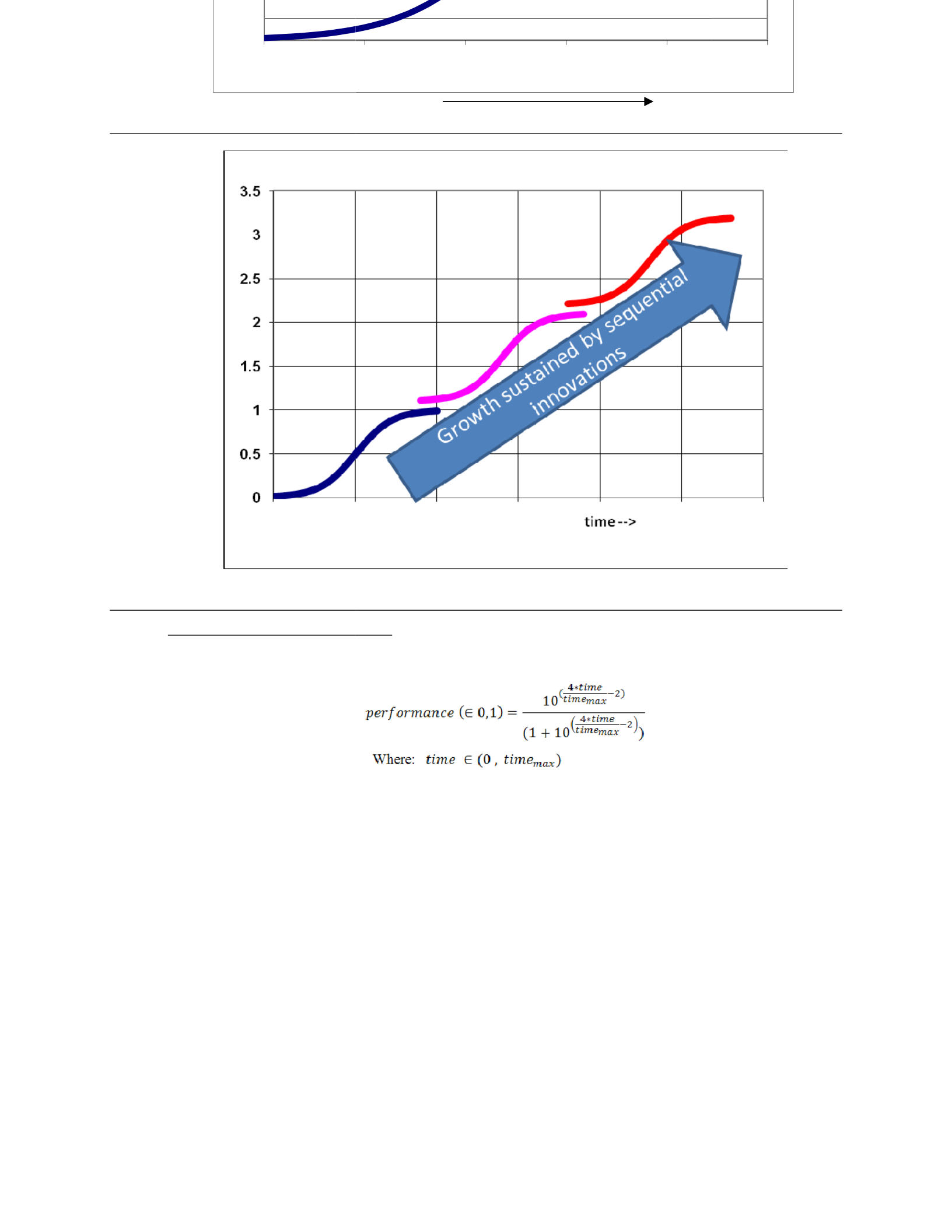
technologies are mature. Most technologies follow an S-curve of development (see Figure 2), where
there is a tail of low growth during the new phase of an item, and a boom of high growth in which the
technology skyrockets to prominence. However, after some period of time, the technology will start to
'flatten out' as the rate of development itself decreases.
The challenge is that the system, of which these items are components, may want to maintain a
growth rate closer to the component's 'boom' rate. And this is where the concept of sustaining innovation
comes into play.
If multiple S-Curves are overlaid, each of the next ones shifted slightly to the right of the

3
0.
5
0.
previous one, it is possible to build layer upon layer of innovation in such a way that this curve sheath
resembles a straight line with a high slope, running from one 'boom' to the next ad infinitum. See Figure
3. In this situation, this technological innovation is called 'sustainable'.
Platea
u
High
growth
4
0.
5
0.
a
n
Figure 2 - S3 Curve Technology Development
Figure 3 – Sustaining Innovation – Overlaying multiple S-curves to maintain the composite growth rate
3 S-Curve technology can be mathematically described as:
Birth
0 2 4 6 8 1
0
Tim
e

5
On the contrary, disruptive innovations can be considered as one that creates an entirely new
market, perhaps even eliminating the market that came before. Of course the car was a disruptive
technology for the proverbial train whip maker.
In naval language, disruptive technology is called a "game-changer," and the advent of
submarines and aircraft carriers are two vivid examples of disruptive platform technology. One might
imagine another, taken from the realm of science fiction: An impenetrable missile shield, such that one
can become an aggressor without fear of retaliation, would be disruptive technology.
5) : Inkremental versus Radikal
Almost the same as the definitions of "Sustainable" and "Disruptive" innovations are the twin
concepts of "Incremental" and "Radical" innovation.
Incremental innovation is one that improves some components of an existing system, while
leaving the architecture and functionality of the system essentially unchanged. Thus, to make an example
in ship design, the invention of a controllable pitch propeller is an additional innovation in improving the
efficiency and propulsive performance of ships.
In contrast, radical innovation is an innovation that produces, not an improvement in existing
capabilities, but entirely new capabilities. Again from the field of ship design, hovercraft innovation,
with its amphibious capabilities, is a radical innovation in ship design.
6) : Architectural Innovation
In Henderson, (1990) Henderson and Clark argue that a third type of innovation needs to be
defined: Architectural innovation. It refers to innovation that does not require new fundamental
technologies, but rather assembles existing technologies in new ways.
The essence of Henderson & Clark's formulation is to differentiate between systems and system
components. They stated , "Successful product development requires two types of knowledge. First, it
requires component knowledge, or knowledge of each of the core design concepts and how to implement
them within a particular component. Second, it requires architectural knowledge or knowledge of the
ways in which these components are integrated and connected together into a coherent whole."
Their comments touch on the subject discussed later in this dissertation on the need for expert
knowledge to make discoveries. In my opinion, there is also a need for expert architectural knowledge,
which is necessary to make architectural innovations.
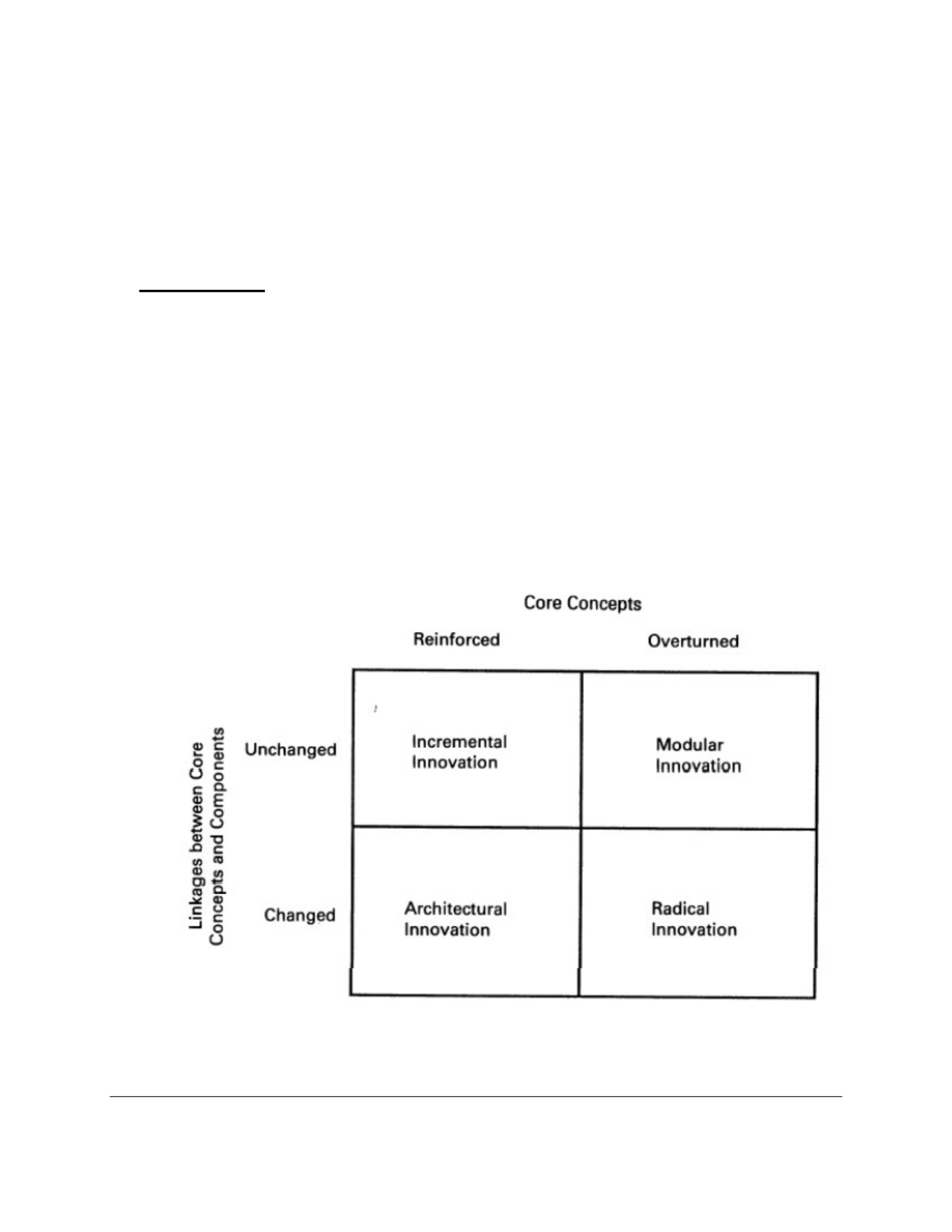
Henderson et al . used Figure 4 to illustrate the amplification results. In this figure, the horizontal
axis represents the spectrum from incremental to radical innovation, while the vertical axis shows which
part of the system the innovation is applied to. So, for example, innovations that apply to system
components, and leave the system architecture unchanged, occupy the top row of the chart. Innovations
that apply to architecture rather than components, are grouped in the bottom row of the chart.
This results in the division of the innovation landscape into four quadrants: Incremental
innovation is innovation applied to system components, while leaving the core concept architecture
unchanged. Radical innovation, in their language, is an innovation that uses a new architecture and a new
core concept - a total departure at the system level and components from the previous system. (A flat-
panel television in the palm of your hand (e.g. an iPhone) is such an innovation, when compared to the
CRT televisions of the 1960s. The components are very different, and the architecture is very different.)
Two new classes of innovation resulted from Henderson and Clark's definitions. One of them is
modular innovation. Modular innovation applies to the use of entirely new core concepts for some or all
of the components of the system, while still assembling those components in traditional architectures.
So that
6
The invention of solid-state circuits for televisions, to replace vacuum tube circuits, represents a modular
innovation.
Architectural innovation then is an innovation in which only the architecture is changed, while
the components still represent the original basic concept. The example the author uses is a room fan:
The status quo ante involves a motor with fan blades attached through a shaft. Architectural innovations
will replace it with rim drive motors - they are still electric motors and fan blades, but they are
assembled in a completely different relationship.
B. :Creativeness
Having defined some key terms, let's now move on to the adjustment of innovation into a larger
activity that is "ship design". To do this, we will create a map that shows where innovations in ship
design correspond to the spectrum of human creativity.
The highest level of creativity taxonomy is simply creativity itself. This level includes all
creative actions, whether they are artistic, philosophical, intellectual, or technical. While I do not intend
to go too long on the subject of creativity in general, I will present some informative background on the
efforts to devise a general model of human creativity. This superset includes creations in art, music,
literature, etc., as well as includes creativity in mechanical arts. Since this is a superset and not the main
focus of the work, it will only receive a very light touch, but it provides an important foundation for the
study, which will trace from general to special.
Figure 4 – Illustration of Henderson and Clark used to define Architectural Innovation
(Henderson, 1990). Note that although this is described as a different categorization, in reality each
axis is continuous.

7
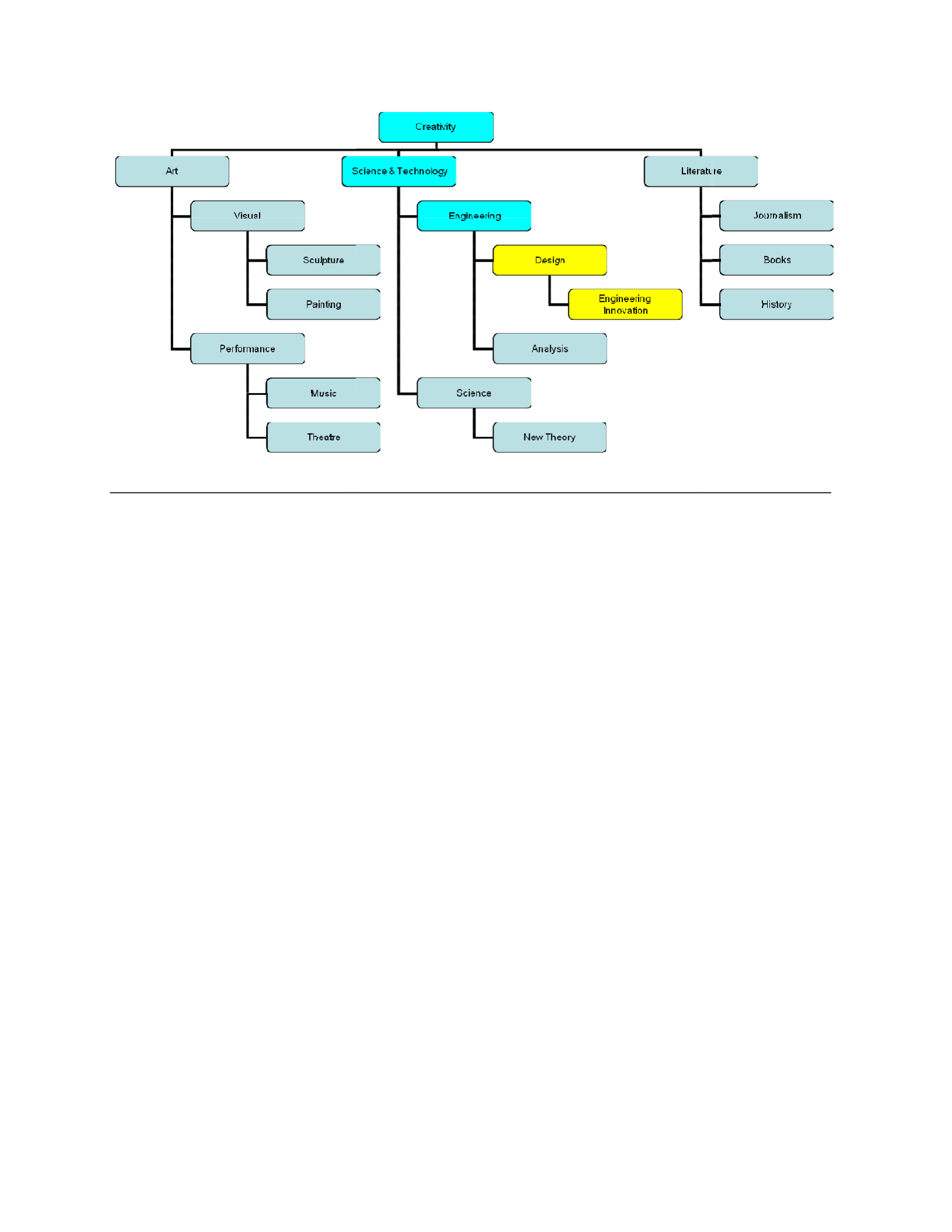
Figure 5 tries to describe the entire creative taxonomy. Under creativity we find engineering
design or product development, including ship design. It is a special class of creativity that focuses on
the creation of real objects or processes, within the constraints of the laws of physics, and to serve
several purposes.
Let's start the discussion at the very top level: What is Creativity? This question seems simple,
but it has given rise to a lot of literature. Creativity literature is incredible because of the many attempts
just to define this term "I knew it when I saw it". I define creativity as follows:
Figure 5 – The Author's Attempt to Describe the Taxonomy of 'Family Tree' Creativity
Creative action is the conscious discovery (driven by purpose) of a new work, with the aim of
this work becoming better in a certain sense than the previous one.
This definition relies on three attributes:
Intention
Novelty
Quality
Let's take a look at the development of this definition:
1) : Stahl's Overview
Professor Robert Stahl provides an interesting summary of the definition of creativity, drawn
from publications in the education industry, which are understandably interested in identifying and
encouraging creativity. In Stahl, (1980) he describes the development of many alternative definitions of
creativity, with a particular emphasis on student creativity in the classroom – an emphasis not far from
engineering creativity.

8
Professor Stahl provides a list of possible definitions of creativity, supported by a separate list of
possible descriptions of the steps taken in the creative process. Let's start by considering a summary list
of their definitions, as follows:
Creativity is:
i) Any activity that leads to the production of something new, whether it is a new technical
invention, a new discovery in science, or a new artistic performance (DeHaan, 1957).
ii) Everything produced by someone who is new or unusual to him (Vance, 1976).
iii) The process of becoming sensitive to problems, shortcomings, knowledge gaps, lost
knowledge, missing elements, or disharmony (Torrance, 1966).
iv) The formation of associative elements into new combinations that meet certain
requirements or are in some way useful (Mednick, 1962).
v) Activities that have four types of response properties or features:
(1) Peculiarity (i.e., the relative frequency of the product among all possible products);
(2) Conformity (i.e., the relationship of the product to the demands of the situation);
(3) Transformation (i.e., the development of new forms that involve overcoming the
constraints of reality);
(4) Condensation (i.e., the extent to which the product manifests a unified and coherent
relationship between simplicity and complexity) (Cronbach, 1968).
vi) The power of imagination to break away from the set of perceptions to restructure new
ideas, thoughts, and feelings into new and meaningful bonds (Khatena and Torrance,
1973).
vii) Intellectual operations are relative to different thinking and redefining abilities driven by
sensitivity to problems (Guilford, 1973).
viii) Thinking that includes some quality control of newly generated ideas includes
conformity (Crockenberg, 1972).
ix) Deliberate entry into a process in which the final product is unknown by its originality or
uniqueness provides a peak experiential response (Gallagher, 1975) a display of openness
to new or unusual ideas, a rich sense of humor, the ability to come up with unique
solutions to problems (GTGEA, 1978)
This definition carries the following parameters as possible conditions for creativity. I ignore
here the difference whether a particular condition is claimed necessary or sufficient or both.
The parameters listed are:
Novelty I, II, V(1, 3, 4), VIII, IX
Compliance with a process iii, iv, vi(?), vii
Existence of requirements or objectives iv, v(2), viii
Extreme quality Ix
From these parameters, the reader will observe that I have accepted three of them in my chosen
definition of creativity, simply avoiding the concept that creativity is the result of adherence to a
particular process. Let me present some of the author's discussions on creativity, to reinforce this
choice.
2) : Model 4P Rhodes
Rhodes (1961) proposed a model of creativity that describes creativity as a four-dimensional
construction involving 'People', 'Process', 'Product' and 'Press.' ('Press' is Rhodes' attempt to find the P-
word to describe the climate or environment in which creativity is expressed. The other four terms are

9
straightforward.) Thus the Person underlines the constituent of man, the need for a Creator. The process is
where the aspect of novelty comes in. The product shows that creativity produces something – whether
it's an art form or an object.
Rhodes's word-for-word definition is: "The word creativity is a noun that names a phenomenon
in which a person communicates a new concept (which is a product). Mental activity (or mental process)
is implied in the definition, and of course no one can imagine someone living or operating in a vacuum,
so the term press is also implicit. This definition raises questions about how new the concept should be
and to whom it should be new."
These same elements are present in engineering design. As stated earlier, design requires a
designer, therefore a 'Person'. Design also results in 'Products'. Design, a properly executed engineering
design, inevitably follows a 'Process', indeed it is a process that is immersed and governed by the laws of
physics, and consists mostly of various engineering analyses. Finally, engineering design takes place
within the framework of industrial and economic infrastructure, which is the 'Press' of Rhodes.
However, Rhodes stopped short of defining the details of these four components. He discusses
some of the proposed processes for creativity, he presents some interesting discussions about the
characteristics of creative people, and the same for processes and products. But he does not conclude by
saying which of the processes, characteristics, etc., are mandatory for creativity. Instead, he left the door
open for the possibility that there might be some correct answers.
2.2.3 : Model 4P + N Lopez
Lopez, (2006) extended Rhodes' model to add a fifth dimension, 'N' to the client's needs.
This is a useful addition because it adds an important element of the pull requirements, which is very
relevant in the design of naval ships.
More importantly, let's note that Lopez felt the need to add this fifth parameter. He feels that
creativity is not sufficiently defined if it is not required to be directed towards a specific goal. Here we
hear a thought that we will come back to later – the need to close the door to random undirected efforts
as "creativity". Yet this closing of the door should not inadvertently also eliminate the possibility of an
intuitive creative leap from "A Ha!" We will tread carefully.
2.2.4 : Cognitive Network Model
Santanen et al, (Santanen, 2002) took the 4-P creativity model and used it as a basis for problem-
solving modeling. Santanen et al focused their discussion on the engineering problem-solving phase that
resulted in a solution, and then in this dissertation the current author will also focus on this aspect. These
authors also developed a thesis that more research is needed into cognitive processes related to creativity.
They stated: "The above creativity perspective offers incredible insights into creative problem-solving.
Many recipes for increasing creativity (e.g., following a stage model, using a group support system,
creating a specific environment, or gathering people with a specific ability) have proven effective and
have resulted in very useful insights drawn from extensive experience. However, these recipes tend to
imply a cause-and-effect relationship without discussing what actually caused the effect or explaining
why the results obtained are important for creativity.
Given this discussion, it is difficult to explain why one person may be creative at some times and not at
another, or why one person is more creative than another. Without this causal explanation, it is difficult
to know which parts of the various recipes are effective and which are superstitious."
Again, the current author will return to this topic when discussing the characteristics of creative
individuals, below.
The Cognitive Network Model (CNM) developed by these authors is based on simple
principles that have a ring of empirical truth in the authors' current experience. I couldn't do better than
send a long quote from the author: (* The pinned quote has been removed)

10
"The Cognitive Network Model of creativity ... trying to answer the research question "What is
the configuration of the basic cognitive mechanisms responsible for generating creative solutions to a
problem?" The model derives from the synthesis of concepts from three research bodies: memory and
knowledge organization, the role of cognition and knowledge in problem-solving, and creativity.
"CNMs begin with the assumption that human memory is organized into bundles of related
knowledge. The most basic of this bundle is generally referred to as a concept that consists of semantic
memory. Several models explaining the conceptual structure have been proposed. While various
strengths and weaknesses exist for each of these structures that are hypothesized to represent our
knowledge, each model proposes that memory is organized into concepts that contain related knowledge.
Thus, human memory is not atomic; In contrast, knowledge is represented by a collection of related
entities.
"The second main premise of the CNM affirms that the concepts that comprise human knowledge
are very associative in nature. That is, concepts are interconnected in such a way that they form a vast
network that represents our knowledge and experience. The memory concept model introduced above
serves primarily to help us classify and handle the concepts of objects (such as cats, dogs, and chairs).
However, human knowledge is clearly organized according to entities that are more sophisticated than
objects alone. There is also a relational concept that shows how different objects interact with each other
through temporal relationships. Therefore, researchers have proposed a more complex and abstract form
of memory organization. Applicable constructions used to describe the relational structure of knowledge
include schemas and frames. Thus, frames can be thought of as a network of nodes (concepts) and
relationships between them. Similarly, schemas are packages that represent all types of knowledge as
well as information about how this knowledge is used. For example, schemas represent concepts stored in
memory such as objects, situations, events, and sequences of events. Therefore, the CNM assumes that
human memory exists as a complex network structure in which frames are interconnected with each other
through associations (links).
"The previous two sections argued that human memory is organized into frames (bundles) that
are very associative in nature. This section considers the third main premise underlying CNM: when a
particular frame is activated (for example, when we think of a cat, dog, or chair), the subsequent
activation spreads to other frames that are closely related to the frame that was originally activated (for
example, thinking of 'cat' can make a person think about their pet). The deployment activation model
asserts that the activation of one node activates the next most powerful node associated with it, which in
turn activates the next node most powerful associated with that node. As the activation spreads in this
way, the relative strength of the activation for each successive frame decreases. The activation pattern
between the related frames involves two components. The first is the activation of automated deployment
that works quickly and occurs without intention or conscious awareness, while the second involves
limited capacity processing mechanisms that cannot operate without intent and conscious processing.
The evidence for deploying activation comes mostly from priming experiments. In the simplest case,
priming occurs when people who are shown the same stimulus on two separate occasions are quicker to
identify the stimulus on the second occasion due to "residue" activation. This repetition priming effect
occurs even when there is no conscious awareness that the stimulus was previously presented.
"Together, the presentation in these two parts and the previous two parts refers to a lot of
research that concerns the organization of memory and knowledge. These findings represent a key
component of the CNM foundation. "
Based on this model of cognition, these authors then build a model of the creative process
through a series of eight basic "Propositions" of CNM, as follows. I've inserted an attempt to
demonstrate the naval architecture application of Proposition.
Proposition 1: Conditions that increase the likelihood of forming new associations between
frameworks that are far from our knowledge network also increase the production of creative

11
solutions.
This suggests that exposure to different types of ships, including an understanding of the
design forces that led to their development, will increase the likelihood that naval architects
will manufacture their own innovative ships as solutions to specific design tasks.
Proposition 2: As the associative distance between protruding frames increases, so is the
likelihood of forming new associations between those frames. The distance between the
"ship electronics" frame and the "hull shape" frame is large. Thus it is unlikely that a naval
architect would build a single obsolete line between these two frameworks, on the contrary
he is much more likely to have many such different paths (my term for association) and
quickly and easily develop a new one. In contrast, the associative distance between the shape
of the stomach and the structure of the stomach is much shorter, and a much smaller set of
associations will exist, and they will be less susceptible to change.
Proposition 3: When cognitive load increases, the likelihood of forming new associations
between prominent skeletons decreases considerably. In very complex design situations, or
even in situations where non-engineering demands increase the mental burden of the
architect (cognitive load), it is unlikely that the engineer will envision an innovation. In
short, he was too busy.
Proposition 4: As the number of stimuli we face per unit of time increases, so does our
corresponding level of cognitive load. In an almost superficial explanation of this
Proposition, I think this is saying that if engineers are distracted frequently, their
innovation productivity will drop.4
Proposition 5: As the associative distance between protruding frames increases, so does our
corresponding level of cognitive load. To establish a connection between the ship's
electronics and the hull shape is hard work, and this will lead to all other consequences of a
high cognitive load.
Proposition 6: When the extent to which we can cut a protruding frame increases, our
corresponding level of cognitive load decreases. This proposition is particularly interesting,
given my (McKesson's) inclination for Very Simple Models (VSMs) in engineering (ref
McKesson, 2011). VSM is a tool for dismantling information. Thus the use of VSM
reduces the cognitive load and (through Propositions 3 – 5) increases the ability to generate
new associations and thus innovation.
Proposition 7: As the diversity of stimuli we face increases, the associative distance between
the protruding frames also increases. This suggests that having a great detail of knowledge
about a particular frame has the effect of "expanding" that frame in such a way that it
occupies a greater "distance". This may mean that a naval architect with detailed expertise in,
say, hull structures, will experience himself far from the discipline, say, of hull shape design,
with the implications already discussed.
Proposition 8: As the diversity of stimuli we encounter increases, the extent to which we can
divide the prominent frames decreases. Under Proposition 6 I suggest that VSM is a tool to
improve the ability to form new associations, and that reducing – in McKesson's 2011
example – the ship's propulsion plant to two parameters, and its hydrodynamics to one, could
lead to a strong innovation in total ship design. Proposition 8 then suggests that marine
engineers will reject their division of disciplines, just as hydrodynamicists reject their
division of disciplines. This can be considered as suggesting that increased expertise serves to
build barriers to innovation – an interesting implication.
An interesting educational implication can be drawn from Propositions 4 & 5, which apply to naval
architecture education as well as others: It can be inferred from these propositions that a student with a high
course load, and thus a heavy cognitive load, is actually less proficient in learning, if we accept that learning is the

12
result of the formation of new associations.
From this proposition it is easy to see the implications for the definition of creativity itself. We
can define creativity as a personality trait in which the mind is able to associate previously dissociated
frameworks of knowledge, and allow these associations to create new knowledge. It is not clear to me
whether the author needs this associative effort to become conscious or whether it can become
unconscious. In my own experience as an innovator (and thus a creator) I found many of my own
associations that I was not aware of.
Therefore, Santanen et al do not give us so many definitions of creativity, but sketches of
creative processes, and creative minds. This sketch will be useful for us later.
2.2.6 : Other Definitions of Process-Based Creativity
The Cognitive Network Model has introduced us to the idea of defining creativity as the result of
a process. Santanen et al are not alone in offering this kind of definition. Stahl (1980) cites several
models of creativity that depend on the process. Three such models are enough:
(a) phases proposed by DeHaan, (1957):
1-period of increased sensitivity to a problem,
2-search period,
3-stage
4-'creative' moments of insight, and
5-confirmation period.
(b) phases proposed by Wallas (1926) and Gallagher (1964):
1-preparation,
2-incubation,
3-illumination, and
4-verification
(c) phases proposed by Torrance (1966):
1-identify difficulties or problems, 2-
find solutions,
3-make guesses or formulate hypotheses,
4-testing and retesting this hypothesis,
5-verify and consolidate these hypotheses, and 6-
communicate findings or results
The model is interesting, because it is the definition of the domain of time. That is, the author
claims that if the steps are not followed then the action is not creative. Stahl dismisses these models as
rather short definitions, noting that creativity is tested in timed tests. "If creativity requires some of the
pre-listed prerequisite phases, then true creative thinking may never happen and will never really
happen during a short, timeless test of creativity."
This brings us to the next puzzle: If creativity is not defined by the process, then perhaps the entire definition

13
is contained in the product? I'm much closer to accepting this alternative, but still have a problem.
2.2.7 : Creativity versus Novelty
Wind-swept logs can be used as boats. And depending on its geometry, it may indicate excellent
directional stability, say, or other features of naval architecture. Does this random action then mark him
as creative? I was reminded of an old joke, where a townsman bought a piece of art in the countryside,
after being amazed to learn that this modern freeform sculpture was produced entirely by the artist using
his tongue. The old farmer in the story then shook his head at the slippery city who bought a cow salt
lick.
Does creativity have to be the result of certain cognitive patterns – certain 'algorithms' for
thinking? Or does the entire definition lie in the product, with the result that every "new" product must
and by definition, be "creative?" I reject both of these alternatives, in favor of Rhodes' inclusion of
"Goals."
This aspect of the purpose is important, because otherwise the cow salt lick will be labeled
"creative". If the only litmus for creativity is novelty, then randomness is creative. And, indeed, if we
consider the role of randomness in genetic evolution (including man-made genetic algorithms) then
randomness is an element of creative action. But while novelty is a necessary condition for creativity, it is
not enough.
Stahl (1980) also dealt with this thesis. He takes the approach that the problem with product
definitions alone is that the wrong answer may have something new, but we don't want to admit the
'wrong' answer into the creative answer set. But it is clear that creativity does depend on novelty, so the
question now becomes, 'From whose perspective is novelty?'
Stahl (1977) argues that many behaviors and/or products are labeled "creative" simply because
they represent something "personally different" from the individual observer's perspective/experience.
Therefore, people tend to use the label "creative" to describe behaviors or products that are unique to
their own thoughts, experiences, expectations, or perceptual orientations. This labeling occurs regardless
of the actual level of originality or intent that goes into the behavior or the product itself.
"Responses that attract attention and are outside of the teacher's personal experience and/or
ability are very likely to be called "creative". A vivid example of this phenomenon is the doodle monster
drawn by a second-grader for an art teacher. Upon seeing the monster, the teacher immediately showed
it as a beautiful example of a creative image. Then the teacher was disappointed by the news that the
monster that was almost identical to the graffiti was observed by the boy two days earlier on a Saturday
morning cartoon show. Without that knowledge, teachers to this day would still believe that the scribbled
monster was the result of creative thinking and behavior. Many English compositions have been labeled
creative because students use language (e.g., metaphors) in a different way than the teacher expects. In
both cases, the products were labeled "creative" simply because they appeared quite original and were
outside the frame of reference that the teacher and the student had for that situation and the student at
the time (i.e., they were personally a different experience for these teachers). Interestingly, students who
are smarter than their teachers are very likely to be identified as the most creative students in the
classroom – provided of course their intelligence is directed in a positive direction."
What we see in this case is that creativity often lies in the eye of the beholder. It's actually
possible that some of the most creative works in the world are actually 'routine' for their creators, they're
just 'creative' for you and me. I am not seriously advancing this as a thesis – only acknowledging the
possibility, in a mathematical sense.
In my own work, I am often asked to review the "creative" concepts produced by various non-
naval architects. Indeed, this task constitutes a large part of my workload at Naval Headquarters, as
these ideas will be sent to members of Congress by constituents, and these letters will then end up on
my desk for review and response back to Members of Congress.

14
In that situation I was clearly the "one who saw it", and it was my judgment that set the level of
creativity expressed. And, as discussed above, it is very common for my answer to Congress to be in line
with the line: "Your constituents have reinvented an idea that was tried a few years ago..."
2.2.8 : Creativity Defined
In a nutshell of the above, creativity for our goals has the following attributes:
This is a deliberate human action, not one that happens randomly
This can be explained algorithmically, but the algorithm is just enough, not necessary
This results in novelty, but novelty is in the eyes of the recipient, not necessarily the
manufacturer.
2.3 :Design
Design is part of creation, but which subset? What discriminators distinguish design from other
creative actions? One might suggest that design differs from creation in the fact that design is constrained
by the laws of physics or the limitations of technology, but then we note that music is limited by sound
physics and instrument mechanics, and that book writing is limited by the limitations of letter
arrangement and the laws of language (James Joyce's "Finnegan's Wake")."" though.) So perhaps the
difference between creation in art and creation in technique lies only in the author's definition of the
scope of his or her endeavors? Is a science fiction writer who fits physics involved in design or fantasy?
I believe that the answer is very simple: Design is an element of creation. A composer or novelist
can design their work even when they sit down to write it. A painter designs his painting - but he calls it
composition. Design is the intelligent arrangement of the subcomponents necessary to produce the whole,
which is the creator's vision.
A science fiction novelist might have designed his book, but he didn't design a spaceship and a
laser cannon in the book. This is because I chose to define 'design' as meaning 'establishing all the steps
and components (at the appropriate level of detail) to bring the creation to life.' In this way he actually
designed his book, but he did not design his fantasy invention - the move was left to some future
engineer.
There are many formal methods for design, such as Lang, (1968), Eder, (2009), and Hubka,
(1967). A comprehensive review of these models will be the dissertation itself, and in this work I
relegate this important set of models to the role of foundation supporters, touching on enough of them to
further complement our mental furniture for the next discussion of innovation. In addition, I limited
myself to models that claimed relevance to naval architecture. If the design should by definition lead to
an instantiation, then this also limits some candidate models from the design process, as some of these
models do not lead to completion.
2.3.1 : Spiral Design
The most venerable model of ship design is the design spiral. One illustration of the design spiral
(taken from SD & C, 2003) is reproduced in Figure 6. Spiral design models as a process that is essentially
iterative, with increased levels of detail and convergence with each iteration. This process is implied to
be linear in an iteration, meaning it flows steadily from Step A to Step B to Step C.
There are many variations of the design spiral that can be found in the literature, but the
difference is a matter of the order in which the various modules come in – whether one should do the
structure before the hull shape, or vice versa. These differences are not in detail different process models.
In fact, the number of different design spiral versions can be considered as support that this model does
seem to capture the reality of the design – at least for naval architects.

15
So if it's accurate, then in what way is it accurate? There are, as mentioned, two main attributes:
The process is repetitive or repetitive. Calculations that are done once may be expected to be
repeated, as any other subsequent calculations will change the input condition to a calculation that has
already been performed.
The process is integrated. Spirals describe convergence as the radius decreases over time. Indeed,
it is a common belief that naval architectural jargon describes failed designs as "exploding spirals." This
means that convergence does NOT occur, but rather each subsequent iteration is getting farther and
farther away, not closer.
The above description of the design spiral will apply to many naval architects, but it lacks one
key element of design: It does not explicitly contain decision-making and creativity. The words I have
used above indicate that design is a sequence of calculations, which can also be performed by machines
as by humans.
However, the key to convergence lies in the human element and the decision-making aspect. The
design spiral only merges because humans are able to see the implications of the next spiral turn and can
make decisions during the next turn that will help the outcome of that turn to be convergent and not
divergent. And indeed cases where the spiral explodes can be very useful to be blamed on poor decision-
making, in the form of poor design leadership5.
The design spiral will not merge on its own. It comes together because smart people make
smart decisions.
Figure 6 – The Ship Design Spiral, illustration of one of the design process models (from SD&C,
(2003)
There are some computer programs that try to capture decision-making as well, and thus reduce the entire
process of ship design to algorithm execution, after an adequate set of input guidelines are given.
Some of these programs work very well, and each is useful for naval architects. But we won't find anyone in the
industry, including the inventor of the program, who would claim that the "ship design program." Even the most
powerful programs must be guided by the human mind.

16
2.3.2 : Dr. Tyson Browning
Browning, (2010) has written about modeling the design process, and it is interesting to note that
he begins by responding to the obvious criticism that having a design model will inhibit a designer's
creativity. If this is true for "design" as I have used the term, then it will definitely be more burdensome
for innovation. Browning's response, however, is that the design process model is not only "not a barrier"
but is actually important for building design capabilities. Browning quotes W. Edwards Deming with the
effect "If you can't define what you do as a process, you don't know what your job is."
The main thrust of Browning's work is that the most important aspect of the design process to
model is the interaction component. In other words, the important feature is usually not what happens in
each node of the design process, but rather the interactions that occur between the nodes.
These insights are valuable and should inform more about our course in naval architecture, as our
course in engineering science already teaches content in a particular node, our course in "design" that
should capture the interaction between those nodes.
We will also see that this focus on interaction is reflected in some of the innovation techniques
that we will encounter below.
There are other interactions between Browning's process modeling work and my own innovation
modeling research. Browning aptly notes that the use of process models can be an important step to
ensure that knowledge is captured and stored. It takes the form of "lessons learned" about the best and
worst ways to do things, and interactions that result in more work, less work, more quality, less cost,
more reliability, and so on.
In Browning's work, we also find echoes of his model of cognitive networks and attention to
associative distances and interactions between concepts. In fact, it would be interesting to apply
Browning's philosophy by actively studying, not concepts, but associations between concepts, explicitly.
We might think of this as studying adjectives instead of nouns. Some naval architects will recognize this
type of thinking in the following example: Compare the difference between characterizing a ship based
on hull shape (noun) versus speed or cruise (adjective). Previous characterizations would have discrete
classes such as "monohull", "catamaran", "trimaran", etc. Instead, the axis of speed and maintenance of
the ocean must be continuous and will lead to different types of insights.
In practice, of course, both types of characterization may be important.
2.3.3 : CK Theory
C-K design theory or concept-knowledge theory is another model of the design process, and here
again we will see the same thinking as encountered in Browning's focus on interaction, and in Santanen's
focus on associative distance.
CK theory defines the design process as a structured system of the expansion process, i.e. an
algorithm that governs the creation of previously unknown objects. The name of this theory is based on
its central premise: the difference between two spaces, the conceptual space "C", and the knowledge
space "K".
The design process is defined as the double expansion of the C and K spaces through the
application of four types of operators: C→C, C→K, K→C, K→K
CK theory is a response to three perceived limitations of existing design theories, which it
claims to have overcome:
Design theory does not take into account innovative aspects of design.

17
Classical design theory is tailored to a specific knowledge base and context. Without
integrated design theory, these fields experience difficulties over cooperation in real
design situations.
Design theory and creativity theory have been developed as separate fields of research. But
design theory should include aspects of design that are creative, surprising, and fortuitous;
while the theory of creativity cannot explain the deliberate inventive process that is common
in the field of design.
Note in particular that the third point echoes our discussion above about the need for there to be
an objective, or requirement, in the process of engineering innovation.
CK theory has a special terminology. "Summary" is defined as an incomplete description of an
object that does not yet exist and is still partially unknown. The first step in CK theory is to define a brief
as a concept, through the introduction of the formal distinction between concept and space of knowledge;
The second step is to characterize the operators needed between these two spaces.
A knowledge space (K-Space) is a set of propositions with a logical status, corresponding to the
knowledge available to the designer or group of designers. K-Space depicts all established objects and
truths from the designer's point of view. The design process affects K-Space – it is constantly changing,
evolving as new truths emerge as a result of the design process.
In contrast, the structure and nature of K-Space have a great influence on the design process itself. So in ship
design there is a lot of knowledge that touches, say, hull shape, stability, and hydrodynamics, and the
status or value of each of these items affects the value of the others, and the value status of these items
will also affect the design process of the ship. When expressed in naval architectural terms, this seems
obvious – the stability status of the ship's design affects the steps to be taken next in the design process.
A concept is then defined as a proposition without a logical status in K-Space. The main
finding of CK theory is that concepts are a necessary departure point from the design process. Without
a concept, the design is reduced to an optimization of a problem-solving standard, which is essentially
analytical rather than synthetic. The concept asserts the existence of an unknown object that presents
some property that the designer desires. In the design of a ship, the concept may be a hull that has a
certain metacentric height and a certain resistance.
Based on this premise, the C-K theory suggests the design process as a result of four operators:
C→K, K→C, C→C, K→K.
Early concepts were partitioned using the proposition of K:K→C The law of hydrodynamics
added certain implications of the stability of the concept.
This partition adds new properties to the concept and creates a new concept: C→C Concept
(ship) takes shape and/or spawns variants.
Thanks to the C→K conjunction this expansion of C can trigger the expansion of the K:K→K
space Generation of some variants, say for example multihull, will require additional knowledge of the
laws of stability and resistance.
Mapping in C-K theory can also be called full factorial expansion. And, like many such
combinations of design variables, not all combinations make sense. In C-K language, absurd concepts are
referred to as crazy concepts. Crazy concepts are concepts that seem absurd as a path of exploration in the
design process. Both C-K theory and practical applications have shown that crazy concepts can benefit
the global design process by adding additional knowledge, not to be used to pursue that "crazy concept"
design path, but to be used to further define "sensible concepts" and lead to their eventual conjunctions.

18
CK theory also claims to help design creativity. The creative aspect of Design results from two
different expansions: C expansions that can be seen as "new ideas", and K expansions that are necessary
to validate these ideas or to extend them towards successful design. Again using the C expansion of a
multihull vessel, this requires the expansion of K in the field of resistance and structural load.
What we see here is an attempt to model design as an interaction between these two spaces.
Again, as the previous definition, the focus is on the process, or dynamic, or other similar actions, and
not on the content or product. In my language, I say that this definition emphasizes verbs, not nouns.
2.3.4 : Design Specified
Based on the above, I define "design" in engineering as part of creativity as follows:
Engineering design is the application by people of engineering principles, through several
processes, to create a specific new product, because it has a specific purpose.
Note that this definition of design is very similar to Rhodes' 4P model of creativity, with the
addition that the creative "tools" used are "engineering principles".
2.4 :Innovation
We are now positioned to answer the first question of this dissertation: What is innovation,
especially engineering innovation in ship design?
Start from the top: Creativity is a purposeful human act that produces novelty in the eyes of the
beholder. Design is a part of creativity that relies on engineering principles and is devoted to the creation
of purposeful products.
Then, what is innovation? The answer appears clearly:
Innovation is the development of engineering towards the commercial deployment of new products.
A new engineering product can be a new architecture, or a new component in an existing
architecture.
Innovation may be sustainable or disruptive, synonymous with "incremental or radical."
The difference is not the size of the innovation, but the 'location' of the innovation in the
definition of the product.
Innovation can now be placed on the family tree of creativity (Figure 5) as illustrated in Figure 7.
19
Figure 7 – Creativity taxonomy, (Figure 5), edited to show engineering design innovations

20
3: What is the ship design innovation tool?
The second question for this thesis is "What are the tools of ship design innovation?"
There are many published (and no doubt many unpublished) tools for innovation. A set of about
a dozen tools is summarized in Appendix C of this dissertation. This appendix provides a working
description of the tools collected from publicly available sources. Some of the tools summarized in the
appendix have formal certifications or credential programs associated with them, and it must be
acknowledged that authors do not have these third-party certifications. Therefore, the summary in
Appendix C should be considered indicative, not definitive.
Some innovation tools are highly formal, proprietary (copyrighted), and/or supported by formal
research and teaching institutions. The poster child for this set might be "TRIZ." Other tools are
unstructured, and have taken the position of generic tools in popular culture. The poster child for this
set might be "Brainstorming."
I've learned a number of these tools from both classes, and my observation is that they all follow
the same algorithmic structure or morphology, but this shared structure is not recognized across
developers. In this section I will present this overarching morphology, and then I will show the mapping
of some of the innovation algorithms into this general structure. I will try to weave a consistent ship
design thread through this section, using an example of a ship's rudder design. Steering design is indeed
one of my initial areas of expertise in ship design, I designed the steering of the Navy's DDG 51 class
warship. At the time, rudder design was a simple application of a derivative design: I looked at previous
successful ships (e.g. the DD 963 class) and scaled my rudder in the same proportions as the LxT.
Now let's see what steering design looks like, if viewed as an application of innovation
process.
3.1 : Overview of Innovation Algorithm Morphology
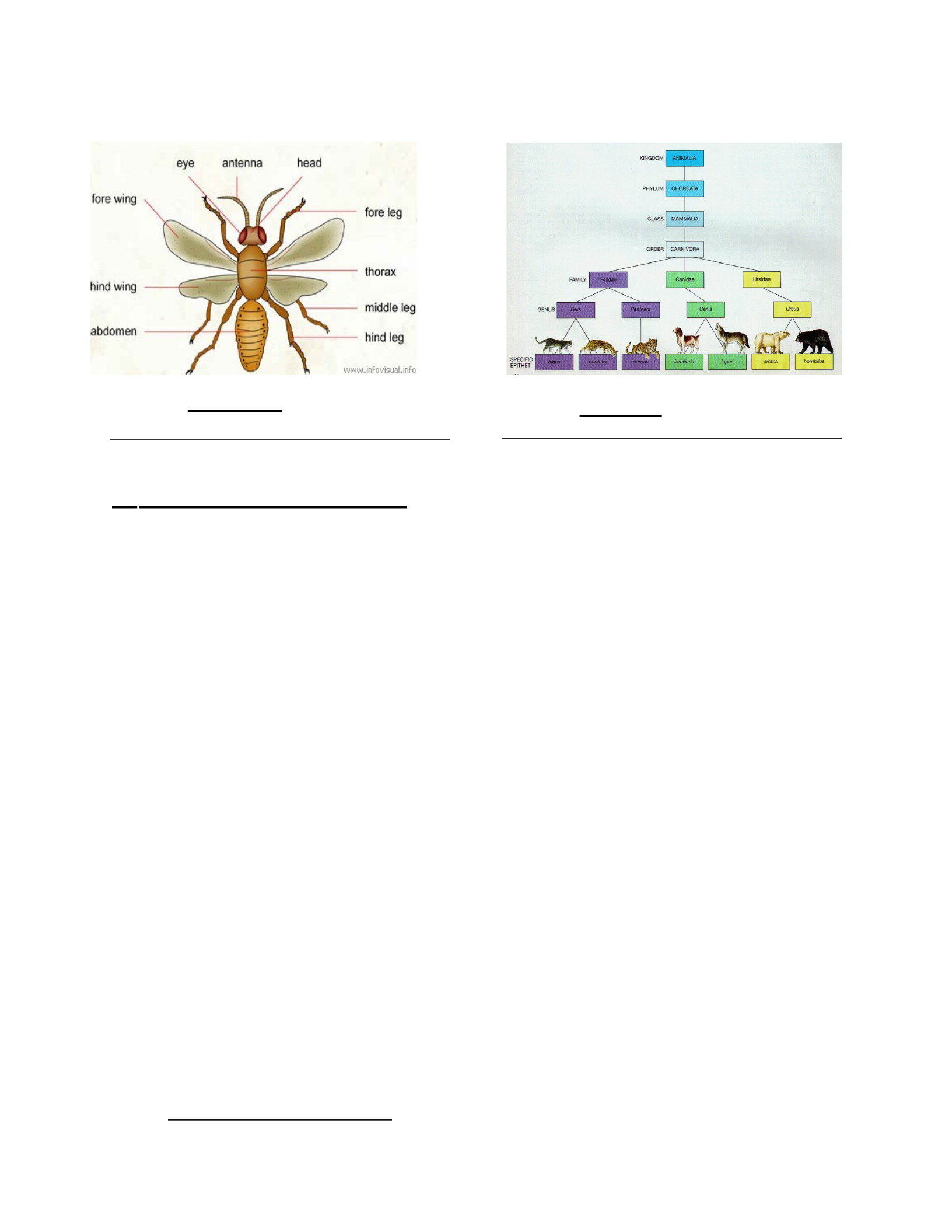
Morphology is a system for describing the structure or shape of an entity, by dividing it into
general components. So in entomology all insects have the same morphology of the head, chest,
abdomen, etc. It differs from taxonomy, where taxonomy is a hierarchical or family tree-type structure,
which is used to classify and differentiate between members of a set.
Perhaps the most familiar introduction to taxonomy is in biology, where organisms are classified by
Kingdom, Phylum, Class, Order, Family, Genus, and Species – see Figure 9.
Both morphology and taxonomy are important for a variety of purposes. Bloom (1956) and
Krathwohl (2002) cite the value of taxonomic systems as an aid for measurement, and also for
establishing a common language about subjects, and for finding conformity among the various elements
of a classified group. In the case of Bloom and Krathwohl the classified items are educational purposes,
and not animals, but this is the proper paradigm for the use of my combined morphological and
taxonomic systems to classify the algorithms of discovery, and to suggest that this act of classification
would have value both as a means of understanding the various algorithms, but also as a means of
comparing and contrasting them, and find their points of similarity or conformity.
The morphology of the innovation algorithm is as follows (illustrated for convenience on the
10.):
Define the Problem
Generalization of the Problem
Find a solution
Implement the Solution
Implementing the App
Learn
21
Figure 8 - Morphology of flying insects.
(Infovisual, 2012) Figure 9 - Taxonomy of some carnivorous
mammals (Biological exceptions, 2012)
3.2 : Step 1 - Define the problem
The first step in morphology – the first general component in innovation methodology – is the
problem statement. The definition of a problem, in marine engineering terms, is roughly equivalent to
stating a design requirement.
First, there is a well-known guide to stating the requirements. The most important of these is that
the requirements should be expressed in a way that describes the function or relationship, and not in a
way that describes the solution. So if we state the problem as "clamp two sheets of paper together", we
have defined solutions (staples) and closed the door to a variety of innovative solutions, including glue,
straight pins, paperclips, and the like. If the problem is formulated as "fix two sheets of paper together"
then this option will be available.
In my example of a steering design, this is a straightforward principle, and we'll look at it again
later: We can state the terms as "Design a shovel steering similar to the DD 963." This is a restrictive
requirement that presupposes a solution6.
If the design team wants to call for innovation in the design of the rudder, then the requirement
would be better stated as "Design an adequate steering system to steer the ship." This then opens the
door to learning how much control is "adequate" and what type of steering will result in this level of
control.
Furthermore, note that a requirement can be expressed in one of two ways – as a component
requirement or as an architectural requirement, and thus we introduce a taxonomy for the definition of a
problem – see Figure 11.
Equivalent to "component" versus "architectural", we can say "functional requirement", a
representative of "relational requirement". Architectural requirements are relational requirements that
describe how system components should interact. So, in the example of home architecture, the garage
should be directly accessible from the kitchen. An example of naval engineering might describe the
interaction of systems on a ship, or it might describe the interaction between a ship and a super-system of
which the ship is a part. Such an example would be "to operate as an element of a Carrier Combat
Group." The requirements of super-systems or external architecture are often very important in naval
design.

22
6 And actually this is how the DDG 51 rudder design requirements are stated, because arguably there is
no need for any innovation in the design of the ship's rudder.

23
Figure 10 - General morphology of the author of the innovation algorithm
Problem
Definition
Problem
Generalization
Look for
Solution
Pretend
Solution
Tool
Application
Learn

24
Component requirements are functional requirements imposed on all or part of a vessel. Thus the
component requirements will be a statement of requirements for maneuverability, or firefighting, or other
similar aspects of performance. Generally the functional requirements of the entire ship are actually
expressed as a large number of smaller component requirements. My steering wheel design task is an
example of functional requirements.
Of course, in most cases, the requirement is stated (badly) as both - for example "The
requirement is for a missile-armed patrol boat." In this case we say that the requirement is poorly stated
because it has been proposed in the form of a solution, not as a problem. But note that this statement
includes both functional requirements (that the ship "patrols") and component requirements (that the
ship is "weaponized with missiles.")
An accurate statement of the issue, or requirement, is important. I have talked about the need to
state the requirements without coming up with the solution. Another aspect is the problem solving into
pieces. Von Hippel (1990) discusses how to solve problems, and the role this damage architecture can
have on the results of invention/innovation. Von Hippel discusses innovation in an industrial context,
where innovation tasks need to be broken down into subtasks and distributed throughout the company.
The nature of the damage will open and close certain doors for innovation, with simple actions defining
the boundaries of the investigation of those tasks.
He uses "task interdependencies" as a metric of whether solving a problem in one task will
require complementary efforts in another. He then argued that innovation would be more successful if
interdependencies between tasks were minimized, and went on to provide guidance on how to define
tasks to minimize their interdependencies, and also to reduce the cost of unavoidable interdependencies.
When it comes to facilitating innovation, von Hippel says that component requirements should
avoid interdependence, and that this independence should also be reflected in the makeup of the design
team assigned to the task.
Let me build an example of this principle, with reference to my steering design task: As this
dissertation progresses, I will envision some radical solutions to the steering task. In fact, I would
suggest that the ship might be steered by manipulating its firemain. What von Hippel is saying here is
that this particular innovation – the firemain steering wheel – is less likely to work particularly because
it crosses boundaries and creates interdependence.
This principle has two interesting implications for naval design: On the one hand we find here a
scientific explanation of the famous inventor's principle of "making only one innovation at a time." And
innovations that require extensive interdisciplinary tendrils are one that is unlikely to succeed. But if that
principle is accepted, then it raises other possible implications: Based on von Hippel we can consider that
specialists working on one part of a design problem do not really need the full capabilities of mutually
stunning tasks, but may be able to get away with using relatively simple replacement models for those
tasks. So, for example, does the designer of the hull shape really need to know the characteristics of the
propeller, or is it enough to just know the diameter? As can be seen from this example, the interface
between design tasks will be simplified according to this philosophy.
It also reflects the idea of "chunking" found in the Cognitive Network Model discussed earlier.
Readers may remember that chunking is a technique that can reduce cognitive load, and thus increase
the ability to innovate.

25
Morphological
components:
Taxonomy of these
components:
Figure 11 – Two taxonomic options for the Problem Definition element
Von Hippel then focused on this aspect of the partitioning of the task, and searched for tools
and models in a similar way to the current author's search for innovative tools and models. As a tool for
declaring requirements independently, von Hippel mentions QFD (Deployment of Quality Functions –
see Akao, 1994). It is interesting to read von Hippel's invention of the QFD method, and listen to
similarities with TRIZ's concept of "contradiction." von Hippel:
"QFD encourages the placement of customer requirements, engineering requirements, and
manufacturing requirements with respect to proposed projects into a common matrix, so that interactions
and possible conflicts can be identified and discussed by project team members at an early stage. Thus,
this method may highlight the following interactions: "The better the car door is at sealing the noise and
dirt tightly (desirable characteristics), the more difficult it is to close (undesirable characteristics) given
that conventional sealing technology is applied". The information can be used as an aid to improve task
partitions. So, if the project specification requires improvements in door closing or door sealing, the
interaction with respect to these two things suggests that setting up task partitions so that they are
included in a single task "improving door closing and door sealing" will reduce the interdependence of
task solving in this case.
There are countless examples of naval architecture of this type of inter-task interface. Fixed with
the stern gear of the ship, we can consider the interaction between the rudder, the propeller, the shaft
bracket and the stern tube. Obviously, before any of the items are altered, the architect must consider the
impact on the others. What von Hippel suggested was that if innovation was sought, then this entire set of
components should be treated as a system: The most innovative steering might turn out to be a
modification of the stern tube or the axle bracket ... or a steerable propeller like on current electric drive
pods. Until recently von Hippel had argued that one should state the problem in terms of their
interactions, and perhaps in terms of their contradictions. Finally, in addition to a careful definition of the
problem, von Hippel stated:
"The second approach to managing task solving interdependencies involves reducing the cost of
involvement in cross-task problem-solving. This approach complements the one discussed above: It
considers the partition of an existing task as a given, and seeks ways to minimize the associated cross-
boundary troubleshooting costs. Therefore, both approaches can be applied simultaneously when trying
to manage the interdependence effects of task problem-solving."
DEFINE
PROBLEM
Component
Requirements
(functions)
Architecture
Requirements
(relationships)

26
This shows that the classic project management disciplines of communication,
integration, gatekeeping, and so on are all contributors to the success of innovation, and that the
careful design of the technical skills included in the design team, will be concurrent with the
success of the team.
What we see in von Hippel later is that we are instructed to define problems carefully, and we are
invited to do so in the language of interfaces and contradictions. Furthermore, we are shown that each
single problem can be broken down into an additional interface or a contradiction problem. We were then
offered several tools to manage problems that were inseparable from their interdependencies – such as
the entire set of architectural requirements. We are also taught to fill our design team with expertise in all
interfacing technologies, but only with those skills.
From the above we can compile a list of "best practices" for the problem definition step, where
"best practices" should be understood in the sense of "most likely to enable successful innovation."
Divide requirements into functional and architectural groups
Requirements state without declaring solutions
Consider using a relationship capture tool like QFD for requirements definition
Specifying explicit requirements interactions and conflicts
Chunk requirements to avoid task interdependencies
Fill your design team with expertise in interdependent technologies
With this as a foundation, let's take a look at what the innovation algorithm provides as a tool for
this step of the process. Readers may want to refer frequently to Appendix C for a description of the
algorithm discussed.
3.2.1 : Defining Problems Using Brainstorming
Brainstorming takes the problem statement for granted, and immediately dives into the idea. But
the main principle of brainstorming – to withhold judgment – has the effect of constantly exposing the
problem to reformulation or restatement.
In a brainstorming session, it's common for a participant to say "But wait, what if instead of
pushing, we have to pull?" Ideas like these are a back-hand way to repeat the problem. In the push/pull
example, the proposer actually starts a path to repeat the requirement at a higher level of abstraction. This
kind of reformulation, as opposed to restatement, falls right below in the discussion of "generalizing the
problem".
3.2.2 : Definition of Problems using Mathematical Problem Solving
Martin Gardner's algorithm for solving mathematical puzzles contains another element in the
definition of a problem. He begins "Is there an aspect of the problem that is actually irrelevant to the
solution, and whose presence in [the statement] only serves to mislead you?" (Gardner, 1978)
This may be considered an element in the generalization of the problem, but I prefer to see in it
the same philosophy as we find in von Hippel, in the command to minimize the reciprocal relationship of
tasks.
3.2.3 : Definition of the Problem of Using Young
The Young elimination technique belongs to the same category. Young calls on us to eliminate
"what no customer has." This is very similar to Gardner's "distraction and irrelevance". If the real goal is
to cool one space and heat another, then why go through the steps in Figure 12? Who are the customers
for intermediate products? Can we not "short-circuit" around Young in a similar way to Figure 13?

27
To use my rudder example, the obvious Young part of the ship's rudder is the rudder pull. We
don't have actual customers for this resistance – can we produce unimpeded lift? Or, can we use the
obstacle itself to steer the ship? I've seen the concept of a catamaran where only the steering on one side
is used at a time, and always the 'deep' side to the turn. This is due to the steering obstacle, given the wide
catamaran beam, will really help to turn the ship, turn the "Young" into something useful, find a
"customer" for the rudder pull.7
To go back to the "Problem Definition" level, we can see that in these examples we redefine the
problem as "exerting a rotational force" while avoiding the specification that this should be a lifting
force.
3.2.4 : Problem Definition using Osborn Parnes' Creative Problem Solving
Process
The Osborn-Parnes Creative Problem Solving Process was developed by Alex Osborn (the
inventor of brainstorming) and Dr. Sidney J. Parnes in the 1950s (Reali, 2012). CPS is a structured
method to come up with new and useful solutions to problems. CPS follows three stages of the process,
which correspond to one's natural creative process, and six explicit steps – See Table 1.
Table 1 - Osborn-Parnes Creative Problem Solving Process
Process Stages Step
Explore the
Challenge
Mess-Finding (identifying goals, desires, or challenges)
Fact Finding (collecting relevant data)
Problem-Finding (clarifying problems that need to be solved to achieve goals)
Generate Ideas Idea Search (generate ideas to solve identified problems)
Be Prepared to Act
Solution Search (moving from idea to implementable solution)
Acceptance-Discovery (plan for action)
As can be seen, the stages of CPS are very similar to the current morphology of authors. I find
it interesting that CPS includes a step to actively look for problems – called "Mess Finding." The Mess-
Finding step is a step in which practitioners are invited to imagine things that could be better. Examples
in literature are generally highly conceptual, such as "imagine a world without war."
I have not included this "Mess Finding" step in the current morphology because in most
engineering "mess" is provided by the client. Instead, my morphology begins with the "Problem
Definition" element located at the end of the first stage of CPS – "Explore Challenges." Sower, (2006)
provides an interesting list (attributed to Van Grundy) of questions that reinforce this part of the process:
7 A clever extension of this was the "plunge rudder" used on some early west coast catamarans. The rudders
are mounted at the angle of attack, but their actuation is to raise and lower them from the water. When the inner
steering wheel "plunges" into the water, it will provide a turning moment, due to the lifting and drag. When
retracted as for straight forward operation, it has no obstacle at all – the complete removal of the Young obstacle.
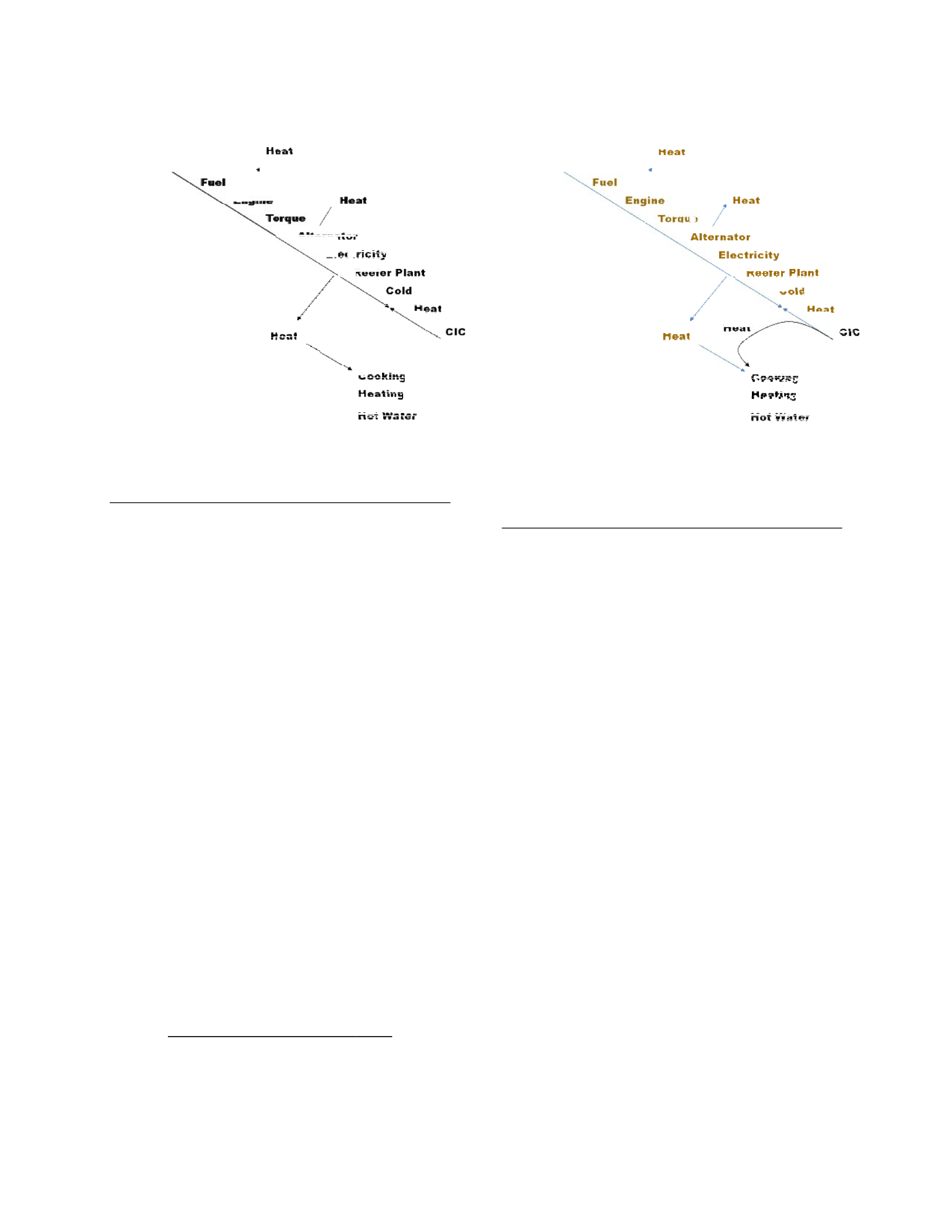
28
Figure 12 – Steps involved in cooling the
ship's CIC, while generating heat for
domestic consumption
What do you know about the situation?
Figure 13 – The steps involved in cooling the
CIC of the vessel, while generating heat for
domestic consumption, simplified to eliminate
the Young
What would be better if you solved this situation? What could be worse?
What are the main obstacles you face in dealing with this situation?
Which part of the situation is relevant?
When is the situation likely to get worse? Getting better?
Notice in the list of Speakers of contradictory and interconnected languages. This is the same
concept that we have seen in von Hippel and will see below in TRIZ. The picture emerges that we have
many writers, all of whom say almost the same thing.
3.2.5 : Defining Problems Using the TRIZ8
The "Problem Definition" step is recognized in TRIZ as a very important component. In classical
TRIZ, a key element of the definition of the problem itself is the identification of the inherent
'contradictions' that give rise to the problem. We have seen this in the work of von Hippel
door seal example: The contradiction is that a tight seal is required when the doo is closed, but a
The tight seal makes it harder to open the door – there is a contradiction between "need to be tight when
closed, need not be tight to open."
The TRIZ method standardizes the definition of contradiction. There are 39 standard terms that
cover all possible desirable features of a system. The full list is given in Table 2, but some examples are
system productivity (feature 32) contrasting with system complexity (feature 36).
It takes some training for a practitioner to be able to map conventional requirements into 39
standard terms in TRIZ, but once this is done, it is possible to use the rest of the TRIZ methods to
repeat the requirements in contradictory language. So for example,
8 TRIZ is a Russian acronym for "Inventive Problem Solving Theory" ( теория решения
изобретательских задач.) See Appendix C.

29
The producibility of an object can be exacerbated by the fact that it is so complex, that features 32 and 36
are at odds.
We'll see how the use of these standard contradictions – potentially 39 x 39 of them – opens the
door to the use of a similar list of standard interventions to solve contradictions.
Table 2 – 39 TRIZ "features" applicable to all systems found (Domb, 1998)
Not. Title Explanation
1 Weight of moving
objects
The mass of an object, in a gravitational field. The force
that the body exerts on its support or suspension.
2Weight of stationary
objects
The mass of an object, in a gravitational field. The force
that the body exerts on its support or suspension, or on
the surface on which it rests.
3 Length of moving
objects
Any one linear dimension, not necessarily the longest, is
considered long.
4Length of stationary
objects Same.
5 Moving object area
Geometric characteristics described by the part of the
plane surrounded by a line. The part of the surface
occupied by the object. OR the square measure of a
surface, whether internal or external, of an object.
6 Area of stationary
objects
Same
7 Volume of moving
objects
The cubic size of the space occupied by an object. Length
x width x height for rectangular objects, height x width
for cylinders, etc.
8Stationary object
volume Same
9 Speed The speed of an object; the rate of a process or action in
time.
10 Force
Force measures the interaction between systems. In
Newtonian physics, force = mass X, acceleration. In TRIZ,
a force is any interaction that is meant to change the
condition of an object.
11 Stress or pressure Force per unit is wide. Also, tension.
12 Shape External contours, system appearance.
13 Object composition
stability
Integrity or integrity of the system; relationships of the
constituent elements of the system. Wear, chemical
decomposition, and disassembly all decrease in stability.
Increasing entropy decreases stability.

30
13 Object composition
stability
Integrity or integrity of the system; relationships of the
constituent elements of the system. Wear, chemical
decomposition, and disassembly all decrease in stability.
Increasing entropy decreases stability.

31
Table 2 – Continued
13 Object composition
stability
Integrity or integrity of the system; relationships of the
constituent elements of the system. Wear, chemical
decomposition, and disassembly all decrease in stability.
Increasing entropy decreases stability.
14 Strength The extent to which an object is able to withstand change
in response to a force. Resistance to damage.
15 Duration of action by
moving objects
The time the object can perform an action. Service life.
The average time between failures is a measure of the
duration of an action. Also, durability.
16 Duration of action by
stationary objects Same.
17 Temperature
The thermal condition of the object or system. Loosely
include other thermal parameters, such as heat
capacity, which affect the rate of temperature change.
18 Illumination intensity The light flux per unit area, as well as other lighting
characteristics of the system such as brightness, light
quality, etc.
19 Use of energy by
moving objects
A measure of the object's capacity to do the job. In
classical mechanics, Energy is a product of the force
times the distance. This includes the use of energy
provided by the super-system (such as electrical or
thermal energy.) The energy needed to do a particular
job.
20 Energy use by
stationary bodies same
21 Power The level of time in which the work is performed. The
level of energy use.
22 Loss of Energy
The use of energy that does not contribute to the work
being done. See
19. Reducing energy loss sometimes requires different
techniques than increasing energy use, which is why it is
a separate category.
23 Loss of substances Partial or complete loss, permanent or temporary, of
some material, substance, part, or subsystem of the
system.
24 Loss of Information
Loss of data or access to data in or by the system. Often
includes sensory data such as scents, textures, etc.
25 Lost Time
Time is the duration of an activity. Increasing time loss
means reducing the time required for the activity. "Cycle
time reduction" is a general term.

32
26 Amount of
substance/material
The number or number of materials, substances, parts, or
subsystems of a system that can be fully or partially
changed, permanently or temporarily.

33
Table 2 – Continued
27 Reliability The ability of the system to perform its intended function
in a predictable manner and conditions.
28 Measurement accuracy
The proximity of a measured value to the actual value of
a system's properties. Reducing errors in measurements
improves measurement accuracy.
29 Precision manufacturing The extent to which the actual characteristics of a system
or object match the specified or required characteristics.
30 External damage affects
the object
The susceptibility of a system to externally generated
(harmful) effects.
31 Harmful factors that
the object produces
Harmful effects are effects that reduce the efficiency or
quality of the functioning of an object or system. These
harmful effects are produced by objects or systems, as
part of their operation.
32 Ease of manufacture The level of facility, comfort or ease in the creation or
manufacture of objects/systems.
33 Ease of operation
Simplicity: The process is NOT easy if it requires a lot of
people, a large number of steps in the operation,
requires special tools, etc. "Hard" processes have low
yields and "easy" processes have high yields; They are
easy to do right.
34 Ease of repair Quality characteristics such as convenience, convenience,
simplicity, and time to fix errors, failures, or defects in a
system.
35 Adaptability or
versatility
The extent to which the system/object responds
positively to external changes. Also, the system can be
used in a variety of ways in a variety of circumstances.
36 Device complexity
The number and diversity of elements and the
interconnectedness of elements in a system. Users may
be elements of the system that increase complexity. The
difficulty of mastering the system is a measure of its
complexity.
37 Difficulty detecting and
measuring
Measurement or monitoring systems that are complex,
expensive, require a lot of time and effort to set up and
use, or that have complex relationships between
components or components that interfere with each other
all indicate "difficulty detecting and measuring." The
increasing cost of measurement to satisfactory error is
also a sign of increasing measurement difficulty.
38 Automation level
The extent to which a system or object performs its
functions without a human interface. The lowest level of
automation is the use of manually operated tools. To the
highest level, the machine senses the necessary
operation, programs itself, and monitors its own
operation.
39 Productivity
The number of functions or operations performed by the
system per unit of time. Time for unit function or

34
operation. Output per unit of time, or cost per unit of
output.

35
3.2.6 : Defining Problems using Design by Analogy
Problem definition is key to any design with analogy methods, as problem statements will guide
analog searches. If the requirement is for warships then we might be motivated to see predators in the
animal kingdom. If the requirement is for efficiency then lexical search will emphasize words that are
synonymous (or antonyms) for efficiency. In all such cases, the practitioner needs to understand the
nature of the challenge, the problems inherent in the requirements it provides, in order to pursue
analogues of the visual, lexical, or biological realm.
3.2.7 : Summary: Problem Definition
At the beginning of this section we list "best practices" for the problem definition step. Now
we can add to that list some specific tools for innovation in the problem definition process, and
propose an omnibus summary:
Problem statements limit opportunities for innovation
Requirements should be divided into functional and architectural groups
Requirements must be stated without declaring a solution
Expanding problem statements "teleologically upwards" expands the solution space, thus
opening the door to innovation
The issue must be stated in a scope that is within the technical domain of the design team
Problem statements can identify distractions, irrelevance, and youth
A problem statement is an opportunity to define a problem by analogy
Related issues can be combined to allow multitasking.
Consider using a tool like QFD for requirements definition
Specifying explicit requirements interactions and conflicts
Chunk requirements to avoid task interdependencies
Fill your design team with expertise in interdependent technologies
3.3 : Step 2 - Generalize the problem
The second step in morphology is to generalize the problem. The problem statement is usually
given in situation-specific language. To open the door to innovative solutions, it is necessary to study the
problem more closely in order to – in a sense – dismantle it and find the "real" problem.
The most obvious example we've seen so far in this essay is in TRIZ, where 39 features are a
means of repeating problems in language that is not specific to a particular technical domain. Let's
explore other such techniques.
3.3.1 : Generalizing Problems Using Brainstorming
As mentioned earlier, the brainstorming process has the effect of constantly exposing problems
for reformulation. Brainstorming sessions on steering design have resulted in ideas that are far from
simple derivative steering. Examples proposed (and remember the principle of deferring assessment)
include:
Instead of planning the steering, we just need to steer. And we can:
oSteering with steering wheel
oSteering with air steering
oSteering with bow steering
oSteering by bending the boat
Instead of piloting a ship, why not use another ship to steer our ship?
oSteering using a tugboat

36
Why drive at all? Can we steer the ship in the right direction after he passes the sea buoy? We do
this with ballistic weapons.
What we see in this discussion is that the proposer actually starts the path to reiterate the
requirements at a higher level of abstraction, and acknowledges that the real problem is exerting force
or making the object move.
This type of restatement is explicitly the goal of a method called teleological decomposition.
3.3.2 : Generalizing Problems using Telephoto Decomposition
One of the usual ways to refer to teleological decomposition is found inscribed on the
whiteboard of a conference room. In what appears to be written graffiti:
Start by asking "why?"
Then ask "why?" again.
Then ask "why?" again.
Then ask "why?" again.
Then ask "why?" again.
Is it not clear what the point of this is? Each requirement statement begs to be restated as a
solution to a one-level higher requirement. Even military missions can be restated as cascades of levels
such as "upholding the political will of the nation."
And every time the requirements statement is raised, it introduces entirely new branches of the
solution tree, and entirely new opportunities for game-changing innovation. Of course, this is a danger
with this approach, as it can create a factorial explosion of the amount of work required, due to the
factorial expansion of the size of the solution investigation universe. So in response, practitioners may
want to extend the teleological tree far enough, but then prune the branches of that tree back to what is
considered likely to be fruitful. Thus this morphological step includes a different/convergent form in
itself.
Of course, based on this methodology alone there is no empirical basis for that perception, and it
is the result of the creativity and open-mindedness of the practitioner.
One last comment right in this section: One of the fruits of the teleological approach is that it
can lead to insights into anti-problems. For example, consider a case where the problem is "the ship is
not fast enough, give it more power." By decaying teleologically we realize that "putting more force
into it" is not the real task, the real task is "the ship is not fast enough." When we reach the ideation
stage, this high-level statement of the problem will help us realize that the solution is, not "putting more
force" but "reducing the obstacle." Thus we have moved from the problem of "more power" to the anti-
problem of "less resistance."
3.3.3 : Generalizing Problems using Synectics
Synektics tries to force this same teleological expansion by creating metaphors for the original
problem. If we then bring the metaphor to the foreground, separating it from its origin, it can be a tool
for the principle of "make the familiar strange, make the strange familiar." Simply put: Look in a new
way. It emphasizes a different aspect of thinking from the generalization of the problem.

37
3.3.4 : Generalizing Problems using the Seven Quintilian Questions
Quintilian was a teacher of rhetoric and oratory in the first century AD. His seven questions have
given rise to a great deal of literature. They are introduced in Appendix C, but their brevity allows them
to be listed here as well:
Who?
What?
Where?
With what?
Why?
How?
When?
The seven questions are powerful tools for all types of thinking, including engineering
innovations. "See in a new way" is the language one might expect from a Quintilian. The seven ancient
questions can easily be described as a tool to help observers "see new".
People are reminded of Sherlock Holmes' oft-repeated statement to Dr. Watson "You see, but
you don't observe." (Doyle, 1892) Had Watson methodically applied the seven Quintilian questions, his
observations would have been greatly improved. Again what we found is that these questions can be used
as a tool to provoke different thoughts.
3.3.5 : Generalizing Problems using Mathematical Problem Solving
Holmes' wisdom was also found in Martin Gardner's algorithm for solving mathematical puzzles.
Gardner's second step is "Can a problem be transformed into an isomorphic that is easier to solve?" (Gardner,
1978)
Obviously, this is a step of generalizing a particular problem – with an unknown solution – into
some other problem that has a known solution. Gardner gives a similar command in his work "Can a
problem be reduced to a simpler case?" In fact, in this derivative design we do it: We know the solution
to drive the DD 963, let's just apply it to the DDG 51.
But what if we don't have a predecessor ship? In most cases in innovation, the task is not always
to turn into a known solution, but only with the act of changing the problem to open the door to many
new avenues for solutions. In the next steps in morphology we will encounter techniques to find such
alternative paths.
Also note that Gardner here is not just talking about divergent steps. Instead he encourages us
to deviate, but only to stray to a problem with a known solution. Thus he incorporated convergent
thinking directly into this step.
The other methodologies discussed above do not provide guidance for problem reconvergence.
3.3.6 : Generalizing Problems using Osborn Parnes' Creative Problem-
Solving Process
The Osborn-Parnes Creative Problem Solving (CPS) process includes a generalization of the
problem in "Problem Search." Immediately after the identification of the problem, as discussed above,
CPS users are instructed to do different thinking in an attempt to generalize the problem and come up
with a solution. CPS is also one of the few formal methods to explicitly dictate the use of divergent &
convergent thinking, in pairs, at every step of the process.

38
The two main techniques in CPS are "IWWMI" and "Five Whys." (Daupert, 1996) "IWWMI"
stands for "In What Way Might I." Quote from Daupert:
"Brainstorm a list of possible problem statements starting with the bar of the sentence, "In what
way can I ...?" This will encourage you to redirect your thinking from a negative problem statement to
a positive one. For example, a negative problem statement might be, "My problem is that I don't have
enough money." This statement brings the brain to a dead end by directing its imagery and associations
towards the thought of scarcity. But stating the situation in a slightly different way leads to the
possibility of the richer thinking: "In what way can I earn more money?" The shift in thinking is subtle,
yet profound. … Let's assume someone wants money to buy stereo equipment:
In what ways can I beg for money? (Panhandlers sometimes make a lot of money)
In what ways can I borrow money? (Maybe my bank or Aunt Martha will help)
In what way can I steal money? (Fast cash source)
How can I find money? (Hmmm, I can look under the couch, check coin returns at vending
machines and pay phones, or grab a soda bottle, or HEY! I just had an idea! Maybe I can
collect the artificially found objects and enter the art contest I just read)
How can I win money? (Lottery, bingo in church, hold a raffle for my house)
In what ways can I give money? (Hmmm, this makes me think about being a fundraiser
for a worthwhile charity, and charging an ethical amount for my services)
How can I spend money? (Ah-ha! It triggered memories of Uncle Fred. He must have
coughed a lot. I haven't thought about it for a long time. He always said if I needed help,
come see him.)
In what ways can I avoid the need for money? (Get a job at a stereo store so I can get the
equipment I want at a discount. Hey! Maybe I can exchange it. Or maybe I can send an early
Christmas list to my family and friends.)
How can I obtain resources? (Find some of the used equipment they threw away, and learn
how to fix it.)
How can I get help? (Maybe if I know someone who works in a stereo shop, or even
know the owner, I can trade some jobs for some equipment.)"
It is clear from the example that this technique generates a restatement of the problem at a
higher teleological level, and also initiates the process of ideation. In fact, when we brainstormed about
steering design tasks, we identified some answers to "In what way can I steer the ship?" To reaffirm:
In what way can I steer the ship?
oSteering with steering wheel
oSteering with air steering
oSteering with bow steering
oSteering by bending the boat
oSteering using a tugboat
oWhy drive at all? Can we steer the ship in the right direction after he passes the sea
buoy? We do this with ballistic weapons.
The "Five Whys" method is exactly what was discussed earlier under teleological decomposition:
Ask "why?" in response to that question, then ask "Why?" again. Repeat through the five "whys."
Daupert: "The result will be the distilled essence of your search at a more abstract level of meaning, a
higher point of view from which more potential solutions can flow than you can derive from the original
problem definition."

39
3.3.7 : Generalizing Problems using TRIZ
In TRIZ the problem definition and the steps of problem generalization are combined: Problems
should be defined in general terms at the beginning. This is achieved through a previously provided list of
"standard features", and identifying contradictions between those features.
In our steering design task, the contradiction is that we want the ship to be directional stable – for
straight – unless we want it not to be straight. In a sense, we are looking for directional stability that we
can turn on and off at will.
In the formalities of TRIZ, the problem is explicitly generalized as a contradiction between two
features, which is found in the intersection of 39 x 39 of a square matrix.
Note that classical TRIZ in this way does not result in a factorial expansion of the problem.
Instead, the "real" problem was found to lie in one or two contradictions between one or two of the 39
features. Using a matrix of contradictions, a short list of less than a dozen inventive principles was found.
The result is not a major expansion of the solution space but rather a focused statement of some scientific
investigation. These investigations can be assigned to qualified team members in parallel, and without the
chaos of "everyone has to think of everything" found in unstructured methods such as brainstorming.
3.3.8 : Generalizing Problems Using Design by Analogy
Various designs with analogy methods are mostly focused on the step of morphological ideas.
However, the method requires that the definition of the problem be brought to a fairly general level to
allow the analogy to lead to innovative solutions, and not just for parents for derivative designs. So, if we
use design by analogy to come up with an innovative concept for ship steering, then we need to state the
problem as "steering", "guide" or "direct", not as "steering of the ship". The analogue of the ship's rudder
would be rudder, the analogue for "steer", "guide" and "direct" would be more evocative, for example as
shown in Figure 34 in Appendix C.
So it is my opinion that innovation algorithms that are classed as "design by analogy" benefit
from all of the problem definition tools listed above. We can investigate the analogy based on the Five
Whys. We can investigate the analogy based on the contradiction of TRIZ. We can look for analogies
based on the inventive principles of TRIZ.
But it's worth noting that the WordTree method (Linsey, 2007) – which is a form of "design by
lexical analogy" – does include a generalization step of an explicit problem. In Linsey's method, the
problem is elaborated by finding a cascading tree of related words. These words include the following
elements:
Major problem descriptor: A one-word action verb that describes a problem. In the matter
of the ship, this may be: "Moving", "Moving", "Driving", etc.
Functional categories: Single word as a whole, Single word critical or difficult function,
single word customer requirement. In the example of the ship's rudder, we might include:
"Control" "Navigation"
WordTrees: Armed with a one-word descriptor (which has a lot of sense of feature and conflict
of TRIZ), the user then generates lexical analogues either manually (WordTrees on sticky
notes) or automatically (WordTrees generated by WordNet thesaurus software.)
The WordTree generated in this method has the same conceptual basis as the other methods
discussed: To cause the user to see the problem in a new way (Synectics) by highlighting its similarities
with other problems (Gardner) and by highlighting the contrasts and conflicts inherent in the problem
(TRIZ).
40
3.3.9 : Summary: Generalization of the Problem
What we have seen is that there are various methods for generalizing problems, but they can all
be settled into about three taxonomic categories (see Figure 14):
Features and Contradictions: TRIZ, antonyms
Teleological Expansion: We see the "5 Whys" repeated in CPS, and also in other forms in
Brainstorming, Synectics, and the Quintilian seven questions.
Transformation: Explicit transformations in Martin Gardner's mathematical problem-solving
algorithms, and in WordTree design with analogy methods.
Morphological
components: PROBLEM
GENERALIZ
ATION
Taxonomy of
these
components:
TRIZ
Features and
Contradiction
s
Teleological
Expansion -
"5 Whys"
Turn it into
an analog
problem
Figure 14 – Three taxonomic options for the Generalization element of the Problem
In all three types it is helpful to use divergent thinking first, to expand the problem, followed by
convergent thinking to collapse the expressed problem back to a manageable size. As mentioned above,
some formal methodologies provide tools for both components of this process.
3.4 : Step 3 - Find a solution
Finding solutions is in many ways a fun part of the innovation process. This is the stage
It is officially called "Ideasi" – Idea generation. There are far more methods of ideas than some
discussed in Appendix C, but the set given therein is diverse enough to capture the key features that
matter.The idea is the same as saying "taking a common problem as a 'real' problem, what is the
possible solution?"
Ironically, while ideation steps are steps full of techniques, each technique can be summed up in
just one or two sentences. In most cases, engineering idea protocols turn out to amount to "find a solution
here" where "here" is a specific domain, or "find a solution that has this feature," (or both.) It is my
finding that there are basically five types of ideas in use:
Idea by Analogy
Ideas with Contrast
Idea with Elimination
Ideas based on Combinations

41
Random Ideas (Unconscious)
42
3.4.1 : Finding Solutions using the Seven Quintilian Questions
Quintilian tells us to look for solutions in five places:
Who – look for alternative people to produce alternative results. What if we used
plumbers instead of boatmen? Will this lead to the idea of piloting a ship by using
firemain to affect the boundary layer?
Morphological components:
Taxonomy of these
components:
Figure 15 - Five taxonomic options for the Search for Solutions (Ideation) element
What – look for alternative materials to produce alternative results: What if we used
fabric instead of steel? Can we find the steering screen?
When – Look for alternative sequences to produce alternative results: What if we paint
ship before installing the system? What if we design the steering wheel first?
Where – Look for geometric alternatives to produce alternative results: What if the
steering wheel was in the air instead of in the water?
With What – Look for alternative infrastructure to produce alternative outcomes: Will
we find a different type of rudder if the ship had unlimited electric power?
In each case, the question serves to provoke a series of new solution ideas, by changing some
fundamental parameters of the problem. Changing staff, changing power plants, or changing shipbuilding
materials will all lead to different ships. In some cases, it may be a better ship, in some ways.
Given the way I pronounce Quintilian's ideation process, I classify this as an idea in contrast: We
transform one element into a contrasting state, and see if it provokes an idea.
3.4.2 : Finding Solutions using Mathematical Problem Solving
Gardner's (1978) method for solving mathematical problems makes explicit reference to two
tools of ideation:
Can you apply theorems from other branches of mathematics?
Can you find a simple algorithm to solve the problem?
This is interesting as a paradigm for ideation because of its substantial differences. The first case
is obviously a case of an idea with an analogy – we are looking for an analogue problem – but it is also
an example of an idea with contrast because we are looking for that analogy in a branch of contrast
IDEATION:
Find a
Solution
Idea by
Analogy
Idea by
Contrast
Idea by
Removal
Idea by
Penggabun
gan
Random
Ideation

43
mathematics. If we look not at mathematics but into other engineering fields, a naval architect might
ask himself "How does a Civil Engineer solve this problem?"
The second method is very thought-provoking. Gardner talked about solving math puzzles, and
he suggested building algorithms. I am not a talented mathematician myself, and I am often faced with
mathematical problems that I cannot solve explicitly. But I've found that I'm pretty good at building
numerical solutions to the problem, and then manipulating the numbers (e.g. reducing the step size, etc.)
so that the empirical solution is getting closer to estimation. It's not good math, but it can be a powerful
piece of engineering.9 reviews
So by extrapolation, is there a way that we can at least progressively approach a solution if we
can't solve the design problem we're providing directly? If I need, say, flexible steel – steel fabric, if you
want – then how can I estimate it? Well, in one dimension, bicycle chains do just that. And in two
dimensions, long-time chain mail achieves the same goal. This is in a sense an 'estimate' of the desired
state, using small step sizes. Thus I classify it as an exercise in ideas by analogy, since the purpose of an
algorithm or forecast is to be analogous to a "real" problem, at least in its most important essence.
3.4.4 : Finding Solutions using the Osborn-Parnes Creative Problem Solving
(CPS) Process
The Osborn-Parnes CPS has an explicit idea step, named "Generate an Idea" or "Idea Search
(If)." For the first order, the CPS IF step seems to be identical to brainstorming. This is not surprising, as
both tools are products of Alex Osborn. Indeed, in my opinion the main way in which CPS is an
improvement of the forerunner of Brainstorming, is that CPS adapts Brainstorming into a single cell of a
whole-cutting process.
Brainstorming as an ideation process is not formally structured, but encourages different thinking
in the broadest possible field. As anyone who has participated in a brainstorming session knows, the
ideas may be based on similarities or differences (analogies or contrasts.) The range of ideas generated
will depend on the creativity of the participants (see Section 5) and on the extent to which the problem
has been generalized.
The danger with brainstorming-based ideation methods is that, if the problem is very common
and the team is very creative, a very large matrix of ideas can be generated. The challenge of sorting
them out and applying convergent thinking to reduce the set to a manageable size can be daunting. This is
one of the reasons why TRIZ says, basically, "don't bother, the right solution will lie in one of these few
tools..."
3.4.5 : Finding Solutions using TRIZ
TRIZ appears in some ways the most unpleasant of its methods, as there is no clear and free
process of ideas. In contrast, TRIZ has a matrix of contradictions and its 40 inventive principles (or in
later development 76 standard solutions) to tell engineers what to do. Of course, this solution is given in
very general terms so we find that in fact a lot of ideas are needed to find ways to exploit these principles.
A classic TRIZ textbook example is the problem of clearing skeet targets after a skeet shoot, when the
field is filled with destroyed clay pigeons. His inventive principle is to "exploit the change of the state." It
takes a little creativity to realize that this means making a target out of ice, and letting the debris melt.
For this reason TRIZ is best learned through formal training and homework, just as techniques
are learned. And indeed the philosophical basis in TRIZ is that innovation or inventive problem-solving
can be taught just as effectively as techniques can be taught in general.
9 This is not intended to defend poor math skills.

44
This is interesting to me personally. I found TRIZ a bit boring, but then I was already a pretty
good innovator. As a result I was reluctant to take the time to slowly learn TRIZ, because I thought it
would only make me a little better, not much better. In the next section I will discuss the personality
characteristics of innovators. At this stage I'm just stating that it would be interesting to know what kind
of engineers are easiest to "take" TRIZ – are these linear algorithmic thinkers, or are they the creative
wild rabbits? This may be a beneficial area for future research.
A few paragraphs above I said that TRIZ has no free idea step. This fact is also one of the
advantages of TRIZ, because in turn it means that the divergent range of thought in TRIZ is not so
uncontrollable as in CPS, and thus the re-convergence process is not so tedious. With TRIZ one doesn't
have to research hundreds of bad ideas, simply because we "suspend judgment" for the duration of our
idea. Instead, our idea is narrowly focused on a few areas where the conceptual "pay-for-money" is most
likely to be located.
3.4.6 : Finding Solutions using Brainstorming
This has been discussed under the above heading of the Osborn-Parnes CPS.
Let's consider here a discussion about one of the main principles of brainstorming – the
suspension of criticism. Lehrer (2012), quoted earlier, narrates the following:
"At design firm IDEO, best known for developing Apple's first mouse, brainstorming is
'practically a religion,' according to the company's general manager. Employees were instructed to
'postpone assessments' and 'look for quantities.'
"The assumption underlying brainstorming is that if people are afraid to say the wrong thing,
they will end up saying nothing. The appeal of this idea is obvious: it's always nice to get bored with
positive feedback. Typically, participants leave the brainstorming session proud of their contributions.
The whiteboard has been filled with free associations. Brainstorming seems like an ideal technique, a
fun way to increase productivity. But there is a problem with brainstorming. It didn't work.
"In 2003, Charlan Nemeth, a professor of psychology at the University of California at Berkeley,
divided two hundred and sixty-five female students into teams of five. He gave all teams the same
problem—'How can traffic congestion be reduced in the San Francisco Bay Area?'—and set each team
one of three conditions. The first set of teams gets a standard brainstorming spiel, including ground rules
without criticism. Another team—assigned by Nemeth as a 'debate' condition—was told, 'Most research
and advice suggests that the best way to come up with a good solution is to find multiple solutions.
Freewheeling is welcome; Don't be afraid to say whatever comes to mind.
However, in addition, most studies suggest that you should debate and even criticize each other's ideas."
The rest receive no further instructions, leaving them free to collaborate as they please. All teams have
twenty minutes to come up with as many good solutions as possible.
"The results inform. The brainstorming group slightly outperformed the uninstructed group, but
the team that was given debate conditions was the most creative by far. On average, they generate almost
twenty percent more ideas. And, after the team was disbanded, another exciting result became apparent.
The researchers asked each subject individually if he or she had any further ideas about traffic. The
brainstormers and people who were not given guidelines generated an average of three additional ideas;
The debaters produced seven.
"Nemeth's study shows that the ineffectiveness of brainstorming stems from what Osborn thinks is
the most important. As Nemeth puts it, 'While the 'Don't criticize' instruction is often cited as an important
instruction in brainstorming, it seems to be a counterproductive strategy. Our findings suggest that
debate and criticism do not inhibit ideas but, rather, stimulate them relative to any

45
other conditions.' Osborn thinks that imagination is stifled by little criticism, but Nemeth's work and a
number of other studies have shown that imagination can flourish in conflict."
In my opinion, productivity increases because it allows brainstorming teams to do more of the
full creative process. The morphology described in this dissertation includes "generating ideas" followed
by "implementing ideas" and "evaluating implementation." As a result, the critique step in modified
brainstorming will result in an attempt to implement and evaluate the idea, not just generate it. So, in my
opinion, rather than chasing asymtotes on a single step of the process, it is more beneficial to get an 80%
solution to multiple process steps, i.e. to include the steps of "apply" and "evaluate".
3.4.7 : Finding Solutions using Youth
Similar to TRIZ, Muda also saves us from too broad ideas. Since Young is defined as "the one
who has no customers" then the search for solutions has only two branches:
Find customers for the item
Get rid of items
In ship design there are a number of opportunities to use a Young approach for innovation and
improvement. In the discussion of what Muda is, I have used the example of heat waste generation.
There are many opportunities to turn waste heat into needed products. The simplest is probably to
arrange the proximity of the compartments in such a way that the heat-producing compartments are
adjacent to the heat-consuming compartments. I have not seen this simple parameter recognized as a
consideration in the arrangement of the vessel, or, say, the objective function of the Intelligent Space
Setting.
Another case for creating customers for Young lies in the design of a robust mounting system of
the machine. For some ships, the engine vibration requirements specify that the engine is installed at a
medium mass that is approximately equal to the mass of the engine. In the classic example, this
intermediate raft is a steel frame ballasted with concrete. But why does this extra weight have to be so
useless? Aren't there a myriad of additional systems, panels, pumps, switchgear, and tool lockers inside
the machine room, which can be used as 'ballasts' for this raft? In fact, we can easily imagine the entire
machine room having a full-size floating floor, where everything is installed. Surely this equipment will
have a sufficient amount of mass for the required acoustic damping task?
Indeed, this gave rise to the idea for an interesting naval architecture exercise in weight
reduction: Check out the list of each system on the ship. For each system identify the purpose of that
system, the resources required by that system, and also the young associated with the system. So, for
example, the purpose of the plant is to generate electricity, the resources needed are fuel and conductors,
Young is waste heat, exhaust gases, and system weight. After compiling this list, we then sorted the entire
set of "Young" and "required resources" ships. I suspect that we may find a number of ship systems that
are customers for some of the other systems of Muda10. Exploiting this can result in weight savings, cost
savings, or other advantages.
Another case is that we may find that some items are on board even though they are only needed
infrequently or only by a small number of other systems. In the previous example I suggested that for
some line-haul merchant ships we might even find the crew as such a system: In the era of widespread
broadband connectivity, we could design a remotely operated container ship that only takes the crew
while in the pilot. Removing all crew support functions in the ship's design, and reducing it to the level of
a "daily ship", would certainly result in smaller, lighter, and cheaper ships.

46
From these examples we see that the main tool of Young as a method of ideas will lie in
elimination or combination.
3.4.8 : Finding Solutions using Multitasking
Multitasking is explicitly a method of searching for ideas with combinations. We strive to
combine the two systems into one meta-system, hopefully simpler in total than two separate systems as a
whole. To use multitasking as an idea tool, the user must determine "what else can this system do?" My
personal technique for this is to try to list the attributes of the system in question, and then identify the
tasks – which are currently being performed by other systems – that require those attributes.
In my most classic example, I noted that the weight of steel in a container ship can easily exceed
the weight of steel in a ship structure. On the one hand this is a testimony to the efficiency of the ship's
structure, but it also increases the chances for multitasking. In my method of ideas, these facts will come
into play when we list the attributes of the cargo including "100,000 tons of steel" and we start to find
other systems on the ship (i.e. hulls) that "consume" steel.
3.4.9 : Finding Solutions using Synektics
The Synectic stage of ideas emphasizes the use of different thoughts. The synectic motto is
"make the familiar strange and the strange familiar" or "believe in the unfamiliar, and alienate the
believed." As an ideation tool, Synectics invented a technique called "stepping stone" to start the ideation
process. For the development of the starting point of an idea, this method combines brainstorming and
deepening and expanding it by analogy; it also adds an important evaluation process for Idea
Development, which takes new ideas that are interesting but not yet feasible and builds them into new
actions that have the commitment of the people who will implement them.
3.4.10 : Finding Solutions using Design By Analogy
This class of engineering clearly promotes ideas by analogy, whether the analogy is found lexical,
visual, or biomimetic. Indeed, most design techniques by analogy are actually "ideas by analogy"
methods.11 years
The challenge with this method lies in the two flanking steps, defining the common problem of
looking for analogies (the third step of morphology) or the task of finding the means to apply the analogy
to the task at hand (the fourth step of morphology). This will be discussed below, but for now it is enough
to consider the challenge of figuring out how to apply the gold panning technique to the task of designing
a self-cleaning cat litter box (one WordTree example.)
3.4.11 : Summary: Solution Search
In the above paragraph, I have explained how a group of innovation methodologies accomplish
the task of ideas. What we see is that the process is generally one of different thinking, avoiding
conventional solutions and looking for new ones. We are looking for this new one by looking in
different places for solutions to problems that have similarities to ours. The different techniques can
then address one or both of the topics of "where to look" or "what to look for."
Ironically, while ideation steps are steps full of techniques, each technique can be summed up in
just one or two sentences. In most cases, the protocol of the engineering idea changes
11 I am sure that some of their proponents would object to this classification, since the authors of this
method have actually noticed other steps in the process of total innovation. Nonetheless, the core concept of design
with analogy techniques is the use of ideas by analogy. This does not demean their efforts to include other
innovation measures.

47
exit to "find a solution here" where "here" is a specific domain. This is my finding as discussed earlier
that there are basically five types of ideas used:
Idea with Analogy: Analog situation (place) or analog problem
Ideas with Contrast: Contrasting situations, or contrasting problems
Idea with Missing: Finding items that don't belong
Idea by Combination: Finding redundant items
Random Ideas (Unconscious)
3.5 : Steps 4 & 5 - Implement and implement the solution
Note that I've identified two separate steps, namely #4 Deploy Solution and #5 Deploy
Application. The two sound very similar, and the differences between the two are subtle enough to
demand a re-emphasis:
In the third step of morphology – Find Solutions – we apply the idea technique to stimulate
thought. But the stimulated mind is not in our technical domain – deliberately! Thus the ideas generated
may be as interesting as:
Use a gold pan to separate cat litter12
Change the phase of one of the materials used13
Use different types of people in the system14
Find customers for waste15
How do we actually translate these ideas into actionable engineering solutions? That is step 4.
Once translated, we still need to actually engineer the app in Step 5.
In my reading, I found little attention paid to this step. It seems that this move is considered a
"normal engineering" development with the implication that there are already adequate tools.
In my own experience, I have found that this step actually requires the same creativity as the
idea-making step itself, and will be worth a substantial expansion in the literature. As a starting point, or
perhaps a "solution", I suggest that the application step can be translated into a new innovation problem,
and the innovation tool is applied again. So evolution might go something like this:
➢Idea: Exploitation of phase changes in a material
➢New Problem: I don't know which material to pursue
➢Generalize the new problem: List all the materials and their phases, and the properties
of those phases
➢Ideation: What analog process are we trying to discover? Say that it is a lever: In this case
we look for which material expands under the phase change.
➢Results: Material has been identified.
➢The new problem is how to make that material undergo that change.
As can be seen from this example, this process leads to a spiral of flowing innovation.
Hopefully this spiral will eventually lead to a task with a simple and clear solution, and not to an
infinite series of spirals. However, it is mathematically unclear that this should be the result.
I am of the opinion that this step of innovation morphology will be feasible for the expansion of research.
12 WordTree Examples
13 Examples of TRIZ
14 Examples of the seven Quintilian questions
15 Young Apps

48
Figure 16 – Attempt to describe "Implement Solution" as a nested iteration of the entire process
With the above as a thorough response, there are two cases of innovation algorithms where we
can identify specific tools to implement solutions. These are the seven Quintilian questions, and Martin
Gardner's mathematical problem solving.
3.5.1 : Implementing Solutions using the Seven Quintilian Questions
Quintilian's seven questions include one question that can be taken as an indicator of the
implementation of an idea: "How?"
In Quintilian we have used the first question – Why? – as a statement of the problem. This then
leads to the use of five questions for ideas:
Who?
What?
When?
Where?
With what?
Problem
Definition
Problem
Generaliza
tion
Look for
Solution
Problem
Definition
Problem
Generaliza
tion
Look for
Solution
Pretend
Solution Problem
Generalizati
on
Learn Tool
Application
Pretend
Solution
Problem
Definition
Look for
Solution
Problem
Definition
Problem
Generalizatio
n
Look for
Solution
Learn Tool
Application
Pretend
Solution
Learn Tool
Application
Pretend
Solution
Tool
Application
Learn

49
Seventh question – How? – then becomes a "million dollar" question that leads to the
implementation of the technique. "How do we actually do this?"
It's satisfying to see that this two-thousand-year-old "algorithm" retains its completeness, but I
have to admit that asking the question "how?" doesn't do much to answer it. We are once again left to
apply the "in miniature" technique problem-solving algorithm in this step.
3.5.2 : Implementing Solutions using Math Problem Solving
Martin Gardner combines the steps of "application", "implementation", and "learning" into one
seemingly simple statement: "Can you check the results with good examples and counterexamples?"
We'll discuss this command further under the heading "Learn", but at this point it seems
appropriate to discuss the upstream implications of this final testing phase. If we are going to test our
innovations, either with positive or negative tests (Gardner's 'example or counter') then we need to design
those tests. And the time to design the test is during the design of the solution itself, that is, during the
implementation of the innovative solution.
Many engineers will agree that the act of designing a test protocol and/or testing has helped them
design a system that will ultimately be tested.
3.6 : Step 6 - Learn
Only Martin Gardner and TRIZ seem to have explicit "Learn" steps. Gardner is the easiest to
discuss: The step is "Can you check the results with good examples and counterexamples?" This act of
checking the results will serve several learning functions, in addition to its basic purpose of validating the
solution. This includes shedding new light on existing problems (as examples or counter-examples will
not be identical to existing problems) and filling the mental inventory of problem solvers with additional
bait for future problems. The latter is perhaps the most direct application of "learning", and is
paradigmatic for almost all innovation algorithms: The solution ever found to be parenting for future
tasks. Innovations that have been implemented are an analogy for future problems.
TRIZ, unsurprisingly, takes an algorithmic approach to the Learning step. Bundled in the
"Algorithm for Solution Verification" are the following elements: (Orloff, 2006)
ALGORITHMS FOR SOLUTION VERIFICATION
1. Create a suggested object structural schematic
2. Define component functions at all levels
3. Define the most important resource flows using structural schemas
4. Demonstrate the interdependence of parameter functions. Determine qualitative and
quantitative properties and functions.
5. Show newly introduced components.
6. Start with the newly introduced component and follow the changes in each
resource stream to evaluate the change in the function of all levels up to and
including the highest (the useful main function of the object).
7. Check the changing character of the pre-conflict, conflict, and post-conflict phase
functions in the operating time with the old solution.
8. Check for changes in construction resources
9. Check out the new positive functions and properties (super positive effect). Assess
its effect on the effectiveness values of the object.
10. Investigate the results of the super positive effects. Create an overview of the changes
(positive and negative) resulting from servicing and using around the object during its
life cycle.
11. Check the possibility of improving the solution.

50
12. Check for new negative functions and properties (super negative effects). Assess its
effect on the effectiveness values of the object.
13. Investigate the results of super negative effects. Create an overview of the changes
(positive and negative) that result in servicing and usage around the object during its
lifetime.
14. Check out how to eliminate any deficiencies that arise. If necessary, discard the
solution, formulate a new problem for the invention, and return to the search for new
ideas.
Although the prose of this method is not clear, the image he paints is one of teleological
recompositions of inventions, examining at each step whether the teleological relationship is as desired.
The various steps of "investigating" and "examining how to remove" once again show the nested spiral
of the innovation process in the process, as depicted in Figure 16.
3.7 : Summary: Morphology and methods of innovation
At this point we have established a thorough morphology of the innovation process, and we have
filled that architecture with special techniques collected from a sample of published innovation methods.
The resulting super-set is depicted in Figure 17. Equipped with such a superset, we now get a
larger toolbox for innovation. Rather than having to chase a single algorithm to completion, we are now
free to use components from other algorithms if we want. In the section below I will show you a small set
of "trials" of this kind of process.
Morfologi
McKesson
Problem Definition
Brainstorming
Unstructured
processes
Teleological
Decomposition
Teleological
Decomposition
Synectic Quintillian
Why?
Gardner
Are there any
aspects of the
problem that
is actually irrelevant
to the solution, and
whose presence in
the story serves to
mislead you?
Young
Defining anti-
problem: Which
part of the existing
system has no
customers?
Osborn-Parnes CPS
Objective
Findings
Fact
Finding
Problem
Discovery
TRIZ
Abstraction
Multitasking
Are there any
functions that are
logically similar
and thus can be
combined into a
single component
or multi-mask
subsystem?
Visual
Analogy
Unstructured
processes
Design by Analogy
Word Tree
Task defined:
"Develop a tool for
folding towels"
Biomimetics
(Inspiration from
Nature)
Define the
Function being
performed
Can the problem be
converted into an
isomorphic that is
easier to solve?
The problem is
outlined by finding a
tiered tree of related
words
1. Major
Problem
Descriptor: Single-
word action verbs
Generalizati
on of the
Problem
Unstructured processes
Make the familiar
strange, make the
strange familiar
Can the problem be
reduced to simpler
case?
Defining the
problem as a
contradiction
Unstructured processes
2. Functional
categories: Single
word as a whole,
Single
Critical or difficult
function word,
customer
requirement one
word
3. Sticky
Notes Word
Tree
4. WordNet
memperluas
WordTrees
Define the
Function being
performed
Find a Solution
Who? What?
When?
Where?
With what?
Can you apply the
theorem of
Other branches of
mathematics?
Can you find a
simple algorithm to
solve the problem?
Can that part be
removed?
Can customers be
found for it?
Idea Search
Investigate 39
Features, 40
inventive principles
and 76 standards
Google image
search?
Manual Analogy
Creation
Creating an Analog
Domain Manual
Search app
Analogy: Google
image search
Search for
applications in the
Analog Domain:
Patent search
Are there any
natural entities
(animals) that do
almost the same
thing?
NB: Does not have
to be a WHOLE
animal - the
method applies at
the component
level
Can I build a
mechanical
equivalent?
Implement the
Solution
How?
Can you check the
results with good
examples and
counterexamples?
Solution Search Implement solutions
Implementi
ng the App
Can you check the
results with good
examples and
counterexamples?
Be Prepared to
Act
Happen
Learn
Can you check the
results with good
examples and
counterexamples?
Figure 17 - Alignment of the learned innovation algorithm against the innovation morphology
49

50
4: Applying morphology and innovation methods
At this point we have built a thorough morphology of the innovation process, and we have filled
that morphology with tools from various sources. I have claimed that these structures and tools can
actually be used in naval architecture, and I have included some examples in the presentation above. In
this section I will make a more unified and focused effort to show how the application of these tools can
benefit design projects.
During the summer of 2012 I was given the opportunity to serve as an ONR Summer Faculty to
support the Naval Research Enterprise Internship Program (NREIP). During this summer program,
eleven teams of interns were presented with technological (design) challenges that are of real interest to
the U.S. Navy. My job so far has been to serve as a resource for all teams, including as a resource in
ideas. I used this opportunity to explore the application of various formal discovery methodologies, for
applications in naval architecture. Two student assignments require innovation, and these two teams are
specifically encouraged to seek my help.
In addition to recent tasks involving third-party teams, I have also selected four projects from
previous professional activities that are heavily innovation-centered. This collection of several examples
is a demonstration of the morphology of current innovations, and their component tools.
This dataset is not a controlled experiment, but is drawn from many projects that are too large to
be done labically (these are funded projects for real clients, with real deadlines). This is not unique to
naval architecture: In many scientific processes we cannot design and control experiments in the way we
want, building well-organized data grids along uniformly spaced intervals and the like. Instead, many
studies have to settle for naturally occurring data, which leaves gaps and questions. An example of this
type of data is any medical study that uses death data. We certainly don't intentionally kill patients to fill
the data space, no matter how mathematically interesting. So in this case the 'experiment' consists of the
ad hoc application of the various methods of discovery found here, for an unstructured set of
opportunities.
The innovation-related projects discussed below are:
WTA Fuel Cell Ferry Architecture (2002)
Missile launchers rearmament at sea (NREIP 2012)
UxV Ship Impact (NREIP 2012)
EFV (PLEATIP 2012)
As mentioned above, I tried to introduce some methods of ideas in Carderock. One of the
Carderock CISD conference rooms is equipped with a poster titled "brainstorming" as depicted at the top
of Figure 18. I added additional posters to this wall, as depicted in the rest of Figure 18, including the
most important (in my opinion) of the idea method. 16 years
4.1 : WTA Fuel Cell Ferry Architecture (2002)
I started this section with a project from my professional history. This is a funded project that
was completed when I was employed by John J McMullen Associates, Inc., from Arlington Virginia. The
project is to develop a hydrogen fuel cell ferry for use in the San Francisco Bay. The specific innovation
challenge here is not to find a path to a solution, but rather to find the means to choose among the many
parallel technologies that are emerging in this field. In 2001-2003 hydrogen fuel cell technology
developed very rapidly, and it is far from clear which technology will be the "winner".
16 Given that Carderock CISD is an Innovation Center in Ship Design, I find it interesting that practitioners
there are unaware that there is a formal method of ideas other than brainstorming. I find this satisfying because it
validates the navy's needs for basic work today.
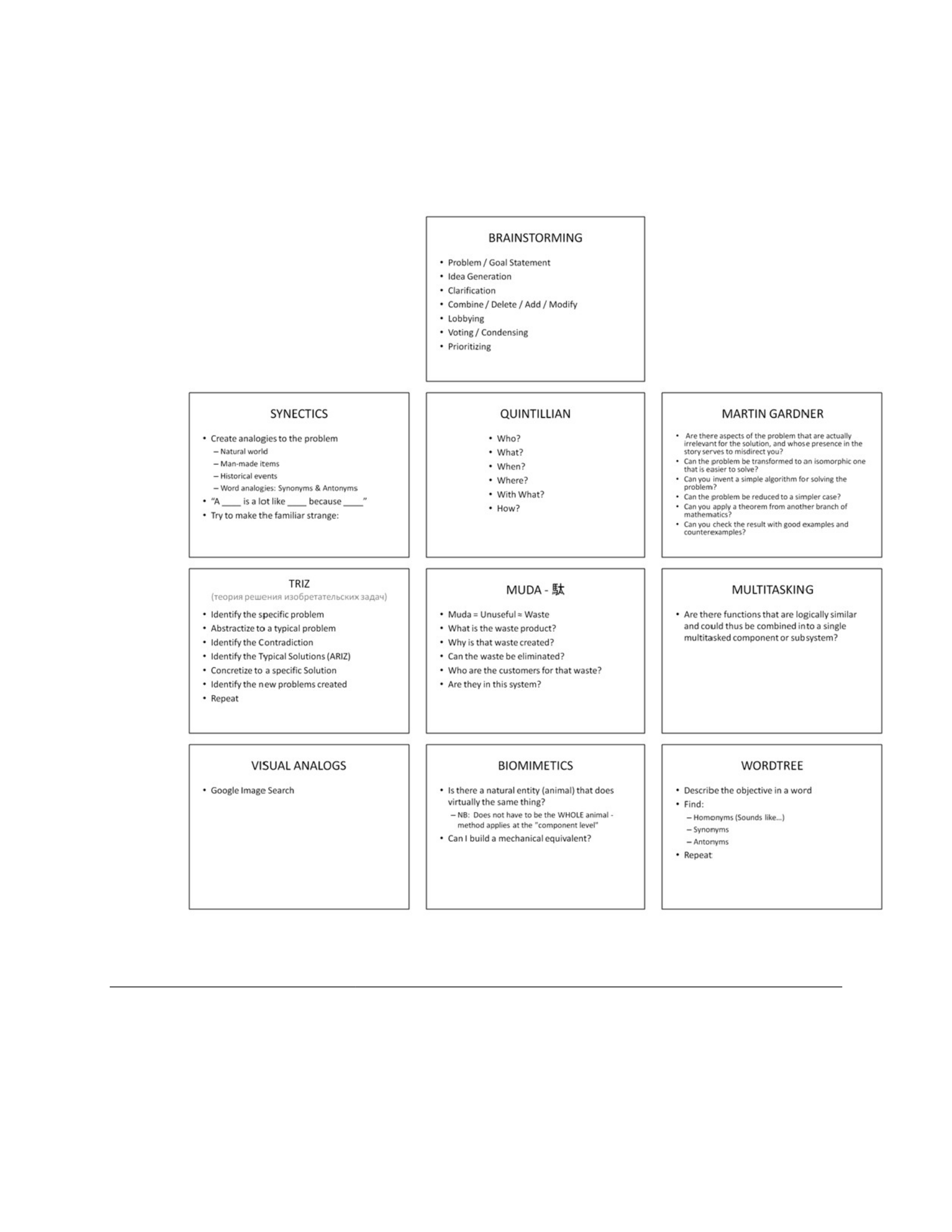
51
Figure 18 - Collage of ten posters of the idea method displayed at the Center for Innovation in Ship
Design, Summer 2012

52
At the time of this project I did not know the TRIZ methodology, nor had I formulated the
morphology of my innovation steps. But I found that I was using this technique perhaps unconsciously in
solving this problem.
The problem is choosing components for fuel cell ferries. A more accurate problem is that
there are too many options, with no clear winners and losers. If we lock in any choice, then we are
doing the customer a disadvantage by narrowing down their field of study.
It's the awareness that offers resolutions like TRIZ: The conflict is that we need a choice (you
can't design for non-specific) but we also need to keep the door open to revise that choice. This statement
of conflict quickly crystallized the solution: We delayed the selection, by dividing the system into logical
parts and designing interfaces between those parts, so that alternative options could be traded in and out
in a plug-and-play architecture.
The main components of the system, and their main alternatives, are:
Fuel storage module
oCompressed hydrogen tank
oLiquid hydrogen tank
oMetal Hydride Bed (Selected as baseline)
Power Generation Module
oProton Exchange Fuel Cell (Selected as baseline)
oLiquid Carbonate Fuel Cell
oHydrogen combustion diesel engine
Accumulator/Electrical Buffer Module
oLead-Acid Battery storage bank (Selected as base)
oSuper-Capacitor Storage
oFlywheel storage
Power Conversion Module
oSwitchgear modules as needed to connect selected power generation and
electrical storage modules
Motor Control
Propulsion Motor
By adopting this "divide and conquer" paradigm, we managed to solve the problem of what
technology to choose, by essentially kicking the decision downstream. We engineer vessels that
accommodate all of the options listed above (with varying specific vessel impacts, to be sure) and
provide superior service to our customers in doing so.
The design of the latter ship is a modular vessel, including a fuel storage module, an electric
generation module, an electric accumulator module. The client chose to move forward with fuel storage
in the form of compressed gas, electricity generation through diesel engines burning hydrogen, and
electricity accumulation in lead-acid batteries. But the ship's architecture will allow the switching of one
of these modules to one of the other listed technologies.

53
H2
350 VDC
480 VAC
Figure 19 – Concept Block Diagram for WTA Fuel Cell Ferries (WTA 2002)
Figure 20 – Detailed Block Diagram for WTA Fuel Cell Ferries (WTA 2002)
Fuel Storage System
Hot
Power Generation System
Hot
Water
Muffler
Water
Air
Power Accumulator System
Air Muffler
Propulsion System
Hot

54
4.2 : Rearming missiles at sea
My first CISD Summer 2012 project assignment was actually a very short and unstructured
meeting. After the introduction to the assignment, a team consisting of Mr. Jack Offutt (CISD), Dr. Colen
Kennel (CISD), and myself spent about 30 minutes in the idea, after which the interns were released to
continue the development of the technique. For our idea sessions, we are first equipped with a short menu
of predefined solution concepts, such as the use of different types of positive control cranes, or the use of
rolling carts with integrated load builders. We used the idea to increase the size of the solution menu.
The first idea technique applied is design by analogy. We identified one industrial analogue –
how eggs are loaded into boxes of a dozen cardboard boxes – but this path is not pursued. 17 We looked
for a process that was analogous to the rearming process, and quickly decided that rearming a missile
launcher might be analogous to reloading a gun, with options ranging from models of one bullet at a time
for revolvers to models including the concept of a plastic strip magazine reloader for automatic. Note that
the strip loader changes the nature of the rearming process in the launcher, but it involves the basic
process of "one bullet at a time" to prepare the loader.
TRIZ received a very short effort. We can go as far as the problem defined as "must move / must
not move": The weapons are taken to the crane (they move) but when they get to the combatant, it is
important that they must not move, so that the missile tubes can be refilled. This turned out to be a pretty
good technique because Colen quickly came up with the idea of using a pumped bag to pick up the
missile and disable it. In this version we imagine a kind of doughnut or inflatable collar: The missile can
be placed generally near the center, hanging (and moving) from its crane elevator, and when the donut is
then pumped, it will grip the missile firmly and prevent further movement. The donut is then passed as
needed to the missile launcher cell, and the missile is gently released (by limiting the pressure of the
donut) so that the weapon slides into the cell.
The untouched area is biomimetic. I still feel there might be a biomimetic parallel but we didn't
find it (nor did we try.) Wordtree, visual analogue, and other techniques are not tried.
4.3 : UxV Launch & Recovery
Another CISD team is working to measure the ship's impact from accommodating all future
unmanned vehicles. This so-called UxV may be an aerial vehicle (UAV), a surface vehicle (USV), or an
underwater vehicle (UUV). I was called by this team to help develop a concept to minimize the impact of
this ship, specifically minimizing the impact of launch and recovery operations. I applied a menu of
innovation techniques to this problem, in a two-hour discussion with a team of three.
4.3.1 : Problem Definition
The problem is to launch, restore, resupply, and maintain a number of unknown types of UxV.
The problem lies in the unknown nature of the vehicle, and its unknown infrastructure
17 I researched this a few weeks later: Eggs are rolled in large quantities through various washing
processes. The rolling motion exploits the oval shape. When it is necessary to place them in cartons – analogous to
the refills of missile launchers – the eggs are handled by suction cup lifting devices, or by clamshell devices that
look like separate mouthpieces. The pointed funnel holds the eggs in place despite the size variation, and then the
funnel opens like a seashell to allow the eggs to fall into the carton. The height of the droplets is calculated to
minimize damage.

55
Requirement. The problem becomes knowing these unknowns, without limiting the vehicles of the
future. This is a difficult challenge when presented in this term.
4.3.2 : General Issues
Given that our problem is knowing the unknown, it is tempting to declare it unsolvable in the
first place. But this certainly ignores a lot of what we know, which are only found at a higher teleological
level than has been stated in the problem.
A common problem is the launch and recovery of offboard vehicles, and the statement itself
contains a lot of information. We know that the vehicle will be of one of three types: Surface, Air, or
Subsurface vehicles. We further know how to place offboard systems into the air (aircraft and missiles),
into water (from rescue rafts to small boats), and below the surface (torpedoes.) Thus we have already
generated an analogue for our UxV problem.
In the actual CISD team discussions, we spent most of the time on the recovery aspect, as this
was considered the most difficult problem. However we have produced one useful guide for the launch
issue, which will be documented (in no order) here:
Air, surface and subsurface vehicles can compete for different types of ship launch support
infrastructure. UAVs like helicopters require a flight deck. USVs such as boats require a boat walkway,
davit, or other similar means to be put into the water.
In order to minimize the impact of the ship, and maximize the flexibility of the ship, we
conclude with the recommendation that all types of UxV should be configured for water takeoff. This
means that no matter whether the vehicle is diving, swimming or flying, it will do so from a 'floating
near the carrier' attitude, and that the act of "launch" will – from the carrier's point of view – consist only
of placing the vehicle into the water in a satisfactory manner.
The act of partitioning this issue, similar to the WTA solution, allows us to focus more on the
recovery task. We'll see that our idea of recovery also generates additional ideas for the rollout – the
division of tasks isn't considered "permanent."
Recovery tasks can be generalized to recover a vehicle from its original elements, in a way
consistent with the vehicle's sensitivity to, say, impact, wet, personnel hazards, etc. To generalize this
problem, we call it "catching eggs".
4.3.3 : Idea Generation
Notice how even in the act of generalizing the problem, we begin to find analogues. The division
between the steps of innovation is not difficult and fast.
Again in this project like the others, we tried to implement various innovation tools in the
ideation step, as follows:
TRIZ: What are the inherent conflicts in this project? It is a bit difficult to state the challenges of
UxV recovery in the contradictory words of TRIZ, but we must bear in mind that none of the participants
are truly experts in TRIZ. The crux of the contradiction is that unmanned vehicles are separate from the
ship, by design and intent, and we need to make them inseparable from the ship, as a recovery measure.
SEVEN QUINTILIAN QUESTIONS: The seven questions do not produce a solution, but they
do explain some easily overlooked obstacles, as follows:
Who? – Must be executable by the ship's power
When? - Time is a factor, as we want to not limit the maneuverability of the aircraft
carrier too much

56
Where? - The vehicle must be restored in all types of environments, including sea and
wind conditions that we cannot launch, but that appears after the vehicle is deployed.
With what? - Our goal is to minimize space, weight, cost, and other impacts of "with
what". It also includes an inventory of our recovery assets that already exist or may be
on the carrier, such as davits, king's masts, cranes, flight decks, etc.
MARTIN GARDNER: Martin Gardner's method emphasizes simplifying problems, and finding
solutions to simpler problems. So in that case, what is the simpler problem that is equivalent to the UxV
recovery problem? Is it easier if the vehicle is not moving? In actual events, this line of thought does not
lead to any innovative solutions, but I feel disturbed that there may be fruit on this path, if we pursue it
further.
BIOMMETIC: The obvious biomimetic parent is the landing bird. We had a long discussion
about how birds land and take off. The key insight is that they like to fall from perches, falling to flying
speed. This suggests that instead of launching, throwing, shooting at the UAV carrier, perhaps the UAV
should be pulled onto a pole and launched.
Similarly, birds love to flare up at their landing sites, and drop the last millimeter to land. To do
this, they approach from under the landing spot and retract the stick in the controlled cage. By timing the
approach correctly, the moment of total loss of speed occurs right at the landing site.
Compare how gracefully several birds land on a perch, with a flare, with how unpleasant the
same bird lands on flat ground, where the blaze is restricted.
MULTITASKING: Are there any functions that are logically similar and thus can be combined
into a single component or subsystem of multitasking? We discuss the idea that landing perches and
storage sites may be one and the same thing, in patterns such as the way bats hang from the ceiling in
their caves.
4.3.4 : Implementing Solutions
The above ideas resulted in some interesting recovery solutions. When we discussed a bird
landing on an elevated perch, one idea was to exploit the bird's self-control. An alternative is to ask the
bird to take a stance, and have the recovery asset take the bird out of the air like catching a butterfly. This
requires a shift in control to an active system on board, but it does not reduce the need for an active
system on birds, as birds still have to fly and hover.18 years
As a result we thought that it would be desirable to have some kind of perch where vehicles
could land. This is how the rotary-wing UAVs were restored, with the ship's flight deck being the perch.
To a certain extent, this is also how stern ship operations are carried out. The problem with both cases
lies in the movement of the aircraft carrier, and the possibility for a devastating speed conflict.
We devised a new solution for vehicles recovered at sea. This is to pull the linear perch, which
can be caught at any time along its length, reducing the need for precision in the approach.
These linear perches are nothing more than tow ropes, and readers should imagine rope-pulling
ski lifts, usually only found on the beginner slopes of ski resorts. Indeed, I remember learning to ski in
my own childhood, and how easy it was to use a rope puller, compared to how scary the "all or nothing"
experience of an elevator seat was.
18 Note that when I talk about birds in this way, the same logic can be applied to marine vehicles.

57
In the case of the UxV, the vehicle will be navigated to meet the rope, and then it will hold onto.
We envision that some sort of grip claw should be attached to the vehicle – a skier's gloved hand, or a
bird's claw – although we have the beginning of exploring ways to transfer this function to the rope
itself.19 years
After being caught by the rope – which can take several times – the rope is then towed to a
conventional stern boat bay or UxV bay. We've taken away the excitement of driving at high speed to the
garage wall, and replaced it with a much safer maneuver done in open water.
4.4 : EFV
The most thorough (but still not comprehensive) treatment of innovation projects occurred
regarding the perennial problem of providing viable hydrodynamics for amphibious armored vehicles.
Previous attempts in this regard led to the "planning bricks" of the AAAV/EFV – see Figure 21.
EFVs are armored vehicles with requirements to cross water at high speeds. The geometry of the
vehicle is very limited, and the result is an illustrated planning concept. The current task is for a simpler
speed goal of only about 12 knots. However, early hydrodynamic studies showed that 12 knots for a
vehicle of this size was a very poor choice of Froude Number, and thus a barrier to high wave generation.
The CISD team is investigating ways to increase the length of hydrodynamics, to change the operational
Froude Number.
I applied the first three steps of innovation morphology to this problem, using a variety of
techniques.
4.4.1 : Problem Definition
The problem is to make a vehicle like an EFV go 12 knots in the water, at the minimum power
level, safely. The solution space is limited that all solutions must be outside the vehicle, and that the
solution must be "lost" when the vehicle is operating on the ground.
4.4.2 : General Issues
The problem can be generalized in many ways, as follows:
TELEOLOGY: What is the purpose? The task is to convert the EFV into a 34.5-ton, 12-knot
ship. What would such a boat be like, if not an EFV? How far does this differ from EFV? Can we make
an EFV "look like" the boat defined above?
TRIZ: What are the inherent conflicts in this project? The design team has taken length as a
contradiction: That the aircraft "wants" twice as long as the EFV "wants it." Presumably the length of the
EFV is driven by transportation requirements and maneuverability. The desired length of the boat is
driven by hydrodynamics. The conflict is thus between two different lengths.
TECHNICAL MEXICAN:
Relevant keywords: Synonyms of
Bata Planning: Jumping over
rocks
Antonym: Sink
These techniques do not return a clearly beneficial avenue for investigation. Of course, this is
just a superficial use of techniques.
58
Figure 21 – Expeditionary Fighting Vehicle (EFV) in planning mode. (MEDO, 2012)
YOUNG: Similar to the use of the contradiction of TRIZ, can I define any aspect of the problem
as "Young" – as an aspect that I have no subscribers to?
In this case one definition is the required length increase: We need to make the ship longer as a
boat, but then we need the length to 'go' to land, because we don't have a customer for the length, once in
the ground vehicle mode.
QUINTILIAN SEVEN QUESTIONS:
Who? - Combat vehicles
What? - It is necessary to cross water at a speed of 12 knots. To do this, we think it
needs to be longer or at least more hydrodynamically shaped.
When? - Time is realized in the desired speed, 12 knots.
Where? - must function in deep water
With what? - Only use systems or components that can be easily carried in the
vehicle
How? - TBD
MARTIN GARDNER:
Martin Gardner's method emphasizes simplifying problems, and finding solutions to simpler
problems. So in that case, what is the simpler problem that is equivalent to the EFV problem?
There are several possibilities:
What if we don't need it to go 12 knots, but only 10? or 8? or 2?
What if we don't need it to be self-propelled, but can be towed?
What if it was designed as a boat first, and then made into a land vehicle afterwards?
Of these, note that the first two require naval architects to challenge requirements, and this is
difficult in an organizational context. But in this case the goal is not really to challenge this requirement,
but to see if by solving the problem in a simpler case, we can provoke a breakthrough that

59
can be used in "real" cases. In other words, if the goal is only to go 2 knots, what is the solution? Given
that solution, how difficult is it to boost that solution so that we reach the 12-knot target? I'll show you
this exploration below.
ANALOG VISUAL:
I didn't find any visual analogues, probably due to my inability to find suitable keywords to
describe the problem in image search. I did get a lot of images in response to the phrase "jumping stone"
and many of these images are interesting, but they are not directly provocative of the idea of a solution to
this problem.
SYNETIC:
In different parts of Synektika we are trying to find an unusual analogue with EFV. The shortlist
I created is as follows (using standard Synectics sentence structure.)
"EFVs are like Crocodiles because they're both amphibians."
"EFVs are like tugboats because they are both in the unfortunate Froude Numbers."
"EFVs are like snow shovels because they both plow the water."
"EFVs are like bulls in a porel shop, because they're dull."
"EFVs are like half-tide rocks, because the water flows around it much faster than
desired."
BIOMIMETICS
The above Synectic exercises actually give rise to a clear biomimetic parent of the Crocodile.
Crocodiles have two separate forms of propulsion, but they do not try to move at high speeds when
watery, except in explosions. Is burst speed an option for EFV, or is it necessary to have 12 knots
continuously?
MULTITASKING:
Are there any functions that are logically similar and thus can be combined into a single
component or multitasking subsystem? I can't find anything about this issue.
4.4.3 : Solution Search
Now that we've generalized the problem in various terms, let's try to find a concept-level
solution in the same terms. First, we note that by applying all the techniques, we have created a much
larger menu of options than any single technique would produce. We are now taking all this thinking
and applying it again to various innovation tools, but now on the third step of "finding a solution".
The idea is:
What is a good 34.5 ton/12 knot boat? How far does this differ from EFV? Can we
make an EFV "look like" the boat defined above?
What can we do to make the length vary in two land/sea modes?
Is there a way to create a "customer" to increase the length?
What if the speed requirements are much lower?
Does the speed have to be continuous?
What if it was designed as a boat first, and then made into a land vehicle afterwards?
First, a glimpse into the tasks of naval architecture. His task was to build a 12-knot ship weighing
34.5 tons; How much is this different from EFV?

60
Applying the McKesson ship-wide method (McKesson 2011b), a good 12-knot ship weighing
34.5 tons would have an expected power demand of about 60 kW. It seems that at this speed the
displacement / length ratio should be in the range of 1 to 3. It produces a length of 22 to 32 meters, of
which the EFV is 10 meters. In fact, this brief glance confirms that the team's current path makes sense.
Now I'm investigating the effect of speed on this solution. Here I refer to McKesson (2011b) for
the best achievable power performance, and Saunders (1957) for the recommended obesity ratio (Figure
22). The basic EFV has a obesity ratio of 35, which is off the charts. However, we see that the desired
obesity ratio decreases with increasing speed. Thus we can build a range of "maximum acceptable
obesity ratio" versus velocity, and then apply a weight of 34.5 tons to translate that to "minimum
acceptable length". The results are shown in Table 3. Again we see that a speed of 12 knots "wants" a
length of 20+ meters, and that a length of 10m is currently too short for any speed at a displacement of
34.5 tons.
Note that we start this investigation by addressing the first point above: What type of boat
does the EFV requirement imply? We've also investigated the fourth bullet – what is the effect of
speed? We are now convinced that length holds the key, and the question becomes, how long is it?
The simplest solution, based on Table 3, is that we need an extension of 15 meters to the
vehicle, which will be "lost" in ground mode.
But now we consider bullet number three, and consider whether there are customers for this
extra length. In fact, we are talking about more than one EFV length with extra length. What if we only
pair two EFVs?
Unfortunately the solution is not that simple, since combining two EFVs does give us extra
length, but it also doubles the weight. But do the benefits of length make us faster than the weight
penalties that lower it? The above methods can be used to investigate this.
Table 4 shows the results of some hypothetical EFV chains, and we see that a three-and-a-
half EFV chain would be a satisfactory combination of weight and length for hydrodynamic
purposes, without "Young" in the form of additional components.
Of course, three and a half is not a viable number, but in the implementation stage below we will
see how this is overcome.
Separate from this idea of the EFV chain, the team focused on resolving contradictions such as
TRIZ by pursuing a vehicle design of variable length. Their particular focus is on the implementation of
the concept of variable length. They have developed several concepts, and the most beneficial is the form
of a telescopic structure that encourages the bow of an inflatable ship, but is attractive (and deflated) for
land mode. It's a classic TRIZ transformation, so we can say that TRIZ is basically used by existing
design teams.
Between these two extremes, from the retractable bow and the EFV chain, there are other hybrid
solutions, for example marrying the Young concept with the TRIZ concept: In this case one part Young is
probably the required increase in length: We need to make the ship longer as a boat, but then we need the
length to 'go' to land - because we don't have customers for the long, once in ground vehicle mode. I can
see two paths to learning that might create customers for extra length. Are there some equipment needed
on the ground that an EFV can carry as "cargo" in the length increase?

61
Table 3 – Preferred length values for various speeds of 34.5 ton EFV
Froude
Number
(length)
Maximum
Acceptable
Obesity
Speed
(knots)
Minimum
Acceptable
Length
0 11 0.0 14.5
0.1 8.8 2.4 15.6
0.2 6.8 5.0 17.0
0.3 4.4 8.1 19.7
0.4 2.2 12.1 24.8
Figure 22 – Harold Saunders CAPT Guide for ship overweight ratios (Saunders, 1957)

62
Table 4 - Attained obesity ratio values for various EFV chains, compared to the recommended
obesity ratio at 12 knots
Total
EFV
Weight
(tons)
Speed
(knots)
Total
lengt
h
Froude
Number
(length)
Achieving
Obesity
Maximum
Recommended
obesity
Minimum
Recommended
obesity
1 34.5 12 10 0.62 35.36 1.9 1.2
2 69 12 20 0.44 8.84 1.9 1.4
3 103.5 12 30 0.36 3.93 3.0 1.7
4 138 12 40 0.31 2.21 4.2 2.5
5 172.5 12 50 0.28 1.41 5.1 3.3
6 207 12 60 0.25 0.98 5.7 4.0
This requires discussion with mission sponsors and these conversations have not yet
happened. Finally, the last point in the list of ideas comes on its own when combined with
the "chain
EFV". What if it was designed as a boat first, and then made into a land vehicle afterwards? There may
be some benefits to this idea. The 12-knot 34-ton boat is about 33 meters long. Once on the beach, this
boat can 'break' and become what? An EFV plus three HMMVs?
Finally, the bullet that asks "does the speed have to be continuous?" This question arises from the
analogy of the crocodile. It is noted that crocodiles are not fast in the water, but have the ability to sprint -
the speed of explosion. Will EFVs benefit in any way from the speed of the explosion? Can this
explosive capability be used to justify a lower (and thus easier to achieve) sustained velocity?
Following the lizard analogy, I wonder if EFVs have to make more than one trip? If not, can a
lizard drop its tail when it reaches the shore?
4.4.4 : Implementing Solutions
It was at this point that I "exited" the task. Fortunately for this thesis, it is relatively easy to see
how the solution outlined above can be implemented:
First, the extendable bow is implemented by designing a kind of scissor mechanism that will
extend the volume of the arc about 10+ meters to the front of the aircraft. The volume of the bow is
envisioned as an inflatable pouch that provides fixed buoyancy, and the extension mechanism also
includes the structure necessary to provide the hull behind that bow. (In the basic concept at CISD, it was
believed that a trench built behind this bow would be sufficient to form a virtual hull, and no material
hull was required.)
Regarding the EFV solution chain, investigations show that three EFVs can be combined. And
assuming that the clutch does require some length, we found that a truly optimal combination of length
and weight can be achieved with a 1.3-meter-long clutch mechanism, i.e. a series of three EFVs
consisting of 103.5 tons and 34 meters.
We can now further improve the design by adopting the virtual hull of the build trench from the
expandable bow solution, and specifying that the three EFVs 1.3 meters apart do not need to have an

63
actual gap-filling hull, they just need to be equipped with a quick separation spacer between the vehicles.
I would argue that engineering this spacer assembly is at least as easy as engineering an extendable arc.
4.5 : Summarized examples
The four short stories above are intended to illustrate a number of different ways that formal
methods and tools of innovation can be applied in ship design. To use the metaphor of the culinary field,
we can think of it as an "appetizer" or a sample of the type of food that can be prepared, using the
morphology described and the tools of its components.
Now let's turn our attention to the characteristics of the cook for that meal, i.e., "What are the
characteristics of a successful ship design innovator?"
5: What are the characteristics of a successful ship design innovator?
We've seen what creativity is, and we've looked at design through both procedural and cognitive
lenses. We have been introduced to some algorithms specifically for innovation, and we have seen that
all of these algorithms have the same architecture or morphology.
Now let's turn our attention to the human actor, the innovator himself. What are the types of
people who are capable of creativity and/or innovation?
This turned out to be a very large field of study, which has generated a lot of debate and is
worthy of many dissertations in itself. I will limit the current discussion to engineering innovation, and
will try to paint an overview of the types of individuals who exhibit a talent for creativity.
Many engineers recall a branching of their personal universe that occurred in their teenage years,
when they discovered that their friends did not share their love of math and science. We each learned that
not everyone can, or will, do math.
In the years that followed I have observed that even of those who can do mathematics, not
everyone can apply that mathematics in the way necessary for engineering analysis.
Moving on, there seem to be many excellent engineers, very skilled in engineering
Analysis, who can't work on the problem of backwards and do engineering synthesis, that's the design.
And of those who can do design, there are some who cannot do design without ancestors, namely
innovation.
I hastily stated that this is not a value assessment, just an observation. As an innovator myself, I
am not a great mathematician. As an engineering designer, I really need a good engineering analyst on
my team. I'm not saying that innovation is a kind of "higher" skill, it's just that it's a different skill.
My observation is that there are individual differences in aptitude for innovation, and this seems
to be supported by the literature on this subject. Let me explore the things that I think are key, without
making it a dissertation on psychology.20 reviews
The topics of this exploration are as follows:
➢What is the relationship between creativity and intelligence?
➢What is the relationship between creativity and quality?
➢What is the relationship between creativity and teamwork?
➢Is creativity aligned with a particular psychological type?
➢Can we learn to be more creative? (Separate from innovation methodology.)
5.1 : Creativity versus intelligence
I started with the relationship between creativity and intelligence. It intuitively seems that
there must be such a relationship, but it turns out that this relationship cannot be described in the
classical terms that are necessary or sufficient.

64
Stahl, (1980) provides a discussion of this relationship when he analyzes student performance on
a series of creativity tests: "According to the literature, the relationship between intelligence and
creativity is not a direct relationship (Getzels, 1969; Ebel, 1974). People who are gifted with creativity
are seen differently from people who are intellectually or academically gifted (Torrance, 1975). Torrance
(1975) argues that equating intellectual talent with creativity is excluding almost 3/4 of all those who are
highly creative
child. And, while creativity may be a factor of intellectual aptitude, it is certainly not a prerequisite
(Torrance, 1963)."
Of course, some part of this result is due to the way the questions are framed. In this case, the
definition of creativity is "doing anything that is different and unique personally." This definition makes
the results even more surprising:
"Given the above, the finding that 70 percent of children who are highly rated in creativity will
not be selected as intellectually gifted should baffle many educators. If creativity is loosely defined as
"doing something different and unique personally", then it's hard to believe that 70 percent of
intellectually gifted children do little new or unique things. In addition, a liberal definition of creativity
would require one to admit that nearly three-quarters of highly creative children are not very "smart".
Both explanations seem a bit absurd.
"In the same vein, the relationship between intelligence (i.e., IQ) and creativity test scores is not
a clear relationship (Crockenberg, 1972; Torrance, 1975; Ebel, 1974; Getzels, 1969). Low test scores
and correlations do not provide evidence that being intelligent disqualifies a person from being creative,
or vice versa (Ebel, 1974). As long as IQ tests emphasize measures of convergent factual ability and
creativity tests are believed to reflect different non-factual memory responses, the controversy related to
the relationship between intelligence and creativity will continue."
If creativity is not the inevitable accompaniment of intelligence, then perhaps it is simply the
result of the rote execution of some process? From an engineering point of view, this would be great, as it
would mean that mechanistic execution of innovation methodologies (choose a comprehensive one, such
as TRIZ) would replace the need for personal creativity. We've rejected this hypothesis in our definition
so far, but Stahl once again helped us:
"It seems appropriate to examine some of the consequences of holding on to the position that
creativity is caused by different creative thought processes. If such a process really exists, then we must
accept the fact that inherent creativity rather than ability, opportunity, effort, intention, task or career
requirement, or circumstance, explains the unique behaviors and products achieved by so-called creative
people. Attempts to explain individual creativity in different fields such as art, science, architecture,
literature, directed at identifying the single "cause" of all this creative behavior have not been successful
(Berelson, 1964 and Taylor, 1975). Interestingly, there are yet no distinct activities, attributes, or
processes that are generally shared by all recognized 'creative' people, which makes them all
significantly (and I don't mean in the statistically sanctified sense of 0.05) apart from the less creative
people.
"That these differences do not exist is supported by the list of characteristics or traits and
attributes that distinguish gifted and talented individuals published by the Council for Exceptional
Children – Nazzaro, 1978). (See Figure 23) Referring to the "creative characteristics" of gifted/gifted
children, the CEC points out that these characteristics "constitute observable behaviors that can be
considered as clues to more specific behaviors" for identifying creative people. Even in Figure 23 there
is an implicit cause-and-effect relationship between the type of thought (e.g., 'fluent', 'flexible') and the
described behavior that follows it. Here again, even research and literature review by the CEC do not
identify clearly distinguishable characteristics of creative behavior or the so-called creative thinking
process."
What Stahl is giving us is that creativity is not an inevitable descendant of an algorithm, or

65
intelligence, and even that creativity can be found in the less intelligent. This is important, because it
means that our innovative boat designers are not necessarily found at the head of the class.

66
Creative Characteristics of Gifted and Talented
Some gifted children will display all of these characteristics, while
characteristics do not always determine who a gifted child is. They
constitute observable behaviors that can be taken as clues to more specific
behavioral characteristics are signals to indicate that certain students may
require closer observation and may require special education and
attention.
They are eloquent thinkers, capable of generating a large
number of possibilities, consequences, or related ideas.
They are flexible thinkers, able to use many different alternatives and
approaches to problem-solving.
They are original thinkers, looking for unusual, or unconventional,
new associations and combinations among items of information.
They also have the ability to see relationships between seemingly
unrelated objects, ideas, or facts.
They are complex thinkers, coming up with new steps,
responses, or other embellishments to basic ideas, problems, or
situations.
They show a willingness to entertain complexity and seem to thrive
in problem situations.
They are good guessers and can craft hypotheses or "what if"
questions easily
They are often aware of their own impulsivity and irrationality
within themselves and show emotional sensitivity.
They have a high level of curiosity about an object, idea, situation,
or event.
They often show intellectual cheerfulness, fantasize and imagine
with ease.
They can be less intellectually stunted than their peers, express
opinions and ideas and often exhibit passionate disagreements.
They have a sensitivity to beauty and are interested in the
aesthetic dimension
Figure 23 - Creative Characteristics of the Gifted and Gifted (Nazzaro, 1978)

67
5.2 : Creativity and quality
Stahl argues that creativity is not intelligence. Does this mean that intelligence is not necessary
for engineering innovation?
In my position as Section Chief for the Advanced Vehicle Design Section at Navy
headquarters21, I was 'privileged' to receive a steady stream of innovation from outside naval engineering
companies. Well-meaning constituents will have a 'good idea' that they will send to their congressmen.
Members of Congress would honestly reply, "I have forwarded your idea to the Department of the Navy
for review..."
In most cases, those ideas, not unintelligent, but may be uneducated. There is a violation of
physics, or a mistake in the application of fluid theory, etc.22 In fact, over the years of conducting such
reviews, I have found that professional researchers who operate in their areas of expertise are far more
likely to produce useful innovations than a number of well-meaning outsiders.
But if it is not the result of intelligence, then what is it? I think the answer is: Expertise.
Previously, I argued that creativity is more than just novelties. But then again if it's more than
just a novelty,
Then what is "delta"? What elements must be added to "novelty" to generate "creativity?" I think
that this element is "quality", the offspring of expertise. Quality is an important component of creativity.
Consider again Stahl's discussion of creativity tests. He says:
"Crockenberg (1972) warns that educators too often (and too quickly) mistakenly equate the
frequency of new and distinct responses or products with high levels of creativity. He strongly suggests
that we avoid being overly influenced by the massiveness, complexity, and/or allure of so-called 'creative
products' that often have nothing to do with sincere creative thinking.
"Unless this ambiguity is clarified, then, taken to the extreme, classroom teachers, curriculum
developers, and teacher educators will continue to believe that whatever one does in response to a
different, new and interesting problem or situation, should be judged 'creative'. If this loose definition is
rejected, then some degree of truth, accuracy, and/or quality is implied but rarely expressed in most
conceptualizations of creativity. If truth or quality is involved, then there must be an externally
determined and measurable precise or appropriate criterion for what constitutes a 'divergent' activity.
Again, logic will suggest that creativity may be an extension or the next step beyond the expected
convergent response in the situation. This phenomenon may help explain why many very recent
"creative" responses are met by rapid acceptance by individuals on the same threshold of discovery.
"The fact that others have to not only recognize but also determine whether someone's product is
creative poses an interesting dilemma. It is possible that individuals do not have any problems in
producing new and unique behaviors and products. Instead, problems arise when we find so little
support and help from others with respect to new things that we can actually do. As suggested by Ebel
(1974), almost all of our unique behaviors and products are overlooked because few others appreciate
them enough to mention them. Therefore, built into uniqueness there must be externally demonstrable
elements such as excellence, quality, suitability, and usability. The emphasis placed by the promoters of
creativity on the suspension of critical judgment, on the full openness to new ideas, however strange as it
may be; and just a number of new alternatives, may need to be reconsidered given these external
criteria."

68
If creativity requires quality, and is built on a foundation of intelligence, then it seems obvious
that expertise is also included in the recipe. The last comment above shows that many creative qualities
need recognition before they can come to fruition. So there is something more than expertise, it is
recognized expertise .
This last point is alluded to in the UNO ENMG 6401 course "Seminar in Organizational
Behavior" in a unit on the nature of power in an organization. In this unit students learn that innovation or
novelty requires a certain amount of "swimming upstream", against the norm. Then how do innovators
get credibility to be listened to? One of the keys is technical excellence. Whetten and Cameron (Whetten,
2011) tell the story of a non-conformist whose performance review included the comment "he was so
smart that we had no choice but to promote him." This is how innovation succeeds in company structures:
Expertise trumps conformity (in some cases.)
Of course, there are a number of nuances to this, and I hope no reader will take this thesis as a
license to deviate will-he/nil-he. An aspect that is not mentioned in Whetten's text is for the innovator to
show that he understands the norms of the company, but that he advises to deliberately and knowingly
violate them, for some higher purpose – for example to solve the technical problems faced in a "better"
way.
Too often I see young innovators whose ideas may be good, but who with their courage
communicate that they do not respect the norms of the company. These people rarely succeed when they
work in this mode. On the contrary, the experienced innovator shows that he understands, but we have to
put those norms aside this time, for this reason... Indeed, often this experienced innovator understands
those norms better than his peers, because he has pulled them out of the background and studied them
explicitly. We'll look at this principle again, under the label "metacognition."
In Krathwohl (2002) proposed a two-dimensional learning taxonomy, which includes the
Knowledge axis and the Cognition axis. Krathwohl argues that progress along the axis dimension is
related to maturity or experience or expertise, each simpler category being a prerequisite for the next
more complex category.
Krathwohl's taxonomy can explain some of the basic skills needed for engineering innovation.
As I've stated repeatedly "not everyone can do it." It seems to me – and this will be a beneficial avenue
for future research – that one has to go far enough on the axis of knowledge in the metacognitive realm,
and far enough along the axis of Cognition to the Creative realm, for discovery to be easy. This will be a
useful topic for the study of statistics.
Kratwohl's taxonomy is described in Table 5. The two dimensions, listed as two columns, are
orthogonal to each other. I consider the AC & 1.0-3.0 sector to be "Technician class" knowledge. It is the
knowledge of, say, what nuts and bolts are, how they relate to each other, how to apply their relationship
(how to choose the right nut for bolts).Engineering Education touches on elements 4.0 and 5.0: Given
what we know about nuts and bolts, can we generalize, and understand the role of thread pitch on the
relationship between grip force and bolt torque? Can we then use that analytical knowledge to evaluate
which bolts are best for a given task?
I believe that Innovation lies in step 5.0: Create, plus knowledge not only about facts and
procedures, but also about what we really know about those facts and procedures – knowledge of
knowledge – so that we can generalize our knowledge, apply it in new ways or new sectors. And, as we
recall the various innovation methodologies, we realize that many of them are attempts to force us to
think about our knowledge, whether this is through the explicit step of "making the familiar strange" or
through the biomimetic analogy of looking for the rudder of a ship on the tail of an otter. In both cases
(and more) we are instructed to distort our knowledge, which we can also describe as "thinking our
minds."

69
Table 5 - Taxonomy of Krathwohl Education
Knowledge Dimension
A. Factual Knowledge – The basic elements
that students must know to get acquainted with
a discipline or solve problems within it.
a. Knowledge of terminology
b. Knowledge of specific details and
elements
B. Conceptual Knowledge – The
interconnectedness between the basic
elements in a larger structure that allows them
to function together.
a. Knowledge of classifications and
categories
b. Knowledge of principles and
generalizations
c. Knowledge of theory, models, and
structures
C. Procedural Knowledge – How to do things;
methods of investigation, and criteria for the use
of skills, algorithms, techniques, and methods.
a. Knowledge of subject-specific skills and
algorithms
b. Knowledge of subject-specific techniques
and methods
c. Knowledge of the criteria for
determining when to use the right
procedure
D. Metacognitive Knowledge – Knowledge
of cognition in general as well as awareness
and knowledge of cognition itself.
a. Strategic knowledge
b. Knowledge of cognitive tasks,
including contextual and conditional
knowledge that is appropriate
c. Self-knowledge
Cognitive Process Dimensions
1.0 Remember – Retrieve relevant knowledge
from long-term memory.
1.1 Recognize
1.2 Remember
2.0 Comprehension – Determines the meaning of
instructional messages, including oral, written,
and graphic communications.
2.11
2.2 Exemplifies
2.3 Classify
2.4 Summarize
2.5 Conclude
2.6 Compare
2.7 Explain
3.0 Apply – Perform or use the procedure in a
specific situation.
3.1 Execute
3.2 Apply
4.0 Analysis - Breaking down materials into their
constituent parts and detecting how they relate to
each other and to the overall structure or purpose.
4.1 Differentiate
4.2 Organizing
4.3 Join
5.0 Evaluation - Make assessments based
on criteria and standards.
5.1 Examine
5.2 Critiquing
6.0 Create - Combine elements to form a novel,
coherent whole or create an original product.
6.1 Produce
6.2 Planning
6.3 Producing
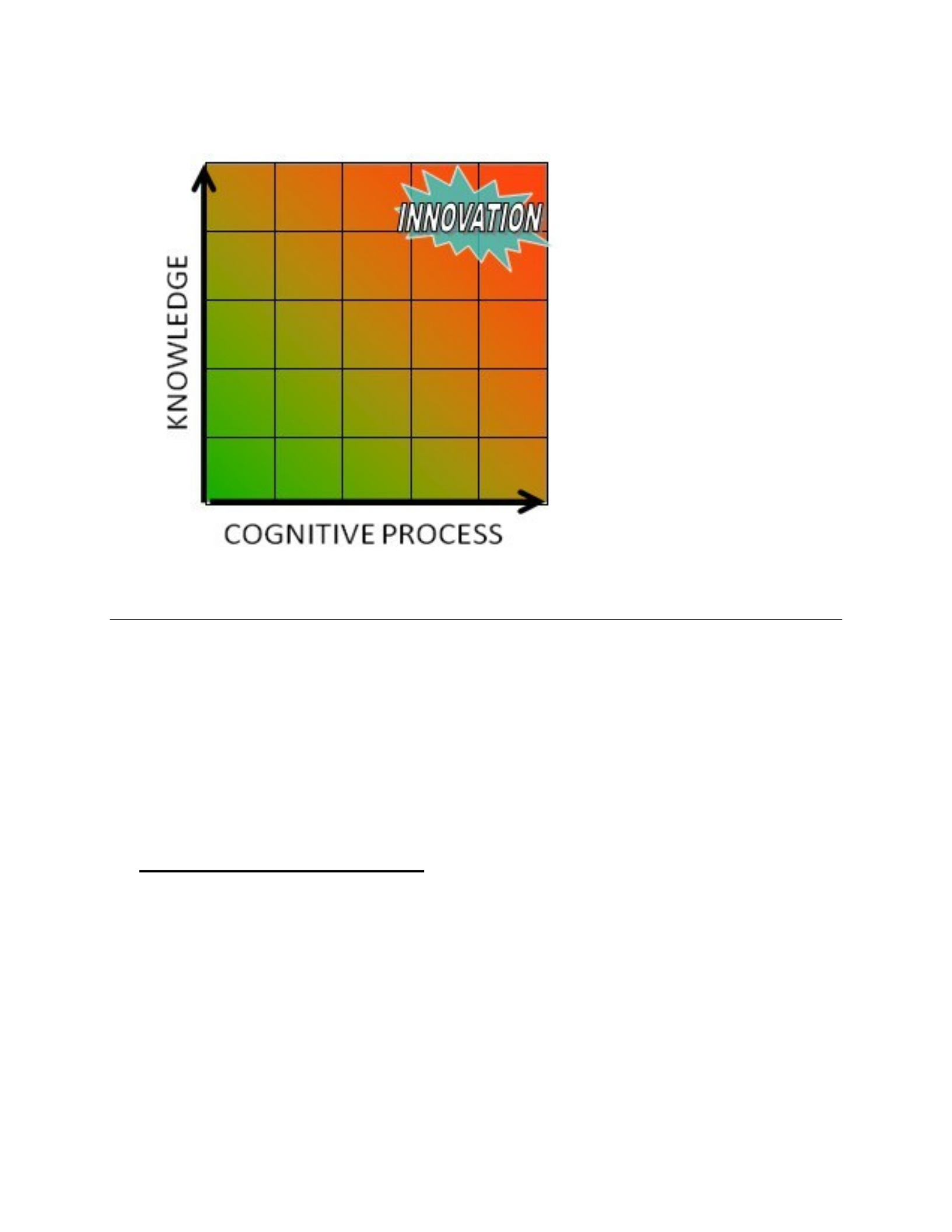
70
Figure 24 – An attempt to illustrate the idea that Innovation lies at the top end of both axes of the
Kratwohl Educational Taxonomy
Figure 24 is an attempt to illustrate the two orthogonal axes of Kratwohl's taxonomy, and my
belief that innovation can be found in the intersection of high values in both dimensions. As it should be
clear from Kratwohl's taxonomic structure, the extreme values on both axes are those that are only
possible to be found in highly educated practitioners, or experts.
It's very simple, which raises fears that it might be simple, but it provides justification for my
premise that expertise is indeed necessary for innovation. Of course, this raises questions about the
definition of expertise, and the determination of how much expertise is needed, as there are clearly
different levels of expertise. In this case I would argue, but not prove, that the Kratwohl method is useful
because it is not so much about the skill itself, but rather about the cognitive processes that the expert
uses.
5.3: Creativity as a social product
So far we have built the case that innovation or creativity may not demand extreme intelligence,
but it does require expertise, and recognized expertise in that regard. Furthermore, through the example
of the "brazen engineer" we see that this innovation occurs within the social structure. Furthermore, it is
known that most of the engineering happens as a result of teamwork. Indeed, we first encountered this
principle during a discussion of the Rhodes 4-P model, (Rhodes, 1961) where one of the P's is a "person".
The question at this stage is what type of social structure is most likely to result in successful innovation.
Dr. Brian Uzzi has conducted an interesting study on the nature of successful and unsuccessful
creative teams. In Uzzi (2005) he presents a discussion about the right "chemistry" needed in a creative
team. Uzzi's research uses Broadway musicals as his laboratory for creative success. Musicals are
interesting to scientists because they all consist of a team of five people: composer, lyricist, libret writer,

71
choreographer, and director. There are also direct metrics of creative success, through box-office
revenue.
Uzzi developed a tool to measure what he calls the "size of the world" of creative teams. The
size of the world is a measure of how many degrees of separation there are between the participants in
the team and the respective universe. This is a common expression in popular culture, where we speak
of the "six degrees of separation," in the sense that no two people on earth are separated by more than
six steps of introduction: "I know the one who knows the one who knows... King of Spain." Indeed, the
six degrees of separation are Uzzi's work.
A writer for The New Yorker (Lehrer, 2012) did an excellent job of making Uzzi's research
readable. I quote from Lehrer:
Uzzi found that the people who work on Broadway are part of a social network with a lot of
interconnections: it doesn't take many links to get from the librettist "Guys and Dolls" to the
choreographer "Cats." Uzzi found a way to measure the density of these connections, a number he calls
Q. If the musical was developed by a team of artists who had worked together several times before
Figure 25—a common practice, because Broadway producers saw the "incumbent team" as less risky—
the musical would have a very high Q. A musical made by a foreign team will have a low Q."
Uzzi himself illustrates this with an image reproduced as Figure 25.
One might expect that low-Q musicals would perform poorly, because foreigners are not insiders
in the industry, in a similar way to my discussion of the outside inventions that were sent to the
Department of the Navy. Furthermore, we might then go to the other extreme and expect a well-
connected team of insiders to be the most successful, and this is where Uzzi's findings may come as a
surprise: Uzzi found (see Figure 26) that there is an optimal level of connectedness, and that an all-
insider team is not the top performer. Let me allow Lehrer to tell his story again:
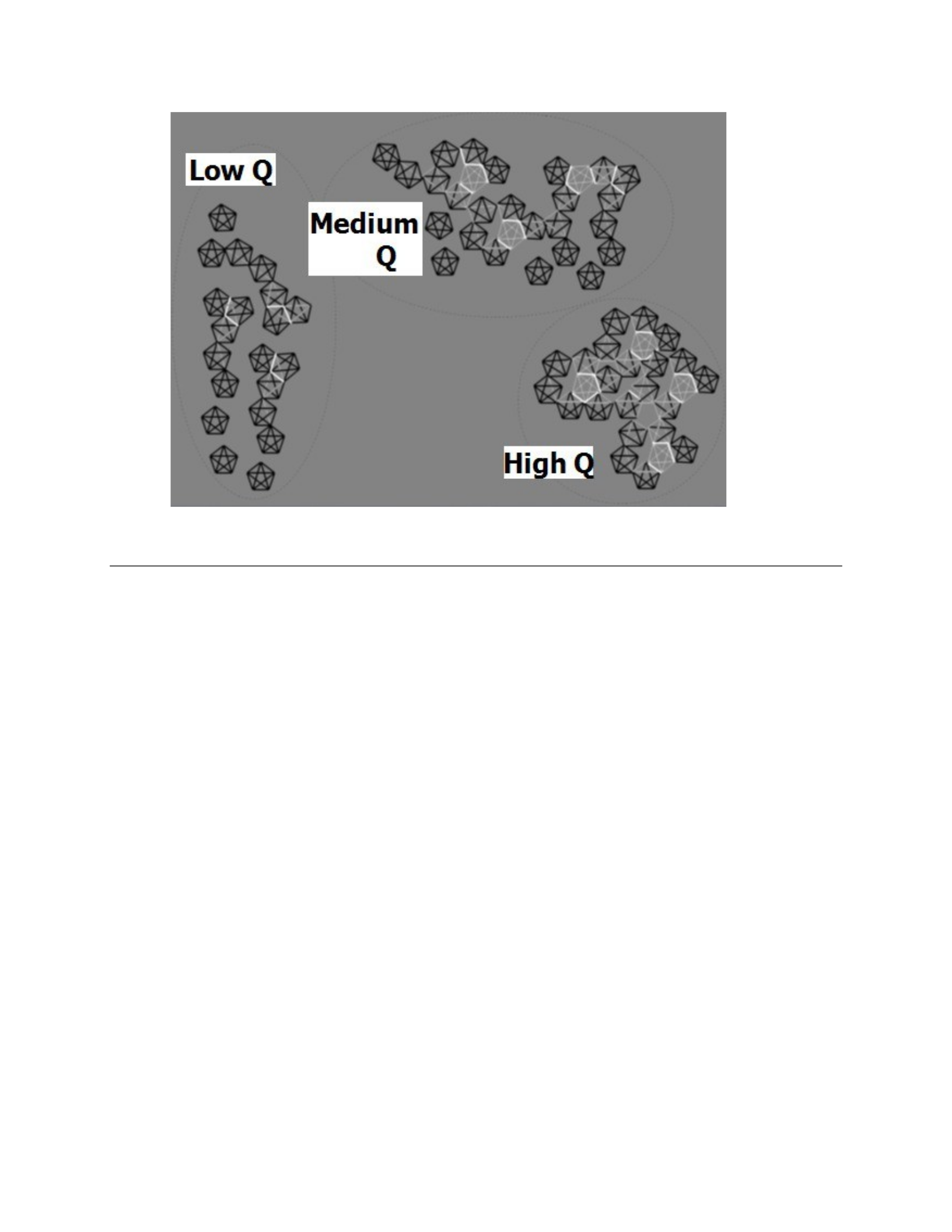
72
Figure 25 - Illustration from Uzzi (2005) depicting the "Q" parameter that measures the level of
cohesion of the creative team
"When Q is too high (above 3.2), work also suffers. All artists think the same way, which
destroys innovation. According to Uzzi, this is what happened on Broadway during the nineteen and
twenties, which he made the focus of a separate study. The decade is remembered for its glittering array
of talents—Cole Porter, Richard Rodgers, Lorenz Hart, Oscar Hammerstein II, and so on—but Uzzi's
data reveals that ninety percent of musicals produced during the decade failed, well above the historical
norm. "Broadway has some of the biggest names ever," Uzzi explains. "But the show is too full of
repetitive relationships, and that stifles creativity."
"The best Broadway shows are produced by networks with intermediate levels of social intimacy.
The ideal level of Q – which Uzzi and his colleague Jarrett Spiro call the "happiness point" – appears
between 2.4 and 2.6. A show produced by a team whose Q is in this range is three times more likely to be
a commercial success than a musical produced by a team with a score below
1.4 or higher 3.2. It is also three times more likely to be praised by critics. "The best Broadway teams, by
far, are those who have a mix of relationships," Uzzi said. "These teams have some old friends, but they
also have beginners. This mix meant that the artists could interact efficiently—they had a familiar
structure to rely on—but they also managed to incorporate some new ideas. They're comfortable with
each other, but they're not very comfortable."
"Uzzi's favorite example of "intermediate Q" is "West Side Story," one of the most successful
Broadway musicals ever. In 1957, the play was seen as a radical departure from Broadway conventions,
both for its focus on social issues and for its expanded dance scenes. This concept was dreamed up by
Jerome Robbins, Leonard Bernstein, and Arthur Laurents. They're all Broadway legends, which
probably makes "West Side Story" look like a show with a high Q. But the project also benefits from a
significant injection of unknown talent, as established artists realize they need a fresh, lyrical voice. After
an extensive search, they chose a twenty-five-year-old lyricist who had never worked on a Broadway
musical before. His name is Stephen Sondheim. "

73
Figure 26 – Broadway musical success versus World Size (Uzzi, 2005, redrawn by the author)
Uzzi's findings are tantalizing, and once again would be a great study in engineering. Navy
engineering companies are at least a determinable community like the Broadway music community. If
we want to assemble a project team from that community and expect significant creative success from
them, then – to conclude from Uzzi – we must be aware of the network of relationships that exist within
that community, and we must choose a team that is not too interconnected, or too disparate.
Unfortunately, the tools for quantifying connectivity are still not developed.
5.4: Measuring innovation talent
Until now I have explained the place of innovation in the field of creativity, or in the field of
engineering design. I have stated that innovation, to be successful, requires expertise. But it is still
evident in my experience that innovation also requires a certain type of thinking, or a certain mindset, or
a certain psychology. We see this same point touched on in Stahl's previous remarks, where we learn that
innovation is not just a descendant of intelligence.
Then what is the psychological 'furniture' that makes an engineer tend to be innovative? It turned
out to be the subject of a substantial body of research in the field of psychology. I hope in this
dissertation only harvest the high points from that research, and use its findings to allow us to "sift"
individuals to see if they are innovators or not. I deliberately state it simply, for clarity. In reality, as we
will see the scale is not "innovator or not" black and white but full of gray areas.
In my research, I have found one explicit attempt to measure innovation talent: the Kirton
Adapter – Innovator Inventory (KAI) is a psychological test that returns a numerical indicator in which a
person falls on the spectrum from Adapter to Innovator (Kirton, 1994). Conceptually it is similar (but
narrower in focus) to the popular Myers Briggs Type Indicator (Myers, 1995) which is already widely
used in DOD.
The Kirton Adaption–Innovation Inventory (KAI) tool measures individual definition and
problem-solving styles. An adapter uses existing knowledge and procedures to solve problems with time-
honored techniques, while an innovator tends to look beyond what is given to solve a problem in a new
way

74
Manner. Below we will discuss more about the implications of these stylistic differences, but at this point
let me point out that what we are talking about here is indeed a style , a preference, the preferred way to
solve the problem. This is the most emphatic , not a measure of individual skill in applying style. KAI
can show that a person is essentially an innovator, and that person may still fail in engineering product
development, due to (among other possibilities) a lack of expertise.
Adaptive Style, in this case, refers to an adaptive, building, or analogous problem-solving style
versus an innovative or pioneering style. Both skills are necessary for organizational problem-solving, but
the differences are often not recognized or measured. The American Chemical Society (ACS, 2012)
provides a list, "Characteristics of adapters and innovators" which is replicated as Table 6. It's also
enlightening to see a rather high-contrast version of how the "other side" often looks at extreme adapters
and innovators – Table 7.
KAI is a 32-item questionnaire used to measure individual problem-solving styles on a scale
from 32 to 160. Someone with an adaptive style will typically score in the range of 60-90, while someone
with an innovative style will score between 110 and 14023. These inventories have been found to be
highly accurate and have been validated globally in many cultures for decades (Kirton, 1984).
However, more important than absolute scores is the relationship between their scores and the
scores of the people they work with. Someone may be a more innovative or more adaptive team
member, depending on the preferences of the other team members.
It has also been found that the big difference between teammates, say 20 points or more, is such a
big difference in cognition that both individuals will work together poorly – they effectively speak
different languages in their approach to problem-solving. Consider the following comment from Dr. Curt
Friedel (Friedel, 2012):
"One of the advantages of AI theory is that more than a 20-point gap between two individuals, or
individuals and the problem at hand, will result in stress. Then there must be motivation to overcome
beyond this gap to work together and solve problems. If motivation is lacking, then there is a failure in
solving problems. So AI is a moving target and the focus is not an understanding of the self, but an
understanding of how to work together better."
Note that what Dr. Friedel suggests is that, in the face of a large AI gap in the team, the team
must carry out a metacognitive process. This may be, in fact, one of the reasons why innovation requires
metacognition, as described above.
It is well known in the industry that the Myers-Briggs Type Indicator can be used as a tool for
designing engineering teams and facilitating cooperation between individuals. Hughes (Hughes, 1994)
correlates the limited scope of MBTI scores with KAI scores, using a class of military officer students
at the National Defense University. The study concluded that people who scored EN_P on MBTI were
more innovative than others. However, it should be noted that the correlation with _N Be
23 I (McKesson) scored 132 which corresponds to my career proof. According to Friedel (2012) "The
average score is 95, and 95% of the population is between 61 and 129. So the rough estimate is that 132 will be one
of the top 2% of the most innovative. I think the reason Kirton doesn't see scores like this is that if you work with an
individual who has a 145, you'll be more adaptive to these individuals. Further, Dr. Kirton appreciates the need for
diversity of thought within the team and does not make the claim that a particular score will be best suited in a
particular profession (although some professions have higher and lower averages). For example, a group of
accountants may be more adaptive and a group of people in finance may be more innovative, but that doesn't mean
highly adaptive individuals will feel uncomfortable in finance. Instead, Dr. Kirton would argue the case for more
adapters in finance, if this is the case."

75
Table 6 - List of American Chemical Society "Characteristics of adapters and innovators" (ACS,
2012)
Adapter
Efficient, thorough, adaptable, methodical,
organized, precise, reliable, reliable
Accept problem definitions
Doing things better
Concerned with solving problems rather
than finding them
Finding solutions to problems in a tried
and understood way
Reduce problems with greater improvement
and efficiency, while aiming for continuity
and stability
It seems to be immune to boredom;
able to maintain high accuracy in long
spells of detailed work
Is an authority in established structures
Innovator
Ingenious, original, independent,
unconventional
Definition of a challenge problem
Doing different things
Finding problems and avenues for their
solutions
Manipulating problems by questioning
existing assumptions
It is a catalyst for groups that are restless,
irreverent towards their consensual views
Able to perform routine work (system
maintenance) only for short bursts; Quickly
delegate routine tasks
Tends to take control in unstructured
situations
Table 7 – How the "other side" often sees extreme adapters and innovators (ACS, 2012)
Innovators are seen as:
Unhealthy, impractical, rude, undisciplined,
insensitive, and people who like to create confusion
The adapter is seen as:
Dogmatic, obedient, stuck in habit, shy, conforming,
and inflexible

76
substantially higher than the correlation with E or So I will restate Hughes' conclusion that
Jungian Intuitive is more likely to be an innovator than Jungian Sensor.24
However, at this point in the dissertation we discuss the use of KAI as a tool to inventory
individual innovation talents. What we see is that KAI does achieve this, but the definition of whether he
is an innovator or not, depends on the context and the team that works with him.
This situational condition opens the door to discussions on innovation management and the use
of KAI and other instruments in designing an ideal engineering team. To me, this feels like a beneficial
subject for engineering management, but it is outside the scope of this study. Interested readers are
referred to courses in innovation and technology management, such as those offered in the UNO MANG
6710 course.
5.5: Think Like Leonardo da Vinci
Michael J. Gelb (Gelb, 1998) published a book titled "How to Think Like Leonardo da Vinci." I
would have ignored this book because of its populist title, if it weren't for the fact that it is sold at the
National Gallery of Art of the United States. This point of sale seems to give credibility to the work, and
I'm glad I made the purchase.
Gelb identified Leonardo da Vinci as the greatest innovator of all time. He then explained seven
cognitive characteristics that he called the da Vincian Principle:
Curiosità – Curiosity, constant thirst for new knowledge
Dimostrazione – Testing knowledge (and hypotheses) and learning from the results
Sensazione – Training of the five senses, including the ability to imagine
Sfumato – High tolerance for ambiguity
Arte/Scienza – The balance between art and science, or the thinking of the whole brain
Corporalita – Physical elegance
Connessione – Systems thinking
Gelb explains each of the seven characteristics and how they contribute to da Vinci's creativity,
and he then develops exercises that readers can do to cultivate those characteristics in themselves.
In the context of this dissertation there are two implications of Gelb's work: First, because Gelb
provides us with a program to study these attributes, the book shapes the segue into a discussion of the
means of teaching innovation. My thesis is that innovation can be defined, can be facilitated by tools, and
can be taught. This will be expanded below.
Second, I affirm from my own experience that these characteristics do contribute to an attitude
of innovation. I will develop this in the following immediate paragraphs.
I would like to be able to cite the vast statistical universe of data on which I can confirm or refute
the hypothesis that these da Vincian characteristics are common in successful innovators. Unfortunately I
don't have such data and I have to leave this research for my Appendix A.
On the other hand, I affirm that these seven characteristics are part of my own character, and to
the extent that I can be considered a typical innovator, then my experience supports the hypothesis.
Indeed, these seven characteristics are so close to my character that the following seven
subsections are very challenging to write. The seven attributes that Leonardo da Vinci allegedly
attributed were
24 My own MBTI score is INTJ, so my own correlation with the KAI score rests on N.

77
It's so certain of my own character attributes, to the point that writing about them almost made me cry.
Needless to say, this level of passion is unusual in engineering dissertations!
In the next brief treatment I will try to show how these characteristics have shaped my own
professional practice, with the intention that from it the reader can deduce a more general application.
5.5.1 : Curiosità – Curiosity, constant thirst for new knowledge
Gelb describes the astonishing breadth of da Vinci's interests, from sculpture to painting to
mechanical engineering to anatomy. He went on to assert that this Catholic curiosity contributed to da
Vinci's success as an innovator.
Broad curiosity contributes to two aspects of engineering innovation: First, in the technical
discipline (in our case, ship design) curiosity serves to expand and develop the expertise of engineers. In
engineering, curiosity manifests itself by asking questions and then applying our engineering skills to
develop answers. This process will certainly grow our individual expertise as we continue to apply our
tools to solve new problems. Indeed, in the context of formal education, this is why we have the problem
of homework: Because skills grow when you use them.
Second, curiosity will foster our ability to implement out-domain solutions to inner-domain
problems. I mean that the exercise of passionate curiosity will help us to be able to implement the TRIZ
solution, or to see the application of the beaver tail to the steering of the boat.
This, of course, is because the curiosity of the technique, with its formula "wow, I wonder if I can
model and solve it", will train us to be better able to model situations. And that training in turn requires us
to be able to realize that this and that may indeed be a model of the task at hand. And from the ability to
recognize these models, comes the ability to recognize different analogues of any kind, whether they
come from biomimetics or if they come from the list of TRIZ solutions.
5.5.2 : Dimostrazione – Testing knowledge (and hypotheses) and learning from
the results
The role of dimostrazione is closely related to curiositá. Above I equate engineering curiosity
with the creation of analytical models for interesting phenomena. If it stands, then dimostrazione is the
breakdown of those models. We test our model and learn from the results. The application is
straightforward.
5.5.3 : Sensazione – Training of the five senses, including the ability to imagine
Under the title "Sensazione", Gelb (1998) encourages practitioners to exercise their senses, to
become active listeners, active seers, active tasters, etc. (These terms are mine, not Gelb.) I know that in
my own life this is true: I love collecting data. When I went around the ship, I really saw it, at the system,
and the details.
I found it interesting to take a boat tour with a group of scholars. The first few times I do this, I'll
find myself chatting with them and saying, "Did you notice..." and that student won't notice that feature.
After some repetition of this experience, I realized that the students didn't see the things I saw – because
they didn't know how. I now enjoy taking boat tours with students but I tend to recount this trip: "Hmm,
why is that bulkhead isolated? The one on this side is not." "What is the monorail overhead for?" "Why
do they label all the pipes? What's the color code?"
Students often thank me for these monologues, because they say that they have learned a lot,
because it allows them to see through my eyes. From this "looking", it's a short step from looking at
details to thinking "I wonder why the designer made that choice?"
This exercise, looking in detail and then thinking about the design process that brought out those
details, is another tool for developing expertise.

78
5.5.4 : Sfumato – High tolerance to ambiguity
In the pursuit of innovation, we often try to take ideas from other disciplines, or ideas that don't
fit in a certain way (such as the transformation of TRIZ) and apply them to the problems we face. When
we do this, we usually experience a stumbling block right from the bat.
I find it useful to suspend worries with that stumbling block, and move forward gently with
innovation for a while. Sometimes I find that the idea of innovation still fails, so I don't have to deal with
that stumbling block. In other cases I've found instances where some other features of the idea
implementation end up stumbling blocks as an unexpected byproduct, so again I don't have to deal with
this issue head-on. And of course, sometimes I just delay the investigation, and I have to deal with it in
the end.
But it's enough of the first two types of situations I've learned to suspend fair judgment in the
development of innovations. I believe that this is an engineering manifestation of Gelb's "tolerance for
ambiguity". It is easy for engineers to feel the need to address any objections as they arise, as opposed to
taking the approach of simply noting those objects for later attention.
5.5.5 : Arte/Scienza – The balance between art and science, or the thinking of the whole brain
Gelb's book is not a treatise on innovation, so it's not surprising that any of its seven
characteristics don't fit easily into my innovation framework. Regarding the need to embrace this realm
of technology and aesthetics, let me just point out the need for expertise, mentioned earlier, and the need
for aesthetic qualities, which are the following below.
5.5.6 : Corporalita – Physical elegance
Under this issue of physical elegance, I chose to include the whole topic of aesthetic quality.
Obviously one aspect of physical elegance, in ship design, is the beautiful design of the ship. But I
believe that the beauty of design is also expressed in the "elegance" of design. This term – which is one
of the "I know when I see it" – gives rise to designs where there are no foreign moving parts, designs
with optimal efficiency, and so on.
Furthermore, I believe that the elegance of the design itself is part of a larger
characteristic called "Quality." In this term I mean quality as developed by Robert Pirsig first
in "Zen and the Art of Motorcycle Maintenance" and later in "Lila" (Pirsig, 1974 & 1991.)
Pirsig's quality metaphysics (MOQ) has given rise to a wealth of literature and is worth studying
for anyone who wants to pursue a career as an innovator. However, it is a large and mature research body
that is sufficiently mature to be worthy of a dissertation in its own right (see Appendix A for a list of
topics that came to mind during the writing of this work.)
5.5.7 : Connessione – Systems thinking
Systems thinking should be a sine qua non for naval architects. Gelb emphasizes it for its lay
audience, but we consider it a foundation in ship design, and we've even built that foundation in our
interface-based innovation tools like multitasking, Young, and more.
5.5.8 : Da Vincian McKesson Training
As I read the Gelb book, I find myself taking note of the areas where I have done things that fit
the Gelb recipe. I believe that these habits of mine – many of which are nothing more than playing – have
been a contributor to my skills as an innovator.
I offer it here only as a form of self-exposure, in the hope that the exercises I describe can spark
ideas in my readers.

79
Try wearing a skirt (if you're a boy). Can you build a logical reason why skirts are
more suitable for men's anatomy than trousers? Can you build a logical reason why
men shouldn't wear skirts? Why are there no "Dress Sandals" for men? Why don't male
office workers paint their nails?
Separate words. It is interesting to see the relationship between ideas that end up being
embedded only as a relationship between words. For example, the word "creepy"
comes from the Latin for the left side. Being left-handed is, in a sense, creepy. What
an interesting and insightful fact.
Learn a foreign language. I often find that thinking in French will take my mind in a
different direction than what I would if I thought in English.
Think in metaphors, constantly creating analogies. "It's like..." I get a lot of positive
comments from my students because I am able to describe complex physics in terms of
analogies. An example of this is my explanation of propeller cavitation which is
analogous to "tearing" a spoonful of Jell-O from a bowl. The analogy is obviously not
exact, but it may be a useful top-level model that can (a) help with understanding and
(b) provoke further learning.
Change jobs. I have changed jobs many times, including giving up a successful
career as a defense contractor to become an academic. I have never regretted this
move.
Learn to read upside down. The orientation of the letters, however, is completely
arbitrary. This would not be true if we read comic books or pictographs, but with the
alphabet written there is no empirical reason that the "A" should point upwards, except
convention.
5.6: Characteristics of a team leader
NASA engineers Michael Ryschkewitsch, Dawn Schaible, and Wiley Larson, in their 2009 paper
"The Art and Science of Systems Engineering" (Ryschkewitsch et al, 2009) directly answer the question
"What are the characteristics of a successful engineering team leader?" This paper is an entire Systems
Engineering textbook in 22 pages, covering the process of systems engineering, the procedural keys to
success, and – relevant to our topic – the necessary characteristics of a good systems engineering leader.
Their list of characteristics – reproduced below – resonates strongly as the characteristics of a good
inventor/innovator as well.
Intellectual curiosity. This reflects the inventor's passion to ask "Why?" "Why" is a very
important question in the context of invention and innovation – indeed I almost titled this dissertation as
"Engineering by asking 'Why?'" "Why" is a question that provokes engineers to even dream in the first
place that there may be an answer other than that that simple derivative evolution will discover. "Why" is
the question that provokes the revolution.
Ability to see the big picture. This signifies the need to remember the true purpose of the device
being discovered, and not fall into the trap of sub-optimization. We have seen this concept repeated in
many guises in the innovation algorithms discussed, as well as explicitly as 'algorithms' themselves under
the heading of teleological decomposition.
Ability to make connections throughout the system. This is a characteristic that will give rise to
innovation with multi-tasking, and was also highlighted by Stahl previously in preparing innovation tasks
and teams to overcome those tasks.
Excellent two-way communicator. In combination with system-wide connection skills, both of
these skills may relate to the ability to seek distant solutions, such as using patent databases as a window
into various industries, rather than sticking to the comforts of the homeland.

80
Strong team members and leaders. Unfortunately this skill is not common among inventors, only
common among successful ones.
Be comfortable with the change. We see this skill commanded by Gelb in the da Vinci discussion.
Be comfortable with uncertainty. Again, one of the attributes of da Vincian Michael Gelb.
Exact paranoia. In my mind, the most important aspect of this 'proper paranoia' is the important
question: "What could go wrong with this?" This question is fundamental in all techniques, but it
becomes even more important when one deviates from a solution that has been tried and proven to be a
higher risk solution. What are those risks? I have previously suggested that innovation should include
some success, and that success is the fruit of skill. Here I say that the application of expertise that results
in success arises because the innovator has asked the right paranoid questions, and as a consequence
stops all technical gaps in his innovation.
Diverse technical skills. Here again we look at the skills associated with the breadth of
knowledge, and the ability to combine solutions from other applications, find similarities with those
applications and map them into existing tasks. We must also see that this skill is a cousin of the paranoia
mentioned above.
How can we know what might go wrong? If our knowledge is narrow then our ability to be a true
paranoid will also be narrow.
It is well known in the aviation industry that the unknowns can be handled, while the unknowns
bite you. Indeed, in the industry this is called "Unk-Unks." To find – before testing – Unk-Unks and
make it known-unknown, requires great skill and imagination.
Confidence and assertiveness. I believe this is a cousin of the issue of "being comfortable with
change" and "being comfortable with uncertainty." What I mean by that is that the leader of a successful
innovation team will find that he or she has to make decisions based on insufficient data, but it is
important for him to make those decisions in order for the project to move forward.
Of course there are tools to manage this type of decision-making risk, and those tools should be
used. But the key point here is that for innovation to succeed, decisions must be made, or progress will
come to a halt. By definition, innovators work in a realm where there is not enough data a priori to instill
total confidence in all options. "There's a point where you pay your two dollars and take your choice."
Appreciate the value of the process. Last on the list Ryschkewitsch et al (2009) is this item, and
again it is true in my own experience. The authors say – and let's remember that they write about systems
engineers, which is a broader pool than the pool of engineering innovators – the success of systems
engineering is more likely to occur when a formal process is followed. In fact, when expressed in that
way, this becomes almost synonymous with the entire motivation for this dissertation: The innovation
process described here will lead to an increase in the success of the innovation.
5.7: Conclusion: Characteristics of innovators
The above paragraph has explained the characteristics of an innovator. Some of these
characteristics are innate, such as Myers-Briggs cognition preferences, while others can be taught, such
as two-way communication skills. I believe that this part of the dissertation can be developed into a
human resource development program. Engineers may be tested for their KAI and MBTI scores and
other metrics (e.g. tolerance for ambiguity.) This score can be used to develop a curriculum for personal
development, or perhaps even to develop a self-awareness tool to help the employee realize that he or
she is not an innovator, and save himself from the frustration of being a square peg in a round hole for
many years in his or her career.

81
In the same vein, the opportunity to use those metrics to best allocate a company's training
resources is also clear.
The possibilities of using the "Innovator Characteristics" dataset to develop training and growth
programs are vast, and I have identified some excellent advanced thesis topics in Appendix A and
Appendix D.
In summary, I conclude that:
Innovators are experts. They must be experts not only in their field, but in the field of
metacognition and in the field of analysis and criticism.
Innovators aren't necessarily the smartest team members. Innovation talent is a skill that is
different from intelligence.
The innovator was probably the "N" type Myers-Briggs.
The innovator understands the old system, and he can show that he respects its origins.
Innovators work in teams that are not too isolated or overly cohesive.
Properly combined, these skills result in an engineer who can say "I understand why the old
way works, but this is a new way that will work better."

82
6: What are the social and institutional barriers and facilitators of
innovation in ship design?
There are many barriers to creativity. A large number of papers have been published on the
characteristics of an "innovation-friendly" workplace. These papers often also contain essays about the
character of innovators, as an innovation-friendly environment is a fun environment for innovators, but it
is most likely to be a "Workplace From Hell" for adapters.
This dissertation will not go far down this path. Here I would like to include a small unit on the
characteristics of an innovation-friendly environment (what Rhodes calls the 'Press' in the 4P model) but
I will leave most of this topic to other courses that already exist on this subject. In fact, much of what I
will share here is just a summary of the material taught to me in UNO MANG 4407 "Technology and
Innovation Management." Nevertheless it is necessary to repeat here, although not my own original
work, because it is fundamental (in the sense of being the foundation) for the success of innovation.
6.1 : Six success themes for innovation companies
These six themes represent best practices in technology and innovation. Of course, there are
other attributes that are needed for the overall success of the company. This list only relates to success
in the management of technology and innovation.
6.1.1 : Business Focus
Successful innovation implementation requires a business focus. This is the same as my previous
statement that innovation should be driven by requirements, but here we command not only a set of
technical requirements for engineering products, but also consistency of course for businesses. A business
that is inconsistent in its support for innovation or the expression of innovation goals will severely hinder
the success of the innovation team.
6.1.2 :Adaptation
Innovation-friendly companies are adaptable. Here again we see business reflecting an attribute
that we have also commanded to staff – tolerance for change and ambiguity identified by Ryschkewitsch
et al (2009) as characteristics of a good systems engineer.
6.1.3 : Organizational Cohesion
Organizational cohesion turns out to be important for the company's success in innovation. The
causes and consequences here are less clear, but I believe this is because this cohesion is an
organizational bond that unites teams in a sea of uncertainty and change. It will also lead to mutual
respect and trust inside and outside the team, so that the "system" is able to tolerate the strange rabbit trail
that is sometimes followed by innovation.
6.1.4 : Entrepreneurial Culture
A company needs to see innovation as a product discriminator. If companies value leadership in
product development (than, say, waiting for an innovative mission description from a ship owner) then
they are much more likely to be able to create and maintain an innovation team within their arrows.
6.1.5 : Sense of Integrity
Everyone, innovative ship designers at least as much as everyone else, want to feel that their job
is for the higher good.

83
6.1.6 : Direct Peak Management
Innovation-friendliness starts at the top of the corporate hierarchy, and requires constant
nurturing by that upper level.
Practically, it requires top management to have technical credentials to be involved in the
innovation process.25 In a ship design company, we can easily see these examples: The ships of the
United States are the innovative product of a company chaired by William Francis Gibbs, a world-class
naval architect himself. My own boss John J. McMullen Associates produced the highly sophisticated
and innovative Sa'ar V corvette for the Republic of Israel, at a time when the company was managed by
naval architects to the top. The successor of the company, after several purchases, let the innovation
advantage diminish, while the top management staff with businessmen and retired military leaders.
6.2 : Project selection process
In addition to the above-mentioned, an innovation-friendly corporate structure will have
recognizable characteristics for their project selection process. In general, the process will consist of
recognizing and encouraging the development of ideas, rather than the formation of higher and higher
obstacles.
It's a bit difficult for me to describe successfully, but my best effort is to imagine the difference
between "Prove to me that your idea will work" and "Let's work together to see if it will work."
6.3 : Organizational Culture
Innovation-friendly companies will have the following features as part of the organizational
culture. It is interesting to note the correlation between these features and the Ryschkewitsch list of
attributes of successful systems engineers.
Individual Initiative: The company will grant individuals an appropriate degree of freedom.
The determination of how much is 'appropriate' is the subject of many lectures.
Risk Tolerance: Companies recognize the risky nature of innovation and embrace inevitable
failure as a learning experience and contribution to an experiential base, rather than as a
punishable mistake.
Direction: Consistent with the issue of "Individual Initiatives", the company will provide
direction on how to manage and implement innovation projects, but will avoid
micromanagement of technical development.
Integration: We've seen that innovation often requires reach across rice bowls. Innovation-
friendly companies will facilitate this through an integrated corporate structure. See also below
for an interesting essay on the use of physical architecture to help facilitate integration.
Management Support: Again, innovation-friendly companies provide management based on
"how can I help you succeed?" instead of "How can I prevent you from failing?"
Control is one of the management tools that must be used subtly, and it is subject to many
detailed lectures and texts.
Identity: Innovation requires risk-taking, and involves multiple failures for every success. It
can be a morally depressing environment, and one of the tools to resist the energy-draining
effects is to build a company culture with a strong identity.
25 The opposite of this is the "pointy-haired boss" in the comic strip Dilbert, who clearly doesn't
understand about the technical work of his engineers.

84
Reward System: A company's real beliefs are expressed by their reward system, and may
often contradict what their words say.
Conflict Tolerance: Again, the corporate expression of one of Ryschkewitsch's list of attributes.
Informal Communication: I'm not clear if it's a chicken or an egg, but the teaching is that
innovation is fostered by an informal communication culture. What I don't know is whether this
is because the innovators themselves will be impatient with formal communication, as can
easily be deduced from the previous discussion of KAI's attributes.
6.4 : Physical Architecture
Most of the above in this chapter has become a staple in management courses. In addition, there
are some interesting studies that show the relationship between the physical design of the workplace as a
means to encourage increased innovation and creativity. The New Yorker article "Groupthink" has the
following interesting story about the physical workplace: (Lehrer, 2012)
"A few years ago, Isaac Kohane, a researcher at Harvard Medical School, published a study that
looked at scientific research conducted by groups in an attempt to determine the effect of physical
proximity on the quality of research. He analyzed more than thirty-five thousand peer-reviewed papers,
mapping out the exact locations of co-authors. Then he assesses the quality of the research by calculating
the number of subsequent citations. The task, Kohane said, took eighteen months to complete. Once the
data was collected, the correlation became clear: when co-authors were closer, their papers tended to be
of much higher quality. The best research is consistently produced when scientists work within ten meters
of each other; The least cited papers tend to emerge from collaborators who are a kilometer or more
apart. "If you want people to work together effectively, these findings reinforce the need to create
architectures that support frequent, physical, and spontaneous interactions," says Kohane. "Even in the
era of big science, when researchers spend so much time on the Internet, it's still very important to create
intimate spaces."
"A new generation of laboratory architecture has tried to make chance encounters more likely,
and this trend has also spread in the business world. One fanatic who believed in the power of space to
improve group work was Steve Jobs. Walter Isaacson's recent biography of Jobs notes that when Jobs
planned Pixar's headquarters, in 1999, he arranged the buildings around the central atrium, so that
Pixar's diverse staff of artists, writers, and computer scientists would meet each other more often. "We
used to joke that the building was a Steve movie," said Ed Catmull, president of Disney Animation and
Pixar Animation. "He really keeps an eye on everything."
Jobs soon realized that it was not enough to just create an airy atrium; He needs to force people
to go there. He started with the mailbox, which he moved to the lobby. Then he moved the meeting room
to the center of the building, followed by a cafeteria, coffee bar, and gift shop. Eventually, he decided
that the atrium should contain the only set of bathrooms in the entire building. (He was later forced to
compromise and install a second pair of bathrooms.) "At first, I thought it was the most ridiculous idea,"
Darla Anderson, a producer on several Pixar films, told me. "I don't want to have to walk all the way to
the atrium every time I need to do something. It was just a waste of time. But Steve said, 'Everyone has to
meet each other.' He truly believes that the best encounters happen by accident, in the hallway or
parking lot. And you know what? He was right. I'm more of a finished coffee and started a conversation
or walked to the bathroom and met unexpected people than sitting at my desk." Brad Bird, director of
"The Incredibles" and "Ratatouille," said that Jobs "made it impossible not to meet other members of the
company."
"In the spring of 1942, it became clear that the Radiation Laboratory at MIT—the main radar
research institute for the Allied war effort—needed more space. Rad Lab has developed radar devices for
fighter planes that allow pilots to identify distant German bombers, and employs hundreds of scientists
every few months. The proposed new structure, known as Building 20, is

85
It will be the largest laboratory, consisting of two hundred and fifty thousand square feet, on three floors.
It was designed in the afternoon by a local architectural firm, and the construction was quick and cheap.
The design features a wooden frame on a concrete slab foundation, with an exterior covered in gray
asbestos shingles. (Steel supply is limited.) The structure violated Cambridge's fire code, but was granted
an exemption due to its temporary status. M.I.T. promised to destroy Building 20 shortly after the war.
"Initially, Building 20 was considered a failure. Poor ventilation and dim hallways.
The walls are thin, the roof is leaking, and the building is baking in the summer and freezing in the
winter. Nevertheless, Building 20 quickly became an innovative research center, Los Alamos of the East
Coast, which is celebrated for its important work on military radar. Within a few years, the laboratory
developed radar systems used for naval navigation, weather prediction, and bomber and U-boat
detection. According to a 1945 statement issued by the Department of Defense, the Rad Lab 'pushed
research in this area forward to at least 25 years of normal peacetime.' If the atomic bomb ended the
war, radar was the one who won it.
"As soon as the Japanese surrendered, the M.I.T., as had been promised, began to make plans for
the demolition of Building 20. The Rad Lab office was demolished and the radio tower on the roof was
demolished. But the influx of students after the GI Bill suddenly left MIT severely short of space.
Building 20 was converted into offices for scientists who had nowhere else to go.
"The first division to move into Building 20 is the Electronics Research Laboratory, which grew
directly from the Rad Lab. Since electrical engineers only need a fraction of the structure,
MIT began shifting various academic departments and student clubs to so-called 'plywood palaces'. In
the nineteen fifties, Building 20 was home to the Nuclear Science Laboratory, the Department of
Linguistics, and the machine shop. There are particle accelerators, R.O.T.C., piano repair facilities, and
cell culture labs.
"Building 20 became a strange and chaotic domain, full of groups that had been thrown together
by chance and who knew little about each other's work. However, by the time it was finally demolished,
by 1998, Building 20 had become a legend of innovation, widely regarded as one of the most creative
spaces in the world. In the postwar decades, scientists working there pioneered a list of amazing
breakthroughs, ranging from advances in high-speed photography to the development of physics behind
microwaves. Building 20 serves as an incubator for Bose Corporation. This gave rise to the first video
games and Chomskyan linguistics. Stewart Brand, in his study 'How Buildings Learn,' cites Building 20
as an example of a 'Low Road' structure, an extraordinarily creative type of space because it is so
undesirable and poorly designed. (Another example is the Silicon Valley garage.) As a result, scientists
in Building 20 felt free to recreate their rooms, customizing the structure to suit their needs. Walls were
knocked down without permission; The equipment is stored in the yard and bolted to the roof. When
Jerrold Zacharias was developing the first atomic clock, working in Building 20, he moved two floors in
his laboratory to make room for a three-story metal cylinder.
"The horizontal layout of the building also spurs interaction. Brand quotes Henry Zimmerman,
an electrical engineer who worked there for many years: 'In a vertical layout with a small floor, there is
less variation in research on each floor. A chance meeting in an elevator tends to end up in the lobby,
while a chance meeting in a corridor tends to lead to a technical discussion." Urban theorist Jane Jacobs
describes such incidental conversations as an 'overflow of knowledge.' A favorite example is the
resurgence of the auto industry in Detroit. In the eighteen-twenties, the city was full of small shipyards
built for the flour trade. Over time, shipyards became centers of expertise in internal combustion
engines. Nearly a century later, the engine proved ideal for driving cars, which is why many pioneers of
the automotive industry began building ships. Jacobs' point is that the unpredictable nature of innovation
means that it cannot be pre-prescribed.
"Building 20 is full of an abundance of knowledge. Take Amar Bose's career. In the spring of
1956, Bose, a music enthusiast, procrastinating on writing his dissertation, decided to buy hi-fi. He

86
Choose the system with the best technical specifications, but find that the speakers sound bad. Bose
realized that hi-fi science needed help and began frequenting the Acoustic Laboratory, which was just
down the hallway. Soon, Bose spent more time playing with tweeters than with his dissertation.
No one cared about intruders in the laboratory, and, three years later, Bose produced a wedge-shaped
instrument equipped with twenty-two speakers, a synthesis of its time among engineers and its musical
sensibilities. Bose Corporation was established shortly thereafter."

87
7: Measure innovation
The thrust of this thesis is to understand and thus control innovation, ideally reaching as far as
"innovation on demand." But the axiom in control theory is "you can't control something you don't
measure." Therefore, we should take a moment to look at the tools and definitions that can be used to
measure innovation.
The first step is to consider what is meant by saying "measure innovation." Do we want to know
how innovative the idea is, or do we want to know how successful it is?
The question of how innovative the idea is, is an interesting question, but I would argue that it
doesn't come to fruition: Why do we care whether the idea is a big change or a small change, as long as
it "carries its weight" by being a good change? Moving away from measuring the magnitude of
innovation and instead measuring the benefits of innovation (by "carrying the load") has the effect of
diverting our investigation to the second question: How successful is the innovation?
In fact, one of my correspondents (Bruinessen, 2013) instilled the idea of success in the
definition of innovation, defining innovation as "the change that is successfully introduced." He writes
"[innovation] can be anything: from process to ship, to thrusters or cranes for example; In that case, not
every change is an innovation, you need to evaluate the success of an object (if you see a major
innovation as a 'jet plane' or 'internet') you need to evaluate it before you can call it an 'innovation'...
The endless discussion of whether we are 'innovating' insinuates that we already know that we will
succeed."
This concept that innovation must succeed is familiar to my own definition, as I have mandated
the requirement for "quality" in engineering innovation. But it clearly serves to underscore the need for
the ability to measure the success or quality of innovation.
In the above paragraph I suggested that the metric should be a "weight" where the benefits are
measured by various "costs" of innovation, which may include the impact on industrial processes, the
impact on resource needs including human resources, and so on. Fortunately all these costs are
acceptable by quantification by well-known management tools, and no new research is needed here.
What is needed is a new definition for the achievement fraction numerator, a metric of innovation
benefits.
How to measure the benefits of innovation is another hot topic in the literature. COMPENDEX
lists 33,000 papers on "measurement innovations," with production amounting to about ten per day (see
Figure 27.) It seems that most of the quotes on the subject address the topic from a commercial point of
view, and use various measures of commercial success, such as "increased sales".
These measures are not suitable for measuring the success of an innovation in ship design,
especially in warship design. In battleship design, the closest equivalent to "increased sales" is
"increased 'victory' in battle." By the time battle data is available, it will be too late to use the results in
meaningful go/don't go decisions regarding innovation.
Of course, battle data can be simulated through wargaming, just as commercial success data can
be simulated using the necessary freight rates and other economic tools. In this case, it is possible to
measure the benefits of an innovative ship, at the level of the entire ship, compared to other benchmark
ships. The means to this end is to use one of the few ship-wide assessment tools in the industry, filling
that tool with data that reflects the completion of innovative ship designs to the required level of detail.
The problem with this approach is twofold:

88
Figure 27 - Compendex publication notes on "Meausirng Innovation" over the last ten years
First, the effort to complete the ship's design to the required level of detail may not make sense
given the magnitude of the innovation. For example, innovations at a very low level on board a ship, such
as the development of a new circuit breaker concept, must be able to be assessed without having to
develop the entire ship around these circuit breakers.
Further, the example of a circuit breaker highlights a second problem: The impact of an
innovative circuit breaker on the economic or military performance of an entire ship may be nil. A better
circuit breaker will likely be a breaker that does a better job of protecting the system, for example by
tripping faster. This will not manifest itself as a benefit in most simulation scenarios, as most scenarios
assume "nothing is wrong." Does this mean that circuit breakers are an innovation that doesn't work? It
seems to be the opposite indicating that the assessment of achievements has been carried out at an
excessively high level.26 years
In an attempt to resolve this conflict, I have found only one other author (Hauschildt, 1991) who
has dealt with the problem of measuring the benefits of innovation at the design stage. Although his
critical work was published in 1991, I was also disappointed to find some cases of subsequent authors
using his work. Apparently the push to measure success in sales profits continues to drive.
The author in question is Prof. Dr. J. Hauschildt, (1991). Hauschildt built a case for measuring
different aspects of innovation, using different measurement techniques, at different stages in the
innovation timeline. An overview of these recommendations is presented in Table 8.
In this table one can clearly judge that most of the ship's design efforts fall on the first two lines:
Product Idea and R&D. And Hauschildt's recommended method for measuring the quality of innovation
at this stage is largely composed of expert opinions.

89
Table 8 - Association of Hauschildt measurement techniques with process stages
Serial
Num
ber
Process Stages The problem of
measuring
success
Evaluation results: Dimensions, criteria,
scale
, ranking, etc.
1 Product idea Reports, more or less
complicated models Number of ideas/alternatives. Evaluation of
ideas/alternatives by experts, referring to
scientific/technological innovations
2 Research &
Developmen
t
Construction, test
plant, prototype
Technical advancements. Increased
productivity. Increased output, decreased
input. Performance evaluation by experts.
3 Penemuan Patents, publications Number of patents, publications, citations,
gifts, gifts. Evaluation by scientists.
4 Investment,
production,
marketing
5 Introduction of new
products in the
market or new
techniques into
production
6 Regular sales, regular
use
Marketable products,
techniques that
Marketmg can
practice
Turnover, cost savings,
profit contribution
Changes in sales,
market share, cost
savings, profit
contribution over the
life cycle
Detailed descriptions to provide evidence of
improvement compared to existing solutions.
Evaluation of product innovation by
marketing managers, Innovation process by
engineers. Imitation.
Monetary units, ratios, relationships, indices.
Comparison over time and with competitors
Evaluation by industry experts. Rise in stock
priees.
Hauschildt arrives at this matrix from an interesting start, and there are both numbers that are
important to our discussion of measuring innovation in ship design; his illustration of the many different
effect domains that an innovation may have, is illustrated in Figure 29.
This is in line with Caspar van Rijnbach's thesis that there are "Six W's and H's" to guide the
determination of how to measure innovation (Rijnbach, 2013):
"Who" are you measuring? In this thesis we want to measure innovation for decision-makers at
the design stage, when test data is not available. Note that we also want to measure the quality of
innovation as a means of providing feedback to innovators, for skill development.
"WHY" are you measuring? This is related to the above, but it should be noted that the two
stakeholders mentioned above have different needs. Decision-makers need to decide whether to pursue
innovation or not. The innovator needs to know if he has used a successful method of innovation, or if he
needs to "do better next time."

90
"WHAT" do you want to measure? Are you measuring output, inputs or process efficiency
and/or effectiveness? This is where I found Hauschildt (1991) very helpful, and I argue that a sensible
way to measure during the design stage is through expert opinions. We may dream of a day when expert
opinions can be modeled by artificial neural networks and the like, but in the current state of
conversation, subjective human evaluation seems to be the only viable tool.
"WHERE" do you measure? With "where" van Rijnbach actually asks "at what stage of the
process?" This has been answered in our case at the beginning, where I have limited this entire discussion
to "measuring innovation during design."
"WHEN" do you measure? Do you measure at the beginning, middle, end of the project, or the
year after the end of the project? This is an interesting question and one that I probably don't have a good
answer for. I find it easy to believe that measurement can often have a stimulating or suffocating effect on
innovation, depending on the innovator's personality. Further, it seems reasonable to me that it would be
useful to go back years later and see if "that" innovation is still good or bad. This will retrain our
evaluation model, as well as capture whether some of the environmental variables have changed.
"HOW" do you measure? Here I take from Hauschildt and suggest that expert reviews are the
right tool, and in my own career, it has always been BOGSAT that passes the go/no-go assessment of my
innovations.
But this in itself is not necessarily bad, as we have the tools to make subjective "expert
judgments" a little more objective. Myself, I am in favor of the use of the Analytical Hierarchy Process,
where we must first ask a panel of judges to determine their criteria and relative weight, and then assess
the innovation based on those criteria. And indeed, this can be done using two separate panel of judges,
one to set criteria, the second to 'assess' against those criteria.
Thus I conclude that the only precise early-stage metric, useful in the ship design process, is to
use expert opinions. I will then make this subjective process more objective by using AHP and similar
tools.
The final component of the measurement question is "how to measure education." I suspect that
this question could actually be a useful subject of study for practitioners of educational theory, but I am
not an expert in that school. My engineer's answer to this question is simply to measure the extent to
which education has made students better innovators, as demonstrated by the production of better
innovations.
A step towards the implementation of an innovation curriculum – as I have proposed – is to
develop a rubric for the assessment and evaluation of the effectiveness of the curriculum. I am not
currently developing this rubric, but the crux of the matter is to differentiate between Assessment
(usually formative) and Evaluation (usually summative.) I hope to be able to make instruments for these
two stages.
Note that even if it is created in the form of a rubric, the core assessment/evaluation tool will still
be an opinion. As an engineer, this bothers me, because I want metrics that can be collected entirely
objectively, but as an engineering educator, I know this is impossible: Many educational assessments
now rely on the subjective opinion of the instructor. As engineers, we avoid this and try to adhere to
numerical formulas, but let's admit it: When we assign a "7 out of 10" to a student's homework, there is
quite a bit of subjectivity in the decision whether it's a "7" and not a "5" or an "8."

91
Figure 28 - Breakdown of the effects of Hauschildt's innovations

7: Conclusions and recommendations
This dissertation has completed the task set for it: Three years ago I set out to fulfill the mission
"Can you teach other naval architects how to be an innovator?" This has led to many subordinate
questions: What is innovation? How do innovators think? Can it be taught? Today I was able to publish
a substantial answer to that question, and a foundational work on which further buildings of creativity
can be built. Next, I have outlined a curriculum that can be used in the first attempt to explicitly teach
innovation in ship design.
In this work, innovation is proven to be part of creativity. Creativity is manifested in techniques
in a specialty known as design. Further innovation is part of design, which is focused on breaking down
derivative approaches to design, and instead results in designs that have no ancestors.
The innovation was found to have many algorithms, some of which were meant to show how it
had been done, others meant to show how it could have been done. However I have observed that all of
these algorithms share the same architecture, and that this common architecture does give rise to useful
tools for engineering innovation. Further, I have shown that this algorithm applies to ship design, either
by citing actual projects, or through my repeated use of rudder design examples.
I argue that not all engineers have the same aptitude for innovation, and I have shown support for
this opinion, and have identified KAI as a tool for testing innovation talent. But KAI is more than just a
test of innovation, it is also a psychological profile, and KAI results have substantial implications for
individual success in a given team. And of course, innovation is a product of teams and individuals, so
the implications of KAI are important in managing innovation success. I have used my own KAI results
to support this claim.
I have shied away from other aspects of institutional facilitators and barriers to innovation
success, as these are well covered elsewhere. This is not to say that these are not important – indeed, the
fact that they are well covered elsewhere suggests that they are very important.
I hope to spread the insights and lessons learned from this work, through formal teaching on
innovation in ship design.

