


1
Summative Assignment
ASU
MKT 402 - Consumer Behavior
Summer 2021

SUMMATIVE ASSIGNMENT 2
Question 1
Self-reflection on paradigms in Marketing theory
The growing body of literature on marketing and the inclining marketing strategy
relevance in business across the world. Therefore, more scholars have begun to reconsider the
importance and the significance of the most popular concepts in marketing that contribute to the
understanding of critical aspects of marketing such as marketing theory (Hurth & Whittlesea,
2017). These scholars have an advanced place of paradigms such as positivism, interactives, and
critical theory. This essay looks into these paradigms and their significance in the understanding
of marketing theory.
Critical theory is one of the fundamental paradigms in the understanding of marketing
theory. Critical marketing, according to Svensson (2018) plays a critical role in challenging the
existing status quo as well as promoting the objective preserves of the postmodern realities of
marketing. It is for this reason that there has been an intense urge for increased research in
marketing to ensure that critical theory is explored. Critical theory is crucial in the process of
marketing as it covers the assumptions and ideologies that underly the vital marketing theories,
methods, and the models of conducting marketing as well as the significance of diverse
marketing concepts and ideas (Svensson, 2018). In marketing, Svensson (2018) states that
consumer activities are critical because it is the basis for which the success of marketing
strategies are measured. In this case, critical theory is applied in the process of marking in that it
plays an active role in the re-evaluation of the outcomes of the diverse strategies of marketing
based on how customers act as a result of getting exposed to marketing messages (Svensson,
2018). These marketing activities are diverse as they range from the loyalty of customers to the
significance of marketing in the mist challenging social processes such as social exclusion and
commodity fetishism. It clear that critical theory has a Signiant role in the understanding of
marketing theory especially regarding the critical aspect of customers in marketing theory.
In marketing theory, the ethical perspectives in the light of customer needs and their
satisfaction and the creation of brand awareness, critical marketing takes a pro-social position.
According to Svensson (2018), the philosophy underlying critical theory is complicated as it
entails a difficult process of describing terms affiliated with critical management hence bearing
the features of reflexivity, denaturalization, and methodological pluralism regarding customers

SUMMATIVE ASSIGNMENT 3
and their needs. simple, Svensson (2018) states that in marketing, critical theory gives a broader
space for the utilization of different analysis methods while at the same time, fostering
reflexivity and the examination in marketing theory, referred to as non-performative stance, that
requires detailed examination. I think that this feature infers that critical theory not practical but
more theoretical and it has less implication on real-life application. However, Das (2019)
indicates that critical theory in the light of customer needs and their satisfaction in marketing
theory digs beneath the social life surfaces in uncovering the significant assumptions that keep
customers from a true and full understanding of how their world works.
Positivism is another paradigm in marketing theory that plays a critical role in its
understanding as well as the understanding of the concept of “a customer”. Marketing theory
entails the gathering of information about consumers through consumer research which is critical
in the understanding of their needs and how to address them. According to Su (2018), in
informing marketing theory, positivism provides a view of society as the critical aspect shaping
consumers and the faith that individual actions are shaped by social facts. It, therefore, acts as the
basis in which consumer researchers choose the best methods in addressing the needs of
consumers and how to meet such needs through research. Additionally. Su (2018) states that
positivism looks into consumer behavior by treating it objectively as applied in science while
emphasizing scientific methods in explaining their behaviors. In other words, it puts more focus
on the treatment of consumers as rational humans who are capable of making purchase decisions
after collecting and going through diverse information on products and services while weighing
alternatives. This is critical in conducting marketing research as it lays a foundation on how
consumer research is conducted. Also, Su (2018) asserts that positivism assumes that the actions
of consumers are founded on the cause and effect relationship which can easily be empirically
and tested and measured. I think that this means that is a researcher or a marketer can use to
identify the reasons underlying diverse consumer behaviors; such a researcher or a marketer is
capable of predicting such behavior. Also, it means that if it is possible to predict their behavior,
they can influence such behavior towards diverse marketing goals.
Interpretivism is another paradigm in marketing theory critical in consumer research.
According to Packard (2017), interpretivism is a post-modernist perspective in the study of
consumer behavior and it emphasizes the consumption among consumers rather than their

SUMMATIVE ASSIGNMENT 4
actions of purchasing. It is a fundamental concept in marketing theory because it explains that
each consumer’s consumption experience is unique hence laying a foundation on how marketing
strategies can be generated to address the uniqueness of customers and their needs. Also, Packard
(2017) adds that in a different way from positivism interpretivism holds that human beings or
consumers can construct their surroundings and disagrees that consumers are only spectators of
what happens around them. I agree with this perspective because I think it is more accurate as it
is more realistic. From the assertions above Packard (2017) deduces that consumer actions come
about as a result of the meanings they assign and not the external factors. Due to the realistic
nature of this perspective, it is, therefore, clear that it can be effectively applied in marketing
theory in understanding the consumer in a better way and in subjectively treating their decision-
making process. Lastly, interpretivism indicates that there is no single, objective truth regarding
consumer behavior since the reality is subjective and that cause and effect cannot be isolated. All
this information is critical in marketing theory because they provide a foundation for the
understanding of consumer behavior which is critical in marketing as a whole.
The suitability of critical thinking and reflective examination in the creation of marketing
educating and practice is one major theme of the analysis of paradigm in marketing theory
considerations. According to Dahl, Peltier, and Schibrowsky (2018), existing literature in the
marketing field has historically emphasized the transfer of knowledge and the mastery of
technique, but a growing number of scholars begin to understand that critical reflection helps
marketers challenge assumptions present in a given paradigm. This implies that not only do
students but practitioners as well are required to do more than merely apply marketing models
but to also ask some questions regarding the cultural, ethical, and social consequences of
different such models in various settings. By critically reviewing and evaluating paradigms like
positivism or interpretivism, it becomes more evident what they cannot provide, and room is left
to pluralistic methodologies that take into consideration a pluralistic attitude to the issue. This
reflective experience can assist marketers to be aware of the situational aspects; these could be
cultural difference, consumer psychology and technological impact that influence the consumer
behavior and market forces. Finally, marketing education enhances the linkage between theory
and practice through the establishment of a culture of reflexivity and critical inquiry and
guarantees that future research and strategies are receptive to changing consumer and societal
demands (Dahl et al., 2018).

SUMMATIVE ASSIGNMENT 5
The other factor in the conception of the paradigms in marketing theory is to
accommodate the cultural and philosophical diversity, on which consumer behavior is based.
Hwang (2015) highlights that theories of self and social interaction that include culture have to
be included in discussion of paradigms because they enable marketing scholars to act beyond the
universalism of Western-centric ones. To give an example, unlike positivism, which focuses on
objectivity and measurability and interpretivism, which focuses on objectively established
meaning, both methods can easily simplify consumer behaviors as long as the cultural
differences have not been properly viewed. As explained by Midgley, Nicholson, and Brennan
(2017), methodological pluralism in marketing research has not been accompanied by smooth
sailing because of paradigm clashes and cultural opposition, but adopting the tensions is crucial
to the development of the discipline. Further, Shapiro and Stefkovich (2016) help us to
remember that ethical decision-making and leadership are involved in the work towards such
complexity, since marketers need to find the balance between commercial perspectives and
fairness in representing different identities of consumers. Collectively, all this implies that
marketing paradigms cannot be seen in a vacuum, but rather they should be seen as
complementary cultural contingent frameworks that can be used to promote inclusivity,
reflexivity, and ethical responsibilities towards marketing theory and practice.

SUMMATIVE ASSIGNMENT 6
Question 2
Critical analysis of Batra, Ahuvia, and Bagozzi's (2012) article, Brand Love.
Introduction
The article that will be critically analysed is the one that has been written by Batra,
Ahuvia, and Bagozzi (2012) and is called Brand Love. This article presents an insightful
exploration on the implications as well as the concept of brand love in a theoretical analysis,
placing the construct in context with other literature in consumer-brand relationships. The
overriding thesis of the authors is that a study of brand love has to be based on an in-depth and
subjective understanding of how consumers perceive and experience it, as opposed to using an
outward-looking superficial indicator (like repeat purchase and loyalty scales). The paper points
out that brand love is more than mere contentment or attachment but rather a liaison of a more
emotional nature between consumers and brands which is seen to replicate the love relationships
that people have with each other. Subsequent advances in the field, including the scale proposed
by Bagozzi, Batra and Ahuvia (2017), further supported the practical definition of this construct,
thus allowing the dimensions of it to be empirically validated. In the same manner, Ahuvia
(2016) noted the theoretical and methodological significance of elucidating the affective basis of
brand love as it was a central phenomenon in the current consumer behavior studies.
Summary of the article
The article examines the concept of brand love through a survey to effectively determine
its elements and the implications it has on the management of brands by companies. In the
process of conducting their research on the diverse “brand love” features, Batra, Ahuvia, and
Bagozzi (2012) carries out two qualitative studies. The survey was used in the collection of data
in this research to investigate and determine the nature and the consequences of brand love.
Structural modeling equations on survey data was allowed for the exploration of the elements of
“brand love” and its modeling as high-order and first-order structural models. Through the high
order modeling, Batra, Ahuvia, and Bagozzi (2012) generated several core features which
include passion-driven behaviors, long-term relationships, positive emotional connection, self-
brand integration, attitude certainty, anticipated separation distress, confidence, and overall

SUMMATIVE ASSIGNMENT 7
positive attitude valence. According to Batra, Ahuvia, and Bagozzi (2012), the brand love
prototype also had its elements in addition to the seven core features including the antecedent of
brand love which is beliefs on quality word of mouth, outcomes which entail the negative
information resistance and brand loyalty. Batra, Ahuvia, and Bagozzi (2012) indicate that both
the high-order brand love and the first-order brand love models are crucial in the prediction of
brand loyalty, better resistance, it gives more understanding, and word of mouth than the
measure of brand love’s overall summary.
The two qualitative types of research found out that even though brand love had emerged
in the recent past as a crucial concept for academics and practitioners, the theoretical progress of
brand love is hampered by diverse factors (Batra, Ahuvia, and Bagozzi, 2012). According to
Batra, Ahuvia, and Bagozzi (2012), some of the factors hampering its theoretical progress
include the literature review substation for the basic exploratory research on interpersonal love
required in laying an excellent foundation for future work on brand love. Also, Batra, Ahuvia,
and Bagozzi (2012) adds that the other factor hampering it is the inability to differentiate
between the more complex and long-lasting love relationship and love emotion. Lastly, Batra,
Ahuvia, and Bagozzi (2012) indicate that the other factor hampering it is the brand love domain
non-utilization of the currently acceptable prototype approach in identification and the definition
of the diverse types of love. Finally, the article provides the managerial implication of brand love
pointing out that the critical issue is how managers can turn brands into loved brands and how
they can maintain such relationships with customers for a longer time. The article indicates that
for brands to build love, they should build passion-driven behaviors in their production, they
should be produced in ways that facilitate and symbolize self-brand integration and they should
establish emotional connections that are positive (Batra, Ahuvia & Bagozzi, 2012). Furthermore,
Batra, Ahuvia, and Bagozzi (2012) say that a manager should create brands that end up
becoming trusted and valuable resources that exude a feeling that urges customers to create a
long-term relationship with them.
Critical Analysis of the article
This article effectively researches the issue of brand love. One of its strengths is that it
employs two qualitative studies in determining the consequences and the nature of brand love.
The use of two qualitative types of research plays a critical role in research because it provides

SUMMATIVE ASSIGNMENT 8
more reliable results. According to Davis, Golicic, and Boerstler (2011), the use of multiple
studies in researching a given phenomenon ensures that the results are more compelling and
robust than in using single studies. It also ensures that there is a consistency of the generated
results and that errors are eliminated through the comparison of the results of the studies. It also
fosters the accuracy of inferences and the establishment of reliable discussions and conclusions.
Therefore, in using multiple studies, the researchers in their article aimed at achieving the above
objectives. The other strength of this article is that it employed the survey research design. In
doing this, the authors effectively allowed the authors to collect a large amount of data from a
large number of respondents which is critical in research as it improves reliability and validity of
the results generated from the data (Rice et al., 2017). Their use of survey methods also ensured
that their data analysis was flexible and provided them with a statistical significance.
Importantly, the authors generated results and discussions for both of the qualitative studies and
provided a harmonized discussion and conclusion for the two studies which made it easy in
understanding their research. They also effectively classified the nature and consequences of
brand love into two categories including first-order and higher-order factors which made it easier
to understand their approach.
The other positive side of the article is that the brand love is reflected into a
multidimensional construct with tangible theoretical implications to the researchers and
practitioners. Determining such causes as passion-related, self-brand integration, and positive
emotional ties, Batra, Ahuvia, and Bagozzi (2012) developed a high construct that would be
confirmed by subsequent studies and explained in more detail. Sta and Abbassi (2018) will claim
indicatively that brand love will depend on the antecedents of brand trust and brand commitment
that subsequently can cause outcomes such as loyalty and positive word-of-mouth. In the same
tune, Halilovic (2013) also demonstrates that brand love is a contributor of brand equity and the
value lies higher than the already known definition of satisfaction and loyalty. These input help
in highlighting the freshness and technical importance of the article in the provision of
knowledge on consumer-brand relationship. Furthermore, the multifacetedness of brand love
could be represented with the scope that is flexible to the circumstances of various situations the
authors proposed the prototype-based methodology and introduced a single yet enabling tool to
the researcher and a marketer.

SUMMATIVE ASSIGNMENT 9
The article also has its weaknesses which are significant and should be addressed despite
these strengths. The first weakness is the use of survey data which, though helpful, may not
adequately be able to profile how deeply personal and changing brand love can be. Other studies
that follow have conjectured that the social and cultural backdrop, in particular the online zone is
decisive in the case of identification of consumer-brand emotional relationship. Indicatively,
Zengin and Aladag (2018) hold that factual interactions through social media have a substantial
impact on cultivating the brand love, implying that upcoming studies need to have a more direct
relationship with digital consumer experiences. Palusuk, Koles, and Hasan (2019) also argue that
brand love construct is still disjointed, and different studies apply and define it differently, which
makes it challenging to use and generalize. The core of this criticism is that the 2012 movie was
pioneering but could have been simplistic on some cultural or situational dynamics of consumer-
brand attachment. In a bid to seal such gaps, then it would be required to include qualitative,
longitudinal and cross-cultural methods in order to capture the multi-faceted nature of how
consumers form and build emotional attachment on brands.
This article effectively explained the nature of brand love and its consequences which is
critical in marketing theory. It is because it is an aspect of marketing theory critical in the
understanding of customers, their needs, and how products can be crafted in a way that not only
meets the customers’ needs but makes them loyal to the product. Importantly, it teaches
managers that they should create products that end up being trusted and valuable to the
customers and it informs marketing theory that for brands to be loved, they should be able to
build love themselves in the way they meet the needs of customers. Also, informs marketing
theory in that it informs managers that they should build passion-driven behaviors in their
production to build love. Additionally, Batra, Ahuvia & Bagozzi (2012) say it informs marketing
theory that brands should be produced in ways that facilitate and symbolize self-brand
integration and they should be established in a way that creates emotional connections that are
positive with the customers.

SUMMATIVE ASSIGNMENT 10
Question 3: Nike’s Just Do It advert Controversy
Nike’s Just Do It Advert Controversy in 2018
NFL’s Colin Kaepernick, a former 49r
Racism in North America
Nike creates its just Do It ad during its 30th
anniversary to featuring Colin Kaepernick
Polarization of Audiences and customers
Others denounces
the move as
unpatriotic and
threatened to
boycott its
products
A few applaud the
Nike’s move to
create the ad
Nike Pulls down the
advert
Figure 1: Visual Representation of Nike's "Just Do It ad Controversy
Source: Researcher
SUMMATIVE ASSIGNMENT 11
Nike’s Just
Do It Ad
Controversy
Marketing
Markets
Consumption
Consumer
Society
Market
Research
Consumer
behavior
Marketing
strategy
Ads and
Campaign
messages
Segmented
Diverse
needs
Region based
Buyer and
seller
relations
A
Commodity
Personal
factors
Social factors
Psychological
factors
Promotional
messages
Value
responsibilit
y
Its sensitive
to brand
messages
Critical Theory
Figure 2: Visual representation of what the Nike’s Just Do It controversy says about
Marketing theory
Source: Researcher

SUMMATIVE ASSIGNMENT 12
Questions the Controversy Raises
The controversy raises diverse questions about the various aspects of marketing theory.
For instance, this brand controversy by Nike raises questions on whether companies should
support certain issues such as racial inequalities in their brand campaigns or they should deists
from taking sides. It raises questions on the issue of marketing influences regarding the factors
and conditions that companies should consider before choosing an influencer or brand
ambassador. The controversy raises questions regarding the importance that companies assign to
their consumer, marketing, and promotional strategy research to ensure that their brand messages
do not conflict with the values, views, beliefs, and opinions of their audiences causing a
backlash. Finally, the controversy also raises questions regarding the extent to which brand
controversies could affect the image.
The 2018 Just Do It campaign created by Nike that involved Colin Kaepernick was
widely discussed as the company directly touched upon the controversial socio-political points,
especially racism and police violence in the US. Although most brands have traditionally not
taken an overtly political approach, Nike made a strategic choice that would entwine its
corporate image with activism. According to Kelner (2018), this campaign was controversial
because there were some individuals who praised Nike and others, including political leaders,
who denounced the brand. This scandal only shows how the marketing campaigns can extend
beyond the commercial purpose to attempt to sway the population in a discussion of social
justice. Nike has a history of bold advertising decisions that cross boardboard relative to its
competitors as Nayak (2017) identifies and the Kaepernick campaign stretched these limits, in its
attempt to connect sport to social values. The general theoretical ramifications of this case lie on
brand authenticity as one of the emerging characteristics of consumers is that a brand must be a
participant in, but not a seller of, culture. It is a role which essentially transforms the role of
marketing in modern day society.
The other significant aspect of the controversy is the reactions of the consumers who
were sharply split on the basis of their races, political and generational affiliations. Intravia et al.
(2020) reiterate that the attitudes towards the campaign conducted by Nike diffused greatly based
on demographic factors where younger and race-diverse consumers tended to support Nike in
accordance with Kaepernick whereas older and conservative consumers responded in the

SUMMATIVE ASSIGNMENT 13
opposite way. This segmentation emphasizes the role played by cultural and social identity in
influencing the perceptions of the consumer with brand messages. Interestingly though, even
after the rejection Nike has seen its sales and brand recognition increase by a quantifiable margin
meaning that the controversy could have actually resulted in the company actually becoming
more popular with its target audience. According to Kim, Kang, and Kim (2020), controversial
spokespersons are not necessarily harmful; on the contrary, a controversial statement can provide
the brand with better emotional connections and loyalty in case the controversy complies with
the values of the target audience and appeals to them.
In theoretical terms, the Nike dispute is one of the reasons why the issue of the corporate
social responsibility (CSR) and the ethical responsibility of the brand in modern society are still
debated. Where Nike is accused by some critics of merely doing this to make a profit some part
of this relocation was observed by some to be an indication of the changing business world
where remaining silent on issues concerning pressing social matters might seem like complicity
to some parties. This contradiction is based on the marketing theory discourse about ethics,
identity, and consumer trust intersection. Both Nayak (2017) and Kelner (2018) mention that the
strategy that enabled Nike to become a cultural leader of the sportswear industry has contributed
to strengthening its brand relevance. Meanwhile, risks of brand activism are noted in the case
where the lack of alignment or perceived insincerity in terms of actions could have devastating
reputational effects. Overcoming this controversy helped Nike show how promotional techniques
may go beyond conventional marketing purposes and affect the thinking of the masses, another
blurring of the business/politics boundary. By so doing, the campaign demonstrates the strength
of marketing to influence cultural discourses, as well as give rise to certain critical issues
regarding responsibility, risk, and authenticity.
Overview of the Controversy Visuals
A written overview of the Visual Representation of Nike's "Just Do It advert Controversy
In marking the 30th anniversary of its legendary marketing slogan, Nike which is an
American sports giant decided to run a series of advertisements featuring athletes considered to
have struggled but effectively overcame their huge physical and personal opposition to rise to the
peak of their professions. A former 49r NFL athlete Colin Kaepernick. He had caused a national

SUMMATIVE ASSIGNMENT 14
debate in the country in 2016 when he knelt during the national anthem recitation during a match
in protesting against North America’s problem of racial inequality.
Nike, in a divisive decision, considered a creative move in the creation of brand
campaigns, it decided to choose Colin Kaepernick star. The role of Colin Kaepernick in this ad
was to narrate it advert’s message of “Just Do It”. However, the results of such a move by Nike
were not pleasant. According to Intravia et al (2020), the advert’s use of Colin Kaepernick in
narrating the phrase polarized the audience of the brand. While a few of them applaud the
company for its bold move in supporting the course for racial equality in North America, the
majority of its audiences denounced the strategy terming it as an unpatriotic act while threatening
to boycott using and purchasing its products (Intravia et al., 2020).
The graphic illustration of the Just Do It commercial of Nike was especially compelling
due to its low key, but emotionally resonating design. In the advertisement, there was a close-up
of the face of Colin Kaepernick, and it was boldly written that: Believe in something. And
everything even to the sacrifice of it. This was not a random black-and-white image; it was
serious and grave, which supported the story of sacrifice and opposition that Nike wanted to
associate its brand image with. Kelner (2018) says that this visual approach increased the
emotion of the message, which could not leave the audience indifferent. As opposed to the flashy
athletics montages, commonly linked to Nike, this ad campaign had a symbolic strength of the
face and words of Kaepernick to attract attention to more complex cultural and political matters.
The minimalism of the imagery, combined with the iconic slogan of the brand, was enough to
make the message of the ad immediately memorable and viral, causing both awe and criticism in
the media outlets around the world.
This advert was not the first one that has brought about controversies to Nike. Other
examples have been pulled down in the past for having similar issues. However, the Just Do It
advert had an immense impact because of how people responded to it. According to Intravia et
al. (2020), shortly after the advert was played on various media platforms, social media
platforms were awash with hashtags such as #BoycottNike, #JustBurnIt among others that
accompanied images of burned and destroyed Nike trainers and clothing. When this happened,
its business shares dropped immense leading to the company’s decision to pull down the advert.

SUMMATIVE ASSIGNMENT 15
Besides the spectacular images, the campaign delivery in the online avenues supported
the reach of the campaign and led to the intensification of the controversy. The images
immediately turned into memes, points of discussion, and symbols of protests that were so
rampant in Twitter, Instagram and Facebook. Due to the tendency of social media to hijack its
consequences, social media instances that make brands activist viral moments may strengthen or
harm brand perception, as Zengin and Aladag (2018) observe. Here, the user-generated content
in the form of people burning their Nike-related products visually supported such hashtags as
BoycottNike and JustBurnIt and turned the form of protest among consumers into a visual
image. In the meantime, fans of the ad repackaged the images and turned them into a symbol of
the boldness of Nike, placing the company within the social justice movements. This
interpretation duality shows the strength of visuals not only in a way of expressing brand
identity, but also in initiating participatory behavior in which consumers themselves remake and
remodel the imagery to suit their cultural and political standpoints. In that way, the images were
not inactive advertisements, but active cultural objects that were taken to a much greater extent
than Nike initially anticipated.
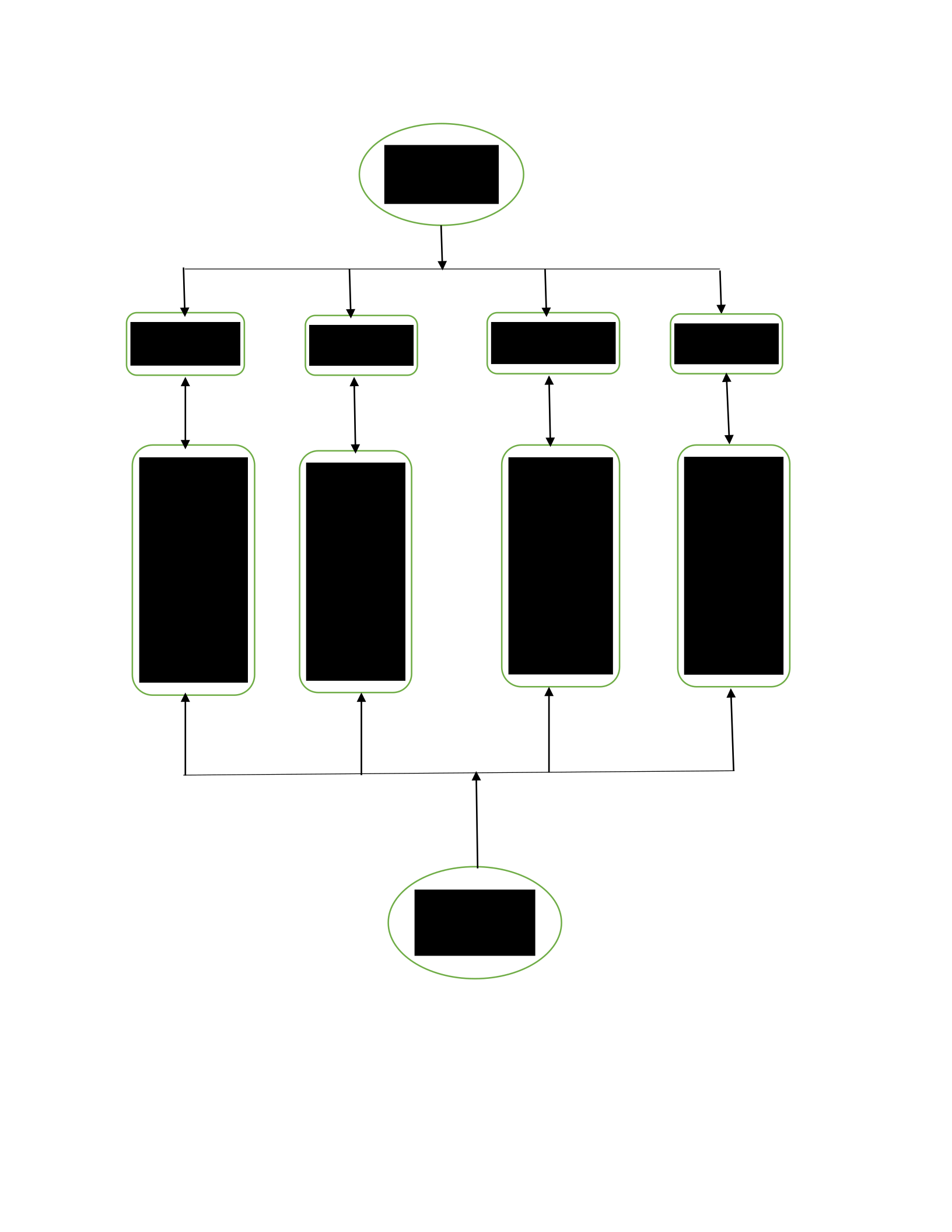
A written overview of the Visual representation of what the Nike’s Just Do It advert
controversy says about Marketing theory
The brand advert controversy by Nike informs marketing theory in diverse ways. One of
the things it says is that marketing research is important when designing an advert or a
promotional message. It is because Intravia et al. (2020) say that companies should conduct
market research to avoid controversies. Also, it informs that in marketing, consumer behavior is
critical because it influences how marketing is done for a product such that companies should
consider it in their promotional plans. Also, Nayak (2017) notes that understanding of the
cultural and political context is also a necessity since it will likely polarize an audience and
suggest a brand perception when not considered. The uproar raises the topicality of the
equivalentity between brand messages and organizational values and long term strategy. The
controversial endorsements proposed by Kim, Kang, and Kim (2020) may be stronger in case
they refer to a brand identity and its target consumers. The marketing theory on this case presents
the idea that the strength of the marketing theory ought to focus not solely on the consumer

SUMMATIVE ASSIGNMENT 16
research but the brand legitimacy, cultural and brand risks of marketing activism consummation
in advertising.
The controversy also says a lot about the markets. For instance, Nike’s controversy
informs that markets are region-based. It means that markets may be a region such as a country,
state, district among others. In these regions, people have specific values, issues affecting them,
customs, beliefs, and other aspects. Nike faces racial inequality controversy which brand
messages must address or avoid to reduce chances of causing brand controversies. It also shows
the importance of the relationships between customers and the sellers in that brand messages
should strengthen rather than weaken it as in the case of Nike.
The controversy also informs about consumption. Nike’s controversy sparked outrage as
well as praises from the audiences. It shows that consumption is based on personal factors such
as attitudes towards certain matters. Nike’s audiences denounced its move because of their
attitudes towards racial inequality. It shows that social and psychological factors such as
inequalities and race play a critical role in determining how people consume certain products. In
Nike’s case, their promotional message and the influencer caused the outrage that led to the
boycotting and burning its trainers and clothing. Simultaneously, though, another group of
consumers reacted optimistically, making the message relayed by Nike a rash statement in favor
of justice and equality. This indicates the reflection of the consumption being not only concerned
with the utility of the product but also with the symbolic meaning and the development of
identities. As Palusuk, Koles, and Hasan (2019) explain, consumers tend to give emotions and
values to brands, and these values and attachments determine how they will consume a product.
The case study of Nike explains how personal beliefs, social values and consumerbrand
relationships collide.
The controversy also informs about the consumer society in that audience’s actions
explain the nature of the consumer society. The consumer society values responsibility in that it
requires companies to be responsible not contravene the values, beliefs, customs, and community
guidelines on sensitive issues. It also informs that the consumer society is sensitive to
promotional messages which calls for the need for marketers to be careful in creating
promotional messages. Finally, critical theory informs about marketing, markets, consumption,
and consumer society and Nike’s controversy. If Nike considered the theory’s key guidelines and

SUMMATIVE ASSIGNMENT 17
components regarding the above components, it would have averted the occurrence of the
controversy.
The Nike controversy is also educative to the marketing theory on how brand activism
works and the dangers of doing it within competitive markets. According to Zengin and Aladag
(2018), the digital media has heightened the impact of visibility of brand messaging which
implies that controversies are made larger and faster than ever before. It means that brands
should not only expect a short-term reaction of consumers when they have a political or a social
stand but also long-term reputational outcomes, which will appear in global markets.
Concurrently, brand activism, performed with integrity, may establish the level of engagement
among the faithful consumers of the same values, and, therefore, enhance the brand equity in the
long run (Sta & Abbassi, 2018). The Nike case shows that, although the action of taking a
position can offend some groups of consumers, it can equally incite others leading to more
loyalty and advocacy. Marketing theory, therefore, needs to develop in order to take into
consideration the dualistic character of brand activism as being a source of risk, as well as the
possibility to become a source of differentiation, emotional attachment, and cultural relevance.

SUMMATIVE ASSIGNMENT 18
References
Ahuvia, A. (2016). Brand love: development and validation of a practical scale. Marketing
Letters.
Bagozzi, R. P., Batra, R., & Ahuvia, A. (2017). Brand love: development and validation of a
practical scale. Marketing letters, 28(1), 1-14.
Batra, R., Ahuvia, A., & Bagozzi, R. P. (2012). Brand love. Journal of marketing, 76(2), 1-16.
Dahl, A. J., Peltier, J. W., & Schibrowsky, J. A. (2018). Critical thinking and reflective learning
in the marketing education literature: A historical perspective and future research
needs. Journal of Marketing Education, 40(2), 101-116.
Das, R. (2019). Alternative Research Paradigms in Marketing: History, Critical Theory, and
Technology Inspired Research!. Journal of Marketing Vistas, 9(2), 13-21.
Davis, D. F., Golicic, S. L., & Boerstler, C. N. (2011). Benefits and challenges of conducting
multiple methods research in marketing. Journal of the academy of marketing science,
39(3), 467-479.
Halilovic, D. (2013). Crazy little thing called brand love! Exploring the influence of brand love
on brand equity (Master's thesis, University of Twente).
Palusuk, N., Koles, B., & Hasan, R. (2019). ‘All you need is brand love’: a critical review and
comprehensive conceptual framework for brand love. Journal of marketing
management, 35(1-2), 97-129.
Nayak, T. (2017). " Just Do It"@ Ad Campaign: The Case of Nike Inc. Globsyn Management
Journal, 11(1/2), 59-66.

SUMMATIVE ASSIGNMENT 19
Intravia, J., Piquero, A. R., Leeper Piquero, N., & Byers, B. (2020). Just do it? An examination
of race on attitudes associated with Nike’s advertisement featuring Colin
Kaepernick. Deviant Behavior, 41(10), 1221-1231.
Kim, S., Kang, E. Y., & Kim, Y. (2020). Controversial spokesperson is not negative: A case of
Nike campaign. International Journal of Business in Sports, Tourism & Hospitality
Management, 31.
Hurth, V., & Whittlesea, E. (2017). Characterizing marketing paradigms for sustainable
marketing management. Social Business, 7(3-4), 359-390.
Hwang, K. K. (2015). Culture‐inclusive theories of self and social interaction: The approach of
multiple philosophical paradigms. Journal for the Theory of Social Behaviour, 45(1), 40-
63.
Midgley, G., Nicholson, J. D., & Brennan, R. (2017). Dealing with challenges to methodological
pluralism: The paradigm problem, psychological resistance and cultural
barriers. Industrial Marketing Management, 62, 150-159.
Intravia, J., Piquero, A. R., Leeper Piquero, N., & Byers, B. (2020). Just do it? An examination
of the race on attitudes associated with Nike’s advertisement featuring Colin Kaepernick.
Deviant Behavior, 41(10), 1221-1231.
Kelner, Martha. "Nike’s controversial Colin Kaepernick ad campaign its most divisive yet." The
Guardian 4 (2018).
Packard, M. D. (2017). Where did interpretivism go in the theory of entrepreneurship?. Journal
of Business Venturing, 32(5), 536-549.

SUMMATIVE ASSIGNMENT 20
Rice, S., Winter, S. R., Doherty, S., & Milner, M. (2017). Advantages and disadvantages of
using internet-based survey methods in aviation-related research. Journal of Aviation
Technology and Engineering, 7(1), 5.
Shapiro, J. P., & Stefkovich, J. A. (2016). Ethical leadership and decision making in education:
Applying theoretical perspectives to complex dilemmas. Routledge.
Sta, N., & Abbassi, R. (2018). Brand love: antecedents and outcomes. Journal of Business and
Management Research, 11, 300-313.
Su, N. (2018). Positivist qualitative methods. The sage handbook of qualitative business and
management research methods.
Svensson, P. (2018). Critical Studies of Marketing Work. The Routledge Companion to Critical
Marketing, 155-171.
Zengin, A. Y., & Aladağ, B. (2018). Social media driven brand love: An investigation on
Turkish customers. İnternet Uygulamaları ve Yönetimi Dergisi, 9(1), 19-42.

