



Introduction Strategic Communications
A fairly recent innovation in the teaching of undergraduate mass
communications, strategic communications combines the teaching of business
principles alongside campaign theory and the older, more established discipline of
integrated marketing communications (IMC) skills, to achieve a prepared student
(Hallahan, K., Holtzhausen, D., van Ruler, B., Vercic, D., & Sriramesh, K., 2007).
The comprehensive approach brings, among other advantages, knowledge,
credibility and self-efficacy to the communications classroom (Ragas & Culp,
2014). The teaching of strategic communications also draws from other traditional
mass communications disciplines including public relations and advertising.
One of the areas where the advantages of adopting a strategic
communications outlook is most prevalent is in the student-run agency. This
research investigates the definition of strategic communications with the hope
that it will assist educators in providing an undergraduate curriculum that
embraces strategic communications as a part of the student-run agency
experience.
As a way to begin this exploration of defining strategic communications,
Table 1.1 offers a series of definitions used throughout the rest of the research.
1
Table 1.1 Definitions of Terms Specific to This Research
Terminology Definition
Academic Service Learning
(Service Learning)
A teaching and learning strategy that
integrates meaningful community
service with instruction and reflection to

enrich the learning experience, teach
civic responsibility, and strengthen
communities. (Kearns, Puglisi, &
Shelton, 2014)
Active/Experiential Learning Students work outside the classroom on real
projects or activities requiring higher-order
thinking like analysis, synthesis and
evaluation as well as reflection.
(Bonwell & Ellison, 1991)
Advertising Advertising is a paid form of persuasive
communication that uses mass and
interactive media to reach broad
audiences in order to connect and
identify sponsor with buyers (a target
audience) and provide information about
products (goods, services, and ideas).
(Moriarity, Mitchell, & Wells, 2009)
Convergence A multi-dimensional phenomenon that
stretches from the ways news is
reported in contemporary society, to
aspects of behavior in a widely diverse
selection of audiences and operators.
(Grant, 2009)
Information/Social Marketing
Campaigns
To risk the incidence of risky behaviors
or to promote social causes important to
the betterment of the community.
(Hallahan et al., 2007)
2
Integrated Communication The combining of communications efforts to
maximize communication dollars, speak with
one voice and communicate with one sight,
one sound. (Schultz, 1993)
Integrated Marketing
Communication
A subset of integrated communications,
“IMC is a communications process that
entails the planning, creation, integration

and implementation of diverse forms of
marcom (advertisements, sales
promotions, publicity releases, events, etc.)
that are delivered over time to a brand’s
targeted customers and prospects.”
(Shimp, 2010)
Integrative Learning Connecting skills and knowledge from
multiple sources and experiences. Applying
theory to practice in various settings utilizing
diverse and even contradictory points of
view. Understanding issues and positions
contextually. Integrative experiences occur
as learners address real-world problems,
requiring multiple areas of knowledge and
multiple modes of inquiry, ultimately offering
multiple solutions. (Huber & Hutchings,
2004)
Marketing Communication
Create awareness and promote sales of
products and services. Also, attract and
retain users and customers, including
intermediaries in distribution channels.
Among nongovernmental organizations and
other not-for-profit organizations, marketing
communications incorporates fundraising
and development communications.
(Hallahan et al., 2007)
New Media “New media” most commonly refers to
content available on-demand on the
Internet, accessible on any digital device,
usually containing interactive user feedback
and creative participation. Common

examples of new media include websites
such as online newspapers, blogs, or wikis,
video games, and social media. A defining
characteristic of new media is dialogue.
(Vogt, 2011)
Political Communication
Build political consensus or consent on
important issues involving the exercise of
political power and the allocation of
resources in society. This includes efforts to
influence voting in elections as well as
public policy decisions by lawmakers or
administrators. On the international level,
this includes communications in support of
public diplomacy and military stabilization.
(Hallahan et al., 2007)
Public Relations
Establish and maintain mutually beneficial
relationships with key constituencies. This
includes consumers and customers, as well
as investors and donors, employees and
volunteers, community leaders, and
government officials. (Hallahan et al., 2007)
Student-run Firms
Student-run agencies are modeled after
professional firms, giving students
opportunities to work on real campaigns for
real clients in a professional environment
(Bush, 2009)
Strategic Communications To facilitate the orderly operations of the
organization. Also, to promote
understanding of an organization’s mission,
vision, and goals: and to supply information
needed in day-to-day operations including
customer and vendor transactions and
customer and staff training. (Hallahan et al.,
2007)
Technical Communication
Educate employees, customers and others

to improve their efficiency. It involves
reducing errors and promoting the effective and satisfying use of technology
when performing tasks important to organization.
(Hallahan et al., 2007)
Because strategic communications incorporates so many other disciplines
in its definition, this study addresses the need for a more pragmatic description of
strategic communications. The research strives to identify a measure for
evaluating a move to a strategic communications orientation in terms of
instruction and training (Hallahan et al., 2007; Holtzhausen & Zerfass, 2013,
2015; Tindal & Holtzhausen, 2011) through original inquiry of existing faculty
members currently teaching in the strategic communications discipline and/or
three other related disciplines: integrated communication, public relations and
advertising. Ultimately this new strategic communications measure (definition)
would be applied to the teaching/advising of student-run agencies and other
integrative learning applications and situations.
This chapter contains two parts. Part 1 explores definitions related to this
study that help frame the research. Part 2 discusses social cognitive theory and
applied service or integrative learning. It includes discussion of the relative
benefits of student-run agencies and internships, and suggests them as
candidates for incorporation of the teaching of strategic communications.
Part 1 A Pragmatic Definition of Strategic Communications
A combination of business acumen and multi-tiered communications skills,
the study of strategic communications at an undergraduate level provides

opportunities for professional education, which encourages students to become
more business savvy, and better equipped to answer business questions and
thoroughly prepared to provide cogent counsel in communication. In addition,
strategic communications instruction fosters the ability for practitioners to
articulate and explain their value as part of the bottom line. Students trained in
strategic communications can provide additional value for business and for their
own contributions to it (Public Relations Society of America, 2011).
Similarly, Hallahan et al., (2007) define strategic communications as
deliberate and purposeful communications:
“Six relevant disciplines are involved in the development,
implementation and assessment of communications by
organizations: management, marketing, public relations, technical
communication, political communication and information/social
marketing campaigns. …A growing number of organizations have
recognized that various communications disciplines share common
purposes and that their objectives and strategies for achieving
these objectives are similar. They differ primarily by their tactics and
are being pressed to adapt to changing environment by their
organizations desire to coordinate communications, by the
convergence of media, and by the blurring of communications
genres. Organizations are seeking integration as well as enhanced
effectiveness through synergy, enhanced efficiencies, and reduced
redundancies.” (Hallahan et al., pp. 1, 5)
What is Strategic Communications? It’s Complicated…
There are many types of communications used in the pedagogy, teaching,
and practice of strategic communications. Some are applied knowledge, some
are specialty fields of communication within a larger discipline, and some involve
the development and cultivation of skill and traits. This study mines those
various areas of communications and determines what specific factors should be
included for a successful strategic communications program. More specifically,

this research seeks to define a strategic communications outlook by including
answers to the following areas: What applied communications should be taught
to attain a strategic communications orientation? What specialty communications
aptitudes are necessary to practice strategic communications? Finally, what
individual skills and traits are necessary for practitioners to obtain in order to
succeed in strategic communications?
Why is This Study Important?
This inquiry is important because it addresses a path of instruction for
strategic communications at the undergraduate level. It attempts to identify a
distinguishing differentiator of strategic communications from other mass
communications disciplines (integrated communications, public relations, and
advertising) currently practiced, and provides recommendations as to how other
programs can adopt a strategic communications outlook.
Moreover, distinctions of strategic communications may be moot if they
are not taught in an environment where they can be applied and their value(s)
reinforced. The student-run agency offers an excellent laboratory for building
strategic communications practitioners. More pragmatically, in terms of
employment and future opportunity for college students in many fields of study,
experience has become as important, and in some cases more important, than
academic performance (Thompson, 2014). In other words: “Experience has
become the new GPA.” From teaching hospital models, to externships,
internships, and practicums, a contemporary onus of higher education is to
provide immersive opportunities to students as part of their courses of study. A

popular delivery system to meet this need is based in academic service learning,
which has its roots in social cognitive theory.
Part 2 Social Cognitive Theory, Applied Service Learning and Integrative
Learning with Student-run Agencies
In the field of mass communications (to include public relations,
advertising, and integrated communications) hands-on instructional opportunities
often consist of internships, campaigns classes, or student-run agencies. From a
global perspective, these experiences mimic real world conditions when the
students are provided opportunities for “real work with real clients.” The
arrangement delivers students an experience complete with the challenges,
responsibilities, and successes associated with working in the field.
Described in the literature by various derivatives of academic service
learning, experiential learning or integrative learning (Bush 2009;
BushBacellis,1998; Maben, 2010; Maben & Whitson, 2014; Ranta, 2014a), the
student-run agency concept permits aspiring communicators the opportunity to
run their own firms within the confines of a university setting and under the
supervision of one or more faculty members.
Student-run advertising and public relations agencies represent a unique,
immersive opportunity for soon-to-be practitioners to gain real-world experience in
a controlled environment doing real work for real clients. As noted in table 1.1,
Student-run agencies are modeled after professional firms, giving students
opportunities to work on real campaigns for real clients in a professional
environment. To further define student-run firms for the purposes of this research,
a student-run firm provides “…undergraduate students the opportunity to work as

if they were employed at a professional public relations agency,” (Maben &
Whitson, 2014, pg. 2). While Maben and Whitson only looked at PR, this study
incorporates a broader view and includes advertising and marketing as part of the
definition. As Bush (2009) states, student-run agencies allow journalism students
to apply learning to practical situations “…in which students implement public
relations, advertising and integrated marketing communications programs for
professional clients,” (p. 27).
Student-run agencies develop professionalism, hone tactical skills, and
cultivate strategic thinking and planning while providing strong networking outlets
and portfolio materials. Clients served by student-run agencies may include
notfor-profits, start-ups, NGOs, corporations and even publics within the
university setting (Maben & Whitson, 2014). More importantly, many student-run
agencies have diversified into an integrated or even a strategic communications
agency approach, enfolding public relations, advertising, and marketing
communications functions under one umbrella while adding training and
education on business principles.
Leadership models for student-run agencies are varied, depending upon
the institution. Bush (2009) categorized them into four groups with distinct
characteristics: Accountability, Faculty Involvement, Levels of Learning and Risk
of Dissolution. In a presentation to the Public Relations Society of America
(PRSA) Educators’ Academy, Ranta (2014a) explored best practices for
studentrun agencies. Among those highlighted were strong student-run agency

branding, peer-to-peer training using real world knowledge and experiences,
dedicated
work space, as well as teambuilding and client interaction. A clear organizational
structure and providing students leadership opportunities to serve as both
account executives and team members for varied accounts were also identified
as benefits.
Regarding leadership selection, some student-run agencies elect their
leadership, others appoint or assign leadership, and still others offer competitive,
paid slots for those students most interested in taking on the mantle of leadership
(Bush, 2009; Bush & Miller, 2011; Maben, 2010; Maben & Whitson, 2014;
Swanson, 2007 and 2011).
Internships
Related to the student-run agency experience is the student internship
experience. Internships are seen as a way for students to obtain immersive
experience in performing various tasks for companies on either a full- or a
parttime basis. In the literature, internships are considered a “valuable learning
experience by members of the public relations academy” (Daugherty, 2011, p.
470). Furthermore, “…perhaps no one aspect of public relations education has
generated more discussion and diversity of implementation than the
recommended ‘supervised work experience,’” (The Commission on Public
Relations Education, 2006 p. 57). Some internships are paid, and others are not
(Beebe, Blaylock, & Sweetser, 2009). Expected development in internships

includes skills acquisition, professional experience, real world exposure, and
gaining a better understanding of the field (Daugherty, 2011).
Both student-run agencies and internships are considered by industry,
faculty, and mass communications professional organizations as exceptional
opportunities for gaining experience and equipping students for future work. Both
experiences can also be considered an outward application of academic service
learning theory, which is an evolution, in part, of social cognitive theory.
Agencies, Internships, Academic Service Learning and Social Cognitive
Theory
In 1986, Albert Bandura put forth the idea of social cognitive theory as a
way to provide insight into the processes underlying learning and instruction.
Using various terms including imitative learning, modeling, and self-efficacy, the
researcher held the opinion that learning is accomplished via a complex
collection of behaviors that stimulate recognition, rehearsal and, imitation.
Bandura’s theory lends itself well to the immersive study of strategic
communications competency and the student-run agency. Accepting that some
excellent ways of imparting knowledge (training) are through imitative learning
and accepting that the goal of a successful student agency/internship experience
is to prepare students for real world experience, the student-run agency provides
prime opportunities to impart knowledge via informed instruction and imitation.
Social cognitive theory emphasizes four conditions which must be present
for learning to take place: an environment where the learner has some control
over decisions; a psychology or collection of personal traits that allow for a sense

of well being (with innate knowledge); an overall cognitive ability to effect change;
and finally, a mastery of skills necessary to effect change, (O’Rorke, 2006).
When compared to the classroom actions of student-run agencies, the
work accomplished within delivers upon these conditions. Students are allowed
to have control over decisions. Specific skills and traits are taught and cultivated
as part of the agency, and there is a consistent expectation for beneficial change
on behalf of a client via an exclusive, focused skill set. Moreover, student-run
agency participants are encouraged to take responsibility and work directly with
the client to help determine needs and deliverables. These exercises require
time, planning, communication, self-evaluation, instructor evaluation, and client
evaluation. And, as part of accomplishing beneficial change on behalf of the
client, students are encouraged to provide new ideas, new data and new
executions of those ideas.
Finally, a key purpose of the student-run agency experience is to practice
and implement new and previously acquired skills congruently. When all of these
conditions are met, learning takes place and self-efficacy is developed. Based on
original study and extensive experience as a student-run agency adviser, the
following table addresses how student-run agencies fulfill some of the tenets of
social cognitive/social learning theory (Ranta, 2014a).
Table 1.2 Student-run Agencies/Internships as a Route to Student Social
Cognition
Fulfillment conditions present at
Condition student-run agencies

A positive environment with Student-run agency participants are encouraged
learner control to manage a client relationship, make decisions, plan and
execute deliverables.
Sense of self that permits
cognitive ability to effect
change
Expectations from the client, the adviser, and the
student are to effect positive change for the benefit
of the client and the education of the student
through innovation, creative energy, and best
practices.
Mastery of skills to effect
change
Key purpose is to coalesce skills and knowledge
into meaningful efforts for the client and an
education for the student which is retained
postclassroom.
Non-referenced original content
Figure 1.1 Strategic Communications in Relation to Communications Disciplines
and Practices
Moving Forward
Strategic communications represents a paradigm shift for mass
communications education. It consists of combining the disciplines of integrated
Integrated
Communications
Public Relations
Advertising
Applied
Comms.
Specialty
Comms.
Skills and
Traits
Communication
Principles
Strategic Communications
Communication Practices

communications, public relations, and advertising under a single umbrella. It also
requires mastery of various elements of applied communications, specialty
communications, and specific skills and traits. Figure 1.1 illustrates how these
factors are related for purposes of this research.
Summary
The convergence of mass communication disciplines has demanded the
tearing down of silos and the blurring of lines between traditional disciplines of
integrated communications, public relations, and advertising. Recently developed
as an umbrella discipline, strategic communications offers unique solutions for
the challenge of preparing the next communicator for this changing landscape.
One of the best applications for strategic communications is the
studentrun agency. Hands-on, integrative education offers substantial
opportunities to foster self-efficacy, deliver real-world experience and produce
capable, skilled communicators. However, the exact definition of strategic
communications is still an open issue. A solid measure of what strategic
communications is would be beneficial in terms of how it should be taught to the
next generation of communicators and assist educators in efforts to prepare
students to meet the rising tide of demand for multi-platform communications
professionals.
Navigation for this Document
Chapter 2 continues the discussion of student-run agencies, academic
service learning, and strategic communications with a literature review. It
concludes with a set of hypotheses and research questions addressed in this

study. Chapter 3 discusses methodology used to gather data on the studied
subject. Chapter 4 reports analysis of results. Chapter 5 provides conclusions,
limitations, and recommendations for further study.

CHAPTER 2 LITERATURE REVIEW
This literature review addresses four areas pursuant to incorporation of
strategic communications into education. Part 1 details existing research on
student-run agencies and internships and what roles they fill in preparing
students for work in strategic communications in the outside world. It highlights
the benefits students, faculty and hiring publics receive from the student agency
approach in communications-related fields. Part 2 discusses the appeal of
academic service learning and explores the imitative modeling that takes place
as students are immersed in a capstone experience as well as addresses
pragmatic values of student-run agency and student internship experiences. Part
3 of this literature review addresses the rise of strategic communications within
the communications profession and the perceived need of communications
faculty to continue their efforts to prepare students to compete in the global
marketplace. Part 4 discusses the operationalization of a strategic
communications definition in terms of original research for this study.
Part 1 Student-run Agencies as a Strategic Communications Training
Pathway
Similar to internships, student-run agencies offer a great deal of autonomy
and empowerment to the participating students. Both offer a pathway to Strategic
Communications Training. And, although there are significant differences
15
between them, for the purposes of this study the shared benefits and challenges
of student run agencies and internships will be addressed.

The number of studies of student-run agencies is limited but growing
(Bush, 2009; Bush & Miller, 2011; Gibson & Rowden, 1994-95; Maben, 2010;
Maben & Whitson, 2014; Ranta, 2014a, and Swanson, 2011). These studies
provide typology of agency structure, best practices of operations, and
discussions of student and adviser experiences.
The Public Relations Student Society of America (PRSSA) is a strong
supporter of student-run agencies and offers opportunities for them to affiliate
nationally with PRSSA leadership. As a way to train students for the agency
environment and to standardize the efforts put forth by student-run agencies,
PRSSA publishes a student agency guidebook, which provides step-by-step
instructions for student-run agencies to receive national affiliate designation
(Public Relations Student Society of America, 2015). This designation check-list
addresses successful completion of the requirements, along with a self-study of
compliance issues, and includes various management functions including client
contracts, a formalized structure, adherence to the PRSA code of ethics, and
accountability for hours used and clients served. Once completed, a student-run
agency’s affiliation package is sent to PRSSA for evaluation. In 2016, there were
36 PRSSA nationally affiliated student-run public relations agencies in the U.S.
Appendix B part 2 of this document lists those agencies and their associated
universities (Public Relations Student Society of America, 2016).
True to Bandura’s 1986 tenets of modeling, the student-run agency
guidebook is specifically designed to be imitative of practices currently in use at
professional agencies. According to the 2015 Association for Education in
Journalism and Mass Communications (AEJMC) directory, there are 134
17

universities reporting a student-run advertising agency, a student-run public
relations agency or both (Association for Education in Journalism and Mass
Communication, 2015). Appendix B part 1 of this document lists those
universities.
Student-run Agencies from a Student Perspective
From a student’s perspective, the advantages of participating in a
studentrun agency over general classroom instruction include generating feelings
of leadership/ownership, self-empowerment, providing opportunities to make
significant decisions, and experiencing professional and personal growth by
managing the client/vendor relationship (Aldoory & Wrigley, 2000). In addition,
the student agency experience, much like an internship, provides many positive
benefits to the students enrolled including positive effects on GPA, better job
prospecting and faster post-graduate job placement (Astin,1993; Callanan &
Benzing, 2004; English & Koeppen,1993; Fang & Lee, 2005; Gault, Reddington &
Schalger, 2000; Knouse, Tanner & Harris, 1999; Neidorf, 2008).
Researchers Kearns, Puglisi and Shelton (2014) offered some interesting
quotes from their research subjects in a study conducted of students’
experiences and perspectives working with student-run agencies:
“Working with a real client has really improved my
expectations for myself. In other classes I do not put nearly
the same amount of effort as I do with Agency. …I feel that
joining Agency has given me a glimpse on what to expect in an
agency for my internship or potential career…” “I can honestly
say that the class emphasized critical thinking and personal
reflection while encouraging me to gain a sense of
community…I’ve learned that working with real clients
presents unique challenges…I learned, along with my group,
to take often desperate wishes from the client and come up
with solutions which satisfied them…” (Kearns et al., 2014).
(Excerpted from Slides 17-20)
18

As can be seen from these statements, in the minds of the respondents,
student agency participation contributes significantly to a level of professional
self-efficacy, and student-run agency membership also inspires decision-making,
client expectation management and problem solving.
Student-run Agency/Service Learning Benefits from the Faculty Perspective
From a faculty perspective, a study of advantages of academic service
learning in public relations courses, and as manifested in student-run agencies,
included comments stating the single most rewarding outcome of the experience
is skill development for students. In addition, planned categories of outcomes in
academic service learning courses are real-world application/practical skills; an
increase in teamliness/interpersonal skills; client interactions and civic
responsibility/citizenship (service) (Werder & Strand, 2011; Witmer, Silverman, &
Gaschen, 2009). In addition, Witmer et al. (2009) mentions a general consensus
among faculty respondents that all public relations professors should be involved
in some form of academic service learning in their classroom approach.
In terms of benefits to the communication profession, Bush (2009) states,
“Student-run firms fill a void in the curriculum by exposing students to disciplined
business practices that may be missing in campaigns or service learning
courses.” (p. 35). Similarly, according to Swanson (2011), “While there is no one
answer for maintaining excellence in teaching and learning with fewer resources,
one strategy that has proven successful for public relations programs is the
implementation of a student-run public relations firm,” (p. 499). In addition,
Gibson and Rowden (1995) advocate the student agency model to ”…overcome
the limitations of classroom instruction and provided structured responsibilities
19

and tasks not always associated with internships,” (p. 30). Hazdovac (2012) also
states student participation in a student-run agency yields an integrative learning
experience with immediate exposure to real-world clients, something “…that
cannot be replicated through hypothetical classroom discussions or case studies,”
(p. 19).
Bush and Miller (2011) point out that student-run agencies also have the
benefit of introducing students to the “convergence and integration” common in
the contemporary public relations professional environment. Bush (2009) also
suggests a larger benefit from student-run agencies is the development of
students’ professional identities. These identities include leadership and
management, team motivation, client negotiation, and professional confidence.
This conclusion mirrors nicely the tenets of Bandura’s perceived self-efficacy
(Bandura, 1998). In a quick snapshot of still more benefits provided to students,
Hazdovac (2012) and others offered the following information in Table 2.1.
Table 2.1 Faculty Opinions of Positive Effects of Student-run Agency
Participation on Students
Positive Effect Citation
Mutual accountability (client, each other, and
instructor)
Hazdovac, 2012
Gain more confidence through acquiring Gibson & Rowden, 1995 new
skills and refining old ones Swanson, 2014
Portfolio development Gibson & Rowden, 1995
Bush & Miller, 2011
Swanson 2011
20

Student-run Agencies—the In-House Internship
While they are the preferred vehicles for this research, student-run
agencies are only one of several forms of hands-on training used in
contemporary curricula that may be suitable for teaching strategic
communications. Many universities and institutions of higher learning provide a
variety of hands-on instructional opportunities with an academic service learning
component. Some of these include internships, capstone classes, campaigns
classes, and other electives. This multi-dimensional approach provides myriad
opportunities for interactive service learning and is recommended by the
Association of American Colleges and Universities (2007); the Public Relations
Student Society of America, (2015) and Beard and Morton (1999).
PRSA felt so strongly about the value of internships and the value of
student-run agencies, it released a “Port of Entry” study, which encouraged their
student organization, PRSSA, to provide a national affiliation program
(Commission on Public Relations Education Report, 1999). In addition to the
opportunity for national affiliation, the program also includes best practices in
ethics, client contracts, management of expectations, and even billing and job
sheets (documentation) as points of self-reflection.
The Port of Entry Study also encourages practitioners to embrace the
internship process and improve the overall utility of the internship experience.
Some additional research findings contributing to the successful internship
experience include ensuring a mentorship relationship with leadership;
participation by internship sponsors in the assessment process; a dedicated
location for internship work; a clear idea of the work requirements for internships;
21

a reflection opportunity for the students; a clear point of contact; coordination
facilitator at the sponsoring university; whenever possible, some sort of
compensation for student work; a periodic review of student work during the
course of the internship; a final reporting opportunity in the form of a portfolio; and
a written report or oral presentation at the conclusion of the internship (Alpert,
Heaney, & Kuhn, 2009; Basow & Byrne,1993; Beebe, Blaylock, & Sweetser, 2009;
Brown & Fall, 2005; and Todd, 2009). Based on these findings, it seems clear that
student-run agencies and internships offer many benefits for students and faculty
in terms of skills development, employability, self-efficacy, and other variables not
obtainable elsewhere.
Part 2 The Appeal of Academic Service Learning in Strategic
Communications Instruction
Service learning roots stretch as early as Campbell (1995) and Dewey
(1938). Relevant learning theories that have developed from service learning and
are attached to student agency creation, management and educational benefits
include experiential learning, applied learning, integrative learning, work
integrated learning, problem-based learning, and academic service learning.
Among those praising academic service learning are the Association of American
Colleges and Universities (2007); Blakeman (2015); Bush-Bacellis (1998); Cohen
and Kinsey (1994); Drake (2000); Jacoby (1999); Strage (2004); and Witmer, et
al., (1998).
In particular, the Association of American Colleges and Universities (AACU)
praised service learning as a promising, high impact activity, which engages
students and promotes learning. In communications instruction particularly, the
concept of the internship and/or the student agency are well established (Panici &
22

Laske, 2002). Bush-Bacelis (1998) states: “The use of Academic Service
Learning has enabled students to feel they are spending time wisely. They are
not simply meeting the assignment for the class; they are genuinely
accomplishing needed tasks while meeting class requirements,” (p. 28).
Aldoory and Wrigley (2000), citing Schine (1997), summed up the Academic
Service Learning appeal: “…service learning has attracted support from
practitioners, policymakers, researchers, governments at all levels, and from the
broader community (p. vii).”
From the Real World Perspective, Academic Service Learning = Jobs
Looking at education programs from a pragmatic prism of “real-world”
strategic communications skills, those competencies practiced and perfected in
student-run agencies and in other experiential class offerings were found to be
extremely beneficial by researchers investigating expectations and employability
(Neff, Walker, Smith, & Creedon 1999; Todd, 2014). Benigni, Cheng and
Cameron (2004) found that “…students with considerable ‘real-world’ application
are more competitive in today’s job market” (p. 206). Practical experience was
also seen as critical in the post-graduation job hunt where students who have
student-run agency and/or internship experience generally found jobs faster than
their non-interning colleagues (Benigni et al., 2004). Student-run agencies have
also been historically seen as a solution to the need for students to have more
on-the-job training before they get to actual jobs.
Academic Service Learning: “Hands-on Meets Need, Head-on”
When reviewing studies of public relations pedagogy, it is apparent that
both students and future employers feel new graduates need more training in the
23

tactical skills than in leadership (Paskin, 2013; Swanson, 2014; and Todd, 2014).
There is also strong evidence, and faculty agreement from the literature, stating
theory is best reinforced with hands-on experience as found in service learning
and in student-run agencies (Brooks, Cornelius, Greenfield, & Joseph, 1995;
Hazdovac, 2012; Paskin, 2013; Swanson, 2007; and Todd, 2014).
Consider the following quotation from faculty on the need to keep students
current with trends in the industry:
“Those of us who teach public relations within higher education are
always under pressure to provide the most relevant knowledge and
skills to our students. We aim to provide students with an
appropriate balance of theoretical/conceptual skills and ‘hands on’
training. We want new college graduates going out into the public
relations workplace knowing not only what to do, but why they’re
doing it.” Hazdovac (2012) (p.15).
Creedon, Neff, Smith, and Walker (1999) state the most desired skills for
hiring new communicators includes critical thinking, problem solving, writing
skills, practical experience, communications skills, and effective characteristics
of a good attitude and being a self-starter. Further, from a faculty perspective, the
use of real clients in classroom instruction generates many positive benefits as
Table 2.2 details.
Table 2.2. Benefits of Using Real Clients in Classroom Instruction
Student Benefit Explanation
Context
Students learn context and understand relevance
Theory Students see theories in practice—enhance student buy-
in.
Motivation
Students seem to find working with clients interesting,
creative and frustrating which all positively impact
24

motivation.
Management Teaches strategic planning with real constraints,
Skills budgeting with real money, research before planning and time
management due to client schedules.
Flexibility
Client plans change and students need to learn flexibility,
adaptability and patience.
Empathy Students express understanding for client needs, concerns,
problems, “ups and downs.”
Professionalism
Students are taught how to speak with clients, meet with
the client, dress, ask questions, and present solutions.
Value
Students value their own work and take campaign
planning very seriously.
Economics
Deciding client service based in part on economics.
Psychological
Issues
Deal with loss of autonomy, teamliness, timelines, and
multiple reporting responsibilities.
Client constraints
Manage expectations positively, deal with client
availability, goal articulations, etc.
Negotiation
Teachers and clients have to balance priorities of
coursework and client needs. Students have to budget
time to dedicate to work.
Time
More time is spent preparing for classes and for client
meetings.
Excerpted from Aldoory & Wrigley (2000)
25

When considering a service learning approach, student-run agencies
resemble a hybrid of capstone campaigns classes and internships in terms of
curricula, benefits, and results. Maben (2010) states, based on the similarity of
internships to student agency work, it is valid to address student-run agencies in
the broader context of internships. “The campus newspaper and public relations
firm are essentially in-house internship programs…” (p. 30).
Similarly, a 2000 study by Dickson, interviewing the CEOs of the top 50
public relations firms, indicated 89 percent felt internships and work experience
were very important to future employment. Fitch (2011) and Schön (1982) point
this out, with Fitch stating as future professionals, students need to learn how to
work in situations with “complexity, uncertainty, instability, uniqueness, and value
conflicts” (p. 14). In short, real-client projects are essential for future practitioners.
Internships—and by default, agencies—are also seen as valuable tools for
employers as they deliver practical experience, one of the key differentiators in
hiring entry-level practitioners (the Commission on Public Relations Education
2006 and Todd, 2009 and 2014). When regarding public relations training
specifically, van Ruler (2005) commented that university learning and teaching
“should not focus on knowledge reproduction but, on the development of learning
capability and creativity in finding acceptable solutions for clients” (p. 164).
In contrast, Royal (2005) added that “…teaching without focus on
integration, judgment, and perspective in the new media environment will
ultimately fail students who suddenly find their skills outdated, outmoded or out of
sync with the real world” (p. 412). Based on these two differing opinions it seems
the best solutions is to find a way to teach both.
26

When considering the influences specific internships (and student-run
agencies) have on students, Maben (2010) found multiple positives including
positive relationships with GPA, greater choice of employability and more. Table
2.3 synthesizes Maben’s findings.
Table 2.3 Positive Effects of Student Internship Service Learning
Service Learning Internship
Effects on Students Citation
Positive effect on career choice
Fall, 2006
Offers new perspectives for students Getz, 2002
Correlates positively with students’ GPA Astin, 1993; English &
Koeppen, 1993; Knouse, et
al., 1999
Assists in finding and securing jobs Neidorf, 2008; Callanan &
Benzing, 2004;
Fang & Lee 2005
Excerpted from Maben 2010
Similarly, Hazdovac (2012) reminds us that researchers Aldoory and Wrigley
(2000) found students working with real clients present several positive
psychological developments including gained confidence, and
improved/increased self-esteem. Cohen and Kinsey (1994) found students were
much more motivated to complete real work for real clients than hypothetical
ones and Sallot (1992,1996) found student tolerance for ambiguity increased, as
did self-esteem and confidence, when working with actual people.
27
Assists in finding jobs sooner Gault, et al. , 2000

Looking more globally, service learning in communications is defined by
Muturi, Soontae, and Mwangi (2013) as a form of teaching that incorporates
community service with the acquisition and/or exercise of skills and knowledge
that tie directly back to the classroom’s learning objectives. It is associated with
boosting critical thinking, improving theory and practice integration, and assisting
in career planning.
Convergence (Integration) and Strategic Communications
Sometimes called new media, the phenomenon of convergence refers to
the merging of technology, content and tasks needed to take maximum
advantage of technological growth and change (Brooks, Kennedy, Moen, &
Ranly, 2010). As Grant (2009) points out, convergence is a multi-dimensional
phenomenon that stretches from the ways news is reported in contemporary
society, to aspects of behavior in a widely diverse selection of audiences and
operators. Integration, in contrast to convergence, is not as technology driven but
does require significant work in assuring messages are prepared and
disseminated through as many message platforms as possible. Consequently,
the rise of communication integration of various types of media, thanks to widely
available new communication technologies and the explosion of social media
usage, has demanded that communications agencies and organizations make
changes to accommodate this rising demand, leverage the ability to influence
over various news platforms, and train those who will meet the converged
communications needs for their organization(s) (ESPN, 2009 and 2013, Ranta,
2014b). The fundamental need for strategic communications education is rooted
in several phenomena. One example is public relations. Historically, public
28

relations, as a discipline, has attracted practitioners who are more used to the
qualitative or output related practices than the hard analytics used by most
business practitioners. In fact, many public relations practitioners are famously
math averse and do not easily conceptualize nor embrace quantitative analytics
as part of their job description (Fleet, 2006; Hanson, 2010; & Williams, 2014).
Public relations’ emphasis in the past has often been about the soft skills areas of
relationship building, issues management and other items including event
planning. While there is merit in all of these areas, there is also a very real, and
developing, need for analytical processes which include things like crisis
planning, reputation management, social media positioning and corporate social
responsibility. As the approach to customer relations, shareholder relations and
stakeholder relations is changing, the demands from the industry have translated
to requiring many public relations practitioners to become more business savvy
and analytically informed.
Public Relations, Advertising and Integrated Communications, What is the
Difference?
In an update to their 2007 publication, Holtzhausen and Zerfass (2015)
stated that their earlier article defining strategic communications “brought about
an identity crisis” (p. 3) in the public relations scholarly community. The conflict
being, that historically, strategic communications was perceived as the “express
mission” of the public relations field. Holtzhausen and Zerfass continue, stating
“the intent of developing the study of strategic communications was meant to
explore what different communities of practice can learn from each other,” with
the overall goal to “break down the silos we have erected around ourselves.” (p.
3). As a way to further explain the need for strategic communications,
29

Holtzhausen and Zerfass cite the blending of communications missions between
traditional activities (advertising, marketing, and public relations); changes in
technology (convergence/integration); increased numbers of channels that
organizations can use to communicate directly to stakeholders; and the
increased attention toward purposeful communications.
Adding to this change in mission is the rise of a subset of integrated
communications (integrated marketing communications or IMC). This blending of
two disciplines (advertising and public relations), for the purposes of marketing to
customers, has resulted in IMC being identified as a stand-alone discipline studied
in business curricula across the country (Shimp, 2010). For the purposes of this
research, IMC is considered as a subset of integrated communications as
integrated communications is much more versatile in its ability to support
communications efforts than IMC alone. In support of this outlook, Wang and
Nelson (2006) found a combined approach of both public relations and advertising
together was more effective than either approach on its own. Similarly, in his study
on integrating public relations with advertising, Moody (2012) makes the
distinction that while advertising and public relations are distinct and separate
disciplines, each has a fundamental function that benefits the communications
process. He argues that public relations’ greatest strengths involve building
relationships, influencing attitude/behavior, and fostering greater understanding
and trust. Furthermore, as a brand builder, public relations is stronger in building
understanding of a product, less expensive than advertising, and allows for
greater depth of message. Continuing the comparison of advertising and public
relations, Moody (2012) states advertising provides more message creativity, is
30

more established to attract attention, offers better control of the message, and is
perhaps even more persuasive than public relations. So in an integrated
communications world, while public relations and advertising offer greater strength
when combined, the two disciplines maintain separate identities and skill traits
that are not duplicated. This raises some interesting questions when considering
the growth of strategic communications.
The Barcelona Principles: Quantifying PR Then and Now
Another key differentiator between advertising and public relations is the
discussion of quantifying results. Prior to the release of the Barcelona Principles
in 2010, a common method for quantifying public relations was a dependence
upon older, less accurate measurements like the advertising equivalency metric
(Manning & Rockland, 2011: Stacks & Michaelson, 2010). In an area of
increasingly competitive actors seeking larger shares of shrinking
communications dollars, and an increasing demand from management to justify
dollars spent, the advertising equivalency valuation (AEV) measurement was
seen as a way to favorably compete against advertising on a dollar-for-dollar
placement. Most public relations campaigns were seen as a way to deliver
impressions equivalent to a more expensive advertising campaign for as little as
10 percent of the cost of a comparable advertising campaign. This practice was
confounded by a common PR agency approach to this methodology with the
addition of the quality (credibility) multiplier, which implied and assumed because
content was viewed in editorial rather than advertising space, or seen as part of a
“news” story rather than an advertisement, it was regarded as more credible by
the audience receiving the information (Bagnall, 2012).
31

Subsequently, recent research has widely debunked the AVE metric and
the associated multiplier (Manning & Rockland 2011; Stacks & Michaelson,
2010). As pointed out by the PR Measurement conference proceedings known as
the Barcelona Principles of 2010, the concept of advertising equivalencies has
been ruled an unacceptable practice, which should be replaced by other analytics
better tailored to perform more accurate analysis. Some of these include key
performance indicators (KPIs) of attitude and behavioral change (Ryan, 2014).
Other elements of the Barcelona Principles were designed to help enhance the
credibility of public relations. They include the need for transparency and
replication in public relations efforts, the need to measure both quantity and
quality of results, the need to measure business results whenever possible, the
need to measure outcomes versus output, and one of the most important in the
paradigm shift of public relations metrics, the need to measure social media
activity, (Manning & Rockland, 2011).
The need to improve measurement has become a constant drumbeat
among all business sectors, not just communications. The rise of improved
analytics in logistics, manufacturing, cost projection and even human resources
has created downward pressure on all aspects of business including
communications. The need for public relations, and for that matter all
communications efforts, is to become more strategic. This impetus is driven both
by improvements in process and analytics and a need for survival (Ragas & Culp,
2014). These innovations need to be understood and taught to future
communicators.
32

Google’s presentation of analytics, for example, has created a renewed
demand for tracking communications outputs and results. Statistics like the
number of unique visitors to a web site, the number of conversions, the time
spent on certain pages, the sites where visitors came from, the place where they
left, the number of return visitors, etc. have all created a pressure to “move the
meter” in these areas with an integrated communications approach that can be
justified to a C-suite executive. And while Google is a recognized leader in
delivering web site analytics, they are by no means the only player in the space
(Ryan, 2014).
Related to web site visitor metrics is the art and science of searcher
metrics or search engine optimization (SEO). Practitioners are being asked to
make their websites more appealing, more “sticky,” more interactive, and overall
more attractive to search engines. A skilled SEO approach will yield wider
audiences with additional reach and more interaction (Parikh & Deshmukh, 2013,
and Ryan, 2014). Obviously, in these instances, a skilled communicator with
mastery of these skills would be in high demand and, conversely, anyone without
these skill sets will be at a deficit for future job prospects.
The obverse of better SEO also requires a renewed diligence in the field of
online brand reputation. In the age of rapid connectivity, the ability for anyone
with a blog or a smart phone to do damage to the reputation, and ultimately the
sales, image, or reputation of a corporation is apparent. Viral campaigns
attacking the service and reputation of organizations are a serious matter, which
need to be addressed decisively, speedily, and completely. Responses to these
threats to reputation also need to be conducted with respect for the adverse
33

impacts of the responses (Blakeman, 2015). Not limited only to the outright
hacking of data with the aim or stealing or disrupting commerce, the war on a
business’ reputation is also something to be mindful of. In public relations, there
are anecdotes galore across the Internet of bad behavior causing unwanted
national attention. From the senior executive who was fired after a leaked
security camera video showed him abusing a friend’s dog in an elevator (Izadi,
2014), to Domino’s pizza workers who were seen doing inappropriate things to
sandwich ingredients while on the job (Clifford, 2009), misconduct, even the most
trivial, can result in lasting damage.
A more abstract but no-less-real factor in the need for more business
education among public relations students and the need for business students to
have an enhanced understanding of communications is the place of public
relations in the business cycle. Researchers Michaelson and Stacks (2014) have
discussed a theory of public relations efforts (and perhaps those of strategic
communications), being a mediating variable in the process of business
management. Called PR ROI/ROE, or Return on Investment/Return on
Expectation, the idea is that good public relations contributes to a company’s
intangible values of reputation, trust, responsible behavior, etc. which in turn
creates a level of confidence that is translated to both stakeholders and
shareholders, thereby increasing the overall reputation/confidence in the
organization and enhancing the bottom line. Elements that contribute to positive
ROI/ROE include positive financial indicators (unit sales, gross profits, and
expenses) as well as nonfinancial indicators (credibility, trust, reputation,
relationships, and confidence).
34
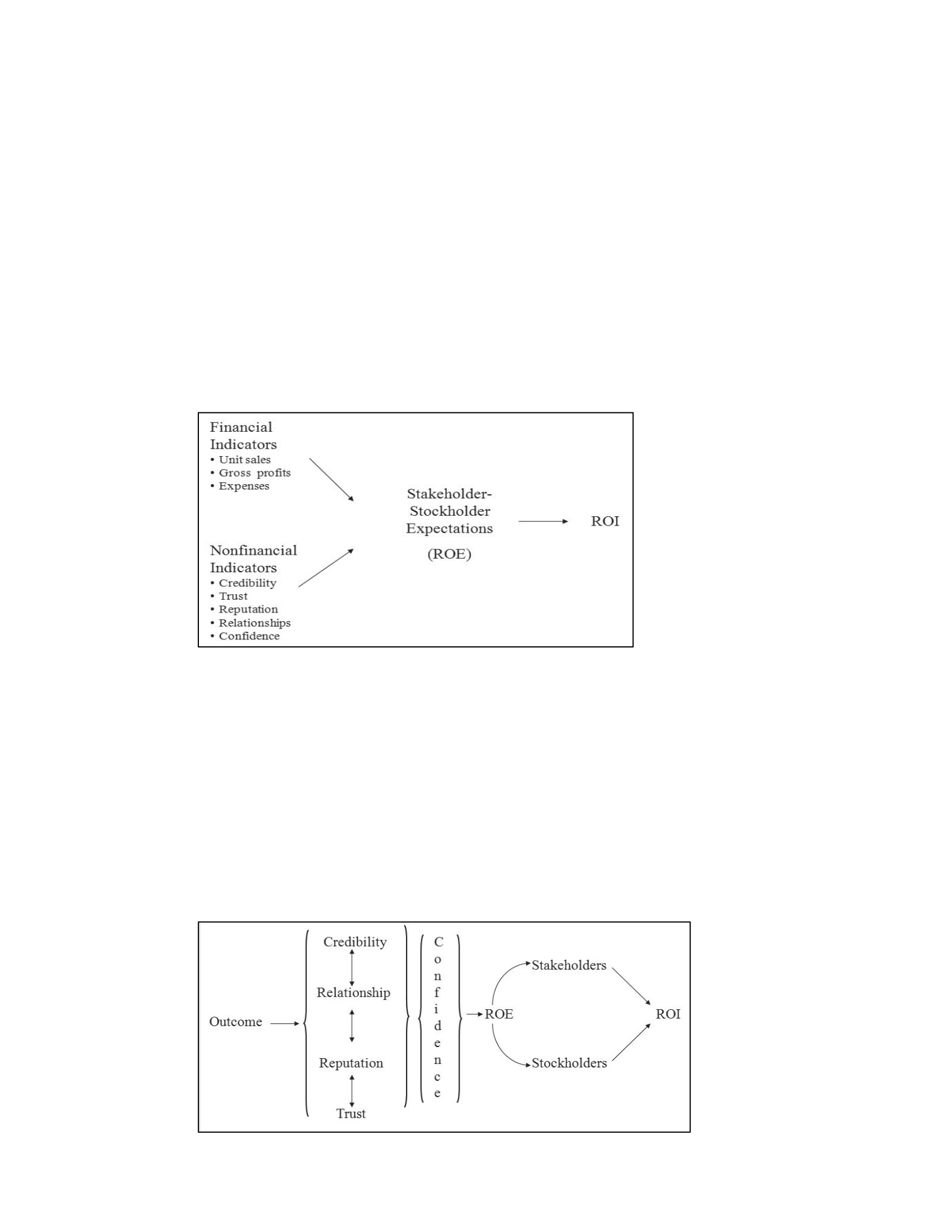
People want to do business or buy the shares of companies that are
trustworthy and sustainable. In addition, a company with a solid reputation is
seen as one that will attract follow-on business, better employees, more investors,
etc. While this ROI/ROE model can contribute to the bottom line strictly in terms of
public relations, as the lines are becoming more blurred between disciplines, it
can be said that this theory would also hold up in a broader strategic
communications model.
Figure 2.1 PR ROI/ROE Mediates Overall ROI
Michaelson, D. & Stacks, D., (2014) A Professional and Practitioner’s
Guide to Public Relations Research, Measurement and Evaluation (2nd
ed.). NY, NY: Business Expert Press. Used with permission.
Furthermore, Michaelson and Stacks (2014) say good public relations’
credibility has a positive impact on ROI by impacting shareholder and stakeholder
confidence as illustrated in Figure 2.2.
35

Figure 2.2 Confidence Effect of Good PR on Overall ROI
Michaelson, D. & Stacks, D., (2014) A Professional and Practitioner’s
Guide to Public Relations Research, Measurement and Evaluation (2nd
ed.). NY, NY: Business Expert Press. Used with permission.
Finally, there is the concept of convergence and communication
integration. The rise of new media (social media, streaming video, blogs, online
news sites, mobile-specific content) and the blurring of lines defining news versus
entertainment as well as the co-mingling of advertising, marketing, and public
relations practices contributes to the need for a more structured, multilevel
approach, which enhances understanding rather than confusing recipients of the
messages. This trend is compounded by the rise of social media and the ready
availability of instant communications across a worldwide network. Webbased
promotions, for example, should be supported by traditional advertising and
underpinned with solid media relations efforts (Shimp, 2010). In addition, solid
efforts at corporate social responsibility or issues management or even crisis
management should be supported by image advertising and incorporated into
marketing efforts as part of any market analysis or informational effort. The rise
of the Internet has created a dramatic shift in transparency metrics and anyone
with an Internet connection can now become an analyst, a voice of opposition or,
hopefully, a raving fan and advocate of a company’s position. In Tindall and
Holtzhausen (2011), “The challenge (to the field) is coordinating and integrating
the communication activities of organizations and in creating a multidisciplinary
but unified body of knowledge that better serves communicative entities in a
society consisting of fragmented audiences and message delivery platforms” (p.
75).
36

The Case for Strategic Communications
In their 2005 study of strategic communications, Argenti, Howell, and Beck
provide a compelling summary of the need for integration not only within the
specific disciplines but also across an organization. Featuring Dell, Inc., FedEx,
Textron, Cendant, and other leading companies, the authors state, “…those
senior executives who think that communications can be delegated to the head of
the corporate communications function are mistaken,” (p. 88). In fact, in many
companies, the CEO acts, in effect, as the senior communications officer of the
company. When asked how much time he spends communicating, Dell’s Kevin
Rollins said, ‘Can you go above 100%?’” (p. 88).
This paradigm shift in the practice has created a corresponding demand
for trained practitioners to execute these functions in coordination — a
readymade opportunity for new graduates who are trained appropriately.
Consequently, this progress in a growing, changing field has created a movement
toward instructional changes at the undergraduate level. More specifically,
communications executives like those at ESPN are seeking people with different,
younger perspectives and outlooks, established “digital native” social media
acumen, multi-platform aptitude, and comfort with wireless-driven developments
in public relations, advertising, and marketing (ESPN, 2009 and
2013: Ranta, 2014b, 2015).
Message to Education from the Professions—Integrate or Die
A study by Rose and Miller (1994) of public relations and advertising
professionals concluded an integrated education curriculum should be created to
37

reflect the needs of the professional marketplace and include additional training
in a wide spectrum of communications techniques. Argenti, Howell, and Beck
(2005) offered the statement:
“Companies that continue to take a laissez-faire approach to
communications will find it increasingly difficult to compete.
Although there will be a continuing need for tactical execution, the
addition of an integrated, strategic focus (emphasis added) will
be critical to success. For communications professionals, this
imperative will not be a threat but an opportunity to not only get a
seat at the table, but to stay there” (p. 89).
In what might be seen as a minor indictment to education, Griffin and
Pasadeos (1998) uncovered disconnects between education and professional
expectations. Reflecting that sentiment in academia, Larsen and Len-Rios (2006)
defined an integrated curriculum as combining advertising, public relations, and
marketing concepts in undergraduate programs. Hallahan et al. (2007) go further,
distinguishing strategic communications as different from integrated
communications, “…because its focus is how an organization communicates
across organizational endeavors” (p. 7). In the same citation, strategic
communications is seen as more purposeful and focused on how an organization
presents (brands) itself across “…the intentional activities of its leaders,
employees, and communication practitioners” (p. 7). In a slightly different take on
the same subject, Grunig (2006) used the term “strategic management role of
public relations” to explain the importance of public relations being more than a
tactical exercise.
The embrace of strategic communications has also expanded to a global
level. Corporations in Europe, South Africa, Australia, New Zealand, and North
America are using “strategic communications” to describe their communications
38

activities (Tindall & Holtzhausen, 2011). Similarly, multiple consulting groups; the
National Investor Relations Institute (National Investor Relations Institute, 2006);
many not-for-profits; the American Bar Association (American Bar Association,
2006); various health communications organizations (Health Communication
Partnerships, 2006; Piotrow & Kincaid, 2001); the U.S. government (McCaffrey,
1999; Office of the Undersecretary of Defense, 2004); the United Nations (United
Nations, 1997); and the Public Relations Society of America (Public Relations
Society of America, 2005) embrace a strategic communications approach.
From a comprehensive perspective, strategic communications is an
effective solution to four phenomena as outlined in table 2.4.
Table 2.4 Justification for the Adoption of Strategic Communications
Reason Justification
Traditional distinctions becoming
blurred
The distinctions between disciplines are
becoming blurred and many traditional
functions are being recombined, leveraged
for strategic purposes.
Technology and media Internet and social media are making it economics are
driving change increasingly difficult to differentiate between
advertising vs. publicity, sales promotion, or
e-commerce.
Organizations using an
expanding variety of methods to
influence behavior
Audience experiences are increasingly
becoming a sum of the people’s
experiences and it is becoming much harder
to isolate any specific method as an
influencer.
Strategic communications is a Historical distinctions of different way for
organizations to communications methods are considered
39

recognize that communications is insufficient to achieve strategically important a
fundamental goal of an entire goals.
organization.
Hallahan, et al., 2007
Todd (2009) recorded the perceptions of PRSSA faculty and professional
advisers when reviewing assessment of students’ learning and faculty
performance. Todd concluded faculty are not teaching the skills students needed
in industry, stating that the emphasis in curriculum is to provide “...practical
experience in new media, internships, preparing students for their first job and
‘hands-on experience’” (p. 71). Todd’s assessment echoes one from much
further back in history where Lee (1947) states “Courses should be regarded as
what they are — a means of conditioning and preparing likely students to enter
upon a series of experiences which may bring them to usefulness in the public
relations field” (p. 91).
Making the specific case for strategic communications, Todd’s 2009 and
2014 studies further stated that employers found students in general lacking in
writing skills, critical thinking skills, and problem-solving skills as well as
comprehension of business practices. To correct this shortfall, Todd offers the
following curriculum recommendations in Table 2.5.
Table 2.5 PR Curriculum Recommendations
Principles of public relations
Research and Evaluation
An internship
Writing and Production
Planning
Campaigns
40

Management
Case Studies
Law and Ethics
Excerpted from Todd 2009
Todd (2009) also asked future employers what knowledge they expected new
graduates to have and those results are included in table 2.6.
Table 2.6 Skills Expectations for New Graduates
Knowledge of global publics
Comprehension of PR theories
Relationship building
Transparency
Research skills
Problem solving
Strategic thinking
Planning
Management
Counseling
Excerpted from Todd, 2009
Looking to technology as being an impetus to integration, Wang (2004)
concluded that new technology is changing the way public relations professionals
communicate with particular attention to video conferencing, and multiple location
projects. For the Institute for Public Relations Researchers, Pavlik (2007)
concluded new media are affecting traditional communication models and
theories. Moreover, this challenge of new technology expands across all
communications disciplines with increasing demands being placed on marketers,
41

advertisers, and other corporate communicators to know how the entire
integrated system works and how to produce content that serves that system.
Are Student-run Agencies Taking Up the Strategic Communications
Banner?
Bush and Miller stated in their 2011 study, “The importance of
understanding student-run agencies lies in the need to determine if and how
communications curricula are falling short of preparing students for the profession
and to examine how agencies might fill potential voids” (p. 485). They further
went on to cite several other researchers, reporting the trend for studentrun
agencies to move more toward an integrated communications approach
(Johnson & Ross, 2001; Kitchen, Kim, & Shulz 2008; AEJMC Report on
Integrated Communication, as cited in Larsen & Len-Rios, 2006, p 35). This
conclusion of the need to integrate can also be reached through observations.
Some examples include integrated courses taught, client work completed,
dedication of resources, faculty and staff to accomplish integration, etc. Larsen
and Len-Rios (2006) found both advertising and public relations educators
agreed that the two most important skills for undergraduates to possess are
writing and critical thinking skills. This commonly felt need might serve as a
springboard for integration of the disciplines within the student-run agency model
and elsewhere. Factors affecting integration are thought to include the physical
age of the instructor, years spent in academia, years spent in professional
practice, and resources available for curriculum integration into a strategic
communications approach.
42

In addition, as Hallahan et al. (2007) point out in their study, strategic
planning is being taught currently in undergraduate programs using a
management by objective approach (Argenti, Howell, & Beck, 2005; Austin &
Pinkleton, 2001; Caywood, 1997; Dozier & Ehling, 1992; Ferguson,1999; Moffitt,
1999; Smith, 2005; Wilson & Ogden, 2004). Consequently pressures may well be
felt by organizations to integrate, and a likely place for this to happen is in the
student-run agency/client-agency relationship.
Integration Resistance
But not all academia is in agreement with the communications integration
concept. Larsen and Len-Rios (2006) found that established communications
programs were less integrated than younger programs. They also discovered
student-agency advisers with strong interest in strategic communications
gravitated more toward communications curriculum integration. Similarly, those in
an integrated curriculum expected more integration and those in a less integrated
program expected the level of integration to stay the same. One other concern
against integrating communications was pointed out by Lauzen (1991). When
public relations is integrated into a cross-disciplinary program, there is a
perceived loss of power to public relations.
Similarly, studies by Laurie and Mortimer (2011) and Kitchen, Schultz, Kim,
Han, and Li (2004) suggest integration is driven by the client as much as by the
firm delivering the service. Moreover, there are distinctive differences between the
agency concepts in the U.S. and Europe. American-based agencies seem more
eager to embrace an integrated model as a way to design agencies — embracing
the concept that integration is the roadmap moving forward, whereas European
43

agencies saw IMC as a tactical breakdown with the emphasis on message
transmission and creation rather than organizational structure. So, what are the
pressures for integration progress? Are influences and pressures to integrate
driven more by clients, by practitioners, or by academics?
Another way to phrase this question is, are agencies meeting the
industry’s desire for more strategic communications capability or are a majority of
agencies still siloed as advertising firms or public relations firms exclusively? In a
study of Strategic Communications in South Africa, Tindall and Holtzhausen
(2011) challenged the siloed approach of communication practices stating, “…
there is more common ground between communication practice in different
settings than previously thought,” (p. 74).
The Need for a Strategic Communications Measure
Despite its detractors, there seems to be a need for convergence and
strategic communications in most programs. These include student-run agencies
(Benigni, Cheng, & Cameron, 2004, and Ranta, 2014a) and other programs
where members are expected to understand and execute strategic
communications upon graduation if not before. This finding leaves open for
discussion how one accurately measures the transition from traditional
communications planning to strategic communications.
Based on these questions and observations, following are the research
questions associated with this inquiry. While correlations for the various
communication types by discipline were conducted, these research questions
were also useful for breaking out various specific DVs as a subset for all
variables within the survey instrument.
44

Research Questions
R1. Is there a significant difference in teaching a strategic communications
curriculum vs. an integrated communication curriculum in terms of applied
communications?
R2. Is there a significant difference in teaching a strategic communications
curriculum vs. an integrated communication curriculum in terms of specialty
communications?
R3. Is there a significant difference in teaching a strategic communications
curriculum vs. an integrated communication curriculum in terms of
communications skills and traits?
R4. Is there a significant difference in teaching a strategic communications
curriculum vs. a public relations curriculum in terms of applied communications?
R5. Is there a significant difference in teaching a strategic communications
curriculum vs. a public relations curriculum in terms of specialty communications?
R6. Is there a significant difference in teaching a strategic communications
curriculum vs. a public relations curriculum in terms of skills and traits?
R7. Is there a significant difference in teaching a strategic communications
curriculum vs. an advertising curriculum in terms of applied communications?
R8. Is there a significant difference in teaching a strategic communications
curriculum vs. an advertising curriculum in terms of specialty communications?
R9. Is there a significant difference in teaching a strategic communications
curriculum vs. an advertising curriculum in terms of skills and traits?
Research Hypotheses
The hypotheses were informed via nine research questions. While
correlations for the various communication types by discipline were conducted,
the research questions were also useful for breaking out various specific DVs as
a subset for all variables within the survey instrument.
For example hypothesis H2b, based on Hallahan et al. (2007), measures a
mean value of importance for political communication (a specialty
communication) between strategic communications and integrated
communications. More specifically, the hypotheses were designed to investigate
how pervasive strategic communications was and how strong the differentiation
45

was between strategic communications and other communications disciplines.
While there were 136 total variables (34 variables divided among applied
communications, specialty communications, and skills and traits x 4
communication disciplines), the hypotheses were intended to be a representative
sample of the relationships, which currently exist between different types of
communication across the other three communications disciplines and strategic
communications. Detailed analyses of the results are included in Chapter 4.
H1 Respondents will report a higher mean value of importance for STRATEGIC
COMMUNICATIONS than INTEGRATED COMMUNICATIONS in the applied
communications dependent variable: business management.
H2a Respondents will report a higher mean value of importance for STRATEGIC
COMMUNICATIONS when compared to INTEGRATED COMMUNICATIONS in
the specialty communications dependent variable: intellectual property.
H2b Respondents will report a higher importance mean value for STRATEGIC
COMMUNICATIONS when compared to INTEGRATED COMMUNICATIONS in
the specialty communications dependent variable: political communication. H3a
Respondents will report a higher mean value of importance for STRATEGIC
COMMUNICATIONS when compared to INTEGRATED COMMUNICATIONS in
the communications skills and traits dependent variable: understands and can
perform qualitative research.
H3b Respondents will report a higher mean value of importance for STRATEGIC
COMMUNICATIONS when compared to INTEGRATED COMMUNICATIONS in
the communications skills and traits dependent variable: understands and can
perform quantitative research.
46

H3c Respondents will report a higher mean value of importance for STRATEGIC
COMMUNICATIONS when compared to INTEGRATED COMMUNICATIONS in
the communications skills and traits dependent variable: acceptance of criticism.
H3d Respondents will report a higher mean value of importance for STRATEGIC
COMMUNICATIONS when compared to INTEGRATED COMMUNICATIONS in
the communications skills and traits dependent variable: persistence.
H4a Respondents will report a higher mean value of importance for STRATEGIC
COMMUNICATIONS when compared to PUBLIC RELATIONS in the applied
communications dependent variable: business management.
H4b Respondents will report a higher mean value of importance for STRATEGIC
COMMUNICATIONS when compared to PUBLIC RELATIONS in the applied
communications dependent variable: strategic planning.
H4c Respondents will report a higher mean value of importance for STRATEGIC
COMMUNICATIONS when compared to PUBLIC RELATIONS in the applied
communications dependent variable: branding communication.
H5a Respondents will report a higher mean value of importance for STRATEGIC
COMMUNICATIONS when compared to PUBLIC RELATIONS in the specialty
communications dependent variable: political communication.
H5b Respondents will report a higher mean value of importance for STRATEGIC
COMMUNICATIONS when compared to PUBLIC RELATIONS in the specialty
communications dependent variable: intellectual property communications.
H5c Respondents will report a higher mean value of importance for STRATEGIC
COMMUNICATIONS when compared to PUBLIC RELATIONS in the specialty
communications dependent variable: regulatory compliance communications.
47

H5d Respondents will report a higher mean value of importance for STRATEGIC
COMMUNICATIONS when compared to PUBLIC RELATIONS in the specialty
communications dependent variable: search engine optimization.
H6a Respondents will report a higher mean value of importance for STRATEGIC
COMMUNICATIONS when compared to PUBLIC RELATIONS in the
communications skills and traits dependent variable: the ability to understand and
perform qualitative research.
H6b Respondents will report a higher mean value of importance for STRATEGIC
COMMUNICATIONS when compared to PUBLIC RELATIONS in the
communications skills and traits dependent variable: the ability to perform
quantitative research.
H6c Respondents will report a higher mean value of importance for STRATEGIC
COMMUNICATIONS when compared to PUBLIC RELATIONS in the
communications skills and traits dependent variable: advertising principles.
H7a Respondents will report a higher mean value of importance for STRATEGIC
COMMUNICATIONS when compared to ADVERTISING in the applied
communications dependent variable: business management.
H7b Respondents will report a higher mean value of importance for STRATEGIC
COMMUNICATIONS when compared to ADVERTISING in the applied
communications dependent variable: strategic planning.
H7c Respondents will report a higher importance mean value for STRATEGIC
COMMUNICATIONS when compared to ADVERTISING in the applied
communications dependent variable: stakeholder communication.
48

H7d Respondents will report a higher mean value of importance for STRATEGIC
COMMUNICATIONS when compared to ADVERTISING in the applied
communications dependent variable: shareholder communication.
H7e Respondents will report a higher mean value of importance for STRATEGIC
COMMUNICATIONS when compared to ADVERTISING in applied
communications dependent variable: crisis communications.
H8a Respondents will report a higher mean value of importance for STRATEGIC
COMMUNICATIONS when compared to ADVERTISING in the specialty
communications dependent variable: technical communications.
H8b Respondents will report a higher mean value of importance for STRATEGIC
COMMUNICATIONS when compared to ADVERTISING in specialty
communications dependent variable: public speaking.
H8c Respondents will report a higher mean value of importance for STRATEGIC
COMMUNICATIONS when compared to ADVERTISING in specialty
communications dependent variable: intellectual property communications.
H8d Respondents will report a higher mean value of importance for STRATEGIC
COMMUNICATIONS when compared to ADVERTISING in specialty
communications dependent variable: regulatory compliance.
H8e Respondents will report a higher mean value of importance for STRATEGIC
COMMUNICATIONS when compared to ADVERTISING in specialty
communications dependent variable: corporate social responsibility.
H8f Respondents will report a higher mean value of importance for STRATEGIC
COMMUNICATIONS when compared to ADVERTISING in specialty
communications dependent variable: not-for-profit communication.
49

H9 Respondents will report a higher mean value of importance for STRATEGIC
COMMUNICATIONS when compared to ADVERTISING in communication skills
and traits dependent variable: public relations principles.
50

CHAPTER 3 METHODOLOGY
This chapter consists of six parts. Part 1 discusses the operationalization
of a Strategic Communications Measure. Part 2 discusses the development of
the study to include focus group approaches. Part 3 discusses the development
of the research instrument. Part 4 discusses formation of research questions and
hypotheses. Part 5 breaks down the instrument by variable. Part 6 discusses the
purposive research sample. Part 7 addresses data analysis.
Part 1 Solving the Puzzle: Operationalization of Strategic Communications
To take up the challenge of defining strategic communications, this
researcher designed a measure for determining what faculty currently teaching in
mass communications areas considered strategic communications. This measure
was developed through analysis of current studies as well as original focus group
work. The process involved the creation of a Mean Value of Importance (MVOI).
Educators, ranking on a four-point scale, determined this value. MVOI was used
to discern how important the dependent variables (loosely arranged into the
categories of applied communications, specialty communications and
communication skills and traits) were to the practice of the strategic
communications discipline. In addition to defining strategic communications,
these variables were also used to ask respondents how they
51
described three other specific communications disciplines: integrated
communications, public relations, and advertising. Dependent variables were

initially adapted from a measure composed by Todd (2009) determining how
effectively practitioners and educators felt current public relations education was
preparing students to compete in the marketplace. However, upon further
investigation informed by work from Hallahan et al. (2007) and preliminary focus
group research, additional items were added. More specifically, the three
communication category variables break out to the following:
Applied Communications Variables (11): business management, strategic
planning, marketing principles, branding communication, media relations,
stakeholder relations, shareholder relations, campaign planning, event
management, crisis communications and media buying.
Specialty Communications Variables (15): technical communications,
patent/IP communications, political communications, regulatory compliance,
interpersonal communications, corporate social responsibility, not-for-profit
communications, new media digital communications, video production, website
development, social media campaigns, public speaking, written communications,
digital analytics, and SEO maximization.
Skills and Traits Variables (8): Skilled in qualitative research, skilled in
quantitative research, values constructive criticism/feedback, demonstrates
familiarity with advertising principles, demonstrates familiarity with public relations
principles, displays collaborative leadership, demonstrates
endurance/persistence, and demonstrates proactive determination.
Part 2 Focus Group Development
The focus group used to inform creation of this survey was composed of
faculty attending an IMC seminar at a southeastern college. Members were
52

recruited by the conference organizer. A total of five faculty participated. Included
in the group were participating faculty who teach business communications,
media production, marketing, integrated marketing communications, professional
communications, journalism, and corporate communications. The focus group
was moderated by an impartial, sixth faculty member to eliminate researcher bias.
The focus group script and organization was designed in accordance with
information from Krueger and Casey (2015) and in further consultation with the
focus group moderator. All responses were recorded. Ultimately, significant
additions to the quantitative survey were incorporated into many of the questions
related to soft skills like: the ability to accept criticism; practice collaborative
leadership; and adopt a proactive orientation. No incentives were provided for
focus group participation. The focus group lasted approximately 70 minutes
during a lunch break within the conference.
A complete outline of the focus group questions is included in Appendix A
Part 1 and findings of the focus group are included in Appendix A Part 2.
Participants were encouraged to discuss their feelings about strategic
communications and integrated communications and where both disciplines were
going in the future. They were also asked to distinguish and define strategic
communications from integrated communications and finally, they were asked to
provide skills and traits that should be identified and cultivated in order for a
student to become more attractive to employers. The qualitative focus group
input figured in the overall design of the quantitative instrument.
53

Survey Design
Survey design, data collection, and analysis were completed in
accordance with the procedures as outlined in the researcher’s university
Institutional Review Board. (See documentation of IRB proceedings in Appendix
F). All results were kept confidential. The survey instrument was tested via a brief
pilot study prior to release. The goal for an estimated completion time of the
quantitative survey was 15-20 minutes (University of South Carolina, 2015).
To ensure maximum completion rates of the survey, a $100 gift card was
initially offered as an incentive. As it became clear that more respondents were
required, six additional $50 gift cards were added (Goritz, 2004, 2006). All seven
cards were distributed as part of a random drawing among those who completed
the survey and opted-in by providing a valid email address at the end of the
survey (Ragas & Culp, 2014; Todd 2009,).
Part 3 Developing the Research Instrument
This section discusses the development of the survey itself and includes
assumptions. The survey was developed in accordance with best practices and
based on a variety of sources.
This survey measured a series of variables categorized under the
headings of applied communications, specialized communications, and skills and
traits found among practitioners. The variables were further refined to investigate
within four recognized communications disciplines: strategic communications,
integrated communications, public relations, and advertising. A complete survey
is included in Appendix A, Part 3.
54

Initially the questionnaire was taken from Todd 2009 and modified from
information obtained via the literature review and consultation with various faculty
members. The instrument was also tested using two pilot flights of research
colleagues at my institution and research cohorts elsewhere.
Of particular interest was the question of whether radio buttons or sliding
scales were more appropriate for the forced response questions. It was also
tested for elapsed time. The goal was to develop a survey that could be
completed in less than 15 minutes.
Assumptions
The first part of the survey was designed to confirm some assumptions
about the state of strategic communications in education and in practice. Four
statements about strategic communications were provided, using a 3-point scale
with the values disagree (1) neither agree nor disagree (2) and agree (3).
Specific questions are included in Table 3.1.
Table 3.1 Variables and Explanations—Initial Assumptions
Variable Explanation
Clear differences between integrated
and strategic communications
This question was prepared largely
based on data gathered during the
initial focus group.
Increasing demands for students to be This question was added to the trained
in strategic communications instrument based on Laurie &
Mortimer (2011) and Moody (2012).
Increasing demands for
communications professionals to
This question was added based on
Laurie & Mortimer (2011), Moody
55

embrace strategic communications (2012) and Kitchen et al. (2004).
Integrated strategic communications is
the next evolution of professional
communications.*
This question is based on
Holtzhausen, & Zerfass (2015)
All questions use a three-point scale (1 = disagree, 2 = neutral, 3 = agree)
*Question 4 was a test question to determine respondents’ agreement with the
potential for combining the two disciplines.
Subsequent parts of the survey were developed using a forced 4-point Likerttype
scale.
Part 4 Operationalization and Mean Values of Importance (MVOIs)
As mentioned previously, while there were a total of 136 dependent
variables explored in this portion of the survey, only 29 hypotheses were selected
for this study. These specific variables were selected based on Hallahan et al.
(2007), organic knowledge from the researcher, and focus group input.
The hypotheses were chosen as a representative sample of all potential
102 comparisons with strategic communications from the 34 types of
communications variables and the three other communications disciplines.
Operationalization was accomplished using a Mean Value of Importance
(MVOI) and a metric was designed to help query educators, particularly those in
capstone courses and student-run agencies to develop a benchmark for weighing
each variable in designing a curriculum. The instrument asked respondents to
decide/rank how important each item was to the practice of strategic
communications, integrated communication, public relations, and advertising.
1. The instrument asked respondents to decide, out of 11 applied
communications variables, how important each item was to the practice of
56

strategic communications, integrated communication, public relations, and
advertising.
2. The instrument asked respondents to decide, out of 15 specialized
communications variables, how important was each item to the practice of
strategic communications, integrated communication, public relations, and
advertising.
3. The instrument asked respondents to decide, out of eight skills and traits
variables, how important was each item to the practice of strategic
communications, integrated communication, public relations, and advertising.
4. Finally the instrument asked the respondents, via open responses, to name
any missing, essential applied communication, type of communication, skill or
trait they thought were important for the practice of strategic communications,
integrated communication, public relations, and advertising.
For example, if business management scored highly on the MVOI scale,
advisers and/or curriculum committees would know to ensure some part of the
strategic communications area of instruction included lessons and applications in
business management.
More About (MVOIs)
The MVOI was designed to confirm the strength of agreement of
respondents to the variables listed under Applied Communications, Specialty
Communications, and Communications Skills and Traits. The scale associated
with the measurement used a four-point “forced choice ” Likert-type scale of
perceived importance (Bertram 2007 and Vogt 1999). The scale was anchored
using the following terms: 1 = Not Important at All; 2 = Of Little Importance; 3 =
57

Average Importance and 4 = Essential. The higher the value of the mean per
question, the more important that variable was to its respective discipline.
The Mean Values of Importance, (MVOI), could then be compared to
determine how important each variable was to its respective discipline and
whether there was a significant difference between the mean values of each
discipline. Specific variables were drawn from literature, focus group information,
and personal experience. A complete copy of the survey is in Appendix A, Part 3.
Commitment of Resources
Following the Mean Value of Importance questions, the next portion of the
survey was based on a 100-point sliding scale and discussed Strategic
Communications Investment of Resources. Questions for this section were
derived from Bush (2009) and Ranta (2014a) as well as the PRSSA Student-run
Agency handbook. In this series of questions, respondents were asked to
comment on investments in Equipment, Travel, Hiring Faculty, Hiring Staff,
Dedicated Space and Dedicated Classes as a way to record investments in
teaching strategic communications. Anchors for the scale were: No investment
(0-33), Some investment (34-67) and Significant investment (68-100).
Student-run Agency Adviser Questions
The next part of the survey was addressing Student-run Agency Advisers.
This portion consisted of eight questions and was accessed via skip logic to
those who indicated they had past experience as a Student-run Agency Adviser.
58

Analyses of these questions will be the topic of future research and
incorporate the findings of this dissertation as part of future publication.
Descriptive Statistics and Incentives
The final portion of the survey was a brief, seven-question demographic
profile. The respondent’s age, experience (teaching and practicing), location of
their program, and current rank were asked. The last question of the survey
provided an opportunity to opt-in for a drawing of a Visa gift card as an incentive
(one $100 and six $50) (Sanchez-Fernandez, Muñoz-Levia, Montore-Rios, &
Ibáñez-Zapata, 2010: Goritz, 2004, 2006).
About Forced Response and Progress Bars
The questionnaire was distributed via Qualtrics survey software using its
email function. The desired 15-20 minute completion time and the
comprehensive nature of the research (including the student-run agency portion
of the suvey) created two concerns when preparing to reach the sample. The first
three parts of the survey used a forced response format. While the forced
responses settings were necessary to secure the proper data, it was a concern
that some respondents would abandon the survey without completion based on
the survey lengths (Tukibayeva & Sarraf, 2012). Based on the 86 percent survey
completion rate, this finding was realized.
As a way to encourage more completions, the progress bar was removed
from the survey, prior to distribution. The justification for removing the bar was
because half of the length of the complete survey was dedicated to student-run
agency advisers. A high percentage of the respondents were not expected to
have experience as student-run agency advisers, and would therefore not be
59

asked to complete a significant portion of the survey. If the progress bar were left
on the survey, respondents may have erroneously concluded the survey was too
long, the progress rate unsatisfactory, and would abandon the survey
prematurely (Mersdorf, 2009). Indeed emails were received from a respondent
asking the survey’s actual length and expressed irritation that no progress bar
was included. However, when the lack of a progress bar was explained, the
respondent understood and completed the survey that day.
Part 5 Breakdown of the Instrument by Variable
Following are a series of tables categorizing the variables, their source,
and their communications types (applied, specialty, skills and traits) measured
across the four communication disciplines (strategic, integrated, public relations,
and advertising).
Table 3.2 Mean Value of Importance (MVOI) for Applied Communications (11)
Measured Variables*
Business Management
Shareholder Relations
Strategic Planning
Campaign Planning
Marketing Principles
Event Management
Branding Communication Crisis Communication
Media Relations
Media Buying
Stakeholder Relations
Selections based on ESPN (2013); Dissertation Focus Group Information (2015);
60

Hallahan et al. (2007); Paskin (2013); Ryan (2014) and Todd (2009)
*All responses in a 4-point Likert-type Scale: (Not Important At All, Of Little
Importance, Average Importance or Essential) (Vogt 1999)
Table 3.3 Mean Value of Importance (MVOI) for Specialty Communications (15)
Measured Variables*
Technical Communication
Video production
Patent/IP Communication
Website development
Political Communication
Social media campaigns
Regulatory Compliance
Public speaking
Interpersonal Communication
Written communication
Corporate Social Responsibility
Digital analytics
Not for profit communication
SEO maximization
New media digital communication
Selections based on ESPN (2009, 2013); Dissertation Focus Group Information
(2015); Hallahan et al. (2007); and Rose & Miller (1994)
*All responses in a 4 point Likert Scale: (Not Important At All, Of Little
Importance, Average Importance or Essential). (Vogt 1999)
Table 3.4 Mean Value of Importance (MVOI) for Communications Skills and Traits
(8)
61

Measured Variables*
Skills in Qualitative Research
Demonstrates familiarity with public
relations principles
Skills in Quantitative Research
Displays collaborative leadership
Values Constructive
Criticism/Feedback
Demonstrates endurance/persistence
Demonstrates familiarity with
advertising principles
Demonstrates proactive
determination
Selections based on ESPN (2009, 2013); Dissertation Focus Group Information
(2015); Hallahan et al. (2007); and Rose & Miller (1994)
*All responses in a 4-point Likert Scale: (Not Important At All, Of Little Importance,
Average Importance or Essential). (Vogt 1999)
Descriptive Information
The next set of variables (descriptives) had high face validity and include:
year born, years of professional integrated communications experience, years of
professional strategic communications experience, years teaching, location of
current teaching (public, private, or other), and current academic rank. These
descriptives would be used in the final analysis to determine if there was any
variance in responses between age, years of experience, years teaching, etc.
Part 6 Purposive Research Sample
Following testing of the survey for coherence, time and flow among six
colleagues/research cohorts, the survey was distributed via email to the target
database. The first purposive sample developed for this research included 726
faculty members located throughout the United States. The database was
assembled using the AEJMC directory of universities reporting a student-run
62

public relations agency, a student-run advertising agency, or an unspecified
(perhaps IMC or strategic communications) agency. An additional source was a
list of conference attendees to an American Advertising Federation conference.
All sample members email addresses were verified via an Internet search, prior
to the first survey distribution.
A note about final sample size: The first distribution of the survey was
deemed unsuccessful. Of the initial flight of 726 emails in July 2015, only 30
usable surveys were returned. Failure of response was attributed to a poor
subject line of the initial e-mail, inopportune timing and lack of personalized text
in the email greeting and the body of the survey. Post hoc analysis concluded
most faculty were likely on sabbatical, vacation, or otherwise engaged and away
from their university email. These oversights were corrected in subsequent
polling.
What’s in a Name? The Second Distribution
As a solution to boost responses and to see if personalization via piped
text would enhance our response rate, an additional email survey was sent two
weeks later to the first 50 names on the original database. To avoid duplication of
answers, email addresses of the 30 who responded to the first distribution were
removed from the list prior to mailing. Piped text allows personal salutations or
other information to be included in each email.
For example, a solicitation email may read Dear Mr. Jones or Dear Dr.
Harris as part of the salutation. To successfully accomplish this on a large scale,
piped text automatically enters information from the survey database. Piped text
63

can be used in the body of the email greeting, in the email subject line, and in the
body of the survey.
As a way to ensure accuracy of the piped text personalization, an
additional validation via an Internet search was conducted of the 50 targeted
names. This verification yielded the first name, last name, title, place of
employment, and email address of the group. When this search was complete,
and using Qualtrics’ piped text feature, the survey was sent.
Out of this second flight to the aforementioned group of 50, using piped
text, three responses were obtained. While statistically a much higher
percentage of responses in the second flight, than in the initial emailing, the
overall n was still suboptimal for the desired inferential statistical analysis.
However, as the personalized results proved promising and as timing was
still considered inopportune for a mass emailing to the entire database, a final
audit was conducted (after removing the first 50 names from the piped text flight).
Methodology for the final audit was identical to that of the second flight of 50
names. Internet searches were conducted confirming first name, last name, title,
email address and area of instruction. This deeper audit led to a removal of 146
individuals (including the initial 50 from the personalization test) from the
purposive sample.
Many of those names culled belonged to individuals who worked in other
areas of academic instruction not directly related to the four dimensions
investigated in this survey (strategic communications, integrated communications,
public relations, and advertising). During this final validation, when multiple points
of contact (POCs) were identified at the same institution and were determined to
64

be qualified, (teaching integrated communications, public relations, advertising, or
strategic communications), a limit of four individuals from each university were
selected. In the case of more than four potential POCs, preference was shown to
senior leadership (dean, director, professor, associate professor).
Finally, in an effort to instill more responses, an additional incentive of six
$50 gift cards were included in the offering text for completing the survey. These
six cards were in addition to a $100 gift card used as incentive for the first survey
wave. Funds to purchase the gift cards were provided by a small research fund
at the author’s university.
Round 3
On September 9, 2015, the survey was distributed for a third time. Title
and last name were used for piped text in both the email solicitation and opening
text block of the survey. The timing was planned to correspond to the second full
week of work for most faculty. Research indicated the added incentives,
personal appeal, and better timing would deliver a greater overall response rate
than previous attempts (Goritz, 2004, 2006; Van Dessel, 2015).
In an effort to ensure this flight would complete the survey, the sample was
contacted two more times, once on September 14, 2015 and again on
September 22, 2015 with continuing appeals to complete the survey. In each
case, respondents who had completed the survey were removed from the
followon solicitations prior to an additional appeal being released.
Ultimately, combining all three of the September appeals in Round 3, a
total of 179 acceptable responses were obtained. Added to the 33 usable
responses from the two, initial, underperforming attempts, an overall final total of
65

n = 212 responses were obtained. This group of 212 was used to analyze the
research. This number equates to an overall response rate of 212/580 or a 37
percent return rate.
Culling Responses
While 212 cases was the final total used, there were 247 total responses
received in the third round. Unfortunately not all of them were kept. Thirty-five
responses from the third round were discarded prior to analysis. Criteria for
discarding a response included all surveys completed in less than four minutes.
Given the scope and number of variables provided in the survey, as well as the
time required to complete the survey in our initial tests with the cohort, anyone
completing the survey in less than four minutes was considered not have spent
sufficient time reviewing potential answers. When the survey was completed, the
gift cards were awarded via the U.S. postal service. Winners were selected from
the respondent pool who opted in during the survey. Specific respondent names
were selected using a random number generator linked to white noise from a
randomized table of the names of the respondents. When contacted, winners
were asked to provide or verify a mailing address for delivery of their incentive.
Ultimately the gift cards purchased and awarded were not Visa gift cards
but MasterCard gift cards as the Visa gift cards were not sold in many stores in
the researcher’s area.
Part 7 Data Analysis
Data analysis for the survey was accomplished using inferential statistics
(Wimmer & Dominick, 2011). Specifically, calculations were made to include
66

means testing, paired sample, single tailed t-tests and Cronbach’s Alpha. Testing
was conducted using SPSS software (Leech, Barrett, & Morgan, 2011).
Cronbach’s Alpha
Before detailed analysis, the survey instrument was subjected to reliability
testing for internal consistency using Cronbach’s Alpha. As all variables
presented were in acceptable ranges, the mean values of each MVOI were then
subjected to paired t-tests (single-tailed) to determine how the variable scored in
all communications dimensions (strategic communications, integrated
communications, public relations, and advertising).
Specific testing was performed against the hypotheses initially and then
subsequent testing was performed against all variables in comparison with
strategic communications.
67

CHAPTER 4 RESULTS
This chapter is divided into seven parts. Part 1 details the descriptive
statistics of the sample. Part 2 analyzes the assumptions made of the demand for
strategic communications education. Part 3 details the results of the exploratory
focus group. Part 4 details the Cronbach’s Alpha values for internal consistency
(reliability). Part 5 details the results of testing the hypotheses in this research.
Part 6 includes an overall list of variable means by area of concentration. It
includes the post-hoc analysis, and an overall correlation of strategic
communications variables against corresponding dimensions of public relations,
advertising, and integrated communications. Part 6 also includes a series of
correlations of dependent variable means between strategic communications and
all other communications dimensions broken down by category: applied
communications, specialty communications, and communications skills and traits.
Part 7 includes findings related to age, number of years working in strategic
communications and years working in teaching,
In addition, Appendix C offers a matrix of the hypotheses means and
Appendix D offers results of t-tests for significance for each dependent variable.
Part 1 Descriptive Statistics
The total number of respondents to this survey was N = 247 faculty
members. The total number of usable responses was N = 212.
68
Each case represented an individual who taught strategic communications,
integrated communications, public relations, or advertising. No specific number

per discipline was recorded as many faculty taught in multiple areas. The mean
age of respondents was 53 years. Overall age range of respondents was ages
23-83 with 16 cases not reporting. The mean number of total years teaching was
15. The range of years teaching among the respondents was 0 to 39 years with
seven cases not reporting. The mean number of years of teaching and/or
practicing integrated communications was 17 with total values ranging from 0 to
50 with nine cases not reporting. The mean number of total years teaching and
or practicing strategic communications was 15 with total values ranging from 0 to
50 with 12 cases not reporting.
Part 2 Assumptions
This research included introductory questions addressing assumptions of
the growth of strategic communications in the professional field and in the
educational field. These assumptions were important to inform further research.
Questions for the assumption section were posed using a 3-point scale (1=
Disagree, 2= Neutral and 3 = Agree) Table 4.1 details the specific means and
responses.
Table 4.1 Assumptions Testing–Defining Perceived Demands About Strategic
Communications
Question Mean SD
There are increasing demands for students
to be trained in strategic communications.
2.84
.44
There are increasing demands for communications professionals to
embrace
strategic communications. 2.83 .44
69

Integrated strategic communications is the
next evolution of professional
communications.
2.49
.59
There are clear differences between integrated
communications and strategic
communications. 2.05 .80
Value 1-3, (1 = Disagree, 2 = Neither Agree nor Disagree, 3 = Agree)
While the continuous variables all showed a mean that indicated some
level of agreement with the growth of strategic communications, one of the most
telling of the findings was the ambivalence present in the statement “There are
clear differences between integrated communications and strategic
communications.” This finding was of particular importance in the post hoc
analysis as detailed in Chapter 5. A similar finding is also discussed from the
perspectives obtained in part two of the survey targeting student-agency advisers.
Approximately 127 of the 212 respondents indicated some past or present
relationship with advising student-run agencies. While these insights were mined
to measure pressures to teach strategic communications, further study of that
data may yield more insights to better inform how to tailor a curriculum to
incorporate strategic communications into an undergraduate program. An
example of one of the findings is listed below in Table 4.2. This set of questions
addressed pressures and efforts student-run agency advisers report in the need
to incorporate strategic communications into their curricula to make their students
more attractive to future employers.
Table 4.2 Perceived Pressures and Efforts to Become More Strategic
Communications Oriented. (N = 127)
70

Question Mean Value
My student-run agency is actively trying to make my students
more attractive to employers by building strategic
communications skills.
86.38
Relative to client pressures, my student-run agency has been
encouraged to become more strategic.
65.05
(Values 0-100 (Strongly disagree 0-19, Disagree 20-39, Neither Disagree nor
Agree 40-59, Agree 60-79 and Strongly Agree 80-100)
Part 3 Exploratory Focus Group Results
As a way to inform the research and shape the questionnaire provided to
our quantitative sample, a focus group was conducted. A complete copy of the
Focus Group Guide (questions and directions) can be found in Appendix A Part 1.
A representative sample of excerpts from the focus group is included in Appendix
A Part 2. Some respondents’ information appears to contradict other responses,
but as the contradictions from the focus group were unclear, many of the findings
were incorporated into the research instrument as described in the earlier
chapter. In addition, free response questions were added to the survey to help
dissuade the confusion. The mixed method approach used for this research was
appropriate to allow for individual insights from each focus group member.
Also notable from the focus group data was contradictory information
differentiating between strategic communications and integrated communications.
This contradictory focus group information foreshadowed similar findings in the
quantitative surveys. Consider the following two statements made by focus
group participants, trying to establish the difference between strategic
communications and integrated communications:
71

Respondent 1: “Integration (integrated communications) has to do with
brand building, elite form brand building. Strategic is different. Strategic
falls under the umbrella of brand building. Not the same. Strategic
communications contains multiple contexts.”
Respondent 2: “Strategic communications ties to outcome, which ties to
elements, which ties to objectives and tactics that ties to goal. Brand leads
to a strategy that leads to tactics. But before all of that, your outcome ties
to your goal. (You) don't start strategically. (You) need a big picture that
informs the entire process. What are their goals, what do they want to
accomplish and then what are the tactics?”
These competing explanations of what is strategic communications and
how it fits under integrated communications are contrary to literature descriptions
that strategic communications is the umbrella, which all other communications
(including integrated communications), fit under. These contradictory definitions
between strategic and integrated communications are important distinctions and
should provide some caution moving forward in validating the hypotheses
addressing them.
Part 4 Cronbach’s Alpha—Internal Validity (Reliability)
In combining means in the survey analysis, it was important to maintain
internal consistency of the measures. Internal consistency was evaluated using
Cronbach’s Alpha. The following table reports the Cronbach’s Alpha tests. Range
of correlations for each group of variables and the corresponding dimensions was
.65 -.85. A total Cronbach’s Alpha score for all of the MVOIs was .96.
Table 4.3 Cronbach’s Alpha Scores
Cronbach’s
Alpha/(N = 212)
Strategic
Comms.
Integrated
Comms.
Public
Relations
Advertising
Applied Comms.
(11 items)
.74
.74
.65
.75
72

Specialty Comms.
(15 items)
.84
.85
.81
.83
Skills and traits
(8 items)
.76
.77
.83
.82
All MVOI
.96
Range from .65 to .85.
Part 5 Hypotheses Testing
Hypotheses were tested using single-tail paired t-tests for differences
between the mean response ratings for different variables using the formula 𝑡
= !!!/ !! !!! where X1 and X2 are the respective paired variable means, S is the
paired standard deviation and N is the number of survey responses.
Twenty-nine hypotheses were selected as a purposive sample of MVOI
and are provided later in this chapter. Implications of these findings and
recommended follow-on research are discussed in Chapter 5.
The t-test methodology was selected as a way to interpret differences in
the Mean Value of Importance (MVOI). All MVOI values were scored by
respondents using a 4-point, forced, Likert-type scale with 1 = Not Important at all,
2 = Of little importance, 3 = Average importance or 4 = Essential. Alternative
explanations of calculating the hypotheses were not explored as part of this initial
research. Table 4.4 provides a general summary finding of all hypotheses. Figure
4.1 provides detailed explanations by hypotheses.
73

H1 Respondents will report a higher mean value of importance for
STRATEGIC COMMUNICATIONS than INTEGRATED COMMUNICATIONS in
the applied communication dependent variable: business management.
There were no differences in a paired t-test between strategic communications
and integrated communications in the applied communications category
dependent variable business management. The hypothesis was not supported.
H2a Respondents will report a higher mean value of importance for
STRATEGIC COMMUNICATIONS when compared to INTEGRATED
COMMUNICATIONS in the specialty communication dependent variable:
intellectual property. A paired t-test indicated a significant difference between
mean values of importance for the specialty communications dependent variable:
intellectual property between strategic communications (M= 2.59) and integrated
communications (M= 2.52) with a paired standard deviation of .58 for 212 cases.
Conditions, t = 1.66 p = .05. The hypothesis was supported
H2b Respondents will report a higher importance mean value for
STRATEGIC COMMUNICATIONS when compared to INTEGRATED
COMMUNICATIONS in the specialty communication dependent variable:
political communications. A paired t-test indicated a significant difference
between mean values of importance for the specialty communications dependent
variable: political communication between strategic communications (M= 3.18)
and integrated communications (M= 2.89) with a paired standard deviation of .65
for 212 cases. Conditions, t = 6.62 p = .00. The hypothesis was supported. H3a
Respondents will report a higher mean value of importance for
74

STRATEGIC COMMUNICATIONS when compared to INTEGRATED
COMMUNICATIONS in the communications skills and traits dependent
variable: understands and can perform qualitative research. There were no
significant differences in a paired t-test between strategic communications and
integrated communications in the communications skills and traits dependent
variable: Understands and can perform qualitative research.
The hypothesis was not supported.
H3b Respondents will report a higher mean value of importance for
STRATEGIC COMMUNICATIONS when compared to INTEGRATED
COMMUNICATIONS in the communications skills and traits dependent
variable: understands and can perform quantitative research. A paired t-test
indicated a significant difference between mean values of importance for the
specialty communications dependent variable: understands and can perform
quantitative research, between strategic communications (M= 3.65) and
integrated communications (M= 3.57) with a paired standard deviation of .54 for
212 cases. Conditions, t = 2.27 p = .012. The hypothesis was supported.
H3c Respondents will report a higher mean value of importance for
STRATEGIC COMMUNICATIONS when compared to INTEGRATED
COMMUNICATIONS in the communications skills and traits dependent
variable: acceptance of criticism. A paired t-test indicated a significant
difference between mean values of importance for the specialty communications
dependent variable: accepts criticism, between strategic communications (M=
3.73) and integrated communications (M= 3.60) with a paired standard deviation
75

of .49 for 212 cases. Conditions, t = 3.83 p = .000. The hypothesis was
supported.
H3d Respondents will report a higher mean value of importance for
STRATEGIC COMMUNICATIONS when compared to INTEGRATED
COMMUNICATIONS in the communications skills and traits dependent
variable: persistence. A paired t-test indicated a significant difference between
mean values of importance for the specialty communications dependent variable:
persistence, between strategic communications (M= 3.67) and integrated
communications (M= 3.61) with a paired standard deviation of .42 for 212 cases.
Conditions, t = 1.82 p = .04. The hypothesis was supported.
H4a Respondents will report a higher mean value of importance for
STRATEGIC COMMUNICATIONS when compared to PUBLIC RELATIONS in
the applied communications dependent variable: business management. A
paired t-test indicated a significant difference between mean values of
importance for the specialty communications dependent variable: business
management, between strategic communications (M= 3.40) and public relations
(M= 3.49) with a paired standard deviation of .62 for 210 cases. Conditions, t =
2.10 p = .02. However, because t is a negative value, the hypothesis was not
supported.
H4b Respondents will report a higher mean value of importance for
STRATEGIC COMMUNICATIONS when compared to PUBLIC RELATIONS in
the applied communications dependent variable: strategic planning. A
paired t-test indicated a significant difference between mean values of
importance for the specialty communications dependent variable: strategic
76

planning, between strategic communications (M = 3.88) and public relations (M =
3.83) with a paired standard deviation of .45 for 210 cases. Conditions, t = 1.86
p = .03. The hypothesis was supported.
H4c Respondents will report a higher mean value of importance for
STRATEGIC COMMUNICATIONS when compared to PUBLIC RELATIONS in
the applied communications dependent variable: branding communication.
There were no significant differences in a paired t-test between strategic
communications and public relations in the applied communications skills
dependent variable branding communication. The hypothesis was not supported.
H5a Respondents will report a higher mean value of importance for
STRATEGIC COMMUNICATIONS when compared to PUBLIC RELATIONS in
the specialty communications dependent variable: political communication.
A paired t-test indicated a significant difference between mean values of
importance for the specialty communications dependent variable: political
communications between strategic communications (M= 3.18) and public
relations political communications (M= 3.35) with a paired standard deviation
of .75 for 210 cases. Conditions, t = -3.31 p = .000. However, because t is a
negative value, the hypothesis was not supported.
H5b Respondents will report a higher mean value of importance for
STRATEGIC COMMUNICATIONS when compared to PUBLIC RELATIONS in
the specialty communications dependent variable: intellectual property. A
paired t-test indicated a significant difference between mean values of
importance for the specialty communications dependent variable: intellectual
property between strategic communications (M= 2.59) and public relations (M=
77

2.78) with a paired standard deviation of .75 for 210 cases. Conditions, t = -3.67
p = .00. However, because t is a negative value, the hypothesis was not
supported.
H5c Respondents will report a higher mean value of importance for
STRATEGIC COMMUNICATIONS when compared to PUBLIC RELATIONS in
the specialty communications dependent variable: regulatory compliance
communication. A paired t-test indicated a significant difference between mean
values of importance for the specialty communications dependent variable:
regulatory compliance between strategic communications (M= 3.02) and public
relations communications (M= 3.25) with a paired standard deviation of .75 for
210 cases. Conditions t = -.4.43 p = .000. However, because it was a negative
value, the hypothesis was not supported.
H5d Respondents will report a higher mean value of importance for
STRATEGIC COMMUNICATIONS when compared to PUBLIC RELATIONS in
the specialty communications dependent variable: search engine
optimization. There were no significant differences in a paired t-test between
strategic communications and public relations in the specialty communications
dependent variable search engine optimization. The hypothesis was not
supported.
H6a Respondents will report a higher mean value of importance for
STRATEGIC COMMUNICATIONS when compared to PUBLIC RELATIONS in
the communications skills and traits dependent variable: the ability to
understand and perform qualitative research. There were no significant
differences in a paired t-test between strategic communications and public
78

relations in the communications skills and traits dependent variable the ability to
understand and perform qualitative research. The hypothesis was not supported.
H6b Respondents will report a higher mean value of importance for
STRATEGIC COMMUNICATIONS when compared to PUBLIC RELATIONS in
the communications skills and traits dependent variable: the ability to
perform quantitative research. A paired t-test indicated a significant difference
between mean values of importance for the specialty communications dependent
variable: the ability to perform quantitative research between strategic
communications (M= 3.65) and public relations (M= 3.53) with a paired standard
deviation of .55 for 210 cases. Conditions, t = 3.17 p = .00. The hypothesis was
supported.
H6c Respondents will report a higher mean value of importance for
STRATEGIC COMMUNICATIONS when compared to PUBLIC RELATIONS in
the communications skills and traits dependent variable: advertising
principles. A paired t-test indicated a significant difference between mean values
of importance for the specialty communications dependent variable: advertising
principles between strategic communications (M= 3.55) and public relations (M=
3.39) with a paired standard deviation of .64 for 210 cases. Conditions, t = 3.65 p
= .000. The hypothesis was supported.
H7a Respondents will report a higher mean value of importance for
STRATEGIC COMMUNICATIONS when compared to ADVERTISING in the
applied communications dependent variable: business management. A
paired t-test indicated a significant difference between mean values of
importance for the specialty communications dependent variable: business
79

management between strategic communications (M= 3.40) and advertising (M=
3.31) with a paired standard deviation of .75 for 210 cases. Conditions, t = 1.65 p
= .05. The hypothesis was supported.
H7b Respondents will report a higher mean value of importance for
STRATEGIC COMMUNICATIONS when compared to ADVERTISING in the
applied communications dependent variable: strategic planning.
A paired t-test indicated a significant difference between mean values of
importance for the specialty communications dependent variable: strategic
planning between strategic communications (M= 3.89) and advertising (M= 3.76)
with a paired standard deviation of .54 for 210 cases. Conditions, t = 3.60 p = .00.
The hypothesis was supported.
H7c Respondents will report a higher importance mean value for
STRATEGIC COMMUNICATIONS when compared to ADVERTISING in the
applied communications dependent variable: stakeholder communications.
A paired t-test indicated a significant difference between mean values of
importance for the specialty communications dependent variable: stakeholder
communication between strategic communications (M= 3.62, SD = .55) and
advertising (M= 3.04, SD = .78) with a paired standard deviation of .85 for 210
cases. Conditions t = 10 p = .00. The hypothesis was supported.
H7d Respondents will report a higher mean value of importance for
STRATEGIC COMMUNICATIONS when compared to ADVERTISING in the
applied communications dependent variable: shareholder communications.
A paired t-test indicated a significant difference between mean values of
importance for the specialty communications dependent variable: shareholder
80

communication between strategic communications (M= 3.48,) and advertising
(M= 2.90,) with a paired standard deviation of .87 for 210 cases. Conditions t =
9.57 p = .00. The hypothesis was supported.
H7e Respondents will report a higher mean value of importance for
STRATEGIC COMMUNICATIONS when compared to ADVERTISNG in
applied communications dependent variable: crisis communications. A
paired t-test indicated a significant difference between mean values of
importance for the specialty communications dependent variable: crisis
communication between strategic communications (M= 3.70) and advertising
(M= 2.89) with a paired standard deviation of .84 for 210 cases. Conditions, t =
13.91 p = .00. The hypothesis was supported.
H8a Respondents will report a higher mean value of importance for
STRATEGIC COMMUNICATIONS when compared to ADVERTISING in the
specialty communications dependent variable: technical communications.
There were no significant differences in a paired t-test between strategic
communications and advertising in the specialty communications dependent
variable: technical communication. The hypothesis was not supported.
H8b Respondents will report a higher mean value of importance for
STRATEGIC COMMUNICATIONS when compared to ADVERTISING in
specialty communications dependent variable: public speaking.
A paired t-test indicated a significant difference between mean values of
importance for the specialty communications dependent variable: public speaking
between strategic communications (M= 3.49,) and advertising (M= 3.27) with a
paired standard deviation of .84 for 210 cases. Conditions, t = 3.85 p = .00. The
hypothesis was supported.
81

H8c Respondents will report a higher mean value of importance for
STRATEGIC COMMUNICATIONS when compared to ADVERTISING in
specialty communications dependent variable: intellectual property
communication. There were no significant differences in a paired t-test between
strategic communications and advertising in the specialty communications
dependent variable: intellectual property communication. The hypothesis was not
supported.
H8d Respondents will report a higher mean value of importance for
STRATEGIC COMMUNICATIONS when compared to ADVERTISING in
specialty communications dependent variable: regulatory compliance.
There were no significant differences in a paired t-test between strategic
communications and advertising in the specialty communications dependent
variable: regulatory compliance communication. The hypothesis was not
supported.
H8e Respondents will report a higher mean value of importance for
STRATEGIC COMMUNICATIONS when compared to ADVERTISING in
specialty communications dependent variable: corporate social
responsibility.
A paired t-test indicated a significant difference between mean values of
importance for the specialty communications dependent variable: corporate
social responsibility between strategic communications (M= 3.63) and advertising
(M= 3.25,) with a paired standard deviation of .87 for 210 cases. Conditions, t =
6.36 p = .00. The hypothesis was supported.
82

H8f Respondents will report a higher mean value of importance for
STRATEGIC COMMUNICATIONS when compared to ADVERTISING in
specialty communications dependent variable: not-for-profit
communications.
A paired t-test indicated a significant difference between mean values of
importance for the specialty communications dependent variable: not-for-profit
communication between strategic communications scores (M= 3.38) and
advertising (M= 3.13) with a paired standard deviation of .87 for 210 cases.
Conditions, t = 4.07 p = .00. The hypothesis was supported.
83

H9 Respondents will report a higher mean value of importance for
STRATEGIC COMMUNICATIONS when compared to ADVERTISING in
communication skills and traits dependent variable: public relations
principles.
A paired t-test indicated a significant difference between mean values of
importance for the specialty communications dependent variable: public relations
principles between strategic communications (M= 3.75) and advertising (M=
3.37) with a paired standard deviation of .71 for 210 cases. Conditions t = 8.11 p
= .00. The hypothesis was supported.
Figure 4.1 Detailed Reporting of Hypotheses
Abbreviated Reporting of Hypotheses
Seventeen hypotheses were supported and 12 hypotheses were not
supported. Below is a table of all hypotheses results.
Table 4.4 Table of Hypotheses Results
Abbreviated Hypotheses Results
Hypothesis: H1
Variable: Business Management
Strategic Communications vs. Integrated Communications: Not Supported
Hypothesis: H2a
Variable: Intellectual Property
Strategic Communications vs. Integrated Communications: Supported
Hypothesis: H2b
Variable: Political Communication
Strategic Communications vs. Integrated Communications: Supported
84

Hypothesis: H3a
Variable: Qualitative Research
Strategic Communications vs. Integrated Communications: Not Supported
Hypothesis H3b
Variable: Quantitative Research:
Strategic Communications vs. Integrated Communications: Supported
Hypothesis H3c
Variable: Acceptance of Criticism
Strategic Communications vs. Integrated Communication: Supported
Hypothesis H3d
Variable: Persistence
Strategic Communications vs. Integrated Communications: Supported
Hypothesis H4a
Variable: Business Management
Strategic Communications vs. Public Relations: Not Supported
Hypothesis: H4b
Variable: Strategic planning
Strategic Communications vs. Public Relations: Supported
Hypothesis: H4c
Variable: Branding Communication
Strategic Communications vs. Public Relations: Not Supported
Hypothesis: H5a
Variable: Political Communication
Strategic Communications vs. Public Relations: Not Supported
Hypothesis: H5b
Variable: Intellectual Property Communication
Strategic Communications vs. Public Relations: Not Supported
Hypothesis: H5c
Variable: Regulatory Compliance
85

Strategic Communications vs. Public Relations: Not Supported
Hypothesis: H5d
Variable: Search Engine Optimization
Strategic Communications vs. Public Relations: Not Supported Hypothesis:
H6a
Variable: Qualitative Research
Strategic Communications vs. Public Relations: Not Supported
86

87
Hypothesis: H6b
Variable: Quantitative Research
Strategic Communications vs. Public Relations: Supported
Hypothesis: H6c
Variable: Advertising Principles
Strategic Communications vs. Public Relations: Supported
Hypothesis: H7a
Variable: Business Management
Strategic Communications vs. Advertising : Supported
Hypothesis: H b7
Va riable: Strategic Plannin g
Strategic Communications vs. Advertising : Supported
H ypothesis: H7c
Variable: Stakeholder Communications
Strategic Communications vs. Advertising: Supported
Hypothesis: H7d
Variable: Shareholder Communication
Strategic Commun ications vs. Advertising: Supported
Hypothesis: H7e
Variable: Crisis Communication
Strategic Communications vs. Advertising: Supported
Hypothesis: H8a
Variable: Technical Communication
Strategic Communications vs. Advertising: Not Supported
Hypothe sis: H8b
Variable: Public Speaking
Strategic Communications vs. Advertising: Supported
Hypothesis: H8c
Variable: Intellectual Property Communication

Strategic Communications vs. Advertising: Not Supported
Hypothesis: H8d
Variable: Regulatory Compliance
Strategic Communications vs. Advertising: Not Supported
Hypothesis: H8e
Variable: Corporate Social Responsibility
Strategic Communications vs. Advertising: Supported
Hypothesis: H8f
Variable: Not-for-Profit Communication
Strategic Communications vs. Advertising: Supported
Hypothesis: H9
Variable: Public Relations Principles
Strategic Communications vs. Advertising: Supported
Overall MVOI Tables
The tables below include the Mean Value of Importance (MVOI) for each
dependent variable when compared against strategic communications in the
research instrument. The table also includes t-statistics used to compare all
dependent variable means against the MVOI for strategic communications.
These values include scores for those MVOIs included in the research
hypotheses and those that are not.
All four communications disciplines are represented (strategic
communications, integrated communication, public relations, and advertising)
and are divided by communication types (applied communications, specialty
communications, and communication skills and traits). Note that bold scores
show a significant differentiation from strategic communications MVOI values.
88

For specific MVOI values and t-test comparisons, consult Appendices C and D.
Table 4.5 Matrix of All Dependent Variable Means (MVOIs) in Applied
Communications
Paired t-test Results Comparison Applied Communications MVOI by
Communications Discipline
MVOI
Strategic
Comms.
(N = 212)
Integrated
Comms.
(N = 212)
Public
Relations
(N = 210)
Advertisin
g
(N = 210)
Business Management
3.40
3.40 t
= .00
p =.50
3.49* t
= -2.10
p = .02
3.31*
t = 1.65
p = .05
Strategic Planning
3.88
3.76* t
= 3.44
p = .00
3.83*
t = 1.86
p = .03
3.76*
t = 3.60
p = .00
Marketing Planning
3.55
3.76* t
= -5.19
p =.00
3.48*
t = 1.67
p = .05
3.80* t
= -5.76
p = .00
Branding
3.69
3.78* t
= -2.17
p = .02
3.65 t
= 1.05
p = .29
3.89* t
= -2.34
p = .01
Media Relations
3.60
3.41* t
= 4.42
p = .00
3.86* t
= -6.33
p = .00
3.23*
t = 6.37
p = .00
Stakeholder Comms.
3.62
3.35* t
= 5.88
p = .00
3.85* t
= -5.59
p = .00
3.04*
t = 9.99
p = .00
Shareholder Comms.
3.47
3.19* t
= 5.68
p = .00
3.70* t
= -4.93
p = .00
2.90*
t = 9.57
p = .00
Campaign planning
3.80
3.79 t
= .37
p = .36
3.85 t
= -1.17
p = .15
3.80 t
= .11
p = .46
89

Event Management
3.23
3.19 t
= .83
p = .20
3.67* t
= -9.01
p = .00
3.09*
t = 2.34
p = .01
Crisis Communications 3.36* 3.90* 2.89*
t = 6.78 t = -5.62 t = 13.91
p = .00 p = .00 p = .00
Media Buying 3.38* 2.96 3.75*
t = -6.01 t = 1.28 t = -11.16
p = .00 p = .10 = .000
(1 = Not Important At All, 2 = Of Little Importance, 3 = Average Importance or 4 =
Essential).
* = Significance in 1-tailed t-test p<. 05 t-value and p-value listed below each
mean when compared to strategic communications. BOLD type = significance.
Table 4.6 Matrix of All Dependent Variable Means (MVOIs) in Specialty
Communications
Paired t-test Results Comparison Specialty Communications MVOI by
Communications Discipline
MVOI
Strategic
Comms.
(N = 212)
Integrated
Comms.
(N = 212)
Public
Relations
(N = 210)
Advertisin
g
(N = 210)
Technical
Communication
3.00
2.95 t
= 1.12
p = .11
3.18* t
= -3.42
p = .00
2.98 t
= .49
p = .31
Intellectual Property
2.59
2.52*
t = 1.66
p = .05
2.78* t
= -3.70
p = .00
2.54 t
= 85
p = .20
Political Communications
3.18
2.89*
t = 6.62
p = .00
3.35* t
= -3.31
p = .00
2.83*
t = 5.99
p = .00
90
3.69
3.05

Regulatory Compliance
Communications
3.01
2.92*
t = 6.62
p = .00
3.25* t
= -4.43
p = .00
3.02 t
= .00
p = .50
Interpersonal
Communications
3.43
3.29*
t = 3.23
p = .00
3.66* t
= -4.64
p = .00
3.23*
t = 3.47
p = .00
Corporate Social
Responsibility
3.63
3.39*
t = 6.15
p = .00
3.76* t
= -3.06
p = .00
3.25*
t = 6.36
p = .00
New Media
Communications
3.74
3.76 t
= -.74
p = .23
3.87* t
= -3.43
p = .00
3.76 t
= -.48
p = .32
Video Production
3.14
3.30* t
= -3.55
p = .00
3.29* t
= -3.09
p = .00
3.60* t
= -9.14
p = .00
Website Production
3.42
3.49* t
= -1.76
p = .04
3.38 t
= .77
p = .22
3.51* t
= -1.75
p = .04
Social Media Production
3.75
3.72 t
= .67
p = .24
3.80 t
= -1.54
p = .06
3.79 t
= -1.04
p = .15
Public Speaking 3.49 3.30* t
= 4.56 p
= .00
3.72* t
= -5.60 p
= .00
3.27* t
= 3.89 p
= .00
Written Communications
3.83
3.75* t
= 2.63 p
= .00
3.89* t
= -2.02
p = .02
3.67* t
= 3.78 p
= .00
Digital Analytics 3.54 3.56 t
= -.49 p
= .31
3.52 t
= .32 p
= .38
3.69* t
= -3.12 p
= .00
91

Not-for-profit
Communications
3.38
3.17* t
= 5.21 p
= .00
3.57* t
= - 4.24 p
= .00
3.13* t
= 4.07 p
= .00
Search Engine
Optimization
3.39
3.47* t
= -1.98 p
= .03
3.35 t
= 1.00
p = .16
3.52* t
= -2.69
p = .00
(1 = Not Important At All, 2 = Of Little Importance, 3 = Average Importance or 4 =
Essential)
* = Significance in 1-tailed t-test p<. 05 t-value and p-value listed below each
mean when compared to Strategic Communications. BOLD type = significance
Table 4.7 Matrix of All Dependent Variable Means (MVOIs) in Communications
Skills and Traits
Paired t-test Results Comparison Communications Skills and Traits MVOI
by Communications Discipline
MVOI
Strategic
Comms.
(N = 212)
Integrated
Comms.
(N = 212)
Public
Relations
(N = 210)
Advertisin
g
(N = 210)
Qualitative Research 3.57 3.55 t
= .35
p = .36
3.59 t
= -.51
p = .31
3.62 t
= -1.11
p = .14
Quantitative Research
3.65
3.57* t
= 2.27
p = .01
3.53*
t = 3.17
p = .00
3.65 t
= .00
p = .50
Receive Criticism
3.73
3.60* t
= 3.83
p = .00
3.79* t
= -1.82
p = .02
3.76 t
= -.87
p = .19
Collaborative Leadership 3.67 3.58* t
= 2.82
p = .00
3.76* t
= -2.53
p = .00
3.68 t
= -.13
p = .49
Persistence 3.67 3.61* t
= 1.82
p = .04
3.71 t
= -1.16
p = .13
3.71 t
= -1.03
92

p = .15
Proactive Determination 3.67 3.58* t
= 3.42
p = .00
3.69 t
= -.43
p = .34
3.64 t
= .88
p = .19
Advertising Principles 3.55 3.69* t
= -3.44
p = .00
3.39*
t = 3.65
p = .00
3.93* t
= -7.99
p = .00
PR Principles 3.75 3.66* t
= 2.42
p = .01
3.90* t
= -4.36
p = .00
3.36*
t = 8.11
p = .00
(1 = Not Important At All, 2 = Of Little Importance, 3 = Average Importance or 4 =
Essential)
* = Significance in 1-tailed t-test p< .05 t-value and p-value listed below each
mean when compared to Strategic Communications.
BOLD type = significant p value.
93

Part 6 Correlations of all Variables by Discipline
As a part of a post-hoc analysis, the total numbers of variables (N = 34)
Applied Communications (11), Specialty Communications (15) and
Communication Skills and Traits (8) were combined to examine the larger
relationships among the variables.
Tables 4.8 – 4.10 demonstrate how the total number of variables
compares when exploring the other three individual disciplines with strategic
communications.
Table 4.8 Pearson Correlations of Applied Communications Dependent Variables
Applied Communications MVOIs, all Disciplines vs. Strategic
Communications
Integrated Public
Communications Relations Advertising
Sig.
N
.62*
.02
11
.79*
.00
11
.17
.31
11
* = Correlation is significant at the 0.05 level (1-tailed).
Table 4.9 Pearson Correlations of Specialty Communications Dependent
Variables
Specialty Communications MVOIs vs. Strategic Communications
Integrated Public
Communications Relations Advertising
Sig.
N
.93**
.00
15
.96**
.00
15
.81**
.00
15
94

** = Correlation is significant at the 0.01 level (1-tailed).
Table 4.10 Pearson Correlations of Skills and Traits Dependent Variables
Communication Skills and Traits MVOIs Strategic
Communications vs. Other Disciplines
Public
Integrated Relations Advertising
Sig.
N
.004
.496
8
.90**
.00
8
-.59
.06
8
** = Correlation is significant at the 0.01 level (1-tailed).
Part 7 Analysis by Age, Years Teaching and Years Working in Strategic
Communications
95
** = Correlation is significant at the 0.01 level (1 -tailed).
Table 4.1 1 Pearson Correlations of All Dependent Variable MVOIs vs Strategic
Communication s
All MVOIs vs. Strategic Communications
Integrated
Public
Relations
Advertising
.87**
.89 **
.60
Sig.
.00
.00
.00
N
34
34
34

In an attempt to determine if age or experience play in the assignment of
importance, correlations of all MVOIs were performed against the variables: year
born, number of years in strategic communications and number of years teaching.
Tables 4.12 – 4.14 list the 136 variables with significant differences.
Implications of these correlations are discussed in Chapter 5.
Table 4.12 Significant Pearson Correlations of Year Born vs. MVOIs
MVOI/Discipline P-value/Significance
Shareholder
Communications/Strategic
Communications
.20/.00**
Strategic Planning/Integrated
Communications .20/.00**
Event Management/Public Relations
.19/.01**
** = Correlation is significant at the 0.01 level (2-tailed).
Table 4.13 Significant Pearson Correlations of Number of Years Practicing
Strategic Communications vs. MVOIs
MVOI/Discipline P-value/Significance
Business Management/Strategic
Communications
.23/.00**
Qualitative Analysis/Strategic
Communications
.19/.01**
Proactive Determination/Strategic
Communications
.17/.01**
Proactive Determination/IMC
.18/.01**
96

Media Relations/Advertising
.21/.00**
Technical Comms./Advertising
.21/.00**
Website Comms./Advertising
.18/.01**
** = Corr. significant at the 0.01 level.
Table 4.14 Significant Pearson Correlations of Number of Years Teaching vs.
MVOIs
MVOI/Discipline P-value/Significance
Receive Criticism/Integrated
communications
-.19/.01**
Advertising Principles/Integrated
Communications
-.18/.01**
Media Buying/Public Relations
.21/.00**
Crisis Communications/Advertising
.20/.00**
PR Principles/Advertising
.19/.01**
** = Correlation is significant at the 0.01 level (2-tailed).
97

CHAPTER 5 DISCUSSION AND CONCLUSIONS
Summary of Findings
This chapter is divided into 11 parts, discussing the implications of the
various findings in this research. Part 1 discusses overall challenges in defining
strategic communications. Part 2 discusses the pressures for adopting strategic
communications. Part 3 discusses overall observations. Part 4 discusses
similarities and differences between strategic communications, integrated
communications, public relations, and advertising. Part 5 discusses implications
for the research hypotheses. Part 6 discusses a total matrix of means. Part 7
discusses single tail t-tests and skills and traits. Part 8 discusses limitations of
this research. Part 9 discusses the need for professional practitioner input. Part
10 discusses the distillation of variables. Part 11 discusses the future of the
research.
Part 1 Strategic Communications Challenges and Confusion
For many faculty surveyed, attempting to define the strategic
communications discipline offered deep challenges. While there is strong
acknowledgement for the need to understand and define strategic
communications in this survey, there is clearly confusion, resistance and doubt as
to what it is and what it is not. Opportunities for further and better definitions are
very strong findings. Consider these quotes from the survey’s open-ended free
response questions:
“I'm having trouble separating strategic communications from integrated
communications - strategic communications integrates across platforms
and media types to reach publics or target audiences. IMC is really a
version of strategic comm. in my mind, with advertising and public
relations being more (but not completely) separate disciplines.”—Survey
respondent free response comments, 2015.
98

“I do not agree with those PR professionals who are trying to co-opt the
term "strategic communications” for their purposes. I view Strategic
Communications at a higher level, at a C level to be utilized by persons
with both a business (MBA) and communications background, i.e.
Someone who understands more than the communications aspects of an
organization, but also business, financial, production, marketing, functions
as well. I use Integrated Communications to include all communications
functions including PR, advertising, WOM, (Word of Mouth, definition
added) digital, personal, social, etc. in a more marketing-oriented manner.”
—Survey respondent free response comments, 2015.
“One of my least favorite things about social science is the seemingly
constant need for researchers and practitioners to create new labels for
existing practices. With the label Strategic Communications, are we
suggesting that there was no strategy involved in Integrated
Communications? That's what I glean from various blogs/papers I have
read on the subject. Marketing Communications covers both Strategic
Communications and Integrated Communications. If an organization's
marketing communications are not both strategic and integrated, that
organization is wasting time and money. While social media has forced
companies to beef up public relations activities and corporate social
programs, I don't think practices are any more strategic than in the past.
What I have noticed is that many organizations are just now beginning to
integrate social media efforts with the rest of their marketing plans and t
(o) include social conversations as a part of the overall strategy. Do I think
we need new terminology to encompass this? No, not really.”—Survey
respondent free response comments, 2015.
The various respondents’ comments summed up much of this research.
As further evidence, consider the implications of the hypotheses used at the
beginning of this research. Seventeen of the 29 hypotheses were supported by
the research findings; 12 were not.
Conclusions about unsupported hypotheses include differences with no
significance between the strategic communications discipline and the other
discipline or, a conclusion that while there was a significant difference, it was in
the negative direction, implying that the variable was actually more important in
one of the other disciplines than strategic communications. Similarly, the data
obtained in this study provide some observations that may be helpful. In many
99

instances, the MVOI was as high or higher in strategic communications than in
other related communication disciplines. In addition, all but one of the 34
variables tested in this survey registered an MVOI value of 3 or better (indicating
average to essential importance) in the area of strategic communications.
Therefore there are meaningful findings to assist in better defining strategic
communications and informing future curriculum instruction.
In summary, this study reveals a pragmatic measurement of strategic
communications, which encompasses variables from applied communications,
specialty communications and communication skills and traits. It measures
contributions to the discipline of strategic communications from three other mass
communication disciplines (integrated communications, public relations and
advertising). It also reveals where best practices for each variable can be found
in terms of each communications discipline.
Finally, the results suggest areas of concentration for educators to include
when contemplating the adoption of a strategic communications orientation or
designing a strategic communications curriculum. In particular, this measurement
lends itself to informing the organization of curricula for student run agencies.
Finally, the study also suggests a pragmatic definition of strategic
communications measureable by topic and suggests areas for future study in
quantifying the practice of strategic communications.
Part 2 Overall Observations—Measurement Scale
Based on the results of the tests conducted for this study, strategic
communications is a blend of applied communications, specialty communications,
and skills and traits. All but one of the variables used in this research, (intellectual
100

property), registered with a mean value score of above 3 on the four-point MVOI
scale, indicating the developed scale is a legitimate measurement of strategic
communications. Cronbach’s Alpha testing of all of the variables indicated internal
consistency across all values ranging from .650 to .848 with an overall total
Cronbach’s Alpha value of .964 for all variables combined.
For purposes of future research, the scale for measuring strategic
communications within the realm of applied communications variables should
include business management, strategic planning, marketing planning, branding,
media relations, stakeholder relations, shareholder relations, campaign planning,
event management, crisis communications, and media buying.
Similarly, as it pertains to types of specialty communications, the scale for
measuring strategic communications should include technical communication,
political communication, regulatory compliance communications, interpersonal
communications, corporate social responsibility communications, new media
communications, video production, website design/production, social media
communications, public speaking skills, written communications skills, command
of digital analytics, not-for-profit communications, and search engine optimization.
Finally, in terms of communications skills and traits, the scale for
measuring strategic communications should include the abilities to conduct and
understand both qualitative and quantitative research, the ability to receive
criticism, the ability to perform collaborative leadership, the ability to demonstrate
persistence in the face of adversity, possessing proactive determination,
familiarity with advertising principles, and familiarity with public relations
principles. In descending MVOI order, Table 5.1 shows a summary detailing how
101

respondents ranked each of the aforementioned variables is to the concept of
importance to strategic communications:
Table 5.1 Strategic Communications MVOI values
Variable MVOI Variable MVOI
Strategic Planning
3.88
Written Communication
3.83
Campaign Planning
3.80
Social Media Production
3.75
PR Principles
3.75
New Media Communication
3.74
Receive Criticism
3.73
Branding
3.69
Crisis Communications
3.69
Collaborative Leadership
3.67
Persistence 3.67 Proactive Determination 3.67
Quantitative Research
3.65
Corp. Social Responsibility
3.63
Stakeholder Communications
3.62
Media Relations
3.60
Qualitative Research
3.57
Marketing Planning
3.55
Advertising Principles
3.55
Digital Analytics
3.54
Public Speaking
3.49
Shareholder
Communications 3.47
102

Interpersonal Communications
3.47
Website Production
3.42
Business Management
3.40
Search Engine Optimization
3.39
Not-for-Profit Communications
3.38
Event management
3.23
Political Communication
3.18
Video Production
3.14
Media Buying
3.05
Regulatory Compliance
Communications
3.01
Technical Communications
3.00
Intellectual Property
2.59
When defining the importance of particular MVOIs against age, years of
experience in strategic communications and years of teaching, there are weak
correlations across a diverse set of variables but no strong indicator that any set
of variables influenced respondents’ assessments of what was important in
adopting strategic communications.
103

For example, as it pertains to age, the younger the faculty member, the
more important shareholder communications is to strategic communications. In
addition the younger the faculty member, the more important practicing integrated
communications is to the study of integrated communications. Finally the younger
the faculty member, the more important event management is to public relations.
Similarly, when addressing years of practicing strategic communications,
those with the most experience saw the important skills of business management,
qualitative analysis and a proactive demeanor as significant attributes for
practicing strategic communications. In addition, the faculty with the greatest
amount of strategic communications experience also valued a proactive
demeanor for the practice of integrated communications. Finally, the more
experienced the strategic communications practitioner, the more important media
relations, technical communications and website design skills are to the discipline
of advertising.
Finally, as it pertains to number of years teaching, there were significant
differences among all of the MOVIs in the ability to receive criticism and strong
knowledge of advertising principles for the practice of integrated communications.
Also, the more experienced teachers valued knowledge of media buying for public
relations practice and an understanding of crisis communications and public
relations principles was also critical for the practice of advertising.
In summary, there are significant differences among some variables but
overall, the age, years of practicing strategic communications and years of
teaching have little effect on the assessment of the values of the measure’s
104

MVOIs and did not have a sufficient number of significant differences to indicate
widespread relationships with any group of variables.
Part 3 Pressures for Adopting Strategic Communications
Based on the results of the surveyed faculty, and the subset of faculty who
have student-run agency experience, it seems clear most believe there are
pressures and desires for undergraduate faculty to teach and practice strategic
communications. However, due to the aforementioned difficulties in defining
strategic communications, it is all the more important to set out to find a definition
for the term, and, once established, how it should be measured. By adopting the
MVOI scale and reviewing different variables under the three categories offered
here — applied communications, specialty communications, and communications
skills and traits — it becomes easier to envision what strategic communications is
and how it can be taught. Furthermore, by assigning values of importance to
each variable under the specific communications disciplines — strategic
communications, integrated communications, public relations, and advertising —
it is also easier to refine where to look when seeking best practices for each
variable. For example, if public relations principles scores the highest MVOI in
the public relations discipline, then as scholars we should start looking there to
find suitable best practices in public relations principles.
Part 4 Paired Sample t-test Values of Significance: Differences Outweigh
Similarities
In this study of mean values of importance, based on the survey of 212
faculty who teach in one or more of the four communications disciplines,
(strategic communications, integrated communications, advertising, and public
105

relations) there are both similarities and differences. When expressed in terms of
the number of significant and insignificant variance of means when testing
between the various communication principles and strategic communications, it
seems clear very few modifications in curriculum would be needed to convert or
upgrade public relations curricula to a strategic communications program. The
conversion of an integrated communications program into a strategic
communications program would similarly involve the adoption of a minimal
number of concepts and areas of emphasis, although the teaching of skills and
traits would require some additional attention to truly become strategic.
In contrast, according to the sample used in this study, the practice of the
discipline of advertising varies more widely with that of strategic communications.
Most of the difference is expressed largely in terms of varied and highly specific
skills and traits. The study of advertising may be where the largest amount of
modification or expansion is needed for a program to become truly strategic.
Part 5 Implications of Research Hypotheses
When reviewing the hypotheses, results are mixed between supported
and unsupported statements. Part 5.1 discusses supported hypotheses and Part
5.2 discusses unsupported hypotheses.
Part 5.1 Implications of Supported Hypotheses (17)
In the following paragraphs, implications of the supported hypotheses are
discussed. As expected in the focus group, some of the outcomes of parts 5.1
and 5.2 contradict with expected outcomes based on existing definitions of
strategic communications:
106

“Six relevant disciplines are involved in the development, implementation
and assessment of communications by organizations: management,
marketing, public relations, technical communication, political
communication and information/social marketing campaigns. …A growing
number of organizations have recognized that various communications
disciplines share common purposes and that their objectives and
strategies for achieving these objectives are similar. They differ primarily
by their tactics and are being pressed to adapt to changing environment
by their organizations desire to coordinate communications, by the
convergence of media, and by the blurring of communications genres.
Organizations are seeking integration as well as enhanced effectiveness
through synergy, enhanced efficiencies, and reduced redundancies.”
(Hallahan et al. pp. 1, 5)
More specifically, when reviewing the hypotheses via a paired t-test
comparison, there is a variety of conclusions to be made based on earlier
findings:
1. Intellectual property specialty communications was more appropriately
characterized as strategic communications than integrated communications.
2. Political communications specialty communications was more
appropriately characterized as strategic communications than integrated
communications. 3. The ability to conduct quantitative research was more
appropriately characterized as a strategic communications skill or trait than
integrated communications.
4. Acceptance of criticism was a trait more necessary for strategic
communications than integrated communications.
5. Persistence was more appropriately characterized as a strategic
communications skill or trait than an integrated communications skill or trait.
6. Strategic planning was more appropriately characterized as strategic
communications than integrated communications.
107

7. Quantitative research capabilities were more appropriately characterized
as strategic communications than public relations communications.
8. Advertising principles were more appropriately characterized as strategic
communications than public relations communications.
9. Business management was more appropriately characterized as applied
communications for strategic communications than Advertising.
10. Strategic planning was more appropriately characterized as strategic
communications than Advertising.
11. Stakeholder communications was more appropriately characterized as
strategic communications than Advertising.
12. Shareholder communications was more appropriately characterized as
strategic communications than Advertising.
13. Crisis communications was more appropriately characterized as strategic
communications than Advertising.
14. Public speaking was more appropriately characterized as strategic
communications than Advertising.
15. Corporate social responsibility was more appropriately characterized as
strategic communications than Advertising.
16. Not-for-profit communications was more appropriately characterized as
strategic communications than Advertising.
17. Public relations principles were more appropriately characterized as
strategic communications than Advertising.
108

Part 5.2 Implications of Unsupported Hypotheses (12)
Like the previous discussions in Part 5.2, in the following instances, the
unsupported hypotheses also tell us something. Most specifically, the following
unsupported hypotheses help us conclude via earlier reported findings that there
is insufficient variance to determine how these variables differ from one discipline
to the other.
1. Business management is an equally applied communications skill set for
both strategic communications and integrated communications.
2. Qualitative research is a skill or trait used by both strategic
communications and integrated communications.
3. Business management is an applied communications skill equally
practiced in public relations and strategic communications.
4. Branding communications is an equally applied communications skill for
both strategic communications and public relations.
5. Political specialty communications more appropriately belonged in public
relations than in strategic communications.
6. Intellectual property specialty communications is not seen as a significant
specialty communication for public relations or strategic communications.
7. Regulatory compliance specialty communications demonstrated no
significant difference between public relations and strategic communications.
8. Search engine optimization specialty communications belongs equally in
both strategic communications and public relations communications.
109

9. Qualitative research is an equal communications skill or trait for both
strategic communications and public relations communications.
10. Technical communications specialty communications is necessary for both
strategic communications and advertising practice.
11. Intellectual property specialty communications is a communications skill
needed for both strategic communications and advertising.
12. Regulatory compliance specialty communications is an applied
communications skill equally necessary for both strategic communications and
advertising.
Part 6 Total Matrices of Means
While selected means tested against hypotheses offered some insights, a
comparison of all means is further instructive in helping to define what strategic
communications is (and is not). Using the data set of faculty respondents in the
sample, certain other observations were made and provided by variable.
Strategic communications has a diverse variety of elements contributing to
its construction. Most of those variables also represent key components of the
three other disciplines: integrated communications, public relations, and
advertising. Looking at the mean values of importance, insights uncovered post
hoc include:
1. When summarizing the combined MVOI values overall, the discipline with the
most similarity to strategic communications is public relations. (SC 118.76, PR
121.97).
110

2. When summarizing the MVOI values overall, the discipline with the least
similarity to strategic communications is integrated communications. (SC
118.76, IC 114.29).
3. In terms of mean value of importance for applied communications, the
discipline with the most similarity to strategic communications is public
relations. (SC 38.98, PR 40.24).
4. In terms of mean value of importance for applied communications, the
discipline with the least similarity to strategic communications is integrated
communications. (SC 38.98, IC 35.92).
5. In terms of mean value of importance for specialty communications, the
discipline with the most similarity to strategic communications is public
relations. (SC 50.52, PR 52.37).
6. In terms of mean value of importance for specialty communications, the
discipline with the least similarity to strategic communications is integrated
communications. (SC 50.52, IC 49.48).
7. In terms of mean value of importance for communications skills and traits, the
disciplines with the most similarities to strategic communications are public
relations and advertising. (SC 29.26, PR 29.36, Ad 29.35)
8. In terms of mean value of importance for communications skills and traits, the
discipline with the least similarity to strategic communications is integrated
communications. (SC 29.26, IC 28.89).
For a more illustrative view, consult tables 5.1.1, 5.1.2 and 5.1.3. The
strongest MVOI of each variable is listed with the discipline. As a comparison of
111

means, please consult the figures below each table, which plots the value of
each mean per variable by discipline. As one can see, there are some values
that are very close together or even equal in value and there are some means
that are more disparate.
Matrix of Means, Applied Communications
Following is a table of the largest MVOI and the associated discipline for
each in the applied communications category.
Table 5.2 Matrix of Means: Applied Communications Table of Dependent
Variables
MVOI Values, Applied Communications Dependent Variables
Variable Title
Largest Value/Discipline
Strategic Planning
3.88/Strategic Communications
Crisis Communication
3.90/Public Relations
Media Relations
3.86/Public Relations
Campaign Planning
3.85/Public Relations
Stakeholder Communication
3.85/Public Relations
Shareholder Communications
3.70/Public Relations
Event Management 3.67/Public Relations
Business Management
3.49/Public Relations
112

Branding
3.89/Advertising
Marketing Planning
3.80/Advertising
Media Buying
3.75/Advertising
Figure 5.1 Applied Communications Chart of Means
Matrix of Means, Specialty Communications
Like the previous table and figure of means for applied communications, the
following is a table of the largest MVOIs and their associated discipline and a bar
graph for the specialty communications category.
113
0 1 2 3 4
Business
Strategic Planning
Marketing Plan
Branding
Media Relations
Stakeholder Comms.
Shareholder Comms.
Campaign Planning
Event Management
Crisis
Media Buying
Advertising
Public Relations
Integrated
Communications
Strategic
Communications

Table 5.3 Matrix of Means: Specialty Communications Table of Dependent
Variables
MVOI Values, Specialty Communications Dependent Variables
Variable Title Largest Value/Discipline
Intellectual Property
2.59/Strategic Communications
Digital Analytics
3.56/Integrated Communications
Search Engine Optimization
3.47/Integrated Communications
Written Communications
3.89/Public Relations
New Media
3.87/Public Relations
Social Media
3.80/Public Relations
Corporate Social Responsibility
3.76/Public Relations
Public Speaking
3.72/Public Speaking
Interpersonal Communications
3.66/Public Relations
Not-for-profit Communications
3.57/Public Relations
Political Communication 3.35 Public Relations
Regulatory Compliance
3.25 Public Relations
Video Production 3.60/Advertising
114
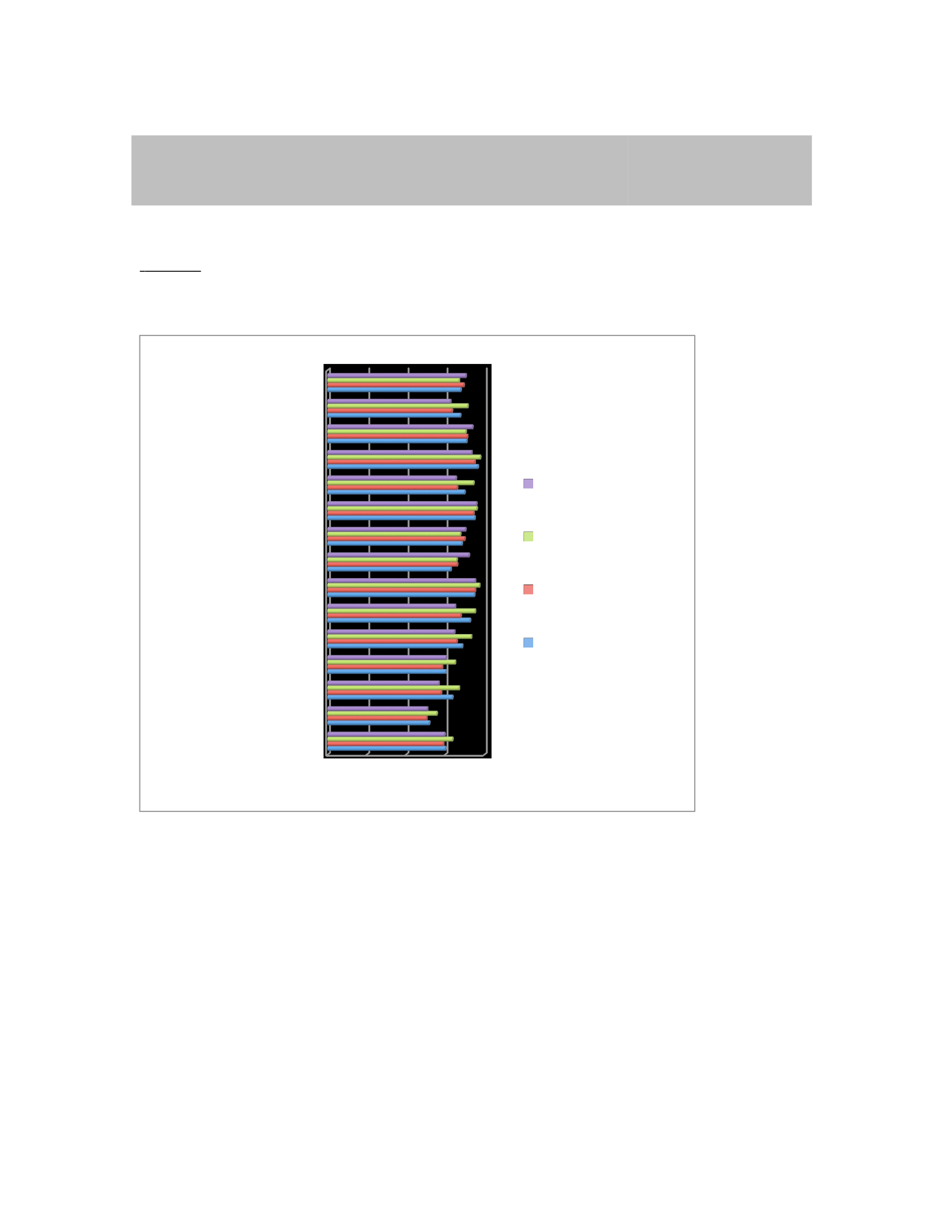
Website Design
3.51/Advertising
Technical Communication 3.18/Public Relations
Figure 5.2 Specialty Communications Chart of Means
Matrix of Means, Communication Skills and Traits
Like the previous tables and figures of means for applied communications and
specialty communications variables, the following is a table of the largest MVOI
and its associated discipline and a bar graph of communications skills and traits
variables.
115
0 1 2 3 4
Technical Comms.
Intellectual Property
Political Comms.
Regulatory
Interpersonal
CSR
New Media
Video Prod.
Website
Social Media
Public Speaking
Written Comms.
Digital Analytics
Not-for-Profit
SEO
Advertising
Publc Relations
Integrated
Communications
Strategic
Communications.

Table 5.4 Matrix of Means, Skills and Traits Table of Dependent Variables
MVOI Values, Communication Skills and Traits Dependent Variables
Variable Title Largest Value/Discipline
Quantitative Research
3.65/Strategic Communications
Public Relations Principles
3.90/Public Relations
Positively Receive Criticism
3.79/Public Relations
Collaborative Leadership
3.76/Public Relations
Persistence
3.71/Public Relations
Proactive Determination
3.69/Public Relations
Advertising Principles
3.89/Advertising
Qualitative Research 3.62/Advertising
116

Figure 5.3 Communications Skills and Traits Chart of Means
Comparison of Significance Against Strategic Communications
The table below compares significance in mean value of differences
across all variables. In this illustration it is clear that there are some significant
differences between strategic communications and the other three disciplines.
However there are also many values that are not significant based on t-test
comparisons. Those disciplines with no significant difference between their
mean value and the strategic communications variable show clearly there is
overlap between strategic communications and the other disciplines.
Table 5.5 Comparison of Significance Against Strategic Communications
117
0 1 2 3 4
Qualitative Analysis
Quantiatitve Analysis
Receive Criticism
Collaborative Leadership
Persistence
Proactive Determination
Advertising Principles
Public Relations
Advertising
Public Relations
Integrated
Communications.
Strategic
Communications.
Str ategic Communications /Variable
Title
Integrated
Comms.
Public
Relations
Advertisi
ng
Applied Communications
Business Management
X X
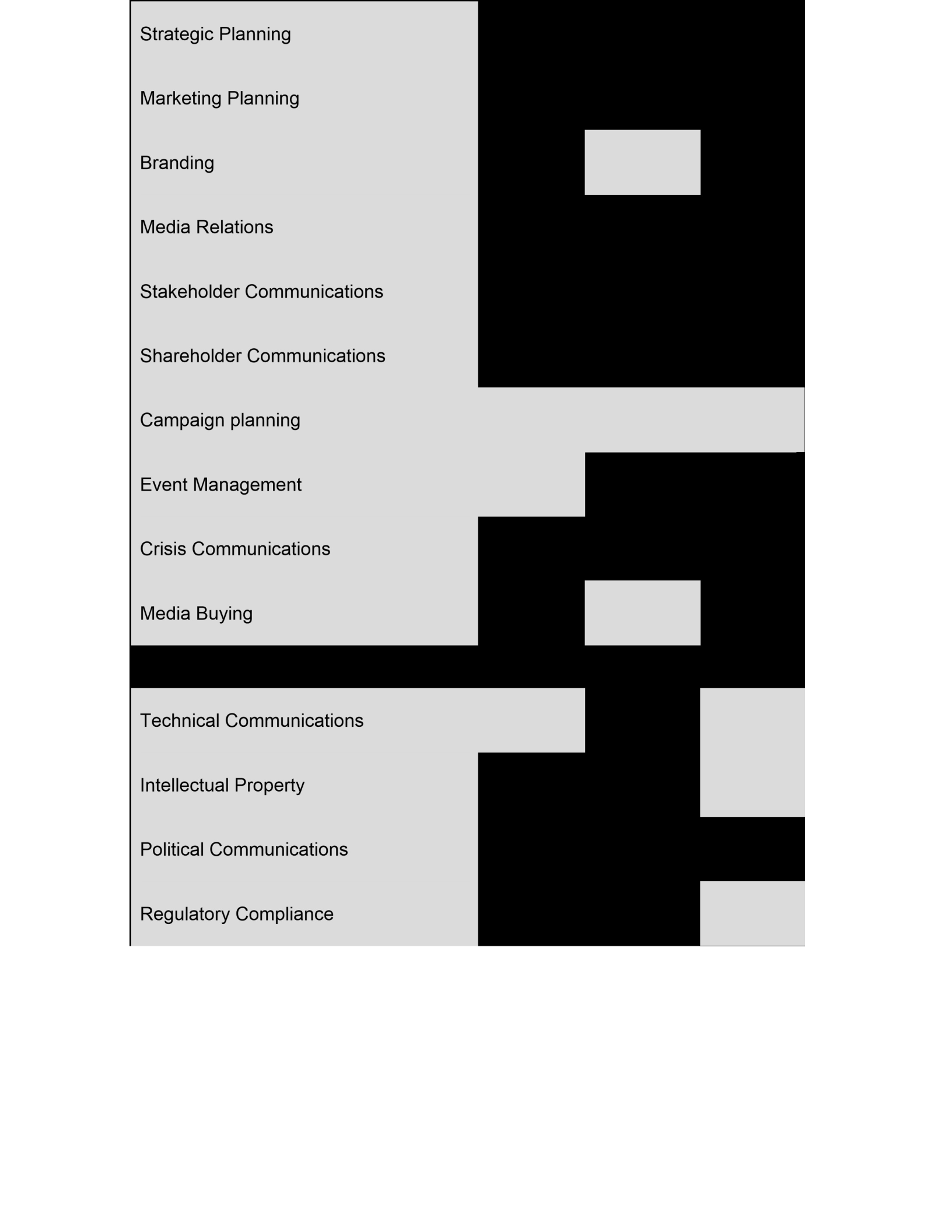
X X
X X X
118

X X
Corporate Social Responsibility
X X
X
X
X
New Media
Video Production
Website Production
X
X
X
X
Social Media Production
Public speaking X X X
Written Communications X X X
Digital Analytics X
Not-for-Profit Communications X X X
X X
119
Search Engine Optimization

(Single tail t-test, p<.05)
X = significant difference in mean value, shaded blocks = no significant difference
between strategic communications and the other associated disciplines by
variable.
Figures 5.4, 5.5 Charts of Mean Values of Importance
Following are two plots of the means in 3-D, which shows the overlap
between the means of each variable. The area chart, Figure 5.4, shows there is
little difference between the collective means among each communication
discipline. Figure 5.5 is a bar graph, which shows all of the variable mean values.
From both of these tables, it seems obvious that there are some differences in
the variables but not all of them can be used to distinguish strategic
communications from the other disciplines.
120
Communication Skills and Traits
Qualitative Research
Quantitative Research
X X
Positively Receive Criticism
X X
Collaborative Leadership
X X
Persistence X
Proactive Determination
X
Advertising Principles
X X X
Public Relations Principles
X X X

121

122
0
0.5
1
1.5
2
2.5
3
3.5
4
1
3
5
7
9
11
13
15
17
19
21
23
25
27
29
31
33
Mean Values
Research Variables
Strategic Communications Integrated Communications
Public Relations Advertising
Figure 5.4 Charts of MVOI by Communication Discipline

Part 7 Implications of Single-Tailed Paired t-tests.
Comparing Mean Values of Importance (MVOI) for integrated
communications, public relations, and advertising against strategic
communications in single-tailed t-tests demonstrates some clear trends.
123
0
0.5
1
1.5
2
2.5
3
3.5
4
1
4
7
10
13
16
19
22
25
28
31
34
Mean Values
Variables
Figure 5.5 Comparison of MVOI Variables
by Communication Discipline
Strategic Communications
Integrated Communications
Public Relations
Advertising

Significant differences in MVOI values between strategic communications
and the other three disciplines are replete. However there are also some areas
of differences with no significance, thereby demonstrating similarity across
discipline. For example, campaign planning is a universal requirement for the
successful practice of all communications disciplines, as is social media
production and, with the exception of advertising, the need to understand digital
analytics. The need to practice good qualitative research can also be implied by
the lack of significant difference across all disciplines. Similarly, persistence and
proactive determination are also described as universal MVOIs with the
exception of the integrated communications discipline.
So where does this leave us? Strategic communications is an emerging,
comprehensive discipline that requires cultivation of best practices from all
disciplines. This metric is useful for identifying where those best practices reside.
It stands to reason that if an applied communications practice or skill is valued
most highly in a specific discipline, then that discipline is where the best practice
resides. For example, looking at our MVOI valuations, if the highest MVOI value
for qualitative research resides in advertising (value = 3.62), then strategic
communications scholars and practitioners should look to the advertising
discipline as the source of best practices and incorporate those lessons into their
programs.
Part 8 Limitations of Research
124

The Instrument
As with all research, this one has its limitations. One of the most
important was caused by the variety of variables used. A total of 136 variables in
a forced response format using a forced, 4-point Likert scale were included in the
initial survey. It was felt this was the absolute maximum number of variables and
response points that could be included in the survey without suffering respondent
fatigue. This limitation left out many other variables that could have been asked
but were not. Part 10 of this chapter discusses additional MVOIs in detail.
In addition, in this research, there may have been some unintentional bias
against integrated communications because it was located next to strategic
communications in the pages of the survey. Based on the questions, some
respondents may have felt a need to distinguish strategic communications from
integrated communications.
Respondent fatigue was also a concern in terms of time taken to complete
the questionnaire. As mentioned, in post hoc analysis of results, some
participants who started the survey abandoned it and some others raced through
the survey. Data from those completing the survey in four minutes or less were
deleted from the pool of respondents. If future study is contemplated, it is
recommended that some of the MVOIs be removed to allow for less responder
fatigue, less time required to complete the questionnaire, and hopefully a higher
completion rate. It may also be a good idea to randomize which discipline
appears opposite of strategic communications in each survey to reduce bias
against any one discipline.
125

Part 9 The Sample: Professional Practitioner Perceptions Wanted
This database was thoroughly vetted and provides a clear representation
of faculty across the United States who are currently involved in teaching one or
more of the four disciplines of strategic communications, integrated
communications, public relations, and advertising, (n = 580 with 212 cases
reporting). It is, however, missing strong representation from professional
practitioners currently active in the practice of strategic communications and the
other disciplines. As the initial objective of this research was to develop a
definition of strategic communications that could be used to inform academia in
developing strategic communications curricula (both undergraduate and
graduate), it made sense to focus primarily on faculty. Moreover, the mean level
of years of teaching in this sample was 15, though specific questions of
nonteaching years of professional practice were not asked.
However, accepting the assumption that most undergraduate programs in
communications exist in whole or in part to equip students to enter the work force,
further research in this area would benefit from an added data set of professional
practitioners. This could be easily achieved in a follow-on study using a slightly
modified instrument and a database of professionals who currently work in the
industry as representative practitioners in all of the four disciplines.
How Old is Too Old?
In a related observation of sample, it is important to recognize that
age/experience was a factor in the sample selection. As stated previously, when
email addresses were being generated and verified for this research, and there
126

were multiple points of contact for a specific institution, preference was shown to
those with titles like dean, director, or adviser. Those individuals were thought to
be most familiar with strategic communications as part of a larger discussion and
would have formed some opinions as to the differences between the four
disciplines studied in this research. A route for future research could be to
intentionally seek out those faculty with less institutional experience or those in
newer programs to determine if there is a wide difference between the various
discipline definitions and associated MVOIs.
Part 10 Addition/Purification of Variables
As part of the research instrument, respondents were given an opportunity
to discuss what other aspects of the four disciplines should be included in further
efforts to define strategic communications. A complete list of the respondent
comments are included in Appendix E. A review of the input provided some
interesting variables that should be included in the next iteration of this research
as shown in the following table. Variables that should definitely be investigated
were selected based on the frequency of their appearance in the free response
answers.
Table 5.6 Additional MVOIs to be Included in Future Research
Suggested MVOI/Frequency of Appearance
Analytical/Critical Thinking Skills/11
Copyediting/Copywriting/5
Creativity/14
Design Literacy/8
127

Entrepreneurship/6
Ethics/7*
Graphic Arts/Visual Design/9
Marketing/5
Proactivity/9
Strategic Development/7
Teambuilding/Teamliness/6
*In the initial survey attempts there was an MVOI: “Provides competent ethical
counsel. However, in subsequent survey attempts, the word ethical was
removed. Since this invalidated the overall results of that particular MVOI, that
MVOI was removed from final calculations.
While copyediting/copywriting was felt to be a variable that would be
universal to all four disciplines and already touched upon in a broader question in
the existing research, some of the other trends would make for interesting
additions. However, several potential variables mentioned (like creativity, critical
thinking or proactivity) are highly specialized, so refining them to a measureable
mean value of importance will require refinement of the definition prior to
inclusion in future research.
Finally, two items of interest as it pertains to the future MVOIs for this
study: The discipline of business communications is touched upon in the original
set of MVOIs but it may be important to include established business
communication professionals in future efforts to better define business
communications and expand the MVOI range of variables.
It may also warrant some consideration that some additional advertising
measures be added to the MVOI count, in addition to (or perhaps in lieu of),
128

public relations variables. While not specifically identified by respondents as
deficient in advertising-based variables, the MVOI topic distribution could be seen
as more heavily weighted to public relations because of the researchers deeper
background of experience in PR and the highly specialized nature of advertising.
One suggestion to address the deficiencies in business communication
and advertising MVOIs in the survey efforts would be to accomplish a follow-on
study using a Delphi panel to assist in fine-tuning these variables for
incorporation in the measure and ultimately the practice. Composition of the
Delphi panels should include a combination of practitioners and educators to
offer a greater diversity of opinion and provide a more pragmatic solution to
defining strategic communication measurement.
Part 11 In Search of More Variance
Related to the question of which MVOI variables should be included in any
follow-on research, it seems appropriate to also add some more variance in the
scale. While a 4-point forced “Likert-type” scale was used initially for this
research, it might be interesting to pilot a larger 5- or 7-point scale using the
identified collection of variables. Within limits, the more response opportunities
espondents have, the greater the variance between principles is expected.
Part 12 Student-run Agency Integrative Learning Inputs
An important post hoc component to this analysis is the perspectives
obtained in part two of the survey targeting student-agency advisers.
Approximately 127 of the 212 respondents in this survey indicated some past or
present relationship with advising student-run agencies. While these insights
129

were mined to measure needs to teach strategic communications, further study
of that data will hopefully yield more input to better inform how to tailor a
studentrun agency curriculum to incorporate strategic communications into an
undergraduate program.
This set of questions addressed efforts student-run agency advisers
reported in the need to incorporate strategic communications into their curriculum
to make their students more attractive to future employers.
Table 5.7 Perceived Pressures and Efforts to Become More Strategic
Communications Oriented.
Question
Mean Value
(N= 127)
My student-run agency is actively trying to make my students
more attractive to employers by building strategic
communications skills
86.38
Relative to client pressures, my student-run agency has been
encouraged to become more strategic
65.05
Relative to institutional pressures, my agency has been
encouraged to become more strategic
61.70
Values 0-100 (Strongly disagree 0-19, Disagree 20-39, Neither Disagree nor
Agree 40-59, Agree 60-79 and Strongly Agree 80-100)
Part 13 Future Research
In addition to fine-tuning the variance with a broader Likert scale, exploring
practitioner opinions, enlisting the help of Delphi panels, and mining the
studentrun agency data collected in this survey, there are several areas of future
research. One option would be to expand this study internationally as there are
some additional schools of thought in other countries as to what the term
130

strategic communications means to their opinion leaders and educators (Tindall
& Holtzhausen, 2011). A literature review of parallel thinking in the areas of
convergence and digital migration indicate that the silos of public relations,
advertising, marketing, and even integrated communications are being subsumed
by the need for strategic communications capabilities and digital
entrepreneurship in terms of storytelling. Collaborating with some of those
scholars might also help inform the academy of not only what should be taught in
terms of content but what should be taught in terms of organic capabilities for the
next generation of communicators. Public relations, for example, has morphed
from a media relations-heavy practice to a more strategic mission. Similarly,
advertising has changed gears significantly from primarily a sales-driven function
to a brand management tool that extends into the traditional realms of earned
media.
Finally, the entire communications industry has been affected by the
incorporation of social media as not only a tactical tool for energizing traditional
word-of-mouth referrals, but also has become the solution for real time analytic
data. And, when that data, along with other tracking applications, is combined
into what is known as “big data,” the entire paradigm of marketing and
communications research shifts from inferential statistics to census data
collection. In order to capitalize on these transitions, strategic communications
needs to evolve into a comprehensive approach toward communications from the
big picture strategic perspective all the way down to the granular tactical
orientation.
131

As stated at the beginning of this research, more study of how to pilot
strategic communications curricula within the realm of student-run agencies is
strongly recommended. The number of student-run agencies is on the rise, the
focus on the pragmatic aspects of an undergraduate education is becoming
increasingly scrutinized, and the need for cross-platform competence will not go
away. Therefore if mass communications instruction at the undergraduate level
is to remain relevant, it is incumbent upon educators to learn how to incorporate
the significant elements of strategic communications education into the highly
successful integrative learning approach to better equip and add value to the next
generation of communicators.
Last Words
As mentioned in the first chapter, according to Hallahan et al. (2007)
strategic communications is defined as six relevant disciplines in the
development, implementation, and assessment of communications by
organizations. Those six disciplines are management, marketing, public relations,
technical communication, political communication, and information/social
marketing campaigns. While this is a workable definition of strategic
communications, this research seems to bear out a slightly different result. In the
insights put forward here, strategic communications is an amalgamation of three
communications disciplines — integrated communications, public relations, and
advertising — and it is expressed through various types of communications
(applied communications specialty communications, and communication skills
132

and traits. Looking more pragmatically, as Hallahan et al. (2007) and this
research bears out,
“A growing number of organizations have recognized that various
communications disciplines share common purposes and that their
objectives and strategies for achieving these objectives are similar. They
differ primarily by their tactics and are being pressed to adapt to changing
environment by their organizations desire to coordinate communications,
by the convergence of media, and by the blurring of communications
genres,” (Hallahan et al., pp. 1, 5).
However, unlike Hallahan, this study seems to find a more overarching
discipline of strategic communications that encompasses some public relations,
integrated communications, and advertising, but also offers a compilation of all of
the above traits into a larger umbrella discipline that stretches into other areas of
applied communications including business management, strategic planning,
marketing planning, branding, stakeholder and shareholder communication, and
campaign planning.
The practice of strategic communications also includes specialty
communication functions like event management, technical communications,
regulatory compliance, interpersonal communication, new media, video
production, website design, social media, public speaking, digital analytics, not
for profit communications, and search engine optimization. Additionally, to
complete the strategic communications definition, there should be skills and traits
included in the measurement like qualitative research, quantitative research,
positively receive criticism and practice collaborative leadership. The ideal
strategic communicator should also be able to demonstrate persistence and
proactive determination as well as understand advertising principles and public
133

relations principles. Moreover, if the free response question items test positively
for reliability, other aspects of the strategic communications definition may
eventually include graphic design, knowledge of law/ethics, the ability to
persuade, the ability to practice critical thinking, the ability to manage
expectations, the ability to positively manifest teamliness/personnel
management, practice storytelling, support diversity, and understand and
practice big data analysis and entrepreneurship.
Based on this study of faculty, strategic communications represents a
growth area for instruction and provides direction and trends that
communications professionals are embracing as a way to add value, quantify
results, and expand the overall success of mass communications on all levels of
professional organizations, corporations, and other entities. The challenge before
the academy is to prepare students to meet this paradigm shift, thereby
producing equipped and capable students with sufficient knowledge and
selfefficacy to succeed in this new environment.
As with any other innovation, the road to change can be bumpy, filled with
detours, and sometimes mired in confusion. There is also the occasional
disruptive technology outbreak or startling finding to further complicate adoption
and evolution. Therefore it is incumbent upon the academy to continue to study
the shift of the education and practice to a strategic communications orientation
both as a way to train others and as a way to improve the overall effectiveness of
communications.
134

