


MAT 275 TEST 1 PRACTICE
1. Determine if each of the following equations is separable (Yes or No), and /or linear (Yes or No).
Record your answer in the following table. Do not attempt to solve the equations.
Equation Separable Linear
y ' =t1
y t
y ' =yt
t1
y '=cos t y
y ' −t y=t3
2. a) Write down a first order linear ODE whose solutions all approach y = 1.
b) Write down a first order linear ODE such that solutions other than y = – 3 all diverge from y = – 3.
3. Consider the ODE
y'=y2y−1 y2
a) Determine all the equilibrium (constant) solutions and classify them as stable, unstable or semi-stable.
b) If y(0) = – 1, what will be the behavior of the solution as
t∞?
c) If y(0) = 0, what will be the behavior of the solution as
t∞?
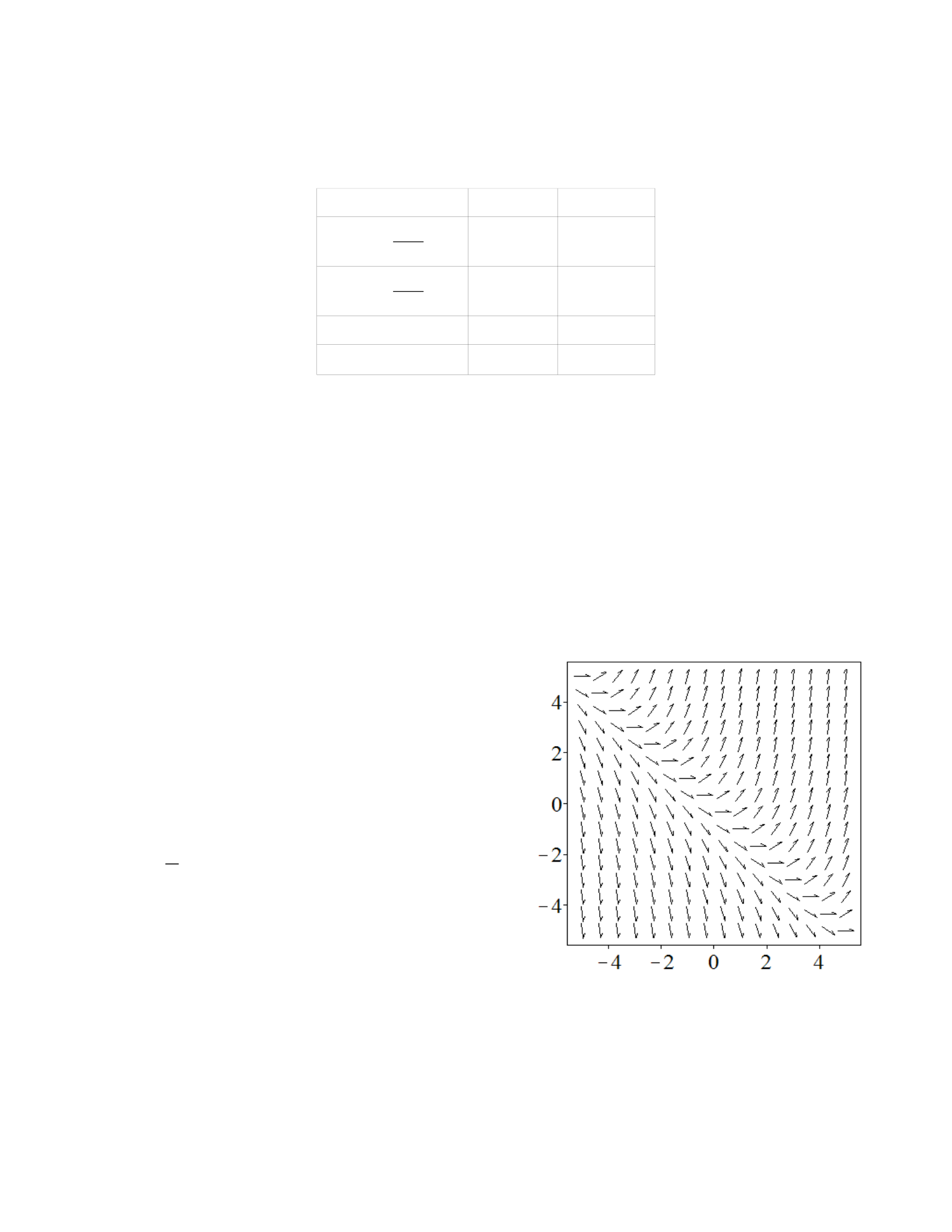
4. Which of the following differential equations best
represents the slope field at the right?
a) y' = x+ y
b) y' = x – y
c) y' = y – x
d) y' = xy
e)
y ' =x
y
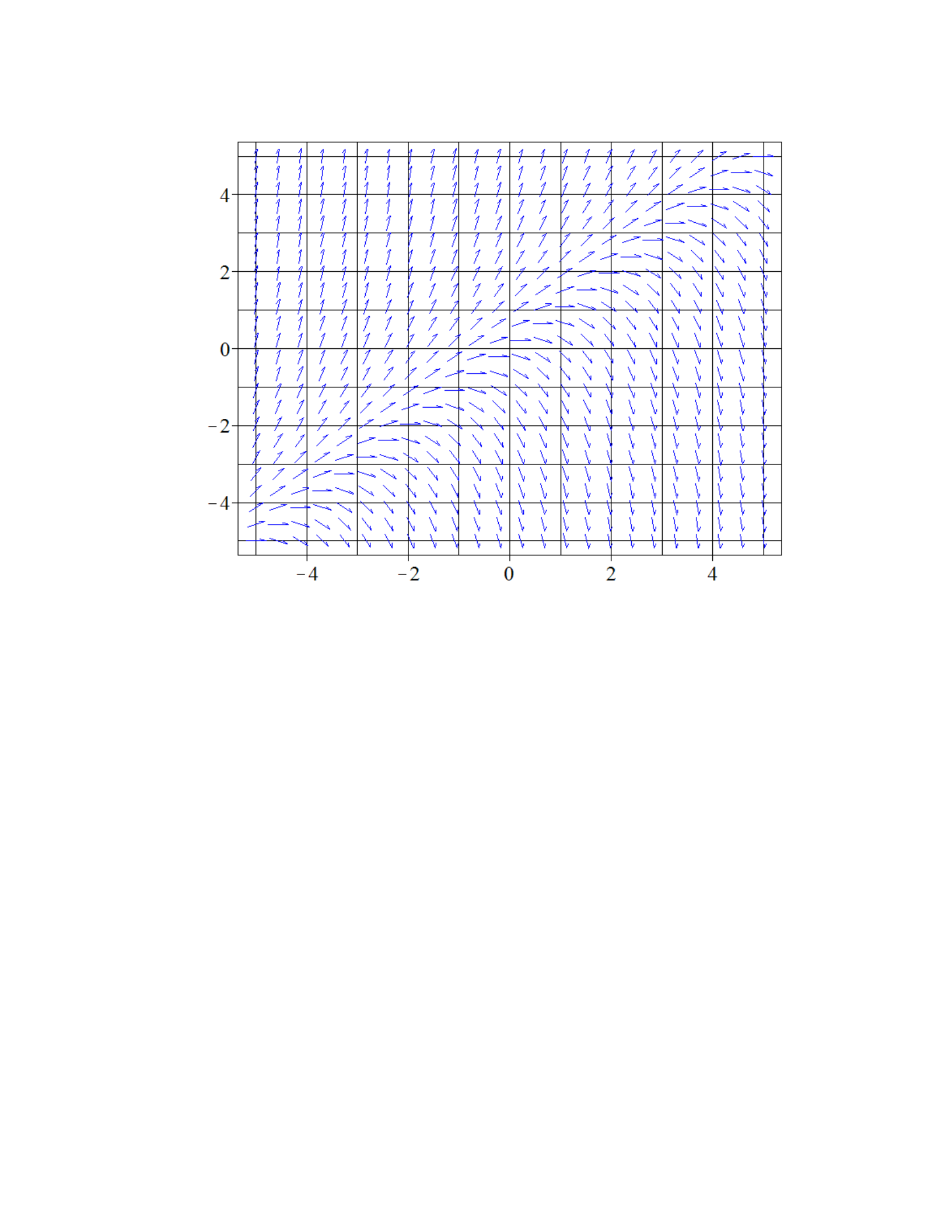
5. Consider the direction field below.
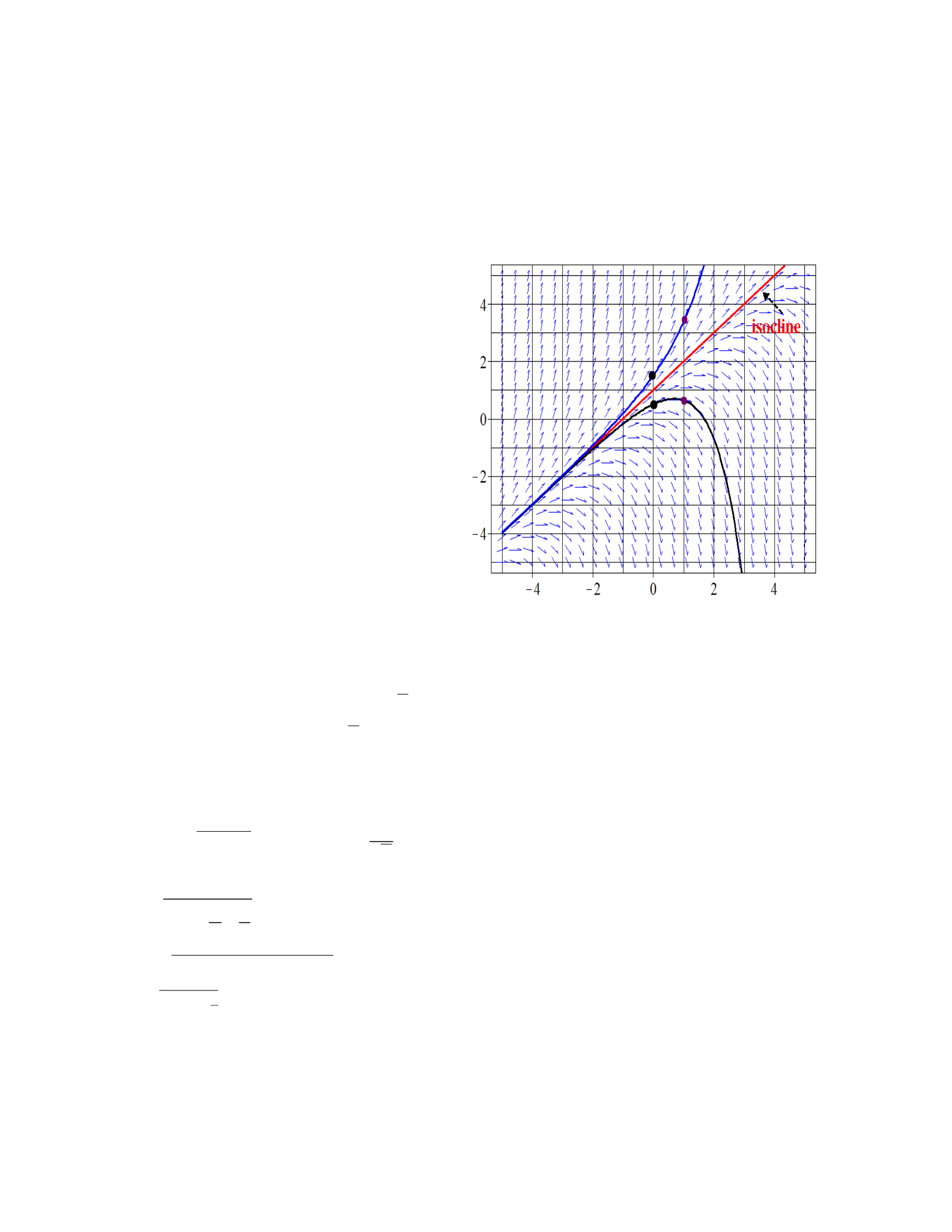
a) i. Sketch the graph of the solution which has initial value y(0) = 1.5.
ii Sketch the solution which has initial value y(0) = 0.5.
b) Use your sketch to estimate the value of y(1) for the solutions in (a) i. and (a) ii.
c) Some solutions of this differential equation grow when t is large and some do not. On the graph, sketch the
curve representing the boundary between these two behaviors. Continue it in both directions till it leaves the
direction field box. Label this curve “isocline”.
d) What happens to the two solutions in part (a) as
t ∞ ?
e) Consider the solution with initial condition y(0) = 1. Estimate the value of y(50). Explain your reasoning.
f) The direction field above comes from one of the following differential equations.
Tell which one it is and why.
I. y' = (1– y)y
II.
y ' =y e−t
III. y' = y – t
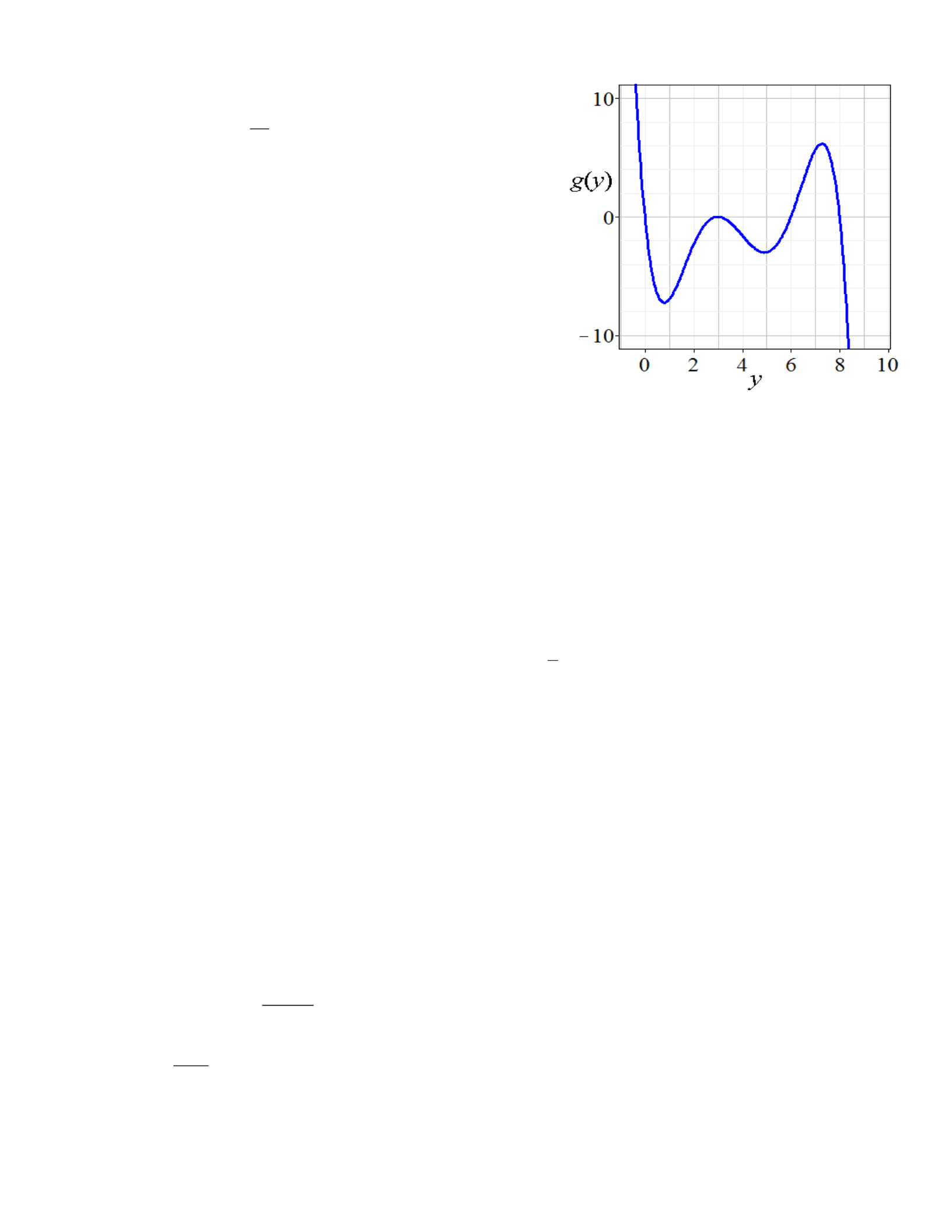
6. The population of Whooping Cranes has been found to
obey the equation
dy
dt =gy
(in appropriate units).
Here's a graph of the function g(y) for y
between – 1 and 10.
a) Identify the equilibrium solutions and classify them as
stable, unstable or semi-stable.
b) For what values of the initial condition at t = 0 will the
population be extinct?
Give your answer in interval form.
7. Consider the differential equation:
x2y '' −3x y ' 5y=2x2ln x
(a) What is the order of the differential equation?
(b) Is the differential equation linear or nonlinear?
(c) Determine the value(s) of the constant A so that
yx= A x2ln x
is a solution to the differential
equation.
8. Consider the differential equation:
−4xy22x y y'=0
(a) What is the order of the differential equation
(b) Is the Differential Equation linear or nonlinear?
(c) Determine the value(s) of the constant A so that
yx=A
x
is a solution to the Differential Equation.
9. Determine the value(s) of the constant r so that
y=er t
is a solution to y'' – y' – 6y =0.
10. The general solution to a certain first order differential equation appears in implicit form
y2−sin x=C.
Determine the value at
x=/2
of the the solution satisfying y(0) = – 1.
11. The general solution of the differential equation
x dy=y dx
is a family of (determine the correct choice)
a) circles b) parabolas c) hyperbolas d) lines passing through the origin
12. Use separation of variables to find the solution of the following Initial Value Problems.
Write your answer in explicit form and simplify as much as possible. For each IVP determine the
interval in which the solution is defined.
a)
y ' =2x
y1y1=−2
b)
x y23y2−x2y '=0y1=3.

c)
y ' =2t
t2yyy1=−2
d)
x2
y2−3
dy
dx =1
2yy1=2
e)
dy
dx =20 y x4y0=4
13. A tank initially contains 60 gal of pure water. Brine containing 1 lb of salt per gallon enters the
tank at 2gal/min, and the (perfectly mixed) solution leaves the tank at 3 gal/min; thus the tank is empty after
exactly 1 hour. Let y(t) be the amount of salt in the tank after t minutes.
(a) Write an Initial Value Problem for the amount of salt in the tank at any time t (< 60).
(b) Solve the IVP in part (a) to find the amount of salt in the tank at any time t (< 60).
(c) Determine the amount of salt when the tank is half empty.
14. A completely filled 20 gallon tank originally contains 10 pounds of salt dissolved in water.
Pure water enters the tank at the rate of 5 gallons/minute, and the well-stirred mixture leaves the tank at the
same rate. Find the amount of salt in the tank after at any time t .
15. A field mouse population satisfies the Initial Value Problem:
dp
dt =0.5 p−400, p0=600 .
(a) Find the time at which the population becomes extinct.
(b) Find the time at which the population becomes extinct if the initial condition is p(0) = 800.
16. Newton's law of cooling is
u ' =−ku−T
where u(t) is the temperature of an object, t is in hours,
T is a constant ambient temperature, and k is a positive constant. Suppose a building loses heat in accordance
with Newton's law of cooling. Suppose that the rate constant k has the value 0.13 hr-1. Assume that the interior
temperature of the building is 76°F, when the heating system fails and the external temperature is T=10°F.
(a) How long will it take for the interior temperature to fall to 32°F?
(b) What happens to the temperature u(t) as
t∞ ?
17. The population of a city increases continuously at a rate proportional, at any time, to the population at
that time. The population doubles in 50yr. Find the ratio of the population P to the initial population
P0
after 75 years.
18. Suppose P(t) denotes the size of an animal population at time t and its growth is described by the differential
equation
dP
dt =0.002 P1000−P.
Determine the value of P at which the population is growing fastest.
19. Solve the following Initial Value Problems using the method of integrating factor.
(a)
y ' =2
ty6t4, y1=−3
(b)
y '−2y=2e5t5e2t, y0=−3
(c)
t y' =−sint
t−2y , y=1.
(d)
t1y' −2y=2t , y0=4.

(e)
dy
dt 0.2 t y =5t , y 0=6
20. Determine (without solving the problem) the maximal interval in which the solution of the given initial value
problem is guaranteed to exist.
t y ' tan ty=sin t , y=0
21. a) Verify that both
y1t=2t−1
and
y2t=t2
are solutions to
y '=2t−t2−y1/2, y 1=1.
In which intervals in t are the solutions valid?
b) Does the existence of two solutions of the given problem contradict any known theorem about
existence and uniqueness of solutions to Differential Equations?
22. Consider the following differential equations. Determine if the Existence and Uniqueness Theorem does or does
not guarantee existence and uniqueness of a solution of each of the following initial value problems.
I.
dy
dx =
x−y , y2=2
II.
dy
dx =
x−y , y2=1
III.
ydy
dx =x−1, y 0=1
IV.
ydy
dx =x−1, y 1=0
23. Use Euler's method and two steps with
x=0.1
for the differential equation y' = y, with initial value
y(0) =1, to find the approximate value of y(0.2).
24. Which statement about Euler's method is false?
I. If you halve the step size, you approximately halve the error.
II. Euler's method never gives exact solutions.
III. Euler's method assumes that the slope of a solution curve is the same at all points in a short interval.
IV. Often, when applying Euler's method, the more steps you take the smaller the error.
V. Euler's method is used to string together a set of linearizations that approximate the curve.
Answers:
1. 1st DE: Yes, No ; 2nd DE: Yes, Yes; 3rd DE: No, No; 4th DE: No, Yes
2. Possible answers: (a) y' = 1− y (b) y' = y + 3
3. (a) y = – 2 stable, y = 0 semi-stable, y = 1 unstable
(b)
lim
t ∞
yt=−2
(c)
lim
t ∞
yt=0
4. (a)
5. (b) i.
y1≈3.3
ii.
y1≈0.6
(d) The first solution approaches ∞ ;
The second solution approaches –∞
(e) 51 (f) III.
6. (a) y = 0 stable; y = 3 semi-stable; y = 6 unstable; y = 8 stable (b) [0,3)
7. (a) second order (b) linear (c) A = 2
8. (a) first (b) non linear (c)
A=±
2
9. r =3, r = – 2 10.
−
2
11. d)
12.
a)
y=−1−
2x2−1
Interval:
1
2,∞
b)
y=− 1
ln x−3
x8
3
Interval:
0,1.089
c)
y=−
2 ln t214−2 ln 2
Interval:
−∞ ,∞
d)
y=
3e1−1
x
Interval:
0,∞
e)
y=4e4x5
Interval:
−∞ ,∞

13. (a)
dy
dt =2−3y
60−t, y 0=0
(b)
yt=60−t−60−t3
3600
(c)
y30=22.5 lb
14.
yt=10 e−t/4
15. (a) t = 4ln(2) ≈2.77 (b) The population will never become extinct.
16. (a) 8.45 hrs (b)
lim
t ∞
ut=10
(u(t) will approach the external temperature).
17.
2
2
18. P = 500
19.
(a)
yt=t22t3−5
(b)
yt=
2
3e3t5t−11
3
e2t
(c)
yt= cos t21
t2
(d)
yt=−2t−15t12
(e)
yt=25−19 e−t2/10
20.
2,3
2
21. (a)
y1t
is a solution for
t≥1;
y2t
is a solution for all t;
(b)
fy
is not continuous at (1, 1).
22. Only II and III are guaranteed to have a unique solution.
23. y(0.2) ≈1.210
24. II

