



the
equation
—
(what
is
the
highest
number
of
derivatives
in-
Linearity
is
important
because
the
structure
of
the the
family
of
solutions
to
a
linear
equation
is
fairly
simple.
Linear
equations
can
usually
be
solved
completely
and
explicitly.
2,,
der.
The
DE
is
linear
since
it
has
the
form
a3(t)
ss
+
a2(t)
—
+
dv
ay(t)G
+ao(t)y
=
g(t).
ond
order.
The
DE
is
Linear
since
it
can
be
put
in
the
form
ar(t)ax
+a1(t)
g
+a0(t)y
=
g(t).
9
—
tty
=0
a’
”
[2b.
y’-yt+P?
=0
[2
B.
+
sin(t+y)
=
sint
oh
+
t+
—
Answer(s)
submitted:
1Nonlinear
2Linear
2Nonlinear
4Linear
(correct)
Correct
Answers:
1NONLINEAR
2LINEAR
Z2NONLINEAR
4LINEAR
3.
(1
point)
Which
of
the
following
are
first
order
linear
differential
equations?
eA.
B.
+
2P=P+4t—2
C.
xo
—4y
=
x®e*
24,
D.
“3
+
sin(x)
9
=
cos(x)
e
E.
sin(x)?
—3y=0
dx
Fo
=y'—3y
Answer(s)
submitted:
e
(8B,
C,
E
)
(correct)
Correct
Answers:
e
BCE
4.
(1
point)
In
problems
below,
(a)
identify
the
independent
variable
and
the
dependent
variable
of
each
equation
(use
’t’
for
the
independent
variable
if
an
independent
variable
is
not
given
explicitly);
(b)
give
the
order
of
each
differential
equation
(enter
’1’
for
first
order,
°2’
for
second
order
and
so on;
do
not
include
the
quotes);
and
(c)
state
whether
the
equation
is
linear
or
nonlinear.
If
your
answer
to
(c)
is
nonlinear,
make
sure
that
you
can
explain
why
this
is
true.
1
Spring 2019
Assignment Section 1.3 Classification of Differential Equations
1. (1 point)
2
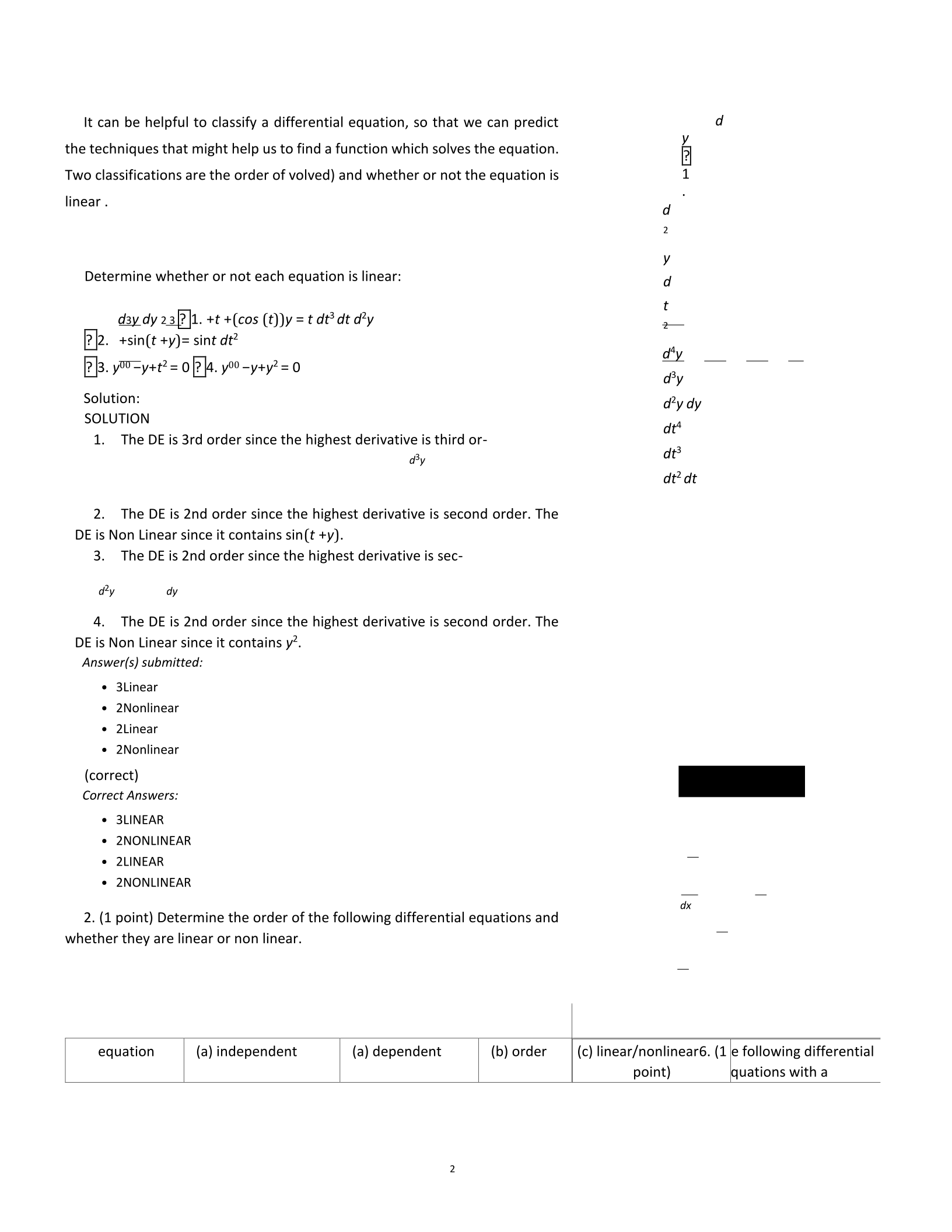
It can be helpful to classify a differential equation, so that we can predict
the techniques that might help us to find a function which solves the equation.
Two classifications are the order of volved) and whether or not the equation is
linear .
Determine whether or not each equation is linear:
d3y dy 2 3 ? 1. +t +(cos (t))y = t dt3 dt d2y
? 2. +sin(t +y)= sint dt2
? 3. y00 −y+t2 = 0 ? 4. y00 −y+y2 = 0
Solution:
SOLUTION
1. The DE is 3rd order since the highest derivative is third or-
d3y
2. The DE is 2nd order since the highest derivative is second order. The
DE is Non Linear since it contains sin(t +y).
3. The DE is 2nd order since the highest derivative is sec-
d2y dy
4. The DE is 2nd order since the highest derivative is second order. The
DE is Non Linear since it contains y2.
Answer(s) submitted:
•3Linear
•2Nonlinear
•2Linear
•2Nonlinear
(correct)
Correct Answers:
•3LINEAR
•2NONLINEAR
•2LINEAR
•2NONLINEAR
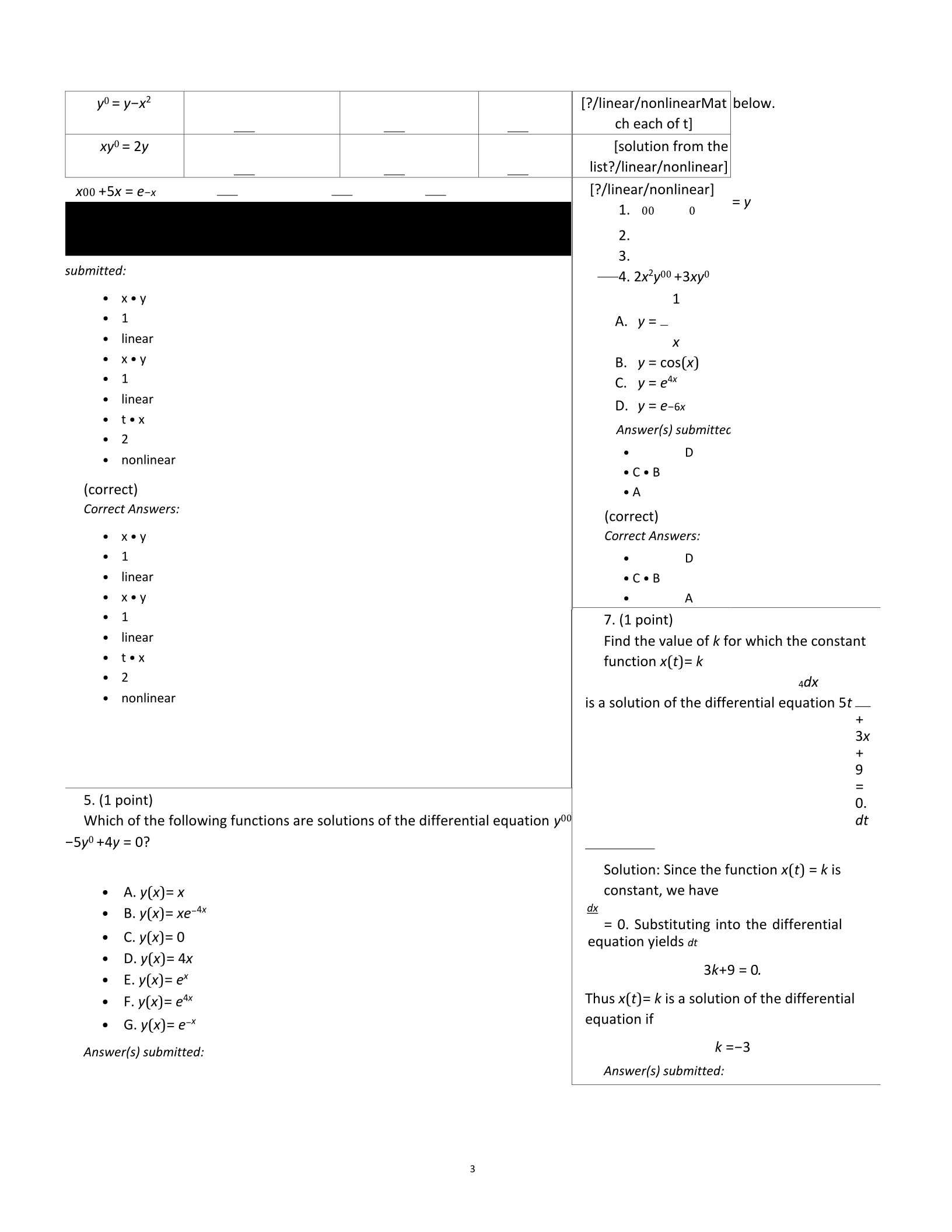
2. (1 point) Determine the order of the following differential equations and
whether they are linear or non linear.
d
y
?
1
.
d
2
y
d
t
2
d4y
d3y
d2y dy
dt4
dt3
dt2 dt
dx
equation
(a) independent
(a) dependent
(b) order
(c) linear/nonlinear6. (1
point)
he following differential
equations with a
3
y0 = y−x2
[?/linear/nonlinearMat
ch each of t]
below.
= y
xy0 = 2y
[solution from the
list?/linear/nonlinear]
x00 +5x = e−x
Answer(s)
submitted:
•x • y
•1
•linear
•x • y
•1
•linear
•t • x
•2
•nonlinear
(correct)
Correct Answers:
•x • y
•1
•linear
•x • y
•1
•linear
•t • x
•2
•nonlinear
[?/linear/nonlinear]
1. 00 0
2.
3.
4. 2x2y00 +3xy0
1
A. y =
x
B. y = cos(x)
C. y = e4x
D. y = e−6x
Answer(s) submitted:
•D
• C • B
• A
(correct)
Correct Answers:
•D
• C • B
•A
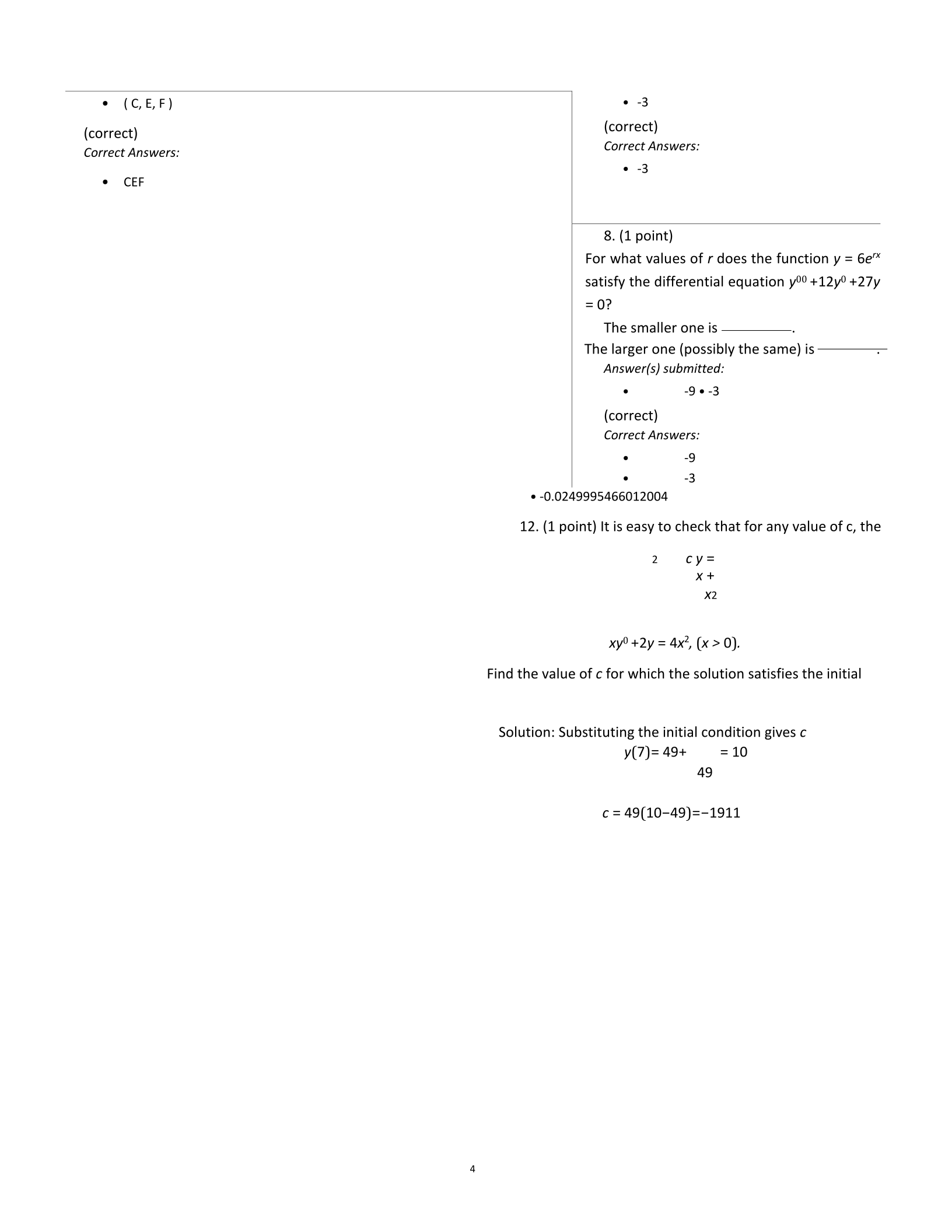
7. (1 point)
Find the value of k for which the constant
function x(t)= k
4dx
is a solution of the differential equation 5t
+
3x
+
9
=
0.
dt
Solution: Since the function x(t) = k is
constant, we have
dx
= 0. Substituting into the differential
equation yields dt
3k+9 = 0.
Thus x(t)= k is a solution of the differential
equation if
k =−3
Answer(s) submitted:
5. (1 point)
Which of the following functions are solutions of the differential equation y00
−5y0 +4y = 0?
•A. y(x)= x
•B. y(x)= xe−4x
•C. y(x)= 0
•D. y(x)= 4x
•E. y(x)= ex
•F. y(x)= e4x
•G. y(x)= e−x
Answer(s) submitted:
4
•( C, E, F )
(correct)
Correct Answers:
•CEF
•-3
(correct)
Correct Answers:
•-3
8. (1 point)
For what values of r does the function y = 6erx
satisfy the differential equation y00 +12y0 +27y
= 0?
The smaller one is .
The larger one (possibly the same) is .
Answer(s) submitted:
•-9 • -3
(correct)
Correct Answers:
•-9
•-3
• -0.0249995466012004
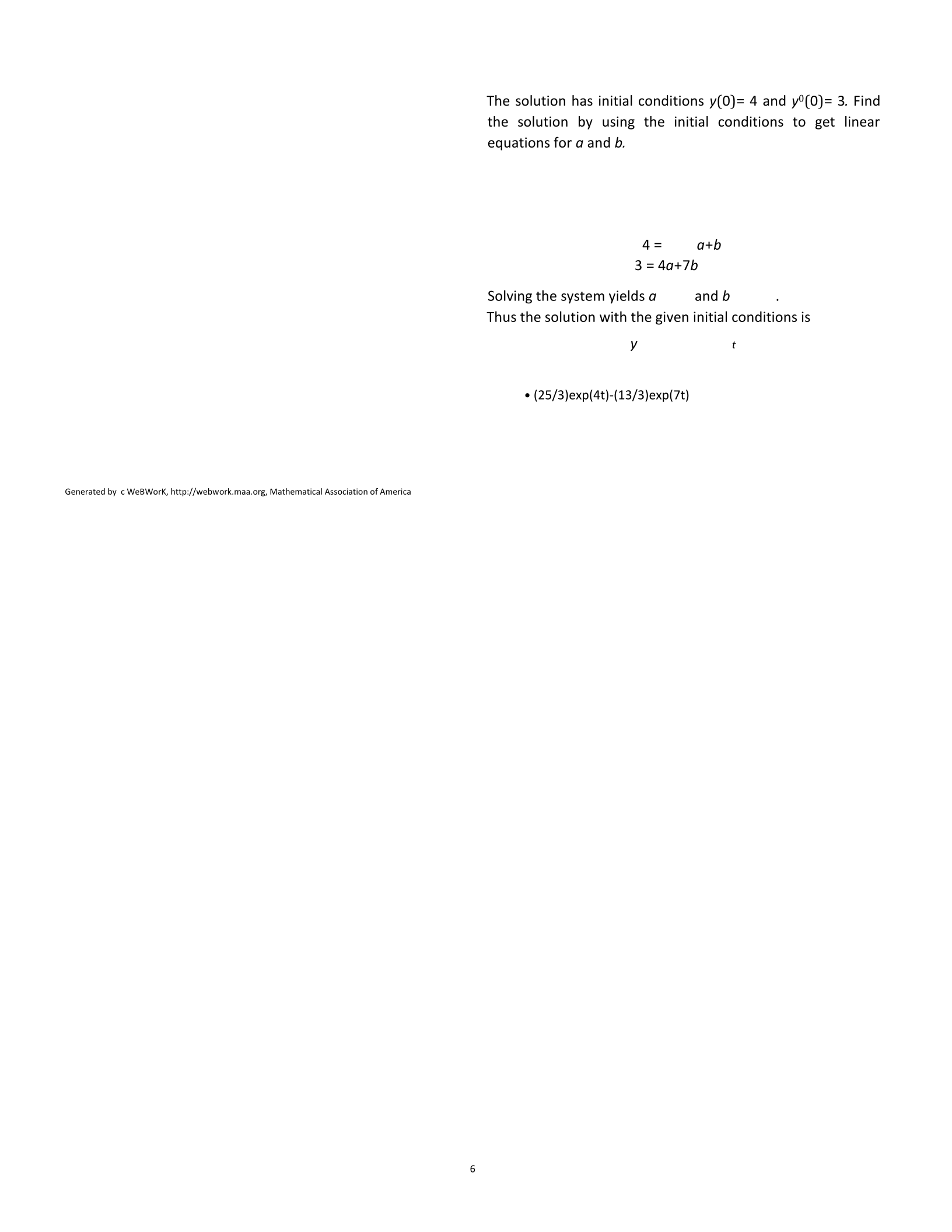
12. (1 point) It is easy to check that for any value of c, the
2 c y =
x +
x2
xy0 +2y = 4x2, (x > 0).
Find the value of c for which the solution satisfies the initial
Solution: Substituting the initial condition gives c
y(7)= 49+ = 10
49
c = 49(10−49)=−1911

5
The solution of a certain differential equation is of the form
y(t)= aexp(4t)+bexp(7t),
where a and b are constants.
6
The solution has initial conditions y(0)= 4 and y0(0)= 3. Find
the solution by using the initial conditions to get linear
equations for a and b.
4 = a+b
3 = 4a+7b
Solving the system yields a and b .
Thus the solution with the given initial conditions is
y t
• (25/3)exp(4t)-(13/3)exp(7t)
Generated by c WeBWorK, http://webwork.maa.org, Mathematical Association of America
Powered by TCPDF (www.tcpdf.org)

