


Austin Cholley Zhu MAT 267 ONLINE A Fall 2021
Assignment Section 12.2 due 09/19/2021 at 11:59pm MST
Problem 1. (1 point)
Evaluate the iterated integral I=Z1
0Z1+x
1−x
(12x2+2y)dydx
Solution:
SOLUTION
I=Z1
0Z1+x
1−x
(12x2+2y)dydx
=Z1
012x2y+y2y=1+x
y=1−xdx
=Z1
0h12x2(1+x)+(1+x)2−12x2(1−x)−(1−x)2idx
=Z1
024x3+4xdx
=6x4+2x21
0
=8
Answer(s) submitted:
•8
(correct)
Correct Answers:
•8
Problem 2. (1 point)
Evaluate the iterated integral I=Z1
0Z1+y
1−y
(6y2+12x)dxdy
Solution:
SOLUTION:
I=Z1
0Z1+y
1−y
(6y2+12x)dxdy
=Z1
06y2x+6x2x=1+y
x=1−ydy
=Z1
0h6y2(1+y) + 6(1+y)2−6y2(1−y)−6(1−y)2idy
=Z1
012y3+24ydy
=3y4+12y21
0
=15
Answer(s) submitted:
•15
(correct)
Correct Answers:
•15
1

Problem 3. (1 point)
Suppose Ris the shaded region in the figure, and f(x,y)is
a continuous function on R. Find the limits of integration
for the following iterated integrals.
(a) ZZ
R
f(x,y)dA =ZB
AZD
C
f(x,y)dydx
A =
B =
C =
D =
(b) ZZ
R
f(x,y)dA =ZF
EZH
G
f(x,y)dx dy
E =
F =
G =
H =
Solution:
SOLUTION
The region Rconsists of the points on or inside the triangle with
vertices (−2,−2),(1,−2),(−2,3).
(a) The region is bounded below by the line y=−2 and above by
the line through the points (1,−2),(−2,3), which has equation
y+2=−5
3(x−1).
The bounds for xare −2≤x≤1. Thus
ZZR
f(x,y)dydx =Z1
−2Z−5
3(x−1)−2
−2
f(x,y)dydx
(b) The region is bounded on the left by the line x=−2 and on
the right by the line through the points (1,−2),(−2,3), which has
equation x=−3
5(y−3)−2.
The bounds for yare −2≤x≤3. Thus
ZZR
f(x,y)dydx =Z3
−2Z−3
5(y−3)−2
−2
f(x,y)dydx
Answer(s) submitted:
•
•
•
•
•
•
•
•
(incorrect)
Correct Answers:
•-2
•1
•-2
•3-1.66667*(x+2)
•-2
•3
•-2
•-[2+0.6*(y-3)]
2

Problem 4. (1 point)
Find the volume of the solid bounded by the planes x=0,y=
0,z=0, and x+y+z=3.
Solution:
SOLUTION
The region D, intersection of the solid with the xy-plane, is shown
below.
The region is bounded below by y=0 and above by y=3−x,
with 0 ≤x≤3. Thus the volume is given by
V=Z3
0Z3−x
0
(3−x−y)dydx
=Z3
0(3−x)y−y2
2y=3−x
y=0
dx
=Z3
0(3−x)2−(3−x)2
2dx
=Z3
0
(3−x)2
2dx
=1
2Z3
0
(3−x)2dx
Using the substitution u=3−x du =−dx, yields
V=−1
2Z0
3
u2dx
=1
2u3
33
0
=33
6
Answer(s) submitted:
•(9/2)
(correct)
Correct Answers:
•4.5
Problem 5. (1 point)
Consider the integral Z1
0Z7
7x
f(x,y)dydx. Sketch the region of in-
tegration and change the order of integration.
Zb
aZg2(y)
g1(y)
f(x,y)dxdy
a=b=
g1(y) = g2(y) =
Solution:
SOLUTION
The region of integration, D, is shown below.
Because the region is
D={(x,y)|0≤x≤1,7x≤y≤7}
=(x,y)|0≤y≤7,0≤x≤y
7
we have
Z1
0Z7
7x
f(x,y)dydx =Z7
0Zy/7
0
f(x,y)dxdy
Thus a=0,b=7,g1(y) = 0 and g2(y) = y
7.
Answer(s) submitted:
•0
•7
•0
•(y/7)
(correct)
Correct Answers:
•0
•7
•0
•y/7
3

Problem 6. (1 point)
Consider the integral Z25
0Z8√x
0
f(x,y)dydx. Sketch the region of
integration and change the order of integration.
Zb
aZg2(y)
g1(y)
f(x,y)dxdy
a=b=
g1(y) = g2(y) =
Solution:
SOLUTION
The region of integration is shown below.
Because the region is
D={(x,y)|0≤x≤25,0≤y≤8√x}
=(x,y)|0≤y≤40,y2
64 ≤x≤25
we have
Z25
0Z8√x
0
f(x,y)dydx =Z40
0Z25
y2/64
f(x,y)dxdy
Thus a=0,b=40,g1(y) = y2
64 and g2(y) = 25.
Answer(s) submitted:
•0
•8sqrt(25)
•((yˆ(2))/(64))
•25
(correct)
Correct Answers:
•0
•40
•yˆ2/64
•25
Problem 7. (1 point)
Consider the integral Z5
0Z√25−y
0
f(x,y)dxdy. If we change the
order of integration we obtain the sum of two integrals:
Zb
aZg2(x)
g1(x)
f(x,y)dydx +Zd
cZg4(x)
g3(x)
f(x,y)dydx
a=b=
g1(x) = g2(x) =
c=d=
g3(x) = g4(x) =
Solution:
SOLUTION
The region of integration is shown below.
The point Ahas coordinates (√20,5)and the curve
connecting the point (5,0)to Ahas equation y=25 −x2.
Thus
Z5
0Z√25−y
0
f(x,y)dxdy =Z√20
0Z5
0
f(x,y)dydx+Z5
√20 Z25−x2
0
f(x,y)dydx
Answer(s) submitted:
•0
•sqrt(20)
•0
•5
•sqrt(20)
•5
•0
•25-xˆ(2)
(correct)
Correct Answers:
•0
•4.47214
•0
•5
•4.47214
•5
•0
•25-xˆ2
4

Problem 8. (1 point)
Consider the integral Z13
1Z4lnx
0
f(x,y)dydx. Sketch the region of
integration and change the order of integration.
Zb
aZg2(y)
g1(y)
f(x,y)dxdy
a=b=
g1(y) = g2(y) =
Solution:
SOLUTION
The region of integration is shown below.
The point Ahas coordinates (13,4ln(13)).
Because the region is
D={(x,y)|1≤x≤13,0≤y≤4lnx}
=n(x,y)|0≤y≤4ln(13),ey/4≤x≤13o
we have
Z13
1Z4lnx
0
f(x,y)dydx =Z4ln(13)
0Z13
ey/4f(x,y)dxdy
Thus, a=0,b=4ln(13),g1(y) = ey/4and g2(y) = 13.
Answer(s) submitted:
•0
•4ln(13)
•eˆ((y/2))
•13
(score 0.75)
Correct Answers:
•0
•10.2598
•exp(y/4)
•13
Problem 9. (1 point)
In evaluating a double integral over a region D, a sum of iterated
integrals was obtained as follows:
ZZD
f(x,y)dA =Z5
0Z3
5y
0
f(x,y)dxdy +Z8
5Z8−y
0
f(x,y)dxdy .
Sketch the region Dand express the double integral as an iterated
integral with reversed order of integration.
Zb
aZg2(x)
g1(x)
f(x,y)dydx
a=b=
g1(x) = g2(x) =
Solution:
SOLUTION
The region of integration is shown below.
The first integral corresponds to the region D1, while the second
integral corresponds to the region D2.
The region is bounded below by the line y=5
3xand above by
the line y=8−x. The two lines intersect at (3,5), so 0 ≤x≤3.
Thus
Z5
0Z3
5y
0
f(x,y)dxdy+Z8
5Z8−y
0
f(x,y)dxdy =Z3
0Z8−x
5
3x
f(x,y)dydx
Answer(s) submitted:
•0
•(3/5)(5)
•8x
•8-x
(score 0.75)
Correct Answers:
•0
•3
•((5/3))*x
•8-x
5

Problem 10. (1 point)
Evaluate the integral by reversing the order of integration.
Z1
0Z4
4y
ex2dxdy =
Solution:
SOLUTION
The region of integration is shown below.
The region is bounded below by y=0 and above by y=x
4, with
0≤x≤4.
Thus
Z1
0Z4
4y
ex2dxdy =R4
0R
x
4
0ex2dydx
=R4
0hyex2iy=x
4
y=0dx
=R4
0
x
4ex2dx
Using the substitution u=x2,du =2xdx, yields
=1
8R16
0eudu
=1
8e16 −1
Answer(s) submitted:
•(((eˆ(16)-1))/8)
(correct)
Correct Answers:
•1.11076E+06
6

Problem 11. (1 point)
Consider the following integral. Sketch its region of inte-
gration in the xy-plane.
Z2
0Z4
y2ysinx2dx dy
(a) Which graph shows the region of integration in the
xy-plane? [?/A/B/C/D]
(b) Write the integral with the order of integration re-
versed:
Z2
0Z4
y2ysinx2dx dy =ZB
AZD
C
ysinx2dy dx
with limits of integration
A =
B =
C =
D =
(c) Evaluate the integral.
A B
C D
(Click on a graph to enlarge it)
Solution:
SOLUTION
(a) The region is bounded on the left by the function x=y2
and on the right by the vertical line x=4. The bounds for yare
0≤y≤2. Thus the region corresponds to graph D.
(b) The region is bounded below by y=0 and above by y=√x,
while 0 ≤x≤4. Thus
Z2
0Z4
y2ysinx2dx dy =Z4
0Z√x
0
ysin(x2)dydx
(c)
R4
0R√x
0ysin(x2)dydx =R4
0hy2
2i√x
0sin(x2)dx
=1
2R4
0xsin(x2)dx [substitution: u=x2,du =2xdx]
=1
4R16
0sin(u)du
=1
4[−cos(u)]16
0
=1−cos(16)
4
Answer(s) submitted:
•D
•0
•4
•0
•sqrt(x)
•(1/4)(-cos(16)+1)
(correct)
Correct Answers:
•D
•0
•4
•0
•sqrt(x)
•[1-cos(2ˆ4)]/4
7

Problem 12. (1 point)
Consider the following integral. Sketch its region of inte-
gration in the xy-plane.
Z0
−4Z0
−√16−x26xy dy dx
(a) Which graph shows the region of integration in the
xy-plane? [?/A/B/C/D]
(b) Evaluate the integral.
A B
C D
(Click on a graph to enlarge it)
Solution:
SOLUTION
(a) The region is bounded below by y=−√16 −x2, which repre-
sents the lower part of a circle centered at the origin and of radius
4, and above by y=0. Since −4≤x≤0, the region represents
the quarter of a disk in the third quadrant and it matches graph B.
(b)
Z0
−4Z0
−√16−x26xy dy dx =6Z0
−4
xy2
20
−√16−x2
dx
=−3Z0
−4
x(16 −x2)dx
=−316 x2
2−x4
40
−4
=−344
4−44
2
=192
Answer(s) submitted:
•B
•192
(correct)
Correct Answers:
•B
•192
8

Problem 13. (1 point)
Set up a double integral in rectangular coordinates for calcu-
lating the volume of the solid under the graph of the function
f(x,y) = 40 −x2−y2and above the plane z=4.
Instructions: Please enter the integrand in the first answer box.
Depending on the order of integration you choose, enter dx and dy
in either order into the second and third answer boxes with only
one dx or dy in each box. Then, enter the limits of integration.
ZB
AZD
C
A =
B =
C =
D =
Solution:
SOLUTION
The function f(x,y) = 40 −x2−y2intersects the plane z=4
when x2+y2=36.
Thus the region of integration is
D=n(x,y)| −6≤x≤6,−√36 −x2≤y≤√36 −x2o
=n(x,y)| −6≤y≤6,−p36 −y2≤x≤p36 −y2o.
The volume is then
V=R6
−6R√36−x2
−√36−x240 −x2−y2−4dydx or
V=R6
−6R√36−y2
−√36−y240 −x2−y2−4dx dy.
Answer(s) submitted:
•16-xˆ(2)-yˆ(2)
(incorrect)
Correct Answers:
•36-xˆ2-yˆ2; dx; dy; -6; 6; -sqrt(36-yˆ2); sqrt(36-yˆ2)
Problem 14. (1 point)
Suppose Ris the shaded region in the figure, and f(x,y)is
a continuous function on R. Find the limits of integration
for the following iterated integrals.
(a) ZZ
R
f(x,y)dA =ZB
AZD
C
f(x,y)dydx
A =
B =
C =
D =
(b) ZZ
R
f(x,y)dA =ZF
EZH
G
f(x,y)dx dy
E =
F =
G =
H =
Solution:
SOLUTION
The region is bounded by the circle centered at the origin with
radius 3. This circle has equation x2+y2=9. Thus the region of
integration is
R=n(x,y)| −3≤x≤3,−√9−x2≤y≤√9−x2o
=n(x,y)| −3≤y≤3,−p9−y2≤x≤p9−y2o
(a) ZZR
f(x,y)dA =Z3
−3Z√9−x2
√9−x2f(x,y)dydx
(b) ZZR
f(x,y)dA =Z3
−3Z√9−y2
√9−y2f(x,y)dx dy
Answer(s) submitted:
•-3
9
•3
•-sqrt(9-xˆ(2))
•sqrt(9-xˆ(2))
•-3
•3
•-sqrt(9-yˆ(2))
•sqrt(9-yˆ(2))
(correct)
Correct Answers:
•-3
•3
•-sqrt(9-xˆ2)
•sqrt(9-xˆ2)
•-3
•3
•-sqrt(9-yˆ2)
•sqrt(9-yˆ2)
Problem 15. (1 point)
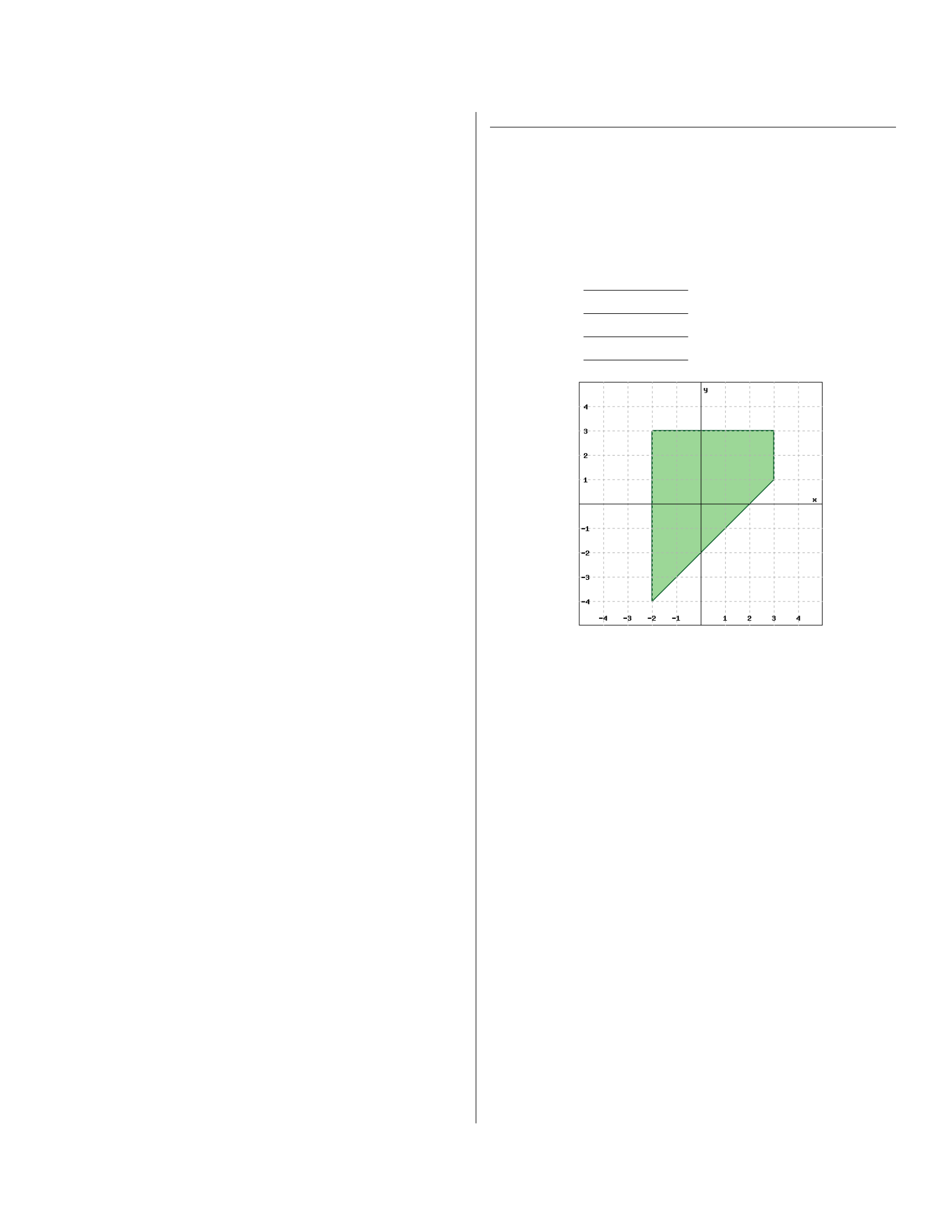
Suppose Ris the shaded region in the figure, and f(x,y)is
a continuous function on R. Find the limits of integration
for the following iterated integral.
(a) ZZ
R
f(x,y)dA =ZB
AZD
C
f(x,y)dydx
A =
B =
C =
D =
Solution:
SOLUTION
The region is bounded below by the line through the points
(−2,−4),(3,1). This line has equation y=1(x+2)−4.
The upper bound is the line y=3, while −2≤x≤3.
Thus
ZZR
f(x,y)dA =Z3
−2Z3
1(x+2)−4
f(x,y)dydx
Answer(s) submitted:
•-2
•3
•.3(x+4)-2
•3
(score 0.75)
Correct Answers:
•-2
•3
•x+2-4
•3
10
Problem 16. (1 point)
Consider the following integral. Sketch its region of inte-
gration in the xy-plane.
Z3
0Ze3
ey
x
ln(x)dx dy
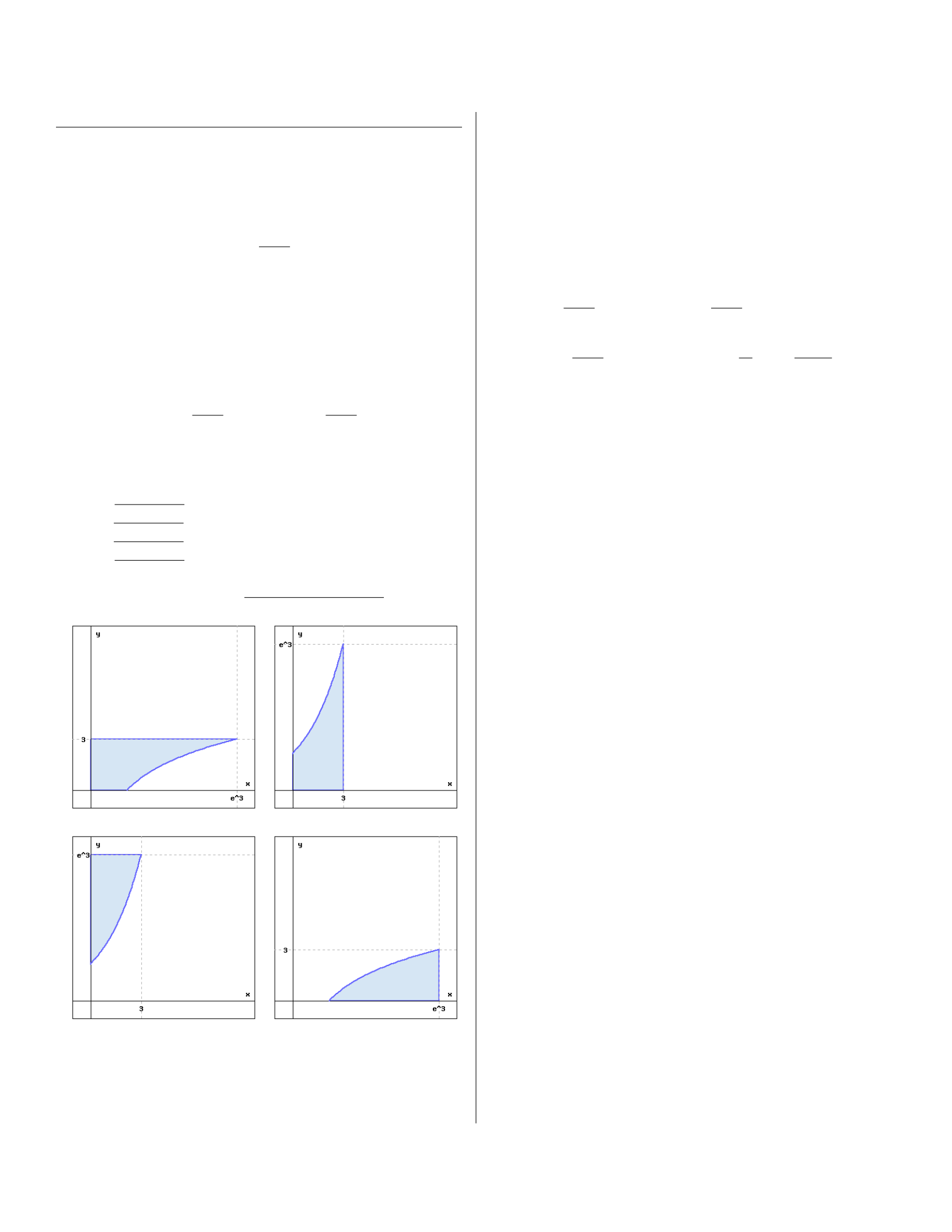
(a) Which graph shows the region of integration in the
xy-plane? [?/A/B/C/D]
(b) Write the integral with the order of integration re-
versed:
Z3
0Ze3
ey
x
ln(x)dx dy =ZB
AZD
C
x
ln(x)dydx
with limits of integration
A =
B =
C =
D =
(c) Evaluate the integral.
A B
C D
(Click on a graph to enlarge it)
Solution:
SOLUTION
The region is bounded on the left by the function x=eyor,
equivalently, y=lnx, and on the right by the vertical line x=e3.
The limits for yare 0 ≤y≤3. Thus
R=(x,y)|0≤y≤3,ey≤x≤e3
=(x,y)|1≤x≤e3,0≤y≤lnx
(a) The graph of this region is shown in figure D.
(b) Z3
0Ze3
ey
x
ln(x)dx dy =Ze3
1Zlnx
0
x
ln(x)dydx
(c) Ze3
1Zlnx
0
x
ln(x)dydx =Ze3
1
x dx =x2
2e3
1
=e6−1
2
Answer(s) submitted:
•D
•1
•eˆ(3)
•0
•ln(x)
•(([eˆ(6)-1])/2)
(correct)
Correct Answers:
•D
•1
•eˆ3
•0
•ln(x)
•[eˆ(2*3)-1]/2
11

Problem 17. (1 point)
Find the volume of the region under the graph of f(x,y) = x+y+1
and above the region y2≤x, 0 ≤x≤4.
volume =
Solution:
SOLUTION
The region of integration is shown below.
Thus,
Volume =Z2
−2Z4
y2(x+y+1)dx dy =Z2
−2
(1
2(x2)+(y+1)x)
x=4
x=y2
dy
=Z2
−2
1
2(16 −y4)+(y+1)(4−y2)dy.
Expanding the second binomial product, we have
Volume =Z2
−2
1
2(16 −y4)+(4+4y−y2−y3)dy
=1
2(16y−y5
5) + 4(y+y2
2)−y3
3−y4
4
2
−2
=1
2(64 −64
5) + 4(4)−16
3=544
15 .
Answer(s) submitted:
•36.2666
(correct)
Correct Answers:
•4*1*2ˆ5/5+4*2ˆ3/3
Generated by ©WeBWorK, http://webwork.maa.org, Mathematical Association of America
12

