


Inozemtseva MAT 265 ONLINE C Spring 2020
Assignment Final Exam due 05/01/2020 at 06:44pm MST
Problem 1.
1. (1 point)
Evaluate the indefinite integral:
Z3eu+4sec2udu = + C.
Answer(s) submitted:
• 3eˆu+4tan(u)
(correct)
Correct Answers:
• 3*exp(u)+4*tan(u)
Problem 2.
2. (1 point) Evaluate the definite integral
Z0.8
0.4 8sec2(x)dx
Answer:
Solution:
SOLUTION
Z0.8
0 4. 8sec2(x)dx = 8
Z0.8
0 4. sec2(x)dx
=8tan( )x i0.8
0 4.
= 8( ( ( ))tan 0.8)−tan 0.4
Answer(s) submitted:
• 8tan(0.8) - 8tan(0.4)
(correct)
Correct Answers:
• 8*(tan(0.8)-(tan(0.4)))
Problem 3.
3. (1 point) Evaluate the definite integral
Z5
4
10 9
x2+
√xdx
Solution:
Z5
4
10 9
x2+
√xdx =
Z5
4
10 9
x2+
x1/2 dx
=
Z5
4
10x2
x1/2 +9
x1/2
dx
=
Z5
4
10x3/2 + 9x−1/2dx
=10
Z5
4x3/2dx + 9
Z5
4x−1/2dx
=10
2
5x5/2
5
4+9h2x1/2i54
= 4( ( )5 4
5/2 −5/2) + 18 5 4
1/2 −1/2
Answer(s) submitted:
• 118sqrt(5)-164
(correct)
Correct Answers:
• 99.8560213449752
Problem 4.
4. (1 point) If f (x) =
Z17
xt6dt then
f0(x) =
Solution:
SOLUTION
f(x) = −
Zx
17 t6dt
Thus
f0(x x) = − 6
Answer(s) submitted:
• -xˆ6
(correct)
Correct Answers:
• -xˆ6
Problem 5.
5. (1 point) Find the average value of : f (x) = 2 sin 7 cosx + x
on the interval [0, 11
6π]
Average value =
Solution:
fave =1
11
6π
R
11
6π
0(2 sin 7 cosx + x)dx
=6
11 ·1
π[−2 cos 7 sinx + x]
11
6π
0
=6
11 ·1
π
−2cos11
6π+7sin11
6π+2cos( ( )0)−7sin 0
=6
11 ·1
π
−2cos11
6π+7sin11
6π+2
Answer(s) submitted:
• ((6/11)*(1/pi))*(-2cos(11/6pi)+7sin(11/6pi)+2cos(0)-7sin(0
1

(correct)
Correct Answers:
• -0.561160213471351
Problem 6.
6. (1 point) Evaluate the limit
lim
a→4
1
a−1
4
a−4
Solution:
lim
a→4
1
a−14
a−4 = lim
a→4
4−a
4a
a−4 = lim
a→4
4−a
4a(a−4) = − lim
a→4
a−4
4a(a−4) = − lim
a→4
1
4a= − 1
16
Answer(s) submitted:
• -1
(incorrect)
Correct Answers:
• -0.0625
Problem 7.
7. (1 point) For what value of the constant c is the function f
continuous on where(−∞ ∞, )
f(t) =
(t2−c if t ∈(−∞,5)
ct +3 if t ∈[ )5,∞
c =
Solution:
lim
x→5−f (x) = lim
x→5−(t2− c c) = 25−
lim
x→5+f (x) = lim
x→5+(ct +3) = 5c + 3
The function is continuous at 5 ifx =
lim
x→5−f f(x) = (5) = lim
x→5+f ( )x
Thus, we must have:
25−c = 5 3c+
Solving this equation yields
c=11
3
Answer(s) submitted:
• 11/3
(correct)
Correct Answers:
• 3.66667
Problem 8.
8. (1 point) Evaluate the limit. If the limit does not exist,
enter DNE.
lim
x→2
x2−2x
x2+ 6x − 16
Solution:
lim
x→2
x2−2x
x2+ 6x − 16 = lim
x→2
x(x − 2)
( )(
x + 8 x − 2) = lim
x→2
x
(x + 8) =2
2+8 =15
Answer(s) submitted:
• 1/5
(correct)
Correct Answers:
• 0.2
Problem 9.
9. (1 point) Evaluate
lim
x→∞ 5cosx
Answer:
Note: Input inf for for∞, -inf −∞ or dne if needed.
Solution: Since the cosine function oscillates in between 1−
and 1 without approaching any value as , the limit doesx → ∞
not exists.
Answer(s) submitted:
• DNE
(correct)
Correct Answers:
• dne
Problem 10.
10. (1 point) Evaluate
lim
x→∞
p16x2+ x − 4x.
Enter inf for for∞, -inf −∞, and DNE if the limit does not
exist.
Limit =
Solution:
SOLUTION
2

We multiply numerator and denominator by the conjugate
radical:
lim
x→∞
p16x2+ x − 4x= lim
x→∞
p16x2+ x − 4x√16x2+ x + 4x
√16 4x2+ x + x
= lim
x→∞
( ( )16x2+ x) − 4x 2
√16 4x2+ x + x
= lim
x→∞
x
√16 4x2+ x + x
= lim
x→∞
1
q
16+ 1
x+4
=1
√16 4+
=1
8
Answer(s) submitted:
• 1/8
(correct)
Correct Answers:
• 0.125
Problem 11.
11. (1 point) Find an equation of the tangent line to the curve
y = 7 − 2x − 3x2at (1,2).
y =
Answer(s) submitted:
• -8x+10
(correct)
Correct Answers:
• -8*x+10
Problem 12.
12. (1 point) Differentiate
f (x) = tan(x x x)( (5 sin ) + 6 cos( )) .
f0(x) =
Solution:
SOLUTION
The product rule gives:
f0(x) = (5 sin 6 cosx + x) d
dx (tan tanx) + x d
dx (5sin 6cosx + x)
= (5 sin x + 6cos x)sec2x + tanx( )5 cos 6 sinx − x
Answer(s) submitted:
• (tan(x)*(5cos(x)-6sin(x))) + (secˆ2(x)*(5sin(x)+6cos(x)))
(correct)
Correct Answers:
• [sec(x)]ˆ2*[5*sin(x)+6*cos(x)]+[5*cos(x)-6*sin(x)]*tan(x)
Problem 13.
13. (1 point) Find the equation of the line that is tangent to
the curve
y = 6xcosx
at the point .(π, −6π)
The equation of this tangent line can be written in the form
y = mx +b where
m =
and b =
Solution:
SOLUTION
The product rule gives
f0(x) = 6 cos x − 6xsin x
The slope of the tangent line at (π,−6 isπ)
m= f 0(π) = −6
So the equation of the tangent line is
y+6π = −6(x − π) or y = −6x
Answer(s) submitted:
• -6
• 0
(correct)
Correct Answers:
• -6
• 0
Problem 14.
14. (1 point) Use implicit differentiation to find the slope of
the tangent line to the curve defined by 2 5 at the
xy9+ 3xy =
point (1 1 ., )
The slope of the tangent line to the curve at the given point
is .
Solution: Differentiating implicitly with respect to x gives
2 18
y9+ xy8dy
dx +3y + 3x dy
dx ,
or
(18xy8+3x)dy
dx = −( )2y9+ 3y ,
and so dy
dx = − 2y9+ 3y
18xy8+3x.
Therefore, the slope of the tangent line to the curve at the point
(1 1, ) is equal to
dy
dx
( )=( )x,y 1,1
=−2· ·19+3 1
18·1·18+3·1 = − 521 .
Answer(s) submitted:
• -5/21
3

(correct)
Correct Answers:
• -5/21
Problem 15.
15. (1 point)
The radius of a spherical balloon is increasing at a rate of 4
centimeters per minute. How fast is the volume changing when
the radius is 14 centimeters?
Note: The volume of a sphere is given by V = (4/3 .)πr3
Rate of change of volume =
Solution: We start by identifying two things:
the given information : The rate of increase of the radius is
4 cm/min
and the unknown : The rate of increase of the volume when
the radius is 14 cm
In this problem, the volume and the radius are both functions of
time t. The rate of increase of the radius with respect to time is
its derivative dr
dt , and the rate of increase of the volume is dV
dt .)
We can therefore restate the given and the unknown as follows:
Given :dr
dt = 4 cm/min
Unknown :dV
dt when r = 14 cm
The formula for the volume of a sphere is
V=4
3πr3
We differentiate both sides of this equation with respect to :t
dV
dt =dV
dr
dr
dt = 4πr2dr
dt
Substituting r = 14 and dr
dt = 4 in this equation, we obtain
dV
dt = 4π( )14 2· 4 = 3136π
The volume of the sphere is increasing at the rate of 3136π ≈
9852.03 cm min
3/
Answer(s) submitted:
• 3136pi
(correct)
Correct Answers:
• 9852.03456165824
Problem 16.
16. (1 point) Use linear approximation, i.e. the tangent line,
to approximate √25.1 as follows:
Let .
f (x) = √x
The equation of the tangent line to 25 can be writtenf (x) at x =
in the form where:y = mx +b
m =
b =
Using this, we find our approximation for 1 is
√25.
NOTE: For this last part, give your answer to at least 9 signifi-
cant figures or use fractions to give the exact answer.
Solution: The tangent line at 25 has equationx =
y= f (25)+ f 0( )(25 x−25) = √25+ 1
2√25(x−25) = 5+ 1
10(x−25) = 1
10x
Thus
m=1
10 and b = 5
2
Substituting x = 25.1 in the equation of the tangent line gives:
√25.3 ≈ 25.1
10 +5
2= 5 01.
Answer(s) submitted:
• 1/10
• 25/10
• 5.01
(correct)
Correct Answers:
• 0.1
• 2.5
• 5.01
Problem 17.
17. (1 point) Find the derivative of the function
g(x) = (3x2+ 2x + 5)ex
g0(x) =
Solution:
SOLUTION
The product rule gives
g0(x) = exd
dx (3 2x2+ x + 5) + (3 2x2+ x + 5) d
dx (ex)
= ex(3 · 2x + 2) + (3 2x2+ x + 5)ex
=3x2+ +8x 7ex
Answer(s) submitted:
• eˆx*(3xˆ2+8x+7)
(correct)
Correct Answers:
• (3*xˆ2+8*x+7)*eˆx
4

Problem 18.
18. (1 point) If , thenf (x) = sin 5 7
−1( x + )2
f0(x) =
Note: The inverse of sin can be entered as arcsin or(x) (x)
asin( )x
Solution:
SOLUTION
f0(x) = 2sin−1(5x + 7) d
dx
sin−1( )5x + 7
=2sin−1(5x + 7) 1
p1 − ( )5x + 7 2
d
dx (5x + 7)
=10 sin−1(5x + 7)
p1 − ( )5x + 7 2
Answer(s) submitted:
• ((50arcsin(5x+7))/(sqrt(1-(5x+7)ˆ2)))
(incorrect)
Correct Answers:
• 5*2*[asin(5*x+7)]ˆ(2-1)/[sqrt(1-(5*x+7)ˆ2)]
Problem 19.
19. (1 point) Evaluate the limit using L’Hospital’s rule if nec-
essary
lim
x→1
x8−1
x11 −1
Answer:
Solution:
SOLUTION
Since lim
x→1
x8−1= 0 and lim
x→1
x11 −1= 0 we have an in-
determinate form of type 0
0so we can apply l’Hospital’s rule:
lim
x→1
x8−1
x11 −1 = lim
x→1
8x7
11x10 =8
11
Answer(s) submitted:
• 8/11
(correct)
Correct Answers:
• 8/11
Problem 20.
20. (1 point) Find all critical values for the function
f(r) = r
7r2+6
and then list them (separated by commas) in the box below.
List of critical numbers:
Solution:
SOLUTION
Using the quotient rule gives
f0(r) = 7r2+ 6 7−r · · 2r
( )
7r2+ 6 2=6 − 7r2
( )
7r2+ 6 2
Since f0(r) exists for all values of , the only critical numbersr
of f occur when 0, that isf 0(r) =
6−7 0r2=
Solving this equation gives
r=
q67and r = −
q6
7
Answer(s) submitted:
• -sqrt(6/7),sqrt(6/7)
(correct)
Correct Answers:
• -0.92582, 0.92582
Problem 21.
21. (1 point) Suppose that
f(x) = 6
x2−36.
(A) List all critical numbers of . If there are no critical num-f
bers, enter ’NONE’.
Critical numbers =
(B) Use interval notation to indicate where is increas-f (x)
ing.
Note: Use ’Inf’ for , and use ’U’ for the union∞, ’-Inf’ for −∞
symbol.
Increasing:
(C) Use interval notation to indicate where is decreas-f (x)
ing.
Decreasing:
(D)List the x-coordinates of all local maxima of f . If there
are no local maxima, enter ’NONE’.
x values of local maxima =
(E) List the -coordinates of all local minima of . If therex f
are no local minima, enter ’NONE’.
x values of local minima =
(F) Use interval notation to indicate where is concavef (x)
up.
Concave up:
(G) Use interval notation to indicate where is concavef (x)
down.
Concave down:
(H) List the x values all inflection points of . If there are nof
inflection points, enter ’NONE’.
Inflection points =
(I) List all horizontal asymptotes of . If there are no hori-f
zontal asymptotes, enter ’NONE’.
Horizontal asymptotes y =
(J) List all vertical asymptotes of . If there are no verticalf
asymptotes, enter ’NONE’.
Vertical asymptotes x =
(K) Use all of the preceding information to sketch a graph of
f . When you’re finished, enter a ”1” in the box below.
Graph Complete:
5
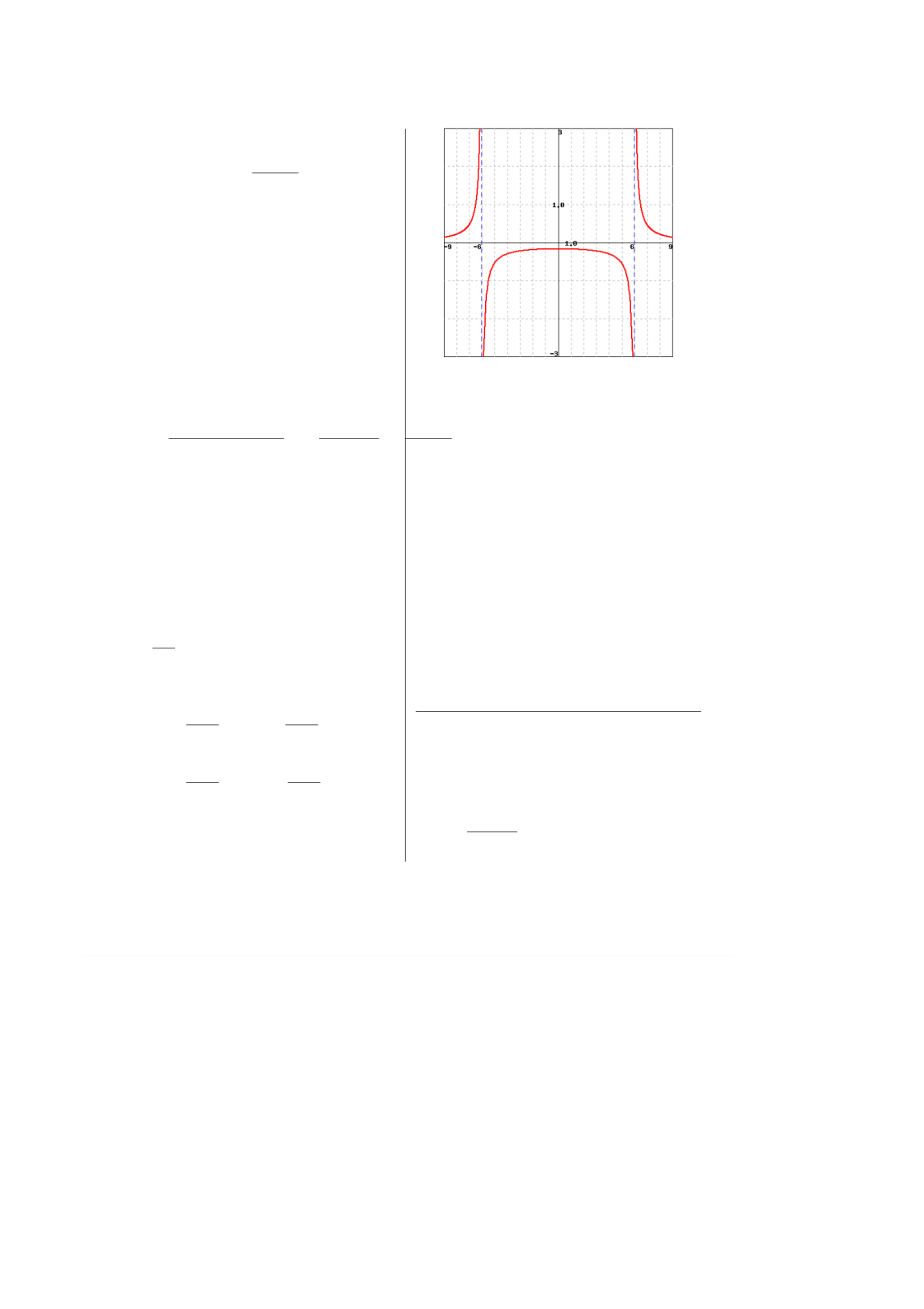
Solution: (A) The first derivative is
f0(x) = − 12x
( )x2− 36 2
The domain of . Thus the onlyf (x) is − −∞, 6) ∪(−6 6 6, )∪( , ∞)
critical number is 0.x =
(B) Since 0 in , the function is in-
f0(x) > (−∞,−6 6 0) ∪(− , )
creasing in those intervals.
(C) Since 0 in , the function is decreasing
f0(x) < (0 6,6) ∪( ,∞)
in those intervals.
(D) Since changes from positive to negative at 0, 0 is the
f0x =
x-coordinate of a local maximum by the First Derivative Test.
(E) There are no minimum values.
(F) Using the quotient rule, we get:
f00(x) = −12(x2− −36)24x2(x2− 36)
( )
x2−36 4= −12 x2−36 − 4x2
( )
x2−36 3= 12 3 36x2+
( )x2− 36 3
Since 3 0 for all , we have
x2+36 > x
f00(x x) > 0 ⇔2− 36 > 0 ⇔−6 < x < 6
Thus f is concave upward on the intervals (−∞,−6) ∪(6,∞)
(G) The function is concave downward on the intervals (−6 6 ., )
(H) The function has no inflection points since 6 and 6 are not−
in the domain of .f
(I) The line 0 is a horizontal asymptote sincey =
limx→±∞ 6
x2−36 = 0.
(J) Since the denominator is zero when 6, we compute thex = ±
following limits:
lim
x→−6−
6
x2−36 = ∞ lim
x→−6+
6
x2−36 = −∞
lim
x→6−
6
x2−36 = −∞ lim
x→6+
6
x2−36 = ∞
Therefore the lines 6 and 6 are vertical asymptotes.x = − x =
(K) The graph of the function is below. The dashed lines repre-
sent the vertical asymptotes.
(Click on graph to enlarge)
Answer(s) submitted:
• 0
• (-INF,6)
• (0,INF)
• 0
• NONE
• (-INF,0)
• (0,INF)
• none
• 0
• -6,6
• 1
(score 0.639999985694885)
Correct Answers:
• 0
• (-infinity,-6) U (-6,0)
• (0,6) U (6,infinity)
• 0
• NONE
• (-infinity,-6) U (6,infinity)
• (-6,6)
• NONE
• 0
• -6, 6
• 1
Problem 22.
22. (1 point)
(A) Estimate the area under the graph of
f (x x) = 25 − 2
from x = 0 to 5 using 5 approximating rectangles and rightx =
endpoints.
Estimate =
(B) Repeat part (A) using left endpoints.
6

Estimate =
(C) Repeat part (A) using midpoints.
Estimate =
Solution:
SOLUTION
We have ∆x = 5−0
5= 1
(A) Estimate = ∆x · ( f (1) + f (2 3 5) + f ( ) + f (4) + f ( ))
= 1·( )24+21+16+9+0
= 70
(B) Estimate = ∆x · ( f (0) + f (1 2 4) + f ( ) + f (3) + f ( ))
= 1·( )25+24+21+16+9
= 95
(C) Estimate = ∆x · ( f (0 5 2 5 4 5. ) + f (1.5) + f ( . ) + f (3.5) + f ( . ))
= 1·( )24.75+ 22.75 + 18.75 + 12.75 + 4.75
= 83 75.
Answer(s) submitted:
• 70
• 95
• 83.75
(correct)
Correct Answers:
• 70
• 95
• 83.75
Problem 23.
23. (1 point)
Consider the integral
Z7
3
4
x+4
dx
(a) Find the Riemann sum for this integral using right end-
points and 4.n =
(b) Find the Riemann sum for this same integral, using left end-
points and 4n =
Solution: We have ∆x = 7−3
3= 1 and x0= 3, x1= 4, x2=
5 6 7., x3= , x4=
Let f (x) = 4
x+4.
(a)
R xxxx
4= ∆x ·[ f ( 1) + f ( 2) + f ( 3) + f ( 4)] = 1 [ f (4) + f (5) + f (6) + f (7)] =
(b)
L xxxx
4= ∆x ·[ f ( 0) + f ( 1) + f ( 2) + f ( 3)] = 1 [ f (3) + f (4) + f (5) + f (6)] =
Answer(s) submitted:
• (4/5)+(4/6)+(4/7)+17
• (4/3)+(4/5)+(4/6)+17
(correct)
Correct Answers:
• 19.0380952380952
• 19.8
Generated by c
WeBWorK, http://webwork.maa.org, Mathematical Association of America
7

