



MAT 142 - COLLEGE MATHEMATICS - Partial
Differential Equations Practice Material - Set 3
1. Find the general solution to the partial differential equation:
∂2u
∂x2+∂2u
∂y2= 0
Ans. To find the general solution to the partial differential equation, we will use the method of
separation of variables.
1. Assume the solution to the PDE is of the form u(x, y) = X(x)Y(y). Substitute this into
the PDE:
X′′(x)Y(y) + X(x)Y′′(y) = 0
2. Divide both sides by X(x)Y(y):
X′′(x)
X(x)+Y′′(y)
Y(y)= 0
3. Rearrange the equation:
X′′(x)
X(x)=−Y′′(y)
Y(y)
4. The left-hand side of the equation depends only on x, while the right-hand side depends
only on y. Since they are equal to a constant −λ, we have two separate ordinary differential
equations:
X′′(x) + λX(x) = 0 and Y′′(y)−λY (y) = 0
5. Solve each ordinary differential equation separately: For X′′(x) + λX(x) = 0, the general
solution is X(x) = Acos(√λx)+Bsin(√λx). For Y′′(y)−λY (y) = 0, the general solution
is Y(y) = Ce√λy +De−√λy .
6. Combining the solutions gives the general solution for u(x, y):
u(x, y) = (Acos(√λx)+Bsin(√λx))(Ce√λy +De−√λy )
7. The general solution can be written as a linear combination of all possible solutions:
u(x, y) = ∞
∑
n=1 (Ancos(√λnx)+Bnsin(√λnx))(Cne√λny+Dne−√λny)
where λnare the eigenvalues.

2. Question: Find the general solution to the partial differential equation
uxx = 4uyy
Ans. Solution: To find the general solution to the partial differential equation uxx = 4uyy , we
will rewrite the equation in terms of the separation of variables method and then solve it.
1. Rewrite the equation: Let u(x, y) = X(x)Y(y). Then, the partial derivatives uxx and
uyy can be expressed as:
uxx =X′′(x)Y(y)and uyy =X(x)Y′′(y)
Substitute these expressions into the given PDE:
X′′(x)Y(y) = 4X(x)Y′′(y)
2. Divide by X(x)Y(y): Divide both sides by X(x)Y(y)to separate variables:
X′′(x)
X(x)= 4Y′′(y)
Y(y)
3. Set both sides equal to a constant: Let this constant be −λ2. Then we have two
ODEs to solve:
X′′(x) + λ2X(x) = 0 and Y′′(y)−4λ2Y(y) = 0
4. Solve the first ODE: The solutions to the ODE for X(x)are:
X(x) = c1cos(λx) + c2sin(λx)
5. Solve the second ODE: The solutions to the ODE for Y(y)are:
Y(y) = c3e2λy +c4e−2λy
6. Combine the solutions: The general solution can be written as the linear combination
of the solutions:
u(x, y) = ∑
n,m
cn,m (cos(λnx) + sin(λnx)) (e2λmy+e−2λmy)
where cn,m are constants and λnand λmare the roots of corresponding characteristic equa-
tions.
Therefore, the general solution to the partial differential equation uxx = 4uyy is given by the
above expression.

3. Find the general solution to the partial differential equation:
∂2u
∂x2−4∂u
∂y = 0.
Ans. To find the general solution to the given partial differential equation, we first assume that
the solution can be expressed as a product of functions of xand y, i.e., u(x, y) = X(x)Y(y).
We substitute this into the partial differential equation and separate variables to solve for X(x)
and Y(y).
1. Substitute u(x, y) = X(x)Y(y)into the PDE:
We have: ∂2u
∂x2−4∂u
∂y = 0.
Substitute u(x, y) = X(x)Y(y)into the equation:
∂2
∂x2(X(x)Y(y)) −4∂
∂y (X(x)Y(y)) = 0.
2. Separate the variables:
Divide by X(x)Y(y):
X′′(x)
X(x)−4Y′(y)
Y(y)= 0.
Simplify:
X′′(x)
X(x)= 4Y′(y)
Y(y)=λ.
This gives two ordinary differential equations, one for X(x)and one for Y(y):
X′′(x)−λX(x) = 0
and
Y′(y)−λ
4Y(y) = 0.
3. Solve the ODEs for X(x)and Y(y):
The solutions are:
X(x) = c1cos(√λx)+c2sin(√λx)
and
Y(y) = c3eλy
4.
4. Combine the solutions:
The general solution is given by the product of X(x)and Y(y):
u(x, y) = (c1cos(√λx)+c2sin(√λx))(c3eλy
4).

Therefore, the general solution to the PDE is:
u(x, y) = ∞
∑
n=1
(c1ncos(√λnx)+c2nsin(√λnx))(c3neλny
4),
where λnare the eigenvalues and c1n, c2n, c3nare constants determined by initial/boundary con-
ditions.
4. Question:
Solve the partial differential equation ∂2u
∂t2= 4∂2u
∂x2subject to the initial conditions u(x, 0) = x2
and ∂u
∂t (x, 0) = 0.
Ans. Step-by-step solution:
1. We can solve the given partial differential equation using the method of separation of
variables. Let’s assume u(x, t) = X(x)T(t). Substituting this into the PDE, we get:
T′′X= 4X′′T
2. Dividing by X(x)T(t), we have:
T′′
T= 4X′′
X
3. Since the left side of the equation depends only on tand the right side depends only on
x, they must be equal to a constant. Let this constant be −λ. So we have two ODEs to solve:
T′′ +λT = 0 and X′′ −λ
4X= 0
4. The solution to the ODE T′′ +λT = 0 is given by T(t) = Acos(√λt)+Bsin(√λt)
where Aand Bare constants.
5. The solution to the ODE X′′ −λ
4X= 0 is given by X(x) = Ce√λx
2+De−√λx
2where C
and Dare constants.
6. Applying the initial condition u(x, 0) = x2to u(x, t) = X(x)T(t), we get X(x)T(0) = x2.
Since ∂u
∂t (x, 0) = 0, we have T′(0) = 0.
7. Substituting the initial conditions, we find that X(x) = x2and T′(0) = 0. This implies
that λ= 4m2for some integer m.
8. Therefore, the general solution to the PDE is given by u(x, t) = (Amcos(2mt) +
Bmsin(2mt))emx + (Cmcos(2mt) + Dmsin(2mt))e−mx, where Am, Bm, Cm, Dmare constants
determined by the initial conditions.

5. Question: Solve the following partial differential equation using the method of characteristics:
ux+uy=x+ 1, u(0, y) = y2
Ans. Solution: 1. We first write down the characteristic equations corresponding to the given
PDE: dx
dt = 1,dy
dt = 1,du
dt =x+ 1
2. Solve the first two characteristic equations to find the characteristic curves:
x=t+c1, y =t+c2
3. From the initial condition, we have u(0, y) = y2. Plugging in x= 0 into the first
characteristic equation gives us c1= 0. Therefore, the characteristic curves are given by x=t
and y=t+c2.
4. Now, we express uin terms of t:
du
dt =t+ 1 =⇒u(t) = 1
2t2+t+c3
5. Making use of the initial condition u(0, y) = y2, we find c3:
u(0, y) = y2=⇒c3=y2
6. So, the general solution to the PDE is given by:
u(x, y) = 1
2x2+x+y2
6. Question: Solve the partial differential equation
∂u
∂t + 2u∂u
∂x = 0
subject to the initial condition u(x, 0) = e−x2.
Ans. Step-by-step solution: 1. Let’s first write the given partial differential equation in the
form of a total derivative by introducing a new variable z(x, t)such that z=u(x, t). This allows
us to write the equation as
dz
dt = 0

dz
dt =∂z
∂t +∂z
∂x
dx
dt =∂u
∂t +∂u
∂x
dx
dt =∂u
∂t + 2u∂u
∂x
2. Since dz
dt = 0, it implies that zis constant with respect to t. Therefore, z(x, t) = C. 3. Using
the initial condition u(x, 0) = e−x2, we have z(x, 0) = e−x2=C. 4. Thus, the solution to the
given partial differential equation is u(x, t) = e−x2.
7. Question: Solve the partial differential equation ∂u
∂t =k(∂2u
∂x2+∂2u
∂y2)with initial condition
u(x, y, 0) = e−x2−y2on the domain −∞ < x, y < ∞.
Ans. Step-by-step solution: 1. We will solve the given partial differential equation using
the method of separation of variables. Let’s assume the solution has the form u(x, y, t) =
X(x)Y(y)T(t).
2. Substituting u(x, y, t) = X(x)Y(y)T(t)into the given PDE gives T′(t)
kT (t)=X′′(x)
X(x)+Y′′(y)
Y(y)=
λ, where λis the separation constant.
3. Solving the ordinary differential equations X′′(x)
X(x)=Y′′(y)
Y(y)=λgives us the solutions
X(x) = Acos(√λx)+Bsin(√λx)and Y(y) = Ccos(√λy)+Dsin(√λy).
4. Since u(x, y, 0) = e−x2−y2, the Fourier series expansion of e−x2−y2will be used to determine
the constants Aand B.
5. After determining the constants A,B,C, and D, we get the general solution u(x, y, t) =
∑∞
n=0 ∑∞
m=0 un,m(x, y, t).
6. Finally, we use the initial condition u(x, y, 0) = e−x2−y2to determine the coefficients
un,m(x, y, 0), which will give the particular solution to the PDE.
8. Question: Solve the partial differential equation uxx −uyy = 0 subject to the boundary
conditions u(0, y) = yand ux(π, y) = 0.
Ans. Step-by-step solution:

1. We first assume a solution of the form u(x, y) = X(x)Y(y). Substituting this into the
PDE gives us X′′Y−XY ′′ = 0, which can be rearranged as X′′
X=Y′′
Y.
2. This implies that the left side of the equation depends only on x, while the right side
depends only on y. Therefore, the only way for this equation to hold for all xand yis if both
sides are equal to a constant. We set this constant to −λ2.
3. This gives us two ordinary differential equations: X′′ +λ2X= 0 and Y′′ −λ2Y= 0. The
general solutions are X(x) = Acos(λx) + Bsin(λx)and Y(y) = Ccosh(λy) + Dsinh(λy).
4. Applying the boundary conditions: - From u(0, y) = y, we have X(0)Y(y) = y, which
gives B·Y(y) = y. Therefore, B= 0 and X(x) = Acos(λx).
- From ux(π, y) = 0, we have X′(π)Y(y) = 0. Since X′(π) = −Aλ sin(λπ), this implies
that Aλ sin(λπ) = 0. This gives us the condition λ=nfor n∈Z.
5. Therefore, the solution to the PDE is u(x, y) = ∑∞
n=1 Ancos(nx)sinh(ny), where Anare
constants to be determined by the initial condition.
6. To find the constants An, we use the initial condition u(0, y) = y. Substituting this into
the solution gives us y=∑∞
n=1 Ansinh(ny).
7. Multiplying both sides by sinh(my)and integrating from 0to πwith respect to ygives us
Am=2
π∫π
0ysinh(my)dy. This integral can be evaluated to determine the value of Amfor each
m.
8. Finally, the solution to the PDE with the given boundary conditions is u(x, y) = ∑∞
n=1 (2
π∫π
0ysinh(ny)dy)cos(nx)sinh(ny).
9. Question: Find the general solution to the partial differential equation:
uxx + 2uxy +uyy = 0
where uxdenotes the partial derivative of uwith respect to x,uydenotes the partial derivative
of uwith respect to y, and subscripts denote partial differentiation.
Ans. Solution:
To find the general solution to the given partial differential equation, we will first determine
the characteristic equation. Let p=uxand q=uy. Then the given partial differential equation
can be rewritten as:
px+ 2py+qy= 0
The characteristic equation of this first-order linear PDE is given by:
dx
1=dy
2=dp
0=dq
−1

1. From dx
1=dy
2, we have 2dx =dy, which can be rewritten as:
2∆x= ∆y
2. From dx
1=dy
2=dq
−1, we have ∆x=−∆q, which can be simplified to:
q=−x+ϕ(y)
where ϕ(y)is an arbitrary function.
3. From p=ux, we have p=du
dx , which gives u=∫p dx. Using the expression for pfrom
step 2, we get:
u=∫(−1) dx =−x+g(y)
where g(y)is another arbitrary function.
4. Combining the expressions for uand qobtained in steps 2 and 3, we have the general
solution to the partial differential equation:
u=−x+ϕ(y) = −x+g(y)
Thus, the general solution to the given partial differential equation is u=−x+ϕ(y), where
ϕ(y)is an arbitrary function.
10. Question:
Consider the partial differential equation
ut−4ux= 0
subject to the initial condition
u(x, 0) = e−x2
a) Find the general solution to the partial differential equation.
b) Find the particular solution that also satisfies the initial condition.
Ans. a) To find the general solution to the partial differential equation, we first write it in the
form of a characteristic equation:
dt
1=dx
−4=du
0

From the second fraction, we have du = 0, which means uis a constant along the character-
istic curves. Let this constant be denoted by C. This yields the characteristic equations:
t=τ
x=−4τ+ξ
u=C
where ξis an arbitrary constant. Hence, the general solution to the partial differential equation
is given by:
u(x, t) = F(−4t+x)
where Fis an arbitrary function.
b) To find the particular solution that also satisfies the initial condition, we substitute u(x, 0) =
e−x2into the general solution:
u(x, 0) = F(−4·0 + x) = F(x) = e−x2
Since F(x) = e−x2, the particular solution that satisfies the initial condition is:
u(x, t) = e−(x+4t)2
11. Question: Solve the following partial differential equation:
∂2u
∂x2+ 4∂2u
∂y2= 0
subject to the boundary conditions u(0, y) = sin(y)and u(x, 0) = e−2x.
Ans. Solution:
1. We assume a separation of variables solution u(x, y) = X(x)Y(y). Substituting this into
the PDE, we obtain:
X′′(x)Y(y)+4X(x)Y′′(y) = 0
Dividing by X(x)Y(y), we get:
X′′(x)
X(x)=−4Y′′(y)
Y(y)=λ

2. Solving the ordinary differential equation X′′(x)−λX(x) = 0 gives us the solutions
X(x) = Acos(2x) + Bsin(2x), where λ=−4.
3. Solving the ordinary differential equation Y′′(y)+4λY (y) = 0 gives us the solutions
Y(y) = Ce2y+De−2y, where λ=−4.
4. Therefore, the general solution is:
u(x, y) = (Acos(2x) + Bsin(2x))(Ce2y+De−2y)
5. Applying the boundary conditions u(0, y) = sin(y)and u(x, 0) = e−2x, we get:
B·e2y+D·e−2y=sin(y)
A·cos(2x) + B·sin(2x) = e−2x
6. From the first boundary condition, we find that D=1
2and C= 0.
7. Substituting these into the second boundary condition and simplifying, we get:
Acos(2x) + Bsin(2x) = e−2x
8. Solving this equation for Aand B, we obtain the final solution:
u(x, y) = 1
2e−2xsin(2y)
12. Find the general solution to the partial differential equation:
uxx −4uxy + 4uyy = 0
Ans. To find the general solution to the given partial differential equation, we first determine
the characteristic equation by introducing new variables:
Let p=uxand q=uy.
Then we have:
uxx =px=uxpp+uxqq=ppx+qpy
uxy =py=uxpp+uxqq=ppy+qqy
uyy =qy=uypp+uyqq=pqx+qqy
Substitute these expressions into the given PDE:

ppx+qpy−4(ppy+qqy) + 4(pqx+qqy) = 0
Simplify this equation to get:
p2−4pq + 4q2= 0
This is a quadratic equation in pand qwhich can be factored as:
(p−2q)2= 0
Thus, the characteristic equation is p−2q= 0.
Now, we introduce the method of characteristics by defining the curves:
dx
dt = 1,dy
dt =−2,dp
dt = 0,dq
dt = 0
Solving the system of ODEs, we get x=t+c1,y=−2t+c2,p=c3,q=c4where c1,c2,
c3, and c4are constants of integration.
Therefore, the general solution to the partial differential equation is:
u(x, y) = F(t+c1,−2t+c2)
where Fis an arbitrary function of two variables.
13. Question: Solve the following partial differential equation:
∂2u
∂x2−4∂2u
∂x∂y −5∂2u
∂y2= 0
Ans. Step-by-step solution:
1. Let’s assume a solution of the form u(x, y) = X(x)Y(y). Substituting this into the given
PDE, we get:
X′′(x)Y(y)−4X′(x)Y′(y)−5X(x)Y′′(y) = 0
2. Dividing the equation by X(x)Y(y), we get:
X′′(x)
X(x)−4X′(x)
X(x)
Y′(y)
Y(y)−5Y′′(y)
Y(y)= 0
3. Rearranging terms, we get:

X′′(x)
X(x)−4X′(x)
X(x)= 5Y′′(y)
Y(y)
4. The left-hand side of the equation is a function of xonly, while the right-hand side is a
function of yonly. Since they are equal to a constant, we can set them equal to some constant,
say λ, such that:
X′′(x)
X(x)−4X′(x)
X(x)=λ= 5Y′′(y)
Y(y)
5. This gives us two ODEs to solve: For X(x):
X′′(x)−4X′(x)−λX(x) = 0
And for Y(y):
Y′′(y)−λ
5Y(y) = 0
6. Solving the ODE for Y(y)yields Y(y) = c1e√λ
5y+c2e−√λ
5y. We consider two cases:
when λ > 0and λ < 0. Let’s denote µ2=λ
5.
7. For λ > 0(µis real), we have Y(y) = c1eµy +c2e−µy . For λ < 0(µis imaginary), we
have Y(y) = c1cos(√−µy) + c2sin(√−µy).
8. Now, solving the ODE for X(x)gives X(x) = c3e2x+c4e3x. Combining the solutions for
X(x)and Y(y), we get the general solution:
u(x, y) = (c3e2x+c4e3x)(c1eµy +c2e−µy )
where µ=√λ
5.
14. Question:
Solve the partial differential equation:
∂2u
∂x2−4∂u
∂t = 0
subject to the initial conditions:
u(x, 0) = 2x
∂u
∂t (x, 0) = x

Ans. Solution:
Step 1. Assume a solution of the form u(x, t) = X(x)T(t).
Substitute this into the partial differential equation:
X′′(x)T(t)−4X(x)T′(t) = 0
Divide by X(x)T(t)to separate variables:
X′′(x)
X(x)= 4T′(t)
T(t)=λ
Step 2. Solve the equation for X(x):
X′′(x)−λX(x) = 0
The general solution of this ordinary differential equation is:
If λ= 0,X(x) = c1x+c2
If λ < 0,X(x) = c1cos(√λx)+c2sin(√λx)
If λ > 0,X(x) = c1e√λx +c2e−√λx
Step 3. Solve the equation for T(t):
T′(t) = λ
4T(t)
This gives T(t) = c3eλ
4t
Step 4. Apply the initial conditions to find λand the constants.
From the initial condition u(x, 0) = 2x:
X(x)T(0) = 2x
X(x)c3= 2x
X(x) = 2x
From the initial condition ∂u
∂t (x, 0) = x:
X′(x)T′(0) = x
X′(x) = x
c1=1
2, c2= 0
Step 5. The solution is given by the product of X(x) and T(t):
u(x, t) = (1/2)x·e0t=1
2x
Therefore, the solution to the partial differential equation with the initial conditions is u(x, t) =
1
2x.

15. Question: Find a particular solution to the partial differential equation uxx −2uxy +uyy = 0,
given that u(x, 0) = x3and uy(x, 0) = 0.
Ans. Solution: We are given the partial differential equation uxx −2uxy +uyy = 0 with initial
conditions u(x, 0) = x3and uy(x, 0) = 0.
1. Finding the general solution: Let’s first find the general solution to the partial differ-
ential equation. We assume a solution of the form u(x, y) = X(x)Y(y). Substituting this into
the equation, we get:
X′′(x)Y(y)−2X′(x)Y′(y) + X(x)Y′′(y) = 0
Dividing by X(x)Y(y), we get:
X′′
X−2X′Y′
XY +Y′′
Y= 0
This equation can be rewritten as two separate ordinary differential equations:
X′′
X−2X′
X
Y′
Y=λand Y′′
Y=−λ
where λis a constant (the separation constant).
Solving the first ordinary differential equation, we get:
X′′ −2XY ′Y′
Y=λX =⇒X′′ −2pY ′=λX
where p=Y′
Y. This is now a second-order homogeneous ordinary differential equation with
constant coefficients.
Solving the second ordinary differential equation, we get:
Y′′ +λY = 0
This is also a second-order homogeneous ordinary differential equation.
2. Solving the ODEs: Solving Y′′ +λY = 0, we find that λmust be a negative constant
for a non-trivial solution. Let λ=−µ2, where µis a positive constant. The solutions to this
ODE are Y(y) = Acos(µy) + Bsin(µy).
Solving X′′ −2pX′=λX, we find X(x) = Cep1x+Dep2xwhere p1and p2are the roots of
the characteristic equation r2−2pr −λ= 0. Substituting λ=−µ2, we have r2−2pr +µ2= 0,
which gives r=p±µ. Thus, we have two solutions for X(x).
3. Combining solutions and applying boundary conditions: Our candidate solution is of
the form u(x, y) = (Acos(µy) + Bsin(µy))(Ce(p+µ)x+De(p−µ)x). Applying the initial condition
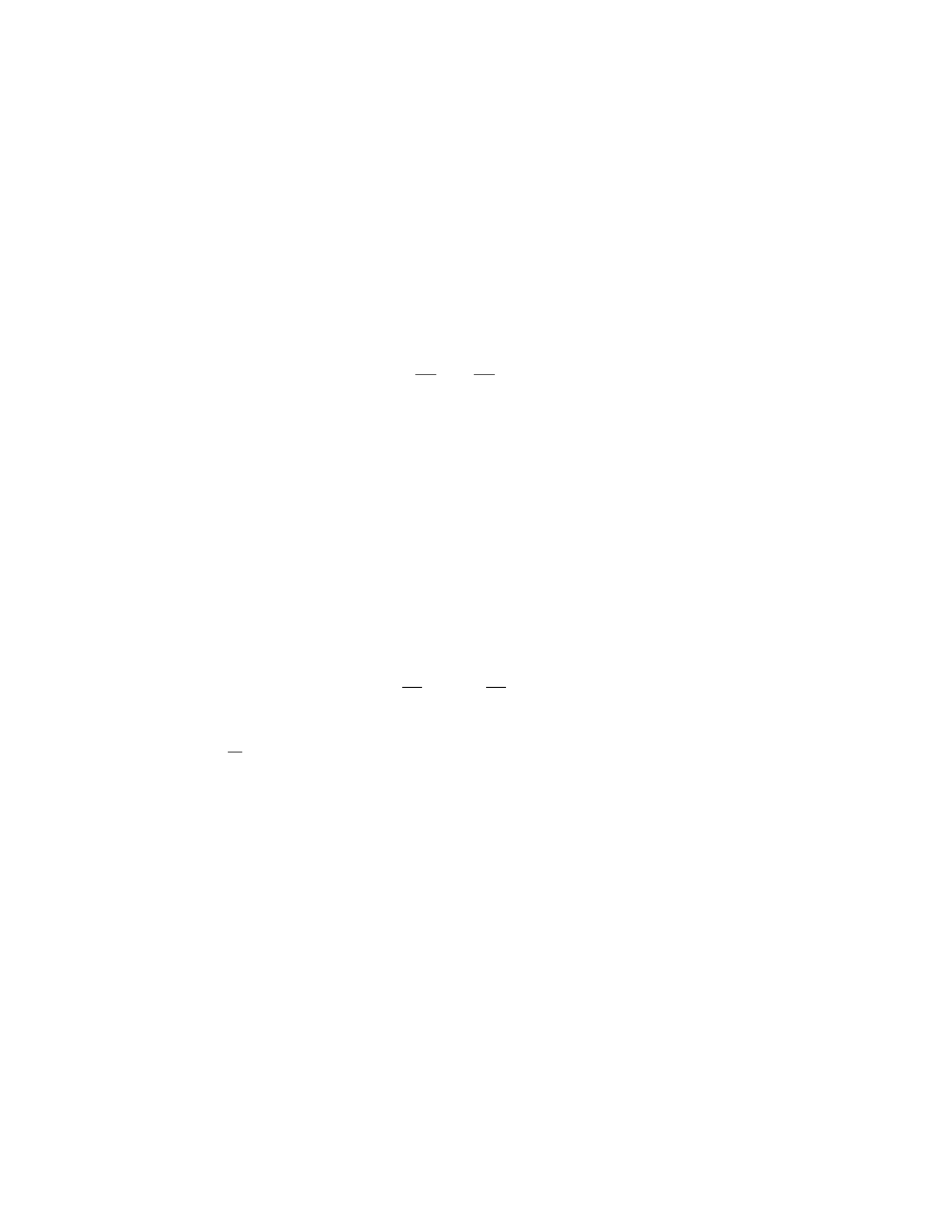
u(x, 0) = x3, we get u(x, 0) = ACepx +ADe−px =x3. From this, we find A=x3
2cosh(px)and
B= 0.
Applying the condition uy(x, 0) = 0, we find that uy(x, 0) = −Aµ sinh(px) = 0. As µ= 0,
this implies A= 0.
Therefore, the particular solution to the given partial differential equation satisfying the initial
conditions is u(x, y) = 0.
16. Consider the partial differential equation:
∂u
∂t = 3∂u
∂x + 2u
subject to the initial condition:
u(x, 0) = sin(x)
Solve this partial differential equation using the method of characteristics.
Ans. To solve this partial differential equation using the method of characteristics, we will seek
a solution of the form u(x, t) = f(x−3t)e2t, where fis an unknown function. We will then
determine fusing the initial condition.
1. Determine the characteristics: Set up the characteristic equations:
dx
dt = 3,du
dt = 2u
Solving the first equation gives x= 3t+c1, where c1is a constant. Using this in the second
equation gives du
dt = 2u. This is a separable equation with the solution u(x, t) = Ce2t, where C
is a constant.
2. Find Cusing the initial condition: Given that u(x, 0) = sin(x), we have f(x) = sin(x)
from the form of the solution. Thus, f(x−3·0) = f(x) = sin(x). This implies C=sin(x).
3. Write the final solution: Therefore, the solution to the partial differential equation is:
u(x, t) = sin(x−3t)e2t
17. Question: Solve the partial differential equation
uxx −2uxt +utt = 0

subject to the initial conditions
u(x, 0) = 2x2
ut(x, 0) = 3x
Ans. Solution:
Let’s denote u(x, t)as the solution to the given partial differential equation.
1. Solve the PDE:
We first find the characteristic equation for the given PDE by letting u(x, t) = F(s), where
s=x−2t. This yields the characteristic equation
dx
ds = 1,dt
ds =−2
Solving these equations gives x=s+c1and t=−2s+c2, where c1and c2are constants.
Thus, the method of characteristics gives us the general solution
u(x, t) = F(x−2t) = F(s)
where Fis an arbitrary function.
2. Use the initial conditions:
From the initial condition u(x, 0) = 2x2, we have
F(x) = 2x2
From the initial condition ut(x, 0) = 3x, we differentiate u(x, t)with respect to tand set
t= 0:
du
dt =dF
ds ·ds
dt =−2F′(s) = 3x
Solving this gives F(s) = −3
2s2+c3, where c3is a constant.
3. Final solution:
Combining the results from step 2, we obtain the final solution
u(x, t) = −3
2(x−2t)2+ 2x2
18. Question: Solve the partial differential equation

ux+uy=u
subject to the initial condition u(x, 0) = ex.
Ans. Step-by-step solution:
1. We will solve the given partial differential equation using the method of characteristics.
Let p=dx −dy be the characteristic curve. Then, the equations dx
1=dy
1=du
udescribe the
characteristics.
2. From the first equality, we have dx =dy, which implies that x−y=C1where C1is a
constant of integration.
3. From the second equality, we have du =u dC1. Integrating both sides gives ln |u|=C2
where C2is another constant of integration.
4. Exponentiating both sides gives u=eC2which simplifies to u=Cex−ywhere Cis an
arbitrary constant.
5. Now, using the initial condition u(x, 0) = ex, we find ex=Cex, which implies that C= 1.
6. Therefore, the solution to the partial differential equation subject to the initial condition
is u=ex−y.
19. Question: Solve the following partial differential equation using the method of characteris-
tics: ∂u
∂x + 2∂u
∂y =uwith the initial condition u(0, y) = y.
Ans. Solution: To solve the given partial differential equation using the method of character-
istics, we first need to find the characteristic curves and then solve along these curves.
1. Find characteristic curves: Let dx/dt = 1,dy/dt = 2, and du/dt =u. Using the chain
rule, we have: du
dt =∂u
∂x
dx
dt +∂u
∂y
dy
dt
Equating this to the given PDE ∂u
∂x + 2∂u
∂y =u, we get:
du
dt =u
This gives us the characteristic ODEs:
dx
dt = 1,dy
dt = 2,du
dt =u

The solutions to these ODEs are:
x=t+x0, y = 2t+y0, u =Cet
where Cis a constant.
2. Solve the characteristic equations: Given the initial condition u(0, y) = y, we have
u(0, y0) = y0on the characteristic curve. This gives us Ce0=y0, so C=y0.
3. Final solution: Substitute C=y0into the general solution u=Cet, we get u=y0et.
Therefore, the solution to the given PDE with the initial condition is u=yex−2y.
20. Question: Consider the partial differential equation given by:
ux+ut=sin(xt)
where u=u(x, t), and uxand utdenote the partial derivatives of uwith respect to xand t,
respectively. Given the initial condition u(x, 0) = x2, find the solution u(x, t)for t > 0.
Ans. Solution: We begin by writing the general solution of the partial differential equation in
the form:
u(x, t) = u1(x, t) + u2(x, t)
where u1(x, t)satisfies the homogeneous equation ux+ut= 0 and u2(x, t)represents a
particular solution of the given nonhomogeneous equation.
1. Finding u1(x, t):To find u1(x, t), we solve the characteristic equation associated with
the homogeneous equation:
dx
1=dt
1=du
0
Solving the first two ratios for a constant k, we have:
dx =dt =⇒x−t=k1
Now, solving the first and third ratios for another constant k2, we get:
dx =du =⇒x=k2
Combining the two solutions, we have:
u1(x, t) = F(x−t) = F(x−(k2)) = F(x−u)

where Fis an arbitrary function.
2. Finding u2(x, t):To find u2(x, t), we guess a particular solution in the form of u2(x, t) =
G(x, t). Since the right-hand side of the given equation is sin(xt), let’s try a solution of the form
G(x, t) = Asin(xt) + Bcos(xt). Taking partial derivatives of Gwith respect to xand t, we get:
Gx=At cos(xt)−Bt sin(xt)
Gt=Ax cos(xt)−Bx sin(xt)
Substitute these derivatives back into the original equation and compare coefficients of sin(xt)
to find the values of Aand B.
3. Combining Solutions: The general solution is given by the sum of u1(x, t)and u2(x, t):
u(x, t) = F(x−u) + Asin(xt) + Bcos(xt)
4. Applying Initial Condition: Using the initial condition u(x, 0) = x2, substitute t= 0
into the general solution and set it equal to x2. Then solve for F(x)in terms of x.
5. Final Solution: Substitute the found function F(x)back into the general solution to
obtain the final solution u(x, t)for t > 0.
21. Question: Find the general solution to the partial differential equation:
uxx −4uxy + 4uyy = 0
Ans. Step-by-step solution: 1. Let’s assume the general solution to the PDE is of the form:
u(x, y) = F(p, q)
where pand qare functions of xand yrespectively. Here, p=ax +by and q=cy +dx for some
constants a, b, c, d to be determined.
2. Computing the partial derivatives uxand uy:
ux=Fp·px+Fq·qx
uy=Fp·py+Fq·qy
3. Calculate the second derivatives uxx, uxy,and uyy:
uxx =Fpp ·p2
x+ 2Fpq ·px·qx+Fqq ·q2
x

uyy =Fpp ·p2
y+ 2Fpq ·py·qy+Fqq ·q2
y
uxy =Fpp ·px·py+Fpq ·(px·qy+py·qx) + Fqq ·qx·qy
4. Substituting the expressions for uxx, uxy,and uyy into the given equation, we get:
Fpp ·(a2+b2)+2Fpq ·(ac +bd) + Fqq ·(c2+d2) = 0
5. Since this equation must hold for all pand q, each term must vanish separately:
a2+b2= 0
ac +bd = 0
c2+d2= 0
6. From a2+b2= 0, we find a=b= 0. Similarly, from c2+d2= 0, we have c=d= 0.
7. Therefore, the solution to the PDE is:
u(x, y) = F(ax, by)
where Fis an arbitrary function.
So, the general solution to the given partial differential equation is u(x, y) = F(ax, by).
22. Question 22: Solve the partial differential equation
∂u
∂t −4∂u
∂x = 0
subject to the initial condition
u(x, 0) = sin(x)
Ans. Solution: We can solve the partial differential equation using the method of characteris-
tics. 1. Write down the characteristic equations:
dt
ds = 1,dx
ds =−4,du
ds = 0
2. Solve the characteristic equations to find the characteristic curves:
t=s+C1, x =−4s+C2, u =C3

where C1, C2, C3are constants of integration. 3. Express C1, C2, C3in terms of the initial
conditions: From x=−4s+C2and x(0) = x0, we obtain C2=x0. From u=C3and
u(x, 0) = sin(x), we obtain C3=sin(x0). Therefore, the characteristic curves are given by:
t=s+t0, x =−4s+x0, u =sin(x0)4. Express x0in terms of tand x: From t=s+t0
and t= 0 at s= 0, we get t0= 0. So, the characteristic curves become: t=s, x =
−4s+x, u =sin(x)5. Using the initial condition u(x, 0) = sin(x)to find u along the
characteristic curve: When t= 0,s= 0 and x=x, so u(x, 0) = sin(x)along the characteristic
curve. 6. Since uremains constant along the characteristic curves, the general solution is:
u(x, t) = sin(−4t+x)
So, the solution to the partial differential equation with the initial condition is u(x, t) = sin(−4t+x).
23. Question: Solve the nonhomogeneous partial differential equation:
∂u
∂t + 4∂u
∂x = 2x+ 3t, u(x, 0) = x2+ 1
Ans. Step-by-step solution: 1. First, we will find the general solution to the homogeneous
equation:
∂u
∂t + 4∂u
∂x = 0
To solve this, we can use the method of characteristics. Let p= 4 and the characteristic
equations be given by:
dx
4=dt
1=du
0
The first characteristic is dx = 4dt, which integrates to x= 4t+C1. The second characteristic
leads to u=C2. Therefore, the general solution to the homogeneous equation is uh(x, t) = C2.
2. Next, we find a particular solution to the nonhomogeneous equation. We assume u(x, t) =
v(x, t) + w(x, t), where v(x, t)satisfies the homogeneous equation and w(x, t)satisfies the
nonhomogeneous equation.
Substitute u(x, t) = v(x, t) + w(x, t)into the nonhomogeneous equation:
∂v
∂t + 4∂v
∂x +∂w
∂t + 4∂w
∂x = 2x+ 3t
Since v(x, t)satisfies the homogeneous equation, the first two terms cancel out. The equation
becomes:

∂w
∂t + 4∂w
∂x = 2x+ 3t
3. To solve the above equation, we use the method of characteristics again with p= 4. The
characteristic equations are:
dx
4=dt
1=dw
2x+ 3t
Solving the first characteristic gives x= 4t+C3. The second characteristic leads to w=
(2x2
2+ 3tx +C4).
Therefore, the general solution to the nonhomogeneous equation is:
u(x, t) = C2+2x2
2+ 3tx +C4
4. Applying the initial condition u(x, 0) = x2+ 1 to the general solution, we find:
x2+ 1 = C2+2x2
2+C4=⇒C2= 1, C4= 0
Thus, the particular solution to the nonhomogeneous equation is:
u(x, t) = 1 + x2+ 3xt
Therefore, the solution to the partial differential equation is:
u(x, t) = C2+2x2
2+ 3tx
24. Question:
Consider the partial differential equation
ut=kuxx −λu, x ∈(0, L), t > 0,
subjected to the initial condition u(x, 0) = sin(πx)and the boundary conditions u(0, t) =
u(L, t) = 0. Solve the partial differential equation using the method of separation of variables.
Ans. Solution:
1. Write down the separated solutions:

Assume a separation of variables solution of the form u(x, t) = X(x)T(t). Substituting this
into the partial differential equation, we get
X(x)T′(t) = kX′′(x)T(t)−λX(x)T(t).
Divide by kX(x)T(t)to obtain
T′(t)
kT (t)=X′′(x)
X(x)−λ
k.
Since the left-hand side depends only on tand the right-hand side depends only on x, both
sides must be equal to a constant −µ. This gives us two ordinary differential equations:
{T′(t) + kµT (t) = 0
X′′(x)+(µ−λ
k)X(x) = 0.
2. Solve the time equation:
The time equation T′(t)+kµT (t) = 0 has the solution T(t) = Ce−kµt, where Cis a constant.
3. Solve the space equation:
The space equation X′′(x)+(µ−λ
k)X(x)=0is a second-order homogeneous differential
equation. The general solution is
X(x) = Acos(√µ−λ
kx)+Bsin(√µ−λ
kx).
Applying the boundary conditions X(0) = X(L) = 0, we get B= 0 and √µ−λ
kL=nπ,
where nis a positive integer. This gives us
µ=n2π2
L2+λ
k.
4. Form the general solution:
The general solution is a linear combination of the separated solutions, given by
u(x, t) = ∞
∑
n=1
Cne−(n2π2
L2+λ
k)tsin(nπ
Lx),
where the coefficients Cncan be obtained from the initial condition u(x, 0) = sin(πx)using
Fourier series.
Therefore, the solution to the partial differential equation is
u(x, t) = ∞
∑
n=1
sin(πx)e−(n2π2
L2+λ
k)tsin(nπ
Lx).

25. Find the general solution to the partial differential equation:
uxx −uyy = 0
Ans. To find the general solution to the given partial differential equation, we proceed as
follows:
1. We first assume a solution of the form u(x, y) = X(x)Y(y). Substituting this into the
given PDE, we have:
X′′(x)Y(y)−X(x)Y′′(y) = 0
2. Dividing through by X(x)Y(y), we get:
X′′(x)
X(x)=Y′′(y)
Y(y)
Since the left side only depends on xand the right side only depends on y, they must be
equal to a constant, say −k2. Therefore, we have two ODEs:
X′′(x) + k2X(x) = 0 and Y′′(y)−k2Y(y) = 0
3. The solutions to these ODEs are of the form X(x) = acos(kx) + bsin(kx)and Y(y) =
ccosh(ky) + dsinh(ky).
4. Combining the solutions, we get the general solution:
u(x, y) = ∞
∑
n=1
(Ancos(ny) + Bnsin(ny)) (Cncosh(nx) + Dnsinh(nx))
where An,Bn,Cn, and Dnare constants determined by the initial/boundary conditions.
26. Question: Find the general solution to the partial differential equation ∂2u
∂x2+4 ∂2u
∂y∂x −5∂2u
∂y2=
0.
Ans. Solution: Let’s assume the general solution has the form u(x, y) = X(x)Y(y). Substi-
tuting this form into the given differential equation, we get:
1. X′′(x)Y(y)+4X′(x)Y′(y)−5X(x)Y′′(y) = 0
Now, divide the equation by X(x)Y(y)to separate the variables:

2. X′′(x)
X(x)+ 4X′(x)
X(x)
Y′(y)
Y(y)−5Y′′(y)
Y(y)= 0
Since the left-hand side of equation (2) depends only on x and on y respectively, it must be
equal to a constant. Assume this constant is equal to −k2, where kis a constant.
3. X′′(x)
X(x)=k2
Solve this ordinary differential equation for X(x):
4. X′′(x)−k2X(x) = 0
The general solution to this differential equation is:
5. X(x) = c1ekx +c2e−kx
Now, let’s solve the same ordinary differential equation for Y(y):
6. Y′′(y)−4Y′(y)+5k2Y(y) = 0
The characteristic equation for this equation is:
7. λ2−4λ+ 5k2= 0
Solving this quadratic equation, we find that the roots are λ= 2±ki. Therefore, the solution
for Y(y)is:
8. Y(y) = c3e2ycos(ky) + c4e2ysin(ky)
Putting everything together, the general solution to the partial differential equation is:
9. u(x, y) = (c1ekx +c2e−kx)(c3e2ycos(ky) + c4e2ysin(ky))
27. Find the general solution to the partial differential equation:
∂2u
∂x2−∂2u
∂y2= 0
Ans. Let’s find the general solution to the given partial differential equation.
Step 1. Assume a separable solution of the form u(x, y) = X(x)Y(y).
Substitute the separable solution into the partial differential equation:
X′′(x)Y(y)−X(x)Y′′(y) = 0
Dividing by X(x)Y(y)gives:
X′′(x)
X(x)=Y′′(y)
Y(y)
Since these depend on different variables, they must be equal to some constant. Let’s call
this constant −λ2.
So we have the two ordinary differential equations:

X′′(x) + λ2X(x) = 0
Y′′(y)−λ2Y(y) = 0
Step 2. Solve the ordinary differential equations for X(x)and Y(y)separately.
The general solution to X′′(x) + λ2X(x) = 0 is X(x) = Acos(λx) + Bsin(λx).
The general solution to Y′′(y)−λ2Y(y) = 0 is Y(y) = Ceλy +De−λy .
Step 3. Combine the solutions.
The general solution to the partial differential equation is the product of the solutions for
X(x)and Y(y):
u(x, y) = (Acos(λx) + Bsin(λx))(Ceλy +De−λy)
This gives us the general solution to the partial differential equation:
u(x, y) = ∞
∑
n=1 [(Ancos(λnx) + Bnsin(λnx))(Cneλny+Dne−λny)]
where λnare the solutions to the characteristic equation r2=λ2and An, Bn, Cn, Dnare
constants determined by the initial/boundary conditions.
28. Question: Solve the partial differential equation
uxx + 2uxy +uyy = 0
subject to the initial conditions
u(0, y) = sin(y)and ux(0, y) = y2
Ans. Solution: We will first rewrite the given partial differential equation as
uxx + 2uxy +uyy = (ux+uy)2= 0
Notice that (ux+uy)2= 0 means that ux+uy= 0 or ux=−uy.
1. Find the general solution: Let’s find the general solution of the characteristic equation
corresponding to ux=−uy. Consider the characteristic equations:
dx
dt = 1,dy
dt =−1,du
dt = 0

Integrating the first two:
x=t+c1, y =−t+c2
where c1, c2are constants of integration.
The general solution is u(x, y) = f(x+y).
2. Determine the specific solution: Apply the initial condition u(0, y) = sin(y):
u(0, y) = f(0 + y) = f(y) = sin(y)
So, fmust be sin(y).
3. Find ux: Compute ux=df (x+y)
dx =f′(x+y).
Apply the initial condition ux(0, y) = y2:
f′(0 + y) = d(sin(y))
dy =dy
dy = 1
Hence, we have u(x, y) = sin(x+y).
Therefore, the solution to the partial differential equation with the given initial conditions is
u(x, y) = sin(x+y).
29. Let u(x, y)be a solution to the partial differential equation
x2uxx + 2xyuxy +y2uyy = 0
Subject to the boundary conditions
u(1, y) = ey, ux(2, y) = 3e2y
Find the solution u(x, y)to the partial differential equation.
Ans. Let’s begin by solving the given partial differential equation using the method of charac-
teristics. 1. We first find the characteristic curves by setting dx/(x2) = dy/(2xy) = du/0:
dx
x2=dy
2xy =⇒∫1
x2dx =∫1
2
1
xdy
This simplifies to −1
x=1
2ln |y|+C1or y=C2x2. So, the characteristic curves are of the form
y=Cx2. 2. Along the characteristic curves, we have ux=du/dx and uy=dy/dxdu/dx. So,
the PDE becomes
x2uxx + 2xyuxy +y2uyy = 0 =⇒ux+yuy= 0

Plugging in ux=du/dx and uy=dy/dxdu/dx and the equation for the characteristic curves
y=Cx2gives
du
dx +Cx2du
dx = 0 =⇒du
dx(1 + Cx2) = 0
This implies that uis constant along each characteristic curve. 3. Using the initial condition
u(1, y) = eywe have u(1, y) = ey=u(x, y)along the characteristic curve passing through (1, y).
So, the solution is u(x, y) = ey/x2. 4. Finally, we use the second initial condition ux(2, y) = 3e2y
to find the value of the constant C. We have ux=−2ey/x2/x3and ux(2, y) = −2ey/22/23=
3e2y. Therefore, C=−4and the solution to the PDE is u(x, y) = ey/x2−4x2.
30. Question: Solve the following partial differential equation using the method of separation
of variables:
uxx −uyy = 0
subject to the boundary conditions:
u(0, y) = 0
u(π, y) = sin(y)
Ans. Solution:
1. Assume that the solution to the partial differential equation can be expressed as a product
of functions of x and y, i.e., u(x, y) = X(x)Y(y).
2. Substitute u(x, y) = X(x)Y(y)into uxx −uyy = 0 to obtain:
X′′(x)Y(y)−X(x)Y′′(y) = 0
3. Divide the equation by X(x)Y(y)to separate the variables:
X′′(x)
X(x)=Y′′(y)
Y(y)
4. Rearrange the terms to get two ordinary differential equations:
X′′(x)
X(x)=λ=Y′′(y)
Y(y)
5. Solve the ordinary differential equations to find the eigenvalues and corresponding eigen-
functions.
For the equation involving x, we have:
X′′(x)−λX(x) = 0
The general solution is:
X(x) = Acos(√λx)+Bsin(√λx)

2. Question: Find the general solution to the partial differential equation
uxx = 4uyy
Ans. Solution: To find the general solution to the partial differential equation uxx = 4uyy , we
will rewrite the equation in terms of the separation of variables method and then solve it.
1. Rewrite the equation: Let u(x, y) = X(x)Y(y). Then, the partial derivatives uxx and
uyy can be expressed as:
uxx =X′′(x)Y(y)and uyy =X(x)Y′′(y)
Substitute these expressions into the given PDE:
X′′(x)Y(y) = 4X(x)Y′′(y)
2. Divide by X(x)Y(y): Divide both sides by X(x)Y(y)to separate variables:
X′′(x)
X(x)= 4Y′′(y)
Y(y)
3. Set both sides equal to a constant: Let this constant be −λ2. Then we have two
ODEs to solve:
X′′(x) + λ2X(x) = 0 and Y′′(y)−4λ2Y(y) = 0
4. Solve the first ODE: The solutions to the ODE for X(x)are:
X(x) = c1cos(λx) + c2sin(λx)
5. Solve the second ODE: The solutions to the ODE for Y(y)are:
Y(y) = c3e2λy +c4e−2λy
6. Combine the solutions: The general solution can be written as the linear combination
of the solutions:
u(x, y) = ∑
n,m
cn,m (cos(λnx) + sin(λnx)) (e2λmy+e−2λmy)
where cn,m are constants and λnand λmare the roots of corresponding characteristic equa-
tions.
Therefore, the general solution to the partial differential equation uxx = 4uyy is given by the
above expression.

3. Find the general solution to the partial differential equation:
∂2u
∂x2−4∂u
∂y = 0.
Ans. To find the general solution to the given partial differential equation, we first assume that
the solution can be expressed as a product of functions of xand y, i.e., u(x, y) = X(x)Y(y).
We substitute this into the partial differential equation and separate variables to solve for X(x)
and Y(y).
1. Substitute u(x, y) = X(x)Y(y)into the PDE:
We have: ∂2u
∂x2−4∂u
∂y = 0.
Substitute u(x, y) = X(x)Y(y)into the equation:
∂2
∂x2(X(x)Y(y)) −4∂
∂y (X(x)Y(y)) = 0.
2. Separate the variables:
Divide by X(x)Y(y):
X′′(x)
X(x)−4Y′(y)
Y(y)= 0.
Simplify:
X′′(x)
X(x)= 4Y′(y)
Y(y)=λ.
This gives two ordinary differential equations, one for X(x)and one for Y(y):
X′′(x)−λX(x) = 0
and
Y′(y)−λ
4Y(y) = 0.
3. Solve the ODEs for X(x)and Y(y):
The solutions are:
X(x) = c1cos(√λx)+c2sin(√λx)
and
Y(y) = c3eλy
4.
4. Combine the solutions:
The general solution is given by the product of X(x)and Y(y):
u(x, y) = (c1cos(√λx)+c2sin(√λx))(c3eλy
4).

Therefore, the general solution to the PDE is:
u(x, y) = ∞
∑
n=1
(c1ncos(√λnx)+c2nsin(√λnx))(c3neλny
4),
where λnare the eigenvalues and c1n, c2n, c3nare constants determined by initial/boundary con-
ditions.
4. Question:
Solve the partial differential equation ∂2u
∂t2= 4∂2u
∂x2subject to the initial conditions u(x, 0) = x2
and ∂u
∂t (x, 0) = 0.
Ans. Step-by-step solution:
1. We can solve the given partial differential equation using the method of separation of
variables. Let’s assume u(x, t) = X(x)T(t). Substituting this into the PDE, we get:
T′′X= 4X′′T
2. Dividing by X(x)T(t), we have:
T′′
T= 4X′′
X
3. Since the left side of the equation depends only on tand the right side depends only on
x, they must be equal to a constant. Let this constant be −λ. So we have two ODEs to solve:
T′′ +λT = 0 and X′′ −λ
4X= 0
4. The solution to the ODE T′′ +λT = 0 is given by T(t) = Acos(√λt)+Bsin(√λt)
where Aand Bare constants.
5. The solution to the ODE X′′ −λ
4X= 0 is given by X(x) = Ce√λx
2+De−√λx
2where C
and Dare constants.
6. Applying the initial condition u(x, 0) = x2to u(x, t) = X(x)T(t), we get X(x)T(0) = x2.
Since ∂u
∂t (x, 0) = 0, we have T′(0) = 0.
7. Substituting the initial conditions, we find that X(x) = x2and T′(0) = 0. This implies
that λ= 4m2for some integer m.
8. Therefore, the general solution to the PDE is given by u(x, t) = (Amcos(2mt) +
Bmsin(2mt))emx + (Cmcos(2mt) + Dmsin(2mt))e−mx, where Am, Bm, Cm, Dmare constants
determined by the initial conditions.

5. Question: Solve the following partial differential equation using the method of characteristics:
ux+uy=x+ 1, u(0, y) = y2
Ans. Solution: 1. We first write down the characteristic equations corresponding to the given
PDE: dx
dt = 1,dy
dt = 1,du
dt =x+ 1
2. Solve the first two characteristic equations to find the characteristic curves:
x=t+c1, y =t+c2
3. From the initial condition, we have u(0, y) = y2. Plugging in x= 0 into the first
characteristic equation gives us c1= 0. Therefore, the characteristic curves are given by x=t
and y=t+c2.
4. Now, we express uin terms of t:
du
dt =t+ 1 =⇒u(t) = 1
2t2+t+c3
5. Making use of the initial condition u(0, y) = y2, we find c3:
u(0, y) = y2=⇒c3=y2
6. So, the general solution to the PDE is given by:
u(x, y) = 1
2x2+x+y2
6. Question: Solve the partial differential equation
∂u
∂t + 2u∂u
∂x = 0
subject to the initial condition u(x, 0) = e−x2.
Ans. Step-by-step solution: 1. Let’s first write the given partial differential equation in the
form of a total derivative by introducing a new variable z(x, t)such that z=u(x, t). This allows
us to write the equation as
dz
dt = 0

dz
dt =∂z
∂t +∂z
∂x
dx
dt =∂u
∂t +∂u
∂x
dx
dt =∂u
∂t + 2u∂u
∂x
2. Since dz
dt = 0, it implies that zis constant with respect to t. Therefore, z(x, t) = C. 3. Using
the initial condition u(x, 0) = e−x2, we have z(x, 0) = e−x2=C. 4. Thus, the solution to the
given partial differential equation is u(x, t) = e−x2.
7. Question: Solve the partial differential equation ∂u
∂t =k(∂2u
∂x2+∂2u
∂y2)with initial condition
u(x, y, 0) = e−x2−y2on the domain −∞ < x, y < ∞.
Ans. Step-by-step solution: 1. We will solve the given partial differential equation using
the method of separation of variables. Let’s assume the solution has the form u(x, y, t) =
X(x)Y(y)T(t).
2. Substituting u(x, y, t) = X(x)Y(y)T(t)into the given PDE gives T′(t)
kT (t)=X′′(x)
X(x)+Y′′(y)
Y(y)=
λ, where λis the separation constant.
3. Solving the ordinary differential equations X′′(x)
X(x)=Y′′(y)
Y(y)=λgives us the solutions
X(x) = Acos(√λx)+Bsin(√λx)and Y(y) = Ccos(√λy)+Dsin(√λy).
4. Since u(x, y, 0) = e−x2−y2, the Fourier series expansion of e−x2−y2will be used to determine
the constants Aand B.
5. After determining the constants A,B,C, and D, we get the general solution u(x, y, t) =
∑∞
n=0 ∑∞
m=0 un,m(x, y, t).
6. Finally, we use the initial condition u(x, y, 0) = e−x2−y2to determine the coefficients
un,m(x, y, 0), which will give the particular solution to the PDE.
8. Question: Solve the partial differential equation uxx −uyy = 0 subject to the boundary
conditions u(0, y) = yand ux(π, y) = 0.
Ans. Step-by-step solution:

1. We first assume a solution of the form u(x, y) = X(x)Y(y). Substituting this into the
PDE gives us X′′Y−XY ′′ = 0, which can be rearranged as X′′
X=Y′′
Y.
2. This implies that the left side of the equation depends only on x, while the right side
depends only on y. Therefore, the only way for this equation to hold for all xand yis if both
sides are equal to a constant. We set this constant to −λ2.
3. This gives us two ordinary differential equations: X′′ +λ2X= 0 and Y′′ −λ2Y= 0. The
general solutions are X(x) = Acos(λx) + Bsin(λx)and Y(y) = Ccosh(λy) + Dsinh(λy).
4. Applying the boundary conditions: - From u(0, y) = y, we have X(0)Y(y) = y, which
gives B·Y(y) = y. Therefore, B= 0 and X(x) = Acos(λx).
- From ux(π, y) = 0, we have X′(π)Y(y) = 0. Since X′(π) = −Aλ sin(λπ), this implies
that Aλ sin(λπ) = 0. This gives us the condition λ=nfor n∈Z.
5. Therefore, the solution to the PDE is u(x, y) = ∑∞
n=1 Ancos(nx)sinh(ny), where Anare
constants to be determined by the initial condition.
6. To find the constants An, we use the initial condition u(0, y) = y. Substituting this into
the solution gives us y=∑∞
n=1 Ansinh(ny).
7. Multiplying both sides by sinh(my)and integrating from 0to πwith respect to ygives us
Am=2
π∫π
0ysinh(my)dy. This integral can be evaluated to determine the value of Amfor each
m.
8. Finally, the solution to the PDE with the given boundary conditions is u(x, y) = ∑∞
n=1 (2
π∫π
0ysinh(ny)dy)cos(nx)sinh(ny).
9. Question: Find the general solution to the partial differential equation:
uxx + 2uxy +uyy = 0
where uxdenotes the partial derivative of uwith respect to x,uydenotes the partial derivative
of uwith respect to y, and subscripts denote partial differentiation.
Ans. Solution:
To find the general solution to the given partial differential equation, we will first determine
the characteristic equation. Let p=uxand q=uy. Then the given partial differential equation
can be rewritten as:
px+ 2py+qy= 0
The characteristic equation of this first-order linear PDE is given by:
dx
1=dy
2=dp
0=dq
−1

1. From dx
1=dy
2, we have 2dx =dy, which can be rewritten as:
2∆x= ∆y
2. From dx
1=dy
2=dq
−1, we have ∆x=−∆q, which can be simplified to:
q=−x+ϕ(y)
where ϕ(y)is an arbitrary function.
3. From p=ux, we have p=du
dx , which gives u=∫p dx. Using the expression for pfrom
step 2, we get:
u=∫(−1) dx =−x+g(y)
where g(y)is another arbitrary function.
4. Combining the expressions for uand qobtained in steps 2 and 3, we have the general
solution to the partial differential equation:
u=−x+ϕ(y) = −x+g(y)
Thus, the general solution to the given partial differential equation is u=−x+ϕ(y), where
ϕ(y)is an arbitrary function.
10. Question:
Consider the partial differential equation
ut−4ux= 0
subject to the initial condition
u(x, 0) = e−x2
a) Find the general solution to the partial differential equation.
b) Find the particular solution that also satisfies the initial condition.
Ans. a) To find the general solution to the partial differential equation, we first write it in the
form of a characteristic equation:
dt
1=dx
−4=du
0

From the second fraction, we have du = 0, which means uis a constant along the character-
istic curves. Let this constant be denoted by C. This yields the characteristic equations:
t=τ
x=−4τ+ξ
u=C
where ξis an arbitrary constant. Hence, the general solution to the partial differential equation
is given by:
u(x, t) = F(−4t+x)
where Fis an arbitrary function.
b) To find the particular solution that also satisfies the initial condition, we substitute u(x, 0) =
e−x2into the general solution:
u(x, 0) = F(−4·0 + x) = F(x) = e−x2
Since F(x) = e−x2, the particular solution that satisfies the initial condition is:
u(x, t) = e−(x+4t)2
11. Question: Solve the following partial differential equation:
∂2u
∂x2+ 4∂2u
∂y2= 0
subject to the boundary conditions u(0, y) = sin(y)and u(x, 0) = e−2x.
Ans. Solution:
1. We assume a separation of variables solution u(x, y) = X(x)Y(y). Substituting this into
the PDE, we obtain:
X′′(x)Y(y)+4X(x)Y′′(y) = 0
Dividing by X(x)Y(y), we get:
X′′(x)
X(x)=−4Y′′(y)
Y(y)=λ

2. Solving the ordinary differential equation X′′(x)−λX(x) = 0 gives us the solutions
X(x) = Acos(2x) + Bsin(2x), where λ=−4.
3. Solving the ordinary differential equation Y′′(y)+4λY (y) = 0 gives us the solutions
Y(y) = Ce2y+De−2y, where λ=−4.
4. Therefore, the general solution is:
u(x, y) = (Acos(2x) + Bsin(2x))(Ce2y+De−2y)
5. Applying the boundary conditions u(0, y) = sin(y)and u(x, 0) = e−2x, we get:
B·e2y+D·e−2y=sin(y)
A·cos(2x) + B·sin(2x) = e−2x
6. From the first boundary condition, we find that D=1
2and C= 0.
7. Substituting these into the second boundary condition and simplifying, we get:
Acos(2x) + Bsin(2x) = e−2x
8. Solving this equation for Aand B, we obtain the final solution:
u(x, y) = 1
2e−2xsin(2y)
12. Find the general solution to the partial differential equation:
uxx −4uxy + 4uyy = 0
Ans. To find the general solution to the given partial differential equation, we first determine
the characteristic equation by introducing new variables:
Let p=uxand q=uy.
Then we have:
uxx =px=uxpp+uxqq=ppx+qpy
uxy =py=uxpp+uxqq=ppy+qqy
uyy =qy=uypp+uyqq=pqx+qqy
Substitute these expressions into the given PDE:

ppx+qpy−4(ppy+qqy) + 4(pqx+qqy) = 0
Simplify this equation to get:
p2−4pq + 4q2= 0
This is a quadratic equation in pand qwhich can be factored as:
(p−2q)2= 0
Thus, the characteristic equation is p−2q= 0.
Now, we introduce the method of characteristics by defining the curves:
dx
dt = 1,dy
dt =−2,dp
dt = 0,dq
dt = 0
Solving the system of ODEs, we get x=t+c1,y=−2t+c2,p=c3,q=c4where c1,c2,
c3, and c4are constants of integration.
Therefore, the general solution to the partial differential equation is:
u(x, y) = F(t+c1,−2t+c2)
where Fis an arbitrary function of two variables.
13. Question: Solve the following partial differential equation:
∂2u
∂x2−4∂2u
∂x∂y −5∂2u
∂y2= 0
Ans. Step-by-step solution:
1. Let’s assume a solution of the form u(x, y) = X(x)Y(y). Substituting this into the given
PDE, we get:
X′′(x)Y(y)−4X′(x)Y′(y)−5X(x)Y′′(y) = 0
2. Dividing the equation by X(x)Y(y), we get:
X′′(x)
X(x)−4X′(x)
X(x)
Y′(y)
Y(y)−5Y′′(y)
Y(y)= 0
3. Rearranging terms, we get:

X′′(x)
X(x)−4X′(x)
X(x)= 5Y′′(y)
Y(y)
4. The left-hand side of the equation is a function of xonly, while the right-hand side is a
function of yonly. Since they are equal to a constant, we can set them equal to some constant,
say λ, such that:
X′′(x)
X(x)−4X′(x)
X(x)=λ= 5Y′′(y)
Y(y)
5. This gives us two ODEs to solve: For X(x):
X′′(x)−4X′(x)−λX(x) = 0
And for Y(y):
Y′′(y)−λ
5Y(y) = 0
6. Solving the ODE for Y(y)yields Y(y) = c1e√λ
5y+c2e−√λ
5y. We consider two cases:
when λ > 0and λ < 0. Let’s denote µ2=λ
5.
7. For λ > 0(µis real), we have Y(y) = c1eµy +c2e−µy . For λ < 0(µis imaginary), we
have Y(y) = c1cos(√−µy) + c2sin(√−µy).
8. Now, solving the ODE for X(x)gives X(x) = c3e2x+c4e3x. Combining the solutions for
X(x)and Y(y), we get the general solution:
u(x, y) = (c3e2x+c4e3x)(c1eµy +c2e−µy )
where µ=√λ
5.
14. Question:
Solve the partial differential equation:
∂2u
∂x2−4∂u
∂t = 0
subject to the initial conditions:
u(x, 0) = 2x
∂u
∂t (x, 0) = x

Ans. Solution:
Step 1. Assume a solution of the form u(x, t) = X(x)T(t).
Substitute this into the partial differential equation:
X′′(x)T(t)−4X(x)T′(t) = 0
Divide by X(x)T(t)to separate variables:
X′′(x)
X(x)= 4T′(t)
T(t)=λ
Step 2. Solve the equation for X(x):
X′′(x)−λX(x) = 0
The general solution of this ordinary differential equation is:
If λ= 0,X(x) = c1x+c2
If λ < 0,X(x) = c1cos(√λx)+c2sin(√λx)
If λ > 0,X(x) = c1e√λx +c2e−√λx
Step 3. Solve the equation for T(t):
T′(t) = λ
4T(t)
This gives T(t) = c3eλ
4t
Step 4. Apply the initial conditions to find λand the constants.
From the initial condition u(x, 0) = 2x:
X(x)T(0) = 2x
X(x)c3= 2x
X(x) = 2x
From the initial condition ∂u
∂t (x, 0) = x:
X′(x)T′(0) = x
X′(x) = x
c1=1
2, c2= 0
Step 5. The solution is given by the product of X(x) and T(t):
u(x, t) = (1/2)x·e0t=1
2x
Therefore, the solution to the partial differential equation with the initial conditions is u(x, t) =
1
2x.

15. Question: Find a particular solution to the partial differential equation uxx −2uxy +uyy = 0,
given that u(x, 0) = x3and uy(x, 0) = 0.
Ans. Solution: We are given the partial differential equation uxx −2uxy +uyy = 0 with initial
conditions u(x, 0) = x3and uy(x, 0) = 0.
1. Finding the general solution: Let’s first find the general solution to the partial differ-
ential equation. We assume a solution of the form u(x, y) = X(x)Y(y). Substituting this into
the equation, we get:
X′′(x)Y(y)−2X′(x)Y′(y) + X(x)Y′′(y) = 0
Dividing by X(x)Y(y), we get:
X′′
X−2X′Y′
XY +Y′′
Y= 0
This equation can be rewritten as two separate ordinary differential equations:
X′′
X−2X′
X
Y′
Y=λand Y′′
Y=−λ
where λis a constant (the separation constant).
Solving the first ordinary differential equation, we get:
X′′ −2XY ′Y′
Y=λX =⇒X′′ −2pY ′=λX
where p=Y′
Y. This is now a second-order homogeneous ordinary differential equation with
constant coefficients.
Solving the second ordinary differential equation, we get:
Y′′ +λY = 0
This is also a second-order homogeneous ordinary differential equation.
2. Solving the ODEs: Solving Y′′ +λY = 0, we find that λmust be a negative constant
for a non-trivial solution. Let λ=−µ2, where µis a positive constant. The solutions to this
ODE are Y(y) = Acos(µy) + Bsin(µy).
Solving X′′ −2pX′=λX, we find X(x) = Cep1x+Dep2xwhere p1and p2are the roots of
the characteristic equation r2−2pr −λ= 0. Substituting λ=−µ2, we have r2−2pr +µ2= 0,
which gives r=p±µ. Thus, we have two solutions for X(x).
3. Combining solutions and applying boundary conditions: Our candidate solution is of
the form u(x, y) = (Acos(µy) + Bsin(µy))(Ce(p+µ)x+De(p−µ)x). Applying the initial condition
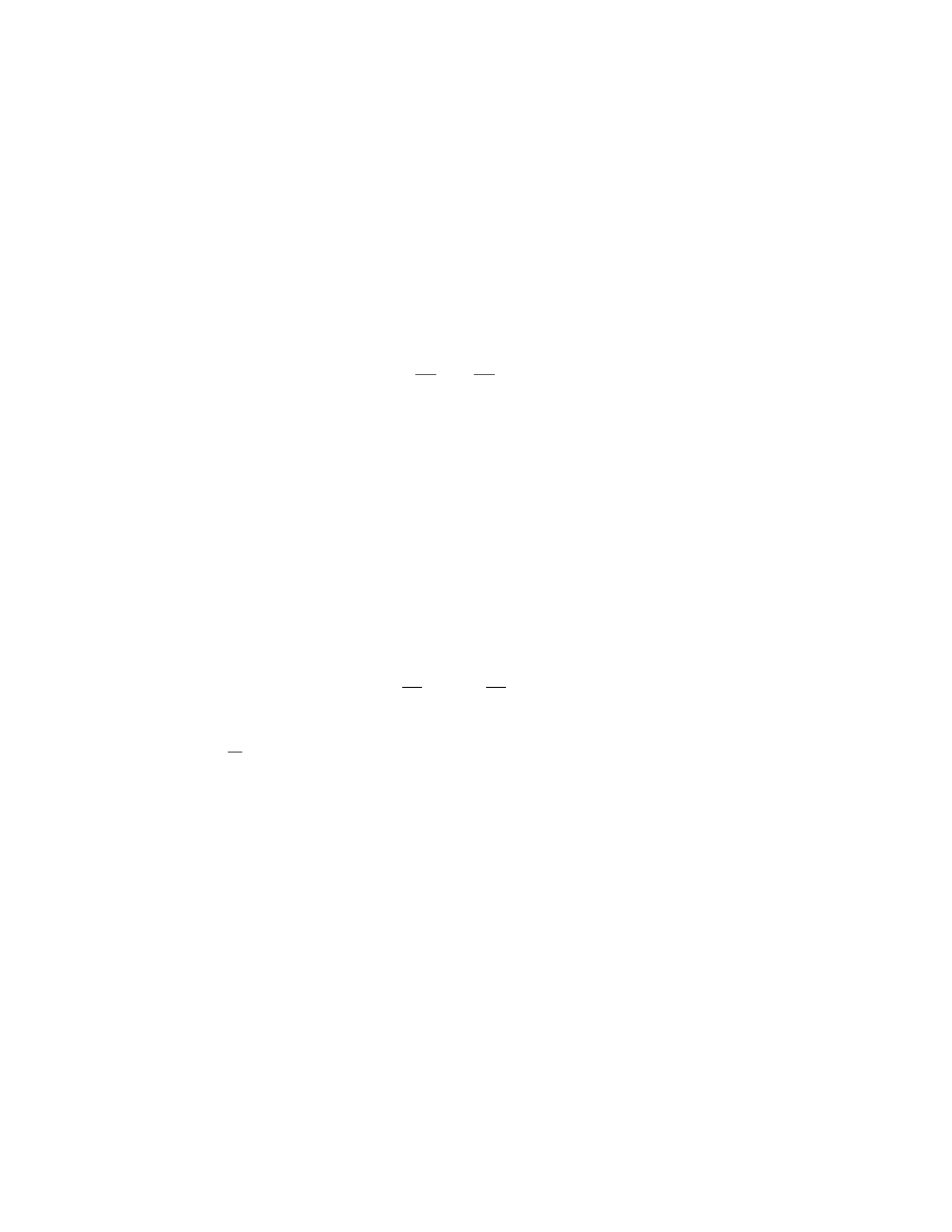
u(x, 0) = x3, we get u(x, 0) = ACepx +ADe−px =x3. From this, we find A=x3
2cosh(px)and
B= 0.
Applying the condition uy(x, 0) = 0, we find that uy(x, 0) = −Aµ sinh(px) = 0. As µ= 0,
this implies A= 0.
Therefore, the particular solution to the given partial differential equation satisfying the initial
conditions is u(x, y) = 0.
16. Consider the partial differential equation:
∂u
∂t = 3∂u
∂x + 2u
subject to the initial condition:
u(x, 0) = sin(x)
Solve this partial differential equation using the method of characteristics.
Ans. To solve this partial differential equation using the method of characteristics, we will seek
a solution of the form u(x, t) = f(x−3t)e2t, where fis an unknown function. We will then
determine fusing the initial condition.
1. Determine the characteristics: Set up the characteristic equations:
dx
dt = 3,du
dt = 2u
Solving the first equation gives x= 3t+c1, where c1is a constant. Using this in the second
equation gives du
dt = 2u. This is a separable equation with the solution u(x, t) = Ce2t, where C
is a constant.
2. Find Cusing the initial condition: Given that u(x, 0) = sin(x), we have f(x) = sin(x)
from the form of the solution. Thus, f(x−3·0) = f(x) = sin(x). This implies C=sin(x).
3. Write the final solution: Therefore, the solution to the partial differential equation is:
u(x, t) = sin(x−3t)e2t
17. Question: Solve the partial differential equation
uxx −2uxt +utt = 0

subject to the initial conditions
u(x, 0) = 2x2
ut(x, 0) = 3x
Ans. Solution:
Let’s denote u(x, t)as the solution to the given partial differential equation.
1. Solve the PDE:
We first find the characteristic equation for the given PDE by letting u(x, t) = F(s), where
s=x−2t. This yields the characteristic equation
dx
ds = 1,dt
ds =−2
Solving these equations gives x=s+c1and t=−2s+c2, where c1and c2are constants.
Thus, the method of characteristics gives us the general solution
u(x, t) = F(x−2t) = F(s)
where Fis an arbitrary function.
2. Use the initial conditions:
From the initial condition u(x, 0) = 2x2, we have
F(x) = 2x2
From the initial condition ut(x, 0) = 3x, we differentiate u(x, t)with respect to tand set
t= 0:
du
dt =dF
ds ·ds
dt =−2F′(s) = 3x
Solving this gives F(s) = −3
2s2+c3, where c3is a constant.
3. Final solution:
Combining the results from step 2, we obtain the final solution
u(x, t) = −3
2(x−2t)2+ 2x2
18. Question: Solve the partial differential equation

ux+uy=u
subject to the initial condition u(x, 0) = ex.
Ans. Step-by-step solution:
1. We will solve the given partial differential equation using the method of characteristics.
Let p=dx −dy be the characteristic curve. Then, the equations dx
1=dy
1=du
udescribe the
characteristics.
2. From the first equality, we have dx =dy, which implies that x−y=C1where C1is a
constant of integration.
3. From the second equality, we have du =u dC1. Integrating both sides gives ln |u|=C2
where C2is another constant of integration.
4. Exponentiating both sides gives u=eC2which simplifies to u=Cex−ywhere Cis an
arbitrary constant.
5. Now, using the initial condition u(x, 0) = ex, we find ex=Cex, which implies that C= 1.
6. Therefore, the solution to the partial differential equation subject to the initial condition
is u=ex−y.
19. Question: Solve the following partial differential equation using the method of characteris-
tics: ∂u
∂x + 2∂u
∂y =uwith the initial condition u(0, y) = y.
Ans. Solution: To solve the given partial differential equation using the method of character-
istics, we first need to find the characteristic curves and then solve along these curves.
1. Find characteristic curves: Let dx/dt = 1,dy/dt = 2, and du/dt =u. Using the chain
rule, we have: du
dt =∂u
∂x
dx
dt +∂u
∂y
dy
dt
Equating this to the given PDE ∂u
∂x + 2∂u
∂y =u, we get:
du
dt =u
This gives us the characteristic ODEs:
dx
dt = 1,dy
dt = 2,du
dt =u

The solutions to these ODEs are:
x=t+x0, y = 2t+y0, u =Cet
where Cis a constant.
2. Solve the characteristic equations: Given the initial condition u(0, y) = y, we have
u(0, y0) = y0on the characteristic curve. This gives us Ce0=y0, so C=y0.
3. Final solution: Substitute C=y0into the general solution u=Cet, we get u=y0et.
Therefore, the solution to the given PDE with the initial condition is u=yex−2y.
20. Question: Consider the partial differential equation given by:
ux+ut=sin(xt)
where u=u(x, t), and uxand utdenote the partial derivatives of uwith respect to xand t,
respectively. Given the initial condition u(x, 0) = x2, find the solution u(x, t)for t > 0.
Ans. Solution: We begin by writing the general solution of the partial differential equation in
the form:
u(x, t) = u1(x, t) + u2(x, t)
where u1(x, t)satisfies the homogeneous equation ux+ut= 0 and u2(x, t)represents a
particular solution of the given nonhomogeneous equation.
1. Finding u1(x, t):To find u1(x, t), we solve the characteristic equation associated with
the homogeneous equation:
dx
1=dt
1=du
0
Solving the first two ratios for a constant k, we have:
dx =dt =⇒x−t=k1
Now, solving the first and third ratios for another constant k2, we get:
dx =du =⇒x=k2
Combining the two solutions, we have:
u1(x, t) = F(x−t) = F(x−(k2)) = F(x−u)

where Fis an arbitrary function.
2. Finding u2(x, t):To find u2(x, t), we guess a particular solution in the form of u2(x, t) =
G(x, t). Since the right-hand side of the given equation is sin(xt), let’s try a solution of the form
G(x, t) = Asin(xt) + Bcos(xt). Taking partial derivatives of Gwith respect to xand t, we get:
Gx=At cos(xt)−Bt sin(xt)
Gt=Ax cos(xt)−Bx sin(xt)
Substitute these derivatives back into the original equation and compare coefficients of sin(xt)
to find the values of Aand B.
3. Combining Solutions: The general solution is given by the sum of u1(x, t)and u2(x, t):
u(x, t) = F(x−u) + Asin(xt) + Bcos(xt)
4. Applying Initial Condition: Using the initial condition u(x, 0) = x2, substitute t= 0
into the general solution and set it equal to x2. Then solve for F(x)in terms of x.
5. Final Solution: Substitute the found function F(x)back into the general solution to
obtain the final solution u(x, t)for t > 0.
21. Question: Find the general solution to the partial differential equation:
uxx −4uxy + 4uyy = 0
Ans. Step-by-step solution: 1. Let’s assume the general solution to the PDE is of the form:
u(x, y) = F(p, q)
where pand qare functions of xand yrespectively. Here, p=ax +by and q=cy +dx for some
constants a, b, c, d to be determined.
2. Computing the partial derivatives uxand uy:
ux=Fp·px+Fq·qx
uy=Fp·py+Fq·qy
3. Calculate the second derivatives uxx, uxy,and uyy:
uxx =Fpp ·p2
x+ 2Fpq ·px·qx+Fqq ·q2
x

uyy =Fpp ·p2
y+ 2Fpq ·py·qy+Fqq ·q2
y
uxy =Fpp ·px·py+Fpq ·(px·qy+py·qx) + Fqq ·qx·qy
4. Substituting the expressions for uxx, uxy,and uyy into the given equation, we get:
Fpp ·(a2+b2)+2Fpq ·(ac +bd) + Fqq ·(c2+d2) = 0
5. Since this equation must hold for all pand q, each term must vanish separately:
a2+b2= 0
ac +bd = 0
c2+d2= 0
6. From a2+b2= 0, we find a=b= 0. Similarly, from c2+d2= 0, we have c=d= 0.
7. Therefore, the solution to the PDE is:
u(x, y) = F(ax, by)
where Fis an arbitrary function.
So, the general solution to the given partial differential equation is u(x, y) = F(ax, by).
22. Question 22: Solve the partial differential equation
∂u
∂t −4∂u
∂x = 0
subject to the initial condition
u(x, 0) = sin(x)
Ans. Solution: We can solve the partial differential equation using the method of characteris-
tics. 1. Write down the characteristic equations:
dt
ds = 1,dx
ds =−4,du
ds = 0
2. Solve the characteristic equations to find the characteristic curves:
t=s+C1, x =−4s+C2, u =C3

where C1, C2, C3are constants of integration. 3. Express C1, C2, C3in terms of the initial
conditions: From x=−4s+C2and x(0) = x0, we obtain C2=x0. From u=C3and
u(x, 0) = sin(x), we obtain C3=sin(x0). Therefore, the characteristic curves are given by:
t=s+t0, x =−4s+x0, u =sin(x0)4. Express x0in terms of tand x: From t=s+t0
and t= 0 at s= 0, we get t0= 0. So, the characteristic curves become: t=s, x =
−4s+x, u =sin(x)5. Using the initial condition u(x, 0) = sin(x)to find u along the
characteristic curve: When t= 0,s= 0 and x=x, so u(x, 0) = sin(x)along the characteristic
curve. 6. Since uremains constant along the characteristic curves, the general solution is:
u(x, t) = sin(−4t+x)
So, the solution to the partial differential equation with the initial condition is u(x, t) = sin(−4t+x).
23. Question: Solve the nonhomogeneous partial differential equation:
∂u
∂t + 4∂u
∂x = 2x+ 3t, u(x, 0) = x2+ 1
Ans. Step-by-step solution: 1. First, we will find the general solution to the homogeneous
equation:
∂u
∂t + 4∂u
∂x = 0
To solve this, we can use the method of characteristics. Let p= 4 and the characteristic
equations be given by:
dx
4=dt
1=du
0
The first characteristic is dx = 4dt, which integrates to x= 4t+C1. The second characteristic
leads to u=C2. Therefore, the general solution to the homogeneous equation is uh(x, t) = C2.
2. Next, we find a particular solution to the nonhomogeneous equation. We assume u(x, t) =
v(x, t) + w(x, t), where v(x, t)satisfies the homogeneous equation and w(x, t)satisfies the
nonhomogeneous equation.
Substitute u(x, t) = v(x, t) + w(x, t)into the nonhomogeneous equation:
∂v
∂t + 4∂v
∂x +∂w
∂t + 4∂w
∂x = 2x+ 3t
Since v(x, t)satisfies the homogeneous equation, the first two terms cancel out. The equation
becomes:

∂w
∂t + 4∂w
∂x = 2x+ 3t
3. To solve the above equation, we use the method of characteristics again with p= 4. The
characteristic equations are:
dx
4=dt
1=dw
2x+ 3t
Solving the first characteristic gives x= 4t+C3. The second characteristic leads to w=
(2x2
2+ 3tx +C4).
Therefore, the general solution to the nonhomogeneous equation is:
u(x, t) = C2+2x2
2+ 3tx +C4
4. Applying the initial condition u(x, 0) = x2+ 1 to the general solution, we find:
x2+ 1 = C2+2x2
2+C4=⇒C2= 1, C4= 0
Thus, the particular solution to the nonhomogeneous equation is:
u(x, t) = 1 + x2+ 3xt
Therefore, the solution to the partial differential equation is:
u(x, t) = C2+2x2
2+ 3tx
24. Question:
Consider the partial differential equation
ut=kuxx −λu, x ∈(0, L), t > 0,
subjected to the initial condition u(x, 0) = sin(πx)and the boundary conditions u(0, t) =
u(L, t) = 0. Solve the partial differential equation using the method of separation of variables.
Ans. Solution:
1. Write down the separated solutions:

Assume a separation of variables solution of the form u(x, t) = X(x)T(t). Substituting this
into the partial differential equation, we get
X(x)T′(t) = kX′′(x)T(t)−λX(x)T(t).
Divide by kX(x)T(t)to obtain
T′(t)
kT (t)=X′′(x)
X(x)−λ
k.
Since the left-hand side depends only on tand the right-hand side depends only on x, both
sides must be equal to a constant −µ. This gives us two ordinary differential equations:
{T′(t) + kµT (t) = 0
X′′(x)+(µ−λ
k)X(x) = 0.
2. Solve the time equation:
The time equation T′(t)+kµT (t) = 0 has the solution T(t) = Ce−kµt, where Cis a constant.
3. Solve the space equation:
The space equation X′′(x)+(µ−λ
k)X(x)=0is a second-order homogeneous differential
equation. The general solution is
X(x) = Acos(√µ−λ
kx)+Bsin(√µ−λ
kx).
Applying the boundary conditions X(0) = X(L) = 0, we get B= 0 and √µ−λ
kL=nπ,
where nis a positive integer. This gives us
µ=n2π2
L2+λ
k.
4. Form the general solution:
The general solution is a linear combination of the separated solutions, given by
u(x, t) = ∞
∑
n=1
Cne−(n2π2
L2+λ
k)tsin(nπ
Lx),
where the coefficients Cncan be obtained from the initial condition u(x, 0) = sin(πx)using
Fourier series.
Therefore, the solution to the partial differential equation is
u(x, t) = ∞
∑
n=1
sin(πx)e−(n2π2
L2+λ
k)tsin(nπ
Lx).

25. Find the general solution to the partial differential equation:
uxx −uyy = 0
Ans. To find the general solution to the given partial differential equation, we proceed as
follows:
1. We first assume a solution of the form u(x, y) = X(x)Y(y). Substituting this into the
given PDE, we have:
X′′(x)Y(y)−X(x)Y′′(y) = 0
2. Dividing through by X(x)Y(y), we get:
X′′(x)
X(x)=Y′′(y)
Y(y)
Since the left side only depends on xand the right side only depends on y, they must be
equal to a constant, say −k2. Therefore, we have two ODEs:
X′′(x) + k2X(x) = 0 and Y′′(y)−k2Y(y) = 0
3. The solutions to these ODEs are of the form X(x) = acos(kx) + bsin(kx)and Y(y) =
ccosh(ky) + dsinh(ky).
4. Combining the solutions, we get the general solution:
u(x, y) = ∞
∑
n=1
(Ancos(ny) + Bnsin(ny)) (Cncosh(nx) + Dnsinh(nx))
where An,Bn,Cn, and Dnare constants determined by the initial/boundary conditions.
26. Question: Find the general solution to the partial differential equation ∂2u
∂x2+4 ∂2u
∂y∂x −5∂2u
∂y2=
0.
Ans. Solution: Let’s assume the general solution has the form u(x, y) = X(x)Y(y). Substi-
tuting this form into the given differential equation, we get:
1. X′′(x)Y(y)+4X′(x)Y′(y)−5X(x)Y′′(y) = 0
Now, divide the equation by X(x)Y(y)to separate the variables:

2. X′′(x)
X(x)+ 4X′(x)
X(x)
Y′(y)
Y(y)−5Y′′(y)
Y(y)= 0
Since the left-hand side of equation (2) depends only on x and on y respectively, it must be
equal to a constant. Assume this constant is equal to −k2, where kis a constant.
3. X′′(x)
X(x)=k2
Solve this ordinary differential equation for X(x):
4. X′′(x)−k2X(x) = 0
The general solution to this differential equation is:
5. X(x) = c1ekx +c2e−kx
Now, let’s solve the same ordinary differential equation for Y(y):
6. Y′′(y)−4Y′(y)+5k2Y(y) = 0
The characteristic equation for this equation is:
7. λ2−4λ+ 5k2= 0
Solving this quadratic equation, we find that the roots are λ= 2±ki. Therefore, the solution
for Y(y)is:
8. Y(y) = c3e2ycos(ky) + c4e2ysin(ky)
Putting everything together, the general solution to the partial differential equation is:
9. u(x, y) = (c1ekx +c2e−kx)(c3e2ycos(ky) + c4e2ysin(ky))
27. Find the general solution to the partial differential equation:
∂2u
∂x2−∂2u
∂y2= 0
Ans. Let’s find the general solution to the given partial differential equation.
Step 1. Assume a separable solution of the form u(x, y) = X(x)Y(y).
Substitute the separable solution into the partial differential equation:
X′′(x)Y(y)−X(x)Y′′(y) = 0
Dividing by X(x)Y(y)gives:
X′′(x)
X(x)=Y′′(y)
Y(y)
Since these depend on different variables, they must be equal to some constant. Let’s call
this constant −λ2.
So we have the two ordinary differential equations:

X′′(x) + λ2X(x) = 0
Y′′(y)−λ2Y(y) = 0
Step 2. Solve the ordinary differential equations for X(x)and Y(y)separately.
The general solution to X′′(x) + λ2X(x) = 0 is X(x) = Acos(λx) + Bsin(λx).
The general solution to Y′′(y)−λ2Y(y) = 0 is Y(y) = Ceλy +De−λy .
Step 3. Combine the solutions.
The general solution to the partial differential equation is the product of the solutions for
X(x)and Y(y):
u(x, y) = (Acos(λx) + Bsin(λx))(Ceλy +De−λy)
This gives us the general solution to the partial differential equation:
u(x, y) = ∞
∑
n=1 [(Ancos(λnx) + Bnsin(λnx))(Cneλny+Dne−λny)]
where λnare the solutions to the characteristic equation r2=λ2and An, Bn, Cn, Dnare
constants determined by the initial/boundary conditions.
28. Question: Solve the partial differential equation
uxx + 2uxy +uyy = 0
subject to the initial conditions
u(0, y) = sin(y)and ux(0, y) = y2
Ans. Solution: We will first rewrite the given partial differential equation as
uxx + 2uxy +uyy = (ux+uy)2= 0
Notice that (ux+uy)2= 0 means that ux+uy= 0 or ux=−uy.
1. Find the general solution: Let’s find the general solution of the characteristic equation
corresponding to ux=−uy. Consider the characteristic equations:
dx
dt = 1,dy
dt =−1,du
dt = 0

Integrating the first two:
x=t+c1, y =−t+c2
where c1, c2are constants of integration.
The general solution is u(x, y) = f(x+y).
2. Determine the specific solution: Apply the initial condition u(0, y) = sin(y):
u(0, y) = f(0 + y) = f(y) = sin(y)
So, fmust be sin(y).
3. Find ux: Compute ux=df (x+y)
dx =f′(x+y).
Apply the initial condition ux(0, y) = y2:
f′(0 + y) = d(sin(y))
dy =dy
dy = 1
Hence, we have u(x, y) = sin(x+y).
Therefore, the solution to the partial differential equation with the given initial conditions is
u(x, y) = sin(x+y).
29. Let u(x, y)be a solution to the partial differential equation
x2uxx + 2xyuxy +y2uyy = 0
Subject to the boundary conditions
u(1, y) = ey, ux(2, y) = 3e2y
Find the solution u(x, y)to the partial differential equation.
Ans. Let’s begin by solving the given partial differential equation using the method of charac-
teristics. 1. We first find the characteristic curves by setting dx/(x2) = dy/(2xy) = du/0:
dx
x2=dy
2xy =⇒∫1
x2dx =∫1
2
1
xdy
This simplifies to −1
x=1
2ln |y|+C1or y=C2x2. So, the characteristic curves are of the form
y=Cx2. 2. Along the characteristic curves, we have ux=du/dx and uy=dy/dxdu/dx. So,
the PDE becomes
x2uxx + 2xyuxy +y2uyy = 0 =⇒ux+yuy= 0

Plugging in ux=du/dx and uy=dy/dxdu/dx and the equation for the characteristic curves
y=Cx2gives
du
dx +Cx2du
dx = 0 =⇒du
dx(1 + Cx2) = 0
This implies that uis constant along each characteristic curve. 3. Using the initial condition
u(1, y) = eywe have u(1, y) = ey=u(x, y)along the characteristic curve passing through (1, y).
So, the solution is u(x, y) = ey/x2. 4. Finally, we use the second initial condition ux(2, y) = 3e2y
to find the value of the constant C. We have ux=−2ey/x2/x3and ux(2, y) = −2ey/22/23=
3e2y. Therefore, C=−4and the solution to the PDE is u(x, y) = ey/x2−4x2.
30. Question: Solve the following partial differential equation using the method of separation
of variables:
uxx −uyy = 0
subject to the boundary conditions:
u(0, y) = 0
u(π, y) = sin(y)
Ans. Solution:
1. Assume that the solution to the partial differential equation can be expressed as a product
of functions of x and y, i.e., u(x, y) = X(x)Y(y).
2. Substitute u(x, y) = X(x)Y(y)into uxx −uyy = 0 to obtain:
X′′(x)Y(y)−X(x)Y′′(y) = 0
3. Divide the equation by X(x)Y(y)to separate the variables:
X′′(x)
X(x)=Y′′(y)
Y(y)
4. Rearrange the terms to get two ordinary differential equations:
X′′(x)
X(x)=λ=Y′′(y)
Y(y)
5. Solve the ordinary differential equations to find the eigenvalues and corresponding eigen-
functions.
For the equation involving x, we have:
X′′(x)−λX(x) = 0
The general solution is:
X(x) = Acos(√λx)+Bsin(√λx)

Applying the boundary conditions u(0, y)=0and u(π, y) = sin(y)will yield the values of A
and B.
6. For the equation involving y, we have:
Y′′(y) + λY (y) = 0
If we choose λ=−m2for some real number m, the general solution will be:
Y(y) = Ccosh(my) + Dsinh(my)
Applying the boundary conditions u(0, y)=0and u(π, y) = sin(y)will yield the values of C
and D.
7. Form the eigenfunction series solution by combining the appropriate eigenfunctions of x
and y with the corresponding eigenvalues.
8. Solve for the coefficients in the series solution using the provided boundary conditions.
9. Write down the final solution to the partial differential equation in terms of the eigenfunc-
tions found in step 7.

