


Introduction Summaries New technologies such as the Internet
New technologies such as the Internet, social media networks, smartphones,
Internet-of-things (IoT) devices, and big data have been changing rapidly. Many
companies have been transforming their traditional brick-and-mortar business models
into online business models (Kramer & Wohlfarth, 2018). Companies increasingly use
consumer data to improve customer experiences, discover new opportunities, and expand
to new market shares (Harting, Reichstein, & Schad, 2018). Public and private
organizations are collecting, using, and sharing consumer information so that they are
able to make their businesses more productive (Zaki, 2019). Innovative technologies,
such as social media networks, Internet websites, and mobile devices provide new data
sources for private companies (Hartmann, Zaki, Feldmann, & Neely, 2016; Kramer &
Wohlfarth, 2018; Zaki, 2019). Internet-connected devices and applications generate huge
amounts of personal data in detail, including information such as name, age, gender,
location, and financial transactions (Matthias, Fouweather, Gregory, & Vernon, 2017).
According to Bradlow, Gangwar, Kopalle, and Voleti (2017), advanced analytic
technologies, such as big data, artificial intelligence, and machine learning algorithms
provide businesses with the capability to analyze and generate new information, including
information about consumer behaviors and characteristics. The capacity of computer
systems has also been improving, and the cost of data storage has been decreasing. This
allows companies to collect and use large amounts of data more efficiently and at a lower
cost.

Altman, Wood, O'Brien, and Gasser (2018) noted that the collection and use of
consumer data is the subject of legal debate in terms of personal privacy rights and ethics.
In collecting large volumes of consumers’ personal information, businesses may cause
harm to individuals by exposing sensitive data to unauthorized third party organizations.
The risks of using personal data without consumer knowledge include misuse of data by
businesses, loss of consumer trust in businesses, and price discrimination in the
marketplace. Private companies need to develop stronger privacy laws and policies to
protect personal data from unauthorized access and misuse.
This study focuses on exploring business practices of collection and use of
consumer information without an individual's consent. This chapter includes an
introduction to the study, which provides general information. I introduce background
information, problem statement, purpose of the study, and the research question. Next, I
present the conceptual framework, which is the research foundation for this study. I
discuss the rationale for research and selected research methods. The next sections
include key concepts, assumptions, and limitations of the study. Finally, I show how this
study contributes to filling a gap in the literature as well as addressing positive social
change.
Background of the Study
Consumers rely on Internet-connected devices and applications to conduct daily
business as well as communicate with friends and loved ones. They use Internet websites
to search for information or purchase goods. Innovative technologies such as social
networks or smartphones allow online users to share personal information with friends

and relatives at any time. The convenience of these technologies offers consumers new
ways to search and explore information, encouraging them to do more business online.
Daily activities that consumers perform on the Internet generate a large amount of data
revealing personal information, such as information about identity, location, behavior, and
characteristics (Baesens, Bapna, Marsden, Vanthienen, & Zhao, 2016). At the same time,
emerging technologies such as big data, artificial intelligence, and advanced predictive
data analytics provide companies the capability to collect consumer data and analyze it to
extract hidden information (Baesens et al., 2016; George, Haas, & Pentland, 2014).
According to Altman et al. (2018), both private and public organizations have
been collecting consumer data for long periods of time. A report about benefits and
opportunities of big data by the White House (2014) said that analyzing personal data
allows organizations to operate business processes efficiently, make the right business
decisions, and understand customer preferences as well as behaviors. Consumer data are
not only valuable for improving products and services, but also for creating potential
benefits for third party data providers. Data providers can extract new insights from
customer data and sell them for profit. Many companies build business models that are
based on consumer data. Technology and e-commerce companies may consider consumer
data to be crucial business assets when competing in the digital economy.
Consumers may not understand fully how third-party companies collect, manage,
and share their personal information in the digital ecosystem (Altman et al., 2018).
Private companies collect, store, and analyze consumer data for many business purposes.

They collect consumer data from third party data providers and combine data from
multiple sources to build comprehensive datasets. Companies also share customer data
with partners and third parties without the knowledge and consent of customers (Altman
et al., 2018).
There was a lack of studies regarding collecting and using consumer data without
individual consent within private companies. Consumers need to know how businesses
collect and use their personal data so that they can make appropriate decisions about
sharing their data (Prince, 2018). Additionally, exploring issues related to private
companies using consumer information may not only protect consumer privacy but also
build trust in the Internet environment and thereby promote the digital economy
(Department of Commerce Internet Policy Task Force, 2010).
After online users post data, it may be impossible for them to remove all copies of
their information completely from the Internet (Kissell, 2019). Consumers can delete data
belonging to their online accounts, but that data may be still stored in database systems.
In some cases, online users may need to pay to delete their personal data from Internet
websites (Petrow, 2018).
Many business sectors, such as online retail, education, transportation, and
healthcare may find potential value in consumer data. Online users may also get the
advantage of customized products and services that companies recommend based on new
insights from customer information. At the same time, issues associated with the use of
personal data need to be discussed, especially when consumers lack understanding about
how their personal data is being collected and used by private companies (Marreiros,

Tonin, Vlassopoulos, & Schraefel, 2017; Zhu & Chang, 2016). Despite risks involved
with consumer privacy violations, there is a lack of studies that address issues associated
with these business practices. This research may help consumers better understand how
their personal data are collected and used by companies so that they can make appropriate
decisions when interacting with Internet-connected applications. Knowledge gained from
these research findings may mitigate risks of unauthorized access and misuse of
consumer data.
Innovative technologies such as the Internet, smartphones, IoT devices, social
media networks, and big data have been changing many aspects of daily life. These
technologies transform the ways individuals communicate, entertain, pay bills, or buy
goods. IoT technology provides the capability to connect electronic devices together and
allows them to communicate and transfer data over the Internet (Atlam & Wills, 2020). At
the same time, IoT systems might pose serious cybersecurity threats related to
unauthorized access due to the dynamic connectivity of the entire system (Atlam & Wills,
2020). With the increasing use of Internet-connected devices in society, private
companies have been able to collect massive amounts of information about online users
(Mulligan, Linebaugh, & Freeman, 2019a). In many cases, companies aggregate, analyze,
and sell consumer data to other companies (Crain, 2018). Business practices of collecting
and using consumer data to improve product quality and enhance customer services may
initially be harmless to individuals. However, when companies collect large volumes of
consumer information and segregate them into profiles to target individuals for specific

purposes related to price discrimination or political influence, these business practices
may cause harm to individuals (Savage, 2019; Schudy & Utikal, 2017; Spence, 2020).
According to Borgesius (2016), Facebook collected the personal data of more than
one billion online users. Acxiom is a data-broker company that has headquarters in Little
Rock, Arkansas and operates over 23,000 computer servers to manage and analyze over
50 trillion data transactions a year (Roderick, 2014). This company collected more than
190 million consumer records as well as information from 144 million households in the
United States (Roderick, 2014). These collected data sets hold thousands of data points on
customers, such as contact information, financial data, medical records, age, gender,
education, marital status, and other personal information (Anthes, 2015;
Roderick, 2014).
Problem Statement
In the data-driven ecosystem, data provider companies such as Oracle, Acxiom,
CoreLogic, and Datalogix have a critical role in providing data services for other
companies (Mendelson & Mendelson, 2017). They collect massive amounts of personal
information from various data sources and sell it to other companies to use for multiple
business purposes, such as marketing, financial assessment, or fraud detection (Crain,
2018). Business and marketing firms can buy these data services to understand and target
potential customers (Oracle, 2018). These business practices of collecting and then selling
consumer data to other companies may occur without the knowledge and permission of
customers (Yeh, 2018). Big data technology has been providing companies with various
potential opportunities as well as transforming business models in the datadriven

economy (Zaki, 2019). The social problem is that private companies use big data
technology to collect and use consumer data without their consent (Estrada-Jimenez,
Parra-Arnau, Rodriguez-Hoyos, & Forne, 2017; Mamonov & Benbunan-Fich, 2018;
Marreiros et al., 2017; Yeh, 2018).
The specific problem is that consumers have little control regarding their data
being collected and used by private companies, and such unauthorized use of personal
data may result in harm to consumers (Crain, 2018; Prince, 2018). For instance,
consumers were not aware that data-provider companies such as Experian, Acxiom,
Equifax, and Facebook collected their personal information (Anthes, 2015; Yeh, 2018). In
many cases, collected data sets include sensitive information, such as health records or
financial data, which should not be available to the public. Furthermore, data-provider
companies have limited customers from viewing their own information (Crain, 2018).
Data provider companies have also not disclosed the clients who buy the consumer data
from them (Anthes, 2015; Crain, 2018; U.S. Senate, Committee on Commerce, Science,
and Transportation, 2013). Another problem associated with the use of sensitive
consumer data is that data breach incidents that might cause serious harm to individual
privacy have repeatedly been happening at major corporations. Smith (2018) noted that a
total of 159,700 data breach incidents happened across major corporations in 2017. For
instance, the data breach at Equifax exposed 145 million personal financial records to the
public (Smith, 2018). Thus, consumers need to know and understand precisely how their
personal data have been collected and used by data broker companies such as Experian,
Acxiom, Equifax, or Facebook.

Purpose of the Study
The purpose of this qualitative archival research is to explore private company
practices of collection and use of consumer data without an individual’s consent. While
big data technology transforms business models in the e-commerce economy, collecting
and using consumer data without an individual’s consent may put privacy information at
risk (Chua, Herbland, Wong, & Chang, 2017; Prince, 2018).
Research Question
The advantage of big data technology is that it aggregates huge amounts of data to
discover insights that may be impossible to come to via traditional data management
systems (Lee, 2017). Consumer data become valuable for businesses to engage potential
customers and improve business services. I explored these business practices of collection
and use of consumer data in the digital age. Private companies have initiated new privacy
policies to protect consumer personal information. Governments introduced data
protection laws to regulate companies to ensure that consumer data processing complies
with the law. At the same time, concerns about using private information without
consumer knowledge and consent need to be addressed. The central research question of
this study is:
How do private company practices of collection and use of consumer data without
an individual’s consent align with ownership, transparency, ethics, and consumer privacy
laws?

Conceptual Framework
To explore the use of consumer data in the digital businesses, this research
adapted the Patterson and Davis (2012) conceptual framework of big data ethics and the
United States Consumer Privacy Bill of Rights initiated by the White House (2013).
Patterson and Davis (2012) developed a theory that provided a conceptual framework to
inquire about the ethics of leveraging private information to promote economic growth.
This big data ethical framework contains four elements: identity, privacy, ownership, and
reputation (Patterson & Davis, 2012). The identity component refers to the relationship
between people and information existing in both digital and physical environments. The
privacy component relates to the concept of who controls and gives access to the data.
The ownership component represents who has the authorization to use, store, and share
the data. The reputation component refers to the ability to determine the origin and truth
of the information. Figure 1 is a graphical depiction of the Patterson and Davis (2012)
conceptual framework of big data ethics.
Figure 1. Graphical model of big data ethical framework. Adapted from “Ethics of Big
Data,” by D. Patterson, and K. Davis, 2012.
Identity
Big Data Ethics
Privacy
Ownership
Reputation

Big data technology refers to the ability to generate, capture, store, and analyze
large amounts of data (Halaweh & Massry, 2015). Big data technology has three core
characteristics: volume, velocity, and variety (Akhtar, 2018; Halaweh & Massry, 2015;
Lee, 2017; Matthias et al., 2017). The volume element of big data technology refers to
large amounts of data. The velocity element represents the speed at which data is
generated, which increases rapidly over time. The variety element represents a variety of
data types. Akhtar (2018) discussed additional dimensions, including veracity, variability,
and value, to define in detail the characteristics of big data technology. The veracity
element refers to data quality as well as noise in data. The variability element refers to the
inconsistency of big data. The value element refers to new information extracting from
big data (Akhtar, 2018).
Applying big data technology to consumer data might touch many aspects of
people’s lives. Exploring the potential benefits of big data and respecting consumer
privacy protection laws can generate benefits for both businesses and customers. Both
companies and consumers might be interested in understanding how to use and manage
private information in digital businesses. While big data technology brings new benefits
to businesses, such as improving products or customer services, or bringing in new
revenue, the study by Marreiros et al. (2017) showed that there are a number of issues
related to business ethics and privacy violation when using the private information of
consumers without an individual’s consent. The Patterson and Davis (2012) conceptual
framework provides a foundation for exploring big data ethics with respect to ownership,
identity, reputation, and privacy. The White House (2013) also introduced the United

States Consumer Privacy Bill of Rights to ensure that businesses comply with current
data privacy laws when handling consumer data.
Nature of the Study
The purpose of this qualitative archival research is to explore private company
practices of collection and use of consumer data without an individual’s consent. To
address the research problem, archival research method was considered for this research.
Ventresca and Mohr (2017) noted that archival research methods allow investigators to
study historical data so that they can explore company practices at different times. Corti
(2004) defined archival research as a systematic form of knowledge inquiry that is used to
search, analyze, and draw inferences from archival data. Corti (2004) mentioned that
investigators can use archival research methods to answer new research questions,
evaluate existing conclusions, discover emerging issues, and generalize findings by
aggregating archival data from multiple sources. Stan (2010) pointed out that
investigators can rely on archival data to study organizational practices. For the purpose
of this study, I used archival research methods to explore organizational practices of using
consumer data without an individual’s consent with respect to ownership, transparency,
and ethics. Archival data can contain important company information which investigators
can study to understand the impact of company practices at the present time. Investigators
can develop systematic methods to gain knowledge from archival documents. They can
find past information and associate it with current events so that they may understand
missions, objectives, and operations of organizations.

Ventresca and Mohr (2017) noticed that modern organizations use written
documents as one of the primary communication methods to record official business
operations. Many organizations in both public and private sectors generate and archive
documents in digital formats. Das, Jain, and Mishra (2018) mentioned that archival
documents contain rich information such as organizational policies, annual reports, press
releases, transcripts of the United States House of Representatives hearings, and subject
matter expert interviews. Historical documents may be archived as text, images, websites,
or media records. These documents generated in the past allow investigators to access and
study organizations (Ventresca & Mohr, 2017). In this study, archival documents helped
to explore the insights of companies when they collect and use consumer data without an
individual’s consent.
Falkenberg (2010) mentioned that ethical problems are often complex, requiring
different points of view to assess and interpret issues. It is therefore critical to gather data
from different sources to have sufficient information regarding the topic of interest.
Regnell, Rainer, Host, and Runeson (2012) noted that collecting data from multiple
sources could limit the effect of drawing conclusions and reduce response biases from a
single data source.
I used archival research methods to collect historical data from multiple sources,
such as hearing transcripts from the U.S. House of Representatives, archived documents
from the U.S. Federal Trade Commission (FTC) testimonies, and transcripts of interviews
with business executive officers. These documents are archived in digital formats and
accessible through digital libraries, Internet web sites, and government digital archives.

Conclusions can also be triangulated from different data sources. When interpretations of
data from multiple sources lead to the same conclusion, the conclusion may have enough
substantial evidence to allow the development of an initial theory that explains the topic
of interest.
Definitions
Artificial intelligence: A study field within computer science that applies
mathematical and computational algorithms to calculate, learn, and adjust automatically
based on data inputs.
Cloud computing: Virtual computing resources, such as networking, databases, or
software platforms that are provided over the Internet by technology companies.
Data analytics: A process of cleansing, transforming, aggregating, and extracting
insights from raw data for various business purposes.
Database: A collection of data that is stored and managed through relational
database management software and run in a computer system.
Data mining: A process involving various computing algorithms and mathematic
calculations to analyze and reveal hidden patterns existing in data sets.
Data provider: Company that collects data from multiple sources, aggregates them
to discover hidden values, and resells them to other organizations.
Ecommerce: Commerce transactions that involve buying and selling goods over
the Internet.
Information management system: Computing software that manages, analyzes,
and displays business information for decision-making purposes.

Internet-of-things (IoT): Electronic devices connect to the Internet to collect,
communicate, and exchange digital data with other devices or systems.
Internet-connected device: An electronic device that connects with other systems
to exchange digital information over the Internet.
Internet protocol (IP) address: A unique numerical identifier that is assigned to
each device to send and receive data in the computing network.
Machine learning: A computer science field involving computing algorithms and
mathematic calculations to analyze, learn, and adjust automatically based on data inputs.
Microsoft SQL server: Relational database management software developed by
Microsoft.
Online application: Computer software, mobile application, or web-based
application that allows users to create accounts, submit forms, or search information over
the Internet.
Online platform: Computer software, mobile application, or web-based
application that allows businesses and consumers to conduct business transactions over
the Internet.
Online User: An individual who uses web browsers or mobile applications to
access the Internet.
Oracle database: Relational database management software developed by Oracle.
Smartphone: A cellular or mobile phone installed with various software
applications that allow users to make phone calls, send text messages, browse the
Internet, take pictures, and watch online streaming videos.

Social Network: A web site through which online users create online social
profiles and stay connected with friends or family members.
Assumptions
This study is based on three assumptions. The first assumption is that consumers
use various privacy protection strategies to protect their personal information in the
Internet environment. They try to limit third party businesses collecting personal
information from their Internet-connected devices. For instance, social network users
restrict unknown friends from accessing their profiles, comments, and photos. They
adjust privacy settings provided by online applications to restrict access and to limit data
sharing with business providers (Kokolakis, 2017). The second assumption is that
consumers often need to agree to privacy statements or terms of use documents before
being able to create personal accounts or to use online applications. They disclose their
personal information to business providers, expecting companies to use their data in order
to provide better business. The third assumption is that consumers conduct business
transactions online through various Internet-connected devices, websites, or online
applications provided by business providers. These online platforms provide consumers
the capability to search for information, create personal accounts, write comments, and
share personal information.
Scope and Delimitations
This study focuses on private companies currently operating in the United States.
These U.S. companies collect and aggregate consumer data so that they disclose private
information without consumer knowledge. They also collect personal data from different

sources and resell it to other companies. These companies might gather data from
consumers directly. They might also purchase processed data from third party data
providers. Consumers may share their personal data through various Internet-connected
devices, applications, and websites. In order to gain a better understanding of these
business practices, existing digital materials from both public and private organizations
were collected and used as primary data in this study.
Limitations
I used qualitative archival research methods to conduct this study. Digital archives
from different sources were the primary data sources in this study. The limitation of using
digital archives is that researchers might not be able to measure the volume, size, and
content of archival materials (Gaillet, 2012). Researchers cannot control archival
repositories and determine what documents they find from archival collections. Since
archival collections are originally documented and used for other purposes, researchers
cannot control how information was collected and documented. In addition, as archival
documents may not directly respond to the research questions of the current study,
researchers need to compile and re-code them to find answers.
In some cases, digital repositories might not keep archives up to date due to
reasons such as lack of budget, personnel, or technology infrastructure. Collecting data
from web sites or digital repositories might constrain researchers’ ability to access
physical materials or find aid from librarians. Gaillet (2012) mentioned the limitation of
keeping long-term access to digital archives. Organizations might update their websites
due to changing technologies, modifying links to documents, or making archival

collections inaccessible from the outside. Another limitation of digital archives regarding
proprietary documents is that private companies might restrict outsiders from accessing
business operational records due to trademarks, contracts, or business competition.
This research focuses on exploring general business practices of collection and
use of consumer data. It did not provide a specific privacy solution for a particular
Internet application or business. Individuals may have different perspectives about their
privacy and personal information. Consumers may lose the convenience of innovative
technologies that make information easy to search, share, and store when they refrain
from connecting to the Internet. At the same time, personal information may be misused
by unknown entities when consumers share their personal information without knowledge
of how companies use it.
Significance of the Study
Data provider companies such as Acxiom, Facebook, Datalogix, CoreLogic, and
many other firms in the consumer data-providing industry have been collecting millions
of individual consumer records from a wide range of data sources (Anthes, 2015;
Ramirez, Brill, Ohlhausen, & McSweeny, 2014a). Many data provider companies have
not been collecting data directly from the customers, but instead have been gathering
customer data from multiple sources, such as the federal government, local governments,
public data available on the Internet, and commercial data (Ramirez et al., 2014a). Data
firms have aggregated information from these data sources to create a complete and
comprehensive profile of millions of individuals (U.S. Senate, Committee on Commerce,
Science, and Transportation, 2013). I explore these business practices with respect to

ownership, transparency, ethics, and consumer privacy laws. Patterson and Davis (2012)
pointed out that businesses need to align between benefits and risks when using big data
technology to collect and use consumer data.
Consumer data is an essential asset in ecommerce. Lee (2017) showed that
datadriven businesses could take advantage of information to improve products and stay
ahead of competitors. Using big data technology to manage and process large volumes of
data also benefits consumers. It allows consumers to easily search, retrieve, and share
information over various Internet-connected devices and applications. While technologies
and consumer data lead to potential benefits for both businesses and consumers,
companies need to consider how to protect private information from misuse, unauthorized
access, and data breaches. Innovative technologies drive companies to progressively use
consumer data in their business operations (Jobs, Aukers, & Gilfoil, 2015). Without
appropriate regulation and management, this may lead to privacy violations and cause
harm to society. Feri, Giannetti, and Jentzsch (2016) pointed out that consumers are not
surprised by acknowledging data breach events in the news due to data spillage incidents
happen frequently.
Significance to Practice
Understanding issues regarding using consumer data may help companies develop
an appropriate privacy protection framework and best practices for protecting consumer
data. Companies may also use results from this study to maximize benefits of using
consumer data while mitigating the ethical risks of exposing consumer privacy.

Significance to Theory
The results of this study may contribute to existing information management
research as I explore organizational practices of collection and use of consumer data
without an individual’s consent. Collecting and using consumer data without an
individual’s consent may compromise customer privacy and result in harm to the
consumer society (Crain, 2018).
Significance to Social Change
The results of this study may contribute to positive social change. Specifically,
consumers can secure their personal information better with more knowledge of business
collection processes taking place through social networks, online web sites, smart
devices, and other Internet-connected platforms. While consumers may be familiar with
using technologies such as smartphones, mobile applications, and social networks, they
may not fully understand the complexity of data processing technologies that businesses
use to collect, analyze, and extract information from online activities. Companies may
sell consumer data to other organizations for profit. The results of this research may help
consumers understand the benefits and risks of sharing their personal data with private
companies so that they can make appropriate decisions to protect their privacy. Personal
data breaches frequently happen in many industries, including technology, healthcare,
banking, and education (Verizon, 2018). Consumers may need to know and understand
personal data being collected and used by third party data providers. Fuster and Gutwirth
(2013) pointed out that consumers have the right to access their personal data as well as
protect their privacy.

Summary and Transition
This chapter includes an overview of the study, showing issues in business
practices of collection and use of consumer information without an individual’s consent. I
discuss the research problem, the purpose of the study, and the research question along
with the qualitative archival research design, which is selected to explore and gain a
better understanding of this topic of interest. This chapter also includes the big data
ethical conceptual framework and its components which provide foundational concept for
the research problem. This chapter also includes the rationale for selecting archival
research method that is used to conduct this study. I present the study’s contribution to
filling gaps in the literature and positive social change. Chapter 2 includes an overview of
existing studies regarding using consumer information in private businesses as well as
current data privacy laws. Chapter 3 includes a discussion of the archival research
method, including archival data sources, research instrumentation, data collection
procedures, and the data analysis process. Chapter 3 also includes the role of the
researcher, issues of trustworthiness, and ethical procedures to ensure that the credibility
of this study is preserved.

Chapter 2: Literature Review
In the Internet ecosystem, consumer data becomes valuable for businesses to
understand consumer preferences and market products to potential customers. Consumer
online activities, including using mobile phone applications, browsing the Internet,
shopping online, searching for services, and posting messages on social networks may be
collected and sold by data provider companies (Ramirez, Wright, Brill, Ohlhausen, &
McSweeny, 2014b). Companies collect consumer data from various sources and use it for
many business purposes. Many businesses might not get data directly from customers;
instead, they buy processed data from data provider companies. The problem is that
consumers may not be aware of their personal information being collected and used by
private companies. Lack of transparency regarding these business practices may result in
harm to consumers. The purpose of this qualitative archival research is to explore private
company practices of collection and use of consumer data without an individual’s
consent.
This chapter includes an overview of the big data ethical conceptual framework
and its components, including identity, ownership, reputation, privacy, and ethics of big
data. This big data ethical conceptual framework provides a foundation to conduct the
literature review involving using consumer data in the data-driven business ecosystem.
Characteristics of data sources, data providers, benefits of data, and privacy risks are
discussed to provide an in-depth understanding of the data-driven business model in
contemporary studies. This chapter also includes current data protection laws that
regulate consumer data processing in the Internet economy.

Literature Search Strategy
I used the Walden University Library to collect and review existing literature
regarding information systems and technology research. I used the following databases in
this study: EBSCOhost, ProQuest, Emerald Insight, and ScienceDirect. These databases
have many options that allow filtering search results to most relevant articles. I used
several options, including keywords, full text, publication date, peer review, source type,
and document type, to reduce numbers of articles returning from each search keyword or
terms.
The keywords and terms used to search relevant articles were: consumer privacy,
consumer data, personal data, privacy information, data privacy, online privacy,
datadriven business, data provider, consumer data in online marketing, big data, ethics
of big data, data ethics, privacy law, privacy protection, regulation control, and data
breach. I included relevant articles which were published within the last 5 years. Some
peerreviewed articles published earlier were also reviewed due to essential information to
support this study. The objective of reviewing prior studies is to gain a better
understanding of the research problem, recognize strengths and weaknesses in the
literature, define theories and findings, and identify knowledge gaps in existing studies.
Beside scholar articles collecting from the Walden University Library, I also used
Google to review reports from web sites of both public agencies and industries. Reports
were collected from the U.S. Congress, FTC, World Economic Forum, International
Telecommunications Union, IBM, and Pew Research Center. These organizations study
social trends, technology, and policy. They conduct public polling and report data privacy

issues that might have an impact on consumers. I collected articles involving Internet
users, IoT devices, privacy data, digital data trends, and social networks.
Conceptual Framework
Patterson and Davis (2012) argued that there are different perspectives regarding
businesses utilizing big data technology to collect, store, and analyze large amounts of
data from business processes and consumers. George et al. (2014) noted that big data
technology provides businesses the capability to understand customer preferences,
improve product and service qualities, and enhance marketing campaigns. While
businesses are excited about the potential benefits of big data technology, there are also
potential risks to using big data technology to aggregate and analyze consumer data
without their consent. Patterson and Davis (2012) argued that the potential risks may be
associated with ownership, transparency, ethics, and consumer privacy laws. Patterson
and Davis (2012) pointed out that businesses need to balance benefits and risks when
using big data technology to collect, store, and analyze consumer data. Using consumer
data to improve products and services is a good thing for businesses. At the same time,
companies also need to consider protecting consumer privacy and preventing the misuse
of sensitive personal information.
While technologies such as big data, data analytics, and machine learning have
been changing rapidly in terms of functionality and capacity, data protection legislations
have not been revised quickly enough to regulate the changes. The federal government
and lawmakers have debated and proposed different consumer data protection policies to
regulate how private companies collect and use consumer data. In 2012, the U.S.

government introduced the Consumer Privacy Bill of Rights Act to regulate businesses
using consumer data as well as protect consumer privacy (White House, 2013). In 2018,
California representative Ro Khanna proposed the Internet Bill of Rights to protect
consumers from data surveillance and give them more control over their personal data
(Swisher, 2018).
Companies can capture online activities when users browse information on web
sites or search for information on their smartphone. Businesses can track what web sites
consumers open, what products they look for, and how long they spend on a specific
website. Companies can also use big data technology to store consumer data permanently
in sophisticated information management systems. Furthermore, big data technology
allows businesses to aggregate consumer data from multiple sources to create a
comprehensive individual profile. For instance, businesses can use location information
embedded in a digital picture file to find out where consumers have traveled in the past.
Information that consumers want to separate and withhold from the public may be
aggregated and analyzed by businesses to reveal consumer behaviors or lifestyles. Big
data technology provides companies the capability to integrate multiple layers of data so
that they can unveil the private information of customers. In many cases, businesses share
customer information with partners to make business processes more efficient
(Bergstrom, 2015; Estrada-Jimenez et al., 2017). Each business sector has unique data
sets about its customers. For example, banking institutions have information about
financial activities and transactions of banking customers. Health insurance companies
have customer medical records. Online retailers may have customer spending data. When

these business sectors exchange customer data to improve their products and services,
analyzing and extracting insights from these data sets might have significant impacts on
customers (Mantelero, 2016). Companies may also use insights from customer
information to make business decisions so that they can offer products and services that
meet preferences of target customers. They may develop effective marketing campaigns
that target specific groups of customers.
Private companies want to expand business and generate revenues for investors.
They want to establish good relationships with customers so that customers feel confident
when doing business with them. Big data provides companies the capacity to better
understand customers by collecting and analyzing large amounts of customer data.
Companies can also exchange customer data with their partners to leverage the full
capability of big data technology. The concern is that customers do not know that their
personal data have been collected, analyzed, and shared among different companies. Big
data ethics and privacy are main concerns in the data-driven economy (Patterson &
Davis, 2012). Patterson and Davis (2012) presented four elements of the big data ethical
framework: identity, privacy, ownership, and reputation.
Identity
According to the U.S. Department of Labor (2019), personal identifiable
information (PII) is any information that directly identifies an individual, or indirectly
identifies an individual when combined with other pieces of information. Such
information may include (but is not limited to) name, gender, birthdate, address,
nationality, or culture. Government organizations often have the authority to issue and

validate physical identity artifacts, such as a birth certificate, driver’s license, social
security number, or passport, to identify an individual. These are some of the fundamental
pieces of information pertaining to identity that people use to define who they are in the
physical world. In the digital environment, organizations use a combination of various
pieces of digital information, such as usernames, passwords, or personal identification
numbers (PIN), to authenticate an individual’s identity. Organizations may also combine
multiple pieces of digital data, such as email, online accounts, cell phone numbers, IP
addresses, social network profiles, and historical transactions, to verify individuals’
identity.
With the growth of Internet-connected devices and online activities, an identity in
a digital world report by World Economic Forum (2018) showed that consumers
increasingly used digital identity to authenticate and accessed online services. Over a
period of time, consumers generate a large volume of historical data over digital networks
that describe in detail individual activities, behaviors, and profiles. Companies may use
this information to make decisions on segmenting customers or offering services to
particular customers. Patterson and Davis (2012) said that technologies transform
individual identity in the digital environment as well as the way that businesses identify
and recognize an individual. Businesses aggregate many personal data from multiple
sources, verify individual identity, extract private information, and determine individual
value. Patterson and Davis (2012) pointed out that ethical issues exist in this practice
when consumers may not know or consent to an entire process of collection, correlation,
and analysis of personal data to identify as well as define individual value.

Ownership
Janecek (2018) noted that when individuals or organizations have ownership of
information, this means that they have the right to make decisions on their own data,
determining who can access and use their data. Today, consumers use various
Internetconnected devices and applications to communicate and exchange information.
Consumer online activities generate a large amount of digital data that companies collect
and use for many purposes. The question is who owns these data. Patterson and Davis
(2012) argued that the degree of ownership of information on the Internet environment
might be broad and hard to define. The issue of data ownership is how to distinguish
between personal data and non-personal data on the Internet. Online activity data, such as
browsing history, search keywords, or product previews, may be non-personal
information, but when companies combine it with other information, such as gender, age,
and marital status, to predict the pregnancy status of an individual, this online activity
data may become personal information. Nevertheless, whether organizations or
consumers own the information, data owners have the right to protect their data from
misuse and unauthorized access.
Reputation
In the context of a data-driven economy, Patterson and Davis (2012) defined
reputation as primarily being what consumers say or think about a company. Businesses
build their brand reputations by offering quality products and providing good customer
service. Internet, social networks, or online streaming media technologies provide
companies the capability to expand their customer base in a short period of time. These

technologies also allow customers to post reviews as well as opinions about particular
products, services, or businesses. Consumer review is one of the key factors that may
influence the business reputation. These online capabilities are critical for businesses to
build their reputations and target new potential customers.
In the Internet environment, customers can write messages, opinions, and
preferences, as well as exchange their expectations about almost any business, product,
and service. Technologies, such as big data, machine learning, or advanced data analytics,
provide companies the ability to collect, analyze, and extract new information from these
consumer data. This capability allows companies to understand customer preferences,
business trends, and competitors. This useful information may help companies determine
their reputation and stay competitive on the market.
Privacy in the Digital Age
Trepte et al. (2015) defined online privacy as a process in which individuals
manage and authorize access to personal matters when they interact with
Internetconnected devices or use Internet platforms. Privacy means individuals can
manage and control their own personal information. Baek, Kim, and Bae (2014) noted
that online users want to balance privacy and convenience and need to make appropriate
decisions on sharing personal data in each occasion. Estrada-Jimenez et al. (2017) pointed
out that privacy risk is the amount of personal information that unauthorized parties can
collect and use to learn about an individual. Dyke, Midha, and Nemati (2007) mentioned
three essential elements in personal privacy: notice, choice, and access. The notice

element refers to advance notification from business entities who collect and use
consumer data.
Businesses should also need to notify customers that they are going to share or sell
consumer data to other companies. The choice element refers to the user's right to decide
whether to share personal data with businesses. The access element refers to online users’
ability to modify their personal data.
New technologies such as the Internet, smartphones, online payment services, and
social networks allow consumers to search, retrieve, create, and exchange information.
Many Internet-connected platforms provide communication channels at both individual
and group levels. The communication context can include many formats, such as texts,
pictures, videos, and website links. Online service providers, technology firms, online
retailers, and third-party companies might later use these communication contexts for
many business purposes. Besides front-end online platforms that consumers use daily,
sophisticated technology behind the scenes, such as big data, data mining, or cloud
computing, enable companies to collect, store, and analyze large volumes of digital data
at a low cost.
Baek et al. (2014) mentioned that with massive amounts of consumer data
generated on the Internet environment, companies could aggregate consumer data from
various sources and extract new information. Consumers may not fully understand the
complexity of information management processes. As Milne (2015) discussed, privacy
issues might exist in these business practices since businesses and consumers may have
different expectations about personal data management. Companies recognize that

consumer data can bring many potential benefits to businesses in the digital age. They
gather consumer data from both internal and external sources to enrich customer profiles.
At the same time, consumers may expect businesses to protect their private information
from misuse and unauthorized access. Consumers also want businesses to keep their
personal information private and have more control over their own personal data (Milne,
2015). However, consumers may not know that companies exchange data with other
firms to use in many business purposes, such as marketing or building customer profiles.
Collecting and using consumer data without individual consent may cause harm to
businesses, consumer privacy rights, and society (Milne, 2015). Companies may lose
consumer trust when they expose personal data to third parties, misuse consumer
information, or use information for a purpose that is not defined in the privacy term
statement (Milne, 2015). There are many factors that may influence whether customers
do business with a company. An IBM and Harris Poll (2019) study showed that 71% of
participants do business with a company if they protect privacy data from cybersecurity
attacks, 69% look for product quality, and 65% consider whether or not a company shares
their data with third-party organizations. The negative perspective of consumers about
companies violating their privacy may affect business goals and customer relationships.
The process of gathering, aggregating, analyzing, using, and selling consumer
data needs to be transparent, so that an individual is able to recognize the risks associated
with personal data disclosure. This can help consumers make the right decisions on their
own personal data. The transparency of using consumer data also helps increase the trust
of customers on the companies. Prince (2018) suggested that online users should utilize

privacy setting tools to manage sensitive information on the Internet. Online users need to
know which personal data they want to share so that sensitive data is not disclosed and
misused by data-provider companies.
Big Data
Organizations have been operating businesses over computing networks for
decades. Zhang, Wang, and Pauleen (2017) said that companies digitalized their business
data so that they could process, exchange, and update business information effectively
and efficiently. In the past, companies could not store and process large volumes of data
due to limitations of computing powers, networks, and traditional data management
system capacity. In the last decade, many innovative technologies, such as cloud
computing, big data, artificial intelligence, or machine learning, emerged and offered
powerful IT infrastructures and information systems to manage and process data
(Fulgoni, 2013). With the sophisticated capability of big data technology, Nada (2016)
noted that companies could collect, aggregate, and store a massive amount of data from
multiple sources. New insights may help companies better understand customer
preferences and forecast business trends (Nada, 2016). Big data offers companies various
potential opportunities to generate new value as well as stay competitive in a digital
economy (George et al., 2014). Companies began using big data technology to collect
consumer data and extract intelligence from it. Jobs, Gilfoil, and Aukers (2016) showed
that big data provides companies the capability to optimize business processes, improve
products, build marketing strategies, and enhance customer services based on customer
data.

The United Kingdom Information Commissioner’s Office (2017) discussed five
characteristics of big data, which define the advanced data analytic features of this
technology. The five characteristics of big data technology are as follows. The first is that
big data uses computing algorithms to process and analyze data so that it can extract
relationships among input variables. The second is that many computing algorithms can
analyze huge amounts of data and produce results that are difficult to understand; it can
be difficult to trace back how these algorithms generate particular outputs. The third is
that big data analytics requires processing large amounts of data in order to generate
accurate and optimal outputs. The fourth is that the collected data can be analyzed and
used for different purposes. For example, location data points can be used to identify
many activities of an individual, such as workplace, working hours, outdoor pattern, or
travel location. The fifth is that emerging technologies, such as Internet, social networks,
or IoT devices, automatically generate a large amount of personal data on the Internet
environment. These new data types are essential for big data analytics.
Akhtar (2018) defined big data as large volumes of data that have structured,
semi-structured, and unstructured data formats and that contain various data types, such
as text, document, image, and media, as well as many other types. These data might
contain insights that are valuable for businesses. Companies combine, analyze, and
extract new information from big data using various sophisticated data mining techniques
and tools. Big data not only refers to data size, but also has other complex elements of
data that traditional information management systems might not be able to process and
analyze in a short period of time (Akter, Wamba, Gunasekaran, Dubey, & Childe, 2016).

The technology community originally described big data using three major elements:
volume, velocity, and variety (Akhtar, 2018; Lee, 2017; Matthias et al., 2017). As
technologies and data became more complex and sophisticated, Akhtar (2018) discussed
additional dimensions, including veracity, variability, and value, to define in detail the
characteristics of big data technology.
Volume. This dimension refers to the size of data. Big data management systems
store and process large amounts of data which are generated from various business
operational systems (Abbasi, Sarker, & Chiang, 2016). Data can contain structured,
semistructured, and unstructured information and have various formats, such as logging
files, text, documents, or images. Abbasi et al. (2016) discussed that due to large volumes
of data, it might not be efficient and optimal to store and manage big data in relational
database management systems. Combining massive volumes of data from multiple
sources might extract insights and discover valuable information for business
intelligence.
Velocity. This refers to the speed of data generated by business processes, sensors,
Internet-connected devices, consumer online activities, and so on. Big data systems often
need to capture business data in real-time and process it anonymously without human
interactions. Mukhiya, Wei, and Lee (2018) discussed various approaches, such as batch,
real-time, and streaming, to capture and analyze massive information using big data
technology. Velocity also is associated with how fast data is created and processed in data
management systems so that it might provide intelligent information for decision-making
systems (Mukhiya et al., 2018).

Variety. This dimension refers to types of big data. Big data contains various
information stored in different formats. It can be structured, semi-structured, and
unstructured data. Emerging technologies, such as social networks, online media
streaming, blogs, sensor data, or mobile phones, generate massive amounts of data in
different formats. Structured data prefers data that fit into relational data management
systems, such as Microsoft Excel files, Oracle database, or Microsoft SQL server.
Structured data are stored in multiple data tables and are joined to each other using key
data values. On the other hand, unstructured data are documents, images, videos, and so
on. Due to the complexity of unstructured data, relational database tables might not be
optimal for storing and analyzing it. For instance, companies might need big data
technology to extract new information from business emails, documents, or customer
product previews.
Veracity. This dimension refers to data quality as well as noise in data. Akhtar
(2018) mentioned that uncertainty of values might exist in big data. One of the challenges
in big data is how to clean and normalize large amounts of data before analyzing and
extracting new information. Companies often need to capture business data in real-time
and process it to update intelligent information for decision-making systems. The noise
and inconsistency in data might affect the accuracy of outcomes. Veracity refers to the
trust in data content when making decisions based on it (Akhtar, 2018).
Variability. This element refers to the inconsistency of big data (Akhtar, 2018).
The meaning and understanding of big data might change over time. This might happen
when analyzing natural language, such as emails, customer service call transcripts, or

product preview messages. The meanings of a word might be different depending on the
context of documents. It may be difficult to capture the meaning of words precisely
within unstructured data, such as documents, text, voice, or messages.
Value. This dimension refers to new information extracting from big data. Big
data provides intelligent information to business decision-making systems. Big data
offers businesses various potential benefits, such as improving product quality,
forecasting business trends, and enhancing customer experiences. In order to gain the full
benefits of big data, companies often need to invest in IT infrastructure and software to
manage and process large volumes of data (Akhtar, 2018). New information extracted
from big data provides companies with business intelligence, so that management teams
can make decisions to achieve business goals. Big data contains huge volumes, various
data types, uncertainty of information, and diversity of meaning. At the same time, big
data might also provide advanced capabilities to businesses to stay competitive in the
data-driven economy. The value of big data is in discovering new business insights from
large volumes of data that have various formats and come from multiple sources.
Big Data Ethics
In terms of ethics, big data technology is neutral, and has no value embedded in
the platform itself (Patterson & Davis, 2012). On the other hand, companies have values,
such as optimal business operations, good products, or profits, associated with their
businesses. The ethical issue may arise when companies use big data technology to
collect and use customer data without their consent. Patterson and Davis (2012) argued
that business ethical subject is different among organizations. Companies are often

concerned about business ethics when they affect business operations, products, or
profits. Due to the benefits of using big data technology to collect and use consumer data,
misusing consumer data in business operations may affect the privacy of customer lives
(Mai, 2016). In fact, private companies have stored various data sets related to customers
in their database management systems. The question depends on how companies use big
data technology to collect, store, analyze, and share consumer data. When companies use
consumer data to improve current business processes or to find new market shares, they
need to align business values with ownership, transparency, ethics, and consumer privacy
laws. Transparency in how companies collect and use consumer data may establish trust
between businesses and customers. It can also give consumers clear understandings of the
benefits of using personal data to optimize products and services.
Information in the Digital Ecosystem
In recent years, innovative technologies, such as big data, social networks,
smartphones, or wearable devices, have been changing at the fastest pace. Internet users
use various social networking platforms, such as Facebook, WhatsApp, Twitter, or
Instagram, to communicate with friends and family members. Smith and Anderson (2018)
conducted a survey of social media use in 2018. They interviewed 2002 adults who are 18
years of age or older and living in the United States and the District of Columbia. The
study showed that YouTube and Facebook are the most popular social platforms on the
Internet; 73% of respondents reported using YouTube, and 68% had
Facebook accounts. The report estimated three-quarters of respondents (74%) who have

Facebook accounts check the website on a daily basis, and half of them (51%) access the
website several times a day. This survey also showed that young adults often use multiple
social network platforms. For instance, almost three-quarters of respondents use more
than one social network platform, average respondents use three platforms, and
respondents between 18 to 29 years of age often have more than four platforms.
Social network websites provide many features to online users, including sending
messages, sharing pictures, and viewing friend profiles. In data-driven ecosystems, data
of online activities and online personal information are valuable for businesses to
understand consumer perspectives and preferences (Gupta & Schneider, 2018).
Companies can use new technologies, such as big data, or data mining, to collect
historical Internet browsing as well as develop rich consumer data sets. Collected data
may contain many personal data points, including name, location, friends, gender, age,
education, salary, marriage status, financial conditions, and other pieces of personal
information (Altman et al., 2018). With large volumes of consumer data available on the
Internet environment, companies can aggregate data and build individual profiles to better
understand customer behaviors and predict business trends.
Innovative technologies such as big data, machine learning, or data mining,
provide companies the capability to compete and gain market share in the digital
economy. At the same time, the use of big data technology to collect and extract personal
information without an individual’s consent may be associated with privacy violations
and business ethics. A data privacy survey of 525 adult consumers in the United States.
conducted by SAS (2018) showed that almost three-fourth of participants (73%) believed

that organizations collect and use their personal data without their consent. Lawmakers
and consumers raise concern over business practices of unauthorized use of consumer
data to track consumer activities and extract personal information.
SAS (2018) data privacy survey found that consumers raised concerns over their
personal data being collected by companies. Overall, 73% of respondents raised concerns
over data privacy, and 67% of them wanted the U.S. government to regulate businesses
more in terms of protecting and handling personal data. Among participants, who want
the U.S. government to do more on data privacy protection, most of them (83%) do not
want organizations to sell or exchange their personal data, and 80% want to know where
their personal data are sold to. SAS (2018) data privacy survey also showed that 66% of
participants wanted to control over their personal data by updating privacy settings of
Internet-connected applications, removing social network accounts, and declining privacy
statements. Specifically, 77% of them would like to change privacy settings of
Internetconnected applications, 65% of them do not want to accept the privacy policy
statement, 56% want to delete mobile applications, and 36% want to remove social
networking accounts.
Managing data generated from Internet activities may be complex and challenging
(Milne, 2015). Technology companies may use big data technology to gather massive
amounts of consumer data from various sources, such as Internet websites, social
networks, or mobile devices. The data can be in various formats, such as texts, images,
documents, and videos. Traditional information systems might not have capacity to store
large amounts of data and process them in a short period of time. Big data technology can

provide companies the capability to build sophisticated information systems to process
large data in both structured and unstructured types. The challenge is that companies
might not establish adequate policies to regulate the process of collecting and using
consumer data (Kshetri, 2014).
Companies may buy and aggregate external information from data providers to
create complete customer profiles. Innovative technologies, such as computing machine
learning algorithms, or data mining, provide companies capability to collect consumer
data from multiple sources and build individual profiles. Many data mining techniques
allow them to learn customer shopping behavior, Internet browsing activities, spending
style, and other personal information. Businesses can generate new revenues when
adopting and integrating advanced data analytic technologies into business operation
processes. For instance, businesses analyze product review data from customers to
understand their preferences so that companies can improve product quality and customer
experiences. Consumer data, that are associated with personal characteristics, may help
businesses build complete customer lifestyles as well as understand their preferences.
Besides the benefit of analyzing customer data to improve product quality,
enhance customer experience, and gain new market shares, companies can create new
revenues from customer data by aggregating and selling it to other companies for other
purposes. These business practices may bring up questions about privacy issues as well as
business ethics. The privacy issue is that customers might not know their personal
information has been sold to other companies. Businesses might have the responsibility to
protect customers’ data and allow customers to make decisions on their personal data.

A study of cybersecurity and privacy conducting by IBM and Harris Poll (2018) collected
data from 10,500 participants globally through an online survey. It showed that 78% of
participants agreed that it is important that businesses have ability to protect their personal
data.
An online survey of 2546 U.S. adults conducted by HarrisX (2018) reported that
83% of participants think that the government needs tougher regulate privacy data, and
62% reported that the government needs to act now as well as initiate new privacy
policies within the next few years. The majority of participants do not believe that
technology and social network companies protect their personal data; 84% reported
companies need to take responsibility in protecting their personal data. In addition, 67%
supported existing privacy policies, such as the Consent Act, or the General Data
Protection Regulation. These privacy policies require companies to notify consumers
when they collect, share, or sell personal information.
By default, the privacy setting features of smartphone applications or social
network websites allow companies to access and collect various pieces of customer
personal information, including pictures, videos, contacts, or location. Users need to find
privacy settings for each application and reset these settings to prevent Internet-connected
applications access to the private information. Trepte et al. (2015) argued that online users
often lack the technical skills to configure privacy properties appropriately and protect
their information. In some cases, online users must allow software applications to access
personal information in order to use these platforms. Online users also want to protect
their privacy by refraining from sharing personal information with business firms, but

they must make a trade-off between giving up their privacy and having the benefits from
Internet-connected applications. Prince (2018) noted that Internet users tend to allow
businesses to access private information in return for using software and services
provided by these companies. Privacy settings are important mechanisms for online users
to control and manage their personal data. Unfortunately, online users might not have the
capacity to understand comprehensively how Internet technology works in order to
protect their personal data.
Other risks associated with sharing personal data in the digital environment are
that customers are not fully aware of how businesses collect and use data after granting
them access to personal information. Companies might ask users’ permissions one time
when users install the application on their mobile devices, but the applications might
collect customers’ data regularly. In some cases, technology companies gather data when
users do not open or interact with their applications.
According to a study of privacy data in 2014 from the Organisation for Economic
Co-operation and Development (2014), there are various threads related to disclosing
personal information when online users interact with Internet-connected devices or
applications. Companies can view critical information such as financial records when
online customers use banking applications to manage their financial transactions.
Technology companies can aggregate multiple data points that belong to customers and to
extract insights into customer lifestyle and spending behaviors. Companies are also
selling customers’ data to third-party firms with customer permission.

In digital ecosystems, businesses consider consumer data as valuable new assets
that can be used for multiple purposes such as marketing, improving customer
experiences, or generating new revenues (Prince, 2018). Businesses have been adopting
new innovative technologies such as big data to collect, store, and exchange customers
simultaneously in the digital networking environment. They aggregate and analyze
customer data to produce a comprehensive data set, which describes the characteristics
and behaviors of an individual or a group of customers. By understanding customer
behaviors from online activity data, businesses can customize their products and services
to target a particular group of consumers. The practices of collecting, analyzing, and
selling customer data without full restrictions lead to serious issues in privacy violations
in which private customer data might be disclosed to business entities without awareness
on the part of the customers (Marreiros et al., 2017; Zhu & Chang, 2016).
Prince (2018) argued that the information privacy of consumers has been violated
due to the lack of personal data management policies at social networking sites. Existing
research mentioned ethical concerns associated with collecting and using large amounts
of consumer data without individual consent (Bender, Cyr, Arbuckle, & Ferris, 2017;
Nunan & Domenico, 2013). Mulligan et al. (2019a) mentioned that unauthorized access,
customer data breaches, and the practice of trading customer data posed serious issues in
the digital economy. These data management issues might discourage consumers from
sharing personal information online due to the lack of data management policies and
practices. Regulations on using personal data are developing to catch up with changes in
new technologies.

At the same time, there is a lack of understanding to address the nature of the
issue of these business practices (Kshetri, 2014). Private companies take advantage of the
lack of data protection in the digital environment to exploit consumer data. Kshetri (2014)
mentioned that companies did not adequately address the privacy issues involved in using
consumer data. Customers are concerned about their data privacy when companies
collect, use, and share their personal information. In this study, I explored business
practices of collection and use of consumer data without individual consent. I presented
various elements of these practices within the data-driven business ecosystem, including
ownership, transparency, ethics, and privacy laws.
Data-Driven Business Model
In the Internet environment, consumer data are generated in many ways from
business reviews, product feedback, personal blogs, messages on social networks, and
many other online platforms (Hartmann et al., 2016; King & Forder, 2016). Personal
business transactions, such as online payment, shopping, registration, financial
transactions, or health records, can create a huge amount of digital data associated with an
individual (Reinsel, Shegewi, & Gantz, 2018b; Smith & Anderson, 2016). Hartmann et al.
(2016) noted that any online activity could provide data to companies that offer products
or services. Wamba et al. (2017) mentioned that companies collected and used these data
for many business purposes, from building customer profiles, improving product quality,
and marketing to customer engagement and demand prediction.

To stay competitive in the data-driven ecosystem, companies increasingly
digitalized business processes and transformed their core businesses based on available
data to compete with rivals (Gantz, Reinsel, & Rydning, 2019; Reinsel, Gantz, &
Rydning, 2018a). Companies increasingly collect massive volumes of individual data
generated by customers’ online activities. Businesses want to use consumer data so that
they can personalize products to meet individual preferences. Consumers rely heavily on
Internet-connected devices and applications to communicate with family, search for
information, and keep track of daily lives. New technologies, such as big data, data
mining, or cloud computing, allow companies to capture consumer data in real-time, and
insert it into sophisticated computer algorithms to generate predictive model of what
business trends and products an individual is looking for. According to a study about
digital transformation conducted by Reinsel et al. (2018a), the study showed an estimated
33 Zettabytes data generated by consumer and business activities in 2018. It predicted
that volumes of data continue expanding to 175 Zettabytes in 2025. The following figure
2 shows the annual size of the global data.

Figure 2. Annual size of global data. Adapted from “Data Age 2025: The Digitization of
the World from Edge to Core,” by D. Reinsel, J. Gantz, and J. Rydning, 2018, IDC White
Paper, sponsored by Seagate. Copyright 2018 by the IDC.
In the data-driven business model, companies use data from various sources to
improve business operations, product quality, and customer services (Jobs et al., 2015;
Perko & Ototsky, 2016). Companies often use computers to process business data and
exchange information with partners. Data-driven companies use emerging technologies,
such as big data or advanced data analytics, to capture and analyze large volumes of data
that traditional database management systems might not be able to process. A study from
the Federal Trade Commission (2011) regarding consumer privacy protection presented
several entities involved in data-driven business models. The data-driven business model
includes (a) data sources, (b) data providers, (c) data buyers, and (d) consumers.
Data Sources
Today, consumers use various Internet-connected devices and applications in their
daily activities. Reinsel et al. (2018a) study predicted that more than 150 billion devices
connect via the Internet by 2025. Smartphones, tablets, smart speakers, and many other
devices are able to collect user data and store it at company or cloud computing provider
data centers. This allows consumers to access and retrieve personal data anywhere
through their devices. At the same time, companies can also access and analyze these data
to better understand consumer behaviors, preferences, as well as to forecast business
trends. Reinsel et al. (2018a) showed that more consumer data are stored at cloud-based
data centers in the future. The following figure 3 shows future data store locations. With
more consumer data managed by enterprises, businesses can aggregate, analyze, and
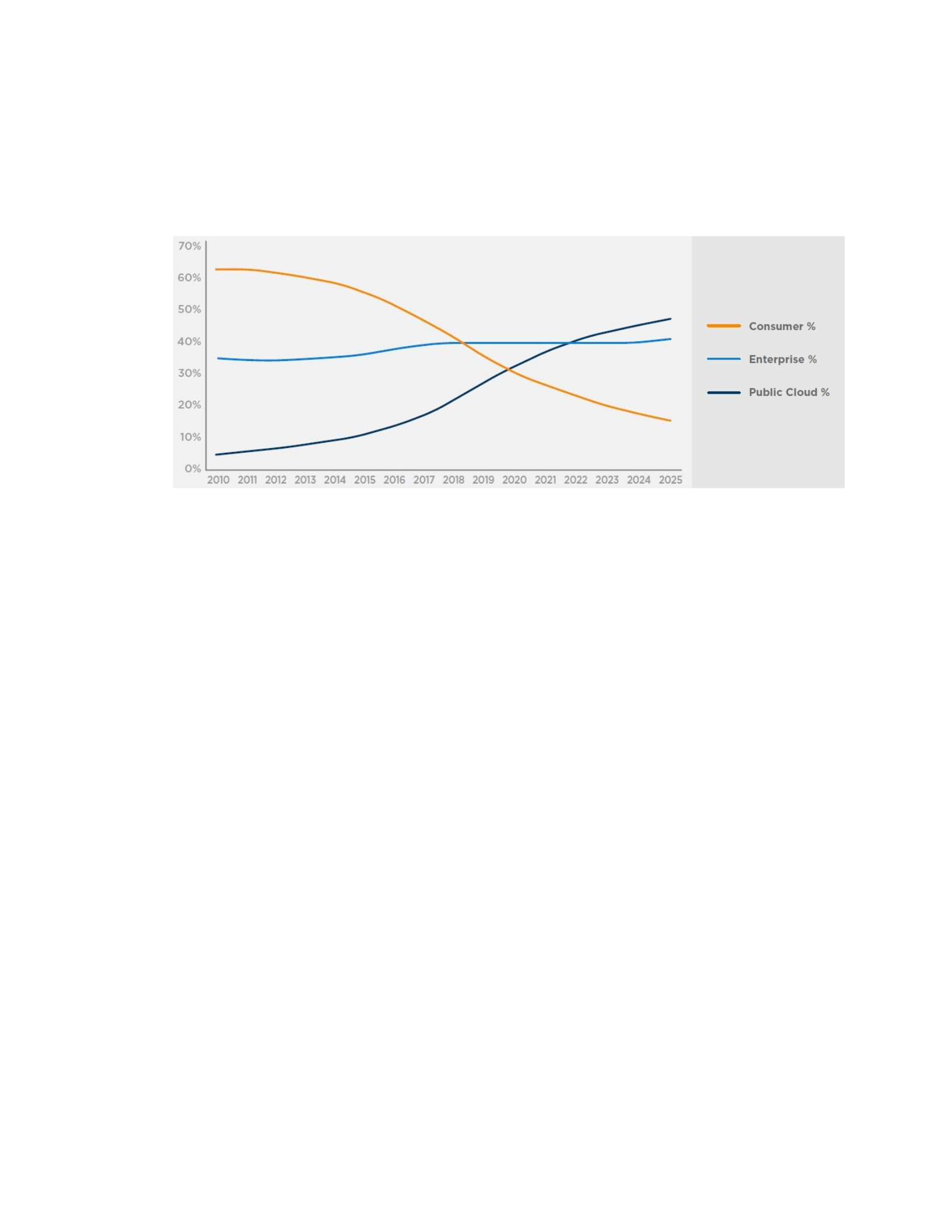
extract new information that may be impossible to reveal in separated databases (Reinsel
et al., 2018a).
Figure 3. Future data storage location. Adapted from “Data Age 2025: The Digitization of
the World from Edge to Core,” by D. Reinsel, J. Gantz, and J. Rydning, 2018, IDC White
Paper, sponsored by Seagate. Copyright 2018 by the IDC.
According to a digital development report conducted by the International
Telecommunications Union (2019), numbers of Internet users around the world continued
to increase promptly in the last decade. The report showed that an average of 10%
increase per year since 2005. Specifically, 16.8% of the world population was using the
Internet in 2005, and an estimated 53.6% use the Internet in 2019. The following figure 4
shows an estimated number of Internet users worldwide. This means an estimated 4.1
billion people accessed the Internet in 2019. Developed countries, Europe, and America
are three regions that have the most online users.
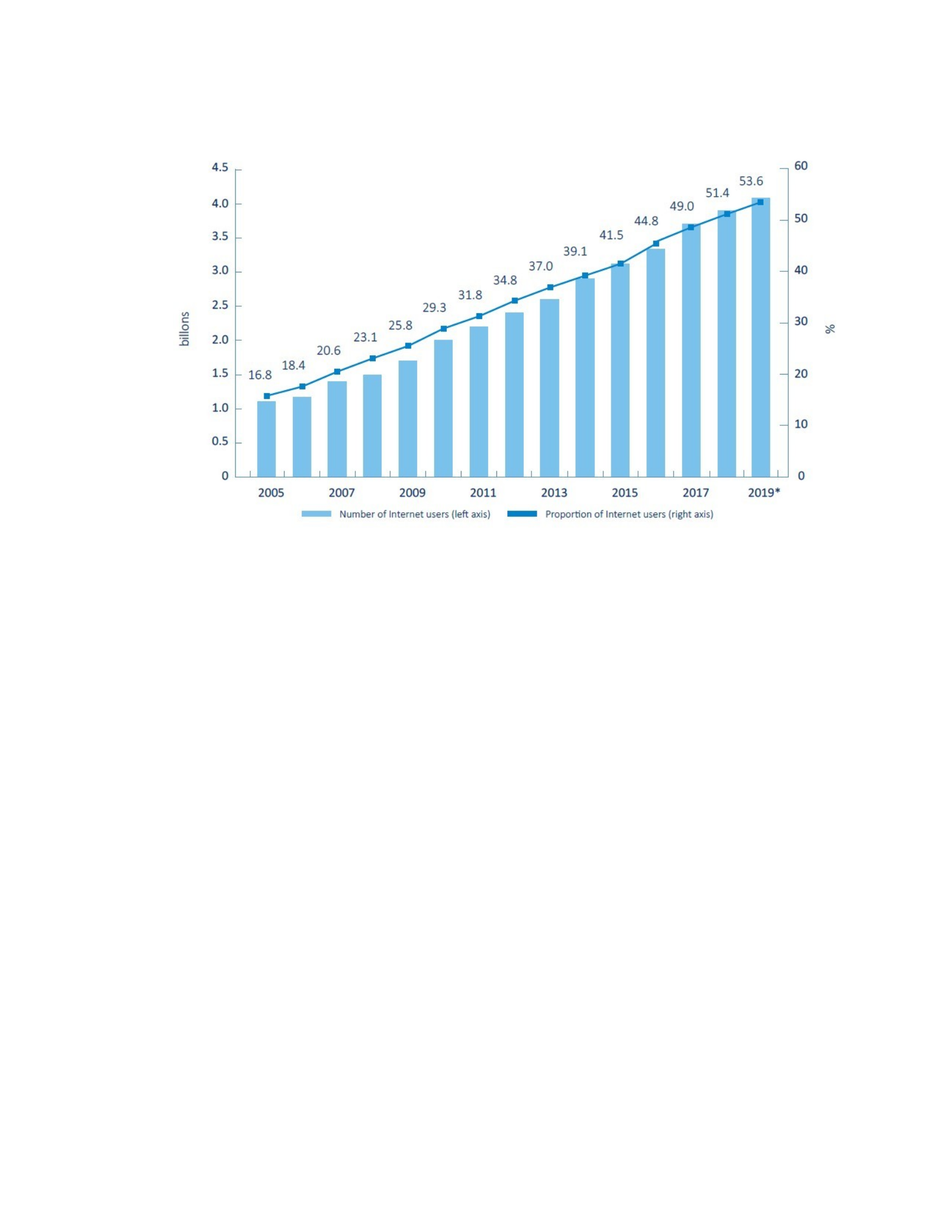
Figure 4. Number of Internet users. Adapted from “Measuring Digital Development:
Facts and Figures 2019,” by International Telecommunications Union, 2019. Copyright
2019 by the International Telecommunications Union.
In terms of mobile phone subscriptions, the International Telecommunications
Union report (2019) showed that numbers of mobile-broadband and mobile-cellular
subscriptions keep growing regularly. For instance, 83 per 100 people worldwide have
active mobile phone subscriptions. The following figure 5 shows an estimated number of
telephone subscriptions worldwide. The report also showed that 71.8% of household in
the United States and 57% worldwide have access to the Internet at home. The figure 6
shows an estimated percentage of households accessing to the Internet at home.
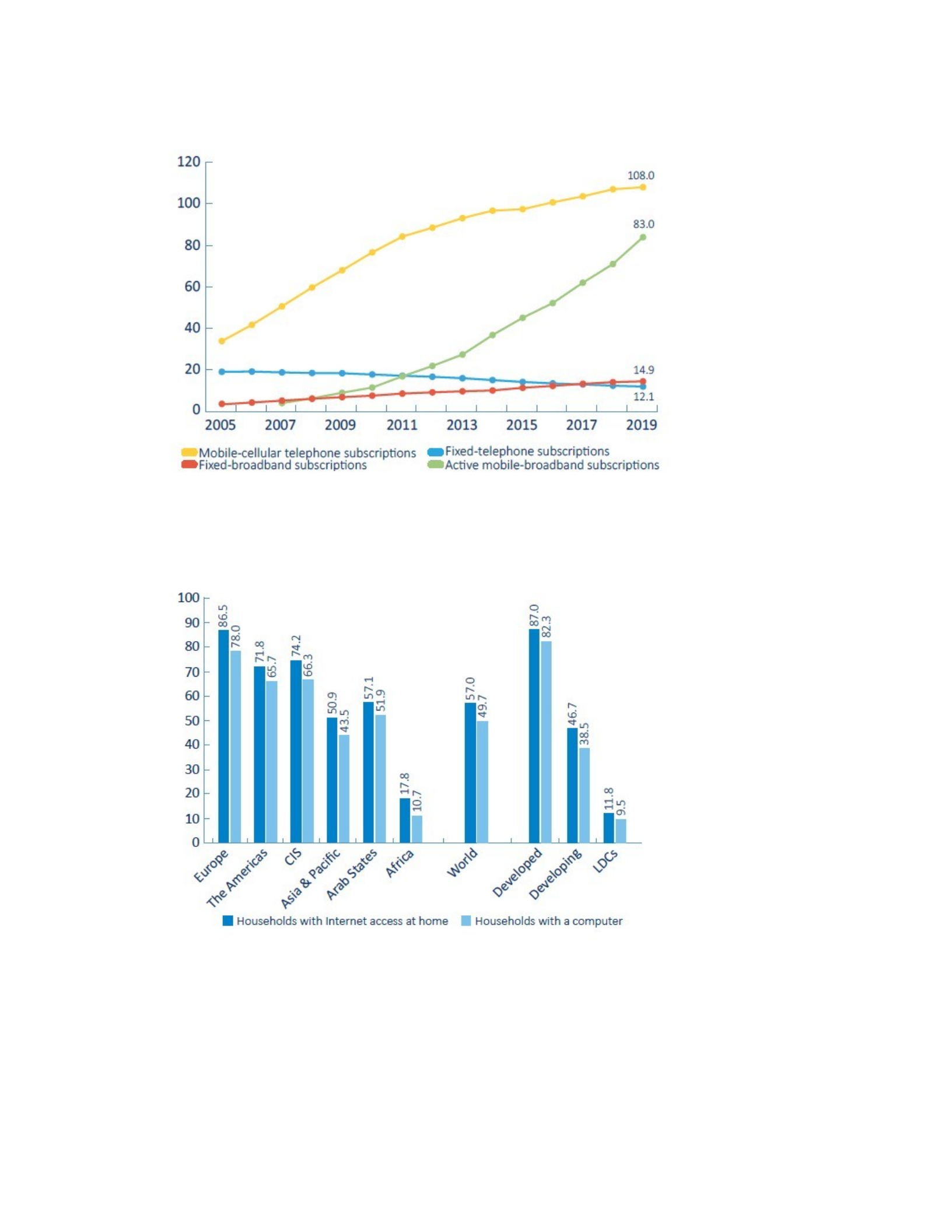
Figure 5. Number of telephone subscriptions. Adapted from “Measuring Digital
Development: Facts and Figures 2019,” by International Telecommunications Union,
2019. Copyright 2019 by the International Telecommunications Union.
Figure 6. Percentage of households accessing the Internet at home. Adapted from
“Measuring Digital Development: Facts and Figures 2019,” by International
Telecommunications Union, 2019. Copyright 2019 by the International
Telecommunications Union.

Data sources are also generated by organizations that provide products and
services to the consumer directly. These companies exist in both private and public
sectors. Businesses in the private sector, such as Internet providers, social networks, and
those in healthcare, insurance, banking, retail, or telecommunication, often interact with
consumers directly. This allows them to gather their customer data directly without going
through third-party companies. These companies might also buy and share consumer data
with other businesses to have more relevant information. For instance, life insurance
companies may collect customer medical records from hospitals or doctor offices to have
a general understanding of customer health conditions, so that they can issue suitable
insurance policy as well as determine appropriate prices. In another case, retailers might
gather information from banking and from social networks so that they can better
understand customer expenditures and recommend products to target these customers.
Customers may be aware of their data being collected by companies, but they may not
fully understand how their personal data are transmitted among companies across
business sectors.
Data Providers
Besides companies that interact with customers directly, many data-provider
companies operate as a middlemen within a data-driven ecosystem; consumers may not
be aware of these businesses. These companies collect and aggregate data from multiple
sources, organizing the data as well as extracting new information from it. Consumer data
may be collected from both public and private sources. The capability of new
technologies, such as big data and data mining technologies, allows data-provider

companies to process large volumes of data and unveil new information that is valuable
for businesses. Finally, data providers sell processed data in useful formats to other
companies. Companies can buy processed data for many business purposes, such as
advertising, financial fraud detection, product quality improvement, and many other
purposes.
Data Buyers
Internet technology transforms traditional companies into data-driven businesses.
Instead of operating businesses at physical locations, many companies leverage Internet
technology to transform their businesses in the digital network environment. Internet
technology provides companies the capability to present business information,
capabilities, products, and services to large numbers of customers. Other emerging
technologies, such as big data and data mining technologies, allow companies to collect
and analyze consumer data in order to better understand business trends and customer
preferences (King & Forder, 2016). Companies in different sectors, such as
manufacturing, marketing, online retail, or banking, depend on consumer information to
optimize their businesses, improve product quality, or enhance customer experiences. For
instance, banking institutions collect financial data, such as lending information,
investment records, insurance records, historical banking transactions, and many other
types of information, to analyze stock markets, determine the risk of loan applications, or
detect financial fraud. Grether (2016) said that marketing agencies want to gather and
analyze consumer data to understand their spending behaviors, financial conditions, and

business trends. Such information helps advertising firms develop effective marketing
campaigns to target potential customers.
Consumers in the Data-Driven Ecosystem
In data-driven business model, consumers use social network platforms, search
information, buy products, or pay for services through various Internet-connected devices
and applications (Li, Ch’ng, Chong, & Bao, 2016). Li et al. (2016) argued that online user
activities hold a critical role in the digital economy. King and Forder (2016) said that
online customer previews created large volumes of data for businesses to collect and use,
transforming their businesses into data-driven business models. Meulen (2017) estimated
that consumers use 52 billion Internet-connected devices worldwide in 2017, which
represents 63% of the total of Internet-connected units. Meulen (2017) also predicted that
the numbers of IoT units demanded by consumers would be double in 2020, projecting
128 billion IoT devices. Consumers create streams of historical data whenever they
interact with Internet-connected applications, such as social networks, purchasing online,
electronic payment, and mobile phones, among others. Companies in data-driven
ecosystems collect and use these data to improve their business processes, marketing,
product quality, and customer experiences.
Benefits of Data
Colombo and Ferrari (2015) said that business and consumer data, which are
generated from business processes, social networks, Internet websites, or mobile devices,
are valuable to businesses. Companies might collect analyze consumer data to understand
customer behaviors so that they can improve product quality or enhance customer

experiences, or for many other purposes (King & Forder, 2016; Volker, 2016). They can
use business data to optimize business operations and stay competitive in e-commerce.
For instance, manufacturing companies might use product operational and maintenance
data to predict the service life of particular products (Reinsel et al., 2018a). Innovative
technologies, such as big data and predictive data analytics, provide businesses the
capability of storing large amounts of data and aggregating multiple data sources to reveal
hidden information (Gunasekaran et al., 2017). Consumer data are collected and used in
many businesses, such as online retailers, health care businesses, and manufacturing
industry. The HarrisX (2018) survey showed that 63% of participants believed that
technology is good for society, and 70% believe technology has positive impact on their
daily life. At the same time, small numbers of participants (14%) said technology is
somewhat bad for society.
Risks of Collecting and using Consumer Data
Business practices of collection of large amounts of consumer data may cause
issues such as exposing personal information and violating individual privacy rights (Jai,
Burns, & King, 2013; Zhu & Chang, 2016). For instance, businesses may predict that an
individual is pregnant by combining age, gender, and historical buying products.
Companies might also gather social network data to predict personal information, such as
emotions, political points of view, religion, and other sensitive data. In the health care
industry, medical insurance companies might collect hospital data and information about
medical claims to identify health conditions of customers. Based on such information,

insurance companies might determine different insurance premiums based on health
preconditions.
Kshetri (2014) mentioned that consumers often had little control over their data
being collected and used by private companies. Consumers might lack the knowledge to
understand the sophisticated operations of data processes. A lack of essential technical
skills also limits consumers from configuring Internet-connected applications
appropriately to protect their data. Kshetri (2014) argued that many companies
established complicated data processes, which make it difficult for consumers to
understand how their information is collected and used. Prince (2018) also pointed out
that customers have limits on managing their personal information when using various
platforms to conduct daily business over the Internet.
Privacy setting features are a common mechanism for controlling personal data
sharing when using online applications. Prince (2018) found that online users do not pay
attention to privacy setting tools to manage personal information. Customers often raise
concerns about their privacy rights instead of about how to protect their personal
information when using Internet-connected devices or applications (Prince, 2018).
According to an online survey conducted by IBM and Harris Poll (2019), the study
collected data from 1,000 adult participants in the United States regarding consumer
perspectives on information privacy. It showed that 76% of participants want to have the
ability to withdraw from sharing personal data with third-party organizations, and 73%
want to have the ability to take back or retrieve their data.

In 2017, many governments in the European Union (EU) initiated new privacy
policies to protect consumer data in the Internet environment (Butterworth, 2018). Big
data technology provides companies the capability to collect, store, and analyze huge
amounts of data that might be impossible to process manually by humans. One of the
major concerns about this technology is that it can operate autonomously and make
independent decisions without human interactions.
While collecting and using consumer information offer businesses many potential
benefits in the digital economy, issues associated with using consumer data without
authorization or consent are infrequently addressed (Zhu & Chang, 2016). Business
leaders are in difficult situations when making decisions on using consumer data in digital
business models. A survey of artificial intelligence ethics by Hashmi (2019) found that
ethical issues were a significant concern with using consumer data in business and that
many leaders were still unable to find suitable solutions to address them.
Innovative technologies, such as the Internet, social networks, or online video
streaming, create new opportunities for online marketing agencies. Bleier and Eisenbeiss
(2015) presented that many online marketing models focus on advertising personalized
products and services to specific groups of customers. In order to deliver customized
products to targeted individuals, companies need to collect and analyze large amounts of
customer data behind the scenes. Although collecting and using consumer data provides
companies many potential opportunities, these business practices prompt a number of
issues in terms of ownership, transparency, ethics, and consumer privacy laws.

Technology companies collect and classify customers into particular groups based on
their private information and behavior. Estrada-Jimenez et al. (2017) noted that collecting
and analyzing customer data takes place in the background, and customers may have little
control over the process. With help from emerging technologies, such as big data and
Internet-connected devices, companies can collect, store, analyze, and exchange massive
consumer data. Due to the large amounts of data, companies often use sophisticated
computing algorithms to process data anonymously. This makes it difficult to keep track
of specific customer data points. Companies also exchange information with partners or
business customers. Estrada-Jimenez et al. (2017) argued that business practices, such as
building customer profiles or exchanging consumer personal information, could lead to
abuses in using consumer data and to discrimination against customers when they receive
business services.
Internet-connected platforms, such as social networking websites or smartphones,
have provided a convenient way for consumers to share memories and connect with loved
ones. Online retailers have also offered convenient ways for customers to shop
merchandise at any time on their Internet-connected devices. In order to enjoy the
convenience that businesses offer, consumers have to disclose personal information, so
that companies can collect private data and analyze it to understand more about
consumers. The dilemma of privacy protection and convenience leads consumers to a
situation in which they want control over their privacy, but also continue disclosing
personal information to get benefits from online service providers (Marreiros et al.,
2017). Trepte et al. (2015) argued that consumers want to protect their private

information and have control over their data flow in the Internet environment. At the
same time, consumers might not be able to prevent businesses from gathering their data
from multiple sources due to a lack of knowledge about privacy online as well as a lack
of data protection mechanisms.
Privacy Risks in Digital Marketing
In the traditional advertising approach, marketing agencies present advertisements
to potential customers without customizing the content. Nowadays, new technologies
provide companies the capability to tailor advertised content to reach a particular group
or individual (Bleier & Eisenbeiss, 2015; Tran, 2017). Estrada-Jimenez et al. (2017)
mentioned that there were many parties and partners involving in online advertising
infrastructures. Marketing agencies depend on technology companies to collect and
analyze customer data so that they may develop mathematical models to predict customer
preferences. Consumer data points, such as website browsing history, location, search
keywords, financial transaction records, and other data points, are valuable to companies
working to engage customers effectively (Grether, 2016). Based on such personal
information, online marking organizations may distribute suitable advertisements to
customers at the right time.
Smit, Noort, and Voorveld (2014) discussed that Internet-connected applications
and devices generate huge amounts of personal data that allow companies to collect and
track online activities of consumers in the real-world. Companies can build a complete
individual profile based on how customers search for information online, as well as on
shopping behaviors, age, gender, and other personal data (Smit et al., 2014). Companies

can collect these personal data directly from online applications or buy them from
dataprovider companies. Estrada-Jimenez et al. (2017) mentioned that privacy risks
existed when personal data are collected and shared among companies without the
awareness of customers. Trepte et al. (2015) noted that online users often lack knowledge
of how personal data flow in the Internet environment. This leads to online users tending
to allow businesses to collect personal data without knowledge of how businesses use
their data. A lack of knowledge about privacy also prevents consumers from maintaining
control over personal data or protecting their data from cybersecurity threats. The risks
might also be associated with privacy rights, discrimination, fraud, and unauthorized
access.
A mobile privacy report by the Federal Trade Commission (2013) presented that
big data technology provides companies the capability to build individual profiles and
categorize the profiles into different groups. By doing that, private companies can
advertise to a particular group with new products or services. Butterworth (2018) argued
that this business practice might result in harm to consumers due to the inaccuracy of
data. Companies may also obtain consumer data from internal sources such as
dataprovider companies. These secondary data sets may contain inaccurate information.
Analyzing low-quality data may lead to biased results.
Sharing Personal Information on the Internet
A report about big data technology by the White House (2014) discussed many
privacy concerns when consumers share their personal information through
Internetconnected applications and devices. Private companies may use consumer data

for different business purposes as well as share customer information with business
partners. The IBM and Harris Poll (2019) showed that less than one third (31%) of
participants believe that their personal data remain within the original company that they
shared data with. Schudy and Utikal (2017) noted that consumers are willing to share
personal information in exchange for the benefits and convenience of Internet-connected
applications or mobile devices. Consumers also tend to share information with unknown
parties or people on the Internet. For instance, people feel comfortable sharing
information on social networks. Schudy and Utikal (2017) mentioned that customers
might not know that their personal data is being shared with companies that they do not
have business with. This business practice may expose the personal information of
consumers to unauthorized parties.
Consumers Managing and Controlling Their Personal Data
The ability to have authority over one’s personal data is a critical element in data
privacy. In addition to managing personal data, consumers want to control how their
personal data is used and shared among businesses. Prince (2018) pointed out that online
users want control over their personal data when interacting with Internet-connected
platforms. Prince (2018) said that there is a significant relationship between selfdisclosure
and privacy controls. Online users who are likely to reveal and share personal information
on the Internet network tend to use privacy setting features to control their information
sharing. Prince (2018) said that personal data have a variety of values and weights
depending on different types of data. Some pieces of information can be more sensitive
than others. For instance, online users pay more attention to health or financial records

than text messages or virtual identities. Since consumer data could be valuable assets to
businesses, businesses have been collecting, analyzing, and selling it to advertising
companies. Prince (2018) argued that businesses should provide effective privacy control
mechanisms that allow online users to configure the privacy settings for their data.
Individuals who are concerned about privacy are more likely to want to manage and
control data when disclosing private data on the Internet.
Current Data Protection Laws
The numbers of data breach incidents that have occurred recently at both public
and private organizations have raised concerns over how data privacy legislation and
policies protect the personal data of consumers in the digital environment. Consumers
continue using Internet-connected devices and sharing personal information over the
Internet at higher rates (Mulligan et al., 2019a). Consumer data are collected directly by
business service providers as well as third-party data providers. Mulligan et al. (2019a)
mentioned that business practices of collection and use of consumer data exposed
personal information to unauthorized or third-party organizations. There are numbers of
personal data protection laws at the federal levels in the United States.
Table 1 includes current data protection laws in the United States. However, these
federal data protection laws are not comprehensive to regulate businesses where they
collect and sell consumer data for business purposes (U.S. Senate Committee on
Commerce, Science, and Transportation, 2013). Data protection laws differ in terms of
industries, scope, law enforcement, and penalties (Mulligan, Linebaugh, & Freeman,
2019b). There is also lack of unified data protection laws at the federal level that regulate

how private companies collect and use consumer data in the digital ecosystem (Mulligan
et al., 2019a). Current U.S. privacy laws do not provide consumers the right to know
what data companies have collected about them and how they use it (U.S. Senate
Committee on Commerce, Science, and Transportation, 2013). Consumers do not have
the capability to verify or make corrections to their data being collected by companies.
Table 1
U.S. Federal Data Protection Laws
Data Protection Laws
Gramm-Leach-Bliley
Act
Industry Description
Finance and
Banking
This law prohibits financial institutions
from sharing nonpublic personal
information (NPI) with third parties. It
requires financial institutions to provide
consumers with their policies for how
they collect, use, and share NPI.
Consumer Financial
Protection Act
Finance and
Banking
This Act regulates financial institutions
offering financial services to consumers
with unfair or abusive practices.
Children’s Online
Privacy Protection
Act
Online Businesses This Act regulates the business practice
of collecting and using children’s
information on the Internet. The law
prohibits companies from collecting
information about children who are
under the age of thirteen without
obtaining consent from their guardians.
The Communication
Act
Telecommunication This law regulates data privacy from
telephone companies that provide
interstate communication. These
companies may not use or share
personal information without customers’
consent. This Act does not cover
television, radio, or Internet providers.
Video Privacy
Protection Act
Video Service
Providers
This law prohibits video service
providers from disclosing personal
identifiable information or information

regarding rental and purchased video
materials. This Act provides a privacy
right to media consumers. It does have
law enforcement as well as penalize
violations.
(Table continues)
Data Protection Laws
Fair Credit Reporting
Act (FCRA)
Industry Description
Credit Reporting This Act regulates entities who operate
in credit reporting (CR) services,
provide information for CR, or use
credit reporting. This Act does not
prohibit CR agencies from collecting,
using, or sharing consumer data with
third parties. Instead it requires CR
agencies to report consumer credit
information accurately. This Act
requires entities to use credit
information only for appropriate
purposes, such as financial transactions.
Federal Securities
Laws
Across Industries These laws regulate how companies
protect against, prevent, and respond to
data breach incidents.
Computer Fraud and
Abuse Act
Consumer and
Provider
This law prohibits unauthorized access
to computer systems. It does not
enforce data protection or data security.
This Act allows individuals to file legal
actions when companies collect online
activities without their authorization.
Electronic
Communications
Privacy Act
Across Industries This Act prohibits unauthorized access
to electronic communication channels,
such as telephone, email, or digital
database systems. This Act provides a
general approach to protecting private
conversations, which are made,
transited, or stored on electronic
networks.
Federal Trade
Commission Act
Across Industries The Act was signed into law in 1914,
which established the Federal Trade
Commission. In terms of data privacy
and security, the Commission prevents

companies from collecting, using, or
disclosing the information of other
organizations or businesses.
(Table continues)
Data Protection Laws
Family Educational
Rights and Privacy
Act
Industry Description
Education This Act prevents educational
institutions from releasing student
educational records without the consent
of parents or students. Parents or
students have the right to review
records as well as challenge them when
they are inaccurate or incorrect.
Health Insurance
Portability and
Accountability Act
Healthcare
Providers
Under this Act, healthcare providers
need to protect health records. It
generally prohibits healthcare providers
from using or sharing a patient’s
information with third parties without
their consent. Healthcare providers need
to notify patients when disclosing
information to third parties for
treatment or payment purposes. Patients
also have the right to request that
healthcare providers provide them with
copies of their own records.
Note. Adapted from “Data Protection Law: An Overview,” by S. P. Mulligan, C. D.
Linebaugh, and W. C. Freeman, 2019a. Retrieved from
https://crsreports.congress.gov/product/pdf/R/R45631
Outside of the United States, other countries also have raised concerns about data
privacy and introduced new comprehensive data protection frameworks to protect
personal information. In 1995, the European Union introduced the Data Protection

Directive laws, which regulate how companies process personal data (Ott & Zylberberg,
2016). For instance, articles 10 and 11 of the Protection Directive require organizations
that do not obtain data directly from individuals to provide data owners the organizational
identity, the purposes of using the data, as well as the right to access to their own data
(Cradock, Stalla-Bourdillon, & Millard, 2017). In 2018, the EU established a
comprehensive data protection framework, named the General Data Protection
Regulation (GDPR), to regulate how businesses can collect and process personal
consumer data (Tikkinen-Piri, Rohunen, & Markkula, 2018). Businesses have the
responsibility to implement appropriate information management systems to prevent the
misuse of personal data as well as to protect data from unauthorized access (Tikkinen-Piri
et al., 2018). With GDPR policies in place, EU citizens have the right to access, remove,
or retrieve personal data stored by businesses. While U.S. data privacy laws focus on the
ability of the U.S. government to access the private lives of citizens or on regulating
specific business sectors, the GDPR provides individuals a general right to protect their
privacy. The GDPR also regulates any organizations that collect large amounts of
personal data in the EU (Mulligan et al., 2019a).
The GDPR applies to any businesses if they collect, store, and use information of
individuals from the EU, regardless of the locations of these organizations (Mulligan et
al., 2019a). Personal data under this law can be any information used to identify an
individual, such as name, address, phone number, IP address, and many other pieces of
information. Since non-EU companies can offer businesses and services to EU citizens
over the Internet and collect personal information, these companies need to comply with

the GDPR even they locate, manage, and process the information of individuals from the
EU outside of EU countries. Mulligan et al. (2019a) noted that the GDPR introduced
several key principles related to the processing of personal data, such as transparency, the
purpose of using data, the accuracy and limitations of data, and data security and
accountability.
Transparency of Processing Personal Information
Custers, Dechesne, Sears, Tani, and Hof (2018) mentioned that the transparency
condition in personal data processing is one of the key principles of the GDPR. It is not
only a designable condition in the privacy protection laws, but it is also a success factor
that allows consumers to check how businesses comply with privacy laws. By GDPR
guidance, businesses need to develop transparent data management processes when
handling consumer privacy information. For instance, businesses need to notify
consumers what information they collect and how they use it. Businesses also need to
provide customers mechanisms that allow them to access and manage their own data
(Custers et al., 2018). The transparency in using consumer data allows not only
companies to ensure compliance with regulation but also to establish trust with their
customers.
Chua et al. (2017) discussed that the notification feature is critical in business
practices of collection and use of consumer data. It might help customers be aware of
what happened to their data. Companies have the responsibility to notify customers what
personal data they collect and how they use these collected data sets (Chua et al., 2017).

Customers are then able to make appropriate decisions on sharing data with online
business providers.
Cradock et al. (2017) mentioned that innovative technologies in the data
management domain developed and advanced rapidly. The Organisation for Economic
Co-operation and Development (2014) reported that innovative technologies advanced in
collecting, aggregating, and analyzing personal data without the knowledge of individuals
over the last twenty years. The big data analytic algorithms become sophisticated, which
provide businesses the capacity to capture and link information together from multiple
sources. Due to huge amounts of data being gathered and fed into these big data analytic
processes, consumers may not know what personal data are being collected and used by
private companies (Cradock et al., 2017).
Cradock et al. (2017) argued that private companies have the responsibility to
inform consumers what personal data they collect and process. Otherwise, consumers
have little control over the process of collecting and using their personal information. The
non-transparency of using consumer data might cause issues regarding the compliance of
private companies. The goal of transparency in consumer data-driven practices is to allow
consumers to identify the compliant companies that they can trust to share personal
information (Cradock et al., 2017).
Cradock et al. (2017) also showed that there was uncertainty over the obligations
of organizations to inform individuals about the practice of using personal data. This
leads to reducing the transparency for individuals to understand how their personal data
are being collected and used within companies. Governments might need to develop new

policies to clarify the obligations of companies to inform individuals about the use of
their personal data.
Purpose of Using Consumer Data
Libaque-Saenz, Chang, Kim, Park, and Rho (2016) showed that companies might
collect and use consumer data for many business purposes, such as online marketing,
decision-making systems, and customer engagement. These data points provide
companies efficient ways to understand customer behavior and preferences. For instance,
many Internet websites allow customers to post previews of particular products or
services after they use it. Such feedback data offers rich information that companies may
use to improve customer experiences.
Butterworth (2018) suggested that companies should explicitly define the
purposes of collecting individual data and not use these data sets for other undefined
purposes. Due to the capability of big data to process large data sets, companies intend to
collect many consumer data sets and use these collected data for different business
purposes. Companies might also aggregate consumer data from multiple sources and
generate new data sets. Some companies even sell these new data sets or the results from
analyzing these data as new products and services. Butterworth (2018) noted that the key
factors in using personal data for purposes that diverge from the original purpose are
fairness and compliance with the laws. When companies collect personal data for a
particular purpose based on customer consent, these collected data should only be used
for that original purpose. Companies might need to notify customers and obtain new
agreement from them in the case that consumer data is used for different purposes.

Big Data Analytic Quality
Big data technology has been providing companies the capability to collect, store,
and analyze a large amount of data in both structured and unstructured formats from
multiple data sources. Each data source contains a piece of information related to a
particular individual or a group of customers. The FTC (2013) reported that when
businesses aggregated these pieces of consumer data, they were able to understand
individual behaviors and build complete profiles. Organizations develop customer
profiles using many data points of personal information such as financial records,
shopping behavior, online spending time, and other personal information (Federal Trade
Commission, 2013). Baesens et al. (2016) argued that the information might be inaccurate
due to the large volume of these data sets. Analyzing these low-quality data sets may
generate inaccurate results (Baesens et al., 2016). Organizations should collect data that
accurately present their customers to train computing algorithms so that they can generate
accurate results (Ginosar & Ariel, 2017).
Consumer Consent
Companies use individual consent to comply with federal laws when collecting
and using consumer data for a particular business purpose. Consumers often need to
accept a privacy statement or data policy when they want to use products or services
offered by the firms (Aimeur, Lawani, & Dalkir, 2016; Marreiros et al., 2017). Altman et
al. (2018) argued that relying on privacy statements to obtain an agreement from
customers does not adequately protect consumer privacy data, since customers may not
fully understand the broad terms of these documents. Consumers may risk exposing

personal information to unknown parties when giving their consent to companies for
collecting and using personal data. Butterworth (2018) noted that companies need to
gather and process personal data based on individual consent. Individual consent should
be meaningful and unambiguous so that consumers can understand precisely the purposes
of collecting and using their personal information. One of the key advantages of big data
technology is that it combines massive data from multiple sources to generate new types
of data. In this case, the original consent for collecting and using consumer data may not
reflect exactly the purpose for which companies plan to obtain data.
Governments often recommend that private companies disclose business practices
of collecting, storing, using, and sharing consumer data. Privacy laws such as the
Consumer Privacy Bill of Rights or Fair Information Practice Principles recommend that
companies establish appropriate data management processes to protect consumer data
from unauthorized access or data breach incident (White House, 2014). Protecting
consumer data from data breaches is one of the key factors in e-commerce industry. The
cybersecurity online survey by IBM and Harris Poll (2018) reported that 75% of
participants do not purchase products when they do not trust a company to protect their
personal data. This cybersecurity survey also showed 85% of participants agreed that
businesses should prioritize cybersecurity strategy over a focus on profit. 71% of them
expected the government take appropriate actions in the case that cybersecurity is
compromised. The challenge for collecting consumer data based on individual consent is
that companies need to define the purpose of using personal data before starting to collect
data. It is challenging to develop meaningful consent if companies do not have a clear

purpose and object for collecting and using consumer data. It is also challenging to
reobtain consent when companies did not collect data directly from customers. For
instance, private companies can buy consumer data from data-provider companies and
aggregate them with their internal data to create rich data sets. In these cases, companies
may not obtain consent from customers who own the data.
Butterworth (2018) mentioned that people might not read privacy statements
when they interact with business websites. In other cases, customers have to accept
privacy terms; otherwise, they cannot access Internet-connected applications or devices.
Marreiros et al. (2017) noted that customers simply accepted the privacy terms in order to
use particular online services. In these cases, the consent may not be provided voluntarily
because customers have no other selections. Butterworth (2018) discussed that consent is
necessary whenever companies need to process personal data to provide services to
customers. Otherwise, companies should not present privacy statements and ask
customers to agree with the terms. Companies should not bundle privacy terms with other
business services that do not require access to personal data (Butterworth, 2018).
Current Approaches to Personal Data Protection
Current studies propose a number of privacy protection approaches (Broeders et
al., 2017; Federal Trade Commission, 2011; Ginosar & Ariel, 2017; White House, 2013).
Many approaches focus on blocking technology companies from collecting data on the
user-side. Online users can configure their Internet-connected devices to prevent
technology companies from gathering personal information when doing business online.
Trepte et al. (2015) pointed out that privacy knowledge could help consumers balance

private information management by sharing needed information only in order to access
digital businesses. Butterworth (2018) argued that companies should provide customers
the capability to withdraw consent that they provided in the past. This would allow
customers to give consent voluntarily as well as to withdrawing freely from privacy terms
agreements previously agreed to.
As data breach incidents occur frequently, companies begin tightening data
protection processes, developing internal data management review, and establishing
restricted privacy policies. For instance, many companies allow consumers to reject
company websites or mobile phone applications that collect their personal data. Some
companies also use sophisticated computing algorithms such as the Randomized
Aggregatable Privacy-Preserving Ordinal Response technique, to protect customer
sensitive information automatically (Erlingsson, Pihur, & Korolova, 2014).
Estrada-Jimenez et al. (2017) proposed three main solutions to protect consumer
data from digital advertising, which include protection parameters, academic research,
and commercial solutions. The protection parameters include location, scope, and
strategy. In terms of academic research, there were numbers of current research
technologies that can help to secure personal data in the online environment. The
academic research includes obliviAd, AdJail, and Privad, as well as many others.
Technology companies also provide many commercial platforms such as Google Sharing,
Brave, Ghostery, and so on.
In terms of the data types, companies might limit themselves to collecting and
using personal data that are relevant to business objectives. They should restrict the scope

of data-collecting processes to the business purpose described in the individual consent.
Organizations should define the purpose of using consumer data and collect data only for
that business goal. This data limitation principle might reduce the capability of big data
technology, which requires a large amount of data to extract insights. The challenge of
this requirement is that companies collect many available data sets rather than limiting
the data collected to a particular purpose.
Butterworth (2018) discussed the need for companies to establish an internal data
management board to oversee the process of collecting and using consumer data in
compliance with legislation. The data management team needs to consider business
ethical aspects of collecting and using private data. The purpose of collecting and using
personal data needs to align with the privacy statement that companies provide to
customers. For example, the location data generated by the mapping application should
not be sold to a travel agency to advertise a particular vacation location.
Gaps and Study Findings Related to the Literature
New emerging technologies such as the Internet, big data, social media networks,
and smartphones allow companies to collect large amounts of digital data associated with
consumer activities, online and offline (Baesens et al., 2016). Companies collect large
volumes of consumer data and sell them as data products to other firms. Companies
might not obtain data directly from consumers. Instead, they might buy and gather
consumer data from third party data providers (Perko & Ototsky, 2016). These business
activities may not be transparent and may remain hidden from consumers (Cradock et al.,
2017; U.S. Senate, Committee on Commerce, Science, and Transportation, 2013).

Companies also aggregate data to create individual profiles or build consumer scoring
systems. These data products might put consumer privacy at risk in terms of misuse,
discrimination, and unauthorized access. There is a lack of understanding of the business
practices of collecting and using consumer data without an individual’s consent. The
findings of this qualitative archival research filled the gap about business practices in
collecting and using consumer data without the knowledge of consumers.
Finding 1. Potential benefits. Business practices of collecting and using
consumer data for marketing or improving products have occurred for a long time
(Grether, 2016; The U.S. Senate Committee on Commerce, Science, and Transportation,
2013; Tran, 2017). Both public and private organizations have collected and used
consumer data for many business purposes (Altman et al., 2018). Finding 1 showed that
companies used consumer data to understand marketing trends, verify financial credits,
develop marketing strategies, and improve product quality along with customer service.
Personal data became valuable as a source of future profits for many businesses in the
digital economy (Colombo & Ferrari, 2015; Marreiros et al., 2017; Prince, 2018).
Finding 1 confirmed that consumer data could provide a variety of potential
benefits to companies operating in the data-driven industry. According to Bleier and
Eisenbeiss (2015), consumer data allowed marketing companies to collect and understand
consumer behaviors and preferences. It helps companies customize advertising to target
potential individuals and particular groups. Nunan and Domenico (2013) studied the
collection and use of personal information for marketing purposes. They discussed the
privacy risks and challenges of using big data to collect customer data for marketing

research. Jobs et al. (2015) studied marketing ecosystems where companies use big data
technology to process consumer data for online advertising. Jobs et al. (2015) argued that
marketing companies might influence potential customers if they invest big data
appropriately.
Finding 2. Data from multiple sources. This finding filled the gap of knowledge
about data sources where companies obtained consumer data. King and Forder (2016)
said that online customer previews created large volumes of data for businesses to collect,
use, and transform their businesses into data-driven business models. Prince (2018)
explored the needs of online users to help them control and manage their personal data in
the digital environment. There was a lack of knowledge about actual sources of consumer
data. Finding 2 showed that companies collected consumer data from public records,
local governments, private companies, third-party providers, and directly from
consumers. Companies used different methods and techniques to obtain detailed
information on individuals. Collected personal data elements included identification,
Internet-connected devices, incomes, education, medical records, finance, lifestyles, and
many other personal data elements.
Finding 3. Identity information. Online users were concerned about their private
data being disclosed on the Internet. At the same time, they shared detailed personal
information when browsing the Internet or using applications in the online environment
(Trepte et al., 2015). Trepte et al. (2015) explored the difference between online users’
privacy attitudes and behaviors in the Internet environment. A study by Ott and

Zylberberg (2016) explored the ownership of data in the digital ecosystem. Colombo and
Ferrari (2015) studied the aspect of data protection in big data technology to address the
lack of data protection awareness and data access control in the digital environment. They
explored the integration of data privacy and protection in big data platforms.
Finding 3 extended knowledge about data ownership and identity information in
the data-driven industry. This finding showed that data companies used various personal
identity information, such as name, address, email, phone number, government-issued
identifiers, and credit card information to verify individual identities. Besides these
identity data elements, companies also aggregated data from different sources, including
public organizations, private companies, social media networks, surveys, or consumers
themselves. Each data source provided bits of identifiable information about contact
information, employment, device information, financial data, and online activities.
Emerging technologies, such as big data, machine learning algorithms, or computer
artificial intelligence, provided companies the ability to combine these data elements and
identify an individual precisely.
Finding 4. Transparency in data-driven businesses. Cradock et al. (2017)
pointed out that transparency is one of the fundamental principles in the European Union
data protection laws. These laws require businesses to notify their customers when they
collect and use consumer data. However, it is not clear what type of personal data
companies collect that require them to inform their customers. A study by Butterworth
(2018) discussed the difficulties in guidelines by the U.K. Information Commissioner’s
Office regarding the use of artificial intelligence to process personal data. The study

focused on the fairness of using personal data in technology organizations. This study
also evaluated the ethical aspect and social impact of using personal data.
Finding 4 extended the knowledge about transparency in the data-driven industry.
Finding 4 showed that data collection processes needed to be transparent when companies
gathered or bought personal information from other companies. Although data provider
companies revealed general purposes of using consumer data, companies often did not
explicitly disclose either their data sources or client information. They also had contracts
with their clients that prohibited clients from disclosing data sources. Finding 4 also
confirmed with a study by Marreiros et al. (2017) which examined the effect of privacy
policies on user behaviors surrounding personal information disclosure and sharing on the
Internet environment. Finding 4 showed that privacy statements were often lengthy and
difficult for consumers to understand, due to its technical terms and general agreements.
Marreiros et al. (2017) asserted that online users were more careful about disclosing
personal information whenever privacy concerns were discussed broadly.
Finding 5. Data products and services. A study by Li et al. (2016) examined the
impact of product category, discount, and customer service on online sales performance.
The study also identified the role of product reviews and ratings in improving sales
performance in the data-driven business model. At the same time, Gunasekaran et al.
(2017) suggested that companies might adopt big data to improve their business
performance and transform supply chain management systems by examining the impact
of big data on supply chain and organizational performance. There was a lack of
knowledge about data products and services offered by data providers.

Finding 5 extended knowledge about the existing consumer data products offered
by data companies. Companies developed data products and services based on two types
of data, actual data, and processed data. Third-party companies or marketing agencies
could buy individual profiles, consumer scoring systems, or predictive modeling products
to forecast common characteristics, health conditions, financial status, or lifestyles of
people living in a particular city or zip code. Grether (2016) mentioned that companies
could use big data to collect real-time and comprehensive consumer data to stay ahead of
competitors. Third-party companies can profit from consumer data by acquiring,
transferring, and selling consumer data for marketing purposes (Grether, 2016).
Regarding the challenges of using big data in market research, Volker (2016) noted that
although big data offers potential benefits for marketing companies, many aspects of big
data need to be considered when managing massive volumes of data for market research.
The challenges include the representation of data, data accuracy, and key variables.
Finding 5 showed that companies monitored individuals' online and offline activities to
understand their characteristics, behaviors, or lifestyles. These sensitive information
provided companies the capability to build scoring systems that might be used to predict
consumer preferences and target them at the right time.
Finding 6. Affiliates and partner networks. There was lack of understanding
about partner networks of data providers. Hartmann et al. (2016) developed a framework
to analyze and classify data-driven business models where companies use consumer data
to operate their businesses. Hartmann et al. (2016) data-driven business model framework
contributes to an understanding of start-up companies that use data as core business assets

to establish business objectives. Finding 6 extended knowledge of data-driven networks
by providing information about clients and affiliates of data companies. Data companies
often did not disclose in detail their clients who bought data products for engaging
potential customers, fraud detections, identity verification, or other business purposes.
According to privacy policy and data catalog documents collected from the 12 companies
in this study, finding 6 showed that clients of data companies might operate in a wide
range of sectors, such as insurance, healthcare, travel, restaurant, or finance. They relied
on consumer profiles, predictive models, tracking data, or scoring systems to forecast
business trends, consumer preferences, or improve internal business operations. Finding 6
also presented that consumers might not know which third-party companies would buy
these data products and how third parties used data products to make decisions against
them.
Finding 7. Purposes of using consumer data. A study by Wamba et al. (2017)
examined the impact of big data analytic capability on company performance. Wamba et
al. (2017) claimed that big data analytic capability has a significant impact on company
performance when investing adequately in big data infrastructure and technical
management knowledge. Jai et al. (2013) examined the effect of online users' behavior on
shopping experiences and repurchase intention in e-commerce. Previous studies have
investigated the performance of personalized advertising in the Internet environment.
Tran (2017) discussed the lack of understanding of personalized advertising on the
Facebook social media network. Tran (2017) developed a model to capture the effect of
customized advertising on the attitude and behavior of Facebook users. Tran (2017)

argued that personalized advertising on Facebook had a significant impact on viewers and
improved customer responses. Zhu and Chang (2016) examined the impact of using
personal data to personalize digital advertising on consumer privacy. Besides, they
explored the relationship between personal advertising and online user perspectives on
privacy concerns. Bleier and Eisenbeiss (2015) investigated the impact of personalized
advertising on customer responses. They pointed out that many online marketing models
focus on using consumer data to personalize advertising on the Internet.
Besides using data to personalize advertising or improve customer experiences,
finding 7 extended knowledge of using consumer data, explore two core purposes that
drive companies to use consumer data. These purposes included internal business and
external business purposes. For internal business purposes, companies used consumer
data to improve business operations, audit business transactions, enhance customer
service, or comply with current regulations. For external business purposes, companies
used consumer data to build individual profiles, consumer scoring systems, or predictive
models. Other businesses in different industries bought these data products to forecast
business trends, manage supply chains, and use them for other business purposes,
including marketing, fraud prevention, identity verification, or risk mitigation. Internal
business operation data and external information could help business leaders make quick
decisions to respond to current market demands.
Finding 8. Complexity of the data-driven industry. Private companies
increasingly digitalized business processes and transformed their core businesses based
on available data to compete with rivals and to stay competitive in the data-driven

ecosystem (Gantz, Reinsel, & Rydning, 2019; Reinsel, Gantz, & Rydning, 2018a).
Businesses want to use consumer data so that they can personalize products to meet
individual preferences. Jobs et al. (2015) and Perko and Ototsky (2016) mentioned that
companies use consumer data from various sources to improve business operations,
product quality, customer services, and many other business aspects. Finding 8 extended
knowledge about businesses that operated in the data-driven industry. Data companies
could acquire consumer data from the government, buy data from other companies,
exchange data with affiliated partners, or collect data directly from consumers. Finding 8
showed that data provider companies made profits based on data that were either
voluntary or involuntary collected from consumers. They collected large volumes of
consumer data and sold it to other companies for various purposes. Data companies also
provided and exchanged data with each other to enrich their data sets. Besides affiliates
and partners operating in the United States, data providers also sold their data products to
foreign companies.
Finding 9. Ownership and consent. Butterworth (2018) noted that companies
need to gather and process personal data based on individual consent. Individual consent
should be meaningful and unambiguous so that consumers can understand precisely the
purposes of collecting and using their personal information. Smit et al. (2014) discussed
that online users were concerned about private information when sharing personal data on
the Internet. Smit et al. (2014) focused on online users' knowledge of private consent,
presented to them by companies. Smit et al. (2014) showed that it is critical that online
users understand the data processes where their personal data are collected and used by

technology companies. A study by Schudy and Utikal (2017) addressed the lack of
understanding of what factors form online users who were willing to disclose their
personal information. In order to understand privacy issues when using social networks to
recruit participants for health research, Bender et al. (2017) developed a privacy-bydesign
framework. This privacy framework provides guidelines to mitigate privacy risks and to
protect the sensitive information of health research participants. Bender et al. (2017)
notified participants about privacy risks of disclosing sensitive information through social
networks.
Finding 9 confirmed previous studies about ownership and consent in practices of
collecting and using consumer data. Finding 9 showed that third-party companies
collected and used consumer data without individuals’ knowledge and consent.
Companies used various technologies to collect consumers’ data whenever they accessed
the Internet via mobile applications, tablets, wearable devices, or computer web browsers.
Finding 9 showed that consumers might have known that companies collected their
online activity data when they accessed the Internet via various Internet-connected
devices. However, consumers may not know the purpose behind companies' intended use
of their personal data. Companies could track online user activities across
Internetconnected devices and applications. They could follow an individual through
multiple devices, including a laptop, tablet, or mobile phone. In many cases, companies
operating in the data-driven economy did not gather data directly from consumers. They
instead bought consumer data products from data provider companies without consumer
knowledge.

Finding 10. Access and control over personal information. Kshetri (2014) and
Gupta and Schneider (2018) claimed that the access control strategies used by private
companies to protect consumer data were not adequate or sufficient. Marreiros et al.
(2017) noted that consumers might not have a complete picture of how their personal data
are being collected and used by businesses. A study by Estrada-Jimenez et al. (2017)
provided an overview of current privacy risks existing in the practice of collecting,
tracking, and sharing customer data for online marketing purposes. Estrada-Jimenez et al.
(2017) mentioned that online users did not have control over their personal data and
lacked awareness about data collection. Online users also lacked the technical knowledge
to protect their data on the Internet environment.
Finding 10 confirmed claims about consumers having limited control over their
personal information in previous studies. Depending on consumers' locations, they could
not access, update, or remove their data from companies. Consumers could submit opting
out requests by asking companies to stop sharing their data with other companies.
Although companies provided consumers with options to opt out of their processes of
collecting and selling data to third-party companies, finding 10 showed that the opt-out
request was only executed at the company where an individual submitted the request.
Consumers needed to find and submit opt-out requests at all companies if they did not
want private companies to use their data. It may be impossible for an individual to contact
every company operating in the information industry. Finding 10 showed that consumers
might be out of control over their personal data as soon as they decide to share

information with companies. Especially in the digital environment, digital data can be
transmitted and exchanged among businesses easily.
Finding 11. Risks and ethics of using personal data. The existing literature
provides various findings in terms of data privacy, privacy protection, consumer
information, and other aspects of the data-driven economy. Kshetri (2014) examined the
relationship among big data characteristics, data privacy, and security with regards to
collecting, using, and sharing private data. Kshetri (2014) showed that third-party
companies might misuse consumer data. The use of big data technology to collect
personal data could post risks to consumers (Altman et al., 2018; Kshetri, 2014). Prince
(2018) examined the impact of factors, such as privacy, data sharing, incentives, and
personal information, on controlled efforts by online users who use privacy settings to
manage and to protect their personal data. Hashmi (2019) addressed ethical roles in the
development process of artificial intelligence applications. Hashmi (2019) argued that the
adoption of AI technology to process personal data might have ethical issues regarding
the legal and social aspects of communities.
Finding 11 extended knowledge about purposes of using personal data that may
cause harm to consumers. Data breaches were one of the main concerns in terms of
collecting and using consumer data. Finding 11 showed that data breach incidents
happened frequently and exposed personal data to unauthorized parties. Identity theft may
affect financial reputations of consumers by being denied from loan applications, rejected
employments, and disqualified from renting apartments. Through data breach incidents,
consumers might have a glimpse of their personal data being collected and used by

unknown organizations. Finding 11 also showed that unauthorized access to personal data
might pose serious threats to consumers. Third-party companies might misuse personal
data or obtain unauthorized access to sensitive information, such as financial status or
health conditions. For example, an individual might be denied opening a line of credit due
to inaccurate information within credit data products. The particular individual may not
know exactly why he or she was rejected or where to correct the information.
Finding 12. Data protection regulations. Mulligan et al. (2019a) mentioned that
there was a lack of unified data protection laws at the federal level that regulate how
private companies collect and use consumer data in the digital ecosystem. Current U.S.
privacy laws do not provide consumers the right to know what data companies have
collected (The U.S. Senate Committee on Commerce, Science, and Transportation,
2013). Regarding the lack of privacy in big data technology, a big data study by King and
Forder (2016) explored privacy concerns in using big data to collect and analyze
consumer data so that companies could build individual profiles. The study developed
foundational privacy principles for lawmakers to establish privacy policies. The aim of
the King and Forder (2016) study was to help legislators draft appropriate privacy laws to
protect consumer data.
Finding 12 confirmed previous studies about the lack of comprehensive federal
data protection laws in which giving consumers the right to control and protect their
personal data from being collected by private companies. There are different laws for
regulating consumer data processing in different businesses, sectors, and industries.
Finding 12 showed that each data company had its own privacy policies to control and

manage consumer data. Businesses in the data-driven economy promote self-regulation
policies to control and protect consumer data. There were no federal regulations that
govern consumer data products, such as predictive models, consumer scoring systems, or
individual profiles, offered by data providers. U.S. legislations have a variety of separated
consumer data protection laws.
Summary and Conclusions
This chapter covers the big data ethical conceptual framework, which provides a
foundation for building new knowledge about consumer data in the digital economy.
Data-driven business models use consumer data to engage potential customers and
provide products that meet customer preferences. While new technologies such as big
data or predictive data analysis, provide benefits to data-driven businesses, these business
practices lead to many concerns in terms of consumer rights and privacy protection. This
chapter also includes various aspects of the data-driven ecosystem. It provides an indepth
explanation of benefits, risks, and concerns regarding the collection, use, and sharing of
consumer data on the Internet. I also discussed existing data protection laws in the United
States and the European Union which regulate the process of managing consumer
information. In Chapter 3, I present the rationale for my research design as well as
discuss the archival research method, including document selection logic, research
instrumentation, data collection procedures, and data analysis plan.
Chapter 3: Research Method

This chapter includes an overview of the archival research method chosen for this
study. I present the rationale for selecting the archival method over other traditional
qualitative approaches. I discuss different elements of the archival research method,
including document selection logic, research instrumentation, and data analysis processes.
I also discuss the role of the researcher as well as trustworthiness and ethical concerns
associated with the selected research method. The purpose of this qualitative archival
research is to explore private company practices of collection and use of consumer data
without an individual’s consent. It focuses on exploring the central research question:
RQ: How do private company practices of collection and use of consumer data
without an individual’s consent align with the ownership, transparency, ethics, and
consumer privacy laws?
Existing documents from different sources are the primary data sources for
answering this qualitative archival research question. Stan (2010) discussed that archival
documents might provide important evidence to study past activities and reflect it to the
present events. Researchers can gather pieces of historical information from multiple
sources to gain an understanding of organizational businesses, public agency activities, or
individual goals.
Research Design and Rationale
The research design is a blueprint for research that describes precisely how
researchers conduct a study (Harindran & Chandra, 2017). Researchers use it as a
foundation to collect evidence, analyze data, and present the findings. According to Lipu,
Williamson, and Lloyd (2007), when researchers establish a research design that presents

each component of a study clearly, it can help them express the research problem, define
the research question, collect data, and discuss findings accurately. A quality research
design can help researchers answer the research problem accurately and deliver quality
results (Harindran & Chandra, 2017). It also provides researchers directions to ensure the
validity and reliability of research findings. Generally, researchers can choose one of
three research methods, including quantitative, qualitative, and mixed methods, to
conduct their studies. Researchers select one of these research approaches depending on
the research problem, research question, purpose of the study, theoretical perspective, and
available data.
Yilmaz (2013) said that quantitative research involves deductive approaches to
confirm or reject existing theories or hypotheses. In quantitative research, researchers
collect data from the sample based on predefined questionnaires. They then map collected
data into numerical form so that they can use statistical calculations to analyze and draw
inferences about tested hypotheses (Yilmaz, 2013). Quantitative research allows
researchers to study a sample of the population and later generalize findings into entire
population (Yilmaz, 2013). At the same time, predefined and structured quantitative
instruments may not allow participants to express their feelings, opinions, and
experiences about the phenomenon. According to Yilmaz (2013), quantitative research
involves focusing on analyzing relationships between variables so that researchers may
predict, confirm, or reject hypotheses. Quantitative research is appropriate for
formulating relationships between variables or understanding the impact of independent
variables on dependent variables. In this study, I did not test, confirm, or reject existing

hypotheses. It was also not intended to establish relationships among variables. This
study focuses on exploring company practices of collection and use of consumer data
without an individual’s consent. I did not use the quantitative approach to conduct this
study.
A publication by Mack, Woodsong, MacQueen, Guest, and Namey (2005) showed
that researchers often use qualitative studies to explore and understand social phenomena.
Mack et al. (2005) stated that qualitative studies do not involve statistical numbers to test
theories or hypotheses. Instead, researchers observe the phenomenon that they are
interested in, collect evidence, and explain the event in terms of their existing
experiences, points of view, and assumptions. Researchers analyze qualitative data to
develop theories using an inductive approach. Birks, Fernandez, Levina, and Nasirin
(2017) noted that qualitative methods are often used to build grounded theories to explain
events that may not be studied. While researchers use statistics to prove existing theories
in quantitative research, they use observations, interviews, or documents to explore a
phenomenon in qualitative studies (Birks et al., 2017).
According to Myers (2002), qualitative research can be divided into five models:
narrative, phenomenological, grounded theory, ethnographic, and case study models.
With the qualitative approach, researchers use observations, interviews, or documents to
collect qualitative data. Myers (2002) highlighted that qualitative studies in IS fields
focus on understanding and explaining problems involving management, computer
technology, human and machine, big data, management, machine learning, or artificial
intelligence.

Harindran and Chandra (2017) noted that archival research is common in
qualitative studies. In archival studies, researchers collect data from historical documents,
facts, and evidence to explore a particular event (Harindran & Chandra, 2017; McIntush
et al., 2019). Fischer and Parmentier (2010) mentioned that researchers increased their
use of archival data as primary data to contribute to understanding in consumer studies.
Archival data contain a wide range of empirical materials, including web sites, company
annual reports, financial reports, and organizational documents. While interview and
observation approaches may be considered main data collection methods in qualitative
studies, archival data can provide researchers with rich information and valid evidence to
support research findings (Tesar, 2015).
Historical documents can provide valuable information related to individuals,
organizations, events, and social concerns. Heng, Wagner, Barnes, and Guarana (2018)
showed that researchers could use archival methods to collect historical documents
systematically, analyzing earlier events to understand their impact on modern society.
Mills and Mills (2018) mentioned that researchers used archival documents not only to
confirm the past events but also to contribute knowledge to the existing literature. In
researching business practices, archival methods can provide insights into how companies
operate and make business decisions over period of time (Mills & Mills,
2018).
Role of the Researcher
Gaillet (2012) discussed the increase of using archival research methods in many
study disciplines as well as the role of the researcher holding in using archives to explore

new phenomena. Archival researchers can reinvestigate existing theories, answer new
research questions, and develop new knowledge based on existing documents (Gaillet,
2012). I chose qualitative archival research methods to explore private company practices
of collection and use of consumer data without an individual’s consent. Archival
documents were primary data that were collected to answer the research question as well
as support findings. I served as the data collection instrument who collected and analyzed
data from both industry and U.S. government agency web sites. I focused on selecting
appropriate strategies so that I could carry out this study scientifically and present
findings without bias.
Research ethics and integrity are important for producing trustworthy findings.
Researchers need to consider research concerns such as ethics, bias, and integrity at each
step of the study, from choosing a suitable research design and data collection method to
drawing inferences and presenting findings (Wood, 2011). Although the data collection
procedures in this study did not involve individuals or animals, I still needed to manage
collected data based on Walden University research ethical guidelines, especially
collected documents associated with private company operations. I did not have any
personal or professional relationships with organizations where I collected data. This
helped eliminate conflict of interest concerns between researcher and research entities. I
searched, categorized, and interpreted archival documents truthfully to ensure their
credibility, authenticity, and representativeness. Gaillet (2012) mentioned that one of the
archival researcher’s roles is to spend time gathering archives and synthesizing them so
that they triangulate evidence and present findings truthfully. I was responsible to verify

the author, original purposes, and context of collected documents. I used triangulation
techniques to reduce errors and mitigate bias existing in archival documents. Welch
(2014) mentioned various triangulation techniques that can be used in the archival
research method. Researchers can collect data from multiple sources, check data from
archival documents, and validate conceptual frameworks from different theorists (Welch,
2014).
Besides collecting data from credible sources, I needed to select an appropriate
data analytic process to categorize, code, and discover common themes within collected
archives. Compiling and coding documents are critical roles of archival researchers
(Gaillet, 2012). Terry, Hayfield, Clarke, and Braun (2017) noted that thematic analysis is
a well-known research method for analyzing and presenting qualitative data. It provides
researchers the capability to develop code lists, categorize patterns, and identify themes
emerging from data (King & Brooks, 2018). I chose thematic analysis method to code,
interpret, and present collected data. I used the archival document selection protocol
(Appendix A) to collect archives from the U.S. government and private company
websites. I present the archival material selection logic and data collection procedure in
the methodology section. I documented data collection procedures and presented coding
development processes. The aim is to increase the transparency of research methods and
data analytic processes, so that other researchers are able to duplicate and reproduce the
results.

Methodology
I used archival research methods to conduct this study. Archival research methods
systematically provide instructions for knowledge inquiry that researchers can use to
study historical materials about an individual, organization, or event (Barnes, Dang,
Leavitt, Guarana, & Uhlmann, 2015; Ventresca & Mohr, 2017). Besides using archival
research methods to study past phenomena, Ventresca and Mohr (2017) noted that
researchers could use archival research methods to investigate contemporary events so
that they can gain a better understanding of present. With emerging technologies such as
Internet or digital data management systems, organizations can create and archive large
amounts of business documents in their computer systems. These archival materials can
provide insights into organizational business practices (Ventresca & Mohr, 2017).
Archival research may allow researchers to develop necessary evidence and establish
fundamental arguments about organizational practices over time. In this methodology
section, I present several components of archival research methods, including participant
selection logic, instrumentation, data collection procedures, a data analysis plan, and
issues of trustworthiness.
Document Selection Logic
Today, many organizations in both public and private sectors use computer
systems to create and archive business documents. Innovative technologies, including
Internet, social networks, blog websites, online media streaming, or digital archival
libraries, provide large amounts of data in various formats. Lucas (2018) noted that
archival materials could be documents, images, videos, texts, or voices. New technologies

also allow online users to search, filter, and retrieve digital materials through various
Internet-connected devices, such as computers or smartphones. Historical digital
materials which are public and accessible on the Internet allow researchers to seek
various pieces of information and to gain insights into organizations or social phenomena
in which they are interested (Corti, 2004; Stan, 2010).
Archival research methods rely on archival materials as main sources to support
the study. Historical materials may provide information that researchers can collect to
understand past events as well as how it influences and forms the present (Stan, 2010).
Corti, (2004) noted that archival material could be found at various sources, which may
contain official and original documents. I used the archival document selection protocol
(Appendix A) to gather archival documents from multiple sources at both U.S.
government agencies and private companies. U.S. government agencies and private
companies may document and publish large amounts of official records, reports, policies,
or letters on the Internet. Many U.S. federal libraries provide a wide range of legislations,
policies, hearing transcripts, hearing videos, committee activities, and other archival
documents. Table 2 includes a list of data sources from websites of U.S. government
agencies, U.S. government libraries, and nonprofit organizations where I collected
archival documents to explore current data protection and privacy legislations.
Table 2
Archival Library
Archival Library Website Uniform Resource Locator
(URL)
The United States House of
Representatives hearing transcripts
https://www.house.gov/

The United States Senate hearing
transcripts
https://www.senate.gov
The U.S. Federal Legislative Information https://www.congress.gov
The U.S. Federal Trade Commission
testimonies
https://www.ftc.gov/
The U.S. National Archives https://www.archives.gov
Library of Congress https://www.loc.gov/
Videos and transcripts of business
executive officer interviews
https://www.youtube.com
Catalog of U.S. Government Publications
(CGP)
https://catalog.gpo.gov
GovInfo https://www.govinfo.gov/
The U.S. Government Publishing Office
(GPO)
https://www.gpo.gov
DocumentCloud https://www.documentcloud.org/home
American Cable Television Industry https://www.c-span.org/
The World Privacy Forum https://www.worldprivacyforum.org
Private companies often publish many business documents, financial reports,
policies, or statements on their websites. Table 3 presents a list of private companies,
where consumer data are used for many business purposes. Documents from these
websites provide rich information that I could explore their business practices of
collecting and using consumer data.
Table 3
Data Provider Company
Company Name Website URL
Acxiom https://www.acxiom.com
Corelogic https://www.corelogic.com
Epsilon https://us.epsilon.com
Equifax https://www.equifax.com/business/
Experian https://www.experian.com
Facebook https://www.facebook.com
GfK https://www.gfk.com/en-us/

Google https://www.google.com
i360 https://www.i-360.com/
Mastercard https://www.mastercardservices.com
Oracle Data Cloud Service https://www.oracle.com/cloud/data-hotline/
Salesforce https://www.salesforce.com
Instrumentation
In qualitative research, there are several approaches that researchers can use to
collect data to address research questions. Depending on the research design, researchers
can use interview methods to gain understandings of a participant’s experiences or
viewpoints. Researchers can observe a participant’s activities and take notes in the study
field. Existing documents, archives, and artifacts are also primary sources for researchers
to explore contemporary phenomena (Merriam & Tisdell, 2015). Archives are often
generated broadly for many purposes, such as business documents, contracts, financial
records, business annual reports, public records, and so on. Especially in the digital age,
organizations can produce large amounts of documents and make them accessible over
the Internet. Barnes et al. (2015) argued that archival documents might provide rich
information about the phenomenon of interest. They offer researchers an opportunity to
discover insights in existing archives and gain a better understanding of the research
problem (Merriam & Tisdell, 2015). Since archives are produced for purposes other than
that of the current study, researchers need to develop a strategy to select relevant
documents to solve research problems. Researchers also need to connect evidence from
the archives to their research questions as well as to interpret archival contents to support
research findings.

Welch (2014) mentioned that private companies often controlled and managed
business operational documents as proprietary materials. They may keep these business
documents confidential and allow for internal use only. Business operational documents
might not be accessible to individuals from outside the company (Welch, 2014). As the
non-disclosure agreement is a common practice to protect proprietary business
information in the industry, it is not feasible to gather internal information from private
businesses or data-provider companies. Instead, I gathered existing documents from
multiple sources to address the research problem. The data sources are presented in the
previous section. I used the archival document selection protocol (Appendix A) to collect
data from U.S. government agencies, private companies, and non-profit organizations.
There is no specific technique to research archival materials and to select
appropriate documents for a study (Corti, 2004). Researchers can start reviewing and
analyzing archival materials as soon as they locate and retrieve relevant information.
With the help of emerging technologies, such as the Internet, big data, or cloud
computing, organizations can generate and store large amounts of business documents in
their information management systems (Gantz et al., 2019). Both industry and U.S.
government agencies might release and make their business documents accessible from
outside via their Internet websites.
Williamson and Johanson (2013) discussed five archival evaluation techniques
that researchers can use to explore archival materials. These evaluation techniques are
detective, verifier, attributor, clarifier, and storyteller techniques (Williamson & Johanson,
2013). The detective technique involves exploring the context of archival documents and

establish links among them. The next step is to verify the creditability of documents to
ensure they were produced by reliable and credible sources. The attributor technique
helps researchers to discover the true meaning of archival documents. Researchers need
to find the original purpose and target population of archives. The clarifier technique
provides researchers a tool for internal checking. It helps researchers find the use of
archival documents by others as well as cross check with outside sources. The last step in
the evaluation process is to evaluate original hypotheses, which were examined based on
archival documents. The storyteller technique describes the accuracy and authenticity of
archival documents by synthesizing and connecting evidence from the chain of events.
Procedures for Data Collection
In archival research methods, researchers collect existing documents from archival
repositories or libraries. Procedures for searching, locating, and selecting archival
documents are critical steps in archival studies. Lucas (2018) noted that archival
researchers need to focus on evaluating existing documents to ensure that they are
reliable and relevant to the research problem and question. Regardless of the data
collection approaches through which researchers choose to gather data, researchers might
establish a procedure for data collection based on research questions and methodology
(Lucas, 2018). The principle of collecting and using existing documents is the same as
other approaches, such as interview, or observation. In archival research methods, the
data collection procedure is a systematic process of locating documents, selecting
relevant data, discovering new insights, and tracking down the information

The first step of data collection procedure is to locate documents related to the
research question. The data sources are presented in the document selection logic section.
The research question of this study is how do private company practices of collection and
use of consumer data without an individual’s consent align with the ownership,
transparency, ethics, and consumer privacy laws. In this study, I used the archival
document selection protocol (Appendix A) to collect archives from the U.S. government
and private company websites. Archival documents from each website offer different
information, which describe business operations as well as organizational policies and
activities. I used different keywords to search relevant documents from data sources,
presented in Table 2 and Table 3. The search keywords included: data broker, data
provider, data-driven business, collect consumer data, consumer data in online
marketing, privacy concerns, consumer privacy, privacy violation, online privacy,
consumer data, personal data, privacy information, data privacy, big data, ethics of big
data, data ethics, privacy law, privacy protection, regulation control, and data breach. I
considered any possibility that can lead to relevant documents. I managed archival
materials based on numbers of metadata, which provide detailed information related to
particular documents. Table 4 provides a list of metadata, which is used to select and
manage collected documents.
Table 4
Archival Material Metadata
Archival material metadata Description
Title The title of archival document
Author The archival authors
Date Date created or released

Location The URL links to documents
Type Describes document type (e.g., text,
video, voice, or image)
Original organization Organization that documents belong to
Note Notes on or descriptions of documents
Search keyword Contains keyword, which is used to
search documents.
Content The full text of the document.
After locating documents to support the study, researchers need to evaluate and
understand archives to ensure that they are coming from reputable and credible sources
(Merriam & Tisdell, 2015). I used the evaluation criteria developed by Wood (2011) to
select and determine which documents should be used in this study. Wood (2011)
presented five archival evaluated criteria, which researchers can use to collect and
manage archival documents. Archival evaluated criteria include provenance, purpose,
context, veracity, and usefulness (Wood, 2011). Table 5 includes the purpose of each
criterion.
Table 5
Reliability Evaluated Criteria
Evaluation criteria Purposes
Provenance This is used to determine the original information of
archives. The author, original reasons, and document
preservation need to be identified to prove the authenticity
of documents.
Purpose The purpose of document needs to be defined. This
information provides objectives of the document that the
author wants to send to target audiences.
Context This information provides context for the documents’
creation, such as original professional purpose, the location
where document was created, or the time created.

Veracity This criterion is used to determine the creditability of
documents. Documents need to be written by the credited
author and based on reliable evidence.
Usefulness This criterion is used to ensure that the selected documents
are valuable and useful for current research. They provide
evidence and information that researchers could not find
from other resources.
Note. Adapted from “Understanding and Evaluating Historical Sources in Nursing
History Research,” by J. P. Wood, 2011, Nursing Praxis in New Zealand, 27, p. 28.
As mentioned, there are many approaches that researchers can choose to collect
relevant documents for the study. Using research questions and the research method as a
foundation, researchers can explore massive archives that are available over the Internet
environment. Each document can potentially provide useful evidence that, when pieced
together, may lead to the answer to the research question. Analyzing and interpreting
credible documents may lead to a better understanding of the phenomenon of interest as
well as present research findings truthfully (Francis & Taylor, 2013). The next step of the
archival research method is data analysis. The data analysis process allows researchers to
systematically analyze collected data, discover common themes, and interpret findings.
Data Analysis Plan
After collecting data to support the study, researchers need to process and analyze
collected data, so that they may discover insights, draw inferences, and answer the
research question. Depending on the selected research design and method, researchers
choose an appropriate data analysis process to make sense of collected data (Willig,
2017). Different theorists have different assumptions, point of views, and approaches to
interpretation. There is no specific standard guideline instructing researchers on how to
analyze and code the contents of qualitative data (Riemer, Quartaroly, & Lapan, 2011).

Researchers compile, code, and interpret the contents of archives based on their best
judgment, assumptions, and experiences (Wood, 2011). Through a systematic data
analysis process, researchers may discover common patterns from collected data and
present findings in another scholar report. In other words, an appropriate data analysis
process allows researchers to transform unstructured data into trustworthy evidence that
explain the phenomenon of interest (Williamson & Johanson, 2013).
Williamson and Johanson (2013) showed that there are many data analysis
approaches that researchers can choose to organize and analyze qualitative data. They
include thematic analysis, content analysis, and discourse analysis, as well as many other
types of analysis methods. The focus is to analyze collected data systematically and
extract key facts from data, so that researchers represent the phenomenon of interest
truthfully based on the evidence of the data. Williamson and Johanson (2013) mentioned
that researchers also hold essential roles in the data analysis process. They interpret the
differences and similarities of patterns emerging from collected data based on their points
of view and experience. All factors involved in the data analysis process need to be
considered in order to ensure the trustworthiness of study results.
In this study, I used thematic analysis to organize, categorize, and code collected
archival documents. King and Brooks (2018) defined thematic analysis as a method for
identifying, categorizing, discovering patterns, and interpreting themes within data.
Thematic analysis is a well-known method for analyzing qualitative data. It provides
researchers the capability to develop code lists, categorize patterns, and identify themes
emerging from data (King & Brooks, 2018). Terry et al. (2017) mentioned that thematic

analysis might be used to analyze many types of qualitative data, including interviews,
surveys, documents, texts from online discussion, and other qualitative sources.
Researchers can use thematic analysis to analyze different sizes of qualitative data as well
as apply it to answer a wide range of research topics (King & Brooks, 2018).
There is no single approach for conducting a thematic analysis of qualitative data
(Terry et al., 2017). Instead, there is a wide range of methods that researchers can select
to explore and interpret collected data. The thematic analysis focuses on identifying and
interpreting common themes that carry essential information relevant to the research
problem. These key features help target audiences better understand the phenomenon of
interest. The thematic analysis also refers to the terms of coding, category, and theme
(King & Brooks, 2018).
Code, category, and theme are essential elements of thematic analysis. Elliott
(2018) defined that code is a unit of data that summaries the essential content of a
document. A code may represent a word, one sentence, or a single paragraph of text
within a particular document. It identifies and captures ideas, concepts, or meanings
within data contents (Elliott, 2018). The research problem, research question, collected
data, and the researcher hold critical roles in driving the coding process (King & Brooks,
2018). Coding is an iterative and recursive process, which might repeatedly progress from
one cycle to the next until common patterns emerge from collections of codes.
Williamson and Johanson (2013) discussed themes as the concept of common patterns
emerging from code lists. Themes hold common meanings and general insights among
data items. They summarize the topic of a common code list. Researchers develop themes

to present essential information for explaining research problems and answering research
questions.
This study adapted the Terry et al. (2017) thematic analysis guideline to analyze
collected documents. This thematic analysis template contains six phases, including
familiarization, coding, theme development, theme reviewing, theme defining, and report.
Researchers have the flexibility to move back and forth among phases within this process
to develop a code list and identify potential themes (Terry et al., 2017). These analysis
phases provide a foundation for researchers to develop a data analysis plan that can help
them achieve their research objectives (King & Brooks, 2018).
Familiarization is the first step in the data analysis process. It provides a
foundation for researchers to get familiar with collected data. The existing digital archives
might have a large volume of materials stored in various formats, such as documents,
images, transcripts, or websites. Terry et al. (2017) mentioned that researchers might be
overwhelmed by the mass of unstructured data of existing archives.
Familiarization provides researchers an opportunity for engaging and exploring archival
materials (Terry et al., 2017). Researchers can start reading documents or watching media
files so that they can gain insights as well as recognize patterns within data. During this
step, I read over the entire set of collected archival materials to get general ideas and to
start asking questions related to the business practices of collection and use of consumer
information. I took notes while reviewing collected documents for referent purposes.
These notes gave general ideas and highlights that I needed to focus on during the coding
process.

The next step in the data analysis process is coding. Coding provides researchers
the capability to capture meaningful information from single sentences or paragraphs and
to highlight them with meaning labels. During the coding process, I reviewed collected
documents and started identifying information related to the research question. Terry et
al. (2017) noted that the coding process in thematic analysis is open and flexible. There is
no standard that requires researchers to code collected data according to a particular
approach. I opened to any lead that may provide insights to gain better understandings of
the research problem. I focused on building a code list, which may provide critical
concepts and summarize contents of collected archives without referring to the actual
documents. The result of this phase was a comprehensive code list that may present
meanings and patterns within the collected documents.
Theme development is the next phase, where researchers can begin categorizing
codes, identifying common patterns, and developing themes. Researchers might gain an
in-depth understanding of collected data after developing a code list that captures the
contents of the data (Terry et al., 2017). The theme development phase allows researchers
to review collections of codes and categorize them into groups, which present general
themes. Archival documents might have a large volume and rich information that might
distract researchers during the data analysis process. Terry et al. (2017) mentioned that
researchers could use the research question as a guideline to recognize potential patterns
as well as to construct themes. During the theme development phase, I focused on
identifying codes that had common meanings across the data segment. The effort was to
cluster common ideas, concepts, and codes into groups so that I could develop potential

themes. Theme development is an iterative process that provides an ability to review,
explore, and reconstruct themes repeatedly (Terry et al., 2017).
Although the theme development phase produces a collection of potential themes
existing in data, researchers need to review and verify them against collected data and the
research question. During the theme reviewing phase, Terry et al. (2017) noted that
researchers need to verify potential themes to ensure they represent the meaning of coded
data. Each theme holds a specific meaning that represents a particular data segment. The
theme also has a key feature related to the research problem. During this phase, I
reviewed the collection of candidate themes and verified them with coded data to ensure
that they represented coded data and related to the research problem.
After checking potential themes to ensure they capture key information from
collected data, I began interpreting and analyzing by writing extracted data from
collections of themes. Terry et al. (2017) noted that the theme needs to be described by a
short summary. A definition of each theme might help clarify the scope, meaning, and
content of the theme. Each theme might provide rich information to researchers for
interpreting and writing about collected data. In the theme defining phase, I interpreted
common patterns of coded data as well as explore the meanings of the collections of
themes.
The final step of the thematic data analysis is to write an analytic report. Terry et
al. (2017) represented two approaches to develop a report based on evidence extracted
from collected data. Two styles of reporting were illustrative and analytic. During the
illustrative approach, researchers use insights from collected data as evidence to support

findings. During the analytic style, researchers might analyze essential features from data
and discuss how these data elements construct the foundation of claims. After getting
familiar with the data, developing a code list, and identifying themes, I was able to write
a final analysis report based on what I find in the data analysis process. I used NVivo
software to store, manage, and organize archival materials that I collected to support this
study. NVivo software provided me a comprehensive tool to conduct coding as well as
analyze collected data.
Issues of Trustworthiness
Credibility
During the archival research method, researchers can use different ways to
evaluate the credibility of archival materials. Myers (2002) said that archival materials
need to be credible, meaningful, and authentic. One of the main steps in the archival
research method is that researchers need to evaluate the data source to ensure its
credibility (Corti, 2004). To increase the credibility of this study, I collected documents
from credible sources. Collected documents may represent original evidence to support
findings. I verified the background information of collected documents when searching
and collecting them through archival libraries. For instance, I collected and analyzed
archival materials, collecting from public websites of U.S. government agencies and
private companies. These sources provide official documents, which describe activities
and business operations of both federal agencies and private companies. The triangulation
technique is an essential technique to establish the validity of the study (Mills & Mills,
2018). Gathering data from different sources might reduce errors existing with archival

materials, such as missing information and conflicting arguments (Mills & Mills, 2018). I
collected data from multiple sources to ensure the accuracy and authenticity of study
findings.
Existing documents, newspapers, records, memos, emails, reports, policies, and
other materials are primary data in the archival research method. Researchers might have
assumptions about bias factor in archival documents since archives might be documented
for purposed other than current studies. Archives could carry opinions or interpretations
of other researchers. For that reason, interpreting and drawing inferences based on
archival collections may have bias since it contains different viewpoints. However,
archival documents provide researchers with a complete picture and multiple views about
an event. The advantage of archival documents is that it allows researchers to check
information from different sources and observe the phenomenon of interest from multiple
views. This helps archival researchers present findings truthfully based on different types
of evidence compiling from multiple sources.
Transferability
Transferability criteria refer to the degree to which research findings can be
transferred or generalized to other contexts (Myers, 2002). The result of this study might
not be generalizable across industries, but it can be transferred to other businesses with
the same study contexts and settings. For instance, the findings might be transferred from
businesses, where they collect personal information directly from consumers to
businesses where they aggregate consumer data from third-party companies. Anney
(2014) mentioned that researchers might have the responsibility to validate the

transferability of the findings. Nevertheless, I used the data saturation approach to ensure
that key information was captured adequately to support findings.
Dependability
The archival research method requires researchers search, select, compile, and
interpret existing documents based on their own judgment (Fischer & Parmentier, 2010).
Digital archives exist in various types and forms, including documents, transcripts,
images, videos, and so on. In archival research, researchers do not focus on selecting
research participants or choosing a sample size. Instead they are concerned about how to
locate, search, and select relevant documents that already exist (Wood, 2011). They aim
to compile, synthesize, and interpret existing archives (Hill, 2011). I used the thematic
analysis method to analyze collected documents. In order to increase the dependability of
this study, the selected research design, including research instrument, data collection
procedure, and data analysis process is described in detail and presented in a systematic
manner. The focus is to ensure that other researchers are able to reproduce research
results by repeating the same knowledge inquiry method. I described and presented in
detail data source locations, where existing archives were stored and accessible for
inquiry. I documented both data collection procedure and data evaluation criteria, which
were used to select relevant archives. I used a well-defined data analysis process,
developed by Terry et al. (2017). Each step in the process was presented to help
researchers develop code lists and identify common themes systematically.

Confirmability
I gathered archival documents from multiple sources from both public and private
organizations. Mills and Mills (2018) mentioned that data coming from different sources
help triangulate information and provide a holistic understanding of the research problem.
Elder, Pavalko, and Clipp (1993) pointed out that multiple data sources can bring
different perspectives and viewpoints related to the research topic. It allows mitigating
potential biases of a single archival repository. To increase the confirmability of the
findings, I collected archival documents in an open-minded way and follow any leads that
guide me to credible documents. I used the thematic analysis method to analyze and map
collected documents into collections of codes and common themes. I used a reflexive
journal to record any issues that might potentially affect the data analysis process. I took
notes on coding development process, reasons behind coding categorization, and
justifications of theme changing. These notes allow me to track and validate data analysis
processes, ensuring that potential biases are mitigated.
Ethical Procedures
Ethical procedures are an important aspect of any scholarly study (McKee &
Porter, 2012). Most academic institutions require researchers to obtain approval from the
Institutional Review Board (IRB) when the study involves accessing humans or animals.
I received permission and approval from the Walden University IRB (# 05-19-
200105615). Myers (2002) mentioned that ethical procedures not only protect study
participants, but also protect researchers from ethical issues when handling participant’s
data. Ethical procedures also help in maintaining the integrity of the study in terms of its

research design, data collection, and data analysis. Myers (2002) noted four ethical
research principles: truthfulness, thoroughness, objectivity, and relevance. Researchers
need to conduct research with positive purposes and study it thoroughly. They also need
to report findings truthfully based on collected data without bias (Myers, 2002).
In archival research, ethical procedures might include issues related to protection
of copyright, ownership, and confidentiality of collected data (Young & Brooker, 2006).
Especially in the digital environment, it is easy for researchers to search and access
massive amounts of information, which are published and distributed over Internet
websites. Both public and private organizations release documents related to their
operational activities and products, including terms of use, privacy policy statements, and
product solutions. Innovative technologies, such as the Internet, mobile devices, and
digital data software, allow researchers easily to search, locate, and store these digital
materials for researching purposes. This capability leads researchers to easily ignore the
ownership, privacy, or intellectual property of digital documents on web sites (Merriam &
Tisdell, 2015). Especially on social network web sites or online video sharing platforms,
individuals might exchange personal information or videos that may lead researchers to
disclose private data of online users.
McKee and Porter (2012) mentioned that protecting the confidentiality and
intellectual property of documents is critical in archival research. I managed and stored
collected documents in two private locations, including my personal laptop and private
Microsoft OneDrive. This Microsoft OneDrive is digital online storage, which was
created by Walden University. It allows students to access Walden University email as

well as OneDrive digital storage. All collected documents were used to support this study.
I did not share any documents with other entities or use collected documents outside the
scope of this study. Although I collected documents from the public domain, I obtained
permission to use any documents which required authorization from authors.
Summary
This chapter includes an overview of the qualitative archival research design and
research methodology. Discussion of the rationale for selecting the archival research
method highlights motivations and reasons why the archival method was chosen over
other traditional qualitative approaches. I also discuss the role of the researcher in this
study. I explain the logic of document selection, research instrumentation, and data
analysis process. I discuss six phases of the thematic data analysis process that provide a
foundation for coding, analyzing, and making sense of existing archival documents.
Chapter 4 includes study results and findings extracted from collected archives. I address
the research question as well as discuss the trustworthiness of evidence based on collected
data.

Chapter 4: Results
The purpose of this qualitative archival research is to explore private company
practices of collecting and using consumer data without an individual’s consent.
Consumer data have become critical assets that allow private companies to improve their
products and customer experiences. Private companies also use new technologies such as
big data, data mining, and computer artificial intelligence to produce data products that
they sell to other companies. I conducted this qualitative archival research to gain an
understanding of these business practices in the data-driven economy. I used archival
documents collected from multiple sources to answer the following research question:
How do private company practices of collection and use of consumer data without an
individual’s consent align with ownership, transparency, ethics, and consumer privacy
laws? There are large volumes of digital archives that are available on the Internet and
accessible for archival research. I collected archival documents from both public and
private sectors, and used a thematic data analysis method to code and extract supporting
evidence.
This chapter includes a description of the research setting, data analysis, evidence
of trustworthiness, and research findings. In the section on the research setting, I discuss
challenges that might affect searching for and finding archives on the Internet.
Characteristics of archival documents such as locations, types of documents, number of
collected documents, and document formats are presented in the demographic and data
collection sections. Next, I discuss the data analysis method that was used to code
collected documents, categorize patterns that emerged, and develop common themes.

Finally, I present research findings based on themes as well as supporting evidence
extracted from collected data.
Research Setting
The ability to access archival materials was a primary consideration during the
document selection process. I used various predefined search keywords and was open to
any possibility that might lead to relevant materials. Not all archives were accessible. For
instance, I was not always able to retrieve all documents referenced within a particular
document. Beyond availability and accessibility of archives, there were additional
considerations during my search for documents. Selected documents needed to be
credible, authentic, representative, and meaningful. Findings from selected documents
needed to be trustworthy so that they could be used as evidence to answer the research
question. I had to verify authors, original purposes, and content of selected documents to
ensure they were valid and reliable. Another challenge in terms of studying archival
documents involved reviewing and analyzing a large volume of available archives.
Demographics
I collected archival materials from nine public websites from the U.S. Congress as
well as various U.S. government agencies and one digital record repository of U.S.
nonprofit organizations. Table 2 in the section on the logic of document selection in
Chapter 3 shows the list of these public websites. The U.S. House of Representatives and
Senate released records of hearings, testimonies, legislations, and other legal records on
their web sites. These documents were available to the public to access and review. Other
U.S. federal agencies, including the FTC, Catalog of U.S. Government Publications, and

U.S. National Archives also published various data privacy policies, guidelines, and
documents regarding best practices that regulate the use of consumer data within private
companies. Besides archival documents from the U.S. government, I also collected
videos of business executive interviews and data protection expert panel discussions from
two online streaming media websites.
The business operations of data provider companies that sell information might be
less known to consumers. They hold a critical role in the data-driven economy by
collecting, buying, analyzing, and selling consumer data to other companies to use for
business purposes. In addition to documents collected from U.S. government legislation, I
collected documents from 12 data provider companies. Table 3 in the section on the logic
of document selection in Chapter 3 shows the list of these companies. These companies
have their main headquarters or regional headquarters in the United States. They offer
data solutions to other companies operating in many industries such as the automotive,
insurance, baking, marketing, and healthcare industries.
Data Collection
Although I collected archival documents that are available and accessible from
public web sites, I ensured that the data collection procedures complied with Walden
University’s ethical standards. I received permission and approval from the Walden
University IRB. The IRB approval number is 05-19-20-0105615. Archival materials were
the primary data sources in this study. I used the archival document selection protocol
(Appendix A) as a guideline for collecting archival materials. Table 6 shows the number
of documents collected from archival libraries. Documents collected from these web sites

included transcripts from 75 U.S. House of Representatives and Senate hearings, 15 data
privacy protection panel discussions, and other federal agency reports. Collected
documents also included transcripts of interviews with data privacy experts, court
records, and witness statements.
Table 6
Number of Documents Collected from Archival Libraries
Archival Library Website Uniform Resource Locator Number of
(URL) Documents
The United States House of
Representatives hearing
transcripts
https://www.house.gov/ 42
The United States Senate
hearing transcripts
https://www.senate.gov 12
The U.S. Federal Legislative
Information
https://www.congress.gov 8
The U.S. Federal Trade
Commission testimonies
https://www.ftc.gov/ 13
The U.S. National Archives https://www.archives.gov 4
Library of Congress https://www.loc.gov/ 4
Videos and transcripts of
subject matter expert
interviews
https://www.youtube.com 6
Catalog of U.S. Government
Publications (CGP)
https://catalog.gpo.gov 1
GovInfo https://www.govinfo.gov/ 20
The U.S. Government
Publishing Office (GPO)
https://www.gpo.gov 1
DocumentCloud https://www.documentcloud.org/home 3
American Cable Television
Industry
https://www.c-span.org/ 3
The World Privacy Forum https://www.worldprivacyforum.org 1

The U.S. government has been digitizing historical Congressional hearings and
publishing on many websites of U.S. government organizations, such as the Discover
U.S. Government Information, the U.S. Government Publishing Office, the United States
House of Representatives, or the United States Senate. Transcripts of Congressional
hearings, testimonies, statements, and reports are in portable document format (PDF) files.
A congressional hearing is a formal meeting where House, Senate, or special committees
conduct investigations, gather information, and explore current issues or events. I
collected these archival documents using search features provided by U.S. government
agency websites. I used predefined search keywords to retrieve documents that were
relevant to the research problem and question. I also documented metadata of each
selected document for the record. The archived document selection protocol (Appendix:
A) describes in detail steps involved with searching for and selecting archival documents.
Table 7 shows the total number of documents collected from each of 12 data
provider companies. Documents from these companies included privacy statements,
privacy policies, terms of use agreements, reports on product solutions, data catalogs,
data directories, and business annual reports. These data provider companies provided
data solutions for businesses in a wide range of industries, such as financial services
marketing, retail, healthcare, mortgage, telecommunication, insurance, entertainment,
restaurants, education, business services, and travel.
Table 7
Number of Documents Collected from Each Data Provider Company
Company Name Website URL Number of
Documents

Acxiom https://www.acxiom.com 7
Corelogic https://www.corelogic.com 2
Epsilon https://us.epsilon.com 7
Equifax https://www.equifax.com 8
Experian https://www.experian.com 23
Facebook https://www.facebook.com 5
GfK https://www.gfk.com/en-us/ 2
Google https://www.google.com 9
i360 https://www.i-360.com/ 7
Mastercard https://www.mastercardservices.com 10
Oracle Data Cloud
Service
https://www.oracle.com/cloud/datahotline/ 9
Salesforce https://www.salesforce.com 7
Data Analysis
The thematic analysis method is a scientific approach to explore emerging
patterns and themes from qualitative data (Braun & Clarke, 2006). It allows researchers
to code words, phases, or sentences in collected documents that might contain rich
information related to the research problem. As Braun and Clarke (2006) discussed, the
thematic data analysis method can be considered a foundational approach to analyzing
qualitative data. Although the thematic analysis method provides a general way to
conduct analysis in a qualitative study, Braun and Clarke (2006) claimed that thematic
data analysis is independent of theory and flexible enough for conducting analysis
broadly in qualitative studies. I used the Terry et al. (2017) thematic analysis guidelines to
analyze collected documents. These guidelines have six steps, which include
familiarization, coding, theme development, theme reviewing, theme defining, and
reporting. I describe in detail these six steps in the data analysis plan section.

In this study, I used Nvivo software to code, categorize, and develop common
themes from archival documents. First, I imported archival materials into Nvivo software
and organized the materials in different groups, including hearings, reports, privacy
statements, data catalogs, panel discussions, and interviews. This allowed me to
categorize the collected archival materials and find relevant documents to answer the
research question. Next, I reviewed all collected documents to familiarize myself with
and explore the content of each document. Due to the large volumes of archival
documents, this step provided opportunities to understand the content and remove any
unrelated materials from the collected data set (Terry et al., 2017). The next step was
manually coding each document using the Patterson and Davis (2012) conceptual
framework as a foundation as well as focusing on the research problem and question. The
result of this step was a code list representing relevant data extracted from the collected
documents. I then reviewed and categorized the codes into different groups. The next step
was to develop candidate themes based on frequent patterns unveiled from the
categorized codes. I then reviewed the candidate themes and verified them with the coded
data to ensure that they represented the meaning of the collected data.
These steps of the thematic data analysis process were repeated so that I was able
to revise the codes, categories, and themes. After multiple revisions of the candidate
themes, I developed short descriptions for each theme to clarify the scope, meaning, and
content of the theme. Following are common themes that emerged from the collected
documents, and summaries of each theme. A complete list of findings and supporting
evidence are discussed in the study results section.

Theme 1: Benefits of using consumer data. Using consumer data could provide
benefits to both consumers and businesses in the data-driven economy. Consumers could
get a wide range of products and services at no cost over the Internet environment.
Consumers did not have to pay for products such as Internet search engines, social media
networks, or online streaming. Data-driven companies could take advantage of consumer
data to expand their businesses and generate new revenues. Consumer data allowed new
small start-up companies to compete with existing businesses by lowering overhead costs
when introducing new products to markets. Marketing agencies could use data to
understand consumer preferences so that they could target consumers precisely. Finding 1
is that there are various potential benefits of using consumer data in the data-driven
economy.
Theme 2: Data sources for consumer data. Companies collected data from
multiple sources, including both public and private sectors. They obtained data from local
government records, bought data products from data providers, or collected data directly
from consumers. They used various methods, such as web crawler technologies, surveys,
questionnaires, or contracting with data providers, to aggregate consumer data.
Companies collected a wide range of consumer data points depending on their industries
and business objectives. Finding 2 is that private companies collect consumer data from
multiple sources in both public and private sectors.
Theme 3: Identity data. Companies collected various personal data elements that
allow them to identify and verify information about individuals. Companies claimed that
they protected private data by gathering anonymous data. However, the objectives of

digital advertising or recommendation systems were to offer products that would meet
individual preferences or to tailor services to individual requirements. Such objectives
would be meaningless if companies did not connect data together and target potential
customers at the individual level. With the advance in new technologies, such as big data,
artificial intelligence, or big data analytics, companies could combine different data sets
and build relationships among data elements to obtain a complete picture of an individual.
Finding 3 is that companies aggregate consumer data that can identify individuals
precisely.
Theme 4: Transparency in data-driven businesses. Privacy documents were
often lengthy with technical terms and conditions. It was difficult for consumers to
understand their rights in term of data privacy protections and options. Consumers needed
to have clear information, so that they could make decisions about their personal data.
Consumers might have known that companies collected their data but may not have been
aware of the business practices of collecting data by third-party or data provider
companies, since these companies often did not interact directly with consumers.
Thirdparty companies also did not disclose exactly which data sources they obtained data
from or which affiliates and buyers they sold data products to. Finding 4 is that business
practices of collecting and using consumer data are not transparent.
Theme 5: Data products and services. Companies aggregated a variety of
consumer information depending on their business objectives or on the industries they
wanted to target. They collected, analyzed, and categorized consumers into groups and
profiles based on shared common characteristics or behaviors. Data catalog documents

from the 12 companies in this study revealed two types of data products: actual data and
processed data. Actual data contained information related to individuals, including names,
age, gender, phone, date of birth, and other personal data elements. Processed data were
derived from aggregating actual data. Companies used emerging technologies, such as
data mining and big data analytics, to transform actual data into analytic forms, scoring
systems, or segments. Individual profiles were another form of processed data, developed
by combining associated actual data from multiple sources. Finding 5 is that companies
offer a wide range of consumer data products and services.
Theme 6: Affiliated companies and partners of data providers. Businesses
operating in different industries bought consumer data from data providers and third party
companies to learn more about their potential customers. Data provider clients were in a
number of industries, including hotel chains, retailers, banking institutions,
telecommunications, technology companies, real estate, manufactures, media agencies,
and nonprofit organizations. Archival documents also mentioned companies which
bought consumer data products and resold them to other third-party companies. Finding 6
is that affiliated companies and partners of data provider companies have businesses in
different industries.
Theme 7: Purposes of using consumer data. Companies collected and used
consumer data for many purposes. They also bought consumer data products and analytic
information from data providers to enrich information about potential consumers. They
used data for both internal and external businesses. For internal purposes, companies
might have used data to improve internal business operations, auditing, or quality control.

For external purposes, consumer data might have been used for marketing, fraud
detection, or for improving customer engagement. Finding 7 is that companies collect and
use consumer data for many business purposes.
Theme 8: Complexity of the data life cycle in data-driven industries.
Datadriven companies collected consumer data from multiple sources, including federal
and local governments, private industry, and directly from consumers. Companies also
bought, exchanged, and sold a wide range of data products and solutions to their affiliated
partners, third-party companies, and customers. It may have been impossible for
consumers to keep track of their data’s circulation or to find out how private companies
had obtained their data. Finding 8 is that the data-driven industry is complex and data
provider networks hold critical roles in the data-driven economy.
Theme 9: Ownership and consent. Consumers might have known that
companies collected their personal data when they used online products and services.
Documents collected from the 12 companies in this study show that they collected data
from different sources. In many cases, they collected data not only directly from
consumers, but they also obtained or bought from third parties. Technology provided
companies the capability to aggregate various personal data elements to build completed
individual profiles, generate scoring systems, and sell a variety of data products to third
parties. Consumers might not have known which companies collected their data, what
personal data elements companies obtained, or which companies bought their data.
Finding 9 is that third party companies collect and use consumer data without individuals’
knowledge and consent.

Theme 10: Limited access and control over personal information. Privacy
policy documents from the 12 companies in this study showed that they provided
consumers options to opt out of data collection processes depending on where consumers
lived. Five of these companies stated explicitly that they allowed consumers to correct
their own personal data. Under the California Consumer Privacy Act (CCPA), companies
allowed California residents to access and remove their data from company database
systems. The opting out or deletion option was only fulfilled at the company where the
individual submitted the request. Consumers needed to find and submit requests at all of
companies where they wanted companies to delete data. It was impossible for an
individual to completely remove their personal data from private companies. Finding 10
is that consumers had limited access and control over their personal information.
Theme 11: Risks, issues, and ethics of using personal data. There were many
issues and risks associated with collecting and using consumer data in data-driven
businesses. These could be related to data breaches, misuse of data, unauthorized access,
discrimination, and consumer consent. Data breaches were one of the main risks,
happening frequently in both public and private sectors. Data breach incidents might have
exposed personal information to public or third-party organizations. Other concerns were
that companies developed individual profiles, generated scoring systems, and segmented
consumers to target them with different products and prices. Bias might occur in
computer algorithms that were used to predict consumer preferences or behaviors. Data
provider companies also sold personal data to their affiliates and third parties without

consumer knowledge. Finding 11 is that many purposes of using personal data may cause
harm to consumers.
Theme 12: Data protection policies and regulations. Collected archival
documents revealed that there were limited federal data protection regulations that give
consumers the right to access, control, or remove their personal data being collected by
third-party companies. Companies provided consumers options to opt out, view, and
delete their personal data depending on where they live. Under CCPA law in California,
companies allowed California residents to submit requests for viewing or removing their
data from company database systems. Finding 12 is that there is no comprehensive
federal data protection regulation in the United States that gives consumers the right to
control and protect their personal data from being collected by private companies.
Evidence of Trustworthiness
Credibility
Credibility is one of the critical pieces of evidence through which qualitative
researchers seek to ensure the validity of a study. According to Guba (1981), qualitative
researchers are most concerned about testing the credibility of collected data
interpretations and research findings. Shenton (2004) discussed several techniques that a
researcher can use to increase credibility. These might include research methods such as
random sampling or triangulation. In this study, I selected a qualitative archival research
method to explore business practices of collecting and using consumer data without an
individual’s consent. Archival materials were the primary data sources in this study. In
term of random sampling, I developed the archival document selection protocol

(Appendix A) to collect documents from U.S. Congressional digital libraries, federal
agencies, and private companies. I collected relevant data based on the research question,
the Patterson and Davis (2012) conceptual framework of big data ethics, and existing
concepts from the literature view. I used different search keywords in the protocol
(Appendix A) to find archival documents. I was also open to any leads that might lead to
a better understanding of the research problem. For example, I often found new hints
from reference materials in a particular document or report. Archival documents obtained
from multiple sources pertained to different aspects of the research problem. I could
compare and verify information from various opinions and points of view. This also
allowed me to triangulate information to ensure the validity of the findings.
Transferability
As Myers (2002), and Shenton (2004) discussed, transferability is the extent to
which the research findings can be generalized to different populations. Shenton (2004)
suggested that qualitative findings often draw from the specific research setting of a
particular environment. It might not be feasible to apply the findings to other situations
that have different contexts. The purpose of this qualitative archival research is to explore
private company practices of collecting and using consumer data without an individual’s
consent. I conducted this study using archival documents relevant to business practices of
data-driven companies which have products and services based on consumer data.
Although the findings of this study are limited to this setting, other researchers may view
this study as an example in a broader environment. In that case, researchers might
associate or extend this study’s findings to their new studies.

Dependability
This evidence of trustworthiness refers to the extent to which research findings
can be replicated by other researchers with the same research setting, context, and
method. In this study, I used an archival research method to conduct this study. Archival
documents were the primary data sources. I developed an archival document selection
protocol (Appendix A) that allows researchers to collect relevant archives systematically.
The protocol provided necessary steps to identify data source locations, search keywords,
document metadata of archives, and review documents. I present in detail the six phases
of the thematic data analysis method that other researchers can follow to analyze
collected documents. I also describe the challenges of the document selection procedure
in the digital environment due to changes in technologies.
Confirmability
To reduce bias in the research findings, I applied the triangulation method to data
sources by collecting archival documents from multiple sources at U.S. Congress digital
libraries, federal agencies, and private companies. Collecting archives from different
sources allows researchers to cross-check information and verify the reliability of
sources. This method also provides the researcher with different points of view about the
practices of using consumer data in the digital age. I used a thematic data analysis method
to review and analyze different aspects of this phenomenon. To reduce bias in the
findings, I gathered archives from organizations that I was not associated with and did not
have any relationships with. The findings were based on evidence extracted from
collected documents.

Study Results
The following common themes were emerged from the collected archival
documents. The themes were (a) benefits of using consumer data, (b) data sources for
consumer data, (c) identity data, (d) transparency in data-driven businesses, (e) data
products and services, (f) affiliate companies and partners of data providers, (g) purposes
of using consumer data, (h) complexity of the data life cycle in data-driven industries, (i)
ownership and consent, (j) limited access and control over personal information, (k) risks,
issues, and ethics of using personal data, and (l) data protection policies and regulations.
The following findings were derived from the 12 common themes. The findings provide
answers with supporting evidence to the research question for this qualitative archival
research: How do private company practices of collecting and using consumer data
without an individual’s consent align with ownership, transparency, ethics, and consumer
privacy laws?
Finding 1: Potential Benefits
There are various potential benefits of using consumer data in the data-driven
economy. In collected transcripts of a Congressional hearing about data privacy
protection, a U.S. senator stated that “the benefits of online tracking and data collection
are very clear. Facebook is free. Gmail is free. Google Maps is free. There are thousands
of mobile device applications that are free” (U.S. Senate, Committee on Commerce,
Science, and Transportation, 2012, p. 3). In recent years, consumers have used various
Internet-connected devices and applications to socialize, entertain, communicate, and

shop on the Internet. In collected documents of a Congressional hearing on fair market in
the digital economy, a U.S. representative stated that “the Internet and digital platforms
are so deeply woven into American lives” (U.S. House of Representatives, Committee on
Small Business, 2019, p. 3). Online activities generate massive data over the Internet that
private companies can collect to learn more about consumer online activities or
behaviors. For example, consumers could use smartphones or tablets to search
information, the news, or home merchandise. They could also use these Internetconnected
devices to connect with friends and relatives anywhere at any time. In a collected opening
statement within a joint hearing about how companies made decisions based on data, a
U.S. representative stated that “these services are convenient, efficient, and provide
valuable and tangible benefits to American consumers” (U.S. House of Representatives,
Committee on Energy and Commerce, 2017, p. 9).
Privacy policies from the 12 companies showed that they used consumer data to
understand marketing trends, verify financial credits, develop marketing strategies, and
improve product quality as well as customer service. Consumers might get
recommendations for products that they were searching. Consumers gained benefits from
reaching a wide range of products and services offered by various companies. This
allowed small companies to engage potential customers and compete with well-known
companies. Aggregating banking transactions from multiple sources allows companies to
prevent identity fraud. Banking institutions could analyze credit transactions or spending
activities to detect abnormal transactions. For example, based on residential address and

historical transactions, banking institutions might put a lock on an individual’s account if
they saw a certain transaction occurring far away from the account address.
In the healthcare and insurance industries, companies could use health data such
as weight, drinking behavior, diabetes, or depression to introduce appropriate healthcare
prevention programs. Collecting and using consumer data for marketing purposes was not
a new activity for private companies. The difference was that companies had the
opportunity to use advanced technologies, such as big data, artificial intelligence, or
computer machine learning algorithms, to collect and analyze massive amounts of digital
data over the Internet environment. This allowed companies to forecast business trends
and better understand consumer preferences.
In addition to the advantages of using consumer data for marketing, customer
engagement, or supply chains, data-driven companies also create jobs in the U.S.
economy. In a collected opening statement within a joint hearing about data-driven
companies, a U.S. Congressman stated that “the companies behind the services have
created thousands and thousands of jobs and brought the U.S. into the forefront of
technology and innovation” (U.S. House of Representatives, Committee on Energy and
Commerce, 2017, p. 9).
Finding 2: Data from Multiple Sources
Private companies collect consumer data from multiple sources in both public and
private sectors. In a hearing about fair market in the digital economy, a U.S.
representative mentioned that “our data is an economic asset which garners more value as
one collects more of it” (U.S. House of Representatives, Committee on Small Business,

2019, p. 2). Private companies use different techniques and technologies to collect data
from Internet-connected devices. For example, healthcare providers could use IoT
devices to monitor patients’ condition in real-time and send urgent alerts to doctors in
case of emergency. In collected transcripts of a Congressional hearing about the IoT
technology, a U.S. senator mentioned that “IoT devices can collect sensitive consumer
and business data” (U.S. Senate, Committee on Commerce, Science, and Transportation,
2015, p. 2). A witness testified that “IoT enables the collection of an unprecedented
quantity and quality of data through sensors and devices” (U.S. Senate, Committee on
Commerce, Science, and Transportation, 2015, p. 8).
Archival government agency reports showed that web crawler technology was
another common method that companies used to capture website contents on the Internet
environment. Web crawler software allowed companies to search, download, and archive
website contents in their repositories. Companies also acquired data from local
government records, bought processed data sets from other companies, and obtained data
directly from consumers. Archival documents showed that companies often obtained or
exchanged data in large volumes. They might collect more data than what they wanted for
their businesses. In the hearing on data privacy protection, a U.S. senator stated that
“they are collecting more than simply the information that you type in. And a lot of
Americans aren’t necessarily aware of that” (U.S. Senate, Committee on Commerce,
Science, and Transportation, 2012, p. 4). Companies used the additional data for purposes
other than their original intent for using data. Archival documents disclosed that

companies collected broad ranges of personal data elements. Table 8 shows examples of
common personal data elements that were being collected and used by companies.
Table 8
Examples of Personal Data Elements
Data Type Data Element
Identification Name, date of birth, age, gender, phone number,
ethnicity, social security number, passport number,
resident address, email address, driver’s license, or
state identification card number.
Internet-connected device IP address, type of browser, time zone, location, or
type of device (smartphone, tablet, personal
computer, or smart television)
Geographic Global positioning system (GPS) location, sensor
data, and information from Bluetooth-enabled
devices or cellular phone towers.
Income Personal income and household income.
Finance Banking accounts, payments, or credit transactions.
Education Colleges and universities attended, professional
certificates, degrees, or education level.
Medical record Health insurance, types of insurance, cholesterol
level, blood pressure, depressive disorder, Bipolar
disorder, or Parkinson’s disease.
Employment Company name or occupations.
Online and offline activity Web browser history, website types, time spent
online, visited web pages, or search keywords.
Behavior Shopping preferences or household purchases.
Public record Census information, voter registrations, motor
vehicle registration, or court files.
Property Car information or real estate information.
U.S. Congressional reports and privacy policies from the 12 companies in this
study revealed that companies collected public records of consumers from federal and
state agencies. Public agencies provided various records, such as census information,
voter registration, court filings, driver’s licenses, or professional certificates. Private

companies also purchased consumer data from other private companies operating in
different sectors. These private sectors were retail, banking, entertainment, and other
third-party data providers.
Retail sector. Third-party companies bought various pieces of information on
purchases from companies operating in the retail industry. Purchased data might contain
names, addresses, or purchased items. Retailers collected such information from purchase
transactions occurring both online and in-store.
Banking sector. Banking institutions offered financial data as well as data on
mutual funds, bank withdrawals, bank deposits, or financial assets to third-party
companies. Third-party companies could buy and develop financial scoring products.
Entertainment sector. Companies operating in the entertainment industry could
provide data, including popular movies, content, or shows. They also offered data on
historical activities such as searches, watched content, reviews, and ratings.
Third-party data providers. Besides collecting or buying data from individual
private companies in different industries, companies also shared and exchanged data with
other data providers. The practice of exchanging data among data provider companies
allowed them to enrich their data sources and enhance their capacity to analyze consumer
data.
Data provided directly from consumers was another data source. Companies used
different ways to collect data directly from customers. They conducted marketing
surveys, offered sweepstakes, or promote discount programs. Through these programs,
private companies could obtain a wide range of information from consumers, including

both online and offline data. Collected data contain information about household
demographics, income, or purchased items. Besides data on shopping behavior,
companies also conduct surveys to collect data on health, such as data on blood pressure,
cholesterol levels, depression, Parkinson’s disease, and other health conditions. To
encourage consumers to respond to marketing surveys, companies promoted discount
programs or sweepstakes and initiated incentives so that consumers could gain benefits
from answering questionnaires. Through these marketing questionnaires, consumers
disclosed various pieces of personal information to businesses as well as to third-party
companies. Archival documents showed that companies often collected data directly from
consumers and shared it with other companies.
Companies also collected historical records of online activities directly from
consumers. Documents from one company stated that it collected visited websites,
information about average time spent online, or paths leading to visited webpages. One of
the 12 companies in this study indicated that it did not collect data directly from
consumers. This company also did not gather sensory data such as video or voice from
consumers.
Social media networks were one of the main data sources for consumer data.
Online users used social media networks to communicate and share personal information
with friends or family members. Data provider companies gathered data that consumers
posted on social networks such as Facebook, LinkedIn, or Twitter. Social media network
data might contain names, hobbies, location, education levels, occupations, or friends.
Types of data collected from social networks varied from text to pictures to media files.

Finding 3: Identity Information
Companies aggregate consumer data that can identify individuals precisely.
Privacy policy documents collected from the 12 companies in this study revealed that
they collected various pieces of personal identifiable information. These data elements
might include a name, address, email, phone number, government-issued identifiers,
credit card information, and other identifiable data points. Even when companies might
not collect personal information directly from consumers, advanced technologies such as
big data, artificial intelligence, big data analytics, and computer machine learning
algorithms allowed companies to aggregate data from multiple data sources and build
complete individual profiles.
Companies aggregated data from different sources, including public organizations,
private companies, social media networks, surveys, or consumers themselves. Each data
source provided bits of identifiable information about contact information, employment,
device information, financial data, and online activities. Using technologies to aggregate
and link these data elements together provided companies the ability to verify and
identify an individual precisely. Companies relied on identifiable data elements to
perform identity verification. At the same time, these elements could put consumers at
risk when these personal data were exposed to unauthorized access or misuse. In a
hearing about identify verification before the Subcommittee on Oversight and
Investigation, a U.S. representative stated that “while these breaches themselves are
troubling enough” (U.S. House of Representatives, Subcommittee on Oversight and
Investigations of the Committee on Energy and Commerce, 2017, p. 2). The U.S.

representative emphasized that “they also raise a subtle more complicated series of
questions and issues around the ways in which organizations including government
agencies, banks, health care organizations, and retail companies perform identity
verification of their citizens and their customers” (U.S. House of Representatives,
Subcommittee on Oversight and Investigations of the Committee on Energy and
Commerce, 2017, p. 2). Companies might increase data protection by separating
identified information from sensitive data, but data management technologies have the
capability to combine massive records from multiple sources and build data relationships
to identify individuals.
Finding 4: Transparency in Data-driven Businesses
Business practices of collecting and using consumer data are not transparent. In
collected transcripts of a joint hearing about social media privacy, a U.S. senate stated
that “consumers must have the transparency necessary to make an informed decision
about whether to share their data and how it can be used” (U.S. Senate, Committee on
Commerce, Science, and Transportation, & Committee on The Judiciary, 2018, p. 6).
Privacy statements or terms of use documents were often lengthy and difficult for
consumers to understand, with technical terms and general agreements. In collected
transcripts of another Congressional hearing about how companies made decisions based
on data that impact consumers, a witness, who was a law professor, stated that “if
consumers tried to read the disclosures, they would of course not understand them and
would not be able to put them to profitable use. To use complex information, one needs

experience and expertise which people simply do not have” (U.S. House of
Representatives, Committee on Energy and Commerce, 2017, p. 16).
Archival documents revealed that data provider companies often did not
specifically disclose either their data sources or their clients. They also had contracts with
their clients that prohibited the clients from disclosing data sources. In a joint hearing
about how companies made decisions based on data that impact consumers, a U.S.
congressman stated that “although there are legitimate reasons and benefits to the
collecting and using information online, we want to ensure that Americans understand
how their information is being used” (U.S. House of Representatives, Committee on
Energy and Commerce, 2017, p. 4).
Companies needed to provide consumers flexible choices about their data when
they used any free-of-charge products. A U.S. representative stated in a joint hearing
about social media privacy that “it is consumer choice. Do users understand what they are
agreeing to when they access the website or agree to terms of service?” (U.S. Senate,
Committee on Commerce, Science, and Transportation, & Committee on The Judiciary,
2018, p. 21). The U.S. representative continued highlighting that “are websites upfront
about how they extract value from users, or do they hide the ball? Do consumers have the
information they need to make an informed choice regarding whether or not to visit a
particular website?” (U.S. Senate, Committee on Commerce, Science, and
Transportation, & Committee on The Judiciary, 2018, p. 21).
Policy documents from one company in this study stated that it collected data
from social media networks, to verify identity or enhance individual profiles. However,

this company did not specify which social networks it collected data from or what data
elements it obtained. In collected transcripts of a Federal Trade Commission workshop
about consumer protection issues in online advertising, a panel member stated that
“consumers don’t have knowledge or transparency about the kind of ways that their
privacy is being invaded upon and how companies are using their information” (U.S.
Federal Trade Commission, 2018, p. 171). The argument was that companies gathered
consumer data from multiple sources. They then generated predictive models and scoring
systems of consumer financial status, behaviors, preferences, or health conditions. These
predictive models or scoring systems represented groups of people, not specific
individuals. Thus, companies could not provide information on individuals so that
consumers would be able to make corrections. Consumers needed transparency in data
collection processes when companies gathered or bought personal information from other
companies. A witness statement in a joint hearing about social media privacy stated that
“companies collecting data must provide transparency regarding their data processes”
(U.S. House of Representatives, Committee on Energy and Commerce, 2018, p. 123).
Finding 5: Data Products and Services
Companies offer a wide range of consumer data products and services. Companies
developed data products and services based on two types of data, actual data and
processed data. Actual data contain various personal data points, such names, age, gender,
phone, date of birth, and other personal data elements. Data provider companies built
individual profiles based on various actual data elements, segmenting consumers into
different categories which shared common characteristics. Policy documents from the 12

companies in this study revealed household incomes, financial assets, financial credit
data, fraud detection, and other data products, providing many characteristics of
individuals. These financial data products provided businesses insights into the financial
status of both existing and potential customers, so that they could target them with new
products at the right time. In a hearing about digitalization, data, and technology in the
financial industry, a U.S. representative mentioned that “many products and services in
the FinTech sector revolve around big data analytics, data aggregation, and other
technologies that make use of consumer data” (U.S. Senate, Committee on Banking,
Housing, and Urban Affairs, 2018, p. 1).
Processed data included information which was analyzed and processed into
scoring systems or predictive models. Third-party companies or marketing agencies could
buy these predictive modeling products to forecast common characteristics, health
conditions, or lifestyles of people living in a particular city or zip code. For instance,
archival documents showed that companies might be able to predict an individual’s health
condition based upon purchase of medication; or businesses might predict the hobbies of
an individual based on purchases of sportswear and sports equipment. Companies bought
scoring measures to assess certain consumer spending behaviors or financial conditions.
Data providers also collected offline data to know more about consumers when they are
not on the Internet. In addition to collecting online data, companies also gathered offline
data to better understand consumer behaviors, so that they could deliver accurate
advertisements to potential customers when they got online. Offline data might help
businesses better understand consumer behaviors to optimize their advertising campaigns

in the online environment. A U.S. representative commented in a Congressional hearing
about digital advertising ecosystem that “information collected about our online activity
is increasingly being merged with our offline identity to create extremely detailed
profiles” (U.S. House of Representatives, Subcommittee on
Digital Commerce and Consumer Protection of the Committee on Energy and
Commerce, 2018, p. 7).
Archival documents showed that some companies removed certain types of data
points from data products and services. For example, companies removed information
about children 12 or under to comply with the Children’s Online Privacy Protection Act
(COPPA). Collected documents revealed some data provider companies checking
information, such as dates of birth or age, to ensure that children’s data and other
associated information were removed from their products. The privacy policy of one of
the 12 companies in the study stated that the company did not include detailed personal
information, such as medical records, financial transactions, or social security numbers,
in their marketing products.
There were different ways that companies stored consumer data. They might have
stored records of completed individual profiles, which contained all of the associated
information, such as contact information, career, shopping style, or favored sports. On the
other hand, companies might have managed a list of events associated with an
individual’s record. When needing to build a complete profile, they developed queries to
retrieve these events and link them to the individual’s record. Archival documents showed
that companies managed and stored consumer data in multiple databases depending on

types of data, products, or services. For example, they separated real estate databases
from court record databases. Companies also stored data used for marketing separately
from product data. In term of the length of time for keeping data, companies often
archived data permanently in their data management systems. They even kept outof-date
information, such as phone numbers or residential addresses, to build historical records as
well as verify the identity of individuals.
Finding 6: Affiliates and Partner Networks
Affiliated companies and partners of data provider companies have businesses in
different industries. Documents of data products and services collected from the 12
private companies showed that they had data solutions for various business sectors. Their
affiliates could use data products to engage customers, fraud detections, identity
verification, and other business purposes. Table 9 shows examples of the industries for
which the 12 companies in this study provided data.
Table 9
Examples of Industry Data
Industry Solution
Financial service Data providers offered a number of financial solutions such as
credit reports, fraud detection, fraud prevention, credit monitoring,
information verification, or risk mitigation.
Automotive Data providers had various automotive data, including vehicle
history, number of operational cars, maintenance schedule,
automotive credit, where consumers bought cars, or what are
popular car models.
Insurance Data providers helped the insurance industry to identify existing
customers who were highly profitable, find new high-value
customers, or predict customer preferences.
(Table continues)

Industry Solution
Healthcare Data providers had data solutions for hospitals, medical groups, or
healthcare providers. Data solutions included digitalizing medical
records, insurance claims, or patient identity verification. Data
also helped medical providers better understand the health
condition of patients.
Mortgage Data providers had data that could help with monitoring debt,
identifying qualified borrowers or renters, verifying employment
information, or auditing loan applications.
Retail Data providers had data solutions that could help retailers identify
influential customers, retain loyal customers, target potential
customers, or improve customer experience.
Travel Data providers had data that could help identify rich customers or
frequent travelers, and attract them by providing offers at the right
time.
Restaurants Data providers used data to help the restaurant industry identify
potential customers various data elements, such as household
income, household spending scoring systems, or payment
affordability.
One company in this study stated that it did not sell data to individual customers.
Its clients, both for-profit and nonprofit organizations in different sectors, included cloud
computing technology firms and security consultants. Clients bought data products for
advertising, marketing, fraud detection, and customer services. Other companies in this
study did not state explicitly their client information in privacy documents. Archival
documents revealed that data provider companies and their affiliated partners often had
contract agreements that specified that they would not disclose data sources or the
companies which bought data products from them.

Finding 7: Purposes of Using Consumer Data
Companies collect and use consumer data for many business purposes. In
collected documents of a Congressional hearing about protecting consumer information, a
U.S. representative stated that “companies across the globe are changing the way they
collect and use consumer data, and we are seeing more sophisticated practices, which
obviously results in more challenges to Americans’ privacy” (U.S. House of
Representatives, Subcommittee on Communications and Technology of the Committee
on Energy and Commerce, 2018, p. 75). Policy documents from the 12 companies in this
study revealed that companies used consumer data for two main areas, including internal
business purposes and external commercial data products. Table 10 shows examples of
the purposes of using consumer data.
Table 10
Purposes of Using Consumer Data
Purpose Description
Internal business Companies used consumer data for business operation
improvement, customer engagement, auditing, quality
control, decision making systems, regulation compliance,
and other areas of internal business management.
External business Companies used consumer data to generate data products
for business statistical models, to forecast business
trends, to manage supply chains, and for other business
purposes including marketing, fraud prevention, identity
verification, or risk mitigation.
For internal business purposes, companies used consumer data to improve
business operations, audit business transactions, enhance customer service, or comply
with current regulations. For example, documents from one of the 12 companies in this

study stated that it collected online user activities, such as visited websites, average
spending time online, or browser types, to improve the content of websites.
For external data products and services, archival documents showed that
companies used innovative technologies, such as big data, data mining, or advanced data
analytics, to develop data products for different businesses, sectors, and industries. For
example, there were various ways of using consumer data for marketing purposes in
datadriven business models. Data provider companies offered various marketing products
and services to other companies. They clustered consumers into groups which shared
common demographics, behaviors, characteristics, or lifestyles. Segregating consumers
into different groups allowed businesses to better understand consumer preferences so
that businesses could target them effectively with specific products and prices.
In addition to classifying consumers into groups, private companies used new
technologies such as big data and advanced data analytic algorithms to build predictive
mathematic models and scoring measures about consumer behaviors. Scoring systems
assigned a number or range to an individual as a score which represents the performance
of that person in specific areas, such as finance, insurance, healthcare, good driving,
politics, or social influencing. In a collected documentary about technology companies
collected, monitored, and control online user data, a business professor discussed that
companies “collect data and some of it is used to improve the service to you, but even
more of it is analyzed to train what they call models patterns of human behavior” (VPRO
Documentary, 2019, p. 3).

Finding 8: Complexity of the Data-Driven Industry
The data-driven industry is complex and data provider networks hold critical roles
in the data-driven economy. Data provider companies collected consumer information
from multiple sources. They could acquire data from the government, buy data from other
companies, exchange data with affiliated partners, or collect data directly from
consumers. Companies collected large volumes of individual data points as well as
business transactions. Each data source provided a few data points for consumers.
Companies could use new technologies, such as big data or computer machine learning
algorithms, to combine data together and build complete individual profiles.
Data provider companies collected large volumes of consumer data and sold it to
other companies to use for various business purposes. These companies also provided and
exchanged data with each other to enrich their data sets. Besides affiliates and partners
operating in the United States, data providers also sold their data products to foreign
companies. Privacy documents from the 12 companies in this study stated that they had
contracts with offshore firms that allowed them to access U.S. data products. It may have
been impossible for consumers to keep track of their data’s circulation or to find out how
companies obtained their information.
Data-driven companies made profits based on data that were either voluntary or
involuntary collected from consumers. In a joint hearing before the subcommittee on
communications and technology and the subcommittee on digital commerce and
consumer protection, a U.S. representative stated that “tech companies and online
platforms make their money because they know who you are, where you are, what you

like, what photos and videos you take and watch, and what news you read” (U.S. House
of Representatives, Committee on Energy and Commerce, 2017, p. 9). In exchange,
consumers received numerous convenient and efficient services free of charge over
Internet platforms. U.S. representative noted that “consumers are willing to share
personal details about themselves - names, locations, interests, and more” (U.S. House of
Representatives, Committee on Energy and Commerce, 2017, p. 9).
Although consumers may not have been aware of business practices of collecting
and using consumer data by data provider companies, data provider companies held key
roles in the data-driven economy. Data providers facilitated the growth of businesses by
using data to forecast business trends, improve product quality, and better understand
customer experiences. Data provider practices of collecting and using consumer data
were often hidden from public view since the companies did not have direct contact with
consumers. Privacy documents from the 12 companies in this study did not disclose the
sources from which they collected data or the customers who bought their data products.
These documents mentioned in general terms that their data products provided solutions
for different business sectors, and industries. Affiliated companies and partners needed to
sign contracts agreeing not to disclose the sources from which data providers obtained
consumer data.
Finding 9: Ownership and Consent
Third-party companies collect and use consumer data without individuals’
knowledge and consent. In a testimony on data security before the Committee on

Financial Services, a witness presented that “data brokers obtain and share vast amounts
of consumer information, typically behind the scenes, without consumer knowledge. Data
brokers sell this information for marketing campaigns and fraud prevention, among other
purposes” (U.S. House of Representatives, Subcommittee on Financial Institutions and
Consumer Credit of the Committee on Financial Services, 2017, p. 65). In collected
documents of another Congressional hearing on the IoT technology, a U.S. senator
remarked that “some companies may transmit the information they collect to third parties
without consumer consent” (U.S. Senate, Committee on Commerce, Science, and
Transportation, 2015, p. 3). Consumers might have known that companies collected their
online activity data when they accessed the Internet via various Internet-connected
devices. However, consumers may not know the purpose that companies intended to use
their personal data. In collected transcripts of a Congressional hearing on identity
verification in data breach incidents, a witness testified that “individuals' personal data is
also frequently collected without their informed consent, that is it's obtained without them
consciously opting in to the service and the purpose for which it's being used” (U.S.
House of Representatives, Subcommittee on Oversight and Investigations of the
Committee on Energy and Commerce, 2017, p. 19).
It was also not clear that consumers understood the capability of advanced
technologies that allowed companies to collect data even when consumers were offline.
Combining offline data with online data could enrich personal profiles and allow
companies to target customers more accurate and effective. For example, companies
might have put cookie information in web browsers, so that marketing agencies could

keep track of the movements of consumers and target them when they were online again.
In collected transcripts of a documentary about technology companies collected,
monitored, and control online user data, a business professor at a well-known university
in the United Stated discussed that “misconception of what's really going on? We think
that the only personal information they have about us is what we've given them and we
think we can exert some control over what we give them” (VPRO Documentary, 2019, p.
3). However, in the reality, the professor explained that “the information that we provide
is the least important part of the information that they collect about us” (VPRO
Documentary, 2019, p. 3). Behind the scenes, companies “retrieve a lot of information
from the digital traces we leave behind unwittingly” (VPRO Documentary, 2019, p. 3).
Companies used various technologies to collect consumers’ data whenever they
accessed the Internet via mobile applications or computer web browsers. Computers
stored historical online activities through web browser tracking cookies, historical online
activity sniffing, or device fingerprinting. The collected archival materials disclosed that
companies could track online user activities across Internet-connected devices and
applications. Companies could follow an individual through multiple devices, including a
laptop, tablet, or mobile phone. A witness in a Congressional hearing about identity
verification presented that “numerous digital threats to consumers, from data breaches to
data brokers running amok to the very architecture of the digital ecosystem, where nearly
every company, known and unknown, is tracking consumers, building a dossier on them”
(U.S. House of Representatives, Subcommittee on Financial Institutions and Consumer

Credit of the Committee on Financial Services, 2017, p. 76). Companies also collected
location data from smartphones or mobile devices. A witness in a Congressional hearing
about the effect of privacy regulation on consumers and competition testified that “a large
number of popular mobile apps gather detailed location information. Third parties sell
profiles based on location information” (U.S. Senate, Committee on Commerce, Science,
and Transportation, 2016, p. 44). In another hearing on protecting consumer proprietary
information, a witness confirmed that “devices often have much more detail location
information than what carrier location provides” (U.S. House of Representatives,
Subcommittee on Communications and Technology of the Committee on Energy and
Commerce, 2018, p. 47). Another witness agreed that “most consumers don’t anticipate
or know the extent to which somebody could be tracking them” (U.S. House of
Representatives, Subcommittee on Communications and Technology of the Committee
on Energy and Commerce, 2018, p. 79).
Digital technologies allowed companies to collect both online and offline data
about consumer preferences and needs. They stored what websites online users visited,
what web pages users viewed, or when online users access to certain web pages. These
data allowed businesses to understand what information online users searched when they
were online. Although new technologies allowed online users to block cookies that were
collecting data, companies found new ways to track online users through other
Internetconnected devices. A U.S. representative stated in a hearing on data privacy
protection that “these companies watch your behavior, and they measure your behavior -
how long you linger on a site, your specific searches. A lot of people think they’re just

going in and searching privately. Somebody’s watching you. Somebody’s tracking you”
(U.S. Senate, Committee on Commerce, Science, and Transportation, 2012, p. 5).
In many cases, companies operating in the data-driven economy did not gather
data directly from consumers. Instead, they bought consumer data products from data
provider companies without consumer knowledge. Data provider companies aggregated
consumer information from multiple sources, including public and private organizations.
In addition to buying data products or services from data providers, companies also
exchanged data with affiliated companies and partners so that they could enrich their data
sets and build complete consumer profiles. Consumers had limited understanding of these
business practices.
Finding 10: Access and Control Over Personal Information
Consumers had limited access and control over their personal information. In
collected documents of a Congressional hearing on protecting consumers from data
breaches, a U.S. senator remarked that “the consumer does not have a choice on the data
that you’re collecting. That’s what I hear from my consumers. That’s what I hear all the
time” (U.S. Senate, Committee on Commerce, Science, and Transportation, 2017, p. 37).
Companies published terms of use or privacy policy documents on their websites that
provided instructions for consumers on how to request to opt out of data collection
processes or how to access and view their own personal information. The collected
archival materials showed that consumers could submit requests to access and view their
own actual data. To fulfill options for opting out or for accessing data, companies
required that consumers provide personal information, including name, address, phone

number, utility bills, or credit information, so that they could verify the identity of
requested person. In collected policy documents, companies stated that they only used
these pieces of personal information for verification purpose. The opting-out or accessing
options did not guarantee that consumers would see all of data related to their profile or
the processed data that companies developed based on the actual data.
To comply with the California Consumer Privacy Act, the 12 companies in this
study provided options to consumers for opting out, accessing, and deleting their data.
California residents could submit requests to access, view, and delete their personal data
from company database systems. They could submit requests via the online form, mail,
and telephone. Documents from the 12 companies in this study provided consumers
options to opt out, or to access or delete personal data, over the company website. The
access and delete options were only available to California residents under CCPA law.
There were companies which did not accept requests for accessing or deleting from
residents living outside the State of California. On the opt-out request website, companies
discussed the impact of opting out of data collection processes at the top of the web page.
Consumers needed to scroll all the way down to see the request form at the bottom of the
page. California residents needed to provide personal information, including name,
address, date of birth, phone number, and email, to view or remove their personal data
from company databases.
According to privacy documents from the 12 companies in this study, consumers
could hire authorized agents to submit opting-out, access, or deletion requests on their
behalf. Authorized agents must be registered with local government to represent

consumers. In the same manner as requests directly from consumers, authorized agents
must submit appropriate information to data providers, so that they could verify identity
and execute the request. The resulting reports from executed requests were sent to
consumers directly.
Although companies provided consumers with options to opt out of their
operation of collecting and selling data to third-party companies, the opt-out request was
only executed at the company where an individual submitted the request. Consumers
needed to find and submit opt-out requests at all of companies if they do not want private
companies to use their data. When an individual selected the opting-out option,
companies would not use that individual’s data for marketing purposes in the future, but
they did not delete the data from their database systems. Archival documents showed that
companies kept opting-out records for identification purposes. Archival documents from
the 12 companies in this study stated that they still stored and maintained certain pieces
of personal information after performing the deletion option. It allowed companies to
verify new collected data, comply with regulations, and detect data breaches. One
company in this study also mentioned that they kept data even when customers did not
have any business relationships with them. They might use opting-out data in processed
data or anonymous products. Records of individuals who had opted out may still appear
or link to other individual profiles, such as profiles of a spouse or friend. Companies
maintained and archived consumer data permanently in the database systems unless there
were restrictions in the contract conditions. Keeping historical personal data might benefit
companies, by allowing them to have complete records for an individual. At the same

time, the practice put consumers at risk when unauthorized access occurred, or when data
was misused by third-party entities.
Finding 11: Risks and Ethics of Using Personal Data
Many purposes of using personal data may cause harm to consumers. In collected
documents of a Congressional hearing before the subcommittee on communications and
technology and the subcommittee on digital commerce and consumer protection, a
witness stated that “the data-driven economy delivers enormous convenience and benefits
too by offering personalized experience to consumers, but concerns about discrimination,
manipulation, data security, and market power and the potential harms they might cause
ought to be taken seriously” (U.S. House of Representatives, Committee on Energy and
Commerce, 2017, p. 16). In collected transcripts of another Congressional hearing on
using computer machine learning before the Subcommittee on Communications
Technology, Innovation, a witness presented that “anytime you’re dealing with data, is
going to be an issue of concern” (U.S. Senate, Subcommittee on Communications,
Technology, Innovation, and the Internet of the Committee on Commerce, Science, and
Transportation, 2017, p. 47).
Data breach is one of the main concerns in collecting and using consumer data. In
collected transcripts of a Congressional hearing about a data breach incident occurring at
a U.S. financial institution, a U.S. representative mentioned that “the criminals got
basically everything they need to steal your identity, open credit card accounts in your
name, and cause you untold frustration and financial calamity” (U.S. House of
Representatives, Committee on Financial Services, 2017, p. 1). The U.S. representative

emphasized that “this may be the most harmful failure to protect private consumer
information the world has ever seen” (U.S. House of Representatives, Committee on
Financial Services, 2017, p. 1). This company failed to notify its customers about the
incident immediately, so that customers could take appropriate steps to protect personal
information. This company also did not disclose what personal information had been
exposed to unauthorized parties. In collected documents of a Congressional hearing on
data security and data breaches, a U.S. senator mentioned that “individuals expect
companies collecting their sensitive personal information to do everything in their power
to protect their data and their security and privacy, notify them promptly when there is a
breach that endangers those consumers” (U.S. Senate, Subcommittee on Consumer
Protection, Product Safety, Insurance, and Data Security of the Committee on Commerce,
Science, and Transportation, 2018, p. 8). A witness also testified that “I would like to
echo statements made by new leadership, and state publicly that it was wrong not to
disclose the breach earlier. The breach should have been disclosed in a timely manner”
(U.S. Senate, Subcommittee on Consumer Protection, Product Safety, Insurance, and
Data Security of the Committee on Commerce, Science, and Transportation, 2018, p. 15).
Due to the sophistication and complexity of new technologies and computer
networks, data breaches happened frequently at organizations in both public and private
sectors. In a data breach hearing, a U.S. representative stated that “large-scale security
breaches unfortunately are becoming all too common. By the increasing frequency and
sophistication of cyber attacks, this clearly demands heightened vigilance and enhanced
efforts to safeguard consumers” (U.S. House of Representatives, Committee on Financial

Services, 2017, p. 2). Criminals stole consumer PII information “to buy a boat in their
name, a house in their name, people are going to commit crimes in their name” (U.S.
Senate, Committee on Commerce, Science, and Transportation, 2017, p. 37), a U.S.
senate remarked in a hearing about protecting consumers from data breaches. The U.S.
senate added “people whose identities were stolen, they are going to have to clear their
record for the rest of their lives” (U.S. Senate, Committee on Commerce, Science, and
Transportation, 2017, p. 37).
According to policy documents from the 12 companies in this study, they
implemented multiple security layers to protect consumer data from unauthorized access
and data breaches. Companies also perform both internal and external audits to maintain
the integrity of database systems. In cases of data breach occurring, company documents
stated that they put alerts on company websites and notified individuals who were
affected in the data breach incidents.
Private companies might misuse personal data or obtain unauthorized access to
sensitive information, such as financial status or health conditions. For example, an
individual might be denied for opening a line of credit due to inaccurate information
within credit data products. That individual may not know exactly why he or she was
rejected or where to correct the information. That individual may not be able to prevent
the same thing from happening again in the future. Unauthorized access to personal data
might pose serious threats to consumers. In collected transcripts of a Congressional
hearing about improving data security, a witness presented that “threats to consumers can
include fraud on existing accounts, new account identity theft, medical identity theft, tax

refund identity theft, and imposters committing crimes using your identity” (U.S. House
of Representatives, Subcommittee on Oversight and Investigations of the Committee on
Energy and Commerce, 2017, p. 69). In addition, companies might use consumer data for
purposes that consumers did not consent for collecting and using. Evidential documents
from a Congressional hearing about the transparency of using consumer data revealed a
popular social media network company compromised their “users throughout the United
States by invading their privacy, allowing for disclosure and use of information in ways
and for purposes other than those consented to or relied upon by such users” (U.S. House
of Representatives, Committee on Energy and Commerce, 2018, p. 187). This social
media network company also mislead their users that “they have full control over the use
of their information, and undermining the ability of users to avail themselves of the
privacy protections promised by the company” (U.S. House of Representatives,
Committee on Energy and Commerce, 2018, p. 187).
In the same manner, unequal opportunities or discrimination may occur when
businesses develop computer algorithms to generate scoring systems. Marketing agencies
then use these scoring systems to target financially vulnerable consumers. In collected
documents of a Congressional hearing on digitalization and data in the financial
technology industry, a witness testified that “there are concerns that the enhanced use of
algorithms may lead to more discrimination, a lack of transparency, or diminished access
to essential services like credit” (U.S. Senate, Committee on Banking, Housing, and
Urban Affairs, 2018, p. 41). Marketing agencies might offer different prices for the same
product based on scores and characteristics associated with individual profiles. In a

Federal Trade Commission workshop about consumer protection issues in online
advertising, a panel discussion member presented that travel consumers might have
different ticket prices depending on their online activities. The panel member remarked
that “there’s no transparency around how these fair prices are reached or what kind of
information they’re using in order to serve you with that price” (U.S. Federal Trade
Commission, 2018, p. 197).
Another concern of using machine learning algorithms to generate predictive
models was that it was difficult to explain outputs of machine learning algorithms. In
collected transcripts of a Congressional hearing on advanced computing solutions, a
professor in computer science testified that “machine-learning results are often lacking in
explanations, interpretations, or error bars, a frustration for scientists. And scientific data
is complicated and often incomplete. The algorithms are known to be biased by the data
that they see” (U.S. House of Representatives, Committee on Science, Space, and
Technology, 2018, p. 32). There were several factors that might contribute to the bias in
predictive data models. It could be using incomplete data, developing inaccurate
algorithms, or incorrect predictive models. Unfortunately, the processes of collecting
data, analyzing it, and generating scoring systems were not transparent. Consumers did
not have control or options to intervene in the data processing of private companies.
Collected transcripts of a data privacy and security panel discussion at the Indian Health
Industry Forum, a panel member, who was an information privacy expert, discussed that
an individual might access to the Internet and search for information related to cancer
symptoms. These online activities of this person might trigger data analytic algorithms at

health insurance companies, such that they might put this person into a high-risk
category.
Another issue in data-driven businesses was discrimination in term of products,
services, and prices. Private companies used consumer data to build individual profiles.
These individual profiles allowed companies to target individuals differently and equally
with the same products or services. In collected documents of a Congressional hearing
about the digital advertising ecosystem, a U.S. representative stated that “targeted ads can
also be tools for discrimination” (U.S. House of Representatives, Subcommittee on
Digital Commerce and Consumer Protection of the Committee on Energy and Commerce,
2018, p. 4). The U.S. representative continued presenting that “we have also seen ads for
junk financial products that are directed to communities of color” (U.S. House of
Representatives, Subcommittee on Digital Commerce and Consumer Protection of the
Committee on Energy and Commerce, 2018, p. 4). Another privacy issue was the concern
about the practice of sharing private personal information in data-driven businesses. In
collected documents of a Congressional hearing about digital advertising ecosystem, a
representative stated that “when they’re combined together, they create a vivid mosaic of
both our online and offline who we are, and we don’t know who that’s being shared with”
(U.S. House of Representatives, Subcommittee on Digital Commerce and Consumer
Protection of the Committee on Energy and Commerce, 2018, p. 76).
When companies used data to build individual profiles and offer products based
on these profiles, consumers might have received different information, services, or
prices. This could lead to price discrimination and unequal access to information. For

instance, data provider companies group consumers based on their financial status. In the
same hearing about digital advertising ecosystem, a U.S. representative argued that
“targeted ads can result in blatant discrimination. It’s been well documented than targeted
advertising systems have allowed housing ads to exclude people of color and job ads to
exclude older workers” (U.S. House of Representatives, Subcommittee on Digital
Commerce and Consumer Protection of the Committee on Energy and Commerce, 2018,
p. 6). Understanding financial status might help businesses engage consumers effectively,
providing products and services which meet consumer preferences. At the same time,
ethical issues might occur when businesses use financial data to take advantage of
consumers who are in difficult financial circumstances. For instance, credit institutions
could use financial data to find financially vulnerable consumers and offer high interest
rate credit cards to them. These business practices need to be explored and scrutinized.
Other issues related to individual profiles and scoring systems were that
companies sent advertising products about financial services to vulnerable consumers
who currently had financial difficulties. Individuals in this segment might have to accept
unfair terms compared to other segments who had stable financial status. Similarly, food
manufacturers might offer low level of sugar products to individual segments who had
symptoms of diabetes based on their profiles. At the same time, health insurance
companies might classify these groups of individuals into high risk categories.
Archival documents revealed that companies use data to build scoring products
and sell them to other companies to assess potential customers or to evaluate financial
applications. Under the Fair Credit Reporting Act, companies cannot use consumer credit

information or Fair Isaac Corporation (FICO) scores for marketing purposes. However,
data provider companies gathered consumer credit information and credit scoring systems
to develop summarized credit scoring products similar to FICO scores. They then sold
these credit scores to other companies for marketing purposes.
Privacy rights are one of the major issues in the business practices of collecting
and using consumer data. Collecting and using consumer data for marketing purposes
were not new strategies for private companies. The difference is that companies might
use advanced technologies to collect, aggregate, and analyze massive amounts of digital
data over the Internet environment. Companies aggregated data from multiple sources.
Each data source provided bits of personal information associated with an individual.
Advanced technologies such as big data, data mining, and advanced data analytic
algorithms provided private companies the capability to connect associated data together
and built complete individual profiles. Aggregating data from multiple sources might
expose private and sensitive information of consumers that was not supposed to be
disclosed in public. Archived documents from one company in this study stated that the
company kept consumer data in their database systems for business purposes, even if
consumers did have any business relationship with it.
Privacy documents of a company in this study stated that they did not reveal
identifiable information of minors, who were under 18 years old, to their affiliates for
advertising. However, they used the minor’s data for non-marketing purposes, including
identity verification, opt-out requests, or fraud detection. They also linked minor data
with adult data, such as parent records, to create rich adult profiles.

Finding 12: Data Protection Regulations
There is no comprehensive federal data protection regulation in the United States
that gives consumers the right to control and protect their personal data from being
collected by private companies. In collected documents of a Congressional hearing on
data security before the Committee on Financial Services, a witness testified that “there
are thousands of underregulated and unregulated data brokers out there” (U.S. House of
Representatives, Subcommittee on Financial Institutions and Consumer Credit of the
Committee on Financial Services, 2017, p. 7). The witness explained that “they sell
numerous consumer profiles to businesses. Consumers have no rights to know about
these files, to examine these files, to correct these files or to limit their use” (U.S. House
of Representatives, Subcommittee on Financial Institutions and Consumer Credit of the
Committee on Financial Services, 2017, p. 65). There are different laws for regulating
consumer data processing in different businesses, sectors, and industries. For example,
the privacy policy of one company in this study states that when the company processed
financial data or medical records for their clients, it needed to comply with either the Fair
Credit Reporting Act or the Health Insurance Portability and Accountability Act.
The policy documents of the 12 companies in this study revealed that it
established business practices of processing data compliance with current data protection
laws and regulations. Each data company had its own privacy policies to control and
manage consumer data. Businesses in the data-driven economy promote self-regulation
policies to control and protect consumer data. Companies might adopt general guidelines
for ethical business best practice, developed by Direct Marketing Association, to handle

sensitive information. In collected transcripts of a hearing on data security, a witness
testified that “with the lack of control, it is very difficult for consumers to do anything
about misuse of their information” (U.S. House of Representatives, Subcommittee on
Financial Institutions and Consumer Credit of the Committee on Financial Services,
2017, p. 7). The witness emphasized that “we have very little authority to vote, to
determine that companies can’t use our information, very limited under Gramm-Leach-
Bliley. In most cases, companies simply collect information about us and sell it” (U.S.
House of Representatives, Subcommittee on Financial Institutions and Consumer Credit
of the Committee on Financial Services, 2017, p. 7).
Under the California Consumer Privacy Act, companies need to provide optingout
option to consumers who do not want companies to sell or exchange their data. The 12
companies in this study provided consumers the option to opt out of data collection and
data use for business purposes. Companies offered these opt-out options via their privacy
statements or policies. However, when consumers chose opt-out options, companies
might not remove consumer information completely from their databases. According to
privacy policy documents, they just marked individual records to indicate that the records
should not be shared with other companies. Companies continued to maintain certain
personal information in database systems for identity verification and other purposes. The
issue is that consumers may not know that companies still had their personal data.
Consumers may not know how much of their personal data or what types of information
companies remove when they choose opt-out options. Although privacy policy
documents of the 12 companies in this study revealed that they did not sell consumer data

to certain types of businesses, there are no comprehensive privacy regulations that control
and enforce how private companies use consumer data in their businesses. Practices of
collecting, using, and selling consumer data within data-driven businesses remained
unclear to public views.
Summary
In this chapter, I presented several key components of the data analysis process
through which I drew the findings and answered the research question. I discussed the
research setting, demographics, and characteristics of the collected archival materials. I
used a thematic data analysis method to code, categorize, and develop themes from
collected archival materials. The following findings were derived from common themes
that emerged from the collected archival documents. The key findings included (a)
potential benefits, (b) data sources from multiple sources, (c) identity information, (d) the
transparency in data-driven businesses, (e) data products and services, (f) affiliates and
partner networks, (g) the purposes of using consumer data, (h) the complexity of the
datadriven industry, (i) ownership and consent, (j) access and control over personal
information, (k) risks and ethics of using personal data, and (l) data protection
regulations. The findings revealed many aspects of the business practices of collecting
and using consumer data in the data-driven economy. In the next chapter, I discuss and
interpret the findings of this study that contribute new knowledge to the existing
literature. I also provide recommendations for future research in broader study domain.
Finally, I discuss research limitations and present research implications that may affect
positive social change.

Chapter 5: Discussion, Conclusions, and Recommendations
The collection and use of consumer data for business purposes was not new to
private companies. Issues involving collecting and using consumer data emerged when
new technologies such as big data, IoT devices, Internet, and social media networks
allowed companies to collect large volumes of personal data to target or influence
individuals in different ways. Consumer data have become valuable assets in the
datadriven economy. Data companies have transformed consumer data into strategic
products and services that can be sold and exchanged for benefits. Using consumer data
has many potential benefits for businesses. Aggregating data to create individual profiles
or segregate consumers into groups might put consumer privacy at risk in terms of
misuse, abuse, discrimination, and unauthorized access.
The purpose of this qualitative archival research is to explore private company
practices of collection and use of consumer data without an individual's consent. The
results of analyzing archival documents gathered from different sources provided insights
into various aspects of this emerging phenomenon. The key findings included (a)
potential benefits, (b) data sources from multiple sources, (c) identity information, (d) the
transparency in data-driven businesses, (e) data products and services, (f) affiliates and
partner networks, (g) purposes of using consumer data, (h) complexity of the data-driven
industry, (i) ownership and consent, (j) access and control over personal information, (k)
risks and ethics of using personal data, and (l) data protection regulations.

Interpretation of Findings
Innovative technologies such as social media networks, smartphones, wearable
devices, and video streaming services offer individuals different ways to communicate
with friends, share pictures with family members, post product reviews, purchase goods,
and search for information (Zaki, 2019). These technologies also create new business
models that rely on consumer data, allowing both businesses and consumers to access
information quickly. Finding 1 of this study shows that companies collected consumer
data in order to understand consumer preferences. Consumer data allowed companies to
improve the quality of existing products and recommend new products to potential
customers. Data-driven companies also applied sophisticated computer algorithms to
generate predictive models and scoring systems to forecast business trends or predict
consumer behaviors. Marketers, retailers, car dealers, and real estate agencies could buy
these data products to use for many business purposes.
Marketing was one of the focused purposes for using predictive data products
(Tran, 2017). Finding 2 and finding 5 of this study show that companies monitored online
and offline activities of consumers to understand their characteristics, behaviors, and
lifestyles. This vital information provided companies with the capability to predict
consumer preferences and target them at the right time. Understanding consumer needs
and recommending relevant products to consumers might improve marketing strategies
and reduce advertising costs. Using historical data to understand business trends also
helped companies develop new products and expand businesses into new markets.

Finding 2 shows that companies obtained the personal data of consumers from
public records, local governments, private companies, online activities, and social media
networks. They used these data elements to build individual profiles, segregate consumers
into groups, or generate predictive scoring systems. These data products offered
businesses a complete understanding of consumers so that they could adapt to the current
market and stay competitive. Finding 7 shows that having customer profiles allowed
companies to customize products and target customers with products that met personal
requirements. Internal business operation data and external information can help business
leaders make quick decisions to respond to current market demands. Essential
information, such as inventory, sales data, customer reviews, and product ratings, help
businesses address the need for products and markets at specific locations.
Although companies collected different types of personal data from multiple
sources, finding 11 shows that businesses might miss data from certain groups of
consumers that had limited access to the Internet or lacked technology. The collected data
sets that companies had in their databases might not represent the entire population in
particular areas. Under certain privacy laws, companies also needed to remove some data
elements from their data products, such as information on underage individuals, gender
identity, or race. Finding 11 shows that when third-party companies relied exclusively on
incomplete data sets to segregate consumers and predict their behaviors, missing
information might lead to biases in predictive models or scoring systems. Companies
used data analyzing algorithms to generate predictive data products automatically, and

