



Introduction Summaries In current networked services
In current networked services, personal data is collected by the service providers for
analysis, acquiring insights of the market, customized service provision, etc. The
users may upload data to online service for storage or sharing information within
community (e.g., Facebook, Dropbox). Because of the growing volume of personal
data exposed on the Internet (either passively or actively), the protection against
data abuse has become highly critical. Regulations such as European Union General
Data Protection Regulation (GDPR) were enforced to protect personal data from
abuse during storage and processing. However, the public is hardly able to know
whether the organizations who process their data are properly compliant with the
policies. Disclosure of violations are usually in the form of breaking scandals. Data
abuse or breaches take place not just in untrustworthy organizations. Unfortunately,
well-known cases of data leakage or misuse are related to famous names of
companies that are considered responsible organizations by the society (e.g.
Facebook-Cambridge Analytica data scandal). Even worse, organizations usually
react to such events passively, concealing the truth from the sight of the public. In
2017, Yahoo admitted 3 billion user accounts had been compromised in their data
breach scandal which was disclosed in 2013, but at the moment of the exposure,
they only announced 500 million users impacted.
While the news of data leakage build up the mental tension of the public,
there is no easy solution to achieve absolute security as the public may desire.
Therefore, a more feasible way is to make the data usage transparent and auditable
so that the users could make informative decisions when choosing a service. From
the experience of other industry sectors, transparency would only benefit an area
rather than undermine its credibility, though organizations may hesitate to do so at
the beginning. Transparency allows the users more reaction time to limit the

damage; and if auditable records exist, the users could measure and compare the
risks of choosing different service providers. On the other hand, the organizations
could benefit from a relatively positive record; and the records could serve as
evidence to which the organizations are able to price their effort on data protection
accordingly.
Therefore, a transparent and auditable public ledger recording the
organization’s performance of data protection seems desirable not only to the
research society but also to the industry sectors in which information technology is
a significant building block. To record policy compliance is a direct approach. It may
seem intuitive at first glance, however, to build an applicable scheme is not a trivial
task, due to the complexity of the current computing environment. Over the last few
years, we have observed a rapid increase on the complexity of data usage and
transmission patterns, which are characterized by broaden categories of devices,
cross-platform data sharing, extensive adoption of outsourced processing,
distributed storage, etc.
To illustrate this complexity, consider the application scenario of social robot
(e.g., Jibo, Kuri, Olly, BIG-i, Zenbo). A social robot is a Cyber Physical System
(CPS) designed to reside in homes and act as personal assistant with a “personality”
that makes it feel like a human companion [1]. In a typical case, the social robot is
not meant to be used in isolation, but in close communication with robot
manufacturer’s cloud service, in order to separate expensive computations from the
robot’s hardware. This design pattern is common in current light weight devices to
reduce the market price and support powerful functionality. In a smart home
setting, a social robot is expected act as a central controller so that it will be
communicating with Internet of Things (IoT) devices directly or indirectly. Several of
the social robot companies plan to or have already released a software development
kit (SDK) for interested parties to create add-on robot skills, which
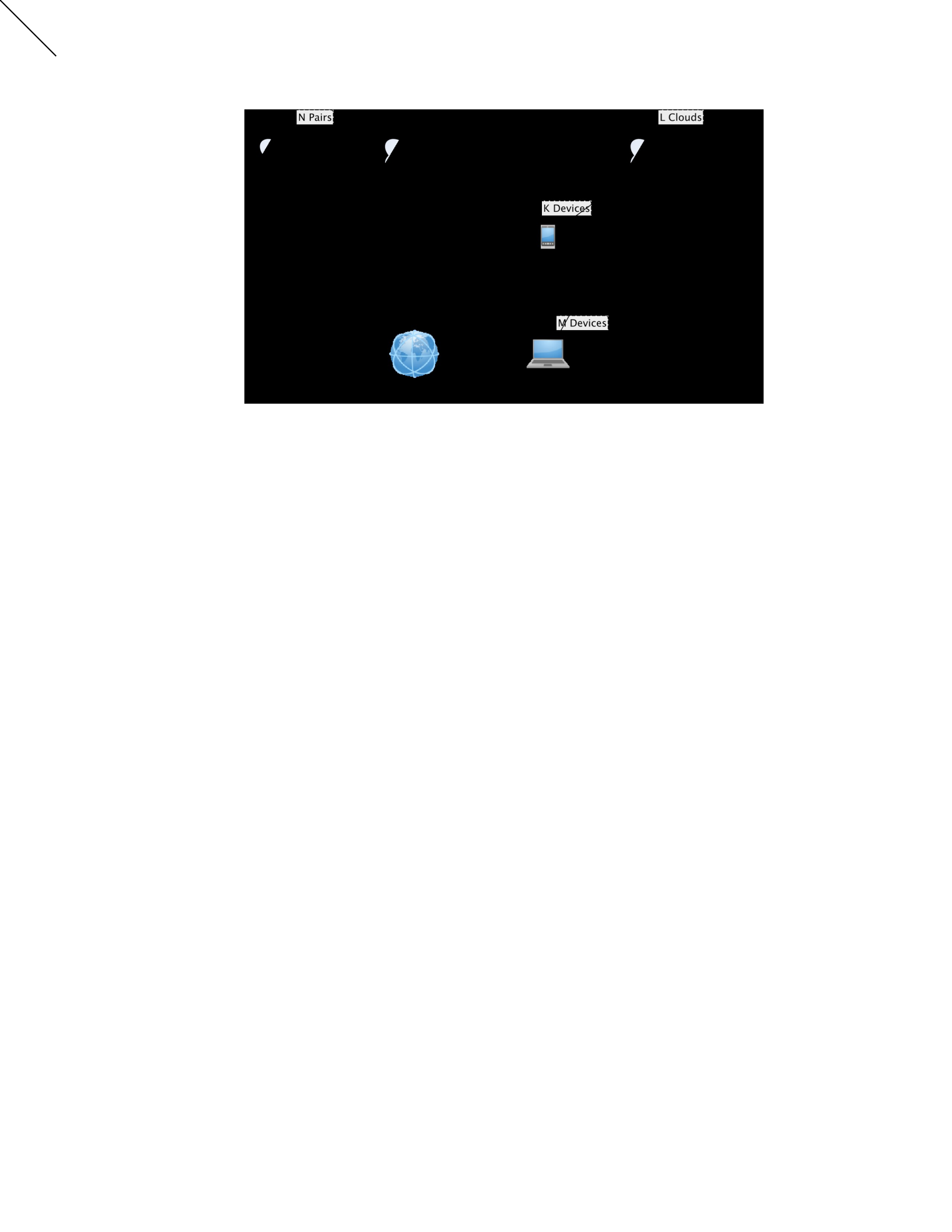
Figure 1.1: The CPS with the social robot in a home setting.
will lead the robot to communicate with additional could services other than that of
the robot manufacturer.
In Fig.1.1, the robot manufacturer’s cloud is depicted as cloud A. Apart from
the robot’s cloud that was just described the user could also have the robot exchange
data with other clouds. Examples include Dropbox, Google Drive, and Facebook. The
robot’s company might even allow users to download add-on skills from platforms
such as Google Play. These types of cloud services are depicted as a cluster of L
clouds, in Fig.1.1.
The social robot will be just one of the devices sending or receiving data from
the group of those L clouds. Smartphones, tablet and laptop devices found in a
household today are often already connected to some of the L clouds. In addition, the
user might desire these personal devices to exchange data with the social robot. For
instance, the robot could send pictures taken with its camera through the
Multimedia Messaging Service (MMS) or electronic mail. Some robots that are
marketed not only as a friendly companion but also as a security patrol guard could
also push alerts and videos of what they mark as unusual conditions. Similarly, the
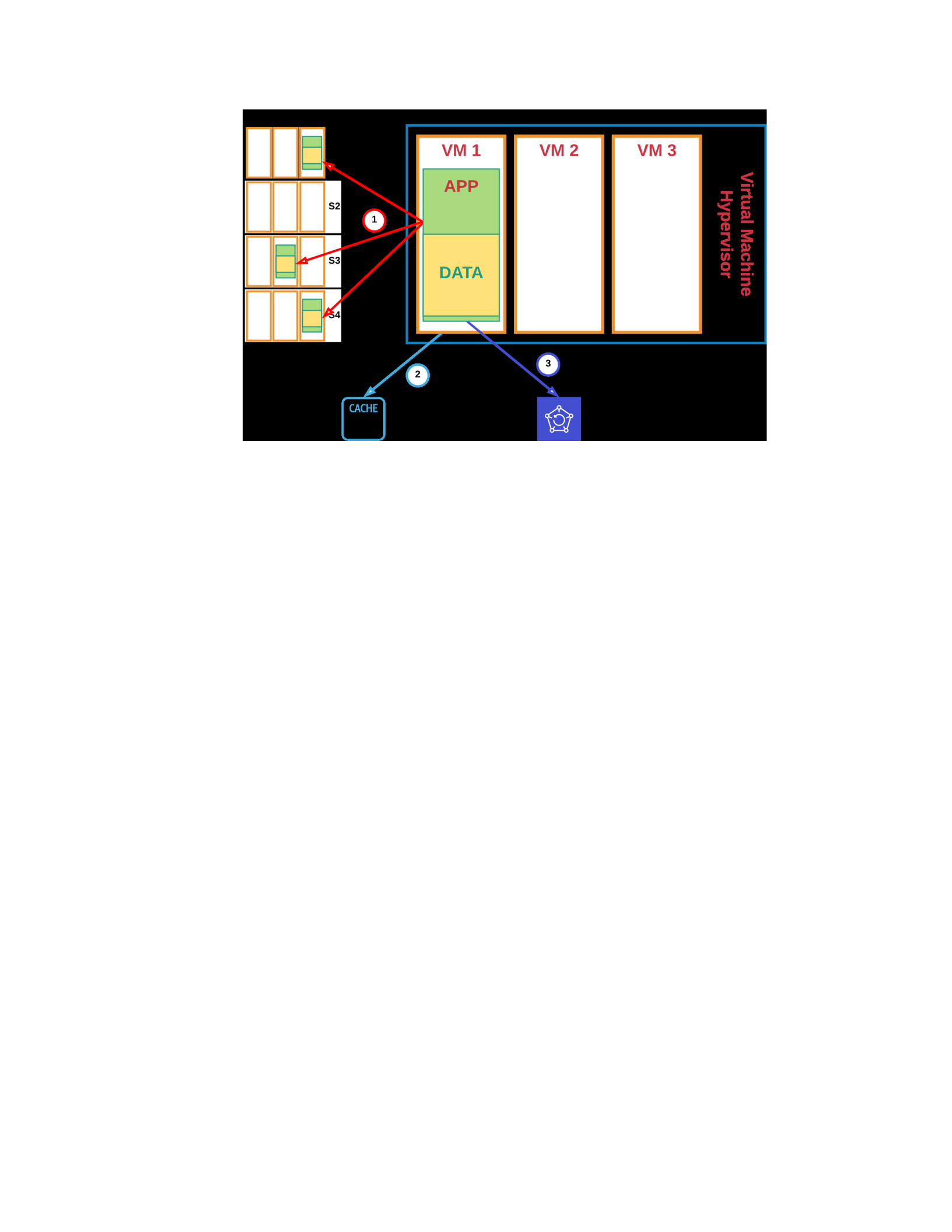
Figure 1.2: The risk of data management in IaaS cloud: 1) APP instance multi-server
duplication for load balancing, 2) VM cached for fast recovery or migration, 3) APP
and DATA backup on storage server, 4) Hypervisor could check the memory of VMs
user might want to share information like the contacts address book from the phone
or personal computer to the social robot. The communication among the devices
illustrated in Fig.1.1 could involve the cellular network, the Internet Service
Provider’s (ISP) network or a wireless local network (e.g. WiFi, Bluetooth Low
Energy).
The introduction of a social robot in a home environment adds a significant
degree of complication to the business relationships and network connections
enabled in a smart home. Each of the mentioned clouds may be run by one entity as
a Software-as-a-Service (SaaS), while a different administrative authority may be
supplying the Platform or Infrastructure-as-a-Service (PaaS or IaaS). It could also be
that the same IaaS (e.g., Amazon Web Services) is the layer below two different SaaS
clouds (e.g., the social robot’s cloud and an IoT device’s cloud).
Given this complexity of connections and data movement, it is difficult to

monitor whether the data is properly protected on every connection and site
because data will cross the boundary of domains, networks, platforms, and even
boundary of nations with different regulations. Even if online service providers are
generally trustworthy, their system could be misconfigured by the lack of
experiences to dealing with the ever growing complexity of current computation
environment. Fig.1.2 illustrates the execution model of an IaaS cloud and the
difficulty in managing data in such environment. The system level intervene by the
cloud infrastructure is out of the control of the service provider at the application
level. A useful public ledger of policy compliance should contain the information of
the entire view of data protection through the involved network.
In this dissertation, we propose a scheme that could provide a public ledger
of policy compliance. To achieve this objective, we leverage public Blockchains as the
public ledger. To address the scalability problem inherent in the Blockchain-based
systems, we utilize state channels to implement the on-chain-hash-off-chain-data
structure. We identify transaction verification as a critical problem when using the
Blockchains as the public ledgers, since Blockchain is not as dependable as it is
supposed to be in this scenario. We suggest a verification mechanism for the
information that out of the view of the blockchain network, which is based on the
incentive-based trust model implied by the state channel model. Then we propose
the Verifiable Off-Chain Message Channel (VOCMC) as the integrated solution for
leveraging blockchain technology as a general purpose recording mechanism. As
mentioned previously, the verification of external information is critical for
blockchain based public ledger, especially in the scenario considered in this work,
where the information published on the ledger should be reliable. The VOCMC
enable the verification of external information and the integration of blockchain
with powerful off-chain computation to overcome the difficulty of scaling the
blockchain. The VOCMC is derived from the state channel, and its name emphasises

the objective of the dissertation, which is to provide an approach to verify external
information. On top of the VOCMC, we suggest a mechanism combined with sticky
policy [2] to provide cross-boundary policy enforcement and monitoring, and thus a
dependable and scalable public ledger for policy compliance. The result can be a
public auditable record of the policy compliance, which can serve as the permanent
immutable credit record of the service provider for the customer making
informative decisions.
The rest of this dissertation is organized as follows.
•We first formalize the model of public ledger object and its verification
mechanism. We observe that the verification of a blockchain transaction can
be decoupled from the ledger object and in essence is part of the functionality
of the transaction system. Therefore, we formalize this concept by self-
verfiable transaction system, and thus prove its inability of verifying external
information (Chapter 2).
•Secondly, we discuss the definition of VOCMC by starting with the concept of
incentive-based trust. Briefly, if a piece of information is attached with an
incentive that leads to interest conflicts among different parties, their
agreement on what the information is could be a reliable description of the
information. Based on this concept, the VOCMC actively adds incentives to the
concerned external information and makes the participants of the channel to
reach agreements on the information as a verification process. We examine the
security properties under the universally composable security framework
(Chapter 3).

•We thirdly use VOCMC as the building block to construct the prototype of
public ledger of policy compliance, which combines off-chain database and on-
chain hash. How to determine whether a policy complies with regulations
is out of the discussion scope of this dissertation, though it is a core
mechanism. We assume that there exist a set of policies and a mechanism that
could effectively determine whether a system has successfully complied with
the polices in the set. We selected a representative policy set for concept
demonstration. We leverage the sticky policy to track the user data and collect
evidence required by the inference engine (Chapter 4).
•We evaluated the prototype to demonstrate its effectiveness on scaling
blockchain applications. We performed prototype experiments to determine
spacial and temporal overhead introduced by the implemented system as a
whole, and the monetary and performance cost of on-chain execution. Based
on these pilot tests, we examined how the off-chain component helps scale the
system. We also tested the effectiveness of the sticky policy mechanism on a
particular policy use case, the guaranteed deletion (Chapter 5).
The scalability of a blockchain system is the weakness for a lot of blockchain-
based applications. This issue is amplified when dealing with micro-transactions in
huge magnitude. Off-chain payment channels or state channels are designed to
address the difficulty in scaling the blockchain system. Though the main objective of
our proposed scheme is to provide verification of external information for the public
ledger, it naturally reliefs the tension the system may suffer. At first glance, off-chain
payment channels merge several micro-transactions into a single on-chain
transaction. From another perspective, this process can be considered as reaching
agreement on a sequence of computation results. In other words, any on-chain
computation can be executed by an off-chain process as long as the result can be

verified by the stakeholders, and reach an agreement on it. In consequence, we can
limit the usage of on-chain computations, such as the smart contracts of Ethereum.
The capacity of on-chain computation depends on the available balance for
computation, which is not appropriate for persistent programs.
Another side effect of executing code on-chain is the halting problem that would
significantly degrade the performance of the blockchain network.

Chapter 2
Blockchain-based Public Ledger
2.1 Introduction
Blockchain technology is attracting growing attention from both researchers and the
general public after its success in cryptocurrency and the participation of
governments and major financial industry players. Although blockchain and
cryptocurrency technologies are often mentioned together, they are not tautologies;
blockchain is only one of the cryptocurrency building blocks, albeit the most
important.
In general, a blockchain serves as a public ledger for recording transactions.
Transactions in Bitcoin are mainly exchanges of the cryptocurrency, from an account
to another. From this perspective, a blockchain seems like just another kind of
database. What makes blockchain interesting is its combination of technical facts
and non-technical facts to achieve several critical properties for establishing a
cryptocurrency.
In traditional banking, the transaction databases are maintained by
organizations that obtained trust from the public, usually endorsed by the
government or influential investors. Transaction databases are critical for banking
and we need trusted organizations to operate them, because the transaction records
are the only evidence of how the assets are located among millions of accounts. If
the transaction database is secured, the assets owned by accounts are secured. The
security of the transaction database depends on trusted organizations. However,
Bitcoin adopted a security model without the trusted authority, which is referred to
as a trusted third party in the majority of the security framework. The abandonment
of the trusted third party is painful, but the solution provided by

Nakamoto has not only solved the problem of establishing trust without trusted
parties but also given fundamental support to the value of Bitcoin.
The rest of this chapter illustrates the general framework of the Bitcoin-like
cryptocurrencies, in order to explain what makes blockchain, a database technology,
important and interesting to both industry and academia. As we will see, blockchain
is a smart combination of existing technical and non-technical factors. This strong
coexistence means that it is difficult to decouple blockchain from the cryptocurrency
system for general purpose ledgers, and the performance challenges are hard to
overcome. The definitions and terminology introduced in this chapter will support
the discussion of later chapters.
2.2 The Bitcoin-like Blockchain
Blockchain is a distributed ledger technology (DLT). The Bitcoin blockchain in
particular is based on peer-to-peer (P2P) networks in which every participating
node, called mining node, has to keep the entire transaction database and update its
local version as the data grows. As a result, multiple copies of the ledger exist in the
network. If the copies disagree about some transactions, how do they resolve the
issue and achieve agreement? This problem could refer to the consistency problem,
the consensus problem, or, more generally, the Byzantine fault tolerance problem
[3]. Inconsistent data is common in the Bitcoin-like blockchain. Suppose every
mining node follows the protocol and never crushes. Despite this ideal execution
environment, data inconsistency occurs due to the transfer latency across the
network.
Fig. 2.1 illustrates this type of data inconsistency. Two transactions (i.e.,
transaction R and transaction B) enter the network from nodes with high transfer
latency. Consider the two subnetworks. From the point of view of these
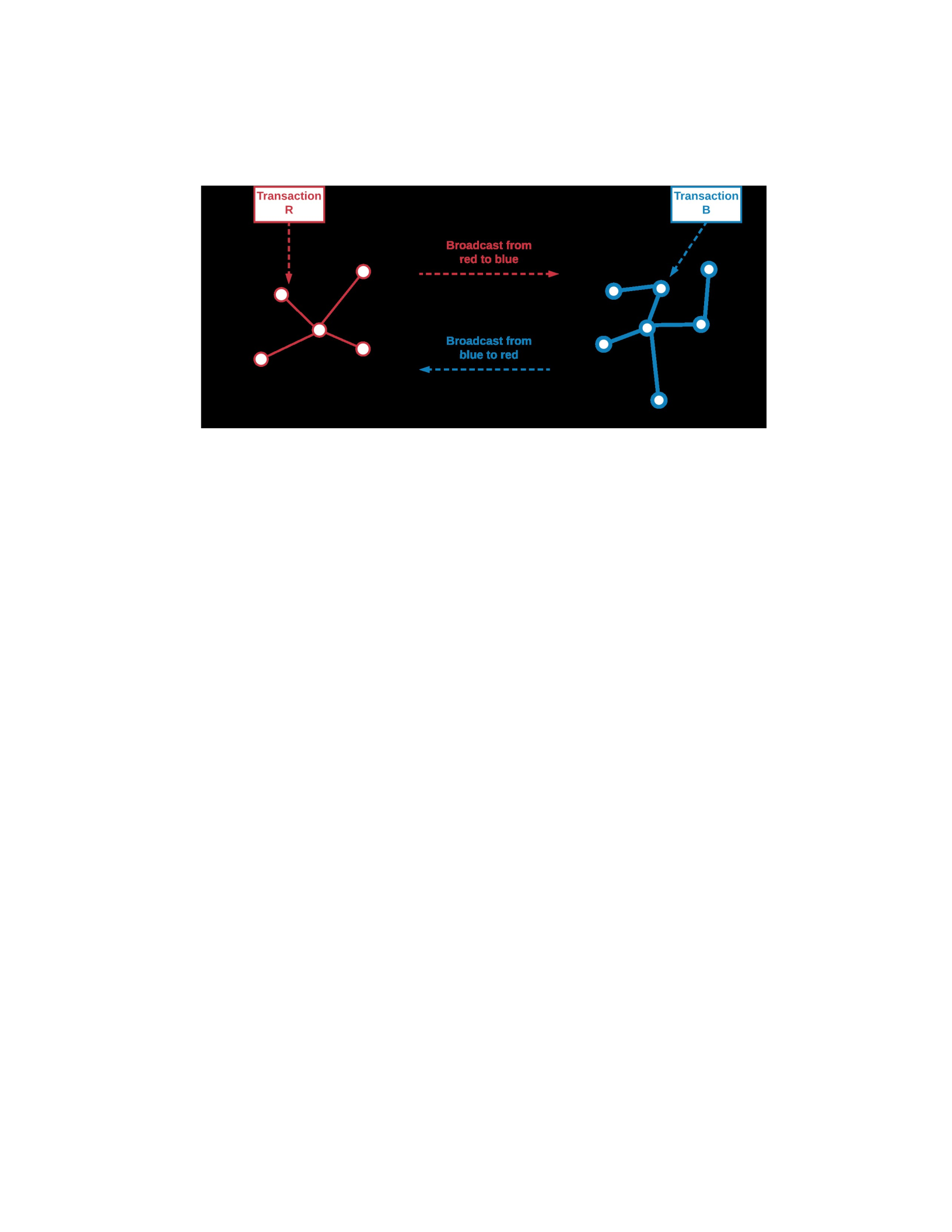
subnetworks, the arriving order of these transactions is different. Another type of
data inconsistency that may occur during valid execution of the protocol of
Figure 2.1: Transactions R and B enter the network from nodes with high transfer
latency. From the point-of-view of the red nodes (the nodes on the left side),
Transaction R arrived earlier than Transaction B, while blue nodes (the nodes on the
right) consider Transaction B as earlier than Transaction R.
Bitcoin-like blockchain is the fact that mining nodes may get offline and back online,
as every node could join and leave a P2P network anytime as they wish. As a result,
there may always be some nodes with an outdated version of the database. The most
important type of data inconsistency is caused by malicious nodes that may alter the
database for their benefits. In a decentralized system without a trusted authority, it
is difficult to identify if a copy of the database is without fraudulent transactions.
In order to achieve data consistency in such a complex environment, the
Bitcoin-like blockchain relies on a protocol that tolerates Byzantine failure in that
the mining nodes’ behavior is, in essence, arbitrary and unpredictable, if the
malicious behaviors are considered as a set of failure cases with arbitrary
consequences. Nakamoto provided the original protocol in the Bitcoin white paper
[4], which includes several smart and correlated design decisions that enable this
scheme. Informally, the protocol has the following features:

•The transactions are recorded in a chained data structure, where the
transactions are arranged in blocks, and each block contains a field which is
the hash of the previous block—then the transaction blocks are chained by
this field.
•The value of a new coming transaction can be verified by the value of
transactions resident in the existing blocks whose value could again be
verified by earlier transactions.
•New blocks are generated through a competition process called mining. The
winning node gets rewarded by obtaining the ownership of new Bitcoins
accompanied by the new-born block.
•All the mining nodes must accept the longest chain as the valid version.
The ideas behind the blockchain are in fact older, and were formerly a
method for time-stamping digital documents. They were introduced by Haber and
Stonetta in a series of works beginning in the early 1990s [5, 6, 7]. By assembling
data into blocks and chaining the blocks with hash pointers, this structure provides
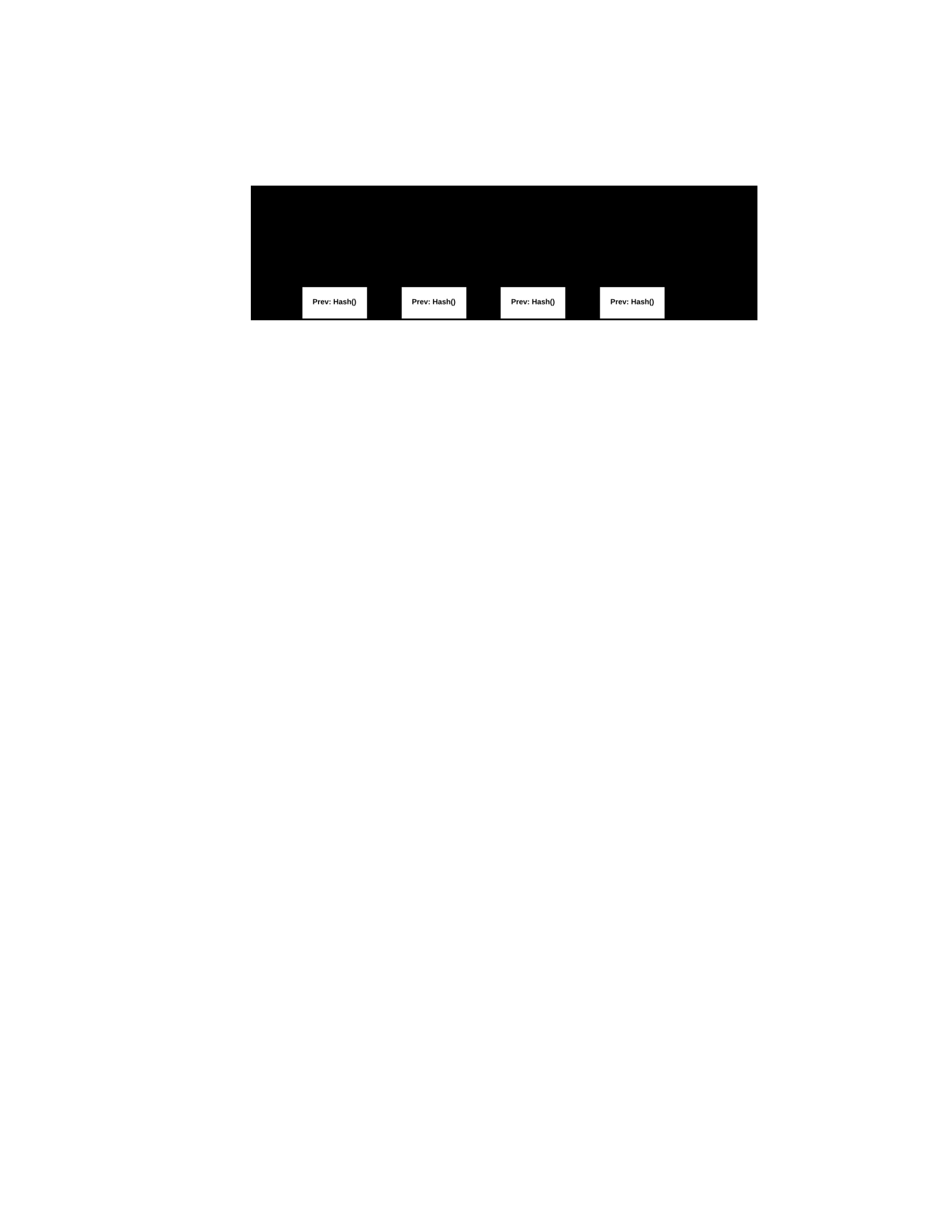
the feature of tamper-evident, as shown in Fig. 2.2. If an adversary had modified
data in any block of the chain, it would invalidate the hash pointers of every
following block. Technically, if we store the last valid hash pointer, the tampering
could be detected even if an adversary modified the data and all the corresponding
hash pointers in the chain. In centralized database architecture, the hash pointers
could be stored by a trusted authority; however, it is not the case for decentralized
systems like the blockchain.
The fundamental assumption behind Bitcoin-like blockchain is that there is
no trusted authority or trusted third party in the system. An individual mining node
has to keep its own copy of the blockchain. An observer cannot recognize which
copy is the valid one, if multiple copies are displayed since, from the perspective of
trust, all the copies are identical without a trusted authority.
Figure 2.2: Every hash pointer depends on all the previous data and pointers. Once a
piece of data is tampered, the following hash pointers will become incorrect. If an
adversary attempts to modify the data, he has to re-compute every hash pointer
influenced by the modification. If there is a trusted authority keeping the record of
the correct value of the last hash, data tampering is always detectable, even if the
adversary modifies the data and hash pointers appropriately.
Imagine, blockchain A and B store the same data except for a single disagreed data
entry. Correspondingly, the hash pointers are differentiated between blockchain A
and B after that data entry. It is possible that B modified the data, or A did the
modification. However, there is no authentic version kept in a secure place; thus, one
could not tell which is the valid chain without modification.
Nakamoto innovatively solved this problem. Firstly, the generation of hash
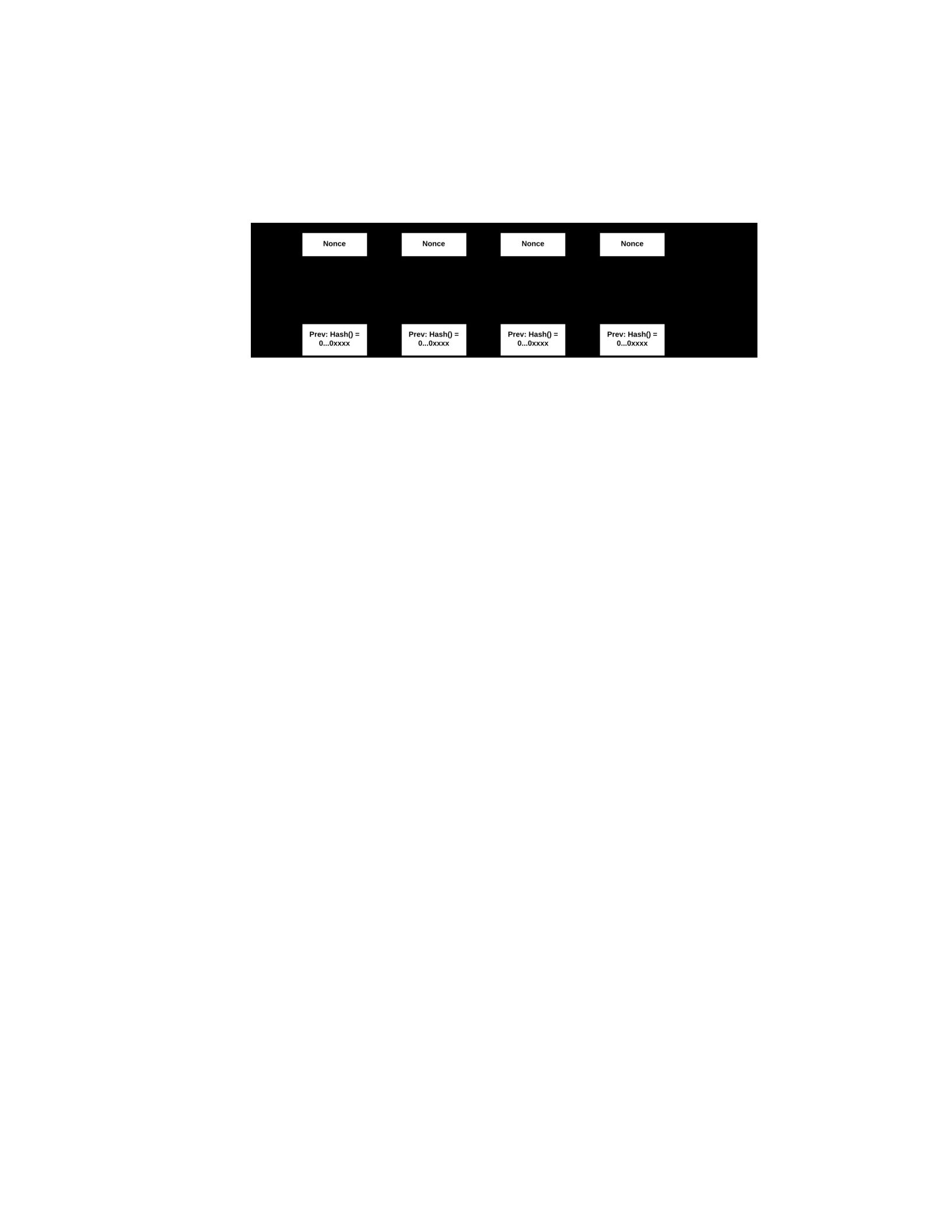
pointers becomes a computationally difficult puzzle. As illustrated in Fig. 2.3, to
generate the hash pointer for a data block, the mining node has to find a string of bit
called nonce with which the generated hash pointer displays some required
patterns. In the Bitcoin system, the required pattern for a hash pointer is some
leading zeros in the generated hash. In order to find an answer to a puzzle for a
specific block, the mining nodes have to randomly select a nonce, then calculate the
resulted hash to verify if the hash meets the requirement. Repeat this cycle until a
valid nonce is found and thus a valid hash. This technical decision makes the hash
generation inefficient, and thus inefficient to regenerate the entire blockchain if a
piece of data is modified. An adversary has to successfully solve as many puzzles as
the number of blocks following the data he intends to change.
It is not enough to secure the valid blockchain by just raising the difficulty of
Figure 2.3: In Bitcoin like blockchain, there is a field called nonce with which the
resulted hash of a block will demonstrate some required patterns. Currently, the
required pattern is the number of leading zeros in the resulted hash pointer. The
process to find a valid nonce is called mining.
its hash generation. Suppose an adversary with a supercomputer, then it is possible
to recreate a blockchain in an acceptable time span. The second requirement to
secure the valid blockchain is that the honest mining nodes control the majority of
computation power in the network. Since new blocks are rapidly added to the
blockchain, an adversary could not just recreate the historical blocks to tamper the
data, but also generate the hash for new blocks correspondingly. To be successful,
the adversary has to maintain computation resources stronger than the honest
nodes; otherwise, the tampered blockchain could be recognized by the miss of the
most recent blocks. Based on the assumption that the majority of computation
resource is controlled by the honest nodes, the Bitcoin-like blockchain further
requires the mining nodes to accept the longest chain as the currently valid version,
since the probability is high that an adversary could not generate blocks faster than
the honest nodes as the computation power owned by the adversary is weaker.
Interestingly, Nakamoto did not specify a strong technical method to protect
the valid hash pointers. For instance, other distributed systems split a secure key
among nodes, and no single node could access and modify critical data [8, 9, 10]. In

Bitcoin, multiple different versions are allowed, and the authentication condition is
simple—by the length of the chain. The critical factor enabling the entire approach is
the assumption of honest majority computation power. In principle, if an adversary
has the computation resource to recreate a blockchain that is longer than generated
by the honest nodes, there is no doubt that the tampered data will become the valid
version.
Assumptions are often not reliable. The assumption under the centralized
system is that the authorized third party is trustworthy, which is not always true,
and that is why systems like blockchain will appear. Though the assumption under
blockchain can become unreliable as well, there is a fair way to make the reliability
probability high. The answer is to reward honest nodes by incentive. The honest
miners are encouraged by rewarding them with financial benefits—the coins. In the
Bitcoin protocol or other similar cryptocurrency scheme [4, 11], incentive comes in
two ways:
•the nodes who find a new block will be automatically rewarded with Bitcoins;
•the owner of the transactions will pay the mining nodes transaction fee.
Technically, these two types of incentive could not prevent misbehavior from
happening, since a successful adversary could get all the rewards. By misbehaviors
such as forking the blockchain or selfish mining, dishonest miners could rubber the
coins of honest miners by simply invalidating blocks generated by them. If the
assumption had held, such an attack would fail in that the adversary is unlikely to
generate more blocks than the honest majority. Forking the blockchain will increase
the risk of mined blocks being discarded, which means the legal revenue is
decreased.
There is another layer of incentive—the reputation of the entire system and,
thus, the value of the rewards. If the adversary controls a dominant computation
power and misbehaviors happen consistently, the market confidence will be
impacted, the honest players and the public will quit, and the currency will become
worthless [12]. An essential fact to the success of Bitcoin is the interest binding
between the players and the system. The rewards are in the form of Bitcoin. In
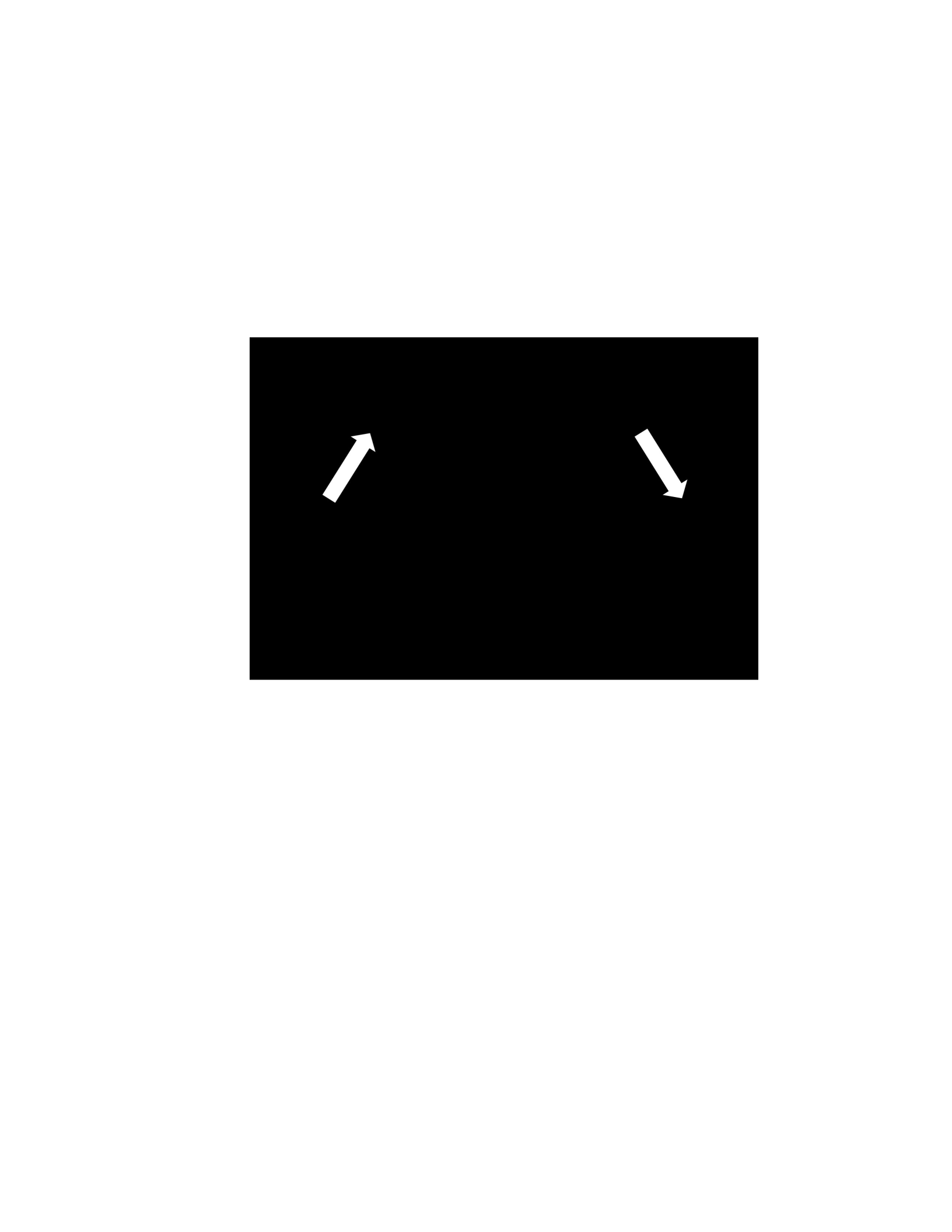
Figure 2.4: Reputation of the system guarantees the rewards to the participants, and
thus the participants will voluntarily preserve the reputation of the system. The
increase of honest players helps maintain the portion of the computation resource
controlled by the honest players. Therefore, the probability of a successful attack is
kept low, which in turn enhances the system reputation.
order to make the rewards they get worth more, the mining nodes have to preserve
the reputation of the system in public, which forms a benign cycle, as demonstrated
by Fig. 2.4:
•the more significant reputation of the system leads to the higher value of the
coins and thus the value of the rewards;
•more rewards lead to more honest players;

•the presence of more honest players increases the computation resource
controlled by the honest parties;
•it is difficult for the dishonest player to increase their portion of computation
resource controlled
•the possibility of successful misbehavior remains low;
•the reputation of the entire system gets enhanced.
The success of Bitcoin, and any other cryptocurrency, depends also on less
controllable factors. The system needs a bootstrap at the early stage. Early
acceptance by the public is vital for the thriving of the entire ecosystem.
It is clear that the components of the Bitcoin system are integrated tightly.
Without the incentive scheme, the blockchain is vulnerable to adversaries with
strong computation power. The security scheme of blockchain is weak from the
aspect of technology. The technical improvement from its original version is the hash
puzzle. Nevertheless, the puzzle could not make the scheme completely secure,
because it is a randomized computation. The adversary wins or loses by chance.
By this point, we have discussed the success of Bitcoin, not the success of
blockchain. We observed that it is challenging to discuss blockchain without the
background of cryptocurrencies because the attempt to decouple the blockchain
from a binding cryptocurrency usually results in fundamental modifications to the
underlying trust assumptions. The success of Bitcoin also depends on human
factors. It is true that the blockchains of successful cryptocurrencies preserve
important properties, especially the Byzantine fault tolerance in a decentralized
anonymous network without a trusted authority. However, this property is
technically quite expensive. For instance, more mining nodes generally lead to a
greater extent of decentralization of computation resources, which is good for the

security of the entire system, but also leads to more fierce competition into owning a
new block. The result is that the performance of the entire system would not scale
with the increase of computation resources. In fact, the performance is degraded in
terms of energy consumption, since the rate of block generation is somehow locked
by the protocol. More mining nodes simply increase energy consumption per block.
Hence, if we discuss blockchain without human factors, constrains become
obvious. For example, to scale the blockchain, researchers introduced permissioned
blockchain, where the mining nodes could only join the network with permission. In
such a system, miners are more easily identified and traceable, in order to regulate
the behavior of miners, while miners could participate or quit as they wish and
anonymously. The difference is subtle comparing to a system enabled by a trusted
authority.
This observation inspires our introduction of the model of incentive-based
trust. It is important to understand the degree of trust provided by the incentive-
based approach and the scenarios in which such an approach is applicable. In the
following section, the pros and cons of blockchain as public ledger will be discussed
in detail.
2.3 Blockchain as Public Ledger
The blockchain serves as the ledger of transactions in Bitcoin. Comparing to its
predecessors [5, 6, 7], Nakamoto’s blockchain is characterized by the following
remarkable features:
•Distributed ledger—each mining node maintains its local copy of the
blockchain with the requirement that mining nodes have to update their local
copy once a version with longer chain length is found.

•Public accessibility—any user can view the transactions published on the
blockchain network.
•Immutability—transactions are confirmed and accepted by all nodes in the
network through the mining process in which the transactions are added into
blocks that are finalized by proof of work (by solving the hash puzzle); once a
transaction is confirmed in this manner, the probability of malicious
modification to the transaction is negligible, because the adversary has to
resolve the hash puzzles for the following blocks influenced by the
modification.
•Public verifiability—transactions could be verified by preceded transactions
in the blockchain.
Due to these desirable properties, blockchain is a promising technique for
public ledger providing auditability and transparency, such as decentralized
information management, immutable record-keeping for possible audit trail, and
robust and available system. Therefore, an increasing number of works aim to
decouple the blockchain from cryptocurrency as a pure database technology—the
distributed ledger technology [13]. As discussed in section 2.2, the immutability is
essentially based on the assumption that the majority of computation resource is
controlled by honest players. More precisely, a successful attacker has to control
over 50% of the mining power in order to succeed in forking the blockchain with
non-negligible probability [12]. However, this assumption also makes it difficult to
realize these desired properties without the appearance of a build-in incentive
strategy. In cryptocurrency, the primary source of reward is the coins mined during
the process of block generation. Thus despite the cheap transaction fee, miners
likely join and stay in the network, which provides a stable population base of active

miners. If the rewards purely come from transaction fees, the cost for the ledger user
would be unsustainable, considering the energy consumption of a blockchain
network with the scale comparable to that of Bitcoin. The estimated electricity used
per transaction of Bitcoin is reaching 200 kWh. Ethereum transactions seem much
cheaper than that of Bitcoin, scoring an electricity consumption of 37 kWh. However,
compared to the 0.01 kWh of Visa transaction, we can imagine 3700 times of
processing fee, if we use a blockchain-based credit card [14].
For reducing the cost of blockchain application and scalability, researchers
have introduced permissioned or private blockchain, contradictory to
permissionless or public blockchain, i.e., the Bitcoin-like blockchain. A private
blockchain is able to adopt different algorithms to scale the performance. Nodes
cannot join a private blockchain network by simply downloading the current version
of the blockchain and broadcasting a joining announcement. Intentional nodes have
to apply for permission from the blockchain owner. Thus the permission itself serves
as a kind of a behavior limitation to the mining nodes, because to get permission the
identity of joining nodes shall be verified, which implies a non-anonymous network.
Adversaries to such a system do not enjoy a leisure equivalent to that of public
blockchain—to join freely, try attacks, and then quit freely. If attackers get caught in
a public blockchain, they can simply start using another identity.
Mining in private blockchain is organized. For example, in Hyperledger fabric
[15], transactions would be firstly ordered by the Ordering Service Nodes, and then
send to some peers designated by an endorsement policy for execution (instead of
mining nodes, nodes in Hyperledger are called peers to indicate that their function is
not mining blocks, but executing code in transactions). The result would be
endorsed by the designated peers, and other peers need only validate the
endorsement instead of re-executing the transaction. This treatment eliminates

mining competition and avoids blockchain forking. It further reduces the
computation workload by the endorsement scheme.
Despite the performance gain of a private blockchain, it indeed changes the
essential trust model of the original blockchain, which, for some advocates of
blockchain technology, is the spirit of this technology. The decentralized trust model
is suspectable in permissioned blockchain in that the owner of the blockchain is the
only entity to release the permission. The behaviors of participants are not
independent of the influence of the owner; therefore, the immutability and integrity
of data are under potential threat. The idea to eliminate the trusted authority comes
from a fundamental question: is the trusted authority actually trustworthy? It is
similar to the political problem of how to prevent the government from abusing its
unlimited power.
This dissertation inclines to the public or permissionless blockchain mode for
the following reasons:
•Technically, the difference between private and public blockchain mainly
reflects the tradeoff between performance and security features. Suitable
decisions depend on application scenarios. There is no “one-size-fits-all”
consensus protocol (Byzantine fault tolerance), which is a well-established
understanding [16];
•Existing public blockchain still has potential with regard to scalability, when
combined with other technologies, such as off-chain channels;
•When considering off-chain extensions, public and private blockchain are
logically equivalent because they provide the same interfaces for off-chain
applications.

The choice between private and public blockchain is mainly about the conflict
between performance and immutability of data. We can choose private blockchain
for better performance, vice versa, depending on the nature of application scenarios.
Now we consider the feature of public verifiability, which is another primary reason
for the adoption of blockchain as a public ledger.
2.3.1 Questionable Public Verifiability of Blockchain
Public verifiability and immutability of data of blockchain attract researchers
looking for transparent and immutable record keeping for possible audit trail [17].
However, approaches often leverage the public accessibility instead of the
verifiability feature. For instance, consider a blockchain-based financial statement
publishment system, where companies anonymously publish their statements on a
blockchain for audit. A questionable logic in such a system is that if a company
Algorithm 1: Ledger Object L
1 Init:S ← ∅
2 function L.get()
3 return S
4 function L.append(r)
5S ← Skr /* k is the concatenation operator
6 return */
tries to cheat, such misbehavior is detectable because of the public verifiability of
the blockchain, and therefore the auditing result is provably correct. If there is no
anonymous requirement, public accessibility may provide some degree of
verifiability since it is relatively easy to build a connection between the financial
statement and the company and its operational activities. Nevertheless, with
anonymity, as long as the number of income and outcome matches, there is no way
to identify a cheater by the use of blockchain. To understand this problem, we
should examine the public verifiability of blockchain in detail.

Let us start with a formal definition of a ledger object for the convenience of
further discussion. We borrow the form from Antonio F. Anta and Maurice Herlihy
[18, 19].
Definition 1. A ledger L is a sequence of records over a sequential history H defined as
follows. The initial value of the sequence L.S is the empty sequence ∅. Suppose the
value of the sequence in ledger L is L.S = V at the invocation of an operation , then:π
1. if is an πL.getp() operation, then the response of returns V , andπ
2. if is an πL.appendp(r) operation, then set the value of sequence in ledger L to L.S
= V kr.
Operations get() and append() are defined in Algorithm 1.
This definition describes a ledger as an append-only list of records and does
not capture the distributed nature of blockchain, but it is enough for the discussion
of the public verifiability of blockchain in this section. We extend it to a distributed
version at the end of this chapter. Note, though the operation get() only returns the
entire list S, other types of reading operation could easily be implemented on top of
get(). This treatment is for the simplicity of the definition and reflects the essence.
In the work of Maurice Herlihy [19], a ledger with public verifiability is
realized by adding a Boolean function Valid(). Precisely, Valid() is invoked by the
operation append() with an input of a sequence of records S and returns true if and
only if some semantics are preserved. Upon the return value of Valid(), append() fails
or accepts the operation request. The formal definition of the validated ledger is
extended from Definition 1, taking into account the influence of Valid() to the
execution route:

Definition 2. A validated ledger VL is a sequence of records over a sequential history H
defined as follows. The initial value of the sequence VL.S is the empty sequence ∅.
Suppose the value of the sequence in ledger VL is VL.S = V at the invocation of an
operation , then:π
1. if is a πVL.getp() operation, then the response of returns V ,π
2. if is a πVL.appendp(r) operation and Valid(V kr) = true, then set the value of
sequence in ledger L to L.S = V kr and respond with ACK, and
3. if is a πVL.appendp(r) operation and Valid(V kr) = false, then keep the value of
sequence in ledger L to L.S = V and respond with NACK.
Operations get(), append(), and Valid() are defined as in Algorithm 2.
The semantics need to be preserved for Bitcoin-like blockchain by Valid() in
Maurice Herlihy’s work [19] and described as preventing double-spending.
However, this is not a precise abstraction of the verification mechanism of Bitcoin-
like blockchain. To the best of our knowledge, few works are aiming to understand
and
Algorithm 2: Validated Ledger Object VL
1 Init: S ← ∅
2 function VL.get()
3 return S
4 functionVL.append(r)
5 if Valid(Skr) then
6S ← Skr
/* k is the concatenation operator
7 return ACK
8 else return NACK */
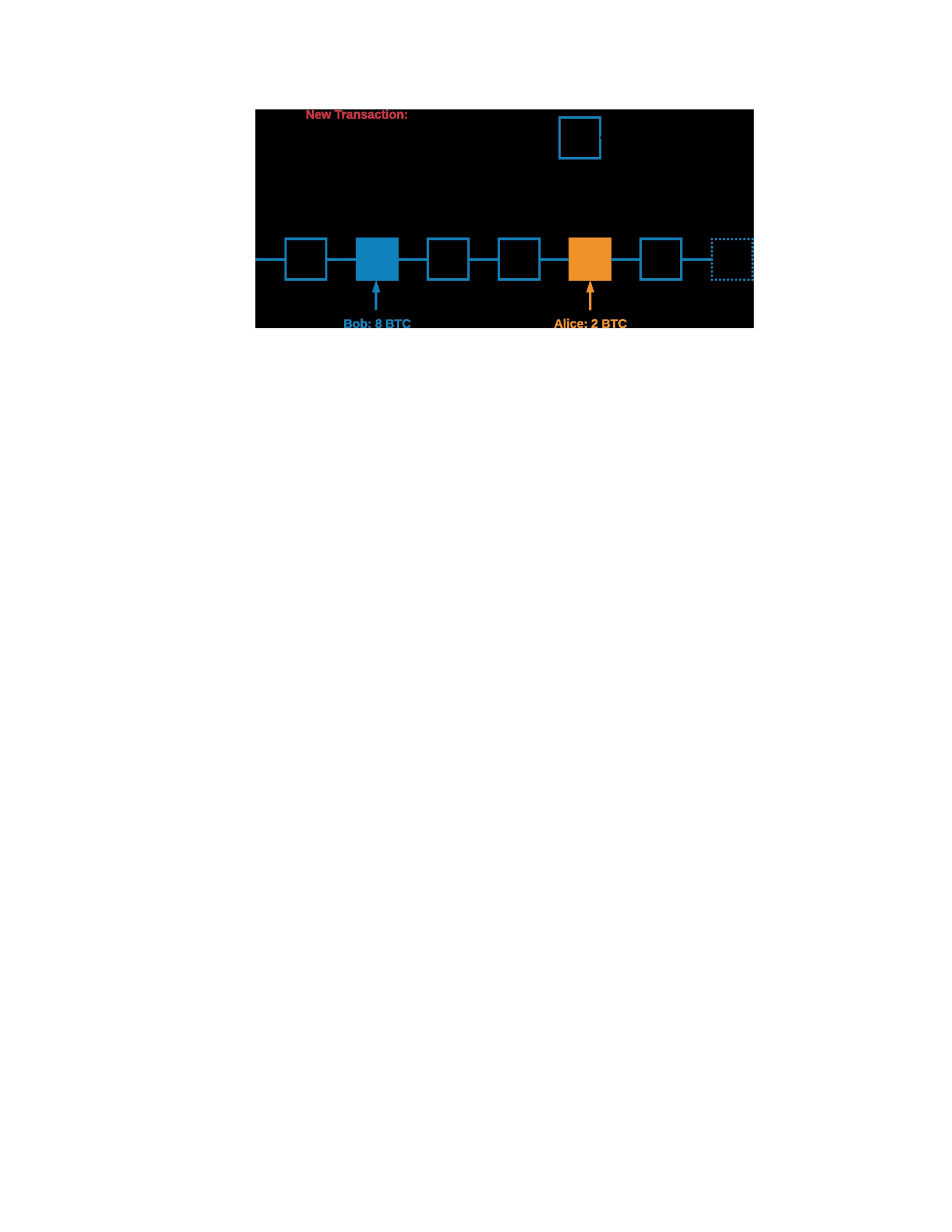
Figure 2.5: The transaction verification of Bitcoin-like blockchain relies on previous
transactions. In this case, Bob intends to transfer 3 BTC to Alice. The mining nodes
check if the account of Bob has enough balance to complete this trade by tracing
back along the blockchain to find transactions that transfer more than 3 BTC to Bob
and those Bitcoins have not yet been spent.
model the verification mechanism of blockchain, and thus lead to drawbacks of
applications relying on the verification feature.
Fig. 2.5 displays how the verification mechanism works. Suppose Bob
transfers Alice 3 units of Bitcoin,
1. a new transaction is broadcasted to the network announcing that Bob
transfers Alice 3 units of Bitcoin;
2. the mining nodes check the blockchain to find if any transactions are
indicating Bob has enough units to complete this transfer;
3. if Bob has enough Bitcoin in his account, the mining nodes include this new
transaction in a block; and
4. when the block containing the new transaction is successfully mined, the
transfer is completed.
What makes the verification process subtle is the structure of the account
information. Bitcoin accounts do not have integrated data in the blockchain to

describe their status, though there are Bitcoin wallet applications that collect and
summarise necessary data to represent an account. Instead, only the transactions
are listed in the blockchain. In order to check if an account has enough balance to
finish a transaction, mining nodes traverse the blockchain to find one or more
transactions whose combined balance is greater than the required value, and that
have not been spent yet. A new transaction must refer to the transactions whose
balance is spent in this new transaction, which means a transaction with a
balance is an incoming transaction and has no further transactions refer to it.
Fig. 2.6 illustrates a case possible for the example in Fig. 2.5. The first
incoming transaction is of balance 2 BTC and referred by two spending transactions
that spend 1 BTC each. Thus when the Bob-to-Alice transaction is announced, the
mining nodes would not include it into a candidate transaction for this transfer.
When miners find the transaction with a balance of 7 BTC, they stop traversing the
blockchain and pick this transaction as the one spent by the new transaction. In the
new transaction, 3 BTC are transferred to Alice, and the rest 4 BTC are included in a
self-transfer to Bob, and the transaction with a balance of 7 BTC is referred.
Clearly, there is a linked list of transactions related to every unit of Bitcoin,
from the latest incoming transaction back to its origin. An important feature of
Bitcoin is that the only source of Bitcoin is the mining activity. Whenever a block is
mined, the miner who solves the puzzle could include a transaction that indicates a

Figure 2.6: A possible situation of transactions corresponding to the example in Fig.
2.5. The first to-Bob transaction is a spent transaction which could be used for
completing this trade. The second to-Bob transaction is a not-spent transaction, but
indicates a balance not enough to complete the transfer. The third is a not-spent
transaction and has enough balance, thus the new transactions refer to it
transferring 3 BTC to Alice and the rest back to Bob.
certain amount of Bitcoin is transferred to the miner’s account. Unlike the
traditional banking system, there is no deposit transaction that injects balance from
another source. This feature is important because, in essence, the “space” of Bitcoin
is closed. Formally, we model the Bitcoin transaction system by the Self-Verifiable
transaction system:
Definition 3. A self-verifiable transaction system VT consists of three components:
1. an element base EB which is initialized as an empty set ∅—an element is noted
as a tuple {ei,value}
2. a label set ID which is defined over the space of strings with a fixed length,
3. a transaction forest T F whose trees are rooted in the element base EB—the
nodes in layers below the roots satisfy the requirement as follows,

•every node t contains a tuple {id,value,parent}, where id ID∈,
•if a node t has child nodes, its value t.value equals the sum of the values of its child
nodes, t.value = P
i∈child ti.value.
Allowed operations in the system are defined as follows:
• Element generation, gen(id)—add a new element e into the element base EB, and
create a new tree with one child node rooted with the newly generated element in
the forest T F,
• Validation, valid(T F)—take the transaction forest and the element base as the
input, and return true if and only if the sum of the values at the root layer equals
the sum of the values of all the leaves,
• Transfer, transfer(idfrom,idto,value)—take as input the ID of the sender idfrom, the ID
of the receiver idto, and the value, find a set of leaves with
t.id = idfrom satisfying P
i∈found ti.value ≥ value, add child nodes with
t.id = idto satisfying P
i∈added ti.value = value, and add a child node with
t.id = idfrom satisfying t.value = P
i∈found ti.value − value; invoke valid() with the
transaction forest T Fupdated with newly added nodes; if valid(T Fupdated) = true,
accept the transfer. Otherwise, rollback the transaction forest.
Operation gen(), transfer(), and valid() are defined as in Algorithm 3.
Per the model definition of the self-verifiable transaction system, we can
provide a proof of the verifiability feature of Bitcoin-like blockchain to prevent
double-spending attacks.
Theorem 1. Let VT be a self-verifiable transaction system, as defined in Definition 3.
Then there is no double-spending transactions iff VT .valid() returns

true.
Algorithm 3: Self-verifiable transaction system VT
1 Init: EB ← , ID ← {0∅,1}n, T F ← ∅
2 function VT .gen(id)
3e = new element
4EB ← EB ∪e
5new node t ← {id,e.value,e}
6T F ← T F ∪t
7 function VT .valid(T F)
8 if sum(ti∈roots.value) = sum(tj∈leaves.value) then
9 return true 10 else return false
11 function VT .transfer(idfrom,idto,value) 12
find a set of leaves C:
13 sum(ti∈C.value) ≥ value
14 ti∈C.id == idfrom
15 create new set of nodes NC:
16 sum(ti∈NC.value) = value
17 ti∈NC.id = idto 18 ti∈NC.parent = idfrom 19 create new node t:
20 t.value = sum(ti∈NC.value) − value
21 t.id = idfrom
22 t.parent = idfrom
23 T F ← T F ∪NC ∪t
24 if VT .valid(T F) then 25 return ACCEPT 26 else
27 rollback
28 return NACCEPT
Proof. By Definition 3, the fact that VT .valid() returns true indicates that the sum of
the values at the root layer equals the sum of the values of all the leaves in the
transaction forest T F. Another fact is that if a node t has child nodes, its value
t.value equals the sum of the values of its child nodes, t.value = P
i∈child ti.value.
Thus, we can divide each tree by the method below,

•for a node with only one child node, keep it the same,
•for a node t with multiple child nodes, create a dummy set of nodes in which
each dummy node corresponds to a child node and satisfies
tdi.value = tci.value
X
tdi.value = t.value
di
tdi.id = t.id tdi.parent =
t.parent
•abort if any of the conditions could not be satisfied.
Repeat this treatment from the leaves up to the roots, and then we get a dummy
forest in which each tree is a linked list with every node that has the same value. In
essence, we have established a 1-on-1 map between every not-spent transaction to
its element base. Obviously, if this 1-on-1 map is established successfully, it is
equivalent to the fact that the sum of the values at the root layer equals the sum of
the values of all the leaves in the transaction forest T F. This 1-on-1 map indicates no
element is spent twice as well. Therefore, the problem is reduced to there is no
double-spending transaction iff the 1-on-1 map could be created. We have shown
, we now prove . Suppose there is a pair of double-spending transactions. Then ⇒ ⇐
there must be at least one node tds whose value is less than the sum of the values of
its child nodes, tds.value < P
i∈child ti.value. Thus, the dividing operation is aborted, and
the map could not be created.

We defined the operation valid() as comparing the sum of leaves and the sum
of roots for the conciseness of discussion. From the basic definition, a formulation
for quicker verification could be induced.
Theorem 2. For a new transaction t of transfer(idfrom,idto,value) in a self-verifiable
transaction system VT , the operation valid(t,tparent,tsibling) is equivalent to the
operation valid(T F) in Definition 3, which is defined as below,
•return true, if the sum of the values of t and tsibling equals the value of tparent,
•return false otherwise.
Proof. For simplicity, we only discuss the case with only one node involved. Proving
the case with multiple nodes follows by separating them into several single node
cases. From the structure of the forest, a transfer transaction might add at most two
children to a node, with the constrain that the sum of the new child nodes equals
their parent’s value. Therefore, this operation would not change the sum of the
leaves layer, and the equivalence holds.
This model of self-verifiable transaction system helps understand the
verifiability of Bitcoin-like blockchain. The insights we achieved from the study is
that the verifiability of Bitcoin-like blockchain is actually provided by the self-
verifiable transaction system. This transaction system is established on top of a
distributed ledger object, and the feature provided by the distributed ledger object
is the public accessibility.
It seems that this combination could provide public verifiability; however, we
show the limitation of the self-verifiability transaction system, and when combining
with Bitcoin-like blockchain, its verifiability is undermined.
From the proof of Theorem 1, the verification of a transaction is, in essence,
to find the origin of the information contained in the transaction from the element

base EB. In other words, if the information does not have its origin in the element
base EB, then it could not be verified by the operation valid(). A double-spending
transaction could not be validated because it indeed introduces information whose
origin is out of the element base EB. Apparently, the reliability of the self-verifiability
transaction system relies on the generation of elements because the verifiability of
the system could not guarantee the operation gen() is valid. An implicit feature
in the self-verifiability transaction system is that the generation of elements is
always valid by default. In Bitcoin-like blockchain, the validity of generation is
justified by proof of work, which is out of the transaction system itself.
Consider leveraging the Bitcoin-like blockchain (which is a combination of a
ledger object and a self-verifiable transaction system) for general-purpose record
keeping. We must firstly extend Definition 3 to support data that is different from
cryptocurrency. We provide an extended definition after the necessary discussion.
As mentioned previously, Bitcoin-like blockchain justifies the generation of its
cryptocurrency by proof of work during the mining process. This method is a natural
choice because the transaction system is exclusively designed for cryptocurrency,
and the system pays the miners for their work with newly generated currency.
However, proof of work could not justify arbitrary data. For instance, a service
provider violates a privacy policy, but announces to the blockchain that it complies
with the policy. This announcement, in this case, is incorrect information, probably
misleading, even malicious. A blockchain with self-verifiability transaction system
has two possible treatments when dealing with this information:
•treat the information as a transaction, then valid() returns false and reject the
information, or

•treat the information as operation gen(), then add it into the element base
without verification.
Assume the system supports such information by assigning a recognizable
value. Then, the first treatment always rejects such information regardless its
correctness since there is no element in the element base EB corresponding to the
information. By definition, a transaction could be accepted only if a related element
has been generated prior to the transaction; otherwise, valid() always returns false.
On the other hand, the second treatment accepts the information without
justification because proof-of-work is unable to make a judgment on the correctness
of specific information. Obviously, the first treatment is not applicable for general
purpose data storage, because it prevents any data from being kept into a blockchain
system. The second treatment is the only way to include arbitrary data into Bitcoin-
like blockchain, but the reliability of data could not be ensured. Back to the example,
the ledger includes the incorrect report regarding the policy enforcement
performance of the service provider. The public might make misled decisions, if
people trust this ledger as a reliable data source.
We extend the self-verifiable transaction system by a hybrid-verifiability
transaction system, as defined below.
Definition 4. A hybrid-verifiability transaction system HV consists of four components:
1. an internal element base IE which is initialized as an empty set ∅—an element is
noted as a tuple {ei,value},
2. a label set ID which is defined over the space of strings with arbitrary length
{0,1}∗,

3. an external element base XE which is initialized as an empty set ∅—an element
is noted as a tuple {id,string|id ID}∈,
4. a transaction forest T F whose trees are rooted in the internal element base IE—
the nodes in layers below the roots satisfy the requirements that follow,
•every node t contains a tuple {id,value,string,parent}, where id ID∈,
•if a node t has child nodes, its value t.value equals the sum of the values of its child
nodes, t.value = P
i∈child ti.value.
Allowed operations in the system are defined as follows,
• internal element generation, INgen(value)—add a new element ie into the internal
element base IE, and create a new tree with one child node rooted with the newly
generated element in the forest T F,
• external element generation, EXgen(id,string)—add a new element xe into the
external element base XE,
• validation, valid(T F)—take the transaction forest and the element base as the
input, and return true if and only if the sum of the value field at the root layer
equals the sum of the value field all the leaves (the string field is not taken into
account),
• transfer, transfer(idfrom,idto,value,string)—take as input the ID of the sender idfrom,
the ID of the receiver idto, and the value, find a set of leaves with t.id = idfrom
satisfying P
i∈found ti.value ≥ value, add child nodes with
t.id = idto satisfying P
i∈added ti.value = value, add a child node with

t.id = idfrom satisfying t.value = P
i∈found ti.value − value, and invoke
EXgen(idto,string); invoke valid() with the transaction forest T Fupdated with new
added nodes; if valid(T Fupdated) = true, accept the transfer, otherwise rollback
the transaction forest.
Operation INgen(), EXgen(), transfer(), and valid() are defined as in Algorithm 4, 5.
This definition provides the functionality for general-purpose data storage. It
captures the fact that the blockchain system is not reliable when serving as a
general-purpose ledger, because it lacks the capability of verifying external
information. The essential difference between the operations INgen() and EXgen() is
that the INgen() is a trusted method, i.e., the information generated by INgen() is
believed to be the truth, while EXgen() only generates an element for injected
Algorithm 4: Hybrid-verifiability transaction system HV
1 Init: IE ← , XE ← , ID ← {0∅ ∅ ,1}n, T F ← ∅
2 function HV.INgen(value)
3e = new element
4e.value = value
5IE ← IE ∪e
6new node t ← {id,e.value,∅,e}
7T F ← T F ∪t
8 function HV.EXgen(id,string)
9e = new element
10 e.value = value
11 e.id = id
12 XE ← XE ∪e
13 function HV.valid(T F)
14 if sum(ti∈roots.value) = sum(tj∈leaves.value) then
15 return true 16 else return false

external information, but does not guarantee its authenticity. This model is a
reasonable abstraction of the Bitcoin-like blockchain. The block mining process
functions as the INgen() in which the coins are generated as elements, and the proof-
of-work justifies the generation of coins as truth. The Bitcoin transactions are
monetary only, and the verification process only determines whether an address
owns enough coins to complete a transfer. There are no transactions that transfer
coins which are not derived from mining. The “coin”, or its equivalent, is the only
verifiable object in the ledger.
Though the Bitcoin-like blockchain allows users to upload some data by
attaching a string of bit in transactions, it accepts this data field without any
verification. In our definition, the operation EXgen() corresponds to this feature.
Defining the inclusion of external data as a type of generation of elements is a
natural choice, as mentioned previously. There is an additional benefit of this
decision: we could retain the definition of allowed operations as an option for users,
and a self-verifiable transaction system could be defined on top of XE without too
Algorithm 5: Hybrid-verifiability transaction system HV
1 function VT .transfer(idfrom,idto,value) 2find a
set of leaves C:
3sum(ti∈C.value) ≥ value
4ti∈C.id == idfrom
5create new set of nodes NC:
6sum(ti∈NC.value) = value
7ti∈NC.id = idto 8 ti∈NC.parent = idfrom 9 create new node t:
10 t.value = sum(ti∈NC.value) − value
11 t.id = idfrom
12 t.parent = idfrom
13 T F ← T F ∪NC ∪t
14 HV.EXgen(id,string)
15 if HV.valid(T F) then 16 return ACCEPT 17 else

18 rollback
19 return NACCEPT
much effort. Ethereum [11] allows its blockchain network to execute arbitrary user
scripts as a smart contract with a fee, which enhanced the ability of verification.
However, the validity of external information still depends on the reliability of the
information source. In a smart contract implementation, Hawk [20], an additional
private layer is introduced to verify the external proof of contract compliance, where
its blockchain only takes currency transfer as transactions. This mechanism could be
effectively modeled as a distributed ledger combined with a special extension of the
hybrid-verifiability transaction system.
To conclude this section, the data from the world outside blockchain (which
is modeled as the combination of distributed ledger and hybrid-verifiability
transaction system) is not reliable due to a lack of applicable verification
mechanism. More precisely, the reliability of data in blockchain depends on the
reliability of the data source. Data in the blockchain is differentiated by the
properties of the related generation process INgen() and EXgen() in which INgen()
represents reliable data source guaranteed by the mining process, and EXgen()
represents unreliable source respectively. Therefore, to leverage blockchain as a
reliable public ledger, we should add another layer of verification to the EXgen() in
order to create a reliable data source. We discuss how to establish an additional
verification mechanism in chapter 3.
2.3.2 Distributed Ledger Object
In the preceding section, we discussed the ledger and its verifiability on the base of
the centralized model. One reason for this treatment is that it simplifies the

discussion of verifiability without impacting the generality, because the verifiability
of the transaction system does not depend on the ledger object, as demonstrated by
the analysis. As a consequence, it is unnecessary to consider the verification when
defining the distributed ledger object. A more important observation is that even the
consensus does not influence the verifiability of the transaction system; thus, we did
not introduce the operation valid() as part of the distributed ledger object as
Antonio F. Anta, etc. did in their work [19].
Another technical decision is that our definition of distributed ledger is not
based on generic deterministic atomic broadcast service [21] since it does not
capture the nature of the consensus protocol of blockchain. The models with atomic
broadcast, in essence, replace the Byzantine fault tolerance consensus protocol with
consensus in the crash-prone system like the one considered in [22].
We describe the distributed ledger object in Algorithms 6, 7, and 8. In the
pseudo-code, the mining nodes are modeled as servers in which each node
maintains a local copy of the entire blockchain. The consensus algorithm only
depends on the length of the blockchain, i.e., the longest version must be accepted
unconditionally. Thus, an interesting observation is that although the verifiability of
the transaction system prevents the double-spending attack, this attack is still
possible in the entire
Algorithm 6: Client code of a distributed ledger DL executed by process p
1seq ← 0
2select L ⊆S : |L| ≥ f + 1
3 function DL.get()
4seq ← seq + 1
5send request(seq,p,GET) to the servers in L
6wait response(seq,p,GET,V ) from some i ∈L
7 return V 8 function DL.append(r)
9seq ← seq + 1

10 send request(seq,p,APPEND,r) to the servers in L
11 wait response(seq,p,APPEND,res) from some i ∈L
12 return res
Algorithm 7: Consensus algorithm of a distributed ledger DL
1 function DL.propose(v) 2 if r / ∈Si.DL.V then
3DL.append(v)
4Vi ← DL.get()
5 if receive(CONSENSUS,Vj) then
6 Vreceived ← Vj 7 if Vreceived ≥ Vi
then
8DL.V = Vreceived
9 else DL.V = Vi 10 broadcast(DL.V )
blockchain system setting with a probability depending on the distribution of
computational power. The double-spending attack is realized by a rollback attack in
essence.
Another problem related to the verification of the transactions is the append-
only feature. This feature is related to immutability, which is a desirable property for
a ledger in that the finalized records are supposed to be reliable as long as the data
source is reliable. However, it could be problematic regarding the flexibility of
general-purpose data storage. For instance, a relational database requires a more
flexible data structure. The append-only feature limits the range of application
scenarios of blockchain. The immutability of blockchain sometimes
Algorithm 8: Server code of a distributed ledger DL executed by server i ∈S
1 init: Si ← ∅
2 receive(seq,p,GET)

3send response(seq,p,GET,Si) to process p
4 receive (seq,p,APPEND,r)
5DL.propose(r)
6send response(seq,p,APPEND,ACK) to process p
causes a problem: any operation other than get() increases its size (e.g., attributes
like address could be modified directly, but it must add a new entry to represent an
address change). A possible way of reasonable data modification is to announce a
replacement of the incorrect information. This method is flawed in two aspects: 1) it
wastes the expensive storage resource in the BC system (i.g both the previous
information and its modification are permanently kept in the BC and duplicated
among the mining nodes); 2) It is not efficient to retrieve the current status of a
specific attribute.
In addition, general purpose recording requires a system with scalability,
because of the volume of data entries and frequent incremental and inquiry
operations. When putting all the records into blocks, it generates highly frequent
transactions which could dysfunction a public blockchain network. As a matter of
fact, it takes 10 minutes on average for a Bitcoin block to be mined. For a Bitcoin
transaction to be confirmed, it is expected to take an hour, and the overall
throughput of the network is limited to around 7 transactions per second [23].
Existing solutions for scaling blockchains consider structures with off-chain
databases and on-chain hashes, in which the reliability of the off-chain database
remains questionable.
2.4 Other Related Work
Kaiwen Zhang et al. structured the requirements for dependable, scalable, and
pervasive distributed ledgers with blockchains, and identifies research challenges to
achieve this objective [24]. One of the particular difficulties besides the scalability

problem is transaction privacy. Because of the transparency of the ledger, it is
possible to construct an activity graph for a particular address. zkLedger [17]
attempted to solve this problem for a public auditable ledger by hiding plain
information via Pedersen commitment and non-interactive zero-knowledge proofs. Z.
Shae and J. Tsai proposed an approach to transform blockchain into distributed
parallel computing architecture for precision medicine [25]. Though different from
the purpose of our scheme, it shares the same extension, i.e., to coordinate on-chain
and off-chain computation. The challenge of the problem is how to keep the on-
chain workload lightweight. Their work depends on an off-chain control node that
could help the on-chain program call off-chain arbitrary code to execute the main
computation. It works when the entire computation is owned by a single
organization. In the presence of collaborators, the output from other participants
could be questionable, and thus a verification process is necessary. There are
discussions about the incentive mechanism underlying the blockchain-based
cryptocurrencies [26, 27]. However, their analysis focuses on the explanation of how
the existing schemes work rather than provide a quantified method to dedicatedly
design incentive frameworks for different application scenarios.
Chapter 3
VOCMC for Verification and Scalability
3.1 Off-chain Payment Channel and State Channel
Public blockchains insist on the permissionless property of their consensus
protocols. As a consequence, the scalability of a public blockchain is limited to a
magnitude (about 10 transactions per second) that is not comparable to the
transaction system of the traditional centralized ledger (thousands of transactions
per second) [28, 29]. One category of scaling solutions [30, 31, 32, 33, 34, 35] is
alternative consensus protocols, which fall short of lacking backward compatibility

or fundamentally altering the decentralized security assumption. Off-chain payment
channels (that are referred to as layer-two protocols in [36]) aim to improve the
scalability of Blockchain-based cryptocurrencies for fast and frequent payment
processing [37, 38] by reducing the transaction load on the underlying blockchain.
According to off-chain payment channel protocols, two parties deposit coins
into a shared multi-signature address to open an off-chain payment channel. After
opening, the two parties can make payments to each other by agreement on the
distribution of the deposit coins without generating any on-chain transaction. The
agreement is in the form of a committed transaction. For example, if Alice wants to
initiate a payment to Bob via an off-chain payment channel, she signs a transaction
indicating the resulted balance. This transaction is a commitment transaction that is
not broadcasted to the network immediately. The new payment replaces the
preceded commitment transaction. At closure, the blockchain network takes the
latest commitment transaction and redistributes the deposit coins.
Unless one party could successfully forge the signature of its counterpart, a
dishonest party is only able to cheat by posting an expired commitment transaction
to close the payment channel. Therefore, any transaction for channel closure should
be finalized after a timeout enough for the counterpart to react to the dispute. A
proven cheater will be punished economically in some way defined by the contract.
A disadvantage of this original form of payment channels is that the payment
channel is pairwise. Only the participants of the transaction that setup the payment
channel could pay each other through it. Thus, the mainstream of research on this
area is to connect existing payment channels into an off-chain payment network. If
Alice wants to pay Bob, they do not have to set up a payment channel between them,
as long as there is a user (we may call her Chris) having a payment channel with
both Alice and Bob. Alice pays Chris, then Chris pays Bob. Any number of nodes can

be added to the chained payment; thus, any pair of users in this network could pay
each other with established additional channels.
Another direction of payment channel research is to generalize it into a so-
called state channel [39]. The participants of a state channel monitor and operate
with some states in concern. In payment channels (a specific state channel), the
interesting state is the deposit paid by the participants. The generalized state
channel could accept any variables as the states. This scheme has the potential to
broaden the adoption of blockchain applications in areas other than
cryptocurrencies, but the potential has not been deeply explored by the researchers.
Raiden is the most prominent project that implements state channel, but currently, it
focuses on the implementation of payment channels via this generalized framework.
Besides the scalability improvement, the off-chain payment channel, or state
channel, in fact, guarantees the reliability of external information by probable
economic loss resulted from being caught behaving dishonestly. Therefore, we can
build a protocol based on this observation. In the next section, we will discuss an
underlying trust concept, and we call it incentive-based trust, then propose an
information verification framework on top of it.
3.2 Incentive-based Trust
There are two folds of security concerns related to off-chain payment channels. The
first is that the deposit balance should be correct; the second is that the publishing
of the transaction indicating correct, current balance state should be guaranteed.
State-of-art research has focused on the publishing problem, i.e., how to guarantee
the honest participants could publish the valid commitment transactions by the
normal closure or by the dispute process when the counterparts attempt to publish
an outdated transaction to rollback the state of the balance. On the other hand, the
correctness of the state has not attracted enough attention because the correctness

of the states seems a natural property in such an environment. However, correctness
is not guaranteed in general. Suppose Alice pays Bob 10 USD for a sandwich, which
is described in the transactions, as shown in Fig. 3.1. Although the value of the
payment is correct, the additional information provided by the comment could be
correct, ambiguous, or absolutely ignored. This scenario is a common case when we
examine any type of transaction description. Other examples can be easily found
from the online banking applications. We can identify two types of information from
the example in Fig. 3.1: I. the payment value whose correctness could directly impact
the interest of the participants, II. comment whose correctness may be irrelevant to
the benefit of each participant in this case. We call type I as incentive-associated
information, if we generalize the financial interest. For off-chain payment channel,
the protocol naturally ensures the correctness of the balance state, because the
deposit balance is an incentive-associated information. The participants will
automatically take care of the balance when reaching an agreement.
Similar to the cryptocurrencies, an important factor for the overall security of
the off-chain payment channel is the incentive, which may be more influential than
estimated. Though technically the security of the blockchain network requires that
Figure 3.1: A: a transaction with comment describing the behavior related to this
payment; B: the comment with partial information; C: comment is ignored.

none of the participants controls a dominant majority of the mining resource, in
practice, the formation of mining pools indeed have put threats to this fundamental
security assumption. Mining pools are groups of cooperating miners who agree to
share block rewards in proportion to their contributed mining hash power [40]. By
joining a mining pool, the miners are able to reduce the variance of their mining
rewards. At the time of writing, the top 3 leading mining pools hold over 51% share
of the computing resource; the biggest pool, BTC.com controls 29.6%; and notably,
most of the mining pools are concentrated in China where is estimated 81% of the
network hash rate [40]. With the presence of mining pools, Eyal and Sirer proposed
the selfish mining strategy that allows a pool with 1/3 of the overall hash power to
obtain more revenue than its ratio of the total hash power [41].
Nevertheless, such an attack has not been observed. The pools have been
benign and followed the protocol so far [41]. The assumption is that the majority
miners may avoid strategies that earn more bitcoins but decrease the expected value
of their future mining rewards since a substantial share requires a large amount of
investment to maintain [12]. Different from the measurement of traditional security
solutions, currently the security or trust strength supported by incentive has not
been measured by quantified models, thus how to effectively choose the reward-
penalty combination remains an open question. Despite the lack of precise models,
we believe the successful applications demonstrate the feasibility of the frameworks
based on this type of security.
In cryptocurrency, the incentive is more rewards than penalties in that the
reputation of the system supports the value of the coins. For the off-chain payment
channel, the penalty has the main influence. Imagine Bob pays to Alice but files a
transaction with less value than expected. Alice double-checks the transaction, then
closes the channel once she finds out about the fraud. Bob may lose part of his
deposit according to the contract. There is another factor that contributes to the

correctness of the states: the direct interest conflict between Alice and Bob. If the
state is incorrect, either the interest of Alice or Bob would be damaged. Therefore, to
protect their benefit from pillage, Alice and Bob have a strong motivation to carefully
monitor the state.
To summarize, we identify three properties that could support effective
verification of external information (states), and ensure the reliability of the
information published on the blockchain, the public ledger:
•there is an incentive that could effectively encourage honest behaviors;
•the value of the states could alter the distribution of interest, which could lead
to direct conflict between the participants; and
•if the incentive strategy is a zero-sum game, the information should be neutral,
i.e., an approximation of the truth with negligible error.
For our work, an inspiring observation is that users and service providers
may hold opposite interests on policy compliance, if the states of policy compliance
are related to the payment process. In consequence, the incentive-based trust can be
applied. Note that, for other application scenarios, the chance is high that we can set
up an environment where the external information can be related to some incentives
and situations with interest conflict, but it is not clear if such an environment always
exists. Solving this problem needs a refined model describing its underlying
mechanism, which is out of the scope of this dissertation.
3.3 Defining VOCMC
We discuss the two-party variant of VOCMC in this section, where we assume the
two parties are users of a blockchain system in which a type of cryptocurrency is

defined, and each party holds enough balance of the cryptocurrency in some private
address. Upon the establishment, these parties have to transfer some units of the
cryptocurrency form their private addresses into a 2-of-2 multi-signature address as
the deposits, i.e., any transfer from the 2-of-2 address requires 2 signatures to
authorize. This framework could be simply extended to n-party cases by applying an
n-of-n multi-signature address and adjusting protocol synchronization, respectively.
We follow the sketch used in [42] to describe the VOCMC protocol. The
protocol essentially relies on the composition of protocols, and thus we breakdown
the entire protocol into some component protocols universally composable [43], i.e.,
a synchronous version of the UC framework [44]. More precisely, the parties who
run the protocol are modeled as interactive poly-time Turing machines (ITM) [45]
whose inputs are from the environment E, which is modeled as an ITM as well. The
environment E represents anything “external” to the execution of the current
protocol instance, e.g., the inputs from the users, other running instances of
protocols, etc. Further, we define ideal functionalities for the on-chain executed
modules and define the entire protocol as running in a hybrid model with the ideal
functionalities. We will discuss the security implications of this hybrid model in
section 3.4.
In the rest of this section, we will first discuss the ideal functionalities
handling cryptocurrency; second, discuss the VOCMC by dividing it into
Algorithm 9: Ledger Functionality FL
1 Data: a balance vector(
2 Input: message from environment E
3Upon receive message(add
4 begin 5 forall j {1∈,...,t} do
6xij := xij + jij
7 end 8 end

9 Upon receive message(remove,sid,{(pij,yij)tj=1|t ∈Zn+,yij ∈R+}):
10 begin
subroutines including channel creation, contract registration, off-chain update, and
channel closure. Each discussion contains its on-chain ideal functionality and off-
chain local components.
3.3.1 Ledger Functionality and Incentive Function
This functionality handling cryptocurrency is separated from other on-chain
functionalities because it is a build-in mechanism offered by the public blockchain
system, and thus not a component of the VOCMC but a critical dependence.
Following [46], we model the cryptocurrency mechanism as a special
functionality FL by which the balance owned by each party is tracked, and currency
transfer is made via operations remove and add (see Algorithm 9). The “transfer”
operation is represented by two separate operations remove and add to simplify the
expression, though the underlying execution logic of blockchain is, in effect,
11 if ( x ij≤yij∀j∈1,...,t ) then
12 reply message( NOFUNDS
,cid )
13 stop
14 else
forall15 j∈{1,...,t }do
16 xij:= xij−jij
17 end
18 end
19 end

[49]
1
Algorithm 10: Incentive function Inc(ev1,...,evn)
Data: a vector of party identifiers(p1,...,pn), a vector of initial balances(b1,...,bn), a
balance pool bp, pool identifier(p0)
2 Input: a vector of evidences (ev1,...,evn) 3
begin
integrated.
Note, the balance vector (x1,...,xn) includes n elements, where n is the number
of existing parties (p1,...,pn). The state of the functionality FL is always public, i.e., the
environment E, the parties (p1,...,pn), and any potential adversary A have free access
to its contents. The vectors (x1,...,xn) and (p1,...,pn) are abstractions of account and
balance in the blockchain concept since they are not maintained explicitly in the
blockchain ledger. A party pi corresponds to a set of m addresses ( )
where m could be any positive integer. The balance xi for
a party pi is collectively represented by all the transactions on the ledger, related to
the party pi. The underlying detail is omitted in the rest of the discussion. The
balance vector (x1,...,xn) and the party vector (p1,...,pn) possess capable expressive
power for the description of this protocol.
The incentive function Inc(ev1,...,evn) is part of the VOCMC protocol (see
Algorithm 10). Since it encapsulates the calling of the ledger functionality FL and is
the only interface for the protocol accessing the ledger functionality FL after channel
creation, we describe it together with FL.
4 create arewardvector( r1,...,r n|Pn
iri== bp) accordingto ( ev1,...,ev n)
5 forall j∈{1,...,n }do
6send message( remove ,sid,p 0,r j) toledgerfunctionality FL
7send message( add ,sid,p j,r j) toledgerfunctionality FL
8 end
9 end

[50]
It holds an initial balance vector (b1,...,bn) which is different from the balance vector
(x1,...,xn), i.e., the deposit the parties put into the VOCMC channel space, which is
frozen by the channel from the ledger balance (x1,...,xn). The frozen balance will
finally be redistributed according to some reward or penalty policy. An evidence
vector (ev1,...,evn) is needed to call this function, for the reward policy to generate the
reward vector (r1,...,rn). Since Inc() could only redistribute the frozen
balance, the reward vector should satisfy the constraint, , where
bp indicates the total value of the frozen balance. After the decision of the reward
vector, the balance will be transferred to the parties’ accounts respectively from the
frozen account (denoted as p0 in Algorithm 10).
3.3.2 Channel Creation
In order to create a new VOCMC channel, the environment E has to send messageE
(CREATE, cid, pida, pidb) to the instance of local protocol (L) (see Algorithm 11) run Π
by party ppida to initiate the creation process. cid indicates the global identifier of the
channel to be created, and pidb indicates the other party that the channel will be
created in between. The protocol instance of the initiating party ppida sends to the on-
chain ideal functionality Fch the message (CONSTRUCT) in which CODE INC contains
the incentive function code, the reward policy, and the required initial value for the
balance vector, to request construction of the VOCMC contract. The ideal
functionality (see Algorithm 12) freezes the required initial balance in the account
identified by cid on the ledger and send messageF(INITIALIZING) to the other party
identified by ppidb.
Upon receiving the messageF(INITIALIZING) and messageE (CREATECONF, cid,
pida, pidb), the party ppidb responds with the message(CONFIRM) to confirm the

[51]
initialization. Then the ideal functionality Fch freezes the required initial balance for
party ppidb and sends messageF to both parties. Otherwise, there is a timeout triggered
in the protocol instance of party ppida who thereafter has the option to refund the
initial balance frozen during the initiating process.
Note, the communication between the environment E and the other entities
Algorithm 11: VOCMC Protocol (L): Create channelΠ
1 Input: messageF from on-chain functionality Fch, messageE from
environment E
2Upon receive messageE(CREATE,cid,pida,pidb): 3 begin
17 end
18 Upon receive messageE(CREATECONF,cid,pida,pidb):
19 begin
4send message( CONSTRUCT
,cid,pid a,pid b,CODE INC ) toon-chain
functionality Fch
5wait upto2∆:
begin6
7 if receive message F(INITIALIZED ,cid ) then
8send message( CREATED,cid,pid a,pid b) to E
9stop
else10
11 if receive message E(REFUND
,cid ) then
12 send message( REFUND
,cid,pid a) to Fch
13 stop
14 end
end15
end16
20 if receive message F(INITIALIZING ,cid,pid a,pid b)then
21 send message( CONFIRM,cid,pid a,pid b) to Fch
22 wait upto∆:
23 if receive message F(INITIALIZED ,cid ) then
24 send message( CREATED ,cid,pid a,pid bto) E
25 stop
26 end
27 end
28 end

[52]
in the protocol is modeled as taking no time, or this can be achieved by defining the
allowed communication time ∆ between the parties other than the environment as
long enough to neglect the communication with the environment. Therefore, the
initiating party ppida has to wait up to 2∆ to let the party ppidb complete the
communication for confirmation.

[53]
Algorithm 12: On-chain Functionality Fch: Create channel
1 Data: a vector of party identifiers(p1,...,pn), initializing list, active list
2 Input: message from the parties
3Upon receive message(CONSTRUCT,cid,pida,pidb,CODE INC):
4 begin
5 if (vocmccid ∈/ initializing list) && (FL.xpida ≥ CODE INC.bpida) then
6send message(REMOVE,sid,ppida,bpida) to ledger functionality FL
7send message(ADD,sid,cid,bpida) to ledger functionality FL
8add the pair (vocmccid,τ0) into initializing list
9send messageF(INITIALIZING,cid,pida,pidb) to ppidb
10 end 11 end
12 Upon receive message(CONFIRM,cid,pida,pidb):
13 begin
14 if (vocmccid ∈initializing list) && (FL.xpidb ≥ CODE INC.bpidb) && ( τ−
τ0 ≤ ∆) then
15 send message(REMOVE,sid,ppidb,bpidb) to ledger functionality FL
16 send message(ADD,sid,cid,bpidb) to ledger functionality FL
17 remove the pair (vocmccid,τ0) from initializing list
18 add vocmccid into active list
19 send messageF(INITIALIZED,cid) to ppida,ppidb
20 end 21 end
22 Upon receive message(REFUND,cid,pida):
23 begin
24 if (vocmccid ∈initializing list) && ( τ− τ0 > ∆) then
25 send message(REMOVE,sid,cid,bpida) to ledger functionality FL
26 send message(ADD,sid,ppida,bpida) to ledger functionality FL
27 remove the pair (vocmccid,τ0) from initializing list
28 end 29 end
3.3.3 Local Contract Instance Update
Denote any input to the VOCMC at time t before the expected registration time TE

begin
else
[54]
as mt,0≤t≤TE. The corresponding output to the blockchain network is generated from
(Φm0,m1,··· ,mt) where the input to the method (·) is the input sequence till Φt. For
convenience, we denote the output at time t as Φt, unless ambiguity occurs.
The protocol is described in Algorithm 13. Similar to the channel creation,
Algorithm 13: VOCMC Protocol (L): Contract updateΠ
1 Data: round number br, current output Φt
2 Input: messageE from environment E, message from other party
3Upon receive messageE(UPDATE,cid,pida,pidb): 4 begin
5compute Sa ← sign(Φt,pida,pidb,br + 1) 6send
message(UPDATE,sid,br + 1,Sa) to ppidb at τ0
7wait up to ∆:
8
9 if receive message(UPDATEOK,sid,br + 1,Sb) then
10 if valid(Sb) then
11br = br + 1, createTemTran(t,Φt,br,Sa,Sb)
12 else if receive message(NEGOTIATE,mnr,sid,nr) then
13 if nr < N then
14mnr+1 ← messageE
15send message(NEGOTIATE,mnr+1,sid,nr + 1)
16goto line 7
17 finalize negotiation
18
19 m0 ← messageE
20 send message(NEGOTIATE,m0,sid,0)
21 goto line 7
22 Upon receive messageE(UPDATECONF,cid,pida,pidb): 23 begin

[55]
the environment E sends messageE(UPDATE) and messageE(UPDATECONF) in order to
instruct party ppida to initiate the update process and party ppidb to respond,
respectively. The initiating party ppida then signs the bit string comprising the output
Φt, the identifier of both parties, and a round number br (the round number
indicates the current round of update which is in effect increased upon a successful
update) via a public key encryption system, then sends the output and the signature
Sa by an update request.
When receiving the update request, the party ppidb needs another environment
input to determine if the output Φt matches her local record. If there is no
disagreement on current output, and the signature Sa is valid, then party ppidb will sign
the same bit string and send the signature Sb in an UPDATEOK response.
Both parties will create and hold a temporary on-chain transaction
TemTran(t,Φt,br,Sa,Sb).
Different from the off-chain payment channel, there is a particular difficulty
when applying state channel for data verification: a participant may intentionally
refuse to create a transaction with output Φt that may impact its benefit. To do so,
24 if ( receive message( UPDATE ,sid,br +1 ,S a)) && ( message E:OK)
&& (valid ( S a)) then
25 compute Sb←sign (Φ t,pid a,pid b,br +1)
26 send message( UPDATEOK,sid,br +1 ,S b)
27 br =br +1 , createTemTran (t, Φt,br,S a,S b)
28 else
29 if message E:NOTOK then
30 m0←message E,send message( NEGOTIATE ,m 0,sid, 0)
31 wait upto∆:
if32 ( receive message (NEGOTIATE ,m nr ,sid,nr ))&&( nr<N )then
33 mnr +1 ←message E
34 send message( NEGOTIATE ,m nr +1 ,sid,nr +1)
35 goto line31
36 finalize negotiation

[56]
the participant could refuse to respond to the latest UPDATE request and close the
channel immediately. Thereafter, the latest output Φt will never be published to the
ledger. We introduce a negotiation procedure to address this issue. Once party ppidb
refuses to respond to an UPDATE request, the counterpart could initiate negotiation
by sending a request message(NEGOTIATE,mnr,sid,nr), where nr is the round number
of negotiation. A deadline ∆ is set for the other party to respond to the negotiation.
The negotiation could also be initiated if there is a disagreement on the output, in
which case the environment E indicates the disagreement by NOTOK message.
If a negotiation request is ignored, a TemTran(t,NEGt) will be automatically
created with default signatures. If the negotiation is responded to, but without
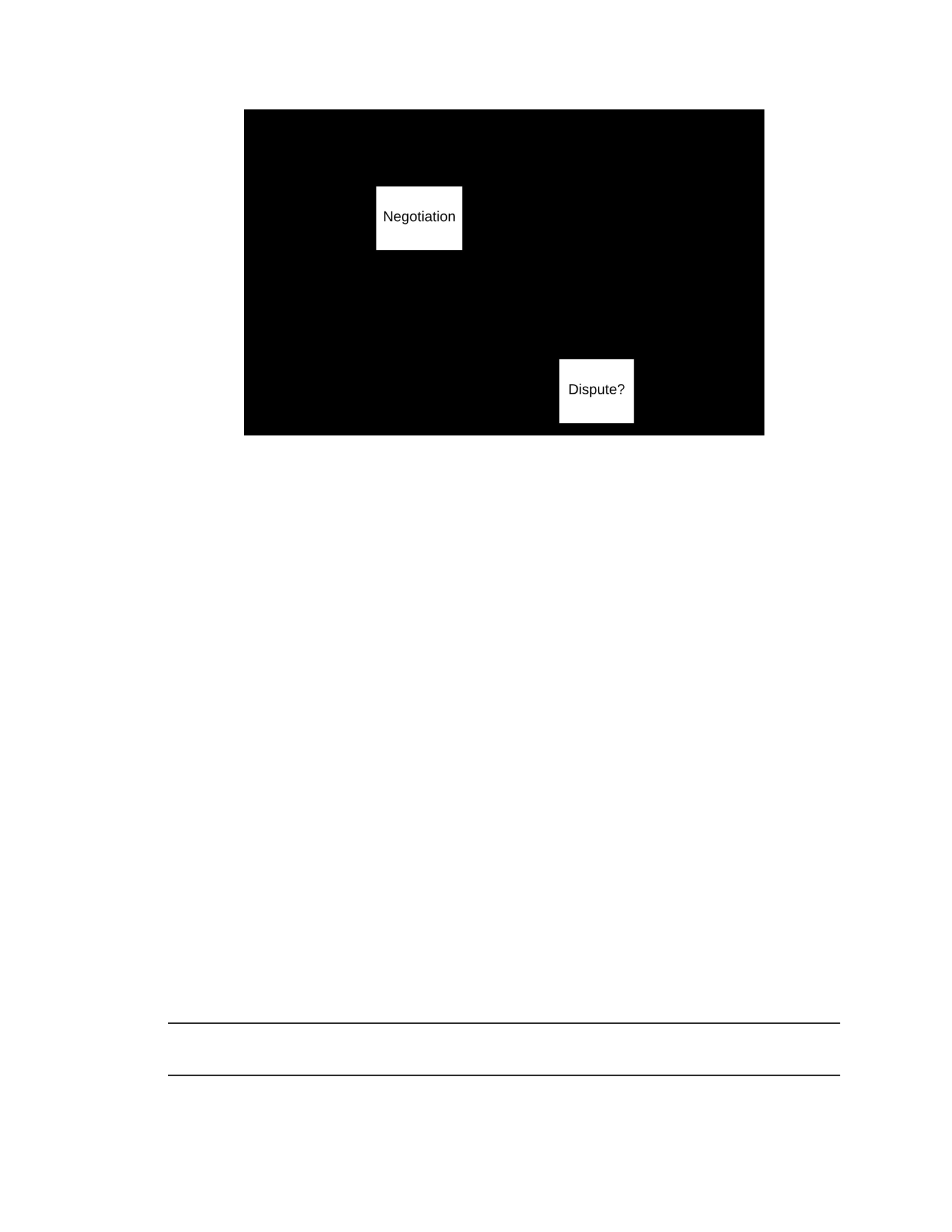
[57]
Figure 3.2: State transition in VOCMC. Negotiation reports indicate that the
information might be unreliable, but the details could help the public make decision
by their own judgement.
reaching an agreement, the negotiation will stay open with a new deadline for
further communication, and thus a VOCMC can not close with any negotiation still
ongoing. If the parties could not reach an agreement after N rounds (the maximum
of rounds allowed) of negotiation, a transaction with information of the negotiation
proceedings, TemTran(t + N∆, NEGN∆), will be automatically created and submitted to
the public ledger. This transaction serves as a report of unsolved negotiation. Fig 3.2
illustrates the state transitions during the execution of the VOCMC. The transaction
of the negotiation report would not serve as the evidence for a reallocation of the
deposit and may be unreliable because it is unwise to accept the explanation from
any one of the parties with disagreement. Nevertheless, the negotiation report is
still a valuable information source in that it provides more details than regular
transactions.
Algorithm 14: VOCMC Protocol (L): Contract registrationΠ

[58]
1 Data: list of TemTran
2 Input: messageF from on-chain functionality Fch, messageE from environment E
3Upon receive messageE(REGISTER,cid,pida,pidb):
4 begin
5send message(REGISTER,cid,pida,pidb,TemTranTpida) to Fch at τ0
6wait up to ∆:
7
8 if receive messageF(REGISTERING,cid,TemTranTpid.br) then
9wait up to ∆:
10 if receive messageF(REGISTERED,cid,TemTranTpid.br) then
11 markTemTranTpid as REGISTERED
12 else
13 send message(FINALIZE,cid,pida,TemTran
14 end 15 16 17 end
18 Upon receive messageE(REGISTERCONF,cid,pida,pidb):
19 begin
3.3.4 Contract Instance Registration
The local protocol instance (see Algorithm 14) maintains a list of temporary
transactions in its local storage. Recall that temporary transaction
TemTran(t,Φt,br,Sa,Sb) is a contract instance containing the output Φt that could be
uploaded to the public ledger (thereafter, a temporary transaction will be denoted as
TemTranT ). The procedure to submit a TemTranT to be mined and appear on the
ledger and thus available to the public is called “contract instance
20 if receive message F(REGISTERING ,cid, TemTran T
pid a)then
21 send message( REGISTER ,cid,pid a,pid b,TemTran T
pid bto) Fch
22 wait upto∆:
23 if receive message F(REGISTERED ,cid, TemTran T
pid .br )then
24 markTemTran T
pid as REGISTERED
end25
end26
end27
begin
end
end

[59]
Algorithm 15: On-chain Functionality Fch: Contract registration
1 Data: registering list
2 Input: message from the parties
3Upon receive message(REGISTER,cid,pida,pidb,TemTranTpida):
4 begin
5 if valid(signaturepida) && valid(signaturepidb) then
6 if TemTranTpidb ∈registering list then
7 if TemTranTpidb.round < TemTranTpida.round then
8replace (TemTranTpidb, τ0) with (TemTranTpida, ˆτ0)
9wait up to ∆
10 end 11
12 add (TemTranTpida, τ0) into registering list
13 send messageF(REGISTERING,cid,TemTranTpida) to ppida and ppidb
14 wait up to ∆
15
16 removeTemTranTpid from registering list
17 registerTemTranTpid
18 send messageF(REGISTERED,cid,TemTranTpid.br) to ppida and ppidb
19 20 end
21 Upon receive message(FINALIZE,cid,pida,TemTranTpida):
22 begin
registration” [42]. Registration could be invoked anytime the newest TemTranT is
unregistered. An enforced registration point is the channel closure, where the latest
TemTranT must be registered.
The environment E instructs the party ppida to initiate the registration process
and the party ppidb to respond, respectively. Upon the initiating instruction, party ppida
23 if (TemTran T
pid a∈registeringlist) &&( τ−τ0≥2∆) then
24 removeTemTran T
pid fromregisteringlist
25 registerTemTran T
pid
26 send message F(REGISTERED ,cid, TemTran T
pid .br ) to ppid aand ppid b
27 end
28 end
else
end
end

[60]
sends to the on-chain functionality Fch the REGISTER message, which contains the
latest TemTranT , i.e., if there are multiple un-registered temporary transactions, take
the latest and ignore the rest.
The on-chain registration functionality (Algorithm 15) verifies the validity of
the signatures. If valid, the temporary transaction TemTranT will be added to the list
of transactions under the registration process (whose members are currently
unregistered), and a REGISTERING will be sent to both parties. Party ppida resets the
timer upon receiving the REGISTERING message, while party ppidb immediately sends
its own copy of the latest temporary transaction TemTranTpidb as a reaction. If both the
copies from party ppida and party ppidb contain the same round number br, the
functionality Fch then removes the temporary transaction from the registering list
and proceeds it into the mining process. Then, it sends the REGISTERED message to
both parties. A different round number indicates a dispute situation, which has to be
settled by determining the largest round number br. The temporary transaction
with the largest br is submitted for mining. In case party ppidb did not respond to the
registering request, party ppida could force the registration of her own version of the
temporary transaction, if a timeout is triggered after receiving the REGISTERING
message from the on-chain functionality Fch, by sending a FINALIZE message.
3.3.5 Channel Closure
In order to close a VOCMC channel, the latest temporary transactions must be
registered. Therefore upon receiving the messageE(CLOSE) from environment E, the
protocol instance (see Algorithm 16) of party ppida will firstly check if the TemTranTE is
marked as registered. If true, then send message(CLOSE,cid) to on-chain
functionality Fch to initiate the closure process.

[61]
The functionality Fch sends messageF(CLOSING, cid) to party ppidb and waits up
to ∆ for response. Upon receiving the CLOSING message, if her own version of the
latest temporary transaction is NOT registered, party ppidb should reply with a
NOTCLOSE message to stop the closure process for the chance to register the
Algorithm 16: VOCMC Protocol (L): Close channelΠ
1 Data: list of TemTran
2 Input: messageE from environment E
3Upon receive messageE(CLOSE,cid,pida,pidb):
4 begin
5 if TemTranTE marked REGISTERED then
6send message(CLOSE, cid) to F
7wait up to 3∆:
8 if receive messageF(CLOSED,cid) then
9send message(CLOSED,cid,pida,pidb) to E
10 end 11 12 13 end
14 Upon receive messageE(CLOSECONF,cid,pida,pidb):
15 begin
temporary transaction. Otherwise, party ppidb just sets a timer to wait for additional
messages.
If a timeout is triggered after sending the CLOSING message, the functionality
Fch will execute the incentive function to reallocate the frozen balance according to
16 if receive message F(CLOSING ,cid ) then
17 if TemTran TEmarked REGISTERED then
18 wait upto∆:
19 if receive message F(CLOSED ,cid ) then
20 send message( CLOSED ,cid,pid a,pid bto) E
21 end
22 else
23 send message( NOTCLOSE ,cid ) to F
24 stop
25 end
26 end
27 end
end
stop

[62]
the evidence vector (ev1,...,evn), remove vocmccid from the active channel list, and send
messageF(CLOSED,cid) to both parties. When received the CLOSED message, the
protocol instances of the parties then signal the environment E the success of
channel closure for further instructions.
Note, we do not inline the registration process into the channel closure
Algorithm 17: On-chain Functionality Fch: Close channel
1 Data: active list, a vector of evidence(ev1,...,evn) 2
Input: message from the parties
protocol for a concise description. It is the users’ responsibility for settling any
unregistered temporary transactions and open negotiations. The functionality only
prevents premature channel closure.
3.4 Security Analysis of the VOCMC
3.4.1 Sketch of Universally Composable Security
It is necessary to understand the universally composable security [43] framework in
order to thoroughly examine the security properties of the VOCMC protocol. This
3Upon receive message( CLOSE ,cid ):
begin4
5send message F(CLOSING ,cid)
6wait upto∆:
7 if receive message( NOTCLOSE ,cid ) then
8stop
9 else
10 executeInc (ev1,...,ev n)
11 remove vocmc cid fromactivelist
12 send message F(CLOSED ,cid)
end13
end14

[63]
paradigm significantly simplified the discussion of protocol security in case complex
patterns of subroutine and communication are adopted for rich enough
representation of more realistic adversarial behaviors. In such cases, a proof based
on the single execution of a protocol instance cannot ensure its security under
parallel and concurrent composition, e.g., Oblivious Transfer [47, 48, 49] whose
initial definition could not guarantee security when multiple instances executed
concurrently.
Instead of extending the security requirements of the composed protocol (as
in [50, 51, 52, 53]) which results in ever-growing complexity of definitions, the
universally composable security framework adopts protocols that are secure in
isolation with the additional requirement of universally composability: if a protocol
is secure under isolated execution and universally composable, its combination with
other universally composable protocols is secure as well.
Therefore, we could securely compose complex protocols by combining
secure subroutine protocols through a general composition process. In this section,
we only consider the subroutine composition, which is the primary composing type
adopted in the VOCMC protocol. The crux of this approach is to define the
subroutine protocol in a way that is secure in an interactive environment, i.e., the
subroutine protocol should UC-emulate [43] a trusted ideal functionality that
preserves all the security requirements for the subroutine. Let φdenote the
subroutine, and πdenote the ideal functionality, respectively. The protocol φUC-
emulates π, if an interactive environment E could not distinguish if it interacts with
the protocol φwith the presence of an adversary A in the real world, or interacts
with the ideal functionality πwith the presence of an adversary S.
Given a protocol φthat UC-emulates π, any party including the adversary
could not gain more information from an instance of φthan an instance of the ideal
functionality π, since adversary A here takes the place of the interactive

[64]
environment E. To define universally composable protocols, besides carefully
protecting the secrets by the ideal functionality, the communication sequence and
timing should be preserved in both the real and ideal world, which is the main effort
when sketching the constructive security proof. Typically, the ideal world adversary
S should be constructed capable of relaying the communication flow between the
corrupted parties and the environment and determine the delay of the
communication channel.
3.4.2 Security of VOCMC
The security proof of VOCMC is relatively straight forward since the subroutines
related to security requirements mostly rely on on-chain functionalities, thus avoid
the difficulty of handling secure computations coordinated with the corrupted
parties. The ideal functionality could be directly replaced by on-chain functionality
without an impact on the security of protocols since the on-chain computation is
supposed to be executed in a secure environment. The assumption of a secure
execution environment of blockchain is based on its fundamental assumption of
decentralized computation resources. It is equivalent to run the secure core of the
protocol by a trusted third party (note, there is no trusted mining node in the
blockchain network, but the network as an entity is trusted). As a consequence, the
security proof is reduced to relaying the communication between the environment
and the parties, which is straight forward. The detailed construction of the message
relay could be found in [42]. This section will discuss some remarkable features of
the functionalities.
Fairness of update. Since there is no secret involved in the message
exchange process except the encryption key, we do not consider the fairness of
information closure in this case. Remember that the initiating party of the update
process will send its own signature along with the initiating message to its

[65]
counterpart, who could intentionally not respond with the other signature required
for creating the temporary transaction. As a result, the initiating party could not
create the latest temporary transaction, while its counterpart could. In the current
setting, this flaw of fairness does no harm the protocol, because only when a party
intends to publish the output, she would initiate the update process. This flaw would
not lead to blockage of information publication. The fairness of updates could be
achieved by introducing an on-chain functionality for fair signature disclosure.
Registration security. Different from off-chain payment channel,
registration of temporary transaction would not always lead to deposit reallocation,
and thus is balance secure. The dispute-like procedure adopted in the protocol is for
confirmation of the agreement on the published information and provides an
opportunity to identify data inconsistency. Note that the submitted transaction
should contain signatures of both parties and has a greater round number, and the
channel would not be closed after a registration; therefore, the registration of an
older temporary transaction would not prevent the latest from registration.
Channel closure and balance security. The fairness of channel closure is
critical in the VOCMC protocol because, upon the closure of a channel, any
unpublished information would be lost, and the frozen balance would be distributed
by the incentive function. If there is any unregistered temporary transaction or
unsolved negotiation, it is possible that the incentive function is executed based on
incomplete or outdated evidence vector and thus incorrect balance distribution. In
the current setting, the channel closure could be stopped directly by the
environment intervention or known unregistered temporary transactions. This
provides an opportunity for malicious prevention of channel closure, e.g., prevent
any channel closure if a party is not satisfied with the current potential outcome of
the incentive function. In order to solve this problem, the channel closure process
could depend on the completeness of registration and negotiation. But, a malicious

[66]
party could initiate an infinite negotiation process to achieve the same effect. To
avoid this problem, we could introduce an on-chain functionality to freeze the
creation of negotiation. Only the negotiation open at the initiating time of the
channel closure would be taken into account.
3.5 Other Related Work
The literature on off-chain protocols is rich. A remarkable large portion of the work
focuses on scaling the blockchain in order to enhance its throughput of payment
transactions. Payment channel networks (PCNs) [37, 54] enable the users to route
payment through a network of existing payment channels, thus avoid unnecessary
channel creation among every pair of channel users. PCNs require routing protocols
[55, 56, 57, 58] to optimize the path searching and secure the chained payment.
Commit chain [59, 60] solved this problem without a network of payment channels
but established a pool that money is freely transferred among the participants. [61,
62, 63, 64] further improved the privacy of the off-chain payment channel, which is
important because the off-chain channel naturally leads to information
concentration related to a small group of users. Arbitrum [65] and TrueBit [66]
scaled smart contract execution by only verifying the signature of endorsers through
on-chain execution, and smart contract execution and verification are purely off-
chain, which is similar to the methodology of our work. Augur [67] also relies on
human knowledge, but allows the users to open a public decision-making process
where any number of participants could join in and provide inputs to help the
process initiator decide the output and collect their payouts.
Another related research area is the oracle system, which aims to provide
data to a blockchain in a more reliable way. However, proposed systems largely differ
in assumptions and applicability. TLS-N [68] focused on data authenticity and
integrity by a modification to the transportation layer security protocol. Similarly,

[67]
TownCrier [69] guarantee authenticated data feeding to the blockchain by
employing trusted execution environments [70, 71]. Astaea [72] and Shintaku [73]
leverage on participants’ domain knowledge and a voting scheme to ensure reliable
data feeding to smart contracts.
From the perspective of game theory, literature analyzed the incentive
mechanism using Nash equilibrium and proposed alternatives depending on
different game constructions. [74, 75] examined incentive compatibility in the
presence of selfish mining behavior of mining pools. [76] improved the proof-of-
stake consensus protocol by incentivizing miners to propagate blocks as soon as
possible using the Stackelberg equilibrium [77]. The Stackelberg game was as well
used in [78] to design a privacy-aware data sharing protocol via blockchain against
the security attacks from the external world.

[68]
Chapter 4
System Design and Implementation
4.1 Introduction
Determining whether an organization complies with the policies is a challenging
task, given the complexity of the current application environment. A data
provenance view is required for dealing with the cross-boundary problem, which is
introduced by the ever frequent storage and process outsourcing. Fig. 4.1 illustrates
a relatively “simple” scenario where a single medical application is described. The
imaginary application employs a social robot that could recognize oral instructions
from human speech and take actions to complete tasks such as searching for music
or traffic conditions. The robot is connected to a PC client and a mobile client for
local configuration, control, and application interface. The robot provider maintains
a data warehouse for storage of the user data, and outsource the speech recognition
to a SaaS provider who is specialized in natural language processing. The training
data for speech recognition model is acquired from the data warehouse. When the
recognition model is ready, the robot could directly send realtime speech record to
the SaaS for analysis.
In order to leverage the VOCMC, one of the critical facts is the agreement.
Hence, our proposed scheme requires the user, and the service provider could make
an independent judgment on policy compliance. We assume policy compliance
inference engines are deployed at both the user side and the provider side. The
scheme should ensure that the required evidence id sent to both the inference
engines. To achieve this goal, we recommend a sticky-policy-based framework to
track the data footprint and enforce the policy application.
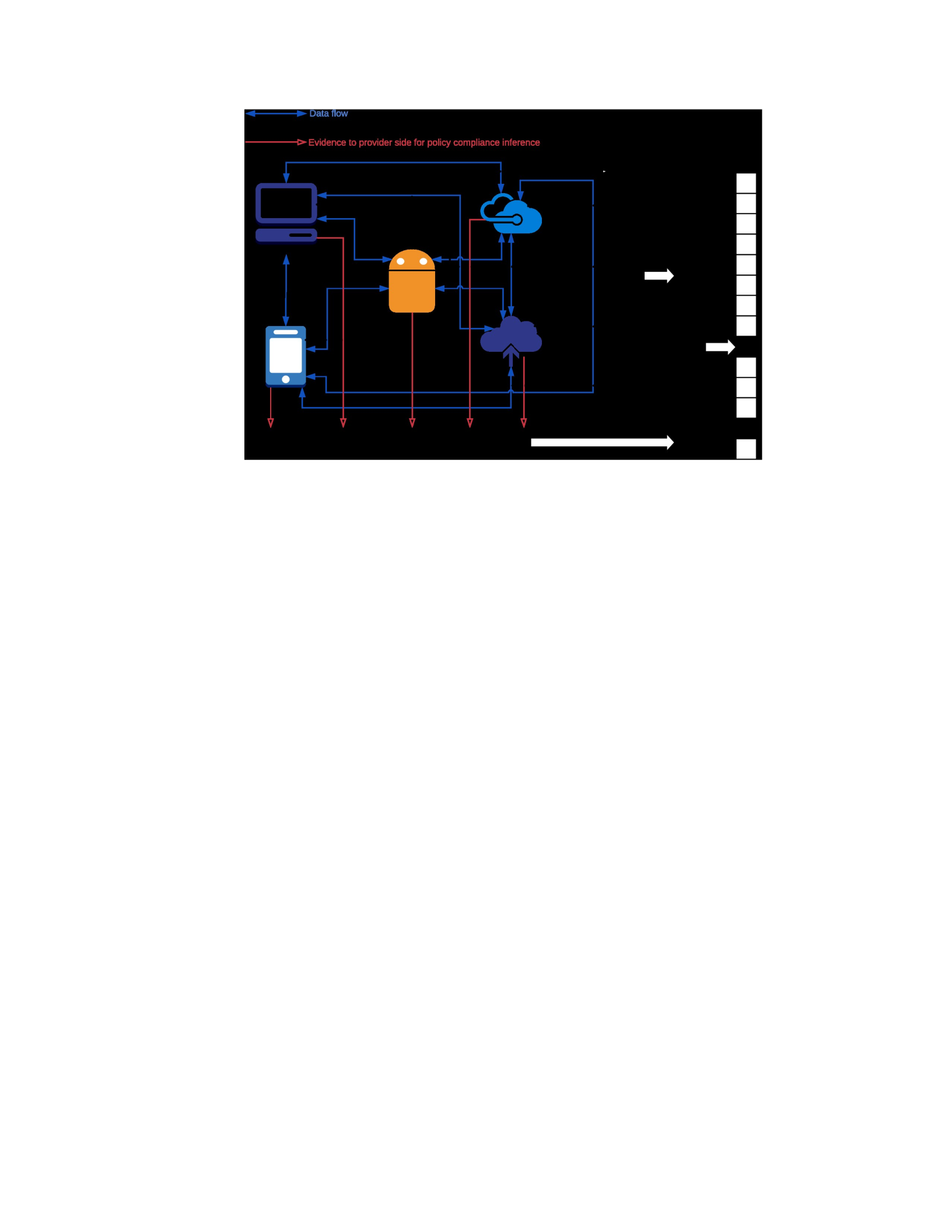
[69]
Figure 4.1: High level description of the proposed scheme with example
4.2 Background: Sticky Policy
Policies can stick to data to define allowed usage and obligations as it travels across
multiple parties, platforms, or administrative domains, enabling users to improve
control over their personal information [79]. The sticky policy is a potential
approach for accountable and enforceable policies [80, 2], which is firstly introduced
by Casassa-Mont et al. [80]. Here, the data owner specifies management constraints
that would be attached to the data by establishing contractual relationships between
data owners and service providers. In order to enforce the owner-specified policies,
a trusted authority (TA) is employed to keep the decryption keys of the encrypted
data. To obtain the decryption key, a party must agree to enforce the policies
associated with the data. Typically, the policies are enforced at the application level
and are tend to be enforced at particular points, e.g., at administrative boundaries.
Since the data is released as the decryption key is released, the data owner loses the

[70]
control and track over her data after the release point. This mechanism is extended
by the following work [81, 82, 83].
A similar idea has been used for tracking data flow within cloud
infrastructures [84, 85, 86]. These works adopted the perspective of Information
Flow Control (IFC), a concept that emphasizes more on policy enforcement on lower
level data transfer, e.g., data sharing among applications within a cloud
infrastructure. Particularly, the proposed IFC is a Linux kernel implementation,
which indicates a data-centric paradigm for data management. Traditionally, user
data is controlled by the processing application and invisible to the operating
system, thus in an OS, when data is shared by multiple applications, each application
has to implement its own data control mechanism, which leads to difficulties in
consistent policy enforcement even though they are in the same system. The IFC,
however, applies data control policies at the OS level, which enables system-wide
consistent policy enforcement beyond isolation and application borders (within an
IFC-enforcing world). This methodology indeed separates the responsibility of data
control from applications. How an application accesses and processes the data is
determined and monitored by the OS according to the policies associated with the
data.
Another related technique is Taint Tracking (TT) [87]. An example of TT used
for privacy preservation is to taint sensitive information, e.g., a list of contacts in
mobile phones, and track it through this closed system [88]. Data leaving the system
(i.e., the phone) is analyzed to ensure it does not contain sensitive information. The
tainting mechanism is to propagate tags through any entities that may contain
sensitive information. Since TT is an OS-level mechanism, it could not know exactly
how the data would be used by a program or process. If the sensitive data is
accessed by an instance of an application, the aroused processes will acquire the

[71]
data’s tag(s), which taint the processes as sensitive. The resulting output or outgoing
connections may be tainted as well. By monitoring the tainted objects, the
occurrence of the issues (e.g., a data leakage, an attack) could be detected.
From the perspective of execution model, the sticky policy actually allows a
data-centered approach that encloses allowed methods with the data object. This
scheme could be further extended to define any allowed operation in the policy
descriptor. Sundareswaran et al. proposed a logging system for data sharing in this
paradigm [89]. In their work, the users’ data is encapsulated with executable code in
JAR files. There is a tradeoff between storage overhead and universal applicability of
the sticky policy. For instance, a system for information flow control uses a tagging
mechanism to identify the policies applied to specific user data within a PaaS cloud
[90, 91] . Since the policy recognition and enforcement system is embedded in the
cloud infrastructure, the tag associated with the user data is quite lightweight, but
this policy enforcement could not be applied when data has to travel across the
boundary of cloud infrastructures (e.g., from EC2 to Azure). If the enforcement code
is attached to the data as [89] or [92], the policy application could be ensured as the
data travel through different cloud infrastructures at the cost of overhead probably
higher than the data in concern. Ideally, the most effective way to implement the
sticky policy mechanism is by a protocol standard in which a header is defined as the
policy descriptor, and the processing methods are defined for the policy agent. We
take this paradigm in this work by assuming there is a standard policy descriptor
attached to the user data, and the corresponding policy agent is deployed through
the entities involved in the service provision.
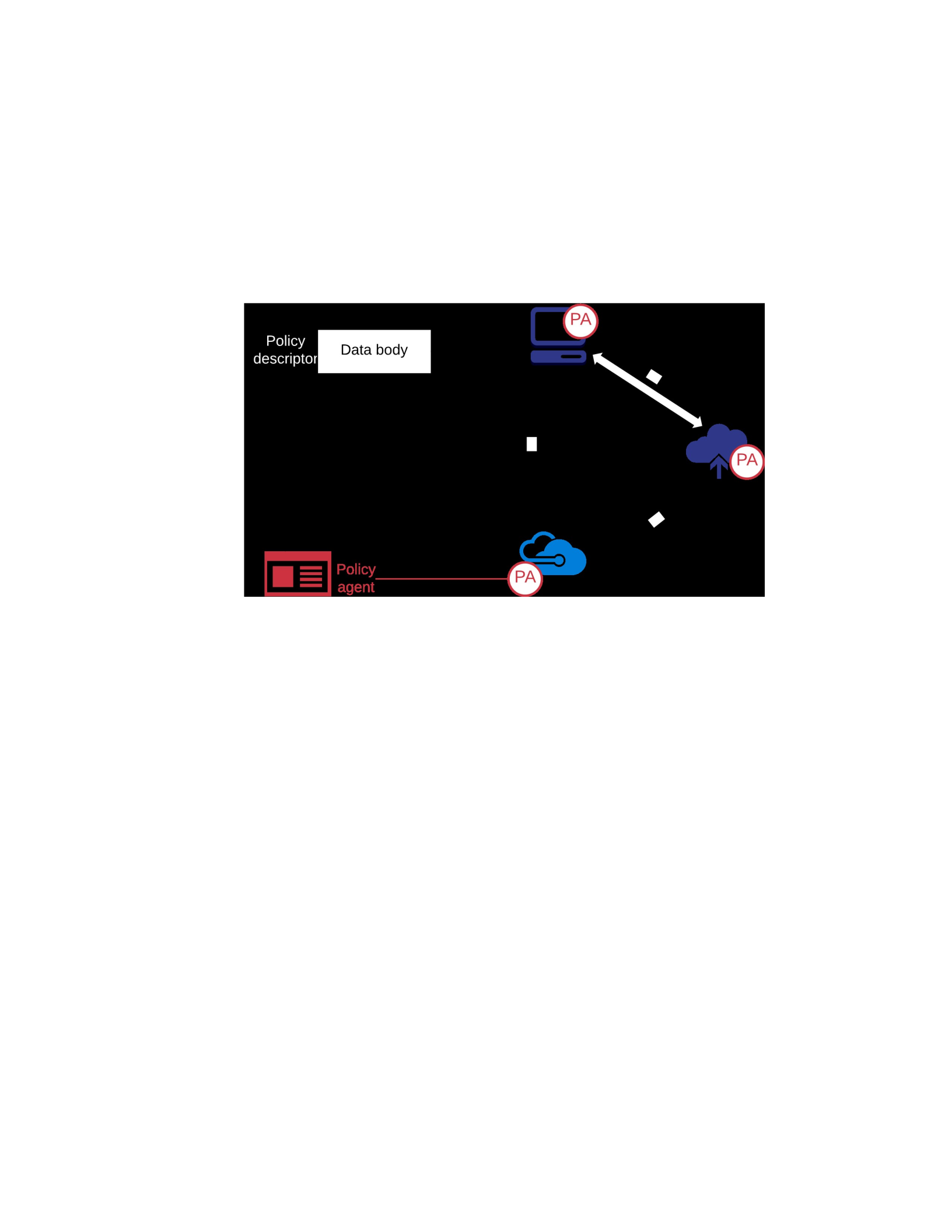
[72]
4.3 System Design Overview
4.3.1 Sticky Policy Based Evidence Collection
Our sticky policy mechanism can be illustrated by Fig. 4.2, where part of the data
flows in Fig. 4.1 is sketched. The user data is accompanied by a policy descriptor
Figure 4.2: The sticky policy mechanism that enables policy application and
evidence collection in Fig. 4.1
during its entire life cycle, including transmission, storage, duplication, processing,
and deletion. The policy descriptor defines the applied policies, or allowed
treatments. A policy agent parses the policy descriptor to determine the policies and
configure the execution environment. We do not require that the policy descriptor
should carry the execution module but assume that the mechanism for policy
application is deployed within the policy agent at any cloud infrastructure involved
in the service provision. In addition, the policy agent is required to have a
communication mechanism that sends logging updates to the data owner and the
service providers when the data is touched by any program. This log serves as the
evidence feeding into the inference engines in Fig. 4.1.

[73]
Because of its inherent flexibility, the sticky policy enabled scheme is
potential to be adjusted to the ever-growing set of policies. Here, we focus our
scheme on following particular problems.
•Consistent cross-boundary policy application. Since any copy of the user
data is accompanied by a policy descriptor, it is straight forward to maintain a
consistent set of applied policies when the data is moved to another sticky
policy enabled domain.
•Global view of data distribution. A central problem for auditable policy
compliance is to track all the duplication of the user data through the cloud in
that the data is probably copied by various purposes (e.g., backup, buffering,
process outsourcing, etc.) and some are generated in unexpected ways.
Therefore, the violations might happen by not only malicious behaviors but
also by misconfiguration or failure of exception processing. The sticky policy
enabled logging mechanism could help to discover all the intentional and
unintentional duplications.
•Fair availability of information for policy compliance inference. VOCMC
works when all the participants can make informed decisions to reach an
agreement. Thus, the fairness of information acquisition is a critical feature.
Since the protocol allows lag for the participants to make delayed decisions,
the fairness here is in the sense of a unique view of available information. The
sticky policy mechanism should guarantee an independent “push” notification
for all the participants.
Fig. 4.1 outlines the high-level design of our proposed public ledger of policy
compliance. The logging mechanism independently provides evidence to policy

[74]
compliance inference engines on both the user side and the provider side. According
to the outputs of the inference engines, the user and the provider reach an
agreement on compliance or violation. Finally, the agreement will appear on the
blockchain (may not in the form of the original record).
4.3.2 Public Blockchain Versus Private Blockchain
The public ledger is recommended to adopt the public blockchain system. The
reason is that the major benefit of blockchain is its immutability and no trusted
authority involved. This property depends on the assumption of the independence
of the miners and the fact that no (group of) miner controls a dominant computing
power. This assumption probably holds for public blockchain, but not for private
(or permitted) blockchain.
The difficulty in adopting private blockchain as the ledger is that it essentially
introduces a trusted authority. The private chain is owned by, an organization and
the miners have to get permission from the owner. Ricardo N. et al. [93] pointed out
that the only feasible solution for the blockchain-based database with public
auditability is to utilize private BC for the recording, and public blockchain for the
checkpoint. We hold a similar point of view, but realize that the private BC is a
replaceable component, as long as the checkpoint in the public blockchain is
reliable. In a setting where a blockchain is controlled by a trusted authority, the
performance of the blockchain has to be compared with other distributed database
systems.
Note that there are scenarios in which permissioned blockchain is applicable
and probably a better solution than its permissionless counterpart. For instance, a
blockchain-based multi-bank settlement system may adopt permissioned
blockchain because if the participating banks play the role of miners, it is natural

[75]
that the miners are independent. In such a system, the population of the miners is
under control and will not decrease and increase frequently. Because of the non-
anonymity, the behavior of the miners is identifiable and detectable.
An observation here is that the assumed attackers in the blockchain-based
system are some malicious block miners. Therefore, if the ledger users are mainly
the miners as well, it is unnecessary to adopt the permissionless blockchain in
practice because they have a direct incentive to guarantee the reliability of the data
and detect any misbehaviors of other miners. For the scenario of this dissertation,
we assume the public is the main data user of the ledger; thus, the interest of the
miners may be inconsistent with the ledger user. Therefore, we choose the public
blockchain for the ledger.
4.4 Demonstration Cases
This section provides four implementations of policy cases to demonstrate the sticky
policy mechanism as follows,
1. data duplication discovery,
2. guaranteed data deletion, 3. data sharing black and white
list, and
4. consent grant and withdraw.
The first two are related to the problem of creating a global view of cross-
boundary data distribution, and the rest are related to the problem of updating
policy across the global data distribution. The sticky policy mechanism is flexible,
because it resembles a container of modules, thus open to extensions. We do not
include access control into the demonstration set in that we attempt to show the

[76]
power of this mechanism for cross-boundary policy compliance. Cross-boundary
access control relies on the services in our showcase and could be implemented by
extension.
4.4.1 Shared Communication Protocol and Execution Model
In order to achieve cross-boundary policy compliance, the sticky policy framework
attaches policy descriptors to each applicable file, which makes it difficult to update
the policy descriptors for all the copies of the applicable files at the same time.
Imagine data copies in a single cloud infrastructure. Data might be duplicated due
Figure 4.3: If the policy descriptor is updated whenever a policy update request
arrives, some of the duplication can not be discovered by this process. There are
unidentifiable duplications caused by lower level system operations without the
participation of the PA.

[77]
to caching, keeping backups, or load balancing. The system is usually unaware of
such “unintentional” duplications, e.g., hard drives might be copied at the operating
system level, and thus there is no opportunity to execute the policy agent at all.
Unintentional copies are generally unidentifiable at the copy time. Fig. 4.3 illustrates
this problem.
Lowering the implementation level of the policy agent could mitigate but not
eliminate the unidentifiable duplication, because virtual machines are broadly
applied in present cloud infrastructures. It is impossible to apply fine granularity
data management in such application scenarios, e.g., servers in an IaaS cloud.
Suppose we implement the policy agent with a list of controlled files. It is
possible to add corresponding entries for copies generated by reaching the policy
agent, which is the PA identifiable duplication in Fig. 4.3. With the presence of the
controlled file list, policy updates could be sent directly to every file in the list. On
the other hand, we could not add the PA unidentifiable duplication into the list of
controlled files, and thus they are not reachable when users update policies.
Another consideration is the performance implication of the policy updating
process. If the policy agent updates the policy descriptors of the controlled files once
it receive a request for policy updating from the users, it will generate frequent
random read/write requests for the file system, which will significantly degrade the
performance of the entire system. One reason is that the files may not be actually
accessed by the processes, and the policy updates will cause additional accesses.
Another reason is that the user data and their duplications may not be stored
consecutively in the storage medium.
Alternatively, we consider fetching policy updates at the access time. First,
any user request for policy updates will be applied to a policy database. Second,
whenever the user data is accessed at the policy agent level, the policy agent will
pull the newest policy set from the policy database, and update the policy descriptor
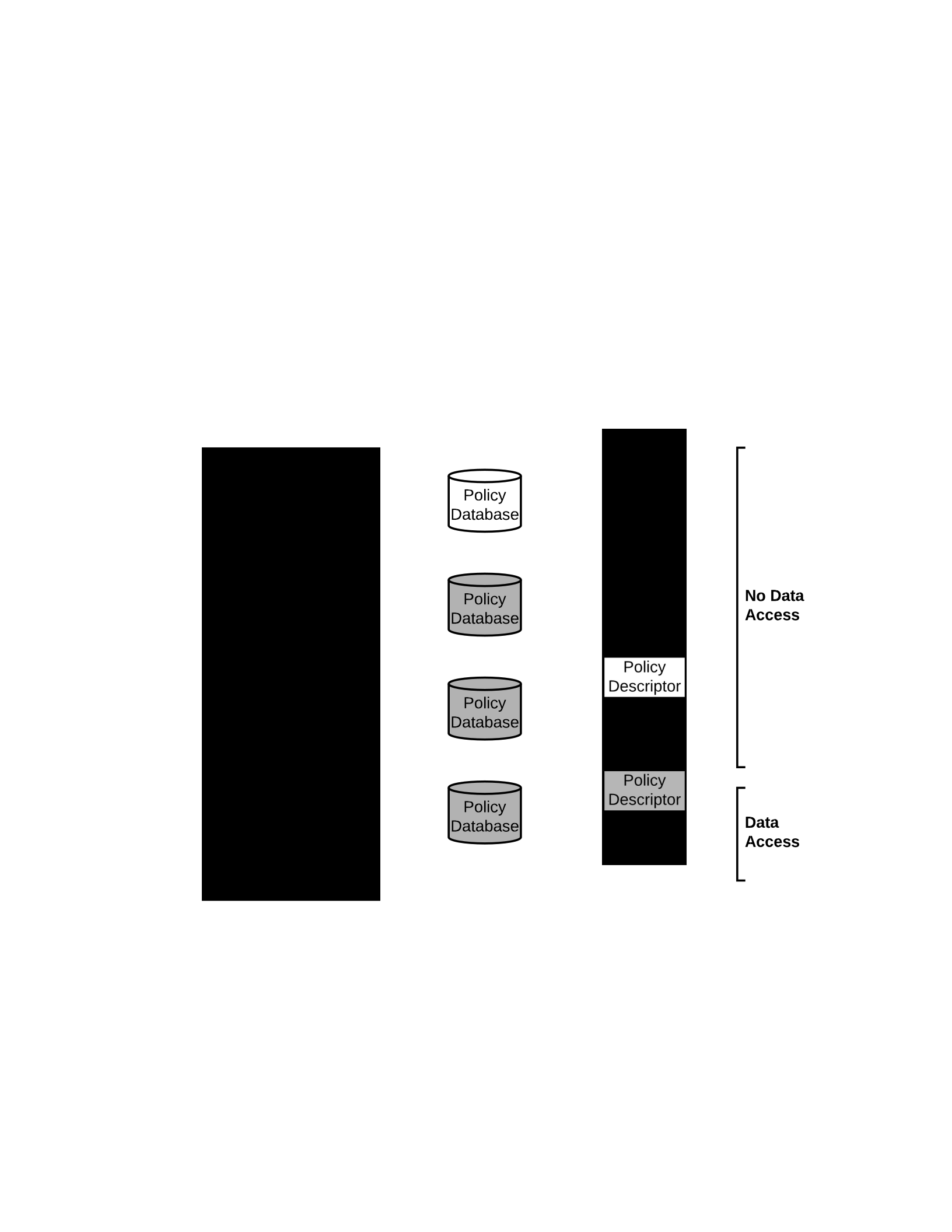
[78]
of the accessed files, as illustrated in Fig. 4.4. Note that the policy database in Fig. 4.4
is logically resident in the user domain in order to offer a cross-boundary policy
application. The cloud provider could cache part of this policy database into the
local domain of the cloud infrastructure to boost performance.
Another critical problem caused by unintentional copies is duplication
discovery. As mentioned previously, the unintentional copies are unidentifiable by
the policy agent at the copy time and thus not included in the global view of data
distribution. This problem is directly related to the guaranteed deletion service,
because the system could not delete a file without the awareness of its existence.
Policy
Descriptor Policy
Database User Data
Policy
Descriptor Policy
Database User Data
Policy
Descriptor Policy
Database User Data
Policy
Descriptor Policy
Database User Data
Figure 4.4: The policy update strategy: the policy database will be updated when
policy update requests arrive, but if there is no data access request, the policy
descriptor attached to that data file will not be updated. The policy descriptor will
only be updated at access time.
Similar to the solution of the policy update problem, we expect to discover
duplication only at the access time. The underlying logic is that if a file is never
accessed, it is equivalent to a non-existent file. Hence, we need the policy agent to
No Data
Access
Data
Access

[79]
send a message to the user domain with information that is able to distinguish every
duplication. We will provide a detailed discussion in a later section. The point here is
that we could combine the message for duplication discovery and policy updates in
a single round communication, and we aim to limit the message communication to a
single round protocol in order to minimize its performance impact. Algorithms 18
and 19 describe the entities’ behavior in this communication and execution model.
We introduced an entity data owner agent or user agent UA, which is a
Algorithm 18: Pseudo code of a policy agent PA
1 receive request(idowner,idPA,pid,fid,ACCESS)
2send request(idowner,pid,fid,STATUS) to user agent UAowner
3wait response(idowner,pid,fid,UPDATE) from user agent UAowner
4upon receive response(idowner,pid,fid,UPDATE)
5update the policy descriptor of (idowner,fid) with UPDATE
6send response (idowner,pid,fid,ALLOWED OPERATION)
7to the process ppid
Algorithm 19: Pseudo code of a data owner agent UA
1 receive request(idowner,idPA,pid,fid,STATUS)
2update(fid,STATUS) to file list
3read(fid,UPDATE) from policy database
4send response(idowner,pid,fid,UPDATE) to policy agent UAidPA
container of the policy database and the global view of data distribution. Especially,
the STATUS contains the necessary information to recognize if a previously unknown
data copy is the target file.

[80]
A data file is the minimum object that a policy set is applied. All the copies of
the data file share the same policy set. We use fid to identify a group of files, which
are copies of the same file, and share the same applicable policies. Additional
information provided by STATUS distinguishes the copies in a filegroup.
The pid indicates the entity that requests the data access. Be aware that pid
here is a generic identifier that is better to be considered as an information
container with a globally unique identifier. It may contain information that
determines the policies to apply. In practice, this field may include domain identifier,
user identifier, application identifier, system information, etc. The pid is used here
for concision and capture the essence.
4.4.2 Case 1: Data Duplication Discovery
It is critical to discover any unintentional copy in order to create a global view of
data distribution. As described in Section 4.4.1, the system discovers duplication at
the accessing time via the information carried by the STATUS field in the request. In
the meantime, intentional and unintentional duplication should be treated in a
uniform way. It is clear that if the policy agent does not report copy operation to the
user agent at the copy time, there will be no difference between intentional copy and
unintentional copy. Therefore, it is unnecessary to differentiate these two types of
duplication and specify corresponding system behaviors.
The data duplication discovery subsystem takes into account the following
design points:
•A copy carries exactly the same information as its source. At the copy time,
both the data file and its policy descriptor will be duplicated. As a
consequence, from the view of the user agent, any duplication is

[81]
indistinguishable from its source, and the system could not rely on the
information of the file’s initial policy descriptor, such as the fid field.
•This process should be a single-round protocol. This requirement is to
minimize the communication overhead introduced by the mechanism. Also,
the system should minimize the size of the communicated message.
•Messages could carry invalid information. The system should filter out
invalid duplication information. For instance, an attacker could inject fortified
copy information into the data distribution view without actually possessing
the data file. When the user requests data deletion according to the
distribution view, it will trigger a policy violation.
Algorithm 20: Pseudo code of user agent UA for duplication discovery
1 init: L ← ∅2 function: fileupload(file)
3HASHfid ← hash(file)
4Gfid.add(HASHfid)
5L.add(fid,Gfid)
6send (idowner,file,fid,HASHfid) to policy agent PAidPA
7 receive request(idowner,idPA,pid,fid,STATUS)
8 if L.search(fid).G.search(STATUS.prehash) then 9 if
verify(file,STATUS.timestamp,
STATUS.rnd,STATUS.curhash) then
10 L[fid].G[STATUS.prehash].HASH ← STATUS.curhash
11 else return INVALID
12 else L[fid].G.add(STATUS.curhash)
13 send response(idowner,pid,fid,ACC) to policy agent PAidPA
The resulted process is described in Algorithms 20 and 21, when the user
agent initializes a list of controlled files. When uploading files to cloud providers by

[82]
invoking fileupload(), the function will generate an initial hash and create a file group
for the uploaded file. The hash is used as the identifier for the initial copy in the
filegroup.
Since the policy descriptor will be copied at the copy time, the system has to
create a copy identifier at the access time (see Algorithm 21). More specifically, the
policy agent will hash the data file with the current timestamp and an additional
random number. The random number is introduced corresponding to the situation
in which multiple copies get accessed at the same time. The timestamp, random
number, newly generated hash value, and previous hash value will be included in the
STATUS field of the request sent to the user agent.
Upon receiving a request, the user agent will search the controlled file list L
by fid. If an entry is found, then search the corresponding copy group Gfid using
STATUS.prehash (at this point, the user agent does not know the newly generated
hash). If the corresponding entry is found for STATUS.prehash, update that entry
with STATUS.curhash, which is the treatment for a previously known copy. Before
Algorithm 21: Pseudo code of policy agent PA for duplication discovery
1 receive request(idowner,idPA,pid,fid,HASHfid,ACCESS)
2STATUS.prehash ← HASHfid
3STATUS.rnd ← random()
4STATUS.timestamp ← now()
5STATUS.curhash ← hash(file,STATUS.rnd,STATUS.timestamp)
6send request(idowner,pid,fid,STATUS) to user agent UAowner
7wait response(idowner,pid,fid,ACC,UPDATE) from user agent UAowner
8upon receive response(idowner,pid,fid,ACC,UPDATE)
9update the policy descriptor of (idowner,fid) with UPDATE
10 HASHfid ← STATUS.curhash 11 send response
(idowner,pid,fid,HASH ,ALLOWED OPERATION)
fid
totheprocess ppid

[83]
the update, the STATUS.curhash should be verified to guarantee its validity.
According to the way of hash generation, this process could filter out the fortified
request without actually holding a copy of the file.
If there is no entry in the copy group Gfid for the STATUS.prehash (this will
happen when a copy is accessed after its source file was accessed, vice versa), it
indicates a previously unknown duplication has been found. Therefore, the system
will add a new entry to the filegroup Gfid with STATUS.curhash. Note that, at the copy
time, the source file and its copy are equivalent, and the system has to update the
file’s hash at every access time to differentiate each copy. Essentially, each
duplication is identified by its access pattern.
The policy agent PA could only update the HASHfid for a particular copy upon
receiving the ACC response in order to avoid inconsistency between policy agent and
user agent. A subtle point is when the ACC response is missing. It may
indicate two situations:
•the request is not received by the user agent, and
•the ACC response is not received by the policy agent.
To settle this problem, we could set a timer on the UA side when sending the
ACC response. If the same request is received before the timer is expired, the UA will
just resend the response. The PA will also set a timer when sending the request. If
the ACC response is not received before the timeout, the PA has to resend the
request. This mechanism is not included in the algorithm description for concision.
4.4.3 Case 2: Guaranteed Data Deletion
Guaranteed data deletion could also refer to secure data deletion [94], data being
forgotten [95], sanitized [96, 97], etc. Most of the works focus on physically erasing

[84]
data from the storage media. In their setting, data can be considered as securely
deleted from a storage system, if an adversary with access to the system is not able
to recover the deleted data [94, 98, 99]. Some researchers further require that data
is assuredly deleted when it becomes inaccessible to anyone permanently after it
has been deleted [100, 101, 102, 103].
Incomplete data deletion is common because typical file deletion only
updates metadata of the “deleted” file (e.g., mark the related storage space as
allocatable), while usually leaving the media unchanged until that space has been
overwritten by new files. For instance, research showed that MSDOS disc formatting
operation only overwrites 0.1% of the data [104]. In the cloud environment, this
issue becomes an even more complex problem due to the unintentional duplication.
Particularly, at the time when the data owner sends a request for data deletion, it is
possible that some unintentional copies are unidentifiable. If the data has been
outsourced to other cloud entities, guaranteed deletion requires WLAN wide search
for the data file, which is impractical.
We did not pursue the enforcement of physical erasion of the data upon
request. Supported by the duplication discovery (see Section 4.4.2), we take a
surveillant approach. Remember that a copy is considered as non-existent, if it has
never been accessed. Therefore, immediate deletion is not required in this system.
Algorithm 22: Pseudo code of user agent UA for guaranteed deletion
1 init: L ← ∅2 function: filedelete(fid)
3L[fid].DEL MARK ← DEL PENDING
4send request(idowner,file,fid,DEL) to policy agent PAidPA
5 receive request(idowner,idPA,pid,fid,STATUS)
6 if L.search(fid).G.search(STATUS.prehash) then 7 if
verify(file,STATUS.timestamp,
STATUS.rnd,STATUS.curhash) then
8L[fid].G[STATUS.prehash].HASH ← STATUS.curhash

[85]
9 if L[fid].DEL MARK == DEL PENDING then
10 if L[fid].G[STATUS.curhash].DEL == false
11 L[fid].G[STATUS.curhash].DEL ← true
12 else return POLICY VIOLATION
13 else return INVALID 14 else
15 L[fid].G.add(STATUS.curhash)
16 L[fid].G[STATUS.curhash].DEL ← true
17 send response(idowner,pid,fid,DEL) to policy agent PAidPA
Instead, our goal is auditable and transparent data deletion, i.e., the system could
monitor the data deletion operation and discover undeleted copies in the future.
Physical deletion is irrelevant in this system, because any data access is reported to
the user agent by the policy agent. If supposedly already “deleted” data gets
accessed, the data owner will catch this event, which will trigger a policy violation.
Algorithms 22 and 23 describe the logic of this component. Similar to
duplication discovery, the deletion takes place at the access time in effect. The
method filedelete(fid) only marks the copy group Gfid as DEL PENDING. When a
request arrives for accessing copies in a DEL PENDING group, the user agent checks
whether this is the first access request towards this copy after the filedelete has been
called. If it is the first time, then set its deletion mark as true; otherwise, issue a
POLICY V IOLATION event.
Since it is possible that unidentifiable copies exist after a file is “deleted”, the
system should be open to newfound copies. Whenever a new copy is recognized, add
Algorithm 23: Pseudo code of user agent UA for guaranteed deletion
1 receive request(idowner,idPA,pid,fid,HASHfid,ACCESS)
2STATUS.prehash ← HASHfid
3STATUS.rnd ← random()
4STATUS.timestamp ← now()
5STATUS.curhash ← hash(file,STATUS.rnd,STATUS.timestamp)

[86]
6send request(idowner,pid,fid,STATUS) to user agent UAowner
7wait response(idowner,pid,fid,ACC,UPDATE) from user agent UAowner
8upon receive response(idowner,pid,fid,DEL)
9update the policy descriptor of (idowner,fid) with DEL
10 HASHfid ← STATUS.curhash
11 send response (idowner,pid,fid,HASHfid,DEL) to the process ppid
it to the group and mark it as deleted. For all these situations, the user agent should
uniformly respond to the access request with DEL to notice the deletion to the policy
agent.
Upon receiving a DEL response, the policy agent has to send the request
process a DEL response. We have not defined the behavior of request processes
upon receiving DEL responses, but since any access has to take place via the policy
agent, access to “deleted” files will be detected and trigger policy violations.
Though this model does not actively delete files upon request and delay the
deletion to the next access request, it will not conflict with the common usability
practice. The user interface could invoke access requests right after the filedelete()
method has been called. This treatment will delete known duplications immediately.
4.4.4 Case 3: Black/White List for Data Sharing
Black/White list is the showcase of the customizable policy set of the system. We
have to first differentiate two types of data sharing because of the discrepancy
between access patterns:
•A local process p draws and sends part of the data to the request process.

[87]
This access pattern could occur when the user data can be viewed as a list of
entries, and only a few entries will be used at a time, e.g., machine learning
algorithms.
•Send a copy of the target file to the request process. This access pattern
usually occurs when sharing multimedia data, or for load balancing purposes.
The first type could be implemented inside the policy agent by a built-in
attribute-based access control mechanism. PA returns required data entries
according to the applied polices. Since the request process could not acquire full
accessibility to the data, it is not file-level data sharing. This type of data access
could be considered as a procedure in which a process with file-level accessibility
serves as an access agent providing data service to other processes.
The focus of this section is the second type, file-level data sharing, which is
usually related to cross-boundary data sharing. The policy agent has to send the
entire file, including the policy descriptor, to the request process. In essence, file-
level data sharing will create a new copy for the domain who initializes the sharing
request, so the overall method heavily depends on the duplication discovery
mechanism. Note that the policy descriptor could only regulate the behaviors
assisted by the policy agent; thus, the duplication discovery is critical for cases in
which the function of policy agent is bypassed in some way.
The black/white list is not enforced by the system, however, the system will
detect policy violations. Data shared with a third party domain has to be accessed
through the policy agent resident in that domain. Thus the user agent could detect
any access request from domains that are blacklisted by the policy configuration.
The behavior of the user agent for data sharing follows the general treatment
described in Algorithm 19 (see section 4.4.1), and the policy agent is defined in
Algorithm 24. Notably, the user agent will not react to the data sharing request

[88]
Algorithm 24: Pseudo code of a policy agent PA for data share
1 receive request(idowner,idPA,iddomain,pid,fid,SHARE)
2send request(idowner,pid,fid,STATUS) to user agent UAowner
3wait response(idowner,pid,fid,UPDATE) from user agent UAowner
4upon receive response(idowner,pid,fid,UPDATE)
5update the policy descriptor of (idowner,fid) with UPDATE
6 if isblacklisted(iddomain) then
7send response (idowner,iddomain,pid,fid,REJECTED) to
ppid
8 else send response (idowner,iddomain,pid,fid,ALLOWED) to
ppid
differently from other requests, though data sharing will lead to additional
duplications.
In fact, the user agent does not distinguish the type of requests except for the
request for consent (see section 4.4.5). The black/white list is only part of the policy
set and will be returned to the policy agent though the policy update UPDATE.
Therefore, the user agent will not create any representative for the possible new
duplications at this moment; however, if the request regards some unknown
duplications that have already existed, the UA will treat it through the duplication
discovery service.
4.4.5 Case 4: Consent Grant and Withdraw
User consent for data usage is an important feature for data service not only because
of the increasing awareness of privacy protection of the public, but also regulations
are established to enforce the transparency of data usage and allow the data owners
to decide how their data will be used.

[89]
The grant and withdrawal of consent are different from other policy requests
in that it is a process initiated by the service provider to require additional privilege
from the data owner. In previous cases, the policy agent could only passively check
the policy database for allowed operations or data sharing domain. The consent
Algorithm 25: Pseudo code of a policy agent PA for consent grant
1 receive request(idowner,idPA,pid,fid,CONSENT)
2send request(idowner,idPA,pid,fid,STATUS,CONSENT) to UAowner
3 receive response(idowner,idPA,pid,fid,CONSENT)
4notify the process ppid with (idowner,fid,CONSENT)
Algorithm 26: Pseudo code of a user agent PA for consent grant
1 receive request(idowner,idPA,pid,fid,STATUS,CONSENT)
2update(fid, STATUS) to file list
3consent ← user input
4update(consent) to policy database
5send response(idowner,idPA,pid,fid,CONSENT) to PAidPA
mechanism allows the policy agent to purpose more operations intended to apply
but not yet allowed by the current policy set.
The consent withdraw could be implemented by mechanisms we have
already defined; thus, we have not defined a specific procedure for consent
withdrawal. It can be done in two ways:
•Reduce the allowed operations though the policy updates. This method
is recommended for fine granularity consent control. Since the user agent

[90]
could update the policy database anytime without interaction with the cloud
provider, consent withdrawal is under control by the data owner.
•Delete data from the cloud infrastructure. This method removes data
from the cloud storage space and blocks any operation request from the
process in the cloud.
For consent grant, a specific request and corresponding behaviors are
defined as Algorithm 25 and Algorithm 26.
Because the request for consent grant needs human interference, the policy
agent will not wait on response right after the request is sent, but asynchronously
process the response. We use notify() to differentiate this process from the ones
DATA OWNER ID POLICY AGENT ID FILE ID LAST ACCESS
TIMESTAMP
POLICY AGENT SOCKET DATA OWNER USER AGENT SOCKET
LATEST FILE HASH NONCE DELETION MARK
POLICY LANGUAGE LANGUAGE VERSION LANGUAGE BLOCK LENGTH
POLICY LANGUAGE BLOCK......
DOMAIN HISTORY LANGUAGE DHL VERSION DOMAIN HISTORY BLOCK LENGTH
DOMAIN HISTORY BLOCK......
Figure 4.5: Data structure of the policy descriptor prototype. Except for the policy
language block and the domain history block, every field is with fixed length. The
policy language block is a variable length field whose length is determined by the
language block length field. the domain history block is a variable length field whose
length is determined by the domain history block length field.
that wait on responses. On the side of the user agent, standard duplication discovery
will be conducted, which is represented by update(fid,STATUS) in Algorithm 26.
Then, prompt the data owner for input and update the policy database according to
user input. Therefore, the cloud provider has to send requests for consent grant and

[91]
check the policy database later on. We can consider any policy update is a process of
implicit consent grant or withdraw.
How the policy agent handles the response is not essential for the explicit
consent request and left to the request process the responsibility.
4.5 Policy Descriptor Prototype
Based on the policy demonstrations cases, we construct the policy descriptor
prototype whose fields are described below (illustrated in Fig. 4.5).
•Data owner ID. Possible usage of this field is to assist management on the
cloud side. On the other hand, it helps user agents filter out messages that
received from the socket but aims to other data owners. This field is
recommended to be globally unique, e.g., addresses on a public blockchain.
•Policy agent ID. This field is used to distinguish policy agents, especially in
cases that data is shared by multiple data processors in a single domain.
•File ID. This field is the identifier of a group of duplications belongs to a data
file, i.e., copies with the same file ID contain the same data except for the policy
descriptor.
•Latest file hash. The hash value generated by taking as input the combination
of the data file, the timestamp of the last access, and a random number. This
field serves as the identifier to distinguish copies in a filegroup. This field will
be updated every time it has been accessed, thus this value has to be
synchronized on both sides.

[92]
•Last access timestamp. This field is used to record the timestamp of the last
access in order to help verify the file hash. This field has to be updated
whenever the file hash has been updated.
•Nonce. This nonce is the random number that is used to generate the file hash.
The purpose of introducing a random number in the hash generation is to
avoid hash conflict when multiple copies of a single file have been accessed at
the same time.
•Policy agent socket. This field is used for the user agent to create a
communication connection with the policy agent.
•Data owner user agent socket. This field is used for the policy agent to create
a communication connection with the user agent.
•Deletion mark. This field is used to indicate a copy has to be deleted, which
has two main effects: as the instruction for deletion of the data file on the
policy agent side; as an indicator of policy violation if an access request is
received for a copy marked as deleted.
•Policy language, language version, language length, and policy language
block. The proposed system allows flexibility for policy representation. Since
the policy set is a variable-length list of variable length content, we do not
specify a fixed length for each entry. Instead, the user of this system could
specify a language parser by the policy language and version field. The
language length indicates the offset of the following policy block in bytes.
•Domain history language, DHL version, domain history block length, and
domain history block. These fields are used to track the history of data
sharing across domains, which is useful, especially for identifying the origin of
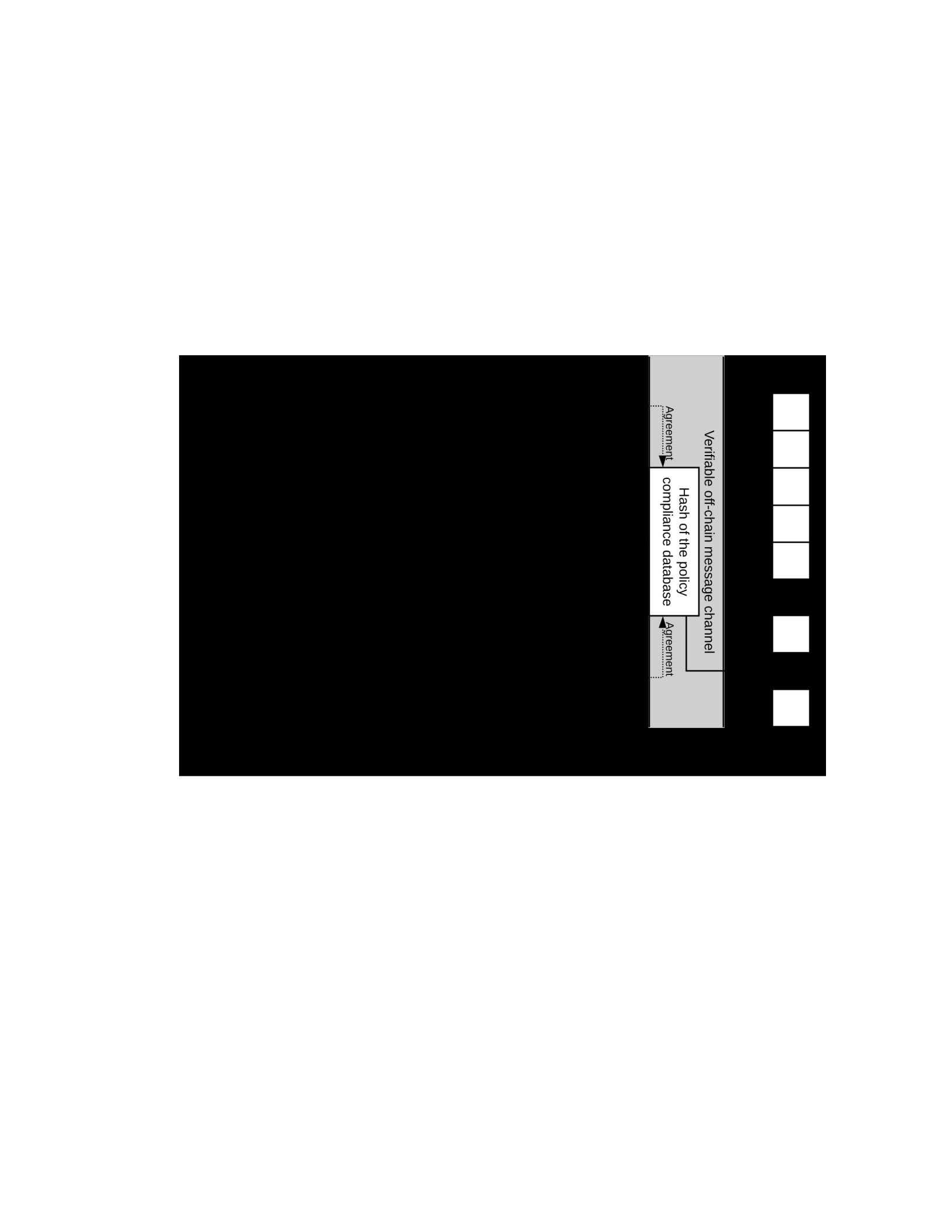
[93]
a duplication of a data file. Since the request message is part of the evidence
for inference of policy compliance, messages have to be forwarded to policy
agents along the domain history path for fair information availability. Similar
to the policy representation, the user of this system could specify a language
parser by the domain history language and version field. The domain history
block length indicates the offset of the following domain history block in bytes.
Figure 4.6: The illustration of the concept demonstration prototype
4.6 System Prototype
4.6.1 Off-chain Databases: Evidence and Inference
We have built a prototype system for the public ledger of policy compliance on top of
the demonstration policy set. The policy violations under consideration regard the
guaranteed deletion, black/white list, and consent grant and withdraw. Data

[94]
duplication discovery serves as a critical supporting technique. The communication
for policy requests between the user agent and the policy agent is recorded as the
evidence to infer policy violations. Fig. 4.6 illustrates the structure of the prototype
of the ledger of policy compliance.
The off-chain database is comprised of two levels and should be maintained
on both the data owner side and the cloud provider side:
•The evidence database. It keeps the most detailed records regarding policy
compliance. Particularly, the prototype system records the request and response
messages between the user agent and the policy agent. Note that the request
and response mechanism could not generate exactly the same view on both
sides. To understand, imagine the scenario of cross-boundary data sharing. From
the data owner’s point of view, there are requests from policy agents of multiple
domains. However, each policy agent only holds its own requests and response.
As a result, the policy agent could not detect some violations that could be
detected by the user agent. For fairness of information availability, requests and
responses should be forwarded to policy agents along the domain history path.
•The policy compliance database. It keeps the output of the policy compliance
inference engine. The hash that will be submitted to the VOCMC for agreement is
calculated from this database. Although the evidence database could create the
same view on both sides, the two views are not the same bit-by-bit, which is not
suitable for hash functions. The data owner and the cloud provider, in fact, reach
an agreement on both the updates to the police compliance database and its
renewed hash.
We use the on-chain hash as an immutable checkpoint of the police
compliance database. Both sides confirm the content of the database and sign on-

[95]
chain transactions through the VOCMC. When retrieving data from the compliance
database, the ledger user could verify its integrity by comparing its on-chain
checkpoint with calculated data hash.
4.6.2 VOCMC Configuration
Suppose the Ethereum blockchain or that with equivalent expressiveness of Turing
completed language is the ledger for the on-chain transactions. The user and the
provider transfer deposits into a 2-of-2 multi-signature address to open a VOCMC
for pairwise recording. The deposit could be part of the payment for the service
provider, which would be transferred to the provider’s address at the end of the
service provision according to the incentive model. The incentive model is
implemented by the smart contract. Every time an update to the database arrives, all
the parties should sign a temporary transaction that contains the hash of the
renewed view of the database when reaching an agreement on the updated states.
Regarding the finalization, our design choice is that the channel would be
closed when finalizing a record, with the redistribution of the deposit. The reason
for the decision is first that the on-chain cost is almost the same no matter what kind
of transaction is processed, and secondly, that finalization could be caused by
dispute where deposit must be redistributed. The current design processes the
finalization uniformly. If the finalization is triggered by the timeout TE and the
service continues, the deposit will be transferred to another 2-of-2 address as
opening another VOCMC. Figure 4.7 illustrates the ideal case in which all the
participants are honest. The VOCMC output to the BC periodically to set checkpoints
on-chain. During the finalization, the smart contract for the incentive model would
be executed by the miners at the cost of the service provider.
[96]
The objective of the proposed public ledger is to serve as a credit record of
service providers to provide a guide to the customer for informative decision
making, just as the personal credit record helps banks make decisions on loan. A
lesson learned from the current credit records is that mistake is not absolutely
unacceptable, no correction is. The commercial bank would not report a default once
it happens, but provide to the customer a time period to make a late payment or take
other acceptable actions. Similarly, GDPR does not require the data
Figure 4.7: High level description of the public ledger with example of continuous
service
processor to be absolutely secure. The organizations are allowed time to react to the
event and notify the data leakage to the users in order to minimize the damages.
The negotiation functionality supports this critical feature for a practical solution.
Data or privacy leakage could take place during the process not only because of the
intentional malicious behavior of the organization but also because of
misconfiguration or attacking from outside. Besides providing an approach to
address disagreement, the negotiation of the VOCMC could also serve as a buffering
mechanism to allow the data processing organizations to take corrective actions or
restoring their defensive system.

[97]
4.6.3 Anonymity
The BC community promotes anonymity as the default for any BC application in
order to protect the privacy of the users. Because of public visibility, the users’
detailed activities could be reconstructed, if identities are not properly treated. The
basic approach for anonymity in a BC system is to strictly abandon address reuse,
that is, an address can only be used for exactly one transaction, regardless of
representing a receiver or a sender. Note that anonymity provides on-chain privacy
[20], that is, transactional privacy is provided against the public unless the
contractual parties themselves voluntarily disclose information.
In our scheme, we embrace the anonymity of the data owner, i.e., the user of
the data service. However, to enable auditability, we intentionally allow the reuse of
service provider addresses. A service provider benefits from reusing an address for
all activities related to a certain business since a trackable history record of good
performance helps marketing. On the other hand, if a potential customer is given a
new address with no publicly available historical record, the customer could suspect
misbehavior.

[98]
Chapter 5
Evaluation and Conclusion
5.1 Experiment Setting
The system scales blockchain-based application by reducing unscalable on-chain
operation without sacrificing the information reliability we desired from the
blockchain system. Therefore, the purpose of the experiments is to demonstrate the
capability of off-chain computation to replace on-chain computation. We ran the
policy agent on a MacOS based machine, which is equipped with a 64-bit 3.1 GHz
dual-core Intel Core i7-5557U processor, 16 GB 1867 MHz DDR3 RAM, 512 GB SSD,
and 100 Mbit/s ethernet connection. The user agent is run on a MacOS based
machine which has a 64-bit 2.7 GHz dual-core Intel Core i5 processor, 8 GB 1867
MHz DDR3 RAM, 256 GB SSD, and 100 Mbit/s ethernet connection. The use of CPU
core is set to be the single-core mode for consistent measurement. The on-chain
operations are tested on Ropsten testnet, whose behavior is supposed to be similar
to the Ethereum main network.
5.2 Baseline Spacial Overhead
The cost of the entire system includes the overhead introduced by the sticky policy
mechanism to data access and data process and the cost of the execution of the
VOCMC protocol. In this section, we discuss the spacial overhead of sticky policy and
VOCMC message.
5.2.1 Policy Descriptor
The prototype relies on the Recursive Length Prefix (RLP) [105] to create the headers
and messages; thus, the length of each field of the header could be of

[99]
Header Field Length (bytes)
Data Owner ID 8
Policy Agent ID 8
File ID 8
Last Access Timestamp 8
Policy Agent Socket 10
Data Owner User Agent Socket 10
Latest File Hash 32
Nonce 4
Deletion Mark 1
Policy Language 8
PL Version 8
Language Block Length 8
Policy Language Block NA
Domain History Language 8
DHL Version 8
Domain History Block Length 8
Domain History Block NA
Total 137+
Table 5.1: The length of the fields in policy descriptor of sticky policy
flexible length. For each field, the RLP will prefix two bytes to set the boundary and
indicate the length of the field. For a payload of more than 55 bytes long, the RLP
encoding adds 2+ bytes to indicate its length. Therefore, for the prototype, we
construct the policy descriptor described in section 4.5 for the cost of 137+ bytes
payload (see Table 5.1) and 34+ bytes for the cost of RLP. The uncertainty of the
header length is because of the variable length fields, Policy language block, and
Domain history block. The fields for IDs, timestamp, and length are of the long
integer, which is of the size of 8 bytes. Note that big integer could be used to replace
the long integer, if necessary. All the fields are determined to create a prototype with
a reasonable setting in which the size of each field is by no means the only option.
The Policy language block and Domain history block are arbitrary strings.

[100]
Field Length (bytes)
Requestor Address 20
Responser Address 20
Message Type 1
Digest of Policy Compliance/Negotiation 32
Round Number 8
Requestor Sign Mark 1
Requestor Signature 41
Responser Sign Mark 1
Responser Signature 41
Negotiation Block NA
Total 165+
Table 5.2: The length of the fields in VOCMC message
We assume the policy block only contains a B/W list of domain names, and the B/W
list consists of 10 items. As well, the domain history block is assumed to comprise
10 domain names. To estimate a realistic overhead of the policy descriptor, we pad
these block with bytes of the average length of domain names, which is
approximately 10 characters [106], and neglect the cost of the imaginary languages.
The resulted policy descriptor is of length 377 bytes
(137 + 34 + 100 + 3 + 100 + 3, the 3 bytes is for the RLP cost of string longer than 55
bytes). If the user data file is a jpeg image of size 2MB, the spacial overhead
introduced by the policy descriptor approximate 0.019%. We use this pseudo-
header for further performance experiments.
5.2.2 VOCMC Message
Table 5.2 illustrates the minimum construction of VOCMC message fields to
implement the required behaviors described in chapter 3, but a particular message
only carries a subset of these fields.

[101]
The possible message type with the largest size is the negotiation message,
which includes the addresses of requestor and responder, message type, digest of
negotiation history, round number, and a variable-length field negotiation block.
The total number of fixed bytes for a negotiation message is 81 + 10 + 3 = 94 bytes,
in which the extra 10 bytes are the RLP cost for regular length byte array, and the
other 3 bytes are for byte array longer than 55 bytes. All the other message types are
with a fixed message length.
The most frequently used message type is the messages for off-chain contract
instance update, which consist of a pair of request and response. The request
message comprises 140 bytes, including the addresses of requestor and responder,
message type, digest of policy compliance history, round number, requestor sign
mark, requestor signature, and responder sign mark. In addition to the fields of the
request message, the response message has the responder signature field, thus
results in 183 bytes in total.
The message for contract instance registration is an on-chain transaction. We
only consider the payload of transaction data involved. A valid registration message
contains all the fields other than the negotiation block and sign marks; thus, the total
message length is 177 bytes no matter the contract registration is for policy
compliance or negotiation.
5.3 Baseline On-chain Cost
On-chain cost consists of transaction fee and transaction confirmation time. We
examine the on-chain cost in the Ropsten [107] network (one of the Ethereum test-
nets). The Ropsten network executes exactly the same code of the Ethereum main
net; therefore, we could expect quite similar behaviors compared to the main net
execution.

[102]
Operation Cost (Gas)
Functionality deployment 1455,250
Successful channel creation 123,047
Unsuccessful channel creation 157,378
Contract instance registration 237,420
Contract instance registration timeout 212,812
Successful channel closure 142,630
Unsuccessful channel closure 90,231
Table 5.3: The gas cost of on-chain operations
5.3.1 Transaction Fee of On-chain Operations
The transaction fee is measured by Gas, which is kind of the “fuel” to execute code in
the Ethereum network. Every instructions and data storage has a Gas consumption
value. The transaction fee is based on the total Gas consumption of the transaction.
Gas is priced in Gwei (the most-used denomination of Ether, the cryptocurrency of
Ethereum). The transaction fee equals gas consumption × gas price. For execution,
the gas consumption is fixed, but the user could announce a relatively high gas price
to raise the priority of her transaction. Therefore, we only use gas consumption as
an indicator of the operation cost. Table 5.3 lists the cost of complete execution of
the on-chain operations of VOCMC.
To provide a more realistic sense of the on-chain execution cost, consider 1-
Gwei gas price and $0.00000014 ether price. Contract instance registration, the
most-used on-chain operation, is priced 0.0332 in US dollar. Thus, frequent on-chain
transaction submission results in high execution cost, which is another constrain
other than performance when building smart contract applications on the public
blockchain.
By design, the on-chain operations consume a fixed number of gas because
each operation only requires a single round protocol. If multiple rounds are

[103]
necessary (e.g., channel closure) for system security, the users should invoke the
operations multiple times and manage it by off-chain logic instead of relying on the
on-chain execution to handle the multiple-round protocol. The reason is that there is
a maximum gas limit imposed by the block miners, non-deterministic execution
risks out-of-gas exceptions.
5.3.2 Ropsten Transaction Latency
The latency of on-chain operation of VOCMC consists of three components, the
transaction confirmation latency, computer-human interaction latency, and
transaction communication latency. We used a message relay contract to measure
the latency of protocol communication through the Ropsten network. The local
client sends a registration transaction and its timestamp to the relay contract. Upon
receiving the transaction, the contract sends the transaction data and timestamp to
the responder address. The responder client uses the timestamp to measure the
latency. We record an average latency of 83.3 ms.
We used the registration operation to measure the transaction confirmation
latency of the Ropsten network. There are two reasons for this decision: 1) contract
instance registration is the most-used operation, 2) contract instance registration
requires no computer-human interaction. This measurement is used to estimate the
scalability of the prototype system. The transaction confirmation latency is
supposed to be 15s to 20s, which is adjusted dynamically by the mining
difficulty [108].
The tester sent 1 transaction per minute for 1000 minutes, and query the
transaction pool to monitor each transaction’s appearance in the pool and take note
of the time. Finally, query the Etherscan [109] to determine the timestamp of when

[104]
the transaction eventually gets incorporated into a block. Fig. 5.1 shows how the
transaction confirmation time varies over 100 minutes. In total, we recorded an

[105]
Figure 5.1: Ropsten testnet transaction confirmation time over a 100-minute period.
average confirmation time of 21.25 seconds and a standard variance of 13.89.
Dynamically, the confirmation time varies from less than 10 seconds to around 70
seconds, as seen in Fig. 5.1. Based on this observation, a wide timeout is
recommended for application logic that relies on transaction confirmation.
5.4 Data Access Delay
We measured the data access delay introduced by the sticky policy mechanism.
Intuitively, there are two types of componential delay: 1) the communication delay
between the policy agent and the user agent, and 2) the time to prepare the
message and list checking. Given a pair of communication parties, most of the delays
tend to be consistent, and fluctuation comes from the communication and execution
environment. Only the time complexity of the hash function is O(n) where n is a
0 20 40 60 80 100
Time (minutes)
0
10
20
30
40
50
60
Transaction confirmation time (seconds)

[106]
parameter related to the size of the data file, i.e., the execution time of Figure 5.2:
Data access latency introduced by sticky policy.
the hash function increases as the input file size increases. Therefore, besides
measure the overall access delay, this experiment aimed to examine how user file
size impacts the performance.
We traversed different file sizes from 1 KB to 20 MB. For each file with a
given size, the tester accessed the file 1,000 times to record the average delay and
the standard variance. Both the overall delay and the execution time of the hash
function were recorded in order to get the statistics of the consistent component
and the variable component. Fig. 5.2 shows the result of file sizes from 1 MB to 20
MB with 1 MB step length.
It can be observed from Fig. 5.2 that the execution time of the hash function
starts to dominate the delay around file size of 7 MB. The consistent component is
0.0 2.5 5.0 7.5 10.0 12.5 15.0 17.5 20.0
File size (MB)
0
50
100
150
200
250
Access latency (Millisecond)
Hash
Other

[107]
ranging from 40 to 53 milliseconds, and the variable part is linear to the file size as
expected. The variance of the overall delay is around 9% of the total. The most
Figure 5.3: Data access latency introduced by sticky policy for small file. acceptable
range of delay is for multimedia files such as images or short video streams. It might
need to be optimized to adjust to larger files. For the files with relatively small size
(e.g., a text file of some KBs), the hash function overhead is negligible compared to
the consistent component, as seen in Fig 5.3.
5.5 On-chain Strategy and Scalability
This section studies the VOCMC’s impact on the scalability of blockchain-based
general purpose ledger. Due to the lack of data access trace from real productive
cloud infrastructure, we could only examine a simulated scenario in order to catch
some insights into the properties of the prototype system. Table 5.4 lists the
simulation configurations for the experiment.
2.5 5.0 7.5 10.0 12.5 15.0 17.5 20.0
File size (KB)
0.050
0.075
0.100
0.125
0.150
0.175
0.200
0.225
Access latency (Millisecond)

[108]
The simulation is designed to capture system behavior similar to our application
scenario, i.e., the public ledger for the policy compliance record of cloud

