


1
Section 1: Foundation of the Study
Media reports on payment-card data breaches lead consumers to believe retail
companies should provide secure transactions without the fear of thieves obtaining the
cardholders’ data (Chang, Venkatasubramanian, West, & Lee, 2013). However, retailers
and bankers face the problem of theft of customer information during transmissions of
payment-card data every day (Chang et al., 2013). More than 15 million people have
their identity stolen through card readers and automated teller machines annually (Chang
et al., 2013). According to the Trustwave Global Security Report (Trustwave, 2016),
retail businesses accounted for 60% of the payment-card data breaches. Thieves obtain
information from the stripe on the back of the customer’s card using skimming
techniques (Fossi et al., 2009). Since the advent of e-commerce web sites, data breaches
and identity theft have increased (Hoffman, 2013). The purpose of this qualitative single
case study was to explore strategies business owners use to minimize payment-card
fraud.
Background of the Problem
Identity theft involves taking on another person’s identity for financial gain (Tan,
Guo, Cahalane, & Cheng, 2016). Tan et al. (2016) stated that retailers lose an estimated
$3.5 billion in lost revenue due to financial card transaction fraud. Payment acceptors’
network security infrastructures are not up to date, which allows criminals to capture card
information. While the dollar amounts retailers lose is significant, the victims and the
card issuers experience a variety of adverse effects (Cross & Kelly, 2016).

2
The effect on the victims includes physical health and well-being, financial
trauma, depression, and psychological traumas (Cross & Kelly, 2016). However,
globally, card issuers look for new methods to detect fraud and reduce organizational
costs, both fiscally and reputationally (Cross & Kelly, 2016). Canadian, European, and
United States card issuers have implemented the chip and pin technology, but card issuers
in the European Union and the United States still experience fraudulent data breaches
(Canadian Bankers Association, 2014).
Payment-card fraud is one of the most significant threats to business on a national
and international basis (Gold, 2014). Customers of major retailers, banks, and hospitality
services face the possibility of fraudulent card activity (Berezina, Cobanoglu, Miller, &
Kwansa, 2010) when presenting their card to pay for services or merchandise at brick and
mortar or online retailers. However, incidents of a data breach and payment-card fraud
have occurred at the merchant level at businesses such as Target, Sally’s Beauty Supply
(a nationwide beauty supply company), Home Depot, and Neiman Marcus that are
changing the customers’ feelings of security (Hardekopf, 2015).
Problem Statement
Critical public data in the United States are vulnerable to theft, creating severe
financial and legal implications for payment-card acceptors (Sen & Borle, 2015). The
cost of identity theft to online and brick and mortar retailers was approximately $16.31
billion in 2014 (Vona, 2015). The general business problem was that payment-card
acceptors and processors do not incorporate strategic systems to prevent card fraud and

3
identity theft at the card processing organization. The specific business problem was that
some international card processing organization managers lack strategies to minimize
payment-card fraud.
Purpose Statement
The purpose of this qualitative single case study was to explore strategies
international card processing organizations use to minimize payment-card fraud. The
targeted population was five to eight data security specialists working for an international
card processing organization in the southeast United States who have successfully
prevented data breaches and payment-card fraud. The implication for positive social
change included the potential for lowering the number of data breaches and payment-card
fraud instances, which could provide customers with confidence in using their payment
cards, reduce fraud losses, and thereby improve the economy.
Nature of the Study
Researchers may choose from three methods: quantitative, qualitative, and mixed
method. Qualitative researchers collect data by exploring documents, observing, and
interviewing interview participants (Marshall, Cardon, Poddar, & Fontenot, 2013). A
quantitative researcher may target the amount of data, allowing for a broad cross-section
and a large volume of numerical data to analyze (Vaitkevicius & Kazokiene, 2013).
Quantitative researchers use close-ended questions to test hypotheses and do not allow
for added probing (Vaitkevicius & Kazokiene, 2013). Mixed-method research may
enhance the gain made by both methods; however, mixed-method research needs

4
considerable investigative skills and creates additional time and information refining
(Venkatesh, Brown, & Bala, 2013). The use of a qualitative research method enabled the
collection of rich and thick data to discover the successful strategies that security
specialists in international card processing organizations in the Southeast United States
use to prevent data breaches and payment-card fraud.
Under consideration were three qualitative design strategies (a) single case, (b)
phenomenology, and (c) ethnography. The single qualitative case study approach offers
abundant opportunities to the researcher for learning and provided the ability to inform or
generate theory (Hart, 2013). A single case study design was chosen to focus on the issue
of payment card fraud reduction. Case study researchers focus on exploring a specific
phenomenon thoroughly, using a representative or typical case (Yin, 2014).
Phenomenological research entails collecting data about the human experience, with an
emphasis on subjectivity (Moustakas, 1994). By contrast, the narrative itself is the object
of interest to narrative researchers (Yin, 2014).
As the purpose of this study was to explore strategies business owners can
institute to minimize payment-card fraud, the single case study design was most
appropriate. A phenomenological design was not suitable for this study because the goal
was not to explore participant’s lived experiences (Moustakas, 1994). An ethnographic
study was not suitable for this study because the purpose of the study did not require field
observations; also, the time required to conduct an ethnographic study would have been
prohibitive.

5
Research Question
The goal of the study was to address one primary research question:
RQ1: What strategies do international card processing organization managers use to
minimize payment-card fraud?
Interview Questions
The following conceptualized interview questions aided in data collection:
1. What opportunities still exist for a person to commit payment-card fraud at the
card processing level?
2. What legal strategies do you see organizations taking to protect themselves
from monetary loss from data breaches?
3. What plans do you have to implement payment-card security?
4. How has your organization increased security to reduce those opportunities?
5. There are separate ways for card acceptors to combat fraud. What technology
tools has your organization implemented?
6. What strategies have you implemented or planning to make your payment-card
protection strategy stronger and yet less costly for your company?
7. How useful are the tools and strategies your organization has implemented?
8. What changes in the PCI-DSS standards need to be added that could increase
security?
9. What steps can payment-card acceptors take to increase security for accepting
payment cards?

6
10. If you implemented fraud-detection practices, what problems did you meet
during the conversion?
11. What else can you add about strategies that the payment-card acceptors could
implement to reduce and eliminate fraud and identity theft?
Conceptual Framework
The theory that served as the conceptual framework for this study was the fraud
theory, which was proposed by Cressey in the 1950s (Cressey, 1954). Cressey (1954)
developed the fraud theory to describe (a) why people commit fraud, (b) the
rationalization people use for having committed fraud, and (c) the financial need of
individuals who commit fraud. Fleming, Hermanson, Kranacher, and Riley (2016)
further defined Cressey’s fraud theory stating that people commit fraud because of (a)
opportunities, (b) rationalizations, and (c) peer pressure. The critical concepts of fraud
theory include fraud risk assessment, rationalizing the act, and the person’s motivation to
commit fraud. As applied to this study, fraud theory was right for the study because it
allowed the participants to effectively explore perceptions and experiences regarding
strategies to reduce payment-card fraud opportunities.
Operational Definitions
Botnet: Botnets are a network formed of hosts controlled remotely by a bot-
master to spread malicious viruses to a network (Narang, Hota, & Sencar, 2016).

7
Card not present: Card not present transactions are transactions performed when
the cardholder is not present such as Internet, mail-order, or telephone purchases (Sahin,
Bulkan, & Duman, 2013).
Card present: Card present is the offense of using a payment-card to buy
something with the knowledge that the forged or stolen payment-card has been revoked
or canceled or the card’s use is unauthorized (Card Present, 2014).
Denial of service: Denial of service refers to botnet attacks on Internet servers
through remote command to perform malicious attacks by the bot-master and denies
service to other servers (Wang, Lin, Cheng, & Chen, 2017).
Identity theft: Identity theft is the act of stealing a person’s identity for unlawful
gains (McNally, 2008).
Malware POS–point of sale: POS malware is a powerful software used to
illegally obtain payment-card datum (Steer, 2014).
Phishing: Phishing refers to attaching fake information websites using e-mails to
obtain a person’s personal data (Kim, Sefcik, & Bradway, 2016).
Vishing: Vishing refers to phone deception requiring phone answerers to enter
their payment-card or checking account information by the phone keypad to clear up
some financial problem (Mugari, Gona, Maunga, & Chiyambiro, 2016).

8
Assumptions, Limitations, and Delimitations
Assumptions
Assumptions are the elements the researcher assumes to be true without evidence
(Ellis & Levy, 2009). Three assumptions were the basis of the study. The first
assumption was that the participants would supply honest and detailed descriptions in
response to the interview questions. The second assumption was the qualitative single
case study was the best design to address the research question and to collect that data,
that the senior managers would provide access to the supporting documents and data.
The last assumption was that the participants were knowledgeable and willing to impart
information about how the company currently handles payment-card fraud.
Limitations
Limitations are internal threats to any study’s validity (Ellis & Levy, 2009). The
first limitation of the study was the willingness of the senior managers to take part in the
study. Because the study was conducted at a single company in the southeastern United
States, the strategies for card fraud detection may not be representative of other payment
card processing organizations located in the United States. The results of the study are
limited by the willingness of the participants to share their knowledge and organization
documents, the thoroughness of their responses, and the ability to recruit a sufficient
number of participants to achieve data saturation.

9
Delimitations
Delimitations are the stated boundaries of the study (Ellis & Levy, 2009). The
delimitations set the scholarly tone of the research and define what the research leaves
out (Ellis & Levy, 2009). The participants were data-security specialists at an
international payment-card processing organization in Georgia. Only data-security
specialists with a minimum of a bachelor’s degree and a minimum of 10 years of
experience in their respective fields took part in the study.
Significance of the Study
The results of the study may provide data-security experts with answers on how to
prevent payment-card fraud. The results of the study may create incentives for business
owners to follow payment-card industry data-security standard (PCI-DSS)
recommendations. The PCI-DSS incentives include (a) reduced liability, (b) reduced
revenue loss, (c) potential reduction in costs to consumers for products or services, (d)
increased consumer confidence leading to increased tax bases, (e) increased tax bases that
may lead to infrastructure improvements and (f) and an increased workforce. The
findings of this study may also add value to businesses by enhancing card acceptors’ and
processors’ ability to increase card security and reduce fraud opportunities.
Contribution to Business Practice
The results of this study have a practical business application. The results of the
study may increase business leaders’ awareness of the strategies needed to reduce
payment-card fraud opportunities. The results of this study could serve as a guide for

10
senior card processing organizations’ managers and card acceptors to reduce card fraud
by obtaining the knowledge of how to reduce fraud opportunities. Card acceptors may
increase POS security through enhanced technological advances that may result in a
reduction in payment-card fraud.
Implications for Social Change
The results of this study may have implications for social change. One
implication for positive social change is that the findings of this study may provide
practical strategies for card processing organizations’ senior managers to reduce card
fraud opportunities. The results might supply strategies to motivate card acceptors to
increase payment-card security; thereby, increasing consumer confidence in the card
acceptors’ ability to provide secure transactions. Increasing confidence in payment-card
security in retail businesses may enable the leaders of retail organizations to prepare for
and deter the malware and viral attacks on the POS systems; thereby, deterring payment-
card fraud and identity theft. The results of the study may influence the belief of
payment-card acceptors globally, both directly and indirectly.
A Review of the Professional and Academic Literature
Payment-card fraud and data breaches occur daily in diverse types of businesses.
Card transaction processors meet fraudulent transactions daily due to card acceptors not
having the appropriate strategies to detect fraud. Suman (2014) presented an overview of
distinct types of business fraud to include (a) payment-card, (b) telecommunication, (c)
data breach, (d) bankruptcy fraud, (e) theft counterfeit, and (f) application fraud. Suman

11
defined payment-card fraud as online and offline unauthorized usage of another person’s
card.
A data breach is the act of entering without warrant or invitation to another
computer system or network. Theft counterfeit fraud is the same type of fraud where the
person uses another’s card without permission (Suman, 2014). Application fraud is the
act of applying for credit or employment in another person’s name and using that
person’s credentials (Suman, 2014). The three types of fraud defined by Suman (2014)
examined in this study are (a) payment-card fraud, (b) identity theft, and (c) data breaches
resulting in payment-card information theft.
The comprehensive literature review includes an exploration of relevant topics to
supply a scholarly background that supports the need to address the problem of payment-
card fraud elimination. The literature review includes the topics of (a) fraud theory, (b)
fraud triangle theory, (c) identity theft, (d) payment-card fraud detection, and (e)
payment-card fraud elimination models. Search keywords used included (a) credit card
fraud, (b) identity theft, (c) credit card fraud elimination, (d) credit card fraud detection,
(e) fraud theory, and (f) fraud triangle theories. Other keyword searches included
computer crimes, swindling, Internet fraud, and economic crime.
The sources were articles in peer-reviewed journals from Walden University
Library and Google Scholar using EBSCOhost, ProQuest, Science Direct, and Thoreau.
The resulting review provided useful data to respond to the research question with
primary sources published from 2014 to 2018 to ensure this study had a supported

12
research method and design. Of the more than 150 sources; 90% are within the last 5
years.
The focus of this qualitative case study was to examine the strategies card
processing companies use to determine fraudulent card transactions. Fraud theory and
the fraud diamond were the foundation for determining card fraud. Omar, Nawawi, and
Puteh Salin (2016) discussed fraud theory as the theory that pertains to American card
fraud. The review includes global and American sources for card fraud detection. The
primary focus; however, was on American card-fraud and data breaches.
Fraud Theory and the Fraud Diamond
Cressey developed fraud theory in 1950 and revised the theory in 1954. Fraud
theory offers researchers and business leaders three potential reasons for a person to
commit fraud (a) opportunity, (b) rationalization and, (c) financial gain (Cressey, 1950).
Tan et al. (2016) defined fraud as involving the use of fabricated identity for financial
gain. Fraud theory is the foundation for the fraud triangle theory. Fraud theory, which is
relevant to payment-card fraud, enables corporate auditors to determine fraudulent
financial transactions in corporate America (Omar et al., 2016).
Fleming et al. (2016) proposed three reasons people commit fraud (a) financial
problems, (b) opportunity, or (c) rationalization (i.e., company owes them something in
the individual’s mind). Omar et al. (2016) noted that financial distress, as perceived by
the individual, is one of the leading causes of fraud. The perpetrator may be unwilling to
discuss financial problems and may have a powerful sense of ego, preventing that person

13
from discussing why he or she felt compelled to commit the fraudulent act (Fleming et
al., 2016). Personal financial problems lead people to commit fraud without considering
the consequences.
Fleming et al. (2016) discussed how fraudsters justify committing fraud through
(a) a moral justification, (b) feeling the organization owes them something, and (c)
rationalization. Fleming et al. reported that fraudsters justify committing fraudulent acts
as part of their moral comfort zone. Fraudsters rationalize the theft by claiming the
business owes them for poor working conditions (Omar et al., 2016). The fraudster
rationalizes his actions because he feels the company owes him either for his demanding
work or through managerial changes.
Omar et al. (2016) stated that the person committing the fraudulent act has a slim
chance of capture. The person committing fraud may use the payment-card for several
small purchases or one large luxury purchase (Fleming et al., 2016). The completion of
fraudulent purchases occurs before the victim tries to use their account to make a
purchase. Payment-card fraudsters realize the act of committing fraud needs both ability
and the belief that he or she may not be caught (Craig & Piquero, 2016; Omar et al.,
2016).
In summary, the purpose of this study was to explore strategies that business
owners and card processors use to reduce or end payment-card fraud. Fraud theory
provides a foundation for understanding why and how thieves commit fraud. Finding
opportunities for a person to commit fraud is the first step in reducing or eliminating

14
payment-card fraud. Cressey (1950, 1954) expanded on fraud theory by creating the
fraud triangle theory, which is covered in the next section.
Fraud Triangle Theory
Cressey (1950, 1954) and Fleming et al. (2016) explained the fraud triangle as (a)
opportunity, (b) rationalization, and (c) financial pressure. Business owners, managers,
and card acceptors focus on the opportunities for a person to commit card fraud. Omar et
al. (2016) analyzed the fraud triangle as a model for assessing the risk of fraud
opportunities, but the triangle is only one aspect of the risk assessment plan. Identifying
fraud risk is a significant part of assurance services. Fleming et al. stated the triangle of
fraud action includes (a) the act, (b) concealment, and (c) conversion. The act of
committing fraud is the execution and method of fraud. The concealment constitutes
hiding the action, and conversion represents the process of turning the ill-gotten gains
into something tangible by the criminal.
Cressey (1950, 1954) created the fraud triangle theory after interviewing 250
prisoners in 1950. Cressey (1950) defined the fraud triangle by the reason’s fraudsters
commit fraudulent acts. Abdullahi and Mansor (2015) discussed Cressey’s fraud
diamond. The fraud diamond, according to Abdullahi and Mansor included pressure,
opportunity, and rationalization. The perceived pressures, incentives, and motives refer
to factors that lead to unethical behaviors. Abdullahi and Mansor stated every fraud
perpetrator faces some form of pressure to commit fraud. The opportunity presents itself
through the lack of controls (internal and external in an organization), and unethical

15
employees may seize the opportunity to commit the felonious act (Abdullahi & Mansor,
2015). The rationale for a person to commit fraud refers to the justification and excuses
to commit the unethical behavior (Abdullahi & Mansor, 2015). Figure 1 portrays
Cressey’s Fraud Triangle with Kassem and Higson’s updated version of 2012.
Abdullahi and Mansor (2015) discussed the pressure a potential fraudster feels to
commit the act. The pressures (i.e., motives) to commit fraud become the heat source for
the act (Abdullahi & Mansor, 2015). Pressures may include ways to pay for a more
opulent lifestyle, employment pressures, or the organization’s fiscal interests (Abdullahi
& Mansor, 2015). More pressures may be external (a) business financial stability, (b)
high management turnover rate, or (c) lack of segregation of duties (Abdullahi & Mansor,
2015).
Figure 1. Kassem and Higson’s (2012) new fraud triangle model.
Note: Kassem and Higson’s new fraud triangle model is an expansion to
Cressey’s Fraud Triangle notating (a) motivation, (b) capability, (c) opportunity, and (d)
personal integrity. Adapted from: “The new fraud triangle model” by R. Kassem and R.
M
[MICE
M ]
P
I
[F Scale]
F 's
C
[F
D ]
O

16
W. Higson, 2012, Journal of Emerging Trends in Economics and Management Science,
3(3), p. 194. Reprinted with permission from Kassem.
Although Abdullahi and Mansor (2015) portrayed the new fraud triangle in their
study, Lokanan (2015) challenged the fraud triangle and the usefulness of the triangle.
Lokanan stated the fraud triangle should not be a single reliable model for anti-fraud
professionals. Lokanan argued that the fraud triangle is a theoretical anchor, and the
fraud triangle endorses a body of knowledge that lacks objective criteria. The body of
knowledge basis comes from the individual’s moral makeup and ethical background.
Lokanan referred to Fleming et al.’s 2016 study as a foundational framework of the new
fraud triangle.
Boyle, DeZoort, and Hermanson (2015) evaluated the use of alternative fraud
model practices affecting professional audit standards. Boyle et al.’s analysis focused on
the auditor's approach to fraud, including how the auditor used the fraud triangle and the
effectiveness of the clients’ anti-fraud measures. Boyle et al. listed anti-fraud measures
(a) deterrence, (b) prevention, (c) detection, and (d) procedures. Fraud deterrence
measures involve the controls and probability of fraudulent activity. Fraud prevention
measures include audits, data security, and monitoring activity (Boyle et al., 2015).
Fraud detection organizations follow PCI-DSS rules and regulations (Boyle et al., 2015;
Willey & White, 2013). Fraud deterrence procedures involve eliminating that may cause
fraud in comparison to prevention identifying and stopping existing fraud activity (Boyle
et al., 2015).

17
The measures described by Boyle et al. (2015) follow Cressey’s 1950 fraud
triangle model and make a distinction. The distinction discussed by Boyle et al. indicated
a company may have healthy internal fraud controls and yet the criminal may not have a
strong perception of the controls. Cressey’s fraud triangle, or fraud diamond, consider
business, personal, and peer pressure reasons for one to commit fraudulent acts.
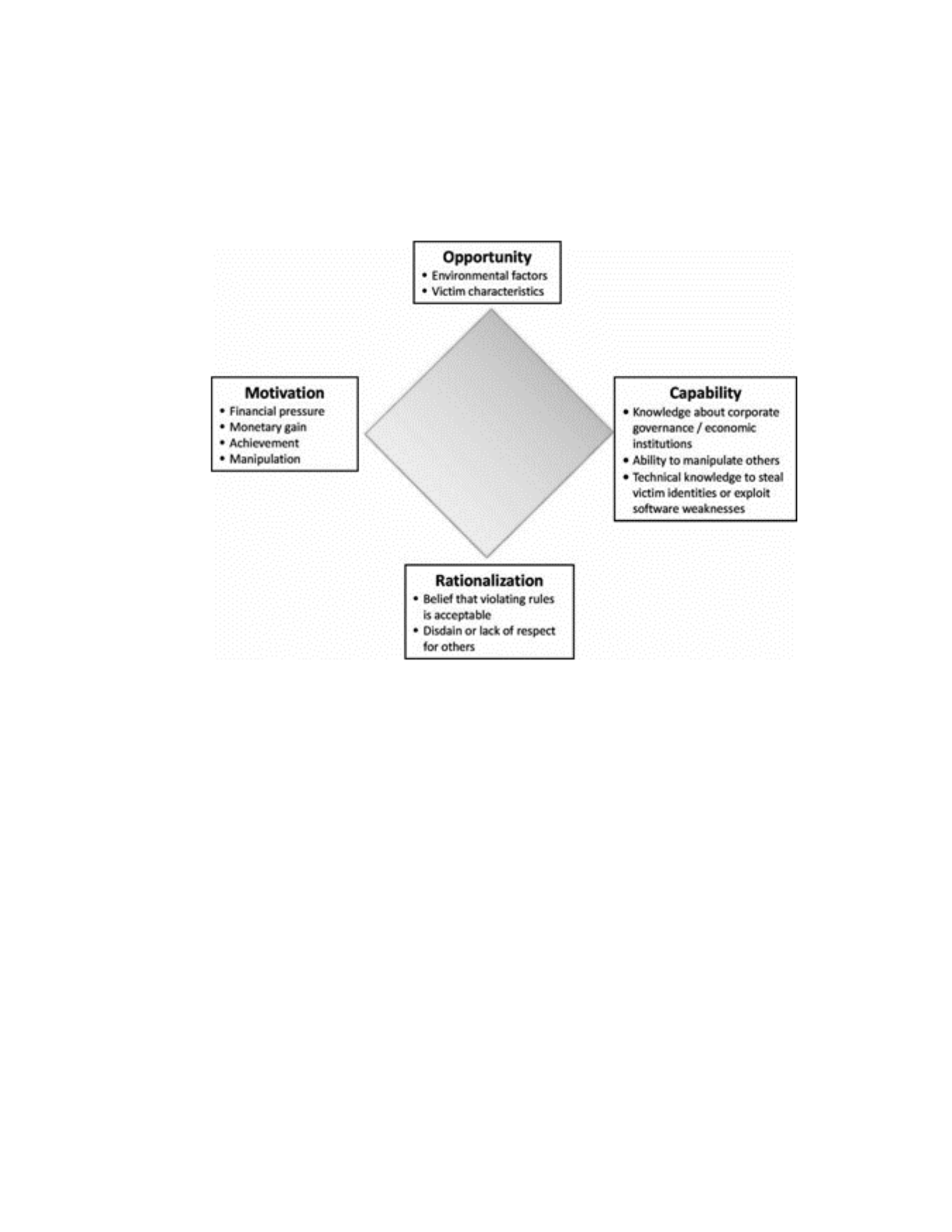
Azrina and Ling Lai (2014) defined the fraud diamond as opportunity, motivation,
capability, and rationalization. Dilla, Harrison, Mennecke, and Janvrin (2013) described
how the fraud diamond aspect of the fraud triangle applies to the virtual world. The
virtual four-sided diamond includes (a) opportunity, (b) motivation, (c) business record-
keeping and (d) virtual laboratories for risk assessment. The four sides of the diamond
represent the criminals’ capacities in the virtual world (Dilla et al., 2013). Mui and
Mailley (2015) discussed the comparison of the fraud triangle and the fraud diamond.
The fraud diamond shares the same characteristics with one difference – why the person
commits fraud.
The fraud diamond described by Mui and Mailley (2015) includes (a) opportunity,
(b) motivation, (c) rationalization, and (d) reason for the person to commit. The societal
factors include philosophical and religious tradition, culture, social norms, and the rule of
law, socio-economic conditions, and political status - relate to the environment where the
perpetrator resides and have an effect on the disposition of the perpetrator (Mui &
Mailley, 2015). The difference between the fraud diamond and the fraud triangle
described by Mui and Mailley is societal factors. Auditors and fraud prevention
18
personnel use both the triangle and the diamond to understand why a person commits
fraud.
Figure 2. Dilla et al. depiction of fraud diamond (2013).
Note: Adapted from “The assets are virtual, but the behavior is real: An analysis of fraud
in virtual worlds and its implications for the real world”. By Dilla et al. 2013, Journal of
Information Systems, 27, 131-158. Reprint with permission from the authors.
In summary, payment-card fraud occurs through opportunity according to the
information provided in fraud and fraud triangle theories (Schuchter & Levi, 2015). The
person committing the fraudulent transaction feels perceived pressure due to the
opportunity and motivation (Schuchter & Levi, 2015). Schuchter and Levi (2015)
explained opportunity allows the thief to decide to commit fraud because of the absence

19
of transparency as well as the lack of discipline. The lack of transparency from the
thief’s perspective comes from the absence of compliance or managerial accounting
(Schuchter & Levi, 2015). Lack of discipline and irresponsible corporate governance
within the organization leads to a lack of audit controls, thus encouraging the crime
(Schuchter & Levi, 2015). Fraud and fraud triangle theories supply insight into the
fraudster's reasoning for committing fraud and identity theft. These insights supply a
foundation for understanding how to prevent fraud and identity theft.
Cressey’s 1973 fraud triangle theory examined the motivation for someone to
commit fraud; the triangle includes (a) pressure, (b) opportunity, and (c) rationalization
(Dorminey, Scott Fleming, Kranacher, & Riley, 2012). However, Dorminey et al. (2012)
believed that the Fraud Triangle was only one crucial part of finding the risk of
opportunities. Dorminey et al. stated that fraudsters’ motivation might be expanded and
identified with acronym MICE: money, ideology, coercion, and entitlement, or ego. In
addition, McMahon, Pence, Bressler, and Bressler (2016), Wolf et al. (2015), and
Beasley, Carcello, Hermanson, and Lapides (2000) identified a fourth critical element
which they thought should be added to Cressey’s Fraud Triangle. McMahon et al., Wolf
et al., and Beasley et al. believed that capability was equally as important as the first three
factors. Adding capability to the fraud triangle could aid in fraud prevention and
detection.

20
Identity Theft
In this section of the review, consideration was made to studies on identity theft
and payment-card fraud to define how identity theft affects payment-card fraud. Card
processing organizations use the information located on a person’s card to determine
issuer and obtain approvals for purchases. Marcum, Higgins, Ricketts, and Wolfe (2015)
determined how students in a rural North Carolina high school stole people’s identity
through (a) assuming someone else’s appearance and (b) obtaining the victim’s personal
information. Impersonation of a person is not as simple as stealing a person’s social
security number or other personal information. Consumers should watch card usage via
the issuer's website (if available) and track credit reports to ensure report accuracy.
Modi, Wiles, and Mishra (2015) and Bai and Chen (2013) reported the magnetic
stripe payment cards allow criminals to commit banking fraud and identity theft.
Magnetic stripe payment cards are easy to clone (Modi et al., 2015). Modi et al.
explained the data recorded on the magnetic stripe are (a) cardholder name; (b) address;
(c) card number; (d) CVV on the back of the card; and (e) line of credit. Magnetic stripes
on payment cards have two to three tracks. Most payment cards use tracks one and two.
Track one’s format contains cardholder information and name and personal information
(Appendix A). The data on track one for financial products have proprietary issuer data.
Track 2 does not include the cardholders’ names. However, track two does have similar
information written in ANSI code to track one (Appendix B).

21
The cloning of a person’s payment-card affords the criminal opportunities to
commit banking fraud (Modi et al., 2015). Modi et al. (2015) described third-party and
offshore payment-card processors' lack of enough security and inability for authorities to
apprehend card thieves. Third-party transactions have the potential for failure because of
the lack of data-security (Modi et al., 2015). The lack of safety increases failure costs at
the third-party processor. Failure costs lead to increased shareholder losses (Modi et al.,
2015) for the organization where a data breach has occurred.
Modi et al. (2015) performed the study using a sample of 146 customer
information security breaches. Modi et al. concluded that the increase in cost to
shareholders leads to decreased returns. The quantitative study by Modi et al. included
samples of sensitive personal data and propensity scores for evaluating changing
concerns. Propensity scores are quantitative risk measurements used to determine
potential fraud (Turner, 2014). Changing concerns describe the mistakes within the fraud
activity formula (Modi et al., 2015). Modi et al. described the propensity score and the
changed curve as flags created within the card processing system flagging potential fraud
transactions.
Bai and Chen (2013) posited that immoral persons contact bank customers using
e-mail to obtain personal information. The e-mail appears as an official notice from the
bank, within the body of the e-mail, the fraudster requests certain information such as the
customer’s card number and cell phone number. Once the cardholder supplies the
information, the fraudster closes out the client's cell phone, obtains a new card, and

22
immediately overdraws the card (Bai & Chen, 2013). Additionally, the fraudster may use
TeamViewer to remote into a person’s computer and obtain information using key
loggers. Keylogger software captures a PC user’s keystrokes and provides the logger
with the unsuspecting person’s personal information such as passwords and logins.
Kahn and Linares-Zegarra (2016) researched how consumer behavior pertains to
identity theft and fraud. Components of the Kahn and Linares-Zegarra study included
physical prevention, account monitoring, agency control, password security, and risky
consumer behaviors. Kahn and Linares-Zegarra found that users do not think about the
actions or reactions of identity theft because of the lack of consumer education in the
defense against identity theft and fraud. Kahn and Linares-Zegarra referred to the
defense against identity theft through consumer education. Consumer education includes
payment-card protection, account monitoring, password security, and avoiding risky card
behavior (i.e., leaving cards and personal information unattended) (Clough, 2015; Kahn
& Linares-Zegarra, 2016). Societal education about payment-card and identity theft lead
the researcher into physical prevention.
Clough (2015) found that consumer naiveté is the leading cause of identity theft.
Clough defined three segments of identity theft: financial, criminal, and identity cloning.
Financial theft occurs when a thief portrays the victim to obtain credit from a financial
institution. Criminal theft happens when the criminal identifies him or herself as another
person to commit a crime, obtain special permits, or commit acts of terrorism. Identity
cloning occurs when the thief uses another person’s identity to assume his or her identity

23
in daily life to obtain new phone or wireless accounts, utility services, or other credit-
related services. Clough stated that identity theft occurs both offline and online. Victims
of identity and card fraud come from all backgrounds, races, and sexual orientations.
Police officers and courts alike need to understand the definition of fraud and identity
theft.
The courts address identity theft as an injury-in-fact as described in Article III,
standing principals of the United States Constitution (Martecchini, 2016). Article III of
the United States Constitution requires plaintiffs to “show concrete and particularized
injury that is fairly traceable to the challenged conduct and likely to be redressed by a
favorable judicial decision” (Martecchini, 2016, p. 1475). The victim of identity theft
must show the justice system's proof of injury. The 7th Circuit Court of Appeals found
customers whose breached payment-card data were at risk of identity theft and increased
risk for fraudulent charges. Reynes and Randa (2017) described the victims of identity
theft and payment card fraud as female, elderly, economic background, and race. The
victim must decide to report the crime to the police.
Legal action on the municipal level is not enough to fight identity theft. Konradt,
Schilling, and Werners (2016) stated that phishing is growing exponentially and has
become a societal issue. Konradt et al. explained that online identity theft is hard to
prove due to a lack of physical evidence. Physical evidence may include transcripts of
computer chats, online purchase transaction records, or applying for credit in another

24
person’s name (Konradt et al., 2016). With the development of WIFI, people have come
to expect absolute security at locations with publicly available WIFI connections.
Virtual identity locks prevent a person(s) from stealing online identities (Konradt
et al., 2016). Konradt et al. (2016) defined virtual identities as assuming someone’s (a)
name, (b) image, (c) e-mail, or (d) or other personal data to use by the person committing
fraud. Additionally, Konradt et al. stated the person or persons who use another person’s
information deceives employers, credit grantors, and non-business-related persons.
Knight and Saxby (2014) discussed how identity deception is a broader cause than
identity theft as one of the many classes of identity crime. Identity deception allows
someone to assume another person or business’ identity (Knight & Saxby, 2014).
Police and judges define identity theft as the theft or assumption of a pre-existing
identity with or without consent and in the case of an individual living or deceased. The
United States government defines identity theft through the Identity Theft and
Assumption Deterrence Act (Federal Trade Commission, 1998). The Act’s introduction
mitigates the economic cost to victims, both entity and individual. The consequences of
identity theft include fines and or jail as a deterrent to future perpetrators (Knight &
Saxby, 2014). The drafters of the Identity Theft and Assumption Deterrence Act identify
identity theft as a federal crime with 15 years’ imprisonment and $250,000 in fines.

25
Figure 3. Conceptual model of identity definitions (Jamieson et al., 2012).
Note: Adapted from: “Addressing identity crime in crime management
information systems: Definitions, classification, and empirics”. Computer Law and
Security Review, 28, 381-395. Reprinted with permission by authors.
Knight and Saxby (2014) stated that government officials need a dependable
identity-crime management program. Knight and Saxby posited the evolution of identity
crimes provides ideas for new research into technological advances and new government
regulations. Each state government has (a) a different definition, and (b) different
judicial conviction outcomes (Knight & Saxby, 2014). Knight and Saxby posited state
legislators should work together to have standard identity theft definition and common
judicial outcomes. The variances in identity theft convictions are state law dependent.
In summary, identity theft and payment-card fraud provide opportunities for
fraudsters to defraud victims and organizations. When a thief captures a victim’s
payment-card information, the thief is capturing the information in the magnetic stripe’s
track 01. The captured data provide personal information such as the victim’s name,
address, social security number, and phone number(s). The fraudster, in turn, uses the

26
obtained information to open new accounts in the victim’s name but does not use the
person’s phone number. The victim discovers they have been a victim of identity theft
when they go to open a new line of credit or make a large purchase and learn of unpaid
accounts.
PCI-DSS
In this section, a review of the security requirements established by PCI-DSS for
card processors and acceptors is provided. PCI-DSS Data-Security standards set the
minimum-security standards for payment-card acceptors and processors (Fernandes,
2015; Willey & White, 2013). The standards are recommended worldwide to reduce
fiscal business loss from card fraud. Card providers and acceptors worldwide have
accepted PCI-DSS compliance (Fernandes, 2015) as a guideline to reducing data
breaches and card fraud. The requirements provide the foundation for protecting
customer information from misuse. PCI-DSS, as of 2015, has 12 security requirements
for protecting cardholder information (Fernandes, 2015; Willey & White, 2013). All
businesses that accept or issue cards and process or transmit card data has to adhere to the
PCI-DSS requirements (Fernandes, 2015).
P. Harvey (2013) and Fernandes (2015) described the requirements created by
PCI-DSS as network personnel, quickly identifying who, what, when, and whether
specific files were accessed. Fernandes stated in the write-up of his study that PCI-DSS
compliance is necessary for all businesses that accept payment cards. PCI-DSS

27
compliance offers the cardholder a sense of security for businesses maintaining card data
(Fernandes, 2015; Harvey, 2013).
PCI-DSS Regulations provide a written outline for organizations to increase
network security, enhance business reputation and brand value, and decrease the chance
of data breach (Fernandes, 2015). Compliance with PCI-DSS requirements means
monitoring log files and critical files in real-time with automation (Fernandes, 2015).
Automation offers the business enhanced payment-card security. However, Rees (2014)
provided business leaders with another methodology for data breach cleanup and
recovery. Rees discussed the controversial PCI-DSS requirements for taking card
payments.
P. Harvey (2013) and Fernandes (2015) explained the 2014-15 PCI-DSS
requirements for payment-card acceptors to secure cardholders’ data. The
recommendations are the most challenging too secure and protect customers’ card
information. The requirements track and monitor network resources and cardholder
information and deploy detection mechanisms to alert network security professionals to
intrusions (Fernandes, 2015). Rees (2014) reviewed the design of PCI-DSS to protect
cardholders’ information. No business wants to be the subject of a data breach where
multiple people’s information has been stolen.
Rees (2014) described that the cleanup costs and fines are devastating and long-
term costs in damage to the organization’s reputation. When properly maintained, the
PCI-DSS requirements reduce the chances of a damaging data breach. Rees discussed

28
that if the worst happens to an organization, the company would still have the security
policies and procedures to address the security event and mitigate the issue through
effective countermeasures.
Business leaders often state the PCI-DSS requirements are hard and expensive to
meet (Rees, 2014). The requirements can be complicated or straightforward as the
security analysts for the organization want to interpret them. The cost is expensive for
the purchase of infrastructure equipment (Rees, 2014). However, the equipment cost
may not be as expensive as the fines and loss of business revenue. Business leaders
argue that PCI-DSS requirements are not legal (Rees, 2014). The requirements indicated
by Rees (2014) protect businesses of any size from data breaches or card fraud.
Rees (2014) stated that the requirements do not have to be difficult, and the
implementation of security equipment expensive. The components are challenging; Rees
suggested using PCI-DSS approved vendors for network and equipment scanning. The
recommendation made by Rees is to choose QSA approved PCI-DSS consultants with
broad experience. Although Rees made recommendations for qualified consultants,
Murdoch and Anderson (2014) discussed the risk of Europay, Mastercard, and Visa’s
(EMV) chip and pin cards in Europe, which included the magnetic stripe and the chip on
a cheap card.
Fraudsters could still easily clone the cards and capture the user's PIN. As the
technology improved, the chip and pin cards introduced more serious fraud problems

29
through tampering with the pin (Murdoch & Anderson, 2014). Although the terminals
for the cards were certified tamper-proof, the machines were not.
Severe flaws in the machine (e.g., non-tamper proof) slowed the certification
process (Murdoch & Anderson, 2014). Additional areas for an attack on the chip and pin
card in the early days was the relay attack during transaction processing (Murdoch &
Anderson, 2014). The relay attack exploits the card authentication process of the
merchant’s terminal (Murdoch & Anderson, 2014). However, the card presenter did not
know which terminal was processing the purchase.
Academia and corporate America look at corporate greed and fraud in different
lights. Payment-card fraud determination follows PCI-DSS rules and regulations
(Maroun & Atkins, 2014). Rule interpretation by data-security professionals and
business leaders follow multiple paths. The implementation of the rules may be as
straightforward or as complicated as management determines the need (Maroun &
Atkins, 2014). The PCI-DSS rules are a guide to data-security for card acceptors
(Maroun & Atkins, 2014).
Ganesan (2016) explained the PCI-DSS requirement for password protection for
enterprise-wide protection. Network users tend to record their passwords in unsecured
spreadsheets. Ganesan posited password management solutions could provide a middle
ground between sensitive systems access and potential data breaches. The password
system provides a level of security and provides a technological scan of all Active
Directory linked systems for security (Ganesan, 2016).

30
The weak point for password-protected systems is the hardcoded default
passwords for the enterprise. Hackers gain access to the default password script; they
may be able to decode and wreak havoc on the network (Ganesan, 2016). Ganesan
(2016) found that web browsers and websites requiring passwords do not have
accountability or trace features on information sharing, among others (human
vulnerability).
In summary, PCI-DSS guidelines provide business leaders with minimum-
security suggestions for the prevention of data breach and or payment-card fraud
detection. The PCI-DSS recommendations for card acceptors included information for
data retention, password strengths, network security protocols, and on-line card
acceptance rules and regulations for data encryption. Rees (2014) stated that the
implementation of data-security does not have to be expensive or complicated. The PCI-
DSS guidelines best implementation uses QSAs with broad knowledge in the PCI-DSS
implementations. The challenge for any QSA or business comes from securing
customer’s data and card information.
Data Breach
Since the advent of e-commerce web sites, data breaches, and identity theft have
increased (Hoffman, 2013). Small (2014) discussed the risk factors and the vulnerability
to data breaches. The server is the most vulnerable location for a data breach to occur
(Small, 2014). Although the server is vulnerable, the end-user and or the cardholder have
responsibility for ensuring data safety.

31
Data-security includes end-users changing passwords and cardholders, ensuring
their cards are safe and secure when not in use (Gold, 2014). Breach containment
involves identifying the problem and performing the necessary steps to stop the
discovered breach (Gold, 2014; Small, 2014). To evaluate risk, security specialists
should determine if a data breach has compromised the system or data, and then they
must estimate costs for breach cleanup.
Leaders must notify customers of the breach and any payment-card users of the
potential for fraud activity on the customers’ cards (Small, 2014). In addition to the
reactive steps, leaders must take proactive steps to prepare for potential future data
breaches through updated spyware, phishing programs, and anti-virus software (Gold,
2014; Small, 2014). Hardware personnel must inspect card readers for potential
problems.
The POS breaches at major retailers such as Home Depot and Target involved
data breaches caused by BlackPOS malware, enabling fraudsters to collect more than 70
million payment-card numbers (Caldwell, 2014). BlackPOS malware spread
incrementally through the POS systems collecting customer data. Caldwell (2014)
indicated that TrendMicro’s POS anti-malware software was not working fast enough to
detect the Trojan. Caldwell stated the anti-malware and anti-virus software on the Target
POS system detection failed and caused the data breach at Target.
Caldwell (2014) suggested if the malware and anti-virus servers worked at
maximum speed, the potential for trapping and cleaning the malware would increase and

32
decrease the effect of the infection. Caldwell suggested that POS system administrators
should remotely shut down the terminal and reimage the machine after intrusion detection
to eliminate additional infections. Caldwell’s research focused on Europay, MasterCard,
and Visa (EMV) chip and pin technology.
Card issuers expect to see a reduction in data breaches because of increased
security. Caldwell (2014) posited mag-stripe technology is attractive to fraudsters
because of the ease of cloning payment cards. Chip and pin are harder to clone and is
less attractive to fraudsters (Caldwell, 2014). EMV technology has become a global
standard for payment-card issuers (Caldwell, 2014). EMV, or chip and pin technology,
uses a microchip technology at the acceptor’s checkout location.
Caldwell (2014) stated throughout the transaction process, EMV transactions use
encryption. The EMV card machine may use the mag-stripe if the merchant uses the
tampered with chip Ireader (Caldwell, 2014). Mag-stripe cards are susceptible to
cloning, which enables criminals to obtain customer data. Card acceptors’ equipment
needs upgrading to read the new chip and pin cards, which the card companies’ issue
(Caldwell, 2014). After 2 years of equipment and software upgrades, some small
retailers are not accepting chip cards because of the cost of new card-reading equipment.
In summary, data breaches attack the server, which is the most vulnerable location
in the network for card transactions (Gold, 2014; Small, 2014). The server vulnerability
to malware and virus attacks leave card acceptors and data-security personnel to create
new security policies for network access and card fraud detection (Small, 2014). The

33
advent of the chip and signature card has reduced brick and mortar card fraud; online
card fraud continues to increase because of card-not-present (Caldwell, 2014).
Dark Web
The dark web or deep web contains content that has not been indexed by popular
search engines like Google or Yahoo (Finklea, 2017). Finklea (2017) posited that the
dark web is used for both legal and illegal activities. The legal activities, as described by
Finklea, include Intranet sites at businesses and government installations. Illegal
activities involve identity theft, payment card information theft, and disrupting supply
chains (Finklea, 2017; Wilson, 2019).
Supply chain disruption occurs when a person or persons launch ransomware or
malware attacks (Wilson, 2019). Ransomware (software) attack attacks a computer and
demands the person or organization to pay a ransom to release the files (Cabaj,
Gregorczyk, & Mazurczyk, 2018). The payment may be in bitcoin or a request for the
local country’s currency (Bancroft & Reid, 2016). The victim of the ransom does not
have to pay the ransom to have the files released. The victim may reset their computer
system to a time before the attack.
The dark web relies on anonymity (Bancroft & Reid, 2016). The anonymity of
the users and the servers conceal the illicit activity. The original idea for the dark web
created by the United States Navy was for open lines of communications (Bancroft &
Reid, 2016). However, as the web developed with more layers, criminals and others
discovered the dark web became a communication avenue without fear of persecution.

34
Although the dark web has multiple uses for illegal activities, fraudsters can buy and sell
information. The victim's personal information is broken down into name, address, social
security number, card numbers, and income brackets (Finklea, 2017). The fraudster can
sell each data cell (Finklea, 2017). The sale of personal information provides the
opportunity for identity theft and payment card fraud.
Payment-Card Fraud Detection
Fraud is an unauthorized activity-taking place in electronic payment systems
(Vaishali, 2014). Card processors and issuers work together using various detection
techniques (Gold, 2014). The techniques involve software and physical card traits (Gold,
2014). Additionally, Gold (2014) described the shift in card usage from credit to debit
cards as one of the results of card fraud. Europe was one of the first areas to issue
prepaid debit cards using chip and pin technology (Gold, 2014). Gold explained chip and
pin technology employed in Europe reduced card fraud. However, thieves can still
emulate the card and obtain a falsified chip (Gold, 2014).
The attacks on smart cards with chip and pin technology forced Visa and
MasterCard to enable chip and pin payment architecture in support of encrypted storage
of the four-character PIN on the card (Gold, 2014). Gold (2014) revealed how a retailer’s
PIN reader might be hacked to view the POS system. Retailer’s point of sale (POS)
systems are vulnerable to attack by malware. Malware has the capability of disabling the
POS system’s chip and pin reader and forcing the mag-stripe reader into use (Caldwell,

35
2014; Gold, 2014). Malware or RAM scraper software exploits the data from the
retailer’s POS terminal and transmits it back to the hacker’s computer (Caldwell, 2014).
Manworren, Letwat, and Daily (2016) described how malware attaches to customer data
and transmits back to hackers. The malware process captures the customer’s card
information and stores the information on the commandeered server (Manworren et al.,
2016). Manworren et al. examined how secure Target’s security analysts considered the
network.
Plachkinova and Maurer (2018) posited that the Target network is technologically
a leader in the industry with security. The Target system had one flaw: third-party
contractors’ logins did not have the appropriate rights to block the person(s) out of the
payment-card system (Manworren et al., 2016). Malware introduction came through the
contractor’s access to hack the Target system (Manworren et al., 2016). The malware
attack allowed hackers to obtain millions of customers’ information before analysts
realized the infection (Plachkinova & Maurer, 2018). The lack of responding to malware
notifications cost Target Corporation, both its reputation and customers (Manworren et
al., 2016).
Card acceptors and system administrators tend not to keep up with security
patches and anti-virus software updates (Small, 2014). The lack of applied security
patches to the operating system or other installed software either enables unauthorized
access to the network through malware or means (Manworren et al., 2016). Small (2014)
also discussed the need for changing people’s perception of information security, creating

36
data stewardship, educating, teaching, and mentoring. Small also discussed the need for
rewarding those individuals who are data-security conscious and sanction those people
who break the data-security rules.
Payment-card fraud detection systems and methodologies vary widely between
banks, card processors, and retailers. Data-security analysts need to be prepared for data
breaches and should have a plan in place for security breaches. Malware and phishing
programs open the door for potential data breaches. The data collected in a breach
provide information about customers' and customers' card numbers. Fraudsters and or
hackers obtaining the information may open new accounts in an unsuspecting person’s
name and ruin that person’s credit. The success or failure of the IT department depends
upon security policies and procedures. Collectively, safety is every employee’s
responsibility. IT security should be about flexibility, not rigidity (Khanna, 2013).
Dal Pozzolo, Caelen, Le Borgne, Waterschoot, and Bontempi (2014) discussed
the current systems technology for detecting fraudulent financial transactions using fraud
management in financial data streams. The application’s use allows for policy constructs
created by human programmers (Dal Pozzolo et al., 2014). Fraud-detection software
evaluation allows for a comparison of the old system with potential new software (Dal
Pozzolo et al., 2014). Dal Pozzolo et al. introduced a hybrid-fraud detection model for e-
commerce and payment-card fraud. The hybrid detection model demonstrates an
increased detection of allowed connections and charges and decreased fraud instances
(Dal Pozzolo et al., 2014).

37
West and Bhattacharya (2016) discussed various fraud detection systems. West
and Bhattacharya focused on computational intelligence (CI) and data mining methods
for detecting financial fraud. CI includes logistic regression analysis, neural networks,
and support vector machines (West & Bhattacharya, 2016). West and Bhattacharya used
three standards for determining the performance of each method: accuracy, sensitivity,
and specificity. Accuracy measures the ratio of successfully detected fraud transactions
compared to unsuccessful detection.
Sensitivity compares the number of items correctly identified as a fraud in
comparison to false positives. Specificity refers to the same concepts for legitimate
transactions (West & Bhattacharya, 2016). Fraud detection is generally viewed as a data
mining classification problem, where the objective is to determine if the transaction is
fraudulent or legitimate. Fraud detection involves monitoring user behavior using the
software to detect fraudulent activity effectively.
Consequences of Payment Card Fraud and Data Breaches
Fraud detection software helps data security analysts and card security analysts to
determine if transactions are fraudulent. Consequences of fraudulent transactions may
lead to consumer embarrassment for purchases. Businesses such as Home Depot, Yahoo,
and Target face similar embarrassment but on a larger scale. Businesses face lawsuits,
financial losses, and congressional actions (West & Bhattacharya, 2016; Whitler &
Farris, 2017). Consequences for commercial organizations vary by state. Home Depot,
for example, governed by the states of Georgia, Indiana, and California, faced United

38
States congressional actions (Bergman, 2015; Manion, 2015). Sanctions by federal, state,
and local laws determine stock prices, consumer trust, and vendor trust. The fallout from
data breaches and fraud for consumers and businesses are economic hardships and less
access to credit.
Although creditworthiness is one outcome, loss of trust and reputation play a
significant role in public opinion. Trust is a fundamental or crucial element (Simon &
Cagle, 2017) for corporations, governments, and individuals. Simon and Cagle (2017)
defined reputation as the amount of regard that stakeholders and consumers place in a
company. Reputation plays a primary role in customer satisfaction for the business
(Bergman, 2015; Simon & Cagle, 2017). An organization that loses both trust and
reputation may not survive the publicized negative information.
The negative effect of consumer notifications of a data breach has led the way for
the United States Congress to develop new requirements for cybersecurity (Bergman,
2015). Congressional leaders are focusing on requirements for full disclosures and
responsible disclosures for data breaches and the effect on the consumer market
(Bergman, 2015). These are just a few of the consequences’ consumers and businesses
alike face when data breaches and card fraud occur.
Payment-Card Fraud Elimination Models (Software)
Payment-card fraud elimination models used through 2019 provide a background
understanding of the models used by a business. Researchers have offered a variety of
potential solutions to payment-card fraud. Additionally, banks and card processors

39
developed methodologies to detect card fraud (West & Bhattacharya, 2016). The
methodologies discussed included (a) support vector machines, (b) decision tree
algorithms, and (c) hidden Markov models to suggest a few (West & Bhattacharya,
2016). Organizational leaders may use a mix of human and software and or hardware to
detect fraudulent usage. The mix of human and software detection processes fail due to
human error (West & Bhattacharya, 2016).
Clustering. X-Means clustering models detect an unsupervised learning
algorithm, which solves a well-known clustering model (Chang & Chang, 2014). The
statistical study performed by J.-S. Chang and Chang (2014) focused on fraudulent
behavior to determine status transitions. J.-S. Chang and Chang identified four
fraudulent behavioral means to determine different fraud schemes. The fraud schemes
identified by J.-S. Chang and Chang described (a) direct attacks, (b) quick profit, (c)
luxury purchases, and (d) price varied purchases. J.-S. Chang and Chang used multiple
statistical methods to determine fraudulent transactions.
Direct attack or aggressive fraudsters apply straight tricks to obtain higher ratings
within the hacker community (Chang & Chang, 2014). J.-S. Chang and Chang (2014)
posited quick profit fraudsters are the classical person looking to make a quick monetary
gain. Luxury purchase fraudsters only pay attention to the high dollar items such as
artwork or high-end vehicles (Chang & Chang, 2014). The price varied fraud described
by J.-S. Chang and Chang involve low price quick move items that most consumers do
not notice.

40
The quantitative methods discussed by J.-S. Chang and Chang (2014) included X-
means algorithms (a variance of K-means). The X-means cluster development
automatically calculates the number of clusters to fit the data set. The X-means formula
as applied by J.-S. Chang and Chang traced fraudulent behavior to determine the
appropriate fraud profile of the fraudsters. Card fraudsters do not always rely on their
initial behavior (Chang & Chang, 2014) because a fraudster changes their behavior to
avoid detection.
Vaishali (2014) offered K-means clustering as one potential way to eliminate
payment-card fraud. Vaishali described hierarchical agglomerative methods [two groups
of clusters determining bottom-up data], partitioning methods [data grouping related to
data mining], single link method [merging two small like data groups]. Additionally, the
methods Vaishali described include the complete link method [merging sets of data], and
group average method [compromise of single and complete link methods]. K-means is
an unsupervised technique for data mining.
The unsupervised technique is useful when there is no prior knowledge about the
observation (Vaishali, 2014). K-means is a straightforward and efficient method for
clustering data. K-Means clustering is popular because of (a) ease of implementation; (b)
versatile implementation, functionality, and termination criteria; (c) time complexity and
storage; and (d) random data shuffling (Vaishali, 2014).
Vaishali (2014) stated that fraud could not have 100% detection using the K-
means method. The plan identifies safe transactions as fraud and fraud transactions as

41
safe transactions. The additional problematic area addressed is the lack of available data
due to confidentiality issues that give little chance to share real data sets and assess
existing techniques. Vaishali discussed several learning methods for payment-card fraud
detection systems, methods including statistical models, static approaches, and K-means.
The results are not always accurate as payment cardholders spending patterns dictate the
use of the algorithms
(Vaishali, 2014).
Clustering is not always an accurate algorithm to detect payment-card fraud. X-
means (K-means variant) works with the dataset to determine card fraud. K-means is an
unsupervised method of determining card fraud. The card-fraud predictions used by
clustering methodologies may provide false positives for fraud transactions based on the
customer’s usage patterns.
Neural networks. Neural networks are popular with business leaders for
payment-card fraud detection (Halvaiee & Akbari, 2014). Neural networks consist of a
set of artificial neurons. The neural network mimics the human brain through customer
spending pattern recognition (Halvaiee & Akbari, 2014). The neural network has the
capability of predicting future values or events based on customer card usage.
Halvaiee and Akbari (2014) posited current fraud detection methods that are using
signatures as time-consuming. Mobile fraud, according to Halvaiee and Akbari, uses
artificial neural networks. Artificial neural networks predict card users’ behavior and
compare the usage to current usage behavior patterns. Halvaiee and Akbari posited

42
payment-card fraud detection requires a high rate of transaction detection while keeping
false alarm rates low.
Van Vlasselaer et al. (2015) discussed a different approach to the use of neural
networks to detect card fraud. The approach Van Vlasselaer et al. discussed involved the
use of time-stamped, labeled transactions, and machine-learned transaction history for
fraud detection. The time-stamped transactions use a sliding window of time to
determine non-fraudulent charges. Van Vlasselaer et al. time windows include short
term, medium, and or long-term, and customer transaction history. The proposed method
uses real-time card transactions.
The approach Van Vlasselaer et al. (2015) incorporated combines both real-time
and network-based attributes. The approach uses the regency-frequency-monetary value
(RFM) network (Van Vlasselaer et al., 2015) using the cardholder’s past transaction
history. A regency-frequency-monetary value network approach to fraud detection uses a
time range for the transaction, usage frequency, and dollar amounts spent on the card.
Regency-frequency-monetary value, according to Van Vlasselaer et al., also used
geographical data and demographic information for determining transaction normalcy.
In summary, neural networks learn to capture and represent complex relationships
using cardholder's past transactions. Neural networks represent the human brain through
artificial intelligence and the ability to learn. The advantage of neural networks is the
ability to represent linear and nonlinear relationships from the data model.

43
Artificial intelligence. Halvaiee and Akbari (2014) reviewed the use of artificial
intelligence (AI) to determine payment-card fraud. AI’s design operates similarly to the
human brain. Halvaiee and Akbari stated that the AI system detects fraud by using
record processes and determines adverse transaction records using customer-spending
patterns.
Halvaiee and Akbari (2014) focused on the Artificial Immune Recognition
System (AIRS), a classification algorithm system. AIRS features include self-regulation,
performance, generalization, and parameter adjustment. Halvaiee and Akbari described
AIRS using generalization through data reduction to increase the detection of fraud
transactions.
Halvaiee and Akbari (2014) posited AIRS knows the cardholders’ spending
patterns and determines the difference between right and fraudulent transactions. AIRS
detects and learns new methods of misuse using the customer’s payment-card usage. The
system acts as the human body in detecting viral spending conditions and fighting off
those questionable spending habits (Halvaiee & Akbari, 2014) that are multiple charges
in a brief period at the same merchant.
West and Bhattacharya (2016) performed a data mining study of artificial
intelligence to detect payment-card fraud. The data mining process used visualization
methodology to present clear and understandable observation results (West &
Bhattacharya, 2016). West and Bhattacharya posited the rules for the system classifies

44
data into understandable formats for the human mind to grasp. The rule should capture
fraudulent transactions; however, no system is infallible (West & Bhattacharya, 2016).
West and Bhattacharya (2016) posited the problems with the rule-based system
are the test data sets based on actual data; the problem is incurred when the system has
already learned the customer's spending habits. The focus of the study covered detection
methods (a) data mining, (b) performance metrics, and (c) algorithms. Performance
metrics assisted Jarrod et al., with a quantitative study to balance the positive and
negative ratios (West & Bhattacharya, 2016).
Artificial intelligence uses the same process as neural networks. AI systems trap
the positive and negative attributes, using algorithms as previously demonstrated. The
problems encountered by West and Bhattacharya (2016) involved the test data set as a
live data set. West and Bhattacharya stated the metrics for fraud determination systems
need to use live data to determine if the transactions flagged are good or bad.
M.A.S.T. Rosaci and Sarne (2014) discussed how e-Commerce plays a role in
online shopping and card-not-present fraud transactions. The technology used for social
media commerce and e-Commerce sites, including local brick and mortar merchants with
websites, use similar fraud detection models. Rosaci and Sarne discussed the aspects of
e-commerce (EC) playing a pivotal role in card not present shopping on the web. The
transactions described by Rosaci and Sarne are Business to Customer (B2C). The
technology allows the customer to enter his or her card number into a website to purchase

45
goods or services. The customer may not know if the page is fraudulent, as the page may
look legitimate.
Rosaci and Sarne (2014) described the need for payment-card-not-present security
using multi-agent technology. The potential fraud detection system supports several
aspects of Business-to-Customer EC activities (Rosaci & Sarne, 2014). A multi-agent
system for traders (M.A.S.T.) detects fraud transactions through a personalized approach.
M.A.S.T. is a set of XML-based personal agents designed to assist the customer and
business in managing personal consumer profiles.
The e-payment model avoids transferring sensitive data through the reinforcement
of trust between merchants and customers (Rosaci & Sarne, 2014). The standards
allowed by PCI-DSS do not have a set time to expire the card information (Rosaci &
Sarne, 2014). However, to increase customer information security, M.A.S.T. offers the
card acceptor a reduced time for data to live for payment-card authorization (Rosaci &
Sarne, 2014).
M.A.S.T. uses XML protocols providing sensitive data to the acceptor and the
financial institution to approve or deny the transaction. M.A.S.T. agents build, update,
and exploit user information to offer customer orientations by weighting shopping habits.
M.A.S.T. needs additional tweaking to improve performance and reliability. M.A.S.T. is
coded software with the potential for malware attacks (Rosaci & Sarne, 2014).
Although payment-card fraud and identity theft occur in multiple ways, card
issuers, processors, and acceptors implemented quantitative or algorithmic solutions.

46
Additional solutions card approvers and acceptors have implemented computer hardware
such as Cisco firewalls, and vector decision machines (Rosaci & Sarne, 2014). Card
acceptors and processors in 2015 and prior years have used quantitative and algorithmic
software solutions with little result in a reduction of fraudulent transactions (Rosaci &
Sarne, 2014). Sahin et al. (2013) offered a quantitative software method for deciding if
transactions are fraudulent.
Sahin et al. (2013) discussed the bias in selecting new fraud detection systems by
comparing the old and new systems. The old systems have the customer data, and
spending habits established, and the new system would need to learn the customer’s
habits. The bias arises from the fact that the old system would terminate the transaction
account when fraud would occur, but the proposed new system would not learn the
customers' spending habits. Sahin et al. performed a statistical study to determine the
acceptability of the proposed new system(s).
Sahin et al. (2013) discussed how the determination process involved that the
biases of the multinomial estimators. The lower the ratio, the less likely the transaction
may be fraudulent (Sahin et al., 2013). The probabilities discussed by Sahin et al. include
costs to the business and the consumer. The costs to the firm may not be apparent to the
bank or the consumer when a fraudulent transaction is detected (Sahin et al., 2013).
Different definitions apply to the costs of doing business; such definitions include
recovery costs to both parties involved. Sahin et al. (2013) discussed fraud as a
documented problem in a wide range of fields. In summarization, a multi-agent system

47
for traders relies on artificial decision-making. Multi-agent systems offer reinforced
learning mechanisms. The mechanisms used to motivate people to address issues
involved in the techniques for machine learning.
Hidden Markov model. Mishra, Panda, and Mishra (2013), and Vojir, Matas,
and Noskova (2016) described the hidden Markov model as a finite set of states linked by
a probability distribution. Mishra et al. stated the distributions control the set of
probabilities called transition probabilities. State-dependent determines the outcome or
observation generated by a probability distribution. Mishra et al. described the outcome
as only visible to an external observer and, therefore, the hidden states.
Ekinci, Lentin, Uray, and Ulengin (2014) and Vojir et al. (2016) described the
hidden Markov model to detect fraudulent payment-card transactions. The model uses
algorithms to detect fraud. The algorithms learn the consumers’ purchasing habits,
calculate the probability, and constructs training sequences. The detection phase
generates observation symbols, form new sequences by adding to existing sequences,
calculates the probability differences and tests if both are the, same the transaction equals
normal else the transaction equals fraud.
Van Vlasselaer et al. (2015) indicated that security is one key area where
researchers are focusing on their studies. Van Vlasselaer et al. posited that network -
intrusion detection systems attempt to detect attacks through network and analysis of the
information from various areas to identify intrusions. Cardholder’s usage patterns
determine intrusion (false usage) or if an acceptable cardholder transaction. The patterns

48
indicate to the issuer how the person uses his or her card. The hidden Markov model is
an anomalous detection system. Van Vlasselaer et al. stated that usage patterns help
issuers develop immune systems to attack.
Payment-card processing using mobile technology opens the door for
criminalistic activity, according to Yelland (2013). Ortiz-Yepes’ (2014) cell phone
technology uses Near Field Communication (NFC) to transmit card information between
the acceptor, processor, and the bank and back to the acceptor. NFC technology has a
significant flaw concerning data transmission between the card and the phone. The
smartphone link allows fraudsters the capability to connect to the phone and obtain the
data through wireless transmissions (Ortiz-Yepes, 2014).
Yelland (2013) discussed how fraudsters hack cell phone service because of
mobile phone security weaknesses. One-way Yelland discussed was for 3-way calls
multiplying into multiple calls from the originating phone to one of the high-cost phone
services for international calls. Ortiz-Yepes (2014) identified Near Field Communication
(NFC) technology for mobile to accept payment cards. NFC routes card information via
a contactless card terminal application.
Cagalj, Perkovic, Bugaric, and Li (2015) supported smartphone technology as
continuously evolving. The newer cell phones come programmed with Near Field
Communication (NFC). Cagalj et al. explained that smartphone usage included financial
transactions through mobile banking applications. The applications are vulnerable to
mafia fraud attacks.

49
Cagalj et al. (2015) explained mafia fraud attacks using the example of a folded
piece of paper (fortune cookie) to capture the unsuspecting cardholder’s data. Cagalj et
al. stated that the criminal uses the unrelayable transmission information to trap the data
provided by the smartphone user when using NFC transactions. Cagalj et al.’s report
portray to the reader transaction timing and potential areas for data capture by criminals.
Cagalj et al. defined one process to delay transaction times to reduce fraud by using
force.
Halvaiee and Akbari (2014) discussed using AI to determine payment-card fraud.
The study focused on increased detection speed 25% more than current AI speeds.
Artificial Immune Systems (AIS) model immolates the human immune system. AIS
detect fraud using record processes and determine adverse record methods (Halvaiee &
Akbari, 2014). Halvaiee and Akbari reported how the AIS system recognizes the
cardholder’s spending patterns by determining the difference between good and lousy
card transactions. AIS detects and learns new methods of payment-card misuse. The
system acts as the human body in detecting viral conditions and fighting off those
conditions (Halvaiee & Akbari, 2014).
Potential 2015 and earlier payment fraud-detection systems used multiple types of
processing equipment and algorithms. Gold (2014) and Wolf et al. (2015) provided a
definition of supervised machine learning for card fraud detection. Carneiro, Figueira,
and Costa (2017) discussed the supervised machine learning system for detecting credit
card fraud. The supervised machine characterizes the card user's spending habits

50
(profile). Carneiro et al. study offered the reader information on support vector machine
(SVM) model usage of multiple kernels involvement that includes several fields of user
profile information instead of spending habits.
The simulation used by Gold (2014) and Wolf et al. (2015) indicated
improvement in the actual identification of fraud. Gold and Wolf et al.’s test data
showed decreases in false positive and false negative identification of fraud charges.
Gold and Wolf et al. used three different fraud probabilities: Quadratic, linear, and RBF,
from 0.30 to 0.50, changing the data size from 30 to 100. The RBF kernel outperformed
the linear and quadratic kernel in all fields.
Gold (2014) and Wolf et al. (2015) concluded that machine learning algorithms
were able to detect the user to root attack categories significantly. Gold and Wolf et al.
stated no procedure devised for kernel delimitation to obtain the best kernel functions.
The study opened the door to additional research areas using different classifiers for the
SVM. The information presented by Carneiro et al. (2017) provided the foundation for
the potential solution to credit-card fraud detection systems.
Richhariyva and Singh (2014) evaluated emerging card fraud challenges and
resolutions. Richhariyva and Singh found growth in fraud sophistication and scope
paralleled improvements in detection systems. New fraud detection systems are costly,
as card fraud continues to rise; the progress to stay ahead of fraudsters continues to lag
(Richhariyva & Singh, 2014).

51
Richhariyva and Singh (2014) posited the growth in card fraud continues, and
banks and other issuers need to stay ahead of the curve. Technology and enterprise-
oriented data-security analysts work on user and enterprise profiles, branding, outliers,
and internal controls to ensure customer resolution to data breaches (Richhariyva &
Singh, 2014). Seeja and Zareapoor (2014) recommended an intelligent card-fraud
detection system.
The hidden Markov model (HMM) is scalable to large transaction data sets and
processes transactions faster. The HMM uses cardholders’ usage habits to apply the
knowledge learned to determine if the transactions are fraudulent or correct. Dal Pozzolo
et al. (2014) discussed software systems technology for detecting fraudulent financial
transactions using fraud management in financial data streams. The application’s use
allows for policy constructs created by human programmers (Dal Pozzolo et al., 2014).
Fraud-detection software evaluation, as discussed by Dal Pozzolo et al. (2014),
allows for a comparison of the old system with potential new software. Dal Pozzolo et al.
introduced a hybrid-fraud detection model for EC and payment-card fraud. The hybrid
detection model demonstrates an increased detection of allowed connections and charges
and decreased fraud instances (Dal Pozzolo et al., 2014).
West and Bhattacharya (2016) focused on CI and data mining methods for
detecting financial fraud. CI includes logistic regression analysis, neural networks, and
support vector machines (West & Bhattacharya, 2016). West and Bhattacharya used

52
three standards for determining the performance of each method: accuracy, sensitivity,
and specificity.
Bhatia, Bajaj, and Hazari (2016) and Kabir, Onik, and Samad (2017) analyzed
payment-card fraud detection using different techniques: HMM, neural networks,
Bayesian learning, support vector machines, K-nearest neighbor, and Dempster Shafer
theory. Bhatia et al. performed a fusion approach to Dempster Shafer using Bayesian
learning. The process fuses cardholder usage and Bayesian learning.
The process combines predetermined suspicion levels and actual patterns to
determine if the transaction is legitimate (Bhatia et al. 2016). The process, as described
by Bhatia et al. (2016) and Kabir et al. (2017), is highly accurate and quick to process;
however, the cost is prohibitive, and processing speed is slow. Card issuers, acceptors,
and processors use the processes to determine fraud or stolen identities, card issuers and
processors follow PCI-DSS recommendations for Chip and PIN cards.
Chip and PIN Payment Cards
The chip and pin cards use computer chip or smart card technology to improve the
card issuer’s capability to authenticate a customer’s transaction (Sullivan, 2013).
Sullivan (2013) stated that the chip card uses a secure code authentication process known
as dynamic data authentication. The chip and pin cards are harder and more expensive to
duplicate, additionally, and the chip offers enhanced protection to the cardholder’s
information (Sullivan, 2013). The chip card generates additional transaction code

53
sequences for similar computer network users, changing their password at regular
intervals (Sullivan, 2013).
F. Wang, Chang, and Lyu (2015) proposed an additional security measure to
include a onetime transaction authentication code. The proposed transaction code, per F.
Wang et al., deletes itself after the transaction completes as either approved or denied
transaction. The introduction of additional security measures introduced by F. Wang et
al. uses facial recognition software for consumer and issuer protections.
Sullivan (2013) posited fraudsters who duplicate chip cards use the duplicated
card for card-not-present transactions. The card information, according to Sullivan, is
obtained through phishing and malicious EC site. Transactions made in-person using
chip and pin, or a fraudster and pictures may intercept QR coded cards (identifying
picture of the cardholder changed to match the person presenting the card (Wang et al.,
2015).
Payment-card fraud detection is a costly problem for card acceptors. The cost of
false-positive affects the merchant and the bank issuing the card. However, if the
processor and the issuer fail to detect the fraud, the transaction cost is lost, the effect to
the merchant can be very high (Bahnsen, Aouada, Stojanovic, & Ottersten, 2016).).
Collectively safety is every employee’s responsibility. IT security should be about
flexibility, not rigidity (Khanna, 2013).
The plethora of research studies forms the fundamental focus of the study
involving the effects of identity theft and data breaches, public perception, and the

54
organization’s reputation. Reviewed literature examined (a) the role of software, (b)
fraud detection methodologies, and (c) new technology such as chip cards with limited
results in reducing payment-card fraud. The PCI-DSS recommendations offer business
leaders and data-security professionals a framework for developing secure networks and
transaction processing guidelines (Clapper & Richmond, 2016; Fernandes, 2015).
Payment-card transaction processing follows the PCI-DSS guidelines. Payment-
card fraud has multiple software algorithms available for detecting fraud such as Markov
Model, Fischer Algorithm, and artificial intelligence packages (Gold, 2014; Manworren
et al., 2016). The results of the review lead to conclusive arguments for the urgent need
to explore anti-fraud strategies to minimize the rising trend of payment-card fraud and
identity theft, among other challenges of network security, transaction processing, and
card issuers struggles to develop processes for identifying fraudulent transactions.
Transition
Section 1 contained a discussion on the need to investigate payment-card fraud
and avenues for reducing or eliminating fraud. The focus of the research problem is on
payment-card fraud and identity theft. United States Government Accountability Office
(2014) posited data breaches increased for banks and governmental agencies to 255,666
in 2013. A background discussion provided information about data breaches, payment-
card fraud, and identity theft in the United States retail arena. Little research is available
about the influence of fraud prevention elimination (Jha & Westland, 2013).

55
This section also contains a discussion of the purpose of the research study, along
with the research method, the nature of the study, the geographic location of the study,
and literary review. The literary analysis included the evolution of payment-card fraud,
identity theft, and data breaches. Also discussed are the current fraud detection and data
breach methodologies.
The literature review also involved reviewing data on retail payment-card and
global card fraud systems. Section 1 included a discussion of the assumptions,
limitations, and delimitations of the study. Section 2 contains the details of the project,
such as the role of the researcher, participants, data collection method, population and
sampling, research method, and design. Section 3 includes the findings of the study.
Additionally, Section 3 covers the implication of social change and recommendations for
action and further research.

56
Section 2: The Project
In Section 2, the role of the researcher is defined; the purpose of the research is
described, the approach and criteria for selecting prospective study participants are
outlined. Also, in this section will be a brief examination of research methods, study
design methodologies, and the rationale for selecting a qualitative method with multiple
case design for this study. Also covered are the considerations for ethical parameters and
principals applicable to this study. In addition, the section contains the outline of
population sampling, followed by a review of the methods for collecting, organizing, and
analyzing the study data. Section 2 concludes with a discussion of the approach to ensure
the reliability and validity of the research and steps for minimizing potential biases and
assuring credibility and confirmability of the study.
Purpose Statement
The purpose of this qualitative single case study was to explore strategies
international card processing organizations use to minimize payment-card fraud. The
targeted population was five to eight data security specialists working for an international
card processing organization in the southeast United States who have successfully
prevented data breaches and payment-card fraud. The implication for positive social
change included the potential for lowering the number of data breaches and payment-card
fraud instances, which could provide customers with confidence in using their payment
cards, reduce fraud losses, and thereby improve the economy.

57
Role of the Researcher
The role of the researcher included selecting participants, collecting data, and
interviewing participants. Additional goals were to compile, adapt, and translate the data
and publicize the results. Other goals included compiling and analyzing data for themes
from the data and presenting the findings in Section 3. As a qualitative researcher,
establishing connections with the participants ensured the participants’ trust and comfort
during the interviews.
The choice to research payment-card fraud elimination involved personal
experience with data-breaches and payment-card fraud activities encountered at various
retail outlets. The type of card fraud I experienced involved my debit card being hacked
at a local restaurant. I learned of the fraud when I attempted to use my card for a
purchase and my card was no longer active. I am passionate about understanding
organization strategies for eliminating and reducing card fraud.
Moustakas (1994) posited the researcher and participants in a case study become
one through the processes of epoch, reduction, and imaginative variation. Moustakas
indicated that in the quest for new knowledge, the researcher must set aside prejudices.
The purpose of the process, known as epoche (Moustakas, 1994), is for researchers to set
aside prejudices and biases to ensure pure research. As the researcher, I eliminated
personal bias by suspending judgment and accepting the information as presented by the
participants.

58
Applebaum (2014) recommended that researchers use a journal to track all study-
related actions to reduce the potential for biases. Moustakas (1994) discussed how a
researcher’s full accounting of firsthand experiences in a topic leads to transparency in
the overall validity of the study. Annotated notes were made on the experience of the
participants with the topic under study as part of the exploration of the phenomenon using
an electronic journal such as OneNote by Microsoft.
Clarity and competence are encouraged in conversation without influencing the
answer or outcome (Shaw & Erren, 2015). The modules concerning ethical research by
the U.S. Department of Health and Human Services’ (1979) Belmont Report guidelines
for using human subjects was completed successfully. The Belmont Report provided the
researcher with the participants' fundamental rights and principals identified by the U.S.
Department of Health Human Services (HHS) commission (Friesen, Kerns, Redman, &
Caplan, 2017; Rogers & Lange, 2013).
The Belmont Report commissioners described the guidelines and principals to
assure compliance with HHS guidelines (Friesen et al., 2017; Rogers & Lange, 2013).
The guidelines provide specific protections for human subjects’ research and include
considerations for vulnerable individuals, populations, or groups (Rogers & Lange,
2013). The Belmont Commission provides guidelines for ethics, research principles, and
considerations researchers should be aware of when performing research (Rogers &
Lange, 2013).

59
To ensure that the guidelines of the Belmont Report (U.S. Department of Health
and Human Services, 1979) were followed, each participant signed a consent form,
indicating the person’s participation was entirely voluntary. Each participant was
ethically treated and followed Walden IRB’s requirements and U.S. federal regulations.
A Walden representative and the vice-president of the international card processing
organization signed a DBA Research Agreement, which defined the responsibility of
each organization. Each participant signed a participation consent form.
In this study, I served in the role of the primary data collection instrument. I
interviewed senior management and data security analysts from my client international
card processing organization located in the southeastern United States. The role of
researchers in qualitative case studies consists of observing participant behavior and
collecting data (Merriam, 2015; Yin, 2014). A researcher’s role includes observation,
taking field notes, collecting data, and guiding the participants through the interview
process and maintaining objectivity during data collection (Marshall & Rossman, 2016).
Abiding by the HHS guidelines ensures the ethical treatment of participants. The
guidelines provide the basis for protecting individuals from harm and secure their well-
being (Dudley et al., 2015). Fair treatment of the interviewees included allowing for age,
experiences, deprivation, competence, merit, and position. I ensured the interviewees
understood and that I had their (signed) consent. I included a formal cover letter of
introduction (see Appendix C) and consent form (see Appendix D) in the appendix
section.

60
I chose to use an investigative interview protocol (see Appendix F). The
information contained in the interview protocol served as a guide to interview
participants with the same standards regarding reliability and validity (Jacob &
Furgerson, 2012). The investigative protocol allowed the interviewees the option of
open-ended free recall questions (Benia, Hauck-Filho, Dillenburg, & Stein, 2015). Benia
et al. (2015) posited that after exhausting open-ended questions, the interviewer has the
option to ask option-posing questions to gain further clarification. The interviewees’
responses to the questions tend to be more informative and more accurate responses to
focused questions. The open-ended questions allowed the interviewer to probe further,
allowing the interviewee the opportunity to provide additional details (Benia et al., 2015).
Participants
DeFeo (2013) stated that qualitative researchers should identify professionals who
have comprehensive knowledge in a specific social or cultural knowledge area. DeFeo
described the optimal standard to conscribe skilled persons to implement a saturation
level of knowledge about the intended research topic. Calderoni, Brunetto, and Piccardi
(2016) recorded that qualitative researchers affirm the strategy of selecting interview
candidates who are appropriate for the direction of the study. The importance for me as
the researcher was to formulate ideas afforded by the participants without bias.
Participants met the following minimum criteria (a) information security specialists, (b)
18 years of age or older, (c) 10 years’ experience, and (d) works for an international
payment-card processing company headquartered in Georgia.

61
Researchers can use various strategies to contact prospective companies (Reilly,
2013). Contacting organizational leaders in-person or by phone is an effective way to ask
for permission to collect data from a business (Bell, Bryman, & Harley, 2015). Visiting
prospective organizations and contacting them by e-mail are effective strategies because
researchers can provide sufficient information about the study to the business leaders to
make a decision (Gandy, 2014). Before meeting potential participants, I included a letter
of introduction through e-mail to explain the study focus and ensure the privacy of the
participants, the collection of signed consent forms, and my handling of concerns and
questions. I used purposive and snowball sampling to identify five to eight participants.
Calderoni et al. (2016) suggested that researchers meet potential participants
before the interview process to assist the researcher in establishing a meaningful working
relationship with participants. Therefore, I contacted senior managers of the international
payment-card processing organization in Georgia. The participants had at least 10 years’
experience, with a minimum of a bachelor’s degree. I contacted the participants using e-
mail and in-person to request permission to collect data. Calderoni et al. recorded that
smaller sample sizes provide increased data richness in case studies.
Establishing working relationships with participants required the researcher to
build trust, creditability, and rapport (McDermid, Peters, Jackson, & Daly, 2014). To
establish rapport with the participants, I met with the participants at a local coffee shop,
restaurant, or other location where the participant felt comfortable discussing business
strategies. The person’s demeanor and daily job-related stress should be considered

62
during the interview process to prevent upsetting the participant or causing the person's
health-related stress (Khanna, 2013).
I considered timing and location to enhance rapport with the participant. To
enhance the reliability and validity of the information, Kaiser (2013), recommended
withholding the names and other contact information sought through personal contacts at
the international payment-card processing company and snowball sampling to provide
anonymity. The personal contacts included those persons working in data-security, who
met the criteria outlined in the study (Marshall & Rossman, 2016; Yin, 2014).
Research Method and Design
The information provided in the research and design method provided the
foundation for gathering the data and guided the focus of the study to answer the primary
research question. The researcher may use one or more research methods. The methods
available to the researcher are (a) qualitative, (b) quantitative, and (c) mixed methods
(Zohrabi, 2013). The research method chosen for this study of reducing payment-card
fraud was qualitative.
Qualitative researchers collect data by exploring documents, observing, and
interviewing interview participants (Marshall et al., 2013). Kerwin-Boudreau and Butler-
Kisber (2016) discussed qualitative research as descriptive methods using exploration,
explanation, and presentation of results about a phenomenon as described by the people
who experienced it. The focus of this qualitative case study was to explore data-security

63
analysts’ perceptions and experiences for an in-depth exploration of reducing payment-
card fraud (Calderoni et al., 2016).
Research Method
Research methods consist of data collection, coding, analysis, and interpretations
used by the investigator for their studies. Three conventional methods employed include
qualitative, quantitative, and mixed methods (Frels & Onwuegbuzie, 2013; Zohrabi,
2013). The method for this study of reducing payment-card fraud was qualitative
because the collection method of data involved emerging questions and strategies.
For the study, qualitative was chosen over quantitative or mixed-method research.
A quantitative researcher may target the amount of data, allowing for a broad cross-
section and a large volume of numerical data to analyze (Vaitkevicius & Kazokiene,
2013). Quantitative researchers use close-ended questions to test hypotheses and do not
allow for additional probing (Vaitkevicius & Kazokiene, 2013). Statistical studies done
before 2017 have assisted with creating computer-coding options for payment-card
processors and banks, with limited results in catching fraudulent transactions (Dal
Pozzolo et al., 2014).
No quantitative methods were used as the purpose of the study was to explore
strategies and not test hypotheses. Mixed-method research may enhance the gain made
by both methods; however, mixed-method research requires considerable investigative
skills and creates additional time and information refining (Venkatesh et al., 2013).
Qualitative research may offer more precise insights on payment-card fraud reduction

64
strategies (Venkatesh et al., 2013; Zohrabi, 2013). Mixed methods research was not
appropriate for this study, as there was not a quantitative component necessary for this
study.
Research Design
Calderoni et al. (2016) described research design as an action plan that connects
theoretical frameworks, research question(s), and the research methodology. A
qualitative case study was chosen to explore the experiences of data-security specialists
as a means of reducing payment-card fraud. The primary focus of this study was to
explore the data-security experts’ perceptions and experiences for an in-depth
investigation of the primary phenomenon.
Three research designs were considered (a) phenomenology, (b) ethnography, and
(c) case study. Phenomenology is appropriate when researchers hope to describe and
analyze how individuals interpret their life experiences regarding specific phenomena
(Moustakas, 1994). Ethnographic researchers engage with study participants through
extensive fieldwork to establish a cultural description (Moustakas, 1994). Neither
phenomenology nor ethnography was appropriate for this proposal because the focus was
not on the meaning of individual experiences or cultural descriptions but rather on
identifying strategies to eliminate credit card fraud.
A qualitative case study design was chosen to analyze the accouterments of
events, experiences, activities, and processes on interviewees through multiple
information sources over time. Kerwin-Boudreau and Butler-Kisber (2016) described

65
how researchers use the case study design to triangulate information from multiple
sources to derive answers to the research question(s). Researchers and scholars using the
case study design explores the experiences of the affected group of people or
organizations over a period to gain a better understanding of the contributing factors to
the phenomenon (Calderoni et al., 2016).
Case study researchers assist with creating an understanding of complex ideas and
analysis of situations (Yin, 2014). Case studies researchers explore specific methods for
grasping and understanding investigative information. The researcher may explore a
restricted case or may study an exploratory case as described by Yin (2014).
Case study researchers focus on specific contexts and situations over time
(Dorrian, Grant, & Banks, 2017). Exploratory case study researchers have little control
over events, and the investigation allows for information gathering from more than one
source to enhance the validity of the single case study (Miller, 2017). Data saturation
relates to the depth of the sample and the ability to find repetition in the information
through interviewing most of the employees of a small business (O’Reilly & Parker,
2013). In an exploratory case study design, data saturation occurs when the participants,
the ones with the most knowledge, provide no new insights to the investigative topic
(O’Reilly & Parker, 2013). The interviews were reviewed in sequence and stopped when
the final interview revealed no additional information.
Williamson, Leeming, Lyttle, and Johnson (2015) indicated that researchers rely
in part on sample size to achieve data saturation, which occurs when no participants

66
reveal no new information. Data were gathered through semistructured interviews and
organizational documents related to the research question. Through methodological
triangulation, I corroborated and triangulated the interview data with the secondary data
to confirm or disconfirm the statements by the participants. Data saturation occurred
when there was no new information gained from the participants and secondary data
(Fusch & Ness, 2015).
Population and Sampling
The population for this qualitative case study was a purposive sample of one vice
president and three senior data security analysts from an international card processing
organization in the southeastern United States. Purposive and snowball sampling
techniques were used. Purposive sampling is a type of sampling in which researchers use
their judgment in interviewee selection based on the criteria of the investigative study
(Barratt, Ferris, & Lenton, 2015). The snowball sampling technique allows the initial
interviewees to recommend additional participants (Dusek, Yurova, & Ruppel, 2015).
Patton (2015) defined purposeful snowball sampling uses the interviewer's ability to
select participants that can add understanding and additional information to the research
topic.
The focus of this study was on the perceptions of data-security professionals
working for an international payment-card processing company in Atlanta, Georgia, to
determine which factors improved data-security to reduce or eliminate payment-card
fraud. The targeted interviewees were data-security specialists currently working within

67
the international payment-card processing company’s IT department. The target
population in the study were data-security specialists who have common defining
characteristics identified for the research.
The sample selection targets a population that possesses data-security specialists
characteristics appropriate for the study. According to Lipstein, Brinkman, Sage,
Lannon, and DeWitt (2013), the combination of purposeful and snowball sampling
involves the selection of participants who have experienced the phenomena under study
and who could also address the research problem including the research question. Simple
random sampling was not suitable for the study because random sampling enables
researchers to address general populations without specific criteria (Griffin, Abdel-
Monem, Tomkins, Richardson, & Jorgensen, 2015).
The appropriate number of participants depended upon the nature of the inquiry
(O’Reilly & Parker, 2013). According to O. C. Robinson (2014), there is no appropriate
number of respondents in a qualitative case study; instead, the researcher stops data
collection when participants provided no new information (Huh, Verma, Rayala, &
Bobba, 2017). Data collection ceased when four of four participants provided no new
relevant information.
Participants were polled to choose a comfortable location for conducting face to
face interviews such as coffee shops, on-site conference rooms, or a public place of their
choosing (Doody & Noonan, 2013). Interviews were conducted at a location each
participant selected (Holmberg & Madsen, 2014). By allowing the participants to select

68
the interview location, more information may be imparted with fewer feelings of stress
and fear of compromising positions (Holmberg & Madsen, 2014; Houghton, Casey,
Shaw, & Murphy, 2013). Location selection is purposeful for imparting fruitful
discussions and privacy.
Data saturation occurs when no new information or themes emerge from the study
participants (Tran, Porcher, Ravaud, & Falissard, 2016). Information was collected from
the vice president and the three data security analysts to ensure data saturation. Member
checking and methodical triangulation were used to enhance data saturation. Simpson
and Quigley (2016) defined member checking as the process of participants reviewing the
rough draft of the information presented and refining the information for accuracy. The
use of member checking allows the researcher to achieve data saturation, authenticate the
data, assure the accuracy of the information imparted through the collected data
(Marshall & Rossman, 2016).
Ethical Research
Participants must give informed consent, and researchers must accept ethical
responsibility when performing research. Walden University requires informed consent
before research with human subjects could begin. The IRB approved research process
included a review of the consent forms, letters of cooperation, and interview information.
The human subject material had to follow federal guidelines and allow for any
unexpected events beyond the researchers' control. Walden University's approval number
for this study is #03-22-19-0411663, with an expiration date of March 21, 2020.

69
Before performing data collection, Walden University IRB approved the study’s
ethical guidelines. IRB approval protects human research participants’ rights (Wolf et
al., 2015). The study contained no foreseeable risks or harm to the interviewees, and the
participants require no research protection. Participants who met the criteria were invited
to participate in the study and receive an informed consent form. Interviewees signed an
informed consent form to participate (see Appendix D). Data about the study was sent to
the participants via electronic mail and printed hard copies; this allowed the participant to
make an informed decision about whether to participate in the investigation.
Participants were informed that they were free to withdraw from the interview
process at any time (Marshall & Rossman, 2016). Participants who request to withdraw
from the study may do so verbally or in writing without penalty (Palinkas et al., 2015).
No incentives were offered for participating in the interviews to avoid coercion and
increase the validity of the interviewees’ answers. As the researcher, the confidentiality
of the participants was ensured following an essential guide to ethical research (Sinha &
Yadav, 2017).
The participants received assurances that the records of the study remain private.
All interviews were audio-recorded using a digital audio recorder and labeled with the
assigned participant code DS01, DS02, through DS4 for the data-security specialists to
protect the confidentiality. Each interviewee’s recorded data was placed in a separate
digital file. Each digital file was labeled with the assigned interview code to ensure the
confidentiality of the participants. After labeling the recordings, the audio files were

70
saved on a compact disc. To protect the rights of the participants, all data, including the
compact disc, will remain in locked fire-rated safe for 5 years.
Data Collection Instruments
The researcher was the primary data collection instrument in this study. In
qualitative research, the researcher is the primary data collection instrument because the
researcher sees, hears, and interprets the data (Anyan, 2013). Data collection instruments
are necessary for the data collection and analysis portion of a research project (Lewis,
2015). The instrumentation for a case study can include observations, interviews,
documents, and audiovisual material. Interviews, observations, and documents are
appropriate for case studies (Lewis, 2015).
Four audio-recorded, semistructured interviews were conducted using an
interview protocol to encourage open discussion (see Appendix F). The information
contained in the interview protocol was used as a guide to conduct compelling interviews
by aligning the questions with the primary research question. Bias may appear
throughout the interview if the interviewees form personal assumptions.
Data sources included interviews and publicly available documents from the
international card processing organization. Documents from the card-processing
organization included policies, procedures, and documented proprietary card processing
information. Larkin and Burgess (2013) stated that organizational documents might
include the public and internal documentation. Both proprietary and publicly available
documentation were used. The documentation included account agreements, card fraud

71
agreements, and proprietary fraud detection documentation. Bias was avoided by
listening to the participants and remained open-minded to the participants’ answers
(Hansman, 2015).
Member checking sessions were essential for clarity and understanding of the
participants’ answers and understanding data presented within the organizational
documentation. Validity and reliability in case studies have different methods during the
research process (Morse, 2015). Validity confirmation involves transcript review
(Morse, 2015). Member checking allows the researcher to document the participants’
answers during data collection (Greene & Stavins, 2017).
Member checking was used to clarify and modify participants’ responses to
ensure the responses are correct. The member checking process allows the interviewees
the opportunity to edit their responses to ensure accuracy (Fusch & Ness, 2015). The
interviewees had 24 to 48 hours to review their answers and make any corrections during
the member checking process. Public and internal documentation was used to validate
responses to the interview questions and ensure an understanding of the participants'
thoughts.
Semistructured interview questions and analysis of payment-card fraud
documents serve as the data collection instruments. Different methods of data collection
were used before deciding on the most appropriate information collection system for the
study. Turley, Monro, and King (2016) encouraged the use of written accounts as

72
convenient for the narration of an event. The written accounts were transcribed
interviews and field notes.
Turley et al. (2016) affirmed that semistructured interviews provide an elaborate
account of events because of flexibility. Turley et al. confirmed that most researchers use
individual interviews as a data collection instrument. The responses to the interview
questions provided insight into the perceptions of data-security specialists to help
determine the appropriate strategies for eliminating payment-card fraud.
Data Collection Technique
In this qualitative single case study research, the researcher was the primary data
collection instrument. According to Patton (2015) and Yin (2014), the researchers are the
primary data collection instrument in qualitative studies. Four participants from an
international card processing organization located in the southeastern United States
agreed to be interviewed. Case study researchers use multiple methods to collect data.
The data include conversational semistructured interviews coxed by the interview guide
(see Appendix G), to determine the barriers faced by the organization concerning data
breach and identity theft (van Zyl, Bam, & Steenkamp, 2016).
Semistructured interviews with 11 open-ended questions were conducted.
Internal documentation provided by the vice president of the card processing organization
was collected. Methodical triangulation was used to enhance identified outcomes.
Venkatesh et al. (2013) posited interviews are the preferred method for data collection in
qualitative research. The interview guide allowed specific topics to be covered and let the

73
interviewer delve more in-depth into responses to gain additional knowledge (van Zyl et
al., 2016). The literature review and relevant publicly available documents allowed the
researcher a broader opinion and constraint barrier to addressing strategies for
reducing/eliminating payment-card fraud.
The use of open-ended interview questions enabled the participants to answer
freely and descriptively. Interviews were conducted away from the participants’
workplace to allow for comfort while responding to interview questions. Williamson et
al. (2015) suggested that the interviewees are more likely to provide descriptive detail in
a comfortable setting.
Oltmann (2016) confirmed that interviews conducted in comfortable settings
provide the opportunity and freedom to describe their experiences. The disadvantage of
face-to-face interviews included the difficulty in setting up convenient meeting times and
locations (Oltmann, 2016). An additional disadvantage was the time to collect data, cost
factors, and distractions (Topkaya, 2015; Vogl, 2013). Because the interviews were
open-ended, no pilot study was necessary.
The disadvantages to semistructured interviews involve the interviewee having
time for the interview, and the interviewer attempting to adjust schedules to meet with the
interviewee (Rahman, 2015). The differences in managerial levels and educational levels
are a disadvantage that can be overcome through the researchers adjusting attitude and
watching for visible clues to comfort (Irvine, Drew, & Sainsbury, 2013; Shapka,
Domene, Khan, & Yang, 2016). Each interview was audio-recorded. After completing

74
data collection, member checking was conducted through the telephone or electronic
mail, depending on the availability of the participant. Member checking assists
researchers by ensuring the information captured was accurate and accurately reflects
what the interviewees intended to put forward (Houghton et al., 2013; Marshall &
Rossman, 2016; Morse, 2015).
The participants had the opportunity to verify their responses for accuracy,
provide additional information for clarity, and provide any additional details during the
member checking process. Participant information verification allows for accuracy
during the member checking process (Houghton et al., 2013). The member checking
process increases reliability by giving participants one additional opportunity to provide
additional information or correct misconstrued information (Harvey, 2015). Reilly
(2013) stated that participants might challenge information interpretation during member
checking.
Data Organization Technique
Data organization allows the researcher to track references (i.e., organizational
documents, peer-reviewed journal articles, books, dissertations, and conference papers).
Word Add-in was used for APA format for citations and bibliographies. To ensure the
Walden University requirement that 85% of the resources are peer-reviewed and within 5
years of the anticipated graduation date, an Excel spreadsheet was used that contained
authors' names, article names, dates, and publication information. Microsoft Note was
also used to store Adobe Reader files and notations for the study.

75
Xu and Storr (2013) wrote that data organization helps the researcher to remain
focused on the task at hand. The identification of themes for analysis and interpretation
was essential to data analysis and interpretation (Anyan, 2013). The use of methodical
triangulation assisted in determining patterns or themes, prevent bias and increase
reliability and validity from the use of multiple data sources.
Sanjari, Bahramnezhad, Khoshnava Foman, Shogi, and Ali Cheraghi (2014) and
L. Turner (2010) recommended researchers protect their data using password protection
on flash drives, computer hard drives, and cloud storage. Sanjari et al. recommended that
researchers protect the identities of participants through coding of individuals, places, and
organizations. L. Turner indicated information should be stored on a computer hard disk,
backed up on an external drive, and stored in a fireproof safe deposit box for 5 years.
Several Universal Serial Bus (USB) drives were used to compliment password-protected
cloud storage on storing the information for 5 years. The purpose of the stored
information is the assumption of confidential and complex passwords to prevent intrusion
and discovery by unauthorized persons. Internet obtained documents were not used for
data triangulation. All data for the project were stored in a separate folder. Additionally,
data retention and storage met the university’s requirement for 5 years from the date of
anticipated graduation.
Data Analysis
De Massis and Kotlar (2014) discussed three general methods for analyzing data:
(a) explanation building and within-case analysis, (b) cross-case analysis, and (c) pattern

76
matching. Because this was a single case study, I used within-case analysis and pattern
matching. As noted by De Massis and Kotlar, in a single case study, the researcher must
converge the data from various sources to understand the entire subject under study.
The researcher should identify and highlight different interpretations among case
study interviewees (De Massis & Kotlar, 2014). Comparison is the primary tool in
qualitative analysis researchers used to identify constructs, group the constructs into main
ideas or themes, and discover contrary evidence, and so on. The primary objective of
qualitative analysis is to identify conceptual similarities and differences and to discover
types, classes, sequences, processes, patterns, or wholes (De Massis & Kotlar, 2014).
The process of data analysis included reviewing all the collected information and
organizing to generate themes. After completing the interviews, the data were
transcribed into Microsoft Word. Member checking was performed by e-mailing each
participant a copy of the interview transcript to ensure data accuracy. After member
checking, the development of the data included categorizing key components, correlating
themes, defining topics, and maintaining the participants’ intent (Fusch & Ness, 2015;
Hashimov, 2015).
Triangulation is the use of multiple sources or methods in a qualitative case study
(Patton, 2015; Yin, 2009, 2014). Methodical triangulation was used to analyze the data
obtained from interviews, internal, and external documents. The information was
organized and analyzed to allow for preliminary exploration and subsequent in-depth
inquiry by triangulating the interview data with the documentation supplied by the data-

77
security specialists. The data analysis technique involved the use of the NVivo 10
software (Robins & Eisen, 2017). The information reduction assisted with identifying
relevant information about the subject matter of designing new payment-card fraud
elimination strategies.
Emerging themes were observed based on both interviews and document data.
Using NVivo 10 software ensured consistency and uniformity of coding (Foster, Curtis,
Mitchell, Van, & Young, 2016; Houghton et al., 2017). I coded data based on conceptual
similarities and differences in the interview transcripts and the documentation. I then
explored the coded data searching for recurring patterns. The results of the study
provided information to card processors on how to reduce payment-card fraud
opportunities.
Reliability and Validity
Iwata, DeLeon, and Roscoe (2013) stated that qualitative researchers focus on
credibility, transferability, dependability, and confirmability to determine the truthfulness
of the relayed information by the participants. Qualitative reliability and validity help
substantiate the validity of the findings, conclusions, and recommendations (Iwata et al.,
2013). Following Iwata et al. template, documented data collection procedures, member
checking, and methodological triangulation were used as part of the process for assuring
this study’s reliability and validity.

78
Reliability
Qualitative researchers enhance the reliability of their research by ensuring the
consistency of the results rather than that of the instrument used to collect data, as in
quantitative analysis (Iwata et al., 2013). Dependability is the achievement of the same
results if the study is repeated (Morse, 2015). Rennie (2012) affirmed dependability as
the ability to repeat the study with consistent findings.
Fusch and Ness (2015) and Noble and Smith (2015) noted qualitative that
researchers use methodical triangulation to ensure the reliability of the study data. An
interview protocol was followed to maintain consistency by asking each participant the
same questions. To enhance the dependability of this study, Behrendt, Matz, and Goritz
(2017) posited the importance of considering the participants’ actions and responses as
credible and truthful. During the interview process, the established interview protocol
was followed. Methodical triangulation was used to ensure the dependability and
reliability of the data used in the study. Noble and Smith identified the necessity to
record all data and information gathered during the study in an accurate and accessible
manner.
Validity
In qualitative research, researchers use credibility, transferability, and
confirmability as the criteria for trustworthiness (Chowdhury, 2015). Nelson (2016)
posited that case study researchers reach validity when the findings become confirmable

79
and credible. C. Marshall and Rossman (2016) noted that researchers integrate rich and
detailed descriptions of themes as a strategy to increase validity in qualitative research.
Credibility. Preconceptions and researcher bias can negatively affect the validity
and reliability of qualitative research; to mitigate personal bias, qualitative researchers
use bracketing techniques to identify and address these preconceptions (McCarthy, 2016).
Gold (2014) stated that credibility might require using member checking. Credibility was
ensured by validating and expounding on interviewees’ responses during the member
checking process. Triangulation of the documents, interviews, and literature review may
ensure additional credibility (Gold, 2014). Member checking and triangulation may aid
in checking for bias, provide more information, and include other perspectives than the
researchers adding credibility to the study (McCarthy, 2016; Nelson, 2016).
Transferability. Transferability, as discussed by Amankwaa (2016), shows the
study findings have context for additional studies through thick descriptions. Since
strategies for payment-card fraud elimination by an international payment-card
processing organization located in Atlanta, Georgia, were explored, the boundaries of the
study may limit the transferability of the study. Thick descriptions of the data analysis
process, participants, and research context were provided to improve transferability.
Data saturation. To support the validity of the study, interviewing participants
continued until data saturation was achieved. Data saturation occurred when the
participants, the ones with the most knowledge, provided no new insights to the

80
investigative topic (O’Reilly & Parker, 2013). Interviews were reviewed in sequence and
stopped when the final interview revealed no additional information.
Data saturation occurred when no added information was imparted as posited by
Bagnasco, Ghirotto, and Sasso (2014) and B. Marshall et al. (2013) and O’Reilly and
Parker (2013). Data saturation relates to the depth of the sample and the ability to find
repetition in the information through interviewing most of the employees of a small
business (Bagnasco et al., 2014; O’Reilly & Parker, 2013). In an exploratory case study
design, data saturation occurs when the participants, the ones with the most knowledge,
provide no new insights to the investigative topic (O’Reilly & Parker, 2013).
Transition and Summary
Section 2 covered the methodologies and strategies to investigate the phenomena
of payment-card fraud and the current (2014/2015) strategies for detecting and reducing
payment-card fraud. The researcher, as described by Lakshmi and Mohideen (2013), has
the responsibility for accuracy and validity in their research. The interview questions
follow the primary research question: what strategies can the payment-card acceptors
implement to reduce and eliminate fraud and identity theft? The qualitative case study
includes interviews and publicly available documents related to the business’ data breach
and fraud detection systems to gain further understanding of current 2017/2018 strategies.
Section 2 contains the methodologies and strategies to approach this study on
payment-card fraud to enable the development of new fraud detection strategies. In
Section 2, elaboration of the model of the study, which included a collection of data,

81
organization, and analysis. Also contained in this section is the data collection
instrument, reliability, and validity of the data collection instrument, data organization
techniques, and evaluation of data. The purpose of determining the appropriate measure
to eliminate payment-card fraud continues in section 3 with the overview, provision of
the results, application to professional studies, and effect on social settings. Section 3
contains the findings, conclusions, and recommendations.

82
Section 3: Application to Professional Practice and Implications for Change
Introduction
The purpose of this qualitative single case study was to explore strategies
international card processing organizations use to minimize payment-card fraud. The
results from the study revealed strategies payment card processing organizational leaders
used to identify and reduce or eliminate fraudulent card transactions. The targeted
population was one organization’s vice president and three data security analysts at an
international card processing organization in Georgia.
The organization vice president signed the letter of cooperation after receiving
Walden University Internal Review Board approval to conduct the study. Data from the
semistructured interviews and organizational documents were analyzed using
methodological triangulation. Member checking was used to ensure the accuracy of data
interpretation. Data analysis included coding techniques and member checking.
Presentation of the Findings
The overall research question for this study was what strategies do international
card processing managers use to minimize payment-card fraud? The information from
this study derived from interviews and public and private company documents about data
security and card fraud detection. Data saturation occurred after interviewing four
participants. After collecting data from four semistructured interviews, data saturation
was achieved when the last participant interviewed provided no new information.
Member checking validated the conclusion of data saturation. Information from the

83
company and public documentation and interviews were triangulated to gain a fuller
understanding of the strategies card processors use to reduce and eliminate card fraud.
Cressy’s fraud theory, developed in 1954, was the foundation for this study.
Fraud theory was used to explore the strategies card processors could use to reduce
payment-card fraud. Managers use the following key concepts (Chafjiri &
Mahmoudabadi, 2018) to determine fraudulent purchases: (a) fraud risk assessment, (b)
rationalization of the act, and (c) the person’s motivation to commit fraud. All the
participants stated in their interviews that risk assessment was essential to determining
and eliminating card fraud.
Artificial intelligence, customer education, and enhanced security is essential, as
confirmed by Chafjiri and Mahmoudabadi (2018) and Pigni, Bartosiak, Piccoli, and Ives
(2018). Managers could use the results of this study to develop, enhance, or implement
strategies to enhance data security and decrease payment card fraud. Four themes
emerged from the data (a) artificial intelligence, (b) cardholder and acceptor education,
(c) enhanced security strategies, and (d) PCI-DSS rules and regulations were identified
from the results of this study and the conceptual framework of fraud theory.
Emergent Theme 1: Artificial Intelligence
The first theme that emerged from the data analysis was the need for the use of
artificial intelligence. The four data security professionals stated AI had reduced
payment card fraud by focusing on the cardholders’ purchasing habits; however, DS01,

84
DS02, DS03, and DS04 all stated AI still is not 100% accurate. DS01 explained how AI
works using customer information and purchasing patterns:
AI reduced card fraud by tracking customer usage and flagging unusual
transactions or transaction times. The flag notifies the fraud department to
contact the cardholder to determine if the transactions are valid. The success rate
has been less than 100% due to false positives. False positives are defined as
transactions that are flagged as fraud; however, the cardholder made the purchase
and confirmed with the processor and holder.
DS02 further explained, “AI accuracy is less than perfect because the software
being used was created by humans. The flaw in the system is the fact AI does not have
the mind of a human”.
DS04 stated, “AI gives false declines to cardholders because of simultaneous
purchases at the same location or at a different location.” When asked to explain the
comment about simultaneous transactions for a more precise understanding and how this
thought applied to accuracy, DS04 stated,
The cardholder presents his or her card at a local retailer for purchase. Someone
has hacked their card information and makes a transaction on the web (card not
present) at approximately the same time. AI is not smart enough to realize that
the card-not-present transaction is fraudulent. The only way that the cardholder
will know of the transaction has occurred is a decline or a phone call from the
issuer asking about the transactions.

85
The accuracy issue arises because of false declines (Mohammed, Wong,
Shiratuddin, & Wang, 2018). AI may cause a credit card decline by processing the
transaction incorrectly (DS03). Companies use AI programs to predict fraud transactions
(Mohammed et al., 2018). The programs struggle with massive amounts of concurrent
transaction processing. The programmers and analysts continue to review and test
advanced neural networks, also known as deep learning processes, involving the number
of fraud transactions flagged versus the number of approved transactions (Mohammed et
al., 2018). The payment processor uses proprietary products to detect fraud and currently
is testing deep learning processes, according to DS01.
Theme 1, artificial intelligence (AI), ties in with previously published information
on artificial intelligence. Mohammed et al. (2018) claimed AI continues to reduce fraud
transactions, and accuracy continues to improve with the deep learning processes.
Mohammed et al. confirmed AI and card fraud detection processes need enhancements to
continue trapping fraud transactions without identifying false positives. Based on the
systematic analysis of internal organizational documents and spreadsheets on card fraud,
additional development of AI is an effective strategy to reduce card fraud.
Cressy’s fraud theory, developed in 1954, was the foundation for this study.
Managers use the following key concepts to determine fraudulent purchases: fraud risk
assessment, rationalization of the act, and the person’s motivation to commit fraud. All
the participants stated in their interviews that risk assessment was essential to
determining and eliminating card fraud. Cressey (1950, 1954) and Fleming et al. (2016)

86
explained the fraud triangle as (a) opportunity, (b) rationalization, and (c) financial
pressure. Identifying fraud risk and eliminating opportunity using artificial intelligence is
a significant component of assurance services.
Assessment is a crucial factor in eliminating or reducing card fraud opportunities.
Transaction processors must have a clear understanding of what transactions are
fraudulent. If transactions are not managed properly, the number of false declines and
fraudulent transactions will increase. AI and deep learning processes continue the need
for human interaction to reduce opportunities for card fraud. Additionally, based on
internal documentation, spreadsheets, and interview analysis, human interaction reduces
the rationalization and reasons for a person to commit card fraud.
Emergent Theme 2: Cardholder and Acceptor Education
The second theme that emerged from the data analysis was the need for
cardholder and acceptor education referencing card security and usage. Payment cards
are becoming a widely accepted method of payment, and security is a significant concern
for both the cardholder and the acceptor. Payment cards can be exploited physically or
virtually. The virtual exploitation takes place with card not present purchases of goods
and services.
The physical exploitation takes place when the person presents the card to pay for
goods or services. The potential for physical exploitation lies with the card reader that
may or may not have been tampered with, the server at the restaurant, or even cashier at a
local retail establishment. The four participants stated that cardholder and acceptor

87
education is key to reducing and eliminating card fraud. DS01 and DS02 provided in-
depth discussions about how cardholders and acceptors need to focus on security
education.
DS01 stated,
Cardholders need to be more aware of surroundings when using their cards for
purchases. Should the cardholder find they are in an unfamiliar area or see people
hanging around that makes the cardholder uncomfortable about using their card,
do not use the card. If the automated teller machine or point of sale equipment
looks like it has been tampered with, do not use the machine, as a card skimmer
may have been installed. Card skimmers read the stripes on the card and obtain
the cardholder information.
DS02 further stated,
Notify the authorities such as police, bank, store manager, and even businesses
like MasterCard and Visa that the machine has been tampered with. You as the
cardholder may not be the only one that has been victimized by the machine.
When notifying the appropriate people, be sure to provide the location, time of
day of discovery, and lock your card with the issuer. One last organization to
notify is the credit bureau.

88
When asked why victims should contact the credit bureau about card fraud, DS02
stated,
Notifying the credit bureau may slow down fraudulent accounts in the victim’s
name. By checking credit reports regularly, people can review their report and
see what accounts are open, what attempts for new credit has been made. During
the process, if the person sees something that is not correct, the person has the
right to dispute the inquiry and or account.
DS01 and DS03 stated informed cardholders check their accounts, review
statements, dispute charges, and regularly check their credit reports. The participants’
responses confirmed Greene and Stavins’ (2017) conclusions that cardholders and that
acceptors need to learn the best strategies to protect card information and data. Greene
and Stavins and Ghazali et al. (2019) noted acceptors and processors should build trust
that their transaction processing system is secure, and their companies use third-party
verification systems.
Ghazali et al. (2019) further stated card transaction processors should generate a
random six-digit number for the consumer to enter at the payment terminal and use
multiple encryption levels based on secure socket layer (SSL) during the transaction
processing. DS03 suggested strongly cardholders pay closer attention to payment card
equipment at the checkout; if the equipment looks damaged or tampered with, do not use
the machine. Instead, DS03 recommended the cardholder use cash or other payment
instruments (e.g., checks or gift cards). DS02 explained,

89
Fraudulent charges may be detected or blocked when you travel outside your
normal consumer area. Example: International travel – debit/credit card
transactions decline, and you are stuck at the airport or port of call without a way
to make purchases. The cardholder has the option to contact the issuer to let the
issuer know they are out of the country. In-country, travel may also cause a card
to decline if the cardholder does not normally travel either internationally or
locally.
Detection occurs when cardholders travel to areas outside of their consumer area
or make purchases that are out of the ordinary.
DS01 discussed educating consumers to use pre-paid cards or PayPal as means to
make online purchases and travel. DS01 recommended the use of PayPal because the
user can set aside a certain amount for their online purchases, place the funds in the
PayPal account, and transfer the funds.
The safety, as described by DS01 and DS02, is that PayPal only has what the user
puts in the account. If someone gets the password to the account, the user is not ruined
financially. Deposit Agreement and Disclosures documentation describe the consumers’
liability as $0 from unauthorized transactions, so the cardholder will not be held
responsible for fraudulent purchases. The organization’s deposit agreement and
disclosures documentation indicate the processor provides the customer with immediate
notification of essential activities such as a low balance or large transactions, which may
be fraudulent.

90
Additional education steps discussed by DS01 and DS03 addressed replacing card
reader equipment. Current equipment reads both chip and magnetic stripe cards. The
magnetic stripe reader enabled thieves to clone cards easily (Banker, D’Amato, &
Sheridan, 2008). Banker et al. (2008) concluded replacing magnetic stripe cards with
chip and pin cards and replace all card processing machines with chip and pin enabled
card readers. Banker et al. stated that card acceptors would be likely to change their
equipment if there were incentives to upgrade or purchase new card readers. The
replacement of the card readers would reduce fraud opportunities (Banker et al., 2008) by
using the newest technologies.
Education is an additional key to reducing or eliminating card fraud opportunity
as described by Cressey (1954) and Fleming et al. (2016). Fraud theory states that people
commit fraud because of opportunities, rationalization, and peer pressure. Theme 2
extends the knowledge of payment card security for the cardholder and acceptor through
education and information provided by card issuers.
Card acceptors and processors should focus on upgrading card reader hardware.
If the equipment is not updated and, the servers are not kept up to date with antivirus
tools, malware detection, and adware detection opportunities for fraud will continue to
exist. DS02 stated their company’s processor’s servers have the latest in fraud detection
methods installed (a) enhanced firewalls, (b) the latest malware, (c) spyware, and (d)
virus updates are applied to their network. The results of the current study indicate that
upgrades are necessary to reduce or eliminate payment card fraud. Internal

91
organizational documents were not available to support the above; however, new
literature has been written stating that educating cardholders and processors reduce card
exploitation.
Emergent Theme 3: Enhanced Wireless Security Strategies
More robust protection strategies were the third theme to evolve from in-depth
analysis of the participants’ interviews, and reviews of public and private documentation
on network security. All the data security analysts responded that more reliable
protection strategies are needed to combat card fraud. While more robust protection
strategies include enhanced artificial intelligence (AI) and education, DS01 and DS03
commented that small business card transactions on unsecured wireless home-style
routers leave the cardholder open to fraud and identity theft opportunities.
Company documentation provided information about wireless security and the
strengths and weaknesses of home-style routers. Wireless security may be turned on;
however, the security of the small business’ wireless router may not be as secure as the
business owner may think, according to DS01. The home-style router typically uses
Wired Equivalent Privacy (WEP). Sari and Karay (2015) posited WEP protocols are a
weak security protocol lacking management and authentication features. DS02, DS03,
and DS04 all noted wireless connections are not secure and are the easiest way for
someone to obtain cardholder information.
WEP security uses static keys for both authentication and encryption. Once the
key is decrypted, the key can be used to decrypt all the packets (Akomea-Agyin &

92
Asante, 2019) in data transmissions. Attackers can use the process to obtain user
information and passwords. The second reason WEP is not the right choice for security
is that the protocol does not support mutual authentication. Additionally, WEP uses 24-
bit encryption, which opens the security protocol to reuse attacks. Finally, WEP uses a
linear process for checksum integrity, which enables attackers to inject messages to
return information to the wrong system. The WEP encryption process is entirely
insecure, no matter how secure the encryption keys may be. The opportunity that the
WEP protocol presents fraudsters to spoof web sites and obtain consumer information.
Online consumers continue to encounter vulnerability when making purchases.
The website may look legitimate, yet the site could have been spoofed. Rivera (2018)
described spoofed websites as websites that look legitimate; however, the site has been
cloned or spoofed to obtain cardholder information. DS04 stated, “Consumers may input
their payment information and receive confirmation of the funds' transfer, yet what the
consumer doesn’t realize is the information they input has gone to the dark web.”
The dark web, according to Rivera (2018), poses vulnerability threats to
businesses. The vulnerabilities are hard to close because of the different security
protocols required by each country (Rivera, 2018). All participants stated the dark web
would continue to be a primary concern as criminals continue to exploit security
vulnerabilities. Technological advancements in web crawlers, monitoring, and
intelligence gathering methodologies are currently thriving in removing dark web sites

93
from the Internet; however, significant gaps still exist in the monitoring of dark web sites
(Paul, 2018). New security strategies are needed to combat fraud on the dark web.
The dark web has become the primary concern as acceptors and processors
address security vulnerabilities caused by spyware, adware, malware, and virus detection
(Rivera, 2018). The opportunity for card fraud remains in the card-not-present (CNP)
transaction area. Cardholders need to be aware of websites and phone shopping as the
sites may look legitimate but are set up to defraud the cardholder.
In discussing fraud theory, Omar et al. (2016) noted that the person committing
the fraudulent act is not likely to be caught. The completion of fraudulent purchases
occurs before the victim tries to use their account to make a purchase. Payment-card
fraudsters realize the act of committing fraud requires both ability and the perception that
he or she may not be caught (Craig & Piquero, 2016; Omar et al., 2016). DS03 indicated
that small business owners should use more robust security system settings for their
networks and credit card processing machines.
Enhanced security strategies, cardholder and transaction processor education, and
artificial intelligence play critical roles in reducing or eliminating card fraud. Improved
strategies in card-not-present transactions should reduce credit card fraud. Business
owners who process transactions need to understand the vulnerabilities created by the
dark web and how to combat them. Business owners must ensure their wireless
technology has secure security protocols to protect consumers.

94
Emergent Theme 4: PCI-DSS Rules and Regulations
Emergent Theme 4 focuses on PCI-DSS rules and regulations. The purpose of the
Payment Card Industry Data Security Standard (PCI-DSS) is to outline technical and
operational requirements to protect data (PCI Security Council, 2018). Business leaders
whose businesses store, process, or transmit data should be aware of and follow these
regulations. Each of the participants conveyed the necessity for more definite PCI-DSS
rules and regulations for card issuers, acceptors, and processors. PCI-DSS regulations
recommend that card-accepting merchants use some form of security to protect customer
data.
DS02 and DS04 stated that small and medium-sized business owners need to have
training in PCI-DSS rules and regulations from PCI-DSS experts in storing customer data
to reduce identity theft or card fraud opportunities. The training should cover secure data
backups and checking the ID of the cardholder to reduce fraud opportunities. PCI-DSS
rules and regulations state backups must be stored off-site. The checking of the ID of the
card user is a strong recommendation from the experts at PCI-DSS to reduce identity
theft opportunities.
DS03 stated,
The easiest place for a data breach is the gas pump. Consumers place their cards
in the reader and enter their personal identification number. The gas pump card
reader may have been tampered with and a card skimmer placed in the card slot
on the pump. The consumer is unaware of the skimmer.

95
PCI-DSS regulations require that the card acceptors clear the information after the
customer completes his or her transaction from the card reader. Not all card acceptors
clear card information after a transaction (Piazza, Fernandes, Anderson, & Olmstead,
2016). By not clearing the data from the processing computer system, the retailer is in
danger of exposing the customers’ data to theft.
The theft of customer data costs business millions every year (Graves, Acquisti, &
Christin, 2018). One data breach incident may take several years for a business to
recover its reputation and financial losses (Graves et al., 2018). DS02 stated that
business leaders must decide what the cost of doing business, as a PCI-DSS compliant
organization, is compared to the cost of the loss due to card theft and data breaches. The
cost of doing business factors slowly into what a business can consider as an acceptable
loss due to fraud (Graves et al., 2018).
DS04 stated that fraud losses could be minimized through other means. The
means recommended by DS04 involved the usage of hologram cards in reducing card
fraud and data theft opportunities and meets the PCI-DSS data storage requirements, as
holograms are harder to detect. The newest technologies use cloud-based transaction
processing. The cloud-based transaction uses a card hologram that disappears after the
transaction completes. Also, cloud-based processing prevents attacks from RAM
scrubber malware (Saravanan & Suresh Babu, 2017).
PCI-DSS regulations describe how card issuers and payment processors must not
store Personal Identification Numbers (PIN) or the card validation code. PCI-DSS

96
requires all card acceptors and processors to use a truncation of the card number and
encrypted drive storage and back-ups. DS04 stated hologram cards store limited data
such as the last four numbers of the payment card. Hologram card readers only show a
masked version of the payment card and a tokenized representation of the card holder’s
information (Piazza et al., 2016). Piazza et al. (2016) stated that the tokenized version of
the cardholder’s information is harder for malware to attack and strip customer
information.
The card validation code is used for card-not-present transactions. The 3- or 4-
digit security code imprinted on the card is intended for card-not-present purchases to
ensure the card is in the customer’s possession (Carneiro et al., 2017). PCI-DSS
regulations focus on card-present and card-not-present transactions. Implementation of
PCI-DSS regulations has a large dollar amount for the upfront cost. According to DS01,
“Implementation of PCI-DSS regulations involves network appliances such as firewalls,
routers and switches, and software costs. The software included malware and virus
detection software. The software should be updated regularly”.
Most small business owners, according to DS01 and DS02, are not in a financial
position to implement a full PCI-DSS implementation. Fleming et al. (2016) discussed
how fraudsters justify committing fraud through (a) a moral justification, (b) feeling the
organization owes them something, and (c) rationalization. Fraudsters rationalize the
theft by claiming the business owes them for poor working conditions (Omar et al.,

97
2016). The opportunity that PCI-DSS rules and regulations attempt to close is the
wireless connections.
Small to medium-sized businesses are not in financial positions to do a full PCI-
DSS investigation and installation. The regulations are only recommendations. Yulianto,
Lim, and Soewito (2016) posited that the security program should be comprehensive and
cover all areas of security. The PCI-DSS rules and regulations are only guidelines.
Usage is voluntary and costly for most smaller businesses.
Table 1
Total of Direct Quotes and Documents for Themes 1, 2, 3, and 4
Theme DS01 DS02 DS03 DS04 Documents
Theme 1 6 5 5 6 6
Theme 2 5 5 7 7 5
Theme 3 5 7 8 5 9
Theme 4 6 7 5 5 5
Total 22 24 25 23 25
Applications to Professional Practice
Innovative approaches are needed to combat card fraud. Data collected from
interviews indicated that small businesses’ current fraud detection strategies need further
enhancements to reduce or eliminate card fraud. The outcome results are essential for
this study. The participants in the current study focused on enhancing artificial
intelligence, educating cardholders, and processors to detect fraud situations, enhancing
wireless security, and increasing adherence to PCI-DSS rules and regulations.

98
The literature supported the four themes found in this study and Cressey’s (1954)
fraud theory. Using the tenets of fraud theory to enhance fraud detection methods could
decrease identity theft and increase card fraud detection (Sadgali, Sael, & Benabbou,
2019). The correlation of fraud theory to card transactions relies on fixed processes and
rules to determine fraud that is outdated and needs enhancements (Robinson & Aria,
2018).
Card processing organizations that apply fraud theory could solve payment card
fraud quickly and efficiently. According to Manworren et al. (2016), the number of
payment card fraud and identity thefts continues to rise because of the number of
interconnected devices. The case for card fraud detection (cybersecurity) is growing
more durable; the card processing management team that adapts cybersecurity will be
more sustainable and strategically placed than card processing organizations that do not
(Manworren et al., 2016).
All four participants emphasized the importance of artificial intelligence and the
need for enhancements. Mohammed et al. (2018) stated that AI and card fraud detection
processes need enhancements to continue identifying fraud transactions without
identifying false positives. The theme of the cardholder and card acceptor education was
the second theme discovered during interviews and analysis. Education was important
for three of the participants, as they realized that everyone does not know what the
indicators of card fraud involve. Greene and Stavins (2017) concluded that cardholders
and acceptors need to learn the best strategies to protect cards and information and data.

99
Two of the participants discussed the importance of enhanced wireless security
and the dark web. Rivera (2018) and Sari and Karay (2015) concluded that home-style
wireless routers using WEP security enables fraudsters to obtain data and make it
available on the dark web. Three of the participants commented on the need for PCI-DSS
rules and regulations to be enhanced. The rules and regulations define the rules for card
acceptors; however, not all card acceptors and processors can afford to have a full PCI-
DSS evaluation and implementation (Yulianto et al., 2016).
Implications for Social Change
When security analysts and managers who work for payment card processing
organizations implement strategies to reduce or eliminate payment-card fraud, they
protect their organizations, consumers, and the local and national economy. The
reduction of card fraud and data breaches includes the potential for new jobs, lower
consumer prices, reduced business insurance costs, and enhanced revenue for local
businesses, contributing to the local economy. The continued usage of payment cards
may help sustain economic growth, improve vendor relations, and may contribute to the
promotion of other social activities (Lee, 2018).
Increased credit card fraud will reduce overall profits for banking, processors, and
card acceptors (Mahmoudi & Duman, 2015). Data security managers who implement
effective strategies may reduce payment card fraud by implementing new fraud detection
strategies. The outcome of this study may enhance social change by increasing consumer
confidence and promote economic growth. The adoption of the strategies that data

100
analyst managers use may affect social change by increasing fraud detection, decreasing
data breaches, increasing consumer satisfaction, and preventing identity theft. The
consequences of identity theft can follow individuals for a lifetime by compromising their
social security numbers, ability to get future credit, or incurring additional debt.
Consumers are more likely to continue to use their cards for online and brick and mortar
purchases when they see decreased chances for card fraud. Decreasing criminal activity
reduces costs for all businesses, and thus both the business and the consumer benefit by
higher profits and lower costs. Particularly following economic times of stress like the
coronavirus pandemic of 2020, protecting busineses and the consumer is of tantamount
importance.
Recommendations for Action
In the United States, payment card fraud and data breaches affect 3 million people
annually. According to Tatham (2018), payment card fraud accounts for $905 million of
liability in 2017. For payment card fraud detection, four recommendations were
uncovered (a) continue to enhance and implement artificial intelligence, (b) educate the
cardholder and acceptor in what to look for when using/accepting payment cards, (c)
enhance security for wireless networks at small to medium-size businesses, and (d)
follow PCI-DSS rules and regulations for storing personal data. The four
recommendations should benefit card processing organization managers who are
struggling to reduce or eliminate card fraud.

101
The findings of this study indicated the need for increased payment card security.
All the participants indicated that a sharper focus on security would have a positive effect
on reducing or eliminating card fraud. A recommendation focusing on enhancing the
programming for artificial intelligence, educating cardholders and acceptors, using
alternate methods for transmitting data such as a virtual private network (VPN), and
following the PCI-DSS rules for clearing out card readers and storing customer
information is offered.
Secondly, for card processing organizations to remain successful, managers
should focus on keeping the security of their networks up to date with the latest virus
signature, operating system updates, and the latest malware/adware updates. The results
of this study revealed that card processing organization managers who improve
transaction security continue to stay in operation. Results of this study will be offered for
dissemination through publications in the ProQuest Dissertation and Theses Database,
distribution to participants, and presentations at professional conferences and business-
related forums when applicable.
Recommendations for Further Research
The study was delimited to the southeast region of the United States and a single
payment card transaction organization. The primary limitations of this study resulted
from (a) use of only one theory of fraud; (b) geographical location; (c) and, focus on one
international card transaction processing organization. For further study, I recommend

102
exploring other card transaction processing organizations in other regions of the United
States.
Other researchers may use different theories, methodologies, and designs to
collect information from other card transaction processors to explore reliable strategies
for card fraud reduction and elimination. Future researchers should study the fraud
theory to explore the effect of technological advances in card transaction fraud
processing. Quantitative analysis may be useful in determining which strategies are most
successful in reducing or eliminating fraud by surveying many credit card processors to
determine which methods they use and how successful they are in reducing fraud over
time. Future researchers should consider exploring the impact of these initiatives on
consumers’ willingness to use credit cards after a data breach has occurred.
Reflections
As I reflect on my journey, I encountered multiple roadblocks and achievements.
Early on, I encountered homelessness. The feeling of not knowing where I would sleep,
eat, or even if I would survive until the next day was resolved by someone who became a
good friend. My study is dedicated to this person. I lost my friend, confidante, and
mentor in 2015. Also, during my journey, I gained an extended family. My extended
family has helped to keep my sanity and keep me focused on my studies. The journey
has been long and rewarding.
My doctoral journey prepared me for the academic research tools to become an
ambassador for social change. The strategies for payment card fraud reduction were

103
informative and yet challenging. The challenges faced were getting participants and
organizations to even tread e-mails or return calls. My search ended when I met the wife
of the vice president of my participant organization in a doctoral program. He was in
hopes that by his assisting with my study, his wife would get the same assistance when
she was at the point of data collection.
Additional challenges came with work, life balance, and time management. The
journey taught me a lot about myself and about how I could overcome those challenges in
life that slam doors. This journey has prepared me to move forward and look at new
business opportunities and continue growth, both personally and professionally.
Conclusion
The purpose of this qualitative single case study was to explore strategies that
payment card processors use to reduce or eliminate card fraud. I conducted
semistructured interviews with four data analysts with 10 or more years’ experience
working with payment card fraud. The participants all reside in the southeast United
States and work for an international card processing organization.
Member checking was used to ensure data saturation and validity. Data saturation
was reached when the four participants relayed similar information to answer the primary
research question. The analysis of each emergent theme was linked back to the literature
review, new and existing bodies of information, and the conceptual framework for the
study.

104
In conclusion, the strategies payment card processors use to determine fraudulent
transactions are artificial intelligence, more robust protection strategies, cardholder
education, and PCI-DSS rules and regulations. International card processors, issuers, and
acceptors need to think creatively and research activity on the dark web to reduce or
eliminate online card fraud. Brick and mortar card acceptors need to consider the means
they use to upload the customers’ information to the financial institution.
Additionally, retailers need to consider how often they must perform maintenance
needs on their card machines and update their inhouse computer systems. Frequent
updates for malware, spyware, and antivirus signatures help to slow down data breaches
and potential customer data capture. Card processors and acceptors must maintain their
information according to PCI-DSS guidelines to ensure continued safe card usage. The
findings of this study could contribute to positive social outcomes and help improve the
reduction or elimination of payment card fraud.

