



INTRODUCTION
Distributed Transaction Processing Systems (DTPSs) facilitate transactions that span
heterogeneous, shared resources in distributed-computing environments. Often an implementation of such a
system executes on many machines separated by physical distances ranging from a few inches to thousands
of miles. A challenge with the implementation of DTPS is that some properties and functionalities cannot be
easily encapsulated and localized into loosely coupled abstractions, which increases the complexity of the
system.
Frederick Brooks characterizes software complexity as either essential or accidental, where essential
complexity stems from the very nature of the problem being solved by the software and accidental complexity
comes from the way that the problem is being solved [1]. A DTPS may have essential complexity in the
nature of the data, operations on the data, or the volume of data. However, issues such as logging, persistence,
resource location, and even distribution itself are more likely to be sources of accidental complexity, because
they are not usually inherent parts of the problem. When these issues are secondary to the primary purposes
of a DTPS, it is common to find logic for them scattered throughout the software and tangled into core
application logic (see Chapter 2). For example, similar snippets of code for concurrency-control operations,
like locking and unlocking, may occur throughout the system, even though they all implement the same basic
concerns or requirements.
Object-oriented Programming (OOP) refers to a programming paradigm characterized by the
concepts of abstraction, encapsulation, sub-typing, information hiding, inheritance, and polymorphism. It
encourages the decomposition of real world problems into objects that encapsulate the attributes and behavior
in meaning abstractions. OOP has proven to be effective in modeling common hierarchical behaviors, but
falls short in modeling behaviors that span (i.e., crosscut) multiple unrelated modules (i.e., contexts) [2].
Attempts to implement such crosscutting concerns in OOP often result in systems that are difficult to reuse
or maintain: this is where Aspect-Oriented Programming (AOP) comes in [3]. AOP and OOP are not
competing programming approaches, but in reality complement each other perfectly.

2
AOP can help manage both essential and accidental complexity by localizing and encapsulating
crosscutting concerns in first-class software components, called aspects [3]. An aspect is very much like a
class in OOP and an aspect instance is like an object, except that an aspect defines special methods, called
advices, which are automatically woven into the core application according to specifications, called pointcuts.
A pointcut identifies a set of joinpoints – a logical intervals in the execution flow of the system where and
when weaving of advice takes place. Each joinpoint begins and ends relative to static places in the source
code, called shadows [4]. Weaving is the process of composing core functionality modules with aspects,
thereby yielding a working system [3].
One could argue that a good programmer can do the same thing in OOP by defining classes for the
crosscutting concerns and hard coding calls to methods of those classes in all the right places. However, the
issue is not whether it can be done; rather, it is the difference in abstractions. AOP offers better abstractions
for separating crosscutting concerns from core functionality that do require core functionality to dependent
on crosscutting concerns in any way. An Aspect-Oriented (AO) developer should be able to add/remove
aspects to/from a project without changes to any other code. Some authors refer to this as a principle, called
obliviousness [6][84].
In 1997, Kiczales et al. designed AspectJ as a compatible extension to the Java Programming
Language (JPL) to encapsulate crosscutting concerns that would otherwise lead to scattering and
tangling
1
[7]. It allows application programmers to weave advice for the logic of crosscutting concerns into
joinpoints that correspond to constructor calls/executions, method calls/executions, class attribute references,
and exceptions [8][9][10]. AspectJ provides separate mechanisms for defining an aspect and identifying its
interaction with an underlying core software system [33]. Therefore, it enables developers to modify and
extend aspect modules independently from the system modules into which they are woven. In many cases, it
can make an implementation clearer while requiring less code [12][13]. This enhances developers’ ability to
express the separation of concerns necessary for a well-designed, maintainable software system [5][29]. An
Eclipse-AspectJ Development Tools (AJDT) is an environment that has been used as an open-source project-
enhanced IDE support for Aspect-Oriented Software Development (AOSD) with Java and AspectJ [8][14].
1
Scattering occurs when a concern/functionality is assigned to several components, where the assigned concern is unrelated to the
key concepts the components model in the application domain. Tangling occurs when code implementing a crosscutting concern is
mixed with code implementing primary functionality of a component [50] [51].

3
However, AspectJ, like many other existing Aspect-Oriented Programming Languages (AOPLs)
and frameworks, suffers from the lack of capabilities that would handle high-level runtime abstractions;
therefore, it only allows the weaving of advice into the execution of code-based contexts, such as methods,
constructors, fields, and exceptions. They do not directly allow behaviors to be woven into more abstract
contexts, such as transactions. The transaction represents a major crosscutting concern in DTPSs because it
is difficult to modularize with current technologies. Furthermore, few approaches have investigated the use
of aspects for distributed transaction programming. Once we identified the weakness in AOP for weaving
advice into distributed transactions, we elaborated on the problem from different dimensions (see Chapter 2)
and reviewed the related literature (see Chapter 11).
As foreseeable of any new technology, the AOP developers continue to apply AspectJ in its
respective domains and propose new AOPL technologies and frameworks to address their needs. Yet, these
proposed features are not adaptable to implementing concerns with respect to high-level abstractions, like
transactions. A transaction is a set of operations on shared resources, such that its execution results in either
the successful completion of all operations or the completion of no operation. Besides this all-or-nothing
property, called atomicity, transactions are consistent, isolated, and durable, meaning that persistent data will
only change from one valid state to another; that other concurrent transactions cannot see the effects of a
transaction until it is completed; and, that effects of a transaction become persistent after completion, even if
there is system failure. Together, Atomicity, Consistency, Isolation, and Durability are often referred to as
the ACID properties [15][16].
Even though transactions core concepts in many distributed systems, they are rarely treated as a
first-class programming concept. Consequentially, the logic for transactions is, in general, scattered or spread
across several units of the DTPS [16][17]. Thus, when changes occur to that logic, there can be a large ripple
effect on the whole system.
Distributed transactions are transactions, but their operations execute on multiple host machines,
ideally with improved throughput. From a logical perspective, a distributed transaction can be a flat sequence
of operations or a hierarchy of sub-transactions, also known as nested transactions. In the latter case, nested
transactions may execute concurrently and sequentially [39].

4
Regardless of whether a distributed transaction is a flat or nested transactions, it is an ephemeral
concept that spans multiple execution threads and operations and may use a variety of distributed resources.
Therefore, from an execution-timeline perspective, it may seem non-contiguous and unevenly spread out.
A transaction’s context is not tied to code constructs, like constructors and methods, in a single thread of
execution; rather, it consists of loosely coupled abstractions like dynamically generated identifiers,
timestamps, and tentative value sets for distributed resources. This makes it very difficult for aspect-oriented
developers to localize and encapsulate crosscutting concerns that apply to transactions as execution units.
It is important to AOP’s long-term success to allow the Distributed Transaction Application (DTA)
programmer to implement crosscutting transaction concerns directly and effectively, while improving
reusability, and modularity without sacrificing performance. This dissertation investigates how transactions
can be provided to application programmers at the programming language level so programmers can weave
transaction-related crosscutting concern into a DTPS in a productive and reusable way, while preserving
performance, core functionality and obliviousness to crosscutting concerns.
To accomplish this overall objective, this dissertation has two main contributions. First, it provides
a foundation for developing an extension to AspectJ, called TransJ, that allows application programmers to
weave aspect behaviors for transaction-related crosscutting concerns into such joinpoints. TransJ offers a
framework, independent the underlying transaction framework that allows Aspect-Oriented developers to
treat transactions as first-class concepts into which compilers can weave transaction-related crosscutting
concerns. Specifically, it defines interesting time points/places for when/where the crosscutting concerns
might augment an application’s core functional or the underlying transaction processing system. To
establish this extension, we captured key transaction events and context information in a conceptual model,
called Unified Model for Joinpoints of Distributed Transactions (UMJDT) [18]. This model defines
interesting joinpoints relative to transaction execution and context data for woven advice. The
implementation of TransJ included an implementation of UMJDT that provided the ability to weave advice
into transaction program execution before, after, or around complete transactions or individual transaction
operations. The implementation perspective of TransJ utilizes the Java Transaction API (JTA) standards,
which is the de facto standard in the Sun Java Enterprise Edition (J2EE) for handling distributed transaction
development today. Chapters 3 and 4 provide a high-level explanation of TransJ architecture, including the

5
JTA standard, UMJDT concepts and AspectJ, and Chapter 5 discusses the lower-level design,
implementation and general architecture of TransJ, along with some fundamental concepts.
The second contribution of this dissertation is a preliminary demonstration of the feasibility,
expressiveness, viability, utility, and effectiveness of TransJ as a framework-independent design for
weaving an advice into transactions (high-level runtime abstractions) by conducting a preliminary empirical
study of the impact TransJ on application development performance and reuse, creating a toolkit of reusable
aspects of common transaction-related crosscutting concerns, and creating a suite of non-trivial sample
applications that use TransJ (see Chapter 6). Analysis and review applications are carried out to examine
the TransJ vs. AspectJ approach with regard to software performance and reuse design quality.
As a consequence of this dissertation, the developer community will have a better tool for
encapsulating non-trivial crosscutting concerns into more reusable, readable, and less complex modules,
rather than radically redefining them or casting them in unfamiliar usage. Thus, TransJ can increase software
development efficiency, so the transaction system is developed faster than its AspectJ equivalent.
The preliminary evidence from this research show that the use of TransJ appears improve software
reuse without sacrificing performance over existing AOP and OOP approaches, when the system involves
or will eventually involve transaction-related crosscutting concerns. The impact of TransJ on software-
development performance and design quality relative to reuse is confirmed by evaluating certain desirable
characteristics and attributes against a quality model for transaction-related applications. To achieve this
goal, we defined an extension to existing quality models with new quality factors, internal attributes, and
metrics relevant to the transaction-related applications (see Chapter 7). Also, we theorized that developers
should see reuse improvements while preserving the software performance relative to eight hypotheses (see
Chapter 8) defined by the quality model. These hypotheses present preliminary results that lead us to believe
that further experimentation with TransJ and refinement of its framework could prove to be very beneficial
to a wide range of software systems. Chapter 9 discusses our experiment methodology, including formal
approval from the Institutional Review Board (IRB) [25]; selection of the sample software applications;
identification of interesting crosscutting concerns that gave us good coverage; and supporting activities,
such as recruitment and training of the developers. After the experiment, we collected data from the code,
journals, questionnaires, and surveys. The results of the study are presented in Chapter 10: we concluded

6
that TransJ’s applications were less coupling (scattered), less complex, and required less effort and time for
making code reusable across transaction-related applications. Also, they were more cohesive and oblivious
without degrading the efficiency. Chapter 12 presents a conclusion, summarizing the main results of this
work and indicating several directions for future research.
In summary, this dissertation presents a new framework, TransJ, for extending the AspectJ language
to be a more powerful support for weaving at run-time. It consists of a set of base aspects and transaction-
related classes—that provide well-defined reusable functionalities, which are encapsulated in reusable
aspects. These reusable aspects can be configured, defined and composed in different ways to design
customized application-level aspects.
In accomplishing these goals, this dissertation provides the following specific contributions:
A Unified Model for Joinpoints in Distributed Transactions (UMJDT) that is a reference model to
describe transaction-related joinpoints and context information that make the most sense for
DTPS’s. It is considered as a foundation model to extend AspectJ joinpoint model in order to support
transaction aspects.
As a technical contribution, a design and implementation of TransJ, including an implementation
of UMJDT and JTA model that facilitate the development of the representative concepts of DTPSs,
and provide the ability to track context information and weave advice into program execution before,
after, or around transaction-related concepts, complete transaction, or transaction operations.
A toolkit consisting of reusable transaction aspects of common transaction-related crosscutting
concerns, which verifies the correctness of UMJDT design. These aspects include performance
measuring, logging, exception handling, audit trails, data sharing, and tracing.
A demonstration of the feasibility and utility of TransJ and a reusable aspect library through the
implementation of DTAs and transaction aspects for those applications.
An extension to a quality model to measure the effectiveness of TransJ in comparison with AspectJ.
We provided an enhanced version of the current Extended Quality Model (EQM) [30] and
Comparison Quality Metrics (CQMs) [54][55] that measures reusability and performance in aspect-
oriented programs.

7
A preliminary experiment to test hypotheses that provided evidence of improvement in code reuse
without sacrificing performance when a system involved transaction-related crosscutting concerns.

8
BACKGROUND
The proposed research includes and combines ideas from two different domains: transactions and
Aspect-Oriented programming (AOP). Sections 2.1 and 2.2 present the relevant transaction concepts and
models. Section 2.3 discusses the specific technologies for using transactions in Java, namely the Transaction
Application API (JTA) and Arjuna. Section 2.3 presents key concepts of AOP necessary to understanding the
contributions of this dissertation. Section 2.5 provides set of a transaction-related crosscutting concerns and
discusses the role of the AspectJ for encapsulating transaction requirements.
2.1 Transaction Concepts
As mentioned, one of the objectives of this research is to implement the foundation for weaving
crosscutting concerns into transactions in DTPS’s. This requires identifying the logical places, i.e., joinpoints,
in transaction execution where a developer might want to weave advice, as well as the kinds of information
that should be available in joinpoint context.
There are many different DTPS’s in use today and they vary in terms of features and
implementations. However, they share commonalities in their underlying concepts of transaction distribution,
management, execution, and concurrency control. We will focus on these concepts to lay a foundation for
identifying transaction joinpoints and context.
As with transactions in centralized systems, a distributed transaction is a sequence of operations on
the shared resources that observes the ACID properties [16][38]. The difference is that the operations of a
distributed transaction execute on more than one host machine, which opens up the possibility of
subsequences of those operations executing concurrently, without shared memory to help with concurrency
controls.
A nested distributed transaction can be thought of as a tree of operations, instead of strict sequence.
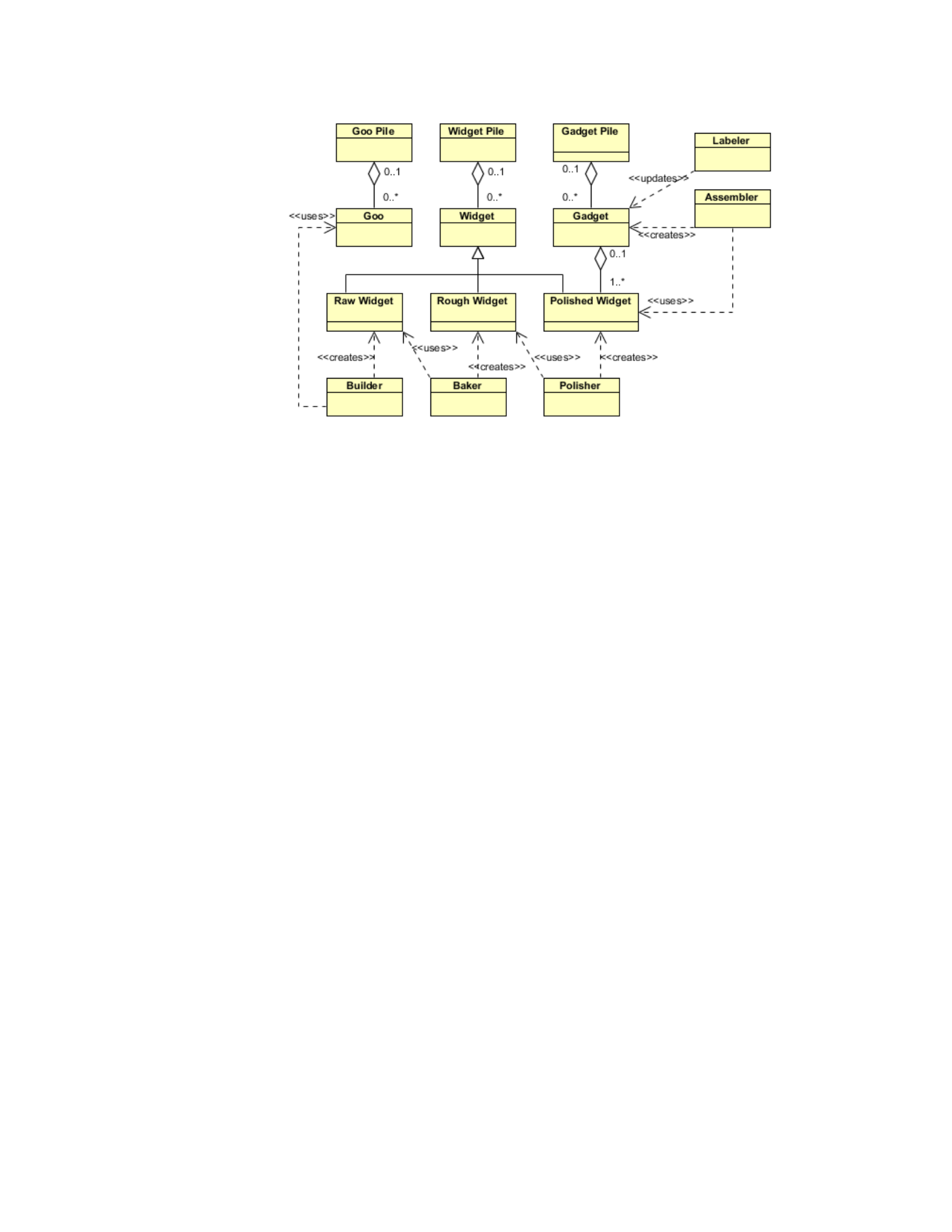
To visualize this, consider an example of a transaction-based manufacturing system that builds Widgets from
Goo and Gadgets from Widgets. See Figure 2-1. The Goo, Widget, and Gadgets are all stored in “piles”. The
9
individual objects and the piles of objects are all shared resources. This system also includes processing
components that handle the manufacturing, namely, Builders that create Raw Widgets from Goo, Bakers that
turn Raw Widgets into Rough Widgets and Polishers that refine Rough Widgets into Polished Widgets.
Finally, there are Assemblers that create Gadgets from Widgets and Labelers that tag the Gadgets with serial
a) Transaction T1
Op1.1: Get Goo from Goo Pile
Op1.2: Give Goo to a Builder and get back a Raw Widget
Op1.3: Give Raw Widget to a Baker and get a Rough Widget
Op1.4: Give Rough Widget to a Polisher and get a Polished Widget
Op1.5: Put Polish Widget in a Widget Pile
b) Transaction T2
Op2.1: Get Widget (W1) from Widget Pile 1
Op2.2: Get Widget (W2) from Widget Pile 2
Op2.3: Give W1 and W2 to Assembler and get a Gadget, G
Op2.4: Put Gadget G in a Gadget Pile
Op2.5: Have Labeler put a tag on G
Figure 2-2. Two Sample Transactions for Constructing Widgets and Gadgets
Figure 2-1. Resources in a Widget and Gadget Manufacturing System
10
numbers. Figure 2-2 lists two simple transactions that represent a) the construction of a Polished Widget and
b) the construction of a Gadget from two Widgets.
Now assume that piles of Goo, Widgets, and Gadgets are distributed across many locations (hosts)
and that Builders are at the same location as Goo Piles; Bakers and Polishers are at the same location as
Widget Piles; and Assemblers and Labelers are close to Gadget Piles, but not necessarily at the same location.
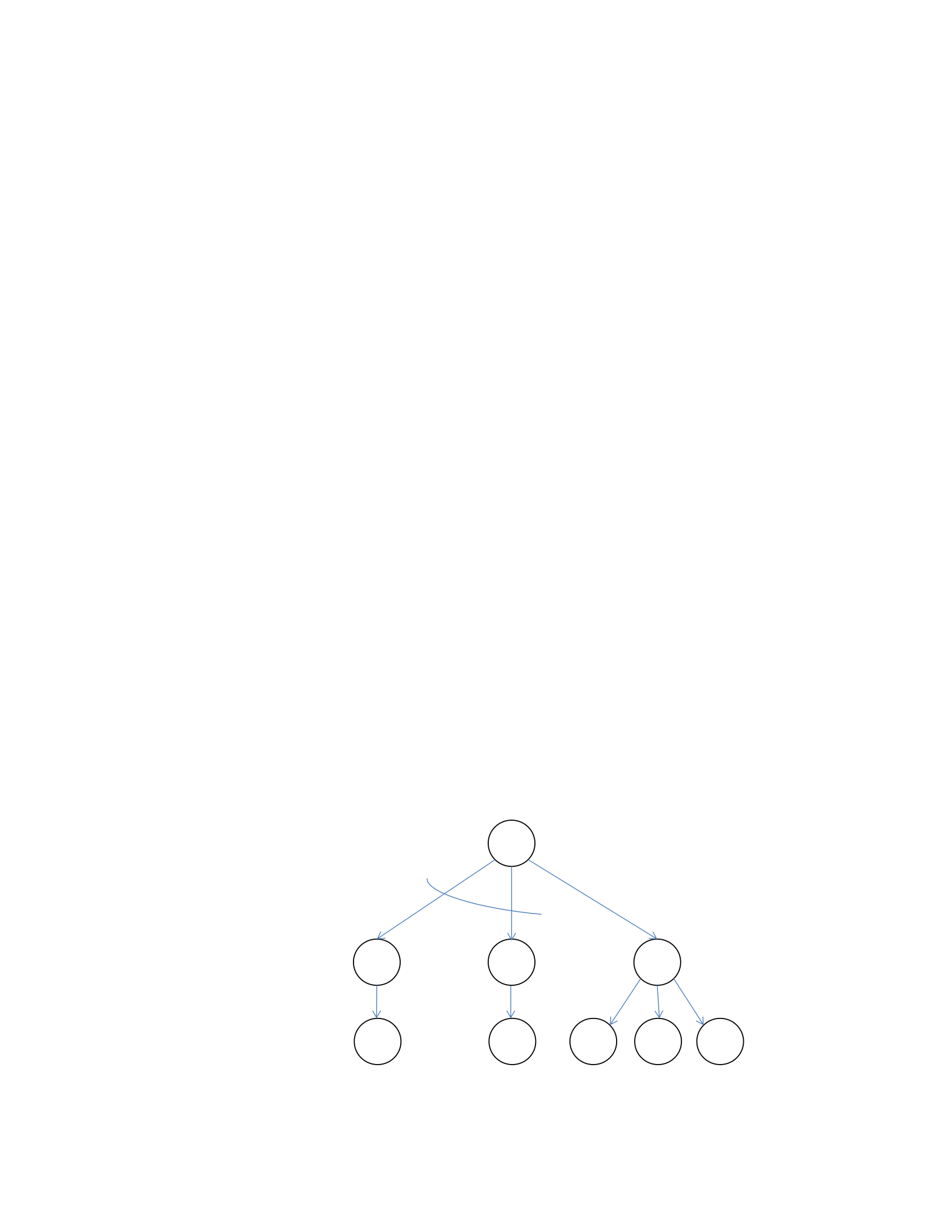
With this distribution of resources, transaction T2 could execute in a distributed manner by having Op2.1
execute in a sub-transaction, ST2.1, Op2.2 execute in another sub-transaction, ST2.2, both on the same host
as the desired Widget Pile, and Op2.3-Op2.5 in a sub-transaction, ST2.3, on the same host as the desired
Gadget Pile. Figure 2-3 represents this distributed transaction as a simple tree with T2 as the root and the
operations as the leaves.
T1 and T2 are just two concrete transactions, but this system could have hundreds of similar
transactions running at the same time. As in all DTPS, each transaction receives a unique identity, i.e.,
Transaction Identifier (TID), when it starts. All references to a transaction will be via this identifier.
Typically, in a DTPS, a Transaction Manager (TM), is responsible for assigning TID’s and keeping track of
parent/sub-transactions relationships.
Beside TID assignment, TM’s are also typically responsible for starting transactions (and sub-
transactions), and ending transactions by either committing or aborting the results. A TM may also oversee
the execution of transaction operations on resources and any necessary concurrency controls, such as locking,
Figure 2-3. Possible Distribution of Transaction T2
T2
ST2.1 ST2.3
Op2.1 Op2.2 Op2.3 Op2.4 Op2.5
Runs on host
with Widget
Pile #1
Runs on
host with
Gadget Pile
ST2.2
Runs on host
with Widget
Pile #2
Concurrently

11
for those resources. Some DTPS delegate these responsibilities to separate components such as Resource
Managers and Lock Managers, but such architectural differences are not important here. For the purpose of
exploring possible transaction-related joinpoints and context information, it is important to just recognize
that operation execution and concurrency control take place with respect to individual resources.
Finally, a TM can also track information about its execution environment, including information
about threads of execution, processes, host machines, secondary storage, and even network connections. It
may do this for a variety of reasons, including performance management, audit trails, and recovery in case
of failure.
A transaction is typically broken up into two basic phases: an execution phase and a commit
phase [4][16][18]. The execution phase is considered tentative, because the changes are not made permanent
until the commit phase. During the execution phase, the TM performs the operations in the body within its
Transaction T2 = new Transaction
T2.Begin
T2.InParallel(
{ SubTransaction T2_1 = T2. CreateSubTransaction
T2_1.Begin
Lock(Widget Pile 1 for Write)
T2_1.Execute(Get Widget W1 from Widget Pile 1)
Unlock(Widget Pile 1)
T2_1.Commit },
{ SubTransaction T2_2 = T2. CreateSubTransaction
T2_2.Begin
Lock(Widget Pile 2 for Write)
T2_2.Execute(Get Widget W2 from Widget Pile 2)
Unlock(Widget Pile 2)
T2_2.Commit } )
SubTransaction T2_3 = T2. CreateSubTransaction
T2_3.Begin
Lock(W1 for Read)
Lock(W2 for Read)
T2_3.Execute(Give W1 and W2 to Assembler and get back Gadget G)
- - Note, this operation doesn’t change W1 or W2
Lock(G for Write)
T2_3. Execute(Put Gadget G in Gadget Pile)
Lock(Gadget Pile for Write)
T2_3. Execute(Have Labeler put a tag on G)
Unlock(W1, W2, G) Gadget Pile)
T2_3.Commit
T2.Commit
Figure 2-4. Pseudo Code for Distributed Version of T2
12
own context. Logically, the operations may result in the tentative changes to shared resources. In a commit
phase, the TM will either finalize all of the tentative changes or abort the transaction.
Three common approaches to concurrency controls are optimistic, timestamp-based, and pessimistic.
Optimistic approaches to concurrency control allow conflicts to occur during the tentative phases of
concurrent transactions, then leave it up to the TM to detect conflicts and abort one or more transactions
when they occur, using either forward or backward validation [27]. Timestamp-based approaches guarantee
serial equivalence [42][43] by imposing an ordering on the execution of the operations in the tentative phase.
Pessimistic approaches use locks to prevent conflicts from occurring in the tentative phase of execution. They
do this by delaying operation execution or by triggering an abort (in the case of deadlock [43]). Locking
schemes vary, but are all based on the premise that a transaction must hold a particular kind of lock before
performing an operation.
A common and simple locking scheme consists of two types of locks: one for read operations and
one write for operations [43]. The pseudo-code in Figure 2-4 includes requests for the appropriate read and
writes locks, following this simple scheme.
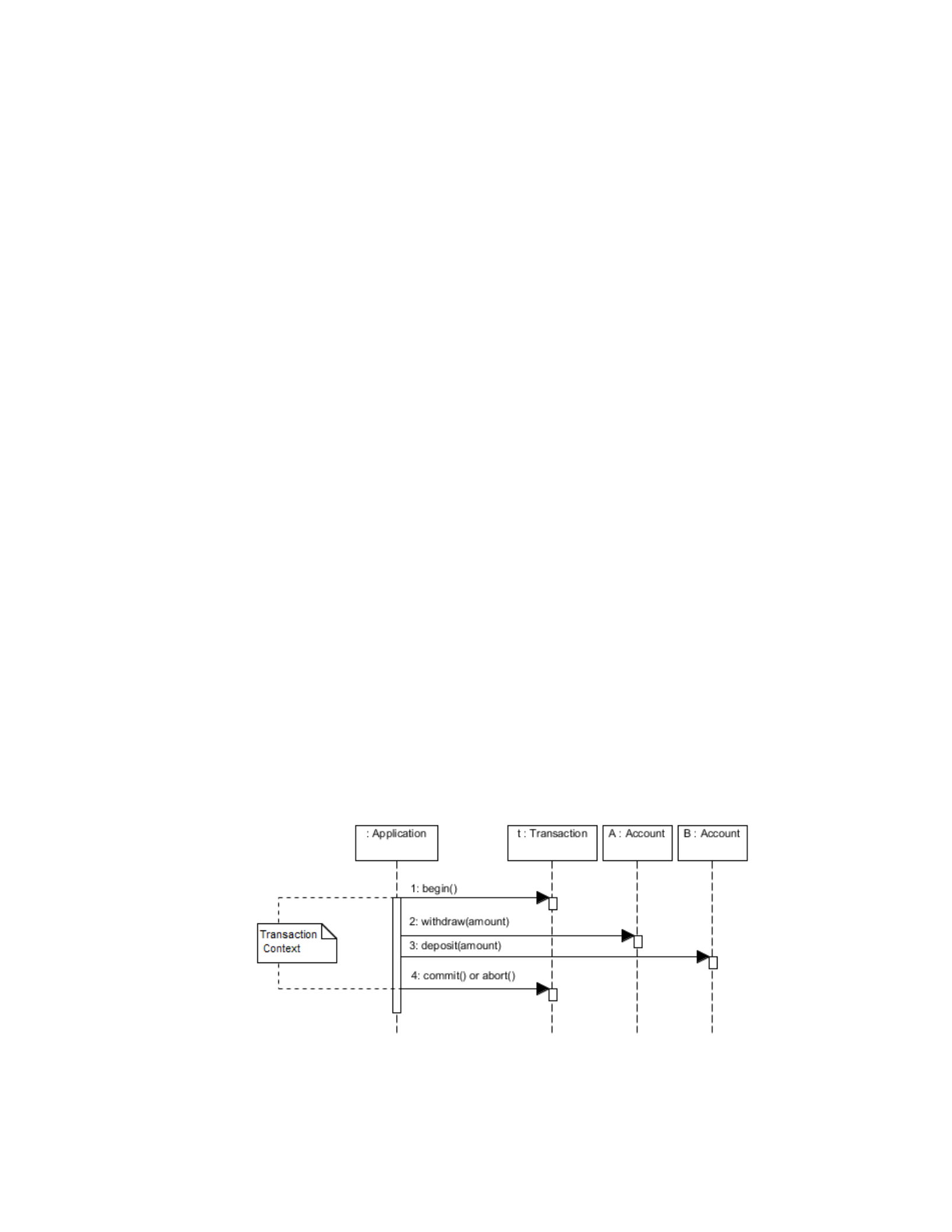
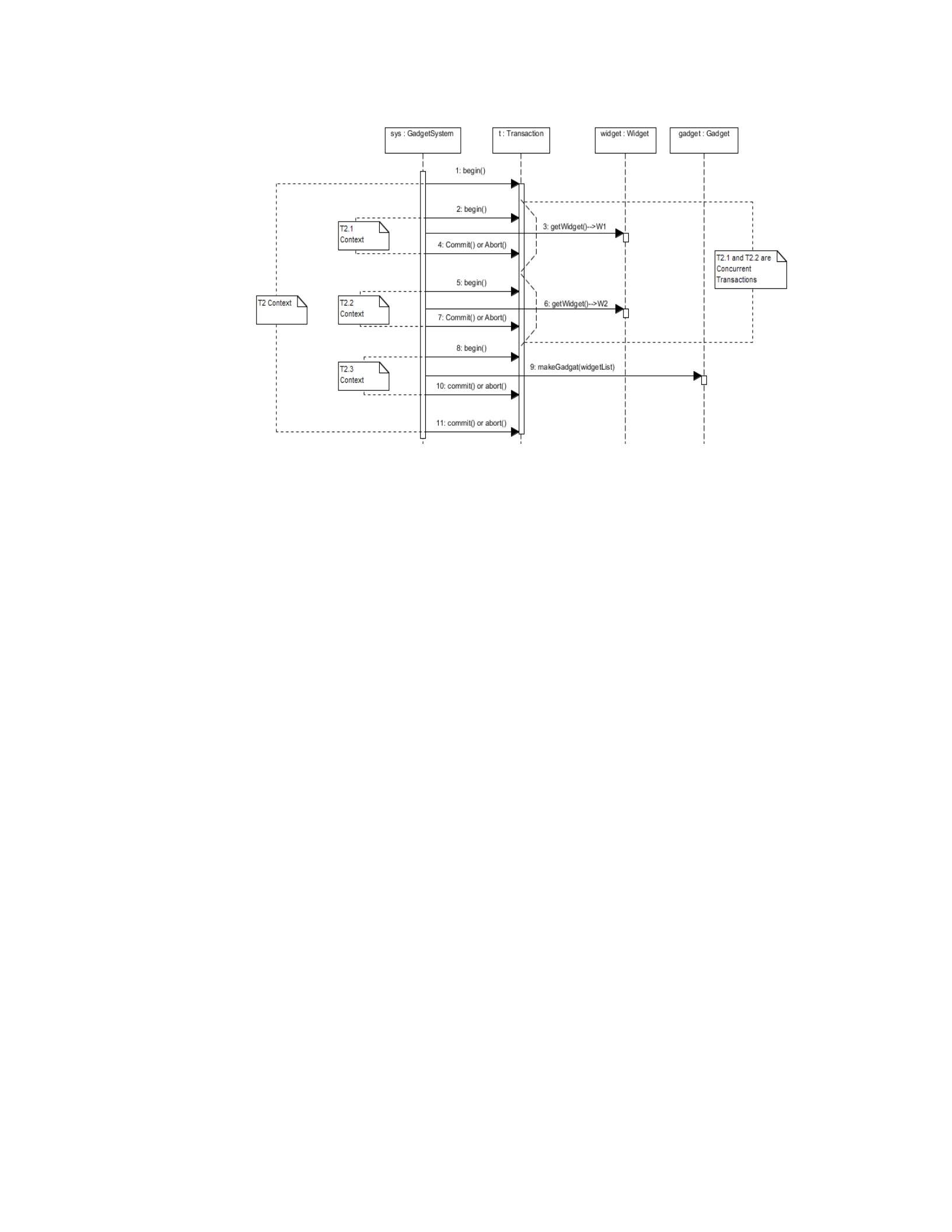
A transaction’s context information includes those pieces of data and metadata that the transaction
needs to be self-contained, guarantee the ACID properties, and support correct execution of both the tentative
and commit phases of execution, as shown in Figure 2-5 and Figure 2-6. Supporting correct execution of the
commit phase means that the context needs to include sufficient information for the TM to decide whether
Figure 2-5. Example of Context in a Flat Transaction
13
the transaction conflicts with other concurrent transactions. However, the details of this context data depend
heavily on the implementation of the DTPS, the types of concurrency control in use, and the commit
algorithm. The only data that are common to virtually all DTPS are the TID and a reference (direct or indirect)
to the responsible TM. Beyond these two items, a transaction’s context may include many different kinds of
implementation specific data, e.g., sets of tentative values, rollback logs, snapshots, lock information,
timestamps, and other kinds of metadata. Therefore, any system that aims to support aspects for transaction
must allow for context information to contain data that specific to a DTPS’s implementation.
2.2 Overview of Java Transaction API (JTA)
The Java Transaction Application Programming Interface (JTA) allows applications to perform
distributed transactions, that is, transactions span multiple data sources. It lets a transactional application to
demarcate transaction boundaries, and allows distributed transactions to be done across multiple X/Open XA
resources in a Java environment [20][40].
JTA is a specification developed under the Java Community Process (JCP) as JSR 907 [19]. It
defines the high-level APIs between a Transaction Manager (TM) and the participants involved in a DTPS,
i.e., transactional application (client and server applications) and the Resource Manager (RM) [19][23][24].
Figure 2-6. Example of Contexts in a Nested Transaction

14
One of the critical advantages of using the JTA API is the separation of concerns in the DTPS, such as
separating transaction management concern from the connection management concern.
In general, a distributed transaction involves many software components: Transaction Manager
(TM), Application Server, Application Program, and Resource Manager (RM). Each of these players
contributes to the DTPS by implementing different sets of transactional APIs and functionalities. The TM
provides the management functions required to support transaction demarcation, transactional resource
management, transaction completion, concurrency, synchronization, and transaction context propagation.
The Application Server provides the infrastructure required to support the application run-time environment,
which includes transaction-state management, such as EJB and JBoss Application Server [20][21][23][24].
The RM provides the application access to resources and supports transaction context propagation. It
participates in distributed transactions by implementing a transaction resource interface used by the TM to
communicate transaction association, transaction completion, and recovery [40].
Interfaces provided by transaction standards are too low-level for most DTA developers. Sun
Microsystems has specified higher-level interfaces to assist in the development of distributed transactional
applications: a high-level Application transaction demarcation interface, a high-level TM interface intended
for Application Server, and a standard Java mapping of the X/Open XA protocol intended for transactional
RM. However, these interfaces are still low-level, and require, the programmer to be concerned with state
management and concurrency for transactional applications [21]. All of these interfaces occur within the
javax.transaction package.
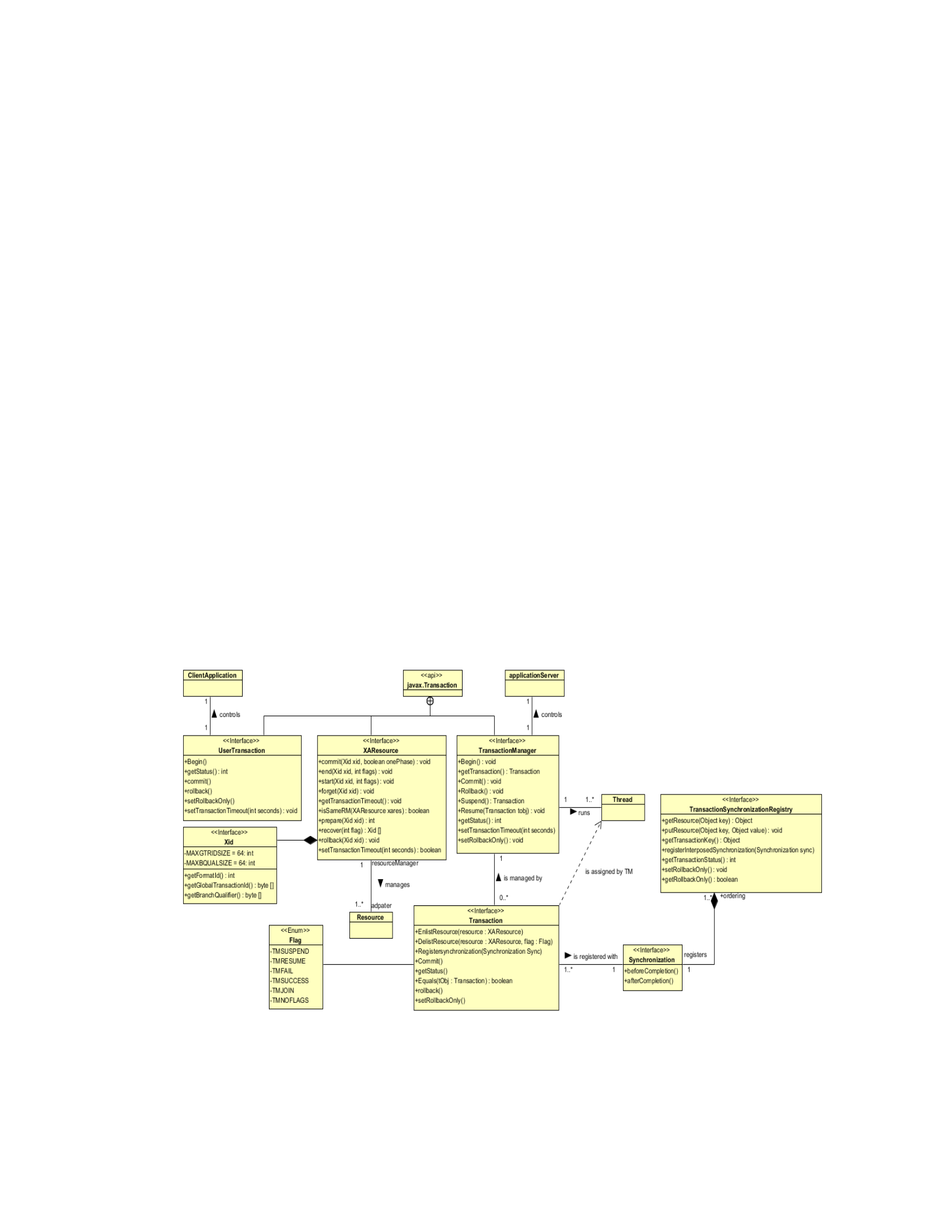
Figure 2-7 illustrates some of the essential JTA’s transaction concepts in perspective of our work,
as described below [22][47]:
Client Application: defines transactions and access resources within transaction boundaries.
UserTransaction: provides applications with the ability to explicitly control transaction boundaries.
It offers methods to begin, commit, rollback, and obtain the status of the transaction associated with
current thread.
Transaction: provides a control of a sequence of tasks of that are associated with target object that
involves resources such as databases, which may include user interface, data retrieval, and
15
communications. It offers methods to begin a transaction, enlist the transactional resources, delist
transactional resources, commit and rollback results for consistent state.
TransactionManager: provides an application server with the ability to control transaction
boundaries on behalf application being managed. It offers functions to maintain and encapsulate the
transaction context and associate it with the calling thread.
XAResource: defines the contract between a RM and a TM in DTPS environment, which supports
association of a transaction to a resource such as Mysql database. Uses the start method to associate
the transaction with the resource, and the end method to disassociate the transaction from the
resource.
The RM is responsible for associating the transaction with all work performed on its data between
the start and end invocations. At commit phase, the TM informs the transactional RMs to prepare (i.e., waiting
for final outcome), commit, or rollback the transaction according to the two-phase commit protocol
(2PC) [38].
Figure 2-7. JTA’s Transaction Elements

16
The commit process in a DTPS that involves multiple distributed resources is somewhat complex
because of the transaction operations may crosscut two or more unrelated software systems and the changes
to the resources must all be committed or rolled back at the same time. Moreover, creating sub-transaction
within an existing transaction (parent transaction), i.e., a nested transaction model, increases the complexity
of implementing the commit process due of sharing of updates from parent transaction to sub-transaction and
difficulty of terminations of nested transactions within interweaving contexts which requires a committed
sub-transaction’s effects become part of the parent, and become permanent only after the parent transaction
commits.
JTA supports interleaving transaction contexts among multiple execution units using the same
resource, as long as lock and release are invoked properly for each transaction context. However, the TM/RM
cannot lock a resource for a transaction until the previous transaction has released [20]. In other words, each
time the resource is used with a different transaction, the method release must be invoked for the previous
transaction that was associated with the resource, and the lock must be invoked for the current transaction
context.
Overview of JTA Implementation
JTA is not a product in itself, but rather a set of Java interface definitions. It’s the actual
implementation of the JTA interfaces that make it possible for a DTPS to execute distributed transactions.
Accordingly, a vendor-specific JTA implementations referred to as a TM’s or transaction services are needed
to actually use the functionality defined in these interfaces. The Implementation details can vary with respect
to JTA concepts, but in general their capabilities are similar. For example, Narayana (Arjuna) [47],
JBossTS [20][21][22], Atomikos [23], and Bitronix [24] are widely popular open source JTA
implementations that touch the architectural concepts of a DTPS. Arjuna, JbossTS, Bitronix, and Atomikos
platforms have been used as open-source TMs that implement the interfaces of JTA, which map the industry
standard, X/Open XA Interface, to Java. One implementation may provide more flexibility over another in
handling a particular situation, but these differences only impact the implementation of the ideas in this
research and not the core contributions. In this dissertation, we focus on the Arjuna. Arjuna allows the JTA
to support nested distributed transactions.

17
One of the cornerstones of the Java Enterprise (J2EE) platform implementations is the Enterprise
JavaBean (EJB) component. This component provides transactional support implementation of the basic JTA
functionalities as a part of its platform. The J2EE specification [44][45] describes the Java Transaction
Service (JTS), how JTA adapts J2EE, and tasks that a certified application server must cope. The
implementation of JTS included in J2EE supports distributed JTA transactions. This is required to access
different data sources within a distributed transaction control. This may allow a J2EE container to weave the
functionality encapsulated in aspects written in an AOPL, like AspectJ. We used this platform to build a
sample of applications (see Appendix A.)
JbossTS is the default TM for Jboss application server (JbossAS). JbossJTA is a middleware
solution that integrates easily with other Jboss frameworks, such as WildFly Application Server, or directly
with standalone Java programs, such as Enterprise Application Platform 6.3 (EAP 6.3). All of the Narayana
JTA classes and interfaces occur within the com.arjuna.ats.jta package (see Section 11.1.1 for more details).
In the implementation of experiment applications, we used the JbossJTA as the TM for local and distributed
JTA applications.
2.3 Overview of Aspect-Oriented Programming
AOP is an extension to OOP that allows developers to extract and untangle secondary concerns from
the primary features of an application. It is difficult to define what constitutes a secondary concern in general
because it depends on the purpose of the software being built. However, secondary concerns often show up
in less-than-expertly-designed object-oriented software as similar snippets of code scattered across multiple
modules or tangled into methods that primarily serve other purposes. A common example is tracing or
logging in a data processing application, where the developers want a chronology of the execution for system
verification, audit-trail, or performance-monitoring measurement reasons. To do this, they might insert logic
throughout the code that writes various messages or statistics to a file. Eventually, these log-writing code
snippets become scattered across the software and tangled in otherwise cohesive methods.
An AOPL, like AspectJ [33], allows a developer to remove all of the log-writing code from the main
application and place that logic in an aspect, which is a class-like abstract data type. An aspect can include
data members, methods, nested types and everything else a class can include. However, they can also include

18
advices and pointcuts. An advice is like a method because it implements some specific behavior; however, it
is not invoked like a method. Instead, the AOPL’s compiler or runtime environment weaves the advice into
the system so it is executed at specific places and time defined by pointcuts. A pointcut is a pattern that
identifies a set of joinpoints, which are best characterized as intervals within the program’s execution flow.
Examples of joinpoints in typical AOPL’s include the execution of a method or the setting of a property.
Consequently, their start and end points map to specific elements of the code, called shadows, which
correspond to places where those intervals may start or end.
When advice executes, it can access context information about the joinpoint at which it was invoked.
This context includes the location of the joinpoint (i.e., the shadow) and runtime information about the objects
involved. Some of the context information is static and therefore can be computed during weaving; other
context is dynamic and depends on the objects involved in the joinpoint.
AOPL’s Implementation: Tools and Frameworks
There are two main approaches for implementing the logic of crosscutting concerns (i.e., aspects)
of an application: asymmetric and symmetric. An asymmetric approach depend on the notion that there is a
core body of code that is then augmented with aspects (i.e., weaving aspect-base) [83][90]. Consequently,
the aspects are typically implemented in an AOP-extension (i.e. AspectJ) of the base language. On the other
hand, in a symmetric approach, there is no distinction between an aspect and a base code (i.e., composition
base-base) [60][83].
Implementation of the crosscutting concerns requires the understanding of how these concerns
interact with other parts of the application. In other words, the JoinPoint Model (JPM) defines the locations
in a code program where/when crosscutting concerns can be applied, a way to choice these locations and a
means of affecting the behavior at these locations.
The weaving of advice into the shadows is an automated process, wherein several of AOP tools
require a special language processor, called an Aspect Weaver. It performs weaving that allows to coordinate
the co-composition of the aspects and application modules. The current most used tools are AspectC++ [34],
AspectJ [8][33], AspectWorkz [9], Jboss AOP [10][20], Spring AOP [11][35]. These tools are built on
principles, which are Advice, Aspect, Joinpoint, and Pointcut. However, they are different in executions and

19
syntaxes, static or dynamic analysis, binding approach, expressiveness, advice weaving-approaches (i.e.,
compile time, runtime time or load time), and their overall academic and industry enhancements.
Jboss Application Server provides an AOP facility [10]. This facility represents the one of the most
aggressive effort to support aspects in an enterprise environment to date. It uses joinpoint constructs called
interceptors that describe points in the application code that are to be aspected. The AspectWorkz as Jboss
AOP, defines aspects and advice code blocks in regular Java classes, while pointcut and advice are defined
using XML configuration files. They perform weaving at runtime using a custom class loader. The JBoss
class loader performs the aspect weaving at deployment time.
Spring AOP is a proxy-based AOP, thus performs weaving at runtime through a dynamic proxy. It
supports only method execution joinpoints - unlike AspectJ, where it supports all joinpoints, such as fields,
methods, constructors, catch blocks in exception handling, etc.
The AJDT plug-in for Eclipse offers powerful support for modular design and implementation of
real world quality software, which includes platform based tool support for AOSD with
AspectJ [3][4][27][36][37]. AspectJ is considered the de facto standard and the most widely used AOP
framework for modeling crosscutting concerns due to its Java-like structure is derived from the JPL, powerful
expressiveness, and debugging abilities, even though it has a little overhead in terms of memory usage and
time. Moreover, the AspectJ weaver can insert an advice block from more than one aspect into application
base code. When the weaver matches a pointcut signature with a joinpoint defined in two or more different
aspects, it may weave the advice blocks in any order with unpredictable results. In this research, we would
limit our implementation and experience to AspectJ for defining the transaction-related crosscutting
concerns.
2.4 Crosscutting Concerns in Transaction
Even though the distribution [36][106], concurrency [43], persistency [36][49], and failures [15][49]
are major concerns in many current large-scale DTAs, current research show that AOP methodology is very
powerful and using it through AspectJ can enable development of concise, modular, efficient, flexible and
cost-effective source code in shorter span of time [7][14][30][31][32][107][110][111]. Improvement in
modularity, decrease in complexity and enhancement to the reusability of the software are also reported. Such

20
an improvement often proposes mechanisms to disclose the code and structure of the scattered and tangled
snippets in the execution of the applications.
The number and variety of crosscutting concerns in a DTPS are perhaps infinite. However, for
illustrative purposes, we will consider just one here. Imagine that we would like to optimize the Gadget
manufacturing system such that Widgets were created just in time, by making sure there are always some
Widgets in a pile, but never in excess.
Such flow-control or timing issues could be considered a secondary crosscutting concern to the basic
Gadget assembly problem. By talking with the domain experts, we would probably discover a couple of basic
rules that govern when the Widget product needs to be speed up or slowed down. An object-oriented
programmer could embed the logic for these rules into the implement of the Builder, Baker, Polisher, or
some other set of components. With some skill, it is possible that the object-oriented programmer might even
be able to do this in a modular and reusable way.
With transaction aspects, an AOP programmer, however, would have a much similar option.
Basically, the programmer would encapsulate the logic for speeding up or slowing down widget production
into an aspect, maybe called something like WidgetProductionSpeedControl. This aspect would include
advice that could be woven before (or around) any operation that accesses a Widget pile. The advice’s logic
would speed up Widget product if the pile was getting too small or slow it down if the pile was getting too
large. The aspect would also include a simple pointcut that defined a pattern for all relevant joinpoints. The
original application code would not need to be aware of the new production-speed control logic. In fact,
because of this obliviousness, it could be tested with or without the speed control functionality without any
reprogramming of the system.
AspectJ by itself does not help programmers to encapsulate such logic in modular, reusable
abstractions. To make things worse, this new production-speed control logic might change (evolve) as other
features evolve in the system such as performance. What makes adding this new production-speed control
logic difficult is its crosscutting nature: the implementation of production-speed control, using the object-
oriented modularization technique, requires change in various places in the code. In other words, the
production-speed control’s code cannot be encapsulated in one place and is scattered throughout the code.
The programmers need a modular reasoning approach to discover the code and the structure of the
21
crosscutting concerns that access the Widget pile; whereas she would most likely need global reasoning when
using traditional OO techniques [29]. However, it is not clear what discipline would help programmers in
AspectJ obtain modular reasoning for such concerns. Specifically, the obliviousness property of AspectJ
conflicts with the ability to reason about programs in a modular fashion. Therefore, the developer may end
up struggling with unnecessary coupling (i.e., lack of obliviousness), compromised flexibility, and less
reusable code. Briefly, the application developer must be aware that the separation does not imply a common
semantic decoupling.
To resolve this situation, the programmer needs a mechanism that not only does allow expressing
the transaction crosscutting features without breaking the existing system, but also helps to do it in a
modularized and reusable fashion. One way of accommodating this through providing a mechanism to
leverage low-level aspects, i.e., base aspects, to provide customizable run-time trace transaction, designed to
enhance understanding of transaction systems infrastructure software. Each of the low-level aspects is
individually reusable and does know about the specific details in transactions’ contexts in which it is used.
This makes it possible to share runtime information among the aspects that allow the programmer to
encapsulate the code for a particular concern in one place and modularize reusable crosscutting functionality
within aspects. Each of these aspects provides a well-defined common reusable functionality, which, as it
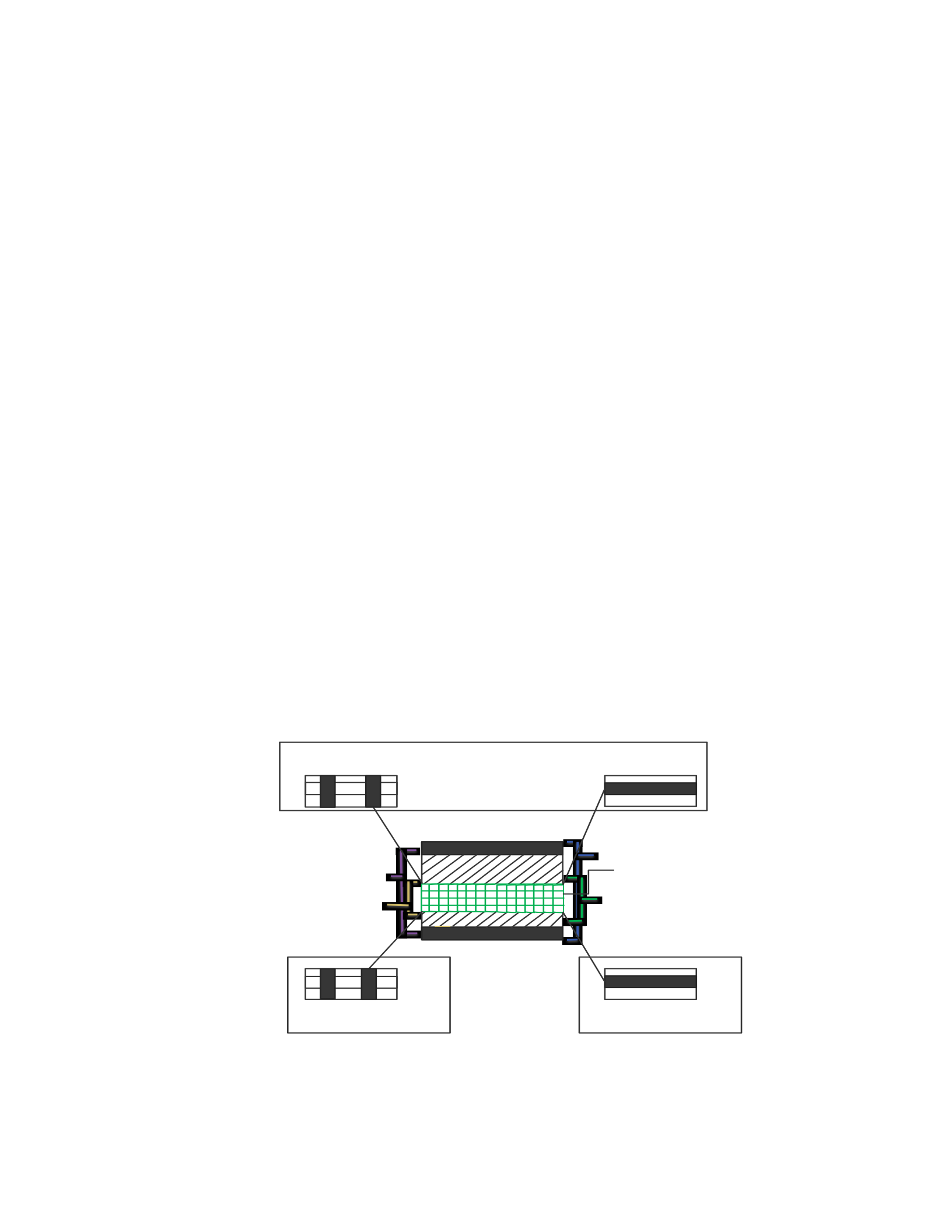
Figure 2-8. Transaction Code Tangling in a Module Logic and Code Scattering of Transaction
Concerns
Host 3Host 2
Host 1
Module logic
Tracing
Security Transaction
Concurrency Control
Performance
Module A Module B
Module C Module D

22
turns out, is often needed in applications to perform a specific behviour. To allow the aspects to be used in
other transaction-related contexts, they should be carefully configured, designed and composed to be
reusable.
Figure 2-8 shows how a module may look like in a system in which transaction crosscutting
concerns are not modularized. The module is implementing a transactional feature in the module logic,
however, there are pieces of code that belong to other concerns in the system, such as concurrency control,
performance, security, audit trail, and tracing. In other words, the module implements pieces of multiple
transaction concerns and the transaction itself. This presence of portions of implementation of multiple
concerns in a module is referred to as code tangling. The implementation of a crosscutting concern like
concurrency control can be present in many other modules, even in other crosscutting modules spread in
many other distributed hosts.
Code scattering can occur in two different ways [76]. It occurs when a piece of implementation
repeatedly appears in many modules, as shown in Figure 2-8. It can also be the result of complementary
fragments of implementation appearing in several modules that may be distributed over many hosts as listed
below. For instance, concurrency controls, like lock and unlock operations, occur in different modules in a
system, even for the same resources. In a nutshell, Code tangling and code scattering negatively affect
software design and development by causing poor traceability, lower productivity, lower code reuse, poor
performance, poor quality, harder evolution, and may lower efficiency [26].
In fact, a DTPS could be further complicated by implementing other transaction-related crosscutting
concerns as listed below, because they pertain to multiple parts of a core or base transaction system.
• Transaction Monitoring.
• Measuring transaction system throughput.
• Measuring transaction-based application responsiveness between clients and distributed servers, in
other words, measuring turnaround performance for an individual transaction, the nested distributed
transactions, and the complete execution of a transaction.
• Optimization using distribution whose implementation is distributed across multiple DTPS’s
modules to optimize the throughput of the DTPS workload-based on the most likely behavior of a

23
transaction. It helps programmers to determine the most efficient way to execute a transaction by
considering the possible behaviors on shared resources.
• Implementing a data-sharing optimization mechanism to share of context information across hosts
only when necessary.
• Simulating transactions in a DTPS to test a specific process.
• Tracking consistent and secure transactions or handling authentication permissions in transaction
domain.
• Adding a new security-level to validate state of shared data coming to/from data sources.
• Measuring the amount of threads being used to serve a specific transaction.
• Logging is a typical crosscutting concern that span multiple objects or modules in different level of
abstractions within a DTPS. It records information about a transaction’s operation executions and
distributed resources in a specific developer-defined format.
• Implementing an audit trail mechanism can be complicated and not modular in a DTPS, because its
code is spread over multiple units and transaction components in order to capture a historical record
to find out who has access, and what transaction he/she has performed during a given period of time,
and when the data is changed.
• Implementing Just-In-Time (JIT) strategy that would be a crosscutting concern since it touch more
parts of the transaction contexts to gather and deliver the context information only when necessary.
• The notification in a DTPS that is often scattered and tangled because it uses to detect critical errors,
exceptions, time-based expiration, and the invalid state.
• Implementing security, specifically authorization and validation rules can adversely affect DTPS’s
implementation due to increase the complexity of existing business logic to track consistent, secure
transactions, and handle authentication permissions in DTPSs.
• Scattering the logic of concurrency and synchronization techniques throughout different elements of
the DTPS and implementing similar snippets of code in such elements.
• The nature of the volume, and velocity of transactions reinforce the overall complexity of a DTPS.
o Volume of transactions: the amount of the transactions (committed and aborted) in an
application to deal with the transaction system requirements.

24
o Velocity of transactions: a rate of transactions that are executed per minute.
o Number of transactions that are involved in the deadlock.
Role of the AspectJ for Encapsulating Transaction Requirements
Although AOP promises increase readability, reusability and maintainability, it also requires special
attention from the developers [51][52]. Building an AO application is a complicated process that involves a
lot of effort. Also, since AO software development is fairly a new approach, it lacks a certain methodology
that can be applied. In our experiment, we use AspectJ as a representative AOPL and use transaction concepts
as a fundamental paradigm to handle transaction-related crosscutting concerns. For example, there are various
thoughts on what AspectJ can achieve and what it cannot. In [28], Kienzle provides a good discussion that
analyzes the limitations of AOP, in which the author try to use AOP techniques to separate transaction-related
concepts from the core other parts of the application. However, this attempt shows that transaction must be
kept in mind throughout the entire application development, that it cannot be completely extracted to a
separate aspect. This supports the argument that AspectJ by itself is insufficient to encapsulating transaction-
related crosscutting concerns.
For example, if a programmer wants to measure turnaround performance for transactions in AspectJ,
the programmer would have to implement some advices to start a process that would capture the time at
which a transaction is begun and other advice they would capture the time at which the transaction is
committed/aborted and then compare the two times (see Chapter 6). However, begin and commit/abort logic
for the transaction may be in separate modules, may be separated in the execution flow by an undetermined
amount of time, and may even be handled on separate execution threads or separate hosts. Furthermore, the
nested transaction may start many sub-transactions at the same time, and the advice would have to weave the
time of a begin sub-transaction with the commit time of the sub-transaction. In a nutshell, the weakness of
AspectJ is that its pointcut designators and joinpoint contexts are limited to standard programming constructs,
and do not deal the high-level run-time abstractions, i.e., entire transaction.
AspectJ, like other AOPLs, does not allow a programmer to define the independent aspect to this
concern, because it cannot capture behavior that spans across several modules and expose the related context
information that’s associated with the complete execution of a transaction. AspectJ’s pointcut designators

25
remain weak relative to weaving crosscutting concerns into transaction abstractions, which we can’t easily
define by available designators. Specifically, programmers cannot deal with code transaction as predicates,
which select transaction joinpoints based on their properties and the relevant context. However, we believe
that AspectJ has a good potential to deal with code constructs, so programmers would only be able to weave
concerns into the underlying transaction operations, such as begin, commit, abort, start, and end. Also, the
programmers would have to explicitly code mechanisms for tracking transaction contexts (transaction
context, lock context, and operation context).
To address this problem for transactions, we will develop an extension to AspectJ framework, called
TransJ, that allows developers to define pointcuts in terms of transaction abstractions and that automatically
keeps track of context information for transactions. The following section provides a high-level overview of
TransJ’s architecture.
26
TRANSJ ARCHITECTURE
3.1 Overview
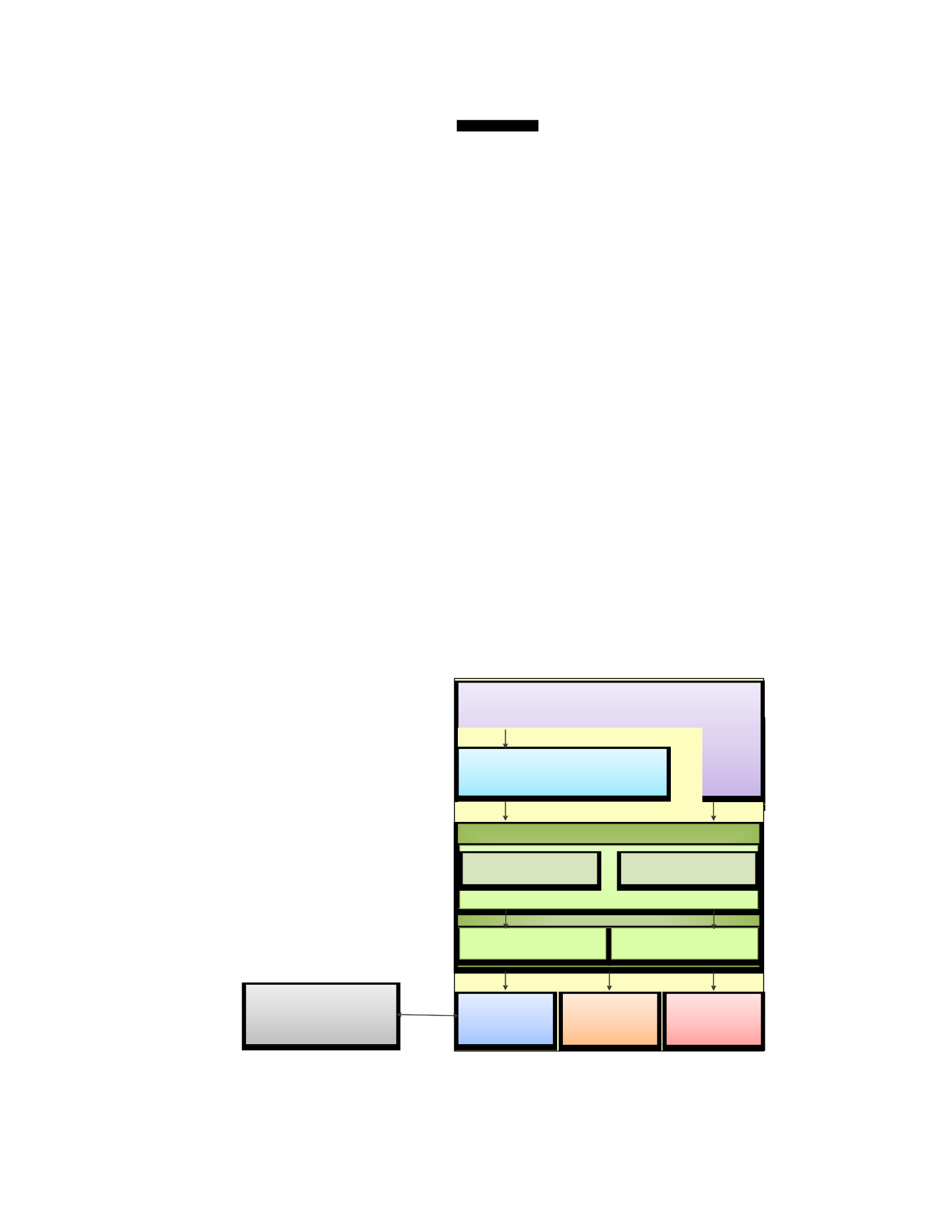
Figure 3-1 represents the relationships between the principal parts and functions in TransJ. In other
words, it is an architectural block diagram of TransJ, in which the colored blocks represent relevant
conceptual layers, and arrows depict dependencies among these layers. It describes the TransJ’s design at a
higher level, with less detailed description aimed more at understanding the overall of its concepts and less
in understanding the details of implementation [56][114]. We adopt a strategy of top-down to the design of
the TransJ with a layered architectural design [56][57], in which each layer embodies a reusable function or
the logical component and provides services to the layer above it and uses the services of the layer below it.
Overall TransJ represents a set of principles that provide an abstract framework to promote code
reuse through managing the complexity of DTPS’s design while preserving the performance. Specifically,
the core TransJ infrastructure layer enables aspect-oriented developers to treat transactions as first-class
Figure 3-1. The Architectural Pattern to TransJ
Base Advices
Core TransJ Infrastructure
Pointcuts
Base Aspects
Context Tracking Joinpoint Tracking
JTA UMJDT
AspectJ
Application Server
Application-Level Aspects
Reusable Aspects

27
concepts into which AspectJ framework can weave crosscutting concerns in a modular way, i.e., transaction
aspects. This promotes greater enhancements, obliviousness, localization along with code reusability, but
may have some performance impacts as well. The following sub-sections provide some necessary details
about each of the layers in the order from top to bottom, that will ultimately set the stage to assess whether
the benefits are achieved.
3.2 Application-level Aspect Layer
Application layer represents an abstraction layer that contains a set of common transaction-related
aspects, which encapsulate base-application requirements. The aspects of this layer are aspects of aspects. In
other words, we can build application-level aspects either by extending the abstract aspects provided by the
reusable aspects or/and base aspects in core TransJ. This type of aspects can help developers to encapsulate
the business requirements of the application into high-level aspects. For example, a manufacturing system
would have a number of application-level aspects, such as production speed control, measuring performance,
logging, load balancing and more. Among them, the logic of Widget production speed control concern can
be written at the application-level using the base aspects, which extends pointcut constructs that select
appropriate operation joinpoints, where WidgetProductionSpeedControl aspect should be woven (see
Section 6.4).
Application-level aspects can use directly either the base aspects or the abstractions provided by
TransJ to access metadata that related to transactions, operations and the affected resources that are pulled
by context trackers. This type of information can describe the expected behavior of the transaction with
respect to the context in which it is running such as lock context, operation context, or transaction context
(Section 4.1.2 for more details). Our goal is for resultant application-level aspects are easy-to-code, more
reusable, understandable, predictable, flexible and modular than similar concerns, programmed in AspectJ
or OOP fashion. (Chapter 6 provides more details)
3.3 Reusable Aspect Layer
The definition of the reusable layer within the scope of TransJ is a layer responsible for providing
a set of helpful aspects that encapsulate common transaction-related crosscutting concerns and exposing

28
relevant context data that application aspects must consider once weaving advices. Overall the reusable
aspects represent general crosscutting concerns commonly found in applications with significant transaction
requirements, and therefore can be woven in DTPSs where a transaction-related concern is applicable. In
other words, this layer represents a toolkit-like collection of transaction aspects that developers should find
useful for in several of DTAs. These reusable aspects depend on a set of the core TransJ aspects that can
decrease the development time to program application-level aspects, and make them more understandable,
reusable, predictable, and oblivious. To ensure that is done effectively, we need appropriate, precise
specifications of such aspects that can then be used to understand the behavior of the DTPSs and introduce
behaviors into complex like nested distributed transactions. The core TransJ provides specifications for
reusable aspects. This kind of aspect is conceptually inspired from the key transaction joinpoints defined in
the UMJDT. Chapter 6 provides more details and examples.
3.4 Core TransJ Infrastructure Layer
The TransJ is a library that introduces a transaction JPM on top of AspectJ JPM. It consists of
components for tracking transaction contexts and joinpoints; base aspects that core transaction abstractions;
and a collection of pointcuts for transaction operations. The base aspects include base advices that embody
and augment the behavior of a transaction; and a collection of pointcuts for gathering context information
that can be used in the advice code.
We specify the behavior of transaction aspects in terms abstraction concepts that to any DTPS built
using JTA and XA [20]. These abstract aspects define one or more pointcuts and items of advices that will
execute when transaction reaches joinpoints matching these pointcuts.
The Context and Joinpoint tracking (trackers) encapsulate hooks into the underlying transactions
subsystems, such as JTA transaction and UMJDT transaction, in which pull relevant context information for
transaction base aspects and keep track the start and end points of the joinpoint. If those changes, one only
needs to replace or extend these trackers. The base aspects make use of the context information provided by
the context tracking and allow reusable or application-level aspects specific to individual transactions. The
joinpoints defined in the TransJ core Infrastructure give the reusable aspect and application-level aspect
convenience, reusable pointcuts for transactional joinpoints.

29
3.5 Unified Model for Joinpoints in Distributed Transaction (UMJDT)
UMJDT is a formal description of common knowledge related to transactions. It describes a
common conceptual understanding about transactions to encapsulate any complex relationship, which can
exist in a DTPS. Specifically, it unifies DTPS concepts related to a) transactions in general, b) the kinds of
information that comprise their context, and c) events that represent interesting time points/places for
when/where the crosscutting concerns might augment an application’s core functional or the underlying
transaction processing system. Therefore, it has become a foundation for weaving transaction aspects into
high-level abstraction, i.e., transaction (see Chapter 4 for more details.)
3.6 Java Transaction API (JTA)
JTA is another foundation part of TransJ architecture. It offers a procedural interface to transactions
and resources, including several methods that allows an application developer to start, join, commit, and
abort transactions (See Chapter 2 for more operations and details). Begin operation, which starts a new
transaction or a nested transaction within an already ongoing one; commit operation, which attempts to
commit the current transaction; abort operation, which forces the transaction to rollback, and more. In
addition, it provides multithreaded transaction models provide additional operations to allow threads to join
an ongoing transaction (join operation), which allows the calling thread to join the transaction with the current
transaction context. TransJ’s pointcuts tied to the JTA constructs.
3.7 AspectJ Framework
The TransJ infrastructure realizes the UMJDT [18] for AspectJ [8]. In AspectJ, the joinpoints are
certain well-defined points in the execution flow of a Java program. These include method and constructor
calls or executions, field accesses, object and class initialization, and others. Pointcut designators allow an
aspect developer to choose a certain set of joinpoints, which can further be composed with Boolean operations
to build up other pointcuts. It is also possible to use wild cards when specifying, for instance, a method
signature [8]. The transaction pointcuts in core TransJ infrastructure will build on standard AspectJ pointcut
designators. In addition, the core TransJ infrastructure would do not constrain to use any AspectJ feature,

30
such as programmer-defined pointcuts, advice, inter-type declarations, etc. (See Section 2.4.1 for more
details.)
3.8 Application Server
Typically, to handle a transaction across multiple distributed resources, we need an application
server. It is not part of the architecture of the TransJ, but it enables distributed transactions across multiple
hosts. For our implementation of TransJ and experience, we have selected the Red Hat Jboss Enterprise
Application Platform (EAP) 6.4. This platform provides all transaction-related concepts, implements JTA
API, concurrency control (locking) and supports nested distributed transaction systems [21].
3.9 Initial Theoretical Comparison of TransJ to AspectJ
The layers represented in this Chapter can offer software system developers with a number of
important benefits when it comes to managing the complexity of transactions in applications.
We chose to implement TransJ in AspectJ since it is currently one of the most popular,
expressiveness and stable AOPLs. Nevertheless, the current AspectJ capabilities are not sufficient to express
crosscutting concerns related to transactions, we believe the TransJ can do better to localize and encapsulate
crosscutting concerns that apply to transactions as execution units since it provides:
A Design Space for New Language Constructs for Transactions: Better Abstractions for Transactions
o TransJ aspectizes transaction concepts to provide loosely coupled abstractions, which allow
programmers directly weave advices into high-level abstractions, like transactions. Therefore,
TransJ provides better abstractions that unify transaction concepts. In comparison, AspectJ
weakly encapsulates and modularizes transaction concerns due to limited abstractions of the
underlying AspectJ and need multiple pointcut definitions to overcome different types of
transaction abstractions for an individual or a nested distributed transaction such as the
concurrency control, and transaction itself.
Improved the Reusability:
o TransJ allows programmers to capture transaction-related concerns (e.g., security, performance
measurements, exception handling), into well-modularized entities (e.g., reusable aspects and

31
application-level aspects) that would be woven into high-level runtime abstractions, in which
developers can implement these concerns in cohesive and loosely coupled aspects. In comparison,
AspectJ needs to program intricate forms of coupling, (i.e., tight coupling), which in turn might
jeopardize reusability.
Joinpoint Model Formalizes Transactional Joinpoints:
o In TransJ, programmers can define pointcuts using terms are related directly to general transaction
concepts, which can access the transaction state and the context information about the joinpoint
at which it was invoked. In comparison, AspectJ provides no vocabulary for defining transaction-
related joinpoints and pointcuts.
High-level Encapsulations, and Localized the Design Decisions:
o TransJ provides a rich set of reusable aspects that correspond to crosscutting concerns that occur
in many DTPSs. These aspects can be extended from abstract base aspects to implement
transaction-related crosscutting concerns in several applications. The reusable aspects also
localize internal design decisions, and encapsulate many complex mechanisms such as tracking
the context information, and joinpoints. With AspectJ, the developer would need to define
complex data structure and explicit mechanisms to combine context information with the effect
of the advice code to arrive at the richer behavior of the transaction method.
Improved Modularity and Obliviousness:
o TransJ completely separates transactional interfaces (begin, commit, rollback, setlock, release,
etc.) from the main functional transaction concepts, and have these encapsulated within code
invoked through specific aspects. Therefore, developers can capture the crosscutting concern for
transactions in terms of general begin, commit, abort, start and end joinpoints, regardless of the
underlying concepts of transaction, distribution, management, execution, synchronization and
concurrency control. With AspectJ, application programmers hardly write understandable aspect
code for transactions, because programming abstractions vary with the underlying transaction
mechanisms or characteristics. For example, the transactions might span many different threads
or hosts and be interleaved with the execution of many other concurrent transactions.
Better Ways to Detangle Transaction Constructs from Core Application:

32
o AspectJ doesn’t provide any abstractions to help alleviate redundant and tangled code of the
distributed transaction requirements. In comparison, TransJ is a layer of abstraction on top of
AspectJ and JTA helps to program the transaction aspects in a uniform manner, hence, it makes
them more detangled, reusable and flexible aspects than similar crosscutting concerns that are
programmed in AspectJ’s fashion. In addition, TransJ approach provides the logic source code is
much easier to read and understand, without the clutter of the code needed to support transaction-
related crosscutting concerns.
More Fluid to Code Transaction-Related Crosscutting Concerns:
o AspectJ directly cannot provide pointcuts to gather transaction contexts that may be shared among
multiple threads or hosts. In doing so, the developers would need to define considerably more
complex pointcuts to program the logic of transaction concerns away from the underlying
application logic. On the contrary, it becomes very easy to program transaction concerns using
TransJ’s pointcuts with fewer lines of code. The core TransJ infrastructure layer of abstraction
on top of AspectJ helps developers to track contexts and joinpoints, which make context
information more fluid than similar crosscutting concerns, programmed in directly AspectJ.
Conceptual Model Captures Transaction Context Information
o TransJ provides low-level distributed aspects that track context information in order to perform
the expected weaving into abstractions that span multiple threads of execution and may be
interleaved with concurrent execution of similar abstraction. With AspectJ only, developers
would need complex data structures and explicit mechanisms in order to pull together all of the
relevant data that needs to make up a transaction context to weave an applicable advice.
Better Organized Transaction Concerns:
o In TransJ, application-level aspect shows the code of transaction concerns more classy,
structured, and predictable than the same concerns programmed in AspectJ.
The results of the experiment in this dissertation (see Chapter 10) provide some preliminary
evidence that TransJ truly realized these benefits.
33
REFERENCE MODEL FOR TRANSJ
This Chapter describes a conceptual model that provides a theoretical foundation for TransJ, namely
jointpoints, contexts and tracking.
4.1 High-level Overview
Overall TransJ enables the separating of complex transaction concerns into manageable cohesive
concepts and promotes greater reuse while maintaining the efficiency.
Transaction Events and Possible Joinpoints
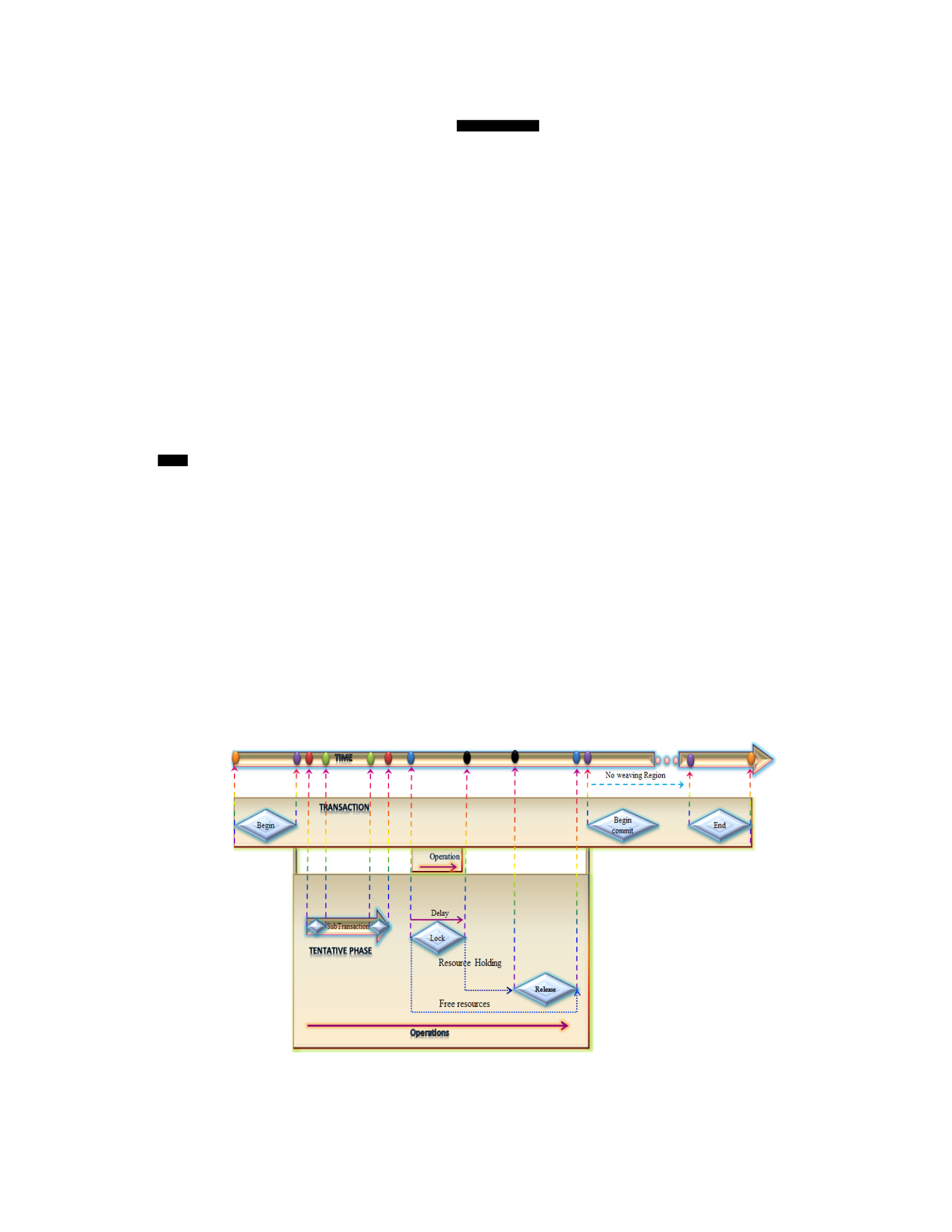
Figure 4-1 uses colored dots in the timeline of the transaction to represent a formal semantics for
joinpoints along with a specified time interval. These dots actually correspond to the high-level abstractions
that help in managing transaction complexity and enabling compositional logic. These are dubbed
transactional joinpoint events. These events allow the simple solutions to the design of interesting high-level
abstractions in transaction programming. For example, managed concurrency can be treated as a high-level
Figure 4-1. Transaction Events and Possible Joinpoints

34
abstraction to lock and release different resources, whereas in other a non-abstract, non-modular concept is
required. Likewise, the entire transaction can also be implemented as an abstract transactional event, which
introduces a new type of joinpoint constructs. As described below, Figure 4-1 represents different kinds of
potential joinpoints in transactions as follows: an outer region that maps the interval that spans the entire
transaction execution, starting before the transaction event begins and ending after the event is committed or
aborted. These transaction events are termed Begin Event and (Commit Event or Abort Event), respectively;
an inner region that maps the interval that spans the entire transaction execution, and a sequence of intervals
(e.g., sub-transactions or operations), starting after the transaction event begins and ending before beginning
the event is committed or aborted. These transaction events are termed Begin Event and (Commit Event or
Abort Event), respectively; a marked-acquired lock region that maps to the interval when the lock is
requested, starting before the transaction invokes a lock event for a specific resource and ending after the
lock event is granted or denied. These events are termed Begin Request lock Event and End Request lock
Event, respectively; a resource holding region that maps to the interval when the lock is held, staring after
the transaction granted the required lock and ending before the transaction mark the lock as free. These
transaction events are termed hold Event and release hold Event, respectively; Operation (arrow) represents
a transaction operation region that maps to the interval when the operation is executed, staring before the
transaction operation is invoked and ending after the transaction operation exits. These transaction events are
termed hold Event and release hold Event, respectively.
Potential Joinpoints and the Scope of the Context
From an advise-weaving perspective, joinpoints map to places where weaving occurs – hence the
use of “point” in the name. However, from an execution perspective, a joinpoint represents a logical interval
of time in a flow of execution. It has a beginning and an end, and advice can be woven into the flow of
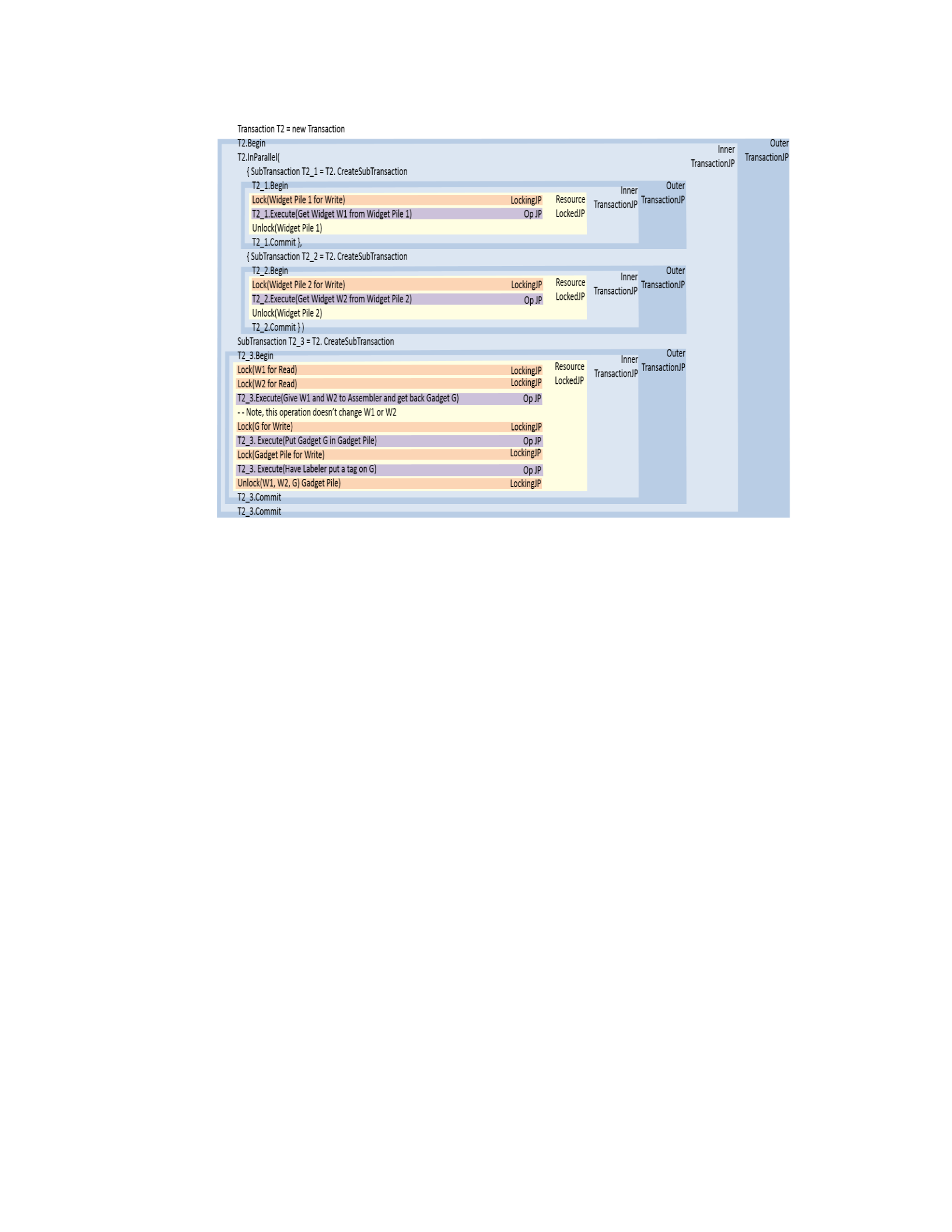
execution before, after, or around it. This section presents Figure 4-2 as a pseudo-code for the implementation
of T2 annotations that illustrates five new types of joinpoints for DTPS’s: outer transaction, inner transaction,
resource locked, locking, and operation. Each type of joinpoint is shown in a different color. This section
also discusses interesting metadata that advice might want to use, and therefore should be part of joinpoint
contexts.
35
An Outer Transaction Joinpoint represents the interval that spans the complete execution of a
transaction, starting just before the tentative phase and ending after the completion of the commit phase. This
kind of joinpoint would allow a programmer to introduce advice before, after or around an entire transaction.
However, because it starts before the beginning of the tentative phase, any “before” advice would not have
access to the target transaction’s context information. However, it would have access to a parent transaction’s
context, which would be particularly important for advice before or around sub-transactions.
An Inner Transaction Joinpoint is similar to an Outer Transaction Joinpoint, except that it starts just
after the tentative phase begins and ends just before the commit phase ends. Advice woven before this kind
of joinpoint would have access to the target transaction’s context.
A Resource-locked Joinpoint represents the interval that spans the time when a lock is held, starting
after acquiring the lock and ending just before its release. Advice woven before, after or around this type of
joinpoint would have access to metadata about the lock, the associated resources and, of course, the
transaction.
Figure 4-2. Pseudo Code for Distributed Version of T2 and the Potential Transaction Joinpoints within
the Scope of the T2’s Context
36
A Locking Joinpoint represents the interval that spans a lock request. In other words, it begins as a
request is made and ends when the request is granted or denied. Advice woven before, after, or around a
Locking Joinpoint can access metadata about the type of lock being requested or the resource.
An Operation Joinpoint is an interval that spans one operation in the execution of the tentative phase
of a transaction. Such advice would access metadata about the operation and the affected resources, as well
as the transaction at large.
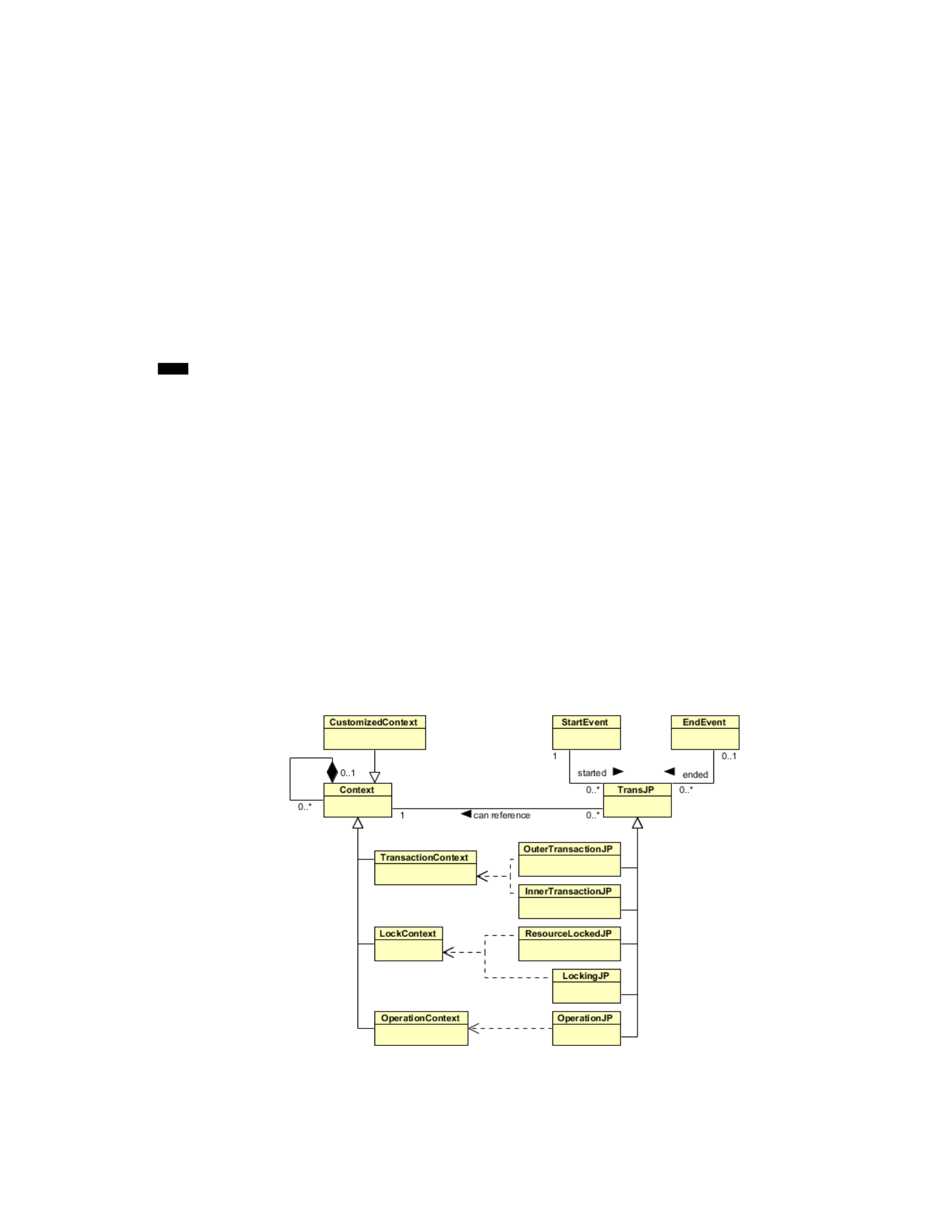
Unified Conceptual Model for Joinpoints in Distributed Transactions (UMJDT)
Figure 4-3 shows part of the UML model, called the Unified Model for Joinpoints in Distributed
Transactions (UMJDT), which captures the key ideas for the new transaction joinpoints and related context
information [18]. The class labeled TransJP is a generalization of the joinpoints as discussed above. By
definition, each is associated with a StartEvent, but may not have an EndEvent if the interval is still in process.
Every TransJP can also reference a context that holds all the relevant statics and runtime information for the
joinpoint. Aspect advice will use this context to access a wide variety of information such as operations in
progress, resources, and current execution environments.
Figure 4-3. Part of the Unified Model for Joinpoints in Distributed Transactions

37
However, there are three special kinds of contexts, and the actually kind of context that a TransJP
directly accesses depends on the TransJP specialization. For example, a LockingJP directly accesses a
LockContext.
Contexts can be composited into a hierarchy of objects, as indicated by the recursive aggregation
relationship connected to the Context class. Although Figure 4-3 does not show all the possibilities and
constraints, a LockContext can be part of a TransactionContext, which could in turn be part of another
TransactionContext (i.e., for a parent transaction.)
Contexts may also be extensible or customizable objects. In other words, the base system that
makes transaction aspect possible will provide classes for Context and its three immediate specializations. It
also projects hooks for extending those classes, either through specialization, plugs-in, or even other kinds
of aspects, so programmers can use context details that are specific to a particular DTPS or DTPS-based
applications.

38
IMPLEMENTATION OF A TRANSJ TOOL SET
This chapter discusses the implementation of the TransJ. Sections 5.2 through 5.6 provides the
technical information about the TransJ, including the transaction concepts that integrate well with the
AspectJ features found in modern programming languages. Figures 5-1 shows a UML paradigm that presents
low-level aspects, high-level joinpoints, high-level contexts, and trackers. The following sections provide the
details.
5.1 Overview
The motivation for building such an abstract independent framework is the observation that
transaction concerns cannot be completely separated at a higher level, and the implementation level as well.
That means, there may be common base logic between these concerns. One example of a conflict would be
that most concurrency control approaches do not work with an in-place update. At the same time, being able
to distinguish read from write or update transaction operations is a common functionality that is required by
transaction.
Motivated by inability to extract separation of concerns completely, the abstract framework for
transactions applies AO design techniques to separate transaction concepts, and specifies a set of small well-
defined aspects, each providing a specific cohesive sub-functionality. The following sections describe the
aspects that are the end results of the separation and encapsulation processes. As a result, the application
developer can make use of transactions as he/she pleases, and does not have to worry about possible
interference problems, i.e., coupling.
5.2 Transaction Joinpoints
As mentioned earlier, joinpoints represent places and times where/when advice can be executed. In
AspectJ, they correspond to constructors, methods, attributes, and exceptions. In TransJ, they correspond to
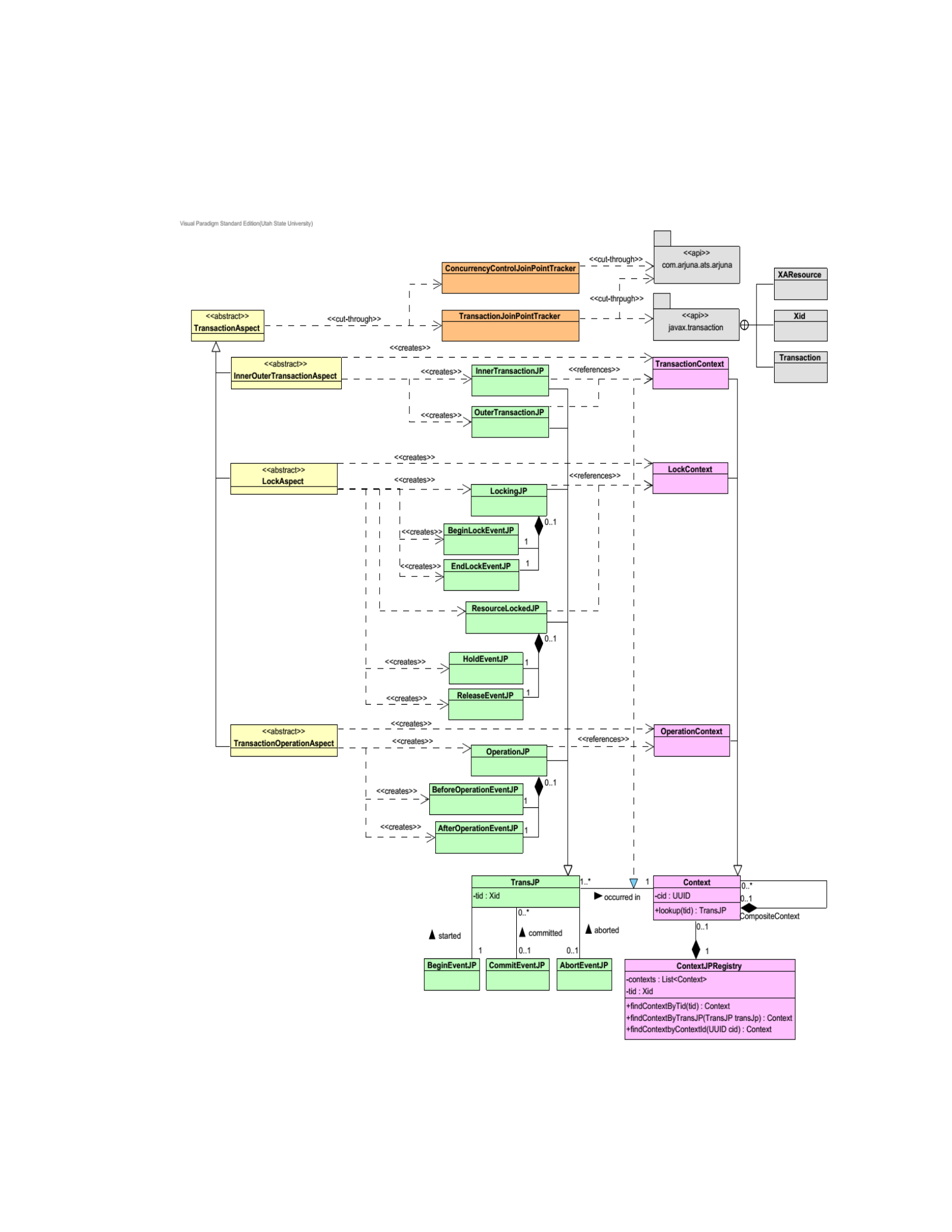
39
abstractions that may span into interleaved multi-threaded or distributed hosts. The UMJDT serves as a
Figure 5-1. Part of the TransJ Event, Joinpoints, Contexts and Aspects

40
foundation for formalizing transaction joinpoints, which fall into three general categories: transaction
joinpoints, operation joinpoints, and concurrency control joinpoints. These categories refer to three different
contexts: transaction context, operation context, lock context, respectively.
Figure 5-1 presents a general joinpoint that is labeled TransJP that encompasses the logical
connection between transaction-event joinpoints. In other words, it is designed to carry out generic
transaction joinpoints, such as creating transaction-event joinpoints and finding where a specific transaction
is involved. Each event can be associated with many other events, with at most one thread. One transaction
can have multiple threads, and a host can process multiple transactions concurrently. For example, in a
distributed nested transaction system, a transaction T1 can begin executing on the thread Th#1 which
corresponds to a begin event, and then allows the transaction to commit or abort for some other thread Th#2.
The green boxes in Figure 5-1 are TransJ classes that implement joinpoints for different kinds of
contexts. Such joinpoints offer a natural abstraction in term of events, enable the explicit definition of
complex crosscuts by means of event pattern, and accommodate very general behaviors of a transaction.
Overall TransJP represents a joinpoint for the entire execution transaction, as well as joinpoints for
a sequence of sub-transactions within a transaction scope, for a sequence of operations within an operation
scope, and for lock/release concurrency operations within a lock scope. TransJP defines three event types:
begin event, commit event, and abort event. The begin event is when something happens at a particular point,
i.e., begin point, related to the setting up of transaction flow control. The commit or abort event is when
something happens at a particular point, i.e., commit or abort point, related to the end of the transaction
execution flow. These events are mapped to three event joinpoints, respectively: BeginEventJP,
CommitEventJP or AbortEventJP. Each one implements a single joinpoint for an individual transaction
event. BeginEventJP represents an execution point of the code into which advice can be woven, when
TransJP related to the begin event of the transaction occurs in the transaction system. CommitEventJP or
AbortEventJP represents an execution point of the code into which advice can be woven, when TransJP
related to the commit or rollback event transaction, respectively, occurs in the transaction system. TransJP is
specialized into five types of joinpoints: InnerTransactionJP, OuterTransactionJP, LockingJP,
ResourceLockedJP, and OperationJP.

41
InnerTransactionJP represents the region of code or period during which a specific transaction code
is executed, where advice can be woven in, when TransJP occurs after the begin event and before the
commit/abort event (prior the end of the transaction execution flow.)
OuterTransactionJP represents the region of code or period during which a specific transaction code
is called, where advice can be woven in, when TransJP occurs before the begin event and after the
commit/abort event (after the transaction has completed.)
The UMJDT states that every commit or abort event must have a corresponding begin event. In
other words, a begin event can exist without a commit or abort event, but not conversely. The events of these
kinds of joinpoints are capable of keeping track of transactions that occur in multiple threads within
distributed transactions.
Inner/Outer transaction joinpoints have direct access to the target transaction’s context, where the
woven advices occur before, after or around these joinpoints. They refer to a transaction context concept, i.e.,
TransactionContext, which contains the relevant transaction information that is delivered at execution time
to a proper transaction knowledge, as shown in Figure 5-1.
LockingJP represents a joinpoint for acquiring the resources used to perform a particular transaction
operation. In other words, it represents the region of code or the period during which a specific
transaction code region is executed, where advice can be woven in, starting when a begin lock request
event is sent to the RM/lock manager and ending when the lock request event is granted or refused.
The beginning and end of the lock request code are associated with two events that are capable of
keeping track of the lock request within the lock context, as shown in Figure 5-1.
o BeginLockEventJP represents an execution point of the code, where advice can be woven
into, when LockingJP runs before executing a set lock event for acquiring the specified
resource within the lock context associated with the target transaction.
o EndLockEventJP represents an execution point of the code, where advice can be woven
in, when LockingJP runs in place of a set lock event to get the lock that has been granted
or refused for the specified resource within the lock context associated with the target
transaction.

42
ResourceLockedJP represents a joinpoint for complete a lock is held. In other words, it represents
the region of code or the period during which a specific transaction code region is executed, where
advice can be woven in, when a hold event occurs after setting the lock and end before releasing the
lock. The demarcation points of the resource locked joinpoint correspond to two events that are
capable of tracking the status of locked resources associated with a target transaction within the lock
context, as shown in Figure 5-1.
o HoldEventJP represents an execution point of the code, where advice can be woven in,
when a ResourceLockedJP occurs the after executing a set lock event to hold the specified
resource within the lock context associated with the target transaction.
o ReleaseEventJP represents an execution point of the code, where advice can be woven in,
when a ResourceLockedJP occurs before executing a release event to unlock the specified
resource within the lock context associated with the target transaction.
OperationJP represents a joinpoint for complete a transaction operation. In other words, it
represents the region of code or period during which a specific transaction operation code region is
executed, where advice can be woven in, when a transaction occurs invoking any transaction
method, (i.e., a method is annotated with a transactional annotation) from within the scope of a
transaction, which indicates whether a method will be executed within an operation context
associated with the target transaction. This joinpoint contains BeforeOperationEventJP and
AfterOperationEventJP for keeping track of the status of all transaction operations.
o BeforeOperationEventJP represents an execution point of the code, where advice can be
woven in, when an OperationJP occurs before executing a reflective access to the
information about a transaction operation associated with the target transaction.
o AfterOperationEventJP represents an execution point of the code, where advice can be
woven in, when an OperationJP occurs after executing the reflective access to the state
available and information about a transaction operation within the operational context
associated with the target transaction.
Each TransJP refers to a specific context that contains all the relevant statics and runtime
information for its joinpoint/s: TransactionContext, OperationContext, or LockContext.

43
5.3 Contexts for Joinpoints
Advice can be executed before, after, or around various contexts. TransJ adds transactions to the list
of possible contexts, but unlike the contexts in AspectJ, a transaction is not tied to a single programming
construct; rather, it consists of loosely-coupled abstractions. TransJ’s contexts include various pieces of
interesting data and metadata that woven advice might use, e.g., identifier, status, sets of tentative values,
rollback logs, snapshots, lock information, timestamps, and other kinds of metadata.
Figure 5-1 presents the composite pattern for the context. The context represents a base class for
context primitive, whereas the context represents a composite class that maintains a collection of subcontexts
in term of a tree structure to represent part-whole hierarchies: Transaction Context, Lock Context, and
Operation Context. These contexts represent concrete primitive contexts; for example a lock context or an
operation context can be part of a transaction context, which in turn can be part of the parent transaction
context.
TransactionContext encapsulates the transaction information that has to be shared among all the
outer and inner transaction joinpoints, such as transaction identifier, starting time, commit time,
abort time, sub-transactions, status, timestamp, tentative values for resources, etc.
LockContext encapsulates the lock information related to underlying resources along with their
transactions, such as a locked time, a released time, time-out, status of shared resources, lock mode,
lock result, lock owner, tentative values to the update resource, etc. This information has to be
available to the LockingJP and ResourcelockedJP.
OperationContext encapsulates information about the sequence of the transaction operations in the
transaction’s body, and operations in progress, etc. This information has to be available to the
OperationJP.
Generally, each context includes the location of the joinpoint and runtime information about the
transaction objects involved. For this, TransJ contexts exhibit one or more attributes associated the events
that are represented joinpoints as discussed above. TransJ considers these joinpoint events as largely
independent, while a context considers them as interrelated through its call transaction concepts that would
lead to a more reusable and robust implementation. These events keep track and record the transaction
identifying information, e.g., the transaction identifier (TID), for all types of joinpoints. When advice

44
executes, it can access the context information about the joinpoint at which it was invoked. Each specialized
context provides different kinds of information that should be available to weave a relevant advice. In other
words, the TransJ’s context is dynamic and depends on the target transaction objects involved in the
joinpoint.
5.4 Registry for Contexts
Transaction aspects dynamically introduce context information for all TransJ joinpoints. When a
joinpoint event occurs, e.g., BeginEventJP, TransJ creates an instance of a joinpoint class, e.g.,
InnerTransactionJP, that further correlates it with other events in the same joinpoint associated with a target
transaction, and then adds the instance of the joinpoint to a relevant context, which contains a collection of
joinpoints of the target transaction, and then adds the context to the registry, which contains a collection of
contexts, namely, the ContextJPRegistry, as shown in Figure 5-1.
When a joinpoint aspect, e.g., InnerOuterTransactionAspect, discovers a relevant transaction
joinpoint and correlates it with other appropriate joinpoints that belong to the same transaction. Advices in a
transaction-related aspect can access these joinpoint objects to obtain context information, like a transaction’s
start time, identifier, status, or the underlying lock information. This task can be facilitated if every context
maintains a list of all the transactions that have accessed it. ContextJPRegistry provides this functionality by
keeping a list of all transaction-related contexts that have interacted with the target transaction. On this,
ContextJPRegistry represents a repository for all transaction-related contexts, which provide relevant
information for advices associated with the target transaction at execution time.
5.5 Trackers
Depending on the location of the joinpoint event, the appropriate part of the context knowledge
should be gathered in those contexts, i.e., transaction context, operation context, and lock context. Behind
the scenes, TransJ uses context gathering mechanisms, namely joinpoint tracker aspects, that are based on
context-aware transaction abstractions and employ joinpoint events to dynamically gather the relevant
information.

45
The trackers work as monitors [32][94] that perform pattern matching on transaction events, to track
individual events and to organize them into high-level transaction-related contexts. Since the monitoring of
transactions is itself a crosscutting concern, trackers are implemented as aspects that weave the necessary
monitoring logic into places where a transaction event may take place. TransJ can support many different
kinds of transaction joinpoint trackers, Figure 5-1 shows two special types of trackers, namely
TransactionJoinPointTracker and ConcurrencyControlJoinpointTracker.
TransactionJoinPointTracker
The transaction joinpoint tracker is an aspect that hides transaction-related abstractions in the core
transaction application. It crosscuts begin, commit, abort, and transaction operation “@transactional”
abstractions and defines a set of elegant and parameterized pointcuts. These provide benefits for sharing
states between advices while overcoming the syntactic and semantic variations, defined on standard JTA and
Arjuna pre-built libraries, i.e., javax.transaction and com.arjuna.ats.arjuna. These pointcuts are rich enough
to encapsulate abstractions for transaction-related concepts of the client and server sides, e.g.,
UserTransaction and TransactionManager, respectively.
TransactionJoinPointTracker discovers a relevant joinpoint of the transaction based on the
knowledge of access transactions, i.e., access to external transactions or access to internal transactions.
Hence, TransJ creates seven clean, well-encapsulated transaction-related abstractions for all kinds of types
begin, commit, rollback, and transactional annotation (shown in Figure 5-2), summarized as follows:
Transaction pointcuts for begins: These pointcuts unify syntactic and semantic variations in
JTA libraries, i.e., JTA API and Arjuna API, and crosscut outer and inner transaction begin
abstractions.
Transaction pointcuts for commits: These pointcuts unify syntactic and semantic variations in
JTA libraries, i.e., JTA API, and Arjuna API, and crosscut outer and inner transaction commit
abstractions.
Transaction pointcuts for abort: These pointcuts unify syntactic and semantic variations in JTA
libraries, i.e., JTA API, and Arjuna API, and crosscut outer and inner transaction rollback
abstractions.
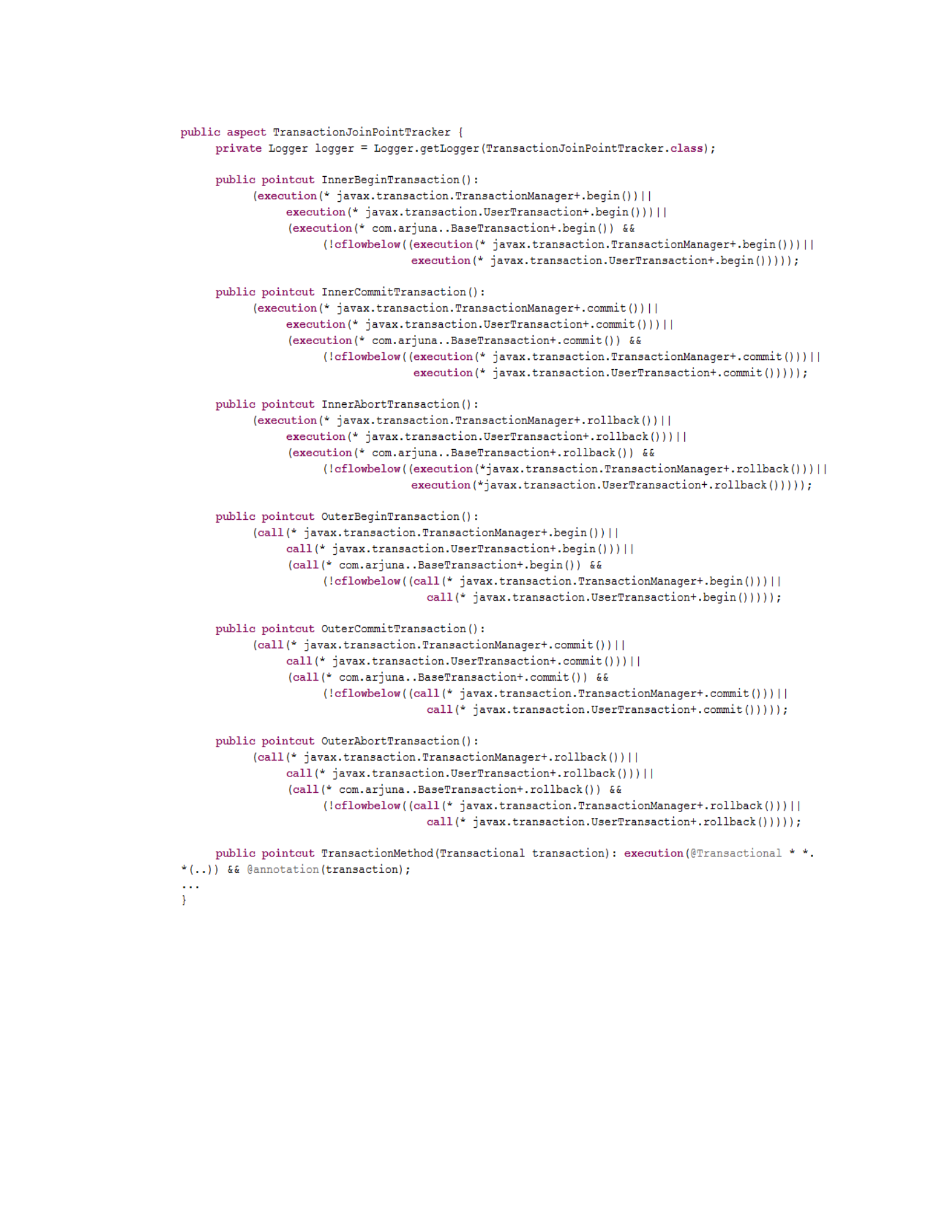
46
Transaction pointcuts for transactional annotations: This pointcuts unify syntactic and semantic
variations in JTA libraries, i.e., JTA API, Arjuna API, and EJB, and crosscut transaction
operation that annotated with Transactional abstractions.
Figure 5-2. A Code Snippet of TransactionJoinPointTracker

47
ConcurrencyControlJoinpointTracker
The concurrency control joinpoint event tracker is an aspect that hides concurrency control
abstractions in core transaction applications. This aspect crosscuts the syntactic and semantic variations that
exist on standard JTA, e.g., pre-built Arjuna library, and unifies them into a set of parameterized pointcuts in
set lock and release lock abstractions. These pointcuts are rich enough to encapsulate and manage all
concurrency-related abstractions and styles related to the locking and unlocking of shared resources in
distributed transactions. Hence, TransJ provides two clean, well-encapsulated transaction-related
abstractions for setlock and doRelease, (shown in Figure 5-3). These are summarized as follows:
Concurrency Control pointcut for setlock: It crosscuts setlock operation for the lock managers in
Arjuna API while requesting to hold a specified resource to the associated transaction.
Concurrency Control pointcut for doRelease: It crosscuts doRelease operation for the lock manager in
Arjuna API while releasing a lock of a specified resource from the associated transaction.
5.6 Base Transaction Aspects
TransJ implements transaction-related crosscutting concerns as aspects derived from transaction
aspects that cut through their respective joinpoint trackers. These aspects are derived from abstract
TransactionAspect, which provides high-level concrete pointcuts that dynamically track different transaction
abstractions, i.e., begin, commit, abort, setlock, doRelease, and transactional abstractions, as shown in
Figure 5-4. In TransJ architecture, the core infrastructure contains three kinds of base transaction aspects,
InnerOuterTransactionAspect, OperationAspect, and LockAspect, as shown in Figure 5-1.
Figure 5-3. A Code Snippet of ConcurrencyControlJoinPointTracker
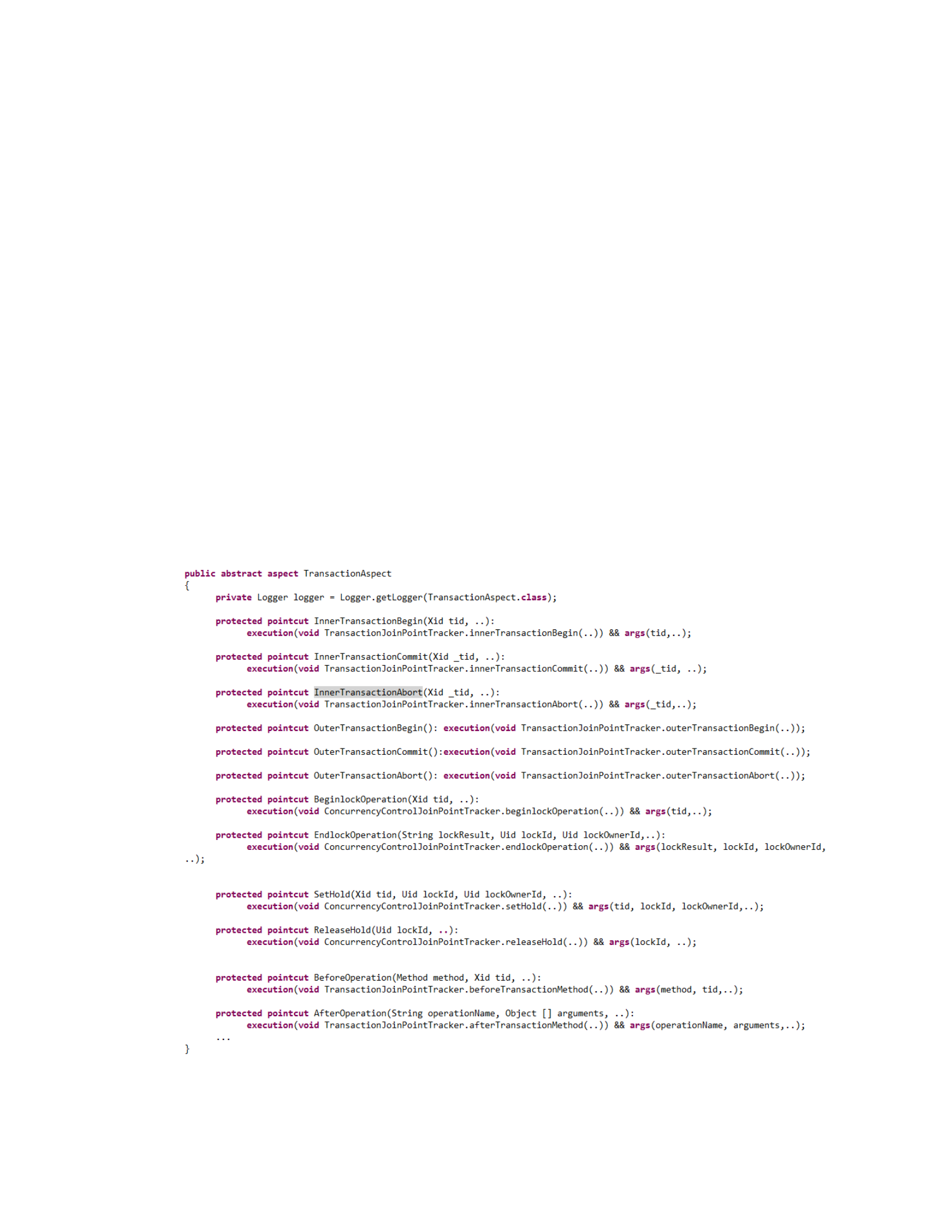
48
The pointcuts in the TransactionAspect take a list of objects as parameters, because this is how
concrete aspects based on these pointcuts can access transaction-related context information. We bind context
data to pointcut variables, which can then be used to parameterize advices. This allows concrete aspects to
be parameterized and configures different joinpoints, which enable reusable aspects to be customized in
different contexts and thus increase the reusability of aspects (see Chapter 10 for more details). The base
aspects consist of three distinct abstract aspects corresponding to three different kinds of contexts, as
mentioned earlier, and extend the TransactionAspect with pointcut abstractions that are meaningful to those
contexts (see Figure 5-4). On this, developers can create their own application-level transaction aspects that
inherit these aspects and include advice based on these pointcuts.
InnerOuterTransactionAspect extends the TransactionAspect with pointcuts for transaction
beginnings and the transaction ends, as shown in Figure 5-5. It involves begin, commit and abort
Figure 5-4. A Code Snippet of TransactionAspect
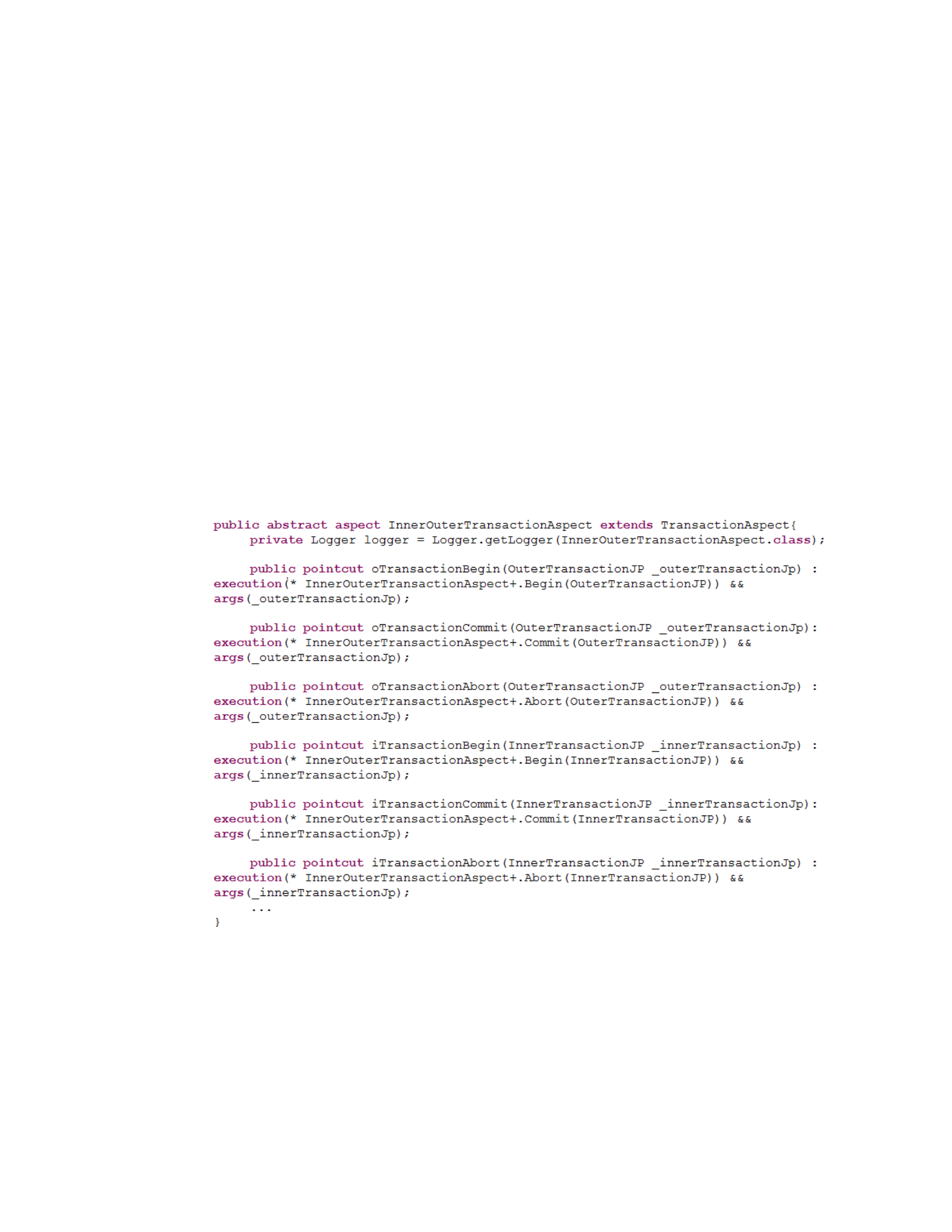
49
joinpoints to demarcate the transaction scope. It defines six pointcuts: iTransactionBegin
2
,
iTransactionCommit, iTransactionAbort, oTransactionBegin
3
, oTransactionCommit and
oTransactionAbort. These pointcuts crosscut TransactionJoinpointTracker to establish a
transaction context on the client application and the application server sides of each executed
transaction. The oTransactionBegin creates an OuterTransactionJP and instantiates a transaction
context. The oTransactionCommit or oTransactionAbort retrieves the matching
OuterTransactionJP from the target TransactionContext in ContextJPRegistry and ends a
transaction after a client or transaction manager invokes a commit or abort joinpoint event. The
iTransactionBegin creates an InnerTransactionJP and starts a transaction when a client or
2
The transaction pointcut is initialized with a lowercase letter that indicates where the joinpoint is located, (i) stands for inner
transaction, e.g., iTransactionBegin means inner begin transaction.
3
The transaction pointcut begins with a lowercase letter that indicates where the joinpoint is located: e.g., (o) stands for outer
transaction; oTransactionBegin means outer begin transaction.
Figure 5-5. Extended Parametrized-Pointcuts in InnerOuterTransactionAspect

50
transaction manager executes a begin event, and then retrieves the matching target
TransactionContext from the ContextJPRegistry and adds the InnerTransactionJP. The
iTransactionCommit or iTransactionAbort retrieves the matching InnerTransactionJP from the
target TransactionContext in the ContextJPRegistry and adds the commit joinpoint event or abort
joinpoint event, as shown in Figure G-1 (Appendix G). Developers can use this kind of aspect to
weave advice before, after, or around entire transactions, either from a transaction application
client or application server perspective in different transaction models (flat or nested).
OperationAspect extends the TransactionAspect with pointcuts for transaction operation, as
shown in Figure 5-6. They provide a way for applications to capture arbitrarily complex
operations; therefore, they define the sequence of operations that comprise the transaction body.
This aspect defines pointcuts to demarcate the transaction operation scope, namely
BeforeTransactionOperation and AfterTransactionOperation. The BeforeTransactionOperation
creates an OperatoinJP and instantiates an OperationContext, as shown in Figure G-2 (appendix
G). It exposes the before-operation event joinpoint to the OperationJP and then adds the
OperationContext to the ContextJPRegistry. The AfterTransactionOperation retrieves the
matching OperationJP from the OperationContext for the current transaction in the
ContextJPRegistry, and exposes the after-operation event joinpoint to the OperationJP.
Developers can use this aspect to weave advice before, after, or around a transaction operation.
Figure 5-6. Extended Parameterized-Pointcuts in TransactionOperationAspect
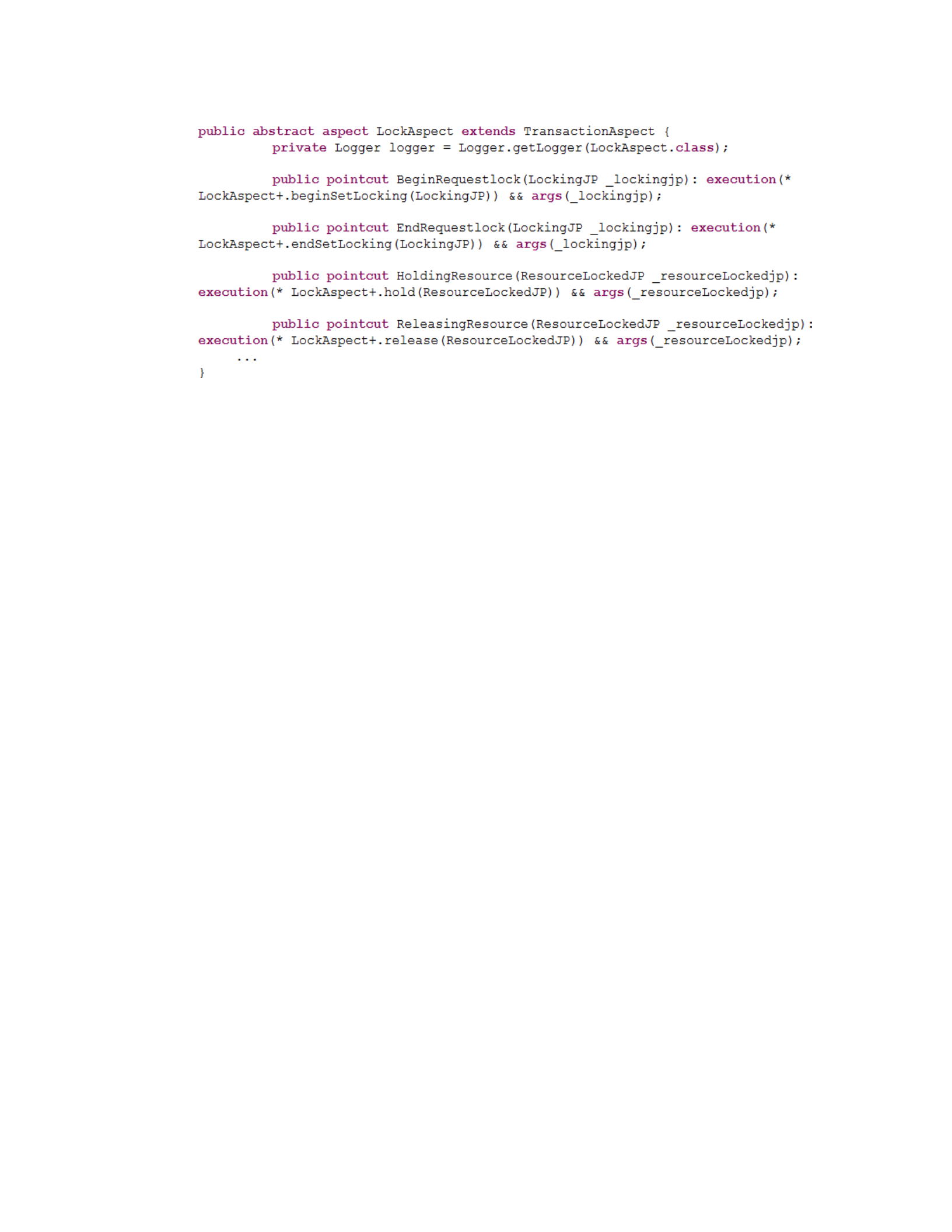
51
LockAspect is derived from the TransactionAspect and thereby inherits the locking and
resource-locked pointcuts, as shown in Figure 5-7. It involves setlock-event and release-event
joinpoints to associate and disassociate the specified resource to/from the target transaction. It
defines pointcuts BeginRequestlock, EndRequestlock, HoldingResource, and
ReleasingResource that crosscut ConcurrencyControlJoinpointTracker to establish the lock
context. BeginRequestlock creates an instance of LockingJP, exposes BeginlockEventJP to it,
instantiates a lock context, and then adds the context to the ContextJPRegistry, as shown in
Figure G-3 (Appendix G). The EndRequestlock retrieves the matching LockingJP from the
target LockContext in the ContextJPRegistry, and exposes the EndlockEventJP to the
LockingJP when the request lock is granted or refused. The HoldingResource creates a
ResourceLockedJP and exposes the hold-event joinpoint to it. It also retrieves the matching
lock context from ContextJPRegistry and then adds the ResourceLockedJP to the lock context
in ContextJPRegistry. The ReleasingResource retrieves the matching ResourceLockedJP from
the target LockContext in the ContextJPRegistry and then exposes the release-event joinpoint
to the ResourcelockedJP and ends the locked resource. Developers can use this aspect to weave
advice before, after, or around the entire locking perspective.
Figure 5-7. Extended Parameterized-Pointcuts in LockAspect

52
In DTPSs, the nested and concurrent transactions may occur with multiple other hosts, i.e.,
transaction in progress, which are also involved in a multi-threaded process. The aspects can apply for a
transaction and keep track of the multiple concurrent transactions by maintaining a collection of contexts. A
context for each transaction is maintained in terms of its own current context and association with the in-
progress transaction.
5.7 Design Patterns Perspective on the TransJ Implementation
TransJ implementation offers a collection of functions for dealing with reusable transaction
crosscutting concerns. To provide reusable code without influencing its architecture, it is built using these
design patterns: Strategy, Singleton and Template method. They allow programmers to extend and customize
the TransJ functionality.
The TransJ implementation of the strategy pattern contains the same concrete strategies (joinpoints)
and contexts [104]. It declares two markers called TransJP and Context that are used in the concrete aspects.
The context has a ConcurrentHashmap to store the relationship between each context and its current
joinpoint.
ContextJPRegistry is a singleton class providing the list of the contexts, which sets and gets the
appropriate context for the target joinpoint and execute the relevant advice. This pattern provides reusable
pattern code in terms of setting and getting the strategies in the transaction-related context. The TransJP
provides the joinpoints for each context in the list, and all the joinpoints are from inheritance relationships.
It means that the joinpoints extends TransJP class.
Furthermore, TransJ implementation provides generic advices in the base aspects that follow the
template method pattern [104]. Therefore, the base aspects are implemented as abstract aspects to contain the
actual implementation of the template advices and pointcuts. This allows developers to quickly adapt them
to the specific needs of their application by reusing and integrating them into existing or new applications.

53
REUSABLE AND APPLICATION-LEVEL ASPECTS
This chapter discusses the reusable and application-level layers in TransJ architecture and provides
examples of transaction-related crosscutting concerns implemented with TransJ.
6.1 Reusable Aspects
Aspect developers implement reusable aspects by specializing the base aspects in TransJ. The
reusable aspects represent general crosscutting concerns commonly found in distributed applications with
significant transaction requirements. Table 1 lists the aspects currently in the reusable aspects library and
Figure 6-1 shows part of the implementation of one of them. This is called the TotalTurnAroundTimeMonitor.
Table 1. Sample Reusable Crosscutting Concerns in Transactions
Aspect Name
Description
Optimizer
Tracks workload based on the most likely behavior of a transaction.
It helps programmers to determine the most efficient way to execute
a transaction by considering the possible behaviors on shared
resources.
PerformanceAnalyzer
Helps the programmer to analyze the vast amount of transaction
resource accesses for improving the application performance
Notification
Allows the developer to activate alarms for critical error, exceptions,
time-based expiration, and invalid state.
Authenticator
Tracks consistent and secure transactions for handling
authentication permissions in transaction domain.
AuditTrail
Records a history of actions executed by transactions and users. It
includes a chronological list of steps that are required in order to
begin a transaction, as well as bring it to completion. It records
information such as who has accessed a transaction, what operation
was performed on it, when it was performed, and how the state was
changed.
LoggingByTransaction
Logs transaction context operations in a developer-defined format
and domain.
JustInTime
Provides virtual helper methods for a transaction which help
programmers share context information across hosts when
necessary.
DeadlockAnalyzer
Detects transactions that are involved in the deadlock.
TotalTurnAroundTimeMonitor
Provides virtual helper methods for transactions which help
programmers measure the responsiveness time by overriding their
aspects in application level.
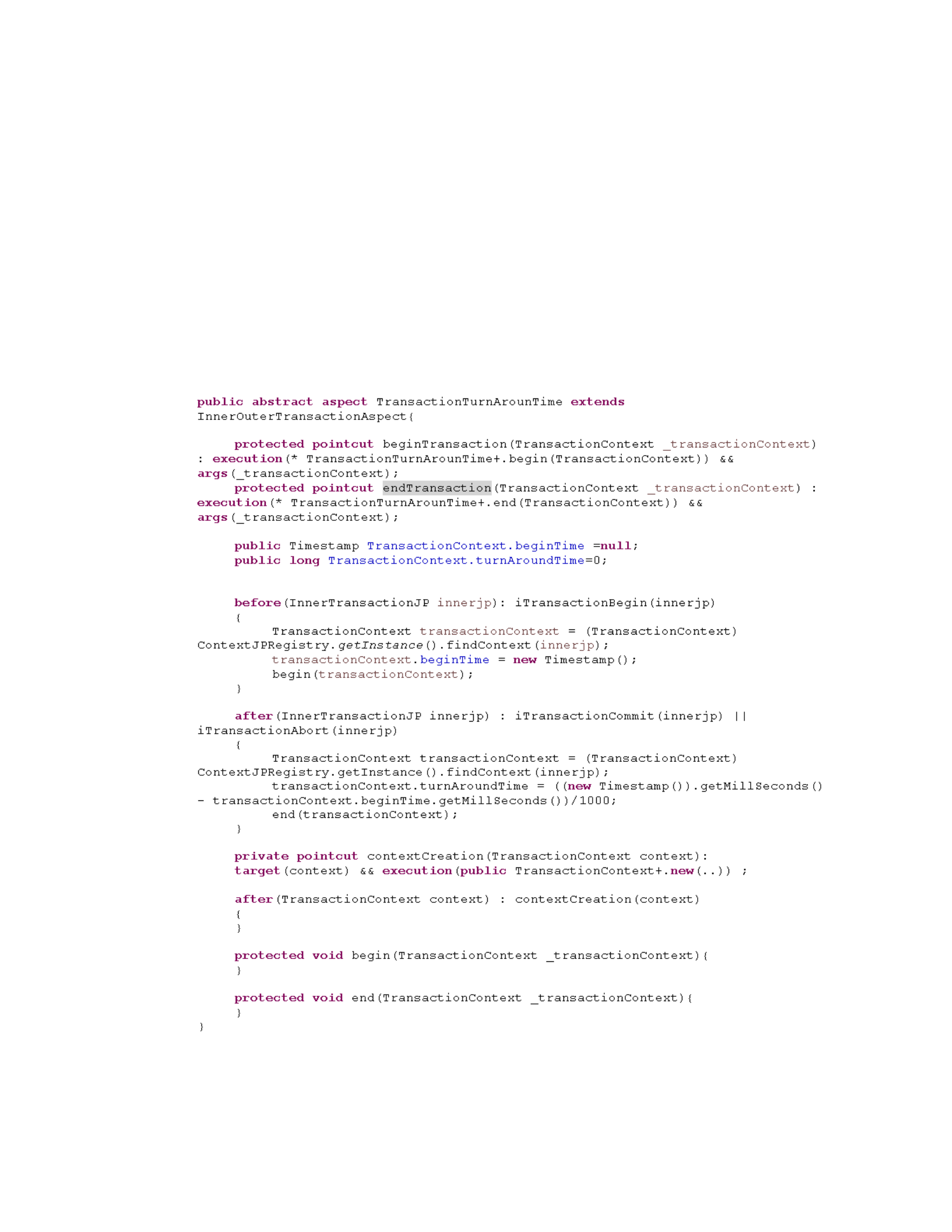
54
TransJ provides a library of reusable aspects for transaction-related crosscutting concerns, like
TransctionTurnAroundTime, that helps programmers measure the responsiveness time. These aspects allow
programmers to adapt the reusable aspects to new demands and to cope with the specific needs of their
application by overriding these methods. Additionally, TransJ library provides other reusable aspects the
make use of this and other reuse techniques to integrate them easily into existing or new applications. We
Figure 6-1. A Reusable-Aspect Code Snippet of TransactionTurnAroundTime
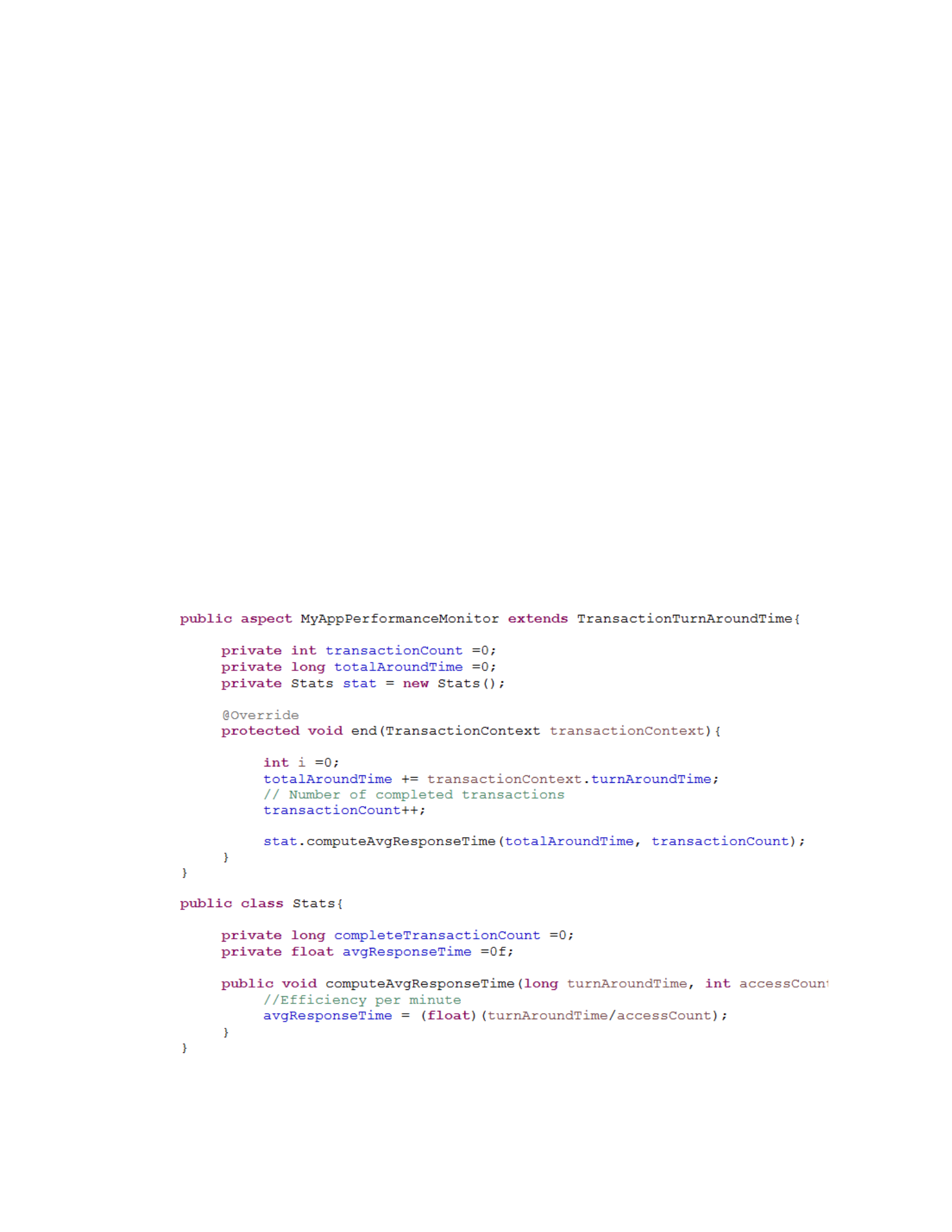
55
expect that reusable aspects will continue to grow as new generally-applicable transaction aspects are
discovered, implemented, and documented.
6.2 Transaction Turnaround Time (TTT) Aspect in Reusable and Application Layers
TransJ allows reusable aspects to run a set of aspects to access context information dynamically.
The reusable aspects use the base aspects to represent the abstract aspects that contains the template advice
as discussed above.
As an example, this section describes the implementation of an application-level aspect that weaves
performance measurements in the distributed transaction applications. For discussion purposes, assume that
the performance measurements are a throughput and average-transaction response turnaround time statistics.
In other words, it measures some performance-related statistics for transaction-based applications between a
client and server, such as turnaround time (i.e., response time). Also, assume that the core application
Figure 6-2. Performance Measure Crosscutting Concern

56
considers a transaction to be the completion a set of sub-transactions. Consider a transaction involving three
sub-transactions. So, we can measure throughput for a unit of time, say 1 minute, by simply counting the
number of these transactions completed in that minute. The average response turnaround time is the average
of time spans from transaction begin times to transaction commit or abort times.
First, notice how this advice is derived from InnerOuterTransactionAspect and in doing so, it can
reuse its implementation of the transaction turnaround time concept directly.
Figure 6-2 shows the key pieces of code for an aspect that implement this performance measure
crosscutting concern. This snippet of code presents the implementation of measuring the total turnaround
time and throughput for a nested transaction at the application level. As mentioned, the developers can
implement and add application-level aspects into core application logic by reusing reusable aspects or
extending base aspects in TransJ.
Second, notice how the aspect is derived from TransactionTurnAroundTime aspect and in doing so,
it can reuse its implementation of the transaction turnaround time concept directly. Then, it adds some
additional behavior at the end of a transaction to compute the average of the transaction responsiveness time
per minute, i.e., efficiency.
6.3 Audit Trails Crosscutting Concerns
This example discusses the design and implementation of an aspect that can manage the audit trail
for recording a history of actions executed by transactions and users. It will include a chronological list of
steps that were required to begin a transaction as well as bring it to end. Imagine that the developer wants to
make the Conference Registration System (CRS) as an auditable system that satisfies all the requirements to
provide a comprehensive and thorough audit trail by implementing various levels of it, e.g., at the transaction
level and operational level, as shown in Figures 6-3 and 6-4. This way allows developers to define audit trail,
which records user registration and deregistration activities, as well as what names were issued by the
attendees to the register for the conference. In other words, the audit trail concern keeps track of who did the
transaction, to what (register or deregister), and when they did it, as well as who tried to do something but
was unsuccessful. It’s useful for detecting conflicted registration, establishing a culture of responsibility and
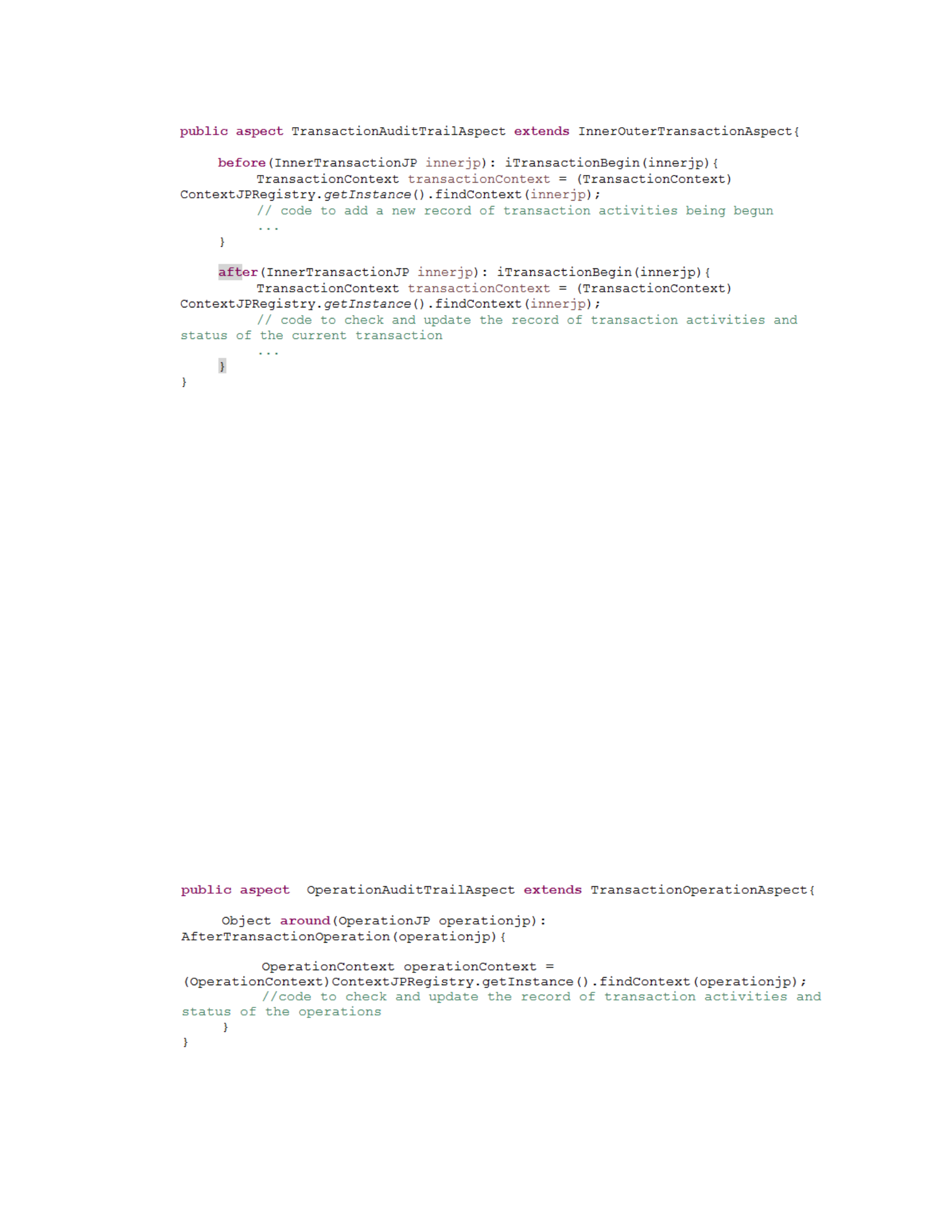
57
accountability, reducing the risk associated with inappropriate registrations, detecting new threats and
intrusion attempts, and identifying potential problems, etc. In transaction contexts, the audit trail aspect
allows a transaction to create a monitor that encapsulates valuable information about the transaction and
current transaction operations: in the Conference Registration System contains the information is usually the
identity of a transaction, the name of the object, access type of the invoked method, operation arguments, etc.
The application-level audit trail aspects in Figures 6-3 and 6-4 extend aspects discussed in Section
5.7. On beginning the transactions, InnerOuterTransactionAspect ensures that it is beginning the transactions
and starting to provide documentary evidence of the sequence of activities that have affected at any time a
Figure 6-4. An Audit Trail Aspect at Transaction Operation Level
Figure 6-3. An Audit Trail Aspect at Transaction Level

58
registration or deregistration transaction. On transaction operations, TransactionOperationAspect gives a
step-by-step documented history of the transaction and keep an eye on the transaction operations.
We conclude, the audit trail aspect can be used in any context: transaction context, operation context,
or lock context, where there is a need to recall transactions, operations or any other meta-data about the target
transaction that have been applied within a specific context. The information pulled by this aspect can, for
instance, be beneficial for logging.
6.4 Optimizing Data Sharing
This section discusses the design and implementation of data-sharing optimizer aspect, i.e., Shared
Aspect, in the context of a DTPS that collects data from different threads that run on distributed hosts, referred
to here as a Gadget Manufacturing System (GMS) as described in Chapter 2 and Appendix A. Threads
running synchronously within the same transaction may concurrently execute conflicting transaction
operations that may cause failure or delay in the execution of transactions.
The shared aspect involves managing the shared resources by collection transactions in the GMS.
The aspect manages the optimizing data sharing through monitoring and adjust the level of execution between
distributed transaction operations. In other words, in order to optimize throughput and hence improve
performance, Shared needs the context information of each operation of the transaction in many contexts.
Therefore, a transaction that is accessed by a thread that is part of a context should notify the context of the
upcoming access. That way, the context can take actions to implement the specified rules. Each accessed
shared resource should be uniquely identifiable in a context of the target transaction. In TransJ, the
ContextJPRegistry provides this functionality by keeping a list of all transaction and operation contexts that
have interacted with the target transaction. Therefore, it is able to track all threads that have run with the
transaction operations.
Figure 2-4 shows the multiple thread access to widget pile concurrently, and then turned them into
new widget type by identifying the right transaction operations. Once the system notices the number of
gadgets exists excess in the inventory, then goes to sleep to slow down the production speed, unless it again
notices the amount of gadgets less than expected, then turn the system to increase the speed of production.
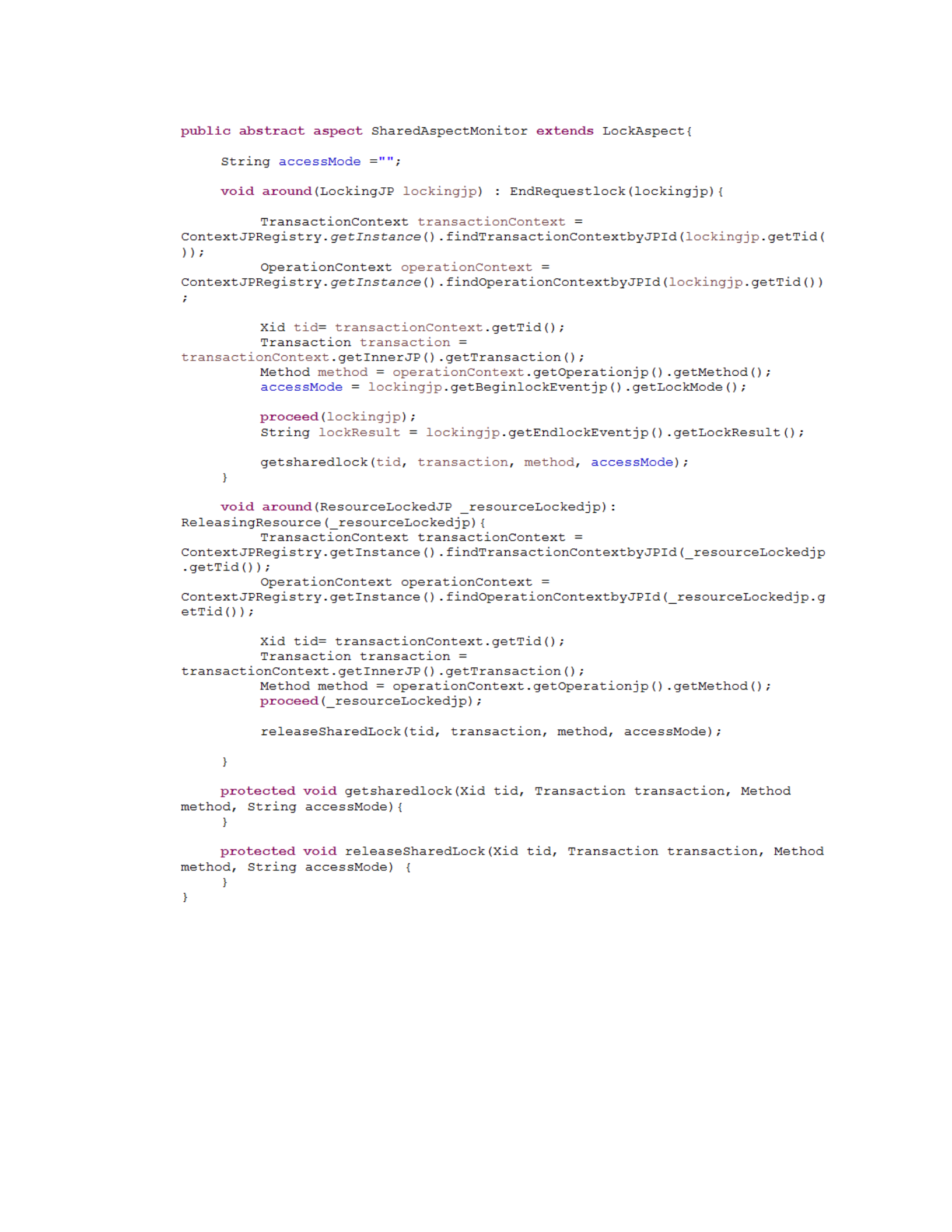
59
In TransJ, Figure 6-5 shows implementation one of the reusable aspect, called
SharedAspectMonitor. It creates a monitoring transaction operation, which manages the shared operations
based on type of access. This aspect monitors the transaction operation context that contains information
Figure 6-5. An Aspect Code Snippet of SharedAspectMonitor
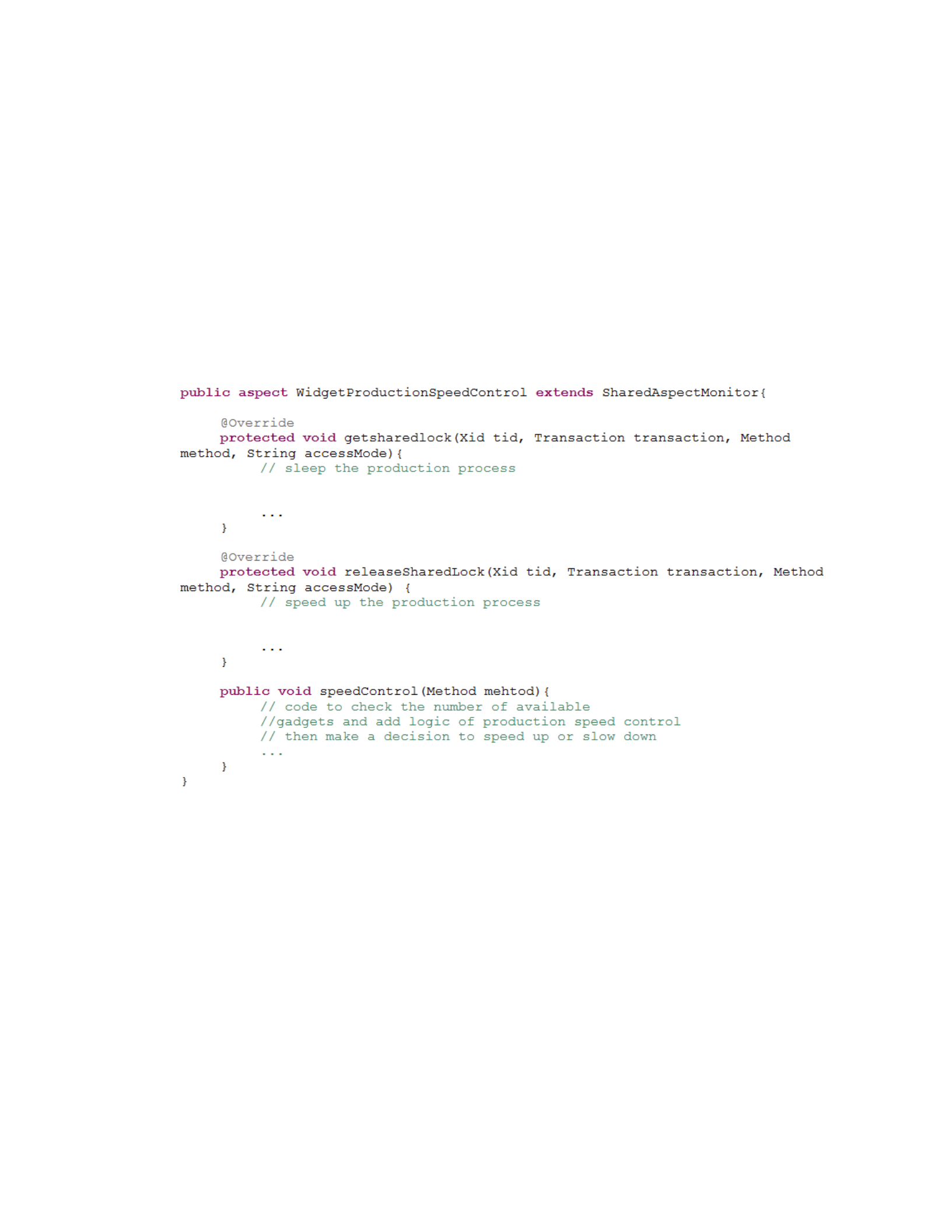
60
about the current operation thread and kind of access. In this example, developers can extend
SharedAspectMonitor and override its methods to control the production process. In addition, we notice the
developer can add some additional behavior to the SharedAspectMonitor by overriding the getsharedlock
and releaseSharedlock to manage the shared resources over distributed transactions, as shown in Figure 6-6.
Figure 6-6. A Code Snippet for WidgetProductionSpeedControl at Application Level

61
MEASURING REUSABILITY, PERFORMANCE AND
SOFTWARE DEVELOPMENT EFFICIENCY
This research aims to demonstrate the feasibility and utility of using TransJ and the reusable aspect
library to implement transaction applications and transaction aspects of those applications. In Chapter 6, we
discussed the applications that are implemented using the TransJ to provide evidence of improvement in
reusability and performance. To investigate this contribution, we adapt a measuring method based on a
metrics suite that extends the metrics traditionally used with the OOP, AOP, and later used in the CommJ
research. Specifically, to measure the effectiveness of TransJ in comparison with AspectJ, we adapt and
extend the Extended-Quality Model [30] and Comparison Quality Metrics (Sant’Anna quality
model) [54][55] to include quality factors and internal attributes that have not been included in these models,
forming the Extended-Quality Model for Transactional Application (EQMTA).
EQMTA consists of four elements: Qualities, Factors, Quality Attributes, and Metrics. See Figure
7-1. The qualities, i.e., reusability and performance, are the most abstract concepts in the model and represent
the ultimate goals of “good” software. Each quality is affected by one or more factors, which are in turn
determined by quality attributes (internal attributes). The quality attributes describe the internal view of the
system attributes with a set of quality metrics that are defined and used to provide a scale and method for
measurement.
Figure 7-2 show the specific qualities, quality factors, and quality attributes of the EQMTA’s suite,
and Figure 7-3 show the metrics. A single star (*) next to an element in either of these figures tags a concept
that not exist in the original EQM [30] or Comparison Quality Model [55]. Double stars (**) mark elements
that are in the previous models, but have been modified to be a measure quality in transaction systems.
Figure 7-1. Elements of the Quality Model
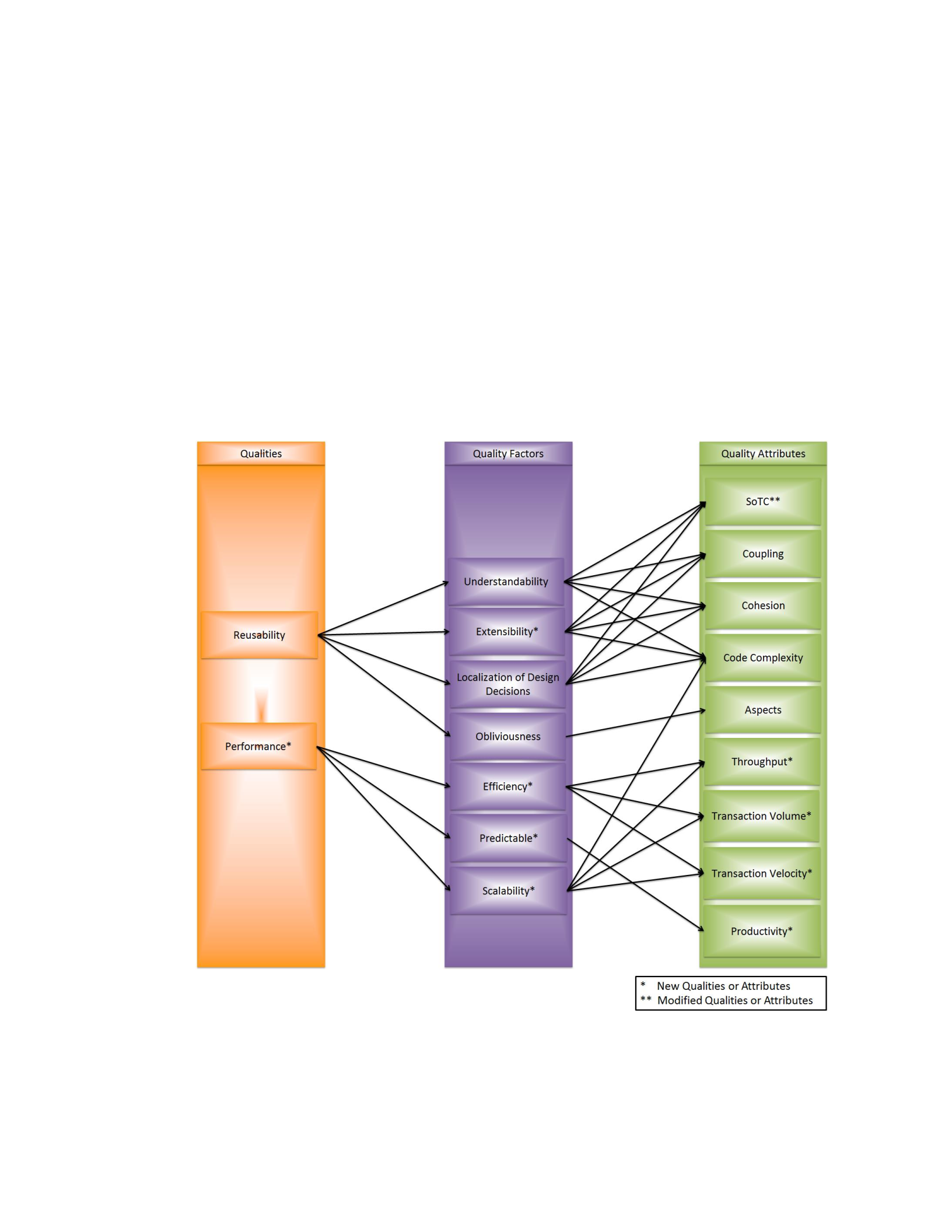
62
7.1 Qualities
Qualities are the highest level abstractions that we want to primarily observe in our system. We
picked reusability and performance as the important qualities to consider initially because of potential for
cost savings that they both represent. The following qualities focus of our experimental research:
o Reusability. It is the ability of transaction elements to serve for structure of different elements in
the same software system or across different ones. In other words, it is modifying existing
Figure 7-2. Extended-Quality Model for Transactional Applications (EQMTA)

63
components as needed to meet specific system requirements. The developers can use it to create
separate components and organize the functionality of a system into independent modules.
o Performance. It is characterized by the amount of useful work accomplished by a transaction
system compared to the transaction element, time, and resources used.
7.2 Quality Factors
The quality factors are the secondary quality attributes that influence the defining primary qualities.
These attributes are useful for the promotion of performance as well as reusability, because they are
associated with well-established internal quality attributes of the software systems. Following are a list of
the elements of our quality model:
• Understandability: It indicates the level of difficulty for studying and understanding a transaction
system’s design and code.
• Extensibility: It indicates the level of difficulty to expand the system’s capabilities, and facilitate
systematic reuse with a minimum amount of effort, in addition to make drastic changes to
components in a transaction system without any need to change others.
• Localization of Design Decisions: It indicates the level of information hiding for a component’s
internal design decision. Hence, it is possible to make material changes to the implementation of a
transaction component without violating the interface [7].
• Obliviousness: It is a special form of low coupling wherein base application functionality has no
dependencies on crosscutting concerns [30].
• Efficiency: It indicates the level of performance of the software. In other words, it captures the ability
of a transaction system to provide appropriate performance in relation to the amount of resources
used, under stated conditions, such response time and throughput.
• Predictability: It indicates the ability to anticipate the amount of work the team can feasibly commit
to providing exactly what the customer expects and delivering the value one time without error or
delay.
• Scalability: It indicates to the capability of a system to increase its total throughput under an
increased load when resources are added that refer to the increasing amount of transactions in a

64
capable manner to be enlarged to accommodate that growth. Therefore, it expresses aspects of the
design that should be tuned for efficient transaction at any given scale.
Localization of design decisions, and code obliviousness were part of Extended-Quality Model [30].
We use them in our quality model due to the following reasons. Firstly, Raza [30] in his CommJ paper
proposes three important characteristics of modular code, namely understandable, obliviousness and
localization of design decisions. Hence, reasoning reusability in terms of understandability, localization of
design decisions, and obliviousness are not complete. Introduction of efficiency, predictability, and
scalability are also equally important. Secondly, by the time Parnas [62] and Coady [65] proposed that the
definition of reusable modular code, obliviousness and extensibility had not been invented as a fundamental
design principle. However, in the context of our research experiment, which depends heavily on measuring
crosscutting concerns, code obliviousness, extensibility, efficiency, predictability, and scalability become
very critical.
7.3 Quality Attributes
Quality attributes, i.e., internal attributes, do not rely on software execution and can therefore be
measured statically. They are characteristics of software systems related to well-established software-
engineering principles, which in turn are necessary to the achievement of the qualities and their respective
internal factors. Following are the internal attributes in our EQMTA.
• Separation of Transaction Concerns (SoTC): It defines the ability to identify, encapsulate and
manipulate unnecessary complexities of transaction system that are relevant to a particular
concern [67].
• Coupling (dependency): It is an indication of the strength of interconnections between the
transaction components in a transaction system [68][100]. In other words, it measures the impact
degree of AOP and TransJ mechanisms on reusability attributes, and collaborations between
transaction components or between transactions and other system components.
• Cohesion: The cohesion of a component is a measure of the closeness of relationship between its
internal components [54]. In other words, it measures the degree to which the pieces of a single
module belong together. Low cohesion is associated with secondary concerns such as being difficult

65
to reuse and maintain. Cohesion is usually compared with coupling. High cohesion often correlates
with loose coupling, and vice versa [68]. Low coupling is often an indicator of a well-structured
transaction system and a good design, and when combined with high cohesion, supports the general
goals of high reusability.
• Code Complexity: It measures how transaction components are structurally interrelated to one
another. It indicates to the degree of difficulty in the transaction system’s design and code [70].
• Tangling: It occurs when a single transaction component includes functionality for two or more
concerns, and those concerns could be reasonably separated into their own components.
• Scattering: It occurs when two or more components include similar logic to accomplish the same or
similar activities. The most serious causes of scattering occur when design decisions have not been
properly localized.
• Aspects/Obliviousness: It is an indication of the ability of aspects component to encapsulate and
manipulate a crosscutting concern of the transaction system. It physically measures the number and
length of a software system’s aspects [30].
• Throughput: It is an indication of the capability of the system to complete a transaction within a
specific interval. In other words, it is the rate at which transactions are processed by the system. It
physically measures the amount of time is taken to respond to the request of a transaction.
• Transaction Volume: It is an indication of the efficiency of transaction system to handle huge data
volume, which determine the amount of transactions processed by the system over the defined
period of time, such as the committed transactions, aborted (uncommitted), and timed-out
transactions during the transaction system execution.
• Transaction Velocity: It gives an indication of the performance of the transaction system, it refers
to how fast a transaction is processed within the context of accessing resources in transaction
systems.
• Productivity: It is an indication of the amount of effort needed for understanding, programming and
debugging the transaction system components. It physically considers the amount of bugs, and total
development time into active and passive times.
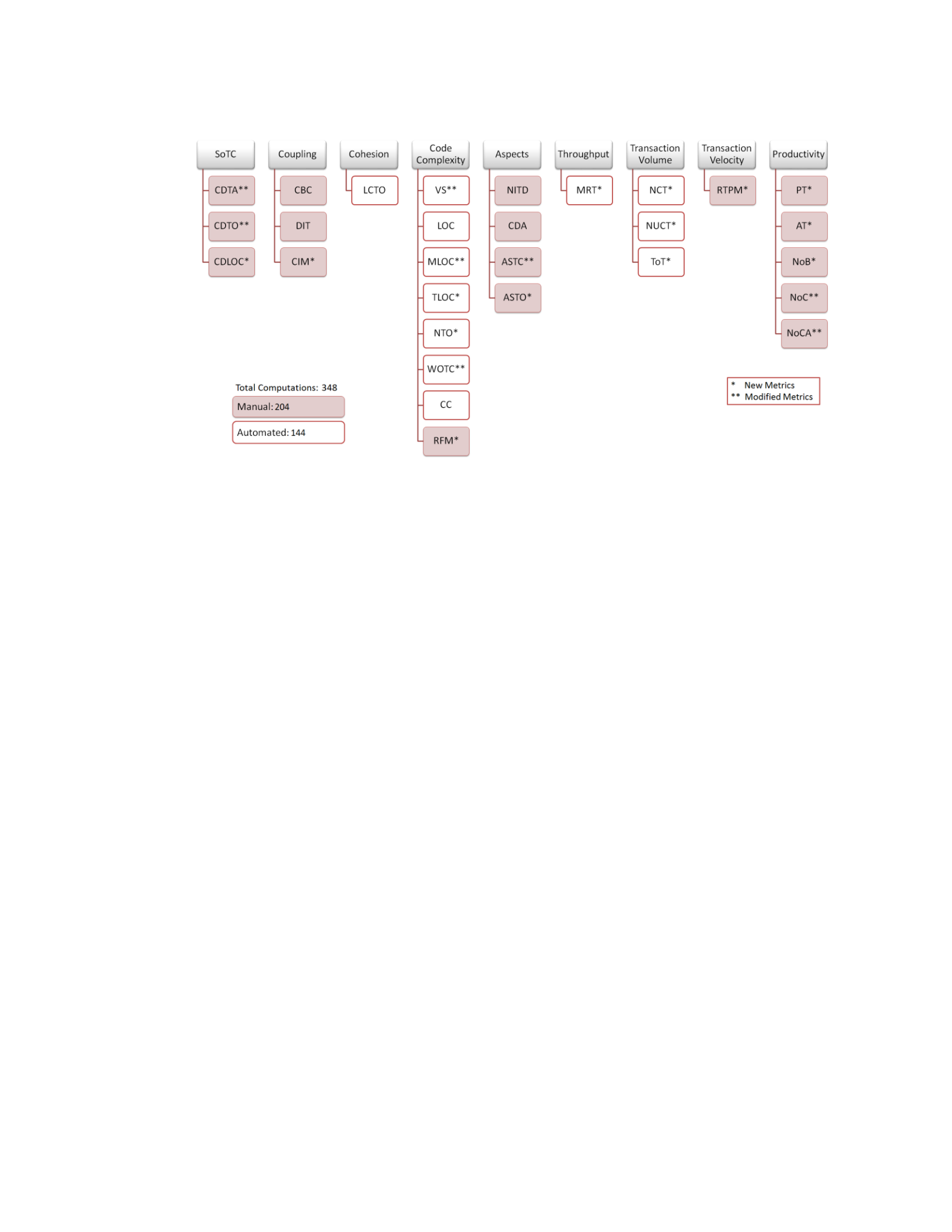
66
7.4 Quality Metrics
Each internal attribute is related to a set of the proposed metrics. The proposed suite of metrics
captures information about the design and code in terms of fundamental software internal attributes as
discussed above.
Figure 7-3 presents the metrics that EQMTA uses to measure each of the internal attributes. We
have tailored the definition of these metrics to reflect the new abstractions introduced by aspects in terms of
quality transaction system attributes. The EQMTA is composed of 29 design and code metrics. In the
following subsections, these metrics are congregated according to internal attributes that are measured. The
description of each metric emphasizes how it satisfies our measurement requirements. The relevance of these
metrics for reuse and performance is discussed in our experimental procedural (see Chapter 9). Twelve of
the metrics can be computed automatically from the code written by the subjects. The others have to be
computed by hand.
Figure 7-3. Measurement Metrics in EQMTA

67
Separation of Transaction Concern (SoTC) and Scattering Metrics
The EQMTA defines the Concern Diffusion in Transaction Application (CDTA), Concern Diffusion
over Transaction Operations (CDTO) and Concern Diffusion over Line of Code (CDLOC) to measure the
degree to which a single concern in transaction system maps to transaction components in the system design
and code, where
CDTA counts the number of primary transaction components (classes or aspects) whose main
purpose is to contribute to the implementation of a single transaction-related concern. In other words,
it counts number of advices and operations that access the primary transaction components to gather
relevant context information by using them in attributes declaration, formal parameters, return types,
introductions (inner-type declarations), method call, and throw declarations.
CDTO counts the total number of primary transaction operations and advices whose main purpose is
to contribute to the implementation of a single transaction-related concern. In other words, it counts
the number of methods and advices that access any primary transaction component to pull all relevant
operation context information by calling their methods or using them in formal parameters, local
variables, return types, and throws declarations. Constructors also are counted as operations.
CDLOC counts the total lines of primary transaction components (a class or aspect) whose main
purpose is to contribute to the implementation of a single transaction-related concern. It counts the
total number of occurrences that access the primary transaction-related concern information, i.e.,
transaction contexts, by using them in attribute declarations, formal parameters, return types, throw
declaration, local variables, inter-type declarations, or method calls. This considers the total number
of transition points for each concern through the line of code over transaction component. Transition
points are points in the code where there is a concern switch. The use of this metric requires a
shadowing process that partitions the code into shadowed areas and non-shadowed areas. Shadowed
areas are lines of code that implement a given concern. Figure 4-1 presents transition points (events)
in our implementation. Transition points are the points in the transaction code where there is a
transition from a non-shadowed area to a shadowed area and vice-versa [55].

68
The higher the CDTA, CDTO, and CDLOC, the more intermingled is the concern code within the
implementation of the transaction-related components. Otherwise, the lower the CDTA, CDTO, and
CDLOC, the more localized is the concern code.
Coupling Metrics
The EQMTA measures coupling from different viewpoints. It defines the Coupling between
Components (CBC), Depth Inheritance Tree (DIT), and Coupling on Intercepted Modules (CIM), where
CBC is defined for counting the number of other transaction components to which a class or an
aspect is coupled. The CBC for a transaction component, it counts the total number of classes or
aspects declared in its attribute declarations. For each transaction operation, it counts the number
of classes referenced by formal parameters, return types, throws declarations, introduction, and
local variables from which shared context information are made. CBC for aspects also includes
the number of components referenced by aspect introductions, component referenced by pointcuts,
and components referenced by each advice. CBC counts each component only once. The low value
of the CBC is desired [55].
DIT: It counts how far down in the inheritance hierarchy a class or aspect is declared. Increase in
the growth of the DIT, the lower-level components inherit or override many methods. This leads
to hitches in understanding the code and design complexity when endeavoring to predict the
behavior of a component.
CIM: It counts the number of classes, aspects or interfaces explicitly named in pointcuts of a given
aspect. It indicates the direct knowledge an aspect has of the rest of the system. High values indicate
tight coupling, due to high crosscutting.
The larger the numbers for CBC, DIT or CIM become, the more difficult it is to understand the
system. Extreme coupling amongst components is harmful to modular design and prevents reuse, because
the higher the sensitivity to changes in other parts of the design. On the other hand, the lower the coupling
for more independent components becomes, it easier it is to reuse it in another application.

69
Cohesion/Tangling Metrics
The EQMTA defines the following metrics for measuring cohesion and tangling among
components: Lack of Cohesion in Transaction Operations (LCTO).
LCTO measures the lack of cohesion of a class or aspect in terms of the amount of method and
advice pairs that do not access the same instance variable and hence should be separated [69]. If the related
transaction methods do not access the same instance variable, they logically represent unrelated components.
In other words, the lower value of LCTO for a more independent transaction component becomes, it
implements a single logical function.
Code Size and Complexity Metrics
The EQMTA measures code complexity from different viewpoints. It defines metrics that are
concerned with the different aspects of the system complexity. Size metrics measure the length of a software
system’s design and code. The following a list of size and complexity metrics: Vocabulary Size (VS), Line
of Code (LOC), Method Lines of Code (MLOC), Transaction Lines of Code (TLOC), Number of Transaction
Operations (NTO), and Weighted Operations per Transaction Component (WOTC), McCabe’s Cyclomatic
Complexity (CC), and Response for Module (RFM).
VS: It counts the number of classes and aspects into the system. Sant’ Anna mentioned that if the
number of components increases, it is a clue of more cohesive and less tangled set of aspects [55].
LOC: It counts the number of physical lines of active code (executable lines) that are in the software.
Size can be measured in a variety of ways. These include counting all physical lines of code, or the
number of statements. The greater the LOC, the more difficult it is to understand the system and
harder find the lines that must be changed during evolution activities or understand the
implementation of the required functionalities during reuse activities [69].
MLOC: It counts the method lines of code, often omitting comments and/or omitting blank lines.
In [69], Kremer claimed that the greater the average of MLOC for a component, the more complex
the component would be.
TLOC: It counts the transaction lines of code. This is the measure of the size of a transaction.
Documentation and implementation comments as well as blank lines are not interpreted as code.

70
NTO: It counts the number of operations in a transaction component. A transaction contains a large
number of operations are less likely to be reused. Sometimes LOC is less, but NTO is more, which
indicates that the transaction component is more complex.
WOTC: It measures the complexity of a transaction component in terms of its operations. WOTC
does not specify the advices and methods complexity measure, which should be tailored to the
specific contexts. On the other words, it is a sum up the complexity of each advices and methods of
aspects and class (WOTC = complexity of operation1 + complexity of advice1 + ... + complexity
of operationN). The transaction operation complexity degree is obtained by counting the number of
parameters of the transaction operation, assuming that a transaction operation with more parameters
than another is likely to be more complex and less understandable [30][55]. The number of advices
and methods and complexity is an indication of how much time and effort is required to develop
and maintain the transaction-related components. The larger the value of weighted operations, the
more complex the program would be [69].
CC is a quantitative measure of the complexity of programming instructions. It is intended to
measure system complexity by examining the software program’s flow graph [70] [71]. In practice,
CC amounts to a count of the decision points present in the software system. It can be calculated as:
𝐶𝐶 = 𝐸 − 𝑁 + 2𝑃 Equation (1)
where,
E is the number of edges of the graph.
N is the number of nodes, and
P is the number of discrete connected components (nodes).
CC measures the logical complexity of the program. CC is originally intended as a
measure of the number of the test case space. In other words, it defines the number of
independent branches and provides you with an upper bound for the number of test cases that
must be conducted to ensure that all statements have been executed at least once [70]. The high
value of CC affects program reuse.

71
RFM: It counts the number of methods and advices that are executed by a given transaction in
response to the request received by another transaction or system. Transactions with a higher
RFM value are more complex and complicated. A lower value of RFM is more desired.
Aspect/Obliviousness Metrics
The EQMTA involves metrics on concerns that evolve into concrete pieces of code, i.e., Aspects,
and contribute directly to the core functionality of the transaction software system. This model defines the
following aspect metrics: Number of Inter-type Declarations (NITD), Crosscutting Degree of an Aspect
(CDA), Aspect Scattering over Transaction Components (ASTC), and Aspect Scattering over Transaction
Operations (ASTO).
NITD: It counts the number of inter-type declarations in the aspects and the number of times they
are used, which also includes their reference in the aspects and application classes. A higher value
of NITD indicates a tighter coupling between the aspect and application components.
CDA: It counts the number of modules affected by the pointcuts and by the introduction in a given
aspect. CDA implies tight coupling between the modules which indicates complexity [68].
ASTC: It counts the number of aspect components scattered over transaction application
components. It measures the tangling of aspects in the application components. The more tangling
of aspects in the program makes the original transaction application less reusable.
ASTO: It counts the number of aspect components, i.e., advices and methods, scattered over
transaction application operations. ASTC gives a high-level overview of the application tangling in
the aspect components, but ASTO provides more insight on operations-level tangling of transaction
applications inside aspect components.
Transaction Throughput Metrics
The EQMTA defines the rate of the Mean Response Time (MRT) to measure the performance of an
individual transaction, in milliseconds.
MRT counts the total time taken between the submission of a transaction request for execution and
the return of the complete output for the front-end user. On the other words, it is the amount of time

72
required for transaction completion, i.e., commit or abort. The response time for a transaction tends
to decrease as you increase overall throughput.
Transaction Volume Metrics
The EQMTA defines the following transaction volume metrics: Number of the Committed
Transactions (NCT), Number of the uncommitted (aborted) Transactions (NUCT), and Timed-out
Transaction (ToT).
NCT counts the total number of committed transactions within an execution interval, i.e., a second.
NUCT counts the total number of the aborted transactions within an execution interval, i.e., a
second.
ToT counts the total number of the timed-out transactions within an execution interval, i.e., a
second.
Transaction Velocity Metrics
The EQMTA defines the Rate of the Transaction Per Minute (RTPM) metrics to measure the
velocity of the transaction.
RTPM refers to the average speed value of transaction processing. In other words, the average
number of transactions that are begin completed, either committed, aborted, or timed-out, per
minute on the transaction system.
The transaction rate can be expressed as transactions per minute, therefore, we can then calculate
the transaction rate for system as follows:
𝑇𝑟𝑎𝑛𝑠𝑎𝑐𝑡𝑖𝑜𝑛 𝑅𝑎𝑡𝑒 = 𝑇𝑟𝑎𝑛𝑠𝑎𝑐𝑡𝑖𝑜𝑛𝑠
60 𝑠 Equation (2)
Maintenance History Metrics
The EQMTA defines productivity metrics to measure development efficiency in terms of the time
needed to maintain the transaction applications. We divide total productivity (maintenance history) into
active time (AT), passive times (PT), a number of bugs (NoB), a number of changes in concern at the
application level (NoC), a number of changes in concern and its application (NoCA). The active time will

73
be spent on typing and producing actual code, whilst the passive time is spent on reading and understanding
the source code, looking for bugs, etc. These metrics are used to predict the amount of effort that will be
required to develop a transaction program. A lower value of PT, AT, NoB, NoC and NoCA is more desired
and will drastically increase the efficiency of the development component of transaction software systems.
Below, we list the maintenance history metrics: Active Time (AT), Passive Time (PT), Number of Bugs
(NoBs), Number of changes in the application and its concerns (NoCA), and number of changes in concerns
(NoC).
AT calculates the time that is needed to develop different transaction software components, i.e., an
average time to write code, e.g., aspects.
PT calculates the time that is spent on the other activities which are concerned with the development
of the transaction system, such as the time to read the code, understand code, detect errors and trace
bugs.
NoB counts the total number of bugs during the development time.
NoC and NoCA count the number of changes required to reuse the concern for another application,
and to maintain the concern, respectively. The difference among them is that the NoC only
considers changes in the concern; however, the NoCA considers changes both in the concern and
application.

74
EXPERIMENTAL HYPOTHESES
The theoretical ideas that underpin TransJ lead to the eight concrete hypotheses [112]. All of these
hypotheses have the same premise and refer to the metrics defined in the EQMTA described in Chapter 7.
Better Encapsulation and Separation of Concern (SoC).
If transaction-related crosscutting concerns are effectively modularized and encapsulated
in TransJ aspects, then the software has better SoCs and less scattering than equivalent
systems developed with AOP design techniques, especially AspectJ.
Supporting a Loose Coupling
If transaction-related crosscutting concerns are effectively encapsulated in TransJ aspects,
then the software has a lower coupling than equivalent systems developed with AOP design
techniques, especially AspectJ.
Higher-Cohesion and Less Tangling
If transaction-related crosscutting concerns are effectively encapsulated in TransJ aspects,
then the software has higher cohesion and less tangling than equivalent systems developed
with AOP design techniques, especially AspectJ.
Reducing the software code size and complexity structure
If transaction-related crosscutting concerns are effectively encapsulated in TransJ aspects,
then the software is not significantly larger or complex than equivalent systems developed
with AOP design techniques, especially AspectJ.
Increasing the capacity of the software obliviousness
If transaction-related crosscutting concerns are effectively encapsulated in TransJ aspects,
then the software is significantly more oblivious than equivalent systems developed with
AOP design techniques, especially AspectJ.
Preserving the software efficiency
If transaction-related crosscutting concerns are effectively encapsulated in TransJ aspects,
then the software would keep or improve runtime performance under stated conditions for

75
a stated period of time, compared with equivalent systems developed with AOP design
techniques, especially AspectJ (measure by Jboss framework functions).
Improving the capacity of software extensibility
If transaction-related crosscutting concerns are effectively encapsulated in TransJ aspects,
then the extension part, i.e., crosscutting concern, of the software would require a smaller
number of changes to reuse (measure by Eclipse IDE diff function) than equivalent systems
developed with AOP design techniques, especially AspectJ.
Improving the productivity of the development process
If TransJ provides a better modularization of transaction-related crosscutting concerns,
then the development transaction system would be less complicated and more readable.
Thus software development efficiency would be increased, so that the system would be
created faster than equivalent systems developed with AOP design techniques. In other
words, the total programmer’s working time should be shorter than the development time
of analogous systems developed with AOP techniques, especially AspectJ.
To determine whether TransJ improves reusability without sacrificing performance, I conducted an
experiment that tests these hypotheses. The next chapter describes this experiment.

76
EXPERIMENTAL PROCEDURE
The experiment to test the hypotheses about TransJ’s benefits consists of the sixteen steps
distributed over two phases as listed below [113]. Sections 9.1 through 9.7 provide additional details about
the steps. Section 9.8 discusses the experiment’s independent and dependent variables, Section 9.9 describes
how I minimized threats to validity caused by extraneous variables, Section 9.10 discusses some restrictions
and Section 9.11 describes how I computed the above hypotheses using the EQMTA metrics.
The first phase of designing the experimental method involves:
1. All the researchers passed the online Human Research Training course offered through the
Collaborative Institutional Training Initiative (CITI). See APPENDIX F for additional details.
2. All the researchers submitted an application for a Human Research Experiment to the
Institutional Review Board (IRB) and got its approval. See APPENDIX F for more details.
3. Developed three non-trivial software applications and documented their requirements, design,
and implementation. See section 9.2 for more details.
4. Selected three common transaction-related crosscutting concerns for the above sample
applications and developed an initial requirements specification document. See Section 9.3 for
more details.
5. Sent invitation letters (See Appendix F.2) and recruited four developers who were experienced
in object-oriented software development (Section 9.4), and randomly organized them into two
study groups: 1 and 2.
a. Group 1 programmed using an AOP technology.
b. Group 2 programmed using a TransJ fashion.
6. Had the volunteers complete a survey that assessed their background and skill levels.
See APPENDIX C.
7. Provided JTA, Arjuna, and JBoss Application Server training to developers in Group 1, and
2, and had them worked through some practice applications. See Section 9.5.

77
8. Provided AOP training to developers in Group 1, and had them worked through some
practice applications. See Section 9.5.
9. Provided TransJ training to developers in Group 2, and had them worked through some
practice applications. See Section 9.5.
The second phase of designing the experimental method, which involves:
10. Gave three sample applications mentioned above, associated documentation, and initial
requirements specifications of all three concerns to the volunteers (APPENDIX A
and APPENDIX B).
11. Asked the volunteers to complete a pre-implementation questionnaire (Appendix D.1), once
they understood the code and documentation provided them in Steps 7, 8, 9, and 10.
12. Asked the volunteers to develop the three crosscutting concerns, and then collected their
implementations using Bitbucket repository, and Box-file sharing.
13. Asked the volunteers to complete a post-questionnaire that gathered some additional
information to measure quality metrics (See Appendix D.2.)
14. Measured the quality metrics using EQMTA, collected findings from the logs and pre/post-
questionnaires of all activities.
15. Evaluated the reusability and performance of the various software artifacts using EQMTA. See
Section 9.7 for details on the metrics and experiment.
16. Interpreted the results of the experiment.
Section 9.8 summarizes the control, independent, dependent, and extraneous variables for this
experiment. Section 9.9 describes potential threats to validity of the research experiment.
9.1 Experimental Approval
In the first step, we got a prior approval by the Institutional Review Board (IRB) [25]. To do so, we
submitted an application for conducting this Human Research Experiment to the USU IRB and got its
approval. Before submitting this application, all the researchers passed the online human research
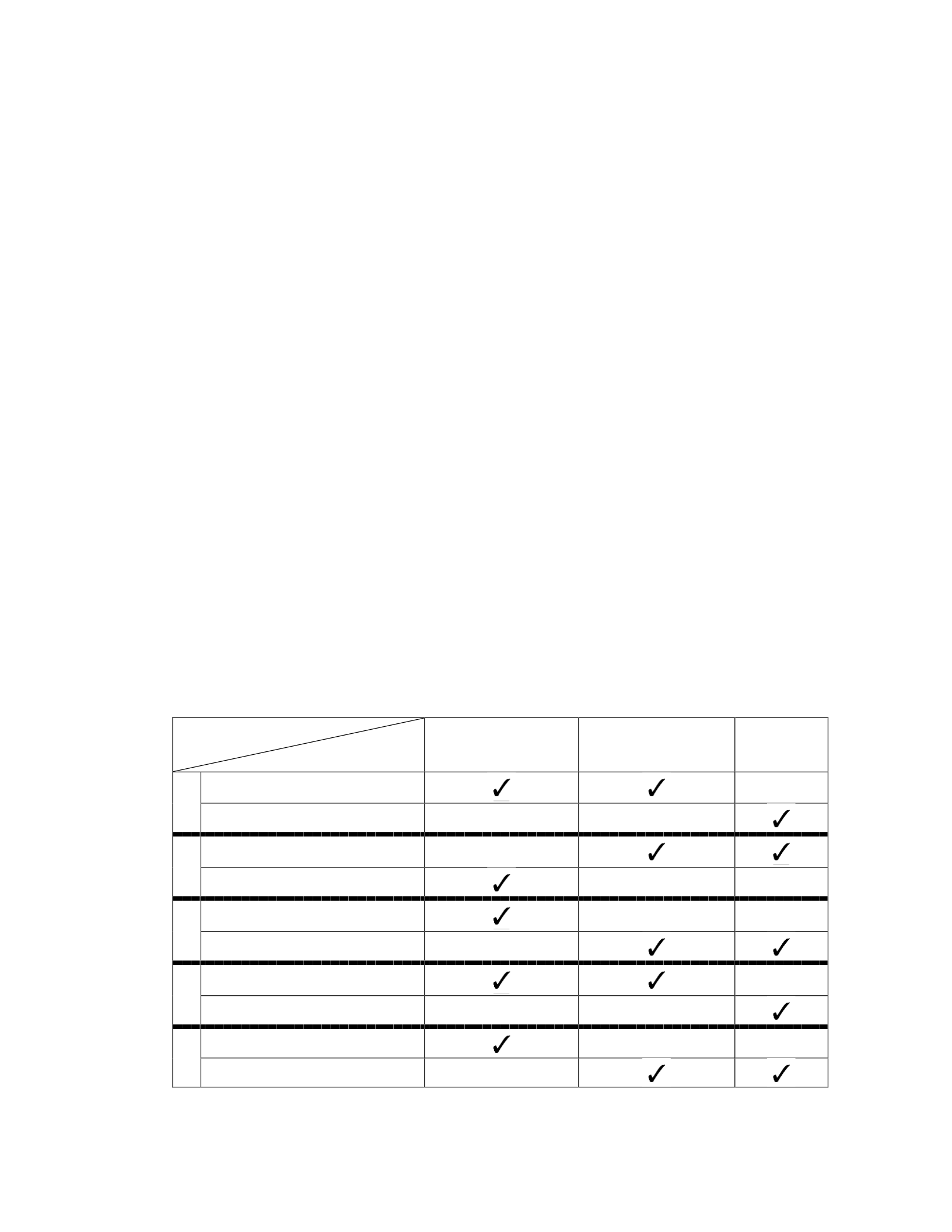
78
experiment-training course offered through the Collaborative Institutional Training Initiative (CITI) [66].
See APPENDIX F.
9.2 Selection of Sample Applications
To improve the veracity of the experiment, it is important that the selected sample applications are
non-trivial transaction systems and that their transactions represent a wide variety of concerns. To this end,
we selected three applications based-on various criteria as: they involved different type of transaction models
and concepts; they were implemented on the JTA API, X/Open standards and run on the Jboss Application
Server; they included shared resources; two of them were distributed over many application hosts; they were
multithreaded; and they were the ones who belong to the common fields are based on the transactions. In
addition, the applications were diverse in the way they implemented transaction, i.e., Flat transaction vs.
nested transaction, and therefore provided good coverage of different types of transactions and transaction–
related concepts. Table 2 shows that these applications are categorized according to some of characteristics
such as:
Table 2. Categories of Selected Applications
Categories
Selected
Applications
Gadget
Manufacturing
System
Conference
Registration System
Local
Bank
System
1
Distributed
Local
2
Flat
Nested
3
Many Resources
Few Resources
4
High Concurrency
Low Concurrency
5
High potential for Conflict
Low potential for Conflict

79
Distributed vs. Local
Flat vs. Nested transaction
Many resources vs. Few resources
High Concurrency vs. Low Concurrency
High Potential for Conflict vs. Low Potential for Conflict
Table 3 describes the selected applications. Appendix A provides additional details about them.
Volunteers were provided with the application code along with the functional requirement documents and
UML diagrams.
9.3 Identifying Crosscutting Concerns from Sample Selected Applications
Since the experiment would eventually require programmers to adapt or extend applications for
requirements that represented transaction-related crosscutting concerns, our methodology included a step,
which systematically selected our representative crosscutting concerns. Volunteers would have to apply each
of these to the applications, individually. We picked three common transaction-related crosscutting concerns
for the experience such that they were applied to all the sample applications and the various concepts of
Table 3. Sample Selected Applications
Application
Name
Description
Local Bank
System
The programmer implemented a transaction application where a server would
calculate the response time between local transactions provided by the client, over a
JDBC connection.
Conference
Registration
System
Flat transactions access a single shared resource. The programmer implemented a
simple audit trail tracker that maintains a record of system activity both by processes
and by user actions of the system. This tracking can help to detect registration and
other suspicious behavior. In conjunction with detecting registration violations,
recording the date and time of each entry of information for each attendee, and
preserving the original content of the recorded information when changed, updated
or corrected.
Gadget
Manufacturing
System
Distributed concurrent transaction accesses distributed data shared amongst
multiple transaction components in multithreaded environment, so if all the threads
succeed it will commit else abort. The programmer implemented an optimization
mechanism in order to optimize sharing of the distributed shared-resources across
hosts.

80
transactions, as shown in Table 4. To reduce chaos in our data, we wanted to make sure that these crosscutting
concerns were adequately simple to a novice developer, who meets the specific criteria that are listed in
Section 9.4, could understand and integrate them into the selected sample applications in less than 15 hours,
regardless of whether TransJ is used. Table 4 and APPENDIX B present the set of selected crosscutting
concerns for the experiment.
9.4 Recruitment of Developers
To transparently recruit the developers, we sent invitation letters and recruited four volunteer
developers who were experienced in object-oriented and aspect-oriented software development, Java,
transaction, and software-engineering design principles such as reusability.
The selection criteria for hiring developers to experimental research was based upon criteria
according to developer capabilities, and relevant to my research field. Ideally, all participants were under-
graduate and graduate students in Computer Science major; they had taken courses in algorithms,
programming language (i.e., Java), data-structure, database system, object-oriented software development,
and software engineering. Additionally, we had who had studied distributed systems, AOP and the concepts
of transaction management systems; and they had a good exposure of:
Unified Modeling Language (UML),
implementing at-least one project in Java, the size of the project is comparable to the scope of our
implementations.
Table 4. Selected Sample Crosscutting Concerns
Aspect Name
Description
Measuring
Performance
It measures some performance-related statistics for transaction-based
applications between a client and server, such as turn-around time (i.e.,
response time).
Data-Sharing
Optimization
It shares context information across hosts only when necessary. It includes
knowledge of contexts related to transactions to allow different transaction
operations to access shared-resources across hosts.
Audit Trail
It records a history of actions executed by transactions and users in order to
monitor transaction activities and provide assurance that meet the predefined
minimum requirements.
81
implementing at-least one database-based application using any type of database management
systems (e.g., SqlServer, MySql, Postgress, DB2, H2 or Access) using Java,
implementing at-least one distributed application project, and
implementing at-least multithreaded programming project.
We randomly organized them into two study groups: 1 and 2. Group 1 programmed using an AOP
approach and Group 2 used TransJ. Next, the participants completed a survey that assessed their background
and skill levels. We also provided JTA, Arjuna, Jboss, AOP training to developers in Group 1, and had them
worked through some practice applications. Similarly, we trained Group 2 developers with TransJ, and had
them worked through some practice applications.
We hired four developers only, each group comprised two developers because there is limited
availability for developers that met the selection criteria.
Invitation Letter
Initially, we sent an invitation letter by the Computer Science Department to all under-graduate
and graduate students. See Appendix F.2.
Anonymous Identity
To protect the privacy of participants, we used aliases. Once selected the required volunteers, all
volunteers tagged with a specific unique identifier. Therefore, data and code gathered from the volunteers
were tagged with this identity to hide the personal identifiable information. An additional safeguard is
included in this experiment to maintain data and codes in a separate secure location using a shared file, like
Box and Bitbucket. The Box is operated by Utah State University (USU). The Bitbucket is used to monitor,
collect and manage changes to the source code. After experimenting, the identity of the volunteer is still
hidden by deleting the records that may indicate the identity of individual volunteers.
A Survey to Assess the Level of Volunteer Skills
To ensure a high quality experiment, we identified the effects of extraneous variables (Section 9.9),
volunteers were asked to fill a pre-placement survey after hiring and before starting the experiment to obtain

82
information on their effectiveness in meeting the needs of the experiment and expectations. See APPENDIX
C for more details. The results of this survey, provided in full in APPENDIX E, clearly indicated that our
selection of candidates satisfied all the criteria that are mentioned above.
9.5 Training of Developers
After selecting the developers, we organized them into two groups (Group 1 and Group 2) and place
them randomly in two categories (i.e., AOP’s category, and TransJ’s category). Group 1’s developers were
trained on how to write aspects using AspectJ, and the Group 2’s developers were trained on how to write
aspects using both AspectJ and TransJ. During training, each developer implemented three sets of examples,
similar to those that would be a part of our experiment. Each group undergone a training program for the
purpose of achieving the experiment as follows:
JTA, Arjuna and Jboss Application Server Training: All developers were trained on how to
configure the JTA, Arjuna and run the Jboss Application Server.
AOP Training: Group 1’s developers were trained on how to write aspects in AOP using AspectJ.
TransJ Training: Group 2’s developers were started with the tutorial so they could understand the
basic principles and the architecture of the TransJ, and had them worked through some practice
applications using its library. In addition, they were trained on how to plug-in the TransJ with
AspectJ.
By the end of training, each developer filled the pre-implementation questionnaire (APPENDIX D).
This kind of questionnaire revealed that all volunteers were in good understanding, coding and debugging
the language related complications, such as EJP, JPA, Jboss Server, etc.
9.6 Implementing the Selected Crosscutting Concerns Using the Set of Requirements and Collected
Artifacts
All volunteers were given an initial set of requirements in which they were asked to implement three
transaction-related crosscutting concerns (Section 9.3) using the sample applications (Section 9.2). More
details of the applications and their associated concerns that are discussed in Chapter 6, APPENDIX A
and APPENDIX B, respectively.

83
During this phase, we analyzed the understanding of the requirements, familiarity with the language
and tools, and debugging the most prominent challenges. They also recorded hourly journals of maintenance
history.
By the end of implementation, each developer filled the post-implementation questionnaire
(APPENDIX D). Observation of this questionnaire indicated that all developers correctly understood the
requirements, familiarized with the language, tools, and debugged the challenges. On requirements
understanding, 50% of the total developers agreed that understanding and analyzing the requirements
properly was the most time consuming in all activities. 75% of the total participants agreed that familiarity
with the language/tool, e.g., JTA, JBoss, Arjuna, was the hardest thing during the initial activity of
implementation, whereas no participant raised this issue again in the second and third activities. On
debugging for AspectJ took more time than TransJ development. Explicitly, 25% of the participants
supported this observation in activity 1, and 75% supported it again in activity 2 and 3. This observation
shows that debugging time may be more associated with the complexity of the requirements than to
experience with the implementation environment. See Section 10.9 and Appendix E for more information
and additional observations.
9.7 Measuring Dependent Variables using Reuse and Performance Metrics
We measured EQMTA code metrics using both manual-based and automated tool-based
methods [22][72]. Total measurements include following: experiment input variables included a total of four
developers and three applications with each; experiment generated a total of 12 software systems against
which the metrics need to be applied; the 29 code metrics of EQMTA, which will have a total of 348
measurements. Of these, 144 measurements from 12 metrics will be generated using tools, and 204
measurements from 17 metrics will be calculated manually.
Once data collection using these code metrics measurement procedure, then we interpreted the
hypothesis in Chapter 8 using different experiment variables (see Section 9.8).

84
9.8 Experiment Variables: Independent, and Dependent Variables
I had tight enough control in this experiment to ensure a good experience. We observed what
happened in changing the implementation approach as an independent variable with a focus on the dependent
variable to see how it responded to the changes in the independent variables. For this experiment, the
independent variables corresponded to factors that represented the implementation method. In our research,
we had two possible values: AOP, and TransJ.
The dependent variables were those that we want to observe possible difference changes occurred
in an AOP’s group and TransJ’s group implementation. All instruments in our EQMTA (see Chapter 7)
represent our dependent variables. Quality measurement metrics (Section 7.4) were our direct independent
variables. Quality attributes (Section 7.3) were indirect dependent variables, which were interpreted from
measurement metrics. Factors (Section 7.2) were indirect dependent variables and were interpreted by using
internal quality attributes. Finally, qualities (Section 7.1) were indirect dependent variables and were
interpreted by using factors.
9.9 Extraneous and Confounding Variables and Mitigation of Threats to Validity
The threats to the validity of an experiment refers to anything that can occur during the experiment
that makes it difficult or impossible for the researcher to say that the experimental variables caused the
changes on the dependent variables and not something else [96][98]. In other words, extraneous and
confounding variables were other factors that might compete with dependent variables being used in the
interpretation the outcome of the this research, hence, that were threaten the validity of experiment results.
Below is a list of the potential extraneous variables in this research experiment along with proposed
mitigation strategies to control their effects on the research experiment output.
Level of Experience for Developers: In our experiment, I formed or selected the groups under study,
manipulates the treatments for the groups, attempts to control extraneous or confounding variables.
In other words, the selection criteria for hiring the participants, and survey to evaluate their skill
levels reasonably mitigated its effect.
Capacity of work and Task Performance: There was a reason to believe that the time of days that
the experiment conducted, that might affect the capacity of work and concentration of participants.

85
In our research, training of participants for specialized skills, needed in this experiment, reasonably
mitigated the effect of this extraneous variable.
Intelligence and Anxiety: No sufficient mitigation strategy to control this threat.
Demand characteristics: Developers got non-verbal interpretations about what is going on in the
experiment, i.e., UML and other visual paradigms.
Health Factors: No sufficient mitigation strategy to control this threat.
Work Environment: There was no adequate mitigation strategy to combat this threat, but I prepared
the developer’s computer to be ready to the implementation, additionally, I prepared an additional
computer in the lab to keep a good environment as possible for developers, who were worked in this
lab.
Personnel Commitment of Developers for Better Design: I found no sufficient mitigation strategy
to control this threat.
Accuracy in Manual Measurements: More than one person participated in measuring some of
EQMTA code metrics.
Accuracy in Tool’s Measurements: When I used tools meant for measurement, I assumed that they
are correct and accurate, however measuring tools are not always right. Therefore, I created a stable
environment to apply the automated measurement. I used the Amazon Web Services to create a
cloud computing environment [109]. Additionally, I asked human resources to manually calculate
some of the measurements using EQMTA metrics, which crosschecked the tool’s automatically-
generated measurement with manual ones and hence effectively mitigated the inaccuracy risks.
9.10 Restrictions
To compare the EQMTAs’ metrics, all the developers must follow the same rules. The technology
used to develop the application were: AspectJ and TransJ programming languages with Java, JbossAS, JTA,
AspectJ, EJB, JPA and Java Servlet. Each participant used the Eclipse Integrated Development Environment
(IDE) or JBoss Studio with the maven, jboss, junit, log4j and jta1.1 plugins installed. The source code was
committed to the BitBucket repository after each completed user activity.

86
9.11 Measuring Characteristics of the Participants Code Using the Metrics in the EQMTA.
I compared implementations of different sample applications across two study groups: one for
TransJ and another for AspectJ. The purpose is that the comparison of the two alternative implementations,
with a focus on seven secondary quality attributes: understandability, extensibility, localization of design,
obliviousness, efficiency, predictability, and scalability. The empirical study was conducted to measure each
of these secondary quality attributes by matching a set of metrics that are consistent with the related-internal
quality attributes. Each hypothesis that was tested by means of this study can be expressed through the
following list of metrics of the EQMTA, We used both manual computation and automated tools to compute
measurements for all these metrics (29 metrics), such as tools in [22][72][73].
We computed the metrics of the first hypothesis, “Better Encapsulation and Separation of Concern
(SoC), by:
CDTA: Calculates the concern occurrences in classes and aspects that can in application-level
components. In other words, concern occurrences can be on an aspect or a class that required
gathering the context data needed for a transaction-related concern. It is a manual calculation.
CDTO: Calculates the total number of transaction operations in an application-level
component containing the concern related occurrences, i.e., relevant operation context
information. It is a manual calculation.
CDLOC: Calculates the total lines of code that implement a given concern in an application-
level components. In addition, it calculates the amount of transition points to gather the
relevant transaction-related context information by analyzing program code line by line. It is
a manual calculation.
o Predictions: For this hypothesis to hold, we expect that:
CDTA, CDTO, and CDLOC will decrease when using TransJ.
We computed the metrics of the second hypothesis, Supporting a better Loose Coupling, by:
CBC: Counts the total number of direct and indirect interdependencies between components
of a transaction program. It is a manual calculation.

87
DIT: Maximum hierarchical distance from component object in the inheritance hierarchy, i.e.,
from the leave component object to the parent object of the hierarchical tree. It is a manual
calculation.
CIM: Calculates the total number of classes, aspects, or interfaces explicitly named in the
pointcuts of a given aspect. It is a manual calculation.
o Predictions: For this hypothesis to hold, we expect that:
CBC, DIT, and CIM will decrease when using TransJ.
We computed the metrics of the third hypothesis, Higher-Cohesion and Less Tangling, by:
LCTO: It is a measure for the cohesiveness of a transaction component and is calculated with
the Equation 3, called Henderson-Sellers method [54]. If (M(A)) is the number of methods
accessing a transaction attribute A, it calculates the average of M(A) for all attributes, subtracts
the number of methods m and divides the result by (1-M). A low value indicates a cohesive
transaction component and a value close to 1 indicates a lack of cohesion and suggests the
component might better be split into a number of subcomponents [30]. The tool [72] calculates
this metric.
𝐿𝐶𝑇𝑂 = <𝜌> − |𝑀(𝐴)|
1−|𝑀(𝐴)| Equation (3)
𝑤ℎ𝑒𝑟𝑒:
M: be the set of methods defined by the transaction component.
A: be the set of attributes defined by the transaction component.
𝜌(M(A)) be the number of methods that access attributes A, where a is a
member of A.
< 𝜌 > be the mean of 𝜌(A) over A.
o Predictions: For this hypothesis to hold, we expect that:
LCTO will decrease when using TransJ.
We computed the metrics of the fourth hypothesis, Reducing the software code size and Complexity,
by:

88
LOC: Calculates the total executable lines of code with excluding non-executable lines such
as white spaces and comments. The tool [72] calculates this metric.
MLOC: Calculates total executable lines of code for a method or advice, ignoring white spaces
and comments. The tool [72] calculates this metric.
TLOC: Calculates total executable lines of code for a transaction ignoring white spaces and
comments. The tool [72] calculates this metric.
NTO: Calculates the total number of operations in a transaction component. The tool [72]
calculates this metric.
VS: Calculates the total number of transaction components, which include inner classes,
aspects, and classes. The tool [72] calculates this metric.
WOTC: Sums up the McCabe Cyclomatic Complexity for all methods and advices in a
transaction component. The tool [72] calculates this metric.
CC: Calculates the number of flows through a piece of code. Each time a branch occurs (for
(...) if (...), switch (...), while (...), for (...), and catch (...) and then ?: ternary operator, as well
as the && and || conditional logic operators in expressions) this metric is incremented by
one [70]. Calculated for methods/advice only. The tool [72] calculates this metric.
RFM: Calculates the number of advices and operations possibly accomplished by a given
transaction in response to a received request. It is a manual calculation.
o Predictions: For this hypothesis to hold, we expect that:
LOC, MLOC, TLOC, NTO, WOTC, CC and RFM will decrease when using TransJ.
VS will increase when using TransJ.
We computed the metrics of the fifth hypothesis, Increasing the capacity of the software
obliviousness, by:
NITD: it calculates the number of Inter-Type Declarations (ITD) in the aspects and
the number of times they are used, which also includes their references in the
application classes. It is a manual calculation.
CDA: it calculates the number of modules that are affected by an aspect, which also
includes their references in the aspects. It is a manual calculation.

89
ASTC: it calculates the number of distinct application components in the transaction-
related concerns, which includes both the distinct number of transaction components
and number of transaction operations for those components. It is a manual
calculation.
ASTO: it calculates the number of methods and advices in the concern containing the
references of transaction operations. It is a manual calculation.
o Predictions: For this hypothesis to hold, we expect that:
NITD, CDA, ASTC, and ASTO will decrease when using TransJ.
We computed metrics of the sixth hypothesis , Improving the software efficiency, by:
MRT: Calculates the rate of the elapsed time from the moment that a user requests a
transaction until the time that the transaction server application indicates the request
has completed, i.e., committed or aborted. The tool [22] calculates this metric.
NCT: Calculates the total number of committed transactions per second. The tool [22]
calculates this metric.
NUCT: Calculates the total number of aborted (i.e., rolled back) transactions per
second. The tool [22] calculates this metric.
ToT: Calculate the total number of time-out transactions per second. The tool [22]
calculates this metric.
RTPM: Calculates the speed of transaction processing. It is a manual calculation.
o Predictions: For this hypothesis to hold, we expect that:
MRT, NUCT, ToT, RTPM, and NCT for TransJ will be equal MRT, NUCT,
ToT, RTPM, and NCT for AspectJ. Otherwise
o MRT, NUCT, and ToT will decrease when using TransJ,
o RTPM, and NCT will increase when using TransJ.
We computed the metrics of the seventh hypothesis , Improving extensibility, by:
NoCA: Calculates the number of changes required to reuse the concern for another
application. The eclipse IDE calculates this metric.

90
NoC: Calculates the number of changes required to maintain the concern. The
eclipse IDE calculates this metric.
o Predictions: For this hypothesis to hold, we expect that:
NoC and NoCA will decrease when using TransJ.
We computed metrics of the eighth hypothesis, Improving the productivity of the
development process, using [102]:
AT: Calculates the total time during which programmers are writing the required
code to maintain the concerns. It is a manual calculation by the questionnaire.
PT: Calculates the total time during which programmers are reading, understanding
the code design, and fixing bugs. It is a manual calculation by the questionnaire.
NoB: Calculates the total number of bugs during the system development to reuse
and maintain the concerns. It is a manual calculation through the questionnaire.
o Predictions: For this hypothesis to hold, we expect that:
AT, PT, and NoB will decrease when using TransJ.

91
EXPERIMENT RESULTS AND INTERPRETATIONS
This chapter presents empirical results relevant to the eight hypotheses. We analyzed and evaluated
the reusability and performance using various software artifacts, which included surveys, questionnaires,
hourly journals, maintenance history, and actual code. The collected data are presented using column bar
graphs, allowing for inspecting of the contributions of the application base code, base aspects, reusable
aspects, and other aspects to each metric in each programming activity.
The number of participants who have taken part in our study is limited. Since internal quality metrics
are computed for each method, advice, class and aspect in the software system, the number of data appeared
sufficient for executing the reliable preliminary experiment to measure impact of TransJ and Aspect on
design quality metrics. In the following graphs, the vertical axes represent the measurements, and the
horizontal axes represent the three activities of the experiment. For each activity there are two bars: a blue
bar for the results of AspectJ group and an orange bar for the results of TransJ group.
10.1 Better Encapsulation and Separation of Concern (SoC)
The first hypothesis theorized that if transaction-related crosscutting concerns are effectively
encapsulated in TransJ aspects, the software has a better separation of concerns and less scattering as
measured by CDTA, CDTO, and CDLOC than equivalent systems developed with AOP design techniques.
In other words, the CDA, CDO and CDLOC metric values for TransJ should be less than AspectJ as
described in Section 9.11.
From the graphs in Figure 10-1, we found that the interest average of CDA, CDO and CDLOC
values for TransJ went to zero in all three activities of the experiment, and the result was significantly
different from AspectJ in the all activities. This was caused by: the parameterization of advice via joinpoints,
which enables aspects to be customized in different contexts and thus increase the reusability of aspects,
resulting in the elimination of application-specific code from the transaction implementations; and the TransJ
pointcuts provide total localization and obliviousness between the transaction application and transaction-
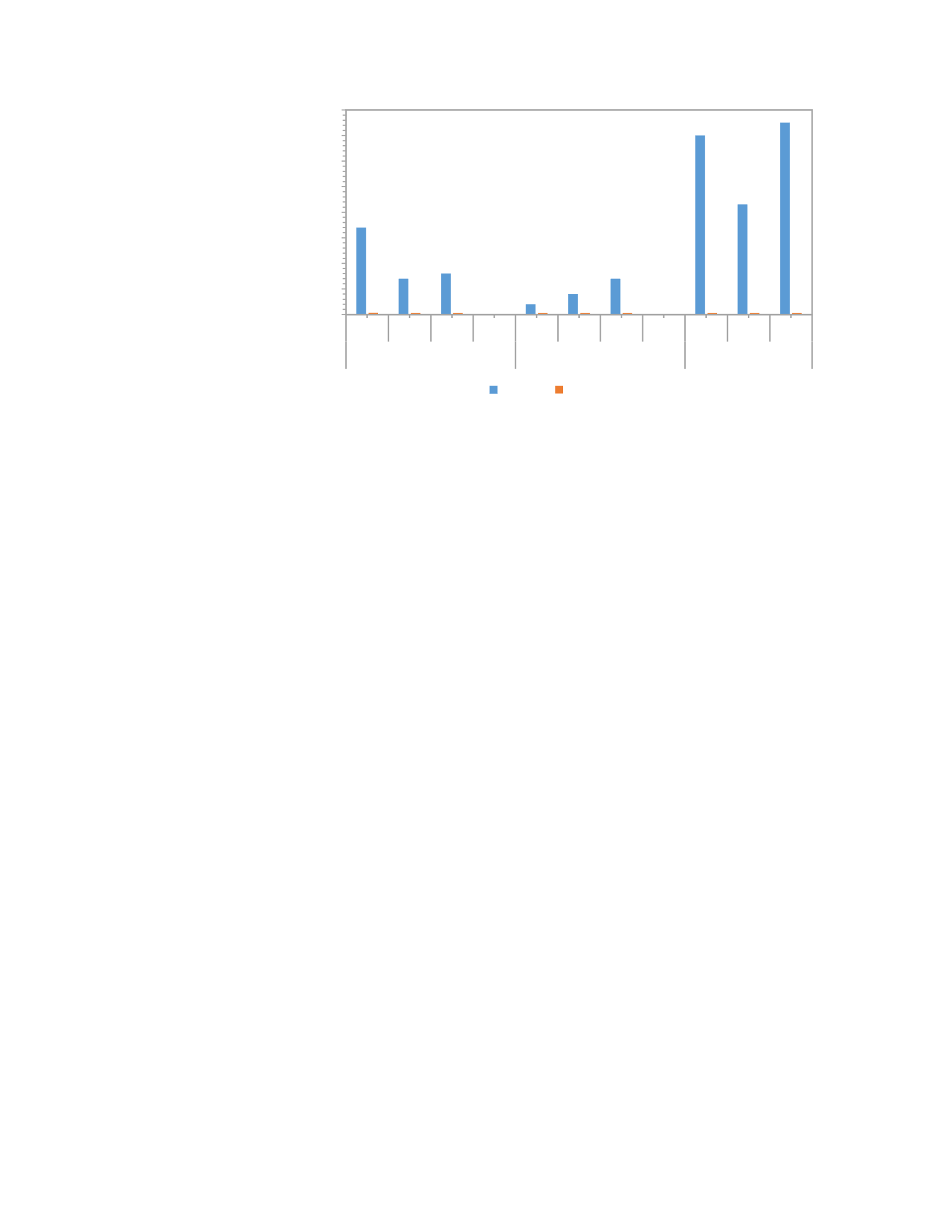
92
related crosscutting concern. Obliviousness can thus be handled for increased SoCs within the reusable aspect
implementation for TransJ pointcuts. This technique can be seen as a compromise, where the reusable aspect
can completely encapsulate the transaction-related crosscutting concern from the core code.
In AspectJ, components and their operations for crosscutting concern were significantly more
diffused in the transaction application because the pointcuts had to be tied to programming constructs instead
of transaction abstractions. Thus, TransJ provides a mechanism for encapsulating crosscutting concerns that
apply to transactions into modular units; this mechanism provides an easy approach to identify the joinpoint
where only the existence of the transaction-related concern and its associated contextual requirements for
perfection of reusability.
From these results, they are apparent that the first hypothesis hold true for better encapsulation,
localization, obliviousness and separation of concerns with no scattering in TransJ implementations than in
AspectJ.
10.2 Supported a better Loose Coupling
The second hypothesis theorized that if the transaction-related crosscutting concerns are effectively
encapsulated in TransJ aspects, then the software has a lower coupling (as measured by CBC, DIT and CIM)
Figure 10-1. CDTA, CDTO, and CDLOC Coverage over Activities
0
5
10
15
20
25
30
35
40
Act.1 Act.2 Act.3 Act.1 Act.2 Act.3 Act.1 Act.2 Act.3
CDTA CDTO CDLOC
AVERAGE CDTA, CDTO AND CDLOC IN
TRANSACTION APPLICATION
AspectJ TransJ
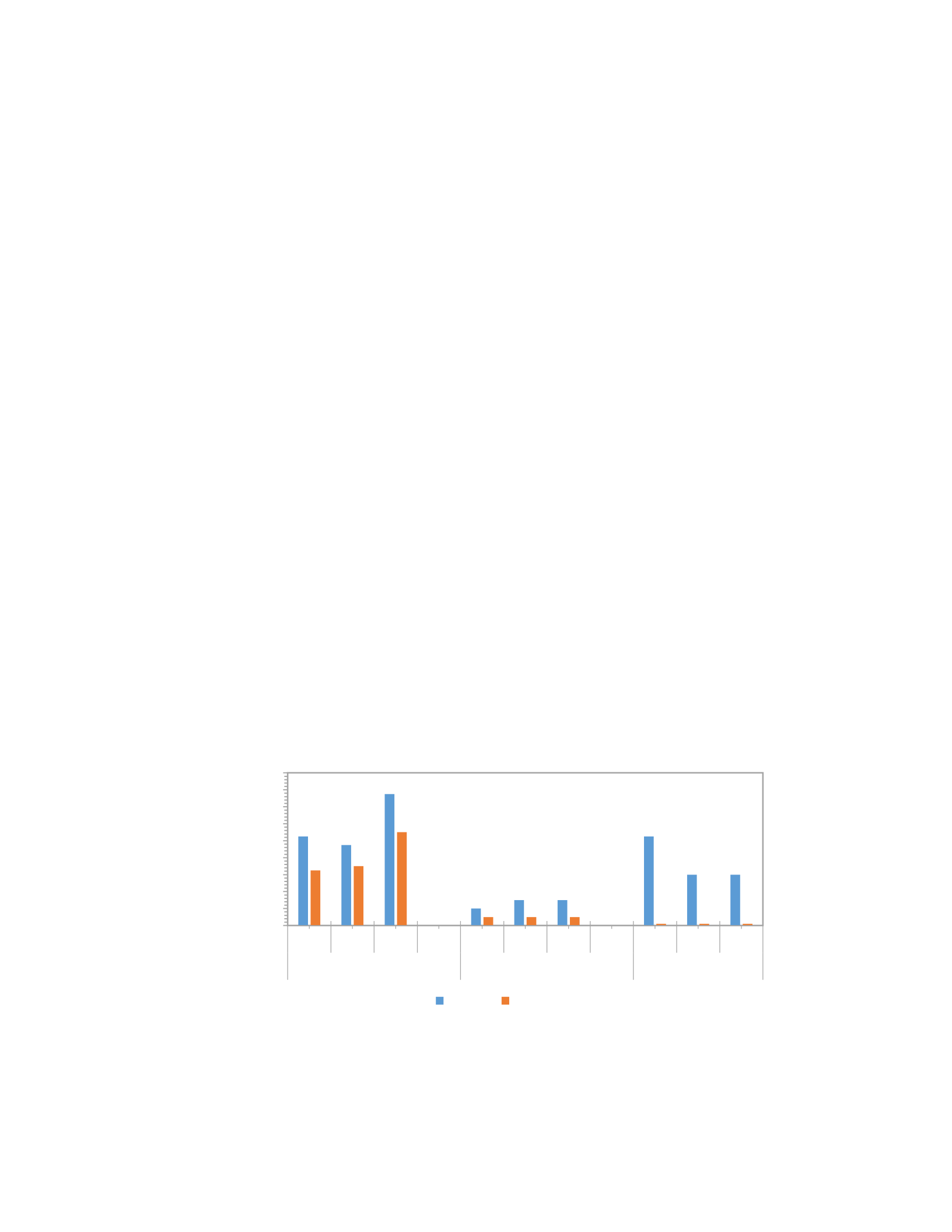
93
than equivalent systems with AOP design techniques. Specifically, the values of CBC, DIT and CIM for
TransJ should be less than AspectJ. Figure 10-2 shows that TransJ implementation decreased the values of
these metrics, as compared to AspectJ implementations in all the three activities of the experiment. TransJ
removed dependencies and did not maintain any direct relationship between transaction-related crosscutting
concerns and the core application components. Removing dependencies between the DTPS components
improved the DTPS architecture, which lead to a less coupled architecture, i.e., lower CBC value, with less
complicated design easier to modify or adapt to new requirements, additionally, it increased the velocity of
adding new features (see Sections 10.7 and 10.8).
In AspectJ, unnecessary coupling of transaction-related concerns with the core application
components increased CBC, which hindered reuse and code understandability. The reason for the tight
coupling in AspectJ compared with TransJ was that the complexity inherent in precisely describing sets of
joinpoints when these joinpoints have no explicit name, this makes them difficult to define pointcuts, such
that they anchor transaction crosscutting logic precisely, where needed without unintentionally matching
additional joinpoints. This means that joinpoints become more likely for the semantics of a pointcut to
changes as the core code evolves, i.e., a fragile pointcut. Whilst, TransJ defines a set of elegant and clear
joinpoints and a set of reusable stable pointcuts.
Figure 10-2. CBC, DIT and CIM Coverage over Activities
0
2
4
6
8
10
12
14
16
18
Act.1 Act.2 Act.3 Act.1 Act.2 Act.3 Act.1 Act.2 Act.3
CBC DIT CIM
AVERAGE CBC, DIT AND CIM IN
APPLICATIONS
AspectJ TransJ

94
On the one hand, wide variations were found in DIT and CIM metrics from TransJ group and
AspectJ group. The most significant indicator of the decrease in coupling between aspects and the core code
is the impact of TransJ’s joinpoints on the CIM metric. This metric counts the number of modules explicitly
named in pointcuts. Compared to the AspectJ activities, the TransJ activities have a reduction of 100%, 100%
and 100% in CIM (i.e., all of the three activities have an average value of zero for CIM metric). This was
caused by providing a comprehensive set of pointcuts, which fully encapsulates the distributed transaction
abstractions. This allows participant programmers to reuse the pointcuts directly, so they did not need to
override or inherit the aspect components to name in the pointcuts of a given class. In contrast, AspectJ
programmers suffered from a lack of clarity of relationship among transaction-related concerns and
application components, wherein aspects acquire context information from one of more classes. Thus, they
preferred to inherit all of the attributes and operations from parent (superclass) methods in crosscutting
concerns to share context data across aspects and distributed transaction application components.
In consonance with these results, we present additional insights into the effects of TransJ on
comprehensibility, readability, and reusability. In other words, TransJ provides better understanding the
overarching among obliviousness and reuse. Thus, we can confidently conclude that the second hypothesis
hold true for reduced coupling in TransJ compared with AspectJ, therefore, increase the understanding and
reuse of the DTPS components.
10.3 Improved Cohesion and Less Tangling
The third hypothesis theorized that if transaction-related crosscutting concerns are effectively
encapsulated in TransJ aspects, then the software has a higher cohesion (See Section 9.11) and less tangling
than equivalent systems developed with AOP design techniques. In other words, the values of LCTO metric
for TransJ should be less than AspectJ. In Figure 10-3, the result reveals that TransJ maintains a lower value
for LCTO than AspectJ in all the three activities of the experiment. Thus, TransJ promoted encapsulation
with implementing a more independent component that implements a single logical function (more cohesive)
than implemented with AspectJ.
Compared to the AspectJ group, the TransJ group improved cohesion in all activities, sometimes
significantly (from 8% to 75%). The decrease in the cohesion of the AspectJ activities is caused by the need

95
to extract new methods to expose advisable joinpoints i.e., multiple transaction joinpoints cannot be advised
as an atomic unit (e.g., begin – commit, begin – abort or lock – release). In other words, the entire transaction
cannot be advised as execution unit, which results in the transaction operation refactorings that decrease
cohesion, i.e., increase the LCTO value. Careful inspection of these results shows that in all activities there
are improvements in cohesion in the TransJ activities versus the AspectJ activities. From these results, we
proved that the third hypothesis hold true for increased cohesion in TransJ compared with AspectJ.
10.4 Reduced the Software Code Size and Complexity
The fourth hypothesis theorized that if transaction-related crosscutting concerns are effectively
encapsulated in TransJ aspects, then the software is less complex and not significantly larger than the
equivalent systems developed with AOP design techniques (as described by LOC, MLOC, TLOC, NTO,
WOTC, CC, RFM and VS in Section 9.11). In other words, the values of LOC, MLOC, TLOC, NTO, WOTC,
CC and RFM metrics for TransJ should be less than AspectJ and VS for TransJ should be more than AspectJ.
Figures 10-4 through 10-8 show that TransJ implementations decreased the metric values for LOC,
MLOC, TLOC, NOT, WOTC, CC and RFM and increased VS value in all the three activities of the
experiment.
In comparison with TransJ, AspectJ programmers found the aspects and application code tends to
contain very terse pointcuts, advices and extra code, especially, when combined with transaction constructs,
Figure 10-3. LCTO Coverage over Activities
0
0.1
0.2
0.3
0.4
0.5
Act.1 Act.2 Act.3
AVERAGE LACK OF COHESION
PER PROGRAMMING ACTIVITY
AspectJ TransJ
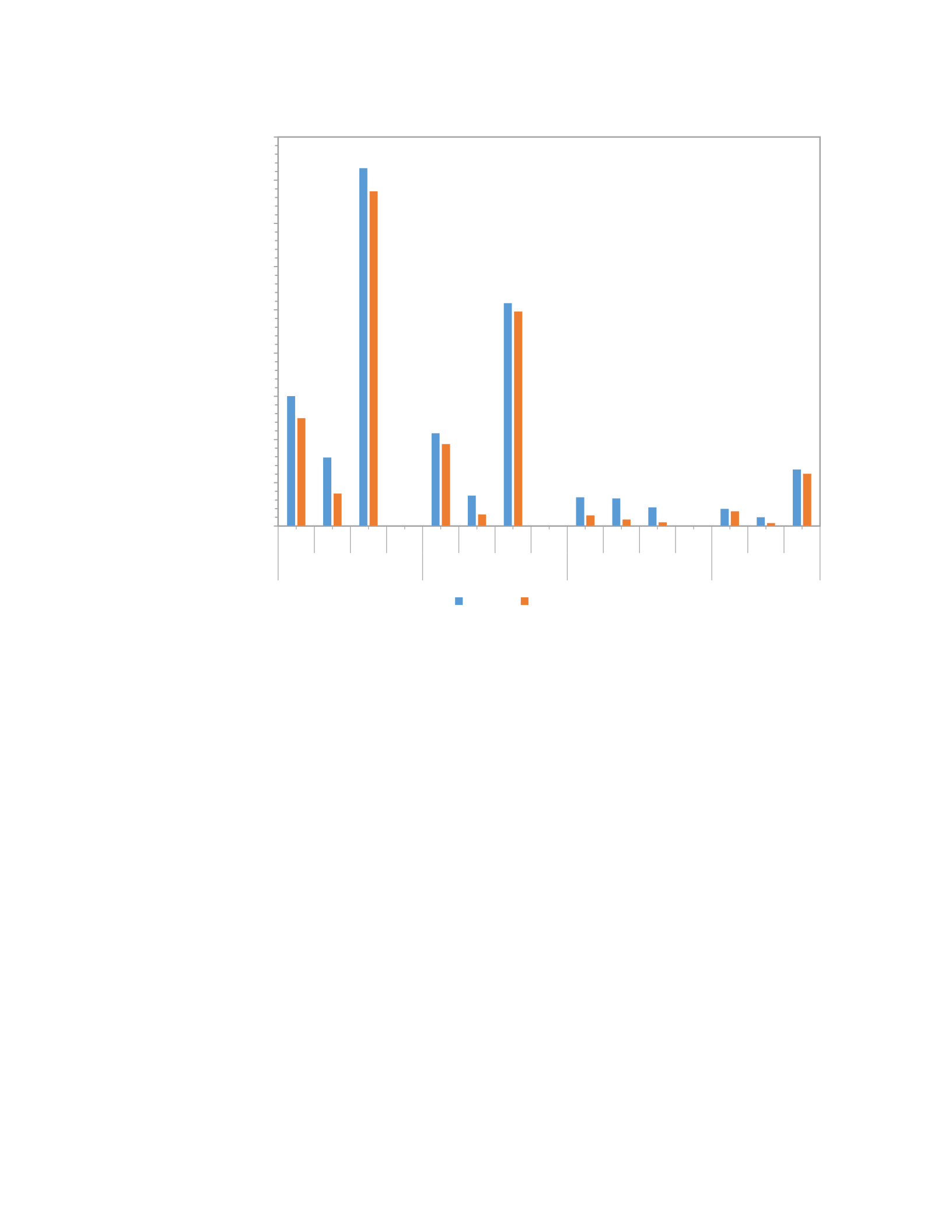
96
such as transaction demarcations, to pull all relevant context information. This had affected on the capacity
of creating and understanding, modifying, reusing, and maintaining applications. In TransJ, programmers
found the aspect code more elegant, classy and clean set of pointcuts in transaction abstractions, which helped
them to code the crosscutting concerns in less LOC compared with AspectJ. Particularly, the MLOC and
TLOC count the total lines of code that implement the transaction-related crosscutting concern component
and transaction operations, including TransJ's joinpoints, which referred to the context of the core code. The
TransJ group performed significantly better than AspectJ group for all activities (by 32% and 80%), as shown
in Figure 10-5. In TransJ, two induced factors affect these metrics: the UMJDT model captures various
general distributed transaction abstractions in meaningful, reusable joinpoints and a set of base aspects, which
help developers implement the transaction-related crosscutting concerns in simpler and logical method
Figure 10-4. Average LOC, MLOC, TLOC and WOTC over Activities
0
500
1000
1500
2000
2500
3000
3500
4000
4500
Act.1 Act.2 Act.3 Act.1 Act.2 Act.3 Act.1 Act.2 Act.3 Act.1 Act.2 Act.3
LOC MLOC TLOC WOTC
AVERAGE LOC, MLOC, TLOC AND WOTC IN APPLICATIONS
AspectJ TransJ
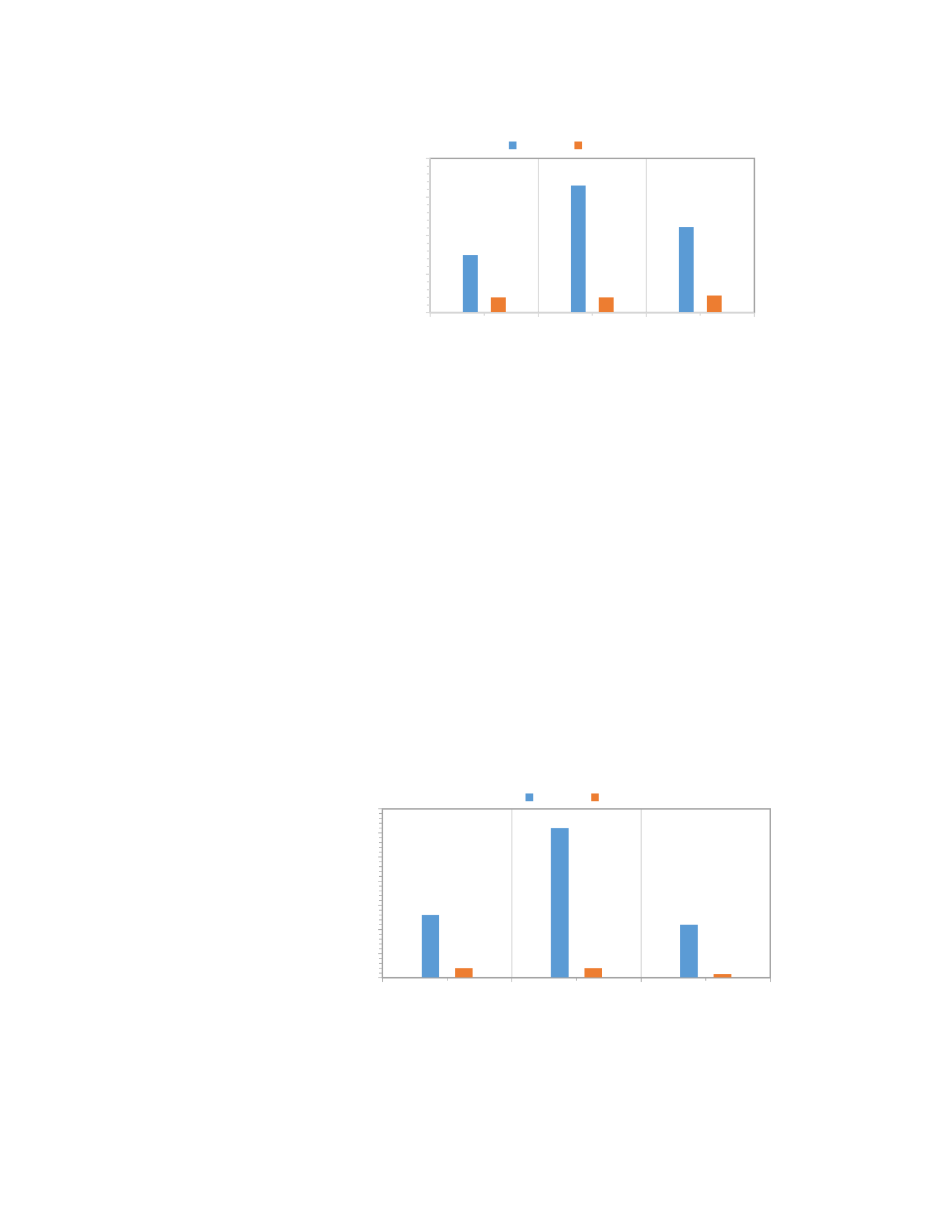
97
bodies, i.e., advice, with no extra lines of codes and less number of operations and advices, thus this reduced
the RFM value. Second, TransJ’s joinpoints referenced by broad contexts and stable pointcut definitions,
therefore, applications did not need additional context information, such as an identifier or lock snapshot.
This allowed the reusable and application-level aspects to inherit or reuse pointcuts to apply the logic of
transaction-related crosscutting concern in appropriate transaction places. Hence, TransJ reduced the values
of MLOC, TLOC, NTO, WOTC, and RFM. Consequently, it reduced the bug density (see Section 10.8 for
more details).
Figure 10-5. Average RFM over Activities
0
20
40
60
80
A C T . 1
A C T . 2
A C T . 3
AVERAGE OF RESPONSE FOR
TRANSACTION MODULE
AspectJ TransJ
Figure 10-6. Average NTO over Activities
0
10
20
30
40
50
60
70
A C T . 1
A C T . 2
A C T . 3
AVERAGE NUMBER OF ADVICES
AND METHODS IN ASPECTS PRE
CORSSCUTTIONG CONCERN
AspectJ TransJ
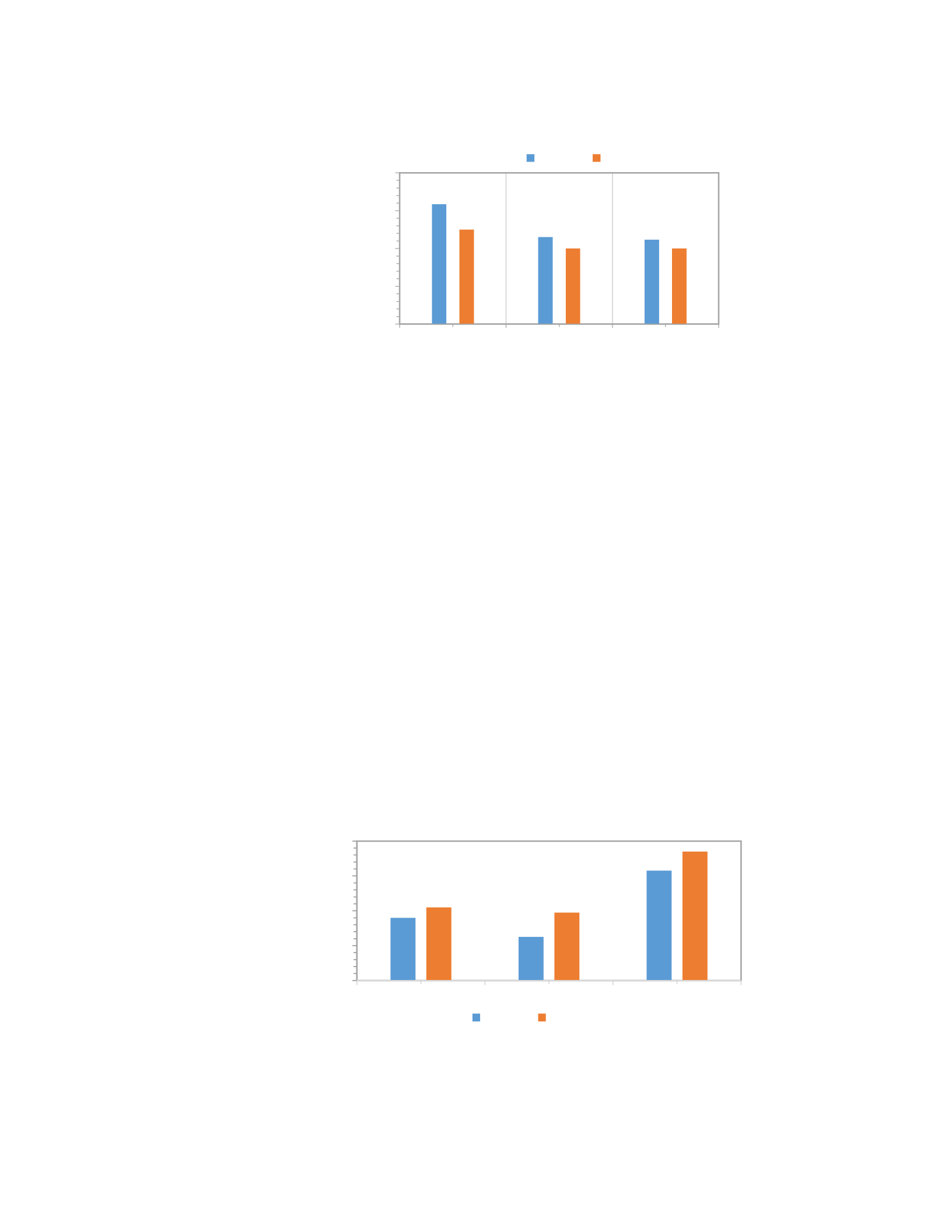
98
Figure 10-7 shows that the value of CC is smaller for TransJ than AspectJ, because TransJ hides
complex transaction abstractions, as mentioned, which result in simple conditional statements and less
tangled code.
As predicted by the above hypothesis, results shown in Figure 10-8 give sufficient evidence that the
average VS value of all programs was more for TransJ than AspectJ, due to inlined code in transaction scopes
being extracted and gathered to inner classes, i.e., contexts and base aspects (caused improvements of 12%
to 23%). Although the number of components were more in TransJ implementations, but they were more
Figure 10-7. Average CC over Activities
0
0.5
1
1.5
2
A C T . 1
A C T . 2
A C T . 3
AVERAGE OF CYCLOMATIC
COMPLEXITY
AspectJ TransJ
Figure 10-8. Average VS over Activities
0
10
20
30
40
Act.1 Act.2 Act.3
AVERAGE VOCABOLOARY
SIZE
AspectJ TransJ
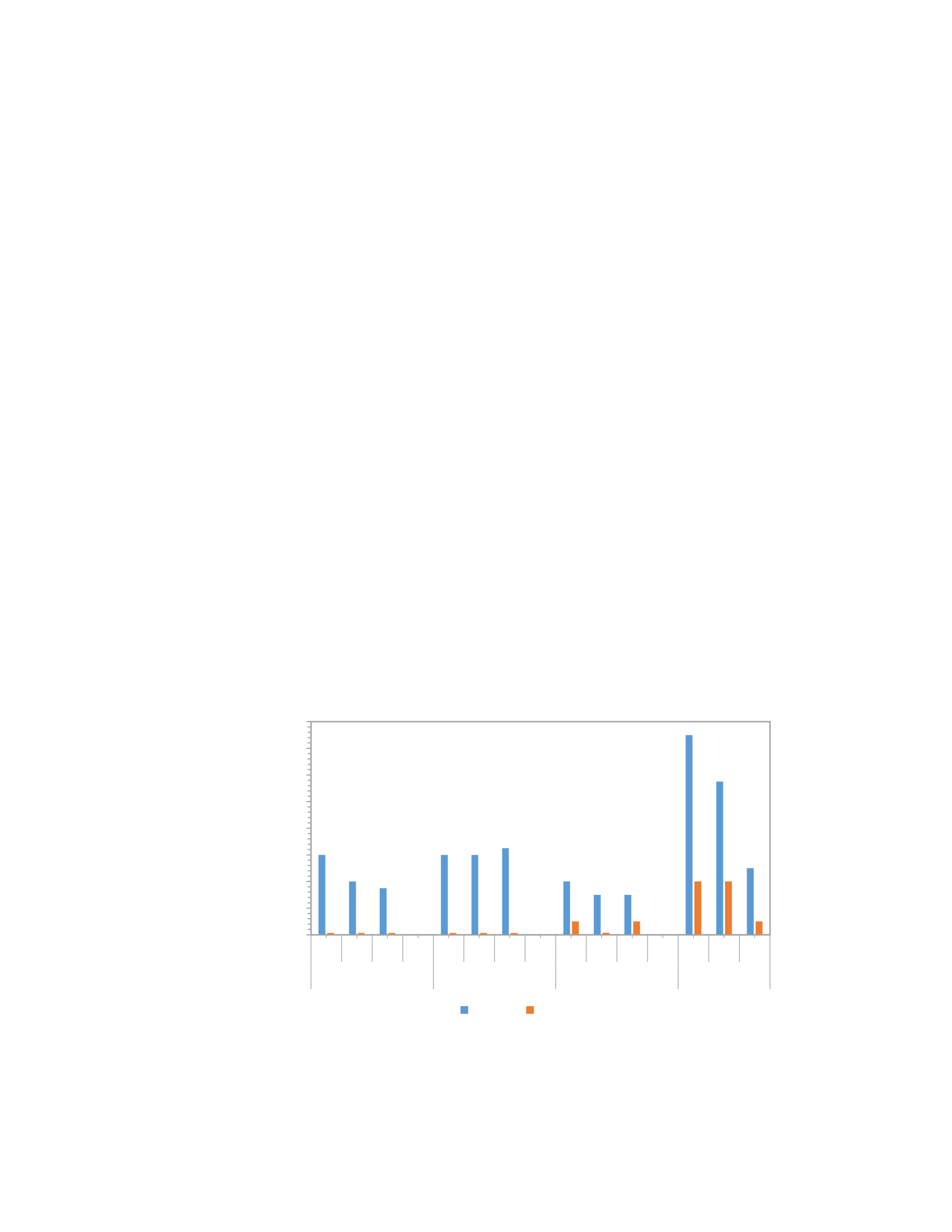
99
cohesive. From these results, we can confidently conclude that the fourth hypothesis hold true for less
complex and a small code size software in TransJ compared with AspectJ.
10.5 Increased the capacity of the software obliviousness
The fifth hypothesis theorized that if transaction-related crosscutting concerns are effectively
encapsulated in TransJ aspects, then the software will be more oblivious than equivalent systems developed
with AOP design techniques (as described by NITD, CDA, ASTC and ASTO in Section 9.11). The values
of NITD, CDA, ASTC and ASTO for TransJ should be less than AspectJ. Figure 10-9 shows that TransJ
implementations significantly reduced the values of NITD, CDA, ASTC and ASTO metrics.
Compared to the AspectJ, NITD and CDA for all TransJ activities differed by 100%. The reason
for having this result, i.e., zero value, for NITD and CDA in TransJ activities that the programmer avoided
the unnecessary complexity of the selected applications, due to TransJ’s joinpoints parameterization that
facilitated generic transaction-related crosscutting concern logic, which is free from application couplings,
and also avoided couplings caused by the application-level advice. In other words, TransJ programmers used
Figure 10-9. Average NITD, CDA, ASTC and ASTO over Activities
0
2
4
6
8
10
12
14
16
Act.1Act.2Act.3 Act.1Act.2Act.3 Act.1Act.2Act.3 Act.1Act.2Act.3
NITDs CDA ASTC ASTO
AVERAGE NITD, CDA, ASTC AND ASTO
AspectJ TransJ
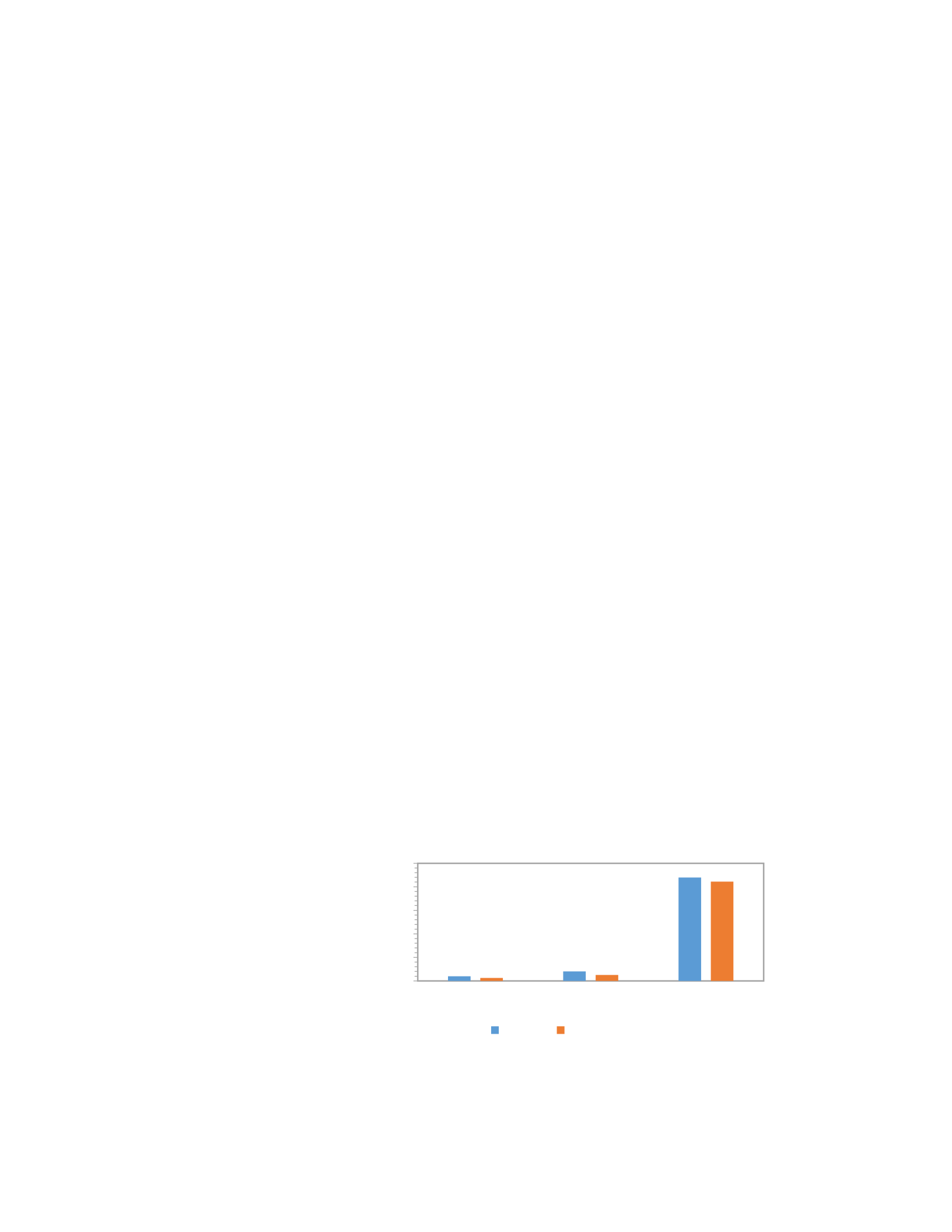
100
transaction abstractions and did not need to use Inter-Type Declarations (ITDs) for sharing of context
information between application and aspect components.
The ASTC and ASTO assess the scattering of an aspect using different level of transaction
granularity, i.e., transaction and transaction operations, respectively. Significant reduction in ASTC and
ASTO was due to the layers of indirections among the transaction application and aspect components, which
TransJ provides but are missing in AspectJ. In other words, TransJ’s base and/or reusable aspects allow
application-level code to customize the TransJ’s joinpoints without coupling links, due to remove
transaction-related concept logic. This decreases the ASTC and ASTO values in the core code, e.g., in activity
1 the reduction was around 80%.
In a nutshell, The improvement of the TransJ activities verse the AspectJ activities was caused by
(a) the higher level of reuse of base aspects, and (b) scoped joinpoints, i.e., contexts, eliminating the need to
create operations to expose new joinpoints. This again underscores the benefits of improving obliviousness
where pointcuts allow reuse in an oblivious approach. From these results, we can confidently conclude that
the fifth hypothesis hold true for less oblivious software crosscutting concerns in TransJ compared with
AspectJ.
10.6 Preserved the software efficiency
To evaluate this hypothesis, we conducted the experiment to assess performance of all activities
within a stable environment to reduce noise. We launched two instances using the Amazon Web Service
Figure 10-10. Average MRT over Activities
0
50
100
150
200
250
Act.1 Act.2 Act.3
AVERAGE TRANSACTION
RESPONSE TIME PER
MILLISECOND
AspectJ TransJ

101
(AWS) Management Console for executing applications with a little noise: a Windows instance and an
Amazon Rational Database Service (Amazon RDS) instance [109]. They are virtual servers in the AWS
cloud. First, we set up and configured a windows instance within a type of t2.small, which provided the 64-
bit version of Microsoft Windows Server 2008 R2, 40G hard drive, 2G memory (RAM). Then we configured
the application to run on this instance, with JDK7, JBoss server, Maven, Eclipse, JTA, and TransJ. Then we
deployed a MySql database on the RDS instance.
The sixth hypothesis theorized that if transaction-related crosscutting concerns are effectively
encapsulated in TransJ aspects, then the software would preserve or improve runtime performance compared
with equivalent systems developed with AOP design techniques (as described by MRT, NCT, NUCT, RTPM
and ToT in section 9.10). The values of MRT, NUCT and ToT for TransJ should be equal or less than
AspectJ, and RTPM, NCT for TransJ should be equal or more than AspectJ.
Figures 10-10 through 10-12 show that TransJ implementation slightly decreased the metric values
for MRT, NUCT, ToT, and slightly increased NCT with maintaining the RTPM in all three activities of the
experiment.
TransJ allows dynamic weaving of aspects at run-time by looking up to the contexts instead of
needing to programing by hand as is done in AspectJ. This impacts the implementation of runtime weaver at
several points. At first, it instantiates new context information into the class at the right time (just-in-time)
for gathering the data needed to perform the behavior specified by the aspect. Second, it wraps all transaction
Figure 10-11. Average Transaction Velocity (RTPM) over Activities
0
2
4
6
8
10
12
14
Act.1 Act.2 Act.3
AVERAGE SPEED OF
TRANSACTION PROCESSING
(#TRANS PER MINUTE /60S)
AspectJ TransJ
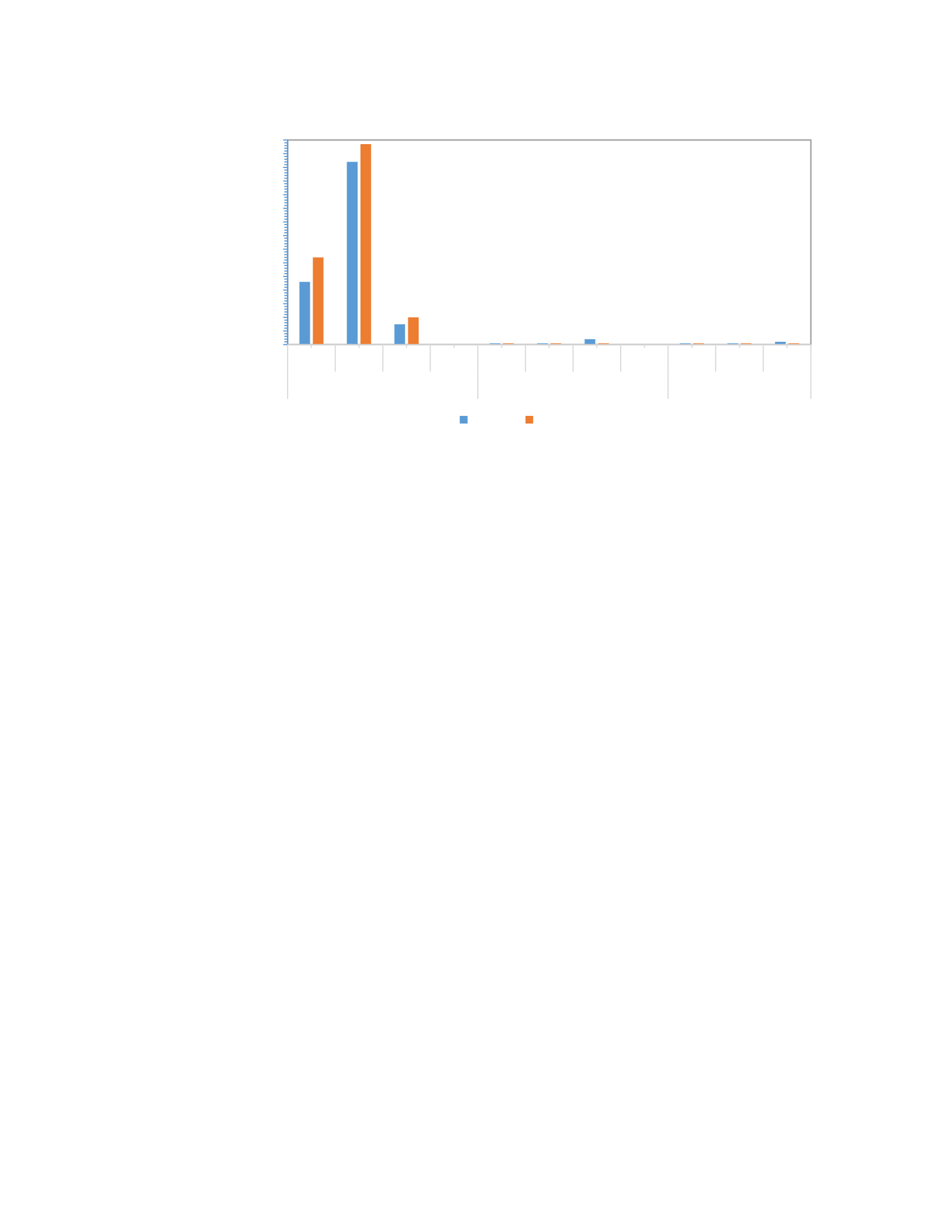
102
operations by demarcating the original methods and then replacing the core implementation with the
specification of the original one, such as name, argument, returned data, etc., which contains the wrapping
code in its body. This wrapping can lead to efficient method invocations.
Figure 10-10 and Figure 10-11 indicate that the TransJ group performed very slightly better than
the AspectJ group for Act.1 and Act.2 with almost 0% improvement for Act.3. This lack of improvement for
Act.3 was caused by the overhead of creating a transaction and transaction operation thread instances,
synchronization and the high concurrent potential for conflicts over the shared resource. In other words, there
are no major differences between the efficiency of TransJ activities and AspectJ activities.
Figure 10-12 shows that the results for the NUCT and ToT metrics remained the same for the Act.1
and Act.2. However, in Act.3 TransJ decreased very slightly the potential of having better ToT and NUCT
values. The decrease in NUCT and ToT values in TransJ at Act.3 was caused by exposing advisable
joinpoints, i.e., lockingJP and resourceLockedJP and dynamic weaving of aspects on them. These joinpoints
represented an indication of the benefits that can come when concurrent operations access the shared
resource. However, there are no major differences between the throughput of TransJ activities and AspectJ
activities.
Figure 10-12. Average NCT, NUCT and ToT over Activities
0
5
10
15
20
25
30
35
40
45
50
55
60
65
70
75
Act.1 Act.2 Act.3 Act.1 Act.2 Act.3 Act.1 Act.2 Act.3
NCT NUCT ToT
AVERAGE NC, NUC AND TO
TRANSACTIONS PER SECONDS
AspectJ TransJ
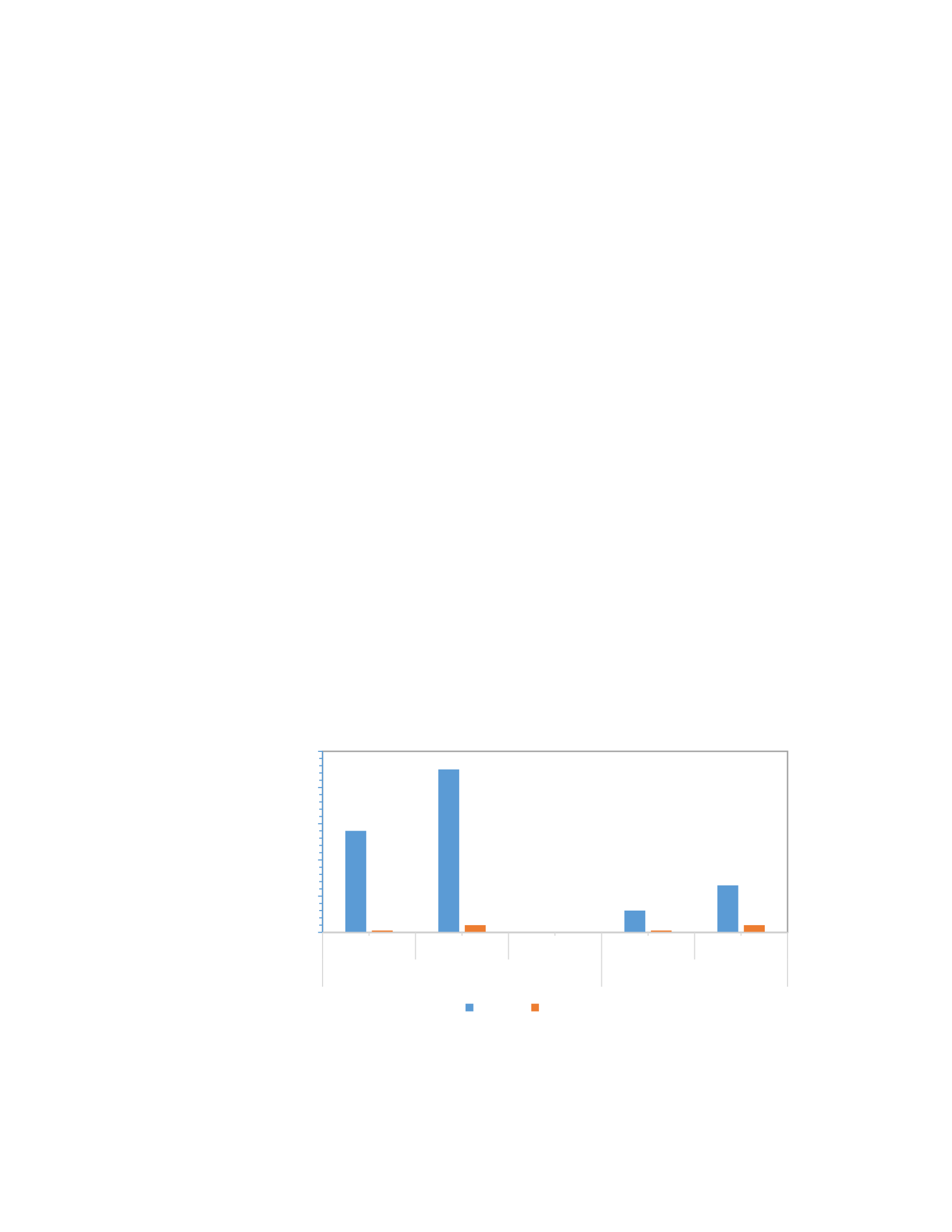
103
In a nutshell, the results of figures do not give sufficient evidence to claim that the benefits of
improving software performance. But from these results, we can confidently conclude that the sixth
hypothesis hold true: preserving runtime performance in TransJ compared to AspectJ.
10.7 Improved reuse and software extensibility
The seventh hypothesis theorized that if transaction-related crosscutting concerns are effectively
encapsulated in TransJ, the crosscutting concern would require a smaller number of changes to reuse
compared to equivalent systems developed with AOP design techniques (as measured by NoC, NoCA in
Section 9.10). In other words, NoCA and NoC values for TransJ should be less than AspectJ. From the results
shown in Figure 10-13, we can see that TransJ implementation significantly reduced the changes required to
reuse the performance measurement concern implementations in Act.1 and Act.2 of the experiment compared
to AspectJ. This means that the application is more amenable to extension.
Compared with AspectJ, the presence of joinpoints in the base aspect of TransJ allows the
implementation of the crosscutting concern logic in reusable and application-level aspects, which allow
contexts and crosscutting concerns to be explicitly communicated. Figure 10-13 presents the percentage of
crosscutting concerns that were implemented by abstract aspects (in base aspect). The data confirm that
Figure 10-13. Average Number of Changes of Performance Measurement Concern over
Conference Registration System and Bank System Activities
0
5
10
15
20
25
Act.1 Act.2 Act.1 Act.2
NoC NoCA
ABERAGE NUMBER OF CHANAGES
TO REUSE OR ADAPT A CONCERN
AspectJ TransJ
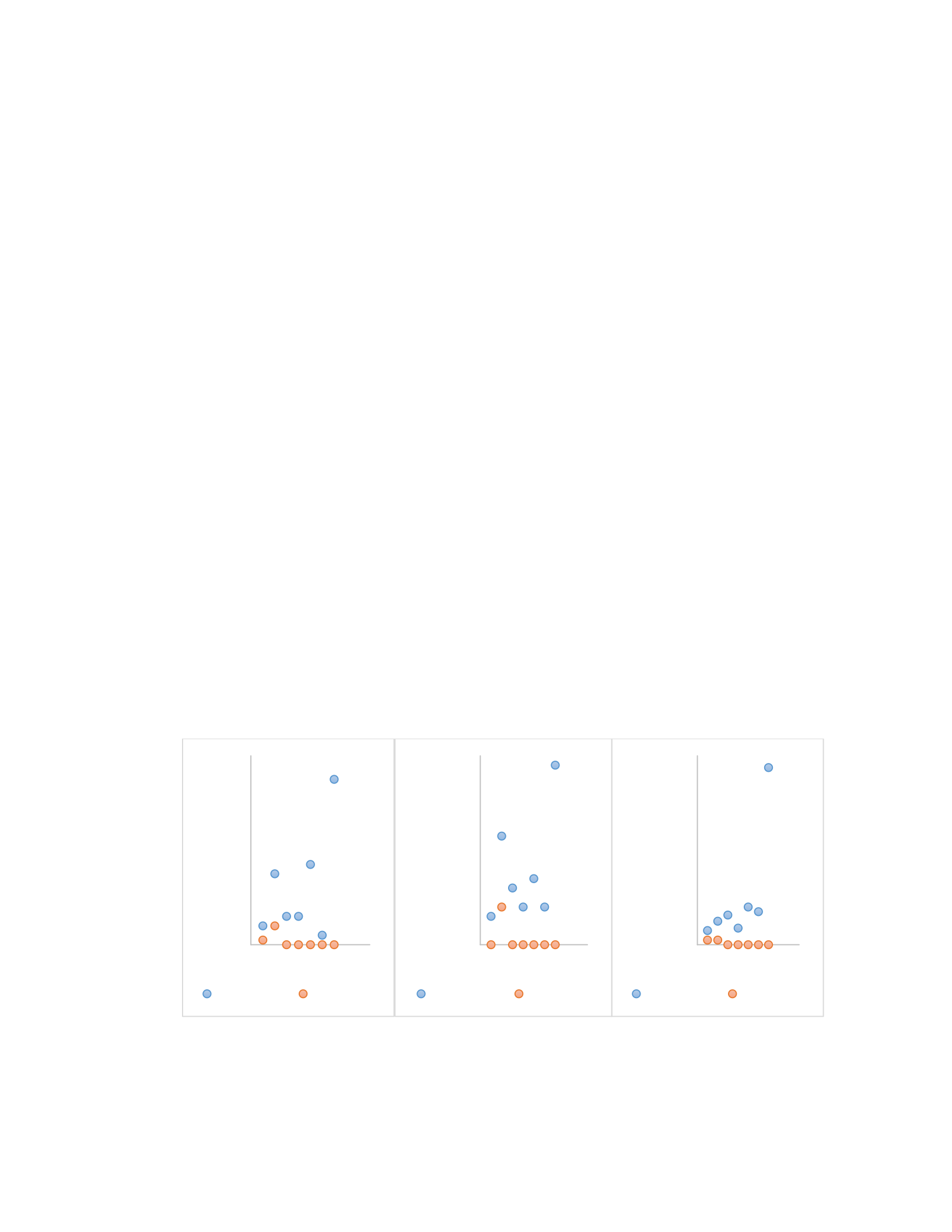
104
significant increases in reusability can be gained by applying TransJ's joinpoints where appropriate. In other
words, TransJ aspects were overall more oblivious, localizing, logical and independent from the base
application than AspectJ concerns, thereby reducing the NoC value in all activities of the experiment.
Figure 10-13 shows the number of changes required to reuse and adapt the concern and
application in Act.1 compared to Act.2, was significantly less for TransJ than AspectJ. The reason for the
difference between NoC and NoCA metrics is that in NoC we are only considering changes in the concern;
whereas in NoCA, we are interested in the number of changes both in the concern and application. We found
that TransJ concerns still were overall more oblivious, localizing, logical and independent from the base
application than AspectJ concerns, and so they have reduced NoCA values in Act.1 and Act.2 of the
experiment.
Figure 10-14 provides another graphical representation of the analysis of reuse for AspectJ and
TransJ. The orange-colored graphs represent scattering in TransJ (aspects only) and the blue-colored graphs
represent scattering in AspectJ implementations. The scattered points in the graph indicate that the number
of changes required for reusing a concern with TransJ and AspectJ in different activities, respectively. The
scattered points represent ASTC, ASTO, CDA, NITD, CDTA, CDTO, and CDLOC metrics results. Overall,
the results of the graph indicate that the CDA, NITD, CDTA, CDTO, and CDLOC remained zero for the
Figure 10-14. ASTC, ASTO, CDA, NITD, CDTA, CDTO and CDLOC over Activities of AspectJ and
TransJ
0
5
10
15
20
25
30
35
40
0 5 10
Concern Scattered over Bank System
AspectJ.Act.1 TransJ.Act.1
0
2
4
6
8
10
12
14
16
18
20
0 5 10
Concern Scattered over Conference
Registration System
AspectJ.Act.2 TransJ.Act.2
0
5
10
15
20
25
30
35
40
0 5 10
Concern Scattred over Gadget
Manufacturing System
AspectJ.Act.3 TransJ.Act.3
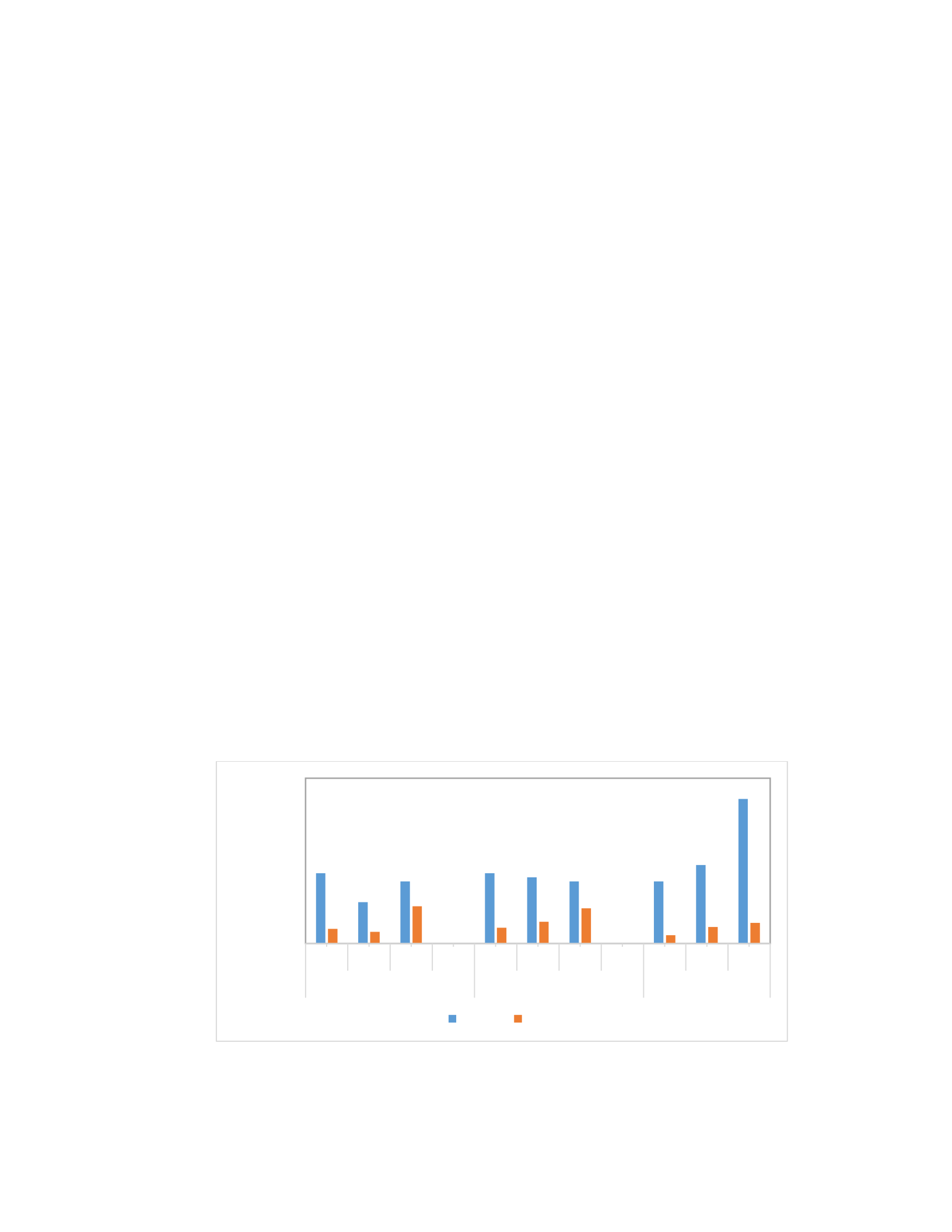
105
activities of TransJ (highly reusable and more extensible), but were highly scattered for AspectJ. The reason
for less scattering is discussed in Section 10.1 and 10.5 above.
From these results, we can confidently conclude that the seventh hypothesis hold true: more
reusability and extensibility in TransJ compared to AspectJ.
10.8 Reduced the time of the development process
The eighth hypothesis theorized that if TransJ provides a better modularization of transaction-
related crosscutting concerns, then the development transaction system would be less complicated, and more
predictable and readable. Thus, software development efficiency (measured by AT, PT and NoB) would be
increased, so that the software would be created faster than the equivalent software developed with AOP
design techniques. In other words, AT, PT and NoB values for TransJ should be less than AspectJ.
From the results shown in Figures 10-15, we can see that TransJ significantly reduced the period
that required to read, understand, implement, and debug the implementations of transaction-related
crosscutting concerns in all activities of the experiment compared to AspectJ. These results confirm that the
applications were more flexible to implement with TransJ and were robust with respect to bugs and error
compared to the AspectJ implementation (Section 10.9 provides more details.)
Figure 10-15. Average AT, PT and NoBs over Activities
0
2
4
6
8
10
12
14
16
18
20
Act.1 Act.2 Act.3 Act.1 Act.2 Act.3 Act.1 Act.2 Act.3
AT PT NoB
AVERAGE ACTIVE, PASSIVE TIME
(PER HOUR) and NoBs
AspectJ TransJ

106
In addition, these figures indicate that TransJ implementation decreased the values of these metrics,
as compared to AspectJ implementations in all the three activities of the experiment. We found that the
average AT that TransJ participants spent on typing and producing actual code of the transaction-related
crosscutting concern was less than for AspectJ participants. It is interesting that the developer of all three
activities needed approximately the same amount of AT to finish the activity. Related to this hypothesis, the
first hypothesis claimed that the TransJ participants, compared to AspectJ participants, found the TransJ
activities were well-separated concerns, so that the total developer’s working time was shorter than the
development time of the equivalent system developed with AspectJ. Therefore, the TransJ participants
performed significantly better than the AspectJ participants for all activities.
PT represents the amount of time they spent on reading the source code, understanding secondary
requirements and looking for bugs. The increases in the PT in the AspectJ activities are caused by the need
to study the whole code to find new pointcuts to expose advisable joinpoints and to gather the relevant
information to a specific context that is required to weave the crosscutting concerns of appropriate joinpoints.
In contrast, TransJ provides pointcuts that help developers code the crosscutting concerns
obliviously. In addition, they do not need to create shared data structures, i.e., contexts, to have an explicit
cooperation between base application code and aspects. This one simple benefit in the mindset of
programmers can drastically reduce the number and seriousness of bugs, i.e., NoBs. NoB counts the number
of bugs and errors raised to maintain the crosscutting concerns.
This again emphasizes the benefits of improving software development efficiency. From these
results, we can confidently conclude that the eighth hypothesis hold true: less software development time is
required for TransJ than for AspectJ.
10.9 Other Useful Observations from Questionnaires and Daily Journals
Besides the analysis of the hypotheses via the metrics, we gathered additional quantitative data
handful observations from developers’ questionnaires (Appendices C and D) and daily maintenance journals
during each activity of the experiment.
In regards to understandable code, we found that 100% of AspectJ participants in the Act.1 were
confused in identifying pointcuts for implementing the given extension feature, and 50% of the same
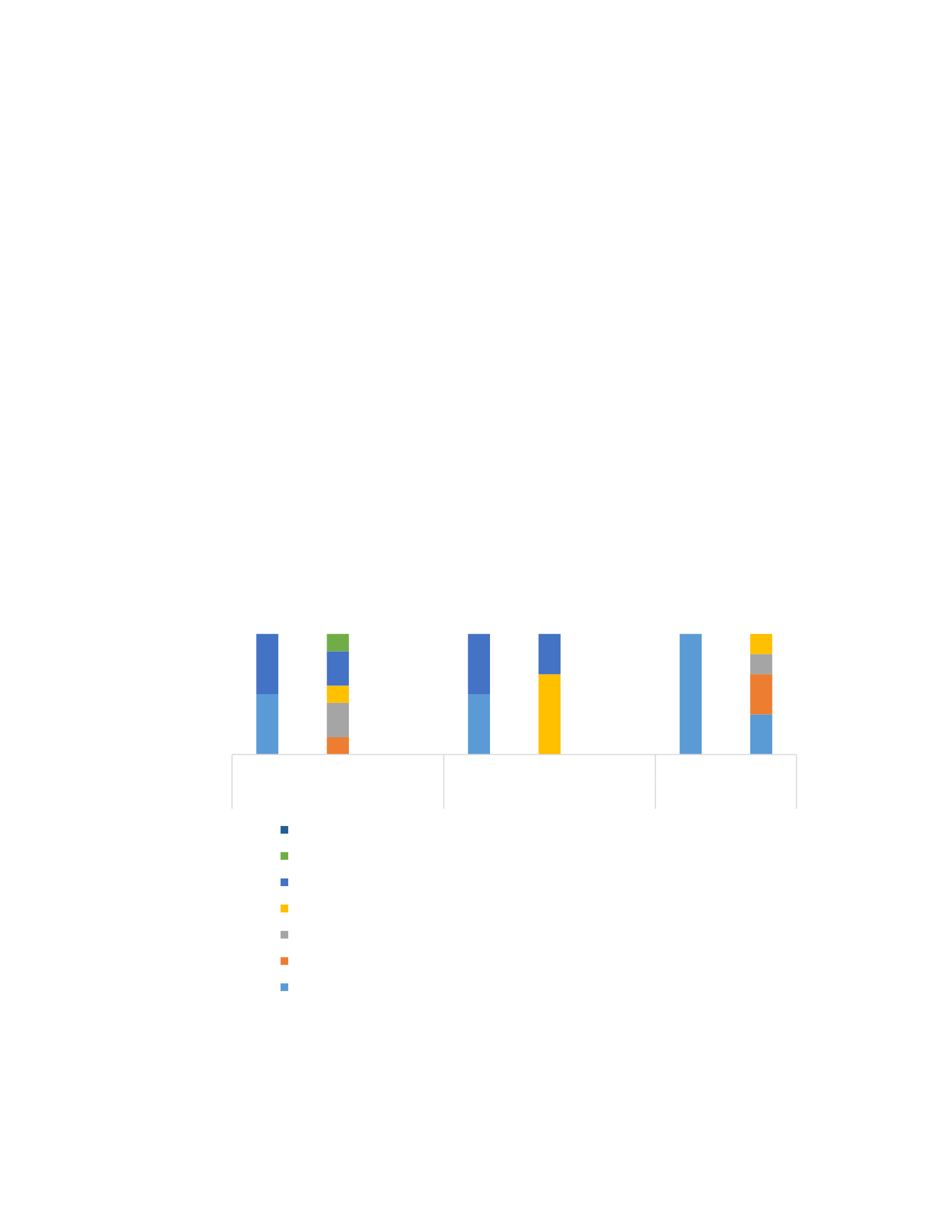
107
participants were still confused during Act.2 and Act.3. On the other hand, none of the TransJ participants
struggled with identifying pointcuts during either phase. This tells us that TransJ implementation provides
simple pointcuts with understandable distributed transaction abstractions. Figure 10-16 show more
percentages of most consuming task during the implementations.
For reusability, we observed that 100% of the AspectJ participants in Act.1, Act2 and Act.3 agreed
that their applications might require redesigning the application’s structure, making minor changes in the
classes, their relationships, roles, and responsibilities in the original application. On the other hand, none of
the TransJ participants made this observation for any activity and they said that they reused the existing code
to implement new changes without failures in all activities. This indirectly reemphasizes the seventh
hypothesis, which states that TransJ implementations help in developing more reusable crosscutting
concerns.
Figure 10-16. The most Time Consuming Activities during Implementation of Feature Changes
0%
20%
40%
60%
80%
100%
TransJ AspectJ TransJ AspectJ TransJ AspectJ
Act.1 Act.2 Act.3
Learning TransJ (not applicable group 1)
Learning AOP
Learning the tools (e.g., Java, an IDE, EJB, JPA, JTA, JBossAS, Arjuna)
Debugging the solutions
Implementing the solutions
Designing the solutions
Understanding the original applications and analyze the new requirements
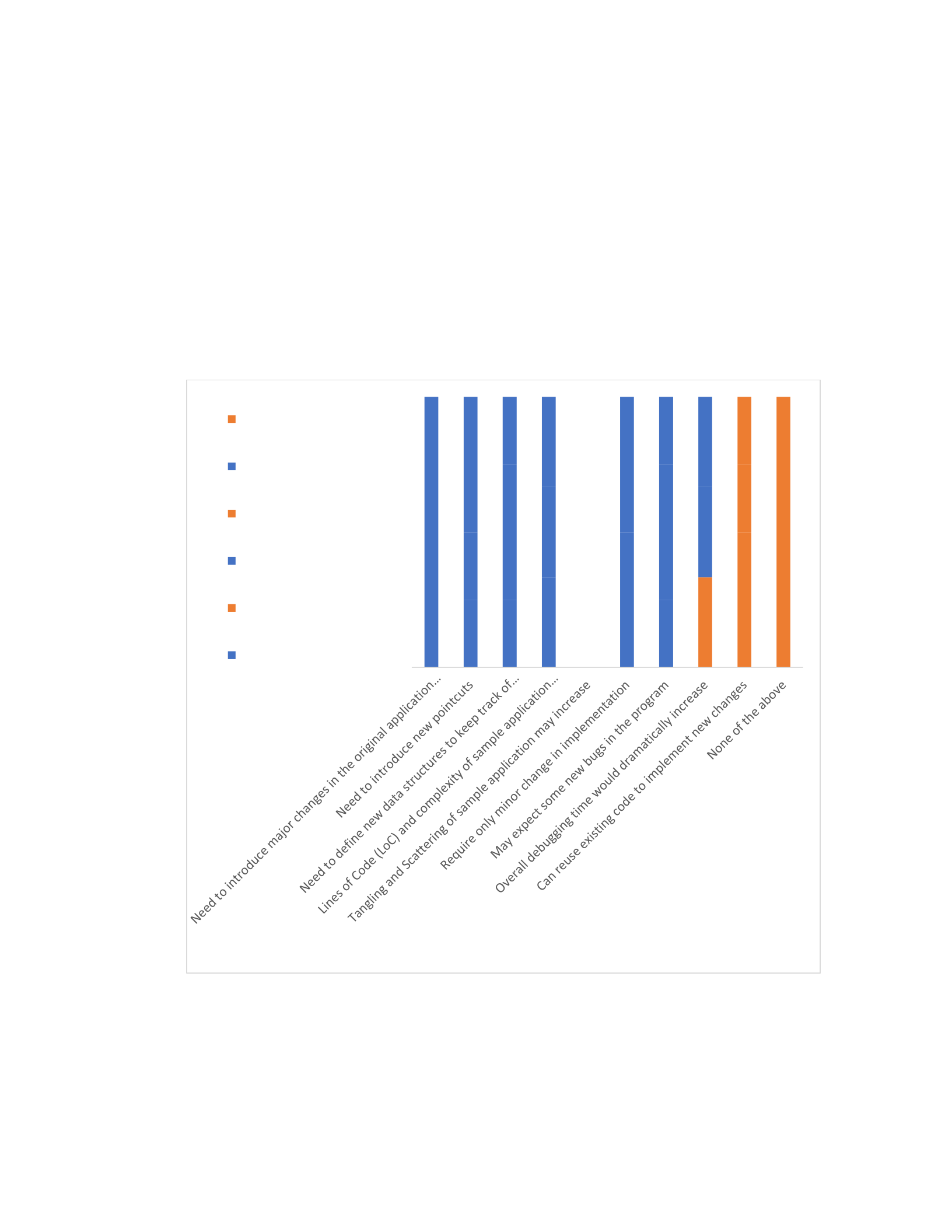
108
Similarly, for extensibility, 100% of the AspectJ participants said that their changes introduced new
dependencies and increased LOC and complexity in the original sample application in all activities. However,
none of the TransJ participants felt that they introduced any dependencies during any activity. Hence, this
reemphasizes the seventh hypothesis, which asserts that TransJ implementation helps in developing more
extensible applications.
Figure 10-17. Sample of Observation of Changes made in Original Applications by the AspectJ
Participants versus the TransJ Participants for all Activities
0%
10%
20%
30%
40%
50%
60%
70%
80%
90%
100%
Act.1 TransJ
Act.1 AspectJ
Act.2 TransJ
Act.2 AspectJ
Act.3 TransJ
Act.3 AspectJ

109
The questionnaires and the maintenance journal history also provide information on the number and
frequency of bugs and errors. Specifically, 100% of the participants in the AspectJ group said that their
extensions introduced new failures, i.e., bugs, into the application code during activities (see Figure 10-17).
The number of failures further increased for Act.2 and increased again with Act.3. However, none of the
TransJ participants in Act.1 and Act.2 made this statement, while 50% participant stated in the daily journal
and maintenance history that they introduced very few bugs, but the total time for developing the concern is
decreased compared to AspectJ participants. This tells us that TransJ’s modularization and obliviousness
decreased the failures and debugging time. Hence, this reemphasizes the eighth hypothesis, which asserts
that TransJ implementation helps in reducing development time.
For performance, we observed that 100% of the AspectJ participants in Act.1, Act2 and Act.3 ranked
their application performance after changes to the original application is fair for all activities. On the other
hand, 100% the TransJ participants described the overall application a good performance after changes to
the original application. This indirectly reemphasizes the hypotheses, which state that the TransJ helps in
improving the reusability without sacrificing the software efficiency compared to AspectJ.

110
RELATED WORK
For years, software engineers have strived with the question of how to construct and organize their
code with the intention of maximizing flexibility, extensibility, understandability, maintainability,
performance, reuse and other software qualities. While OOP provides a solid-framework for code-based
manipulation, optimization, organization, it breaks down when programmers must implement features that
cut across the entire system, such as logging, distribution, concurrency (synchronization), security auditing,
multithreaded, and transaction handling [77]. Implementing such crosscutting functionality do not fit
efficiently into OOP, which leads to an unnecessary code duplication, a complex code, a decrease in software
quality, and an increase in product errors and bugs [41]. AOP adds a high level model of reuse in traditional
OOP frameworks, with minimal impact on existing code bases [3][5].
The ideas, concepts and approaches investigated in this section intersect with a broad spectrum of
research projects on distributed transaction processing systems and aspects, reusable AO frameworks,
application-level aspects and interactions. We offer some important and relevant research in this chapter.
11.1 Transaction Middlewares and Frameworks
Several research works are currently underway to explore the feasibility of AOP mechanisms to deal
with the concepts of transaction in various scenarios, such as [60]. The case study proposed in [77], promises
to be a perfect candidate that may serve as a benchmark for evaluating the new AOP approaches, the
expressivity of AOP languages, the performance of AOP environments, and the suitability of AO modeling
notations. This research presents a language independent decomposition of the Atomicity, Consistency,
Isolation and Durability (ACID) properties of transactions into a set of fine-grained aspects, i.e., base aspects,
each one providing a well-defined reusable functionality. It then shows how these aspects can be configured
and composed in different ways to achieve various concurrency control and recovery strategies for the
transactional object. Therefore, this framework enables the design of various concurrency control and
recovery concerns through the configuration and composition of these new aspects. However, other concerns,
such as transaction life-cycle management, are only primarily supported and badly modularized, and as a

111
result, their functionality cuts through the code design of the other aspects of the framework. Motivated by
these, Kienzle was taken the case study one step further. In [49][50], he presents a language-independent
framework that provides the runtime support for transactions, called AspectOptima. It uses AO technology
to decompose transaction models and their implementations into many individual reusable aspects. In other
words, it consists of a collection of ten base aspects that can be configured to guarantee the ACID properties
for the transactional object [50]. However, this purpose of this research is not produced implementations for
a specific transaction standard like JTA, or a reference implementations.
In comparing with AspectOptima, the TransJ discusses the composition of transaction abstractions
by separating out the definition of transactions from the definition of other aspects using general-purpose
abstract transaction concepts, i.e., high-level abstractions, each one providing a reusable functionality. We
believe our work enables better reuse, encapsulation and obliviousness for transaction-related crosscutting
concerns.
In [78], Panos introduces the transaction framework, called ACTA, that provides the formal
reasoning about the attributes of transaction notations. It is not a model for transactions, but instead can be
used to determine the new transaction patterns to define the effects of transactions on other transactions, and
the effects of transactions on other concepts. However, the framework’s power comes from its ability to
represent the structural behavior of transactions and the relations between them. ACTA uses mainly to
capture transaction properties, such as consistency, visibility, permanence and recovery. However,
implementations of ACTA models are not always direct and simple. ACTA is a purely meta-model, and
therefore does not concern itself with possible implementation issues. Consequently, it is really hard to
determine that the ACTA model does actually identify the semantics of a transactional model [78]. On the
other hand, TransJ serves for a more practical purpose. TransJ tries to define a transaction joinpoint model,
which is not the only contribution of this research. In addition, it proposes a new context concept to act as
meta-data model for encapsulating the transaction-related information. Furthermore, the research adds new
abstract concepts, which correspond to the transaction primitives in JTA and AspectJ frameworks, enable the
design of various application-level aspects through the configuration and composition of reusable and base
aspects.

112
JTA Platforms
Spring framework provides an abstraction for transaction management that presents a programming
model for running an application with any JTA implementation [46][47]. It supports the programmatic and
declarative transaction management paradigms [44]. The central implementation of Spring framewrork’s
transaction management is a JtaTransactionManager, which is the standard choice to run on J2EE application
servers. Spring’s transaction applications can use the PlatformTransactionManager implementation for JTA,
delegating to a backend JTA provider [11]. Moreover, Spring provides several vendor-specific platform
transaction managers that are recommended to be used if appropriate, such as
WebLogicJtaTransactionManager on Oracle WebLogic server, and WebSphereUowTransactionManager on
IBM WebSphere application server. For J2EE servers, the standard JtaTransactionManager is
sufficient [45][46].
Atomikos EssentialTransactions [23] is a free open source TM is available, it allows developers to
run distributed transactions on a lightweight run-time environment. It provides a fully functional JTA and
offers more functions than defined in the JTA specifications [23]. Bitronix Transaction Manager (BTM) is
similar to Atomikos, but it aims to make JTA a commodity. BTM offers all services required by the JTA API
while trying to preserve the code as simple as possible for easier understanding of the XA standard [24].
Narayana is the primer open source TM. It provides a transaction toolkit which allows application
developers to create transaction applications using standards-based protocols for all resources, message
queues, and other components. Narayana is formerly known as JBOSS Transaction Services Suite 5 (JbossTS
5) [47]. JbossTS includes technology acquired in 2005 from the Arjuna Transaction Service Suite (ArjunaTS)
and Hewlett-Packard (HP) technologies, which support both JTA and JTS APIs. ArjunaTS is made up of a
number of different modules: ORB Portability layer, SOAP Portability, the Object Transaction Service
(OTS), ArjunaCore, Java Database Connectivity (JDBC), JTA, Transaction Objects, Web Services
transaction support (WS-T). See [47] for more information. ArjunaCore is a central module that provides
the core of all of the transaction service implementations at the heart of all of transaction products. It supports
ACID properties as well as nested transactions. JbossJTA allows application programmers to construct both
local and distributed JTA transactions, which wraps ArjunaCore to provide local JTA support without
distributions, and wraps the JTS to provide distributed JTA transactions. The transaction module provides

113
OO classes from which application classes can inherit to obtain preferred properties, such as persistence (e.g.,
StateManager object) and concurrency control (e.g., LockManager object) [21]. JbossJTA provides
distributed transactions through multiple resources, standards-based transaction support to J2EE applications,
and protects against data corruption by ensuring complete, and accurate transactions for Java-based
applications [10].
In this dissertation, we used the Arjuna library to implement the sample of transaction applications,
because it provides transaction support for nested transactions and concurrent control notations.
11.2 Reuse and Modularization of Advanced Transaction Issues
Sarangdevot and Sharma investigate in the modular design of a real life distributed transaction
applications in the domain of banking [14] and insurance [79][80] by using the AOP design methodology in
an Eclipse-AJDT environment. The authors illustrate how separation of concerns is one of the key principles
of good transaction software system design and implementation. Successful implementation of transaction
applications conclude that the AOP methodology in the Eclipse-AJDT environment offers powerful support
for modular design of transaction software systems. In the end, it is concluded that the AspectJ
implementation is improved several software quality factors such as modularity, readability,
understandability, maintainability, correctness, extendibility, reusability, traceability, flexibility,
predictability, adaptability and ease of evolution. Reduction in development time and costing were also
perceived. Thus, overall improvements in the quality and performance of the software system are
realized [79].
Fabry pursues to provide a successful modularization of advanced transaction models (ATMS,
sometimes also called extended transaction models) [81]. He proposes a new aspect language, KALA, which
is a domain-specific aspect language for using advanced transaction management in a distributed system. It
allows the modularization of the different concerns contained within such an ATMS and allows programmers
to express their needs at a higher-level abstraction than what is accomplished with general-purpose aspect
languages. As a result, this domain-specific aspect language significantly raises the level of abstraction and
makes the demarcation code much more concise [81][115]. In addition, Farby provides two technical
contributions: a general Transaction Processing Monitor based on the ACTA formal model that supports a

114
wide variety of ATMS; and offers an implementation of an aspect weaver for the KALA language, which
generates code using this interface.
TransJ provides many abstraction aspects (base-aspects), which can be extended to build a high-
level of abstractions (reusable and application-level aspects) that can encapsulate more complex types of
transaction concerns. TransJ also provides a central transaction process trackers in order to communicate
with transaction logic (demarcation code) to achieve the better separation of concerns, and a high-level
obliviousness. As opposed to the KALA, the TransJ is more about modeling transaction concerns. It defines
a transaction joinpoint model, i.e., UMJDT, and reusable transaction abstractions in AspectJ language.
In [48][82], Cunha and Ekwa investigate approaches for implementing reusable aspects for high-
level concurrency techniques in AspectJ. The authors present two alternate implementations can be used: one
based on traditional pointcut interfaces and another based on annotations. Cunha illustrates these
implementations showed how abstract pointcuts interfaces and annotations can be used to implement a well-
defined high-level concurrency pattern and mechanisms, namely one-way calls, futures, waiting guards,
readers/writers, barriers and active object; and use of AspectJ enables the development of reusable
implementations of the above-mentioned approaches, in the form of higher modularity and unpluggability.
In [83], the authors also compared the performance overhead, reusability and the unpluggability between
conventional OOP implementations and AOP implementations. Eventually, they conclude that the AspectJ
implementation is more reusable and pluggable, but incurs a noticeable performance overhead. However,
AspectJ has a limitation in acquiring context and joinpoint information on concrete aspects: when a super-
aspect defines an abstract pointcut, the sub-aspects cannot change the pointcut’s signature. The ideas are
similar in the sense that the TransJ weaves aspects into transaction applications using the AspectJ. We believe
that in using TransJ the same level of concurrency patterns can be redefined in a more modular and oblivious
fashion. It also allows developers to provide concrete pointcuts for each pointcuts to have their application
advised-hindering obliviousness. It allows many reusable aspects, which can be extended to build more useful
application-level aspects of concurrency control approach or other transaction-related concepts. In short,
TransJ the only work required by developers to extends the functionality provided by reusable aspects library
are to bind their application classes to the appropriate aspects. This requires no knowledge of the inner
working of TransJ.

115
In [32] and [94], Douence, et al., present Concurrent Event-based AOP (CEAOP), which defines
the approach of writing concurrent aspects. The authors provide an intuitive and simple model for sequential
AOP, whose notion of aspects, defined in a model for concurrent aspects which extends the sequential event-
based AOP approach. This model explicitly addresses the three AO-specific coordination issues: aspects
modularize functionalities that typically modify base executions at a large number of execution points;
advices can be divided into pieces that can be matched differently with the base execution; and multiple
advices may apply at the same of execution point. Then it shows how to compose concurrent aspects using a
set of general composition operators and sketches its Java prototypical implementation. The way paper tries
to compose concurrent aspects shares some similarity with TransJ, however, its scope is more towards
covering concurrency pattern, which is not the main research direction in our work (i.e., transaction).
Rashid, et al., [49] represents an effort to support persistence by implementing a reusable, modular
and oblivious AO framework in AspectJ. The authors explored three issues in the context of AOP and data
persistence: the possibility of using AOP techniques in aspectizing persistence, the reusability of persistence
aspects, and whether persistence aspects could be developed independently of an application. However,
application developers could only be partially oblivious to these aspects because of continuing to take into
account the architectural decision during the design phase.
The scope of the persistence framework is very limited as compared to the TransJ. TransJ relies on
well-defined both reusable and base aspects that can be used in a non-database persistent context, i.e.,
transaction context. The developers can reuse joinpoints and pointcuts for each of the transaction-related
pointcuts in the reusable and base aspects to have their applications advised-interfering with obliviousness.
TransJ applies these ideas into the domain of transactions, wherein the reusable aspects could be used to
configure of application-level aspects of different transaction systems to modularize several types of
transaction-related concerns.
11.3 Works on Joinpoint Model with Reference to TransJ
The Ph.D thesis [85] of Sadat-Mohtasham aims to provide a design, and implement Transactional
Pointcuts as a realization of the new model in the AspectJ language. The contributions made by the thesis
can be broken down into three different parts. First, the thesis proposes a new joinpoint model, based on the

116
pointcut-advice model. The pointcut-advice model is a dynamic joinpoint model in which joinpoints are
points in program execution. This model takes joinpoint inter-relationships into account and allows the
designation of more complex computations as joinpoints. In other words, it makes designation and advice of
interrelated joinpoints possible. Secondly, on top of this model, the thesis designs a new construct, transcut,
which selects sets of interrelated joinpoints and reify them into higher-level joinpoints that can be advised.
Third, the thesis shows a design a transcut matching algorithm based on single-entry single-exit regions of
control dependences in a control flow, i.e., the Program Dependence Graph (PDG). This representation is
the backbone of the transcut matching algorithm.
Alongside the above research contributions, the thesis also provides a technical contribution. Based
on the transcut it presents an AspectJ language extension that realizes transactional pointcuts. The author has
extended abc’s existing joinpoint matching infrastructure for transcut matching by implementing the
appropriate subclasses (for the new type of shadow, new pointcuts, etc.,) and by advising the right joinpoints
to adapt the behavior of some of the existing components in the context of transcut matching. If a transcut
matches a shadow, an advice application object is created to be applied to the shadow in the weaving phase.
All three major types of advice (i.e., around, after, and before) are supported for transcuts. There are some
differences between transactional pointcut model and our work. Transactional pointcut relies on static
analysis only and, therefore, is inherently imprecise. Our model uses an interval joinpoints (execution-time
joinpoint model) to determine dynamically when an advice should stratify. Also, the TransJ designation and
advice model complies with the existing dynamic pointcut-advice model in AspectJ, which made it possible
for integration and interaction with an AOPL, such as AspectJ.
On the other hand, the author discusses dynamic meta-model annotations to add well-separated
concerns. He shares some design similarities for TransJ that is joinpoints in transcut is identified as part of
a bigger context and in relation to other joinpoints. TransJ design principles include a similar concept for
implementing transaction patterns using AspectJ, but the TransJ handles transactions in high-level
transaction abstractions rather than low-level abstractions. It allows to encapsulate the transaction concerns
from core application functionality with writing reusable and application-level transaction aspects as
explained in TransJ, Chapters 4, 5 and 6. In addition, it already provides a set of reusable aspects and have
the ability to compose the application-level aspects.

117
Rajan et al. [86], propose a new language, Ptolemy, which adds quantified, typed events to implicit
invocation languages, producing a language that has many of the benefits of both implicit invocation and
AOPLs. A drawback of implicit invocation languages is their incapability to refer to a large set of events
succinctly. They also lack the expressive power of AOP advice. Limitations of AOPLs include potentially
fragile dependence on syntactic structure that may hurt reusability and maintainability, and limits on the
available set of implicit events and the reflective context information available. The authors implement the
Quantified, typed events in their language Ptolemy to solve all these problems. Ptolemy lets explicit
declaration of event types that have a name and a set of variables used to expose context. Arbitrary sequences
of expressions can be annotated as having a specific event type. Objects can register to be able to advise the
event types they are interested in. When an event of a specific type is fired, all the relevant advice is executed.
The designers of Ptolemy also recognize the need for arbitrary pieces of code to be treated as typed joinpoints.
In Ptolemy, the events have to be explicitly announced in the target code while our objective is obliviousness.
That is, TransJ allows event type declarations in an implicit manner. This implies that programmers are
completely oblivious of the inner workings of the TransJ. Therefore, it already provides a set of reusable and
application-level aspects and have the ability to compose using base aspects.
Harbulot, et al. [87], propose an AspectJ language extension, called LoopsAJ. In LoopsAJ, the
authors add a primitive pointcut loop that can match loops in the program and can expose values like the
minimal and maximal value of the loop-iteration counter and its stride. The authors define a loop pointcut to
designate and advice loops, which is in essence, is an arbitrary computation as joinpoints that are referenced
to through their key constituent joinpoints. Although loops are an instance of such computations, the loop
pointcut cannot select loops based on what they do, instead, all found loops are exposed. LoopsAJ’s performs
loop matching on the bytecode level, and it can recognize well-structured loops only.
Bodden introduces Closure Joinpoints (CJs) [88], as a design for explicit block joinpoints that yields
a syntax and semantics close to the JPL. In writing CJs, he proposes to implement an “extract joinpoint"
refactoring, similar to the traditional “extract method" refactoring. But he did not show an integration of CJs
into the AspectJ.
Akai et al., propose region pointcuts for AspectJ [37][89]. Region pointcuts consist a “region match
pattern" over regular AspectJ pointcuts. This allows developers to select regions, i.e., intervals of time that

118
start when matching one regular AspectJ pointcut and end when matching another. Region pointcuts are quite
powerful in that they give aspect programmers very fine-grained control about which statements exactly
constitute a joinpoint. On the other hand, region joinpoints may increase the problem of fragile pointcuts:
because region pointcuts are very explicit about syntactic constructs of the base program, and even the order
in which they occur, they may increase coupling to the particular base code at hand. Explicit joinpoints
circumvent this problem by assuming that the core-code programmer is aspect-aware and includes relevant
joinpoints in the core code. Although region pointcuts pick out implicit logical intervals of the core code,
these intervals are nevertheless subject to the very control-flow and data-flow constraints. The idea is similar
in the sense that TransJ defines joinpoints, which corresponds to a logical interval of time in a flow of
execution. It has a beginning and an end, and advice can be woven into the flow of execution before, after,
or around it. In other words, these joinpoints define the region of code, where advice may be woven.
Nishizawa, et al., propose a remote pointcut and remote inter-type declaration as an extension to
AspectJ language for distributed software [74]. The language construct, called remote pointcut, enables
developers to write simple aspects to modularize crosscutting concerns related to distributions, scattered on
multiple hosts. Similarly, Pawlak presents a framework to build AO distributed applications in Java [90]. He
talks about dynamic wrappers (also called generic advice) and meta-model annotations to add well-separated
concerns. The author also provides a way to define distributed pointcuts. With similar concept, Kaewkasi [91]
proposed distributed advice code execution. The interesting idea is the distributed advice execution using
shared execution units. Along the similar lines, Mondejar [92] introduces a complete aspect remoting service
with 1-to-1 and 1-to-*(many) abstractions, outlines a distributed joinpoint model to intercept remote services.
The notion of remote service abstractions such as 1-to-1 and 1-to-* abstractions and later its implementation
as any pointcut, many pointcuts and multi-pointcuts share some design principles with our work. These
papers share some design similarities and future extension points for TransJ.
11.4 Other Work on Interesting Crosscutting Concerns and Design Principles with Reference to
TransJ
Kiczales, et al. [3], introduced the idea of weaving logic for crosscutting concerns into core
applications was introduced over 15 years ago, and their work stems from even earlier research with

119
inheritance, aggregation, and mix-ins [2]. Like all great ideas, the heart of the weaving solution is relatively
straightforward – modularize concerns into first-class constructs, find the right place(s) to introduce
appropriate logic from those constructs, and the either insert code that executes the new logic unconditional
(because it can be determined to always be needed) or insert code that makes a final decision about executing
the new code at runtime. Raza, et al., present the design and implementation of a new AOPL framework,
called CommJ, which is an extension to AspectJ for enabling programmers to encapsulate communication-
related crosscutting concerns in modular, cohesive and loosely coupled aspects [31]. CommJ allows
developers to weave crosscutting concerns into inter-process communications (IPC) in a modular and
reusable way, while keeping the core functionality oblivious to those concerns. They also discuss an initial
study on hoped-for benefits of CommJ in comparison with AspectJ [30]. It does so by evaluating certain
desirable characteristics defining a quality model that can be measured by computable metrics. Based on
initial theoretic notions, they hypothesize that developers should see reuse and maintenance improvements
relative to six desired qualities defined by the quality model.
The results from this preliminary investigation provides sufficient evidence to conclude that CommJ
is capable of encapsulating a wide range of communication-related crosscutting concerns and that it can
provide better maintainability and reusability. This is in many respects, we found some conceptual similarity
with this design approach to our work, but we have a different goal in that it addresses how to weave
transaction-related crosscutting concerns into high-level runtime abstractions, i.e., distributed transactions.
TransJ framework provides low-level distributed aspects that perform the expected weaving and tracking of
context information. We believe this to be feasible because it is similar to the technique used by CommJ to
add communication-related aspects to AspectJ. It also clearly defines transaction primitives for the DTPS
that defines interesting joinpoints relative to transaction execution and related contexts for the woven logic
of crosscutting concerns. We believe our work paves the way for the weaving of crossing cutting concerns
into high-level program abstractions that span multiple threads of execution and may be interleaved with
concurrent execution of similar the abstraction. It also can define more reusable aspects, which not only can
be extended, but can also be combined to build more complex types of transaction concerns.
The main contribution of the Soares, et al., in their paper [36], is to provide architectural guidelines
and implementation of several persistence and distribution concerns in the application using AspectJ. The

120
authors demonstrate that coding crosscutting concerns using AspectJ are a better option than to write in plain
Java language. This paper shares some architectural guidelines with TransJ architecture. In addition, Soares,
et al. [103], define guidelines to reorganize OO software in order to modularize concurrency control using
AOP. Those guidelines are supported by a concurrency control implementation that guarantees system
correctness without redundant logic of concurrency control, both increasing software efficiency and
guaranteeing safety. The author provides aspect framework that offers simple aspects that can be reused to
implement the logic of concurrency control in other applications, thus it makes the concurrency control easy
to develop and reduces the complexity of other related components of the software system, such as business
and data management modules, by decoupling the logic of concurrency control code from core applications.
Netinant describes an AO framework where both functional components and system properties are
designed relatively separate from each other [95]. This framework allows developers to build software
systems that are manageable, stable and adaptable. Most of the work in this paper concentrates on the
decomposition of concurrent OO systems with the objective to accomplish a better separation of crosscutting
concerns in both design and implementation. It highlights the general design principles of separation of
concerns, some of which can be employed in TransJ to improve its existing design.
Perhaps one of the most relevant previous work to our research is trace-based aspect techniques in
which joinpoints are runtime execution events and pointcuts consist of patterns of events [93][94]. Among
these mechanisms, Tracematch [93] seems to be the most developed and has been added as an extension to
the abc compiler. It includes three parts: an event definition part that defines the runtime events of interest
using pointcuts; a regular pattern of the defined events; and advice to be executed when the pattern is matched
at runtime. Runtime events are tracked and once a specified pattern of events is occurred, an advice can be
executed. Similarly, TransJ uses joinpoint trackers, which are monitors that perform pattern matching on
transaction events, to track events and organize them into high-level transaction contexts.
The methodologies cited above do not seem to be tailored to satisfy the software traceability for
DTAs. Therefore, what makes our work different compared to other works in this area is that the fact that we
explicitly deal with transaction-related crosscutting concerns and providing a reusable aspect library.

121
11.5 Measurement Metrics with Reference to EQMTA
Within software engineering, there are software quality models made for quantifying various
qualities of the attributes such as Boehm’s Model, and McCall's Model [96]. McCall proposed quality factors
in the early 1970s. They are as valid today as they were at that time. This model was developed to measure
the relationships between external factors and product quality criteria. It started with a volume of 55 quality
characteristics that have an important effect on software quality, and called them factors. The quality
attributes were classified into three major varieties, eleven factors that describe the external view (user view)
of the software system, twenty-three internal attributes which describe the internal view (developer view) of
the software system, and metrics which defined and used to offer a scale and methodology for measurement.
In our experiment’s perspective, we select reusability and performance as the most important quality factors
to consider initially because of the potential for cost savings they both represent. Further work could focus
on some of the other nine factors. Boehm added new quality factors to McCall’s model with concentrating
on the maintainability of software systems. The goal of this model is to address the contemporary deficiencies
of models that quantitatively and automatically calculate the quality of software system. Therefore, the
Boehm model characterizes the features of the software system hierarchically in order to get contribute in the
total quality [101].
The previous research work contains several sets of traditional metrics and others for OO software
systems. Most existing traditional metrics cannot be applied straightforwardly to AO software system [97],
since AOP introduces new abstractions to software engineering. Up to now, most empirical studies in the AO
context on subjective criteria and qualitative investigation [61][65][68][98][99]. For example, Sant’Anna’s
quality model [54][55] presents a suite of metrics and a quality model, which supports different kinds of
implementation environments, to evaluate the assessment of AO software in terms of reusability and
maintainability. The author provides the Quality model [54] using Basili’s Goal-Question-Metric (GQM)
Methodology [61]. Basili offers a three-step framework: (1) list the key Goals of the empirical study; (2)
derive from each goal the Questions that must be answered to define if the goals have been met; (3) decide
what must be measured in order to be able to answer the questions effectively. The proposed metrics satisfy
key requirements in order to realize successful measurements in the AO context. These metrics are more
generalized to measure different concerns of design and code as compared to Lopes’ work [59]. Moreover,

122
its metrics are early prediction mechanisms for different stringent principles within the design of AO software
system, like coupling and cohesion. Therefore, Sant’Anna’s quality model is strong enough to be applied to
different types of implementations. Some other metrics [61] can be considered as complimentary to our
chosen quality model, but they are not based on well-known software engineering quality models.
We use these models to define a new extended model for transactional application. It defines new
quality internal attributes and metrics, such as extensibility, scalability, predictability, transaction volume,
transaction velocity, etc., as discussed in Chapter 7.
Raza and Clyde define a reuse and maintenance quality model as an extension to Sant’ Anna Quality
Model [54], called Extended-Quality Model (EQM) [30]. The authors add internal attributes such as, the
localization of design decisions, and code obliviousness. The EQM includes sixteen metrics for the six
different internal attributes. Tools can compute ten of the metrics for code written by the subjects. The others
have to be computed by hand.
Our quality model is based on these models and made a few enhancements to the EQM [30] and
hope that doing so would further strengthen the model. The quality of transaction system is defined according
to two major perspectives: product revision (ability to undergo change and adapt to new application) and
product performance (its transaction efficiency). For instance, the interpretation of reusability and
performance is dependent upon understandability and efficiency factors. As per our definitions of the
qualities (see Chapter 7), code obliviousness, localization of design decisions, extensibility, efficiency,
predictability, and scalability, are very important factors in the model. Further, Raza, Parnas, and Coady
previously defined properties of modular code as being flexible, comprehensive, code obliviousness and
independent development [30][61][65]. At that time, code predictability, scalability, extensibility were not
the primary concern, but became an important element of software design in later years after emerging
research in AOSD.
In our model (EQMTA), using a combination of qualitative and quantitative approaches can
improve an assessment by ensuring that the restrictions of one type of data are balanced by the strengths of
another. In other words, we rely on the positivistic approach, using quantitative methods, such as quality
metrics, but others, such as qualities, quality factors, and quality attributes, are of qualitative is that it usually
depend on inductive reasoning.

123
SUMMARY AND FUTURE WORK
12.1 Summary
This dissertation took the necessary steps to introduce the notation of transaction-aware aspects to
incorporate transaction-related crosscutting concerns into an AspectJ framework, namely TransJ. TransJ is
an independent abstraction framework that uses aspects as main abstractions and proposes a model for
distributed transaction aspects and transaction joinpoints for weaving crosscutting concerns into transaction
abstractions. In other words, it allows developers to encapsulate transaction-related crosscutting concerns in
reusable modules.
Since the transaction-related concepts, such as transaction itself, transaction operation, concurrency
control, etc., cannot encapsulate the crosscutting concerns, the first step was to propose a new conceptual
model, i.e., UMJDT, to define interesting joinpoints relative to transaction execution and context data for
woven advice. Each joinpoint referred to a specific context, e.g., transaction context, operation context, or
lock context. The context is basically a region (interval) of computation with well-defined information, make
it a perfect choice for encapsulating the transaction-related crosscutting concerns.
With the introduction of UMJDT model, it then describes the design and implementation of some
of TransJ components, such as the base aspects, each one providing a well-defined reusable functionality. It
also provides an overview of a toolkit, i.e., the reusable library that consists of reusable transaction aspects
and doubles as a proof of concepts, since these aspects can be directly applied to a wide range of existing
transaction applications. It then shows how these reusable aspects can be configured and composed in
different ways to encapsulate new concerns.
We believe that TransJ is capable of encapsulating a wide range of transaction-related crosscutting
concerns in aspects. We hope to gather more empirical evidence of the TransJ’s value by increasing the
number of aspects in the reusable aspects and by continuing to expand the number and types of applications
that use TransJ.
We also conducted a research experiment to compare AspectJ with TransJ for various software
design attributes related to reuse and performance through an extended-quality model for transactional

124
application, namely EQMTA. Initial findings from this experiment revealed that crosscutting concerns
programmed in TransJ delivered more modular, reusable programs without sacrificing the performance.
However, our future research will include more formal software-engineering productivity experiments to
verify the performance belief.
A primary conclusion of this dissertation is that the use the TransJ joinpoints to model transaction-
related crosscutting concerns facilities the creation of reusable and application-level aspect library. The base
aspect increases code reuse and reduce pointcuts complexity. Achieving a semantic separation of concerns
while also achieving highly reusable aspect components. The abstract base and reusable aspects must be
wisely designed and implemented to be as minimal as possible or whole application reusability may actually
decrease. In TransJ, replacing the actual method with a set of specifications that make the access to the base
application code unnecessary and allow aspect’s advice to be woven into base aspect at runtime that help to
maintain the runtime performance. Finally, the greatest application reusability and extensibility are achieved
when a combination of transaction joinpoints and oblivious aspects are applied and when having a stable
fashion of pointcuts. Therefore, the use TransJ result in better code quality.
12.2 Future Work
As with any research study, this work conceptually opens avenues for future work. We envision a
number of extensions or spins off to TransJ.
Package TransJ and release as an open source extension to AspectJ.
TransJ has the potential to be very useful for testing various kinds of transaction models related errors
in transaction abstractions. We plan to explore this potential and additional experiments focus on
analyzing the exception handling strategies in these models and providing them into reusable aspects.
The performance metrics show a slight improvement in the performance of transaction applications
are implemented on TransJ. Therefore, we plan to explore this improvement and make additional
experiments in different types of transaction systems in different environments.
We plan to conduct additional studies, refine the TransJ Infrastructure and extend the library of
reusable aspects.

125
A future work that may bring a new dimension to the TransJ is the introduction of dependencies among
the contexts. Currently, except the nested transaction model, there is no relationship between different
contexts. Therefore, we need to handle various kinds of dependencies among the contexts to improve
the coupling and cohesion between reusable aspects.
TransJ framework could also handle models such as recovery. To achieve this as an ambitious goal,
the framework must be well analyzed to determine what additional aspects have to be incorporated
into TransJ.
TransJ can be extended for distributed remote pointcuts that would simplify the implementation of
even more complex crosscutting concerns, such as recovery, or multithreaded in a distributed system.
Finally, TransJ has potential to support different kinds of transaction managers, such as, bitronix,
atomikos, or spring transaction manager. We plan to explore this potential and additional experiments
focus on implementing strategy pattern for different types of trackers.

