


INTRODUCTION In the interconnected and global
In the interconnected and global context of today, where every individual, organization,
entity or company can more easily share their voice and gain a public platform, it is no wonder
that states have found themselves under increasing pressure to engage directly with public
audiences and to meet their expectations more directly. Whereas in decades past public
diplomacy and soft power may have seemed to be the purview of only a few states, now even
minor global actors have to be concerned with public perceptions and how they utilize various
resources to enhance their influence.
In the field of international relations, the study of soft power is a relatively new topic that
is only decades old. Yet, soft power is becoming increasingly relevant because a more globally
conscious public sees the use of soft power as a more legitimate means to pursue national
interests than actions that employ hard power. Despite the increased importance of soft power
around the world, the academic analysis of soft power still relies almost completely on a Western
view of which countries exercise soft power and who should be exerting such forms of influence.
In reality, however, the soft power tactics used by non-Western and non-dominant states remain
largely understudied, and we still know too little about how soft power operates in non-Western
contexts.
The aim of this dissertation is to fill the gap on the exercise of soft power in non-Western
contexts by conducting a qualitative case study of the soft power approach that is employed by
the Islamic Republic of Iran, especially in how it works to achieve its foreign policy objectives in
the neighboring country of Afghanistan. According to standard conceptions of soft power
dynamics, Iran, is a non-Western and developing nation, making it difficult that it should achieve
much success in apply soft power because it does not have the necessary resources to be seen as

a desirable or attractive model to follow. However, the Iranian political system rejects this
conception of soft power as it actively seeks to re-define what resources can be used to apply soft
power, and also how those resources are deployed in the service of the state’s foreign policy
objectives.
In order to explain Iran’s use of soft power in Afghanistan, this dissertation will adopt a
multidisciplinary approach, that draws from a rich body of literature from both international
relations (IR) and communications. Also, in order to achieve a greater analytical depth, I use a
multi-method approach, using both a case-study method and discourse analysis. The aim of this
dissertation is to challenge the traditional conception of soft power, emphasizing the importance
of stepping outside of the typical framework of soft power in the IR discipline and to broaden its
theoretical application. I will explain how states that are less likely to have soft power are still
able to wield it and show how the unorthodox case study of the Islamic Republic of Iran
challenges the traditional Western hegemonic view of the world order.
Research Question and Hypothesis
This dissertation strives to answer the following research question:
RQ1: How does Iran, as a non-Western and non-dominant state with limited normative
resources of attraction, use soft power in support of its foreign policy objectives?
I hypothesize that Iran’s conceptualization of soft power differs from the accepted Western
framework in that it approaches soft power resources of attraction as being subjective and
localized rather than normative and universal. Furthermore, I hypothesize that Iran identifies and
cultivates a subject-specific attraction resource tailored for each target audience, a process I call
‘affinity.’ I will conduct a case study that examines Iran’s approach to soft power in Afghanistan
and how it uses the ‘affinity’ process to identify and cultivate a localized resource of attraction.

Scope and Limitations of the Case Study
One limitation of the current study stems from the nature of the methodological approach.
Because this study is based on an in-depth qualitative case study analysis, the results are not
generalizable to the greater population. However, generalization is not the goal of the present
study. The purpose of the research is to consider the unique case of Iran and how soft power in
Iran is distinct from the soft power employed by Western countries.
Indeed, some non-Western scholars, such as Jimi Adesina (2002) have raised doubts
whether it is even possible for social science to produce nomothetic statements, or whether it is
even desirable to do so. Nomothetical statements are especially problematic given the
nonapplicability of laws to human and social behavior (Little 1998) in general and due to the
recognition that most nomothetically-formulated statements were indeed produced by Western,
male scientists from Europe or North America who mistook their own partial insights and
findings as universal (Harding 2015). With this critique in mind, this dissertation does not seek to
formulate a generalizable law about soft power. Instead, it uses Iran’s soft power approach
toward Afghanistan as a case and demonstrates that states like Iran can make effective use of soft
power and effectively influence states the perceive to be of strategic interest. As such, this
dissertation offers a more limited level of generalization that is based in treating Iran as an
example of non-Western, non-democratic, and non-dominant states and their ability to formulate
and carry out their foreign policy objectives.
I also use discourse analysis as my methodology to analyze statements made by
influential Iranian leaders in chapter six. The analysis will concentrate on speeches given by high
level Iranian leaders between 2007 and 2017, such as the Iranian supreme leader and multiple
Iranian presidents, as well as statements delivered by foreign ministers in direct communications

with Afghan audiences. the speakers who statements are being included are those who influence
Iranian policy directly, especially those that make foreign policy decisions on behalf of the state.
The date range is limited due to the availability of digital texts online.
This dissertation will use materials from both primary and secondary sources in order to
understand the way the Iranian state exercises its soft power. Primary sources will mainly be
translated from Persian to English and include documents like transcriptions of the speeches
delivered by Iranian leaders and other documents issued by the Iranian government or religious
authorities. Secondary sources include books, articles and manuscripts containing research on
soft power that will mainly be in English.
Chapter Overview
Chapter One of this dissertation paints a broad picture of different theoretical approaches
to power within the discipline of International Relations (IR) from its earliest philosophical roots
until the time period where the United States becomes the world’s sole dominant power. The
chapter focuses specifically on the classical realism and neo realism perspectives, as well as the
approaches of more recent constructivist theorists to power. Influential theorists of power are
discussed including Max Weber (1980), Robert A. Dahl (1957), Peter Barach and Morton Baratz
(1963, 1970), and Steven Lukes (1974, 2005). Special consideration is given to the three faces of
power framework developed by Lukes because it allows for consideration of the different
manifestations of power and it allows for consideration of notions like soft power and hegemony
together. The chapter ends by discussing the relevance of critical constructivism and provides
explanation as to why it is the most appropriate framework for this dissertation.
Chapter Two details Joseph S. Nye’s conception of soft power. Nye developed the
concept of soft power to explain the influence the United States enjoyed mainly after the Cold
War as it became the world’s only superpower. In Nye’s conception, the resources used to

exercise soft power are universal, and the agent-subject dichotomies that result from this kind of
soft power are antagonistic, making this kind of soft power a useful conceptual devise for
powerful states. This chapter also explains how weaker states or rising powers would seek to
reduce the antagonistic element of the power struggle and utilize their soft-power resources to
increase cooperation. Chapter two thus presents various critiques of Nye’s notion of soft power
and argues for a re-conceptualization of the soft power concept so its use by non-Western and
non-dominant states can be considered more fully.
Chapter Three discusses the methodological approach to the research, which draws from
both political science and communications. This chapter presents the multidisciplinary methods
adopted to carry out research on the use of soft power by Iran. It will first discuss the use of the
case study method in qualitative research and more particularly, the single case study method.
The chapter will discuss the single case study method and its appropriateness for answering the
research question posed in this dissertation. Next, it will give a detailed explanation of discourse
analysis as a method with a particular focus on Laclau and Mouffe’s approach to discourse
analysis (1985). Discourse analysis is presented as the most appropriate method for this research
because of the emphasis it places on the constructed nature of linguistic practices, and the chapter
also explains how the constructivist position helps the researcher to link the concepts of soft
power and discourse.
Chapter four examines Iran’s soft power strategy and its constructivist approach to
cultivating soft power resources for use in its relationship with neighboring Afghanistan. The
chapter explores non-Western and non-dominant conceptions of soft power resources as localized
rather than universal. The soft power strategies that non-dominant states adopt are audience-
oriented, and the sources of attraction they develop are localized in the population that the non-
dominant state seeks to influence. The chapter explains how the author uses the term affinity to

distinguish this form of using attraction resources from the view of attraction resources as
universals put forward by Nye.
Chapter Five details the multi-layered nature of Iran’s national identity and how Iranian
foreign policy objectives are linked to those distinctive identities. This helps to explain the
significance of the localized attraction resources by providing more context about the
relationship between Iran and Afghanistan and how Iranian authorities are able to mobilize local
attraction resources so effectively. Iran’s four overarching foreign policy objectives of securing
the regime’s existence, promoting political Islam, rejecting external domination, and pursuing
plans for modernization and development are all reflected in how it exercises soft power in
neighboring Afghanistan.
Chapter Six presents the results of the discourse analysis that was carried out on a number
of key speeches delivered by Iranian leaders between 2007 and 2017 in order to understand what
affinities were being cultivated with Afghan audiences and to thus provide a case study of Iran’s
approach to soft power. These examples of speeches and statements directed at Afghan audiences
confirm the hypothesis that Iranian leaders actively cultivate a localized attraction resource using
‘brotherhood’ as a nodal point. This linkage is based on an audienceoriented soft power resource
that builds upon signifiers of loyalty, friendship, cooperation, and unity. This guides the Afghan
audience towards Iran’s preferred discourse of anti-hegemony as an antagonistic discourse to
offset the hegemonic discourses of Iran’s Western rivals.
Chapter Seven concludes the dissertation by summarizing the way that Iran applies soft
power in its relationship with Afghanistan and how Iran dedicates a lot of resources to public
diplomacy and uses key cultural elements as an explicit part of that diplomacy. IIran utilizes its
extensive repertoire of diplomacy tools to continually emphasize the brotherhood affinity it holds

with Afghanistan in this highly relative form of soft power. This alternative, non-Western means
to apply soft power can be developed further with continued research. In conducting a discourse
analysis of the way Iranian authorities relate to the country’s other neighbors such as Shi’a Arab
Iraq, Christian Armenia, or pluralistic Turkey, one would expect to find Iranian officials using
different affinities—or nodal points—to be cultivated with each of these neighbors. The
concluding chapter notes the potential in this alternative understanding of soft power for
understanding the diplomacy efforts of other non-dominant states. It would be beneficial if
international relations experts on states such as India, Brazil, Nigeria, or Turkey, for example,
could utilize this framework of affinity to explore if other states use soft power strategies of own.
CHAPTER ONE:
THE COMPETING THEORETICAL FRAMEWORKS OF POWER IN
INTERNATIONAL RELATIONS
Introduction
As a prelude to a discussion of the various concepts attached to the notion of ‘power,’ this
chapter begins with a summary of how the realist, neo-realist, and constructivist schools
approach the study of power within the field of international relations (IR). The work of Hans J.
Morgenthau (1985) is associated most with the classical realist perspective, which views the
behavior of states in terms of Hobbesian models of human behavior. In this view, states accrue
power because of the desire to dominate others. Shifting focus slightly, the neo-realist school of
thought emphasizes the international context within which a nation functions. Neo-realism draws
attention to the power relations between states and the possibility of drawing up alliances, where

individual states may decide to sacrifice their dominance for security. With respect to the concept
of power, both realist and neo-realist schools of IR emphasize physical resources and the material
dimensions of power, which, realist and neorealist thinkers believe are objectively measurable.
An alternative perspective on the notion of power within the IR field is the constructivist
school. Constructivists criticize realism, neorealism, and neoliberal institutionalism for their
materialistic point of view, suggesting that states are social actors, whose behavior follows
domestic and international rules. They claim that focusing mainly on interests and the material
distribution of power does not lead to a sufficient explanation of international phenomena and
that social construction of state identities must be added to the analyses.
This chapter will start with a discussion on various theoretical approaches in studies of IR
and how the realist and constructivist schools of thought in IR approach the concept of power.
More particularly, this chapter will examine constructivism and its variations and will offer an
explanation of why constructivism will be the most appropriate framework for the study of soft
power.
Various Frameworks to International Relations and Power
Each different schools of thought in IR have different conceptions on the notion of power.
The realist school of thought emphasizes that power is based on resources and the capabilities of
a nation to employ their resources. However, one key dichotomy within the realist school of
thought has been the division between scholars who view power as a resource, irrespective of
how it is used (Waltz 1979; Gilpin 1981), and power as it is actually exercised
(i.e., in terms of behavior). A third dimension of state power is ‘non-coercive’ termed by Edward
H. Carr; it includes ‘mass opinion’ and this notion of non-coercive power eventually evolved into
Nye’s concept of soft power (1990) that will be discussed in more detail later.

Within the constructivist school of thought, there are dimensions of power that are
structural and there are dimensions of power that have more to do with agency that are each
expressed through complicated sets of social relations between nations and also between nations
and individuals. Thus, included in the realm of power relations are questions of identity,
ideology, and discourse, as well as the cultural context within which power is exercised in the
constructivist framework (Wendt 1999). Constructivists also recognize diversity in the forms of
power. For constructivists, overt power, covert power and latent power represent at least three
different levels on which different forms of power operate.
The Realist Perspective
The classical realist approach to IR is based on the view that human nature is static and
that conflict is natural, and that human characteristics are universal, as understood by political
philosophers like Thomas Hobbes and Niccolo Machiavelli. In his famous 1985 book Politics
among Nations: The struggle for Power and Peace, Morgenthau asserts that “politics, like society
in general is governed by objective laws that have their roots in human nature” and that even
relations between international actors are a function of man’s innate desire to dominate others
and avoid domination (Morgenthau 1985, 4). Carr’s (1946) writings predate Morgenthau’s but
also dismiss liberalism as a utopian approach and deny the idea that a harmony of interests can
be achieved in international relations. Among the many contributions that the realist theoretical
framework has made to IR are the balance of power theory, in which weaker states form alliances
to balance individual stronger states, and the concept of hegemony, whereby stronger states seek
to dominate weaker states.
Neo-realist perspective. Neo-realists questioned the balance of power and theories of
hegemony for their inability to predict rebalance. Neo-realism was presented as an alternative to
all other IR theories because it rested on “real” scientific assumptions. It rests on the assumption

that states behave in the framework of the international system in the same way as producers and
consumers do in economic markets. According to Kenneth Waltz the “organizing” principle in
both cases are anarchy.
Kenneth Waltz, in his 1979 book Theory of International Politics, offers a neo-realist
framework on international relations that puts the onus on the structure of the international
system rather than the model of human nature that is the basis of the system for the classical
realists (Waltz 1979, 108). Like the realist school, Waltz also views the system as innately
anarchic but proposes a defensive neo-realist model in which weaker states ally with stronger
states for survival rather than pursuing a balance-of-power strategy and would even eschew
seeking a dominant posture in order to avoid being targeted by the other states within the
international structure (Waltz 1979). In his 1986 article “Reflections on Theory of International
Politics,” Waltz argues that the structure of the international system on which he based his ideas
could potentially change over time, but he does not see this as a likely occurrence because it is
not a simple matter. Thus, he expects states to continue to act within the defensive neo-realist
paradigm to which he ascribes (Waltz 1986, 329).
In contrast, John Mearsheimer’s (2001) offensive neo-realist model maintains that states
have a material incentive to pursue hegemony within the confines afforded them by the
international structure. He also highlights five assumptions on the part of the realism school of
thought: the international system is anarchic by nature; states have the ability to militarily attack
one another; states’ intentions are uncertain by nature; survival is a motivation for state behavior;
and survival is something that states try to ensure (2001, 36). In The Tragedy of Great Power
Politics Mearsheimer writes, “The overriding goal of each state is to maximize its share of world
power, which means gaining power at the expense of other states. But great powers do not
merely strive to be the strongest of all the great powers, although that is a welcome outcome.

Their ultimate aim is to be the hegemon—that is the only great power in the system” (2001, 1–
3).
The realist and neo-realist discourse on power places a premium on a state’s access to
material resources and assets that states use to ensure their survival. Waltz (1979), for example,
offers a list of scientific and tangible variables, including “size of population and territory,
resource endowment, economic capability, military strength, political stability and competence,”
that can be quantified and qualified (131). While realists are in agreement that power is a key
determinant in political relations, there is there is a variation in how individual realists
understand the concept. For instance, classical realists posit that the permanent struggle for
power stems from the fundamental human drive for power (Morgenthau 1954). In contrast, for
structural or neo-realists, it is the architecture of the international system that forces states to
pursue power and maximize their power position (Mearsheimer 2001; Dunne, Kurki, and Smith
2013).
The Constructivist Perspective
By way of contrast, the constructivist approach to IR is concerned with the effect that
human consciousness has on state structures and the relations among states. Constructivist’s
perspective views states as complex social actors, state behavior is governed by different
ideologies and normative beliefs about policies and the roles of government (Tannenwald 2005).
They stress the varying identities that complicate state actions and emphasize how the state is
comprised of different beliefs and interests. As Anne-Marie Slaughter discusses in the handbook
she authored called International Relations, Principle Theories, “a focus on the social context in
which international relations occurs leads Constructivists to emphasize issues of identity and
belief” (Slaughter N/A, 4).

Further, constructivists do not limit themselves solely to the behavior of states but
consider the role that non-state actors play as well because they also create the structures and
norms within which states function (Martin Weber 2007, 98). Furthermore, constructivists do not
agree with the materialistic view of realists and view states as social actors who follow
normative behavior patterns according to structured, fundamentally social rules rather than
naturalistic rules (Sorensen and Jackson 2007, 162). Just as realists root themselves in the
philosophical writings of Hobbes and Machiavelli, constructivists root themselves in the
philosophical writings and ontological ideas about the inter-subjectivity of reality from writers
such as Giambattista Vico, Immanuel Kant, Max Weber, and Karl Marx about the
intersubjectivity of reality (Weber 2007, 97).
In his 1992 article “Anarchy Is What States Make It: The Social Construction of Power
Politics,” Alexander Wendt, a structural constructivist, critiques the realist concept of
international anarchy. In defining anarchy, Wendt writes, “Self-help and power politics are
institutions, not essential features of anarchy. Anarchy is what states make of it” (1992, 395). He
further posits “an inter-subjectively constructed identity of enemy, rival, and/or friend in the
social world of states” (1992, 392). Wendt notes that in the pre-Westphalia Hobbesian world
view, states appear to each other as enemies to be destroyed, while in the sovereignty-defining
Lockean world view, states regard each other as rivals with whom they must compete.
While some constructivists accept the Hobbesian (i.e., realist and neo-realist) view (that
states are self-interested, rational actors), many consider the Lockean view where the influence of
both positive and negative state interrelationships are analyzed. On the other hand, in the post–
World War II Kantian world view, states view other states as friends and potential collaborators.
Wendt argues that Waltz’s definition of political structure -based on mainly three dimensions;
namely, ordering principles (anarchic nature of international system), the character of the units

(sameness of functions performed by states: internal order and external defense) and the
distribution of capabilities- says little about state behavior. It does not take into consideration of
intersubjective factors. For instance, it does not imply how states will treat each other, as friends
or enemies. It is also not clear whether they recognize each other’s sovereignty, they will have
dynastic ties, and they will be revisionist or status quo powers. Contrary to neorealist
understanding, states sharing similar security interests would not regard each other as a
militarily potential threat even if one is militarily hopeless against the other. These
intersubjective factors are deeply related to the security interests of states and the character of
their relations in an anarchical environment.
Developing the concept of a “structure of identity and interest,” Wendt claims that Waltz
makes insufficient assumptions with respect to interests of states. Therefore, “without
assumptions about the structure of identities and interests in the system, Waltz’s definition of
structure cannot predict the content or the dynamics of anarchy.” In this context, constructivists
do not agree with the neorealist assumption that structure is an unintended by-product of rational,
self-interested efforts to survive. They argue that structure is not a constant factor; rather, some
part of it will be reproduced or transformed by any given action. They further claim that
preexistence of rules and norms becomes the indispensable prerequisite for social action even in
an anarchical environment.
Wendt’s basic critique of classical and neo-realists is that states are not static and uniform
entities that function within a uniform international system. Rather, each state is a dynamic entity
with a constructed set of contexts that inform its decisions within a dynamic global system that
itself is constructed and structured according to changing normative contexts. According to
Wendt, “[a]ll theories of international relations are based on social theories of the relationship
[among] agency, process, and social structure. Social theories do not determine the content of

our international theorizing, but they do structure the questions we ask about world politics and
our approaches to answering those questions” (1992, 422).
Nina Tannenwald (2005) is another constructivist scholar who identifies four ideas that
matter in the relations of states in her titled, “The Role of Ideas and the End of the Cold War.”
The four ideas that are important are the following: ideology, normative beliefs, causal beliefs,
and policy prescriptions (15–16). Ideology is a structured doctrine describing the needs and
desires of a group or state; normative beliefs are standards of behavior based on right and wrong;
causal beliefs are a logic-based set of rules that help assess the possible result of an action; and
policy prescriptions deal with strategic or tactical choices made by policy makers.
Variations of constructivism. Various strands of constructivism are also present in IR.
In his article “The Promise of Constructivism in International Relations Theory,” Ted Hopf
(1998) distinguishes between “conventional” constructivism and “critical” constructivism within
the IR field (181–85). According to Hopf, “[c]onstructivism itself should be understood in its
conventional and critical variants, the latter being more closely tied to critical social theory”
(1998, 172), whereas conventional constructivism is “a collection of principles distilled from
critical social theory but without the latter’s more consistent theoretical or epistemological
follow-through” (1998, 181).
Critical constructivists like Cynthia Weber explored the concept of myths within IR,
which eventually form the basis of theories (2005, 2–6). The function of myths is the
“transformation of what is particular, cultural, and ideological (like a story told by an IR
tradition) into what appears to be universal, natural, and purely empirical” (C. Weber 2005, 6–
7). This transformation is a “highly political practice that depends upon all sorts of complex
configurations of power” and, in Weber’s interpretation, is the means through which IR theory
becomes “a site of cultural practice” (2005, 6–7). Paul Kowert (2001), David Houghton (2007),

and many others discuss the importance of identity and of social perceptions of constructed
meaning concerning the world (Kowert 2001, 268–69; Houghton 2007, 29–30). Ted Hopf adds
that identities serve three critical functions for states: “They tell you and others who you are and
they tell you who others are. In telling you who you are, identities strongly imply a particular set
of interests or preferences with respect to choices of action in particular domains, and with
respect to particular actors” (1998, 175). He adds, “[I]n world politics, a structure is a set of
relatively unchangeable constraints on the behavior of states” (Hopf 1998, 172).
In focusing on the role of ‘words spoken’ in the context of identity, constructivists apply
such tools as qualitative discourse analysis, which attempts to capture the creation of words’
meaning and the accompanying communication processes amongst key actors within any given
political context. Some critical constructivists view ‘identity’ as non-static and constantly
changing from within the domestic sphere of a state. Identity is thereby continually affecting
changes in that state’s actions in the international sphere, as well as changing normative
perceptions of the state in relation to its own historical and social structures. The view that the
international area is in constant flux and that state behavior is dynamic has resulted in a
vociferous critique of the constructivist approach as untenable for ‘scientific,’ methodological,
and empirical research.
In political science and within the IR scholarly community, constructivist theories are still
viewed with some level of skepticism because of their departure from objectivity and the notion
that reality is a concrete entity to be analyzed. Conversely, constructivism is impartial towards
the substance of mainstream theories like realism and neo-realism paradigms within IR.
As an alternative theoretical paradigm, constructivism addresses key issues in international
relations that mainstream IR theories fail to adequately comprehend and explain.

Most studies on Islamic Republic of Iran's foreign policy have used
rationalism/positivism theories and approaches in their attempt to explore the behavioral nature
of foreign policy of Iran. Embedded in this approach is the instrumental rationality assumption
of rationalist theories of liberalism and realism. The instrumental rationality assumption,
assumes all countries as to be the same and neglects the consistent role and impact of the
nonmaterial and ideational structures toward language, culture, and discourse. Further, it
neglects communicative and critical rationality in foreign policy. Thus, considering this
rationality resides with what the western states and scholars have considered to be normative and
rational, this approach is not adequate for this study. The case of Iran needs to be studied
regardless of ideational and normative structures in international environment and must be
contextualized within its own context. Thus, this dissertation will rely of constructivism for its
theoretical framework in examining the case of Iran’s use of soft power in Afghanistan.
The Elusive Concept of Power in International Relations
One of the most important and hotly contested concept in all social science disciplines is
the concept of ‘power’ and its role within international relations. Because of its centrality within
IR, understanding power as it is viewed through the lens of various IR frameworks that were
discussed previously is imperative. The discipline of International Relations incorporates a
number of competing schools of thought, but for the long time, the discipline has treated power
as the exclusive prerogative of realism. The two broad theoretical IR frameworks discussed in
the previous section (i.e., realist versus constructivist) have divergent perspectives on how power
operates within the international system.
Because of differences among these frameworks, uniform agreement regarding the
concept is problematic, as Lukes succinctly states, “Power is essentially a contested term” (1974,

9). A deep review of how power is viewed by different theorists and different forms of power and
their different implications can help explain the so-called “paradox of power.”
The Realist Perspective of Power
In 1946, Carr wrote forcefully against “utopian” conceptions of interstate relations,
essentially claiming that, within the IR discipline, ‘power’ can only be defined correctly through
a realist conceptual framework. Since then and only until recently, this view has dominated
scholarship on power in IR. Power between states was thus construed and debated largely within
the realist perspective, including the realist domain of explanations and definitions. Most of this
discourse centers around how states ‘use’ power, and state power is defined in terms of having
more material resources. The more powerful state has assets that allow it to compel other states
to take actions that are advantageous to it. This formulation has resulted in an accepted
organization of the dimensions of power within the dichotomies of resources and behaviors or
assets and their uses. Critiques of these dimensions within the realist framework have centered
on the “paradoxes of power,” where a disconnect has been observed between expected outcomes
and actual events or between capabilities and outcomes.
Debate about the resource-based dimension of power has raged among realist scholars.
What constitutes a resource? How are resources measured? Waltz (1979) offers one of the more
thorough definitions of power in terms of the capacity to exert it. Based on his findings, the
capacity to exert power includes the “size of [a nation’s] population and territory, resource
endowment, economic capability, military strength, political stability and competence” (Waltz
1979, 113). He further adds, “[I]n international politics force serves, not only as the ultima ratio,
but indeed as the first and constant one” (1979, 131). In War and Change in World Politics,
Robert Gilpin defines “the military, economic, and technological capabilities of states” (1981,
13) by their capacity to exert power. In realist analyses, industrial and economic capacity makes

up the ‘muscle,’ or potential force, of a state, and power signals the degree to which the state is
capable of exerting their power over others as a resource. As Waltz (1979) says, a state’s ultimate
goal is to be the hegemon in the system:
In anarchy, security is the highest end. Only if survival is assured can states
safely seek such other goals as tranquility, profit and power. Because power is a means
and not an end, states prefer to join the weaker of the two coalitions. They cannot let
power, a possibly useful means, become the end they pursue. The goal the system
encourages them to seek is security (126).
The ‘behavior’ end of this dichotomy deals with the actions taken by any given actor. It
deals with the ‘use’ of the resources or tangible materials that are also a dimension in definitions
of power. This dimension of power concerns itself with how power is actually used in practice
and claims its use is more relevant than its mere existence. Yet what it has in common with a
‘resource’ view of power is its tangibility and measurability within physical reality. This concept
of how power is used has played a pivotal role in describing what constitutes power within the
realist paradigm.
As mentioned previously, the realist’s theoretical framework of power has the same
philosophical roots as the broader realist school of thought: the writings of Thomas Hobbes
(1968) and Niccolo Machiavelli (1961). Hobbes imagined the world as a purely anarchical where
the domination of one over the other is the basic and natural survival goal of each actor. Each
actor is led to accrue tangible power resources so as to ensure its security and survival. The
Machiavellian description, however, is most concerned with actions taken by actors irrelevant of
the assets that have been accrued. So, in the more Machiavellian reading of power, power is as
power does and not in what it is potentially capable of doing.

Modern realists combine elements of both the Hobbesian and Machiavellian dimensions
of power in their definitions. For example, Carr (1946) writes of power in terms of military
power, economic power, and possessing power over opinion. Without offering an explicit
definition of power, Carr argues that power is indivisible. Morgenthau broadens this definition of
power in his seminal work Politics among Nations first published in 1948, to include “man’s
control over the minds and actions of other men,” while looking for “the expectation of benefits,
the fear of disadvantages, the respect or love for men or institutions,” via “orders, threats, the
authority or charisma of a man or of an office, or a combination of any of these” (86). However,
with respect to providing a definition of power, it could be argued that he endorsed both the
relational approach and the elements of a national power approach. Morgenthau defines political
power as “a psychological relation between those who exercise it and those over whom it is
exercised. It gives the former control over certain actions of the latter through the influence
which the former exerts over the latter’s minds” (1954, 26–27). Morgenthau’s relational approach
to power is also close to Max Weber’s definition, which will be discussed in a later section.
Morgenthau’s vantage point is informed by the view that an actor’s lust for power is intended not
just to satisfy survival but is, rather, geared towards an insatiable appetite for domination and the
avoidance of being dominated by others.
As the realist and neo-realist definitions of power evolved, it became clearer there were
paradoxes of power and that realist and neo-realist definitions were unable to explain some
observable events in international relations. The realists reacted by beginning to differentiate
discussions of power into three main categories: military, economic, and non-coercive. The
noncoercive form of power is also persuasive power, described initially by Carr simply as “mass
opinion,” but defined later as the kind of power used in propaganda, or later as the “power to win
others over” instead of “winning over others” (Jervis 1999). Since the concept of soft power is

the center of this dissertation, it is important to note here, that this is a main element of Joseph
Nye’s conception of “soft power” that he draws from the realist definition of power (Schmidt
2005, Knorr 1975, Adler 1987, Haas 1992, Krause 1991, Nye 1990). Although he is a convinced
institutionalist,1 Nye’s stance on power and power politics reveals close affinities with realism.
Nye’s works reintroduce Morgenthau’s power analysis via a neoliberal paradigm. As Nye admits,
while world politics becomes more complex, the appropriate response to the changes occurring
in world politics today is not to abandon the traditional concern for the military balance of power,
but to accept its limitations and supplement it with insights about
‘interdependence.’
The Constructivist Perspective of Power
As realists and later neo-realists debated the merits of the resource-based and the
behavioral-based definitions of power, within its there was another group of IR theorists who had
a completely different view of power and how to analyze and measure it. The constructivist view
of power centered on questions of agency and structure. Much like the overall theoretical models
and conceptions with which the constructivist school approaches the entire discipline of IR, the
constructivist views of power have also been based upon various disciplinary frameworks within
social science such as philosophy, sociology, anthropology, and communications. Among IR
constructivists, the question of how to define and explain power is contextual and linked not just
to materials and capability, or even behaviors and actions. Rather, power is viewed relationally
and there are limitations outside the actor’s conscious or even unconscious control. through how
the actor is
Much of the basis for non-realist views on power is rooted in the post-modern
philosophical writings of Michel Foucault. Just as the philosophical underpinnings of the
constructivist perspective led IR scholars toward questions of socialization, culture, norms,

myths, and identity, the philosophical underpinnings also influenced their scholarship on power.
Constructivists were interested in exploring the contextual basis within which power exists and is
practiced. Lukes (2005), whose contributions to the contemporary understanding of power I will
explore in a later section, is the individual most cited in discussions on constructivist definitions
of power in IR. Before I move in that direction, however, it is important that I expand on the
components of power that constructivists view as most essential, i.e., agency and structure.
A prime example of this definitional leap is found in Wendt’s book Social Theory of
International Politics (1999), written as a response to and expansion on Waltz’s Theory of
International Politics (1984). Whereas Waltz, a neo-realist, constrains his conception of power to
material explanations of hegemony and power, Wendt believes there are other sources of ‘non-
material’ power and offers a definition that includes identity, ideology, discourse, culture, and
ideas as important components of power (Wendt 1999, 92). Wendt’s point is that ideational
factors are instrumental to how power operates and can even be predictive of behaviors and
outcomes in some instances. He stated that, although material factors and capabilities are
important to realist evaluations of power and behavior, it is also true that the ideas of actors guide
their actions within the global system (Wendt 1999, 94–95), i.e., that the “meaning of power and
interests are largely a function of ideas” (96). This conception of power therefore includes as an
element of evaluation the agents themselves, or the agency of the actors themselves above and
beyond any consideration of the material assets or the exercise of material power by the actor.
This definition does not reject the dimensions of power deemed relevant by realists but adds a
layer of complexity and invites scholars to view the context within which states act in order to
measure power (Wendt 1999, 110).
The other dimension of power that is of great relevance to constructivist theorists is the
idea of structure. Again, constructivist scholars broaden the view of power to include the context

within which it is exercised. Constructivists posit that the behaviors and actions that are
important to realist definitions are also limited because of the structural context in which they are
used. Just as power to a constructivist is a function of both material assets and non-material
ideas, power is also both a function of actions taken and what actions are allowed within the
context in which the actor takes the action. The contention is that only certain behaviors are
‘allowed’ or available due to the power that is exerted through structures. In the international
sphere, it is possible that structures limit the actions that actors can take, or it can empower them.
Wendt also makes the case for structure as a dimension of power in his 1999 book, in which he
asserts that institutions and structures must be included in the definition of power within
International Relations.
More recently, critical theorists have added a further layer of complexity to the
constructivist understanding of power, postulating three distinct arenas of power: overt power as
examined and defined by realists; covert power as contextualized by constructivists; and, lastly,
latent power, which is layered in unconscious psychological conceptions of self and what is
possible. Overt power deals with declared political preferences, A getting B to do what A wants;
covert power deals with political preferences that reveal themselves through complaints about
political non-issues, the ability to prevent decision making, mobilizing bias to prevent discussion
on certain issues and thus to determine what is important and unimportant, B doing what A wants
B to do because A has set the context of what choices are available and important ; and latent
power deals with the relations between political preferences and real interests, B wanting or
desiring what A wants B to want where B is not even aware of where its ‘real’ desire or interests
lies but assumes it lies where A wants it to be.
As a rule, while realists see power in terms of the distribution of material things and the
actions that exercise that material power, constructivists argue for a definition of power that

includes deeper motivations stemming from ideas of both self and society. While realists have re-
examined their definitions of power over time to explain the paradoxes that have arose and
situations that cannot be explained by their theories, constructivists claim that the realist
perspective on power has been far too limited to grasp global dynamics and thus have proved to
be insufficient for current studies of IR.
Barnett and Duvall (2005), whose contributions I will examine in greater detail later,
plainly state the critique constructivists have of the realists as follows:
The failure to develop alternative conceptualizations of power limits the ability of
international relations scholars to understand how global outcomes are produced and how
actors are differentially enabled and constrained to determine their fates. One certainly
needs to know about the ability of actors to use resources to control the behavior of others
(41).
Thus, maintaining that the traditional understandings of power in international relations are
poorly suited for explaining the contemporary world system and Barnett and Duvall (2005),
advocate for a more complex or “polymorphous” theory of power in world politics (40). The
current emphasis on Nye’s concept of ‘soft power,’ which is the main subject of this dissertation,
is a further attempt to capture the ever-changing dynamics of the power concept within the larger
framework of international relations in a rapidly changing global environment.
As the discussion above illustrates, there continues to be wide-ranging debate on the
significance of power and what it means in different scholarly disciplines. Yet, despite all the
attention the concept receives in scholarly work, the discipline of IR has not yet achieved
anything remotely resembling a consensus on the subject of power. Some have attributed this
lack of consensus to the relative importance of the concept’s role in international relations
(Baldwin 2002 and Berenskoetter 2007), while others have pointed to the dynamic nature of the

global system and its state of constant flux (Gallarotti 2010b, 4). Global shifts occur at such a
fast pace that scholars are attempting to define, explain, and theorize about a concept that itself is
always changing and being exercised in different ways, constituting what Ulrich Beck (2005)
terms a “hazy power space” in his book called Power in the Global Age.
Contemporary Definitions of Power
The prevalent model of power in Western scholarly work is derived from ‘power-over’ or,
as Michael Karlberg (2005) calls it, the “power as domination model,” a paradigm that can be
traced back to the writings of various social and political theorists ranging from Machiavelli
(1961) to Max Weber (1986) to Pierre Bourdieu (1994).
The most influential authors on modern conceptualizations of power that will be
discussed here will be of Max Weber (1980), Robert A. Dahl (1957), Peter Barach and Morton
Baratz (1963, 1970), and Steven Lukes (1974, 2005). The latter three scholars listed helps to
deepen elements of Weber’s conceptualizations of power. Dahl, for example, adds an event
orientation or traceability of action to Weber’s relational conceptualization of power, in which
two distinct actors are present and linked through a relationship of desires. Barach and Baratz
(1963) also expand on Weber and define power as the ability to determine what options are
available for debate or action. Lastly, Lukes views the power to influence and manage other
actors’ thoughts and desires as a central mechanism for preempting potential conflict between
multiple actors. This multiple actor view allowed Lukes to address what had been considered as
the paradoxes of power under previous frameworks.
After World War II, in the modern era, the behavioral conception of power took deeper
root as scholars adopted the definition presented by German philosopher Max Weber, that power
[German macht] is: “the opportunity [sometimes translated as ‘chance’] to have one’s will prevail

within a social relationship, also against resistance no matter what this opportunity is based on”
(Berenskoetter and Williams 2007, 3).2
This definition upended the classical view of power as a purely objective measurement of
accrued assets or even the capacity to use assets. It instead framed power as having meaning only
within a relational context, i.e., by stating that power can only be defined relationally. Weber
made the explicit point that each actor in the relationship has his or her own frame of reference
toward the relationship. Each actor’s behavior is “mutually adjusted and oriented toward each
other” (Berenskoetter and Williams 2007, 3) and the power relationship between them cannot be
fully understood except in relation. As a consequence, this definition requires an understanding
of the context within which the relationship is occurring.
Weber’s second key point was to define power as an “opportunity [or chance].”3 In this
view, power is not limited to the effect it can impose or the force it can employ but rather in the
capacity it can create or the potential effect of its application. Thus, to Weber, the definition of
power included not taking any action and yet still achieving a desired result based purely on the
relational understanding that action could be taken by the actors, for example.
The third point that Weber made about power adds one other element, that of ‘resistance.’
In this part of his definition, Weber understood that power is not just exercised ‘over’ other
actors, but there is also the power to empower other actors as in the power ‘to’ resist, or the
power ‘to’ protest. Thus, Weber’s definition of power is capable of explaining instances of both
resistance and cooperation. Weber’s point here is that not only does power achieve goals directly
through force but that states also maximize their power so they can gain leverage to achieve their
goals by influencing other countries (Berenskoetter and Williams 2007).

Robert Dahl (1957)—The First Face of Power
In 1957, Robert Dahl published an article called, “The Concept of Power,” in which he
also attempted to define power. Dahl found Weber’s basic philosophical position on the
components of power to be useful and he used that definition as a spring board to develop his
own definition. Dahl’s definition is centered on those instances where actor B takes an action that
actor A desires for actor B to take (Dahl). In this definition, power is relational because it is
manifested through the behaviors of actors, so it is viewed as an explicitly behaviorist view of
power as opposed to a purely materialist position. Dahl was viewing power through the
behavioral dimension that has been outlined previously.
What Dahl added to Weber’s definition is event orientation, or traceability of action,
which Weber did not present as a necessary component of his definition. Dahl’s discussion of
power requires an observable cause-and-effect lineage for power to have played a role. B takes
an undesired action if and only if A desires that B take that action first. In Dahl’s reasoning,
without actor A’s desire, B would not be compelled to take the action A desires. For later
scholars, this definition proved far too narrow to explain actions taken by global actors in
international relationships or even for individual actors in personal relationships. Lukes labeled
this definition of power as the ‘first face of power.’ It is the explicit use of power to compel
actions and behaviors that would otherwise not be taken (Lukes 1974).
Peter Bachrach and Morton Baratz (1962, 1970) — The Second Face of Power
In two works published in 1962 and 1970, Peter Bachrach and Morton Baratz critiqued
Dahl’s definition of power as far too limited in scope. Although they recognized the applicability
of his definition when dealing with formal decision making in situations of conflict, the authors
argued that Dahl left out entire areas where power relationships also apply, such as in the case of
non-decisions, or when some actions are not even considered possible. In effect, Bachrach and

Baratz ask who has the power to exclude issues from consideration, stating: “Power is also
exercised when A devotes his energies to creating or reinforcing social and political values and
institutional practice that limit the scope of the political process to public consideration of only
those issues which are comparatively innocuous to A. To the extent that A succeeds in doing this,
B is prevented, for all practical purposes, from bringing to the fore any issues that might in their
resolution be seriously detrimental to A’s set of preferences” (Bachrach and Baratz 1970, 8). This
is Lukes’s ‘second face of power,’ and it is a covert layer that can underlie instances where direct
or overt power are manifested.
Within the discipline of IR, however, the application of Bachrach and Baratz’s view of
power, however, has mostly been limited to specific structural processes such as agenda setting
or framing of issues in which conflict among the actors exists. Bachrach and Baratz define
agenda setting as the “ability of actors to create or reinforce barriers to the public airing of policy
conflicts” (1970, 8). Bachrach and Baratz highlight structures and constraints imposed by
structures in their definition of power. Power is defined not only as A’s will being imposed on B
through a direct relationship, but also in terms of A’s power to set the rules against B in such a
way as to indirectly affect B’s ability to choose its own desired outcome.
Bachrach and Baratz’s definition of power has found some cachet in IR, particularly
among those scholars who study institutions. When power is viewed through this lens it is
particularly helpful for understanding interdependence in the global economy and the impact that
markets have on the decisions made by states. Robert Keohane and Joseph Nye (1977, 2000)
were among the earliest scholars to discuss ‘asymmetrical economic interdependence’ and the
role this plays in limiting state decision making. In his writings, Stephen Kranser (1985) labels
this type of power “meta power,” because it can dictate regimes and structures. This line of
inquiry into the nature of power not only expanded the definition of power in the international

arena but also the scope of who can have power. The ‘actors’ in this conception of power could
then include not just the state actors engaged in the direct relational conception of power, but also
other potentially non-state actors who create the context within which those relational
dimensions of power occur. Viewed from this perspective, the structures themselves could also
play a role and exercise their own dimensions of power beyond that which is attributable to each
individual actor (Hall and Taylor 1996).
Steven Lukes (1974, 2005)—The Third Face of Power
Steven Lukes is another important figure within IR who expanded the scope for how
power is viewed. In Power: A Radical View (2005), a republication of his 1974 book by the same
name, Lukes expanded on a conception of power which explored a latent layer of influence
previously not considered in terms of overt or even covert power that dominated the field of IR.
He drew attention to another form of power when “A exercises power over B when A affects B
in a manner contrary to B’s interests” (9 His inclusion of concepts like ‘false consciousness’ and
‘real interests’ expands the scope of IR scholars view power. According to Lukes:
A may exercise power over B by getting him to do what he does not want to do,
but he also exercises power over him by influencing, shaping or determining his very
wants. Indeed, is it not the supreme exercise of power to get another or others to have the
desires you want them to have – that is, to secure their compliance by controlling their
thoughts and desires? (10)
It is important to note that the 2005 edition of Lukes’s book was heavily influenced by the
writings of Foucault in philosophy and Bourdieu in sociology, whose works each focused on
discourses of domination, latent power, and identity and who are highly influential writers in
social theories more generally. Luke’s work brings the broader social theories on power to bear in
the field of IR.

This dimension of power Lukes labeled the ‘third face of power.’ He argued that there are
three layers, or faces, to power. The first face of power is like that discussed by Dahl, which is
when A has the ability to change the behavior of B directly. The second face of power is like that
defined by Bachrach and Baratz, and it deals with cases where A is able to create structures or
build agendas that prevent B from expressing its actual desires and thus limiting B in the
decisions it is able to make. The third face of power is where A is able to define for B what its
desires and what its grievances are; to the point where B believes they are its own desires or
grievances (2005, 95).
In Lukes’ view, the power to influence and manage other actors’ thoughts and desires to
preempt a potential conflict is the most effective type of power. He wrote, “The most effective
and insidious use of power is to prevent such conflict from arising in the first place” (2005, 27).
For him, such power is more far-reaching than that described through resource or behavioral
relational comparisons or even through normative or structural relationships. He specifically
criticized what he saw as an ‘exercise fallacy’ among those who define power on a purely
behavioral basis or in terms of only those actions that are visible as these do not consider the
capacity to have power or the ability to exert influence without activity. He also criticized what
he calls the ‘vehicle fallacy’ among those who view power solely through the prism of resources
and assets. Although the first two faces or dimensions of power are important, in his 2005
explanation of the third face of power, Lukes argues that, the third face is the most important face
of power because it shapes the first and second faces. Whereas in 1974 he believed that the study
of power should focus on asymmetrical relationships of conflicting interests as the “central
interest in studying power relations in the first place” (Lukes 1974, 34), in 2005 he accedes that
definitions of power should encompass conceptions of ‘power to’ as well as ‘power over.’
Partially due to the influence of Foucault, Lukes accepted that not all power is negative or

zerosum in that actor B must ‘lose’ for actor A to ‘gain.’ Lukes accepted conceptions of power
that could be positive, productive and transformative for all actors within the relationship, even
within relationships of dependency or domination. It is important to note that, even in 2005,
Lukes’ foundational question remained: “How is willing compliance to domination secured?”
(2005, 10).
In elaborating on this third face of power, Lukes concedes there are occurrences of
asymmetrical power relationships that are not zero-sum arrangements or where one actor is the
sole winner. He also concedes that power is not a binary matter of a single interest but rather that
each actor has a complex set of multiple interests and desires that are in competition with each
other. Meanwhile, he also noted that, in the complex set of multi-actor relationships that compose
the world of international relations, these latent aspects of power as domination are more difficult
to understand or may even be impregnable. Yet given all these constraints on his broad definition
of power, Lukes remained insistent that this third face remains the most important element of
power as it helps dictate the terms of the first two faces he had previously defined.
The third face of power has allowed Lukes to account for more complex manifestations of
power like the dynamics of ostensible consensus, cases of cooperation, as well as instances
where there is a lack of conflict. Prior definitions and the various realist theories of international
relations could not adequately explain these sorts of manifestations beyond labeling them
paradoxes of power. This discourse on power has had other notable adherents in Antonio
Gramsci, for example, who also argued that actors have the ability to shape the interests and
identities of other actors and that such ‘productive power’ can be understood through a careful
study of each individual subject in relationships of oppression and domination. This
conceptualization of power does not lack for critics, who concern themselves with the results and
measurability of power in international relations and who point out that this framework does not

give the observer an adequate understanding of the use of power to shape the interests and
desires of the less powerful.
Michael Barnett and Raymond Duvall (2005)—Four Typologies of Power
There are other scholars who have argued there are multiple definitions of power because
power can be applied differently depending on the scenario in question. In 2005, Michael Barnett
and Raymond Duvall, in “Power in International Politics,” argued that these various definitions
of power are each applicable to different stages of conflict or types of disagreement. The authors
develop a systematic model and argue there are multiple definitions of power because power can
be applied differently based on relational circumstances and agent-specific subjectivity. They
recommend that IR scholars use various sets of power definitions when giving advice to
policymakers or engaging in a study to understand specific dynamics to gain better perspectives
and offer better advice (Barnett and Duvall 2005, 54). Barnett and Duvall’s typology, shown in
the figure below, rests on two dimensions—the medium through which power is exercised (i.e.,
actions by actors and social relations) and what the authors term ‘relational specificity,’ i.e.,
whether the power is directly or indirectly applied. Their typology thus defines four possible
power types: compulsory, institutional, structural, and productive (Barnett and Duvall 2005, 48).
Barnett and Duvall begin by defining power as “the production, in and through social
relations, of effects on actors that shape their capacity to control their fate” (2005, 42). This
definition includes two kinds of relationships between the actors within the power comparison:
either a direct relationship, in which ‘production of effect’ occurs within the social relationship,
or an indirect or diffuse relationship, in which the ‘production of effect’ occurs through the social
relationship—or through the institutions/paradigms that define the social relationship.
This bifurcation of the ‘relationship’ between direct and diffuse forms of power captures
the same differences as expressed previously by Lukes. Dahl for example drew attention to the

direct relationship that is pointed out by Barnett and Duvall, and this is also the essence of the
first face of power as described by Lukes. This is also what Barnett and Duvall call compulsory
power. The second face of power defined by Bachrach and Baratz is called institutional power by
Barnett and Duvall. This is Lukes’s ‘second face of power,’ and it is a covert layer that can
underlie instances where direct or overt power are manifested. However, in both the compulsory
and institutional power relationship types, power occurs within the framework of an interaction
between specific actors.
Within the Barnett and Duvall definition of power, there is another notion that is linked to
a second layer of covert power which is linked to the actors' ‘capacities to control their fates,’
such that power works through the constitutive relationship between the actor producing the
effect (actor A) and the actor whose capacity is limited (actor B). Barnett and Duvall call this
structural power as reflected within a specific structure that is not actor specific yet provides
specific actor A with power to act on or against specific actor B that limits its freedom of action.
Lastly, Barnett and Duvall employ the term productive power to mean a more diffuse
interactive relationship whereby actor A does not target a specific actor B but A is in control of
specific structures that none-the-less limit (or empower) the range of actions available to actor B.
Barnett and Duvall (2005) state that their detailed typology will provide “a consideration of
power’s polymorphous character will enhance and deepen theoretic understanding of
international politics” (40), allowing for a conceptualization of power relationships from multiple
angles with multiple applications within the IR discipline. Moreover, the authors argue that using
an “eclectic conceptualization of power” would enable “policy makers … to look at the problem
from a number of angles,” in particular, “how to apply different resources of power and not just
one type of power resource to the problem” (41).
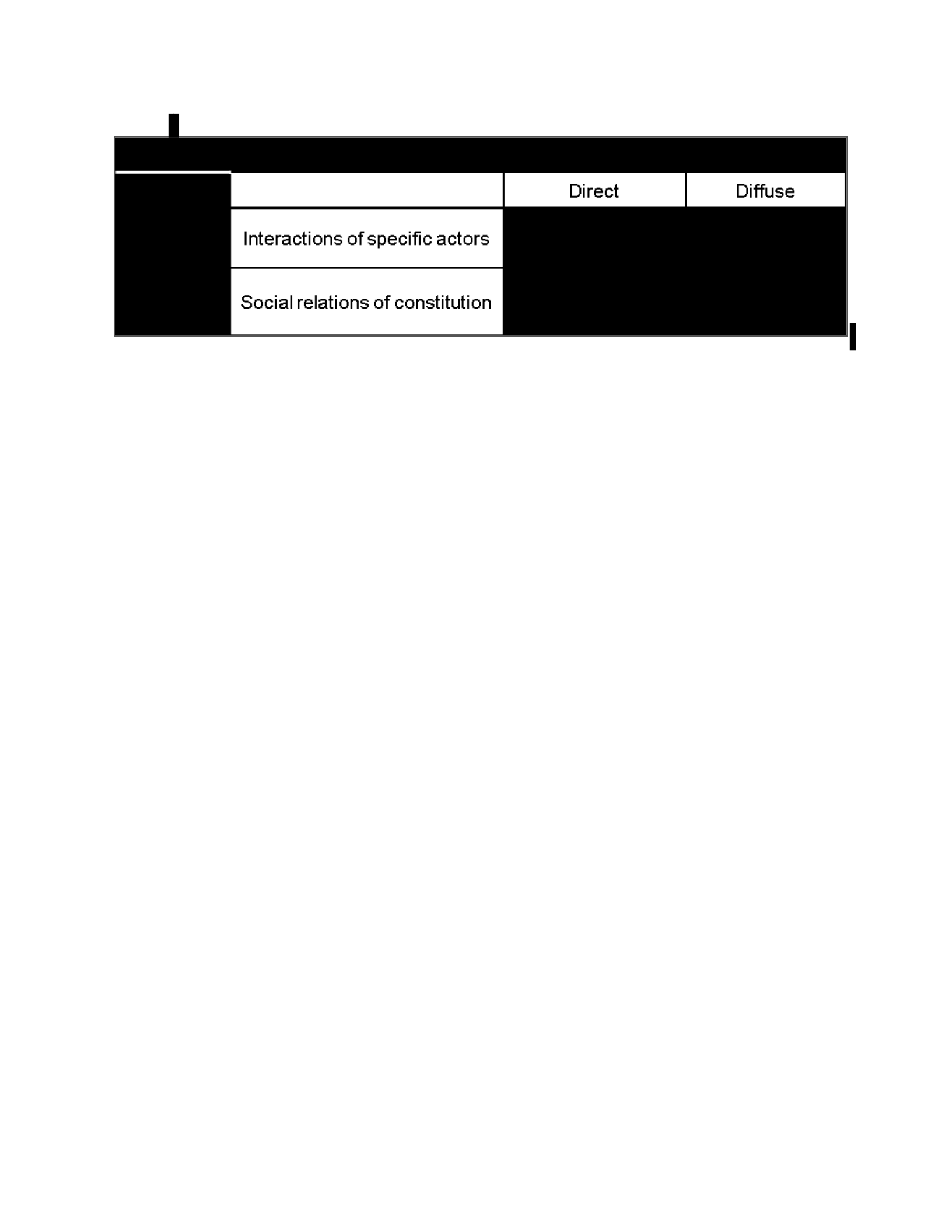
Figure 1. Taxonomy of power (Barnett and Duvall 2005, 48).
Conclusion
This diverse set of viewpoints on different definitions of the term ‘power’ should give
pause to any astute observer of international relations. The various understandings of power
reflect the changing dynamics of global affairs as Waltz’ tripartite nature of anarchy attempts to
outline.
The competing definitions of power each capture a very ‘truthful’ and ‘real’ measurement
of power, yet each is also limited by the perspective it draws upon. Thus, I conclude that power
and its definition draw directly upon the vantage point of the observer. If my goal is to study the
use of power by Iran, it becomes imperative for me to observe Iran’s actions through the lens of
Iranian policy makers and within the context of the Iranian state rather than a Western-centric
context.
Iran has fewer power assets than many countries on the global stage in terms of the
military, economic, and even institutional resources the country has available. Given these
realities as viewed from the Iranian perspective, it is then imperative that Iran find ways to use
other forms of power and other types of power resources. The next chapter will explore the
concept of ‘soft power’ and will offer a re-conceptualization of the concept that can be applied to
the study of Iran’s use of soft power in its foreign policy. Iran is using soft power tactics to

increase its influence within its geographic region and particularly for the purpose for this case
study, to increase its influence in Afghanistan.
1 This approach wants to explain cooperation between (state) actors and coordination of
their actions. It also addresses the core question of in/stability and in/security. Institutionalists maintain
that cooperation between states / governments is possible and may be effective.
2 I have used the translation of Max Weber employed and discussed in Felix Berenskoetter
and Michael J. Williams, Power in World Politics (2007).
3 Felix Berenskoetter and Michael J. Williams (2007) make a distinction in the definition
of the word ‘probability’ used in Robert Dahl’s reference to Weber. They say that probability is closer in
meaning to ‘chance’ and, therefore, it is not what Weber meant. Their understanding of Weber is that he
meant ‘opportunity’ or ‘possibility’ when he wrote ‘auch gegen Widerstreben’ (Weber 1976, 28).

CHAPTER TWO:
JOSEPH NYE’S CONCEPTUALIZATION OF SOFT POWER
Introduction
The concept of “soft power” is now widely used in many disciplines, and the term was
first developed in the influential 1990 book by Harvard University professor Joseph S. Nye, titled
Bound to Lead: The Changing Nature of American Power, Soft Power. Nye introduced the soft-
power concept to the lexicon of the international relations field and this profoundly shifted the
nature of academic discourses surrounding power. Though his 1990 book was concerned
primarily with the United States and its role in the world, Nye in his later works (2002, 2004a/b)
expanded on the concept further and applied it to other cases. He used new polling data and
historical research, and further explored the implications and limits of soft power. Soft Power:
The Means to Success in World Politics (2004b), responds to some of the early critics of the soft
power idea and Nye further developed his explanation of soft power within the unipolar context
of the current world system. Specifically, he uses the current American war in Iraq as a new
context for defining and delving into the importance of soft power in current international
relations research. Based on his understanding of the contemporary world—interdependence,
which is characterized by multiple channels, the absence of hierarchy among issues, and a minor
role of military force—Nye elaborates another important issue in the definition of power—the
changed sources of power.
In this chapter, I will delve into the conception of “soft power” first proposed by Nye
concentrating on the way he refines the concept in his later book (2004). I explore in detail Nye’s
discussion of various concepts he associates with soft power like the continuum of power, the

resources of soft power, the reflective behaviors of soft power, and policies that can be associated
with soft power. Further, this chapter will discuss critiques of Nye’s soft power concept given by
other scholars and will further explore and offer a critique of his concept relevant to this
dissertation. Lastly, I will introduce a reconceptualization of Nye’s soft power concept, beyond
its western centric box, that if applied as a theoretical concept, it can help to explain the ability of
non-western, non-dominant states in wielding soft power.
Nye’s Concept of Soft Power
When Nye wrote his 1990 book, it was an effort to explain the forms of power the United
States had employed in the preceding decade. In this work, Nye explores the importance of
nonmilitary influence in international relations. In the first 35 years after World War II, the
balance of power in the world system was bipolar, where international dynamics were dominated
by two superpowers. This bipolar system was different than what classical realist theories of
international relations had predicted where there would be more nations with influence. In the
1980s, international relations scholars began to see a growing interdependence among states,
especially in economic terms. There was also an increase in relative power among non-state
global actors. Nye also recognized these same trends in his assessment of the United States and
international relations due to changing global structures and the perceived diffusion of power at
the state-level (Nye 1990, 170). These global shifts had far-reaching implications for how a
state’s capacity to influence others was evaluated. For some analysts, the changes the global
arena was witnessing would lead to a decline in U.S. power. However, Nye’s position was
different and he took exception to view. For Nye, the existing measure of power were limited in
scope and they could not fully capture the way the nature of power was changing. Nye proposed
a new conception of power to better understand the relative power position of the United States.
Nye’s 1990 Conceptualization of Soft Power

In response to rapid rates of change and the increased complexity of international affairs,
Nye warned that while states should continue to keep with the traditional concern over the
balance of military power among nation-states, Nye argued that states must also adapt to the
limitations to the military power model given the emerging world order that showed increasing
interdependence. For Nye, the new world system was characterized by interdependence, with less
concern for hierarchy and a reduced use of military power. This led Nye (1990b) to reevaluate
how power was defined in international relations, focusing on how the sources of state power had
changed.
Nye stated that political actors and states attempt to leverage their influence through
whatever tools are available to them. He writes, “In an anarchic system of states where there is
no higher government to settle conflicts and where the ultimate recourse is self-help, [military
force] could never be ruled out” (Nye 1990a, 30). In assessing a state’s power, Nye draws
attention to central aspects like institutions, education, culture, ideology, and technology. Nye
showed how the world system was changing and that matters such as population, geography, and
raw materials were losing the centrality they once had in determining the most powerful states.
In Bound to Lead: The Changing Nature of American Power (1990a), Nye originally
characterizes power as the “ability to do things, control others to do what they would not
necessarily do” (154). Nye continued to see the relevance of the traditional realist stance to
power similar to Hans J. Morgenthau, Klaus Knorr, and Ray S. Cline, which sees power as, “the
possession of resources is more practical than in terms of the behavioral definition of power”
(Nye 1990a, 26). But he parts from them by offering a schema that accounts for different sources
of power,1 one that is in-line with his view of changes in the new international environment.

A Continuum of Power
In describing his conception of power, Nye envisioned a continuum of power ranging
from what he labeled hard power—command power to what he labeled soft power—co-optive
power. His conception of power (Figure 2) saw hard power as command power and soft power as
co-optive power. Accordingly, the continuum reflected behavior ranging from coercion on one
end of the spectrum to attraction on the other. Along the continuum he lists other behaviors,
inducement, closer to command power and agenda-setting, closer to co-optive power. The
behavioralist understanding of Nye’s understanding of power, with its emphasis on causality, is
clear in the continuum of power figure (2). Nye’s behavioralist approach to power poses
challenges to conceptualizing the influence yielded by soft power which will be discussed in later
sections.
Figure 2. Nye’s continuum of power (Nye 1990, 267 endnote).
Nye, in explaining the continuum of power and with regards to soft power, writes:
A country may achieve the outcomes it prefers in world politics because other
countries want to follow it or have agreed to a system that produces such effects. In this
sense, it is just as important to set the agenda and structure the situation in world politics,
as it is to get others to change in particular situations. This aspect of power—that is,
getting others to want what you want—might be called indirect or co-optive power. It is
in contrast to the active command power behavior of getting others to do what you want.
Co-optive power can rest on the attraction of one’s idea or on the ability to set the
political agenda in a way that shapes the preferences that others express.... The ability to

establish preferences tends to be associated with intangible power resources such as
culture, ideology, and institutions. This dimension can be thought of as soft power, in
contrast to the hard command power usually associated with tangible resources like
military and economic strength (32).
By 2004, the world had shifted fully from a bipolar dynamic into a unipolar dynamic that
was defined by the geopolitical strength of the United States. In 2001 and again in 2003, the
United States invaded two countries by forming coalitions of other nations. During the 14 years
between Nye’s two books, the concept of soft power had gained in popularity not only among
scholars and IR theorists, but also among foreign policy practitioners around the world. The use
of the new concept led to multiple layers of questions and also critiques, which prompted Nye to
expand on his conception further and to include more descriptive explanations for evidence of his
idea. He also worked on detailed descriptions of the resources he viewed as underpinning soft
power.
In 2004 Nye drew a clearer distinction between what constituted hard power and soft
power in his conceptualization. He included coercion and inducement behaviors on the hard
power end of the spectrum and described resources such as use of force and sanctions as
coercive. Economic payments, bribes, and providing aid were classified as inducements by Nye.
He described agenda setting and attraction as behaviors associated with soft power, and he
delineated institution creation as a resource used to build agenda-setting behavior, which is
another form of power. Nye said that values, culture, and policies as all the resources used to
build the power of attraction. These three resources will be discussed in further detail in sections
to follow.

Figure 3: Nye’s chart of power behavior and resources (Nye 2004b, 8).
It is important to note that Nye’s conception of power shifts slightly from 1990 to 2004
but may be more accurate to say he wrote more precisely about his conception of soft power, not
that his conception shifted. Nye (2004b) describes soft power as “getting others to want the
outcomes that you want,” “the ability to shape the preferences of others,” and “the ability to
attract” (5–6). In being more descriptive of the attributes of soft power, he responded to the
general critiques leveled during the preceding fourteen years that his conception was too
ambiguous and thus not as effective in understanding global power dynamics. His attempt still
left many scholars unsatisfied, but the 2004 description of soft power is far more precise and
detailed and will serve as the definition I use in dealing with Nye’s critics and in explaining my
own contribution to this conversation.
Soft Power Behaviors, Currencies, and Policies
In Nye’s 2004 book, Soft Power: The Means to Success in World Politics, the author
provides details about dimensions of soft power that were previously missing from his discussion
of the concept. Nye takes it upon himself to better explain the four behaviors he had pointed to
on his continuum: coercion, inducement, agenda-setting and attraction (1990). On the continuum
he also delineates specific resources that each type of behavioral patterns utilizes in exercising
power, that he calls ‘currencies.’ In addition, he writes about specific policies that states

implement or can implement to utilize those currencies and engage in the behaviors he specified
on his continuum. This 2004 extrapolation of his 1990 conception of soft power has been the
standard by which soft power has been discussed over the past twelve years by IR scholars of all
stripes. Before going into the critiques leveled at Nye’s conception of soft power in the next
section and discussing my own perspective on how to contextualize soft power to better explain
the foreign policy choices of states such as Iran, it is imperative to fully unwrap Nye’s
conception here.
Clarifying the Continuum of Power
Figure 3 in the previous section updates Nye’s original 1990 conception of the continuum
of power. There he delineated not just the ‘most likely resources’ used when exercising a
particular behavior associated with power, but also drew a tentative distinction between hard and
soft power behaviors on that spectrum. During the fourteen years between these two books, Nye
was challenged by both realists who doubted that his description of co-optive power should be
viewed as power at all, as well as by constructivists who thought his conception of soft power
was far too limited in scope. They accused him of trying to fit an inherently non-realist
perspective of power into a realist theoretical framework that was ultimately constraining.
Part of Nye’s response to critics was to defend the idea that agenda-setting and attraction
should be construed as a form of power. In effect, he challenged long-standing realist
conceptions power as solely those examples where exercising influence directly affected
behavior or the actions of others as the defining characteristic of power, as exemplified by Dahl’s
“first dimensional” exercise of power. Nye writes that “the skeptics who want to define power
only as deliberate acts of command and control are ignoring the second, or structural, face of
power, the ability to get the outcomes you want without having to force people to change their
behavior through threats or payments” (2004b, 15). In including agenda setting through the use

of institutions as an example of the exercise of soft power, Nye then further expands his
definition of power and places another set of behaviors distinctly beyond agenda setting further
along on the spectrum of behavior and toward the co-optive end of his continuum. He calls this
new set of behaviors associated with co-optive behaviors attraction.
Because the nature of soft power is inherently intangible, it also makes it difficult to
identify the particular power resources that are associated with the soft power categories on
Nye’s continuum like the attraction category, for example. Sigrid S. Eggereide in her 2012 paper
on Nye writes that “it is essential to also discuss Nye’s distinction between soft-power resources
and soft power behaviors. Soft-power resources are usually generalized as potential power, or
the “currencies” as Nye calls it, that can be used to achieve a goal” (Eggereide 2012). For Nye,
there is a distinction between the behavior associated with a form of power and the resources that
are used in order to exert that kind of influence. As he explains, “In behavioral terms, soft power
is attractive power. In terms of resources, soft-power resources are the assets that produce such
attraction” (Nye 2004b, 6).
Resources and Currencies of Soft Power
As Nye clarified his conception of soft power and delineated it from hard power, and in
his 2004 book and later work he introduced yet another model to further describe his conception
of different forms of power. He added further distinctions on the kind of power exercised,
delineating now three distinct categories or dimensions: Military, Economic, and Soft (Figure 4).
In this later model, Nye splits hard power into two categories, and he includes both agenda
setting and attraction as behaviors that fall under the umbrella term of soft power. In Nye’s 2004
book, he spends quite a bit of space describing the soft-power resources he sees as values,
culture, policies, and institutions.
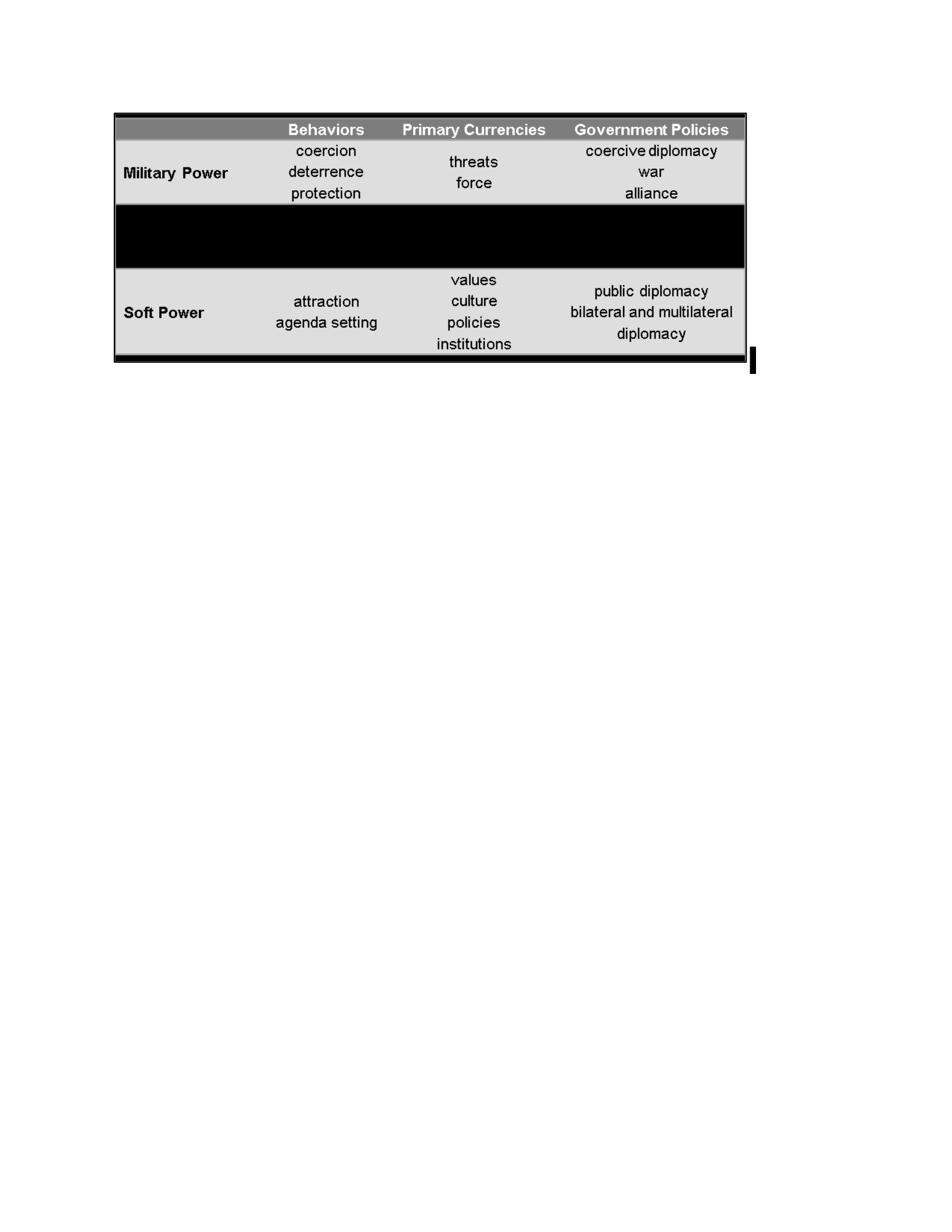
Figure 4: Nye’s three dimensions of power: military, economic, soft (Nye 2004b, 31).
In his earlier discussion of power published in 1990, Nye pointed out that the use of
military force had been declining as recourse for exerting a state’s will throughout the 1980s,
because the buildup of gaining military capabilities and the maintenance that equipment and
military personnel required was economically. Military actions were thus a drain on the
economic power that states possess and it was becoming an increasingly unviable option,
especially as technologies continue to improve and make military-based solutions more
expensive. Nye argued that even though military force was a highly effective currency for
asserting a state’s will, it would not help build the economic power base of a state in short and
medium term (Nye 1990a, 159–60). Nye further discussed the limitations of the hard power
approach like military force by arguing the state itself is losing importance as a global actor
relative to the increasing influence of other entities such as multi-national corporations, non-state
actors, and global institutions (Nye 1990a, 156–57). He also emphasized the growing primacy of
international markets within an interdependent global trade system that continues to utilize
technological innovations such as satellites, fiber optics technology, and a spreading internet to
exert further influence on social networks that cut across individual countries, making traditional
military resources less of a recourse for expressing a state’s will as military might is less

conducive to the kinds of power being exercised in the international realm today (Nye 1990a,
164–65).
Although there was at times a lot of resistance to Nye’s conceptualization of soft power
among the more traditional realists, in some ways Nye’s explanation is similar to the realists.’ For
both Nye and the realists, power resides in the sum total of a country’s capabilities relative to
other states and it can be measured by some calculation of its domestic attributes. In addition,
Nye describes the intangible features of soft power resources, much like Hans Morgenthau
described the elements of national power; where less tangible qualities like character, morale,
quality of diplomacy, and quality of government are important demonstrations of a state’s power
as well. By comparison, in describing the components of attraction, Nye writes, “soft-power
resources are the assets that produce such attraction . . . [it] rests primarily on three resources: its
culture (in places where it is attractive to others), its political values (when it lives up to them at
home and abroad), and its foreign polices (when they are seen as legitimate and having moral
authority)” (Nye 1990a, 4).
Nye eventually moved beyond just the narrow discussion of his power continuum and
explored factors such as, “global information, culture, ideology, institutions, technology, and
education” as other factors that became important in achieving great levels of state power (Nye
2002, 9). He believed that such factors had become variables that were just as significant as
geography, population, and raw materials or access to natural resources. Nye (2004) argues that
the global shift towards a more complex and interdependent international system also required a
departure from traditional views of power and hegemony towards a conceptualization that takes
into account these changes (Nye 2004b). As an example, Nye argues that advancements in
technology took on greater importance for states as a source of growth and power. Nye drew
attention to specific devices that help make communication among units in the global system

easier and more efficient as a previously overlooked and underappreciated source of power (Nye
1990a, 158). Thus, with power becoming less coercive and soft power resources becoming ever
more important in the power calculations that states make, it has become necessary to analyze
power and foreign policy behavior from this new perspective.
In his 1990 conception, Nye focused on the United States as an agent that used resources
to exercise what he termed soft power. Specifically, he named American culture, American
multinational corporations, and international laws as the resources that the United States used to
employ forms of soft power (Nye 1990a, 191–93). But in 2004 he expanded on his ideas and
explained these sources of soft power more specifically. As we see in Figure 4, Nye delineated
four specific ‘currencies’ as primary resources of soft power: values, culture, policies, and
institutions. I will delve into each one in turn, as understanding Nye’s perspective on each of
these resources will help us understand why there were also critiques of Nye’s position and
limitations in the applicability of Nye’s conception of soft power to non-Western states. In
describing the four currencies: values, culture, policies, and institutions, Nye describes these as
the resources or assets that help to produce attraction. Yet whether these resources actually
produce policy outcomes and state goals depends on a careful evaluation of each instance and an
analysis of each particular cases (Nye 2004b, 6).
Values. The first resource of soft power that generates what Nye calls attraction are the
values of a state. A state can show the values it upholds in the kinds of policies it advocates and
through official statements, but also most importantly through the actions it takes. In order for the
values of a country to produce attractiveness, there has to be consistency in the belief being
professed and the actions taken by a state in function of those values. Therefore, Nye says, an
adherence to values can negatively or positively affect the relative soft power that a country
enjoys, because low adherence will undermine the credibility of a nation, while high levels of

consistency will increase credibility. As Nye explains, “Hypocritical, arrogant, and egoistic
policies based on a narrow approach weaken a country’s soft power and, therefore, should be
avoided” (Nye 2004b, 13–14). States that take action or promote broadly shared values such as
peace, democracy, human rights, or justice are likely to have heighted levels of attractiveness
based on this value resource, according to Nye
Culture. The second resource of soft power that creates attraction is the far more
complex culture resource. Broadly speaking, culture is defined as a set of ideas, traditions, and
attitudes with historical roots that partially define or typify a group of people or a society. Culture
can be viewed as an attractive resource for a state when groups of people from other states
positively interact with that culture through commerce, tourism, or academic exchanges. Nye
does not explain what the elements of an attractive culture are, nor does he differentiate between
attractive cultural resources or non-attractive cultural resources. Nye does not discuss the
example of cultural resources beyond stating that it is a resource that produces attraction when it
is able to influence a target audience into changing its behavior to emulate the agent
state.
Policies. Nye sees political and national/foreign policies as the third soft power resource
of attraction. Policies are a soft power resource when they are seen to be consistent with the
norms and standards of the international community. Referring to the United States, Nye points
out that having a solid democracy at home, working well with others in international institutions,
and promoting peace and human rights in foreign policy are all policy-sources of soft power
(Nye 2004b, 11). “While all soft-power resources matter, foreign policy is especially important,
because this is the resource that is “both the most volatile and the most susceptible to government
control” (Nye 2004b, 68).

Institutions. Nye sees a fourth soft power resource of attraction in having a strong role in
international institutions. This resource can be seen as attractive because it has the potential to
influence the preferences of others. As shown in Figure 3, institutions are closer to the hard end
of the spectrum, but the line between hard and soft is certainly unclear when it comes to
institutional power, you can also wield economic power though a strong position in international
institutions, for instance. Nye places a strong position in international institutions on the soft
side of the scale because of the possibilities such positions create for agenda setting.
Behaviors Associated with Soft Power
Along with discussing the resources associated with soft power, Nye outlines specific
behaviors taken by states using those resources. He argues that possession of soft-power
resources alone is not sufficient to produce results. Specific behaviors have to be undertaken
skillfully to transform such resources into power. He points out that this is true of hard power as
well, including military and economic power. It depends on the context in which these resources
are used. Nye outlines three specific elements that contribute to enhancing a country’s soft
power: First, countries can gain soft power when their culture are a closer fit with the prevailing
global norms like pluralism or autonomy; second, countries can gain soft power when they have
various communication channels at their disposal and thus can influence how issues are framed;
and third, countries can gain soft power when they are seen as more credible by other states due
their international and domestic performance.
The two behaviors that Nye associates with the soft power of states are agenda setting and
attraction. As a behavior, agenda setting requires the use of institutions as a resource to achieve
soft power. This set of behaviors dovetails very closely with the second face of power as
discussed by Bachrach and Baratz (1962 and 1963) and the influence that covert power can have
on states. In his conception of soft power, Nye brings this state behavior set back into the fold of

a realist theoretical framework by identifying institutions as a resource. This puts the state back
in the driver’s seat as the agent implementing a specific behavior pattern through agenda setting.
By focusing in on specific behaviors on the part of the state, Nye is showing how the state is
actively framing issues to its liking. Thus, Nye is bringing measurable behaviors and resources
into the discussion of power and how it is wielded.
The other arena of behavior Nye outlines is what he calls the behavior of attraction. Nye
remains rather evasive about the real meaning of ‘attraction’ as a behavior category. He
acknowledges that “in general, soft-power resources are slower, more diffuse, and more
cumbersome to wield than hard power resources” (2004b, 100). Nonetheless, Nye still insists that
soft power is “a form of power, a means of obtaining desired outcomes” (2004b, 129). In
discussing this behavior of attraction, Nye is careful to delineate it from the more accepted
concepts of public diplomacy as he views public diplomacy as one of the ‘tools’ or government
policies that are reflective of the behavior of attraction using the currencies of values, culture,
and policy implementations outlined in the prior sub section. Nye even describes three
dimensions of public diplomacy: daily communication, or “explaining the context of your
domestic and foreign policy decisions”; strategic communication; and the dimension of public
diplomacy that develops, “lasting relationships with key individuals over many years through
scholarships, exchanges, training, seminar, conference, and access to media channels” (2004b,
107–9).
For Nye, attraction is a state behavior that draws on resources like values, culture, and
policy, although Nye also explains that state actors are not well suited to creating those resources
with intentionality. These resources tend to already exist within the context of the international
relationship in question. State actors then use attraction behaviors to promote these resources
bilaterally or multi-laterally. The states who can mobilize attraction resources benefit from the

soft power that is accrued. In essence, Nye suggests that to develop their attraction-based
behaviors of soft power, states can invest in their diplomacy tools to promote the soft-power
resources that are pre-existing for them or that they already possess.
Attraction as Influence and Persuasion
The extent to which attraction can be considered a kind of influence on the part of the
state depends on the target audience. For example, Nye explains how if an individual is hungry,
then influencing them to eat cannot be viewed as an exercise of soft power. Therefore, Nye’s
view is that attraction is only a form of soft power when a conflict of desires exists or where the
behavior of an individual or state is influenced or redirected due to the attraction it has to another
state. The element that Nye does not discuss in detail is how target country B perceives that
attraction, as there are multiple actors within a polity that make up a state and thus direct its
policymaking. A specific cultural or value-based resource ‘possessed’ by country A may be
attractive to some elements within country B, but it can only produce influence or persuade
country B to change its own behavior if that attraction is translated into policy preferences or
policy actions by country B. Nye alludes to this dilemma by admitting that “soft power can
influence not the policymaking itself but only the environment for policy” (2004b).
Soft Power in the Context of the Three Faces of Power
In his 2004 description of the conception of soft power, Nye refers to the “structural face”
of Bachrach and Baratz’s formulation of power, or what Lukes calls the “second face” of power.
However, for Nye his conception of soft power is different than what Barach and Baratz
emphasize. Nye describes soft power as an ‘ability’ within a clear behavioral paradigm requiring
agency. Nye says that soft power “rests on the ability to shape the preferences of others” (2004b,
5), which also places the use of ‘agenda setting’ squarely within the rubric of state action rather
than some diffuse definition of power derived from an already existing structural context. Nye’s

agenda setting behavior therefore is not about creating the structures within which other actors’
behaviors are limited, but rather it refers to the action of the setting of the agenda itself within
whatever structural context exists. So, Nye is in agreement with the “first face” definitions of
power that are adopted by scholars like Dahl insofar as he ascribes power based on specific
actions or behavior and searches for the causal relationships he sees in the use of soft power.
Nye’s conception of soft power does, however, accept Bachrach and Baratz’s idea that there exist
structural forms of power, but Nye’s perspective of power is more in line with Dahl’s conception
of power as wielded by an actor.
This conception of soft power leaves much room for debate as reflected in the multiple
critiques I will review in the following section. Above all, there is tension between the
agencydominant conception of power versus Nye´s insistence that soft power is defined by a lack
of compulsion, or as he says “affecting behavior with commanding it” (2004b, 2). The
agencydominant conception defines the exercise of power in terms of making another take
actions they would otherwise not have taken. The Bachrach and Baratz model of power avoids
this conflict by delineating between direct wielded power and indirect power through structures.
Nye also completely avoids Lukes’s definition, which is inclusive of the ‘third face’ of power, or
latent subject-oriented power. This definition, as I discussed in the previous chapter, requires an
almost constructivist theoretical framework that Nye does not adhere to and avoids at all costs.
As I will explore in the following sections, this blind spot leaves Nye’s conception of soft power
venerable to multiple angles of criticism because of its inability to adequately explain his
formulation of ‘attraction’ behavior or even the measurability of the resources/currencies he
identifies.
Lastly, in his book, The Future of Power (2011), Nye once again turns back to discussion
about the essence of soft power. In responding to some of the critiques leveled at the limitations

of his conception, Nye delineates further about ‘attraction’ behavior and he suggests a new
concept he calls ‘smart power’ as a guiding principle of soft power. Nye notes that attracting
attention can within certain contexts, produce positive, welcome results or it can sometimes
produce negative or unwelcome results (2011, 90). He notes that positive attraction is based on
“benignity competence, and charisma.” However, an actor can also be viewed as manipulative or
incompetent in their use of soft power which would produce results closer to indifference or even
revulsion (Nye 2011, 92). Nye also makes the distinction between soft power as a tool and soft
power as a behavior. He explains how soft power approaches are used to affect another actor’s
actions rather than using force, threats, or a payoff. Nye concedes there are dilemmas in
characterizing persuasion as it can be done in an attractive way that appeals to facts, logic, and
emotions or in a negative way that may seem dishonest or even fraudulent (Nye 2011, 93). Yet
even in his latest writings he does not yield to the idea that his formulation uses a constructivist
theoretical framework.
Critiques of Joseph Nye’s Concept of Soft Power
Nye’s conception of soft power is not without its detractors. There are many angles which
different scholars have used to criticize Nye’s views on power, from different theoretical and
methodological perspectives. Nye’s conception is criticized from both the realist theoretical camp
as well as the constructivist theoretical camp, yet most of the critiques I will address will be
directed from the constructivist angle and from my own analytical standpoints.
The Analytical and Theoretical Limitations of Nye’s Conception of Soft Power
One of the principle avenues for criticizing Nye’s soft power model is that he does not
provide the analytical depth necessary to explain his concept. Those scholars who wage this
critique argue that Nye’s formulation is built upon assumptions rather than evidence. The critics
feel he fails to provide a consistent analytical model for his conception of soft power. The

problem for these naysayers is that the reader of Nye’s theories is left without knowing how soft
power actually works in practice.
Nye places a tremendous emphasis on the behavior of attraction in his framework. The
ability to expand or increase attraction is the critical behavioral mechanism needed to understand
the concept of soft power. One criticism of Nye’s theory, however, is that in all of his writings
from 1990 to 2011, Nye neglects to really explain how attraction operates.
A potentially more damaging second element of this critique is that Nye treats attraction
as a natural and static condition. If one assumes from Nye’s position that attraction is a natural
condition, the critics argue, then a state would not need to engage in public diplomacy or utilize
other tools to try to ‘increase’ their power to attract. However, in Nye’s conception of soft power
and in the colloquial use of soft power by states, instruments such as public diplomacy are a
central element in the practical usage of soft power. One scholar put it succinctly by saying “if
people want to do what you want them to do through cultural affinity, why expend so much
energy on public diplomacy?” (Hocking 2005, 35).
Attempts to Offer a Theoretical Framework for Soft Power
Another of the main critiques of Nye´s soft-power concept is on the issues of its
conversion or how soft-power resources are converted to power behavior (outcomes). The reason
for the lack of clarity on this matter is because Nye fails to articulate any clear boundaries for the
ability or power “to attract.” Even though attraction is the center of Nye’s theory, he doesn't offer
any definition of it or any map for how attraction is acquired.2 In his writings on attraction, Nye
does attempt to present the behavior of attraction in a measurable manner but he does not present
readers with a full conceptual notion of the term. He also does not address how attraction can be
increased or acquired in greater amounts by a state actor.3

Soft Power and Attraction
One of Nye’s critics, Alexander Vuving, tried to provide a theoretical explanation of soft
power in a 2009 paper titled “How Soft Power Works” in order to solve the big questions that
many still had about Nye’s power of attraction. Vuving views soft power in two different ways.
He says that in the narrow sense “soft power is similar to cultural influence,” and in the broader
sense soft power is “synonymous with non-military power and includes both cultural power and
economic strength” (Vuving 2009, 3). He labels the lack of clarity surrounding soft power a
“vehicle fallacy” which leads many to misunderstand the soft-power concept. Vuving defines
vehicle fallacy as when someone equates power with power resources, which results in confusing
the resources needed to enact power with the actual behavior. In order to reconcile the vehicle
fallacy issue, Vuving makes an additional distinction between power resources and power
currencies and says that, “power currencies are usually properties of resource or activities”
(2009, 3).
Vuving begins his study by offering a definition of soft power and argues that Nye’s
definition is problematic. Vuving describes soft power as “the ability to get other to want, or
accept, what you want” (2009, 4–5). After identifying attraction as the mechanism through which
soft power works, Vuving delves into his main question about what generates attraction. He
defines three power currencies from which “both power and its ‘softness’ are derived,” and
associates these currencies with the tools of soft power—which for Vuving are the policies the
governments adopt, which he calls “the act.” According to Vuving, the three power currencies
are: benignity, brilliance, and beauty. He says benignity is kindness of behavior and attitude, and
it generates soft power by producing feels like gratitude or sympathy. Vuving says that
multilateralism, humanitarian assistance, and aid are examples of acts of benignity. Brilliance
refers to the capabilities and accomplishments of an actor, and this, generates soft power through

the production of admiration. Examples of ‘the act’ are successes in terms of economic stability
or domestic stability. Third, Vuving says beauty results from shared norms and goals and it
generates soft power because it provides inspiration. Ann example of this “act” is conducting
domestic and foreign policies based on normative principles (Vuving 2009, 8–9, 20).
Another attempt to provide a theoretical framework for soft power is found in Geun Lee’s
2009 article titled: “A theory of soft power and Korea’s soft power strategy.” Lee critiques Nye’s
weak theoretical framework for soft power but also questions Nye’s representation of soft power
as being highly contextual. Lee claims that Nye’s conception of soft power is too specific to the
case of U.S. hegemony and that the concept as articulated provides less insight about the soft
power strategies used by lesser powers. He writes, “for lesser powers, leadership-oriented soft
power, particularly hegemonic leadership-oriented soft power, is of little value in achieving their
political and economic goals” (Lee 2009, 124). Lee re-conceptualizes Nye’s soft-power concept
and puts the sources of soft power, what he calls “soft resources,” at the center of the theory
rather than the nature of the power exerted or the behavior employed by the state as Nye does.
Using a case study of South Korea, Lee identifies five different categories of soft power based on
the policy goals being pursued. Lee also offers two criteria for his categorization: first, whether
the subject state is demonstrating voluntary support or using co-optive forms of power, and,
second, the nature of the different goals being pursued by the multiple actors as they use these
co-optive powers (2009, 127). I will not delve further into Lee’s theoretical framework for
softpower as that is not the purpose of this paper. However, his critique of Nye’s theoretical
framework is emblematic of the critiques that other IR scholars hold.
Attraction as Natural or Constructed
Another dimension of Nye’s concept of soft power that is critiques is Nye’s insistence that
attraction is a naturally occurring condition. Nye’s conception of attraction requires attraction to

be static and measurable in an almost linear and unmoving way that exists irrelevant of the
actions taken by actors. In essence, Nye views attraction as preexisting and not something that
can be created or constructed through actions by the state.
The main critique of Nye’s concept on the issue of attraction-generation is Janice B.
Mattern (2005). She feels that a major weakness of Nye’s model is his treatment of attraction as
natural. Nye treats “attraction” as something that just “is,” rather than something that needs to be
put in motion. In her 2005 article, “Why ‘Soft Power’ Isn’t So Soft: Representational Force and
the Sociolinguistic Construction of Attraction in World Politics,” published in The Journal of
International Studies, Mattern strongly criticizes the idea that attraction is naturally existing. This
dissertation views attraction as a form of behavior and puts forth the argument that all attraction
is something constructed and thus a socially created reality. Mattern argues: “Insofar as attraction
is socio-linguistically constructed through representational force, soft power should not be
understood in juxtaposition to hard power but as a construction of it by different means” (2005,
583). Mattern argues that attractiveness itself is a social construct and since language is the tool
with which construction of such concepts occur, then attraction must be viewed as a
sociolinguistic construction.
Mattern expands on this point by explaining that states use communicative exchange
strategies to project an attractive ‘reality’ or ‘truth’ about the idea. The state can present an
evidence-based argument, or a form of persuasion, for example, or use some other linguistic tool
with ‘representational force’ (Mattern 2005, 582). Mattern asserts that although representational
force is non-physical, it should still be considered coercive power. She also asserts that any art
form intended to create cultural attraction—whether literature, film, music, or public
diplomacy—will have ‘representational force’ behind it.

Mattern thus posits that soft power should be considered a continuation of hard power
through a different set of tools (Mattern 2005, 583). She says that in order to achieve foreign
policy goals or other desired results, a state often engages in arguments of persuasion using
representational force—otherwise called verbal ‘fighting. She draws on the writings of Jurgen
Habermas to further question Nye’s approach to attractiveness as a naturally occurring
phenomenon. Mattern argues that any analytical framework which attempts to capture the ‘reality
of attractiveness’ requires delving into the nature of persuasion. It is thus necessary to have a set
of preconditions premised on shared understandings; a pre-condition that does not necessarily
exist among states for whom Nye’s conception of attraction was devised (Mattern 2005, 586,
594). Her main point that Nye’s soft power is indistinct from hard power because it is still a
coercive power only demonstrated through representational force. States use representational
force to persuade and thus leading to ‘verbal fighting.’ She defines representational force as, “(a)
form of power that operates through the structure of a speaker's narrative representation of
‘reality,’ … specifically, a narrative expresses representational force when it is organized in such
a way that it threatens the audience with unthinkable harm unless it submits, in word and deed, to
the terms of the spectator's viewpoint” (Mattern 2005, 586). The harm specified by Mattern need
not be a physical harm, as it is sufficient for it to some sort of psychological harm to the target
audience’s ontological sense of security or their sense of reality.
Mattern argues that through the construction of such representational narratives, actor A
can exploit and threaten actor B’s conception of reality such that Actor B is left with ‘no choice’
(Mattern 2005, 586). An illustrative example of this is the United States’ use of a narrative of
“you are either with us or against us” in its War on Terror. By subjecting the target of the
narrative to a narrative of ‘good’ versus ‘bad’ defined by the United States, the representational
force being offered is for the audience to either submit or suffer. She therefore makes the case

that through such construction of attractiveness, soft power operates through a coercive
mechanism rather than a co-optive one, which is the opposite of the conception offered by Nye.
Mattern accepts that the resources used for soft power can be distinguished from the resources
used for hard power, however, she claims the mechanisms underlying it are the same as those for
hard power. Thus, the analytical framework needed to understand the underlying mechanisms is
lacking in Nye’s conception of soft power.
Policy and Practical Limitations
There is a second set of criticisms concerning Nye’s conceptions of soft power and
attraction that are based on the practical applications of such a theorization. Some scholars
criticize Nye’s notion of soft power because it helps little in achieving policy goals or forwarding
national objectives, like in the work of Hall that will be discussed below (Hall, 2010). Another
set of critiques concerning the practical applications of the theory revolve around the question of
how influence is actually achieved using soft-power concepts.
In the 2010 article “An Unclear Attraction: A Critical Examination of Soft Power as an
Analytical Category,” Todd Hall argues that Nye’s notion of soft power lacks a conceptual
framework that would allow it to be used among nations in terms the practical exercise of power.
He faults Nye’s concept for being a category of practice rather than a category of analysis to
understand power. Hall says the fault with Nye’s conception lies in that the “idea of attraction is
the primary mechanism behind the effects he attributes to soft power” (Hall 2010, 190). Hall
points out that Nye’s three main resources or currencies—culture, values, and policies—are
difficult to associate with the behavior of attraction he outlines. Hall says the analytical
framework is missing to help translate those resources or sources of soft power into the attraction
behavior that Nye relies on so heavily. The essence of Hall’s critique is that resources described

as culture, values (or ideas), and policies are very vague. They do not necessarily produce the
national interest objectives or practical results and achievements that a state would seek in using
its soft power.
Hall breaks down his criticism into two main questions and three observations. First, Hall
asks, does the exhibited behavior of a target state toward the specific soft power resource signify
attraction? Second, if an attraction can be linked to that resource, does it actually produce a
favorable policy outcome that is sought after by the state employing soft power?
Hall notes it is not readily apparent that the attraction in the target state actually exists.
Even if such a linkage could be shown, Hall says it is almost impossible to show there is a link
between the attraction generated and the desired policy objectives of the state employing that soft
power (Hall 2010, 206). He further maintains that these soft-power resources and the attraction
they produce are interwoven with questions of political identity. He adds that even if as a whole,
a target state desires to emulate the cultural currencies of another state they consider attractive, it
does not necessarily signify support for or backing of that state’s political objectives and
interests. It is therefore possible for a state to be attracted to a set of soft-power resources without
leading that state to desire the same outcomes as the original state desires (Hall 2010, 206).
Hall also observes that even if a desired outcome or result is achieved where such an
attraction exists, the conceptual framework offered by Nye does not allow for a disentangling of
attraction from other causes that may have produced that result. That is to say, if the target state
takes foreign policy actions in line with the desires of the soft power user, the soft power user
cannot be certain that it was indeed the use of soft power or the existence of attraction that
produced that result. The result could have occurred for other possible reasons (Hall 2010, 207).
Hall’s critique is directed at the dichotomy in Nye’s conception of soft power. Hall agrees
that there is a set of powers that lie outside traditional definitions of hard power and he proposes

an alternative framework whereby an observer should consider power strategies in three specific
arenas: institutional power, reputational power, and representational power. The definitions that
Hall provides for each of these forms of power are given below:
1. Institutional power: “The options available to state actors according to their membership and
relative position within specific international organizations which enable those states to
exercise influence within them” (Hall 2010, 208).
2. Reputational power: “A reputation for being economically successful, for instance, might
give a state more of a say in the creation of development models. Being known as a neutral
broker could qualify a state to intercede as arbitrator in a conflict” (Hall 2010, 208).
3. Representational power: “The ability of states to frame issues, advance their own
interpretations, and consciously seek to shape the beliefs of others. Sources and tools of
representational power include public diplomacy, propaganda and information control” (Hall
2010, 209).
Hall also adds there is some danger for a state that attempts to use soft power if it
entangles itself in its self-identified cultures, values, and policies and imagines them to be
achieving results as it then becomes possible for that state to limit its own options in order to
preserve those currencies while costing the actor in its inability to achieve its self-interest using
other tools not congruent with those soft-power resources (Hall 2010, 204–6).
In his 2007 case study Soft Power and Its Perils: US Cultural Policy in Early Postwar
Japan and Permanent Dependency, Takeshi Matsuda also looked at the practical foreign policy
implications of the attraction concept using the bilateral relationship between the United States
and Japan after World War II as a case study. Matsuda concludes that soft power is a two-way
exchange, it does not represent a unilateral or linear ‘cultural imperialism’ with only a one-way
flow of attraction. He posits that the United States attempted to adopt a dominationsubordination

relationship in Japan post WWII where influence and attraction would flow in a linear line from
the ‘superior’ resources the U.S. possessed in terms of culture, values, and policies (Matsuda
2007, 4–6). However, Matsuda finds that even in the cases where the United States penetrated
Japanese society with its cultural ideas, values, and government policies, this did not lead the
Japanese to passively accept those cultural resources. In essence, even though the behavior of
attraction was present, it did not lead to a wholesale adoption of those assets. Matsuda cautions
against the use of coercion by cultural means but also through soft power. He says that even in
such a clear case study as this example of post WWII Japan and the United
States, it does not lead to the adoption of wholesale policy objectives (Matsuda 2007, 6–7).
Relevancy and Application Limitations
There is another tier of criticism in the literature on soft power that directs attention to the
universality of Nye’s conception of soft power, or more accurately, the limitation of applying the
concept to non-Western or even non-U.S. actors. Since Nye’s conception of soft power was first
introduced in 1990, the world has remained a unipolar world dominated by the United States.
This dominance of the U.S. in terms of military power, economic power, structural power, and
the normative power it has in terms of the global context is the backdrop of Nye’s conception of
soft power. With this context in mind, critics who see the hegemony of the United States as a
problem argue that Nye’s concept is applicable to the example of the United States and perhaps
other Western states but there is little in Nye’s conception of soft power that is applicable to
rising powers or weak states.
Soft Power as a Western Hegemonic Discourse
In the literature concerning the notion of hegemony, Robert Cox provides a useful
definition and says “hegemony is ‘an inter-subjective sharing of behavioral expectations. A
leading nation’s conception of the world becomes universalized” (Cox 1983, 168). Ian Clark, in

his 2009 article “Towards an English School Theory of Hegemony,” adds that hegemony is a
structure, constructed on a foundation of normative necessities that creates and enforces
seemingly voluntary compliance in all the actors pulled into the orbit of the hegemon (Clark
2009, 28). Indeed, reading soft power as a form of hegemonic discourse makes it a form of
structural power which sets the standards and norms of behavior for all. Soft power in this sense
would define the terms of legitimacy because it operates like the notion of hegemony.
This line of criticism borrows from hegemonic state theory to criticize the concept of soft
power as limited in application to just those nations that are dominant superpowers because it
only describes the toolset available to such states. This critique argues that Nye focused heavily
on the international prestige enjoyed by the United States and how it can enhance its influence.
Thus, Nye fails to explain the application of his soft-power concept to weaker states with
different goals and strategies. This argument states that even weak states exercise soft power,
however, the conception Nye offers is far too limited to reflect on their use of such power.
This hegemonic discourse that is used by Western powers accomplishes two things: First,
it furthers U.S. and Western power; and second, it establishes which states can be considered
powerful. In essence, this reading of Nye’s conception of soft power shows that U.S. and Western
culture as ‘universal global goods,’ as it does Western values and Western policies such as
democracy, rule of law, respect for human rights, and free markets. Thus, any country in support
of these global norms is automatically given a moral authority and thus can be said to possess
soft power, while any state in opposition to any of these norms is immediately considered to be
less powerful and outside the global norm.
Beyond Nye’s Conceptualization of Soft Power
It is important to remember that the concept of soft power introduced by Nye in 1990
served a specific historical purpose. At that time Nye recalls that: “the Cold War is over and

Americans are trying to understand their place in a world without a defining Soviet threat” (Nye
1990, 153). However, reviewing the scholarship on soft power and studying its application in
various studies reveal that IR scholars have certainly begun to move beyond the original
constraints of the concept. The soft-power concept has been used to analyze the foreign policies
of China (Vogel 2006; Cho and Jeong 2008; Wang 2008; Bates and Huang 2009; Paradise
2009; Kurlantzick 2007), Russia (Popescu 2006; Tsygankov 2006), Japan (Lam 2007; Otmazgin
2008), Brazil (Lee et al. 2010; Lee and Gomez 2011), India (Malone 2011; Hymans
2009; Thussu 2013), and South Korea (Hayashi and Lee 2007; Lee 2009). These scholars have
shifted away from just a discussion of hegemony and the most powerful countries to a discussion
with a more robust conceptual understanding of soft power that can be more broadly applied.
This dissertation on Iran’s use of soft power tactics in Afghanistan will also add another rich
example to this scholarly debate.
Conceptual Ambiguity and Tautological Framework
Despite the obvious overlap between Nye’s soft-power concept and constructivist
frameworks of power, Nye does not make any link between constructivism and the concept of
soft power in his writings. What is clear from the published scholarship that discusses Nye’s
work is that Nye wanted to delineate soft power as any exercise of power that is not hard power
in military coercive terms or economic inducement terms. Over time, this has included not just
what Nye calls cultural and political attraction, but also traditional diplomacy, public diplomacy,
intelligence and examples of military cooperation, psychological operations, confidence-building
measures, multinational enterprises, and various other undertakings the state becomes involved
in that are not examples of direct, coercive power. As Leslie Gelb remarked, “soft power now
seems to mean everything” (Gelb 2009, 69). Nye’s response is that soft power is only those
behaviors regarded as legitimate by the target and those with which the target cooperates (Nye

2011, 20). Nye thus says that if the target is not cooperative, then there is no real relation of
attraction between the two parties and thus soft power has not been exercised (Nye 2011, 20).
However, this argument is criticized as well because it is tautological as soft power is deemed
present when successful, but not present when not successful.
Re-Conceptualization of Soft Power Through Affinity
In order to engage in a rigorous study of the foreign policy choices and actions taken by
Iran, a new conceptualization of soft power is necessary. As the previous section shows, Nye’s
conception is severely lacking when it comes explaining the use of soft power by non-Western
states.
The Western-centric nature of Nye’s conception of soft power is particularly egregious
when it comes to the three types of resources or currencies he outlines as the assets associated
with the concept of attraction. In essence, Nye argues that there are universally accepted cultural,
moral, and policy norms which qualify as attractive and thus provide a state with the potential to
apply soft power. However, in the case of Iran, there is an active resistance to the same norms
used by countries like the United States. Iran is developing its own resources to develop
attraction for each targeted audience in order to wield its soft power in achieving its foreign
policy objectives. I will explore the soft power practices used by Iran’s government in its foreign
policy, particularly toward Afghanistan in detail in a forthcoming section, but in this section, my
focus will be on developing a new conceptual framework of soft power that is not inherently
western-centric and thus, can explain the case of Iran specifically, as well as potentially other
non-dominant, non-Western powers more broadly.
It is important for me to note that the baseline of my approach is a constructivist one,
whereby the soft power currencies are viewed and measured as dynamic constructs of the given
state rather than static, naturally occurring principles to be adhered to by all. It is my view and

the view of this paper that a realist theoretical approach to soft power is far too limiting in
understanding the actions and dynamics of foreign policy choices of actors on the international
stage. A constructivist perspective is responsive to observable behaviors and is also better able to
predict future actions.
A Theoretical Eclecticism Approach
The theoretical approach utilized in this dissertation dovetails with the constructivist
framework used by scholars such as Janice Mattern (2005). Mattern’s writings on narrative,
discourse, and constructed values form the foundation for the revised conceptualization of soft
power I will use to examine soft power in the case of Iran. In addition to this constructivist
framework, I also draw insights from other theoretical paradigms. Peter Katzenstein (2004), a
major proponent of theoretical eclecticism, argues that despite the potential pitfalls in
synthesizing paradigms, the rewards from using two or more different conceptual tools to
analyze a case can be well worth it. He writes, “the recognition of the existence of, and possible
complementarities between, multiple research traditions hold forth the prospect of translating the
analytic languages and theoretical insights of each in the process of substantive process”
(Katzenstein 2004, 4). In this paper I will use a constructivist approach to try to rework the
notion of soft power so it can be used as a useful analytical tool for understanding Iranian foreign
policy in Afghanistan.
I will draw on concepts developed in a range of other disciplines like Gramsci’s use of
hegemony, Weber’s understanding of authority, Foucault’s notion of disciplinary power, and
Laclau and Mouffe discourse theory to conceptualize Iran’s soft power practices and its
constructive approach to attraction. Traditional realist approaches to IR, including Nye’s
softpower concept are far too limited to understand and analyze the usage of resources in Iran as

well as the efforts taken by the government in foreign policy to produce attraction relationships
with other countries.
I argue that Iran aims to create attraction by nurturing affinity on a case-by-case basis
focused on the target audience. Iranian soft power practice does not view its cultural, values, and
policy resources as static and necessitating a universal acceptance, rather, it views each
individual targeted relationship as potentially requiring a unique set of soft-power resources to be
constructed in order to build up a reservoir of attraction with that specific target audience. Iran
does this using a set of tools that include narrative creation and discourse more often associated
with the field of communications rather than IR. Yet, in order to analyze, understand, and predict
their foreign policy behavior, it is important to incorporate these tools into my conception of soft
power as practiced by Iran.
Discourse and Soft Power
The scholarship on the concept of discourse is very helpful in contextualizing soft power
usage in cases such as Iran. Stefano Guzzini explains how a domestic political discourse
establishes the boundaries of what issues fall within the political realm, and thus, what
responsibilities the state administration is expected to act upon (Guzzini 2006, 3). Guzzini gives
an example of the discourse used in Chinese foreign policy that places an emphasis on soft power
usage to improve the national image and promote cultural resources, moving these resources into
the realm of statecraft. He states that a performative analysis of soft power would
“reveal the respective value of different power resources” (Guzzini 2006, 12).
These linkages between resources that are based on culture or values are made part of a
constructed discourse that is consciously implemented by the state. They speak to the generative
capacity of policy argumentation. Craig Hayden explores these linkages in a number of articles
and books and speaks to how states load assumptions about communication, media effects and

linkages with other kinds of power into, “a rhetoric of necessity or exigency” (Hayden 2011b).
This form of analysis requires attention to the rhetorical and the argumentative aspects of
discourse, as well as the contingent nature of soft power as a meaningful concept for
policymakers (Goodnight 1998, Epstein 2008, Asen 2010).
In the case of Iran, the western hegemonic discourse of the soft power concept and
phenomenon, where attraction and influence are measured against the western accepted and
defined norms, is seen an existential threat and has driven Iran’s foreign policy toward actively
utilizing soft power in its foreign policy. In addition, Iran’s relatively weak resource position has
led it to employ a dynamic where Iran uses a constructivist perspective of soft power through
which it creates or nurtures new soft-power resources based not on Iran’s domestic valuation of
those resources, but the subjective valuation of the target audience in each bilateral soft power
relationship.
Dynamic Soft-Power Resources
Going back to Nye’s soft power mechanism of attraction, which is central to the
conception of soft power and how it functions in international relations, the crucial element is the
valuation of the resources or currencies that drive the attraction behavior. As previously stated,
for Nye, these resources are static and universal in nature and measurable in comparative terms
to other states. However, I prescribe to the critique leveled by Mattern, who pointed out the false
distinction between the agent and the subject and their respective relationships to social structure
(2007, 103). I believe that soft power is analyzed best when those culture, value, and policy
currencies are viewed through the prism of the subject or target audience of the soft power
attraction/behavior, rather than through the prism or valuation of the agent taking the soft power
action. It is in the receiving of the resource by the target audience or subject that attraction
occurs, not in the practice or use of the resource by the state agent. If soft power practices are

viewed through this prism, then the soft-power concept has far more utility in analyzing the
actions of non-Western or non-dominant international actors that do not enjoy the structural
advantages of a hegemonic power.
“Power of Affinity” as a Re-conceptualization of Soft Power
It is accepted that within the global order and in the realm of international relations, each
actor has a different standing, a different set of objectives, and different interests or strategic
priorities. In using soft power tools to aid their foreign policy objectives, states tend to seek and
use soft power where they exhibit a comparative or competitive advantage in relation to rivals
and foes. Obviously, states that enjoy a hard power advantage, either in military or economic
terms, gravitate toward maximizing their influence through creating attraction via those hard
power resources. Weaker states thus must find their own niche of attractiveness where they are
able. Having heavily emphasized the United States in his conception of soft power, Nye has
limited his concept’s utility to the superpower’s means to success in world politics. Yet
nonsuperpowers are also readily devoting state resources to soft power tools such as public
diplomacy, cultural exchanges, or bilateral exchanges.
In the case of Iran’s foreign policy, I argue that the country’s discourse on soft power
usage reflects a belief on the part of the Iranian state that it can create or produce attraction by
selectively nurturing the resource it utilizes. It selects resources based on the subject or target
audience’s valuation of the soft-power resource in question. Furthermore, Iran views itself as
having the ability to build up this attraction through a building block I will call ‘affinity.’ In
practice, affinity can be defined as a narrative-driven connection between two seemingly
disparate resource valuations. Affinity is the threads of connectivity that links a pre-existing
normative resource in the target audience or subject state with a narrative-driven soft-power

resource in the agent state. In some cases, such linkages may be very easy to create; in others,
they take far more effort.
This dissertation will be a case study of Iranian soft power usage toward Afghanistan and
will show how Iran uses the building block of constructed affinity to identify a resource within
the target country. The process starts with Iran identifying specific resources that have value
within the target audience state, then it identifies from its own sources of attraction, a specific
cultural dimension that the target audience admires or values within its polity that the target
audience wants to adopt, for example, in order to create a narrative of affinity. In essence, Iran
identifies a thread of affinity, then exerts considerable effort to highlight that linkage while
diminishing other soft power resources offered by rival states.
Conclusion
If war is the continuation of politics through other means as Clausewitz is famously said
to have written, then Foucault’s contention that politics is war by other means should be seen as
equally plausible. Foucault encourages us to see power, in all its forms, as a function of force
relations (Foucault 1978, 92). Therefore, viewing soft power behaviors of attraction as on the
same continuum as the coercive behavior of hard power does not seem far-fetched.
Constructivists such as Mattern (2005) clearly view persuasive argumentation as vocalized force,
which they view as coercive as the use of military force. In essence then, the constructivist view
is that wherever power exists, even soft power, there also exists a subject or target of that power
that is capable of resistance, in theory at least (Foucault 1982, 220). In Nye’s conception of soft
power where resources are universalized and normative, it is therefore easy to see why the
relational agent-subject dichotomies could be viewed as antagonistic and therefore useful as a
conceptual devise for powerful states.

However, when a weaker state or rising power views its position within such a dynamic,
it would naturally seek to reduce the antagonistic element of the power struggle and utilize its
soft-power resources to increase cooperation. Viewed from such a context, soft power usage as a
foreign policy tool by non-dominant states should be conceptualized such that they do not lead to
antagonistic posturing that would fail to achieve a foreign policy objective or state interest.
Given such a dynamic, it can be useful to conceptualize soft power in constructivist and
inter-subjective terms and analyze how rising powers might use tools such as affinity creation or
nurturing to construct attraction where none might seem to exist based on normative or static
definitions of those resources.
1 For example, Kenneth N. Waltz, in his Theory of International Politic, describes the
power politics in a bipolar world as “competition [that] becomes more comprehensive as well as more
widely extended. Not only just military preparation but also economic growth and technological
development become matters of intense and constant concern.” (1979, 172).
2 Not until his 2011 book, The Future of Power, did Nye touch on the issue of how
countries can be effective in their soft power utilization. He refers to three clusters of qualities: benignity,
competence, and charisma, drawing from a 2009 paper delivered by Alexander Vuving, “How Soft Power
Works.” According to Nye, “these clusters of qualities are crucial for converting resources (such as
culture, values, and policies) into power behavior” (Nye 2011, 92), and he argues that it is a critical ability
to create perceptions of these three qualities in the target in order to convert soft-power resources into
outcomes (Nye 2011, 100). He describes benignity as “being perceived as benign tends to generate
sympathy, trust, credibility, and acquiescence” (92); competence “refers to how an agent does things, and
it produces admiration, respect, and emulation through its actions” (92); charisma is “an aspect of an
agent’s relation to ideals, values, and vision, and it tends to produce inspiration and adherence” (92).
Affecting others can be done in different ways, and Nye distinguishes between an active and a passive
approach to soft power. The active approach is to make an effort to create attraction through, for example,
public diplomacy, broadcasting, exchanges, and assistance, while the passive approach is to cause
attraction through being an example for others to follow (Nye 2011, 94). Yet another distinction is
between the two models of direct and indirect soft power. The direct form of soft power refers to the
attraction and persuasion, which happens on the level of leaders, while the indirect form “is a two-step
model in which publics and third parties are influenced, and they in turn affect the leaders of other
countries” (94).
3 Another scholar who attempts to offer a theoretical framework for attaining attraction is
Oguzlu.
He points to legitimacy and credibility as the criteria for gaining attraction.

CHAPTER THREE:
METHODOLOGY
Introduction
This chapter presents the methodological approach of this dissertation. Positioning
research within a particular paradigmatic framework is an important task as each research
paradigm has its own assumptions, strategies, methods, and limitations.
The research paradigm I will largely follow in this study is an exploratory framework
using a case study. An exploratory research question aims to discover or explore a phenomenon,
whereas a descriptive question strives to provide an accurate description of an event, and an
explanatory question seeks to explain an event by establishing causal relationships between
variables (Saunder et al. 2007). According to John Gerring (2001, 231), an exploratory research
design is used to properly define and align concepts, theories, and evidence for case-study
research. Explanatory research, in contrast, uses factual analysis as a process of confirming or
disconfirming a previously stipulated hypothesis.
Some scholars believe that case studies frequently use “how” question for both
exploratory and explanatory purposes (Saunders et al. 2007). Often, the explanation of social
phenomena may demand some form of exploratory research because not a lot is known about a
particular example yet and the social world is complex. A “how” question may also be used in
those case studies that deal with causal mechanisms of social phenomena, such as conflicts and
wars, which occur over a period of time (Yin 2009, 9–11).
Exploratory research must be grounded in an appropriate theoretical and methodological
framework. In his article, “Theory and Methodology of Exploratory Social Science Research,”

Bernd Reiter argues that in order “to legitimize and provide a solid epistemological basis for
exploratory research in the social sciences, it has to be based on a philosophy of science; it must
be articulated within an epistemological framework; and it must be able to formulate a
comprehensive methodological framework to justify its methods. It must also be based on an
explicit ontology of the social sciences in order to determine what is accepted as ‘real’ and as
‘factual’” (2017, 3).
This dissertation employs an explorative research method that is both inductive and
deductive. Thus, it allows for new approaches and an appreciation for counter-hegemonic
alternatives to the act of explaining the world. This methodology allows the use of various
conceptual tools to provide a new explanation for the case of Iran that has been previously
overlooked: a new explanation of a given reality, from a new angle. Inductive research is, by
nature, open-ended and exploratory. Thus, adopting an inductive approach allows the researcher
to generate a new theory based on emerging data. It is particularly useful because the structural
approach and tools applied by behaviorists do not account for human, social, and hence culturally
influenced behavior. Thus, as Reiter notes, “[W]hat we get instead is a mechanistic depiction of
social reality” (2017, 6).
The Case Study Approach
A case study approach is most useful when the study concerns a new and emerging
phenomenon within a real-life context and when its relation to its contexts are not well
established. In particular, as Robert Yin discusses, a qualitative research design using the case
study approach is more valuable when meaning and context are important in order to answer
questions of “why” and “how” (Yin 2009). The case study method further, allows the researcher
to propose new theoretical explanations when extant theories are inadequate or incomplete.

Choosing a case study as the methodological approach allows for heavily contextualized and
nuanced qualitative analysis.
Alexander George and Andrew Bennett (2005, 5) define case-study research as “the
detailed examination of an aspect of historical episode to develop or test historical explanations
that may be generalizable to other events.” Accordingly, there are four main advantages to a case
study method: conceptual validity, deriving new hypotheses, exploring causal mechanisms, and
modeling and assessing complex causal relations (George and Bennett 2005, 19–22).
Another proponent of the approach, Robert Stake, notes that as a form of research the
case study “is defined by interest in an individual case, not by the methods of inquiry used”, and
that “the object of study is a specific, unique, bounded system” (2008, 443, 445). Stake argues
that the richness of case studies correlates with the amount of detail and contextualization that is
possible when only one or a small number of focal cases and issues are analyzed. The two
principle uses of case studies are obtaining descriptions and interpretations from other sources in
order to show the various perspectives of the case (Stake 1995).
The Contextualization of Case Study Research
Case studies provide high conceptual validity by allowing the researcher to identify
concepts and indicators that best fit the theoretical basis of the researcher’s study. Case study
research assumes that each case is distinct because the context matters. This contextualization is
particularly useful where variables are difficult to quantify or measure. Further, it avoids the
problem of travelling concepts where the meaning of something is different in various cases
based on the cultural background.
At the same time, it is crucial to recognize the consequences of such contextualization on
the generalizability of findings. George and Bennet (2005) maintain that “several kinds of
novariance research designs can be useful in theory development and testing using multiple

observations from a single case. These include the deviant, crucial, most-likely, and least-likely
research designs, as well as single-case study tests of claims of necessity and sufficiency” (32–
33). Therefore, findings of a study based on the case study method cannot be automatically
generalized to apply in a larger group (George and Bennett 2005, 30–32).
The Principles of Single Case Study Research
Three key points relate to issues of ontology, epistemology, and methodology, which are
central to the principles of single case-study research.
Ontology. Ontology and the concept of ‘boundedness,’ as Gerring (2004) puts it, suggest
that a case study should be “an intensive study of a single unit … a spatially bounded
phenomenon—e.g., a nation-state, revolution, political party, election, or person—observed at a
single point in time or over some delimited period of time” (342). Thus, when it comes to the
particular unit of analysis, it means that defining principles should incorporate both the spatial
and temporal elements of any case.
Epistemology. Relating to epistemology, as Tim May notes, “even the most fervent
advocates acknowledge that the term has entered into understandings with little specification or
discussion of purpose and process” (2011, 220). He argues that the main cause for this is the
relationship between the use of case studies in social research and the differing epistemological
traditions—positivist, interpretivist, and others—within which it has been utilized. This
dissertation adopts an interpretivist approach because it is best suited for single-case study
methods that emphasize particularization.
Methodology. In methodological terms, the case study uses a distinctly qualitative
approach. However, as Yin discusses, “case studies can be exploratory, descriptive, and/or
explanatory in nature” and it is “a common misconception that the various research methods

should be arrayed hierarchically … many social scientists still deeply believe that case studies
are only appropriate for the exploratory phase of an investigation” (Yin 2009, 6).
The Question of Generalizability
Although single case study analysis can be a powerful exploratory tool, it is not without it
criticisms. Primarily, critics emphasize concerns regarding the issues of methodological rigor,
researcher subjectivity, and generalizability (external validity). Perhaps the most noteworthy of
such criticism are those surrounding generalizability. To this point, Eckstein notes that the
criticism surrounding generalizability is “mitigated by the fact that its capability to do so is never
claimed by its exponents; in fact, it is often explicitly repudiated” (1975, 134). In other words,
because particularization is paramount to single case-study research and generalizability is not
the purpose of the analysis, then external validity concerns are irrelevant. Additionally, as
Gerring puts it, “theory confirmation/disconfirmation is not the case study’s strong suit” (2004,
350). Despite this criticism, the single-case study method has many advantages for understanding
and explaining the nuances of contemporary complex phenomena in international relations. The
various forms of single-case study approach can provide an empirically rich and holistic
explanation of a particular phenomenon. This can be especially valuable when evaluating factors
such as power that is difficult to measure and has different meanings and implications in various
cultures and contexts (George and Bennett 2005, 19).
Iran as a Case Study
For the purposes of this dissertation, single case study method is preferred because it
facilitates theory development and for its ability to contribute to our knowledge when studying
complex social, political, and cultural phenomena by allowing a comprehensive consideration of
the context surrounding the case.

In general, a single case study method is a viable research strategy because it allows the
researcher to: (1) explore the particular question in great detail, (2) comprehensively examine the
context of the case, (3) study the case multi-dimensionally or holistically, (4) examine the case in
isolation from other cases, and (5) better understand a phenomenon by considering a single
typical case or a single deviant case.
The case of the Islamic Republic of Iran, as an ideographic case study and an ideal case
for the study of soft power, can broaden and enhance our understanding of the concept of soft
power. This is particularly true because Iran, as a non-dominant, non-democratic, and
nonWestern state, strives to forge its own approach to soft power by depending on attraction
resources that starkly differ from Western norms. The lack of scholarly studies using such an
approach has led to disregard of non-Western political thoughts. Here, this method will allow for
a more conceptualized study of Iran’s perception of the concept of soft power. Thus, the
questions become, is soft power misunderstood or understood differently and is it misused or
used for different purposes in a different manner? The case of Iran as studied in this dissertation
challenges the universality of theories by demonstrating the importance of socio-historical
particularity. Thus, it becomes an important case in demonstrating the limitation of the current
theory of soft power.
Discourse Theory
Discourse theory developed as a response to a number of observed flaws in existing
paradigms of social science research. Traditional methods of analyzing foreign policy solely
based on the framework of positivism were no longer efficient for explaining foreign policy.
Discourse theory has sought to draw critically upon Marxist, social constructivist, and
interpretative models of social science research. Constructivist, post-structuralist, and critical

international relations (IR) scholars have largely drawn on discourse analytical methods in the
pursuit of various research agendas. It offers IR scholars new ways of analyzing the relationship
between social and political structures, the role of interests and identities in explaining social
action, the blending of meanings and practices, and the nature of social and historical change.
Discourse theorists stress that agents and systems are social constructs that undergo
constant historical and social change as a result of political practices. Theory, therefore, cannot
be separated totally and objectively from the reality it seeks to explain since these practices are
shaped, in part, by the social worlds that are occupied by the research subjects and objects.
Discourses are relational systems of meaning and practice that constitute the identities of subjects
and objects. Attention is focused on the creation, disruption, and transformation of the structures
that organize social life.
Constructivist scholars have mainly focused on identity, norms and institutions while
post-structuralists and critical scholars explored the nexus between knowledge/power, such as
Foucault, whose work has been essential to discourse theory. As Stavrakakis and Norval discuss,
“Discourse theory puts forward an alternative conceptual framework built around the dominance
of political concepts and logics such as hegemony, antagonism and dislocation” (2000, 8).
To offer a richer analysis, this dissertation will adopt a blend between the critical
constructivist and post-structuralist approach to discourse theory. While poststructuralism is
criticized by positivist scholars in social sciences because of their relativist perspective and
approach to research (Hansen 2006, 23–25), this can be resolved by transparency in research.
Further, while the epistemological and ontological concerns of poststructuralist and positivist
political science are fundamentally different, they should be regarded as equally legitimate.
Poststructuralism is also a critical research perspective that questions the status quo and
maintains that theory and method as not mutually exclusive.

Discourse Theory as a “Toolbox”
The flexible nature of discourse theory allows it to be combined with other theories and
methods (Jorgensen & Phillips, 2002). Indeed, the theory is not limited by specific
methodological requirements. Accordingly, Ernesto Laclau and Chantal Mouffe (1985) refer to
discourse theory as a sort of “toolbox” that can utilize the specific knowledge from each theory
involved and in turn, gain greater explanatory power. However, in order to adopt this “toolbox”
approach to social and cultural research, three conditions that must be met.
First, other theories must be ‘translated’ into the terms of discourse analysis. Consistent
with the non-essentialist philosophy, Laclau and Mouffe (1985) assume that all elements of the
social and cultural world are discursive. As such, theories that recognize non-discursive aspects
(e.g. ‘economy’, ‘human bodies’) have to be made consistent with non-essentialist thinking.
Second, theory and methods must determine which phenomenon is analyzed. This is in
stark contrast to research that first determines a topic of interest and then selects the theoretical
and methodological approach that best applies to that phenomenon. The nature of discourse
theory necessitates this theory- and method-driven approach. Laclau and Mouffe maintain that
knowledge is a product of (research) perspectives and therefore constructs a phenomenon (i.e. the
object of a research). In addition, assuming that “the social world” is a dynamic social construct,
the research selection is a political matter as it can help bring about social change
(Jorgensen and Phillips 2001, 154–55).
Finally, effort must be made to avoid eclecticism among the theoretical and
methodological frameworks in the “toolbox.” The researcher must consider how the applied
approaches relate to each other in terms of philosophy, theory, and methods (Jorgensen and
Phillips 2001, 154–55).

Three Generations of Discourse Theory
The first generation of discourse theory. Jacob Torfing (2005) has distinguished three
generations of discourse analysis. The first is inspired by socio-linguistics and sees discourses as
linguistic practices. For this generation, the focus is on language as a textual unit and as such,
frequently relies on methods such as content analysis (van Dijk 1998, 3).
The second generation of discourse theory. The second generation, which developed
around Michel Foucault and his view on the relation between power and knowledge, is more
considerate of discursive practices, which lead to the construction of social, political and cultural
identity. Thus, discourse is defined in terms of social practices and discourse analysis as a
methodological approach aims at analyzing linguistic and non-linguistic data as discursive forms.
Norman Fairclough’s Critical Discourse Analysis (CDA) (Fairclough, 1992, 1995) is the most
important form of discourse analysis from this second generation. In this approach, the
conditions of discourse formation are closely related to power relations in the Foucauldian sense
(Torfing 2005). In CDA, it seems that discourse is considered as a mechanism that is embedded
in the independently existing structure of society (Wodak 2001, 65).
The third generation of discourse theory. The third generation of discourse analysis,
which this dissertation will employ, is rooted in post-structuralism. Accordingly, social reality
and discourse are perceived as mutually constituting one another. Jacques Derrida (1978), one of
the third-generation influencers, believes that there is no essential structure regarding
meaningmaking for social phenomena. Therefore, in each discursive formation, formation of
meaning could continue infinitely and all structures and centers are provisional and may change
or be displaced. In this generation, discourses are matters that make meaning for all social
phenomena, but these meanings are partially fixed in and through discourses, which even
construct meaning for objects (Laclau and Mouffe 1985).

In this dissertation, in line with the second and third generations of discourse theory, it is
assumed that discourse and social reality are mutually constituted. Therefore, all objects and
human actions are objects of discourse. They are meaningful in the sense that human agency
develops structures of meaning through interaction, both at the material and discursive level.
Discourse and Discourse Analysis
Before closely examining Laclau and Mouffe’s (1985) Discourse Theory, a discussion of
discourse and discourse analysis as a method is warranted. Although early thinkers like Jean
Jacques Rousseau and Thomas Hobbes used this concept, Michel Foucault is considered to be the
most prominent scholar in the development of discourse analysis. During the 1960s and 1970s,
Foucault offered a theoretical framework for discourse analyses and applied it in several
published studies. His work has been used by a significant number of discourse theorists who
followed him.
Foucault and discourse. Foucault defines discourse as, “… a group of statements in so
far as they belong to the same discursive formation [...Discourse] is made up of a limited number
of statements for which a group of conditions of existence can be defined. Discourse in this sense
is not an ideal, timeless form [...] it is, from beginning to end, historical – a fragment of history
[...] posing its own limits, its divisions, its transformations, the specific modes of its temporality”
(Foucault 1972, 117). Truth is discursively constructed and what is true or false in different eras
is determined by different rules of knowledge. Foucault (1972, 37) believes that discourses are
acts that do not determine the identities of subjects, but rather they create subjects. Thus, what is
called the Foucauldian notion of discourse maintains that discourse is the gathering place of
power and knowledge. Foucault argued that, “discourses organize symbolic forms within our
lives, in such a way that they become internalized (or naturalized) within people’s minds and

hearts. This is the power of discourse—it controls the agency of its subjects” (Foucault 1982, 43–
46).
Jorgensen and Phillips, define discourse more broadly as, “a particular way of talking
about and understanding the world (or an aspect of the world)” (2001, 9). A discourse establishes
an order of relations between meaning and ‘things’, objects, subjects and concepts. As Jorgensen
and Phillips (2001, 5–6) point out, although many differences exist between the various forms of
discourse theory, all share four commonalities. First, they adopt a critical worldview, rather than
examining the world objectively. Second, all variations of discourse theory recognize that
knowledge is historically and culturally specific. Third, each maintains that social interaction
influences knowledge. Finally, all forms of discourse theory, drawing on their Foucauldian roots,
argue that different types of knowledge lead to different types of social action.
Ernesto Laclau and Chantal Mouffe’s discourse analysis theory. The theoretical
approach used in this study is based on Laclau and Mouffe’s discourse theory. Laclau and
Mouffe (1985) constructed their theory by combining two major theoretical traditions, Marxism
and structuralism. Marxism provides a starting point for thinking about the social and
structuralism provides a theory of meaning. Drawing inspiration from Foucault’s analysis of
power relations and discourse, Laclau and Mouffe base their theory on poststructuralist
assumptions regarding the impossibility of having perpetual structures. No discourse is a closed
entity. Rather, the aim is to fix the meaning of language through understanding rules that govern
the production of the social within discursive practices.
Laclau and Mouffe’s discourse theory attempts to analyze how the structure, in the form
of a discourse, is established and changed. It looks into ways that social practices methodically
form the identities of subjects and objects by putting together a series of contingent signifying
elements available in a discursive field. Moreover, while discourse theory stresses the

contingency of all social identity, it also acknowledges that partial fixations of meaning are
possible and necessary. For the authors, the political processes are the most important and have
the greatest impact in the social (Laclau 1990). Laclau and Mouffe see politics as the way in
which the society constantly unites by excluding other alternative ways (Laclau and Mouffe
1985).
Laclau and Mouffe define discourse as "a relational ensemble of signifying practices
creating meaning, which extends to the whole social space, both linguistic and extra-linguistic".
Meaning comes from elements with which a given discourse associates itself with or from which
it separates. Laclau and Mouffe describe discursive processes as a whole in the following
statement:
(We) call each practice articulation, which establishes a relation between the
elements in such a way that their identity is transformed as a result of the articulatory
practice. The structured totality, which is the result of the articulatory practice, we call
discourse. As far as the differential positions articulated within a discourse, we call them
moments. By contrast, we call any difference that is not discursively articulated, the
element (11).
Thus, elements are signs that have not become moments because they have not been
articulated in a discourse. Elements once defined in differential relations to other elements and
around a nodal point, become moments. Nodal points are those elements with which a discourse
identifies, nodal points are "privileged signifiers that fix the meaning of a signifying chain"
(Laclau and Mouffe 1985, 112). Privileged signifiers are the signs that all the other signs are
ordered around. Thus, nodal points give meaning to a chain of signifiers by partially fixing
meaning within those chains and any other nodal points that have not been given a fixed
definition are referred to as floating signifiers. Laclau and Mouffe write:
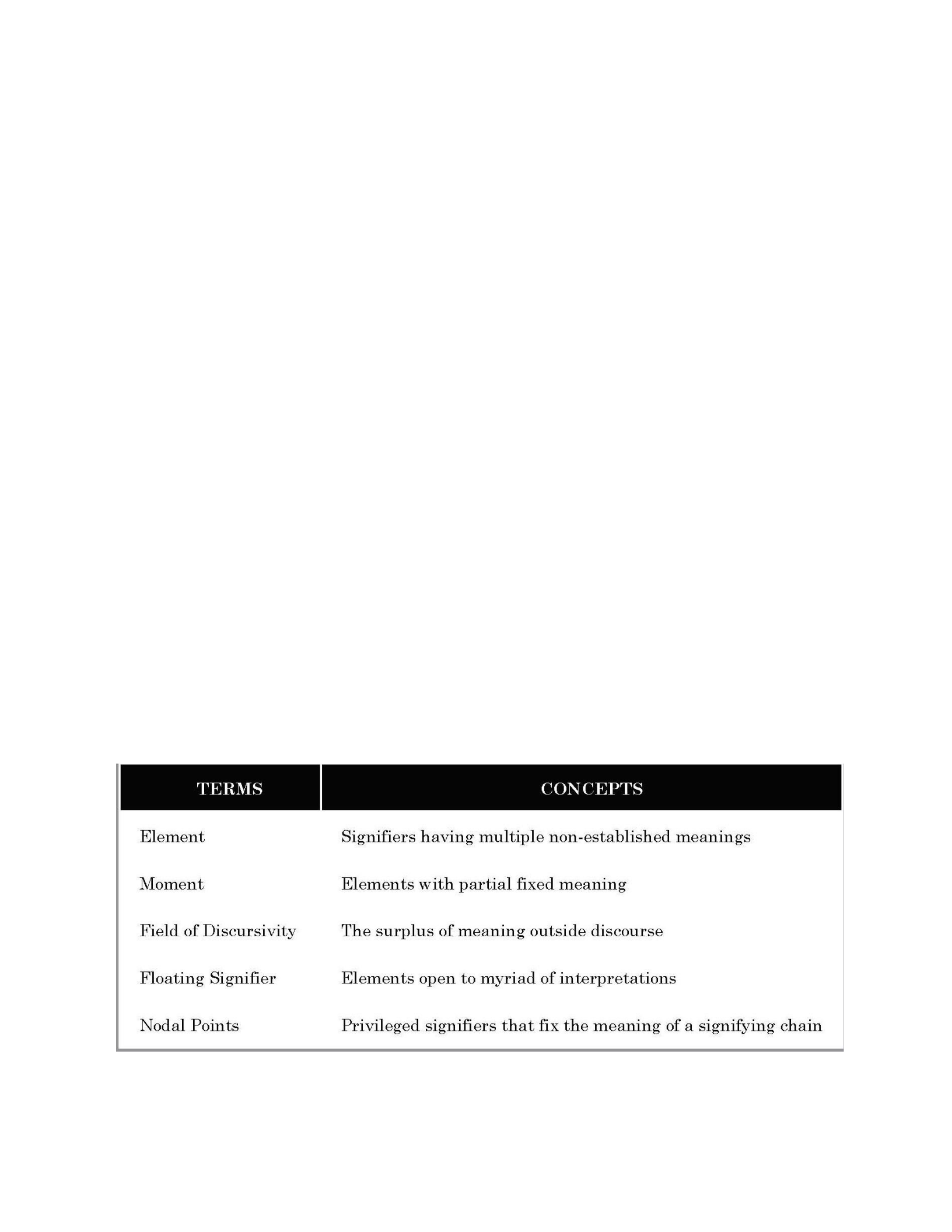
(e)very discourse is constituted as an attempt to dominate the field of discursivity
by expanding signifying chains which partially fix the meaning of the floating signifier.
The privileged discursive points which partially fix meaning within signifying chains are
called nodal points (113).
The meanings of elements are ambiguous until they are linked to other elements. This
meaning-making process of linking elements is referred to as articulation. In contrast to
elements, moments are the signs in a discourse that have defined meaning based on their
differences to each other. Therefore, a discourse is a grouping or organization of elements whose
ambiguous meanings are no longer ambiguous or, whose elements have become moments.
Signifying chains are linked moments that are connected in a specific relational way such that
they give the discourse definition. All other meanings from which an element is drawn from is
referred to as field of discursivity, or as Jorgensen and Philips (2002) discuss, field of discursivity
is the, " reservoir for the 'surplus of meaning' produced by the articulatory practice – that is, the
meanings that each sign has, or has had, in other discourses, but which are excluded by the
specific discourse in order to create a unity of meaning" (Jorgensen and Phillips 2002, 27).
Figure 5: Central terms associated with Laclau and Mouffe's characterization of discourse.

Another significant term in Laclau and Mouffe’s theory is antagonistic relations, which
emerges in the process of constructing a hegemonic discourse. They define antagonism as the
“limit of all objectivity” (1985, 122). To further explain this term, Laclau and Mouffe (1985,
127-134) introduce the 'logic of equivalence and difference,' a logic of equivalent functions, by
constructing a chain of equivalent identities among different elements. Another important
concept relating to elements is the chain of equivalence which is a linguistic logic that looks for
similarities between different elements that characterize the discourse. Chain of equivalence
gains strength when set up against ‘the chain of difference’ which contains meanings that are
divergent to the discourse of the chain of equivalence. This is a process of strengthening
commonality by weakening differences. This becomes central to the formation of hegemonic
discourses, since hegemony creates a partial totalization that works within the struggle of these
two logics (Laclau 2005, 78). The concept of discourse is thereby a discursive attempt to
transform elements to moments and maintain them in a temporary fixed meaning (Laclau and
Mouffe 1985).
Hegemonic Discourse
In Laclau and Mouffe’s discourse theory, hegemony refers to the construction of a
dominant discursive formation, “The political as well as moral-intellectual leadership of a
hegemonic force (state, class, movement, or other) hinges on the construction of a discursive
formation that provides a surface of inscription for a wide range of demands, views and
attitudes” (Laclau and Mouffe 1985, 124). Laclau and Mouffe by taking advantage of Gramsci’s
hegemony theory, acknowledge the discourse which has fixed its preferred meanings for floating
signifiers and transforms elements to moments, as the hegemonic discourse.
In essence, Laclau and Mouffe’s discourse analysis framework depends on the concept of
an ongoing political struggle. They see a hegemonic discourse existing in any situation where

objectivity is claimed. From Laclau and Mouffe’s perspective, the privileged position of a state in
a group of other states or the privileged position of an idea among a group of ideas are both
results of dominant discursive formations. Therefore, hegemonic interventions or anti-hegemonic
discourses are defined as discourses that aim to restore ambiguity to moments or remove
meaning and convert moments to elements. This struggle between a dominant discourse and an
antagonistic or anti-hegemonic discourse can lead to results whereby the formerly antagonistic
discourse becomes dominant and thereafter is the new hegemonic discourse.
Identity and Discourse
Laclau and Mouffe (1985) discuss identity as being a result of discursive and political
processes, in which the identity is negotiated against other and later accepted. Thus, identity is
contingent and changeable. They also believe that identities are fragmented. As an example, one
may take on various identities as your identity fluctuates from one discourse to another, given the
circumstances. This is a highly political conception of identity. Thus, according to Torfing,
“identity is a political construction, it cannot be prior to politics, but is maintained, constructed,
transformed through political struggles” (Torfing 2003, 63).
So even when a single discourse may get a partial fixation, the identity of an individual is
never firm, because it consistently moves from one identity to another. They maintain that it is
possible for identities may become static in that they may obtain the status of being objective,
however, the objective status may also be disputed and therefore, not be permanent. For the
purpose of this dissertation, Identity is an important element to discuss because it will be a
component of forming central discursive nodes.

Conclusion
The study of discourse has served as area that has brought together scholars from various
disciplines, beyond traditional disciplines of the social sciences. For the purpose of this
dissertation, Laclau and Mouffe’s discourse analysis framework allows for combining both
poststructuralism and social constructivism in this dissertation. Within constructivism, it is not
the truth behind articulations that results in social consequences and creates meaning, but rather
the language used in the policies or political leaders that construct the world through a spoken or
written reality (Laclau and Mouffe 1985). According to Laclau and Mouffe, what is being
articulated (language) can be examined, and through it, opinions are constructed in articulations.
Discourse not only provides a language for classification and interpretation of events and
phenomena but also makes methods and techniques of being and taking action in the world
understandable. Discourse operationalizes a particular type of regime of truth and excludes or
eliminates other possible forms of identity and. Also, discourse explains how to dominate a
meaning system and remake meaning in relation to procedural pragmatics, understanding
variability, and legitimatization of a behavior and approach (Milliken 1999, 229–30).

CHAPTER FOUR:
THE PROCESS OF AFFINITY
This chapter compares and contrasts the concept of soft power as applied in Western
contexts, (and particularly in Nye’s perspective of soft power), and non-Western contexts. A
contrast is drawn between the ways in which this concept is defined. In the Western view, the
goal is to gain cooperation from a target nation by eliciting appreciation for qualities that
characterize the dominant nation in the target nation. On the other hand, Iran takes a constructed
approach to sources of soft power as and applies a subject-centered strategy. Iran identifies
characteristics in its target audience with which it can establish what I call “affinity,” attraction in
the view of the Iranian government can be constructed through discourses.
Introduction
This chapter describes the concept of ‘affinity’ as a mechanism for non-Western and
nondominant states to exercise soft power. This concept fits into the approach of viewing
discourses as always subject to change, as described by Laclau and Mouffe (1985) and discussed
in the previous chapter. This chapter also explores Iran’s use of ‘affinity’ to demonstrate the
function of this concept, in particular its rejection of the normative nature of attraction behavior
resources, or, as Laclau and Mouffe would say, Iran’s articulation of an antagonistic discourse to
challenge the hegemonic discourses that are associated with Western forms of soft power.
First, ‘attraction’ is considered a subjective experience in the non-Western view because
the same attraction resources can be appealing to some but not to others. Contrary to Nye’s
understanding of a country’s attractiveness as something “natural,” the Iran case study with show
that attractiveness is, in fact, constructed within a specific social context. This is a reflection of

the field of discursivity and the variances of meaning given to floating signifiers that are based
on the articulations of specific discourses. Laclau and Mouffe’s approach to understanding
discourses therefore captures Nye’s own rationale and myopic views on attraction—namely, that
the West’s hegemonic discourse on soft power and more particularly attraction is static. In Laclau
and Mouffe’s formulation of discourse, there are no fixed discourses since antagonistic
discourses can challenge the most fixed and structured discourses and hence bring change. To
that point, the changing perceptions of attraction that occur with changes in social circumstances
further emphasizes the need for Nye’s concept of soft power to be considered within a different
theoretical framework than Nye’s neo-realist perspective. It is even more important to reconsider
the concept of attraction outside of Nye’s Western-centric approach to soft power.
Thus, this dissertation agrees with Mattern’s views of attraction as a subjective
experience. I argue that to understand the concept of attraction, it must be studied within a
localized rather than a universal context. Emphasizing that soft power and attraction are
intersubjective experiences, Mattern writes, “realities of attraction are inter-subjectively
constructed matrices of beliefs through which a population signifies things, people, and ideas”
(2005, 596).
Inter-subjectivity means that both sides must view the sources of soft power as attractive. Within
Laclau and Mouffe’s discourse theory, it is also possible to employ the concept that Mattern
terms inter-subjectivity. As discussed in the first chapter, this complements the idea of floating
signifiers, which play an important role as nodal points in differing discourses.
In order to establish an affinity, Iran localizes resources of attraction based on its targeted
audience and cultivates attraction through a discursive approach that creates and propagates soft
power. Using Nye’s conception of soft power as described in previous chapters—particularly his
tautological description of attraction and persuasion—countries such as Iran are denied their

ability to cultivate what Nye means by soft power; consequently, most studies on the subject
have not included non-Western states and they have underestimated the ability of countries like
Iran to cultivate its soft power. In fact, not only has soft power been an intrinsic part of Iran’s
foreign policy strategy but I will demonstrate that it has expended considerable monetary and
political resources in developing its public diplomacy resources. It continues to do so through
various institutions in charge of public diplomacy and by carefully studying and designing
audience specific communication strategies. Lastly, the aim of this chapter is to explain and
demonstrate the mechanism of ‘affinity’ as applied by Iran with respect to Afghanistan.
Soft Power by Non-Western, Non-Dominant Powers
Nye maintains that the states able to exercise the highest levels of soft power will be those
whose dominant culture and ideas are closer to “prevailing global norms,” which “now
emphasize liberalism, pluralism and autonomy” (Nye 2004b, 31–32), as well as “democracy and
human rights” (Nye 2004b, 62). Therefore, he contends, those with less normative values and
with more parochial cultures are less likely to produce soft power (Nye 2004b, 11). This
conceptualization limits the ability of other states to be considered agents of soft power, thereby
overlooking Iran’s focus utilization of tools that are associated with soft power. As noted
previously, this conception of soft power being linked only to those countries that are closest to
prevailing global norms is equivalent to a hegemonic discourse that, according to Laclau and
Mouffe, seems to be objective and unbreakable.
Nye’s (1990) concept and description of soft power reflects the hegemonic view of a
dominant power such as the United States and that is not surprising. Craig Hayden states that
Nye’s initial view of soft power argued for hegemonic control and simply formed a value-neutral
interpretation of Gramsci’s hegemony thesis for policy makers (2012, 38). Others, such as Geraldo Zahran
and Leonardo Ramos (2010), have asserted that Nye’s soft power should incorporate a more Gramscian

notion of hegemony. To begin with, they contend that the concept “creates the illusion of an aspect of
power that could exist on its own only through consent, ignoring the social reality populated by intrinsic
mechanisms of coercion” (Zahran and Ramos 2010, 24). Next, they argue that Nye’s view of soft power
ignores how “ideas are always relative, they originate in a given society or culture, they are not absolute
and usually mean different things for different people” (Zahran and Ramos 2010, 24). For Zahran and
Ramos there are no ‘universal values’ which serve as sources of soft power. They further assert that it
“misinterprets the spheres of political and civil society, and therefore the relation between coercion and
consent” (Zahran and Ramos 2010, 25), that are independent from one another.
Nye’s concept assumes the existence of a regular set of resources that are universally
accepted and desirable to the point that he views the inducement of the behavior of attraction in
the target audience as a linear result of what he calls the currencies that constitute the resources
of soft power. Some interpretations of the notion of hegemony also assume assumes the target
population’s active and willing consent in a similar way (Fontana 2008, 86). Nye’s vision of soft
power and its practice by a dominant power like the United States are much like the Gramscian
view of the United States’ path to soft power: It is assumed to be extensive, and it demands the
active and universal advancement of the liberal values it espouses, thereby justifying its global
leadership. This concept can be equally applied to Western European or even Russian and
Chinese views on soft power because it emphasizes the sources of attraction in the dominant
state, assuming that the non-dominant, target state desires the same resource (Layne 2010;
Zahran and Ramos 2010).
As noted by Gary Rawnsley, soft power has become so en vogue and pervasive that all
states, dominant and non-dominant, are engaging in some sort of soft power practices so as to
remain relevant and current with global norms (2012, 124). Even though there are significant
constraints to using soft power effectively, Iran has demonstrated that it understands the

significance of soft power for achieving its foreign policy goals, particularly due to the limited
extent to which Iran has hard power resources like extortion and coercion.
De-Westernizing the Soft-power Concept
Academic literature’s focus on soft power has been primarily concentrated on how the
United States and other Western nations use this form of power. In contrast, the number of
studies on its use by other world powers such as China and Russia, let alone a non-dominant
power such as Iran, has been very limited (Hayden 2012; Rawnsley 2012; Zaharna 2012; Zahran
& Ramos 2010). This is a deficiency that has, unfortunately, led to underestimates as to the
capacity and extent of the use of soft power globally. A prime example is the case of Russia and
Ukraine. International relations experts, viewing Russia through a Western-centric prism, are at a
loss to explain the effectiveness of its soft power activities in Ukraine. To them, Russia does not
and should not have any of the attractive qualities identified by Nye, and yet popular opinion
polls in Eastern Europe and some areas of Ukraine suggest that Russia’s use of soft power has
been more successful than presumed by western scholars. China provides another example.
China’s resources are not considered attractive by many in order to allow Chine to wield
influence and enhance its soft power as envisioned by Nye’s concept of soft power, but China is
enjoying considerable success using the tools of soft power in some so-called third world
countries.
Iran is not only a non-Western state; it also represents an example of a non-dominant
power. Yet evidence has shown that Iran has had success in cultivating attraction and pursuing its
objectives using soft power tactics. Throughout the past four decades or so, Iran has resisted the
dominant global discourses by providing alternative moral, cultural, and ideological discourses.
Discourses built around value-laden nodal points such as ‘supporting the oppressed’ are
skeptical of the pillars that Nye establishes as resources for attraction like democracy, equality,

and the rule of law. Alternatively, Iran has cultivated a discourse of anti-arrogance that is based
on opposing any system with these three features. Iran criticizes any ideas, events, or processes
conflicting with their anti-arrogance approach as part of its discourse it actively employs in the
field of foreign policy (Ajili et al. 2014, 115–16).
In this light, a non-Western, non-dominant state such as Iran must firmly reject Nye’s
normative sources of attraction as the initial step in exercising soft power and achieving
attraction. This is not necessarily a rejection of the desirability of the behavior of attraction,
which the soft power aims to achieve. It also does not imply that the sources of attraction utilized
by Western powers do not have attractive value to those states themselves. Iran’s actions, rather,
demonstrate a form of respect towards those assets. However, Iran’s actions also show an
intentional effort to gain attraction on a separate track than the United States and the Western
world in order to achieve its foreign policy objectives by circumventing Western values. The
United States and Iran therefore have competing discourses and the articulation of competing
discourses is possible because of the differing meanings given by each discourse to floating
signifiers.
To de-Westernize the concept of soft power, one must re-conceptualize the values linked
to the desired behaviors of attraction. Localized soft power sources of attraction should be
identified through the prism of the domestic cultural, historical, and socio-political context of the
target states with the goal of creating an attraction connection, based on the local valuations of
those sources rather than on the Western-centric valuations. Following Nye’s conceptualizations
of attraction will lead to failure for engendering attraction for non-dominant powers like Iran.
Sources of Attraction as Localized Rather than Universal
In order to describe how and why a non-dominant power would even attempt to use soft
power to achieve a desirable behavior of attraction that lies at the heart of soft power,

understanding how a non-dominant power such as Iran constructs its conception of attraction and
relationships is important. As discussed previously, Nye describes these sources of attraction as
universally measurable and static and is adamant in writing that states either possess or do not
possess these key soft power currencies. The static and universally ‘good’ nature of these values,
cultures, and policies is a key element of Nye’s conception of how attraction occurs.
For Nye, soft power is only agent focused, and its use is a function of direct linkages to
the resources that Nye sees as the sources of attraction. These sources of attraction are
manifested in the behaviors that allow (dominant, Western) states to exercise soft power, a
conversion Nye calls a “conversation” (Hayden 2005, 43). However, many scholars have pointed
out the limitations of how this direct relationship is imagined Thus, soft power can be generated
and sustained only if the resources from which it arises are deemed attractive, desirable, and
legitimate.
However, different actors are likely to have different opinions about a country´s culture,
political values, and foreign policy, thus implying that attraction is a social construct rather than a
universally accepted cosmopolitan concept (Mattern 2005). For example, Yusashi Watanabe and
David McConnell argue that the behavior of attraction is socially constructed through an
“indigenization of soft power” that “cannot be reduced to a universally prescriptive calculation of
influence” (Hayden 2005, 35). What is loved in one country might be despised in another, while
some assets might be deemed more attractive, desirable, or legitimate than others, with diverse
views appearing inside even apparently homogeneous cultures.
In his later writings, Nye concedes that some forms of soft power are active and some are
passive, i.e., that soft power is sometimes the result of a ‘conversion’ versus when it is sometimes
due to ‘translation’ of those sources of attraction into behavior desired by the agent. Yet Nye does
not detail how active efforts of conversion that rely on framing and persuasion would actually be

received by the target audience. Craig Hayden, in his 2005 book The Rhetoric of Soft Power, also
points out this shortcoming, writing, “Nye suggests that careful post-hoc process tracing can
reveal the causal mechanisms most likely to be explained as soft power. However, if soft power
is so contingent and relation-dependent as Nye suggests, then we might also interpret soft power
as rhetoric” (51).
This brings us to the key vantage point from which non-dominant powers such as Iran
view soft power. Sources of soft power attraction do not have to be universal but can, in fact, be
localized and based on the target state’s perceptions concerning those sources. In the terminology
used by Laclau and Mouffe, these sources of attraction constitute floating signifiers within
competing discourses being articulated by competing states. In effect, the behavior of attraction
is subject-centric and not agent-centric in this instance and so it is based on localized perceptions
of the value ascribed to the agent’s sources of attraction. Alternatively, the articulation of these
floating signifiers within a given discourse makes them nodal points in a signifying chain. An
example of this discrepancy between the prism through which dominant and non-dominant
powers understand attraction can be seen in the way countries like Iran implement public
diplomacy campaigns.
Listening is a crucial step in localizing these sources of attraction. In Afghanistan, U.S.
policy makers would first ‘listen’ to the Afghan polity for examples wherein the sources of
attraction it viewed as universal were reflected. For the U.S. practitioner of public diplomacy,
listening is geared toward finding the pre-existing sources of attraction echoed in the target
demographic, then highlighting how the U.S. is an exemplar of that source. This means that the
United States in this case found the means to achieving the desired behavior of attraction among
the target population as well as the means of ‘persuading’ them that the United States is an
attractive example of what they would want to strive to achieve. In contrast, Iran’s strategy would

not involve listening simply to hear their own pre-existing values that it already possesses echoed
in the target population; rather, for Iran, would “listen” for a value intrinsic to that local audience.
Supreme Leader Khamene’i sums up this process as follows: “Without knowing exactly
the audience, one cannot plan precisely to influence their perceptions. The definition of the target
audience depends on the internal and external environment, events and historical trends that have
evolved over time. The target audience can be defined on the basis of factors such as language,
religious beliefs, social and economic status, occupation, and others” (Khamene’i 2010). He also
adds: “The correct understanding of the target audience’s characteristics will allow us to then
understand their perceptions, beliefs, and attitudes towards us” (Khamene’i 2010). His
conclusion is that, with respect to public engagement, “it should be noted that the focus should be
on the audience. This has the highest value in providing benefits rather than penetrating them”
(Khamene’i 2010). For Iran, the intent is to localize sources of attraction based on pre-existing
values within the target audience in order to identify areas of shared consensus. By using this
approach of achieving areas of consensus, the intervener can create a realignment of values that
occurs through the process of creating a collective understanding (Roselle, Miskimmon and
O’Loughlin 2013, 72).
The Process of ‘Affinity’
To best conceptualize the processes by which Iran cultivates an affinity, the first step is to
identify the foreign policy objectives of the Iranian government. Iran uses its soft power tools in
a very intentional manner in order to aid it in achieving its broad national interests rather than
seeing soft power merely as a mechanism by which it can passively influence specific target
countries or even the globe. According to Dehghani-Firoozababadi, Iran “can be considered as a
mission-oriented state rather than [an] interest-oriented [state]” (2008, 7). Thus, unlike the
traditional conception of soft power as explained by Nye, Iran begins its soft-power projection

and plans by choosing to pursue specific foreign policy goals in a given bilateral or multi-lateral
relationship.
Using Soft Power to Achieve Foreign Policy Objectives
The Iran-Afghan relationship is rich with examples of Iranian use of soft power tools to
achieve its various and specific foreign policy objectives vis-à-vis that neighbor. With
Afghanistan, one of Iran’s key objectives is border security. Iran faced off against a massed
Taliban force on its Eastern border in 1999 after sixteen of its diplomats and journalists were
killed by the then-Taliban government. In the ensuing seventeen years, as U.S. and coalition
forces deployed tens of thousands of troops to Afghanistan in response to the attacks of
September 11, 2001, Iran’s strategic concern became a fear of invasion and direct attacks from
the same border.
Alongside these concerns, Iran has continued to fight heavily armed drug smugglers who
use the porous border to move their illicit products toward Europe and so are able to dump
thousands of tons of drugs into Iran’s growing drug consuming population. A tertiary goal for
Iran is to control the flow of refugees into Iran, which reached its high-water mark during the
Taliban era and caused immense infrastructure strains on Iran’s system, with an estimated 2
million Afghans spread throughout Iran. Given these high-value foreign policy objectives, it is
not surprising that Iran would devote not only hard power military and economic resources but
also its soft power sources of attraction toward this bilateral relationship.
What we see in the example of Afghanistan is the intricate manner in which Iran
identifies the affinities it plans to cultivate and how it aims to overcome its seeming disparity in
sources of attraction as Nye envisions them. After choosing the specific foreign policy objective
of border security and the specific Iran-Afghan bilateral relationship, Iran’s state apparatus must

then engage in the process of identifying the specific localized attraction resource that can
resonate as a point of affinity.
Although this process is by nature an opaque process that has to take place within the
confines of Iran’s foreign policy planning system, we can imagine the elements that would be
required for this process to identify that affinity node. The following is a set of steps that could
produce such a result.
The first step in this internal process would be to identify a set of resources of
attraction—political values, foreign policies, and/or culture—that hold value within the target
country. Unlike the perception within Western-centric views that such sources are universal and
static, Iran approached the question of ascribing value by being highly subject driven in its
evaluation. In this case, Iran studies Afghan society to identify what matters to Afghans within
their context and within their sense of identity. Furthermore, Iran’s intricate understanding of
Afghan society has been reflected in the differing discourses offered to the Hazara, Tajik, and
Pashtun populations and even its differing approach to those specific Afghan sub-ethnic groups
divided by geography or religious sect. Within the Laclau and Mouffe framework, this specific
targeting by subpopulation, region, and sect reflects an Iranian recognition that discourses are
continually competing, so that Iran is constantly articulating meaning for floating signifiers as
perceived by the audiences it is targeting.
By accepting the premise that each group would have its own measures for these values,
policies, and cultures, Iran thus has shown acceptance that its own valuations are of lesser
importance than those ascribed to those sources of attraction by its target audience. In essence,
Iran’s internal mechanism is to spend more time and energy in studying the target audience than
it does in attempting to persuade the target audience of its own internal valuations.

Next, in order to identify an affinity linkage, the studied values of the target audience
must be internalized in order to locate a linkage with something of value about Iran, be that in
terms of history, society, culture, or ideals. Thus, when targeting Sunni Pashtuns in the
mountainous south of Afghanistan, Iran uses discourses that establish affinities between them in
terms of non-sectarian Pan-Islamism and shared sites that are historical examples of regional
anti-colonial guerrilla warfare. With the traditional Shia Hazara populations in Herat, Iran
articulates discourses of Shia-solidarity and deploys a discourse that stresses a victimized siege
mentality due to its minority status. In turn, when dealing with cosmopolitan and less stridently
religious elites in Kabul, Iran pinpoints affinities in its classical Persian heritage that values
centralized governance.
In essence, during this step the Iranian state apparatus would aim to identify a long list of
moments and nodal points to use them as nodes of affinity with each given target audience.
These nodes of affinity would be centered on the subject’s valuations of those sources of
attraction that matter to the subject rather than to configure them just to Iran itself. Each of these
floating signifiers within the given articulated discourse serve as a potential node of affinity and
is among these nodes of affinity. Iran then choses a specific affinity to pursue.
The third step in this process was for Iran to then compare each of these numerous nodes
of affinity against a list of considerations. Four main considerations were evaluated: comparative
advantage with rivals, short- and long-term capacity, domestic Iranian dynamics, and available
tools. In this step of the process, the Iranian apparatus evaluated the potential effectiveness of
each of these nodes of affinity in achieving its foreign policy objectives. For example, if Iran’s
main rival in cosmopolitan Kabul is the United States, highlighting an affinity node of
democratic ideals or effective governance would be a losing cause compared to the same source
of attraction that the United States could offer. Or, alternatively, if it attempted to highlight an

affinity node of Islamic fundamentalism with the Southern Pashtuns, it would be competing with
potentially more convincing Pakistani and Saudi sources of attraction or affinities in the same
arena. Therefore, Iran’s internal evaluations take into account how each of these potential affinity
nodes compare to regional and global rivals vying for attraction among the targeted audience.
Similarly, Iran considers the short- and long-term potential for each of the identified
affinity nodes. Being a non-dominant power and viewing soft-power sources as resources that
ought to be cultivated, Iran has not based its plans only on capitalizing on immediate attraction to
achieve its goals, Iran has looked at the short-, medium-, and long-term potential of each node of
affinity. For example, towards states such as Venezuela, Iran has identified nodes of affinity
centered on religiosity, developing world status, and anti-imperialism, but they would also
evaluate the short- and medium-term potential of cultivating the anti-imperialism affinity as
having been a more effective affinity of higher value during the tenure of Hugo Chavez. In this
case, Iran has highlighted perceived connections between historical anti-colonial Iranian figures
and anti-colonial heroes in Venezuela like Simon Bolivar. In essence, Iran’s choice of affinity
node to cultivate is also dependent upon an internal evaluation of which affinity node has
potential to be more useful for short-term versus long-term cultivation.
Next among these four sets of evaluations was a review of the domestic dynamics within
Iran. Iran then considers how amplifying that affinity in its outreach or public diplomacy might
reflect within Iran’s complex political system. Therefore, Iran’s efforts in soft power outreach
might use various communication tools and public diplomacy initiatives ranging from team
exchanges or academic conferences to mass-media megaphones such as Friday Prayer sermons
or creating mass-media television content publicized through the state broadcasting service.
The last consideration is an assessment of the capacities and limitations of the tools
available to the foreign policy apparatus of the country for each identified affinity node. For

instance, the soft-power tools available to Iran are similar to those available to global powers
such as the United States: strategic communication, public diplomacy, cultural diplomacy, etc.
Thus, as the Iranian apparatus evaluated a given affinity node with respect to Afghans, it
considered that, due to their shared language, public diplomacy through targeted media and
strategic communications through leadership speeches would be prove effective in cultivating
that affinity. Affinity nodes chosen for cultivation were matched with available tools in Iran’s soft
power arsenal so that those currencies could be effectively highlighted. In essence, Iran could
have chosen to forgo a preferred affinity node in favor of a second-rated one because of an
evaluation that it judged that it lacked the proper tools to cultivate the former with the target
audience relative to the latter.
Iran is not regarded as a beacon of democracy or equality, and, with respect to culture,
Iran’s cultural exports are severely limited to Persian speaking audiences and the odd poetry
lover. Moreover, its policy choices would seem to place Iran on the side of terrorists, fomenting
regional instability, and social disorder. However, is clear is that, whatever the details of this
process and however the internal evaluations of the state apparatus played out, Iran clearly and
deliberately has chosen very specific affinity nodes in each of its bilateral relationships geared
toward achieving very specific foreign policy objectives. Iran’s directed usage of subject-specific
localized sources of attraction to cultivate attraction in its target audiences stands in stark contrast
to Nye’s conception. Nye has a different conception of how soft-power behavior of attraction
works. He erroneously believes that the sources of soft power are universal and normative, and
that without these universal or normative sources a state does not have the capability to really use
what Nye would recognize as soft power.

Conclusion
As discussed, the problematic nature of attraction is largely due to Nye’s dual treatment of
the national values and culture that underpin soft power. His conceptualization of values is torn
between a universalistic standpoint and a relational approach. Iran’s application of soft power
and discourses of “affinity” represents a new, ‘indigenous’ form of soft power that part from the
Western approach. Iran approaches soft power with the firm conviction that the task of enhancing
national attractiveness is a matter to be orchestrated and directed by the state. Iran is keen to
employ soft power in a way that would facilitate understanding and a sense of affinity between
itself and its targeted audience. As Mattern (2005) argues, “the attraction of values is socially
constructed and is a result of a ‘power politics of identity’ and a struggle over ideas that form part
of social relations” (594). In this light, the contingent nature of values and norms brings back the
usefulness of Laclau and Mouffe discourse analysis theory in examining discourses which will be
applied in more detail in the following chapter.

CHAPTER FIVE:
FOUNDATIONS OF IRAN’S FOREIGN POLICY OBJECTIVES
Introduction
Contemporary Iran is the product of a complicated history as a nation located at the
crossroads of many classical civilizations spanning history and different geographies. The
outlook, identity and mentality of is population—including its leaders—are informed by that
past. The history of Iran is extensive and beyond the scope of this dissertation, but to learn more
one can read the great scholarship of Hamid Dabashi, Sandra Mackey, Hamid Enayat, Roy
Mottahedeh, or Stephen Kinzer among others to get a better grasp of that context. The Islamic
Republic of Iran’s foreign policy objectives are thus in part a function of the country’s
complicated and distant past. The relevant details that will relate to this study of Iran’s current
foreign policy objectives are presented in this chapter.1
The Iranian Backdrop
First, Iran’s history is defined by the ebb and flow of its various dynasties and empires.
Persia, the pre-modern name for the Iranian state, had five long periods of grand empire, at one
time stretching from the Indian subcontinent in the East to the Nile in the West and from southern
Russia in the North to much of the Arabian Peninsula to the South. The region experienced three
crucial periods of defeat at the hands of the Greeks, Muslims, and Mongols as well as the
massive loss of both land and sovereignty during the colonial era at the hands of the Russians
and the English. In its current situation Iran is surrounded by regional rivals and unstable nation
states. The military interests of global powers like the United States are a continuation of a long-
standing sense of threat that permeates the way Iranian leadership views its geopolitical situation.

Over the past thirty-seven years since the Islamic Revolution, aside from its many
domestic challenges, Iran has had to survive an eight-year war with neighboring Iraq to its West,
the fall of the Soviet Union to its North, instability, civil war, and coalition forces to its East in
Afghanistan, and an economically and militarily ascendant grouping of Gulf Cooperation
Council states to its South. The council is backed up by the full might of the U.S. Navy in the
Persian Gulf in addition to NATO member Turkey and warring Armenia and Azerbaijan to its
North. In order for Iran to achieve its foreign policy objectives in this set of circumstances, “the
ability to exercise soft power (persuasion, subterfuge) has allowed Iran to punch very much
above her weight” (Ansari 2007).2
In addition to this regional and global context, Iran’s revolution and globally unique
theocratic government structure give it an ideological set of guiding principles that are reflected
in its foreign policy objectives. The Iranian constitution itself directs that its polices should be
based on four principles: 1) the rejection of all forms of external domination; 2) the preservation
of Iran’s independence and territorial integrity; 3) the defense of the rights of all Muslims
without allying with hegemonic powers; and 4) the maintenance of peaceful relations with all
non-belligerent states (IRI 1979 Constitution).
Though this set of principles is neither exhaustive nor complete, it does provide valuable
insight as into the mindset of Iran’s objectives. In addition, Iran’s modern pre-revolutionary
history, including the 1953 coup and Iran’s experience at conducting international relations
during the Shah’s rule as it sided with the United States in the Cold War during this period, have
had a dramatic effect on the decisions that are taken by its current leaders. The next section of
this chapter will delve into Iran’s competing identities and look in more detail at the constructed
national identity of the Islamic Republic. This chapter will also discuss the four main foreign
policy objectives in Iran and the discourses that underpin them.

The Iranian Multilayer Identity
As discussed previously, identity is an internally and externally constructed sense of self.
In the context of a complex and diverse state such as Iran, this constructed sense of self is both a
powerful tool in the hands of its leaders and a fount that brings challenges and makes it difficult
to create consensus over policy and goals. In the literature on Iranian identity, among the myriad
sets of constructed identities in a country made of various ethnic groups3, four main identity
markers are noted as competing and often contradictory forces within that society: Persian
identity, Islamic identity, revolutionary identity, and modern identity.
In its 37 years, the Islamic Republic of Iran has highlighted Islamic identity above others,
but it has also variously relied on other identities both in the formation of its foreign policy
objectives as well as in its efforts to cultivate affinity in its exercise of soft power. The Islamic
Republic has also attempted to craft a national identity based on these competing identities. It is
unsurprising that like most other post-Westphalia nation-states, the Islamic Republic of Iran has
attempted to unify its population through a crafted national identity and variously used parts of
each crafted national identity to tie the country together. Even though the concept of identity is a
relatively simple phenomenon intended to separate the ‘us’ from the ‘other,’ the concept of a
national identity is a complex amalgamation of multiple factors. In the case of modern Iran, the
three distinct and dominant discourses on identity described above are not always congruent nor
do they lend themselves to simplification.
Even though the concept of identity is a relatively simple phenomenon intended to
separate the ‘us’ from the ‘other,’ the concept of a national identity is a complex amalgamation of
multiple factors. In the case of modern Iran, the three distinct and dominant discourses on
identity described above are not always congruent nor do they lend themselves to simplification.

In terms of foreign policy, Iran has used the siege mentality that is prevalent in its
national identity as a unifying force; indeed, its Persian identity has been under assault
throughout history, its Islamic identity forced to countenance western global norms, and its
identity as a modern nation has been under threat because of isolation and sanction. These
identities have formed the backbone of Iranian foreign policy objectives during the Islamic
Republic era.
Of further interest to this dissertation is how Iran has also capitalized on the differences
present in these multiple identities to create affinity linkages with other states, even when it does
not use those same identity signifiers for domestic unity or to underpin its own national identity.
The discourses Iran has articulated to advance its foreign policy objectives, as well as the affinity
linkages it creates in its bilateral relationships have shown how Iran is willing to utilize all
elements of tis various identities. The narratives it has weaved to cultivate its soft power are
different that the themes of identity that leaders highlight domestically and within Iran.
Persian Identity
The Persian identity marker is the longest held and possibly the most complex among the
Iranian population. It can be interpreted in multiple different ways, even by an individual, not to
mention the nation as a whole. This identity marker harkens to the grandeur of multiple ancient,
classical, and medieval dynasties, each of which spanned large geographic areas as well as
encompassed a multitude of ethnic groups under their Persian Empire banner.
For some, even the term Persian is problematic as it refers to a specific sub-ethnic
grouping or even linguistic tradition. Here, however, ‘Persian Identity’ is used to refer to a set of
constructed social values, traditions, and ideals based on a collective historical memory. As is the
case with all identities, the basic unifying theme of this identity is a collective understanding of
‘us’ versus ‘them.’ In a sense, the discourses of Persian history are filled with ‘the other,’

(Greeks, Romans, Mongols, Arabs, Turks, Europeans, and Russians) attacking and laying siege
to the Persian empire. It is filled both with stories and narratives of glory, from the Cyrus
Cylinder as the first human rights charter, to discourses of loss such as those during the Mongol
invasion. This historical memory bears witness for Iran to see itself as a society under constant
threat from abroad at the same time Iran is lauded for its ability to assimilate invaders into the
fold. However, this historical memory of being under siege speaks to both a sense of insecurity
and Persian exceptionalism. As Sadegh Zibakalam writes, “Iranian ‘exceptionalism’ rests on two
main pillars: the negation of the present world order and the belief in the inherent superiority of
Iranian civilization” (Zibakalam, 85).
Many forces have helped create this identity, including Zoroastrianism’s dichotomy
between good and evil and the dualism of Manichaeism. The Persian identity has also been
shaped by Mazdakism and the ideas of equality and equity that underpinned Mazdakism. The
power vested in the history of the Persian language with poetry and narrative building has also
shaped Persian identity. Other influences on Persian identity include ethno-centric ideas of
Aryanism, centralization of power through various periods of empire, and even the Safavid’s
intentional bifurcation of political Islam through Persian Shiism is in essence a socio-political
tool to counter the Sunni Ottoman Caliphate.
This ideological history coupled with Persia’s military history has created a conception of
Persianism as always under threat, serving the ‘good’, and defending against the ‘other.’ As
Majid Abbasi has summarized, “Iranian historical memory that witnessed the security and
welfare in their ancient period at least through predecessors' narrative, converted security into a
permanent concern of the society so that everything was seen in the shadow of security and even
discourses also took on the flavor and color of security” (Abbasi N/A).

The utility of this identity as a basis for discourses which aimed to further current Iranian
foreign policy objectives is very clear. The Persian language linkages to Afghanistan and
Tajikstan and the shared nostalgia of historical glory shared with wider audiences in Central Asia,
the Caucasus, and even in the Indian subcontinent are the discourses that are most clearly used in
Iranian foreign policy. Yet, even beyond geographical proximity, discourses built upon the
foundation of this identity provide linkages to other nations that also revel in the nostalgia of
historical glory such as Mongols, Chinese, Italians (Romans), Greeks, Turks (Ottomans), and
South American countries (Aztec, Inca, Maya).
Islamic Identity
Even after the Islamic conquest of Persia in the eighth century, various religious and
theological frameworks still competed with Islam within the population. Although history tells us
that Persian generals, theologians, scientists, and clerics played significant roles in the
Damascus-based Abbasid Caliphate, there is little evidence that an indigenous Islamic identity
had yet emerged as a unifying identity marker to compete with the still-dominant Persian identity
at that time.
A unified Islamic identity did not truly emerge until the post-Mongol Safavid Dynasty
circa 1500 A.D. The Safavids, an invading Turkic tribe from the Caucasus, needed to unify their
subjects against another impressive empire—the Ottoman Caliphate to their West. Over their
250-year dynasty, the Safavids articulated a new identity discourse for their expansive Persian
Empire. By melding many of the qualities of the Persian identity into a new Islamic and Shiite
political-religious identity, they were better situated to withstand the influence of the Sunni
Ottoman Empire.

Religious archetypes of identity are one of the oldest and most complex sets of ‘us’ and
‘them’ dichotomies among identities (Adibzadeh 2008, 73). The complexity stems not only from
the interplay between Islam and other religions, but also among understandings of Islam along
sectarian lines. For a nation-state such as Iran with a mixed religious history and a changing
geographical history, this identity takes on another layer of complexity. The layering of identity
also plays out in the different geopolitical tensions in Iran. There are ideals of Islamic-ness at a
territorial level that seek to encompass the political boundaries of Iran, but there are also
fractioning influences at a sectarian level of Shia’ism versus Sunnism, for example, and again at
a pan-Islamic level relating to non-Iranian Islamic states and nations.
These competing valuations of Islamic identity at the national and pan-national levels
allows Iranian policymakers a useful flexibility that would otherwise seem impossible for a
religious identity based on a more rigid identification of the ‘other.’ Furthermore, unlike other
religious identities, the Iranian Islamic identity coexists alongside a deeply rooted Persian
identity and was, in fact, conceived by the Safavid dynasty as a means to co-opt and assimilate
the linguistic, cultural, and ethnic identities of the peoples they ruled.
The Islamic concept of the ‘ummah’, or community of Muslims is used extensively by
Iranian leaders project this Islamic identity when wielded as a Pan-Islamic idea. It attempts to
bond all Muslims against the hegemonic ‘other’—usually the West—and to counter incoming
cultural influences (Said 1978). Yet, when wielded as a nationalist idea, Iran as the Shi’ite
regional power is itself set against the majority Sunni Muslim populations of most of its
neighbors. Therefore, it is important to realize that the use of this Islamic identity in formulating
Iranian foreign policy objectives and discourses has to contend with a dissonance in these two
definitions of ummah—often as a transnational identity discourse de-emphasizing differences

and building on a consensus about Islamic values, but at times a national identity differentiating
between Iranian Islamic values and non-Iranian Islamic values.
The Revolutionary Identity
The Pan-Islamic elements of the revolutionary identity marker draw on a wealth of
discourses that use principles like duty, martyrdom, aiding the dispossessed, and spreading the
virtues of the religion, among others. These discourses and values are, for the most part,
congruent with the Shi’ite Islamic identity that Iran embraces. One of the ways Iran attempts to
bridge this divide is by portraying its Revolution as a “powerful impetus for the revival of
Islam,” and as, “a clear example for modeling seeking passionate and enthusiastic Islam that
intended to fight all corrupt forces on the ground, especially the United States of America ....
This condition was unsustainable because of extremely high costs” (Murden 2004, 1043, 1049).
These Islamic discourses as universal ideologies formed a framework for Iran’s foreign policy
objectives and allowed the country to pursue a regional leadership role (Fuller 1998, 309).
This revolutionary mentality allows Iran to pursue a set of foreign policy objectives
congruent with the wider Islamic discourses rather than being limited by its minority status
within the Islamic ummah (community) (Foucault 2001, 60; Hinnebusch and Ehteshami 2003,
80). In addition, presenting itself as the region’s revolutionary face of Islam has allowed Iran to
embrace Sunni Islamic liberation movements and ally itself with the Sunni masses against the
prevailing elites and the western capitalist hegemon responsible for the “humiliation” of the
Mulsim ummah (Maleki 2003A, 36).
When attempting to understand the Iranian Islamic identity discourse, the unique nature
of Shi’ite interpretations of Islam, including the narratives of Martyrdom, shahid4 linked back to
Karbala5, the rituals of Ashura, and the savior-discourse of Mahdaviat,6 are all rooted in a
fundamental pessimism about the nation-state and temporal politics. This pervasive expectation

of temporal injustice colors Iranian conceptions of what will be achieved by mundane politics yet
buttresses the effort despite long odds. Dissecting the effects of Shiism on Islamic identity in
Iran, is itself worthy of multiple books. Suffice it to say, the Shiite layer of Islamic identity has
provided Iranian leaders with a multitude of discourses and narratives, however, most of those
are geared toward a domestic audience and, to a lesser extent, toward the small Shia populations
in the Persian Gulf countries.
For the purposes of Iran’s use of soft power and the affinity mechanism it develops, these
internal identity signifiers are less useful and therefore less prevalent compared to the PanIslamic
layer of identity signifiers. One key takeaway from this layer of Islamic identity that does,
however, color Iranian perceptions is the fatalistic idea of always being under the threat of alien
subjugation, or a conspiratorial mindset of being under siege. This compounds other existing
identity elements and feeds other discourses on anti-colonialism, anti-hegemony, martyrdom, and
a mysticism-focused sense of justice.
The Pan-Islamic utility of this identity discourse is more readily apparent in Iran’s foreign
policy. Iran’s claim to the mantle of Pan-Islamic solidarity is its stated commitment to all
Muslims suffering oppression, despite its Shiite otherness. The clearest example of this is Iran’s
support for Palestinians against ‘Zionist’ Israel. Furthermore, by committing itself—in its
discourse—to stand against the dominant forces of the West, Iran attempts to distinguish itself
and elevate its position above the other regional Muslim states such as Saudi Arabia, Turkey,
Iraq, or Egypt who have made agreements with the dominant western powers. Therefore, Iran has
embraced a discourse of resistance that none of its regional Muslim rivals can hope to match as a
means of overcoming its minority status in the sectarian division among Muslims.

Modern Identity
The relatively new layer of identity that affects internal discussions of being Iranian is the
modern identity framework, which dates back to the profound changes the French Revolution
brought to the world with and its ideals of liberte, egalite, and fraternite (Dabashi 2007). During
the nineteenth century, French intellectual thought had a direct effect on the Iranian elites who
sent their best and brightest sons to France for advanced studies. These ideals culminated in the
1906 Iranian Constitutional Revolution when intellectual, economic, and religious elites forced
the ruling Qajar Dynasty into accepting a Parliamentary Constitution based mostly on the French
model.
Despite setbacks such as the 1953 coup, the ideas of the constitutionalist movement were
engrained. It first found favor among Iranian elites then slowly permeated into the population as
a whole during the post-World War II modern era (Salimi 2001). For Iranians, modernism as an
identity discourse includes such signifiers as centralized governance, equality under the law,
scientific advancement, economic development, and the primacy of meritocracy over feudal and
tribal allegiances.
This identity discourse is a challenge to both the long-existing Persian identity and the
pervasive Islamic identity in society. The clash of these identity discourses has been the canvas
upon which modern Iranian history, including the Islamic Revolution, have been painted.
Examples of these clashes abound, including Reza Shah’s 1930’s modernism movement,
Mosadeq’s 1951 nationalization of the oil industry, and Mohammad Reza Shah’s 1963 White
Revolution land reforms. In lieu of cursorily repeating here all the great scholarship of others in
this arena, I refer the reader to the works of Mohammad Nia (2012), Haghighat (2012),
Hosseinizadeh (2008), Dehghani (2007, 68), Salimi (2007), Hossein Karimifard (2012, 240),
Atai and Behestani (1389), Dehshiri and Majidi (2008, 112), and others who have uncovered

how the melding of these different identities has affected the Iranian psyche. More important to
the work here is the observation that even the leaders of the Islamic Republic of Iran, who traffic
in the supremacy of the Islamic identity discourse, have repurposed many floating signifiers from
these other identity discourses to serve domestic and foreign policy purposes.
Traditional identities are viewed as barriers to state advancement and create disruptions to
global integration according to modernization theories. Yet, somewhat in defiance of this, post-
revolutionary Iran has combined both traditional and modern frameworks, relying heavily on rule
of law, sovereignty, technological and economic development, and discourses of equality in its
interactions with the world. Iran has made an effort to synthesize signifiers of modern identity
with signifiers of Islamic identity. In this way the Iranian leadership has created signifier chains
of Islamic modernization centered on industrialization, centralization of power, and Islamic law.
Meanwhile, it has distanced itself from other elements of modernization like capitalism,
consumerism, secularism, and individualism. This clash of identities is most apparent in the
domestic politics of Iran as exemplified in the 2009 Green Movement.
This identity discourse has influenced Iranian action on the global stage. This combined,
modern identity discourse is evident in Iran’s efforts at global economic integration, by joining
the WTO, and embracing the information age. Despite an assumption that more traditional
Persian and Islamic identity discourses outweigh the modernity discourse within Iranian society,
there is widespread acceptance of these identity signifiers of modernity among Iranian leaders
and policymakers. This is reflected in the foreign policy objectives Iran pursues and in the
discourses it chooses to construct in the international arena.
Iran’s Foreign Policy Objectives and Discourses
Similar to every other state, Iran has a set of foreign policy objectives that guide its hard
power and soft power strategies. In order to achieve those objectives and get other states to take

actions that Iran desires, the country’s leaders use all of the resources at their disposal. Soft
power is best analyzed when it is put in the context of a country’s foreign policy objectives.
Therefore, this section will focus on Iran’s foreign policy objectives and factors that shape those
objectives.
A number of scholars have examined Iran’s foreign policy objectives deeply, and even
though there is no clear consensus on every point, there is general agreement on broadly defined
foreign policy goals among the experts (Sarioghalam; Dehghani Firoozabadi; Tajik; Haghighat).
Evidence of Iran’s foreign policy objectives is found in the ideologies and identities that shape
perceptions of reality within Iran and by examining the discourses its officials articulate to frame
their actions.
For the purpose of my discussion I have distilled these foreign policy objectives into four
categories: securing the regime’s existence, promoting Islamic governance, rejecting external
domination, and modernizing economic development. These four broad foreign policy objectives
are manifest in the constructed national identity discourse of Iranian officials as well as its other
strategically articulated discourses.
Objective: Securing the Regime’s Existence
As an autocratic government for thirty-seven years, the Islamic Republic has clearly
shown that maintaining its hold on power and preserving its political system is a high priority. It
has pursued this objective through maintaining the country’s territorial integrity, attaining both
internal and external legitimacy and status, and protecting itself from its perceived ‘enemies.’ In
Persian, the word nezam is used to denote the prevailing political system that is the governing
structure of the state. In English, the word nezam is often translated into ‘regime’ to denote its
distinct institutional nature separate from the nation or state as a whole. Without delving into the

details of that structure, the Islamic Republic’s main priority is to guarantee its hold on power by
protecting itself from any external and internal threats to its existence.
There have been a multitude of successful and unsuccessful attempts at taking territory
away from Iran and they are far too numerous to repeat here. However, these historic
circumstances do bring a lot to bear on the current position of the ruling regime. The invasion of
Iran by neighboring Iraq is a key example of a threat that occurred after the 1979 Revolution. In
the eight-year war that ensued, one the Iranians call ‘The Sacred Defense,’ (sometimes translated
as Holy Defense) Iraq was supported monetarily, legally, and militarily by almost every Arab
Persian Gulf state, the United States, European powers, and even the Russians. The details of
Iran’s solitary stand against the forces arrayed against it are examined in multiple other sources.
In addition, modern Iranian history includes the build-up of military forces on its eastern
border during the Taliban era in 1999, as well as repeated U.S. threats of invasion that continue to
this day. For Iranians, examples from the pre-revolution era that are most cogent and part of
recent memory include the taking of Iranian islands by foreign powers with U.N. approval in
Bahrain in 1970, and the Abu Musa, and the Greater and Lesser Tonb islands by the British
earlier in the twentieth century. Additionally, Russian interventions in the mid-1800s cost Iran
significant territories to its north and east.
Therefore, it is not surprising that nodal points such as ‘enemies’ and ever-present
‘threats’ have been a mainstay in the discourse articulations used in speeches by Iranian leaders
and in Iranian public diplomacy efforts with both foreign and domestic audiences. These nodal
points have framed Iranian negotiating postures as well as signifiers such as victimhood,
vigilance, and heroic steadfastness against invaders.
The pre-revolutionary history and a sort of paranoia at the existence of external threats is
even reflected in Iran’s constitution. Articles 81 and 82 for example, forbid “the granting of

concessions to foreigners” and “the employment of foreign experts [except for situations when
necessary and with the approval of the Majlis].” Articles 145 and 146 forbid the acceptance of
any foreigner “into the Army or security forces of the country” and “the establishment of any
kind of foreign military base in Iran, even for peaceful purposes.” This is due to a fear of losing
sovereignty for granting concessions to foreign powers.
When speaking about foreign policy, articulated signifiers such as ‘enemy,’ ‘threat,’ and
‘mistrust’ are repeatedly present. As noted by Byman, Chubin, Ehteshami, and Green (2001),
discourses centered on ‘the enemy’ particularly entered the Iranian political lexicon after the
1979 revolution, mostly “fueled by the history of intervention, manipulation, and exploitation of
the country by foreign powers” (9–10). As history has shown, Iranian threat perceptions are not
unwarranted, and since the Islamic Revolution, Iranian leaders have used the nodal point of
‘enemies’ in its articulated discourses to both rally domestic support and pursue foreign policies.
Discourses around the concept of foreign threats have only increased since the September
11, 2001, terrorist attacks in New York City. Despite a narrow window where Iran and the United
States worked together at the Bonn Conference after the overthrow of the Taliban by coalition
forces, the George W. Bush administration’s explicit threats of bombings and invasion,
particularly after the March 2003 invasion of Iraq, are actions on the part of the United States’
government that cemented Iranian perceptions of a threat. The Iranian regime has used
discourses centered on this perceived threat to increase its legitimacy and status both
domestically and abroad.
Another oft-articulated discourse on the part of Iranian leaders is the discourse of mistrust
of foreign powers, particularly Western powers. Citing historic grievances ranging from Western
support for the 1953 coup to the West’s support for Saddam Hussein during the Iran-Iraq war,
Iranian leaders have repeated the refrain that the West, specifically the United States, are not to

be trusted. Iranian leaders often point to perceived hypocrisy between Western values and
actions, and there is an attempt to paint Western objectives as nefarious.
Objective: Promoting Political Islam
The second objective of the Iranian government, rooted in Iran’s complex Islamic identity
and brought to realization through discourses, is what I have called promoting political Islam.
This broader title includes promoting the concept of Islamic governance and defending the
oppressed peoples of the world and all Muslims. It also means promoting Islamic unity and
idealizing martyrdom in the pursuit of justice.
There are several articles within the Iranian constitution that harken to this particular
objective. Article 3 states that the duty of the Islamic Republic of Iran is to direct its resources to
“framing the foreign policy of the country on the basis of Islamic criteria, fraternal commitment
to all Muslims, and unsparing support to the Mustadafin of the world.” Article 152 of the
constitution is also direct in stating, “The foreign policy of the Islamic Republic of Iran is based
upon... the defense of the rights of all Muslims...” In addition, Article 154 emphasizes that “Iran
has as its ideal human felicity throughout human society” and “while scrupulously refraining
from all forms of interference in the internal affairs of other nations, it supports the just struggles
of the Mustazafin against the Mustakbirun (the oppressed against the tyrants) in every corner of
the globe.”
The nodal points and chain signifiers of Iran’s discourses aimed at making this objective a
reality is evident in how these articles are worded. Iran portrays itself as having a “duty and
responsibility toward all Muslims” in the world and it does not refrain from loudly proclaiming
this intention. In line with the logic of responsibility, the country “undertakes the fraternal
commitment towards all Muslims, and unsparing support to the oppressed of the world”. As
Dehghani Firoozabadi has said, “the practical reflection of this principle in Iranian foreign policy

is manifested in rejection of domination, defending the rights of all Muslims” (Dehghani
Firoozababadi 2008, 15). These principles that delineate a responsibility to take an active stance
against worldwide tyranny (especially against Muslims) are a part of the Iranian constitution.
The signifier of mustazafin or ‘the oppressed,’ is an important articulation for Iran. It uses
the terminology of oppression to delineate between its own foreign policy positions and those of
its adversaries. By doing so, Iran intentionally poses as a defender of justice and innocent
civilians while it is also shrouded in the righteousness of religious doctrine. Western-dominated
hegemonic discourses of democracy and capitalism are generally articulated as being unable to
protect the innocent, and they are even sometimes taken as frameworks that intentionally
promote oppression of the innocent or powerless. Thus, articulating the signifier of ‘the
oppressed’ is a clear attempt at actualizing its objective of promoting Islamic governance in
contrast to Western discourses.
Support for this objective can also be deciphered from signifiers articulated by the
supreme leader around the discourse of “exporting the revolution” by proclaiming support for
“Islamic revolutionary movements.” Among many examples, in 2001 the Supreme Leader
Ayatollah Khamene’i said: “We consider supporting the Palestinian and Lebanese people one of
our major Islamic duties. This is why Washington is applying huge pressure against the Islamic
Republic in order to stop this support” (Ayatollah Khamene’i, April 24, 2001). In the short term,
a discourse of ‘exporting the Islamic Revolution’ necessitates preserving the Islamic Republic
itself; in the short-term, this objective equates Iranian interests with broader Pan-Islamic
interests; and in the long-term, this objective strives for a world order in which Islam is
dominant.
There is also a distinct discourse of Islamic unity and solidarity that is evident in the
discourses used by Iranian officials. This is manifested in a desire for cooperation among Muslim

states in economic and technical arenas, but there is also included expanded visions of stronger
political and security ties among Islamic countries. As Gharayagh Zandi describes, “the spill-
over to political and security areas and finally, cultural and Islamic contiguity further facilitate
the interactions of Islamic countries, bringing about mechanisms for conflict settlement” (2007,
74).
Another often-articulated Iranian discourse in pursuit of this objective is the discourse of
‘martyrdom.’ Although the word has a defined meaning in the western cultural context, within
the Islamic identity, however, the depth and breadth of this concept is far more powerful. As
Mohammadi describes, martyrdom signifies a specific type of self-sacrifice in the defense of
Islam and becoming a martyr entitles a Muslim to follow a direct path to paradise. It is
intertwined with the concept of Jihad, a holy struggle for Islam against evil. Martyrdom also
signifies a valuation of the afterlife far above the valuation of physical existence on earth
(Mohammadi 2008, 10–11). When using this discourse, Iranian leaders attempt to juxtapose the
entire state of Iran as a martyr willing to make sacrifices for the Islamic umma. Other Islamic
states are willing to compromise with the western-dominated global order that sometimes goes
against the best interests of Islam. For Shiite and Sunni audiences alike, this is a powerful
discourse aimed at elevating Iran’s stature in the Muslim community as a whole.
According to Ayatollah Ruhallah Khomeini, “Islam is everything...and as the only country
being ruled by guardianship by a jurist (Velayet-i Faqih) system, the Islamic Republic must be
the leader of the Muslim community (umma) and all the suppressed people (mostazafin) of the
world through their fight (jihad) against the suppressors (mosteqbir)” (Ramazani 1986, 142)
Therefore, the adaptation of the Islamic concepts of the doctrine of oneness/unity (tevhid),
community (umma), fight (jihad) and oppressed (mostazafin) led to an automatic theorization of
a foreign policy outlook based on holism and negation (Gedilik 2010, 10).

Objective: Rejection of External Domination
Another objective of the Iranian government is categorized here as the ‘rejection of
external domination,’ and is rooted both in the siege mentality captured in the Persian identity
and the specific circumstances that led to the 1979 Islamic Revolution. Discourses used by the
Iranian government to help achieve this objective are the discourses of anti-imperialism,
antihegemony, non-alignment, and the current existence of an unjust global order.
Iran’s past history of imperialism and attempts of external domination by global powers
before the revolution affected how the new Islamic political order viewed the role of global
powers and attempts at external domination of Iran. The Iranian constitution is therefore very
heavy in foreign policy dictates that are geared toward this rejection of external domination
objective.
Specific articles that refer to external domination and the responsibility to guard against it
in the Iranian constitution are described below. Article 3 states that it is the duty of the Islamic
Republic of Iran to direct its resources to “...the complete elimination of imperialism and the
prevention of foreign influence.” In addition, Article 43, concerning economy and financial
affairs, underlines that “prevention of foreign economic domination over the country’s economy
[together with an emphasis on making] the country self-sufficient and free from dependence.”
Articles 81 and 82 all prohibit other forms that can be associated with giving power to external
forces like “the granting of concessions to foreigners” and “the employment of foreign experts
[except for situations when necessary and with the approval of the Majlis].” Articles 145 and 146
also prevent any foreigner from entering, “into the Army or security forces of the country” and
“the establishment of any kind of foreign military base in Iran, even for peaceful purposes”.
Article 152 reads in part: “The foreign policy of the Islamic Republic of Iran is based upon...
non-alignment with respect to the hegemonic superpowers, and the maintenance of mutually

peaceful relations with all non-belligerent states.” Article 153 reads “any form of agreement
resulting in foreign control over the natural resources, economy, army, or culture of the country,
as well as other aspects of the national life, is forbidden.”
Anti-imperialism and anti-hegemony form the dominant discourse that Iranian leaders
gear toward achieving this objective. In the articulation of this discourse, Iran has continuously
claimed that the foreign policy, global institutions, and exercise of power exhibited by the United
States and the Western world have been geared toward domination of the developing world. To
that end, the discourse of ‘Counter-Hegemonism’, and the ‘Anti-Arrogance Campaign’ was seen
in Iran’s policy from the early days of the 1979 Revolution. There is also a policy of ‘Neither
East nor West, an Islamic Republic’ that is considered an Iranian version of ‘non-alignment.’ As
Firozabaid writes, the “anti-arrogance campaign, counter-hegemony, and resistance are essential
principles of Iran's foreign behavior” (Dehghani Firozabadi 2008, 18). Eftekhari links these
discourses to Islam and says they are based on the idea of Nafy-e Sabil or non-domination over
Muslims. Based on this religious principle, “Islam is such that it gains supremacy and isn’t
dominated by others” (Eftekhari 2007, 34).
In the beginning days of the Iranian revolution, the goals of Iran’s ‘non-alignment’ policy
were as Sadri listed in what follows: “(1) to achieve autonomy in foreign policymaking, (2) to
avoid a costly involvement in the American-Soviet rivalry, (3) to end Iran's dependence on one
ideological camp, and (4) to improve ties with all states (except Israel and the former South
African regime). Most of those goals were rooted in Iranian history, geopolitics, and economy. In
fact, the status and condition of Iran under the Shah was the main factor in shaping such a
postrevolutionary foreign policy” (Sadri 1999, 31).

Further, Mohammad Nia (2011), one of the prominent Iranian scholars on foreign policy
and identity, refers to counter hegemony or anti–imperialism as one of the most significant
behavioral characteristics of Iranian foreign policy over the past three decades (283). Furthering
this point, Moshirzadeh finds that this, “has led to the formation of a particular role identity in
Iran’s foreign policy: Iran as an independent state” (Moshirzadeh 2007, 529).
In a meeting with foreign policy authorities and ambassadors, Khamene’i made
statements that exemplified the dominance of this discourse. He stated, “We would never tolerate
hegemonic behavior ... and countering global hegemonic system and to overrule the
oppressedoppressor’s equation is an inseparable indicative of our diplomacy” (Ayatollah
Khamene’i: Aug
20, 2007).
Underpinning this broader discourse are Iran’s efforts to highlight the Non-Aligned
Movement’s (NAM) founding principles of transforming management of the global order away
from super power dominance. Even though Iran was a founding member of NAM prior to the
Islamic Revolution of 1979, the Islamic Republic continued participating in the movement,
sought to direct it, and even hosted the sixteenth summit of the NAM in Tehran in 2012.
Iran’s anti-hegemonic and anti-imperialist discourses have also led Iran to support
thirdworldism and to lead in anti-imperialism front. Dehghani Firoozabadi (2008) in
“Emancipating Foreign Policy: Critical Theory and Islamic Republic of Iran's Foreign Policy,”
points out that Iran seeks “purposeful cooperation, coalitions and alliances among anti-
hegemonic forces at individual, state and non-governmental levels” (19). Iran’s efforts in leading
this front and positioning itself as a supporter of Third-Worldism has its roots in Iran’s national

identity and can be better understood if seem within the context of Iran’s pursuit for
independence seeking and national pride.
Another manifestation of these discourses is Iran’s strategy to look East so it can build
south-south alliances with other non-hegemonic countries. As Susanne Ratius and Henner Furtig
(2009) discuss in their article examining the Iran and Venezuela alliance, “Iran and Venezuela:
Bilateral Alliance and Global Power Projections,” Iran’s ‘South-South alliances’ are directed
towards Latin America, with countries such as Venezuela and Bolivia and others that similarly
pursue an ‘anti-imperialism’ agenda. From the position of third world, there are discourses that
espouse ‘victimism,’ anti-imperialism, and opposition to neo-liberalism, and Iran uses these as an
affinity node with the Latin American states that have also adopted an anti-imperialistic position,
particularly Venezuela. Such discourse articulations were frequent in the speeches of the former
Iranian President Ahmadinejad, “an anti-hegemonic and anti-imperialistic front is currently
forming, and all free nations and justice seeking people are little by little giving their hands
together to create an expanded front against domineering system and thought” (Ahmadinejad,
Aug 2007).
Another discourse articulated by Iran in pursuing this resisting domination objective is the
discourse of global justice. In this discourse, Iran portrays the dominant global order and its
hegemonic discourse as inherently unfair, unjust, and oppressive. Further, by doing so, Iran
stakes a claim to creating an international order that is fairer. In this discourse, the world is
divided between good and evil, with Iran on the side of good and the Shaitan-e Bozorg (The
Great Satan—the United States) leading the forces of evil. According to this worldview, “the
struggle is constant until the first eliminates the second” (Mozafari 2009, 10). Iran also heavily
uses signifiers such as hypocrisy or double-standards, global arrogance, and victimization to
paint a picture of an unjust global order. The justice-based discourse “allows us to understand

Iran’s continuous reference to double standards in the international system and its demand for an
international recognition of its right to nuclear technology” (Moshirzadeh 2007, 538).
Objective: Modernization and Development
Another foreign policy objective of Iran is to build the technological and scientific
capabilities within the country so that Iran can independently modernize and continue with its
own economic development. This objective draws from the identity that Iran wishes to cultivate
as a modern entity and it is evident in the discourses of the Iranian government that emerge using
signifiers such as self-sufficiency, economic independence, independent scientific research, and
technological progress.
In the Iranian Constitution, Article 43 concerns itself with the economy and financial
affairs and requires the “prevention of foreign economic domination over the country’s economy
together with an emphasis on making] the country self-sufficient and free from dependence.” The
prescription in these articles is further amplified by the discourses used by Iranian leaders over
the past 37 years. Iran has sought to domesticate advanced technologies and intellectual property
in reaction to the international economic sanctions that attempt to isolate the country. After 1979,
being able to domestically produce technologies in the petrochemical sector and mastering the
nuclear fuel cycle became both an issue of national pride and an economic necessity.
Iran has characterized these efforts by both claiming a natural and universal right to
scientific progress. These discourses have been articulated as a means of combating its isolation.
As Moshirzadeh finds, “Iran’s supreme leader even argues there is a causal relationship linking
scientific advancement, self-sufficiency and independence” (Moshirzadeh 2007, 529). Through
such discourses, Iran also links this foreign policy objective to the three previously outlined.
When aimed at a domestic audience, these discourses are intended to galvanize domestic support

for policies that might otherwise be unpopular because they isolate Iran. These attempts to draw
in domestic support are efforts by Iranian scientists to master the nuclear fuel cycle, for example.
Internationally, Iran uses these discourses to attract the support of other developing countries.
Iran also capitalizes on a discourse of ‘Islamic solidarity’ to expand economic and
technical ties among Islamic countries. By couching its technological and scientific progress in
terms of ‘Islamic progress,’ Iran aims to increase potential partnerships with other Islamic states
and counteract Western efforts at isolating Iran. Further, such a strategy is intended to reduce
threat perceptions among Islamic audiences in its immediate region as it advances its military
technology and capacity. For example, when Iran successfully launched satellites due to its
advances in ballistic missile technology, it referenced this as an achievement for Islamic
scientists, rather than purely as a military technical achievement for only Iran. Furthermore, Iran
attempts to utilize a discourse of Islamic solidarity, “into the political and security areas to further
facilitate the interactions of Islamic countries, bringing about mechanisms for conflict
settlement” (Gharayagh Zandi 2007, 8 and 74).
The importance of this objective is evinced by Iran’s 20-year ‘Vision 2025’ document
endorsed by Supreme Leader Khamene’I, which calls for Iran to be the leading regional power,
in terms of economic, scientific and technological capabilities by the year 2025 (20-Year
Perspective Document, 2005). The Vision 2025 document decrees that by year 2025, Iran will be
a ‘knowledge-based economy,’ and it outlines specific strategies for increasing domestic capacity
in this area and acquiring foreign technologies. This document also serves as a framework
through which Iranian leaders can cooperate with Western rivals despite their mistrust of Western
intentions.

Conclusion
An understanding of Iranian history, political identities, and foreign policy objectives is
necessary in explaining Iran’s application of soft power. This understanding will particularly help
in examining Iran’s soft power approach to Afghanistan to test the hypothesis of this dissertation.
As explored in this chapter, Iran’s history of territorial expansion and contraction and its
interactions with multiple other cultures have created a multi-layered sense of identity that
permeates not just the population’s sense of self, but also the country’s foreign policy. The four
overarching foreign policy objectives of securing the regime’s existence, promoting political
Islam, rejecting external domination, and pursuing plans for modernization and development are
all direct or indirect reflections of that multi-layered identity.
When this deeper understanding of the roots of Iranian identities is coupled with the
hypothesized process of affinity described in chapter four, one can see how identified
subjectspecific and localized resources of attraction in target audiences can find suitable
analogues among the deep well of options offered by this complex identity matrix.
1 All speeches have been translated from Farsi to English.
2 Ansari quoted in Pazooh, M. and Esfahani, M. “Culture, The Core of Soft Power: An
Overview of Iran’s Cultural Component of Soft Power,” 2014, available at
http://studylib.net/doc/8465630/golshanpazhooh.kouhi.iran.sp.june.2014--2-
3 The estimated numbers for various ethnic groups in Iran: 51% of Iran’s population is
ethnic Persian, the rest being Azeris (24%), Gilaki and Mazandarani (8%), Kurd (7%), Arab (3%), Lur
(2%), Baloch (2%), Turkmen (2%), and other (1%) (CIA 2012).
4 Shahid originates from the Quranic Arabic word meaning “witness” and is also used to
denote a martyr. It is used as an honorific for Muslims who have died fulfilling a religious commandment,
especially those who die waging jihad, or historically in the military expansion of Islam.
5 Karbala refers to the battle of Karbala (680 AD), the battle has a central place in Shia
history, tradition and theology and it has frequently been recounted in Shia Islamic literature. It is the
death place of prophet Muhammad’s grandsons, Husayn and Hasan. According to Yitzhak Nakash, the
Battle of Karbala played a central role in shaping the identity of Shia and turned the already distinguished
sect into a sect with “its own rituals and collective memory.” Husayn's suffering and death became a
symbol of sacrifice “in the struggle for right against wrong, and for justice and truth against wrongdoing

and falsehood.” See Nakash, Yitzhak (January 1, 1993) “An Attempt to Trace the Origin of the Rituals of
Āshurā,” Die Welt des Islams. 33 (2): 161–81.
6 Mahdaviat is a religious term in Shia translating to “Mahdiism” or “belief in the Mahdi.”
The idea of Mahdaviat is based on the solid principle of divine vow which says that the end of humanity
will be in the best form, and for the fulfillment of this promise formation of a perfect system along with
an excellent leader is much necessary. A Leader will get free from the shackles of tyranny the feeble, the
pathetic and the oppressed people, will give them the courage to live conceitedly, and will liberate them
from the all types of prejudices like religious, racial, linguistic, economical, theoretical, etc. So we can
say that Mahdaviat is the doctrine to epilogue the politics of oppression, tyranny, injustice, cheating,
artifice, exploitation, and self-interest and to establish a fair and just global Government. “Mahdaviat,”
Shia News Association, https://en.shafaqna.com/mahdaviat/.
CHAPTER SIX:
THE CASE OF AFGHANISTAN
Introduction
The purpose of this dissertation is to test the hypothesis that Iran’s conceptualization of
soft power differs from accepted norms in the dominant perspectives on soft power in IR and that
Iran’s actions demonstrate that sources of attraction are localized rather than universal in the case
of Iranian influence in Afghanistan. To do so, this section delves into specific details of the use of
affinity in Iran’s relationship with target populations in Afghanistan. After providing background
on the nature of the bilateral relationship, the chapter will discuss Iran’s foreign policy objectives
in Afghanistan. Once the objectives have been made clear, I will then illustrate how Iran uses the
process of affinity that was detailed in chapter four and I will identify the affinity node that Iran
uses to cultivate the behavior of attraction. Then, a framework derived from Laclau and Mouffe’s
discourse theory is applied to speeches and interviews given by key Iranian leaders that speak
about matters relating to Afghanistan. This will demonstrate how Iran applied nodal points in its
discourses over time in order to foment the desired affinity. I analyze the public comments made

by Iranian presidents, foreign ministers, the Supreme Leader, and other high-ranking Iranian
officials from 2001 until 2015 in order to represent a broad section of
Iranian political factions.
Understanding Afghanistan
Afghanistan and Iran have a long history of interrelationship that involves varying periods
of peace, varying periods of war, as well as times when there were efforts at unification, and
periods where there was a lot of effort to build bilateral relationships. From the earliest Persian
Empire period in 540 BC until Russia and Great Britain established Afghanistan’s modern
boundaries in 1880, Afghanistan was variously contained within Iran. Afghanistan was a
subservient kingdom within the Persian Empire. This protracted shared history has left about 50
percent of Afghanistan’s population speaking Dari, a dialect closely related to Iran’s Farsi, and
almost 20 percent of its population comprised of Shia, the dominant sect of Islam in Iran.
Afghanistan was under proxy rule by the Soviets during the first decade after the Islamic
Revolution in Iran. Afghanistan then descended into a protracted civil war during the 1990s,
when the Taliban, a fundamentalist Sunni faction of mostly Pashto ethnic tribes, slowly took
control of the country and an Iranian-backed Northern Alliance based in Hazara and Tajik lost
ground to the Taliban. At the height of the Afghan civil war, an estimated 2.4 million Afghan
refugees lived in Iran. In October 1998, after 11 Iranian diplomats and journalists were killed by
the Taliban in the northern city of Mazar-e Sharif, Iran amassed 200,000 troops on its Afghan
border and the two countries narrowly avoided all-out war. Relations between Iran and
Afghanistan have improved in recent decades after an international coalition aided the Northern
Alliance in toppling the Taliban in October 2001. Since that time Iran and Afghanistan have
enjoyed a resurgence of complex but cooperative relations.

Iran has played an active role in Afghanistan’s reconstruction since 2001, with an initial
pledge of $570 USD million in aid and a later pledge of $100 USD million (at the Conference on
Afghan Reconstruction held in February 2006), making Iran one of the largest donor states to
Afghanistan in recent times (Farrar-Wellman 2010).1 By 2016, Iran’s bilateral trade with
Afghanistan was reported to be worth $2 billion USD. In 2017, Afghanistan had a population of
approximately 35 million with 582 miles of shared borders on Iran’s eastern border.
While the impact of Iran’s growing economic influence in Afghanistan is evident
throughout all of Afghanistan’s provinces, it is most notable in the northwestern provinces,
particularly in the city of Herat. In 2012, the American Enterprise Institute and the Institute for
the Study of War Report (ISW Report) showed that Iran has funded the construction of most of
the existing infrastructure in Herat including its electrical grid, gas pipelines, mining industry,
and transportation and energy infrastructure.
As an example of one of Iran’s most recent aid activities in Herat, the ISW report (2012)
refers to Hamid Karzai’s (former Afghan leader from 2001 to 2014) approval of an Iranian firm’s
proposal in January of 2012. The document describes plans to build a cement factory in
Herat and to engage in exploration of the Pahlawanan Coal Mine in Herat (ISW Report, 2012).
Iran has also built a railroad linking Herat to the northeastern city of Mashhad in Iran, thereby
facilitating increased commerce between the two countries. It is also significant that the ISW
report refers to Herat as “arguably Afghanistan’s most developed and prosperous city” (ISW
2012).
Alongside the existence of strong bilateral economic relationships between parts of
Afghanistan and Iran, Iranian MPs and political leaders regularly travel to Afghanistan (and vice
versa) to coordinate on a wide variety of issues. The activities where there is a lot of bilateral

cooperation include narcotics trafficking, refugee repatriation, training of security forces, and
academic exchanges.
It is also true that beginning in 2001 there was a growing presence of the United States in
Afghanistan. Beginning in 2001 up to 150,000 Coalition Force troops, including up to 100,000
U.S. personnel, were stationed in Afghanistan. Although the number of U.S. troops is due to be
reduced to 5,500 by the end of 2016, the presence of this largely Western coalition on Iran’s
eastern border has been a source of concern in Iran’s foreign policy calculations and it is part of
the reason for Iran’s wish to influence popular opinion in Afghanistan. Although Afghanistan and
Iran have endured a global power struggle on their border in recent years, there is a unique
relationship between the people of Iran and Afghanistan as their shared history, culture, religion,
and sense of identity have led to a sense of closeness despite geopolitical vicissitudes.
Foreign Policy Objectives and Discourses Pertaining to Afghanistan
As Afghanistan’s neighbor, Iran has multiple foreign policy objectives in Afghanistan.
Iran uses a wide array of discourses to frame its position vis-à-vis its bilateral arrangements
within Afghanistan. However, among these various objectives, the objective that draws most of
Iran’s attention is that of rejecting external domination.
Both of Iran’s Supreme Leaders have emphasized how in their mind, global powers aim
to dominate smaller states through colonialism, imperialism, hegemony, and domination. The
discourses of anti-imperialism, national independence, and global justice articulated by Iran
speak to the framing used to shore up its own defenses. By insisting on Afghan independence,
Iran is aiming to diminish the power that global and regional rivals have in Afghanistan. These
discourses are collectively articulated as a discourse of anti-hegemony.
Because coalition military forces are still present in Afghanistan and opposition to
external interference on the domestic level is strong, these anti-hegemony discourses find an avid

audience. By extending such messages throughout Afghanistan using all of its various tools on
the ground, Iran then amplifies its chosen affinity node by situating itself and the Iranian people
as defenders of Afghan sovereignty rather than just another nation-state attempting to dominate
Afghanistan or impose a hegemonic will.
There are three other of Iran’s cultural diplomacy objectives that are also in play in its
relationship with Afghanistan, particularly promoting political Islam through the discourses of
duty, responsibility, and Islamic progress. However, even in the articulation of these discourses,
Iran highlights the importance of the bonds of friendship and family to the affinity it aims to
cultivate among the Afghan people. The key aim for Iran in Afghanistan is to protect itself from
the Afghan government and its active terrorist and criminal organizations. However, more
importantly for Iran, is to insulate itself from the global and regional powers that would use
Afghan territory to affect Iran. For some years, Iran’s concern was that the United States would
launch military strikes against Iran from Afghan territory. Now that the threat has receded with
the U.S. draw-down, Iran’s aim is to ensure the Afghan people and government are friendlier
toward Iran than they are toward other benefactors.
Iranian-Afghan Affinity: Sense of Brotherhood (Hess-e Baradari)
Given the deeply rooted history, identities, and concerns that both nations share, it is no
surprise that Iran has devoted significant soft-power resources to cultivating the behavior of
attraction in Afghanistan. Using the affinity process discussed in previous chapters and
considering the numerous regional and global rivals seeking to also influence Afghan behavior
through their own soft power actions, the matrix shows that the affinity node Iran is cultivating in
Afghanistan is a sense of brotherhood.
The emotion-based connection that Iran has fostered around the notion of brotherhood has
multiple facets, including familial loyalty, shared history and a common destiny.

Brotherhood signifies a closeness that goes beyond mere friendship or mutual interest to one that
is based on ‘love of the other.’ An articulated node of affinity based on a discourse of
brotherhood also attempts to show the bond between Afghanistan and Iran to be deeply rooted in
history and mutual experience, making it more impervious and resilient to the ephemeral events
of the day. As such, this discourse surrounding brotherhood has the capacity to stand up to
competing discourses as it can be articulated as a relatively long-lasting bond. Further, Iran
makes a concerted attempt to connect to the Afghan people in a way that shows its long-term
commitment to the people, despite short-term challenges. Within the shared cultural context of
the Iranian and Afghan people, extended-family connections have a more meaningful depth than
within the European and Western context.
Ali Asghar Daudi, a visiting Iranian professor in Afghanistan, stated in an interview with
the International Peace Studies Center (IPSC) that Afghanistan is Iran’s cultural backyard. He
said there is no alternative to Iran’s culture in Afghanistan because the cultural and linguistic
commonalities have bound the two countries so closely that no other country can replace Iran in
terms of cultural influence. Most textbooks in Afghanistan are in the Persian language and
scholarly sources used by Afghan students are published in Iran. Afghan students are eager to
study in Iranian academic institutions and universities. Despite many channels that broadcast
Indian and Western movies, Afghan families prefer Iranian radio and TV productions. As
someone who has been active in Afghan universities for the past three years, I have witnessed
Afghan students’ enthusiasm for using Iranian sources of scholarship and research.
Another important element of this affinity is Iran’s comparative advantage with respect to
the soft-power resources that are used by Iran’s rivals. As Laclau and Mouffe point out, this
articulation of the floating signifier of moment defined as culture has a competitive advantage
over other articulations in the field of discursivity. In the case of Afghanistan, especially after the

2001 coalition intervention, Iran has competed with every major global power and every major
and minor regional power for the affection of the Afghan populace. Russia, the United Kingdom,
and the United States have all had experiences of either invasion or intervention in Afghanistan.
China, India, Pakistan, and Saudi Arabia all have important economic and religious interests in
the country, and dozens upon dozens of countries have made pledges and donations either within
the rubric of the post-2001 coalition or as independent actions.
From the various possible discourses, or from what Laclau and Mouffe refer to as field of
discursivity, Iran has chosen an affinity node that no other country can hope to match. In lieu of
aiming toward logic-based affinities or choosing national interest-based affinity nodes, Iran has
highlighted an affinity for cultivation that supersedes logic and individual interest in the minds
and identity of Afghans—which is a sense of affinity build on the notion of brotherhood and
family ties between Iran and Afghanistan.
To test the hypothesis of this dissertation, this chapter will analyze the discourse that has
been articulated and emphasized to Afghanistan since 2007. The discourse analysis framework
offered by Laclau and Mouffe (1985) will be employed to demonstrate Iran’s deployment of soft
power tools to cultivate this particular affinity. In particular, the cultivation of this affinity is
demonstrated in the activities of the institutions mandated with carrying out Iran’s public
diplomacy activities and the discourses articulated by the Iranian leaders.
Institutions Charged with Iran’s Public Diplomacy Activites
In order to achieve its foreign policy objectives, Iran has a specific approach to
cultivating attraction that falls outside the understanding of soft power actions practiced in the
United States and elsewhere in the West. Because Iran’s goal is to cultivate affinity with each
individual target audience as a means of increasing its soft power via attraction, Iran relies
heavily on its many public institutions and it has a very orchestrated and intentional approach to

cultural diplomacy. This section will attempt to demonstrate how Iran organizes its public
diplomacy efforts under specific state institutions that were created to implement Iranian soft
power policies. These institutions play an important role in articulating the discourses that Iran
directs at its targeted audiences like sectors of the Afghani population.
It is important to note that within the field of international relations, there is little
consensus on categorizing the tools of soft power. Some scholars place an emphasis on public
diplomacy while others see public diplomacy as only a part of a larger strategic communication
category. Meanwhile, other tools such as cultural diplomacy, music diplomacy, sports diplomacy,
or even academic exchanges are given differing levels of importance based on how a given paper
describes them. In the case of Iran’s use of public diplomacy toward Afghanistan, we see a
consistent use of cultural diplomacy as the key public diplomacy tool.
Given there is little consensus on which soft power tools are most important and how they
operate together best, it is necessary to take a close look at how Iran organizes these tools based
on first-hand material in order to clearly understand how Iran applies these tools to the case of
Afghanistan. The use of state institutions that see to matters of public diplomacy as tools of
foreign policy is an intentional maneuver on the part of Iran. They use these institutions as a
means to exercise soft power as a directed part of Iran’s broader foreign policy strategy in
Afghanistan. The importance attached to soft power is clear in the pronouncements made by
Iranian leaders as well as in the budget allocations that are directed to the institutions explicitly
tasked with engaging in public diplomacy.
Iran’s use various public diplomacy tools are a great example of how non-Western and
non-dominant authoritarian states implement top-down initiatives. Whereas on the one hand, the
Iranian case shows the utility of Nye’s original concept of soft power as Iran makes a direct effort
to implement soft power tools such as public diplomacy, the Iran case also shows the limitations

of the original concept as Nye devised it because Iran uses many facets such as the resources of
attraction a lot differently than Nye formulated in his own vision of soft power.
Iran is unique because cultural diplomacy is viewed as the driving facet of public
diplomacy. Former MP Ayatollah Mohajerani, Iran’s former Minister of Culture and Islamic
Guidance during the 1997-2005 presidency of Mohammad Khatami, once remarked how, “[i]n
that time, culture was the main and the first element in Khatami’s government. It was very clear,
for example, that the Minister of Culture was so important, sometimes more important than the
Minister of Foreign Affairs!” (Wastnidge 2014, 7) This clearly indicates the weight given to
cultural diplomacy as a focal point of Iran’s efforts at public diplomacy. Similar sentiments are
repeatedly evident in quotes by Iranian leaders and the public statements given by institutions
carrying out Iranian policy. For example, Von Maltzahn (2013) notes that the Iranian cultural
diplomacy programs through ICRO react[s] to local characteristics, “by studying to whom it can
reach out in each region, finding points of commonalities” (221). Among the institutions that
implement Iran’s public diplomacy outreach, there is a clear emphasis on building cultural ties
and emphasizing narratives that show affinity with the target populations. Building cultural ties
forms the backbone of Iran’s foreign diplomacy outreach.
The Iranian regime is surprisingly transparent for an authoritarian system in its
organizational structure and budgetary expenditures, at least in the realm of public and cultural
diplomacy. There are four major institutional entities tasked with performing Iranian public and
cultural diplomacy activities. Most are under the direct control of the Office of the Supreme
Leader. The head of each of these institutional entities is appointed by the supreme leader
himself, while a few serve under ministers who are appointed by the president and who are
subsequently confirmed by the Iranian Majles. However, the strategic planning for all four

institutions has to function in line with the foreign policy objectives outlined by the Iranian
National Security Council. These institutions include the Islamic Culture and Relations
Organization (ICRO), the Islamic Republic of Iran Broadcasting Company (IRIB), and the
Ministry of Foreign Affairs (MFA). The following section outlines the purpose, capacities, and
role of each of these important institutions in supporting Iran’s articulated discourse of
antihegemony in Afghanistan.
Islamic Culture and Relations Organization (ICRO) and its Activities in Afghanistan
The ICRO with a bout 80 cultural representative offices abroad, is the premiere strategic
entity responsible for setting, coordinating, and executing Iran’s cultural diplomacy policies. The
ICRO, headed by Abuzar Ebrahimi-Turkman,2 is an organization directly subordinate to the
Ministry of Culture and Islamic Guidance. Reflecting the importance of this entity within the
ministry, the organization is overseen by a fifteen-member leadership council chaired by the
Culture Minister. This council also includes the Foreign Minister, the Information Minister, the
International Affairs Advisor at the Office of the Supreme Leader, the head of the IRIB, the head
of the Islamic Propaganda Organization, five members directly appointed by the Supreme
Leader, and other high-ranking officials.
Ebrahimi-Turkman who finished his term as the head of ICRO in 2017 (2014-2017) in an
interview with Fars News Agency has described ‘cultural synergy’ as one of the most important
achievements of ICRO in his three years, “The most important work we have done in the recent
three years has been in the field of synergy. We have invited more than 43 organizations to the
Islamic Culture and Relations Organization and asked them if they have potential for activities
abroad they can perform them directly through the Islamic Culture and Relations Organization.
Fortunately, this also was successful and we were able to provide Iranian cultural capacity
abroad” (April 2017). He also noted in the same interview that much of the budget of ICRO is

spent on building the Cultural Centers affiliated with ICRO. ICRO’s budget was reported to be
90 million USD (2.3 trillion rials) in 2016 with a small increase from its 84 million USD budget
in 2015. It is important to note that ICRO’s budget is part of the over budget given to Ministry of
Culture which was given a 41 percent increase in its overall budget, to stand at 335 million USD
(10 trillion rials) in 2016.
The ICRO’s primary purpose is to lead and see to the implementation of Iran’s cultural
diplomacy and outreach efforts with foreign audiences, with a focus on introducing history and
cultural civilization of Iran to other countries. As listed on its website, its responsibilities include:
cultural ties with other nations and communities; consolidating of cultural ties between the
Islamic Republic of Iran and other nations; [offering] a proper presentation of Iranian culture and
civilization; preparing the grounds for unity among Muslims; revival and promotion of Islamic
culture and teachings in the world; and disseminating information about the principles and
realities of the Islamic Revolution. These stated objectives line up directly with the articulated
discourse of anti-hegemony that Iran promulgates to achieve its foreign policy objective in
Afghanistan. In the ICRO website section on Afghanistan, the history of the cultural links
between the countries is highlighted, and literary figures from both countries are quoted using the
terminology of brotherhood and family. This further articulates the nodal point of
‘brotherhood’ that is used as part of Iran’s discourses about anti-imperialism, Pan-Islamism, and
others.
In Afghanistan, the ICRO has three cultural centers in Kabul, Herat, and Jalalabad that
work alongside the Iranian Embassy in Kabul and the four consulates across the county. These
centers have cultural councilors who are charged with managing the ICRO’s programs,
conferences, and events independent of Iran’s official foreign ministry presence.

Ghahraman Soleimani, former Deputy Head ICRO, referring to deep-rooted and old ties
between Iran and Afghanistan relation stated, “we like Afghanistan with all of its ethnic diversity
and colorful cultural body and hope that the level of interactions between Iran and Afghanistan
will be developed and intercultural exchanges will be on the agenda of the officials of the two
countries more than ever.” He further has described their relation in the context of shared
civilization, “Persian is one of the most important elements and features of civilization and
culture between the two countries and naturally facilitate and accelerate the interaction and
human and social relations between them and make them undeniable.”
ICRO’s Research and Training Department oversees the preservation of any documents
and manuscripts that are shared between Iran and Afghanistan as its essential work, performed
jointly by the manuscript experts of both countries. Soleimani has said, “both countries have
ancient civilizations in which there is a dynamic culture and the proof is the change of oldest
civilization of Iran and Afghanistan to the Islamic civilization and their constructive role in the
flourishing of the Islamic culture and civilization.” Lastly, Soleimani described the closeness of
Iran and Afghanistan, “a feeling of closeness, friendship, and empathy… I hope that with holding
courses similar to manuscripts and their maintenance methods in Iran, the two nations of Iran and
Afghanistan can make efforts for the excellence of their culture and make it more fertile with
each other beyond political issues.” As an example of ICRO’s work in Afghanistan that focuses
on education, it has identified one of the major needs of Afghanistan's society is to boost their
reading facilities. Thus, ICRO in Kabul has donated some 2400 books, 350 volumes of
Roshd magazines and 20 Qurans to 11 institutes in Afghanistan's Badakhshan province. This is
in order to develop the scientific and cultural competence of the visitors of Badakhshan
province's libraries, which it claims to be a venue for scholars, researchers and the public.

Islamic Republic of Iran Broadcasting and Afghanistan
The Islamic Republic of Iran Broadcasting (IRIB) is the state-run broadcast
communications organization that produces all television and radio programming across Iran’s
dozens of platforms. Iran’s constitution dictates that mass media broadcasting can only be
operated by the state. No private enterprise is legally allowed to produce such content for
domestic or external consumption in Iran. As of 2009, the IRIB’s budget was reported to be about
$900 million and employed an estimated 46,000 personnel. The supreme leader appoints the
director of the IRIB who reports directly to the Office of the Supreme Leader while a sixmember
advisory council includes two representatives from each of Iran’s three branches of government.
The stated international mission of the IRIB includes the goal of familiarizing different
world nations with Iranian history and culture as well as its different regions and historical sites.
The IRIB is also responsible for elaborating on Iran’s Islamic Revolution and the ideals of the
Islamic Republic system. Furthermore, the IRIB’s charter has clear guidelines and objectives for
its foreign media products including, “promoting the majesty and supremacy of Islam in all of its
programs so that the programs which are against Islamic criterion would be avoided” and
“setting the situation toward the self-sufficiency and embodiment of the policy of ‘Neither East,
Nor West’ in all of the fields of politics, social affairs, culture, economics, and military within the
framework of the Islamic Republic's Laws” (IRIB Official Website).
The IRIB world service includes twenty-nine production centers that provide content for
seven international satellite television stations, dozens of radio stations, and an extensive
streamcapable website with content in thirty-two languages3 geared toward global audiences.
This includes Dari, Tajik, and Pashto programing directed at Afghanistan. These various IRIB
platforms are intentionally set up as tools for Iran’s efforts to articulate antagonistic discourses
that challenge the hegemonic discourses or Western powers, for example. One case that shows

how the different platforms are intentionally set up as tools is when former IRIB Deputy for
International Programming, Peyman Jebelli4 said in December 2016 that, “Our international
media messaging is different than the prevailing messaging in the global media” (Jebelli 2016).
He characterized this difference in almost militaristic terms, stating: “The Islamic Republic of
Iran’s international programming media [platforms] are on the media front lines. It is sincerely
engaged in formidable combat with strong rivals on an uneven battlefield [despite] coming from
obscurity”5 (Jebelli 2016).
The view that Iran is engaged in a battle of discourses is explicit. Iranian leaders who are
responsible for public diplomacy are directly engaged in articulating meaning for the floating
signifiers used in Iran’s wider discourse and establishing nodal points that meant Iran’s
objectives. In referring to the discourse of exporting the revolution, Jebelli says, “We have not
exported the message of the Islamic Revolution to other countries in the language of force,
rather, this revolution is based on the logic of humanity’s nature” (Jebelli 2016).
In Afghanistan, Iran uses these IRIB tools to directly articulate the discourses that target
the nodes of affinity Iran want to encourage and make stronger with Afghanistan. The shifting
landscape of Afghan society and the media used has facilitated this articulation. During the
Taliban era, television and satellite use were severely limited and radio listenership was
dominant. According to a 2010 US AID report, television viewership had increased to 48 percent
of the population in Afghanistan.6 A 2012 BBC Policy Briefing also found that as a whole, TV
and radio penetration had expanded at a 20 percent rate per year from 2006 to 2012 with
increasing competition between government and private broadcast channels.7 Additionally, aside
from the United States and Iran, a dozen other countries also either directly supported broadcast
channels or funded private Afghan channels.8

As one of Afghanistan’s bordering neighbors, Iran understands the important role of
media in the effort to rebuild Afghanistan and thus, as correctly noted by Amie Ferris-Rotman,
“Iran’s media strategy is another part of a multi-pronged projection of ‘soft power’ into
Afghanistan,” they both share cultural, language and historical links, which give Iran a unique
advantage for tapping into Afghanistan media. According to a professor at Heart University,
“When we talk about cultural identity, we talk about Iranian identity because we don’t think there
is an Afghan identity” (BBC-PB, 2012).9
According to Abdul Mujeeb Khalvatgar, executive director of the Afghan
mediadevelopment group Nia, Iran’s media strategy in Afghanistan began in 2006 and has been
growing ever since. “The pace has been quickening since 2011, which is when Iran began to
actually inject its viewpoint into Afghan media” (Reuters 2012: N/A). As of the end of 2012,
nearly one-third of Afghan media is either backed by Iran financially or influenced by Iran
because of the content it provides to the media agencies.
The IRIB’s director-general (2016), Dr. Ali Asgari is another IRIB executive that is
explicit in his statements about seeing public diplomacy as another sort of battlefield. In a 2016
interview he said, “Pars Today could find its position in this media war by researching,
familiarizing himself with different nations' cultures and designing the right message.” This
effort to articulate a ‘right message’ dependent on the understanding of a target audience is
reminiscent of Mattern’s discussion about the inter-subjectivity of the sources of attraction.
Another IRIB executive, External Media Deputy M. Akhgari was even more stark in his
remarks at the initiation event for Pars Today when he said: “The importance of new and
innovative media strategies is a necessary part of Iran’s soft power.” These quotes by IRIB
executives and decision makers are a reflection of an active Iranian strategy to articulate

antagonistic discourses by defining floating signifiers into nodal points. Indeed, this discursive
strategy is directed, explicit, and premeditated. These tools of public diplomacy are augmented
with a cultural diplomacy toolset that is equally important and effective.
Ministry of Foreign Affairs (MFA) Activities in Afghanistan
Iran’s MFA is one of the largest ministries in the government, both in terms of personnel
and budget, with the foreign minister directly appointed by the president and approved by the
Majles. However, under Iran’s system, it is actually the supreme leader who is in charge of
foreign affairs at a strategic level. Consequently, even the president must consult on the selection
of leaders for this ministry because they must meet with the explicit approval of the Office of
the Supreme Leader. According to its website, the MFA is directly charged with managing Iran’s
111 embassies, consulates, and interest sections around the world. Structurally, alongside its
political and economic portfolios, each embassy also has staff directly responsible for public
diplomacy and cultural outreach in the host nation.
The MFA also houses Iran’s Center for Public Diplomacy, which is headed by the MFA
spokesperson. This center has expanded in recent years and controls the MFA’s official website,
conducts interviews, responds to mass media inquiries, and spearheads the ministry’s social
media presence.
In Afghanistan, the MFA has taken on a larger role in the arena of public diplomacy by
directly funding projects that support Iran’s broader soft power agenda. For example, the MFA
coordinates so that Afghan scholars are invited to academic conferences in Iran and it supports
Iranian participation in Afghan-based conferences.10 In a 2015 interview, Mohammad Kazem
Kahduni, the Iranian Embassy’s Cultural Affairs Attaché in Afghanistan, said, “From the start of
our work in July 2003 until now, we have provided more than 100,000 scientific and literary

books to this county’s [Afghanistan’s] schools, universities, and libraries.” He outlined other
cultural activities that were sponsored by the Iranian Embassy including dozens of classes in art,
poetry, the Persian language, the Quran, spirituality, and handicrafts. According to Khaduni,
these classes meet two to four hours per week and include anywhere from 25 to 70 participants
per class.
In addition, Ferris-Rotman also refers to the Iranian consulate as having a pervasive
influence in cultural and media matters in Western Afghanistan. In August of 2012, Iranian
cultural attaché, Naser Jahan-Shahi, reportedly hosted a dinner inviting representatives from
major Afghan broadcast companies and print outlets in order to propose the establishment of a
“union of journalists” fully funded by the embassy, to coordinate the work of pro-Iran media in
Afghanistan.11
The MFA is an institution used by Iranian leadership support Iran’s broader agenda
through discourse articulation and the increase Iran’s soft power in Afghanistan, much like the
ICRO and the IRIB, However, these tools of public diplomacy can only function effectively if the
messages that underscore their activities are clear. The next section provides examples of how
Iranian leaders help achieve Iran’s foreign policy objectives in Afghanistan by consistently
cultivating an anti-hegemony discourse. They do this by evoking the nodal point of brotherhood
and creating an affinity linkage between Iran and the Afghan target audience.
Articulation of the Anti-Hegemony Discourse and Elaboration of the Brotherhood Nodal
Point in Speeches
Given the focused set of tools used by the Iranian government to push its cultural
diplomacy efforts and soft power policies forward in support of Iran’s foreign policy objectives,
there are specific articulations that can be found consistently in the public speeches and

statements of Iranian leaders. As previously explained in describing the scope of this study, I
have reviewed a number of the speeches and statements made by Iranian leaders that pertain to
Afghanistan. This material dates in the range from 2007 to 2017 over the course of multiple
Iranian governments. In order to test the hypothesis that “brotherhood” is a significant nodal
point in in the discourse that Iranian leaders use in relation to Afghanistan, one would expect to
see a consistent articulation of that signifier used to support Iran’s anti-hegemony discourse in a
wide array of speeches and statements, regardless of the administration. My review of this
material shows that high-level Iranian leaders, including the supreme leader, presidents, and
multiple other high-ranking officials did use anti-hegemony discourse consistently while they
also regularly appealed to a nodal point of ‘brotherhood’ among other chain signifiers to
strengthen this discourse. The affinity node of ‘brotherhood’ holds within it articulations of
loyalty, history, family, love, and destiny as chain signifiers in support of Iran’s preferred
discourse. As Laclau and Mouffe explain, discourses are built on a foundation of linked signifiers
and, in the case of the Iranian leaders’ statements, these signifier chains are used to articulate a
discourse that purports Iran and Afghanistan stand together against external hegemony.
Standing alongside Afghan President Hamid Karzai at a press conference in Kabul in
May 2009, Iranian President Mahmoud Ahmadinejad said, “The people of Afghanistan have been
suffering for thirty years and many of their problems come from outside.” This articulation of the
‘outside’ signifier links Ahmadinejad purposefully ‘inside’ standing with the Afghan audience. To
further drive the point, he says, “Some are trying to keep us behind.” 12 Note here the use of ‘us’
to again place Ahmadinejad, and by extension Iran, within the same circle of unity with Afghans.
This articulation of a “us” versus “the outside” can consistently be found in this and other
speeches.

In another segment of the same speech, the Iranian president says the fates of the two
countries are “intertwined” and adds, “Iran and Afghanistan are united in their sorrows, joys, and
enemies.” In this example, Ahmadinejad uses various chained signifiers to evoke emotions and to
further link them through the use of signifiers such as ‘intertwined.’ All these terms support the
nodal point of ‘brotherhood’ that Iran uses as a point of affinity with Afghanistan, to highlight
that the notion of brotherhood is attraction resource that holds value for the Afghan audience.
In this same news conference, Hamid Karzai either intentionally or unintentionally
accedes to the discourse that was being articulated by Iran with the statement: “We assured our
brothers in Iran that we do not want our soil to be used against our neighbors.” Here, Karzai’s use
of the nodal point or affinity of ‘brother’ directly supports the discourse of national independence
in his use of signifiers such as ‘our soil.’ This reflects then a similar element in Iran’s foreign
policy where there is an explicit position to reject external domination in relation to Afghanistan.
This pattern of articulation is consistent with those found in other speeches by
Ahmadinejad, including one he gave during a trilateral meeting with Afghanistan and Pakistan in
Islamabad in 2012. In this speech,13 Ahmadinejad was again clear in articulating a discourse of
anti-hegemony, saying in part, “Our region has always been the goal of colonialism and
hegemony…. All problems are imposed. They are seeking to create divisions and conflicts
between countries and within nations in order to advance their policies.” In this segment of his
speech, he is defining the external westerners as hegemons and setting up a set of discourses to
identify that intrusion by foreign powers and to fix it with significance in a field of discursivity.
Ahmadinejad then pivots to articulating the nodal point of brotherhood at this trilateral meeting,
“Fortunately, today there is a deep and strong will between the three countries. My dear brother,
Mr. Karzai, President of Afghanistan, and my dear brother, Mr. Zardari, President of Pakistan….
As brothers, we are determined to plan and implement the necessary work in the interests of the

three nations.” Once more, emotional signifiers such as ‘deep and strong will’ are used to link up
with the nodal point in support of the articulated discourse.
Even high-ranking officials politically opposed to Ahmadinejad made use of the same
rhetoric and the same articulations. For example, former President and then-head of the
Expediency Council, Ayatollah Hashemi Rafsanjani, in a statement after meeting with the Afghan
Minister of Higher Education, said, “The invaders should one day leave Afghanistan and leave
the country to its people who are familiar with the problems of their country.”14 This further
articulates the discourse of anti-hegemony. Rafsanjani’s statement also then turned to the nodal
point of ‘brotherhood’ as he said, “They (Afghans) are at all levels of our lives, and the Iranian
people's relations with them are Islamic and human…. [I]t is our duty to work on the scientific
advancement of our brothers in Afghanistan.” Here again, Rafsanjani uses chain signifiers to
articulate an emotional and spiritual proximity between Afghans and Iranians, highlighted by the
use of ‘our brothers’ as the nodal point of the signifier chain.
Ahmadinejad’s Foreign Minister Manoucher Mottaki is another high-ranking official who
articulated similar chain signifiers to build the discourse of anti-hegemony.15 In an interview with
an Afghan paper in 2012, Mottaki said, “Iran believes that despite ten years of foreign military
presence in Afghanistan, the security situation has deteriorated in the country.” Later in the
interview he is quoted using similar signifiers: “In the Iranian vision, the Afghan people and the
neighboring states can do a great deal to bring security back to Afghanistan.” This articulation is
embraced from the top down within the Iranian leadership. During a meeting with top military
officials,16 Supreme Leader Khamene’i clearly articulates the same anti-hegemony discourse,
“One of the important components of the soft power of the Islamic Republic is absolute distrust
toward hegemonic powers, on top of them America, and this distrust must increase on a daily
basis.” In a 2011 statement17 about the Afghan people and his memories of his Afghan friends in

his early days, Khamene’i emphasizes the nodal point of ‘brotherhood’ along with the chain
signifiers of emotional connections we have seen previously. Specifically, Khamene’i said, “My
heart and emotional ties with Afghanistan and with the Afghan brothers are very high. From the
old time in Mashhad, I had this connection with my brothers.”
In 2011, during a visit by Afghan President Karzai to Tehran, Khamene’i again articulated
the anti-hegemony discourse saying, “Withdrawal of foreign military forces from Afghanistan is
the wish of Iran. The people of Afghanistan deserve to take their destiny into their own hands.
The people of Afghanistan put up a brave fight whenever they were faced with foreigners who
wanted to occupy their country.”18
This is consistent with what Khamene’i stated during another meeting with Karzai in
Tehran four years later. Khamene’i uses the same articulation of an anti-hegemonic discourse,
stating, “The United States and some countries in the region do not care about the capacities of
Afghanistan.” He also articulated the nodal point of ‘brotherhood’ again: “Tehran is the house of
our Afghan brothers.”19
Not only are the expressed sentiments consistent across time, but also across
administrations, as the newly elected Iranian President Hassan Rouhani demonstrated in
December of 2013. Rouhani joined Karzai in Kabul during the signing ceremony20 for the
bilateral agreement called the ‘Comprehensive Partnership Agreement of Friendship’ between
Iran and Afghanistan, where he emphasized, the “good neighborliness” and “brotherhood”
between the two countries. He stressed the long-term cultural, religious, and linguistic ties that
are shared between Iran and Afghanistan, noting that, “[our] government has emphasized the
expansion of relations between its neighbors, especially our Muslim and brother country
Afghanistan, and [we] believe that the prosperity and security of the Afghan people will increase

cooperation in the region.” This articulation once again links the safety of the Afghan people
within the discourse of anti-hegemony while uniting the two countries through the nodal point of
‘brotherhood’ and the signifier chain of emotional terms. During the same speech the Iranian
president also noted, “We are worried about the tensions caused by the presence of foreign troops
in the region and we believe that all foreign troops must leave the area and the security of
Afghanistan returned to the people of this county.” The anti-hegemonic discourse is evident
throughout Rouhani’s speech.
Hamid Karzai, once again confirmed the Iranian discourse and ‘brotherhood’ nodal point
within the discourse by saying, “The Islamic Republic of Iran has always been fully committed
to its brother, and has clearly expressed its positions. The government and people of Afghanistan
have always enjoyed the respect of the Iranian people and government and similarly respect the
Iranian government and its people.”21 A year later, March 2014, Rouhani visited Kabul for a
multilateral Nowruz Celebration22 where he again made use of the brotherhood nodal point and
attendant chain signifiers when he said to the audience that “Comraderies’, reconciliation,
kindness and harmony with nature, which means moderation and moderation, is seen as this
occasion.” It is clear that the notion of brotherhood is a point of affinity that is used by various
administrations and over time in Iran’s interactions with Afghanistan.
One year later on April 2015 in Tehran, during a joint press conference with Ashraf
Ghani who would be elected to the Afghan presidency in September of that year, Rouhani said,
“We have been negotiating ways to strengthen the security of the region, because the region's
problems do not belong to any single country, and will gradually plague all.” Alongside this
articulation of the anti-hegemony discourse, Rouhani also emphasized the historical connection
of the two countries. Referring to the centuries of peaceful coexistence of the two nations, he

said, “It is proud that as two governments we can deepen and strengthen the unity, unity and
proximity of the two nations of Iran and Afghanistan, and provide a platform for wider relations
and prosperity of the two brotherly peoples of the two countries.” Once more, the nodal point of
brotherhood is a central to articulating the discourse that Iranian officials use. As Rouhani states:
“The Islamic Republic of Iran has always supported the people of Afghanistan …. Today, Iran
stands with the Afghan nation and supports its brothers.”
One year later on April 2015 in Tehran, during a joint press conference with Ashraf
Ghani, who would be elected to the Afghan presidency in September of that year, Rouhani said,
“We have been negotiating ways to strengthen the security of the region, because the region's
problems do not belong to any single country, and will gradually plague all.” Alongside this
articulation of the anti-hegemony discourse, Rouhani also emphasized the historical connection
of the two countries, referring to the centuries of peaceful coexistence of the two nations, he said,
“It is proud that as two governments we can deepen and strengthen the unity, unity and proximity
of the two nations of Iran and Afghanistan, and provide a platform for wider relations and
prosperity of the two brotherly peoples of the two countries.” Once more, the nodal point of
brotherhood is a central to articulating the discourse as Rouhani states: “The Islamic Republic of
Iran has always supported the people of Afghanistan …. Today, Iran stands with the Afghan
nation and supports its brothers.”
This pattern of articulation continued in 2016 when the U.S. and foreign forces were at
the lowest point of the drawdown in Afghanistan. When Rouhani and Afghan Chief Executive
Abdullah Abdullah met at the sidelines of the Organization of the Islamic Cooperation (OIC),
Rouhani said, “Iran has always been and will always stand alongside the nation and government
of Afghanistan.”23 He added, “Afghan people had suffered a lot during the years, but they

remained in the path of their independence and security. The Islamic Republic of Iran is always
calling for the development of stability and peace in Afghanistan, and it will always be with the
people of this country.”24 The nodal point of ‘brotherhood’ is paramount to the discourse, further
reiterated later in the speech. “The Islamic Republic of Iran’s commitment is to the expansion of
relations and cooperation with its neighbors—chief among which is the friendly and brotherly
country of Afghanistan.”25
Once again, Iran finds its articulated nodal point of brotherhood reflected back when
Afghan President Ghani visited Tehran in 2017 for Rouhani’s second inauguration. Ghani said:
“Afghanistan and Iran are countries with brotherly and common culture, and Iran's relations with
Afghanistan are of special importance.”26 Rouhani responded by continuing to cultivate the same
discourse and linked the chain signifiers that make ‘brotherhood’ such an important nodal point
for Iran. Rouhani said, “We are very happy that in Afghanistan we are witnessing unity and
brotherhood; this national solidarity is imperative for the people’s welfare and development. The
reciprocal trust of the people and the government is the most important national treasure, and its
result is stability, security, and development, which benefits both the Afghan people and the
region’s people.”
This consistent set of articulations and the centrality of the ‘brotherhood’ nodal point
might best be captured by the statements made at the December 2016 “Iran and Afghanistan
Cultural Dialogue” event sponsored by the ICRO and the Afghanistan Strategic Studies Institute.
This highly attended event, which included multiple political and academic dignitaries from both
countries, included an address by ICRO head Ebrahimi-Turkman titled “We have a loving view
toward Afghanistan.” The term “loving” is a defined moment that supports the nodal point of

“sense of brotherhood.”27 By repeatedly expressing meanings that link the countries in familial
terms, this speech continued the articulation of overlapping discourses.
It is also significant that in the same speech, Ebrahimi-Turkman describes Iran-Afghan
relations in the following quote, “In the arena of cultural relations between Iran and other nations
and governments, no county has the same level of commonality in cultural, religious, and
civilizational areas with Iran. In fact, if we want to be completely truthful, instead of the phrase
‘commonality’ it is wiser to use the phrase ‘cultural oneness’ (Yeganegi-ye Farhangi in Persian).”
Again, the leader of Iran’s cultural outreach efforts Ebrahimi-Turkman articulated meanings that
pull Iran and Afghanistan’s relationship closer than friends into the realm of family. In another
segment of the speech, Ebrahimi-Turkman is even more direct in articulating the bond and says,
“We are proud that we have an Afghan brother and we consistently emphasize the expansion of
cultural relationships so that countries can understand each other.” He adds, “The depth and
breadth of [our] unity has been and is such that anti-cultural changes in the geopolitical arena of
the two [countries] have never been able to seriously or negatively affect [our] cultural unity or
allowed to become an obstacle to [our] cultural engagement or exchange.” 28 The use of the term
‘Afghan brother’ coupled with the indirect statement that foreign efforts to distance the two
countries will not work exemplifies the use of the ‘sense of brotherhood’ as a nodal point to
uphold the discourse of anti-hegemony and opposing foreign intervention.
As previously noted, the effectiveness of an articulated discourse is often measured in
examples where the target re-articulates the same discourse using the same signifiers. In a May
23 newspaper interview, Mohammad Hassan Jafari, the secretary general of Afghanistan's
National Welfare Party, parrots Iran’s anti-hegemony discourse, “Iran is the only country that
wants peace and stability in Afghanistan.” Jafari also uses the same nodal points and signifiers

Iran has been articulating for a decade by saying, “Iranians are our brothers,” and adds: “We
appreciate the help and support that the Islamic Republic offers to our country” (TehranTimes
May 23 2017). This use of the same nodal points and signifiers is important in showing the
relation of affinity that these modes of discourse have created between the state administrations
of Afghanistan and Iran.
Conclusion
These examples of speeches and statements directed at Afghan audiences confirm the
hypothesis that Iranian leaders actively cultivate a localized attraction resource using
‘brotherhood’ as a nodal point. In conjunction with a chain of signifiers, such articulation builds
an affinity linkage between Iran and Afghanistan. This linkage is based on an audience-oriented
soft power resource that builds upon signifiers of loyalty, friendship, cooperation, and unity that
guides the Afghan audience toward Iran’s preferred discourse of anti-hegemony as an
antagonistic discourse set against the hegemonic discourse offered by Iran’s Western rivals.
The crucial point here is that Iran’s soft power efforts actively articulate its chosen
discourse to achieve its intended foreign policy goal of not allowing Afghanistan to be dominated
by an external power. The examples provided in this chapter demonstrate that Iran’s approach to
soft power is radically different than the conception that Nye offers. In effect, Iran’s soft power
strategy is predicated on a subject-oriented conception of attraction and its sources. By listening
to the target audience for sources of attraction, Iran gives itself the opportunity to then construct
its public and cultural diplomacy efforts around a specific affinity shared between Iran and the
target audience rather than being limited by a static set of universal attraction resources defined
by political science theorists from half-way around the world. The examples provided in this
chapter, although not exhaustive, are demonstrative of a consistency in messaging by Iran.

Further, the examples provide some indication of how that messaging found a receptive enough
audience to be accepted and internalized by at least some of the target audience population.
1 See also “Karzai: Iran’s Help Has Contributed to Afghanistan Development,” Dec. 27,
3005,
Iran News, http://www.payvand.com/news/05/dec/1216.html
2 Abuzar Ebrahimi-Turkman, a former Iranian cultural advisor in Russia, has a Ph.D. in
Private Law and Higher Education. Turkman has been a cultural affiliate of the Iranian Embassy in
Ankara, a cultural affiliate of the Iranian Embassy in Ashgabat, a member of the Editorial Board of
the International Cultural Magazine, the Deputy Director General of the Asian and Pacific Cultural
Directorate at the
Organization for Islamic Culture and Communication, the Director General of the Asia-Pacific Cultural
Organization Islamic Relations has been a cultural advisor to the Russian Federation since March 10,
2008. His scientific works include Quranic jokes, stories about 3 cities about the Islamic cities and Islamic
glories of Khorasan, the story of scholars in Russian, Russian culture from customs and customs, and
more than 100 scientific articles in Persian, English, Russian, Turkmen And the Turkish language,
published in Iran and abroad. See “Ebrahimi Turkman Was Head of the Islamic Communication and
Culture Organization,” Mehr NewsAgency, March 24, 1396, https://www.mehrnews.com/news/2161532/
3 The languages are Albanian, Arabic, Armenian, Azeri, Bengali, Bosnian, Chinese, Dari,
English, French, Georgian, German, Hausa, Hebrew, Hindi, Indonesian, Italian, Japanese, Kazakh,
Kurdish, Pashto, Russian, Spanish, Swahili, Tajik, Turkish and Urdu. See Islamic Broadcasting
Organization of Iran, www.irib.ir/worldservice
4 Peyman Jebelli is the former director of Alalam News Network and media director of
Supreme National Security Council under its ex-secretary Saeed Jalili. He has also served as Iran’s
ambassador to Tunisia. He also holds a PhD in Cultural Communication.
5 Transcript (Farsi) of a speech given by IRIB Deputy for International Programming,
Peyman Jebelli on December 1 2016 at the ceremony of World Peace in the Shadow of Heavenly Mercy.
Worldservice.irib.ir -
http://worldservice.irib.ir/fa/%D8%A7%D8%AE%D8%A8%D8%A7%D8%B1_%D9%85%D8%B9%D8
%A7%D9%88%D9%86%D8%AA-i1558
6 A comprehensive survey by Altai Consulting for USAID in 2010 found a decline in radio
ownership and listenership in recent years: 68% of Afghans said they listened to radio—down from 83%
in 2005. TV viewing, however, had risen to 48% and was still going up. Internet usage is low at
approximately 4%, due to limited literacy and few fixed line connections. Print media has by far the
lowest percentage of readers, this perhaps due to the high number of illiteracy among Afghan population,
only 13% of the population read a newspaper and this number is falling, particularly with the rise of
television. In a nationwide survey in 2011, only 1% of Afghans identified newspapers as their main
source of information.
7 BBC Policy Briefing (#5) (March 2012), The Media of Afghanistan: The Challenges of
Transition

8 It is important to note that Iran is not the only country that continuingly seeks to influence
Afghanistan’s media environment. According to a recent report from the National Endowment for
Democracy, the U.S. has spent ‘hundreds of millions of dollars’ over a ten years. (Iran’s role is second
only to that of the United States). Of the other ISAF countries, the British, the Danes, the Dutch, the
French, the Germans and the Italians have also made strategic interventions. Japan and India have also
invested in rebuilding the infrastructure of the state broadcaster, RTA, and the Turkish Government has
supported the Uzbek media. There is a substantial investment by Saudi Arabia, which is encouraging the
spread of Wahabism through its support for Sunni educational institutions and media. Pakistan is also
involved through support for some Pashto media outlets in the south and east of the country.
9 It is interesting to note that Iranian serials have always been popular among Afghans and
currently according to the BBC policy brief they are broadcasts on channels, Tamaddon, Noor, Kawsar,
Rah-e-Farda.
10 See “Mr. Maleki’s Visit to Iran’s Cultural Capital, Kapisa Province,” available at
http://kabul.icro.ir/index.aspx?fkeyid=&siteid=205&pageid=11695&newsview=656826
11 The union of journalists includes Tamaddon (Civilization) TV, Noor (Light) TV, Ayna
(Mirror) TV, Insaaf [Justice] (a daily newspaper), and Roshd [Progress] (a daily newspaper).
12 “Ahmadinejad: Sadness, Joy and Enemy of Iran and Afghanistan Are One” May 19,
2009,
Payam Aftab News Network, http://www.payam-aftab.com/fa/doc/news/10218/
13 “Dr. Ahmadinejad's Speeches Shared with the Leaders of Pakistan and Afghanistan,” Feb.
28,
2011, Voice of Justice, http://drahmadinejad.blogfa.com/post/780
14“Hashemi: Afghans Are at All Levels of our Lives,” Feb. 23, 2014, SeratNews,
http://www.seratnews.com/fa/news/163476
15 May 2016 - “Ayatollah Ali Khamenei's words about Afghanistan and Afghans,”
Fars News
Agency, http://af.farsnews.com/other_media/news/13950308000120 may 2016 - “Imam Khamenei: My
Heart and Emotions are Very High with Afghanistan and with
Afghan Brothers,” Tasnim News, https://www.tasnimnews.com/fa/news/1395/03/07/
16 “Distrust in America, important component of Iran's soft power,” Sept. 18, 2016,
The Office of the Supreme Leader, http://www.leader.ir/en/content/16228/The-leader-meets-with-
commanders-andofficials-of-the-Islamic-Revolution-Guards-Corps
17 December 2011 - “Some sayings of Imam Khamenei about the Oppressed
Nation and the
Oppressed Nation of Afghanistan,” Loving the Prophet, Imam Khomeini,
http://khamenei.blogfa.com/post/32
18“Supreme Leader Meets Afghan President,” June 25, 2011, The Office of the Supreme Leader,
http://www.leader.ir/langs/en/index.php?p=contentShow&id=8232
19 April 2015 - “Visit of the President of Afghanistan with the Leader of the Revolution,” Office for
the Preservation and Publication of the Works of Ayatollah Ali Azimi Seyyed Ali Khamenei,
http://farsi.khamenei.ir/news-content?id=29473
20December 2013 - “The Meeting between Dr. Rouhani and Karzai Was Agreed: Initiation of
Talks to Sign a Comprehensive Partnership Agreement between Iran and Afghanistan,” Presidency of the
Islamic Republic of Iran, http://www.president.ir/fa/73274

21 Sixth Summit of the Presidents of the three Persian-speaking countries. March 2013.
http://rouhani.ir/event.php?event_id=368
22 Norouz is the name of the Iranian New Year, which is celebrated as the beginning of the
New Year. Although having Iranian and religious Zoroastrian origins, Nowruz has been celebrated by
people from diverse ethno-linguistic communities. It has been celebrated for over 3,000 years in Western
Asia, Central Asia, the Caucasus, the Black Sea Basin, and the Balkans. It is a secular holiday for most
celebrants that is enjoyed by people of several different faiths. Further, Norouz is an occasion that
Iraniasm is fully embraced by the current Iranian government and authorities. It is an example of the
extent of Iran’s perception of its ‘civilizational sphere’ which includes messages of felicitation to other
nations that celebrate Norouz. See Shahram Akbarzadeh, “State Identity in Iranian Foreign Policy,”
British Journal of Middle Eastern Studies, March 2016,
https://www.researchgate.net/publication/298735987_State_Identity_in_Iranian_Foreign_Policy
23 Presidency of the Islamic Republic of Iran. News number - 92921. President meets Chief
Executive Officer of the Afghan National Unity Government. http://president.ir/fa/92921 24 Ibid. 25 Ibid.
26 Ashraf Ghani traveled to Iran to attend the ritual Inauguration. August 5, 2017.
BBC World
Service. http://www.bbc.com/persian/afghanistan-40837918
27 Iran and Afghanistan Friendship Committee. December 2016. We have a
romantic look to Afghanistan. http://www.iran-afghanistan.com/news/?p=6953
28 Ibid.
CHAPTER SEVEN:
CONCLUSION AND WAY FORWARD

By analyzing the speeches of Iranian leaders that addressed Afghan audiences in recent
years, this dissertation shows there were consistent patterns in the way Iranian authorities
addressed their Afghani audiences. The speeches were designed to intentionally highlight the
notion of ‘brotherhood,’ so that the speeches delivered would help generate attraction among the
Afghani population who were targets. In soft power parlance, this made the notion of
brotherhood into an attraction resource or what I call a source of affinity that could be used to
influence the Afghani population with soft power. Brotherhood was vested with a local set of
meanings and values that Iranian authorities used to consciously build an affinity linkage
between Iran and Afghanistan.
In addition, there was also a lot of consistency in the Iranian foreign policy speeches in
terms of the signifiers that were used, such as loyalty, friendship, cooperation, and unity. This
provides evidence that Iranian authorities were intentionally crafting an alternative to the
discourses used by the globally hegemonic powers that were also trying to gain a foothold in
Afghanistan, like the United States. It is clear that Iran is using soft power strategies to reach its
foreign policy objectives in countries like Afghanistan in order to subvert the influence of global
rivals.
The Iranian approach to soft power diplomacy is markedly different than the approach
conceptualized to help explain the soft power used by Western states, where attraction resources
are seen in universal and normative terms. But if the concepts in the Western understanding of

