



Government Contracting
An enhanced understanding of government contracting provides insight for this
qualitative case study. In order for the government contracting process to function,
authority to acquire goods and services must exist. Government contracting involves
purchasing goods and services from sources outside of the company (GSA, 2005).
Government procurement of goods and services benefits everyone without exception,
meaning that each stakeholder benefits individually (Rufin & Rivera-Santos, 2012).
Government contracting employees use contracts to purchase goods and services. The
FAR contains guidelines for government contract administration as well as ethical codes
of conduct for employees responsible for contract administration (Acquisition Central,
2014). The terms contracting out and outsourcing are used interchangeably throughout
this study. Understanding the standard competition process when administering
government contracts provides guidelines in the government contracting organization’s
interaction with private suppliers.

Government contracting organizations must be open to competition. To execute a
standard government contracting competition process, employees must make public
announcements giving suppliers opportunities to compete for government contracts
(Acquisition Central, 2014). Figure 1 displays the standard competition process as
outlined by the FAR. Competition offers private companies opportunities to compete in a
public sphere for government contracts (Ohemeng & Grant, 2014). FAR Part 15
established requirements regarding supplier choice for government contracts (Acquisition
Central, 2014). Selecting a reputable contractor is necessary for contract management
success (Bradshaw & Chang, 2013). Government contracting employees can consider a
supplier’s past performance and reputation to determine if the supplier’s actions may
adversely affect the outcome of the contract (Acquisition Central, 2014).
In 1994, Congress passed the Federal Acquisition Streamlining Act authorizing
government contracting organizations to consider a supplier’s past performance when
evaluating determination of future contract actions (U.S. Department of Labor [DOL],
2014b). Ignorance concerning vendors’ past performance contributed to high risk in
contracting (Bradshaw & Chang, 2013). Without adequate contractor past performance
information, government contracting organizations risk duplicating contract failures
(Bradshaw & Chang, 2013). FAR Part 15 directs government contracting employees to
ensure that government contracts are competitive. Government contracting employees
must deliberate a contractor’s past acts when deciding if the supplier is eligible for a
government contract. Knowing how to manage a government contract may offer each

government contracting employee appropriate guidelines to work within the confines of
stringent government contracting regulations.
Employees who understand the requirements of government contract management
may do their job effectively. Contract management promulgates relationships between
each government contracting organization, government contracting employees, and
suppliers (SBA, 2014). Government contracting organizations might demonstrate
consistency when assessing a supplier’s eligibility for a government contract (Bradshaw
& Chang, 2013). Suppliers may help government contracting employees with processes
of contract administration provided the actions do not alter or affect other suppliers
(Acquisition Central, 2014). Government contracting organizations might develop an
understanding towards appropriate economic, social, democratic, and legal considerations
as highlighted by organizational requirements and civil law (Yang & VanLandingham,
2012).
The use of private suppliers to execute government contracts has increased in the
past decade (Schick, 2011). Government outsourcing affords private sector companies
opportunities to provide goods and services to government organizations (U.S. Office of
Management and Budget [OMB], 2003). Government contracting organizations posited
that outsourcing to private companies provides cost savings in the delivery of services
(Kidalov & Snider, 2011). The government contract is an agreement that stipulates
business communications between qualified private companies and the government
(SBA, 2014).

Since its foundation in 1953, the SBA has advocated small companies in the
United States (SBA, 2014). Small businesses are vital to the economy since they can
provide stability in economically distressed areas (Servon, Fairlie, Rastello, & Seely,
2010). Due to small businesses’ value to the economy, the SBA initiated policies and
programs to maximize small business development (Servon et al., 2010). Due to recent
financial crises, the government established public policies to support small business
concerns (Dennis, 2011). Due to the creative and innovative nature of small businesses,
economic recovery in the United States may occur (Monahan, Shah, & Mattare, 2011).
Table 1
Summary of 2008 and 2009 Small Business Procurement Scores at the SBA
2008 2009
Achievement 2009 Goal Achievement
Small business 21.50 23.00 21.89
Women-owned small business 3.39 5.00 3.68
Small Disadvantaged Business 6.76 5.00 7.57
Service-disabled veteran-owned small
Business
1.49
3.00
1.98
HUBZone
2.34
3.00
2.81
Note. The above data refer to information retrieved from http://www.sba.gov.

The SBA’s socioeconomic program monitors the following concerns:
servicedisabled veteran-owned, small disadvantaged, women-owned, HUBZone, and 8(a)
business development programs (SBA, 2014). The SBA established a list of small
business size requirements to assist companies in determining their small business status
(Acquisition Central, 2014). Under Title 13, Code of Federal Regulations, Part 121, the
SBA assessed the standards for small companies doing business with the federal
government (Government Printing Office [GPO], 2011). The SBA tracks small business
procurement status annually. As noted in Table 1, the SBA surpassed their 2008
achievements; however, in three of five socioeconomic groups, the SBA’s achievements
did not meet 2009 set goals (SBA, 2014).
Some organizations may struggle to find their place in the realm of the small
business zone. Minority owned companies might at times struggle to connect with
government organizations (Ram, Woldesenbet, & Jones, 2011). To equalize small
business growth in government contracting, the federal government created the
SmallDisadvantage Business (SDB) certification program and the Section 8(a) program
(as cited by Smith & Fernandez, 2010). These two programs allow minority-owned small
businesses to obtain government contracts.
In 2008, the SBA began enforcement of policies governing Small-Disadvantaged
businesses (SBA, 2014). To qualify as a Small-Disadvantaged business, socially or
economically disadvantaged individual must 51% or more retain the business (SBA,
2014). Under the Section 8(a) program, the government contracting agency can
distinguish contracts for certified Small-Disadvantaged companies (Smith & Fernandez,

2010). The SBA (2014) provided eight eligibility requirements for Section 8(a) program
eligibility including American citizenship, 51% or above minority-owned and displayed
an expectation for success.
The federal government developed Microenterprise Development programs
(MED) to capitalize on the entrepreneurship of Small-Disadvantaged businesses
(Monahan et al., 2011). The majority of MED businesses are women and minority owned
businesses (Monahan et al., 2011). Title VII of the Civil Rights Act of 1964 governed
minority-owned businesses. Under Title VII, minority-owned businesses might make a
disparate-impact civil rights lawsuit if a business practice adversely affects the minority
business (Biddle & Biddle, 2013). Small businesses offer ethnically diverse organizations
competitive advantage (Smallbone, Kitching, & Athayde, 2010). Ethnically diverse
organizations may increase competition in the small business arena (Smallbone et al.,
2010).
Competition in minority owned small businesses enables organizations to segment
their strategies to reduce costs and increase profits (Collins, 2011). Small businesses are
imperative to the United States economic growth. As such, the SBA created programs to
give particular groups economic advantages. The Microenterprise Development programs
allowed qualified companies to compete as Small-Disadvantaged business. As with all
other government contracting regulations, the legislative branch of the United States
government determined a need to update the requirements for small business concerns.

In 2007, the U.S. Supreme Court updated the rules as applied to Title VII. Based
on the court’s ruling, Title VII incorporated equal employment practices related to
discrimination (Bradbury, 2011). The SBA influences the moral attitude of government
contracting regarding socio-economic businesses by offering ethical recommendations to
government contracting employees and supplier (SBA, 2014). FAR Part 19 includes
regulations related to government contracting organizations working with small
businesses (Acquisition Central, 2014). To help small businesses in understanding and/or
registering to do business with government contracting organizations, the SBA provided
systems and guidelines. The FAR – Federal Acquisition Regulations; SAM –System for
Award Management; FPDS – Federal Procurement Data Systems; GSAM – General
Service Administration Manual; and ESRS – Electronic Subcontracting Reporting
System. For a small business to obtain a government contract, a small business must
ensure it is competitively ready in a global marketplace.
Competition is a basis for government contracting (Wydler et al., 2013); however,
competition for government contracts is uncertain (Johnston & Girth, 2012). Government
contracting employees anticipated that suppliers would provide services as specified in
the contract (Keeler, 2013). Therefore, government contracting employees must ensure
there is clarity in each contract (Kidalov & Snider, 2011). If provisions of the contract are
ambiguous, suppliers may apply their interpretation to the contract. Therefore,
transparency in contracting is important in assuring that contractors perform the contract
requirements as specified (Keeler, 2013).

Government contracting employees must offer clearly defined protocols that
establish criteria for a contract (Yang & VanLandingham, 2012). The SBA provided
guidance to assist small businesses desiring to do business with government
organizations. FAR Part 19 outlines to each government contracting employee precise
rules and regulations associated with doing government contracting business with small
companies. Although the FAR provides guidelines for doing business with a government
contracting organization, a concern noted is a lack of adherence to the government
contracting guidelines by contractors and government contracting employees.
As with all business ventures, government contracting employees may encounter
apprehensions and misgivings while administering government contracts. A recurring
concern regarding contracting out of government services is the integration of contractor
priorities with the responsibilities of contract administration (Keeler, 2013). Opportunism
may occur in the form of unethical conduct (Maser & Thompson, 2013). Government
contracting employees can monitor a supplier’s implementation of the contracting
requirements (Kidalov & Snider, 2011); suppliers may occasionally receive government
contracting funds but provide lackluster service (Yang & VanLandingham, 2012).
Another issue regarding contracting out of government services is a lack of
oversight (Lamothe & Lamothe, 2013). Government contracting employees must develop
strategies when offering government contracts to private suppliers. To ensure that
suppliers provide the goods or service as outlined in the contract, it is important that
government contracting employees and suppliers know the requirements of the contract.
The lack of accountability and transparencies of government outsourcing services may

require reforms to the current guidelines regarding the implementation of contracted
services (Costantino et al., 2012). A problem may exist in defining core competencies in
government contracting; political and ideological factors may affect core competency
decisions (Yang and VanLandingham, 2012).
Government contracting organizations must ensure that government contracting
employees have the tools needed to complete contracting functions (Sebastian &
Davison, 2011). When inadequate core competencies exist, there may be a rise in
customer complaints. Knowing steps to deal with a customer’s complaints may ensure
that the government contract requirements are satisfied. Customers should make
complaints regarding unfulfilled features of the contract to the government contracting
organization and not directly to the vendor (Keeler, 2013). Customer service and
customer satisfaction encompass the administration of government contracts (SBA,
2014). Ensuring customer satisfaction with all aspects of the contract must be a priority
for both the supplier and government contracting employee (SBA, 2014). Customers who
are unsatisfied with the scope of the contract may submit complaints to supervising
authorities (Keeler, 2013). A customer’s complaints of ethical violations of the agreement
might introduce liquidated damages against the supplier.
Ethical violations found when administering government service contracts contain
prohibited solicitation or acceptance of gratuities. Government organizations required
ethics when outsourcing government contracts since society expects government
contracting employees to serve the public trust by ensuring that only approved suppliers
receive government contracts (Schick, 2011). Political and economic factors may affect

government contracting out; however, government contracting employees may use
standard laws to enforce ethical management of contracts (Yang & VanLandingham,
2012). Transparency is necessary during the contracting process (Maser & Thompson,
2013). Whatever factors influence government contract administration, ensuring that
government contracting employees provide suppliers with clearly written contracts is
necessary and proper.
Congress retains required and proper authority over the government contracting
regulations. Under Article I, Section 8, Clause 18 of the Unites States Constitution,
Congress can delegate powers to the Executive Branch of the federal government (OMB,
2003). Congressional delegation of authority can change contract management; each
branch of the government connects to the other, sometimes making the lines between
politics, and public administration blurred (Rosenbloom, 2013). The Executive Branch of
the U.S. government established laws central to government contracting organizations
and entities (Acquisition Central, 2014). The laws enacted by the Congress summarized
processes for competitiveness in government contracting.
Competitive sourcing permits public/private companies to do business with the
federal government organizations (Johnston & Girth, 2012). The relationship among
public/private businesses and government entities is essential to public service
contracting (Witesman & Fernandez, 2013). Competition in government contracting
authorizes public/private companies to compete and supply of goods and services while
affording government organizations opportunities to reduce spending (Lamothe &
Lamothe, 2012). Lamothe and Lamothe (2012) assessed that competition provides
incentives to companies to provide the best products and service to the government.
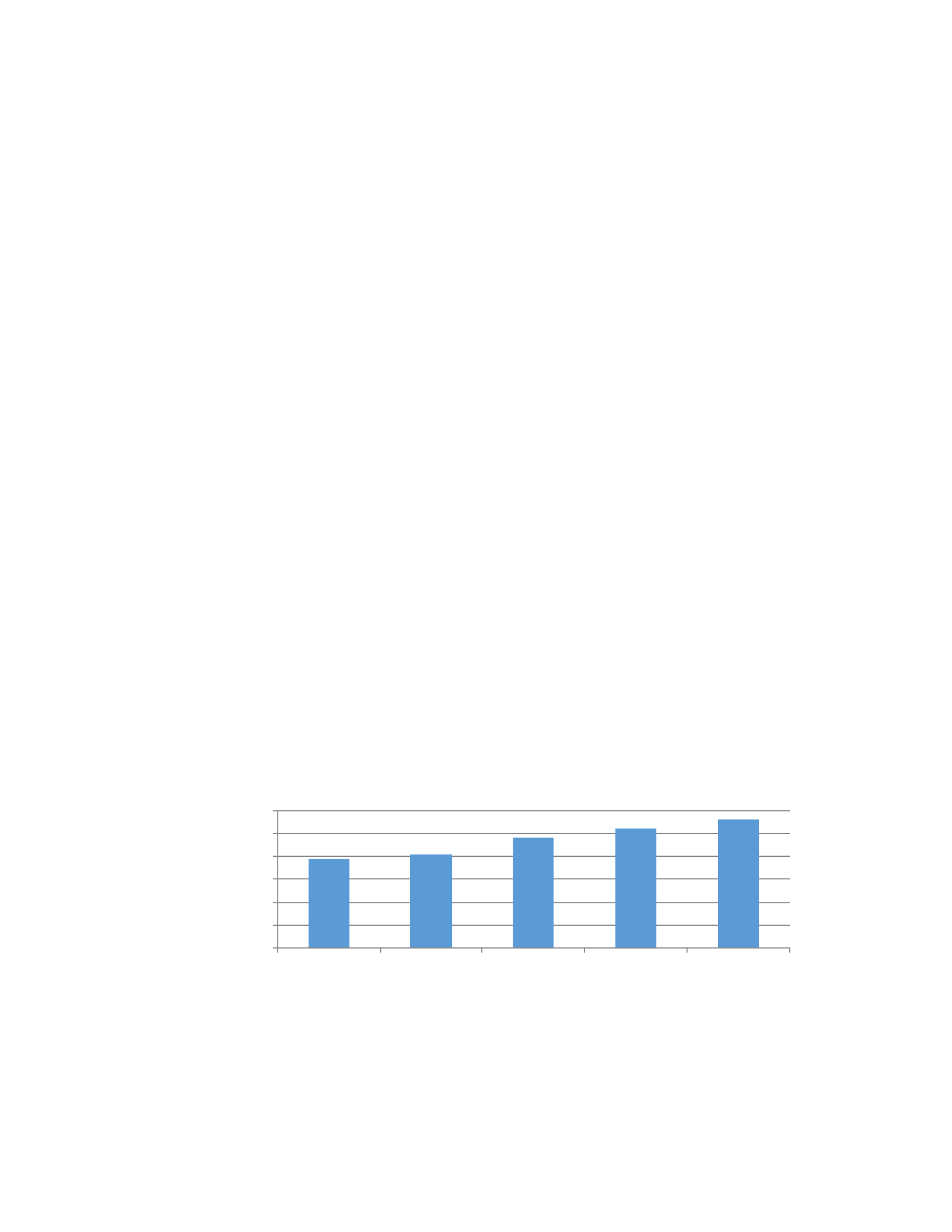
Figure 2 indicates the degree of annual government spending on contracts from 2005
through 2009. As noted in Figure 2, annual government contract spending steadily
increased from 2005 through 2009.
DLA is an entity of the Department of Defense (DoD) and as such, DLA’s budget
falls within the parameters of this table. DoD spent billions of dollars each year. Based on
information listed in Figure 2, government contracting employees exercised control over
billions of dollars to administer government contracts. Government contracting spending
increase provided opportunities for government employees to do unethical business when
administering contracts. The value of a government contract may determine the amount
of spending on that contract. The greater the value of the contract, the more profit a
supplier may receive. There can be prerequisites that guide government contracting
employees when administering a large monetary value contract such as an operational
contract.
Annual Spending on Contracts ($B)
Figure 2. Summary of the U.S. Department of Defense annual contract spending from
0
100
200
300
400
500
600
2005 2006 2007 2008 2009

2005 through 2009. The above information was retrieved from
http://csis.org/files/publication/120524_DIIG_Defense_Service_Contract_Trends.pdf.
Members of various branches of the United States military often embark on joint
operations globally. As such, these operational units need emergency funds to purchase
goods and services contingent upon mission essentiality. Threats to the national security
of the United States’ afforded the Congress the opportunity to establish guidelines for
issuing operational contracts (Acquisition Central, 2014). Under a joint capabilities
determination, government contracting organizations use operational contracts to provide
goods, services, and support to joint forces of the United States during contingencies
(Acquisition Central, 2014).
Due to the spending that may occur when administering an operational contract,
Johnston and Girth (2012) assessed the prerequisites of operational government contracts
by attempting to explain why competition was not the norm with some government
contracts. Lamothe and Lamothe (2012) maintained that competition must be a
prerequisite to satisfactory contract performance. Competition drove value and efficiency
in government contracting (Johnston & Girth, 2012). Efficiency analyzes the use of
resources during a process (Gardenal, 2013). The FAR instructed that all government
contracting employees seek out competition prior to issuing government contracts (Cohn,
2011). Knowing the status of a global marketplace may offer suppliers competitive
advantages.
Organizations realize that using websites for market research when conducting
business to government transactions is advantageous (Kotler, 2011). The proliferation of

the internet with the ability to identify companies electronically surpassed traditional
exchanges (Kotler, 2011). Market research when administering government contracts
offer government contracting employees a suitable acquisition method of finding relevant
suppliers (SBA, 2014). Market research supports government contracting efforts by
providing government contracting employees with the ability to identify and utilize hard
to find information business customers and their buying behaviors (SBA, 2014).
The use of the internet to conduct market research in government contracting
organizations may create a feeling of efficiency (SBA, 2014). Web sites of professional
companies qualified to conduct business with government contracting organizations vary
significantly. Market research began with an emphasis on finding qualified suppliers to
meet government contracting organizations’ demand for commercial products (SBA,
2014). A rise in instances of government contracting scandals compelled the Congress to
established government contracting reforms that changed how government contracting
employees conduct market research (Mothershed, 2012).
With the passage of the Federal Acquisition Streamlining Act of 1994 (FASA) and
the Federal Acquisition Reform Act of 1996 (FARA), Congress changed procurement
policies for government contracting organizations (SBA, 2014). An adoption of FASA
and FARA enabled government contracting organizations to implement commercial
regulations when procuring goods and services (Lansiti, 2012). Market research permits
government contracting employees to gather information about target markets. Knowing
the target market can assist government contracting employees in determining fair and
reasonable pricing for government contracts. Although plans exist to govern the

administration of individual contracts, barriers may prevent the government contracting
employees from successfully doing their jobs.
When faced with obstacles when administering government contracts,
government contracting employees must have the tools needed to overcome the barriers.
Barriers to efficient government contracting may emerge through misunderstanding
market dynamics, government service delivery, and responsibility to society (Johnston &
Girth, 2012). Government contracting managers may intervene to improve or reduce
barriers by conveying to suppliers improvement required in contractor performance;
therefore, maximizing the scope of the contract (Johnston & Girth, 2012). An additional
barrier to efficient government contracting may be the policy of outsourcing or
contracting out government services (Smirnova & Leland, 2014). A lack of perceived
competition, when contracting out government services, reduces implementation by
government organizations (Smirnova & Leland, 2014). Contracting out of government
services made public procurement relevant to the economy (Costantino et al., 2012).
Government contracting organizations use outsourcing to seek government
services through private companies (Payton & Kennedy, 2013). Government
contractingout stresses outsourcing provisions for services such as transportation
services, garbage collection, janitorial, and similar services (Smirnova & Leland, 2014).
Contracting out government services can provide an economic benefit (Chanson &
Quelin, 2013). Given the heterogeneous nature of these services, it may be useful for
government organizations to contract out those services. Private companies can compete
for government service contracts (Johnston & Girth, 2012).

Occasions may exist for government contracting employees to manage service
contracts unethically (Curry, 2010). Government contracting employees sometimes
administer service contracts with minimal supervision (OPM, 1983). If the government
contracting employees assign quality control responsibilities to vendors, the employees
relinquish oversight of government contracting out services (Lamothe & Lamothe, 2013).
Government contracting employees must incorporate the requirements, compliance with
the law, and customer satisfaction related to the contract; these services should be
conducted ethically (Witesman & Fernandez, 2013). Through the power of the purse,
Congress authorized funds needed to manage government contracts (Manuel & Yeh,
2010).
Government contracting policies must provide clear guidelines on ethical
standards (Kidalov & Snider, 2011). Federal Acquisition Regulations contain procedures
that govern government contracting (Cohn, 2011). OMB Circular A-76 detailed the
processes for contracting out of goods and services with commercial or private interests
(OMB, 2003). Although government contracting employees may encounter barriers to
efficient government contracting, they must ethically administer government contracts to
authorized suppliers. Contracting out a requirement for goods or services to commercial
entities may entice government contracting employees to offer unapproved contracts to
unauthorized suppliers in exchange for money. However, employees must consider their
actions and the effect on all stakeholders. A government contracting manager’s
intervention may or may not be beneficial to controlling barriers in government contract
administration.

Civilians/civil servants control large sectors of the government contracting entity.
The Federal Procurement Data System – Next Generation [FPDS] (2014) revealed that
the federal government contracting organizations employ approximately 1.8 million
civilians or 16% of their workforce. Civilian control of some government contracting
may strip the organizations of the discipline required to maintain ethical standards
(Witko, 2011). The G.A.O. [U.S. GAO] (2009) reported an increase in cases of some
government contracting employees influenced to make unwarranted contracts to suppliers
in exchange for cash, gifts, and other nonmonetary awards. Reports of incidents of
mismanagement of public funds have alerted Congress to enact new laws and prompted
calls for oversight (as cited by Manuel & Yeh, 2010). To ensure suppliers’ compliance
with government contracts, government contracting employees can conduct proper
oversight. Politics may affect the distribution of government contracts. Suppliers may
Government contracting organizations must be open to competition. To execute a
standard government contracting competition process, employees must make public
announcements giving suppliers opportunities to compete for government contracts
(Acquisition Central, 2014). Figure 1 displays the standard competition process as
outlined by the FAR. Competition offers private companies opportunities to compete in a
public sphere for government contracts (Ohemeng & Grant, 2014). FAR Part 15
established requirements regarding supplier choice for government contracts (Acquisition
Central, 2014). Selecting a reputable contractor is necessary for contract management
success (Bradshaw & Chang, 2013). Government contracting employees can consider a

supplier’s past performance and reputation to determine if the supplier’s actions may
adversely affect the outcome of the contract (Acquisition Central, 2014).
In 1994, Congress passed the Federal Acquisition Streamlining Act authorizing
government contracting organizations to consider a supplier’s past performance when
evaluating determination of future contract actions (U.S. Department of Labor [DOL],
2014b). Ignorance concerning vendors’ past performance contributed to high risk in
contracting (Bradshaw & Chang, 2013). Without adequate contractor past performance
information, government contracting organizations risk duplicating contract failures
(Bradshaw & Chang, 2013). FAR Part 15 directs government contracting employees to
ensure that government contracts are competitive. Government contracting employees
must deliberate a contractor’s past acts when deciding if the supplier is eligible for a
government contract. Knowing how to manage a government contract may offer each
government contracting employee appropriate guidelines to work within the confines of
stringent government contracting regulations.
Employees who understand the requirements of government contract management
may do their job effectively. Contract management promulgates relationships between
each government contracting organization, government contracting employees, and
suppliers (SBA, 2014). Government contracting organizations might demonstrate
consistency when assessing a supplier’s eligibility for a government contract (Bradshaw
& Chang, 2013). Suppliers may help government contracting employees with processes
of contract administration provided the actions do not alter or affect other suppliers
(Acquisition Central, 2014). Government contracting organizations might develop an

understanding towards appropriate economic, social, democratic, and legal considerations
as highlighted by organizational requirements and civil law (Yang & VanLandingham,
2012).
The use of private suppliers to execute government contracts has increased in the
past decade (Schick, 2011). Government outsourcing affords private sector companies
opportunities to provide goods and services to government organizations (U.S. Office of
Management and Budget [OMB], 2003). Government contracting organizations posited
that outsourcing to private companies provides cost savings in the delivery of services
(Kidalov & Snider, 2011). The government contract is an agreement that stipulates
business communications between qualified private companies and the government
(SBA, 2014).
Since its foundation in 1953, the SBA has advocated small companies in the
United States (SBA, 2014). Small businesses are vital to the economy since they can
provide stability in economically distressed areas (Servon, Fairlie, Rastello, & Seely,
2010). Due to small businesses’ value to the economy, the SBA initiated policies and
programs to maximize small business development (Servon et al., 2010). Due to recent
financial crises, the government established public policies to support small business
concerns (Dennis, 2011). Due to the creative and innovative nature of small businesses,
economic recovery in the United States may occur (Monahan, Shah, & Mattare, 2011).

Table 1
Summary of 2008 and 2009 Small Business Procurement Scores at the SBA
2008 2009
Achievement 2009 Goal Achievement
Small business 21.50 23.00 21.89
Women-owned small business 3.39 5.00 3.68
Small Disadvantaged Business 6.76 5.00 7.57
Service-disabled veteran-owned small
Business
1.49
3.00
1.98
HUBZone
2.34
3.00
2.81
Note. The above data refer to information retrieved from http://www.sba.gov.
The SBA’s socioeconomic program monitors the following concerns:
servicedisabled veteran-owned, small disadvantaged, women-owned, HUBZone, and 8(a)
business development programs (SBA, 2014). The SBA established a list of small
business size requirements to assist companies in determining their small business status
(Acquisition Central, 2014). Under Title 13, Code of Federal Regulations, Part 121, the
SBA assessed the standards for small companies doing business with the federal
government (Government Printing Office [GPO], 2011). The SBA tracks small business
procurement status annually. As noted in Table 1, the SBA surpassed their 2008
achievements; however, in three of five socioeconomic groups, the SBA’s achievements
did not meet 2009 set goals (SBA, 2014).

Some organizations may struggle to find their place in the realm of the small
business zone. Minority owned companies might at times struggle to connect with
government organizations (Ram, Woldesenbet, & Jones, 2011). To equalize small
business growth in government contracting, the federal government created the
SmallDisadvantage Business (SDB) certification program and the Section 8(a) program
(as cited by Smith & Fernandez, 2010). These two programs allow minority-owned small
businesses to obtain government contracts.
In 2008, the SBA began enforcement of policies governing Small-Disadvantaged
businesses (SBA, 2014). To qualify as a Small-Disadvantaged business, socially or
economically disadvantaged individual must 51% or more retain the business (SBA,
2014). Under the Section 8(a) program, the government contracting agency can
distinguish contracts for certified Small-Disadvantaged companies (Smith & Fernandez,
2010). The SBA (2014) provided eight eligibility requirements for Section 8(a) program
eligibility including American citizenship, 51% or above minority-owned and displayed
an expectation for success.
The federal government developed Microenterprise Development programs
(MED) to capitalize on the entrepreneurship of Small-Disadvantaged businesses
(Monahan et al., 2011). The majority of MED businesses are women and minority owned
businesses (Monahan et al., 2011). Title VII of the Civil Rights Act of 1964 governed
minority-owned businesses. Under Title VII, minority-owned businesses might make a
disparate-impact civil rights lawsuit if a business practice adversely affects the minority
business (Biddle & Biddle, 2013). Small businesses offer ethnically diverse organizations

competitive advantage (Smallbone, Kitching, & Athayde, 2010). Ethnically diverse
organizations may increase competition in the small business arena (Smallbone et al.,
2010).
Competition in minority owned small businesses enables organizations to segment
their strategies to reduce costs and increase profits (Collins, 2011). Small businesses are
imperative to the United States economic growth. As such, the SBA created programs to
give particular groups economic advantages. The Microenterprise Development programs
allowed qualified companies to compete as Small-Disadvantaged business. As with all
other government contracting regulations, the legislative branch of the United States
government determined a need to update the requirements for small business concerns.
In 2007, the U.S. Supreme Court updated the rules as applied to Title VII. Based
on the court’s ruling, Title VII incorporated equal employment practices related to
discrimination (Bradbury, 2011). The SBA influences the moral attitude of government
contracting regarding socio-economic businesses by offering ethical recommendations to
government contracting employees and supplier (SBA, 2014). FAR Part 19 includes
regulations related to government contracting organizations working with small
businesses (Acquisition Central, 2014). To help small businesses in understanding and/or
registering to do business with government contracting organizations, the SBA provided
systems and guidelines. The FAR – Federal Acquisition Regulations; SAM –System for
Award Management; FPDS – Federal Procurement Data Systems; GSAM – General

Service Administration Manual; and ESRS – Electronic Subcontracting Reporting
System. For a small business to obtain a government contract, a small business must
ensure it is competitively ready in a global marketplace.
Competition is a basis for government contracting (Wydler et al., 2013); however,
competition for government contracts is uncertain (Johnston & Girth, 2012). Government
contracting employees anticipated that suppliers would provide services as specified in
the contract (Keeler, 2013). Therefore, government contracting employees must ensure
there is clarity in each contract (Kidalov & Snider, 2011). If provisions of the contract are
ambiguous, suppliers may apply their interpretation to the contract. Therefore,
transparency in contracting is important in assuring that contractors perform the contract
requirements as specified (Keeler, 2013).
Government contracting employees must offer clearly defined protocols that
establish criteria for a contract (Yang & VanLandingham, 2012). The SBA provided
guidance to assist small businesses desiring to do business with government
organizations. FAR Part 19 outlines to each government contracting employee precise
rules and regulations associated with doing government contracting business with small
companies. Although the FAR provides guidelines for doing business with a government
contracting organization, a concern noted is a lack of adherence to the government
contracting guidelines by contractors and government contracting employees.
As with all business ventures, government contracting employees may encounter
apprehensions and misgivings while administering government contracts. A recurring
concern regarding contracting out of government services is the integration of contractor

priorities with the responsibilities of contract administration (Keeler, 2013). Opportunism
may occur in the form of unethical conduct (Maser & Thompson, 2013). Government
contracting employees can monitor a supplier’s implementation of the contracting
requirements (Kidalov & Snider, 2011); suppliers may occasionally receive government
contracting funds but provide lackluster service (Yang & VanLandingham, 2012).
Another issue regarding contracting out of government services is a lack of
oversight (Lamothe & Lamothe, 2013). Government contracting employees must develop
strategies when offering government contracts to private suppliers. To ensure that
suppliers provide the goods or service as outlined in the contract, it is important that
government contracting employees and suppliers know the requirements of the contract.
The lack of accountability and transparencies of government outsourcing services may
require reforms to the current guidelines regarding the implementation of contracted
services (Costantino et al., 2012). A problem may exist in defining core competencies in
government contracting; political and ideological factors may affect core competency
decisions (Yang and VanLandingham, 2012).
Government contracting organizations must ensure that government contracting
employees have the tools needed to complete contracting functions (Sebastian &
Davison, 2011). When inadequate core competencies exist, there may be a rise in
customer complaints. Knowing steps to deal with a customer’s complaints may ensure
that the government contract requirements are satisfied. Customers should make
complaints regarding unfulfilled features of the contract to the government contracting
organization and not directly to the vendor (Keeler, 2013). Customer service and

customer satisfaction encompass the administration of government contracts (SBA,
2014). Ensuring customer satisfaction with all aspects of the contract must be a priority
for both the supplier and government contracting employee (SBA, 2014). Customers who
are unsatisfied with the scope of the contract may submit complaints to supervising
authorities (Keeler, 2013). A customer’s complaints of ethical violations of the agreement
might introduce liquidated damages against the supplier.
Ethical violations found when administering government service contracts contain
prohibited solicitation or acceptance of gratuities. Government organizations required
ethics when outsourcing government contracts since society expects government
contracting employees to serve the public trust by ensuring that only approved suppliers
receive government contracts (Schick, 2011). Political and economic factors may affect
government contracting out; however, government contracting employees may use
standard laws to enforce ethical management of contracts (Yang & VanLandingham,
2012). Transparency is necessary during the contracting process (Maser & Thompson,
2013). Whatever factors influence government contract administration, ensuring that
government contracting employees provide suppliers with clearly written contracts is
necessary and proper.
Congress retains required and proper authority over the government contracting
regulations. Under Article I, Section 8, Clause 18 of the Unites States Constitution,
Congress can delegate powers to the Executive Branch of the federal government (OMB,
2003). Congressional delegation of authority can change contract management; each
branch of the government connects to the other, sometimes making the lines between

politics, and public administration blurred (Rosenbloom, 2013). The Executive Branch of
the U.S. government established laws central to government contracting organizations
and entities (Acquisition Central, 2014). The laws enacted by the Congress summarized
processes for competitiveness in government contracting.
Competitive sourcing permits public/private companies to do business with the
federal government organizations (Johnston & Girth, 2012). The relationship among
public/private businesses and government entities is essential to public service
contracting (Witesman & Fernandez, 2013). Competition in government contracting
authorizes public/private companies to compete and supply of goods and services while
affording government organizations opportunities to reduce spending (Lamothe &
Lamothe, 2012). Lamothe and Lamothe (2012) assessed that competition provides
incentives to companies to provide the best products and service to the government.
Figure 2 indicates the degree of annual government spending on contracts from 2005
through 2009. As noted in Figure 2, annual government contract spending steadily
increased from 2005 through 2009.
DLA is an entity of the Department of Defense (DoD) and as such, DLA’s budget
falls within the parameters of this table. DoD spent billions of dollars each year. Based on
information listed in Figure 2, government contracting employees exercised control over
billions of dollars to administer government contracts. Government contracting spending
increase provided opportunities for government employees to do unethical business when
administering contracts. The value of a government contract may determine the amount
of spending on that contract. The greater the value of the contract, the more profit a

supplier may receive. There can be prerequisites that guide government contracting
employees when administering a large monetary value contract such as an operational
contract.
Annual Spending on Contracts ($B)
Figure 2. Summary of the U.S. Department of Defense annual contract spending from
2005 through 2009. The above information was retrieved from
http://csis.org/files/publication/120524_DIIG_Defense_Service_Contract_Trends.pdf.
Members of various branches of the United States military often embark on joint
operations globally. As such, these operational units need emergency funds to purchase
goods and services contingent upon mission essentiality. Threats to the national security
of the United States’ afforded the Congress the opportunity to establish guidelines for
issuing operational contracts (Acquisition Central, 2014). Under a joint capabilities
determination, government contracting organizations use operational contracts to provide
goods, services, and support to joint forces of the United States during contingencies
(Acquisition Central, 2014).
Due to the spending that may occur when administering an operational contract,
Johnston and Girth (2012) assessed the prerequisites of operational government contracts
0
100
200
300
400
500
600
2005 2006 2007 2008 2009

by attempting to explain why competition was not the norm with some government
contracts. Lamothe and Lamothe (2012) maintained that competition must be a
prerequisite to satisfactory contract performance. Competition drove value and efficiency
in government contracting (Johnston & Girth, 2012). Efficiency analyzes the use of
resources during a process (Gardenal, 2013). The FAR instructed that all government
contracting employees seek out competition prior to issuing government contracts (Cohn,
2011). Knowing the status of a global marketplace may offer suppliers competitive
advantages.
Organizations realize that using websites for market research when conducting
business to government transactions is advantageous (Kotler, 2011). The proliferation of
the internet with the ability to identify companies electronically surpassed traditional
exchanges (Kotler, 2011). Market research when administering government contracts
offer government contracting employees a suitable acquisition method of finding relevant
suppliers (SBA, 2014). Market research supports government contracting efforts by
providing government contracting employees with the ability to identify and utilize hard
to find information business customers and their buying behaviors (SBA, 2014).
The use of the internet to conduct market research in government contracting
organizations may create a feeling of efficiency (SBA, 2014). Web sites of professional
companies qualified to conduct business with government contracting organizations vary
significantly. Market research began with an emphasis on finding qualified suppliers to
meet government contracting organizations’ demand for commercial products (SBA,

2014). A rise in instances of government contracting scandals compelled the Congress to
established government contracting reforms that changed how government contracting
employees conduct market research (Mothershed, 2012).
With the passage of the Federal Acquisition Streamlining Act of 1994 (FASA) and
the Federal Acquisition Reform Act of 1996 (FARA), Congress changed procurement
policies for government contracting organizations (SBA, 2014). An adoption of FASA
and FARA enabled government contracting organizations to implement commercial
regulations when procuring goods and services (Lansiti, 2012). Market research permits
government contracting employees to gather information about target markets. Knowing
the target market can assist government contracting employees in determining fair and
reasonable pricing for government contracts. Although plans exist to govern the
administration of individual contracts, barriers may prevent the government contracting
employees from successfully doing their jobs.
When faced with obstacles when administering government contracts,
government contracting employees must have the tools needed to overcome the barriers.
Barriers to efficient government contracting may emerge through misunderstanding
market dynamics, government service delivery, and responsibility to society (Johnston &
Girth, 2012). Government contracting managers may intervene to improve or reduce
barriers by conveying to suppliers improvement required in contractor performance;
therefore, maximizing the scope of the contract (Johnston & Girth, 2012). An additional
barrier to efficient government contracting may be the policy of outsourcing or
contracting out government services (Smirnova & Leland, 2014). A lack of perceived

competition, when contracting out government services, reduces implementation by
government organizations (Smirnova & Leland, 2014). Contracting out of government
services made public procurement relevant to the economy (Costantino et al., 2012).
Government contracting organizations use outsourcing to seek government
services through private companies (Payton & Kennedy, 2013). Government
contractingout stresses outsourcing provisions for services such as transportation
services, garbage collection, janitorial, and similar services (Smirnova & Leland, 2014).
Contracting out government services can provide an economic benefit (Chanson &
Quelin, 2013). Given the heterogeneous nature of these services, it may be useful for
government organizations to contract out those services. Private companies can compete
for government service contracts (Johnston & Girth, 2012).
Occasions may exist for government contracting employees to manage service
contracts unethically (Curry, 2010). Government contracting employees sometimes
administer service contracts with minimal supervision (OPM, 1983). If the government
contracting employees assign quality control responsibilities to vendors, the employees
relinquish oversight of government contracting out services (Lamothe & Lamothe, 2013).
Government contracting employees must incorporate the requirements, compliance with
the law, and customer satisfaction related to the contract; these services should be
conducted ethically (Witesman & Fernandez, 2013). Through the power of the purse,
Congress authorized funds needed to manage government contracts (Manuel & Yeh,
2010).

Government contracting policies must provide clear guidelines on ethical
standards (Kidalov & Snider, 2011). Federal Acquisition Regulations contain procedures
that govern government contracting (Cohn, 2011). OMB Circular A-76 detailed the
processes for contracting out of goods and services with commercial or private interests
(OMB, 2003). Although government contracting employees may encounter barriers to
efficient government contracting, they must ethically administer government contracts to
authorized suppliers. Contracting out a requirement for goods or services to commercial
entities may entice government contracting employees to offer unapproved contracts to
unauthorized suppliers in exchange for money. However, employees must consider their
actions and the effect on all stakeholders. A government contracting manager’s
intervention may or may not be beneficial to controlling barriers in government contract
administration.
Civilians/civil servants control large sectors of the government contracting entity.
The Federal Procurement Data System – Next Generation [FPDS] (2014) revealed that
the federal government contracting organizations employ approximately 1.8 million
civilians or 16% of their workforce. Civilian control of some government contracting
may strip the organizations of the discipline required to maintain ethical standards
(Witko, 2011). The G.A.O. [U.S. GAO] (2009) reported an increase in cases of some
government contracting employees influenced to make unwarranted contracts to suppliers
in exchange for cash, gifts, and other nonmonetary awards. Reports of incidents of
mismanagement of public funds have alerted Congress to enact new laws and prompted
calls for oversight (as cited by Manuel & Yeh, 2010). To ensure suppliers’ compliance

with government contracts, government contracting employees can conduct proper
oversight. Politics may affect the distribution of government contracts. Suppliers may
Government contracting organizations must be open to competition. To execute a
standard government contracting competition process, employees must make public
announcements giving suppliers opportunities to compete for government contracts
(Acquisition Central, 2014). Figure 1 displays the standard competition process as
outlined by the FAR. Competition offers private companies opportunities to compete in a
public sphere for government contracts (Ohemeng & Grant, 2014). FAR Part 15
established requirements regarding supplier choice for government contracts (Acquisition
Central, 2014). Selecting a reputable contractor is necessary for contract management
success (Bradshaw & Chang, 2013). Government contracting employees can consider a
supplier’s past performance and reputation to determine if the supplier’s actions may
adversely affect the outcome of the contract (Acquisition Central, 2014).
In 1994, Congress passed the Federal Acquisition Streamlining Act authorizing
government contracting organizations to consider a supplier’s past performance when
evaluating determination of future contract actions (U.S. Department of Labor [DOL],
2014b). Ignorance concerning vendors’ past performance contributed to high risk in
contracting (Bradshaw & Chang, 2013). Without adequate contractor past performance
information, government contracting organizations risk duplicating contract failures
(Bradshaw & Chang, 2013). FAR Part 15 directs government contracting employees to
ensure that government contracts are competitive. Government contracting employees
must deliberate a contractor’s past acts when deciding if the supplier is eligible for a

government contract. Knowing how to manage a government contract may offer each
government contracting employee appropriate guidelines to work within the confines of
stringent government contracting regulations.
Employees who understand the requirements of government contract management
may do their job effectively. Contract management promulgates relationships between
each government contracting organization, government contracting employees, and
suppliers (SBA, 2014). Government contracting organizations might demonstrate
consistency when assessing a supplier’s eligibility for a government contract (Bradshaw
& Chang, 2013). Suppliers may help government contracting employees with processes
of contract administration provided the actions do not alter or affect other suppliers
(Acquisition Central, 2014). Government contracting organizations might develop an
understanding towards appropriate economic, social, democratic, and legal considerations
as highlighted by organizational requirements and civil law (Yang & VanLandingham,
2012).
The use of private suppliers to execute government contracts has increased in the
past decade (Schick, 2011). Government outsourcing affords private sector companies
opportunities to provide goods and services to government organizations (U.S. Office of
Management and Budget [OMB], 2003). Government contracting organizations posited
that outsourcing to private companies provides cost savings in the delivery of services
(Kidalov & Snider, 2011). The government contract is an agreement that stipulates
business communications between qualified private companies and the government
(SBA, 2014).

Since its foundation in 1953, the SBA has advocated small companies in the
United States (SBA, 2014). Small businesses are vital to the economy since they can
provide stability in economically distressed areas (Servon, Fairlie, Rastello, & Seely,
2010). Due to small businesses’ value to the economy, the SBA initiated policies and
programs to maximize small business development (Servon et al., 2010). Due to recent
financial crises, the government established public policies to support small business
concerns (Dennis, 2011). Due to the creative and innovative nature of small businesses,
economic recovery in the United States may occur (Monahan, Shah, & Mattare, 2011).
Table 1
Summary of 2008 and 2009 Small Business Procurement Scores at the SBA
2008 2009
Achievement 2009 Goal Achievement
Small business 21.50 23.00 21.89
Women-owned small business 3.39 5.00 3.68
Small Disadvantaged Business 6.76 5.00 7.57
Service-disabled veteran-owned small
Business
1.49
3.00
1.98
HUBZone
2.34
3.00
2.81
Note. The above data refer to information retrieved from http://www.sba.gov.

The SBA’s socioeconomic program monitors the following concerns:
servicedisabled veteran-owned, small disadvantaged, women-owned, HUBZone, and 8(a)
business development programs (SBA, 2014). The SBA established a list of small
business size requirements to assist companies in determining their small business status
(Acquisition Central, 2014). Under Title 13, Code of Federal Regulations, Part 121, the
SBA assessed the standards for small companies doing business with the federal
government (Government Printing Office [GPO], 2011). The SBA tracks small business
procurement status annually. As noted in Table 1, the SBA surpassed their 2008
achievements; however, in three of five socioeconomic groups, the SBA’s achievements
did not meet 2009 set goals (SBA, 2014).
Some organizations may struggle to find their place in the realm of the small
business zone. Minority owned companies might at times struggle to connect with
government organizations (Ram, Woldesenbet, & Jones, 2011). To equalize small
business growth in government contracting, the federal government created the
SmallDisadvantage Business (SDB) certification program and the Section 8(a) program
(as cited by Smith & Fernandez, 2010). These two programs allow minority-owned small
businesses to obtain government contracts.
In 2008, the SBA began enforcement of policies governing Small-Disadvantaged
businesses (SBA, 2014). To qualify as a Small-Disadvantaged business, socially or
economically disadvantaged individual must 51% or more retain the business (SBA,
2014). Under the Section 8(a) program, the government contracting agency can
distinguish contracts for certified Small-Disadvantaged companies (Smith & Fernandez,

2010). The SBA (2014) provided eight eligibility requirements for Section 8(a) program
eligibility including American citizenship, 51% or above minority-owned and displayed
an expectation for success.
The federal government developed Microenterprise Development programs
(MED) to capitalize on the entrepreneurship of Small-Disadvantaged businesses
(Monahan et al., 2011). The majority of MED businesses are women and minority owned
businesses (Monahan et al., 2011). Title VII of the Civil Rights Act of 1964 governed
minority-owned businesses. Under Title VII, minority-owned businesses might make a
disparate-impact civil rights lawsuit if a business practice adversely affects the minority
business (Biddle & Biddle, 2013). Small businesses offer ethnically diverse organizations
competitive advantage (Smallbone, Kitching, & Athayde, 2010). Ethnically diverse
organizations may increase competition in the small business arena (Smallbone et al.,
2010).
Competition in minority owned small businesses enables organizations to segment
their strategies to reduce costs and increase profits (Collins, 2011). Small businesses are
imperative to the United States economic growth. As such, the SBA created programs to
give particular groups economic advantages. The Microenterprise Development programs
allowed qualified companies to compete as Small-Disadvantaged business. As with all
other government contracting regulations, the legislative branch of the United States
government determined a need to update the requirements for small business concerns.

In 2007, the U.S. Supreme Court updated the rules as applied to Title VII. Based
on the court’s ruling, Title VII incorporated equal employment practices related to
discrimination (Bradbury, 2011). The SBA influences the moral attitude of government
contracting regarding socio-economic businesses by offering ethical recommendations to
government contracting employees and supplier (SBA, 2014). FAR Part 19 includes
regulations related to government contracting organizations working with small
businesses (Acquisition Central, 2014). To help small businesses in understanding and/or
registering to do business with government contracting organizations, the SBA provided
systems and guidelines. The FAR – Federal Acquisition Regulations; SAM –System for
Award Management; FPDS – Federal Procurement Data Systems; GSAM – General
Service Administration Manual; and ESRS – Electronic Subcontracting Reporting
System. For a small business to obtain a government contract, a small business must
ensure it is competitively ready in a global marketplace.
Competition is a basis for government contracting (Wydler et al., 2013); however,
competition for government contracts is uncertain (Johnston & Girth, 2012). Government
contracting employees anticipated that suppliers would provide services as specified in
the contract (Keeler, 2013). Therefore, government contracting employees must ensure
there is clarity in each contract (Kidalov & Snider, 2011). If provisions of the contract are
ambiguous, suppliers may apply their interpretation to the contract. Therefore,
transparency in contracting is important in assuring that contractors perform the contract
requirements as specified (Keeler, 2013).

Government contracting employees must offer clearly defined protocols that
establish criteria for a contract (Yang & VanLandingham, 2012). The SBA provided
guidance to assist small businesses desiring to do business with government
organizations. FAR Part 19 outlines to each government contracting employee precise
rules and regulations associated with doing government contracting business with small
companies. Although the FAR provides guidelines for doing business with a government
contracting organization, a concern noted is a lack of adherence to the government
contracting guidelines by contractors and government contracting employees.
As with all business ventures, government contracting employees may encounter
apprehensions and misgivings while administering government contracts. A recurring
concern regarding contracting out of government services is the integration of contractor
priorities with the responsibilities of contract administration (Keeler, 2013). Opportunism
may occur in the form of unethical conduct (Maser & Thompson, 2013). Government
contracting employees can monitor a supplier’s implementation of the contracting
requirements (Kidalov & Snider, 2011); suppliers may occasionally receive government
contracting funds but provide lackluster service (Yang & VanLandingham, 2012).
Another issue regarding contracting out of government services is a lack of
oversight (Lamothe & Lamothe, 2013). Government contracting employees must develop
strategies when offering government contracts to private suppliers. To ensure that
suppliers provide the goods or service as outlined in the contract, it is important that
government contracting employees and suppliers know the requirements of the contract.
The lack of accountability and transparencies of government outsourcing services may

require reforms to the current guidelines regarding the implementation of contracted
services (Costantino et al., 2012). A problem may exist in defining core competencies in
government contracting; political and ideological factors may affect core competency
decisions (Yang and VanLandingham, 2012).
Government contracting organizations must ensure that government contracting
employees have the tools needed to complete contracting functions (Sebastian &
Davison, 2011). When inadequate core competencies exist, there may be a rise in
customer complaints. Knowing steps to deal with a customer’s complaints may ensure
that the government contract requirements are satisfied. Customers should make
complaints regarding unfulfilled features of the contract to the government contracting
organization and not directly to the vendor (Keeler, 2013). Customer service and
customer satisfaction encompass the administration of government contracts (SBA,
2014). Ensuring customer satisfaction with all aspects of the contract must be a priority
for both the supplier and government contracting employee (SBA, 2014). Customers who
are unsatisfied with the scope of the contract may submit complaints to supervising
authorities (Keeler, 2013). A customer’s complaints of ethical violations of the agreement
might introduce liquidated damages against the supplier.
Ethical violations found when administering government service contracts contain
prohibited solicitation or acceptance of gratuities. Government organizations required
ethics when outsourcing government contracts since society expects government
contracting employees to serve the public trust by ensuring that only approved suppliers
receive government contracts (Schick, 2011). Political and economic factors may affect

government contracting out; however, government contracting employees may use
standard laws to enforce ethical management of contracts (Yang & VanLandingham,
2012). Transparency is necessary during the contracting process (Maser & Thompson,
2013). Whatever factors influence government contract administration, ensuring that
government contracting employees provide suppliers with clearly written contracts is
necessary and proper.
Congress retains required and proper authority over the government contracting
regulations. Under Article I, Section 8, Clause 18 of the Unites States Constitution,
Congress can delegate powers to the Executive Branch of the federal government (OMB,
2003). Congressional delegation of authority can change contract management; each
branch of the government connects to the other, sometimes making the lines between
politics, and public administration blurred (Rosenbloom, 2013). The Executive Branch of
the U.S. government established laws central to government contracting organizations
and entities (Acquisition Central, 2014). The laws enacted by the Congress summarized
processes for competitiveness in government contracting.
Competitive sourcing permits public/private companies to do business with the
federal government organizations (Johnston & Girth, 2012). The relationship among
public/private businesses and government entities is essential to public service
contracting (Witesman & Fernandez, 2013). Competition in government contracting
authorizes public/private companies to compete and supply of goods and services while
affording government organizations opportunities to reduce spending (Lamothe &
Lamothe, 2012). Lamothe and Lamothe (2012) assessed that competition provides
incentives to companies to provide the best products and service to the government.
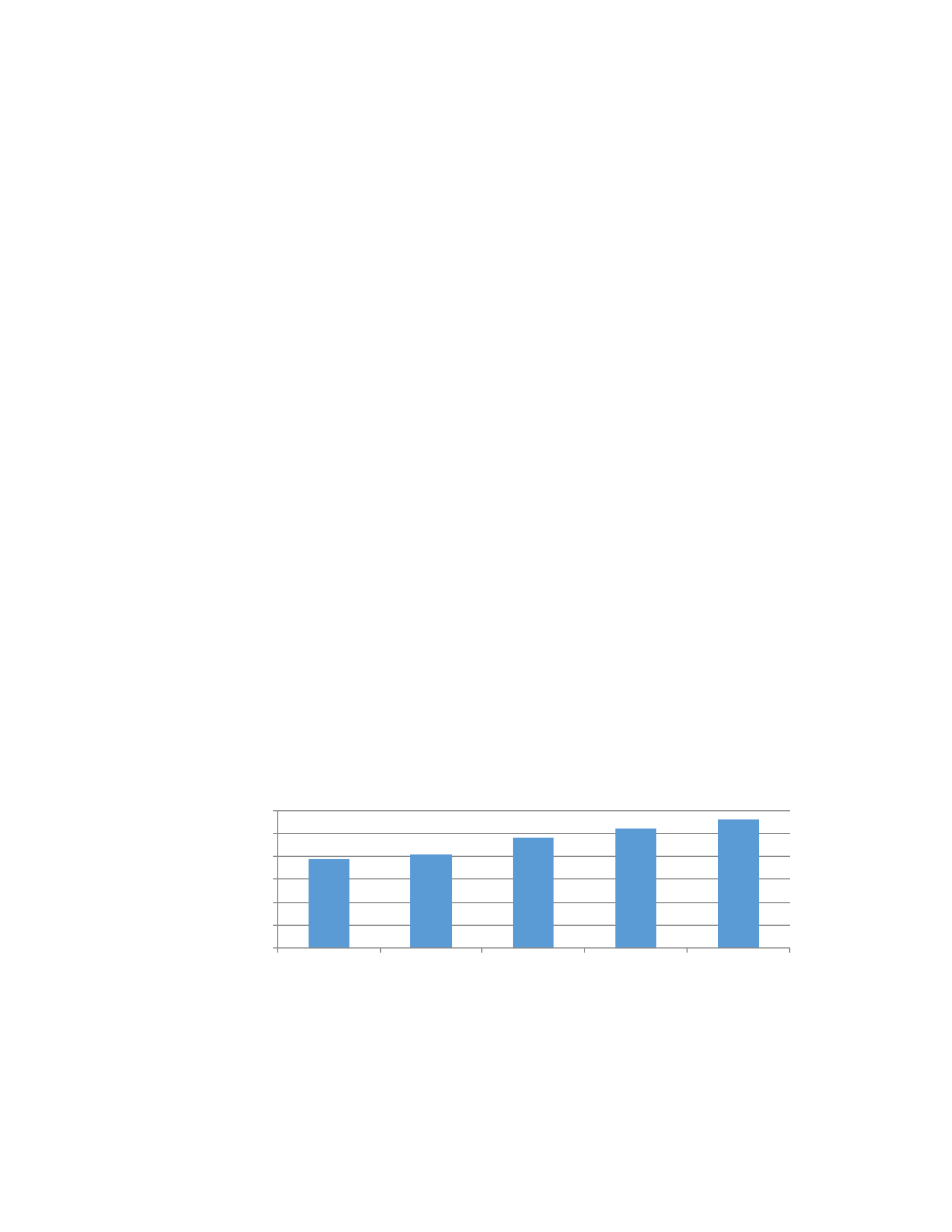
Figure 2 indicates the degree of annual government spending on contracts from 2005
through 2009. As noted in Figure 2, annual government contract spending steadily
increased from 2005 through 2009.
DLA is an entity of the Department of Defense (DoD) and as such, DLA’s budget
falls within the parameters of this table. DoD spent billions of dollars each year. Based on
information listed in Figure 2, government contracting employees exercised control over
billions of dollars to administer government contracts. Government contracting spending
increase provided opportunities for government employees to do unethical business when
administering contracts. The value of a government contract may determine the amount
of spending on that contract. The greater the value of the contract, the more profit a
supplier may receive. There can be prerequisites that guide government contracting
employees when administering a large monetary value contract such as an operational
contract.
Annual Spending on Contracts ($B)
Figure 2. Summary of the U.S. Department of Defense annual contract spending from
0
100
200
300
400
500
600
2005 2006 2007 2008 2009

2005 through 2009. The above information was retrieved from
http://csis.org/files/publication/120524_DIIG_Defense_Service_Contract_Trends.pdf.
Members of various branches of the United States military often embark on joint
operations globally. As such, these operational units need emergency funds to purchase
goods and services contingent upon mission essentiality. Threats to the national security
of the United States’ afforded the Congress the opportunity to establish guidelines for
issuing operational contracts (Acquisition Central, 2014). Under a joint capabilities
determination, government contracting organizations use operational contracts to provide
goods, services, and support to joint forces of the United States during contingencies
(Acquisition Central, 2014).
Due to the spending that may occur when administering an operational contract,
Johnston and Girth (2012) assessed the prerequisites of operational government contracts
by attempting to explain why competition was not the norm with some government
contracts. Lamothe and Lamothe (2012) maintained that competition must be a
prerequisite to satisfactory contract performance. Competition drove value and efficiency
in government contracting (Johnston & Girth, 2012). Efficiency analyzes the use of
resources during a process (Gardenal, 2013). The FAR instructed that all government
contracting employees seek out competition prior to issuing government contracts (Cohn,
2011). Knowing the status of a global marketplace may offer suppliers competitive
advantages.
Organizations realize that using websites for market research when conducting
business to government transactions is advantageous (Kotler, 2011). The proliferation of

the internet with the ability to identify companies electronically surpassed traditional
exchanges (Kotler, 2011). Market research when administering government contracts
offer government contracting employees a suitable acquisition method of finding relevant
suppliers (SBA, 2014). Market research supports government contracting efforts by
providing government contracting employees with the ability to identify and utilize hard
to find information business customers and their buying behaviors (SBA, 2014).
The use of the internet to conduct market research in government contracting
organizations may create a feeling of efficiency (SBA, 2014). Web sites of professional
companies qualified to conduct business with government contracting organizations vary
significantly. Market research began with an emphasis on finding qualified suppliers to
meet government contracting organizations’ demand for commercial products (SBA,
2014). A rise in instances of government contracting scandals compelled the Congress to
established government contracting reforms that changed how government contracting
employees conduct market research (Mothershed, 2012).
With the passage of the Federal Acquisition Streamlining Act of 1994 (FASA) and
the Federal Acquisition Reform Act of 1996 (FARA), Congress changed procurement
policies for government contracting organizations (SBA, 2014). An adoption of FASA
and FARA enabled government contracting organizations to implement commercial
regulations when procuring goods and services (Lansiti, 2012). Market research permits
government contracting employees to gather information about target markets. Knowing
the target market can assist government contracting employees in determining fair and
reasonable pricing for government contracts. Although plans exist to govern the

administration of individual contracts, barriers may prevent the government contracting
employees from successfully doing their jobs.
When faced with obstacles when administering government contracts,
government contracting employees must have the tools needed to overcome the barriers.
Barriers to efficient government contracting may emerge through misunderstanding
market dynamics, government service delivery, and responsibility to society (Johnston &
Girth, 2012). Government contracting managers may intervene to improve or reduce
barriers by conveying to suppliers improvement required in contractor performance;
therefore, maximizing the scope of the contract (Johnston & Girth, 2012). An additional
barrier to efficient government contracting may be the policy of outsourcing or
contracting out government services (Smirnova & Leland, 2014). A lack of perceived
competition, when contracting out government services, reduces implementation by
government organizations (Smirnova & Leland, 2014). Contracting out of government
services made public procurement relevant to the economy (Costantino et al., 2012).
Government contracting organizations use outsourcing to seek government
services through private companies (Payton & Kennedy, 2013). Government
contractingout stresses outsourcing provisions for services such as transportation
services, garbage collection, janitorial, and similar services (Smirnova & Leland, 2014).
Contracting out government services can provide an economic benefit (Chanson &
Quelin, 2013). Given the heterogeneous nature of these services, it may be useful for
government organizations to contract out those services. Private companies can compete
for government service contracts (Johnston & Girth, 2012).

Occasions may exist for government contracting employees to manage service
contracts unethically (Curry, 2010). Government contracting employees sometimes
administer service contracts with minimal supervision (OPM, 1983). If the government
contracting employees assign quality control responsibilities to vendors, the employees
relinquish oversight of government contracting out services (Lamothe & Lamothe, 2013).
Government contracting employees must incorporate the requirements, compliance with
the law, and customer satisfaction related to the contract; these services should be
conducted ethically (Witesman & Fernandez, 2013). Through the power of the purse,
Congress authorized funds needed to manage government contracts (Manuel & Yeh,
2010).
Government contracting policies must provide clear guidelines on ethical
standards (Kidalov & Snider, 2011). Federal Acquisition Regulations contain procedures
that govern government contracting (Cohn, 2011). OMB Circular A-76 detailed the
processes for contracting out of goods and services with commercial or private interests
(OMB, 2003). Although government contracting employees may encounter barriers to
efficient government contracting, they must ethically administer government contracts to
authorized suppliers. Contracting out a requirement for goods or services to commercial
entities may entice government contracting employees to offer unapproved contracts to
unauthorized suppliers in exchange for money. However, employees must consider their
actions and the effect on all stakeholders. A government contracting manager’s
intervention may or may not be beneficial to controlling barriers in government contract
administration.

Civilians/civil servants control large sectors of the government contracting entity.
The Federal Procurement Data System – Next Generation [FPDS] (2014) revealed that
the federal government contracting organizations employ approximately 1.8 million
civilians or 16% of their workforce. Civilian control of some government contracting
may strip the organizations of the discipline required to maintain ethical standards
(Witko, 2011). The G.A.O. [U.S. GAO] (2009) reported an increase in cases of some
government contracting employees influenced to make unwarranted contracts to suppliers
in exchange for cash, gifts, and other nonmonetary awards. Reports of incidents of
mismanagement of public funds have alerted Congress to enact new laws and prompted
calls for oversight (as cited by Manuel & Yeh, 2010). To ensure suppliers’ compliance
with government contracts, government contracting employees can conduct proper
oversight. Politics may affect the distribution of government contracts. Suppliers may
Government contracting organizations must be open to competition. To execute a
standard government contracting competition process, employees must make public
announcements giving suppliers opportunities to compete for government contracts
(Acquisition Central, 2014). Figure 1 displays the standard competition process as
outlined by the FAR. Competition offers private companies opportunities to compete in a
public sphere for government contracts (Ohemeng & Grant, 2014). FAR Part 15
established requirements regarding supplier choice for government contracts (Acquisition
Central, 2014). Selecting a reputable contractor is necessary for contract management
success (Bradshaw & Chang, 2013). Government contracting employees can consider a

supplier’s past performance and reputation to determine if the supplier’s actions may
adversely affect the outcome of the contract (Acquisition Central, 2014).
In 1994, Congress passed the Federal Acquisition Streamlining Act authorizing
government contracting organizations to consider a supplier’s past performance when
evaluating determination of future contract actions (U.S. Department of Labor [DOL],
2014b). Ignorance concerning vendors’ past performance contributed to high risk in
contracting (Bradshaw & Chang, 2013). Without adequate contractor past performance
information, government contracting organizations risk duplicating contract failures
(Bradshaw & Chang, 2013). FAR Part 15 directs government contracting employees to
ensure that government contracts are competitive. Government contracting employees
must deliberate a contractor’s past acts when deciding if the supplier is eligible for a
government contract. Knowing how to manage a government contract may offer each
government contracting employee appropriate guidelines to work within the confines of
stringent government contracting regulations.
Employees who understand the requirements of government contract management
may do their job effectively. Contract management promulgates relationships between
each government contracting organization, government contracting employees, and
suppliers (SBA, 2014). Government contracting organizations might demonstrate
consistency when assessing a supplier’s eligibility for a government contract (Bradshaw
& Chang, 2013). Suppliers may help government contracting employees with processes
of contract administration provided the actions do not alter or affect other suppliers
(Acquisition Central, 2014). Government contracting organizations might develop an

understanding towards appropriate economic, social, democratic, and legal considerations
as highlighted by organizational requirements and civil law (Yang & VanLandingham,
2012).
The use of private suppliers to execute government contracts has increased in the
past decade (Schick, 2011). Government outsourcing affords private sector companies
opportunities to provide goods and services to government organizations (U.S. Office of
Management and Budget [OMB], 2003). Government contracting organizations posited
that outsourcing to private companies provides cost savings in the delivery of services
(Kidalov & Snider, 2011). The government contract is an agreement that stipulates
business communications between qualified private companies and the government
(SBA, 2014).
Since its foundation in 1953, the SBA has advocated small companies in the
United States (SBA, 2014). Small businesses are vital to the economy since they can
provide stability in economically distressed areas (Servon, Fairlie, Rastello, & Seely,
2010). Due to small businesses’ value to the economy, the SBA initiated policies and
programs to maximize small business development (Servon et al., 2010). Due to recent
financial crises, the government established public policies to support small business
concerns (Dennis, 2011). Due to the creative and innovative nature of small businesses,
economic recovery in the United States may occur (Monahan, Shah, & Mattare, 2011).

Table 1
Summary of 2008 and 2009 Small Business Procurement Scores at the SBA
2008 2009
Achievement 2009 Goal Achievement
Small business 21.50 23.00 21.89
Women-owned small business 3.39 5.00 3.68
Small Disadvantaged Business 6.76 5.00 7.57
Service-disabled veteran-owned small
Business
1.49
3.00
1.98
HUBZone
2.34
3.00
2.81
Note. The above data refer to information retrieved from http://www.sba.gov.
The SBA’s socioeconomic program monitors the following concerns:
servicedisabled veteran-owned, small disadvantaged, women-owned, HUBZone, and 8(a)
business development programs (SBA, 2014). The SBA established a list of small
business size requirements to assist companies in determining their small business status
(Acquisition Central, 2014). Under Title 13, Code of Federal Regulations, Part 121, the
SBA assessed the standards for small companies doing business with the federal
government (Government Printing Office [GPO], 2011). The SBA tracks small business
procurement status annually. As noted in Table 1, the SBA surpassed their 2008
achievements; however, in three of five socioeconomic groups, the SBA’s achievements
did not meet 2009 set goals (SBA, 2014).

Some organizations may struggle to find their place in the realm of the small
business zone. Minority owned companies might at times struggle to connect with
government organizations (Ram, Woldesenbet, & Jones, 2011). To equalize small
business growth in government contracting, the federal government created the
SmallDisadvantage Business (SDB) certification program and the Section 8(a) program
(as cited by Smith & Fernandez, 2010). These two programs allow minority-owned small
businesses to obtain government contracts.
In 2008, the SBA began enforcement of policies governing Small-Disadvantaged
businesses (SBA, 2014). To qualify as a Small-Disadvantaged business, socially or
economically disadvantaged individual must 51% or more retain the business (SBA,
2014). Under the Section 8(a) program, the government contracting agency can
distinguish contracts for certified Small-Disadvantaged companies (Smith & Fernandez,
2010). The SBA (2014) provided eight eligibility requirements for Section 8(a) program
eligibility including American citizenship, 51% or above minority-owned and displayed
an expectation for success.
The federal government developed Microenterprise Development programs
(MED) to capitalize on the entrepreneurship of Small-Disadvantaged businesses
(Monahan et al., 2011). The majority of MED businesses are women and minority owned
businesses (Monahan et al., 2011). Title VII of the Civil Rights Act of 1964 governed
minority-owned businesses. Under Title VII, minority-owned businesses might make a
disparate-impact civil rights lawsuit if a business practice adversely affects the minority
business (Biddle & Biddle, 2013). Small businesses offer ethnically diverse organizations

competitive advantage (Smallbone, Kitching, & Athayde, 2010). Ethnically diverse
organizations may increase competition in the small business arena (Smallbone et al.,
2010).
Competition in minority owned small businesses enables organizations to segment
their strategies to reduce costs and increase profits (Collins, 2011). Small businesses are
imperative to the United States economic growth. As such, the SBA created programs to
give particular groups economic advantages. The Microenterprise Development programs
allowed qualified companies to compete as Small-Disadvantaged business. As with all
other government contracting regulations, the legislative branch of the United States
government determined a need to update the requirements for small business concerns.
In 2007, the U.S. Supreme Court updated the rules as applied to Title VII. Based
on the court’s ruling, Title VII incorporated equal employment practices related to
discrimination (Bradbury, 2011). The SBA influences the moral attitude of government
contracting regarding socio-economic businesses by offering ethical recommendations to
government contracting employees and supplier (SBA, 2014). FAR Part 19 includes
regulations related to government contracting organizations working with small
businesses (Acquisition Central, 2014). To help small businesses in understanding and/or
registering to do business with government contracting organizations, the SBA provided
systems and guidelines. The FAR – Federal Acquisition Regulations; SAM –System for
Award Management; FPDS – Federal Procurement Data Systems; GSAM – General

Service Administration Manual; and ESRS – Electronic Subcontracting Reporting
System. For a small business to obtain a government contract, a small business must
ensure it is competitively ready in a global marketplace.
Competition is a basis for government contracting (Wydler et al., 2013); however,
competition for government contracts is uncertain (Johnston & Girth, 2012). Government
contracting employees anticipated that suppliers would provide services as specified in
the contract (Keeler, 2013). Therefore, government contracting employees must ensure
there is clarity in each contract (Kidalov & Snider, 2011). If provisions of the contract are
ambiguous, suppliers may apply their interpretation to the contract. Therefore,
transparency in contracting is important in assuring that contractors perform the contract
requirements as specified (Keeler, 2013).
Government contracting employees must offer clearly defined protocols that
establish criteria for a contract (Yang & VanLandingham, 2012). The SBA provided
guidance to assist small businesses desiring to do business with government
organizations. FAR Part 19 outlines to each government contracting employee precise
rules and regulations associated with doing government contracting business with small
companies. Although the FAR provides guidelines for doing business with a government
contracting organization, a concern noted is a lack of adherence to the government
contracting guidelines by contractors and government contracting employees.
As with all business ventures, government contracting employees may encounter
apprehensions and misgivings while administering government contracts. A recurring
concern regarding contracting out of government services is the integration of contractor

priorities with the responsibilities of contract administration (Keeler, 2013). Opportunism
may occur in the form of unethical conduct (Maser & Thompson, 2013). Government
contracting employees can monitor a supplier’s implementation of the contracting
requirements (Kidalov & Snider, 2011); suppliers may occasionally receive government
contracting funds but provide lackluster service (Yang & VanLandingham, 2012).
Another issue regarding contracting out of government services is a lack of
oversight (Lamothe & Lamothe, 2013). Government contracting employees must develop
strategies when offering government contracts to private suppliers. To ensure that
suppliers provide the goods or service as outlined in the contract, it is important that
government contracting employees and suppliers know the requirements of the contract.
The lack of accountability and transparencies of government outsourcing services may
require reforms to the current guidelines regarding the implementation of contracted
services (Costantino et al., 2012). A problem may exist in defining core competencies in
government contracting; political and ideological factors may affect core competency
decisions (Yang and VanLandingham, 2012).
Government contracting organizations must ensure that government contracting
employees have the tools needed to complete contracting functions (Sebastian &
Davison, 2011). When inadequate core competencies exist, there may be a rise in
customer complaints. Knowing steps to deal with a customer’s complaints may ensure
that the government contract requirements are satisfied. Customers should make
complaints regarding unfulfilled features of the contract to the government contracting
organization and not directly to the vendor (Keeler, 2013). Customer service and

customer satisfaction encompass the administration of government contracts (SBA,
2014). Ensuring customer satisfaction with all aspects of the contract must be a priority
for both the supplier and government contracting employee (SBA, 2014). Customers who
are unsatisfied with the scope of the contract may submit complaints to supervising
authorities (Keeler, 2013). A customer’s complaints of ethical violations of the agreement
might introduce liquidated damages against the supplier.
Ethical violations found when administering government service contracts contain
prohibited solicitation or acceptance of gratuities. Government organizations required
ethics when outsourcing government contracts since society expects government
contracting employees to serve the public trust by ensuring that only approved suppliers
receive government contracts (Schick, 2011). Political and economic factors may affect
government contracting out; however, government contracting employees may use
standard laws to enforce ethical management of contracts (Yang & VanLandingham,
2012). Transparency is necessary during the contracting process (Maser & Thompson,
2013). Whatever factors influence government contract administration, ensuring that
government contracting employees provide suppliers with clearly written contracts is
necessary and proper.
Congress retains required and proper authority over the government contracting
regulations. Under Article I, Section 8, Clause 18 of the Unites States Constitution,
Congress can delegate powers to the Executive Branch of the federal government (OMB,
2003). Congressional delegation of authority can change contract management; each
branch of the government connects to the other, sometimes making the lines between

politics, and public administration blurred (Rosenbloom, 2013). The Executive Branch of
the U.S. government established laws central to government contracting organizations
and entities (Acquisition Central, 2014). The laws enacted by the Congress summarized
processes for competitiveness in government contracting.
Competitive sourcing permits public/private companies to do business with the
federal government organizations (Johnston & Girth, 2012). The relationship among
public/private businesses and government entities is essential to public service
contracting (Witesman & Fernandez, 2013). Competition in government contracting
authorizes public/private companies to compete and supply of goods and services while
affording government organizations opportunities to reduce spending (Lamothe &
Lamothe, 2012). Lamothe and Lamothe (2012) assessed that competition provides
incentives to companies to provide the best products and service to the government.
Figure 2 indicates the degree of annual government spending on contracts from 2005
through 2009. As noted in Figure 2, annual government contract spending steadily
increased from 2005 through 2009.
DLA is an entity of the Department of Defense (DoD) and as such, DLA’s budget
falls within the parameters of this table. DoD spent billions of dollars each year. Based on
information listed in Figure 2, government contracting employees exercised control over
billions of dollars to administer government contracts. Government contracting spending
increase provided opportunities for government employees to do unethical business when
administering contracts. The value of a government contract may determine the amount
of spending on that contract. The greater the value of the contract, the more profit a

supplier may receive. There can be prerequisites that guide government contracting
employees when administering a large monetary value contract such as an operational
contract.
Annual Spending on Contracts ($B)
Figure 2. Summary of the U.S. Department of Defense annual contract spending from
2005 through 2009. The above information was retrieved from
http://csis.org/files/publication/120524_DIIG_Defense_Service_Contract_Trends.pdf.
Members of various branches of the United States military often embark on joint
operations globally. As such, these operational units need emergency funds to purchase
goods and services contingent upon mission essentiality. Threats to the national security
of the United States’ afforded the Congress the opportunity to establish guidelines for
issuing operational contracts (Acquisition Central, 2014). Under a joint capabilities
determination, government contracting organizations use operational contracts to provide
goods, services, and support to joint forces of the United States during contingencies
(Acquisition Central, 2014).
Due to the spending that may occur when administering an operational contract,
Johnston and Girth (2012) assessed the prerequisites of operational government contracts
0
100
200
300
400
500
600
2005 2006 2007 2008 2009

by attempting to explain why competition was not the norm with some government
contracts. Lamothe and Lamothe (2012) maintained that competition must be a
prerequisite to satisfactory contract performance. Competition drove value and efficiency
in government contracting (Johnston & Girth, 2012). Efficiency analyzes the use of
resources during a process (Gardenal, 2013). The FAR instructed that all government
contracting employees seek out competition prior to issuing government contracts (Cohn,
2011). Knowing the status of a global marketplace may offer suppliers competitive
advantages.
Organizations realize that using websites for market research when conducting
business to government transactions is advantageous (Kotler, 2011). The proliferation of
the internet with the ability to identify companies electronically surpassed traditional
exchanges (Kotler, 2011). Market research when administering government contracts
offer government contracting employees a suitable acquisition method of finding relevant
suppliers (SBA, 2014). Market research supports government contracting efforts by
providing government contracting employees with the ability to identify and utilize hard
to find information business customers and their buying behaviors (SBA, 2014).
The use of the internet to conduct market research in government contracting
organizations may create a feeling of efficiency (SBA, 2014). Web sites of professional
companies qualified to conduct business with government contracting organizations vary
significantly. Market research began with an emphasis on finding qualified suppliers to
meet government contracting organizations’ demand for commercial products (SBA,

2014). A rise in instances of government contracting scandals compelled the Congress to
established government contracting reforms that changed how government contracting
employees conduct market research (Mothershed, 2012).
With the passage of the Federal Acquisition Streamlining Act of 1994 (FASA) and
the Federal Acquisition Reform Act of 1996 (FARA), Congress changed procurement
policies for government contracting organizations (SBA, 2014). An adoption of FASA
and FARA enabled government contracting organizations to implement commercial
regulations when procuring goods and services (Lansiti, 2012). Market research permits
government contracting employees to gather information about target markets. Knowing
the target market can assist government contracting employees in determining fair and
reasonable pricing for government contracts. Although plans exist to govern the
administration of individual contracts, barriers may prevent the government contracting
employees from successfully doing their jobs.
When faced with obstacles when administering government contracts,
government contracting employees must have the tools needed to overcome the barriers.
Barriers to efficient government contracting may emerge through misunderstanding
market dynamics, government service delivery, and responsibility to society (Johnston &
Girth, 2012). Government contracting managers may intervene to improve or reduce
barriers by conveying to suppliers improvement required in contractor performance;
therefore, maximizing the scope of the contract (Johnston & Girth, 2012). An additional
barrier to efficient government contracting may be the policy of outsourcing or
contracting out government services (Smirnova & Leland, 2014). A lack of perceived

competition, when contracting out government services, reduces implementation by
government organizations (Smirnova & Leland, 2014). Contracting out of government
services made public procurement relevant to the economy (Costantino et al., 2012).
Government contracting organizations use outsourcing to seek government
services through private companies (Payton & Kennedy, 2013). Government
contractingout stresses outsourcing provisions for services such as transportation
services, garbage collection, janitorial, and similar services (Smirnova & Leland, 2014).
Contracting out government services can provide an economic benefit (Chanson &
Quelin, 2013). Given the heterogeneous nature of these services, it may be useful for
government organizations to contract out those services. Private companies can compete
for government service contracts (Johnston & Girth, 2012).
Occasions may exist for government contracting employees to manage service
contracts unethically (Curry, 2010). Government contracting employees sometimes
administer service contracts with minimal supervision (OPM, 1983). If the government
contracting employees assign quality control responsibilities to vendors, the employees
relinquish oversight of government contracting out services (Lamothe & Lamothe, 2013).
Government contracting employees must incorporate the requirements, compliance with
the law, and customer satisfaction related to the contract; these services should be
conducted ethically (Witesman & Fernandez, 2013). Through the power of the purse,
Congress authorized funds needed to manage government contracts (Manuel & Yeh,
2010).

Government contracting policies must provide clear guidelines on ethical
standards (Kidalov & Snider, 2011). Federal Acquisition Regulations contain procedures
that govern government contracting (Cohn, 2011). OMB Circular A-76 detailed the
processes for contracting out of goods and services with commercial or private interests
(OMB, 2003). Although government contracting employees may encounter barriers to
efficient government contracting, they must ethically administer government contracts to
authorized suppliers. Contracting out a requirement for goods or services to commercial
entities may entice government contracting employees to offer unapproved contracts to
unauthorized suppliers in exchange for money. However, employees must consider their
actions and the effect on all stakeholders. A government contracting manager’s
intervention may or may not be beneficial to controlling barriers in government contract
administration.
Civilians/civil servants control large sectors of the government contracting entity.
The Federal Procurement Data System – Next Generation [FPDS] (2014) revealed that
the federal government contracting organizations employ approximately 1.8 million
civilians or 16% of their workforce. Civilian control of some government contracting
may strip the organizations of the discipline required to maintain ethical standards
(Witko, 2011). The G.A.O. [U.S. GAO] (2009) reported an increase in cases of some
government contracting employees influenced to make unwarranted contracts to suppliers
in exchange for cash, gifts, and other nonmonetary awards. Reports of incidents of
mismanagement of public funds have alerted Congress to enact new laws and prompted
calls for oversight (as cited by Manuel & Yeh, 2010). To ensure suppliers’ compliance

with government contracts, government contracting employees can conduct proper
oversight. Politics may affect the distribution of government contracts. Suppliers may
Government contracting organizations must be open to competition. To execute a
standard government contracting competition process, employees must make public
announcements giving suppliers opportunities to compete for government contracts
(Acquisition Central, 2014). Figure 1 displays the standard competition process as
outlined by the FAR. Competition offers private companies opportunities to compete in a
public sphere for government contracts (Ohemeng & Grant, 2014). FAR Part 15
established requirements regarding supplier choice for government contracts (Acquisition
Central, 2014). Selecting a reputable contractor is necessary for contract management
success (Bradshaw & Chang, 2013). Government contracting employees can consider a
supplier’s past performance and reputation to determine if the supplier’s actions may
adversely affect the outcome of the contract (Acquisition Central, 2014).
In 1994, Congress passed the Federal Acquisition Streamlining Act authorizing
government contracting organizations to consider a supplier’s past performance when
evaluating determination of future contract actions (U.S. Department of Labor [DOL],
2014b). Ignorance concerning vendors’ past performance contributed to high risk in
contracting (Bradshaw & Chang, 2013). Without adequate contractor past performance
information, government contracting organizations risk duplicating contract failures
(Bradshaw & Chang, 2013). FAR Part 15 directs government contracting employees to
ensure that government contracts are competitive. Government contracting employees
must deliberate a contractor’s past acts when deciding if the supplier is eligible for a

government contract. Knowing how to manage a government contract may offer each
government contracting employee appropriate guidelines to work within the confines of
stringent government contracting regulations.
Employees who understand the requirements of government contract management
may do their job effectively. Contract management promulgates relationships between
each government contracting organization, government contracting employees, and
suppliers (SBA, 2014). Government contracting organizations might demonstrate
consistency when assessing a supplier’s eligibility for a government contract (Bradshaw
& Chang, 2013). Suppliers may help government contracting employees with processes
of contract administration provided the actions do not alter or affect other suppliers
(Acquisition Central, 2014). Government contracting organizations might develop an
understanding towards appropriate economic, social, democratic, and legal considerations
as highlighted by organizational requirements and civil law (Yang & VanLandingham,
2012).
The use of private suppliers to execute government contracts has increased in the
past decade (Schick, 2011). Government outsourcing affords private sector companies
opportunities to provide goods and services to government organizations (U.S. Office of
Management and Budget [OMB], 2003). Government contracting organizations posited
that outsourcing to private companies provides cost savings in the delivery of services
(Kidalov & Snider, 2011). The government contract is an agreement that stipulates
business communications between qualified private companies and the government
(SBA, 2014).

Since its foundation in 1953, the SBA has advocated small companies in the
United States (SBA, 2014). Small businesses are vital to the economy since they can
provide stability in economically distressed areas (Servon, Fairlie, Rastello, & Seely,
2010). Due to small businesses’ value to the economy, the SBA initiated policies and
programs to maximize small business development (Servon et al., 2010). Due to recent
financial crises, the government established public policies to support small business
concerns (Dennis, 2011). Due to the creative and innovative nature of small businesses,
economic recovery in the United States may occur (Monahan, Shah, & Mattare, 2011).
Table 1
Summary of 2008 and 2009 Small Business Procurement Scores at the SBA
2008 2009
Achievement 2009 Goal Achievement
Small business 21.50 23.00 21.89
Women-owned small business 3.39 5.00 3.68
Small Disadvantaged Business 6.76 5.00 7.57
Service-disabled veteran-owned small
Business
1.49
3.00
1.98
HUBZone
2.34
3.00
2.81
Note. The above data refer to information retrieved from http://www.sba.gov.

The SBA’s socioeconomic program monitors the following concerns:
servicedisabled veteran-owned, small disadvantaged, women-owned, HUBZone, and 8(a)
business development programs (SBA, 2014). The SBA established a list of small
business size requirements to assist companies in determining their small business status
(Acquisition Central, 2014). Under Title 13, Code of Federal Regulations, Part 121, the
SBA assessed the standards for small companies doing business with the federal
government (Government Printing Office [GPO], 2011). The SBA tracks small business
procurement status annually. As noted in Table 1, the SBA surpassed their 2008
achievements; however, in three of five socioeconomic groups, the SBA’s achievements
did not meet 2009 set goals (SBA, 2014).
Some organizations may struggle to find their place in the realm of the small
business zone. Minority owned companies might at times struggle to connect with
government organizations (Ram, Woldesenbet, & Jones, 2011). To equalize small
business growth in government contracting, the federal government created the
SmallDisadvantage Business (SDB) certification program and the Section 8(a) program
(as cited by Smith & Fernandez, 2010). These two programs allow minority-owned small
businesses to obtain government contracts.
In 2008, the SBA began enforcement of policies governing Small-Disadvantaged
businesses (SBA, 2014). To qualify as a Small-Disadvantaged business, socially or
economically disadvantaged individual must 51% or more retain the business (SBA,
2014). Under the Section 8(a) program, the government contracting agency can
distinguish contracts for certified Small-Disadvantaged companies (Smith & Fernandez,

2010). The SBA (2014) provided eight eligibility requirements for Section 8(a) program
eligibility including American citizenship, 51% or above minority-owned and displayed
an expectation for success.
The federal government developed Microenterprise Development programs
(MED) to capitalize on the entrepreneurship of Small-Disadvantaged businesses
(Monahan et al., 2011). The majority of MED businesses are women and minority owned
businesses (Monahan et al., 2011). Title VII of the Civil Rights Act of 1964 governed
minority-owned businesses. Under Title VII, minority-owned businesses might make a
disparate-impact civil rights lawsuit if a business practice adversely affects the minority
business (Biddle & Biddle, 2013). Small businesses offer ethnically diverse organizations
competitive advantage (Smallbone, Kitching, & Athayde, 2010). Ethnically diverse
organizations may increase competition in the small business arena (Smallbone et al.,
2010).
Competition in minority owned small businesses enables organizations to segment
their strategies to reduce costs and increase profits (Collins, 2011). Small businesses are
imperative to the United States economic growth. As such, the SBA created programs to
give particular groups economic advantages. The Microenterprise Development programs
allowed qualified companies to compete as Small-Disadvantaged business. As with all
other government contracting regulations, the legislative branch of the United States
government determined a need to update the requirements for small business concerns.

In 2007, the U.S. Supreme Court updated the rules as applied to Title VII. Based
on the court’s ruling, Title VII incorporated equal employment practices related to
discrimination (Bradbury, 2011). The SBA influences the moral attitude of government
contracting regarding socio-economic businesses by offering ethical recommendations to
government contracting employees and supplier (SBA, 2014). FAR Part 19 includes
regulations related to government contracting organizations working with small
businesses (Acquisition Central, 2014). To help small businesses in understanding and/or
registering to do business with government contracting organizations, the SBA provided
systems and guidelines. The FAR – Federal Acquisition Regulations; SAM –System for
Award Management; FPDS – Federal Procurement Data Systems; GSAM – General
Service Administration Manual; and ESRS – Electronic Subcontracting Reporting
System. For a small business to obtain a government contract, a small business must
ensure it is competitively ready in a global marketplace.
Competition is a basis for government contracting (Wydler et al., 2013); however,
competition for government contracts is uncertain (Johnston & Girth, 2012). Government
contracting employees anticipated that suppliers would provide services as specified in
the contract (Keeler, 2013). Therefore, government contracting employees must ensure
there is clarity in each contract (Kidalov & Snider, 2011). If provisions of the contract are
ambiguous, suppliers may apply their interpretation to the contract. Therefore,
transparency in contracting is important in assuring that contractors perform the contract
requirements as specified (Keeler, 2013).

Government contracting employees must offer clearly defined protocols that
establish criteria for a contract (Yang & VanLandingham, 2012). The SBA provided
guidance to assist small businesses desiring to do business with government
organizations. FAR Part 19 outlines to each government contracting employee precise
rules and regulations associated with doing government contracting business with small
companies. Although the FAR provides guidelines for doing business with a government
contracting organization, a concern noted is a lack of adherence to the government
contracting guidelines by contractors and government contracting employees.
As with all business ventures, government contracting employees may encounter
apprehensions and misgivings while administering government contracts. A recurring
concern regarding contracting out of government services is the integration of contractor
priorities with the responsibilities of contract administration (Keeler, 2013). Opportunism
may occur in the form of unethical conduct (Maser & Thompson, 2013). Government
contracting employees can monitor a supplier’s implementation of the contracting
requirements (Kidalov & Snider, 2011); suppliers may occasionally receive government
contracting funds but provide lackluster service (Yang & VanLandingham, 2012).
Another issue regarding contracting out of government services is a lack of
oversight (Lamothe & Lamothe, 2013). Government contracting employees must develop
strategies when offering government contracts to private suppliers. To ensure that
suppliers provide the goods or service as outlined in the contract, it is important that
government contracting employees and suppliers know the requirements of the contract.
The lack of accountability and transparencies of government outsourcing services may

require reforms to the current guidelines regarding the implementation of contracted
services (Costantino et al., 2012). A problem may exist in defining core competencies in
government contracting; political and ideological factors may affect core competency
decisions (Yang and VanLandingham, 2012).
Government contracting organizations must ensure that government contracting
employees have the tools needed to complete contracting functions (Sebastian &
Davison, 2011). When inadequate core competencies exist, there may be a rise in
customer complaints. Knowing steps to deal with a customer’s complaints may ensure
that the government contract requirements are satisfied. Customers should make
complaints regarding unfulfilled features of the contract to the government contracting
organization and not directly to the vendor (Keeler, 2013). Customer service and
customer satisfaction encompass the administration of government contracts (SBA,
2014). Ensuring customer satisfaction with all aspects of the contract must be a priority
for both the supplier and government contracting employee (SBA, 2014). Customers who
are unsatisfied with the scope of the contract may submit complaints to supervising
authorities (Keeler, 2013). A customer’s complaints of ethical violations of the agreement
might introduce liquidated damages against the supplier.
Ethical violations found when administering government service contracts contain
prohibited solicitation or acceptance of gratuities. Government organizations required
ethics when outsourcing government contracts since society expects government
contracting employees to serve the public trust by ensuring that only approved suppliers
receive government contracts (Schick, 2011). Political and economic factors may affect

government contracting out; however, government contracting employees may use
standard laws to enforce ethical management of contracts (Yang & VanLandingham,
2012). Transparency is necessary during the contracting process (Maser & Thompson,
2013). Whatever factors influence government contract administration, ensuring that
government contracting employees provide suppliers with clearly written contracts is
necessary and proper.
Congress retains required and proper authority over the government contracting
regulations. Under Article I, Section 8, Clause 18 of the Unites States Constitution,
Congress can delegate powers to the Executive Branch of the federal government (OMB,
2003). Congressional delegation of authority can change contract management; each
branch of the government connects to the other, sometimes making the lines between
politics, and public administration blurred (Rosenbloom, 2013). The Executive Branch of
the U.S. government established laws central to government contracting organizations
and entities (Acquisition Central, 2014). The laws enacted by the Congress summarized
processes for competitiveness in government contracting.
Competitive sourcing permits public/private companies to do business with the
federal government organizations (Johnston & Girth, 2012). The relationship among
public/private businesses and government entities is essential to public service
contracting (Witesman & Fernandez, 2013). Competition in government contracting
authorizes public/private companies to compete and supply of goods and services while
affording government organizations opportunities to reduce spending (Lamothe &
Lamothe, 2012). Lamothe and Lamothe (2012) assessed that competition provides
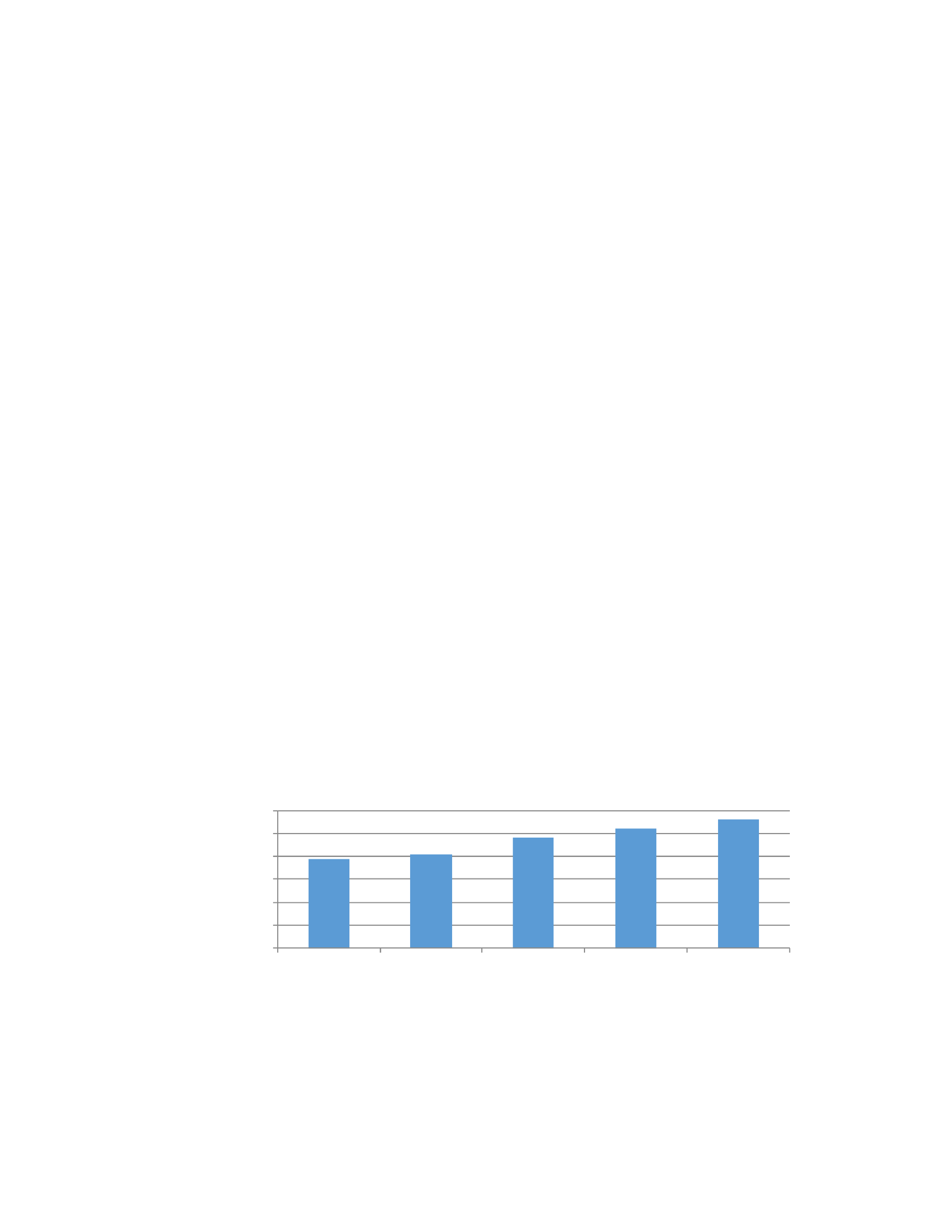
incentives to companies to provide the best products and service to the government.
Figure 2 indicates the degree of annual government spending on contracts from 2005
through 2009. As noted in Figure 2, annual government contract spending steadily
increased from 2005 through 2009.
DLA is an entity of the Department of Defense (DoD) and as such, DLA’s budget
falls within the parameters of this table. DoD spent billions of dollars each year. Based on
information listed in Figure 2, government contracting employees exercised control over
billions of dollars to administer government contracts. Government contracting spending
increase provided opportunities for government employees to do unethical business when
administering contracts. The value of a government contract may determine the amount
of spending on that contract. The greater the value of the contract, the more profit a
supplier may receive. There can be prerequisites that guide government contracting
employees when administering a large monetary value contract such as an operational
contract.
Annual Spending on Contracts ($B)
Figure 2. Summary of the U.S. Department of Defense annual contract spending from
0
100
200
300
400
500
600
2005 2006 2007 2008 2009

2005 through 2009. The above information was retrieved from
http://csis.org/files/publication/120524_DIIG_Defense_Service_Contract_Trends.pdf.
Members of various branches of the United States military often embark on joint
operations globally. As such, these operational units need emergency funds to purchase
goods and services contingent upon mission essentiality. Threats to the national security
of the United States’ afforded the Congress the opportunity to establish guidelines for
issuing operational contracts (Acquisition Central, 2014). Under a joint capabilities
determination, government contracting organizations use operational contracts to provide
goods, services, and support to joint forces of the United States during contingencies
(Acquisition Central, 2014).
Due to the spending that may occur when administering an operational contract,
Johnston and Girth (2012) assessed the prerequisites of operational government contracts
by attempting to explain why competition was not the norm with some government
contracts. Lamothe and Lamothe (2012) maintained that competition must be a
prerequisite to satisfactory contract performance. Competition drove value and efficiency
in government contracting (Johnston & Girth, 2012). Efficiency analyzes the use of
resources during a process (Gardenal, 2013). The FAR instructed that all government
contracting employees seek out competition prior to issuing government contracts (Cohn,
2011). Knowing the status of a global marketplace may offer suppliers competitive
advantages.
Organizations realize that using websites for market research when conducting
business to government transactions is advantageous (Kotler, 2011). The proliferation of

the internet with the ability to identify companies electronically surpassed traditional
exchanges (Kotler, 2011). Market research when administering government contracts
offer government contracting employees a suitable acquisition method of finding relevant
suppliers (SBA, 2014). Market research supports government contracting efforts by
providing government contracting employees with the ability to identify and utilize hard
to find information business customers and their buying behaviors (SBA, 2014).
The use of the internet to conduct market research in government contracting
organizations may create a feeling of efficiency (SBA, 2014). Web sites of professional
companies qualified to conduct business with government contracting organizations vary
significantly. Market research began with an emphasis on finding qualified suppliers to
meet government contracting organizations’ demand for commercial products (SBA,
2014). A rise in instances of government contracting scandals compelled the Congress to
established government contracting reforms that changed how government contracting
employees conduct market research (Mothershed, 2012).
With the passage of the Federal Acquisition Streamlining Act of 1994 (FASA) and
the Federal Acquisition Reform Act of 1996 (FARA), Congress changed procurement
policies for government contracting organizations (SBA, 2014). An adoption of FASA
and FARA enabled government contracting organizations to implement commercial
regulations when procuring goods and services (Lansiti, 2012). Market research permits
government contracting employees to gather information about target markets. Knowing
the target market can assist government contracting employees in determining fair and
reasonable pricing for government contracts. Although plans exist to govern the

administration of individual contracts, barriers may prevent the government contracting
employees from successfully doing their jobs.
When faced with obstacles when administering government contracts,
government contracting employees must have the tools needed to overcome the barriers.
Barriers to efficient government contracting may emerge through misunderstanding
market dynamics, government service delivery, and responsibility to society (Johnston &
Girth, 2012). Government contracting managers may intervene to improve or reduce
barriers by conveying to suppliers improvement required in contractor performance;
therefore, maximizing the scope of the contract (Johnston & Girth, 2012). An additional
barrier to efficient government contracting may be the policy of outsourcing or
contracting out government services (Smirnova & Leland, 2014). A lack of perceived
competition, when contracting out government services, reduces implementation by
government organizations (Smirnova & Leland, 2014). Contracting out of government
services made public procurement relevant to the economy (Costantino et al., 2012).
Government contracting organizations use outsourcing to seek government
services through private companies (Payton & Kennedy, 2013). Government
contractingout stresses outsourcing provisions for services such as transportation
services, garbage collection, janitorial, and similar services (Smirnova & Leland, 2014).
Contracting out government services can provide an economic benefit (Chanson &
Quelin, 2013). Given the heterogeneous nature of these services, it may be useful for
government organizations to contract out those services. Private companies can compete
for government service contracts (Johnston & Girth, 2012).

Occasions may exist for government contracting employees to manage service
contracts unethically (Curry, 2010). Government contracting employees sometimes
administer service contracts with minimal supervision (OPM, 1983). If the government
contracting employees assign quality control responsibilities to vendors, the employees
relinquish oversight of government contracting out services (Lamothe & Lamothe, 2013).
Government contracting employees must incorporate the requirements, compliance with
the law, and customer satisfaction related to the contract; these services should be
conducted ethically (Witesman & Fernandez, 2013). Through the power of the purse,
Congress authorized funds needed to manage government contracts (Manuel & Yeh,
2010).
Government contracting policies must provide clear guidelines on ethical
standards (Kidalov & Snider, 2011). Federal Acquisition Regulations contain procedures
that govern government contracting (Cohn, 2011). OMB Circular A-76 detailed the
processes for contracting out of goods and services with commercial or private interests
(OMB, 2003). Although government contracting employees may encounter barriers to
efficient government contracting, they must ethically administer government contracts to
authorized suppliers. Contracting out a requirement for goods or services to commercial
entities may entice government contracting employees to offer unapproved contracts to
unauthorized suppliers in exchange for money. However, employees must consider their
actions and the effect on all stakeholders. A government contracting manager’s
intervention may or may not be beneficial to controlling barriers in government contract
administration.

Civilians/civil servants control large sectors of the government contracting entity.
The Federal Procurement Data System – Next Generation [FPDS] (2014) revealed that
the federal government contracting organizations employ approximately 1.8 million
civilians or 16% of their workforce. Civilian control of some government contracting
may strip the organizations of the discipline required to maintain ethical standards
(Witko, 2011). The G.A.O. [U.S. GAO] (2009) reported an increase in cases of some
government contracting employees influenced to make unwarranted contracts to suppliers
in exchange for cash, gifts, and other nonmonetary awards. Reports of incidents of
mismanagement of public funds have alerted Congress to enact new laws and prompted
calls for oversight (as cited by Manuel & Yeh, 2010). To ensure suppliers’ compliance
with government contracts, government contracting employees can conduct proper
oversight. Politics may affect the distribution of government contracts. Suppliers may
Government contracting organizations must be open to competition. To execute a
standard government contracting competition process, employees must make public
announcements giving suppliers opportunities to compete for government contracts
(Acquisition Central, 2014). Figure 1 displays the standard competition process as
outlined by the FAR. Competition offers private companies opportunities to compete in a
public sphere for government contracts (Ohemeng & Grant, 2014). FAR Part 15
established requirements regarding supplier choice for government contracts (Acquisition
Central, 2014). Selecting a reputable contractor is necessary for contract management
success (Bradshaw & Chang, 2013). Government contracting employees can consider a

supplier’s past performance and reputation to determine if the supplier’s actions may
adversely affect the outcome of the contract (Acquisition Central, 2014).
In 1994, Congress passed the Federal Acquisition Streamlining Act authorizing
government contracting organizations to consider a supplier’s past performance when
evaluating determination of future contract actions (U.S. Department of Labor [DOL],
2014b). Ignorance concerning vendors’ past performance contributed to high risk in
contracting (Bradshaw & Chang, 2013). Without adequate contractor past performance
information, government contracting organizations risk duplicating contract failures
(Bradshaw & Chang, 2013). FAR Part 15 directs government contracting employees to
ensure that government contracts are competitive. Government contracting employees
must deliberate a contractor’s past acts when deciding if the supplier is eligible for a
government contract. Knowing how to manage a government contract may offer each
government contracting employee appropriate guidelines to work within the confines of
stringent government contracting regulations.
Employees who understand the requirements of government contract management
may do their job effectively. Contract management promulgates relationships between
each government contracting organization, government contracting employees, and
suppliers (SBA, 2014). Government contracting organizations might demonstrate
consistency when assessing a supplier’s eligibility for a government contract (Bradshaw
& Chang, 2013). Suppliers may help government contracting employees with processes
of contract administration provided the actions do not alter or affect other suppliers
(Acquisition Central, 2014). Government contracting organizations might develop an

understanding towards appropriate economic, social, democratic, and legal considerations
as highlighted by organizational requirements and civil law (Yang & VanLandingham,
2012).
The use of private suppliers to execute government contracts has increased in the
past decade (Schick, 2011). Government outsourcing affords private sector companies
opportunities to provide goods and services to government organizations (U.S. Office of
Management and Budget [OMB], 2003). Government contracting organizations posited
that outsourcing to private companies provides cost savings in the delivery of services
(Kidalov & Snider, 2011). The government contract is an agreement that stipulates
business communications between qualified private companies and the government
(SBA, 2014).
Since its foundation in 1953, the SBA has advocated small companies in the
United States (SBA, 2014). Small businesses are vital to the economy since they can
provide stability in economically distressed areas (Servon, Fairlie, Rastello, & Seely,
2010). Due to small businesses’ value to the economy, the SBA initiated policies and
programs to maximize small business development (Servon et al., 2010). Due to recent
financial crises, the government established public policies to support small business
concerns (Dennis, 2011). Due to the creative and innovative nature of small businesses,
economic recovery in the United States may occur (Monahan, Shah, & Mattare, 2011).

Table 1
Summary of 2008 and 2009 Small Business Procurement Scores at the SBA
2008 2009
Achievement 2009 Goal Achievement
Small business 21.50 23.00 21.89
Women-owned small business 3.39 5.00 3.68
Small Disadvantaged Business 6.76 5.00 7.57
Service-disabled veteran-owned small
Business
1.49
3.00
1.98
HUBZone
2.34
3.00
2.81
Note. The above data refer to information retrieved from http://www.sba.gov.
The SBA’s socioeconomic program monitors the following concerns:
servicedisabled veteran-owned, small disadvantaged, women-owned, HUBZone, and 8(a)
business development programs (SBA, 2014). The SBA established a list of small
business size requirements to assist companies in determining their small business status
(Acquisition Central, 2014). Under Title 13, Code of Federal Regulations, Part 121, the
SBA assessed the standards for small companies doing business with the federal
government (Government Printing Office [GPO], 2011). The SBA tracks small business
procurement status annually. As noted in Table 1, the SBA surpassed their 2008
achievements; however, in three of five socioeconomic groups, the SBA’s achievements
did not meet 2009 set goals (SBA, 2014).

Some organizations may struggle to find their place in the realm of the small
business zone. Minority owned companies might at times struggle to connect with
government organizations (Ram, Woldesenbet, & Jones, 2011). To equalize small
business growth in government contracting, the federal government created the
SmallDisadvantage Business (SDB) certification program and the Section 8(a) program
(as cited by Smith & Fernandez, 2010). These two programs allow minority-owned small
businesses to obtain government contracts.
In 2008, the SBA began enforcement of policies governing Small-Disadvantaged
businesses (SBA, 2014). To qualify as a Small-Disadvantaged business, socially or
economically disadvantaged individual must 51% or more retain the business (SBA,
2014). Under the Section 8(a) program, the government contracting agency can
distinguish contracts for certified Small-Disadvantaged companies (Smith & Fernandez,
2010). The SBA (2014) provided eight eligibility requirements for Section 8(a) program
eligibility including American citizenship, 51% or above minority-owned and displayed
an expectation for success.
The federal government developed Microenterprise Development programs
(MED) to capitalize on the entrepreneurship of Small-Disadvantaged businesses
(Monahan et al., 2011). The majority of MED businesses are women and minority owned
businesses (Monahan et al., 2011). Title VII of the Civil Rights Act of 1964 governed
minority-owned businesses. Under Title VII, minority-owned businesses might make a
disparate-impact civil rights lawsuit if a business practice adversely affects the minority
business (Biddle & Biddle, 2013). Small businesses offer ethnically diverse organizations

competitive advantage (Smallbone, Kitching, & Athayde, 2010). Ethnically diverse
organizations may increase competition in the small business arena (Smallbone et al.,
2010).
Competition in minority owned small businesses enables organizations to segment
their strategies to reduce costs and increase profits (Collins, 2011). Small businesses are
imperative to the United States economic growth. As such, the SBA created programs to
give particular groups economic advantages. The Microenterprise Development programs
allowed qualified companies to compete as Small-Disadvantaged business. As with all
other government contracting regulations, the legislative branch of the United States
government determined a need to update the requirements for small business concerns.
In 2007, the U.S. Supreme Court updated the rules as applied to Title VII. Based
on the court’s ruling, Title VII incorporated equal employment practices related to
discrimination (Bradbury, 2011). The SBA influences the moral attitude of government
contracting regarding socio-economic businesses by offering ethical recommendations to
government contracting employees and supplier (SBA, 2014). FAR Part 19 includes
regulations related to government contracting organizations working with small
businesses (Acquisition Central, 2014). To help small businesses in understanding and/or
registering to do business with government contracting organizations, the SBA provided
systems and guidelines. The FAR – Federal Acquisition Regulations; SAM –System for
Award Management; FPDS – Federal Procurement Data Systems; GSAM – General

Service Administration Manual; and ESRS – Electronic Subcontracting Reporting
System. For a small business to obtain a government contract, a small business must
ensure it is competitively ready in a global marketplace.
Competition is a basis for government contracting (Wydler et al., 2013); however,
competition for government contracts is uncertain (Johnston & Girth, 2012). Government
contracting employees anticipated that suppliers would provide services as specified in
the contract (Keeler, 2013). Therefore, government contracting employees must ensure
there is clarity in each contract (Kidalov & Snider, 2011). If provisions of the contract are
ambiguous, suppliers may apply their interpretation to the contract. Therefore,
transparency in contracting is important in assuring that contractors perform the contract
requirements as specified (Keeler, 2013).
Government contracting employees must offer clearly defined protocols that
establish criteria for a contract (Yang & VanLandingham, 2012). The SBA provided
guidance to assist small businesses desiring to do business with government
organizations. FAR Part 19 outlines to each government contracting employee precise
rules and regulations associated with doing government contracting business with small
companies. Although the FAR provides guidelines for doing business with a government
contracting organization, a concern noted is a lack of adherence to the government
contracting guidelines by contractors and government contracting employees.
As with all business ventures, government contracting employees may encounter
apprehensions and misgivings while administering government contracts. A recurring
concern regarding contracting out of government services is the integration of contractor

priorities with the responsibilities of contract administration (Keeler, 2013). Opportunism
may occur in the form of unethical conduct (Maser & Thompson, 2013). Government
contracting employees can monitor a supplier’s implementation of the contracting
requirements (Kidalov & Snider, 2011); suppliers may occasionally receive government
contracting funds but provide lackluster service (Yang & VanLandingham, 2012).
Another issue regarding contracting out of government services is a lack of
oversight (Lamothe & Lamothe, 2013). Government contracting employees must develop
strategies when offering government contracts to private suppliers. To ensure that
suppliers provide the goods or service as outlined in the contract, it is important that
government contracting employees and suppliers know the requirements of the contract.
The lack of accountability and transparencies of government outsourcing services may
require reforms to the current guidelines regarding the implementation of contracted
services (Costantino et al., 2012). A problem may exist in defining core competencies in
government contracting; political and ideological factors may affect core competency
decisions (Yang and VanLandingham, 2012).
Government contracting organizations must ensure that government contracting
employees have the tools needed to complete contracting functions (Sebastian &
Davison, 2011). When inadequate core competencies exist, there may be a rise in
customer complaints. Knowing steps to deal with a customer’s complaints may ensure
that the government contract requirements are satisfied. Customers should make
complaints regarding unfulfilled features of the contract to the government contracting
organization and not directly to the vendor (Keeler, 2013). Customer service and

customer satisfaction encompass the administration of government contracts (SBA,
2014). Ensuring customer satisfaction with all aspects of the contract must be a priority
for both the supplier and government contracting employee (SBA, 2014). Customers who
are unsatisfied with the scope of the contract may submit complaints to supervising
authorities (Keeler, 2013). A customer’s complaints of ethical violations of the agreement
might introduce liquidated damages against the supplier.
Ethical violations found when administering government service contracts contain
prohibited solicitation or acceptance of gratuities. Government organizations required
ethics when outsourcing government contracts since society expects government
contracting employees to serve the public trust by ensuring that only approved suppliers
receive government contracts (Schick, 2011). Political and economic factors may affect
government contracting out; however, government contracting employees may use
standard laws to enforce ethical management of contracts (Yang & VanLandingham,
2012). Transparency is necessary during the contracting process (Maser & Thompson,
2013). Whatever factors influence government contract administration, ensuring that
government contracting employees provide suppliers with clearly written contracts is
necessary and proper.
Congress retains required and proper authority over the government contracting
regulations. Under Article I, Section 8, Clause 18 of the Unites States Constitution,
Congress can delegate powers to the Executive Branch of the federal government (OMB,
2003). Congressional delegation of authority can change contract management; each
branch of the government connects to the other, sometimes making the lines between

politics, and public administration blurred (Rosenbloom, 2013). The Executive Branch of
the U.S. government established laws central to government contracting organizations
and entities (Acquisition Central, 2014). The laws enacted by the Congress summarized
processes for competitiveness in government contracting.
Competitive sourcing permits public/private companies to do business with the
federal government organizations (Johnston & Girth, 2012). The relationship among
public/private businesses and government entities is essential to public service
contracting (Witesman & Fernandez, 2013). Competition in government contracting
authorizes public/private companies to compete and supply of goods and services while
affording government organizations opportunities to reduce spending (Lamothe &
Lamothe, 2012). Lamothe and Lamothe (2012) assessed that competition provides
incentives to companies to provide the best products and service to the government.
Figure 2 indicates the degree of annual government spending on contracts from 2005
through 2009. As noted in Figure 2, annual government contract spending steadily
increased from 2005 through 2009.
DLA is an entity of the Department of Defense (DoD) and as such, DLA’s budget
falls within the parameters of this table. DoD spent billions of dollars each year. Based on
information listed in Figure 2, government contracting employees exercised control over
billions of dollars to administer government contracts. Government contracting spending
increase provided opportunities for government employees to do unethical business when
administering contracts. The value of a government contract may determine the amount
of spending on that contract. The greater the value of the contract, the more profit a

supplier may receive. There can be prerequisites that guide government contracting
employees when administering a large monetary value contract such as an operational
contract.
Annual Spending on Contracts ($B)
Figure 2. Summary of the U.S. Department of Defense annual contract spending from
2005 through 2009. The above information was retrieved from
http://csis.org/files/publication/120524_DIIG_Defense_Service_Contract_Trends.pdf.
Members of various branches of the United States military often embark on joint
operations globally. As such, these operational units need emergency funds to purchase
goods and services contingent upon mission essentiality. Threats to the national security
of the United States’ afforded the Congress the opportunity to establish guidelines for
issuing operational contracts (Acquisition Central, 2014). Under a joint capabilities
determination, government contracting organizations use operational contracts to provide
goods, services, and support to joint forces of the United States during contingencies
(Acquisition Central, 2014).
Due to the spending that may occur when administering an operational contract,
Johnston and Girth (2012) assessed the prerequisites of operational government contracts
0
100
200
300
400
500
600
2005 2006 2007 2008 2009

by attempting to explain why competition was not the norm with some government
contracts. Lamothe and Lamothe (2012) maintained that competition must be a
prerequisite to satisfactory contract performance. Competition drove value and efficiency
in government contracting (Johnston & Girth, 2012). Efficiency analyzes the use of
resources during a process (Gardenal, 2013). The FAR instructed that all government
contracting employees seek out competition prior to issuing government contracts (Cohn,
2011). Knowing the status of a global marketplace may offer suppliers competitive
advantages.
Organizations realize that using websites for market research when conducting
business to government transactions is advantageous (Kotler, 2011). The proliferation of
the internet with the ability to identify companies electronically surpassed traditional
exchanges (Kotler, 2011). Market research when administering government contracts
offer government contracting employees a suitable acquisition method of finding relevant
suppliers (SBA, 2014). Market research supports government contracting efforts by
providing government contracting employees with the ability to identify and utilize hard
to find information business customers and their buying behaviors (SBA, 2014).
The use of the internet to conduct market research in government contracting
organizations may create a feeling of efficiency (SBA, 2014). Web sites of professional
companies qualified to conduct business with government contracting organizations vary
significantly. Market research began with an emphasis on finding qualified suppliers to
meet government contracting organizations’ demand for commercial products (SBA,

2014). A rise in instances of government contracting scandals compelled the Congress to
established government contracting reforms that changed how government contracting
employees conduct market research (Mothershed, 2012).
With the passage of the Federal Acquisition Streamlining Act of 1994 (FASA) and
the Federal Acquisition Reform Act of 1996 (FARA), Congress changed procurement
policies for government contracting organizations (SBA, 2014). An adoption of FASA
and FARA enabled government contracting organizations to implement commercial
regulations when procuring goods and services (Lansiti, 2012). Market research permits
government contracting employees to gather information about target markets. Knowing
the target market can assist government contracting employees in determining fair and
reasonable pricing for government contracts. Although plans exist to govern the
administration of individual contracts, barriers may prevent the government contracting
employees from successfully doing their jobs.
When faced with obstacles when administering government contracts,
government contracting employees must have the tools needed to overcome the barriers.
Barriers to efficient government contracting may emerge through misunderstanding
market dynamics, government service delivery, and responsibility to society (Johnston &
Girth, 2012). Government contracting managers may intervene to improve or reduce
barriers by conveying to suppliers improvement required in contractor performance;
therefore, maximizing the scope of the contract (Johnston & Girth, 2012). An additional
barrier to efficient government contracting may be the policy of outsourcing or
contracting out government services (Smirnova & Leland, 2014). A lack of perceived

competition, when contracting out government services, reduces implementation by
government organizations (Smirnova & Leland, 2014). Contracting out of government
services made public procurement relevant to the economy (Costantino et al., 2012).
Government contracting organizations use outsourcing to seek government
services through private companies (Payton & Kennedy, 2013). Government
contractingout stresses outsourcing provisions for services such as transportation
services, garbage collection, janitorial, and similar services (Smirnova & Leland, 2014).
Contracting out government services can provide an economic benefit (Chanson &
Quelin, 2013). Given the heterogeneous nature of these services, it may be useful for
government organizations to contract out those services. Private companies can compete
for government service contracts (Johnston & Girth, 2012).
Occasions may exist for government contracting employees to manage service
contracts unethically (Curry, 2010). Government contracting employees sometimes
administer service contracts with minimal supervision (OPM, 1983). If the government
contracting employees assign quality control responsibilities to vendors, the employees
relinquish oversight of government contracting out services (Lamothe & Lamothe, 2013).
Government contracting employees must incorporate the requirements, compliance with
the law, and customer satisfaction related to the contract; these services should be
conducted ethically (Witesman & Fernandez, 2013). Through the power of the purse,
Congress authorized funds needed to manage government contracts (Manuel & Yeh,
2010).

Government contracting policies must provide clear guidelines on ethical
standards (Kidalov & Snider, 2011). Federal Acquisition Regulations contain procedures
that govern government contracting (Cohn, 2011). OMB Circular A-76 detailed the
processes for contracting out of goods and services with commercial or private interests
(OMB, 2003). Although government contracting employees may encounter barriers to
efficient government contracting, they must ethically administer government contracts to
authorized suppliers. Contracting out a requirement for goods or services to commercial
entities may entice government contracting employees to offer unapproved contracts to
unauthorized suppliers in exchange for money. However, employees must consider their
actions and the effect on all stakeholders. A government contracting manager’s
intervention may or may not be beneficial to controlling barriers in government contract
administration.
Civilians/civil servants control large sectors of the government contracting entity.
The Federal Procurement Data System – Next Generation [FPDS] (2014) revealed that
the federal government contracting organizations employ approximately 1.8 million
civilians or 16% of their workforce. Civilian control of some government contracting
may strip the organizations of the discipline required to maintain ethical standards
(Witko, 2011). The G.A.O. [U.S. GAO] (2009) reported an increase in cases of some
government contracting employees influenced to make unwarranted contracts to suppliers
in exchange for cash, gifts, and other nonmonetary awards. Reports of incidents of
mismanagement of public funds have alerted Congress to enact new laws and prompted
calls for oversight (as cited by Manuel & Yeh, 2010). To ensure suppliers’ compliance

with government contracts, government contracting employees can conduct proper
oversight. Politics may affect the distribution of government contracts. Suppliers may
Government contracting organizations must be open to competition. To execute a
standard government contracting competition process, employees must make public
announcements giving suppliers opportunities to compete for government contracts
(Acquisition Central, 2014). Figure 1 displays the standard competition process as
outlined by the FAR. Competition offers private companies opportunities to compete in a
public sphere for government contracts (Ohemeng & Grant, 2014). FAR Part 15
established requirements regarding supplier choice for government contracts (Acquisition
Central, 2014). Selecting a reputable contractor is necessary for contract management
success (Bradshaw & Chang, 2013). Government contracting employees can consider a
supplier’s past performance and reputation to determine if the supplier’s actions may
adversely affect the outcome of the contract (Acquisition Central, 2014).
In 1994, Congress passed the Federal Acquisition Streamlining Act authorizing
government contracting organizations to consider a supplier’s past performance when
evaluating determination of future contract actions (U.S. Department of Labor [DOL],
2014b). Ignorance concerning vendors’ past performance contributed to high risk in
contracting (Bradshaw & Chang, 2013). Without adequate contractor past performance
information, government contracting organizations risk duplicating contract failures
(Bradshaw & Chang, 2013). FAR Part 15 directs government contracting employees to
ensure that government contracts are competitive. Government contracting employees
must deliberate a contractor’s past acts when deciding if the supplier is eligible for a

government contract. Knowing how to manage a government contract may offer each
government contracting employee appropriate guidelines to work within the confines of
stringent government contracting regulations.
Employees who understand the requirements of government contract management
may do their job effectively. Contract management promulgates relationships between
each government contracting organization, government contracting employees, and
suppliers (SBA, 2014). Government contracting organizations might demonstrate
consistency when assessing a supplier’s eligibility for a government contract (Bradshaw
& Chang, 2013). Suppliers may help government contracting employees with processes
of contract administration provided the actions do not alter or affect other suppliers
(Acquisition Central, 2014). Government contracting organizations might develop an
understanding towards appropriate economic, social, democratic, and legal considerations
as highlighted by organizational requirements and civil law (Yang & VanLandingham,
2012).
The use of private suppliers to execute government contracts has increased in the
past decade (Schick, 2011). Government outsourcing affords private sector companies
opportunities to provide goods and services to government organizations (U.S. Office of
Management and Budget [OMB], 2003). Government contracting organizations posited
that outsourcing to private companies provides cost savings in the delivery of services
(Kidalov & Snider, 2011). The government contract is an agreement that stipulates
business communications between qualified private companies and the government
(SBA, 2014).

Since its foundation in 1953, the SBA has advocated small companies in the
United States (SBA, 2014). Small businesses are vital to the economy since they can
provide stability in economically distressed areas (Servon, Fairlie, Rastello, & Seely,
2010). Due to small businesses’ value to the economy, the SBA initiated policies and
programs to maximize small business development (Servon et al., 2010). Due to recent
financial crises, the government established public policies to support small business
concerns (Dennis, 2011). Due to the creative and innovative nature of small businesses,
economic recovery in the United States may occur (Monahan, Shah, & Mattare, 2011).
Table 1
Summary of 2008 and 2009 Small Business Procurement Scores at the SBA
2008 2009
Achievement 2009 Goal Achievement
Small business 21.50 23.00 21.89
Women-owned small business 3.39 5.00 3.68
Small Disadvantaged Business 6.76 5.00 7.57
Service-disabled veteran-owned small
Business
1.49
3.00
1.98
HUBZone
2.34
3.00
2.81
Note. The above data refer to information retrieved from http://www.sba.gov.

The SBA’s socioeconomic program monitors the following concerns:
servicedisabled veteran-owned, small disadvantaged, women-owned, HUBZone, and 8(a)
business development programs (SBA, 2014). The SBA established a list of small
business size requirements to assist companies in determining their small business status
(Acquisition Central, 2014). Under Title 13, Code of Federal Regulations, Part 121, the
SBA assessed the standards for small companies doing business with the federal
government (Government Printing Office [GPO], 2011). The SBA tracks small business
procurement status annually. As noted in Table 1, the SBA surpassed their 2008
achievements; however, in three of five socioeconomic groups, the SBA’s achievements
did not meet 2009 set goals (SBA, 2014).
Some organizations may struggle to find their place in the realm of the small
business zone. Minority owned companies might at times struggle to connect with
government organizations (Ram, Woldesenbet, & Jones, 2011). To equalize small
business growth in government contracting, the federal government created the
SmallDisadvantage Business (SDB) certification program and the Section 8(a) program
(as cited by Smith & Fernandez, 2010). These two programs allow minority-owned small
businesses to obtain government contracts.
In 2008, the SBA began enforcement of policies governing Small-Disadvantaged
businesses (SBA, 2014). To qualify as a Small-Disadvantaged business, socially or
economically disadvantaged individual must 51% or more retain the business (SBA,
2014). Under the Section 8(a) program, the government contracting agency can
distinguish contracts for certified Small-Disadvantaged companies (Smith & Fernandez,

2010). The SBA (2014) provided eight eligibility requirements for Section 8(a) program
eligibility including American citizenship, 51% or above minority-owned and displayed
an expectation for success.
The federal government developed Microenterprise Development programs
(MED) to capitalize on the entrepreneurship of Small-Disadvantaged businesses
(Monahan et al., 2011). The majority of MED businesses are women and minority owned
businesses (Monahan et al., 2011). Title VII of the Civil Rights Act of 1964 governed
minority-owned businesses. Under Title VII, minority-owned businesses might make a
disparate-impact civil rights lawsuit if a business practice adversely affects the minority
business (Biddle & Biddle, 2013). Small businesses offer ethnically diverse organizations
competitive advantage (Smallbone, Kitching, & Athayde, 2010). Ethnically diverse
organizations may increase competition in the small business arena (Smallbone et al.,
2010).
Competition in minority owned small businesses enables organizations to segment
their strategies to reduce costs and increase profits (Collins, 2011). Small businesses are
imperative to the United States economic growth. As such, the SBA created programs to
give particular groups economic advantages. The Microenterprise Development programs
allowed qualified companies to compete as Small-Disadvantaged business. As with all
other government contracting regulations, the legislative branch of the United States
government determined a need to update the requirements for small business concerns.

In 2007, the U.S. Supreme Court updated the rules as applied to Title VII. Based
on the court’s ruling, Title VII incorporated equal employment practices related to
discrimination (Bradbury, 2011). The SBA influences the moral attitude of government
contracting regarding socio-economic businesses by offering ethical recommendations to
government contracting employees and supplier (SBA, 2014). FAR Part 19 includes
regulations related to government contracting organizations working with small
businesses (Acquisition Central, 2014). To help small businesses in understanding and/or
registering to do business with government contracting organizations, the SBA provided
systems and guidelines. The FAR – Federal Acquisition Regulations; SAM –System for
Award Management; FPDS – Federal Procurement Data Systems; GSAM – General
Service Administration Manual; and ESRS – Electronic Subcontracting Reporting
System. For a small business to obtain a government contract, a small business must
ensure it is competitively ready in a global marketplace.
Competition is a basis for government contracting (Wydler et al., 2013); however,
competition for government contracts is uncertain (Johnston & Girth, 2012). Government
contracting employees anticipated that suppliers would provide services as specified in
the contract (Keeler, 2013). Therefore, government contracting employees must ensure
there is clarity in each contract (Kidalov & Snider, 2011). If provisions of the contract are
ambiguous, suppliers may apply their interpretation to the contract. Therefore,
transparency in contracting is important in assuring that contractors perform the contract
requirements as specified (Keeler, 2013).

Government contracting employees must offer clearly defined protocols that
establish criteria for a contract (Yang & VanLandingham, 2012). The SBA provided
guidance to assist small businesses desiring to do business with government
organizations. FAR Part 19 outlines to each government contracting employee precise
rules and regulations associated with doing government contracting business with small
companies. Although the FAR provides guidelines for doing business with a government
contracting organization, a concern noted is a lack of adherence to the government
contracting guidelines by contractors and government contracting employees.
As with all business ventures, government contracting employees may encounter
apprehensions and misgivings while administering government contracts. A recurring
concern regarding contracting out of government services is the integration of contractor
priorities with the responsibilities of contract administration (Keeler, 2013). Opportunism
may occur in the form of unethical conduct (Maser & Thompson, 2013). Government
contracting employees can monitor a supplier’s implementation of the contracting
requirements (Kidalov & Snider, 2011); suppliers may occasionally receive government
contracting funds but provide lackluster service (Yang & VanLandingham, 2012).
Another issue regarding contracting out of government services is a lack of
oversight (Lamothe & Lamothe, 2013). Government contracting employees must develop
strategies when offering government contracts to private suppliers. To ensure that
suppliers provide the goods or service as outlined in the contract, it is important that
government contracting employees and suppliers know the requirements of the contract.
The lack of accountability and transparencies of government outsourcing services may

require reforms to the current guidelines regarding the implementation of contracted
services (Costantino et al., 2012). A problem may exist in defining core competencies in
government contracting; political and ideological factors may affect core competency
decisions (Yang and VanLandingham, 2012).
Government contracting organizations must ensure that government contracting
employees have the tools needed to complete contracting functions (Sebastian &
Davison, 2011). When inadequate core competencies exist, there may be a rise in
customer complaints. Knowing steps to deal with a customer’s complaints may ensure
that the government contract requirements are satisfied. Customers should make
complaints regarding unfulfilled features of the contract to the government contracting
organization and not directly to the vendor (Keeler, 2013). Customer service and
customer satisfaction encompass the administration of government contracts (SBA,
2014). Ensuring customer satisfaction with all aspects of the contract must be a priority
for both the supplier and government contracting employee (SBA, 2014). Customers who
are unsatisfied with the scope of the contract may submit complaints to supervising
authorities (Keeler, 2013). A customer’s complaints of ethical violations of the agreement
might introduce liquidated damages against the supplier.
Ethical violations found when administering government service contracts contain
prohibited solicitation or acceptance of gratuities. Government organizations required
ethics when outsourcing government contracts since society expects government
contracting employees to serve the public trust by ensuring that only approved suppliers
receive government contracts (Schick, 2011). Political and economic factors may affect

government contracting out; however, government contracting employees may use
standard laws to enforce ethical management of contracts (Yang & VanLandingham,
2012). Transparency is necessary during the contracting process (Maser & Thompson,
2013). Whatever factors influence government contract administration, ensuring that
government contracting employees provide suppliers with clearly written contracts is
necessary and proper.
Congress retains required and proper authority over the government contracting
regulations. Under Article I, Section 8, Clause 18 of the Unites States Constitution,
Congress can delegate powers to the Executive Branch of the federal government (OMB,
2003). Congressional delegation of authority can change contract management; each
branch of the government connects to the other, sometimes making the lines between
politics, and public administration blurred (Rosenbloom, 2013). The Executive Branch of
the U.S. government established laws central to government contracting organizations
and entities (Acquisition Central, 2014). The laws enacted by the Congress summarized
processes for competitiveness in government contracting.
Competitive sourcing permits public/private companies to do business with the
federal government organizations (Johnston & Girth, 2012). The relationship among
public/private businesses and government entities is essential to public service
contracting (Witesman & Fernandez, 2013). Competition in government contracting
authorizes public/private companies to compete and supply of goods and services while
affording government organizations opportunities to reduce spending (Lamothe &
Lamothe, 2012). Lamothe and Lamothe (2012) assessed that competition provides
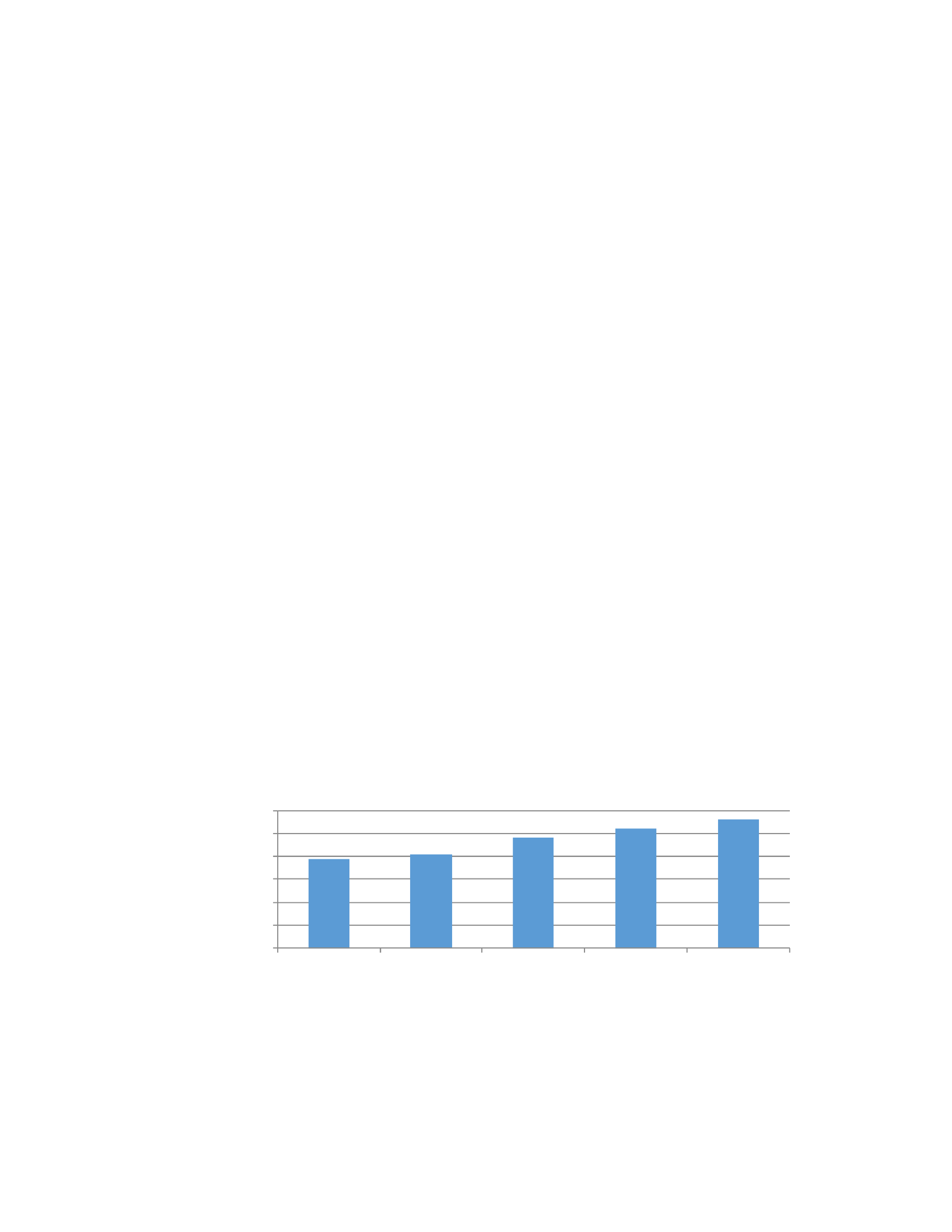
incentives to companies to provide the best products and service to the government.
Figure 2 indicates the degree of annual government spending on contracts from 2005
through 2009. As noted in Figure 2, annual government contract spending steadily
increased from 2005 through 2009.
DLA is an entity of the Department of Defense (DoD) and as such, DLA’s budget
falls within the parameters of this table. DoD spent billions of dollars each year. Based on
information listed in Figure 2, government contracting employees exercised control over
billions of dollars to administer government contracts. Government contracting spending
increase provided opportunities for government employees to do unethical business when
administering contracts. The value of a government contract may determine the amount
of spending on that contract. The greater the value of the contract, the more profit a
supplier may receive. There can be prerequisites that guide government contracting
employees when administering a large monetary value contract such as an operational
contract.
Annual Spending on Contracts ($B)
Figure 2. Summary of the U.S. Department of Defense annual contract spending from
0
100
200
300
400
500
600
2005 2006 2007 2008 2009

2005 through 2009. The above information was retrieved from
http://csis.org/files/publication/120524_DIIG_Defense_Service_Contract_Trends.pdf.
Members of various branches of the United States military often embark on joint
operations globally. As such, these operational units need emergency funds to purchase
goods and services contingent upon mission essentiality. Threats to the national security
of the United States’ afforded the Congress the opportunity to establish guidelines for
issuing operational contracts (Acquisition Central, 2014). Under a joint capabilities
determination, government contracting organizations use operational contracts to provide
goods, services, and support to joint forces of the United States during contingencies
(Acquisition Central, 2014).
Due to the spending that may occur when administering an operational contract,
Johnston and Girth (2012) assessed the prerequisites of operational government contracts
by attempting to explain why competition was not the norm with some government
contracts. Lamothe and Lamothe (2012) maintained that competition must be a
prerequisite to satisfactory contract performance. Competition drove value and efficiency
in government contracting (Johnston & Girth, 2012). Efficiency analyzes the use of
resources during a process (Gardenal, 2013). The FAR instructed that all government
contracting employees seek out competition prior to issuing government contracts (Cohn,
2011). Knowing the status of a global marketplace may offer suppliers competitive
advantages.
Organizations realize that using websites for market research when conducting
business to government transactions is advantageous (Kotler, 2011). The proliferation of

the internet with the ability to identify companies electronically surpassed traditional
exchanges (Kotler, 2011). Market research when administering government contracts
offer government contracting employees a suitable acquisition method of finding relevant
suppliers (SBA, 2014). Market research supports government contracting efforts by
providing government contracting employees with the ability to identify and utilize hard
to find information business customers and their buying behaviors (SBA, 2014).
The use of the internet to conduct market research in government contracting
organizations may create a feeling of efficiency (SBA, 2014). Web sites of professional
companies qualified to conduct business with government contracting organizations vary
significantly. Market research began with an emphasis on finding qualified suppliers to
meet government contracting organizations’ demand for commercial products (SBA,
2014). A rise in instances of government contracting scandals compelled the Congress to
established government contracting reforms that changed how government contracting
employees conduct market research (Mothershed, 2012).
With the passage of the Federal Acquisition Streamlining Act of 1994 (FASA) and
the Federal Acquisition Reform Act of 1996 (FARA), Congress changed procurement
policies for government contracting organizations (SBA, 2014). An adoption of FASA
and FARA enabled government contracting organizations to implement commercial
regulations when procuring goods and services (Lansiti, 2012). Market research permits
government contracting employees to gather information about target markets. Knowing
the target market can assist government contracting employees in determining fair and
reasonable pricing for government contracts. Although plans exist to govern the

administration of individual contracts, barriers may prevent the government contracting
employees from successfully doing their jobs.
When faced with obstacles when administering government contracts,
government contracting employees must have the tools needed to overcome the barriers.
Barriers to efficient government contracting may emerge through misunderstanding
market dynamics, government service delivery, and responsibility to society (Johnston &
Girth, 2012). Government contracting managers may intervene to improve or reduce
barriers by conveying to suppliers improvement required in contractor performance;
therefore, maximizing the scope of the contract (Johnston & Girth, 2012). An additional
barrier to efficient government contracting may be the policy of outsourcing or
contracting out government services (Smirnova & Leland, 2014). A lack of perceived
competition, when contracting out government services, reduces implementation by
government organizations (Smirnova & Leland, 2014). Contracting out of government
services made public procurement relevant to the economy (Costantino et al., 2012).
Government contracting organizations use outsourcing to seek government
services through private companies (Payton & Kennedy, 2013). Government
contractingout stresses outsourcing provisions for services such as transportation
services, garbage collection, janitorial, and similar services (Smirnova & Leland, 2014).
Contracting out government services can provide an economic benefit (Chanson &
Quelin, 2013). Given the heterogeneous nature of these services, it may be useful for
government organizations to contract out those services. Private companies can compete
for government service contracts (Johnston & Girth, 2012).

Occasions may exist for government contracting employees to manage service
contracts unethically (Curry, 2010). Government contracting employees sometimes
administer service contracts with minimal supervision (OPM, 1983). If the government
contracting employees assign quality control responsibilities to vendors, the employees
relinquish oversight of government contracting out services (Lamothe & Lamothe, 2013).
Government contracting employees must incorporate the requirements, compliance with
the law, and customer satisfaction related to the contract; these services should be
conducted ethically (Witesman & Fernandez, 2013). Through the power of the purse,
Congress authorized funds needed to manage government contracts (Manuel & Yeh,
2010).
Government contracting policies must provide clear guidelines on ethical
standards (Kidalov & Snider, 2011). Federal Acquisition Regulations contain procedures
that govern government contracting (Cohn, 2011). OMB Circular A-76 detailed the
processes for contracting out of goods and services with commercial or private interests
(OMB, 2003). Although government contracting employees may encounter barriers to
efficient government contracting, they must ethically administer government contracts to
authorized suppliers. Contracting out a requirement for goods or services to commercial
entities may entice government contracting employees to offer unapproved contracts to
unauthorized suppliers in exchange for money. However, employees must consider their
actions and the effect on all stakeholders. A government contracting manager’s
intervention may or may not be beneficial to controlling barriers in government contract
administration.

Civilians/civil servants control large sectors of the government contracting entity.
The Federal Procurement Data System – Next Generation [FPDS] (2014) revealed that
the federal government contracting organizations employ approximately 1.8 million
civilians or 16% of their workforce. Civilian control of some government contracting
may strip the organizations of the discipline required to maintain ethical standards
(Witko, 2011). The G.A.O. [U.S. GAO] (2009) reported an increase in cases of some
government contracting employees influenced to make unwarranted contracts to suppliers
in exchange for cash, gifts, and other nonmonetary awards. Reports of incidents of
mismanagement of public funds have alerted Congress to enact new laws and prompted
calls for oversight (as cited by Manuel & Yeh, 2010). To ensure suppliers’ compliance
with government contracts, government contracting employees can conduct proper
oversight. Politics may affect the distribution of government contracts. Suppliers may
Government contracting organizations must be open to competition. To execute a
standard government contracting competition process, employees must make public
announcements giving suppliers opportunities to compete for government contracts
(Acquisition Central, 2014). Figure 1 displays the standard competition process as
outlined by the FAR. Competition offers private companies opportunities to compete in a
public sphere for government contracts (Ohemeng & Grant, 2014). FAR Part 15
established requirements regarding supplier choice for government contracts (Acquisition
Central, 2014). Selecting a reputable contractor is necessary for contract management
success (Bradshaw & Chang, 2013). Government contracting employees can consider a

supplier’s past performance and reputation to determine if the supplier’s actions may
adversely affect the outcome of the contract (Acquisition Central, 2014).
In 1994, Congress passed the Federal Acquisition Streamlining Act authorizing
government contracting organizations to consider a supplier’s past performance when
evaluating determination of future contract actions (U.S. Department of Labor [DOL],
2014b). Ignorance concerning vendors’ past performance contributed to high risk in
contracting (Bradshaw & Chang, 2013). Without adequate contractor past performance
information, government contracting organizations risk duplicating contract failures
(Bradshaw & Chang, 2013). FAR Part 15 directs government contracting employees to
ensure that government contracts are competitive. Government contracting employees
must deliberate a contractor’s past acts when deciding if the supplier is eligible for a
government contract. Knowing how to manage a government contract may offer each
government contracting employee appropriate guidelines to work within the confines of
stringent government contracting regulations.
Employees who understand the requirements of government contract management
may do their job effectively. Contract management promulgates relationships between
each government contracting organization, government contracting employees, and
suppliers (SBA, 2014). Government contracting organizations might demonstrate
consistency when assessing a supplier’s eligibility for a government contract (Bradshaw
& Chang, 2013). Suppliers may help government contracting employees with processes
of contract administration provided the actions do not alter or affect other suppliers
(Acquisition Central, 2014). Government contracting organizations might develop an

understanding towards appropriate economic, social, democratic, and legal considerations
as highlighted by organizational requirements and civil law (Yang & VanLandingham,
2012).
The use of private suppliers to execute government contracts has increased in the
past decade (Schick, 2011). Government outsourcing affords private sector companies
opportunities to provide goods and services to government organizations (U.S. Office of
Management and Budget [OMB], 2003). Government contracting organizations posited
that outsourcing to private companies provides cost savings in the delivery of services
(Kidalov & Snider, 2011). The government contract is an agreement that stipulates
business communications between qualified private companies and the government
(SBA, 2014).
Since its foundation in 1953, the SBA has advocated small companies in the
United States (SBA, 2014). Small businesses are vital to the economy since they can
provide stability in economically distressed areas (Servon, Fairlie, Rastello, & Seely,
2010). Due to small businesses’ value to the economy, the SBA initiated policies and
programs to maximize small business development (Servon et al., 2010). Due to recent
financial crises, the government established public policies to support small business
concerns (Dennis, 2011). Due to the creative and innovative nature of small businesses,
economic recovery in the United States may occur (Monahan, Shah, & Mattare, 2011).

Table 1
Summary of 2008 and 2009 Small Business Procurement Scores at the SBA
2008 2009
Achievement 2009 Goal Achievement
Small business 21.50 23.00 21.89
Women-owned small business 3.39 5.00 3.68
Small Disadvantaged Business 6.76 5.00 7.57
Service-disabled veteran-owned small
Business
1.49
3.00
1.98
HUBZone
2.34
3.00
2.81
Note. The above data refer to information retrieved from http://www.sba.gov.
The SBA’s socioeconomic program monitors the following concerns:
servicedisabled veteran-owned, small disadvantaged, women-owned, HUBZone, and 8(a)
business development programs (SBA, 2014). The SBA established a list of small
business size requirements to assist companies in determining their small business status
(Acquisition Central, 2014). Under Title 13, Code of Federal Regulations, Part 121, the
SBA assessed the standards for small companies doing business with the federal
government (Government Printing Office [GPO], 2011). The SBA tracks small business
procurement status annually. As noted in Table 1, the SBA surpassed their 2008
achievements; however, in three of five socioeconomic groups, the SBA’s achievements
did not meet 2009 set goals (SBA, 2014).

Some organizations may struggle to find their place in the realm of the small
business zone. Minority owned companies might at times struggle to connect with
government organizations (Ram, Woldesenbet, & Jones, 2011). To equalize small
business growth in government contracting, the federal government created the
SmallDisadvantage Business (SDB) certification program and the Section 8(a) program
(as cited by Smith & Fernandez, 2010). These two programs allow minority-owned small
businesses to obtain government contracts.
In 2008, the SBA began enforcement of policies governing Small-Disadvantaged
businesses (SBA, 2014). To qualify as a Small-Disadvantaged business, socially or
economically disadvantaged individual must 51% or more retain the business (SBA,
2014). Under the Section 8(a) program, the government contracting agency can
distinguish contracts for certified Small-Disadvantaged companies (Smith & Fernandez,
2010). The SBA (2014) provided eight eligibility requirements for Section 8(a) program
eligibility including American citizenship, 51% or above minority-owned and displayed
an expectation for success.
The federal government developed Microenterprise Development programs
(MED) to capitalize on the entrepreneurship of Small-Disadvantaged businesses
(Monahan et al., 2011). The majority of MED businesses are women and minority owned
businesses (Monahan et al., 2011). Title VII of the Civil Rights Act of 1964 governed
minority-owned businesses. Under Title VII, minority-owned businesses might make a
disparate-impact civil rights lawsuit if a business practice adversely affects the minority
business (Biddle & Biddle, 2013). Small businesses offer ethnically diverse organizations

competitive advantage (Smallbone, Kitching, & Athayde, 2010). Ethnically diverse
organizations may increase competition in the small business arena (Smallbone et al.,
2010).
Competition in minority owned small businesses enables organizations to segment
their strategies to reduce costs and increase profits (Collins, 2011). Small businesses are
imperative to the United States economic growth. As such, the SBA created programs to
give particular groups economic advantages. The Microenterprise Development programs
allowed qualified companies to compete as Small-Disadvantaged business. As with all
other government contracting regulations, the legislative branch of the United States
government determined a need to update the requirements for small business concerns.
In 2007, the U.S. Supreme Court updated the rules as applied to Title VII. Based
on the court’s ruling, Title VII incorporated equal employment practices related to
discrimination (Bradbury, 2011). The SBA influences the moral attitude of government
contracting regarding socio-economic businesses by offering ethical recommendations to
government contracting employees and supplier (SBA, 2014). FAR Part 19 includes
regulations related to government contracting organizations working with small
businesses (Acquisition Central, 2014). To help small businesses in understanding and/or
registering to do business with government contracting organizations, the SBA provided
systems and guidelines. The FAR – Federal Acquisition Regulations; SAM –System for
Award Management; FPDS – Federal Procurement Data Systems; GSAM – General

Service Administration Manual; and ESRS – Electronic Subcontracting Reporting
System. For a small business to obtain a government contract, a small business must
ensure it is competitively ready in a global marketplace.
Competition is a basis for government contracting (Wydler et al., 2013); however,
competition for government contracts is uncertain (Johnston & Girth, 2012). Government
contracting employees anticipated that suppliers would provide services as specified in
the contract (Keeler, 2013). Therefore, government contracting employees must ensure
there is clarity in each contract (Kidalov & Snider, 2011). If provisions of the contract are
ambiguous, suppliers may apply their interpretation to the contract. Therefore,
transparency in contracting is important in assuring that contractors perform the contract
requirements as specified (Keeler, 2013).
Government contracting employees must offer clearly defined protocols that
establish criteria for a contract (Yang & VanLandingham, 2012). The SBA provided
guidance to assist small businesses desiring to do business with government
organizations. FAR Part 19 outlines to each government contracting employee precise
rules and regulations associated with doing government contracting business with small
companies. Although the FAR provides guidelines for doing business with a government
contracting organization, a concern noted is a lack of adherence to the government
contracting guidelines by contractors and government contracting employees.
As with all business ventures, government contracting employees may encounter
apprehensions and misgivings while administering government contracts. A recurring
concern regarding contracting out of government services is the integration of contractor

priorities with the responsibilities of contract administration (Keeler, 2013). Opportunism
may occur in the form of unethical conduct (Maser & Thompson, 2013). Government
contracting employees can monitor a supplier’s implementation of the contracting
requirements (Kidalov & Snider, 2011); suppliers may occasionally receive government
contracting funds but provide lackluster service (Yang & VanLandingham, 2012).
Another issue regarding contracting out of government services is a lack of
oversight (Lamothe & Lamothe, 2013). Government contracting employees must develop
strategies when offering government contracts to private suppliers. To ensure that
suppliers provide the goods or service as outlined in the contract, it is important that
government contracting employees and suppliers know the requirements of the contract.
The lack of accountability and transparencies of government outsourcing services may
require reforms to the current guidelines regarding the implementation of contracted
services (Costantino et al., 2012). A problem may exist in defining core competencies in
government contracting; political and ideological factors may affect core competency
decisions (Yang and VanLandingham, 2012).
Government contracting organizations must ensure that government contracting
employees have the tools needed to complete contracting functions (Sebastian &
Davison, 2011). When inadequate core competencies exist, there may be a rise in
customer complaints. Knowing steps to deal with a customer’s complaints may ensure
that the government contract requirements are satisfied. Customers should make
complaints regarding unfulfilled features of the contract to the government contracting
organization and not directly to the vendor (Keeler, 2013). Customer service and

customer satisfaction encompass the administration of government contracts (SBA,
2014). Ensuring customer satisfaction with all aspects of the contract must be a priority
for both the supplier and government contracting employee (SBA, 2014). Customers who
are unsatisfied with the scope of the contract may submit complaints to supervising
authorities (Keeler, 2013). A customer’s complaints of ethical violations of the agreement
might introduce liquidated damages against the supplier.
Ethical violations found when administering government service contracts contain
prohibited solicitation or acceptance of gratuities. Government organizations required
ethics when outsourcing government contracts since society expects government
contracting employees to serve the public trust by ensuring that only approved suppliers
receive government contracts (Schick, 2011). Political and economic factors may affect
government contracting out; however, government contracting employees may use
standard laws to enforce ethical management of contracts (Yang & VanLandingham,
2012). Transparency is necessary during the contracting process (Maser & Thompson,
2013). Whatever factors influence government contract administration, ensuring that
government contracting employees provide suppliers with clearly written contracts is
necessary and proper.
Congress retains required and proper authority over the government contracting
regulations. Under Article I, Section 8, Clause 18 of the Unites States Constitution,
Congress can delegate powers to the Executive Branch of the federal government (OMB,
2003). Congressional delegation of authority can change contract management; each
branch of the government connects to the other, sometimes making the lines between

politics, and public administration blurred (Rosenbloom, 2013). The Executive Branch of
the U.S. government established laws central to government contracting organizations
and entities (Acquisition Central, 2014). The laws enacted by the Congress summarized
processes for competitiveness in government contracting.
Competitive sourcing permits public/private companies to do business with the
federal government organizations (Johnston & Girth, 2012). The relationship among
public/private businesses and government entities is essential to public service
contracting (Witesman & Fernandez, 2013). Competition in government contracting
authorizes public/private companies to compete and supply of goods and services while
affording government organizations opportunities to reduce spending (Lamothe &
Lamothe, 2012). Lamothe and Lamothe (2012) assessed that competition provides
incentives to companies to provide the best products and service to the government.
Figure 2 indicates the degree of annual government spending on contracts from 2005
through 2009. As noted in Figure 2, annual government contract spending steadily
increased from 2005 through 2009.
DLA is an entity of the Department of Defense (DoD) and as such, DLA’s budget
falls within the parameters of this table. DoD spent billions of dollars each year. Based on
information listed in Figure 2, government contracting employees exercised control over
billions of dollars to administer government contracts. Government contracting spending
increase provided opportunities for government employees to do unethical business when
administering contracts. The value of a government contract may determine the amount
of spending on that contract. The greater the value of the contract, the more profit a

supplier may receive. There can be prerequisites that guide government contracting
employees when administering a large monetary value contract such as an operational
contract.
Annual Spending on Contracts ($B)
Figure 2. Summary of the U.S. Department of Defense annual contract spending from
2005 through 2009. The above information was retrieved from
http://csis.org/files/publication/120524_DIIG_Defense_Service_Contract_Trends.pdf.
Members of various branches of the United States military often embark on joint
operations globally. As such, these operational units need emergency funds to purchase
goods and services contingent upon mission essentiality. Threats to the national security
of the United States’ afforded the Congress the opportunity to establish guidelines for
issuing operational contracts (Acquisition Central, 2014). Under a joint capabilities
determination, government contracting organizations use operational contracts to provide
goods, services, and support to joint forces of the United States during contingencies
(Acquisition Central, 2014).
Due to the spending that may occur when administering an operational contract,
Johnston and Girth (2012) assessed the prerequisites of operational government contracts
0
100
200
300
400
500
600
2005 2006 2007 2008 2009

by attempting to explain why competition was not the norm with some government
contracts. Lamothe and Lamothe (2012) maintained that competition must be a
prerequisite to satisfactory contract performance. Competition drove value and efficiency
in government contracting (Johnston & Girth, 2012). Efficiency analyzes the use of
resources during a process (Gardenal, 2013). The FAR instructed that all government
contracting employees seek out competition prior to issuing government contracts (Cohn,
2011). Knowing the status of a global marketplace may offer suppliers competitive
advantages.
Organizations realize that using websites for market research when conducting
business to government transactions is advantageous (Kotler, 2011). The proliferation of
the internet with the ability to identify companies electronically surpassed traditional
exchanges (Kotler, 2011). Market research when administering government contracts
offer government contracting employees a suitable acquisition method of finding relevant
suppliers (SBA, 2014). Market research supports government contracting efforts by
providing government contracting employees with the ability to identify and utilize hard
to find information business customers and their buying behaviors (SBA, 2014).
The use of the internet to conduct market research in government contracting
organizations may create a feeling of efficiency (SBA, 2014). Web sites of professional
companies qualified to conduct business with government contracting organizations vary
significantly. Market research began with an emphasis on finding qualified suppliers to
meet government contracting organizations’ demand for commercial products (SBA,

2014). A rise in instances of government contracting scandals compelled the Congress to
established government contracting reforms that changed how government contracting
employees conduct market research (Mothershed, 2012).
With the passage of the Federal Acquisition Streamlining Act of 1994 (FASA) and
the Federal Acquisition Reform Act of 1996 (FARA), Congress changed procurement
policies for government contracting organizations (SBA, 2014). An adoption of FASA
and FARA enabled government contracting organizations to implement commercial
regulations when procuring goods and services (Lansiti, 2012). Market research permits
government contracting employees to gather information about target markets. Knowing
the target market can assist government contracting employees in determining fair and
reasonable pricing for government contracts. Although plans exist to govern the
administration of individual contracts, barriers may prevent the government contracting
employees from successfully doing their jobs.
When faced with obstacles when administering government contracts,
government contracting employees must have the tools needed to overcome the barriers.
Barriers to efficient government contracting may emerge through misunderstanding
market dynamics, government service delivery, and responsibility to society (Johnston &
Girth, 2012). Government contracting managers may intervene to improve or reduce
barriers by conveying to suppliers improvement required in contractor performance;
therefore, maximizing the scope of the contract (Johnston & Girth, 2012). An additional
barrier to efficient government contracting may be the policy of outsourcing or
contracting out government services (Smirnova & Leland, 2014). A lack of perceived

competition, when contracting out government services, reduces implementation by
government organizations (Smirnova & Leland, 2014). Contracting out of government
services made public procurement relevant to the economy (Costantino et al., 2012).
Government contracting organizations use outsourcing to seek government
services through private companies (Payton & Kennedy, 2013). Government
contractingout stresses outsourcing provisions for services such as transportation
services, garbage collection, janitorial, and similar services (Smirnova & Leland, 2014).
Contracting out government services can provide an economic benefit (Chanson &
Quelin, 2013). Given the heterogeneous nature of these services, it may be useful for
government organizations to contract out those services. Private companies can compete
for government service contracts (Johnston & Girth, 2012).
Occasions may exist for government contracting employees to manage service
contracts unethically (Curry, 2010). Government contracting employees sometimes
administer service contracts with minimal supervision (OPM, 1983). If the government
contracting employees assign quality control responsibilities to vendors, the employees
relinquish oversight of government contracting out services (Lamothe & Lamothe, 2013).
Government contracting employees must incorporate the requirements, compliance with
the law, and customer satisfaction related to the contract; these services should be
conducted ethically (Witesman & Fernandez, 2013). Through the power of the purse,
Congress authorized funds needed to manage government contracts (Manuel & Yeh,
2010).

Government contracting policies must provide clear guidelines on ethical
standards (Kidalov & Snider, 2011). Federal Acquisition Regulations contain procedures
that govern government contracting (Cohn, 2011). OMB Circular A-76 detailed the
processes for contracting out of goods and services with commercial or private interests
(OMB, 2003). Although government contracting employees may encounter barriers to
efficient government contracting, they must ethically administer government contracts to
authorized suppliers. Contracting out a requirement for goods or services to commercial
entities may entice government contracting employees to offer unapproved contracts to
unauthorized suppliers in exchange for money. However, employees must consider their
actions and the effect on all stakeholders. A government contracting manager’s
intervention may or may not be beneficial to controlling barriers in government contract
administration.
Civilians/civil servants control large sectors of the government contracting entity.
The Federal Procurement Data System – Next Generation [FPDS] (2014) revealed that
the federal government contracting organizations employ approximately 1.8 million
civilians or 16% of their workforce. Civilian control of some government contracting
may strip the organizations of the discipline required to maintain ethical standards
(Witko, 2011). The G.A.O. [U.S. GAO] (2009) reported an increase in cases of some
government contracting employees influenced to make unwarranted contracts to suppliers
in exchange for cash, gifts, and other nonmonetary awards. Reports of incidents of
mismanagement of public funds have alerted Congress to enact new laws and prompted
calls for oversight (as cited by Manuel & Yeh, 2010). To ensure suppliers’ compliance

with government contracts, government contracting employees can conduct proper
oversight. Politics may affect the distribution of government contracts. Suppliers may
Government contracting organizations must be open to competition. To execute a
standard government contracting competition process, employees must make public
announcements giving suppliers opportunities to compete for government contracts
(Acquisition Central, 2014). Figure 1 displays the standard competition process as
outlined by the FAR. Competition offers private companies opportunities to compete in a
public sphere for government contracts (Ohemeng & Grant, 2014). FAR Part 15
established requirements regarding supplier choice for government contracts (Acquisition
Central, 2014). Selecting a reputable contractor is necessary for contract management
success (Bradshaw & Chang, 2013). Government contracting employees can consider a
supplier’s past performance and reputation to determine if the supplier’s actions may
adversely affect the outcome of the contract (Acquisition Central, 2014).
In 1994, Congress passed the Federal Acquisition Streamlining Act authorizing
government contracting organizations to consider a supplier’s past performance when
evaluating determination of future contract actions (U.S. Department of Labor [DOL],
2014b). Ignorance concerning vendors’ past performance contributed to high risk in
contracting (Bradshaw & Chang, 2013). Without adequate contractor past performance
information, government contracting organizations risk duplicating contract failures
(Bradshaw & Chang, 2013). FAR Part 15 directs government contracting employees to
ensure that government contracts are competitive. Government contracting employees
must deliberate a contractor’s past acts when deciding if the supplier is eligible for a

government contract. Knowing how to manage a government contract may offer each
government contracting employee appropriate guidelines to work within the confines of
stringent government contracting regulations.
Employees who understand the requirements of government contract management
may do their job effectively. Contract management promulgates relationships between
each government contracting organization, government contracting employees, and
suppliers (SBA, 2014). Government contracting organizations might demonstrate
consistency when assessing a supplier’s eligibility for a government contract (Bradshaw
& Chang, 2013). Suppliers may help government contracting employees with processes
of contract administration provided the actions do not alter or affect other suppliers
(Acquisition Central, 2014). Government contracting organizations might develop an
understanding towards appropriate economic, social, democratic, and legal considerations
as highlighted by organizational requirements and civil law (Yang & VanLandingham,
2012).
The use of private suppliers to execute government contracts has increased in the
past decade (Schick, 2011). Government outsourcing affords private sector companies
opportunities to provide goods and services to government organizations (U.S. Office of
Management and Budget [OMB], 2003). Government contracting organizations posited
that outsourcing to private companies provides cost savings in the delivery of services
(Kidalov & Snider, 2011). The government contract is an agreement that stipulates
business communications between qualified private companies and the government
(SBA, 2014).

Since its foundation in 1953, the SBA has advocated small companies in the
United States (SBA, 2014). Small businesses are vital to the economy since they can
provide stability in economically distressed areas (Servon, Fairlie, Rastello, & Seely,
2010). Due to small businesses’ value to the economy, the SBA initiated policies and
programs to maximize small business development (Servon et al., 2010). Due to recent
financial crises, the government established public policies to support small business
concerns (Dennis, 2011). Due to the creative and innovative nature of small businesses,
economic recovery in the United States may occur (Monahan, Shah, & Mattare, 2011).
Table 1
Summary of 2008 and 2009 Small Business Procurement Scores at the SBA
2008 2009
Achievement 2009 Goal Achievement
Small business 21.50 23.00 21.89
Women-owned small business 3.39 5.00 3.68
Small Disadvantaged Business 6.76 5.00 7.57
Service-disabled veteran-owned small
Business
1.49
3.00
1.98
HUBZone
2.34
3.00
2.81
Note. The above data refer to information retrieved from http://www.sba.gov.

The SBA’s socioeconomic program monitors the following concerns:
servicedisabled veteran-owned, small disadvantaged, women-owned, HUBZone, and 8(a)
business development programs (SBA, 2014). The SBA established a list of small
business size requirements to assist companies in determining their small business status
(Acquisition Central, 2014). Under Title 13, Code of Federal Regulations, Part 121, the
SBA assessed the standards for small companies doing business with the federal
government (Government Printing Office [GPO], 2011). The SBA tracks small business
procurement status annually. As noted in Table 1, the SBA surpassed their 2008
achievements; however, in three of five socioeconomic groups, the SBA’s achievements
did not meet 2009 set goals (SBA, 2014).
Some organizations may struggle to find their place in the realm of the small
business zone. Minority owned companies might at times struggle to connect with
government organizations (Ram, Woldesenbet, & Jones, 2011). To equalize small
business growth in government contracting, the federal government created the
SmallDisadvantage Business (SDB) certification program and the Section 8(a) program
(as cited by Smith & Fernandez, 2010). These two programs allow minority-owned small
businesses to obtain government contracts.
In 2008, the SBA began enforcement of policies governing Small-Disadvantaged
businesses (SBA, 2014). To qualify as a Small-Disadvantaged business, socially or
economically disadvantaged individual must 51% or more retain the business (SBA,
2014). Under the Section 8(a) program, the government contracting agency can
distinguish contracts for certified Small-Disadvantaged companies (Smith & Fernandez,

2010). The SBA (2014) provided eight eligibility requirements for Section 8(a) program
eligibility including American citizenship, 51% or above minority-owned and displayed
an expectation for success.
The federal government developed Microenterprise Development programs
(MED) to capitalize on the entrepreneurship of Small-Disadvantaged businesses
(Monahan et al., 2011). The majority of MED businesses are women and minority owned
businesses (Monahan et al., 2011). Title VII of the Civil Rights Act of 1964 governed
minority-owned businesses. Under Title VII, minority-owned businesses might make a
disparate-impact civil rights lawsuit if a business practice adversely affects the minority
business (Biddle & Biddle, 2013). Small businesses offer ethnically diverse organizations
competitive advantage (Smallbone, Kitching, & Athayde, 2010). Ethnically diverse
organizations may increase competition in the small business arena (Smallbone et al.,
2010).
Competition in minority owned small businesses enables organizations to segment
their strategies to reduce costs and increase profits (Collins, 2011). Small businesses are
imperative to the United States economic growth. As such, the SBA created programs to
give particular groups economic advantages. The Microenterprise Development programs
allowed qualified companies to compete as Small-Disadvantaged business. As with all
other government contracting regulations, the legislative branch of the United States
government determined a need to update the requirements for small business concerns.

In 2007, the U.S. Supreme Court updated the rules as applied to Title VII. Based
on the court’s ruling, Title VII incorporated equal employment practices related to
discrimination (Bradbury, 2011). The SBA influences the moral attitude of government
contracting regarding socio-economic businesses by offering ethical recommendations to
government contracting employees and supplier (SBA, 2014). FAR Part 19 includes
regulations related to government contracting organizations working with small
businesses (Acquisition Central, 2014). To help small businesses in understanding and/or
registering to do business with government contracting organizations, the SBA provided
systems and guidelines. The FAR – Federal Acquisition Regulations; SAM –System for
Award Management; FPDS – Federal Procurement Data Systems; GSAM – General
Service Administration Manual; and ESRS – Electronic Subcontracting Reporting
System. For a small business to obtain a government contract, a small business must
ensure it is competitively ready in a global marketplace.
Competition is a basis for government contracting (Wydler et al., 2013); however,
competition for government contracts is uncertain (Johnston & Girth, 2012). Government
contracting employees anticipated that suppliers would provide services as specified in
the contract (Keeler, 2013). Therefore, government contracting employees must ensure
there is clarity in each contract (Kidalov & Snider, 2011). If provisions of the contract are
ambiguous, suppliers may apply their interpretation to the contract. Therefore,
transparency in contracting is important in assuring that contractors perform the contract
requirements as specified (Keeler, 2013).

Government contracting employees must offer clearly defined protocols that
establish criteria for a contract (Yang & VanLandingham, 2012). The SBA provided
guidance to assist small businesses desiring to do business with government
organizations. FAR Part 19 outlines to each government contracting employee precise
rules and regulations associated with doing government contracting business with small
companies. Although the FAR provides guidelines for doing business with a government
contracting organization, a concern noted is a lack of adherence to the government
contracting guidelines by contractors and government contracting employees.
As with all business ventures, government contracting employees may encounter
apprehensions and misgivings while administering government contracts. A recurring
concern regarding contracting out of government services is the integration of contractor
priorities with the responsibilities of contract administration (Keeler, 2013). Opportunism
may occur in the form of unethical conduct (Maser & Thompson, 2013). Government
contracting employees can monitor a supplier’s implementation of the contracting
requirements (Kidalov & Snider, 2011); suppliers may occasionally receive government
contracting funds but provide lackluster service (Yang & VanLandingham, 2012).
Another issue regarding contracting out of government services is a lack of
oversight (Lamothe & Lamothe, 2013). Government contracting employees must develop
strategies when offering government contracts to private suppliers. To ensure that
suppliers provide the goods or service as outlined in the contract, it is important that
government contracting employees and suppliers know the requirements of the contract.
The lack of accountability and transparencies of government outsourcing services may

require reforms to the current guidelines regarding the implementation of contracted
services (Costantino et al., 2012). A problem may exist in defining core competencies in
government contracting; political and ideological factors may affect core competency
decisions (Yang and VanLandingham, 2012).
Government contracting organizations must ensure that government contracting
employees have the tools needed to complete contracting functions (Sebastian &
Davison, 2011). When inadequate core competencies exist, there may be a rise in
customer complaints. Knowing steps to deal with a customer’s complaints may ensure
that the government contract requirements are satisfied. Customers should make
complaints regarding unfulfilled features of the contract to the government contracting
organization and not directly to the vendor (Keeler, 2013). Customer service and
customer satisfaction encompass the administration of government contracts (SBA,
2014). Ensuring customer satisfaction with all aspects of the contract must be a priority
for both the supplier and government contracting employee (SBA, 2014). Customers who
are unsatisfied with the scope of the contract may submit complaints to supervising
authorities (Keeler, 2013). A customer’s complaints of ethical violations of the agreement
might introduce liquidated damages against the supplier.
Ethical violations found when administering government service contracts contain
prohibited solicitation or acceptance of gratuities. Government organizations required
ethics when outsourcing government contracts since society expects government
contracting employees to serve the public trust by ensuring that only approved suppliers
receive government contracts (Schick, 2011). Political and economic factors may affect

government contracting out; however, government contracting employees may use
standard laws to enforce ethical management of contracts (Yang & VanLandingham,
2012). Transparency is necessary during the contracting process (Maser & Thompson,
2013). Whatever factors influence government contract administration, ensuring that
government contracting employees provide suppliers with clearly written contracts is
necessary and proper.
Congress retains required and proper authority over the government contracting
regulations. Under Article I, Section 8, Clause 18 of the Unites States Constitution,
Congress can delegate powers to the Executive Branch of the federal government (OMB,
2003). Congressional delegation of authority can change contract management; each
branch of the government connects to the other, sometimes making the lines between
politics, and public administration blurred (Rosenbloom, 2013). The Executive Branch of
the U.S. government established laws central to government contracting organizations
and entities (Acquisition Central, 2014). The laws enacted by the Congress summarized
processes for competitiveness in government contracting.
Competitive sourcing permits public/private companies to do business with the
federal government organizations (Johnston & Girth, 2012). The relationship among
public/private businesses and government entities is essential to public service
contracting (Witesman & Fernandez, 2013). Competition in government contracting
authorizes public/private companies to compete and supply of goods and services while
affording government organizations opportunities to reduce spending (Lamothe &
Lamothe, 2012). Lamothe and Lamothe (2012) assessed that competition provides
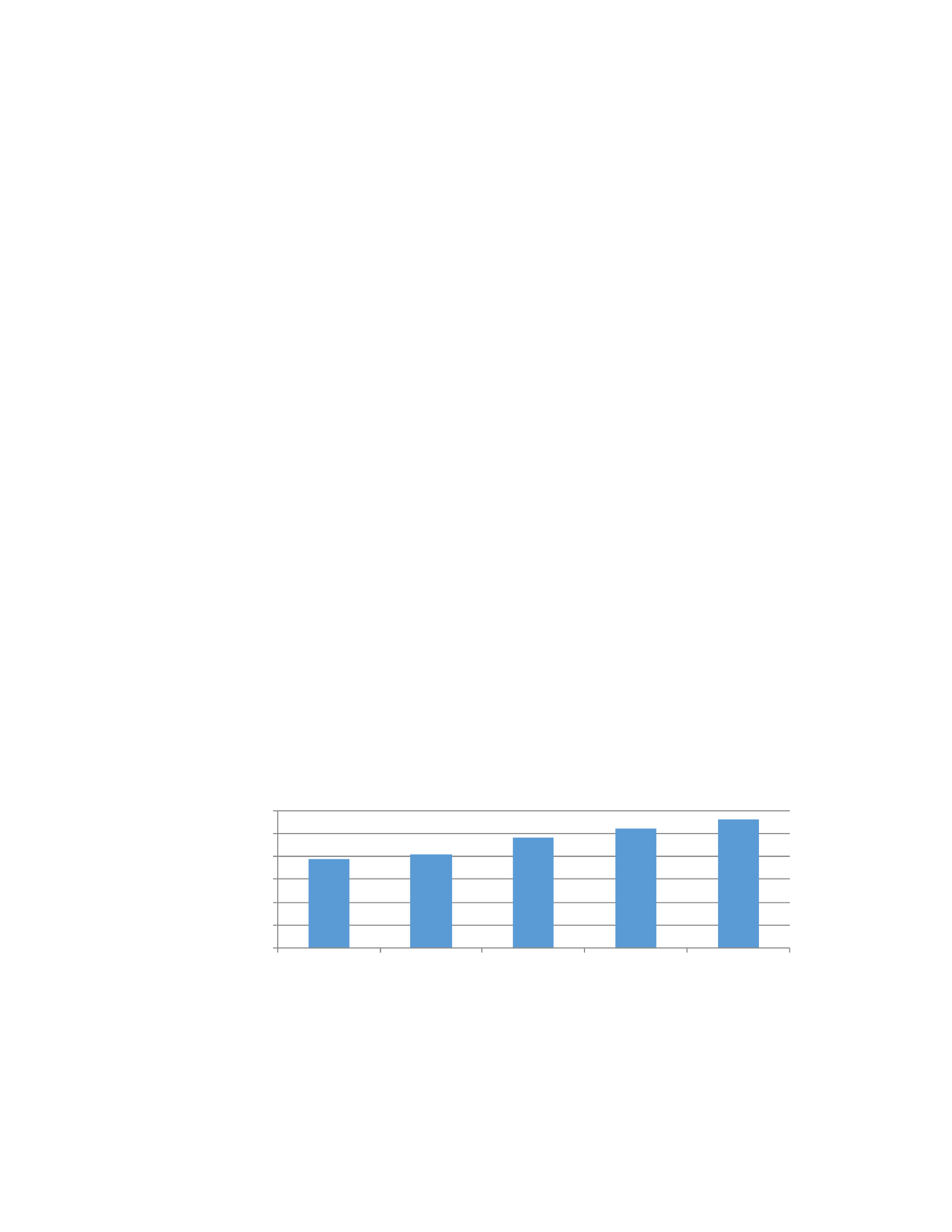
incentives to companies to provide the best products and service to the government.
Figure 2 indicates the degree of annual government spending on contracts from 2005
through 2009. As noted in Figure 2, annual government contract spending steadily
increased from 2005 through 2009.
DLA is an entity of the Department of Defense (DoD) and as such, DLA’s budget
falls within the parameters of this table. DoD spent billions of dollars each year. Based on
information listed in Figure 2, government contracting employees exercised control over
billions of dollars to administer government contracts. Government contracting spending
increase provided opportunities for government employees to do unethical business when
administering contracts. The value of a government contract may determine the amount
of spending on that contract. The greater the value of the contract, the more profit a
supplier may receive. There can be prerequisites that guide government contracting
employees when administering a large monetary value contract such as an operational
contract.
Annual Spending on Contracts ($B)
Figure 2. Summary of the U.S. Department of Defense annual contract spending from
0
100
200
300
400
500
600
2005 2006 2007 2008 2009

2005 through 2009. The above information was retrieved from
http://csis.org/files/publication/120524_DIIG_Defense_Service_Contract_Trends.pdf.
Members of various branches of the United States military often embark on joint
operations globally. As such, these operational units need emergency funds to purchase
goods and services contingent upon mission essentiality. Threats to the national security
of the United States’ afforded the Congress the opportunity to establish guidelines for
issuing operational contracts (Acquisition Central, 2014). Under a joint capabilities
determination, government contracting organizations use operational contracts to provide
goods, services, and support to joint forces of the United States during contingencies
(Acquisition Central, 2014).
Due to the spending that may occur when administering an operational contract,
Johnston and Girth (2012) assessed the prerequisites of operational government contracts
by attempting to explain why competition was not the norm with some government
contracts. Lamothe and Lamothe (2012) maintained that competition must be a
prerequisite to satisfactory contract performance. Competition drove value and efficiency
in government contracting (Johnston & Girth, 2012). Efficiency analyzes the use of
resources during a process (Gardenal, 2013). The FAR instructed that all government
contracting employees seek out competition prior to issuing government contracts (Cohn,
2011). Knowing the status of a global marketplace may offer suppliers competitive
advantages.
Organizations realize that using websites for market research when conducting
business to government transactions is advantageous (Kotler, 2011). The proliferation of

the internet with the ability to identify companies electronically surpassed traditional
exchanges (Kotler, 2011). Market research when administering government contracts
offer government contracting employees a suitable acquisition method of finding relevant
suppliers (SBA, 2014). Market research supports government contracting efforts by
providing government contracting employees with the ability to identify and utilize hard
to find information business customers and their buying behaviors (SBA, 2014).
The use of the internet to conduct market research in government contracting
organizations may create a feeling of efficiency (SBA, 2014). Web sites of professional
companies qualified to conduct business with government contracting organizations vary
significantly. Market research began with an emphasis on finding qualified suppliers to
meet government contracting organizations’ demand for commercial products (SBA,
2014). A rise in instances of government contracting scandals compelled the Congress to
established government contracting reforms that changed how government contracting
employees conduct market research (Mothershed, 2012).
With the passage of the Federal Acquisition Streamlining Act of 1994 (FASA) and
the Federal Acquisition Reform Act of 1996 (FARA), Congress changed procurement
policies for government contracting organizations (SBA, 2014). An adoption of FASA
and FARA enabled government contracting organizations to implement commercial
regulations when procuring goods and services (Lansiti, 2012). Market research permits
government contracting employees to gather information about target markets. Knowing
the target market can assist government contracting employees in determining fair and
reasonable pricing for government contracts. Although plans exist to govern the

administration of individual contracts, barriers may prevent the government contracting
employees from successfully doing their jobs.
When faced with obstacles when administering government contracts,
government contracting employees must have the tools needed to overcome the barriers.
Barriers to efficient government contracting may emerge through misunderstanding
market dynamics, government service delivery, and responsibility to society (Johnston &
Girth, 2012). Government contracting managers may intervene to improve or reduce
barriers by conveying to suppliers improvement required in contractor performance;
therefore, maximizing the scope of the contract (Johnston & Girth, 2012). An additional
barrier to efficient government contracting may be the policy of outsourcing or
contracting out government services (Smirnova & Leland, 2014). A lack of perceived
competition, when contracting out government services, reduces implementation by
government organizations (Smirnova & Leland, 2014). Contracting out of government
services made public procurement relevant to the economy (Costantino et al., 2012).
Government contracting organizations use outsourcing to seek government
services through private companies (Payton & Kennedy, 2013). Government
contractingout stresses outsourcing provisions for services such as transportation
services, garbage collection, janitorial, and similar services (Smirnova & Leland, 2014).
Contracting out government services can provide an economic benefit (Chanson &
Quelin, 2013). Given the heterogeneous nature of these services, it may be useful for
government organizations to contract out those services. Private companies can compete
for government service contracts (Johnston & Girth, 2012).

Occasions may exist for government contracting employees to manage service
contracts unethically (Curry, 2010). Government contracting employees sometimes
administer service contracts with minimal supervision (OPM, 1983). If the government
contracting employees assign quality control responsibilities to vendors, the employees
relinquish oversight of government contracting out services (Lamothe & Lamothe, 2013).
Government contracting employees must incorporate the requirements, compliance with
the law, and customer satisfaction related to the contract; these services should be
conducted ethically (Witesman & Fernandez, 2013). Through the power of the purse,
Congress authorized funds needed to manage government contracts (Manuel & Yeh,
2010).
Government contracting policies must provide clear guidelines on ethical
standards (Kidalov & Snider, 2011). Federal Acquisition Regulations contain procedures
that govern government contracting (Cohn, 2011). OMB Circular A-76 detailed the
processes for contracting out of goods and services with commercial or private interests
(OMB, 2003). Although government contracting employees may encounter barriers to
efficient government contracting, they must ethically administer government contracts to
authorized suppliers. Contracting out a requirement for goods or services to commercial
entities may entice government contracting employees to offer unapproved contracts to
unauthorized suppliers in exchange for money. However, employees must consider their
actions and the effect on all stakeholders. A government contracting manager’s
intervention may or may not be beneficial to controlling barriers in government contract
administration.

Civilians/civil servants control large sectors of the government contracting entity.
The Federal Procurement Data System – Next Generation [FPDS] (2014) revealed that
the federal government contracting organizations employ approximately 1.8 million
civilians or 16% of their workforce. Civilian control of some government contracting
may strip the organizations of the discipline required to maintain ethical standards
(Witko, 2011). The G.A.O. [U.S. GAO] (2009) reported an increase in cases of some
government contracting employees influenced to make unwarranted contracts to suppliers
in exchange for cash, gifts, and other nonmonetary awards. Reports of incidents of
mismanagement of public funds have alerted Congress to enact new laws and prompted
calls for oversight (as cited by Manuel & Yeh, 2010). To ensure suppliers’ compliance
with government contracts, government contracting employees can conduct proper
oversight. Politics may affect the distribution of government contracts. Suppliers may
Government contracting organizations must be open to competition. To execute a
standard government contracting competition process, employees must make public
announcements giving suppliers opportunities to compete for government contracts
(Acquisition Central, 2014). Figure 1 displays the standard competition process as
outlined by the FAR. Competition offers private companies opportunities to compete in a
public sphere for government contracts (Ohemeng & Grant, 2014). FAR Part 15
established requirements regarding supplier choice for government contracts (Acquisition
Central, 2014). Selecting a reputable contractor is necessary for contract management
success (Bradshaw & Chang, 2013). Government contracting employees can consider a

supplier’s past performance and reputation to determine if the supplier’s actions may
adversely affect the outcome of the contract (Acquisition Central, 2014).
In 1994, Congress passed the Federal Acquisition Streamlining Act authorizing
government contracting organizations to consider a supplier’s past performance when
evaluating determination of future contract actions (U.S. Department of Labor [DOL],
2014b). Ignorance concerning vendors’ past performance contributed to high risk in
contracting (Bradshaw & Chang, 2013). Without adequate contractor past performance
information, government contracting organizations risk duplicating contract failures
(Bradshaw & Chang, 2013). FAR Part 15 directs government contracting employees to
ensure that government contracts are competitive. Government contracting employees
must deliberate a contractor’s past acts when deciding if the supplier is eligible for a
government contract. Knowing how to manage a government contract may offer each
government contracting employee appropriate guidelines to work within the confines of
stringent government contracting regulations.
Employees who understand the requirements of government contract management
may do their job effectively. Contract management promulgates relationships between
each government contracting organization, government contracting employees, and
suppliers (SBA, 2014). Government contracting organizations might demonstrate
consistency when assessing a supplier’s eligibility for a government contract (Bradshaw
& Chang, 2013). Suppliers may help government contracting employees with processes
of contract administration provided the actions do not alter or affect other suppliers
(Acquisition Central, 2014). Government contracting organizations might develop an

understanding towards appropriate economic, social, democratic, and legal considerations
as highlighted by organizational requirements and civil law (Yang & VanLandingham,
2012).
The use of private suppliers to execute government contracts has increased in the
past decade (Schick, 2011). Government outsourcing affords private sector companies
opportunities to provide goods and services to government organizations (U.S. Office of
Management and Budget [OMB], 2003). Government contracting organizations posited
that outsourcing to private companies provides cost savings in the delivery of services
(Kidalov & Snider, 2011). The government contract is an agreement that stipulates
business communications between qualified private companies and the government
(SBA, 2014).
Since its foundation in 1953, the SBA has advocated small companies in the
United States (SBA, 2014). Small businesses are vital to the economy since they can
provide stability in economically distressed areas (Servon, Fairlie, Rastello, & Seely,
2010). Due to small businesses’ value to the economy, the SBA initiated policies and
programs to maximize small business development (Servon et al., 2010). Due to recent
financial crises, the government established public policies to support small business
concerns (Dennis, 2011). Due to the creative and innovative nature of small businesses,
economic recovery in the United States may occur (Monahan, Shah, & Mattare, 2011).

Table 1
Summary of 2008 and 2009 Small Business Procurement Scores at the SBA
2008 2009
Achievement 2009 Goal Achievement
Small business 21.50 23.00 21.89
Women-owned small business 3.39 5.00 3.68
Small Disadvantaged Business 6.76 5.00 7.57
Service-disabled veteran-owned small
Business
1.49
3.00
1.98
HUBZone
2.34
3.00
2.81
Note. The above data refer to information retrieved from http://www.sba.gov.
The SBA’s socioeconomic program monitors the following concerns:
servicedisabled veteran-owned, small disadvantaged, women-owned, HUBZone, and 8(a)
business development programs (SBA, 2014). The SBA established a list of small
business size requirements to assist companies in determining their small business status
(Acquisition Central, 2014). Under Title 13, Code of Federal Regulations, Part 121, the
SBA assessed the standards for small companies doing business with the federal
government (Government Printing Office [GPO], 2011). The SBA tracks small business
procurement status annually. As noted in Table 1, the SBA surpassed their 2008
achievements; however, in three of five socioeconomic groups, the SBA’s achievements
did not meet 2009 set goals (SBA, 2014).

Some organizations may struggle to find their place in the realm of the small
business zone. Minority owned companies might at times struggle to connect with
government organizations (Ram, Woldesenbet, & Jones, 2011). To equalize small
business growth in government contracting, the federal government created the
SmallDisadvantage Business (SDB) certification program and the Section 8(a) program
(as cited by Smith & Fernandez, 2010). These two programs allow minority-owned small
businesses to obtain government contracts.
In 2008, the SBA began enforcement of policies governing Small-Disadvantaged
businesses (SBA, 2014). To qualify as a Small-Disadvantaged business, socially or
economically disadvantaged individual must 51% or more retain the business (SBA,
2014). Under the Section 8(a) program, the government contracting agency can
distinguish contracts for certified Small-Disadvantaged companies (Smith & Fernandez,
2010). The SBA (2014) provided eight eligibility requirements for Section 8(a) program
eligibility including American citizenship, 51% or above minority-owned and displayed
an expectation for success.
The federal government developed Microenterprise Development programs
(MED) to capitalize on the entrepreneurship of Small-Disadvantaged businesses
(Monahan et al., 2011). The majority of MED businesses are women and minority owned
businesses (Monahan et al., 2011). Title VII of the Civil Rights Act of 1964 governed
minority-owned businesses. Under Title VII, minority-owned businesses might make a
disparate-impact civil rights lawsuit if a business practice adversely affects the minority
business (Biddle & Biddle, 2013). Small businesses offer ethnically diverse organizations

competitive advantage (Smallbone, Kitching, & Athayde, 2010). Ethnically diverse
organizations may increase competition in the small business arena (Smallbone et al.,
2010).
Competition in minority owned small businesses enables organizations to segment
their strategies to reduce costs and increase profits (Collins, 2011). Small businesses are
imperative to the United States economic growth. As such, the SBA created programs to
give particular groups economic advantages. The Microenterprise Development programs
allowed qualified companies to compete as Small-Disadvantaged business. As with all
other government contracting regulations, the legislative branch of the United States
government determined a need to update the requirements for small business concerns.
In 2007, the U.S. Supreme Court updated the rules as applied to Title VII. Based
on the court’s ruling, Title VII incorporated equal employment practices related to
discrimination (Bradbury, 2011). The SBA influences the moral attitude of government
contracting regarding socio-economic businesses by offering ethical recommendations to
government contracting employees and supplier (SBA, 2014). FAR Part 19 includes
regulations related to government contracting organizations working with small
businesses (Acquisition Central, 2014). To help small businesses in understanding and/or
registering to do business with government contracting organizations, the SBA provided
systems and guidelines. The FAR – Federal Acquisition Regulations; SAM –System for
Award Management; FPDS – Federal Procurement Data Systems; GSAM – General

Service Administration Manual; and ESRS – Electronic Subcontracting Reporting
System. For a small business to obtain a government contract, a small business must
ensure it is competitively ready in a global marketplace.
Competition is a basis for government contracting (Wydler et al., 2013); however,
competition for government contracts is uncertain (Johnston & Girth, 2012). Government
contracting employees anticipated that suppliers would provide services as specified in
the contract (Keeler, 2013). Therefore, government contracting employees must ensure
there is clarity in each contract (Kidalov & Snider, 2011). If provisions of the contract are
ambiguous, suppliers may apply their interpretation to the contract. Therefore,
transparency in contracting is important in assuring that contractors perform the contract
requirements as specified (Keeler, 2013).
Government contracting employees must offer clearly defined protocols that
establish criteria for a contract (Yang & VanLandingham, 2012). The SBA provided
guidance to assist small businesses desiring to do business with government
organizations. FAR Part 19 outlines to each government contracting employee precise
rules and regulations associated with doing government contracting business with small
companies. Although the FAR provides guidelines for doing business with a government
contracting organization, a concern noted is a lack of adherence to the government
contracting guidelines by contractors and government contracting employees.
As with all business ventures, government contracting employees may encounter
apprehensions and misgivings while administering government contracts. A recurring
concern regarding contracting out of government services is the integration of contractor

priorities with the responsibilities of contract administration (Keeler, 2013). Opportunism
may occur in the form of unethical conduct (Maser & Thompson, 2013). Government
contracting employees can monitor a supplier’s implementation of the contracting
requirements (Kidalov & Snider, 2011); suppliers may occasionally receive government
contracting funds but provide lackluster service (Yang & VanLandingham, 2012).
Another issue regarding contracting out of government services is a lack of
oversight (Lamothe & Lamothe, 2013). Government contracting employees must develop
strategies when offering government contracts to private suppliers. To ensure that
suppliers provide the goods or service as outlined in the contract, it is important that
government contracting employees and suppliers know the requirements of the contract.
The lack of accountability and transparencies of government outsourcing services may
require reforms to the current guidelines regarding the implementation of contracted
services (Costantino et al., 2012). A problem may exist in defining core competencies in
government contracting; political and ideological factors may affect core competency
decisions (Yang and VanLandingham, 2012).
Government contracting organizations must ensure that government contracting
employees have the tools needed to complete contracting functions (Sebastian &
Davison, 2011). When inadequate core competencies exist, there may be a rise in
customer complaints. Knowing steps to deal with a customer’s complaints may ensure
that the government contract requirements are satisfied. Customers should make
complaints regarding unfulfilled features of the contract to the government contracting
organization and not directly to the vendor (Keeler, 2013). Customer service and

customer satisfaction encompass the administration of government contracts (SBA,
2014). Ensuring customer satisfaction with all aspects of the contract must be a priority
for both the supplier and government contracting employee (SBA, 2014). Customers who
are unsatisfied with the scope of the contract may submit complaints to supervising
authorities (Keeler, 2013). A customer’s complaints of ethical violations of the agreement
might introduce liquidated damages against the supplier.
Ethical violations found when administering government service contracts contain
prohibited solicitation or acceptance of gratuities. Government organizations required
ethics when outsourcing government contracts since society expects government
contracting employees to serve the public trust by ensuring that only approved suppliers
receive government contracts (Schick, 2011). Political and economic factors may affect
government contracting out; however, government contracting employees may use
standard laws to enforce ethical management of contracts (Yang & VanLandingham,
2012). Transparency is necessary during the contracting process (Maser & Thompson,
2013). Whatever factors influence government contract administration, ensuring that
government contracting employees provide suppliers with clearly written contracts is
necessary and proper.
Congress retains required and proper authority over the government contracting
regulations. Under Article I, Section 8, Clause 18 of the Unites States Constitution,
Congress can delegate powers to the Executive Branch of the federal government (OMB,
2003). Congressional delegation of authority can change contract management; each
branch of the government connects to the other, sometimes making the lines between

politics, and public administration blurred (Rosenbloom, 2013). The Executive Branch of
the U.S. government established laws central to government contracting organizations
and entities (Acquisition Central, 2014). The laws enacted by the Congress summarized
processes for competitiveness in government contracting.
Competitive sourcing permits public/private companies to do business with the
federal government organizations (Johnston & Girth, 2012). The relationship among
public/private businesses and government entities is essential to public service
contracting (Witesman & Fernandez, 2013). Competition in government contracting
authorizes public/private companies to compete and supply of goods and services while
affording government organizations opportunities to reduce spending (Lamothe &
Lamothe, 2012). Lamothe and Lamothe (2012) assessed that competition provides
incentives to companies to provide the best products and service to the government.
Figure 2 indicates the degree of annual government spending on contracts from 2005
through 2009. As noted in Figure 2, annual government contract spending steadily
increased from 2005 through 2009.
DLA is an entity of the Department of Defense (DoD) and as such, DLA’s budget
falls within the parameters of this table. DoD spent billions of dollars each year. Based on
information listed in Figure 2, government contracting employees exercised control over
billions of dollars to administer government contracts. Government contracting spending
increase provided opportunities for government employees to do unethical business when
administering contracts. The value of a government contract may determine the amount
of spending on that contract. The greater the value of the contract, the more profit a

supplier may receive. There can be prerequisites that guide government contracting
employees when administering a large monetary value contract such as an operational
contract.
Annual Spending on Contracts ($B)
Figure 2. Summary of the U.S. Department of Defense annual contract spending from
2005 through 2009. The above information was retrieved from
http://csis.org/files/publication/120524_DIIG_Defense_Service_Contract_Trends.pdf.
Members of various branches of the United States military often embark on joint
operations globally. As such, these operational units need emergency funds to purchase
goods and services contingent upon mission essentiality. Threats to the national security
of the United States’ afforded the Congress the opportunity to establish guidelines for
issuing operational contracts (Acquisition Central, 2014). Under a joint capabilities
determination, government contracting organizations use operational contracts to provide
goods, services, and support to joint forces of the United States during contingencies
(Acquisition Central, 2014).
Due to the spending that may occur when administering an operational contract,
Johnston and Girth (2012) assessed the prerequisites of operational government contracts
0
100
200
300
400
500
600
2005 2006 2007 2008 2009

by attempting to explain why competition was not the norm with some government
contracts. Lamothe and Lamothe (2012) maintained that competition must be a
prerequisite to satisfactory contract performance. Competition drove value and efficiency
in government contracting (Johnston & Girth, 2012). Efficiency analyzes the use of
resources during a process (Gardenal, 2013). The FAR instructed that all government
contracting employees seek out competition prior to issuing government contracts (Cohn,
2011). Knowing the status of a global marketplace may offer suppliers competitive
advantages.
Organizations realize that using websites for market research when conducting
business to government transactions is advantageous (Kotler, 2011). The proliferation of
the internet with the ability to identify companies electronically surpassed traditional
exchanges (Kotler, 2011). Market research when administering government contracts
offer government contracting employees a suitable acquisition method of finding relevant
suppliers (SBA, 2014). Market research supports government contracting efforts by
providing government contracting employees with the ability to identify and utilize hard
to find information business customers and their buying behaviors (SBA, 2014).
The use of the internet to conduct market research in government contracting
organizations may create a feeling of efficiency (SBA, 2014). Web sites of professional
companies qualified to conduct business with government contracting organizations vary
significantly. Market research began with an emphasis on finding qualified suppliers to
meet government contracting organizations’ demand for commercial products (SBA,

2014). A rise in instances of government contracting scandals compelled the Congress to
established government contracting reforms that changed how government contracting
employees conduct market research (Mothershed, 2012).
With the passage of the Federal Acquisition Streamlining Act of 1994 (FASA) and
the Federal Acquisition Reform Act of 1996 (FARA), Congress changed procurement
policies for government contracting organizations (SBA, 2014). An adoption of FASA
and FARA enabled government contracting organizations to implement commercial
regulations when procuring goods and services (Lansiti, 2012). Market research permits
government contracting employees to gather information about target markets. Knowing
the target market can assist government contracting employees in determining fair and
reasonable pricing for government contracts. Although plans exist to govern the
administration of individual contracts, barriers may prevent the government contracting
employees from successfully doing their jobs.
When faced with obstacles when administering government contracts,
government contracting employees must have the tools needed to overcome the barriers.
Barriers to efficient government contracting may emerge through misunderstanding
market dynamics, government service delivery, and responsibility to society (Johnston &
Girth, 2012). Government contracting managers may intervene to improve or reduce
barriers by conveying to suppliers improvement required in contractor performance;
therefore, maximizing the scope of the contract (Johnston & Girth, 2012). An additional
barrier to efficient government contracting may be the policy of outsourcing or
contracting out government services (Smirnova & Leland, 2014). A lack of perceived

competition, when contracting out government services, reduces implementation by
government organizations (Smirnova & Leland, 2014). Contracting out of government
services made public procurement relevant to the economy (Costantino et al., 2012).
Government contracting organizations use outsourcing to seek government
services through private companies (Payton & Kennedy, 2013). Government
contractingout stresses outsourcing provisions for services such as transportation
services, garbage collection, janitorial, and similar services (Smirnova & Leland, 2014).
Contracting out government services can provide an economic benefit (Chanson &
Quelin, 2013). Given the heterogeneous nature of these services, it may be useful for
government organizations to contract out those services. Private companies can compete
for government service contracts (Johnston & Girth, 2012).
Occasions may exist for government contracting employees to manage service
contracts unethically (Curry, 2010). Government contracting employees sometimes
administer service contracts with minimal supervision (OPM, 1983). If the government
contracting employees assign quality control responsibilities to vendors, the employees
relinquish oversight of government contracting out services (Lamothe & Lamothe, 2013).
Government contracting employees must incorporate the requirements, compliance with
the law, and customer satisfaction related to the contract; these services should be
conducted ethically (Witesman & Fernandez, 2013). Through the power of the purse,
Congress authorized funds needed to manage government contracts (Manuel & Yeh,
2010).

Government contracting policies must provide clear guidelines on ethical
standards (Kidalov & Snider, 2011). Federal Acquisition Regulations contain procedures
that govern government contracting (Cohn, 2011). OMB Circular A-76 detailed the
processes for contracting out of goods and services with commercial or private interests
(OMB, 2003). Although government contracting employees may encounter barriers to
efficient government contracting, they must ethically administer government contracts to
authorized suppliers. Contracting out a requirement for goods or services to commercial
entities may entice government contracting employees to offer unapproved contracts to
unauthorized suppliers in exchange for money. However, employees must consider their
actions and the effect on all stakeholders. A government contracting manager’s
intervention may or may not be beneficial to controlling barriers in government contract
administration.
Civilians/civil servants control large sectors of the government contracting entity.
The Federal Procurement Data System – Next Generation [FPDS] (2014) revealed that
the federal government contracting organizations employ approximately 1.8 million
civilians or 16% of their workforce. Civilian control of some government contracting
may strip the organizations of the discipline required to maintain ethical standards
(Witko, 2011). The G.A.O. [U.S. GAO] (2009) reported an increase in cases of some
government contracting employees influenced to make unwarranted contracts to suppliers
in exchange for cash, gifts, and other nonmonetary awards. Reports of incidents of
mismanagement of public funds have alerted Congress to enact new laws and prompted
calls for oversight (as cited by Manuel & Yeh, 2010). To ensure suppliers’ compliance

with government contracts, government contracting employees can conduct proper
oversight. Politics may affect the distribution of government contracts. Suppliers may

