


1
THE ROLE OF THE INDIVIDUAL LEARNING PROGRAM (PPI) IN INCREASING THE
INDEPENDENCE OF AUTISTIC CHILDREN
CHAPTER I INTRODUCTION
A. Background
In essence, all children have the same opportunity to get an education. Through
education, all the potential of students can be explored and developed optimally. Both
normal and special needs students. This is in line with the mandate of the 1945
Constitution article 31 paragraph 1 and paragraph 2 concerning the rights and
obligations of every citizen to get education and Article 32 of the National Education
System Law Number 20 of 2003 concerning the National Education System which
regulates special education and special service education. Also in Law number 20 of
2003 article 5 paragraph 1 concerning the right of every citizen to obtain quality
education. Thus, there is no reason to eliminate the education of Children with Special
Needs (ABK), let alone neglect ABK in obtaining education. Meanwhile, the equitable
distribution of learning opportunities for children with special needs is based on the
Salamanca Statement in 1994. Salamanca's statement is an extension of the goals of
Education For All (EFA) by considering the fundamental policy shift needed to
promote an inclusive education approach. Through this inclusive education, it is hoped
that regular schools can serve all children, including those with special needs.
So far, educational services for children with special needs in Indonesia have
been provided through three educational institutions, namely, Special Schools (SLB),
Special Elementary Schools (SDLB), and integrated education. SLB as the oldest
special education institution, accommodates children with the same type of disorder, so
there is SLB for children with visual impairments (visually impaired), hearing
impairments (deafness), intellectual/thinking impairments (deafness), physical and
motor impairments (deafness), emotional and behavioral barriers (deafness),

2
and children with multiple disabilities (decapitation). SLB accommodates various
types of children with special needs.
Individual differences in students have become an important thing to consider
in the teaching process. Education policies in many Western countries even support the
provision of educational programs that meet the individual needs of each student as
much as possible, including students with special needs. Students with special needs
have obstacles in participating in learning, the obstacles vary, ranging from the
heaviest gradation to the lightest. For students who have severe obstacles, they can be
educated in special schools or Special Schools (SLB) and Special Elementary Schools
(SDLB). Meanwhile, those who have learning disabilities at medium and light
gradations can be educated in public schools/regular schools, with certain
requirements. Education for ABK in public schools/regular schools is called inclusive
schools.
Each student is different from one another, both in the academic and non-
academic fields. This reality requires educators to consider the differences of students
when developing the curriculum and designing learning. The curriculum used in
inclusion schools is certainly not only a general/regular curriculum. Because the
regular curriculum is only suitable for normal children and has homogeneous abilities.
For ABK in inclusive schools, they should use a special curriculum that is tailored to
the individual needs of students
In Law number 20 of 2003 concerning the National Education System
(UUSPN) in article 1 point 19 it is stated that "The curriculum is: (1) a set of plans and
arrangements regarding the objectives, content, and (2) subject matter, as well as (3)
the method used as a guideline for the implementation of learning activities to achieve
certain educational goals".
The development of a diverse Education Unit Level Curriculum (KTSP) refers
to national education standards to ensure the achievement of

3
national education. National education standards consist of standards for content,
processes, competencies of graduates, education personnel, facilities and infrastructure,
management, financing and assessment of education. Two of the eight national
education standards, namely the Content Standards (SI) and Graduate Competency
Standards (SKL) are the main references for educational units in developing the
curriculum.
Law of the Republic of Indonesia Number 20 of 2003 (Law 20/2003)
concerning the National Education System and Government Regulation of the
Republic of Indonesia Number 19 of 2005 (PP 19/2005) concerning National
Education Standards mandates that the curriculum at the KTSP at the primary and
secondary education levels be prepared by educational units with reference to SI and
SKL and guided by guidelines compiled by the National Education Standards Agency
(BSNP). In addition, the preparation of KTSP must also follow other provisions related
to the curriculum in Law 20/2003 and PP 19/2005.
In the context of inclusive schools, KTSP will not only be one kind, because of
the existence of children with special needs in the school. This means that in addition
to the KTSP that is developed with reference to the Competency Standards and Basic
Competencies contained in the SI and SKL, it also develops an individual learning
program (PPI) or Individualized Educational Program (IEP) which is developed
referring to a special curriculum that contains competency standards and basic
competencies for basic education units that still need to be developed. In inclusive
schools, there is a regular curriculum or KTSP that is developed based on the
Competency Standards (SK) and Basic Competencies (KD) developed by BSNP, and
IEP (Individualized Educational Program) or PPI (Individual Learning Program)
which is developed based on the "Special Curriculum" or "Modified Curriculum".
The competency standards and basic competencies in the modified curriculum
will be the direction and foundation for developing subject matter, learning activities,
and competency achievement indicators for assessment, with
considering the individual abilities of students. The results are outlined in

4
IEP or PPI developed by Special Education Teachers (GPK) and other related officers.
SD N 2 Bendan is a school that provides integrated education. In addition to
normal children in SD N 2 Bendan, there are several types of disorders, including:
deaf, speech-impaired, visually impaired, slow learner, and autistic. As a basis for
learning students, programs are made systematically. Programs for normal children and
ABK are not the same, for normal children a Learning Implementation Plan (RPP) is
made while for ABK a more specific program is made and based on the abilities of
each individual summarized in the Individual Learning Program (PPI). Of all these
types of abnormalities, all are made PPI. The content of each PPI differs from one
another. Especially PPI for autistic children, there are aspects of detail that are
considered. Of course, the program must be in accordance with the needs of each child,
because the characteristics of autistic children are different from one autistic child to
another.
For example, the Individual Learning Program (PPI) for ABK at SD N 2
Bendan Boyolali, especially autistic children. PPI for autistic children is made as a
curriculum for children and as a reference to train skills in terms of socialization,
intelligence and independence. The Individual Learning Program (PPI) is a program
created by an educator as a reference to provide teaching for ABK. The Individual
Learning Program (PPI) was created to provide specific learning for Children with
Special Needs (ABK) because the abilities of ABK and normal children are different,
both in terms of intelligence, concentration, and independence.
For teachers who are familiar with the creation of Lesson Units (SP), some of
the components of an individual teaching program may be familiar, although there are
some differences. This difference can be seen in at least two things, namely in the
content of the program and in the process of compiling it. In terms of content, one
component of PPI that is clearly absent from the SP is the description of the child's
condition

5
now. As stated in the term used, PPI is prepared for individual extraordinary children,
not for a class of students as in SP. Because of its individual nature, the characteristics
of the child in question must be described in full, both regarding the level of ability and
the level of weakness in all aspects related to education, including learning
achievement, intelligence level, emotional state, social ability, physical, health, etc.
This difference in content also affects the preparation process. Lesson units are
arranged based on the quantity of material that must be completed by the teacher in a
certain period of time (for example, one semester) without much consideration for
individual differences in students. In other words, the unit of study is oriented towards
the material. In contrast, individualized teaching programs are oriented towards
individual students. Therefore, the process of preparing individual teaching programs
must begin with a thorough assessment of students' individual abilities and weaknesses
using reliable measurement tools. This preparation process will also involve various
professionals, such as teachers themselves, PLB teachers, psychologists, psychiatrists,
medical personnel, and social workers. This is what is not found in the process of
preparing lesson units.
Autistic children themselves are children who experience persuasive disorders
that include abnormalities in the fields of communication, social interaction, emotions,
behaviors and have different ways of thinking about various kinds of information
received by their brains so that they cause differences in responding to objects. In
addition, the relationship with someone is automatically disrupted. Some autistic
people do not show mental disabilities with normal physical growth and consistent
autistic symptoms often make parents unaware of their children's abnormalities. In
addition, most autistic children also experience disturbances in independence.
Independence means that things can stand on their own without depending on others.
Developmental disorders in children that result in not being able to communicate and
not being able to express feelings and

6
The desire so that the behavior of relationships with others is also disturbed which will
have an impact on the social development of the child itself.
Starting from the background about the circumstances and problems faced by
autistic children and the importance of the role of PPI in increasing the independence
of daily life of autistic children. Therefore, the author is interested in conducting
research on "The Role of Individual Learning Programs (PPI) in Increasing the
Independence of Autistic Children at SDN 2 Bendan (Case Study at Inclusive
Education Organizing Schools)"
B. Problem formulation
Problem formulation is very important in research activities, because the
problem is an object that will be researched and a solution will be sought through
research. Based on the background of the problem, it can be formulated as follows:
"Does the Individual Learning Program (PPI) play a role in increasing the
independence of autistic children in SD N 2 Bendan, the 2011/2012 school year?"
C. Research Objectives
This research has a direction and goals that have been set so that it can provide
benefits. The purpose of this study is to find out the role of the Individual Learning
Program (PPI) in increasing the independence of autistic children in SD N 2 Bendan,
the 2011/2012 school year.

7
D. Research Benefits
The researcher hopes that this research can obtain practical and theoretical
benefits.
1. Theoretical benefits:
a) As an input, especially for Inclusion Elementary Schools in dealing with
problems that arise related to children's independence, especially autistic
children,
b) Providing input materials for parents and educators of autistic children in
relation to the provision of services to children
c) As a contribution of scientific works to the development of science in general
and extraordinary educational institutions in particular,
d) Knowing the Individual Learning Program (PPI) in its role in increasing the
independence of autistic children,
e) In addition to relevant program references and information
2. Practical Benefits
a) For the author:
(a) It can add to a broad insight into science and as a land to apply the theories
obtained in college
(b) Gain first-hand experience and knowledge about the situation and condition
of autistic children in their independence,
b) For schools
(a) Giving donations in overcoming obstacles to the independence of autistic
children at SD N 2 Bendan,
(b) Providing input to educators in relation to the independence of autistic
children,
(c) Schools can determine the right services for increasing the independence of
autistic children by collaborating with parents,
(d) Contributing to the development of science for schools.

8
CHAPTER II
THEORETICAL
FOUNDATIONS
A. Literature Review
1. Definition of Role
Every human being who is part of society always has a status and a subordination
that will give rise to a role or role. So status is a position in a social system, while role
is behavior related to that status. Role is a dynamic aspect of the subject's status. If a
person exercises a right and obligation in accordance with his position, he carries out a
job. The role determines what a person does in society. To find out more details about
the meaning of the role according to experts, it will be stated as follows:
Aminudin Rami (1991:120), role is the behavior expected of a person in a certain
status. Meanwhile, according to Abu Ahmad (1990:125), the role is a complex of
human appreciation for the way individuals must behave and act in certain situations
based on their social status and function. Another opinion, according to Phil Astrid
(1983:75), role is the dynamics of status and use of rights and obligations or can also
be referred to as subjective status.
The role referred to in this case emphasizes the elements of obligation and
responsibility. Social roles can also be referred to by other terms, namely positions or
duties. Meanwhile, a position or social task is a social role that is handed over by an
agency to an authorized person or social institution and then a special program is made
to meet the needs of the community, in this case ABK. Here what is referred to as an
agency or institution is SD N 2 Bendan which suddenly created an Individual Learning
Program for ABK.

9
2. Review of the Individual Learning Program (PPI) challenge
a). Definition of PPI
Along with the issuance of Indonesian government regulations on the
implementation of inclusive education in several pilot schools, the need for knowledge
on the preparation and implementation of PPI is increasing. This does not only happen
among teachers, but also parents of students with special needs. PPI guarantees
accountability where teachers who are responsible for providing instruction have clear
curriculum expectations and targets that must be met and monitored. PPI can also
compensate for shortcomings in the regular curriculum that do not comprehensively
contain areas relevant to the lives of students with special needs. Parental involvement
is seen when providing input and information about the child's condition and their
aspirations. In addition, PPI provides a systematic teaching structure that helps
educators focus on important learning areas.
The Individual Teaching Program (PPI) is a teaching program where students can
do the right tasks in sufficient time and motivated conditions. This program is
structured by considering students' abilities and needs so that they can learn optimally
and master certain levels of material that have been set. The preparation of the program
is carried out before students get special services in certain educational settings.
Sunardi, (2003:53) stated "Individual Learning Program (PPI) is a learning
program that is designed to help students with special needs according to their abilities.
This program is divided into two (2) things, namely: Long-term programs and short-
term programs".
Meanwhile, according to Gunarhadi (2010) in the papers taken at
[email protected] PPI are:

10
Learning activities that focus on assistance and tutoring to each individual,
provide wide opportunities for each child to learn, and base the needs and
abilities of children to catch up and optimize their abilities
An Individualized Learning Program (PPI) or known as an Individualized
Educational Program (IEP) is a written document that briefly describes a child's
education. In accordance with the term, it must be made specifically directed to the
individual child himself so that the child benefits in the educational process. The key
word is the individual. A program that is suitable for one crew member may not be
suitable for the other crew member. PPI is a stepping stone in the educational process
of a child with autism. We recognize that PPI is a written statement about an
educational program that identifies services and services in meeting the needs of
children so that they can grow and learn during their school age. The written statement
can then be considered as a sharah or formal document regarding:
1) A special educational plan because it explains the targets to be achieved
during the school year,
2) The services needed to help the child achieve these goals,
3) A method of evaluating children's progress.
Thus, the individual learning program is a learning service model for students
with special needs who study with normal children in regular schools. PPI is developed
specifically for students with special needs, whose preparation involves teachers,
parents and related experts. In PPI, it states where the child is, where the goal is, how
to achieve that goal, and how to state the achievement of the goal. With

11
Thus, PPI is developed by matching abilities with children's needs
Usually in one school year, the implementation of individual learning programs
is divided into several periods. This period can be made according to needs, for
example once every three (3) months. This period is flexible so that if there are
changes to the implementation of individual learning programs, teachers can make
changes so that they can help students with special needs even though the period has
not ended. To find out whether the implementation of PPI has been successful or not, it
is necessary to hold an evaluation.
Looking at the needs of students and the responsibility of teachers as educators,
there are obstacles that occur, namely: some teachers who teach in inclusion schools
consider PPI to be time-consuming and troublesome. They also feel unconfident to
compile it because they feel they lack knowledge about it. As a result, the philosophy
of inclusive education that takes into account the unique needs of students with special
needs has become less fulfilled.
PPI as an Individualized Teaching Program is often unrelated to the regular
curriculum, 'isolating' students with special needs, assigning additional workload to
teachers, teacher oriented, and only focusing on specific skills rather than cognitive
aspects of learning.
b). Format PPI
There is no standard format regarding PPI. PPI varies widely, depending on the
child's condition and school policy. The thing that gets emphasis in writing PPI is
clear, useful and in accordance with the applicable rules, not in the format. In addition,
the relationship between components must also be clear so that the focus on the special
needs of students is maintained.
The PPI format is adjusted to the needs and conditions of each school, but there
are standard components that must be present in a PPI, namely: student data
information and student ability levels. Before PPI was prepared by teachers and teams,
then

12
Holistic information is needed about the development of students, especially in the first
five (5) years of life. This information is obtained through the initial identification and
assessment process, then analyzed in a written data. Based on these results, it is
possible to compile a student profile. The student profile contains the student's biodata.
The preparation of PPI follows a process that starts from Pre-Referral, Referral,
Identification, Eligibility, PPI Development, PPI Implementation, and followed by
Evaluation and Reviews. This process can be divided into the Data Collection stage,
the Meeting stage, and the Program Preparation stage. As a program designed
according to the needs of students, PPI contains education that is appropriate for
students, the extent to which students are able to participate in the curriculum,
accommodation received by students in studying and taking exams/tests, and various
services from related service providers. As contained in the
http://gulit1.wordpress.com/2009/03/05/program-pendidikan-individual-ppi/ PPI
contains several components as follows:
1) Vision statement, which is a positive statement that reflects the hopes and dreams
of students, families and schools which then becomes the direction for setting long-
term goals
2) The characteristics and special needs of the student, including their current level of
performance. These are obtained during the identification and assessment process
through interviews, observations and tests. Examples of special needs or
characteristics of students in the social-emotional aspect are "Shyness which means
not having friends, not taking the initiative to initiate social contact by smiling or
greeting, often refusing the teacher's offer to answer questions, etc."
3) Special education, related services, assistive devices, program modification and
support for parties involved in the implementation of PPI to meet the special needs
of students. In this component, PPI also contains the frequency, duration and
location of an activity
4) Long-term goals and behavioral objectives

13
Long-term goals are priorities that will be achieved within a certain period of time. In
general, long-term goals are set for a year, but it is possible for a period of 3 and 6
months, depending on the learning activities at school. A good long-term goal is
focused on the student's strengths and needs, the child center, is not too specific
and sets a target time for its achievement. In addition, the number does not exceed
three goals.
PPI does not have a very standard format. This means that each Special
Education team can choose the format that is preferred and assessed appropriately for
the child. In http://cerpenik.blogspot.com/2011/04/modifikasi-kurikulum-dan-
program.html in making PPI, there are at least 2 important things that must be present,
namely: (1) information about children and their abilities and (2) programs to be
implemented. One of the formats that can be used is the PPI format whose components
are as follows:
1) Information about the child.
Information about children is usually obtained from the results of identification
and assessment. Identification is an activity to get to know students in general,
rough, global and not menditailing. Meanwhile, assessment is an identification
process to recognize the characteristics of students in more depth. This
identification and assessment needs to be carried out to determine the right
implementation and in accordance with the characteristics of students. How to
conduct an assessment on students can be by observation, checklist, test, etc. The
aspects that are assessed concern various academic and non-academic matters.
Such as general knowledge, academic skills, fostering communication and social
interaction, problems faced by students, student behavior, self-development skills,
and sensory-motor skills, etc. Information about the child can be included in the
bio and an overview of the child's development. For example:
Student biodata in general includes:

14
(a) Name :
(b) Place/date of birth :
(c) Parents' names :
(d) Address :
(e) Telephone :
(f) Guardians who can be contacted in case of emergency:
While the description of the development of students with special needs
includes the state of the child starting from the beginning of pregnancy, during
pregnancy, the birth process, and child development, the following is an overview
of the development of students:
(a) Current history in content
(b) Birth history
(c) Health history (e.g., immunizations, allergies, indigestion, respiration, or the
presence of other health conditions)
(d) History of tasks that correspond to students' developmental tasks from 0 to 4
years old (e.g. information about gross motor processes, whether the child
crawls before walking). Another example, the feeding process,
whether the child sucks before he can chew.
(e) Student development at the age of 5 years, an overview of their development
while in kindergarten (e.g. kindergarten report card)
(f) The results of assessments and identification carried out by expert professions,
such as psychologists, pediatricians, psychiatrists.
(g) Additional information from parents.
2) Programs to be implemented
The programs that will be implemented must be based on the level of ability
possessed by students. Therefore, it is necessary to establish a specific program as
described below:

15
(a) Program Priority Setting
From the information described in the component of the student's ability
level, the prioritized programs are determined, and the stages. Also, the number
of programs that are used as targets and aspects that are determined are
adjusted to the needs of students. Aspects in PPI include academic and non-
academic aspects. The academic aspect refers to the curriculum at the level of
elementary, junior high, and high school education units. Meanwhile, the non-
academic aspect is an ability that includes emotional skills, socialization,
behavior, communication, and self-development. The two learning areas are
chosen according to the needs and level of development of students.
(b) Implementing Elements
Appointment of parties directly involved in the creation of PPI, such as
classroom teachers, subject matter teachers, special supervisors, accompanying
teachers, parents, psychologists, therapists, and other experts involved
(c) Era
Listing the time of implementation of PPI in a school year is carried out at
least every three months or adjusted to the needs of students with special needs,
and the school policy concerned
(d) General Purpose
Helping students to find the necessary needs, through certain programs so
that students can succeed well, and can maintain the results they achieve.
(e) Learning Objectives
It is a certain ability that must be expected to be achieved by students
(f) Learning activities
These are the methods used as a reference in implementing the program

16
(g) Completion date
It is the end date of the program that has been carried out according to the
plan.
(h) Evaluation
Various types of evaluation can be carried out in the form of writing, oral,
or practical assessment. The evaluation was carried out to measure students'
ability to the learning outcome process.
c). Example of PPI model
Each teaching staff or educator has a different PPI model or format. This is because
PPI does not have a basic and dynamic format. The following is an example of a model
of student profiles and individual learning programs (PPI) for children with special
needs taken from http://cerpenik.blogspot.com/2011/04/ : (example 1 and example 2)
Example 1
Student Profile Model
STUDENT PROFILE
1) Student Data
(a) Name :
(b) Gender:
(c) Place of birth :
(d) Date of Birth :
(e) Diagnosis :
2) Parent Data
(a) Father's Name :
(b) Mother's Name :
(c) Address :
(d) Telephone :

17
3) Guardians who can be contacted in an emergency:
(a) Name :
(b) Status :
(c) Address :
(d) Telephone :
4) Examples of Student Development
(a) Current history in content
In the first trimester the fetal development is fine, there are no significant
obstacles such as vomiting or excessive nausea. Mom's busyness which is quite
time-consuming makes her not pay much attention to symptoms that are
considered disturbing. In the 2nd and 7th months, I had experienced bleeding in
the form of spots, but it could be anticipated with medication because I
immediately consulted a doctor.
(b) Birth history
Born at 3 a.m. after experiencing contractions for 17 hours. The birth
process is normal by induction because it does not progress in opening. After
that, the delivery process went smoothly, the baby was born weighing 2.8 kg
and 45 cm in length.
(c) Health history
The child must be hospitalized when the child is 5 days old because there
are symptoms of yellowish skin. This yellow skin is an indication of
function
a heart that has not developed optimally. This is marked by the results of
laboratory examinations with bilirubin levels reaching 13, the normal limit
is below 10.
Children consume breast milk (breast milk) until the age of 2 months. After
trying several types of formula milk, it was found that the child was allergic
to regular milk. This can be seen from the appearance of red spots all over
the body. Children must consume special milk by

18
short-chain peptides for 7 months. After that, it began to be gradually replaced
with hypo-allergenic milk which is milk for children who have allergies up
to the age of 1 year. Gradually it is also replaced with regular milk.
Due to health problems, the immunizations that are undergone are
hampered. Children get all the required and recommended immunizations.
Although the implementation is 2-3 months late.
(d) History of tasks that correspond to student developmental tasks from 0 to 4
years.
The child grows to a normal weight. It began to roll at the age of 4 months.
Sitting at 8 months of age. It immediately walks at the age of 9 months so
that it does not go through the crawling process. At the age of 1 year, you
can walk even though you are tiptoe and unbalanced. Can jump up and
down with 2 feet at 1.5 years old. Until now, it has not been able to jump 1
foot
alternately.
Breastfeeding development, when newborn in the hospital, the child drinks
formula milk using a spoon, not with the baby's pacifier. Children begin to
learn to breastfeed from the mother from the age of 2 days. For drinking
training using pacifiers, I had time to try 3 different brands of pacifiers
until finally finding a pacifier that can be used for breastfeeding. The strength
of the child's mouth muscles tends to be weak, the suction is not strong so it
takes a long time to finish milk. Children also often salivate until the age of
1 year. The child's mouth muscles are still weak until now. This can be seen
from the long meal time.
Speech development: Children cannot speak until the age of 3. Initially, at
the age of 2 years old, they began to be able to pronounce 1 syllable for
certain purposes, but the articulation was not clear. Children undergoing

19
Speech Therapy until the age of 5 years. The progress after undergoing Speech
Therapy now children can speak fluently even though the r and s sounds are
not clear.
Children do not like to be around other people, they prefer to be alone.
Children tend to be fussy if they are in an environment they don't like.
Behaviour
Children who often appear when they feel uncomfortable are screaming while
covering their ears and circling around the room.
(e) Student development at the age of 5
Children enter kindergarten at the age of 5. Every day at school, Mother
and Child must accompany outside the classroom because if at any time there is
a report from the teacher, Mother and Child feel obliged to help. Occasionally,
the child's mother accompanies the child in the classroom if the child shows
behavior that makes the classroom situation unconducive.
The results of assessments and identification carried out by expert professions,
such as psychologists, pediatricians, psychiatrists.
At the age of 3.5 years the child goes through a psychological assessment
process, which includes observation and intelligence tests, psychologists
declare that the child has autism. The child also undergoes an EEG test by a
pediatric neurologist and a food allergy test.
Since then the child has been on the Casseien Free Gluten Free (CFGF) diet,
Sensory Integration Therapy dan Behavior Therapy.
(f) Additional information from parents.
Parents feel that children need practice in the field of daily life
activities, academic lessons can be given to children as long as children can
follow. If the child has difficulty following academic lessons, the teaching
material should be modified according to the needs of the A.

20
Example 2.
Individualized Learning Program Format (1)
INDIVIDUALIZED LEARNING PROGRAMS
Name :
Class :
Academic Year :
Diagnosis :
Era :
1) Implementing Elements
It Implementer's Name Position Signature
1. Teacher
2. Student Teacher
Special Needs
2) Ability Level
(a) Academic :
...................................................................................................................................
(b) Non-Academic :
...................................................................................................................................
(c) Program Priorities :
...................................................................................................................................
(d) General Purpose :
...................................................................................................................................
(e) Learning Objectives :
...................................................................................................................................
(f) Learning Activities:
...................................................................................................................................
(g) Completion Date :
...................................................................................................................................
(h) Evaluation :
...................................................................................................................................

21
Example 3
Individualized Learning Program Format (2)
INDIVIDUALIZED LEARNING PROGRAMS
Name :
Class :
Academic Year :
Diagnosis :
Era :
1) Description of the ability level of the current learner
2) Long-term (general) and short-term (specific) goals
(a) Long-term goals :
(b) Short-term goals:
3) Details of special education services and other related services, including how
much students can participate in regular classes.
4) Service delivery settings
5) Implementation time and evaluation criteria.
3. Overview of Autistic Children
a). Definition of autistic children
Autistic comes from the word auto, which means sendri, with the demikina
autistic can be interpreted as someone who lives in his world. Autistic children tend to
experience obstacles in interaction, communication, behavior, and social.
The definition of autistic children was further explained by several experts,
including:
Emi Dasiemi, Msi in the lecture of PLB FKIP UNS class of 2006:
Autistic children are children who have pervasive or comprehensive developmental
disorders, namely:
1) Mutual social interaction disorder (very little eye contact, less lively
facial expressions, inability to play with peers)
2) Communication disorders

22
(a) Often uses strange language
(b) Repetitive behavior (steorotyphim)
(c) The movements are strange and distinctive
(d) Glued to parts of objects
(e) Concentration disorders
3) Arises before the age of 3, mostly in males
4) Less varied gameplay
5) Prefer to be alone"
Another definition is put forward by (Sutadi, 2002:48), "Autism is a disorder in
severe neurological development that affects the way a person communicates and
relates (relates to) others around him in a reasonable way."
childr
en,
Meanwhile, according to Sasanti (2004:8), in the symposium paper of the
Autism is a set of clinical symptoms or syndromes motivated by various
factors that are very varied and related to each other and unique because
they are not the same for each case and clinically often find symptoms that
are mixed or overlap with symptoms of several other developmental
disorders or other specific disorders.
From the above understanding, it can be concluded that autistic children are
children who experience disorders in severe neurological development that affect the
way children interact socially, communicate, imagine and relate (relate) with others
around them in a reasonable way. In addition to problems with social interaction,
imagination, and communication, children with autism also have a limited range of
interests. Many children with autism (nearly 75%) also have mental retardation. In
many cases, autistic children do not have an emotional bond with their parents or other
family members.
b). Causes of autistic children
Until now, the certainty regarding the causes of autism has not been solved. In
fact, the development of the number of autistic children today is increasingly

23
worrisome. Here are the opinions of several experts about the causes of autistic
children that the author managed to get
In the blog http://nanie90.blogspot.com/2010/04/html. Budiman (Kompas, 26-
9-2000) stated that the recent increase in autism cases, apart from the condition factors
in the uterus such as exposure to toxoplasmosis virus, cytomegalovirus, rubella or
herpes, and hereditary factors, is also suspected to be due to the influence of toxic
substances. For example, lead (Pb) from vehicle exhausts, factory chimneys, wall
paint; cadmium (Cd) from battery rock; and mercury (Hg) which is also used to tame
germs for immunization. Likewise, antibiotics destroy almost all the good and bad
germs in the digestive tract, so fungi are rampant in the intestines. Heavy metals that
accumulate in the body of an adult woman enter the fetus through bone
demineralization, and are channeled to the baby through breast milk.
Stephen Edelson, MD (Nirmala Magazine, June 2001) who conducted a 1998
study of 56 children with autism, found that 95% of them had one or more chemical
toxins in their blood at fairly high levels, exceeding the maximum limit of the average
healthy adult. In addition, 100% of them contain high levels of one or more metals
such as mercury and lead, which are toxins that can attack the brain system. The results
of mineral analysis of the hair of children with autism showed high levels of Pb and
Hg.
Meanwhile, according to Dr. Emi Dasiemi, Msi, there are several causes of
autism, including:
1) Psychosocial factors
2) Neurobiological Factors
3) Biologis Theories
4) Genetic Factors
5) Perinatal Factor

24
6) Immune Theories
7) Viral infections
This can be explained as follows:
1) Psychosocial factors
It used to be considered as a result of a cold and unfriendly relationship between
parents and children. The disruption occurs because the involvement between
the child and the mother is lacking.
2) Neurobiological Factors
In autistic children, there is a disorder in the development of brain cells during
pregnancy due to:
- Oxygenation disorders
- Bleeding
- Infection
3) Biologis Theories
This theory developed due to several facts such as the following: the existence of a
close relationship with mental retardation (75-80%), the ratio of men to women
= 4 : 1, the increasing incidence of seizure disorders (25%), and the existence
of several medical and genetic conditions that have a relationship with this
disorder. Until now, it is believed that autism disorder is a behavioral syndrome
that can be caused by various conditions that affect the central nervous system.
However, until now it is not known exactly where the abnormality lies. This is
suspected to be due to dysfunction of the brainstem and mesolimbic. However,
from the latest research, it was found that there is a possibility of involvement
from the cerebellum
4) Genetic Factors
There is strong evidence that says changes in genes contribute to the occurrence of
autism. According to the National Institute of Health, families with one child
with autism have a 1-20 times greater chance of
giving birth to a child who is also autistic. Research on twins

25
found that if one of the children is autistic, the twin is likely to have the same
disorder. In general, experts identified 20 genes that cause autism spectrum
disorder. These genes play an important role in brain development, brain
growth, and the way brain cells communicate.
5) Perinatal Factor
During pregnancy, brain cell formation is disrupted by various causative
factors, as well as various factors shortly after birth. In addition, treatment in
pregnant women can also be a risk factor for autism. The most commonly
reported complications associated with autism are first trimester bleeding and
fetal emergency accompanied by mykonium aspiration as birth approaches.
6) Immune Theories
An improper immune system can produce antibodies that attack children's
brains, causing autism. Abnormalities in brain structure cause autistic behavior.
Children with autism have an abnormal time of their brain growth. Early in
childhood, the brains of autistic children grow faster and larger than normal
children. Then, when normal children's brains get bigger and more organized,
autistic children's brains grow more slowly.
7) Viral infections
When the baby is in the womb, the baby is particularly susceptible to viral
attacks such as toxoplasmosis virus, cytomegalovirus, rubella or herpes, and
hereditary factors
Based on the description above, it can be concluded that the cause of
autistic children can be caused by several factors such as:
1) Prenatal (prenatal): such as Pregnancy Infections, Metabolic Disorders,
Irradiation During Pregnancy Between 2-6 Weeks, Chromosomal
Abnormalities, Malnutrition

26
2) During Childbirth (Christmas) :Include Anoxia Prematurity and
postmaturity, Brain damage
3) After Childbirth: Malnutrition, Infection, Trauma
c). Symptoms of Autism
Symptoms of autism in general can be detected at the age of 3 years and
throughout their lives these symptoms will be seen. The symptoms of autism that arise
between child 1 and other children vary and vary in severity from mild to paralyzing.
Here are some opinions about the symptoms of autism that the author took from
several sources:
From http://obatherbal.xamthone-plus.net/2011/09/ it was presented, that
common symptoms that may be present to some degree in children with autism
include:
1) Difficulties with verbal communication, including problems using and
understanding language.
2) Inability to participate in conversations, even when the child has the ability to
speak.
3) Difficulties with non-verbal communication, such as gestures and facial
expressions.
4) Difficulties with social interactions, including relating to people and the
environment around them.
5) Inability to make friends and prefer to play alone.
6) Lack of imagination.
7) Difficulty adjusting to changes in a routine or familiar environment, or
unreasonable urges on the following routines in detail.
8) Repetitive body movements, or patterns of behavior, such as flapping hands,
spinning, and banging heads.
9) Preoccupation with unusual objects or parts of things.

27
Meanwhile, in http://nanie90.blogspot.com/2010/04/ the symptoms of
autism are stated, namely:
1) There are persistent disturbances in social interaction,
2) Distorted communication, and limited behavior patterns and stereotypes.
3) This abnormal function usually appears before the age of 3.
4) More than two-thirds had below-average function.
Children with autism can appear normal in the first or second year of life.
Parents are often aware of language delays and certain different ways of playing and
interacting with others. These children may become very sensitive or even
unresponsive to stimuli from their five senses (hearing, touch, smell, taste and sight).
Repetitive behaviors (flapping hands or fingers, shaking the body and repeating words)
can also be found. Behavior can be aggressive (both to oneself and others) or even very
passive. Most likely, previous behaviors that were considered normal may become
additional symptoms. In addition to repetitive play, limited interest and social barriers,
some other things that are also inherent in people with autism are abnormal responses
to sensory information they receive, for example; noises, light, surfaces or textures of
certain ingredients and certain taste choices in their favorite foods.
The following are some or all of the characteristics that can be observed in
people with autism and their spectrum, both with the mildest to the most severe
conditions.
1) Barriers to communication,
e.g.: speaking and understanding a language

28
2) Difficulty in relating to other people or objects around them and connecting
events that occur.
3) Playing with toys or other objects unnaturally.
For example: playing on one object continuously until it is damaged or destroyed.
4) It is difficult to accept changes to the routine and the recognized environment.
5) Repetitive movements or the presence of certain patterns of behavior People with
autism and their spectrum are very diverse both in their abilities, level of intelligence,
and even behavior. Some of them do not 'speak' while others may be limited in
language so they are often found repeating words or sentences (echolalia). Those who
have high language skills generally use limited themes and find it difficult to
understand abstract concepts. Thus, always exist Individuality that
unique from Individual-Individu
incumbent.
4. Overview of Independence
a). Definition of Independence
According to the origin of the word, the word independence comes from the word
independence which has the suffix ke-an. Independence means standing alone.
According to the Great Dictionary of Indonesian edition of the Ministry of
Education and Culture, Balai Pustaka (1995:625), independence is defined as "a state
of being able to stand on its own, not depending on others since childhood he has been
used to it, so that he is free from the dependence of others. Independence is the state of
being able to stand on its own without depending on others."
According to Hadawi Nawawi (1994:57), independence is "the ability to
accommodate the good qualities of human beings to be displayed in appropriate
attitudes and behaviors based on the situation and conditions faced by an individual."

29
From this understanding, it can be concluded that independence is the ability where
the individual can stand alone without the help of others, in this case independence for
autistic children, namely children can minimize dependence on others, and maximize
their abilities in terms of socialization, communication and social interaction.
b). Independence Criteria
According to Sutardi (1984:3), it is stated that the characteristics of independent
life are three areas of life, including:
1) Activity of Daily Living (ADL)
What is meant by ADL is an activity related to daily life, for example:
eating, drinking, and dressing.
2) Activities to Play
This activity is an activity that has to do with games that have the goal of
allowing children (autists) to channel their emotions as well as be entertained,
because playing is a fun thing for autistic children. The playing activities include
various forms of games. In addition, playing activities can also train motor skills,
both fine motor and gross motor. For example: playing music, soccer, and various
other toys.
3) Work Activities
In a job, there are life values, in addition to being a basic activity or
preparation for children to master certain types of skills to become provisions in
their survival.
Various forms of activities need to be given to children (autistic) so that their
lives are more independent, or not dependent on others and it is hoped that the child
can meet his own life needs

30
c). Factors that affect independence
The factors that affect the temperature are divided into two, namely:
1) Factors from within the individual
(a) Physical condition
Physical condition is the physical condition of the individual. For
example, a sick person can't do anything, all his needs need the help of others.
In this way, it is said that they are less independent, because they are very
dependent on others.
(b) Psychic conditions
Psychic condition is the psychological condition of an individual.
Psychiatric conditions that affect independence are intelligence, motivation,
and attitude.
2) Factors from outside the individual
(a) Social factors
This factor is a factor that comes from humans. Which means there is a
direct relationship with humans. For example, a child is in the care of an
educator or an authoritarian family. In an authoritarian family, usually
everything has been determined by the parents. So that children cannot
participate in making decisions. With such conditions, it will kill creativity and
foster dependence on the child himself. It is different in a democratic family,
children are given the opportunity and freedom to express their ideas and wills
so that their creativity will be more developed. Likewise with autistic children,
if all the needs of the child (autistic) are met (for example: eating and drinking
are taken and fed), then the child's abilities will be limited and will not develop.
(b) Non-social factors
The non-social factor in question is that in addition to the direct
relationship with humans, there are other factors, factors of the situation and
conditions

31
The children's conflict in question is the political, economic, and cultural
situation.
d). Efforts to Increase the Independence of Autistic Children
The effort given is to provide guidance services for the independence of autistic
children themselves. Some alternative guidance efforts in increasing children's
independence are:
1) Self-adjustment guidance
There are two important things in self-adjustment, including:
(a) The family's views and attitudes towards children in various matters between:
(1). Abilities and weaknesses related to their body and spirituality
(2). The child's social roles and attitudes, difficult or easy to get along with,
like to cry, like to laugh, mumble or get angry, unresponsive to the
environment
(3). Definition of ethical and aesthetic values
(b) Parents' views and attitudes towards children's health, that physical health will
affect their spiritual development, are not a problem for parents.
2) Job adjustment guidance
In the matter of employment, there needs to be vocational training, the important
factors required in job training are:
(a) Bidang vocational
For example: agriculture, livestock, handicrafts, carpentry and households.
(b) The method used is in accordance with each work attitude which has different
ways and attitudes, for example the attitude of hoeing is different from cooking

32
(c) Inventory of work materials
This is very important so that the continuity of work can continue and think about
how to keep the supply of materials available.
3) Social adjustment guidance
Social adjustment efforts are aimed at children so that they can adjust to their wide
social environment. In order for children to be independent in their social
adjustment life, guidance is given to:
(a) Personality formation
Personal formation, especially self-confidence, can be achieved through
sensomotor coordination exercises, including:
(1) Free games of all kinds (puzzel)
(2) The child walks by researching or walking on a board that is located a
little high or climbing stairs
(3) Laihan cutting and folding paper
(b) Taking care of yourself
Taking care of yourself or emphasizing ADL includes:
(1) Personal hygiene
For this, children are trained in brushing their teeth, bathing, eating, drinking,
and maintaining other body hygiene.
(2) Neatness
The neatness in question is the neatness that is related to oneself or the
neatness of the environment. For this reason, children need to be trained
in certain things in a simple way such as:
Dressing neatly, combing your hair or dressing up
The neatness of the bedroom
Neatness and cleanliness of bedrooms, dining rooms, and living rooms.

33
B. Thinking Framework
The framework of thinking is a direction of reasoning to be able to arrive at the
discovery of temporary answers to the formulated problems. The preparation of a
framework of thinking means making rational arguments based on theories that have
been expressed in theoretical studies. Thus, the preparation of the framework of
thinking in this study can be explained as follows:
Autistic children experience persuasive disorder which includes abnormalities
in the fields of communication, social interaction, emotions, behaviors and have a
different way of thinking about various kinds of information received by their brains so
that there are differences in responding to objects and affecting independence in
carrying out self-care activities. In addition, the relationship with someone is
automatically disrupted.
Independence is the ability where the individual can stand alone without the
help of others, in this case independence for autistic children, namely children can
minimize dependence on others, and maximize their abilities in terms of socialization,
communication and social interaction. These disorders may be caused by disturbances
of the central nervous system or by other factors that affect indirectly, for example lack
of stimulation of vocabulary and language from the environment, ineffective language
teaching in schools, and so on.
Autistic children can be said to have independence if there are 3 criteria,
namely (1) children can do Activities of Daily Living (ADL), What is meant by ADL is
an activity related to daily life, for example: eating, drinking, and dressing. The (2nd)
is that children can do Play Activities, This activity is an activity that has to do with
games that have the goal of allowing children (autists) to channel their emotions as
well as be entertained, because playing is a fun thing for autistic children. The playing
activities include various forms of games. In addition, playing activities can also train

34
motor skills, both fine motor and gross motor. For example: playing music, soccer, and
various other toys. And the (3rd) child can do work activities, In a job there are life
values, in addition to being a basic activity or preparation for children to master certain
types of skills to be a provision in their survival.
Based on the independence criteria, the problem of independence experienced
by autistic children is related to the learning programs provided by teachers who work
with the child's parents. Although this is not a direct influence of the cause of the lack
of independence of autistic children
Increasing independence can be done in various ways, one of which is the
creation of special programs by schools which are summarized in the Individual
Learning Program (PPI). The PPI has goals and benefits, the PPI program design is
adjusted to the character of each individual. So that the learning process for children
can be carried out as much as possible to get the best results.
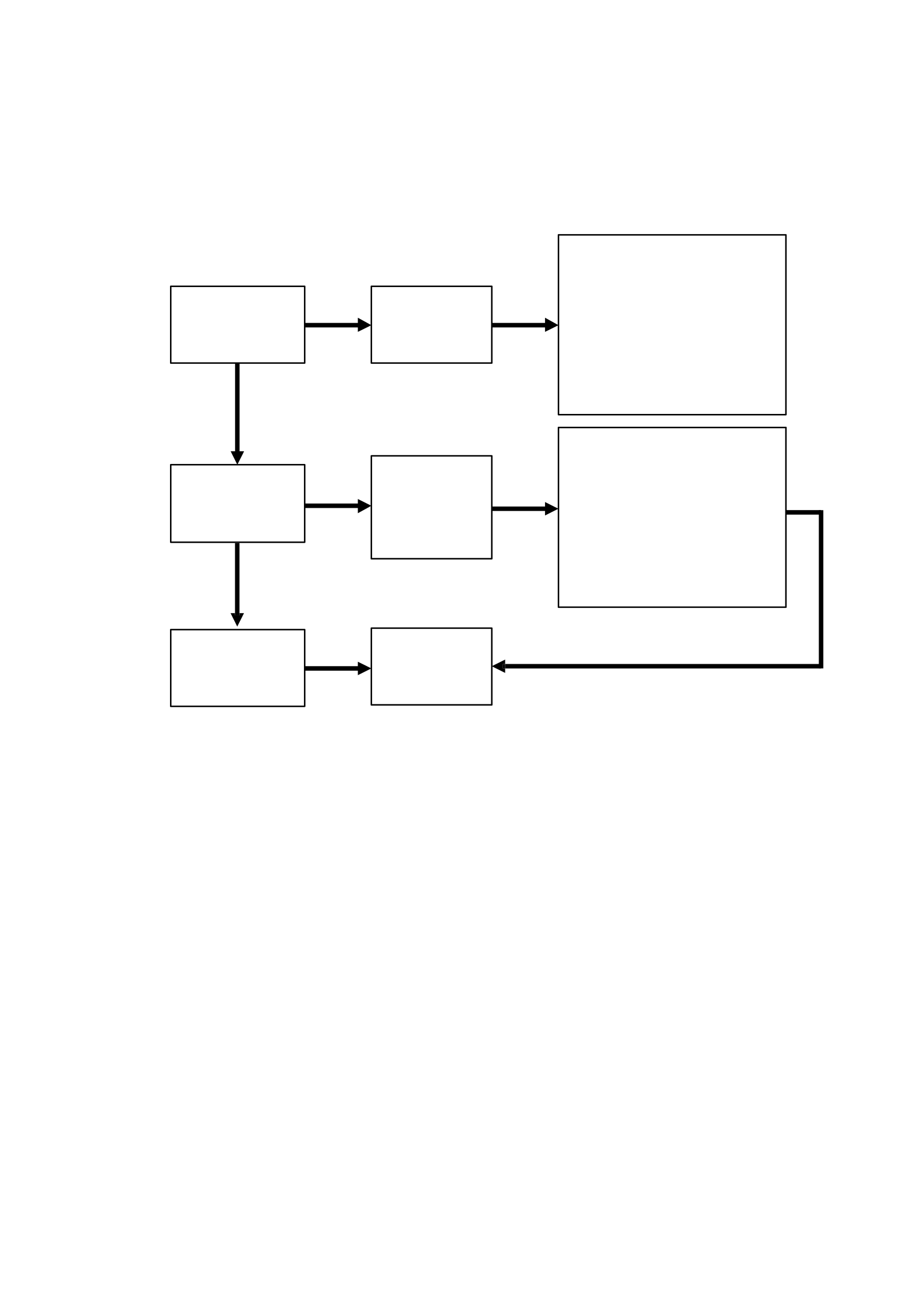
Based on the presentation that has been presented, in this study a frame of mind
chart can be made as follows:
35
C. Research Hypothesis
Hypotheses are provisional answers to problems that have been researched
and are still proven to be true. Based on the literature review and the frame of mind,
the following hypothesis can be formulated:
"The Individual Learning Program (PPI) plays a role in improving the independence
of autistic children in SD N 2 Bendan, Academic Year 2011/2012"
Figure 1. Thinking Framework Chart
Children can eat on their own
ChildcanPrepare your own
book
Childcanwear your own shoes
(the level of independence of
autistic children increases)
Increase
Result
Action
Implementation
of nIndividual
Learning
Program
Children cannot eat on their
own
Childnot yetcan prepare your
own books
Childnot yetcan wear their own
shoes (the child's
independence level
autism is increasing)
TradisionalBeginning

ommit to u
c Ser
36
CHAPTER III
RESEARCH
METHODOLOGY
A. Place and Time of Research.
1. Research Venue
The place of research is the location where research is carried out so that a
certain amount of data needed from the problem being studied is obtained. This
research took place at SD Negeri 2 Bendan which is located in Klumpit Village,
Banyudono District, Boyolali Regency, with the following considerations:
a). The researcher has had a good relationship with the school.
b). The school has never been used for similar research.
c). The data needed in this study is in the school.
d). The criteria for the subjects to be studied are found in the school.
2. Research Time
Table 1. Research time
Moon October November December January Febuar
Sunday I II III IV V I II III IV I II III IV I II III IV V I II III
Filing x
heading
Submissio
n of
Licensing
proposals
research
x x x
x x x
Research
Implementation x x x x x x x
Analysis of research
results x x x x x x
Preparation of
research results x x x
Perbanyakan x

ommit to u
c Ser
36

37
B. Research Methods
A research must basically use a certain method that is carried out in a planned
and systematic manner. Determining the right research method will make it easier for
researchers to conduct their research and also the results of their research can be held
accountable scientifically.
According to Suharsimi Arikunto (2006:160) argues that the research method
is the method used by researchers in perfecting their research data.
According to Mardalis (2002: 24) argues that a method is a method or
technique that is carried out in the research process, while research is an effort
in the field of knowledge that is carried out to obtain facts and principles
patiently, carefully and systematically to realize the truth.
According to Winarno Surakhmad (1994:131) the definition of method is as
follows:
Method is the main way used to achieve a goal, for example to test a series of
hypotheses, using certain techniques or tools. This method is used after the
investigator takes into account the reasonableness of the investigation objective
and from the investigation situation.
Based on the above opinion, it can be concluded that the research method is a
way or path taken in an effort to find, develop and clarify the truth of an event using
scientific methods.
Mardalis (2002: 25-26) stated that there are four methods that are commonly
used in research activities, namely:
1. Historical Research
2. Exploratory Research
3. Descriptive Research
4. Explanatory Research/ Explanation/ Experiment

38
Some of the methods above can be described in more detail as follows:
1. Historical Research
This research aims to describe what has happened in the past. The processes consist of
investigating, recording, analyzing, and interpreting past events in order to find
generalizations. These generalizations are useful for understanding the past, as well
as the current situation, and can even be used to a limited extent to overcome future
matters.
2. Exploratory Research
This research aims to provide new relationships that exist in a wide and complex
problem. This research also aims to collect as much data as possible. After
analysis, it is hoped that the results will be biased into hypotheses for the next
research. Exploratory research itself does not use hypotheses, because the
complexity of the data to be studied is impossible to formulate or cannot be biased
in the preparation of hypotheses.
3. Descriptive Research
This research aims to describe what is currently applicable. In it, there are efforts to
describe, record, analyze, and interpret the conditions that are currently occurring
or existing. This study does not test hypotheses or does not use hypotheses, but
only describes the information as it is according to the variables studied. This kind
of research is often carried out by officials to take policies or decisions to take
action in carrying out their duties.
4. Explanatory Research/ Explanation/ Experiment
This study aims to explain what will happen if certain variables are controlled or
manipulated regularly. The focus of the research is on the size between variables.
In this relationship intentionality
manipulate a variable, forever part of

39
which is inseparable from the experimental method. This study can be said to be a
hypothesis tester research that tests the cause-and-effect relationship between the
variables studied.
1. Form of Research
In this study, the author uses the Qualitative Descriptive method, because the
data collected is in the form of words, sentences, document recordings and archives
that have a very much more meaning than just numbers or frequencies.
According to Drs. Slamet Widodo, ST, M.Pd, the descriptive research method is to
make a systematic, factual, and accurate assessment of facts and characteristics of certain
populations.
From the conclusion of the opinion above, it can be concluded that descriptive research
is research that describes or describes a solution to a problem factually and accurately
regarding the facts and characteristics of a certain population
Then it was explained again by Sugiyono (2010: 15) as follows:
Qualitative research methods are research methods based on the philosophy
of postpositivism, used by researchers in natural object conditions, (as
opposed to experiments) where the researcher is the key instrument, sampling
data sources is carried out by purposive and snowball, data collection
techniques with triangulation (combined), data analysis is
inductive/qualitative, and qualitative research results emphasize meaning
rather than generalization.
This research was obtained by considering the suitability of the object of the
study, so that it uses an in-depth research method to be in accordance with the method,
namely using a descriptive method. This is in accordance with the opinion of Winarno
Surakhmad (1994: 139) "The descriptive investigation method is to narrate and
interpret the existing data".
Based on the above opinion, it can be concluded that the research method is a
way or path taken in an effort to find, develop and clarify the truth of an event

40
By using the scientific method, so the method has a very important role in the effort to
conduct a research and solve the problems experienced by the researcher".
2. Research Strategy
In order for the problem to be researched to be revealed and solved, after
determining the form of research, the next research strategy to be used is determined.
H.B Sutopo (2002: 112) stated that "In qualitative research, there are known as single
case studies and multiple case studies, then both are still distinguished by the type of
targeted or holistic research".
The strategy used in this study is a single pinned strategy model. Regarding this
model, H. B. Sutopo (2002: 41-42) explained as follows: "In qualitative research, there
is a form of research where the researcher has determined in advance the focus of his
research in the form of the main object to be studied based on the objectives expected
by the researcher, the form of research is a pinned form".
For this reason, the meaning of the single strategy is anchored in this study,
which contains the following meaning: single which means only in one location,
namely in SD N 2 Bendan. While pegged means only for the purpose of knowing the
role of the Individual Teaching Program (PPI) to increase the independence of autistic
children.
C. Data Source
According to H.B. Sutopo (2002: 50-54) stated that: "Data sources in qualitative
research can be in the form of people, events or activities, places or locations, objects,
various images and recordings, documents or archives".
Another opinion about data sources in qualitative research is that revealed by
Lofland quoted by Lexy J. Moleong (2010: 157) explaining that: "Data sources in
qualitative research are words, and actions,

41
The rest is additional data such as documents and others. In this regard, in this section
the types of data are divided into words and actions, written data sources, photographs
and statistics".
Based on the above opinion, in this study the author uses data sources in the
form of informants, places and events and documents, further explained as follows:
1. Report
"Informants are data sources that can provide data in the form of oral answers
through interviews or written answers through questionnaires." (Suharsimi Arikunto,
1996: 114).
The informants in this study are:
a). Principal of SD N 2 Bendan, Banyudono, Boyolali
b). Special Assistant Teacher (GPK) SD N 2 Bendan, Banyudono, Boyolali
c). Parents/guardians of autistic children.
2. Places and Events
The author in this study took the research site at SD N 2 Bendang, which is
located in Klumpit village, Banyudono district, Boyolali Regency. While the event in
question is the role of individual learning programs in increasing the independence of
autistic children, autistic children at SD N 2 Bendan number 8 children and all are
boys.
3. Document
The second source of data or secondary data in this study is documents. "In
terms of data sources, additional materials derived from written sources can be divided
into sources of scientific books and magazines, sources from archives, personal
documents and official documents." (Lexy J. Moleong, 2010:159) Documents here can
be in the form of letters and agendas related to a certain event. In this study, the
documents that will be used by the researcher are:

42
a). Student learning outcome report book (report card)
Student learning outcome reports (report cards) for children with special needs,
especially autistic children, are different from regular children. If in the regular
children's report card is measured by numbers, then the report card for autistic
children is in the form of a description (picture) of the child's development during a
certain period.
b). Student liaison book
The student liaison book is a medium used by special assistant teachers to inform
activities during the learning process carried out during school, this aims to make
parents/guardians aware of the activities that children do while at school and then
follow up at home, because the learning process of autistic children is continuous.
c). Individual Learning Program (PPI)
The Individual Learning Program (PPI) is a set of programs compiled by educators
as a reference to provide learning for children.
d). Photos and special class agenda books
Photos are images taken during the child's learning process, both in the classroom
and outside the classroom. Meanwhile, the special class agenda book is a record of
activities carried out by children during the process in school.
D. Sampling Techniques (Snippets)
In qualitative research, the sample will be shown by the researcher by
considering that the sample knows the problem being researched, is honest,
trustworthy and the data is objective. According to Prof. Sutrisno Hadi MA, there are
two types of sampling techniques, namely:

43
1. Random sampling technique
Random sampling technique is a sampling technique in which all individuals in the
pollutation, either individually or together, are given the same opportunity to
become members of the sample. Random sampling is also given the term random
or random sampling, which is sampling that is not selective or indiscriminate,
based on mathematical principles that have been tested in practice. Therefore, it is
seen as the best sampling technique in research.
In practice, random sampling includes:
a). How to draw
Sampling by ballot is like a person exercising a ballot. The steps are:
1) Create a list that contains all the subjects, objects, events, or groups to be
investigated,
2) Giving codes in the form of numbers for everything to be investigated,
3) Write the code each on a small piece of paper,
4) Repeat each little piece of paper,
5) Put the rolls of paper in a can or similar place,
6) Shake the can well,
7) Taking the rolls one by one is a number of needs.
b). Ordinal way
This method is done by choosing an even or odd number or a certain multiple,
the steps:
1) Create a list of all the subjects, event objects, or groups to be investigated
with their serial numbers,
2) Taking certain numbers, for example odd or even all numbers or certain
multiples numbers, for example:

44
n
1
Subject name
Ida
2 Ika
3 Echo
4 Edi
5 Bobi
D Dst
c). How to randomize from a random number table
This method leads the researcher to select the sample members by:
1) List numbers and subjects
2) Create a table that contains subject numbers
3) Drop pencils arbitrarily on the squares of the table containing numbers until
as many members are obtained
Practical example:
See example 2 (ordinal way) and a
Create a random number table
1 2 3
4 5 6
7 8 9
Pencils fall on numbers 3,4,5,6,7,8 and 9. Those numbers are used as
samples
Note
The example is used for small samples,
2. sampling
The random sampling technique is a sampling method that not all members of the
population are given the opportunity to be selected as a sample.

45
a). Various.
All sampling techniques that are not classified as random sampling are
classified as types of non-random sampling techniques. The types of sampling in
non-random sampling are:
1) Proportional Sampling Technique.
This technique requires sampling from each sub-population by taking into
account the size of the sub-sub-population. This method can provide a more
accountable generalization basis than if it does not take into account the size of
the sub-population and each sub-population.
Example:
The study took 50 smart children and 50 stupid children based on their IQ
levels, so the comparison of the two groups was accompanied by a random
technique, sometimes not. If the proportional sampling technique is
accompanied by randomness, it is called proportional random sampling.
The sample obtained by this technique is called proportional sample.
2) Stratifiet Sampling Technique.
This technique is commonly used when the population consists of a multi-
tiered group. Educational research often uses this technique, for example when
researching grade-level education levels.
The steps are:
Recording the many levels that exist in the population.
Determine the number of levels in the sample based on a).
Select sample members from each level at a) by proportional or
proportional random sampling technique.

46
Example:
The research to determine the average learning achievement of a junior high
school, the sample is students in grades I, II, and III. The sample obtained
in this way is a Stratifiet Sample
3) Purposive Sampling Technique
This technique is based on certain traits or traits that are estimated to be closely
related to the traits or traits that exist in the population that are known
beforehand. Thus specific traits or traits that are present or seen in the
population are used as the key for sampling.
Example:
Research on public opinion for the development of Special Education (PLB) or
what is now also given the term special education. Taking samples of urban
and rural community subjects. Because the two communities have different
characteristics. Samples obtained by this technique are called purposive
samples. , _
4) Quota Sampling Technique
This technique requires sampling by targeting yourself to Quotum (in Indonesia =
kotum). The researcher must first determine the number of subjects to be
investigated. The subjects of the population must be set criteria to determine
the criteria for the sample. The main feature in quota sampling is that the
number of subjects that has been determined will be met. The main drawback
of this technique is that the sampling officers are less supervised whether the
criteria in the population are reflected in the sample, hence the less preferred
technique.
5) Double Sampling Technique
That is sampling that seeks to have twin samples.

47
What is meant by twin samples, namely samples obtained for example by
questionnaire (especially questionnaires sent by post). From that method, there
are questionnaires that return and there are questionnaires that do not return.
Each group is recorded, then the questionnaire that is not reaffirmed is
emphasized by an interview. So this second sampling serves to check the first
sampling (which the questionnaire returns).
Example:
Sampling in cross validation, the first sample uses a larger number of
members and in the second sample which serves as a control tool. Samples
obtained by this technique are called twins (double samples).
6) Teknik Area Probability Sampling
This technique requires a sampling method based on the division of areas
(areas) in the population. This means that the areas in the population are
divided into several smaller areas
Example:
Researching the people of Solo city took samples of suburban areas and central
city areas. To represent the central area of the city, for example, the sub-
districts of Keprabon, Kauman, Timuran, Sriwedari and Kepatihan. To
represent suburban areas, for example, the Kelurahan area; Kadipiro,
Karangasem, Mojosongo and so on.
The sample obtained by this technique is called the sample area.
7) Cluster Sampling Technique
This technique requires groups to be sampled based on the groups in the
population. So the population is deliberately viewed as a group, then the group
is reflected in the sample.

48
Example
Sampling to research the people of Solo, for example, the people of Solo
are grouped: employees, traders, entrepreneurs, and manual laborers. Thus
the various sampling techniques have been explained, from the brief
description it is hoped that readers or researchers can choose the
appropriate technique.
Therefore, in this study using sampling techniques that must be adjusted to
existing needs, the most appropriate sampling with this study is to use Purposive
Sampling . According to H.B. Sutopo (2002: 56): "Purposive sampling is the tendency
of researchers to choose informants who are considered to know the information and
problems in depth and can be trusted to be a solid source of data".
In this case, the measures used by the researcher to select the informants
include:
a). Principal of SD N 2 Bendan, Banyudono, Boyolali, Parjo S.Pd
b). Special Assistant Teacher (GPK) SD N 2 Bendan, Banyudono, Boyolali namely:
Special Assistant Teacher I: Dewi Susilawati S.Pd
Special Accompanying Teacher II: Wahyu Agung Saputro S.Pd
E. Data Collection Techniques
Data collection techniques are the methods used by research to collect data in
order to test hypotheses. To obtain the expected and accountable data, accuracy is
needed in choosing a data collection method.
The data collection techniques used by this researcher include:
1. Interview (Iinterview)
According to Cholid Narbuko and Abu Ahmadi (2005:83) an interview is "a
question-and-answer process in a study that takes place orally in which

49
two or more people face to face listening directly to information or statements."
Cholid Narbuko and Abu Ahmadi classify interviews into several types,
namely:
a). According to the procedure
1) Free interview (unguided interview)
A free interview is an interview process in which the interviewer does not
intentionally direct questions and answers to the main points of the research
focus and the interviewer (the interviewee).
2) Guided interviews
This interview is also called an interview guide. Contralled interview or
structured interview, which is an interview that uses a guide to the subject
matter being researched.
3) Free guided interviews.
It is a combination of free and guided interviews. So the interviewer only
makes the main points to be researched, then in the interview process taking
place following the situation the interviewer must be good at directing what is
being questioned if it turns out that he deviates. The interview guidelines function as
a control so that the interview process does not lose its direction.
The data collection technique used in this study is guided free interviews. With
free guided interviews, researchers will obtain data from informants, with the intention
of being able to reveal the problems being researched through questions or attitudes,
either through tone of voice, mimicry, or eye contact. Interviews like this are flexible
and open, and are not strictly structured in a formal setting and can be conducted
anywhere and repeatedly with the same informant to get more answers

50
complete and in-depth about the use of PPI in increasing the independence of autistic
children at SD N 2 Bendan.
In this study, the author conducted an interview technique by asking questions
about the use of PPI in increasing the independence of autistic children. Where the list
of questions has been prepared in advance, but this question can be further developed
according to the conditions or answers of the informants so that it is snawball. That
way the author can collect data or information as accurately and as much as possible
from the informants. So that the researcher is not fixated on a list of questions that have
been prepared in advance. But that doesn't mean the list of questions isn't used at all.
The list of questions serves to remind the author that the question must at least be
asked to the informant and must be answered. This list of questions as an interview
guideline can be seen in (attachment 1), for an excerpt of the interview results can be
seen in (attachment 2), while a picture/photo of the interview excerpt can be seen in
(attachment 3).
The parties interviewed in this study are:
a). Principal of SD N 2 Bendan, Banyudono, Boyolali, Parjo S.Pd
b). Special Assistant Teacher (GPK) at SD N 2 Bendan, Banyudono, Boyolali:
Special Assistant Teacher I : Dewi Susilawati S.Pd
Special Accompanying Teacher II: Wahyu Agung Saputro S.Pd
2. Live Observation
The observation technique is used by directly observing a symptom (event that
occurs in the field) by studying, and revealing phenomena that are related to research
both in real and in-depth, namely various activities of autistic children at SD N 2
Bendan. For this study, the researcher plays a passive role by making observations,
covering all aspects of activities on the object being studied, both audible and seen
activities. Activities that can improve

51
Children's independence, for example, preparing books when they are about to start
lessons and handicrafts.
3. Document Analysis
The documents used in this study are data that can be used to test, interpret, and
even predict things that will happen in the future. Documentation techniques can be in
the form of archives in the form of relevant records and other physical objects.
According to H.B. Sutopo (2002: 54) who argues that: "Documents and
archives are written materials related to a certain event or activity".
In this study, the documents used by studying books, reports, archives or other
documents that are relevant to the research problem and the results of interviews about
the role of PPI in increasing the independence of autistic children. as an
implementation of the role of PPI by paying attention to various existing facts and then
made in a valid conclusion. In this case, the researcher studies documents from the
research location that are related/relevant to the problem discussed. The documents
used are:
a). Learning report for students with special needs (ABK Report Card),
b). Individual Learning Program (PPI),
c). Student liaison book, and
d). Photos of ABK student activities.
F. Data Validity
In the acquisition of data which is then checked for validity, Sugiyono (2010:
363) argues that "Validity is the degree of accuracy between the data that occurs in the
research object and the data that can be reported by the researcher". Thus, valid data is
appropriate data/

52
There is no difference between the data reported by the researcher and the data that
actually occurs in the field.
1. Triangulation
In data collection techniques, "triangulation is defined as a data collection
technique that combines various data collection techniques and existing data sources".
(Sugiyono, 2010:330)
According to Patton quoted by H.B Sutopo (2002:78-82) there are 4 types of
data triangulation: "Data Triangulation, Method Triangulation, Researcher
Triangulation, Theory Triangulation".
This can be explained as follows:
a). Data Triangulation, this type of triangulation is carried out by collecting different
data sources to collect similar data.
b). Triangulation Method, this type of triangulation is carried out by collecting similar
data but using different techniques or data collection methods.
c). Triangulation of researchers, the results of research, either data or conclusions
about a certain part or the whole can be tested for validity from several researchers.
d). Triangulation Theory, this triangulation is carried out by researchers using more
than one theory in discussing the problem being studied.
Meanwhile, theoretical triangulation is used by researchers using the
perspective of more than one theory in discussing the problem being studied. H.B
Sutopo (1988: 31) explains the steps of theoretical triangulation as follows:
a). Conduct a search of other research on the same topic as the research to be analyzed
by the researcher.
b). Analyze data using several different theoretical perspectives. Thus, the results of
the research can be improved and their validity is guaranteed.

53
In this case, the researcher uses data triangulation and theoretical triangulation.
Sugiyono (2006:307) explains the steps of data triangulation or source triangulation as
follows:
a). Collect the same data.
b). Checking the data that has been obtained with the intended purpose of providing
truth and gaining trust in data obtained from various different sources.
c). Through these multiple sources, one data will be controlled with the same data
source in different situations.
d). The data that has been analyzed by the researcher so that it produces a conclusion
is then asked for agreement (member check) with other data sources.
Meanwhile, theoretical triangulation is used by researchers using the
perspective of more than one theory in discussing the problem being studied. H.B
Sutopo (1988: 31) explains the steps of theoretical triangulation as follows:
a). Conduct a search of other research on the same topic as the research to be analyzed
by the researcher.
b). Analyze data using several different theoretical perspectives. Thus, the results of
the research can be improved and their validity is guaranteed.
In this study, the researcher is more focused on the use of data triangulation
techniques and triangulation methods (can be seen in appendices 4 and 5). Data
triangulation is where researchers collect different data sources to collect similar data,
which is done by utilizing various information from informants, documents, as well as
archives and events where the research is carried out. In addition, the author uses a
triangulation method, namely by collecting similar data but by using different
techniques or methods of data collection. In this case, the author uses data collection
techniques with interviews, observations, and document analysis.

54
The reason for choosing data triangulation and method triangulation is to close the
possibility of a lack of data from one source and this method can be supplemented with
data from other sources and methods.
2. Informan review
Informant review is an effort to develop the validity of data carried out by
communicating the report units that have been prepared to the informant, especially
those who are seen as key informants to find out whether what has been researched is
something that they can agree to or not, while those who are used as review informants
in this study are Special Assistant Teachers (GPK) teachers at SD N 2 Bendan,
Banyudono, Boyolali: Dewi Susilawati S.Pd and Wahyu Agung Saputro S.Pd
G. Data Analysis
According to Lexy J. Moleong (2010: 280) what is meant by data analysis is:
"The process of arranging the order of data, organizing it into a pattern, category, and
basic unit of description".
The data analysis model that will be used in this study is the Interactive
Analysis Model. It was emphasized by Miles and Hubertman in Sugiyono (2010:337)
that "activities in qualitative data analysis are carried out interactively and take place
continuously until complete, so that the data is saturated".
In the data analysis process, there are 4 main components that must be
understood by every qualitative researcher. The four main components are: (1) data
collection, (2) data reduction, (3) data presentation, (4) conclusion drawing or
verification.
1. Data Collection
This data collection step is in accordance with the data collection techniques
described above, which consist of interviews, observations, document analysis, and
analysis. Data collection is carried out as long as the required data is inadequate and
will

55
is stopped when the necessary data is sufficient in drawing conclusions.
2. Data Reduction
Data reduction is part of the analysis that takes place continuously during
research activities even before the data is actually collected, meaning that before the
data is collected as a whole, the data analysis process has been carried out.
3. Data Presentation
To avoid difficulties in drawing conclusions, the data that has been collected
needs to be presented in certain forms to combine information arranged in an
integrated form. Data presentation can also be interpreted as an effort to compile a set
of information that has been obtained in the field, then the data is presented clearly and
systematically so that it will make it easier for researchers to understand and interpret
what happened and what should be done with relevant theories.
4. Drawing conclusions
The last analysis activity is drawing conclusions, which is the analysis of a
series of data in the form of case symptoms in the field. Drawing conclusions is not the
final or final step of an analysis because the conclusions still need to be verified. If the
conclusions that have been drawn have not been obtained valid data, then the analysis
process is repeated until the data is obtained that is really accurate, suitable and solid
so that its validity can be accounted for.
The four main components are a series in the data analysis process that is one
another so that they cannot be separated. Where one component is a step towards the
other, so it can be said that in qualitative research it is not possible to take only one
component. Drawing conclusions is the result of a research process

56
which is inseparable from the previous process, because it is a unit.
For more details, the Interactive Analysis Model can be seen in the following
scheme:
Figure 2. Components of Interactive Model Data Analysis (H.B Sutopo, 2002: 96)
H. Research Procedure
The research procedure used in this study includes the following steps:
1. Preparation.
The preparation stage is the stage of gathering information and theory
materials that can support the formulation of problems. The preparation stage
includes the following things:
a). Determining the research problem and submitting the research title
b). Drafting a research proposal
c). Develop research protocols, develop data collection guidelines and prepare a
schedule of research activities
d). Taking care of research licensing.
1
Data Collection
2
Data Reduction
3
Data
Presentation
4
Verification/conclusion

57
2. Implementation Stage
The implementation stage is based on the goals to be achieved, starting
from observation, surveys to data collection in the field. Matters related to the
implementation stage include:
a). Research data search
b). Research data collection
c). Selection of research data
3. Analysis Stage
For the initial analysis, the research was carried out since data collection in
the field. Meanwhile, the final analysis is carried out after data mining is
considered to be sufficient to support the purpose and objectives of the research. In
this analysis stage, the steps taken are:
a). Processing and analysis of research data
b). Drawing conclusions
4. Report Writing Stage
The report writing stage is the final stage where the researcher begins to
compile the results of the report that has been prepared neatly which is followed
by duplication according to the required amount.
To make the steps easier in the research, the researcher presents the following
schematic of the research procedure:
Gatherin
g of TA
and
Early ISIS
Multiply Reports
Figure 3. Research Procedure Scheme
Source: Hurber and Milles in Soetardi (2002: 25)
Report Writing
Drawing
conclusions
Final Analysis
58
Proposal
Peng
An
al
Skin
Preparation for
Implementation

uns.a5c
9.id
CHAPTER IV
RESEARCH
RESULTS
A. Description of Research Location/Research Object
1. Research Location
SD N 2 Bendan is a public elementary school that has pioneered the
implementation of inclusive education in Boyolali Regency since the 2005/2006
school year until now. SD N 2 Bendan itself was established in 1974'' with a
location in the village of Jl. Klumpit Rt.5/Rw.1 Bendan, Banyudono, Boyolali
57373. Strategic location, and an inclusive learning system are what make SD N 2
Bendan much sought after by researchers as a research location.
As a school that provides inclusive education, in addition to children with
average ability, SD N 2 Bendan also has children with special needs with different
obstacles such as obstacles in learning (slow leener), hearing impairment (deaf),
intellectual impairment (impaired Grahita), and emotional disorders (autism).
As an elementary school that provides inclusive education, ABK
who study at SD N 2 Bendan is not only from the blood around SD N 2 Bendan,
there are several children who are deliberately schooled by their parents to study
at SD N 2 Bendan because the location of SD N 2 Bendan is close to the market
and not too far from the main highway of SD N 2 Bendan and is quite easy to
find. In general, the condition of SD N 2 Bendan is quite good and very conducive
to the process of teaching and learning activities.
2. School Vision and Mission
Every agency or school must have a vision and mission, this vision and
mission are the goals that will be implemented as long as the agency or school is
established. The following is the vision and mission of SD N 2 Bedan

a. School Vision of SD N 2 Bendan
Vision of SD N 2 Bendan "Forming superior people with character with
friendly and inclusive learning"
b. Misi SD N 2 Bendan
The mission of SD N 2 Bendan is:
1) Increasing faith and devotion to God Almighty
2) Effectiveness in activities to achieve achievements
3) Optimal learning services
4) Children with special needs served
5) Manners and ethics are basic capital
6) Inclusive and friendly to learning
3. School Facilities
In addition to conducive environmental conditions, SD N 2 Bendan is also
supported by teaching and learning rooms and facilities, namely:
a. There are 13 rooms, consisting of:
1) 1 Principal's room/office,
2) 1 Teacher's Office,
3) 1 UKS,
4) 1 Computer Room,
5) 6 Regular Classroom
6) 1 Warehouse
7) 1 prayer room, and
8) 1 Source Room/ Special Room
b. There are various supporting tools such as:
1) 8 Computers
2) 2 projectors
3) Educational Teaching Aids (APE)
4) Therapeutic ball
5) Picture cards
6) PuzzleI

7) Meja therapy
8) Student liaison book
9) Inclusion learning guidebook, etc.
c. Dedicated educators
1) Dewi Susilawati S.Pd
2) Wahyu Agung Saputro S.Pd
4. Organizational Structure of SD N 2 Bedan
A school is an institution engaged in education. An educational institution
is responsible for improving education and forming a virtuous generation. To
meet these demands, an institution must have a strategy in handling them.
Therefore, SD N 2 Bendan in its management has an organizational structure,
namely:

Figure 4. Organizational Structure of SD N 2 Bendan
5. Data on Autistic Children at SD N 2 Bendan Banyudono
Data on Children and Levels of Autistic Children at SD N 2 Bendan can be seen in
the table below:
It Child Name
(Initials) TTL Address Class
1 ZF Boyolali,
17 -11-2003 Perungararu Poyolali I
2 MRAM Boyolali,
10-01-2004
Sidomulyo, Boyolali II

children's OSI,
because
3 MRR Boyolali,
10-11-2004 Sidomulyo, Terrace, Boyolali II
4 SNA Klaten,
4-9-2001 Example, Sambon, Boyolali II
5 AKAA Boyolali,
10-9-2002
Jl. Jambu No. 13 Surodadi,
Siswodipuran III
6 BY Pontianak
25-11-2003 Ketaon, Banyudono III
7 FGS Magetan,
13-10-1999
Bendo Kovong,
Nagarur, Boyolali IV
8 MLI Surakarta,
20-3-1999 Kembang Attached, Terrace,
Boyolali
V
Table 3. Child Data and Autism Rate at SD N 2 Bendan
6. Independence Level of Autistic Children of SD N 2 Bendan
The level of independence of autistic children at SD N 2 Bendan varies
between one autistic child and another. The indicator of independence itself
cannot be calculated with certainty, this is because the ability of children is
different from one another. The ability to be independent is very diverse such as
preparing textbooks, wearing clothes, writing, spelling, eating and drinking by
yourself.
From this ability of independence, the ability to prepare books and write
ranks at the top of the list of abilities that are difficult for autistic children to do.
Direct observation found that the Individual Learning Program (PPI) is very
influential on the ability of autistic children to be independent. This is because in
the Individual Learning Program (PPI) there is a structured program in improving
and optimizing the independence of autistic children.
The provision of Individual Learning Programs (PPI) is carried out every day
and sustainable. The provision of PPI in schools is carried out by teachers in a
structured and unfettered manner (more flexible) because it is still
C o n d i t i o n o f t h e Children's emotions are different every day

The difference is that as long as the child is in school, the child must follow all the
programs given by the teacher, if the child rebels, the teacher will put pressure on
the child so that the child wants to do it. The provision of PPI is in collaboration
with parents. Special Accompanying Teachers provide PPI at school while parents
continue or follow up on what is given by the teacher while at school. This is
intended so that children are used to the education provided by teachers and the
PPI given to children is not in vain.
Teachers provide learning and guidance to autistic children at school based
on the PPI that has been made previously, while parents are in charge of following
up on what has been given by teachers at school. All activities given to children
are communicated to parents through a liaison book.
Independence data can be seen, one of which is through the types of
independence of autistic children in the form of observation and interviews, data
and conditions of children are obtained as follows:
a. ZF
Conditions Before being given PPI
ZF is a verbal autistic child. ZF can communicate with his teachers and
friends but in his daily life he cannot do ADL independently, academically ZF is
an autistic child who is classified as intelligent. ZF's memory is excellent, for
example ZF can remember the names of football players and can remember the
score or value of the match he watches. Before attending SD N 2 Bendan, ZF had
attended a public kindergarten and did some therapy privately. ZF's parents are
very concerned about the growth and development of ZF, all the needs needed by
ZF are always tried and met so that ZF becomes dependent on their parents. The
following is a description of ZF's initial capabilities:
1) Reading Ability: ZF can already read by spelling, for example:
(a). BALL dibaca B+O= BO ; L+A=LA ; BO-A=BALL
(b). BUKU dibaca BU-KU=BUKU

2) Writing Ability: ZF can write, but ZF's writing is not neat, it is still out of
line, the letters used are still many wrong and reversed. For example, in
writing the letters "d" and "b"; The letters "m" and "n"
3) Brushing Teeth: ZF was able to brush his teeth by himself but with the
assistance and supervision of the teacher. Because ZF often swallows the
toothpaste it uses.
4) Play: ZF has excessive fear, so when playing with new people, ZF will
have excessive anxiety and often fear. ZF does not close himself off from
others, but when dealing with people he has just met, he will feel
threatened and seek protection from people he knows.
5) Preparing Books: ZF has not been able to prepare books, every time ZF
starts a lesson must be accompanied by a teacher to prepare the textbook,
because ZF cannot distinguish textbooks from one another.
6) Responding to Master's Orders: whenever given instructions by the
teacher, ZF responds slowly. The teacher's orders must be repeated many
times. Teachers must often repeat the commands given to ZF, because it is
very difficult for ZF to respond to commands.
7) Ask the Teacher: ZF is a timid child. Every time given the opportunity to
ask questions, ZF's response was not very enthusiastic. When asking, ZF
uses language that is stammered and many words are turned upside down.
8) Wearing Clothes: in the family environment, ZF is a spoiled child.
Independence at home is still not optimal. When ZF was at home, ZF
didn't want to curse his own clothes, ZF wanted to wear clothes if they
were worn by his father or mother.
9) Eating and Drinking: in terms of meeting their living needs such as eating
and drinking, ZF is provided and fed. ZF is unwilling to do

himself, because when he is at home, all his needs are always served by his
mother and father
10) Folding Clothes: ZF can't fold clothes yet, when taught to fold clothes, ZF
will look for other busyness.
11) Counting: ZF has begun to know numbers and can count from numbers 1-
5, and if it is more than that, ZF will complain and do not want to learn.
Conditions After being given PPI
ZF is an interactive child, before ZF went to school at SD N 2 Bendan ZF
had been educated at a boarding school. ZF was able to respond to what his
teacher gave:
1) Reading Ability: ZF can already read by spelling, before being given PPI
ZF spells letter by letter, after being given PPI ZF spells 2 letters at once,
for example:
(c). BOLA dibaca BO-LA=BOLA (d).
BUKU dibaca BU-KU=BUKU
2) Writing Ability: The teacher provides assistance to ZF in the form of
colored help lines, so that ZF can write on the help lines. (example See
attachment)
3) Brushing Teeth: ZF can brush teeth regularly, assistance to ZF can be
reduced, teachers replace ZF toothpaste with adult toothpaste. So ZF did
not want to swallow the water and toothpaste.
4) Play: the teacher accompanies ZF when getting acquainted with other
people, with this kind of assistance ZF is able to communicate and ZF's
fear of others can be reduced.
5) Preparing the Book: the teacher marks the ZF book so that ZF can
distinguish one textbook from another. ZF has been able to distinguish
between textbooks and liaison books.
6) Responding to the Teacher's Orders: The teacher's orders must be repeated
many times. The teacher must repeat the order given to ZF, but in

understanding the orders or instructions from the teacher, ZF can already
observe them well.
7) Ask the Teacher: ZF wants to ask the teacher, the words used by ZF have
also begun to be organized and well structured.
8) Wearing Clothes: ZF can and wants to wear his own clothes, clothes that
can be worn in the form of t-shirts and collar pants, to wear shirts and
pants that use ZF zippers is still difficult.
9) Eat and Drink: ZF wants to eat and drink by himself, the teacher
accompanies ZF when eating and drinking, because if he is not
accompanied by ZF will let him eat and only see it,
10) Folding Clothes: ZF does not want to fold clothes, when given clothes to
fold, ZF will look at them and refuse to fold them.
11) Counting: ZF can already beat from 1-10, ZF can also add with the help of
images.
b. MRAM
Conditions Before being given PPI
MRAM is a non-verbal autistic. MRAM cannot be communicated, every time
MRAM is invited to communicate, it is just silent and no response is given,
only a few seconds of eye contact. MRAM has been abandoned by the father
figure since he was still in the womb, so MRAM will respond more quickly to
the teacher's commands with a male gender. MRAM is cared for by his mother
and grandmother. While MRAM was at school, MRAM was accompanied by
his mother. MRAM tends to be quiet and does not do much activity. MRAM
loves to play ball and listen to music. Here are some aspects that need to be
considered by teachers, here are the initial abilities that MRAM can do:
1) Reading Ability: MRAM cannot read yet, MRAM can
recognize images and imitate what their companions say
just.

2) Writing Ability: MRAM cannot write yet, every time given instructions to
write he just is silent and does not pay attention. When told to hold a
pencil, MRAM will throw it away and return to silence, when forced to
write, MRAM will cry and clench its palms.
3) Brushing Teeth: MRAM is a child who tends to be quiet, he does not want
to open his mouth except when eating and drinking. When told to brush
their teeth, MRAM will close its mouth and run.
4) Play: in playing activities, MRAM is a passive child, he tends to be silent
and if he wants to play he will play alone without paying attention to
others. MRAM loves to play ball and listen to music. If you play ball,
MRAM will sit on it and sing, and when the television is turned on,
MRAM will sit in front of the television watching the television.
5) Preparing a Book: MRAM is a passive child, MRAM cannot prepare a
book on its own, when the lesson starts MRAM is just silent and as if
daydreaming. If addressed, MRAM will answer by shouting.
6) Responding to Teacher Orders: every time an instruction is given by the
MRAM teacher, it responds slowly. The teacher's orders must be repeated
many times. Teachers must often repeat the commands given to MRAM,
the response given by MRAM is only with shouts and movements of some
of their limbs. For example, if the teacher greets "good morning
(MRAM)", MRAM will answer "selamat pagiiiiiii (rippling) bu gu-ru".
7) Asking the Teacher: MRAM never asks the teacher, MRAM tends to be
more silent and daydreaming, when told to ask questions, MRAM does not
respond and just is silent.
8) Wearing Clothes: in the MRAM family environment is a child
who are spoiled. MRAM cannot wear his own clothes yet, still worn by his
parents. .

9) Eat and Drink: MRAM cannot eat on its own, is still fed by its mother, this
is because while at home MRAM is accustomed to being fed and not
taught to eat on its own, but MRAM can already hold a drinking bottle and
drink on its own.
10) Folding Clothes: MRAM cannot fold clothes on its own, when told to fold
clothes, MRAM will be silent and does not respond and just is silent.
11) Counting: MRAM cannot recognize numbers yet, but MRAM can mention
numbers ranging from 1 (one) to 10 (ten).
Conditions After Being Given PPI
MRAM is a child who is difficult to be given PPI, as long as PPI is
given, MRAM is more silent and passive. The response given by MRAM is not so
much and only tends to be silent. In giving PPI to MRAM is not so optimal,
because during school MRAM is accompanied by his mother both in class and
outside the classroom, when MRAM mother leaves class, MRAM will follow her
and if separated MRAM will cry endlessly until MRAM mother returns.
1) Reading Ability: in learning to read, MRAM does not have much
interaction. MRAM is just silent and daydreaming.
2) Writing Ability: When given MRAM is instructed to write, MRAM is just
silent. After being given PPI, MRAM wants to hold a pencil, if you hold a
pencil, MRAM will doodle without direction and if directed MRAM will
scream and rebel.
3) Brushing Teeth: MRAM does not want to brush teeth, brushing teeth is
only done at home and with the mother. When given PPI, MRAM brushed
his teeth, closed his mouth and shook his head.
4) Play: MRAM does not want to join and play with his friends.
MRAM tends to be quiet and prefers to play with his mother. MRAM
prefers to listen to music, watch TV, play ball and ride
bus.

5) Preparing the Book: MRAM has not been able to prepare its own book, if
it is called, MRAM will answer by shouting.
6) Responding to the Teacher's Order: as long as MRAM is given, PPI is just
silent. There was not much response from MRAM.
7) Asking the Teacher: MRAM is just silent and does not ask the teacher, is
more silent and daydreaming, when told to ask questions, MRAM does not
respond and is just silent.
8) Wearing Clothes: MRAM cannot wear his own clothes yet, he is still
being picked up by his mother. When given clothes and MRAM was
instructed to put on clothes, MRAM just kept silent and did not respond.
9) Eat and Drink: MRAM does not want to eat on its own, but if given a
spoon, MRAM will suck the spoon. During meals, MRAM was fed by the
mother's oleg and when drinking MRAM, she still used a bottle or straw
because MRAM could not use a glass yet.
10) Folding Clothes: MRAM cannot wear clothes on its own, when taught to
fold clothes, MRAM only looks and is silent.
11) Counting: MRAM has begun to recognize numbers. Every time you are
given a picture of the MRAM number, it will mention the number. For
example, if the teacher shows the number "4", then MRAM will mention
"four".
c. MRR
Conditions Before being given PPI
MRR is a non-verbal autism. In communication, MRR can respond to the
other person, but the response given is monotonous and only with words that he
often speaks. MRR lives with his parents, his father works in Semarang and
comes home once a week and his mother teaches at one of the junior high schools
in Boyolali. While at home, MRR was taken care of by a maid and assisted by an
uncle from MRR. While at school, MRR is not accompanied by parents or other
special companions, on days
only when the mother of the MRR is on vacation and does not teach MRR
accompanied by the mother so that GPK communication is only limited to books

student liaison only. During school, MRR tends to be active and cannot sit quietly,
if the teacher forces him to sit MRR will sit but only for a short time and
accompanied by crying, besides that if MRR stands and walks MRR likes to
throw all the things on the table so GPK or companions have to supervise MRR
extra. The following are the initial capabilities of MRAM:
1) Reading Ability: MRR cannot read yet, but MRR can already describe the
image it sees.
2) Writing Ability: MRR can already write, but the willingness to write is
very small. MRR does not want to write and hold a pencil. If given a
pencil, MRR will throw the pencil, shout and get angry.
3) Brushing Teeth: MRR is a child who cannot stand still. MRR does not
want to brush his teeth and if forced MRR will swallow toothpaste and
water used for gargling.
4) Play: in playing activities, MRR is an active child and cannot be still.
MRR can play with other children and easily blend in with the people
around them. MRR is a child who gets bored easily with the toys he owns.
In the activity of playing MRR, he likes to walk and run around so the
teacher must supervise MRR extra, because if not supervised, MRR will
throw away the items in front of him, including all items on the table.
5) Preparing the Book: MRR has not been able to prepare the book. If the
book is prepared on the MRR table, it will be thrown away, so the
textbook will be used for learning if the MRR will only write, because if
the book is prepared before the MRR is ready to write, the MRR will
throw it away or tear it up.
6) Responding to Teacher's Orders: MRR's response to teachers' orders is still
very little, MRR responds by mimicking what is said
Teacher.

7) Asking the Teacher: MRR never asks the teacher, MRR tends to laugh
more and move his body, when asked to ask the teacher, MRR will frown
while looking at the teacher and imitate the teacher's words. If given a
question, MRR will answer with the word "hah..." MRR's response to
questions also tends to be monotonous and teachers have to repeat the
questions given to MRR frequently. The responses given are still
monotonous and only colloquial language is spoken. For example:
Teacher : assalamualaikum riski
Assalamualaikum riski
Assalamualaikum riski
MRR : hah.....
Hah....
kumcalam (wa’alaikumsalam)
Guru : Where are you going?
Where are you
going? Where
are you going?
MRR : hah.....
Hah....
Mr. Kesjaaaa (work)
Teacher : Who is his mother's
name? Who is his mother's
name?
Who is his mother's name?
MRR : hah.....
Hah....
Ibu indaaaaaah
Teacher: What is the name of
his sister? What is
his sister's name?
What is his sister's
name?
MRR : hah.....
Hah....

adek anicaaaa (anisa)
8) Wearing Clothes: MRR cannot wear clothes yet, in daily life MRR is still
served by mothers or maids only.
9) Eat and Drink: MRR cannot eat and drink by himself, if he is eating, MRR
will be seated on special chairs and tables, because if he is not forced to sit
MRR will run around and not want to eat.
10) Folding Clothes: MRR cannot fold clothes by itself, when told to fold
clothes, MRR will be silent and does not respond and just is silent.
11) Counting: MRR does not recognize numbers, but MRR can mention
numbers ranging from 1 (one) to 5 (five).
Conditions after being given PPI
MRR is one of the active autistic children. MRR is a non-verbal autism.
In communication, MRR can respond, but the response given is not what the
interlocutor expects, :
1) Reading Ability: MRR cannot read yet, MRR can already describe the
picture he sees, for example when the teacher shows a picture of a bird and
asks MRR, then MRR will answer that it is a picture of a bird. In addition,
if the teacher mentions some animals, MRR will describe by imitating
their voices. Such as:
(a). The teacher mentions the cow, then the MRR will imitate the
sound of the cow (b). The teacher said that MRR goats will imitate
the sound of goats
2) Writing Ability: when given PPI MRR often refuses, such as throwing
away books, throwing away pencils and crying. So teachers often force
MRR to write. For example, during Indonesian lessons, all students have
to write, the teacher holds the MRR on his lap and guides the MRR's hand
to write. MRR was forced to write to the finish even though MRR rebelled
and cried.
3) Brushing Teeth: MRR cannot brush his teeth on his own, when brushing
his teeth, MRR is still assisted by his mother. In addition, the water that

MRR is used to gargle using mineral water or plain water, because MRR often
swallows the water.
4) Play: MRR prefers to play around by himself, MRR does not want to sit
quietly. When the lesson starts, MRR will walk around the room and
throw away books and all items on the table, if the classroom door is open,
MRR will go out and often enter other classrooms so that it disturbs and
causes noise in other classes. When the lesson starts, MRR must be
supervised and accompanied by parents, because if there are no MRR
parents, one of the teachers must supervise and accompany MRR from the
beginning to the end of the lesson so that the other students are lacking.
5) Preparing the Book: MRR has not been able to prepare the book
6) Responding to Teacher Commands : every time given instructions by the
MRR teacher responds with a shout, the MRR responds slowly. The
teacher's orders must be repeated many times.
For example:
Teacher : R... sit
MRR: hah..............(while looking at the teacher)
The instruction was repeated up to 3 to 4 times with the same response, after
which the MRR wanted to sit down.
7) Ask the Teacher: MRR is able to ask the teacher. MRR questions are only
limited to daily questions that teachers often ask MRR. For example:
MRR : Guru to Eyikkum
(Asalamulaikkum) :wa’alaiku
msalam
MRR: Mr. (where are you going?)
Teacher : Mr. Ker......? (MRR told to continue)
MRR : kerjaaaaaaaa
8) Wearing Clothes: MRR cannot wear clothes yet, in daily life MRR is still
served by mothers or maids only.

9) Eat and Drink: MRR cannot eat and drink on his own, he still needs help
from a companion. However, MRR can already use its own spoon. The
teacher prepares rice and vegetables in a spoon and MRR puts it in his
own mouth.
10) Folding Clothes: MRR cannot fold clothes yet.
11) Counting: MRR cannot be calculated, when the teacher mentions the
number 1-2-3 MRR will continue 4-5-6.
d. SNA
Conditions Before being given PPI
SNA is a verbal autistic child, SNA can communicate with
his parents, teachers and friends. In interaction, SNA shows an exaggerated
attitude. For example, if SNA is called, SNA will answer with tension and show
an excessive attitude such as pinching and spitting. Before SNA went to school at
SD N 2 Bendan, SNA had been schooled at a school in the Klaten area. During
SNA, school is classified as SNA including children who like to disturb their
friends so that SNA is shunned and expelled because they are considered naughty
and hurt their friends. Based on these conditions, SNA parents are looking for a
school that can accept SNA conditions and can educate SNA well. SNA's parents
once thought about sending SNA to SLB, but SNA's parents wanted SNA to go to
school in a public school so that in addition to SNA getting a commensurate
education, SNA could also socialize. The following is a description of SNA's
initial capabilities:
1) Reading Ability: SNA can read but still spell, besides that SNA can also
describe and tell the pictures it sees. SNA reading ability cannot be
separated from the role of the mother of SNA who accompanies and
guides SNA learning.
2) Writing Ability: SNA can already know letters and write. When dictated in
the letters SNA, they can follow and write, but the writing from SNA is

not neat and massively out of line. In addition, if

given praise SNA will be quick to be proud and will show some excessive
behavior such as shouting and screaming.
3) Brushing Teeth: SNA can brush its teeth on its own, but when brushing
SNA's teeth sometimes swallows toothpaste and water used to gargle so
that in brushing SNA's teeth needs special assistance by parents or
teachers.
4) Play: SNA is able to play with other friends. While playing with his
friends, SNA is still accompanied by his mother.
5) Preparing Books: SNA is a diligent child, SNA can prepare its own
textbooks even though the books provided by SNA are often wrong
6) Responding to the Teacher's Orders: in responding to the response of the
SNA teacher who is not an obedient child, SNA considers that the order
given by the teacher is a joke so that every SNA is ordered to do
something SNA will respond with shouts and do things like that, for
example if SNA is ordered to sit then SNA will stand, if told to write SNA
will be silent and do not want to write.
7) Ask the Teacher: SNA is very interactive, SNA's curiosity is huge. If SNA
wants to ask, SNA will ask continuously until SNA is satisfied to ask.
Questions from SNA are sometimes not important questions, but teachers
must still answer so that SNA is not fussy and shouting, because if SNA's
questions are not answered, SNA will chase the teacher and ask for the
answer.
8) Wearing Clothes: SNA can already wear collared t-shirts and pants, SNA
cannot wear shirts and pants that use zippers and buttons.
9) Eat and Drink: SNA can eat and drink by herself, but SNA does not want
to eat and drink by herself, SNA is very spoiled so if there is a mother
SNA will ask her mother to feed her.

10) Folding Clothes: SNA is a diligent child, SNA can fold clothes by herself
but the folds are not neat and seem to be folded as they are. This can be
seen if SNA comes, SNA will fold the jacket he is wearing and it means it
on the table that has been provided.
11) Counting: SNA can already calculate, SNA can add and subtract below 10.
SNA will use its fingers to count.
Conditions after being given PPI
SNA can communicate well and interactively. When given PPI, SNA
responds well, but teachers must be vigilant because if SNA is given more
attention, SNA often misbehaves and issues bad behavior such as spitting and
hitting. The following is the state of SNA after being given PPI:
1) Reading Ability: SNA can read well, although occasionally still spelling.
However, when the teaching began, SNA was rarely waited for by his
mother.
2) Writing Ability: SNA is able to write well and neatly, the teacher gives
SNA book help lines and SNA is instructed to write between the lines. The
provision of this helpline is a little troublesome for teachers, but it is very
effective for SNA.
3) Brushing Teeth: SNA can brush its own teeth, the glue paste and water
used to gargle can also be vomited again.
4) Play: in SNA play activities, children are active so that it is easy to blend
in with their friends. When playing, SNA often shows an excessive
attitude such as spitting, pinching and hitting so that SNA is often shunned
by his friends. if it is felt that it is hurtful and dangerous for both SNA
itself and his friends, SNA will be reprimanded by the teacher, but this
reprimand against SNA actually makes SNA even worse. SNA really likes
to play puzzles and play ball. If SNA is playing and there is one

his friend interrupting SNA will spit or hit his friend, so SNA must be directly
supervised by parents.
5) Preparing a Book: SNA can already
6) Responding to Teacher Orders: in responding to teacher orders, SNA is
still the same as the initial condition. SNA likes to tease teachers and do
unwanted things.
7) Ask the Teacher: SNA is very interactive, if the teacher explains
something, SNA will immediately ask questions in a row. For example the
following conversation:
Teacher :"This is a picture of a glass" (the teacher explained while
showing a picture of a glass)
SNA : "What glass?"
Teacher : "glass to drink" SNA
"What to drink?"
Teacher : "drink
water" SNA
"What
water?"
Teacher "water to drink" SNA
"For a drink?"
Teacher "Yes"
Questions from SNA are sometimes not important questions, to deal with
them, the teacher only listens and distracts SNA with explanations or with
other materials.
8) Wearing Clothes: SNA is able to wear shirts and button her own shirts. In
addition, SNA is also able to wear pants that use zippers, but SNA often
does not want to do so and chooses to wear it by her mother or companion.
9) Eat and Drink: SNA is able to eat and drink alone without the help of her
mother and companions, when eating and drinking SNA is not
accompanied by her mother, because if accompanied by her mother SNA

will sulk and ask to be fed.

10) Folding Clothes: SNA is able to fold her own clothes, even SNA is able to
put her clothes in her own closet.
11) Counting: SNA is able to calculate, SNA is able to add and subtract in
order from 1-20.
e. AKAA
Conditions Before being given PPI
AKAA is a verbal autistic, AKAA can communicate with her teachers
and friends normally, but AKAA's eye contact is very difficult. In terms of
obedience, AKAA is a very neat and obedient child to existing regulations. If the
school bell rings, AKAA will immediately run to the school yard to perform a
ceremony or morning apple. In speaking, AKAA is still limping and like spelling.
AKAA's facial expression is also not so visible.while at school, AKAA is
accompanied by a caregiver who accompanies and takes care of AKAA at home.
1) Reading Ability: AKAA can read but still spell. In reading the AKAA
must be accompanied and shown the letters that must be read. In addition,
AKAA can also describe and tell the pictures he sees.
2) Writing Ability: AKAA can write well, it's just that the font size is still not
neat, some are big and some are small. In addition, AKAA can also write
what his teacher said.
3) Brushing Teeth: AKAA can brush their teeth by themselves, but AKAA
does not have the awareness to brush their teeth by themselves, so parents
or companions must tell AKAA to brush their teeth.
4) Play: in playing activities, AKAA prefers to play alone, will
but if they are invited to play with their other friends, AKAA can join and
blend in with others. In general, physical form
AKAA is not an autistic child, but when

playing AKAA is clearly seen that AKAA has special needs. For example,
during breaks, AKAA runs to the yard and jumps up and down while
moving his hands (like dancing). AKAA really likes to play ball and listen
to songs, when AKAA is played on television containing songs AKAA
will be silent in front of the television, listen to songs and imitate the song
and when AKAA plays ball, AKAA will feel at home playing ball, even
AKAA can spend hours with the ball he plays.
5) Preparing Books: AKAA is a diligent child, AKAA is able to prepare its
own textbooks without the help of other people or companions, AKAA
distinguishes between one lesson and another based on the pictures on the
cover of the notebook. AKAA often makes mistakes in taking books on
the same cover, therefore parents must pay attention to AKAA when
preparing books.
6) Responding to Teacher's Orders: in responding to the teacher's response,
AKAA is a very obedient child, including doing the things he fears the
most. The following is an example of AKAA's response when at school:
When coming home from school, usually children leave the classroom
while shaking hands with the teacher, when AKAA is told to shake hands
with the teachers in the office AKAA does not want to, when asked why
AKAA only answered that he is afraid because there is a dark horse in the
office while there is no dark horse in the office, the teacher still invites
AKAA to enter the office. After entering the office, AKAA closed his eyes
while shaking hands with the teacher. The next day, the teacher told
AKAA to go to the office without accompanying him, and so on. Until
now, AKAA continues to carry out this routine even though the teacher
who ordered it was not present.
7) Ask the Teacher: in receiving AKAA lessons, including passive children,
AKAA does not like to ask questions and tends to be silent.

8) Wearing Clothes: AKAA can wear their own clothes, but when AKAA is
told to wear AKAA pants, the child asks for help from parents or
companions to wear them.
9) Eat and Drink: AKAA can already eat and drink by itself. However, on
food that he does not like, AKAA will choose and throw it away. This is
different if AKAA is fed AKAA will eat half of the food that is fed to him.
10) Folding Clothes: AKAA cannot fold clothes by herself yet, for example
when AKAA takes off the jacket, she will give the jacket to her
companion without folding it first.
11) Counting: AKAA can already count, AKAA is able to add and subtract,
but AKAA's memory is still lacking so that when given a AKAA question,
an example of solving the problem must be given, then AKAA can
understand and solve other problems.
Conditions After Being Given PPI
As long as AKAA was given PPI and did not refuse, AKAA was able to
do what was instructed to him well. AKAA's eye contact is already there, but only
for a few seconds. AKAA's communication is also good, AKAA is able to
respond to what the interlocutor says, besides that in bringing up AKAA's facial
expressions can be done even though it seems forced. The following are AKAA's
abilities after being given PPI:
1) Reading Ability: AKAA is able to read without the help of a companion,
even though AKAA is still spelling and still slow. AKAA is also able to
tell about what he sees, in a stammering tone, AKAA tells the events that
he experienced well and collapsed. For example, every Sunday AKAA
goes to church, AKAA tells that during church AKAA prays, sings and
meets his friends.
2) Writing Ability: AKAA is able to write neatly. The size of the letters has
started to be the same, AKAA is able to stir

the names of his family members and the names of his friends without the help
of a companion.
3) Brushing Teeth: AKAA is able to brush their teeth by themselves, while at
home AKAA makes a special schedule by the teacher to brush their teeth,
so parents or companions do not have to bother telling AKA to brush their
teeth.
4) Play: AKAA is able to play with his friends, AKAA is able to interact with
other friends. However, if AKAA is not told or invited to play with his
friends, AKAA prefers to play alone and tends to be silent.
5) Preparing Books: AKAA is able to prepare its own notebooks and learning
materials, besides that AKAA is also able to reorganize its books and
learning supplies. AKAA is a diligent child, if the bell for the change of
class hours rings, AKAA will put his books and learning supplies in his
bag and replace them with other textbooks, even though the AKAA book
has not finished writing.
6) Responding to Teacher's Orders: AKAA is an obedient child, AKAA
responds well to the teacher's response. AKAA did the teacher's orders
well and neatly.
7) Asking the Teacher: AKAA does not ask the teacher much, if AKAA
wants to know something, AKAA will look at it continuously until the
teacher explains or reprimands him.
8) Wearing Clothes: AKAA can wear her own clothes. AKAA is also able to
distinguish clothes used daily, traveling and school clothes.
9) Eat and Drink: AKAA can.
10) Folding Clothes: AKAA is not yet able to fold clothes, but AKAA is able
to put where the clothes are usually placed, such as when AKAA comes
home from school, AKAA will take off the school clothes and put them on
the hanger behind the door of his room.

11) Counting: AKAA is able to calculate, AKAA is able to add, multiply and
multiply, for division AKAA has not been able to do it. AKAA must be
given examples of problems and how to solve them first, then AKAA can
do other problems.
f. PAR
Conditions Before Being Given PPI
PAR is a verbal autistic child, PAR can communicate with teachers,
friends and the community in general. PAR is an adopted child, PAR was adopted
by his uncle since the age of 1 month. at the time of marriage, the age of the PAR
mother was 28 years old and the PAR father was 70 years old. PAR was born in
Kalimantan, When giving birth PAR PAR's mother died and when she was 6 days
old PAR was brought to Java by her uncle and aunt. PAR was born with the help
of a shaman. Since childhood, PAR is an active child, PAR is unusual to see since
the age of 2, PAR often screams and speaks without direction. The emotional state
of the PAR is very unstable, the PAR often screams and hits the table. In addition,
the PAR often speaks inclearly and without direction. The following is the
development of PAR while at school.
1) Reading Ability: PAR cannot read yet, but PAR can already recognize
letters. In addition, the PAR can also describe the garmab that he sees. For
example, if PAR is shown a picture of a ship, PAR will describe the ship
starting from the ship's driver, the ship is a means of transportation at sea.
2) Writing Ability: PAR cannot write independently. The PAR can connect
dotted lines and imitate the writing given by the teacher. In addition, PAR
is very fond of drawing and coloring, the pictures that PAR likes are
pictures of airplanes and cars. The imagination of the PAR is very good,
what he thinks will be expressed in the form of pictures.

3) Brushing Teeth: PARs can brush their teeth on their own, but PARs often
refuse if they are not instructed to brush their teeth themselves. The
rejection of the PAR can be in the form of a rebuke and a blow.
4) Play: in the activity of playing PAR can and wants to play with other
friends, but if the PAR is fun playing and is disturbed, the PAR will hit
and scream. PAR is very happy to play ball and run around.
5) Preparing Books: PAR cannot prepare its own textbooks, so the books
used are prepared by teachers or companions. The PAR cannot distinguish
between one book and another. PAR is often mistaken and cannot
distinguish between books used for drawing and used for writing.
6) Responding to the Master's Orders: in responding to the teacher's response,
the PAR teacher is an obedient student, but in certain cases the PAR is
often tempted and impressed and embarrassed even though he is able and
willing to do it
7) Ask Teachers: PAR is an active child, PAR often asks teachers. However,
the questions asked by the PAR often do not correspond to the lesson and
tend to divert to what he likes.
8) Wearing Clothes: in their daily lives, PAR can wear t-shirts and collar
pants, but PAR cannot wear shirts and pants that use zippers themselves,
so in wearing formal shirts and pants need help from parents or
companions
9) Eat and Drink: PAR can eat and drink by themselves, but in using the PAR
fork is still difficult and requires supervision from a companion or teacher.
In terms of appetite, PAR is a child who has a large appetite. In the case of
food, the PAR does not choose food, but the PAR has
some restricted foods. For example, foods that contain
sugar and flour.

10) Folding Clothes: PAR cannot fold clothes yet, when told to fold clothes,
PAR will throw them away and shout "don't want to".
11) Counting: PAR can be counted from 1-10. PAR can do addition with the
help of pictures. For example, two balls plus 3 balls, the result is 5 balls.
Conditions After Being Given PPI
When they were first given PPI, PAR still often refused. The rejection of
the PAR was in the form of shouting and crying. The screams of PAR are often
accompanied by punches on the table and stomping of their feet. The following is
the development of PAR after being given PPI:
1) Reading Ability: In addition, the PAR can also describe the garmar that
the PAR sees is able to read by spelling with assistance. When the PAR
reads, the teacher helps the PAR spell the letters.
2) Writing Ability: PAR is able to write by imitating the example given by
the teacher. The PAR will write in the box provided by the teacher.
3) Brushing Teeth: PAR can brush their teeth by themselves, the teacher
provides a special schedule for PAR to brush their teeth.
4) Play: PAR is able to interact with his friends. PAR is able to play and
share toys with its garden. PAR also has a sense of sharing, for example,
when a PAR friend cries because he is fighting over a toy, PAR will give
him a PAR toy so that his friend is silent. In addition, when some of his
friends quarreled, PAR broke him up.
5) Preparing Books: PARs are able to prepare their textbooks to be used. To
distinguish between textbooks and other books, PAR gives a special mark
on the cover of the book. This special sign is in the form of colored paper
pastes made by PAR, PAR makes
This sign alone and without help from a teacher or companion, the idea of
PAR is obtained when the PAR covers the book on the book

class administration, when they saw it, the PAR asked the teacher and
came up with the idea of PAR to make a mark on the cover of the book.
6) Responding to Teachers' Orders: PAR is able to respond well to teachers'
orders. The response given by PAR is still the same as before being given
PPI, PAR is often tempted and impressed and embarrassed even though he
is able and willing to do it
7) Ask the Teacher: the intensity of the PAR when asking the teacher begins
to decrease, the PAR can distinguish between important questions and less
important questions.
8) Wearing Clothes: PAR is able to wear shirts and pants that use zippers.
PAR was able to button his shirt even though it was not neat and still a
long time so that PAR was still under supervision.
9) Eat and Drink: PAR is able to eat and drink by itself, PAR is able to use a
fork and eat satay correctly, PAR is also able to distinguish between foods
that are allowed to be eaten and foods that are not allowed to be eaten, for
example, PAR is not allowed to eat bread and noodles, then PAR will not
eat these foods. And if during the time at home the PAR eats foods that are
prohibited from eating, the PAR will remind the teacher and mention the
effects of the food. For example, once when the PAR laughed to himself in
class, the teacher asked why the PAR laughed and the PAR replied while
laughing "dek pras gek wingi bar mangan perangan perakan perek akeh
og" (dik pras yesterday finished eating a lot of candy). Likewise, when the
PAR is given prohibited food, the PAR will tell the consequences. One
example is when a PAR friend gives a wafer, the PAR refuses and throws
it away, when reprimanded by the PAR teacher replies "dik pras do not eat
manganese wafers, then it does not get fun" (dik pras is not allowed to eat
wafers, later it will recur) the meaning of relapse is that the PAR laughs to
itself and screams, because if there are too many PAR
eating sweet foods will laugh at themselves.

10) Folding Clothes: PAR cannot fold clothes yet, when given clothes to fold,
PAR will put it directly in the closet and not fold it.
11) Counting: in addition to being able to count 1-10 and do addition, PAR is
also able to subtract with the help of pictures. For example, 5 balls minus 2
balls results in 3 balls
g. FGS
Conditions Before Being Given PPI
FGS is a non-verbal autistic child, the response given by FGS during
often FGS responds with punches, shouts, repetition of words and just silence.
FGS's father works as a laborer and his mother is a housewife. FGS has one
younger brother who is still a toddler, since FGS has a younger sibling, FGS's
parents' attention has decreased. The attention of FGS parents greatly affects the
psychological condition of FGS itself. In addition, FGS diet and sleep patterns
The state of FGS during home greatly affects the learning process of FSGS at
school. For example, if FGS sleeps too late, at school FGS is "fussy", tantrums or
sleep.
Next. The following are the initial capabilities of FGS:
1) Reading Ability: FGS cannot read yet, but FGS can already recognize
letters. For example, during a lesson, FGS is shown the letter "S", then
FGS will mention and say that it is the letter "S".
2) Writing Ability: FGS cannot write yet, if given a pencil FGS will throw it
and he does not want to hold a pencil, every time he is given instructions
to write he just is silent and does not pay attention. When told to hold a
pencil, FGS will throw away and return to silence, when FGS is guided to
write FGS will write, and when the teacher's hand is released FGS will
return to silence.
3) Brushing Teeth: FGS cannot brush teeth, teachers or teachers can not brush their teeth
the companion must guide and direct the FGS to brush the teeth, often the
FGS is used for gargling,

So the water used for gargling must be replaced with mineral water or
water.
4) Play: FGS does not really like to play with other people, he tends to be
quiet and prefers to play alone, FGS is very happy to listen to songs or
music, if FGS is in front of a big mirror, FGS will sing as if he were on the
concert stage.
5) Preparing the Book: FGS is a passive child, FGS has not been able to
prepare a book on its own, when the lesson starts FGS is just silent and as
if daydreaming. If addressed, FGS will answer while looking away or
dancing.
6) Responding to Teacher Orders: every instruction given by the FGS teacher
responds slowly. The teacher's orders must be repeated many times. The
teacher must often repeat the commands given to FGS, the response given
by FGS is only with the movement of part of his body. For example, if the
teacher greets "good morning (FGS)", then FGS will answer "good
morning, good morning".
7) Ask the Teacher: FGS never asks the teacher, tends to be more silent and
daydreaming, when the FGS wants to know something, the FGS will point
to the object while saying "that".
8) Wearing Clothes: FGS cannot wear clothes yet, if FGS is wearing clothes
that he does not like, then FGS will reject him and do not want to wear
him.
9) Eat and Drink: when it comes to eating and drinking, FGS cannot eat and
drink on its own. if a drink is provided, FGS can drink it by itself, but if
FGS is eaten, he only wants to be fed by his mother, not others.
10) Folding Clothes: FGS can't fold clothes yet, if they see clothes, FGS will
throw them away and get rid of them from his sight.
11) Counting: verbally FGS can count from 1-20. If the teacher mentions the
numbers 1,2,3. FGS will continue until number 2

Conditions After being given PPI
FGS does not respond too much when given PPI and FGS is silent a lot.
The response given by FGS is in the form of shouting, punching, and repeating
what the teacher said. The following are the FGS capabilities after being given
PPI:
1) Reading Ability: FGS is able to name the letters it sees. If the FGS does
not know the letter, the FGS will point it out and ask the teacher to tell it.
2) Writing Ability: FGS is able to hold a pencil and use the pencil. When
given a book to write, FGS will throw it away, but if FGS is given a
picture book, FGS will pay attention and see it.
3) Brushing Teeth: FGS has not been able to brush teeth, until now FGS has
been brushing
4) Play: FGS interaction with his playmates is still very lacking. FGS prefers
to play alone rather than play with his friends. During recess, teachers
must pay extra attention to FGS, because FGS often runs out of school and
picks up snacks at the market in front of the school.
5) Preparing Books: FGS has not been able to prepare books on its own. All
school supplies are prepared by parents or teachers who supervise FGS
during lessons.
6) Responding to Teachers' Orders: FGS's response to teachers' orders is still
lacking, FGS often do not pay attention or even ignore teachers' orders.
7) Ask the Teacher: During the lesson, FGS is more often silent and does not
ask much questions to the teacher. FGS does not ask much questions to
teachers and often daydreams. When FGS wants to know something, FGS
will point to the object while saying "that".

8) Wearing Clothes: FGS can already wear clothes, when given a shirt FGS
will wear it but FGS cannot button his own clothes, FGS will ask his
parents for help to button his clothes.
9) Eat and Drink: when it comes to eating and drinking, FGS cannot eat and
drink on its own. if a drink is provided, FGS can drink it by itself, but if
FGS is eaten, he only wants to be fed by his mother, not others.
10) Folding Clothes: FGS still can't fold clothes, if they see clothes, FGS will
throw them away and get rid of them from his sight.
11) Counting: in addition to verbally, FGS can count from 1-20 FGS can
already answer the sum given by the teacher. For example: the teacher
asks 1 + how much ?, FGS will answer 2, FGS is able to add 1 – 5.
h. MLI
Conditions Before being given PPI
MLI Is child Autistic verbal in common MLI get
communicate as usual. MLI can communicate with teachers and their friends as
usual. In terms of obedience, MLI is a child who obeys the teacher's orders, MLI
experiences attention disorders, besides that MLI is also able to procrude
(influence) his friends. MLI often speaks profanity and teaches her friends to
follow her behavior.
1) Reading Ability: MLI cannot read and recognize letters yet. To recognize
MLI images is still difficult to distinguish and often mistaken, for
example, the teacher gives an image of an apple and an orange, MLI is
told to show which is the image of an orange, MLI will point to an image
of an apple. In addition, MLI's memory is not so good.
2) Writing Ability: MLI can write well, MLI can follow the writing that
i s
d i b c e o r m i k m a n i t
.
MLI's writing is not neat, still

out of line, and if writing on the first page of the book, MLI will continue to
the edge of the paper and not down to it.
3) Brushing Teeth: MLI can already brush teeth on its own. No special
assistance is required. However, for the toothbrushing routine, MLI needs
to be reminded. Because MLI often forgets not to brush their teeth.
4) Play: MLI can mingle with other children. In general, MLI does not
interfere much and can interact with his friends.
5) Preparing Books: MLI is able to prepare its own textbooks without the
help of other people or companions, MLI is able to distinguish textbooks
from other lessons based on the images on the cover of the notebook. MLI
often makes mistakes in taking books on the same cover, therefore parents
should pay attention to MLI when preparing books.
6) Responding to Teacher Orders: in responding to teacher orders, MLI is an
obedient child, MLI can respond to teacher orders well, but MLI often
makes mistakes in responding to teacher orders, so teachers have to repeat
orders to MLI repeatedly.
7) Asking Teachers: MLI does not really like to ask teachers, MLI tends to be
silent and pay attention to what the teacher says. If MLI asks, MLI will use
the Javanese word "ngoko alus" to the teacher.
8) Wearing Clothes: MLI can wear their own clothes, parents / companions
prepare clothes, MLII will wear the clothes they wear. However, if the
clothes are not prepared, MLI will take the makeshift clothes and wear
them. Perknitka one day MLI went to school wearing collar pants and a t-
shirt, because the school uniform was not prepared.

9) Eat and Drink: MLI can eat and drink on its own, MLI is able to use
cutlery well.
10) Folding Clothes: MLI can fold clothes by itself, but the results of MLI's
folds are not as optimal and neat.
11) Counting: MLI has not been able to calculate well, MLI has not been able
to mention numbers in order and is still flipping.
Conditions After Being Given PPI
MLI is an interactive child when given PPI, as long as it is given PPI,
MLI pays attention and follows what the teacher says. MLI's grasp and memory of
the material given is very lacking, so teachers have to explain repeatedly until
MLI understands and is able to carry out what the teacher gives.
1) Reading Ability: after being given PPI, MLI is able to recognize letters
and numbers. However, every day the teacher has to repeat until several
meetings so that MLI memorizes these letters, because MLI's memory is
very lacking.
2) Writing Ability: MLI's writing has begun to be neat, in the provision of
PPI writing, the book used to write MLI is given a help line with a red
color so that MLI can write in the line that has been made by the teacher.
3) Brushing Teeth: MLI has a special schedule for brushing teeth. This
schedule is in the form of a picture of a child brushing his teeth according
to the predetermined hours.
4) Play: when playing, MLI is able to play with other friends. However, if
MLI feels unnoticed, MLI will call one of his friends and teach his friend
to say dirty.
5) Preparing Books: MLI can already prepare books on their own without the
help of others.

6) Responding to Teacher Orders: MLI is able to respond to teacher
commands well, but teachers must pay attention to MLI because the
response received by MLI is often not the same as what the teacher wants.
7) Ask Teachers: MLI does not ask many questions. MLI likes to be given
questions and explained by teachers.
8) Wearing Clothes: MLI can already wear her own clothes well. Even
though MLI can wear her own clothes, MLI still has to be supervised,
because MLI often does not pay attention to the clothes she wears.
9) Eat and Drink: MLI can already eat and drink on its own.
10) Folding Clothes: MLI can fold clothes and put them in the closet.
11) Counting: MLI can count well, MLI can already add up from 1-10. For the
rest, MLI has not been able to do it.
7. PPI Content in Relation to Independence of Autistic Children in SD N 2
Bendan
The Individual Learning Program (PPI) is a series of curriculum created
and given to children with special needs while the child is educated at SD N 2
Bendan. This PPI contains information about learning that will be given to
children, because the emotional condition of autistic children who are labile The
programs in PPI are not too many and complicated. PPI for autistic children is
different from other ABK, PPI for autistic children at SD N 2 Bendan emphasizes
more on children's independence, such as preparing their own textbooks, eating
and drinking by themselves, wearing their own clothes and pants, etc.
In learning, the teacher gives an example to the child, while the parent or
companion helps the child to imitate all the examples given by the teacher. This
activity is carried out repeatedly until the child can do the activity on their own.
For children who are not accompanied by their parents, the teacher accompanies
the child and guides the child after giving an example.

PPI for autistic children is different from other PPI ABK, PPI for autistic
children is more specific and emphasizes self-development, fine motor
movements and gross motor movements, and child socialization. This PPI is a PPI
that is adjusted to the ability and type of autism of each child.
B. Description of Research Findings
Factors that cause the lack of independence of autistic children at SD N
2 Bendan
As is known, autistic children experience disturbances in socialization so
that it affects their independence. Parents demand that the school educate and
guide their children to become capable, skilled, and independent individuals. At
school, children are given guidance and education, while when children are at
home, children's education is left to parents. As with autistic children, children are
given education and guidance while at home parents follow up on what is given at
school. The learning program for autistic children is summarized in the Individual
Learning Program (PPI).
The emotional condition of autistic children themselves is very unstable.
Sometimes they laugh for no reason and often children cry for no reason. During
school, it is not uncommon for children to have tantrums and hurt themselves.
The quality of food and the condition of children at home greatly affect the
emotional state of children during school. For example, the influence of food
quality is if the child eats too much food that contains sugar (sweet), then the next
day the child will laugh to himself while in class, while an example of the
influence of the child's condition at home is if the child at home does not sleep at
school, the child is silent and often cries.
However, all of that will not happen because of the factors that affect it.
For more details, the researcher will present the factors that lack independence of
autistic children and the treatment given to each child based on the results of the
study as follows:

1. ZF
Factors Affecting Independence
a. Family factors (Excessive parental attention)
ZF is an only child. ZF's parents and family love ZF very much,
ZF's parents and family care for ZF is very large, this concern is shown by
the fulfillment of ZF's needs and all wishes. While at home, ZF is used to
being served and in terms of eating, drinking, wearing clothes and all other
needs. The fulfillment of ZF's needs and desires is a form of parental
affection and attention, but the fulfillment of ZF's needs causes ZF's level
of independence not to develop and ZF's level of dependence on its parents
is increasing.
b. Socialization with the environment
Socialization with the environment is something that more or less
affects ZF's independence. The environment is the right place to increase
independence. ZF's socialization with the environment is not good, if you
are in the community ZF closes itself and does not want to mingle with
other people, this is because ZF is used to being served and is more often
at home so socialization with the community is very lacking. In life at
home, ZF is used to being served in terms of eating, drinking and wearing
clothes, all his needs are met by his parents until now. ZF can eat, drink
and wear his own clothes but if ZF is at home ZF often asks his mother to
serve him.
Treatment Given by GPK
ZF is autistic with social disorders. In handling ZF, GPK provides
special therapy such as inviting ZF to places where they can practice their
independence and socialization such as inviting ZF to the office, inviting ZF
to socialize with his friends in regular classes so that ZF
have a sense of confidence and be able to socialize on their own. In addition,
during school, ZF was

such as cleaning up his own books after lessons, during sports ZF changing
his own clothes without the help of others, eating and drinking by himself and
so on.
2. MRAM
Factors Affecting Independence
a. Family conditions
During this time, MRAM was raised by his mother and
grandmother. While at MRAM's house, all the needs and desires of
MRAM were fulfilled by his grandmother and mother. MRAM's mother
does not work while MRAM's grandmother sells chicken meat at the
market. In terms of economic conditions, MRAM parents can be said to be
sufficient, in the sense that there is no shortage. The attention of MRAM's
parents and family is very large, during the MRAM school is escorted by
his mother by public transportation and during school MRAM is waiting
for his mother, including when in class. During learning in the MRAM
class, he was accompanied by his mother, because during learning in the
classroom, MRAM did not want to learn and was only silent if not
accompanied by his mother, so that MRAM's independence was not
optimal because MRAM was very dependent on his mother and teachers
had difficulty in providing learning to MRAM.
b. Socialization
In MRAM socialization is very limited, this is because MRAM
cannot communicate well, MRAM experiences communication disorders.
Until now, MRAM can only imitate what her mother says, so MRAM
cannot communicate independently. While at school MRAM accompanied
by his mother, MRAM could not be separated from his mother. During
learning, MRAM mothers must also accompany and accompany MRAM
until the lesson is over, so that MRAM's independence cannot develop.
The process of socializing MRAM with other people is also very
limited, because MRAM is very
h i g hn m t u mn i g t
mother, besides that MRAM
is also

very passive in communicating. This passive attitude of MRAM is shown
by the absence of response given by MRAM to the stimuli given. For
example, when MRAM is called, MRAM is just silent, MRAM's response
will be given when MRAM's mother tells MRAM to answer the call given.
Such MRAM conditions are what cause the lack of MRAM independence.
Excessive worry about the condition of MRAM causes a desire to maintain
and protect MRAM, making MRAM very dependent on his mother,
because one-way MRAM's needs will be fulfilled by his mother without
MRAM requesting.
Treatment Given by GPK
MRAM is a non-verbal autistic child. MRAM has not been able to
socialize with other people besides his mother. During school, MRAM is
taught to socialize and move to train his fine motor skills. As long as MRAM
is invited to communicate with MRAM, MRAM's answer often depends on
his mother, because during school MRAM is always accompanied by his
mother.
3. MRR
Factors Affecting Independence
a. Family situation
MRR is the first of two children. while at home, MRR is taken care
of by a maid Because MRR's mother has to work and MRR's father works
outside the city (go home once a week). While at home, MRR was taken
care of by a maid. MRR maids take care of MRR since MRR is 3 months
old, so MRR mothers do not need to explain the condition of MRR
because MRR maids already know and know the ins and outs of MRR.
Economically, MRR families can be categorized as able and adequate. In
addition to formal education at MRR schools also
get a therapy at his house. MRR therapy performed 3 times
Week.

b. Socialization
The MRR socialization process is quite good. While at school,
MRR is able to interact with teachers and friends, besides that while at
home, MRR is also able to interact with family and people around him, but
MRR parents and caregivers often limit MRR socialization with others,
because MRR parents are afraid that when MRR escapes MRR supervision
can hurt others.
Treatment Given by GPK
MRR of autistic children who are classified as active, during the
period of MRR learning, often gives rejection, the rejection is in the form of
sneezing, punching and screaming. During MRR school at SD N 2 Bendan,
MRR is taught to communicate and respond to the situation around him.
During school, MRR did not want to be silent, MRR preferred to walk around
the classroom and throw away the items on the desk.
4. SNA
a. Family conditions
SNA is the 3rd child of 3 siblings, SNA's father works at a health
center in Boyolali and SNA's mother does not work and only takes care of
SNA. During SNA, SNA school was awaited by his mother. The distance
between SNA's house and the school is quite far, if it is reached by
motorbike, it takes more than 1 hour. So SNA had to leave home at 5 am.
In addition to school education, SNA does not get any other education
other than family, because of the limited economic condition of SNA
parents so that SNA parents do not send them to school or provide therapy
outside of school hours.
b. Socialization
During school, SNA can socialize with teachers and students
well, but if SNA is given an excessive response, SNA will give an
excessive response as well. Response given
can punch and talk, if SNA acts

Thus SNA's parents will hit SNA, the blow given to SNA does not cause a
deterrent effect, often SNA cries but if SNA is given attention again, SNA
will spit again. With such a situation, the teacher works around by
diverting SNA's attention so that SNA does not spit and hit again. This
attitude of SNA makes SNA often shunned by friends and teachers,
because they are afraid that SNA will hurt.
Treatment Given by GPK
SNA of autistic children with behavioral disorders. During school,
SNA often shows disrespectful behavior such as spitting and hitting teachers
and people around them, screaming for attention, and crying for sympathy.
GPK often gives "punishments" such as bangs and minor blows to SNA
(blows given are only light blows and with the permission of SNA's parents)
so that SNA is a deterrent. However, this does not make SNA a deterrent,
another way carried out by GPK is to divert attention. This distraction can be
in various ways, such as when SNA shouts that GPK shows something like a
ball and SNA's favorite food.
5. AKAA
a. Family conditions
AKAA is the first child of two siblings, in general, the condition of
AKAA's parents is including people who are (able). AKAA's condition
began when AKAA was 2 years old, AKAA suffered from fever and had
seizures, Since then AKAA is known to have special needs. As soon as
they knew that AKAA had special needs, AKAA parents began to find out
and try to make AKAA able to grow and develop like other children.
AKAA has been receiving special services since AKAA was 3 years old

years, since AKAA was born until now, AKAA is taken care of by a
caregiver because AKAA's parents work.
AKAA's caregivers, taking care of AKAA from birth until now
because of that, AKAA parents do not need to bother explaining the
condition of AKAA which is slightly different from children of their age.
AKAA caregivers consider AKAA like their own child, so AKAA
caregivers understand AKAA's situation and how to serve her. AKAA's
closeness with this caregiver should be slightly reduced, because with the
closeness of AKAA and AKAA's parents will gradually decrease because
AKAA is too much with her caregiver than with AKAA.
b. Socialization
AKAA socialization during school is good, AKAA is able to
respond to those nearby. However, the situation at school and the situation
at home are very different, when at home AKAA only communicates with
his parents, younger siblings, caregivers and grandfathers. When at home,
AKAA does not socialize outside the house, so AKAA socialization runs a
little slowly.
Treatment Given by GPK
During AKAA's school at SD N 2 Bendan, AKAA did not show bad
behavior. AKAA is able to perform the tasks given by the teacher well.
AKAA experienced a disturbance in his confidence. AKAA is able to do the
tasks given by GPK well, but at the beginning of the work, AKAA must be
given an example of how to do it.
6. PAR
a. Psychological conditions
Psychic condition is the psychological condition of an individual.
Psychiatric conditions that affect independence are intelligence,
motivation,
and attitude. PAR
is generally
able to

self-reliance activities, but for the psychological condition of the PAR is
disturbed, the PAR does not like to be disturbed and if disturbed he will
scream while hitting things nearby. PAR itself feels disturbed when others
see or pay attention to it. PAR is a very sensitive and irritable child. If
anyone disturbs or disturbs them, the PAR will shout and clench their fists.
b. Family Situation
PAR is a verbal autistic child. PAR was born in Sulawesi, PAR's
mother died while giving birth to PAR, while PAR's father died when PAR
was 3 months old. When PAR's mother got married, she was 29 years old,
while PAR's father was almost 70 years old. When PAR was 1 month old,
PAR was taken by his uncle and aunt to Java because PAR's father was
unable to take care of PAR. The PAR uncle and aunt themselves took care
of the PAR with affection and considered the PAR as their own child. All
PAR developments are very much paid attention to by PAR aunts. Since it
was known that the PAR had privileges, the PAR aunts and uncles
immediately sought out therapy and provided special services, including
attention to the PAR.
Treatment Given by GPK
Of the eight autistic children, PAR is the child with the greatest
emotional disorder. PAR's emotions are very volatile, if something bothers
him, he will scream and hit the table. If PAR is emotional, GPK can only
calm him down while distracting him. Since childhood, PAR has been on a
special diet with food, PAR itself has also been instilled with what foods can
and should not be eaten.

7. FGS
a. Family
FGS is the first child of 2 siblings. Economically, the economic
situation of the FGS family is very mediocre. FGS's father works as a daily
laborer while FGS's mother is a housewife. FGS's parents' attention to FGS
has decreased slightly since FGS had a younger sibling. When FGS came
home from school, he was put in the room and while watching television,
FGS was served when FGS took a shower, ate and when his father came
home because the FGS development process was lacking.
b. Physical condition
Physical conditions greatly affect the level of independence of
autistic children, autistic children. Children with physical conditions that
are lacking or incomplete are helpless, all their needs need the help of
others. In this way, it is said that they are less independent, because they
are very dependent on others. For example, FGS is a non-verbal autistic,
although his physical condition is perfect, his motor skills cannot work
optimally, so in carrying out daily activities he needs help from others.
Treatment Given by GPK
FGS is one of the non-verbal autists, during school FGS did not do
many activities. The condition of FGS during school is greatly influenced by
the condition of FGS while at home. If FGS is not sleeping at home, eating
during school FGS will cry (fussy) or sleep until school is over. In addition,
while in school, GPK must supervise FGS extra, because if FGS escapes
supervision, FGS will run out of the classroom and enter other classes and
even run to the market in front of the school.

8. MLI
a. Family Conditions
Social factors can also affect the level of independence of autistic
children, for example MLI, MLI used to be a family that was quite in the
area, but at one time the economic condition of the MLI family suffered a
setback, because the business started by his father experienced problems
and went bankrupt and his parents experienced great pressure so that
attention to MLI decreased. This condition causes MLI to lack attention
and seek attention such as not wanting to eat if not fed, talking dirty so that
they are reprimanded and such.
b. Socialization
MLI's lack of attention to MLI results in MLI often seeking
attention outside the family environment such as MLI often gathering with
adults around her house, gathering at celebrations, cycling or walking far
away (once MLI walked from Boyolali-Solo), so that MLI's association
more or less affects her social development. Negative impacts that often
arise are MLI saying dirty words and sleeping in class because they stay
up late all night with adults.
Treatment Given by GPK
MLI verbal autistic children, during school MLI is able to socialize
well. MLI often shows bad behavior such as talking dirty and provoking his
friends. MLI's behavior is because while at home, MLI often hangs out with
the adults around him

C. DISCUSSION
1. Implementation of the Individual Learning Program (PPI) in
Overcoming the Level of Independence of Autistic Children at
SD N 2 Bendan
The Individual Learning Program (PPI) is very important in the learning
process for autistic children. PPI for autistic children is made based on the child's
early ability, with PPI teachers having a reference for learning autistic children
and it is hoped that autistic children can receive learning according to their
abilities. The ability of autistic children is more emphasized on the ability to take
care of themselves (ADL) and the ability to socialize, for example, children
prepare their own books, children wear their own clothes, play with friends. This
program aims to reduce children's dependence on others and be able to carry out
daily activities without the help of others.
The creation and use of PPI is indeed more complicated than the use of
RPP, because the creation of PPI must adjust to the needs and abilities of each
individual. In making PPI, GPK must consider the time of PPI implementation,
the length of PPI implementation and must look at the needs of children's services.
While autistic children are in school, special programs are made which are
summarized in a program, namely the Individual Learning Program (PPI). As
long as autistic children are in school, they must carry out the programs in PPI. In
its implementation, there are a lot of children who refuse to implement the
program in PPI, the form of rejection can be in the form of whining, crying,
getting angry, hitting and screaming. As long as the child refuses, the teacher has
a special strategy in handling it.
In practice, many children have not been able to do things related to
health, for example, they have not been able to eat and drink on their own. GPK
must make PPI regarding self-development about eating and drinking. Self-
development about eating and drinking on your own must go through several
stages such as:
a. GPK introduces tools used for eating and drinking such as
spoons, plates, and glasses,

b. After the child gets to know these tools, the child is explained about the
function of each of the tableware, in the introduction period in GPK requires
quite a lot of time because GPK has to repeat continuously,
c. If the child already knows and knows the function of the tableware, the teacher
guides the child to use the tableware.
2. Efforts to Increase the Independence of Autistic Children
GPK's task is not only to educate autistic children. Fostering and
maximizing the abilities of autistic children. The GPK effort provided is to
provide guidance services for the independence of autistic children themselves.
Some alternative guidance efforts in increasing children's independence are:
a. Self-adjustment guidance
Self-development is one of the programs in PPI that is used to
increase children's independence. In self-development, children are taught to
meet their own needs. The need in this context is not a need in fact, the need
in this case is to do things related to ADL such as eating, drinking, bathing
and wearing clothes.
The implementation of this self-development program is carried out
once a week on Fridays. Self-development in autistic children varies or is not
monotonous. One of these self-development is that autistic children are taught
how to wear clothes, eat, prepare their own textbooks, tidy themselves up and
many more.
Various reactions will arise when children carry out PPI, these
reactions can come from children, schools and parents. The reaction can be
described as berkut:
1) Reaction from the child
The reaction of autistic children varies from one child to another.
These reactions are in the form of shouting, crying, hitting the table and
many more. As revealed by Dewi Susilawati "when children are instructed
To perform
the task of yacnomg
will be a reaction of rejection

like screaming and crying" this can be exemplified in MRR, when MRR is
instructed to write, MRR shows a reaction of rejection in the form of
crying and whining, when forced MRR to cry but GPK continues to force
and guide MRR to continue writing until MRR completes his task.
Another reaction was also shown by MLI, when MLI was instructed to
write, MLI would continue to write until all the books were finished and
MLI. MLI will not stop writing if it is not instructed to stop.
2) Reaction from the school
The reaction from this school is a reaction that arises when autistic
children do not want to do assignments. As long as the child is in school,
the child is required to socialize with his friends. Various responses to the
existence of autistic children are different. Some support and some refuse.
A supportive attitude is shown by children who respond and invite autistic
people to play together. The attitude of rejection is shown by children who
are afraid to get close to autistic children because they are afraid if the
autistic child hurts them.
3) Reaction from parents
Parents of autistic children are parents who are very sensitive about
their children, they want their children to get the best in school. While the
child is in school, parents hand over the responsibility of educating their
children to the school. The reaction of parents is mixed, some support and
some refuse. The reaction that refuses, for example, parents feel
unacceptable if their child is yelled at, in learning autistic children, the
teacher does not yell but only acts firmly so that the child has obedience to
the teacher. On the other hand, positive reactions are shown when teachers
give reprimands to children and parents help teachers to direct their
children.
b. Job Adjustment Guidance
This job adjustment guidance is that children are introduced to various
jobs and
anackodmiamj aitrktoanusteenrtang
jobs that children are interested in.

3. Obstacles faced by GPK in the use of PPI
In the implementation of the independence of autistic children as an
implementation of the use of PPI. In schools that are in charge of fostering,
monitoring, and supervising the process of using PPI, not only special
accompanying teachers but also from all ranks of principals and teachers at SD N
2 Bendan. The provision of rewards and punishments can and is allowed as long
as they do not violate the norms that apply in schools and schools. For autistic
children who make mistakes, GPK can give punishment in the form of a
reprimand or giving additional tasks, while children who can do their tasks well
GPK can give a reward in the form of rubbing the child's head or praise the child.
During the implementation of the process of giving PPI to children, there
are obstacles faced. "The obstacles faced by the complex, starting from the
making, implementation, and assessment" explained Mrs. Dewi Susilawati S.Pd,
this can be explained as follows:
a. Manufacturing Constraints
1) In making PPI, GPK must pay attention to the ability of each child so that
it is more complicated and detailed
2) The PPI made by GPK must be dynamic, meaning considering the
interests of children so that GPK must study the characteristics of each
child
3) GPK must collaborate with classroom teachers and subject teachers in
making PPI because learning for autistic children is also carried out by
classroom teachers and subject teachers
b. Implementation Obstacles
1) In the implementation of the child's emotional condition is labile so that
the process of implementing PPI is disrupted
2) The demands of parents who want their children to be prioritized, while
GPK must pay attention to other children
3) Supporting facilities are still not optimal, such as for computer learning,
there is only one computer.

c. Assessment Constraints
1) GPK must cooperate with classroom teachers and subject teachers in
assessing children's learning outcomes, so that the assessment is more
complicated.
2) Children's assessment is mostly in the form of a description of the child's
ability, while academic ability is an assessment after the ability to be
independent
GPK has limitations in carrying out its role to supervise its students
individually. Supervision that can be carried out by teachers is limited while at
school or during the learning process. In other words, GPK only provides
guidance for independence for children while the child is at school, while while
the child is at home, the educational process is left to parents.

CHAPTER V
CONCLUSIONS, IMPLICATIONS, AND
SUGGESTIONS
A. Conclusion
The Individual Learning Program (PPI) is essentially teaching autistic
children to be independent and develop their existing potential as well as teaching
children to be able to socialize with the general public. The aspects arranged in the
PPI are adjusted to the ability of each child. From the results of the research and
discussion, the following conclusions were obtained:
Based on the review above, the author can explain that the Individual
Learning Program (PPI) plays a role in the level of independence of autistic
children of SD N 2 Bendan. With PPI, it can make it easier for teachers to provide
guidance and monitor the educational results of each individual, especially GPK
because the abilities and learning outcomes of each child are different as well as
the peaks given. In dealing with autistic children, GPK prepares what actions will
be taken for each individual. Before starting learning, the first thing done by GPK
is to identify the child's initial ability, the initial identification of the child's ability
is carried out to find out the child's basic ability before being given treatment.
Thus, GPK can prepare PPI based on the needs of each child.
109

B. Implication
Based on the conclusion above, the implications of this study are:
1. The preparation of PPI that is adjusted to the ability of each individual can
increase the ability of autistic children to be independent.
2. Because the creation and preparation of PPI is carried out based on individual
abilities, PPI can be used as a reference for teaching and developing the level
of independence of autistic children.
3. because in the implementation of independence as the implementation of PPI
at SD N 2 Bendan there are still obstacles faced by GPK, so the use of PPI at
SD N 2 Bendan has not been maximized.
C. Suggestion
1. Considering that there is still a lack of independence for autistic children at SD
N 2 Bendan, it is felt that there is a need to increase coaching and add
companions for autistic children at SD N 2 Bendan so that the level of
independence of autistic children at SD N 2 Bendan is maximized
2. Because the lack of independence in children is still lacking, the additional
time to carry out self-development is better added. For example, in one week
there are 2 or 3 days to do self-development. Because for autistic children, self-
development is very necessary.
.

