


1
INDIVIDUALIZED EDUCATION
PROGRAM
CHAPTER I INTRODUCTION
In the Magetan Regency area, there are 60 inclusion
schools, of which there are 42 inclusion elementary schools.
Inclusive education is an organized learning model by
implementing inclusive policies and practices in schools
(Galevska, N. A., & Pesic, M. I., 2018). The goal of inclusive
education is to ensure that all children with special needs
effectively access special and public facilities from early
childhood to secondary school, to participate fully in society
while they are educated in their schools (Hornby, G., 2015).
During the Covid-19 pandemic, early reading learning
for inclusive elementary school students experienced various
obstacles, one of which was because learning was carried out
online with an asynchronous technique so that it was difficult for
teachers to instill initial reading skills in students, especially
students with special needs.
Initial reading skills are very important to instill in
students because the abilities obtained through initial reading
affect the ability to read further. The purpose of starting reading
is so that students can read simple words and sentences fluently
and accurately. Initial reading learning is adapted to

1
students' psychological abilities and development. Therefore,
learning must be development-oriented that emphasizes several
things, one of which is an individualized educational program
(Wiyani, N.A., & Barnawi, 2014).
An Individualized Education Program (IEP) is a
plan/program that is prepared for each child with special needs
based on the results of the assessment and adjusted to the
condition, ability, and needs of the child concerned. IEPs can be
short-term or long-term programs, and cover various aspects of
education, not only the curriculum but also include placement and
referral with relevant institutions for children with special needs.
There are still many found in inclusion elementary
schools that have not developed and managed IEPs for students
with special needs, especially in learning to read at the beginning.
Therefore, it is necessary to find a solution that includes 2 things
at once, namely being able to improve the quality of learning
during the pandemic and improving the quality of initial reading
learning in inclusion elementary schools, especially for students
with special needs. The solution taken is to develop an IEP with
a blended learning model in early reading learning for students
with special needs. Staker, B.H., & Horn, M.B. (2012) defines
blended learning as learning that combines online learning with

1
conventional (face-to-face) learning. Students are facilitated to be
able to learn and repeat the material independently for one part of
the session using online learning materials and resources and the
other part of the session is carried out face-to-face in the
classroom. Blended learning is not only about integrating
technology in classroom learning, but also focuses more on
facilitating students to explore teaching materials and gain
independent learning experiences. The type of blended learning
model chosen is the Enriched-Virtual Model. In this classroom
model, the learning program is divided into two sessions, namely
face-to-face learning and online learning.
The product of this development research is an IEP with
a blended learning model in early reading learning for students
with special needs. The stages of IEP development include
assessment, collaboration, writing, introducing, monitoring,
reviewing, reporting (Ministry of Education, 2009). The IEP
prepared in early reading learning covers all disorders of students
with special needs in inclusion elementary schools, consisting of
children who are blind, deaf, visually impaired, handicapped,
disabled, gifted, have specific learning difficulties, autistic, and
children with other deviations/behavioral disorders.

1
CHAPTER II
INDIVIDUALIZED EDUCATION PROGRAM (IEP)
A. Individualized Education Program
1. Basic Concepts of Individualized Education Program (IEP)
Inclusive education is an educational service system
for children with special needs in regular schools. In
inclusive schools, there is a great need for an educational
service system for children with special needs in regular
schools, namely a curriculum that is prepared to realize
educational goals. Inclusion schools require the
implementation of an Individualized Education Program
(IEP) for students who have disabilities and require
special education because they apply the curriculum in
accordance with the student's disability or dysfunction.
Until now, there are still many inclusive schools that have
not developed and managed an Individualized Education
Program (IEP) for students with special needs so that they
participate in education in general regardless of the
conditions and needs of each student with special needs.
Therefore, in providing education in general, the
Individualized Education Program

1
/IEP) for children with special needs that is appropriately
designed and written as a document describing
educational programs for children with special needs to
help them make progress.
An Individualized Education Program (IEP) is a
document written to meet the individual learning needs of
students with special needs. The Individualized Education
Program (IEP) is in the form of a written record that
provides an individualized learning plan based on the
strengths and weaknesses of students with special needs.
The Individualized Education Program (IEP) serves as a
document to determine cooperation and collaboration
between schools, parents, students, and if necessary, the
local education office, and parties from other institutions
or support services. The Individualized Education
Program (IEP) must be prepared by a special education
teacher (GPK) for every student with special needs.
Added by Vuspapatih (2011) Individualized Education
Program (IEP) is a plan or program that is prepared for
each child with special needs based on the results of an
assessment of the handicap owned by each child with
special needs. This IEP program can be in the form of a
short-term program or a long-term program,

1
which includes educational aspects, psycho-socio-
emotional aspects, and referrals with related institutions
for children with special needs. The information that
needs to be in the Individualized Education Program
(IEP) includes basic information, the child's strengths and
difficulties, areas that need to be developed, specific
targets for the child, and the assistance that must be
provided so that the child can achieve the target (Dukes &
Smith, 2009).
According to Tim Loreman, et al. (2005) the
implementation of IEP considers the limitations and
inability to cope with the disorders or obstacles that
students with special needs have. In its implementation,
the Individualized Education Program (IEP) focuses more
on what students learn from a specific period of time. The
Individualized Education Program (IEP) explains how
students with special needs learn, how they exemplify
what they have learned and what teachers and service
providers will do to help students with special needs learn
more effectively (Rahman, 2014).
The individualized education program for students
with special needs aims to assist teachers in ensuring that
students with special needs are able to participate in
learning at school along with regular students. On the
other hand, Individualized Education

1
Programs (IEPs) can also help the structure and learning
programs can be carried out systematically so that they
have progress in the learning process at school. The use of
the Individualized Education Program (IEP) implemented
by teachers for students with special needs makes the
teaching and learning process more orderly, systematic,
and helps teachers keep up with the development of
students with special needs. The use of Individualized
Education Program (IEP) helps teachers to plan lessons in
daily life in the classroom, helps students receive good
quality learning, has a positive impact on the academic
development of students with special needs, and can help
students with special needs to achieve learning progress in
accordance with the general curriculum in the education
system (Ahmed, 2015; Nasir in Ismail & Majid, 2010;
Dempsey, 2012; Sahin, 2012; Timothy &
Agbenyega, 2018).
The preparation of the Individualized Education
Program (IEP) considers the results of the assessment of
children with special needs. The results of the assessment
are related to the limitations and limitations of each child
with special needs that will be considered in terms of
access to the general curriculum, goals and objectives, and

1
selection of placement in an environment with minimal
limitations (Loreman et al., 2005).
According to Snell (in Vusparatih, 2011), the basic
assumptions of the development of an Individualized
Education Program (IEP) for children with special needs,
especially those who experience moderate and severe
violence, are as follows.
a. The learning process of children with special needs is
slow, the level of disorder is getting worse, and the
process is slow. This condition requires confidence that
children with special needs, regardless of the type of
disorder, will still be able to learn even though it takes
a long time.
b. Schools are responsible for teaching functional skills
necessary to optimize students' independence, at least
teaching independence in carrying out activities in their
daily lives.
c. To produce an optimal learning impact on students,
teachers need to communicate with students' parents in
order to convey the successes or obstacles experienced
by students.
d. The principles of behavior modification can be applied
in general to children with special needs who
experience severe disabilities or disabilities.

1
e. There is no standardized norm reference or assessment
tool so that informal and individual assessments are
more expected from students with special needs.
f. There needs to be socialization to the community about
the validation of teaching objectives, procedures and
impacts so that teachers can give confidence to the
community that the goals and materials taught are quite
simple according to the level of cognitive development,
the teaching procedures are quite humane and effective
so that it is hoped that students with special needs can
bring about meaningful behavioral changes.
2. Objectives of the Preparation of the Individualized Education
Program
(IEP)
The preparation of the Individualized Education
Program aims to: (1) students can participate in learning in
public schools with various activities and various variations
in conditions from students with special needs and regular
students; (2) students are expected to follow an assessment
system that is in accordance with school standards; and (3)
students can interact and socialize with other regular
(normal) students.
Based on these three goals, the priority of the goal is
students with special needs who are able to

1
interact and socialize with regular students. As social beings,
parents have hopes for their children to be able to live
independently in society. Meanwhile, for children with
special needs, independence in carrying out daily tasks in
their lives is a scourge because most children with special
needs still need help from parents or families in every line of
their daily activities. Therefore, for many cases, children with
special needs who attend public schools have the ultimate
goal, namely students are able to live independently in
society, be able to interact and socialize with normal
individuals.
The Individualized Education Program (IEP) is
designed so that students with special needs can receive
education in public schools with all the limitations that the
student has and all the consequences that exist. When
receiving education in public schools, students with special
needs are expected to meet the target of the inclusive
education curriculum, grade standards, and be able to interact
with normal students. However, to achieve this goal is very
difficult for students with special needs to achieve, especially
if the students with special needs have severe disabilities.
Therefore, the purpose of preparing the Individualized
Education Program (IEP) is to find out the records and
conditions for cognitive, as well as psychological,

1
The socio-emotional of each child with special needs so that
it can adjust to the target of academic achievement is
reviewed by the target time and test which will later become
a standard benchmark in measuring student understanding. In
certain cases in students with special needs, students need
longer time to understand the material and learn to socialize
with their class teachers and other friends.
3. Individual Education Program (IEP) Preparation Process
The Individualized Education Program (IEP) is
prepared with the aim that students with special needs are
expected to be able to participate in all school activities
together with other regular/normal students. Therefore, the
IEP drafting team must understand the process in compiling
the Individualized Education Program (IEP) because the IEP
is the main curriculum for students with special needs. The
difference in the determination of the time to achieve the
target and the standard of grades makes students will
experience different teaching and learning activities from
regular students. The percentage difference in learning
activities between students with special needs and regular
students is highly dependent on the severity of each student
with special needs (Vusparatih, 2011).
Furthermore, Vusparatih (2011) explained that in
compiling the Individualized Education Program (IEP)
1
Several considerations are needed such as achievement
targets, achievement times, and program expiration deadlines
that are adjusted to the duration of the school year according
to the student's academic calendar. This is done so that the
percentage difference in activities of students with special
needs and regular students is not too large. The longer
students do activities together with normal students, the
better it is for the development of their ability to interact and
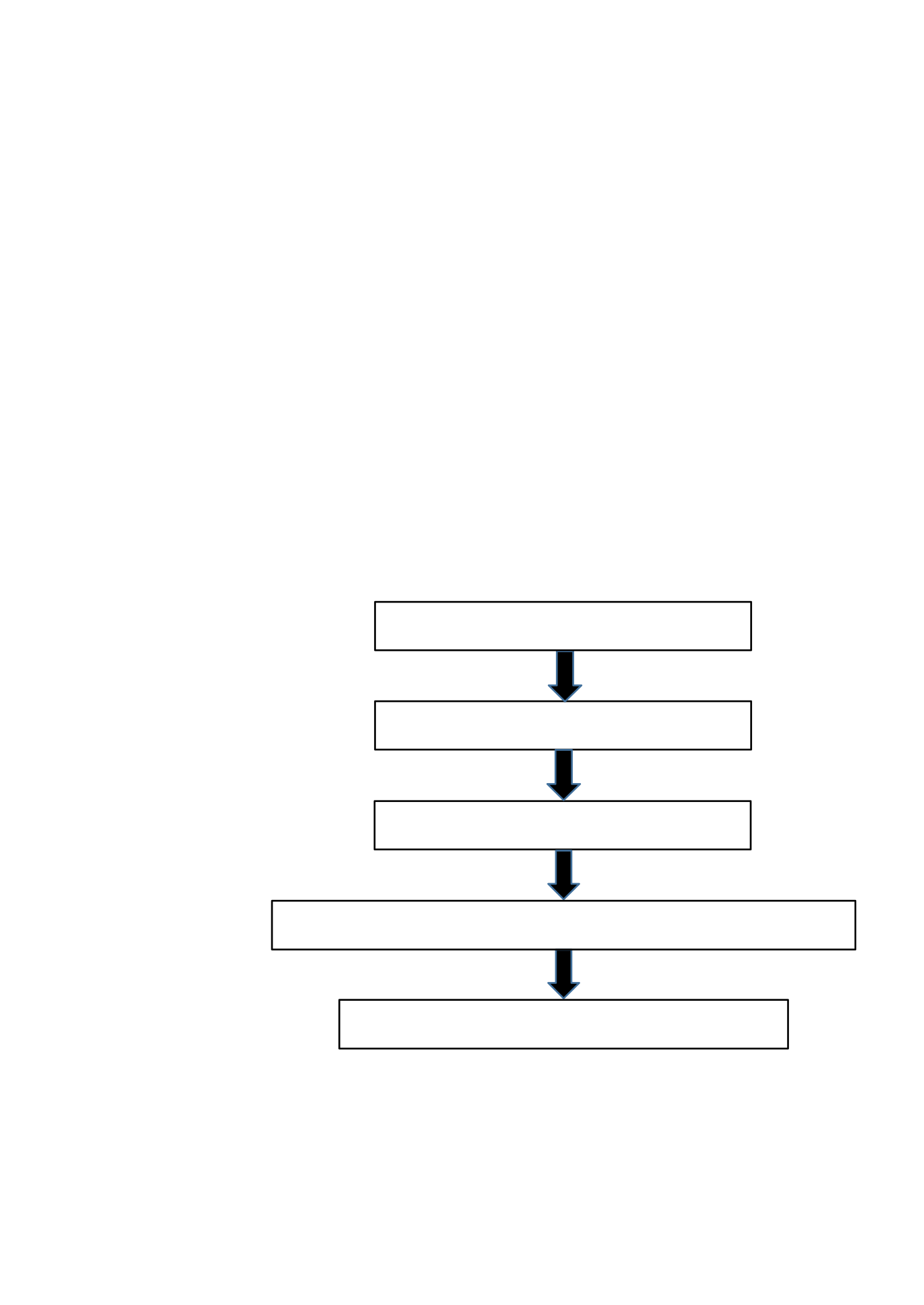
socialize. The flow of preparing an Individualized Education
Program (IEP) should ideally be arranged as follows.
Figure 2.1 Flow of Individualized Education Program (IEP)
Preparation
Determine the way of assessment and deadlines
Determine strategies and resources to achieve goals
Long-term goals
Set priorities
Short-term goals

1
Based on this flow, it can be explained that the
priority scale and the determination of how to assess and the
deadline are the most effective strategies in starting the
preparation of the Individualized Education Program (IEP).
In compiling IEPs for students with special needs, first
determine the top priority. For students with special needs,
numbers that show grades in a subject are not the main
importance and not the main priority, but the main priority is
more at the beginning of entering school where students with
special needs know the school environment, know the
classroom teacher, get to know some of their classmates, get
to know the school cleaner, school security officer, and get to
know the classroom environment which includes the
teacher's desk, lockers put bags, where the seats where
students sit.
The long-term goals of a student with special needs
need to be formulated carefully. For example, a student with
special needs may only be "able to communicate in a
reprimanded manner of no more than 3 sentences without the
help and stimulus of his accompanying teacher to his 5
classmates". This long-term goal can be given a target time
of 1 semester. This target is inversely proportional for regular
students. In 1 semester, regular students in grade 1 of
elementary school must achieve certain curriculum targets
such as calculating addition and

1
reduction, being able to make complete sentences in
Indonesian, but for students with special needs this will be
difficult to do optimally. Therefore, the Individualized
Education Program (IEP) plays a very important role. On the
one hand, students with special needs must try to adapt to the
environment, but on the other hand, they must also follow the
school curriculum targets. The Individualized Education
Program (IEP) will accommodate the needs of achieving the
school's curriculum targets but must also be adjusted to the
conditions of each student with special needs.
4. Development and Management of Individual Educational
Programs (IEPs)
According to Rudiyati (2010), the process of
developing an Individualized Education Program (IEP)
should ideally involve various parties related to the education
of children with special needs. In the development of the
Individualized Education Program (IEP), the following steps
need to be taken:
a. Formation of Committees/Teams, which are tasked with
compiling and monitoring the implementation of the
Individualized Education Program (IEP) consisting of,
among others:
1) Teachers (including special teachers) and Principals
2) Parents/guardians of students
3) Child (if possible)

1
4) Other parties at the request of the Principal, Teacher
or Parent/guardian of the student.
b. Meeting of committee members or drafters of the
Individualized Education Program (IEP).
c. Identify the student's abilities and limitations (need-
assessment), as the basis for preparing the curriculum for
the student.
d. The preparation of the curriculum is based on the
conditions, limitations, needs and environment of the
students with disabilities concerned.
e. A placement decision that determines whether the student
will be placed in a public/inclusion school, a special
school or in another institution.
f. The process of developing an individual curriculum whose
description is outlined in the IEP which includes the
following activities:
1) Describe in detail the student's current abilities in
various fields.
2) Set annual goals and specific goals that students will
achieve. In setting goals it must be remembered that:
(1) Goals should include functional skills that are
practical and necessary for students, both for the
present and the future.

1
(2) The goal includes four domains, namely the
domestic realm, leisure, community and
vocational.
(3) Goals must be in accordance with the
chronological age/development of the student.
(4) Goals must be realistic, meaning they can be
achieved by students.
(5) Determine the measuring tools and recorders of the
progress that students with special needs have
achieved.
(6) Determine the area of the curriculum that is under
pressure.
(7) Establishing a strategy in teaching skills in
accordance with the realm of the curriculum that is
under pressure begins with conducting a task
analysis, which is analyzing a complex task into
small steps that are simple and easy for students to
do. Task analysis can be done by observing
students when performing the task in question and
recording steps that students can and cannot take
or need help; carefully.
The management of the Individualized Education
Program (IEP) can be done by periodically evaluating the
Individualized Education Program (IEP) carried out by the
committee or the team that prepares the IEP to find out
whether it is

1
The program is right for children with special needs. In the
end, the Individualized Education Program (IEP) must be
reviewed and monitored for its implementation. This is
important because the Individualized Education Program
(IEP) needs to receive attention at all times as a working
document, by changing or modifying what is done by the
Committee/Team as a necessity. What things need to be
replaced and modified so that goals and objectives can be
achieved successfully in student achievement. For example,
whether the goals and objectives in the Individualized
Education Program (IEP) need to be eliminated and choose
more achievable targets. If only passing on unmodified goals
and objectives, then students are not making progress from a
significant amount of time. This is not only meaningless, but
often unproductive (Rudiyati, 2010). Continuing to work in
one particular field but not showing progress will become
boring and damage the potential of students' self-esteem
(Loreman, et al: 2005).
5. Key Components of an Individual Educational Program (IEP)
In compiling an Individualized Education Program
(IEP), it is necessary to pay attention to the main components
that must be present in the IEP. The loss of one component can
be interpreted as the Individualized Education Program (IEP)
is not

1
will run optimally. The main components according to Taylor
et al. (2009) are:
1) Identification and assessment
The identification process in the creation of an
Individualized Education Program (IEP) is the first step
is to identify the strengths and needs of students. The
components of identification and assessment are equally
important because when identifying, the Individualized
Education Program (IEP) drafting team will look at the
results of previous student assessments with the aim of
evaluating previous strategies and what still needs to be
continued.
2) Planning
Planning includes designing long-term, short-term goals,
and determining achievement strategies. The
achievement strategy in question is the support and
implementation program. The Individualized Education
Program (IEP) drafting team will determine the
programs that will be carried out to achieve short-term
and long-term goals. The support program here is a
program that is only specifically applied to students with
special needs.

1
3) Evaluation
The evaluation component contains how the team that
prepares the Individualized n Program (IEP), especially
the class and accompanying teachers, will evaluate
whether the program has succeeded in making students
achieve the targets that have been determined in the
short-term component. This evaluation method is to
determine the assessment method as well as reflection
from the members of the drafting team about the running
of the Individualized Education Program (IEP) program
and the successes or failures that occur after the deadline
that has been set in the Individualized Education
Program (IEP).
4) Report
After the Individualized Education Program (IEP)
runs and reaches the predetermined deadline, the
Individualized Education Program (IEP) drafting team
must immediately make a report on the results of the
IEP. This component is significant enough to be part of
the next IEP. The success or failure achieved will
provide positive input to design a new Individualized
Education Program (IEP). This is where the
identification process will begin again.

1
Based on this description, it can be concluded that
the components in the Individualized Education
Program (IEP) are likened to a cycle that continues to
rotate and continue with each other.
As a complement to the Individualized Education
Program (IEP), some important information outlined in
the Individualized Education Program (IEP) (Ministry
of Education Ontario, 2004) are:
1) Strengths and needs related to students' learning needs. If
students are identified as children with special needs
through appropriate assessments, then the Individualized
Education Program (IEP) must contain the strengths and
needs identified in the form of a statement.
2) Relevant assessment data that supports the identification
of factors that are considered for the need for special
education programs or services.
3) Special health support services needed by students with
special needs that allow the student to participate in
activities at school.
4) List of subjects where students with special needs need
modifications in their learning process.
5) Accommodation data needed by students to help learn in
the learning process.
6) The level of achievement of students in each subject.

1
7) Annual program objectives and learning targets for each
subject.
8) The assessment method that will be used to assess
student achievement.
9) Indications of student progress written in the report that
will be submitted to parents.
10) Documentation of the results of consultation with
parents and students during the development of the
Individualized Education Program (IEP).
6. Stages of Individualized Education Program (IEP)
Development
The stages in the development of the Individualized
Education Program (Ministry of Education British
Columbia, in Rovik, 2017) are described as follows.
a. Assessment
Assessment can be carried out in several ways,
namely through observation, looking at student
development data owned by the school, interviews with
subject teachers and special assistant teachers (GPK), as
well as formal and informal tests that include quizzes,
ability checks and diagnoses, reference standard tests,
norm standard tests, and alternative tests such as oral tests,
descriptions, handwriting, and using electronic devices.

1
b. Collaboration
Collaboration is a process where people work
together to solve a common problem or a problem that is
of concern at the time. Collaboration is needed to create
clear communication and a person's willingness to work
together to achieve a predetermined goal. Planning from
an IEP can be done with the knowledge and expertise of
several people, depending on the needs of the students.
c. Writing
The Individualized Education Program (IEP) must
contain the identity of the student, the IEP development
and implementation team, the assessments that have been
carried out, the obstacles and strengths, the needs and
treatments, the supporting and inhibiting factors, the
treatment plan, and others. The IEP that has been
developed can be used as a reference in developing
learning tools, such as syllabus, annual programs,
semester programs, RPP/RPK, and so on.
d. Introducing
An IEP developed will be useful when it has been
introduced and practiced well. Introducing new strategies
in the IEP must begin with a discussion with students
because they are the

1
who play the most role in determining the success rate of
the program for them. Practices can increase choice,
provide wider access to the general curriculum, increase
student commitment, use varied learning materials and
reduce stigma against children with special needs.
e. Monitoring
Supervision is a process where educators collect and
assess data on student responses about students' strategies
and developments towards the goals/objectives to be
achieved in the IEP. Monitoring provides the feedback
needed to identify possible adjustments to the objectives,
strategies, and interventions of various parties that have
been implemented.
f. Reviewing
The purpose of an IEP review is to determine the
feasibility and effectiveness of the IEP being developed,
share information about learner progress, and help
identify effective strategies for the preparation of the
transition process. The
implemented IEP needs to be reviewed at least once a
year.

1
g. Reporting
A progress report contains a description of the
student's progress towards the goals to be achieved,
including subjects, courses, or grade levels. Reports
should be objective, concise, and not use a specific accent.
Reports need to be made by classroom teachers, subject
teachers, special assistant teachers, and related agencies.
B. Reading the Beginning
1. The Fact of Reading Beginnings
Formally, reading activities are language skills
taught in grades 1 and 2 of elementary school. Seefeldt
and Wasik (2008) stated that one of the most important
elements for developing reading skills is the
development of language skills. Human language skills
consist of listening, speaking, reading, and writing skills.
These four language skills are used stimulantly,
integrated, and not separate. One example of its
realization is that speaking implies the need for listening
activities, as well as writing activities, implying the need
for reading activities (Brown, 2002). Likewise, reading
skills are two skills that are integrated with

1
in other languages. Barton & Hamilton (2003) stated that
skills in reading are not limited to kinesthetic activities
but also cognitive activities that cannot be separated.
The essence of reading, according to Finn (1985),
is the activity of arranging symbols and language sounds
so that people who see these symbols can say words or
sentences. Therefore, learning to read requires skills
related to hearing (auditory skills) and visual skills
(visual skills). In order to be able to combine language
sounds and symbols, the ability to distinguish characters
and language sounds from one another is required.
In line with Finn's understanding, Owens (1992)
defines reading as an activity to understand complex
meanings and is a continuous cognitive activity in the
form of the ability to understand words and interpret
their meanings (decoding) thoroughly and integrated.
Blass (2002) stated that this complexity makes reading
an important skill for children's success as well as a very
fun activity for children.
Along with the times, reading has become a tool to
achieve success and experience

1
a satisfying life (Blass, 2002). Therefore, learning to
read must be done from an early age. Reading taught at
the beginner level is called introductory reading.
According to Tarigan (in Dalman, 2008), initial reading
is a process carried out and used by readers to obtain the
message that the writer wants to convey through the
medium of words or written language. In this case,
reading is an effort to trace the meaning in the writing.
According to Steinberg (Susanto, 2011), early reading is
reading that is taught programmatically to preschoolers.
According to Leonhardt (in Dhieni 2015) early
reading is very important for children to have. Children
who love to read will have a higher sense of freedom.
The love of reading must be developed from an early
age. The ability to read is one of the highest human
functions and is the difference between humans and
other creatures (Sutan, 2004). Reading a lot can make a
person have broad knowledge, be wise, and have more
values than people who do not read at all, read little, or
only read non-quality reading. Read or read

1
get Interpreted as Activities browsing,
understanding, and exploring various symbols. Symbols
can be in the form of a series of letters, in a writing or
reading, even a picture (Sutan, 2004). Activities read
Initial be reading activities for 1st and
2nd grade elementary school students. At the beginning
reading stage, children need to pay attention to 2 things,
namely the regularity of the shape and the combined
pattern of letters. A child as a first-time reader
understands the concept of printed letters and the concept
of a book if (1) understands that a book is to be read, (2)
understands that printed letters and not pictures carry a
message, (3) understands that you are reading letter
print, (4) understand that You read the printed
letters from left to right, (5) can identify the title, author,
and illustration (Seefeldt, C. & Wasik, B. A., 2008). Street,
B.V & Leftsein (2007). Add that reader beginner
Understanding About concept about read
with How to understand printed letters and concepts
about a book. The initial reading mastery of elementary
school students has not been maximized. This occurs due
to various things, namely differences in the form of training
due to teacher factors, social environment, background, and
the unavailability of learning facilities that students are
interested in (Andayani, 2010).

1
The development of early reading begins with awareness
and exploration of the environment carried out by
children to build the foundation of learning to read. This
stage can be interpreted that children can develop their
reading skills from an early age because they already
have awareness of literacy (Magnifico, A. M., Woodard,
R., & McMCarthey, S., 2019).
There are 6 factors that need to be known to start the
initial stages of teaching beginner reading, namely
physical, perceptual, conceptual, linguistic, and
environmental (Shapiro, L. R., Carool, J. M. & Solity, J.
E., 2013) adding 5 important areas in beginner reading
activities, namely awareness, phonetics, phonetics,
vocabulary, and comprehension. These five areas have
been focused on early reading learning across the
country and the results have improved for all readers.
Clementson, T. (2010) stated that early reading learning
should be packaged specifically to make students
confident and happy to do reading activities. Topics, text
types, and practice types are selected to encourage
students' desire to read, as well as relevant to the
student's age. According to Daniels, E., Hamby,
J. and Chen, R-J. (2015), teachers must provide various
teaching methods, one of which is the reading method

1
writing commencement (MMP). This method is very
optimal in elementary school elementary grades, which
includes aspects of receptive and productive abilities.
The emphasis on this method is on students' ability to
read aloud and write words.
Early reading is a stage that changes humans
from not being able to read to being able to read
(Dardjowidjojo, 2005). At the beginning reading stage,
children need to pay attention to two rights, namely the
regularity of the shape and the combination pattern of
letters. A child as a beginner reader understands the
concept of printed letters and the concept of a book if (1)
understands that a book is to be read, (2) understands
that printed letters or not pictures carry a message, (3)
understands that you read printed letters, (4) understands
that you read printed letters from left to right, (5) can
identify titles, author and illustration, (6) characterize
the back and front of a book (Seefeldt and Wasik, 2008).
Street (2007) adds that beginner readers understand
the concept of reading by understanding printed letters
and the concept of a book. A reading book is a book to
read, consisting of printed letters and not pictures
carrying a message, it can be

1
reading printed letters, understanding that reading
printed letters from left to right, can identify titles,
authors and illustrations, and characterize the back and
front of a book (Seefeldt and Wasik, 2008)
Reading and writing skills are functional
prerequisites for a child to learn about the environment.
These two skills are the basis for any learning, and the
success of reading and writing will be the key to
scholastic achievement, namely the potential to learn
higher knowledge (Cunningham and Stovanich, 1997).
This is also stated by Berninger & Abbot (2002), whose
research resulted in the finding that good vocabulary is
associated with reading comprehension. Reading and
writing skills are interrelated.
Brewer (1992) said that the purpose of learning
(instruction) of reading in young children is to develop
oral language skills, learn about the function of the
alphabet, learn about the structure of the story, learn
about what the person is reading, apply reading
strategies, and become independent readers. The
learning objectives conveyed by Brewer are herarkhis,
and their application must be adjusted to the level of
child development. Therefore, the first stage that

1
developed is to develop oral language skills. Oral
language skills are important for children's literacy
development. Script is basically a symbol of spoken
language, so the higher the level of oral language a child,
the easier it is for him to learn to read.
Based on the study of the essence of reading and
writing the beginning, it can be synthesized that MMP is
the activity of converting letter symbols into meaningful
sounds and then writing them starting from the shape of
letters, words, to simple sentences using lowercase
letters. This MMP activity can be carried out starting
from the method of plagiarizing letters to produce
meaningful structures, the implementation is in grades I
and II.
2. Stages of Beginner Reading Writing
The initial stage of reading and writing according to
Cox (1999) is with the introduction of reading and writing
that appears continuously. The introduction to written
printing begins at home and continues to preschool and
early elementary school. Experiences related to the printed
environment and experiences with storybooks brought at
home and preschool are significant factors in the beginning,
print-rich environment,

1
Experience with storybooks through reading stories will
make children imitate adult activities. Likewise, learning to
read and write is taught with games (Goodman & Myres,
2004).
The development of reading and writing skills
develops gradually from the age of 6. This is formulated
from Fitzgerald & Shanahan (2000) who stated that reading
skills are the foundation for writing competence for all
students. In line with that, Ahmed (2014) also stated that
the relationship between reading and writing is very
intensive in learning. The relationship can be observed in
the learning of words, sentences, and types of texts. The
model used to teach can be reading to write or writing to
reading. The implementation of this learning has stages that
are carried out at each level.
Chall (1983) stated that there are five stages of
reading as follows. Stage 1 is getting to know reading and
messaging (6-7 years), stage 2 is reading fluently (7-8
years), stage 3 is reading to learn new things (9-13 years),
stage 4 is reading with various types of reading (15-17
years), and reading by associating various sciences and
building a new knowledge (18 years and above).
Reinforced by Bryant's (2002) statement that

1
Beginner readers and writers will be more proficient in
reading if taught in a fun way. The literacy stage (reading
and writing) begins with learning the sounds of
pronunciation and phonemes. In addition to pronunciation
and phonemes, reading also learns rhymes and rhythms.
The reading stage is then compared with writing which
begins with writing letters.
Magnifico, et al. (2019) stated that the development
of early reading and writing (MMP) begins with awareness
and exploration of the environment carried out by children
to build a foundation for learning to read and write. This
stage can be interpreted that children can develop their
reading and writing skills from an early age because they
have an awareness of literacy which is shown in the form of
listening to them, discussing storybooks, understanding that
writing contains messages, identifying symbols in their
environment, participating in rhythmic games, until they
begin to recognize letters and match their sounds, and using
letters or symbols to create messages.
According to Shapiro, Carroll & Solity (2013) six
factors that need to be known to start the initial stages of
teaching reading are (1) physical readiness,
(2) perceptual, (3) conceptual, (4) linguistic, (5) effective, and

1
(6) environmental or experiential. Physical readiness is the
need for a healthy condition in children to learn to read and
write, including not experiencing obstacles in hearing,
vision, speech, and other physical problems that affect
children's attention when learning to read and write.
Perceptual readiness means that children know the
relationship between written language and speech. Children
understand the difference between letters and sounds.
Cognitive readiness is the cognitive and intellectual abilities
possessed by children, such as the ability to solve problems
and provide reasons. The linguistic readiness emphasized in
this type of readiness is that the child is given the
opportunity to speak and listen. Affective readiness is an
activity that prepares children to face the task of reading in
front of school and themselves. Finally, environmental
readiness/experiential means that children need experience
connecting their concepts and their environment. Children
who get experience from the environment directly, are
usually ready and have a clear concept from their
experience.
Combs (1996: 15) divides the initial reading stage
into three stages, namely preparation, development, and
transition. At the preparation stage, students begin to realize
the function of printed goods (books, magazines,

1
and newspapers), the concept of how printed goods work,
the concept of letters, and words. At the stage of
development, students have understood the language
patterns contained in printed goods. Students begin to learn
to pair one word with another. In the transition stage,
students begin to change the habit of reading aloud to
reading silently. In the transition stage, students begin to be
able to do reading activities casually.
Five areas are important in early reading activities:
phonemic awareness, phonics, fluency, vocabulary, and
comprehension (Mariotti & Homan, 2005). These five areas
have been focused on learning to read in schools across the
country and the results have been improved for all readers.
The stages of initial writing development are
described in detail by Kucer (2009) by providing forms of
children's writing. The development of the forms in
question includes: making signs (scribbling), drawing,
making nonphonetic letters, writing spelling findings, and
writing conventionally. To arrive at conventional writing
skills, children try to understand and master the principles
of writing (Cox, 1999). In other words, children discover
concepts about writing that are marked by the following
principles:
(1) the principle of signs and messages, (2) the principle of
flexibility, (3)

1
the principle of loop, (4) the principle of compression, (5)
the principle of contrast, and (6) the principle of direction,
space, and page.
The development of the way children write produces
spelling through five stages, namely: the storage stage, the
prephonetic stage, the phonetic stage, the transitional stage,
and the correct stage. First, the storage stage means that
children realize that speech can be recorded with graphic
symbols. This stage takes place at preschool age. Second,
the praphonetic stage, where children can spell words but
do not yet understand the concept of words. This stage
takes place from kindergarten to the beginning of grade 1 of
elementary school (5-6 years old). Third, the phonetic level
is that children can spell out all the sounds in the word they
hear and write down as they hear. This stage takes place
between grades 1-3 elementary school (6-8 years old).
Fourth, the transitional stage is that children use vowels in
all syllables and use familiar patterns. This stage takes place
from the end of grade 1 to the beginning of grade 2 of
elementary school (7-8 years). Fifth, the correct stage,
namely children produce writing with words with correct
spelling. This stage takes place between grades 2-4
elementary school (7-9 years) (Westwood, 2008).
Kuta (2008) stated that there are three main things
that teachers need to pay attention to in learning MMP,
namely (1) the development of children's social aspects,
namely

1
Ability to work together, self-confidence, self-control,
stability emotion and taste bear answer (2)
physical development, namely motor movement regulation,
eye movement coordination, and (3) cognitive development,
namely distinguishing letter sounds, connecting words and
meanings. Clementson (2010) stated that reading and writing
learning for elementary school students should be packaged
specifically to make students confident and happy to do these
two activities. Topics, text types, and practice types are
selected to encourage students' desire to read and write, and
are relevant to students' ages. Some of the criteria for learning
to read include learning read Adapt from
textwhich tells about real conditions in life, such
as from newspapers, labels, recipes, magazine articles, and
stories. Learning write related with book text. This learning
is to build a number of different skills to complete students' writing assignments.
These skills include getting to know different types of texts,
checking pronunciation, and writing assignments.
The synthesis results of the above opinions about the
initial stages of reading and writing can be carried out early
from home and continue to school. The stages of reading
are divided into preparation, development, and transition.
The writing stage begins with

1
imitating forms of writing, knowing the principles of written
language, then writing to produce spelling.
3. Beginner Writing Reading Method
The method of teaching MMP must be mastered by
teachers because it greatly affects the success of learning as
researched by Daniels, Hamby, and Chen (2015) who stated
that it is important to provide various teaching methods
such as demonstrating will make students clearer. The
method used to master MMP skills is called the MMP
method according to the learning objectives. The MMP
method is very optimal in elementary school lower grades.
This method involves aspects of receptive and productive
ability. The emphasis on this method is on students' ability
to read aloud and write words.
Clemenston (2010) has compiled a book to teach
reading and writing for elementary school students with
various activities. The activities that must be carried out by
students are divided into reading learning activities and
writing activities. Reading activities bring students closer to
reading materials around students, such as magazines,
newspapers, recipes, labels, and information brochures.
Writing activities are carried out by reading

1
various texts, understanding letters, completing forms or
words that are sloppy, and writing about personal data.
Anstey & Bull (2010) designed a number of steps that
can be used to develop students' comprehension in order to
have reading skills. Some things that can support the speed
of early reading in children are as follows. First, prepare
children to read. The two main components that need to be
considered to prepare children for early reading efforts are
helping children to distinguish between sentences and
words. Second, in relation to the material of the initial
reading skills program, it must start from the level of
mastery of simple words or sentences to more complex
words. Third, give a pre-test to the child to determine the
readiness of the child to start learning the initial reading
skills.
The initial reading and writing method has been
initiated by many linguists and modified by many
researchers to create a new MMP method. One of the most
well-known MMP methods is the multisensory method
developed by Fernald & Gillingham. This method is
divided into two types, namely the Gillingham-Stillman
Method is a method that is structured and oriented towards
the relationship between sounds and letters, in

1
where each letter is learned in a multisensory manner. This
method is used for a higher level and is synthetic, where a
word is broken down into smaller units to be studied, then
combined back into a whole word (Myers, 1976). The steps
to implement this method are as follows: (1) The card is
shown to the child, teacher say letter deep
cards The child repeats it many times. If the child is considered to be able to
remember, teacher menyebutkan letter and The
child repeats it. (2) Teacher say sound while asking
what letters were sounded. (3) Showing the letter card
slowly, the teacher writes and explains the letter shape, the
child traces with his finger and copies it. (4) The teacher asks
the child to write down the letters that have been learned.
The second multisensory method is called the Grace Fernald
Method. Fernald divides his program into 4 levels over a
long period of time, with continuous evaluation with the aim
of improving children's reading skills to a level that is at the
same level as the desired intellectual level and education
level. (1) At this level one, students are allowed to choose
one word that they want to learn, the length of the word is
not considered. The teacher writes the word on paper with
crayons, then the child traces it with his fingers (tactile-
kinesthetic). When browsing, the child

1
seeing and saying words aloud (visual- auditory). This
process is repeated until the child is able to write the word
without looking at the copy. (2) Level two students still
have to write words while voicing them. (3) Level three is
carried out with students learning directly from the rich
words they write. The child sees the word, and is able to
write it without spelling or looking at the copy.
(4) Level four begins when students are able to generalize
and discover new words based on similarities with familiar
words (Myers, 1976).
The next method that has been known is the
Structural Synthetic Analysis (SAS) method. This method
is based on the Gestalt (whole) theory of psychiatry. In this
method, the child first interprets everything as a whole. The
whole has more meaning when compared to the elements.
The position of each element, only means if it has a
functional position in a whole. For example, the element "a"
only means if this "a" is functional in a word or sentence,
for example "apple", "chicken" or "apple is red", "chicken
is five" (Rathvon, 2004). This SAS method, according to
Baso's (2017) research, can improve initial reading skills in
Tadulako.

1
The SAS method introduces early reading to children
starting by introducing "words" or "simple sentences".
Words are not analyzed into parts, but are studied as whole
units as part of the whole text. Reading is taught by
maintaining the integrity of the language or not being
divided. Learning to understand words occurs through an
induction process (Seefeldt and Wasik, 2008:340). If the
child has understood about the word or sentence, then the
word or sentence is broken down into its parts. The learning
sequence of this SAS model is generally that the teacher
introduces words written on the board without or
accompanied by pictures. Then the teacher explained that
the word can be decomposed into syllables and syllables
decomposed into letters. The letters are combined into
syllables, and syllables are combined into words, then
words are combined into sentences. Karimkhanlooei (2015)
added with his research that with the sound method and
SAS ability, reading and writing for early childhood
increases compared to traditional methods.
Another method that can improve MMP ability is the
Phonics-Based Sentences Method (PSBM) or known as the
sound or alphabet method according to research by Kayiran
(2012) can improve reading and writing skills. The sound
method with the alphabetical method has

1
The similarity lies in the way the letters are spelled or
pronounced. With this method, students learn to read and
write starting from the phoneme. After the phoneme then
the alphabet, the word, the sentence, and the text.
The global (whole-word) method according to Ingram
(2002) is also an MMP method that can improve reading
and writing skills for beginner learning. The MMP method
has the following steps. Students read sentences placed
under pictures, read sentences without the help of pictures,
decompose sentences that have been mastered into words,
decipher words into syllables, and decipher syllables into
letters.
Richgels (2013) in his research stated that with the
Talk, Write, and Read (TWR) method, students can read,
write, and speak at the same time. TWR is a method
consistent with the interactive social outlook on emerging
literacy. TWR shows the steps of storytelling, writing a
story, and reading a story. Usually TWR is carried out by
students with teacher guidance. Students will easily read,
write, and speak because the TWR method is easy to
implement.
Another method of teaching reading and writing as
conveyed in Gunawan's (1996) research is using makiriana
for learning

1
Read the beginning with the following steps. (1) in the
learning and application section, the teaching materials are
presented with the principle of 'snowball' (the more time
there are), (2) the teaching materials are presented by
paying attention to the order of difficulty, (3) before
teaching, the teaching materials are grouped based on the
type of graphic symbols, (4) the types of teaching materials
that are presented include vowels, consonants, syllables,
words, simple sentences and punctuation. This model has
the main characteristics of considering elements of play,
thinking (analysis-synthesis), services, teachers and
educational units.
The learning method used to teach MMP is strongly
supported by techniques, media, and of course the learning
approach used by teachers. Techniques that can be applied
by teachers during learning as the following studies have a
great influence on the success of MMP learning. As
research by Keer and Vanderlinde (2013) shows that peer
tutorial techniques can improve cooperation, task
completion time, provide specific direct feedback, and can
directly correct errors. Reading activities are strongly
emphasized by reading together.
Research by Daniels, Hamby, and Chen (2015) states
that it is important to provide a variety of

1
Teaching methods such as demonstrating will make
students clearer. In learning to read and write, students are
involved in the process will produce good academics.
Teachers who include more reading and writing activities
will find higher student abilities in terms of comprehension.
Learning media also affects the success of delivering
MMP teaching materials. As Sukartiningsih's (2004)
research on improving the quality of MMP learning in
grade 1 of elementary school through the media of picture
words also results in the fact that picture card media is used
as an alternative media in MMP learning in elementary
school. This medium has certain characteristics that are
very early, but also advanced. The weakness of this media
is not durable, therefore it is necessary to develop other
media that are more durable. Similarly, a study in Turkey
stated that students chose textbooks rather than tablet
computers to improve reading skills (Dockrell, Earle &
Galvin, 2010).
Scarparolo (2018) research shows that the learning
approach also affects the success of teachers in delivering
MMP material. The influence of using a direct learning
approach with reading skills for early age students is very
large. Align with

1
Researcher Andayani (2010) also confirmed that the
application of the MMP teaching material model with an
attractive approach in elementary schools in poor areas of
Surakarta City can effectively improve students' MMP
ability. This research aims to compile an initial product in
the form of MMP teaching materials with the right
attractive approach to be applied in elementary schools in
poor areas of Surakarta City. Based on the results of the
effectiveness test, it was found that teaching materials with
an attractive approach can be used to improve the
competence of MMPs effectively and acceptably. The
attractive learning approach that is carried out begins with
(1) reading and writing to recognize vowels/sounds and
letters, (2) reading and writing words and syllables, (3)
reading and writing the names of objects and living things,
(4) reading and writing the properties of objects, (5) reading
and writing number symbols, (6) reading and writing
antonyms, (7) reading and writing time and place, and (8)
reading and writing simple sentences. The results of the
MMP learning acceptance test with an attractive approach
showed a positive response from the teachers at the school.
Based on some of the above statements, it can be
synthesized that the MMP method is divided into the
beginning reading and writing beginning methods.
Although it is divided into two upgraded abilities,

1
The two abilities are so closely related that the method used
can accommodate both abilities. This MMP method
includes the SAS method, the alphabet method, the sound
method, the global method, and Talk, Write, and Read
(TWR). At the time of learning, the MMP method urgently
requires techniques, approaches, and learning media.
Techniques that can be applied to teach MMP are direct
techniques, demonstrations, and peer teaching. Word card
media and teaching materials implemented with an
attractive approach also affect the improvement of students'
MMP abilities.
C. Children with Special Needs
1. Definition of Children with Special Needs
Children with special needs are children who
experience obstacles to physical, mental, social-emotional,
and communication development, making children
different from children in general and need help (Sulthon,
2020). Meanwhile, according to Sawitri (2020), children
with special needs experience significant obstacles to
achieving their goals, needs, and potential to the
maximum because their physical, cognitive, and
emotional functions are different from children in general.

1
2. Characteristics of Children with Special Needs
According to Husna et al., (2021) the
characteristics of children with special needs include:
a. Blind
A blind child is a child who has a problem with
vision function or a blind child is also called a child
who is blind. Classification of blind children includes
color blindness, functional blindness and low vision.
b. Deaf
Deaf children are commonly referred to as hearing
loss. The deaf are divided into 2 categories. The first is
deafness, which is the loss of hearing function in the
ear. The second is hearing loss, which is a person who
has damage to the hearing organ but can still hear even
though using a hearing device.
c. Tuna Grahita
Visually impaired children are children who have
obstacles and problems with intelligence. The
classification of tuna grahita is:
1) Children with normal intelligence classifications
have IQ scores between 90-110
2) Children with mild intelligence classifications have
IQ scores between 65-80

1
3) Children with a moderate intelligence classification
have an IQ score between 50-65
4) Children with severe intelligence classifications
have IQ scores between 35-50
d. Tuna Daksa
Blind children are children who have motor
disorders or have movement disorders. Children with
disabilities experience disorders in their limbs, but in
general, children with disabilities do not experience
problems with intelligence ability. In general, children
with disabilities experience normal development like
children in general. However, more than that, we need
to pay more attention to children with disabilities in
terms of social-emotional development. Children with
disabilities grow up with problematic body conditions,
of course this will more or less affect social-emotional
development.
b. Tuna Laras
Deaf children are behavioral disorders that show
continuous resistance to society, self-destruction, and
failure in the learning process at school. In the context
of special education in Indonesia, it is said that deaf
children experience behavioral problems,

1
social, and emotional. Based on these problems, deaf
children can experience a huge impact if they do not
get special services. Deaf children need counseling and
rehabilitation services to implement special exercises
so that they can behave in accordance with social
norms and rules in society.
c. Intelligent Children and Special Talents
Gifted children are children who have abilities or
talents above the average child in general. Similar to
children with special intelligence who have intelligence
above the average IQ of children in general. However,
there are other opinions about the term gifted and
special intelligent children, namely those who have
abilities or IQ above average and can excel because of
these abilities. Children with special intelligence and
talent do experience rapid development in certain
aspects, but that does not mean that it does not pose a
negative threat to their social-emotional aspects.
Children with special intelligence and talent will get
more achievements and a higher success rate than other
children. But certainly get Result
fatal if they have failed, the things that
can happen are

1
Closing yourself, high stress, and even suicide can
occur in children with special intelligence and talents
who experience failure.
3. Classification of Children with Special Needs
According to Abdullah (2013) children with special
needs can be grouped into 3 categories, namely physical
disorders, mental disorders and social characteristic
disorders.
a. Physical Disorders
A physical disorder is experiencing an
obstacle in one of the organs that results in its function
not functioning optimally. It does not function properly
because it has abnormalities in the sensory organs. For
example, there are problems with the sense of hearing
(deaf), abnormalities in the sense of vision (Visually
impaired), speech disorders (speech impairment),
abnormalities in the brain nerves that result in motor
function (Cerebral Palsy), and abnormalities in the
body's motor organs (Deafness).
b. Mental Disorders
Mental disorders are those who experience
obstacles in the ability to think critically, logically in
responding to the surrounding environment. Children
with mental disorders consist of 2, namely children
with

1
with the meaning of superior/more and children with
mental disorders in the sense of less (Tuna Grahita).
Children with superior mental disorders consist of:
a) Children are able to learn quickly (rapid learner),
which means they have intelligence in the range of
110-120.
b) Gifted children have intelligence in the range of
120-140.
c) Genius Child (Extremely Gifted) is having
intelligence in the range above 140.
Children with mental disorders in the sense of
lack (Tuna grahita) are children who have a level of
intelligence below normal so that they need help in
living their daily lives through special guidance and
services. Children with disabilities can be classified as
follows:
a) Visually impaired children who have the ability to
be educated have an intelligence score range
between 50 - 75.
b) Visually impaired children who have the ability to
be trained have an intelligence score range
between 25 - 50.
c) Visually impaired children who have the ability to
be treated have an intelligence score range below
50
c. Social Characteristic Disorder (Social Behavior)

1
Social behavior disorders or commonly called
irregularities, namely those who experience obstacles
in the social environment find it difficult to comply
with social rules, norms and others. The classification
of children with social behavior disorders based on the
source of the disorder is:
1) Emotional deafness, which is those who experience
extreme social behavior deviations as a form of
emotional disorder
2) Social impairment is experiencing deviations in
social behavior as a form of disorder in social
adjustment.
According to Zaitun (2017) children with special needs
are divided into two, namely:
1) CIBI Potential; Special intelligence and special talents are
entitled to special education.
a) Smart special
Physical : (probably) none
Behavior: quick thinking, creative, independent,
responsible for tasks, impressive
achievements, or having outstanding
talents.
Complaints: Often feeling dissatisfied
b) Gifted (CIBI) is a person called special and/or special
talent if after being measured by

1
using standard intelligence tests resulted in IQ scores
above 110 (superior, gifted, talented), creativity and
task commitment above average. A person is said to
have a special talent in certain areas of academics,
sports, arts and/or leadership that exceeds the level of
age development of peers.
2) Disorders: a) physical, b) mental-intellectual, c)
emotional and social-entitled to special education.

1
CHAPTER III
IMPLEMENTATION OF INDIVIDUALIZED EDUCATION
PROGRAM
(IEP) FOR CHILDREN WITH SPECIAL NEEDS
The preparation of the Individualized Education Program
(IEP) for students with special needs is based on an empirical
foundation, namely a study of the exploration/exploration of the
conditions of early reading learning in students with special needs
and the teacher's need for the Individualized Education Program
(IEP) for students with special needs at Inclusion Elementary
School in Magetan Regency.
Data collection at the exploration/preliminary stage was
carried out for 3 months, starting from April 2021 to July 2021.
In Magetan Regency, there are 43 Inclusion Elementary Schools
with 374 students with special needs. In this study, 12 Inclusion
Elementary Schools were purposively selected as samples. The
determination of the sample is based on regional considerations,
namely Inclusion Elementary School in urban areas as many as 4
schools, sub-district city areas as many as 4 schools, and
rural/mountainous areas as many as 4 schools.
The data of schools used as research samples can be seen
in Table 2.1 below.

1
Table 2.1 List of Inclusion Elementary Schools in Magetan
Regency as a Research Sample
It School Name District Jml
Stude
nts
Jml
ABK
Teac
her
Jml
Jml
GPK*)
1 SDN
Sukowinangun 2
Magetan 95 20 10 2
2 Tulung 1
Elementary
School
Coaching 47 1 6 1
3 WEE TS Ngariboyo 89 3 11 1
4 SDN Kerik 1 Takeran 63 2 7 2
5 SDN Belotan 1 Bendo 73 5 10 2
6 SDN Bangsri 2 Ngariboyo 109 3 8 2
7 SDN Sumber
Dukun
Ngariboyo 69 1 9 2
8 SDN Plaosan 1 Plaosan 359 6 20 2
9Bulu
Gunung
Elementar
y School
Poncol 121 1 11 2
10 SDN Turi 1 Panecan 90 4 8 1
11 SDN
Sukowinangun 1
Magetan 307 29 9 2
12 SDN Maospati 1 Maospati 123 2 9 2
Sum 1575 77 118 21
*) Special Accompanying Teacher
In the exploration stage, an in-depth study was carried
out on the condition of Inclusion Elementary School in Magetan
Regency and the implementation of initial reading learning. The
purpose of this activity is to obtain a comprehensive description
of the conditions of early reading learning and the needs of
students and teachers for the Individualized Education Program
(IEP) for early reading learning in the selected research setting.
Through this study, it will be known the conditions for the
implementation of initial reading learning carried out by teachers,
as well as the needs of teachers and students will be

1
Individualized Education Program (IEP) in learning to read at the
beginning.
Data collection was carried out through interviews with
teachers, observations at school, and document studies on the
syllabus, Learning Implementation Plan (RPP), and other
documents related to initial reading learning. The data that has
been collected is then analyzed with an interactive analysis
model, which is carried out in two stages, namely during or
during data collection and after data collection.
A. Profile of Students and Teachers of Inclusion Elementary
School in Magetan Regency In the front, it was explained
that the number of Inclusion Elementary School students in
Magetan Regency is 3274 students spread across 43 Inclusion
Elementary School. Of the 43 schools, 12 were selected
school as a research sample with 77 students with special
needs. The determination of sample members was carried out
by purposive technique.
According to the teachers and based on data contained in
the Magetan Regency Education and Sports Office, an
assessment of the type of disorder has been carried out for all
students with special needs at the Inclusion Elementary School
in Magetan Regency, which is carried out by a psychology
institution. Based on the results of interviews with teachers
and documents at school, the types of disorders experienced by
students of the research subjects can be mapped as follows.

1
Table 2.2 Types of Disorders of Students with Special Needs
in Inclusion Elementary School in Magetan
Regency
No Types of Disorders Sum Percentage
1 Slow Learning 55 71,43%
2 Learning Difficulties 2 2,59%
3 Autis 2 2,59%
4 Medium tuna grahita 5 6,49%
5 dyslexia 1 1,30%
6 ADHD 5 6,49%
7 Down syndrome 2 2,59%
8 Mild deaf 1 1,30%
9 Motor disorders 1 1,30%
10 Deaf 1 1,30%
11 Speech Delay 1 1,30%
12 Cerebral Palsy 1 1,30%
Sum 77
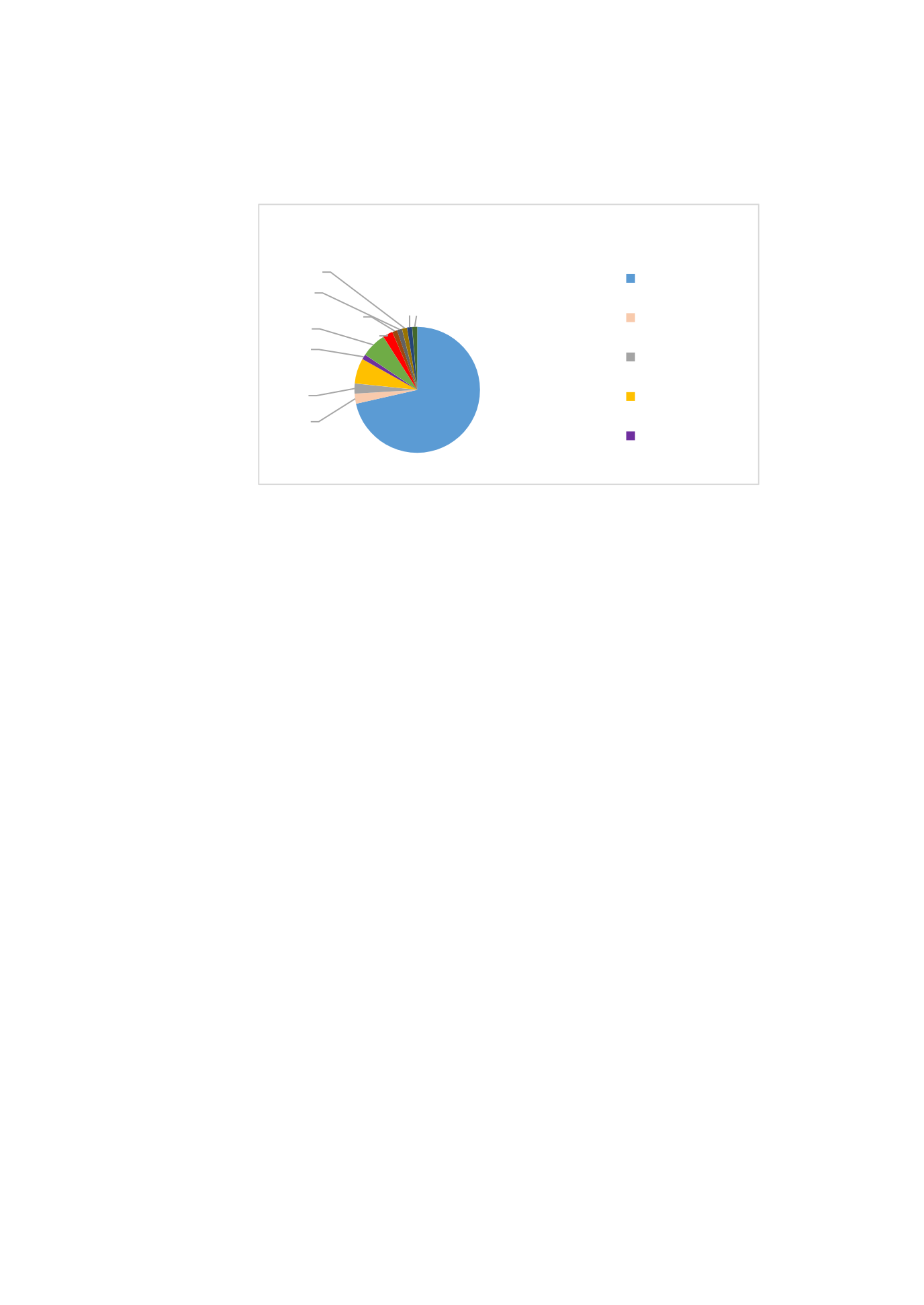
Based on the data in Table 4.2, it is known that of the 77
students with special needs who were used as the subject of the
study, the most common type of disorder was learning delay
(LB), which was 71.43%, learning difficulties as much,
autism, down syndrome as much as 2.59% each, moderate
impairment and ADHD as much as 6.49% each, dyslexia
impaired with impaired people, motor impairment, deafness,
speech delay, cerebral palsy 1.30% each. The percentage of the
percentage of disorders of students with special needs in the
table above can be seen in Figure 4.1 below.
1
Figure 2.2 Percentage Proportion of Disorders
Type
Students with Special Needs at
Inclusion Elementary School in
Magetan Regency
Based on the data obtained at the research site, the
number of teachers who specifically accompany students with
special needs is 15 people. The ratio of teachers : students is
classified as good, namely the ratio is 1 : 4.9. Of the 15
teachers, only 1 person has an extraordinary education
background (Special Education), while the
14 came from graduates in various fields of study. To improve
the professionalism of the Special Assistance Teachers, the
Magetan Regency Education and Sports Office has held
education and training several times to equip the teachers with
materials on inclusion education and assistance for students
with special needs.
Tuna grahita
keep
Dyslexia
71,43%
2,59%
2,59%
6,49%
Difficulty
Learn
Autis
1,30% 1,30% 1,30%
6,49%2,59%
1,30%
1 Slow Learning
Mageta
n
Types of Disorders for Students with
Special Needs in Inclusion Elementary
Schools in the District
1,30%
1,30%
1
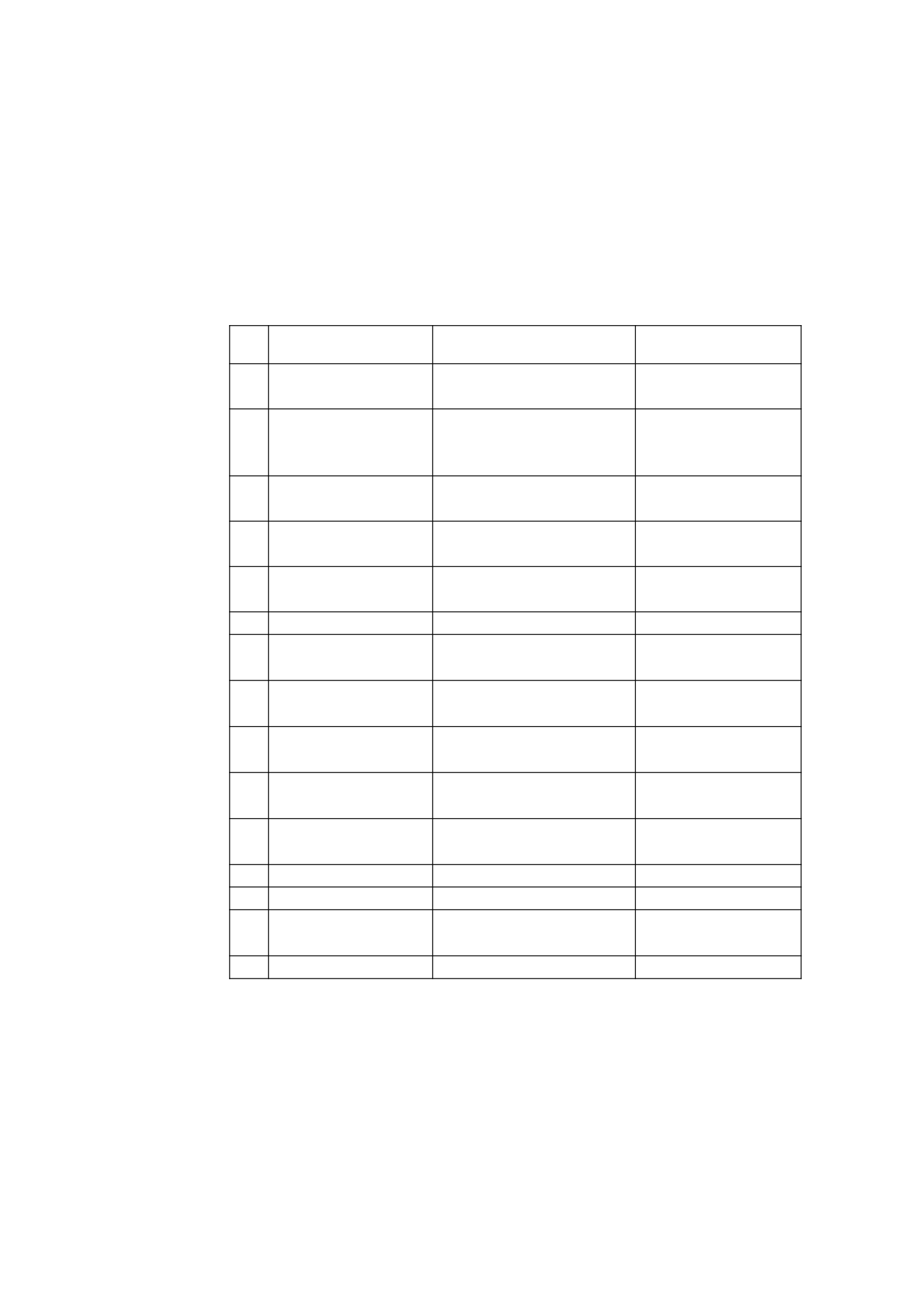
The data of special assistant teachers in the inclusion schools
studied can be seen in the following Table 2.3.
Table 2.3 Data on Special Accompanying Teachers in
Inclusion Schools in Magetan Regency
It Teacher's Name School Educational
Background*)
1 Fiki Kusuma
Permatasari, S.Pd.
SDN Sukowinangun 2
Magetan
Outer Education
Usual
2 Amelilin Vivilia Tulung 1 Elementary
School
Coaching
Education
Biology
3 Anggoro Hadi
Prasetyo
SDN Kerik 1 Takeran Education
Mathematics
4 Katemi SDN Kerik 1 Takeran Education
English
5 Erna SDN Nguntoronadi,
Nguntoronadi
Assoc. Prof.
6 Ernawati's Soup SDN Belotan 1 Bendo Assoc. Prof.
7 Eni Muryati SDN Bangsri 2
Ngariboyo
Assoc. Prof.
8Fitri Dwi
Mahargiani
The SDN is the Assoc. Prof.
9Request
Copy
SDN Plaosan 1
Plaosan
Assoc. Prof.
10 Shanti
Mariana
SDN Plaosan 1
Plaosan
PGSD
11 Taryono SDN Bulu Gunung 1
Poncol
Penjakes
12 Retno Sulistyorini SDN Turi 1 Panekan PGSD
13 Sutanto SDN Sukowinangun 1 English
14 Kusuman's clash
remembers
SDN Maospati 1 Assoc. Prof.
15 Shella Longina S SDN Maospati 1 Assoc. Prof.
*) All special assistant teachers have participated in the inclusion school training
Based on the results of interviews, document studies,
and observations, it can be concluded that the special assistant
teachers at the Inclusion Elementary School in the research site
have

1
good and feasible competencies to provide assistance to
students with special needs at the school where the research is
conducted. From interviews conducted with several teacher
informants, the informant stated that special assistant teachers
should ideally not only have good academic competence but
also have good interest, patience, and attention to the learning
development of students with special needs. It was further
stated that special assistant teachers must be diligent in
following the development of inclusive school problems, have
the ability to choose teaching methods that are appropriate to
the type of disorder experienced by students.
To improve the quality of special assistant teachers, the
Magetan Regency Education and Sports Office encourages and
facilitates teachers to develop themselves as special assistant
teachers for students with special needs, for example through
inclusive school education and training activities. At this time,
all special assistant teachers at 43 Inclusion Elementary
Schools in Magetan Regency have certificates as special
assistant teachers.
B. Early Reading Learning Conditions for Students with
Special Needs
Initial reading learning is a reading activity carried out
in elementary school elementary grades (grades I and II). The
learning objectives at this stage are more

1
emphasis is placed on the ability to read techniques that are
limited to the fairness of pronunciation and intonation. The
initial reading ability obtained by students in grades I and II
will be the basis for learning to read in the following classes.
Learning to read at the beginning should be done using simple
learning techniques and materials, using the student's own
words The reading ability obtained at the beginning reading
will greatly affect the ability to read further.
As the ability that underlies the next ability, the ability
to read at the beginning really requires the teacher's attention.
If the foundation is not strong, at the advanced reading stage
students will have difficulty to be able to have adequate
reading skills. Therefore, however, teachers of grades I and II
must be able to teach early reading in the right way so that
they can provide an adequate basis for reading skills to their
students.
According to the teacher informant, the implementation
of initial reading at SD Inklusi in Magetan Regency before the
pandemic was carried out in two periods, namely the period of
reading without books and reading using books. Reading
without books is done by teaching using media or teaching
aids other than books, while reading with books is a reading
activity using books.

1
In the interview, the informant stated that actually the
beginning reading was given to students in grades 1 and II,
along with writing and arithmetic. However, for students with
special needs, initial reading lessons can also be done until
they are in high grades. Early reading learning before the
pandemic was done with drils, continuous practice. In
addition, it also uses letter cards and picture cards. Pembel;
The teaching of initial reading for students with special needs
is carried out in one class with other normal students. This
condition is an obstacle for students with special needs
because their competencies are different from normal students.
Based on the observation results, most of the Inclusion
Elementary Schools in Magetan Regency have good enough
infrastructure to organize inclusion schools. The classrooms,
playground and library are well maintained. The teachers have
a good spirit to serve, full of enthusiasm in teaching.
The informant understands that the beginning reading
in grades I and II of SD Inclusion is intended to train students
to master reading techniques, practice singing skills or
pronounce writing well. The success of students in early
reading allows students to have (1) basic knowledge that can
be used as a basis for listening to Indonesian, (2) basic
knowledge that

1
can be used as a basis for speaking Indonesian, (3) basic
knowledge is used as a basis for reading Indonesian, and (4)
basic knowledge can be used as a basis for writing in
Indonesian. However, the reality is that all these goals have
not been achieved properly. For this reason, in some schools,
teachers provide additional lessons so that these students with
special needs have a good starting reading foundation and are
not too far behind their classmates. For example, in SD
Sukowinangun 2, out of 20 students with special needs, only
about a quarter are somewhat fluent in reading, the rest still
need to improve their reading skills.
The teacher stated that there are many obstacles in the
AM carries out initial reading learning for students with
special needs. Each student with special needs has different
obstacles, while teachers who understand these obstacles are
few. For example, at school they are given material with drils,
at home it is not applied. His parents did not care, had no
contribution to his children's studies. These parents mostly
come from underprivileged people with low education. To
teach early reading skills, a variety of media is needed, while
the media available in this school is very limited.

1
We lack the media to teach beginning reading, even though
this beginning reading ability is very important for children.
This obstacle is increasingly faced by teachers during
the covid 19 pandemic. The Covid-19 pandemic is an
anomaly, creating disorder and uncertainty. The uncertain
situation due to the Covid-19 pandemic has made it impossible
for people to distinguish between holidays and going to work.
Since there is an encouragement to work from home, study
from home, and work at home, the boundaries between work,
holidays, weekdays, and holidays have become blurred.
Initially, the Covid-19 pandemic was a health crisis, but now
almost all sectors are affected, including the education sector.
In Indonesia, the impact on the education sector due to
the Covid-19 outbreak is felt by all levels of schools, starting
from the elementary school/madrasah ibtidaiyah, junior high
school/tsanawiyah madrasah, and high school/madrasah
aliyah, and universities. All levels of education from
elementary schools/ibtidaiyah to universities (universities)
both under the Ministry of Education and Culture of the
Republic of Indonesia and those under the Ministry of
Religion of the Republic of Indonesia have all been negatively
impacted because students are forced to learn from home
online, because face-to-face learning is eliminated for

1
prevent the transmission of Covid-19. This is also a challenge
for teachers at Inclusion Elementary School in Magetan
Regency.
In the interview, the informant stated that he could not
learn to read early online due to equipment constraints. Not all
students can use cellphones, and there are some who do not
have cellphones. The socio-economic condition of parents of
students with special needs at SD Inclusion in Magetan
Regency comes from underprivileged families on average.
During the pandemic, initial reading learning was carried out
face-to-face through home visits. In addition, teachers also
routinely give assignments to students, with parental
assistance, but this has not been able to run well. If the
pandemic conditions are in the red zone, then all learning will
stop, including teachers cannot carry out home visits.
The informant stated that the impact of online learning
activities from home, namely students feel forced to learn
remotely without adequate facilities and infrastructure,
students do not have a distance learning culture because so far
the learning system has been carried out face-to-face, because
school is closed for too long, students feel bored. Online
learning also has an impact on parents, namely the increase in
the cost of purchasing internet quota and parents have to spend
more time accompanying their children while learning from
home

1
For teachers who are not proficient in using internet
technology or social media as a means of learning, this will be
a serious obstacle. Many teachers of SD Inklusi are not able to
use online learning tools and need assistance and training first.
This situation also occurs in early reading learning at
school. In learning early reading online, educators must
evaluate the effectiveness and adjust to the learning needs of
students. This is important to continue to meet learning aspects
such as knowledge, skills, and skills.
According to the informant, ideally in learning to read
at the beginning, teachers should not burden students with
various burdensome tasks. In learning to read at the beginning,
teachers should not be oriented towards the completeness of
curriculum achievements, but must be able to provide
meaningful learning experiences. Learning from home is
focused on life skills education, while learning activities and
tasks can be adjusted to the conditions of each school, by
providing qualitative feedback, without having to be
quantitative. The process of learning at home does not change
the way of learning in the classroom. That is, even though
students are at home, teachers continue to teach, there is still
interaction with students. This condition is difficult to achieve
by most Inclusion Elementary Schools in

1
Magetan Regency, especially schools that are located in rural areas
and mountain slopes.
C. The Needs of Teachers and Students for Individualized
Education Programs (IEPs) in Early Reading Learning
The implementation of inclusive education in Indonesia
is currently not running as it should. The implementation of
learning is only based on normal children without paying
attention to the abilities and needs of children with special
needs in the school, so it can be said that children with special
needs do not get
appropriate services. This kind of learning practice
is not the soul of
inclusive education, but integrated education,
where children with special needs must adapt to learning, and
not learning that is adjusted to the uniqueness of their learning
needs.
This inappropriate service can cause students to fail to
meet the learning objectives that have been determined. The
remedial exam is also not helpful enough because the remedial
program is not carried out as it should, namely the difficulties
experienced by students are identified and then the appropriate
remedial program is planned and implemented. In schools,
remedial is only carried out in the form of a retest to get a
score according to the KKM. If students experience failure in
achieving learning goals, then students will stay in class.
Students are considered stupid students because they are
unable to follow

1
Learning. The worst impact is students who drop out of
school.
Learning that is in accordance with the child's abilities
and needs is believed to be able to develop the potential that
children have. One way that can be done to help students with
special needs is by
developing an Individualized Education Program
(IEP) or
Individual Learning Program (PPI). An Individualized
Education Program
(IEP) or Individualized Learning Program
(PPI) or also called an Individualized Education Plan is a plan
written for each child who needs additional needs, to help
them make progress. The information that needs to be in the
IEP includes basic information, children's strengths and
difficulties, areas that need to be developed, specific targets for
children, and assistance that must be provided so that children
can achieve their targets.
Until now, there are still many inclusion schools that
have not developed and managed IEPs for students with
disabilities, so they must follow educational programs in
general regardless of their conditions and needs. Therefore, it
is important to develop and manage IEPs for students with
disabilities in inclusive schools.
Based on the results of interviews with 12 teachers at
12 Inclusion Elementary Schools in Magetan Regency, there is
only 1 teacher who has
used the Individualized Education Program
(IEP), namely at SD Sukowinangun 2, while the rest do not
understand the Individualized Education Program (IEP). The teacher
stated
that he only has a special IEP for autistic children,
ADHD, and slow learners, while for other obstacles he has not
yet

1
have. All of this is due to the limitation of teachers who have
extraordinary educational backgrounds (PLB). Ideally, in the
inclusion school, there are at least teachers with extraordinary
educational backgrounds.
According to all the teachers interviewed, the
Individualized Education Program (IEP) is urgently needed.
Early reading learning with an Individualized Education
Program (IEP) for each obstacle for students with special
needs will greatly help the success of initial reading learning.
In the front, various obstacles in carrying out initial
reading learning have been explained, especially during the
covid 19 pandemic. Face-to-face learning at school is
impossible, especially if Magetan Regency is in the covid 19
red zone. Teachers have conducted online learning but the
success rate is very low. According to teachers, there are many
obstacles to online learning. Teachers have used video calls for
half an hour, even students are busy themselves, some are
sleeping, some are angry. Extra high patience is required to
guide students with special needs. To overcome these
obstacles, teachers are offered a blended learning model.
In interviews with 12 teacher informants, none of them
have been familiar with the blended learning model. All
teachers stated that they needed a blended learning model in
learning to read at the beginning. In the interview, it was
explained to the teacher informant that the application of the
blended learning model

1
able to facilitate the speed and learning needs of diverse
students.
Through a combination of the role of teachers as
facilitators along with the use of technology, students can
adjust their learning process to their abilities and needs. In
addition, the blended learning model allows teachers to be
able to help students with special needs who encounter
problems in learning, both individually and in groups.
The online learning system used in the blended
learning model also allows students to explore more learning
materials so that there is a variety of learning activities. This is
in line with efforts to improve the quality of learning in
accordance with the demands of education in the XXI century.
Teachers realize that to be able to implement the
blended learning model, teachers must have knowledge of
various things such as how to compile the content of learning
materials, select and implement learning strategies, and
knowledge of how to integrate technology in learning
activities. The concrete form of the application of this blended
learning model must be reflected in the lesson plan, learning
activities, and initial reading learning assessment.
1
CHAPTER IV
INDIVIDUALIZED EDUCATION PROGRAM
I. IDENTITY
Student's Full Name
(initials)
AH
Male Gender Date of Birth
February 17
2014
Class
2
School
SDN Sukowinangun
1 Magetan
Academic
Year
2021/2022
Parent/Guardian Name Students live with:
(v) Parents ( )
Guardians:
………………..
Program Builder: IEP Development Team
1. Researchers
2. Principal
3. Indonesian Teacher
4. Guidance and Counseling Teacher
5. Special Accompanying Teacher
Program Implementers:
1. Researchers
2. Indonesian Teacher
3. Special Accompanying Teacher
Class teacher: Dwi Pujiastuti Accompanying teacher: Sutanto
Assessments that have been
conducted:
Test IQ
Assessment results:
Slow Learner
Special needs of
students: (V) Slow to
learn
( ) Dyslexia
( ) Learning
Difficulties ( )
ADHD
( ) Tuna Grahita
( ) Autis
( ) Tuna Daksa
(v) Others: Slow learning
Specially needed equipment:
Special services students have participated in:

1
( ) Speech therapy, duration...................... ( )
Occupation, the duration of ...........................
( ) Others: .................. Ever...................
Specific services that students are participating in
( ) Speech therapy, duration...................... ( )
Occupation, the duration of ...........................
( ) Others: .................. Ever...................
II. STRENGTHS AND RESISTANCE
Obstacles Strength
Cognitive
a. Unable to solve
complex problems
(abstract)
b. Unable to convey
assignments that
have been learned
c. Difficult to master
academic skills
such as counting
and spelling
d. Does not have a
jangariataiang
destination
e. Slow in completing
tasks
f. Difficulty
mastering
academic skills
such as spelling
g. Unable to generalize
skills, knowledge
and
strategy
a. Able to understand the
teacher's instructions
b. Able to understand,
apply/apply the
understanding learned
c. Able to analyze the
information provided by the
teacher

1
Emotion
a. Have a poor self-
concept and have
emotional and
behavioral problems
b. Unable to express
emotions well
c. Easily give up when
facing difficulties
d. Don't dare
to express
an opinion
e. Unable to
control oneself
f. Unable to afford
expressing feelings
a. Able to express emotions
according to circumstances
b. Able to feel emotional
changes around them/others
Social
a. Difficulty in
establishing
relationships with
others
b. Not happy when
mingling with his
friends
c. Don't have
close friends
d. Being indifferent to
the surrounding
environment
e. Withdraw from
the environment
f. Not willing to share
things with
His
a. Play with different friends
b. Willing to help a friend
c. Able to communicate
well
d. Able to establish good
friendships
e. It is not easy to quarrel
with his friends
f. Enjoys playing with
friends his age
1
Motor
a. Unable to pay
attention for a long
period of time
b. Experiencing
difficulties in
following gradual
instruction
c. Do not have more
skills in the fields of
mechanics
(machinery), arts, and
sports
a. Able to respond to responses
given by others
b. Able to perform tasks in
accordance with the given
procedures
c. Responding to the teacher's
instructions is no slower than
a normal child
Behaviour
a. Unable to
perform tasks
according to
procedures
b. Not obeying the
agreed class rules
c. Often late
d. Not doing
assignments
a. Self-sufficient
b. Don't like ordering friends to
do what they want
Others
a. Parents do not know
that their child is a
slow learner
III. NEEDS ANALYSIS
Necessity Treatment
Cognitive
Improving capabilities in
solving complex
problems
(abstract).
Give assignments with problems
that have a level of complexity
gradual
(medium-complex)
1
Improving capabilities
deep
remember and
convey the hearingalone
(no get
Deliver tasks
that have been learned)
Teaching how to make good
notes, so that the material
received is easy to remember
(write down the important points
of a learning material) in the
form of mind maps and concept
maps and write down important
points
from the subject matter on the
board.
Improving capabilities
in
mastering academic skills
such
as counting and spelling.
Conducting remedial teaching
(repeating lessons outside of
learning hours)
Providing exercises in the form
of solving problems with gradual
difficulty levels (simple-
complex)
Dst.
Create long-term goals. Determine the goals of the pillars
to be achieved and the strategies
that will be used to achieve the
goals that have been
Set
Completing tasks on
time (slow in completing
tasks).
Ask his classmates to petrify in
completing assignments. (Peer
tutoring).
Improving capabilities in
generalizing skills,
knowledge and
strategy.
Give Training in the
form of generalizing skills,
knowledge, and strategies with
gradual difficulty levels (simple-
complex)
Increase
Academic grades
Involve children in tutoring
(private tutoring) and do remedial
teaching.

1
Improving capabilities in
managing time due to
limited recall data
and ConcentrationThe
Bad
Improving capabilities in
mastering a concept.
Teaching how to determine the
important points of a learning
material can be done by teaching
how to make a good concept or
mind map.
Conducting remedial teaching
(repeating lessons outside of
learning hours)
Take note of the main points of
the learning material on the
board.
Exercise memory
sharpness (when the
teacher reminds the last
material studied, the child
does not seem to
remember anything).
Taking notes in the form of a
mind map or concept map
Presenting material with
images, illustrations, videos, and
more
Activities learning using
interesting (cooperative and
competitive) methods, such as
games, practicums,
demonstrations, and others.
It looks like they can't
understand what the
teacher is saying.
Using language
which is simple
and easy to understand.
Improving capabilities
deep
remember lessons
that ever
Delivered.
Take notes in the form of a mind
map or concept map.
Improving capabilities
deep
remember lessons
that ever
Delivered.
Ask students to increase reading
references or teachers provide
Interesting reading
recommendations.
1
Increase the value of the
lesson to be equal even
above his friends.
Conducting remedial teaching
(repeating lessons outside of
school hours)
The presentation of learning
materials is fun, so that the
material received is easy to
remember, such as by holding
group games and using videos.
Involve children in tutoring
(subject tutoring)
Increase motivation to
learn (not struggle hard
to get grades)
Providing motivation to regular
students in general and students
with special needs in particular
before, during, or after learning
activities.
Create a
cooperative learning environment
and
competitive by choosing the right
learning method.
Socioemotional
Have a poor self-concept
and have emotional and
behavioral problems.
Improve the attitudes and
abilities of people who relate
to students (parents and school
residents)
Parents and teachers as good role
models
Unable to channel his
emotions
well
Trained on how to express
their emotions
well
It's easy to give up when
Facing difficulties
Provides motivation and
help
1
Train and increase the
level of confidence
and courage in
expressing their
opinions and feelings
Do not express their
opinions and feelings
Unable to express his
feelings
Unable to recognize
own feelings
Train and increase confidence
through improving cognitive
abilities and habituating students
to public speaking Habituating
students to express what they feel
to subject teachers, classroom
teachers, GPK, BK teachers,
parents, or friends.
Difficult to establish
relationships with others
Creating an environment that
accepts the presence of students
with special needs around them
Subject teachers, classroom
teachers, GPK, BK teachers,
parents, or friends invite them to
talk The school requires all
students to participate in
extracurricular activities
Getting students used to helping
each other
Not happy when mingling
with his friends
Don't have close friends
Being indifferent to the
surrounding environment
Withdrawing from the
environment
Not willing to share
things with
His
Doesn't like to help
Not friendly with others
Not protecting his friends,
especially those who
younger age
Motor
Increased concentration
(inability to pay attention
for a long period of time)
Using varied and interesting
learning methods.
1
Improve the ability to
follow gradual
instructions
Provide simple instructions using
easy-to-understand language and
repeat instructions
Does not have the ability
to go deeper
Mechanical (mechanical),
arts, and sports fields
Seeking out the talents and
interests of students and then
developing them
Practicing improves
delirium and doing
everything regularly (not
meticulous and
disorganized)
Suggest having an activity
notebook that contains daily
activities that have been and will
be carried out.
Re-check the work that has
been done
Increased confidence
level (inability to tell
about yourself with
confidence)
Training and increasing the level
of confidence, one of the things
that can be done is to motivate
and convince that the student has
advantages that others may not
have
in public speaking
Train and improve the
ability to conduct teacher
instruction properly and
appropriately
Provide instructions using
easy-to-understand language
Give instructions using easy-
to-understand language Use
instructions with clear
pronunciation
Give instructions in a loud
voice Repeat instructions
1
Behaviour
Unable to perform tasks
according to procedures
Creating an environment that
accepts the presence of students
with special needs around them
and asking their close friends to
invite participants to sit and
mingle with other
friends/communities.
Friends and teachers often talk to
each other, both in person
or indirectly through messages on
mobile phones
Not complying with
agreed class rules
Sanctioning apabula for violating
regulations and providing rewards
for complying with regulations
Practice discipline
(often late)
Sanctions if they violate the rules
(late).
Complete tasks on
time
Ask fellow students to help
participants with special needs
complete their assignments
Focus during class hours The use of learning methods
that are varied, interesting, and
fun.
Obey class or school rules Sanctioning if violating the rules
and providing rewards for obeying
regulation.
Be polite Setting a good example,
reprimands in a good way and at
the right time.
Choosing duam when you
don't want to obey orders
Repeating commands,
reminding/reprimanding in a
good way
Likes to order friends to
do what they want
Asking students to do their
tasks independently
Tends to be lazy Provides motivation

1
Others
Parents need to The school invites parents
knowing that and said that
his son is a slow His son is a slow
learner learner (requires service
special according to ability, talent,
and his interests)
IV. SUPPORTING AND INHIBITING FACTORS
Supporting Factors Inhibiting Factors
At School
a. There is a positive
attitude and belief
from school residents
towards the ability of
students with special
needs and students
will succeed
b. Sufficient
personnel
available
c. There are special
assistant teachers
(GPK) who are
ready to help
students with
special needs and
teachers
Regular
a. Schools do not take part in the
placement of student seats
b. The use of monotonous
learning methods
c. Learning that is not based
on students' interests,
needs, and abilities
At
Home
- -
Other Places
- -
1
INDIVIDUALIZED EDUCATION PROGRAM
I. IDENTITY
Student's Full Name
(initials)
MI
Male Gender Date of Birth
May 23, 2013
Grad
e 3
School
SDN Sukowinangun 1
Magetan
Academic
Year
2021/2022
Parent/Guardian Name
Dodik Istianto
Students live with:
(v) Parents ( )
Guardians:
………………..
Program Builder: IEP Development Team
1. Researchers
2. Principal
3. Indonesian Teacher
4. Guidance and Counseling Teacher
5. Special Accompanying Teacher
Program Implementers:
1. Researchers
2. Indonesian Teacher
3. Special Accompanying Teacher
Class teacher: Anas Anwar Accompanying teacher: Sutanto
Assessments that have
been conducted:
Test IQ
Assessment results:
Slow Learner
Special needs of
students: (V) Slow to
learn
( ) Dyslexia
( ) Learning
Difficulties ( )
ADHD
( ) Tuna Grahita
( ) Autis
( ) Tuna Daksa
(v) Others: Slow learning
Specially needed equipment:
Special services that students have
participated in: ( ) Speech therapy,
duration......................

1
( ) Occupation, the duration of ...........................
( ) Others: .................. Ever...................
Specific services that students are participating in
( ) Speech therapy, duration...................... ( )
Occupation, the duration of ...........................
( ) Others: .................. Ever...................
II. STRENGTHS AND OBSTACLES
Obstacles Strength
Cognitive
a. Unable to solve
complex problems
(abstract)
b. Unable to convey
assignments that
have been learned
c. Difficulty
mastering
academic skills
such as counting
and spelling
d. Does not have a
jangariataiang
destination
e. Slow in completing
tasks
f. Difficulty
mastering
academic skills
such as spelling
g. Unable to generalize
skills, knowledge
and
strategy
a. Able to understand the
teacher's instructions
b. Able to understand,
apply/apply the
understanding learned
c. Able to analyze the
information provided by
the teacher

1
Emotion
a. Have a poor self-
concept and have
emotional and
behavioral problems
b. Unable to express
emotions well
c. Easily give up when
facing difficulties
d. Don't dare to express
an opinion
e. Unable to
control oneself
f. Unable to
express
feeling
a. Able to express emotions
according to circumstances
b. Able to feel emotional
changes around them/others
Social
a. Difficulty in
establishing
relationships with
others
b. Not happy when
mingling with his
friends
c. Don't have close
friends
d. Being indifferent to
the surrounding
environment
e. Withdraw from
the environment
f. Not willing to share
the things they have
with their friends
a. Play with different friends
b. Willing to help a friend
c. Able to communicate
well
d. Able to establish good
friendships
e. It is not easy to quarrel
with his friends
f. Enjoys playing with friends
his age

1
Motor
a. Unable to pay
attention for a long
period of time
b. Experiencing
difficulties in
following gradual
instruction
c. Do not have more
skills in the fields of
mechanics
(machinery), arts, and
sports
a. Able to respond to responses
given by others
b. Able to perform tasks in
accordance with the given
procedures
c. Responding to the teacher's
instructions is no slower than
a normal child
Behaviour
a. Unable to
perform tasks
according to
procedures
b. Not obeying the
agreed class rules
c. Often late
d. Not doing
assignments
a. Self-sufficient
b. Don't like ordering friends to
do what they want
Others
a. Parents do not know
that their child is a
slow learner
II. NEEDS ANALYSIS
Necessity Treatment
Cognitive
Improving the ability to
Solving
complex problems
(abstract).
Give assignments with
problems that have a level of
complexity Gradual
(simple-complex)
1
Improve the ability to
remember and convey one's
own hearings (unable to
convey tasks that have been
learned)
Teaching how to take good
notes, so that the material
received is easy to remember
(write down the important
points of a learning material)
in the form of mind maps and
concept maps and write down
key points from the subject
matter on the board.
Increase Capabilities
in control
Skills academic
like counting and spelling.
Conducting remedial teaching
(repeating lessons outside of
learning hours) Providing
exercise in the
form of completing
problems with a
high level of difficulty
Gradual (simple-
complex) etc.
Make purpose long-
term.
Memntukan
Objectives of Jangariatiang to
be achieved and strategic to be
used to achieve the goals that
have been
Set
Completing tasks on time
(slow in completing tasks).
Ask his classmates to petrify
in completing assignments.
(Peer
tutoring).
Improve the ability to
generalize skills, knowledge,
and strategies.
Providing training in the form
of generalizing skills,
knowledge,
and strategies with the level of
gradual difficulty (simple-
complex)
Increase
Academic grades
Include child to
tutoring (private lessons)
and do remedial
teaching.

1
Improve your time
management skills because
data
remember
limited and poor
concentration
Improving the ability to
master a concept.
Teaching how to determine the
important points of a learning
material can be done by
teaching how to make a good
concept or mind map.
Conducting remedial teaching
(repeating lessons outside of
learning hours)
Taking note of the main points
of things
important from the learning
materials on the board.
Practice memory acuity
(when the teacher reminds
the last material studied, the
child does not seem to
remember anything).
Taking notes in the form of a
mind map or concept map
Presenting material with
images, illustrations, videos,
and more
Activities Learning
using
interesting
(cooperative and competitive)
methods, such as games,
practicums, demonstrations,
and
others.
It looks like they can't
understand what the teacher
is saying.
Using simple and easy-to-
understand language.
Increase Ability to
remember lessons
that has been conveyed.
Take notes in the form of a mind
map or concept map.
Improve the ability to
remember lessons that have
been taught.
Ask students to multiply
reading
references or teachers provide
reading recommendations that
pull.

1
Increase the value of the
lesson to be equal even
above his peers.
Conducting remedial teaching
(repeating lessons outside of
school hours)
The presentation of learning
materials is fun, so that the
material received is easy to
remember, such as by holding
group games and using videos.
Involve children in tutoring
(subject tutoring)
Increase motivation to learn
(not struggle hard to get
grades)
Providing motivation to
regular students in general and
students with special needs in
particular before, during, or
after
Activities
Teaching.
Create A
cooperative and competitive
learning atmosphere by means
of selection method
the right learning.
Socioemotional
Have a poor self-concept and
have emotional and
behavioral problems.
Improve the attitudes and
abilities of people who relate to
students (parents and school
residents)
Parents and teachers as good
role models
Unable to channel his
emotions well
Trained on how to express
their emotions well
Easily give up in the face of
adversity
Providing motivation and
assistance
1
Train and increase the level
of confidence and courage in
expressing their opinions and
feelings
Unable to express his
opinions and feelings
Unable to express his
feelings
Unable to recognize one's
own feelings
Train and increase self-
confidence through
improving cognitive abilities
and habituating students to
public speaking Accustom
students to express what they
feel to subject teachers,
classroom teachers,
GPK, BK teachers, parents, or
friends.
Difficulty in establishing
relationships with others
Creating an environment that
accepts the presence of students
with special needs around them
Subject teachers, classroom
teachers, GPK, BK teachers,
parents, or friends invite them
to talk
The school requires all
students to participate in
extracurricular Getting
students used to helping
each other
Not happy when mingling
with his friends
Don't have close friends
Being indifferent to the
surrounding environment
Withdrawing from the
environment
Not ready for
Share things you have with
your friends
Doesn't like to help
Not friendly with people
other
Not protecting his friends
especially those who are
younger
Motor
Increased concentration
(inability to pay attention for
a long period of time)
Using varied and interesting
learning methods.
Improve the ability to
follow gradual instructions
Provide simple instructions
using easy-to-understand
language and
Repeating Instructions
1
Does not have the ability
in the fields of mechanics
(machinery), arts, and
athletics
Seeking talent and interests
learners and then develop them
Practicing improves
delirium and doing
everything regularly (not
meticulous and
disorganized)
Suggest having an activity
notebook that contains daily
activities that have been and
will be carried out. Double-
checking
work done
Increased confidence level
(inability to tell about
yourself with confidence)
Training and increasing the
level of confidence, one of the
things that can be done is to
provide motivation and
convince that the student has
strengths that others may not
have in training skills in
Public speaking
Train and improve the
ability to conduct teacher
instruction properly and
appropriately
Provide instructions using easy-
to-understand language
Give instructions using easy-
to-understand language Use
instructions with clear
pronunciation Give
instructions with
loud voices
Repeating
instructions
1
Behaviour
Unable to perform tasks
according to procedures
Creating an environment that
accepts the presence of students
with special needs around them
and asking their close friends to
invite participants to sit and
mingle with other
friends/communities. Friends
and teachers often talk to each
other, both in person
or indirectly through
messages on mobile phones
Not complying with agreed
class rules
Sanctioning apabula for
violating regulations and
providing rewards for
complying with regulations
Practice discipline (often late) Sanctions if they violate the
rules (late).
Complete tasks on time Ask fellow students to help
participants with special
needs complete
His duties
Focus during class hours The use of learning methods
that are varied, interesting, and
fun.
Obey class or school rules Sanctioning if violating the
rules and providing rewards
when
Obey the rules.
Be polite Giving a good example,
reprimanding in a way that
that is good and at the right
time.
Choosing duam when you
don't want to obey orders
Repeating commands,
reminding/reprimanding in
a good way

1
Likes to rule friends
to do what you want
Ask students
perform their duties
independently
Tends to be lazy Provides motivation
Others
Parents need to know that
their child is a slow learner
The school invites parents and
complains that their child is a
slow learner (requires special
services according to
his abilities, talents, and
interests)
IV. SUPPORTING AND INHIBITING FACTORS
Supporting Factors Inhibiting Factors
At School
a. There is a positive
attitude and belief from
school residents towards
the ability of students
with special needs and
students will succeed
b. Sufficient personnel
available
c. There are special
assistant teachers (GPK)
who are ready to help
students with special
needs and
Regular Teacher
a. Schools do not take part
in the placement of
student seats
b. The use of
monotonous
learning methods
c. Learning that is not
based on students'
interests, needs, and
abilities
At
Home
- -
Other Places
1
INDIVIDUALIZED EDUCATION PROGRAM
I. IDENTITY
Student's Full Name
(initials)
JA
Female
Gender
Date of Birth
March 19, 2013
Grad
e 3
School
SDN Sukowinangun
1 Magetan
Academic
Year
2021/2022
Budiono's
Parents/Guardians
Students live with:
(v) Parents ( )
Guardians:
………………..
Program Builder: IEP Development Team
1. Researchers
2. Principal
3. Indonesian Teacher
4. Guidance and Counseling Teacher
5. Special Accompanying Teacher
Program Implementers:
1. Researchers
2. Indonesian Teacher
3. Special Accompanying Teacher
Class teacher: Fathul Dwi Krisdianto Accompanying teacher: Sutanto
Assessments that have been
conducted:
Test IQ
Assessment results:
Slow Learner
Special needs of
students: (V) Slow to
learn
( ) Dyslexia
( ) Learning
Difficulties ( )
ADHD
( ) Tuna Grahita
( ) Autis
( ) Tuna Daksa
(v) Others: Slow learning
Specially needed equipment:
Special services that students have
participated in: ( ) Speech therapy,
duration...................... ( ) Occupation, the

1
duration of ...........................

1
( ) Others: .................. Ever...................
Specific services that students are participating in
( ) Speech therapy, duration...................... ( )
Occupation, the duration of ...........................
( ) Others: .................. Ever...................
II. STRENGTHS AND RESISTANCE
Obstacles Strength
Cognitive
a. Unable to solve
complex problems
(abstract)
b. Unable to convey
assignments that
have been learned
c. Difficulty
mastering
academic skills
such as counting
and spelling
d. Does not have a
jangariataiang
destination
e. Slow in completing
tasks
f. Difficulty
mastering
academic skills
such as spelling
g. Unable to generalize
skills, knowledge
and
strategy
a. Able to understand the
teacher's instructions
b. Able to understand,
apply/apply the
understanding learned
c. Able to analyze the
information provided by the
teacher

1
Emotion
a. Have a poor self-
concept and have
emotional and
behavioral problems
b. Unable to express
emotions well
c. Easily give up when
facing difficulties
d. Don't dare to express
an opinion
e. Unable to
control oneself
f. Unable to
express
feeling
a. Able to express emotions
according to circumstances
b. Able to feel emotional
changes around them/others
Social
a. Difficulty in
establishing
relationships with
others
b. Not happy when
mingling with his
friends
c. Don't have close
friends
d. Being indifferent to
the surrounding
environment
e. Withdraw from
the environment
f. Not willing to share
the things they have
with their friends
a. Play with different friends
b. Willing to help a friend
c. Able to communicate
well
d. Able to establish good
friendships
e. It is not easy to quarrel
with his friends
f. Enjoys playing with friends
his age
1
Motor
a. Unable to pay
attention for a long
period of time
b. Experiencing
difficulties in
following gradual
instruction
c. Does not have more
skills in the field
mechanics, arts, and
sports
a. Able to respond to responses
given by others
b. Able to perform tasks in
accordance with the given
procedures
c. Responding to the teacher's
instructions is no slower than
a normal child
Behaviour
a. Unable to
perform tasks
according to
procedures
b. Not obeying the
agreed class rules
c. Often late
d. Not doing
assignments
a. Self-sufficient
b. Don't like ordering friends to
do what they want
Others
a. Parents do not know
that their child is a
slow learner
III. NEEDS ANALYSIS
Necessity Treatment
Cognitive
Improving capabilities in
solving complex
problems
(abstract).
Give assignments with problems
that have a level of complexity
gradual
(medium-complex)
1
Improving capabilities
deep
remember and
convey the hearingalone
(no get
Deliver tasks
that have been learned)
Teaching how to make good
notes, so that the material
received is easy to remember
(write down the important points
of a learning material) in the
form of mind maps and concept
maps and write down important
points
from the subject matter on the
board.
Improving capabilities
in
mastering academic skills
such
as counting and spelling.
Conducting remedial teaching
(repeating lessons outside of
learning hours)
Providing exercises in the form
of solving problems with gradual
difficulty levels (simple-
complex)
Dst.
Create long-term goals. Determine the goals of the pillars
to be achieved and the strategies
that will be used to achieve the
goals that have been
Set
Completing tasks on
time (slow in completing
tasks).
Ask his classmates to petrify in
completing assignments. (Peer
tutoring).
Improving capabilities in
generalizing skills,
knowledge and
strategy.
Give Training in the
form of generalizing skills,
knowledge, and strategies with
gradual difficulty levels (simple-
complex)
Increase
Academic grades
Involve children in tutoring
(private tutoring) and do
remedial
teaching.

1
Improving capabilities in
managing time due to
limited recall data
and ConcentrationThe
Bad
Improving capabilities in
mastering a concept.
Teaching how to determine the
important points of a learning
material can be done by teaching
how to make a good concept or
mind map.
Conducting remedial teaching
(repeating lessons outside of
learning hours)
Take note of the main points of
the learning material on the
board.
Exercise memory
sharpness (when the
teacher reminds the last
material studied, the child
does not seem to
remember anything).
Taking notes in the form of a
mind map or concept map
Presenting material with
images, illustrations, videos, and
more
Activities learning using
interesting (cooperative and
competitive) methods, such as
games, practicums,
demonstrations, and others.
It looks like they can't
understand what the
teacher is saying.
Using language
which is simple
and easy to understand.
Improving capabilities
deep
remember lessons
that ever
Delivered.
Take notes in the form of a mind
map or concept map.
Improving capabilities
deep
remember lessons
that ever
Delivered.
Ask students to increase reading
references or teachers provide
Interesting reading
recommendations.
1
Increase the value of the
lesson to be equal even
above his friends.
Conducting remedial teaching
(repeating lessons outside of
school hours)
The presentation of learning
materials is fun, so that the
material received is easy to
remember, such as by holding
group games and using videos.
Involve children in tutoring
(subject tutoring)
Increase motivation to
learn (not struggle hard
to get grades)
Give motivation to
participants educate
Regular in
general and Participants
education in need
special in
particular before, during, or after learning activities. Create
A cooperative
and competitive learning
atmosphere by means of selection
the right learning method.
Socioemotional
Have a poor self-concept
and have emotional and
behavioral problems.
Improve the attitudes and
abilities of people who relate
to students (parents and school
residents)
Parents and teachers as good role
models
Unable to channel his
emotions
well
Trained on how to express
their emotions
well
It's easy to give up when
Facing difficulties
Provides motivation and
help
1
Train and increase the
level of confidence
and courage in
expressing their
opinions and feelings
Do not express their
opinions and feelings
Unable to express his
feelings
Unable to recognize
own feelings
Train and increase confidence
through improving cognitive
abilities and habituating students
to public speaking Habituating
students to express what they
feel to subject teachers,
classroom teachers, GPK, BK
teachers, parents, or friends.
Difficult to establish
relationships with others
Creating an environment that
accepts the presence of students
with special needs around them
Subject teachers, classroom
teachers, GPK, BK teachers,
parents, or friends invite them to
talk The school requires all
students to participate in
extracurricular activities
Getting students used to
helping each other
Not happy when mingling
with his friends
Don't have close friends
Being indifferent to the
surrounding environment
Withdrawing from the
environment
Not willing to share
things with
His
Doesn't like to help
Not friendly with others
Not protecting his friends,
especially those who
younger age
Motor
Increased concentration
(inability to pay attention
for a long period of time)
Using varied and interesting
learning methods.
1
Improve the ability to
follow gradual
instructions
Provide simple instructions using
easy-to-understand language and
repeat instructions
Does not have the ability
to go deeper
Mechanical (mechanical),
arts, and sports fields
Seeking out the talents and
interests of students and then
developing them
Practicing improves
delirium and doing
everything regularly (not
meticulous and
disorganized)
Suggest having an activity
notebook that contains daily
activities that have been and will
be carried out.
Re-check the work that has
been done
Increased confidence
level (inability to tell
about yourself with
confidence)
Training and increasing the level
of confidence, one of the things
that can be done is to motivate
and convince that the student has
advantages that others may not
have
in public speaking
Train and improve the
ability to conduct teacher
instruction properly and
appropriately
Provide instructions using
easy-to-understand language
Give instructions using easy-
to-understand language Use
instructions with clear
pronunciation
Give instructions in a loud
voice Repeat instructions
1
Behaviour
Unable to perform tasks
according to procedures
Creating an environment that
accepts the presence of students
with special needs around them
and asking their close friends to
invite participants to sit and
mingle with other
friends/communities.
Friends and teachers often talk to
each other, both in person
or indirectly through messages on
mobile phones
Not complying with
agreed class rules
Sanctioning apabula for violating
regulations and providing rewards
for complying with regulations
Practice discipline
(often late)
Sanctions if they violate the rules
(late).
Complete tasks on
time
Ask fellow students to help
participants with special needs
complete their assignments
Focus during class hours The use of learning methods
that are varied, interesting, and
fun.
Obey class or school rules Sanctioning if violating the rules
and providing rewards for obeying
regulation.
Be polite Setting a good example,
reprimands in a good way and at
the right time.
Choosing duam when you
don't want to obey orders
Repeating commands,
reminding/reprimanding in a
good way
Likes to order friends to
do what they want
Asking students to do their
tasks independently
Tends to be lazy Provides motivation

1
Others
Parents need to The school invites parents
knowing that and said that
his son is a slow His son is a slow
learner learner (requires service
special according to ability,
talents, and interests)
IV. SUPPORTING AND INHIBITING FACTORS
Supporting Factors Inhibiting Factors
At School
a. There is a positive
attitude and belief
from school residents
towards the ability of
students with special
needs and students
will succeed
b. Sufficient
personnel
available
c. There are special
assistant teachers
(GPK) who are
ready to help
students with
special needs and
teachers
Regular
a. Schools do not take part in the
placement of student seats
b. The use of monotonous
learning methods
c. Learning that is not based
on students' interests,
needs, and abilities
At
Home
- -
Other Places
- -

1
CHAPTER V
CONCLUSIO
N
An Individualized Education Program (IEP) is a learning
plan or program that is prepared for each child with special needs
based on the strengths and weaknesses of children with special
needs. The IEP is prepared based on the results of the assessment
of the handicap owned by each child with special needs. This IEP
program can be in the form of a short-term program or a long-
term program, which includes educational aspects, psycho-socio-
emotional aspects, and referrals with related institutions for
children with special needs.
The information that needs to be in the Individualized
Education Program (IEP) includes basic information, the child's
strengths and difficulties, areas that need to be developed,
specific targets for the child, and assistance that must be provided
so that the child can achieve the target. Therefore, the use of the
Individualized Education Program (IEP) helps teachers to plan
lessons in their daily lives in the classroom, helps students receive
good quality learning, has a positive impact on the academic
development of students with special needs, and can help students
with special needs to achieve learning progress in accordance
with the general curriculum in the education system.

1
The Individualized Education Program (IEP) serves as a
document to determine cooperation and collaboration between
schools, parents, students, and if necessary, the local education
office, and parties from other institutions or support services.
Therefore, the use of the Individualized Education Program (IEP)
helps teachers to plan lessons in their daily lives in the classroom,
helps students receive good quality learning, has a positive
impact on the academic development of students with special
needs, and can help students with special needs to achieve
learning progress in accordance with the general curriculum in
the education system.

