


STATEMENT OF THE PURPUSE, OBJECTIVE, SCOPE, AND
LIMITATIONS OF THE STUDY
There is extensive debate about the future of the banking channels roles, functionality and
management. There are opinions that branches will become very difficult as a customer move
toward online channels, whereas others believe that majority of transactions will still remain
in the bank branches and customers still looks the location as per their convenient because
they really need face-to –face and human interaction.
The objective of the study is to evaluate the banking sector in Kosovo, more specifically
distribution channels development, channels management, integration among them, and
global trends and strategies. In addition, different channels penetration, number of
people/inhabitants per different channels and also analyze how our market stands in
comparison with other regional counties. The objective of the study is also to describe how
the electronic channels help to reduce costs for both banks and customers!
Banks are finding current market environment and conditions tough and try to find the best
way to meet customer demands, provide superior customer service, while increasing
efficiency and reduce operating costs. Putting customer first is the right response, and the
branch is the places to do that, however how much cost are associated with opening new
branch? The answer on the question is based on the products and services which the new
branch will offer. The fundamental question to this is: whether these transactions and
payments can be performed in other alternative channels which are less costly? Globally,
the role of branches is changing rapidly. Most of the services and routine transactions are
moving toward alternative and electronic channels such us: Automatic Teller Machines,
Internet Banking, Mobile Banking and Call Centre.
One thing is clear: the branches will always exist, however the following questions occur,
respectively the scope of the study is:
• What will be the future of the bank branches? What will be the role of the branches
in the environment dominated by new channels?

• What role other alternative/electronic channels will play?
• How the development and usage of alternative/electronic channels will effect CIR
(cost income ratio) and banks profitability;
One of the possible limitations of the study are lack of quantitative data, in particular, data
for mobile banking in Kosovo and regional countries, Call Centre/Telebanking sales
activities, as well as costs structure through different channels, which could ensure a better
origination of this paper.

SPECIFIC, METHODOLOGY OF THE STUDY
For the purpose of this thesis I chose the qualitative research method by using observation
techniques, interviews and literature review.
This research was started back in 2005 and since then in my position as a distribution
channels head, responsible for network channels development, management and integration,
I have used observation techniques. During this period, I conducted a close observation in
all channels throughout the Republic of Kosovo. The focus was in all branches /cities, as
well as centralized alternative channels located in head office in Prishtina, i.e Call Centre.
My second approach to this research was the interview method, where I used the structured
and semi-structured interviews with all relevant parties in branches, including branch
management and front line employees. Additionally, there were questioners organised in
branches in order to gather internal and external customers’ feedbacks. In order to triangulate
the study I used the literature review to verify the data collected during the observatory
techniques and relevant interviews.
Methodology includes shifting from traditional channels of distribution to more advanced
channels, such us: E- Banking, ATM and Mobile Banking, as well as costs and benefits.
The data collected in this study were compared to the study case of in-branch and E banking
usage by customers, analyses of basic/simple transactions and more complex transactions
1
.
These comparisons were mostly based on the literature reviews from different retail banking
conference materials and presentations in Europe, EFMA magazines
2
, The Economists
3
,
European banking reports and publications.

1. FINANCIAL SECTOR IN KOSOVO
1.1. The evolution of Banking
In the middle Ages, gold and silver were used as money in most European nations and for
international trade. To avoid the inconvenience (and risk) of carrying around a wheelbarrow
full of gold and coins, most merchants preferred to keep their money in a safe place. They
usually left it with goldsmiths or money changers who first placed it on benches (or counters)
so it could be examined and weighted. This practice evolved into what is now known as
Banking. The word Bank is derived from the Italian word of bench, which is banco
4
.
1.2. Development of the Kosovo Financial Market
The Kosovo economy inherited in 1999 had been damaged by poor economic policies,
broken external trade and financial links, international sanctions, a lack of investment, and
ethnic conflict6. Therefore, the economic and socio-political uncertainty persisting during
the 1990s that eroded the public confidence was reflected in the creation of the structures
characteristic of a cash society and in the restrained foreign investment even after the conflict
was over.
Kosovo financial sector is one of the newest financial sectors in Eastern Europe, the
development started in 2000 when the Banking and Payment Authority for Kosovo (today
operating, Central Bank of Kosovo) has licensed the first bank after the conflict,
MicroEnterprise Bank, January 17, 2000 (today operate as a ProCredit Bank).The graph
below summarizes the development history of commercial banking in Kosovo market.
Today, Kosovo Banking market consists with eight commercial banks, operating throughout
Kosovo (source: Central Bank of the Republic of Kosovo).

Figure 1: Development of the banking sector - entrance of new Banks by years
Notes:
1. January 2008, NLB Prishtina took over and merged Kasabank (KSB) and Banka e Re e Kosovës (BRK).
2. Raiffesien International came to Kosovo by the end of 2001 by purchasing most of the shares of the American Bank of
Kosovo to complete the purchase and rename the bank in June 2003.
3. Tthe Banking and Payments Authority of Kosovo (BPK), in its capacity of bank supervisory authority, by order dated
March 13, 2006 revoked the license of Credit Bank of Pristina.
Table 1: List of Commercial Banks operating in Kosovo
Commercial Banks; June 2012 - Acronyms
RBKO
Raiffesien Bank Kosovo J.S.C.
PCB
Procredit Bank
TEB
Turk Economic Bankasi
BKT
Banka Kombetare Tregtare
BE
Banka Ekonomike
NLB
Nova Ljublanska Banka
Komercijalna Banka
Komercijalna Banka
BRK, BE, ABK acquire
d TEB & NLB
PCB ABK, BpB by Raiffeisen BKT
2000
200
1
2003
2007
20
0
8

1.3. Kosovo Economy overview
Over the past years Kosovo's economy has shown remarkable progress in transitioning to a
market-based system and sustaining economic stability, but it is still highly dependent on the
international community and the diaspora for financial and technical aid. Most economic
development since 1999 has taken place in the trade, retail and construction sectors. The
private sector which has emerged since 1999 is mainly small-scale. The industrial sector
remains weak. Kosovo has very low levels of general government debt (only 5.8% of GDP)
5
.
Migration and remittances have made an enormous contribution to the Kosovo economy. On
a household level, they ate considered a coping mechanism for the disadvantaged household
lacking employment and earning opportunities. More than one in every third household in
Kosovo has family member abroad, and one in every forth receive remittances
6
.
Remittances from the diaspora - located mainly in Germany, Switzerland, and the Nordic
countries - are estimated to account for about 17% of GDP, and foreign subsidies for
approximately 20%. The amount of remittances in 2011 reached 584 mio. A fairly high share,
57.2% of cash remittances are channeled to Kosovo through banks and money transfer
agencies, 42.8% are bought in person by emigrants or their friends. Also the transfers
channels have been formalized, informal channels are still popular because of the costs
compared to formal channels. The remittances inflow shows the positive trend since 2005,
except 2009 when there was a slight decrease from 535 mio ( 2008) to 505 mio (2009), which
is mainly justified with the global economical and financial difficulties in the countries where
emigrants lives.
Unemployment, around 45% of the population, is a significant problem that encourages
outward migration and black market activity. Most of Kosovo's population lives in rural
towns outside of the capital, Prishtina9. With international aid, Kosovo has been able to
privatize 50 per cent of its government-controlled enterprises (SOEs) by number, and over
90 per cent of SOEs by value.
The countries of Southeastern Europe (SEE) recorded positive economic growth rates during
2011, among which Kosovo marked the highest growth rate. Most of the SEE countries
during 2011 were careful in reducing the budget deficit; despite the fact that the level of
public debt in the SEE countries is moderate. Year 2011 was characterized with higher rates
of inflation, whose main source were energy and food prices. As a result of developments in
the euro zone and SEE, a slowdown of credit growth and deterioration of quality of loan
portfolio was observed in these countries. Within the SEE countries, Kosovo continues to be
one of the states with the highest rate of credit growth and a better loan portfolio quality. The
macroeconomic data indicate that there has been a recovery of economic activity and a
positive economic growth
7
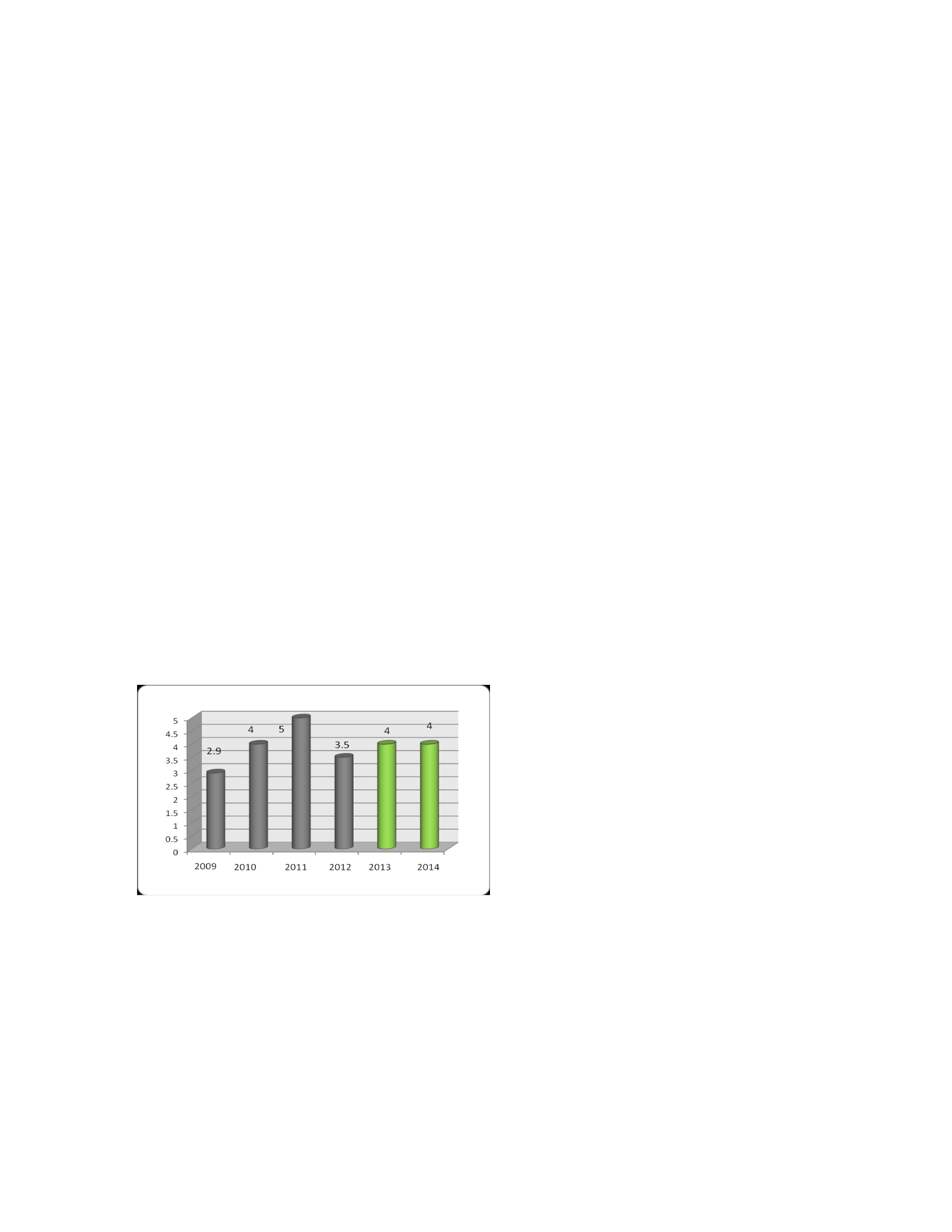
. According to CBK and IMF reports, the GDP real growth in
Kosovo was 2.9 % in 2009, 4% in 2010 and 5% in 2011, whereas forecasted growth for 2013
and 2014 is 4%.
Figure 2: GDP growth (%) by years in Kosovo, (2013 and 2014 forecasted figures)
1.4. General Characteristics of Financial Sector in Kosovo
The positive performance of the real sector of the economy also helped maintaining the
stability of the financial sector, which in year 2011 continued to increase its activity.

During the second half of 2007 the banking sector was characterized with new entries. In
third quarter of 2007, the license for operating in the Kosovo banking market was granted to
Banka Kombëtare Tregtare (BKT) from Albania. At the end of 2007, Türk Ekonomi Bankasi
(TEB) from Turkey joined the Kosovo banking system and in January 2008 started its
operations. Also NLB Prishtina which took over and merged Kasabank (KSB) and Banka e
Re e Kosovës (BRK) started operations in January 2008. In December 2009, Kosovo banking
sector consisted of eight commercial banks (Table 1), of which six in foreign ownership and
the remaining two in domestic ownership.
Even though the number of commercial banks didn’t change much in the last five years
(figure 1), the number of alternative channels was rapidly developed, which we will analyze
in more details in the next chapter.
Financial sector assets at the end of 2011 reached the value of euro 3.5 billion, representing
an annual increase of 9.3 percent. Banking system assets continue to dominate the structure
of overall financial sector assets with a share of 76.3 percent (figure 3). The activity of the
banking system continues to be concentrated in lending to the country’s economy, while the
main source of funding for banks remain deposits collected in Kosovo. In 2011, loans issued
by the banking system recorded an annual increase of 16.4 percent, reaching a value of euro
1.7 billion.
Deposits in the banking system continued to grow, reaching the amount of euro 2.1 billion,
thus representing an annual growth rate of 8.5 percent. Kosovo’s banking system has
continued to maintain a high level of stability, characterized by a high level of capitalization,
good quality of loan portfolio and satisfactory liquidity position.
For the banking system as a whole, the Tier One Capital Ratio as of January 2012 was 17.5%,
the proportion of non-performing loans was 5.9%, and the credit to deposit ratio was at
80%.
8
.

1.5. Structure of the financial sector
Commercial banks continued to represent the main participant in financial sector, managing
76.3 percent of total assets of the sector. An increase 2011 vs.2010 is noticed in share of the
pension funds which at the end of 2011 managed 17% of the financial sector assets compared
to 15.4% percent in 2010. The number of commercial banks operating remained unchanged,
at eight (8), as well as pension funds two(2).Changes are noticed in the number of insurance
companies operating in Kosovo, where in late 2011 began operating two new companies, thus
raising the number of insurance companies to 13
9
.
The number of new entries on regard to commercial banks is much affected from global
economic and financial difficulties in the European countries. These difficulties are reflected
in the performance of potential investors, thus, effecting their capacity and interest to extend
the activity into new markets.
Figure 3. Structure of financial system assets by sectors

Commercial Banks
76.3%
Pension Funds
17 %
Microfinance Institutions
3.70%
Insurance Companies
3%
Financial auxiliaries
0.20%
1.6. Foreign Investments in Banking sector
Financial sector in Kosovo is characterized with a large presence of foreign capital. This is
mainly prevalent in the banking and insurance market .The presence of foreign financial
institutions in Kosovo has contributed in the modernization of the financial system by
bringing more advanced practices in finance and stimulating competition (figure 4 shows
market share by banks operating in Kosovo). In the last five years there was no new foreign
investment in the Banking sector, however by end of 2012 it is expected that new Turkish
bank will entre in Kosovo financial market.
The ownership structure of Kosovo’s banking system consisting of six foreign-owned banks
and two domestically-owned. The sector remains dominated by foreign-owned banks, which
manage over 90 percent of total banking sector assets. Kosovo’s banking sector continues to
be characterized by a high degree of concentration, with over 70% percent of total assets
being managed by the three largest banks, respectively Raiffeisen Bank Kosovo, Procredit
Bank and Nova Ljublanska Banka.
76.3
%
3
%
17
%
3.7
%
Commercial Banks
Insurance Companies
Pension Funds
Microfinancial Institutions
Financial auxiliaries

Figure 4: Lending and Deposits market share by banks
10
The banking sector activity remains mainly basic and relies on lending to the domestic
economy, while its main source of finance remain deposits collected in Kosovo,
consequently the Kosovo was not directly exposed by 2008-2009 financial crises.
Raiffesien Bank International
11
Raiffeisen Bank International AG (RBI) regards both Austria, where it is a leading corporate
and investment bank, and Central and Eastern Europe (CEE) as its home market. In CEE,
RBI operates an extensive network of subsidiary banks, leasing companies and a range of
other specialized financial service providers in 17 markets.RBI is the only Austrian bank
with a presence in both the world's financial centers and in Asia, the group's further
geographical area of focus. In total, around 61,000 employees service about 14.1 million
customers through more than 3,100 business outlets, the great majority of which are located
in CEE.
RBI is a fully-consolidated subsidiary of Raiffeisen Zentralbank Österreich AG (RZB). RZB
indirectly owns around 78.5 per cent of the common stock, the remainder is in free float.
RBI's shares are listed on the Vienna Stock Exchange. RZB is the central institution of the
PCB
30
%
RBKO
26
%
NLB
-
Prishtina
%
15
TEB
%
12
BPB
5
%
BE
%
6
BKT
6
%
PCB
RBKO
NLB
-
Prishtina
TEB
BPB
BE
BKT
PCB
30
%
RBKO
24
%
NLB
-
Prishtina
%
16
TEB
%
11
BPB
5
%
BE
7
%
BKT
7
%
PCB
RBKO
NLB
-
Prishtina
TEB
BPB
BE
BKT

Austrian Raiffeisen Banking Group, the country's largest banking group, and serves as the
group head office of the entire RZB Group, including RBI.
1.7. Kosovo's membership in the International Monetary Fund
During 2009 a big progress was made, Kosovo become a member of IMF- International
Monetary Fund, being its 186th member.
The International Monetary Fund (IMF) is an organization of 188 countries, working to
foster global monetary cooperation, secure financial stability, facilitate international trade,
promote high employment and sustainable economic growth, and reduce poverty around the
world
12
.Membership of Kosovo in the IMF represents a particular opportunity for new
perspectives and challenges of economic development.
1.8. European banking sector in figures
According to the European Central Bank’s figures on Credit Institutions operating in the EU,
the decade-long trend of a decline in the number of Credit Institutions (CI) continued into
2011. Over the past decade, the EU-27 Credit Institutions population shrank by some fifteen
hundred institutions, resulting in just over 8,060 Credit Institutions by the end of 2011. This
financial consolidation has been accompanied by a solid bank asset growth, total aggregated
assets witnessing an 85% increase in 2011 compared with 2001. Over the same period, the
loan base grew by 69% to finance the EU businesses and private persons, and 79% more
deposits are now held by the EU banks. The EU financial sector ended 2011 on a positive
note: total assets grew by 4.4%, while both loans and deposits increased by almost 3.7% and
4.3% respectively. According to the International Monetary Fund (IMF), the level of non-
performing loans (NPLs), as a share in total loans, was still rather high in most EU countries
in 2011. Median NPL ratio was at 6.0% in the EU-27, and at 5.6% in the euro area
13
.

1.9. Global Financial Crises
The impact of global financial crisis (2008 and 2009) cannot be said to have affected
only US or Europe or Africa due to the fact it had a global impact. Every country suffered
serious economical loses even if they were not the originators of the crisis. It marked a time
in history when people in all walks of life had almost similar economic challenges to speak.
Governments, banks, companies and other financial institutions had to come up with
remedies in order to cope with the situation. Think of cutting costs, low credit facilities, low
income, and budget controls just to mention a few. Indeed, some countries are still struggling
to repair or rather recover from this situation. Kosovo is part of Europe and cannot act as a
closed oasis.
The year 2008 will be remembered as a year of crises which happened once in a
century. Initially, the crises caused the turbulences in the Wall Street and brought the
radical changes from the governments. The year of 2008 was a year of financial crises, which
brought the USA, Europe and Japan into recession, for the first time after the Second World
War.
In the long history of global financial crisis, 2008 crisis is regarded as among the most
profound and comprehensive on the speed and wideness of development. The sources of the
crisis lie in the three pillars of the functioning of banking institutions: inadequate
management of credit risk and liberalization of excessive lending policies (undervalued
credit risk due to the intensification of competition in financial markets); inadequate
capitalization of the banking institutions; and inadequate management of their liquidity. A
lot of people took loans without having the capacity to pay their debts, creditors started to
bankrupt. These brought to the situation that banks have limited the lending to business and
individuals. Given the fact that lending by financial institutions is the source of funding for
many economic activities, problems in this area had "domino effect" for many of those
economic activities. Therefore, the crisis played a significant role in the failure of key
businesses, declines in consumer wealth, and a downturn in economic activity leading to the
2008-2012 global recession and contributing to the European sovereign debt crises.

Following, will try to widen its scope by capturing the general impact of global financial
crisis on Balkan economies (Southern Eastern Europe).
1.9.1. Global Financial Crisis – It’s causes and consequences
This section will seek to discuss the meaning of Global Financial Crisis, its causes
and consequences. Here, the study will focus more on its general implications.
It is believed that the global financial crisis witnessed in 2008 was the worst in history
since the Great Depression
14
(Trivedi, 2009). At the onset of this crisis, large financial
institutions in US encountered failures and challenges (Trivedi, 2009) which also led to other
European bank failures. As such, financial crisis applies widely to various situations. In most
cases, financial institutions or assets lose their value all of a sudden.
This loss is normally big and unanticipated. As a result, it causes serious recessions and
most banking processes panic, a crash occurs to the stock market, increased proliferation of
financial bubbles, and crisis of currency and sovereign defaults (Trivedi, 2009).
As mentioned earlier, panicking in the banking system and recessions can be
experienced in commercial banks where the depositors rush to withdraw all they have, what
can be referred to as a bank run. Again, financial institutions eventually lose a larger part of
their value.
Global financial crisis is not a phenomenon that occurs in a vacuum. As such, its
consequences can be determined; it is believed that cases of regulatory failure, fraud,
mismatch of asset-liability and leveraged investment act as major causes of such crisis
(Trivedi, 2009).
It is also worth noting that global financial crisis impacts on the demand side of
development process and the supply side of development process. Impact on consumer
demand occurs due to the fact that majority of consumers reduce their spending including
the private sectors who may consider postponing their projects. It is also worth noting that

the intention of the private sector to invest in real estate can be adversely effected (Davies,
2009)
15
Looking at the impact on the supply side of development process the private capital
flows (FDI) slows down as the crisis affect the available pool of funds. In terms of liquidity,
global financial crisis leaves banks on the danger of potential losses on their foreign
investments. Moreover, most skilled workers undergo untimely retrenchment or there would
be a downward pressure on their income and remuneration. This scenario would also occur
to the un-skilled laborers who would also experience a reduction in their remuneration. The
cost of raw materials may also depreciate due to the reduction of prices in the commodities.
In this regard, the cost of materials in general would also decrease (Piscar, 2009)
16
. From this
point it can be seen that reduction in the cost of materials has got both a positive impact and
a negative impact. This is because the consumer of such raw materials will be able to pay for
them at a cheaper price but on the other hand, the seller
will make less profit that he would not have made had he sold the commodities at a higher
price.
In general, global financial crisis affects the welfare and quality of life of all citizens.
Inflation, for instance, can be one of the reasons to this. Another factor is what has already
been mentioned in that loss of employment can reduce people’s income. It is very difficult
to have job opportunities in a situation of global financial crisis
17
(Norhayati, 2009).
1.9.2. The Effects of Global Financial Crisis on Balkan Economies
This section will take into consideration the impact of global financial crisis on
Balkan economies. The section may contain some aspects that have already been discussed
earlier only that they will be more specific.

It is believed that the crisis did not come out as a financial crisis to the Balkans but it
was some sort of an economic turbulence that was due to the fact that Balkan’s products had
a reduced demand in the world markets (Lenahan, 2009)
18
. In the same context, other sources
of finance also suffered immensely. There were increased losses in investments, industrial
production, foreign exchange, remittances and employment (Lenahan, 2009).
In the beginning of the crisis most governments thought that they were still immune
to its challenges but after many citizens lost their jobs and the increased reduction of world
commodity prices, the governments accepted the reality of this crisis. Although as they
insisted that the effects would not impact much on the Balkan region, the economy indicators
still exhibited some degree of challenges and downfall, reduced industrial output, foreign
investment and increasing rate of unemployment (The Economist, 2009). Clearly, the growth
forecasts reduced from five percent to three percent, there was slowdown of investor projects
and governments were embarking on rescue plans (The
Economist, 2009). It is believed that in September 2008 when the global financial crisis
was at the peak, contractions occurred to growth and joblessness mounted in the Balkan
region. The situation seemed worse due to the fact that managers in foreign institutions and
especially, foreign banks looked for foreign support so that they could withstand the
situation. This was a clear indication that although the governments felt protected and secure
from the situation they were still exposed to the financial crisis that replicated in the region
in the form of economic crisis.
The increased fall of prices in the world markets had its challenges. Balkan region is
known for its steel and metal exports and it was unfortunate that it had been affected by the
global slump in the prices of the commodity. It was noted that the price of metals fell by two-
thirds in mid 2008 which posed serious economic challenges to the region.
19
(Dnevnik,
2009).

Global financial crisis saw many companies announce lay-offs due to reduced
demand and closure of many factories (International Monetary Fund, 2008). In Macedonia,
for instance, unemployment was rated at 33%. Furthermore, Bosnia, Herzegovina and
Kosovo recorded their unemployment rate at 40% 23.
Another sector that lost adversely was the real estate market due the fact that credits
went down and it was also very difficult for the borrowers to clear their loans. Moreover, the
prices for houses rose including other commercial-property prices. It is also worth noting
that demand for new residential houses had also gone down
20
.
It is worthwhile to mention that global financial crisis also affected the small scale
enterprises and medium enterprises which actually serve as a backbone of the Balkan
economies (Utrinski, 2009).
1.9.3. The Macroeconomic and Social Impact of the Global Financial Crisis
This section seeks to discuss the impact of global recession on Southeast Europe
Economies. It will take into consideration the trends in GDP, employment, fiscal balances,
monetary and social policy responses. It shall examine several economies where Kosovo is
one of them.
According to tables below there was a slowed growth of GDP in Southeast Europe in the
year 2009
21
.
Table 2: GDP trends (%) in SEE (2005-2008)
Period (2005-2008)
GDP Trends (%)
Montenegro
7.7
BiH
5.8
Serbia
5.8

Croatia
4.2
FRYoM
4.8
Kosovo
4.7
Albania
6.0
Table 3: GDP trends (%) in SEE (2009)
Period (2009)
GDP Trends (%)
Montenegro
-4.5
BiH
-3.2
Serbia
-3.0
Croatia
-5.6
FRYoM
-1.2
Kosovo
3.4
Albania
2.5
As can be seen from table 3 (see above), Kosovo has the best growth performance of 3.4%
followed by Albania with 2.5%. However, the other economies have their GDP below zero
since they record at negative values. The GDP growth in Kosovo and Albania was due to the
fact that the two regions avoided sharp external adjustments. However, other economies
reduced their net capital inflows which in turn tightened credit conditions in the period 2008-
2009.
Q: To what extent has global financial crisis impacted on Kosovo?
Financial markets crisis has not had a material impact on financial sector due to Kosovo
limited exposure outside of the Kosovo. However there were indirectly impacted, such us:
Pension Savings Trust, which ended with the decline of the value of shares in the financial

markets, mainly on 50% in U.S. markets, lower remittances during 2009 which continues to
be the main source of income for a lot of Kosovo population, lower foreign direct
investments etc.
During these periods, the banks were more conservative on lending. The potential losses of
the Kosovo financial markets would be in case of external exposure like placements or
interest-bearing demands with other banks.
One thing that this study needs to re-affirm is that global financial crisis was real in
Kosovo and its repercussion has been felt. Kosovo is part of Europe and cannot act as a
closed oasis.
2. Distribution Channels Management in Banking Sector
This section will seek to discuss the Distribution Channels in banking sector. Here,
the study will focus more on role and usage of different channels, staring from Branch
Network, Sales Agents, POS (point of sales), ATMs, E banking and Online/Call Centers.
Multi-channel integration is set to become a key growth story in the bank distribution channel
market, as customers increasingly select to use the full range of offered channels. By
investing in channel integration and functionality towards channels strengths, Banks can
offer seamless customer service, while improving cross-sell rates, leveraging process
synergies and increase efficiency while streamline operations (reduce costs).

2.1. Overview of Distribution Channels in Kosovo banking sector
Banking channels developments - What are the current trends?
Even though the number of banks remains the same in the last five years, outstanding
improvements were made in terms of new channels of distribution, in particular alternative
channels, such us: Point of Sales, ATM network and E- banking.
An expansion of the distribution network which improved citizen’s access to banking
services was noticed in the last five years. The number of commercial bank branches in 2012
reached at 309, from 279 in 2008 (all of them are sub branches spread out in different area
in order to provide the easy and convenient access to the customers). Years 2008 to 2012
marked a significant increase in the provision of banking services such as Automated Teller
Machines (ATMs), points of sale, electronic banking accounts, thus, facilitating customers’
access to banking services. Number of branch/sub branches was increased for 11%, whereas
number of POS terminals increased from 3,426 in 2008 to 7,534 in 2012, respectively 120%,
Automatic Teller Machines increased from 240 in 2008 to 460 in 2011, respectively 92%,
whereas E banking users from 13,000 in 2008 to 68,992 in 2011, or 429 %
22
, indicating that
usage of alternative channels is growing rapidly comparing to the traditional branch network.
Table 4: Banking channels developments in Kosovo, 2008 –2011
Banking channels
2008
2009
2010
2011
%
growth
Number of ATMs
240
339
415
460
92%
Number of POS
3,426
5,251
6,194
7,534
120%
Number of E banking users
13,051
40,924
55,292
68,992
429%
Number of branch units
279
287
311
310
11%

The table below presents the volume of payments over the last three years. Apart from the
outstanding increase on number of alternative channels, the usage, respectively volumes
performed has shown a high increase year on year, indicating that cash economy gradually
is reducing while usage of alternative channels has been increased.
Table 5: Electronic Payments in millions euro, Kosovo market
Description
2009
2010
2011
% growth
ATM withdrawals
582
639
790
36%
POS payments
68
94
142
109%
E-banking payments
607
782
1,191
96%
Source: CBK annual report (2011)
2.1.1. Branches, as a main distribution channel
A significant slowdown during the last five years has been evident with regard to the
expansion of the number of commercial bank branches and sub-branches. These
developments mainly reflect the measures undertaken by commercial banks to reduce their
basics transactions in-branch and shift them to electronic and less costly channels. The
number of commercial bank branches and sub-branches in 2012 reached at 309 (279 in
2008). The expansion of bank infrastructure, in terms of the number of Automated Teller
Machines (ATM), points of sale (POS) and electronic banking (e-banking), continued over
the years, thus enhancing customer’s access to banking services.

Figure 5: Number of branch units in Kosovo by years
Following, I will analyze the number of bank branches in comparison with other countries.
It is important to analyze how the other Balkan countries have developed the different
channels, how the ratio stands for number of Branch units per inhabitants in Kosovo and
comparison with different countries.
Table 6: Number of bank branches in different countries
Kosovo
Albania
Bosnia
Croatia
FYR
Macedonia
Slovenia
Bulgaria
Turkey
Population
2,100,000
3,195,000
3,843,000
4,489,409
2,057,284
2,050,189
7,504,868
73,000,000
Loans (bn €)
1,6
3,54
7,54
36,94
3,04
34,44
25,94
274
Deposits (bn €)
2,1
5,89
6,40
36,45
3,47
23,50
23,99
260
Loans per
inhabitant
762
1,108
1,952
8,228
1,478
16,798
3,456
3,753
Deposits per
inhabitant
1,000
1,844
1,665
8,119
1,687
11,462
3,197
3,562
Branch units
309
548
955
1,282
436
741
5,961
10,072
Number of
inhabitants/branch
6,796
5,830
4,024
3,502
4,719
2,767
1,259
7,248
As can be seen in the above table, the number of bank branches various between countries.
Kosovo has the fewest number of branches per inhabitants, respectively 6,796 inhabitants
per branch unit, whereas the best ratio in the region has Bulgaria with 1,259 inhabitants per
branch.
If we compare with EU, by the end of 2010, the number of banks in EU had fallen by 2.2%
to 6,825. Bank branches also had registered a decline of 1.9%, to 215,000 on the account of
rise popularity of online banking
23
. The average standard in Europe Union is 2,300

inhabitants per bank branch (503 mio/215,000 branches). Austria has a highly developed
banking sector. Access to banking services, measured as number of inhabitants per bank
branch, is among the highest in Europe (1,673 inhabitants per branch in 2010).
Figure 6: Number of inhabitants per branch- comparison with regional countries
2.1.2. Branch Productivity in Europe - Branches’ central role
Below will present the study made by “Finalta”, on regard to Branch Productivity in Europe.
In 49% of the banking establishments questioned, more than 80% of products are sold via
the retail Branch Bank. Only 2% of those questioned conducted the majority of their sales
through other channels ( see Figure 7).
Figure 7: What percentage of retail products sales are made through branch network?
-
,000
1
,000
2
,000
3
,000
4
,000
5
,000
6
7
,000
Kosova
Albania
Bosnia
Croatia
Macedonia
Slovenia
Bulgaria
6
,796
,830
5
,024
4
3
,502
,719
4
,767
2
,259
1
Number of inhabitants per branch

For 49% of the Banks questioned the branch network accounts for more then 80% of the
volume of sales to private customers. Products with high added value are sold via the branch
network. Because of this, the branches’ central role to the retail bank’s profitability remains
key
24
. Furthermore, I have analyzed the products sales by channels in Bank X. From the
analyses performed (see below figure 8), we see that majority of sales are performed in
Branch Network, respectively 70% of volumes, 20% by Mobile Bankers network, 7% by
the CRM, while 3% thru the Call Centre. Please note that analyzes and sales are performed
for Mass Banking only!
Figure 8: Volumes of sales by channels, Bank X
It is important to emphasize that above I have analyzed the products sales and not
routine/simple transactions, such us: teller transactions and payments. Therefore, I will be
Branch, 70%
Mobile
Bankers/Agent
s, 20%
CRM, 7%
Call Centre, 3%
able to conclude that yet the main channel for products sales, especially loans remain branch
network. In order to have clearer picture for majority of transactions made in branch I have
also analyzed the service part, respectively routine/simple transactions and payments. The
aim of these analyses was to see the volume of these transactions performed by cashiers and
service staff, as well as see the possibility to move these transactions to other less costly
channels, respectively electronic channels. In order to make this study more comprehensive
I have also analyzed the costs structure for traditional and electronic channel transactions.
The analyses prove how electronic channels help reduce the costs for both banks and
customers.
2.1.3. Analysis of the transactions type performed in branch
From the analyses below performed in Bank X, we see that over 60% of transactions,
respectively 50% of the staff are engaged to routine transactions, majority of them can be
performed by other alternative channels, ATM’s, E banking and Call Centre. Therefore, the
core question here is: whether these transactions can be performed in electronic channels?
The answer is yes! Majority of these transactions can be performed in other channels: cash
withdrawals can be performed in ATMs, while other payments, such us utility and diverse
transfers through E-banking and Mobile Banking channels.
Figure 9: Type of transactions in branch, study performed in Bank X (Kosovo)
Cash
withdrawals,
40
%
Cash deposits,
30
%
Utility
payments, 20%
Transfers, 15%
Others, 10%

In order to have more comprehensive study, I will also present the results from Global
Consumer Banking Survey 2012.
25
According to this survey, customers want the flexibility
to use different channels for different transactions. Banks need to let customers personalize
their distribution choices, with different cost and accessibility options. Internet banking is
now customers’ preferred way to access account information’s. The huge success of online
banking can be attributed to its convenience and accessibility. In most markets, internet
banking is also the most popular channel for customers undertaking simple transactions such
as paying bill. Despite the success of internet banking, customers around the world agree
that access to branches and branch staff remains crucial to overall satisfaction. This is
especially true when it comes to complex transactions, which customers in all markets prefer.
The picture is more varied for advice on products and services.
Figure 10: Preferred method for simple transactions- EU
Figure 11: Preferred method for complex transactions- EU
15
%
Branch visit
3
%
Postal Mail
Mobile app,
1
%
65
%
Internet
2
%
Email
11
%
ATM
3
% Call
Centre

Additionally, “Finalta” study also analyzes the incentive scheme for Branch Managers.
Branch Managers leadership are the key role for successful Retail Banking. Based on the
study done by Finalta (Financial Service Benchmarking, London), European Branch
Managers bonus depends greatly on sales. On average, 64% of branch mangers bonuses
depend on sales targets being achieved, 12% on costs, 11% on customer service, 6% on staff
satisfaction and 10% on other factors (generally risk or specific strategic initiatives).
Figure 12: European Branch Managers MBO’s and bonuses criteria;
In addition, I have also analyzed the bonuses scheme in Bank X (see below figure 13).
Analyzing, the above “Finalta” study results, and branch managers’ bonuses scheme in Bank
X, I can conclude that similar criteria’s are applicable for Branch Managers bonus scheme
in Bank X as well. However, there is a slight difference on credit quality and regulatory
Branch visit
82
%
Call Centre
4
%
Internet
9
%
Email
%
2
ATM
1
%
Postal Mail
1
%
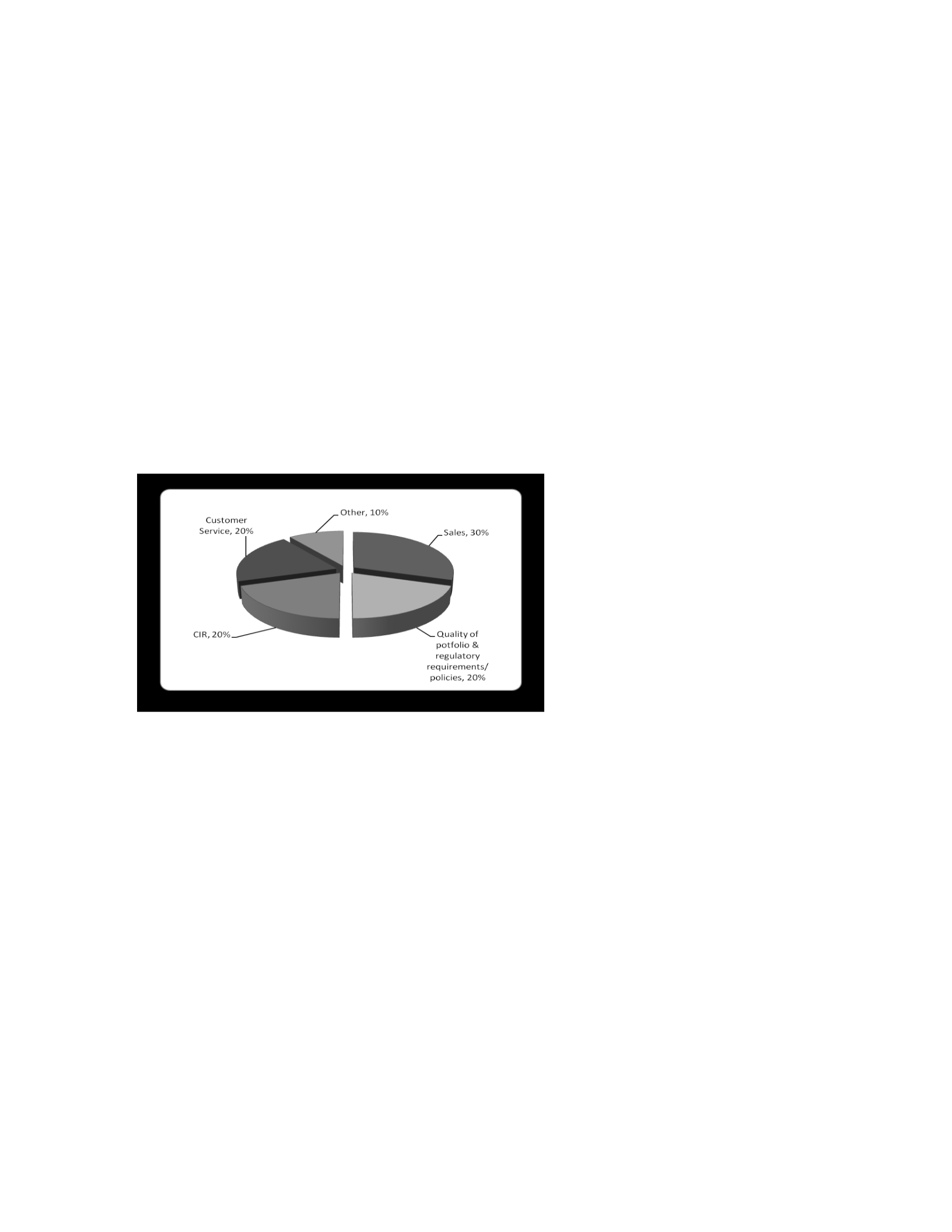
requirements. Yet, as the banking channels strategies and trends are changing, the criteria’s
on the incentive schemes should be modified, accordantly. As the banks are moving and
shifting the focus to more electronic channels, the incentives should also linked to usage of
alternative channels, such us: E banking sales and usage/turnover, number of ATM
transactions, number of payments through POS’s etc. What the banks staff needs to work
on is advice customers to use more ATMs, E banking and Mobile Banking, while in-branch
staff must be focused more on higher value-added transactions which cannot be performed
through other banking channels, i.e. higher volume loans, mortgages, consultation and
financial advises.
Figure 13: Branch Managers MBO and bonuses criteria in Bank X;
2.1.4. The future of Bank branches
We all are aware that branches are most expensive channel. The cost structure of branches,
starting from operating costs: staff expenses (i.e. hiring and training), facilities (electricity,
heating etc.), security costs including cash dispensing , and at the other side capital
expenditure, are putting pressure on the cost/income ratio of many retail banks, which is
considered to be one of the key performance ratio for a successful bank.
There are couples of reasons to believe that branches will remain one of the main distribution
channels even in the future. Why they will still exist?

Customers still want to visit branches. Even though this also depends on various countries
and cultural habits, customers still prefer face to face interaction, especially for higher ticket
loans, like mortgages, financial advices and investments opportunities. In addition, in many
countries legal framework is not harmonized with customer’s adoption strategy. For
example, to open a bank account legally customers are obliged to be present in branch in
order to prove identification, despite the fact that there might be online functionality for
account opening process.
Bank branches, are now considered as a way of securing the loyalty of existing customers
and acquiring new ones. Having said that before, the branches of today are not the same as
yesterday. The branches are now one of several components in multi-channels strategy,
human contact, a warm welcome and offering advice. Naturally, the trend towards opening
branches places greater emphasis on automation. In other worlds, current developments
concern both content and form. Branches will not disappear, but they will change over the
time [29].
Whilst bankers all agree on the predominant role played by a branch in terms of distribution,
it is remarkable to analyze the different channels. Below I will explain the role of other
banking channels: Automatic Teller Machines (ATMs), E-banking, Mobile Banking, Call
Centre, as well as statistics on regard to internet penetration/usage in Europe, worldwide and
E-banking penetration, in particular.
2.2. Automatic Teller Machines – banking channel
2.2.1. Automatic Teller Machines - Definition
Automatic Teller machines (ATM), also known as a cash point is a computerized
telecommunications device that enables the customers of a financial institutions to perform
the transactions without the need for a cashier. There are two primary types of automated
machines, the basic one allow the customers only to withdraw cash and receive a statement

report, while the more complex machine accept deposits and other services as well. An
automatic teller machine (ATM) allows bank customers to conduct their banking transactions
from almost every automatic teller machine in the world.
The customer is identified by inserting a plastic card with magnetic strip or chip that contains
a unique card number and some additional information’s such as an expiration date or CVVC
(or CVV). Authentication is provided by the customer entering a personal identification
number (PIN). As the new technologies are extremely fast enhancing, there are also new
services in a long-predicted move towards the Smartphone becoming a digital wallet. The
newest ATM at Royal Bank of Scotland operates without a card to withdraw cash up to £100.
They are given a six-digit code to enter into an ATM and release the cash.
(Source: ATMIA, ATM industry associations global).
2.2.2. Automatic Teller Machines - History
The history of the ATM often is open for debate, since the cash dispenser's development
occurred long before the machine was put into use. That written, most historians agree that
Barclay's in the London was the first to deploy an ATM in 1967. It wasn't until the mid to
late 1980s that ATMs gained wide acceptance. Estimates developed by ATMIA ( ATM
Industry associations global) place the number of ATMs in use currently at over 2.2 million
(2010), or 1 ATM per around over 3000 people in the world
26
.
From 1967, when the very first ATM was installed in London, it took 33 years (until 2000)
for the ATM industry to reach the 1 million ATMs around the world. To reach 2.2 million, it
has taken only 10 years. Thirty-three years to install 1 million ATMs, while ten years to
install 1.2 million ATMs shows how fast the ATM network is growing in the recent decade.
2.2.3. ATM Network Development in Kosovo

The number of ATMs grew quite fast in our market as well. The figure below shows the
number of ATM development over the years. As we can see the number is growing rapidly,
or almost 100 % over the 5 years period, indicating that usage of self-service channels is
growing very fast, which is also linked to the level of education and trust in electronic
channels.
As I stated above, Kosovo started developing its banking sector and payments infrastructure
from scratch after the war in ’99, much later than the countries in the Southeastern and
Central Europe, however the outstanding progress has been made, not only on the number
of banks and variety of products offered, but also developments of channels and usage.
Figure 14: Number of ATM’s by years in Kosovo
2.2.4. Comparison of ATM’s network- Kosovo with other countries
Following I will present the number of ATMs in different regional countries, even though
this cannot be considered as an indicator for comparison purposes due to the fact that there
are different parameters which leads to the appropriate number of ATM devices such us:
number of population, country area and density, accessibility, number of transactions per
ATM etc.
Figure 15: Number of ATM’s by countries

Even though, we see that there is a huge progress made on regard to ATM and other channels
developments in Kosovo, yet, comparing with other regional countries, we see that still we
are quite behind other regions. As we can see from the table 7 (see below), Kosovo has the
lowest number of ATM per inhabitants, respectively 1 ATM per 4,565 inhabitants, which is
almost four times lower then Croatia, Slovenia and Bulgaria. The best ratio from the
countries shown in the table has Slovenia, 1 ATM per 1,130 inhabitants.
Table 7: Number of ATMs in different countries
Kosovo
Albania
Bosnia
Croatia
FYR
Macedonia
Slovenia
Bulgaria
Turkey
Population
2,100,000
3,195,000
3,843,000
4,489,409
2,057,284
2,050,189
7,504,868
73,000,000
Area (km^2)
10,887
28,748
51,197
56,594
25,713
20,273
110,879
783,562
Density (km^2)
193
111
74
78
80
101
68
94
ATM devices
460
771
1,098
3,794
869
1,814
5,718
27,649
Number of ATM
device per
inhabitant
4,565
4,144
3,500
1,183
2,367
1,130
1,312
2,640
ATM per 100
km^2
4
3
2
7
3
9
5
4
Source: CBK Annual report, 2011
In order to make the study more comprehensive, I have also analyzed the average ATMs in
EU area. In 2011, there were 437,400 Automatic Teller Machines (ATMs) in the EU-27, an

increase of 1%, or almost 4,100 units since a year before. The number of people per ATM in
Europe fell to 1,148.
Germany, Spain, France, and the UK combined, account for 60% of all ATMs in the EU. The
ATMs are also used more frequently: the number of transactions in the EU grew on average
by 1.3% in 2011; however the number of cash withdrawals grew only by 0.3%
27
. As far as
convenience and accessibility of banking services in EU countries are concerned, Portugal
leads in term of number of ATMs per inhabitants, the parameter being 620. At the same time
the least number of inhabitants per ATM was registered in the Chezk Republic, Sweden and
Poland. In each of these countries there are between 2,400 and 2,900 inhabitants per device
28
.
Figure 16: Comparison of inhabitants per ATM’s in different countries
There is no official benchmark on regard to the number of ATM’s in the respective region.
The figure above summarizes the number of inhabitants per ATM. As shown in the figure
above, in Kosovo there are 4,565 inhabitants per ATM. However, this ratio is much depended
-
,000
1
,000
2
,000
3
,000
4
5
,000
Kosova
Albania
Bosnia
Croatia
FYR
Macedonia
Slovenia
Bulgaria
4
,565
4
,144
3
,500
1
,183
,367
2
,130
1
,312
1
Number of inhabitants per ATM device

on density in the respective country. As we see in the table above (Table 7), Kosovo has the
highest density, 193 inhabitants per km^2 compared with other countries. Apart from the
ATM network, the outstanding expansion is made on number and usage of point of sales
(POS’s), indicating that cash economy is being reduced and usage of alternative channels
has been increased.
Figure 17: Volume of deposits per inhabitant, Kosovo
-
,000
2
4
,000
,000
6
,000
8
10
,000
12
,000
Kosova
Albania
Bosnia
Croatia
FYC
Macedonia
Slovenia
Bulgaria
,000
1
,844
1
,665
1
,119
8
,687
1
,462
11
3
,197
Volume of Deposits per inhabitant

Figure 18: Volume of loans per inhabitant, Kosovo
As presented above, similar to number of different channels per inhabitant, the same position
stand for volumes of deposits and loans. Kosovo has the lowest volumes per inhabitant, 1000
euro deposits per inhabitant, respectively 762 euro volumes of loans.
2.3. E-Banking as an alternative Distribution Channels
In today's society, globally, customers more than ever correlate a bank's value to the services
it provides online. With the growing number of internet users, many banks use internet
banking strategy and variety of services in order to remain competitive, aiming to attract and
retain customers with enhanced online services.
In the recent decade, many banks started to use the internet banking not only as an innovative
banking channel, but the channel/tool to attract customer acquisition, increase customer
satisfaction and convenience, as well as approach to optimize costs and enhance profitability.
Internet Banking seems to be part of the noticeable banking strategies for new entrants in the
banking sector.
-
5
,000
10
,000
15
,000
20
,000
Kosova
Albania
Bosnia
Croatia
FYC
Macedonia
Slovenia
Bulgaria
762
,108
1
,952
1
8
,228
,478
1
,798
16
3
,456
Volume of Loans per inhabitant

By integrating business channels and customers point of view, expanding self-service
functionality and improving web site security, financial institutions are creating a seamless
online banking experience. Worldwide, online banking is a critical factor of any bank
business. This is becoming competitive weapon for financial institutions. More than ever
banks customers want to conduct more transactions online. More than ever before, banks are
promoting the E Banking as a component of their multichannel strategy and competitive
advantage.
Looking at the Kosovo market, E banking channels is quite new in the Kosovo financial
market, whereas worldwide the usage of internet banking is much higher in comparison with
our market. However, in the recent years, we see the outstanding progress on regard to the
speed of developments in e-banking channel, yet, it is far behind the EU internet banking
market. I can conclude this by analyzing the growing trend showed in table 4 (see above).
According to the data presented the number of e-banking users is growing continuously year
on year. In 2008 there were only 13,051 e-banking users, despite the fact that banking sector
started in 2000. From 2008 to mid 2011 the number of e-banking users reached 68,992
respectively 429% increase.
It goes without saying, that the number of e- banking users is very much linked to the internet
penetration in the respective countries. In the table above I present the usage of Internet in
European Union, as well as comparison with other part of the world. As we can see, the
penetration in European Union33 is much higher comparing with other part of the world, 73
% of population, whereas rest of the world is 31.3%. World average is 34.3%. I have also
analyzed internet penetration in different countries of the SEE countries (presented in
appendix 2).As shown, according to the figures from Internet World State Statistics, internet
penetration is Kosovo is only 20.5%, which is quite lower compared with all other regional
countries. Consequently, the e-banking users in Kosovo are much lower, although the recent
trend is very promising.

Figure 19: Number of Internet Users and E-banking users by countries
Internet Penetration in European Union34
WORLD
REGION
Population
(2012 Est.)
% Pop.
of World
Internet Users,
30-June-12
Penetration
(%
Population)
Internet
% Users
Facebook 30-
Sept-12
European Union
503,824,373
7.2 %
368,021,986
73.0 %
15.3 %
187,340,360
Rest of World
6,514,022,54
9
92.8 %
2,037,496,390
31.3 %
84.7 %
749,829,460
TOTAL WORLD
7,017,846,92
2
100.0 %
2,405,518,376
34.3 %
100.0 %
937,169,820
33 Internet penetration in Europe (total) is 63.2%, for more details please see appendix 2.
34 http://www.internetworldstats.com/stats.htm
Figure 20: Internet Penetration in European Union
The Netherlands is the country with the strongest internet banking penetration in Europe,
-
,000,000
1
,000,000
2
3
,000,000
,000,000
4
Kosova
Albania
Bosnja
Croatia
Macedonia
377,000
1
,471,400
2
,327,578
,167,838
3
,180,704
1
68
,992
,368
27
67
,802
998,862
211,599
Number of E
-
banking users
Number of Internet Users
Number of
Internet Users and E
-
banking users by countires
0.0
%
20.0
%
40.0
%
60.0
%
80.0
%
European Union
World Average
Rest of the world
%
73.0
34.3
%
%
31.3
Internet Penetration in European Union, June 2012

66.3 percent of Dutch internet users’ access online banking sites. Globally, 423.5 million
people accessed online banking sites (during April 2012), reaching 28.7 percent of the
internet audience. In North America, 45 percent of internet audiences accessed banking
sites
29
. Globally, 59% of internet users check their bank account online
30
.
In conclusion, internet banking as a banking channel has globally experienced strong growth
in recent years; yet, internet remains secondary to branches and call centers as a business
generator and customer usage. Ultimately branches remains good generator for the business
growth, especially in regions where customers are either insufficient familiar with internet
and/or low penetration in internet (i.e. Kosovo), or customers like more taking the financial
advice.
2.4. Mobile Banking
Continues sophisticated mobile technology becoming a perfect chance for banks to improve
service, reduce costs and increased customer engagement and satisfaction.
As it undergoes significant challenges, there’s been no better time for alternative thinking
within the industry
31
Mobile banking (also known as M-Banking) is a term used for performing check balances,
account transactions, payments, credit applications and other banking transactions. Mobile
Banking as a banking channel is old more than a decade ago. At the beginner, mobile usage
by banking and financial world was used only for the SMS, known as SMS banking.
However with the new advanced technology, mobile banking channel is offering many
dynamic options and functionalities. During the decade, starting from 2000 year, there was
an outstanding progress on regard to Mobile Banking. Mobile Banking advanced from

providing basic text messaging services to more advance services, such are: checking
balance, making transactions, view credit history, fund transfers etc.
Apple's initial success with I Phone and the rapid growth of phones based on Google's
Android have led to increasing use of special customer programs, different applications
downloaded to the mobile device.
Customer and banks have started to transform the mobile phone into a “personal banking
assistant” for customers to help them manage their accounts anytime, anywhere without an
expensive mobile phone upgrade.
On regard to statistics for Mobile Banking, in the EU5 (France, Germany, Italy, Spain and
the UK) 30 million people accessed a bank accounts via their Smartphone (in July 2012), an
increase of 85 percent compared to a year ago. The UK had the largest user base with 7.3
million Smartphone owners accessing bank accounts in the month, nearly twice as many as
just one year ago. Spain showed an even stronger increase with 113 percent more users
making use of service compared to previous year38. While, Mobile Banking is relatively new
in our market, we have lack of data on regard to Mobile Banking in Kosovo and other
regional markets.
2.5. Mobile Bankers/Sales Agents network
Mobile Bankers are defined as a distribution channel with the purpose of increasing branch
sales force by selling bank products and services. An agent helps sell bank product/service,
but will not take ownership of what they are selling at any time. Agents usually work on
commission taking a percentage of the total sales made by them. This channel is quite
developed in Kosovo market as well, however as a benchmark
32
can be analyzed the Bank
X, where Agents network is very well developed, and around 20 % of sales comes from the
agents network. Sales Agents network is perfect motivation concept. A mobile banker's

activity consists of making regular/daily - visits to market vendors. The Mobile/Agents
network is very cost effective channel as they do not have offices in the branch, consequently
do not have other associated costs, such us: space, desk, computer etc. With the new channel
“Mobile bankers”, customers do not have to visit a bank’s office in order to get a professional
consultation on our retail services. Customers will get a free of charge consultation at place
and time convenient. The role of the mobile bankers is to: visit customers at time convenient
for them, helps customers to prepare the necessary documents in order to apply for the bank
service and brings the customers documents in the Bank office instead of customer come.
Agent’s network is very cost effective channel, as there are only costs linked to the sales
results and no other overhead costs associated with them.
2.5.1. Direct Mail - sales and promotion tools
Direct mail involves sending an offer, message, reminder or other item to a person at a
particular address. Direct mail is a popular medium because its permits very selectively target
group, usually they are personalized, are flexible, and allow early testing and response
measurement.
Figure 21: Steps in Developing a Direct Mail Campaign
Source
33
: Successful Direct Marketing Methods, 6th ed.(Lincolnwood,IL: NTC Business Books,1996)
Also known as a mail shot, this type of marketing can produce sales on a local, specific bank
branch, national, or even global scale. The businesses would send out, flyers, leaflets,
brochures or catalogues (often targeted to particular consumers) selling different
Set
Objectives
Identify
Targets
Define the
offer
Test the
elements
Measure
the results

product/service. Any interested receivers of the mail would make an order through the
contact details/order form that would be included
34
.
Although very effective, there is some cost involved but is considerably cheaper compared
to other sources of marketing such as advertising. Poorly targeted mail shots can also damage
the image of the business; therefore it is very important to build appropriate mailing lists
before the direct mails were sent. Direct mail can be complied and sent directly from the
business, or can be used a professional service to distribute information; however the costs
will be much higher. This method is very common in Raiffeiesen Bank as well, where in
monthly basis there are thousand direct mails distributed to the customers. One thing which
is very important during the direct mail process is to make sure that same customer does not
receive the same offer every month, or different offers from the same bank consisting
different products. On this regard, proper CRM system (Customer Relationship
Management) is curtail, otherwise it may cause the customer dissatisfaction and complains.
2.6. Call Centre as a banking channel
In the recent decade, selling product and services through Call Centre is becoming
increasingly popular. Similar to direct mail, telemarketing allows sales to be made on a local,
national and global scale, although the costs will increase with the time and distance of phone
calls.
A decade ago, most companies didn’t even consider the revenue potential of inbound
customer service calls. But, today call centers generate up to 25 % of total new revenues
(credit cards and cash/small ticket loans) and up to 60% for some telecommunications
companies. Initially, the top priority of agents in this call centers was resolving the issues.
But, today, Call Centre telebankers are also encouraged to initiate conversation to uncover
the needs of customers, and consequently this can lead to sales of new products. Within few
years of starting to implement from service to sales strategy, most bank call centre’s that
already deliver high quality service can boost they sales levels to at least three core products

for every 100 calls
35
.In order to have the clearer picture on regard to the services provided
by Call Centre, especially on the Banking Industry, I am attaching below main groups of
serviced provided by Call Centre in Raiffeisen Bank Kosovo
36
.Analyzing the picture below,
we see that one of the main pillars of the Call Centre is telemarketing and outbound calls. If
number of calls is analyzed, there are the same numbers of outbound calls as inbound.
However, in the recent years, the strategy is more oriented toward using more IVR
(interactive voice response) for providing most of the services that the inbound telebanker
offer today, while, telebankers use free capacity for more revenue generated activities,
respectively sales activities.
Figure 22: Group of Service provided by Call Centre
In order to make the study more comprehensive I will further present the impact of social
networking in the banking industry. The information’s provided below are taken from the
survey performed by Ernst & Young, more specifically Global Consumer Banking Survey
2012.

2.7. The role of Social networks in the banking
Social networks are becoming important sources of banking information, especially in
emerging markets. Social networks are also magnifying customer voices, increasing their
power to act as advocates or critics. Globally 44% respondents use social networking sites
as a source of banking information. Customers in emerging markets are particularly likely
to use social media to interact with their banks. Worldwide, almost one-third of customers
who use social networking sites to interact with their bank also use them to comment on the
service they have received and to pass on news about good offers.
37
Figure 23: Usage of social networking in relation to banking activities
3. Costs of transactions , E-banking and ATMs versus in-branch

Following, I will analyze the costs per unit transaction through different channels, traditional
and electronic channel. Consequently, draw the conclusion on the potential costs savings for
the banks, as well as customers.
According to the analyses made in bank X, estimated bank costs per routine cash transaction
in branch is 1.50 EUR, compared to 0.60 EUR in ATM. As seen, the difference in costs for
one transaction is 0.90 EUR. The analyzes found that on average online transactions costs
are approximately 2.5 times less than those made by branch teller. However, another factor
which needs to be considered is the functionality of ATMs in the banking sector in Kosovo.
As presented above, there are 460 ATMs placed around the Kosovo, while only one ATM
provides the cash deposit function. Thus, when I calculate the costs per transaction, and draw
assumption on possible costs savings in case of bank X, I consider only cash withdrawals
and exclude cash deposits, at this stage. Another important factor to be considered is also the
amount of cash withdrawals per transaction, due to the fact that there are different limits
applied across the banks. Nevertheless, according to my analyses in bank X , over 80 % of
the transactions performed in branch are below the limit allowed to be performed through
ATM machines, indicating that there is a possibility for banks to move these transactions to
less costly channel, for bank and customer as well.
Table 8: Estimated Unit Costs per transactions through different banking channels
Unit costs per transaction ( cash withdrawal)
in different distribution channels
Unit costs per transaction (payments) in
different distribution channels
Channel
Unit costs
Channel
Unit costs
In-Branch
€ 1.50
In branch
€ 1.50
ATM
€ 0.60
E-banking
€ 0.50
*Analyses made in the Bank X. The costs per transactions various from bank to bank due to different processes
and systems across the banks, therefore it is difficult to calculate the possible costs savings for overall market;
The table shows significant difference on costs in different channels, transaction costs
performed in branches are more than doubled compared to electronic channels, ATMs and

Internet Banking. It is very reasonable since it is not that require human resources costs only,
but also facilities costs, costs of offices, maintenance, securities, rent, utilities etc. Analyzing
the bank X, there are over 1 million cash withdrawals yearly executed inside the bank
branches. Assuming that at least 20% of these payments move to Automatic Teller Machines
(ATMs), the bank will decrease transactions costs for approximately € 180 thousands yearly.
Consequently, there will be free resources capacity for more value-added transactions and
financial advisories, which will result with better customer services, efficiency and
profitability. According to CBK quarterly report on cash and non cash payment, in overall
market are over 1.2 million cash withdrawals per quarter inside the banks, nearly 5 million
per year.
Furthermore, I have also analyzed the simple domestics’ payments through different banking
channels (see above table 8). As seen, online bank payment transaction, respectively E-
banking transaction costs approximately 3 times cheaper than traditional transactions costs
concluded in the branch network According to CBK quarterly report, number of payment
processes using e-banking is 424,273 transactions during 2011, whereas number of interbank
payments is 4.2 million during 2011.
38
The expenses for the domestic payment unit costs
include the following unit costs components: development, HR related costs, IT operational,
marketing, facilitiies, etc. In branch and call centre, mosts of the costs are connected to the
human resources activities (remuneration, staff management, work-place expenses/offices,
fixed assets depreciations).
If we analyze the overall payments in the Kosovo banking market, we see that majority of
payments are still performed in the branch network. According to the Kosovo Payment
Report , during 2011 there were over 4.2 million interbank payments performed , while
number of E-banking still remain low, only 10 % of transactions are performed through the
E-banking (source: Quarterly report on cash & non cash payments, CBK).

In order to make the conclusion on profitability, some investigation on the income side has
to be made as well. For the banks, fee incomes from the ATMs and E-banking transactions
are lower compared to in-branch, while less costly for the clients. Fee for cash withdrawal
inside the branch in Bank X is 0.20 EUR, whereas in ATM is 0.05 EUR, meaning that bank
will earn 0.15 EUR less for the transaction performed in the ATM, but at the same time
difference in costs is much higher, respectively € 0.90 per transaction, consequently net
income is higher.
In summary, I might conclude the following:
• Banks can reduce costs by increasing usage of electronic channels. Electronic
channels banking services can impact cost savings for the banks and higher
profitability, as the unit costs are lower;
• Electronic channels provide costs-savings for the customers as well, as consequently
the fees for the clients are cheaper in online channels. As presented above, ATM
withdrawal fee is three times less compared to in-branch withdrawal.

4. Integration among different banking channels
Banks are developing their multichannel distribution strategies by defining more focused
mission and roles for their channels. The development of a multichannel distribution strategy
is based on three main phases:
• the development of new channels,
• the promotion of new channels usage by customers,
• the integration among channels ;
In terms of channels operation and roles, in most of the cases the branch is the predominant
channel and owns the majority of bank’s customers. ATMs, Internet and Phone Banking/Call
Centre are alternative and more supportive channels to carry out the basic transactions,
focused on cost to serve reduction.The war to win for retail banks is to be excellent in
distribution. As such, the banks distribution models need to get closer to the retail distribution
models, combining better-cost efficiencies and optimizations with effective product ranges
and services.
The branch will remain the groundwork of retail distribution however it will be in the
different approach. Banks will have to “re-invent” the branches to drive down their operating
costs while generating more sales. The branch of future requires customeroriented branch
personnel, supported by new capabilities in terms of informing, advising, selling and serving
the customers, sustained by an integrated CRM (Customer Relationship Management)
solution. The integration among branches and other distribution channels will be a key
success factor in the distribution model of the future, because it will allow banks to:
• Effectively meet customer needs and preferences by offering different choices of
distribution channels, as per customers convenience;
• Use branch for higher value transactions, financial advisory approach and
relationship management ;
• Leveraging cost optimization opportunities arising from low cost innovative
channels;
The integration among branches and other channels should provide the customer with a
consistent customer experience and match the bank mix of products/services and channels

with his needs and preferences. Within integrated commercial actions the branch will still
have the most important role for the overall success of the initiative.
Figure 24: Branch integration with other channels
Customer
5. Three Enablers to Win the Distribution Game
Below I will further analyze three enablers to win the distribution game, or saying on the
other words few important areas of making the retail banking successful:
5.1. Sales Organization
5.2. Distribution Footprint
5.3. Sales Force Effectiveness
5.1. Sales Organization
“People create organizations, and people can destroy them. The most valuable commodity in
business is not technology or capital, but people”. Effective management of people is a
challenge managers will increasingly face in the 21st century.
Return on talent- For decades companies have utilized key metrics like ROI and ROA (return
on assets). Twenty-first century organizations will utilize a measurement called ROT (return
on talent). ROT is expressed as follow: ROT = knowledge generated / investments in talents.

ROT measure the payback from investments in people. It shows if managers are hiring the
right people, and how effectively they use them to achieve businesses success.
39
A Sales Organization Must Be Focused on:
As few management layers as possible
Each person has exactly one superior
Management span allows for effective control
Clear roles and responsibilities
5.2. Distribution Footprint
When it comes to new branch buildings different approaches are required. Below are some
specifics on this regard; however on the last part of this chapter I will present the case of new
branch build/opening in Raiffesien Bank Kosovo, in order to get the clear understanding on
the evaluation criteria’s and how the positive decision on new branch opening is taken.
Following, I present some general criteria’s:
Branch penetration and branch density in your country work in your favor – Build. Expand
smartly- Although the distribution is sub- scale, your country already has high branch
density. Utilize alternative distribution channels such as DSAs, E-banking, and ATMs.
Move in line with competitors- You have sufficient distribution. Expand only if your
competitors are expanding and/or you wish to increase your market share substantially. Don´t
build- Your distribution scale is sufficient to compete with the big competitors – you are one
of them.
5.3. Sales force effectiveness
Each company needs to define the specific objectives its sales force will achieve.
Increasingly, companies are setting the objectives for sales representatives based not only on
sales volumes and profitability targets, but also on their ability to create customer
satisfactions47.
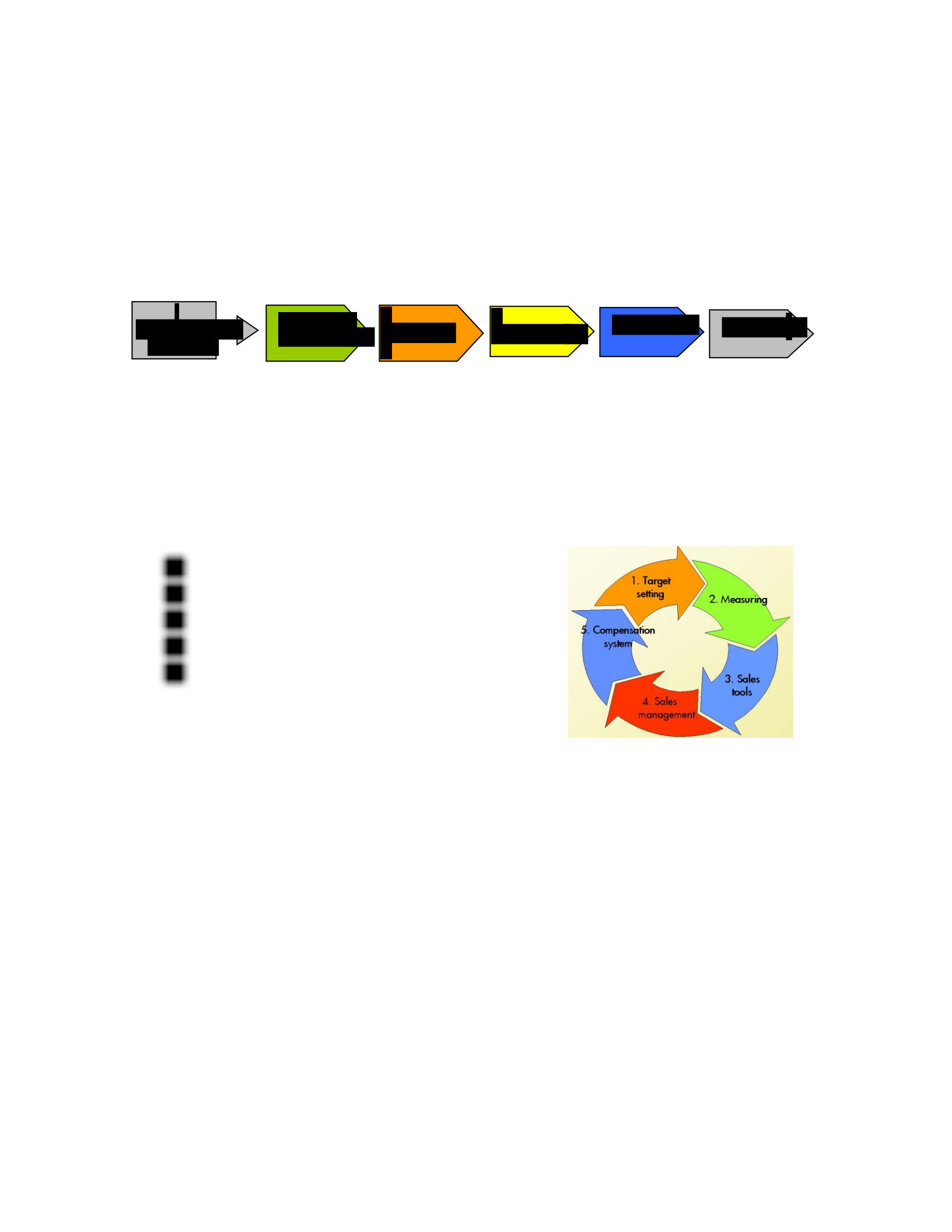
Effective management of the sales force is needed to implement the companies’ chosen sales
force design and achieves its sales objectives. Sales force management covers the steps in
recruiting/selecting, training, supervising, monitoring and evaluation (see below figure 25).
Figure 25: Sales force management process
Following, I will present highlights of a project implemented in Raiffeisen Bank Kosovo.
The project called Sales Force Effectiveness consisting of 5 main pillars
40
:
Figure 26: Sales Force Effectiveness process
Target setting
In branch measurements
Proper sales tools and sales management
Coaching
Motivation and Compensation program
Some ambitions sales staff is self-starters who will put forth their best, effort without any
special coaching. The majority of sales staff, however, requires more encouragement and
special incentives. This is especially true of field selling, which can be frustrating because
sales people usually work alone, keep irregular hours, are often away from home and
sometimes lose large orders they have worked hard to obtain (Kotler pg 307).
When it comes to motivation tools, in Raiffesien are different financial and non financial
motivation tools. Reward and recognition program is very well accepted, it is not only the
Managing the
sale force
Recruiting
and selecting
Training
Supervising
Motivating
Evaluating

financial bonuses a motivation tool for staff, there are also other non-cash awards which are
much appreciated by the staff, to name few: best seller of the month received the dinner with
the management board, special certificate for best performing, weekend trip with family, a
night shift off for a week for the best performing telebanker etc. However, it is very important
to emphasize quite important factors on regard staff incentives, such us:
• Direct link between sales performance and reward;
• Wide compensation spread between high and low performers;
• Sales performance as main driver of rewards for sellers and managers;
• Individual (majority) and (small) shared component to support team cooperation;
Figure 27: Key Variables that influence Motivation
41
INTERNAL
(push forces)
EXTERNAL
(pull forces)
Characteristics of
The Individual
Characteristics of Characteristics of
The JOB The Work Situation
(examples) (examples)
NEEDS
For security
For achievements
For power
ATTITUDES
About self
About Job
About Supervisor
About Organization
INTERESTS
Hobbies, Travel, reading
Sports
FEEDBACK SOCIAL ENVIOREMENT
Amount Supervisor
Timing Workgroup members
Subordinators
WORK LOAD ORGANIZATIONAL ACTIONS
Tasks Individual and group awards
Variety Training and development Scope
Pressure to perform
DISCRETION
How job is performed?

6. New branch opening
The openings of new branches have a major impact on the assessment of the company itself.
For this reason it is obvious that an accurate and all planning instrument needs to be
developed and analyzed. The following parameters need to be considered, when the
evaluation for new branch opening is made:
• Location of the branch (capital city, region, small region/town)
• Customer structure ( small business, agro, corporate, individuals)
• Economic environment, un-employment rate, purchasing power;
• Competition;
And the fundamental question is: what nature of the business is expected from the new
branch, whether the branch will be focused on the lending and deposits, financial advisory
approach and relationship management or provides the simple basic transactions which can
be also performed by other alternative channel, ATM, Call Centre and E Banking?
Additionally, the detail feasibility study needs to be done before the new branch is opened.
Some of the key financial ratios on taking the decisions for new branch opening are given
below:
NPV- One of the main factors for making the decision on new branch opening is NPV. The
Net Present Value (NPV), also known as Net Present Worth of a Capital Budgeting project
indicates the expected impact of the project on the value of the company. Projects with a
positive NPV are expected to increase the value. Thus, the NPV decision rule specifies that
all independent projects with a positive NPV should be accepted. When choosing among
mutually exclusive projects, the project with the largest (positive) NPV should be selected.
The NPV compares the present value of money today to the present value of money in the
future, taking into consideration inflation.
“Break-even point” - The break-even point is defined as the point where sales or revenues
equal with costs/expenses. There is no profit made or loss gained at the break-even point.

This figure is important for anyone that manages a business since the break-even point is the
lower limit of profit when setting prices and determining margins.
Payback Period- the Payback Period refers to the period of time required for the return on
an investment to recompense the sum of original investment or, the amount of time that it
takes for a Capital Budgeting project to recover its initial cost. When choosing among
mutually projects, the project with the quickest payback is preferred.
The further analysis consists of: general information of the region, competition and
customers, investments and organization/structure
42
.
First part of the analyses is competition and customers. Following will I present the key
evaluation criteria on regard to competition and customer target group:
• Market shares a general overview of the market shares according to each segment;
• Customers, the existing and target customer groups in the region;
• Location of the Branch -the special features of the district and infrastructures;
• Investment and Structure;
• Structure and Staff: How many employees are planned? Which tasks will they take
over? Which organizational structure will be established?
New branch opening - Research study in Raiffesien Bank Kosovo
Below I will present a case study performed for new branch opening in Gjilani city in
Raiffeisen Bank Kosovo. We will see that based on financial analyses made, projections for
new sales volumes, new customers, investment and operating costs, resulting with the key
ratios: NPV, PBP and IRR, the positive decision on new project is made.
Total investment
€ 75,000
PBP (Payback period)
1 year
Staff number
5-8
Total branch costs (cumulative over 5 years)
450 thousand (Operating Cost)
NPAT
Cumulative over the five years: 500 tsd €
Type of branch
Retail

Operative (date)
June’2011
General Information of the region - Population/Area: Gjilan municipality has 133,724
inhabitants, covers an area of with 515 square meters and consists of 63 villages. It is located
47 kilometers southeast of Prishtina, 21 km from Vitia, 25 km from Kamenica and 23 km
from the border with Serbia. Gjilan covers 6 % of Kosovo territory.
Gjilani has approximately 20 % of RBKO loan portfolio, respectively 20 % of deposits and
there are averages of 30,000 teller transactions per month. Gjilani main city has 4 ATMs
throughout the city.
Economic outlook of the region (employment/unemployment): Estimated number of
employees in public sector is 4.184 (Municipality administration, Health and Education,
Police, TMK, PTK, KEK, Courts etc), while in private sector estimated no. is 11,166. There
are another 25,000 people from Gjilan working abroad (out of country). As a strength factor
for this region, we could consider privatized factories. There are 3,722 private businesses
registered: trade 61.7%, production 11%, service/hotels 12.8%, transport and
communication 7%, constructions 5.5%, etc.
Competition (Existing local and foreign banks): There are seven banks operating in Gjilan:
ProCredit Bank, “Nova Ljublanska Banka “, BPB, Banka Ekonomike , TEB, BKT and three
Micro finance Institutions : “FINCA”, “KEP” and “Beslidhja”.
Organizational structure and staff: Perhaps the simplest structure is the functional structure.
This structure is one of the most common organizational structures in part because it
separates the specialized knowledge of each functional area through horizontal
differentiation and can direct knowledge toward the company’s key products and services.
Number of staff in the beginning will be five: Manager, business officers, two individual
loan officers and one teller. The plans for next five years are to increase number of staff from
5 to 8 staff.
Recommendation:

The key fundamental question of this research study is: What is the main target group for
new branch, what type of the business we expect from the new branch: simple/routine teller
transaction or providing products and services that cannot be performed from other
alternative channels (loans)?
A: BUILD - Based on development of the Gjilan branch, business potential (see appendix),
existing Branch capacity, number of new potential customers, business growth, number of
branches in comparison with other competitors, recent privatized companies, and in order to
provide better customer service to our existing and potential customers, the new branch
opening is recommend in Gjilani city. The new sub branch will be located in “Dardania”; it
is old area of the city, residential zone with over 30,000 inhabitants, as well as industrial zone
including few production, trade and service companies.

CHAPTER IV
FINDINGS AND ANALYSES OF INFORMATIONS
Kosovo has made outstanding progress in the last twelve years, especially in reconstructing
the financial sector basically from the scratch and rebuilding confidence in it, much later
than other countries in Southeastern and Central Europe. Moreover, the openness of banking
sector to foreign competitors has shown to be an important component for a successful
strategy of developing the efficient financial system and promoting economic growth.
As illustrated, even though Kosovo Financial Market is almost new after the war, and a
decade of the non proper banking sector, there were different banking channels established,
starting from the branch network as an old and the early channel, moving forward with the
other alternative channels, such us: ATMs, POSs and Internet Banking. However, despite
the fact that there was a huge progress made on regard to channels developments, yet,
Kosovo remain behind in terms of different channels penetration per inhabitants/people, as
well as number of transactions performed thru electronic channels remain quite low.
Electronic channels provide costs-savings for the banks and customers; by increasing usage
of electronic channels banks can reduce costs and increase profitability as the unit costs are
lower in electronic channels versus In-branch costs. Worldwide, role of branches gradually
is changing.
The trend towards opening branches is greater emphasis on automation. Branches will not
disappear, but they will change over the time, more space for consultation, financial advises
and problem solving rather than regular transactions processing. More than ever, today's
banking sector is faced with tough challenges. Worldwide, financial institutions continuously
are increasing relying on self-service technology in order to meet these challenges, automate
branch processes, and at the same time gaining a competitive advantage and enhancing
profitability.

CHAPTER V
CONCLUSIVE CONLUSIONS
According to data and facts presented in the ATM (Automatic and Teller Machines) and
branch network section, number of people/inhabitants per ATM in Kosovo is 4,565, number
of people/inhabitants per branch is 6,796, and fewest POSs (Point of Sales) compared with
the region.
According to the European Banking Reports, fact and figures 2011, the average standard in
Europe Union is 2,300 inhabitants per bank branch (503 mio/215,000 branches). Austria has
a highly developed banking sector. Access to banking services, measured as number of
inhabitants per bank branch is among the highest in Europe, 1,673 inhabitants per branch,
whereas the best ratio in the region has Bulgaria with 1,259 inhabitants per branch.
According to European Banking Reports, the number of people per ATM in Europe is 1,148.
Germany, Spain, France, and the UK combined, account for 60% of all ATMs in the EU.
Based on the Internet World Statistics, Kosovo has low number of internet penetration as
well, respectively 20.5 % of the population or 377 thousand internet users. Consequently,
number of E-banking users remains low.
Based on the CBK annual report 2011, there are only 68,992 E-banking users in Kosovo at
the end of 2011, which is 20% out of 377 thousand internet users in our country. On regard
to number of transactions performed thru electronic channels, the usage remains quite low.
Based on the CBK quarterly report on cash and non cash payments, there are over 5 million
yearly cash withdrawals inside the branch, majority of them can be performed in the ATM
network. Likewise, according to the same report, number of interbank payments is over 4.2
million yearly (2011), greater part of them can be performed through E-banking channel.
RECOMMENDATIONS

Considering the above facts and figures, I recommend the following:
• Banks should further develop, expend and enhance online channels - Based on
facts and figures, Kosovo has the lowest ratio on regard to number of people/inhabitants per
ATM, per Branch, as well as very low number of E-banking users. However, building
branches at this point is quite expenses, and it is difficult to achieve the Pay Back Period
(time to recover the initial investments), therefore the future plans and strategies must be
focused on less costly channels, respectively alternative and electronic channels. One of the
future steps in the Banking sector are enhancing the self service areas, respectively building
so called “bank kiosk”. Considering that having Bank Kiosk is less expense than building an
entire new branch bank, I recommend piloting Self Service Areas/Kiosks in some of the
locations/places where the bank needs to be present, but not with the full range of products
and services. As a potential location for having the Bank Kiosks are municipalities building
i.e. Prishtina. The new financial kiosk terminal should have features and ability to do
standard ATM transactions, in additions: money transfers, bill payments, cash deposits,
statement printing. “Bank Kiosks” will reduce customer’s waiting time and increase
customer satisfaction, improve staff efficiency, enhance revenuegenerating opportunities,
and better customer service by offering 24/7 service to the customers and avoiding waiting
time. As analyzed above, the current ATM network in Kosovo does not have the ability to
provide cash deposits functionality, which is one of the major part of the transactions
performed inside the branch network;
• Streamline and efficient operations - Banks must switch basics transactions from
branches to other alternative and less costly channels, increase efficiency while use existing
capacity for more complex transactions and financial advisory approach for customers.
• Banks should plan awareness program for customers -Taking into consideration
the low usage of electronic channels in Kosovo, banks needs to work on awareness program,

promote electronic channels through different campaigns, brochures, with the main focus on
benefits and convenience of using electronic channels;
• Re-price the transaction services - I recommend that based on the costs per
transactions banks should re-price the transaction fees, making them cheaper for the
customers using ATMs, E banking and Mobile banking;
• Changing incentive schemes for staff - Changing the incentive schemes can also be
a high effective way to move branch employees from fundamental tasks, i.e. cashing to
actually driving revenue growth, i.e. loans;
• Make branches more efficient - Getting the staffing model right and optimizing
operating hours are two of the main components. Analyze the volume of transactions by
hours, identify peak hours, analyze the type of the transactions and whether these
transactions can be performed outside the branch. The questions are: do we still need as many
cashier positions while customers visit the branches less often and perform more routine
transactions in the ATM, Mobile Banking and E banking. Branch re-organization and re-
shifting of the positions to more values added business is recommended, more on lending,
investment opportunities and financial advisories. Consequently operating costs will be
reduced, bank efficiency will be improved and customer satisfaction increase.
In conclusion, even though the banks continue to develop alternative and electronic channels,
physical branches will play a key role in the customer relationship. Branches will continue
to be one of the main distribution channels, however they will look differently over the time,
and teller counters will be replaced with self service area/24 hrs, more space for relationship
management and financial advisors. To sum up, branches will always remain the heart of
distribution, but, with the different role as today.

