


1
Section 1: Foundation of the Study
Communities, businesses, governments, and investors throughout the world
understand the need for conservation of resources and social equity in a constantly
changing global environment (Mori, Best, & Cotter, 2013). Leaders need to be
responsible not just for the financial aspects of the organization, but also responsible for
the organization’s effect on the environment and society, according to the theory of
corporate social responsibility (CSR; Christofi, Christofi, & Sisaye, 2012). Although the
concept of CSR refers to corporations, the concept of social responsibility and
sustainability is applicable for all organizations, including nonprofit organizations and
academic institutions (Othman & Othman, 2014). The purpose of this qualitative single
case study was to explore the steps necessary for leaders and managers to integrate
sustainability reporting into the reporting cycle for a nonprofit higher education
institution.
Background of the Problem
CSR is a concept embraced by organizations throughout the global environment
(Christofi et al., 2012). Leaders need to be responsible for the impact their organizations
make on the environmental, economic, and social aspects in the community (Hack,
Kenyon, & Wood, 2014). To assess progress and communicate with stakeholders,
organizational leaders use sustainability reporting for CSR initiatives (Luke, Barraket, &
Eversole, 2013). However, leaders of higher education institutions do not use
sustainability reporting at the same rate as corporations (Lange & Kerr, 2013).

2
Higher education institutions are complex organizations with ties to communities
through multiple stakeholders and partnerships (Krizek, Newport, White, & Townsend,
2012). Students, faculty, staff, administrators, and community partners of higher
education institutions view sustainability as a significant goal; approximately two-thirds
of prospective college freshman have claimed that the green initiatives of a university are
a factor in college choice (Krizek et al., 2012). Accounting professionals have discussed
the need for an accountability reporting system for nonprofit organizations, but have not
addressed the steps needed to integrate sustainability reporting into the reporting cycle
(Zainon et al., 2014). It is essential for academic leaders to understand the process of
integrating sustainability reporting into the reporting cycle at nonprofit academic
institutions and to encourage its use for greater transparency and benefit to students,
faculty, staff, administration, and community partners.
Problem Statement
Leaders at nonprofit academic institutions have followed the global business trend
of embracing sustainability initiatives for positive social change; however, there has been
slow growth in sustainability reporting among academic institutions (Lange & Kerr,
2013). Even though sustainability reporting increased for private-sector organizations,
academic institutions compose only 0.75% of reporting organizations globally (Lange &
Kerr, 2013). The general business problem is that the lack of sustainability reporting for
some nonprofit academic institutions may have led to inaccurate or incomplete
information for stakeholders. The specific business problem is that some leaders and

3
managers of nonprofit educational institutions may lack the tacit knowledge regarding the
strategies and processes necessary to integrate sustainability reporting into the reporting
cycle of the organization.
Purpose Statement
The purpose of this qualitative single case study was to explore the strategies and
processes necessary for leaders and managers to integrate sustainability reporting into the
reporting cycle for a nonprofit higher education institution. Sustainability reporting is the
implementation of accounting methods that record and report the triple bottom line (TBL)
of environmental, economic, and social impacts (Milne & Gray, 2013). The target
population consisted of leaders and managers at a nonprofit academic institution located
in the state of Michigan that published sustainability reports. I conducted a case study of
one nonprofit academic institution that utilized sustainability reporting. This population
was appropriate for the study because the Sustainability, Tracking, Assessment and
Rating System (STARS) reporting framework was used by higher education institutions
located in the United States (Krizek et al., 2012). The implications for positive social
change included the potential for greater transparency for stakeholders and greater
effectiveness of the implementation of environmental, economic, and social initiatives for
higher education institutions.
Nature of the Study
I used a qualitative method for the study to explore the process of integrating
sustainability reporting into the reporting cycle of a nonprofit academic institution.

4
Researchers use a qualitative method when the focus is upon the subjective meaning,
experiences, and motivating actions of a real-world situation (Delattre, Ocler, Moulette,
& Rymeyko, 2009). A quantitative method is appropriate when the focus is upon
observable and objective data and facts that can be quantified in order to demonstrate
causality (Wahyuni, 2012). A quantitative method was not appropriate for this study
because an exploration of a business process required qualitative information such as
experiences and decision-making processes.
I used a single case study design for the study. A case study design was suitable
because the focus was on a process within an organization with an in-depth and holistic
approach (Zivkovic, 2012). I conducted interviews with leaders and managers involved
in the sustainability reporting process of a nonprofit academic institution. In addition to
the interview data, I collected data from document reviews of sustainability reports as
well as financial reports and annual reports. I did not use a phenomenological design
because a phenomenological study is a description of common experiences about a
phenomenon (Petty, Thomson, & Stew, 2012). I explored a business process or system;
therefore, a single case study design was appropriate.
Research Question
Through the study, I addressed one central research question:
RQ 1. What strategies and processes do academic leaders and managers use to
develop, deploy, and integrate sustainability reporting into the reporting cycle of a
nonprofit academic organization?

5
Interview Questions
The purpose of this qualitative single case study was to explore the strategies and
processes necessary for leaders and managers to integrate sustainability reporting into the
reporting cycle for a nonprofit higher education institution. The objectives for the
interviews were to (a) understand the process of integration of sustainability reporting
into the reporting cycle, (b) understand the overall strategy of the implementation of
sustainability reporting, and (c) understand the decision-making process of leaders and
managers regarding sustainability reporting. The interview questions for the study were
1. Why is your institution committed to sustainability reporting?
2. What types of reports are used by your institution for sustainability reporting
and why?
3. What type of framework is used for sustainability reporting and why?
4. What is the process of planning and developing the sustainability reporting
system?
5. What is the process of implementing and managing the sustainability
reporting system?
6. What are the improvements needed, if any, for the sustainability reporting
system at your organization and why?
7. Is there anything that you would like to add that is relevant to defining the
strategies and processes needed to implement sustainability reporting at your
institution?

6
Conceptual Framework
The conceptual framework I used for the study was CSR. H. Bowen defined the
concept of CSR in 1953. H. Bowen (1953) stated CSR is the responsibility that
businesses should have to society. The current CSR paradigm incorporates three
concepts of responsibility for corporations: (a) economic, (b) social, and (c)
environmental (Christofi et al., 2012).
The goal for CSR is to ensure that corporate actions and decision making are
beneficial for society and all stakeholders (Hack et al., 2014). The key components
underlying the concept of CSR are (a) economic indicators such as revenues, operating
costs, and community investments; (b) environmental indicators such as impact on
living/non-living natural systems, waste, and environmental compliance; (c) social
indicators such as impact on human rights and labor practices, benefits, and diversity; and
(d) transparency (Christofi et al., 2012).
Montiel and Delgado-Ceballos (2014) explored corporate sustainability, which is
considered an extension of the concept of CSR. The concept of corporate sustainability
incorporates a guide for action that transforms the entire organizational structure (Montiel
& Delgado-Ceballos, 2014). Montiel and Delgado-Ceballos concluded that leaders using
corporate sustainability need to follow a systems approach and integrate sustainability
into the processes and strategies of the organization.
Another conceptual framework element relevant to the study was the TBL
framework developed by Elkington (1997). Elkington defined sustainability using three

7
measurements: social, environmental, and economic performance. The TBL framework
reflects the three CSR concepts and provides a set of indicators for sustainability
reporting (Lin, Chang, & Chang, 2014). Christofi et al. (2012) defined sustainability
reporting as the implementation of accounting methods that record and report TBL
results.
Operational Definitions
Corporate social responsibility (CSR): Corporate social responsibility (CSR) is a
concept that represents the responsibility of an organization to the environment,
economy, and the community (Hack et al., 2014). The concept of CSR reflects the
relationship of the organization with stakeholders and society (Christofi et al., 2012).
Integrated reporting: Integrated reporting is the combination of sustainability
reporting with other traditional accounting reports (Rogers & Herz, 2013). Ioana and
Adriana (2013) considered integrated reporting as an evolutionary development of
standalone sustainability reporting and the future of reporting in the accounting field.
Sustainability: Sustainability is a concept that encompasses the ability of leaders
of organizations to meet the needs of the firm and stakeholders while maintaining
environmental, financial, and social performance (Searcy & Buslovich, 2014). The
concept of sustainability includes the organization leaders’ concerns with social and
environmental issues in business activities and interactions with stakeholders (Van Der
Ploeg & Vanclay, 2013).

8
Sustainability reporting: Sustainability reporting is a tool for managers to assess
and communicate their CSR initiatives (Christofi et al., 2012). Sustainability reporting is
a reporting system for communicating the TBL of organizational CSR practices to
internal and external stakeholders (Ekwueme, Egbunike, & Onyali, 2013). Sustainability
reporting is also known as TBL reporting; environmental, social and governance
reporting; corporate responsibility reporting; and CSR reporting (Lusher, Way, & Rock,
2012).
Sustainability reporting framework: A sustainability reporting framework is a tool
to use as a guide in reporting both financial and nonfinancial activity (Waite, 2013).
Managers can use a sustainability reporting framework to plan and develop sustainability
reports (Yarime & Tanaka, 2012).
Triple bottom line (TBL): The concept of the TBL is the core concept that forms
the foundation of sustainability reporting (Milne & Gray, 2013). The TBL model
includes the triple measures of financial, social, and environmental performance for
organizations (Ekwueme et al., 2013).
Assumptions, Limitations, and Delimitations
An assumption is a fact that is not verified within the study (Zivkovic, 2012). A
limitation is a potential weakness that may affect the external validity of a study
(Ruzzene, 2012). A delimitation is a boundary that outlines the scope of the study
(Ruzzene, 2012).

9
Assumptions
An underlying assumption was that leaders at some academic institutions
recognized the benefits of sustainability reporting and strove to incorporate sustainability
reporting into the reporting cycle. Another assumption was that leaders at those
academic institutions embraced the concept of social responsibility and recognized the
significance of the impact of an organization on the community and environment. I
focused on an organization that practiced CSR to provide an in-depth study of an
academic institution whose leaders recognized the benefits of sustainability programs and
reporting. I assumed that the leaders who participated were knowledgeable about
sustainability reporting and they were honest in answering research questions and
thorough in providing required documentation to complete the study.
Limitations
A single case study is a limitation because it may hinder transferability to other
organizations (Zivkovic, 2012). I mitigated the limitation by selecting an exemplary case
of an academic institution that had fully integrated sustainability reporting into the
reporting cycle. An exemplary case is typically used as a model of an under-researched
phenomenon in a case study (Zivkovic, 2012).
Another potential limitation of the case study was the willingness of participation
by leaders and the honesty in the responses of the leaders. I mitigated the limitation by
thoroughly explaining the data collection process to leaders in order to have clear
communication about the level of participation needed for the study (Wahyuni, 2012).

10
The results of the study are limited by the honesty and thoroughness of the participants’
responses.
Delimitations
The study was delimited to one nonprofit academic institution in the United
States. I included sustainability managers, contributors of the sustainability reports, and
the highest ranking responsible officer, confirming accuracy of the sustainability reports
as leaders of the organization. I collected and analyzed document data from the
sustainability reports and financial statements of the organization, as well as budget
reports, and auditor’s reports. The scope of the study did not extend outside of the United
States and did not include for-profit organizations. I conducted the interviews and
document reviews of the study over the course of 2 months, so the scope of the study did
not extend past a 2-month period.
Significance of the Study
Contribution to Business Practice
CSR is a concept embraced by leaders of organizations throughout the global
environment (Christofi et al., 2012). Leaders of organizations need to be responsible not
just for financial aspects of business, but also responsible for their effect on the
environment and society (Hack et al., 2014). In order to assess progress and
communicate with stakeholders, leaders at organizations have been using sustainability
reporting for CSR initiatives (Luke et al., 2013).

11
Nonprofit academic institutions have been part of the trend of sustainability;
however, higher education institutions have not kept up with sustainability reporting, as
compared to corporate organizations (Lange & Kerr, 2013). Through the study, I
explored the strategies and processes academic leaders and managers employed for
integrating sustainability reporting into the reporting cycle at a nonprofit academic
institution. Leaders and managers at nonprofit academic institutions may use the findings
of the study to incorporate sustainability reporting for their CSR initiatives.
Leaders and managers of nonprofit academic institutions who are considering
using sustainability reporting for the CSR initiatives of their organization are one
potential audience of the study. Another target audience is students, faculty, staff,
administration, and community partners who are interested in understanding the
sustainability reporting process. Accounting professionals may be interested in the study
because sustainability reporting has links with financial reporting (Ngwakwe, 2012).
Accounting professionals work with sustainability managers. Therefore, the findings,
conclusions, and recommendations from the study may contribute to these individuals’
knowledge of the internal organizational processes in sustainability reporting.
Implications for Social Change
People, communities, and societies throughout the world have realized that
conservation of resources, social equity, and fiscal responsibility are necessary for
positive growth of the global environment (Hack et al., 2014). Leaders at organizations
are developing and implementing CSR initiatives in response to stakeholders’ needs and

12
concerns (Lin et al., 2014). Sustainability reporting is an essential part of the process of
CSR initiatives (Mori et al., 2013).
Through sustainability reporting, leaders of organizations become accountable to
stakeholders (Lin et al., 2014). Organizational leaders will be able to (a) understand the
needs of their communities, (b) demonstrate effectiveness of sustainability projects, and
(c) improve CSR initiatives by using the findings of sustainability reports. By improving
sustainability initiatives, organizational leaders at academic institutions can bring about
positive social change, not only for students, faculty, staff, administration, and
community partners, but also to the environment and society.
A Review of the Professional and Academic Literature
A review of the research provided background and assisted in framing the
problem for a qualitative study. Sustainability reporting is defined as a means for
managers to assess and communicate their CSR initiatives (Christofi et al., 2012).
Sustainability reporting is also known as TBL reporting, environmental, social and
governance reporting, corporate responsibility reporting, and CSR reporting (Lusher et
al., 2012).
I used a variety of keywords for searching business research databases such as
Business Source Complete and Sage Premier. Some of the keywords used were TBL,
CSR, sustainability reporting, green accounting, nonprofit, and university. I searched for
full-text, peer-reviewed articles starting from the year 2012 to 2015. The summary of the
frequencies of peer-reviewed articles published from 2012 to 2015 is shown in Table 1.

13
After searching two business databases, there were a total of 3,735 potential articles using
the keyword searches, as shown in Table 1.
The purpose of the qualitative case study was to explore how sustainability
reporting is managed at a nonprofit higher education institution. Sustainability reporting
is used to document, assess, and communicate the progress of CSR initiatives to
stakeholders. A literature review of sustainability reporting included a historical review
of the conceptual framework of CSR and TBL. The review of the literature included
different aspects of sustainability reporting: (a) conceptual framework, (b) current
sustainability reporting practices, (c) benefits and risks of sustainability reporting, (d)
professional accountancy involvement, (e) stakeholders’ roles in sustainability reporting
integrated reporting, (f) managerial use of sustainability reporting, (g) sustainability
reporting frameworks, and (h) integrated reporting and the future of sustainability
reporting.
Table 1
Summary of Frequency of Peer Reviewed Articles Published from 2012 to 2015
Keyword
Business Source Complete
Sage Premier
Sustainability reporting
157
82
TBL
138
196
CSR
1596
1255
CSR, nonprofit
33
224
Green accounting
42
4
CSR, academic institution
1
7
Total
1967
1768

14
Conceptual Framework
Historical review of CSR. The purpose of the study was to explore how
sustainability reporting is managed at a nonprofit higher education institution. Managers
use sustainability reporting to document, assess, and communicate the progress of CSR
initiatives to stakeholders. H. Bowen initially defined the concept of CSR in 1953.
Carroll expanded the CSR model in 1999.
The concept of CSR was used to explain the responsibility that organizations have
to benefit society and the community (Hack et al., 2014). Corporate sustainability, an
expansion of the concept of CSR, emphasizes the need for organizations to integrate
economic, social, and environmental systems into the organizational process. As of
2014, the definition of CSR appeared to reflect the relationship of the organization with
stakeholders and society (Hack et al., 2014).
Leaders who are committed to CSR develop and implement practices that
promote corporate sustainability. Montiel and Delgado-Ceballos (2014) considered
corporate sustainability an extension of the concept of CSR. Montiel and Delgado-
Ceballos concluded that there was no singular definition of corporate sustainability, but it
typically emphasizes the need for organizations to find ways to interconnect social,
economic, and ecological systems.
Although the concept of CSR refers to social responsibility, the research indicated
that there is a link between CSR and competitiveness at the business and national levels
(Boulouta & Pitelis, 2014). Boulouta and Pitelis (2014) suggested that CSR can make a

15
positive contribution to national competitiveness, as measured by national living
standards. Leaders of companies redefined the rules of CSR through managing of their
roles within the business environment (Albareda, 2013). Business environments created
a culture of cooperation and competition, which led to standards, practices, and processes
in CSR reporting (Albareda, 2013).
T. Hahn, Figge, Aragon-Correa, and Sharma (2015) argued that the concept of
corporate sustainability includes the contribution of an organization to goals regarding
environmental issues, social equity issues, and economic development. T. Hahn et al.
defined the concept of corporate sustainability as a demonstration of social and
environmental issues in business operations of an organization. The concept of corporate
sustainability also included interactions with stakeholders. The concept of corporate
sustainability emphasized a long-term objective of how an organization can benefit
society (T. Hahn et al., 2015).
T. Hahn et al. (2015) argued that many studies regarding corporate sustainability
were based on an institutional theory or resource-based perspective. Institutional theory
is the notion that leaders of organizations respond to sustainability issues due to demands
of the organizational environment. Using institutional theory, T. Hahn et al. argued that a
favorable organizational setting was a prerequisite for organization leaders to respond to
sustainability issues. Another viewpoint is the resource-based perspective. Using a
resource-based perspective, competitiveness becomes a driver for leaders of an

16
organization to respond to sustainability issues (T. Hahn et al., 2015). T. Hahn et al.
pointed out that addressing sustainability concerns can result in a competitive advantage.
Historical review of TBL. Elkington first promoted TBL in 1997. TBL is a
concept that identifies the social, environmental, and economic impacts of an
organization (Milne & Gray, 2013). Sustainability reporting is defined as a means for
managers to assess and communicate their CSR initiatives (Christofi et al., 2012).
Sustainability reporting incorporates the economic, environmental, and social
performance indicators of an organization into the reporting process (Christofi et al.,
2012). The TBL model is used to promote the idea that leaders of an organization should
measure not just the financial bottom line, but also the social and environmental
performance (Ekwueme et al., 2013).
Transparency and accountability are essential components of a CSR strategy;
organization leaders use sustainability reporting as a tool to provide transparency and
accountability to stakeholders (Ekwueme et al., 2013). Stakeholders can assess the
progress of CSR initiatives by viewing the TBL indicators of economic, environmental,
and social performance in sustainability reporting. Sustainability reporting is necessary
for assessment of CSR initiatives. Leaders need to focus on the actual progress of
sustainability initiatives and use the TBL framework as a tool for measurement and
assessment (Milne & Gray, 2013).
Leaders at organizations need to be aware of the benefits of integrating TBL into
the business process. Benefits of integrating TBL include enhanced image and

17
differentiation for the organization in the marketplace (Alhaddi, 2014). The economic,
social, and environmental concepts of TBL are demonstrated in the global growth of the
organization, employee engagement, and strategic sustainability priorities. There is a
business advantage of having an enhanced image for the organization by promoting a
TBL image (Alhaddi, 2014).
Current Sustainability Reporting Practices
Leaders of organizations throughout the world use sustainability reporting on their
official websites (Mori et al., 2013). The percentage of organization leaders issuing a
sustainability report increased from 2012 to 2013. However, the percentage of leaders of
organizations assuring their sustainability reports was stagnant (Mori et al., 2013).
Faisal, Tower, and Rusmin (2012) researched corporate sustainability disclosure practices
in a global context. Their findings indicated that the average level of sustainability
disclosure was 61.9% for public companies (Faisal et al., 2012). According to a KPMG
International survey conducted in 2011, leaders of 62% of companies had a strategy for
corporate sustainability, more than 33% of leaders issued at least one public report on
sustainability, and another 19% planned to issue a sustainability report by 2013 (Faisal et
al., 2012).
James (2013) noted that company leaders formally reported their sustainability
efforts to stakeholders; however, reporting was voluntary, and the level and quality of the
disclosures varied among companies. Sustainability reporting evolved in terms of
standards, guidelines, and processes (Searcy & Buslovich, 2014). There are standards

18
used for sustainability reporting; however, there is no singular universal standard (Faisal
et al., 2012).
The global business environment consists of a culture of cooperation and
competition; leaders of organizations need to adapt to the changes occurring in the areas
of sustainability and CSR (Albareda, 2013). An analytical framework to analyze CSR
accountability standards should include the scope of the reports, the stakeholders
involved, performance evaluations, and types of monitoring strategies (Albareda, 2013).
Searcy and Buslovich (2014) identified key challenges in developing sustainability
reports including timelines, data collection, selecting content, and balance in reporting.
Sustainability practices and reporting influenced performance measurement in
terms of purpose, measurements, and ownership (Klovienė & Speziale, 2015).
Performance measurement and sustainability reporting became more important within
organizations, expanding influence into decision making for leadership (Klovienė &
Speziale, 2015). Klovienė and Speziale (2015) concluded that managers should expand
the content of performance measurement systems in response to sustainability issues and
to provide this information for sustainability reporting.
Managers at large companies tend to use sustainability and integrated reporting
more than managers at small and midsized companies (James, 2013). James (2013)
concluded that integrated reporting might provide benefits for small and midsized
companies, enhancing the legitimacy of the company and its economic success.
Integrated reporting may enable leaders of small and midsized companies to obtain

19
funding for expansion projects, gain new investors, or allow for opportunities for
acquisition by another company (James, 2013).
Although some leaders of organizations used sustainability reporting, some did
not engage in sustainability reporting (Stubbs, Higgins, & Milne, 2013). Stubbs et al.
(2013) found five reasons that explain why a firm did not produce a comprehensive and
publicly available report of its sustainability performance: (a) lack of external stakeholder
pressure; (b) no perceived benefits and little motivation; (c) sustainability reporting is
optional and not mandatory; (d) a compliance approach toward sustainability; and (e) the
culture of the organization does not promote reporting. Stubbs et al. concluded that
stakeholders, including government, industry partners, and investors needed to exert
pressure for better and more detailed disclosure from leaders of organizations to
encourage sustainability reporting.
Shabana, Buchholtz, and Carroll (2014) argued that CSR reporting was prevalent
to the extent that it was recognized as an expectation for stakeholders. Shabana et al.
presented a three-stage process of sustainability reporting. The three stages were
defensive reporting, proactive reporting, and imitative diffusion.
Leaders of organizations performed defensive reporting when they did not meet
stakeholder expectations. The reporting was used by the organization to explain the gap
between expectations and performance (Shabana et al., 2014). Shabana et al. (2014)
called the second stage proactive reporting and presented the third stage of imitative
diffusion as the point at which leaders of an organization perceived that the net benefits

20
of sustainability reporting exceeded the net costs. In the third stage, managers perceived
CSR reporting was necessary to be consistent with other organizations.
Sustainability reporting at nonprofit organizations and academic
institutions. There has not been as much research conducted regarding sustainability
reporting at nonprofit organizations and academic institutions in comparison to
corporations (Krizek et al., 2012). Sustainability indicators in a higher education
institution included the TBL of economic, environmental, and social performance. For
an academic institution, social performance included the promotion of well-being, know-
how, and ownership of students and staff as well as community involvement (Othman &
Othman, 2014). The academic institution has unique challenges due to the complexity of
the organizational structure and the pressures from numerous stakeholders (Krizek et al.,
2012). The accounting and financial reporting requirements of nonprofit organizations
were identified as different from the private sector because of different needs of the
stakeholders of nonprofit organizations (Zainon et al., 2014).
Higher education institutions are oriented with goals of education, research, and
service; these goals may compete with each other, making prioritizing a challenge.
Krizek et al. (2012) described four phases of campus sustainability; the fourth phase was
a fully self-actualized and integrated sustainability approach. An integrated sustainability
approach included sustainability reporting that was available to all stakeholders and fully
integrated into the reporting cycle (Krizek et al., 2012).

21
Although sustainability reporting was a necessary component of CSR,
sustainability reporting by academic institutions only constituted 0.75% of all global
reporting output (Lange & Kerr, 2013). Lange and Kerr (2013) suggested that the budget
of a university was one of the obstacles to implementing sustainability initiatives. Lange
and Kerr concluded that leaders at academic institutions needed to rethink the budgeting
and accounting procedures to accommodate reporting of economic, social, and
environmental impacts.
Sustainability indicators in a higher education institution included the TBL of
economic, environmental, and social performance. The academic institution was
uniquely challenged due to the complexity of the organizational structure, numerous
stakeholders, and community involvement (Godemann, Bebbington, Herzig, & Moon,
2014). Godemann et al. (2014) considered that one role served by academic institutions
was as contributors to the values of society. Qian (2013) discussed that leaders of
academic institutions were encouraged to prepare students to be socially responsible
professionals, but university leaders were slow to incorporate sustainability into curricula
and organizational processes.
Another role for the academic institution was to represent an organization that
made impacts on the community. Godemann et al. (2014) observed that a relatively
small number of academic institutions integrated sustainable development into teaching,
research, knowledge exchange, and operations. Administrators should link the entire
sustainability approach to the strategy and the academic culture of the university (Qian,

22
2013). Godemann et al. concluded that the study of academic institutions whose leaders
integrated sustainability into their processes would be a useful focus for further research.
Trencher, Yarime, McCormick, Doll, and Kraines (2014) explored sustainability
as a new mission for academic institutions. There was a global trend of academic
institutions forming collaborative partnerships with government, industry, and
community groups to develop sustainable initiatives (Trencher et al., 2014). There were
three themes within sustainability at academic institutions: sustainability in the
curriculum, sustainability in operations, and sustainability reporting (Vaughter, Wright,
McKenzie, & Lidstone, 2013). Nonprofit organizations need to have better sustainability
reporting for performance measurement because the needs of the stakeholders emphasize
accountability and transparency (Zainon et al., 2014).
Vaughter et al. (2013) concluded that, in terms of sustainability reporting, the
majority of studies examined operational outcomes but did not focus on the evaluation of
other factors of sustainability, including education, research, governance, or community
engagement. Leaders at academic institutions had the opportunity to encourage mutual
learning and collaboration in education, research, and outreach activities in sustainability
science (Yarime et al., 2012). Interdisciplinary and transdisciplinary multistakeholder
collaborations between the academic institution and the community were necessary to
develop innovation for sustainability (Yarime et al., 2012).
Sustainability reporting best practices. Sustainability reporting is typically
voluntary, so guidelines and best practices for sustainability reporting and assurance are

23
necessary for organizations and stakeholders (Van Der Ploeg & Vanclay, 2013).
Sustainability reports should provide a complete and balanced picture of corporate
sustainability performance, including negative aspects (R. Hahn & Lülfs, 2014). Van Der
Ploeg and Vanclay (2013) argued the need for an assessment tool to guide a stakeholder
on the important focus areas for an evaluation of sustainability reporting.
Luke et al. (2013) examined the factors in sustainability reporting that social
enterprises value. Social enterprises are organizations that focus on social purpose and
financial objectives. Luke et al. concluded that the best practice for sustainability
reporting was to document the actual outcomes and impacts along with qualitative terms
rather than taking a strictly financial approach. Luke et al. suggested that a better
allocation of the limited resources of social enterprises would be toward documenting the
actual outcomes and impacts as a first step in sustainability reporting.
Leaders can use a sustainability reporting assessment tool to assess the reports of
their organizations. The focus areas covered in a reporting assessment checklist were
accessibility, readability, the use of an established framework, sustainability in a long-
term strategy, sustainability in operations, evidence to support information, stakeholder
engagement, supply chain responsibility, impacts on stakeholders, and assurance
assessment (Van Der Ploeg & Vanclay, 2013). Stakeholders may use a sustainability
reporting assessment checklist to determine whether a sustainability report was credible
(Van Der Ploeg & Vanclay, 2013).

24
It is vital for transparency that sustainability reporting reveals both positive and
negative assessments of CSR initiatives. R. Hahn and Lülfs (2014) developed a
framework for reporting negative aspects to improve the overall balance of sustainability
reporting. The framework was based on the Global Reporting Initiative (GRI) guidelines
that challenged companies to report both positive and negative features of sustainability
initiatives (R. Hahn & Lülfs, 2014).
Benefits and Risks of Sustainability Reporting
The use of sustainability reporting brings both benefits and risks to the
organization (Eberle, Berens, & Li, 2013). If managers understood the impact of
sustainability reporting to an organization, managers were able to make effective
decisions regarding sustainability reporting in the context of the business environment
(Glavas & Mish, 2014). Companies that used TBL were transparent in their business
processes and tended to collaborate with others in the value chain (Glavas & Mish, 2014).
Glavas and Mish (2014) concluded that due to collaboration, TBL companies created
new markets that benefited other companies. Leaders in TBL companies focused on
collaborative advantage rather than competitive advantage.
The benefits of sustainability reporting included greater financial performance,
especially if the sustainability initiatives addressed new product or service development
(Kurapatskie & Darnall, 2013). Kurapatskie and Darnall (2013) identified the two types
of sustainability activities as higher order and lower order sustainability activities. The
higher level sustainability activities were associated with the development of new

25
products and processes. The lower level sustainability activities were associated with the
modification of existing products and processes.
Kurapatskie and Darnall (2013) found that both types of sustainability activities
were correlated with financial performance in terms of direction and trends. Kurapatskie
and Darnall noted that the average level of financial benefits related to higher order
sustainability activities was greater than the average level of financial benefits related to
lower order sustainability activities. Kurapatskie and Darnall concluded that the
development of higher order sustainability activities might yield greater financial benefits
for organizations.
The strategy of using green marketing by the promotion of sustainability
initiatives was positively correlated with the return on assets of the organization
(Leonidou, Katsikeas, & Morgan, 2013). Sustainability reporting was part of green
marketing because managers used sustainability reports to communicate initiatives with
stakeholders. Leonidou et al. (2013) concluded that green product and distribution
programs positively affected product-market performance of organizations.
If stakeholders supported sustainability initiatives, then managers viewed
sustainability programs as being less risky than failing to respond to stakeholder pressure
(Leonidou et al., 2013). Leonidou et al. (2013) found that managers could promote
sustainability initiatives to leaders by emphasizing stakeholder pressures if there were no
slack resources. Conversely, Leonidou et al. concluded that managers could promote

26
sustainability programs by presenting the programs as a long-term investment if there
were slack resources.
Successful companies with strong economic growth were likely to use
sustainability reporting (Peršič & Markič, 2013). Peršič and Markič (2013) found that
leaders of companies with high revenues, profits, and strong operational growth tended to
use sustainability reporting to report on CSR activities. Because successful companies
tended to use sustainability reporting, customers perceived companies that used
sustainability reporting as more successful.
Another benefit of incorporating social responsibility into the value system of the
company was that socially responsible companies were less likely to engage in tax
avoidance (Lanis & Richardson, 2014). Lanis and Richardson (2014) found that the
higher the level of CSR performance of a company, the lower the likelihood of tax
avoidance. Lanis and Richardson concluded that CSR was a legitimate business activity
and not just for enhancement of a business image.
The main reasons for sustainability initiatives, as cited by management, were
reduced energy costs, stakeholder expectations and demands, risk to the brand, and
increased competition (Cavazos-Garza & Krueger, 2014). Cavazos-Garza and Krueger
(2014) listed five benefits of sustainability reporting: (a) improved reputation through
transparency, (b) improved relationships with employees, (c) increased access to capital,
(d) greater efficiency, and (e) waste reduction. Cavazos-Garza and Krueger analyzed
financial performance of 13 public companies that hired a sustainability officer to

27
examine any financial benefits of hiring a sustainability officer. Cavazos-Garza and
Krueger argued that the companies had significant financial improvement in the 2- and 4-
year periods after hiring a sustainability officer. Cavazos-Garza and Krueger indicated
that the financial improvement may demonstrate that investors were more interested in
corporations that included sustainability initiatives in their strategic plan.
One risk of sustainability reporting is that increased interaction with stakeholders
may result in negative assessments (Eberle et al., 2013). Negative assessments may have
a detrimental impact on the credibility of a company. Eberle et al. (2013) found that an
increase in perceived interactivity with stakeholders led to higher message credibility and
stronger feelings of identification with the company. However, Eberle et al. concluded
that the detrimental impact of negative evaluations was much higher than the favorable
impact of positive evaluations. R. Hahn and Lülfs (2014) identified six strategies
companies used to legitimize negative aspects in sustainability reporting: (a)
marginalization, (b) abstraction, (c) indicating facts, (d) rationalization, (e) authorization,
and (f) corrective action. To mitigate the damage, managers need to monitor online
communications with stakeholders carefully (Eberle et al., 2013).
Managers are unlikely to disclose negative events such as pending litigation
involving environmental or social issues in sustainability reports (Moore & Poznanski,
2015). Moore and Poznanski (2015) argued that current sustainability reporting practice
focuses on past and current results, but has little value in predicting future periods.

28
Moore and Poznanski argued that to create useful sustainability reports, money spent on
sustainability goals should have the same disclosure criteria as any other information.
Professional Accountancy Involvement in Sustainability Reporting
Professional accountancy bodies increased their involvement in sustainability
reporting, but there was still a lack of standards (Lusher et al., 2012). Ballou, Casey,
Grenier, and Heitger (2012) conducted a survey of 178 corporate responsibility officers
to explore how accountants can add value to sustainability initiatives. Ballou et al.
concluded that accounting professionals were rarely involved in sustainability initiatives,
but they were highly involved with strategic integration.
Reporting of accounting information evolved from a strictly financial statement
model to a model that addressed issues of governance, social issues, environmental
issues, and sustainability in CSR reports (Lusher et al., 2012). In the 1980s, professionals
in the accounting field recognized the need to account for social and environmental
matters when companies started including environmental issues in their annual reports
(Lusher et al., 2012). As of 2012, a future integrated reporting model was under
development by the International Integrated Reporting Committee. The integrated
reporting model combined the various components of financial reporting with the
reporting of social and environmental costs into one report (Lusher et al., 2012).
Ngwakwe (2012) reviewed the accounting stance on sustainability developments
from global and national accounting bodies, including the International Federation of
Accountants, the American Institute of Certified Public Accountants, the Association of

29
Chartered Certified Accountants, plus the Big Four audit companies. There were high
levels of sustainability initiatives; however, there was also a lack of standards and
uniform accounting guidelines (Ngwakwe, 2012). Ngwakwe concluded that, to support
sustainable development, the accounting profession should create carbon accounting
standards, regulate sustainability accounting, and develop engineering accounting to
address challenges such as climate change and carbon trading.
Tschopp and Nastanski (2014) defined the concept of accounting harmonization
as the process of increasing the comparability of reporting practices by reducing the
degree of variation between users. Harmonization of sustainability reporting standards
was vital to enhancing transparency and comparability (Tschopp & Nastanski, 2014).
Tschopp and Nastanski recommended that accounting professionals adopt universal
standard guidelines for sustainability reporting to increase harmonization.
Corporate sustainability focused on the accountability of the financial, economic,
and social impact regarding organizational practices (Seay, 2015). Seay (2015) argued
that accountants could function as gatekeepers for ethical standards because accounting
standards were used for accountability. Because the concept of sustainability required
managers to be held accountable to stakeholders, accountants were in the position to
develop sustainability reports that had transparency and accountability (Seay, 2015).
Stakeholders’ Roles in Sustainability Reporting
A vital component in sustainability reporting and CSR practices was the
relationship between the organization and stakeholders (Gawel, 2014). Stakeholders are

30
groups of people who have interrelationships with an organization (Fernandez-Feijoo,
Romero, & Ruiz, 2014). The academic institution is a complex organization with
competing priorities from numerous stakeholders (Krizek et al., 2012).
There are numerous stakeholders at academic institutions, including students,
faculty, alumni, staff, administrators, local businesses, governmental agencies, and other
colleges (Fernandez-Feijoo et al., 2014). One of the functions of sustainability reporting
is the communication of sustainability practices to internal and external stakeholders
(Brown-Liburd & Zamora, 2015). Transparency is the quality of communication
between stakeholders and the organization (Fernandez-Feijoo et al., 2014).
Brown-Liburd and Zamora (2015) argued that CSR reports tended to be positive
when the information was voluntarily disclosed. Stakeholders were skeptical of the
veracity of the reports, especially when managers’ bonuses were tied to the success of
sustainability initiatives (Brown-Liburd & Zamora, 2015). Because the stakeholders
were skeptical of the CSR reports, they wanted third-party assurance for the reports.
Brown-Liburd and Zamora concluded that managers needed to examine CSR disclosure
factors and encouraged the expansion of assurance and integrated reporting.
The relationship between stakeholders and organizations influences the quality of
sustainability reporting (Fernandez-Feijoo et al., 2014). Fernandez-Feijoo et al. (2014)
defined transparency as the availability of company-specific information to internal and
external stakeholders. Fernandez-Feijoo et al. concluded that investors and employees

31
had the highest level of influence in CSR reporting transparency as stakeholders, while
environment stakeholders had the lowest level of influence.
Greenwood and Kamoche (2013) developed a knowledge appropriation model
consisting of three stages: (a) knowledge creation, (b) knowledge generation, and (c)
outcome distribution. Social auditing was a process of auditing the CSR reports using an
auditing framework that integrated stakeholder involvement. Greenwood and Kamoche
argued that deficient stakeholder involvement in the creation and distribution stages of
the model lessened the effectiveness of auditing of the strategic management system.
The integration of stakeholders into the reporting and auditing process was necessary for
effective social auditing (Greenwood & Kamoche, 2013).
Stakeholders had a role in integrated reporting (Van Zyl, 2013). Van Zyl (2013)
defined integrated reporting as reporting that highlighted the relationship between
financial and nonfinancial performance. Stakeholders needed to be part of the reporting
process for integrated reporting to be successful (Van Zyl, 2013). The communication
between the company and stakeholders should be interactive, honest, and continuous for
maximum transparency (Van Zyl, 2013).
Gawel (2014) argued that developing relationships with stakeholders was not
easy. The key factor in forming relationships between businesses and community
stakeholders was mutual trust, and developing trust was a lengthy process (Gawel, 2014).
Stakeholders drove the development of CSR philosophy and strategy for an organization
(C. Mason & Simmons, 2014). Assessment and feedback from stakeholders led to

32
changes in the CSR strategy of the organization (C. Mason & Simmons, 2014). The CSR
framework required reporting to stakeholders about sustainability outcomes with a
system for dialog between the organization and stakeholders to develop relationships,
trust, and feedback (C. Mason & Simmons, 2014).
Because there is a wide range of stakeholders at academic institutions, leaders of
academic institutions had the opportunity to encourage mutual sustainability learning and
collaboration in education, research, and community outreach activities (Yarime et al.,
2012). Yarime et al. (2012) concluded that multistakeholder collaborations with the
public sector were necessary to develop innovation for sustainability. Stakeholder
collaboration strategies for academic institutions included student exchanges among
different universities, coordination of academic programs with external organizations,
and outreach programs for stakeholders (Yarime et al., 2012).
Stakeholders valued usefulness in sustainability reporting, including
comprehensive reports, the inclusion of costs and benefits, and plans of future projects
(Leszczynska, 2012). Leszczynska (2012) argued that sustainability reports needed to be
neutral and objective; the reports should include failed projects along with the successful
projects. Stakeholders at academic institutions valued assessments that demonstrated
multiple dimensions of sustainability including education, research, governance, and
community engagement (Vaughter et al., 2013).
Among users and preparers of sustainability reporting, both stakeholder groups
valued the economic, environmental, and social indicators as necessary for sustainability

33
reporting (Lin et al., 2014). Lin et al. (2014) concluded that the perceptions between the
user and preparer groups were not statistically significantly different. Both groups valued
the three main GRI indicators as necessary for sustainability reporting. Lin et al.
concluded that the similarities in the viewpoints of the two groups indicated that the
characteristics can be used to create uniform standards for reporting and disclosure.
Although there were similarities between groups of stakeholders, it was vital to
consider potential differences. For example, students composed one of the most
influential groups of stakeholders at academic institutions (González-Rodríguez, Díaz-
Fernández, Pawlak, & Simonetti, 2013). Cultural differences may have existed among
university students that could affect the students’ perceptions of sustainability (González-
Rodríguez et al., 2013). Leaders at academic institutions needed to accommodate the
differences among stakeholders to engage the widest range of stakeholders effectively.
Managerial Use in Sustainability Reporting
Managerial accounting. Sustainability reports provided information not only to
external stakeholders, but also to internal stakeholders such as managers and staff as well
(Raghunandan, Ramgulam, Buckmire, & Raghunandan-Mohammed, 2012). Managers
used sustainability reports in decision making regarding development and improvement
of CSR initiatives (Smith, 2014). Smith (2014) argued that sustainability issues led to
new opportunities for organizations to succeed in the long term. Managers required
timely and relevant information to develop sustainability initiatives effectively. Smith
(2014) concluded that managerial accounting functions, which already provided

34
production information, can be expanded to include information about sustainability
initiatives. To integrate sustainability information into managerial accounting reports,
accountants needed to develop standards, metrics, and assurance standards for an
integrated reporting model (Smith, 2014).
Managers used managerial accounting systems to identify, measure, assess, and
communicate information to managers (Nwagbara & Reid, 2013). Nwagbara and Reid
(2013) concluded that commitment to CSR was needed for competitive positioning in the
global business environment. Leaders of companies needed to demonstrate commitment
by integrating sustainability into strategic planning and addressing criticism through
sustainability reporting and stakeholder communication (Nwagbara & Reid, 2013).
As the global business environment changed, managers included sustainability
reports as an additional source of information along with traditional managerial
accounting reports (Raghunandan et al., 2012). Raghunandan et al. (2012) discussed that
the fundamental purpose of accounting was to provide information that was useful for
good business decisions. Sustainability reporting can assist in effective decision making
regarding CSR initiatives.
Managers were reluctant to adapt best practices in sustainability reporting due to
multiple concerns including public scrutiny, potential of criticism of reputation, and costs
(Darus, Sawani, Zain, & Janggu, 2014). Darus et al. (2014) argued that these factors
overrode the benefit of providing credible information to stakeholders. Pressure from
stakeholders or regulatory bodies may be needed to convince company leaders to use

35
third-party assurance for sustainability reporting (Darus et al., 2014). Darus et al.
concluded that independent assurance was necessary to ensure the credibility of
sustainability reports.
Sustainability and governance. The concept of sustainability influenced
corporate governance as business leaders realized the positions of their firms are part of a
wider environment (Lawrence, Collins, & Roper, 2013). Business leaders increasingly
accepted that the well-being of the organization was linked to the well-being of the
environment (Lawrence et al., 2013). In a traditional business model, leaders’
responsibility was to shareholders of the company (Lawrence et al., 2013). There was a
changing perspective that the leaders’ responsibilities were to a wider group of
stakeholders (Klettner, Clarke, & Boersma, 2014).
In a sustainability model, senior management and the board were involved in
sustainability strategy development (Klettner et al., 2014). The corporate governance
structure monitors and ensured implementation of the sustainability strategy through
financial rewards. Leaders of companies that integrated sustainability fully were willing
to engage with stakeholders and communicate with detailed sustainability reports
(Klettner et al., 2014).
The role of sustainability in governance has increased among organizations
(Klettner et al., 2014). Lawrence et al. (2013) presented a timeline of business
management from the 19th century to the 21st century. Lawrence et al. discussed that the
19th century was the century of the entrepreneur; that period was the start of the modern

36
corporate structure. Lawrence et al. argued that the 20th century was the century of
management, demonstrated in the growth of management theories and management
consulting. Lawrence et al. concluded that the 21st century will be the century of
governance because the focus will be on the responsibility and effectiveness of the
organization in the global community. Leaders in the 21st century will align
organizations to a stakeholder approach, incorporating CSR into the corporate structure
through governance that engages stakeholders (Klettner et al., 2014).
Decision making in sustainability reporting. Managers can use sustainability
reporting for decision making on an organizational level (Palthe, 2013). Kiron,
Kruschwitz, Reeves, and Goh (2013) concluded that integration of a sustainability agenda
required organizational change. For an organization to fully utilize sustainability in
decision making, leaders need to be fully committed to the sustainability agenda (Kiron et
al., 2013).
Kiron et al. (2013) stated that there were four keys to the sustainability agenda of
a company. One key was the commitment to sustainability by members at the highest
executive level. For example, the chief sustainability officer should report directly to the
chief executive officer and be considered a member of the executive strategy team (Kiron
et al., 2013). Another key was the use of collaboration. Leaders of a company should
collaborate with customers and other organizations regarding sustainability initiatives.
The third key was business model innovation. Business model innovation occurred when
leaders of an organization were willing to develop new business opportunities. The

37
fourth key was new internal organization structures. Leaders of a company should be
willing to change internal organizational structures to accommodate the sustainability
initiatives (Kiron et al., 2013).
Palthe (2013) argued that academic institutions should foster business leaders who
incorporate sustainability into their decision making. Leaders of the future need to know
how to integrate sustainability into business strategy, operations, and governance (Palthe,
2013). Future leaders also need to know how to make connections between sustainability
issues and practices, as well as understand the importance of partnerships with
stakeholders (Palthe, 2013).
Sustainability issues are complex and deal with demands from numerous
stakeholders (T. Hahn, Pinkse, Preuss, & Figge, 2014). To understand managerial
decision making regarding sustainability, T. Hahn et al. (2014) proposed two cognitive
frames used by managers in decision making. In a sustainability approach, leaders of
organizations needed to consider environmental and social impacts and not just financial
outcomes. Because there were multiple outcomes that are interdependent, there may
have been risks of consequences that were difficult to predict (T. Hahn et al., 2014). For
example, a solution for a financial issue may have been detrimental to the environment.
The two cognitive frames represented two approaches to decision making
regarding sustainability: a business case frame and a paradoxical frame (T. Hahn et al.,
2014). Managers may have used either frame when dealing with sustainability issues and
reconciling conflicting factors. A cognitive frame was a mental method that people used

38
to understand situations. T. Hahn et al. (2014) proposed that the business case frame be
used when managers dealt with ambiguities by seeking alignment between factors and
eliminating inconsistencies. The paradox frame was used when managers accepted the
inconsistencies and attempted to accommodate conflicts between economic,
environmental, and social issues. T. Hahn et al. concluded that managers rarely decided
on radical change when faced with sustainability issues because both cognitive frames
had limitations.
Kantabutra and Saratun (2013) proposed that leaders of academic institutions
should adopt long-term principles of sustainable leadership to encourage success in
sustainability initiatives. Kantabutra and Saratun found that to ensure sustainability,
university administrators should perceive employees as stakeholders and prime assets.
Leaders should nurture an organizational culture that allowed for self-governance and
encourageed innovation among employees (Kantabutra & Saratun, 2013). Leaders at
academic institutions should be willing to invest in sustainability initiatives, even if these
initiatives had a negative impact on the budget in the short term. University
administrators should reward employees through a performance evaluation system that
encouraged CSR behaviors (Kantabutra & Saratun, 2013). Another long-term strategy
was to integrate CSR into the curriculum to further integration of sustainability into the
structure of the institution (Kantabutra & Saratun, 2013).

39
Sustainability Reporting Frameworks
Sustainability reporting frameworks were developed in recent years that
addressed the challenges of reporting both financial and nonfinancial activity (Waite,
2013). GRI was a comprehensive sustainability reporting framework that was used by
organizations throughout the world for reporting on their economic, environmental, and
social performance (Lusher et al., 2012). The majority of organizations that used the GRI
reporting framework were publicly traded corporations (Mori et al., 2013). Leaders at the
Big Four accounting firms developed CSR reporting frameworks that encompassed the
TBL objectives of community, environment, and economic impacts to provide more
comprehensive reports to stakeholders (Lusher et al., 2012).
Waite (2013) developed a practical framework called the supply chain, user,
relations, and future (SURF) framework for approaching sustainable development. Waite
concluded after analyzing the data that there was a lack of systems-level and future-
oriented thinking for individual companies regarding sustainability development. Waite
argued that the SURF framework differed from current frameworks because it had a
systems approach addressing (a) sustainability throughout the supply chain, (b) what
happens after the user consumes the product or service, (c) maintaining positive relations
with stakeholders, and (d) the impact of current decisions on the future.
Sustainability reporting frameworks for academic institutions. Leaders of
academic institutions needed a sustainability reporting framework to provide a guide for
planning and developing sustainability reports (Yarime & Tanaka, 2012). These leaders

40
that used sustainability reporting frameworks tended to develop sustainability plans. The
sustainability plans provided a basis for implementing the sustainability vision (Lidstone,
Wright, & Sherren, 2015). Lidstone et al. (2015) defined sustainability plans as detailed
documents that provided a basis for implementing the sustainability vision.
Sustainability plans included operations, academics, and administration aspects in an
integrated approach. The sustainability plan should include the environmental, social,
and economic aspects of sustainability (Lidstone et al., 2015).
Yarime and Tanaka (2012) argued that integrating sustainability into all of the
major activities of higher education institutions presented an opportunity to prepare
students and the community to become more adept decision makers in a complex
business environment. Yarime and Tanaka discussed that the slow pace of sustainability
development in academic institutions was influenced by the conventional university
evaluation systems that did not consider sustainability perspectives in their assessment
frameworks. There were multiple sustainability reporting frameworks available for
academic institutions, so leaders needed to review and find the framework that was best
suited for the organization (Yarime & Tanaka, 2012).
Representatives of the Association for the Advancement of Sustainability in
Higher Education (AASHE) developed the Sustainability Tracking, Assessment, and
Rating System (STARS) as a sustainability reporting framework for higher education
institutions (Krizek et al., 2012). The STARS framework was a self-reporting framework
that allowed for access by the public and stakeholders (AASHE, 2015). As of 2015, 692

41
academic institutions had registered for the STARS reporting tool (AASHE, 2015). The
STARS framework had a systems approach to sustainability and included sections for
education and research, operations, planning, administration, engagement, and innovation
(Lidstone et al., 2015).
Integrated Balanced Scorecard. Balanced scorecard was a tool used by
management containing accounting information. The balanced scorecard model
incorporated governance and performance evaluations in a systematic and comprehensive
framework (Kasperskaya & Tayles, 2013). Sustainability reporting can be incorporated
into an existing balanced scorecard model (Zavodna, 2013). Leaders of universities
increasingly used the balanced scorecard model for strategic planning (Pineno, 2013).
The balanced scorecard was a causal performance measurement method (PMM;
Kasperskaya & Tayles, 2013). The causal PMM became a trend in managerial
accounting (Kasperskaya & Tayles, 2013). In the balanced scorecard, some indicators
were lead indicators that drove a certain activity. Some indicators were lag indicators
that were associated with the outcome of the activity. The theoretical framework of
balanced scorecard relied on causal logic (Kasperskaya & Tayles, 2013). Causal logic
indicated that there were causal relationships between certain activities and outcomes.
These activities formed a strategic plan for the organization. The balanced scorecard can
be used to manage and assess causal factors from four managerial perspectives: financial,
learning and growth, internal business processes, and customers (Kasperskaya & Tayles,
2013).

42
Huang, Pepper, and Bowrey (2014) illustrated the use of a sustainability balanced
scorecard as a contributing factor in reporting and assurance. Leaders of organizations
may use the sustainability balanced scorecard to provide an overview of the focal areas of
reporting practice. Huang et al. identified that the main organizational strategy to
manage legitimacy-related sensitive issues was the stakeholder dialog mechanism.
Huang et al. also discussed that a system for stakeholder dialog was a vital strategy in
sustainability reporting.
The balanced scorecard model was increasingly adopted by academic institutions
because the balanced scorecard emphasized management of performance (Schobel,
2012). Leaders of academic institutions also followed the trend of sustainability
reporting (Pineno, 2013). Schobel (2012) noted that two universities, Leeds University
and the University of California, were in the balanced scorecard Hall of Fame.
Zavodna (2013) proposed that environmental and social indicators can be added
to the balanced scorecard model. The addition of sustainability indicators may be the
most direct approach for companies that already used the balanced scorecard. Managers
can provide an integrated approach to sustainability reporting if the sustainability
indicators were added to an existing balanced scorecard framework.
Schobel (2012) argued that as the use of balanced scorecard grew, organizations
needed to link nonfinancial indicators of performance with cash flow consequences. The
integrated balanced scorecard model can be used for academic institutions to assist in
decision making and strategic planning because it is an evaluation of multiple

43
perspectives, including sustainability (Schobel, 2012). The effective use of sustainability
reporting can improve employee satisfaction, productivity, image, and stakeholder
relationships (Zavodna, 2013).
Integrated Reporting and Future of Sustainability Reporting
Churet and Eccles (2014) defined integrated reporting as the merging of the
sustainability report and the financial report into a single report. The integrated report
was intended for stakeholders to communicate the progress of sustainability initiatives,
and how the initiatives contributed to the long-term strategy of the organization (Churet
& Eccles, 2014). Ioana and Adriana (2013) considered integrated reporting as an
evolutionary development of standalone sustainability reporting. Furthermore, Ioana and
Adriana indicated that integrated reporting was the future for annual reports and
suggested further research.
Accounting professionals developed standards that integrated sustainability
reports with financial reporting (Ioana & Adriana, 2013). The combination of
sustainability reporting with other accounting reports was known as integrated reporting
(Rogers & Herz, 2013). Churet and Eccles (2014) argued that the integrated reporting
process was important because stakeholders needed a comprehensive understanding of
the relationships between the business and the business environment.
The Sustainability Accounting Standards Board (SASB) was created to provide
standards for sustainability reporting and integrated reporting (Rogers & Herz, 2013).
The SASB standards were a cost-effective guideline for companies to (a) communicate

44
with investors and other stakeholders, (b) ensure completeness of information, and (c)
provide assessments for investors and other stakeholders (Rogers & Herz, 2013). Frias-
Aceituno, Rodríguez-Ariza, and Garcia-Sánchez (2014) recommended that the integrated
international standards report should be based on GRI guidelines because this simplified
the development of reporting guidelines.
Certain factors such as company size and profitability may increase the likelihood
of the use of integrated reporting by an organization (Frias-Aceituno et al., 2014).
Country-level factors such as economic status, investor, and employment protection laws
may also increase the likelihood of integrated reporting (Jensen & Berg, 2012).
Countries that had higher investor protection laws, higher expenditures for college
education, more trade unions, and higher economic development status tended to use
integrated reporting (Jensen & Berg, 2012). Frias-Aceituno et al. (2014) concluded that
companies in monopolistic situations were less likely to publish integrated reports.
Company size and profitability had a positive impact on the likelihood of integrated
reports because companies that had higher profits and greater size were more likely to use
integrated reports (Frias-Aceituno et al., 2014).
Conclusion
The findings of the literature review indicated that sustainability reporting was
growing but still lagging for higher education institutions (Lange & Kerr, 2013). Another
trend occurring was the accounting profession becoming increasingly involved in the
development and standardization of sustainability reporting (Lusher et al., 2012).

45
Sustainability reporting was still evolving as more organizations engage in CSR
initiatives, and as demand for sustainability reporting increased from stakeholders
(Searcy & Buslovich, 2014).
The concept of sustainability was an extension of the concept of CSR (Montiel &
Delgado-Ceballos, 2014). The concept of TBL was the foundation of sustainability
reporting that incorporated environmental, economic, and social factors in sustainability
reports. Transparency and accountability to stakeholders were essential in CSR and in
sustainability reporting (Ekwueme et al., 2013).
Academic institutions are complex organizations with a wide variety of
stakeholders. The nonprofit academic institution may have a greater need for
transparency than corporations due to the close ties with stakeholders and the community
(Krizek et al., 2012). Stakeholders wanted more transparency and information from
organizations, and they were one of the driving forces behind sustainability reporting
(Lin et al., 2014). Academic institutions were in a position to promote sustainability
through education, research, operational processes, and community activities (Othman &
Othman, 2014).
The use of sustainability reporting can provide multiple benefits for organizations
(Eberle et al., 2013). Some of the benefits included increased collaboration with business
partners (Glavas & Mish, 2014), long-term financial benefits (Kurapatskie & Darnall,
2013), and opportunities for green marketing (Leonidou et al., 2013). Academic
institutions would benefit from the use of sustainability reporting by providing greater

46
transparency to stakeholders and mutual collaboration with multiple stakeholders
(Yarime et al., 2012).
Sustainability reporting frameworks were used to meet the challenges of reporting
both financial and nonfinancial activity in a comprehensive report (Waite, 2013). The
most widely used sustainability reporting framework was the GRI (Lusher et al., 2012).
There were sustainability reporting frameworks available for organizations including
reporting frameworks that were specifically designed for academic institutions (Krizek et
al., 2012). An alternative for universities was to use an existing framework such as
balanced scorecard and integrate sustainability indicators into the balanced scorecard
(Zavodna, 2013).
The future of sustainability reporting was trending toward integrated reporting
that incorporated sustainability measures into the traditional financial reports (Churet &
Eccles, 2014). Stakeholders can use integrated reports for comprehensive information
about the TBL of environmental, economic, and social factors for an organization.
Professional accounting groups such as SASB were developing guidelines and standards
for integrated reporting (Rogers & Herz, 2013).
Transition
Leaders at academic institutions understood the importance of sustainability;
however, there was slow growth in sustainability reporting at academic institutions
(Lange & Kerr, 2013). Leaders and managers used sustainability reporting to assess and
communicate sustainability initiatives to stakeholders (Christofi et al., 2012). The

47
specific business problem was that some leaders and managers of nonprofit educational
institutions may have lacked the tacit knowledge regarding the strategies and processes
necessary to integrate sustainability reporting into the reporting cycle of the organization.
The purpose of this qualitative single case study was to explore the strategies and
processes necessary for leaders and managers to integrate sustainability reporting into the
reporting cycle for a nonprofit higher education institution.
The second section of the study outlines the doctoral study project. I describe the
research method and design for the doctoral study. I describe the population and
sampling, ethical research guidelines, and the role of the researcher in a qualitative study.
I outline the data collection instruments, data collection technique, data organization, and
data analysis. I also address reliability and validity issues in a qualitative research study.

48
Section 2: The Project
I present the structure of the doctoral study in this section of the study. The
structure of the doctoral study includes the methodology and design as well as ethical
research considerations. Section 2 includes detailed outlines of (a) the data collection
instruments, (b) the data collection techniques, and (c) the data organization techniques. I
describe the data analysis of the generated data from the data collection instruments. The
data collection and analysis process were supported by techniques that ensured reliability
and validity. In this section, I address reliability and validity of qualitative research that
includes credibility, transferability, dependability, and confirmability concerns.
Purpose Statement
The purpose of this qualitative single case study was to explore the strategies and
processes necessary for leaders and managers to integrate sustainability reporting into the
reporting cycle for a nonprofit higher education institution. Sustainability reporting is the
implementation of accounting methods that record and report the TBL of environmental,
economic, and social impacts (Milne & Gray, 2013). The target population of this study
consisted of leaders and managers at a nonprofit academic institution located in the state
of Michigan that published sustainability reports. I conducted a case study of one
nonprofit academic institution that utilized sustainability reporting. This population was
appropriate for the study because the STARS sustainability reporting framework was
used by higher education institutions located in the United States (Krizek et al., 2012).
The implications for positive social change included the potential for greater transparency

49
for stakeholders and greater effectiveness of the implementation of environmental,
economic, and social initiatives for higher education institutions.
Role of the Researcher
In qualitative research, the researcher is the instrument of data collection (Koch,
Niesz, & McCarthy, 2013). Qualitative researchers collect, analyze, and interpret the
data themselves. Quantitative researchers use instruments for data collection such as
surveys, tests, or scales. Qualitative researchers need to be aware of their influence on all
aspects of the research because of the amount of interaction with research participants.
The influence of the researcher includes relationships with participants, life experiences,
and attitudes that may have influenced the view and interpretation of the qualitative data
(Koch et al., 2013).
Prior to the start of the academic research process, I had an active interest in the
concepts of corporate sustainability responsibility, sustainability, and accounting for
sustainability. My professional perspective was supportive of the concept of CSR for
organizations and the importance of sustainability for organizations and communities.
My profession was in the accounting field, and I held the designation of certified public
accountant in the state of Ohio. I was an active participant in the accounting field and
supported the involvement of the accounting profession in the sustainability process. I
was not professionally involved in the sustainability reporting process prior to the study.

50
While I was a faculty member at a nonprofit university in the state of Michigan, I
was not a faculty member of the nonprofit academic institution in the study. I did not
have any relationship with the participants of the single case study prior to the study.
The Belmont Report is a statement of basic ethical standards and guidelines
addressing the conduct of research with human participants. The Belmont Report
initiated the institutional review board (IRB) system. The role of the IRB is to protect the
rights and welfare of research participants. The IRB reviews research studies to ensure
that the ethical requirements were met before approval of the study (Aggarwal &
Gurnani, 2014).
The Belmont Report outlined three ethical principles to protect the rights and
welfare of research participants. The first ethical principle was that participants are
autonomous agents. Participants must have had sufficient information to decide whether
to participate in the study. The second principle was that researchers should maximize
benefit and minimize harm to research participants. The third principle was the fairness
principle. Researchers should equitably have distributed the risks and benefits associated
with the research across society according to the fairness principle (Mikesell, Bromley, &
Khodyakov, 2013).
I practiced reflexivity to mitigate bias and increase the awareness of my influence
on the data and the data collection. Koch et al. (2013) defined reflexivity as a self-
reflection of a person’s biases, theoretical predispositions, and orientations to the research

51
subject. Koch et al. explained that researchers must consider possible biases at every
stage of the research.
Roulston and Shelton (2015) recommended including written information of
actions and rationales for decision making throughout a study. Roulston and Shelton also
discussed the need for the researcher to reflect deeply on any assumptions, actions, and
interactions. The researcher needs to be aware of the implications of interactions with
those involved in the study (Roulston & Shelton, 2015).
I practiced reflexivity throughout the entire research process, including in the
development of the interview questions, before analysis of interview transcripts, and
throughout the data analysis process. I reported biases and assumptions regarding the
topic of sustainability reporting. The practice of reflexivity ensured that the resulting
themes emerged from the responses and not from the researcher’s biases (Koch et al.,
2013).
Participants
The purpose of this qualitative single case study was to explore the strategies and
processes necessary for leaders to integrate sustainability reporting into the reporting
cycle for a nonprofit higher education institution. The eligibility criteria included leaders
from a nonprofit academic institution that integrated sustainability reporting into the
reporting cycle of the organization. For the purpose of the single case study, leaders were
internal stakeholders of the sustainability process, including the sustainability manager,

52
administrators who contributed to the reporting cycle, members of the sustainability
committee, and administrators who oversaw the sustainability reporting.
Gaining access to participants may be a challenging task for the doctoral study, so
strategies were required (Wahyuni, 2012). Hysong et al. (2013) developed a framework
for the recruitment process: (a) gaining entry into the organizations, (b) obtaining
accurate eligibility and contact information, (c) reaching busy professionals, (d) assessing
willingness to participate, and (e) scheduling participants for data collection. I followed
this framework to gain access to participants. I contacted the sustainability manager and
the sustainability director via e-mail and then followed up through both e-mails and
phone conversations. I contacted other administrators as per the conversations with the
sustainability manager and the director. After gaining entry into the organization, I
obtained accurate eligibility and contact information from each potential participant.
Obtaining accurate information was a time-consuming step in the recruitment process, so
I allowed for time and ensured that there was careful recording of the information
(Hysong et al., 2013).
Curry (2012) defined reciprocity in qualitative research as interaction between
researchers and participants. It was crucial to have reciprocity with participants so that
the research project was mutually beneficial (Curry, 2012). The working relationship
with participants needed to be transparent and respectful with clear communication. I
informed the participants of the purpose of the study and outlined the data collection
methods. I discussed the interview data with the participants after data collection and

53
allowed for the participants to clarify any information. I shared with the participants the
findings of the study and discussed how I reached the conclusions. I kept the participants
informed through e-mail, phone conversations, and face-to-face conversations.
Through the study, I addressed one central research question:
RQ 1. What strategies and processes do academic leaders and managers use to
develop, deploy, and integrate sustainability reporting into the reporting cycle of a
nonprofit academic organization?
The participants included the sustainability manager, administrators who oversaw
the sustainability reporting process, and managers who contributed to sustainability
reporting. The participants included staff and members of the sustainability committee.
The participants aligned with the overarching research question because the participants
were leaders and managers who actively participated in the sustainability reporting
process.
Research Method and Design
Leaders at academic institutions have followed the global business trend of
embracing sustainability initiatives for positive social change; however, there has been
slow growth in sustainability reporting among academic institutions (Lange & Kerr,
2013). The specific business problem addressed in the study was that some leaders and
managers of nonprofit educational institutions may lack the tacit knowledge regarding the
strategies and processes necessary to integrate sustainability reporting into the reporting
cycle of the organization. The purpose of this qualitative single case study was to explore

54
the strategies and processes necessary for some leaders and managers of nonprofit
educational institutions to integrate sustainability reporting into the reporting cycle of the
organization.
Research Method
I used a qualitative methodology for the study. Researchers use a qualitative
method when the focus is upon the subjective meaning, experiences, and motivating
actions of a real-world situation (Delattre et al., 2009). For this qualitative research, there
were two core principles of quality: transparency and systematic structure (Meyrick,
2006). High quality qualitative research should include details about every step in the
methodology to establish a transparent process (Meyrick, 2006). Transparency allows
the reader to decide if the methods used and decisions made during data collection were
reasonable (Moravcsik, 2013).
A quantitative methodology would be appropriate if the focus was upon
observable and objective data and facts that could be quantified to demonstrate
relationships and differences (Wahyuni, 2012). A traditional quantitative approach
demonstrates a significant relationship between two variables so that a change in the
independent variable results in a change in the dependent variable (Maxwell, 2012). A
quantitative methodology would not have been appropriate for the study because an
exploration of a business process required qualitative information such as experiences
and understanding of the decision-making processes (Delattre et al., 2009). Delattre et al.

55
(2009) argued that one of the main characteristics of qualitative research was the ability
to understand and explain the complexity of the organization and the business processes.
A mixed method approach combines elements of both quantitative methodology
and qualitative methodology (Venkatesh, Brown, & Bala, 2013). Venkatesh et al. (2013)
discussed that a researcher selects a mixed methods approach based on the research
questions and objectives. Venkatesh et al. argued that a mixed methods approach was
appropriate when one research method would yield incomplete information and not
answer the research questions. Because the focus of the study was on the business
process of sustainability reporting, a qualitative method was more appropriate than a
quantitative method or mixed method approach.
Research Design
I used a single case study design for the study. A typical case study research is a
qualitative approach in which the researcher examines a bounded system or case over
time through detailed data collection involving multiple sources of information (Yin,
2013). In a case study, the context of the setting of the case is significant and should be
described sufficiently in the study (Yin, 2013).
Case study research is an exploration of a case with the intention to study the
complexity of the object or process (Hyett, Kenny, & Dickson-Swift, 2014). Zivkovic
(2012) argued that single case studies were strongest for exemplary situations where the
object has been under-researched. A business process or implementation of a business
model was appropriate for this case study (Zivkovic, 2012).

56
Qualitative approaches that differ from case study include narrative study,
grounded theory, and phenomenological study. Each approach differs in purpose and in
the final product. A narrative study is a collection of individuals’ stories. A
phenomenological study is a description of experiences surrounding a phenomenon.
Grounded theory study typically focuses on a theory and uses a visual model (Petty et al.,
2012). The purpose of the study was to explore the strategies and processes necessary for
leaders to integrate sustainability reporting into the reporting cycle for a nonprofit higher
education institution. The purpose was appropriate for a case study design, but did not fit
with the other qualitative approaches.
Wahyuni (2012) presented three ideal conditions for conducting a case study.
The research question should be focused on a process rather than a singular incidence for
the first condition. The second condition was that there was no control required over the
events being studied (Wahyuni, 2012). The third condition was that the focus of the
study should be on a contemporary event rather than a historical event (Wahyuni, 2012).
The study fulfilled all three conditions for conducting a case study.
O’Reilly and Parker (2012) defined data saturation as the concept of collecting
data until nothing new was generated. Data saturation was the point where there were no
more emergent patterns in the data (O’Reilly & Parker, 2012). G. Bowen (2008) argued
that the focus was more on sample adequacy to demonstrate that saturation was reached
rather than on sample size. The depth of data rather than frequencies ensured data
saturation (O’Reilly & Parker, 2012).

57
I ensured data saturation by interviewing participants who best represented the
topic of integration of sustainability reporting. M. Mason (2010) argued that the sample
size should be large enough to represent a range of experiences. The adequacy of
sampling indicated that both depth and breadth of information was achieved (G. Bowen,
2008). I ensured data saturation by interviewing at least four participants who were
knowledgeable about the sustainability reporting process at their nonprofit academic
institution. If there were no new or conflicting information in the fourth interview, I
concluded that data saturation had been reached (O’Reilly & Parker, 2012). If there was
new or conflicting information in the fourth interview, I would have added interviews
until there was no new or conflicting data collected. The participants included leaders
and managers who were involved in different aspects of sustainability reporting to
represent a range of experiences. The interviewees had depth of knowledge about the
integration of sustainability reporting in the reporting cycle of a nonprofit academic
institution because they actively participated in the sustainability reporting process. I
conducted member checking with participants to ensure that the information was in
depth.
G. Bowen (2008) concluded that using data collection methods such as in-depth
interviews and document reviews produced enough data to achieve data saturation on the
research topic. The objective of data saturation was on quality rather than quantity to
become saturated with information (G. Bowen, 2008). In addition to in-depth interviews,
I reviewed documents from multiple sources including sustainability reports, annual

58
reports, and financial reports to ensure data saturation. The sustainability report was
available on the STARS website. The financial reports and annual reports were available
on the website of the academic institution.
Population and Sampling
The researcher should use the research question to drive the selection process for
the participants (Wahyuni, 2012). The research question provided the characteristics of
the unit to be studied. The method of choosing a unit according to predetermined criteria
was known as purposive sampling (Wahyuni, 2012). A purposive sampling was used to
select units based on their matched criteria to criteria required to answer the research
question (Wahyuni, 2012).
I selected a small number of participants because the interview process was in-
depth and time-consuming. An adequate sample size was one that would sufficiently
answer the research question (G. Bowen, 2008). The focus was on sample adequacy
rather than on sample size (G. Bowen, 2008). The number of participants depended on
the number of people who were involved in the sustainability reporting process at the
academic institution. There should be at least three to five interviewees per case study
(Marshall, Cardon, Poddar, & Fontenot, 2013). I interviewed four participants in the
single case study.
M. Mason (2010) argued that the sample size should be large enough to represent
a range of experiences with data saturation in mind. If the sample size was too large, it
risked being repetitious (M. Mason, 2010). The adequacy of sampling indicated that both

59
depth and breadth of information was achieved (G. Bowen, 2008). In addition to in-
depth interviews, I conducted document reviews of sustainability reports, annual reports,
and financial reports to produce enough data to achieve data saturation on the research
topic (G. Bowen, 2008).
The target population consisted of leaders at a nonprofit academic institution that
used and integrated sustainability reporting into the reporting cycle of the organization.
To select an academic institution that effectively used sustainability reporting, I used the
criteria of a widely used sustainability framework for academic institutions.
Representatives of AASHE developed the STARS reporting framework specifically for
the needs of academic institutions (Krizek et al., 2012). The STARS framework had a
systems approach of sustainability and included sections for education and research,
operations, planning, administration, engagement, and innovation, which were criteria
unique for higher education institutions (Lidstone et al., 2015).
Leaders and managers at a nonprofit academic institution that had at a high level
of the STARS reporting framework composed the target population. The STARS
framework had four categories: academics, engagement, operations, and planning and
administration (AASHE, 2015). The high level of sustainability reporting was the gold
level of the STARS reporting framework, which was a minimum score of 65 across the
four categories (AASHE, 2015). The final selection of the participants was from an
organization that demonstrated the gold level of integration of sustainability reporting in
the STARS reporting framework. I interviewed the participants at their academic

60
institution. The setting was at the participants’ organization for the convenience of the
participants and allowed the participants to be in a familiar setting. It was appropriate to
interview the participants in a natural, real-life setting because a case study had a focus
on a real-life, contemporary bounded system (Hyett et al., 2014).
The criteria for selecting participants were based on the research question
(Wahyuni, 2012). Through the study, I addressed one central research question:
RQ 1. What strategies and processes do academic leaders and managers use to
develop, deploy, and integrate sustainability reporting into the reporting cycle of a
nonprofit academic organization?
The participants were academic leaders and managers who were involved in the
development and implementation of sustainability reporting into the reporting cycle of
the organization. The participants included the sustainability executive director,
members of the sustainability committee, and other administrators involved in
sustainability reporting. The criteria for selection of participants matched the criteria
required to answer the research question that was appropriate for a qualitative case study
(Wahyuni, 2012).
Ethical Research
I followed the guidelines set by Walden University IRB for ethical research
(Walden University, 2015). The Belmont Report initiated the IRB system (Aggarwal &
Gurnani, 2014). The role of the IRB is to protect the rights and welfare of research

61
participants. The IRB reviewed the research study to ensure that the ethical requirements
were met before approval of the study (Aggarwal & Gurnani, 2014).
The IRB required an informed consent form for the participants (Walden
University, 2015). The informed consent form disclosed the nature and purpose of the
study and details regarding participation (Qu & Dumay, 2011). The IRB approval
number for the study was 03-03-16-0438608.
Participants were informed about the interview process, the role of the researcher,
and how the interview data would be used (Qu & Dumay, 2011). The participants were
informed that they could discontinue participation in the study at their own discretion and
at any time without negative impact. I informed the participants of the details of
participation, including an estimate of time commitment, data collection procedures, and
possible risks and benefits (Qu & Dumay, 2011).
All the participants in the study were low-risk adults over the age of 18. None of
the participants were in a subordinate position to me. I did not engage in any form of
coercion to secure participants. None of the participants received compensation, gifts, or
reimbursement for participation. All participants were informed about the lack of
compensation (Qu & Dumay, 2011).
I omitted any identifying information for both the participants and the case
organization, according to confidentiality standards (Wahyuni, 2012). I protected the
names of individuals and organization by coding identification data and keeping all
records anonymous (Qu & Dumay, 2011). All data from the study, including consent

62
forms, will be maintained in a locked container for 5 years after the completion of the
research, in accord with ethical standards (Wahyuni, 2012).
Data Collection Instruments
Because I conducted a qualitative single case study, I functioned as the primary
data collection instrument (Qu & Dumay, 2011). The data collection process was face-
to-face semistructured interviews with leaders and managers in charge of sustainability
reporting. The use of a semistructured qualitative interview technique was considered an
appropriate format for case study research because open-ended questions were a flexible
approach that accommodated a wide range of experiences (Qu & Dumay, 2011). Open-
ended questions accommodated the need for the researcher to ask for more explanation
on the answer to gain a deeper understanding of the issues (Wahyuni, 2012).
All participants received a list of broad questions in advance of the interview to
give them time to reflect on their views on sustainability reporting within their
organizations. I focused the interviews on the process and strategy of integration of
sustainability reporting in an academic institution. I used interviews with open-ended
questions to collect in-depth responses about people’s experiences, perceptions, and
knowledge regarding sustainability reporting in an academic institution (Dabić &
Stojanov, 2014). There was an interview guide for the interviews to ensure that the
interview data were consistent for all participants (Wahyuni, 2012). The interviews were
recorded, and written transcriptions of the interviews were made (Wahyuni, 2012). The
participants had a follow-up meeting for member checking after I completed analysis of

63
the interview data. The participants received an outline of the findings of the interview.
The participants had the opportunity to check the findings, ask questions, and give
feedback (Shenton, 2004).
I reviewed organizational documents to establish information about the
organization such as size, financial budgets, sustainability initiatives, and profitability. I
used the concept of TBL to assess the environmental, economic, and social condition of
the academic institution (Christofi et al., 2012). The documents used were public
documents from multiple sources, including published annual reports and sustainability
reports. The documents were available on the websites of the organizations and the
sustainability reporting website (AASHE, 2015).
A mock interview with colleagues was held prior to conducting the formal
interview to test and refine the interview instrument (Wahyuni, 2012). A colleague mock
interview did not result in a change of questions or interview structure to clarify the
objectives of the interview. The structure of the interview did not change to improve the
flow of the discussion during the interviews (Wahyuni, 2012). The use of the colleague
mock interview enhanced the reliability and validity of the data collection technique of
semistructured interviews (Shenton, 2004).
I enhanced the reliability and validity of the data collection instrument by using
member checking (Shenton, 2004). Member checks are when participants check the
research findings to make sure that they are true to and represent their experiences (Elo et
al., 2014). The participants had a follow-up meeting after I completed review of the

64
interview data. The participants received an outline of the findings of the interview.
Participants had the opportunity to give feedback about the findings and clarify their
inputs (Shenton, 2004).
The interview guide with the interview questions is located in Appendix A of the
study. The interview protocol is located in Appendix B of the study. The document
review protocol is located in Appendix C of the study. The Table of Contents of the
study lists the appendices.
Data Collection Technique
In qualitative research, there are three main types of data collection methods: in-
depth interviews, direct observations, and written document review (Dabić & Stojanov,
2014). The data collection method of interviews is widely used in qualitative case studies
(Dabić & Stojanov, 2014). Direct observation is a technique used to collect data in the
natural environment. Written documents included organizational records,
correspondence, and reports such as financial reports and sustainability reports (Dabić &
Stojanov, 2014). I used interviews and written document reviews as the data collection
techniques for the single case study.
I chose the face-to-face semistructured interview technique because it produced
the most detailed information about what strategies and processes leaders used in
sustainability reporting. Semistructured interviews were effective and convenient in
gathering information (Qu & Dumay, 2011). The interview method also allowed for
member checking the data with the participants.

65
The interview questions were structured to include open-ended main questions,
follow-up questions, probing questions, and specifying and direct questions (Qu &
Dumay, 2011). I developed the questions based on the research problem. Follow-up and
probing questions helped extend the participants’ answers after the structured interview
question. Specifying and direct questions were used to develop precise descriptions (Qu
& Dumay, 2011).
With the participants’ permission, each interview was recorded to ensure accuracy
(Wahyuni, 2012). I took notes during each interview to record additional information.
Wahyuni (2012) outlined three types of notes that can be recorded for an interview:
observational, methodological, and theoretical. Observational memos are also known as
field notes. Observational memos were used to describe the situation during the
interview. Methodological memos were the records of any issues regarding the methods
used. Theoretical memos focused on themes that emerged from the interview process
(Wahyuni, 2012).
Wahyuni (2012) suggested that each interview should last no more than 1 1/2
hours. After each interview, I conducted a debriefing so participants could ask questions,
make comments, or add additional information (Wahyuni, 2012). I also conducted
follow-up interviews so participants could review the interview information and
preliminary findings.
I chose data collection from documentation in addition to interviews to provide
background information about the organizations and its sustainability reporting. The data

66
from the documentation also provided a way to corroborate the information from the
participants (Dabić & Stojanov, 2014). The documentation review came from two
different sources: sustainability reports and annual reports (Wahyuni, 2012). The
sustainability reports were available on the sustainability reporting website. The annual
report was available on the website of the academic institution.
The semistructured interview was flexible, accessible, and capable of disclosing
participants’ experiences and perspectives (Qu & Dumay, 2011). Qu and Dumay (2011)
argued that semistructured interviews were often the most effective and convenient
means of gathering information. A semistructured interview technique was based on
human conversation, so the interviewer could modify the pace and ordering of the open-
ended questions to engage the participant (Qu & Dumay, 2011). Another advantage of a
semistructured interview technique was that it could be used to help understand the
perceptions of the participants and their social environment (Qu & Dumay, 2011).
The advantage of using documentation review was the ability to triangulate the
data with the interview data (Dabić & Stojanov, 2014). Data triangulation required
multiple sources of data, such as interviews and documentation. The role of triangulation
in a case study was to analyze all the interrelated parts of an organization (Zivkovic,
2012). I used the data from the interviews and document reviews of sustainability
reports, financial reports, and annual reports to compare and corroborate to ensure
reliability (Dabić & Stojanov, 2014).

67
One of the disadvantages of the semistructured interview technique was the
assumption that the participants understood the open-ended questions. Another
assumption was that the interviewer was aware of the differences in the way the
participants experienced the business process such as sustainability reporting (Qu &
Dumay, 2011). The interview process was not a neutral and completely objective tool
because it was affected by the perspectives of both the interviewer and the participants.
To mitigate the disadvantages, I used a reflexive process before, during, and after the
interviews regarding how the questions were asked and interpreted (Koch et al., 2013).
Member checks were a process when participants checked the research findings to
ensure that the findings were true to their experiences (Elo et al., 2014). I conducted a
follow-up meeting with the participants after the interview data had been analyzed. I
revealed the findings of the research to the participants at the meeting. The participants
gave feedback about the findings, asked questions, and clarified their input (Shenton,
2004).
Data Organization Technique
I transcribed the interview data from the audio recording into text. I checked the
transcription against the voice recording to ensure accuracy (Wahyuni, 2012). The
transcription was maintained in electronic format and hard copy text. I stored the
observational, methodological, and theoretical notes in both electronic and hard copy
text. Roulston and Shelton (2015) recommended maintaining a reflective journal that
indicated the researcher’s perspective and rationales for decision making throughout the

68
study. I maintained the reflective journal in electronic format. The document reviews of
the annual report, financial reports, and sustainability reports of the academic institution
were maintained in electronic format and hard copy text.
I used a coding process for data analysis and organized the results into the form of
a codebook. Codes were defined as labels for assigning meaning to textual data such as
interview data (DeCuir-Gunby, Marshall, & McCulloch, 2011). I assigned codes to
chunks of textual data that were connected to a specific context. For example, when a
participant mentioned how students were interested in sustainability reporting I assigned
the code of internal stakeholder to the chunk of the interview data. I organized the
coding into a codebook. The codebook was a set of codes with definitions that were used
as a guide to help analyze interview data (DeCuir-Gunby et al., 2011). I organized the
data to be consistent and detailed. DeCuir-Gunby et al. (2011) recommended that the
data organization for the codebook have three components: code label, definition, and an
example. The codebook was maintained in both hard copy and electronic format.
The right to privacy and confidentiality was vital for participants (Qu & Dumay,
2011). I concealed identities of people and places in data and results. For example, one
of the participants was the executive director of sustainability and I identified the
participant as EDOS in all data and results. The raw data will be maintained in a locked
container for 5 years (Qu & Dumay, 2011). After 5 years, the raw data will be destroyed.

69
Data Analysis
I utilized qualitative content analysis for the data analysis of the case study.
Qualitative content analysis was a thematic analysis used to identify patterns and themes
within the data (Wahyuni, 2012). I utilized a coding method for the qualitative content
analysis. Coding is defined as labeling of the data into meaningful groups (DeCuir-
Gunby et al., 2011). Coding was a method used to assign a code representing a topic or
category for data (DeCuir-Gunby et al., 2011).
I also used data source triangulation for the data analysis process. The
triangulation approach included data triangulation, method triangulation, and evaluator
triangulation to enhance the credibility of research findings (Wahyuni, 2012). Zivkovic
(2012) described the role of triangulation in a case study as analysis of all the interrelated
parts of an organization. I used the data triangulation approach to explore the
organization vertically from multiple levels and perspectives (Zivkovic, 2012).
Zivkovic (2012) argued that the use of multiple sources of evidence, including
interviews and external reports, was a way of creating construct validity. Triangulation
was one method of addressing validity issues in case study methodology (Zivkovic,
2012). Yin (2013) indicated that data source triangulation was likely to strengthen the
validity of a case study evaluation. Triangulation of data could be used from multiple
sources of data, including interviews and documentation (Dabić & Stojanov, 2014). I
used the data from the interviews and document reviews of sustainability reports,
financial reports, and annual reports for the data source triangulation process.

70
Data triangulation did not indicate causal meanings between data (Kaczynski,
Salmona, & Smith, 2014). I used data triangulation to explore deeper understanding by
providing different ways of viewing the business process. I compared the different
multiple sources of data to corroborate the participants’ statements in the interviews with
the information from the sustainability, financial, and annual reports. I used the data
from the documents to further understand the integration of sustainability reporting into
the reporting cycle by comparing the data between the multiple reports.
Analysis of interview data began with data preparation (Wahyuni, 2012). Data
preparation in qualitative research included data storage, transcribing audio interviews,
and cleaning data (Wahyuni, 2012). The raw interview data were in the form of audio
recordings of the interviews. I transcribed the audio recordings into text transcripts.
After transcription, I checked the transcript with the audio recording for accuracy.
Transcript cleaning consisted of removing all identifying information of the
participants and the organization. The identifying information was replaced with unique
codes to ensure confidentiality (Wahyuni, 2012). When the identifying information was
replaced, then a peer could read the transcripts or coding while maintaining
confidentiality (Wahyuni, 2012).
The interviews were transcribed and organized through coding. After reading and
reviewing all transcripts, I divided the information into topics. The topics were given
codes, and the transcripts were coded (DeCuir-Gunby et al., 2011).

71
There were four key steps in data analysis of qualitative data: (a) immersion in the
data, (b) coding, (c) creating categories, and (d) identification of themes (Green et al.,
2007). The first step was immersion in the data, which meant that the researcher
reviewed the transcripts repeatedly as well as listened to the recordings (Green et al.,
2007). I became immersed in the data by manually transcribing the interviews and
reviewing both the recordings and transcripts.
The second step was coding the data; this was a process of examining and sorting
the information into codes (Green et al., 2007). I used a data-driven coding approach for
the project. Data-driven codes were codes derived from the raw data (DeCuir-Gunby et
al., 2011). There were three levels of coding: open coding, axial coding, and selective
coding (Wahyuni, 2012). Open coding was conducted by analyzing transcripts and
distinguishing different themes and concepts found in the data (Wahyuni, 2012). Axial
coding was used when grouping the data into relevant categories (Wahyuni, 2012). Some
of the codes were directly from the data, such as the exact words used by an interviewee.
Some of the codes were drawn from the topic of the study (Hsieh & Shannon, 2005).
The third step of data analysis was creating categories (Green et al., 2007). The
codes were linked to create categories and form relationships (Green et al., 2007). I used
selective coding to make logical connections between the core categories and themes to
explore what was happening within the business processes (Wahyuni, 2012).
The fourth step of data analysis was the identification of themes (Green et al.,
2007). The theme was more than a category; it shifted the analysis from description to

72
explanation (Green et al., 2007). As the researcher, I developed themes by linking the
categories with why the information was important (Green et al., 2007). After reviewing
the data from the interview, I looked for meaning related to the topic of sustainability
reporting. I coded each transcript using color coding of the categories with notes in the
margin.
I developed a codebook to organize the codes and help analyze interview data.
The process of creating and organizing the codes was an iterative process that might have
been revised during the process of data analysis (DeCuir-Gunby et al., 2011). After the
transcripts were coded, then the topics were grouped into categories. Throughout the
coding process, different codes and categories were added or modified. A summary
matrix was prepared for each transcript that highlighted the categories and their location
within the transcript (DeCuir-Gunby et al., 2011). There was a comparison of categories
using the summary matrices across participants.
I conducted document reviews of the sustainability reports, financial reports, and
annual reports. The sustainability reports were available on the STARS sustainability
framework website (AASHE, 2015). The financial reports and the annual reports were
available on the website of the nonprofit academic institution.
I reviewed the sustainability reports using guidelines set by STARS for
sustainability reporting. The STARS sustainability reporting guidelines were adapted to
assess the quality of the sustainability reporting of the organization (AASHE, 2015). Van
Der Ploeg and Vanclay (2013) developed a sustainability reporting assessment.

73
According to Van Der Ploeg and Vanclay, researchers used a checklist of 10 questions to
evaluate the quality of sustainability reporting. I used a checklist incorporating both the
STARS guidelines and the sustainability reporting assessment tool to assess the content
and quality of the sustainability reporting of the organization.
I reviewed the financial reports and annual reports of the nonprofit academic
institution using a checklist of financial and nonfinancial indicators. The financial
reports included the income statement, balance sheet, and statement of cash flows. The
annual reports typically included financial reports, budgets, and nonfinancial information
such as reports on projects. The financial and annual reports also provided demographic
information such as organizational size, enrollment, faculty and staff, and governance.
For the coding, I used MAXQDA software for coding and identifying themes. I
transcribed the interviews into MAXQDA. The transcripts were coded in MAXQDA
using color coding that corresponded to the topics. I used MAXQDA to create the
summary matrix for each transcript.
Thematic analysis was part of qualitative content analysis (Wahyuni, 2012).
Researchers used thematic analysis to identify patterns and themes within data (Wahyuni,
2012). After the coding process was completed, the researcher looked for themes formed
by the categories of information (Hsieh & Shannon, 2005). The researcher developed the
categories from the data in the conventional content analysis technique rather than having
preconceived categories (Hsieh & Shannon, 2005). The codes came directly from the
data and then were sorted into categories. The categories were organized into meaningful

74
clusters (Hsieh & Shannon, 2005). The themes were developed from the clusters of
categories (Green et al., 2007).
The theme was more than a category; it shifted the analysis from description to
explanation (Green et al., 2007). The researcher developed themes by linking the
categories with why the information was important (Green et al., 2007). I used the
process of examining the transcript, drawing on knowledge of sustainability reporting,
and referring to the research question to create categories and develop themes. I thought
in terms of (a) the conceptual framework of CSR, (b) TBL reporting, and (c) corporate
sustainability to correlate key themes.
Reliability and Validity
In a qualitative case study, reliability and validity issues corresponded to
credibility, transferability, dependability, and confirmability (Wahyuni, 2012). To ensure
validity and reliability of the data, I had a detail-oriented approach (Shenton, 2004). The
transcripts were checked to ensure that there are no mistakes. The coding was checked
for consistency and modified if necessary. The interviews from the participants were
reviewed to see if there were any inconsistencies in the findings. To verify the
information, I used member checks as part of the interview process (Shenton, 2004).
Each participant was given a summary of the findings of the interview at a follow-up
meeting to ensure that what was said was what the participant intended (Shenton, 2004).
The participants were presented with the findings and asked if they thought that the
findings were accurate.

75
I used data triangulation from multiple sources of data to address validity
(Wahyuni, 2012). The multiple sources of data included interviews and document
reviews of sustainability reports, financial reports, and annual reports. When writing the
research findings, I described my background and experience to clarify bias. The
background description provided context for the research (Shenton, 2004). I presented
negative information in addition to the findings that might have contradicted the themes.
I used rich, thick description for the narrative of the study to ensure that information was
clarified and detailed (Shenton, 2004).
Reliability
Wahyuni (2012) defined dependability as corresponding to the reliability of the
information. Dependability required taking into account all the changes that occurred in
a research process and how these processes affected the way research was being
conducted (Wahyuni, 2012). If there was a detailed description of the research design
and process, then dependability is enhanced when future researchers follow a similar
research framework (Shenton, 2004). I presented a detailed explanation of the research
methodology so the study might be repeated (Shenton, 2004). The detailed explanation
included the data collection technique, data organization, and data analysis. Each step of
the research process described the methods and how the methods relate to each other
(Shenton, 2004).
I enhanced the reliability and validity of the data collection instrument by using
member checking (Shenton, 2004). Member checks were when participants checked the

76
research findings to make sure that they were true to their experiences (Elo et al., 2014).
The participants had a follow-up meeting after the interview data had been analyzed. The
participants were given an outline of the findings of the interview. Participants had the
opportunity to give feedback about the findings and clarify their input (Shenton, 2004).
Validity
Credibility was correlated with the accuracy of data to reflect the intended process
or focus (Wahyuni, 2012). To ensure credibility, the research methods were appropriate
for the research question (Shenton, 2004). I carefully selected the organization for the
case study and ensured that the organization fulfilled the criteria. Triangulation, member
checking, thorough literature reviews, and detailed description of the role of the
researcher were some of the methods used to ensure credibility (Shenton, 2004).
I used data source triangulation to ensure credibility. The triangulation approach
includes data triangulation, method triangulation, and evaluator triangulation to enhance
the credibility of research findings (Wahyuni, 2012). I used data triangulation to
corroborate the information by comparing the data from multiple sources (Zivkovic,
2012). Triangulation of data can be used from multiple sources of data, including
interviews and documentation (Dabić & Stojanov, 2014). The multiple sources of data
came from the interviews and the reviews of the annual reports, financial reports, and the
sustainability reports of the case institution.
I used member checking to ensure credibility (Shenton, 2004). Member checking
was defined as a process when participants checked the research findings to ensure that

77
the information was accurate to their experiences (Elo et al., 2014). I conducted a follow-
up meeting with participants and presented the findings of the interviews to the
participants. Participants were able to address any concerns about the findings and point
out any inaccuracies (Shenton, 2004).
Transferability was defined as the level the research could be applied to other
situations or settings (Wahyuni, 2012). To enhance transferability, the research study
included a detailed description of the background of the case study to provide context
(Shenton, 2004). The research findings might be applied to other situations if the context
was fully understood (Wahyuni, 2012). I provided rich descriptions of the settings and
current state of the sustainability processes in the case study to enhance the possibility of
the findings being applied to a different case within the nonprofit higher education
industry.
Confirmability was defined as whether the findings reflected the understandings
and experiences of the participant and not the researcher’s bias (Wahyuni, 2012). To
ensure confirmability, I used triangulation, an audit trail, and transparency methods in the
case study (Shenton, 2004). An audit trail was developed by careful documentation of
data collection and data analysis processes, including research memos (Wahyuni, 2012).
The audit trail could be used to provide a step-by-step explanation of the research process
to allow scrutiny of the findings (Shenton, 2004). I used transparency methods including
the disclosure of researcher’s beliefs, assumptions, and limitations of the research to
enhance confirmability (Shenton, 2004).

78
O’Reilly and Parker (2012) defined data saturation as the concept of collecting
data until no more new information was generated. Data saturation was the point where
there were no new or emerging patterns in the data (O’Reilly & Parker, 2012). The depth
of data rather than frequencies ensured data saturation (O’Reilly & Parker, 2012).
I ensured data saturation by interviewing a range of participants to cover the
experiences regarding the integration of sustainability reporting (M. Mason, 2010). I
conducted member checking with participants to ensure that the information will be in-
depth. I continued to collect information from the participants through additional
interviews until there was no new data collected.
I reviewed documents from multiple sources including sustainability reports,
annual reports, and financial reports to ensure data saturation. The objective of data
saturation was on the quality of information (G. Bowen, 2008). Using diverse data
collection instruments such as interviews and documents reviews produced enough data
to achieve data saturation (G. Bowen, 2008).
Transition and Summary
I presented the structure of the doctoral study in this section of the study. The
purpose of this qualitative single case study was to explore the strategies and processes
necessary for leaders and managers to integrate sustainability reporting into the reporting
cycle for a nonprofit higher education institution. For the purpose of the study, leaders
were internal stakeholders of the sustainability process including the sustainability
manager, administrators who contribute to the reporting cycle, members of the

79
sustainability committee, and administrators that oversee the sustainability reporting. I
followed the guidelines set by the Walden University IRB for ethical research (Walden
University, 2015).
Because I conducted a qualitative single case study, I functioned as the primary
data collection instrument (Qu & Dumay, 2011). The data collection process was a face-
to-face semistructured interview technique with leaders and managers in charge of
sustainability reporting. I also reviewed organizational documents as an additional
source of data. The documents used were public documents from multiple sources,
including published annual reports, financial reports, and sustainability reports.
I utilized qualitative content analysis for the data analysis of the case study.
Qualitative content analysis was a thematic analysis used to identify patterns and themes
within the data (Wahyuni, 2012). I used a coding method for the qualitative content
analysis.
I also used data source triangulation for the data analysis process. The
triangulation approach included data triangulation, method triangulation, and evaluator
triangulation to enhance the credibility of research findings (Wahyuni, 2012). I used the
data triangulation approach to explore the organization vertically from multiple levels
and perspectives (Zivkovic, 2012).
In a qualitative case study, reliability and validity issues corresponded to
credibility, transferability, dependability and confirmability (Wahyuni, 2012). I used
member checks as part of the interview process to ensure reliability and validity

80
(Shenton, 2004). I used data triangulation from multiple sources of data to address
validity (Wahyuni, 2012). The multiple sources of data included interviews and
document reviews of sustainability reports, financial reports, and annual reports.
I present the findings of the doctoral study in the next section of the study. The
presentation of the findings includes identification of each theme and discussion of the
relationship of the findings to the themes. I relate the findings to the conceptual
framework. I describe the ways that the findings may confirm, disconfirm, or extend
knowledge in the field of sustainability reporting.
Section 3 of the study includes detailed descriptions of (a) the applications to
professional practices, (b) implications for social change, (c) recommendations for action,
and (d) recommendations for further research. I reflect on my experience within the
DBA doctoral study process. I discuss possible biases, preconceived ideas, and their
possible influence on the participants or the process.

81
Section 3: Application to Professional Practice and Implications for Change
Introduction
The purpose of this qualitative single case study was to explore the strategies and
processes necessary for leaders and managers to integrate sustainability reporting into the
reporting cycle for a nonprofit higher education institution. I present the findings of the
doctoral study in this section of the study. Section 3 of the study also includes detailed
descriptions of (a) the applications to professional practices, (b) implications for social
change, (c) recommendations for action, (d) recommendations for further research, (e)
reflections, and (f) summary.
The case organization was a large nonprofit university located in the state of
Michigan with a total student enrollment of over 15,000 students. The case nonprofit
university was financially stable and its annual reports indicated healthy financial growth.
The leaders of the case nonprofit university published their sustainability reports on the
AASHE STARS website (AASHE, 2015).
Presentation of the Findings
Throughout the study, I addressed one central research question:
RQ 1. What strategies and processes do academic leaders and managers use to
develop, deploy, and integrate sustainability reporting into the reporting cycle of a
nonprofit academic organization?
The participants of the interviews were leaders, managers, and employees of the
case nonprofit academic institution in the state of Michigan. The participants were the

82
campus sustainability coordinator (CSC), the executive director of the office of
sustainability (EDOS), an associate professor at the university (PROF), and an assistant
vice president (AVP). All participants were actively involved with the sustainability
reporting process at the case nonprofit academic institution. The participants represented
different levels within the organization including administration, faculty, managers, and
top leadership.
The main responsibility of the EDOS was to integrate sustainability and its best
practices across the campus and community. The main responsibility of the CSC was to
focus on student, faculty, and staff sustainability activities as well as to oversee the
sustainability reporting process. The main responsibility of the PROF was to serve as the
chair of the working group on educational sustainable development. The PROF was in
charge of tracking courses throughout the university, including sustainability concepts.
The AVP was responsible for overseeing assessment and accreditation for the nonprofit
university. In terms of sustainability reporting, the AVP was a cochair of the campus
sustainability advisory committee (CSAC) overseeing strategic planning, assessment, and
accreditation.
I utilized qualitative content analysis for the data analysis of the case study. The
interviews were transcribed and organized through coding. I used MAXQDA software
for coding and organizing the qualitative data. After reading and reviewing all
transcripts, I divided the information into topics. The topics were given codes, and the
transcripts were coded (DeCuir-Gunby et al., 2011).

83
The codes were linked to create categories and form relationships (Green et al.,
2007). I used the core categories and themes to explore the research question of the study
(Wahyuni, 2012). Themes were developed by analyzing how the information was
important in the sustainability reporting process (Green et al., 2007).
Document reviews were conducted for the published annual reports and
sustainability reports of the case nonprofit university. I used the different sources of data
to explore the sustainability reporting process through multiple views (Zivkovic, 2012). I
compared the different multiple sources of data to synthesize information from the
interviews with the information from the sustainability and annual reports.
Summary of Themes
The results revealed five themes regarding the sustainability reporting process
developed from the analysis of the data. The themes were: (a) sustainability reporting
framework reflecting TBL; (b) sustainability reporting process as a long-term process; (c)
stakeholder engagement with leadership support; (d) collaborative process in
sustainability reporting; and (e) sustainability as an organizational value. I developed the
themes from coding the interview data, document reviews, and support from the literature
review.
The keywords count (see Table 2) revealed that the keyword of sustainability was
by far the most frequently used term (f = 148). This result supported the conclusion that
sustainability was a significant concept that was used throughout the interview data.
Other keywords included impact (f = 26), people (f = 24), system (f = 22), students (f =

84
20), business (f = 17), and community (f = 21). These keywords indicated an emphasis on
stakeholders such as students and the community. The keywords of process (f = 32),
strategic (f = 23), system (f = 22), and information (f = 21) revealed that there was a
process or system involving people and information. The keywords of years (f = 26),
progress (f = 18), assessment (f = 18), and journey (f = 16) indicated a long-term process
involving years of assessment and progress similar to a journey.
Table 2
Keyword Frequency: Top 20 Keywords
Keyword
Frequency
Percentage (%)
sustainability
148
4.79
reporting
84
2.72
STARS
55
1.78
university
51
1.65
process
32
1.04
impact
26
0.84
years
26
0.84
people
24
0.78
strategic
23
0.74
system
22
0.71
community
21
0.68
information
21
0.68
students
20
0.65
AASHE
18
0.58
assessment
18
0.58
progress
18
0.58
business
17
0.55
committee
17
0.55
economic
16
0.52
journey
16
0.52
The codes (see Table 3) were (a) STARS, (b) collaboration, (c) journey, (d)
external stakeholders, (e) value, (f) development, (g) TBL, (h) leadership, (i) CSAC, (j)

85
internal stakeholders, (k) framework, (l) implementation, (m) awareness, and (n)
baseline. I grouped the codes into categories and then into the five themes (see Table 4).
The code frequency was the number of segments of interview data that had the
designated code. The percentage of the summary of themes was the percentage of the
coded segments of interview data within each theme.
Table 3
Code Frequency
Code
Frequency
Percentage (%)
STARS
21
18%
Collaboration
14
12%
Journey
10
8%
External stakeholders
9
8%
Value
8
7%
Development
8
7%
TBL
7
6%
Leadership
7
6%
CSAC
7
6%
Internal stakeholders
6
5%
Framework
6
5%
Implementation
5
4%
Awareness
5
4%
Baseline
5
4%
Table 4
Summary of Themes for the Sustainability Reporting Process
Theme
Percentage (%)
Theme 1: Sustainability reporting framework reflecting TBL
29%
Theme 2: Sustainability reporting as a long-term process
28%
Theme 3: Stakeholder engagement with leadership support
19%
Theme 4: Collaborative process in sustainability reporting
18%
Theme 5: Sustainability as an organizational value
7%

86
I grouped the codes of STARS, TBL, and framework into the category of
sustainability reporting framework because the codes were related by referring to the
sustainability reporting framework used at the case nonprofit university. The first theme
of sustainability reporting framework reflecting TBL emerged when the relationship
between the framework used and the reasons why it was used in the context of TBL was
studied. The sustainability reporting framework had TBL as a foundation for the
categories and subcategories of the framework.
The codes of journey, awareness, and baseline were grouped together under the
category of preliminary stage because the codes referred to steps taken before
sustainability reporting begins. The preliminary stage was the first step in the
sustainability reporting process. I grouped the codes of implementation and development
into the category of sustainability reporting cycle because the codes referred to the
planning and implementation of the sustainability reporting process. The second theme
of sustainability reporting as a long-term process emerged when the categories of the
preliminary stage and the sustainability reporting cycle were brought together. The
sustainability reporting process had a long-term journey approach because there was a
preliminary stage before sustainability reporting was undertaken and then a sustainability
reporting cycle process that occurred after the preliminary stage.
I grouped the codes of internal stakeholders, external stakeholders, and leadership
into the category of engagement and support because the codes were related to the
support of the sustainability reporting process. The third theme of stakeholder

87
engagement with leadership support emerged when the relationship between the
stakeholders and leaders in the context of the sustainability reporting process was
explored. The sustainability reporting process was supported by both stakeholders and
top leaders, which ensured the success of the process.
I grouped the codes of collaboration, framework, and CSAC into the category of
the collaborative process because the codes were related to their interactions among
groups of people and departments. The fourth theme of the collaborative process in
sustainability reporting emerged when I explored the relationship between the coded
segments with the sustainability reporting process. Collaboration between people and
departments throughout the university was required in the sustainability reporting
process.
I coded interview segments with the code of value every time that a participant
said the word value. I noted that participants mentioned sustainability as the value in
every interview segment regarding the code of value. The category of sustainability as
value resulted from the code of value and the frequency of the word sustainability. The
fifth theme of sustainability as an organizational value emerged when the concept of
sustainability and its value to the organization was explored. The case nonprofit
university had sustainability as one of its key values, which meant that the leaders and
managers fully integrated the concept of sustainability throughout the university.

88
Theme 1: Sustainability Reporting Framework Reflecting TBL
TBL is a concept that identifies and measures the social, environmental, and
economic impacts of an organization (Milne & Gray, 2013). I identified TBL as part of
the conceptual framework for the study. The leaders and managers of the case nonprofit
academic institution indicated that they selected a specific sustainability reporting
framework that incorporated TBL to produce a comprehensive and high-quality report.
The participants thought it was necessary that the sustainability reporting framework
accurately reflected the concept of the TBL and its environmental, economic, and social
characteristics.
The participants selected the AASHE STARS sustainability reporting framework
as the framework for the sustainability report because the STARS report incorporated the
TBL concept. The EDOS emphasized the need to be dedicated to the TBL and show all
three aspects. The EDOS stated,
And we focused on the triple bottom line. So we used a full triple bottom
line. So we defined sustainability and we understood what it meant, we
did not choose green, we did not choose environmental only—we went for
economic, social, and environmental impact. It was a great thing to do
because we knew all three legs were important. (EDOS)
Stakeholders indicated that they were interested in the TBL as well. The PROF stated,
“Internally, there is a large interest among students, faculty, and staff that want to see the
economic, social, and environmental dimensions of education be valued.”

89
Even though the STARS framework was challenging to complete because of its
multitude of categories and subcategories, the participants thought the framework was
worth the work because it was comprehensive and demonstrated TBL. The EDOS
thought that not all academic institutions could use STARS because STARS was complex
and likely too complex for a smaller school. The EDOS stated regarding the STARS
reporting framework,
It is a 250-page report—250. Who is going to take the time to go through
the data? That is a huge internal discussion. I get colleges in here all the
time. Some of them I would recommend that they should seriously look at
it, others I don't. And the reason being is that they are just not ready for it.
So we could go through assessment first, then progress, and then decide as
a college are you ready to look at STARS? (EDOS)
The PROF agreed with the EDOS and stated regarding the STARS reporting
framework, “I guess that—that system is really complicated. It has a large number of
reporting metrics. Hundreds, or maybe over a thousand. So it is a lot of work to track
down all the information.”
However, the EDOS thought that whatever sustainability reporting framework
that an academic institution used, it was necessary that the framework incorporated the
TBL. The EDOS emphasized the importance of using TBL in the sustainability reporting
framework by stating, “So now we can express social, environmental, and economic
capital in the same context.” The EDOS stated, “But I appreciate that there is at least a

90
standard with STARS. Just start a journey, take a look at STARS. That is what I told a
community college. Always go to the best practice of what works.” The AVP stated that
the information used in the STARS report was used in other reports as well:
We are reporting through the sustainability office, but that also gets folded
into other aspects on campus because we have what we call an
accountability report. We have an accountability report that the
president's office puts out annually. And there are definitely aspects of the
sustainability report in the accountability report. (AVP)
The STARS 2.0 framework had a TBL approach of sustainability and had main
sections that reflected the environmental, economic, and social aspects of the
organization. The main sections were academics, engagement, operations, planning and
administration, and innovation (AASHE, 2015). Each section of the STARS 2.0
framework had subcategories (see Table 5). The academics sections had curriculum and
research subcategories. Engagement had campus and public engagements. Operations
had air and climate, buildings, dining services, energy, grounds, purchasing,
transportation, waste, and water subcategories. Planning and administrative section had
coordination, planning, and governance; diversity and affordability; health, wellbeing,
and work; and investment subcategories. Innovation section had specific innovation
projects as a subcategory.
The numerous categories and subcategories covered the environmental, economic,
and social components of TBL. For example, the operations category contained many

91
environmental components. The planning and administrative section contained many
social aspects such as diversity and health. The investment subcategory was an economic
component. The numerous categories and subcategories corroborated with the
assessment by the participants that the STARS framework might be too much for a
smaller academic institution to handle.
For each subcategory, points were awarded on the STARS framework, depending
on whether the organization addressed the subcategory topic in the sustainability report.
The total points of the sustainability report determined the level of sustainability
reporting quality. The sustainability report of the case organization had a gold level
rating on the STARS guidelines. A gold level rating was considered a high-quality rating
(AASHE, 2015).
Table 5
The Categories and Subcategories of the STARS Report
Category
Subcategories
Academics
Engagement
Curriculum, Research
Campus Engagement, Public Engagement
Operations
Air and Climate, Buildings, Dining Services,
Energy, Grounds, Purchasing, Transportation,
Waste, Water
Planning and Administration
Governance, Diversity, Health and Wellbeing,
Investment
Innovation
Innovation projects
Theme 2: Sustainability Reporting as a Long-Term Process
The sustainability reporting process at the case nonprofit academic institution
followed a series of steps that ensured an accurate, comprehensive, and ongoing

92
sustainability report. The specific business problem addressed in the study was that some
leaders and managers of nonprofit educational institutions may lack the tacit knowledge
regarding the strategies and processes necessary to integrate sustainability reporting into
the organization’s reporting cycle. The findings revealed a sustainability reporting
process at a nonprofit academic institution that was successful in preparing, developing,
and maintaining a quality sustainability reporting cycle.
The participants described the sustainability reporting process as a journey. The
use of journey as a metaphor for the sustainability reporting process indicated that there
were certain steps that were essential for successful implementation. The concept of a
journey indicated that the process was lengthy with a long-term timeframe. The
sustainability reporting process cannot be implemented without a preliminary stage. The
EDOS stated,
And then you have to go through an understanding of what sustainability
means and where do you apply it. I don't know if anyone gave you this
information but just to get to the report is the last thing, it’s the journey to
how you got there. So there are ten major areas that we focused on from
the outset. So we went from how to create awareness, then what does it
mean for a faculty member or a student or someone in administration, is it
a fad, is it going away or is it a best practice? Where do we apply it?
How much progress? Now you are getting into the reporting part.
(EDOS)

93
There were steps in the process that needed to be taken before the sustainability
reporting cycle could begin. The essential steps before sustainability reporting could
begin were awareness, assessment, and progress. This preliminary stage (see Figure 1)
established a baseline, which became the foundation for the sustainability reporting.
Figure 1. Preliminary stage establishing a baseline.
Awareness. Awareness was the step where leaders and stakeholders became
aware of what sustainability was and its importance in the community and the university.
The EDOS said,
So back at that juncture, the first step was creating awareness. Back then
the president of the university, he helped form in 2005 the city's
sustainability partnership. He signed on, and so did the mayor. There
were five original founding members. They were our university, city,
public schools, another local college, and a local community college.
Today there are 270 organizations across all sectors. So just look at the
capacity that created awareness. (EDOS)

94
The EDOS added that awareness might be repeated, “So reporting has been a big
journey in itself but we never got to the reporting until we had awareness and then it
cycles back. So we still with new freshmen have to create awareness and understanding.”
Assessment. After awareness, the leaders and managers of the case nonprofit
university conducted an assessment report of the current state of sustainability initiatives.
The president of the university hired a sustainability consultant, who identified different
areas of sustainability at the university. The sustainability consultant interviewed
employees to assess the state of sustainability issues, including environmental areas such
as waste and energy management and social areas such as health and wellness and
stakeholder engagement. The sustainability consultant then developed an assessment
report that was reviewed by the leaders and managers of the nonprofit university. The
EDOS said, “So, for our first effort, we issued our first report. But it was what I would
call is an assessment report. So you have to have a baseline.” The EDOS described the
assessment report process:
The university looked at this committee and it was very high level,
finance, and administration level with a number of stakeholders. And they
gave me ten different colleges that they wanted me to benchmark. And go
out and benchmark what indicators they were using. Then they selected
the indicators. So I compared say nine out of 10 were tracking this and
eight out of 10 are tracking this. So that very first report was all
assessment to get our baseline. So you can, we probably called it an

95
indicator report. But it was really an assessment. And that was the first
one done. (EDOS)
Progress. After a year, the sustainability consultant tracked the progress of the
sustainability issues identified in the assessment report. The progress report was a
baseline for the sustainability reports to follow. Only after a baseline was established
could managers start developing sustainability reports. The EDOS stated, “So the next
step is progress, and nobody wants progress—they want impact, long-term change and
everybody thinks that you can leap over those steps. You can't, you cannot do that. You
have to go through that journey.” The EDOS further explained, “But you don't get to this
high-end reporting until you do some sort of assessment, then some sort of progress
reporting, and then maybe look at STARS.”
Sustainability reporting cycle. After the preliminary stage, then the
sustainability reporting cycle can be established (see Figure 2). The sustainability
reporting cycle started with preparing to gather data using the sustainability reporting
framework as a guideline. The managers determined who had the data that were used in
the sustainability report. The managers then collaborated with other departments and
gather data. The PROF stated, “We need a core group of people who understand the
process, and they are proactive and keeping track and when the time comes, at the end of
the year they have the information to report.”
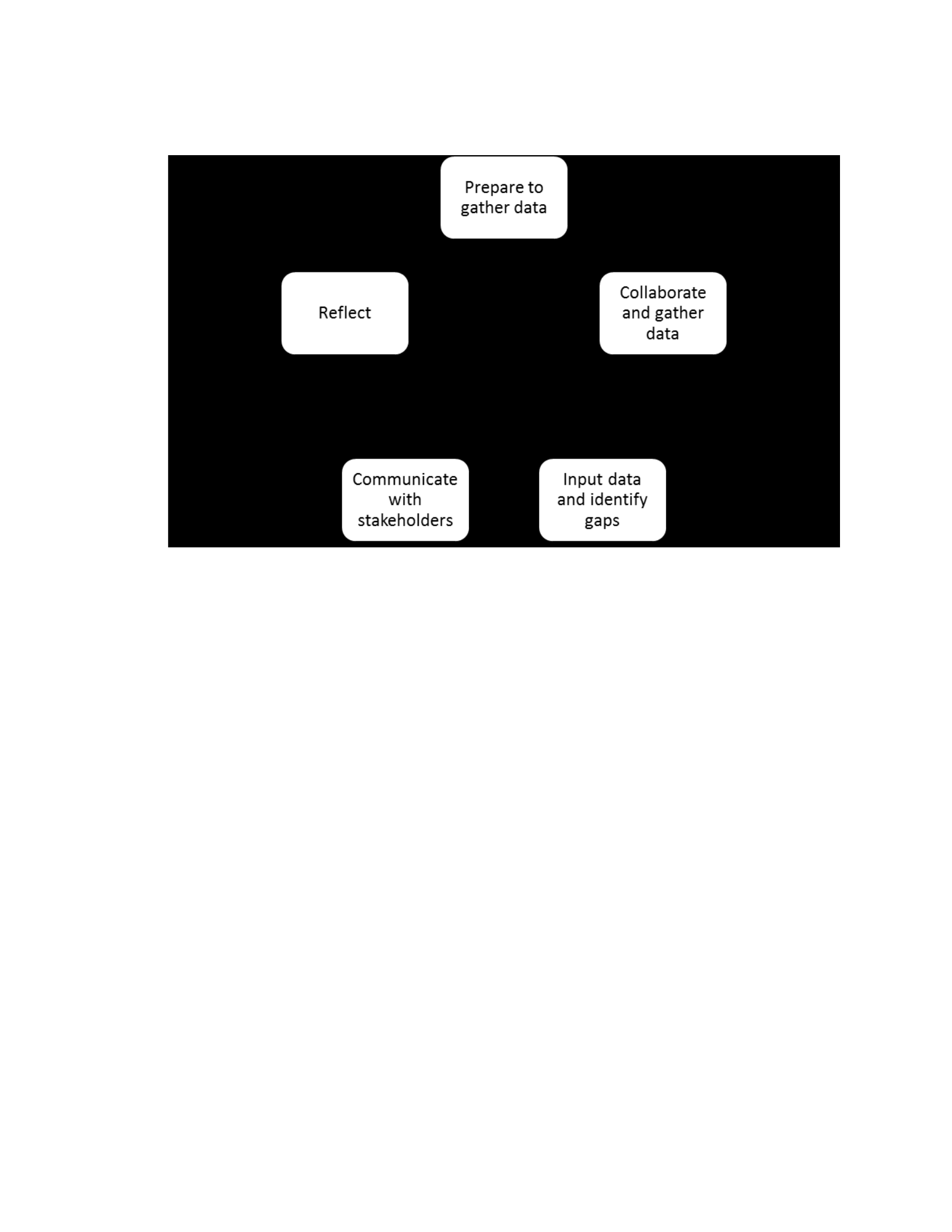
96
Figure 2. Sustainability reporting cycle.
After gathering the data, they entered the data into the framework. The EDOS
stated when describing the importance of a framework,
But in preparation, we have 15 different report areas. But how do they all
integrate? So you have assessment reports, financial reports, progress
reports, compliance reports- how does all that flow into the sustainability
reports? So is there an integrating architecture for all the reporting and
planning we do? (EDOS)
The participants used the STARS reporting framework as the framework for the
sustainability information. The EDOS stated, regarding the reporting process,

97
To us, the process of the reporting is embedded. So all these workgroups
know that we track data inside STARS, they all know that. And so we
will go out and request that data. Some of them know it so well since they
are department heads they go into the database themselves and fill it in.
(EDOS)
The participants identified gaps in the sustainability reporting framework
information. The participants fixed the gaps by going to the appropriate workgroup,
collaborating, and gathering more data. The CSC addressed the issue of gap analysis:
But when we first started out they did a study to see where they were at
with everything, so it was a really comprehensive review of what we are
doing for sustainability. So the first step was what are we doing for
sustainability? And that was how we were able to say well, these are what
we are strong but here are some areas that we are very weak so we could
put more effort in those areas. So the process has really been gap analysis.
(CSC)
The PROF gave an example of identifying gaps as part of the sustainability
reporting process: “So we maintain a database of courses that focus on sustainability. . . .
So we track them two different ways: a set of courses that are entirely focused on
sustainability and ones that include some aspect of sustainability.” Then the PROF
elaborated regarding identification of gaps in the information:

98
Then we identify gaps. So we noticed that one of the health majors—from
the outside we feel that healthcare is a really important aspect of
sustainability. But at least superficially we don't have any nursing courses
in our sustainability database. So this is an opportunity to reach out to the
nursing staff and what we are trying to do and how we envision
sustainability and how what they are doing is probably already
incorporating many aspects of sustainability at various level. Primary care
or organizational management within a hospital. So how can we frame
what you are already doing in the context of sustainability? (PROF)
The PROF concluded, “We have members of those departments on our working
group, so they are actively working with the faculty just to frame . . . what they are
already doing in the context of sustainability.”
After the sustainability report information was complete, then the report was
shared and communicated with stakeholders. The AVP emphasized that the systematic
approach to sustainability reporting was important for planning and communication:
That sustainability reporting not only brings everybody together under a common
focus is going to be helpful under its own right, but it’s the ability then to report it
on a systematic way that will allow others including administration to be able to
see that plan and systematic review approach that will bring more attention to it.
(AVP)

99
The STARS sustainability report of the case organization was available online to
the public on the AASHE STARS website (AASHE, 2015). An integrated sustainability
approach included sustainability reporting that was available to all stakeholders and fully
integrated into the reporting cycle (Krizek et al., 2012). After receiving feedback from
stakeholders, managers reflected on the reporting information to improve sustainability
performance.
Theme 3: Stakeholder Engagement with Leadership Support
The leaders and managers of the case nonprofit academic institution emphasized
the need for stakeholder engagement with strong leadership support of the sustainability
reporting process. The EDOS stated regarding two presidents of the nonprofit university
who started the sustainability movement:
He wanted to have a discussion about what sustainability means and how
it could be an important activity on campus. That was in 2004, then when
the next president came, he had a background. So his question was- how
are we applying it? How many grants do we have? So he went
immediately to the apply side. So the first one created the awareness and
the conversation and then the second one went to the apply side. So then
the second president signed a number of sustainability commitments on
behalf of the university and so our journey is one of leadership and
excellence in our case. And how do you report it? (EDOS)

100
The CSC stated, “We are very fortunate that we have administrative support.”
The CSC continued, “For example, one of these opportunities to do reporting is called the
President's climate commitment and our president signed on right away and we were one
of the first schools to sign off on this.” The AVP agreed, “It is important for us to know
from top administration down in terms of us being sustainable- it is part of who we are as
part of the culture of the institution.”
The EDOS, CSC, and AVP described the visionary campus leader that Krizek et
al. (2012) argued was necessary for a full sustainability implementation at a university.
A visionary campus leader was a high-level executive who encouraged a vision of
sustainability. Krizek et al. claimed that a visionary campus leader supported stakeholder
engagement, transparency in the sustainability process, and a comprehensive
sustainability reporting process. The AVP described the earlier leaders of the nonprofit
university, “They brought in a person to head up the sustainability initiative. It was a
leading, bleeding edge of when this sort of work was starting on campuses.” The STARS
reporting framework indicated the importance of top leadership in sustainability reporting
(AASHE, 2015). The STARS reporting framework required that each submitted report
must be accompanied by a letter from the president, chancellor, or highest ranking
executive of the institution who confirmed that the report had been checked for accuracy
(AASHE, 2015).
The participants thought that both stakeholders and top leaders needed to support
sustainability reporting for the process to be successful. Both internal and external

101
stakeholders wanted sustainability initiatives and reporting while the leaders supported
the process. The PROF described it as “a top-down, bottom-up approach.” The CSC
stated the benefits of the stakeholders and leaders supporting sustainability:
But also if you just walk through our campus you can tell that
sustainability is important. In terms of allocating resources we are able to
have these beautiful new buildings and do some other great things
renewable energy wise and stuff like that because we do have that extra
support. We are fortunate not to have to fight sustainability battles.
(CSC)
The PROF talked about the external stakeholders, including the local businesses:
“The external factors there is a whole group of businesses and foundations that are really
interested in sustainability. Our university's value of sustainability fits into that
ecosystem around us and that extends to the mayor's office and the county.” The PROF
further stated, “So it is a really good fit and I think that we are a good model for other
institutions and regions in the country.” The PROF also discussed other universities and
local government support of sustainability:
And in terms of sustainability there is a lot of spillover between not only
with industry but with a lot of nonprofits and the university and
government. And I think it is working as kind of a holistic ecosystem of
ideas. I think that our university is doing a really good job, but we are

102
doing a good job because there is so much other stuff going on in the
community related to sustainability. (PROF)
The PROF concluded that the nonprofit university had a lot of support regarding
sustainability reporting, “Yes, a lot of support. We are all reinforcing one another.” The
support of the environment was corroborated by T. Hahn et al. (2015). T. Hahn et al.
noted that a favorable organizational setting was a prerequisite for organizations to
respond to sustainability issues. Fernandez-Feijoo et al. (2014) described the numerous
stakeholders at academic institutions, including students, faculty, alumni, staff,
administrators, local businesses, governmental agencies, and other colleges in the same
way as the PROF of the case nonprofit university. Multistakeholder collaboration
encouraged mutual learning of sustainability (Yarime et al., 2012).
In the STARS reporting framework, there was a category for engagement
(AASHE, 2015). This category consisted of two subcategories: campus engagement and
public engagement. The case nonprofit academic institution had a high percentage of
over 85% for engagement activity, indicating a high degree of stakeholder engagement.
Theme 4: Collaborative Process in Sustainability Reporting
The participants emphasized the collaborative process of the sustainability
reporting cycle at their nonprofit university. The sustainability practices of the nonprofit
academic institution affected multiple levels and departments, requiring a collaborative
effort throughout the organization. The case university handled the collaborative process
by creating CSAC, which was the campus sustainability action committee. Avota,

103
Mcfadzean, and Peiseniece (2015) noted that teamwork was a common method of
collaboration in a sustainable organization.
The participants stated that the sustainability report was an external report that
used internal data. The internal data were gathered from a wide range of different
departments throughout the university through internal reports. The CSC stated, “We do
some internal reports such as our strategic plan, different committee work. There is a
campus sustainability advisory committee; this is our big one, so we do reports for that
committee.” The CSC further stated,
There is a lot of internal reporting that happens through committee. But
separately there is a lot of external reporting that we do, and those sort of
reports that other institutions do so there can be comparisons between
other institutions. (CSC)
To complete the sustainability report, it was necessary to collaborate with
numerous people, which was a time-consuming process. It was also difficult to know
who had the data or where and when the data were available. The CSC stated, regarding
CSAC, “It brings everyone to the table, so that has been really helpful.” The CSC
continued, “Before we did that I had to reach out to all the different groups individually
and kind of get everyone up to speed individually, so it was not efficient basically.”
I conducted a document review of the AASHE STARS sustainability reporting
framework that the case nonprofit university used for its sustainability report. The
STARS 2.0 framework had a systems approach to sustainability, and the main sections

104
were academics, engagement, operations, planning and administration, and innovation
(AASHE, 2015). Each section of the STARS 2.0 framework had subcategories. The
STARS reporting framework indicated that the participants were accurate that the
sustainability report required a wide range of information from departments across the
entire university.
To resolve the challenges of gathering, tracking, and sharing information
necessary in sustainability reporting, the leaders at the nonprofit university established
the CSAC. CSAC was organized into 11 workgroups. Each workgroup represented an
area of sustainability such as waste management, transportation, curriculum, and
operations. Each workgroup had a leader with people from different departments within
the workgroup. The CSC stated, “There are 11 workgroups in different areas. And they
work with other workgroups. Even if we have 20 people at a meeting, there are really
like 60 people working with the reporting since they are working with different
networks.” The AVP agreed,
From that standpoint, what we are doing now is that we have groups and
subgroups that work on various aspects of our sustainability practices on
campus. Like our food services, our academic programs, our student
engagement, our facilities, energy usage, and so on. (AVP)
People worked together within the workgroup, and the workgroups collaborated
with other workgroups to share and communicate information about sustainability
practices. The PROF stated when referring to the workgroups,

105
And then internally we developed the campus sustainability advisory
committee that helps with the data collection that goes into the collection.
But also within the working groups, we can identify specific sustainability
targets and goals that we want to implement those through a process of
continuous improvements. Include more sustainability into our
educational curricula, or in our operations, in our investments and then
that circles back and we are able to report on that. (PROF)
The CSC stated, “One thing that has been great is that we can have constant
feedback in conversations so they can see areas that could be improved and have better
results. That has been a really good thing to keep things going.” The collaborative
process was described by T. Hahn et al. (2014) to allow for information exchange and
open dialogue across different levels of the organization, which encouraged
organizational learning and creative problem solving. The collaborative process was
essential to contribute internal information of 11 workgroups to the external sustainability
report (see Figure 3).
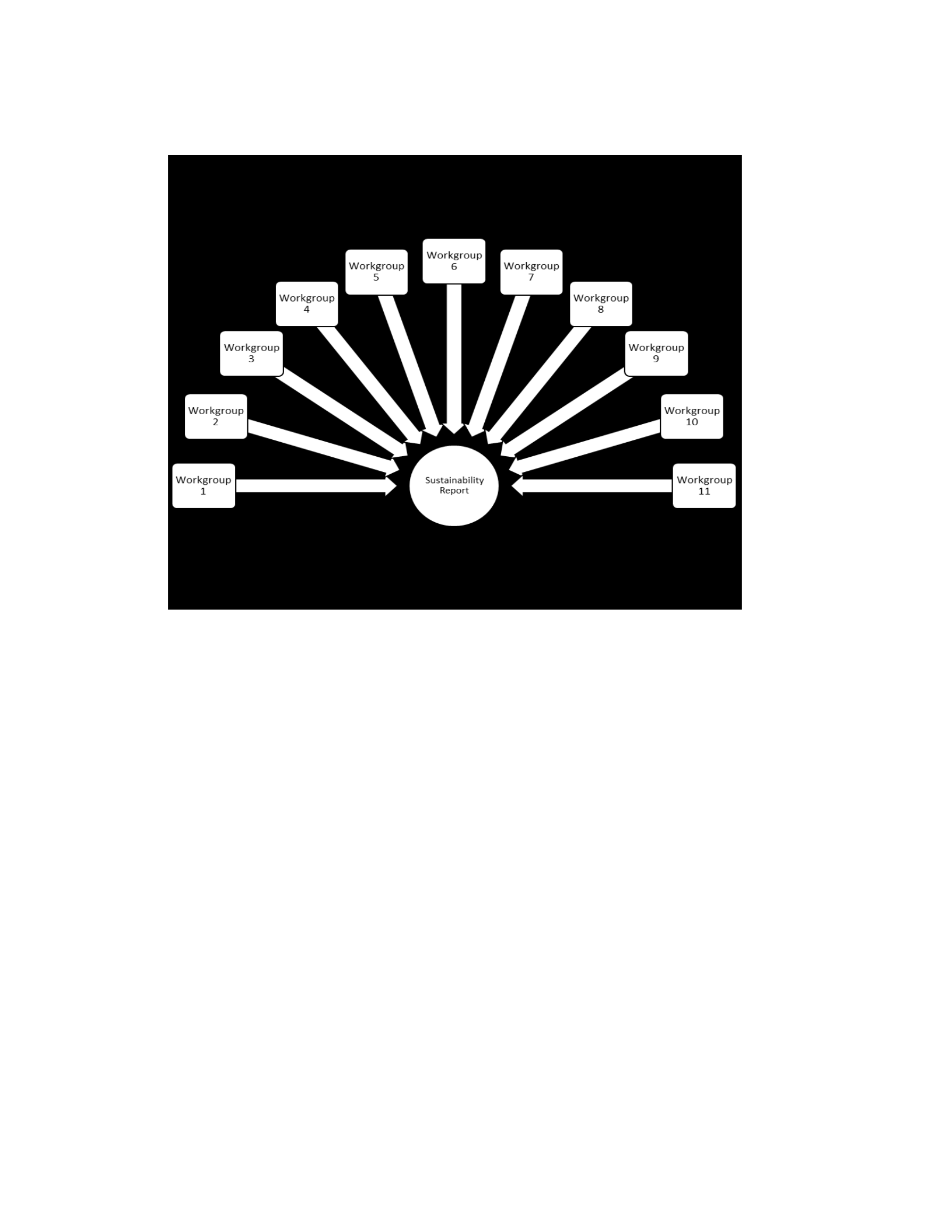
106
Figure 3. Collaborative process from internal information contributing to external
sustainability report.
The participants indicated that CSAC had improved the efficiency of the
collaborative process. CSAC also addressed the university-wide strategic plan and not
just the sustainability report. The EDOS stated, regarding CSAC,
So today, our campus sustainability advisory committee is developing a
sustainability plan that fits into the strategic plan. We never had one
across the university. We always had one in our office, but our office is of
service to everyone. So this was a major step forward last year in setting

107
up a sustainability advisory council that would actually integrate the goals
in 11 different areas. (EDOS)
The participants believed that CSAC was essential to the success of the
sustainability initiatives and different reporting cycles throughout the nonprofit
university. The CSC stated,
So we are having them looking at our university's strategic planning like
the big overarching document and see how they fit into that. So we are
right in the middle of that process. That has been a neat process for us.
We can see how sustainability specifically ties into the mission and goals
and outcomes for the university. (CSC)
The CSC concluded regarding the collaborative effort of CSAC, “It has been a
huge improvement though to have everyone together.” The AVP added that the members
of the sustainability committee are developing an online information distribution system:
We might do them on a spreadsheet in my office or somewhere else in their area
has their own tracking, but we are putting together now an internal web-based
systems where you can get on and it makes the information much more disbursed
and available to those around campus. (AVP)
Theme 5: Sustainability as an Organizational Value
The leaders and managers of the case nonprofit academic institution indicated that
sustainability had to be a key value of the organization to support sustainability reporting.
Sustainability was a concept that encompassed the ability of organizations to meet the

108
needs of stakeholders while maintaining high environmental, financial, and social
performance (Searcy & Buslovich, 2014). I identified sustainability as a part of the
conceptual framework of the study. The CSC stated, regarding sustainability as an
organizational value,
We are very lucky at our university that sustainability is one of our formal
values. The institution has seven formal values in effective teaching and
inclusion. So we are very fortunate that sustainability was named one of
them. I think that this is kind of unique, we are fortunate to have
administrative support. So sustainability is very important to our
university as a whole. (CSC)
The EDOS defined sustainability in this way: “And use a marketplace term—a set
of tools and best practices that allow you to make a better decision both for today and
tomorrow, but gives you positive social, economic, and environmental impact. That is
the best definition.” The AVP stated the long-term commitment to sustainability started
years ago and grew:
It seems as though sustainability has always been at least an interest all the
way back when early on we were doing LEED [Leadership in Energy and
Environmental Design] certified buildings on campus. Kind of well in
advance of other public buildings. From that perspective, it kind of grew
from where I saw it. (AVP)

109
The viewpoints of the participants aligned with T. Hahn et al. (2015) who argued
that a favorable organizational setting was a prerequisite for organizations to respond to
sustainability issues.
Because sustainability reporting was voluntary, the participants thought that the
nonprofit university had to value sustainability to invest in the lengthy journey of
sustainability reporting. The EDOS stated, regarding the voluntary aspect of
sustainability reporting,
The best way to look at it is—it's required. None of this was really
required. That's different, right? There are assessment reports for
accreditation, but sustainability is not the same way. There is no
requirement to do it but, we self-imposed, there is your difference. So we
self-imposed, we did not have to do an assessment. But the university
wanted to find out where we are. But they picked the indicators, and that
started the journey. (EDOS)
At the case nonprofit academic institution, sustainability was now considered a
key value that was to be integrated across the entire organization. Although most
universities do not have the same level of commitment to sustainability as the case
university, the participants thought it was important for a university to value
sustainability and be dedicated to the concept of sustainability for continued success. The
EDOS stated about the importance of sustainability as an organizational value:

110
In 2010 the difference was that it is no longer an activity it is now one of
the university's seven values. That is a huge difference because once it is
a value you have to integrate sustainability across all departments and all
our colleges and it has to do with leadership and excellence, it is not an
activity. It’s not about just saving energy. So today it’s about how to live
a sustainable lifestyle. (EDOS)
The PROF stated, “Sustainability is valued and implemented and acted upon in
the curriculum and in the way we do work.” The PROF continued, “We are also doing it
internally for the university because sustainability is a university value now. So we have
to have metrics and show how we are integrating that value into everything we do in our
operations.”
The EDOS stated the benefits of having sustainability as an organizational value
in the context of commitment:
Plus you have to get to the point where the university has a commitment to
it. And there are still are many universities that are doing great work ten
years ago that have still not been able to get to the total commitment. So
we are very fortunate. And more or less, I don't know any that has it as a
university value. We only have seven values at our university, and that is
a major difference. To be a good global citizen which is what we are
trying to do here. They believe that sustainability helps prepare a student
to become one of those - a good global citizen. (EDOS)

111
The use of sustainability as an organizational value corroborated with the
conclusion by Krizek et al. (2012) that the principles of sustainability needed to become
part of the mission, vision, and values of the academic institution to be fully integrated
into the organization.
Applications to Professional Practice
The findings, conclusions, and recommendations from the study contributed to the
field of knowledge of the internal organizational processes in sustainability reporting.
The findings of the study fulfilled the need for an exploration of a sustainability reporting
cycle for a nonprofit academic institution. The five themes of the study that emerged
from the findings were: (a) sustainability reporting framework reflecting TBL; (b)
sustainability reporting as a long-term process; (c) stakeholder engagement with
leadership support; (d) collaborative process in sustainability reporting; and (e)
sustainability as an organizational value.
Leaders and managers at nonprofit academic institutions could select a
sustainability reporting framework that reflected the TBL concept to ensure that the
sustainability report was high quality and measured important sustainability
characteristics. TBL was a concept that assessed sustainability practices through
environmental, economic, and social factors (Milne & Gray, 2013). The findings of the
study indicated that it was essential that the sustainability reporting framework
incorporated TBL to provide a comprehensive assessment.

112
Leaders and managers at nonprofit academic institutions might be hesitant to
implement sustainability reporting because they did not know how to start. Managers
identified lack of knowledge in developing sustainability reports as the main reason for
not using sustainability reports (Habek & Wolniak, 2015). The findings of the study
indicated the steps of establishing a sustainability reporting process consisted of
completing a preliminary stage before the reporting cycle, and then the reporting cycle
could be established. The preliminary stage of awareness, assessment, and progress
established a baseline before starting the sustainability reporting cycle. The sustainability
reporting cycle of preparation, collaboration, input and gap analysis, communication with
stakeholders, and reflection was perpetuated on an annual basis. Managers at nonprofit
academic institutions could use the sustainability reporting process described in the study
as a model to assist them in developing their own sustainability reports.
Leaders and stakeholders of a nonprofit academic institution could consider if
there was stakeholder engagement with leadership support for sustainability reporting.
At the case nonprofit university, both internal and external stakeholders supported
sustainability initiatives and sustainability reporting. Stakeholders wanted to see progress
and assessment of sustainability initiatives and were engaged in the sustainability
reporting process. Along with the stakeholders, the top leaders at the university strongly
supported sustainability practices and sustainability reporting.
A comprehensive sustainability reporting framework required a diverse range of
information from multiple sources. In the case study, the sources of information came

113
from internal reports of different departments throughout the university. The case
nonprofit university formed a collaborative committee that united all the departments
throughout the university with sustainability as the goal. Leaders and managers could use
the same strategy to support collaboration in the sustainability reporting process.
Leaders and managers can assess their organizations and determine if their
organizational environment had the values for sustainability reporting support.
Sustainability as an organizational value may be necessary to support the lengthy process
of sustainability reporting. Sustainability reporting could provide leaders and managers
an assessment tool for improvement of sustainability initiatives. The nonprofit academic
institution can also benefit from the recognition of commitment to the community
through transparency of the sustainability reporting process.
Implications for Social Change
If leaders and managers had the knowledge of preparing, developing, and
maintaining a sustainability reporting cycle, then the leaders and managers were more
likely to consider using sustainability reporting (Habek & Wolniak, 2015). If nonprofit
academic institutions had sustainability reports, then stakeholders would be able to assess
the progress of sustainability practices that will increase the transparency of the
sustainability process. Leaders and managers at nonprofit academic institutions could use
the findings from the study to implement the process of sustainability reporting.
Community engagement was a characteristic of an organization that incorporated
sustainability as a value. One way to connect and communicate with community

114
stakeholders and partners was through sustainability reporting. A network of community
partners could use the sustainability reports to understand the impact of sustainable
practices as well as compare progress. The engagement with other nonprofit academic
institutions could be enhanced if the institutions used the same sustainability reporting
framework such as STARS to assess the sustainability initiatives across organizations.
Being a good global citizen means understanding that the conservation of
environmental resources, economic responsibility, and social awareness are important for
the positive growth of the global environment (Hack et al., 2014). As leaders in
businesses and organizations embrace sustainability practices, sustainability reporting
becomes part of the sustainability movement (Mori et al., 2013). Leaders and managers
of nonprofit academic institutions can use the findings of the study to start the
sustainability reporting process by completing the preliminary stage of awareness,
assessment, and progress. The findings indicated the necessary conditions for starting
and implementing the sustainability reporting process.
Stakeholder engagement with leadership support was a vital factor in supporting
the sustainability reporting process. At a nonprofit academic institution, engaging
students, faculty, staff, administration, and community partners such as local businesses
brought positive social change to the community and environment. Stakeholder
engagement and collaboration established an environment of participation and
information exchange that encouraged organizational learning and innovation benefiting
the entire community.

115
Recommendations for Action
The data analysis revealed five themes: (a) sustainability reporting framework
reflecting TBL; (b) sustainability reporting as a long-term process; (c) stakeholder
engagement with leadership support; (d) collaborative process in sustainability reporting;
and (e) sustainability as an organizational value. Leaders and managers at nonprofit
academic institutions can use the themes as steps and strategies for implementing a
sustainability reporting process. The strategy of completing the preliminary stage of
awareness, assessment, and progress before starting sustainability reporting can function
as a guideline for starting a sustainability reporting process. The sustainability reporting
cycle of preparation, collaboration, identification of gaps, stakeholder communication,
and reflection is a strategy for implementation of a sustainability reporting process.
The use of a sustainability reporting framework that was based on TBL can be a
standard for managers who are considering different sustainability reporting frameworks.
The collaborative effort was an essential factor in the sustainability reporting process that
leaders and managers can encourage through teamwork and committee formation.
Stakeholder engagement with leadership support can indicate if a nonprofit academic
institution had the support needed to implement a sustainability reporting process.
Finally, sustainability as an organizational value was a vital factor for a nonprofit
academic institution to have to integrate sustainability reporting throughout the
organization.

116
Leaders and managers of nonprofit academic institutions who were considering
using sustainability reporting for sustainability initiatives at their organizations is a target
audience of the study. Another target audience is internal and external stakeholders
including students, faculty, staff, administration, and community partners who are
interested in understanding the sustainability reporting process. Leaders at nonprofit
academic institutions have the responsibility of encouraging sustainability reporting and
understanding the benefits to the community and stakeholders.
Accounting professionals can be attentive to the findings since sustainability
reporting incorporates aspects of financial reporting. Accounting professionals may work
with sustainability managers to provide the economic component of the TBL. Because
the concept of sustainability requires managers to be held accountable to stakeholders,
then accountants are in the position of applying the ethical standards of transparency to
sustainability reports (Seay, 2015).
The results of the study can add to the information sharing at conferences with
accounting professionals. Because the study focused on a nonprofit academic institution,
I can present my findings at academic conferences. The findings of the study can
contribute to training for managers who are interested in sustainability reporting or
starting the sustainability reporting process at their nonprofit academic institutions. I can
disseminate the findings of the study by publishing in academic journals targeted for
leaders at academic institutions. I can also share the results of the study through online
journals and professional online blogs.

117
Recommendations for Further Research
The purpose of this qualitative single case study was to explore the strategies and
processes necessary for leaders and managers to integrate sustainability reporting into the
reporting cycle for a nonprofit higher education institution. I identified in Section 1 that a
single case study was a limitation because it might hinder transferability to other
organizations (Zivkovic, 2012). I mitigated the limitation by selecting an exemplary case
of an academic institution that had fully integrated sustainability reporting into the
reporting cycle. In future research, multiple case studies of academic institutions can
extend the research.
Another limitation of the case study was the willingness of participation by
leaders and the honesty in the responses of the leaders. I was able to mitigate the
limitation by thoroughly explaining the data collection process to the participants. I
addressed the honesty and thoroughness of the participants’ responses by asking follow-
up questions if the answers were not clear. Additional questions to the list of interview
questions can extend future research.
The scope of the study did not extend outside of the state of Michigan and outside
of the United States. The scope of the study did not include for-profit academic
institutions. For further research, the inclusion of for-profit academic institutions could
extend the body of knowledge. For-profit academic institutions share many of the same
challenges of nonprofit academic institutions, such as a complicated network of

118
stakeholders and community involvement. Research can also include academic
institutions in different states or regions of the United States.
I conducted the interviews and document reviews of the study over the course of 2
months, so the scope of the study did not extend past a 2-month period. For future
research, the scope of the study could be more long-term. Researchers can interview
participants at one stage of the sustainability reporting process and then interview again
at a different stage to explore what participants think about the sustainability reporting
process over an extended period.
Cavazos-Garza and Krueger (2014) suggested that future research could focus on
the inclusion of sustainability in an organization’s strategy. I focused on the process of
developing and implementing sustainability reporting in the single case study. Future
research can focus on how to include sustainability into an organization’s strategic
planning.
Moore and Poznanski (2015) pointed out that many sustainability reports lacked
information that would be valuable to stakeholders. I did not include external
stakeholders in the interview process for the single case study. Future research could
include surveying external stakeholders to examine what stakeholders were looking for in
sustainability reports.
Reflections
In qualitative research, the researcher was the instrument of data collection (Koch
et al., 2013). I collected, analyzed, and interpreted the data in the qualitative single case

119
study. I was aware of possible influence on all aspects of the research because of the
amount of interaction with research participants. The influence of the researcher
included relationships with participants, personal biases, and attitudes that might have
influenced the view and interpretation of the qualitative data (Koch et al., 2013).
Prior to the start of the academic research process, I had an active interest in the
concepts of CSR, sustainability, and accounting for sustainability. My professional
perspective was supportive of the concept of CSR for organizations and the importance
of sustainability for organizations and communities. I was an active participant in the
accounting field and supported the involvement of the accounting profession in the
sustainability reporting process. I taught accounting at the college level and I supported
teaching sustainability concepts in the context of accounting education.
I was not a faculty member of the nonprofit academic institution in the study, so I
did not have any relationship with the participants of the single case study prior to the
study. The only contact I had with the participants of the case academic institution was
through the interview process. I practiced reflexivity to mitigate bias and increase the
awareness of my influence on the data and the data collection.
I practiced reflexivity throughout the entire research process, including
development of interview questions, analysis of interview transcripts, and the
development of themes. The practice of reflexivity ensured that the resulting themes
emerged from the responses and not from the researcher’s biases (Koch et al., 2013). I
reflected on my support of the concept of sustainability and ensured that all information

120
from the participants’ responses were directly from the participants and did not reflect my
biases.
After completing the study, I understood the importance of leaders, managers, and
employees in embracing the concept of sustainability when developing sustainability
reporting. If the leaders, managers, and employees are committed to sustainability and
the benefits to the community, then they will take the time and effort in developing
sustainability reports for their stakeholders. I have a better understanding of the need for
a collaborative effort in developing sustainability reports. Communication needs to be
open across different levels and areas in the organization for the sustainability reporting
process to succeed. I have a greater understanding of the unique position that nonprofit
academic institutions have in the community and their potential for the promotion of
sustainability and responsible sustainability reporting.
Summary and Study Conclusions
The findings from the study contributed to the body of knowledge regarding the
planning, development, and monitoring of sustainability reports. The five themes from
the study were: (a) sustainability reporting framework reflecting TBL; (b) sustainability
reporting as a long-term process; (c) stakeholder engagement with leadership support; (d)
collaborative process in sustainability reporting; and (e) sustainability as an
organizational value. The sustainability reporting process was a lengthy and complicated
process that could span years and involved stakeholders throughout the nonprofit
academic institution and community. Leaders and managers of nonprofit academic

121
institutions can use the results of the study as guidance for the development and
implementation of their sustainability reporting process.
The nonprofit academic institution is a learning organization, and the leaders have
the ability to educate the community through traditional means and through example. If a
nonprofit academic institution published sustainability reports, then all stakeholders
would be able to assess the commitment to sustainability of the organization. The
nonprofit academic institution can serve the community on multiple levels, including
education, community networking, and as a role model for best practices in sustainability.
The nonprofit academic institution can fulfill a leadership role in an increasingly global
and community-oriented world perspective in the academic field through information and
knowledge sharing of the sustainability reporting process.

122
References
Aggarwal, B., & Gurnani, M. (2014). Development of ethical guidelines for clinical
research: Serendipity or eulogy. Ethics & Medicine: An International Journal of
Bioethics, 30, 97-108. Retrieved from http://www.ethicsandmedicine.com/
Albareda, L. (2013). CSR governance innovation: Standard competition-collaboration
dynamic. Corporate Governance, 13, 551-568. http://dx.doi.org/10.1108/CG-06-
2013-0076
Alhaddi, H. (2014). The influence of triple bottom line on strategic positioning: An
exploratory case study on differentiation through image. Journal of Management
and Strategy, 5(1), 55-73. http://dx.doi.org/10.5430/jms.v5n1p55
Association for the Advancement of Sustainability in Higher Education. (2015). STARS
participants and reports. Philadelphia, PA. Retrieved from
https://stars.aashe.org/institutions/participants-and-reports/
Avota, S., Mcfadzean, E., & Peiseniece, L. (2015). Linking personal and organisational
values and behaviour to corporate sustainability: A conceptual model. Journal of
Business Management, (10), 124-139. Retrieved from http://www.riseba.lv/
en/publications/journal.html
Ballou, B., Casey, R. J., Grenier, J. H., & Heitger, D. L. (2012). Exploring the strategic
integration of sustainability initiatives: Opportunities for accounting research.
Accounting Horizons, 26, 265-288. http://dx.doi.org/10.2308/acch-50088

123
Boulouta, I., & Pitelis, C. N. (2014). Who needs CSR? The impact of corporate social
responsibility on national competitiveness. Journal of Business Ethics, 119, 349-
364. http://dx.doi.org/10.1007/s10551-013-1633-2
Bowen, G. (2008). Naturalistic inquiry and the saturation concept: A research note.
Qualitative Research, 8, 137-152. http://dx.doi.org/10.1177/1468794107085301
Bowen, H. (1953). Social responsibilities of the businessman. New York, NY: Harper &
Row.
Brown-Liburd, H., & Zamora, V. L. (2015). The role of corporate social responsibility
(CSR) assurance in investors’ judgments when managerial pay is explicitly tied to
CSR performance. Auditing: A Journal of Practice & Theory, 34(1), 75-96.
http://dx.doi.org/10.2308/ajpt-50813
Carroll, A. (1999). Corporate social responsibility. Business and Society, 38, 268-295.
Retrieved from http://bas.sagepub.com/
Cavazos-Garza, A. A., & Krueger, T. (2014). Wealth impacts arising from hiring a
sustainability officer. Journal of Strategic Innovation and Sustainability, 10(1),
24-34. Retrieved from http://www.na-businesspress.com/jsisopen.html
Christofi, A., Christofi, P., & Sisaye, S. (2012). Corporate sustainability: Historical
development and reporting practices. Management Research Review, 35, 157-172.
http://dx.doi.org/10.1108/01409171211195170

124
Churet, C., & Eccles, R. G. (2014). Integrated reporting, quality of management, and
financial performance. Journal of Applied Corporate Finance, 26(1), 7-18.
http://dx.doi.org/10.1111/jacf.12054
Curry, M. W. (2012). In pursuit of reciprocity: Researchers, teachers, and school
reformers engaged in collaborative analysis of video records. Theory Into
Practice, 51, 91-98. http://dx.doi.org/10.1080/00405841.2012.662858
Dabić, T., & Stojanov, Ž. (2014). Techniques for collecting qualitative field data in
education research: Example of two studies in information technology field.
Proceedings of the 1st International Scientific Conference - Sinteza 2014, 362-
367. http://dx.doi.org/10.15308/sinteza-2014-362-367
Darus, F., Sawani, Y., Zain, M. M., & Janggu, T. (2014). Impediments to CSR assurance
in an emerging economy. Managerial Auditing Journal, 29, 253-267.
http://dx.doi.org/10.1108/MAJ-04-2013-0846
DeCuir-Gunby, J. T., Marshall, P. L., & McCulloch, A W. (2011). Developing and using
a codebook for the analysis of interview data: An example from a professional
development research project. Field Methods, 23, 136-155. http://dx.doi.org/
10.1177/1525822X10388468
Delattre, M., Ocler, R., Moulette, P., & Rymeyko, K. (2009). Singularity of qualitative
research : From collecting information to producing results. Tamara Journal for
Critical Organization Inquiry, 7(3), 33-51. Retrieved from
http://tamarajournal.com/

125
Eberle, D., Berens, G., & Li, T. (2013). The impact of interactive corporate social
responsibility communication on corporate reputation. Journal of Business Ethics,
118, 731-746. http://dx.doi.org/10.1007/s10551-013-1957-y
Ekwueme, C. M., Egbunike, C. F., & Onyali, C. I. (2013). Benefits of triple bottom line
disclosures on corporate performance: An exploratory study of corporate
stakeholders. Journal of Management and Sustainability, 3(2), 79-91.
http://dx.doi.org/10.5539/jms.v3n2p79
Elkington, J. (1997). Cannibals with forks: The triple bottom line of 21st century
business. London, England: Capstone.
Elo, S., Kaariainen, M., Kanste, O., Polkki, T., Utriainen, K., & Kyngas, H. (2014).
Qualitative content analysis: A focus on trustworthiness. SAGE Open, 4, 1-10.
http://dx.doi.org/10.1177/2158244014522633
Faisal, F., Tower, G., & Rusmin, R. (2012). Legitimising corporate sustainability
reporting throughout the world. Australasian Accounting Business and Finance
Journal, 6(2), 19-35. Retrieved from http://ro.uow.edu.au/aabfj/
Fernandez-Feijoo, B., Romero, S., & Ruiz, S. (2014). Effect of stakeholders’ pressure on
transparency of sustainability reports within the GRI framework. Journal of
Business Ethics, 122, 53-63. http://dx.doi.org/10.1007/s10551-013-1748-5
Frias-Aceituno, J. V., Rodríguez-Ariza, L., & Garcia-Sánchez, I. M. (2014). Explanatory
factors of integrated sustainability and financial reporting. Business Strategy and
the Environment, 23, 56-72. http://dx.doi.org/10.1002/bse.1765

126
Gawel, A. (2014). Business collaboration with universities as an example of corporate
social responsibility - A review of case study. Poznan University of Economics
Review, 14(1), 20-31. Retrieved from http://www.puereview.ue.poznan.pl/
index.php/en/
Glavas, A., & Mish, J. (2014). Resources and capabilities of triple bottom line firms:
Going over old or breaking new ground? Journal of Business Ethics, 127, 623-
642. http://dx.doi.org/10.1007/s10551-014-2067-1
Godemann, J., Bebbington, J., Herzig, C., & Moon, J. (2014). Higher education and
sustainable development. Accounting, Auditing & Accountability Journal, 27,
218-233. http://dx.doi.org/10.1108/AAAJ-12-2013-1553
González-Rodríguez, M. R., Díaz-Fernández, M. C., Pawlak, M., & Simonetti, B. (2013).
Perceptions of students university of corporate social responsibility. Quality and
Quantity, 47, 2361-2377. http://dx.doi.org/10.1007/s11135-012-9781-5
Green, J., Willis, K., Hughes, E., Small, R., Welch, N., Gibbs, L., & Daly, J. (2007).
Generating best evidence from qualitative research: The role of data analysis.
Australian and New Zealand Journal of Public Health, 31, 545-550.
http://dx.doi.org/10.1111/j.1753-6405.2007.00141.x
Greenwood, M., & Kamoche, K. (2013). Social accounting as stakeholder knowledge
appropriation. Journal of Management and Governance, 17, 723-743.
http://dx.doi.org/10.1007/s10997-011-9208-z

127
Habek, P., & Wolniak, R. (2015). Factors influencing the development of CSR reporting
practices: Experts’ versus preparers’ points of view. Engineering Economics, 26,
560-570. http://doi.org/10.5755/j01.ee.26.5.7690
Hack, L., Kenyon, A. J., & Wood, E. H. (2014). A critical corporate social responsibility
(CSR) timeline : How should it be understood now ? International Journal of
Management Cases, 16(4), 46-56. Retrieved from http://www.ijmc.org/
ijmc/Home.html
Hahn, R., & Lülfs, R. (2014). Legitimizing negative aspects in GRI-oriented
sustainability reporting: A qualitative analysis of corporate disclosure strategies.
Journal of Business Ethics, 123, 401-420. http://dx.doi.org/10.1007/s10551-013-
1801-4
Hahn, T., Figge, F., Aragon-Correa, J., & Sharma, S. (2015). Advancing research on
corporate sustainability: Off to pastures new or back to the roots? Business &
Society, 1-31. http://dx.doi.org/10.1177/0007650315576152
Hahn, T., Pinkse, J., Preuss, L., & Figge, F. (2014). Cognitive frames in corporate
sustainability: Managerial sensemaking with paradoxical and business case
frames. Academy of Management Review, 4015(1), 18-42.
http://dx.doi.org/10.5465/amr.2012.0341
Hsieh, H. F., & Shannon, S. E. (2005). Three approaches to qualitative content analysis.
Qualitative Health Research, 15, 1277-1288. http://dx.doi.org/10.1177/
1049732305276687

128
Huang, T., Pepper, M., & Bowrey, G. (2014). Implementing a sustainability balanced
scorecard to contribute to the process of organisational legitimacy assessment.
Australasian Accounting, Business and Finance Journal, 8(2), 15-34.
http://dx.doi.org/10.14453/aabfj.v8i2.3
Hyett, N., Kenny, A., & Dickson-Swift, V. (2014). Methodology or method ? A critical
review of qualitative case study reports. International Journal of Qualitative
Studies on Health and Well-Being, 1, 1-12.
http://dx.doi.org/10.3402/qhw.v9.23606
Hysong, S. J., Smitham, K. B., Knox, M., Johnson, K.-E., SoRelle, R., & Haidet, P.
(2013). Recruiting clinical personnel as research participants: A framework for
assessing feasibility. Implementation Science : IS, 8(1), 125-132. http://dx.doi.org/
10.1186/1748-5908-8-125
Ioana, D., & Adriana, T. (2013). New corporate reporting trends. Analysis on the
evolution of integrated reporting. Annals of the University of Oradea, Economic
Science Series, 22, 1221-1229. Retrieved from http://anale.steconomiceuoradea.
ro/en/
James, M. L. (2013). Sustainability and integrated reporting: Opportunities and strategies
for small and midsize companies. Entrepreneurial Executive, 18, 17-28. Retrieved
from http://www.alliedacademies.org/entrepreneurial-executive/

129
Jensen, J. C., & Berg, N. (2012). Determinants of traditional sustainability reporting
versus integrated reporting. An institutionalist approach. Business Strategy and
the Environment, 21, 299-316. http://dx.doi.org/10.1002/bse.740
Kaczynski, D., Salmona, M., & Smith, T. (2014). Qualitative research in finance.
Australian Journal of Management, 39, 127-135. http://dx.doi.org/10.1177/
0312896212469611
Kantabutra, S., & Saratun, M. (2013). Sustainable leadership: Honeybee practices at
Thailand’s oldest university. International Journal of Educational Management,
27, 356-376. http://dx.doi.org/10.1108/09513541311316304
Kasperskaya, Y., & Tayles, M. (2013). The role of causal links in performance
measurement models. Managerial Auditing Journal, 28, 426-443.
http://dx.doi.org/10.1108/02686901311327209
Kiron, D., Kruschwitz, N., Reeves, M., & Goh, E. (2013). The benefits of sustainability-
driven innovation. MIT Sloan Management Review, 54(2), 69-73. Retrieved from
http://sloanreview.mit.edu/
Klettner, A., Clarke, T., & Boersma, M. (2014). The governance of corporate
sustainability: Empirical insights into the development, leadership and
implementation of responsible business strategy. Journal of Business Ethics, 122,
145-165. http://dx.doi.org/10.1007/s10551-013-1750-y

130
Klovienė, L., & Speziale, M. T. (2015). Sustainability reporting as a challenge for
performance measurement: Literature review. Economics and Business, 26, 44-
53. http://dx.doi.org/10.7250/eb.2014.019
Koch, L. C., Niesz, T., & McCarthy, H. (2013). Understanding and reporting qualitative
research: An analytical review and recommendations for submitting authors.
Rehabilitation Counseling Bulletin, 57, 131-143. http://dx.doi.org/10.1177/
0034355213502549
Krizek, K. J., Newport, D., White, J., & Townsend, A. R. (2012). Higher education’s
sustainability imperative: How to practically respond? International Journal of
Sustainability in Higher Education, 13, 19-33. http://dx.doi.org/10.1108/
14676371211190281
Kurapatskie, B., & Darnall, N. (2013). Which corporate sustainability activities are
associated with greater financial payoffs? Business Strategy and the Environment,
22, 49-61. http://dx.doi.org/10.1002/bse.1735
Lange, E., & Kerr, S. (2013). Accounting and incentives for sustainability in higher
education: An interdisciplinary analysis of a needed revolution. Social
Responsibility Journal, 9, 210-219. http://dx.doi.org/10.1108/SRJ-08-2011-0058
Lanis, R., & Richardson, G. (2014). Is corporate social responsibility performance
associated with tax avoidance? Journal of Business Ethics, 1-19. http://dx.doi.org/
10.1007/s10551-014-2052-8

131
Lawrence, S., Collins, E., & Roper, J. (2013). Expanding responsibilities of corporate
governance : The incorporation of CSR and sustainability. Indian Journal of
Corporate Governance, 6(1), 49-63. Retrieved from
http://www.ipeindia.org/main/index.php?page=journal-of-corporate-governance
Leonidou, C. N., Katsikeas, C. S., & Morgan, N. A. (2013). “Greening” the marketing
mix: Do firms do it and does it pay off? Journal of the Academy of Marketing
Science, 41, 151-170. http://dx.doi.org/10.1007/s11747-012-0317-2
Leszczynska, A. (2012). Towards shareholders’ value: An analysis of sustainability
reports. Industrial Management & Data Systems, 112, 911-928. http://dx.doi.org/
10.1108/02635571211238518
Lidstone, L., Wright, T., & Sherren, K. (2015). Canadian STARS-rated campus
sustainability plans: Priorities, plan creation and design. Sustainability, 7, 725-
746. http://dx.doi.org/10.3390/su7010725
Lin, I.-H., Chang, O. H., & Chang, C. (2014). Importance of sustainability performance
indicators as perceived by the users and preparers. Journal of Management and
Sustainability, 4(1), 29-42. http://dx.doi.org/10.5539/jms.v4n1p29
Luke, B., Barraket, J., & Eversole, R. (2013). Measurement as legitimacy versus
legitimacy of measures. Qualitative Research in Accounting & Management, 10,
234-258. http://dx.doi.org/10.1108/QRAM-08-2012-0034

132
Lusher, A. L., Way, M., & Rock, S. (2012). What is the accounting profession’s role in
accountability of economic, social, and environmental issues ? International
Journal of Business & Social Science, 3(15), 13-20. Retrieved from http://www.
ijbssnet.com/
Marshall, B., Cardon, P., Poddar, A., & Fontenot, R. (2013). Does sample size matter in
qualitative research?: A review of qualitative interviews in is research. Journal of
Computer Information Systems, 54(1), 11-22. Retrieved from
http://www.iacis.org/jcis/jcis.php
Mason, C., & Simmons, J. (2014). Embedding corporate social responsibility in corporate
governance: A stakeholder systems approach. Journal of Business Ethics, 119,
77-86. http://dx.doi.org/10.1007/s10551-012-1615-9
Mason, M. (2010). Sample size and saturation in PhD studies using qualitative
interviews. Forum: Qualitative Social Research, 11(3), 1-18. Retrieved from
http://www.qualitative-research.net/index.php/fqs
Maxwell, J. (2012). The importance of qualitative research for causal explanation in
education. Qualitative Inquiry, 18, 655-661. http://dx.doi.org/10.1177/
1077800412452856
Meyrick, J. (2006). What is good qualitative research? A first step towards a
comprehensive approach to judging rigour/quality. Journal of Health Psychology,
11, 799-808. http://dx.doi.org/10.1177/1359105306066643

133
Mikesell, L., Bromley, E., & Khodyakov, D. (2013). Ethical community-engaged
research: A literature review. American Journal of Public Health, 103(12), 7-15.
http://dx.doi.org/10.2105/AJPH.2013.301605
Milne, M. J., & Gray, R. (2013). W(h)ither ecology? The triple bottom line, the Global
Reporting Initiative, and corporate sustainability reporting. Journal of Business
Ethics, 118, 13-29. http://dx.doi.org/10.1007/s10551-012-1543-8
Montiel, I., & Delgado-Ceballos, J. (2014). Defining and measuring corporate
sustainability: Are we there yet? Organization & Environment, 27, 113-139.
http://dx.doi.org/10.1177/1086026614526413
Moore, W. B., & Poznanski, P. J. (2015). Sustainability reporting: An accountant’s
perspective. Journal of Management and Sustainability, 5(2), 92-97.
http://dx.doi.org/10.5539/jms.v5n2p92
Moravcsik, A. (2013). Transparency: The revolution in qualitative research. PS: Political
Science & Politics, 47, 48-53. http://dx.doi.org/10.1017/S1049096513001789
Mori, R., Best, P. J., & Cotter, J. (2013). Sustainability reporting and assurance: A
historical analysis on a world-wide phenomenon. Journal of Business Ethics, 120,
1-11. http://dx.doi.org/10.1007/s10551-013-1637-y
Ngwakwe, C. (2012). Rethinking the accounting stance on sustainable development.
Sustainable Development, 20, 28-41. http://dx.doi.org/10.1002/sd.462

134
Nwagbara, U., & Reid, P. (2013). Corporate social responsibility (CSR) and management
trends : Changing times and changing strategies. Economic Insights - Trends and
Challenges, 2(2), 12-19. Retrieved from http://www.upg-bulletin-
se.ro/archive_en.html
O’Reilly, M., & Parker, N. (2012). “Unsatisfactory saturation”: A critical exploration of
the notion of saturated sample sizes in qualitative research. Qualitative Research,
13, 190-197. http://dx.doi.org/10.1177/1468794112446106
Othman, R., & Othman, R. (2014). Higher education institutions and social performance:
Evidence from public and private universities. International Journal of Business
& Society, 15, 1-18. Retrieved from http://www.ijbs.unimas.my
Palthe, J. (2013). Integrating human rights in business education: Embracing the social
dimension of sustainability. Journal of Education for Business, 88, 117-124.
http://dx.doi.org/10.1080/08832323.2011.648969
Peršič, A., & Markič, M. (2013). The impact of social responsibility vision and strategy
on successful corporate operations. Managing Global Transitions: International
Research Journal, 11, 27-40. http://dx.doi.org/10.2478/orga-2013-0007
Petty, N. J., Thomson, O. P., & Stew, G. (2012). Ready for a paradigm shift? Part 2:
Introducing qualitative research methodologies and methods. Manual Therapy,
17, 378-384. http://dx.doi.org/10.1016/j.math.2012.03.004

135
Pineno, C. J. (2013). Sustainability reporting by organizations: An integrated approach or
a separate category within the balanced scorecard. Journal of Business and
Accounting, 20, 619-633. Retrieved from http://asbbs.org/files/2015/
JBA_V8_2015.pdf
Qian, W. (2013). Embracing the paradox in educational change for sustainable
development: A case of accounting. Journal of Education for Sustainable
Development, 7, 75-93. http://dx.doi.org/10.1177/0973408213495609
Qu, S. Q., & Dumay, J. (2011). The qualitative research interview. Qualitative Research
in Accounting & Management, 8, 238-264. http://dx.doi.org/10.1108/
11766091111162070
Raghunandan, M., Ramgulam, N., Buckmire, C., & Raghunandan-Mohammed, K.
(2012). The need to build sustainable value-added reports: Seeking out ways to
enhance the report ’s managerial accounting information. International Journal of
Business and Social Science, 3(10), 114-126. Retrieved from http://www.
ijbssnet.com
Rogers, J., & Herz, R. (2013). Corporate disclosure of material information: The
evolution - and the need to evolve again. Journal of Applied Corporate Finance,
25(3), 50-55. http://dx.doi.org/10.1111/jacf.12028
Roulston, K., & Shelton, S. (2015). Reconceptualizing bias in teaching qualitative
research methods. Qualitative Inquiry, 21, 332-342. http://dx.doi.org/10.1177/
1077800414563803

136
Ruzzene, A. (2012). Drawing lessons from case studies by enhancing comparability.
Philosophy of the Social Sciences, 42, 99-120. http://dx.doi.org/10.1177/
0048393111426683
Schobel, K. (2012). Balanced Scorecards in education: Focusing on financial strategies.
Measuring Business Excellence, 16(3), 17-28. http://dx.doi.org/10.1108/
13683041211257385
Searcy, C., & Buslovich, R. (2014). Corporate perspectives on the development and use
of sustainability reports. Journal of Business Ethics, 121, 149-169.
http://dx.doi.org/10.1007/s10551-013-1701-7
Seay, S. S. (2015). Sustainability is applied ethics. Journal of Legal, Ethical and
Regulatory Issues, 18(2), 63. Retrieved from http://www.alliedacademies.org/
legal-ethical-and-regulatory-issues/
Shabana, K. M., Buchholtz, A. K., & Carroll, A. B. (2014). The institutionalisation of
corporate social responsibility reporting. Business & Society, 46, 1-29.
http://dx.doi.org/10.1177/0007650316628177
Shenton, A. (2004). Strategies for ensuring trustworthiness in qualitative research
projects. Education for Information, 22, 63-75. Retrieved from
http://www.iospress.nl/journal/education-for-information/
Smith, S. S. (2014). Strategy, sustainability, and innovative financial reporting. Journal
of Strategic Innovation and Sustainability, 10(1), 19-24. Retrieved from
http://www.na-businesspress.com/jsisopen.html

137
Stubbs, W., Higgins, C., & Milne, M. (2013). Why do companies not produce
sustainability reports? Business Strategy and the Environment, 22, 456-470.
http://dx.doi.org/10.1002/bse.1756
Trencher, G., Yarime, M., McCormick, K. B., Doll, C. N. H., & Kraines, S. B. (2014).
Beyond the third mission: Exploring the emerging university function of co-
creation for sustainability. Science and Public Policy, 41, 151-179.
http://dx.doi.org/10.1093/scipol/sct044
Tschopp, D., & Nastanski, M. (2014). The harmonization and convergence of Corporate
Social Responsibility reporting standards. Journal of Business Ethics, 125, 147-
162. http://dx.doi.org/10.1007/s10551-013-1906-9
Van Der Ploeg, L., & Vanclay, F. (2013). Credible claim or corporate spin?: A checklist
To evaluate corporate sustainability reports. Journal of Environmental Assessment
Policy and Management, 15, 1350012. http://dx.doi.org/10.1142/
S1464333213500129
Van Zyl, A. S. (2013). The importance of stakeholder engagement in managing corporate
reputations. International Journal of Innovation and Sustainable Development, 7,
46-60. http://dx.doi.org/10.1504/IJISD.2013.052120
Vaughter, P., Wright, T., McKenzie, M., & Lidstone, L. (2013). Greening the ivory
tower: A review of educational research on sustainability in post-secondary
education. Sustainability, 5, 2252-2271. http://dx.doi.org/10.3390/su5052252

