


Utility Maximization and Demand
Choices that maximize utility—that is, choices that follow the marginal decision rule—
generally produce downward-sloping demand curves. This section shows how an individual’s
utility-maximizing choices can lead to a demand curve.
Deriving an Individual’s Demand Curve
Suppose, for simplicity, that Mary Andrews consumes only apples, denoted by the letter A, and
oranges, denoted by the letter O. Apples cost $2 per pound and oranges cost $1 per pound, and
her budget allows her to spend $20 per month on the two goods. We assume that Ms. Andrews
will adjust her consumption so that the utility-maximizing condition holds for the two goods:
The ratio of marginal utility to price is the same for apples and oranges. That is,
Equation 7.4
MUA$2=MUO$1
Here MUA and MUO are the marginal utilities of apples and oranges, respectively. Her
spending equals her budget of $20 per month; suppose she buys 5 pounds of apples and 10 of
oranges.
Now suppose that an unusually large harvest of apples lowers their price to $1 per pound. The
lower price of apples increases the marginal utility of each $1 Ms. Andrews spends on apples,
so that at her current level of consumption of apples and oranges
Equation 7.5
MUA$1>MUO$1
Ms. Andrews will respond by purchasing more apples. As she does so, the marginal utility she
receives from apples will decline. If she regards apples and oranges as substitutes, she will also
buy fewer oranges. That will cause the marginal utility of oranges to rise. She will continue to
adjust her spending until the marginal utility per $1 spent is equal for both goods:
Equation 7.6
MUA$1=MUO$1
Suppose that at this new solution, she purchases 12 pounds of apples and 8 pounds of oranges.
She is still spending all of her budget of $20 on the two goods [(12 x $1)+(8 x $1)=$20].
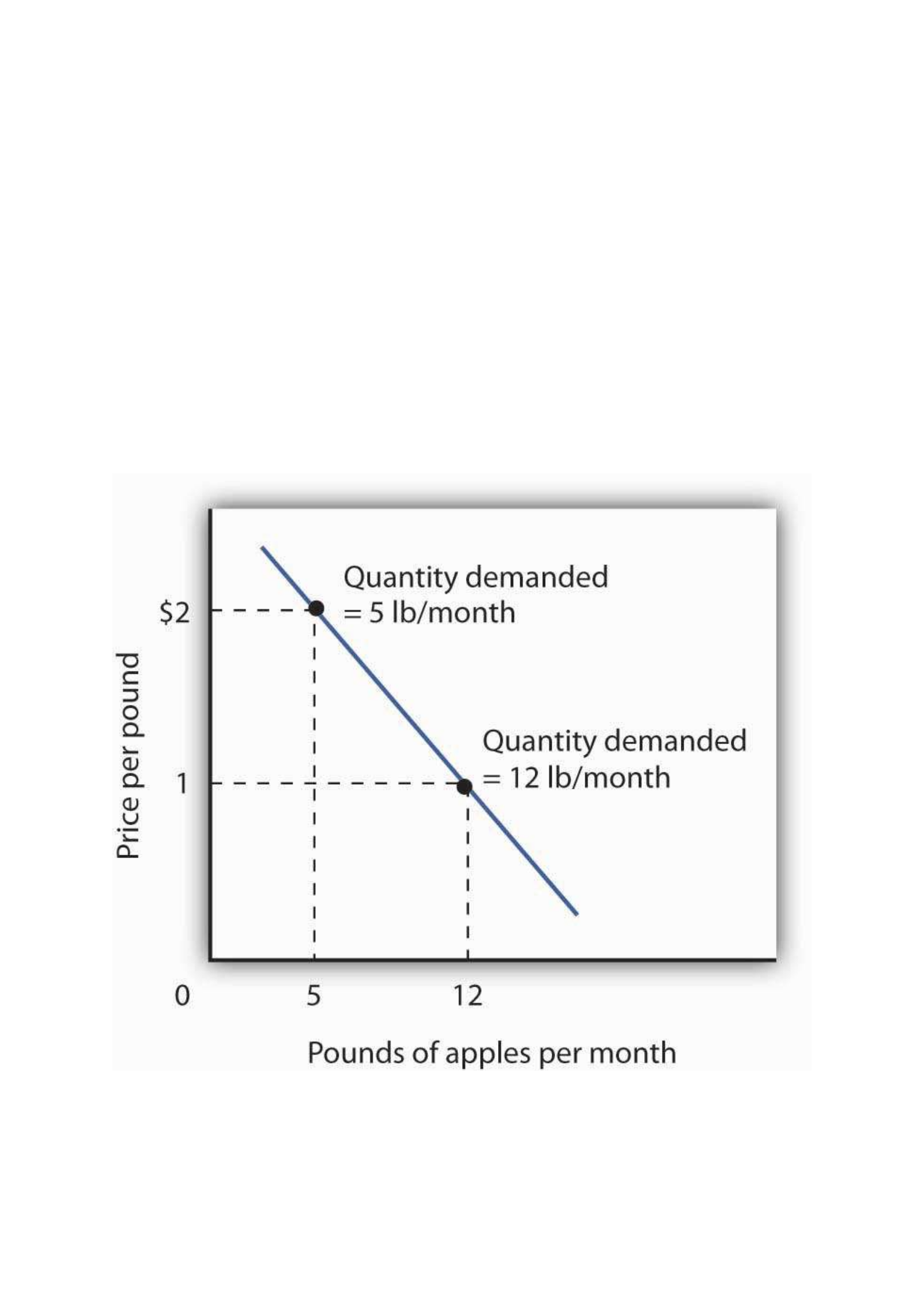
Figure 7.2 Utility Maximization and an Individual’s Demand Curve
Mary Andrews’s demand curve for apples, d, can be derived by determining the quantities of
apples she will buy at each price. Those quantities are determined by the application of the

marginal decision rule to utility maximization. At a price of $2 per pound, Ms. Andrews
maximizes utility by purchasing 5 pounds of apples per month. When the price of apples falls
to $1 per pound, the quantity of apples at which she maximizes utility increases to 12 pounds
per month.
It is through a consumer’s reaction to different prices that we trace the consumer’s demand
curve for a good. When the price of apples was $2 per pound, Ms. Andrews maximized her
utility by purchasing 5 pounds of apples, as illustrated in Figure 7.2 "Utility Maximization and
an Individual’s Demand Curve". When the price of apples fell, she increased the quantity of
apples she purchased to 12 pounds.
Heads Up!
Notice that, in this example, Ms. Andrews maximizes utility where not only the ratios of
marginal utilities to price are equal, but also the marginal utilities of both goods are equal. But,
the equal-marginal-utility outcome is only true here because the prices of the two goods are the
same: each good is priced at $1 in this case. If the prices of apples and oranges were different,
the marginal utilities at the utility maximizing solution would have been different. The
condition for maximizing utility—consume where the ratios of marginal utility to price are
equal—holds regardless. The utility-maximizing condition is not that consumers maximize
utility by equating marginal utilities.

From Individual to Market Demand
The market demand curves we studied in previous chapters are derived from individual demand
curves such as the one depicted in Figure 7.2 "Utility Maximization and an Individual’s
Demand Curve". Suppose that in addition to Ms. Andrews, there are two other consumers in
the market for apples—Ellen Smith and Koy Keino. The quantities each consumes at various
prices are given in Figure 7.3 "Deriving a Market Demand Curve", along with the quantities
that Ms. Andrews consumes at each price. The demand curves for each are shown in Panel (a).
The market demand curve for all three consumers, shown in Panel (b), is then found by adding
the quantities demanded at each price for all three consumers. At a price of $2 per pound, for
example, Ms. Andrews demands 5 pounds of apples per month, Ms. Smith demands 3 pounds,
and Mr. Keino demands 8 pounds. A total of 16 pounds of apples are demanded per month at
this price. Adding the individual quantities demanded at $1 per pound yields market demand
of 40 pounds per month. This method of adding amounts along the horizontal axis of a graph
is referred to as summing horizontally. The market demand curve is thus the horizontal
summation of all the individual demand curves.
Figure 7.3 Deriving a Market Demand Curve
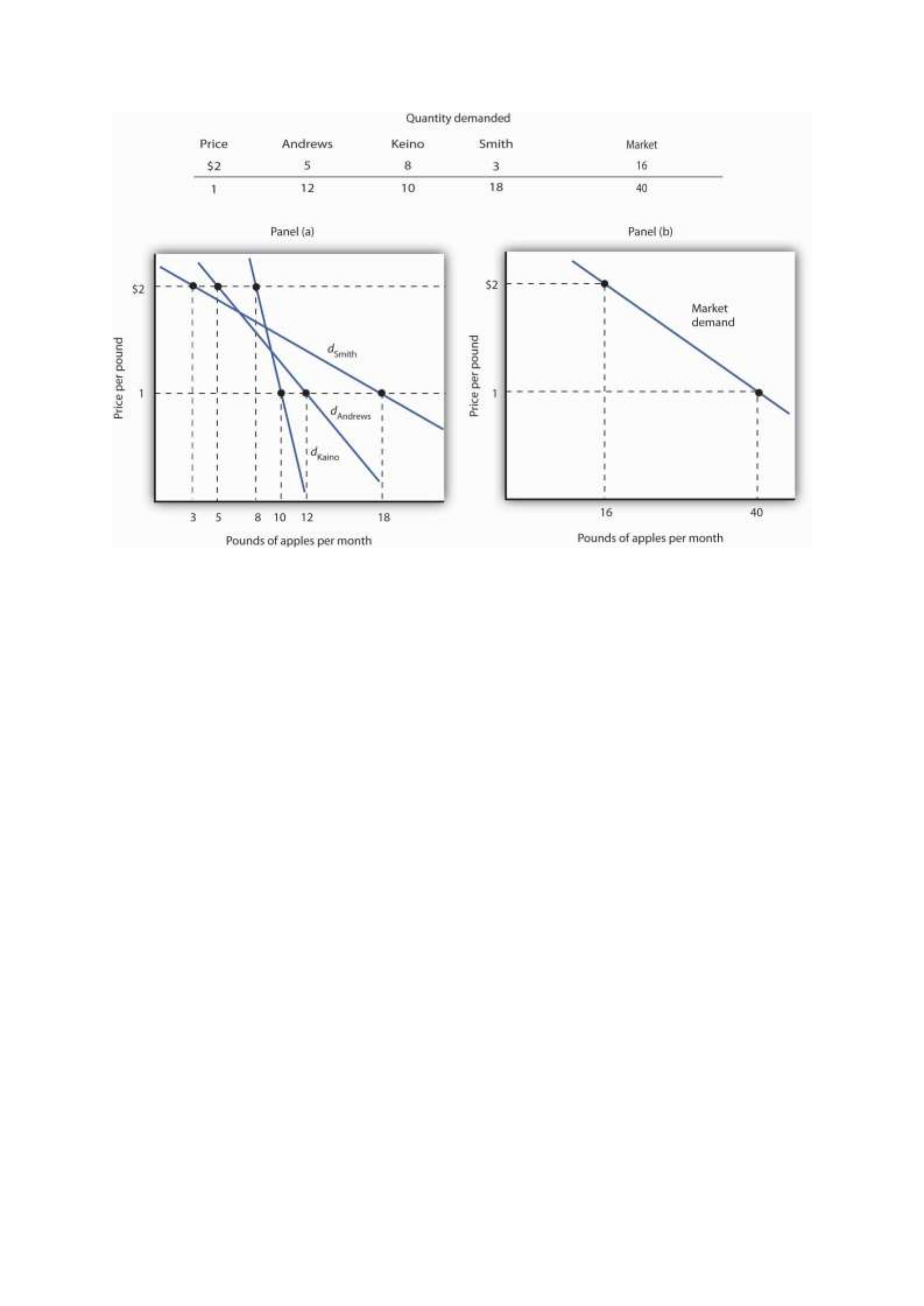
The demand schedules for Mary Andrews, Ellen Smith, and Koy Keino are given in the table.
Their individual demand curves are plotted in Panel (a). The market demand curve for all three
is shown in Panel (b).
Individual demand curves, then, reflect utility-maximizing adjustment by consumers to various
market prices. Once again, we see that as the price falls, consumers tend to buy more of a good.
Demand curves are downward-sloping as the law of demand asserts.
Substitution and Income Effects
We saw that when the price of apples fell from $2 to $1 per pound, Mary Andrews increased
the quantity of apples she demanded. Behind that adjustment, however, lie two distinct effects:
the substitution effect and the income effect. It is important to distinguish these effects, because
they can have quite different implications for the elasticity of the demand curve.
First, the reduction in the price of apples made them cheaper relative to oranges. Before the
price change, it cost the same amount to buy 2 pounds of oranges or 1 pound of apples. After

the price change, it cost the same amount to buy 1 pound of either oranges or apples. In effect,
2 pounds of oranges would exchange for 1 pound of apples before the price change, and 1
pound of oranges would exchange for 1 pound of apples after the price change.
Second, the price reduction essentially made consumers of apples richer. Before the price
change, Ms. Andrews was purchasing 5 pounds of apples and 10 pounds of oranges at a total
cost to her of $20. At the new lower price of apples, she could purchase this same combination
for $15. In effect, the price reduction for apples was equivalent to handing her a $5 bill, thereby
increasing her purchasing power. Purchasing power refers to the quantity of goods and services
that can be purchased with a given budget.
To distinguish between the substitution and income effects, economists consider first the
impact of a price change with no change in the consumer’s ability to purchase goods and
services. An income-compensated price change is an imaginary exercise in which we assume
that when the price of a good or service changes, the consumer’s income is adjusted so that he
or she has just enough to purchase the original combination of goods and services at the new
set of prices. Ms. Andrews was purchasing 5 pounds of apples and 10 pounds of oranges before
the price change. Buying that same combination after the price change would cost $15. The
income-compensated price change thus requires us to take $5 from Ms. Andrews when the
price of apples falls to $1 per pound. She can still buy 5 pounds of apples and 10 pounds of
oranges. If, instead, the price of apples increased, we would give Ms. Andrews more money
(i.e., we would “compensate” her) so that she could purchase the same combination of goods.
With $15 and cheaper apples, Ms. Andrews could buy 5 pounds of apples and 10 pounds of
oranges. But would she? The answer lies in comparing the marginal benefit of spending another
$1 on apples to the marginal benefit of spending another $1 on oranges, as expressed
in Equation 7.5. It shows that the extra utility per $1 she could obtain from apples now exceeds

the extra utility per $1 from oranges. She will thus increase her consumption of apples. If she
had only $15, any increase in her consumption of apples would require a reduction in her
consumption of oranges. In effect, she responds to the income-compensated price change for
apples by substituting apples for oranges. The change in a consumer’s consumption of a good
in response to an income-compensated price change is called the substitution effect.
Suppose that with an income-compensated reduction in the price of apples to $1 per pound,
Ms. Andrews would increase her consumption of apples to 9 pounds per month and reduce her
consumption of oranges to 6 pounds per month. The substitution effect of the price reduction
is an increase in apple consumption of 4 pounds per month.
The substitution effect always involves a change in consumption in a direction opposite that of
the price change. When a consumer is maximizing utility, the ratio of marginal utility to price
is the same for all goods. An income-compensated price reduction increases the extra utility
per dollar available from the good whose price has fallen; a consumer will thus purchase more
of it. An income-compensated price increase reduces the extra utility per dollar from the good;
the consumer will purchase less of it.
In other words, when the price of a good falls, people react to the lower price by substituting
or switching toward that good, buying more of it and less of other goods, if we artificially hold
the consumer’s ability to buy goods constant. When the price of a good goes up, people react
to the higher price by substituting or switching away from that good, buying less of it and
instead buying more of other goods. By examining the impact of consumer purchases of an
income-compensated price change, we are looking at just the change in relative prices of goods
and eliminating any impact on consumer buying that comes from the effective change in the
consumer’s ability to purchase goods and services (that is, we hold the consumer’s purchasing
power constant).

To complete our analysis of the impact of the price change, we must now consider the $5 that
Ms. Andrews effectively gained from it. After the price reduction, it cost her just $15 to buy
what cost her $20 before. She has, in effect, $5 more than she did before. Her additional income
may also have an effect on the number of apples she consumes. The change in consumption of
a good resulting from the implicit change in income because of a price change is called
the income effect of a price change. When the price of a good rises, there is an implicit
reduction in income. When the price of a good falls, there is an implicit increase. When the
price of apples fell, Ms. Andrews (who was consuming 5 pounds of apples per month) received
an implicit increase in income of $5.
Suppose Ms. Andrews uses her implicit increase in income to purchase 3 more pounds of apples
and 2 more pounds of oranges per month. She has already increased her apple consumption to
9 pounds per month because of the substitution effect, so the added 3 pounds brings her
consumption level to 12 pounds per month. That is precisely what we observed when we
derived her demand curve; it is the change we would observe in the marketplace. We see now,
however, that her increase in quantity demanded consists of a substitution effect and an income
effect. Figure 7.4 "The Substitution and Income Effects of a Price Change" shows the
combined effects of the price change.
Figure 7.4 The Substitution and Income Effects of a Price Change
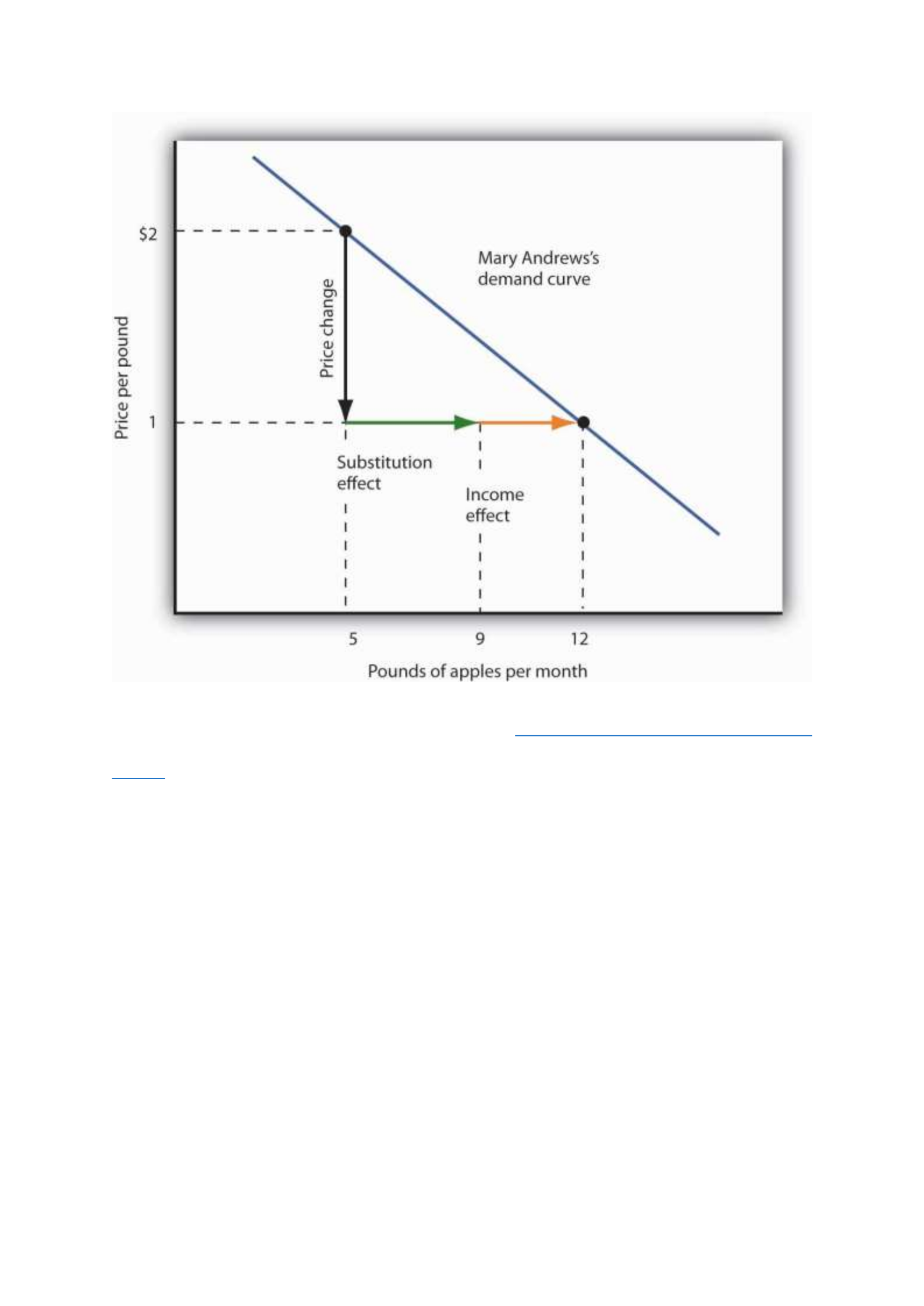
This demand curve for Ms. Andrews was presented in Figure 7.3 "Deriving a Market Demand
Curve". It shows that a reduction in the price of apples from $2 to $1 per pound increases the
quantity Ms. Andrews demands from 5 pounds of apples to 12. This graph shows that this
change consists of a substitution effect and an income effect. The substitution effect increases
the quantity demanded by 4 pounds, the income effect by 3, for a total increase in quantity
demanded of 7 pounds.
The size of the substitution effect depends on the rate at which the marginal utilities of goods
change as the consumer adjusts consumption to a price change. As Ms. Andrews buys more
apples and fewer oranges, the marginal utility of apples will fall and the marginal utility of
oranges will rise. If relatively small changes in quantities consumed produce large changes in
marginal utilities, the substitution effect that is required to restore the equality of marginal-

utility-to-price ratios will be small. If much larger changes in quantities consumed are needed
to produce equivalent changes in marginal utilities, then the substitution effect will be large.
The magnitude of the income effect of a price change depends on how responsive the demand
for a good is to a change in income and on how important the good is in a consumer’s budget.
When the price changes for a good that makes up a substantial fraction of a consumer’s budget,
the change in the consumer’s ability to buy things is substantial. A change in the price of a good
that makes up a trivial fraction of a consumer’s budget, however, has little effect on his or her
purchasing power; the income effect of such a price change is small.
Because each consumer’s response to a price change depends on the sizes of the substitution
and income effects, these effects play a role in determining the price elasticity of demand. All
other things unchanged, the larger the substitution effect, the greater the absolute value of the
price elasticity of demand. When the income effect moves in the same direction as the
substitution effect, a greater income effect contributes to a greater price elasticity of demand as
well. There are, however, cases in which the substitution and income effects move in opposite
directions. We shall explore these ideas in the next section.
Normal and Inferior Goods
The nature of the income effect of a price change depends on whether the good is normal or
inferior. The income effect reinforces the substitution effect in the case of normal goods; it
works in the opposite direction for inferior goods.
Normal Goods
A normal good is one whose consumption increases with an increase in income. When the price
of a normal good falls, there are two identifying effects:

1. The substitution effect contributes to an increase in the quantity demanded because
consumers substitute more of the good for other goods.
2. The reduction in price increases the consumer’s ability to buy goods. Because the good
is normal, this increase in purchasing power further increases the quantity of the good
demanded through the income effect.
In the case of a normal good, then, the substitution and income effects reinforce each other.
Ms. Andrews’s response to a price reduction for apples is a typical response to a lower price
for a normal good.
An increase in the price of a normal good works in an equivalent fashion. The higher price
causes consumers to substitute more of other goods, whose prices are now relatively lower.
The substitution effect thus reduces the quantity demanded. The higher price also reduces
purchasing power, causing consumers to reduce consumption of the good via the income effect.
Inferior Goods
In the chapter that introduced the model of demand and supply, we saw that an inferior good is
one for which demand falls when income rises. It is likely to be a good that people do not really
like very much. When incomes are low, people consume the inferior good because it is what
they can afford. As their incomes rise and they can afford something they like better, they
consume less of the inferior good. When the price of an inferior good falls, two things happen:
1. Consumers will substitute more of the inferior good for other goods because its price
has fallen relative to those goods. The quantity demanded increases as a result of the
substitution effect.
2. The lower price effectively makes consumers richer. But, because the good is inferior,
this reduces quantity demanded.
The case of inferior goods is thus quite different from that of normal goods. The income effect
of a price change works in a direction opposite to that of the substitution effect in the case of
an inferior good, whereas it reinforces the substitution effect in the case of a normal good.
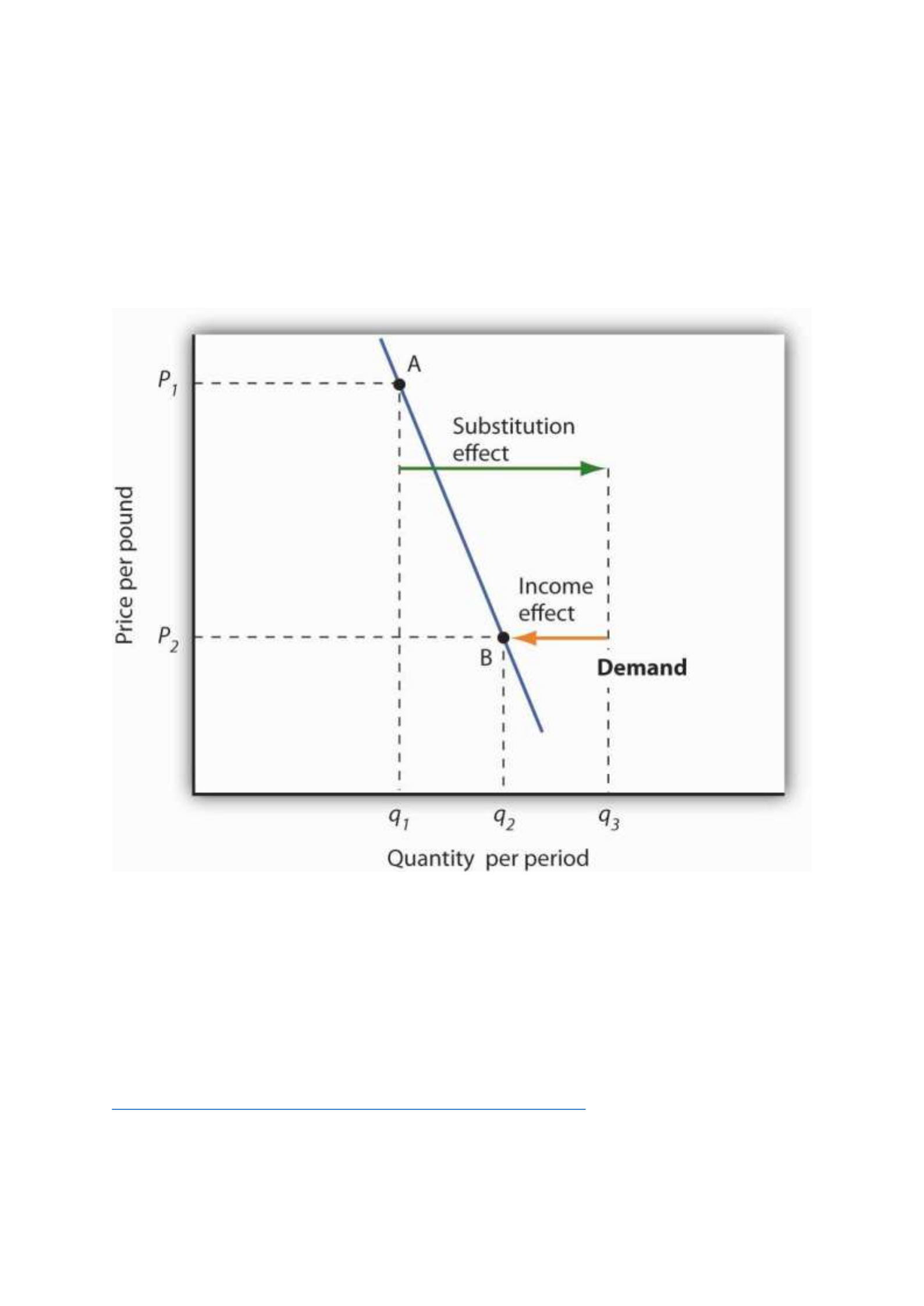
Figure 7.5 Substitution and Income Effects for Inferior Goods
The substitution and income effects work against each other in the case of inferior goods. The
consumer begins at point A, consuming q1 units of the good at a price P1. When the price falls
to P2, the consumer moves to point B, increasing quantity demanded to q2. The substitution
effect increases quantity demanded to qs, but the income effect reduces it from qs to q2.
Figure 7.5 "Substitution and Income Effects for Inferior Goods" illustrates the substitution and
income effects of a price reduction for an inferior good. When the price falls from P1 to P2, the

quantity demanded by a consumer increases from q1 to q2. The substitution effect increases
quantity demanded from q1 to qs. But the income effect reduces quantity demanded
from qs to q2; the substitution effect is stronger than the income effect. The result is consistent
with the law of demand: A reduction in price increases the quantity demanded. The quantity
demanded is smaller, however, than it would be if the good were normal. Inferior goods are
therefore likely to have less elastic demand than normal goods.
Suppose, for simplicity, that Mary Andrews consumes only apples, denoted by the letter A, and
oranges, denoted by the letter O. Apples cost $2 per pound and oranges cost $1 per pound, and
her budget allows her to spend $20 per month on the two goods. We assume that Ms. Andrews
will adjust her consumption so that the utility-maximizing condition holds for the two goods:
The ratio of marginal utility to price is the same for apples and oranges. That is,
Equation 7.4
MUA$2=MUO$1
Here MUA and MUO are the marginal utilities of apples and oranges, respectively. Her
spending equals her budget of $20 per month; suppose she buys 5 pounds of apples and 10 of
oranges.
Now suppose that an unusually large harvest of apples lowers their price to $1 per pound. The
lower price of apples increases the marginal utility of each $1 Ms. Andrews spends on apples,
so that at her current level of consumption of apples and oranges
Equation 7.5
MUA$1>MUO$1
Ms. Andrews will respond by purchasing more apples. As she does so, the marginal utility she
receives from apples will decline. If she regards apples and oranges as substitutes, she will also

buy fewer oranges. That will cause the marginal utility of oranges to rise. She will continue to
adjust her spending until the marginal utility per $1 spent is equal for both goods:
Equation 7.6
MUA$1=MUO$1
Suppose that at this new solution, she purchases 12 pounds of apples and 8 pounds of oranges.
She is still spending all of her budget of $20 on the two goods [(12 x $1)+(8 x $1)=$20].
Suppose, for simplicity, that Mary Andrews consumes only apples, denoted by the letter A, and
oranges, denoted by the letter O. Apples cost $2 per pound and oranges cost $1 per pound, and
her budget allows her to spend $20 per month on the two goods. We assume that Ms. Andrews
will adjust her consumption so that the utility-maximizing condition holds for the two goods:
The ratio of marginal utility to price is the same for apples and oranges. That is,
Equation 7.4
MUA$2=MUO$1
Here MUA and MUO are the marginal utilities of apples and oranges, respectively. Her
spending equals her budget of $20 per month; suppose she buys 5 pounds of apples and 10 of
oranges.
Now suppose that an unusually large harvest of apples lowers their price to $1 per pound. The
lower price of apples increases the marginal utility of each $1 Ms. Andrews spends on apples,
so that at her current level of consumption of apples and oranges
Equation 7.5
MUA$1>MUO$1

Ms. Andrews will respond by purchasing more apples. As she does so, the marginal utility she
receives from apples will decline. If she regards apples and oranges as substitutes, she will also
buy fewer oranges. That will cause the marginal utility of oranges to rise. She will continue to
adjust her spending until the marginal utility per $1 spent is equal for both goods:
Equation 7.6
MUA$1=MUO$1
Suppose that at this new solution, she purchases 12 pounds of apples and 8 pounds of oranges.
She is still spending all of her budget of $20 on the two goods [(12 x $1)+(8 x $1)=$20].
Suppose, for simplicity, that Mary Andrews consumes only apples, denoted by the letter A, and
oranges, denoted by the letter O. Apples cost $2 per pound and oranges cost $1 per pound, and
her budget allows her to spend $20 per month on the two goods. We assume that Ms. Andrews
will adjust her consumption so that the utility-maximizing condition holds for the two goods:
The ratio of marginal utility to price is the same for apples and oranges. That is,
Equation 7.4
MUA$2=MUO$1
Here MUA and MUO are the marginal utilities of apples and oranges, respectively. Her
spending equals her budget of $20 per month; suppose she buys 5 pounds of apples and 10 of
oranges.
Now suppose that an unusually large harvest of apples lowers their price to $1 per pound. The
lower price of apples increases the marginal utility of each $1 Ms. Andrews spends on apples,
so that at her current level of consumption of apples and oranges
Equation 7.5

MUA$1>MUO$1
Ms. Andrews will respond by purchasing more apples. As she does so, the marginal utility she
receives from apples will decline. If she regards apples and oranges as substitutes, she will also
buy fewer oranges. That will cause the marginal utility of oranges to rise. She will continue to
adjust her spending until the marginal utility per $1 spent is equal for both goods:
Equation 7.6
MUA$1=MUO$1
Suppose that at this new solution, she purchases 12 pounds of apples and 8 pounds of oranges.
She is still spending all of her budget of $20 on the two goods [(12 x $1)+(8 x $1)=$20].
Suppose, for simplicity, that Mary Andrews consumes only apples, denoted by the letter A, and
oranges, denoted by the letter O. Apples cost $2 per pound and oranges cost $1 per pound, and
her budget allows her to spend $20 per month on the two goods. We assume that Ms. Andrews
will adjust her consumption so that the utility-maximizing condition holds for the two goods:
The ratio of marginal utility to price is the same for apples and oranges. That is,
Equation 7.4
MUA$2=MUO$1
Here MUA and MUO are the marginal utilities of apples and oranges, respectively. Her
spending equals her budget of $20 per month; suppose she buys 5 pounds of apples and 10 of
oranges.
Now suppose that an unusually large harvest of apples lowers their price to $1 per pound. The
lower price of apples increases the marginal utility of each $1 Ms. Andrews spends on apples,
so that at her current level of consumption of apples and oranges

Equation 7.5
MUA$1>MUO$1
Ms. Andrews will respond by purchasing more apples. As she does so, the marginal utility she
receives from apples will decline. If she regards apples and oranges as substitutes, she will also
buy fewer oranges. That will cause the marginal utility of oranges to rise. She will continue to
adjust her spending until the marginal utility per $1 spent is equal for both goods:
Equation 7.6
MUA$1=MUO$1
Suppose that at this new solution, she purchases 12 pounds of apples and 8 pounds of oranges.
She is still spending all of her budget of $20 on the two goods [(12 x $1)+(8 x $1)=$20].
From Individual to Market Demand
The market demand curves we studied in previous chapters are derived from individual demand
curves such as the one depicted in Figure 7.2 "Utility Maximization and an Individual’s
Demand Curve". Suppose that in addition to Ms. Andrews, there are two other consumers in
the market for apples—Ellen Smith and Koy Keino. The quantities each consumes at various
prices are given in Figure 7.3 "Deriving a Market Demand Curve", along with the quantities
that Ms. Andrews consumes at each price. The demand curves for each are shown in Panel (a).
The market demand curve for all three consumers, shown in Panel (b), is then found by adding
the quantities demanded at each price for all three consumers. At a price of $2 per pound, for
example, Ms. Andrews demands 5 pounds of apples per month, Ms. Smith demands 3 pounds,
and Mr. Keino demands 8 pounds. A total of 16 pounds of apples are demanded per month at
this price. Adding the individual quantities demanded at $1 per pound yields market demand
of 40 pounds per month. This method of adding amounts along the horizontal axis of a graph

is referred to as summing horizontally. The market demand curve is thus the horizontal
summation of all the individual demand curves.
Suppose, for simplicity, that Mary Andrews consumes only apples, denoted by the letter A, and
oranges, denoted by the letter O. Apples cost $2 per pound and oranges cost $1 per pound, and
her budget allows her to spend $20 per month on the two goods. We assume that Ms. Andrews
will adjust her consumption so that the utility-maximizing condition holds for the two goods:
The ratio of marginal utility to price is the same for apples and oranges. That is,
Equation 7.4
MUA$2=MUO$1
Here MUA and MUO are the marginal utilities of apples and oranges, respectively. Her
spending equals her budget of $20 per month; suppose she buys 5 pounds of apples and 10 of
oranges.
Now suppose that an unusually large harvest of apples lowers their price to $1 per pound. The
lower price of apples increases the marginal utility of each $1 Ms. Andrews spends on apples,
so that at her current level of consumption of apples and oranges
Equation 7.5
MUA$1>MUO$1
Ms. Andrews will respond by purchasing more apples. As she does so, the marginal utility she
receives from apples will decline. If she regards apples and oranges as substitutes, she will also
buy fewer oranges. That will cause the marginal utility of oranges to rise. She will continue to
adjust her spending until the marginal utility per $1 spent is equal for both goods:
Equation 7.6

MUA$1=MUO$1
Suppose that at this new solution, she purchases 12 pounds of apples and 8 pounds of oranges.
She is still spending all of her budget of $20 on the two goods [(12 x $1)+(8 x $1)=$20].
Suppose, for simplicity, that Mary Andrews consumes only apples, denoted by the letter A, and
oranges, denoted by the letter O. Apples cost $2 per pound and oranges cost $1 per pound, and
her budget allows her to spend $20 per month on the two goods. We assume that Ms. Andrews
will adjust her consumption so that the utility-maximizing condition holds for the two goods:
The ratio of marginal utility to price is the same for apples and oranges. That is,
Equation 7.4
MUA$2=MUO$1
Here MUA and MUO are the marginal utilities of apples and oranges, respectively. Her
spending equals her budget of $20 per month; suppose she buys 5 pounds of apples and 10 of
oranges.
Now suppose that an unusually large harvest of apples lowers their price to $1 per pound. The
lower price of apples increases the marginal utility of each $1 Ms. Andrews spends on apples,
so that at her current level of consumption of apples and oranges
Equation 7.5
MUA$1>MUO$1
Ms. Andrews will respond by purchasing more apples. As she does so, the marginal utility she
receives from apples will decline. If she regards apples and oranges as substitutes, she will also
buy fewer oranges. That will cause the marginal utility of oranges to rise. She will continue to
adjust her spending until the marginal utility per $1 spent is equal for both goods:

Equation 7.6
MUA$1=MUO$1
Suppose that at this new solution, she purchases 12 pounds of apples and 8 pounds of oranges.
She is still spending all of her budget of $20 on the two goods [(12 x $1)+(8 x $1)=$20].
Suppose, for simplicity, that Mary Andrews consumes only apples, denoted by the letter A, and
oranges, denoted by the letter O. Apples cost $2 per pound and oranges cost $1 per pound, and
her budget allows her to spend $20 per month on the two goods. We assume that Ms. Andrews
will adjust her consumption so that the utility-maximizing condition holds for the two goods:
The ratio of marginal utility to price is the same for apples and oranges. That is,
Equation 7.4
MUA$2=MUO$1
Here MUA and MUO are the marginal utilities of apples and oranges, respectively. Her
spending equals her budget of $20 per month; suppose she buys 5 pounds of apples and 10 of
oranges.
Now suppose that an unusually large harvest of apples lowers their price to $1 per pound. The
lower price of apples increases the marginal utility of each $1 Ms. Andrews spends on apples,
so that at her current level of consumption of apples and oranges
Equation 7.5
MUA$1>MUO$1
Ms. Andrews will respond by purchasing more apples. As she does so, the marginal utility she
receives from apples will decline. If she regards apples and oranges as substitutes, she will also

buy fewer oranges. That will cause the marginal utility of oranges to rise. She will continue to
adjust her spending until the marginal utility per $1 spent is equal for both goods:
Equation 7.6
MUA$1=MUO$1
Suppose that at this new solution, she purchases 12 pounds of apples and 8 pounds of oranges.
She is still spending all of her budget of $20 on the two goods [(12 x $1)+(8 x $1)=$20].
Suppose, for simplicity, that Mary Andrews consumes only apples, denoted by the letter A, and
oranges, denoted by the letter O. Apples cost $2 per pound and oranges cost $1 per pound, and
her budget allows her to spend $20 per month on the two goods. We assume that Ms. Andrews
will adjust her consumption so that the utility-maximizing condition holds for the two goods:
The ratio of marginal utility to price is the same for apples and oranges. That is,
Equation 7.4
MUA$2=MUO$1
Here MUA and MUO are the marginal utilities of apples and oranges, respectively. Her
spending equals her budget of $20 per month; suppose she buys 5 pounds of apples and 10 of
oranges.
Now suppose that an unusually large harvest of apples lowers their price to $1 per pound. The
lower price of apples increases the marginal utility of each $1 Ms. Andrews spends on apples,
so that at her current level of consumption of apples and oranges
Equation 7.5
MUA$1>MUO$1

Ms. Andrews will respond by purchasing more apples. As she does so, the marginal utility she
receives from apples will decline. If she regards apples and oranges as substitutes, she will also
buy fewer oranges. That will cause the marginal utility of oranges to rise. She will continue to
adjust her spending until the marginal utility per $1 spent is equal for both goods:
Equation 7.6
MUA$1=MUO$1
Suppose that at this new solution, she purchases 12 pounds of apples and 8 pounds of oranges.
She is still spending all of her budget of $20 on the two goods [(12 x $1)+(8 x $1)=$20].
From Individual to Market Demand
The market demand curves we studied in previous chapters are derived from individual demand
curves such as the one depicted in Figure 7.2 "Utility Maximization and an Individual’s
Demand Curve". Suppose that in addition to Ms. Andrews, there are two other consumers in
the market for apples—Ellen Smith and Koy Keino. The quantities each consumes at various
prices are given in Figure 7.3 "Deriving a Market Demand Curve", along with the quantities
that Ms. Andrews consumes at each price. The demand curves for each are shown in Panel (a).
The market demand curve for all three consumers, shown in Panel (b), is then found by adding
the quantities demanded at each price for all three consumers. At a price of $2 per pound, for
example, Ms. Andrews demands 5 pounds of apples per month, Ms. Smith demands 3 pounds,
and Mr. Keino demands 8 pounds. A total of 16 pounds of apples are demanded per month at
this price. Adding the individual quantities demanded at $1 per pound yields market demand
of 40 pounds per month. This method of adding amounts along the horizontal axis of a graph
is referred to as summing horizontally. The market demand curve is thus the horizontal
summation of all the individual demand curves.

Suppose, for simplicity, that Mary Andrews consumes only apples, denoted by the letter A, and
oranges, denoted by the letter O. Apples cost $2 per pound and oranges cost $1 per pound, and
her budget allows her to spend $20 per month on the two goods. We assume that Ms. Andrews
will adjust her consumption so that the utility-maximizing condition holds for the two goods:
The ratio of marginal utility to price is the same for apples and oranges. That is,
Equation 7.4
MUA$2=MUO$1
Here MUA and MUO are the marginal utilities of apples and oranges, respectively. Her
spending equals her budget of $20 per month; suppose she buys 5 pounds of apples and 10 of
oranges.
Now suppose that an unusually large harvest of apples lowers their price to $1 per pound. The
lower price of apples increases the marginal utility of each $1 Ms. Andrews spends on apples,
so that at her current level of consumption of apples and oranges
Equation 7.5
MUA$1>MUO$1
Ms. Andrews will respond by purchasing more apples. As she does so, the marginal utility she
receives from apples will decline. If she regards apples and oranges as substitutes, she will also
buy fewer oranges. That will cause the marginal utility of oranges to rise. She will continue to
adjust her spending until the marginal utility per $1 spent is equal for both goods:
Equation 7.6
MUA$1=MUO$1

Suppose that at this new solution, she purchases 12 pounds of apples and 8 pounds of oranges.
She is still spending all of her budget of $20 on the two goods [(12 x $1)+(8 x $1)=$20].
Suppose, for simplicity, that Mary Andrews consumes only apples, denoted by the letter A, and
oranges, denoted by the letter O. Apples cost $2 per pound and oranges cost $1 per pound, and
her budget allows her to spend $20 per month on the two goods. We assume that Ms. Andrews
will adjust her consumption so that the utility-maximizing condition holds for the two goods:
The ratio of marginal utility to price is the same for apples and oranges. That is,
Equation 7.4
MUA$2=MUO$1
Here MUA and MUO are the marginal utilities of apples and oranges, respectively. Her
spending equals her budget of $20 per month; suppose she buys 5 pounds of apples and 10 of
oranges.
Now suppose that an unusually large harvest of apples lowers their price to $1 per pound. The
lower price of apples increases the marginal utility of each $1 Ms. Andrews spends on apples,
so that at her current level of consumption of apples and oranges
Equation 7.5
MUA$1>MUO$1
Ms. Andrews will respond by purchasing more apples. As she does so, the marginal utility she
receives from apples will decline. If she regards apples and oranges as substitutes, she will also
buy fewer oranges. That will cause the marginal utility of oranges to rise. She will continue to
adjust her spending until the marginal utility per $1 spent is equal for both goods:
Equation 7.6

MUA$1=MUO$1
Suppose that at this new solution, she purchases 12 pounds of apples and 8 pounds of oranges.
She is still spending all of her budget of $20 on the two goods [(12 x $1)+(8 x $1)=$20].
Suppose, for simplicity, that Mary Andrews consumes only apples, denoted by the letter A, and
oranges, denoted by the letter O. Apples cost $2 per pound and oranges cost $1 per pound, and
her budget allows her to spend $20 per month on the two goods. We assume that Ms. Andrews
will adjust her consumption so that the utility-maximizing condition holds for the two goods:
The ratio of marginal utility to price is the same for apples and oranges. That is,
Equation 7.4
MUA$2=MUO$1
Here MUA and MUO are the marginal utilities of apples and oranges, respectively. Her
spending equals her budget of $20 per month; suppose she buys 5 pounds of apples and 10 of
oranges.
Now suppose that an unusually large harvest of apples lowers their price to $1 per pound. The
lower price of apples increases the marginal utility of each $1 Ms. Andrews spends on apples,
so that at her current level of consumption of apples and oranges
Equation 7.5
MUA$1>MUO$1
Ms. Andrews will respond by purchasing more apples. As she does so, the marginal utility she
receives from apples will decline. If she regards apples and oranges as substitutes, she will also
buy fewer oranges. That will cause the marginal utility of oranges to rise. She will continue to
adjust her spending until the marginal utility per $1 spent is equal for both goods:

Equation 7.6
MUA$1=MUO$1
Suppose that at this new solution, she purchases 12 pounds of apples and 8 pounds of oranges.
She is still spending all of her budget of $20 on the two goods [(12 x $1)+(8 x $1)=$20].
Suppose, for simplicity, that Mary Andrews consumes only apples, denoted by the letter A, and
oranges, denoted by the letter O. Apples cost $2 per pound and oranges cost $1 per pound, and
her budget allows her to spend $20 per month on the two goods. We assume that Ms. Andrews
will adjust her consumption so that the utility-maximizing condition holds for the two goods:
The ratio of marginal utility to price is the same for apples and oranges. That is,
Equation 7.4
MUA$2=MUO$1
Here MUA and MUO are the marginal utilities of apples and oranges, respectively. Her
spending equals her budget of $20 per month; suppose she buys 5 pounds of apples and 10 of
oranges.
Now suppose that an unusually large harvest of apples lowers their price to $1 per pound. The
lower price of apples increases the marginal utility of each $1 Ms. Andrews spends on apples,
so that at her current level of consumption of apples and oranges
Equation 7.5
MUA$1>MUO$1
Ms. Andrews will respond by purchasing more apples. As she does so, the marginal utility she
receives from apples will decline. If she regards apples and oranges as substitutes, she will also

buy fewer oranges. That will cause the marginal utility of oranges to rise. She will continue to
adjust her spending until the marginal utility per $1 spent is equal for both goods:
Equation 7.6
MUA$1=MUO$1
Suppose that at this new solution, she purchases 12 pounds of apples and 8 pounds of oranges.
She is still spending all of her budget of $20 on the two goods [(12 x $1)+(8 x $1)=$20].
From Individual to Market Demand
The market demand curves we studied in previous chapters are derived from individual demand
curves such as the one depicted in Figure 7.2 "Utility Maximization and an Individual’s
Demand Curve". Suppose that in addition to Ms. Andrews, there are two other consumers in
the market for apples—Ellen Smith and Koy Keino. The quantities each consumes at various
prices are given in Figure 7.3 "Deriving a Market Demand Curve", along with the quantities
that Ms. Andrews consumes at each price. The demand curves for each are shown in Panel (a).
The market demand curve for all three consumers, shown in Panel (b), is then found by adding
the quantities demanded at each price for all three consumers. At a price of $2 per pound, for
example, Ms. Andrews demands 5 pounds of apples per month, Ms. Smith demands 3 pounds,
and Mr. Keino demands 8 pounds. A total of 16 pounds of apples are demanded per month at
this price. Adding the individual quantities demanded at $1 per pound yields market demand
of 40 pounds per month. This method of adding amounts along the horizontal axis of a graph
is referred to as summing horizontally. The market demand curve is thus the horizontal
summation of all the individual demand curves.
Suppose, for simplicity, that Mary Andrews consumes only apples, denoted by the letter A, and
oranges, denoted by the letter O. Apples cost $2 per pound and oranges cost $1 per pound, and
her budget allows her to spend $20 per month on the two goods. We assume that Ms. Andrews

will adjust her consumption so that the utility-maximizing condition holds for the two goods:
The ratio of marginal utility to price is the same for apples and oranges. That is,
Equation 7.4
MUA$2=MUO$1
Here MUA and MUO are the marginal utilities of apples and oranges, respectively. Her
spending equals her budget of $20 per month; suppose she buys 5 pounds of apples and 10 of
oranges.
Now suppose that an unusually large harvest of apples lowers their price to $1 per pound. The
lower price of apples increases the marginal utility of each $1 Ms. Andrews spends on apples,
so that at her current level of consumption of apples and oranges
Equation 7.5
MUA$1>MUO$1
Ms. Andrews will respond by purchasing more apples. As she does so, the marginal utility she
receives from apples will decline. If she regards apples and oranges as substitutes, she will also
buy fewer oranges. That will cause the marginal utility of oranges to rise. She will continue to
adjust her spending until the marginal utility per $1 spent is equal for both goods:
Equation 7.6
MUA$1=MUO$1
Suppose that at this new solution, she purchases 12 pounds of apples and 8 pounds of oranges.
She is still spending all of her budget of $20 on the two goods [(12 x $1)+(8 x $1)=$20].
Suppose, for simplicity, that Mary Andrews consumes only apples, denoted by the letter A, and
oranges, denoted by the letter O. Apples cost $2 per pound and oranges cost $1 per pound, and

her budget allows her to spend $20 per month on the two goods. We assume that Ms. Andrews
will adjust her consumption so that the utility-maximizing condition holds for the two goods:
The ratio of marginal utility to price is the same for apples and oranges. That is,
Equation 7.4
MUA$2=MUO$1
Here MUA and MUO are the marginal utilities of apples and oranges, respectively. Her
spending equals her budget of $20 per month; suppose she buys 5 pounds of apples and 10 of
oranges.
Now suppose that an unusually large harvest of apples lowers their price to $1 per pound. The
lower price of apples increases the marginal utility of each $1 Ms. Andrews spends on apples,
so that at her current level of consumption of apples and oranges
Equation 7.5
MUA$1>MUO$1
Ms. Andrews will respond by purchasing more apples. As she does so, the marginal utility she
receives from apples will decline. If she regards apples and oranges as substitutes, she will also
buy fewer oranges. That will cause the marginal utility of oranges to rise. She will continue to
adjust her spending until the marginal utility per $1 spent is equal for both goods:
Equation 7.6
MUA$1=MUO$1
Suppose that at this new solution, she purchases 12 pounds of apples and 8 pounds of oranges.
She is still spending all of her budget of $20 on the two goods [(12 x $1)+(8 x $1)=$20].

Suppose, for simplicity, that Mary Andrews consumes only apples, denoted by the letter A, and
oranges, denoted by the letter O. Apples cost $2 per pound and oranges cost $1 per pound, and
her budget allows her to spend $20 per month on the two goods. We assume that Ms. Andrews
will adjust her consumption so that the utility-maximizing condition holds for the two goods:
The ratio of marginal utility to price is the same for apples and oranges. That is,
Equation 7.4
MUA$2=MUO$1
Here MUA and MUO are the marginal utilities of apples and oranges, respectively. Her
spending equals her budget of $20 per month; suppose she buys 5 pounds of apples and 10 of
oranges.
Now suppose that an unusually large harvest of apples lowers their price to $1 per pound. The
lower price of apples increases the marginal utility of each $1 Ms. Andrews spends on apples,
so that at her current level of consumption of apples and oranges
Equation 7.5
MUA$1>MUO$1
Ms. Andrews will respond by purchasing more apples. As she does so, the marginal utility she
receives from apples will decline. If she regards apples and oranges as substitutes, she will also
buy fewer oranges. That will cause the marginal utility of oranges to rise. She will continue to
adjust her spending until the marginal utility per $1 spent is equal for both goods:
Equation 7.6
MUA$1=MUO$1

Suppose that at this new solution, she purchases 12 pounds of apples and 8 pounds of oranges.
She is still spending all of her budget of $20 on the two goods [(12 x $1)+(8 x $1)=$20].
Suppose, for simplicity, that Mary Andrews consumes only apples, denoted by the letter A, and
oranges, denoted by the letter O. Apples cost $2 per pound and oranges cost $1 per pound, and
her budget allows her to spend $20 per month on the two goods. We assume that Ms. Andrews
will adjust her consumption so that the utility-maximizing condition holds for the two goods:
The ratio of marginal utility to price is the same for apples and oranges. That is,
Equation 7.4
MUA$2=MUO$1
Here MUA and MUO are the marginal utilities of apples and oranges, respectively. Her
spending equals her budget of $20 per month; suppose she buys 5 pounds of apples and 10 of
oranges.
Now suppose that an unusually large harvest of apples lowers their price to $1 per pound. The
lower price of apples increases the marginal utility of each $1 Ms. Andrews spends on apples,
so that at her current level of consumption of apples and oranges
Equation 7.5
MUA$1>MUO$1
Ms. Andrews will respond by purchasing more apples. As she does so, the marginal utility she
receives from apples will decline. If she regards apples and oranges as substitutes, she will also
buy fewer oranges. That will cause the marginal utility of oranges to rise. She will continue to
adjust her spending until the marginal utility per $1 spent is equal for both goods:
Equation 7.6

MUA$1=MUO$1
Suppose that at this new solution, she purchases 12 pounds of apples and 8 pounds of oranges.
She is still spending all of her budget of $20 on the two goods [(12 x $1)+(8 x $1)=$20].
From Individual to Market Demand
The market demand curves we studied in previous chapters are derived from individual demand
curves such as the one depicted in Figure 7.2 "Utility Maximization and an Individual’s
Demand Curve". Suppose that in addition to Ms. Andrews, there are two other consumers in
the market for apples—Ellen Smith and Koy Keino. The quantities each consumes at various
prices are given in Figure 7.3 "Deriving a Market Demand Curve", along with the quantities
that Ms. Andrews consumes at each price. The demand curves for each are shown in Panel (a).
The market demand curve for all three consumers, shown in Panel (b), is then found by adding
the quantities demanded at each price for all three consumers. At a price of $2 per pound, for
example, Ms. Andrews demands 5 pounds of apples per month, Ms. Smith demands 3 pounds,
and Mr. Keino demands 8 pounds. A total of 16 pounds of apples are demanded per month at
this price. Adding the individual quantities demanded at $1 per pound yields market demand
of 40 pounds per month. This method of adding amounts along the horizontal axis of a graph
is referred to as summing horizontally. The market demand curve is thus the horizontal
summation of all the individual demand curves.
Suppose, for simplicity, that Mary Andrews consumes only apples, denoted by the letter A, and
oranges, denoted by the letter O. Apples cost $2 per pound and oranges cost $1 per pound, and
her budget allows her to spend $20 per month on the two goods. We assume that Ms. Andrews
will adjust her consumption so that the utility-maximizing condition holds for the two goods:
The ratio of marginal utility to price is the same for apples and oranges. That is,
Equation 7.4

MUA$2=MUO$1
Here MUA and MUO are the marginal utilities of apples and oranges, respectively. Her
spending equals her budget of $20 per month; suppose she buys 5 pounds of apples and 10 of
oranges.
Now suppose that an unusually large harvest of apples lowers their price to $1 per pound. The
lower price of apples increases the marginal utility of each $1 Ms. Andrews spends on apples,
so that at her current level of consumption of apples and oranges
Equation 7.5
MUA$1>MUO$1
Ms. Andrews will respond by purchasing more apples. As she does so, the marginal utility she
receives from apples will decline. If she regards apples and oranges as substitutes, she will also
buy fewer oranges. That will cause the marginal utility of oranges to rise. She will continue to
adjust her spending until the marginal utility per $1 spent is equal for both goods:
Equation 7.6
MUA$1=MUO$1
Suppose that at this new solution, she purchases 12 pounds of apples and 8 pounds of oranges.
She is still spending all of her budget of $20 on the two goods [(12 x $1)+(8 x $1)=$20].
Suppose, for simplicity, that Mary Andrews consumes only apples, denoted by the letter A, and
oranges, denoted by the letter O. Apples cost $2 per pound and oranges cost $1 per pound, and
her budget allows her to spend $20 per month on the two goods. We assume that Ms. Andrews
will adjust her consumption so that the utility-maximizing condition holds for the two goods:
The ratio of marginal utility to price is the same for apples and oranges. That is,

Equation 7.4
MUA$2=MUO$1
Here MUA and MUO are the marginal utilities of apples and oranges, respectively. Her
spending equals her budget of $20 per month; suppose she buys 5 pounds of apples and 10 of
oranges.
Now suppose that an unusually large harvest of apples lowers their price to $1 per pound. The
lower price of apples increases the marginal utility of each $1 Ms. Andrews spends on apples,
so that at her current level of consumption of apples and oranges
Equation 7.5
MUA$1>MUO$1
Ms. Andrews will respond by purchasing more apples. As she does so, the marginal utility she
receives from apples will decline. If she regards apples and oranges as substitutes, she will also
buy fewer oranges. That will cause the marginal utility of oranges to rise. She will continue to
adjust her spending until the marginal utility per $1 spent is equal for both goods:
Equation 7.6
MUA$1=MUO$1
Suppose that at this new solution, she purchases 12 pounds of apples and 8 pounds of oranges.
She is still spending all of her budget of $20 on the two goods [(12 x $1)+(8 x $1)=$20].
Suppose, for simplicity, that Mary Andrews consumes only apples, denoted by the letter A, and
oranges, denoted by the letter O. Apples cost $2 per pound and oranges cost $1 per pound, and
her budget allows her to spend $20 per month on the two goods. We assume that Ms. Andrews

will adjust her consumption so that the utility-maximizing condition holds for the two goods:
The ratio of marginal utility to price is the same for apples and oranges. That is,
Equation 7.4
MUA$2=MUO$1
Here MUA and MUO are the marginal utilities of apples and oranges, respectively. Her
spending equals her budget of $20 per month; suppose she buys 5 pounds of apples and 10 of
oranges.
Now suppose that an unusually large harvest of apples lowers their price to $1 per pound. The
lower price of apples increases the marginal utility of each $1 Ms. Andrews spends on apples,
so that at her current level of consumption of apples and oranges
Equation 7.5
MUA$1>MUO$1
Ms. Andrews will respond by purchasing more apples. As she does so, the marginal utility she
receives from apples will decline. If she regards apples and oranges as substitutes, she will also
buy fewer oranges. That will cause the marginal utility of oranges to rise. She will continue to
adjust her spending until the marginal utility per $1 spent is equal for both goods:
Equation 7.6
MUA$1=MUO$1
Suppose that at this new solution, she purchases 12 pounds of apples and 8 pounds of oranges.
She is still spending all of her budget of $20 on the two goods [(12 x $1)+(8 x $1)=$20].
Suppose, for simplicity, that Mary Andrews consumes only apples, denoted by the letter A, and
oranges, denoted by the letter O. Apples cost $2 per pound and oranges cost $1 per pound, and

her budget allows her to spend $20 per month on the two goods. We assume that Ms. Andrews
will adjust her consumption so that the utility-maximizing condition holds for the two goods:
The ratio of marginal utility to price is the same for apples and oranges. That is,
Equation 7.4
MUA$2=MUO$1
Here MUA and MUO are the marginal utilities of apples and oranges, respectively. Her
spending equals her budget of $20 per month; suppose she buys 5 pounds of apples and 10 of
oranges.
Now suppose that an unusually large harvest of apples lowers their price to $1 per pound. The
lower price of apples increases the marginal utility of each $1 Ms. Andrews spends on apples,
so that at her current level of consumption of apples and oranges
Equation 7.5
MUA$1>MUO$1
Ms. Andrews will respond by purchasing more apples. As she does so, the marginal utility she
receives from apples will decline. If she regards apples and oranges as substitutes, she will also
buy fewer oranges. That will cause the marginal utility of oranges to rise. She will continue to
adjust her spending until the marginal utility per $1 spent is equal for both goods:
Equation 7.6
MUA$1=MUO$1
Suppose that at this new solution, she purchases 12 pounds of apples and 8 pounds of oranges.
She is still spending all of her budget of $20 on the two goods [(12 x $1)+(8 x $1)=$20].
From Individual to Market Demand

The market demand curves we studied in previous chapters are derived from individual demand
curves such as the one depicted in Figure 7.2 "Utility Maximization and an Individual’s
Demand Curve". Suppose that in addition to Ms. Andrews, there are two other consumers in
the market for apples—Ellen Smith and Koy Keino. The quantities each consumes at various
prices are given in Figure 7.3 "Deriving a Market Demand Curve", along with the quantities
that Ms. Andrews consumes at each price. The demand curves for each are shown in Panel (a).
The market demand curve for all three consumers, shown in Panel (b), is then found by adding
the quantities demanded at each price for all three consumers. At a price of $2 per pound, for
example, Ms. Andrews demands 5 pounds of apples per month, Ms. Smith demands 3 pounds,
and Mr. Keino demands 8 pounds. A total of 16 pounds of apples are demanded per month at
this price. Adding the individual quantities demanded at $1 per pound yields market demand
of 40 pounds per month. This method of adding amounts along the horizontal axis of a graph
is referred to as summing horizontally. The market demand curve is thus the horizontal
summation of all the individual demand curves.
Suppose, for simplicity, that Mary Andrews consumes only apples, denoted by the letter A, and
oranges, denoted by the letter O. Apples cost $2 per pound and oranges cost $1 per pound, and
her budget allows her to spend $20 per month on the two goods. We assume that Ms. Andrews
will adjust her consumption so that the utility-maximizing condition holds for the two goods:
The ratio of marginal utility to price is the same for apples and oranges. That is,
Equation 7.4
MUA$2=MUO$1
Here MUA and MUO are the marginal utilities of apples and oranges, respectively. Her
spending equals her budget of $20 per month; suppose she buys 5 pounds of apples and 10 of
oranges.

Now suppose that an unusually large harvest of apples lowers their price to $1 per pound. The
lower price of apples increases the marginal utility of each $1 Ms. Andrews spends on apples,
so that at her current level of consumption of apples and oranges
Equation 7.5
MUA$1>MUO$1
Ms. Andrews will respond by purchasing more apples. As she does so, the marginal utility she
receives from apples will decline. If she regards apples and oranges as substitutes, she will also
buy fewer oranges. That will cause the marginal utility of oranges to rise. She will continue to
adjust her spending until the marginal utility per $1 spent is equal for both goods:
Equation 7.6
MUA$1=MUO$1
Suppose that at this new solution, she purchases 12 pounds of apples and 8 pounds of oranges.
She is still spending all of her budget of $20 on the two goods [(12 x $1)+(8 x $1)=$20].
Suppose, for simplicity, that Mary Andrews consumes only apples, denoted by the letter A, and
oranges, denoted by the letter O. Apples cost $2 per pound and oranges cost $1 per pound, and
her budget allows her to spend $20 per month on the two goods. We assume that Ms. Andrews
will adjust her consumption so that the utility-maximizing condition holds for the two goods:
The ratio of marginal utility to price is the same for apples and oranges. That is,
Equation 7.4
MUA$2=MUO$1

Here MUA and MUO are the marginal utilities of apples and oranges, respectively. Her
spending equals her budget of $20 per month; suppose she buys 5 pounds of apples and 10 of
oranges.
Now suppose that an unusually large harvest of apples lowers their price to $1 per pound. The
lower price of apples increases the marginal utility of each $1 Ms. Andrews spends on apples,
so that at her current level of consumption of apples and oranges
Equation 7.5
MUA$1>MUO$1
Ms. Andrews will respond by purchasing more apples. As she does so, the marginal utility she
receives from apples will decline. If she regards apples and oranges as substitutes, she will also
buy fewer oranges. That will cause the marginal utility of oranges to rise. She will continue to
adjust her spending until the marginal utility per $1 spent is equal for both goods:
Equation 7.6
MUA$1=MUO$1
Suppose that at this new solution, she purchases 12 pounds of apples and 8 pounds of oranges.
She is still spending all of her budget of $20 on the two goods [(12 x $1)+(8 x $1)=$20].
Suppose, for simplicity, that Mary Andrews consumes only apples, denoted by the letter A, and
oranges, denoted by the letter O. Apples cost $2 per pound and oranges cost $1 per pound, and
her budget allows her to spend $20 per month on the two goods. We assume that Ms. Andrews
will adjust her consumption so that the utility-maximizing condition holds for the two goods:
The ratio of marginal utility to price is the same for apples and oranges. That is,
Equation 7.4

MUA$2=MUO$1
Here MUA and MUO are the marginal utilities of apples and oranges, respectively. Her
spending equals her budget of $20 per month; suppose she buys 5 pounds of apples and 10 of
oranges.
Now suppose that an unusually large harvest of apples lowers their price to $1 per pound. The
lower price of apples increases the marginal utility of each $1 Ms. Andrews spends on apples,
so that at her current level of consumption of apples and oranges
Equation 7.5
MUA$1>MUO$1
Ms. Andrews will respond by purchasing more apples. As she does so, the marginal utility she
receives from apples will decline. If she regards apples and oranges as substitutes, she will also
buy fewer oranges. That will cause the marginal utility of oranges to rise. She will continue to
adjust her spending until the marginal utility per $1 spent is equal for both goods:
Equation 7.6
MUA$1=MUO$1
Suppose that at this new solution, she purchases 12 pounds of apples and 8 pounds of oranges.
She is still spending all of her budget of $20 on the two goods [(12 x $1)+(8 x $1)=$20].
Suppose, for simplicity, that Mary Andrews consumes only apples, denoted by the letter A, and
oranges, denoted by the letter O. Apples cost $2 per pound and oranges cost $1 per pound, and
her budget allows her to spend $20 per month on the two goods. We assume that Ms. Andrews
will adjust her consumption so that the utility-maximizing condition holds for the two goods:
The ratio of marginal utility to price is the same for apples and oranges. That is,

Equation 7.4
MUA$2=MUO$1
Here MUA and MUO are the marginal utilities of apples and oranges, respectively. Her
spending equals her budget of $20 per month; suppose she buys 5 pounds of apples and 10 of
oranges.
Now suppose that an unusually large harvest of apples lowers their price to $1 per pound. The
lower price of apples increases the marginal utility of each $1 Ms. Andrews spends on apples,
so that at her current level of consumption of apples and oranges
Equation 7.5
MUA$1>MUO$1
Ms. Andrews will respond by purchasing more apples. As she does so, the marginal utility she
receives from apples will decline. If she regards apples and oranges as substitutes, she will also
buy fewer oranges. That will cause the marginal utility of oranges to rise. She will continue to
adjust her spending until the marginal utility per $1 spent is equal for both goods:
Equation 7.6
MUA$1=MUO$1
Suppose that at this new solution, she purchases 12 pounds of apples and 8 pounds of oranges.
She is still spending all of her budget of $20 on the two goods [(12 x $1)+(8 x $1)=$20].
From Individual to Market Demand
The market demand curves we studied in previous chapters are derived from individual demand
curves such as the one depicted in Figure 7.2 "Utility Maximization and an Individual’s
Demand Curve". Suppose that in addition to Ms. Andrews, there are two other consumers in

the market for apples—Ellen Smith and Koy Keino. The quantities each consumes at various
prices are given in Figure 7.3 "Deriving a Market Demand Curve", along with the quantities
that Ms. Andrews consumes at each price. The demand curves for each are shown in Panel (a).
The market demand curve for all three consumers, shown in Panel (b), is then found by adding
the quantities demanded at each price for all three consumers. At a price of $2 per pound, for
example, Ms. Andrews demands 5 pounds of apples per month, Ms. Smith demands 3 pounds,
and Mr. Keino demands 8 pounds. A total of 16 pounds of apples are demanded per month at
this price. Adding the individual quantities demanded at $1 per pound yields market demand
of 40 pounds per month. This method of adding amounts along the horizontal axis of a graph
is referred to as summing horizontally. The market demand curve is thus the horizontal
summation of all the individual demand curves.
Suppose, for simplicity, that Mary Andrews consumes only apples, denoted by the letter A, and
oranges, denoted by the letter O. Apples cost $2 per pound and oranges cost $1 per pound, and
her budget allows her to spend $20 per month on the two goods. We assume that Ms. Andrews
will adjust her consumption so that the utility-maximizing condition holds for the two goods:
The ratio of marginal utility to price is the same for apples and oranges. That is,
Equation 7.4
MUA$2=MUO$1
Here MUA and MUO are the marginal utilities of apples and oranges, respectively. Her
spending equals her budget of $20 per month; suppose she buys 5 pounds of apples and 10 of
oranges.
Now suppose that an unusually large harvest of apples lowers their price to $1 per pound. The
lower price of apples increases the marginal utility of each $1 Ms. Andrews spends on apples,
so that at her current level of consumption of apples and oranges

Equation 7.5
MUA$1>MUO$1
Ms. Andrews will respond by purchasing more apples. As she does so, the marginal utility she
receives from apples will decline. If she regards apples and oranges as substitutes, she will also
buy fewer oranges. That will cause the marginal utility of oranges to rise. She will continue to
adjust her spending until the marginal utility per $1 spent is equal for both goods:
Equation 7.6
MUA$1=MUO$1
Suppose that at this new solution, she purchases 12 pounds of apples and 8 pounds of oranges.
She is still spending all of her budget of $20 on the two goods [(12 x $1)+(8 x $1)=$20].
Suppose, for simplicity, that Mary Andrews consumes only apples, denoted by the letter A, and
oranges, denoted by the letter O. Apples cost $2 per pound and oranges cost $1 per pound, and
her budget allows her to spend $20 per month on the two goods. We assume that Ms. Andrews
will adjust her consumption so that the utility-maximizing condition holds for the two goods:
The ratio of marginal utility to price is the same for apples and oranges. That is,
Equation 7.4
MUA$2=MUO$1
Here MUA and MUO are the marginal utilities of apples and oranges, respectively. Her
spending equals her budget of $20 per month; suppose she buys 5 pounds of apples and 10 of
oranges.

Now suppose that an unusually large harvest of apples lowers their price to $1 per pound. The
lower price of apples increases the marginal utility of each $1 Ms. Andrews spends on apples,
so that at her current level of consumption of apples and oranges
Equation 7.5
MUA$1>MUO$1
Ms. Andrews will respond by purchasing more apples. As she does so, the marginal utility she
receives from apples will decline. If she regards apples and oranges as substitutes, she will also
buy fewer oranges. That will cause the marginal utility of oranges to rise. She will continue to
adjust her spending until the marginal utility per $1 spent is equal for both goods:
Equation 7.6
MUA$1=MUO$1
Suppose that at this new solution, she purchases 12 pounds of apples and 8 pounds of oranges.
She is still spending all of her budget of $20 on the two goods [(12 x $1)+(8 x $1)=$20].
Suppose, for simplicity, that Mary Andrews consumes only apples, denoted by the letter A, and
oranges, denoted by the letter O. Apples cost $2 per pound and oranges cost $1 per pound, and
her budget allows her to spend $20 per month on the two goods. We assume that Ms. Andrews
will adjust her consumption so that the utility-maximizing condition holds for the two goods:
The ratio of marginal utility to price is the same for apples and oranges. That is,
Equation 7.4
MUA$2=MUO$1

Here MUA and MUO are the marginal utilities of apples and oranges, respectively. Her
spending equals her budget of $20 per month; suppose she buys 5 pounds of apples and 10 of
oranges.
Now suppose that an unusually large harvest of apples lowers their price to $1 per pound. The
lower price of apples increases the marginal utility of each $1 Ms. Andrews spends on apples,
so that at her current level of consumption of apples and oranges
Equation 7.5
MUA$1>MUO$1
Ms. Andrews will respond by purchasing more apples. As she does so, the marginal utility she
receives from apples will decline. If she regards apples and oranges as substitutes, she will also
buy fewer oranges. That will cause the marginal utility of oranges to rise. She will continue to
adjust her spending until the marginal utility per $1 spent is equal for both goods:
Equation 7.6
MUA$1=MUO$1
Suppose that at this new solution, she purchases 12 pounds of apples and 8 pounds of oranges.
She is still spending all of her budget of $20 on the two goods [(12 x $1)+(8 x $1)=$20].
Suppose, for simplicity, that Mary Andrews consumes only apples, denoted by the letter A, and
oranges, denoted by the letter O. Apples cost $2 per pound and oranges cost $1 per pound, and
her budget allows her to spend $20 per month on the two goods. We assume that Ms. Andrews
will adjust her consumption so that the utility-maximizing condition holds for the two goods:
The ratio of marginal utility to price is the same for apples and oranges. That is,
Equation 7.4

MUA$2=MUO$1
Here MUA and MUO are the marginal utilities of apples and oranges, respectively. Her
spending equals her budget of $20 per month; suppose she buys 5 pounds of apples and 10 of
oranges.
Now suppose that an unusually large harvest of apples lowers their price to $1 per pound. The
lower price of apples increases the marginal utility of each $1 Ms. Andrews spends on apples,
so that at her current level of consumption of apples and oranges
Equation 7.5
MUA$1>MUO$1
Ms. Andrews will respond by purchasing more apples. As she does so, the marginal utility she
receives from apples will decline. If she regards apples and oranges as substitutes, she will also
buy fewer oranges. That will cause the marginal utility of oranges to rise. She will continue to
adjust her spending until the marginal utility per $1 spent is equal for both goods:
Equation 7.6
MUA$1=MUO$1
Suppose that at this new solution, she purchases 12 pounds of apples and 8 pounds of oranges.
She is still spending all of her budget of $20 on the two goods [(12 x $1)+(8 x $1)=$20].
From Individual to Market Demand
The market demand curves we studied in previous chapters are derived from individual demand
curves such as the one depicted in Figure 7.2 "Utility Maximization and an Individual’s
Demand Curve". Suppose that in addition to Ms. Andrews, there are two other consumers in
the market for apples—Ellen Smith and Koy Keino. The quantities each consumes at various

prices are given in Figure 7.3 "Deriving a Market Demand Curve", along with the quantities
that Ms. Andrews consumes at each price. The demand curves for each are shown in Panel (a).
The market demand curve for all three consumers, shown in Panel (b), is then found by adding
the quantities demanded at each price for all three consumers. At a price of $2 per pound, for
example, Ms. Andrews demands 5 pounds of apples per month, Ms. Smith demands 3 pounds,
and Mr. Keino demands 8 pounds. A total of 16 pounds of apples are demanded per month at
this price. Adding the individual quantities demanded at $1 per pound yields market demand
of 40 pounds per month. This method of adding amounts along the horizontal axis of a graph
is referred to as summing horizontally. The market demand curve is thus the horizontal
summation of all the individual demand curves.
Suppose, for simplicity, that Mary Andrews consumes only apples, denoted by the letter A, and
oranges, denoted by the letter O. Apples cost $2 per pound and oranges cost $1 per pound, and
her budget allows her to spend $20 per month on the two goods. We assume that Ms. Andrews
will adjust her consumption so that the utility-maximizing condition holds for the two goods:
The ratio of marginal utility to price is the same for apples and oranges. That is,
Equation 7.4
MUA$2=MUO$1
Here MUA and MUO are the marginal utilities of apples and oranges, respectively. Her
spending equals her budget of $20 per month; suppose she buys 5 pounds of apples and 10 of
oranges.
Now suppose that an unusually large harvest of apples lowers their price to $1 per pound. The
lower price of apples increases the marginal utility of each $1 Ms. Andrews spends on apples,
so that at her current level of consumption of apples and oranges
Equation 7.5

MUA$1>MUO$1
Ms. Andrews will respond by purchasing more apples. As she does so, the marginal utility she
receives from apples will decline. If she regards apples and oranges as substitutes, she will also
buy fewer oranges. That will cause the marginal utility of oranges to rise. She will continue to
adjust her spending until the marginal utility per $1 spent is equal for both goods:
Equation 7.6
MUA$1=MUO$1
Suppose that at this new solution, she purchases 12 pounds of apples and 8 pounds of oranges.
She is still spending all of her budget of $20 on the two goods [(12 x $1)+(8 x $1)=$20].
Suppose, for simplicity, that Mary Andrews consumes only apples, denoted by the letter A, and
oranges, denoted by the letter O. Apples cost $2 per pound and oranges cost $1 per pound, and
her budget allows her to spend $20 per month on the two goods. We assume that Ms. Andrews
will adjust her consumption so that the utility-maximizing condition holds for the two goods:
The ratio of marginal utility to price is the same for apples and oranges. That is,
Equation 7.4
MUA$2=MUO$1
Here MUA and MUO are the marginal utilities of apples and oranges, respectively. Her
spending equals her budget of $20 per month; suppose she buys 5 pounds of apples and 10 of
oranges.
Now suppose that an unusually large harvest of apples lowers their price to $1 per pound. The
lower price of apples increases the marginal utility of each $1 Ms. Andrews spends on apples,
so that at her current level of consumption of apples and oranges

Equation 7.5
MUA$1>MUO$1
Ms. Andrews will respond by purchasing more apples. As she does so, the marginal utility she
receives from apples will decline. If she regards apples and oranges as substitutes, she will also
buy fewer oranges. That will cause the marginal utility of oranges to rise. She will continue to
adjust her spending until the marginal utility per $1 spent is equal for both goods:
Equation 7.6
MUA$1=MUO$1
Suppose that at this new solution, she purchases 12 pounds of apples and 8 pounds of oranges.
She is still spending all of her budget of $20 on the two goods [(12 x $1)+(8 x $1)=$20].
Suppose, for simplicity, that Mary Andrews consumes only apples, denoted by the letter A, and
oranges, denoted by the letter O. Apples cost $2 per pound and oranges cost $1 per pound, and
her budget allows her to spend $20 per month on the two goods. We assume that Ms. Andrews
will adjust her consumption so that the utility-maximizing condition holds for the two goods:
The ratio of marginal utility to price is the same for apples and oranges. That is,
Equation 7.4
MUA$2=MUO$1
Here MUA and MUO are the marginal utilities of apples and oranges, respectively. Her
spending equals her budget of $20 per month; suppose she buys 5 pounds of apples and 10 of
oranges.

Now suppose that an unusually large harvest of apples lowers their price to $1 per pound. The
lower price of apples increases the marginal utility of each $1 Ms. Andrews spends on apples,
so that at her current level of consumption of apples and oranges
Equation 7.5
MUA$1>MUO$1
Ms. Andrews will respond by purchasing more apples. As she does so, the marginal utility she
receives from apples will decline. If she regards apples and oranges as substitutes, she will also
buy fewer oranges. That will cause the marginal utility of oranges to rise. She will continue to
adjust her spending until the marginal utility per $1 spent is equal for both goods:
Equation 7.6
MUA$1=MUO$1
Suppose that at this new solution, she purchases 12 pounds of apples and 8 pounds of oranges.
She is still spending all of her budget of $20 on the two goods [(12 x $1)+(8 x $1)=$20].
Suppose, for simplicity, that Mary Andrews consumes only apples, denoted by the letter A, and
oranges, denoted by the letter O. Apples cost $2 per pound and oranges cost $1 per pound, and
her budget allows her to spend $20 per month on the two goods. We assume that Ms. Andrews
will adjust her consumption so that the utility-maximizing condition holds for the two goods:
The ratio of marginal utility to price is the same for apples and oranges. That is,
Equation 7.4
MUA$2=MUO$1

Here MUA and MUO are the marginal utilities of apples and oranges, respectively. Her
spending equals her budget of $20 per month; suppose she buys 5 pounds of apples and 10 of
oranges.
Now suppose that an unusually large harvest of apples lowers their price to $1 per pound. The
lower price of apples increases the marginal utility of each $1 Ms. Andrews spends on apples,
so that at her current level of consumption of apples and oranges
Equation 7.5
MUA$1>MUO$1
Ms. Andrews will respond by purchasing more apples. As she does so, the marginal utility she
receives from apples will decline. If she regards apples and oranges as substitutes, she will also
buy fewer oranges. That will cause the marginal utility of oranges to rise. She will continue to
adjust her spending until the marginal utility per $1 spent is equal for both goods:
Equation 7.6
MUA$1=MUO$1
Suppose that at this new solution, she purchases 12 pounds of apples and 8 pounds of oranges.
She is still spending all of her budget of $20 on the two goods [(12 x $1)+(8 x $1)=$20].
From Individual to Market Demand
The market demand curves we studied in previous chapters are derived from individual demand
curves such as the one depicted in Figure 7.2 "Utility Maximization and an Individual’s
Demand Curve". Suppose that in addition to Ms. Andrews, there are two other consumers in
the market for apples—Ellen Smith and Koy Keino. The quantities each consumes at various
prices are given in Figure 7.3 "Deriving a Market Demand Curve", along with the quantities
that Ms. Andrews consumes at each price. The demand curves for each are shown in Panel (a).

The market demand curve for all three consumers, shown in Panel (b), is then found by adding
the quantities demanded at each price for all three consumers. At a price of $2 per pound, for
example, Ms. Andrews demands 5 pounds of apples per month, Ms. Smith demands 3 pounds,
and Mr. Keino demands 8 pounds. A total of 16 pounds of apples are demanded per month at
this price. Adding the individual quantities demanded at $1 per pound yields market demand
of 40 pounds per month. This method of adding amounts along the horizontal axis of a graph
is referred to as summing horizontally. The market demand curve is thus the horizontal
summation of all the individual demand curves.
Suppose, for simplicity, that Mary Andrews consumes only apples, denoted by the letter A, and
oranges, denoted by the letter O. Apples cost $2 per pound and oranges cost $1 per pound, and
her budget allows her to spend $20 per month on the two goods. We assume that Ms. Andrews
will adjust her consumption so that the utility-maximizing condition holds for the two goods:
The ratio of marginal utility to price is the same for apples and oranges. That is,
Equation 7.4
MUA$2=MUO$1
Here MUA and MUO are the marginal utilities of apples and oranges, respectively. Her
spending equals her budget of $20 per month; suppose she buys 5 pounds of apples and 10 of
oranges.
Now suppose that an unusually large harvest of apples lowers their price to $1 per pound. The
lower price of apples increases the marginal utility of each $1 Ms. Andrews spends on apples,
so that at her current level of consumption of apples and oranges
Equation 7.5
MUA$1>MUO$1

Ms. Andrews will respond by purchasing more apples. As she does so, the marginal utility she
receives from apples will decline. If she regards apples and oranges as substitutes, she will also
buy fewer oranges. That will cause the marginal utility of oranges to rise. She will continue to
adjust her spending until the marginal utility per $1 spent is equal for both goods:
Equation 7.6
MUA$1=MUO$1
Suppose that at this new solution, she purchases 12 pounds of apples and 8 pounds of oranges.
She is still spending all of her budget of $20 on the two goods [(12 x $1)+(8 x $1)=$20].
Suppose, for simplicity, that Mary Andrews consumes only apples, denoted by the letter A, and
oranges, denoted by the letter O. Apples cost $2 per pound and oranges cost $1 per pound, and
her budget allows her to spend $20 per month on the two goods. We assume that Ms. Andrews
will adjust her consumption so that the utility-maximizing condition holds for the two goods:
The ratio of marginal utility to price is the same for apples and oranges. That is,
Equation 7.4
MUA$2=MUO$1
Here MUA and MUO are the marginal utilities of apples and oranges, respectively. Her
spending equals her budget of $20 per month; suppose she buys 5 pounds of apples and 10 of
oranges.
Now suppose that an unusually large harvest of apples lowers their price to $1 per pound. The
lower price of apples increases the marginal utility of each $1 Ms. Andrews spends on apples,
so that at her current level of consumption of apples and oranges
Equation 7.5

MUA$1>MUO$1
Ms. Andrews will respond by purchasing more apples. As she does so, the marginal utility she
receives from apples will decline. If she regards apples and oranges as substitutes, she will also
buy fewer oranges. That will cause the marginal utility of oranges to rise. She will continue to
adjust her spending until the marginal utility per $1 spent is equal for both goods:
Equation 7.6
MUA$1=MUO$1
Suppose that at this new solution, she purchases 12 pounds of apples and 8 pounds of oranges.
She is still spending all of her budget of $20 on the two goods [(12 x $1)+(8 x $1)=$20].
Suppose, for simplicity, that Mary Andrews consumes only apples, denoted by the letter A, and
oranges, denoted by the letter O. Apples cost $2 per pound and oranges cost $1 per pound, and
her budget allows her to spend $20 per month on the two goods. We assume that Ms. Andrews
will adjust her consumption so that the utility-maximizing condition holds for the two goods:
The ratio of marginal utility to price is the same for apples and oranges. That is,
Equation 7.4
MUA$2=MUO$1
Here MUA and MUO are the marginal utilities of apples and oranges, respectively. Her
spending equals her budget of $20 per month; suppose she buys 5 pounds of apples and 10 of
oranges.
Now suppose that an unusually large harvest of apples lowers their price to $1 per pound. The
lower price of apples increases the marginal utility of each $1 Ms. Andrews spends on apples,
so that at her current level of consumption of apples and oranges

Equation 7.5
MUA$1>MUO$1
Ms. Andrews will respond by purchasing more apples. As she does so, the marginal utility she
receives from apples will decline. If she regards apples and oranges as substitutes, she will also
buy fewer oranges. That will cause the marginal utility of oranges to rise. She will continue to
adjust her spending until the marginal utility per $1 spent is equal for both goods:
Equation 7.6
MUA$1=MUO$1
Suppose that at this new solution, she purchases 12 pounds of apples and 8 pounds of oranges.
She is still spending all of her budget of $20 on the two goods [(12 x $1)+(8 x $1)=$20].
Suppose, for simplicity, that Mary Andrews consumes only apples, denoted by the letter A, and
oranges, denoted by the letter O. Apples cost $2 per pound and oranges cost $1 per pound, and
her budget allows her to spend $20 per month on the two goods. We assume that Ms. Andrews
will adjust her consumption so that the utility-maximizing condition holds for the two goods:
The ratio of marginal utility to price is the same for apples and oranges. That is,
Equation 7.4
MUA$2=MUO$1
Here MUA and MUO are the marginal utilities of apples and oranges, respectively. Her
spending equals her budget of $20 per month; suppose she buys 5 pounds of apples and 10 of
oranges.

Now suppose that an unusually large harvest of apples lowers their price to $1 per pound. The
lower price of apples increases the marginal utility of each $1 Ms. Andrews spends on apples,
so that at her current level of consumption of apples and oranges
Equation 7.5
MUA$1>MUO$1
Ms. Andrews will respond by purchasing more apples. As she does so, the marginal utility she
receives from apples will decline. If she regards apples and oranges as substitutes, she will also
buy fewer oranges. That will cause the marginal utility of oranges to rise. She will continue to
adjust her spending until the marginal utility per $1 spent is equal for both goods:
Equation 7.6
MUA$1=MUO$1
Suppose that at this new solution, she purchases 12 pounds of apples and 8 pounds of oranges.
She is still spending all of her budget of $20 on the two goods [(12 x $1)+(8 x $1)=$20].
From Individual to Market Demand
The market demand curves we studied in previous chapters are derived from individual demand
curves such as the one depicted in Figure 7.2 "Utility Maximization and an Individual’s
Demand Curve". Suppose that in addition to Ms. Andrews, there are two other consumers in
the market for apples—Ellen Smith and Koy Keino. The quantities each consumes at various
prices are given in Figure 7.3 "Deriving a Market Demand Curve", along with the quantities
that Ms. Andrews consumes at each price. The demand curves for each are shown in Panel (a).
The market demand curve for all three consumers, shown in Panel (b), is then found by adding
the quantities demanded at each price for all three consumers. At a price of $2 per pound, for
example, Ms. Andrews demands 5 pounds of apples per month, Ms. Smith demands 3 pounds,

and Mr. Keino demands 8 pounds. A total of 16 pounds of apples are demanded per month at
this price. Adding the individual quantities demanded at $1 per pound yields market demand
of 40 pounds per month. This method of adding amounts along the horizontal axis of a graph
is referred to as summing horizontally. The market demand curve is thus the horizontal
summation of all the individual demand curves.
Suppose, for simplicity, that Mary Andrews consumes only apples, denoted by the letter A, and
oranges, denoted by the letter O. Apples cost $2 per pound and oranges cost $1 per pound, and
her budget allows her to spend $20 per month on the two goods. We assume that Ms. Andrews
will adjust her consumption so that the utility-maximizing condition holds for the two goods:
The ratio of marginal utility to price is the same for apples and oranges. That is,
Equation 7.4
MUA$2=MUO$1
Here MUA and MUO are the marginal utilities of apples and oranges, respectively. Her
spending equals her budget of $20 per month; suppose she buys 5 pounds of apples and 10 of
oranges.
Now suppose that an unusually large harvest of apples lowers their price to $1 per pound. The
lower price of apples increases the marginal utility of each $1 Ms. Andrews spends on apples,
so that at her current level of consumption of apples and oranges
Equation 7.5
MUA$1>MUO$1
Ms. Andrews will respond by purchasing more apples. As she does so, the marginal utility she
receives from apples will decline. If she regards apples and oranges as substitutes, she will also

buy fewer oranges. That will cause the marginal utility of oranges to rise. She will continue to
adjust her spending until the marginal utility per $1 spent is equal for both goods:
Equation 7.6
MUA$1=MUO$1
Suppose that at this new solution, she purchases 12 pounds of apples and 8 pounds of oranges.
She is still spending all of her budget of $20 on the two goods [(12 x $1)+(8 x $1)=$20].
Suppose, for simplicity, that Mary Andrews consumes only apples, denoted by the letter A, and
oranges, denoted by the letter O. Apples cost $2 per pound and oranges cost $1 per pound, and
her budget allows her to spend $20 per month on the two goods. We assume that Ms. Andrews
will adjust her consumption so that the utility-maximizing condition holds for the two goods:
The ratio of marginal utility to price is the same for apples and oranges. That is,
Equation 7.4
MUA$2=MUO$1
Here MUA and MUO are the marginal utilities of apples and oranges, respectively. Her
spending equals her budget of $20 per month; suppose she buys 5 pounds of apples and 10 of
oranges.
Now suppose that an unusually large harvest of apples lowers their price to $1 per pound. The
lower price of apples increases the marginal utility of each $1 Ms. Andrews spends on apples,
so that at her current level of consumption of apples and oranges
Equation 7.5
MUA$1>MUO$1

Ms. Andrews will respond by purchasing more apples. As she does so, the marginal utility she
receives from apples will decline. If she regards apples and oranges as substitutes, she will also
buy fewer oranges. That will cause the marginal utility of oranges to rise. She will continue to
adjust her spending until the marginal utility per $1 spent is equal for both goods:
Equation 7.6
MUA$1=MUO$1
Suppose that at this new solution, she purchases 12 pounds of apples and 8 pounds of oranges.
She is still spending all of her budget of $20 on the two goods [(12 x $1)+(8 x $1)=$20].
Suppose, for simplicity, that Mary Andrews consumes only apples, denoted by the letter A, and
oranges, denoted by the letter O. Apples cost $2 per pound and oranges cost $1 per pound, and
her budget allows her to spend $20 per month on the two goods. We assume that Ms. Andrews
will adjust her consumption so that the utility-maximizing condition holds for the two goods:
The ratio of marginal utility to price is the same for apples and oranges. That is,
Equation 7.4
MUA$2=MUO$1
Here MUA and MUO are the marginal utilities of apples and oranges, respectively. Her
spending equals her budget of $20 per month; suppose she buys 5 pounds of apples and 10 of
oranges.
Now suppose that an unusually large harvest of apples lowers their price to $1 per pound. The
lower price of apples increases the marginal utility of each $1 Ms. Andrews spends on apples,
so that at her current level of consumption of apples and oranges
Equation 7.5

MUA$1>MUO$1
Ms. Andrews will respond by purchasing more apples. As she does so, the marginal utility she
receives from apples will decline. If she regards apples and oranges as substitutes, she will also
buy fewer oranges. That will cause the marginal utility of oranges to rise. She will continue to
adjust her spending until the marginal utility per $1 spent is equal for both goods:
Equation 7.6
MUA$1=MUO$1
Suppose that at this new solution, she purchases 12 pounds of apples and 8 pounds of oranges.
She is still spending all of her budget of $20 on the two goods [(12 x $1)+(8 x $1)=$20].
Suppose, for simplicity, that Mary Andrews consumes only apples, denoted by the letter A, and
oranges, denoted by the letter O. Apples cost $2 per pound and oranges cost $1 per pound, and
her budget allows her to spend $20 per month on the two goods. We assume that Ms. Andrews
will adjust her consumption so that the utility-maximizing condition holds for the two goods:
The ratio of marginal utility to price is the same for apples and oranges. That is,
Equation 7.4
MUA$2=MUO$1
Here MUA and MUO are the marginal utilities of apples and oranges, respectively. Her
spending equals her budget of $20 per month; suppose she buys 5 pounds of apples and 10 of
oranges.
Now suppose that an unusually large harvest of apples lowers their price to $1 per pound. The
lower price of apples increases the marginal utility of each $1 Ms. Andrews spends on apples,
so that at her current level of consumption of apples and oranges

Equation 7.5
MUA$1>MUO$1
Ms. Andrews will respond by purchasing more apples. As she does so, the marginal utility she
receives from apples will decline. If she regards apples and oranges as substitutes, she will also
buy fewer oranges. That will cause the marginal utility of oranges to rise. She will continue to
adjust her spending until the marginal utility per $1 spent is equal for both goods:
Equation 7.6
MUA$1=MUO$1
Suppose that at this new solution, she purchases 12 pounds of apples and 8 pounds of oranges.
She is still spending all of her budget of $20 on the two goods [(12 x $1)+(8 x $1)=$20].
From Individual to Market Demand
The market demand curves we studied in previous chapters are derived from individual demand
curves such as the one depicted in Figure 7.2 "Utility Maximization and an Individual’s
Demand Curve". Suppose that in addition to Ms. Andrews, there are two other consumers in
the market for apples—Ellen Smith and Koy Keino. The quantities each consumes at various
prices are given in Figure 7.3 "Deriving a Market Demand Curve", along with the quantities
that Ms. Andrews consumes at each price. The demand curves for each are shown in Panel (a).
The market demand curve for all three consumers, shown in Panel (b), is then found by adding
the quantities demanded at each price for all three consumers. At a price of $2 per pound, for
example, Ms. Andrews demands 5 pounds of apples per month, Ms. Smith demands 3 pounds,
and Mr. Keino demands 8 pounds. A total of 16 pounds of apples are demanded per month at
this price. Adding the individual quantities demanded at $1 per pound yields market demand
of 40 pounds per month. This method of adding amounts along the horizontal axis of a graph

is referred to as summing horizontally. The market demand curve is thus the horizontal
summation of all the individual demand curves.
Suppose, for simplicity, that Mary Andrews consumes only apples, denoted by the letter A, and
oranges, denoted by the letter O. Apples cost $2 per pound and oranges cost $1 per pound, and
her budget allows her to spend $20 per month on the two goods. We assume that Ms. Andrews
will adjust her consumption so that the utility-maximizing condition holds for the two goods:
The ratio of marginal utility to price is the same for apples and oranges. That is,
Equation 7.4
MUA$2=MUO$1
Here MUA and MUO are the marginal utilities of apples and oranges, respectively. Her
spending equals her budget of $20 per month; suppose she buys 5 pounds of apples and 10 of
oranges.
Now suppose that an unusually large harvest of apples lowers their price to $1 per pound. The
lower price of apples increases the marginal utility of each $1 Ms. Andrews spends on apples,
so that at her current level of consumption of apples and oranges
Equation 7.5
MUA$1>MUO$1
Ms. Andrews will respond by purchasing more apples. As she does so, the marginal utility she
receives from apples will decline. If she regards apples and oranges as substitutes, she will also
buy fewer oranges. That will cause the marginal utility of oranges to rise. She will continue to
adjust her spending until the marginal utility per $1 spent is equal for both goods:
Equation 7.6

MUA$1=MUO$1
Suppose that at this new solution, she purchases 12 pounds of apples and 8 pounds of oranges.
She is still spending all of her budget of $20 on the two goods [(12 x $1)+(8 x $1)=$20].
Suppose, for simplicity, that Mary Andrews consumes only apples, denoted by the letter A, and
oranges, denoted by the letter O. Apples cost $2 per pound and oranges cost $1 per pound, and
her budget allows her to spend $20 per month on the two goods. We assume that Ms. Andrews
will adjust her consumption so that the utility-maximizing condition holds for the two goods:
The ratio of marginal utility to price is the same for apples and oranges. That is,
Equation 7.4
MUA$2=MUO$1
Here MUA and MUO are the marginal utilities of apples and oranges, respectively. Her
spending equals her budget of $20 per month; suppose she buys 5 pounds of apples and 10 of
oranges.
Now suppose that an unusually large harvest of apples lowers their price to $1 per pound. The
lower price of apples increases the marginal utility of each $1 Ms. Andrews spends on apples,
so that at her current level of consumption of apples and oranges
Equation 7.5
MUA$1>MUO$1
Ms. Andrews will respond by purchasing more apples. As she does so, the marginal utility she
receives from apples will decline. If she regards apples and oranges as substitutes, she will also
buy fewer oranges. That will cause the marginal utility of oranges to rise. She will continue to
adjust her spending until the marginal utility per $1 spent is equal for both goods:

Equation 7.6
MUA$1=MUO$1
Suppose that at this new solution, she purchases 12 pounds of apples and 8 pounds of oranges.
She is still spending all of her budget of $20 on the two goods [(12 x $1)+(8 x $1)=$20].
Suppose, for simplicity, that Mary Andrews consumes only apples, denoted by the letter A, and
oranges, denoted by the letter O. Apples cost $2 per pound and oranges cost $1 per pound, and
her budget allows her to spend $20 per month on the two goods. We assume that Ms. Andrews
will adjust her consumption so that the utility-maximizing condition holds for the two goods:
The ratio of marginal utility to price is the same for apples and oranges. That is,
Equation 7.4
MUA$2=MUO$1
Here MUA and MUO are the marginal utilities of apples and oranges, respectively. Her
spending equals her budget of $20 per month; suppose she buys 5 pounds of apples and 10 of
oranges.
Now suppose that an unusually large harvest of apples lowers their price to $1 per pound. The
lower price of apples increases the marginal utility of each $1 Ms. Andrews spends on apples,
so that at her current level of consumption of apples and oranges
Equation 7.5
MUA$1>MUO$1
Ms. Andrews will respond by purchasing more apples. As she does so, the marginal utility she
receives from apples will decline. If she regards apples and oranges as substitutes, she will also

buy fewer oranges. That will cause the marginal utility of oranges to rise. She will continue to
adjust her spending until the marginal utility per $1 spent is equal for both goods:
Equation 7.6
MUA$1=MUO$1
Suppose that at this new solution, she purchases 12 pounds of apples and 8 pounds of oranges.
She is still spending all of her budget of $20 on the two goods [(12 x $1)+(8 x $1)=$20].
Suppose, for simplicity, that Mary Andrews consumes only apples, denoted by the letter A, and
oranges, denoted by the letter O. Apples cost $2 per pound and oranges cost $1 per pound, and
her budget allows her to spend $20 per month on the two goods. We assume that Ms. Andrews
will adjust her consumption so that the utility-maximizing condition holds for the two goods:
The ratio of marginal utility to price is the same for apples and oranges. That is,
Equation 7.4
MUA$2=MUO$1
Here MUA and MUO are the marginal utilities of apples and oranges, respectively. Her
spending equals her budget of $20 per month; suppose she buys 5 pounds of apples and 10 of
oranges.
Now suppose that an unusually large harvest of apples lowers their price to $1 per pound. The
lower price of apples increases the marginal utility of each $1 Ms. Andrews spends on apples,
so that at her current level of consumption of apples and oranges
Equation 7.5
MUA$1>MUO$1

Ms. Andrews will respond by purchasing more apples. As she does so, the marginal utility she
receives from apples will decline. If she regards apples and oranges as substitutes, she will also
buy fewer oranges. That will cause the marginal utility of oranges to rise. She will continue to
adjust her spending until the marginal utility per $1 spent is equal for both goods:
Equation 7.6
MUA$1=MUO$1
Suppose that at this new solution, she purchases 12 pounds of apples and 8 pounds of oranges.
She is still spending all of her budget of $20 on the two goods [(12 x $1)+(8 x $1)=$20].
From Individual to Market Demand
The market demand curves we studied in previous chapters are derived from individual demand
curves such as the one depicted in Figure 7.2 "Utility Maximization and an Individual’s
Demand Curve". Suppose that in addition to Ms. Andrews, there are two other consumers in
the market for apples—Ellen Smith and Koy Keino. The quantities each consumes at various
prices are given in Figure 7.3 "Deriving a Market Demand Curve", along with the quantities
that Ms. Andrews consumes at each price. The demand curves for each are shown in Panel (a).
The market demand curve for all three consumers, shown in Panel (b), is then found by adding
the quantities demanded at each price for all three consumers. At a price of $2 per pound, for
example, Ms. Andrews demands 5 pounds of apples per month, Ms. Smith demands 3 pounds,
and Mr. Keino demands 8 pounds. A total of 16 pounds of apples are demanded per month at
this price. Adding the individual quantities demanded at $1 per pound yields market demand
of 40 pounds per month. This method of adding amounts along the horizontal axis of a graph
is referred to as summing horizontally. The market demand curve is thus the horizontal
summation of all the individual demand curves.

Suppose, for simplicity, that Mary Andrews consumes only apples, denoted by the letter A, and
oranges, denoted by the letter O. Apples cost $2 per pound and oranges cost $1 per pound, and
her budget allows her to spend $20 per month on the two goods. We assume that Ms. Andrews
will adjust her consumption so that the utility-maximizing condition holds for the two goods:
The ratio of marginal utility to price is the same for apples and oranges. That is,
Equation 7.4
MUA$2=MUO$1
Here MUA and MUO are the marginal utilities of apples and oranges, respectively. Her
spending equals her budget of $20 per month; suppose she buys 5 pounds of apples and 10 of
oranges.
Now suppose that an unusually large harvest of apples lowers their price to $1 per pound. The
lower price of apples increases the marginal utility of each $1 Ms. Andrews spends on apples,
so that at her current level of consumption of apples and oranges
Equation 7.5
MUA$1>MUO$1
Ms. Andrews will respond by purchasing more apples. As she does so, the marginal utility she
receives from apples will decline. If she regards apples and oranges as substitutes, she will also
buy fewer oranges. That will cause the marginal utility of oranges to rise. She will continue to
adjust her spending until the marginal utility per $1 spent is equal for both goods:
Equation 7.6
MUA$1=MUO$1

Suppose that at this new solution, she purchases 12 pounds of apples and 8 pounds of oranges.
She is still spending all of her budget of $20 on the two goods [(12 x $1)+(8 x $1)=$20].
Suppose, for simplicity, that Mary Andrews consumes only apples, denoted by the letter A, and
oranges, denoted by the letter O. Apples cost $2 per pound and oranges cost $1 per pound, and
her budget allows her to spend $20 per month on the two goods. We assume that Ms. Andrews
will adjust her consumption so that the utility-maximizing condition holds for the two goods:
The ratio of marginal utility to price is the same for apples and oranges. That is,
Equation 7.4
MUA$2=MUO$1
Here MUA and MUO are the marginal utilities of apples and oranges, respectively. Her
spending equals her budget of $20 per month; suppose she buys 5 pounds of apples and 10 of
oranges.
Now suppose that an unusually large harvest of apples lowers their price to $1 per pound. The
lower price of apples increases the marginal utility of each $1 Ms. Andrews spends on apples,
so that at her current level of consumption of apples and oranges
Equation 7.5
MUA$1>MUO$1
Ms. Andrews will respond by purchasing more apples. As she does so, the marginal utility she
receives from apples will decline. If she regards apples and oranges as substitutes, she will also
buy fewer oranges. That will cause the marginal utility of oranges to rise. She will continue to
adjust her spending until the marginal utility per $1 spent is equal for both goods:
Equation 7.6

MUA$1=MUO$1
Suppose that at this new solution, she purchases 12 pounds of apples and 8 pounds of oranges.
She is still spending all of her budget of $20 on the two goods [(12 x $1)+(8 x $1)=$20].
Suppose, for simplicity, that Mary Andrews consumes only apples, denoted by the letter A, and
oranges, denoted by the letter O. Apples cost $2 per pound and oranges cost $1 per pound, and
her budget allows her to spend $20 per month on the two goods. We assume that Ms. Andrews
will adjust her consumption so that the utility-maximizing condition holds for the two goods:
The ratio of marginal utility to price is the same for apples and oranges. That is,
Equation 7.4
MUA$2=MUO$1
Here MUA and MUO are the marginal utilities of apples and oranges, respectively. Her
spending equals her budget of $20 per month; suppose she buys 5 pounds of apples and 10 of
oranges.
Now suppose that an unusually large harvest of apples lowers their price to $1 per pound. The
lower price of apples increases the marginal utility of each $1 Ms. Andrews spends on apples,
so that at her current level of consumption of apples and oranges
Equation 7.5
MUA$1>MUO$1
Ms. Andrews will respond by purchasing more apples. As she does so, the marginal utility she
receives from apples will decline. If she regards apples and oranges as substitutes, she will also
buy fewer oranges. That will cause the marginal utility of oranges to rise. She will continue to
adjust her spending until the marginal utility per $1 spent is equal for both goods:

Equation 7.6
MUA$1=MUO$1
Suppose that at this new solution, she purchases 12 pounds of apples and 8 pounds of oranges.
She is still spending all of her budget of $20 on the two goods [(12 x $1)+(8 x $1)=$20].
Suppose, for simplicity, that Mary Andrews consumes only apples, denoted by the letter A, and
oranges, denoted by the letter O. Apples cost $2 per pound and oranges cost $1 per pound, and
her budget allows her to spend $20 per month on the two goods. We assume that Ms. Andrews
will adjust her consumption so that the utility-maximizing condition holds for the two goods:
The ratio of marginal utility to price is the same for apples and oranges. That is,
Equation 7.4
MUA$2=MUO$1
Here MUA and MUO are the marginal utilities of apples and oranges, respectively. Her
spending equals her budget of $20 per month; suppose she buys 5 pounds of apples and 10 of
oranges.
Now suppose that an unusually large harvest of apples lowers their price to $1 per pound. The
lower price of apples increases the marginal utility of each $1 Ms. Andrews spends on apples,
so that at her current level of consumption of apples and oranges
Equation 7.5
MUA$1>MUO$1
Ms. Andrews will respond by purchasing more apples. As she does so, the marginal utility she
receives from apples will decline. If she regards apples and oranges as substitutes, she will also

buy fewer oranges. That will cause the marginal utility of oranges to rise. She will continue to
adjust her spending until the marginal utility per $1 spent is equal for both goods:
Equation 7.6
MUA$1=MUO$1
Suppose that at this new solution, she purchases 12 pounds of apples and 8 pounds of oranges.
She is still spending all of her budget of $20 on the two goods [(12 x $1)+(8 x $1)=$20].
From Individual to Market Demand
The market demand curves we studied in previous chapters are derived from individual demand
curves such as the one depicted in Figure 7.2 "Utility Maximization and an Individual’s
Demand Curve". Suppose that in addition to Ms. Andrews, there are two other consumers in
the market for apples—Ellen Smith and Koy Keino. The quantities each consumes at various
prices are given in Figure 7.3 "Deriving a Market Demand Curve", along with the quantities
that Ms. Andrews consumes at each price. The demand curves for each are shown in Panel (a).
The market demand curve for all three consumers, shown in Panel (b), is then found by adding
the quantities demanded at each price for all three consumers. At a price of $2 per pound, for
example, Ms. Andrews demands 5 pounds of apples per month, Ms. Smith demands 3 pounds,
and Mr. Keino demands 8 pounds. A total of 16 pounds of apples are demanded per month at
this price. Adding the individual quantities demanded at $1 per pound yields market demand
of 40 pounds per month. This method of adding amounts along the horizontal axis of a graph
is referred to as summing horizontally. The market demand curve is thus the horizontal
summation of all the individual demand curves.
Suppose, for simplicity, that Mary Andrews consumes only apples, denoted by the letter A, and
oranges, denoted by the letter O. Apples cost $2 per pound and oranges cost $1 per pound, and
her budget allows her to spend $20 per month on the two goods. We assume that Ms. Andrews

will adjust her consumption so that the utility-maximizing condition holds for the two goods:
The ratio of marginal utility to price is the same for apples and oranges. That is,
Equation 7.4
MUA$2=MUO$1
Here MUA and MUO are the marginal utilities of apples and oranges, respectively. Her
spending equals her budget of $20 per month; suppose she buys 5 pounds of apples and 10 of
oranges.
Now suppose that an unusually large harvest of apples lowers their price to $1 per pound. The
lower price of apples increases the marginal utility of each $1 Ms. Andrews spends on apples,
so that at her current level of consumption of apples and oranges
Equation 7.5
MUA$1>MUO$1
Ms. Andrews will respond by purchasing more apples. As she does so, the marginal utility she
receives from apples will decline. If she regards apples and oranges as substitutes, she will also
buy fewer oranges. That will cause the marginal utility of oranges to rise. She will continue to
adjust her spending until the marginal utility per $1 spent is equal for both goods:
Equation 7.6
MUA$1=MUO$1
Suppose that at this new solution, she purchases 12 pounds of apples and 8 pounds of oranges.
She is still spending all of her budget of $20 on the two goods [(12 x $1)+(8 x $1)=$20].
Suppose, for simplicity, that Mary Andrews consumes only apples, denoted by the letter A, and
oranges, denoted by the letter O. Apples cost $2 per pound and oranges cost $1 per pound, and

her budget allows her to spend $20 per month on the two goods. We assume that Ms. Andrews
will adjust her consumption so that the utility-maximizing condition holds for the two goods:
The ratio of marginal utility to price is the same for apples and oranges. That is,
Equation 7.4
MUA$2=MUO$1
Here MUA and MUO are the marginal utilities of apples and oranges, respectively. Her
spending equals her budget of $20 per month; suppose she buys 5 pounds of apples and 10 of
oranges.
Now suppose that an unusually large harvest of apples lowers their price to $1 per pound. The
lower price of apples increases the marginal utility of each $1 Ms. Andrews spends on apples,
so that at her current level of consumption of apples and oranges
Equation 7.5
MUA$1>MUO$1
Ms. Andrews will respond by purchasing more apples. As she does so, the marginal utility she
receives from apples will decline. If she regards apples and oranges as substitutes, she will also
buy fewer oranges. That will cause the marginal utility of oranges to rise. She will continue to
adjust her spending until the marginal utility per $1 spent is equal for both goods:
Equation 7.6
MUA$1=MUO$1
Suppose that at this new solution, she purchases 12 pounds of apples and 8 pounds of oranges.
She is still spending all of her budget of $20 on the two goods [(12 x $1)+(8 x $1)=$20].

Suppose, for simplicity, that Mary Andrews consumes only apples, denoted by the letter A, and
oranges, denoted by the letter O. Apples cost $2 per pound and oranges cost $1 per pound, and
her budget allows her to spend $20 per month on the two goods. We assume that Ms. Andrews
will adjust her consumption so that the utility-maximizing condition holds for the two goods:
The ratio of marginal utility to price is the same for apples and oranges. That is,
Equation 7.4
MUA$2=MUO$1
Here MUA and MUO are the marginal utilities of apples and oranges, respectively. Her
spending equals her budget of $20 per month; suppose she buys 5 pounds of apples and 10 of
oranges.
Now suppose that an unusually large harvest of apples lowers their price to $1 per pound. The
lower price of apples increases the marginal utility of each $1 Ms. Andrews spends on apples,
so that at her current level of consumption of apples and oranges
Equation 7.5
MUA$1>MUO$1
Ms. Andrews will respond by purchasing more apples. As she does so, the marginal utility she
receives from apples will decline. If she regards apples and oranges as substitutes, she will also
buy fewer oranges. That will cause the marginal utility of oranges to rise. She will continue to
adjust her spending until the marginal utility per $1 spent is equal for both goods:
Equation 7.6
MUA$1=MUO$1

Suppose that at this new solution, she purchases 12 pounds of apples and 8 pounds of oranges.
She is still spending all of her budget of $20 on the two goods [(12 x $1)+(8 x $1)=$20].
Suppose, for simplicity, that Mary Andrews consumes only apples, denoted by the letter A, and
oranges, denoted by the letter O. Apples cost $2 per pound and oranges cost $1 per pound, and
her budget allows her to spend $20 per month on the two goods. We assume that Ms. Andrews
will adjust her consumption so that the utility-maximizing condition holds for the two goods:
The ratio of marginal utility to price is the same for apples and oranges. That is,
Equation 7.4
MUA$2=MUO$1
Here MUA and MUO are the marginal utilities of apples and oranges, respectively. Her
spending equals her budget of $20 per month; suppose she buys 5 pounds of apples and 10 of
oranges.
Now suppose that an unusually large harvest of apples lowers their price to $1 per pound. The
lower price of apples increases the marginal utility of each $1 Ms. Andrews spends on apples,
so that at her current level of consumption of apples and oranges
Equation 7.5
MUA$1>MUO$1
Ms. Andrews will respond by purchasing more apples. As she does so, the marginal utility she
receives from apples will decline. If she regards apples and oranges as substitutes, she will also
buy fewer oranges. That will cause the marginal utility of oranges to rise. She will continue to
adjust her spending until the marginal utility per $1 spent is equal for both goods:
Equation 7.6

MUA$1=MUO$1
Suppose that at this new solution, she purchases 12 pounds of apples and 8 pounds of oranges.
She is still spending all of her budget of $20 on the two goods [(12 x $1)+(8 x $1)=$20].
From Individual to Market Demand
The market demand curves we studied in previous chapters are derived from individual demand
curves such as the one depicted in Figure 7.2 "Utility Maximization and an Individual’s
Demand Curve". Suppose that in addition to Ms. Andrews, there are two other consumers in
the market for apples—Ellen Smith and Koy Keino. The quantities each consumes at various
prices are given in Figure 7.3 "Deriving a Market Demand Curve", along with the quantities
that Ms. Andrews consumes at each price. The demand curves for each are shown in Panel (a).
The market demand curve for all three consumers, shown in Panel (b), is then found by adding
the quantities demanded at each price for all three consumers. At a price of $2 per pound, for
example, Ms. Andrews demands 5 pounds of apples per month, Ms. Smith demands 3 pounds,
and Mr. Keino demands 8 pounds. A total of 16 pounds of apples are demanded per month at
this price. Adding the individual quantities demanded at $1 per pound yields market demand
of 40 pounds per month. This method of adding amounts along the horizontal axis of a graph
is referred to as summing horizontally. The market demand curve is thus the horizontal
summation of all the individual demand curves.
Suppose, for simplicity, that Mary Andrews consumes only apples, denoted by the letter A, and
oranges, denoted by the letter O. Apples cost $2 per pound and oranges cost $1 per pound, and
her budget allows her to spend $20 per month on the two goods. We assume that Ms. Andrews
will adjust her consumption so that the utility-maximizing condition holds for the two goods:
The ratio of marginal utility to price is the same for apples and oranges. That is,
Equation 7.4

MUA$2=MUO$1
Here MUA and MUO are the marginal utilities of apples and oranges, respectively. Her
spending equals her budget of $20 per month; suppose she buys 5 pounds of apples and 10 of
oranges.
Now suppose that an unusually large harvest of apples lowers their price to $1 per pound. The
lower price of apples increases the marginal utility of each $1 Ms. Andrews spends on apples,
so that at her current level of consumption of apples and oranges
Equation 7.5
MUA$1>MUO$1
Ms. Andrews will respond by purchasing more apples. As she does so, the marginal utility she
receives from apples will decline. If she regards apples and oranges as substitutes, she will also
buy fewer oranges. That will cause the marginal utility of oranges to rise. She will continue to
adjust her spending until the marginal utility per $1 spent is equal for both goods:
Equation 7.6
MUA$1=MUO$1
Suppose that at this new solution, she purchases 12 pounds of apples and 8 pounds of oranges.
She is still spending all of her budget of $20 on the two goods [(12 x $1)+(8 x $1)=$20].
Suppose, for simplicity, that Mary Andrews consumes only apples, denoted by the letter A, and
oranges, denoted by the letter O. Apples cost $2 per pound and oranges cost $1 per pound, and
her budget allows her to spend $20 per month on the two goods. We assume that Ms. Andrews
will adjust her consumption so that the utility-maximizing condition holds for the two goods:
The ratio of marginal utility to price is the same for apples and oranges. That is,

Equation 7.4
MUA$2=MUO$1
Here MUA and MUO are the marginal utilities of apples and oranges, respectively. Her
spending equals her budget of $20 per month; suppose she buys 5 pounds of apples and 10 of
oranges.
Now suppose that an unusually large harvest of apples lowers their price to $1 per pound. The
lower price of apples increases the marginal utility of each $1 Ms. Andrews spends on apples,
so that at her current level of consumption of apples and oranges
Equation 7.5
MUA$1>MUO$1
Ms. Andrews will respond by purchasing more apples. As she does so, the marginal utility she
receives from apples will decline. If she regards apples and oranges as substitutes, she will also
buy fewer oranges. That will cause the marginal utility of oranges to rise. She will continue to
adjust her spending until the marginal utility per $1 spent is equal for both goods:
Equation 7.6
MUA$1=MUO$1
Suppose that at this new solution, she purchases 12 pounds of apples and 8 pounds of oranges.
She is still spending all of her budget of $20 on the two goods [(12 x $1)+(8 x $1)=$20].
Suppose, for simplicity, that Mary Andrews consumes only apples, denoted by the letter A, and
oranges, denoted by the letter O. Apples cost $2 per pound and oranges cost $1 per pound, and
her budget allows her to spend $20 per month on the two goods. We assume that Ms. Andrews

will adjust her consumption so that the utility-maximizing condition holds for the two goods:
The ratio of marginal utility to price is the same for apples and oranges. That is,
Equation 7.4
MUA$2=MUO$1
Here MUA and MUO are the marginal utilities of apples and oranges, respectively. Her
spending equals her budget of $20 per month; suppose she buys 5 pounds of apples and 10 of
oranges.
Now suppose that an unusually large harvest of apples lowers their price to $1 per pound. The
lower price of apples increases the marginal utility of each $1 Ms. Andrews spends on apples,
so that at her current level of consumption of apples and oranges
Equation 7.5
MUA$1>MUO$1
Ms. Andrews will respond by purchasing more apples. As she does so, the marginal utility she
receives from apples will decline. If she regards apples and oranges as substitutes, she will also
buy fewer oranges. That will cause the marginal utility of oranges to rise. She will continue to
adjust her spending until the marginal utility per $1 spent is equal for both goods:
Equation 7.6
MUA$1=MUO$1
Suppose that at this new solution, she purchases 12 pounds of apples and 8 pounds of oranges.
She is still spending all of her budget of $20 on the two goods [(12 x $1)+(8 x $1)=$20].
Suppose, for simplicity, that Mary Andrews consumes only apples, denoted by the letter A, and
oranges, denoted by the letter O. Apples cost $2 per pound and oranges cost $1 per pound, and

her budget allows her to spend $20 per month on the two goods. We assume that Ms. Andrews
will adjust her consumption so that the utility-maximizing condition holds for the two goods:
The ratio of marginal utility to price is the same for apples and oranges. That is,
Equation 7.4
MUA$2=MUO$1
Here MUA and MUO are the marginal utilities of apples and oranges, respectively. Her
spending equals her budget of $20 per month; suppose she buys 5 pounds of apples and 10 of
oranges.
Now suppose that an unusually large harvest of apples lowers their price to $1 per pound. The
lower price of apples increases the marginal utility of each $1 Ms. Andrews spends on apples,
so that at her current level of consumption of apples and oranges
Equation 7.5
MUA$1>MUO$1
Ms. Andrews will respond by purchasing more apples. As she does so, the marginal utility she
receives from apples will decline. If she regards apples and oranges as substitutes, she will also
buy fewer oranges. That will cause the marginal utility of oranges to rise. She will continue to
adjust her spending until the marginal utility per $1 spent is equal for both goods:
Equation 7.6
MUA$1=MUO$1
Suppose that at this new solution, she purchases 12 pounds of apples and 8 pounds of oranges.
She is still spending all of her budget of $20 on the two goods [(12 x $1)+(8 x $1)=$20].
From Individual to Market Demand

The market demand curves we studied in previous chapters are derived from individual demand
curves such as the one depicted in Figure 7.2 "Utility Maximization and an Individual’s
Demand Curve". Suppose that in addition to Ms. Andrews, there are two other consumers in
the market for apples—Ellen Smith and Koy Keino. The quantities each consumes at various
prices are given in Figure 7.3 "Deriving a Market Demand Curve", along with the quantities
that Ms. Andrews consumes at each price. The demand curves for each are shown in Panel (a).
The market demand curve for all three consumers, shown in Panel (b), is then found by adding
the quantities demanded at each price for all three consumers. At a price of $2 per pound, for
example, Ms. Andrews demands 5 pounds of apples per month, Ms. Smith demands 3 pounds,
and Mr. Keino demands 8 pounds. A total of 16 pounds of apples are demanded per month at
this price. Adding the individual quantities demanded at $1 per pound yields market demand
of 40 pounds per month. This method of adding amounts along the horizontal axis of a graph
is referred to as summing horizontally. The market demand curve is thus the horizontal
summation of all the individual demand curves.
Suppose, for simplicity, that Mary Andrews consumes only apples, denoted by the letter A, and
oranges, denoted by the letter O. Apples cost $2 per pound and oranges cost $1 per pound, and
her budget allows her to spend $20 per month on the two goods. We assume that Ms. Andrews
will adjust her consumption so that the utility-maximizing condition holds for the two goods:
The ratio of marginal utility to price is the same for apples and oranges. That is,
Equation 7.4
MUA$2=MUO$1
Here MUA and MUO are the marginal utilities of apples and oranges, respectively. Her
spending equals her budget of $20 per month; suppose she buys 5 pounds of apples and 10 of
oranges.

Now suppose that an unusually large harvest of apples lowers their price to $1 per pound. The
lower price of apples increases the marginal utility of each $1 Ms. Andrews spends on apples,
so that at her current level of consumption of apples and oranges
Equation 7.5
MUA$1>MUO$1
Ms. Andrews will respond by purchasing more apples. As she does so, the marginal utility she
receives from apples will decline. If she regards apples and oranges as substitutes, she will also
buy fewer oranges. That will cause the marginal utility of oranges to rise. She will continue to
adjust her spending until the marginal utility per $1 spent is equal for both goods:
Equation 7.6
MUA$1=MUO$1
Suppose that at this new solution, she purchases 12 pounds of apples and 8 pounds of oranges.
She is still spending all of her budget of $20 on the two goods [(12 x $1)+(8 x $1)=$20].
Suppose, for simplicity, that Mary Andrews consumes only apples, denoted by the letter A, and
oranges, denoted by the letter O. Apples cost $2 per pound and oranges cost $1 per pound, and
her budget allows her to spend $20 per month on the two goods. We assume that Ms. Andrews
will adjust her consumption so that the utility-maximizing condition holds for the two goods:
The ratio of marginal utility to price is the same for apples and oranges. That is,
Equation 7.4
MUA$2=MUO$1

Here MUA and MUO are the marginal utilities of apples and oranges, respectively. Her
spending equals her budget of $20 per month; suppose she buys 5 pounds of apples and 10 of
oranges.
Now suppose that an unusually large harvest of apples lowers their price to $1 per pound. The
lower price of apples increases the marginal utility of each $1 Ms. Andrews spends on apples,
so that at her current level of consumption of apples and oranges
Equation 7.5
MUA$1>MUO$1
Ms. Andrews will respond by purchasing more apples. As she does so, the marginal utility she
receives from apples will decline. If she regards apples and oranges as substitutes, she will also
buy fewer oranges. That will cause the marginal utility of oranges to rise. She will continue to
adjust her spending until the marginal utility per $1 spent is equal for both goods:
Equation 7.6
MUA$1=MUO$1
Suppose that at this new solution, she purchases 12 pounds of apples and 8 pounds of oranges.
She is still spending all of her budget of $20 on the two goods [(12 x $1)+(8 x $1)=$20].
Suppose, for simplicity, that Mary Andrews consumes only apples, denoted by the letter A, and
oranges, denoted by the letter O. Apples cost $2 per pound and oranges cost $1 per pound, and
her budget allows her to spend $20 per month on the two goods. We assume that Ms. Andrews
will adjust her consumption so that the utility-maximizing condition holds for the two goods:
The ratio of marginal utility to price is the same for apples and oranges. That is,
Equation 7.4

MUA$2=MUO$1
Here MUA and MUO are the marginal utilities of apples and oranges, respectively. Her
spending equals her budget of $20 per month; suppose she buys 5 pounds of apples and 10 of
oranges.
Now suppose that an unusually large harvest of apples lowers their price to $1 per pound. The
lower price of apples increases the marginal utility of each $1 Ms. Andrews spends on apples,
so that at her current level of consumption of apples and oranges
Equation 7.5
MUA$1>MUO$1
Ms. Andrews will respond by purchasing more apples. As she does so, the marginal utility she
receives from apples will decline. If she regards apples and oranges as substitutes, she will also
buy fewer oranges. That will cause the marginal utility of oranges to rise. She will continue to
adjust her spending until the marginal utility per $1 spent is equal for both goods:
Equation 7.6
MUA$1=MUO$1
Suppose that at this new solution, she purchases 12 pounds of apples and 8 pounds of oranges.
She is still spending all of her budget of $20 on the two goods [(12 x $1)+(8 x $1)=$20].
Suppose, for simplicity, that Mary Andrews consumes only apples, denoted by the letter A, and
oranges, denoted by the letter O. Apples cost $2 per pound and oranges cost $1 per pound, and
her budget allows her to spend $20 per month on the two goods. We assume that Ms. Andrews
will adjust her consumption so that the utility-maximizing condition holds for the two goods:
The ratio of marginal utility to price is the same for apples and oranges. That is,

Equation 7.4
MUA$2=MUO$1
Here MUA and MUO are the marginal utilities of apples and oranges, respectively. Her
spending equals her budget of $20 per month; suppose she buys 5 pounds of apples and 10 of
oranges.
Now suppose that an unusually large harvest of apples lowers their price to $1 per pound. The
lower price of apples increases the marginal utility of each $1 Ms. Andrews spends on apples,
so that at her current level of consumption of apples and oranges
Equation 7.5
MUA$1>MUO$1
Ms. Andrews will respond by purchasing more apples. As she does so, the marginal utility she
receives from apples will decline. If she regards apples and oranges as substitutes, she will also
buy fewer oranges. That will cause the marginal utility of oranges to rise. She will continue to
adjust her spending until the marginal utility per $1 spent is equal for both goods:
Equation 7.6
MUA$1=MUO$1
Suppose that at this new solution, she purchases 12 pounds of apples and 8 pounds of oranges.
She is still spending all of her budget of $20 on the two goods [(12 x $1)+(8 x $1)=$20].
From Individual to Market Demand
The market demand curves we studied in previous chapters are derived from individual demand
curves such as the one depicted in Figure 7.2 "Utility Maximization and an Individual’s
Demand Curve". Suppose that in addition to Ms. Andrews, there are two other consumers in

the market for apples—Ellen Smith and Koy Keino. The quantities each consumes at various
prices are given in Figure 7.3 "Deriving a Market Demand Curve", along with the quantities
that Ms. Andrews consumes at each price. The demand curves for each are shown in Panel (a).
The market demand curve for all three consumers, shown in Panel (b), is then found by adding
the quantities demanded at each price for all three consumers. At a price of $2 per pound, for
example, Ms. Andrews demands 5 pounds of apples per month, Ms. Smith demands 3 pounds,
and Mr. Keino demands 8 pounds. A total of 16 pounds of apples are demanded per month at
this price. Adding the individual quantities demanded at $1 per pound yields market demand
of 40 pounds per month. This method of adding amounts along the horizontal axis of a graph
is referred to as summing horizontally. The market demand curve is thus the horizontal
summation of all the individual demand curves.
Suppose, for simplicity, that Mary Andrews consumes only apples, denoted by the letter A, and
oranges, denoted by the letter O. Apples cost $2 per pound and oranges cost $1 per pound, and
her budget allows her to spend $20 per month on the two goods. We assume that Ms. Andrews
will adjust her consumption so that the utility-maximizing condition holds for the two goods:
The ratio of marginal utility to price is the same for apples and oranges. That is,
Equation 7.4
MUA$2=MUO$1
Here MUA and MUO are the marginal utilities of apples and oranges, respectively. Her
spending equals her budget of $20 per month; suppose she buys 5 pounds of apples and 10 of
oranges.
Now suppose that an unusually large harvest of apples lowers their price to $1 per pound. The
lower price of apples increases the marginal utility of each $1 Ms. Andrews spends on apples,
so that at her current level of consumption of apples and oranges

Equation 7.5
MUA$1>MUO$1
Ms. Andrews will respond by purchasing more apples. As she does so, the marginal utility she
receives from apples will decline. If she regards apples and oranges as substitutes, she will also
buy fewer oranges. That will cause the marginal utility of oranges to rise. She will continue to
adjust her spending until the marginal utility per $1 spent is equal for both goods:
Equation 7.6
MUA$1=MUO$1
Suppose that at this new solution, she purchases 12 pounds of apples and 8 pounds of oranges.
She is still spending all of her budget of $20 on the two goods [(12 x $1)+(8 x $1)=$20].
Suppose, for simplicity, that Mary Andrews consumes only apples, denoted by the letter A, and
oranges, denoted by the letter O. Apples cost $2 per pound and oranges cost $1 per pound, and
her budget allows her to spend $20 per month on the two goods. We assume that Ms. Andrews
will adjust her consumption so that the utility-maximizing condition holds for the two goods:
The ratio of marginal utility to price is the same for apples and oranges. That is,
Equation 7.4
MUA$2=MUO$1
Here MUA and MUO are the marginal utilities of apples and oranges, respectively. Her
spending equals her budget of $20 per month; suppose she buys 5 pounds of apples and 10 of
oranges.

Now suppose that an unusually large harvest of apples lowers their price to $1 per pound. The
lower price of apples increases the marginal utility of each $1 Ms. Andrews spends on apples,
so that at her current level of consumption of apples and oranges
Equation 7.5
MUA$1>MUO$1
Ms. Andrews will respond by purchasing more apples. As she does so, the marginal utility she
receives from apples will decline. If she regards apples and oranges as substitutes, she will also
buy fewer oranges. That will cause the marginal utility of oranges to rise. She will continue to
adjust her spending until the marginal utility per $1 spent is equal for both goods:
Equation 7.6
MUA$1=MUO$1
Suppose that at this new solution, she purchases 12 pounds of apples and 8 pounds of oranges.
She is still spending all of her budget of $20 on the two goods [(12 x $1)+(8 x $1)=$20].
Suppose, for simplicity, that Mary Andrews consumes only apples, denoted by the letter A, and
oranges, denoted by the letter O. Apples cost $2 per pound and oranges cost $1 per pound, and
her budget allows her to spend $20 per month on the two goods. We assume that Ms. Andrews
will adjust her consumption so that the utility-maximizing condition holds for the two goods:
The ratio of marginal utility to price is the same for apples and oranges. That is,
Equation 7.4
MUA$2=MUO$1

Here MUA and MUO are the marginal utilities of apples and oranges, respectively. Her
spending equals her budget of $20 per month; suppose she buys 5 pounds of apples and 10 of
oranges.
Now suppose that an unusually large harvest of apples lowers their price to $1 per pound. The
lower price of apples increases the marginal utility of each $1 Ms. Andrews spends on apples,
so that at her current level of consumption of apples and oranges
Equation 7.5
MUA$1>MUO$1
Ms. Andrews will respond by purchasing more apples. As she does so, the marginal utility she
receives from apples will decline. If she regards apples and oranges as substitutes, she will also
buy fewer oranges. That will cause the marginal utility of oranges to rise. She will continue to
adjust her spending until the marginal utility per $1 spent is equal for both goods:
Equation 7.6
MUA$1=MUO$1
Suppose that at this new solution, she purchases 12 pounds of apples and 8 pounds of oranges.
She is still spending all of her budget of $20 on the two goods [(12 x $1)+(8 x $1)=$20].
Suppose, for simplicity, that Mary Andrews consumes only apples, denoted by the letter A, and
oranges, denoted by the letter O. Apples cost $2 per pound and oranges cost $1 per pound, and
her budget allows her to spend $20 per month on the two goods. We assume that Ms. Andrews
will adjust her consumption so that the utility-maximizing condition holds for the two goods:
The ratio of marginal utility to price is the same for apples and oranges. That is,
Equation 7.4

MUA$2=MUO$1
Here MUA and MUO are the marginal utilities of apples and oranges, respectively. Her
spending equals her budget of $20 per month; suppose she buys 5 pounds of apples and 10 of
oranges.
Now suppose that an unusually large harvest of apples lowers their price to $1 per pound. The
lower price of apples increases the marginal utility of each $1 Ms. Andrews spends on apples,
so that at her current level of consumption of apples and oranges
Equation 7.5
MUA$1>MUO$1
Ms. Andrews will respond by purchasing more apples. As she does so, the marginal utility she
receives from apples will decline. If she regards apples and oranges as substitutes, she will also
buy fewer oranges. That will cause the marginal utility of oranges to rise. She will continue to
adjust her spending until the marginal utility per $1 spent is equal for both goods:
Equation 7.6
MUA$1=MUO$1
Suppose that at this new solution, she purchases 12 pounds of apples and 8 pounds of oranges.
She is still spending all of her budget of $20 on the two goods [(12 x $1)+(8 x $1)=$20].
From Individual to Market Demand
The market demand curves we studied in previous chapters are derived from individual demand
curves such as the one depicted in Figure 7.2 "Utility Maximization and an Individual’s
Demand Curve". Suppose that in addition to Ms. Andrews, there are two other consumers in
the market for apples—Ellen Smith and Koy Keino. The quantities each consumes at various

prices are given in Figure 7.3 "Deriving a Market Demand Curve", along with the quantities
that Ms. Andrews consumes at each price. The demand curves for each are shown in Panel (a).
The market demand curve for all three consumers, shown in Panel (b), is then found by adding
the quantities demanded at each price for all three consumers. At a price of $2 per pound, for
example, Ms. Andrews demands 5 pounds of apples per month, Ms. Smith demands 3 pounds,
and Mr. Keino demands 8 pounds. A total of 16 pounds of apples are demanded per month at
this price. Adding the individual quantities demanded at $1 per pound yields market demand
of 40 pounds per month. This method of adding amounts along the horizontal axis of a graph
is referred to as summing horizontally. The market demand curve is thus the horizontal
summation of all the individual demand curves.
Suppose, for simplicity, that Mary Andrews consumes only apples, denoted by the letter A, and
oranges, denoted by the letter O. Apples cost $2 per pound and oranges cost $1 per pound, and
her budget allows her to spend $20 per month on the two goods. We assume that Ms. Andrews
will adjust her consumption so that the utility-maximizing condition holds for the two goods:
The ratio of marginal utility to price is the same for apples and oranges. That is,
Equation 7.4
MUA$2=MUO$1
Here MUA and MUO are the marginal utilities of apples and oranges, respectively. Her
spending equals her budget of $20 per month; suppose she buys 5 pounds of apples and 10 of
oranges.
Now suppose that an unusually large harvest of apples lowers their price to $1 per pound. The
lower price of apples increases the marginal utility of each $1 Ms. Andrews spends on apples,
so that at her current level of consumption of apples and oranges
Equation 7.5

MUA$1>MUO$1
Ms. Andrews will respond by purchasing more apples. As she does so, the marginal utility she
receives from apples will decline. If she regards apples and oranges as substitutes, she will also
buy fewer oranges. That will cause the marginal utility of oranges to rise. She will continue to
adjust her spending until the marginal utility per $1 spent is equal for both goods:
Equation 7.6
MUA$1=MUO$1
Suppose that at this new solution, she purchases 12 pounds of apples and 8 pounds of oranges.
She is still spending all of her budget of $20 on the two goods [(12 x $1)+(8 x $1)=$20].
Suppose, for simplicity, that Mary Andrews consumes only apples, denoted by the letter A, and
oranges, denoted by the letter O. Apples cost $2 per pound and oranges cost $1 per pound, and
her budget allows her to spend $20 per month on the two goods. We assume that Ms. Andrews
will adjust her consumption so that the utility-maximizing condition holds for the two goods:
The ratio of marginal utility to price is the same for apples and oranges. That is,
Equation 7.4
MUA$2=MUO$1
Here MUA and MUO are the marginal utilities of apples and oranges, respectively. Her
spending equals her budget of $20 per month; suppose she buys 5 pounds of apples and 10 of
oranges.
Now suppose that an unusually large harvest of apples lowers their price to $1 per pound. The
lower price of apples increases the marginal utility of each $1 Ms. Andrews spends on apples,
so that at her current level of consumption of apples and oranges

Equation 7.5
MUA$1>MUO$1
Ms. Andrews will respond by purchasing more apples. As she does so, the marginal utility she
receives from apples will decline. If she regards apples and oranges as substitutes, she will also
buy fewer oranges. That will cause the marginal utility of oranges to rise. She will continue to
adjust her spending until the marginal utility per $1 spent is equal for both goods:
Equation 7.6
MUA$1=MUO$1
Suppose that at this new solution, she purchases 12 pounds of apples and 8 pounds of oranges.
She is still spending all of her budget of $20 on the two goods [(12 x $1)+(8 x $1)=$20].
Suppose, for simplicity, that Mary Andrews consumes only apples, denoted by the letter A, and
oranges, denoted by the letter O. Apples cost $2 per pound and oranges cost $1 per pound, and
her budget allows her to spend $20 per month on the two goods. We assume that Ms. Andrews
will adjust her consumption so that the utility-maximizing condition holds for the two goods:
The ratio of marginal utility to price is the same for apples and oranges. That is,
Equation 7.4
MUA$2=MUO$1
Here MUA and MUO are the marginal utilities of apples and oranges, respectively. Her
spending equals her budget of $20 per month; suppose she buys 5 pounds of apples and 10 of
oranges.

Now suppose that an unusually large harvest of apples lowers their price to $1 per pound. The
lower price of apples increases the marginal utility of each $1 Ms. Andrews spends on apples,
so that at her current level of consumption of apples and oranges
Equation 7.5
MUA$1>MUO$1
Ms. Andrews will respond by purchasing more apples. As she does so, the marginal utility she
receives from apples will decline. If she regards apples and oranges as substitutes, she will also
buy fewer oranges. That will cause the marginal utility of oranges to rise. She will continue to
adjust her spending until the marginal utility per $1 spent is equal for both goods:
Equation 7.6
MUA$1=MUO$1
Suppose that at this new solution, she purchases 12 pounds of apples and 8 pounds of oranges.
She is still spending all of her budget of $20 on the two goods [(12 x $1)+(8 x $1)=$20].
Suppose, for simplicity, that Mary Andrews consumes only apples, denoted by the letter A, and
oranges, denoted by the letter O. Apples cost $2 per pound and oranges cost $1 per pound, and
her budget allows her to spend $20 per month on the two goods. We assume that Ms. Andrews
will adjust her consumption so that the utility-maximizing condition holds for the two goods:
The ratio of marginal utility to price is the same for apples and oranges. That is,
Equation 7.4
MUA$2=MUO$1

Here MUA and MUO are the marginal utilities of apples and oranges, respectively. Her
spending equals her budget of $20 per month; suppose she buys 5 pounds of apples and 10 of
oranges.
Now suppose that an unusually large harvest of apples lowers their price to $1 per pound. The
lower price of apples increases the marginal utility of each $1 Ms. Andrews spends on apples,
so that at her current level of consumption of apples and oranges
Equation 7.5
MUA$1>MUO$1
Ms. Andrews will respond by purchasing more apples. As she does so, the marginal utility she
receives from apples will decline. If she regards apples and oranges as substitutes, she will also
buy fewer oranges. That will cause the marginal utility of oranges to rise. She will continue to
adjust her spending until the marginal utility per $1 spent is equal for both goods:
Equation 7.6
MUA$1=MUO$1
Suppose that at this new solution, she purchases 12 pounds of apples and 8 pounds of oranges.
She is still spending all of her budget of $20 on the two goods [(12 x $1)+(8 x $1)=$20].
From Individual to Market Demand
The market demand curves we studied in previous chapters are derived from individual demand
curves such as the one depicted in Figure 7.2 "Utility Maximization and an Individual’s
Demand Curve". Suppose that in addition to Ms. Andrews, there are two other consumers in
the market for apples—Ellen Smith and Koy Keino. The quantities each consumes at various
prices are given in Figure 7.3 "Deriving a Market Demand Curve", along with the quantities
that Ms. Andrews consumes at each price. The demand curves for each are shown in Panel (a).

The market demand curve for all three consumers, shown in Panel (b), is then found by adding
the quantities demanded at each price for all three consumers. At a price of $2 per pound, for
example, Ms. Andrews demands 5 pounds of apples per month, Ms. Smith demands 3 pounds,
and Mr. Keino demands 8 pounds. A total of 16 pounds of apples are demanded per month at
this price. Adding the individual quantities demanded at $1 per pound yields market demand
of 40 pounds per month. This method of adding amounts along the horizontal axis of a graph
is referred to as summing horizontally. The market demand curve is thus the horizontal
summation of all the individual demand curves.
Suppose, for simplicity, that Mary Andrews consumes only apples, denoted by the letter A, and
oranges, denoted by the letter O. Apples cost $2 per pound and oranges cost $1 per pound, and
her budget allows her to spend $20 per month on the two goods. We assume that Ms. Andrews
will adjust her consumption so that the utility-maximizing condition holds for the two goods:
The ratio of marginal utility to price is the same for apples and oranges. That is,
Equation 7.4
MUA$2=MUO$1
Here MUA and MUO are the marginal utilities of apples and oranges, respectively. Her
spending equals her budget of $20 per month; suppose she buys 5 pounds of apples and 10 of
oranges.
Now suppose that an unusually large harvest of apples lowers their price to $1 per pound. The
lower price of apples increases the marginal utility of each $1 Ms. Andrews spends on apples,
so that at her current level of consumption of apples and oranges
Equation 7.5
MUA$1>MUO$1

Ms. Andrews will respond by purchasing more apples. As she does so, the marginal utility she
receives from apples will decline. If she regards apples and oranges as substitutes, she will also
buy fewer oranges. That will cause the marginal utility of oranges to rise. She will continue to
adjust her spending until the marginal utility per $1 spent is equal for both goods:
Equation 7.6
MUA$1=MUO$1
Suppose that at this new solution, she purchases 12 pounds of apples and 8 pounds of oranges.
She is still spending all of her budget of $20 on the two goods [(12 x $1)+(8 x $1)=$20].
Suppose, for simplicity, that Mary Andrews consumes only apples, denoted by the letter A, and
oranges, denoted by the letter O. Apples cost $2 per pound and oranges cost $1 per pound, and
her budget allows her to spend $20 per month on the two goods. We assume that Ms. Andrews
will adjust her consumption so that the utility-maximizing condition holds for the two goods:
The ratio of marginal utility to price is the same for apples and oranges. That is,
Equation 7.4
MUA$2=MUO$1
Here MUA and MUO are the marginal utilities of apples and oranges, respectively. Her
spending equals her budget of $20 per month; suppose she buys 5 pounds of apples and 10 of
oranges.
Now suppose that an unusually large harvest of apples lowers their price to $1 per pound. The
lower price of apples increases the marginal utility of each $1 Ms. Andrews spends on apples,
so that at her current level of consumption of apples and oranges
Equation 7.5

MUA$1>MUO$1
Ms. Andrews will respond by purchasing more apples. As she does so, the marginal utility she
receives from apples will decline. If she regards apples and oranges as substitutes, she will also
buy fewer oranges. That will cause the marginal utility of oranges to rise. She will continue to
adjust her spending until the marginal utility per $1 spent is equal for both goods:
Equation 7.6
MUA$1=MUO$1
Suppose that at this new solution, she purchases 12 pounds of apples and 8 pounds of oranges.
She is still spending all of her budget of $20 on the two goods [(12 x $1)+(8 x $1)=$20].
Suppose, for simplicity, that Mary Andrews consumes only apples, denoted by the letter A, and
oranges, denoted by the letter O. Apples cost $2 per pound and oranges cost $1 per pound, and
her budget allows her to spend $20 per month on the two goods. We assume that Ms. Andrews
will adjust her consumption so that the utility-maximizing condition holds for the two goods:
The ratio of marginal utility to price is the same for apples and oranges. That is,
Equation 7.4
MUA$2=MUO$1
Here MUA and MUO are the marginal utilities of apples and oranges, respectively. Her
spending equals her budget of $20 per month; suppose she buys 5 pounds of apples and 10 of
oranges.
Now suppose that an unusually large harvest of apples lowers their price to $1 per pound. The
lower price of apples increases the marginal utility of each $1 Ms. Andrews spends on apples,
so that at her current level of consumption of apples and oranges

Equation 7.5
MUA$1>MUO$1
Ms. Andrews will respond by purchasing more apples. As she does so, the marginal utility she
receives from apples will decline. If she regards apples and oranges as substitutes, she will also
buy fewer oranges. That will cause the marginal utility of oranges to rise. She will continue to
adjust her spending until the marginal utility per $1 spent is equal for both goods:
Equation 7.6
MUA$1=MUO$1
Suppose that at this new solution, she purchases 12 pounds of apples and 8 pounds of oranges.
She is still spending all of her budget of $20 on the two goods [(12 x $1)+(8 x $1)=$20].
Suppose, for simplicity, that Mary Andrews consumes only apples, denoted by the letter A, and
oranges, denoted by the letter O. Apples cost $2 per pound and oranges cost $1 per pound, and
her budget allows her to spend $20 per month on the two goods. We assume that Ms. Andrews
will adjust her consumption so that the utility-maximizing condition holds for the two goods:
The ratio of marginal utility to price is the same for apples and oranges. That is,
Equation 7.4
MUA$2=MUO$1
Here MUA and MUO are the marginal utilities of apples and oranges, respectively. Her
spending equals her budget of $20 per month; suppose she buys 5 pounds of apples and 10 of
oranges.

Now suppose that an unusually large harvest of apples lowers their price to $1 per pound. The
lower price of apples increases the marginal utility of each $1 Ms. Andrews spends on apples,
so that at her current level of consumption of apples and oranges
Equation 7.5
MUA$1>MUO$1
Ms. Andrews will respond by purchasing more apples. As she does so, the marginal utility she
receives from apples will decline. If she regards apples and oranges as substitutes, she will also
buy fewer oranges. That will cause the marginal utility of oranges to rise. She will continue to
adjust her spending until the marginal utility per $1 spent is equal for both goods:
Equation 7.6
MUA$1=MUO$1
Suppose that at this new solution, she purchases 12 pounds of apples and 8 pounds of oranges.
She is still spending all of her budget of $20 on the two goods [(12 x $1)+(8 x $1)=$20].
From Individual to Market Demand
The market demand curves we studied in previous chapters are derived from individual demand
curves such as the one depicted in Figure 7.2 "Utility Maximization and an Individual’s
Demand Curve". Suppose that in addition to Ms. Andrews, there are two other consumers in
the market for apples—Ellen Smith and Koy Keino. The quantities each consumes at various
prices are given in Figure 7.3 "Deriving a Market Demand Curve", along with the quantities
that Ms. Andrews consumes at each price. The demand curves for each are shown in Panel (a).
The market demand curve for all three consumers, shown in Panel (b), is then found by adding
the quantities demanded at each price for all three consumers. At a price of $2 per pound, for
example, Ms. Andrews demands 5 pounds of apples per month, Ms. Smith demands 3 pounds,

and Mr. Keino demands 8 pounds. A total of 16 pounds of apples are demanded per month at
this price. Adding the individual quantities demanded at $1 per pound yields market demand
of 40 pounds per month. This method of adding amounts along the horizontal axis of a graph
is referred to as summing horizontally. The market demand curve is thus the horizontal
summation of all the individual demand curves.
Suppose, for simplicity, that Mary Andrews consumes only apples, denoted by the letter A, and
oranges, denoted by the letter O. Apples cost $2 per pound and oranges cost $1 per pound, and
her budget allows her to spend $20 per month on the two goods. We assume that Ms. Andrews
will adjust her consumption so that the utility-maximizing condition holds for the two goods:
The ratio of marginal utility to price is the same for apples and oranges. That is,
Equation 7.4
MUA$2=MUO$1
Here MUA and MUO are the marginal utilities of apples and oranges, respectively. Her
spending equals her budget of $20 per month; suppose she buys 5 pounds of apples and 10 of
oranges.
Now suppose that an unusually large harvest of apples lowers their price to $1 per pound. The
lower price of apples increases the marginal utility of each $1 Ms. Andrews spends on apples,
so that at her current level of consumption of apples and oranges
Equation 7.5
MUA$1>MUO$1
Ms. Andrews will respond by purchasing more apples. As she does so, the marginal utility she
receives from apples will decline. If she regards apples and oranges as substitutes, she will also

buy fewer oranges. That will cause the marginal utility of oranges to rise. She will continue to
adjust her spending until the marginal utility per $1 spent is equal for both goods:
Equation 7.6
MUA$1=MUO$1
Suppose that at this new solution, she purchases 12 pounds of apples and 8 pounds of oranges.
She is still spending all of her budget of $20 on the two goods [(12 x $1)+(8 x $1)=$20].
Suppose, for simplicity, that Mary Andrews consumes only apples, denoted by the letter A, and
oranges, denoted by the letter O. Apples cost $2 per pound and oranges cost $1 per pound, and
her budget allows her to spend $20 per month on the two goods. We assume that Ms. Andrews
will adjust her consumption so that the utility-maximizing condition holds for the two goods:
The ratio of marginal utility to price is the same for apples and oranges. That is,
Equation 7.4
MUA$2=MUO$1
Here MUA and MUO are the marginal utilities of apples and oranges, respectively. Her
spending equals her budget of $20 per month; suppose she buys 5 pounds of apples and 10 of
oranges.
Now suppose that an unusually large harvest of apples lowers their price to $1 per pound. The
lower price of apples increases the marginal utility of each $1 Ms. Andrews spends on apples,
so that at her current level of consumption of apples and oranges
Equation 7.5
MUA$1>MUO$1

Ms. Andrews will respond by purchasing more apples. As she does so, the marginal utility she
receives from apples will decline. If she regards apples and oranges as substitutes, she will also
buy fewer oranges. That will cause the marginal utility of oranges to rise. She will continue to
adjust her spending until the marginal utility per $1 spent is equal for both goods:
Equation 7.6
MUA$1=MUO$1
Suppose that at this new solution, she purchases 12 pounds of apples and 8 pounds of oranges.
She is still spending all of her budget of $20 on the two goods [(12 x $1)+(8 x $1)=$20].
Suppose, for simplicity, that Mary Andrews consumes only apples, denoted by the letter A, and
oranges, denoted by the letter O. Apples cost $2 per pound and oranges cost $1 per pound, and
her budget allows her to spend $20 per month on the two goods. We assume that Ms. Andrews
will adjust her consumption so that the utility-maximizing condition holds for the two goods:
The ratio of marginal utility to price is the same for apples and oranges. That is,
Equation 7.4
MUA$2=MUO$1
Here MUA and MUO are the marginal utilities of apples and oranges, respectively. Her
spending equals her budget of $20 per month; suppose she buys 5 pounds of apples and 10 of
oranges.
Now suppose that an unusually large harvest of apples lowers their price to $1 per pound. The
lower price of apples increases the marginal utility of each $1 Ms. Andrews spends on apples,
so that at her current level of consumption of apples and oranges
Equation 7.5

MUA$1>MUO$1
Ms. Andrews will respond by purchasing more apples. As she does so, the marginal utility she
receives from apples will decline. If she regards apples and oranges as substitutes, she will also
buy fewer oranges. That will cause the marginal utility of oranges to rise. She will continue to
adjust her spending until the marginal utility per $1 spent is equal for both goods:
Equation 7.6
MUA$1=MUO$1
Suppose that at this new solution, she purchases 12 pounds of apples and 8 pounds of oranges.
She is still spending all of her budget of $20 on the two goods [(12 x $1)+(8 x $1)=$20].
Suppose, for simplicity, that Mary Andrews consumes only apples, denoted by the letter A, and
oranges, denoted by the letter O. Apples cost $2 per pound and oranges cost $1 per pound, and
her budget allows her to spend $20 per month on the two goods. We assume that Ms. Andrews
will adjust her consumption so that the utility-maximizing condition holds for the two goods:
The ratio of marginal utility to price is the same for apples and oranges. That is,
Equation 7.4
MUA$2=MUO$1
Here MUA and MUO are the marginal utilities of apples and oranges, respectively. Her
spending equals her budget of $20 per month; suppose she buys 5 pounds of apples and 10 of
oranges.
Now suppose that an unusually large harvest of apples lowers their price to $1 per pound. The
lower price of apples increases the marginal utility of each $1 Ms. Andrews spends on apples,
so that at her current level of consumption of apples and oranges

Equation 7.5
MUA$1>MUO$1
Ms. Andrews will respond by purchasing more apples. As she does so, the marginal utility she
receives from apples will decline. If she regards apples and oranges as substitutes, she will also
buy fewer oranges. That will cause the marginal utility of oranges to rise. She will continue to
adjust her spending until the marginal utility per $1 spent is equal for both goods:
Equation 7.6
MUA$1=MUO$1
Suppose that at this new solution, she purchases 12 pounds of apples and 8 pounds of oranges.
She is still spending all of her budget of $20 on the two goods [(12 x $1)+(8 x $1)=$20].
From Individual to Market Demand
The market demand curves we studied in previous chapters are derived from individual demand
curves such as the one depicted in Figure 7.2 "Utility Maximization and an Individual’s
Demand Curve". Suppose that in addition to Ms. Andrews, there are two other consumers in
the market for apples—Ellen Smith and Koy Keino. The quantities each consumes at various
prices are given in Figure 7.3 "Deriving a Market Demand Curve", along with the quantities
that Ms. Andrews consumes at each price. The demand curves for each are shown in Panel (a).
The market demand curve for all three consumers, shown in Panel (b), is then found by adding
the quantities demanded at each price for all three consumers. At a price of $2 per pound, for
example, Ms. Andrews demands 5 pounds of apples per month, Ms. Smith demands 3 pounds,
and Mr. Keino demands 8 pounds. A total of 16 pounds of apples are demanded per month at
this price. Adding the individual quantities demanded at $1 per pound yields market demand
of 40 pounds per month. This method of adding amounts along the horizontal axis of a graph

is referred to as summing horizontally. The market demand curve is thus the horizontal
summation of all the individual demand curves.
Suppose, for simplicity, that Mary Andrews consumes only apples, denoted by the letter A, and
oranges, denoted by the letter O. Apples cost $2 per pound and oranges cost $1 per pound, and
her budget allows her to spend $20 per month on the two goods. We assume that Ms. Andrews
will adjust her consumption so that the utility-maximizing condition holds for the two goods:
The ratio of marginal utility to price is the same for apples and oranges. That is,
Equation 7.4
MUA$2=MUO$1
Here MUA and MUO are the marginal utilities of apples and oranges, respectively. Her
spending equals her budget of $20 per month; suppose she buys 5 pounds of apples and 10 of
oranges.
Now suppose that an unusually large harvest of apples lowers their price to $1 per pound. The
lower price of apples increases the marginal utility of each $1 Ms. Andrews spends on apples,
so that at her current level of consumption of apples and oranges
Equation 7.5
MUA$1>MUO$1
Ms. Andrews will respond by purchasing more apples. As she does so, the marginal utility she
receives from apples will decline. If she regards apples and oranges as substitutes, she will also
buy fewer oranges. That will cause the marginal utility of oranges to rise. She will continue to
adjust her spending until the marginal utility per $1 spent is equal for both goods:
Equation 7.6

MUA$1=MUO$1
Suppose that at this new solution, she purchases 12 pounds of apples and 8 pounds of oranges.
She is still spending all of her budget of $20 on the two goods [(12 x $1)+(8 x $1)=$20].
Suppose, for simplicity, that Mary Andrews consumes only apples, denoted by the letter A, and
oranges, denoted by the letter O. Apples cost $2 per pound and oranges cost $1 per pound, and
her budget allows her to spend $20 per month on the two goods. We assume that Ms. Andrews
will adjust her consumption so that the utility-maximizing condition holds for the two goods:
The ratio of marginal utility to price is the same for apples and oranges. That is,
Equation 7.4
MUA$2=MUO$1
Here MUA and MUO are the marginal utilities of apples and oranges, respectively. Her
spending equals her budget of $20 per month; suppose she buys 5 pounds of apples and 10 of
oranges.
Now suppose that an unusually large harvest of apples lowers their price to $1 per pound. The
lower price of apples increases the marginal utility of each $1 Ms. Andrews spends on apples,
so that at her current level of consumption of apples and oranges
Equation 7.5
MUA$1>MUO$1
Ms. Andrews will respond by purchasing more apples. As she does so, the marginal utility she
receives from apples will decline. If she regards apples and oranges as substitutes, she will also
buy fewer oranges. That will cause the marginal utility of oranges to rise. She will continue to
adjust her spending until the marginal utility per $1 spent is equal for both goods:

Equation 7.6
MUA$1=MUO$1
Suppose that at this new solution, she purchases 12 pounds of apples and 8 pounds of oranges.
She is still spending all of her budget of $20 on the two goods [(12 x $1)+(8 x $1)=$20].
Suppose, for simplicity, that Mary Andrews consumes only apples, denoted by the letter A, and
oranges, denoted by the letter O. Apples cost $2 per pound and oranges cost $1 per pound, and
her budget allows her to spend $20 per month on the two goods. We assume that Ms. Andrews
will adjust her consumption so that the utility-maximizing condition holds for the two goods:
The ratio of marginal utility to price is the same for apples and oranges. That is,
Equation 7.4
MUA$2=MUO$1
Here MUA and MUO are the marginal utilities of apples and oranges, respectively. Her
spending equals her budget of $20 per month; suppose she buys 5 pounds of apples and 10 of
oranges.
Now suppose that an unusually large harvest of apples lowers their price to $1 per pound. The
lower price of apples increases the marginal utility of each $1 Ms. Andrews spends on apples,
so that at her current level of consumption of apples and oranges
Equation 7.5
MUA$1>MUO$1
Ms. Andrews will respond by purchasing more apples. As she does so, the marginal utility she
receives from apples will decline. If she regards apples and oranges as substitutes, she will also

buy fewer oranges. That will cause the marginal utility of oranges to rise. She will continue to
adjust her spending until the marginal utility per $1 spent is equal for both goods:
Equation 7.6
MUA$1=MUO$1
Suppose that at this new solution, she purchases 12 pounds of apples and 8 pounds of oranges.
She is still spending all of her budget of $20 on the two goods [(12 x $1)+(8 x $1)=$20].
Suppose, for simplicity, that Mary Andrews consumes only apples, denoted by the letter A, and
oranges, denoted by the letter O. Apples cost $2 per pound and oranges cost $1 per pound, and
her budget allows her to spend $20 per month on the two goods. We assume that Ms. Andrews
will adjust her consumption so that the utility-maximizing condition holds for the two goods:
The ratio of marginal utility to price is the same for apples and oranges. That is,
Equation 7.4
MUA$2=MUO$1
Here MUA and MUO are the marginal utilities of apples and oranges, respectively. Her
spending equals her budget of $20 per month; suppose she buys 5 pounds of apples and 10 of
oranges.
Now suppose that an unusually large harvest of apples lowers their price to $1 per pound. The
lower price of apples increases the marginal utility of each $1 Ms. Andrews spends on apples,
so that at her current level of consumption of apples and oranges
Equation 7.5
MUA$1>MUO$1

Ms. Andrews will respond by purchasing more apples. As she does so, the marginal utility she
receives from apples will decline. If she regards apples and oranges as substitutes, she will also
buy fewer oranges. That will cause the marginal utility of oranges to rise. She will continue to
adjust her spending until the marginal utility per $1 spent is equal for both goods:
Equation 7.6
MUA$1=MUO$1
Suppose that at this new solution, she purchases 12 pounds of apples and 8 pounds of oranges.
She is still spending all of her budget of $20 on the two goods [(12 x $1)+(8 x $1)=$20].
From Individual to Market Demand
The market demand curves we studied in previous chapters are derived from individual demand
curves such as the one depicted in Figure 7.2 "Utility Maximization and an Individual’s
Demand Curve". Suppose that in addition to Ms. Andrews, there are two other consumers in
the market for apples—Ellen Smith and Koy Keino. The quantities each consumes at various
prices are given in Figure 7.3 "Deriving a Market Demand Curve", along with the quantities
that Ms. Andrews consumes at each price. The demand curves for each are shown in Panel (a).
The market demand curve for all three consumers, shown in Panel (b), is then found by adding
the quantities demanded at each price for all three consumers. At a price of $2 per pound, for
example, Ms. Andrews demands 5 pounds of apples per month, Ms. Smith demands 3 pounds,
and Mr. Keino demands 8 pounds. A total of 16 pounds of apples are demanded per month at
this price. Adding the individual quantities demanded at $1 per pound yields market demand
of 40 pounds per month. This method of adding amounts along the horizontal axis of a graph
is referred to as summing horizontally. The market demand curve is thus the horizontal
summation of all the individual demand curves.

Suppose, for simplicity, that Mary Andrews consumes only apples, denoted by the letter A, and
oranges, denoted by the letter O. Apples cost $2 per pound and oranges cost $1 per pound, and
her budget allows her to spend $20 per month on the two goods. We assume that Ms. Andrews
will adjust her consumption so that the utility-maximizing condition holds for the two goods:
The ratio of marginal utility to price is the same for apples and oranges. That is,
Equation 7.4
MUA$2=MUO$1
Here MUA and MUO are the marginal utilities of apples and oranges, respectively. Her
spending equals her budget of $20 per month; suppose she buys 5 pounds of apples and 10 of
oranges.
Now suppose that an unusually large harvest of apples lowers their price to $1 per pound. The
lower price of apples increases the marginal utility of each $1 Ms. Andrews spends on apples,
so that at her current level of consumption of apples and oranges
Equation 7.5
MUA$1>MUO$1
Ms. Andrews will respond by purchasing more apples. As she does so, the marginal utility she
receives from apples will decline. If she regards apples and oranges as substitutes, she will also
buy fewer oranges. That will cause the marginal utility of oranges to rise. She will continue to
adjust her spending until the marginal utility per $1 spent is equal for both goods:
Equation 7.6
MUA$1=MUO$1

Suppose that at this new solution, she purchases 12 pounds of apples and 8 pounds of oranges.
She is still spending all of her budget of $20 on the two goods [(12 x $1)+(8 x $1)=$20].
Suppose, for simplicity, that Mary Andrews consumes only apples, denoted by the letter A, and
oranges, denoted by the letter O. Apples cost $2 per pound and oranges cost $1 per pound, and
her budget allows her to spend $20 per month on the two goods. We assume that Ms. Andrews
will adjust her consumption so that the utility-maximizing condition holds for the two goods:
The ratio of marginal utility to price is the same for apples and oranges. That is,
Equation 7.4
MUA$2=MUO$1
Here MUA and MUO are the marginal utilities of apples and oranges, respectively. Her
spending equals her budget of $20 per month; suppose she buys 5 pounds of apples and 10 of
oranges.
Now suppose that an unusually large harvest of apples lowers their price to $1 per pound. The
lower price of apples increases the marginal utility of each $1 Ms. Andrews spends on apples,
so that at her current level of consumption of apples and oranges
Equation 7.5
MUA$1>MUO$1
Ms. Andrews will respond by purchasing more apples. As she does so, the marginal utility she
receives from apples will decline. If she regards apples and oranges as substitutes, she will also
buy fewer oranges. That will cause the marginal utility of oranges to rise. She will continue to
adjust her spending until the marginal utility per $1 spent is equal for both goods:
Equation 7.6

MUA$1=MUO$1
Suppose that at this new solution, she purchases 12 pounds of apples and 8 pounds of oranges.
She is still spending all of her budget of $20 on the two goods [(12 x $1)+(8 x $1)=$20].
Suppose, for simplicity, that Mary Andrews consumes only apples, denoted by the letter A, and
oranges, denoted by the letter O. Apples cost $2 per pound and oranges cost $1 per pound, and
her budget allows her to spend $20 per month on the two goods. We assume that Ms. Andrews
will adjust her consumption so that the utility-maximizing condition holds for the two goods:
The ratio of marginal utility to price is the same for apples and oranges. That is,
Equation 7.4
MUA$2=MUO$1
Here MUA and MUO are the marginal utilities of apples and oranges, respectively. Her
spending equals her budget of $20 per month; suppose she buys 5 pounds of apples and 10 of
oranges.
Now suppose that an unusually large harvest of apples lowers their price to $1 per pound. The
lower price of apples increases the marginal utility of each $1 Ms. Andrews spends on apples,
so that at her current level of consumption of apples and oranges
Equation 7.5
MUA$1>MUO$1
Ms. Andrews will respond by purchasing more apples. As she does so, the marginal utility she
receives from apples will decline. If she regards apples and oranges as substitutes, she will also
buy fewer oranges. That will cause the marginal utility of oranges to rise. She will continue to
adjust her spending until the marginal utility per $1 spent is equal for both goods:

Equation 7.6
MUA$1=MUO$1
Suppose that at this new solution, she purchases 12 pounds of apples and 8 pounds of oranges.
She is still spending all of her budget of $20 on the two goods [(12 x $1)+(8 x $1)=$20].
Suppose, for simplicity, that Mary Andrews consumes only apples, denoted by the letter A, and
oranges, denoted by the letter O. Apples cost $2 per pound and oranges cost $1 per pound, and
her budget allows her to spend $20 per month on the two goods. We assume that Ms. Andrews
will adjust her consumption so that the utility-maximizing condition holds for the two goods:
The ratio of marginal utility to price is the same for apples and oranges. That is,
Equation 7.4
MUA$2=MUO$1
Here MUA and MUO are the marginal utilities of apples and oranges, respectively. Her
spending equals her budget of $20 per month; suppose she buys 5 pounds of apples and 10 of
oranges.
Now suppose that an unusually large harvest of apples lowers their price to $1 per pound. The
lower price of apples increases the marginal utility of each $1 Ms. Andrews spends on apples,
so that at her current level of consumption of apples and oranges
Equation 7.5
MUA$1>MUO$1
Ms. Andrews will respond by purchasing more apples. As she does so, the marginal utility she
receives from apples will decline. If she regards apples and oranges as substitutes, she will also

buy fewer oranges. That will cause the marginal utility of oranges to rise. She will continue to
adjust her spending until the marginal utility per $1 spent is equal for both goods:
Equation 7.6
MUA$1=MUO$1
Suppose that at this new solution, she purchases 12 pounds of apples and 8 pounds of oranges.
She is still spending all of her budget of $20 on the two goods [(12 x $1)+(8 x $1)=$20].
From Individual to Market Demand
The market demand curves we studied in previous chapters are derived from individual demand
curves such as the one depicted in Figure 7.2 "Utility Maximization and an Individual’s
Demand Curve". Suppose that in addition to Ms. Andrews, there are two other consumers in
the market for apples—Ellen Smith and Koy Keino. The quantities each consumes at various
prices are given in Figure 7.3 "Deriving a Market Demand Curve", along with the quantities
that Ms. Andrews consumes at each price. The demand curves for each are shown in Panel (a).
The market demand curve for all three consumers, shown in Panel (b), is then found by adding
the quantities demanded at each price for all three consumers. At a price of $2 per pound, for
example, Ms. Andrews demands 5 pounds of apples per month, Ms. Smith demands 3 pounds,
and Mr. Keino demands 8 pounds. A total of 16 pounds of apples are demanded per month at
this price. Adding the individual quantities demanded at $1 per pound yields market demand
of 40 pounds per month. This method of adding amounts along the horizontal axis of a graph
is referred to as summing horizontally. The market demand curve is thus the horizontal
summation of all the individual demand curves.
Suppose, for simplicity, that Mary Andrews consumes only apples, denoted by the letter A, and
oranges, denoted by the letter O. Apples cost $2 per pound and oranges cost $1 per pound, and
her budget allows her to spend $20 per month on the two goods. We assume that Ms. Andrews

will adjust her consumption so that the utility-maximizing condition holds for the two goods:
The ratio of marginal utility to price is the same for apples and oranges. That is,
Equation 7.4
MUA$2=MUO$1
Here MUA and MUO are the marginal utilities of apples and oranges, respectively. Her
spending equals her budget of $20 per month; suppose she buys 5 pounds of apples and 10 of
oranges.
Now suppose that an unusually large harvest of apples lowers their price to $1 per pound. The
lower price of apples increases the marginal utility of each $1 Ms. Andrews spends on apples,
so that at her current level of consumption of apples and oranges
Equation 7.5
MUA$1>MUO$1
Ms. Andrews will respond by purchasing more apples. As she does so, the marginal utility she
receives from apples will decline. If she regards apples and oranges as substitutes, she will also
buy fewer oranges. That will cause the marginal utility of oranges to rise. She will continue to
adjust her spending until the marginal utility per $1 spent is equal for both goods:
Equation 7.6
MUA$1=MUO$1
Suppose that at this new solution, she purchases 12 pounds of apples and 8 pounds of oranges.
She is still spending all of her budget of $20 on the two goods [(12 x $1)+(8 x $1)=$20].
Suppose, for simplicity, that Mary Andrews consumes only apples, denoted by the letter A, and
oranges, denoted by the letter O. Apples cost $2 per pound and oranges cost $1 per pound, and

her budget allows her to spend $20 per month on the two goods. We assume that Ms. Andrews
will adjust her consumption so that the utility-maximizing condition holds for the two goods:
The ratio of marginal utility to price is the same for apples and oranges. That is,
Equation 7.4
MUA$2=MUO$1
Here MUA and MUO are the marginal utilities of apples and oranges, respectively. Her
spending equals her budget of $20 per month; suppose she buys 5 pounds of apples and 10 of
oranges.
Now suppose that an unusually large harvest of apples lowers their price to $1 per pound. The
lower price of apples increases the marginal utility of each $1 Ms. Andrews spends on apples,
so that at her current level of consumption of apples and oranges
Equation 7.5
MUA$1>MUO$1
Ms. Andrews will respond by purchasing more apples. As she does so, the marginal utility she
receives from apples will decline. If she regards apples and oranges as substitutes, she will also
buy fewer oranges. That will cause the marginal utility of oranges to rise. She will continue to
adjust her spending until the marginal utility per $1 spent is equal for both goods:
Equation 7.6
MUA$1=MUO$1
Suppose that at this new solution, she purchases 12 pounds of apples and 8 pounds of oranges.
She is still spending all of her budget of $20 on the two goods [(12 x $1)+(8 x $1)=$20].

Suppose, for simplicity, that Mary Andrews consumes only apples, denoted by the letter A, and
oranges, denoted by the letter O. Apples cost $2 per pound and oranges cost $1 per pound, and
her budget allows her to spend $20 per month on the two goods. We assume that Ms. Andrews
will adjust her consumption so that the utility-maximizing condition holds for the two goods:
The ratio of marginal utility to price is the same for apples and oranges. That is,
Equation 7.4
MUA$2=MUO$1
Here MUA and MUO are the marginal utilities of apples and oranges, respectively. Her
spending equals her budget of $20 per month; suppose she buys 5 pounds of apples and 10 of
oranges.
Now suppose that an unusually large harvest of apples lowers their price to $1 per pound. The
lower price of apples increases the marginal utility of each $1 Ms. Andrews spends on apples,
so that at her current level of consumption of apples and oranges
Equation 7.5
MUA$1>MUO$1
Ms. Andrews will respond by purchasing more apples. As she does so, the marginal utility she
receives from apples will decline. If she regards apples and oranges as substitutes, she will also
buy fewer oranges. That will cause the marginal utility of oranges to rise. She will continue to
adjust her spending until the marginal utility per $1 spent is equal for both goods:
Equation 7.6
MUA$1=MUO$1

Suppose that at this new solution, she purchases 12 pounds of apples and 8 pounds of oranges.
She is still spending all of her budget of $20 on the two goods [(12 x $1)+(8 x $1)=$20].
Suppose, for simplicity, that Mary Andrews consumes only apples, denoted by the letter A, and
oranges, denoted by the letter O. Apples cost $2 per pound and oranges cost $1 per pound, and
her budget allows her to spend $20 per month on the two goods. We assume that Ms. Andrews
will adjust her consumption so that the utility-maximizing condition holds for the two goods:
The ratio of marginal utility to price is the same for apples and oranges. That is,
Equation 7.4
MUA$2=MUO$1
Here MUA and MUO are the marginal utilities of apples and oranges, respectively. Her
spending equals her budget of $20 per month; suppose she buys 5 pounds of apples and 10 of
oranges.
Now suppose that an unusually large harvest of apples lowers their price to $1 per pound. The
lower price of apples increases the marginal utility of each $1 Ms. Andrews spends on apples,
so that at her current level of consumption of apples and oranges
Equation 7.5
MUA$1>MUO$1
Ms. Andrews will respond by purchasing more apples. As she does so, the marginal utility she
receives from apples will decline. If she regards apples and oranges as substitutes, she will also
buy fewer oranges. That will cause the marginal utility of oranges to rise. She will continue to
adjust her spending until the marginal utility per $1 spent is equal for both goods:
Equation 7.6

MUA$1=MUO$1
Suppose that at this new solution, she purchases 12 pounds of apples and 8 pounds of oranges.
She is still spending all of her budget of $20 on the two goods [(12 x $1)+(8 x $1)=$20].
From Individual to Market Demand
The market demand curves we studied in previous chapters are derived from individual demand
curves such as the one depicted in Figure 7.2 "Utility Maximization and an Individual’s
Demand Curve". Suppose that in addition to Ms. Andrews, there are two other consumers in
the market for apples—Ellen Smith and Koy Keino. The quantities each consumes at various
prices are given in Figure 7.3 "Deriving a Market Demand Curve", along with the quantities
that Ms. Andrews consumes at each price. The demand curves for each are shown in Panel (a).
The market demand curve for all three consumers, shown in Panel (b), is then found by adding
the quantities demanded at each price for all three consumers. At a price of $2 per pound, for
example, Ms. Andrews demands 5 pounds of apples per month, Ms. Smith demands 3 pounds,
and Mr. Keino demands 8 pounds. A total of 16 pounds of apples are demanded per month at
this price. Adding the individual quantities demanded at $1 per pound yields market demand
of 40 pounds per month. This method of adding amounts along the horizontal axis of a graph
is referred to as summing horizontally. The market demand curve is thus the horizontal
summation of all the individual demand curves.
Suppose, for simplicity, that Mary Andrews consumes only apples, denoted by the letter A, and
oranges, denoted by the letter O. Apples cost $2 per pound and oranges cost $1 per pound, and
her budget allows her to spend $20 per month on the two goods. We assume that Ms. Andrews
will adjust her consumption so that the utility-maximizing condition holds for the two goods:
The ratio of marginal utility to price is the same for apples and oranges. That is,
Equation 7.4

MUA$2=MUO$1
Here MUA and MUO are the marginal utilities of apples and oranges, respectively. Her
spending equals her budget of $20 per month; suppose she buys 5 pounds of apples and 10 of
oranges.
Now suppose that an unusually large harvest of apples lowers their price to $1 per pound. The
lower price of apples increases the marginal utility of each $1 Ms. Andrews spends on apples,
so that at her current level of consumption of apples and oranges
Equation 7.5
MUA$1>MUO$1
Ms. Andrews will respond by purchasing more apples. As she does so, the marginal utility she
receives from apples will decline. If she regards apples and oranges as substitutes, she will also
buy fewer oranges. That will cause the marginal utility of oranges to rise. She will continue to
adjust her spending until the marginal utility per $1 spent is equal for both goods:
Equation 7.6
MUA$1=MUO$1
Suppose that at this new solution, she purchases 12 pounds of apples and 8 pounds of oranges.
She is still spending all of her budget of $20 on the two goods [(12 x $1)+(8 x $1)=$20].
Suppose, for simplicity, that Mary Andrews consumes only apples, denoted by the letter A, and
oranges, denoted by the letter O. Apples cost $2 per pound and oranges cost $1 per pound, and
her budget allows her to spend $20 per month on the two goods. We assume that Ms. Andrews
will adjust her consumption so that the utility-maximizing condition holds for the two goods:
The ratio of marginal utility to price is the same for apples and oranges. That is,

Equation 7.4
MUA$2=MUO$1
Here MUA and MUO are the marginal utilities of apples and oranges, respectively. Her
spending equals her budget of $20 per month; suppose she buys 5 pounds of apples and 10 of
oranges.
Now suppose that an unusually large harvest of apples lowers their price to $1 per pound. The
lower price of apples increases the marginal utility of each $1 Ms. Andrews spends on apples,
so that at her current level of consumption of apples and oranges
Equation 7.5
MUA$1>MUO$1
Ms. Andrews will respond by purchasing more apples. As she does so, the marginal utility she
receives from apples will decline. If she regards apples and oranges as substitutes, she will also
buy fewer oranges. That will cause the marginal utility of oranges to rise. She will continue to
adjust her spending until the marginal utility per $1 spent is equal for both goods:
Equation 7.6
MUA$1=MUO$1
Suppose that at this new solution, she purchases 12 pounds of apples and 8 pounds of oranges.
She is still spending all of her budget of $20 on the two goods [(12 x $1)+(8 x $1)=$20].
Suppose, for simplicity, that Mary Andrews consumes only apples, denoted by the letter A, and
oranges, denoted by the letter O. Apples cost $2 per pound and oranges cost $1 per pound, and
her budget allows her to spend $20 per month on the two goods. We assume that Ms. Andrews

will adjust her consumption so that the utility-maximizing condition holds for the two goods:
The ratio of marginal utility to price is the same for apples and oranges. That is,
Equation 7.4
MUA$2=MUO$1
Here MUA and MUO are the marginal utilities of apples and oranges, respectively. Her
spending equals her budget of $20 per month; suppose she buys 5 pounds of apples and 10 of
oranges.
Now suppose that an unusually large harvest of apples lowers their price to $1 per pound. The
lower price of apples increases the marginal utility of each $1 Ms. Andrews spends on apples,
so that at her current level of consumption of apples and oranges
Equation 7.5
MUA$1>MUO$1
Ms. Andrews will respond by purchasing more apples. As she does so, the marginal utility she
receives from apples will decline. If she regards apples and oranges as substitutes, she will also
buy fewer oranges. That will cause the marginal utility of oranges to rise. She will continue to
adjust her spending until the marginal utility per $1 spent is equal for both goods:
Equation 7.6
MUA$1=MUO$1
Suppose that at this new solution, she purchases 12 pounds of apples and 8 pounds of oranges.
She is still spending all of her budget of $20 on the two goods [(12 x $1)+(8 x $1)=$20].
Suppose, for simplicity, that Mary Andrews consumes only apples, denoted by the letter A, and
oranges, denoted by the letter O. Apples cost $2 per pound and oranges cost $1 per pound, and

her budget allows her to spend $20 per month on the two goods. We assume that Ms. Andrews
will adjust her consumption so that the utility-maximizing condition holds for the two goods:
The ratio of marginal utility to price is the same for apples and oranges. That is,
Equation 7.4
MUA$2=MUO$1
Here MUA and MUO are the marginal utilities of apples and oranges, respectively. Her
spending equals her budget of $20 per month; suppose she buys 5 pounds of apples and 10 of
oranges.
Now suppose that an unusually large harvest of apples lowers their price to $1 per pound. The
lower price of apples increases the marginal utility of each $1 Ms. Andrews spends on apples,
so that at her current level of consumption of apples and oranges
Equation 7.5
MUA$1>MUO$1
Ms. Andrews will respond by purchasing more apples. As she does so, the marginal utility she
receives from apples will decline. If she regards apples and oranges as substitutes, she will also
buy fewer oranges. That will cause the marginal utility of oranges to rise. She will continue to
adjust her spending until the marginal utility per $1 spent is equal for both goods:
Equation 7.6
MUA$1=MUO$1
Suppose that at this new solution, she purchases 12 pounds of apples and 8 pounds of oranges.
She is still spending all of her budget of $20 on the two goods [(12 x $1)+(8 x $1)=$20].
From Individual to Market Demand

The market demand curves we studied in previous chapters are derived from individual demand
curves such as the one depicted in Figure 7.2 "Utility Maximization and an Individual’s
Demand Curve". Suppose that in addition to Ms. Andrews, there are two other consumers in
the market for apples—Ellen Smith and Koy Keino. The quantities each consumes at various
prices are given in Figure 7.3 "Deriving a Market Demand Curve", along with the quantities
that Ms. Andrews consumes at each price. The demand curves for each are shown in Panel (a).
The market demand curve for all three consumers, shown in Panel (b), is then found by adding
the quantities demanded at each price for all three consumers. At a price of $2 per pound, for
example, Ms. Andrews demands 5 pounds of apples per month, Ms. Smith demands 3 pounds,
and Mr. Keino demands 8 pounds. A total of 16 pounds of apples are demanded per month at
this price. Adding the individual quantities demanded at $1 per pound yields market demand
of 40 pounds per month. This method of adding amounts along the horizontal axis of a graph
is referred to as summing horizontally. The market demand curve is thus the horizontal
summation of all the individual demand curves.
Suppose, for simplicity, that Mary Andrews consumes only apples, denoted by the letter A, and
oranges, denoted by the letter O. Apples cost $2 per pound and oranges cost $1 per pound, and
her budget allows her to spend $20 per month on the two goods. We assume that Ms. Andrews
will adjust her consumption so that the utility-maximizing condition holds for the two goods:
The ratio of marginal utility to price is the same for apples and oranges. That is,
Equation 7.4
MUA$2=MUO$1
Here MUA and MUO are the marginal utilities of apples and oranges, respectively. Her
spending equals her budget of $20 per month; suppose she buys 5 pounds of apples and 10 of
oranges.

Now suppose that an unusually large harvest of apples lowers their price to $1 per pound. The
lower price of apples increases the marginal utility of each $1 Ms. Andrews spends on apples,
so that at her current level of consumption of apples and oranges
Equation 7.5
MUA$1>MUO$1
Ms. Andrews will respond by purchasing more apples. As she does so, the marginal utility she
receives from apples will decline. If she regards apples and oranges as substitutes, she will also
buy fewer oranges. That will cause the marginal utility of oranges to rise. She will continue to
adjust her spending until the marginal utility per $1 spent is equal for both goods:
Equation 7.6
MUA$1=MUO$1
Suppose that at this new solution, she purchases 12 pounds of apples and 8 pounds of oranges.
She is still spending all of her budget of $20 on the two goods [(12 x $1)+(8 x $1)=$20].
Suppose, for simplicity, that Mary Andrews consumes only apples, denoted by the letter A, and
oranges, denoted by the letter O. Apples cost $2 per pound and oranges cost $1 per pound, and
her budget allows her to spend $20 per month on the two goods. We assume that Ms. Andrews
will adjust her consumption so that the utility-maximizing condition holds for the two goods:
The ratio of marginal utility to price is the same for apples and oranges. That is,
Equation 7.4
MUA$2=MUO$1

Here MUA and MUO are the marginal utilities of apples and oranges, respectively. Her
spending equals her budget of $20 per month; suppose she buys 5 pounds of apples and 10 of
oranges.
Now suppose that an unusually large harvest of apples lowers their price to $1 per pound. The
lower price of apples increases the marginal utility of each $1 Ms. Andrews spends on apples,
so that at her current level of consumption of apples and oranges
Equation 7.5
MUA$1>MUO$1
Ms. Andrews will respond by purchasing more apples. As she does so, the marginal utility she
receives from apples will decline. If she regards apples and oranges as substitutes, she will also
buy fewer oranges. That will cause the marginal utility of oranges to rise. She will continue to
adjust her spending until the marginal utility per $1 spent is equal for both goods:
Equation 7.6
MUA$1=MUO$1
Suppose that at this new solution, she purchases 12 pounds of apples and 8 pounds of oranges.
She is still spending all of her budget of $20 on the two goods [(12 x $1)+(8 x $1)=$20].
Suppose, for simplicity, that Mary Andrews consumes only apples, denoted by the letter A, and
oranges, denoted by the letter O. Apples cost $2 per pound and oranges cost $1 per pound, and
her budget allows her to spend $20 per month on the two goods. We assume that Ms. Andrews
will adjust her consumption so that the utility-maximizing condition holds for the two goods:
The ratio of marginal utility to price is the same for apples and oranges. That is,
Equation 7.4

MUA$2=MUO$1
Here MUA and MUO are the marginal utilities of apples and oranges, respectively. Her
spending equals her budget of $20 per month; suppose she buys 5 pounds of apples and 10 of
oranges.
Now suppose that an unusually large harvest of apples lowers their price to $1 per pound. The
lower price of apples increases the marginal utility of each $1 Ms. Andrews spends on apples,
so that at her current level of consumption of apples and oranges
Equation 7.5
MUA$1>MUO$1
Ms. Andrews will respond by purchasing more apples. As she does so, the marginal utility she
receives from apples will decline. If she regards apples and oranges as substitutes, she will also
buy fewer oranges. That will cause the marginal utility of oranges to rise. She will continue to
adjust her spending until the marginal utility per $1 spent is equal for both goods:
Equation 7.6
MUA$1=MUO$1
Suppose that at this new solution, she purchases 12 pounds of apples and 8 pounds of oranges.
She is still spending all of her budget of $20 on the two goods [(12 x $1)+(8 x $1)=$20].
Suppose, for simplicity, that Mary Andrews consumes only apples, denoted by the letter A, and
oranges, denoted by the letter O. Apples cost $2 per pound and oranges cost $1 per pound, and
her budget allows her to spend $20 per month on the two goods. We assume that Ms. Andrews
will adjust her consumption so that the utility-maximizing condition holds for the two goods:
The ratio of marginal utility to price is the same for apples and oranges. That is,

Equation 7.4
MUA$2=MUO$1
Here MUA and MUO are the marginal utilities of apples and oranges, respectively. Her
spending equals her budget of $20 per month; suppose she buys 5 pounds of apples and 10 of
oranges.
Now suppose that an unusually large harvest of apples lowers their price to $1 per pound. The
lower price of apples increases the marginal utility of each $1 Ms. Andrews spends on apples,
so that at her current level of consumption of apples and oranges
Equation 7.5
MUA$1>MUO$1
Ms. Andrews will respond by purchasing more apples. As she does so, the marginal utility she
receives from apples will decline. If she regards apples and oranges as substitutes, she will also
buy fewer oranges. That will cause the marginal utility of oranges to rise. She will continue to
adjust her spending until the marginal utility per $1 spent is equal for both goods:
Equation 7.6
MUA$1=MUO$1
Suppose that at this new solution, she purchases 12 pounds of apples and 8 pounds of oranges.
She is still spending all of her budget of $20 on the two goods [(12 x $1)+(8 x $1)=$20].
From Individual to Market Demand
The market demand curves we studied in previous chapters are derived from individual demand
curves such as the one depicted in Figure 7.2 "Utility Maximization and an Individual’s
Demand Curve". Suppose that in addition to Ms. Andrews, there are two other consumers in

the market for apples—Ellen Smith and Koy Keino. The quantities each consumes at various
prices are given in Figure 7.3 "Deriving a Market Demand Curve", along with the quantities
that Ms. Andrews consumes at each price. The demand curves for each are shown in Panel (a).
The market demand curve for all three consumers, shown in Panel (b), is then found by adding
the quantities demanded at each price for all three consumers. At a price of $2 per pound, for
example, Ms. Andrews demands 5 pounds of apples per month, Ms. Smith demands 3 pounds,
and Mr. Keino demands 8 pounds. A total of 16 pounds of apples are demanded per month at
this price. Adding the individual quantities demanded at $1 per pound yields market demand
of 40 pounds per month. This method of adding amounts along the horizontal axis of a graph
is referred to as summing horizontally. The market demand curve is thus the horizontal
summation of all the individual demand curves.
Suppose, for simplicity, that Mary Andrews consumes only apples, denoted by the letter A, and
oranges, denoted by the letter O. Apples cost $2 per pound and oranges cost $1 per pound, and
her budget allows her to spend $20 per month on the two goods. We assume that Ms. Andrews
will adjust her consumption so that the utility-maximizing condition holds for the two goods:
The ratio of marginal utility to price is the same for apples and oranges. That is,
Equation 7.4
MUA$2=MUO$1
Here MUA and MUO are the marginal utilities of apples and oranges, respectively. Her
spending equals her budget of $20 per month; suppose she buys 5 pounds of apples and 10 of
oranges.
Now suppose that an unusually large harvest of apples lowers their price to $1 per pound. The
lower price of apples increases the marginal utility of each $1 Ms. Andrews spends on apples,
so that at her current level of consumption of apples and oranges

Equation 7.5
MUA$1>MUO$1
Ms. Andrews will respond by purchasing more apples. As she does so, the marginal utility she
receives from apples will decline. If she regards apples and oranges as substitutes, she will also
buy fewer oranges. That will cause the marginal utility of oranges to rise. She will continue to
adjust her spending until the marginal utility per $1 spent is equal for both goods:
Equation 7.6
MUA$1=MUO$1
Suppose that at this new solution, she purchases 12 pounds of apples and 8 pounds of oranges.
She is still spending all of her budget of $20 on the two goods [(12 x $1)+(8 x $1)=$20].
Suppose, for simplicity, that Mary Andrews consumes only apples, denoted by the letter A, and
oranges, denoted by the letter O. Apples cost $2 per pound and oranges cost $1 per pound, and
her budget allows her to spend $20 per month on the two goods. We assume that Ms. Andrews
will adjust her consumption so that the utility-maximizing condition holds for the two goods:
The ratio of marginal utility to price is the same for apples and oranges. That is,
Equation 7.4
MUA$2=MUO$1
Here MUA and MUO are the marginal utilities of apples and oranges, respectively. Her
spending equals her budget of $20 per month; suppose she buys 5 pounds of apples and 10 of
oranges.

Now suppose that an unusually large harvest of apples lowers their price to $1 per pound. The
lower price of apples increases the marginal utility of each $1 Ms. Andrews spends on apples,
so that at her current level of consumption of apples and oranges
Equation 7.5
MUA$1>MUO$1
Ms. Andrews will respond by purchasing more apples. As she does so, the marginal utility she
receives from apples will decline. If she regards apples and oranges as substitutes, she will also
buy fewer oranges. That will cause the marginal utility of oranges to rise. She will continue to
adjust her spending until the marginal utility per $1 spent is equal for both goods:
Equation 7.6
MUA$1=MUO$1
Suppose that at this new solution, she purchases 12 pounds of apples and 8 pounds of oranges.
She is still spending all of her budget of $20 on the two goods [(12 x $1)+(8 x $1)=$20].
Suppose, for simplicity, that Mary Andrews consumes only apples, denoted by the letter A, and
oranges, denoted by the letter O. Apples cost $2 per pound and oranges cost $1 per pound, and
her budget allows her to spend $20 per month on the two goods. We assume that Ms. Andrews
will adjust her consumption so that the utility-maximizing condition holds for the two goods:
The ratio of marginal utility to price is the same for apples and oranges. That is,
Equation 7.4
MUA$2=MUO$1

Here MUA and MUO are the marginal utilities of apples and oranges, respectively. Her
spending equals her budget of $20 per month; suppose she buys 5 pounds of apples and 10 of
oranges.
Now suppose that an unusually large harvest of apples lowers their price to $1 per pound. The
lower price of apples increases the marginal utility of each $1 Ms. Andrews spends on apples,
so that at her current level of consumption of apples and oranges
Equation 7.5
MUA$1>MUO$1
Ms. Andrews will respond by purchasing more apples. As she does so, the marginal utility she
receives from apples will decline. If she regards apples and oranges as substitutes, she will also
buy fewer oranges. That will cause the marginal utility of oranges to rise. She will continue to
adjust her spending until the marginal utility per $1 spent is equal for both goods:
Equation 7.6
MUA$1=MUO$1
Suppose that at this new solution, she purchases 12 pounds of apples and 8 pounds of oranges.
She is still spending all of her budget of $20 on the two goods [(12 x $1)+(8 x $1)=$20].
Suppose, for simplicity, that Mary Andrews consumes only apples, denoted by the letter A, and
oranges, denoted by the letter O. Apples cost $2 per pound and oranges cost $1 per pound, and
her budget allows her to spend $20 per month on the two goods. We assume that Ms. Andrews
will adjust her consumption so that the utility-maximizing condition holds for the two goods:
The ratio of marginal utility to price is the same for apples and oranges. That is,
Equation 7.4

MUA$2=MUO$1
Here MUA and MUO are the marginal utilities of apples and oranges, respectively. Her
spending equals her budget of $20 per month; suppose she buys 5 pounds of apples and 10 of
oranges.
Now suppose that an unusually large harvest of apples lowers their price to $1 per pound. The
lower price of apples increases the marginal utility of each $1 Ms. Andrews spends on apples,
so that at her current level of consumption of apples and oranges
Equation 7.5
MUA$1>MUO$1
Ms. Andrews will respond by purchasing more apples. As she does so, the marginal utility she
receives from apples will decline. If she regards apples and oranges as substitutes, she will also
buy fewer oranges. That will cause the marginal utility of oranges to rise. She will continue to
adjust her spending until the marginal utility per $1 spent is equal for both goods:
Equation 7.6
MUA$1=MUO$1
Suppose that at this new solution, she purchases 12 pounds of apples and 8 pounds of oranges.
She is still spending all of her budget of $20 on the two goods [(12 x $1)+(8 x $1)=$20].
From Individual to Market Demand
The market demand curves we studied in previous chapters are derived from individual demand
curves such as the one depicted in Figure 7.2 "Utility Maximization and an Individual’s
Demand Curve". Suppose that in addition to Ms. Andrews, there are two other consumers in
the market for apples—Ellen Smith and Koy Keino. The quantities each consumes at various

prices are given in Figure 7.3 "Deriving a Market Demand Curve", along with the quantities
that Ms. Andrews consumes at each price. The demand curves for each are shown in Panel (a).
The market demand curve for all three consumers, shown in Panel (b), is then found by adding
the quantities demanded at each price for all three consumers. At a price of $2 per pound, for
example, Ms. Andrews demands 5 pounds of apples per month, Ms. Smith demands 3 pounds,
and Mr. Keino demands 8 pounds. A total of 16 pounds of apples are demanded per month at
this price. Adding the individual quantities demanded at $1 per pound yields market demand
of 40 pounds per month. This method of adding amounts along the horizontal axis of a graph
is referred to as summing horizontally. The market demand curve is thus the horizontal
summation of all the individual demand curves.
Suppose, for simplicity, that Mary Andrews consumes only apples, denoted by the letter A, and
oranges, denoted by the letter O. Apples cost $2 per pound and oranges cost $1 per pound, and
her budget allows her to spend $20 per month on the two goods. We assume that Ms. Andrews
will adjust her consumption so that the utility-maximizing condition holds for the two goods:
The ratio of marginal utility to price is the same for apples and oranges. That is,
Equation 7.4
MUA$2=MUO$1
Here MUA and MUO are the marginal utilities of apples and oranges, respectively. Her
spending equals her budget of $20 per month; suppose she buys 5 pounds of apples and 10 of
oranges.
Now suppose that an unusually large harvest of apples lowers their price to $1 per pound. The
lower price of apples increases the marginal utility of each $1 Ms. Andrews spends on apples,
so that at her current level of consumption of apples and oranges
Equation 7.5

MUA$1>MUO$1
Ms. Andrews will respond by purchasing more apples. As she does so, the marginal utility she
receives from apples will decline. If she regards apples and oranges as substitutes, she will also
buy fewer oranges. That will cause the marginal utility of oranges to rise. She will continue to
adjust her spending until the marginal utility per $1 spent is equal for both goods:
Equation 7.6
MUA$1=MUO$1
Suppose that at this new solution, she purchases 12 pounds of apples and 8 pounds of oranges.
She is still spending all of her budget of $20 on the two goods [(12 x $1)+(8 x $1)=$20].
Suppose, for simplicity, that Mary Andrews consumes only apples, denoted by the letter A, and
oranges, denoted by the letter O. Apples cost $2 per pound and oranges cost $1 per pound, and
her budget allows her to spend $20 per month on the two goods. We assume that Ms. Andrews
will adjust her consumption so that the utility-maximizing condition holds for the two goods:
The ratio of marginal utility to price is the same for apples and oranges. That is,
Equation 7.4
MUA$2=MUO$1
Here MUA and MUO are the marginal utilities of apples and oranges, respectively. Her
spending equals her budget of $20 per month; suppose she buys 5 pounds of apples and 10 of
oranges.
Now suppose that an unusually large harvest of apples lowers their price to $1 per pound. The
lower price of apples increases the marginal utility of each $1 Ms. Andrews spends on apples,
so that at her current level of consumption of apples and oranges

Equation 7.5
MUA$1>MUO$1
Ms. Andrews will respond by purchasing more apples. As she does so, the marginal utility she
receives from apples will decline. If she regards apples and oranges as substitutes, she will also
buy fewer oranges. That will cause the marginal utility of oranges to rise. She will continue to
adjust her spending until the marginal utility per $1 spent is equal for both goods:
Equation 7.6
MUA$1=MUO$1
Suppose that at this new solution, she purchases 12 pounds of apples and 8 pounds of oranges.
She is still spending all of her budget of $20 on the two goods [(12 x $1)+(8 x $1)=$20].
Suppose, for simplicity, that Mary Andrews consumes only apples, denoted by the letter A, and
oranges, denoted by the letter O. Apples cost $2 per pound and oranges cost $1 per pound, and
her budget allows her to spend $20 per month on the two goods. We assume that Ms. Andrews
will adjust her consumption so that the utility-maximizing condition holds for the two goods:
The ratio of marginal utility to price is the same for apples and oranges. That is,
Equation 7.4
MUA$2=MUO$1
Here MUA and MUO are the marginal utilities of apples and oranges, respectively. Her
spending equals her budget of $20 per month; suppose she buys 5 pounds of apples and 10 of
oranges.

Now suppose that an unusually large harvest of apples lowers their price to $1 per pound. The
lower price of apples increases the marginal utility of each $1 Ms. Andrews spends on apples,
so that at her current level of consumption of apples and oranges
Equation 7.5
MUA$1>MUO$1
Ms. Andrews will respond by purchasing more apples. As she does so, the marginal utility she
receives from apples will decline. If she regards apples and oranges as substitutes, she will also
buy fewer oranges. That will cause the marginal utility of oranges to rise. She will continue to
adjust her spending until the marginal utility per $1 spent is equal for both goods:
Equation 7.6
MUA$1=MUO$1
Suppose that at this new solution, she purchases 12 pounds of apples and 8 pounds of oranges.
She is still spending all of her budget of $20 on the two goods [(12 x $1)+(8 x $1)=$20].
Suppose, for simplicity, that Mary Andrews consumes only apples, denoted by the letter A, and
oranges, denoted by the letter O. Apples cost $2 per pound and oranges cost $1 per pound, and
her budget allows her to spend $20 per month on the two goods. We assume that Ms. Andrews
will adjust her consumption so that the utility-maximizing condition holds for the two goods:
The ratio of marginal utility to price is the same for apples and oranges. That is,
Equation 7.4
MUA$2=MUO$1

Here MUA and MUO are the marginal utilities of apples and oranges, respectively. Her
spending equals her budget of $20 per month; suppose she buys 5 pounds of apples and 10 of
oranges.
Now suppose that an unusually large harvest of apples lowers their price to $1 per pound. The
lower price of apples increases the marginal utility of each $1 Ms. Andrews spends on apples,
so that at her current level of consumption of apples and oranges
Equation 7.5
MUA$1>MUO$1
Ms. Andrews will respond by purchasing more apples. As she does so, the marginal utility she
receives from apples will decline. If she regards apples and oranges as substitutes, she will also
buy fewer oranges. That will cause the marginal utility of oranges to rise. She will continue to
adjust her spending until the marginal utility per $1 spent is equal for both goods:
Equation 7.6
MUA$1=MUO$1
Suppose that at this new solution, she purchases 12 pounds of apples and 8 pounds of oranges.
She is still spending all of her budget of $20 on the two goods [(12 x $1)+(8 x $1)=$20].
From Individual to Market Demand
The market demand curves we studied in previous chapters are derived from individual demand
curves such as the one depicted in Figure 7.2 "Utility Maximization and an Individual’s
Demand Curve". Suppose that in addition to Ms. Andrews, there are two other consumers in
the market for apples—Ellen Smith and Koy Keino. The quantities each consumes at various
prices are given in Figure 7.3 "Deriving a Market Demand Curve", along with the quantities
that Ms. Andrews consumes at each price. The demand curves for each are shown in Panel (a).

The market demand curve for all three consumers, shown in Panel (b), is then found by adding
the quantities demanded at each price for all three consumers. At a price of $2 per pound, for
example, Ms. Andrews demands 5 pounds of apples per month, Ms. Smith demands 3 pounds,
and Mr. Keino demands 8 pounds. A total of 16 pounds of apples are demanded per month at
this price. Adding the individual quantities demanded at $1 per pound yields market demand
of 40 pounds per month. This method of adding amounts along the horizontal axis of a graph
is referred to as summing horizontally. The market demand curve is thus the horizontal
summation of all the individual demand curves.
Suppose, for simplicity, that Mary Andrews consumes only apples, denoted by the letter A, and
oranges, denoted by the letter O. Apples cost $2 per pound and oranges cost $1 per pound, and
her budget allows her to spend $20 per month on the two goods. We assume that Ms. Andrews
will adjust her consumption so that the utility-maximizing condition holds for the two goods:
The ratio of marginal utility to price is the same for apples and oranges. That is,
Equation 7.4
MUA$2=MUO$1
Here MUA and MUO are the marginal utilities of apples and oranges, respectively. Her
spending equals her budget of $20 per month; suppose she buys 5 pounds of apples and 10 of
oranges.
Now suppose that an unusually large harvest of apples lowers their price to $1 per pound. The
lower price of apples increases the marginal utility of each $1 Ms. Andrews spends on apples,
so that at her current level of consumption of apples and oranges
Equation 7.5
MUA$1>MUO$1

Ms. Andrews will respond by purchasing more apples. As she does so, the marginal utility she
receives from apples will decline. If she regards apples and oranges as substitutes, she will also
buy fewer oranges. That will cause the marginal utility of oranges to rise. She will continue to
adjust her spending until the marginal utility per $1 spent is equal for both goods:
Equation 7.6
MUA$1=MUO$1
Suppose that at this new solution, she purchases 12 pounds of apples and 8 pounds of oranges.
She is still spending all of her budget of $20 on the two goods [(12 x $1)+(8 x $1)=$20].
Suppose, for simplicity, that Mary Andrews consumes only apples, denoted by the letter A, and
oranges, denoted by the letter O. Apples cost $2 per pound and oranges cost $1 per pound, and
her budget allows her to spend $20 per month on the two goods. We assume that Ms. Andrews
will adjust her consumption so that the utility-maximizing condition holds for the two goods:
The ratio of marginal utility to price is the same for apples and oranges. That is,
Equation 7.4
MUA$2=MUO$1
Here MUA and MUO are the marginal utilities of apples and oranges, respectively. Her
spending equals her budget of $20 per month; suppose she buys 5 pounds of apples and 10 of
oranges.
Now suppose that an unusually large harvest of apples lowers their price to $1 per pound. The
lower price of apples increases the marginal utility of each $1 Ms. Andrews spends on apples,
so that at her current level of consumption of apples and oranges
Equation 7.5

MUA$1>MUO$1
Ms. Andrews will respond by purchasing more apples. As she does so, the marginal utility she
receives from apples will decline. If she regards apples and oranges as substitutes, she will also
buy fewer oranges. That will cause the marginal utility of oranges to rise. She will continue to
adjust her spending until the marginal utility per $1 spent is equal for both goods:
Equation 7.6
MUA$1=MUO$1
Suppose that at this new solution, she purchases 12 pounds of apples and 8 pounds of oranges.
She is still spending all of her budget of $20 on the two goods [(12 x $1)+(8 x $1)=$20].
Suppose, for simplicity, that Mary Andrews consumes only apples, denoted by the letter A, and
oranges, denoted by the letter O. Apples cost $2 per pound and oranges cost $1 per pound, and
her budget allows her to spend $20 per month on the two goods. We assume that Ms. Andrews
will adjust her consumption so that the utility-maximizing condition holds for the two goods:
The ratio of marginal utility to price is the same for apples and oranges. That is,
Equation 7.4
MUA$2=MUO$1
Here MUA and MUO are the marginal utilities of apples and oranges, respectively. Her
spending equals her budget of $20 per month; suppose she buys 5 pounds of apples and 10 of
oranges.
Now suppose that an unusually large harvest of apples lowers their price to $1 per pound. The
lower price of apples increases the marginal utility of each $1 Ms. Andrews spends on apples,
so that at her current level of consumption of apples and oranges

Equation 7.5
MUA$1>MUO$1
Ms. Andrews will respond by purchasing more apples. As she does so, the marginal utility she
receives from apples will decline. If she regards apples and oranges as substitutes, she will also
buy fewer oranges. That will cause the marginal utility of oranges to rise. She will continue to
adjust her spending until the marginal utility per $1 spent is equal for both goods:
Equation 7.6
MUA$1=MUO$1
Suppose that at this new solution, she purchases 12 pounds of apples and 8 pounds of oranges.
She is still spending all of her budget of $20 on the two goods [(12 x $1)+(8 x $1)=$20].
Suppose, for simplicity, that Mary Andrews consumes only apples, denoted by the letter A, and
oranges, denoted by the letter O. Apples cost $2 per pound and oranges cost $1 per pound, and
her budget allows her to spend $20 per month on the two goods. We assume that Ms. Andrews
will adjust her consumption so that the utility-maximizing condition holds for the two goods:
The ratio of marginal utility to price is the same for apples and oranges. That is,
Equation 7.4
MUA$2=MUO$1
Here MUA and MUO are the marginal utilities of apples and oranges, respectively. Her
spending equals her budget of $20 per month; suppose she buys 5 pounds of apples and 10 of
oranges.

Now suppose that an unusually large harvest of apples lowers their price to $1 per pound. The
lower price of apples increases the marginal utility of each $1 Ms. Andrews spends on apples,
so that at her current level of consumption of apples and oranges
Equation 7.5
MUA$1>MUO$1
Ms. Andrews will respond by purchasing more apples. As she does so, the marginal utility she
receives from apples will decline. If she regards apples and oranges as substitutes, she will also
buy fewer oranges. That will cause the marginal utility of oranges to rise. She will continue to
adjust her spending until the marginal utility per $1 spent is equal for both goods:
Equation 7.6
MUA$1=MUO$1
Suppose that at this new solution, she purchases 12 pounds of apples and 8 pounds of oranges.
She is still spending all of her budget of $20 on the two goods [(12 x $1)+(8 x $1)=$20].
From Individual to Market Demand
The market demand curves we studied in previous chapters are derived from individual demand
curves such as the one depicted in Figure 7.2 "Utility Maximization and an Individual’s
Demand Curve". Suppose that in addition to Ms. Andrews, there are two other consumers in
the market for apples—Ellen Smith and Koy Keino. The quantities each consumes at various
prices are given in Figure 7.3 "Deriving a Market Demand Curve", along with the quantities
that Ms. Andrews consumes at each price. The demand curves for each are shown in Panel (a).
The market demand curve for all three consumers, shown in Panel (b), is then found by adding
the quantities demanded at each price for all three consumers. At a price of $2 per pound, for
example, Ms. Andrews demands 5 pounds of apples per month, Ms. Smith demands 3 pounds,

and Mr. Keino demands 8 pounds. A total of 16 pounds of apples are demanded per month at
this price. Adding the individual quantities demanded at $1 per pound yields market demand
of 40 pounds per month. This method of adding amounts along the horizontal axis of a graph
is referred to as summing horizontally. The market demand curve is thus the horizontal
summation of all the individual demand curves.
Suppose, for simplicity, that Mary Andrews consumes only apples, denoted by the letter A, and
oranges, denoted by the letter O. Apples cost $2 per pound and oranges cost $1 per pound, and
her budget allows her to spend $20 per month on the two goods. We assume that Ms. Andrews
will adjust her consumption so that the utility-maximizing condition holds for the two goods:
The ratio of marginal utility to price is the same for apples and oranges. That is,
Equation 7.4
MUA$2=MUO$1
Here MUA and MUO are the marginal utilities of apples and oranges, respectively. Her
spending equals her budget of $20 per month; suppose she buys 5 pounds of apples and 10 of
oranges.
Now suppose that an unusually large harvest of apples lowers their price to $1 per pound. The
lower price of apples increases the marginal utility of each $1 Ms. Andrews spends on apples,
so that at her current level of consumption of apples and oranges
Equation 7.5
MUA$1>MUO$1
Ms. Andrews will respond by purchasing more apples. As she does so, the marginal utility she
receives from apples will decline. If she regards apples and oranges as substitutes, she will also

buy fewer oranges. That will cause the marginal utility of oranges to rise. She will continue to
adjust her spending until the marginal utility per $1 spent is equal for both goods:
Equation 7.6
MUA$1=MUO$1
Suppose that at this new solution, she purchases 12 pounds of apples and 8 pounds of oranges.
She is still spending all of her budget of $20 on the two goods [(12 x $1)+(8 x $1)=$20].
Suppose, for simplicity, that Mary Andrews consumes only apples, denoted by the letter A, and
oranges, denoted by the letter O. Apples cost $2 per pound and oranges cost $1 per pound, and
her budget allows her to spend $20 per month on the two goods. We assume that Ms. Andrews
will adjust her consumption so that the utility-maximizing condition holds for the two goods:
The ratio of marginal utility to price is the same for apples and oranges. That is,
Equation 7.4
MUA$2=MUO$1
Here MUA and MUO are the marginal utilities of apples and oranges, respectively. Her
spending equals her budget of $20 per month; suppose she buys 5 pounds of apples and 10 of
oranges.
Now suppose that an unusually large harvest of apples lowers their price to $1 per pound. The
lower price of apples increases the marginal utility of each $1 Ms. Andrews spends on apples,
so that at her current level of consumption of apples and oranges
Equation 7.5
MUA$1>MUO$1

Ms. Andrews will respond by purchasing more apples. As she does so, the marginal utility she
receives from apples will decline. If she regards apples and oranges as substitutes, she will also
buy fewer oranges. That will cause the marginal utility of oranges to rise. She will continue to
adjust her spending until the marginal utility per $1 spent is equal for both goods:
Equation 7.6
MUA$1=MUO$1
Suppose that at this new solution, she purchases 12 pounds of apples and 8 pounds of oranges.
She is still spending all of her budget of $20 on the two goods [(12 x $1)+(8 x $1)=$20].
Suppose, for simplicity, that Mary Andrews consumes only apples, denoted by the letter A, and
oranges, denoted by the letter O. Apples cost $2 per pound and oranges cost $1 per pound, and
her budget allows her to spend $20 per month on the two goods. We assume that Ms. Andrews
will adjust her consumption so that the utility-maximizing condition holds for the two goods:
The ratio of marginal utility to price is the same for apples and oranges. That is,
Equation 7.4
MUA$2=MUO$1
Here MUA and MUO are the marginal utilities of apples and oranges, respectively. Her
spending equals her budget of $20 per month; suppose she buys 5 pounds of apples and 10 of
oranges.
Now suppose that an unusually large harvest of apples lowers their price to $1 per pound. The
lower price of apples increases the marginal utility of each $1 Ms. Andrews spends on apples,
so that at her current level of consumption of apples and oranges
Equation 7.5

MUA$1>MUO$1
Ms. Andrews will respond by purchasing more apples. As she does so, the marginal utility she
receives from apples will decline. If she regards apples and oranges as substitutes, she will also
buy fewer oranges. That will cause the marginal utility of oranges to rise. She will continue to
adjust her spending until the marginal utility per $1 spent is equal for both goods:
Equation 7.6
MUA$1=MUO$1
Suppose that at this new solution, she purchases 12 pounds of apples and 8 pounds of oranges.
She is still spending all of her budget of $20 on the two goods [(12 x $1)+(8 x $1)=$20].
Suppose, for simplicity, that Mary Andrews consumes only apples, denoted by the letter A, and
oranges, denoted by the letter O. Apples cost $2 per pound and oranges cost $1 per pound, and
her budget allows her to spend $20 per month on the two goods. We assume that Ms. Andrews
will adjust her consumption so that the utility-maximizing condition holds for the two goods:
The ratio of marginal utility to price is the same for apples and oranges. That is,
Equation 7.4
MUA$2=MUO$1
Here MUA and MUO are the marginal utilities of apples and oranges, respectively. Her
spending equals her budget of $20 per month; suppose she buys 5 pounds of apples and 10 of
oranges.
Now suppose that an unusually large harvest of apples lowers their price to $1 per pound. The
lower price of apples increases the marginal utility of each $1 Ms. Andrews spends on apples,
so that at her current level of consumption of apples and oranges

Equation 7.5
MUA$1>MUO$1
Ms. Andrews will respond by purchasing more apples. As she does so, the marginal utility she
receives from apples will decline. If she regards apples and oranges as substitutes, she will also
buy fewer oranges. That will cause the marginal utility of oranges to rise. She will continue to
adjust her spending until the marginal utility per $1 spent is equal for both goods:
Equation 7.6
MUA$1=MUO$1
Suppose that at this new solution, she purchases 12 pounds of apples and 8 pounds of oranges.
She is still spending all of her budget of $20 on the two goods [(12 x $1)+(8 x $1)=$20].
From Individual to Market Demand
The market demand curves we studied in previous chapters are derived from individual demand
curves such as the one depicted in Figure 7.2 "Utility Maximization and an Individual’s
Demand Curve". Suppose that in addition to Ms. Andrews, there are two other consumers in
the market for apples—Ellen Smith and Koy Keino. The quantities each consumes at various
prices are given in Figure 7.3 "Deriving a Market Demand Curve", along with the quantities
that Ms. Andrews consumes at each price. The demand curves for each are shown in Panel (a).
The market demand curve for all three consumers, shown in Panel (b), is then found by adding
the quantities demanded at each price for all three consumers. At a price of $2 per pound, for
example, Ms. Andrews demands 5 pounds of apples per month, Ms. Smith demands 3 pounds,
and Mr. Keino demands 8 pounds. A total of 16 pounds of apples are demanded per month at
this price. Adding the individual quantities demanded at $1 per pound yields market demand
of 40 pounds per month. This method of adding amounts along the horizontal axis of a graph

is referred to as summing horizontally. The market demand curve is thus the horizontal
summation of all the individual demand curves.
Suppose, for simplicity, that Mary Andrews consumes only apples, denoted by the letter A, and
oranges, denoted by the letter O. Apples cost $2 per pound and oranges cost $1 per pound, and
her budget allows her to spend $20 per month on the two goods. We assume that Ms. Andrews
will adjust her consumption so that the utility-maximizing condition holds for the two goods:
The ratio of marginal utility to price is the same for apples and oranges. That is,
Equation 7.4
MUA$2=MUO$1
Here MUA and MUO are the marginal utilities of apples and oranges, respectively. Her
spending equals her budget of $20 per month; suppose she buys 5 pounds of apples and 10 of
oranges.
Now suppose that an unusually large harvest of apples lowers their price to $1 per pound. The
lower price of apples increases the marginal utility of each $1 Ms. Andrews spends on apples,
so that at her current level of consumption of apples and oranges
Equation 7.5
MUA$1>MUO$1
Ms. Andrews will respond by purchasing more apples. As she does so, the marginal utility she
receives from apples will decline. If she regards apples and oranges as substitutes, she will also
buy fewer oranges. That will cause the marginal utility of oranges to rise. She will continue to
adjust her spending until the marginal utility per $1 spent is equal for both goods:
Equation 7.6

MUA$1=MUO$1
Suppose that at this new solution, she purchases 12 pounds of apples and 8 pounds of oranges.
She is still spending all of her budget of $20 on the two goods [(12 x $1)+(8 x $1)=$20].
Suppose, for simplicity, that Mary Andrews consumes only apples, denoted by the letter A, and
oranges, denoted by the letter O. Apples cost $2 per pound and oranges cost $1 per pound, and
her budget allows her to spend $20 per month on the two goods. We assume that Ms. Andrews
will adjust her consumption so that the utility-maximizing condition holds for the two goods:
The ratio of marginal utility to price is the same for apples and oranges. That is,
Equation 7.4
MUA$2=MUO$1
Here MUA and MUO are the marginal utilities of apples and oranges, respectively. Her
spending equals her budget of $20 per month; suppose she buys 5 pounds of apples and 10 of
oranges.
Now suppose that an unusually large harvest of apples lowers their price to $1 per pound. The
lower price of apples increases the marginal utility of each $1 Ms. Andrews spends on apples,
so that at her current level of consumption of apples and oranges
Equation 7.5
MUA$1>MUO$1
Ms. Andrews will respond by purchasing more apples. As she does so, the marginal utility she
receives from apples will decline. If she regards apples and oranges as substitutes, she will also
buy fewer oranges. That will cause the marginal utility of oranges to rise. She will continue to
adjust her spending until the marginal utility per $1 spent is equal for both goods:

Equation 7.6
MUA$1=MUO$1
Suppose that at this new solution, she purchases 12 pounds of apples and 8 pounds of oranges.
She is still spending all of her budget of $20 on the two goods [(12 x $1)+(8 x $1)=$20].
Suppose, for simplicity, that Mary Andrews consumes only apples, denoted by the letter A, and
oranges, denoted by the letter O. Apples cost $2 per pound and oranges cost $1 per pound, and
her budget allows her to spend $20 per month on the two goods. We assume that Ms. Andrews
will adjust her consumption so that the utility-maximizing condition holds for the two goods:
The ratio of marginal utility to price is the same for apples and oranges. That is,
Equation 7.4
MUA$2=MUO$1
Here MUA and MUO are the marginal utilities of apples and oranges, respectively. Her
spending equals her budget of $20 per month; suppose she buys 5 pounds of apples and 10 of
oranges.
Now suppose that an unusually large harvest of apples lowers their price to $1 per pound. The
lower price of apples increases the marginal utility of each $1 Ms. Andrews spends on apples,
so that at her current level of consumption of apples and oranges
Equation 7.5
MUA$1>MUO$1
Ms. Andrews will respond by purchasing more apples. As she does so, the marginal utility she
receives from apples will decline. If she regards apples and oranges as substitutes, she will also

buy fewer oranges. That will cause the marginal utility of oranges to rise. She will continue to
adjust her spending until the marginal utility per $1 spent is equal for both goods:
Equation 7.6
MUA$1=MUO$1
Suppose that at this new solution, she purchases 12 pounds of apples and 8 pounds of oranges.
She is still spending all of her budget of $20 on the two goods [(12 x $1)+(8 x $1)=$20].
Suppose, for simplicity, that Mary Andrews consumes only apples, denoted by the letter A, and
oranges, denoted by the letter O. Apples cost $2 per pound and oranges cost $1 per pound, and
her budget allows her to spend $20 per month on the two goods. We assume that Ms. Andrews
will adjust her consumption so that the utility-maximizing condition holds for the two goods:
The ratio of marginal utility to price is the same for apples and oranges. That is,
Equation 7.4
MUA$2=MUO$1
Here MUA and MUO are the marginal utilities of apples and oranges, respectively. Her
spending equals her budget of $20 per month; suppose she buys 5 pounds of apples and 10 of
oranges.
Now suppose that an unusually large harvest of apples lowers their price to $1 per pound. The
lower price of apples increases the marginal utility of each $1 Ms. Andrews spends on apples,
so that at her current level of consumption of apples and oranges
Equation 7.5
MUA$1>MUO$1

Ms. Andrews will respond by purchasing more apples. As she does so, the marginal utility she
receives from apples will decline. If she regards apples and oranges as substitutes, she will also
buy fewer oranges. That will cause the marginal utility of oranges to rise. She will continue to
adjust her spending until the marginal utility per $1 spent is equal for both goods:
Equation 7.6
MUA$1=MUO$1
Suppose that at this new solution, she purchases 12 pounds of apples and 8 pounds of oranges.
She is still spending all of her budget of $20 on the two goods [(12 x $1)+(8 x $1)=$20].
From Individual to Market Demand
The market demand curves we studied in previous chapters are derived from individual demand
curves such as the one depicted in Figure 7.2 "Utility Maximization and an Individual’s
Demand Curve". Suppose that in addition to Ms. Andrews, there are two other consumers in
the market for apples—Ellen Smith and Koy Keino. The quantities each consumes at various
prices are given in Figure 7.3 "Deriving a Market Demand Curve", along with the quantities
that Ms. Andrews consumes at each price. The demand curves for each are shown in Panel (a).
The market demand curve for all three consumers, shown in Panel (b), is then found by adding
the quantities demanded at each price for all three consumers. At a price of $2 per pound, for
example, Ms. Andrews demands 5 pounds of apples per month, Ms. Smith demands 3 pounds,
and Mr. Keino demands 8 pounds. A total of 16 pounds of apples are demanded per month at
this price. Adding the individual quantities demanded at $1 per pound yields market demand
of 40 pounds per month. This method of adding amounts along the horizontal axis of a graph
is referred to as summing horizontally. The market demand curve is thus the horizontal
summation of all the individual demand curves.

Suppose, for simplicity, that Mary Andrews consumes only apples, denoted by the letter A, and
oranges, denoted by the letter O. Apples cost $2 per pound and oranges cost $1 per pound, and
her budget allows her to spend $20 per month on the two goods. We assume that Ms. Andrews
will adjust her consumption so that the utility-maximizing condition holds for the two goods:
The ratio of marginal utility to price is the same for apples and oranges. That is,
Equation 7.4
MUA$2=MUO$1
Here MUA and MUO are the marginal utilities of apples and oranges, respectively. Her
spending equals her budget of $20 per month; suppose she buys 5 pounds of apples and 10 of
oranges.
Now suppose that an unusually large harvest of apples lowers their price to $1 per pound. The
lower price of apples increases the marginal utility of each $1 Ms. Andrews spends on apples,
so that at her current level of consumption of apples and oranges
Equation 7.5
MUA$1>MUO$1
Ms. Andrews will respond by purchasing more apples. As she does so, the marginal utility she
receives from apples will decline. If she regards apples and oranges as substitutes, she will also
buy fewer oranges. That will cause the marginal utility of oranges to rise. She will continue to
adjust her spending until the marginal utility per $1 spent is equal for both goods:
Equation 7.6
MUA$1=MUO$1

Suppose that at this new solution, she purchases 12 pounds of apples and 8 pounds of oranges.
She is still spending all of her budget of $20 on the two goods [(12 x $1)+(8 x $1)=$20].
Suppose, for simplicity, that Mary Andrews consumes only apples, denoted by the letter A, and
oranges, denoted by the letter O. Apples cost $2 per pound and oranges cost $1 per pound, and
her budget allows her to spend $20 per month on the two goods. We assume that Ms. Andrews
will adjust her consumption so that the utility-maximizing condition holds for the two goods:
The ratio of marginal utility to price is the same for apples and oranges. That is,
Equation 7.4
MUA$2=MUO$1
Here MUA and MUO are the marginal utilities of apples and oranges, respectively. Her
spending equals her budget of $20 per month; suppose she buys 5 pounds of apples and 10 of
oranges.
Now suppose that an unusually large harvest of apples lowers their price to $1 per pound. The
lower price of apples increases the marginal utility of each $1 Ms. Andrews spends on apples,
so that at her current level of consumption of apples and oranges
Equation 7.5
MUA$1>MUO$1
Ms. Andrews will respond by purchasing more apples. As she does so, the marginal utility she
receives from apples will decline. If she regards apples and oranges as substitutes, she will also
buy fewer oranges. That will cause the marginal utility of oranges to rise. She will continue to
adjust her spending until the marginal utility per $1 spent is equal for both goods:
Equation 7.6

MUA$1=MUO$1
Suppose that at this new solution, she purchases 12 pounds of apples and 8 pounds of oranges.
She is still spending all of her budget of $20 on the two goods [(12 x $1)+(8 x $1)=$20].
Suppose, for simplicity, that Mary Andrews consumes only apples, denoted by the letter A, and
oranges, denoted by the letter O. Apples cost $2 per pound and oranges cost $1 per pound, and
her budget allows her to spend $20 per month on the two goods. We assume that Ms. Andrews
will adjust her consumption so that the utility-maximizing condition holds for the two goods:
The ratio of marginal utility to price is the same for apples and oranges. That is,
Equation 7.4
MUA$2=MUO$1
Here MUA and MUO are the marginal utilities of apples and oranges, respectively. Her
spending equals her budget of $20 per month; suppose she buys 5 pounds of apples and 10 of
oranges.
Now suppose that an unusually large harvest of apples lowers their price to $1 per pound. The
lower price of apples increases the marginal utility of each $1 Ms. Andrews spends on apples,
so that at her current level of consumption of apples and oranges
Equation 7.5
MUA$1>MUO$1
Ms. Andrews will respond by purchasing more apples. As she does so, the marginal utility she
receives from apples will decline. If she regards apples and oranges as substitutes, she will also
buy fewer oranges. That will cause the marginal utility of oranges to rise. She will continue to
adjust her spending until the marginal utility per $1 spent is equal for both goods:

Equation 7.6
MUA$1=MUO$1
Suppose that at this new solution, she purchases 12 pounds of apples and 8 pounds of oranges.
She is still spending all of her budget of $20 on the two goods [(12 x $1)+(8 x $1)=$20].
Suppose, for simplicity, that Mary Andrews consumes only apples, denoted by the letter A, and
oranges, denoted by the letter O. Apples cost $2 per pound and oranges cost $1 per pound, and
her budget allows her to spend $20 per month on the two goods. We assume that Ms. Andrews
will adjust her consumption so that the utility-maximizing condition holds for the two goods:
The ratio of marginal utility to price is the same for apples and oranges. That is,
Equation 7.4
MUA$2=MUO$1
Here MUA and MUO are the marginal utilities of apples and oranges, respectively. Her
spending equals her budget of $20 per month; suppose she buys 5 pounds of apples and 10 of
oranges.
Now suppose that an unusually large harvest of apples lowers their price to $1 per pound. The
lower price of apples increases the marginal utility of each $1 Ms. Andrews spends on apples,
so that at her current level of consumption of apples and oranges
Equation 7.5
MUA$1>MUO$1
Ms. Andrews will respond by purchasing more apples. As she does so, the marginal utility she
receives from apples will decline. If she regards apples and oranges as substitutes, she will also

buy fewer oranges. That will cause the marginal utility of oranges to rise. She will continue to
adjust her spending until the marginal utility per $1 spent is equal for both goods:
Equation 7.6
MUA$1=MUO$1
Suppose that at this new solution, she purchases 12 pounds of apples and 8 pounds of oranges.
She is still spending all of her budget of $20 on the two goods [(12 x $1)+(8 x $1)=$20].
From Individual to Market Demand
The market demand curves we studied in previous chapters are derived from individual demand
curves such as the one depicted in Figure 7.2 "Utility Maximization and an Individual’s
Demand Curve". Suppose that in addition to Ms. Andrews, there are two other consumers in
the market for apples—Ellen Smith and Koy Keino. The quantities each consumes at various
prices are given in Figure 7.3 "Deriving a Market Demand Curve", along with the quantities
that Ms. Andrews consumes at each price. The demand curves for each are shown in Panel (a).
The market demand curve for all three consumers, shown in Panel (b), is then found by adding
the quantities demanded at each price for all three consumers. At a price of $2 per pound, for
example, Ms. Andrews demands 5 pounds of apples per month, Ms. Smith demands 3 pounds,
and Mr. Keino demands 8 pounds. A total of 16 pounds of apples are demanded per month at
this price. Adding the individual quantities demanded at $1 per pound yields market demand
of 40 pounds per month. This method of adding amounts along the horizontal axis of a graph
is referred to as summing horizontally. The market demand curve is thus the horizontal
summation of all the individual demand curves.
Suppose, for simplicity, that Mary Andrews consumes only apples, denoted by the letter A, and
oranges, denoted by the letter O. Apples cost $2 per pound and oranges cost $1 per pound, and
her budget allows her to spend $20 per month on the two goods. We assume that Ms. Andrews

will adjust her consumption so that the utility-maximizing condition holds for the two goods:
The ratio of marginal utility to price is the same for apples and oranges. That is,
Equation 7.4
MUA$2=MUO$1
Here MUA and MUO are the marginal utilities of apples and oranges, respectively. Her
spending equals her budget of $20 per month; suppose she buys 5 pounds of apples and 10 of
oranges.
Now suppose that an unusually large harvest of apples lowers their price to $1 per pound. The
lower price of apples increases the marginal utility of each $1 Ms. Andrews spends on apples,
so that at her current level of consumption of apples and oranges
Equation 7.5
MUA$1>MUO$1
Ms. Andrews will respond by purchasing more apples. As she does so, the marginal utility she
receives from apples will decline. If she regards apples and oranges as substitutes, she will also
buy fewer oranges. That will cause the marginal utility of oranges to rise. She will continue to
adjust her spending until the marginal utility per $1 spent is equal for both goods:
Equation 7.6
MUA$1=MUO$1
Suppose that at this new solution, she purchases 12 pounds of apples and 8 pounds of oranges.
She is still spending all of her budget of $20 on the two goods [(12 x $1)+(8 x $1)=$20].
Suppose, for simplicity, that Mary Andrews consumes only apples, denoted by the letter A, and
oranges, denoted by the letter O. Apples cost $2 per pound and oranges cost $1 per pound, and

her budget allows her to spend $20 per month on the two goods. We assume that Ms. Andrews
will adjust her consumption so that the utility-maximizing condition holds for the two goods:
The ratio of marginal utility to price is the same for apples and oranges. That is,
Equation 7.4
MUA$2=MUO$1
Here MUA and MUO are the marginal utilities of apples and oranges, respectively. Her
spending equals her budget of $20 per month; suppose she buys 5 pounds of apples and 10 of
oranges.
Now suppose that an unusually large harvest of apples lowers their price to $1 per pound. The
lower price of apples increases the marginal utility of each $1 Ms. Andrews spends on apples,
so that at her current level of consumption of apples and oranges
Equation 7.5
MUA$1>MUO$1
Ms. Andrews will respond by purchasing more apples. As she does so, the marginal utility she
receives from apples will decline. If she regards apples and oranges as substitutes, she will also
buy fewer oranges. That will cause the marginal utility of oranges to rise. She will continue to
adjust her spending until the marginal utility per $1 spent is equal for both goods:
Equation 7.6
MUA$1=MUO$1
Suppose that at this new solution, she purchases 12 pounds of apples and 8 pounds of oranges.
She is still spending all of her budget of $20 on the two goods [(12 x $1)+(8 x $1)=$20].

Suppose, for simplicity, that Mary Andrews consumes only apples, denoted by the letter A, and
oranges, denoted by the letter O. Apples cost $2 per pound and oranges cost $1 per pound, and
her budget allows her to spend $20 per month on the two goods. We assume that Ms. Andrews
will adjust her consumption so that the utility-maximizing condition holds for the two goods:
The ratio of marginal utility to price is the same for apples and oranges. That is,
Equation 7.4
MUA$2=MUO$1
Here MUA and MUO are the marginal utilities of apples and oranges, respectively. Her
spending equals her budget of $20 per month; suppose she buys 5 pounds of apples and 10 of
oranges.
Now suppose that an unusually large harvest of apples lowers their price to $1 per pound. The
lower price of apples increases the marginal utility of each $1 Ms. Andrews spends on apples,
so that at her current level of consumption of apples and oranges
Equation 7.5
MUA$1>MUO$1
Ms. Andrews will respond by purchasing more apples. As she does so, the marginal utility she
receives from apples will decline. If she regards apples and oranges as substitutes, she will also
buy fewer oranges. That will cause the marginal utility of oranges to rise. She will continue to
adjust her spending until the marginal utility per $1 spent is equal for both goods:
Equation 7.6
MUA$1=MUO$1

Suppose that at this new solution, she purchases 12 pounds of apples and 8 pounds of oranges.
She is still spending all of her budget of $20 on the two goods [(12 x $1)+(8 x $1)=$20].
Suppose, for simplicity, that Mary Andrews consumes only apples, denoted by the letter A, and
oranges, denoted by the letter O. Apples cost $2 per pound and oranges cost $1 per pound, and
her budget allows her to spend $20 per month on the two goods. We assume that Ms. Andrews
will adjust her consumption so that the utility-maximizing condition holds for the two goods:
The ratio of marginal utility to price is the same for apples and oranges. That is,
Equation 7.4
MUA$2=MUO$1
Here MUA and MUO are the marginal utilities of apples and oranges, respectively. Her
spending equals her budget of $20 per month; suppose she buys 5 pounds of apples and 10 of
oranges.
Now suppose that an unusually large harvest of apples lowers their price to $1 per pound. The
lower price of apples increases the marginal utility of each $1 Ms. Andrews spends on apples,
so that at her current level of consumption of apples and oranges
Equation 7.5
MUA$1>MUO$1
Ms. Andrews will respond by purchasing more apples. As she does so, the marginal utility she
receives from apples will decline. If she regards apples and oranges as substitutes, she will also
buy fewer oranges. That will cause the marginal utility of oranges to rise. She will continue to
adjust her spending until the marginal utility per $1 spent is equal for both goods:
Equation 7.6

MUA$1=MUO$1
Suppose that at this new solution, she purchases 12 pounds of apples and 8 pounds of oranges.
She is still spending all of her budget of $20 on the two goods [(12 x $1)+(8 x $1)=$20].
From Individual to Market Demand
The market demand curves we studied in previous chapters are derived from individual demand
curves such as the one depicted in Figure 7.2 "Utility Maximization and an Individual’s
Demand Curve". Suppose that in addition to Ms. Andrews, there are two other consumers in
the market for apples—Ellen Smith and Koy Keino. The quantities each consumes at various
prices are given in Figure 7.3 "Deriving a Market Demand Curve", along with the quantities
that Ms. Andrews consumes at each price. The demand curves for each are shown in Panel (a).
The market demand curve for all three consumers, shown in Panel (b), is then found by adding
the quantities demanded at each price for all three consumers. At a price of $2 per pound, for
example, Ms. Andrews demands 5 pounds of apples per month, Ms. Smith demands 3 pounds,
and Mr. Keino demands 8 pounds. A total of 16 pounds of apples are demanded per month at
this price. Adding the individual quantities demanded at $1 per pound yields market demand
of 40 pounds per month. This method of adding amounts along the horizontal axis of a graph
is referred to as summing horizontally. The market demand curve is thus the horizontal
summation of all the individual demand curves.
Suppose, for simplicity, that Mary Andrews consumes only apples, denoted by the letter A, and
oranges, denoted by the letter O. Apples cost $2 per pound and oranges cost $1 per pound, and
her budget allows her to spend $20 per month on the two goods. We assume that Ms. Andrews
will adjust her consumption so that the utility-maximizing condition holds for the two goods:
The ratio of marginal utility to price is the same for apples and oranges. That is,
Equation 7.4

MUA$2=MUO$1
Here MUA and MUO are the marginal utilities of apples and oranges, respectively. Her
spending equals her budget of $20 per month; suppose she buys 5 pounds of apples and 10 of
oranges.
Now suppose that an unusually large harvest of apples lowers their price to $1 per pound. The
lower price of apples increases the marginal utility of each $1 Ms. Andrews spends on apples,
so that at her current level of consumption of apples and oranges
Equation 7.5
MUA$1>MUO$1
Ms. Andrews will respond by purchasing more apples. As she does so, the marginal utility she
receives from apples will decline. If she regards apples and oranges as substitutes, she will also
buy fewer oranges. That will cause the marginal utility of oranges to rise. She will continue to
adjust her spending until the marginal utility per $1 spent is equal for both goods:
Equation 7.6
MUA$1=MUO$1
Suppose that at this new solution, she purchases 12 pounds of apples and 8 pounds of oranges.
She is still spending all of her budget of $20 on the two goods [(12 x $1)+(8 x $1)=$20].
Suppose, for simplicity, that Mary Andrews consumes only apples, denoted by the letter A, and
oranges, denoted by the letter O. Apples cost $2 per pound and oranges cost $1 per pound, and
her budget allows her to spend $20 per month on the two goods. We assume that Ms. Andrews
will adjust her consumption so that the utility-maximizing condition holds for the two goods:
The ratio of marginal utility to price is the same for apples and oranges. That is,

Equation 7.4
MUA$2=MUO$1
Here MUA and MUO are the marginal utilities of apples and oranges, respectively. Her
spending equals her budget of $20 per month; suppose she buys 5 pounds of apples and 10 of
oranges.
Now suppose that an unusually large harvest of apples lowers their price to $1 per pound. The
lower price of apples increases the marginal utility of each $1 Ms. Andrews spends on apples,
so that at her current level of consumption of apples and oranges
Equation 7.5
MUA$1>MUO$1
Ms. Andrews will respond by purchasing more apples. As she does so, the marginal utility she
receives from apples will decline. If she regards apples and oranges as substitutes, she will also
buy fewer oranges. That will cause the marginal utility of oranges to rise. She will continue to
adjust her spending until the marginal utility per $1 spent is equal for both goods:
Equation 7.6
MUA$1=MUO$1
Suppose that at this new solution, she purchases 12 pounds of apples and 8 pounds of oranges.
She is still spending all of her budget of $20 on the two goods [(12 x $1)+(8 x $1)=$20].
Suppose, for simplicity, that Mary Andrews consumes only apples, denoted by the letter A, and
oranges, denoted by the letter O. Apples cost $2 per pound and oranges cost $1 per pound, and
her budget allows her to spend $20 per month on the two goods. We assume that Ms. Andrews

will adjust her consumption so that the utility-maximizing condition holds for the two goods:
The ratio of marginal utility to price is the same for apples and oranges. That is,
Equation 7.4
MUA$2=MUO$1
Here MUA and MUO are the marginal utilities of apples and oranges, respectively. Her
spending equals her budget of $20 per month; suppose she buys 5 pounds of apples and 10 of
oranges.
Now suppose that an unusually large harvest of apples lowers their price to $1 per pound. The
lower price of apples increases the marginal utility of each $1 Ms. Andrews spends on apples,
so that at her current level of consumption of apples and oranges
Equation 7.5
MUA$1>MUO$1
Ms. Andrews will respond by purchasing more apples. As she does so, the marginal utility she
receives from apples will decline. If she regards apples and oranges as substitutes, she will also
buy fewer oranges. That will cause the marginal utility of oranges to rise. She will continue to
adjust her spending until the marginal utility per $1 spent is equal for both goods:
Equation 7.6
MUA$1=MUO$1
Suppose that at this new solution, she purchases 12 pounds of apples and 8 pounds of oranges.
She is still spending all of her budget of $20 on the two goods [(12 x $1)+(8 x $1)=$20].
Suppose, for simplicity, that Mary Andrews consumes only apples, denoted by the letter A, and
oranges, denoted by the letter O. Apples cost $2 per pound and oranges cost $1 per pound, and

her budget allows her to spend $20 per month on the two goods. We assume that Ms. Andrews
will adjust her consumption so that the utility-maximizing condition holds for the two goods:
The ratio of marginal utility to price is the same for apples and oranges. That is,
Equation 7.4
MUA$2=MUO$1
Here MUA and MUO are the marginal utilities of apples and oranges, respectively. Her
spending equals her budget of $20 per month; suppose she buys 5 pounds of apples and 10 of
oranges.
Now suppose that an unusually large harvest of apples lowers their price to $1 per pound. The
lower price of apples increases the marginal utility of each $1 Ms. Andrews spends on apples,
so that at her current level of consumption of apples and oranges
Equation 7.5
MUA$1>MUO$1
Ms. Andrews will respond by purchasing more apples. As she does so, the marginal utility she
receives from apples will decline. If she regards apples and oranges as substitutes, she will also
buy fewer oranges. That will cause the marginal utility of oranges to rise. She will continue to
adjust her spending until the marginal utility per $1 spent is equal for both goods:
Equation 7.6
MUA$1=MUO$1
Suppose that at this new solution, she purchases 12 pounds of apples and 8 pounds of oranges.
She is still spending all of her budget of $20 on the two goods [(12 x $1)+(8 x $1)=$20].
From Individual to Market Demand

The market demand curves we studied in previous chapters are derived from individual demand
curves such as the one depicted in Figure 7.2 "Utility Maximization and an Individual’s
Demand Curve". Suppose that in addition to Ms. Andrews, there are two other consumers in
the market for apples—Ellen Smith and Koy Keino. The quantities each consumes at various
prices are given in Figure 7.3 "Deriving a Market Demand Curve", along with the quantities
that Ms. Andrews consumes at each price. The demand curves for each are shown in Panel (a).
The market demand curve for all three consumers, shown in Panel (b), is then found by adding
the quantities demanded at each price for all three consumers. At a price of $2 per pound, for
example, Ms. Andrews demands 5 pounds of apples per month, Ms. Smith demands 3 pounds,
and Mr. Keino demands 8 pounds. A total of 16 pounds of apples are demanded per month at
this price. Adding the individual quantities demanded at $1 per pound yields market demand
of 40 pounds per month. This method of adding amounts along the horizontal axis of a graph
is referred to as summing horizontally. The market demand curve is thus the horizontal
summation of all the individual demand curves.
Suppose, for simplicity, that Mary Andrews consumes only apples, denoted by the letter A, and
oranges, denoted by the letter O. Apples cost $2 per pound and oranges cost $1 per pound, and
her budget allows her to spend $20 per month on the two goods. We assume that Ms. Andrews
will adjust her consumption so that the utility-maximizing condition holds for the two goods:
The ratio of marginal utility to price is the same for apples and oranges. That is,
Equation 7.4
MUA$2=MUO$1
Here MUA and MUO are the marginal utilities of apples and oranges, respectively. Her
spending equals her budget of $20 per month; suppose she buys 5 pounds of apples and 10 of
oranges.

Now suppose that an unusually large harvest of apples lowers their price to $1 per pound. The
lower price of apples increases the marginal utility of each $1 Ms. Andrews spends on apples,
so that at her current level of consumption of apples and oranges
Equation 7.5
MUA$1>MUO$1
Ms. Andrews will respond by purchasing more apples. As she does so, the marginal utility she
receives from apples will decline. If she regards apples and oranges as substitutes, she will also
buy fewer oranges. That will cause the marginal utility of oranges to rise. She will continue to
adjust her spending until the marginal utility per $1 spent is equal for both goods:
Equation 7.6
MUA$1=MUO$1
Suppose that at this new solution, she purchases 12 pounds of apples and 8 pounds of oranges.
She is still spending all of her budget of $20 on the two goods [(12 x $1)+(8 x $1)=$20].
Suppose, for simplicity, that Mary Andrews consumes only apples, denoted by the letter A, and
oranges, denoted by the letter O. Apples cost $2 per pound and oranges cost $1 per pound, and
her budget allows her to spend $20 per month on the two goods. We assume that Ms. Andrews
will adjust her consumption so that the utility-maximizing condition holds for the two goods:
The ratio of marginal utility to price is the same for apples and oranges. That is,
Equation 7.4
MUA$2=MUO$1

Here MUA and MUO are the marginal utilities of apples and oranges, respectively. Her
spending equals her budget of $20 per month; suppose she buys 5 pounds of apples and 10 of
oranges.
Now suppose that an unusually large harvest of apples lowers their price to $1 per pound. The
lower price of apples increases the marginal utility of each $1 Ms. Andrews spends on apples,
so that at her current level of consumption of apples and oranges
Equation 7.5
MUA$1>MUO$1
Ms. Andrews will respond by purchasing more apples. As she does so, the marginal utility she
receives from apples will decline. If she regards apples and oranges as substitutes, she will also
buy fewer oranges. That will cause the marginal utility of oranges to rise. She will continue to
adjust her spending until the marginal utility per $1 spent is equal for both goods:
Equation 7.6
MUA$1=MUO$1
Suppose that at this new solution, she purchases 12 pounds of apples and 8 pounds of oranges.
She is still spending all of her budget of $20 on the two goods [(12 x $1)+(8 x $1)=$20].
Suppose, for simplicity, that Mary Andrews consumes only apples, denoted by the letter A, and
oranges, denoted by the letter O. Apples cost $2 per pound and oranges cost $1 per pound, and
her budget allows her to spend $20 per month on the two goods. We assume that Ms. Andrews
will adjust her consumption so that the utility-maximizing condition holds for the two goods:
The ratio of marginal utility to price is the same for apples and oranges. That is,
Equation 7.4

MUA$2=MUO$1
Here MUA and MUO are the marginal utilities of apples and oranges, respectively. Her
spending equals her budget of $20 per month; suppose she buys 5 pounds of apples and 10 of
oranges.
Now suppose that an unusually large harvest of apples lowers their price to $1 per pound. The
lower price of apples increases the marginal utility of each $1 Ms. Andrews spends on apples,
so that at her current level of consumption of apples and oranges
Equation 7.5
MUA$1>MUO$1
Ms. Andrews will respond by purchasing more apples. As she does so, the marginal utility she
receives from apples will decline. If she regards apples and oranges as substitutes, she will also
buy fewer oranges. That will cause the marginal utility of oranges to rise. She will continue to
adjust her spending until the marginal utility per $1 spent is equal for both goods:
Equation 7.6
MUA$1=MUO$1
Suppose that at this new solution, she purchases 12 pounds of apples and 8 pounds of oranges.
She is still spending all of her budget of $20 on the two goods [(12 x $1)+(8 x $1)=$20].
Suppose, for simplicity, that Mary Andrews consumes only apples, denoted by the letter A, and
oranges, denoted by the letter O. Apples cost $2 per pound and oranges cost $1 per pound, and
her budget allows her to spend $20 per month on the two goods. We assume that Ms. Andrews
will adjust her consumption so that the utility-maximizing condition holds for the two goods:
The ratio of marginal utility to price is the same for apples and oranges. That is,

Equation 7.4
MUA$2=MUO$1
Here MUA and MUO are the marginal utilities of apples and oranges, respectively. Her
spending equals her budget of $20 per month; suppose she buys 5 pounds of apples and 10 of
oranges.
Now suppose that an unusually large harvest of apples lowers their price to $1 per pound. The
lower price of apples increases the marginal utility of each $1 Ms. Andrews spends on apples,
so that at her current level of consumption of apples and oranges
Equation 7.5
MUA$1>MUO$1
Ms. Andrews will respond by purchasing more apples. As she does so, the marginal utility she
receives from apples will decline. If she regards apples and oranges as substitutes, she will also
buy fewer oranges. That will cause the marginal utility of oranges to rise. She will continue to
adjust her spending until the marginal utility per $1 spent is equal for both goods:
Equation 7.6
MUA$1=MUO$1
Suppose that at this new solution, she purchases 12 pounds of apples and 8 pounds of oranges.
She is still spending all of her budget of $20 on the two goods [(12 x $1)+(8 x $1)=$20].
From Individual to Market Demand
The market demand curves we studied in previous chapters are derived from individual demand
curves such as the one depicted in Figure 7.2 "Utility Maximization and an Individual’s
Demand Curve". Suppose that in addition to Ms. Andrews, there are two other consumers in

the market for apples—Ellen Smith and Koy Keino. The quantities each consumes at various
prices are given in Figure 7.3 "Deriving a Market Demand Curve", along with the quantities
that Ms. Andrews consumes at each price. The demand curves for each are shown in Panel (a).
The market demand curve for all three consumers, shown in Panel (b), is then found by adding
the quantities demanded at each price for all three consumers. At a price of $2 per pound, for
example, Ms. Andrews demands 5 pounds of apples per month, Ms. Smith demands 3 pounds,
and Mr. Keino demands 8 pounds. A total of 16 pounds of apples are demanded per month at
this price. Adding the individual quantities demanded at $1 per pound yields market demand
of 40 pounds per month. This method of adding amounts along the horizontal axis of a graph
is referred to as summing horizontally. The market demand curve is thus the horizontal
summation of all the individual demand curves.
Suppose, for simplicity, that Mary Andrews consumes only apples, denoted by the letter A, and
oranges, denoted by the letter O. Apples cost $2 per pound and oranges cost $1 per pound, and
her budget allows her to spend $20 per month on the two goods. We assume that Ms. Andrews
will adjust her consumption so that the utility-maximizing condition holds for the two goods:
The ratio of marginal utility to price is the same for apples and oranges. That is,
Equation 7.4
MUA$2=MUO$1
Here MUA and MUO are the marginal utilities of apples and oranges, respectively. Her
spending equals her budget of $20 per month; suppose she buys 5 pounds of apples and 10 of
oranges.
Now suppose that an unusually large harvest of apples lowers their price to $1 per pound. The
lower price of apples increases the marginal utility of each $1 Ms. Andrews spends on apples,
so that at her current level of consumption of apples and oranges

Equation 7.5
MUA$1>MUO$1
Ms. Andrews will respond by purchasing more apples. As she does so, the marginal utility she
receives from apples will decline. If she regards apples and oranges as substitutes, she will also
buy fewer oranges. That will cause the marginal utility of oranges to rise. She will continue to
adjust her spending until the marginal utility per $1 spent is equal for both goods:
Equation 7.6
MUA$1=MUO$1
Suppose that at this new solution, she purchases 12 pounds of apples and 8 pounds of oranges.
She is still spending all of her budget of $20 on the two goods [(12 x $1)+(8 x $1)=$20].
Suppose, for simplicity, that Mary Andrews consumes only apples, denoted by the letter A, and
oranges, denoted by the letter O. Apples cost $2 per pound and oranges cost $1 per pound, and
her budget allows her to spend $20 per month on the two goods. We assume that Ms. Andrews
will adjust her consumption so that the utility-maximizing condition holds for the two goods:
The ratio of marginal utility to price is the same for apples and oranges. That is,
Equation 7.4
MUA$2=MUO$1
Here MUA and MUO are the marginal utilities of apples and oranges, respectively. Her
spending equals her budget of $20 per month; suppose she buys 5 pounds of apples and 10 of
oranges.

Now suppose that an unusually large harvest of apples lowers their price to $1 per pound. The
lower price of apples increases the marginal utility of each $1 Ms. Andrews spends on apples,
so that at her current level of consumption of apples and oranges
Equation 7.5
MUA$1>MUO$1
Ms. Andrews will respond by purchasing more apples. As she does so, the marginal utility she
receives from apples will decline. If she regards apples and oranges as substitutes, she will also
buy fewer oranges. That will cause the marginal utility of oranges to rise. She will continue to
adjust her spending until the marginal utility per $1 spent is equal for both goods:
Equation 7.6
MUA$1=MUO$1
Suppose that at this new solution, she purchases 12 pounds of apples and 8 pounds of oranges.
She is still spending all of her budget of $20 on the two goods [(12 x $1)+(8 x $1)=$20].
Suppose, for simplicity, that Mary Andrews consumes only apples, denoted by the letter A, and
oranges, denoted by the letter O. Apples cost $2 per pound and oranges cost $1 per pound, and
her budget allows her to spend $20 per month on the two goods. We assume that Ms. Andrews
will adjust her consumption so that the utility-maximizing condition holds for the two goods:
The ratio of marginal utility to price is the same for apples and oranges. That is,
Equation 7.4
MUA$2=MUO$1

Here MUA and MUO are the marginal utilities of apples and oranges, respectively. Her
spending equals her budget of $20 per month; suppose she buys 5 pounds of apples and 10 of
oranges.
Now suppose that an unusually large harvest of apples lowers their price to $1 per pound. The
lower price of apples increases the marginal utility of each $1 Ms. Andrews spends on apples,
so that at her current level of consumption of apples and oranges
Equation 7.5
MUA$1>MUO$1
Ms. Andrews will respond by purchasing more apples. As she does so, the marginal utility she
receives from apples will decline. If she regards apples and oranges as substitutes, she will also
buy fewer oranges. That will cause the marginal utility of oranges to rise. She will continue to
adjust her spending until the marginal utility per $1 spent is equal for both goods:
Equation 7.6
MUA$1=MUO$1
Suppose that at this new solution, she purchases 12 pounds of apples and 8 pounds of oranges.
She is still spending all of her budget of $20 on the two goods [(12 x $1)+(8 x $1)=$20].
Suppose, for simplicity, that Mary Andrews consumes only apples, denoted by the letter A, and
oranges, denoted by the letter O. Apples cost $2 per pound and oranges cost $1 per pound, and
her budget allows her to spend $20 per month on the two goods. We assume that Ms. Andrews
will adjust her consumption so that the utility-maximizing condition holds for the two goods:
The ratio of marginal utility to price is the same for apples and oranges. That is,
Equation 7.4

MUA$2=MUO$1
Here MUA and MUO are the marginal utilities of apples and oranges, respectively. Her
spending equals her budget of $20 per month; suppose she buys 5 pounds of apples and 10 of
oranges.
Now suppose that an unusually large harvest of apples lowers their price to $1 per pound. The
lower price of apples increases the marginal utility of each $1 Ms. Andrews spends on apples,
so that at her current level of consumption of apples and oranges
Equation 7.5
MUA$1>MUO$1
Ms. Andrews will respond by purchasing more apples. As she does so, the marginal utility she
receives from apples will decline. If she regards apples and oranges as substitutes, she will also
buy fewer oranges. That will cause the marginal utility of oranges to rise. She will continue to
adjust her spending until the marginal utility per $1 spent is equal for both goods:
Equation 7.6
MUA$1=MUO$1
Suppose that at this new solution, she purchases 12 pounds of apples and 8 pounds of oranges.
She is still spending all of her budget of $20 on the two goods [(12 x $1)+(8 x $1)=$20].
From Individual to Market Demand
The market demand curves we studied in previous chapters are derived from individual demand
curves such as the one depicted in Figure 7.2 "Utility Maximization and an Individual’s
Demand Curve". Suppose that in addition to Ms. Andrews, there are two other consumers in
the market for apples—Ellen Smith and Koy Keino. The quantities each consumes at various

prices are given in Figure 7.3 "Deriving a Market Demand Curve", along with the quantities
that Ms. Andrews consumes at each price. The demand curves for each are shown in Panel (a).
The market demand curve for all three consumers, shown in Panel (b), is then found by adding
the quantities demanded at each price for all three consumers. At a price of $2 per pound, for
example, Ms. Andrews demands 5 pounds of apples per month, Ms. Smith demands 3 pounds,
and Mr. Keino demands 8 pounds. A total of 16 pounds of apples are demanded per month at
this price. Adding the individual quantities demanded at $1 per pound yields market demand
of 40 pounds per month. This method of adding amounts along the horizontal axis of a graph
is referred to as summing horizontally. The market demand curve is thus the horizontal
summation of all the individual demand curves.
Suppose, for simplicity, that Mary Andrews consumes only apples, denoted by the letter A, and
oranges, denoted by the letter O. Apples cost $2 per pound and oranges cost $1 per pound, and
her budget allows her to spend $20 per month on the two goods. We assume that Ms. Andrews
will adjust her consumption so that the utility-maximizing condition holds for the two goods:
The ratio of marginal utility to price is the same for apples and oranges. That is,
Equation 7.4
MUA$2=MUO$1
Here MUA and MUO are the marginal utilities of apples and oranges, respectively. Her
spending equals her budget of $20 per month; suppose she buys 5 pounds of apples and 10 of
oranges.
Now suppose that an unusually large harvest of apples lowers their price to $1 per pound. The
lower price of apples increases the marginal utility of each $1 Ms. Andrews spends on apples,
so that at her current level of consumption of apples and oranges
Equation 7.5

MUA$1>MUO$1
Ms. Andrews will respond by purchasing more apples. As she does so, the marginal utility she
receives from apples will decline. If she regards apples and oranges as substitutes, she will also
buy fewer oranges. That will cause the marginal utility of oranges to rise. She will continue to
adjust her spending until the marginal utility per $1 spent is equal for both goods:
Equation 7.6
MUA$1=MUO$1
Suppose that at this new solution, she purchases 12 pounds of apples and 8 pounds of oranges.
She is still spending all of her budget of $20 on the two goods [(12 x $1)+(8 x $1)=$20].
Suppose, for simplicity, that Mary Andrews consumes only apples, denoted by the letter A, and
oranges, denoted by the letter O. Apples cost $2 per pound and oranges cost $1 per pound, and
her budget allows her to spend $20 per month on the two goods. We assume that Ms. Andrews
will adjust her consumption so that the utility-maximizing condition holds for the two goods:
The ratio of marginal utility to price is the same for apples and oranges. That is,
Equation 7.4
MUA$2=MUO$1
Here MUA and MUO are the marginal utilities of apples and oranges, respectively. Her
spending equals her budget of $20 per month; suppose she buys 5 pounds of apples and 10 of
oranges.
Now suppose that an unusually large harvest of apples lowers their price to $1 per pound. The
lower price of apples increases the marginal utility of each $1 Ms. Andrews spends on apples,
so that at her current level of consumption of apples and oranges

Equation 7.5
MUA$1>MUO$1
Ms. Andrews will respond by purchasing more apples. As she does so, the marginal utility she
receives from apples will decline. If she regards apples and oranges as substitutes, she will also
buy fewer oranges. That will cause the marginal utility of oranges to rise. She will continue to
adjust her spending until the marginal utility per $1 spent is equal for both goods:
Equation 7.6
MUA$1=MUO$1
Suppose that at this new solution, she purchases 12 pounds of apples and 8 pounds of oranges.
She is still spending all of her budget of $20 on the two goods [(12 x $1)+(8 x $1)=$20].
Suppose, for simplicity, that Mary Andrews consumes only apples, denoted by the letter A, and
oranges, denoted by the letter O. Apples cost $2 per pound and oranges cost $1 per pound, and
her budget allows her to spend $20 per month on the two goods. We assume that Ms. Andrews
will adjust her consumption so that the utility-maximizing condition holds for the two goods:
The ratio of marginal utility to price is the same for apples and oranges. That is,
Equation 7.4
MUA$2=MUO$1
Here MUA and MUO are the marginal utilities of apples and oranges, respectively. Her
spending equals her budget of $20 per month; suppose she buys 5 pounds of apples and 10 of
oranges.

Now suppose that an unusually large harvest of apples lowers their price to $1 per pound. The
lower price of apples increases the marginal utility of each $1 Ms. Andrews spends on apples,
so that at her current level of consumption of apples and oranges
Equation 7.5
MUA$1>MUO$1
Ms. Andrews will respond by purchasing more apples. As she does so, the marginal utility she
receives from apples will decline. If she regards apples and oranges as substitutes, she will also
buy fewer oranges. That will cause the marginal utility of oranges to rise. She will continue to
adjust her spending until the marginal utility per $1 spent is equal for both goods:
Equation 7.6
MUA$1=MUO$1
Suppose that at this new solution, she purchases 12 pounds of apples and 8 pounds of oranges.
She is still spending all of her budget of $20 on the two goods [(12 x $1)+(8 x $1)=$20].
Suppose, for simplicity, that Mary Andrews consumes only apples, denoted by the letter A, and
oranges, denoted by the letter O. Apples cost $2 per pound and oranges cost $1 per pound, and
her budget allows her to spend $20 per month on the two goods. We assume that Ms. Andrews
will adjust her consumption so that the utility-maximizing condition holds for the two goods:
The ratio of marginal utility to price is the same for apples and oranges. That is,
Equation 7.4
MUA$2=MUO$1

Here MUA and MUO are the marginal utilities of apples and oranges, respectively. Her
spending equals her budget of $20 per month; suppose she buys 5 pounds of apples and 10 of
oranges.
Now suppose that an unusually large harvest of apples lowers their price to $1 per pound. The
lower price of apples increases the marginal utility of each $1 Ms. Andrews spends on apples,
so that at her current level of consumption of apples and oranges
Equation 7.5
MUA$1>MUO$1
Ms. Andrews will respond by purchasing more apples. As she does so, the marginal utility she
receives from apples will decline. If she regards apples and oranges as substitutes, she will also
buy fewer oranges. That will cause the marginal utility of oranges to rise. She will continue to
adjust her spending until the marginal utility per $1 spent is equal for both goods:
Equation 7.6
MUA$1=MUO$1
Suppose that at this new solution, she purchases 12 pounds of apples and 8 pounds of oranges.
She is still spending all of her budget of $20 on the two goods [(12 x $1)+(8 x $1)=$20].
From Individual to Market Demand
The market demand curves we studied in previous chapters are derived from individual demand
curves such as the one depicted in Figure 7.2 "Utility Maximization and an Individual’s
Demand Curve". Suppose that in addition to Ms. Andrews, there are two other consumers in
the market for apples—Ellen Smith and Koy Keino. The quantities each consumes at various
prices are given in Figure 7.3 "Deriving a Market Demand Curve", along with the quantities
that Ms. Andrews consumes at each price. The demand curves for each are shown in Panel (a).

The market demand curve for all three consumers, shown in Panel (b), is then found by adding
the quantities demanded at each price for all three consumers. At a price of $2 per pound, for
example, Ms. Andrews demands 5 pounds of apples per month, Ms. Smith demands 3 pounds,
and Mr. Keino demands 8 pounds. A total of 16 pounds of apples are demanded per month at
this price. Adding the individual quantities demanded at $1 per pound yields market demand
of 40 pounds per month. This method of adding amounts along the horizontal axis of a graph
is referred to as summing horizontally. The market demand curve is thus the horizontal
summation of all the individual demand curves.
Suppose, for simplicity, that Mary Andrews consumes only apples, denoted by the letter A, and
oranges, denoted by the letter O. Apples cost $2 per pound and oranges cost $1 per pound, and
her budget allows her to spend $20 per month on the two goods. We assume that Ms. Andrews
will adjust her consumption so that the utility-maximizing condition holds for the two goods:
The ratio of marginal utility to price is the same for apples and oranges. That is,
Equation 7.4
MUA$2=MUO$1
Here MUA and MUO are the marginal utilities of apples and oranges, respectively. Her
spending equals her budget of $20 per month; suppose she buys 5 pounds of apples and 10 of
oranges.
Now suppose that an unusually large harvest of apples lowers their price to $1 per pound. The
lower price of apples increases the marginal utility of each $1 Ms. Andrews spends on apples,
so that at her current level of consumption of apples and oranges
Equation 7.5
MUA$1>MUO$1

Ms. Andrews will respond by purchasing more apples. As she does so, the marginal utility she
receives from apples will decline. If she regards apples and oranges as substitutes, she will also
buy fewer oranges. That will cause the marginal utility of oranges to rise. She will continue to
adjust her spending until the marginal utility per $1 spent is equal for both goods:
Equation 7.6
MUA$1=MUO$1
Suppose that at this new solution, she purchases 12 pounds of apples and 8 pounds of oranges.
She is still spending all of her budget of $20 on the two goods [(12 x $1)+(8 x $1)=$20].
Suppose, for simplicity, that Mary Andrews consumes only apples, denoted by the letter A, and
oranges, denoted by the letter O. Apples cost $2 per pound and oranges cost $1 per pound, and
her budget allows her to spend $20 per month on the two goods. We assume that Ms. Andrews
will adjust her consumption so that the utility-maximizing condition holds for the two goods:
The ratio of marginal utility to price is the same for apples and oranges. That is,
Equation 7.4
MUA$2=MUO$1
Here MUA and MUO are the marginal utilities of apples and oranges, respectively. Her
spending equals her budget of $20 per month; suppose she buys 5 pounds of apples and 10 of
oranges.
Now suppose that an unusually large harvest of apples lowers their price to $1 per pound. The
lower price of apples increases the marginal utility of each $1 Ms. Andrews spends on apples,
so that at her current level of consumption of apples and oranges
Equation 7.5

MUA$1>MUO$1
Ms. Andrews will respond by purchasing more apples. As she does so, the marginal utility she
receives from apples will decline. If she regards apples and oranges as substitutes, she will also
buy fewer oranges. That will cause the marginal utility of oranges to rise. She will continue to
adjust her spending until the marginal utility per $1 spent is equal for both goods:
Equation 7.6
MUA$1=MUO$1
Suppose that at this new solution, she purchases 12 pounds of apples and 8 pounds of oranges.
She is still spending all of her budget of $20 on the two goods [(12 x $1)+(8 x $1)=$20].
Suppose, for simplicity, that Mary Andrews consumes only apples, denoted by the letter A, and
oranges, denoted by the letter O. Apples cost $2 per pound and oranges cost $1 per pound, and
her budget allows her to spend $20 per month on the two goods. We assume that Ms. Andrews
will adjust her consumption so that the utility-maximizing condition holds for the two goods:
The ratio of marginal utility to price is the same for apples and oranges. That is,
Equation 7.4
MUA$2=MUO$1
Here MUA and MUO are the marginal utilities of apples and oranges, respectively. Her
spending equals her budget of $20 per month; suppose she buys 5 pounds of apples and 10 of
oranges.
Now suppose that an unusually large harvest of apples lowers their price to $1 per pound. The
lower price of apples increases the marginal utility of each $1 Ms. Andrews spends on apples,
so that at her current level of consumption of apples and oranges

Equation 7.5
MUA$1>MUO$1
Ms. Andrews will respond by purchasing more apples. As she does so, the marginal utility she
receives from apples will decline. If she regards apples and oranges as substitutes, she will also
buy fewer oranges. That will cause the marginal utility of oranges to rise. She will continue to
adjust her spending until the marginal utility per $1 spent is equal for both goods:
Equation 7.6
MUA$1=MUO$1
Suppose that at this new solution, she purchases 12 pounds of apples and 8 pounds of oranges.
She is still spending all of her budget of $20 on the two goods [(12 x $1)+(8 x $1)=$20].
Suppose, for simplicity, that Mary Andrews consumes only apples, denoted by the letter A, and
oranges, denoted by the letter O. Apples cost $2 per pound and oranges cost $1 per pound, and
her budget allows her to spend $20 per month on the two goods. We assume that Ms. Andrews
will adjust her consumption so that the utility-maximizing condition holds for the two goods:
The ratio of marginal utility to price is the same for apples and oranges. That is,
Equation 7.4
MUA$2=MUO$1
Here MUA and MUO are the marginal utilities of apples and oranges, respectively. Her
spending equals her budget of $20 per month; suppose she buys 5 pounds of apples and 10 of
oranges.

Now suppose that an unusually large harvest of apples lowers their price to $1 per pound. The
lower price of apples increases the marginal utility of each $1 Ms. Andrews spends on apples,
so that at her current level of consumption of apples and oranges
Equation 7.5
MUA$1>MUO$1
Ms. Andrews will respond by purchasing more apples. As she does so, the marginal utility she
receives from apples will decline. If she regards apples and oranges as substitutes, she will also
buy fewer oranges. That will cause the marginal utility of oranges to rise. She will continue to
adjust her spending until the marginal utility per $1 spent is equal for both goods:
Equation 7.6
MUA$1=MUO$1
Suppose that at this new solution, she purchases 12 pounds of apples and 8 pounds of oranges.
She is still spending all of her budget of $20 on the two goods [(12 x $1)+(8 x $1)=$20].
From Individual to Market Demand
The market demand curves we studied in previous chapters are derived from individual demand
curves such as the one depicted in Figure 7.2 "Utility Maximization and an Individual’s
Demand Curve". Suppose that in addition to Ms. Andrews, there are two other consumers in
the market for apples—Ellen Smith and Koy Keino. The quantities each consumes at various
prices are given in Figure 7.3 "Deriving a Market Demand Curve", along with the quantities
that Ms. Andrews consumes at each price. The demand curves for each are shown in Panel (a).
The market demand curve for all three consumers, shown in Panel (b), is then found by adding
the quantities demanded at each price for all three consumers. At a price of $2 per pound, for
example, Ms. Andrews demands 5 pounds of apples per month, Ms. Smith demands 3 pounds,

and Mr. Keino demands 8 pounds. A total of 16 pounds of apples are demanded per month at
this price. Adding the individual quantities demanded at $1 per pound yields market demand
of 40 pounds per month. This method of adding amounts along the horizontal axis of a graph
is referred to as summing horizontally. The market demand curve is thus the horizontal
summation of all the individual demand curves.
Suppose, for simplicity, that Mary Andrews consumes only apples, denoted by the letter A, and
oranges, denoted by the letter O. Apples cost $2 per pound and oranges cost $1 per pound, and
her budget allows her to spend $20 per month on the two goods. We assume that Ms. Andrews
will adjust her consumption so that the utility-maximizing condition holds for the two goods:
The ratio of marginal utility to price is the same for apples and oranges. That is,
Equation 7.4
MUA$2=MUO$1
Here MUA and MUO are the marginal utilities of apples and oranges, respectively. Her
spending equals her budget of $20 per month; suppose she buys 5 pounds of apples and 10 of
oranges.
Now suppose that an unusually large harvest of apples lowers their price to $1 per pound. The
lower price of apples increases the marginal utility of each $1 Ms. Andrews spends on apples,
so that at her current level of consumption of apples and oranges
Equation 7.5
MUA$1>MUO$1
Ms. Andrews will respond by purchasing more apples. As she does so, the marginal utility she
receives from apples will decline. If she regards apples and oranges as substitutes, she will also

buy fewer oranges. That will cause the marginal utility of oranges to rise. She will continue to
adjust her spending until the marginal utility per $1 spent is equal for both goods:
Equation 7.6
MUA$1=MUO$1
Suppose that at this new solution, she purchases 12 pounds of apples and 8 pounds of oranges.
She is still spending all of her budget of $20 on the two goods [(12 x $1)+(8 x $1)=$20].
Suppose, for simplicity, that Mary Andrews consumes only apples, denoted by the letter A, and
oranges, denoted by the letter O. Apples cost $2 per pound and oranges cost $1 per pound, and
her budget allows her to spend $20 per month on the two goods. We assume that Ms. Andrews
will adjust her consumption so that the utility-maximizing condition holds for the two goods:
The ratio of marginal utility to price is the same for apples and oranges. That is,
Equation 7.4
MUA$2=MUO$1
Here MUA and MUO are the marginal utilities of apples and oranges, respectively. Her
spending equals her budget of $20 per month; suppose she buys 5 pounds of apples and 10 of
oranges.
Now suppose that an unusually large harvest of apples lowers their price to $1 per pound. The
lower price of apples increases the marginal utility of each $1 Ms. Andrews spends on apples,
so that at her current level of consumption of apples and oranges
Equation 7.5
MUA$1>MUO$1

Ms. Andrews will respond by purchasing more apples. As she does so, the marginal utility she
receives from apples will decline. If she regards apples and oranges as substitutes, she will also
buy fewer oranges. That will cause the marginal utility of oranges to rise. She will continue to
adjust her spending until the marginal utility per $1 spent is equal for both goods:
Equation 7.6
MUA$1=MUO$1
Suppose that at this new solution, she purchases 12 pounds of apples and 8 pounds of oranges.
She is still spending all of her budget of $20 on the two goods [(12 x $1)+(8 x $1)=$20].
Suppose, for simplicity, that Mary Andrews consumes only apples, denoted by the letter A, and
oranges, denoted by the letter O. Apples cost $2 per pound and oranges cost $1 per pound, and
her budget allows her to spend $20 per month on the two goods. We assume that Ms. Andrews
will adjust her consumption so that the utility-maximizing condition holds for the two goods:
The ratio of marginal utility to price is the same for apples and oranges. That is,
Equation 7.4
MUA$2=MUO$1
Here MUA and MUO are the marginal utilities of apples and oranges, respectively. Her
spending equals her budget of $20 per month; suppose she buys 5 pounds of apples and 10 of
oranges.
Now suppose that an unusually large harvest of apples lowers their price to $1 per pound. The
lower price of apples increases the marginal utility of each $1 Ms. Andrews spends on apples,
so that at her current level of consumption of apples and oranges
Equation 7.5

MUA$1>MUO$1
Ms. Andrews will respond by purchasing more apples. As she does so, the marginal utility she
receives from apples will decline. If she regards apples and oranges as substitutes, she will also
buy fewer oranges. That will cause the marginal utility of oranges to rise. She will continue to
adjust her spending until the marginal utility per $1 spent is equal for both goods:
Equation 7.6
MUA$1=MUO$1
Suppose that at this new solution, she purchases 12 pounds of apples and 8 pounds of oranges.
She is still spending all of her budget of $20 on the two goods [(12 x $1)+(8 x $1)=$20].
Suppose, for simplicity, that Mary Andrews consumes only apples, denoted by the letter A, and
oranges, denoted by the letter O. Apples cost $2 per pound and oranges cost $1 per pound, and
her budget allows her to spend $20 per month on the two goods. We assume that Ms. Andrews
will adjust her consumption so that the utility-maximizing condition holds for the two goods:
The ratio of marginal utility to price is the same for apples and oranges. That is,
Equation 7.4
MUA$2=MUO$1
Here MUA and MUO are the marginal utilities of apples and oranges, respectively. Her
spending equals her budget of $20 per month; suppose she buys 5 pounds of apples and 10 of
oranges.
Now suppose that an unusually large harvest of apples lowers their price to $1 per pound. The
lower price of apples increases the marginal utility of each $1 Ms. Andrews spends on apples,
so that at her current level of consumption of apples and oranges

Equation 7.5
MUA$1>MUO$1
Ms. Andrews will respond by purchasing more apples. As she does so, the marginal utility she
receives from apples will decline. If she regards apples and oranges as substitutes, she will also
buy fewer oranges. That will cause the marginal utility of oranges to rise. She will continue to
adjust her spending until the marginal utility per $1 spent is equal for both goods:
Equation 7.6
MUA$1=MUO$1
Suppose that at this new solution, she purchases 12 pounds of apples and 8 pounds of oranges.
She is still spending all of her budget of $20 on the two goods [(12 x $1)+(8 x $1)=$20].
From Individual to Market Demand
The market demand curves we studied in previous chapters are derived from individual demand
curves such as the one depicted in Figure 7.2 "Utility Maximization and an Individual’s
Demand Curve". Suppose that in addition to Ms. Andrews, there are two other consumers in
the market for apples—Ellen Smith and Koy Keino. The quantities each consumes at various
prices are given in Figure 7.3 "Deriving a Market Demand Curve", along with the quantities
that Ms. Andrews consumes at each price. The demand curves for each are shown in Panel (a).
The market demand curve for all three consumers, shown in Panel (b), is then found by adding
the quantities demanded at each price for all three consumers. At a price of $2 per pound, for
example, Ms. Andrews demands 5 pounds of apples per month, Ms. Smith demands 3 pounds,
and Mr. Keino demands 8 pounds. A total of 16 pounds of apples are demanded per month at
this price. Adding the individual quantities demanded at $1 per pound yields market demand
of 40 pounds per month. This method of adding amounts along the horizontal axis of a graph

is referred to as summing horizontally. The market demand curve is thus the horizontal
summation of all the individual demand curves.
Suppose, for simplicity, that Mary Andrews consumes only apples, denoted by the letter A, and
oranges, denoted by the letter O. Apples cost $2 per pound and oranges cost $1 per pound, and
her budget allows her to spend $20 per month on the two goods. We assume that Ms. Andrews
will adjust her consumption so that the utility-maximizing condition holds for the two goods:
The ratio of marginal utility to price is the same for apples and oranges. That is,
Equation 7.4
MUA$2=MUO$1
Here MUA and MUO are the marginal utilities of apples and oranges, respectively. Her
spending equals her budget of $20 per month; suppose she buys 5 pounds of apples and 10 of
oranges.
Now suppose that an unusually large harvest of apples lowers their price to $1 per pound. The
lower price of apples increases the marginal utility of each $1 Ms. Andrews spends on apples,
so that at her current level of consumption of apples and oranges
Equation 7.5
MUA$1>MUO$1
Ms. Andrews will respond by purchasing more apples. As she does so, the marginal utility she
receives from apples will decline. If she regards apples and oranges as substitutes, she will also
buy fewer oranges. That will cause the marginal utility of oranges to rise. She will continue to
adjust her spending until the marginal utility per $1 spent is equal for both goods:
Equation 7.6

MUA$1=MUO$1
Suppose that at this new solution, she purchases 12 pounds of apples and 8 pounds of oranges.
She is still spending all of her budget of $20 on the two goods [(12 x $1)+(8 x $1)=$20].
Suppose, for simplicity, that Mary Andrews consumes only apples, denoted by the letter A, and
oranges, denoted by the letter O. Apples cost $2 per pound and oranges cost $1 per pound, and
her budget allows her to spend $20 per month on the two goods. We assume that Ms. Andrews
will adjust her consumption so that the utility-maximizing condition holds for the two goods:
The ratio of marginal utility to price is the same for apples and oranges. That is,
Equation 7.4
MUA$2=MUO$1
Here MUA and MUO are the marginal utilities of apples and oranges, respectively. Her
spending equals her budget of $20 per month; suppose she buys 5 pounds of apples and 10 of
oranges.
Now suppose that an unusually large harvest of apples lowers their price to $1 per pound. The
lower price of apples increases the marginal utility of each $1 Ms. Andrews spends on apples,
so that at her current level of consumption of apples and oranges
Equation 7.5
MUA$1>MUO$1
Ms. Andrews will respond by purchasing more apples. As she does so, the marginal utility she
receives from apples will decline. If she regards apples and oranges as substitutes, she will also
buy fewer oranges. That will cause the marginal utility of oranges to rise. She will continue to
adjust her spending until the marginal utility per $1 spent is equal for both goods:

Equation 7.6
MUA$1=MUO$1
Suppose that at this new solution, she purchases 12 pounds of apples and 8 pounds of oranges.
She is still spending all of her budget of $20 on the two goods [(12 x $1)+(8 x $1)=$20].
Suppose, for simplicity, that Mary Andrews consumes only apples, denoted by the letter A, and
oranges, denoted by the letter O. Apples cost $2 per pound and oranges cost $1 per pound, and
her budget allows her to spend $20 per month on the two goods. We assume that Ms. Andrews
will adjust her consumption so that the utility-maximizing condition holds for the two goods:
The ratio of marginal utility to price is the same for apples and oranges. That is,
Equation 7.4
MUA$2=MUO$1
Here MUA and MUO are the marginal utilities of apples and oranges, respectively. Her
spending equals her budget of $20 per month; suppose she buys 5 pounds of apples and 10 of
oranges.
Now suppose that an unusually large harvest of apples lowers their price to $1 per pound. The
lower price of apples increases the marginal utility of each $1 Ms. Andrews spends on apples,
so that at her current level of consumption of apples and oranges
Equation 7.5
MUA$1>MUO$1
Ms. Andrews will respond by purchasing more apples. As she does so, the marginal utility she
receives from apples will decline. If she regards apples and oranges as substitutes, she will also

buy fewer oranges. That will cause the marginal utility of oranges to rise. She will continue to
adjust her spending until the marginal utility per $1 spent is equal for both goods:
Equation 7.6
MUA$1=MUO$1
Suppose that at this new solution, she purchases 12 pounds of apples and 8 pounds of oranges.
She is still spending all of her budget of $20 on the two goods [(12 x $1)+(8 x $1)=$20].
Suppose, for simplicity, that Mary Andrews consumes only apples, denoted by the letter A, and
oranges, denoted by the letter O. Apples cost $2 per pound and oranges cost $1 per pound, and
her budget allows her to spend $20 per month on the two goods. We assume that Ms. Andrews
will adjust her consumption so that the utility-maximizing condition holds for the two goods:
The ratio of marginal utility to price is the same for apples and oranges. That is,
Equation 7.4
MUA$2=MUO$1
Here MUA and MUO are the marginal utilities of apples and oranges, respectively. Her
spending equals her budget of $20 per month; suppose she buys 5 pounds of apples and 10 of
oranges.
Now suppose that an unusually large harvest of apples lowers their price to $1 per pound. The
lower price of apples increases the marginal utility of each $1 Ms. Andrews spends on apples,
so that at her current level of consumption of apples and oranges
Equation 7.5
MUA$1>MUO$1

Ms. Andrews will respond by purchasing more apples. As she does so, the marginal utility she
receives from apples will decline. If she regards apples and oranges as substitutes, she will also
buy fewer oranges. That will cause the marginal utility of oranges to rise. She will continue to
adjust her spending until the marginal utility per $1 spent is equal for both goods:
Equation 7.6
MUA$1=MUO$1
Suppose that at this new solution, she purchases 12 pounds of apples and 8 pounds of oranges.
She is still spending all of her budget of $20 on the two goods [(12 x $1)+(8 x $1)=$20].
From Individual to Market Demand
The market demand curves we studied in previous chapters are derived from individual demand
curves such as the one depicted in Figure 7.2 "Utility Maximization and an Individual’s
Demand Curve". Suppose that in addition to Ms. Andrews, there are two other consumers in
the market for apples—Ellen Smith and Koy Keino. The quantities each consumes at various
prices are given in Figure 7.3 "Deriving a Market Demand Curve", along with the quantities
that Ms. Andrews consumes at each price. The demand curves for each are shown in Panel (a).
The market demand curve for all three consumers, shown in Panel (b), is then found by adding
the quantities demanded at each price for all three consumers. At a price of $2 per pound, for
example, Ms. Andrews demands 5 pounds of apples per month, Ms. Smith demands 3 pounds,
and Mr. Keino demands 8 pounds. A total of 16 pounds of apples are demanded per month at
this price. Adding the individual quantities demanded at $1 per pound yields market demand
of 40 pounds per month. This method of adding amounts along the horizontal axis of a graph
is referred to as summing horizontally. The market demand curve is thus the horizontal
summation of all the individual demand curves.

Suppose, for simplicity, that Mary Andrews consumes only apples, denoted by the letter A, and
oranges, denoted by the letter O. Apples cost $2 per pound and oranges cost $1 per pound, and
her budget allows her to spend $20 per month on the two goods. We assume that Ms. Andrews
will adjust her consumption so that the utility-maximizing condition holds for the two goods:
The ratio of marginal utility to price is the same for apples and oranges. That is,
Equation 7.4
MUA$2=MUO$1
Here MUA and MUO are the marginal utilities of apples and oranges, respectively. Her
spending equals her budget of $20 per month; suppose she buys 5 pounds of apples and 10 of
oranges.
Now suppose that an unusually large harvest of apples lowers their price to $1 per pound. The
lower price of apples increases the marginal utility of each $1 Ms. Andrews spends on apples,
so that at her current level of consumption of apples and oranges
Equation 7.5
MUA$1>MUO$1
Ms. Andrews will respond by purchasing more apples. As she does so, the marginal utility she
receives from apples will decline. If she regards apples and oranges as substitutes, she will also
buy fewer oranges. That will cause the marginal utility of oranges to rise. She will continue to
adjust her spending until the marginal utility per $1 spent is equal for both goods:
Equation 7.6
MUA$1=MUO$1

Suppose that at this new solution, she purchases 12 pounds of apples and 8 pounds of oranges.
She is still spending all of her budget of $20 on the two goods [(12 x $1)+(8 x $1)=$20].
Suppose, for simplicity, that Mary Andrews consumes only apples, denoted by the letter A, and
oranges, denoted by the letter O. Apples cost $2 per pound and oranges cost $1 per pound, and
her budget allows her to spend $20 per month on the two goods. We assume that Ms. Andrews
will adjust her consumption so that the utility-maximizing condition holds for the two goods:
The ratio of marginal utility to price is the same for apples and oranges. That is,
Equation 7.4
MUA$2=MUO$1
Here MUA and MUO are the marginal utilities of apples and oranges, respectively. Her
spending equals her budget of $20 per month; suppose she buys 5 pounds of apples and 10 of
oranges.
Now suppose that an unusually large harvest of apples lowers their price to $1 per pound. The
lower price of apples increases the marginal utility of each $1 Ms. Andrews spends on apples,
so that at her current level of consumption of apples and oranges
Equation 7.5
MUA$1>MUO$1
Ms. Andrews will respond by purchasing more apples. As she does so, the marginal utility she
receives from apples will decline. If she regards apples and oranges as substitutes, she will also
buy fewer oranges. That will cause the marginal utility of oranges to rise. She will continue to
adjust her spending until the marginal utility per $1 spent is equal for both goods:
Equation 7.6

MUA$1=MUO$1
Suppose that at this new solution, she purchases 12 pounds of apples and 8 pounds of oranges.
She is still spending all of her budget of $20 on the two goods [(12 x $1)+(8 x $1)=$20].
Suppose, for simplicity, that Mary Andrews consumes only apples, denoted by the letter A, and
oranges, denoted by the letter O. Apples cost $2 per pound and oranges cost $1 per pound, and
her budget allows her to spend $20 per month on the two goods. We assume that Ms. Andrews
will adjust her consumption so that the utility-maximizing condition holds for the two goods:
The ratio of marginal utility to price is the same for apples and oranges. That is,
Equation 7.4
MUA$2=MUO$1
Here MUA and MUO are the marginal utilities of apples and oranges, respectively. Her
spending equals her budget of $20 per month; suppose she buys 5 pounds of apples and 10 of
oranges.
Now suppose that an unusually large harvest of apples lowers their price to $1 per pound. The
lower price of apples increases the marginal utility of each $1 Ms. Andrews spends on apples,
so that at her current level of consumption of apples and oranges
Equation 7.5
MUA$1>MUO$1
Ms. Andrews will respond by purchasing more apples. As she does so, the marginal utility she
receives from apples will decline. If she regards apples and oranges as substitutes, she will also
buy fewer oranges. That will cause the marginal utility of oranges to rise. She will continue to
adjust her spending until the marginal utility per $1 spent is equal for both goods:

Equation 7.6
MUA$1=MUO$1
Suppose that at this new solution, she purchases 12 pounds of apples and 8 pounds of oranges.
She is still spending all of her budget of $20 on the two goods [(12 x $1)+(8 x $1)=$20].
Suppose, for simplicity, that Mary Andrews consumes only apples, denoted by the letter A, and
oranges, denoted by the letter O. Apples cost $2 per pound and oranges cost $1 per pound, and
her budget allows her to spend $20 per month on the two goods. We assume that Ms. Andrews
will adjust her consumption so that the utility-maximizing condition holds for the two goods:
The ratio of marginal utility to price is the same for apples and oranges. That is,
Equation 7.4
MUA$2=MUO$1
Here MUA and MUO are the marginal utilities of apples and oranges, respectively. Her
spending equals her budget of $20 per month; suppose she buys 5 pounds of apples and 10 of
oranges.
Now suppose that an unusually large harvest of apples lowers their price to $1 per pound. The
lower price of apples increases the marginal utility of each $1 Ms. Andrews spends on apples,
so that at her current level of consumption of apples and oranges
Equation 7.5
MUA$1>MUO$1
Ms. Andrews will respond by purchasing more apples. As she does so, the marginal utility she
receives from apples will decline. If she regards apples and oranges as substitutes, she will also

buy fewer oranges. That will cause the marginal utility of oranges to rise. She will continue to
adjust her spending until the marginal utility per $1 spent is equal for both goods:
Equation 7.6
MUA$1=MUO$1
Suppose that at this new solution, she purchases 12 pounds of apples and 8 pounds of oranges.
She is still spending all of her budget of $20 on the two goods [(12 x $1)+(8 x $1)=$20].
From Individual to Market Demand
The market demand curves we studied in previous chapters are derived from individual demand
curves such as the one depicted in Figure 7.2 "Utility Maximization and an Individual’s
Demand Curve". Suppose that in addition to Ms. Andrews, there are two other consumers in
the market for apples—Ellen Smith and Koy Keino. The quantities each consumes at various
prices are given in Figure 7.3 "Deriving a Market Demand Curve", along with the quantities
that Ms. Andrews consumes at each price. The demand curves for each are shown in Panel (a).
The market demand curve for all three consumers, shown in Panel (b), is then found by adding
the quantities demanded at each price for all three consumers. At a price of $2 per pound, for
example, Ms. Andrews demands 5 pounds of apples per month, Ms. Smith demands 3 pounds,
and Mr. Keino demands 8 pounds. A total of 16 pounds of apples are demanded per month at
this price. Adding the individual quantities demanded at $1 per pound yields market demand
of 40 pounds per month. This method of adding amounts along the horizontal axis of a graph
is referred to as summing horizontally. The market demand curve is thus the horizontal
summation of all the individual demand curves.

