


CON 252: Methods, Materials, and Equipment Spring 2016
Name: Kyle Dick
Directions for Completion and Submission:
All homework assignments are to be typed on a word processor and submitted electronically via
Blackboard no later than 12:00 PM on Thursday, January 28, 2016. Be sure to show all work and to
highlight your answers. You should complete this assignment individually, however you are able to
work with other students, but ensure that you all turn in individual assignments. This homework is based
on lectures, class discussions, course readings, and may require additional independent research.
Part A: Based on lecture notes, class discussions and course readings
1. Describe the two site evaluation areas: surface investigation and subsurface investigation. (10
points) Why is each area critical? (10 points) What methods are used to complete each of these
investigations? (10 points)
When evaluating a site there are two major evaluations that must take place before
construction of a project can begin. The first of these evaluations is a surface
investigation. In this investigation, the topography of the site will be discussed as well
as any vegetation or existing structures that may be present. The subsurface
investigation is similar to the lab based activity we did in class with the playdough. In
that lab we took a core sample of the soil and described the different layers of
playdough that we saw. Nearly the same thing happens in a subsurface investigation, but
with soil instead of playdough. Both of these areas are critical to observe before
construction begins. The surface investigation will allow the contractor knowledge of
how much prep the site will need before any construction can begin. This includes the
possibility of levelling the site by either removing or adding dirt, or if any materials
such as vegetation or existing structures may need to be removed. Subsurface
investigation is equal important. This is because you may have to drill into the ground,
and your structure will lie on this soil. If the soil is not strong enough to bear the weight,
it will have to be removed and replaced. To complete a surface investigation contractors
may use a variety of methods. It can be as simple as taking picture of the site and
writing down what you observe, and using a level to see if the site is level. Subsurface
investigation can be accomplished by using a core drill. We did a mock of this in class.
2. An inorganic soil has the following characteristics. Over 60% of the soil is, by weight, coarser
than a no. 200 sieve, and over 50% of that fraction is larger than the no. 4 sieve. There is a
significant amount of fines within the soil, and the soil is therefore very silty. How would you
classify this soil? Refer to the Unified Soil Classification System chart on Slide 14 of the
Earthwork lecture. (5 points)
GM
3. State why we dewater (NOT waterproof) a site. (5 points)
There are many reasons to dewater a site, but the main reason is to provide a dry
working platform. If there is water underneath a thin layer of soil, it may be smart to
dewater the site because the soil could become unstable and not capable of bearing the
1
Geotechnical Reports, Earthwork, Foundations
HO: Thursday, January 21, 2016
Homework #1 DUE: Thursday, January 28, 2016 at 12:00 PM
CON 252: Methods, Materials, and Equipment Spring 2016
weight that it is required to. Another example where they almost always dewater the site
is in open pit mining. To reach the valuable ores and materials, sometimes the miners
have to dig underneath the water table which will cause water to flood into the areas
being mines. The will require them to dewater the site.
4. Create a table that lists and briefly describes (one sentence each) the various supports used for
open excavations. List at least five supports based on the Mehta Ch. 11 reading posted in the
Assigned Readings folder on Blackboard. (10 points- 2 points per row)
Supports for Open Excavations Description
1. Cantilevered Soldier Piles H shaped steel columns are pushed into the ground
and the holes in the H-shaped steel are filled with
lean concrete until desired strength is achieved.
2. Anchored Support Piles The piles are anchored to the ground and is
supported by two steel channels with a space
between them.
3. Secant Piles Two sets of interlocking contiguous piles that is
reinforced in the same way as the contiguous bored
concrete piles.
4. Soil Nailing A means of strengthening soil with closely shaped
inclined steel bars.
5. Bentonite Slurry as Trench
Support
When there is a high water table this method is done
by putting in two linear concrete walls and adding
the slurry which puts pressure on the walls and
stabilizes them.
5. Shallow and Deep Foundations
a) List and briefly describe (one sentence each) two types of shallow foundations. (4
points)
1a. Slab-on-Grade foundation: A concrete slab is placed on the ground to act as
a foundation.
2a. Spread footing foundation: This foundation has a wider base portion than
the weight bearing walls attached to it so that it can spread out the weight of the
building effectively.
b) List and briefly describe (one sentence each) two types of deep foundations. (4 points)
1b. Driven foundations: Piles are driven deep into the ground with a pile driver
and are often reinforced with rebar.
2b. Drilled piles: A hole is drilled deep into the ground and then concrete and
other reinforcing material are placed into the hole.
6. There is a proposal to build another ASU residence hall directly north of CAVC in place of
where the three current parking lots are. If this proposal were accepted, would shoring be
required during excavation on that site? (2 points) Why or why not? (8 points)
1. Shoring would not be required for this excavation. The sites in question
that are to be excavated do not share foundation or walls with any other
structure so there would be no need to shore the site during the
excavation.
2
CON 252: Methods, Materials, and Equipment Spring 2016
7. You are on a site excavating 100 cubic yards of soil. This soil needs to be removed from site,
and the available trucks can carry 10 cubic yards of soil. How many trucks are needed to fully
remove this soil once it is excavated? (12 points)
1. Soil expands around 20% when it is dug up, therefore 100 cubic yards becomes 120
cubic yards. Because of this it will take 12 trucks carrying 10 cubic yards of soil to
be able to properly remove all the soil from the site assuming each truck
successfully is loaded with 10 cubic yards worth of soil. If not, it may take 13
trucks.
Part B: Based on the Alpha Geotechnical Report posted on Blackboard (Alpha Geotechnical &
Materials (2012) Geotechnical Subsurface Exploration Eastmark CFD Roads)
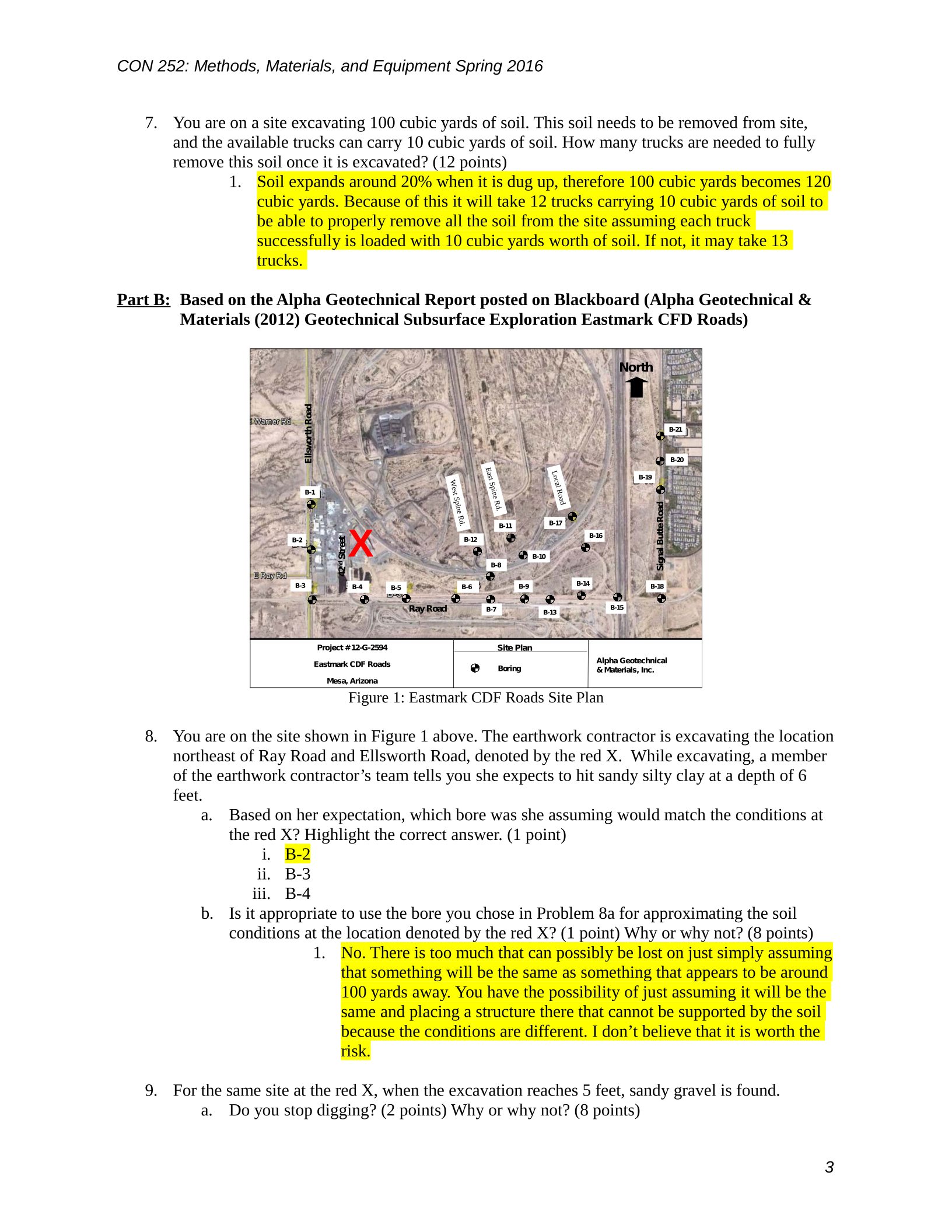
Figure 1: Eastmark CDF Roads Site Plan
8. You are on the site shown in Figure 1 above. The earthwork contractor is excavating the location
northeast of Ray Road and Ellsworth Road, denoted by the red X. While excavating, a member
of the earthwork contractor’s team tells you she expects to hit sandy silty clay at a depth of 6
feet.
a. Based on her expectation, which bore was she assuming would match the conditions at
the red X? Highlight the correct answer. (1 point)
i. B-2
ii. B-3
iii. B-4
b. Is it appropriate to use the bore you chose in Problem 8a for approximating the soil
conditions at the location denoted by the red X? (1 point) Why or why not? (8 points)
1. No. There is too much that can possibly be lost on just simply assuming
that something will be the same as something that appears to be around
100 yards away. You have the possibility of just assuming it will be the
same and placing a structure there that cannot be supported by the soil
because the conditions are different. I don’t believe that it is worth the
risk.
9. For the same site at the red X, when the excavation reaches 5 feet, sandy gravel is found.
a. Do you stop digging? (2 points) Why or why not? (8 points)
3
Site Plan
Project # 12-G-2594
Eastmark CDF Roads
Mesa, Arizona
North
Alpha Geotechnical
& Materials, Inc.
Boring
B-1
B-2
B-3
Ray Road
42
nd Street
B-4 B-6
B-10
B-9
B-13
B-14
B-15
B-16
B-17
B-18
B-19
B-20
B-21
B-5
B-8
B-7
B-12
B-11
Signal Butte Road
Ellsworth Road
X

CON 252: Methods, Materials, and Equipment Spring 2016
1. Yes. If the soil is not what you think it’s supposed to be, there is a
potential for future problems. At this point I would request another core
sample to make sure I know what I am getting myself into even though
this way will take more time and money, it could possibly prevent a
future incident in the future from not taking the appropriate precautions
when dealing with new and unexpected information.
4
Powered by TCPDF (www.tcpdf.org)

