


PUTTING OUT FIRES: HOW COMMUNICATION PROFESSIONALS
UNDERSTAND AND PRACTICE CONFLICT RESOLUTION
Chapter 1: Introduction
“Putting out fires.” One of my participants used this metaphor to describe
what she did every day as a communication professional. Her metaphor expressed
not only unrelenting problem solving, but—as I understood her narrative—intense
job demands that burned with conflict. This research study began by exploring one
activity that has been claimed for public relations professionals—the role of
negotiator. It expanded into a broader study of how public relations/communication
practitioners understand conflict and what roles in managing organizational conflict
these professionals can legitimately claim.
Statement of the Problem
The exact roles public relations practitioners should enact within organizations
continue to be hotly debated in the discipline (Botan & Hazelton, 2006; Holtzhausen,
2007; Neil & Drumwright, 2012). Goffman (1959) defined a role, including a job or
profession, as the rights and duties that are attached to a given social status. Scholars
of public relations widely agree that practitioners manage communication to achieve
mutually beneficial relationships with organizational stakeholders (Cutlip, Center, &
Broome, 1985; Heath (2001). Lattimore, Baskin, Heiman, and Toth (2007) added
leadership to the management and relationshipbuilding roles. In sum, the public
1

relations discipline claims communication management, relationship management,
and leadership in communication as primary organizational roles.
I proposed to study negotiation because that role has not achieved primary
status in our profession. Researchers first systematically claimed the negotiation role
for public relations in 1985 (Dozier, Grunig, & Grunig, 1995). Since then, very little
evidence has surfaced that public relations practitioners routinely negotiate for their
organizations or groups. Research studies claim negotiation as a public relations
activity, often without definition or empirical evidence (Curtin & Gaither, 2007;
Plowman, 1998, 2007). Vasquez (1996) called for further categorization of that role
in our discipline, starting with distinctions between formal and informal negotiation
—a distinction also proposed by Gelfand and McCusker (2002). Still, little work has
been done on exactly how the negotiation role actually functions in our profession.
Moreover, we do not have a snapshot of what levels of conflict practitioners face in
their everyday work.
Arguments for conflict management as a public relations role. Three areas
of research provide theoretical support for conflict management as a wide-spread role
for communication professionals: crisis communication, strategic communication,
and public relations activism. Public relations practitioners play a visible role when
organizations experience negative public scrutiny (Coombs, 2006; Johansen,
Aggerholm, & Frandsen, 2012; Palenchar, 2007; Veil , Buehner, & Palenchar, 2011).
These crises often require negotiation with publics and stakeholders—a
communication activity that Pruitt (2001) perceived to be growing out of a broader
conflict situation.
2

Second, strategic communication has been claimed as a public relations role
requiring managerial and decision-making power that generates conflict (Grunig &
Repper, 1992; Neale, Tenbrunsel, Galvin, & Bazerman, 2006). One conflict
management role identified by Hallahan et al. (2007) includes actively changing
organizational culture and values. Further, because digital communication and social
networking sites have taken a prominent place in both strategic and crisis
communication activities, Kazoleas and Teigen (2006) contended that conflict was
integral to electronic media use while other researchers have investigated how to
manage conflict in those media (Briones, Kuch, Liu, & Jin, 2011; Olaniran, 2010).
Finally, negotiation of meaning to achieve organizational consensus has been
claimed as a public relations role by activist scholars (Cammaerts, 2008; Smith &
Ferguson, 2001; Zoch, Collins, Sisco, & Supa, 2008). These communication efforts
often require transforming employee attitudes and emotions until a mutual
understanding of the goals of an organization and its motives has been reached
(Jameson, Bodtker, Porch, & Jordon, 2009). Taken together, research and theory on
crisis communication, strategic communication, and activist public relations give
credence to the claim that conflict management is a vital public relations role.
Goals of the Research Study
This study has two goals: one academic and one in practice. First, our
discipline needs evidence to fill in research gaps about how practitioners engage in
negotiation, what that negotiation entails, and what understandings of negotiation or
other conflict management roles apply in public relations practice. Second, I hope
the participants’ insights and recommendations can reach a wide audience of
3

communication professionals, add to their understanding of practice, and perhaps
improve their work lives.
To those ends, this exploratory study has the following goals:
•To investigate assumptions and claims that public relations
activities involve or should involve conflict resolution,
including overt negotiation.
•To increase our knowledge of how public relations/communication
practitioners understand conflict, its management, its
processes, and its causes within their profession.
•To document how public relations/communication practitioners
describe conflict resolution activities they experience in
their everyday work, including those involving digital
channels.
•To explore whether conflict management and negotiation are
major roles in public relations practice that could be usefully
added to the accepted roles of strategic communication and
relationship management.
Rationale: These goals were best achieved through a qualitative research
study involving 31 public relations/communication professionals with five or more
years of experience who could describe and illuminate their experiences with
circumstances of conflict. Denzin and Lincoln (2005) defined qualitative research as
a way to “study things in their natural settings, attempting to make sense of, or
interpret, phenomena in terms of the meanings people bring to them” (p. 1).
4

Qualitative data collection included triangulation of in-depth interview transcripts,
critical incident narratives, printed materials, and website information (Charmaz,
2006). Data analysis followed a qualitative research method designed to generate
constructs and “build theory from data” (Corbin & Strauss, 2008, p. 1). In order to
eliminate leading questions about negotiation as a role, interview questions did not
use the term negotiation, but allowed participants to find their own language in
describing conflict.
Research questions. The following research questions guided my inquiry.
They were designed to gather rich descriptive data from the participants and to insure
depth in my analysis of their understandings of conflicts within their professional
lives (Creswell, 2007; Miles et al, 2014). Although the language of these questions
was refined based on reiterative data analysis and reduction, the questions cover the
research areas approved by my dissertation committee in the proposal I submitted—
including digital communication.
RQ1: How do public relations/communication practitioners with at least 5
years of experience describe their job activities and roles in the context of conflict
management?
RQ2: How do public relations/communication professionals understand
conflict management and negotiation as roles in their practice?
RQ3: How do public relations/communication practitioners understand their
use of digital and social media in roles that involve conflict management or
negotiation?
5

RQ4: How do communication practitioners understand conflict processes and apply
conflict resolution techniques in critical incidents they have experienced in the
workplace?
Sub-questions and probes explored many factors in conflict, conflict
processes, and conflict management, as well as contributing variables, including
external and internal audiences, use of communication channels in conflict, personal
skills in conflict management, and training in conflict resolution.
Voices and standpoint. Voice is “the overall tone, mode, and orientation of
the report” (Miles et al., 2014). Wolcott (2001) argued that the voice and standpoint
are interchangeable terms. These concepts describe the researcher’s authorial choices
that, in turn, reveal what role she takes in reporting the data—omniscient narrator,
interviewer, or storyteller (Tierney, 1997).
Several goals of the study—comparing the roles of practitioners with
assumptions in communications research and developing a grounded theory model—
led me to structure the report using the traditional formal sections in research articles.
Throughout the data analysis and writing of the results, I viewed myself in the
struggling-to-be-objective interviewer role—a standpoint that required me to
reflexively deal with my bias in order to give authentic voices to my participants.
Because of my close involvement with practitioners in my role as practicum
supervisor in a professional graduate school of communication and my work as a
member of the Public Relations Society of America, I viewed my interviewees as
coresearchers and myself as a co-participant.
Extensive quotations in the Results section allowed the individual voices of
my participants to be heard above the formal tone of an academic writer that my own
6

voice often took in this document. To allow the voices of my participants to speak to
the reader directly without compromising their confidentiality, I created a fictional
first name for each participant and used that name consistently. By identifying
interviewees by (fictitious) first names and quoting liberally, I hoped to give each
participant the distinct personality and voice that I experienced.
Overview of the Dissertation
Chapters in the dissertation have three major goals: 1) to review past and
current research on negotiation and conflict management from a variety of social
science disciplines and applied fields; 2) to establish qualitative research and
grounded theory method as effective strategies for producing credible, reliable, and
valid answers to the research questions; and 3) to generate results that satisfy
standards for “rich, thick description” and faithful interpretation of the participants’
meanings during data reduction.
To meet these goals, the Literature Review (Chapter 2) covers factors in
conflict and negotiation across social science disciplines and summarizes public
relations theories and studies in negotiation. It also explores recent Internet and
software developments in negotiation, as well as current research in conflict
resolution and transformation. The Method section (Chapter 3) explains grounded
theory procedures of data collection, data analysis, and strategies to reduce bias and
insure reliability and validity. Objections to these procedures and to qualitative
methods in general are addressed. The Results section (Chapter 4) liberally quotes
from participant transcripts to substantiate themes, categories, and factors emerging
from the data.
7

The Discussion section (Chapter 5) reviews the 13 major themes and factors
that emerged from data analysis. It weaves those factors into a model for
transformation of conflict as a role for public relations practitioners. This model rests
on participants’ perceptions of audience conflict, conflict avoidance, conflict
processes, and training needs.
8

Chapter 2: Literature Review
The literature review should “make the case that a study is important” (Jones
& Kottler, 2006, p. 26). Hofstee (2006) claimed it must establish originality, defined
as significance or value. More precisely, the literature review should establish a
research gap; that is, it should separate what researchers have done from what needs
to be accomplished (Randolph, 2009).
One choice facing qualitative researchers is whether to conduct a literature
review before or after the research design is planned and carried out (Charmaz,
2006). This study required a literature review in the proposal stage, so delaying the
review was not an option even though scholars using similar perspectives argue that
bias can arise from immersion in past research. Some phenomenologists (Georgi,
1985; Jones,
2005; Moustakas, 1994; Sanders, 1982) and grounded theorists (Gibson & Hartman,
2014; Goulding, 2005; Wolcott, 1994) dispute the value of literature reviews,
especially those conducted before the start of a qualitative study. Glaser and Strauss
(1967) argued that literature reviews predispose researchers “to see [their] data
through the lens of earlier ideas, often known as ‘received theory’ ” (Charmaz, 2006,
p. 165). If you delay writing the literature review until after data analysis, the
argument goes, your results may be less contaminated by bias from preconceived
ideas.
Other qualitative researchers (Henwood & Pidgeon, 2003) counter that no
researcher can ignore her prior learning and experience, but she can take a highly
critical stance toward prior research and use bracketing activities to reduce bias. I
followed this advice. Memos and bracketing activities were applied to prevent past
9

research findings in this review from influencing the results (Miles et al., 2014). In
addition to using bias prevention strategies, I found that my literature review required
updating twice after its original version. After completing the data analysis, I needed
to include studies on themes developed by participants that had not been covered,
such as team cooperation (Gallicano, 2013; Van Lange, Joireman, Parks, & Van Dijk,
2013). During the Discussion analysis, I added current research on organization-wide
factors in conflict resolution that illuminated the macro implications of my findings
(Gelfand, Leslie, Keller, & deDrieu, 2012; Tekleab & Quigley, 2014; Verčič, Verčič,
& Sriramesh, 2012).
As recommended by Randolph (2009), this literature review examines a
research gap between theory about negotiation in communication practice (Grunig &
Grunig, 1992) and studies showing solid evidence that the negotiation role is actually
part of practitioners’ work life (Vasquez, 1996). To document this research gap, the
selected literature review articles aim to fairly represent the topic of
negotiation/conflict resolution in communication practice and examine both “research
outcomes” and “practices or applications” (Randolph, 2009, p. 2).
Specifically, this review of literature explores definitions of key terms,
provides historical background that places the study in context of conflict
management, and documents that the research questions have value in the
communication discipline (Hofstee, 2006). It summarizes public relations scholarship
on negotiation, intercultural factors within that research, and negotiation theories
from other disciplines that have informed our discipline. The literature review
identifies gaps in public relations research on negotiation, including lack of empirical
studies in the field, failure to distinguish formal from informal negotiation, and the
10

need for a true process model. Research and theory from other social science
disciplines provide additional perspectives on negotiation and conflict resolution.
Moreover, recent developments in discourse analysis and electronic or automatic
negotiation may push negotiation into a more central place in public relations.
Defining Negotiation
Negotiation is an activity that falls within the broader category of conflict
management in organizations where communication practitioners work and in public
relations roles that involve resolving conflict with stakeholders (Hargie & Tourish,
2009b; Montes et al., 2012; Posthuma, 2012; Rahim, 2011; Verčič et al., 2012).
Conflict has been defined as “the interaction of interdependent people who perceive
opposition of goals, aims, and values, and who see the other party as potentially
interfering with the realization of these goals” (Putnam & Poole, 1987, p. 552).
Conflict has been widely viewed as an inevitable part of organizations (Gelfand et al.,
2012). Consequently, conflict has to be managed and styles of conflict management
have been studied both in personal life and in the workplace (Rahim, 2011).
Paraphrasing Thomas (1976), Montes, Rodriguez, & Serrano, (2012) defined conflict
management styles “as a general and consistent orientation toward the other party and
the conflict issues” (p. 7). Within this study, negotiation finds its place as an activity
within the communication/public relations workplace and its demands for conflict
management and resolution.
Definitions of negotiation can be so broad they apply to any situation where
two or more people are communicating. Gelfand & McCusker (2002) defined
negotiation as “a communication exchange . . . [or] a pervasive form of social
interaction that is conducted frequently in formal arenas, such as international
11

relations, and manager-subordinate relations, as well as informal arenas, such as
interpersonal relations and marital decision-making” (p. 292). This broad definition
involving social interaction raises questions about what public relations scholarship
means by negotiation. The Encyclopedia of Public Relations (Heath, 2012) has no
entry for negotiation. We find only brief comments on multi-party negotiations under
conflict resolution (Plowman, 2005), and negotiation is implied within collaborative
decision-making (McComas & Derville, 2005). Distinctions between conflicts
involving issues and conflicts involving meaning, or between problem solving and
negotiation, are often blurred. The following questions are frequently ignored: what
are the differences between formal and informal negotiations (Ury, 1993)? between
the goals of conflict resolution and meaning-making (Wilson & Putnam, 1990)? and
between negotiation and relationship building (Christen, 2004; Vasquez, 1996)?
Let's begin with the distinction between formal and informal negotiations—a
difference that is often ignored in public relations research (Vasquez, 1996). One
useful perspective distinguishes between conflicts of interest and conflicts of
viewpoint. Kuula and Stam (2008) compared negotiation in the two types of conflict
by using the adjectives distributive and integrative:
. . . negotiation includes resolving both conflicts of interest between
conflicting parties (i.e., ‘hard,’ ‘distributive,’ or ‘win-lose’
negotiations) and conflicts of viewpoint between essentially friendly
parties (i.e., ‘soft,’ ‘integrative,’ or ‘win-win’ negotiations)” (p. 719).
The difference between distributive and integrative negotiations has been fully
developed in scholarship on formal negotiations. Lewicki, Saunders, Barry, and
Minton (2004) listed these characteristics of a formal or distributive negotiation:
12

1. Individuals, groups, or organizations can negotiate.
2. The parties perceive that their goals and interests are in conflict (p. 4). 3.
Parties voluntarily enter into the negotiation because they hope to
gain something that would be hard to get otherwise.
4. Negotiation allows parties to avoid a solution imposed by a powerful entity
such as a court or regulatory agency.
5. Parties have to give and take in a negotiation and be willing to
compromise.
6. Parties often want tangible results from a negotiation, but intangible
interests are also in play (e.g., saving face and maintaining
relationships).
The formal negotiation framework assumes that parties want a concrete
agreement at the end of the negotiation that will redistribute tangible and intangible
resources in order to reduce conflict (Lax & Sibenius, 2006). Social science
perspectives on negotiation widely accept the premise that resource allocation should
benefit all parties (i.e., a win-win agreement) and not only the most powerful party
(i.e., a win-lose agreement) (Fisher, Ury, & Patton, 2011). Sycara (1991) explained
that each party wants to achieve its aspirations in a settlement, not just tangible
resources. At the same time, they accept constraints on their power. J. Grunig (1992)
placed public relations squarely in this tradition by defining the negotiation process as
collaboration (p. 316).
Informal negotiations operate outside a formal framework and without
potential interventions by outside parties. Gelfand and McCusker (2003), who
identify themselves as communication scholars, posited five elements at the core of
13

all negotiations: “(1) the parties have, or perceive they have, a conflict of interests;
(2) parties are engaged in communication; (3) compromises are possible; (4) parties
can make provisional offers and counter-offers to each other; (5) parties are
temporarily joined together voluntarily, and their outcomes are determined jointly”
(p. 293). This shifts the frame of negotiation to elements such as perceptions and
offers that may be temporary and that highlight communication.
Among public relations scholars, Vasquez (1996) most forcefully issued a call
to study negotiation as an element in everyday social interactions, rather than as a
feature of formal conflict resolution. This scholar rated negotiation theories in public
relations as underdeveloped; Vasquez (1996) turned to the social interaction
perspective to uncover conflict resolution dimensions that were missing from the
excellence paradigm. Putnam and Roloff (1992) defined social interaction as
communication that is directed toward understanding symbols and creating meaning
both verbally and nonverbally. In contrast, formal negotiation has one concrete goal:
bargaining to achieve agreement.
Public relations scholars widely accept the value of mutually beneficial
outcomes in conflict resolution, as well as the use of integrative bargaining to
achieve self-interested outcomes. Katz and Pattarini (2008) labeled integrative
bargaining as an essential tool for public relations counselors. They define this
process as "identifying and prioritizing interests, developing options that might meet
those interests, agreeing on fair standards for evaluating options, and exploring both
alternatives and proposals to a negotiated agreement" (p. 88). Their article serves as a
guidebook to the principles and techniques of integrated negotiation that practitioners
can use to build relationships and establish trust with stakeholders. The most
14

important concept in integrative bargaining is the shift from asserting one party's
position on issues to exploring shared interests with the other negotiators. Integrative
bargaining scholarship underscores an essential divide in social science thinking
about negotiation. The difference involves formal theory-testing versus model-
building without replication. Kraus (2001) isolated this distinction by creating two
categories: (1) the formal theory of bargaining based on gametheoretical approaches
that is tested through experiments and simulations and (2) the informal theory of
negotiation guides—an approach that develops beneficial strategies for a negotiator
to use in specific situations. The standards of validity and reliability are different in
each approach. The majority of social science studies on negotiation use game-
theoretical approaches investigated through statistical analysis (Buelens, Van de
Woestyne, Mestdagh, & Bouckenooghe, 2008). The most famous negotiation guides
have been produced by scholars in the Harvard Negotiation Project whose
conclusions emerged from business and law case studies (Fisher et al., 2011; Lax &
Sibenius, 2006; Malhotra & Bazerman, 2007; Ury, 2007). Game theory and
negotiation guides based on case study experience have cross-fertilized, so we can
find statistical analyses based on concepts from negotiation guides (Donohue &
Roberto, 1996; Taylor & Thomas, 2008).
In public relations, studies on negotiation often sort into the same dichotomy
of game-theory versus negotiation-guide perspectives. These categories become
useful when we judge how to apply the conclusions of research studies. Game
theoretical approaches often surface in public relations studies that assume
organizations are rational entities operating in an uncertain environment (Okura,
15

Dozier, Sha, & Hofstetter, 2009). Public relations research favors the negotiation
guides approach because it offers pragmatic and often successful strategies that
negotiators can use to resolve conflict (Plowman, 1995).
Public Relations Perspectives on Negotiation
Over the last thirty years, public relations scholars have followed the lead of
other social scientists by studying negotiation as an activity of individuals in overt
conflict settings. One crucial theory—Pruitt and Kim’s (2004) model of conflict
styles—posited "the strength of two independent individual difference variables:
selfconcern and other-concern" (p. 42). Self-concern reflects how much an individual
values his or her own interests in conflict situations; other-concern reflects how much
genuine importance someone places on what happens to others during conflict. This
difference is at the heart of Pruitt's (1981) dual concern model. In general, individuals
moderate their self-concern because they cannot get what they want unless they help
or show concern for others.
Pruitt (1981, 2001) labeled this strategy of moderating self-interest as
instrumental or strategic and formulated a typology of negotiation strategies that
included various combinations of self-concern and other-concern. Contending
describes strategies based on pure self concern; yielding occurs when the other party's
interests take precedence; problem solving strategies are applied when a party asserts
both self-concern and other-concern; avoiding strategies surface when a party has
little self-concern or other-concern; and compromising involves trying to find a
middle ground even if an equitable split does not satisfy either party (Pruitt & Kim,
2004, pp. 40-41).
16

Perspectives on conflict from the excellence model. Various elements of the
dual-concern model, particularly its strategic categories, have been folded into public
relations theory and practice (Dozier, Grunig, & Grunig, 1995; Plowman, Briggs, &
Huang, 2001; Vasquez, 1996). In one of the few substantive models of negotiation in
public relations—the conflict resolution model of public relations—Plowman (2007)
has adapted the strategies and framework of public relations negotiation to new
developments in the excellence model. We have already cited Grunig and Grunig's
(1992) definition of "collaboration as the process of negotiation" in the context of
public relations. Subsequently, Plowman (1995) emphasized collaboration in
negotiation by linking individual conflict strategies to the four communication
models created by Grunig and Hunt (1984) as well as to the situational theory of
publics (Grunig & Repper, 1992). In other words, conflict strategies were linked to
achieving negotiation outcomes that both the organization and its stakeholders
viewed as winwin.
In a simulated study involving Walgreen's goal to establish a mail order drug
business, Plowman (1995) adapted five individual conflict strategies—contending,
cooperating, avoiding, accommodating, and compromising—to two-way symmetrical
communication between an organization and its publics (p. 95). For example, a
contending strategy relies on one-way communication that is essentially
asymmetrical and non-collaborative. In 1995, Plowman also added two negotiation
tactics called the unconditionally constructive tactic and the win/win or no deal
tactic. The unconditionally constructive tactic added the element of altruism to an
organizational strategy. When using this tactic, organizations must keep the interests
of the contending parties in mind even if some stakeholders violate trust or other
17

standards. Win/win or no deal requires that every party benefits; otherwise, no
agreement can be reached. These tactics allow negotiators to handle stalemates and
other problems that block collaboration in the negotiation process. Plowman (1995)
placed these seven strategies on a simple continuum from symmetrical, or
collaborative practices, to asymmetrical or contending practices.
When the excellence model developed the new paradigm of symmetry in
twoway practice (Grunig, 2001), Plowman (2007) expanded the seven negotiation
strategies to include the mixed motives of self-interest and other-interest. That model
illustrated how mixed motives in communication between organizations and publics
could lead to symmetrical communication and win-win outcomes for both parties
(Dozier et al., 1995; Grunig, 2001). The new elements in this model included the
tactic of principled standards that requires parties to act according to these standards
even when they do not benefit. A principled tactic introduces ethics and social
responsibility into negotiation, but the consequences may result in symmetrical or
asymmetrical outcomes for the parties (Huang, 1997). A final strategy in the conflict
resolution model of public relations is perseverance—the obligation to work toward
one's goals regardless of the other party's response. The nine strategies are arrayed on
a continuum that places one-way strategies at either end and two-way strategies in a
middle win-win zone. For example, cooperation, unconditionally constructive, and
win-win or no deal tactics fall in the win-win zone that will result in positive
agreement. If an organization acts unilaterally in self-interest, its tactics can include
contention, avoidance, and principled action. When publics act with self-interest, they
use accommodation, compromise, and perseverance tactics. Plowman (2007)
introduced the strategy of assertive pacifism that can be used when publics act
18

aggressively and with arrogance (pp. 96-97). The conflict resolution model of public
relations continues to evolve.
Within the excellence model and the conflict resolution model of public
relations (Plowman, 2007), mediator is the only specific role for public relations
practitioners. Grunig and Grunig (1992) defined a mediator as a "neutral third party"
who "enters the process of negotiation" and takes a neutral role and assists in
negotiation like lawyers and counselors (p. 316). Plowman (2007) developed a more
nuanced typology of mediator roles for practitioners including internal peer mediation
to solve organizational problems and affiliated third party mediation in which a
highly trained practitioner can resolve conflicts even when perceived as aligned with
one party. Certainly, practitioners take other conflict resolution roles. The activist
literature in public relations suggests the role of conflict creator (Holtzhausen, 2007),
but to date we do not have an extensive list of roles in negotiation.
Another substantial model related to conflict resolution and relationship
management is the value of public relations model developed by Huang (2001).
Using structural equation modeling and questionnaire data collected during a
legislative session in Taiwan, Huang's (2001) study established direct and indirect
relationships between communication strategies, relationship building variables, and
conflict resolution. The independent variable was public relations strategies.
Following Grunig's (2001) new formulations of public relations dimensions, Huang
(2001) chose five public relations strategies: symmetrical-ethical communication,
two-way communication, interpersonal communication, mediated communication,
and social activities. The practice of social activities is culturally based in Chinese
concepts of personal influence and connections within a social network (Huang,
19

2001, p. 268). The three dependent variables were the conflict strategies used by
counter parties: integrative, distributive, and non-confrontation-avoidance. Finally, as
mediating variables, Huang (2001) selected five relationship factors developed in part
by Grunig and Huang (2000): control mutuality, trust, relational commitment,
relational satisfaction, and face and favor. This study is notable for using three
Chinese cultural variables—social activity and the gifts of face and favor—that can
be offered within a social setting. Many indirect effects were found among the 14
variables, but none of the public relations communication strategies had any direct
effect on conflict resolution. The Chinese variables of social activity, face, and favor
did have direct influence on the use of cooperative tactics. Huang's (2001) model of
the value of public relations showed that relationships indirectly influence the use of
collaborative tactics, but the researcher called for much more testing of the model
outside of Taiwan.
In contrast to tha more formal negotiations emphasized by Huang (2001) and
Plowman (2007), some public relations and communication scholars have turned
their attention to informal negotiation. Vasquez (1996) called for "the application of
negotiation models to other, different communication contexts" that we do not usually
identify as negotiations (p. 58). He pointed the way by calling on public relations
practitioners to "construct frames of organizational information" that can "negotiate
the relationships between an organization and key publics" (p. 72). Putnam (2005)
proposed discourse analysis as the primary technique "to unpack the developmental
and contextual features of negotiation" (p. 17). Discourse analysis bypasses the
typologies of formal conflict resolution strategies and instead examines transcripts,
audiotapes, and other evidence in order to uncover differences between ordinary
20

interactions and negotiations. Some discourse analysts have tackled relationship
building, trust, power structures, and organizational cultures in e-mail negotiations
(Jensen, 2009) and in meetings among organizations with conflicting interests in
waste management (Bennington, Shetler, & Shaw, 2003). Putnam (2005) asserted that
these quantitative and qualitative discourse analyses will help us to understand the
process of negotiation, not simply the individual motivations, tactics, and outcomes
displayed in formal settings. Informal negotiations are captured in phrases such as
negotiating a relationship (Vasquez, 1996, p. 72) or engaging in dialogue when
conflicts arise (Kent & Taylor, 2002). Scholars will have to define what practitioners
mean when they talk about negotiating in informal settings.
Perspectives from the contingency theory of public relations. The
contingency theory of public relations (Shin, Heath, & Lee, 2011) aims to understand
decision-making processes used by practitioners during conflict situations. Various
scholars (Cameron, Crop, & Reber, 2001; Cancel, Cameron, Sallot, & Mitrook, 1997;
Caneron, Mitrook, & Cameron, 1999) have described the complex of eighty or more
variables that can influence conflict management in our field, the leadership styles
that influence decision-making, and the ethical factors in conflict resolution. The
contingency theory of public relations raises the following questions that bear
strongly on the results of this study: are practitioners mostly involved in conflict at
the individual, unit, organizational, or social level (Shin, Cameron, & Crop, 2006)? is
conflict management a routine or non-routine role for practitioners (Shin et al.,
2011)? what strategies do practitioners generally view as effective in resolving
conflict (Cancel et al., 1999)? what ethical standards are applied in conflict
management during practice?
21

Some public relations scholars have studied conflict resolution and
negotiation in our profession using the contingency theory of accommodation
(Cameron et al., 2001), sometimes labeled the contingency theory of conflict
management (Cancel et al., 1997). This model uses concepts from other negotiation
perspectives described above, including accommodation, cooperation, and
compromise (Fisher et al., 2011; Pruitt, 1981; Pruitt & Kim, 2001). Options for
responses to conflict range on a continuum from pure advocacy to pure
accommodation; the advocacy stance is adversarial because it unequivocally supports
the organization’s position while the opposite stance of accommodation is fully
cooperative (Cameron et al., 2001). In between are varying degrees of cooperation
between an organization and its publics. This theory is interested in decision-making
processes during conflict, but generally ignores the outcomes of negotiation; the
conflict processes “may change rapidly according to the dynamics of the situation”
and involve issues that “don’t really have yes or no answers on either side” (Cancel et
al., 1999, p. 176).
The contingency theory of accommodation (Cancel et al., 1997) challenges
other models of public relations, particularly the excellence model, that view dialogue
and symmetrical communication as normative strategies in dealing with conflict (e.g.,
Cutlip, Center, & Broome, 2000; Grunig, 1989; Shin et al., 2011). The theory’s
proponents (Cancel et al., 1999) have argued that the excellence model could not
accurately represent best practices in public relations because of incomplete analysis
of what constitutes an ethical or moral strategy during conflict. This position opens
up a debate about what legitimate, ethical strategies can be applied by communication
practitioners especially in conflict situations that involve extreme positions.
22

Proponents of the theory generally support the use of accommodation (i.e.,
cooperation with other parties to resolve conflict), but view conflict situations as
highly complex disputes in which dialogue may be ineffective and even unethical
(Cancel et al., 1999).
Moreover, scholars within contingency theory question whether two-way
communication can be effective in many conflict situations (Cancel et al., 1997). In a
thought piece on dialogue in public relations, Stoker and Tusinski (2006) argued for
engagement through one-way dissemination (i.e., unilateral) and reconciliation with
publics where no negotiated agreement or mutual understanding is possible. In these
situations, symmetrical two-way communication could result in “moral cracks and
contradictions” (Stoker & Tusinski, 2006, p. 158) and result in quid pro quo
agreements that are unethical because, for example, important issues and stakeholders
are excluded. In these extraordinary relationships, nonreciprocal forms of
communication such as “suspended dialogue” or “dissemination” may have more
value for both parties, as well as more ethical force.
Examples from Stoker and Tusinski (2006) illustrate the ethical quandaries
that organizations and publics face in decisions relating to their conflict strategies.
The authors pointed out biases in selecting publics with which organizations will
engage in symmetrical two-way dialogue, often preferring engagement with
likeminded parties that can offer reciprocation. By favoring engagement with
“homogeneous publics,” that is, those with similar viewpoints, the organization can
more easily “achieve mutual understanding” and reach an agreement (Stoker &
Tusinski, 2006, p. 163). More recalcitrant parties are ignored, often those with fewer
resources to engage in campaigns and negotiation. In contrast, ethical conflict
23

management can put aside symmetrical dialogue with like-minded parties, accept
continuation of the conflict, engage in dissemination of information and arguments,
and accept that no valid agreement can currently be reached.
In addition to these theoretical explorations of ethics in conflict resolution, the
contingency theory of accommodation has developed a matrix of variables and
factors of special interest to studies like this one about conflict resolution in the
communication profession (Cancel et al., 1997). Researchers have explored these
variables in qualitative interview studies about conflict involving communication
professionals, including experienced public relations managers and journalists (Shin
& Cameron, 2004). Initially, the matrix developers identified 86 variables that could
influence conflict situations in communication practice. Cancel et al. (1999) defined
two broad categories that can be applied to these variables—predisposing variables
that “shape the organization’s predisposition toward relations with external publics”
and situational variables “at work during a particular situation involving an
organization and an external public” (p. 177). Results of an interview study with 18
experienced public relations professionals showed that situational variables far
outweighed predisposition variables in decisions to accommodate external publics.
But many factors influenced the conflict strategy, including how threatening the
external public seemed to the dominant coalition (e.g., the strategy could affect
profits and reputation) and how internal stakeholders such as employees viewed the
public.
Researchers who study the complex matrix of variables in the contingency
theory have struggled to make practical sense of how the 86 variables influence
everyday public relations practice (Reber & Cameron, 2003). Attempts have been
24

made to aggregate these 86 matrix variables. One study isolated 12 factors divided
along external or internal dimensions (Shin, Cameron, & Crop, 2006). External
dimensions include external threats, industry environment, political/social/cultural
environment, and external publics; internal factors include organizational
characteristics, management characteristics, and individual characteristics.
Unfortunately, interview studies with experienced public relations
practitioners can result in a flurry of claims about the contingency theory variables
that seem stereotyped and self-serving. For example, in a small interview study
involving eight public relations professionals in high-income global corporations,
Cameron, Crop, and Reber (2001) found support for criticisms of two-way
symmetrical dialogue by the contingency theory of accommodation. The study tested
six variables involving the disposition of organizations prior to conflict: moral
conviction; awareness of conflicting demands from external publics; regulatory, legal,
or judicial constraints; and management pressure on practitioners. The interviewers
asked practitioners to recall episodes involving these six variables—for example,
“Can experienced practitioners recount instances when the demands or needs of a
public were not accommodated at all because to do so would violate the practitioner’s
moral convictions?” (Cameron et al., 2001, p. 248). Every participant recalled
episodes that supported this conclusion: “There are times when nothing good can
come from dialogue” (Cameron et al., 2001, p. 250). Several examples showed the
drawbacks of engaging in dialogue that excluded more distant community
stakeholders who were negatively impacted by the agreement between a for-profit
and a non-profit organization.
25

More importantly, this research team (Cameron et al., 2001) found that
participant descriptions of conflict episodes contradicted how the individuals
explained those situations. The practitioners engaged in “platitudes about win-win or
other lofty sentiments” that distorted “how professionals actually conduct themselves
during conflict” (Cameron et al., 2001, p. 256). For example, the participants would
describe their communication strategies as “ ‘two-way’, ‘win-win’, or ‘compromise’
when it is clearly an asymmetrical approach” (Cameron et al., 2001, p. 253). Some
practitioners accused the opposing party of engaging in biased messages while their
organizations were “getting ‘the truth’ out there” or “just trying to set the record
straight” (Cameron et al., 2001, p. 253). The interview findings supported probing for
details about what actually happened in conflict episodes, rather than accepting
explanations by the practitioners. Further, the participants, who each had two decades
of experience in public relations, did not show clear understanding of “terms like
winwin, two-way, symmetrical and accommodation” (Cameron et al., 2001, p. 256).
Because of conflicting answers and lack of knowledge about conflict resolution
concepts, the researchers recommended future survey research to clarify what
practitioners mean by the conflict resolution vocabulary they use on the job.
Moreover, leading questions and excluded target audiences undermined the validity
of this study’s results.
In a larger interview study with public relations practitioners, Cameron et al.,
(1999) found more specific results on contingency theory variables, including the
addition of new variables for situations. They asked 18 high-level communication
professionals from large corporations about their understanding of contingency
theory. The interview guide contained a checklist of the 80+ contingency theory
26

variables. When participant responses flagged toward the end of the conversation, the
three interviewers asked about variables on the list that had not yet been mentioned.
As a result, many variables in the findings had only weak support from the
participants. Major findings included (1) the use of philanthropic and community
relations activities to accommodate publics in conflict with the organization; (2) the
emergence of characteristics of an antagonistic public—especially its relative power
to injure the organization’s reputation and earnings—as variables in how the
organization handles the conflict; and (3) the impact of a large mix of variables, not
just a small number, in the decision-making process involving conflicts with external
publics. Also, line managers—not just the dominant coalition— often have
decisionmaking power in dealing with external publics, so they can undermine public
relations efforts to accommodate these publics. Finally, in these large corporations,
certain individual personality characteristics of people in the dominant coalition (e.g.,
open-mindedness, ability to put aside personal biases, and past training) could create
a positive outcome to conflict with external publics.
The contingency theory of accommodation in public relations accepts a
complicated variable stew as operating in a public relations conflict situation. The
model of contingency summarized above generates some predictions about what
participants in this study may report. First, these participants may profess a
preference for accommodation (i.e., a cooperative style) to advocacy (i.e., an
adversarial style) in dealing with conflict (Cameron et al., 2001). Second,
practitioners in this study may avoid symmetrical two-way communication in some
conflict situations because of the unethical outcomes that may result (Stoker &
Tusinski, 2006). Third, in making decisions, practitioners may rely more heavily on
27

situational variables in the conflict situation rather than on factors established in
advance by the organizational culture (i.e., predispositional variables). Fourth,
practitioners will focus more on individuallevel factors in conflict situations than on
organizational- or societal-level factors
(Shin et al., 2006). Finally, practitioners will perceive little if any difference between
how public relations leaders deal with conflict in routine work situations versus
nonroutine work situations, although practitioners may be more resourceful in crisis
situations (Shin et al., 2011, p. 185).
Robustness and Gaps in Public Relations Research on Negotiation
The two major theories I have reviewed above—the excellence paradigm and
contingency theory—both explored the roles that practitioners play in conflict
management. In their recent overview of leadership styles supported by contingency
theory, Shin et al. (2011) claimed that public relations scholars seek “to understand
roles that practitioners play on behalf of organizations” (p. 167). Within this
excellence model, this goal of establishing a specific number and type of public
relations roles was examined by Broom and Dozier (1986) and Dozier (1992).
However, Shin et al. (2011) contended that after decades of research, “the body of
scholarly literature provides little explication of what specific behavioral
characteristics and functions public relations professionals enact or are expected to
enact” (p. 183). This statement implies that significant gaps exist in the current
literature on public relations practice and conflict resolution roles.
The excellence model placed conflict resolution and negotiation at the center
of public relations research and practice (Dozier et al., 1995; Grunig & Grunig,
1992). Scholars like Plowman (1998) and Huang (1997) have robustly adapted
28

integrative bargaining and negotiation tactics developed by scholars in social
psychology (Pruitt, 1981), business (Fisher et al., 2011), and other disciplines
(Rahim, 2011). More specifically, the conflict resolution model of public relations
(Plowman, 2007) and the value of public relations model (Huang, 2001) have woven
integrative bargaining and tactics into core elements of the excellence paradigm:
dimensions of public relations (Grunig, 2006), strategic communication, and
relationship building (Brunig, Dials, & Shirka, 2008). Also, scholars have made
convincing connections between various incarnations of the symmetry model and
conflict resolution (Huang, 2007).
The literature covered in this essay has effectively conceptualized the role of
mediation in public relations. Grunig and Grunig (1992) and Plowman (2007)
recommend the mediation role as part of public relations practice. However, a study
by Kelleher (2003) sheds doubt on whether a public relations practitioner will be
accepted as a mediator in a formal negotiation. Kelleher's (2003) study documented
the overt rejection of public relations practitioners as mediators in a labor dispute.
We do not know how widely public relations practitioners are used as mediators
between organizations and publics.
The public relations literature on negotiation leaves many gaps. Very little
quantitative and qualitative research has been conducted on negotiation in the field as
opposed to simulations (Christen, 2004; Plowman, 2008). For example, little work
has been done on establishing the value of public relations in the environment
surrounding formal negotiations (Lax & Sibenius, 2006). Equally important, the
discipline lacks a process model of public relations negotiation that moves beyond the
tactical strategies that are widely disseminated in popular guides (Fisher et al., 2011;
29

Malhotra & Bazerman, 2007). Without a process model, we lack clarity on what
happens in formal and informal negotiations within a public relations context, as well
as what level of conflict—individual, unit, organization, societal—practitioners are
most effective in managing. The research gap between studies involving
individuallevel factors and group-level or multi-party factors in negotiation and
decisionmaking has been documented in a literature review conducted by Caputo
(2013). Her study concludes that while “most negotiations in business and political
contexts . . . are performed by more than two parties,” the role of cognitive and
emotional biases in conflict situations was clearly “under-researched in the literature”
(Caputo, 2013,
p. 392) and so much of the complexity of these multi-party negotiation had been
ignored in research.
Several gaps in research on negotiation mirror general problems in our
discipline. With the exception of Huang's (2001, 1997) research, few models or
studies tackle differences in culture, gender, and ethnicity in public relations
negotiation. Studies of gender differences in public relations indicate that women
may use different negotiation tactics and relationship building strategies to resolve
conflict (Aldoory, Reber, Berger, & Toth, 2009; Babcock & Laschever, 2003; Kolb,
1993). Finally, advances in automated negotiation and virtual conflict resolution have
been widely ignored in our field. The sections below explore two theories from
outside public relations that could help our discipline develop a negotiation process
model and bring virtual negotiation into its practice.
The Four-Phase Model of Negotiation Communication.
30

Scholars from several social sciences have tried to verify empirically the
phases that occur in real life negotiations. Negotiation phases have often been based
on broad beginning-middle-end or before-during-after models that seasoned
negotiators have experienced (Donohue & Roberto, 1996, 1993). For example, a
typical phase article written for health facilities managers (Guernsey & Klare, 1995)
listed three stages of formal negotiation—assessment of all parties' goals, exchange
of information, and persuasion. These stages are commonsensical but may not
accurately describe negotiations between organizations and publics. Simple
negotiation phase models are intended to help individuals develop skills, such as
active listening (Stone, Patton, & Heen, 1999).
Hostage negotiation scholars have led research into more sophisticated
process models of negotiation. These scholars have developed numerous models that
deal with coercive and cooperative relationships in hostage negotiation (Donohue,
Ramesh, & Borchgrevink, 1991), with concepts of cylindrical communication
(Taylor, 2002), and with the negotiation of order among participants (Donohue &
Roberto, 1993). The purpose of these models is to help negotiators free hostages
without violence. Although few of these models deal directly with relationship
building or strategic management of crisis situations, most have been empirically
tested through case studies.
One recently developed model—the four-phase model of communication
(Madrigal, Bowman, & McClain, 2009)—has several characteristics that can apply to
public relations. To date, the model has had minimal empirical verification
(Borowsky, 2011; Madrigal, 2010), but its elements can be adapted to a variety of
communication situations. The developers of the four-phase model intended to rectify
31

several of the major problems in negotiation models. In their recent review, Madrigal
et al. (2009) pointed out that these models are overly "complex and lack empirical
validation" (p. 120); moreover, these scholars claimed that the negotiation "field has
not yet established a communication model that describes the communication process
of negotiation while providing utility to the negotiation team . . . ." (p. 120).
Consequently, Madrigal et al., (2009) proposed a four-phase model of communication
behavior that is "flexible enough to apply to the vast majority of [negotiation]
situations but with enough specificity to provide utility" (p. 120). Although this
model was developed specifically for hostage negotiation, its four phases link closely
with public relations perspectives and give excellent clues as to how public relations
practitioners can actively participate in formal and informal negotiations. These
phases are not linear, but can be recycled many times in different orders. Moreover,
the scholars claimed that this model can supplement other negotiation models.
The four phases are described below and adapted for stages in public relations
practice through my commentary.
Phase 1: Establishing Initial Dialogue. The model assumes that initiating
dialogue will be a difficult phase in hostage situations because the
hostage taker often avoids communication with the negotiator. In the
conflict resolution literature of public relations, we sometimes read of
parties and stakeholders in a crisis situation who avoid dialogue
(Cancel et al., 1997). As boundary spanners (Dozier et al., 1995),
public relations practitioners and managers can be assigned the role
of establishing the initial dialogue.
32

Phase 2. Building Rapport. Negotiation scholars have spent considerable
effort in understanding this phase of negotiation (Donohue & Roberto,
1993); the general goal for the negotiator is to establish trust and a
shared mutual "positive regard" (p. 129). Public relations scholars
have identified this goal as part of interpersonal communication
(Grunig & Huang, 2000; Toth, 2000).
Phase 3. Influencing. This concept describes "a key phase that has been
overlooked by previous [hostage communication] models" (Madrigal,
et al., 2009, p. 129). Public relations scholars have covered influencing
largely through the typology of negotiation tactics, such as avoidance
and accommodation (Plowman, 2007). Madrigal et al. (2009)
operationalize these tactics by highlighting persuasive techniques
such as active listening, making suggestions, making promises, and
reframing the way parties view the problem. Some conceptions of
framing the problem insist upon including culture as a factor (Van
Gorp, 2007).
Phase 4: Surrender. This phase, of course, means that the hostage-taker
surrenders and the hostage is freed. How can this be translated into a
public relations context? We might call this resolution.
Two studies offer some support for the four-phase model. Both studies used
hostage negotiation transcripts and content analysis to test whether the four phases
surfaced. Madrigal (2010) coded successful negotiations using the Crisis
Communication Rating Scale (CCRS; McClain, Callaghan, Madrigal, Unwin, &
Casterano, 2006) that allowed him to systematically examine the communication
33

variables. His findings gave support to the first three phases in hostage negotiations,
as well as some indication that the surrender phase could be established with
additional analysis. In a case study involving a single male hostage taker who was
trapped during a bank robbery, Borowsky (2011) found support for phase 2 when the
negotiators used conversational flexibility (i.e., the ability to act out several roles
within a conflict event) in order to establish rapport with the hostage taker. While
these content analyses of law enforcement negotiations seem extreme, the findings
support the concept of phases within negotiations and the importance of having an
arsenal of communication tactics when managing conflicts.
The logic of the four-phase model asks us to take the negotiating team's
perspective because the team has little control over hostage-takers' behavior.
However, public relations scholars urge us to understand multiple perspectives in
conflict resolution, including contending parties such as activists (L. Grunig, 1992;
Holtzhausen, 2007). Unfortunately, many negotiations involving organizations and
publics are predicated on understanding only one position—the goals sought by a
single party (Pruitt & Kim, 2004). The four-phase model does privilege one party's
views, but it can apply to a multi-party perspective. This model perhaps offers a
starting point for a process model of negotiations in public relations—especially in
situations involving crisis communication (Coombs, 2006) and aggressive, zero-sum
tactics (Fisher et al., 2011). It illustrates how another practical discipline—law
enforcement—develops process models.
Awareness of process is a cornerstone of training and practice in negotiation
(Fisher et al., 2011; Gupta, Boyd & Kuzmits, 2011; Gross, Hogler, & Henle, 2013;
34

Raffia, 1982; Ury, 2007). The study raises the question of how its participants
understand the process of conflict resolution or conflict management and whether
they view it as consisting of phases such as those proposed by Madrigal et al. (2009).
Individual and Group-Level Factors in Conflict Management This section
covers an array of factors that in theory affect conflict management within groups.
Many participants in this study described conflicts occurring within teams in their
workplaces. Before assessing these narratives, several caveats should be noted. First,
the literature on teams, their composition, and performance is so vast (Caputo, 2013;
Stewart, 2006) that major concepts will have to be summarized briefly. These
theoretical concepts will be compared with what my participants understood was
important in their jobs.
Second, much of the research reviewed in this section has been conducted in
laboratory settings, not in field circumstances. A majority of the 89 studies on team
performance between 1980 and 2006 covered in Bell’s (2007) meta-analysis took
place under laboratory conditions (e.g., for many variables 66% or more were studied
in lab settings). Moreover, Bell (2007) found some differences between results in the
two settings; in particular, personality variables moderated team performance in field
settings, but had negligible effect in lab settings. Consequently, researchers such as
Bazerman and Moore (2009) have argued that studies of multi-party negotiation and
group decision-making should move beyond experimental methods based on rational
assumptions and instead establish useful conflict resolution strategies based on
realworld experiences (Caputo, 2013). My study asked participants to reflect on field
settings.
35

A third caveat is that the research literature on conflict management within
groups crosses many disciplines—communication (Olaniran, 2009), social
psychology (McGrath, Arrow, Gruenfeld, Hollingshead, & Connor, 1993), economics
(Caputo, 2013), and business (Griffith, Connelly, & Thiel, 2014; Martinez-Moreno,
González-Navarro, Zornoza, & Ripo, 2009) among others. These studies examined
many factors and variables in team conflict management that are rooted in theories
not fully linked to communication processes. Still, some variables at both the
individual and group or team-levels have shown significance in my participants’
understanding of conflict on their jobs. Here is a partial list.
Relationship building in negotiation (Kurtzberg, et al., 2005)
Team psychological safety within relationship conflict (Martins, Schilpzand,
Kirkman, Ivanaj, & Ivanaj, 2013)
Type of tasks in which people experience conflict (Hollingshead et al., 1993;
McGrath et al., 1993)
Team composition factors that individual members bring to the group, such
as agreeableness (Bell, 2007; Stewart, 2006)
Cognitive ability, biases, or cognitive diversity within team composition
(Caputo, 2013; Martins et al., 2013)
Group/team interaction patterns, including confrontation and cooperation
(Olaniran, 2010)
Personality factors (Antonioni, 1998; Cogliser, Gardner, Gavin, & Broberg,
2012; Swaab, Galinsky, Medvec, & Diermeier, 2012)
Emotional influences and regulation (Bazerman & Moore, 2009; Griffith,
Connelly, & Thiel, 2014)
36

Conflict management culture (Choi, 2013)
Team performance as an independent and outcome variable (Hollingshead et
al., 1993; Martinez-Moreno et al., 2009)
Conflict management processes in teams (Martinez-Moreno et al., 2009;
Olaniran, 2010).
Many more factors and variables could be added as categories to the list
above, including trustworthiness (Cogliser et al., 2012), team heterogeneity (Stewart,
2006), and experience levels of the team members (McGrath, 1993). A review of
some recent meta-analyses and literature reviews provides a concise snapshot of
which factors might be most relevant in communication within team conflict
management in public relations.
Three types of conflict in teams. Public relations practice involves extensive
teamwork (Grunig, Grunig, & Dozier, 2002). A recent meta-analysis by De Wit,
Greer, and Jehn (2012) can illuminate my participants’ understandings of conflict in
team interactions. Drilling down into types of conflict and their impact on team
performance, these scholars (De Wit et al., 2012) conducted meta-analyses in three
categories: relationship conflicts, task conflicts, and process conflicts. My
participants covered some of these areas of team conflict in their narratives and, to
some extent, reflected the definitions found within research studies analyzed by De
Wit et al. (2012).
Relationship conflicts have particular resonance in public relations theory and
practice because of our profession’s emphasis on relationship building (Condit, 2006;
Grunig & Huang, 2000; Lewis, Isbell, & Koschmann, 2010; Toth, 2000). In a broad
base of studies, relationship conflict was generally defined as “disagreements among
37

group members about interpersonal issues, such as personality differences or
differences in norms and values” (De Wit et al., 2012, p. 360). Stated from a
somewhat different perspective, Martins et al. (2013) and others limited relationship
conflict to factors involving the affective climate among team members where affect
refers to “emotions, moods, traits, and emotion-based preferences such as likes and
dislikes” (Authayarat & Umemuro, 2011, p. 433). Put more bluntly, Behar, Mannix,
Peterson, and Trochim (2011) state, “ . . . relationship conflict is interpersonal
animosity, tension, or annoyance among members” (p. 128). The key concepts in
these definitions include interpersonal interchanges, personality differences, the
affective climate, values, and norms. In their literature review of relationship conflict
research, De Wit et al. (2012) found no positive outcomes because, they concluded,
“these conflicts are strongly intertwined with the self-concept” (p. 362). In short,
these conflicts can create anxiety, hostility, reduced commitment, and restricted team
problem solving—all factors that negatively affect team outcomes.
In contrast, task conflicts occur when group members disagree about what’s
involved in the task at hand and how to think about its outcomes (De Wit et al., 2012,
p. 360). In a meta-analysis of task conflict research findings in 116 intragroup conflict
studies published between 1990 and 2010, De Wit et al. (2012) reported that factors
in task conflicts could actually benefit team performance. For example, task conflict
can help group members put aside their pre-existing biases about the project, increase
their understanding of its requirements, and evaluate others’ ideas more fairly. As a
result, task conflict can lead to innovation, individual expression of perspectives,
increased commitment to the project, and enhanced satisfaction with working on it.
38

On the negative side, task conflicts can distract team members and use up resources
and reduce satisfaction if people feel their contributions or skills are challenged (De
Wit, Jen, & Scheepers, 2013).
Finally, process conflicts involve disagreements over how tasks,
responsibilities, and resources are assigned to group members (Behfar et al., 2011). In
other words, process encompasses the task strategy or procedures that the team
develops to distribute work, to schedule and handle workflow, and how the team
coordinates personnel to undertake the project. According to Behfar et al. (2011),
process disputes arise when people perceive that other team members aren’t meeting
deadlines or fulfilling their assignments. Questions remain about whether process
conflicts lead to predominantly positive or negative outcomes for a team. Research on
group process by De Wit et al. (2012) found largely negative effects on outcomes
because task delegation communicated messages about how personal competence and
respect were perceived within the team. Other scholars reported negative
consequences such as reduced innovation, “increased anger, animosity, negative
attitudes toward the group” (Behfar et al., 2011, p. 129). On the other hand, Behfar et
al. (2011) reported a mixed impact of process conflicts on group performance within
the small number of studies found on this factor. For example, when process conflicts
developed early on in a task and were resolved early, the team could deal more
effectively with questions and concerns about roles and strategies.
These three types of conflict—relationship, task, and process—have to be
understood in the context of their effect on team outcomes. A significant body of
research indicates that conflict impacts team performance in expected and
unpredictable ways. De Wit et al.’s (2012) meta-analysis of 116 empirical studies on
39

intragroup conflict examined how different conflict types influenced team outcomes.
Within the research stream of intragroup conflict, group performance or outcomes are
often divided into two types: distal and proximal. According to De Wit et al. (2012)
distal outcomes focus on group performance (p. 361), including traditional measures
such as productivity and effectiveness. Proximal outcomes, on the other hand, are
linked to emergent states and group viability. This distinction is very important to this
study because my interlocutors explored proximal outcomes more fully than distal
outcomes. In the language of practitioners, emergent states include trust, motivation,
satisfaction, commitment, cognitions relating to individual abilities, and emotions (De
Wit et al., 2012, p. 362). Group viability involves affect and behaviors that indicate
whether members want to continue working in the group.
Results from De Wit et al.’s (2012) meta-analysis suggested that all three
types of conflict studied have much more negative impact on proximal outcomes such
as trust than on distal outcomes—although moderating variables had statistically
significant effects. Teams can still be productive and effective at high degrees of
conflict, but members’ trust, motivation, and satisfaction levels can often plummet. In
other words, trust and commitment can potentially suffer more than team
performance measured by objective productive and effectiveness standards (De Wit et
al., 2012, p. 367). Many moderators, of course, were shown to affect distal and
proximate outcomes within this meta-analysis and literature review of 116 intra-
group conflict studies over twenty years (De Wit et al., 2012, p. 364).
Three specific moderators were tested across the conflict types: task type, the
organizational level of the group studied, and cultural context. These moderators
showed what a complex pattern can emerge in trying to understand how conflicts
40

affect outcomes, particularly when types of conflict are strongly correlated. For
example, when task conflict and relationship conflict were highly associated, more
negative effects surfaced on several outcomes. Notably, a strong correlation between
process conflict and relationship conflict negatively impacted group performance.
Individual moderators also seemed to influence outcomes, including level in the
organization. Task conflict among top managers revealed stronger performance
results than task conflicts among teams further down the organizational hierarchy.
Finally, process conflicts seem particularly resistant to the influence of the three
moderators studied, although, according to Behfar et al. (2011), process conflicts
negatively influence group performance, coordination, and satisfaction. This
section covered three types of team conflict and the moderators that might affect
group outcomes of various kinds. The results from the meta-analysis by De Wit et
al. (2012) and extensive literature review by Behfar et al. (2011) demonstrated that
practitioners in this study would benefit from understanding the types of intragroup
conflict and the many factors that can influence how a conflict type affects their
team’s performance.
Personality factors in team performance. Participants in this study offered
personality as part of their understanding of conflict in communication organizations.
Concepts of Personality have been employed among a substantial number of
organizational conflict scholars to explore conflict management styles (Antonioni,
1998), team performance (Bell, 2007), management decisions (LePine, Buckman,
Crawford, & Methot, 2011), and trustworthiness (Cogliser et al., 2012). Personality
has proved challenging to define (Antonioni, 1998), but LePine et al. (2011) stated
that it “refers to structures and propensities that reflect or explain characteristic
41

patterns of an individual’s thoughts, emotions and behaviors” (p. 312). Bell (2007)
classified personality as a deep-level team composition variable similar to values and
abilities. These personality patterns and variables become important for this study
because they can create conflict when individuals are managing tasks, as well as
inhibit relationship building and disrupt relationship maintenance (Judge & LePine,
2007).
Researchers have asked a question that bears on some perceptions of my
participants: how does diversity or uniformity of personality characteristics influence
team functioning? According to Judge and Lepine (2007), many laypeople and even
scholars believe that diversity “enhances team creativity and problem solving ability”
(p. 344). Findings from other research beginning in the 1950s has shown negative
effects of diverse employee personalities depending on the context or the task
demands—for example, when effectiveness and other outcomes depend on
“interpersonal processes and social integration” (Judge & Lepine, 2007, p. 344).
Moreover, differences in personality may accrue negative effects over time, although
Haythorn (1968)—a pioneer in personality and group composition research—warned
that “the effect of homogeneity per se, however, cannot be divorced from the
individual personality characteristics or value under consideration” (p. 124). In other
words, because personality has many facets, personnel homogeneity within a team
does not guarantee harmony or successful outcomes.
One commonly applied model of the factors involved in personality is called
the Big-Five or Five-Factor model of personality or FFM (Cogliser et al., 2012).
Judge and LePine (2007) gave an overview of the history of FFM that revealed how
the model added depth of analysis to studies of homogeneity or diversity of
42

personality in teams. The Big-Five model revealed, for example, the negative side of
traits that undermine agreeableness and high conscientiousness during group work
(Judge & LePine, 2007, p. 345). For example, team members may react intensely to
poor performers, especially when they perceive low conscientiousness as a trait in
these employees. These negative perceptions of personality traits can create conflict
when other team members perceive unfairness in work-load or low agreeableness
(Bell, 2007).
The Big-Five Factor model of personality posits the following factors as
features of personality: extraversion, agreeableness, conscientiousness, openness, and
neuroticism (Antonioni, 1998). These factors have been summarized, operationally
defined, and tested “significantly in the last 20 years” until the five FFM traits have
“become the generally accepted taxonomy of personality characteristics” (Judge &
LePine, 2007, p. 313). While my participants named several of these personality
factors in their answers, these factors have special definitions within the FFM.
Antonioni (1998) pointed out that each factor could be viewed dialectically in two
dimensions: extraversion and introversion, agreeableness and antagonism,
conscientiousness and undisciplined behavior, openness to experience and closed to
experience, emotional stability and neuroticism; hence, the following snapshots of
each factor:
1. Extraversion: “. . . the extent to which people are gregarious,
assertive, and sociable”
2. Agreeableness: “. . . the extent to which individuals are cooperative,
warm, understanding, and sympathetic”
3. Conscientiousness: “ . . . the extent to which individuals are
43

hardworking, organized, dependable, and firm”
4. Openness: “ . . . defines individuals who are reflective, creative,
and comfortable with theory”
5. Emotional stability: “defines individuals who are calm, self-
confident, and patient” (Antonioni, 1998, p. 358).
While different facets of these factors emerge in the literature on FFM (Cogliser et
al., 2012), these snapshots seem to describe characteristics of employees who would
be highly valued on most teams. Bell (2007) provided some concise descriptions of
how the dichotomies involved in these personality factors can reduce or foment
conflict in teams. Conscientious behaviors among team members, for example, can
result in more effective problem-solving and goal achievement, in part because this
personality factor can enhance the task process. Agreeableness and extraversion,
according to Bell’s (2007) meta-analysis, lead to more effective interactions among
team members. A team with a high number of agreeable members will more likely
“engage in positive interpersonal processes” (Bell, 2007, p. 597). Extroverts tend to
be attracted to teamwork and promoting help-seeking in the group. Bell (2007)
further cites studies that indicate how emotionally stable people “create a relaxed
atmosphere” that promotes cooperation (p. 597). Finally, the openness factor among
team members can result in greater creativity and adaptability when change is
required.
This study raised the question of how practitioners understand personality as a
factor in conflict within communication practice. The research reported above
provides insights into how personality factors can impact team performance and
outcomes (Stewart, 2006), but many caveats remain. Findings on personality factors
44

differ somewhat between experimental and field settings (Bell, 2007). Consequently,
successful real-world applications of findings from FFM research become difficult
because of the many “uncontrolled” interactions among setting, task features, team
configuration, organizational climate, communication channels, and individual-level
factors, including personality (Cogliser et al., 2012).
Emotions and beliefs in teams. In the critical incidents reported in this study
and in answers to the final question summarizing advice on conflict resolution,
participants used phrases depicting emotions such as anger and hostility, as well trust
and other beliefs. A substantial body of primary research explores the influence of
emotions and beliefs on conflict, team performance and outcomes (Balliet & Van
Lange, 2013; Chen & Ayoko, 2012; Jameson, Bodtker, Porch, & Jordan, 2009;
Posthuma, 2012; Montes et al., 2012; Tekleab & Quigley, 2014; Yamagishi, 2011).
Obviously, this review cannot summarize the rich and varied analyses of the effects of
emotions and beliefs on organizational conflict. However, the following brief
overview will give context to the discussion of this study’s results concerning
emotion and trust in communication practice.
Posthuma (2012) has argued that emotions “are a needed and important
addition to conflict management research—above and beyond cognitions and
behaviors” (p. 4). He listed some emotions recently studied in investigations of how
positive and negative emotions can be regulated effectively during conflict: “anger,
enthusiasm, excitement, guilt, and remorse” (p. 4). These studies on conflict
management and emotions assume that affective variables (i.e., feelings) will impact
the way individuals respond during conflict.
45

Emotional communication and conflict transformation. Some studies of
emotion in team or group conflicts are rooted in concepts of transforming conflict
situations, rather than achieving instrumental agreements on behaviors in the context
of a win-win solution (Jameson et al., 2009; Jones, 2000; Fisher & Shapiro, 2005;
Martins et al., 2013). The studies or reviews covered in this section offer a different
perspective on what role communication practitioners might play in conflict
situations within their organizations—the role of conflict transformation defined as
modifying the characteristics of the conflict situation by “inducing change in the
parties’ relationship through improving mutual understanding” (Botes, 2003, p. 3). In
contrast, resolving conflict—a goal common in negotiation—requires solving “the
problems that lead to the conflictual behavior in the first place” (Burton, 1990, p. 203
as cited in Botes, 2003, p. 2). Rather than being directly involved in formal
negotiations or even conflict resolution, practitioners might be instrumental in
transforming the relationships among their teams or other organizational employees.
In 2000, Jones published a review of literature on emotional communication
in conflict. This scholar re-issued a challenge to conflict and communication scholars
to dig deeper into the connection between how we communicate emotions during
conflict situations and the outcomes. Jones (2000) substantiated that the field of
conflict studies had only recently delved into emotional components because of a bias
toward “the rational over the emotional” (p. 82). Emotion, Jones (2000) admitted, is
difficult to define, but many scholars including Lazarus (1994) theorize that it has
three components: cognitive, physiological, and behavioral. Building on these
elements, Jones (2000) viewed communication as an essential part of emotion as
socially constructed and contended that at its core, conflict is an emotional process (p.
46

81).
In the principles that Jones (2000) set forth, we get a glimpse into how
communication and emotion interact in conflict processes and what techniques can be
applied to transform the conflict within teams.
1. Emotions are socially constructed.
2. Emotions are responses to how we evaluate events and circumstances—
either positively or negatively (p. 87).
3. Emotions are rule-governed—that is, within organizations, we have cultural
rules about how we should feel and other rules about how to communicate
emotion (p. 88).
4. Emotional experience is communicated through discourse—defined widely as
all kinds of communication both verbal and non-verbal.
5. Emotional experience expresses values that are informed by a moral frame we
bring to the conflict (p. 93). Examples of emotions that involve values can
include disgust, anger, and contempt.
6. We can develop emotional competence, learning how emotions are negotiated
in settings, including the workplace (p. 89).
Through these principles Jones (2000) arrives at the thesis that emotion and identity
are inextricably connected in the conflict process. Lazarus (1994) made that point in
his contention that emotion requires the self and/or ego, but Jones (2000) adds the
concept that emotional communication can strongly affect group identity and even
create conflict with out groups (p. 95). Jones (2000) proposes an important research
question about how communication of emotion such as shame and pride impacts the
development of identity in groups. More importantly, she asks how the process of
47

communicating emotions can act as a constructive intervention in conflict
transformation. Her review ends with a substantial list of exploratory questions on the
connection between identity, conflict processes, cultural differences, and
communication of emotion that scholars have been investigating since the late 1990s.
One group of researchers has explored specific strategies to address negative
conflict situations through emotional processes. Jameson et al., (2009) proposed
transforming conflict situations by priming parties to talk about emotions, often with
the help of mediators or conflict coaches. Through these conversations, the authors
hypothesized that group members could move beyond an impasse and establish a
more positive relationship in the long-term. The goal within the Jameson et al. (2009)
model was not a negotiated agreement or an instrumental document that specifies
behaviors each party will fulfill within the realization of a win-win outcome (Fisher
et al., 2011). In conflict communication models of transformation (Jones, 2000), the
goal of mediation or other kind of intervention can be an improvement in affect
within the relationship and a willingness to affiliate with team members who had
previously been viewed with antagonism.
In contrast to the definitions summarized earlier in this review, Jameson et al.
(2009) defined emotion “as how a disputant describes subjectively experienced
feelings toward the other party of the conflict issues” (p. 169). The researchers used
anger as an example to explore a number of essential factors in the process of conflict
transformation, including acknowledging and owning emotions, empowerment,
recognition, and pinpointing underlying identity problems (Jameson et al., 2009, pp.
169-170). The five core concepts that can trigger conflict—appreciation, affiliation,
autonomy, status, and role—mirror factors within the transformation conflict models
48

of Galtrung (1996) and Bush and Folger (2004) (reviewed in Jameson et al., 2009).
Transformation models focus on modifying subjective experience so that people
achieve better working relationships.
In Beyond Reason: Using Emotions as You Negotiate, Fisher and Shapiro
(2005) present strategies particularly for dealing with problems of affiliation and
autonomy. In positive affiliation, both parties see one another as colleagues rather
than adversaries, or at least connected positively in the negotiation process. In
positive autonomy, each party respects the right of the other to make independent
decisions based on what he or she deems to be important. One warning offered by
Fisher and Shapiro (2005): do not base agreements primarily on emotion because
these are prone to manipulation. On core concept within Fisher and Shapiro’s (2005)
emotion transformation guidebook is role choice. Role choice requires an individual
to identify his or her traditional role in the situation and then to create or adopt a role
that will be more effective in bringing about resolution of the conflict. Since this
study explores roles that public relations practitioners can fulfill in resolving conflict
with internal and external stakeholders, Fisher and Shapiro (2005) offer insight into
adopting temporary roles in conflict situations—a creative action based on flexibility
and the intent to transform an impasse in the negotiation.
One research stream has explored how emotions are related to the conflict
management styles that individuals apply. A variety of emotions have been linked to
conflict styles such as the five delineated by Rahim (2011): integrating (high concern
for self and others); obliging (low concern for self and high concern for other);
dominating (high concern for self and low concern for others); avoiding (low concern
for self and others); and compromising (middle concern for self and others with the
49

goal of trading off wins and losses) (as summarized in Montes et al., 2012, p. 8).
These conflict styles can be understood as behaviors that indicate a “consistent
orientation toward the other party and the conflict issues” (Montes et al., 2012, p. 7).
Without getting too far down into the definitional weeds of emotional states and
various affective responses, researchers have tended to focus on how positive or
negative moods—defined as longer-lasting affective states—influence styles and
strategies for resolution of conflict situations (Montes et al., 2012).
Emotional communication and conflict transformation models explored in this
section (Jameson et al., 2009; Jones, 2000; Fisher & Shapiro, 2005; Martins et al.,
2013) offer insight into how practitioners in this study understand their roles in
conflict management. Rather than fulfilling highly prescribed conflict management
assignments specified in job descriptions, practitioners could enact flexible roles
involving conflict communication and transformation of the conflict situation that
enable employees to work together over the long term.
Communication Channels and Conflict Management
This study’s interview guide asked participants directly and indirectly to
explore their understandings of how communication channels influence conflict
management and resolution in their workplaces (Purdy, Nye, & Balakrishnan, 2000).
Some articles (Dennis, Fuller, & Valacich, 2008; Geiger & Parlamis, 2014; Olaniran,
2010; Martinez-Moreno et al., 2009; Swaab et al., 2012) have examined how
communication media influence the outcomes of individual or team performance
when conflicts are present. These studies attempt to clarify the variables that enhance
or impede the process leading to successful management of a conflict. Channels and
50

communication media in these studies include email (e.g., Olaniran, 2010), face-
toface (Galin, Gross, & Gosalker, 2007), video conferencing (Martinez-Moreno et al.,
2009), and computer-mediated communication or CMC (Kurtzberg, Dunn-Jensen, &
Matsibekker, 2005). Several other studies examine the effect of verbal and nonverbal
channels in the communication media (Bronstein, Nelson, Livnat, & Ben-Ari,
2012; Walther, Loh, & Granka, 2005).
To understand the factors that influence conflict negotiation in
computermediated communication (Purdy et al., 2000), researchers have drawn on
the model of media synchronicity (Dennis et al., 2008). This model moves beyond the
assumption that only channels such as face-to-face situations create rich exchanges of
information that allow for greater understanding. Because communicators receive
many aural, visual, and nonverbal cues, videoconferencing and telephone
conversations are also considered to be rich media channels (Purdy et al., 2000).
Media richness includes media synchronicity defined as communication that enables
parties in a conflict situation to convey relevant information effectively as the
negotiation evolves and then to engage in discussion until the participants “agree on
the meaning of the information” (Geiger & Parlamis, 2014, p. 71). According to
Geiger and Parlamis (2014), media synchronicity relies on two factors: conveyance of
relevant information among parties and convergence of meaning so that parties agree
on what the information means.
Dennis et al. (2008) have explored how media synchronicity theory can
extend beyond the acceptance of face-to-face communication as the gold standard
during conflict resolution to an appreciation of the advantages of computer-mediated
communication in conflict resolution. These researchers assume that all
51

communication media are valuable; one is not better than another. They do
acknowledge that high synchronicity channels such as face-to-face and telephone are
potentially well suited to helping practitioners converge information during conflict
management and reach mutual understanding. Specifically, the parties can give and
take information more easily and compare their understandings of the situation.
Email, on the other hand, is viewed as low in synchronicity or as asynchronous
because of the time differences in giving and receiving. However, Dennis et al.
(2008) contend that email can be more effective than synchronous media in
conveying information and then allowing the receiver to analyze it and consider its
potential meaning before reentering into communication with a negotiating partner.
While the media synchronicity model effectively explains how conveyance
and convergence influence outcomes in conflict, critics contend that the model leaves
out individual-level factors. Geiger and Parlamis (2014) examined a cluster of three
individual-level factors in the use of computer-mediated conflict resolution that
extend beyond variables in the media. These three factors—labeled as the email
affinity scale—influence conflict resolution outcomes because individuals enter the
negotiation holding these attitudes and beliefs: 1) preference for a channel like email;
2) comfort with using the channel like email; and 3) belief that the channel can
convey a clear message. After developing and testing a valid and reliable scale to
measure the impact of these three factors in negotiation situations, Geiger and
Parlamis (2014) tested their impact in a quasi-experimental study involving pairs of
graduate student negotiators from U.S. and German universities (n=92; pairs=41).
Participants were tested using the email affinity scale and then paired based on their
total score on the scale with high scorers designated as buyers matched with high
52

scorers designated as sellers, and so on down the range of scores. The pairs were
asked to negotiate a price for the sale of an energy-efficient pump using email over a
10-day period. Results were analyzed using a combination of correlation and
regression analysis to determine the impact of email affinity variables on joint
outcomes. Geiger and Parlamis (2014) found that only comfort with email use
showed statistical significance in increasing joint gain in the negotiation outcome.
Liking email as a communication channel and believing email can clearly transmit
information were NOT significant. Also, statistically significant in positive gains for
both negotiators was a larger number of emails exchanged. The duration of the email
messages, however, actually negatively influenced joint gains.
Geiger and Parlamis (2014) and other studies have challenged perceptions that
only face-to-face or other synchronous channels will yield strong joint gains during
negotiation or conflict resolution. Individual-level variables can determine how
effectively practitioners use any given communication channel. Bronstein et al.
(2012) support this conclusion in their findings that individuals adapted verbal
communication strategies in negotiation depending upon characteristics of the
negotiation partner. The verbal strategies were not dependent on the channel itself.
The studies in this section indicate that communication professionals have much to
learn about the interaction between communication channels and individual-level
variables during conflict resolution.
Digital Conflict Resolution
My study includes an examination of digital media in the work life and
conflict management activities of a selected group of public relationship
professionals. Digital technology increasingly dominates public relations practice
53

(Lattimore, Baskin, Heiman, & Toth, 2007). Okura, Dozier, Sha, and Hofstetter
(2009) pointed out that "digital technology has radically transformed the tactical
challenges facing public relations practitioners" (p. 51). Because public relations
scholars have identified conflict resolution and problem solving as major public
relations functions (Grunig & Grunig, 1992), we need to pay attention to software
innovations and artificial intelligence research that will allow organizations to resolve
disputes and negotiate without face-to-face contact. Further, research from many
disciplines examines how digital communication channels have affected conflict
resolution and negotiation in the workplace (Geiger & Parlamis, 2014).
Conclusion
The opening of this literature review set a major goal of demonstrating that
negotiation and conflict management in public relations is a topic worthy of a
dissertation because it reveals significant research gaps that a qualitative study could
address (Hofstee, 2006; Jones & Kottler, 2006; Randolf, 2009). This literature review
revealed the crowded field of factors and moderating variables covered by the
models, theories, and practical strategies or tactics summarized above (e.g., Grunig &
Grunig, 1992; Kraus 2001; Fisher et al., 2011). Several research gaps were identified
in our understanding of (1) how practitioners describe their workplace roles and
activities that involve conflict, (2) how conflict management can be defined and
understood in every day communication practice, (3) how digital and social media
influence conflict situations in practice, and (4) how practitioners understand the
strategies for resolving conflicts in their workplaces.
54

The examination of the literature began with problems in defining negotiation
in public relations (Katz & Pattarini, 2008; Vasquez, 1996) and models of negotiation
in our field (Dozier et al., 1995; Huang, 1997; Plowman, 2007). Grunig and Grunig
(1992) specified mediator as a role for public relations practitioners within
negotiation contexts where they would take on a neutral position to facilitate an
agreement. The exploration of definitions of negotiation revealed difficulties in
establishing practical understandings of what negotiation might mean in the every
day work lives of communication professionals. Gelfand and McCusker (2002) and
Vasquez (1996), proposed a continuum of formal to informal negotiations that could
cover highly formalized situations leading to formal agreements as well as
interpersonal situations that may result in temporary solutions in areas of agreement.
Later sections of the literature review on emotion and transformational
conflict management (Jones, 2000) added layers of complexity to definitions of
negotiation because these studies did not focus on agreements and performance
outcomes, but on negotiation of identity (Jameson et al., 2009) and relationships
(Martins et al., 2013). The literature on definitions of negotiation reviewed here
indicate a gap in understanding of how communication practitioners—as opposed to
academics in the communication field—describe negotiation or conflict
resolution/management activities in their work lives. The overview of definitions and
terminology in communication workplace conflict generated the following research
question that will address the understanding of practitioners.
RQ1: How do public relations/communication practitioners with at least 5
years of experience describe their job activities and roles in the context of conflict
management?
55

A second literature trail led beyond definitions involving negotiation to studies
that positioned my research within the larger category of conflict resolution and
management inside organizations (Rahim, 2011) and within the subcategory of
conflict management styles (Montes et al., 2012). This arena of conflict resolution
and management tackled models exploring situational, rational, cognitive and
emotional factors in workplace settings. These factors were examined in the sections
on public relations perspectives in negotiation, identity, alternatives to the strategic
perspective, and individual and group-level factors. Because public relations practice
is widely argued to deal with conflict (Cameron, Pang, & Yin, 2008; Dozier et al.,
1995; Huang, 2001; Kent & Taylor, 2002; Plowman, 1998), formal and informal
negotiation have been claimed as part of its practice.
To date, public relations research has developed models that illuminate formal
negotiation (Plowman, 2007; Huang, 2001), but scholars (Putnam, 2005; Vasquez,
1996) have challenged the field to develop concepts and methodologies that will help
us understand informal negotiation and problem solving. Overall, public relations
scholars have been adept at incorporating theoretical perspectives on negotiation from
social psychology, business management, and other fields into the dominant paradigm
of our field—excellence. Two models developed by Putnam (2006) and Huang
(2001) include negotiation tactics and frameworks developed in other disciplines.
However, we lack the practical process models of negotiation and conflict resolution
that guide hostage negotiators and practitioners in other fields. This review raised the
question of whether process models such as the four-stage model of communication
(Madrigal, Bowman, & McClain, 2009) can be adapted to public relations practice.
Further, individual-level and group-level factors that have been studied in
56

other academic and practical disciplines have often not been integrated into our
understanding of conflict in communication practice. The sub-section on such factors
in this literature review documented a range of elements in conflict studies that are
relevant to communication practice: relationship conflict (Kurtzberg et al., 2005),
team composition, tasks, and psychology (Bell, 2007; Hollingshead et al., 1993;
Martins et al., 2013); personality factors (Cogliser et al., 2012; Swaab et al., 2012);
emotional influences and regulation (Bazerman & Moore, 2009; Griffith et al., 2014):
organizational conflict culture (Choi, 2013) and conflict transformation processes
(Jameson et al., 2009). The contingency theory of public relations (Cameron et al.,
2008) acknowledges the complexity of conflict situations by positing eighty or more
variables that influence conflict management in our field (Cancel et al., 1999).
However, scholars (Stoker & Tusinski, 2006) have questioned the assumption in
contingency theory that dialogue will be an effective resolution strategy. Moreover, a
variety of studies involving interviews with practitioners revealed many
contradictions in how to make practical sense of contingency theory (Reber &
Cameron, 2003; Shin et al., 2006).
Given the difficulties in applying conflict theories to communication practice,
this study proposed the following question that allowed participants to express their
understanding of conflict management and resolution outside the confines of
established theory.
RQ2: How do public relations/communication professionals understand
conflict management and negotiation as roles in their practice? Third,
scholars studying technology factors in conflict resolution were included because of
rapid development in digital and computer-assisted negotiation and conflict resolution
57

(Dennis et al., 2008; Geiger & Parlamis, 2014; Olaniran, 2010; Martinez-Moreno, et
al., 2009, Swaab et al., 2012; Sweetser & Kelleher, 2011). Berger and Iyengar (2013)
claimed that long distance channels shaped messages to consumers in substantially
different ways than face-to-face strategies. Paulson and Naquin (2004) identified the
problems in establishing trust using long distance channels when attempting to
resolve conflicts. Geiger and Parlamis (2014) added to analysis of the digital channels
by exploring individual-level factors in computermediated conflict resolution,
including preferences for asynchronous channels and the belief that a channel can
convey a clear message. Moreover, innovations in automated and simulated
negotiation help organizations solve everyday problems with stakeholders (Kraus,
2001). Because of the rapid changes in technology in communication practice, this
study will explore the following research questions on digital and social media use in
practice.
RQ3: How do public relations practitioners understand their use of digital
and social media in roles that involve conflict management or negotiation?
Finally, the literature covered in this review explores the processes of conflict
resolution as studied in experiments and also in guidebooks based on case studies and
the experience of experts. Awareness of process, as I stated above, is the foundation
of training and practice in negotiation (Fisher et al., 2011; Gross et al., 2013; Gupta et
al., 2011; Raffia, 1982; Rahim, 2011; Ury, 2007). A research gap exists between the
processes modeled in empirical research and the strategies for practical conflict
resolution offered in guidebooks. Many of the guidebook style publications have little
foundation in empirical research (Gross et al., 2013; Madrigal et al., 2010), while the
preponderance of empirical studies have been conducted in laboratory settings rather
58

than in the field (Bell, 2007; Stewart, 2006). Evidence from meta-analyses of conflict
research demonstrates that results in the two settings can be significantly different
(De Wit et al., 2012). Caputo (2012) claimed that most negotiation models have been
built prescriptively, instead of through descriptive qualitative or case study methods
than can capture the complexity of negotiation processes. This study contributes to
the building of conflict resolution models by providing some of the descriptive
qualitative evidence on conflict processes in the field that Caputo (2012) called for.
The following research question allowed participants to explore how they understand
conflict resolution processes.
RQ4: How do communication practitioners understand conflict processes
and apply conflict resolution techniques in critical incidents they have
experienced in the workplace?
Chapter 3: Method
59

To meet the goals of this study, I applied qualitative research as a way to “study
things in their natural settings, attempting to make sense of, or interpret,
phenomena in terms of the meanings people bring to them” (Denzin & Lincoln, 2005,
p. 1). The major perspective I used as researcher derived primarily from
(1) grounded theory data analysis (Charmaz, 2014; Clark, 2005; Corbin & Strauss,
2008; Glaser & Strauss, 1967), (2) its related theoretical and practical
frameworks (Denzen & Lincoln, 2005; Starks & Trinidad, 2007), and (3) inductive
processes recommended by other qualitative researchers (Creswell,
2003; Creswell & Plano, 2007; Koerber & McMichael, 2008; Merriam, 2009;
Miles, Huberman, & Saldaña, 2014; Potter, 1996; Wolcott, 1994). For an overview
of my authorial voice or standpoint, please see the introduction. Data were
collected through 31 in-depth interviews and follow-up questions, as well as
printed materials provided by the participants, and information from websites
linked to the participants’ organizations or professional activities. To create
more substantial results and enhanced verification, these three types of data
enabled triangulation or multiple lines of sight bearing on conflict in public
relations practice (Berg, 2007). Moreover, I used multiple techniques for
qualitative research data collection and analysis to enrich the material and
deepen my findings. Data were analyzed in several stages: (1) through notes
recorded during the in-depth interviews; (2) through reflective notes written
immediately after the interviews
(Faÿ & Riot, 2007; Finlay, 2002); (3) through qualitative content analysis, involving
constant comparison of interview transcripts to generate studyspecific categories
60

and themes; and (4) through qualitative content analysis of interview transcripts,
applying concepts and themes derived from previous research studies (Gelo et al.,
2008).
Importantly, while my study varied from grounded theory because I
conducted a literature review in the proposal stage, I followed the nine strategies
that Charmaz (2014, p. 15) listed as standards for conducting grounded theory.
These strategies are described in detail below or documented in the Results and
Discussion sections of this dissertation: (1) iterative data collection and analysis
(see Data Collection and Analysis); (2) analysis of actions and processes (see
Instrumentation); (3) comparative methods of analysis (e.g., constant
comparison; see Analysis Stage One); (4) development of new conceptual
categories using narratives and descriptions (see Critical Incident
Data Collection); (5) inductive analytic categories (see Concepts and Factors in
Results); (6) theory construction (see Transforming Conflict Model in
Discussion); (7) theoretical sampling (see Sampling Procedures); (8) variation in
the studied categories or process (e.g., minority viewpoints, see Results); and (9)
category development rather than coverage of an empirical topic (see categorical
findings under each RQ in Results).
This section reviews the steps followed in the process to collect and analyze
data, as well as strategies for reducing bias and increasing internal and external
validity.
Method Overview
61

Unit of Analysis
Individuals who work as public relations practitioners are the unit of
analysis. Babbie (2010) defined units of analysis as "the what or whom being
studied" (p. 95), noting that most social science research used individual people as
their units–as opposed to groups, organizations, or social artifacts. Creswell
(2007) identified individuals who share experience of the same phenomenon as
the units of analysis for grounded theory data analysis. Individuals in this study
share work experience of at least five years in public relations and
communication.
Participants
In a qualitative study, a full description of participants allows readers to
judge the credibility of results (Holsti, 1969). For this study, I recruited thirtyone
(31) public relations practitioners with five or more years of experience to
participate in in-depth interviews and to provide critical incident narratives.
Information about the thirty-one participants was gathered in two ways in this
study: during questions and probes within the interview and with an information
sheet that participants completed at the end of the interview.
Gender was an important variable during the interviews. Twenty of the 31
participants were women (64.5%); eleven (35.5%) were male. National
estimates of the proportions of women and men in the profession vary, but the
clear majority is female–72 percent of the 21,000-member Public Relations
62

Society of America (PRSA) (Working, 2013), a close match for my ratio. A 2010 PRSA
report indicated that “14% of the membership self-identified as Hispanic,
black/African American, Asian/Asian American” (Tindall, 2012). In this study,
16% of my participants identified with one of these categories.
Gender and race or ethnic identities are summarized below in Table 3.1.
Table 3.1
Identities of the Participants
Identity Percentage of
Participants
National Statistics
Female 64.5% 72%
Male 35.5% 28%
Hispanic, Black/African
American, or Asian/ Asian
American
16% 14%
Age and number of years in the communication profession were
determined by questions on the participant’s personal information sheet. Those
who had changed jobs over several decades had some difficulty calculating their
precise longevity in the profession. Several of these participants had begun working
at for-profit public relations agencies during or immediately after finishing
secondary school. In one case, the individual’s father owned a communication
agency; in another case, the participant grew up in a European country where many
young people entered the work world in their late teens.
Table 3.2
Participant Ages and Professional Experience
Category Number Average Range Median
63

Age 31 48.77 years 27-70 years 51.5 years
Years in 31 18.32 years 5-44 years 20 years
Profession
Most participants in the interviews referred to multiple jobs held during
their careers in communication and public relations. The following chart
enumerates only the frequency of organizational settings for their principal conflict
incident narrative. Of the 31 interviewees, 18 (58%) narrated incidents that
occurred in for-profit organizations; 13 (42%) reported on incidents in nonprofit
organizations.
Table 3.3
Type and Purpose of Principal Organizations Reported by Participants
Organization Type Organization/Professional Frequency
Purpose
Organization Type Organization/Professional Purpose Frequency
For-Profit Communication/PR General Services 3
Corporation Consulting for Federal Agencies 2
Global Business (health products, minerals) 2
Insurance 1
Negotiation for County/State Consortium 1
Social Change and Activism 1
Health Promotion & Research 1
Small Business Social Change & Activism 1
64

Media Relations 2
Research Analysis & Campaign Development 1
Non-Profit Diplomacy (Public Affairs) 2
Government Security (Defense and Intelligence) 2
County Conference & Travel Bureau 1
State Health & Aging Bureau 1
Non-Profit Labor Union, Labor Association 2
Private University/College (PR/Marketing) 2
Environmental 1
Community Service 1
Performing Arts 1
Participants were free to report on any job held in communication or
public relations, not merely their current employment. Some chose to discuss
work they had done, or incidents that had transpired, in previous work settings.
The following list enumerates the categories of organizations cited by participants
in their communication and public relations careers.
Categories of Organizations Cited by Participants
Government agency: Federal
Diplomacy (Public Affairs)
Security (Global)
Government agency: State or County
Education Departments
Health and Aging
Public School Boards
65

County Conference and Travel Bureau
For-profit organization: Corporation or Small Business.
Insurance
Global Business, including health products and strategic minerals
For-profit organization: Communication or Public Relations Firm as
Employee
Communication Consulting for Federal Agencies
Negotiation for County/State Agencies
Health Promotion and Research
Media Relations
Research Analysis and Campaign Development for Small
Businesses
Strategic Communication and Relations
For-profit organization: Communication or Public Relations Firm as
Owner-CEO
Small Business Communication Consulting and Services
Social Change and Activism
Non-profit organization
Performing Arts or Museum
Community Service
Environmental
Labor Union
University/College (Directors of PR/Marketing)
66

The majority of participants described their experiences with conflict
resolution in one organization, although the more experienced professionals
mentioned conflict within several organizations where they had worked. The
study was especially enriched when the same individual could recount conflict
instances in two organizations. For example, one participant worked in
communication for state employees and then was hired to communicate for
government management that negotiated with these employees. Another
participant worked as a journalist on the school board beat and then as a media
communication specialist for a county’s school boards. These practitioners offered
insights from both sides of the conflicts that arose between their organizations.
Participants reported the exact title of the jobs they held. The list below
shows the diversity of titles. Job Titles of Participants
Executive Director
Executive Director of Public Relations and Marketing
Consultant for Military Organizations
Communication Consultant
Communication Coordinator
Communication Field Coordinator
Director of Communication
Director of Marketing and Public Relations
Director of Public Relations and Reputation Management
Information Officer
Media Relations Specialist
President
67

Senior Analyst for Small Businesses
Senior Director of Marketing and Communication
Senior Vice President for External Affairs
Strategic and Media Consultant
This diverse list of job titles is typical in communication/public relations.
Doyle (2013) listed 47 separate job titles that covered employment in the field,
and college career centers have listed a dizzying number of job titles that
communication graduates could qualify for. Because the responsibilities covered
under these titles vary widely, interviewees often spent significant time describing
what they did on a typical day (Appendix A: Interview Protocol, Question 2). Their
daily job descriptions are captured in the Results section (Research Question 1).
Moreover, these job titles did not always indicate where the participant fit
into the organizational or career hierarchy. In 1993, PRSA outlined five basic
levels of growth in public relations or communication careers: technician (two
levels), supervisor (two levels), manager, director, and executive. Where did my
participants fit in this scheme? Some participants had job titles implying that
they were managers or directors when, in fact, they had few if any supervisory
duties. Perhaps because of the minimum requirement of five years experience, no
one fit exclusively in the category of entry-level technician. Every participant had
broader responsibilities than writing text for various communication channels,
although all of them continued to write and edit text regardless of their career
levels. Surprisingly, one participant with eight years of experience and a title of
vice president continued to function largely as an entry-level technician in a
68

small organization. She routinely took photographs, shot video for media outlets,
and copy- edited text for the other employees. At age 57, this professional
worried that her lack of supervisory experience and up-to-date technical skills
would prevent her from getting a better job. Personally, this was the most painful
interview I conducted because the interviewee laid out the problems facing older
professionals who perceive that their skills do not meet the demands of new
technologies and advanced management. Her senior title did not mask the
participant’s daily entry-level duties.
A number of participants performed the responsibilities of second-level
technician that include analyzing issues, conducting research, and overseeing staff
in completing the various messages required in publications, campaigns,
presentations, video productions, and the like. According to the Professional
Career Guide (PRSA, 1993), these advanced technicians continue to use their
technical and craft skills, but expand into coordinating and planning project tasks,
budgets, and schedules. For example, several participants functioned as liaisons
with government agency personnel on contracts implemented by their for-profit
employers. Another participant worked as a media specialist communicating his
environmental organization’s goals to journalists in three states, but he also acted
as an event planner.
The levels of supervisor and manager were sometimes difficult for me to
capture from descriptions of the participants’ responsibilities. These roles can be
identified by job title in large public relations agencies with multiple divisions
such as Edelman—the largest public relations firm in the United States (Edelman,
69

2013, Main Website Page, www.edelman.com). But the duties assigned to these
jobs are not consistent across smaller public relations firms or government
agencies.
Sampling
Sampling procedures. This study used purposive sampling – “a type of
non-probability sampling in which you select the units to be observed on the basis
of your own judgment about which ones will be the most useful or representative”
(Babbie, 2010, p. 183). Grounded theory data analysis rests on purposeful or
purposive sampling because a basic requirement is that the participants have
experience of the phenomenon (Creswell, 2003, p. 125). In this study, participants
were purposefully chosen because they had at least five years of experience as
communication professionals and, consequently, could provide authentic
perspectives on conflict in practice. Put another way, a selection and recruitment
of experienced professionals insures that the findings will not be "entirely
idiosyncratic" (Koerber & McMichael, 2008, p. 454).
While non-probability sampling restricts the generalization of results to a
larger population (Stacks, 2011), it has several advantages in qualitative research.
I could select participants who would generate data with the highest potential for
discovery, deeper understanding, contradictions, and implications for practice
(Merriam, 2009). Also, purposeful sampling technique has the power to enhance
contributions to grounded theory analysis. Corbin and Strauss (2008)
recommended a theoretical sampling procedure that gives researchers the
flexibility to “maximize opportunities to develop concepts in terms of their
70

properties and dimensions, uncover variations, and identify relationships
between concepts” (p. 143). In other words, researchers have to identify people
and situations within a general target population that will help them accumulate
their data and reach saturation or the stage when no new discoveries are being
made (Corbin & Strauss, 2008). Purposeful sampling allowed me to achieve
saturation as defined in grounded theory data analysis.
Several kinds of purposeful sampling were used in this study: convenience
and snowball sampling. I generated a typical sample of communication
professionals with five years of experience by starting with people who were
convenient based on their availability, location, and professional connections to
my colleagues or myself. I moved beyond convenience sampling because it can
produce information-poor data from highly similar participants (Merriam, 2009).
By asking my interviewees to recommend other professionals for the study,
snowball sampling expanded the pool of participants (Stacks, 2011). I added
theoretical sampling strategies to insure that my data reflected some diversity in
gender, ethnicity/race, type of communication practice, and geographical location
(Charmaz, 2014). Consequently, all potential participants were asked what
public relations employment they had experienced (see Appendix A, Interview
Protocol). Those who had never held a paid position as a public research
practitioner were excluded. Participants completed a brief information sheet at
the end of the interview that documented their employment in public relations
(see Appendix
B).
71

Standards for sample size. I employed three standards to determine
when my sample was large enough to represent the population: quantities
suggested by other researchers, saturation, and ability to credibly analyze the data
collected. Recruiting continued until all these standards were met, for it was clear
that one standard alone would have been difficult to rely on with any certainty.
Numerical standards are not widely recommended by writers on
qualitative research methodology. Merriam (2009) advised “those with low
tolerance for ambiguity” to accept that “there is no answer” to how large the
sample size should be (p. 80). Nevertheless, Creswell (2007) examined a number
of studies to determine how many units had been included by researchers from
different methodological positions. Numbers might range from one to 325, but
most studies used from 3 to 10 (Creswell, 2007). For my second perspective–
grounded theory data collection–Creswell (2007) recommended “20 to 30
individuals in order to develop a well-saturated theory” (p. 128). Charmaz (2006)
pointed out that many grounded theory studies had incorporated much larger
numbers of participants.
Participant recruitment continued until a minimum saturation was
reached at 31 interviews based on richness of the data for analysis. Saturation is a
qualitative research term often employed as a standard for when the researcher
can stop adding participants. Corbin and Strauss (2008) defined it as a stage
“when no new data are emerging . . . but it also denotes the development of
categories in terms of their properties and dimensions” (p. 143).
My third criterion was the manageability of the sample. On the one hand,
72

significant numbers of participants can bolster the study’s credibility. On the
other hand, Kvale (1996) warned that qualitative researchers often collected so
many interview data that they could not possibly analyze their findings. He gave
the hypothetical example of qualitative researchers-in-training who conducted 30
to 40 hours of interviews and produced 1,000 pages of transcripts. Kvale (1996)
commented, “One thousand pages of transcripts are generally too much to
handle. The material is too extensive to overview and to work out the depth of
meaning of what was said” (p. 277). Fewer interviews or critical incident
narratives may be sufficient to achieve what is called saturation of data–a
condition in which additional interviews seem to produce no new understanding
(Creswell, 2007).
Recruitment. Participants were recruited using criterion convenience
method, a snowball technique, and opportunistic recruitment (Creswell, 2003;
Miles, Huberman, & Saldaña, 2014). Although scholars describe these techniques as
mutually exclusive (Koerber & McMichael, 2008), I believe they work together to
yield a strong purposeful sample. Criterion convenience sampling involved
recruiting people known to me or to friends or colleagues because they fit the
standard of experienced public relations practitioner within one of the
applicable organizational categories. Convenience participants are often selected
based on ready availability that saves time and money (Babbie, 2010). Participants
who completed an interview were asked for names of other practitioners who
could be recruited–a technique called snowball, chain, or network sampling
73

(Merriam, 2009). Finally, I used opportunistic recruitment at professional
meetings and conferences that public relations practitioners attended.
Materials and Procedures
This section explains how the choice of instruments was made, what data
collection instruments are used, where and how the data are collected, and what
privacy protections the participants can expect (Creswell, 2003).
Instrumentation. According to Miles & Huberman (1994),
"Instrumentation comprises specific methods for collecting data . . . and may be
loosely to tightly structured" (p. 36). Grounded theory data collection relies heavily
on in-depth interviews because individuals can express their understanding of a
phenomenon most fully through language (Creswell, 2007). Interviews are loosely
structured or unstructured because the data collection process should be informal
and interactive; questions posed by researchers are always open-ended (Corbin &
Strauss, 2008).
Initial contact. Initial contacts with potential participants proceeded via
mail, email, or telephone. Examples of initial contact messages can be found in
Rubin and Rubin (2005). Individuals who agreed to participate received a follow-up
letter that documented the date, time, and place of the interview.
Interview protocol. A written interview protocol guided the interview
(Appendix A). It included open-ended questions to establish rapport and to
encourage participants to explore their experiences of negotiation and how they
understood them. I organized the protocol using main questions to ensure that
conflict in practice was thoroughly explored, as well as follow-up questions to
74

expand detail and clarify meanings about ideas, and probing questions to
“complete an idea, fill in a missing piece, or request clarification of what was said”
(Rubin & Rubin, 2005, p. 137). I found that probes led me to new themes (e.g.,
mentoring and personal skills in conflict management) that turned into major
follow-up questions.
Charmaz (2006) identified two main questions that have to be posed in
any grounded theory interview: What did you experience and how do you
understand that experience? To explore these questions, the protocol was
divided into five sections that covered descriptions, definitions, and
understanding of the roles practitioners play in conflict situations in their work
lives. RQ1 on a participant’s current job/role included four sub-questions that
covered the organization’s purpose and mission, her daily work activities, the
audiences she wanted to reach, and a challenging project she recently had
worked on. These questions allowed me to compile portraits of the workplaces of
my participants, the audiences that could be sources of conflict, and whether
conflict surfaced in challenging projects.
RQ2 explored conflict with internal and external audiences and the amount
of time practitioners devoted to dealing with conflicts. Literature covering the
functions of public relations practice have focused on publics and building
relationships with audiences in both routine practice and conflict situations
(Aldoory & Sha, 2007; Bruning, Dials, & Shirka, 2008; Grunig & Repper, 1992;
Leitch & Morton, 2010; Ni & Kim, 2009). RQ3 collected data on participants’ use of
digital and social media–in some cases, perceived use of digital media in dealing
75

with conflict. RQ 4 centered on gathering critical incidents and deepening our
understanding of how conflicts affect work life. The critical incident technique is
described in detail in the data analysis section below. The conclusion section of
the protocol allowed participants to add further comments they would like to
make on how public relations practitioners work to deal with conflict on the job.
This question turned into a major source of data because many participants
wanted to express their general understanding of conflict and offer personally
successful strategies for resolving it. Participants also could add questions they
wanted me to ask and then often answered those questions.
At the end of the interview, I collected background information (see Appendix
B) that allowed me to collect systematic information about the age and work
experience of all participants.
Pilot of interview protocol. A pilot refines the protocol so that the study results
reflect the “lived experiences” of the participants (Creswell, 2007). Using the
protocol (Appendix A), I conducted interviews with five public relations practitioners
whose characteristics matched the sample (Kvale, 2007). I added the following
questions (Appendix C) (Sampson, 2004): How did you experience the interview?
How well did the questions help you describe your experiences? What issues did I
miss? What would you omit? After analyzing data from the pilot, I made
modifications to the protocol. For example, based on a recommendation from the
pilot, I added a probe about what percentage of time each participant spent in
management as compared to practice activities. I added a follow-up about whether
conflicts arose inside the organization over money because several practitioners in
76

public agencies mentioned reduced budgets after the 2008 economic recession.
Several participants recommended that I add a probe about conflicts involving
cultural and gender differences. Some of these probes only produced marginal
information in the data analysis stages, but they added depth to the participants’
answers.
Data Collection
In-depth interviews. Interviews in this study were in-depth and
personto-person. DeMarrais (2004) defined an interview as "a process in which
a researcher and participant engage in conversation focused on questions related
to a research study" (p. 55). Depth is created in interviews when participants are
allowed to explore significant topics without limitations on their answers (Rubin
& Rubin, 2005). The in-depth interviews in this study were semi-structured: they
featured main questions about negotiation and its meaning, but allowed these
questions to be posed in a flexible order with the addition of any probing
questions that could clarify meaning and fill in gaps in the experience (Merriam,
2009). Rubin and Rubin (2005) listed several types of probing questions to aid in
elaborating and clarifying responses (pp. 164-171). Probes were also used to
clarify the sequence of events and add examples to the answers. Rapport
between researcher and interviewee was established and maintained so that the
conversation could flow freely and rich data could emerge (Rubin & Rubin,
2005).
Overview of data. The 31 interviews ranged in duration from 45 to 170
minutes; total interview time (including introductory and concluding dialogue)
77

was 2,899 minutes (48 hours, 19 minutes). All interviews were audio-recorded. I
made post-interview observation notes to clarify data and my personal experience
of the interview, then reviewed transcripts and undertook coding of the findings.
Full transcripts consumed 668 typed, single-spaced pages (46 lines per page).
IRB permission. Before any interview took place, the interviewees read and
signed the University of Maryland Institutional Review Board permission document
for this study. It explained the study's purpose, the rights of the participant, the
confidentiality protections that apply to participant identity, and the audio-taping
requirement. Before conducting interviews by telephone, I sent the IRB permission
forms to participants via email along with the interview questions. See Appendix D
for IRB approval form.
Setting. The interview setting can influence a participant’s comments
and the researcher’s impressions. Stacks (2011) recommended that researchers
conduct in-depth interviews in the participant’s office or home; the participant
may feel more relaxed in a familiar setting and the surrounding objects can “tell
you much about the person you are interviewing” (p. 176). Researchers
increasingly prefer on-location data collection for qualitative studies (Krueger &
Casey, 2009). However, Debus (1988) warned against noisy places and those
where the participant feels exposed to observation by passers-by. Fifteen of my
31 interviews were conducted face-to-face in various locations. The other
participants lived too far away to be interviewed without expensive travel; they
were reached by telephone. When the interview was face-to-face, I asked
78

participants if I could come to their workplaces where the real-life setting could
bolster their reflections on work experience.
Critical incident data collection. The interview protocol contained a
critical incident (CI) question intended to deepen my understanding of conflict
events that participants had experienced during communication work
(Butterfield, Borgen, Amundson, & Maglio, 2005).
Question 9: Can you tell me about a time when you played a role in trying
to resolve a disagreement in your public relations or communication work? Or
could you tell me about an incident that you witnessed and
know a lot about?
However, participants provided critical incidents in their answers to a number of
questions, not just to question 9.
Critical incident technique (CIT; Flanagan, 1954) is a qualitative research
method that uses interviews (individual or group) to understand “significant
occurrences (events, incidents, processes, or issues” (Chell, 2004, p. 48)
identified by participants to help researchers understand the topic (Butterfield et
al., 2005; Hughes, 2012). To qualify as a critical incident, the episode must be
“sufficiently complete in itself to permit inferences and predictions,” “the purpose
or intent of the act seems fairly clear to the observer,” and “its consequences are
sufficiently definite to leave little doubt concerning its effects” (Flanagan, 1954, p.
327). These qualities separated the critical incident from many examples or
illustrations that participants gave in their answers to other questions.
79

During probes of the critical incident narratives, the interviewees were
asked to reflect on who was involved, the course of events, the result or outcome,
and the causes of what happened (Edvardsson & Roos, 2001). In answer to my
critical incident question, the participants told stories about “organizational
dramas” (Chell, 2004, p. 58) that spurred self-reflection and yielded insights into
the processes of conflict resolution. More importantly, the participants revealed
the emotions they experienced and the effects of these workplace conflicts on
their lives and careers.
In addition to collecting details about and responses to the incidents, I
asked participants how “the outcomes could have been better or worse”
(Appendix A: Interview Protocol). In critical incident method, this question
produces a Wish List (WL), defined as items that a participant thought would have
improved the outcome if they had been added to or eliminated from the situation
(Butterfield et al., 2009, p. 267). Wish List items could include people,
information, tactics, supports, policies, interventions, and the like; these same
items could also be taken out of the situation, rather than added (e.g., I wish that
coworker had butted out).
Data Analysis and Interpretation
In qualitative research, analysis generally means the "process of
examining something in order to find out what it is and how it works" (Corbin &
Strauss, 2008, p. 46). Analysis is viewed as a dynamic inductive process which
yields concepts or themes that develop over time through systematic
examination of the data (Corbin & Strauss, 2008). Researchers who want to
80

describe a phenomenon usually begin with an examination of the whole and then
examine the components that indicate how the whole works (Corbin & Strauss,
2008). The strategy of whole to part applies to this research project's analysis of
conflict resolution in public relations practice.
In this study, qualitative content analysis reduced data collected from
interview transcripts and other written texts so that participant information and
insights about conflict resolution could be conveyed reliably, credibly, and as
objectively as possible. Data analysis followed the two-stage process recommended
by Miles, Huberman, & Saldaña (2014): analyzing the data using categories and
themes developed from the participant data (i.e., the emic stage) and analyzing the
data using codes, categories, and themes derived from prior
research (i.e., the etic stage).
Qualitative content analysis procedures rely on specific definitions and
goals. Content analysis has been defined as “a method of analyzing written, verbal,
or visual communication messages” (Elo & Kyngäs, 2008). Coding, or “deriving
and developing concepts from data” (Corbin & Strauss, 2008, p. 65) required
generating codes from segments of the data. Codes are “tags or labels for
assigning units of meaning to the descriptive or inferential information compiled
during the study” (Miles & Huberman, 1994, p. 65). According to Krippendorf
(2004), content analysis of data should result in a “condensed and broad
description of the phenomenon, and the outcome of the analysis is concepts or
categories describing the phenomenon” (Elo & Kyngäs, 2008, p. 108). More
81

simply stated, the goal of qualitative content analysis is to turn raw data into
concepts (Corbin & Strauss, 2008).
Guides or handbooks often describe qualitative content analysis of large
verbal data sets as overwhelming at first (Corbin & Strauss, 2008; Creswell,
2003; Kvale, 1995; Merriam, 2009). I found this to be true. By dividing the
analysis process into stages, I was able to capture the descriptions and meanings
of the participants first. Then, in the second stage, I established credibility by
comparing the study-unique categories/themes with results from past studies on
conflict resolution.
Analysis stage one. My first analytic stage–the emic procedure–involved a
repeated process of reading and analyzing the data (Corbin & Strauss, 2008). The
goal was to generate a reduced group of in vivo codes: that is, concepts captured
by the actual words of the participants and not created by the researcher. Because
my participants were experienced and articulate professionals, they provided
vivid, precise phrases to describe their experiences and understanding. I felt that
to deviate from their exact words in generating codes could compromise the
objectivity of my analysis. In this first stage, I generated words/phrases/concepts
that captured the meaning of data segments, compared and contrasted those
meanings, collapsed the meanings into codes that could guide analysis of other
segments of the data, and finally–through iteration–arrived at a smaller, workable
set of key words, phrases, and examples that could answer the research questions
with fidelity to the participants’ descriptions and understandings.
82

To be more precise, I applied several strategies from the thirteen tactics
recommended by Miles and Huberman (1994) for generating meaning from
qualitative data; these included (1) noting patterns and themes, (2) clustering,
(3) making contrasts and comparisons, (4) recording metaphors, (5) “subsuming
particulars into the general” (p. 255), (6) “building a logical chain of evidence” (p.
260), and (7) making conceptual coherence of the reduced data. I excluded a
number of analytic strategies as incompatible with my theoretical stance that
grounds theory in inductive data collection. I did not count or treat word data as
variables that could be manipulated during analysis or whose relationships could
be expressed in word equations (Miles & Huberman, 1994, pp. 256-257).
Moreover, I used the strategy of constant comparison from grounded theory data
analysis. Simply defined, constant comparison is “the analytic process of
comparing different pieces of data for similarities or differences” (Corbin &
Strauss, 2008, p. 65). While this data analysis tactic is similar to
making comparisons and contrasts as recommended by Miles and Huberman
(1994), grounded theory data analysis developed more specific strategies
including open and axial coding (Glaser & Strauss, 1967). Open coding is applied in
the initial analysis of the data in order to break data apart and delineate
categories and concepts (Corbin & Strauss, 2008, p. 9). Axial coding is a second
stage that involves making connections among the categories. In particular, axial
coding requires analysts to look at the context of the categories/concepts/themes,
to uncover the relationships among them, and to explore how these relationships
illuminate the participants’ understanding of conflict resolution in
83

communication practice. Axial coding furthered my understanding of the
behaviors, interpretations, strategic recommendations, and insights the
participants revealed during our interviews. Theoretical strands emerged in the
results as a set of constructs and factors. The data yielded enough evidence to
articulate a descriptive model and conflict transformation theory comparable to
the grounded theory examples provided by Glaser and
Strauss (1967, p. 213) and Corbin and Strauss (2008, p. 271).
Analysis stage two. Once the major construct and factors solidified, stage
two considered concepts and themes from the results of previous research studies
on conflict resolution in work settings (Creswell, 2007). This analysis aided me in
what Corbin and Strauss (2008) called integration in which researchers add
“missing links in the logic” of their grounded theory models (p. 274). New sections
were added to the literature review to investigate emotion, conflict avoidance, and
transformation of conflict–themes that emerged in stage one analysis. I kept a
concept journal on research studies that connected to the study’s major themes.
For example, the journal covered studies on e-mentoring (Srivastava & Jomon,
2013), team personality (LePine et al., 2011), detoxifying negative relationships
(Gallicano, 2013), and the use of communication audits to uncover organizational
conflicts (Hargie & Tourish, 2009). This stage of examining existing research
allowed me to get a bigger picture of the workplace conflict terrain. Using this
research information, I was able to refine my participants’ understanding in ways
that helped me create a logical structure for my final theory.
84

Analysis of critical incidents. As explained under Data Collection,
critical incident technique (CIT; Flanagan, 1954) was incorporated into my
research through a single question augmented by probes in the interview
protocol. Critical incident technique employs many of the same data analysis
techniques used in other qualitative methods that rely on interviews. These
include phenomenology, grounded theory, and case study (Creswell, 2008).
Still, other data techniques are specific to CIT because its origins were in job
effectiveness analysis, selection of pilots, and other organizational applications
involving employees (Flanagan, 1954). Because its method strategies have been
geared to practical results, the data analysis has been more standardized and has
even included specific numerical standards for including a category in the final
analysis of the data (Butterfield et al., 2005). Strategies involving counts of
participant responses have been excluded from my data analysis because they
contradict theoretical underpinnings of my study in grounded theory. However, I
have adopted other method analyses from CIT and its newest development
Extended Critical Incident Technique (ECIT; Hughes, 2012). These tactics include
using several pre-existing categories to analyze the critical incidents and several
strategies developed as credibility checks.
Specific coding categories in critical incident technique. Butterfield et al.
(2009), Hughes (2012), Miles & Huberman (1994), and others have compiled pre-
existing categories that bolster the analysis of critical incidents. Some of these
categories are meant to create homogeneity of descriptive details across the
critical incidents. I used the following detail categories:
85

Topic of the incident
Context, including any triggering factor
People involved and their histories
Organization
Time period (short-term versus long-term)
Tone or affect of the incident (positive, negative, neutral)
Turning points or differences (e.g., age, gender, culture)
Outcomes and explanation of outcomes
Wish list items to improve the outcomes
Other coding categories were added as needed.
Selected credibility checks in critical incident technique. Credibility or
trustworthiness checks have been highly evolved in CIT because many applications
have focused on behavior measurement (Flanagan, 1954). Butterfield et al. (2009)
listed nine of these checks (pp. 274-276); a number of them mirror
reliability/validity strategies that are widely used in other qualitative method
approaches (e.g., saturation, audiotaping and complete transcription, evaluation
of researcher bias). However, I found several of the credibility checks of critical
incident method highly applicable and feasible in the data analysis.
1. Incidents were analyzed in batches of three and categories were
organized on a table that included the participant identification code, the
date categorized, and new categories that emerged. Separate tables were kept
for the critical incident narrative and for the items that participants included in
86

their wish lists to be added to or eliminated from the conflict resolution process to
achieve a better outcome.
2. An independent analyst with a PhD and previous faculty tenure
acted as a check on categories in at least 25% of the interviews
(Butterfield et al., 2005). His checks included distinguishing critical incidents
and wish list items (e.g., independent extraction of CIs); placing incidents
into categories; and determining if the categories were
exhaustive.
Analysis of print and digital materials. A variety of print and digital
materials were collected throughout the study. Prior to interviewing each
participant, I examined organization websites, LinkedIn pages, and other
Internet evidence. During face-to-face interviews, I collected print materials from
the participants’ offices that documented the current activities and
communication campaigns of the organization. In person and on the telephone, I
asked for organizational charts and other materials that the practitioner thought
would be useful in helping me understand his or her everyday work life. At
several stages in my constant comparison data analysis, I incorporated
information from these sources and other digital materials such as newspaper
articles and professional publications. For example, I used these materials to
check the accuracy of statements or to deepen my understanding of the outcome
of a news event that a participant offered as critical incident.
Triangulation. I used a number of data triangulation procedures to boost
87

the internal validity of my results (Creswell, 2007). Triangulation strategies
occurred throughout data collection, analysis, and interpretation. Merriam
(2009) listed four types of triangulation including the use of multiple sources of
data. In this study, I used interview data, observations, and
artifacts/documents/records (Denzin & Lincoln, 2011, p. 12). Before interviews, I
reviewed organization websites to familiarize myself with the workplace context,
During interviews, I collected organizational charts, mission statements,
pamphlets and other materials. These proved invaluable in clarifying exact job
titles, hierarchical relationships, and other details about the work lives that
participants described.
After interviews, I conducted extensive fact-checking of details and events
described by participants. For example, one participant described conflicts
surrounding his communication work after a high-profile plan crash. I located
newspaper and magazine reports that helped me to clarify this event and the
participant’s role. I was also able to trace a public dispute over closing of schools
during a flu outbreak and the sale of a health insurance company. These artifacts
allowed me to authentic results.
Finally, I used observation to triangulate data. No only did I interview in
the workplace of as many participants as possible; I attended several conferences
and events where participants presented or were actively involved. In one case, I
observed the agency where a participant was actively dealing with clients. In
another case, I attended two different panel discussions where the participant
was a speaker.
88

Standards of Validity and Reliability (Internal Validity)
This section briefly covers the theoretical debate over the standards for
judging qualitative research, traditionally conceptualized as validity, reliability,
and utility (Potter, 1996; Wolcott, 1994). The following paragraphs define validity
as an ethical construct and reliability as a form of internal validity, subsequently
proceeding to explain the strategies I used to boost internal and external validity
and minimize bias.
Among qualitative research scholars, concepts of validity and reliability
have been vigorously disputed and theorists have proposed alternative
frameworks to judge whether the findings and conclusions of a study are “possibly
or probably true, reliable, valid, dependable, reasonable, confirmable, credible,
trustworthy, useful, compelling, significant, empowering (add others of your
choice)” (Miles, Huberman, & Saldaña, 2014, p. 310). This section cannot cover the
complex debate over what criteria of truth or objectivity should be applied to
qualitative research studies like this one (Starks & Trinidad, 2007). Even a review
of the alternative terms used by qualitative scholars to designate validity and
reliability would require a lengthy essay (Creswell, 2007, p. 203).
However, I was guided by concepts of internal and external validity and reliability
that I believe apply logically and ethically to the goals of this study. First, I
defined external validity in two contexts: fittingness (or fit) with other people’s
understandings and values (Miles, Huberman, & Saldaña, 2014). External validity
is a highly contested construct in qualitative research, but its meaning seems to
center around whether the conclusions are trustworthy enough to be applied in
89

the real world (Lincoln, Lynham, & Guba, 2011). The question that I asked myself
about external validity while conducting this study was whether I had applied
enough rigor to make links with other studies, other communication work
settings, and other professionals. Another perspective on fit as an external
validity standard is transferability—a concept from qualitative research
approaches that assert conclusions are applicable to other settings (Miles,
Huberman, & Saldaña, 2014).
The ethical context of external validity considers “how we [qualitative
researchers] are able to improve the lives of those we study” (Tierney, 1997, p.
vii). Ethical validity is very closely tied to applications of the conclusions in
communication practice (Lincoln et al., 2011). At the very least, the interview
process should have expanded the awareness of my interviewees on how the
conflicts they experience benefit or detract from their everyday work lives. One
participant already told me that he had improved his hiring practices after our
interview. I hope the conclusions of the study can influence practice if and when I
can describe them to communication professionals through conferences and
meetings of professional organizations such as the Public Relations Society of
America.
Another element of validity that I stressed in the process of completing
this study is credibility or authenticity—a component of internal validity (Miles,
Huberman, & Saldaña, 2014). Internal validity in qualitative research is a standard
of reliability because it demands consistency between the results and the data
collected—just as replication of a study in quantitative research demands
90

reliability in producing results consistent with those found in the original study
(Merriam, 2009, p. 221). As a researcher, I asked the following questions to
determine if this study’s conclusions have internal validity: Do the conclusions
make sense to me? Would the conclusions seem credible to the participants of the
study? Does the study authentically depict the conflict and its manifestations in
the work lives of these communication professionals? Strategies to increase
internal validity. Internal validity–also called credibility and authenticity–has
been defined as the “truth value” of the research that includes insuring that the
“findings of the study make sense,” that they appear “credible to the people we
study,” and that they create “an authentic portrait of what we were looking at”
(Miles, Huberman, & Saldano, 2014, p. 312). I used several qualitative method
tactics to insure that the descriptive results of this study are “reliable, dependable,
reasonable, credible, [and] useful” (Miles &
Huberman, 1994, p. 277).
Because grounded theory and related qualitative research methods
privilege the participant’s understanding of the experience (Creswell, 2009), my
internal validation activities first included asking for clarification of answers
shortly after the interview. After each interview, I typed up my notes from the
conversation, noted any confusing passages, and crafted a thank-you note to the
interviewee summarizing a main point or insight that had surfaced. If I needed
clarification of a point, I asked for it in the email or, in several instances, in person.
I received only two responses to email requests, both including additional details
about the interviewees’ work experience.
91

Further, I checked facts and filled in details about the participants’
organizations from website information and printed materials that I collected
during face-to-face interviews. For example, I checked job titles, mission statements
of the organizations, key stakeholders, and organizational charts.
Strategies to increase external validity. Qualitative researchers such as
Miles and Huberman (1994) have sought verification of findings through twelve
"operationalized tactics," such as checking for representativeness in the data and
"triangulating across data sources and methods" (p. 28). Creswell (2007) listed
the following strategies for improving external validity: “prolonged engagement
and persistent observation,” triangulation of data, peer review or debriefing,
providing disconfirming evidence, clarifying researcher bias (see section below),
member checking, and providing rich, thick description (pp. 207-209). To varying
degrees, I applied all these external validation strategies during the conduct of
this study. Triangulation of data is described in the data collection section of this
chapter while clarifying and researcher bias is described in the next section. The
results section (Chapter 5) provides evidence of rich, thick description for each
theme and critical incident. I included extensive narratives and plentiful
quotations to verify my analysis of the actual words spoken by participants.
I achieved prolonged engagement and observation, continuing my contact
with participants and practitioners by joining and becoming actively involved as
an officer in a local chapter of the Public Relations Society of America. The
membership provided me with national leadership training and exposure to
many communication practitioners in my region. Through PRSA and supervision
92

of graduate communication practicum interns, my knowledge of practice has
been deepened over the course of this study and has helped me verify themes and
constructs.
I also used member checking to test the validity of the findings—a
technique recommended by Lincoln and Guba (1985) as “the most critical
technique for establishing credibility” (p. 314). Peer checking involved asking
participants if they deemed the findings credible and representative of their
understandings (Merriam, 2009). After completing the second stage of data
analysis, I spoke with eight participants informally to review the study’s discussion
of conflicts with internal audiences, conflict avoidance, conflict transformation, and
informal versus formal conflict resolution techniques. These participants
confirmed the results and added further understandings, especially about conflict
avoidance.
In addition, I used peer review or debriefing as an external check of the
findings (Creswell, 2007). I made a formal PowerPoint presentation of my results to
a group of colleagues in communication and government at Johns Hopkins
University. The presentation included brief quotations from the interview
transcripts, data analysis notes, and relevant literature (Merriam, 2009). The
feedback from these participants and colleagues helped me to assess how well I
applied the method, as well as to judge the depth of understanding and the
credibility of the results. Their comments helped me understand how readers will
absorb or reject the meta-themes and the transformation of conflict model (Eisner,
1991).
93

Reflective strategies to reduce personal biases. Reflexivity in
qualitative research has been generally defined as a strategy used by researchers
to reduce their personal biases in the collection and analysis of data. Finlay
(2002) described it as “an explicit, self-aware meta-analysis of the research
process” (p. 531) that requires qualitative researchers to put aside the belief that
our methods are “objective” processes and to accept instead that “we actively
construct our knowledge” (p. 532). Biases in data collection and analysis can
result from the researcher’s emotions that influence participants’ responses
(Corbin & Strauss, 2008), from personal values about what is good or useful, and
from expectations about what the results should be (Maxwell, 2005). The
theoretical underpinnings of reflexive practice cut across many traditions in
communication research, including critical, social constructivist, participative,
and postmodern (Finlay, 2002; Lincoln, Lynham, & Guba, 2011). A main
approach in qualitative research to reduce researcher bias is
called bracketing. Fischer (2009) described it as “an investigator’s identification of
vested interests, personal experience, cultural factors, assumptions, and hunches
that could influence how he or she views the study’s data” (p. 583). The goal is
make sure that the findings remain "as faithful as humanly possible to the
participants' description and that the essence of their description is reported
accurately" (Hamill & Sinclair, 2010, p. 23). Researchers have developed extensive
bracketing activities. These include developing an audit trail, clarifying one's
personal value system, describing role conflicts, identifying "gatekeeper's
interests," exploring feelings, narrating events in one's personal history that
94

influence the research, reflecting on post-analysis bias, applying guided imagery
after data collection, and exploring biases absorbed from literature review articles
(Ahern, 1999; Gearing, 2004; Hamill & Sinclair, 2010; Moustakas, 1994; Wall,
Glenn, Mitchinson, & Poole, 2004; LeVasseur, 2003).
Because no single researcher can engage in all these activities without
weighting the researcher's perspective too heavily in the study (Clegg & Hardy,
2006), I used the following activities throughout the project. The activities
created a bracketing practice that I believe allowed me temporarily to suspend my
personal beliefs, prior knowledge, and assumptions during data collection and
analysis.
1. I kept a reflective journal. My journal began before data collection and
continued throughout the research process. Bracketing through pre-research writing
included reflections on the following aspects of my experience and the research
context: gender, ethnicity, socio-economic status, power, hierarchy, value system,
and problems that may arise in the research process (Gearing,
2004).
2. I wrote observational notes and memos during data collection. Bracketing
activities included keeping a set of observational notes during and immediately after
in-depth interviewing (Corbin & Strauss, 2008) and writing memos after interviews
to record "personal, methodological, and substantive" issues (Miles & Huberman,
1994, p. 72).
95

3. I maintained an audit trail during data analysis, recording the details of data
analysis and the bases for decisions made during data reduction (Cutcliffe &
McKenna, 2004; Wolf, 2003).
4. I engaged in more formal and systematic memoing during data analysis. Miles
and Huberman (1994) described memoing "as a rapid way of capturing thoughts that
occur" through all stages of data reduction and development of the final conclusions
(p. 74).
Although these activities included reflection on the specific content of data
and their interpretation, bracketing reflexivity must focus heavily on filtering out
my "internal suppositions" (Gearing, 2004, p. 1433) as a researcher, including
personal knowledge, experiences, cultural assumptions and values, as well as
academic and scientific ideas gleaned from the communication discipline.
Reflexive observations. This section examines some of my personal
biases, assumptions, and research perspectives that can help the reader understand
more about how I arrived at my conclusions. These observations emerged during
the reflexivity strategies described above.
First, I assumed that some of this study’s results would have been different
if I had interviewed my participants prior to the severe U. S. economic downturn
beginning in 2008. While pundits have debated to what extent the public relations
industry suffered financially during this recession (Rudawsky.
2011, August 11), public relations practitioners and educators in the MidAtlantic
region where I live have reported that recent graduates in communication studies
are having a tough time finding jobs. The Public Relations Society of America in
96

this four-state area plus the District of Columbia has developed an employer
survey to find out how these recent graduates with BAs and MAs can be made
more employable. The recession, linked to my graduate students’ difficulties in
finding or changing jobs, may have influenced the attention I paid to
intergenerational conflicts in my data analysis. In addition, some older
participants in this study reported fears over finding new jobs in a tough job
market that places strong emphasis on technology. As an older employee myself, I
may have been especially sensitive to intergenerational
conflict.
Second, I made assumptions about the skills of communication
professionals that can be challenged by research and real world experience.
Because communication is often cited as a major factor in successful conflict
resolution and management (Jones, 2005; Putnam, 2006; Ruck & Welch, 2012;
Verčič et al., 2012), I assumed that communication practitioners/managers have an
edge over other managers in dealing with conflict. The skills practitioners use in
their direct practice role—such as audience segmentation, message crafting, and
persuasive techniques— should enhance their skills in managing disputes within
teams, resolving employee conflicts, and even using conflict to enhance
performance. This assumption seems to underpin previous negotiation and
conflict theories in public relations scholarship (Cancel et al., 1997; Grunig &
Grunig, 1992; Huang, 2001; Plowman, 2005). During this study, I did not
vigorously challenge the assumption that public relations practitioners will be
skilled conflict managers because they’ve been trained in communication with
97

external audiences, the media, and even during crisis situations. Participants in
this study acknowledged the powerful influence of emotions, identity, and even
childhood experiences in their ability to manage conflict. I underestimated these
highly personal, non-professional factors in conceptualizing this study. Last,
I found that the dissertation genre both limited and distorted my research process.
I had not adhered to the strict requirements of the grounded theory philosophy
and method as set forth by Corbin and Strauss (2008) and did not realize how the
prospectus’ literature review would—in the opinion of some scholars—distort my
ability to generate a true grounded theory model from the data (see Charmaz,
2014, pp. 306-310, for the pros and cons of preparing the literature review in
advance of a grounded theory study).
These assumptions and sensitivities highlight some common biases I
believe I share with my participants, many other public relations scholars, and
even my readers. Through reflection, I am questioning my negative perception of
bias, and am exploring more positive constructions of bias in qualitative research.
Any qualitative study may reflect many kinds of bias. Although researcher bias
can distort results—especially when it mirrors participant bias—the biases of
participants provide data that can lead to credible insights. I claim to explore the
understandings and perceptions of my participants, but from another vantage
point, I realize that I have been documenting their biases and the biases inherent
in a specific era and professional culture. No doubt my results on conflict reflect
this difficult post-2008 historical period in the United States.
98

Generational conflict offers one example of potential distortion created
when the biases of participants overlap my own. I am an older professional whose
career has involved teaching literature, writing, and communication to graduate
and undergraduate students. Because I have worked so long with younger people,
I have a strong commitment to their future success and a sensitivity to difficulties
that gatekeepers create. This may have affected my analysis of generational
conflict. But, as seen in my sections on strategies to increase internal and external
validity, I worked hard to sideline my biases in order to allow the biases of my
participants to emerge.
Chapter 4: Results
This results section summarizes data collected during 31 interviews with
communication professionals. A complete profile of the characteristics of the
participants was included in the Methods section. The data collected through the
interviews helped me to summarize participants’ answers and develop themes in the
following areas:
Description of the communication practitioner’s role and job activities (RQ1)
Understanding of conflict management and negotiation in communication
99

practice (RQ2)
Understanding of how digital and social media are used in conflict
management, transformation, and negotiation (RQ3)
Perspectives from critical incidents on processes used to manage conflict in
practice (RQ4)
In order to achieve in-depth analysis, the interview protocol expanded the four
general research questions specified in the Literature Review into 12 questions that
covered participants’ current job/role in the organization, problem solving or conflict
resolution on the job, and critical incidents involving conflict resolution or
negotiation (see Appendix A). This section systematically covers results from each
research question and sub-questions. It reports details and themes that developed
during the data analysis process described in Methods.
RQ1: How do public relations/communication practitioners with at least 5 years of
experience describe their job activities and roles in the context of conflict
management?
Five interview protocol sub-questions helped me find out what kind of
organizations the participants worked for (RQ1.1), what were their daily work
activities (RQ1.2), what audiences they wanted to reach (RQ1.3), how important
digital communication was in their daily work (RQ1.4), and what challenging
projects the practitioners were currently facing. Although the questions for RQ1 did
not specifically deal with problem solving and conflict resolution, participants
provided many data relevant to their experiences with conflict in their answers to
100

these descriptive questions. Table 4.1 summarizes the major themes, variables and
conflict sources that emerged during the analysis of RQ1 that described the work
environments of the practitioners.
RQ1.1. How would you describe your organization to someone who doesn't know
anything about it? What is its mission?
Interviewees currently worked for a diverse group of organizations at the
international, national, statewide, regional, and local levels. The majority were
employed by for-profit (20/31 or 64.5%) enterprises. Nonprofits totaled 11 and
represented 35.5%.
International organizations
Profit: 4
Non-profit: 3
National organizations
Profit: 7
Non-profit: 1
Regional organizations
Profit: 6
Non-profit: 3
Statewide organizations
Profit: 2
Non-profit: 3
Local organizations
Profit: 1
Non-profit: 1
101

The missions of the international organizations divided into two main groups:
U.S. Government organizations (e.g., State Department and military) and global
integrated communications firms that provide public relations, marketing, research,
and advertising services to clients worldwide. One firm distributed personal care
products and vitamins globally.
National organizations were more diverse. They included pharmaceutical and
engineered wood products manufacturers, a digital development corporation, and
several integrated communication firms. One interviewee worked for a U. S. agency
with an international security mission; another worked for a major national political
party.
Regional organizations were located in heavily populated areas and included a
theater, an environmental group dedicated to water quality, and a community college.
For-profit regional organizations included four public relations firms.
Most statewide organizations—both profit and non-profit––had missions of
providing services to state residents. These included health and education. One public
relations firm specialized in advertising only to state residents and one consulting
firm represented government agencies in California.
The study included only two local organizations: a Hispanic community
center and a public relations agency that serves only town businesses.
RQ1.2: Please tell me what you do on your job every day? How much of your job is
working on projects and how much is management?
According to my interviewees, work in a job labeled as communication or
public relations involves a welter of activities that were not logically linked to the job
titles of the interviewees. High-level professionals in large international
102

communication firms reported writing press releases and conducting environmental
scanning just like professionals at the beginning of their careers in small
organizations. Others—a very few—conducted formal negotiations or directly
lobbied elected officials to change features of legislative bills. The categories of job
functions—defined as routine tasks or activities performed by interviewees—reveal
significant overlap. For example, member communication might well involve
significant relationship building. However, this research question asked participants
to identify their job activities using their own language, not categories that were
prompted by the interviewer or a survey.
Six job functions surfaced as common to sizeable numbers of the participants.
In particular, two job functions (i.e., routine tasks or activities performed by the
interviewee) were identified most often as tasks the participants completed
frequently: media relations (23/31 or 74.19%) and client or member communication
(23/31 or 74.19%). Next, participants reported engaging in strategic planning (16/31
or 51.61%) and in promotion and marketing (16/31 or 51.61%). The third largest job
function categories were relationship building (14/31 or 45.16%) and general
management (14/31 or 45.16%). One other function stood out as fairly common:
crisis communication (10/31 or 32.26%).
Sixteen other job activities were identified by between one and eight
participants. Eight (8/31 or 25.81%) indicated environmental scanning as a job
activity. Categories mentioned by seven participants (7/31 or 22.58%) were crisis
planning, communication to staff, and policy research. Six people (6/31 or 19.35%)
indicated one of the two following categories: event planning or briefing managers.
Five activities occupied four people each (4/31 or 12.90%): website management,
103

lobbying, training, formal teaching, and interpreting information for managers. Three
people each (2/3 or 6.52%) reported mentoring or mediation or policy analysis.
Finally, one person (1/31 or 3.23%) engaged in formal negotiation.
Further analysis showed that participants clustered their roles or job functions
into three main categories: direct practice, management, and training/mentoring.
These major roles give additional clues into where conflict management activities can
occur in everyday practice.
Direct practice
1. Media relations
2. Client and members communication
3. Promotion and marketing
4. Relationship building
5. Crisis intervention
6. Environmental scanning
7. Research
8. Event planning
9. Website management
Lobbying
10. Negotiation and mediation
11. Program assessment
Policy analysis
Management
1. Strategic planning
2. General management
104

3. Briefing and interpreting information for managers
4. Crisis planning
Staff communication
Training and Mentoring
1. Training
Formal teaching
2. Mentoring
Participants were not asked to define each activity but only to provide a label
for their everyday job assignments. These categories were collected to aid in analysis
of the major research questions on conflict resolution. Some activities could fall into
more than one category.
RQ1.3: Can you describe some of the audiences you want to reach through your job
activities?
This question provided a database of audiences that could be sources of
conflicts and communication problems for participants. Audiences were analyzed
using two dimensions: (1) whether the audiences were internal or external and (2)
whether the organizations were profit or non-profit. These dimensions emerged from
answers to this question only. The participants indicated two types of for-profit
organizations: public relations (or communication) agency and corporation.
Nonprofits included government agencies, NGOs, arts and education, and other.
These dimensions revealed significant matches between type of audience and type of
organization. In examining these data, it is important to remember that the
participants were divided among 20 for-profit and 11 non-profit organizations.
Further, the category labels were not crisply distinct because of word definitions. For
105

example, did the participants mean to indicate a significant difference when they
mentioned a client in contrast to a customer?
Internal audiences were similar in profit and non-profit organizations. Most
important were the participant’s team or department and other departments in the
organization. Non-profit employees mentioned the C-suite or top management more
often than those in for-profit organizations. Further, non-profit practitioners also
listed board members or similar internal stakeholders more frequently than those in
for-profits (7/31 from non-profits as opposed to 1/31 in the for-profits). Finally,
students were mentioned as an internal audience in one for-profit organization and
two non-profits.
Types of external audiences revealed more differences among practitioners
who worked in profit and non-profit organizations. Without question, external
audiences involving company clients under contract formed the major external
audience for for-profit communication agency staff. However, government officials
were an almost equally important external audience. In contrast, corporate
communication staff were also involved with clients, but with far fewer government
audiences. The non-profit employees dealt with far fewer client audiences, but a
fairly strong number of government officials.
Media was an important audience for both profit and non-profit practitioners.
The corporate communicators reported media audiences more strongly than did
public relations agencies. All categories of non-profits (i.e., government, NGOs, and
arts/education) were equally involved in media outlets as audiences.
The general public was identified by both profits and non-profits as a major
audience. However, government agency employees cited the general public more
106

frequently than did other communication practitioners. Corporations also showed
strong interest in the general public as audience.
Another category of audience that was mentioned frequently by interviewees
was leaders of other organizations. These include business leaders, civic leaders, and
other influencers or opinion leaders in outside organizations.
Some categories listed by small numbers of participants showed the most
striking contrast between profits and non-profits. Only participants from for-profit
communication agencies and corporations mentioned customers. Moreover, only one
employee of a corporation mentioned an opposing negotiator as an audience; no
nonprofit employees mentioned this category. Finally, young communication
professionals or students counted as audiences for a sprinkling of non-profits and one
for-profit.
Some conclusions emerged from the extensive data on audiences that
participants indicated they wanted to reach in their communication work.
1. Regardless of the type of organization they worked for, participants
identified a broad spectrum of domestic and global audiences.
2. The main audience was the clients or customers of the organization.
3. Government communicators in this study reported internal audiences more
frequently than employees in other types of organizations.
4. Corporate, government agency, and NGO communicators identified media
as audiences more often than did PR agencies and arts/education
organizations.
107

5. Few interviewees cited top management as one of their audiences. RQ1.4: What is
the most challenging project you have worked on lately? Probe: What was so
challenging about these projects?
The data analysis revealed two general areas where participants experienced
challenging projects. The first type of projects involved communication difficulties
within the internal hierarchy of their organizations. Difficult external relations
characterized the second type of projects that were challenging. Only about a third of
participants answered this question after it was asked, but many others gave examples
of challenging projects in response to other queries. More challenging projects
involved internal audiences than external.
Challenging internal projects were characterized by the goal of persuading
colleagues toward or away from an action. Themes involving challenging internal
projects included:
1. Dissuading colleagues from acting on a bad idea
2. Persuading staff to accept a social media policy
3. Establishing guidelines on whether the creative staff or the public relations staff
would make final decisions on the social media messages within a client’s
campaign
4. Dealing with crisis responses when systems go offline
5. Implementing website and social media plans within departments that resist
change, to make platforms more user friendly
6. Developing new taglines and other organizational identity slogans in the face of
resistance from internal stakeholders
108

7. Creating communication links with staff working in distant locations
Challenging external projects often required persuading stakeholders to
support decisions or engage in behaviors requiring commitment. Themes involving
projects with difficult external relations included:
1. Convincing external stakeholders that cutting an academic sports program would
be beneficial to the community
2. Controlling information about a merger so it is not leaked prematurely
3. Implementing a pest control program about the dangers of moving firewood as a
behavior that spreads the insects
4. Managing summer promotions and ticket sales for the fall theater season 5.
Recruiting union members when potential enrollees fear retaliation from other
employees
Summary of main themes in RQ1. Table 4.1 summarizes the major themes,
variables and conflict sources that emerged during the analysis of RQ1 that described
the work environments of the practitioners.
Table 4.1
RQ1: Themes, Variables, and Conflict Sources
Themes Variables Conflict Locations
Organization types Profit/Non-profit
Local to national
Loose or hybrid structure
109

Job activities Project vs. management
Mentoring, training
Overlapping
responsibilities
Little formal negotiation
Audiences and
collaborators
Internal vs. external
Profit vs. non-profit
Internal: Organizational
teams
Internal: Higher
management
External: Clients including
government, media,
general public especially in
tax-supported
organizations
Note. Profit includes agencies and corporations. Non-profit includes government,
NGOs, arts, and education.
The participants’ type of organization—for-profit versus non-profit—played a
significant role in themes that surfaced in answer to this first RQ about how
experienced professionals described their job activities and roles in the context of
problem solving and conflict resolution. Two-thirds of the participants worked at
forprofit organizations, so analysis did break down somewhat along organizational
lines. A second important factor connected to claims made for the negotiation role of
public relations professionals (Grunig & Grunig, 1991; Plowman, 1995): very few of
the participants reported formal negotiation as a role in their job activities and these
110

individuals worked for labor organizations or for employers. Job
functions, roles, or activities clustered into three areas: direct communication or
public relations practice, management, and training or mentoring. Within these
clusters, six specific functions surfaced: media relations, client or member
communication, strategic planning, promotion and marketing, relationship building,
and general management. Crisis communication ranked somewhat below these six
functions. Interestingly, these job functions were reported by participants in both for-
profits and non-profits regardless of their formal job titles in the organization.
Participants identified a broad range of specific domestic and global
collaborators. Audiences that the practitioners were trying to reach divided along two
axes: internal versus external audiences and profit versus non-profit audiences.
Participants in for-profits identified their departmental teams or other departmental
teams as their primary internal audiences while more non-profit practitioners reported
top management or the C-suite as one important internal audience. Still, relatively
few participants mentioned top management among their major internal audiences.
Predictably, the external audiences were different for practitioners in profits
and non-profits. For-profit communication agencies focused on their contractual
clients, including government agencies; corporate communication professionals
identified clients or customers as their major external audiences; and non-profits
reported various external stakeholders, including a fairly strong number of
government agencies. In both profits and non-profits, the practitioners identified the
media and the “general public” as major external audiences.
In describing recent challenging projects they had undertaken, the participants
cited persuasion as a major goal. Internally, for example, they had to persuade staff to
111

accept a social media policy or changes in the organization’s digital platforms.
Externally, challenging projects included controlling information about mergers and
convincing external stakeholders to accept cuts or change behaviors in their personal
lives.
RQ2: How do public relations/communication professionals understand conflict
management and negotiation as roles in their practice?
Questions 6 through 10 in the interview protocol were aimed at finding out
what conflict situations the participants experienced on the job and how they
understood the process and outcomes of these situations. The protocol separated
questions about conflicts within the organization from those with external
stakeholders. The protocol allowed me to explore the processes involved in conflict
situations, as well as the time and resources devoted to solving problems that went
beyond those normally encountered in getting the work done. Participants early in the
interview process asked to clarify what I meant by problem solving because their
daily work required making decisions frequently to complete projects. For the
majority of interviews, problem solving was defined as treating disagreements and
conflicts that went beyond the usual matters that had to be handled to get the work
done. Finally, the data for RQ2 were enriched by gathering critical incidents, as well
as by the participants’ perspectives on what influenced the outcomes.
RQ2.1: What activities in your public relations or communication work have involved
solving problems or resolving disagreements INSIDE the organization? Data from
an earlier question (RQ1. 4) revealed that participants reported more challenging
projects involving internal than external audiences. Results for RQ2.1 confirmed the
dominance of internal conflicts in the everyday work lives of communication
112

practitioners. While the interview protocol asked about activities that involved
resolving disagreements, participants responded as if the question were meant to
explore work situations or conditions that triggered conflict. The following themes
emerged during data reduction and analysis of responses about solving problems and
resolving disagreements inside the organization: (1) rigid or loose organizational
structures; (2) function of the public relations department; (3) interdepartmental
rivalry; and (4) intergenerational and ethnic conflict.
Conflict within the organizational structure. A majority of participants
reported conflicts arising from the rigid or loose hierarchical structures within their
organizations. While data analysis revealed mixed opinions on sources of conflicts in
the different types of structures, the few participants who worked in mixed
hierarchical and bottom-up decision-making structures reported the highest degree of
conflict.
Some participants explored the pros and cons of strong hierarchical structures.
One participant gave the example of the “rigidity of the Marine chain of command”
compared with the “more open authority” that requires “a higher degree of
supervision.” Keith who reported on his work as a public affairs officer overseas
described conflicts between the communication team and the dominant coalition that
did not want to engage media representatives. The dominant coalition viewed every
encounter with the media as a “win/lose situation” and often disagreed with the
communication staff’s objectives and vetoed press conferences. Sam—currently a
vice president for strategic communication at a public relations firm—remembered
working for locally elected officials who established hierarchy and reduced conflict
by firing the staff from the previous administration. The current president of a social
113

marketing firm reflected on her past experiences working within a hierarchical public
relations firm with “a male culture of confrontation and rigid management roles.”
This structure in Jayme’s opinion “induced conflict” because leaders failed to
understand “there are three sides to everything.”
Hierarchical structures, on the other hand, included elements that reduced
conflict and increased opportunities for persuasion. Katie who works for a performing
arts organization described its hierarchical structure as reducing conflict because the
communication flowed fluently down to the staff whose job was to implement
decisions. A research and development director for a chemical corporation viewed
“meetings with management as opportunities for persuasion” to convince “leaders
that an idea is bad.” Sandra insisted that these meetings were not negotiations, but
that “good managers make decisions to end conflict.”
Participants also expressed differences about the value and drawbacks of more
open structures of authority in dealing with conflict. Supporters of top-down
decisionmaking approaches included Daniel who worked for a government security
agency. He described “peripatetic managers” whose job was to see and hear conflicts.
These individuals resolved conflicts through “open-ended conferences discussing
strategy and organizational risk.” These managers benefited because they resolved
conflict in conferences “without risk to their careers.” The communication director of
a forprofit think tank valued the “entrepreneurial spirit” supported by her CEO who
encouraged “people pitching outside their own specialties” and debating proposals.
The CEO made the final decisions after these open strategic planning meetings, but
“the debates enforced confidence in recommendations” that were subsequently acted
on. The open authority structure in this think tank was reinforced by the open floor
114

plan at the central office that allowed for “transparency, informality, and discussion.”
A few dissenters pointed to problems with looser authority structures. Lynn,
the CEO and president of an integrated marketing firm, firmly believed that looser
structures undermined privacy in decision-making and created fear. Employees, he
claimed, “instinctively want to avoid conflict”—a point Lynn made again in his
critical incident narrative—and so will be reluctant to “raise concerns” in open
discussions. Sarah, a marketing director of an intercontinental digital public relations
firm, reported that global time pressures undermined the chain of command. She and
her staff had to make “quick decisions without reference to supervisors” and this
“entailed the risks of policy deviation and misunderstanding.”
Mixed structures of hierarchy and independent decision-making ranked high
for creating conflict as reported by staff in labor federations and other contexts
dependent on union negotiation. While only a handful of participants had served in
these organizations, they noted that communication professionals “worked under both
top-down authority” at the state and national levels, but had to “beg locals to get
volunteers and resources.” According to Lisa who worked for both labor unions and
unions of employers, local union members created serious internal conflicts over
negotiated agreements that “often needed resolution by subversion” on the part of the
communication staff. Gabriel agreed that message crafting was a major conflict
resolution tool in these dual structures. She was obliged to use “constant
compromises in the language of messages” in order to minimize internal conflict
situations and to “persuade members to join common efforts.”
Conflict around the function of public relations. Public relations professionals
in this study experienced internal conflict around the reputation of public relations as
115

a profession, the viability of communication strategic plans, the perception of public
relations within the organization, and disputes with other departments over work
responsibilities. Taken together, these themes created conflict by challenging the
credibility of public relations practice.
Several participants identified negative images of public relations and
communication professionals that undermined their credibility internally. One public
affairs officer described his duty to produce “public relations spin” about a political
situation overseas that “masked the messy conflict resolution” process there and to
assign credit for success. Another practitioner compared her work as a strategic
consultant “who gives the best advice and then is let go” with communication staff
who implement the plan, but only sometimes “help make policy.”
Public relations staff can face low reputations among faculty at universities
and colleges according this study’s respondents. Matthew compared his experience in
public relations at a small liberal arts college with “lawyers who defend
axemurderers.” Another communication director at a college in transition between
presidents described being “an ambassador” among the academic departments who
“behave like clients” seeking unrealistic marketing campaigns.
The second source of conflict around the function of public relations occurs
when senior managers challenge the viability of strategic plans offered by the
communication staff. Sophie has worked for over a decade at a regional tourist board
that is financed by membership dues from local businesses. Her latest CEO has
demanded “shorter messages, less detailed content, doesn’t recognize segmentation of
audiences, so let it go.” Moreover, the CEO “is satisfied with glitz, quick, not entirely
accurate messages” and wants results “without spending too much time on anything.”
116

Consequently, Sophie objects to the short-sighted decisions made by the CEO who
often ignores what the communication staff says. “As a communicator,” Sally said,
“you look at the whole image of the whole organization.” Ted, employed by an
environmental activist organization, felt similarly that the communication
department’s recommendations were being ignored. He claimed “the communication
staff was brought late into controversies and gets little credit for what it achieves.”
All respondents described “confrontational meetings” with decision makers.
Several participants addressed the perceptions or stereotypes of the public
relations departments in their organizations that created conflict or worked against its
resolution. Sandra, a communication practitioner who has worked at the vice
president level in corporations, complained, “Conflict is inevitable, but public
relations people want to be liked.” Their accommodating style handicaps the search
for resolution. On the other hand, Kira has found that public relations practitioners
are
“not always popular with other staff” because of the reputation they have for
“efficiency.” And Ted continued his critique of negative attitudes toward the
communication department in his environmental activist organization by contrasting
the “aggressive media strategy” advocated by his group with the belief by others that
it will undermine support from major stakeholders.
Finally, practitioners in this study described disputes that arose from rivalries
with other departments in the organization. Major disputes were reported with the
creative team, the marketing department, and accounts or legal staff. The major
source of inter-departmental conflict involved control of digital and social media.
These conflicts will be covered in depth in the results for RQ3, but several points
117

deserve mention here. First, smaller agencies may experience more interdepartmental
conflict than organizations with more specialized groups. Ginger’s integrated
marketing and public relations agency seems to experience frequent encroachment on
areas formally assigned to public relations. Accounts and legal in particular “blur the
roles of departments over control of SM [social media].” Ginger called for
“restructuring by top management.” Inter-departmental conflict also arose over
clients. Kira described problems when labor was divided between the creative team
who developed campaigns and public relations staff who also interacted with clients
around project development and implementation. “Overspecialization makes it
difficult to coordinate strategy,” according to Kira, and results in “time-consuming
and delayed implementation.”
Whether or not these themes of conflict around professional status and roles
are unique to public relations practitioners, they underscore the sense of we versus
them that a group of participants experienced and expressed strongly.
Conflicts created by inter-generational and ethnic or cultural differences. Over
half of participants identified conflicts arising over inter-generational or cultural
differences. These two themes generated opposing perspectives and even negative
appraisals of other groups who differed by age. Several comments by participants
highlight the importance of age and culture in communication practice. One project
director for a federal government agency stated, “Intergenerational conflicts abound.”
Another employee of a federal security agency believed that “you can reduce
conflict” by hiring people who are similar in gender, ethnicity, and age, but “at the
cost of diversity and quality products.” Two participants appeared to disagree with the
previous appeal to diversity in hiring. Sarah and Micah whose for-profit public
118

relations agencies work extensively with external clients advocated “careful hiring of
people” to “build cooperative team culture” and “head off conflict.” Macey described
“eliminating those who don’t fit, even after hiring them.” Neither of these participants
revealed their understanding of what qualities an employee would need to fit into the
team culture.
Cultural differences emerged mainly in comments made by practitioners in
global communications. Conflicts arose over non-compliance involving agreements
signed by international clients, the unreliability of local employees,
misunderstandings around messages drafted at U.S. corporate headquarters, and the
dominance of white men in public relations. Some conflicts were contextualized by a
geographical region or by conditions in developing countries. For example, two
participants working for U.S. government agencies noted problems arising from “lack
of civil society” in countries that “approach conflict differently” and “have no
structures for resolution, see no need for it, and can’t afford it.” One of these
participants noted, “agreement by handshake and no enforcement.” Rick, a director of
global public relations, described conflicts arising from the difficulty of translating
central management’s messages deployed from the U.S. to local employees in Japan
and Eastern Europe. Specific narratives involving cultural differences are included
among the critical incidents covered in RQ4.1 and RQ4.2.
Two participants countered conventional perspectives on public relations
culture. One particularly pointed comment on public relations practice was made by
Lynn who owns his own communication and marketing firm. He stated that “white
men dominate the leadership of the communication profession.” He has experienced
conflict from this dominant culture because white men “will promise what they
119

cannot deliver.” Lynn’s comment resonates with Mike’s observation at the beginning
of this section that conflict can be reduced by hiring people who are highly similar.
Natalie who currently works in the Hispanic television industry in the U.S. clarified
cultural misunderstandings of Latino cultures. She noted that “Latino cultural
boundaries are more malleable than White American, and that the main medium in
the Hispanic community is word of mouth.”
The second theme, intergenerational conflicts, revealed significant criticism of
older and younger professionals in our field. Older professionals were criticized for
pride and inability to adapt. Younger professionals were criticized for lack of basic
skills to do their jobs and communication deficits in the workplace. Kira who works
in a large independent public relations firm claimed that “seniority comes with excess
personal pride” and insistence on “precedent.” She found senior staff had “difficulty
in adapting to changing conditions.” On the positive side, older staff had experience
that “enables professionals to tolerate conflict despite discomfort.” As an older
practitioner in environmental protection, Ted agreed that he had “to swallow my point
of view” to be successful in working with younger professionals.
Participants agreed that older professionals had an obligation to take on the
role of mentoring. However, that role could create conflict because, as Caitlin
explained, in political consulting “mentoring requires a sense of precedence” that
younger professionals lack. Emily, who has eight years of experience in digital media
public relations, agreed that “raw youth” requires “good mentoring that includes
ethics.”
Younger professionals, identified as Millennials, were faulted for “not
thinking of the outcome of their actions” or “the long-term commitments required in
120

the professions.” Lynn, in particular, found that interns and younger employees
created conflict because “they have not learned how to craft direct communications or
sell a point of view.” Consequently, the burden of dealing with clients falls on senior
staff. Michael agreed that younger professionals lacked “adequate communication
skills” and their inadequacy creates conflict. He contended that good communication
skills require “mentoring of younger staff, but there’s no money for it.” These
observations on intergenerational and cultural conflicts in practice underline the role
some public relations practitioners have as mediators between age groups and
cultures. Mentoring was mentioned as one solution, but one respondent doubted
mentoring would be funded.
RQ2.2: What activities in your public relations or communication work have involved
solving problems or resolving disagreements with EXTERNAL audiences?
External conflict had a lower profile in the interviews than internal conflict.
However, a smattering of participants––especially those who work in crisis
communication––pointed out how conflict with external audiences can create internal
disputes. Barbara provided a notable example of the internal conflict created when
external stakeholders wanted to buy a health insurance provider business.
Themes involving external entities included conflict (1) with external
stakeholders in direct contact with practitioners, (2) with potentially hostile
audiences, and (3) with situations involving public monies. External audiences
included clients, students and parents, divisions of large corporations, government
agencies, community activists, media representatives, competitor public relations
agencies, voters, customers, environmentalists, employers of union labor, members of
Congress, and state and federal regulators.
121

Conflicts with external stakeholders in direct contact with practitioners.
Conflict resolution with external stakeholders who were directly involved in the
everyday work of practitioners appeared to occupy a relatively small number of
participants. In these instances, external stakeholders were sometimes viewed as
colleagues who shared responsibility for carrying out the organization’s goals. For
example, Rick, a communication director for a global franchise corporation,
developed crisis communication responses because of the frequent “unethical or
illegal activity” by distributors of the company’s products. “Consumers complained
to authorities or the media” about health problems they believed were caused by the
products. These distributors had independent contracts and were external
stakeholders, but the company could punish them “through fines or revoking their
licenses.”
Several practitioners described conflicts with government agencies that had
regulatory power over the organization’s operations. Sam recalled the problems a
superintendent of schools faced when the Center for Disease Control ordered schools
closed during the swine flu epidemic. As the public relations specialist for the district,
Sam had to advise the superintendent on a media campaign that would answer parents
who complained to reporters that this school closing created hardships for their
families. Consequently, the superintendent launched a public debate over what
conditions would allow him to reopen the schools. After a 24-hour news cycle, the
superintendent declared that he had met CDC guidelines and the students went back
to school.
The work of another practitioner included advising clients on how to negotiate
compliance with government regulators on safety issues in their businesses. Safety
122

regulators were integrated into clients’ daily operations. This communication
professional developed persuasive tactics to mitigate the hardship his clients would
experience from these safety regulations.
Another example involved the complex interactions of government agencies
involved in security and defense. As Daniel explained, procedures specified how
inter-agency negotiations would be held “to iron out disagreements about the
interpretation of evidence-based positions” on things like whether “to invest in a
weapons system.” As a representative of a security agency, Daniel witnessed how “a
persuasive style could derail strong evidence” in the decisions leaders made. “Once a
spokesman small in stature with a weak voice lost his agency’s case.”
Within this theme, external stakeholders become directly involved in
decisionmaking and can be viewed as competitors and barriers to achieving the
organization’s goals. However, these stakeholders cannot be sidelined to resolve the
conflict. Conflict with potentially hostile external audiences. A majority of
participants described episodes involving potentially hostile external audiences.
Interestingly, the respondents sometimes contrasted the perception of hostility within
their organizations with their impression that these external audiences could become
supporters. However, in all these anticipated conflicts, participants expressed fear of a
negative mass media campaign directed at their organizations.
In some industries, the press was viewed by top management as unvaryingly
hostile. As media representative for an environmental protection foundation, Ted
described hostile interchanges with “a very negative press which enjoys conflict.” A
typical question from an editor was “Do any of your solutions not require tax
increases?” To counter this hostility, Ted “writes letters—some ghost-written [i.e.,
123

published under a supporter’s name with his or her permission] that explain the
organization’s position.” At other times, Ted “seeks frank exchanges with reporters”
so that he learns their thinking about his organization’s initiatives and can counter
them. Keith routinely prepared top military officers in a combat zone for press
conferences with regional and local media representatives. These media “were
biased and wanted to produce what audiences wanted or expected.” U.S.
spokespeople “had to be prepared for hostile questions and learn how to play to the
audience.” Even when the organization believes the press can be useful in
solving a problem the management may not understand how to harness mass media
support. One participant was hired by a federal entitlement program to convince
media to “help prevent leaks.” The government agency believed that a video
presentation would convince media representatives to withhold publishing leaks; the
public relations professionals wanted to hold a live question and answer session that
would be cheaper and more effective. Both strategies were tried with mixed effect
and the retainer contract ran out without positive results for the government agency.
Some interviewees contrasted expressions of audience hostility reported in
mass media in contrast with social media platforms. A communication practitioner,
Matthew has routinely worked with non-profit organizations such as colleges and
public museums to create communication strategies to deal with crisis events
publicized in the media. These events have included physical attacks on students
overseas, insect infestations on imported fruit, and the theft of valuable historical
documents. In contrast with Ted and Keith, Matthew prefers strategies that evade
mass media coverage. For example, Matthew avoided publicity around the student
attack “by off-the-record briefings with key press outlets that hinted at motives of the
124

plaintiffs in the case.” On the other hand, Matthew believes “controversy attracts
attention” in social media platforms and communicators “have to use it to advantage
or get it offline ASAP.” The political consultant Caitlin also recommended direct
engagement with social media during political crises: “Join the conversation; change
the conversation. Use outside validators and surrogates who help reinforce your
point.” Caitlin offered this conclusion about whether to engage or avoid media when
audiences turn hostile: “Media conflicts become emotional and emotion must be
dealt with.” Sarah supported that view. Her public relations firm operating in a large
city got into “a spinning match in the press” with a competitor agency. Sarah
explained that her agency was in the wrong; it “confronted the accusations factually
and honestly without spreading gossip. The best policy is to own up and explain that
the agency understands the audience point of view.”
Other interviewees preferred communication interventions to prevent open
conflict with community groups, customers, competitors, and business opponents that
could become hostile around organizational actions. Kira provided one notable
example when her public relations firm represented a large-scale developer of a
shopping center that did not hire union employees. She anticipated opposition from
union and community members who would “block rezoning action needed to build
the project.” Kira created a five-stage crisis prevention plan that included “appealing
to the community and stressing job creation and organizing meetings for stakeholders
with the client.” The shopping center has subsequently been built with little
controversy. Similarly, Katie avoided subscriber backlash about a major change in her
organization’s theater venue by handling all customer complaints personally and
125

immediately. However, her organization was prepared “if community wide problems
occurred” to respond “by press relations to communicate its side.”
Potentially hostile external audiences, according to my interviewees, gain
their power from their ability to use mass media or social media platforms. While
interviewees offered different strategies to deal with conflict from these audiences,
most agreed that understanding the opposition was crucial. “Grasp the needs of the
opponents without losing loyalty to the company,” Sandra offered. “Directly address
long-standing hostility. Sustained attention and patience can result in changed
community attitudes,” Matthew advised. Finally, Keith recommended a strategy of
helping your hostile media practitioners develop their craft of reporting objectively.
Conflicts over the spending of public monies. Another theme developed out of
situations where spending of public monies caused conflict requiring communication
interventions. A number of these conflicts involved practitioners in for-profit
communication agencies holding contracts with external government agencies.
Conflicts involved government accounting procedures, money spent on campaigns,
employee pay and benefit contracts, budget cuts, and activist publics who were suing
government agencies. Practitioners faced monetary conflicts that developed in their
own work with government agencies, but also were called in to help resolve conflicts
that entailed public spending.
Participants gave detailed accounts of conflicts with “preoccupied, demanding
government clients” who were “being pressed by timelines and budget constraints.”
Merit, who worked in a national public relations firm, experienced “incremental
demands from the client” who would then become “uncommunicative about the
delivered products.” Her agency could not get approval of its work either because of
126

“confusion and competition” within the government agency or because the client
“was merely unsure or preoccupied.” Because the “agency’s reputation was at stake,
it risked angering its clients by demanding a response.” Merit said her agency “often
played therapist to the client, sometimes to avoid lawsuits or sanctions.” Another
communication employee of a major national firm was charged with convincing a
defense agency to change its accounting procedures. David encountered stiff
resistance from his defense agency contacts who preferred “the way it’s always been
done.” David’s arguments calling for short-term documenting of costs that would
result in long-term survival of the agency were not effective. “The conflicts became
emotional” and could not be resolved without intervention by “top management or a
mediator.”
Government agencies sometimes needed the help of communication
professionals in high conflict situations. Lisa worked on behalf of state agencies that
had to negotiate labor contracts with their public employees. Although pay scales
were at stake, “rights [i.e., benefits and work conditions] were harder to negotiate.
People got more polarized.” Lisa’s communication skills were applied in formal
negotiations, but also in dealing with media to sustain the government agency’s
credibility. She explained the elaborate negotiation process where “nothing is
scripted, [so] be prepared for surprises.” On the other hand, the negotiators had to
honor traditions and expectations valued by public sector audiences. “Negotiations
could be shortened by rational decision-making,” Lisa explained, but often dragged
because “the dance has to go on.” Communication staff for both government and
union had a major goal of “maintaining good relationships for the future” because
these professionals would be meeting frequently and “wanted to make [the opponent]
127

feel safe.” In safe spaces, the negotiators could communicate “informally, regularly,
but in strict confidence” so that an agreement could be worked out that was
acceptable to stake-holders sensitive to public spending.
Other communication practitioners were called in to advise on strategies for
dealing with Congress or with activist groups who were suing a government agency.
Paige conducted focus groups and interviews with activists and populations affected
by government programs to determine “what was needed, really needed” to settle
these disputes. Caitlin unsuccessfully recommended strategies for persuading
members of Congress to include additional parts suppliers in the recent federal auto
bailout. The top management of the auto parts manufacturer who hired Caitlin’s
agency had never done direct political lobbying before, so he held back. The strategy
of appealing to the auto companies instead did not work and the manufacturer’s
products were never covered by the bailout. Caitlin expanded this story when asked
to report a critical incident.
Problem solving with external audiences navigated conflicts with closely
connected external stakeholders, potentially hostile audiences, and situations where
public monies are at stake. Generally, the closer the relationship with the external
stakeholders, the more likely conflict will arise and the greater the need for conflict
resolution. Also, the press and other mass media representatives were often viewed as
hostile audiences. Some participants worked hard to avoid conflict with external
audiences rather than allow disputes to surface in mass media platforms. Others
engaged accusations and negative comments immediately when they appeared on
social media,
128

RQ2.3: How much of your current job do you think is dedicated to resolving conflicts
or working through disagreements about how to solve problems?
This question emerged from literature review sources that claimed public
relations practitioners can fill a negotiation role for their organizations (Dozier,
Grunig & Grunig, 1995; Grunig, 2001; Grunig & Grunig, 1992; Huang, 1997, 2001;
Plowman, 1995, 2007). Participants were asked to explore their experiences of time
spent in conflict resolution. They answered this question both as a percentage of their
daily work and in word descriptions. The data clustered into three themes:
distribution of conflict resolution between internal and external audiences, time
devoted to conflict involved in practice as compared with management, and estimates
of conflict situations built into the job.
Distribution of time spent in conflict resolution with internal audiences.
Estimates of percentages of daily job time spent in dealing with conflict involving
internal audiences ranged from 10% to 100%. About equal numbers reported that
conflict required less than 45% of their time as participants who reported percentages
above 50%. The divide between fairly low and fairly high percentages of conflict
resolution was strikingly bimodal. The highest number of participants either
estimated 10% of their workday or 60-70% of that time as devoted to conflict
resolution.
Job types involving fairly low reports of conflict (less than 45%) among
internal audiences included media specialist, director or vice president of
communication marketing, communication director for a think tank, agency
communication research analyst, communication director for a global franchise,
public affairs officer for the U.S. State Department, and senior vice president for
129

communication in an insurance company. In contrast, job types with fairly high
reports of conflict (above 50% of time) involving internal audiences included public
affairs officer for the U.S. military, communication for a labor federation, and
executive director of communication for colleges and universities. A sizeable number
of participants reported higher percentages for situations in which they dealt with
management issues involving personnel disputes and team disputes. These personnel
issues generated conflict percentages ranging from 60% to 90% or 100%. Several
participants also reported that during crisis situations the need to resolve internal
conflicts became extremely high for weeks or even months.
Distribution of time spent in conflict resolution with external audiences.
Fewer participants (about half the number) estimated percentage of time spent on
conflicts with external audiences. Further, these percentages clustered more obviously
into bimodal estimates. About half estimated between 10% and 20% while the other
half indicated 75% to 100%. Job roles with low levels of external conflict resolution
included media specialist, communication specialist to the military, communicator in
corporate research and development, and CEO of a public relations and marketing
firm. Participants who reported higher percentages of external conflict resolution held
jobs as director of marketing, communication manager and negotiator for an
employer consortium, information officer at a county health agency, and senior vice
president for communication at a health insurance company.
Time devoted to conflict in practice and in management. Participants
described some differences between the conflict resolution they experienced in
getting their communication projects done and the conflict that developed during
their duties as managers. The data revealed clear distinctions between levels of
130

conflict in practice and management, but no clear patterns emerged. One CEO of a
public relations firm reported very low conflict with his clients: “Clients are my
bosses.” On the other hand, he found extensive conflict in dealing with management
of volunteer programs sponsored by his firm and with mentoring young professionals.
In contrast, a public relations employee at an environmental protection organization
reported spending 80% of his time resolving conflict in practice and only 20% during
management.
Time spent in conflicts sometimes depended on how much public funding was
involved. A vice president of a small public relations agency said that conflict rose to
100% of time with practice in public sectors. An information officer for a public
agency described major conflicts in staff management when the state legislature voted
“resource cuts” and “passed guidelines that kept the employees from talking about
those cuts with the decision-makers.”
Other comments revealed a few practitioners who worked to avoid spending
time with conflict or had to accept social conditions that produced it. One person
engaged with NIH communication contracts spent significant time building teams so
the members worked together with less conflict. This same practitioner described
spending 40% of her time in “serious problem-solving, but less in real conflict.” Two
practitioners described conflict that arose in both practice and management because
of language and cultural differences. One said, “These misunderstandings create
conflict.” Another commented, “There’s lots of emotion in this work” that created
conflict.
Summary of themes in RQ2
Table 4.2 summarizes the main RW2 themes that surfaced in the data analysis.
131

Table 4.2
RQ.2: Conflict Management and Negotiation Roles
Conflict Source Internal to Organization External Stakeholder
Structure Mixed and bottom-up
decision making
Direct client contact,
especially with
government
agencies
Status of the profession Doubts about expertise,
credibility, control of
digital media
Hostile media, general
public; suspicions over use
of public money
Personnel disputes Intergenerational and
ethnic differences; abuse of
social media
Favoritism in contracts
International cultural
differences
Positive role for the
profession
Advocacy
Mediation
Explanation of role
Damage control
Time spent on conflict
resolution
Wide fluctuations, but
increases with personnel
issues and internal crisis
management
Intense time commitment
during critical incidents
Participants reported many more conflicts with internal audiences than
external audiences. Internally, understandings of conflict situations requiring conflict
management centered on organizational structures and decision-making, conflicts
132

with marketing and other departments involved in communication over work
functions; and intergenerational conflicts.
Externally, understandings of conflict situations and management involved
stakeholders who had direct contact with practitioners, potentially hostile audiences
who could mobilize mass media and social media platforms, citizens concerned with
spending and activities of tax-supported organizations including schools. When
asked how much time in the workday was spent in resolving internal conflict,
estimates varied widely with internal and external audiences and across jobs.
Internally, time was largely devoted to personnel and team disagreements. The time
spent resolving conflict with external audiences was bifurcated between 10-20% and
75-100%.
RQ3: How do public relations/communication practitioners understand their use of
digital and social media in roles that involve conflict management or negotiation?
Three interview protocol questions allowed me to explore how digital and
social media have been used by practitioners in their daily jobs and how these
platforms have been used to resolve conflict. Results showed that digital
communication filled two functions for these participants: disseminating information
and relationship building. Participants rarely used digital platforms for attempts to
resolve serious conflicts. Finally, except when distance intervened, practitioners
preferred face-to-face communication during conflict because they can gain more
information and can respond to non-verbal cues.
RQ3.1: How important is digital communication in your job? Does your job involve
communicating with audiences through digital channels such as Facebook, Twitter,
organizational intranet, or other social media?
133

This question aimed at establishing a database of digital communication that
might be the source of conflict in the everyday jobs of the participants. The data
collected from this question turned out to be complex because participants not only
reported the benefits and drawbacks of the digital technology they used, but the
multiple contexts in which they used it. Similar to RQ2, data seemed logically
organized along two dimensions: (1) whether the digital technology was used to
communicate with internal or external audiences and (2) whether the participant’s
organization was profit or non-profit.
The participants described using the following digital technologies when
communicating with both internal and external audiences: email, Facebook, Twitter,
Flikr, and blogs. Intranet (by definition) and YouTube were only mentioned with
internal audiences. Websites were reserved for external audiences. When discussing
internal audiences, communicators from both for-profit and non-profit organizations
indicated a strong preference for face-to-face communication over digital formats.
Further analysis revealed that participants used digital communication for
three main purposes: (1) disseminating information; (2) interpersonal communication
in social media; and (3) crisis communication.
Disseminating Information. The participants identified four factors as the
main sources of conflict in disseminating information over digital platforms: the
quality of the information, speed of transmission, accuracy and clarity, and its
permanence on the Internet. The interviewees revealed these conflict areas indirectly
when they described the benefits and drawbacks of digital communication in reaching
external audiences. Internally, conflict was created between Communication and
Marketing departments over who would control various digital platforms such as the
134

organization’s website or Facebook page. Communication practitioners “could be
marginalized” in these turf wars.
The threat of conflict increases with the speed of information and the need for
controlling its effects. Communication staff need to “keep information current and
create buzz” in the digital environment, said one academic information officer. This
“quick turn-around” in turn increases the risk of distortion, misinformation,
falsification of information and “mere rumors,” as one public relations staff member
described it. Turning messages over quickly on digital platforms results in
“information that tends to be shallow” and of low quality. Because stakeholders can
misinterpret these messages, conflict arises quickly around information that “is hard
to control,” especially “when media go viral.” The slower speed of transmission and
audience control allowed by some digital media, particularly email, was a great
advantage mentioned by many participants. As one PR practitioner explained,
“Emails can be ignored or deleted, but they allow time to respond. They serve as a
record of communication especially to the press.” Given these characteristics, email
can help reduce conflicts.
Finally, interviewees worried about the permanence of digital information and
the security risks that arise with information on the Internet. “Issues need
straightforward description” in digital platforms, said one interviewee because while
“broad audiences provide opportunities,” the digital record remains to be examined
over long periods by these large audiences. Government agencies, in particular, “fret
over security” of their digital platforms, but these channels also offer opportunities
“in all sectors to provide accuracy” in the information that the organization transmits
to its audiences.
135

Even though digital media provide increased opportunities for conflict, these
practitioners found websites and social medial platforms “essential today.”
Relationship Building on Social Media Platforms. Some interviewees viewed
social media as beneficial in building relationships and thus avoiding or reducing
conflict. Social media were defined by the participants broadly to include email,
intranet, and social networking media. In particular, the media could be used to
manage (1) staff morale, (2) client recruitment and maintenance, and (3) networking
opportunities of the organization. Among the participants who used social media on
the job, comments were generally positive about using these platforms to improve
communication among stakeholders at a more personal level.
Social media sites were also viewed positively as tools to maintain staff
morale even when the communication was one way. One respondent commented,
“They [social media] provide visibility and transparency.” For example, intranet and
email were mentioned as a way to “provide information and encouragement to staff
and contractors” even when no response was possible. Globally, corporations use
“central-source messaging,” but then provide “local market exchanges” with their
franchise managers and employees in other countries. As I understood this global
communication manager’s point, social media allowed him to communicate with
local employees about more formal messages they received from corporate
headquarters—a strategy to reduce conflict.
The employees of public relations agencies among my participants indicated
that social media are preferred when relationship-building goals with clients are at
stake: for example, “to start dialogue about products, events, even go viral.” One
participant described these as “affinity links,” although she believed these “links were
136

under-exploited by corporations.” Moreover, social networking media such as
Facebook and Twitter allowed these agencies “to piggyback on the social media of
partners and cooperating organizations.” This piggybacking allows organizations to
build relationships with the established audiences of partners. To build relationships
with some clients, interviewees had to comply with their “demand for social media
use,” especially with motorcycle distributors, students, and labor unions. Potential
conflicts arose when the interviewees implemented social networking sites in their
organizations. First, while the sites are a growth area for corporations, NGOs,
academe, and arts organizations, these media “require resources, technology, and staff
guidance” that are often not available. Consequently, the platforms are poorly
maintained or abandoned. Second, while these media provide staff solidarity in
government and corporations, supervisors are obliged to oversee their junior staff so
that they do not reveal privileged organizational information to their networks or use
work time for personal messaging. As one interviewee put it,
“social media requires emotional intelligence.”
Overall, the minority of participants who answered this question perceived
overwhelming value in using social media to build relationships with clients, improve
staff morale, and network with partner organizations.
RQ3.2: Could you describe a situation where you have mainly used digital channels,
like email or instant messaging or texting, to resolve a conflict that arose?
Very few participants provided incidents involving situations where they used
digital channels to resolve a conflict. In responses to RQ3.1 and RQ4 on critical
incidents and to sketch perspectives on how to manage and resolve workplace
137

conflicts, participants tried to describe face-to-face conflict situations and to indicate
a preference for face-to-face contact during serious conflicts.
Controlling Crises with Digital Media. A handful of participants described
social media tools that they used to deal with crisis situations. According to one
participant, social media allow “wide distribution of responses and explanations.”
Tim, Lisa, and Gillian reported that labor unions, in particular, used social media
liberally to engage their employees in political crises. One practitioner gave advice
that websites should “convey policy to staff and client audiences” but that during
crises, emails and social networking “especially when packaged together, provide
rapid alerts and prompt response.” Two warnings about digital media use during
crises emerged: in complex situations, understanding cannot be assured, especially
when messages are distributed hastily. Second, according to Matthew, an experienced
public relations professional, social media should “not entail anonymity or deception.
The speaker must identify himself.”
Although this question on digital media was meant to be descriptive,
participants revealed their understanding of how these platforms could create or
minimize conflict. Social networking media were embraced by several participants as
essential to practice, but generally not identified as major sources of conflict—except
when staff were misusing them for personal tasks or showing lack of “emotional
intelligence” in the content they posted.
RQ3.3. Does most of your conflict solving work occur in face-to-face situations or
through more distant channels (e.g. over the telephone, in email, through instant
messaging, via texting)? Problem solving is done in many routine jobs; conflict
resolution involves more serious disagreements.
138

Although virtually all participants made use of email, websites, and/or social
media from time to time, the majority—16 of the 23 who answered the question
explicitly—expressed preference for face-to-face discussions of internal
organizational problems. These respondents often acknowledged the complexity of
those conflicts, requiring a versatile toolkit of remedies. The choice among those
tools, as we might expect, depended on the circumstances of the disagreement and the
parties involved in it.
Ginger, who manages public relations for a small private agency, admitted
that problems “might start in email (e.g., budget negotiations with clients), or maybe
through the phone. [But] I like dealing with people. Too much gets ‘lost in
translation.’ The body language. You are forced to listen, act with civility.” Sam,
working in a similar firm, found that face-to-face contact resolved most conflicts.
Daniel, who recommended training in social relations as a “charm school, teaching
employees to play well with others,” recounted resolving a conflict between two
subordinates by isolating them in a room alone, and requiring them to emerge after a
specified period of time; although he never asked what was said or transacted in the
room, the outcome was a healthy improvement in relations.
Within her large agency, Paige acknowledged that email had to be copiously
used, but found that telephone contact allowed a more personal, efficient, probing
approach to internecine disagreements. “Let’s try to get a verbal agreement,” she said,
but if the response is hostile (“they can cut you off”), email was the obvious
alternative. In her service to regional labor organizations, Gillian needed frequent
recourse to digital and social media, but “would not send an email to deal with
conflict; the message may get through but you wouldn’t.” She considered face-to-face
139

contact most effective, but “it’s the words you use,” and in telephone calls “you can’t
read the body language.” She admitted that indirect connections might lower
emotional levels and facilitate compromise, but “if you are making an ask it’s much
more difficult to say no face-to-face.”
In her own labor/employer negotiations, Lisa sought to reduce the circle of
interlocutors and witnesses: to reduce “the fishbowl effect” while bargaining. When
they have witnesses, she says, negotiators “tend to take strong positions favored by
their constituents.” In his labor organizational work, Todd found face-to-face contact
essential, even among his clientele of university students, who were typically thought
to “know and use technology to communicate with the leadership.”
In serving as public affairs officer for diplomatic missions, Jean found that
“personal relationships are the key to your success,” partly because not everybody in
host countries has access to digital media, and power outages can kill cellphones.
Natalie pointed out that many Hispanic Americans also don’t have Internet access;
although they too use cellphones, they still preferred face-to-face discussion. In
Anna’s government agency, digital media proved useful, but there were never enough
staff or other resources to maintain websites properly. Keith referred to the military’s
need to deal with conflict in meetings and press conferences. At his university,
Brandon started the week with a staff round-robin. Macey, project manager for a
government contractor, strove to “get it out on the table” promptly, finding that email
sometimes “takes too long,” and that it gets details wrong. So, “tailor your
communication differently to people who don’t like email—or some other channel.”
In his work at a community college, Duncan viewed “email as a necessary
evil” that solves many conflicts but can be misunderstood, especially when the
140

subject gets batted back and forth over time or is treated emotionally. Social media,
he said, are illusory: “An avatar can say anything and it’s not you.” Caitlin pointed
out that face-to-face treatment within an organization “conveys seriousness.” For
problems of less gravity, telephone or email contact should suffice. Of course
digital channels have advantages, too. In her service with an international think tank,
Drew found that email allows contact with all who need to know, that it provides time
to think, to compose one’s responses, to track the comment thread, and to speak one
at a time. Lynn praised email for “reducing conflict because the tone may appear
neutral;” he tended to avoid Tweeting, however, as the content restrictions of the
channel produce a high degree of miscommunication. Although choosing whichever
medium is most efficient for a task, Katie considered emails and text messages to be
crucial in communicating within her performing arts organization, for anything
important should be reduced to writing. Although her agency inevitably used digital
channels, Sarah sought in problem contexts to avoid texting and social media
platforms, regarding them as “an intimate channel used with family and friends, and
often conducted on privately owned phones.”
Coping with external problems, interviewees tended to accept the utility of
email and social media channels more readily than in their internal relationships.
Conceding that face-to-face relations build the trust needed to resolve many
difficulties, Rick’s global corporation required the immediacy of electronic media. “If
something happens, you get on your own site, you get on other people’s sites . . . and
just say ‘Let us tell you what happened, from our viewpoint.’” Caitlin’s dealings with
political and government audiences required a broad range of online channels. In her
contractual work, Kira found government interlocutors prone to initiate conference
141

calls, a kind of hybrid mode that features voice-to-voice immediacy combined with
technological diffusion.
As vice-president of an insurance company, Barbara preferred email as a
medium that, unlike telephone calls, establishes a record of what is said. While
arguing that “conflicts are never resolved with email,” she found that medium “good
in terms of saying ‘Hey, here’s a problem that has come up. Here’s our response to
the problem.’ It doesn’t allow for a dialogue . . . if you’re trying to resolve the
problem, it requires a conversation.” Conversations make “it easier to hear pauses in
the cadence of their language – sighing, or if they’re scandalized by something.”
Moreover, phone calls allow prompt answers to questions and can be held short.
Hence, the phone line was important in crisis situations with legislators or regulators
who should never learn about conflicts first from newspapers or letters of complaint.
However, when dealing with reporters, she did not use telephone: “I don’t want them
to hear any anxiety in my voice.”
Matthew also understood external conflicts as delicate, particularly when
representing clients vulnerable to critical opinion. He tended, however, to shun digital
media in such situations. When crises arose, he sought to move the controversy
offline as quickly as possible, to save the client from a spreading stain of Google
listings. Moreover,
I would do everything in my power not to use emails – not to use anything
written that can’t be taken back. You can be frank in a discussion with
someone, but if that discussion is an email discussion that can be forwarded
to the world, it can come back to bite you very easily. So I almost never do a
142

conflict resolution in any modality other than verbal. It could be telephone, it
could be face-to-face, but it has to be verbal.
Summary of themes in RQ3
The following table summarizes the main themes that surfaced in the data
analysis related to RQ3 on digital media and conflict.
Table 3.3
RQ.3. Practitioners’ Understanding of Conflict in Digital/Social Media
Themes Digital Understandings
About the Internal
Organization
Digital Understandings
Around External
Stakeholders
Importance of digital
communication
All channels essential;
digital useful in profits and
non-profits if well
managed. Value of intranet
questioned
Essential, especially
websites and email; less so
with social media
Purposes Information, interpersonal
contact, and crisis
communication.
Relationship building
Information, interpersonal
contact, and crisis
communication. Client
recruitment and
networking
Conflict Sources Lack of training and
guidance.
Abuses in digital use
Lack of quality, speed, and
accuracy.
Permanence on web.
143

(caused by lack of
emotional intelligence).
Disputes over who controls
digital use
Risks of anonymity.
Utility in conflict
management
Social media (includes
email) useful to build
relationships, staff morale,
and provide wide
distribution
Relationship building.
Useful as informal,
backchannel
communication.
Digital preferences Face-to-face for serous
conflict.
Email and social media
useful if controlled for
accuracy
Face-to-face, including
telephone.
Email and social media
useful if controlled for
accuracy
Although this question on digital media was meant to be descriptive,
participants revealed their understanding of how these platforms could create or
minimize conflict. Social networking media were embraced by several participants as
essential to practice, but generally not identified as major sources of conflict—except
when staff were misusing them for personal tasks or showing lack of “emotional
intelligence” in the content they posted. Participants’ understanding of conflict
management through digital and social media included the positive benefits of
building relationships with stakeholders, managing employee morale, and networking
144

with partner organizations. Themes pointed up the complexity of problems in our
field; they entail an array of remedies, from simple face-to-face confrontation to
broad, technologically mediated message strategies. All remedies have their
advantages and disadvantages; they have to be applied as circumstances demand.
RQ4: How do communication practitioners understand conflict processes and apply
conflict resolution techniques in critical incidents they have experienced in the
workplace?
This research question prodded me to seek real depth in participant responses.
The Methods section describes the strategy of asking about critical instances and
explains its benefits in qualitative research (Butterfield et al., 2005; Butterfield et al.,
2009; Chell, 2004). Results from the critical incidents gathered in this study are
summarized in RQ4.1. The closing section of the interview protocol proved to be a
surprising source for my participants’ understanding of conflict in their workplaces.
When I asked each interviewee if he or she had anything to add, the answers were
often lengthy and included broad themes and advice that they hadn’t previously
touched on directly. The closing remarks of my interviewees are summarized in
RQ4.2.
RQ4.1: Can you tell me about a time when you played a role in trying to resolve a
disagreement during your public relations or communication work? Or could you tell
me an incident that you witnessed and know a lot about?
The critical incident (CIT; Flanagan, 1954) protocol question asked
participants to identify and then describe a conflict incident in the workplace.
Prompts focused participants on details and circumstances, images that came to mind
as they remembered, communication problems, and outcomes. The incidents added
145

depth to the results because interviewees reflected on the people involved, on how
events evolved, and on the outcome and its causes (Butterfield et al., 2005; see also
Critical Incident Data Collection in the Method section). Although interviewees
offered many examples and illustrations, the critical incidents described in this
section met these standards of CIT: (1) the interviewees gave an account “sufficiently
complete in itself to permit inferences and predictions” (Flanagan, 1954, p. 327); (2)
the interviewees described the conflict in the situation clearly and in detail; and (3)
the interviewees portrayed a definite outcome to the incident. Some interviewees
provided several incidents that are included in the analysis.
Interviewees recalled incidents involving people within the organization
(internal) slightly more often than incidents involving external individuals (external).
Four categories of incidents emerged: (1) conflicts involving personnel who were
incompatible (internal); (2) conflicts generated by clients (external); (3) conflicts
generated by external audiences hostile to the organization (external); and (4)
conflicts involving overt negotiation among parties (internal and external). Names in
this section, as elsewhere, have been changed to protect the identities of participants.
Incidents involving incompatible personnel (internal). More participants
described incidents involving conflicts among employees than any other category.
These seventeen conflicts involved individuals, teams, departments, and the dominant
coalition. The incidents broke down almost equally into two main subcategories:
conflict with peers (no overt power differences) and conflicts with superiors or
subordinates (overt power differences). One incident involved an internal conflict that
started after an external agency recruited an employee. The conflict issues ranged
from promotion to ownership of projects or activities, performance problems,
146

decisions viewed as arbitrary, to top management behaviors that disrupted the work
of subordinates.
These issues sound like typical disputes in organizations. However, the results
were enriched by the intense emotions that made them memorable and by the
subthemes that participants wove into the narratives. Intergenerational conflict, for
example, surfaced in a surprising number of these incidents. Clashes of values and
personality conflicts abounded. Conflicts were sometimes embedded in troubled
organizations where people peripheral to the incident were quitting or demoralized.
Participants also identified differences in ethnicity and gender that intensified
conflict.
Promotion conflicts. Promotion conflicts did not end happily in these
narratives. In these four incidents, promotion conflict arose when employees were
pitted against each other for promotion or when top management promoted an
individual without consultation or adequate support.
Sarah reported an incident that started when top management sponsored a
promotion contest that it hoped would improve the performance of all employees in a
large non-profit agency. This marketing/communication director reported that she got
caught up in the contest and felt “pressure to make an impression” even though she
was not eligible for the promotion. Two men at the firm began competing heavily for
advancement, especially in meetings where their contest “became increasingly noisy
and even rude [because] . . . they wanted their ideas to be validated.” Sarah
repeatedly emphasized a quality she believed motivated the employees: “The people
in my current agency are very bright and like to be told that their ideas are good even
if they won’t work in the campaign.” The competition culminated at a meeting where
147

among others, Sarah, a senior supervisor, and the two men were present. The men
began “behaving rudely” over how to handle a work assignment. The supervisor
asked everyone to leave but Sarah and the two men. Together, the senior supervisor
and Sarah communicated that neither would be promoted while their conflict was so
open and disruptive. “Eventually, we got through to them, but it took some time.”
According to Sarah, the competition to improve performance was highly “destructive.
It brewed hostility between the two men.” The men could not modify their behaviors
and neither was promoted to the higher position.
Another promotion conflict occurred when an international personal care
products corporation selected a manager from New Zealand to supervise operations
in Australia. At the meeting in Sydney where the New Zealander’s promotion was
announced, the man wore a jersey with a silver fern that represented New Zealand’s
All Blacks rugby team—a national rival of Australia for the Bledisloe Cup.
According the interviewee, “Now that’s like coming onto the stage and throwing
blood or something like that. I mean horribly offensive. You think the manager [the
Kiwi who was promoted] would have had better brains than that.” The top
management in the U.S. did not consult with the communication team or the staff in
Australia when making the promotion. “The Australian market did not recover
quickly from this insult.” In other words, the corporation lost money for a number of
years.
In the context of these promotions, both interviewees faulted decisions by top
management that either distorted employee communication behavior or did not
adequately predict and prevent communication disasters.
148

Personal conflicts. Some interviewees framed conflicts as attributed primarily
to incompatible personalities among employees with similar job rankings. When
encouraged to dig deeper, the participants found attributes of the employees that
produced a richer analysis.
Daniel, a team leader and communication trainer, described two women he
supervised in a U.S. security agency. He noted their conflict immediately when the
younger woman was promoted into his team. “They hated each other’s guts from the
day they met each other and they had nothing in common with each other except for a
very, very good professional understanding of their issue, and the tolerance level
wasn’t there.” When the women communicated, they talked past one another, neither
hearing the message of the other. Daniel summed up the situation as “an older person
who repeated herself 3000 times and a younger person who didn’t have time to listen
to the 3001st time.” Although the interviewee noted the generational difference, he
emphasized essential personality differences. “You can’t fix a broken egg,” he said.
He worked “very hard to get them together,” but when that failed, he worked “very
hard to get one of them a different job.” In the end, the older woman “was hired as an
advisor at the White House and left.”
Another supervisor encountered a similar problem when an older worker was
hired as a manager to join a communication training team. The government client
hired him, but his job was to support the agency’s staff in reaching its contract goals.
Macey, the project director, immediately heard complaints from her staff that the
older worker was disrupting their work. Every morning he stopped by to chitchat and
give updates on his hobbies, particularly his woodworking projects. More
importantly, the new manager offended team members with his communication style.
149

“His way of communication was a little different. He was not big on e-mail
communication,” Macey said, “even though email was a major channel in keeping in
touch with clients around the country.” His email messages were “very very direct.”
The recipients “felt like he was barking orders” and “set very short deadlines.” He
also did not like to be “copied on anything” although he had to keep current with the
office activities. The new manager preferred to communicate face-to-face which he
had relied on in his previous work in the military. In addition, during the weekly team
meetings, he deflected the talk away from work to his personal life.
Macey felt that “her group was stuck in their attempts to solve the problem”
with the new manager. Because she “wanted to make the [government] client happy,”
Macey was highly motivated to integrate him as a productive team member. After she
consulted her immediate supervisor, she decided to hold a meeting to resolve the
problem. Because “emotions were running high,” Macey prepped the team for the
meeting. She emphasized that “they had to walk out of the room with a resolution so
that they could work with this person.”
The meeting resulted in the team gaining new understanding of their coworker
and in setting guidelines for the team’s interactions with him. The older man
explained that he “was new and wanted people to get to know him. The other team
members emphasized [sic] with this and what he was going through.” The manager
felt that email was “just a cold way of communicating. He preferred face-to-face.”
The team explained the negative impact the manager’s emails were having on them.
After explaining to the new employee that if the interrupting behaviors continued, he
would be “written up,” Macey and her team agreed to accommodate his
150

communication style in specific ways. First, the office would distribute his
handcrafted wooden boxes as “small rewards for excellent work.” Next, they
established “artsy-fartsy” days when all employees would bring in their crafts and
showcase them.
In hindsight, Macey offered several explanations for the “high emotions”
involved in this conflict. “I don’t know if it was maybe a trust thing,” but the
interviewee “felt tension was created by a difference in the ages” of the team. Macey
placed blame on both sides in this intergenerational conflict. Older people “like to
talk. They like to share stories, and these younger people, they just want to be in front
of the computer, and that’s how they communicate: text messages and Office
Communicator.” The conflict, according to the interviewee, was effectively resolved.
These incidents both involved personal characteristics of employees that
created hostility. In the first, Daniel was unable to explain the conflict between two
employees using any factor other than personality incompatibility. Macey analyzed
the conflict between her team and the new manager as intergenerational, but also as
differences in communication preferences.
Supervisor and subordinate conflicts. Most of these internal conflicts pitted
subordinates against supervisors. The conflicts arose when supervisors wanted an
employee to behave unethically, when employees were abused verbally, when CEO
actions undermined employee work, when supervisors cut pay, and when employees
failed to meet benchmarks. In all but two incidents, the interviewees recounted
situations in which they had been the subordinate.
These episodes sometimes showed the participants endeavoring to avoid
conflict. Ted who works for a non-profit activist organization sized up the potential
151

conflict with his boss this way: “I calculated that I had to play nice with her and make
her feel important; that challenging her was going to make my life miserable. But I
also think it helped that after the fourth person quit she began to understand that she
was part of the issue . . . and she was willing to be a little bit more self critical.”
Ginger related a serious conflict among six employees that seemed to have been
created and sustained by the CEO/founder of a public relations agency. The CEO was
“difficult” and may have been “bipolar,” but Ginger continued to work in the agency
for two years even though she spent about 70% of her time resolving conflict in this
environment. She knew “the difficulties going in,” but the “job market was tight.”
Ginger got “good experience” and then “moved on.” In a third incident, Catherine,
the owner of a public relations agency terminated her work with a non-profit service
organization abruptly when the new “leadership screamed at staff and misused staff
time.” The participant described the finances as “a real mess.” Although she had been
connected to this organization for many years, Catherine said, “I walked away. I felt I
was too much in the middle and was too emotionally involved.”
Other incidents revealed employees who directly challenged bosses. In most
cases, the employees had only small success in changing the behavior or attitudes of
bosses. Two episodes illustrate how intense these conflicts can become. In the first, a
former journalist was working at a public organization that replaced its long-term
president who “had a national reputation and was good at communication.” Sam
described the new president as “sinister at times, arbitrary and punitive.” The
communication staff that Sam managed “strategized about how to make suggestions
that would not result in retaliation.” When the president’s financial decisions came
under press scrutiny, Sam encountered “unpredictable responses to decision-making.”
152

The president became abusive when Sam disagreed with his orders on how to resolve
the press crisis. In the end, this Vice President of Communication “did not see any
way of remedying the conflict or modifying the CEO’s behavior.” Sam quit, along
with many other top managers. Two years later the president was forced out.
Jayme—a consultant at a major government science agency––encountered
similar abusive language from her boss when she earned the highest score on a
national evaluation of team leaders. Her boss called Jayme into his office and “was
ranting. ‘Isn’t this a good thing?’ I [Jayme] asked. ‘You need to get a good
asskicking,’ he said, ‘because it’s not like this everywhere.’ What I thought was a
success was not what he considered a success. . . . My EDP [i.e., ranking on the
evaluation] seemed like something soft or unsavory.” The interviewee explained that
her boss’s view of good management was equated with “fear and aloofness.” After
this event, the boss asked Jayme “to do unethical things. The first time I refused he
said okay. The second time he said, ‘You have one more time to say no to me.’ I said,
‘You can fire me or accept me.’ I was not emotional and not afraid of the
consequences. He did not speak to me for several days.” Jayme stated that her
response to the boss’s demands arose from “values that came from my upbringing.”
She was not fired and continued to work with this agency.
On the other side, bosses or supervisors remembered conflict incidents in
which they could not modify employee behaviors that were undermining the
organization’s goal attainment. In a privately owned integrated communication firm,
the CEO wanted to reduce his own workload and offered to promote a long-term
employee into the presidency of the public relations division. He met with this
employee to create her yearly professional plan. The employee said she wanted this
153

promotion and together they set the goals that would allow her to become president in
one year. After the year, the employee had “missed 80% of the metrics” in her
professional plan. “She had forgotten about the money part of running three different
offices. She had 17 years of performance reviews . . . and had enough information.”
The CEO analyzed his employee’s behavior: “Her motivation was not there. She was
not committed.” During a discussion of what professional goals the employee wanted
to meet in the next year, the CEO asked, “What drives you?” The employee indicated
that she did not want the promotion, largely because of the financial responsibilities.
The CEO reorganized the office. The long-term employee became the Chief Creative
Officer and another person became the Chief Financial Officer. The CEO expressed
frustration that this trusted employee had not immediately stated that she did not want
promotion. However, he waited one year before evaluating her progress on meeting
the metrics for becoming president.
Julia, a public affairs officer in a U.S. embassy in Africa experienced similar
resistance by a local employee to meeting performance rubrics. The local employee
worked in an English-language library sponsored by the U.S. government. In spite of
being involved in planning a concert event where books by American authors would
be raffled off, the employee did not bring the books to the event or hand out raffle
tickets to the invited guests. Julia at first assumed “this was an intercultural
communication problem and did not come down hard on the employee.” However,
the local employee continued to ignore Julia’s instructions. She called in the human
resources staff at the embassy because she “was afraid that the librarian employee
would accuse me of cultural bias.” In fact, the supervisor of the library who was also
a local employee had accused Julia in a meeting of “primitive thinking” about the
154

African country. Over the next year and a half, the employee received benchmarks for
performance and Julia “gave feedback several times during a document review telling
the employee that his performance had not improved.” Finally, “a warning of firing
was given” and the employee was fired. This firing lowered Julia’s reputation and her
“level of trust with the non-American staff in the library. . . . The local staff in the
library never forgave me.”
Employee turnover was one frequent outcome in these supervisor/subordinate
conflicts even if the interviewee did not personally resign. In addition to the incidents
described above, a communication director for a county agency for the aging and
disabled described quitting after her contract salary was cut by 10% even though her
earnings were significantly below local standards. A vice-president for
communication expressed personal distress over an event press conference she was
forced to organize under orders by the CEO of a destination marketing firm. The vice
president objected that the press conference was deceptive because the event in
question was going to be cancelled. Although this participant had threatened to quit
just before the interview, a follow-up meeting with our interviewer revealed that she
was still working at the destination marketing firm.
Throughout these conflict incidents involving incompatible personnel, the
narrators conveyed serious impact on their work lives. In a handful of incidents, the
interviewees expressed satisfaction that they had resolved the conflict without harm
to themselves or the teams for which they were responsible. However, the outcomes
for the preponderance of employees involved serious disruption to their lives,
including finding new jobs or dealing with unwelcome changes in their workplace
culture. As one interviewee said, “This was not the place I knew.”
155

Incidents generated by clients. Four participants working for public relations
or integrated communication firms narrated incidents about conflicts with clients
external to their organizations. Three of the four related problems over campaign
plans, conveying some very rich data. The fourth described a conflict over public
relations responses during a crisis. As an example in one less complex incident, a
client rejected findings from focus group research conducted by a campaign designer.
The research indicated that the target audience preferred to receive a nutrition
message from older girls, not from girls of their own age group. The research was
robust, but the client wanted young girl models delivering the ad messages even
though ads with older models would have persuaded the teens more effectively.
Caitlin recounted an incident from her job as a strategic consultant to a client
whose business provided services for automobile manufacturers in Ohio and
Michigan. During the recent “meltdown of the auto industry that got a bailout by
Congress,” this peripheral business was not covered by the Congressional action. The
client hired Caitlin’s agency “to have this service industry included in the bailout.”
Caitlin and her team developed a two-pronged plan that “highlighted the existence of
this side industry” and that recommended “meeting with key members of Congress to
explain why the bailout should include the client’s employees.” In particular, the
media campaign was designed “to put a human face on the people who would lose
their jobs and to show them as unidentified victims.” Caitlin proposed collecting
stories from the employees to be integrated into the campaign messages. The client
immediately rejected the plan. Why? “The client had never engaged in strategies like
this before. The past ruled.” Moreover, the client was afraid this campaign would
compete with negotiations underway between Congress and the unions and the
156

automakers—even though this type of business was not included. Caitlin took some
responsibility for the rejection. “We’ve got a problem as communication
practitioners. We talk too much about things in the abstract.” Consequently, the client
rejected the plan and the business never received funding through the bailout. In
another incident, told by Merit, a communication project director, a health campaign
development firm had to scrap a campaign that was close to being implemented.
Before the project could start, the contract stipulated that Merit’s firm subcontract
with a consultant who was a friend of managers in the client’s organization.
Moreover, Merit’s firm “had put a lot of resources in producing the original contract
plan and our firm stood to lose a lot of money.” As Merit worked toward
implementation of the health campaign, she noted that the client’s department
assigned to the project “could not manage the whole scope of the project” and the
client’s immediate project director “lacked skills to implement it.” This project
director was fired.
The new project director immediately announced she was scaling back the
campaign. Merit remembered a contentious meeting with her to present actual
deliverables including educational materials.
She ripped into our creative team in particular. I mean she was angry,
she was vicious, she was really. I think it’s fair to say that we all felt
she was acting like a bully. I mean people were visibly shaking around
the table. It was probably one of the most contentious meetings I’ve
ever had. But when she really started getting angry, we just basically
were silent and so I guess there were strategies [to resolve the
conflict], that silence was a strategy. And by the end of the meeting,
157

the agreement was that we would go back to the drawing table because
we wanted to ensure that we met her needs as a client.
This incident also revealed how indirect communication can inflame conflict.
The client’s new project director decided to interact almost exclusively with the
consultant/subcontractor who had been hired under the contractor’s requirements.
“The client and subcontractor joined into an adversarial relationship” with Merit’s
firm. The client and consultant “had been friends and received the same background
training” that they wanted to see reflected in the campaign—although they did not
explain this to Merit’s firm. “We just didn’t realize,” Merit said, “that this altercation.
. . where one pits against the other and vice versa, we just didn’t see it coming.”
The outcome required Merit’s firm to redo the project. Merit acknowledged
that “we went over budget, but they [her managers] really wanted to do it so we could
come out of it with a happy client.” Merit identified several communication problems
in this incident. Use direct communication, she recommended, “to establish some
kind of trust that people are going through the proper channels.” If trust can’t be built
through communication, “then don’t take the contract. . . . Because the—quite frankly
—emotional baggage that happens if you don’t insure that trust and if you don’t set
up the chain of communication, it’s just not worth it.”
Finally, a public relations director I’ve named Matthew related an incident
where his personal behavior undermined the crisis campaign he had launched after a
plane accident. He worked for an agency that represented an airline when one of its
planes rolled off the end of the runway at a large urban airport. “I did public relations
for that organization. I had heard probably minutes after the accident what
happened.” Disputes erupted almost immediately over the details of the accident and
158

what responsibility the airline should take for passenger injuries. In a bizarre twist,
“two passengers appeared to be missing. They were in the front of the plane that
broke off.” Matthew immediately wanted to distribute the airline’s version of the
story. As the airline’s spokesperson on the ground, he arranged an interview with a
major national newspaper. He delivered the facts as the airline understood them.
Matthew described unconsciously pulling on the end of his moustache because he
was nervous during the newspaper interview and did not notice that a photographer
had taken his picture. The next day his unflattering photo appeared on the front page
of the newspaper. He appeared to “be twirling his moustache like Snidely
Whiplash”—a cartoon villain.
This was my lowest point on being on the wrong side of
public relations. My photograph completely undermined the
airline’s valid position that I had communicated to the reporter. My
picture showed that the airline was untrustworthy and that was the picture,
the PR guy twirling his moustache. More importantly, Matthew’s photograph
almost certainly increased the conflict that swirled around the parties involved in the
accident. Afterwards, few media reports gave credence to the airline’s statements
and Matthew’s client suffered serious financial consequences.
These incidents with clients were narrated in notable detail and involved
failure for the participants who experienced the conflicts. Although this category was
under-represented in number of incidents, other research questions in this study
elicited examples and illustrations of conflicts involving clients of public relations
firms.
159

Incidents with external audiences hostile to the organization. Thirteen
participants narrated conflicts with external audiences that held negative views of
their organizations or clients. Participant organizations in this category include
universities, an environmental protection group, a theater, a social service agency, a
health insurance company, a federal government agency, and a labor union. Many of
these organizations are operated primarily through public support. One interviewee
pointed out that whenever tax money is involved, “the public feels it has the right to
[an] opinion about how money is spent. They’re empowered stakeholders.”
Educational institutions in these incidents experienced significant conflict
with parents, students, and community members. In several incidents, stakeholders
objected when a college cut tuition benefits to senior citizens or passed on $100 fees
to international students in order to pay its share of a federally mandated student
database. In the international student case, the institution backed down after student
protest supported by one communication practitioner in this study. The executive
director of communication for the college that had eliminated tuition discounts for
retired citizens strongly protested to top management because these senior citizens
were strong supporters of the institution.
Two other incidents involved conflict with specific groups of students who
experienced crises while attending college. As a vice president for marketing and
public relations at a smaller state university, Matthew faced a media outcry when
students had to vacate a residence hall rendered uninhabitable because of mold.
Stakeholders like “alums and parents” demanded a resolution; the university was
under threat of “loss of reputation.” Keeping the students in local hotels was too
costly. But, “the PR team heard about a cruise ship that was traveling from Maine to
160

Florida and thought that living on a cruise ship for a semester [would] create a
positive communication campaign.” The president and his staff adopted the cruise
ship solution and a media campaign diminished conflict from stakeholders.
A more serious incident at the same university involved students traveling in
South America on a summer program. “The students were robbed on a bus and three
or four of the girls were raped.” Rather than relying on Matthew and his team, the
university immediately hired “a professional crisis communication consultant who
handled the media at the time the story hit the papers.” According to Matthew, there
really wasn’t a lot of negative publicity at that particular moment.” However, the
interviewee had to deal with media when several of the parents sued the university.
Matthew’s public relations strategy was to reduce conflict with a wider audience by
keeping the lawsuits out of the media. He succeeded by pointing out to his media
colleagues that the students involved were young and deserved privacy. He also
offered negative characterizations of the people who “attacked the organization” he
worked for. To journalists, he used phrases like “deep pockets” when describing the
suing parents.
Communication professionals working for labor unions reported some
predictable conflicts with external groups when union leadership supported federal
legislation involving the Employee Free Choice Act and the Affordable Care Act
(ACA). An interviewee named Gillian who serves as a Communication Director of a
regional labor federation was tasked with persuading its membership to support these
national bills that would aid workers who wanted to unionize and provide some
workers and their families with affordable health insurance. A number of external
groups in Gillian’s state opposed the union’s position on the Employee Free Choice
161

Act. These included most members of Congress in her state, the Chamber of
Commerce, corporations like Home Depot who operated in her state, construction
companies, and transportation companies like FedEx. More importantly, “Media
outlets were neutral or hostile at best.” Gillian developed a strategy that could
inform voters of the kinds of people who would be affected by the legislation: “their
mail deliverer, nurses at hospitals, and others. You know these people! I explained
how legislation would benefit regional people not in unions. The goal was to change
images of the people who belong to unions.”
On a second front, Gillian developed messages under the supervision of the
officers of her organization to persuade members of the regional federation of unions
that they should support the two pieces of legislation. The strategy appealed to group
loyalty and obedience to leadership.
Groups within the organization had different priorities. We made it
clear that our leadership had a firm position. Some groups wanted to
be more diplomatic. They wanted to use “campaign speak”—trying to
disagree, but say to friends, don’t hate me.
Gillian reported that her campaigns to reach voters failed to reduce conflict.
The Employee Free Choice Act failed to pass Congress. The Affordable Care Act is
still being contested in her state. She learned from this experience that she “didn’t like
press relations. Getting their attention is a pain in the neck. They will show up and
still not write the story you want.” Gillian knew that “unions had to counteract a
negative identity,” but she felt her campaign had no impact on hostile audiences.
Conflict with media outlets surfaced in two other incidents. Sandra had
frequent conflicts with the press as a Director of Corporate Communications for the
162

research department of a major chemical company. Her incident showed an
acceptance of this conflict in the context of relationship building. After scheduling an
interview with Sandra, a newspaper reporter called at the end of the workday. The
man said,
I need to see if we can do this later, I have to leave and pick up my
child from day-care. And I said, oh gosh, no problem. I’m a working
mom with three children and I understand child care issues completely
and we chatted for a couple of minutes. Now do I think this changed
his story? Of course not, but I think it allowed us to view each
other as human beings and honestly the relationship was better
after that.
On the other hand, Barbara and her company never were able to mitigate the
hostility of the press. As Senior Vice President for External Affairs of a major
regional health insurance provider, Barbara accepted that “the press dislikes health
insurance companies.” She identified the conflict inherent in cases involving
coverage for certain services and “the company’s decisions about whether the
services are medically necessary.” Barbara’s strategy was to “stay away from the
press as much as possible” and “assess whether the press could be objective on an
issue.” One incident captured the difficulty the company faced in trying to place a
positive newspaper article. The conflict began when a woman was injured in a fall
while she was hiking. The woman did not show her insurance card at the hospital and
Barbara’s company refused the policyholder’s claims.
The hiker went to the press to make a complaint. We did have
some responsibility for the error and I agreed to give a press
163

interview. I gave the company’s side in detail about the pro-
cedures for filing a claim. The newspaper article did give a fair
analysis, but not until the end of the article. Our CEO and
chairman said, “We’re never gonna get a fair shake.”
This perception by Barbara and her bosses resulted in press communication
largely through email in order to “establish the message transmitted” and to
“determine how the message was re-engineered when it went to press.” The distrust
between the health insurance company and the press narrowed the opportunities for
communication.
Several incidents involved conflict with audiences that were normally
sympathetic to the organizations. The directors of a regional theater decided quickly
to renovate their facilities so that within a month performances had to be moved to a
temporary building. This move would require some patrons to travel a much longer
distance. Local media “revealed the new location before notification of the member
base.” The Senior Director of Marketing and Communication said, “We could not
follow the usual procedure” that would have prepared ticket holders far in advance.
The communication department used a three-stage strategy to resolve the conflict
with patrons and prevent cancellations of season tickets.
We apologized through emails and phone calls.
We worked to raise the comfort level patrons would feel at the
new location.
We used surveys to see how customers responded.
This campaign effectively kept ticketholders from jumping ship. The director
explained the success this way: “Invest in your patrons. Call them. . . . The product is
164

important, but they have to buy into your brand and show commitment to the
organization.”
In another incident, however, an environmental organization lost the support
of companion groups when its staff worked with state politicians to craft legislation
that would improve water quality in the region. The legislators invited staff in the
policy department of this organization to advise them on a state bill that eventually
passed into law. According to a communication coordinator in this organization, “The
press and other environmental groups viewed this as unacceptable.” The coordinator
said, “There was not clear communication channels with other organizations. There
are many, many [environmental] organizations [in his area].” Moreover, the
communication staff “did not know about the arrangement between the upper
management and legislators.” The other environmental groups met to resolve how
these “backdoor agreements” could be avoided, but the meeting did not result in any
resolution. The leaders of the communicator’s organization realized that they needed
to repair trust with the environmental community and they “tried to form a coalition
with some other groups, but the drawback is that decision by committee is less
effective. But the coalition attempt was a direct result of the negative press and the
environmental activists’ response to unilateral work by the organization.” The
outcomes of these conflict incidents with external audiences showed mixed results.
The press or other news media turned out to be major antagonists in these narratives.
Incidents requiring negotiation. Participants reported four incidents that
required direct negotiation with an adversary. Two situations involved universities
that wanted to change traditions. Participants in the two other incidents engaged in
clearly defined negotiations to resolve salary or health care disputes. In one
165

university dispute, several faculty in a graduate communication department
campaigned to change the curriculum to offer a professional project option in
addition to the thesis. The faculty succeeded in lobbying for the change, but it proved
a hollow victory when the option was not effectively marketed and no students
selected it. The persuasive campaign seemed to work well with faculty, but no similar
campaign was directed at the students.
A more challenging university dispute arose when administrators tried to
change a popular athletic slogan. According to higheredtaglines.com, a slogan or
tagline is “a concise and memorable phrase that embodies your brand’s position.”
Brandon, the Vice President of Marketing and Communications, argued against this
change because the slogan or tagline was an integral part of the university’s brand
much like Be a Maverick represents the University of Texas or Fighting Irish is
inseparable from Notre Dame. The administration, however, “didn’t like it [the
existing tagline]. It was not appropriate” to the organization’s educational mission.
An alternative was proposed similar to Heading to the Top and Aiming High. Brandon
and his marketing staff conducted a survey about the new tagline and “students hated
it.” Moreover, because the students showed strong loyalty to the old tagline, the
change “would require dealing with angry students, a powerful consumer group.”
Under Brandon’s direction, the communication office managers decided to
launch “a campaign to get acceptance of the existing tagline.” Staff went on “a
listening tour to every major administrator and interviewed them individually. They
asked, ‘How does the tagline make a difference in your marketing?’” The staff
listeners agreed not to criticize the proposed new tagline. The listening revealed that
academic administrators felt the old tagline was “too generically applied to every part
166

of the university. It did not apply to individual departments.” The communication
office then developed a marketing strategy that showed how the tagline could be
adapted to advertise academic, financial, support services, and other departments. The
staff organized group meetings with the administrators and showed a marketing
PowerPoint as part of a persuasive campaign to save the tagline. Brandon reported
“unanimous support for the tagline by the administrators.”
This negotiation over the university’s brand involved surveys, a fully
developed persuasive campaign, individual and group meetings, and finally an
informal up-or-down vote on retaining the original tagline. Why was this extensive
effort with students and administrators needed? Brandon implied that the slogan
conflict could be resolved only when stakeholders were convinced the tagline could
communicate their respective identities.
In a salary negotiation for county employees, Pink Power became the rallying
cry for a communication campaign to gain wage equity for women workers.
Interviewee Lisa was part of a three-woman negotiation team that met with the Board
of Supervisors to work out an equity pay agreement based on a state-wide study that
“showed a significant inequity between male dominated and female dominated jobs.”
This team was involved in year-long face-to-face negotiations with the Board
members. Confronted by employer statements that “the study recommendations
would not be implemented,” the team also directed “a vigorous media, political, and
pressure tactics communication campaign” outside the negotiation room. Lisa, a
communication professional in a county department, said, “The situation required
dramatic things.” Because “wage equity is technical and relies on data hard to
167

understand,” the team developed catch phrases such as Pink Power Rally and Pink
Collar Ghetto to make the issue accessible.
The group staged rallies in the Board of Supervisors meetings. We
carried a small black coffin to illustrate the death of comparable worth.
We rallied politicians and relied on the woman politician on the Board
to educate her colleagues and support us. These tactics were used
primarily when things stalled in the negotiation room.
In the end, the team reached a 3% equity settlement with the county employer.
The negotiators developed a strategy to declare victory to the women employees who
were the stakeholders. “We called this 3% a ‘down payment’ on future equity
payments, even though the Board made it clear no more equity would be
implemented. The Board wanted the employees to shut up and go away.” The team,
Lisa explained, “had to spin this compromise as a success to engage the employees
and make this fight seem as worth the effort.” At a second negotiation, the
Board made it increasingly clear that no more concessions would be made.
So the negotiating team asked for another study to further document wage
inequity. This seemed like another step, but, in fact, it is a common
tactic when no further agreement can be reached. Still it had value as a PR
tactic—something more had been done.
Lisa claimed she “learned the art of compromise in this incident.” Her team
“had to learn the process of getting some benefits when they had little power.” In
answer to the question whether she felt a disconnect between being a negotiator and a
demonstrator, Lisa said, “It did not feel like a conflict.”
168

In a final critical incident about negotiation with an external audience, a
Senior Vice President for External Affairs met with a surgeon who wanted his
patients treated in a hospital setting, not in the outside facility that the interviewee’s
insurance company had mandated in its latest guidelines for reimbursement. Barbara,
the vice president, recounted their conversation about the conflict this way:
The surgeon said, “You’re killing my patients because you’re not
letting them get these AM [lower-level ambulatory] surgeries in
hospitals.” I said, “Then, okay, really. Are we? Let’s think about it.
You wanna be able to get the surgery scheduled within a timely
manner within your day. Your patients want to have things scheduled
timely. They wanna get out. They want to get on about their lives.
They don’t want any repercussions. Can’t this be done outside the
hospital? Your problem is that you don’t think that you can
accomplish the goals you’ve set for yourself. Isn’t it really that you
can accomplish your goals, you might just have to do it in a slightly
different way. Is that really bad?”
The goal of this conversation and those with other physicians was “to get
them no longer to say mean things about the company to their patients. That was
essentially it. Or no longer to complain before the legislature. Of if they’d asked for
an audit from a regulator, they would back off.” Did Barbara succeed in negotiating
these outcomes? “It depended. Sometimes I was called the princess of darkness.
Sometime I was called the princess of light.” She was called the princess of darkness
when “the physicians lost.” Barbara accepted the label of the princess of darkness as
part of her role as the representative of an insurance provider.
169

Barbara described tactics that she used to gain compliance from surgeons so
that they would stop attacking her insurance company and work with regulators to
achieve compromises on costs. “I’m trying to make them look like they are the
person in the wrong.” She would say, “Look, you have an appeals process, and you
didn’t use the appeals process.” Or, “You went through the appeals process . . . and
that independent medical expert didn’t agree with you. What are we supposed to do?”
This Senior Vice President for External Affairs explained that she had to use
these tactics because she “had very few options to negotiate a settlement.” Her bosses
gave Barbara very little room for independent decision-making.
The more independence you have in negotiation, the more ability
you have to modify the company’s decision, the better off you are.
That’s a rare company that will allow an employee to walk into
a negotiation [with decision-making power].
In addition to in-person conflict resolution, Barbara explained further how
negotiation was essential to her communication job. She offered a broad definition of
negotiation. “Influencing public opinion is a form of negotiation. The public opinion,
right, is a mediator of sorts.” Her team’s work in media relations aimed at getting a
fair argument of her company’s position in the press on or on television. “In the court
of public opinion, your job as a PR person is to make sure the company—at least—if
the people don’t agree at least they say, ‘Okay, they did it for the right reasons.’” In
short, media relations practitioners engage in a media debate after which the public
viewers express their opinions to stakeholders such as political decision-makers,
court officials, and regulators.
170

RQ4.2: Are there any comments you would like to add about how public
relations/communication people work to solve conflicts? Or about your role in the
public relations/communication field?
In the closing section of the interview protocol when asked if they had
anything to add, the interviewees often summed up their understanding of workplace
conflict in general and offered considerable advice on how to resolve conflict. They
talked at length about (1) what personal qualities and skills they possess that helped
them deal with conflict, (2) what strategies proved effective in conflict resolution, (3)
how mentors—including family members––had shaped their conflict resolution
strategies, and (4) how to avoid conflict especially through team and relationship
building. Participants early in my data gathering suggested that I ask about mentors
and personal traits or skills that benefit people who are faced with conflict. These
probes resulted in rich data that explored the highly personal perspectives my
participants hold on conflict resolution. Based on their professional experiences,
many participants offered principles of conflict resolution or advice to other
practitioners.
Personal qualities and skills. During their critical incident narratives, many
participants revealed personal skills and qualities that they believed made them
effective conflict resolvers. About one third of participants succinctly listed a handful
of personal characteristics that proved invaluable in resolving the critical incidents.
Senior managers underscored the impact of personal qualities as a theme in these
quotations:
“We have to use our individual strengths as communicators.”
“Knowing your weaknesses is key.”
171

“I was born to do this, I think. . . . It was a gift I think of this cross cultural
communication. . . . And to me it just seemed so natural and logical.”
“I’m a personable person, and I strive to get along with everybody I work
with and I strive to treat people the way I would want to be treated.”
“I don’t like conflict and arguing.”
“I want to raise awareness. I do not give up.”
“I don’t take rejection personally.”
Many of the personal qualities can be grouped in categories of cognitive
abilities (e.g., listening), emotions, and values.
Cognitive qualities. Most frequently participants identified good listener as
the personal quality most valuable in conflict resolution. Scholars in listening
research connect this ability to a variety of cognitive functions (Bodie, Washington,
Imhof, & Cooper, 2008). During iterative data analysis (i.e., constant comparison), I
discovered that many participants did not operationally define good listening or
express clear understanding of how that personal quality affected conflict resolution. I
began to probe participants on what they meant by listening and how it influenced
conflict. Catherine, the owner of a boutique public relations firm, explained, “Being
able to listen really means being able to understand.” Jayme also connected listening
to cognitive skill of clarifying: “Listen and clarify. It’s not that deep. Point out what
doesn’t make sense. Being a manager is not different than being a person.” Lisa
described listening as “keeping my pores open” and elaborated on it as an activity
that allows her “to scan the emotional environment, to see who is who, who has
vulnerability, what people need.” As a communication practitioner for a state-wide
labor union, Tim used listening to become skilled in “prioritizing the needs of the
172

potential members.” Barbara who has worked for many years in the for-profit health
industry expressed the cognitive purpose of listening as establishing the motivation of
the speaker.
Some people think listening means like you never cut off the other
person and you let them talk all the time. I’m not like that. I cut
people off. I interrupt them. . . . In listening, you’re trying to get to the
core, the essence of what’d drive them to say whatever it is that they’re
saying. You have to understand their problem.
Good listening as a personal quality gained resonance primarily when the participants
linked it to other cognitive or job skills. Without prompting, however, many
participants simply mentioned listening as if it were a widely accepted requisite skill
for a communication professional.
A number of other cognitive abilities were mentioned as traits that participants
said helped them in conflict resolution: “good judgment,” “prediction of the
consequences of actions,” grasp and application of “objective information,” “rational
thinking that convinces clients,” “strong problem-solving skills,” and “accurate
assessment of the needs of people” involved in conflicts. Caitlin summarized these
cognitive assets as her “ability to see the big picture of the forest, rather than the
trees.” In addition, participants mentioned their mastery of “local knowledge”
obtained in inter-cultural experiences in Asia, Africa, South America, and on
immigration into the United States.
Emotions. The theme of emotions in conflict was detected in almost all
interviewee transcripts. Participants talked about their own positive emotions as
beneficial contributors to conflict resolution, but admitted to difficulties in controlling
173

emotions that sparked conflict. One participant claimed to possess “emotional
intelligence” that, in turn, helps her “know how to make people feel safe.” Duncan, a
director of PR and marketing, described “a sense of humor and enjoyment” as a
personal quality he brings to workplace problem solving. Sam and Kim who both
work in public relations agencies listed “enthusiasm” as an invaluable personal
characteristic that seemed to dampen conflict among staff. Macey who directs
communication on a federal project likes to work in a “warm, happy environment”
and tries to create one for her staff. The value of “niceness” in asking was practiced
by Sandra in her corporate communication work.
On the other hand, an equal number of participants warned against emotional
disruption. This perspective was summed up by Jayme and Sarah: “Emotions get in
the way” and “Take the emotion out of it.” The director of an overseas media and
communication firm stated, “I always keep a calm demeanor.” Natalie who currently
works in Spanish-language television stated, “I do not like conflict and arguing.”
Lynn warned, “Don’t piss people off.” Rick gave a direct appraisal of his own
“biggest problem in keeping my cool.” He described a situation where he “lost my
cool with a coworker” and she has “not forgiven me.” He has to “be very, very
careful to keep on an even keel.” In crisis situations, he can “feel like it’s a personal
attack on me.” While he used to be “better in crisis situations,” Rick remarked that
it’s “getting more difficult” as he ages.
One participant, Ted, articulated the importance of emotion in dealing with
conflict and called for HR programs to help people overcome “interpersonal
problems.” He analyzed the importance of emotional responses in the frequent
conflict his environmental organization experiences internally and externally.
174

A lot of it comes down to what’s going on inside, emotionally, and it’s
not always strategies and planning documents for crises. It’s sort of
how two people get along and we don’t have any official formal-like
personal development programs, but I think that’s a really big
part of it.
He felt that “people are trying to work out things on their own instead of being
supported by their organizations.” He argued that human resources should provide
personal development programs that would, in turn, improve “good performance.”
While Ted supported training, Duncan who has worked in non-profit and
forprofit settings questioned whether positive emotional skills applied in conflict
could be taught. More than any other participant, Duncan placed high value on
emotional intelligence.
Emotional intelligence I guess is kind of the heart of what we’re
talking about. The emotional ability to relate to people in such a way
that you fully understand where they’re coming from, maybe
empathize and try to become—you know, from their point of view
understand—can that be taught? I’m not enough of an expert to
know. . . . I mean I think there are some children that have this
amazing sense of empathy and understanding and can really relate to
people and others just don’t. They have no clue.
Later, Duncan criticized professionals who avoid face-to-face communication
because they fear the emotional content. “I think the non-verbal is the key to
successful communication. If my dog can pick up on emotions, then, I mean come
on!” Again and again, Duncan returned to emotions that he experienced on the job
175

(“It makes you want to pull your hair out.”) and how his emotional responses enhance
his job. “In fact, my boss knows how I get irritable when I get hungry . . . and I was
really fired up. She actually said ‘Don’t go eat lunch, go call them right now’ because
she wanted me to convey the anger. It was the opposite. Don’t calm down. Go get
‘em, tiger.” Emotional intelligence and manipulation raised serious questions for
Duncan about human nature and its effect on the job.
Although only a small number of participants like Jayme, Lisa, and Duncan
delved deeply into emotion in conflict situations, interviewees quoted in this section
and most other participants held clear views on whether emotions should be
suppressed or encouraged in such situations. Generally, these observations on
emotions were given in short specific guidelines: “Emotions get in the way.”
Personal values. In comparison with cognitive skills and emotions, personal
values were not often directly explored, although values were often implied. For
example, Lynn remarked, “I don’t take rejection personally” and “I do not give up” as
a way of expressing his value of being an effective leader in the communication
profession. Julia identified “fairness” as her personal quality that she applied in
overseas embassy jobs. While offering guidelines on resolving conflict, Sarah
commented, “Try to build trust and forge alliances.” Her statement does not reveal
whether trust-building is a practical tactic or an expression of a personal value.
Similarly, Barbara indicated that she gained “trust and credibility organically over
time” as opposed to claiming that a trust value guided her actions. Other participants
expressed rules of conduct that could have implied either values or simply personal
preferences in conflict situations: “I don’t like complaining” and “I draw the line on
bad behavior.”
176

However, for some participants, personal values surfaced as the bedrock of
individual conflict resolution strategies, as well as a source of conflict. Jayme, a PR
agency owner, spoke most extensively about personal values—how they developed
and functioned on the job. She attributed her professional success to “the strong set of
values I gained from my upbringing” in “a segregated city.” Because of her father’s
experience with bi-racial identity, he gave Jayme advice such as “Be smart and know
who you are.” Her family values applied in the workplace initially created conflict.
“People don’t know I’m bi-racial. I come in a different form than you expected. Early
on it was a problem.” Jayme related several critical incidents in which she applied
personal values to resolve conflict involving racial prejudice and disrespect. Another
personal value has functioned primarily as a conflict-reduction device: “I won’t work
on something I don’t believe in. This is a blessing and a gift.” Throughout her
interview, then, Jayme used personal values as a touchstone for her success in our
profession.
Lisa, a labor communication director, also traced personal values useful in
conflict resolution to early family experiences. “People who seek out the job of
negotiator have often grown up in difficult families where they acquired skills that
can be applied in negotiation.” These skills include “hypervigilance, reading the
signals of others, gaining what you need without having power to compel the
agreement of the other.” In describing the high value she places on resolving conflict
in the workplace, Lisa said, “What makes this job attractive is that I can remake the
family type and get a good outcome in the current situation, so that I feel satisfied
when the conflict is overcome.” Lisa, then, perceived negative experiences as the
laboratory in which solid conflict resolution skills could be learned. Personal
177

qualities and abilities included cognitive skills, emotional intelligence, and values.
Cognitive skills revolved around listening, judgment, problem-solving, assessment,
and contextual understanding. Many participants mentioned emotional abilities and
perspectives, but a few delved deeply into the emotional components of conflict
resolution. While personal values were clearly articulated by a few notable
participants, the majority expressed conflict resolution rules or tactics that could be
interpreted as values or simply practical guidelines. Conflict resolution
strategies. A political communication professional, Caitlin insisted that “conflict
strategies have to match the situation; you can’t use mechanical judgments.” Her
analysis illuminates the diversity of strategies that participants recommended for
dealing with internal conflict. RQ2 established that internal organizational conflict
occupied communication practitioners more heavily in their job roles than conflict
with external stakeholders. Consequently, the participants’ understanding of how to
resolve conflict focused primarily on internal conflict, including how to improve the
resolution process, and the need to supervise and mentor staff in conflict resolution.
Improving the conflict resolution process. The participants offered general
advice on how to improve the methods that practitioners apply to resolve conflicts.
Two major themes emerged: (1) using informal versus formal conflict resolution
processes and (2) improving the specific steps in the conflict resolution process.
Several participants expressed unique opinions on recourse to “subversive” tactics to
reach an agreement and the need for self-reflection about one’s own contribution to
the conflict situation.
Formal versus informal processes. Several participants disagreed on the
benefits of using formal as opposed to informal processes to resolve conflicts that
178

arise during communication practice. Supporters of formal processes argued that
specific formal procedures prevent misunderstanding, foster top-down conflict
resolution, and facilitate communication among parties. Catherine, who learned
public relations practice in Great Britain, praised Americans for being “the first to
have formal conflict resolution procedures.” She explained further, “Americans are
good at formalizing strategies to deal with conflict that include team building and
involvement of communication.” Catherine also recommended “dealing with
complaints from the top” in a predictable process. Matthew agreed that formal
procedures work best because they “avoid decisions made outside meetings”—that is,
decisions that do not include all relevant actors. He believes that by “including key
personnel in formal decision meetings,” we can “avoid misinformation when your
words are filtered by others.” Michael praised the formal process because “it
permitted a record of decisions.”
Other participants advocated informal conflict resolution processes. Michael
described using informal approaches first and then applying more formal remedies.
“When conflict arises, talk informally at first; then, when necessary, take it upstairs.”
Macey recommended an informal process involving “jumping into disputes, even
unpleasant ones.” The divide between these two positions reflects the preference of
some practitioners to rely on a well-defined structure and the perception of others that
when conflicts first arise they can be resolved interpersonally.
Improving the steps in the process. Sandra, who has worked as a research and
development communication specialist, expressed a remarkably detailed list of steps
and strategies that practitioners can use in the conflict resolution process:
1. Find “what the disputants have in common.”
179

2. “Explain the context to reveal the reality behind the conflict.”
3. “Lay out the options.”
4. “Keep focused on the organizational goals.”
5. “Agree to disagree and move on unless it’s required by the standards
to persist.”
6. “Good conflict managers make decisions, but hear every point of
view.”
Natalie agreed directly with this sixth point; she commented, “See all angles before
reacting.” Sarah added to items #1 and #2 when she recommended using the
“discovery conversation” to determine the sources of conflict. These points and
others made by the participants resonate with concepts developed by Fisher et al.
(2011) and others in the Harvard Negotiation Project. Their concepts include
establishing the context, identifying the parties involved and their respective interests,
the issues to be decided, and the standards the parties can apply.
Participants filled in several other important factors in the process, including
timing considerations. Paige said, “Choose when to engage in conflict, but only when
you are in the position to effect change.” Sam cautioned practitioners to limit the
length of the conflict. “The longer you fight, the more you risk the organization.”
Lisa also advised practitioners to “let bad consequences play out, dissipate,” rather
than intervening to prolong the conflict.
Finally, several participants championed using creativity, subversion, and even
increasing conflict through debate. Lisa whose work had included formal negotiation
for both labor and management, strongly advocated using creativity and subversion in
the conflict resolution process. For example, she described building long-term
180

friendships with opposition leaders that her employers might have viewed as
subversive, but that resulted in less stressful, rationally directed negotiation sessions.
Sarah, who worked in a global consulting and public relations firm, insisted that
intensive debate in her organization increased conflict but resulted in more effective
strategic plans.
Conflict resolution through staff supervision. Communication managers in
this study offered strategies using performance evaluations and sanctions to resolve
conflict among staff. A number of participants enjoyed positive relationships with
coworkers, describing staff they supervised as “extended family” and working
“indirectly to prevent conflict among internal audiences who face difficult working
conditions” (Anna, regional office for the aging). In spite of positive working
relationships, many participants described using criticism to change staff behaviors
that they believed cause internal conflict.
Participants used diverse strategies to supervise staff in an effort to reduce
conflict. Catherine stated, “Criticism is more useful than praise in changing
behavior.” Lynn described personnel evaluations as “a way to tell employees what
they did wrong.” Although Sandra agreed that communication staff should be given
“honest, timely feedback,” she urged other professionals to “keep style humane, let
people know it’s okay to fail. Be mindful of the needs of younger staff.” Several
public affairs officers mentioned the conflict that Americans experience “when they
have to give feedback on poor performance by employees from other countries.”
Brian, who works as a VP for communication at a major university, had
serious concerns about personnel evaluations on two fronts—relationship damage and
effect on creativity. He acknowledged that “some people are better at receiving
181

criticism than others” and recommended that we “give and receive criticism without
breaking the relationship that allows ideas to emerge even if they’re dumb.”
Personnel evaluations can curb team creativity—an asset that Brian believes
intrinsically motivates people. “People want to enjoy their jobs and part of the reason
they enjoy them is because they get to be creative.” His staff supervision incorporates
a team exercise each morning that allows people to “build room for the free-flow of
ideas” by portraying their successes and current concerns about work assignments.
Staff stand in a circle for this exercise to symbolically “close the creative circle.”
Brian believes that a “creative environment can “enhance problem solving and lower
conflict” because “it encourages positive thinking.” But he also recognized that
creativity can “cause conflict when people are asked to change.”
Other participants openly advocated punishment as a conflict resolution
strategy. For the handful of participants who endorsed such sanctions, they were most
appropriate against staff who violate the organizational culture. “Adapt to the
organizational culture or be fired,” Jayme recommended in her critical incident about
a consultant who by-passed her agency supervisor. Caitlin was equally firm about
political communication personnel who violated campaign ethics. “Warn prospective
leakers they’ll be fired.” Paige who works in health communication advocated having
“a set of rules to apply when conflict arises.” This cluster of participants attributed
failure to comply with workplace culture to a responsibility of the organization to
train employees about what’s expected. Drew explained, “Employees are informed
about the style of business here [in an overseas media and public relations firm] and
the style of communicating here.” Her critical incident involved conflict between the
182

founder/president and a senior research staff member who objected to the boss
breaking the cultural communication rules and creating conflict.
Finally, several participants recommended that the ability to resolve conflict
be included in performance evaluations of communication practitioners. Very few of
them found conflict resolution skills included as part of their evaluation exercises.
One notable exception were practitioners who dealt directly with elected officials and
who had to negotiate agreements or understandings with them. This included Barbara
who managed communication in profit-motive health insurance, Sam who developed
communication strategies for county executives and school boards, and Lisa who
negotiated for an association of state employers.
Participants talked about using performance evaluations, criticism,
punishments, training in organization culture, and motivational activities as strategies
for managing conflict through staff supervision. One final strategy involved hiring
practices that excluded people who would cause conflict. Jayme stated, “Hire people
without baggage who know how to play well with others.” Macey advocated “hiring
practices [that] build a team that can work together without conflict.” She
recommended “background checks before hiring, explaining the organization’s
culture, and setting a time limit for expiration of negative energy.” In other words, if
individuals find it difficult to adapt to the team and “create negative energy,” they
should be fired.
Mentoring around conflict resolution. Participants invoked mentoring as an
important factor in conflict resolution. By the end of the third interview, I noted that
interviewees had started to establish mentoring as a variable when exploring conflict
on the job. When this variable continued to surface, I added mentoring as a probe and
183

sought feedback from previous interviewees. Mentors in communication included
bosses in the profession, fathers, newspaper editors, academics, a Quaker, union
officers, and public relations consultants. Participants (1) discussed how mentors
helped them master the processes of conflict resolution, and (2) gave profiles of an
effective conflict resolution mentor. A few participants were skeptical of mentors. “I
had no mentors.” “I learned from experience, not mentors, to deal upfront and set
expectations.” Sam who works in strategic communication at a small agency pointed
out that “mentors can also function poorly, so you must be able to learn from bad
examples, too.” Brandon concurred: “I’ve learned from bad examples. I’ve never
seen a perfect mentor.”
Two practitioners observed professionals who were good at conflict resolution
and then applied the skills they witnessed. As CEO of an integrated public
relations/marketing firm, Lynn has had the opportunity to watch “many skillful
people and adapt their approach.” Anna also observed “many successful people and
probably modeled them” when she encountered conflict. Drew admired her current
boss “who welcomes debate and uses it in making decisions and accepts criticism
without becoming hostile.” Sandra also witnessed the success of a mentor who
embraced conflict and the existence of enemies as a mark of effective management.
Her mentor explained his philosophy of conflict this way.
You are going to pick up etiological adversaries along the way, people
who don’t agree with you. And the fact that you have these conflicts
sometimes also means your ideas have weight.
184

Other participants experienced indirect mentoring. Keith, for example, who
has had experience in military and for-profit communication, described reading to
acquire conflict resolution skills.
I did not have a mentor, but wished I had. I learned from books and
then had the opportunity to put skills into practice because of the jobs
I’ve had. But commonly people need models because most people are
not good negotiators.
Brandon mentioned a specific entrepreneur whose positive attitude in the face of
conflict inspired him. His role model Kevin Plank had founded a successful athletic
apparel and footwear corporation against great odds. This vice-president for
communication liked to quote from his role model when conflict became intense: “No
loser talk, ever.” This strategy of using pithy quotations to guide behavior in the face
of conflict applied in Brandon’s critical incident during an organization’s search for a
motivating tagline.
Participants who had been directly mentored gave glimpses into the processes
of conflict resolution that had been passed to them. Sarah remembered a music
mentor who said, “People are motivated by two things: fear and love.” In her current
job at a large digital media agency, Sarah’s mentors believe instead it is important to
“teach critical thinking and take time to think matters out.” In Merit’s work as a
communication research analyst, she encountered a mentor whose conflict resolution
skills were largely revealed through effective staff management. This mentor lowered
conflict by “refusing to micro-manage or to bother competent people.” She “assigned
tasks systematically and intelligibly” and “used a constructive approach festooned
with praise; but had high expectations.” A communication manager for a global
185

franchise corporation described a mentor from academia “who was attentive,
conciliatory, and able to calm disputers down.” Rick identified this conflict resolution
style as “an inherent gift.”
Macey had a similar experience with her mentor who oversaw communication
pertaining to large government health contracts. Her mentor used an “open door
policy, asked directly about problems, was shy yet very personal, valued casual
conversations, and used praise.” These qualities that Macy has adopted as a manager
created an environment in which staff conflict could be resolved quickly. A public
relations consultant in the insurance industry also mentored Barbara, “remaining
calm” during conflict and inviting her pupil to “bounce ideas off her.” In dealing with
external stakeholder conflict, Gillian was mentored by union officers at a regional
labor federation through their “experience in dealing with decision makers” on many
levels of state and national government. She described how these mentors adjusted
tactics in response to current political climates. Ted and Katie appreciated their
mentors because “he had our backs” and “it’s valuable to have a mentor as one’s
safety net.”
In these quotations and other interview responses, participants revealed the
personal impact of these mentors’ actions and conflict resolution approaches on their
concept of our profession and even the course of their lives. For example, Natalie
who followed her father into the communication field said, “I didn’t get much
mentoring from my father but he influenced my choice of profession.” According to
Duncan, “Good mentors helped me to understand my strengths.”
Other participants gave profiles of what a good mentor should be rather than
examples from specific mentors they had known.
186

Mentors are there to coach and emphasize your personal strengths
(Duncan).
Mentors and conflict solvers have much in common; they’re hands on,
work with adversaries, and help the other side reach
agreement with them (Lisa).
Mentors accept all viewpoints, avoid rushing to judgment, but don’t
hesitate to decide. They keep conflicts from escalating
(Sandra).
Mentors exemplify fairness, steadiness, calm, knowledge of the
context, and focus on outcomes (Jean).
These quotations take on the form of items in a guidebook or handbook on mentoring.
Significantly, some participants advocated mentoring through conflict
resolution training. Catherine specifically mentioned training in the Managing
Interpersonal Conflict (MIC) approach by William H. Donohue (Donohue & Roberto,
1996), combined with Gordon Mack’s Strategic Improvement approach. She has
applied this training in her public relations consultation and volunteer work with a
legal conflict resolution organization. Ted spoke extensively about the need for
“personal development training” to help staff manage conflict. Keith follows up on
his belief that “people are not good negotiators” by implementing “training in
negotiation and conflict resolution through scenarios.” Barbara described and
recommended “taking workshops where we modeled problem-solving strategies.”
While the participants covered many strategies of mentoring, the data
supported the use of mentoring as a tool for transmitting conflict resolution
187

techniques to other professionals. Mentoring can be buttressed by training in conflict
resolution.
Conflict avoidance techniques. Participants offered many strategies and
guidelines that would enable practitioners to avoid conflict with both internal and
external stakeholders. Paige offered a useful metaphor to illustrate the difference
between direct action to resolve conflict and these conflict avoidance techniques:
“Most situations don’t require emergency medicine.” If we extend Paige’s conceit,
conflict avoidance strategies are preventive medicine as opposed to the emergency
medicine required in open conflict. Gillian adapted her metaphor to include knowing
when a conflict is beyond medical treatment. “Avoid conflict that can’t be fixed.”
Strategies for conflict avoidance entail creating a non-toxic work environment
in which the staff understands the cultures of different departments and where clients
are respected. Avoiding conflict also requires personal discipline and self-knowledge
in the workplace. Drew summed up the main point: “Communication is key in
heading off conflict.”
Participants have examined the importance of organizational culture in
conflict resolution. Some seemed to be applying the definition used by Deal and
Kennedy (2000): “the way we do things around here” (p. 4). Consequently, they saw
the pertinence of organizational culture in forming conflict avoidance strategies.
Jayme advised “creating an environment of low goal conflict.” Strategies to reduce
goal conflict included “exchanging communication about goals” and “getting people
to see themselves as part of a team with consistent values.” Building teams and
relationships are covered as themes in the next section.
188

Building teams and relationships to reduce conflict. In previous sections in
this data analysis, participants have discussed building relationships and teams as part
of their workplace activities. Building relationships, including teams, has been a
major element in scholarly constructions of communication practice (Hung, 2007;
Ledingham, 2006; Scott, 2007). Participants commented on team relationships
primarily in RQ2.1 when they were asked to explore problem solving and conflict
within their organizations and in RQ3.1 when asked about how they used digital
communication in the workplace. In response to this latter question, practitioners
described relationship building primarily in their use of social media platforms such
as Facebook and Twitter. The themes in this section extend the data analysis beyond
details participants provided about their workplace activities. In their final comments
participants provided general advice about how to reduce conflict through team and
relationship building.
Several participants articulated the obligation of employees to work as part of
the team. Drew most clearly expressed the centrality of teamwork in achieving
organizational goals.
You should be on the same team, and you know we work for the same
company. You know, and so we have to find what is best for the
company. Employees are told about the style of business here and the
style of communicating here.
Macey described a compatible team as “primordial, like a family.” Like Drew, she
viewed team building and support as a major activity of communication managers. “I
want to create a happy work environment for my team.” While Gillian admitted she
lacked authority to “compel compliance with requests that help implement
189

campaigns,” she advocated internal persuasive campaigns to convince affiliate teams
to work together or suffer goal losses.
Internal audiences have to be persuaded to join a common effort. They
have to see their identities as linked to common action. They have to
understand issues in certain ways. We have to use specific kinds of
language in conflict situations and our internal audiences help craft
language in messages and position statements.
This emphasis on developing common language and identity was echoed in Jayme’s
distinction between creating common values rather than simply enforcing
organizational rules. As owner of a communication firm, she believed in “negotiating
identity” of the staff and in helping them become “socialized into the organization’s
culture.” Keith also emphasized establishing “the common goals that people share”
while Macey explained, “Organizational culture can reduce conflict.” If a relationship
breaks, Catherine advocated dismissing members who don’t fit in and “trying to get
exit interviews” that determine what went wrong. Caitlin also recommended firing
employees who showed disloyalty to the organization’s goals.
Several participants emphasized personal bonding in teams. Ted called for
going beyond formal team building to promote activities that “allow people to
become intimate, to interact.” Further, Ted advocated “personal development” of
team members that Human Resources should support by offering specific programs
beyond skills training. Samantha encouraged bonding through meetings of staff
comfortably seated on the office couches “to learn in the moment and create workable
compromises and decisions.” Macey advised bringing personal experience into the
workplace through “water cooler discussions about kids, things like that.” Anna
190

agreed that “chitchat” and other “morale-boosting activities” like “supplying ice
cream” were effective in team building and reducing stress and immediate conflict.
According to many participants—especially those who had worked in global
communication––team and relationship building provides long-term benefits for
reducing conflict internally and externally. Jean had developed the metaphor of
solving conflicts “by building relations as you would weave a necklace.” The
completed circular necklace would link many segments of society. Rick stated
directly that building relationships in Asia reduces conflict. In overseas
communication work, Jan agreed that building relationships with “lower-level
employees” was highly valuable because they could indirectly influence “top-level
decision-makers.” Natalie viewed Hispanic communication practitioners as attuned to
the time investment needed to create solid relationships––“often spending hours at
lunch getting to know each other.” The payoff includes helping “people on both sides
of the cultural divide” reduce “their fear that they won’t be understood.” In other
words, relationship builders can act as translators between cultures.
Not surprisingly, participants advocated building relationships that could
cushion fallout from crises and reduce conflict. Matthew said, “Keep trust of allies
for support against the infidel”—presumably those who are hostile to the
organization. As an employee of a government agency, Macey recommended
“reinforcing relationships” that would be useful when the organization was “faced
with budget
cuts and layoffs.” Practitioners can “use external networks to support the agency”
during conflicts over resources.
191

While some vivid metaphors of necklace building and cultural translation
emerged in these closing themes, the interviewees largely supported a major
understanding of communication practitioners as relationship builders, either within
their immediate work teams or in larger social networks. While one interviewee,
Caitlin, stated directly, “I prefer working alone rather than in teams,” most
participants placed emphasis on strategies for reducing conflict through team building
and establishing long-term work relationships.
Summary of themes in RQ4. The data from critical incidents yielded the
themes below on conflict processes and resolution in answer to RQ4.
Table 4.4
RQ.4. Conflict Processes & Resolution Techniques in Critical Incident Narratives
Themes Processes Internal to
Organizations
Processes Related to
External Stakeholders
Conflict sources Incompatible personnel
Resentment by
subordinates or
supervisor decisions,
conflict styles
Client generated disputes
Hostile external
audiences
Issues of public money,
unpopular institutions or
actions
Negotiation involving
contract or policy
disputes
Conflict Management
Strategies
Increase understanding
of participants Develop
personal qualities and
skills involving
cognitions (listening),
emotions
(managing) and values
Applying advice about
conflict management
Training
Conflict Resolution
Strategies
Staff supervision
Performance evaluations.
Build external conflict
resolution into job
Sanctions
Enhancing creativity and
workplace culture
expectations
Apply both formal and
informal strategies.
Improve the process
192

steps
Mentoring Models and advice
important, but not always
beneficial
Mentors need training.
Conflict Avoidance Selective hiring for
compatibility
Team and relationship
building to establish
common language and
identity
Recruitment and HR
policies to ensure process
skills and ability to
translate between
cultures
Five significant themes emerged from the extensive critical incidents narrated
by the participants. Participants understood the major goal of conflict processes as
avoiding or minimizing conflict. Many incidents involved incompatible employees,
supervisor and subordinate conflicts, and some conflict with clients or hostile
audiences. A few incidents dealt with formal negotiations—that is, conflict processes
that ended in agreements or recognized resolutions of the problem. Themes pertaining
to conflict resolution included improving the resolution process, using staff
supervision, mentoring, building team relationships, hiring compatible team
members, and training to improve conflict resolution skills.
Gender, Racial, Ethnic Influences on Conflict in Practice
This section summarizes how some participants understood gender differences
and racial or ethnic discrimination as variables influencing conflict in their
workplaces. Because the participants claimed many identities, often the
understandings of what happened in critical incidents or other responses did not
privilege one identity over another. For example, Daniel described a conflict between
two women in a government agency, but age differences seemed more salient than
gender. Consequently, data results from these identities have also been reported in the
193

Result sections for specific RQs.
Understandings about gender, race, and ethnicity fell under an umbrella
concept: assumptions about minorities create conflict. These understandings were
offered by a small number of participants who expressed strong opinions. The
assumptions about minorities covered three areas: language and ethnic characteristics,
employment, and women’s conflict resolution abilities.
Assumption 1: People who speak the same non-English language share the
same experiences and culture. Natalie, a media specialist and communication director
in a Hispanic community center, was the only informant on this assumption. She said,
“I act as translator between two language groups.” Her job involves “translating
government regulations and other expectations to Spanish-speaking clients.” Natalie
warned against lumping all Spanish-speaking communities together. “We have to
have specific knowledge of individual Hispanic communities we want to reach. No
generalization possible.” As part of triangulating data in this study, I attended two of
Natalie’s presentations delivered to communication practitioners who wanted to reach
Hispanic/Latino audiences. Rather than making assumptions about Spanish speakers,
Natalie urged us to think differently about Spanish-speaking immigrants who flew
into the United States in contrast to those who walked into the country. The needs of
these two groups require different communication campaigns.
Assumption 2: Minorities are expected to hold only certain kinds of jobs in
communication practice. Among the five participants (16% of total) who identified
their racial or ethnic category, three related incidents in which they had experienced
discrimination in the workplace. Research has documented lack of diversity among
practitioners in our field (Austin, 2010; Hon & Brunner, 2000). Two Black
194

participants— both currently presidents of their own integrated communication and
social marketing firms—perceived racial discrimination in the public relations
profession. Jayme described discrimination by her erstwhile manager in a major
government science agency, behavior that included criticism both for winning the
highest personnel evaluation for communication consultants and for not following his
unethical orders. Again, the conflict seemed to engage Jayme’s identities as both a
woman and racial minority. Lynn candidly criticized white men who “dominate the
leadership of the communication profession,” commenting that in conflict situations,
“Whites will promise what they cannot deliver.” Lynn’s firm devotes two departments
to working on problems of race equity, but does “not engage around issues of gender
or sexual orientation.” This CEO offered evidence of discrimination in the lack of
invitations to Black professionals to speak at major public relations conferences and
the failure experiences of Black professionals he has recruited for jobs in major
corporations. Both Jayme and Lynn reported actively challenging discrimination
when it was directed at them in the workplace or in professional organizations.
Assumption 3: Women communication professionals deal with conflict differently
than men.
Gender was not a major research focus of this study, but probes did bring out
some gendered interpretations. As reported in Method, 64.5% of participants were
female, 35.5% male. Several women participants confirmed research findings that
gender inequality exists on many levels in public relations practice (Aldoory, Reber,
Berger, & Toth, 2009; Al-Jenaibi, 2011; Working, 2013). Lisa’s critical incident
involved a specific communication campaign to achieve wage equity among female
county employees in California. Lisa served as both campaign manager and member
195

on the three-person team that negotiated the wage contract with the Board of
Supervisors. As described in detail in the RQ4 results on conflict processes, Lisa’s
group won only a disappointing 3% equity increase, but used mainstream media to
“turn a loss into a victory.” However, Lisa conveyed an even stronger attachment to
other formal negotiators whether male or female because many shared a common
childhood experience of conflict in their families.
A small number of women and one man among the participants expressed
both positive and negative assumptions about the opposite gender in workplace
conflict situations. Kira, a media relations professional, described the male staff in
the creative department as “ego-sensitive” and “less skilled in personal relations.”
They tend to work toward “self-advancement” and “enrich their CVs through
awards.” Lisa agreed that her negotiation and communication work took place
largely in a “testosterone-laden environment” where she advocated humor as an
essential conflict resolution tactic. Two younger participants viewed women as better
conflict managers than men. After six years of experience, David described women as
“more objective, more demanding for evidence, and better negotiators.” Sarah, an
8year veteran of managing digital media and communication, credited women with
being “better at seeing both sides to a controversy, heading off conflict, and seeing
the human element.” Other participants did not offer dissenting opinions about
women’s leadership capabilities nor did they describe an experience of promotion
barriers for women communication professionals as a source of conflict
(AlimoMetcalfe, 2010).
196

Table 4.5 summarizes the understandings of a small number of participants
concerning gender, racial, and ethnic influences on conflict in communication
practice.
Table 4.5
Gender, Racial, and Ethnic Influences on Conflict in Communication Practice
Themes
Conflict Situations
Processes in
Management
Assumptions about
minorities create conflict
Managers assume you
are a low-level employee
Top managers in public
relations are white males
Use strategic responses
when confronting
discrimination
Withdrawal when no
change is possible
Beliefs that language
determines ethnic identity
fuels conflict
Spanish-speaking groups
are lumped
together, not segmented
Practitioners act as
translators between
language groups
Perceptions that women
professionals manage
conflict differently than men
Conflicts between
departments where
women and men
dominate Women as
better conflict
resolvers because of
objectivity, seeing
both sides, and
preventing conflict
Emulating women
leaders’ skills in
working toward
collective good, using
objectivity, gathering
evidence, and heading
off conflict
Dominance of white men in
communication practice Access by minorities to
leadership roles in
professional
Individual challenges to
discrimination in the
workplace and in
organizations Unfair professional
evaluation practices organizations involving racial
minorities
197

Conclusion: Conflict Constructs and Factors
Chapter 4 has systematically covered findings for the study’s four research
questions on how public relations practitioners understand their roles dealing with
conflict in the workplace. Data from approximately 1,000 double-spaced pages of
text were condensed into patterns for each research question and displayed as themes
or metaphors in subheadings. The themes were further condensed in the summary
section of results for each RQ.
This section reports the final stage in qualitative data analysis—drawing and
verifying conclusions (Miles, Huberman, & Saldaña, 2014). The goal is to make
comparisons and contrasts across themes that will produce a smaller number of
factors and to develop constructs that will yield a more conceptual vision of the
practitioners’ understandings of conflict. Miles et al. (2014) defined factors as
“disparate but related pieces of data [that] have something in common” (p. 286). A
final goal in drawing and verifying conclusions involves “making
conceptual/theoretical coherence” (Miles et al., 2014, p. 292) from the metaphors,
factors, and constructs derived during the analytical process.
Drawing a conclusion required connecting themes to yield factors and
subsequently to develop constructs underpinning a coherent theory of how public
relations practitioners understand conflict in their work lives and why they hold those
understandings. Constructs in the grounded theory approach used in this study reveal
dimensions in the data and cluster the factors that “show the range and thus
parameters of the data” (Miles et al., 2014, p.173). Outliers, surprises, and negative
evidence emerged as factors to disconfirm findings in the conclusion (Miles et al.,
198
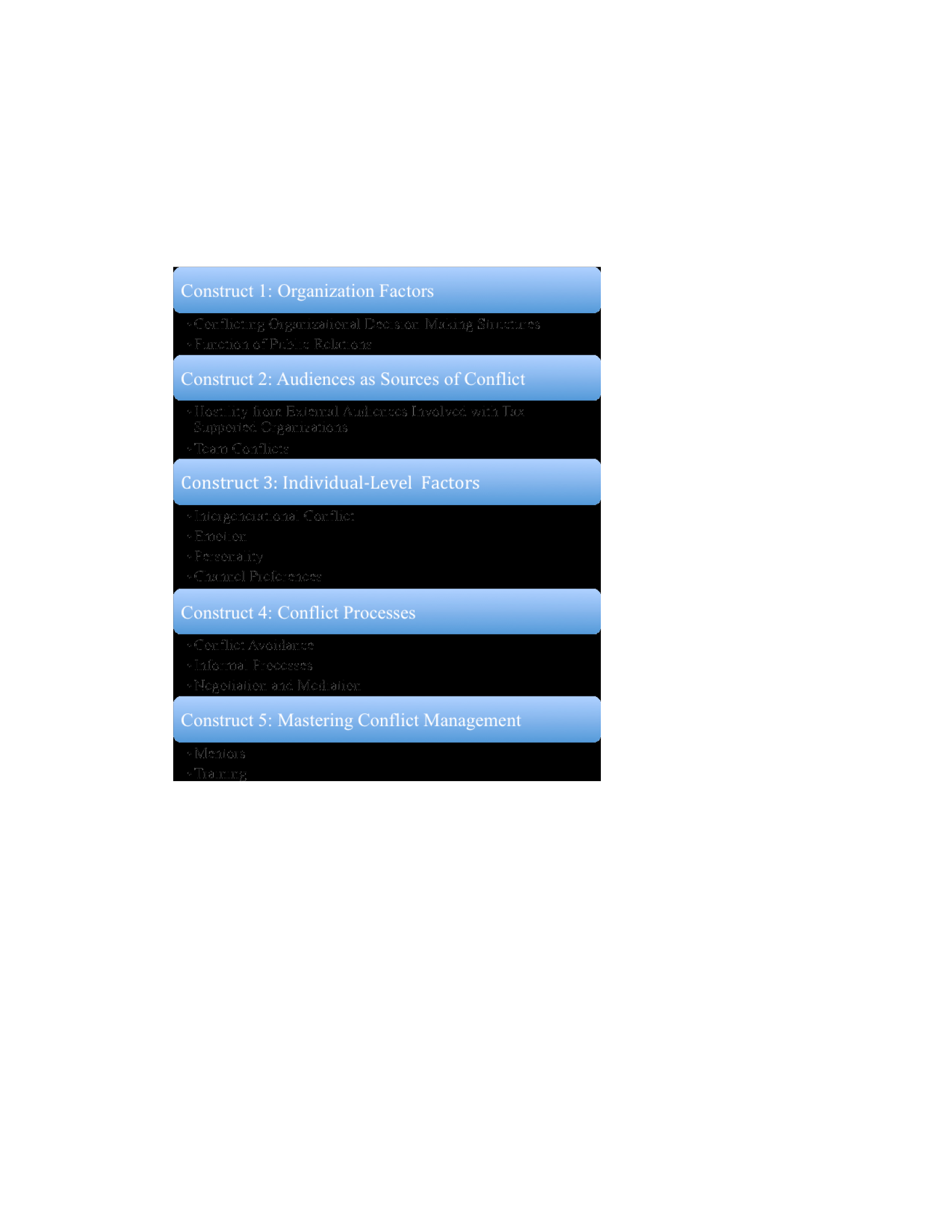
2014). Figure 4.5 displays five main constructs and the factors that emerged within
each construct.
Figure 4.1
Conflict Constructs in Public Relations Practice
Construct 1: Organization Factors
Findings did not reveal strong understandings of how organizational structures
contributed to conflict, but some critical incidents pinpointed organizational culture
and values as an element in reducing conflict. However, two factors connected to
decision-making and division of functions among departments were believed to
increase conflict in the workplace.
199

Factor 1.1 Conflicting organizational decision-making structure. One major
factor that emerged in conflict within organizations was the structure of
decisionmaking. Participants underscored conflict that developed when mixed
structures of decision-making were accepted in the organization. Conflict arose when
practitioners experienced strong hierarchical decision-making along with acceptance
of independent decision-making within departments or horizontal structures.
Factor 1.2 Conflicts over the function of public relations. Conflicts with the
creative team, the marketing department, and legal staff were reported. The major
inter-departmental conflicts involved control over the use of digital and social media
to disseminate information and to build relationships with important publics and
stakeholders both internally and externally. Digital media and social networking sites
(SNS) were viewed as a growth area in communication in organizations of all kinds.
Larger organizations had tried to reduce conflict by establishing highly specialized
departments for these functions. Practitioners in smaller organizations experienced
repeated encroachment on their communication functions when social media were
involved.
Construct 2: Audiences as Sources of Conflict
Participants’ descriptions of their jobs and their critical incidents resulted in
some paradoxical findings about audiences as sources of conflict. The main
audiences for all practitioners regardless of the type of organization were external.
However, practitioners’ perceived internal audiences as the main sources of conflict in
their workplace. In short, findings revealed a contrast between the participants’
ratings of the most important audience (i.e., clients or customers) and the audience
that produced the most conflict (e.g., internal audiences).
200

Results were complicated because a single audience was labeled as internal or
external depending on the situation. Shifting perceptions of the same individuals as
internal or external to the organization suggest fluid boundaries between within the
group and outside it.
Factor 2.1: Hostility from external audiences dealing with tax-supported
organization. A number of participants feared hostile messages directed at their
organizations from negative mass media or social media platforms. Government
entities and their clients or stakeholders were both sources of hostile attitudes for
practitioners. This notable finding applied to consultants providing services to
government agencies and to organizations involved in the spending of public monies.
Almost all participants who worked for tax-supported organizations faced notable
conflict with a variety of audiences.
Factor 2.2. Team and department conflicts dominate. Participants reported
more employee conflict than any other category. Team conflicts and conflicts among
employees surfaced frequently in reports of how work time was spent and in critical
incidents. Percentage of work time spent on dealing with internal audience conflicts
tended to pool either around low percentages or high percentages. Personnel disputes
and team disputes increased the percentage of time spent on conflict. Themes
included conflicts involving personnel who showed incompatibilities or personality
clashes with other employees, promotion and other HR disputes, and disputes
between immediate supervisors and employees over challenges to authority and
behaviors that were undermining goal achievement. The critical incidents involving
serious team conflicts did sometimes have positive outcomes, but generally the
participants reported serious disruptions in their lives including finding new jobs.
201

Construct 3: Individual-Level Factors
The factors in this construct show a range of individual characteristics or
responses that participants understood as affecting conflict situations. These factors
include age, emotional responses, personality characteristics, and preferences for
communication channels.
Factor 3.1 Intergenerational and ethnic conflicts. Participants pinpointed
differences in age and generational background as a major source of conflict among
employees in communication workplaces. Half the participants reported
intergenerational or ethnic factors in workplace disputes. Intergenerational conflicts
involved differences in communication styles, disputes over social media use, and the
sense that older employees dominated. Practitioners in government agencies
experienced intergenerational conflicts more prominently. People in global
communication noted incidents of ethnicity and cultural differences as sources of
conflict. Black practitioners reported facing prejudices while working in the
communication field.
Factor 3.2 Emotions. Emotions were prominent individual characteristics that
had a largely negative impact. A sizeable minority of participants reported emotion as
a factor in the conflicts they encountered. Only one person out of the 10 who
commented viewed emotions as adding positively to the management of conflict.
Factor 3.3 Personality characteristics. The term personality was used to
describe individual differences that had an impact on conflict. One notable aspect of
the personality factor was that it influenced the conflict management styles of
individuals in the critical incidents.
202

Factor 3.4. Preference for face-to-face and distrust of digital communication.
Many participants viewed face-to-face communication as the gold standard when
resolving conflicts with internal audiences. Few participants used digital
communication to negotiate or mediate serious disagreements. They endorsed
telephone and digital channels to resolve conflicts with distant parties, but with
reservations over digital communication. Some viewed email messages as too prone
to misinterpretations; a few endorsed email as promoting a less emotional exchange
of options to resolve conflicts.
Construct 4: Conflict Management Processes
Participants expressed their understandings of how they had experienced
conflict and how processes to manage conflicts had evolved to culminate in a
successful or unsuccessful resolution. RQ4 questions elicited general observations
and principles about how participants believed workplace conflicts could be
prevented or alleviated. Notably, only a few participants focused on the steps in
conflict resolution or offered systematic explanation of how processes could be
managed and changed.
Factor 4.1. Conflict avoidance. Avoidance of conflict was both embraced and
criticized as management strategy. This factor was mentioned often, but only a
handful of participants represented strongly expressed poles of opinion on conflict
avoidance. Participants who represented the avoidance pole wanted to suppress
conflict through hiring practices and socialization of team members. A corporate vice
president representing the outlier embrace-conflict pole criticized public relations
practitioners for the desire to be liked in a conflict-laden profession and pointed to
practitioners’ failures to use conflict to strategically produce better outcomes.
203

Factor 4.2. Informal processes and steps. The critical incidents question asked
participants to recount situations that had definite endings. With few exceptions these
narratives revealed the use of informal conflict management processes and
spontaneous steps in trying to manage the most prevalent kind of incident—conflict
among employees. The recommendations for managing conflict focused on informal
processes, such as setting up meetings between employees in conflict. Practitioners
implied they wanted to transform conflict situations so that some conflict resolution
could be achieved. A small number of participants recommended improving the steps
in the conflict resolution process.
Factor 4.3. Negotiation and mediation. Conflict organized around formal
negotiation and mediation was an outlier. Only individuals who worked in certain
types of organizations including labor unions and health insurance businesses were
involved in formal negotiation or mediation. Negotiations were described in four
incidents about salary or health care disputes. A mediation incident occurred over
faculty, student, and administrator differences involving changes in a university
symbol. Practitioners who reported these incidents had received little, if any, training
in negotiation or mediation, although one agency owner had been trained as mediator
volunteer by a local conflict resolution center.
Construct 5: Mastering Conflict Management and Resolution
Participants offered suggestions on how communication professionals could
manage conflict and achieve resolutions of workplace conflict. Specific strategies for
conflict management varied widely, and participants offered a variety of suggestions
to improve the process. Two specific factors were commonly mentioned: mentoring
and training.
204

Factor 5.1. Mentoring. Participants introduced mentoring as a factor that could
help practitioners develop skills in managing workplace conflict. Mentors included
family members as well as professional bosses and colleagues, and the benefits of
mentoring were controversial. Younger participants reported resentment of mentoring
undertaken by older employees. Some participants argued that bad examples were
more powerful than positive ones in showing how NOT to resolve conflicts.
Factor 5.2. Training. Training in conflict resolution was widely supported by
participants, but the preferred type of training varied from negotiation and mediation
to mentorship to personal development activities. One metaphor described training in
conflict resolution as “charm school.” In addition, training in staff management was
recommended for team dispute resolution.
The constructs emerging out of the findings require further analysis in the
Discussion section which compares these findings with existing research and explores
a model that proposes relationships among these factors.
Chapter 5: Discussion
Qualitative research informs our understanding of practices in communication and
should improve those practices (Merriam, 2009). These principles represent the two
broad aims of this study. In response to in-depth interview questions (Appendix A),
31 communication practitioners with an average of 18.32 years of experience in
regional, national, and global organizations explored their roles and their
understanding of how to manage conflict in their respective workplaces. Because
public relations research emphasizes segmentation of audience it is not surprising that
internal and external collaborators represent a main source of conflict. As research in
205

social sciences suggests (Deutsch, 2006), conflict processes clustered into constructs
or meta-themes.
After analyzing over 48 hours of interviews through the grounded theory
approach, 13 themes emerged to be distributed over five categories (meta-themes)
ranging from individual to team to organizational levels.
The organized meta-themes are:
Sources of Conflict: Organizational Level
Sources of Conflict: Audiences
Sources of Conflict: Individual Level
Conflict Processes
Mastering Conflict Management Skills
From the complex of factors within these five categories I propose a grounded
theory model (Corbin & Strauss, 2008) for applying transformation strategies
(Jameson et al., 2009) to manage conflict in public relations and communication
practice. Conflict management is most simply defined as “a social process to handle
and resolve disagreements (see Robey et al., 1989)” (Olaniran, 2010, p. 44).
Following Rahim (2011), conflict management within this model is defined as
applying strategies that moderate effects of interactions that reveal “incompatibility,
disagreement, or dissonance within or between social entities (i.e., individual, group,
organization, etc.)” (p. 207). This model is constructed from elements of practice
emphasized by my participants, including the types of audiences involved, whether
relationships are long or short-term, and whether the processes are formal or informal
(See Appendix F for a full-page version of the model).
Figure 5.1
206

Transformation Model of Conflict Management in Public Relations Practice
This model situates conflict within organizational structures or cultures and in
interactions between teams and within teams. In other words, the model deals with
the meso-level of the organization, the meso-level of between-team or intergroup
interactions, and the micro-level of within-team interchanges (Babbie, 2010; Lyon,
DeChurch, & Thompson, 2010). Shein (1990) defined culture as the norms, values,
beliefs, attitudes, and expectations operating in the organization.
The model does not include the macro-level of inter-organizational tensions
(Bennington, Shetler, & Shaw, 2003; Lewis, Isbell, & Koschmann, 2010; Ferguson,
1984) or the micro-level of individual-level factors that are typically covered in
howto guides produced by the Harvard Negotiation Project and mass-market
publishers
(Fisher et al., 2011; Lax & Sebenius, 2006; Stone, Patton, & Heen, 2010; Ury, 19963;
2007). Data on inter-organizational conflict did not reach a level of thematic
207

significance. The individual-level conflict themes were applicable to professionals in
many contexts and require further research to identify those specific to
communication practice.
Transforming conflict as relationship change. While my cohort of
practitioners did not specifically identify transforming conflict situations as a role in
their work lives, recent research in conflict transformation (Botes, 2003; Fisher &
Shapiro, 2005; Jameson et al., 2009; Jones, 2000; Martins et al., 2013) helped me find
a label for the more informal processes of conflict management that most of my
participants favored. While transformation research has focused on intragroup
conflict (de Wit et al., 2012), emotion in organizational conflicts (Jameson et al.,
2009), and large-scale social conflicts (Pluut & Curseu, 2013), the concept of conflict
transformation—defined as “inducing change in the parties’ relationship through
improving mutual understanding” (Botes, 2003, p. 4)—has applications in many
fields of practice. My model operates on the basic principle from conflict
transformation research that changing relationships among participants offers more
long-term benefits than simple conflict resolution and that it increases the potential
for changing structures that create the conflicts (Greer et al., 2011).
Further, the transformational model of conflict management in public relations
practice emphasizes the dichotomy between conflict within internal versus with
external audiences. The organizational and audience elements of the model are
explicated below.
Organizational structure and culture model overview. Participants’
understandings helped me establish links between the organizational structures in the
workplace and the roles they fill as communication practitioners in conflict
208

management. The importance of organizational-level factors in creating and
resolving conflict did not surface early in my data analysis. Several participants
subsequently introduced the impact of organizational-level factors; other participants
added the strategy of conflict avoidance (Choi, 2013) as a mitigating element of
conflict cultures where they worked (Shein, 1990).
Research in several disciplines confirms that conflict is a factor emerging
from organizational structures and from dominating, avoiding, and collaborative
cultures (Choi, 2013; Gallicano, 2013; Gelfand et al., 2008; Gelfand et al., 2012;
Grunig, 1992; Hofstede, 2010; Huang, 1997; Huang, 2001; Pruitt & Carnavale, 1999;
Rahim, 2011). Because this study explores roles in communication practice,
organizational structures in this model are defined as “the relationships among
people who assume the roles of the organization and to the organizational groups or
units to which they belong (e.g., departments, divisions”) (Hatch, 2012, p. 101).
Hatch (2012) listed seven common dimensions of organizational structure including
administration, levels of hierarchy and decision-making, coordination of activities,
standardization of activities, procedures, and specialization (p. 108). Choi (2013)
divided conflict management cultures along three dimensions used in the conflict
styles model by Pruitt and Carnavale (1999): dominating, avoiding, and
collaborating. Some participants used similar language in describing the conflict
cultures in their workplaces.
Further, researchers have also identified communication as a causal factor in
organizational tensions involving negotiation order (Bennington et al., 2003),
engaging audiences (Bruning, Dials, & Shirke, 2008), organizational success (Hargie
& Tourish, 2009a, 2009b) and media use (Olaniran, 2010; Purdy, Nye, &
209

Balakrishnan, 2000). Aula and Siira (2010) claimed that communication was the
bedrock of conflict management, but described how communication could both
bolster the meaning-making structures in organizations and break down these
structures to bring about change. These researchers labeled this the dual-function of
communication in conflict management. This model contributes to our understanding
by suggesting that communication practitioners fill a special role in transforming
organizational-level conflict rather than resolving, avoiding, or eliminating it.
Internal audience conflict sub-model. The transformation model of conflict
management in public relations practice follows my participants’ emphasis on team or
group conflict as prevalent in everyday practice. Their predominant goal was to
maintain long-term relations through informal conflict resolution processes, hiring
policies, and socialization practices that insure common understandings and values
among team members. In addition, they advocated training or mentoring programs to
increase team conflict resolution skills and self-awareness about personal
contributions to conflict.
The structure of this model is supported by the research described above on
the meso-level of conflict among teams and the micro-level of conflict within teams
(Lyon et al., 2010). The model emphasizes relationship building as a major role in
public relations practice (Briones et al., 2011; Bruning et al., 2008). In the bottom
tier, the model posits three conflict management strategies: transformation, hiring,
and training/mentoring.
Further explanation is needed about why I placed mediation as a factor with
external audiences, not internal audiences. Mediation models in the public relations
literature and its findings both influenced my choice. A number of participants
210

expressed dislike of internal mediation because they wanted to solve conflicts without
interference from uninvolved parties. It was my understanding that mediators could
weaken feelings of self-efficacy among those employees involved in the conflict.
Moreover, organizational models of mediation, especially in public relations, aim at
eliminating conflict—conflict resolution—not conflict management or
transformation. For example, Plowman (2007) reviewed three approaches to the role
of mediator in public relations: the public relations manager as peer mediator who
meets with parties in conflict to find possible solutions, as inside facilitator who helps
parties prevent formal conflict resolution, and as provider of information and insight
in conflict resolution efforts by virtue of his/her professional experience. The
outcomes that the mediators seek involve win-win or no deal, altruistic, and
principled concepts linked to the Harvard Negotiation Project (Fisher et al., 2011) and
dual-concerns conflict management styles (Pruitt & Carnavale, 1999). My
participants preferred informal processes with less defined outcomes in dealing with
internal conflicts.
External audience conflict sub-model. In contrast, conflict with external
audiences played a less prominent role in the model, often involving the more formal
processes of negotiation and mediation. This sub-model has only two tiers that
specify the role of communication professionals as transforming the environment
through formal negotiations and as mediating formally and informally with external
audiences to transform the conflict situation.
The negotiation tier of this model reflects the finding that few of my
participants were actively involved in negotiation to reach formal agreements such as
a labor or health insurance contract. Instead, a fair number of participants endeavored
211

more often to modify the environment around formal negotiations or disputes about
policies in tax-supported organizations. In other words, my participants sometimes
understood their roles as persuading and changing attitudes of publics who were not
immediately engaged in the dispute, but who were stakeholders able to impact the
outcome. These stakeholders were often journalists and other media professionals.
On the mediation tier, practitioners are engaged in mediating or moderating
conflict situations involving external audiences. According to Plowman (2007), we
usually think of mediators as disinterested or neutral third parties who offer support
to reach a solution in disputes. In the context of conflict transformation, mediation
has also been defined as “the degree of willingness to entertain change for the benefit
of others” (Shin, Jin, Cheng, & Cameron, 2003, p. 9). The literature on external
mediation in public relations is sparse. In a study summarized in the literature review,
Huang (2001) found that public relations conflict management strategies—
distributive, collaborative, and non-confrontational/avoidance—applied by
communication practitioners with members of the Taiwanese legislature had no direct
effect on the resolution of the conflict. Instead, relationship factors similar to those
used in conflict transformation (e.g., increasing trust, relational commitment, and face
gifts) did affect use of cooperative tactics. Consequently, my model uses conflict
transformation as a strategy in contexts requiring mediation with external audiences.
The remainder of the Discussion section examines the efficacy of this model and
its viability in communication research and practice. The examination (1)
summarizes the major findings; (2) compares this study’s results with the
theories, models, and findings of research surveyed in the literature review; (3)
212

discusses implications of my findings; (4) describes limitations; and then (5)
makes recommendations for future research and applications in practice.
Summary of Major Findings
The research questions of this study delved into conflict situations that the
31 practitioner participants had experienced with internal and external
audiences. The inquiry probed into their understanding of conflict processes and
examined their use of digital and social media in conflict situations. According to
Guest et al. (2012), qualitative data coding should result in meta-themes that
exist at a “higher level of abstraction and [are] not directly observed in the data”
(p. 255). These meta-themes should represent the complexity of the data and
their contradictions. The empirical narratives of my participants, reflecting their
professional understanding of conflict in communication practice, induced
thirteen themes grouped into five categories or meta-themes. These metathemes
formed five dimensions summarized in Figure 5.2 and described below.
Figure 5.2: Dimensions in the Constructs Derived from the Data
213

Sources of Conflict: Organizational Level
1. Conflict arises from mixed decision-making structures. That is,
organizations that require both hierarchical and independent decision-making
experience more conflict.
2. Without clear divisions of labor, serious disputes can arise over the function
of public relations/communication departments in access to new media.
214

Sources of Conflict: Audiences
3. Conflicts within teams are the most prevalent, followed by conflicts with
adjacent departments.
4. Practitioners in tax-supported organizations experience the most
conflict with external audiences.
Sources of Conflict: Individual Level
5. Disputes between generations (intergenerational conflict) represent a major
source of conflict, particularly in government agencies.
6. Emotions generally have a negative impact on workplace conflicts.
7. Personality can be a major causal factor in conflict, in part because it influences
conflict styles.
8. Personal preferences for mediating channels can affect outcomes of
conflicts, but face-to-face conversations are best in dealing with serious conflicts.
Conflict Processes
9. Avoidance can be an effective strategy for conflict management in public
relations/communication practice.
10. Informal processes of conflict management are preferable to formal
processes.
11. Negotiation and mediation skills are required in specialized types of
organizations (e.g., those that require labor contracts or in diplomatic missions), but
are not used in general communication practice.
215

Mastering Conflict Management Skills
12. To learn conflict management skills practitioners should have direct or
indirect access to mentors.
13. Formal conflict management training should inculcate a range of skills from
negotiation to personal development – including “charm school” or playing well
with others.
Robust Findings and Contradictions
Discrete findings within these themes and meta-themes prove to be robust
as well as problematic and even contradictory. The critical incidents and other
narratives revealed much less conflict with external audiences than with internal
audiences, even though participant work assignments dealt mainly with external
stakeholders. A contradiction arose, however, over whether to label some
audiences as external or internal. Depending on the context, participants viewed
stakeholders as “one of us” or “one of them.” In particular, communication
consultants applied flexible labeling because they worked so closely with people
outside their organizations. Public relations officers within universities, on the
other hand, frequently found themselves dealing with academic departments as
in some other workplace.
Another robust finding involved digital communication, especially social
media sites (SNSs). Professional recourse to digital communication, particularly
email and websites, was common. However, participants disputed its benefits
and drawbacks and seemed uncomfortable using digital platforms to resolve
conflicts. They overwhelmingly preferred face-to-face and/or telephone channels
216

in serious conflict situations. Moreover, role conflict arose over whether
communication, marketing, or design departments should manage social media
platforms.
Data about processes used in conflict situations also generated some salient
findings. Almost all participants plumbed the effects of positive and negative
emotions in workplace interactions. The majority regarded emotions as negative
influences in creating and prolonging conflict. Rather than examining specific
emotions, they posed this question: “Should emotions be suppressed or
encouraged in conflict situations?” A handful asked, “Can we train practitioners
how to manage emotions?” Answers to these questions showed no consensus. A
handful of participants viewed emotion as a positive factor that could exert a
favorable effect on conflict management.
The conflict management processes that participants recommended
largely involved prevention and avoidance—for example, hiring compatible
employees and using reward and punishment in staff supervision. Almost none of
the practitioners reported conflict resolution as a skill covered in their
performance evaluations. By far, the participants preferred informal resolution
processes such as information gathering, discovery conversations with the
antagonists, and decisions based on organizational goals. Only two participants
valued conflict as a boon to creativity and to the development of effective
strategic plans. One of these participants—clearly an outlier—criticized
communication professionals for preferring conflict avoidance because it helps
them achieve a personal goal of being liked.
217

Primary finding. This study’s main research question asked what role
public relations and communication practitioners should play in dealing with
conflict in their everyday work lives. The main finding was that practitioners
experienced most conflict within work teams and in relation to other
departments. These internal conflicts could prevent professionals from achieving
their goals of strategic communication with an external constituency. This main
finding is somewhat paradoxical. In their classification of six kinds of strategic
communication—defined as “the purposeful use of communication by an
organization to fulfill its mission” (p. 3)—Hallahan et al. (2007) isolated the role
of public relations practitioners as “establishing and building relationships with
key constituencies” (p. 4). These are mostly external audiences such as
customers, consumers, investors, donors, politicians, community leaders, and the
media. My participants, however, did not understand the preponderance of
conflict in their work lives to be with these external constituencies. Only a
smattering of participants in tax-supported organizations and the health
industry faced hostile audiences. Instead, their conflict partners were close co-
workers.
Given this primary finding, my model shifts away from formal conflict
resolution and direct engagement with external audiences during crises (Coombs,
2006) toward the transformation of conflict dynamics (Botes, 2003) in work
place relationships. Transformation of conflicts involves modifying emotional
responses, sharpening perceptions of the conflict situation, and deescalation of
relationship conflict (Pluut & Curseu, 2013).
218

Comparison of Findings with Existing Literature
According to Guest, MacQueen, and Namey (2012), “A common goal in
scientific inquiry is to compare two or more things and see how they are similar
and how they are different” (p. xv). This section examines convergences and
divergences between this study’s results and its theoretical model against those of
existing literature.
Negotiation as a role for public relations practitioners. Should negotiation
be a major function that public relations practitioners discharge for their
organizations? This study’s descriptive findings on negotiation in practice partly fills
a research gap on this function that was identified by Vasquez (1996). With the
exception of practitioners who worked in organizations where formal negotiations
were held with stakeholders (e.g., labor unions and employers), negotiation was not
described or understood as a major role among the communication practitioners in
this study. This does not devalue the models for negotiation in public relations
practice developed by Grunig and Repper (1992), Huang (2001), and Plowman
(2007). It simply means that the majority of practitioners may not be asked to fill the
negotiation role. It leaves open the question of what role practitioners should play in
dealing with conflict inside and outside their organizations.
Participants described various conflict management and resolution roles
and analyzed their processes. Communication practice itself involves significant
conflict. Vasquez’s (1996) distinction between formal and informal negotiation
applies somewhat to this study, but more recent research in cognitive and
emotional factors in conflict management (Balliet & Van Lange, 2013; Bell, 2007;
219

Jameson et al., 2009; Martins et al., 2013; Posthuma, 2012) emphasizes
transformation of the perceptions of the parties rather than overt agreement on
the issues in dispute. For example, after conducting an experimental study on how
task conflict influenced trust among group members, Chen and Ayoko (2012)
advised managers that they could increase trust by stimulating task conflict
among employees. According to affective events theory this strategy increases
levels of perceived trust by arousing the positive emotions of “enthusiasm and
excitement” (Chen & Ayoko, 2012, p. 19). This focus on transforming the affective
perceptions of people in conflict situations opens up a positive role for
practitioners that already emerges in the experience of communication
professionals as shown in some meta-themes from my interviews. That role is
reflected in the transformation model of conflict in public relations practice
proposed by this study.
Relationship building and maintenance as roles for practitioners in
conflict management. Many participants identified relationship building as a
strategy to reduce and avoid conflict. One public affairs officer used “building a
necklace” as a metaphor for the process of adding community people into her
network to resolve conflicts. This insight reflected Toth’s (2000) concept of
relationships as “reservoirs of credibility and trust” (p. 217) that can be drawn
upon when conflict arises. Gallicano (2013) expressed a similar concept in her
theory of insulation—or viewing relationships as an investment that insulates the
practitioner when disgruntled communication partners make heavy withdrawals
on the relationship (p. 383).
220

In general, participants’ understanding of relationship building and
maintenance paralleled conclusions found in communication theory, research,
and professional publications (Kent & Taylor, 2002; Leddington, 2006: Scott,
2007). Although the findings did not add to our knowledge of relationships, the
participants did show familiarity with relationship building and maintenance as a
major role for our profession. They confirmed the dialogic communication model
developed by Grunig and Hunt (1984) and extended to the Internet by Kent and
Taylor (1998). Many critical incidents and other narratives in these interviews
described building or failing to build relationships in conflict situations with
journalists, coworkers across generations, employees in marketing and design
departments, and other engaged parties.
Finally, these participants confirmed the need for dialogue in resolving
conflicts by showing strong preferences for the most immediate channels for contact:
face-to-face and telephone.
Organizational level sources of conflict. Only a few participants explored
organizational structures and climate as sources of conflict in their work
lives.
Research confirmed that social media have created highly-prized platforms
for conducting two-way communication with major stakeholders (Wright &
Hinson, 2008). A stream of literature in our discipline stretching back to the
1970s (Kotler & Mindak, 1978) predicted that the boundaries between public
relations and marketing would continue to blur and cause conflict (Grunig &
Grunig, 1998). This study’s finding that communication professionals were
221

contesting control of social media with their marketing colleagues implies that
disputes over new technology will continue.
Internal organization conflicts and their causal factors. Team
interactions are a common source of conflict in many organizations. Reports from
my participants confirmed that team and other in-house interactions were the
major source of conflict in the workplace for communication practitioners.
Participants in this study failed to express deeper understanding of how the
variables actually provoke disputes. For example, they did not describe task or
process conflicts that cropped up in their work lives (Martinez-Moreno, 2009).
Abundant research on team conflict—a major source of conflict that emerged in
this study—provides fairly detailed understanding of what variables create
conflict and what effect the conflict has on team outcomes (Behfar et al.,
2001; de Wit et al., 2012; Greer et al., 2002; Martins et al., 2013; Olaniran, 2010;
Pluut & Curseu, 2013). Apart from disputes over division of labor, the
manager/practitioners in this study explored very few types of disruption in getting
the job done.
Intergenerational conflict. This study substantiated in public relations
and communication practice the same intergenerational conflict that has been
documented by research in human resources (Gibson, Greenwood, Murphy, &
Riddle, 2009; Tolbize, 2008) and in nursing (Leiter, Price, & Spencer, 2010). Many
studies in intergenerational conflict review popular literature and stop with
defining generations and their characteristics (Tolbize, 2008). A notable
exception was a study by Murphy (2012) that depicted a strategy of reverse
222

mentoring that develops leadership skills in younger employees by allowing
them to mentor older employees. Nelsey and Brownie (2012) also recommended
mentoring across generations, as well as leadership training and team
development to foster productive working relationships among generations.
The meta-theme of intergenerational conflict raises several questions
that affect practitioners. Do generational conflicts in public relations have special
characteristics that make them different from other professions? What are the
variables that create these conflicts? Findings in this study isolated generational
differences in communication styles, perceptions of attempts to dominate, and
professional standards of conduct in using social media. One result of
intergenerational conflicts has been well documented in nursing where staff
retention has suffered (Nelsey & Brownie, 2012).
Based on this study’s findings, however, a research gap exists in our
understanding of intergenerational conflicts in communication practice and its
remedies.
Individual level sources of conflict. Participants identified several
individual level factors that contributed to conflicts in their workplaces. These
included positive or negative emotions, personality, and preferences for/against
communication channels. Existing literature in a variety of disciplines confirms
this study’s findings on the impact of emotional responses and personality
factors in workplace conflict. For example, Antonioni (1998) connected the big
five personality factors with conflict management styles. Judge and LePine (2007)
confirmed my participants’ recommendations for hiring policies that consider
223

personality as a way to reduce team conflicts. And more recently, Bradley et al.
(2013) examined how the personalities of teams themselves foreshadowed
conflicts over tasks and success in resolving those conflicts. Moreover,
research has supported my participants’ understanding of the
importance of emotions in intra-group conflicts. In an introduction to an issue of
the Journal of Conflict Management devoted to emotions, Posthuma (2012)
argued that the influences of positive and negative emotions on conflict
management were strong and complex. Chen and Ayoko (2012) lend support to
this study’s findings that emotional factors affected our perception of trust during
conflict. One understanding of many of my participants—that emotion was
primarily a negative influence in conflict situations—was not confirmed. Griffith
et al. (2014) found that managers who used several emotional regulation
strategies could moderate the negative effects of relationship conflict.
Findings on the impact of communication channel preference when
dealing with conflict may have opened a new line of inquiry. My participants’
preference for face-to-face interactions or telephone conversations is
substantiated in the literature (Ting-Toomey, 2005; van Es et al., 2004). However,
the benefits of email and other distant channels in conflict management have not
been widely studied (Geiger & Parlamis, 2014). Impact of digital channels
and social media on conflict. Findings confirmed the widespread use of
Twitter, Facebook, and other social media to build relationships with publics.
However, participants contested the benefits and drawbacks of using new media
in conflict management. These new media caused disputes with other
224

departments that wanted to take control of these channels from communication
staff. Also, my participants showed little knowledge of the research on using
digital platforms (e.g., email) and software to enhance the outcomes from
decision-making or negotiating agreements (Benyoucef & Verrons, 2007; Cheung
et al., 2004; Dorado et al., 2002; Gabuthy et al., 2008; Jensen, 2009).
Filling Research Gaps Identified in the Literature
One goal of this dissertation was to enrich our understanding of practices
against negotiation theories and models developed within public relations research.
This research focused on the roles of communication practitioners within
organizations, including the role of negotiator or mediator (Huang, 2001; Plowman,
2007 ) and the role of decision-maker during conflict situations (Cameron, Crop, &
Reber, 2001; Shin, Heath, & Lee, 2011). A very small number of participants in the
study filled formal negotiation roles in their organizations. This majority worked for
specialized organizations involved in labor contracts, health insurance, and higher
education. Their roles involved negotiating signed agreements or coming to verbal
agreements to remove or put aside the sources
of conflict.
The study did establish that communication and public relations
practitioners experience varying degrees of internal and external conflict that
can be attributed to their job duties in the organization. Although smaller in
number, conflicts with external audiences claimed much more time for conflict
management. But the professionals also experienced the same types of conflict as
other employees/managers experience who do not work in communication.
225

Implications of Findings
Theoretical implications. This study established its theoretical roots
within grounded theory (Corbin & Strauss, 2008), its predecessors in naturalistic
inquiry (Lincoln, 2010; Lincoln & Guba, 1985), and its post-modern incarnations
(Clark, 2005). While the study generated a conflict transformation role in public
relations practice, the complexity of the findings resulted more realistically in
what Lincoln and Guba (1985) called a pattern theory. A pattern theory “contains
an interconnected set of concepts and relationships, but does not require causal
statements” (Creswell, 2009, p. 64). Neuman (2010) maintained that the system
of ideas in pattern theory succeeds when it provides information and when
themes and concepts are interconnected. The patterns revealed within this study
included a bifurcation between internal and external audiences common to
public relations practice, as well as roles of relationship building and negotiation
that have been well developed in the literature.
Contradictions and outliers. Four themes captured significant outlying
understandings of conflict in public relations workplaces: (1) impact of
organizational structure and culture on conflict; (2) appreciation of conflict and
emotion as positive elements in practice; (3) the value of digital communication
in conflict management; and (4) the distrust of mentoring as a means of learning
conflict management skills. With the exception of confusion over who makes final
decisions, participants reported on conflict elements “close to home” in their
departments rather than in leadership and culture (Choi, 2013; Gelfand et al.,
2012; McMillan et al., 2012; Shin et al., 2011). In fact, almost no one mentioned
226

conflicts with top management, as opposed to supervisorsubordinate conflict
(McMillen et al., 2012).
Further, only a small minority of participants understood the positive value
of conflict in their work settings and appreciated how emotion could be used to
enhance relationships and outcomes even though research increasingly supports
this appreciation of dissonance (Chen & Ayoko, 2012; Griffith et al.,
2014; Tekleab & Quigley, 2014).
Outlying participants also appreciated the benefits of digital communication
in resolving conflict because email and other channels could provide much-needed
distance as well as a record of the parties’ responses. Almost no one saw the value
of communicating about conflict over social networking sites.
Finally, some participants expressed strong contradictory views of the
value of mentors in learning effective conflict management strategies. One person
highlighted the bad advice she had received from mentors; another pointed to
learning what NOT to do from mentors.
Implications for practice. The conflict transformation model of public
relations implies a more conscious role for practitioners in transforming conflict
situations for both internal and external audiences. The findings suggest that
communication practitioners are already engaged in managing conflict within
their teams and across departments. However, my participants reported the need
for training in conflict management strategies and had fairly superficial
interpretations of how to transform employee emotions and perceptions to
create real long-term change in team relationships.
227

Further, communication practitioners need to assess whether they have a
special role to play in transforming or detoxifying conflicts within their
organizations. The implication for practice revolves around this question: Do
public relations professionals have special communication skills that would make
them exceptionally valuable in transforming and detoxifying conflict situations in
their workplaces? Does their training in relationship building and maintenance
equip these professionals to deal more effectively than others with intragroup
conflict?
Certainly, my participants did not claim the role of conflict transformation
even when their critical incidents showed that they transformed disputes among
internal publics. As the findings showed, the participants attributed skillful
conflict management to individual-level factors like positive emotions,
personality, generational attributes, and preferences for communication
channels. They did not claim that training and experience in communication
practice made them especially adept at transforming or
resolving conflicts.
My results did not support the claim that communication practitioners
played a negotiation role in their organizations. Instead, practitioners might claim
a special function as conflict transformers or detoxifiers in their organizations
with increased understanding of that role and given adequate training or
mentoring.
Limitations
I acknowledge the basic limitations of my qualitative research method:
228

difficulties in developing a theory that could embrace contradictions and
inconsistencies in the data; problems in achieving reliability and validity
(described below); and obstacles in applying research usefully to communication
practice. The analytical challenge in qualitative research, as described by Miles et
al. (2014) is “to find coherent descriptions and explanations that still include all
the gaps, inconsistencies, and contradictions inherent in personal and social life”
(p. 10). Personally, I felt daunted by the sheer weight of data—668 single-spaced
pages of transcripts plus written and web material—and faced risks in trying to
force logical and reasonable interpretation on data that are random and
contradictory.
Sampling. In addition, the study had sampling limitations. Although
participants came from a variety of states including Florida, Utah, California, and
New York, the majority worked in the mid-Atlantic region where the federal
government is a major employer. This may explain the prominence of conflict in
tax-supported organizations. Further, I did not limit the participants to
professionals with the job titles of public relations practitioners. As I explained in
Method, job titles vary widely in the public relations profession, but the results
would have been different if I had eliminated some kinds of communication
practitioners.
Measurement. Some of the results of this study seem generic to many kinds
of managerial positions. It was difficult to distinguish during analysis whether the
participants answered as communication professionals or as employees who also
had managerial and other responsibilities. In hindsight, a crucial question had been
229

omitted: How do conflicts in your communication job differ from the conflict
experienced by other people in the organization or your clients’ organizations? This
question would have helped me understand whether communication practitioners
can take on a specialized role in conflict
management.
Self-reported data. A sizeable mass of data in this study came from
narratives of critical incidents. This kind of self-report raises questions of selective
memory, discrimination among several related incidents, attribution of positive
outcomes to the teller’s actions, and exaggeration of some events
(Butterfield et al., 2005, 2009; Chell, 2004; Flanagan, 1954; Schluter et al., 2007).
While acknowledging that such incidents cannot be fact-checked and that
distortions can affect the validity of my results, these narratives added
immeasurably to the richness of the data and allowed the participants to explore
emotions and other personal understandings that would have been lost otherwise.
Internal (reliability) and external validity. The Method section of this
study explained why validity is a contested term in qualitative research and
described the strategies I used to increase external and internal validity. Miles et al.
(2014) and Saldaña (2013) defined internal validity—or truth value—as evidence
that the findings of the study made sense, were credible to the people I studied, and
gave an authentic portrait of conflict within communication and public relations
practice. Internal and external validity bear upon the goal of this study—to
contribute to understanding of practice and improvement of
professional work-life.
230

Authenticity and truth value are evident in the candor and depth of
participants’ responses. I was surprised by the willingness of practitioners to
speak with me at length—sometimes over two hours—and their generosity in
describing the trials and emotions they experienced during the workplace
incidents. Furthermore, the protocol questions and themes took unpredictable
directions. Participants led me to the importance of teams, mentors, and personal
skills in communication practice. I verified the credibility of the interview data by
fact-checking details against website and printed information. After the
interviews were finished, I asked participants to clarify their statements in
response to questions sent by email. I also checked and rechecked the transcripts
when I had questions about whether I had accurately represented the data and
duly recorded contradictions and outliers.
Reliability (internal validity) is defined in qualitative research as evidence
that “the process of the study is consistent, reasonably stable over time” so that
audiences get a sense of “quality and integrity” (Miles et al., 2014, p. 312). I tried
to increase reliability by constant comparison of data across escalating levels of
abstraction: words, themes, factors, and then the five categories/meta-themes. I
returned again and again to the practitioners’ transcripts to check exact words
and phrases. I reviewed the lists of themes that evolved over time to insure that I
consistently captured the understandings of participants during data reduction.
In the journal notes kept during interviewing and at each analytic stage, I noted
inconsistencies in how I understood the data, as well as contradictory opinions
and singular insights offered by the participants. Even in the final analysis of the
231

13 strongest themes that emerged from the data, I returned to the fringe of Postit
notes on transcript pages, sending me to the original contexts in which I first
caught sight of these understandings. The struggle for consistency, quality, and
integrity continued as I continually tweaked the meta-themes and the
transformational model in light of the evidence.
Standards for achieving external validity in qualitative research require the
researcher to establish (1) the larger importance of the study’s results; (2) the
potential transferability of the findings to other contexts and individuals; and (3)
its utility or application in the field—in this case, the work settings of public
relations practitioners (Glaser, 2004). This is essentially a test of fit with accepted
professional values (Miles et al., 2014). First, I tried to bolster validity by reducing
my personal bias in generating the factors and model (see Method section). The
strategies I used included keeping a reflective journal, bracketing my biases in
observational notes and memos, keeping an audit trail during data analysis, and
engaging in systematic and formal memo writing during all stages of research,
including the writing of this dissertation.
External validity can also weaken when evidence is inadequate or not
connected sufficiently to experience, when categorization and assumptions are
implausible, and inconsistencies abound. The Results section recorded substantial
evidence that was verified through quotations. The critical incidents allowed
participants to explore their experiences more fully. Stage two analysis supported
the plausibility of my categories and assumptions through examination of existing
research and also through a PowerPoint presentation of the results to three
232

colleagues in advanced academic programs at Johns Hopkins University. I also
used member-checking to assure validity by informally chatting at various times
with eight participants to get their responses to some basic findings. This practice
required me to become actively involved in local and regional meetings of the
Public Relations Society of America (PRSA).
Future Directions for Research
Because this grounded theory study was largely exploratory, two broad
areas of future research will help to clarify the components of the model I propose.
1. Investigate the role of conflict transformation in public relations and
communication practice. Future research will need to investigate the role that
public relations practitioners can claim in transforming internal conflict. The
transformation model of conflict management in public relations is defined as
structural in grounded theory (Miles et al., 2014). This implies that it has not
reached the level of formal theory and requires much more investigation to prove
its worth.
Consequently, a number of factors in this model and my research themes
require further research. The tendency toward conflict avoidance among
practitioners is one intriguing area. The specialized skill set that communication
practitioners bring to conflict management is another. Also, quantitative methods
(e.g., distributing a survey) could be used to measure the time communication
practitioners devote to conflict resolution and their assessments of its
importance in the profession.
2. Develop a model of conflict management specifically applicable to
digital communication channels. Because this study and the existing literature
233

document the increasing use of digital and social media in the communication
profession, much more research is needed in how to manage communication on
these platforms. Although my participants overwhelmingly preferred face-toface
interactions for serious conflict resolution, these professionals will have to
manage more and more conflict with audiences—external and internal—with
whom in-person meetings are highly improbable. Very few communication
research studies have investigated how practitioners should handle conflict on
social networking sites, although some work has been done on adoption of social
media (Curtis et al., 2010) as well as building and maintaining relationships
(Briones et al., 2011). Researchers in other disciplines, however, have been
robustly exploring digital negotiation and conflict resolution (Benyoucef &
Verrons, 2007; Dorado et al., 2002; Taylor & Thomas, 2008).
Future Directions for Practice.
Michael Roloff (2009) wrote movingly on the profound difficulty of
applying conflict management research to practice. I too perceived real
limitations in using the findings of this study to help practitioners. The majority of
research studies cited in this document used experimental or quasiexperimental
research. While I believe this interview study has expanded our knowledge of
actual public relations practice, its findings still seem separated from practice.
This study demonstrated that research lags behind practice especially in
applicability of social media.
The future directions for practice should increase communication
professionals’ understanding of sources of conflict in their work lives; help them
234

define their special organizational roles, if any, in dealing with conflict; provide
training in conflict transformation and management; and promote recognition of
how public relations practitioners manage conflict during organizational change.
1. Increase awareness of transforming conflict especially at the team or
department level as a realistic role of communication practitioners. Practitioners
would benefit from learning about the theoretical frameworks of conflict
transformation (Botes, 2003; Greet et al., 2008; Pluut & Crusue, 2013) and the
related construct of detoxification (Gallicano, 2013).
2. Enable practitioners to appreciate and use conflict positively in improving
outcomes in public relations and communication practice. For better or worse,
practitioners in this study revealed preferences for conflict avoidance through
hiring procedures, socialization, and staff management. Sensitizing
communication professionals to the causes and benefits of workplace conflict
could enable them to use their strategic communication skills in managing
intragroup problems. Webinars and workshops in conflict management could be
offered online and at professional gatherings such as the PRSA International
Conference.
3. Train practitioners in steps involved in the conflict management process
and provide opportunities for practicing and reflecting on effective conflict
resolution. Very few practitioners in this study could describe steps in effective
conflict resolution. Although they showed familiarity with some strategies from
the Harvard Negotiation Project (Fisher et al., 2011), they lacked, for example,
understanding of the four basic phases in the communication negotiation model
235

devised by Madrigal et al. (2009). Organizations and degree programs could
consider offering training in these and other conflict management strategies.
4. Participants often deplored the absence from job descriptions and
performance evaluations of their contributions in mediating and resolving
conflicts. Research in human resource and personnel policies could help create
awareness of the conflict transformation role that public relations professionals fill
and encourage rewards for it.
Conclusion
So, what?
What’s new?
What do we know now that we didn’t know before?
This conclusion answers these essential questions about my dissertation
research. My study proposed to fill a research gap in our perception of how
practitioners understand their roles and activities in conflict resolution and
management. Its impetus included several models of negotiation in public relations
that developed over several decades (Dozier, Grunig, & Grunig, 1995; Huang, 1997,
2001; Plowman, 1995, 2005). This study’s results only partly confirmed a formal or
informal role of negotiator for a small number of practitioners in specific types of
organizations such as health and unionized industries. These models continue to have
applicability, but in restricted areas of practice.
By collecting data in the field rather than through experiments or surveys, and
by covering a range of practitioners in various stages of their careers excluding
beginners, new insights emerged into conflict management in everyday
communication practice. Participants understood conflict as any serious disturbance
236

in relationships and goal achievement that went beyond routine problem solving or
widely studied crisis communication roles with external audiences (Coombs, 2006;
Heide & Simonsson, 2014; Liu, Austin, & Jin, 2011).
Results of this study challenged the normative power and C-suite strategic
decision-making roles that scholars have claimed for public relations and
communication practitioners (Berger & Reber, 2006). Even though my participants
had ample opportunity to explore conflict with top management over their blocked
career advancement, including failure to be seated at the decision-making table, these
practitioners did not demean direct practice as a job function. They did not express
the tension between being locked in the “iron cage of practice” as “an order taker”
(Berger and Reber, 2006, p. 218) and wanting to move into the powerful leadership
role of “strategic advisor” (p. 13) where they might even negotiate on behalf of the
organization (Dozier, Grunig, & Grunig, 1995; Sison, 2010).
Instead, my participants, who mostly occupied mid-level jobs across a
spectrum of organizations, portrayed themselves as firmly rooted in communication
practice, not in advancement to top-level management. Three real work-world roles
emerged: direct practice, management, and training/mentoring. All participants
reported engaging in direct practice no matter how senior their positions. They also
embraced training and mentoring as legitimate functions that could be recognized and
practiced even in early career stages. The major managerial role did produce
significant conflict in the work lives of participants, especially within teams and with
closely linked departments. The value of decision-making power or influence
surfaced thematically for less than a handful of participants and seemed linked with
237

conflict primarily as a factor in getting the work done effectively rather than
enhancing status.
This leads me to the contribution of the transformation model of conflict in
public relations practice that synthesized my data. The model suggests this normative
conclusion: that practitioners must be prepared to manage significant short- and
longterm internal conflict in their daily work, and that this responsibility may require
transforming the conflict so that people can work together more effectively over time,
rather than resolving conflict as a short-term fix. As stated earlier, only practitioners
in specific types of organizations required high-level negotiation and conflict
resolution skills. Another way would conceptualize these different organization types
as distinct cultures that require different skills (L’Etang, 2012). To sum up this
insight, all practitioners will have a high likelihood of dealing with internal audience
conflict, while only a small minority will be called upon to resolve conflict through
formal agreements. Subsequent studies could benefit from analyzing practice within
organizational types or distinct cultures. In addition, these studies should not assume
that internal audiences can be easily identified; labels of internal and external can
shift depending on the conflict situation.
Readers may find much to question in the transformation model. Nevertheless,
I was fully committed to exploration, and allowed participants to take the lead even
though some descriptive results turned out to be too broad or shallow for theoretical
application. The model emerged inductively and could be faulted for appearing
unduly hierarchical or rigidly separated into factors relating to internal or external
audiences. However, my participants perceived sharply divisive conflict within their
work environment, even though scholars in crisis communication may argue that
238

conflict with external audiences can generate internal conflict (Coombs, 2006). While
such factors or dimensions as audience segmentation, relationship building over the
long- and short-term, and strategic management roles are embedded in our
understanding of communication practice, these variables have been recontextualized
in my practitioners’ understanding of their daily work. I believe my results add depth
to our debate over putative roles for public relations/communication practitioners as
conflict resolvers and strategic leaders—roles that some argue can enhance the status
of our profession (Berger & Reber, 2006; Gupta, 2011; Heide & Simonsson, 2014;
Swerling & Thorson, 2014; Steyn, 2007). Status may be enhanced through
practitioners documenting existing skills that add value to the organization and then
marketing those competencies.
Finally, this study helped me to uncover insights about communication
practice and conflict that I hope can guide me and other researchers in future studies.
First, I question why I and perhaps other researchers assume that public
relations/communication practitioners are more competent in or prepared for conflict
resolution—and even internal conflict management—than other managers or
professionals. My assumption seemed built on a belief that training in audience
analysis, message construction, and persuasive techniques would prepare
communication professionals for dealing with conflict across a variety of situations;
that assumption should be challenged. This study showed significant differences
across types of organizations in their need for conflict management and/or resolution
skills. The factor of organization type or culture could be a useful addition to our
research. Most importantly, conflict transformation (Botes, 2003; Greer et al., 2008;
Jameson et al., 2009; Pluut & Curseu, 2013) is a concept that could be added to the
239

arsenal of strategies and tactics we practice. A research stream on transformation is
developing outside our discipline, but its conceptual framework identifies emotions
and other individual-level variables that my participants understood as highly
important in dealing with conflict in their everyday communication work.
240

