


1
Unemployment Problem in South Africa
Name
Institution
Date

2
Unemployment Problem in South Africa
Introduction
In order to achieve a sustainable economic growth policy, it is important to establish
stable and low unemployment rates. High unemployment rates have a detrimental effects on
economic and social welfare of a nation and its people (Makaringe & Khobai, 2018). High
unemployment cause erosion to human capital resources, social exclusion and social unrest
(increased protests and crime rates). These immediate effects of unemployment lead to
widespread income inequality and poverty. According to a report done by Bloomberg the
unemployment in South Africa has surged to become the highest globally (34.4%) in 2021
(Naidoo, 2021). After gaining independence in 1994, South Africa had to address economic gap
that existed due to apartheid rule. The incoming leadership had to content with and address the
apartheid economic and social injustices which caused high unemployment, income inequality
and high levels of poverty among the majority black population. Still, almost three decades later,
South Africa’s unemployment rates remain extremely high. Indeed, the unemployment rate
averaged 20% in 1994. The purpose of this report is to analyze the high unemployment rate in
South Africa and determine its influence the country’s economic growth.

3
(Source: Naidoo, 2021)
Relationship between Unemployment and South Africa Economy
When employment rate which is growing at a rate higher than economic growth is
essential for promoting unemployment rate reduction and economic development. Every
economy must focus on creating employment opportunities to support economic growth.
However, low economic growth conditions have made it difficult for most countries to create
adequate employment opportunities. High unemployment rate in South Africa exposes the
countries weak economic structures. As a result, the high unemployment rate can closely be
related to the country’s GDP, inflation and interest rates.
Unemployment and GDP Growth
Typically, high unemployment rates are termed undesirable globally. Although
economists and academicians belief that natural unemployment level is inevitable, escalated

4
levels can pose significant costs to the nations. For instance, unemployment represent dead loss
because unemployed people create no economic gain for themselves or a country. When
individual cannot find job opportunities, they have no source of income which subsequently
affect their living standards negatively. Therefore, unemployment robs a nation its resourceful
talents because prolonged unemployment erode people’s skills. To a greater extend, due to
unemployment, people start being skeptic and question the value of education; hence, lose the
desire to invest in education with the goal of getting employment. When people lose faith with
the education system and employment they revert to civil violence and crime to earn their daily
bread. Lack of formal paying job force more people to engage in illegal activities and crime to
address their economic needs.
On a macro level, the government consider unemployment as an unnecessary menace
because it increase government spending through unemployment transfers and supporting social
amenities. As a result, unemployment affects a country’s economic growth through lost tax
revenue when they do not participate in economic activities. South Africa has enjoyed
considerate economic growth since attaining independence in 1994. According to Mahadea &
Kaseeram (2018), economic expansion saw the creation of more employment opportunities
which saw over 3.5 million people getting employed each year over the last two decades.
However, increasing population growth ensure that more people enter job market at a rate higher
than job creation rates. As a result, the unemployment rates keep soaring up from 20% in 1994 to
34.4% in 2021. As Mahadea & Kaseeram (2018) notes, the youth constitute a significant
proportion of the unemployed (53%).
A noted by Meyer (2017), economic growth can be traced to increased entrepreneurship
in an economy. Rapid entrepreneurial activities result in creation of employment opportunities

5
and increased income among citizens. The increased employment opportunities arise due to
increased aggregate demand and supply of products and services. Since independence, South
Africa has averaged an economic growth of 3.6% to 5% between 1994 and 2015. The economy
has grown consistently over the years while the GDP per capita has also increased considerably.
However, the unemployment rate has lagged behind economic growth over similar periods.
Naidoo (2021) notes that the South African economy is the most industrialize in Africa but the
education system undermine employment due to lack of adequate supply of skilled human
capital resources. As a result, the country can benefit massively from increased entrepreneurship
by aligning skill development with the employment market needs.

6
(Source: Meyer, 2017)
Unemployment and Inflation
A.W. Philip brought forward the correlation between unemployment and inflation in
1958. After plotting wage inflation against unemployment, Philip realized that a negative
relationship existed between these variables. Meyer (2017) notes that countries could manipulate
the trade-off relationship between the two variables to stimulate employment opportunities. The
unemployment rate has been growing steadily over the years from 20% in 1994 to 26% in 2016
(Vermeulen, 2017). However, due to Covid-19, unemployment rose to unprecedented levels of
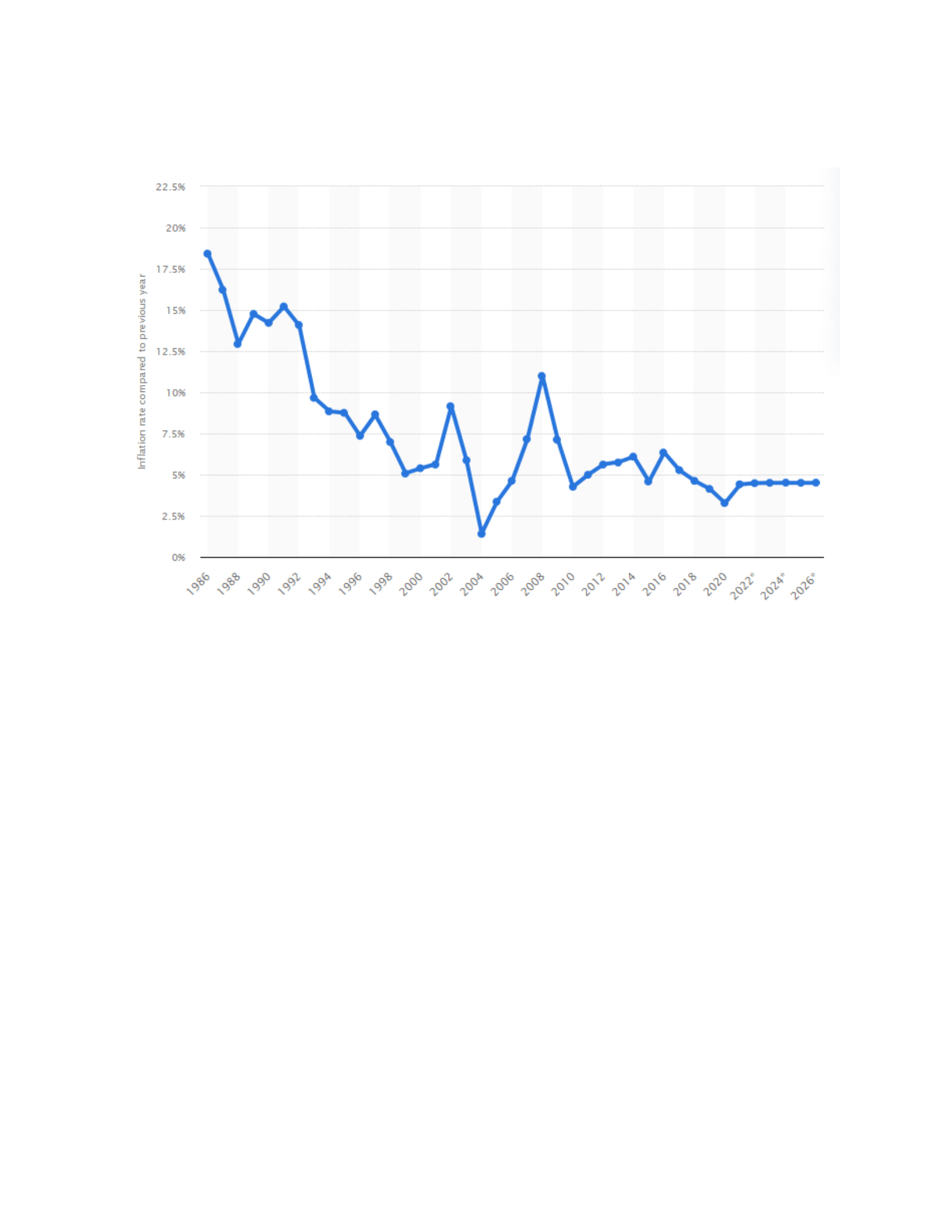
34.4% in 2021. At the same time, the inflation rate has dropped significantly from 15.3% in 1991
to maintain a single figure rate to-date. The inflation rate stood at 4.4% in 2021. However, in
2008 the inflation rate in South Africa increased to 11.5% due to the global financial crisis. The
country enjoys a mixed economy with majority of GDP generated through the service sector,
particularly tourism.
Inflation is a crucial element in influencing the country’s economic strengths. It refers to
the price increase for a predetermined basket of product mainly containing commonly consumed
goods and services. For instance, the basket may include clothes, utilities, groceries, rent, raw
materials or recreational products. The price of some of these products and services are more
volatile than others. Low and stable inflation rates witnessed in South Africa are universally
associated with a conducive macro-environment. As a result, it promotes direct foreign
investment, create opportunities for productive investment and ensure sustainable economic
growth. However, the anomalies of the Covid-19 which continue to affect the service sector
reliant economy of South Africa has continued to keep inflation low and unemployment high.
7
(Source: Stastica, 2021).
Creating and retaining job opportunities is crucial for establishing an economy focused
on income sustainability and wealth mobilization. Increasing rates of unemployment create
socio-economic problems. As noted by Naidoo (2021), the South Africa economy shrank by 7%
in 2020 as the government tightened measures to mitigate third wave Covid-19 infections. The
increased unemployment exerted pressure on the government and other authorities to increase
social support services and relief measures. Social protests and riots were witnessed in KwaZulu-
Natal and Gauteng which are leading economic hubs of the country. Thousands of businesses
were closed while others were looted. About 354 people also lost their live in the unrest that cost
the country about $3.3 billion and 150, 000 job opportunities (Naidoo, 2021).

8
Generally, South Africa has experienced slow economic growth rates which has
contributed to slow employment intake. With an employment creation rate lower than the labor
market growth rate, unemployment has continued to grow and create increased widespread
poverty, social exclusion, inequality and crime.
Unemployment and Interest Rates
According to Meyer, Chipeta & Mc Camel (2018), a negative relationship exists between
economic growth and interest rates in a country. When a country’s central bank maintain low
interest rates, people are motivated to borrow more and invest. Such actions spur economic
growth in the country and create more employment opportunities to citizens, however, when
interest rates increase, less people are willing to borrow either to invest or spend. As a result, the
aggregate demand and supply decreases leading to a slowdown in economic growth. As a result,
employment opportunities stagnate or decrease despite more people entering the job market. As
Meyer, Chipeta & Mc Camel (2018) notes, South Africa experience high interest rates, high
inflation and low economic growth. According to Tradingeconomics, (2022) the interest rate has
dropped significantly from 22% in 1998 to about 3.5 in 2022. The rate has maintained above
6.5% in the past decades until the South African Reserve Bank reduced it to 3.5% (2020) as a
measures to spur economic growth and reduce unemployment. However, the interest rate was
reviewed upwards in in November 2021 (3.75%) and January 2022 (4.0%) to keep inflation
expectations moderate (Tradingeconomics, 2022)

9
(Source: Tradingeconomics, 2022).
Conclusion
Most developing countries experience limited creation of employment opportunities due
to low economic growth. As a result, increased unemployment rates result in unacceptable
income inequality levels and widespread poverty. South Africa has experienced growing
unemployment rate which reached global high in 2021 at 34.4%. The country has a challenging
transition after gaining independence as leaders attempted to address the socio-economic
disparities arising from apartheid rule. However, in order to increase employment rates, an
economy has to create employment opportunities at a higher rate than the labor market growth
rate. Although the country embarked in increasing and promoting entrepreneurship opportunities,
the economic growth rate has lagged behind the labor market growth rate which has ensured
unemployment level keep rising. The county is yet to experience tangible impact on
unemployment from the recent efforts in 2021 to reduce discount rate and spur economic growth.

10
References
Mahadea, D., & Kaseeram, I. (2018). Impact of unemployment and income on entrepreneurship
in post-apartheid South Africa: 1994–2015.IThe Southern African Journal of
Entrepreneurship and Small Business Management,I10(1), 1-9.
Makaringe, S. C., & Khobai, H. (2018). The effect of unemployment on economic growth in
South Africa (1994-2016).
Meyer, D. F. (2017). An analysis of the short and long-run effects of economic growth on
employment in South Africa.IInternational Journal of Economics and Finance
Studies,I9(1), 177-193.
Meyer, D. F., Chipeta, C., & Mc Camel, R. T. (2018). An Analysis of the Effectiveness of
Interest Rates to Facilitate Price Stability and Economic Growth in South Africa.IStudia
Universitatis Babes-Bolyai Oeconomica,I63(3), 68-90.
Naidoo, P. (2021). South Africa Unemployment Rate Rises to Highest in the World. Retrieved
13 February 2022, from https://www.bloomberg.com/news/articles/2021-08-24/south-
african-unemployment-rate-rises-to-highest-in-the-world#:~:text=South%20Africa's
%20unemployment%20rate%20surged,released%20in%20the%20capital%2C
%20Pretoria.
Stastica. (2021). Inflation rate: South Africa | Statista. Retrieved 20 February 2022, from
https://www.statista.com/statistics/370515/inflation-rate-in-south-africa/
Tradingeconomics. (2022). South Africa Interest Rate - 2022 Data - 1998-2021 Historical - 2023
Forecast. Retrieved 20 February 2022, from

11
https://tradingeconomics.com/south-africa/interest-rate#:~:text=South%20Africa
%20Holds%20Key%20Interest%20Rate%20at%203.5%25&text=Headline%20CPI
%20forecast%20has%20been%20revised%20slightly%20higher%20to
%204.4,2022%20and%204.5%25%20in%202023.
Vermeulen, J. C. (2017). Inflation and unemployment in South Africa: Is the Phillips curve still
dead?.ISouthern African Business Review,I21(1), 20-54.

