


Bioenergetic microbe
Biocyidation and energy transfer
Energy originating from light must be converted into chemical energy before
being used in the enatgonic reaction. In cells, chemical energy is found in the
form of high-energy organic groups. This group contains S or P.Adenosin
trifosphate (ATP) one of the most important high-energy groups. If both of the
phosphate groups are hydrolyzed, each produces 12000 cal / phosphate, while
the third phosphate only produces 1500 kal. The energy freed ATP depends on
the state of hydrolysis, especially pH and reactant levels. Although ATP contains
2 high-energy phosphates, in reaction generally only one high-energy phosphate
is used for activation.
1. Nicotinamid adenin dinucleotid (NAD); NAD functions to accept
hydrogen from reduced substrate
2. Flavin Adenin Mononucleotide (FMN) and Flavin Adenin Dyubleotides
(Fad). This compound accepts hydrogen from NADH2 or directly from the
substrate.
3. Cytochrome (CYT A, B, C)
Every cytochrome has EO 'different, but everything is
contains Haem as a prostetic group with Fe as an aseptor
electrons. Oxygen reacts with electrons into O- ions
And with Ion H + forming H2O.
The following picture shows the oxidation substrate reaction through the system
Electron Transport, with EO's value 'each carrier and reaction place
ATP formation. The relationship between changes in free energy with
changes in the difference in potential energy that occur if electron passes
The system is as follows:
FO = -NFAEO
FO = changes in free energy (kal / mol) in standard circumstances
n = number of electrons passing
EO = potential difference (volts)
F = Farady constant (23,063 cal / volt equivalent)
For biological systems, n usually 2 and fo replaced f 'because it's not on
Standard conditions, so:
F '= -46.126 x AEO'
If the potential difference is a system before and after oxidation is known,
from the above equation can be calculated the amount of energy that is released
during
oxidation. For example if the electron passes NADH2 to O2, AEO '= 1.14 volts,
then
Af '= -52,000 kal. Theoretical reaction produces 4 high-energy phosphates.
If this reaction is studied with mitochondria isolated from mammals,
Khamir and mushrooms, it turns out that the oxidation only produces 3 ATP
from
Every oxygen atom is used. Not all microbes have enzymes
Complete electron transport. Lactobacillus and Clostridium do not have
cytochrome even though they have enzymes with nucleotide and groups of
nucleotides
Prostetic flavo protein. Lactobacillus has a flavoprotein-oxidase
can use O2 as the last electron aseptor; but with it
O2, H2O2 formed is not H2O. Some species of streptococcus, acetobacter,
and Kramir has a peroxidase enzyme (catalase) that has merehee
Reduced substrate (for example CYT C reduced, or reduced nad) with
The existence of peroxidase and Ion H. The results of the reaction of the
oxidized substrate and water. Anaerobic and facultative anaerobes are grown by
Anaerob has another way of rexidating a reduced hydrogen carrier.
This is often done by offset the oxidation reaction of the substrate with
Other reduction reactions, thus accumulating reduced final results. For example
Lactobacillus in glycolysis reducing pyruvate acid into lactic acid
(See picture). Some clostridium anaerobic fecterming glucose,
Referred to reduced hydrogen carriards with aseto-acetate reduction
(As a Koensim A complex) becomes buty and butanol acid. Yeast
Reducing acetaldehyde into alcohol. The formation of ATP in the
phosphorylation reaction to ADP in principle there are three levels, namely: (1)
phosphorylation at the substrate level (fermentative), (2) phosphorylation of
electron transport levels (oxidative in respiration), and (3) Photosynthetic
phosphorylation.
Fermentation
Emden-Meyerhof-Parnas (EMP) line
This reaction is called glycolysis, solving sugar anaerobally to acid
pyruvate carried out by most bodies from high levels to level
low. Glycolysis reactions occur in cytoplasms and do not use
Oxygen as an electron aseptor, but another substance. Pyruvate acid
has an important position because it is the center point of

Various solving and formation reactions. Facultative microbes
Anaerob, for example Saccharomyces cerevisiae fermented sugar
Anaerob becomes alcohol and CO2. Lactobacillus spp. Homerfulative
Remodel the sugar anaerobally becomes lactic acid. Obged microbes
Anaerobs like Clostridium spp. break sugar into acetone, butanol,
butirat. Aerob microbes do the glycolysis process as the first part of
Carbohydrate breakdown in anaerobally, which will be forwarded in the lactic
acid burden, because glycolysis is not forwarded to the aerobic level
But to lactic acid. Microbes that fermentate through glycolysis
Only produces 2 moles ATP of each glucose that is metabolized.
Entner-Doudoroff (ED) lane
This reaction was carried out by several microbes including pseudomonas
SPP. which can form alcohol from sugar through this path. On each
Solving 1 mol glucose is also produced as also 1 ATP, 1 NADH2 and 1 NADPH2.
At P. Lindneri 2 Pyruvate acid is broken down into 2 ethanol and 2 CO2; was
On other pseudomonas 2 pyruvate acid is converted into 1 ethanol, 1 acid
Lactate and 1 CO2.
Hexosa Mono Phosphate (HMP)
Besides through the EMP a lot of bodies that can overhaul the sugar via HMP.
This reaction is useful for forming pentose sugar and others, for
Biosynthesis needs. The reaction took place through sugar C5, 5-phosphate
ribulose,
which is a precursor of ribose sugar, deoxiribose, nucleic acid component,
Aromatic amino acids, enensim, ATP, NAD, FAD and so on. No HMP
Directly produce energy, but especially forming NADPH2.
Heterofermentative path of lactic acid bacteria
Lactic acid bacteria group besides producing lactate acid
Homofought (for example Lactobacillus spp.), also heterofermentative
(For example Leuconostoc SPP., Streptococcus spp., etc.). On fermentation
heterofermentative besides lactic acid, acetic acid, ethanol and
Co2.
Anaerobic acid metabolic pathways
A lot of anaerobic body that has different enzymes
Used in Piruvate acid reshuffle. Clostridium depends on the species,
Can change pyruvate acid into buther acid, acetic acid, acetone, butanol,
ethanol, CO2, and H2. Enteric bacteria such as Escherichia coli and aerobacter
aerogenes can change pyruvate acid into succinic acid, acetate, lactate,
ethanol, CO2, and H2 (or format). Aerobacter aerogenes also produce
2,3-butilen-glycol. Salmonella sp. have the same metabolic pattern
with Escherichia coli, but more produce acid format, from
On H2 and CO2 as in Escherichia coli.
Respiration
Respiration is a biological oxidation process with O2 as an aseptor
The last electron. On eukaryotic body this process occurs inside
mitochondria, while in prokaryotic bodies occur under the plasma membrane
or at the mesosomes. This process is the second phase of aerobs from the
reshuffle
The first phase sugar is anaerobic (glycolysis). At respiration generated a lot
energy that can be used for biosynthetic processes.
Krebs Cycle (TCA Cycle)
This reaction besides important for energy formation is also important for
biosynthesis, because it can provide a carbon framework for various
compounds
important in cells. In most bacteria, glutamic acid is amino acids
The key formed from sources of ammonia and carbon. Many of the bacteria
Can react with ammonia with fumaric acid forming aspartate. With
This amino acid transamination serves as an amino donor to acid
alpha-ketos like pyruvate acid, oxalate, alpha-keto-isovaleraters to form
Amino acid. Another important point is succinil-scoa that reacts with
Pirol acid, form a pyrol ring. Krebs cycles are often called cycles
Tribakboxylic acid (TCA cycle), or citric acid cycle. In the krebs cycle one
pyruistic acid molecule is perfect oxidized
Being CO2 and H2O produce 15 ATP. One glucose molecule
metabolized through glycolysis and the Krebs cycle perfectly becomes CO2
and H2O produces 38 ATP (see calculation).
Certain bacteria and fungi can use the C2 carbon substrate. The body
It has complete enensism of the Krebs cycle with additional enzymes
IsociTrase that can break down isocites into succinic and gliocsilat, and
Syntetase ensim which causes condensation of glioxylic acid with ACE-COA into
a malat. With both cycles this cell can form alpha-
Ketoglutarat needed for biosynthesis. And if malic acid experiences
Dekarboksilation becomes a phospho-enol-pyruvate, with the reaction behind
glycolysis and
HMP can be formed hexose and pentose.
Photosynthesis
Phosphorylation in photosynthesis uses light as an energy source.
This process uses chlorophyll pigments to absorb light energy and change it into
chemical energy. Based on the spectrum absorption
Differentiated chlorophyll A, B, C, D, E, and bacterial chlorophyll. Besides that
there is a pigment
Additionally to capture energy and protect chlorophyll, such as carotinoids,
Biliprotein, fikoeritrin, and fikobilin. Energy photon light:
E h h C
h = constants plank = 6.555 x 10⁻²³
V = light frequency
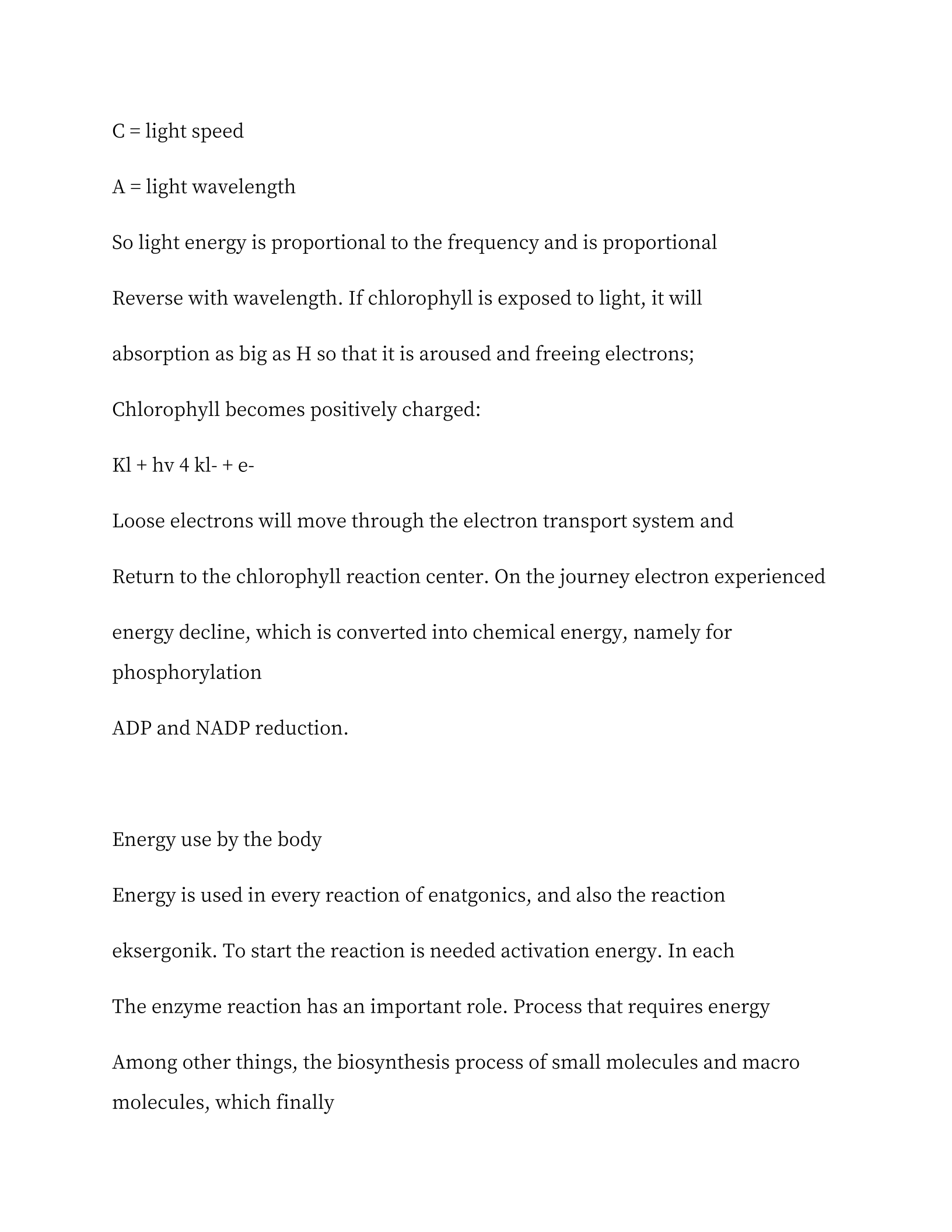
C = light speed
A = light wavelength
So light energy is proportional to the frequency and is proportional
Reverse with wavelength. If chlorophyll is exposed to light, it will
absorption as big as H so that it is aroused and freeing electrons;
Chlorophyll becomes positively charged:
Kl + hv 4 kl- + e-
Loose electrons will move through the electron transport system and
Return to the chlorophyll reaction center. On the journey electron experienced
energy decline, which is converted into chemical energy, namely for
phosphorylation
ADP and NADP reduction.
Energy use by the body
Energy is used in every reaction of enatgonics, and also the reaction
eksergonik. To start the reaction is needed activation energy. In each
The enzyme reaction has an important role. Process that requires energy
Among other things, the biosynthesis process of small molecules and macro
molecules, which finally
heading to growth and breeding; absorption of food elements, motion,
and so on.
Macromolecular catabolism
a. Carbohydrate solving
Carbohydrates are polysaccharides namely a polymer of Sedehana Sugar
(Glucose, galactose, fructose, etc.). Distinguished polysaccharide breaking
enzymes
become exhidrollase that decides regular sugar attractions from the tip,
And endohydrollase that decides to random sugar attract in the middle.
For example, for example Alfa-amylase (exOhidrolse) declares the reality
glucose from a two-two amilum starts from the end of the non reduction, while
betaamilage
Disconnect glucose reserves in any place in the middle. Both enzymes
This disconnects the alpha-1.4-glycoside bond from the amilum. Enzymes that
break the chain
Glucose branches from Amilo-pectin, a branched amilum component, is it
glucoamilase which breaks the alpha-1.6-glycosoda.
breakfast. Fat solution
Fat is ester from glycerol and fatty acids (triglycerides). Fat
sometimes it contains other substances such as phosphate, protein,
carbohydrates as
Substitute for one of the fat acids. Lipase enzymes break down fat into glycerol
and fatty acids. Glycerol was overhauled further through Glycolysis (EMP).
Fatty acid experiences betaoxidation into acetic acid, as ace-coa
Endabolized Lebioh further through the Krebs cycle.
C.. Protein breakdown
Protein is a polypeptide with a certain structure, a heteropolymer
from amino acids. Protease (poly-peptidase, oligo-peptidase, peptidase)
Remodel protein into a simpler peptide or amino acid.
Furthermore, amino acids experience transamination, deaminated,
decarboxylation,
or dehydrogenation into other simpler substances that are next
Can be metabolized, among others through the Krebs cycle.
d. Nucleic acid decomposition
Nucleic acid (DNA and RNA) are heteropolymers of nucleotides.
Nuclease enzyme, nucleotidase, phosphoryal nucleoside, and nucleoside
hydrolylase
will break nucleic acid into oligo, in, or mono nucleotides; and
then it becomes a ribose or deer-ribose sugar, phosphoric acid, purine base and
Pirimidin base.

