


INTRODUCTION SUMMARIES RAPID TECHNOLOGICAL
Rapid technological change is occurring in all areas of business and industry; as
Thamhain (2005) observed, “The magnitude and speed of technological advances over
the past decades are stunning, reshaping our world and influencing virtually every aspect
of life...as technology crosses virtually all levels and all disciplines of an enterprise” (p.
xi). Technological progress is credited with generating approximately half of the
economic growth seen in the U.S. in the last 50 years (U.S. National Science and
Technology Council, Office of Technology Policy [NSTC], 1996, p. 1). Participants in a
U.S. National Science Foundation-sponsored workshop, Management of Technology: The
Drivers of Technological Changes in the Twenty First Century, recognized the necessity
of technology management education ensuing from the occurrence of rapid technological
change (Khalil & Yanez, 2006). The relentless changing of the technological arena has
resulted in a pressing need for qualified employees who have technical, scientific, and
professional skills, with employment growth projections of 28.4% and 1.9 million new
jobs in these areas expected by 2014 (U.S. Department of Labor, Bureau of Labor
Statistics, 2005).
Technology is the foundational basis of economic growth and competitiveness in
all industrialized nations (U.S. National Science and Technology Council, 1996), and
“technological change and globalization have increased the demand for higher-level
skills” (Council for Adult and Experiential Learning, 2008, p. 18). Higher education is
considered an essential component of state economic development initiatives in preparing
a workforce for the “New Economy,” which is now based on successful application of
technology in all areas (Burke, 2003). Even in 1987, Herink et al. noted that management

of the technologies used in business and industry was necessary for continued economic
development. This situation is still true today, with growth projections of 60.5% in
management, scientific, and technical consulting services being driven “by the increased
use of new technology and computer software and the growing complexity of business”
(U.S. Department of Labor, Bureau of Labor Statistics, 2005, para. 3).
The economy in the United States is driven by an educated workforce (National
Commission on Adult Literacy, 2008). “The need for a useful and usable education has
been a theme in American public policy at least since the launching of the land grant
universities with the Morrill Act of 1862” (Kirp, 2003, p. 3). Career-focused educational
programs that prepare graduates for productive positions in the workforce make up more
than 60% of the baccalaureate degrees awarded (U.S. Department of Education, National
Center for Education Statistics, 2005). Coordinators of educational programs in
technology management seek to develop the necessary competencies required of program
graduates by employers (Klingenberg & Lauria, 2007; Nambisan & Wilemon, 2004).
The hiring of employees with baccalaureate degrees is projected to increase, with almost
60% of companies expecting to increase hiring of these graduates (Casner-Lotto, &
Barrington, 2006, p. 11). Enrollment in undergraduate and graduate programs is also
anticipated to continue to increase during the next 10 years (U.S. Department of
Education, National Center for Education Statistics, 2007). The fastest-growing area in
higher education has been at the community college level (American Council on
Education, 2004), where many students are considered nontraditional adult learners
(Council for Adult and Experiential Learning, 2008). Because the fastest-growing
occupations will require some post-secondary education, scores of adult learners are
returning to the classroom to update their skills and increase their opportunities for

gainful employment (Council for Adult and Experiential Learning, 2008). Graduates of
technically focused associate degree programs may continue their education at the
baccalaureate degree level and gain competencies sought by employers by pursuing
educational programs in technology management. Most 72% (or 13) undergraduate
technology management programs accept transfer credit from community colleges
(Becker, 2007).
Widespread agreement exists on the need for technology management education
(Badawy, 2004; Khalil & Yanez, 2006; van Wyk, 2004). Nambisan and Wilemon (2002)
stressed that:
university graduates who can operate effectively across the boundaries of
engineering, science and business often have career opportunities superior to
those not adept at extending themselves beyond their primary professional or
technical domain. Indeed, new skills and knowledge in technology management
are called for as companies and markets require managers to perceive and
understand how the various technologies can provide the productive/competitive
capabilities to the businesses (p. 108).
Researchers debate the formation dates of the technology management discipline
(Chanaron & Jolly, 1999; Daim, Jetter, Kocaoglu, Maglio, & Demirkan, 2007; Fortino,
2006; Klingenberg & Lauria, 2007), yet strong evidence of high growth in the
establishment of technology management programs during the 1990s and into the 21st
century has been put forth by Kocaoglu, Sarihan, Sudrajat, and Hernandez (2003).
Undergraduate technology management programs did not come into existence until after 1987, though
some undergraduate courses were taught in the discipline prior to this date (Herink, et al., 1987).

Professor van Wyk (2004) stressed that a “compelling need for technologically
informed management” (p. 5) exists resulting “from a significant gap in traditional
management theory” (p. 5). Badawy (1998) concurred and identified these five
contributing factors:
1. the necessity of understanding the complex problems of managing technology
2. the critical need for a broad vision of technology as an integral link in corporate
strategy
3. managing technological innovation as a top-management responsibility
4. the context and core competence of technology-based organizations
5. the unique characteristics of the technical professional (p. 99).
The majority of the research on technology management education focuses on
graduate-level studies (Badawy, 1998; Nambisan & Wilemon, 2002; van Wyk, 2004;
Yanez, 2006; Yanez & Khalil, 2007). Nambisan and Wilemon (2003) noted that there has
been an almost exclusive focus on technology management programs at the graduate
level and went on to state ”given the increasing demand for technology professionals in
all areas of the society...we will need to start examining how technology management
education can be incorporated at the undergraduate level too” (p. 962). Research at this
level is becoming increasingly important as undergraduate technology management
programs continue to be established to meet the needs of society and now make up more
than 20% of all programs offered in this field (Becker, 2007, Kocaoglu, Sarihan,
Sudrajat, & Hernandez, 2003).
Several of these researchers (i.e., Alvear, Rueda, Hernandez, Kocaoglu, 2006;
Khalil & Yanez, 2006; van Wyk, 2004; Yanez, 2006) are attempting to define a body of
knowledge for the technology management discipline. Much of this research has

examined existing programs (Kocaoglu, Sarihan, Sudrajat, & Hernandez, 2003,
Nambisan & Wilemon) and has been conducted under the auspices of professional
associations in the technology management field, such as the International Association of
Management of Technology (IAMOT; Yanez, 2006) and the Portland International
Center for Engineering and Technology Management (PICMET; Kocaoglu et al., 2003).
Various approaches to curriculum development of technology management programs
have been employed (Badawy, 1998; Klingenberg & Rothberg, 2006; Nambisan &
Wilemon, 2002; van Wyk, 2004). Courses in these technology management programs
could be grouped into four areas: (a) technology management, (b) corporate functionality,
(c) technology specific, and (d) foundational. The core curriculum (technology
management courses) included course titles such as change management, fundamentals of
technology management, project management, and innovation management (Badawy,
1998; Becker, 2007; Hauck, 1999; Herink et al., 1987; Klingenberg & Rothberg, 2006;
Nambisan & Wilemon, 2002; van Wyk, 2004; and Yanez, 2006).
The inclusion of the needs of industry when designing the curriculum for
technology management programs is of the utmost importance (Nambisan & Wilemon,
2004). Programs in technology management are career-focused, and graduates of
technology management programs should have competencies in areas that are deemed
important by employers. This researcher found no studies that specifically focused on
determining the needs of employers in the development of curricular programs in
technology management; however, Yanez’s study (2006) did focus on management of
technology stakeholders who were members of IAMOT, including some industry
members. As Nambisan and Wilemon (2004) emphasized, there is a critical need for
increased involvement of industry in the curriculum development of technology

management programs to help the discipline continue to grow and have greater relevance.
Very little information is available about the undergraduate aspect of technology
management education, yet more than 20% of engineering management and technology
management programs are offered at the undergraduate level (Becker, 2007; Kocaoglu et
al., 2003). Moreover, Fortino (2006) suggested that the number of academic technology
management programs at this level will continue to accelerate. Therefore, the need for
accurate information about core curricular elements of undergraduate technology
management programs is critical for program development and improvement.
Statement of the Problem
Employment positions requiring technology management skills are projected to
continue to grow through 2014 (U.S. Department of Labor, Bureau of Labor Statistics,
2005); moreover, the number of new programs in technology management is also
expected to increase during this time period (Fortino, 2006). Efforts to determine an
identified body of knowledge for technology management programs continues (Alvear et
al., 2006; Khalil & Yanez, 2006; van Wyk, 2004) and are of critical importance to the
discipline (Yanez & Khalil, 2007); in addition, a cohesive, well-defined curriculum is
necessary to sustain growth in the field. This need is especially important at the
undergraduate level, where more than 20% of technology management programs are
offered, and a significant lack of research on core curricular elements is evident.
Purpose of the Study
The primary purpose of this study was to determine the core curricular elements
of effective undergraduate technology management academic programs. Specifically, the
following four research questions were addressed:

Research Question 1: What is the relative perceived importance of each of the
eight core-competency areas (management of technological change, management
of organizational change, project management, assessment and evaluation of
technology, quality management of technology, information and knowledge
management, innovation and product development, and strategic management of
technology) in technology management?
Research Question 2: What is the relative perceived level of importance of each
item within each of the eight core competency technology management scales?
Research Question 3: Do any differences exist between industry sectors (business
services, education, government, and manufacturing) and their representatives’
perceptions of the relative importance of the eight core competency areas?
Research Question 4: Do any differences exist between industry sectors and their
representatives’ perceptions of the items within each of the core competency
areas?
Significance of the Study
The establishment of a recognized core curriculum is critical for the technology
management profession at both the undergraduate and graduate levels. Undergraduate
technology management education has largely been ignored by researchers, and the
results of this study highlighted the relative importance of undergraduate education in
technology management within the profession.
In addition, hopefully, baccalaureate technology management degree holders will
be better positioned for employment in well-paying jobs within business and industry if
their degree is seen as relevant by prospective employers. The results of this study

demonstrate that inclusion of technology management-specific core competencies in
undergraduate technology management programs is essential.
Research Methodology
A survey research method was used to solicit responses from the sample
population regarding core curricular competencies that should be included in
undergraduate technology management programs. The use of surveys in curriculum
development and design has been supported by many researchers, including Diamond
(1998); Ehie (2002); Grier, (2005); Kung, Yang, & Zhang (2006); and Shin (1999). Rea
and Parker (1997) stated that “survey research has derived considerable credibility from
its widespread acceptance and use in academic institutions” (pp. 1-2), and Trochim
(2001) concurred, affirming that “survey research is one of the most important areas of
measurement in applied social research” (p. 107).
Research Design
The following five-phase process was used in this research study: (a)
identification of the sample population, (b) selection of the software, (c) development of
the survey instrument, (d) data gathering, and (e) data analysis. This exploratory
descriptive study used a quantitative mixed-mode (Internet-based and paper-based
survey) design. The survey was administered to 228 adult human subjects with expertise
in technology management. Specifically, 40 employees in each of the following three
industry sectors were asked to participate in this research study: (a) business services (b)
education, and (c) manufacturing, as well as 60 employees from the government sector.
Additionally, 18 executive board members of the Michigan Economic Development
Corporation (MEDC) and 30 members of the Southern Wayne County Regional Chamber

of Commerce (SWCCC) were invited to participate. A quantitative analysis of the survey
results was completed. The use of a mixed-mode survey provided an additional
opportunity for participants to complete the survey if they were reluctant or unwilling to
respond to a Web-based survey or if they were unable to respond because of technical
difficulties (Dillman, 2007).
A technology management curriculum inventory (TMCI) was developed based on
the technology management literature and a review of textbooks used in the technology
management discipline. The TMCI provided the basis for the survey instrument
development and included the following eight areas: (a) strategic management of
technology, (b) management of innovation and product development, (c) management of
technological change, (d) management of organizational change, (e) technology project
management, (f) assessment and evaluation of technology, (g) quality management of
technology, and (h) information and knowledge management. A five-point Likert scale
(strongly agree, somewhat agree, neither agree nor disagree, somewhat disagree, and
strongly disagree) was used to measure the perceived level of importance respondents
had regarding the inclusion of items within the eight areas in an undergraduate
technology management program.
An email invitation was sent to survey participants three days before the
distribution of the electronic survey. An Internet link included in the letter permitted
participants to access the survey, which was developed using Survey Monkey software. A
follow-up reminder was sent to survey participants who still had not responded to the
survey within one week of receiving the survey, and a second reminder was distributed
one week later. In addition to the surveys sent by email, participants from the government
sector and members of the SWCCC received a paper-based survey; follow-up reminders

were not sent to these participants. Participants from all four industry sectors (i.e.,
business services, education, government, and manufacturing) responded to the survey, as
well as members of the MEDC and the SWCCC. There was an overall response rate of
55.7% (or 127 responses).
Data collected from the paper-based surveys were inputted into Survey Monkey,
and then all data were exported into Microsoft Excel and then imported into Statistical
Package for the Social Sciences (SPSS) for analysis. Descriptive statistics, including
ranges, averages, and measures of central tendencies, were used to analyze data.
Cronbach’s alpha was used to determine the reliability of the survey instrument, and
statistical significance was determined using a one sample t test on the mean of each
item. An analysis of variance procedure was used to determine if perceptions of
technology management competencies varied by industry sector.
Delimitations of the Study
This study was delimited by its sole focus on undergraduate technology
management education programs. In addition, the study was delimited by its attention to
undergraduate technology management programs located in the United States versus
international technology management undergraduate programs.
Definition of Relevant Terms
The following terms are operationally defined for specific use in this study:
Academic program: The combination of courses required to complete a degree or
certificate program in a college or university; this term is also synonymous with
the word major.
Core competencies: “The knowledge, skills, abilities and behaviors that contribute to an
employee’s job success” (Casner-Lotto & Barrington, 2006, p. 15).

Core curriculum: Required, discipline-specific courses included in a major or specialized
program of study.
Curriculum: The subject matter or content included in an undergraduate technology
management program or major.
Discipline: “A set of generalizations that explain the relationships among a body of facts
and concepts” (Parkay & Hass, 2000, p. 218-219).
Engineering management: A program that focuses on the application of engineering
principles to the planning and operational management of industrial and
manufacturing operations and prepares individuals to plan and manage such
operations. Includes instruction in accounting, engineering economy, financial
management, industrial and human resources management, industrial psychology,
management information systems, mathematical modeling and optimization,
quality control, operations research, safety and health issues, and environmental
programs (CIP code 15.1501: Engineering/Industrial Management, U.S.
Department of Education, 2002).
Instructional programs: A combination of courses and experiences designed to
accomplish a predetermined objective or set of allied objectives such as
preparation for advanced study, qualification for an occupation or range of
occupations, or simply the increase of knowledge and understanding (U.S.
Department of Education, 2002, p. I-4).
Major: An academic field of study consisting of the courses necessary to complete a
degree or certificate program in a college or university; this term is synonymous
with “academic program”.

Program: “Any activity or collection of activities of the institution that consumes
resources (dollars, people, space, equipment, and time)” (Dickeson, 1999, p. 45);
a term frequently referred to as a “major” at the undergraduate level (Ornstein &
Hunkins, 2004).
Technology management: “A field of study and a practice concerned with exploring and
understanding technology as a corporate resource that determines both the
strategic and operational capabilities of the firm in designing and developing
products and services for maximum customer satisfaction, corporate productivity,
profitability, and competitiveness (Badawy, 1998, p. 105).
Undergraduate program: The combination of courses, including general education
requirements and discipline-specific requirements, necessary to complete a
baccalaureate degree program at a college or university.
Organization of the Dissertation
This dissertation will be organized into the remaining four chapters: (a)
technology management education literature review, (b) methodology, (c) presentation
and analysis of data, and (d) summary, conclusions, inferences, and recommendations for
further research and action. Chapter 2 will be a review of relevant literature on
technology management education, including an overview of the discipline. In the third
chapter, a description of the research methodology used in the study will be presented
along with information about mixed-method research and the survey development
process. The fourth chapter will present and analyze data collected in the study, and in the
fifth chapter, the summary, conclusions, inferences, and recommendations for further
research and action will be provided.

CHAPTER 2: TECHNOLOGY MANAGEMENT EDUCATION LITERATURE
REVIEW
The relevance and need for technology management education have been well
established in the past 20 years (Herink et al., 1987; Khalil & Yanez, 2006; van Wyk
2004). Technology management education is continuing to evolve and coalesce, and an
identified body of knowledge is emerging at the graduate level (van Wyk, 2004; Yanez,
2006). Yet definitions of technology management still vary (Bellamy, Becker, & Kuwik,
2003; van Wyk, 2004), and a nebulous line of distinction often exists between the
disciplines of technology management and engineering management in the minds of
some researchers (Alvear, Rueda, Hernandez, & Kocaoglu, 2006; Daim, Jetter, Kocaoglu,
Maglio, & Demirkan, 2007). Several professional associations related to the field of
technology management have been established in the past two decades (i.e.,
Engineering and Technology Management Education Research Council, International
Association of Management of Technology, Portland International Center for
Management of Engineering and Technology, and the Technology Management
Education Association). Specialized accrediting bodies such as the Association to
Advance Collegiate Schools of Business-International (AACSB International) and the
National Association of Industrial Technology (NAIT) are granting professional
accreditation to qualified technology management programs, and IAMOT is in the
process of becoming an accrediting body for the discipline (IAMOT, 2007). An
abundance of professional journals and publications focusing on the field of technology
management exists, including the International Journal of Technology Management,
Research in Technology Management, and the International Journal of Technology and

Innovation Management Education.
More than 20% (Becker, 2007) of the technology management educational
programs in the United States are offered at the undergraduate level, and Kocaoglu,
Sarihan, Sudrajat, & Hernandez (2003) also found that more than 20% of engineering-
and technology management (ETM) programs are offered at this level. Nambisan and
Wilemon (2003), however, found that only about 9% of world-wide institutions who
responded to their 2003 survey (53 responses from 170 surveys) offered an undergraduate
technology management program, while 49% of these institutions offered undergraduate
courses in technology management. There is, however, a dearth of research focused on
undergraduate technology management education. The following six topics will be
discussed in this chapter: (a) societal influences on curriculum, (b) problems in defining
technology management, (c) overview of technology management education, (d)
differentiation between engineering management programs and technology management
programs, (e) the function of professional associations, accrediting agencies, and journals
in technology management education, and (f) the current status of undergraduate
technology management programs.
Societal Influences on Curriculum
Education is a driving force in the U.S. economy (National Commission on Adult
Literacy, 2008). As Ratcliff (1997) noted, “Social conditions exert significant influence
on the purpose, organization, and structure of the curriculum....[A]n important emerging
social goal for undergraduate education is the transfer of technological knowledge and
skill in an effort to further economic development” (p. 17). This goal has assumed an
even greater level of importance as half (15 of 30) of the fastest-growing occupations
require at least a bachelor’s degree (U.S. Department of Labor, Bureau of Labor
Statistics, 2007). “U.S. society is concerned about the development of human capital and

how its investment in students’ education will pay off in terms of productive employment,
economic growth, and international competitiveness” (Stark & Lattuca, 1997, p. 357).
Technology management programs should be responsive to the needs of businesses and
industries, and curriculum in these programs should be designed to meet these needs
(Nambisan & Wilemon, 2004). As Dickeson (1999) underscored, programmatic
curriculum in higher education is directly tied to societal influences, and the content of
academic programs should be responsive to these societal pressures. The
curriculum offered by institutions of higher education is in a state of change, with new
academic programs being added in a variety of areas, many of which are a result of
technological innovations (U.S. Department of Education, 2002). Increasing complexity,
technological change, and the degree of information generated have led to the
development of sub-disciplines and specializations within academic fields (Gaff &
Ratcliff, 1997). This movement toward increased specialization of the higher education
curriculum was evidenced by the addition of approximately 750 new academic programs
in the 2000 Classification of Instructional Programs (CIP) compiled by the National
Center for Education Statistics (U.S. Department of Education, National Center for
Education Statistics, 2002). In fact, 37 new programs with “management” in their titles
were added to the CIP in 2000. Revisions to the CIP are infrequent, with revisions
occurring in 1985, 1990, and 2000 (U.S. Department of Education, National Center for
Education Statistics, 2002). Efforts are currently underway to revise the CIP in 2010
(Coon, June 13, 2008, personal communication). Although a taxonomic code for
technology management programs was not included in the 2000 CIP Taxonomy, a
proposal for inclusion has been made by both Becker (2007) and the President of
IAMOT (Khalil, August 11, 2007, personal communication).

The majority of undergraduate degree programs are in areas that prepare students
for gainful employment; more than 60% of bachelor’s degrees are awarded in
careereducation programs (U.S. Department of Education, National Center for Education
Statistics, Trends in Undergraduate Career Education, 2005). One of the primary goals of
a college education is career training (Newman, Couturier, & Scurry, 2004, p. 71), and
“external influences, originating in society, operate on collegiate career study programs
directly and strongly” (Stark & Lattuca, 1997, p. 163). Academic programs in
occupational fields (i.e., business, education, engineering, and nursing) are developed to
prepare individuals for productive positions in the workforce (Brint, Riddle, TurkBicakci,
& Levy, 2005). Jones (2002) affirmed that “ideally, an undergraduate education should
provide students with the necessary skills, abilities, attitudes, and values that are critical
to successfully navigate the dynamic complexities of the business world” (p. 1). With
these words, he emphasized the importance of undergraduate majors obtaining technical
knowledge in professional preparation programs.
Technology management education programs were developed in response to
external needs originating in society (Badawy, 1998; Herink et al., 1987) and are
careerfocused programs. Consequently, the undergraduate technology management
curriculum has to be responsive to the needs of businesses and industry, and a unified,
relevant curriculum must be developed and maintained.
Problems in Defining Technology Management
In a 1986 workshop, the status of research, education, and practice in the
management of technology was examined by members of the Task Force on Management
of Technology, the Cross-Disciplinary Engineering Research Committee and

Manufacturing Studies Board, and the Commission on Engineering and Technical
Systems, along with academic and industrial participants. The seminal report,
Management of Technology: The Hidden Competitive Advantage (Herink et al., 1987),
was subsequently produced. In this report, management of technology was defined as
linking “engineering, science, and management disciplines to address the planning,
development, and implementation of technological capabilities to shape and accomplish
the strategic and operational objectives of an organization” (p. 9). With this definition in
place, practitioners and academics still cannot agree on a working definition of
technology management some two decades later (Bellamy, Becker, & Kuwik, 2003, p. 1).
Even in the third version of A Credo for the Management of Technology (MOT), van
Wyk (2004) stated, “One important feature [that] has not been included, [is] a definition
of MOT. We have left this out because of the difficulty of finding common ground” (p.
88). Thamhain (2005) concurred and noted that many definitions for management of
technology exist. Yanez (2006) believed that the changing and evolving conditions
associated with technology contribute to the changing definition of the discipline. Yet,
according to Badawy (1998), MOT can:
be defined as a field of study and a practice concerned with exploring and
understanding technology as a corporate resource that determines both the strategic
and operational capabilities of the firm in designing and developing products and
services for maximum customer satisfaction, corporate productivity, profitability,
and competitiveness (p. 105).
In 1987 the drivers of technology management were delineated by Herink et al. in
the report Management of Technology: The Hidden Competitive Advantage.

Environmental factors included increased global competition, rapid technological change,
diversification, and decentralization of operations in business and industry. The
traditional management functions that affected technology management needs were
finance, marketing, research and development, production, and planning. The
management of the technology knowledge base was influenced by traditional academic
programs such as business, engineering, and social sciences, as well as emerging
technology management education programs.
Overview of Technology Management Education
Some debate surrounds the date on which technology management education
programs were established, with some researchers (Daim, Jetter, Kocaoglu, Maglio, &
Demirkan, 2007) maintaining that academic roots were anchored in the early 1900s.
According to Fortino (2006), while the discipline of technology management goes back
40 years, program development has been strong for the last 10 years and is projected to
continue with the same or an even greater level of emphasis in the future. Chanaron and
Jolly (1999) believed that technology management developed even later (i.e., in the mid-
1980s). Technology management education programs were initially established to “enable
technology-driven firms link [sic] strategic management goals to their technological
capabilities and requirements” (Klingenberg & Lauria, 2007, p. 1484). In 1987 no
undergraduate programs in technology management were identified, although courses in
technology management were offered under the headings of science, technology, and
society (Herink et al., 1987).
An undeniable need for technology management education exists (Herink et al.,
1987; Khalil & Yanez, 2006; van Wyk, 2004). According to van Wyk (2004), the
necessity for technology management education occurred as operations at many

companies became technologically intensive and as graduates of traditional management
education programs found they were not equipped with the expertise or skills required by
employers. These deficits resulted because traditional management programs were
functionally based and included study in the standardized disciplines of finance,
marketing, and operations instead of any focus on the management of technology (van
Wyk, 2004).
While one purpose of the report by Herink et al. (1987) was to identify specific
areas (competencies and issues) leaders of effective technology management education
programs should address, another purpose was to look at the needs of industry. The issues
and responsibilities specific to the management of technology that were identified in the
1987 study included strategic issues (management of innovation, forecasting and
assessment, managing for technological change, product conceptualization, design, and
support), interfunctional policy issues relating to technology (technology transfer,
sociotechnical system design, and the interfaces between marketing, manufacturing,
administration, and research and development), and the management of projects,
technical professionals, quality, and productivity. The authors also noted that the
management and utilization of information systems, technological economics, human
resource management, and the ethical and social impact of technology support services
should be considered (Herink et al., 1987).
The authors (Herink et al., 1987) also emphasized that “education programs in
MOT must be expanded as well as restructured, new programs initiated, and an integrated
curriculum developed” (p. 21). Relatively slow growth in the establishment of
engineering and technology management programs occurred during the 1980s, but
program establishment accelerated after 1990 (Kocaoglu, Sarihan, Sudrajat, &

Hernandez, 2003). In a comprehensive engineering and technology management study,
Educational Trends in Engineering and Technology Management (ETM; 2003), personnel
in 1,200 academic institutions were contacted and researchers identified the existence of
269 relevant programs internationally (Kocaoglu, Sarihan, Sudrajat, &
Hernandez, 2003). Much of the published research (i.e., Alvear, Rueda, Hernandez, &
Kocaoglu, 2006; Aje, 2005; and Yanez, 2006) in technology management refers to the
findings of this ETM study, which combined programs in engineering and technology
management. It is important to note that Kocaoglu is the President of PICMET.
Institutional representatives from 148 institutions (or approximately 12.3% of those
surveyed) responded, representing 211 undergraduate, master’s, and doctoral programs.
Most of the participating ETM programs (136, or 64.45% of respondents) were offered at
the master’s level, 44 (20.85%) of the 211 academic programs identified were offered at
the baccalaureate level, and 31 (14.69%) were doctoral.
Most technology management programs have been and still are offered at the
master’s level, and the majority of the literature on the technology management
curriculum is dedicated to graduate programs (Badawy, 1998; Klingenberg & Lauria,
2007; Nambisan & Wilemon, 2004; van Wyk, 2004; Yanez & Khalil, 2007). A paucity of
information exists on undergraduate technology management education programs, with
the finding of only three articles specifically focused on the topic (i.e., Becker, 2007;
Gruver & Stamos, Jr., 1997; Hauck, 1999).
Technology management education is an evolving academic discipline (Badawy,
1998), and researchers are attempting to identify a common body of knowledge for the
discipline (Khalil & Yanez, 2006; van Wyk, 2004; Yanez, 2006). Several approaches to
graduate curriculum development in technology management education have been

suggested, including Badawy’s (1998) alternative models, van Wyk’s (2004) template for
graduate programs in the management of technology, Yanez’s (2006) body of knowledge
for MOT graduate education, Nambisan and Wilemon’s (2004) belief that industry
involvement in curricular content is critical for technology management programs, and
Klingenberg and Lauria’s (2007) vision-driven approach to technology management
curriculum development. Table 1 shows the major components of the curricular
models/approaches to graduate-level technology management education programs.
Table 1
Curricular Models/Approaches to Graduate Technology Management Education
Author
Year
Name of
Model/Approach
Curricular Components
Herink et al.
1987
Issues and
Responsibilities
Specific to
Management of
Technology
• Strategic Issues
• Interfunctional Policy Issues
• Research, Development,
Operations
• Technology Support
Badawy
1998
Alternative Model for
Graduate Technology
Management
Education
• Core Courses/Topics
• Foundational Courses/Topics
• Elective Courses/Topics

Nambisan
& Wilemon
2002
Key Management of
Technology Program
Themes
• Strategic Technology
Management
• Innovation Management
• Manufacturing
• New Product Development
van Wyke
2004
Template for
Graduate Programs in
the Management of
Technology
• Technology-Centered Subjects
• Technology-Related
Management Procedures
• Corporate Functions
• Supporting Disciplines
Klingenberg
& Rothberg
2006
Vision-Driven
Approach
• Core Courses
• Strategic Technology
Management Track
Yanez
2006
Body of Knowledge
Framework for
Management of
Technology Graduate
Education
• Management of
TechnologyCentered
Knowledge
• Knowledge of Corporate
Functions
• Technology-Centered
Knowledge
• Knowledge of Supporting
Disciplines
• Special Requirements
Sources: Badawy, 1998; Herink et al., 1987; Klingenberg & Rothberg, 2006; Nambisan & Wilemon,
2002; van Wyk, 2004; Yanez, 2006.
“Because of the evolving nature of the field of MOT, there [were] no established
models” (Badawy, 1998, p. 106); therefore, Badawy addressed content, foundational
knowledge, and organizational structures in an alternative model for graduate technology
management education. Badawy (1998) also recommended that the program be jointly
sponsored by faculty members in both business and engineering colleges and that leaders
from industry be heavily involved in curricular content and design.
A flexible format for a program of study related to the management of technology
was advanced by van Wyk (2004) in a report to the education committee of IAMOT. This
format included the following four areas: (a) technology-centered subjects, (b)

technology-related management procedures, (c) corporate functions, and (d) supporting
disciplines.
Alvear, Rueda, Hernandez, and Kocaoglu’s analysis of ETM programs (2006) was
based on 2003 ETM study data. This study by Alvear et al. (2006) of ETM programs had
a 35% commonality criterion for inclusion of courses in ETM programs. Analysis was
completed by the organizational location of the programs in either business schools or
engineering schools. Technology management courses taught in both business and
engineering schools included strategic planning, creativity management, change
management, and technology management. Aje’s analysis (2005) of catalog and syllabi
content from 148 universities was also based on the institutions whose representatives
responded to the ETM study. His analysis showed that none of the most commonly taught
ETM courses achieved a 50% commonality criterion, though a course in project
management was taught at 49 (33%) institutions, and both information technology and
strategic management were taught at 41 (27.7%) institutions, quality management courses
were included in 39 programs (26.3%), innovation management in 38 (25.7%)
institutions, product development was addressed in 37 (25%) programs, and a course in
change management was taught at only 34 institutions (23%).
Nambisan and Wilemon’s (2002) global survey of academicians at 123
institutions focused on graduate management of technology programs; their findings were
based on 67 responses (54.5% response rate). They found that strategic management,
technology strategy, innovation management, and new product development were key in
management of technology courses.
A body-of-knowledge framework for MOT was proposed by Yanez (2006). His
dissertation research study included two surveys; one (2005) surveyed MOT stakeholders

who were members of IAMOT and the members of an electronic newsgroup maintained
by the Management of Innovation and New Technology (MINT) Research Centre at
McMaster University. This first survey sought opinions of stakeholders regarding validity
of the template for MOT graduate programs as a framework for the MOT body of
knowledge. This survey was sent to approximately 1,200 people, and 106 responses were
received (approximate response rate of 8.8%). Yanez’s second survey was also sent to the
1,200 members of IAMOT (2006) and to editorial boards of technology-innovation
management and management of technology journals; this survey sought input on the
MOT body of knowledge initiative. A total of 129 responses (approximate response rate
of 10.8%) to this survey were received; the majority (66%) came from academia and only
27% from industry. Requests to participate in both of these studies were sent by Khalil,
President of IAMOT (Yanez, 2006). The proposed MOT body of knowledge framework
that resulted from the research included the following five knowledge groups with
associated disciplines/courses: (a) management of technology-centered knowledge, (b)
knowledge of corporate functions, (c) technology-centered knowledge, (d) special
requirements/assignments, and (e) knowledge of supporting disciplines.
Klingenberg and Lauria (2007) recommended a vision-driven approach for course
and program development in a technology management master of science program. They
viewed the technology management program objectives as ensuing from the program
vision, which should be derived from the mission and capabilities of the organization.
They, like Badawy (1998), also sought input from industry leaders in developing the
program of study components. Industry representatives helped define the skill sets and
learning outcomes of the program, which then became program learning objectives.
Klingenberg and Rothberg (2006) developed program, skills, knowledge, and ability

objectives for a master of science in a technology-management program. Structurally,
Klingenberg and Lauria (2007) viewed technology management as a system, with
education as the mediator among business, society, and government.
A curriculum reform process was used by Hauck (1999) to develop A Model
Undergraduate Curriculum in Technology Management at Colorado State University in
the Department of Manufacturing Technology and Construction Management. Three
majors (construction management, industrial technology management, and technology
education and training) were housed in this department. A common core in technology
management was developed to “accommodate the objective of emphasizing the common
purposes noted for all three programs [and] to establish a common core of departmental
requirements” (Hauck, 1999, p. 833). The following six technology management core
courses resulted from the integration of research and from departmental faculty
discussions: (a) team problem solving and leadership, (b) graphic
communications/computer-aided design, (c) trends in energy and transportation, (d)
introduction to manufacturing and construction, (e) energy control systems, and (f)
materials testing and processing. Gruver and Stamos (1997) promoted the inclusion of a
two-summer program for undergraduates majoring in business or engineering, where
students spent the time between their sophomore and junior years studying technology
management, and during the following summer they completed an internship at selected
organizations.
Based on a literature review related to technology management education, these
four primary areas surfaced as the ones in which courses/topics should be grouped: (a)
technology management, (b) corporate functionality, (c) technology specific, and (d)
foundational. Courses related to technology management included innovation

management, management of technological change, and strategic management of
technology. The corporate functionality area consisted of courses such as accounting,
finance, law, and marketing. Technology-specific courses focused on emerging
technologies, technical specializations, and technology theory. Foundational
courses/topics included quantitative reasoning, communication, and economics among
others. See Table 2 for a list of courses/topics related to each primary area of technology
management education.
Table 2
Primary Areas and Courses/Topics included in Technology Management Education
Area
Courses/Topics

Technology
Management
Courses/Topics
• Change management
• Emerging technology management models
• Entrepreneurship
• Fundamentals of technology management
• Global aspects of technology management
• Innovation management
• Knowledge management
• Leadership in technical organizations
• Managing cross-functional teams
• Management of information technology
• Managing organizational change
• Managing product, information, and process technology
• New product development
• Project management
• Quality management
• Research and development management
• Strategic management of technology
• Technology and organizational systems
• Technology forecasting
• Technology policy
Corporate
Functionality
Courses/Topics
• Accounting
• Business and strategic management
• Finance
• Information systems policy
• Leadership and organizational behavior
• Marketing
• Operations
• Personnel/human resource management
• Supply chain management
• Systems and information concepts in organizations
Technology-Specific
Courses/Topics
• Emerging technologies
• Technical/engineering specialty
• Technology analysis
• Technology theory
• Technology transfer
Foundational
Courses/Topics
• Communication skills
• Computer-based applications and management support
systems
• Economics
• Ethics
•
Problem solving
•
Quantitative methods
•
Research methods and statistics

Sources: Afuah, 2003; Alvear, Rueda, Hernandez, & Kocaoglu, 2006; Angus, Gundersen, & Cullinan,
2000; Arnold, & Holler, 1995; Badawy, 1995; Badiru, 1996; Bennett, 1996; Dorf, 1999; Durham, &
Kennedy, 1997; Ettlie, 2006; Evans & Lindsay, 2008; Gehani, 1998; Gerwin, & Kolodny, 1992; Haag,
Cummings, & McCubbrey, 2005; Haddad, 2002; Hammer, & Champy, 2003; Herink et al., 1987; Hitt,
Costa, & Nixon, 1998; Jain, & Triandis, 1997; Katz, 2004; Khalil, 2000; Laudon, & Laudon, 2001;
McGrath, 1995; Mintzberg, Lampel, Quinn, & Ghoshal, 2003; Morel-Guimaraes, Khalil, & Hosni,
2005; Narayanan, 2001; Porter, Roper, Mason, Rossini, & Banks, 1991; Rosenau, Jr., 1992; Sherif, &
Khalil, 2007; Thamhain, 2005; Tushman, & Anderson, 2004; Van Wyk, 2004; Warren, 2002; Yanez,
2006; Yanez & Khalil, 2007.
In addition, the increased use of information-based technologies has influenced
the organizational structure of many higher education institutions, with more than half of
all postsecondary institutions now offering distance-education courses (U.S. Department
of Education, National Center for Education Statistics, 2005). Alvear, Rueda, Hernandez,
& Kocaoglu (2006) reported that 36% of ETM programs use Web-based course delivery
formats in conjunction with classroom teaching. Yet “academic institutions are still slow
in embracing change both in curricula and in methods of delivery of education” (Khalil,
2001, p. 16).
Differentiation between Engineering Management Programs and Technology
Management Programs
Technology management and engineering management are sometimes considered
to be the same field (Alvear et al., 2006; Daim et al., 2007); although Herink et al. (1987)
agreed that similarities exist between the two fields, they maintained that “engineering
management is not the same as technology management” (p. 12). Nambisan and Wilemon
(2003) concurred and noted that the distinction between technology management and
engineering management is becoming progressively apparent. Thamhain (2005) posited
that engineering management is a subset of technology management, while Badawy
(1998) supposed that engineering management is narrower in scope than technology
management and that engineering management is primarily concerned with the

management of the engineering function. The American Society for Engineering
Management (ASEM; 2007) defined engineering management as:
the art and science of planning, organizing, allocating resources, and directing and
controlling activities which have a technological component.... Engineering
managers are distinguished from other managers by the fact that they possess both
an ability to apply engineering principles and a skill in organizing and directing
technical projects and people in technical jobs (p. 1).
Problems in defining distinct technology management degree programs, at both
the undergraduate and graduate levels, have primarily resulted from the lack of a code for
technology management programs in the taxonomic scheme developed and used by the
U.S. Department of Education’s National Center for Education Statistics (NCES) in the
CIP. Most technology management program coordinators use the combined CIP code
(15.1501) for engineering/industrial management programs, which defines these
programs as follows:
A program that focuses on the application of engineering principles to the
planning and operational management of industrial and manufacturing operations,
and prepares individuals to plan and manage such operations. Includes instruction
in accounting, engineering economy, financial management, industrial and human
resources management, industrial psychology, management information systems,
mathematical modeling and optimization, quality control, operations research,
safety and health issues, and environmental program management (U.S.
Department of Education, National Center for Education Statistics, 2002, para.
86).

The establishment of a CIP code is essential if the field of technology
management is to be recognized and validated as a formal discipline. The creation of a
dedicated CIP code will structurally focus technology management programs by
delineating curricular principles and content. Graduates of technology management
programs do not require the ability to apply engineering principles. Several researchers
(Becker, 2007; Herink et al., 1987; Nambisan & Wilemon, 2003; Thamhain, 2005)
believe that engineering management and technology management academic programs
are unique entities and should be addressed as such.
Function of Professional Associations, Accrediting Agencies, and Journals in Technology
Management Education
External influences, such as those exerted by members of professional
organizations and accrediting bodies, have a direct bearing on technology management
education. Members of professional associations also provide forums such as conferences
at which topics related to technology management education may be discussed (IAMOT,
n.d.; PICMET, n.d.). The associations also act as information resource centers for faculty
members and researchers in the technology management discipline (ETMERC, n.d.;
IAMOT, n.d.). Accrediting bodies validate the content taught in technology management
programs and ensure that quality standards are met by accredited programs (AACSB
International, n.d.). Publications and journals focused on technology management also
provide an important means of disseminating information relevant to technology
management education.
Professional Associations
Professional associations are important to the development of the discipline of
technology management and provide a forum for sharing knowledge in the field through

conferences, meetings, and publications (IAMOT, n.d.; PICMET, n.d.). Several
professional associations are dedicated to the technology management field, including
IAMOT, the Portland International Center for the Management of Engineering and
Technology (PICMET), the Technology Management Education Association (TMEDA),
the Academy of Management (AOM) Division of Technology and Innovation
Management (TIM), and the Engineering and Technology Management Education and
Research Council (ETMERC). Associations and organizations devoted to technology
management continue to be established, and even regional associations such as the
Technology Management Association of Chicago (TMAC; 2005) are now in place.
Members of IAMOT actively promote education in the field of technology
management and act as an “information resource center in the field” (IAMOT, n.d., para.
1). IAMOT staff members also sponsor an annual international conference on the
management of technology and publish the conference proceedings; in addition, IAMOT
members advocate research and application projects in the field of technology
management (IAMOT, Bylaws, n.d.).
Members of PICMET also actively support technology management education
and act as information resources for both engineering and technology management. In
1989 PICMET was “established as a non-profit organization to disseminate information
on technology management through an international conference” (PICMET, n.d., para.
1). The first conference was held in 1991, and biennial conferences were held until 2004, when the
conference became an annual event (PICMET, n.d.). “PICMET’s focus is on bringing together the experts
on technology management to address the issues involved in managing current and emerging technologies”
(PICMET, n.d., para. 3). A wide variety of content areas related to technology management is addressed at
the conferences and includes topics such as decision-making in technology management, disruptive

technologies, emerging technologies, environmental issues, intellectual capital, management of engineers
and scientists, manufacturing management, project management, technology forecasting, technology
management education, and technological change (PICMET, n.d.).
In 1987 the Academy of Management formed the Technology and Innovation
Management (TIM) Division to “bring together scholars interested in innovation,
research and development, and the management of technology-based organizations”
(Academy of Management, 2008, para. 1). The domain of the TIM Division includes
management of technological change and innovation, innovation process management,
technology implementation and use, the effects of technology on organizations, and
project management (Academy of Management, 2008).
The Technology Management Education Association (TMEDA) is “a community
of higher education and industry professionals dedicated to improving the effectiveness of
technology management education” (TMEDA, n.d., para. 1). The association’s leaders
host an annual workshop focused on technology management education where members
have an opportunity to interact with other technology management professionals and
learn about recent developments in the field of technology management education. The
first annual workshop hosted by TMEDA was held in 2003 (TMEDA, 2007). Technology
management resources, such as links to other related professional associations and
conferences, educational programs, and research centers, are also available to members.
In 2003 the Engineering and Technology Management Education and Research Council
(ETMERC) was founded. The council aims to advance the fields of engineering
management and technology management through education and research activities.
These activities include development of program curriculum, creation of accreditation
guidelines for departments or programs, conducting benchmarking studies for the

establishment of norms and standards in engineering and technology management, and
raising the awareness of engineering and technology management in both academia and
industry (ETMERC, n.d.).
The Technology Management Association of Chicago (TMAC) holds monthly
meetings that include a networking period and presentations by experts in the field of
technology management. For example, the May 5, 2008, meeting topic was “Enterprise
Attention Management: Addressing Info-Stress and Information Overload” (TMAC,
n.d.). The association’s membership includes managers, entrepreneurs, and other leaders
interested in emerging technologies (TMAC, 2005).
Professional associations related to technology management (i.e., IAMOT,
PICMET, TMEDA, AOM Division of TIM, and ETMERC) provide invaluable resources,
contacts, and information in this dynamic, growing discipline.
Specialized Accrediting Bodies
Increasing emphasis is being placed on accreditation, assessment (Diamond,
1998; Dickeson, 1999; Wholey, Hatry, & Newcomer, 2004), learner outcomes (Jacobi,
Astin, & Ayala, Jr., 1987), and accountability (Burke, 2005) in higher education. “The
purposes or goals of accountability programs for higher education have shifted over time
from system efficiency, to educational quality, to organizational productivity, and to
external responsiveness to public priorities or market demands” (Burke, 2005, p. 4).
Accreditation has become progressively more important in higher education (Whittlesey,
2005). Political constituents and legislators require institutions of higher education be
accredited. “The goal of accreditation is to ensure that education provided by institutions
of higher education meets acceptable levels of quality” (U.S. Department of Education,
2005, National Center for Education Statistics, p. 1). Curry and Wergin (1997) argued

that “the criteria for accreditation are only loosely related to the outcomes society
demands in competent professionals; most professional associations and agencies have
considerable input into, if not sole control over, which schools achieve and maintain their
professional accreditation” (p. 349).
Accreditation of academic institutions and programs functions through national,
regional, and specialized agencies that focus on programmatic areas (Burke, 2005).
Recognition by specialized accrediting bodies is important for academic programs,
including those in the technology management discipline (Burke, 2005; Dickeson, 1999).
Accredited academic programs are viewed as those providing a quality education (Burke,
2005; Dickeson, 1999) and emphasizing learner outcomes; such results have become
increasingly important in the accrediting process (Burke, 2005; Dickeson, 1999;
Newman, Couturier, & Scurry, 2004).
Accreditation is awarded to academic courses of study through “a process of
voluntary, non-governmental review of educational institutions and
programs….Specialized agencies award accreditation for professional programs and
academic units in particular fields of study” (AACSB International, n.d., para. 2).
Technology management degree programs are typically located organizationally in
schools and colleges of business, engineering, and technology; specialized accreditation
is generally associated with the school or college in which the program resides. Currently,
only two accrediting bodies award specialized accreditation to technology management
programs: the Association to Advance Collegiate Schools of Business International
(AACSB International) and the National Association of Industrial Technology (NAIT).
IAMOT is in the process of becoming an accrediting body for technology management

programs (IAMOT, 2007). The Accreditation Board for Engineering and Technology
(ABET) grants accreditation to engineering management programs.
AACSB International 2008 accredits both undergraduate and graduate programs
in business and accounting. Accreditation is linked to the mission of the institution, and a
peer-review process is used to ensure compliance with standards set by the AACSB
International (AACSB International, n.d.). Accreditation for AACSB International
includes strategic management standards, participant standards, and assurance of learning
standards (AACSB International, 2008). Only two programs (11% of the undergraduate
technology management programs identified by Becker [2007]) had achieved specialized
accreditation by AACSB International (2007): Clarkson University (Clarkson University,
2006) and Texas A&M University – Commerce (Texas A&M University – Commerce,
2005). Clarkson University’s business and technology management major is housed in
the School of Business and Texas A&M University’s technology management program is
located organizationally in the College of Business and Technology.
Accreditation is awarded to industrial technology programs in colleges,
universities, and technical institutes by NAIT. The association also promotes industrial
technology and provides certification to industrial technologists (NAIT, n.d.). Only three
(16.7%) undergraduate technology management programs were granted accreditation by
NAIT, and one of these programs (Texas A& M University – Commerce, [2005]) was
also accredited by AACSB International (Becker, 2007).
NAIT is transitioning to an outcome-assessment accreditation model as part of the
requirements established by the Council for Higher Education Accreditation (CHEA), the
organization from which NAIT received its authority to accredit programs (NAIT, 2007).
The outcome-assessment accreditation model is made up of these three areas: (a) program

inputs, (b) program operation criteria, and (c) outcomes measures that focus on program
improvement (NAIT, 2007).
IAMOT is working to become an accrediting body. In 2007, IAMOT leaders
disseminated the organization’s proposed accreditation/certification guidelines for
management of technology (MOT) graduate-level programs (IAMOT, 2007). The
guidelines will be used in conjunction with accreditation from AACSB International and
ABET (Walsh, 2004). Four knowledge groups (management of technology-centered
knowledge, knowledge of corporate functions, technology-centered knowledge, and
knowledge of supporting disciplines) are promoted in the IAMOT program guidelines for
certification in addition to an area devoted to special topics. The assessment process will
include evaluation of “program objectives; program structure and contents;
instructors/faculty qualifications; program administration; knowledge delivery system
and facilities; participant qualifications at the entry and exit levels; program
outcome/graduates accomplishments; and the institution commitment and support to the
program” (IAMOT, 2007, p. 3).
The increasing emphasis on accountability and accreditation (Burke, 2005) of
academic programs warrants the development of specialized accreditation of technology
management programs at both the undergraduate and graduate levels. IAMOT’s proposed
development of a specialized accreditation agency is critical for continued growth of the
discipline and for quality assurance of programs. Given the growing importance of
undergraduate academic offerings, any accrediting effort should also be focused on the
standards and quality of undergraduate as well as graduate technology management
education programs.

Technology Management Publications and Journals
Numerous publications are dedicated to the topic of technology management.
These magazines, journals, and newsletters provide an invaluable forum for the
dissemination of knowledge related to the technology management discipline.
Publications range from documents providing general coverage of technology
management topics, such as Research in Technology Management and the Technology
Management Newsletter, to specialized publications that narrowly focus on only one
aspect of technology management, such as the Journal of Technology Transfer or the
International Journal of Technology Marketing.
Two of the professional associations related to technology management sponsor
publications. PICMET sponsors the Technology Management Newsletter (TMN), which
was established in 2004 and is published online on a quarterly basis. TMN contributors
report on and promote the field of technology management and the content serves as a
resource for technology managers, educators, and researchers (Technology Management
Newsletter, 2004). The recently established (2006) International Journal of Technology
and Innovation Management Education (IJTIME) is sponsored by the (Technology
Management Education Association (TMEDA; Technology Management Education
Association, n.d.). “The key aim for this journal is to become a forum for the
development and sharing of best practices in technology and innovation management
education” (Maital & Horwitch, 2006). See Appendix A for a list of selected technology
management publications and journals.
Current Status of Undergraduate Technology Management Education
Technology management education is a dynamic academic field, with program
development rapidly increasing at the undergraduate, graduate, and doctoral levels

(Kocaoglu, Sarihan, Sudrajat, & Hernandez, 2003) over the last 30 years (Alvear, Rueda,
Hernandez, & Kocaoglu, 2006). Engineering, Technology, and Management survey
respondents (Kocaoglu et al., 2003) identified 26 titles of undergraduate engineering
management and technology management programs (e.g., bachelor of applied science in
engineering management; bachelor of business in operations management, engineering
science, industrial engineering, and management; and bachelor of technology in
technology management); a complete list of program titles can be found in Appendix B.
Use of a wide variety of program titles and the combining of engineering and technology
management programs in research articles by some authors (Alvear, Rueda, Hernandez,
& Kocaoglu, 2006; Daim et al., 2007) have contributed to the ambiguity surrounding
technology management education.
In 2007 Becker completed a comparative analysis of undergraduate technology
and engineering management programs in the U.S.. In this analysis, 18 undergraduate
technology management programs were identified as operational in the U.S. between
spring 2005 and winter 2007. More than half (10, or 56%) of the institutions offering
technology management programs conferred bachelor of science degrees, and three
(17%) awarded a bachelor of applied science degree, while only two (11%) awarded a
bachelor of arts degree. A bachelor of applied technology was awarded by one (6%)
institution, a bachelor of industrial technology was awarded by another institution, and
the other institution did not specify the degree type (Becker, 2007). Only the following
five courses in the undergraduate technology management program analysis met a 50%
commonality criterion: (a) statistics (11, or 61% of programs required), (b) accounting
(10, or 56% of programs required), (c) quality (9, or 50%), (d) marketing (9, or 50%), and
(e) organizational behavior (9, or 50%; Becker, 2007). Most (13, or 72%) of the

technology management programs accepted transfer coursework from community
colleges, which primarily consisted of general education and technical courses (Becker,
2007).
As noted, most technology management academic programs are offered at the
master’s level; however, undergraduate programs in technology-management education
continue to be established and make up an increasingly greater percentage of overall
programs in the discipline (0% in 1987 and more than 20% in 2007; Becker, 2007;
Herink et al., 1987). The lack of literature on curriculum development in undergraduate
academic programs has, in part, led to a wide variety of coursework and a lack of a
unified curriculum in undergraduate technology management majors. Courses in
statistics, accounting, quality, marketing, and organizational behavior do not constitute a
unified body of knowledge in technology management programs at the undergraduate
level. Unpublished results of Becker’s (2007) study also indicated that very few (5, or
28%) of the technology management programs even offered a course in technology
management.
The organizational structure of units offering technology management and applied
technology management programs differed. Five of the technology management
programs were housed in colleges or schools of technology, but only one of the applied
technology management programs was located in a college of technology and
management. Three of the applied technology management programs were located in a
college of business. Two of the applied technology management programs were the only
baccalaureate programs offered at their institutions (Brazosport College and Midland
College), with both of these colleges having received initial authorization to offer
baccalaureate degrees in 2005. The establishment of baccalaureate completion programs,

which have an applied and workplace focus, at two-year community colleges is an
emerging trend occurring in higher education and warrants further research because the
highest growth area in higher education is at the community college level (American
Council of Education, 2004).
A survey of legislation in all 50 states by Levin (2004) indicated that legislators in
the following five states authorized community colleges to offer baccalaureate degrees:
Arkansas, Florida, Idaho, Nevada, and Utah. Texas legislators also allowed community
colleges to offer baccalaureate degrees (Brazosport, 2005). Undergraduate technology
management education may be adversely affected by community colleges that offer
baccalaureate degrees (Mills, 2003).
An array of technical coursework from associate degrees may be accepted as
transfer credit in undergraduate technology management degree programs. For example,
Clarkson University accepts technical coursework in the specialization areas of
entrepreneurship, human resource management, international business, and project
management. In addition, students can customize their technical concentration with the
assistance of an adviser. St. Petersburg College accepts technical coursework from the
following areas: computer engineering technology, computer information technology,
computer programming, computer service technology, electrical distribution technology,
manufacturing technology, network services technology, plastics engineering technology,
telecommunications technology, electronics engineering technology, and database
technology. The acceptance of technical credits from community colleges is common
(Becker, 2007) in undergraduate technology management programs.

Summary
In reviewing the related literature on technology management education, the need
for both undergraduate and graduate programs in the disciplinary area is apparent
(Badawy, 1998; Becker, 2007; Hauck, 1999; Herink et al., 1987; Khalil & Yanez, 2006;
van Wyk, 2004). The need for technology management education has resulted from
rapidly changing technologies, increased complexity of business operations, and global
competition (Herink et al., 1987; Thamhain, 2005). Various definitions exist for
technology management (Bellamy, Becker, & Kuwik, 2003; Herink et al., 1987;
Thamhain, 2005; van Wyk, 2004), and the lack of a formal CIP code designated by the
NCES exasperates the problem of defining technology management as a discipline.
Differentiation between engineering management programs and technology management
programs also should be addressed, and boundaries between the two disciplines should be
formalized (Becker, 2007; Nambisan & Wilemon, 2003).
Growth in the establishment of technology management programs has been strong
since the 1990s and is expected to continue (Fortino, 2006; Kocaoglu, Sarihan, Sudrajat,
& Hernandez, 2003; Nambisan & Wilemon, 2003). In 1987 no undergraduate technology
management education programs existed, and these programs now make up more than
20% of all technology management academic offerings (Becker, 2007; Kocaoglu,
Sarihan, Sudrajat, & Hernandez, 2003). However, very little research has been focused on
curricular issues related to undergraduate technology management education. Instead,
researchers have focused on graduate education in technology management (Badawy,
1998; Klingenberg & Lauria, 2007; van Wyk, 2004; Yanez, 2006). Four primary
coursework areas in technology management programs emerged from this review: (a)

technology management courses/topics, (b) corporate functionality courses/topics, (c)
technology-specific courses/topics, and (d) foundational courses/topics.
Several external influences on the discipline of technology management exist,
including professional associations, specialized accreditation agencies, and publications
and journals. Professional association members promote the field of technology
management and provide an avenue for members of the association to discuss and
disseminate information related to the field. Numerous publications and journals also
provide a means to share knowledge about the technology management discipline.
Specialized accrediting agencies assist in assuring that quality educational
standards are being promoted in the discipline of technology management. Currently, two
agencies (AACSB International and NAIT) grant accreditation to technology
management programs, and IAMOT is working to become an accrediting organization in
this field.
Undergraduate technology management education programs are evolving in the
discipline; at this point, very little consistency exists in the curricular content taught
within these programs (Becker, 2007). Clearly, the lack of research devoted to the topic of
undergraduate technology management education has adversely affected the quality and
consistency of these programs.

CHAPTER 3: RESEARCH METHODOLOGY
In this section of the document, research design, research questions, and the
following five phases used in implementing research procedures will be discussed: (a)
identification of the sample population, (b) selection of the survey software, (c) survey
instrument design and pilot testing, (d) data gathering, and (e) data analysis. Data
integrity will also be discussed.
A survey method was used by the researcher to seek the opinions of the sample
population regarding core curriculum competencies in undergraduate technology
management education programs. Many researchers (i.e., Diamond, 1998; Ehie 2002;
Grier, 2005; Kung, Yang, and Zhang 2006; and Shin 1999) have used survey research in
designing and developing curriculum. The use of surveys by faculty in academic
institutions is widely accepted (Rea & Parker, 1997). A flowchart of the five phases used
in this research process is included in Figure 1.
Research Design
In this exploratory descriptive research study, the purpose of the investigation was
to determine the core curricular components of an undergraduate technology management
education program. After an extensive survey of available literature, the researcher found
no research studies that addressed this specific topical area. Use of a descriptive study
approach (Trochim, 2001) allows the investigator to “describe phenomena in detail...in
contrast to explanatory studies, which generally attempt to explain a social phenomenon
by specifying why or how it happened” (Bailey, 1994, p. 40). While no formal hypothesis
will be presented, which is common in exploratory research studies (Bailey, 1994),
research questions will be considered.

Figure 1: Research Methodology Process
Identification of sample population
Selection of the software
Development of survey instrument
Review survey software packages
Data gathering
Develop survey
Pilot survey
Check for reliability of survey
instrument; revise if necessary
Send
out
letters
o
f
i
nvitation
Send out survey
Send
out
first
r
em
inder
Send out second reminder
Email thank you note for
completing with link to summary
results
Export data to SPSS
Run statistical analysis on data
Export data, both Web-based and
paper-based surveys, to MS Excel
Analyze data
Develop findings and conclusions
Data analysis

A quantitative mixed-mode (Internet-based and paper-based survey) design was
used in this exploratory study. The survey was administered to 228 adult human subjects
with expertise in the field of technology management. Specifically, 180 employees in the
following four industry sectors were asked to participate: (a) business services, 40
employees; (b) education, 40 employees; (c) government, 60 employees; and (d)
manufacturing, 40 employees. In addition, 18 executive board members of the MEDC
and 30 members of the SWCCC were invited to participate in the survey. A quantitative
analysis of the results was completed.
The use of a mixed-mode survey should improve response rates (Dillman, 2007)
and provided an additional opportunity for participants to complete the survey if they
were reluctant or unwilling to respond to a Web-based survey or if they were unable to
respond because of technical difficulties (Dillman, 2007). A paper-based survey was
administered to participants in the government sector and to members of the SWCCC. In
order to minimize any measurement differences as a result of using mixed-mode surveys,
the survey instrument was developed using the unimode construction approach (Dillman,
2007, p. 244). A copy of the Web-based survey was saved and printed as a PDF file
(Survey Monkey, n.d.) to assure “receipt by respondents of a common mental stimulus”
(p. 232), as recommended by Dillman (2007).
Research Questions
The current lack of research on the undergraduate technology management
curriculum compelled this investigation, and the results of the study will be used to
determine an optimal core curriculum for undergraduate technology management
academic programs. The overarching question for this study is: What core competencies
are necessary for undergraduate technology management majors to be successful when

they enter the workplace? “Core competencies refer to the knowledge, skills, abilities and
behaviors that contribute to an employee’s job success” (Casner-Lotto & Barrington,
2006, p. 15).
A review of the technology management literature is indicative of the following
eight categories on which undergraduate technology management education should focus:
(a) strategic management of technology, (b) management of innovation and product
development, (c) management of technological change, (d) management of organizational
change, (e) project management, (f) assessment and evaluation of technology, (g) quality
management of technology, and (h) information/knowledge management (Alvear, Rueda,
Hernandez, & Kocaoglu, 2006; Angus, Gundersen, & Cullinan, 2000; Evans & Lindsay,
2008; Haag, Cummings, & McCubbrey, 2005; Herink et al., 1987; Porter, Roper, Mason,
Rossini, & Banks, 1991; Thamhain, 2005; Yanez, 2006; Yanez & Khalil, 2007). These
categories were included in the survey, and items representative of the domain for each of
these eight categories were incorporated into the survey. Participants were asked to
indicate their level of agreement or disagreement that graduates of undergraduate
technology management academic programs should have competencies in the eight areas
through the use of a Technology Management
Curriculum Inventory (see Appendix C).
Specifically, the following four research questions were addressed in this study:
Research Question 1: What is the relative perceived importance of each
of the eight core competency areas (management of technological change,
management of organizational change, project management, assessment and
evaluation of technology, quality management of technology, information and

knowledge management, innovation and product development, and strategic
management of technology) in technology management academic programs?
Research Question 2: What is the relative perceived importance of each
item within each of the eight core competency technology management scales?
Research Question 3: Do any differences exist between industry sectors
(i.e., business services, education, government, and manufacturing) and their
representatives’ perceptions of the relative importance of the eight core
competency areas?
Research Question 4: Do any differences exist between industry sectors
and their representatives’ perceptions of the items within each of the core
competency areas?
This research study was approved by Eastern Michigan University’s Institutional
Review Board before the pilot study was administered. A copy of the approval form and
informed consent document is located in Appendix D.
Phase I: Identification of Sample Population
Purposive expert sampling (Bailey, 1994; Trochim, 2001) was used in this
research study to identify participants. Purposive sampling is useful when researching
“one or more specific predefined groups...Expert sampling involves the assembling of a
sample of persons with known or demonstrable experience and expertise in some area”
(Trochim, 2001, pp. 56-57). People with expertise in technology management from each
of the following industry sectors were asked to participate in this research study: business
services, education, government, and manufacturing. Specifically, these groups of
individuals were surveyed:

• Business services employees and technology managers from Blue Cross Blue
Shield of Michigan, IBM, and Schneider Logistics; these administrative
professionals manage technology in their respective organizations.
• Technology managers and information technology managers from Eastern
Michigan University, Utah Valley State College, and the University of
Michigan made up the members of the education sector. Graduates of
technology management programs are employed at all three of these
institutions; in addition, Utah Valley State College has an undergraduate
technology management program.
• The government sector was represented in this research study by law
enforcement officials from the Detroit (Michigan) Police Department and
emergency management professionals from southeastern Michigan. These
officials occupied leadership positions in their respective institutions and are
required to manage technologies.
• Employees from Robert Bosch, LLC; Integral Vision; Sypris Test and
Measurement; Brooks Global; and Visteon Corporation, working at various
facilities in Michigan, represented the manufacturing sector. These
respondents were responsible for managing technologies at their respective
organizations.
In addition, 18 members of the executive board of directors of the MEDC and 30
members of the SWCCC were queried. MEDC represents more than 10,500 business
and industrial organizations in 46 specialty areas within the state of Michigan;
moreover, MEDC is the state’s leading economic development authority (Granholm,
2008). The business and specialty areas of MEDC include, but are not limited to,

automotive, advanced manufacturing, construction, financial services, information
technology, retail, and Web design. The SWCCC represents businesses and industries
from 21 communities in southeastern Michigan, including business services,
education, and manufacturing (SWCCC, Member Directory, n.d.). Technologies are
used in all of the member businesses and organizations associated with the MEDC
and SWCCC; therefore, the need to manage technologies is critical for the economic
success of these enterprises (Khalil & Yanez, 2006).
Phase II: Selection of the Software
Many different Internet-based survey software packages are available for use by
researchers (Burke & James, 2006). Features and options in the survey software packages
vary significantly, as does cost, with some of the basic packages being available for free.
Some of the features and options of survey software packages include, but are not limited
to, data collection and coding; data analysis; layout and design options; and the ability to
include graphics, skip patterns, answer verification, customize, and vary question types
(Burke & James, 2006). The ease with which surveys can be developed and distributed
also varies significantly, with some survey software packages having templates for
question development that can be modified and some packages requiring the ability to
perform HTML coding.
This researcher reviewed the following three survey software packages: (a) Snap,
(b) Survey Monkey, and (c) Survey Methods. Each of the survey software packages
offered different levels of features and support. Survey Methods offers a free basic
package, an advanced package ($9 per month), and a professional package ($39 per
month; Survey Methods, n.d.). The Snap Professional Edition costs $1,145 and has
questionnaire design, publication data collection, and analysis for paper as well as

telephone surveys; the Snap ProNet Edition costs $1,995 and has the same features as the
Snap Professional Edition plus add-ons for paper, telephone, scanner, Web, and email
surveys (Snap Surveys, n.d.). While Eastern Michigan University has a site license for
Snap software, a location restriction exists, and the software can only be accessed from a
university computer. Survey Monkey is the lowest-priced solution, with a free basic
package and a monthly rate of $19.95 for the professional version. A paper-based survey
can also be generated using Survey Monkey (Survey Monkey, n.d.). Survey Methods
(Survey Methods, n.d.) does have automatic reminders and custom thank you greetings.
Confidentiality can be assured with all of the software packages, and each one has the
ability to export data to an Excel spreadsheet application for analysis.
Survey Monkey was chosen as the survey software for use in this research study.
The primary advantage was the ability to generate a PDF file of the survey instrument,
which allowed the use of a mixed-mode research instrument.
Phase III: Survey Instrument Design and Pilot Testing
The TMCI was developed after an analysis of the research in the technology
management field and a review of textbooks used in the discipline. See Appendix E for a
list of the textbooks reviewed in the development of this instrument. The TMCI was then
used to develop the items in each of the eight scales used in the pilot survey.
Content validity of the TMCI inventory categories and items was ensured because
each appears to be representative of the domain of items for each concept and was based
on the researcher’s review of the technology management literature. The pilot survey was
divided into the following 10 categories: (a) informed consent, (b) demographic
information, (c) strategic management of technology, (d) management of innovation and
product development, (e) management of technological change, (f) management of

organizational change, (g) project management, (h) assessment and evaluation of
technology, (9) quality management of technology, and (10) information/knowledge
management. A copy of the pilot test survey instrument is included in Appendix F.
A Likert scale consisting of a five-point rating (strongly agree, somewhat agree, neither
agree nor disagree, somewhat disagree, and strongly disagree) was used to solicit
opinions from members of the sample population. A Likert scale is used to measure the
attitude of the respondent on a “continuum from highly favorable to highly unfavorable,
or vice versa, with an equal number of positive and negative response possibilities and
one middle or neutral category” (Rea & Parker, 1997, p. 59). When a series of questions
related to a specific subject is included, and attitudinal information is sought, the Likert
scale is applicable.
The pilot study was electronically administered to 30 upper-division
undergraduate technology management students, and a paper-based survey was
administered to 15 master of science in technology studies students at Eastern Michigan
University. From the 45-member pilot test group, a total of 33 respondents (or 73.3%) of
the pilot sample population responded to the survey. All of the respondents indicated their
gender (21 [63.6%] males and 12 [36.4%] females). The mean age of the respondents was
35 years, with a median age of 33.
Respondents representing all industry sectors were involved in the pilot study (see
Figure 2). Based on feedback from pilot study participants and analysis of the industry
sector variable, it was determined that respondents from Web design and health care
should be incorporated into the business services area. The resulting four industry sectors
were included in the survey instrument: (a) business services, (b) education, (c)
government, and (d) manufacturing.

PRIMARY INDUSTRY
Figure 2: Pilot Test Respondents by Primary Industry
Primary Industry
Results of the pilot test were analyzed, and alpha reliability was tested for each of
the eight scales and the items within the scales using Cronbach’s alpha. Statistical
significance was determined by performing a one sample t test for the mean of each scale
and for each item within each scale.
Minor revisions to the pilot test survey were made based on feedback received
from pilot survey participants to increase the reliability of the instrument. One item was
removed from the project-management scale because it was considered redundant. These
revisions also included changing the order of the questionnaire by moving the strategic
management of technology scale and the management of innovation and product

development scale to the end of the survey as a result of the lower Cronbach’s alpha
reported on these two scales.
Thirty total cases were included (three were excluded) in the reliability analysis.
The reliability analysis of each of the scales is noted in Table 3, and the reliability
analysis of each of the items within each scale is included in Appendix G.
Table 3
Pilot Test: Instrument Reliability Analysis of Scales
Scale
Number of
Items in Scale
Cronbach’s
Alpha
Strategic Management of Technology
5
.564
Management of Innovation and Product
Development
4
.762
Management of Technological Change
4
.782
Management of Organizational Change
6
.887
Technology Project Management
8
.870
Assessment and Evaluation of Technology
8
.790
Quality Management of Technology
9
.905
Information/Knowledge Management
9
.877
Analysis of the pilot test results confirmed reliability of the pilot test instrument. A copy
of the final version of the survey instrument used in the study is located in Appendix H.
Phase IV: Data Gathering
On May 12, 2008, three days prior to the email distribution of the final survey
instrument, an email invitation (first contact) was sent to survey participants requesting
their participation in the study (see Appendix I for a copy of the email invitation). The

survey instrument was then distributed by email (second contact) on May 15, 2008, and
was accessible through an Internet link included in the email. Respondents had the option
of completing a Web-based survey or requesting a paper-based survey through the U.S.
mail. If the participant completed a paper-based survey, responses were electronically
entered into the database by the researcher (see Appendix J). A follow-up reminder (third
contact) was sent on May 21, 2008, to members of the sample population who had not
responded within one week (seven days) after receiving the emailed survey (see
Appendix K). A second reminder (fourth contact) was sent on May 27, 2008, to those
participants who still had not responded to the survey within six days of the first reminder
(see Appendix L). The survey closed on June 7, 2008.
Phase V: Data Analysis
Survey data were imported from Survey Monkey into Microsoft Excel and then
imported into Statistical Package for the Social Sciences (SPSS). Descriptive statistics
were used to analyze data, including ranges, averages, and measures of central
tendencies. A mean for each item within each category was calculated to determine the
relative importance of each item to the other. The relative importance of each item within
each category was based on mean values and statistical significance.
A Likert scale consisting of five scale points and five anchors was used to
measure the items within each of the technology management categories. Each of the
category items was tested for its alpha reliability. A one sample t test was performed for
the mean of each item to determine statistical significance.
Upon review of the returned questionnaires, the investigator determined that
sufficient numbers of responses existed to make categorization by industry type possible.
An analysis of variance procedure was used to determine if perceptions of technology

management curriculum competencies varied according to industry type. In order to
perform this procedure, items within each technology management category were
summed to form eight separate scales. Each scale was tested for its alpha reliability. A
one-way ANOVA procedure was completed and two post-hoc tests (Hochberg’s GT2 and
the Games-Howell) were also completed. Hochberg’s GT2 is a multiple comparison
procedure developed to deal with conditions in which different sample sizes exist (Fields,
2005). The Games-Howell procedure is used when there is uncertainty in the equivalence
of population variances and is “also accurate when sample sizes are unequal” (Fields,
2005, p. 341).
Measures to Ensure Integrity
The research study did not involve any deception or punishment of the research
participants. Moreover, the information collected was held confidentially and only
presented in aggregate form. Participant surveys were coded so the names of the
organizations/participants cannot be revealed; names and codes were kept under lock and
key at the researcher’s home until the study was completed, at which time the names,
codes, and research data were destroyed. The aggregate results of the research will be
disseminated in this dissertation, in future publications, and in national/international
presentations. Participants were informed that they could request a copy of the research
results when submitting their survey responses and were also reminded of their right to
withdraw from the study at any time during the process (i.e., participation in the study
was voluntary). A copy of the Informed Consent document is included in Appendix M.
CHAPTER 4: PRESENTATION AND ANALYSIS OF DATA
In this chapter, data collected during this investigation are presented and analyzed
by the author. As noted in this document, the primary purpose of the study was to

determine the core competencies required of undergraduate technology management
program graduates in the following eight areas: (a) management of technological change
(b) management of organizational change, (c) project management, (d) assessment and
evaluation of technology, (e) quality management, (f) information and knowledge
management, (g) product and innovation management, and (h) strategic management of
technology. In addition, the investigator sought to determine whether differences existed
between the four industry sector categories (business services, education, government,
and manufacturing) and the eight core competency areas.
Descriptive statistics were used to analyze data, including the range, averages, and
measures of central tendencies. Averages for each item within each of the eight categories
were calculated to determine the relative importance of each item to the other items. The
overall participant response rates for the study and for each of the industry sectors
(business services, education, government, and manufacturing), the respondent
demographic information, and the following four specific research questions will be
addressed in this chapter:
Research Question 1: What is the relative perceived importance of each of the
eight core competency areas (management of technological change, management
of organizational change, project management, assessment and evaluation of
technology, quality management of technology, information and knowledge
management, innovation and product development, and strategic management of
technology) in technology management?
Research Question 2: What is the relative perceived level of importance of each
item within each of the eight core competency technology management scales?

Research Question 3: Do any differences exist between industry sectors (business
services, education, government, and manufacturing) and their representatives’
perceptions of the relative importance of the eight core competency areas?
Research Question 4: Do any differences exist between industry sectors and their
representatives’ perceptions of the items within each of the core competency
areas?
Response Rate
The survey instrument was administered to 228 people; 127 responses were
received for an overall response rate of 55.7%. Employees from the government sector
had an 85% response rate, which represented the highest level of involvement by
participants in any one industry sector in this study. The high response rate by
representatives of the government sector may have resulted from the personal distribution
and collection of a paper-based survey by the researcher. Table 4 contains specific
information about the response rates from each of the participating groups.
Table 4
Survey Response Rate by Industry Sector
Industry Sector
Number
of
Invitations
Number
of
Responses
Response
Rate %
Survey
Distribution
Method
Data
Collection
Method
Business Services
40
29
72.5%
Electronic
mail
Web-based
Education
40
23
57.5%
Electronic
mail
Web-based

Government
60
51
85.0%
Paper-based
Collected at
point of
administration
Manufacturing
40
21
52.5%
Electronic
mail
Web-based
*MEDC
18
2
11.1%
Electronic
mail
Web-based
*SWCCC
30
6
20.0%
Paper-based
U.S. Mail
Total
228
127
55.7%
*Note: Respondents from MEDC and SWCCC identified their primary industry sector affiliation when they
completed the survey instrument.
Demographic Information
The provision of demographic information including position titles and the name
of the organization at which the participant was employed was optional. The positions
represented in the business services category included titles such as business analyst,
business operations manager, logistics manager, project manager, and senior analyst. The
respondents’ position titles in the education sector included director of information
technology, director of project management, executive director of human resources,
interim chief information officer, and manager of academic information systems. In the
government sector, individuals were employed in positions with titles of captain, fire
chief, fire marshal, lieutenant, sergeant, and supervisor. Participants from the
manufacturing sector were in positions such as chief executive officer, director of sales
engineering, production supervisor, senior design engineer, unit manager, and
vicepresident of operations. Based on the variety of positions held by the respondents, the
investigator believes to have collected a sample that is representative of the population
under study.
Of the 127 survey respondents, 124 indicated their gender. The majority (92, or

74.2%) of the respondents was male, and 32, or 25.8%, were female. A total of 116
(91.3%) people reported their age, but 11 of the respondents chose not to answer this
particular question. The range was from age 23 to 71, with the mean age of respondents
being 44.83 or 45 years old and a median age of 38. See Figure 3 for the frequency
distribution of the respondents’ ages.

Figure 3: Frequency Distribution of the Respondents’ Ages
The majority of respondents (124, or 97.6%) indicated the industry sector in
which their employer was categorized. Most of the respondents were from the
government sector (51 respondents, or 40.1%), followed by the business services sector
(29, or 22.8%), education (23, or 18.1%), and manufacturing (21, or 16.5%). See Figure 4
for details.

Business Services Education Government Manufacturing
Industry Sector
Figure 4: Frequency Distribution of Primary Industry Sector
Reliability of Scales
The mean of the items within each of the scales was used to determine the
reliability of the scales. Cronbach’s Alpha “is the most common measure of scale
reliability” (Field, 2005, p. 667), and a value of .7-.8 is generally indicative of
acceptability and, thus, reliability of a scale (Field, 2005). This statistical test was used to
test reliability of each scale. Items with missing variables (13) were excluded from this
analysis. “By default, SPSS excludes cases listwise, which means that if a person has a
missing value for any variable, then they [sic] are excluded from the whole analysis”
(Fields, 2005, p. 183). A total of 114 cases, or 89.8%, of the sample population were
included in the calculation of Cronbach’s Alpha. See Table 5 for the reliability analysis of
the scales.

Table 5
Survey Instrument Reliability Analysis of Scales
Scale
Number of Items
in Scale
Cronbach’s Alpha
Management of Technological Change
4
.761
Management of Organizational Change
6
.833
Technology Project Management
8
.869
Assessment and Evaluation of Technology
8
.848
Quality Management of Technology
9
.903
Information/Knowledge Management
9
.888
Management of Innovation and Product
Development
4
.803
Strategic Management of Technology
5
.893
The reliability value of the Strategic Management of Technology scale improved
substantially over the pilot test survey reliability analysis (i.e., increasing from .564 on
the pilot test instrument to .893 in the final survey instrument). This enhanced reliability
may have resulted from moving the scale to the end of the survey. The Management of
Innovation and Product Development scale reliability also improved from .762 during the
pilot test to .803 for the final instrument.
Research Questions
In the following section, each of the four research questions will be addressed in
detail. The question will be posed, and then data received from participants via the survey
instrument will be presented and analyzed using appropriate statistical tests.

Research Question 1: What is the relative perceived importance of each of the
eight core competency areas (management of technological change, management
of organizational change, project management, assessment and evaluation of
technology, quality management of technology, information and knowledge
management, innovation and product development, and strategic management of
technology) in technology management?
A weighted scale was developed by dividing the mean value of each scale by the
number of items within the scale to arrive at a weighted mean. The weighted means were
then compared to determine their relative importance to each other. A sample t test was
performed on the means of the weighted scales to determine statistical significance at the
<.01 level (see Table 6).

Table 6
T test of Weighted Scales
Weighted Scale
Number of
Respondents
Mean
Standard
Deviation
t test
df
Sig
<.01
Level
Management of
Technological Change
127
1.4429
.48814
33.312
126
.000
Management of
Organizational Change
124
1.5121
.49119
34.280
123
.000
Technology Project
Management
127
1.3532
.44737
34.088
126
.000
Assessment and
Evaluation of
Technology
125
1.5720
.46481
37.813
124
.000
Quality Management of
Technology
124
1.6478
.55902
32.825
123
.000
Information/Knowledge
Management
124
1.4875
.47474
34.890
123
.000
Management of
Innovation and Product
Development
125
1.7320
.58645
33.019
124
.000
Strategic Management
of Technology
127
1.5213
.58236
29.438
126
.000
All of the scales were significant at the <.01 level. A visual representation of the
means of the weighted scales is included in Figure 5.

Figure 5: Weighted Means of Scales
The means of the weighted scale ranged between 1.35 for the Technology Project
Management scale, which was perceived as having the highest level of relative
importance by the respondents, to 1.73 for the Management of Innovation and Product
Development scale. The differences in the weighted means of the scales are minor, and
the majority of respondents, as evidenced by the weighted means, either strongly agreed
or somewhat agreed that undergraduate technology management students should be
proficient in all eight of the core competency areas. See Table 7.
Table 7
Weighted Scales

Weighted Means of Scales by Perceived Level of Importance
Perceived
Level of
Importance
Weighted Scale
Number of
Respondents
Weighted
Mean
1
Technology Project Management
127
1.3532
2
Management of Technological Change
127
1.4429
3
Information/Knowledge Management
124
1.4875
4
Management of Organizational Change
124
1.5121
5
Strategic Management of Technology
127
1.5213
6
Assessment and Evaluation of Technology
125
1.5720
7
Quality Management of Technology
124
1.6478
8
Management of Innovation and Product
Development
125
1.7320
Research Question 2: What is the relative perceived level of importance of each
item within each of the eight core competency technology management scales?
Management of Technological Change
A one sample t test was completed for the Management of Technological Change
items. All items within the scale were found to be significant at the <.01 level. The scale
had a Cronbach’s Alpha of .761 (see Table 8).
Table 8
T test for Items within the Management of Technological Change Scale
Item
Number of
Respondents
Mean
Standard
Deviation
t test
df
Sig <.01
Level
Ability to assess the
need for technological
change
127
1.42
.695
22.978
126
.000
Ability to assess an
organization’s
readiness for
technological change
127
1.49
.665
25.217
126
.000
Ability to implement
technological change
127
1.33
.535
28.013
126
.000

Ability to scan
significant
technological changes
occurring within the
external environment
of the organization
127
1.54
.
652
26.532
126
.000
The median score for all of the items within the scale was 1.0, or “strongly agree”
(see Appendix N for responses [frequencies and percentages] for items associated with
the Management of Technological Change scale). A visual representation of the means of
the items within the Management of Technology Change scale is included in Figure 6.
Items
Figure 6: Management of Technological Change Item Means

The mean value of the scale items ranged from 1.33 for the ability to implement
technological change to 1.54 for the ability to scan significant technological changes
occurring within the organization’s external environment. One item in this category, the
ability to implement technological change, had 89 (70.1%) respondents who strongly
agreed that this component was an essential ingredient in an undergraduate technology
management program. See Table 9 for the perceived level of importance of items with the
Management of Technological Change scale.
Table 9
Perceived Level of Importance of Items within Management of Technological Change
Scale
Perceived
Level of
Importance
Item
Number of
Respondents
Mean
1
Ability to implement technological change
127
1.33
2
Ability to assess the need for technological
change
127
1.42
3
Ability to assess an organization’s readiness
for technological change
127
1.49
4
Ability to scan significant technological
changes occurring within the external
environment of the organization
127
1.54
Based on data presented and analyzed, respondents overwhelmingly maintained
that the undergraduate technology management curriculum should include a significant
component on the management of technological change. The specific competencies that
need to be addressed, in order of their importance, are the ability to implement
technological innovations, ability to assess the need for technological change, ability to

determine the organization’s readiness to implement technological change, and ability to
identify technological changes occurring in the external environment.
Management of Organizational Change
A one sample t test was completed for the Management of Organizational Change
items. All items within the scale were found to be significant at the <.01 level. The scale
had an overall Cronbach’s Alpha of .833 (see Table 10).
Table 10
T test for Items within Management of Organizational Change Scale
Item
Number of
Respondents
Mean
Standard
Deviation
t test
df
Sig <.01
Level
Ability to assess the need
for organizational
change
127
1.43
.650
24.859
126
.000
Understanding of how to
integrate new
organizational processes
127
1.44
.686
23.669
126
.000
Ability to implement
organizational change
127
1.57
.719
24.551
126
.000
Ability to plan for and
implement various forms
of cross-functional teams
and processes
127
1.53
.653
26.381
126
.000
Ability to assess and
implement requisite
changes in human
resource management
125
1.82
.766
26.504
124
.000
Understanding of
leadership strategies and
methods
126
1.37
.574
26.688
125
.000
The median score for all of the items within the scale was 1.0, or “strongly agree,”
with the exception of the ability to assess and implement requisite changes in human
resource management, which had a median score of 2.0, or “somewhat agree.” Only
37.6%, or 47 respondents, “strongly agreed” that this item should be included in an

undergraduate technology management program. See Appendix O for information about
participants’ responses (frequencies and percentages) to the items associated with the
Management of Organizational Change scale. A visual representation of the means of the
items within the Management of Organizational Change scale is included in Figure 7.
Items
Figure 7: Management of Organizational Change Item Means
The means of the scale items ranged from 1.37 for understanding of leadership
strategies and methods to 1.82 for ability to assess and implement requisite changes in
human resource management. See Table 11 for the perceived level of importance of items
within the Management of Organizational Change scale.

Table 11
Perceived Level of Importance of Items within Management of Organizational Change
Scale
Perceived
Level of
Importance
Item
Number of
Respondents
Mean
1
Understanding of leadership strategies and
methods
126
1.37
2
Ability to assess the need for organizational
change
127
1.43
3
Understanding of how to integrate new
organizational processes
127
1.44
4
Ability to plan for and implement various
forms of cross-functional teams and
processes
127
1.53
5
Ability to implement organizational change
127
1.57
6
Ability to assess and implement requisite
changes in human resource management
125
1.82
Once again, the respondents convincingly indicated that the undergraduate
technology management curriculum should include a component on the management of
organizational change. They maintained that graduates should be proficient in the
following competencies, in the following priority order: strategies and methods of
leading, assessing the need for organizational change, integrating new organizational
change processes, using cross-functional teams/processes, implementing organizational
change, and assessing and implementing innovative human resource management
processes.

Technology Project Management
A one sample t test was completed for the Technology Project Management items.
All items within the scale were found to be significant at the <.01 level. The scale had an
overall Cronbach’s Alpha of .869 (see Table 12).
Table 12
T test for Items within the Technology Project Management Scale
Item
Number of
Respondents
Mean
Standard
Deviation
t test
df
Sig
<.01
Level
Ability to plan and
organize projects
127
1.25
.471
29.963
126
.000
Ability to implement
projects effectively
127
1.31
.559
26.500
126
.000
Ability to work effectively
with functional groups
within the organization to
plan and implement
projects
127
1.31
.530
27.957
126
.000
Ability to schedule projects
effectively and within the
constraints of the
organization
127
1.31
.559
26.500
126
.000
Ability to gather data on
the task, schedule, budget,
monitor and evaluate the
total effort
127
1.30
.608
24.068
126
.000
Ability to reduce
implementation costs of
new projects
127
1.62
.745
24.549
126
.000
Ability to manage and lead
the project team
127
1.35
.673
22.681
126
.000
The median score for the items within the scale were 1.0, or “strongly agree.” See
Appendix P for participants’ responses (frequency and percentage) to items associated
with the Technology Project Management scale. A visual representation of the means of
the items within the Technology Project Management scale is included in Figure 8.

Items
Figure 8: Management of Technology Project Management Item Means
The mean value of the scale items ranged from 1.25 for the ability to plan and
organize projects to 1.62 for the ability to reduce implementation costs of new projects.
Only one item in this scale, the ability to reduce implementation costs of new projects,
had less than 71.7% of respondents who strongly agreed that the item should be included;
this item had a 52.8% level of agreement. See Table 13 for the perceived level of
importance of items within the Technology Project Management scale.

Table 13
Perceived Level of Importance of Items within Technology Project Management Scale
Perceived
Level of
Importance
Item
Number of
Respondents
Mean
1
Ability to plan and organize projects
127
1.25
2
Ability to gather data on the task,
schedule, budget, monitor, and evaluate
the total effort
127
1.30
3
Ability to implement projects effectively
127
1.31
4
Ability to work effectively with functional
groups within the organization to plan and
implement projects
127
1.31
5
Ability to schedule projects effectively and
within the constraints of the organization
127
1.31
6
Ability to manage and lead the project
team
127
1.35
7
Ability to reduce implementation costs of
new projects
127
1.62
Respondents considered technology project management to be the most important
component of the undergraduate technology management curriculum. In this category,
they maintained that these skills needed to be acquired by graduates (importance in the
order listed): planning and organizing projects; data gathering; scheduling; budgeting,
monitoring, and evaluating projects; project implementation; working effectively with
functional groups; effective scheduling within organizational constraints; leading and
managing the project team; and identifying cost savings when implementing new
projects.

Assessment and Evaluation of Technology
A one sample t test was completed for the Assessment and Evaluation of
Technology items. All eight items within the scale were found to be significant at the <.01
level, and the scale had an overall Cronbach’s Alpha of .848 (see Table 14).

Table 14
T test for Items within the Assessment and Evaluation of Technology Scale
Item
Number of
Respondents
Mean
Standard
Deviation
t test
df
Sig
<.01
Level
Ability to assess training
needs in association with
the implementation of new
technologies
126
1.54
.677
25.526
125
.000
Ability to assess cost and
benefits of new
technologies
127
1.49
.677
24.776
126
.000
Ability to do a strengths,
weaknesses, opportunities,
and threats (SWOT)
analysis associated with
new technologies
127
1.50
.722
23.463
126
.000
Ability to assess the effects
of technologies on society
127
1.83
.794
26.024
126
.000
Ability to identify
technologies important to
the business
127
1.32
.502
29.691
126
.000
Ability to anticipate how
new technologies may
effect the organization
126
1.39
.565
27.579
125
.000
Ability to assess the
integrative effects of
technology on the
organization (customer,
market, process, employee,
vendor, and owner-related
factors)
127
1.65
.717
25.993
126
.000
Understanding of Porter’s
Five Forces Model (buyer
power, supplier power,
threat of substitute
products and services,
threat of new entrants, and
rivalry among existing
competitors) in assessing
technology
127
1.98
.913
24.407
126
.000

The median score for five of the eight items within the scale was 1.0, or “strongly
agree,” and three of the items (ability to assess the integrative effects of technology on the
organization, ability to assess the effects of technologies on society, and an understanding
of Porter’s Five Forces Model) had a median value of 2.0, which equates to “somewhat
agree.” See Appendix Q for information about the response frequencies and percentages
associated with the Assessment and Evaluation of Technology scale. A visual
representation of the means of the items within the Assessment and Evaluation of
Technology scale is included in Figure 9.
Items
Figure 9: Assessment and Evaluation of Technology Item Means

The means of the scale items ranged from 1.32 for the ability to identify
technologies important to the business to 1.98 for an understanding of Porter’s Five
Forces Model. See Table 15 for the perceived level of importance of items within the
Assessment and Evaluation of Technology scale.
Table 15
Perceived Level of Importance of Items within the Assessment and Evaluation of
Technology Scale
Perceived
Level of
Importance
Item
Number of
Respondents
Mean
1
Ability to identify technologies important to the
business
127
1.32
2
Ability to anticipate how new technologies may
effect the organization
126
1.39
3
Ability to assess cost and benefits of new
technologies
127
1.49
4
Ability to do a strengths, weaknesses,
opportunities, and threats (SWOT) analysis
associated with new technologies
127
1.50
5
Ability to assess training needs in association
with the implementation of new technologies
126
1.54
6
Ability to assess the integrative effects of
technology on the organization (customer, market,
process, employee, vendor, and ownerrelated
factors)
127
1.65
7
Ability to assess the effects of technologies on
society
127
1.83
8
Understanding of Porter’s Five Forces Model
(buyer power, supplier power, threat of substitute
products and services, threat of new entrants, and
rivalry among existing competitors) in assessing
technology
127
1.98
Based on participants’ responses, the undergraduate technology management
curriculum should also include an emphasis on the assessment and evaluation of

technology. Respondents agreed that the skills required of graduates should be as follows:
identifying technologies that will have a significant impact on the organization,
anticipating the effect of new technologies on business operations, using cost-benefit
analysis when reviewing new technologies, conducting SWOT analysis, assessing
technology training needs, assessing the integrative effects of technology on all aspects of
the organization, determining the impact of new technologies on society, and
understanding Porter’s Five Forces Model in assessing technology.
Quality Management of Technology
A one sample t test was completed for the Quality Management of Technology
items. All items within the scale were found to be significant at the <.01 level. The scale
had an overall Cronbach’s Alpha of .903 and the highest Cronbach’s Alpha rating of all of
the scales (see Table 16).

Table 16
T test for Items within the Quality Management of Technology Scale
Item
Number of
Respondents
Mean
Standard
Deviation
t test
df
Sig
<.01
Level
Ability to manage for quality
outcomes
127
1.53
.722
23.848
126
.000
Ability to manage for
performance excellence
127
1.50
.711
23.828
126
.000
Understanding of the tools
used in process improvement
127
1.38
.590
26.321
126
.000
Understanding of the
principles of Six Sigma
126
1.82
.804
25.374
125
.000
Understanding of the
Baldridge criteria for quality
126
2.02
.858
26.381
125
.000
Understanding of the
Deming philosophy of
quality improvement
125
1.83
.801
25.585
124
.000
Understanding of ISO 9000
standards
127
1.94
.889
24.565
126
.000
Understanding of principles
of total quality management
(with a focus on customers
and stakeholders,
participation and teamwork
by organization members,
and continuous
improvement and learning)
125
1.46
.629
25.894
124
.000
Ability to implement process
improvement schemes
127
1.45
.651
25.076
126
.000
The median score for more than half (five) of the items within the scale was 1.0,
or “strongly agree.” The other four items were focused on specific quality management
philosophies or methods (Six Sigma, Baldridge, Deming, and ISO 9000) and had a
median value of 2.0, or “somewhat agree.” Two of these four items (understanding of

ISO 9000 standards and understanding of the Baldridge criteria for quality) had fewer
than 39%, or 49, respondents who strongly agreed that these items should be included in
an undergraduate technology management program. See Appendix R for participants’
responses (frequency and percentage) to items associated with the Quality Management
of Technology scale. A visual representation of the means of the items within the Quality
Management of Technology scale is included in Figure 10.
Items
Figure 10: Quality Management of Technology Item Means

The mean values of the scale items ranged from 1.38 for an understanding of the
tools used in process improvement to 2.02 for an understanding of the Baldridge criteria
for quality. See Table 17 for the perceived level of importance of items within the Quality
Management of Technology scale.
Table 17
Perceived Level of Importance of Items within Quality Management of Technology
Scale
Perceived
Level of
Importance
Item
Number of
Respondents
Mean
1
Understanding of the tools used in process
improvement
127
1.38
2
Ability to implement process improvement
schemes
127
1.45
3
Understanding of principles of total quality
management (which has a focus on customers and
stakeholders, participation and teamwork by
organization members, and continuous
improvement and learning)
125
1.46
4
Ability to manage for performance excellence
127
1.50
5
Ability to manage for quality outcomes
127
1.53
6
Understanding of the principles of Six Sigma
126
1.82
7
Understanding of the Deming philosophy of
quality improvement
125
1.83
8
Understanding of ISO 9000 standards
127
1.94
9
Understanding of the Baldridge criteria for
quality
126
2.02
Quality management of technology was yet another component of the
undergraduate technology management curriculum respondents deemed essential for
success in the profession. Participants went on to say that graduates should be able to
demonstrate competence in the following skills (in the order listed): understanding of

process-improvement tools; implementation of process-improvement strategies;
knowledge of total quality management, management for performance excellence, and
quality outcomes; and familiarity with the principles of Six Sigma, Deming’s quality
management philosophy, ISO 9000 standards, and Baldridge criteria for quality.
Information and Knowledge Management
A one sample t test was completed for the Information and Knowledge
Management items. All items within the scale were found to be significant at the <.01
level, and the scale had an overall Cronbach’s Alpha of .888 (see Table 18).

Table 18
T test for Items within the Information and Knowledge Management Scale
Item
Number of
Respondents
Mean
Standard
Deviation
t test
df
Sig
<.01
Level
Understanding of knowledge
management systems that
support the capturing,
organization, and
dissemination of knowledge
throughout an organization
127
1.54
.676
25.743
126
.000
Ability to use online
collaboration systems
127
1.49
.665
25.217
126
.000
Understanding of ethical,
security, and privacy issues
surrounding the use of
electronic information
127
1.32
.533
27.981
126
.000
Ability to use and manage
databases
127
1.46
.588
28.061
126
.000
Ability to use spreadsheets for
quantitative analysis of
information
127
1.35
.525
28.891
126
.000
Understanding of electronic
commerce applications and
principles
126
1.69
.774
24.509
125
.000
Understanding of information
technology and system
development
126
1.44
.663
24.311
125
.000
Ability to integrate and use
information technology to
increase the competitive
stance of an organization
126
1.41
.623
25.447
125
.000
Understanding of business to
business e-commerce
127
1.72
.786
24.619
126
.000
The median score for most (seven of nine) of the items within the scale was 1.0,
or “strongly agree.” The two items with a median value of 2.0, or “somewhat agree,”
were both related to e-commerce, specifically an understanding of electronic commerce
applications and principles and an understanding of business-to-business e-commerce.
See Appendix S for participant responses (frequencies and percentages) to the items

associated with the Information and Knowledge Management scale. A visual
representation of the means of the items within the Information and Knowledge
Management scale is included in Figure 11.
Items Figure 11:
Information and Knowledge Management Item Means
The mean values of the scale items ranged from 1.32 for understanding of ethical,
security, and privacy issues surrounding the use of electronic information to 1.72 for
understanding of business-to-business e-commerce. Only one item, understanding of
ethical, security, and privacy issues surrounding the use of electronic information, had
greater than 70% (or 90) of respondents strongly agreeing that this item should be

included in an undergraduate technology management program. See Table 19 for the
perceived level of importance of items within the Information and Knowledge
Management scale.
Table 19
Perceived Level of Importance of Items within the Information and Knowledge
Management Scale
Perceived Level
of Importance
Item
Number of
Respondents
Mean
1
Understanding of ethical, security, and
privacy issues surrounding the use of
electronic information
127
1.32
2
Ability to use spreadsheets for quantitative
analysis of information
127
1.35
3
Ability to integrate and use information
technology to increase the competitive
stance of an organization
126
1.41
4
Understanding of information technology
and system development
126
1.44
5
Ability to use and manage databases
127
1.46
6
Ability to use online collaboration systems
127
1.49
7
Understanding of knowledge management
systems that support the capturing,
organization, and dissemination of
knowledge throughout an organization
127
1.54
8
Understanding of electronic commerce
applications and principles
126
1.69
9
Understanding of business-to-business
ecommerce
127
1.72
Results indicate that the undergraduate technology management curriculum
should also include a significant emphasis on information and knowledge management.
As such, graduates should possess skills in these areas (in priority order as listed):
understanding ethical, security, and privacy issues involved with electronic information;

use of spreadsheets in quantitative analysis; use of information technology to enhance
organizational competitiveness; understanding of information technology and system
development; use and management of databases; use of online collaborative systems; use
of knowledge management systems; and knowledge of electronic commerce
applications/principles as well as business-to-business e-commerce.
Management of Innovation and Product Development
A one sample t test was completed for the four Management of Innovation and
Product Development items. All items within the scale were found to be significant at the
<.01 level. The scale had an overall Cronbach’s Alpha of .803. See Table 20.
Table 20
T test for Items within the Management of Innovation and Product Development
Scale
Item
Number of
Respondents
Mean
Standard
Deviation
t test
df
Sig <.01
Level
Understanding of the
platform approach to
product development
127
1.84
.771
26.940
126
.000
Ability to predict new
product success
127
1.85
.788
26.477
126
.000
Understanding of
processes used to launch
new products
125
1.65
.687
26.823
124
.000
Ability to plan for and
implement team-based
management systems used
in the development and
launching of new products
127
1.59
.705
25.408
126
.000
The median value for three of the four items within the scale were 2.0, or
“somewhat agree,” and only one item had a median value of 1.0, or “strongly agree,” for

the ability to plan for and implement team-based management systems used in the
development and launching of new products. See Appendix T for participant responses
(frequencies and percentages) to items associated with the Management of Innovation
and Product Development scale. A visual representation of the means of the items within
the Management of Innovation and Product Development scale is included in Figure 12.
Items
Figure 12: Management of Innovation and Product Development Item Means
The mean values of the scale items ranged from 1.59 for the ability to plan for and
implement team-based management systems used in the development and launching of
new products to 1.85 for an ability to predict new product success. Two items (an
understanding of the platform approach to product development and the ability to predict

new product success) had 37% or fewer respondents who strongly agreed that these items
should be included as core competencies in an undergraduate technology management
program. See Table 21 for the perceived level of importance of items within the
Management of Innovation and Product Development scale.
Table 21
Perceived Level of Importance of Items within Management of Innovation and Product
Development Scale
Perceived Level
of Importance
Item
Number of
Respondents
Mean
1
Ability to plan for and implement
teambased management systems used in
the development and launching of new
products
127
1.59
2
Understanding of processes used to launch
new products
125
1.65
3
Understanding of the platform approach to
product development
127
1.84
4
Ability to predict new product success
127
1.85
According to respondents, information about the management of innovation and
product development should also be included as a component of an effective
undergraduate technology management curriculum. Participants reported that the
elements of this component that should be translated into competencies for graduates
were as follows (listed in order of priority): use of team-based management systems in
developing and launching new products, knowledge of processes for launching new
products, familiarity with platform approach to product development, and ability to
predict new product success rates.

Strategic Management of Technology
A one sample t test was completed for the Strategic Management of Technology
items. All items within the scale were significant at the <.01 level. The scale had an
overall Cronbach’s Alpha of .893 (see Table 22).
Table 22
T test for Items within the Strategic Management of Technology Scale
Item
Number of
Respondents
Mean
Standard
Deviation
t test
df
Sig
<.01
Level
Ability to develop an effective
technology strategy for
achieving competitive
advantage
127
1.56
.742
23.690
126
.000
Ability to develop effective
planning procedures for
selecting new technology
127
1.46
.652
25.308
126
.000
Ability to assess the internal
strengths and weaknesses of
the organization with respect
to changes occurring within
the external environment of
the organization
127
1.61
.735
24.745
126
.000
Ability to align the
organization’s structure and
processes with its core
technologies
127
1.56
.720
24.404
126
.000
Ability to create value through
the use of technology
127
1.41
.622
25.547
126
.000
The median score for all of the items within the scale was 1, or “strongly agree.”
See Appendix U for responses (frequencies and percentages) for items associated with the
Strategic Management of Technology scale. A visual representation of the means of the
items within the Strategic Management of Technology scale is included in Figure 13.

Items
Figure 13: Strategic Management of Technology Item Means
The mean value of the scale items ranged from 1.41 for the ability to create value
through the use of technology to 1.61 for an ability to assess the internal strengths and
weaknesses of the organization with respect to changes occurring within the external
environment of the organization. See Table 23 for the perceived level of importance of
items within the Strategic Management of Technology scale.
Table 23

Perceived Level of Importance of Items within Strategic Management of Technology
Scale
Perceived Level
of Importance
Item
Number of
Respondents
Mean
1
Ability to create value through the use of
technology
127
1.41
2
Ability to develop effective planning
procedures for selecting new technology
127
1.46
3
Ability to develop an effective technology
strategy for achieving competitive advantage
127
1.56
4
Ability to align the organization’s structure
and processes with its core technologies
127
1.56
5
Ability to assess the internal strengths and
weaknesses of the organization with respect to
changes occurring within the external
environment of the organization
127
1.61
Research Question 3: Do any differences exist between industry sectors (business
services, education, government, and manufacturing) and their representatives’
perceptions of the relative importance of the eight core competency areas?
A one-way analysis of variance procedure was performed on the weighted values
of the eight scales to determine if any differences existed in the perceived level of
agreement between industry sectors. Weighted values were used to ensure a common
frame of reference in the data analysis. The results of the one-way analysis of variance for
all scales are included in Appendix V.
Responses to only one scale (Information and Knowledge Management) were
significantly different at the <.015 level between industry sectors. Specifically, a
difference was noted between respondents from the business services sector, which had a
weighted mean value of 1.3086, and the manufacturing sector with a weighted mean
value of 1.7222. Respondents from the business services sector considered information
and knowledge management to be an important component of an undergraduate

technology management curriculum, whereas respondents from the manufacturing sector
indicated a lower level of importance for the area. See Table 24 for the analysis of
variance results for the weighted Information and Knowledge Management scale.
Table 24
Analysis of Variance Results for the Weighted Information and Knowledge
Management Scale
Sum of
Squares
df
Mean Square
F
p*
Information and
Knowledge
Management
Between
Groups
2.224
3
.741
3.656
0.015*
Within
Groups
23.726
117
.203
Total
25.951
120
*Significant at the <.05 level
Hochberg’s GT2 post-hoc procedure and the Games-Howell procedure were also
performed on the data. Hochberg’s GT2 is a “pairwise test procedure...designed to cope
with situations in which sample sizes are different” (Field, 2005, p. 341). Because the
sample size of the government sector (51 respondents) was more than twice as large as
the sample sizes from the education sector (23 respondents) and the manufacturing sector
(21 respondents), the Hochberg GT2 procedure was chosen for this analysis. The Games-
Howell procedure was run in conjunction with the Hochberg’s GT2 test because of the
uncertainty of equal population variances. Both of these procedures were recommended
by Field (2005) for use in circumstances where an unequal sample size exists.
Hochberg’s GT2 procedure indicated a significant difference at the <.014 level between
the manufacturing sector and the business services sector on the Information and

Knowledge Management scale. The Games-Howell procedure also supported this
statistical difference at the .025 level. A visual representation of the differences in
weighted means between the four industry sectors is included in Figure 14. See Appendix
V for the detailed statistical analysis results.
Business Services Education Government Manufacturing
Industry Sector
Figure 14: Weighted Means of the Information and Knowledge Management Scale by
Industry Sector
Research Question 4: Do any differences exist between industry sectors and their
representatives’ perceptions of the items within each of the core-competency
areas?
A one-way analysis of variance procedure was performed on the mean values of
each item within the eight scales to determine if differences existed in the perceived level

of agreement between representatives from the four industry sectors. In addition, two
post-hoc procedures were performed on the items within each of the scales: Hochberg’s
GT2 and Games-Howell. A significance level of p=<.05 for all three (i.e., analysis of
variance, Hochberg’s GT2, and Games-Howell) of these procedures was deemed
necessary to indicate significant statistical differences between industry sectors by this
researcher. Based on these criteria, significant differences were found between
representatives of industry sectors within the following four scales: (a) management of
technological change, (b) assessment and evaluation of technology, (c) quality
management of technology, and (d) information and knowledge management. Appendix
V contains a display of the one-way analysis of variance results for all items within each
of these four scales; in addition, the results of the post-hoc procedural tests, which
document multiple comparisons of data, are presented. Each of these areas will be
addressed in detail in the following sections.
Management of Technological Change
A one-way analysis of variance procedure revealed that responses to one item (the
ability to assess the need for technological change) in the Management of Technological
Change scale were significantly different between participants by industry sector at the
p=.044 level (see Table 25).
Table 25
Results of the Analysis of Variance for the Ability to Assess the Need for
Technological Change
Sum of
Squares
df
Mean
Square
F
p*
Ability to assess the need for Between
technological change Groups
2.934
3
.978
2.778
0.044*
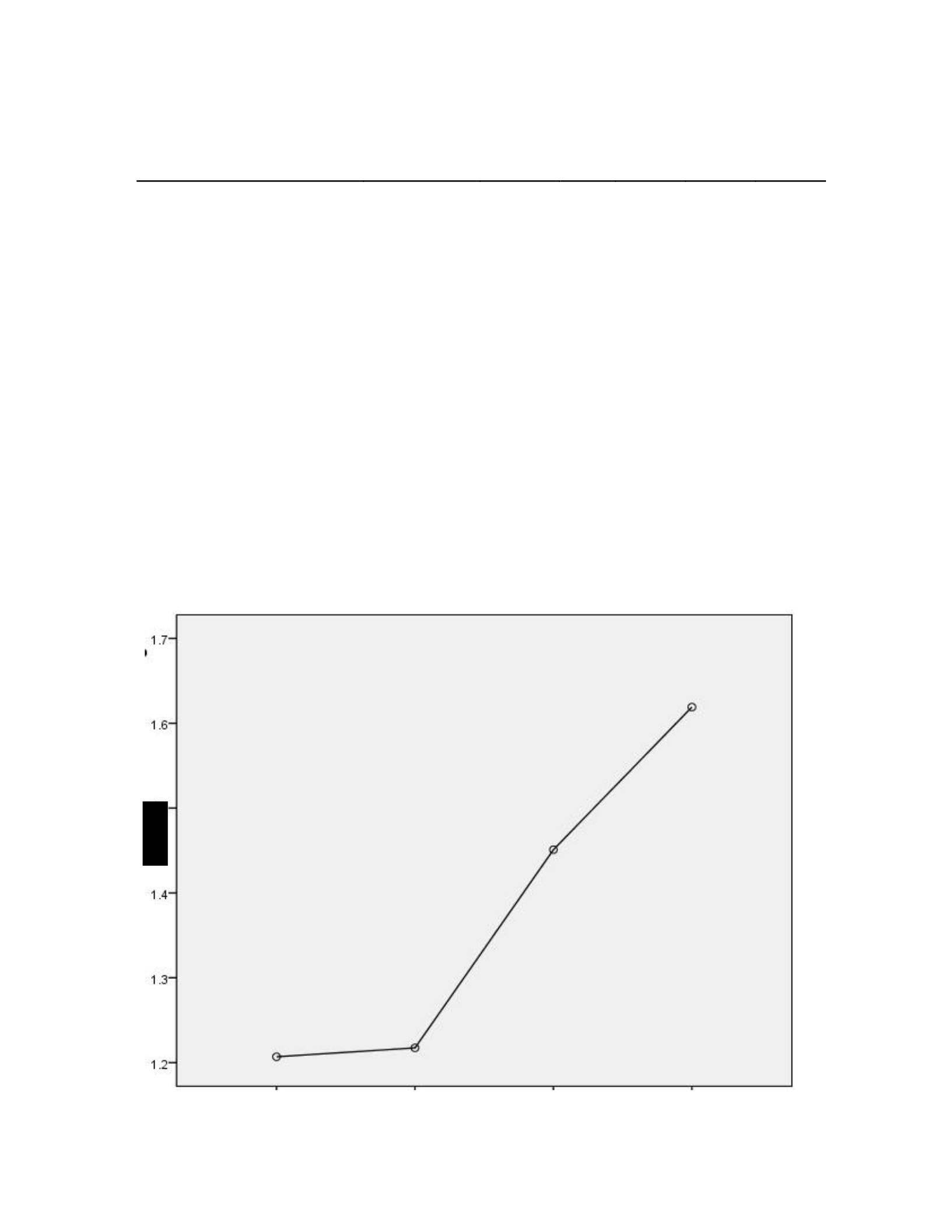
Within Groups
42.251
120
.352
Total 45.185 123
*Significant at the <.05 level.
Differences in perceived level of importance were noted between respondents
from the business services sector, who reported a mean value of 1.21, and representatives
of the manufacturing sector, who registered a mean value of 1.62. However, the post-hoc
tests failed to support the statistical significance of the finding. Specifically, the results of
the Hochberg’s GT2 procedure showed a lack of statistical significance at the p=.096
level, and the Games-Howell procedure indicated a lack of statistical significance at the
p=.120 level for the item. Figure 15 includes a visual plot of the means for this item.
Business Services Education Government Manufacturing

Industry Sector
Figure 15: Means of Ability to Assess the Need for Technological Change by Industry
Sector
Assessment and Evaluation of Technology
The one-way analysis of variance results indicated that responses to only one item
(the ability to assess the effects of technologies on society) produced a significant
difference between representatives of industry sectors at the p=.028 level in the
Assessment and Evaluation of Technology scale. A specific difference was found between
the business services sector participants, whose mean value for the item was
1.52, and respondents from the education sector, whose mean value was 2.17 (see Table
26 for specific data). Application of Hochberg’s GT2 and Games-Howell post-hoc tests
produced support for the significant difference at p=.018 and p=.041, respectively.
Table 26
Analysis of Variance Results for the Ability to Assess the Effects of Technologies on
Society
Sum of
Squares
df
Mean
Square
F
p*
Ability to assess the
effects of technologies
on society
Between
Groups
5.702
3
1.901
3.151
.028*
Within
Groups
72.394
120
.603
Total 78.097 123
*Significant at the <.05 level.
Consequently, these results indicate that respondents from the business services
sector placed greater importance on the inclusion of information about the ability to
assess the effects of technology on society than did education sector respondents. See

Figure 16 for a visual representation of the mean values for this item.
Business Services Education Government Manufacturing

Industry Sector
Figure 16: Means of Ability to Assess the Effects of Technologies on Society by
Industry Sector
Quality Management of Technology
Once again, one-way analysis of variance procedure revealed that responses to
two items within the Quality Management of Technology scale (an understanding of the
tools used in process improvement and an understanding of ISO 9000 standards)
produced significant differences between respondents from different industry sectors.
Both of the differences occurred between representatives of the business services sector
and the government sector. Specifically, participants from the business services sector
scored a mean value of 1.17, and respondents from the government sector reported a
mean value of 1.51 for understanding of the tools used in process improvement. For
understanding of ISO 9000 standards, business services sector participants registered a
mean value of 1.52 and government sector representatives scored a mean value of 2.08.
See Table 27 for the analysis of variance results for both items.
Table 27
Analysis of Variance Results for Understanding of the Tools Used in Process
Improvement and Understanding of ISO 9000 Standards
Sum of
Squares
df
Mean
Square
F
p*
Understanding of the
Tools Used in Process
Improvement
Total
Between
Groups
Within
Groups
3.151
40.034
3
120
1.050
.
334
3.149
0.028*
43.185
123
Understanding of ISO
9000 Standards
Between
Groups
7.028
3
2.343
3.041
0.032*

Total
Within
Groups
92.456
120
.770
99.484
123
*Significant at the <.05 level.
Hochberg’s GT2 procedure did not support the existence of a significant
difference between participants from the business services and government sectors on
understanding of the tools used in process improvement in that only a p=.077 was
produced. Yet the results of the Games-Howell procedure documented a significant
difference at p=.05 for this item between the identified industry sectors. See Figure 17 for
a visual representation of the means between industry sectors for this item. Consequently,
the analysis does not support the finding of significant statistical differences between
industry sectors for this item.
Business Services Education Government Manufacturing

Industry Sector
Figure 17: Mean Values of Understanding of the Tools Used in Process Improvement
by Industry Sector
The results of applying Hochberg’s GT2 and Games-Howell procedures did,
however, support the finding of a significant difference between the responses of business
service and government sector participants on understanding of ISO 9000 standards, with
p=.041 and p=.018, respectively. Therefore, respondents from the business services
sector agreed more strongly that ISO 9000 standards should be included in an
undergraduate technology management curriculum than did respondents from the
government sector. See Figure 18 for the means plot between industry sectors for this
item.
Business Services Education Government Manufacturing
Industry Sector

Figure 18: Means of the Understanding of ISO 9000 Standards by Industry Sector
Information and Knowledge Management
Responses to the Information and Knowledge Management scale items produced
the most differences between industry sector representatives. In fact, significant
differences were found between respondents from different industry sectors on the
following three items: (a) ability to use online collaboration systems, with p=.024; (b)
ability to use and manage databases, with p=.024; and (c) understanding of electronic
commerce applications and principles, with p=.043. In addition, differences between
industry sector participants were found at the p=.052 for ability to use spreadsheets for
quantitative analysis of information. See Table 28 for the analysis of variance results for
these five items.
Table 28
Analysis of Variance Results for Selected Items within the Information and Knowledge
Management Scale
Sum of
Squares
df
Mean
Square
F
p*
Ability to use online
collaboration systems
Between
Groups
3.844
3
1.281
3.275
0.024*
Total
Within Groups
46.954
120
.391
50.798
123
Ability to use and manage
databases
Between
Groups
3.239
3
1.080
3.270
0.024*
Total
Within Groups
39.632
120
.330
42.871
123

Ability to use spreadsheets
for quantitative analysis of
information
Between
Groups
1.975
3
.658
2.652
0.052*
Total
Within Groups
29.799
120
.248
31.774
123
Understanding of electronic Between
commerce applications and Groups
principles
4.788
3
1.596
2.799
0.043*
Within Groups
Total
67.846
119
.570
72.634
122
*Significant at the <.05 level.
Differences between research participants from the business services sector and
the manufacturing sector were noted on ability to use online collaboration systems.
Specifically, the business services sector respondents reported a higher level of
importance for this item, with a mean value of 1.28, than the representatives of the
manufacturing sector, who recorded a mean value of 1.81. Application of Hochberg’s
GT2 post-hoc test produced support for a significant difference with p=.021. However,
the level of significance dropped to p=.059 when the Games-Howell procedure was
performed and statistical significance between the industry sectors was not verified (see
Figure 19).

Business Services Education Government Manufacturing
Industry Sector
Figure 19: Mean Values of the Ability to Use Online Collaboration Systems by Industry
Sector
Although the results of the one-way analysis of variance indicated that significant
differences existed between industry sector representatives for ability to use and manage
databases, these differences were not supported when the post-hoc procedures were
performed. A mean value of 1.31 was reported by respondents from the business services
sector, and a mean value of 1.71 was indicated by participants from the manufacturing
sector. The results of Hochberg’s GT2 procedure showed significance with p=.089 for
this item, and the Games-Howell level was even lower, with p=.151. Figure 20 depicts
the mean value between industry sectors for this item.

Business Services Education Government Manufacturing
Industry Sector
Figure 20: Mean Values of the Ability to Use and Manage Databases by Industry Sector
The results of the one-way analysis of variance on the ability to use spreadsheets
for quantitative analysis of information indicated a level of significance of .052. Neither
post-hoc test produced support for findings of significance between groups. See Figure 21
for details.

Business Services Education Government Manufacturing
Industry Sector
Figure 21: Means of the Ability to Use Spreadsheets for Quantitative Analysis of
Information by Industry Sector
For understanding of e-commerce applications and principles, significant
differences were found using the one-way analysis of variance procedure. However, only
the Games-Howell post-hoc test supported this finding, with p=.039 between participants
from the manufacturing and business services sectors. The Hochberg’s GT2 post-hoc test
results indicated lack of significant difference between these two industry sectors, with
p=.067. The mean values for this item were 1.54 for respondents from the business
services sector and 2.10 for contributors from the manufacturing sector. See Figure 22 for
additional information.

Business Services Education Government Manufacturing
Industry Sector
Figure 22: Means of the Understanding of Electronic Commerce Applications and
Principles by Industry Sector
CHAPTER 5: SUMMARY, CONCLUSIONS, AND RECOMMENDATIONS FOR
FURTHER RESEARCH AND ACTION
The ability to manage technology is critical for economic success in today’s
rapidly changing, technologically based business environment (Thamhain, 2005); this

requirement has resulted in a fundamental need for technology management education
programs (Badawy, 1998; Khalil & Yanez, 2006; van Wyk, 2004). Even though the
establishment of academic programs in undergraduate technology management continues
(Fortino, 2006), minimal research has been focused on this area. Therefore, this
exploratory descriptive research study was conducted to determine the core curricular
elements of an effective undergraduate technology management program. In this chapter,
summary information about the topic will be provided, and conclusions reached from
data collected will be presented. The researcher will then make recommendations for
further research and action.
Summary
Technological changes have been a driving force in economic development
(Burke, 2003; U.S. National Science and Technology Council, Office of Technology
Policy, 1996), and the need for competent employees who have technical, scientific, and
professional skills is expected to increase by 28.4% by 2014 (U.S. Department of Labor,
Bureau of Labor Statistics, 2005). Obtaining higher education degrees is a critical factor
in preparing employees for productive positions in a changing technologically based
environment (Council for Adult and Experiential Learning, 2008), and the hiring of
graduates with baccalaureate degrees is projected to increase (Casner-Lotto &
Barrington, 2006). Career-focused programs, such as technology management, make up
approximately 60% of all undergraduate degrees awarded (Hudson & Carey, 2005), and
enrollments in higher education institutions are projected to increase in the next 10 years
(U.S. Department of Education, 2007). Extensive agreement exists about the need for
technology management education programs (Badawy, 1998; Herink et al., 1987; Khalil
& Yanez, 2006; Nambisan & Wilemon, 2003; van Wyk, 2004).

The evolving discipline of technology management has experienced significant
growth in terms of the number of academic programs offered in the past 20 years
(Kocaoglu et al., 2003). Some problems, however, still exist in defining the field of study
(Thamhain, 2005; van Wyk, 2004). A Classification of Instructional Programs (CIP) code
for technology management programs in the taxonomic structure used by the U.S.
Department of Education’s National Center for Education Statistics (2002) does not exist,
although a CIP code for engineering management is available. According to most
researchers, engineering management and technology management are two distinct
disciplines (Badawy, 1998; Herink, et al., 1987; Nambisan & Wilemon, 2004; Thamhain,
2005); however, some researchers consider them to be the same area of interest (Alvear,
Guillermo, Hernandez, & Kocaoglu, 2006; Daim et al., 2007). The lack of a dedicated
CIP code and the questionable combining of these two fields are impediments to the
discipline of technology management.
The issues and responsibilities related to the field of technology management
were delineated by Herink et al. in 1987, and recent efforts by researchers to define a
common body of knowledge in technology management have occurred (van Wyk, 2004;
Yanez, 2006). An assortment of curriculum development models has been used by faculty
members in designing technology management programs, including Badawy’s (1998)
alternative model for graduate technology management education, van Wyk’s (2004)
template for graduate programs in the management of technology, and
Klingenberg and Rothberg’s (2006) vision-driven approach. Nambisan and Wilemon
(2004) recommended that leaders from industry should be involved in defining the
curriculum for technology management programs. These four areas emerged in the
research and suggest a way courses can be grouped: (a) technology management-related

courses, (b) corporate functionality-related courses, (c) technology-specific courses, and
(d) foundational courses. This study focused exclusively on core competencies in
technology management; competencies related to corporate functionality and
foundational knowledge were not addressed, nor were technology-specific competencies.
Many professional organizations associated with the technology management discipline
exist, including the Academy of Management (AOM) Division of Technology and
Innovation Management (TIM), the Engineering and Technology Management Education
and Research Council (ETMERC), the International Association for Management of
Technology (IAMOT), the Portland International Center for the
Management of Engineering and Technology (PICMET), and the Technology
Management Education Association (TMEDA). Two accrediting agencies are active in
the discipline, the Association to Advance Collegiate Schools of Business and the
National Association of Industrial Technology, and IAMOT is in the process of becoming
an accrediting body for technology management graduate programs (IAMOT, 2007). In
addition to the professional organizations associated with technology management,
numerous publications and journals are devoted to the field of study.
Although little research exists on academic offerings at the undergraduate level in
technology management, programs are being established at an increasing rate, and the
number is expected to continue to grow (Fortino, 2006). The scarcity of research on
undergraduate technology management education has contributed to the fragmented
nature of the coursework required in these programs and the lack of a cohesive,
recognizable curriculum at this level. Only 28% of (or 5) undergraduate programs even
require a course in their curriculum with the words technology management in their title
(Becker, 2007), and only these five courses in undergraduate technology management

programs met a 50% commonality criterion: (a) accounting, (b) marketing, (c)
organizational behavior, (d) quality, and (e) statistics (Becker, 2007).
At the undergraduate level, two types of degrees are awarded in technology
management education programs: a bachelor of science degree and a bachelor of applied
science degree. Some of the bachelor of applied science degrees are conferred by
community colleges, and debate continues about the appropriateness of community
colleges offering baccalaureate degrees. Most of the undergraduate technology
management programs (72%, or 13 programs) did, however, accept transfer credit in the
form of technical coursework and general education requirements from community
colleges.
Many new academic programs are being established in higher education to meet
needs presented by frequently changing economic conditions, global and instantaneous
communications, and technological updates. For instance, approximately 750 programs
were added to the CIP taxonomic structure compiled by the National Center for
Education Statistics (U.S. Department of Education, National Center for Education
Statistics, 2002). Of those new programs, 37 contained the term management in their
titles. Much of the growth in program establishment is likely attributed to new
technologies. The use of distance education (Internet-based delivery of courses) is also
becoming increasingly popular in higher education settings and in technology
management programs (Alvear, Rueda, Hernandez, & Kocaoglu, 2006; U.S. Department
of Education, National Center for Education Statistics, 2005).
Career-focused professional and occupational undergraduate programs make up
the majority (59.9%) of degrees conferred at the undergraduate level (Hudson & Carey,
2005). Societal influences, such as the expansion of technological capabilities, directly

affect these career-focused programs (Stark & Lattuca, 1997). Technology management
educational programs that developed as a direct result of changing societal needs
(Badawy, 1998; Herink et al., 1987) are considered career-focused programs. Naturally,
technology management programs must be responsive to changing economic and societal
needs in order to be considered effective (Dickeson, 1999).
In addition to being responsive to societal and economic shifts, undergraduate and
graduate technology management programs must be intimately tied to the institutional
mission of the college or university in which they reside (Wendt. Jr., 1995). This
connection is also required by accrediting agency standards (e.g., AACSB International,
NAIT). Specialized accreditation of technology management programs has become an
increasingly important consideration (Whittlesey, 2005) as accountability for educational
program outcomes has gained importance (Burke, 2005).
This researcher selected a survey method to solicit the opinions of the sample
population regarding effective core curricular competencies in an undergraduate
technology management program. The following five procedures were used in
implementing this research: (a) identification of the sample population, (b) selection of
the survey software, (c) survey instrument design and pilot testing, (d) data gathering, and
(e) data analysis.
A purposive expert sample of employees with expertise in technology
management from four industry sectors (business services, education, government, and
manufacturing) participated in this study. In addition, economic developers from the
Michigan Economic Development Corporation (MEDC) and members of the Southern
Wayne County Regional Chamber of Commerce (SWCCC) were involved in the
endeavor. Data were obtained through use of a Web- and paper-based survey instrument.

Email invitations were sent to participants from the business services, education, and
manufacturing sectors, and to executive members of MEDC; two follow-up requests were
sent to participants who had not responded to the initial survey. A paper-based survey was
distributed to employees from the government sector and to members of SWCCC. A total
of 228 surveys were distributed, and 127 were returned for an overall response rate of
55.7%.
Three survey software packages were reviewed by this researcher (Snap, Survey
Methods, and Survey Monkey). Survey Monkey was chosen because of its ability to
generate a PDF file of the survey instrument that enabled the use of a mixed-mode
research instrument.
The survey instrument was developed after an extensive review of the literature
and textbooks associated with the field of technology management. The following eight
areas in which competencies should be achieved by graduates of technology management
programs resulted from this research: (a) strategic management of technology, (b)
management of innovation and product development, (c) management of technological
change, (d) management of organizational change, (e) project management, (f)
assessment and evaluation of technology, (g) quality management of technology, and (h)
information/knowledge management (Alvear, Rueda, Hernandez, & Kocaoglu, 2006;
Angus, Gundersen, & Cullinan, 2000; Evans & Lindsay, 2008; Haag, Cummings, &
McCubbrey, 2005; Herink et al., 1987; Porter, Roper, Mason, Rossini, & Banks, 1991;
Thamhain, 2005; Yanez, 2006; Yanez & Khalil, 2007). A pilot survey test was
electronically distributed to 30 upper-division undergraduate technology management
majors and to 15 master of science in technology studies students at Eastern Michigan
University. Pilot study results were analyzed, and alpha reliability for each of the eight

scales and the items within the scales were tested. One sample t tests were performed to
determine statistical significance. Only minor revisions were made to the final survey
instrument in an effort to improve reliability of the strategic management of technology
scale and the management of innovation and product development scale. These two
scales were moved to the end of the survey. In addition, one item was removed from the
technology project management scale to eliminate redundancy.
The survey instrument used in this study was divided into the following 10
categories: (a) informed consent, (b) demographic information, (c) management of
technological change, (d) management of organizational change, (e) project management,
(f) assessment and evaluation of technology, (g) quality management of technology, (h)
information/knowledge management, (i) management of innovation and product
development, and (j) strategic management of technology. A five-point (strongly agree,
somewhat agree, neither agree nor disagree, somewhat disagree, and strongly disagree)
Likert scale was used to measure the perceived level of agreement of the respondents
regarding the inclusion of items associated with the eight core competency areas in
undergraduate technology management programs.
The survey instrument achieved a very high level of reliability, which was tested
using Cronbach’s alpha (α=.902). Descriptive statistics, including the range, averages,
and measures of central tendencies, were used to analyze data in this exploratory
descriptive research study. The mean for each item within each of the eight categories
was calculated to determine the relative importance of each item. Weighted means were
calculated for each scale by dividing the mean value of each scale by the number of items
within the scale. The weighted means in each of the eight areas were then compared to
determine their relative importance to each other. One sample t tests were computed to

test for statistical significance of each scale and of each item within each scale. An
analysis of variance procedure was performed to determine if any perceived levels of
differences existed between industry sectors on the eight scales and on each item within
the eight scales. Two post-hoc procedures (Hochberg’s GT2 and Games-Howell) were
also performed on data to determine statistical significance of the findings.
Conclusions
Because this research is exploratory by design, no literature is available to use in
making direct comparisons with information gleaned from this study. However, in order
to be comprehensive, this researcher will compare the related literature and research on
graduate programs in technology management education and the information from the
engineering and technology management (ETM) study by Kocaoglu et al. (2003) to the
initial conclusions about the undergraduate core curriculum included in this section.
In essence, the very minimal research on technology management programs,
while instructive, is inadequate as far as empirical research goes for the following
reasons:
• None of the studies identified (Alvear, Rueda, Hernandez, and Kocaoglu
[2006]; Kocaoglu, Sarihan, Sudrajat, and Hernandez [2003]; or Yanez
[2006]) had an overall response rate of more than 12.3%. Therefore,
drawing any valid conclusions is risky.
• Aje’s (2005) research was based on a review of syllabi and course catalog
content from the 148 institutions involved in ETM research study (which
represented only 12.3% of the 1,200 institutions surveyed by Kocaoglu et
al. [2003]).
• Nambisan and Wilemon’s (2002) research, Graduate Management of

Technology Education: Global Survey, Critical Issues and Emerging
Trends, involved an examination of 123 institutions and may be the only
study with a response rate substantial enough to support solid research
conclusions (67 responses, or a 54.5% response rate). However, some
confusion exists as to the actual return rate. Specifically, the authors
indicated in a 2003 article, A Global Study of Graduate Management of
Technology Programs, that 170 surveys were distributed and that 53
“usable” responses were returned for a response rate of about 33%.
However, in the initial article about the study in 2002, Graduate
Management of Technology Education: Global Survey, Critical Issues and
Emerging Trends, 67 responses were returned from the distribution of 123
surveys for a 54.5% response rate. Both of these research articles appear
to focus on the same study of global graduate management of technology
programs/education, but the authors report different respondent numbers.
• In all of these research studies, except Yanez (2006), academics studied
academics. Only Yanez (2006) included industry representatives as
potential respondents; for Yanez’s study, only 35 representatives from
industry were among the 129 participants who returned the second survey
he distributed.
When considering the conclusions drawn from this study, the reader should be
aware of the study’s delimitations. For instance, this exploratory research was delimited
by the purposive selection of the survey population. This researcher was interested in
obtaining the opinions of people with expertise in technology management from four
different industry sectors (business services, education, government, and manufacturing)

and from economic developers. The reader, therefore, should be aware of how the
participants were selected when making generalizations based on the results of the study.
Moreover, the researcher did not address the need for foundational courses or supporting
areas of knowledge for technology management education degree programs. Topical
areas such as the ability to communicate effectively, reason quantitatively, use computer
applications effectively, and develop an understanding of economic principles were
outside the scope of this study. The inclusion of these foundational courses as part of an
undergraduate technology management education degree program should, however, be a
consideration for faculty members as they develop a comprehensive baccalaureate degree
framework.
Technology-specific courses, such as technology theory and emerging
technologies, also were not addressed in this study. Additionally, questions related to the
technical-specialty area commonly included in undergraduate technology management
education programs (Becker, 2007) were not incorporated into this study.
Corporate functions typically taught in a school or college of business as part of a
traditional management major were also not handled in this particular research project.
Participants were not asked to express their opinions about the inclusion of the following
topics in an undergraduate technology management education program: accounting,
finance, law, marketing, or organizational behavior. Although courses in these topical
areas may be important components of an undergraduate technology management
education program, this researcher focused only on areas directly related to the discipline
of technology management.
An ideal undergraduate technology management program would likely contain
courses from the following four areas: core technology management, traditional corporate

functions, general education, and a technical concentration. See Table 29 for an example
of a model undergraduate technology management curriculum.
Table 29
Model Undergraduate Technology Management Curriculum
Technology Management
Related Courses
Assessment and Evaluation of Technology
Information Technology Management
Management of Innovation and Product Development
Management of Organizational Change
Management of Technological Change
Quality Management of Technology
Strategic Management of Technology
Technology Project Management
Corporate Functionality Related
Courses
Accounting
Finance
Law
Marketing
Organizational Behavior
Technical Concentrations
Automotive Service Technology
Biomedical Engineering Technology
Computer Service Technology
Environmental Technology
Fluid Power Technology
Graphic Design Technology
Health Information Technology
Information Technology
Network Technology
Public Safety Technology
Telecommunication Technology
Foundational Courses
Advanced Composition
Computer Applications
Economics
Quantitative Reasoning
The technology management education survey instrument had a high level of
reliability (Crobach’s alpha ranged from .761 for the management of technological
change scale to α=.903 for the quality management of technology scale, with the other
scales ranging between α=.803 to α=.893) and provided support for the conclusions

drawn from participant data. Participants were asked their opinions about the inclusion of
52 items organized into eight areas using a five-point Likert scale. The conclusions
reached for each of the four research questions will now be presented.
Research Question 1: What is the relative perceived importance of each of the
eight core competency areas (management of technological change, management
of organizational change, project management, assessment and evaluation of
technology, quality management of technology, information and knowledge
management, innovation and product development, and strategic management of
technology) in technology management?
According to survey respondents, the following eight core competency areas
should definitely be included in an undergraduate technology management education
program in the following priority order:
1. technology project management
2. management of technological change
3. information and knowledge management
4. management of organizational change
5. strategic management of technology
6. assessment and evaluation of technology
7. quality management of technology and
8. innovation and product development.
Technology project management was viewed as the most important area, while the
management of innovation and product development was perceived as the least important
area to include in the core curriculum.

In comparing the findings from this research study on the undergraduate core
curriculum to previously published research by Aje (2005), none of the core competency
areas identified were offered at 50% of the institutions involved in Aje’s (2005) study.
Alvear et al.’s (2006) research included courses that were offered in 35% or more of the
programs, but only indicated rankings of the courses and not the actual numbers or
percentages of the courses taught in the engineering and technology management
programs.
The results of this study concurred with Nambisan and Wilemon’s (2002) findings
at the graduate level. Specifically, they found that the institutions involved in their survey
included these courses in their curriculum: technology strategy (91%), strategic
management (88%), innovation management (75%), new product development (78%),
information technology (43%), and quality management (42%). Their 2003 study
indicated that innovation management, strategy, and technology management were the
three most important themes addressed in technology management programs. Yanez’s
(2006) study denoted the following eight courses in order of perceived importance as core
elements in graduate technology management programs: strategic management,
innovation management, fundamentals of technology management, product development
management, knowledge management, entrepreneurship, project management, and
technology foresight and forecasting. Quality management and change management were
considered electives. In summary, similarities exist between graduate and undergraduate
technology management course offerings, the identified MOT body of knowledge, and
industry participants’ perception of required core competencies in undergraduate
technology management programs.

Research Question 2: What is the relative perceived level of importance of each
item within the eight core competency technology management scales?
Technology project management was identified as the most important area to
include in an undergraduate technology management education core curriculum. The
competencies that all graduates must develop are listed below in order of importance:
1. ability to plan and organize projects,
2. ability to gather data on the task, schedule, budget, monitor, and evaluate the
total effort,
3. ability to implement projects effectively,
4. ability to work effectively with functional groups within the organization to
plan and implement projects,
5. ability to schedule projects effectively and within the constraints of the
organization,
6. ability to manage and lead the project team, and
7. ability to reduce implementation costs of new projects
Most researchers (Alvear et al., 2006; Badawy, 1998; Herink et al., 1987;
Klingenberg & Rothberg, 2006; Yanez 2006) agreed that a course in project management
was important, although Hauck (1999) did not include a course in technology project
management, nor did Nambisan and Wilemon (2002) reference one as an MOT course. A
course in project management was not identified as meeting the 50% commonality
criterion in Becker’s 2007 study of undergraduate technology management programs.
None of the researchers broke down the components or competencies required in a course
in technology project management. However, Yanez (2006) included information about
project management put forth by the Project Management Institute (PMI) in his analysis.

A course including the entire seven competency areas related to the technology project
management noted above should be included in an undergraduate technology
management program.
When dealing with the management of technological change, the ability to
implement technological change appeared to be the most important skill for graduates to
develop in an undergraduate technology management education program. An ability to
scan significant technological changes occurring within the external environment of the
organization seemed to be less important but still critical enough to include in the
curriculum. In addition, graduates must be able to demonstrate competence in an ability
to assess the need for technological change and an ability to assess an organization’s
readiness for technological change. The analysis by Alvear et al. (2006) and the issues
and responsibilities specific to the management of technology identified by Herink et al.
(1987) supported the inclusion of a course in management of technological change in
technology management programs. Yanez (2006), however, viewed change management
as an elective area at the graduate level. Industry respondents indicated that competencies
in the management of technological change were crucial for undergraduates of
technology management programs.
Within the information and knowledge management area, there are nine
competencies that technology management education undergraduates must acquire; the
following competencies are listed by the level of importance indicated by survey
respondents:
1. understanding of ethical, security, and privacy issues surrounding the use of
electronic information;
2. ability to use spreadsheets for quantitative analysis of information;

3. ability to integrate and use information technology to increase the competitive
stance of an organization;
4. understanding of information technology and system development;
5. ability to use and manage databases;
6. ability to use online collaboration systems;
7. understanding of knowledge management systems that support the capturing,
organization, and dissemination of knowledge throughout an organization;
8. understanding of electronic commerce applications and principles; and
9. understanding of business-to-business e-commerce
Again, information and knowledge management was considered an important
component in technology management programs by researchers who focused on
graduate-level programming (i.e., Badawy, 1998; Herink et al., 1987; Klingenberg &
Rothberg, 2006; Nambisan & Wilemon, 2002; Yanez, 2006) and in ETM programs
offered by business schools (Alvear et al., 2006). Responses from industry sector
participants in this study deemed competencies in information and knowledge
management to be vital in undergraduate technology management programs.
When addressing the core competency area known as the management of
organizational change, an understanding of leadership strategies and methods surfaced as
the most important area to be taught in this segment of the curriculum. The ability to
assess and implement requisite changes in human resource management was perceived as
being the least important. The other four skills that graduates must acquire, by level of
importance, were ability to assess the need for organizational change, understanding of
how to integrate new organizational processes, ability to plan for and implement various

forms of cross-functional teams and processes, and ability to implement organizational
change.
The only researchers of graduate technology management programs who included
a course in the management of organizational change were Klingenberg and Rothberg
(2006). Hauck (1999) identified a core course in team problem solving and leadership.
However, industry respondents in this study indicated that all six areas identified in the
management of organizational change should be included in undergraduate technology
management programs as core competencies.
Strategic management of technology was considered an essential component of an
undergraduate technology management education degree program. The most important
skill for graduates to acquire was an ability to create value through the use of technology,
while the ability to assess the internal strengths and weaknesses of the organization with
respect to changes occurring within the external environment of the organization was
viewed as the least important skill (but still one that needed to be included in the
curriculum). The other three competencies considered necessary for graduates are listed
as follows by perceived level of importance:
1. ability to develop effective planning procedures for selecting new
technology;
2. ability to develop an effective technology strategy for achieving
competitive advantage; and
3. ability to align the organization’s structure and processes with its core
technologies.
All of the researchers focusing on graduate programs in technology management
identified competencies in the strategic management of technology as important attributes

for graduates of these programs. In fact, Yanez (2006) found the strategic management of
technology to be the most important competency area in his study. Interestingly, Aje’s
(2005) analysis showed that strategic management courses were being taught at only 41
(27.7%) institutions, but the examination by Alvear et al. (2006) pointed out that a course
in strategic planning was taught at 35% or more of the ETM programs. Although
Becker’s 2007 study did not indicate that at least 50% of undergraduate technology
management programs required a course in strategic management of technology, this
principal area should be included in undergraduate educational programs in technology
management.
In the core competency area of assessment and evaluation of technology, the
skills, knowledge, behaviors, and abilities considered most important for undergraduates
to acquire was the ability to identify technologies important to the business; the
knowledge area considered least important, but still important enough to include in the
curriculum, was an understanding of Porter’s Five Forces Model (buyer power, supplier
power, threat of substitute products and services, threat of new entrants, and rivalry
among existing competitors) in assessing technology. The other six competencies that
graduates need to demonstrate, by perceived level of importance according to survey
respondents, were:
1. ability to anticipate how new technologies may affect the organization;
2. ability to assess cost and benefits of new technologies;
3. ability to do a strengths, weaknesses, opportunities, and threats (SWOT)
analysis associated with new technologies;
4. ability to assess training needs in association with the implementation of
new technologies;

5. ability to assess the integrative effects of technology on the organization
(customer-related factors, market-related factors, process-related factors,
employee-related factors, vendor-related factors, and owner-related
factors); and
6. ability to assess the effects of technologies on society.
None of the research in graduate technology management educational programs
specifically addressed the assessment and evaluation of technology, although Herink et al.
(1987) mentioned technological forecasting and assessment, Badawy (1998)
recommended a foundational course in technology analysis, and van Wyk (2004) as well
as Yanez (2006) recommended a core course in technology forecasting. Again,
respondents from industry indicated that this important competency area was essential to
success by undergraduates and that material related to the area should be included in
undergraduate technology management programs.
Quality management of technology was also regarded as a central competency
area for graduates of undergraduate technology management education programs by
respondents. The competencies that must be included in the core curriculum are listed by
perceived level of importance as follows:
1. understanding of the tools used in process improvement;
2. ability to implement process improvement schemes;
3. understanding of principles of total quality management;
4. ability to manage for performance excellence;
5. ability to manage for quality outcomes;
6. understanding of the principles of Six Sigma;
7. understanding of the Deming philosophy of quality improvement;

8. understanding of ISO 9000 standards; and
9. an understanding of the Baldrige criteria for quality
While quality management of technology was viewed as an elective course in the
graduate body of knowledge framework set forth by Yanez (2006), quality management
of technology was identified by Herink et al. (1987) as an issue and responsibility
specific to the management of technology. A course in quality was required in half (9) of
the undergraduate technology management programs identified by Becker (2007), and the
inclusion of a course focusing on quality management of technology should be required
in undergraduate technology management programs, according to respondents from
industry who participated in this study.
Although innovation and product development had the lowest level of perceived
importance of the eight core competency areas, respondents still felt that graduates of
baccalaureate technology management education programs should have the following
competencies (based on level of rated importance):
1. ability to plan for and implement team-based management systems used in the
development and launching of new products;
2. understanding of processes used to launch new products;
3. understanding of the platform approach to product development; and
4. an ability to predict new product success
At the graduate level, management of innovation and product development was
deemed vital by the following researchers: Badawy, 1998; Herink et al., 1987; Nambisan
and Wilemon, 2002; van Wyk, 2004; and Yanez, 2006. A course in innovation
management also met the 35% criterion for inclusion in engineering schools in an
analysis by Alvear et al. (2006). Competencies in innovation and product development

should be included in undergraduate technology management programs, as indicated by
industry respondents.
Research Question 3: Do any differences exist between industry sectors (business
services, education, government, and manufacturing) and their representatives’
perceptions of the relative importance of the eight core competency areas?
Differences between industry sectors (business services, education, government,
and manufacturing) and their representatives’ perception of the relative importance of the
eight core competency areas were evident in only one core competency area: information
and knowledge management. The respondents from the business services sector
perceived information and knowledge management as being more important than did
participants from the manufacturing sector. This difference may be attributed to the
greater emphasis placed on information and knowledge management by individuals from
the business service sectors versus the emphasis on production by employees in the
manufacturing sector. Researchers in graduate technology management did not address
this difference found between industry sectors.
Research Question 4: Do any differences exist between industry sectors and their
representatives’ perceptions of the items within each of the core competency
areas?
In the core competency area of assessment and evaluation of technology, the
respondents from the business services sector placed greater importance on the ability to
assess the effects of technologies on society than did respondents from the education
sector. This researcher did not locate any information in the literature that would indicate
why this difference may have occurred.

Differences between respondents from the business services sector as compared to
the government sector were also noted on understanding of ISO 9000 standards, which
was a component of the quality management of technology core competency area.
Business services sector respondents indicated more support for inclusion of this
competency in the curriculum than did government respondents. Possibly because
members of the government sector are not required to meet quality standards set forth in
the ISO 9000 standards, they may not perceive the standards to be as important as
members of the business services sector who have direct experience with ISO 9000
standard compliance.
In summary, results from this study indicated the importance of including the
following eight core competency areas in an undergraduate technology management
academic curriculum in the priority order indicated:
1. technology project management
2. management of technological change
3. information and knowledge management
4. management of organizational change
5. strategic management of technology
6. assessment and evaluation of technology
7. quality management of technology and 8. innovation and product
development.

Recommendations for Further Research and Action
Although this study addressed an important area where research was lacking, far
more research is needed in the discipline of technology management. Suggestions for
further research endeavors are as follows:
1. More research is essential regarding the specific technology management needs of
employers in various industry sectors, including business services, education,
government, and manufacturing. The content of technology management education
programs can then be modified, if necessary, to meet the needs of employers in the
particular industry sectors and in the surrounding communities where the educational
institution is located.
2. A national study of business and industry technology management stakeholders
(i.e., academics and representatives from the four industry sectors) should occur using the
reliable and valid Technology Management Curriculum Inventory to determine the
appropriate curricular content of both undergraduate and graduate programs in
technology management. The results of such a study will help define the relevant
technology management body of knowledge.
3. Research focused specifically on undergraduate programs must continue. A
definite need for undergraduate technology management programs has been recognized,
and the process of program establishment is expected to continue. Very few researchers
have dealt with this topical area, and it is important for the discipline of technology
management to develop a relevant, cohesive curriculum for academic programs taught at
the undergraduate level.
4. In determining and identifying the body of knowledge for technology
management, researchers should focus on topics related to technology management and

should not include content from other disciplinary areas. Divergent views surrounding
the body of knowledge in the technology management discipline exist among
practitioners and academics. Although technology management may be considered an
interdisciplinary field by some researchers, and, in fact, does draw content from several
disciplinary areas, the body of knowledge should be focused on technology management
practices. Acknowledgment of other disciplinary connections should be made but not
included in the body of knowledge.
5. Research on the use of distance education (i.e., Internet-based) delivery formats in
technology management educational programs should occur at both the undergraduate
and graduate levels. Online delivery of technology management courses and programs
will most likely continue to increase, and pedagogical considerations related to this
method of delivering instruction must be addressed.
6. Research on varying levels of knowledge associated with baccalaureate, master’s,
and doctoral programs should occur. Although this dissertation research project did not
specifically address the varying levels of knowledge for technology management
programs at the bachelor, master’s, and doctoral levels, research should be undertaken
that addresses this issue, as academic programs in technology management are offered at
all three levels. This researcher believes that bachelor’s degree programs in technology
management should have an applied focus and prepare students for entry-level positions
in the field. Technology management master’s degree programs should maintain a
greater emphasis on research and foster a greater degree of specialization. Courses in
strategic planning, innovation, and product development as well as the theory of
technology will need greater emphasis at the master’s level than at the undergraduate

level. Doctoral programs in technology management should have a theoretical focus with
an even greater emphasis on research and scholarship in the discipline.
This study has also illustrated the necessity for action to occur in several areas
associated with the discipline of technology management. These actions are denoted in
the following section.
1. Practitioners and academics alike must come to a working agreement on the definition
of technology management in order for the discipline to move forward and be formally
recognized. Some debate still exists about the definition of the term technology
management (Badawy, 1998; Bellamy, Becker, & Kuwik, 2003; Thamhain, 2005). This
researcher believes that much of the ambiguity surrounding the definition of
technology management will be alleviated if a specific CIP code were approved by the
U.S. Department of Education: National Center for Educational Statistics for
technology management.
2. A concerted effort must be made to have this discipline recognized by the U.S.
Department of Education, National Center for Education Statistics. Faculty members
associated with the technology management discipline and members of technology
management professional associations must make obtaining a dedicated CIP code for
technology management a top priority.
3. Faculty members within the technology management discipline in higher education
institutions need to recognize and support the critical importance of undergraduate
technology management education degree programs. Members of professional
associations also need to recognize and serve as advocates for undergraduate
technology management education programs and research.

Undergraduate technology management education programs appear to be held in
lower esteem by members of the academic community than graduate programs in
technology management. This fact is evidenced by the lack of research devoted to this
particular area. The hierarchical nature of higher education supports the fallacy that
undergraduate education is less valued or important than graduate education. In addition,
some faculty employed within graduate technology management education programs
have indicated that undergraduate technology management education programs are
inappropriate and that baccalaureate students do not have the requisite knowledge to
succeed as technology managers.
Several undergraduate technology management degree programs cater to the adult
learner, and many adult learners are returning to college to complete baccalaureate degree
programs in technology management. These adult students require a baccalaureate degree
to increase their upward mobility in the job market and/or find well-paying employment
opportunities. They bring valid educational experience from technical associate degrees
and relevant work experience to the programs. Graduates of undergraduate technology
management degree programs fulfill a critical need in society and are qualified for gainful
and productive employment.
4. In developing accreditation guidelines for technology management education
programs, guidelines for undergraduate programs must also be included. IAMOT is in
the process of becoming an accrediting body for graduate technology management
education programs. At this point, no efforts are being made to accredit undergraduate
technology management education programs. Growth in program establishment of
undergraduate technology management education programs will continue, and the
importance of accrediting these programs also cannot be overemphasized.

Summary
This research study has identified the core curricular elements necessary for
inclusion in an effective undergraduate technology management education program.
These eight core competency areas include (a) technology project management, (b)
management of technological change, (c) information and knowledge management, (d)
management of organizational change, (e) strategic management of technology, (f)
assessment and evaluation of technology, (g) quality management of technology, and (h)
innovation and product development. Content related to these eight areas should be
included in all undergraduate technology management education programs.
The discipline of technology management is essential for economic growth in the
nation and the world. Therefore, academic programs in technology management must be
relevant, and the content taught in these programs must be germane and meet the needs of
employers and students. Graduates of baccalaureate technology management programs in
which appropriate material is taught will be favorably perceived and sought after by
employers. Clearly, giving undergraduate students access to a program of study focused
on the development of technology management competencies identified by industry
representatives as soon as they are needed in the workforce will represent the ideal
partnership between higher education and business where everyone wins.


