


SUPPORTING SERVICES SUBSYSTEM
ARIZONA STATE UNIVERSITY
AGB 410 - AGRIBUSINESS MANAGEMENT
WEEK 4
Introduction:
For the implementation of the argribusiness system, supporters are needed such as
financial industry (agribusiness banks and agribusiness cooperatives), infrastructure
(infrastructure and facilities), human resources and natural resources, research and
development, agribusiness information services, consultants/instructors, and government
policies (monetary and fiscal).
1. Financial Industry:
a. Agribusiness Bank:
A bank is a body whose purpose is not only to store money, but also to provide credit
both by circulating means of exchange in the form of banknotes and chattel money.
In terms of its function, the bank is a place to collect funds from the public and channel
them back to people who need them. The funds collected can be in the form of savings, time
deposits, and current accounts; bear the risk in case of imbalances in the economy (inflation
and deflation); bear financing, namely banks are willing to pay a service fee to people who
save their money such as savings interest; and provide services (facilities) for sending money
and exchanging checks (check cashing).
The role of banks, especially banks providing agricultural business loans to the
agricultural business subsector (farming, fishing, and livestock raising) which aims to
increase primary products and the agro-processing subsector agro-industry and marketing in
agribusiness companies both small and medium scale such as SMEs and large scale which in
addition to increasing secondary products can also expand or expand business.
b. Agribusiness Cooperative:
The role of agribusiness cooperatives as well as agribusiness banks is very instrumental
in improving agribusiness, especially those in rural areas such as farming, fishing, and
livestock farming. Judging from the concept of thought, cooperatives are a form of

cooperation that is voluntary, has the same rights and obligations, is borne and shared fairly,
and its main purpose is not the pursuit of profit.
For this reason, the presence of agribusiness cooperatives for farmers, fishermen, and
breeders can avoid agribusiness business systems that can harm farmers and fishermen
because these cooperatives can help provide consumer goods needed by their members, also
process raw materials (raw materials) into semi-finished materials (work in process) and
finished goods (finished product), help market the goods they produce, and provide credit to
improve their business.
In terms of agricultural cooperatives, according to Baswir (2000:79) agricultural
cooperatives are business cooperatives related to certain agricultural commodities. This
cooperative has a membership of farmers, farm laborers, and those who are directly related to
the agricultural business. Activities carried out by agribusiness cooperatives are cultivating
seeds, sprays, and agricultural equipment; processing agricultural products; marketing the
results or processed products of agricultural commodities; providing capital for farmers; and
developing farmers' skills.
2. Infrastructure (Infrastructure and Facilities):
To further develop and streamline the operational activities of the agribusiness
management system, infrastructure is needed in the form of roads, bridges, agro-industrial
areas, irrigation and water supply, electricity, telephone networks, agricultural machinery,
and so on.
Infrastructure development must be in line with the agribusiness being managed. In
small-scale agribusinesses, the infrastructure required is still limited, while in medium and
large scales the infrastructure required is more.
3. Human Resources and Natural Resources:
a. Human Resources
The success of the agribusiness business sector cannot be separated from the
agribusiness human resource factor (HR) as the actor of its development, because
agribusiness HR contains two meanings. First, HR as a work effort that can provide in the
agribusiness process (production, processing, and marketing processes) in this case reflects
the quality of effort given by a person in a certain time to produce agribusiness products
(goods and services); Second, HR concerning being able to work effectively and efficiently to
provide agribusiness products that have economic value.

Human resources that are suitable for use in every agribusiness business must be in
accordance with their respective fields or expertise (-the right man on the right place and the
right man behind the right gun/placement of the right people in the right place and placement
of the right person for the position‖).
It is important to recognize the importance of human resources in the management of
agribusiness systems, such as production, finance, marketing, and even the human resources
themselves for the management of subsystem actors in the agribusiness system. According to
Arfida (2003: 20), the utilization of human resources to produce products (goods and
services) is influenced by two factors, namely the number and quality of these human
resources, as well as the factors and conditions that influence the utilization of these human
resources.
Natural resources are the main element for supporting up-stream agribusiness
(upstream/input) as a producer of primary agricultural inputs because it cannot be regulated
by humans so that such support only depends on natural resources, such as climate and soil as
a condition for the production of agricultural inputs.
growing or plant production factors and the ocean as a breeding ground for marine
fisheries resources.
Climate can be seen as plant growing requirements such as rainfall, humidity, air
temperature, altitude, and light intensity. Soil is focused on soil type, soil structure, and soil
topography, while ocean is salt content, light, and temperature.
4. Research and Development (R&D)
Research and development in the field of agribusiness is needed to improve product
quality as well as effectiveness and efficiency both in the on-farm subsystem (agricultural
businesses in the form of farming, fishing, and animal husbandry) and the of-farm / down
stream subsystem (processing and marketing).
In the on-farm subsystem, it can be in the form of increased crop production such as the
results of biotechnology research (tissue culture, feed technology, pest and disease control).
Then in the of-farm / down stream sub-system such as bioprocess engineering (increasing the
added value of processing agricultural products known as agro-industry, both in small,
medium and large industries), then marketing can be studied with market research (price,
demand, supply, and equilibrium).
For this reason, the role of research and development institutions, especially universities

(lecturers and students) is needed to be further empowered in supporting business
development in the agribusiness sector by producing innovations so that agribusiness
products can compete in the global market.
Research and development programs in higher education are carried out through
laboratory support activities for certain courses and field practices; research activities of final
reports, such as D3 field practice reports, S1 (undergraduate) theses, S2 (master) theses, and
S3 (doctoral) dissertations; cooperation activities with agro-industrial companies,
communities, governments both at home and abroad.
5. Information Services Agribusiness
The agribusiness information explosion has had a profound impact on management and
organizational complexity. Managers as decision-makers are essentially information
processors. Modern agribusiness managers must recognize that the ability to acquire, store,
process, retrieve and present information for informed decisions is vital. This is, after all, the
basic reason for an agribusiness information system is better decisions.
Agribusiness information is needed in every agribusiness subsystem from input
(procurement of inputs), process (agricultural business), to output (agro-industry and
marketing) and supporting subsystems because the information will improve the process or
work activities such as speed and accuracy that can be used as a consideration of alternatives
in decision making The information is known as the Agribusiness Management Information
System (SIMA) or Agribusiness Management Information System (AMIS) (Figure 4.7.).
The purpose of an AMIS is to provide information for decision-making on planning,
organizing, directing, controlling, and evaluating the operational activities of an agribusiness
subsystem of a company and present organizational synergies in the process.
The company's steering committee, in addition to the production manager, marketing
manager and finance manager, also requires an AMIS manager. The AMIS manager
functions as an inputter of data or information by monitoring, application programming data,
and designing agribusiness information.
6. Agricultural Consultants and Extension Workers
Agricultural consultants and extension workers must be empowered and developed to
anticipate environmental changes that have far-reaching impacts on agribusiness productivity,
effectiveness and efficiency.

The rapid flow of globalization demands a high ability from them to work hard in
increasing the competitiveness of agribusiness products. Increasing competitiveness can be
done by contributing agribusiness actors (farmers, fishermen, breeders, agribusiness
entrepreneurs) in the form of knowledge and positioning these actors as subjects and not as
objects by establishing equal working partner relationships with them in order to achieve
sustainable agribusiness development.
7. Government Policy
Government policy plays a very important role in regulating and creating a conducive
agribusiness business system environment by setting policies ranging from centralized to
decentralized environments, such as agribusiness commodity prices, provision of service
facilities, banking, exports and imports, and so on.
In macroeconomic studies of government policy as an action to influence the course of
the economy with the intention that the state of the economy does not deviate too much from
the desired state, the study is in the form of monetary policy (investment and saving) and
fiscal policy (taxes) because both issues can realize the adverse effects of the development of
agribusiness business systems.
a. Monetary Policy
In developing agribusiness, it is necessary to invest in the sector from the savings of the
community and investors from the private sector and abroad. The government must try to
encourage these parties to use their available savings to invest in the agribusiness sector.
Capital investment will make an important contribution to business improvement and
expansion, using modern technology for product quality and speed in conducting business
activities to achieve effectiveness, work efficiency, and so on.
Monetary policy is implemented by influencing the money supply and interest rates. In
terms of macroeconomics, monetary policy can be divided into 2 (two) groups, namely:
quantitative monetary policy and qualitative monetary policy (Sukirno, 2004: 310).
Quantitative monetary policy is a central bank measure whose main objective is to influence
the amount of money supply and interest rates in the economy, while qualitative monetary
policy is a central bank measure aimed at overseeing the forms of loans and investments
made by trading banks.
b. Fiscal Policy
Fiscal policy is defined as actions taken by the government in the field of state budgets

with the intention of influencing the course of the economy. The state budget is the result of
tax collection. According to Reksopryitno (2000: 98) Tax or tax in macroeconomic theory is
in the form of purchasing power submitted by the community to the government where the
submission of the tax is in the form of purchasing power money or purchasing power the
government does not provide a direct return. Such taxes can be in the form of income tax,
wealth tax, inheritance tax, and so on.
The government's move on fiscal policy is to make changes in the tax system on the
agribusiness sector business, where the tax applied to the sector is based on the size of the
business because usually the government does not see the size of the business then raise
business taxes with the intention that the government will make the type of spending or
spending on various government programs such as proportional tax. According to Sukirno
(2004: 154) the proportional tax system is applied by not distinguishing between rich or poor
people and between large companies and small companies.
C.
TECHNOLOGY APPLICATION
(Use of Technology)
In its development, technology has experienced many new innovations starting from the
discovery of the steam engine in the 18th century (industrial revolution I), world war
equipment I and II (industrial revolution II), until advanced technology emerged in the early
1980s (industrial revolution III) until now, such as according to Said and Intan (2000: 19)
agroindustry, biotechnology, burotika (informatics), microelectronics, engineering, new
materials, telematics, medical technology, and new materials. If examined more deeply, these
advanced technologies can be applied in agriculture/agribusiness (food, horticulture,
plantation, livestock, fisheries, and forestry) and can even be used as the key to success in the
era of global/international markets.
Table 4.2 Applications of Biotechnology in Agriculture.
N
o.
Commo
dities
Low Productivity Problem
Solving
Output

1
.
Rice
-
Cell and
tissue culture
-
Embryo
rescue
-
Protoplast
fusion
Increased
productivity and
product quality
2
.
Soybea
ns
Rizobia and
mycorrhiza
Productivity
high
3
.
Onions
white
Protoplast fusion
High-yielding
seeds
4
.
Livesto
ck
Recombinant
DNA
Productivity
up
5
.
Fisherie
s
-
Recombina
nt DNA
-
Healthy
fisheries
Productivity
up
Source: Moeljoprawiro (1994) cit Said and Intan (2001:136)
When viewed from the development and application of biotechnology, biotechnology
becomes very important in building the agribusiness sector in Indonesia, especially the
processing of products/agro-industry which is expected to be able to overcome the problems
faced in building future agribusiness. Table 4.2 shows how the principles of biotechnology
are used to overcome productivity problems in agriculture.
The role of biotechnology and bioprocess engineering in the food commodity system is
shown in Figure 4.8. The figure shows that the development of biotechnology, especially
genetic engineering, cell and tissue culture, biofertilizers, biopesticides, superior seeds,
integrated pest control, and feed technology has a huge influence on the performance of
agricultural producers' businesses both in terms of productivity and quality of products and
types of products. Thus, it will be able to ensure the availability of raw materials for agro-
industry, both in terms of quantity, quality, specifications, and continuity of supply.
Likewise, the development of
Bioprocess engineering, especially those related to increasing value-added products,
enzyme technology, plant cell bioreactors, and others that will affect agribusiness
development (Said and Intan, 2001:139).

Technology is a means to perform tasks towards a better and more prosperous human
life. Technology can also be considered as the knowledge and resources needed to achieve
goals. There are then two general categories of technology, namely (1) hard technology
represented by natural science, engineering, and mathematics; and (2) soft technology
represented by business/agribusiness processes needed to translate ideas and concepts into
marketable products.
Agribusiness technology is one of the main means to achieve the goals, efficiency, and
high productivity of agribusiness companies (Said and Intan, 2001:127). Meanwhile,
according to Tjakraatmadja (1997) cit Said and Intan (2000:33) technology management is a
science needed to maximize the value added of a technology by conducting appropriate
management processes. With the management function, the scope of application of
technology management in agribusiness becomes very broad, ranging from technology
planning to technology evaluation in order to achieve greater value added to meet the needs
and wants of consumers.
Agribusiness technology management is an activity in each agribusiness subsystem
(input subsystem, process subsystem, output subsystem, and supporting instituion) by
applying management functions (planning, organizing, realization, controlling, and
evaluation) in an integrated manner based on predetermined goals.
The agribusiness technology management system can cover all subsystems that exist in
agribusiness activities, starting from the input subsystem (procurement and distribution of
inputs), production process subsystem (farming and fishing), subsystems (farming and
fishing), and subsystems output (processing/ agro-industry and marketing), and supporting
institution subsystem (Figure 4.9).
(1) Input subsystem (procurement and distribution of inputs) in the form of seed and
seedling technology.
(2) The production process subsystem is in the form of farming, namely variety technology,
cell and tissue culture technology, balanced fertilization technology. Meanwhile, fishing
technology is in the form of motorboats and fishing gear, such as nets (trawl, otter trawl,
purse seine/ring trawl, and drift gill net) and fishing rods (pole and line/huhate fishing
rod, tonda, rawai, set long line, and drift long line).
(3) Processing and marketing output subsystems, namely processing in the form of
production engineering and design (for products), as well as manufacturing engineering
and quality control (for processes). Then marketing products through the internet (e-

commerce) and other media (TV, radio, magazines, etc.).
(4) Supporting services subsystem in the form of agricultural information technology
(extension) and research and development technology.
Agribusiness technology management as one of the resources in various agribusiness
subsystems must be used appropriately. Therefore, management functions are needed in the
effective application of agribusiness technology starting from planning, organizing,
implementing applications, monitoring, and evaluating.
1. Technology planning
Agribusiness technology planning can be associated with the selection of the type of
technology to be developed and applied to agribusiness subsystems, ranging from
upstream/inputs to downstream and supporting services.
Things that need to be considered, namely a). cost capability because through research
and development requires relatively large costs and the type of technology to be selected; b).
the ability of human resources in research and development to develop a type of technology;
c). the scale of business (production volume capacity) and the level of selling price produced
by the technology, as well as the level of product competition in the global market; and d).
the culture, customs and habits of the community in assessing technology, because usually
people sometimes reject technology while the technology has been believed to improve
people's lives in real terms so that strategic steps are needed so that it can be accepted and
applied by the community.
2. Technology organizing
Technology organizing (technology organizing) agribusiness is covering the company's
resources (human and financial) that exist appropriately and efficiently. For the field of
technology development (technology development) for example processing technology / agro-
industry through research and development is very important to achieve effective and
efficient.
3. Technology application realization
The implementation of technology application starts from research and development
until the use of the technology based on a predetermined period of time such as processing
technology.

4. Technology controlling
Technology supervision is carried out by managers and experts continuously from
planning to completion.
Implementation. Such supervision is important as a correction to avoid procedural errors
in the field and if errors do occur, action can be taken immediately.
5. Technology evaluation
Technology evaluation can be an effort to assess the implementation or suitability
between plans, implementation, and the results of technology application regarding whether
or not there are deviations and whether or not the goals or objectives set based on the plan
have been made.
D.
Ootcome
Outcome, is the result obtained from consumers which can be used as feedback in
making further decisions, this can be in the form of customer satisfaction based on consumer
needs and wants and customer value based on the benefits or value obtained by consumers.
1. Customer Satisfaction
Customer satisfaction is the main orientation of an agribusiness company in
implementing the agribusiness marketing concept. If there are repeated purchases, then
consumers can be said to be satisfied with the product. According to Engel et al. (1990) cit
Tjiptono (2000: 24) Customer satisfaction is an after-purchase evaluation in which
alternatives are at least equal to or exceed customer expectations, while customer
dissatisfaction arises if the results (outcomes) do not meet expectations.
In the era of competition, agribusiness companies must be able to place customer
satisfaction as a goal.
This is reflected in the fact that more and more companies include their commitment
through vision and mission by delivering quality goods and services at competitive prices, in
addition to creating customer satisfaction, it can also provide benefits to customers (customer
value).

Customer value = Benefit - Sacrifice * Relationship
2. Customer Value and Benefits
In the agribusiness environment, the customer is in control of agribusiness, the value
paradigm focuses all resources controlled by the agribusiness organization or company to
produce value to meet customer needs. All agribusiness processes generate value for
customers.
Customer value is the benefit or value obtained by consumers obtained from
agribusiness products in the form of goods and services. So it is not only the satisfaction it
gets but the benefits can also be obtained, for example food agribusiness, by consuming food
products it will get satisfaction and the benefits meet the needs of the body.
According to Mulyadi (2000: 33) customer value is the difference between the benefits
obtained by customers from the products and services they consume and the sacrifices made
by customers to obtain these benefits. The benefits obtained and the sacrifices made by
customers are determined by the quality of the relationship built between producers and
suppliers, between producers and their agribusiness partners, and producers and their
customers. Therefore, the customer value formula can be expressed as follows:
From the formula, it can be seen that the sign used to indicate the role of relationships in
shaping customer value is the multiplication sign (*). This is that quality relationships can
multiply the customer value built by producers for customers.
Quality relationships built by producers and their suppliers and agribusiness partners
will enable producers to produce consistent product quality for customers. Consistent product
quality will increase producer reliability as a provider of value to customers. Producer
reliability will trigger producer speed as a provider of value to customers so that in the end
quality, reliability and speed make producers efficient product producers.
A. Agribusiness Human Resource Management:
Human resource management is a branch of management and as a type of science and
applied science that a person uses as guiding principles or truths on the basis of real life in
agribusiness companies to achieve certain results. The goal of human resources is to realize
an effective and efficient work unit.
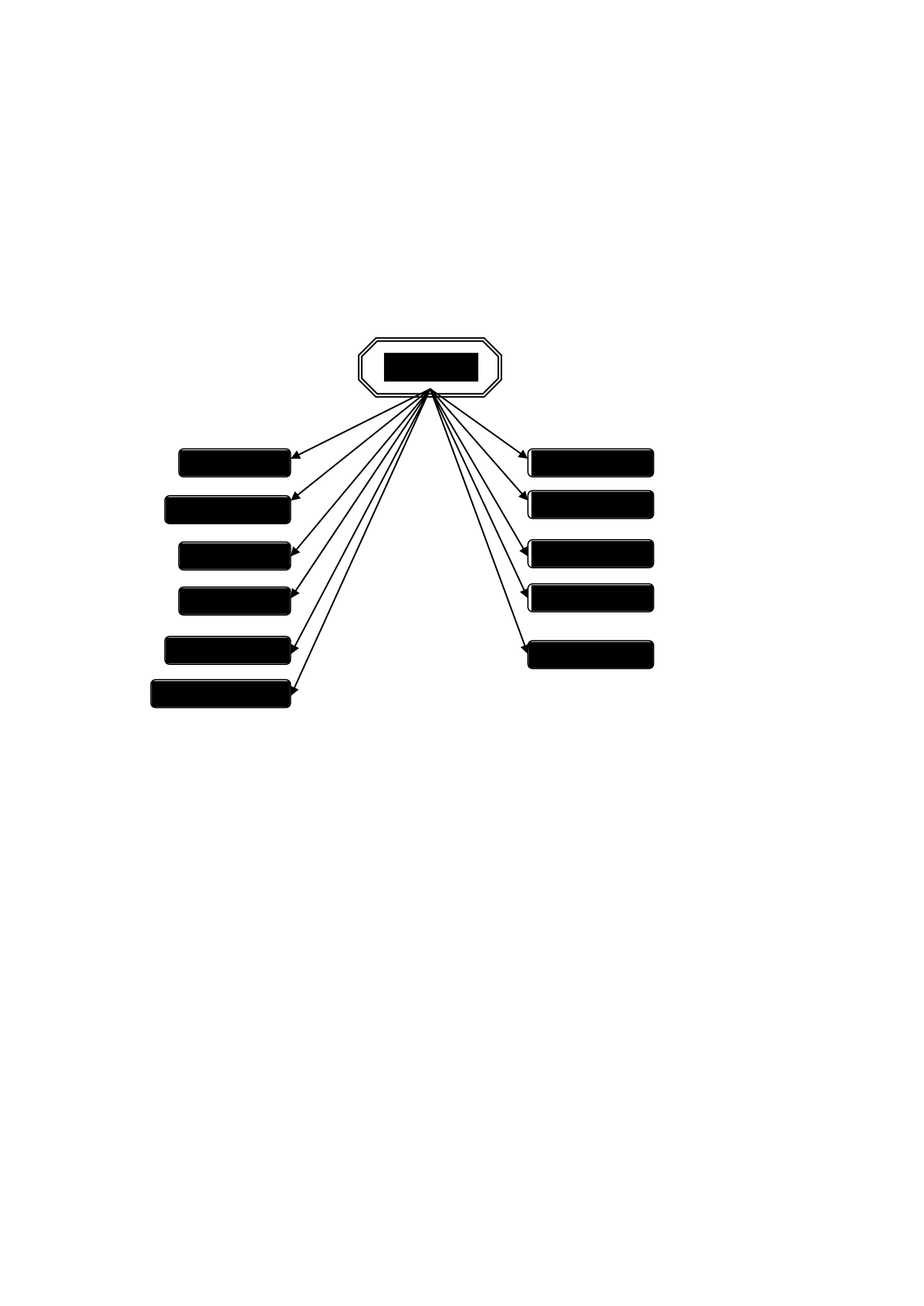
Human resource management is the attraction, selection, development, maintenance, and
use of human resources to achieve goals, both individual and organizational (Handoko, 2000:
4). Meanwhile, human resource management according to Hasibuan (2000: 10) is the science
and art of regulating the relationship and role of labor to effectively and efficiently help
realize the goals of the company, employees, and society.
Figure 5.1 Management Functions
Agribusiness Human Resources
When examined from various definitions of human resource management, agribusiness
human resource management is the art and science of managing the functions of employees
or workers in an agribusiness business so that they are effective and efficient in helping to
realize the goals of the organization/company, individuals, and society.
The functions of agribusiness human resource management can be in the form of
planning, organizing, directing, supervising, procuring, developing, compensating,
integrating, maintenance, discipline, and dismissal (Figure 5.1.).
1. Planning
The function of human resource planning in agribusiness will be done properly and
functions
of

correctly if the planner knows what and how human resources are. Human resource planning
according to Hasibuan (2000: 247) is planning the workforce to fit the needs of the company
and be effective and efficient in helping realize goals. Human resource planning can be done
properly and correctly if information about job analysis, organization, and labor supply
situation is obtained.
a. Job analysis is providing information about job activities, job standards, job
context, personnel requirements, human behavior, and tools used. These activities consist of
job description (concerning what is done in a job/job profile), job specification (who does a
job), job evaluation (concerning the lightness of work and the amount of compensation), job
enrichment (vertical expansion of work), job enlargement (horizontal expansion of work),
and work simplication (work is simplified).
b. The organization provides information about: 1) the objectives to be achieved,
whether profit or service; 2) the type of organization, whether line, line and staff, functional,
or committee; 3) the leadership of the organization, individual or collective; 4) the number of
employees and managerial and operational details; and 5) the types of authority delegated
within the organization.
c. The labor supply situation provides information on the following: 1) the supply of
labor and the level of human resources, 2) the types, age composition, education level, and
distribution or distribution of labor, 3) labor and compensation policies, and 4) HR education
systems, curricula, and levels.
If the above information is obtained by planners completely and accurately, agribusiness
HR planning will be good and correct. If HR is good and correct, then the realization of
agribusiness HRM will be smooth.
2. Organizing
Organizing in agribusiness human resources is a system of cooperative activities
between all humans involved in agribusiness companies or organizations based on their
respective responsibilities to achieve predetermined goals.
In principle, the agribusiness organization aims to make the organization run well or in
order to form an organization or in an effort to develop an organization. We need to pay
attention to some organizational principles or principles, such as (a) formulation of objectives
clearly by determining programs, procedures, KISS ME (Coordination, Integration,

Simplication, Synchronization, and Mechanization); (b) division of labor, based on the
region/territory, based on the type of product produced, based on customers served
(wholesale and retail), based on the basis of functions (series of work), as well as based on
time (morning, afternoon and evening); (c) delegation of authority based on various aspects,
such as the authority to make decisions, the authority to use resources, the authority to order,
and the authority to use a certain time limit; (d) the span of authority, such as the span of
authority, the span of control, the span of management, and the span of managerial
responsibilities; (e) the levels of supervision are kept as few or as simple as possible, besides
(f) unity of command and responsibility, a subordinate has only one superior from whom
he receives orders and to whom he gives account of the performance of his duties.
According to the pattern of work relationships and the traffic in authority and
responsibility, the forms of organization are as follows: line organization, functional
organization, line and staff organization, and functional and staff organization (Manullang,
1996: 52). Organization in agribusiness can be used line organization and line and staff
organization (Figure 5.2 and 5.3).
The line organization is a small agribusiness organization, the number of employees is
small and know each other, and work specialization is not so high. While the line and staff
organization is adopted by large organizations, the working area is wide, and has diverse
fields of work, and the number of employees is large. In line and staff organizations there is
one or more staff members. Staff are people who are experts in certain fields whose job is to
provide advice and suggestions in their fields to the leading officials in the organization.
3. Directing
Directing is an activity to direct all employees to work together effectively and
efficiently in helping to achieve the goals of the company, employees and society. Giving
directions or in other words orders is the function and duty of the leader or manager, such as
orders. In carrying out a task, the main thing that must be considered is the purpose of the
activity. Likewise, giving orders to subordinates should not be arbitrary, casual, or idle. Every
leader in giving orders must really be to realize the purpose of the order.
The main purpose in giving orders by superiors to subordinates is to coordinate the
activities of subordinates so that the activities of each diverse subordinate are coordinated in a
direction, namely to the company's goals. Giving orders to subordinates is also intended to

provide education to the subordinates themselves. Therefore, the task of giving orders to
subordinates must be closely related to the intention of increasing the knowledge of
subordinates who receive orders. An order according to Manullang (1996: 120) is an official
instruction from a superior to a subordinate to do or not to do something in order to realize
the goal of realizing company goals. An order must come from the superior to the subordinate
and not the other way around. The subordinate who is ordered must be a subordinate of the
superior concerned, not a subordinate of another superior, except in a functional system. So
the superior who gives orders to subordinates must be a superior who has the authority to do
so.
4. Supervision (directing)
Supervision in agribusiness human resources can be viewed from a supervisory system
that contains the main principles of supervision. Each activity requires a monitoring system.
Whether the employee is doing a good job or not.
The main purpose of supervision is to make sure that what is planned becomes a reality.
Therefore, in order for the supervisory system to be truly effective, meaning that it can realize
its goals, the supervisory system must at least be able to immediately report any deviations
food-deviations from the plan. What happens can be purpose-driven.
The focus of supervision actually revolves around humans because it is humans who
carry out activities in business entities or in the agribusiness organization concerned. In
addition, the economic nature of the supervision system is really necessary, there is no point
in making an expensive supervision system if the purpose of the supervision can be realized
with a cheap system. Supervisory systems for large agribusiness companies do not need to be
adopted if supervision is not economical. The guideline should be to create and adhere to a
supervisory system by truly realizing economic motives.
5. Procurement
Procurement of agribusiness human resources is the first operational function of
agribusiness HRM. Employee procurement is an important, difficult, and complex issue
because getting and placing competent, compatible, and effective people is not as easy as
buying and placing machines. Employees are the main assets of the company who are the
planners and active actors of every organizational activity. The main activity in agribusiness
HRM is the procurement of agribusiness human resources. This is in the form of activities to

develop a program for forecasting labor needs for attraction, selection, and placement,
orientation, and induction of workers.
Forecasting labor needs is intended so that the number of current and future labor needs
is in accordance with the workload, vacancies can be avoided and all workers can be done.
Forecasting labor needs can be based on production quantities, business forecasts, company
expansion, technological developments, labor supply and demand, and employee career
planning.
Manpower attraction is intended to call applicants to fill vacant positions in an
organization through labor sources, such as advertisements, employment placement offices,
educational institutions, employee unions, and employees, as well as employee families.
Then the withdrawal method can be done by a closed method which is only informed to
employees or certain people only and an open method is widely informed by placing
advertisements in mass and electronic media so that it is widely spread to the public.
Labor selection, is a process to give positions to the right applicants. With the right
applicant, there is a match (best fit) between the needs of the position (job recruirements) on
the one hand and the qualifications of the candidate on the other. The selection process
according to Manullang (1996: 146) generally consists of the stages of preliminary
interviews, filling out application forms, reference checks, psychological tests, interviews,
medical examinations, and approval of direct superiors.
Job placement means that an applicant is decided to hold a position in the organization
through an orientation (induction) process, which introduces employees to the company about
their work, the history of the company, the production issued by the company, the obligations
and rights of employees, working conditions, and employee wages and salaries.
Proper selection and placement of workers will have a positive impact on an
organization. Wrong selection and placement of workers have a negative impact, including
the emergence of labor unrest, a decrease in the number of employees, and a decrease in the
number of employees morale and enthusiasm, decreased productivity, errors in the
performance of duties, and lack of responsibility.
Orientation or introduction for each new employee must be carried out to state that they
are truly accepted with open arms as employees who will work together with other employees
in the company. Meanwhile, employee induction is an activity to change the behavior of new
employees so that they adjust to the rules of the agribusiness company.

6. Development
Agribusiness HR development is the second operational function of agribusiness HR
management. Employee development needs to be carried out in a planned and sustainable
manner. In order for development to be carried out properly, an employee or workforce
development program must first be established. Workforce development is a program
specifically designed by an organization with the aim of assisting employees in increasing
their knowledge capabilities and improving their attitudes. According to Manullang (1996:
147), various activities that can be carried out by an organization for workforce development,
namely training / education, job rotation, delegation of authority, promotion, transfer,
counseling, and conferences.
Agribusiness human resource development is an effort to improve the technical,
theoretical, conceptual, and moral capabilities of agribusiness human resources, both
employees and leaders (directors/managers) with job or position needs through education and
training.
Education improves theoretical, conceptual, and moral skills. Meanwhile, training
improves the technical skills of job execution.
Development methods for education can include training methods, under study, job
rotation and planned progression, coaching and counseling, junior board of executives or
multiple management, business games, sensitivity training, and other development methods.
As for training, it can be on the job, vestibule, demonstration and example, simulation,
apprenticeship, classroom methods (lecture/lecture, conference/meeting, programmed
instruction, case study method, role playing, discussion method, and seminar method).
7. Compensation
Compensation is the provision of compensation in the form of money or goods to
employees in exchange for services provided to the company. The company's principles must
be fair and feasible. Fair means in accordance with work performance and feasible in meeting
primary needs and guided by the government's minimum wage limit.
Compensation systems are time systems, output systems, and piece-rate systems
(Hasibuan, 2000: 123). (a) Time system, the amount of compensation (salaries and wages) is
determined based on time standards such as hours, weeks, or months. The administration of
the time system is relatively easy and can be applied to both permanent employees and non-
permanent workers; (b) Output system, the amount of compensation/wages is determined

based on the unit produced by the worker, such as per piece, meter, liter, and kilogram. The
amount of compensation paid is always based on the amount of work done, not the length of
time spent doing it. This output system cannot be applied to permanent employees (time
system) and other types of workers.
(c) Piece-rate system is a method of remuneration in which the amount of remuneration
is determined based on the volume of work and the duration of the work. Determining the
amount of compensation based on the piece-rate system is quite complicated, takes a long
time to do, and many tools are needed to complete it.
The determination of the compensation system should provide satisfaction for
employees, profit for the company, as well as quality products and reasonable prices. So, all
parties get satisfaction from the wage system implemented.
8. Integration
Integration as an activity to unite the interests of the company and the needs of
employees in order to create harmonious and mutually beneficial cooperation. Integration is
the most important, difficult, and complex operational function of human resource
management to realize because humans are dynamic and have different thoughts, feelings,
self-esteem, traits, backgrounds, behaviors, desires, and needs in agribusiness company
organizations.
To influence the attitudes and behavior of employees, managers must understand what
attitudes and motives encourage them to work for the company. In general, people want to
work because they are driven by the desire to fulfill their physical and spiritual needs. So,
managers must try to provide fair and appropriate compensation and treat employees well as
human beings. On the other hand, employees must also realize why the company accepts
them and what they want expected from employees. Companies always expect their
employees to work hard, adhere to discipline, and produce good work performance because
that way the company can get its profits.
Managers in implementing integration must be based on established principles and
methods. According to Hasibuan (2000: 135-136), the principle of integration is to create
good and mutually beneficial cooperation, while the method of integration can also be in the
form of human relations, motivation, leadership, collective bargaining.
The problem of integration is to unite the desires of employees and the interests of the
company in order to create harmonious and mutually beneficial cooperation. So the nature of

man and the nature of organization need serious attention.
9. Maintenance
Employee maintenance must receive serious attention from managers. If employee
maintenance is not paid attention to, then employee morale, attitude, and loyalty will
decrease. Maintenance is an activity to maintain to improve the physical, mental, and loyalty
conditions of employees so that they remain willing to work together until retirement.
Choosing the right method is very important so that the implementation is effective in
supporting the achievement of goals. A capable manager will apply appropriate and effective
methods in the implementation of their tasks. Maintenance of security, health, and loyalty of
employees should be with effective and efficient methods in order to achieve optimal
benefits.
Maintenance methods can be carried out in the form of communication, intensive,
employee welfare, occupational safety and health (KKK), and Pancasila industrial relations
(Hasibuan, 2000: 178). (a) communication must be used in any delivery of information from
communicators to communicants. Communication is said to be effective if the information is
delivered in a short time, clearly and easily understood, perceived, interpreted, and
implemented as intended by the communicator to the communicator; (b) Incentives are
stimulating forces given to certain employees based on their work performance so that
employees are encouraged to increase their work productivity; (c) Employee welfare is a
complementary service (material and nonmaterial) provided based on policies with the aim of
maintaining and improving the physical and mental condition of employees so that their work
productivity increases; (d) occupational safety and health (KKK) will create the realization of
good employee maintenance; and (e) Pancasila industrial relations (HIP) is a relationship
between the actors in the product production process (workers, employers, and government)
based on values that are a manifestation of all the precepts of Pancasila and the 1945
Constitution which grew and developed on the national personality and national culture of
Indonesia.
10. Discipline
Discipline as the most important operative function of human resource management
because the better the employee's discipline, the higher the work performance he can achieve.
Without good discipline, it is difficult for the organization

The company achieves optimal results. Discipline is the most important HRM function
and the key to realizing goals because without good discipline it will be difficult to realize
maximum goals. Discipline is also the desire and awareness to obey company rules and social
norms.
Good discipline reflects a person's sense of responsibility for the tasks assigned to him.
This encourages work passion, work enthusiasm, and the realization of company, employee
and community goals. Therefore, every manager is said to be effective in his leadership, if his
employees are well disciplined.
11. Dismissal (separation)
Dismissal as the last operative function of HRM. The term dismissal is synonymous
with separation or termination of employment (PHK) of employees from a company
organization. The dismissal function must receive serious attention from company managers
because it has been regulated by law and provides risks for the company and for the
employees concerned.
Dismissal is the termination of a person's employment relationship from a company.
This dismissal is caused by the wishes of the employee, the wishes of the company, the
employment contract expires, retirement, and other causes. Basically nothing lasts forever in
this world, if there is procurement there will also be dismissal.

