


CHAPTER I INTRODUCTION Since 2008 Russia Has Significantly Increased
Since 2008, Russia has significantly increased and improved its Arctic military
capabilities, its capacity to operate militarily in the Arctic, and its strategies to defend the
Russian Arctic coastal areas. Russia’s military buildup in the Arctic has become more about
projecting power than defending its coastline. As a result, the United States and other Arctic
European states have responded in kind. Thus, the Arctic appears to be the arena of a security
dilemma. However, the traditional explanations of the security dilemma do not sufficiently
explain Russia’s decision to initiate the militarization of the Arctic. Russia relies heavily on the
natural resources of the Arctic and should strive to maintain the peace and cooperation that has
traditionally marked the geopolitical conditions in the Arctic. Instead, ontological security
suggests that Russia’s desire to maintain continuity as the dominant Arctic power and regain its
identity as a great power provides a necessary causal explanation of Russia’s efforts to militarize
the Arctic.
The increasing militarization in the Arctic does not indicate impending Arctic conflict.
However, efforts by Russia and the other Arctic states to increase Arctic military capabilities are
spiraling toward Arctic competition despite ongoing regional cooperation. The Arctic had been a
region of cooperation for decades. However, over the past decade, the Arctic has become known
for increasing competition between Russia, the United States (U.S.), and the North Atlantic
Treaty Organization (NATO). Russia’s competition lies mainly with the U.S. and NATO, but
neither the U.S. nor NATO has indicated any interest in a conflict over Arctic matters.

Today, journals, newspapers, think tanks, defense departments, and ministries are
concerned about the increased Arctic competition and rising militarization. Russia’s decision to
initiate the Arctic build seems counterproductive. Russia relies on Arctic oil and gas extraction
and exports. Maintaining the status quo of a stable and cooperative region is in Russia’s best
interest. The move by Moscow to invest in Arctic conventional defenses has NATO and other
Arctic states questioning Moscow’s decision to increase tensions in the Arctic. Why did Russia
militarize the Arctic when no threat existed? Why have the U.S. and NATO responded, albeit
slowly at first, by increasing their capability and capacity to operate their conventional forces in
the Arctic? Why has the competition between Russia and the U.S. and NATO increased in the
Arctic despite the success of international institutions and regimes and the overall spirit of
cooperation that had marked the Arctic for decades? To answer these questions, it is important
first to understand Russia’s post-Soviet era struggles to strengthen its economy, impose
widespread government reforms, and ultimately secure its identity as a great power.
In some ways, Russia’s sense of self as a great power was never gone. However, Russia
experienced a severe shock to its identity in the 1990s. The world ceased to recognize Russia as a
great power. The sentiment was that Russia had lost the Cold War, and with it, Russia had lost its
status. The kind of shock Russia experienced was so severe that it created collective anxiety, and
so great was this anxiety that Russia would take risky measures to regain its identity, fulfill its
sense of self, and relieve the anxiety created by the discontinuity in its ontological security.
Ontological security is the sense of self and identity. Jenifer Mitzen writes about ontological
security in international relations. She defines ontological security as “the need to experience
oneself as a whole, continuous person in time — as being rather than constantly changing — in

order to realize a sense of agency.”1 Ontological security theorists like Mitzen argue that states
seek physical and ontological security like people. However, depending on the severity of the
break in the continuity in the sense of self, states may seek ontological security at the risk of
physical security.
This study aims to build upon the proposition made by Mitzen that states may seek
ontological security over physical security under a severe loss of the sense of self. The realist
argument is that physical security is a state’s primary objective. By seeking physical security,
fear and uncertainty about the intent of other states can lead to the condition known as the
security dilemma. The security dilemma occurs when one state fears another and strengthens its
defenses. In doing so, the other state may also experience fear and uncertainty and strengthen its
defenses. As a result, the two states may continue to increase their defenses while generating fear
in the other. The spiraling buildup of defenses is known as the security dilemma. Realists argue
that states prefer to find a way out of the dilemma but fear that they will be vulnerable if they are
the first to stop increasing defenses. However, this study argues that instead of trying to avoid a
security dilemma, states may seek a security dilemma to establish or reestablish an
intersubjective relationship that satisfies its ontological security.
The contextual case study used is Russia’s militarization of the Arctic. Russia has
significantly increased military defenses in the region which has generated a response by the
U.S. and NATO to increase their abilities to operate as a combined force in the Arctic. Without
Russia’s Arctic military expansion, the U.S. and NATO would have little interest in increasing
their capabilities to operate in the region. The response by the U.S. and NATO mainly began as a
1. Jennifer Mitzen, "Ontological Security in World Politics: State Identity and the Security Dilemma."
European Journal of International Relations 12, no. 3 (n.d.), p. 342.

matter of credibility. The U.S. may have perceived the cost to its credibility of not responding to
Russia’s Arctic militarization was beginning to be outweighed by the cost of responding.
Russia’s aggressive foreign policies over the last decade have also given the U.S., and most
European countries cause for genuine concern over the physical security of some of Russia’s
neighboring states. Their concern is leading the U.S. and NATO to increase deterrence measures
against Russia’s activities in the Arctic region, resulting in an apparent Arctic security dilemma.
This study examines three theoretical explanations for Russia’s behavior in the Arctic.
First, the structural forces of realism are explicitly examined to explain the current security
dilemma in the Arctic. Realism’s emphasis on states’ pursuit of power can explain much of
Russia’s actions in the Arctic. However, it fails to explain Russia’s actions because there was no
tangible threat to Russia’s national interests in the Arctic. Therefore, the study explores more
subsystemic factors by examining constructivism’s possible explanation. Constructivism relies
on structural, systemic factors but allows for past experiences of individual states.
Constructivism offers that within the systemic structure of the international system,
states’ actions will be influenced by their constructed beliefs and shared experiences. The
subsystemic factors offer a more holistic approach to understanding Russia’s behavior in the
Arctic. The Arctic has shaped Russia’s foreign policies for decades, and it has shaped its culture
and identity. Nevertheless, constructivism may not fully explain Russia’s willingness to generate
an Arctic security dilemma, making its position less secure. A complete explanation of a state’s
behavior is often an eclectic collection of various theories. As such, ontological security theory
tells us that states may pursue ontological security over physical. Therefore, ontological security
theory is necessary to explain Russia’s behavior in the Arctic.

If Russia were acting under the tenets of realism, we would expect to see Russia pursue a
strategy to build its defenses, mainly its nuclear force, to deter any action by NATO, China, or a
neighboring state. Russia has a modernized nuclear force, and by including what it calls tactical
nuclear weapons, it has the largest nuclear force in the world. China comes in at a distant third.
Therefore, it is safe to conclude that Russia has created a credible nuclear deterrent. Russia’s
defense budget is the third largest in the world. The defense budgets are covered in later
chapters, but Russia’s as the third largest, at around $60bn in 2020, it is an order of magnitude
smaller than the U.S. budget. Russia is also the largest country in the world, with thousands of
miles of borders with other countries. The study shows Russia has built new military facilities
deep in the Arctic. Maximizing power in the Arctic offers diminishing returns. Not only was
there no indication by any state to threaten Russia’s Arctic, but Russia had also previously been
the dominant Arctic power. Furthermore, U.S. and NATO would prefer the status quo ante when
there was no need to increase their Arctic military capabilities.
The realist explanation for the causes of a security dilemma was absent in the Arctic.
Russia was not threatened, and the U.S. and NATO never showed any interest in the Arctic. The
only interest the U.S. and other Arctic states showed was cooperating with Russia. Even now,
under the currently Arctic security dilemma and Russia’s invasion of Ukraine, arguments exist
for Russia’s inclusion in the Arctic Council. Therefore, if Russia were behaving in strict
accordance with realism, it would likely use its limited resources to strengthen its weaker areas
of defense. The Arctic was never a weak area for Russia.
The hypothesis that Russia is pursuing a security dilemma in the Arctic to satisfy its
ontological needs is difficult to test. This study provides evidence of Russia’s increased Arctic
military capabilities and that Russia experienced a severe discontinuity in its identity as a great

power. Ontological security theory argues that states are willing to risk physical security to
achieve ontological security. However, ontological security is achieved indirectly. In pursuing
ontological security, actors pursue actions that lead to outcomes that indirectly satisfy
ontological needs. The desired outcomes result from strategic interaction among actors. The
choices one actor makes influence the choices of another. Therefore, game theory, which is a
methodology to model strategic interaction, is used to test the hypothesis.
Using game theory methodology enables us to understand the strategic interaction
between actors. Using a separating game allows us to examine whether Russia is the type of
actor that seeks physical security or the type that seeks ontological security-seeking actor. The
model is framed in the context of the Arctic and constrained to choices about actions in the
Arctic. Game theory highly abstracts the actors involved and the choices presented. It is not a
reflection of real life. However, the insights will allow us to test the validity of the hypothesis
that Russia’s actions in the Arctic are motivated by its need to achieve ontological security.
The study begins by providing an overview of Russia’s quest for great power status and
how that quest is dependent on the Arctic. Additionally, the first chapter provides evidence that
the Arctic is a region marked by international cooperation. The second chapter illustrates
Russia’s efforts to increase its Arctic military operational capabilities. Despite that cooperation,
the region is turning into a zone of competition. The theoretical foundation for this study and
thesis is explored in Chapter III. In Russia’s recent Arctic militarization case study, the theories
examined are ontological security theory, neorealism, and constructivism. Chapter IV uses game
theory methods to examine the rationality of Russia’s decision-making in its pursuit of great
power status and the response by the U.S. Demonstrating causal factors in Russia’s actions in the
Arctic through ontological security is challenging. However, game theory sheds insight on the

rational decisions to seek ontological security through militarizing the Arctic. Chapter V is a
look into the U.S. and NATO’s and NATO’s decision to increase its ability to operate as a
combined military in the Arctic. The chapter focuses on the U.S. concerns with regard to its
credibility. The final chapter discusses the results and insights gained from the typology of
international relations theories and game theory methods employed in the previous chapters. It
also considers the connection between Russia’s activities in the Arctic and its invasion of
Ukraine on 24 February 2022. China’s interests in the Arctic a briefly discussed. China has many
interests in the Arctic and has made itself a key stakeholder. The focus of this study is the
relationship between Russia and NATO, but China’s involvement in the Arctic has major
strategic ramifications. First, we begin with an overview of the conditions that lead to Russia’s
aggressive Arctic militarization between 2008 and 2018.
The Arctic’s Role in National Security
Before analyzing Russian ontological security-seeking requirements and its efforts to
militarize the Arctic, we must start with an overview of the importance of the Arctic and its
relevance to national security. The Arctic is vitally important to many actors across many
sectors. However, for this study, the scope of Arctic importance will be limited to its relevance to
Russian national security. Russian national security in the Arctic revolves mainly around the
maritime domain. Generally speaking, the Arctic is a maritime region. The Arctic circle is
defined by the 6633’ north latitude circumscribing the globe. The area to the north of the Arctic
circle is considered the Arctic. However, the Arctic circle’s latitude simply results from the tilt of
the Earth’s axis, which is approximately 2327’ from the perpendicular of the plane created by
Earth’s revolution around the Sun. From the winter solstice to the spring equinox, the Sun will

not rise above the horizon on the Arctic circle and will not set above the Arctic circle during
from the summer solstice to the autumnal equinox. The latitudinal designation is only one of
several delineating boundaries. Other boundaries of the Arctic include the 10C July isotherm or
the nearly coincident tree line boundary. Many other boundaries delineate the Arctic, depending
on the Arctic’s meaning to the party creating the boundary. Regardless of how it is defined, the
Arctic is an environment of extreme conditions that offer challenges and opportunities for
Russia. The role of geography cannot be understated; the Arctic is an essential feature of the
geopolitics between Russia, the U.S., and NATO.
Russia’s economy depends heavily on crude oil. Russia is one of the world’s top three oil
producers and the world’s second-largest natural gas producer, and the Arctic seabed contains
substantial natural resources.2 Reports from the U.S. Geological Survey in 2008 estimated that
roughly 13% of the world’s undiscovered oil deposits and 30% of the world’s undiscovered
natural gas lie in the shallow continental shelves below the surface of the Arctic Ocean. Most of
the Arctic’s natural resources lie within the established Exclusive Economic Zones defined by
the United Nations Convention on the Law of the Seas (UNCLOS). Oil and natural gas deposits
also lie in the terrestrial parts of the Arctic. The Yamal peninsula is home to the Yamal LNG
Project, a massive undertaking led by Russia’s state-run Gazprom.3 The Arctic is exceptionally
resource-rich, and nearly all the Arctic natural resources lie in uncontested territories. Due to
climate change and the receding sea ice, much of the natural resources are increasingly more
accessible. Russia is taking advantage of the more accessible Arctic oil and gas.
2. IEA, Energy Fact Sheet: Why does Russian oil and gas matter? 2022.
https://www.iea.org/articles/energy-fact-sheet-why-does-russian-oil-and-gas-matter (accessed July 4, 2022).
3. Hydrocarbons Technology, Yamal LNG Project, Sabetta. 2022. https://www.hydrocarbons-
technology.com/projects/yamal-lng-project-russia/ (accessed February 1, 2022).

In recent years, Russia has increasingly focused on the Arctic as a way to increase oil and gas production
and offset declines at existing and older production sites. The Arctic accounts for over 80% of Russia’s
natural gas production and an estimated 20% of its crude production. While climate change threatens future
investment in the region, it also presents Russia with the opportunity of increasing access to Arctic trade
routes, allowing for further flexibility for seaborne deliveries of fossil fuels, particularly to Asia.4
The changing climate impacts the polar regions almost four times more than the middle latitudes.
The warming climate affects the annual extent of Arctic sea ice. Over the past several decades,
the extent of the annual Arctic sea ice has receded significantly. The warming climate also makes
much of the Arctic ice thinner. There are other environmental impacts due to climate change, and
those environmental impacts result in other transformational changes in the Arctic.
The thinning and receding ice means that the Arctic is much more accessible, resulting in
considerably more maritime traffic. The increased maritime traffic impacts Russia’s security.
Moreover, the receding ice occurs mainly over the Russian Arctic and not the North American
Arctic. These issues are addressed later in the study, but climate change is both an opportunity
and a threat to Russia. It is an opportunity because the more the ice recedes, the more natural
resources are accessible, and the less it costs to extract them.
On the other hand, Russia’s economy is heavily dependent on its oil and gas exports. The
changing climate creates a global collective effort to find alternatives to petroleum-based energy.
The more the world transitions to other energy sources and the warmer the climate, the less the
world will need oil and gas. However, waning global oil and gas consumption is not an
immediate threat. The threat could become a significant issue for Russia if it does not diversify
its economy. Considering Russia does not have a strong innovation or even an imitation sector,
the Arctic is vital to Russia’s economic security.
4. IEA, Energy Fact Sheet: Why does Russian oil and gas matter? 2022.
https://www.iea.org/articles/energy-fact-sheet-why-does-russian-oil-and-gas-matter (accessed July 4, 2022).

The Arctic is home to Russia’s Northern Fleet on the Kola peninsula on the Barents Sea.
The Barents Sea provides Russia’s Navy access to the North Atlantic. Russia’s naval fleet in the
Kola peninsula includes a substantial portion of its ballistic nuclear missile submarine fleet
giving Russia its nuclear second-strike capability. The Arctic is a significant region to most of
the world’s countries, but mainly to Russia. Russia has a long history with the Arctic, and Russia
identifies as the dominant Arctic power.
As recently as 4 July 2022, the Economist published an article titled, Who controls the
Arctic? The article notes some well-known data about the Arctic, but it answers the question of
the title. “In May Sergei Lavrov, Russia’s foreign minister, claimed that his country controls the
Arctic. ‘It has been absolutely clear for a long time that this is our territory,’ he said.”5 Lavrov’s
argument is what makes Russia’s militarization of the Arctic paradoxical. The Economist article
briefly describes Russia’s efforts to increase its Arctic military presence, stating that since as
early as 2007, at least 50 Soviet-era airbases have been renovated for operations in the Arctic.6
The paradox is why, if it is clear that the Arctic has been part of Russian territory for a long time,
would Russia make such an effort to militarize a region that is not in dispute? In a report released
by the Center for Naval Analysis (CNA), Katarzyna Zysk ponders the paradox of Russia’s
expanding Arctic military capabilities and increased activities of Russia’s armed forces in the
Arctic. Zysk asks,
What war scenarios is Russia preparing for in this remote and relatively stable region? And what is driving
Russia to prioritize the region and continue to inject new capabilities into all of its defense branches,
expand its military infrastructure, and increase the quantity, scope, and complexity of its military exercises
and training—even as the economic environment has become increasingly constrained, including periods of
stagnation and recession, since 2014?7
5. The Economist, "Who controls the Arctic?" The Economist, July 4, 2022.
6. The Economist, "Who controls the Arctic?" The Economist, July 4, 2022.
7. Katarzyna Zysk, Russia's Military Build-Up in the Arctic: to What End? Occaissional Paper, Arlington:
Center for Naval Analysis, 2020. p. 2.

Zysk also highlights the other puzzling piece of Russia’s expanded activities in the Arctic. Not
only does Russia’s increased militarization seem unnecessary, but Putin ushered in Russia’s
expanded military activities and increased infrastructure during economic constraints.
Russia’s Ontological Security
Russia tends to have an outsized ability to influence global affairs, given the size of its
economy and military capacity.8 It has shown that it can expand its military operations and act as
a peacekeeper in disputed regions. Russian oil and gas impact the global energy markets. The
Kremlin’s aggressive foreign policies significantly influence the U.S. and European national
security policies. Russia has maintained its strategic nuclear arsenal and capability to employ
nuclear ballistic missiles throughout its tumultuous post-Soviet period. The Russian nuclear
weapons stockpile makes up the largest nuclear arsenal of any country, even under the remaining
arms control treaty, the New Strategic Arms Reduction Treaty (New START). Another
indication that Russia’s identity as a great power was in a far less precarious state.
Following the collapse of the Soviet Union, Russia’s identity was threatened. The anxiety
that accompanies discontinuity in identity can lead the agent, be it state or individual, to
reestablish continuity of identity in harmful ways. The agent, in this case, Russia, may undertake
acts that could result in physical harm to ensure that its identity remains intact. This study
examines Russia’s motives through the lens of ontological security theory to understand the
causal mechanisms of Russia’s militarization of the Arctic. The research in this study indicates
that the spiraling militarization of the Arctic is not simply the result of rational actions leading
8. Kathryn E. Stoner, Russia Resurrected: Its Power and Purpose in a New Global Order. New York:
Oxford University Press, 2021. Stoner’s thesis is that Russia’s material power does not add up to the power Russia
seems to have on the global stage.

toward a suboptimal outcome as described by the security dilemma but includes complex
consequences of the rational pursuit of ontological security.
Ontological security theory suggests that when a state’s identity is challenged, a state will
pursue self-identity needs through social actions, even at the risk of physical security.9 Jennifer
Mitzen argues that ontological security is the “security not of the body but the self, the subjective
sense of who one is, which enables and motivates action and choice.”10 Karl Gustafsson and
Nina C. Krikel-Choi point out that ontological security theory counters the traditional
international relations theories based on the desire for states to achieve physical security. They
argue that ontological security “seeks to question the primacy of physical security in
[international relations].”11 For example, Russia’s identity as a great power, a powerful state
capable of influencing international affairs on a global scale, came into question following the
dissolution of the Soviet Union. Throughout the 1990s, Russia experienced domestic political
and economic crises and experienced relegation from the great powers in international politics.
The decade confirmed that Russia’s status had fallen remarkably. A collective Russian need to
regain and maintain its previous status as a great power drove Russia to pursue a course directed
at reestablishing its earlier status as a great power.
After centuries as a nation that wielded power and influence across Europe, Asia, parts of
Africa, and even areas in the western hemisphere, Russia had to rely on assistance from
international institutions to ensure its survival. Russia’s status as a second-rate power caused a
9. Brent J. Steele, Ontological Security in International Relations: Self-Identity and the IR State. New
York: Routledge, 2008, p. 2-3.
10. Jennifer Mitzen, "Ontological Security in World Politics: State Identity and the Security Dilemma."
European Journal of International Relations 12, no. 3 (n.d.), p. 344.
11. Karl Gustafsson and Nina C. Krickel-Choi, "Returning to the Roots of Ontological Security: Insights
From the Existentialist Anxiety Literature." European Journal of International Relations 26, no. 3 (2020), p. 877.

discontinuity of the long-standing identity as a great power. Ontological security theory suggests
that when states experience a discontinuity with their identity, the experience can become “a
radical disjuncture of an unpredictable kind,”12 creating anxiety in a state much the same way an
individual experiences anxiety.13 Ontological security theory proposes that actors seek a sense of
biographical continuity, be they individuals or states.14 That is, actors seek a sense of identity to
realize a sense of agency. Actors can avoid that anxiety by establishing a sense of continuity with
others.15 In the context of the post-Cold War, Russia’s economy was weak as it transformed from
a centrally controlled economy to a capitalist economy.16 In the decade following the collapse of
the Soviet Union, Russia’s military strength and capabilities declined sharply, and the Kremlin
significantly reduced its military presence in the Arctic. The entire Russian military decreased
considerably from Soviet levels. As Russian troop strength dwindled in the Arctic, Soviet legacy
airbases could no longer be maintained, and training and exercises in the region stopped. Except
for Russia’s nuclear forces and some remnants of its navy, the Kremlin withdrew most of its
forces from the Arctic.
When Russia downsized its Arctic military footprint and abandoned most of its northern
military bases, mainly because it could not afford to maintain forces in the region and the need
for a large strategic deterrence force based in the Arctic no longer existed following the end of
the Cold War. During the Cold War, the Arctic was a theater for nuclear weapons. As mentioned,
12. Steele, Ontological Security in International Relations: Self-Identity and the IR State, p. 51.
13. Steele, Ontological Security in International Relations: Self-Identity and the IR State, p. 51.
14. Catarina Kinnvall and Jennifer Mitzen, "Anxiety, fear, and ontological security in world politics:
thinking with and beyond Giddens," International Theory 12 (2020), p. 244.
15. Kinnvall and Mitzen, "Anxiety, fear, and ontological security in world politics: thinking with and
beyond Giddens," International Theory, p. 240.
16. Stoner, Russia Resurrected: Its Power and Purpose in a New Global Order, p. 120.

it was the home for much of the Soviet second-strike capability, its submarine force capable of
launching nuclear-armed missiles. Most of Russia’s nuclear-armed submarine force is still based
in the Arctic’s Kola Peninsula.17 During the Cold War, the Soviet Union and the United States
were less concerned with conventional fighting in the Arctic. Instead, both valued its geographic
importance to their respective strategic nuclear forces. The Soviets and the Americans sought to
preserve the Arctic as a strategic theater critical to nuclear deterrence, but after the Soviet Union
dissolved, the importance of the strategic nature of the Arctic declined.
The fading strategic nature of competition between the U.S. and post-Soviet Russia made
room for increased cooperation in the Arctic. As a result, the Arctic emerged as a region marked
by international cooperation. Cooperation in the Arctic between the United States and the Soviet
Union endured for decades but was overshadowed by the bipolar structural competition of the
Cold War. Soon after the collapse of the Soviet Union, the eight Arctic states and Arctic non-
state actors, such as groups representing indigenous peoples, officially established the Arctic
Council by signing the Ottawa Declaration in 1996.18 Over twenty-five years later, the Arctic
Council has become the leading international Arctic regime de-facto. The chairmanship rotates
among the Arctic states every two years, and at the time of writing this study, Russia had
assumed the chairmanship of the Arctic Council. The Arctic Council is a remarkable institution
held as a standard for international cooperation.
Nevertheless, despite the remarkable and continued cooperation over the last decade, the
Arctic has been marked by increasing competition. The increased competition coincides with
17. Thomas Nilsen, "Putin puts nuclear deterrence forces at Kola on alert." Barents Observer, February 27,
2022.
18. The Arctic Council Secretariat, The Arctic in a Changing Climate. 2021. https://arctic-
council.org/en/explore/topics/climate/ (accessed August 28, 2021)

Russia’s strong recovery on the global scale. Russia went from receiving international handouts
from the World Bank and the International Monetary Fund in the years after the Soviet Union
collapsed to a position of strength marked by its aggressive foreign policies with former Soviet
republics, western Europe, and the United States.
The current geopolitical tensions between Russia and the U.S. and NATO are
problematic. The U.S. and western Europe have imposed heavy sanctions on Russia for its
actions in Ukraine and Crimea. NATO countries reinforced their defenses in areas not typically
associated with armed conflict. For example, NATO established its Cyber Center of Excellence
in Tallinn, Estonia, following the suspected Russian cyber-attacks on Estonia following the
protests over the Bronze Soldier, a memorial to the Soviet soldiers claimed to have liberated
Estonia from Nazi Germany. More non-NATO states are considering the benefits over the costs
of NATO membership. While writing this study, Russia invaded Ukraine, prompting Sweden
and Finland to apply for NATO membership.
Meanwhile, NATO is increasing its capability and capacity for combined, multinational
operations in the North Atlantic and parts of the Arctic. Russia is arguably in a less secure
position than it was in 2008, but it is considered a great power competitor of the U.S. and NATO.
U.S. and NATO’s recognition of Russia as a major competitor and potential adversary validates
Russia’s strategies and foreign policies. The discontinuity of Russia’s identity is potentially
beginning to resolve. Therefore, Russia’s increased militarization of the Arctic and its actions in
Ukraine indicate that Russia will continue to influence global affairs in pursuit of its ontological
needs, for better or worse.

CHAPTER II
RUSSIA’S ARCTIC MILITARIZATION
Chapter II provides evidence of Russia’s increased militarization of the Arctic and the
expanded role the Russian armed forces have in the region. Moreover, the examination of the
Russian identity and the relationship between the idea of Russia with the domestic and
international audiences begins with an analysis of the discourse content of President Putin’s
interviews and speeches since 2008. The content of President Putin’s public addresses is used in
this study to investigate the emphasis his government places on securing the identity of a great
Russia both within the country’s boundaries and with the international community. The content
of Russian national security strategies and defense budgets are necessary elements in confirming
Russian Arctic militarization.
Russia has modernized decrepit Soviet-era bases, added new bases that house infantry
battalions, and constructed new military airfields in remote Arctic regions. Geopolitically, the
Arctic offers Russia the basis for its restoration of its great power status.19 Therefore, ontological
security is necessary to consider that Russia’s actions in the Arctic may be efforts to achieve
ontological security.
Russia in the 1990s
Christmas day 1991 marked the culmination of a series of crisis and the end of the Soviet
Union. That moment created a severe transformational shock and substantial discontinuity to the
19. Michael Paul and Göran Swistek, "Russia in the Arctic: Development Plans, Military Potential, and
Conflict Prevention." Stifung Wissenschaft and Politik (German Institute for International and Security Affairs),
February 2022, p. 15.

Russian identity. For centuries Russia was a great power, but when the reign of the Soviet Union
ended, Russia’s status, direction, and agency were somewhat lost simultaneously. Kathryn
Stoner captured the international response following the Soviet Union’s dissolution. She writes,
“Russia was widely dismissed by the international community as nothing more than a regional
power whose global influence had died with communism.”20 The severe transformation of
Russia and the subordination of its status altered the agency of the state and created a sense of
anxiety among the individual Russian citizens, the government, and internationally.
The transformation phase was a period of anxiety brought on by the discontinuity and
uncertainty of Russia’s future. Daniel Yergin et al. captured the collective emotional
despondence as Russia accepted its fate at the end of the Soviet rule, describing the Soviet
leader’s final official address,
Gorbachev concluded his valedictory speech and faded into the ether…the Soviet Union followed suit,
disappearing into the night. There was no great celebration, no honking of horns or ringing of bells, just a
great silence in the dark, and uncertainty as to what the dawn would bring.21
The aftermath of the Soviet collapse left Russia struggling to transform itself from a communist
relic to a liberal market economy and democracy. The collapse also left Russia uncertain about
its future role in the new world order.
At the beginning of post-Soviet Russia, President Boris Yeltsin and U.S. President
George H.W. Bush declared that the U.S. and Russia were no longer adversaries and announced
their intent to shepherd a new era of strategic partnership. Soon the optimism gave way to the
realities of international politics and conflict of interests. Russia maintained its nuclear arsenal,
but that did not stop NATO from expanding eastward with the new force posture of NATO
20. Stoner, Russia Resurrected: Its Power and Purpose in a New Global Order, p. 3
21. Daniel Yergin and Thane Gustafson, Russia 2010 - And What it Means for the World. New York:
Random House, 1993, p. 21.

military equipment and troops in the previous territory of the German Democratic Republic, or
East Germany. Russia viewed NATO’s move as an insult to its identity as a great power and an
encroachment on its sphere of influence. The Kremlin felt more than disrespected by the U.S.
and several European powers; it felt as though the West simply dismissed Russia’s interests.22
From then on, Russian and U.S. relations rapidly declined due to a series of crises in the 1990s.23
Domestically, the Russian political and intellectual elite propagated that then-Russian President
Boris Yeltsin had allowed Russia to fall into a smutnoye vremya, a term associated with the
infamous period in Russian history known as the Times of Trouble 1598-1613. This historical
period was marked by political turmoil, invasions, uprisings, and widespread famine. Boris
Yeltsin was compared to the de facto regent of the period, Boris Godunov. The collective
memory in Russia of smutnoye vremya was so powerful that Vladimir Putin successfully used
the image to launch his reform platform as president in 1990-2000.24
The domestic shock that Russia experienced during the 1990s created dislocation in its
ontological security. Russia’s identity as a great power vanished, immediately shocking the
system. Brent Steele explains that ontological security reveals how crises can challenge a state’s
identity.25 While Russia worked to transform a centrally controlled economy into a liberal
economy, the impact on Russia’s identity went largely ignored. Steele asserts that consistently
ignored threats to ontological security produce shame. During the ongoing Russian crisis in the
22. Joshua Shifrinson and R. Itzkowitz, "Deal or No Deal? The End of the Cold War and the U.S. Offer to
Limit NATO Expansion." International Security 40, no. 4 (2016). p. 9.
23. Fiona Hill and Clifford G. Gaddy, Mr. Putin: Operative in the Kremlin. Washington: Brookings
Institution Press, 2013, p. 32.
24. Hill and Gaddy, Mr. Putin: Operative in the Kremlin, p. 23.
25. Steele, Ontological Security in International Relations: Self-Identity and the IR State, p. 3.

1990s, the U.S. sponsored the eastward expansion of NATO that further isolated Russia and, in a
way, added insult to injury. In the 1990s, President Boris Yeltsin worked to relieve the domestic
economic crisis, but Russia still faced severe setbacks. Russian politicians fought vigorous
political battles. The political fighting turned into a crisis of its own and eventually reached the
point that President Yeltsin used military tanks to shell the Russian parliament. The economic
reforms that Yeltsin put in place had failed. The economy was in complete ruins, citizens
protested the deteriorating conditions, and the government was at war with Chechnya. NATO
had expanded eastward and dominated the Balkan conflicts bringing Russia’s relationship with
the U.S. to decline significantly.26
Russia in the 2000s
Following the collapse of the Soviet Union, neither the U.S. nor Russia focused on Arctic
military issues.27 In 2007 Artur Chilingarov led the Arktika-2007 expedition that planted the
Russian flag on the seabed of the geographic north pole.28 Chilingarov, a charismatic polar
researcher and Russian statesman, said that planting the flag on the north pole was geographic,
not political, like planting a flag on the moon or Mt. Everest.29 As with the American flag on the
moon, Chilingarov’s geographic gesture was also a tremendous patriotic move marking the
beginning of Russia’s return as a great power. The flag-planting was interesting to some in
26. Hill and Gaddy. Mr. Putin: Operative in the Kremlin, p. 36-37.
27. Giles Merritt, "Friend or foe?" The Guardian, December 16, 2007.
28. TASS, "Arctic explorers tell how they put Petersburg's flag on ocean's bottom." TASS Russian News
Agency, August 4, 2017.
29. TASS, "Arctic explorers tell how they put Petersburg's flag on ocean's bottom." TASS Russian News
Agency, August 4, 2017.

Arctic circles and made for some inflammatory news stories. According to the Associated Press,
the U.S. considered the move as “‘Just a show.’ The United States promptly dismissed the
Russian move as legally meaningless whether it planted ‘a metal flag, a rubber flag or a
bedsheet.’” 30 Canadian Foreign Minister Peter Mackay added that Russia “could not expect to
claim territory under the rules of ‘the 15th century.’”31 However, it had a significant impact on
the George W. Bush administration. A seeming innocuous flex of national pride triggered a slow
cascade of events, heavily led by Russia, and resulting with the current spiraling of Arctic
militarization. The flag-planting alone is not the cause of the spiraling militarization in the
Arctic. The conditions under which the flag-planting occurred, the geopolitical conditions, and
President Putin’s efforts to bring Russia out of the post-Cold War-ruin created a complex
interaction of domestic and international drivers that catalyzed Russia’s securitization of the
Arctic.
Russia’s actions in 2008 against Georgia and in 2014 against Ukraine made it clear that
Russia was on a course to reclaim its status and confirm its identity as a great power. Several
explanations can rationally explain Russia’s aggressive militarization, but Russia’s policies and
military expenditure to increase its non-nuclear conventional forces are contrary to the efforts
made by the Arctic states. Russia, other Arctic states, and many non-Arctic states have
cooperated multilaterally for decades. To what extent have international institutions and regimes
reduced the probability of conflict or animosity between the Arctic states. The Arctic states have
little to no incentives to defect, cooperation benefitted all Arctic stakeholders.32
30. The Associated Press, Russia defends North Pole flag-planting. August 8, 2007.
https://www.nbcnews.com/id/wbna20169307 (accessed November 15, 2021).
31. The Associated Press, Russia defends North Pole flag-planting. August 8, 2007.
https://www.nbcnews.com/id/wbna20169307 (accessed November 15, 2021).
32. Robert Axelrod, The Evolution of Cooperation. New York: Basic Books, 1984, p. 124

No other state had interests in the Russian Arctic that threaten Russia. Russia has
militarized the Arctic absent a specific threat, and the paradox is that relatively recently NATO
responded in kind. However, the uncertainty about what is driving Russia to expand military
operational capabilities in the Arctic has caused confusion. The U.S., for example, is pursuing a
strengthened Arctic posture in a seemingly uncoordinated and hesitant fashion. The U.S. is
slowly developing a coherent strategic narrative, but in the debate over the national defense
budget, lawmakers and the U.S. Department of Defense (DOD) struggle to make a rational case
for increasing U.S. military Arctic capabilities. The U.S. continues, albeit slowly, to increase
Arctic capabilities and publish disparate Arctic strategies. While the U.S. tends to hesitantly
progress toward a national Arctic strategy, many other states, and NATO, are also increasing
their respective Arctic security awareness and presence. The increased Arctic awareness and
military activities, particularly by the U.S. and NATO, make Russia less secure in the Arctic than
a decade ago.
In the early 2000s, domestic attention was focused on overcoming slow gross domestic
product rates, demographic issues, and corruption. Oil extraction and exports, and effective
monetary policies, have Russia’s economy a needed boost. The economy has grown significantly
in little more than a quarter-century. The Russian economy suffered setbacks in the 2008 global
crisis and energy slump, and again in 2014 when global energy prices again fell dramatically,
and the U.S. implemented sanctions.33 Nonetheless, under Putin, Russia’s GDP steadily grew. As
a result of economic reforms and a strengthening economy, Putin turned toward developing a
professional and modern military.34 In doing so, Russia modernized many of its dilapidated
33. Stoner, Russia Resurrected: Its Power and Purpose in a New Global Order, p 132.
34. Stoner, Russia Resurrected: Its Power and Purpose in a New Global Order, p. 153

Arctic infrastructures, especially those of Russia’s second-strike nuclear capabilities on the Kola
peninsula. Russia continued to increase its Arctic militarization and build new Arctic bases,
develop new Arctic strategies, and conduct sophisticated combined-arms military exercises in the
Arctic.
To strengthen its military, Russia implemented the New Look military reforms in 2008
and transformed the Russian military.35 While Russia’s military is more powerful and its
economy dramatically strengthened, Russia does not compare to the U.S. or China. Kathryn
Stoner notes, “Russia has developed an outsized ability to exercise considerable influence
abroad.”36 This outsized influence that Stoner references, more than Russia’s calculable material
strength, caused the U.S. to reconsider its strategic outlook toward Russia.
Arctic Cooperation
In recent years global interests in the Arctic have increased, ranging from the impacts of
climate change to the increasing militarization in the region. International institutions such as the
Arctic Council are working to understand and mitigate the risks and effects of climate change in
the Arctic.37 As a result of Russia’s 2022 invasion of Ukraine, members of the Arctic Council
voted to suspend the Arctic Council temporarily. The United Nations Convention on the Law of
the Seas is an international treaty designating sovereign maritime boundaries, including special
provisions for the Arctic.38 The Arctic Coast Guard Forum is a non-treaty international
35. Stoner, Russia Resurrected: Its Power and Purpose in a New Global Order, p 184.
36. Stoner, Russia Resurrected: Its Power and Purpose in a New Global Order, page 4.
37. The Arctic Council Secretariat, The Arctic in a Changing Climate. 2021. https://arctic-
council.org/en/explore/topics/climate/ (accessed August 28, 2021).

organization in which member states work to mitigate risks associated with the Arctic and
increase cooperation among the Arctic states.39 Organizations such as the Arctic Circle bring
together interested participants from around the globe to share ideas and interests and advance
Arctic understanding and cooperation.40 The Arctic is not a lawless frontier nor a barren frontier.
The Arctic has customary international laws that are widely recognized and is home to around 4
million people.41 In 1987, Mikhail Gorbachev declared that the Arctic should be a zone of peace.
He indicated that the Soviet Union was willing to reduce its military capabilities in the Arctic to
make the Arctic a peaceful region.42
Most Arctic institutions and organizations are focused on cooperating in science,
development, safety, and other non-security-related issues. The Arctic Council is mandated
explicitly by the 1996 Ottawa Declaration that it “should not deal with matters related to military
security.”43 As a result of the moratorium on military security-related issues, the Arctic states
38. The Division for Ocean Affairs and the Law of the Sea, Office of Legal Affairs, United Nations, United
Nations Convention on the Law of the Sea of 10 December 1982. n.d.
https://www.un.org/Depts/los/convention_agreements/texts/unclos/UNCLOS-TOC.htm (accessed August 28, 2021).
Part II, Section 1, Article 2 provides the “legal status of the territorial sea, of the air space over the territorial sea and
of its bed and subsoil. Whereas, Part XII, Section 8, Article 234 provides covenant for coastal states “to adopt and
enforce non-discriminatory laws and regulations…in ice-covered areas within the limits of the exclusive economic
zone…”
39. The Arctic Coast Guard Forum, About the ACGF. n.d. https://www.arcticcoastguardforum.com/about-
acgf (accessed August 28, 2021).
40. Arctic Circle, Arctic Circle. n.d. https://www.arcticcircle.org/ (accessed April 7, 2021).
41. National Snow and Ice Data Center, Arctic People. May 4, 2020.
https://nsidc.org/cryosphere/arctic-meteorology/arctic-
people.html#:~:text=Indigenous%20People&text=Residents%20of%20the%20Arctic%20include,minority%20of%2
0the%20Arctic%20population. (accessed June 3, 2022)
42. Mikhail Gorbachev, "Mikhail Gorbachev's speech in Murmansk at the ceremonial meeting on the
occasion of the presentation of the order of Lenin and the Gold Star to the city of Murmansk." Barentsinfo. October
1, 1987.
43. The Arctic Council Secretariat, The Arctic Council. 2020. https://arctic-council.org/en/ (accessed May
4, 2020).

created a separate forum specifically to discuss military security issues. To address the emerging
militarization of the Arctic, the United States and Norway established the Arctic Security Forces
Roundtable (ASFR) in 2010 to offer a means by which states can specifically address Arctic
military security matters. The ASFR was created to remove uncertainty about military intentions
and activities and promote cooperation among the Arctic states.44 Five of the eight Arctic states
are also NATO members. Sweden and Finland are not yet members of NATO, but they have
applied for NATO membership following Russia’s 2022 invasion of Ukraine.
Experts are arguing for and against NATO hosting high-level Arctic military security
discussions. Those in favor argue NATO is an established security organization with a global
outlook, and except for Sweden and Finland, all Arctic states are members, Russia
notwithstanding. Therefore, the Arctic states are already members of NATO or have close
working relations. The growing concern among Arctic security professionals is that tensions or
conflict from other areas worldwide could spill over into the Arctic.45 Those arguing against
NATO hosting Arctic military security dialogues are concerned with the perception that NATO
and its partners intend to surround Russia, which would likely further antagonize Moscow. They
fear that the Kremlin would further increase tensions in the high north.46 For the last decade,
Russia has led the Arctic states to expand their Arctic military capabilities and improve and
44. U.S. Northern Command Public Affairs, NATO Allies, Partners Promote Arctic Security, Military
Cooperation. May 5, 2022. https://www.northcom.mil/Newsroom/News/Article/Article/3021154/nato-allies-
partners-promote-arctic-security-military-
cooperation/#:~:text=The%20annual%20Arctic%20Security%20Forces,nations%2C%20May%203%2D5. (accessed
July 6, 2022)
45. Joshua Tallis, "NATO is the right forum for security dialogue in the High North." Defense News, July
28, 2020.
46. Mathieu Boulègue and Duncan Depledge, Polar Points: No. 5 | It Is Time to Negotiate a New Military
Security Architecture for the Arctic. April 16, 2021. https://www.wilsoncenter.org/blog-post/no-5-it-time-negotiate-
new-military-security-architecture-arctic (accessed August 28, 2021).

modernize existing Arctic military infrastructure. While tensions between the U.S. and Russia
steadily increased, Russia’s actions in Ukraine in 2014 caused the ASFR to exclude Russia from
its meetings.47
Nonetheless, cooperation among Arctic states is substantial. Arctic cooperation existed
during the Cold War between the U.S., the Soviet Union, and China. Science provided a shared
understanding and language for states to cooperate in the Arctic. The U.S., USSR, and other
states have collaborated for decades to further the body of knowledge. Since the end of the Cold
War, cooperation and collaboration have increased. Arctic nations formed formal international
institutions and regimes that advanced partnership and cooperation in the region throughout the
1990s and early 2000s. Since the Arctic Council was established in 1996, cooperation has
increased under the auspices of the Arctic Council and other organizations and agreements.48 The
success of the Arctic Council is especially remarkable in light of Russia’s belligerent behavior in
other parts of Europe.
Arctic states and regional actors tend to practice expected norms and behaviors
coordinating differences among the Arctic states and actors. The sovereignty issues are subtle,
but no significant sovereignty disputes require military intervention. Given the international
cooperation between Arctic states and actors, why has the Russian Federation militarized the
Arctic absent a specific threat? The answer could lie in one or some combination of three
explanations for Russia’s securitization and subsequent militarization of the Arctic. The first is
that Russia may feel vulnerable to the changing conditions in the Arctic, combined with NATO’s
47. Boulègue and Depledge, Polar Points: No. 5 | It Is Time to Negotiate a New Military Security
Architecture for the Arctic.
48. Timo Koivurova, "Limits and possibilities of the Arctic Council in a rapidly changing scene of Arctic
governance." Polar Record (Cambridge University Press) 46, no. 237 (2010), p. 146.

expanding membership. As a result of Russia’s sense of vulnerability and a growing and
strengthening NATO, Russia has taken defensive measures to protect its northern flank. Russia’s
decision to protect its northern flank can generally be understood by the offensive realism’s
causal logic, except that there was no major material threat to Russia’s Arctic.
The second explanation is that Russia has identified as an Arctic power. Even though
there is no major material threat, Russia has constructed the idea that all Western states pose a
potential threat to Russia’s Arctic interests. The constructed intersubjective structure is
represented by the enmity between the West and Russia. Therefore, though the West posed no
immediate threat to the Russian Arctic, Russia may have perceived that if its northern flank
remained vulnerable, the U.S. and NATO would, at some point, exploit that vulnerability.
The third possible explanation builds from the second in that it is based on the
intersubjective relationship between Russia and the West. Russia ultimately seeks to secure its
identity once again as a great power. If Russia is a great power, it would materially dominate the
Arctic, pursue its empirical interests wherever it can, and ensure the U.S. and NATO recognized
Russia as a great power. The third explanation can also settle the rationality debate over Russia’s
actions. Russia’s actions may seem irrational if one assumes it is pursuing material interests,
because it may be needlessly spending on expanding its military capabilities in the Arctic where
there is no threat. Instead, if one assumes that Russia seeks to secure its identity as a great power,
then its decisions can be considered rational if it believes that its efforts to militarize the Arctic
will secure its identity.
As Russia increased its military presence and operations in the Arctic, other states have
responded by increasing their capability to operate militarily and formulate specific Arctic
strategies. However, it is not accurate to describe the militarization of the Arctic as a security

dilemma in the strictest sense. The situation is paradoxical because there was no conventional
threat to the Russian Arctic for which Moscow needed to develop Russia’s Arctic defenses to the
extent that it has. Washington has targeted its U.S. intercontinental ballistic missiles (ICBMs) at
Russia since early in the Cold War. Many ICBMs’ trajectories would take them over the Arctic,
but that is simply a result of ballistic flight paths and has nothing to do with the Arctic
specifically. Moreover, the U.S. has no specific interests in territorial gains and respects the
sovereign jurisdiction of Russia’s Arctic maritime boundaries.
Russia’s decision to expand its conventional defenses into the Arctic is an inefficient use
of limited resources. The Russian Arctic threat is minimal compared to its eastern, southern, and
western flanks. Therefore, if Russia is a rational actor and seeks security by maximizing power,
Moscow might have achieved a higher expected utility by using the resources it spent on the
Arctic in other places or developing other weapons or command and control systems.
While the offensive realist explanation is necessary to explain Russia’s Arctic
militarization, it is insufficient. Ontological security theory also assumes the agent, in this case,
the state, is a rational actor. A rational actor will pursue the highest expected utility, but in this
case, ontological security theory posits that Russia seeks the continuation of its identity. Russia
needs the U.S., European powers, and China to recognize Russia as a great power. When U.S.
President Barrack Obama dismissed Russia as nothing more than a regional power, he sent a
clear message to President Putin.
Putin could have accepted Obama’s position on Russia, but instead, he continued to
pursue Russia’s ontological security needs even at the cost of its physical security. As Russia
built up its military force structure to dominate the Arctic, the U.S. and other NATO countries
followed suit, albeit far behind Russia's Arctic capabilities. Russia pursued other strategies

besides militarizing the Arctic to secure its identity. Russia’s actions in Georgia and Ukraine are
clear indications that Russia seeks to reestablish not just its empirical power but its identity.
Russia cannot secure its identity alone. It needs the recognition of others to confirm its identity
because identity is relational.
In the earlier years of Russian military reforms, which began in 2008-2009, there was not
much indication those states felt less secure due to Russia’s military build-up in the Arctic. As
relations with Russia, the U.S., and Western Europe deteriorated, some observers noticed that
conditions were emerging that could lead to a security dilemma in the Arctic. For example, an
analyst for the Norwegian Defense Research Establishment, Kristian Åtland, wrote in 2014 that
“despite being a low-tension region, the Arctic is by no means immune to the logic of the
security dilemma.”49 Åtland notes that in 2014, all Arctic states had adopted strategies and had
issued statements from defense and foreign ministries regarding Arctic security.
Since then, the statements have turned into strategies. The number of Arctic strategies has
increased, and they have become more specific and focused on great power competition. NATO
is increasing the frequency and complexity of Arctic-oriented multinational military exercises.
The evidence is clear; the Arctic is becoming an area of increased competition. Given the lack of
historic conflict over the Arctic itself, the increased militarization of the Arctic indicates that the
increased competition is the result of pressures external to the Arctic. Russia has tremendous
natural resources and an increasingly accessible maritime route across the Arctic, yet there is no
indication of the potential for a conflict over Arctic territory. Ernie Regehr, a Senior Fellow in
49. Kristian Åtland, "Instate Relations in the Arctic: An Emerging Security Dilemma?" Comparative
Strategy 33, no. 2 (2014), p. 157.

Defense and Arctic Security with the Simons Foundation and researcher with the University of
Waterloo, writes,
Left to its own internal dynamics, the Arctic should not be drifting towards geostrategic competition
and growing tension. While the region’s resource base is significant, no lawless claims rush is
brewing, not least because it is not a lawless frontier and because most of those resources are within
the acknowledged jurisdictions of individual states, either behind national boundaries or inside
exclusive economic zones. There are promising fisheries resources in the international Arctic waters
beyond national jurisdictions, but commonly agreed restraints and regulations are moving toward the
status of law. The borders between states are largely settled, and where they are not, there is really no
likelihood that their resolution will involve military confrontation. Continental shelf claims, still being
processed at the United Nations, will be adjudicated by scientists, not soldiers, and by the application
of established laws—laws which all five Arctic Ocean states have pledged to follow, through the
Ilulissat Declaration (even though the United States is not party to the key legal framework, the U.N.
Convention on the Law of the Sea, UNCLOS). Ultimate legal jurisdiction over increasingly navigable
sea transportation routes is contested, and while that could lead to symbolic challenges, like freedom
of navigation voyages, and produce commensurate tensions, no state in the region or beyond has a
serious interest in obstructing or disrupting those routes.50
Regehr’s remarks indicate the existence of the paradox. He states that there are no particular
reasons why competition in the Arctic should increase. Therefore if there are no reasons for
competition over Arctic specific reasons, then the fact that the competition is growing is
evidence that the reasons for the competition are external to the Arctic. The following chapter
explores three potential theories that offer a causal explanation for Russia’s militarization and
rising competition in the Arctic.
All three theories explain the causal mechanisms of Russia’s decisions to militarize the
Arctic. Neorealism provides the rational framework for increasing security among the Arctic
states, yet it falls short of explaining why Russia initiated the developing Arctic security
conditions. Constructivism offers the endogenous factors that could fill in the gaps left by
realism to explain Russia’s actions. However, constructivism can only partially do so because,
like offensive realism, constructivism argues that the structure of the international system sets the
conditions for competition. Whereas ontological security tends to provide not only endogenous
50. Ernie Regehr, "Military Infrastructure and Strategic Capabilities: Russia’s Arctic Defense Posture." In
The Arctic and World Order, by Spohr Spohr, Daniel S. Hamilton, and Jason C. Moyer, p. 187.

explanations but demonstrates a pattern of rational decision-making that leads toward different
outcomes than offensive realism and constructivism might suggest. Russia’s actions seem
irrational without ontological security, but assuming Russia is a rational actor means that
constructivism and realism cannot sufficiently explain Russia’s behavior. It is, therefore,
necessary to include ontological security to explain the rationality of Russia’s actions in the
Arctic.
Russia’s Arctic Militarization
The increasing militarization in the Arctic does not indicate impending Arctic conflict.
However, efforts by Russia and the other Arctic states to increase Arctic military capabilities are
spiraling toward Arctic competition despite ongoing regional cooperation. The competition’s
magnitude and nature depend on more variables beyond the geographical nature of the Arctic.
The spiraling competition, commonly known as the security dilemma, suggests that under
anarchy, states acting as rational actors seeking to increase their security end up decreasing the
security of others.51 As a result, other states feel insecure and uncertain about the situation and
rationally take measures to improve their security, spiraling competition. In its most abstract
form, a security dilemma is represented by the model of the Prisoner’s dilemma. In this model,
the prisoners reach a rational yet suboptimal equilibrium by following a dominant strategy as
utility maximizers. The strategic logic of the Prisoner’s dilemma is explored further in Chapter
IV. For now, it is important to recognize that in the Arctic, the suboptimal outcome is that both
Russia and western Arctic states have increased their military capabilities to operate within the
Arctic and this is leading to increased competition and tension.
51. Charles L. Glaser, "The Security Dilemma Revisted." World Politics (Cambridge University Press) 50,
no. 1 (October 1997), p. 171.

The expulsion of Russia from Arctic security forums creates another paradox. The Arctic
states developed the security forums to broaden cooperation and reduce insecurity among the
Arctic states. However, now that there are no military-focused forums that include Russia, the
collaboration is severely reduced, which means that cooperation and dialogue on military matters
are challenging to achieve, leading to insecurity between Russia and the other Arctic states.
Growing insecurity about states’ intentions can create yet another paradox: Arctic states continue
to militarize the Arctic because they seek security by adding capabilities, increasing exercises, or
both. The paradox, known as the security dilemma, is that states seeking security ultimately find
themselves less secure by their actions and how others perceive those actions.52 Citing Ken
Booth and Nicholas Wheeler’s understanding that security dilemma is more of a paradox,
Kristian Åtland writes, “that states acquire military capabilities to protect themselves from the
threat posed by others and in turn achieve less rather than more security, since their actions
trigger similar measures in other states.” 53
Over concerns of rising tensions, in May 2021, when Russia assumed the bi-annual
chairmanship of the Arctic Council, Russian Foreign Minister Sergei Lavrov proposed including
high-level military meetings under the auspices of the Arctic Council. Russia is concerned about
the increasing Arctic militarization from the other Arctic states, but it does not have a forum to
discuss the security issues with the Arctic states. Therefore, Lavrov proposed that the Arctic
Council host military security dialogues, stating, “It is important to extend the positive relations
52. Robert Jervis, "Cooperation Under the Security Dilemma." World Politics (Cambridge University
Press) 8, no. 2 (1978), p. 189-191.
53. Kristian Åtland, "Interstate Relations in the Arctic: An Emerging Security Dilemma?" Comparative
Strategy 33, no. 2 (2014), p. 148-149.

that we have within the Arctic Council to encompass the military sphere as well.”54 Members of
the Arctic Council are vehemently opposed to Lavrov’s suggestion. The Arctic Council has
proved to be a forum of cooperation.55 Bringing military security matters to the Council would
overshadow the cooperative efforts and exclude the voices of non-state Arctic actors. Removing
Russia from high-level Arctic military security dialogues has paradoxically threatened the one
forum that is a beacon of Arctic cooperation.
Revitalizing Cold War Relics
Moscow is increasing spending to revitalize Cold War-era military bases and build new
bases along its Arctic coastline. The increased militarization of the Arctic is, in part, a complex
response to increased accessibility and global awareness. In the past decade, Russia significantly
increased its Arctic defenses, created specific Arctic military organizational structures, and
increased military exercises in the Arctic. In response, albeit relatively slowly and
uncoordinatedly, the United States and other non-Arctic NATO members have increased their
Arctic military capabilities.
Moscow has steadily modernized Soviet-era bases and its second-strike nuclear forces
based on the Kola Peninsula in the western part of Russia’s Arctic. The home for Russia’s
Northern Fleet is in the Arctic, and its mission is to operate in the Barents Sea and the North
Atlantic as part of Russia’s Bastion defense concept. Traditionally, the Soviet concept of the
Bastion Defense was a layered defense system consisting of two sectors. The outer sector was
54. Reuters Staff, “Russia calls for military meetings between Arctic states as tensions rise.” Reuters, May
20, 2021.
55. Ragnhild Groenning, Why Military Security should be kept out of the Arctic Council. June 2, 2016.
https://www.thearcticinstitute.org/why-military-security-should-be-kept-out-of-the-arctic-council/ (accessed August
8, 2021).

conceived to be the area of sea-denial operations, and the inner sector was to be the area of sea-
control. The development of military infrastructure along the Northern Sea Route offers another
layer of defense through radar and missile sites, and improved airbases.56 In addition to
modernizing and renovating neglected bases, Moscow has dedicated government expenditure to
building new bases and strengthening its Arctic military capabilities. Meanwhile, the U.S. lags
years behind in response to Russia’s initiatives. Even as the U.S. responds to Russia’s growing
defenses in the Arctic, it does so with a lack of national focus and direction. The U.S. has few
Arctic-specific conventional military capabilities and only a few units that train for cold weather
operations.
The U.S. seems uncertain of the extent to which Russian increases in its Arctic
conventional military capabilities threaten U.S. interests. As a result, the U.S. Department of
Defense has responded with unsure footing. An example of the uncertainty in how and why the
U.S. should compete in the Arctic is then-Secretary of Defense Mattis’ response during a press
conference touring Alaskan military installations in 2018. Mattis commented, “I think when we
look at our relationship to the Arctic, you’ve got a number of nations in the Arctic Council, as
you know. Many of those are NATO nations...and I think what we have to look at, is how do we
work together? And certainly America has got to up its game in the Arctic. There’s no doubt
about that.”57 This vague comment about America upping its game in the Arctic is indicative of
the overall urge to change the status quo, primarily compelled by Russian military activities, but
56. Geir Arne Hestvik, Conflict 2020 and Beyond: A Look at the Russian Bastion Defence Strategy.
Information paper, Norfolk: NATO: Combined Joint Operations from the Sea Centre of Excellence, 2020, p. 24-25.
57. Reuters Staff, "'America’s got to up its game in the Arctic': Mattis." Reuters, June 25, 2018.

the U.S. is still uncertain about how and why it should up its game, militarily speaking, in the
Arctic.
Putin recognized the national economic potential of the Arctic early in his presidency. In
2000, President Putin signed the “Basics of the Russian Federation State Policy in the Arctic.”
By signing this initial policy on the Arctic, Putin dedicated funds for Russia’s Arctic military
modernization program.58 In 2008, then-President Medvedev signed the “Foundations of State
Policy of the Russian Federation in the Arctic to 2020 and Beyond.” This document established
the Russian Arctic Zone as a strategic resource base. Shortly into Putin’s third term as president
in 2013, he signed the “Development of the Arctic Zone of the Russian Federation and National
Security for the Period Until 2020,” updating the previous document. Moscow issued this to
emphasize the strategic value of the Northern Sea Route as an economic development zone and
prioritize militarization and security of the Russian Arctic.
Since then, Russia has modernized bases and increased its Arctic coastal defense systems.
In addition, Russia established the Northern Fleet Joint Strategic Command in 2014.59 Russia’s
Arctic Strategy frames Russia’s national interests in the Russian Arctic Zone regarding threats
and challenges to its national security. Recently, Russia added to its Arctic Strategy when on 5
March, 2020, President Putin signed the document “Regarding the Foundations of State Policy of
the Russian Federation in the Arctic in the Period to 2035.” Additionally, Russia announced two
other major projects in early 2020: The Strategy of Development of the Arctic Zone of the
Russian Federation; and the Provision of the National Security for Period to 2035.60
58. Elizabeth Buchanan, “The overhaul of Russian strategic planning for the Arctic Zone to 2035,” NATO
Defense College (Rome, 19 May 2020), https://www.ndc.nato.int/research/research.php?icode=641#.
59. Office of the Undersecretary of Defense for Policy, Report to Congress Department of Defense Arctic
Strategy, Department of Defense (2019), 4.
60. Buchanan, “The overhaul of Russian strategic planning for the Arctic Zone to 2035.”

In 2018, Russia deployed a battery-sized K-300P Bastion-P coastal defense missile
system. The system supports supersonic P-800 Oniks/Yakhont anti-ship cruise missiles.61
Improvements to Russia’s Arctic defenses are also part of its broader nuclear deterrent strategy.62
As of late October 2020, Russian President Putin signed the “Strategy for the Development of
the Arctic Zone of the Russian Federation and Provisions of National Security for the Period
through 2035,” rounding out Russia’s three Arctic Strategic documents that outline Russia’s
strategy for the Arctic.63 Russia initiated militarization of the Arctic despite slow economic
growth, the inability to increase the national debt.
Russia has recently upgraded a military runway at the Nagurskoye Airbase on Franz
Joseph Land’s Alexandra Land Island. During the Cold War, the airbase consisted of a small dirt
strip.64 Today, the airbase can support M-31BM Foxhounds, an updated variant of Russia’s
highspeed interceptor with a proven record of Arctic operations. The airbase is also capable of
staging Russian strategic bombers. The base is also home to Russia’s recently completed 14,000
square-meter military housing complex, known as an Arctic Trefoil. The project started in 2014
when Russian Defense Minister Sergei Shoygu announced the project as a priority in Russia’s
61. Matthew Melino, Heather A. Conely, and Joseph S. Bermudez, The Ice Curtain: Bringing
Transparency to the Arctic, CSIS (Center for Strategic and International Studies, 2020), p. 2.
https://www.csis.org/analysis/ice-curtain-s-400-deployments-and-enhanced-defense-russias-western-arctic-
rogachevo-air.
62. Melino, Conely, and Bermudez, The Ice Curtain: Bringing Transparency to the Arctic, CSIS (Center
for Strategic and International Studies, 2020), p. 7-8. https://www.csis.org/analysis/ice-curtain-s-400-deployments-
and-enhanced-defense-russias-western-arctic-rogachevo-air.
63. Bye Hilde-Gunn, "Russia’s Updated Arctic Strategy: New Strategic Planning Document Approved,"
High North News (Oct 28, 2020). https://www.highnorthnews.com/en/russias-updated-arctic-strategy-new-strategic-
planning-document-approved.
64. Melino, Conely, and Bermudez, The Ice Curtain: Bringing Transparency to the Arctic, CSIS (Center
for Strategic and International Studies, 2020), p. 1. https://www.csis.org/analysis/ice-curtain-s-400-deployments-
and-enhanced-defense-russias-western-arctic-rogachevo-air.p.

plans to develop military infrastructure in the Arctic.65 This base is integral to the electronic
surveillance, air defense, and anti-ship missile systems.66 The development and expansion of
Nagurskoye are remarkable for several reasons. First, Russia’s most northern base is 600 miles
from the geographic North Pole.67 Russia has many military bases in the Arctic, many of which
have also been recently upgraded. Nagurskoye is 80 degrees north latitude, and was a costly
project. Second, the increased capabilities greatly expand Russia’s integrated air defenses, and
provide the shortest distance to launch strategic airstrikes into North America, however unlikely
that may be. Finally, while the airbase and state-of-the-art Arctic garrison increased the span of
Russia’s Arctic operational and strategic capabilities.
Russia’s Bastion defense perimeter around the Kola peninsula is designed to give Russia
defense in depth. The Ministry of Defense introduced the Bastion concept in the early 1990s, but
it had originated in Soviet doctrine.68 The Kola peninsula is home to Russia’s strategic defense
forces. Five major military bases and several naval yards are home to 25 submarines and 40
surface ships. In addition, the Kola peninsula is home to Russia’s Northern fleet and many
military airfields. The airfields are bases for tactical fighters, reconnaissance aircraft, and
facilitate forward basing its strategic bombers.69 However, most of these forces are not postured
for specific Arctic operations. Most of the Bastion defense forces, as mentioned, are to provide a
65. Thomas Nilsen, "Take a Look Inside Russia's Northernmost Arctic Military Base." The Barents
Observer, April 18, 2017.
66. Kostya Manenkov and Vladimir Isachenkov, "Russia's Northernmost Base Projects its Power Across
Arctic." AP News, May 18, 2021.
67. Henry Ridgwell, "US, Russia Spar Over Military Buildup On Sidelines of Arctic Summit." Voice of
America, May 21, 2021.
68. Boulègue, Russia's Military Posture in the Arctic: Managing Hard Power in 'Low Tension"
Environment. p. 2.
69. Regehr, "Military Infrastructure and Strategic Capabilities: Russia’s Arctic Defense Posture," p. 193.

defense in depth and to ensure the Northern Fleet has access through the Greenland, Iceland, and
United Kingdom (GIUK) Gap.
Russia has built an extensive network of installations stretching from the Kola peninsula
and the Barents Sea west to the Pacific Ocean. The network spans nearly halfway around the
Arctic Circle. In addition, at least ten military facilities are designated as integrated Emergency
Response Centers.70 In 2014, Russia announced plans to increase military infrastructure and
force posture in the Arctic. The plan called for a massive increase in Arctic operational
capabilities, including 13 air defense radar sites and a new aviation training range. In addition,
the goal was to reopen 50 former Soviet Arctic military bases and increase Russia’s special
forces in the Arctic by 30 percent.71 These updated and new military installations, training
facilities, and the units assigned to the installations are designed to operate specifically in the
Arctic. Many installations serve dual-use purposes of providing a defensive posture, search and
rescue, and disaster response and they support much of the scientific and meteorological
efforts.72
Aviation force posture increased over the recent years. Russia flies Arctic air patrols for
surveillance and data collection on ice conditions. The data is critical to operations along the
Northern Sea Route.73 Pilots and aircrew conducted over 100 anti-submarine warfare patrols in
the Arctic in 2018, flying in the Tu-142 Bear, the Il-38 May, and the Su-24MR Fencer-E.74 The
70. Regehr, "Military Infrastructure and Strategic Capabilities: Russia’s Arctic Defense Posture," p. 195.
71. Melino, Conley, and Bermudez, "Hunting for Russia’s Newest Military ‘Treasures in the Far North.’,"
2020, p. 1. The authors reference Sohrab Ahmari, “The New Cold War’s Arctic Front,” Wall Street Journal, June 9,
2015, https://www.wsj.com/articles/the-new-cold-wars-arcticfront-1433872323.
72. Regehr, "Military Infrastructure and Strategic Capabilities: Russia’s Arctic Defense Posture," p. 194.
73. Atle Staalesen, "Air Force ready to land in new Arctic bases." The Barents Observer, January 2, 2019.
74. Staalesen, "Air Force ready to land in new Arctic bases."

Su-24MR Fencer-E is a high-speed interceptor with a new reconnaissance radar and imaging
capability.75 In addition, Russia has also upgraded many Arctic military airfields to support
various aircraft not normally able to operate in the region. However, these aircraft are not
expeditious and require tremendous support and infrastructure, so Moscow’s policymakers must
agree to spend the necessary resources. Anadyr-Ugolny airbase, located only a few hundred
miles from Alaska, is an example of an expensive yet strategically situated facility that needs
excessive resources to support non-expeditious aircraft.76
The deep-water port of Provideniya rests at the eastern end of the Northern Sea Route
and is located north of Anadyr-Ugolny on the Bering Strait. Provideniya is the designated
Emergency Rescue Center for the area. A Sopka-2 Radar site on Wrangel Island, on the western
edge of the Chukchi Sea, provides early warning detection for the eastern coasts of Russia and
the Northern Sea Route. Wrangel Island is an extremely remote island and it is where the first
modern trefoil was built.
The decision by the Kremlin to commit the resources necessary to build such a great
Arctic defense network appears not to be in keeping with Russia's stated strategic goals of
defending its nuclear forces, seaways, and natural resource base in the high north.77 Russia has
diverted resources to militarizing the Arctic to the extent that seems to exceed any current or
near-future threat. Arctic military infrastructure investment is costly. Even though the Russian
economy has done relatively well from its dismal start in the early 1990s, Kathryn Stoner warns
75. TASS Russian News Agency, Su-24MR reconnaissance plane enters service with air regiment in
Russia’s Central Command. August 22, 2019. https://tass.com/defense/1074627 (accessed January 16, 2022).
76. Regehr, "Military Infrastructure and Strategic Capabilities: Russia’s Arctic Defense Posture," p. 197.
77. Buchanan, “The overhaul of Russian strategic planning for the Arctic Zone to 2035.”

that it is not a stable foundation from which to project other forms of power.78 It follows that
militarizing the Arctic to the extent it has, given the state of Russia’s economy, is a seemingly
irrational act. However, the generally accepted proposition is that states are rational actors.
Therefore, militarizing the Arctic may achieve more than a conventional defense of the Russian
high north. The actions may seek to achieve or maintain a more complex and nuanced objective
than the parsimonious neorealism perspective can explain. In addition to defending its critical
nuclear forces and natural resources and securing its borders, Russia seeks prestige and
recognition as a great power and the supreme power in the Arctic. In that case, its actions may be
more rational than they appear.
A Defense Spending Comparison
The sanctions imposed on Russia after 2014 for violating the sovereign territory of
Ukraine and for stealing assets of the Ukrainian people, have hindered Russian economic
growth, mainly as a result of limited oil and gas extraction infrastructure. However, the sanctions
have not impeded Russia’s economic growth as expected. Kathryn Stoner observed that Russia’s
economy is more robust than most expect despite problems in growth. Stoner notes that Russia’s
“economy was still growing even under the most extensive sanctions ever imposed on Russia by
the West, and this was outside the context of high global oil prices.”79 (emphasis in the original)
The growing Russian economy allowed policymakers to invest widely in many domestic
projects, including military reform.
78. Stoner, Russia Resurrected: Its Power and Purpose in a New Global Order, p. 123.
79. Stoner, Russia Resurrected: Its Power and Purpose in a New Global Order, p. 153. Italics in the
original.

Determining defense spending is challenging for analysts, especially when comparing
defense spending among states. Defense spending is a broad concept that includes and excludes
various factors depending on each country. Normalizing defense spending for relative
comparison must account for the differences in what one country includes in its defense budgets
and what others do not. For instance, some countries may include research and development
investment in the private sector as part of their authorized defense spending, while others may
not. Personnel costs are also another area that different countries often consider differently. Two
significant line items in U.S. defense spending are medical and retirement costs. Some countries
may not count that in their defense spending authorizations. Analysts must consider the
differences in spending when comparing different countries.
Most importantly, however, no comparison of countries’ defense spending can be made
without controlling for Purchasing Power Parity (PPP). The OECD defines the PPP as “the rates
of currency conversion that try to equalise the purchasing power of different currencies, by
eliminating the differences in price levels between countries.”80 The Economist claims it
invented the Big Mac Index, based on the theory of PPP, as a light-hearted way to determine if
currencies are set at the correct levels.81 Using The Economist’s Big Mac index, “a Big Mac
costs 169 roubles in Russia and US$5.65 in the United States. The implied exchange
rate is 29.91. The difference between this and the actual exchange rate, 74.53, suggests
the Russian rouble is 59.9% undervalued.”82 When compared against the U.S. dollar, the Chinese
80. OECD, Purchasing Power Parities (PPP) (indicator). November 2021.
https://data.oecd.org/conversion/purchasing-power-parities-ppp.htm.
81. The Economist, "The Big Mac Index: Our Interactive currency comparison tool." The Economist, July
21, 2021.
82. The Economist, "The Big Mac Index: Our Interactive currency comparison tool." The Economist, July
21, 2021.This example is calculated using the Raw Index, adjusted for GDP, The Economist calculates the ruble to
be undervalued at 34.3%.

yuan is 38.8% undervalued. When comparing the ruble against the yuan, the ruble is calculated
to be 34.4% undervalued.83 A simple comparison of PPP shows that Russia and China are
spending more on their defense than it would appear.
When comparing defense spending controlled for PPP, it is essential to understand a few
issues that can make PPP-weighted comparisons problematic. A standard method is first to
convert currencies to U.S. dollars and then control for the PPP. Using currency exchange rates
has its challenges. To heed Rumer et al., event though it may be larger than it appears,the U.S.
should not exaggerate Russia’s military and economic power and will. Instead, Rumer et al.
advise that a nuanced understanding of Russian power is needed.84 Military defense spending is
often classified, or parts of the total defense budget are publicly released while others are
guarded. Moreover, some defense budgets include personnel costs, pensions, and research and
development, while others may not or may include some areas and not others. Additionally,
defense budgets may include homeland security and homeland defense, whereas others may not,
or those expenditures may fall under another budget. All of this is to say that comparing defense
expenditures is challenging to accomplish accurately.
Russia has significantly increased actual spending over the past two decades. According
to Stockholm’s International Peace Research Institute (SIPRI), Russia’s military spending has
increased by 30% in real terms since 2010 and 175% overall since 2000.85 In 2017, Russia’s
83. The Economist, "The Big Mac Index: Our Interactive currency comparison tool." The Economist, July
21, 2021. When adjusted for GDP, there is only a slight difference showing the ruble undervalued against the yuan
by 34.1%.
84. Eugene Rumer and Richard Sokolsky, "Grand Illusions: The Impact of Misperceptions About Russia on
U.S. Policy." Carnegie Endowment for International Peace, June 30, 2021.
85. Siemon T. Wezeman, "Russia's Military Spending: Frequently Asked Questions." Stockholm
International Peace Research Institute, April 2020.

defense spending declined significantly. According to SIPRI, Russia’s military spending in 2016
was $69.2 billion, adjusted for inflation and the average 2016 exchange rate to the U.S. dollar. In
2017, Russia’s defense spending was $55.3 billion, equaling a real-term decrease of 20%.
However, it is important to note that Russia’s 2016 defense spending included a large, one-off
debt payment of $11.8 billion to the Russian defense industry. The debt repayment is important
to note because that large debt repayment masked an already declining Russian defense budget.86
Compared with the U.S., the Russian defense budget is relatively small. Compared to China’s
defense spending since 2008, Russia’s spending is less than half of China’s. Comparing the three
defense budgets, adjusted for market exchange rates, as shown in figure 1, illustrates the
comparatively small Russian defense expenditure.
The United States undoubtedly dominates Russia in every domain of power.
Nevertheless, as Stoner points out, the U.S. was “utterly unable (or willing) to challenge
meaningfully Russian action in Ukraine in 2014, or Syria in 2015.”87 Stoner’s point is that
Russia does not need to be the best in every power domain; it just needs to be good enough.88 As
figure 1 illustrates, the U.S. spends far more than China or Russia on defense. China is added to
give Russia’s defense spending a more meaningful perspective. Since the U.S. 2017 National
Security Strategy declared both China and Russia as Great Power Competitors of the U.S.,89
figure 1 clearly shows that Russia is the weaker of America’s great power competitors. Under
86. Stockholm International Peace Research Institute (SIPRI), The methodology behind SIPRI’s military
expenditure data for Russia for 2016–17. May 15, 2018. https://www.sipri.org/media/2018/methodology-behind-
sipris-military-expenditure-data-russia-2016-17 (accessed November 25, 2021).
87. Stoner, Russia Resurrected: Its Power and Purpose in a New Global Order, p. 236.
88. Stoner, Russia Resurrected: Its Power and Purpose in a New Global Order, p.236.
89. United States, The national security strategy of the United States of America. Washington: President of
the U.S., 2017.

President Biden, the 2021 Interim National Security Strategy describes the competition between
the U.S. and Russia and the U.S. and China as strategic competition.90 Still, the sentiment holds
that Russia, though no peer to the U.S., is one of the United States’ main geopolitical
competitors.
Figure 1. Defense spending adjusted for market exchange rates in 2019 constant U.S. dollars.91
90. United States, The national security strategy of the United States of America. Washington: President of
the U.S., 2017.
91. Stockholm International Peace Research Institute (SIPRI), SIPRI Military Expenditure Database. 2021.
https://www.sipri.org/databases/milex (accessed November 25, 2021).
Data collected from SIPRI Military Expenditure Database, 2021.. See
https://www.sipri.org/databases/milex/sources-and-methods#definition-of-military-expenditure for SIPRI’s sources
and methods for military expenditure data.

Since 2008 Russia has increased defense spending and modernized its military and
continues to do so. Russian forces were essentially neglected until the 2008 Russo-Georgian war,
and the poor performance of the Russian military led to reforms of the Russian armed forces. As
a result, the Russian armed forces became a central instrument of Russian power. 92 Comparing
defense spending by converting to U.S. dollars using the PPP rate is more telling than comparing
defense spending at market exchange rates. Defense expenditures over the same period using
PPP conversion rates illustrate that Russian defense spending is equivalent to three times that of
actual spending. Figure 2 shows defense spending for China, the U.S., and Russia over the same
period. The U.S. is held constant, whereas China sees a significant increase, but Russia’s defense
spending is much higher when converting the Ruble to U.S. dollars using the PPP rate.
92. Oscar Jonsson, The Russian Understanding of War: Blurring the Lines Between War and Peace.
Washington: Georgetown University Press, 2019, p. 43.

Figure 2. Defense spending adjusted for PPP of GDP in 2019 constant U.S. dollars.93
Russia’s defense expenditure must cover a broad range of defense-related issues.
Analyzing China’s and Russia’s defense spending is difficult due to transparency. The PPP
measures the sum of all goods and services of a country, but at prevailing prices in the U.S.
Therefore, it is difficult to calculate the cost of non-U.S. military equipment in U.S. dollars.
However, given the limitations of using PPP to compare military spending of different countries,
93. OECD, Purchasing Power Parities (PPP) (indicator). November 2021. Exchange rates are sourced
from the IMF's database International financial statistics. The PPP for GDP covers both final consumption
expenditure (household and government) and gross capital formation. Comparing PPP “requires participating
countries to price products that are identical or, if not identical, equivalent. Products are said to be comparable if
they have identical or equivalent physical and economic characteristics – that is, if they have the same or similar
technical parameters and price determining properties.”
https://stats.oecd.org/Index.aspx?DataSetCode=SNA_TABLE4#
Defense Spending - PPP
1000
900
800
700
600
500
400
300
200
100
0
2008
2010
2012
2014
2016
2018
2020
United States
China
Russia
Billions of U.S. dollars

PPP conversion rates are still considered the best way of comparing defense spending.94 Since
2015, Russia’s GDP has decreased by about 4.6 percent, mainly due to Western sanctions and a
global decrease in global oil prices.95 Putin’s focus on defense spending at the cost of other
programs during periods of slow economic growth demonstrates his commitment to building and
maintaining a modern military. The PPP conversion compared to the market exchange rate in
figure 3 shows that Russia is getting about three times as much spending by 2020.
94. GlobalSecurity.org, World Wide Military Expenditures. n.d.
https://www.globalsecurity.org/military/world/spending-methods.htm (accessed December 10, 2021).
95. Franz-Stefan Gady, "Putin to Press on With Russia’s Military Modernization Can the Kremlin sustain
its ambitious military modernization program in the long run?" The Diplomat, June 2015.
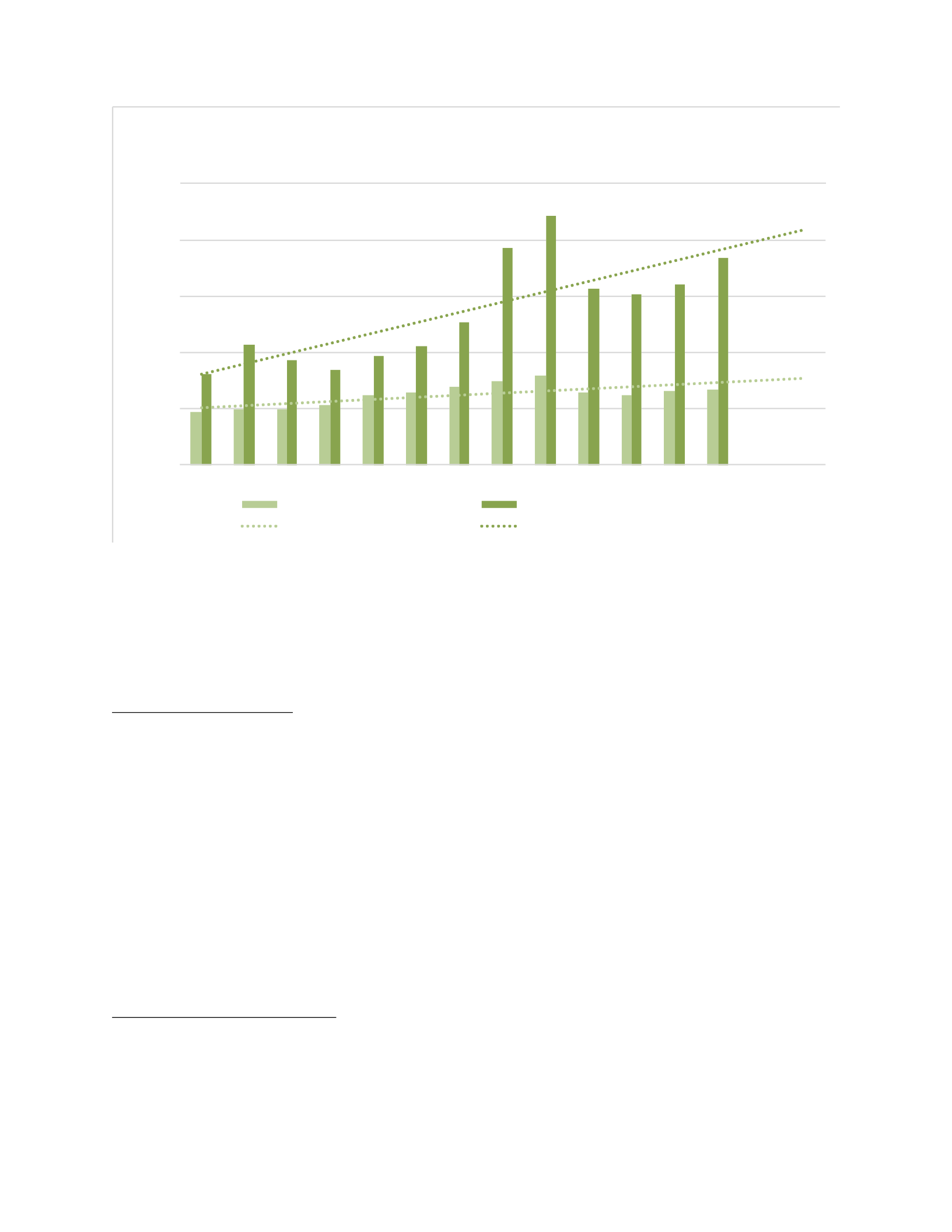
250
200
150
100
50
0
2008 2009 2010 2011 2012 2013 2014 2015 2016 2017 2018 2019 2020
Market Exchange Rate Purchasing Power Parity Rate
Linear (Market Exchange Rate) Linear (Purchasing Power Parity Rate)
Figure 3. Russian Defense Spending – PPP conversion versus the market exchange rate.96
Russia’s Arctic Strategy
Putin’s Arctic Strategy to 2035 is aimed at defending Russia’s national interests, and
developing the strategic natural resource base for Russia’s economic needs.97 The following
excerpt summarizes Russia’s ambitions to protect its national interests in the Arctic as outlined in
the Russian Arctic Strategy to 2035.
The primary [Russian] national interests in the Arctic are as follows: Ensuring the sovereignty and
territorial integrity of [Russia]; Preserving the Arctic as a territory of peace, stability, and mutually
beneficial partnership; Guaranteeing high living standards and well-being for the Arctic population;
Developing the Russian Arctic as a strategic resource base, and using it sustainably to accelerate economic
growth; Developing the Northern Sea Route as [Russia’s] globally competitive and national transportation
96. OECD, Purchasing Power Parities (PPP) (indicator). November 2021, and Stockholm International
Peace Research Institute (SIPRI) . SIPRI Military Expenditure Database. 2021. Data for figure 3 was compiled from
both sources.
97. Buchanan, “The overhaul of Russian strategic planning for the Arctic Zone to 2035.”
Billions of U.S. dollars

corridor; and, Protecting the Arctic Environment, preserving the native lands, and protecting the traditional
way of life of the indigenous people in the Russian Arctic.98
In addition to defining Russia’s national interest in the Arctic, the Russian Arctic Strategy
to 2035 also defines the challenges to Russia’s national interests and provides implementation
measures and comprehensive ambitions. Analyzing Russia’s identified threats to national
security in the Arctic shows three themes emerge as challenges to Russia’s interests. The
challenges identified in the strategy outline a broad set of national security threats that focus on a
decline in infrastructure development on land, slow infrastructure development along the
Northern Sea Route, and environmental challenges. More specific threats to national security
include “attempts by foreign states to revise international treaties governing economic and other
Arctic activities and establish national regulatory frameworks…[and] Arctic military buildup by
foreign states; and ‘discrediting’ [Russia’s] Arctic activities.”99
The three themes of national security threats to Russia’s Arctic need to be examined on a
temporal scale. The latest Russian strategy for the Arctic tends to separate the threats to national
interests in development, governance, and national security. The Arctic provides Russia with
tremendous national resources. The Arctic has massive oil, gas, mineral reserves, and other
economic activities. These natural resources need to be extracted and shipped, so Russia must
continue developing infrastructure specific to natural resources and the hundreds of thousands of
Russians living in the Arctic.
98. Lawson W. Brigham, "The Russian Maritime Arctic: Region of Great Change in the 21sy Century."
Maritime Irregular Warfare Studies (Center on Irregular Warfare and Armed Groups, U.S. Naval War College),
2021, p. 30. From Foundations of the Russian State Policy in the Arctic for the Period up to 2035. Signed by
president of the Russian Federation on 5 March 2020, The Kremlin, Moscow. Translation by A. Davis and R. Vest,
Russia Maritime Studies Institute, U.S. Naval War College, Newport, RI, 14 pages.
99. Brigham, "The Russian Maritime Arctic: Region of Great Change in the 21sy Century." Maritime
Irregular Warfare Studies (Center on Irregular Warfare and Armed Groups, U.S. Naval War College), 2021, p. 30.

As the climate changes and permafrost thaws, damage to existing outdated infrastructure
increases. The warming climate and increased technology challenge the maritime Arctic’s
international regimes. The warming climate means that sea ice is receding and thinning. The
impact of the warming climate is that more actors are interested in the Arctic and that natural
resources are becoming more accessible. The climatic impacts on the Arctic drive claims to the
United Nations Commission on the Limits of the Continental Shelf (CLCS), territorial claims
and Economic Exclusion Zones, and increased security for monitoring and defense of the Arctic
coastal region. The military threats are, in a sense, connected to the warming climate. Still, the
threat of Arctic military buildup by foreign states is a complex issue that is likely the result of the
Russian militarization of the Arctic that started over a decade ago.
Overreaction to Russia’s Arctic Military Activities
The preceding section describes Russia’s expanded military activities in the Arctic. The
decision to do so is a political one. As with the U.S. military, the Russian military does not set
policy. The military is an instrument of national power subordinate to civilian political decision-
makers. Civilian policymakers decided that militarizing the Arctic is a national security
imperative of a high national priority. The effort to militarize the Arctic, a region that is highly
challenging to access and a region that Russia dominates, might seem irrational or less critical to
matters of U.S. national security. Jim Townsend from the Center for a New American Strategy
wrote, “I think the first is to not overreact. What the Russians are doing doesn’t look that
threatening. This is not the middle of Europe, it’s on their own territory.”100 Townsend’s remarks
bring up several important points for the U.S. and NATO to consider.
100. Regehr, "Military Infrastructure and Strategic Capabilities: Russia’s Arctic Defense Posture," p. 205.
Regehr references a quote by Jim Townsend in Malte Humpert, “Satellite Images Reveal New Russian Long-Range

The first is that Russia is adding military bases, improving infrastructure, and adding
operating capabilities entirely on its territory. The remote Russian Arctic is bounded by the polar
ice cap in the north. The U.S. delimits the Bering Strait on its far east, and the Barents Sea on its
western flank is more vulnerable and sits adjacent to Norway. It is no surprise that the Russian
Bastion defense concept is in place in the Barents Sea to provide a defense in depth to protect its
strategic military bases and naval yards on the Kola peninsula. However, the entire Russian
Arctic flank is geographically fortified beyond the Kara Gate, the strait between Novaya Zemlya
and the Russian mainland.
Nevertheless, this is where much of the infrastructure development is occurring. Much of
the infrastructure is to develop the Northern Sea Route as a strategically important sea line of
communication. Russia has also refurbished old Soviet bases, built new ones, and stationed
hundreds of Russian troops and special forces in the region. Townsend’s remarks tend to be
prudent advice for U.S. leaders to heed. On the other hand, the quizzical nature of his comments
reinforces another point. Russia is spending tremendous resources to militarize for reasons that
are unclear to most observers.
Early warning radar sites along critical avenues of approach in the Arctic make sense.
Russia’s Bastion defense in depth in the Barents Sea defends the Kola peninsula and assures
access to the GIUK gap and the North Atlantic. Even when calculating for PPP, Russia’s defense
budget is relatively small compared to the U.S., the collective NATO, and China. Choosing to
allocate so much of its budget to the Arctic when there are many other options sends a message
to Russia’s competitors. The message, however, is not as straightforward as Townsend’s
Radar in the Arctic,” High North News, December 17, 2019. https://www.highnorthnews.com/en/satellite-images-
reveal-new-russian-long-range-radar-arctic.

remarks. Russia’s actions in the Arctic should not be considered good or bad, strategically sound
or unsound. The binary options create false equivalencies. For example, Russia tests its
hypersonic Tsirkon missile and Kalibr and Oniks cruise missiles from frigates aimed at Novaya
Zemlya, the same large yet remote island the Soviet Union tested nuclear weapons in the
twentieth century. There are strategically sound reasons for Russia’s militarization of the Arctic.
However, the absence of any threat to Russia’s Arctic territory and given that Russia had been
considered the Arctic hegemon101 means that Russia has arguably exceeded its requirements to
not only operate from the Arctic, as most of its assets on the Kola peninsula are for, but to
operate within the Arctic.
101. James Kraska, "The New Arctic Geography and U.S. Strategy." In Arctic Security in an Age of
Climate Change, ed. James Kraska, 244-246. Cambridge: Cambridge University Press, 2011, p. 247.

CHAPTER III
IDENTITY, PHYSICAL SECURITY, AND RATIONALITY
In his book, "A Brief History of Time," Stephen Hawking takes the reader through a
history of theories about the universe. He notes that any good theory used to make predictions
can potentially be falsified through observation. When this happens, a new theory is developed to
explain the latest observation. Instead of abandoning the old theory, Hawking states, "In practice,
what often happens is that a new theory is devised that is an extension of the previous theory."102
In the discipline of international relations, many theories exist that explain the phenomena of the
interaction among states under varying conditions. Given a set of conditions and dependent
variables, the theories of international relations can predict actions to an extent. However, in
social settings, predictions are incredibly challenging because the subjects possess agency, and
not all act the same under the same conditions nor with the same preferences.
Whereas, in the study of physics, at least using Sir Isaac Newton’s theories, objects act
the same given the same conditions. Even then, predictions are based on probabilities in the very
large or very small world of physics. For example, the Schrodinger equation only predicts the
probability of some event occurring. In this chapter, we examine Russia’s behavior, specifically
in the Arctic, through the lenses of several theories.
Each theory by itself falls short of being able to explain Russia’s behavior completely.
International relations require more than one state or actor on the systemic level, and so the
behavior of the U.S. mainly, but also NATO as an organization, is also examined through
various international relations theories to understand why Russia has increased its Arctic military
102. Stephen Hawking, A Brief History of Time. New York: Bantam Books, 2017, p. 10-11.

capabilities, and why the U.S. and NATO have responded. As one can imagine, the reasons are
paradoxically simple and complex.
Theories and Explanations
International relations theories abound to explain how state, and even non-state, actors
behave. Within the discipline of international relations, there are many different classifications of
theories, and within those broad categories of theories, there are differences. Some of the
differences are minor, while others are quite substantial. For instance, realism has become
somewhat of the cornerstone by which other theories are built upon, or the fundamentals of other
theories contrast. Under the genre of realism, there are several types of realism. Traditional or
classical realism consists of very different assumptions than neo-classical realism. Neorealism, a
significant step away from traditional realism, uses different assumptions to explain states' ever
more nuanced behavior. Even within neorealism, different schools of thought exist on states’
preferences. Some social theories have been elevated, in a sense, from the individual to the
international level. Theories such as constructivism and ontological security theories may not
strictly be theories. Still, they have both come from the social realm and are used to help
understand behavior between states that realism fails to be able to explain.
The debate over whether structure, agency, or culture causes state behavior has been
going on for decades. Kenneth Waltz argues that to understand international politics, one must
consider international politics in the context of a system and that “Only through some systems
theory can international politics be understood.”103 Waltz takes aim at the reductionist view of
international relations and uses the systemic context of structure to explain interstate behavior.
103 Kenneth N. Waltz, Theory of International Politics. London: Addison-Weslely Publishing Company,
1979, p. 79.

His neorealist theory is parsimonious and tends to ignore the unit level of analysis.
Nonetheless, the structural causes of interstate behavior are difficult to ignore. In Waltz’s case,
neorealism tends to explain the behavior of the two Cold War superpowers, the U.S. and the
Soviet Union. However, the unit-system interaction complexity allows us better to understand
the international politics beyond the bi-polar structure. Waltz’s view of systems theory of
international politics distinguishes “systems-level from unit-level forces,”104 whereas Alexander
Wendt agrees that a social system is just structure. However, Wendt argues that “the task of
structural theorizing ultimately must be to show how the elements of the system fit together into
some kind of whole.”105 For Wendt, the system consists of three elements. Much like the
neorealists, the first element of a system is the material conditions. However, unlike the
neorealists, Wendt argues that the system consists of not simply the unit-level forces but includes
both interests and ideas. Waltz might consider treating these three elements as separate
structures, but Wendt argues that these elements, though somewhat abstract, constitute the
systemic whole of the social structure.
The neorealist would not consider identity a causal variable because the sub-systemic
forces, according to neorealism, do not significantly contribute to international politics. Wendt
and the constructivist school of thought consider identity one of those unit-level forces as causal
factors of interstate politics. Wendt argues that identity is constituted by internal and external
structures held by the self and others. The part of identity held by the self is a subjective quality
of an actor’s understanding of its identity. However, identity cannot be held by the actor alone.
As Wendt points out, an actor can see itself possessing a specific identity, but that identity also
104. Waltz, Theory of International Politics, p. 79.
105. Alexander Wendt, Social Theory of International Politics. Cambridge: Cambridge University Press,
1999, p. 139.

depends on others. Wendt and James Fearon define two categories of identities as type and role.
The type is an internal idea of self, but the role cannot exist without others in a social context.
What makes an identity then is the relationship between the endogenous concept of self and the
social, exogenous context of self. However, what matters most is the degree to which others
impose the role on an actor. Therefore, as Wendt writes, “the divorce between role theory and
systemic IR has been premature.”106 The role of identity in international politics can be better
understood if we take a more social understanding of the international system.
Identity of the State
So far, the concept that identity is a causal factor of state behavior and, therefore, of
international politics has been introduced. However, two crucial questions still need to be
answered. The first is how a collective state identity is constituted, and to what extent can a state
have a collective identity? The second question is, what happens when the type and role of a
state are not aligned when the international system does not recognize the idea of self? The idea
that a state has an identity has simply been assumed, but the concept that a state can have a
collective identity needs examining. First, however, as discussed above, identity has an
intersubjective property that relies on recognition by others and the self. For example, a person
trained for spaceflight has a specific identity. How do we as a society recognize the identity of a
person trained for spaceflight? The person must first be employed by a space fairing nation or, as
is the case with SpaceX, a private company. Do we call that person an astronaut or a cosmonaut?
Maybe that person is neither, but instead, they are taikonauts.
106. Wendt, Social Theory of International Politics, p. 229.

We could simply define an astronaut as a person trained by the U.S. for spaceflight,
Russia trains a cosmonaut, and a taikonaut is one whom China trains. A person who wants to be
a cosmonaut cannot seek employment by the National Aeronautics and Space Administration
(NASA). NASA produces astronauts. Even though all three types of space farers do the same
thing, but they have an exogenous role imposed upon them whether or not they accept that role.
The identity of an astronaut and a cosmonaut emerged during the Cold War, and the role
is interdependent on the individual type. To understand the difference, consider the term sailor.
The term sailor is an English word, and the Russian word is матрос. In either case, the word is a
general term for a seafarer. However, there is no single general term for a spacefarer. How we
identify a spacefarer is based on both the type, one trained for space flight, and the role, trained
by Russia, China, or the U.S. As a result, when referring to a spacefarer, we identify them by
their the country that trained them because their identity is constituted by the social construct of
the Cold War structure. The example of the astronaut versus cosmonaut is a collective
construction of identity, which partly demonstrates how a state might have a collective identity.
A state is not a monolithic entity; it is not a black box nor a billiard ball. The state is a
complex interdependent system of systems of units. Those who consider the state a rational
acting black box treat state identity as the result of some external forces acting on it at the system
level. Given the structure and material power, all else being equal, any state would rationally
behave like any other. Interests cause a state’s behavior, and structure causes its interests.
Therefore, the neorealist argues that a state makes rational decisions to pursue its interests. The
constructivist argues that those interests are derived from more than just the system-level
structure. Sub-systemic forces derive interests, including identity, from complex interactions and
forces. The constructivist and neorealist would argue that the state makes rational decisions to

pursue its interests. What happens when a state makes decisions and acts in ways that do not
appear to be in its best interest? Would we call that state irrational? One of the fundamental
assumptions in IR is that a state is a rational actor. Then, it must be possible that the state
rationally pursues an interest derived from other forces.
Just as neorealism built upon traditional realism, constructivism has built upon the
concept of structure. Still, it allows for the sub-system units and forces surrounding those units to
explain and understand international politics. Identity and culture are key elements of
constructivism. However, if states act in ways that seem irrational, it is critical to examine a
state’s potential preferences. Suppose a state makes decisions that are not likely to lead toward
its interests. In that case, observers can assume either the state is acting irrationally or lacks the
necessary information to make the decisions required to achieve its preferences.
If we then build upon constructivism’s ideas about sub-systemic forces, such as identity
driving states’ interest, to examine other state behavior that may seem irrational, we might find
that the preferences are not uniform. Kenneth Waltz argued that the structure of the international
system encourages states to seek their security primarily.107 Waltz is considered a defensive
neorealist, but John Mearsheimer, an offensive realist, agrees with Waltz that survival is a
primary goal of great powers.108 Wendt agrees that the state’s vital interest is physical security,
but he includes autonomy, economic well-being, and collective self-esteem.109 The
constructivists’ addition of the vital interests beyond physical security advances the role of sub-
systemic forces in IR. These IR theories assume physical security is a vital interest because it is
107. Waltz, Theory of International Politics, p. 126.
108. John J. Mearsheimer, The Tragedy of Great Power Politics. New York: W.W. Norton and Company,
2001, p. 31.
109. Wendt, Social Theory of International Politics, p. 235-237.

necessary for survival and for states to pursue their other interests. Without physical security, a
state’s focus must be on survival, and until its survival is secured, the pursuit of other national
interests is limited.
Ontological security, much like constructivism, has been elevated from the individual to
examine international relations. However, in contrast to mainstream IR assumptions, ontological
security does not assume that state physical security is the ultimate goal under which the
conditions are set for states to pursue their other interests. Instead, ontological security, it is
assumed, is the core interest by which all other interests can occur. Brent Steele argues that states
seek ontological security to “maintain consistent self-concepts, and the ‘Self” of states is
constituted and maintained through a narrative which gives life to routinized foreign policy
actions.”110
Russia's Arctic military buildup and the U.S. and NATO response to Russia's
militarization of the Arctic is the sine qua non for Russia's great power status. However, Russia
indeed has legitimate defense concerns, and Russia needs to have adequate defenses in the
Arctic. Nevertheless, the substantial build of Arctic military force posture indicates Russia's
tendency to seek affirmation as a great power. Ontological security is, therefore, necessary to
explain this tendency.
Jennifer Mitzen proposes, states may seek ontological security over physical security.
She argues that “a harmful or self-defeating relationship can provide ontological security, which
means states can become attached to conflict.”111 Therefore, if we assume that Russia is a
rational actor and rationally pursues interests that increase risk to its security, we do not need to
110. Steele, Ontological Security in International Relations: Self-Identity and the IR State, p. 3.
111. Mitzen, Jennifer. "Ontological Security in World Politics: State Identity and the Security Dilemma."
European Journal of International Relations 12, no. 3 (n.d.), p. 342.

also assume that Russia must be ill-informed. It is not necessarily an irrational act to pursue
ontological identity over physical security. Russia's actions may appear irrational when viewing
Russia's actions informed by neorealist ideas of utility. Meaning that when viewed from the
perspective of neorealism, the state is assumed to be a rational actor and seeks to maximize its
utility. A state's maximum utility, according to neorealism, is physical security. As Mitzen
argues, states may give up some physical security to achieve ontological security. Therefore,
when viewed from the lens of ontological security theory, the state pursues its maximum utility
which may be to preserve its identity. If a state takes actions to achieve its highest preferences
over outcomes, and the outcome is ontological security, then it is not acting irrationally; on the
contrary, the state is acting by the strict definition of rationality.
This chapter has so far reviewed neorealism, ontological security, constructivism, and the
concept of rationality. Each of these theories has, in some way, built off of a previous theory.
These concepts allow us to understand Russia's Arctic militarization and determine whether a
security dilemma is developing in the Arctic. However, it is necessary to understand what it
means to be a great power. If Russia is in pursuit of great power status, then we must have a clear
understanding of what Russia is pursuing. The next section is an examination of the idea of great
power.
Ontological Security
Another explanation is that the militarization of the Arctic results from Russia's desire to
uphold its identity, both at home and abroad. Russia believes itself to be a great power. Putin
works to maintain the Russian identity for domestic consumption and its status as a great power
for the international audience. The idea of Russia's identity did not begin with Putin, but he

codified the national idea in his December 29, 1999, Millennium Message in his effort to unify
the country's disparate political factions.112 Therefore, Russia must create a reaction to validate
its status as a great power. When Russia began concerted efforts to modernize Arctic defenses
and invest in Arctic military capabilities and capacity, no significant threat to Russia's Arctic
flank existed, nor was there any significant change in U.S. or NATO military Arctic capabilities
or activities.
Ontological security theory helps us understand the causal factors for Russia's continued
military build and the slow U.S.-NATO response in the Arctic. The security dilemma could
explain other states' reactions regarding the uncertainty and insecurity in other Arctic states due
to Russia's actions. However, if Canada were to militarize the Arctic similarly, would the other
Arctic states react the same way they are to Russia? To further investigate the international
response, this study will examine constructivism's assertion that anarchy is not uniform and that
states construct anarchy due to a state's perceived identity. The U.S. and other Arctic states are
reacting to Russia's militarization of the Arctic, not simply because they seek to increase their
security in the Arctic. Russian bases in the Arctic are there primarily to defend territory in the
Russian Arctic. Seizing Arctic territory will not increase the security of the other Arctic states.
Instead, the other Arctic states are reacting to Russia's militarization because of Russia's identity
and the constructed conception of Russia as a revisionist great power. The constructed idea of
Russia, supported by Russia's ontological security needs, has caused a reaction by other states.
Because the response by the U.S. and others is a result of constructed beliefs of Russia and not
only a consequence of neorealist causes, the U.S. is unclear about its developing Arctic strategy.
Still, Russia's military activity in the Arctic has compelled the U.S. to react.
112. Fiona Hill and Clifford G. Gaddy, Mr. Putin: Operative in the Kremlin, p. 44.

Russia did not have a specific threat to defend against in the Arctic. Instead, Russia
meant to solicit securitization of the Arctic by others and make it a security zone to demonstrate
its status as a great power. During the Cold War, the Arctic was the stage for nuclear deterrence
and strategic competition between the Soviet Union and the United States. Even though
cooperation in the Arctic existed during the Cold War, competition between the two reaffirmed a
sense of certainty and identity. The competition between the U.S. and the USSR developed into a
stable pattern of behavior and identities. During Cold War, their identities as great powers were
formed by each state's material strength and power, the relationship between the two states, and
how the international system responded to the bipolar structure. The reaction of the U.S.
affirmed the Soviet self-concept of the USSR as a great power.
Anthony Giddens argues that for an agent to maintain its normative existence, it must
have a consistent understanding of its identity moving forward, without which the agent
experiences shame.113 As Brent Steele has demonstrated, states are rational egoists that base
egoism not on material structures but self-identity needs. The general proposition is that states
prefer consistent self-identity, at times over physical security, because any inconsistency
generates a sense of anxiety that the state will feel compelled to rectify above all else. The drive
to pursue identity, as Jennifer Mitzen argues, may cause states to act in seemingly irrational
ways. Mitzen contends that the need to maintain identity can outweigh physical security
considerations. She argues that since relationships help form an identity, states may prefer to
maintain a harmful relationship if it reaffirms their identity.114
113. Kinnvall and Mitzen, "Anxiety, fear, and ontological security in world politics: thinking with and
beyond Giddens," International Theory, p. 249.
114. Mitzen, "Ontological Security in World Politics: State Identity and the Security Dilemma." European
Journal of International Relations, p. 350.

An agent seeks to maintain its sense of identity or sense of self, which is an emotionally
driven motivation. In sociology, human interaction assumes an emotional variable is a causal
factor for social behavior. However, sociologists tend to assume that emotions are not
independent variables but, rather, they are intervening variables of human behavior.115
Nonetheless, emotions have a significant role in human behavior. For this study, it is
unnecessary to understand the psychological impact of emotions and the reflexive behavior
caused by a person's emotions. However, before examining the role of ontological security needs
of a state, it is necessary to understand the reflexive role of human emotions.
International relations theories tend to treat states similarly to humans interacting in their
social structures. If emotions motivate or cause human behavior, directly or indirectly, it
becomes necessary to address the role of emotions at the state level. The foundation of
ontological security theory is that a state has a sense of self and identity. A person feels
emotions. People experience pride or shame based on the interpretation of what they imagine to
be the reaction of others.116 Ontological security theory in international relations
anthropomorphizes the state and ascribes the same emotional responses to states.
The idea that a state can have an emotional response that motivates subsequent behavior
as an independent or intervening variable is problematic. A state itself is not likely to possess the
human qualities of emotion. Do laws and territory and economies have emotions? Individuals
have emotions, but is there such a thing as a collective emotion of a population? The problem
with ontological security theory as a theory of international relations is that it must assume that
states are similarly motivated by emotions, much like individuals. If a state seeks a sense of
115. Peggy A. Thoits, "The Sociology of Emotions." Annual Review of Sociology, 1989, p. 329.
116. Thoits, "The Sociology of Emotions." Annual Review of Sociology, p. 328.

continuity with its identity, in a similar way an individual does, then the state must have a similar
emotional quality. Jennifer Mitzen and Brent Steele approach the issue from two different
positions.
Mitzen argues that a state's ontological security is the collective ontological security for
the individuals. Therefore the ontological security of the state is socially constructed and defined
by the individuals. Thus, when the state satisfies its ontological security needs, it meets its
members' collective ontological security needs.
In comparison, Steele agrees that a state's identity is socially constructed but argues that
states choose a course of action reflexively to satisfy their sense of identity.117 Both Mitzen and
Steele agree that the state can have an identity and act in ways that best secure its sense of
identity, whether reflexively or socially defined. Conventional international relations theories
consider the state to act as though motivated by human emotion.118 For example, fear is a central
theme in neorealism. Fear is a human emotion that international relations theorists elevate to the
state level. Fear motivates states to act in specific ways to increase their security.
Nevertheless, as Jennifer Mitzen points out, a state's need to preserve a sense of identity
can outweigh a bad yet stable relationship that reaffirms a sense of self.119 For example, the
stable relationship between the U.S. and USSR substantiated the Soviet identity, but the
maintenance of that relationship led to the end of the Soviet Union. As a result, the relationship
changed and brought Russia insecurity and discontinuity. Russia seeks to regain the identity of a
117. Brent J. Steele, "Ontological Security and the Power of Self-Identity: British Neutrality and the
American Civil War." Review of International Studies 31, no. 3 (2005), p. 526.
118. Steele, Ontological Security in International Relations: Self-Identity and the IR State, p. 16.
119. Mitzen, "Ontological Security in World Politics: State Identity and the Security Dilemma." European
Journal of International Relations, p. 342.

great power but recognizing Russia as a great power by other great powers is necessary to
confirm Russia's identity as a great power.
The challenge in determining Russia's ontological insecurity is establishing the use of
identity as a variable. The proposition that Russia seeks validation as a great power, and
securitizes the Arctic to achieve that objective, requires qualitative content analysis to
contextualize Russia's political leaders to establish social meaning. If the general proposition of
ontological security theory is that states seek a stable sense of identity, this study must establish
the identity that Russia seeks to maintain. Ontological security theory also holds that states are
willing to maintain that stable sense of identity even at the cost of a destructive or self-defeating
relationship.120 The proposition that Russia's militarization of the Arctic has catalyzed a tit-for-tat
with the U.S. and NATO is based on the previous logic flow.
In review, the logic follows that since the collapse of the Soviet Union, Russia has lost its
claim as a great power. To reestablish that identity as a great power, Russia must act in ways that
can validate its identity through the response of other great powers. In other words, if Russia
were to militarize the Arctic, and the U.S. and NATO did not respond, could Russia claim to be a
great power? As ontological security theory asserts, states will seek to stabilize a sense of
identity over a sense of physical security. Since, as Mitzen points out, identity is formed and
sustained through relationships, it holds that Russia's militarization of the Arctic in the absence
of a specific threat and the subsequent similar response from the U.S. and NATO has now
paradoxically created a potential need for Russia to strengthen its conventional Arctic defenses.
120. Mitzen, "Ontological Security in World Politics: State Identity and the Security Dilemma." European
Journal of International Relations, p. 343.

However, Russia affirms its sense of identity as a great power in doing so.121 According to the
ontological security theorists, states seek established patterns of behavior. Mitzen proposes that
the security dilemma is not necessarily a function of uncertainty, but rather a function of
certainty.
Even a harmful or self-defeating relationship can provide ontological security, which means states can
become attached to conflict. That is, states might actually come to prefer their ongoing, certain conflict to
the unsettling condition of deep uncertainty as to the other’s and one’s own identity. The attachment
dynamics of ontological security-seeking thus turn the security dilemma’s link between uncertainty and
conflict on its head, suggesting that conflict can be caused not by uncertainty but by the certainty such
relationships offer their participants.122
If necessary, states will attempt to reestablish specific practices that eliminate uncertainty about
their identity to maintain a perception of their self-concepts.123 The proposition that Russia's
securitization and subsequent militarization of the Arctic is an attempt to reestablish the
routinization of great power competition with the U.S. and NATO, as well as other states such as
China, should be supported by the discourse of Russia's leaders, especially that of its President
Vladimir Putin.
Rationality
International relations theories assume that the state is a rational actor. The state is a
complex political system of individuals and groups of individuals. Every member of a state has
preferences over various outcomes, groups and organizations have preferences over outcomes,
and states have preferences over outcomes. Rationality tells us that an actor chooses the action
121. Mitzen, "Ontological Security in World Politics: State Identity and the Security Dilemma." European
Journal of International Relations, p. 357.
122. Mitzen, "Ontological Security in World Politics: State Identity and the Security Dilemma." European
Journal of International Relations, p. 352-353.
123. Mitzen, "Ontological Security in World Politics: State Identity and the Security Dilemma." European
Journal of International Relations, p. 360.

that the actor believes gives them the highest probability of achieving their most preferred
outcome when faced with a choice of actions. Rationality also means that actors rarely, if ever,
have perfect information when choosing actions. Rationality is not a judgment of the values of an
actor's choice. Instead, rationality is only predicated on the actions taken. The determinant of
rationality is whether the chosen action leads an actor towards its most preferred outcome given
the conditions under which the actor chose the action. The above discussion of rationality is an
abstract understanding of rational acts. Reality in life is much less clear and much more complex.
The complexity of a state's choice of actions is abstracted to study international politics.
The simplification is not arbitrary, but a parsimonious theory with valid assumptions allows us to
focus on the strategic interaction of states without overwhelming the analysis with unnecessary
complexity. However, when studying the rational acts of a state, we must ensure that the level of
abstraction is appropriate. Because a state is a social construction of individuals, groups, and
organizations, all with varying preferences over outcomes, it may be necessary to examine
different levels of the intrastate social structures. David Earnest sheds light on the paradoxical
nature of emergent outcomes of individual decision-making. Ernest notes that World War I "was
inadvertent as events in obscure places and seemingly innocuous decisions contributed to a spiral
of events over which statesmen quickly lost control."124 Individuals’ rational decision-making
produced subsequent institutional behaviors and state behavior.
Earnest makes the point with his example of the inadvertent spiraling of events that led to
the outbreak of World War I. The argument that some actors wanted war is difficult to counter. It
may be true that some individuals wanted war. However, Earnest writes, "One cannot simply
124. David C. Earnest, Massively Parallel Globalization - Explorations in Self-Organization and World
Politics. Albany: State University of New York Press, 2015, p. 3.

reduce the war to the preferences of the tsar, Kaiser, emperor, or king. Thirty-seven million
people died."125 The question is not about whether the decision was rational because, as
previously mentioned, the outcomes do not indicate whether choices of actions were rational.
Imperfect information causes actors to make choices based on the subjective probability of
achieving the desired outcome.
Instead, the analysis should be aimed at what actor, or agent, was the key decision-maker.
Sidney Verba acknowledges that rationality models can only give us imperfect explanations and
predictions of international events. He does not suggest we abandon the idea of rationality
models. Instead, he says, the models would be extremely useful if individuals actually behaved
rationally. Verba makes it clear that models serve the purpose of developing an understanding of
the nature of interdependent decision-making. Verba argues that models offer insight into
strategic interaction but do not replicate it. He argues that the model is an abstraction of life and
cannot replicate the complexity of how actors come to the decisions they make. Instead, Verba
argues that,
The rationality model is useful, but it is useful only if its limitations are appreciated. It may be
convenient under certain circumstances to assume that nations make decisions as if they were
following the rules of means-ends rationality. But if the simplification of the rationality model
leads one to believe that an adequate model of the international system can be developed without
consideration of the complex ways in which policy is formulated within the nations that are
members of that system, the model will ill serve the cause of theory in international relations.126
125. Earnest, Massively Parallel Globalization - Explorations in Self-Organization and World Politics.
Albany: State University of New York Press, 2015, p. 3.
126. Sidney Verba, "Assumptions of Rationality and Non-Rationality in Models of the International
System." World Politics 14, no. 1 (October 1961), p. 113.

The Problem with Inductive Reasoning
The causal explanations for Russia's militarization of the Arctic may not be as clear as the
intuition of traditional international relations theories may lead us. Russia has allocated national
resources to strengthen its military infrastructure and presence in the Arctic, which is self-
evident. Intuition would likely lead us to think that neorealism offers a causal explanation. There
are likely many causal explanations for any social phenomena. Neorealism tends to provide a
parsimonious set of independent variables that primarily explain the systemic behavior of the
international system. Neorealism does not ignore that there are multiple causal variables in
international relations. Still, it tends to focus on a small number of variables that are the most
significant, not the only, contributing to international relations' causes. This study is not an
indictment of neorealism. However, this study's position is that an inductive approach to Russia's
Arctic military activities over the last two decades may lead observers to conclude that the
systemic forces cause Russia's behavior. The observable events can be associated with the
neorealist explanation. However, David Hume has cautioned the observer that observing regular
successions of types of events, "through ‘custom’ comes to associate these events in such a way
as to create the ‘illusory belief’ in causal connection."127 To that point, one cannot dismiss the
idea that the systemic structure is causal factor in Russia's efforts to militarize the Arctic,
however it is not the only causal factor.
Kenneth Waltz's concept of the international system as a self-help system offers a causal
explanation. Waltz writes, "A self-help system is one in which those who do not help
themselves…will lay themselves open to dangers, will suffer."128 His theory supports Russia's
127. Milja Kurki, "Causes of a Divided Discipline: Rethinking the Concept of Cause in International
Relations." Reveiw of International Studies 32, no. 2 (2006), p. 192.
128. Waltz, Theory of International Politics, p. 118.

actions in the Arctic. Russia's Arctic coastline and maritime zone stretch nearly one-half of the
circumference of the Arctic Circle. Russia should defend its Arctic flank. Furthermore,
geography dictates that the most secure basing location for its nuclear ballistic missile submarine
force is in the Arctic's Kola peninsula.
Waltz offers deductive reasoning for why states behave the way they do in the anarchic
structure of the international system. However, as Hume cautions above, because Russia is doing
these things in the Arctic does not give sufficient inductive reasoning for a neorealist causal
explanation of Russia's militarization of the Arctic. In other words, it is not enough to assume
that neorealism provides a sufficient causal explanation of Russia's militarization of the Arctic
because Russia appears to act as a state should, given the structure and material strength, in an
anarchic self-help system.
Russia's military buildup in the Arctic is a complex response to many factors. The
neorealist and the neoclassical realist explanations tend to provide a clear understanding of the
causal factors of Russia's militarization. However, the causal factors of neorealism and
neoclassical realism do not sufficiently explain the extent of Moscow's efforts to militarize the
Arctic. If, as Kenneth Waltz explains, a theory can demonstrate that some factors are more
important than others,129 then the factors of ontological security are more important in Russia's
decision than those causal factors emphasized by neorealism and neoclassical realism.
Ontological security cannot sufficiently explain Russia's efforts to militarize the Arctic because
the causes are complex drivers of Russian foreign policy. However, by isolating the factors of
129. Kenneth N. Waltz, "The Origins of War in Neorealist Theory." The Journal of Interdisciplinary
History (The MIT Press) 18, no. 4 (Spring 1988), p. 615.

ontological security theory, it is possible to understand the factors that cause Russia to militarize
the Arctic to the extent it has and is planning for in the future.
Vladimir Putin in 1999 stated that "Russia was and will remain a great power."130 The
collapse of the Soviet Union meant that the official ideology ended abruptly,131 creating a
discontinuity in Russia's identity. Russia within the Soviet Union was the great power, and its
relationship with the United States and NATO affirmed its great power status. When the Soviet
Union dissolved, Russia experienced uncertainty about its identity as a great power. Since the
1990s, Putin has attempted to affirm Russia's status as a great power and minimize the
uncertainty of Russia's identity by imposing cognitive order on its standing as a great power. In
other words, Russia is an ontological-security-seeking agent.
In the early 2000s, President Putin had accepted U.S. global leadership, but this was to be
in exchange for America’s recognition of Russia as a major ally and its hegemonic role over the
former Soviet space. The U.S. ultimately did offer this special recognition. However, from 2003
to 2005, Russian relations with the U.S. and Europe deteriorated within a very short time. As
Dimitri Trenin from the Carnegie Moscow Center said in 2006, “Until recently, Russia saw itself
in the Western solar system, very far from the center, but a part of it. Now, it has left the orbit
entirely.”132 Trenin points out that Russia wanted to be with the U.S., China, and the global great
powers. In addition, Russia was dissatisfied with its relegation to the second-tier status alongside
India and Brazil.133
130. Vladimir Putin, Nataliya Gevorkyan, Natalya Timkova, and Andrea Kolensnikov, First Person: An
Astonishingly Frank Self-Portrait. Translated by Catherine A. Fitzpatrick. New York: Public Affairs, 2000.
131. Angela E. Stent, Putin's World: Russia Against the West and With the Rest. New York: Twelve, 2019,
p. 34.
132. Dimitri Trenin, "Russia Leaves the West." Foreign Affairs 85, no. 4 (July/August 2006): p. 1.
133. Trenin, "Russia Leaves the West." Foreign Affairs, p. 1.

Ontological security is an individual’s need “to experience oneself as a whole, continuous
person in time – as being rather than constantly changing – in order to realize a sense of
agency.”134 Ontological security is the security of one’s identity and the self.135 The sense of self
or identity is subjective, but it is the stable sense of self that one seeks. All actors need a stable
sense of who they are – their preferences, goals, or interests.136 If ontological security is an
individual need, is it applicable to collective identities and therefore useful to study international
relations?
Two main arguments over the applicability of ontological security theory in international
relations exist. The first argument, as mentioned above, is over whether ontological security can
be attributed to a state as a black box or to the agents of states and the extent to which a state can
be treated monolithically. The second major debate is over the understanding of ontological
insecurity versus ontological security. Literature suggests that insecurity and security are treated
as opposite ends of the same idea of ontology, but the definitions of each do not support this
position. Jennifer Mitzen writes that ontological insecurity “refers to the deep, incapacitating
state of not knowing which dangers to confront and which to ignore, i.e. how to get by in the
world.”137 This incapacitating state, Mitzen argues, prevents the individual from realizing a sense
134. Mitzen, "Ontological Security in World Politics: State Identity and the Security Dilemma." European
Journal of International Relations, p. 342.
135. Mitzen, "Ontological Security in World Politics: State Identity and the Security Dilemma." European
Journal of International Relations, p. 344.
136. Jennifer Mitzen, "Ontological Security in World Politics, and Implications for the Study of European
Security." Prepared for the CIDEL Workshop, Oslo, October 22-23 2004, “From Civilian to Military Power: The
European Union at a Crossroads?”. n.d., p. 2.
137. Mitzen, "Ontological Security in World Politics: State Identity and the Security Dilemma." European
Journal of International Relations, p. 345.

of agency.138 Mitzen writes that ontological security, on the other hand, “is the condition that
obtains when an individual has confident expectations, even if probabilistic, about the means-
ends relationships that govern her social life.”139 Meaning, that if an individual’s ontological
needs are met, the individual knows how to act and can go on being themselves. Whereas
ontological insecurity creates the condition under which an individual is consumed with coping
with the immediate needs because the individual is uncertain about the means-ends relationship
in their lives.140 A further examination of the meaning of ontological insecurity reveals a debate
over its ambiguous nature and its conceptual relationship to anxiety.
Often the term ontological insecurity and fear are used interchangeably, and at other
times it is used separately. Gustafsson and Krickel-Choi have observed that those who
distinguish the terms suggest that ontological insecurity is more severe than anxiety. They further
suggest that anxiety is a condition that can lead to ontological insecurity.141 The seeming lack of
clarity is important because it raises several unanswered questions and leaves the field of
ontological security theory open to criticism.
One of the main criticisms of ontological security is whether a psychological concept can
be applied to collective actors. Ontological security theory is fixed mainly at the state unit level
138. Mitzen, "Ontological Security in World Politics: State Identity and the Security Dilemma." European
Journal of International Relations, p. 345.
139. Mitzen, "Ontological Security in World Politics: State Identity and the Security Dilemma." European
Journal of International Relations, p. 345.
140. Mitzen, "Ontological Security in World Politics: State Identity and the Security Dilemma." European
Journal of International Relations, p. 345.
141. Gustafsson and Krickel-Choi, "Returning to the Roots of Ontological Security: Insights From the
Existentialist Anxiety Literature." European Journal of International Relations, p. 878.

of analysis.142 Many international relations theories anthropomorphize states. For example,
neorealism treats the state as a black box but yet argues that the state seeks security. The claim is
that, even though considered a black box, the need for security and the drive to pursue security
comes from the collective actors of the state. Mitzen offers that “‘state as person’ has heuristic
value insofar as it indexes real aspects of the ways in which states operate in world politics.”143
While the heuristic may be helpful, the question of whether or not ‘state as person’ is valid
remains. The fact that the anthropomorphism of states is an accepted norm in international
relations does support the heuristic value of ‘state as a person.’
Nonetheless, the issue remains, and as Alexander Wendt noted, this debate is found in
nearly every international relations theory. However, Wendt further examines the argument over
whether the state has the same properties as a person or can only be considered a person for
analytical purposes. The latter case is what Wendt refers to as ‘as if’ a person.144 Wendt starts by
asking the question, ‘what is meant by person?’ The fact that debates exist over defining a person
illustrates the challenge of the proper use of ‘state as person’ in international relations theory.
The requirement for personhood is that the referent object must be an intentional actor, be
an organism, and be conscious.145 The realist view of the state as a rational actor means that the
state passes the intentional actor test. However, many international relations theories do not
142. Gustafsson and Krickel-Choi, "Returning to the Roots of Ontological Security: Insights From the
Existentialist Anxiety Literature." European Journal of International Relations, p. 878. The authors references
Mitzen 2006.
143. Mitzen, "Ontological Security in World Politics: State Identity and the Security Dilemma." European
Journal of International Relations, p. 352.
144. Alexander Wendt, "The State as Person in International Theory." Review of International Studies
(Cambridge University Press) 30, no. 2 (2004), p. 291-292.
145. Wendt, "The State as Person in International Theory." Review of International Studies, p. 296.

agree with the realist perspective, and as such, there is no consensus in international relations
about the rational actor model and, as a result, the state as an intentional actor. Therefore, as
Wendt notes, “there seems to be no sense in which we really take state personhood seriously; it's
‘as if’ all the way down.”146 Brent Steele accepts Wendt’s characterization of ‘everyone else
does it’ of the scaling up of analysis from person to state.
Mitzen argues that the ontological security of states satisfies the ontological security of
the individual and that this assumption helps explain macro-level patterns. Steele criticizes the
former for obscuring “the political and normative nature of the ontological security process.”147
Steele argues that much like neoliberals and neorealists, Mitzen treats the state as a black box. In
doing so, Steele argues, Mitzen homogenizes individuals to treat the collective actors
monolithically.148 However, as Steele notes, leaders and policymakers seldom agree on all
things, including national interests. By ‘scaling up,’ Steele argues, Mitzen can de-emphasize the
national domestic debates over policy and identity. Steele offers Bill McSweeny’s concession
that “states are not people, but [McSweeny] considers it necessary for both ontological (because
individuals are in charge of state resources) and methodological reason to consider states ‘as if’
they are people.”149
The argument over whether a state is a person, as Wendt proposes, and a state is ‘as if’ a
person is necessary to ensure that we are not superficially collectively treating the state as a
person. Colin Wight disagrees with Wendt’s position that the state is a person. Wight argues that
146. Wendt, "The State as Person in International Theory." Review of International Studies, p. 298.
147. Steele, Ontological Security in International Relations: Self-Identity and the IR State, p.17.
148. Steele, Ontological Security in International Relations: Self-Identity and the IR State, p. 17.
149. Steele, Ontological Security in International Relations: Self-Identity and the IR State, p. 18.

the state can be considered ‘as if’ it is a person. Wight’s approach to the debate begins from the
structure-agent perspective, arguing that being a person is uniquely human. He argues that
humans have both agency and human activity. Wendt’s position that the state is a person
supposes that states have agency. However, states do not have human activity. Wight, therefore
argues that to equate state and humans means that humans do not have human activity. Wight’s
concern is that “to treat the state as a person simply leaves open an individualist riposte that
threatens any attempt to construct a structurally aware, although non-structuralist, theory of
IR.”150 The individualist counter would significantly impact the entire study of international
relations. Wight’s position is that treating the state as a person is unnecessary. The normative ‘as
if’ suffices because we can treat the state as having agency without treating the state as a person.
Wight, however, acknowledges that in the field of international relations, only a small
body of literature addresses the concept of agency. Barry Buzan’s understanding of agency is
that an agent can exert power. Wight explains that this is akin to the natural world in the way an
oxidizing agent causes oxidation. Wight argues that Buzan’s notion of agency might be
acceptable grounds for a social agent-structure thesis in international relations.151 However,
Wight argues that accepting the natural world’s form of agency neglects the things that separate
the social and natural worlds. Agents of the social world, Wight argues, inherently possess
meaning and intentionality. Wight explains how international relations accepts the construction
of agency in the state. He offers that state agency occurs “if the state is attributed a set of
150. Colin Wight, "State Agency: Social Action without Human Activity?" Review of International Studies
30, no. 2 (April 2004), p. 270.
151. Wight, "State Agency: Social Action without Human Activity?" Review of International Studies, p.
273-274.

properties that actually reside at a level below the state; viz., properties of human agents.”152
What follows in international relations is that if it is accepted that states possess agency, then
there is no need to ascribe human attributes or human agency to the state.153 The argument is
seemingly circular in that if agency is located in the state, the state must possess properties of
human agents, then, if the state possesses the properties of human agents, agency is located in the
state, and therefore there is a need to ascribe human agency to the state.
The normative value of locating agency within the state is self-evident. As previously
mentioned, most international relations theories are founded on the notion of state agency. For
example, the idea that states seek security gives agency to the state. That is, the state is thought
to act rationally and intentionally. Without establishing the normative concept of state agency, it
is not possible to examine the idea of self in the state. Much like agency, the idea of the state
possessing a self is ubiquitous in international relations theory. Kenneth Waltz’s concept of state
interaction is fundamentally based on the idea that structure causes a self-help system. The level
of analysis occurs at the system, and the actors are states. Therefore, Waltz has assumed the idea
of the state possessing a self.
Before moving on to self-identity, we must further develop the notion of self in a state,
considering a person has agency and has a subjective sense of self. Meaning that the person is the
subject to which the sense of self, or self-identity, occurs. In this case, how can a state have a
self-identity if it relies on subjective construction? If a person has agency, how do we treat the
state as a person? Colin Wight has provided an interesting way of understanding this problem.
152. Wight, "State Agency: Social Action without Human Activity?" Review of International Studies, p.
274.
153.Wight, "State Agency: Social Action without Human Activity?" Review of International Studies, p.
275.

Having reviewed several authors on the subject, Wight concludes that the state is a collective,
and therefore it is not an actor but a structure, and Wendt agrees with this understanding.
However, the state is not a simple reduction to the simple sum of governmental actions.154 Wight
further argues that the state is a special kind of structure that emerges into what he calls a
corporate agent. Wight explains that in the case of the state being a structure of corporate agency,
two factors must be considered. The two factors are an ‘Idea’ of corporate agency and a decision
structure. Wight states, "[t]he ‘Idea’ of corporate agency emerges when ‘individuals’ shared
knowledge reproduces an Idea of the state as a corporate ‘person’ or ‘group self’.”155 However,
he also acknowledges that this idea alone does not explain why or how a state acquires
personhood.156 Wendt argues that corporate agency cannot be reduced to individual agency
because the state’s actions are not the individual’s actions. Therefore, Wendt’s position is that
the effect of the state structure is state agency.
Wendt argues that the structures that constitute the state “constitute irreducible capacities
for intentionality. These capacities are real not fiction.”157 Wendt argues that a reductionist view
of the state helps understand the state’s agency. He assumes that the ontologically emergent
nature of the state as a unified actor makes it necessary to anthropomorphize a state to
understand and predict its behavior. Wendt’s argument that state agency is ontologically
emergent and that state agency is the result of complex and irreducible interaction of its
154. Wight, "State Agency: Social Action without Human Activity?" Review of International Studies, p.
276.
155. Wight, "State Agency: Social Action without Human Activity?" Review of International Studies, p.
276. Wight cites Wendt, Social Theory, p. 216-218.
156. Wight, "State Agency: Social Action without Human Activity?" Review of International Studies, p.
276.
157. Wendt, Social Theory of International Politics, p. 221.

constituent parts is clear. However, his argument that it is necessary to anthropomorphize a state
to understand and predict its behavior is a seemingly weak argument. Wendt’s conclusion,
though logically weak, may still be valid but problematic.
Wendt’s arguments demonstrate that the state is a collective structure, but because it is
made up of individuals and organizations, the state “may have multiple personalities
domestically [but] they manage to work together when dealing with outsiders.”158 The collective
nature of the state and the duality of state intentionality makes it challenging to determine the
identity of a state. Nevertheless, again, Wendt manages to weave the domestic-international
personalities to explain identity.
As Mitzen points out about Wendt’s argument, an identity shapes its role, and the role
thus constitutes a state’s behavior. The role of a state is a constitutive argument that places
identity as a social relationship. Mitzen’s position is that a “state cannot ‘be’ or sustain its type
without its strategic partner acting in a certain way (recognizing it).”159 That is to say, the
identity of a state is both a collective identity and a recognized identity by other states. So, when
an agent's identity, in this case, the state’s identity, is in doubt, the agent, or state, experiences
anxiety. That anxiety then drives the agent to seek affirmation of its identity.
Seeking Great Power Status
Suppose we assume Russia is insecure about its status as a great power. In that case, it is
necessary first to understand what it means to be a great power and what elements of being a
great power are missing from Russia's perceived identity. The concepts of self and identity are
158. Wendt, Social Theory of International Politics, p. 222.
159. Mitzen, "Ontological Security in World Politics: State Identity and the Security Dilemma." European
Journal of International Relations, p. 358.

socially constructed among agents. In the study of sociology, the agent is usually an individual.
In this study, the agent is the state. Ontological security is the security of the self and the identity
of the self. If we can anthropomorphize the state as an agent with an identity and sense of self,
similar to an individual, then we can apply ontological security theory to international relations.
International relations is a complex social structure, much like a society of individuals. In any
social structure, whether at the individual or international systemic level, we must assume that
there is more than a single causal explanation for behavior.
On the other hand, we must also determine which causal explanations are most
significant to make any study of social interaction meaningful. Ontological security provides the
causal explanations that neorealism does not adequately cover. Additionally, the constructivist
perspective is useful to examine how both the systemic and subsystemic factors may explain
Russia's behavior and the responding behavior of the U.S. and NATO.
The concept of a great power is a construct of international politics, and therefore it is a
relative term. Max Weber defined a great power as a state with prestige over other states, and the
state must also identify as great to be a great power.160 Weber's concept of a great power was a
state with power over others. For one state to have power over another and be prestigious among
other powerful states gives the definition of great power its relative and relational meaning.
Weber points out that it is a natural but irrational act for states to seek great power status and not
a result of the international system. Weber and many others believe prestige correlates to
structural factors’ relative strength. States recognize the relative status of economic and military
160. Iver B. Neumann, "Russia as a Great Power, 1815-2007." Journal of International Relations and
Development 11 (2008), p. 130.

powers and their respective spheres of influence. However, Weber points out that prestige is a
function of culture in addition to power.161
To say a great power is a more powerful state than most, in terms of structural factors, is
axiomatic and quantifiable to a significant extent. However, saying that a great power is a state
with pronounced prestige over other states is more problematic and qualitative. Edward D.
Mansfield and Jack Snyder argue that regimes in democratizing states might take a risky but easy
strategy of establishing prestige. Governments, they argue, risk pursuing prestige because the
state becomes vulnerable to insults to its reputation.162 When the state's reputation is repudiated
and there are no apparent concessions to repair it, it may seek less diplomatic solutions to
international disputes to demonstrate its status as a great power. Russia’s status, for example,
diminished following the collapse of the Soviet Union. Russia's diminished status was an injury
President Putin was unwilling to endure.
Early in his Presidency, Putin devised strategies to set a course for Russia to achieve
great power status again. Russia's nuclear strategy and doctrine provided for the anticipated use
of nuclear weapons to counter a conventional attack on its territory. Putin's decision-making
reflected in Russia's aggressive foreign policies and symbolizes Russia's intent to reclaim its
great power status. Putin blames the U.S. and the West and their attempts to expand NATO for
his decisions to take military action against Ukraine and Georgia. Russia's actions, Putin argues,
161. Iver B. Neumann, "Russia as a great power, 1815-2007," Journal of International Relations and
Development 11 (2008), p. 130.
162. Edward D Mansfield and Jack Snyder, 2004, "Democratic Transitions and War." In Understanding
International Relations: The Value of Alternative Lenses, by Daniel J. Kaufman, Jay M. Parker and Patrick V.
Howell, 395-408. Boston: McGraw Hill, p. 406.

were rational to defend Russia's interests. Putin's comments and aggressive foreign policy
demonstrate his perception of Russia's restored greatness.163
Russia's role in international politics suggests that its great power status consists of more
than military strength. Military strength, as mentioned above, can be quantified, and one can
determine the stronger of two opponents. However, as Jack Levy has explained, military strength
does not always indicate the more powerful of two states. Levy uses the Arab-Israeli conflict as a
counterexample, demonstrating that military capabilities do not necessarily define the most
powerful state. David Singer's Correlates of War study compares military material capabilities to
examine the relative differences in military strength among states. However, as Levy rightly
points out, military capabilities do not sufficiently indicate the power of a state and, accordingly,
cannot alone determine which states are great powers and which are not.164 A great power is not
likely to be militarily threatened by a non-great power, and as Levy also asserts, great powers
can project military power beyond their borders. Thus, military strength is a necessary but not
sufficient variable when defining a great power.
A relatively strong military power is an essential element of a great power, but as
discussed, military power does not sufficiently establish what separates a great power from
others. Using Levy's analysis, a great power distinguishes itself from other states by how widely
they cast their interests. Instead of their interests remaining local, a great power's interests and
security concerns are considered more in global terms, and great powers concern themselves
with the order of the international system.165 Great powers also tend to pursue and defend their
163. Stoner, Russia Resurrected: Its Power and Purpose in a New Global Order, p. 12-13.
164. Jack S. Levy, 1983. War in the Modern Great Power System. Lexington: University of Kentucky
Press, p. 15.
165. Levy, 1983. War in the Modern Great Power System. Lexington: University of Kentucky Press, p. 17.

interests more aggressively than other states. Finally, great powers tend to interact with other
great powers more frequently than other states. These attributes describe the actions of a great
power, but a state cannot indeed be a great power unless others recognize it as a great power.
Other great powers must recognize a state as a great power. When other states perceive a
state as a great power, other states treat it as a great power. The defining elements of a great
power do not rest on endogenous factors alone; exogenous factors predicate great power status.
Levy makes this distinction by acknowledging that a great power is not a matter of wealth.
Instead, it is a complex combination of military strength and influence in security-related
issues.166 Neither is it enough to be recognized as a great power by other great powers. The rest
of the international system, including major international regimes, institutions, and organizations
must also recognize the state as a great power. To understand what makes a state a great power
beyond military strength, one must examine the structure of the international system and how
that constitutes great power status among states.
In addition to the internal structural power, a great power must perceive itself as a great
power, and the international system must also perceive the state as a great power. The next
question is, what causes the system to perceive a state as a great power? Suppose one considers
the international system a social structure that consists of states at the systemic level. How does
the international system constitute the identity of a state? Alexander Wendt's translation of social
structure to the international system helps explain the causal mechanism of perceived state
identity.167 In other words, the agent-structure relationship gives meaning to great power status
among states.
166. Levy, 1983. War in the Modern Great Power System. Lexington: University of Kentucky Press, p. 18.
167. Wendt, Social Theory of International Politics, p. 144.

Power is not simple to quantify. Material strength is a critical attribute of a state's power.
One can quantify a state’s material strength and compare it to other states. For example in the
previous chapter, the defense spending by China, Russia, and the U.S is compared. The
comparison was only a factor of power, but did not consider the emergent properties of
combining other factors that constitute power and perception. The ability of a state to transform
material strength into power is a function of perception by both the individual state and other
states. Suppose the effect is that a state is perceived as a great power in the international system,
most importantly by other great powers. In that case, a causal mechanism exists and must be
identified. In any given social structure, the causal agents of identity are complex.
Nevertheless, Wendt argues that constructivists seek to identify the constitutive effects of
structure on identity in social systems. In international relations, constructivists also seek to
understand the causal effects of structure on identity.168 If the structure has a casual effect on
identity, what are the causal effects beyond material factors? Again, constructivism sheds light
on the co-determination of agent and structure.
Co-determination of agent and structure in international relations is evident if and only if
the structure has a causal effect on state identity. In his counterargument to realism's rational
actor model, Wendt starts with the obvious point that there can be no international system
without states, nor can states exist without the international system. In his efforts to elevate a
social theory into an international relation's theory, or at least apply it to international relations,
Wendt anthropomorphizes states in the same way most other theories of international relations
do. In doing so, Wendt equates a society of individuals to the international system constituted of
states. That is, states constitute the system, and the system constitutes the states. The problem
168. Wendt, Social Theory of International Politics, p. 144.

with this is that it creates a tautological logic making it difficult for researchers to determine
causality. This research intends to define state identity and precisely what it means for a state to
be a great power in the international system. As previously stated, a great power consists of
material strength, primarily military and economic strength, translated into power. A state must
also internally identify as a great power, but for a state to be a great power, the system must
recognize the state as a great power.
While Wendt offers theoretical evidence that social science can be applied to
international relations, that states have identities, and that the system constitutes the state
identity, the analytical framework to understand a state's identity is missing. Abdelal et al.
provide a framework that integrates existing and future research on identity.169 The framework
expresses collective identity as a social category defined by content and contestation. Abdelal et
al. describe social identity content as consisting of four non-mutually exclusive types:
constitutive norms, social purposes, relational comparisons, and cognitive models. Contestation,
however, refers to the degree of agreement within a group over the content of collective
identity.170 For this research, the assumption is that contestation is a key driver of Russia's
pursuit of its state identity. Russia seeks to be recognized as a great power by the international
system. The international system recognizes a state as a great power because that state practices
constitutive norms of a great power. In general terms, constitutive norms are the actions by
which other states recognize a state as having a particular identity.171
169. Rawi Abdelal, Yoshiko M. Herrera, Alastair Iain Johnston, and Rose McDermott, "Identity as a
Variable." Perspective on Politics 4, no. 4, p. 696.
170. Abdelal, Herrera, Johnston, and McDermott, "Identity as a Variable." Perspective on Politics, p. 696.
171. Abdelal, Herrera, Johnston, and McDermott, "Identity as a Variable." Perspective on Politics, p. 697.

Wendt argues that individuals are purposive, and a society's character is much different
from a society constructed of individuals with no purposive intentions. Using the
anthropomorphic image of a state, as in 'Russia is concerned about NATO expansion,' or 'U.S.
interests in the Arctic are growing,' states construct the international system, and the system
constructs states. What separates the realist and constructivist views is that while realists tend to
maintain the idea of states as rational actors, constructivists also acknowledge states as "actors to
which we can legitimately attribute anthropomorphic qualities like desires, beliefs, and
intentionality."172 If states possess anthropomorphic qualities, then like individuals, those
qualities define their identity.
Realism
The realist material explanation for Russia's military investment in the Arctic is that the
Russian Arctic holds vast natural resources, mainly oil and natural gas, that need defending. In
addition, the changing climate is causing changes to fish migration patterns. While the highest
potential for revenue lies with the Arctic energy reserves, the highest potential for conflict lies
within the international competition for Arctic fishing. The U.N. Convention of the Law of the
Seas (UNCLOS) delineates states' sovereignty in the global coastal and maritime domains.
UNCLOS article 234, Ice-covered areas, provides special provisions for mitigating marine
pollution in ice-covered regions.173 A few territorial disputes exist, but they are minor issues.
Claims of extensions of Russia's continental shelf have the potential for conflict, especially
172. Wendt, Social Theory of International Politics, p. 197.
173. UN General Assembly, Convention on the Law of the Sea, 10 December 1982, p.
115. https://www.un.org/depts/los/convention_agreements/texts/unclos/unclos_e.pdf, (accessed 29 August 2021).

Russian claims to the Lomonosov Ridge, which would extend Russia's economic exclusion
zones allowing for exclusive claims reaching the North Pole.174 With sea ice diminishing and
technology advancing, unlawful Lomonosov Ridge claims have the potential for future conflict.
There is also the concern that a conflict between great powers could extend into the
Arctic. Therefore Russia does not want to be vulnerable along its lengthy Arctic coast or the
Kola Peninsula's bases for nuclear submarines and ballistic missiles. However, this study argues
that the neorealist explanation that the anarchic structure drives Russia to militarize the Arctic
rationally does not sufficiently explain the recent phenomenon.
Several theories of international relations can explain Russia's action to a certain extent.
For instance, Kenneth Waltz, in breaking from Hans Morgenthau, suggests that states, not
humans seek to dominate other states. Russia may seek to dominate other states to the extent that
it can. The Arctic provides a theater by which Russia can exert its domination. However, no
other states are creating the conditions over which Russia can dominate. Waltz's causal
explanation that states seek to dominate other states as an instinct does not sufficiently explain
Russia's military expansion into the Arctic. For Russia to dominate other states in the Arctic, the
status quo must first change. However, the Arctic is not a lawless frontier. There is little territory
worth fighting over, nor is there any particular reason for Arctic domination in the sense of
natural urges. Thus, states have no rational explanation for changing the status quo. Russia may
seek domination in the Arctic, but under the conditions in which Russia's military expenditure in
the Arctic started to increase around 2012, no other power dominated the Arctic than Russia at
the time. Russia was the dominant Arctic power. Thus, it is not likely that neorealist explanations
alone are responsible for Russia's militarization of the Arctic.
174. UN General Assembly, Convention on the Law of the Sea, p. 145. Annex II of UNCLOS provides
provisions for claims to the continental shelves beyond the 200 nautical mile exclusive economic zones.

John Mearsheimer offers a more nuanced approach to understanding the causal
mechanism for states' endless struggle for power. Mearsheimer reasons the causal agent is the
anarchic structure of the international system. He argues that states seek to maximize power to
ensure their survival and that states are rational actors. However, there seems to be a flaw in the
causal logic concerning Russia's Arctic militarization. If Russia, first and foremost, seeks
survival and is a power maximizer, it follows that Russia would increase its material strength.
The monetary policies, strategies, and defense policies Moscow has put in place tend to
strengthen Russia's position. Still, Russia's military and economic strength are small compared to
the U.S. or China. The offensive realist explanation does, at first, tend to explain seemingly
rational decisions to achieve expected outcomes and that there is indeed something in the Arctic
that Russia feels it needs to defend. However, given the current conditions of Arctic cooperation,
the lack of Arctic capabilities of the U.S. and China, and the lack of territorial interest by the
U.S. or China in the Arctic, it seems that of all the choices Russia had, militarizing the Arctic
with so much infrastructure and conventional forces does not offer the highest expected utility as
prescribed by offensive realism.
The realist explanation for Russia's militarization of the Arctic is that the structure of the
international system creates uncertainty in Russia about the intentions of the U.S., NATO, China,
and other actors with Arctic interests. The warming Arctic has made a complex change to the
region. The decrease in overall sea ice creates greater accessibility to the Northern Sea Route, the
seaway that runs along Russia's Arctic coastline. Global concerns about the warming climate
have generated greater awareness of the Arctic, and many state and non-state actors are
becoming increasingly interested in the Arctic. Except for its nuclear forces, the Russian Arctic
military infrastructure was neglected for nearly two decades. As a result, Russia's military

capabilities in the Arctic had significantly atrophied, leaving the region relatively vulnerable.
The vulnerable flank of the Russian Arctic is also a vast natural resource base that the country's
economy heavily relies on, and its nuclear deterrent forces are based mainly on the Kola
Peninsula. When Moscow decided to allocate resources to modernize Arctic bases and increase
its Arctic force structure, which was part of a broader transformation of the Russian military,175
realists argued that this was a rational act in response to the uncertainty inherent in the
international system.
The neorealist tradition can explain Russia's Arctic militarization, but only to a certain
extent. Russia may not be satisfied with the post-Cold War status quo. After the collapse of the
Soviet Union, the NATO expansion put in doubt, or instead confirmed the suspicion, that there
would be any real change to the U.S. intentions of weakening Russia's position in world
politics.176 Continuity of the adversarial relationship between Washington and Moscow, with the
brief exception in the 1990s and early 2000, shapes the relationship between Russia and the
U.S.177 Robert Jervis argues that a state predisposed to see another as an adversary will tend to
react strongly against the other.178 NATO expansion aggravated Russia's sense of vulnerability.
The US-led actions taken against Russia after it seized Crimea further reinforced
Russia's sense of vulnerability. In his efforts to expand NATO, U.S. President Bill Clinton
pursued his administration’s agenda of expanding the U.S. led, liberal international order. The
175. Marina, Shcherbakova. "Амбициозные задачи нужно ставить перед собой всегда." [Ambitious
Goals should Always Be Set] Krasnaya Zvezda. November 06, 2018. http://redstar.ru/ambitsioznye-zada
176. Joshua Shifrinson and R. Itzkowitz, "Deal or No Deal? The End of the Cold War and the U.S. Offer to
Limit NATO Expansion." International Security, p. 8.
177. Shifrinson and Itzkowitz, "Deal or No Deal? The End of the Cold War and the U.S. Offer to Limit
NATO Expansion." International Security, p. 8.
178. Robert Jervis, "Cooperation Under the Security Dilemma." World Politics, p. 175.

Clinton administration's European foreign policy goal was to turn former Soviet countries into
liberal democracies.179 The U.S. efforts to push a liberal order on former Soviet republics and
expand the Western military alliance eastward present Russia with a challenging and humiliating
difficulty. When Putin became president of Russia, he set out to reverse the conditions imposed
upon Russia. Not only was there a collective sense of humiliation to overcome, but Moscow
viewed an ever-expanding NATO as making Russia less secure and more vulnerable. To mitigate
Russia’s vulnerability, Putin decided to strengthen its Arctic defenses.180 But NATO expansion
was not occurring in the Arctic. Instead, NATO had somewhat abandoned its collective ability to
conventionally operate its militaries in the region, and instead had focused elsewhere, mainly
Afghanistan.
Russia’s sense of vulnerability comes from Russia's subjective response to the U.S. and
NATO not respecting the interests of Russia. If the U.S. and western European powers do not
respect a country’s interest, or even acknowledge them, can that country be a great power.
Russia’s sense of vulnerability was not so much a physical one, but rather an ontological one.
Russia could expand its military in the Arctic with little concern by the U.S. and NATO, unlike
when it expanded in to Ukraine in 2014. Militarizing the Arctic in response to the U.S. and
NATO expanding eastward, and pushing a liberal order on former Soviet republics impose
elements of physical insecurity on Russia, but mainly it threatened Russia’s ontological security.
It was not until much later in the 2010’s that NATO gradually shifted its attention towards the
Arctic, but not as a direct response to an imbalance in Arctic military capabilities with Russia.
179. Mearsheimer, "Bound to Fail: The Rise and Fall of the Liberal International Order." International
Security 43, no. 4 (2019), p. 23.
180. Jervis, "Cooperation Under the Security Dilemma." World Politics, p. 174.

Instead, NATO’s attention on the Arctic started as a curios response to the global attention on the
Arctic. Therefore, the Arctic does not appear to be a clear case of a security dilemma.
A security dilemma begins with one state's uncertainty over the intentions of another
state. The anarchic structure of the international system enables states' insecurity about others'
intentions, particularly under long-standing adversarial relationships. Jervis underscores the
spiral nature of the security dilemma. The insecurity and uncertainty of intentions between states
may increase one state's security, but by doing so, it decreases other states' security.181 Two
critical elements of Jervis' description of the security dilemma seem deficient to initiate a spiral
security dilemma under the conditions in the Arctic. The first is Russia's sense of vulnerability in
the Arctic, and the second is whether Russia's efforts to militarize the Arctic decrease the
security of other states.
Russia has reason to strengthen and modernize its Arctic military capabilities. Most of
Russia's second-strike SSBN fleet is based on the Arctic's Kola Peninsula, the Northern Fleet's
ability to operate in the Barents and Norwegian seas and access the Atlantic Ocean, and the
region's economic interests.182 As noted by Rumer et al.,
Russia's peacetime military presence in the Arctic and the allocation of resources to improve its military
capabilities and infrastructure there are aligned with these interests. Maintaining a predominant military
position in the Arctic is seen as a necessary component of Russia's posture there, given the Kremlin's priorities
in Europe and tense relationship with the West, NATO's enhanced military capabilities near the Russian
border, and Western sanctions targeted to constrain Russian energy exploration and production activities in
the Arctic.183
181. Jervis, "Cooperation Under the Security Dilemma." World Politics, p. 169
182. Eugene Rumer, Richard Sokolsky, and Paul Stronski, "Russia in the Arctic - A Critical Examination."
Carnegie Endowment for International Peace. March 29, 2021. https://carnegieendowment.org/2021/03/29/russia-
in-arctic-critical-examination-pub-84181 (accessed July 15, 2021), p. 6.
183. Eugene Rumer, Richard Sokolsky, and Paul Stronski, "Russia in the Arctic - A Critical Examination."
Carnegie Endowment for International Peace, p. 6.

However, much of what Rumer et al. refer to in the above excerpt follows the U.S. and NATO’s
response to Russia’s initial actions to expand its Arctic military capabilities. Before, Russia’s
revanchist behavior the U.S. and NATO had a much more limited ability to operate in the Arctic.
Very few countries have Arctic military capabilities ready to meet the capabilities and capacities
of Russia's conventional Arctic forces.
In January 2009, the George W. Bush administration presented an Arctic Policy outlining
six security priorities for the region and updating the long-standing policy of 1994.184 The U.S.
has shown an increasing strength of interest in the Arctic in recent years, as demonstrated by
each branch of the military services and Coast Guard. Since 2020, each U.S. service has either
published an update to its Arctic strategy or published an inaugural Arctic strategy. The fiscal
year 2019 John S. McCain National Defense Authorization Act requested an update to the
previous 2016 DOD Arctic Strategy. U.S. 2019 DOD Arctic Strategy provides an overview of
U.S. interests in the Arctic and how to defend those interests. The strategy emphasizes homeland
defense and international cooperation. While the report demonstrates an increase in the
prioritization of U.S. interests in the Arctic, the lack of U.S. interest in the Arctic over the
previous decade is clear. Instead of initiating a coherent national strategy in the Arctic, the
increase in the U.S. strategic interests is in response to Russia's steady Arctic military buildup.
The DOD acknowledges Russia as a polar great power and notes Russia's increasing military
presence and the importance of the Arctic to Russia's economy.185 The 2019 DOD Arctic
strategy notes China's growing presence in the Arctic and stresses China as an emerging threat to
184. Siemon T. Wezeman, "Military Capabilities in the Arctic: A New Cold War in the High North?"
SIPRI Background Paper. October 2016. https://www.sipri.org/sites/default/files/Military-capabilities-in-the-
Arctic.pdf (accessed August 5, 2021), p. 17.
185. Alina Bykova, "Russian Arctic Council Chairmanship: "Will Welcome More Active Engagement of
the Observer States"." High North News, March 8, 2021.

the region. The DOD’s concern over China's presence in the Arctic echoes the Trump
administration's perspective. U.S. Secretary of State, Mike Pompeo, delivered an address in
Rovaniemi, Finland to delegates of Arctic nations.186 During the speech, he acknowledged
Russia's increasing military presence but stated that while China's Arctic economic activities
were welcome, Pompeo warned the delegates that China's national security ambitions in the
Arctic were not welcome.187
Conclusion
When a country increases its defensive posture, much like Russia has in the Arctic, it
may generate a response of potential insecurity by other countries. The lack of information may
make states perceive Russia as pursuing offensive actions to further aggression toward its
neighbors. The perception that Russia has offensive and aggressive intentions can lead to fear.
Fear, a human emotion ascribed to the state, may drive states to improve their security. States
may look to increase their Arctic military capabilities in response to Russia's actions in the
Arctic. The result of states responding to Russia's Arctic militarization is two-pronged. First, it
affirms Russia's need to increase its military capabilities and its Arctic military capacity. The
result is the paradoxical situation known as the security dilemma. Secondly, the international
response to Russia's increasing militarization in the Arctic demonstrates that Russia can have
significant global influence. Russia's ability to influence global affairs tends to outweigh its
material strength.
186. Michael R. Pompeo, "Remarks: Secretary of State Michael R. Pompeo At the Arctic Council
Ministerial Meeting." U.S. Department of State, Office of the Spokesperson, May 7, 2019.
187. Simon Johnson, "Reuters." Pompeo: Russia is "aggressive" in the Arctic, China's work there also
needs watching. May 6, 2019. https://www.reuters.com/article/us-finland-arctic-council/pompeo-russia-is-
aggressive-in-arctic-chinas-work-there-also-needs-watching-idUSKCN1SC1AY (accessed June 30, 2021).

Moreover, according to Kathryn Stoner, Russia's outsized ability to influence global
affairs indicates Russia's revisionary tendencies. Without knowledge of the country's intent to
increase its defensive posture, the perception can be that the state is expanding its defensive
posture, not for defensive measures but offensive measures, leading to the well-known security
dilemma. The security dilemma results from rational strategic behavior that leads two or more
actors to arm themselves to become more secure, ultimately leaving them less secure. The
dilemma is that rational acts lead the actors to the point that they are worse off than when they
started. This concept aligns with neorealism’s causal explanations of rising competition in the
international system.
A state may claim that increased military posture and capabilities are only for defensive
purposes. However, it is difficult for any state to perceive a modern weapon system as solely
defensive. John Mearsheimer makes this very point that much like a weapon system, it is also
challenging to know a state's intent. Constructivism tells us that it is not so much the distribution
of material power that defines states’ behavior or whether or not a state claims a weapon system
is for defensive purposes. Instead of a material focus on international relations, the constructivist
claims that the most important aspect of international relations is the social aspect, not the
material aspect.188 Instead of material forces structuring international relations, the constructivist
claim is that international relations are socially constructed. Alexander Wendt argues that the
socially constructed system “shapes actors’ identities and interests, rather than just their behavior
(a claim that opposes rationalism).”189 Constructivism tends to share many of the fundamental
188. Robert Jackson, and Georg Sørenson, Introduction to International Relations: Theories and
Approaches. 5th Edition. Oxford: Oxford University Press, 2013, p. 209.
189. Alexander Wendt, "Constructing International Politics." International Security 20, no. 1 (Summer
1995), p. 71.

assumptions about international relations. Both agree that the international system is anarchic.
Many theories of international relations share this assumption. More importantly, constructivists
and offensive neorealists assume that states are rational and seek to survive.
Additionally, Wendt adds that neorealism and constructivism agree that the state is the
unit of analysis, and both agree on “the importance of system or ‘third image’ theorizing.”190 For
example, when Russia started efforts to militarize the Arctic, other states did not respond.
Eventually the states did respond, so what caused the response? Neorealism fails to explain the
response by NATO and the U.S. Why? Because it is difficult to see how placing a couple of
hundred troops on isolated islands just a few hundred miles from the North Pole or how an early
warning radar system to cover the NSR tends to make the U.S. or the NATO countries less
secure. The security dilemma logic does not hold in this case either. However, there is merit in
Mearsheimer’s argument that it is difficult, at times, to discern an offensive from a defensive
military system. Constructivism, however, does offer insight into why the U.S. and NATO would
react to Russia’s expanded Arctic defenses. The simple explanation for this is that NATO and the
U.S. responded to Russia because NATO is NATO and Russia is Russia. Meaning, that NATO is
a defensive alliance made up of countries who believed that they needed to be a part of a security
alliance that was created to defend themselves against the Soviet Union under the assumption
that the Soviet Union was a valid threat.
Russia’s actions and the response by the West in the last decade and a half reaffirm the
constructed identities between Russia and the West. Realism and constructivism individually,
however, do not sufficiently explain Russia’s decisions to militarize the Arctic. Even when
taking both into consideration as a complex explanation still does not explain why Russia would
190. Wendt, "Constructing International Politics." International Security 20, no. 1 (Summer 1995), p. 72.

have initiated efforts to increase its defensive posture in the Arctic. Ontological security gives us
a causal explanation that validates Russia’s rational decision-making. By understanding the order
of preferences over outcomes, we can validly assume Russia is a rational actor because the
Kremlin made decisions that, given the conditions and information available, would lead to
securing its identity as a great power even though doing so has jeopardized its physical security.

CHAPTER IV
GAME THEORY AND ONTOLOGICAL SECURITY SEEKERS
Russia’s militarization of the Arctic seemingly results in an emerging security dilemma
as the U.S., NATO, and several other states increase their Arctic military capabilities. Arguments
supporting the idea of an Arctic security dilemma have become increasingly popular in
explaining the emerging security conditions in the Arctic.191 The offensive realist position is that
anarchy and fear undermine interstate cooperation, creating conditions under which a security
dilemma emerges.192 However, as Mitzen argues, states pursuing ontological security may
become attached to a security dilemma because the routinized relationship with another state
achieves ontological security. Russia possibly sought ontological security by significantly
increasing its Arctic defenses and strategies in this case. The cause of the Arctic militarization is
possibly different from the realist explanations of the security dilemma because the U.S. was not
initially fearful of Russia’s intentions in the Arctic. The U.S. had cooperated with Russia and,
before that, the Soviet Union on Arctic matters. American and European energy companies had
long partnered with Russia to extract natural resources, primarily natural gas and oil. The U.S.
and NATO had no reason to fear Russia’s militarization in the Arctic, nor did Russia have a valid
reason to fear NATO or the U.S. because neither had nearly the capability of Russia to operate in
the Russian Arctic. The U.S. never indicated its interests in Russia’s Arctic territory other than
cooperating with Russia. This chapter will show that with the use of game theory techniques, the
191. Åtland, "Interstate Relations in the Arctic: An Emerging Security Dilemma?" Comparative Strategy.
192. John J. Mearsheimer, The Tragedy of Great Power Politics, p. 83. Mearsheimer argues large bodies of
water insulate countries from invasion. The stopping power of water, Mearsheimer argues, helped the U.S. and UK
become great powers because both strengthen their countries with as much defending invaders as others did.

developing security conditions in the Arctic are not strictly a result of the security dilemma.
Instead, the following game theory methodology will prove the hypothesis that Russia pursued
an Arctic security dilemma to establish an adversarial relationship with the U.S. and NATO and,
ultimately, an Arctic security dilemma. The Arctic security dilemma resulted from Russia’s
efforts to create an intersubjective, albeit adversarial, relationship with the U.S. and NATO. The
relationship is adversarial, placing Russia in a less secure position, but ontological security tells
us that actors will seek ontological security at the cost of physical if necessary to achieve their
desired end state. As the following game theoretic methods demonstrate, Russia’s actions are
possibly the result of its pursuing its ontological needs, but what caused the U.S. and NATO to
react to Russia’s Arctic militarization, and why was their response delayed? The delayed and
tepid response by the U.S. results from the cost-benefit analysis of its reputation for intervening,
or in this case responding, to Russia’s militarization of the Arctic.
The U.S. and NATO's decision to respond to Russia’s militarization is explored in the
next chapter. First, however, it is essential to note that there are several contributing factors to
the decision of the U.S. and NATO to expand military capabilities in the Arctic. First, of course,
Russia’s domination of the Arctic has had a significant impact on the balance of the security
conditions. However, political maneuvering by Alaska’s U.S. senators193, 194 and an emerging
global Arctic awareness, have also pressured the U.S. to begin acting as a great Arctic power.195
193. Lisa Murkowski, Floor Speech: Unveiling Arctic Legislation to Reinvigorate America's Arctic Role.
December 11, 2018. https://www.murkowski.senate.gov/press/speech/floor-speech-unveiling-arctic-legislation-to-
reinvigorate-americas-arctic-role (accessed May 23, 2002).
194. Dan Sullivan, Sullivan Introduces Arctic Focus Act to Direct Coast Guard Operations to America's
Arctic. November 29, 2021. https://www.sullivan.senate.gov/newsroom/press-releases/sullivan-introduces-arctic-
focus-act-to-direct-coast-guard-operations-to-americas-arctic (accessed May 23, 2022).
195. Arctic Circle, Arctic Circle. 2021. https://www.sullivan.senate.gov/newsroom/press-releases/sullivan-
introduces-arctic-focus-act-to-direct-coast-guard-operations-to-americas-arctic (accessed May 23, 2022). The Arctic

Still, the U.S. took several years to undertake strategies aimed at the Arctic. As a result, the
external costs of not responding, similar to not intervening in a crisis, began to outweigh the
benefits of not responding.
An Arctic Security Dilemma?
NATO’s Secretary General, Jens Stoltenberg, in late August of 2022, stated that NATO
must prioritize its military presence in the Arctic. Stoltenberg is concerned with Russia’s recent
military activities in the Arctic. Stoltenberg indicated alarm over Russia’s recent testing of
hypersonic missiles in the Arctic and the reopening of Russian airbases. In addition, Russia’s
invasion of Ukraine has heightened concerns about Russia’s intentions. In 2014, Kristian Åtland
from the Norwegian Defence Research Establishment published an article that examined whether
a security dilemma was emerging in the Arctic. Åtland warned that Arctic states would be more
likely to maintain stability in the Arctic if the Arctic states understood how the security dilemma
works. 196 The U.S. and NATO have grown increasingly concerned about Russia’s Arctic
military activities. As Stoltenberg recently remarked, Russia’s invasion of Ukraine has amplified
NATO’s concern over Russia’s military activities. The current security dilemma took decades to
emerge. In the 1990s, the Arctic Council was formed in hopes that cooperation in the Arctic
would continue solidifying the Arctic as a zone of peace.
The Arctic Council is an international institution responsible for decades of cooperation
among the Arctic states and other Arctic nonstate actors. The Arctic Council has facilitated a
Circle homepage claims its conferences bring together over 3,000 participants form 70 countries, illustrating the
emerging global Arctic awareness.
196. Åtland, "Interstate Relations in the Arctic: An Emerging Security Dilemma?" Comparative Strategy,
p. 162.

cooperative relationship among the actors. Even before the Arctic Council was established in
1996, the Soviets and the Americans looked upon the high north as a zone of exceptionalism. On
October 1, 1987, Mikhail Gorbachev delivered his Murmansk speech in which he called for the
north to become a zone of peace. Gorbachev stated, “Let the North of the globe, the Arctic,
become a zone of peace,” and outlined a proposed a six-point plan to reduce the militarization of
the region.197 The Arctic Council is a response to Gorbachev’s six-point proposal and other
normative institutions predicated on cooperation in the Arctic. These include the Arctic Chiefs of
Defense Staff meetings, the Arctic Coast Guard Forum, and the Arctic Council’s working
groups' continued efforts to promote scientific, economic, and shipping regulations and
guidelines.198 The Arctic states have been coordinating and cooperating for decades, so the
argument that there exists some uncertainty and misinterpretation about Russia’s Arctic military
buildup that leads to a security dilemma is not a sufficient explanation.
As previously mentioned, Russia’s militarization of the Arctic serves several purposes.
First, Russia has material concerns regarding its ability to defend and protect its natural resources
and open northern flank. However, its open northern flank is reinforced by geography and
environmental conditions that make access difficult. Second, the other argument, the central
thesis of this study is that Russia seeks to meet its ontological security needs by acting and
identifying itself as a great power. Third, the ontological security causes of Russia’s military
buildup are clear to the other Arctic states and NATO. As a result, U.S. policymakers and
strategists are challenged with whether or how to respond to Russia’s growing military presence
in the Arctic.
197. Heather Exner-Pirot, and Robert W. Murray, "Regional Order in the Arctic: Negotiated
Exceptionalism," Politik 20, no. 3 (October 2017), p. 52.
198. Exner-Pirot, and W. Murray, "Regional Order in the Arctic: Negotiated Exceptionalism," p. 52.

Let us consider Washington’s response to the current crisis in Ukraine to help understand
why the U.S. and NATO have responded to Russia in the Arctic. The U.S. and NATO are
supplying Ukraine with weapons, funds, and information to help fight Russia. Why did the U.S.
and NATO decide to intervene and support Ukraine in 2022 but not in 2014 or Georgia in 2008?
The answers are always complex, but a few reasons shed insight into Washington’s decision to
respond to Russia’s Arctic militarization. First, the cost-benefit analysis favored a U.S. and
NATO response despite much debate over the nature of U.S. national interests in Ukraine.199 The
decision to intervene by supporting Ukraine’s efforts to defend against Russia is rational, given
Russia’s 2014 actions in Crimea and the Donbas region and Russia’s invasion of Georgia in
2008. If Russia had not previously invaded Georgia and Ukraine, the probability that the U.S.
would lead a massive effort to support Ukraine in 2022 would be much lower. Again, given that
the updated state of the world is one in which Russia began its aggressive, imperialistic actions
toward its neighboring former Soviet republics changes the cost-benefit analysis for the U.S.,
even when taking into consideration and possible lack of domestic support for President Biden’s
decision to support Ukraine.
Conditioning Beliefs - Georgia 2008
In August of 2008, Russian forces invaded Georgia. The causes of the conflict can be
traced back to at least 1920. However, it is sufficient to note that Moscow had increased tensions
with Tbilisi by working to strengthen ties with the Georgian province of South Ossetia. At the
same time, Tbilisi had increased tensions with Moscow by strengthening ties with NATO. At the
199. Ashford, Emma, and Matthew Kroenig, It's Debatable: Is Defending Ukraine Vital to U.S. Security?
January 27, 2022. https://foreignpolicy.com/2022/01/27/russia-ukraine-vital-usa-security/ (accessed May 23, 2022).

2008 Bucharest summit, NATO welcomed “Ukraine's and Georgia's Euro-Atlantic aspirations
for membership and agreed that these countries will become members of NATO.”200 NATO had
agreed to the future membership of Georgia and Ukraine but fell short of an actual Membership
Action Plan. Georgia’s move to NATO membership had angered Moscow. In 2008, tensions
between South Ossetia and Georgia increased to the point that gunfire erupted between the two
in July 2008. In addition, Russian forces conducted an exercise called “Caucasus 2008” in the
region. The exercise concluded on 2 August 2008.201
Tensions between Georgia and South Ossetia continued to rise in early August. Early in
the morning of 8 August, Georgia commenced heavy artillery attacks on South Ossetia. By that
afternoon, Russian forces were actively fighting Georgian forces. Russian forces had stalled
Georgia’s invasion of South Ossetia but could not force a retreat. Russia and Georgia reached a
cease-fire agreement on 16 August, and Russian forces began withdrawing on 18 August.202
Years after the cease-fire, debates over U.S. intervention continue.
The debate about U.S. intervention in Georgia was made public on the tenth anniversary
of the Russo-Georgia war. In an opinion piece in the Washington Post, columnist Robert Kagan
argued that
The five-day Russo-Georgian war was ostensibly fought over disputed territories, but Putin’s real purpose
was geopolitical. Georgia, like other former Soviet satellites and republics, was seeking to integrate into the
West economically and politically, and to gain Western protection from Moscow. Fearing Putin’s reaction,
NATO that spring had refused to offer Georgia even a road map to membership in the alliance, but Putin
moved anyway — to punish the Georgians, to warn others and to send a clear message to the West. Russia
was going to reassert its hegemony by force.203
200. North Atlantic Treaty Organization, NATO decisions on open-door policy. April 4, 2008.
https://www.nato.int/docu/update/2008/04-april/e0403h.html (accessed May 28, 2022).
201. Anton Lavrov, "Timeline of Russian-Georgian Hostilities in August 2008." In The Tanks of August, by
Ruslan Pukhov, 37-76. Moscow: Centre for Analysis of Strategies and Technologies, 2010, p. 44.
202. A. Lavrov, "Timeline of Russian-Georgian Hostilities in August 2008," p. 75.
203. Robert Kagan, "Believe it or not, Trump's following a familiar script on Russia." The Washington
Post, August 7, 2018

Kagan argued that Putin followed a similar plan against Ukraine in 2014 because the U.S. did not
intervene. He acknowledges that the U.S. did provide humanitarian assistance but did not so
much as levy sanctions against Russia. Furthermore, Kagan points out that when it came time to
assert leadership and lead the cease-fire negotiations, U.S. President George W. Bush yielded to
French President Nicholas Sarkozy. Kagan went so far as to indict President Bush’s Secretary of
state, Condoleezza Rice, for blaming Georgian President Mikheil Saakashvili for allowing the
Russians to provoke him to attack South Ossetian separatists. Kagan emphasized his point by
evoking a powerful historical analogy. Kagan wrote that the U.S. had blamed Georgia “[j]ust as
the British and French blamed the Czechs for provoking Hitler in the 1930s.”204 It is difficult to
judge the cost to the U.S. and NATO's reputation, if any, due to the criticisms against the Bush
administration.
However, in reply to Kagan’s opinion piece, Secretary Rice countered the following day,
on 8 August 2018. Rice penned her opinion arguing that the Bush administration did recognize
the danger Russia presented to Georgia. She claims that the U.S. and Germany negotiated to de-
escalate tensions in South Ossetia. Rice acknowledges that the U.S. initially asked the French to
negotiate a peace settlement, but when the French failed to reach a settlement, the U.S. took the
lead. Furthermore, Rice makes it clear that it was she who negotiated an end to hostilities. Rice
admits the U.S. could not deter Russia and that the events of the Russo-Georgia war should
inform decision-making as we move forward. Rice ends her article with a warning,
The United States is sometimes constrained in what it can do in circumstances such as the Georgia
conflict…we reminded our European friends that, only months before, they had denied Georgia and
Ukraine a closer association with NATO through the Membership Action Plan — against American and
Eastern European wishes. That was indeed a bad signal to Putin. We could not deter Moscow in this case.
204. Kagan, "Believe it or not, Trump's following a familiar script on Russia."

But we did act, and Georgia survived. It is still a sad story — and perhaps Putin did take the wrong lessons
from it. In order to deter him in the future, however, we need to first get the facts right about the past.205
Both of the articles reveal two fundamental issues for the U.S. The first is that Russia
demonstrated its willingness to invade another sovereign country and break international laws
and customs. The second issue is that the U.S. may have perceived the subjective probability of
Russia invading another country low because it was the first time Russia had invaded another
state since the collapse of the Soviet Union. However, the U.S. beliefs were updated with the
information that Russia was willing to invade a smaller country. That is, the prior subjective
probability of Russia invading another country was low, but given the events of 2008, the
posterior conditional probability that Russia was the type of state that would invade another
country should be higher. Kagan and Rice state that Russia’s actions were a defining moment in
its relations with the West. Moreover, the moment brought to light the declining nature of
relations between Moscow and Washington.
However, the impact of Russia’s invasion of Georgia on the U.S was not all that
significant. There are likely two critical reasons for this. The first is that other than breaking
international rules, Russia’s invasion of a pro-Russian separatist region in Georgia did not
conflict significantly with U.S. national interests. Second, at the time, Russia’s invasion was a
significant break in relations with the West. However, it was the first of such events, and because
the strength of interest in the West over Georgia was low, the impact of Russia invading another
country was not as great as if, for example, Russia had invaded Estonia. Invading a NATO state
conflicts with U.S. interests, but as for Georgia, there was no strong reaction from the U.S., as
Kagan argues. Nonetheless, the U.S. was compelled to respond to Russia’s actions, even though
205. Rice, Condoleezza, "Russia invaded Georgia 10 years ago. Don't say America didn't respond." The
Washington Post, August 8, 2018.

the response was not very strong. The weak U.S. reaction to Russia’s invasion of George differs
considerably from the U.S. and NATO’s reaction to Russia’s invasion of Ukraine in 2022.
Ukraine
The second fundamental issue is that Russia’s invasion of Georgia conditioned, at least
partly, the U.S. and NATO reactions. To demonstrate this, we might ask how the U.S. would
react to Ukraine’s invasion of 2022 if Russia had not invaded Georgia and Ukraine in 2014 or
intervened in Syria to support the Assad regime. What is the probability that the U.S. would have
supported Ukraine to the extent it has if these other events had not occurred? Bayes’s Theorem
can help to understand the response by the U.S. and NATO. However, it can also help to
understand the decision by both Sweden and Finland to apply for NATO membership now
instead of when Russia invaded Georgia in 2008 or Ukraine in 2014. The reasons may seem
axiomatic, but given the rationale for Russia’s history of intervention over the past 15 years, the
response is more complex than it might at first appear.
To understand Russia’s actions, we should consider the causal factors as motivations in a
holistic way, as Brent Steele does in his book, “Ontological Security in International Relations.”
Steele’s methodology takes the Verstehen approach to social scientific inquiry, a holistic, non-
reducible understanding of the processes that inform decision-making. Steele posits that
Ontological security process – a process which deals with such matters such as self-identity, the creation of
meanings for actions through a “biographical narrative,” how actors decide upon certain actions to promote
a healthy vision of the self to others, how the internal dialectic of a divided or severed Self overcomes (but
not always) insecurity, and how all of this influences the place of the national self in an international
context – lends itself to an interpretive approach. (emphasis added)206
206. Steele, Ontological Security in International Relations: Self-Identity and the IR State, p. 6.

Russia’s actions, which ostensibly are to fulfill its ontological security needs over its physical
security needs or rather despite its physical security needs, have established a specific belief by
the U.S. and NATO, as well as Sweden and Finland, about the type of actor Russia is.
The U.S. did not completely alter its belief in Russia’s type. Instead, the U.S. may have
seen Russia as a belligerent actor, willing to assert its dominance in a small former Soviet
republic in which the West had little interest. However, Russia’s actions in Crimea and Ukraine’s
Donbas region in 2014 offered to update the beliefs of the U.S. and NATO in a more nuanced
way. The U.S. may have believed that the Kremlin would maintain the Soviet way of executing
its strategy by working with and through communist sympathizers. If the U.S. and NATO
believed that Russia would either attempt a full-scale invasion to control the government of
another state but not integrate as part of Russia or that Russia would not do so because it
believed the costs were too high, then the U.S. and NATO would likely be surprised by the
Kremlin’s non-linear way of achieving the same results.
Nonetheless, in the end, Russia was behind the cyberattack on Estonia that effectively
shut down the government, banks, and media outlets in 2007. In addition, Russia took Crimea
through a sham referendum in 2014, supported Russian separatists in Ukraine’s Donbas region,
supported the Assad regime entering the civil war in Syria in 2015, and interfered with U.S.
elections in 2016. Furthermore, throughout the past decade, Russia has militarily dominated the
Arctic. Finally, in the late winter of 2022, Russia executed a full-scale invasion of Ukraine. To
varying degrees, these actions counter or threaten U.S. and NATO interests. However, Russia’s
international belligerent behavior also informs the U.S. and NATO decision-making as they
pursue their interests.

We may be able to find insights into the decision-making among the actors involved,
especially considering that more nuanced ways exist to view rational decision-making. For
example, the perfect Bayesian equilibria is a refinement of the Nash equilibrium concept. Game
theorist Frank Zagare argues that the application of game theory in security studies, specifically
the perfect Bayes equilibrium, “permits analysts to develop more nuanced explanations and more
potent predictions of interstate conflict behavior when applying game theory to the field of
security studies.”207 However, Zagare adds that an abstract game theory model that tends to fit a
specific crisis or conflict is not a sufficient condition for empirical application. Instead, the
modeler must provide “a set of theoretically derived and empirically supported preference and
information assumptions.”208 The following sections develop a theoretically derived model to
examine how ontological security causes states to pursue identity at the potential risk to physical
security. The model is empirically supported by evidence of Russia’s decision to militarize the
Arctic.
First, we will examine the Prisoner’s Dilemma. The critical point is that the two actors
involved in this highly abstracted situation choose their best response in light of the other’s best
response. The logic of the Prisoner’s Dilemma leads the two actors to a suboptimal equilibrium.
The Prisoner’s Dilemma illustrates the strategic logic behind the security dilemma, whereby both
actors prefer to cooperate, but under the given conditions, their best response is not to cooperate.
207. Frank C. Zagare, Game Theory, Diplomatic History and Security Studies. Oxford: Oxford University
Press, 2019, p. 16.
208. Zagare, Game Theory, Diplomatic History and Security Studies, p. 84.

The Prisoner’s Dilemma
To understand how the current security dilemma developed, we can examine in more
abstract terms how two actors, in this case, NATO and Russia, can end up in a situation neither
may have wanted. The security dilemma is considered a function of the anarchic structure of the
international system. Within the anarchic system, there exists among states an uncertainty about
the other's intentions. The uncertainty among states in an anarchic structure creates a sense of
mistrust. The mistrust emerges because of the relative power differential among states, and states
are inclined to make worst-case assumptions about another’s intentions. Therefore, if one actor,
such as Russia, which we will call state A, takes actions to create stronger defenses, then another
state B is likely to distrust the intentions of state A. For example, the collective states of NATO
are represented as state B. Because of the anarchic nature of international relations, state B is
better off mistrusting the intentions of state A. The mistrust of state B motivates the state to
increase its defenses. As state B increases its defenses, state A or other states experience a sense
of uncertainty about state B’s intentions, further intensifying their insecurity. The result, in
abstract terms, is a sub-Pareto Nash equilibrium in which states A and B mistrust each other and
continue to increase their defenses. This sub-Pareto Nash equilibrium sets the conditions for a
higher likelihood of conflict.
The security dilemma is a condition between two states known as the Prisoner’s
Dilemma. The Prisoner’s Dilemma is an example in game theory of a sub-Pareto, Nash
equilibrium, in which both game players rationally select a strategy that results in a suboptimal
outcome. In the Prisoner’s Dilemma, the result of two players rationally choosing their best
strategy in response to the other player’s best strategy is a worse outcome for both players. The
suboptimal result means that there exists a better, optimal outcome for both players that they

have failed to achieve. The result, in this case, is known as a Nash equilibrium, named after the
mathematician John Forbes Nash Jr. A Nash equilibrium exists in a two-player game when
neither player has an incentive to deviate from their chosen strategy. More formally, a Nash
equilibrium exists if, in this case, two players choose a pair of strategies if and only if (iff) those
strategies are best replies to each other. As a result, neither player has an incentive to deviate
from its equilibrium strategy unilaterally.209 In a Prisoners’ Dilemma game, the conditions are
such that both players could be better off if they cooperate. However, the subjective element of
mistrust and the objective element of rationality lead players to choose a strategy that leads to a
less than optimal outcome.
In table 1, the normal-form matrix illustrates the sub-optimal Nash equilibrium. The
numbers in the box represent payoffs for the different strategies given the other player’s strategy.
It is important to note that the payoffs represent a player’s preference order given outcomes
within game theory. The preference order and values of payoffs must be transitive and complete.
The outcomes, or consequences, are the combined result of each player's choices or decisions.
For example, in the Prisoners’ Dilemma in table 1, four possible outcomes result from a
combination of the two choices each player has.
In this case, the players are states with options to cooperate or defect. Cooperation means
that the state will not increase its defenses. This strategy is likely to occur when mistrust and
uncertainty are mitigated through some type of dialogue, for instance, through a formal treaty or
recognized international norm. In this case, the option to defect means that the state chooses to
continue to increase its defenses. If a state decides to defect, the result is that mistrust and
uncertainty abound among states, and as a result, the other states resume increasing their
209. James D. Morrow, Game Theory for Political Scientists. Princeton: Princeton University Press,
1994, .p. 80-81.

defenses. The decision to continue to increase defenses and the security of their respective states
is a rational choice given the conditions of the Prisoners’ Dilemma. The resultant state of
international relations is a security dilemma. A non-cooperative environment can lead players to
the sub-Pareto Nash equilibrium under the right conditions. The four possible outcomes are,
1. State A cooperates; State B cooperates. Payoffs (3, 3). Note that the left number
corresponds to player 1, or State A, and the right to player 2, or State B.
2. State A cooperates; State B defects. Payoffs (1,4).
3. State A defects; State B cooperates. Payoffs (4, 1).
4. State A defects; State B defects. Payoffs (2,2).
It is essential to see that the choices that lead to the outcome are rational and stable and that
under these conditions, the outcome is sub-Pareto optimal.
Cooperate
State B
Defect
State A
Cooperate
Defect
Table 1. The Prisoners’ Dilemma
(3,3)
(1,4)
(4,1)
(2,2)

State A must choose a strategy to cooperate or defect based on which is the best response to the
strategy of State B. In this case, the game is symmetric, and each player has perfect information.
Perfect information means that each player has complete knowledge of the other player’s
strategies and expected payoffs for each outcome. Moreover, the game depicted in table 1 is a
non-repeated, simultaneously played game. Table 2 illustrates the best choices for each player.
Again, the game is symmetric, so each player has the same best reply to the other’s strategy. A
line indicates the best replies under the payoff for each player.
Cooperate
State B
Defect
State A
Cooperate
Defect
Table 2. The best replies for both players in a Prisoners’ Dilemma.
In this case, both players have only two choices. First, both states consider what their best
reply is to each strategy. We will start with State A, keeping in mind that this simplified and
highly abstract depiction of the security dilemma is a simultaneous, one-move game. State A
must choose to cooperate or defect under each of the two strategies that State B could take. If
State B cooperates, as indicated by the left column, then the best reply for State A is to defect.
(3,3)
(1,4)
(4,1)
(2,2)
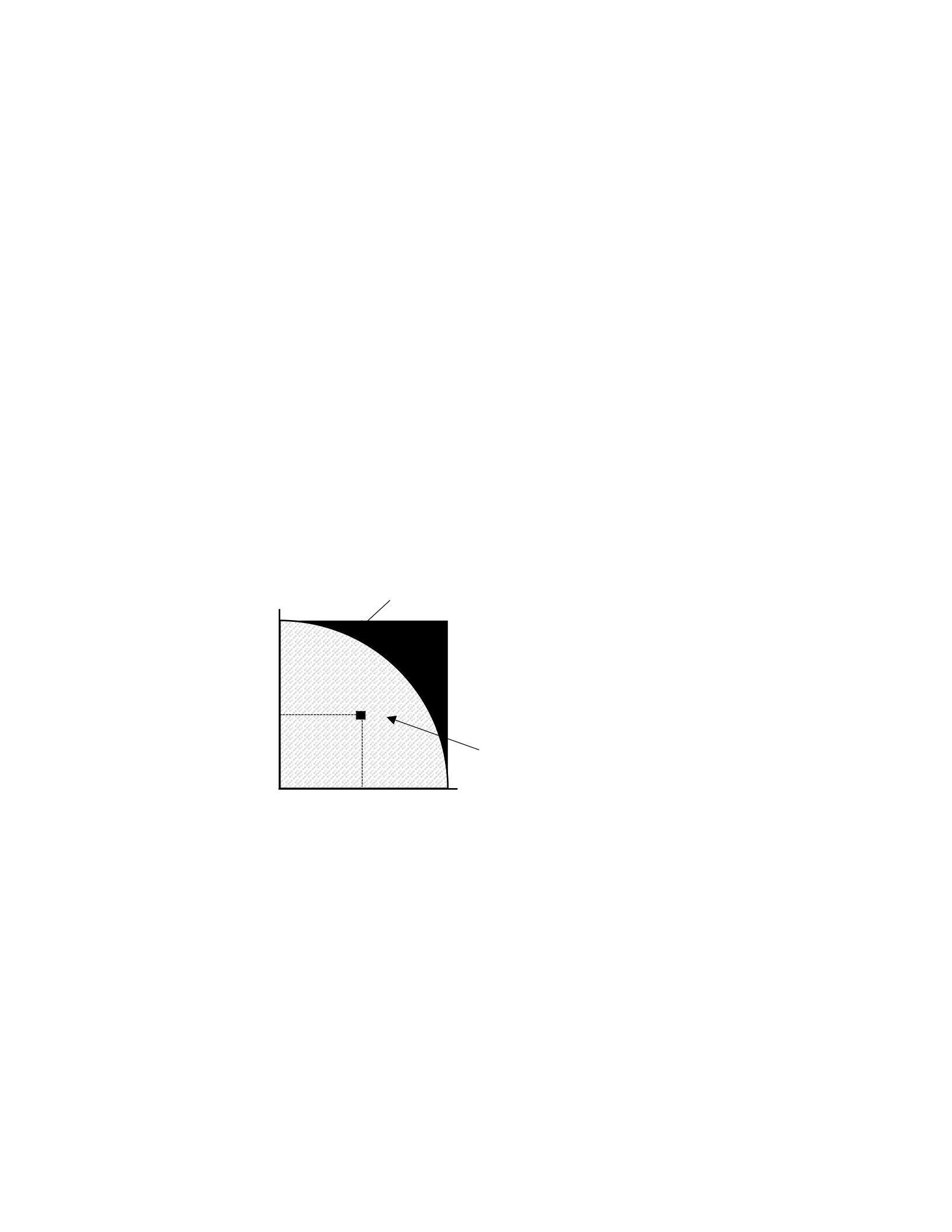
State A then evaluates its best reply if State B were to defect. In this case, State A’s best reply is
to defect. Because the game is symmetric, State B’s best reply to both of State A’s strategies is
also defect, defect. In game theory notation, we can write the pair of strategies, M, as (Defect;
Defect). Again, more formally, the strategy for player 1 is S, and the strategy for player 2 is a.
Therefore, M(S2; a2) is the outcome.
Not all Nash equilibriums are sub-Pareto outcomes. However, in the case of the
Prisoner’s Dilemma, which represents the type of conditions found in the security dilemma, the
Nash equilibrium is sub-Pareto, as illustrated in figure 4. The game's structure leads both players,
or in this case, states A and B, to rationally choose to defect.
Pareto front
4 (optimal outcome)
3
State B 2
1
0
Sub-Pareto
(sub-optimal outcome)
1 2 3 4
State A
Figure 4. The sub-Pareto Nash equilibrium of the Prisoner’s Dilemma.
The strategy (Defect; Defect) leaves each state with a payoff of 2. When both states have
a payoff of 2, the result falls within the area of the arc of the Pareto front. For the game to result
in optimal payoffs, the states must choose a strategy that would lead to an outcome where the
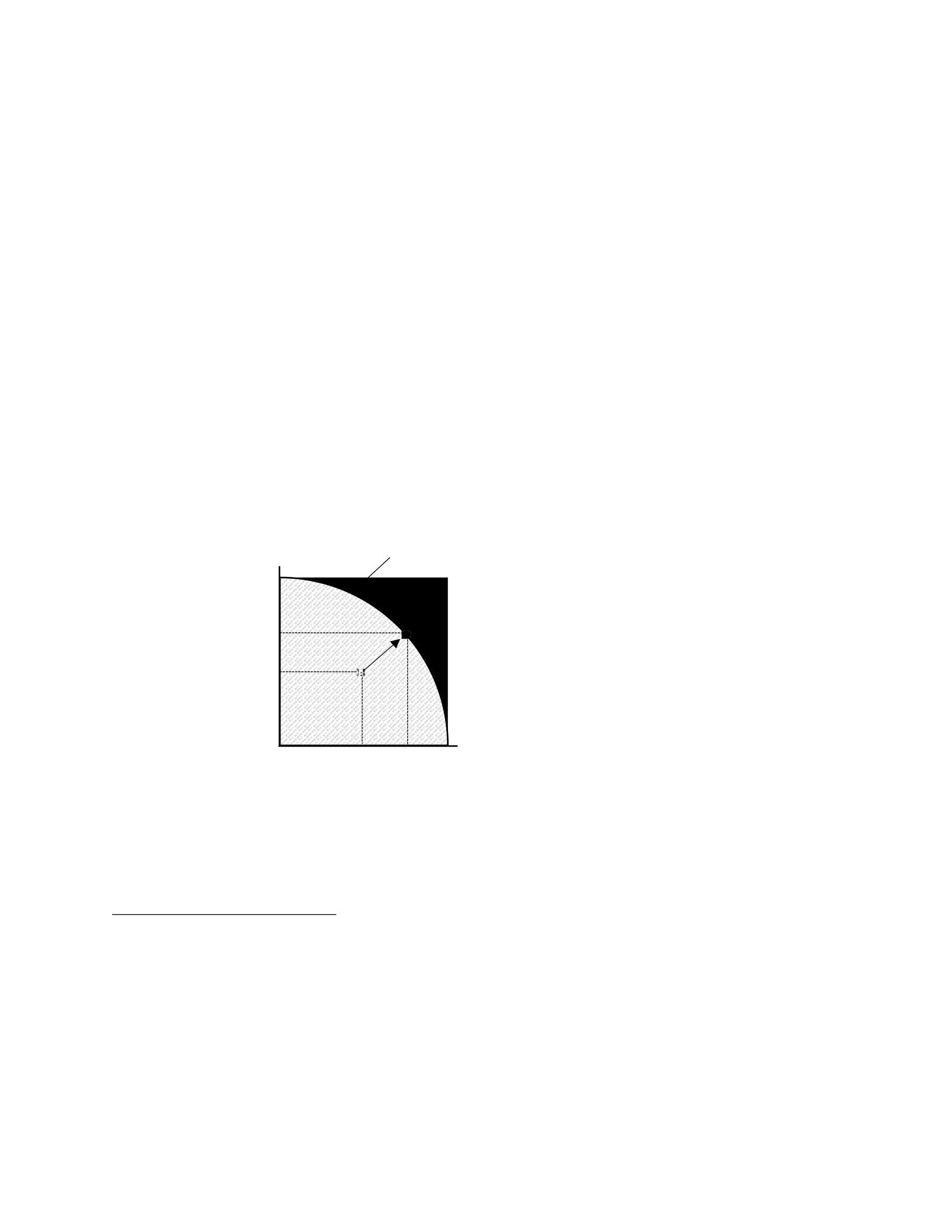
payoffs fall on the Pareto front. The Pareto front represents an optimal outcome but does not
necessarily mean a fair outcome. For instance, if State A cooperates, State B would rationally
choose to defect. The combined strategies of (Cooperate; Defect) result in a (1;4) payoff
structure. State A receives a payoff of 1, while State B receives a payoff of 4, resulting in an
optimal yet unfair and unstable result. Ultimately, the best outcome for the situation is for both
states to cooperate. A (Cooperate; Cooperate) combined strategy is the best result for each player
and falls on the Pareto front, as shown in figure 5. When both states choose to cooperate, the
payoff is (3;3).
4
3
State B 2
1
Pareto front
(optimal outcome)
0 1 2 3 4
State A
Figure 5. The optimal payoff on the Pareto front.210
210. The Pareto curve is a visual aide to represent the sub-pareto outcome of (Defect, Defect). In this
specific example I use whole numbers for the payoffs. The point for the outcome of (Defect, Defect) is (2,2) using
the payoffs in figure 5. However, the point for the values of the outcome (Cooperate,Cooperate) is not (3,3) on the
curve. The point for values for x=3 and y=3 is (3,3). The actual point on the curve is not (3,3) but (2.83, 2.83). I can
keep the payoff values of 1 and 4, making the point on the curve for the (Cooperate,Defect) outcome not (1,4), but
(1,3.87) on the curve used in figure 5. Using the curve in figure 5, I could accurately represent the payoff structure to
be 1. State A cooperates; State B cooperates. Payoffs (2.83,2.83). Note the left number corresponds to player
1, or State A, and the right to player 2, or State B.
2. State A cooperates; State B defects. Payoffs (1,3.87).
3. State A defects; State B cooperates. Payoffs (3.87,1).

In this case, both states have adjusted their strategies to cooperate. However, much like the
security dilemma, the Prisoners' Dilemma does not support (Cooperate; Cooperate) as a stable
equilibrium because the best reply to either Cooperate or Defect is to Defect for both states.
Achieving an outcome in which both states choose to cooperate requires significant effort and
incentives. For example, international institutions provide forums for communication and shared
information. In addition, regimes such as arms control agreements can alter the payoff structure
and incentivize states to cooperate instead of defecting.
If the incentives alter the payoffs in such a way as to promote coordination, the states can
achieve a Pareto optimal equilibrium. However, where on the Pareto front, the equilibrium
occurs depends on many factors. States are likely to agree on mutually undesirable outcomes but
may disagree on preferred outcomes. A set of preferred outcomes falls along the Pareto front. As
shown in figure 5, the Pareto front ranges from zero to four for each player. However, two actors
achieve a Pareto optimal outcome when they cannot improve their situation without making the
other worse off. Therefore, where two states fall on the Pareto front is often a result of power
distribution. The more powerful state is likely to pursue more favorable conditions.
In contrast, the weaker is expected to accept an outcome less than is preferred but better
than a mutually least preferred outcome. The Pareto optimal outcome is often the result of
coordination between states achieved through a regime. When this occurs, the structure of the
preferences is altered so that the states can move beyond the Prisoner’s dilemma to the type of
game known as coordination games. Table 3 illustrates a pure coordination aversion game. The
strategies have been changed to Left and Right for demonstration purposes.
4. State A defects; State B defects. Payoffs (2,2). However, for simplicity, I am using the whole numbers
for the payoffs.

The payoff structure and the strategies are changed to demonstrate that if the states can
coordinate, they can achieve a Pareto optimal, stable outcome. Both states prefer to avoid a (Left;
Right), or (Right; Left) outcome, but both states are agnostic towards the outcomes of either
(Right; Right) or (Left; Left).
Left
State B
Right
State A
Left
Right
Table 3. Coordination game
In the symmetric coordination game, there are now two Nash equilibriums, (Left; Left) and
(Right; Right). In this case, the two states are indifferent over the two strategies. The only thing
the states need to do is to coordinate their strategies. For example, if State B plays a Left
strategy, State A would also choose to play Left because it is the best reply to State B’s strategy,
which means there is no profitable deviation from playing Left. In this case, the two states must
coordinate on whether to choose a Left or Right strategy. International institutions and regimes
can facilitate coordination. A regime can then remove the structure of the Prisoner’s dilemma,
allowing for a Pareto optimal solution.
(3,3)
(0,0)
(0,0)
(3,3)

The reality of international relations is that the power distribution among states naturally
generates favorable conditions for the more powerful states. The power distribution favors the
more powerful states’ bargaining ability to achieve their interests, but to what extent states will
bargain and negotiate depends on the strength of interest other than the issue at hand. For
instance, as Stephen Krasner has noted, regimes are futile under proper zero-sum conditions
because one state’s gain is another’s loss. Therefore if there is no common ground the states are
willing to accept, a regime will not produce a cooperative agreement. On the other hand, when
states’ interests are in harmony, a regime is superfluous because, Krasner writes, “each
individual player, acting without regard for the behavior of others, maximizes both its utility and
that of the system as a whole.”211 Under these conditions, self-regarding actors pursuing
strategies that are best replies to the other’s will result in a Pareto optimal, Nash equilibrium.”212
The two-player game abstracts the strategic interaction among actors participating in
international regimes in the above examples. In most regimes, not all actors are in complete
harmony, nor do complete zero-sum conditions exist.
Åtland reinforces the inadvertent danger of the security dilemma by quoting Robert
Jervis, “it is very likely that two states which support the status quo but do not understand the
security dilemma will end up, if not in a war, then at least in a relationship of higher conflict than
is required by the objective situation.”213 Jervis argues that neither state prefers conflict.
211. Stephen D. Krasner,"Global Communications and National Power: Life on the Pareto Frontier." World
Politics, April 1991, p. 338.
212. Krasner,"Global Communications and National Power: Life on the Pareto Frontier," p. 338. Krasner
cites Robert O. Keohane, After Hegemony: Cooperation and Discord in the World Political Economy (Princeton:
Princeton University Press, 1984), p. 51.
213. Åtland, "Interstate Relations in the Arctic: An Emerging Security Dilemma?" Comparative Strategy p.
162. Quoting Robert Jervis, “Cooperation under the Security Dilemma,” World Politics, vol. 30, no. 2 (January
1978), p. 182.

However, the system’s structure reinforces mistrust, even though, he argues, that cooperation is
possible under certain conditions.
Conditional Probabilities and Beliefs
To formalize our understanding of Russia’s militarization of the Arctic in recent years,
we can develop a formal game theory structure predicated on Bayes’s Theorem. Bayes’s
Theorem can determine the probability that the dominant causal factor is the need to satisfy
Russia’s ontological security, given that Russia has expanded its Arctic military capabilities. A
Bayesian model can help us understand why Russia might instigate an Arctic security dilemma.
The proposition that Russia’s ontological security needs were not met leads to the second
proposition that it generated the intersubjective relationship with the U.S. and NATO. By
creating a security dilemma, by forcing a reaction from other great powers, Russia creates new
material needs from the competition with other great powers while simultaneously satisfying its
ontological security needs.
The competition between Russia and the U.S. and NATO satisfies Russia’s ontological
needs. After the collapse of the Soviet Union, the U.S. and NATO’s dismissal of Russia as
anything more than a regional power with nuclear weapons reinforced biological discontinuity in
Russia’s sense of itself as a great power that Russia experienced after the collapse of the Soviet
Union. Even as Russia grew stronger following the 1990s, the U.S. did not give Russia the
respect it felt it deserved as a fellow great power. Instead, the U.S. made concessions by
extending exceptions to Russia instead of rightfully earning equal treatment. For example, by
bringing Russia into the G-7 and making it the G-8 in 1998, the G-7 members hoped that by
including Russia in the G-7, Russia would continue its efforts toward realizing a fully liberal

economy and a fully democratized government.214. Instead, Russia’s inclusion was transactional.
The G-7 hoped that by treating Russia as a member, it would act as a member, but the reality of
geopolitics replaced the hope of the G-7. As Russia strengthened, Putin sought to regain its status
as a great power by exerting influence over its neighboring states, especially those of the former
Soviet Union. After Russia’s actions in Ukraine and Crimea in 2014, Russia was suspended from
the G-8, and Moscow formally removed Russia in 2017. In the 1990s, Russian liberals believed
that the U.S was its preferred international partner and that there was a “natural belonging to the
West.”215 As a result, Russia tended to stray from its historical identity, searching for a new
identity.
In the 1990s, Russian President Boris Yeltsin and the reformers of the new government
looked to become part of the West. Angela Stent points out that Yeltsin’s “renouncing its
uniqueness and otherness went against centuries of Russian traditions.”216 The collapse of the
Soviet Union left Russia discordant with its sense of self. Yeltsin’s efforts to subsume Russia to
the U.S. led Russia further away from its rightful idea of itself as a global leader in its own right.
Russia’s uniqueness and power created the Russian idea and the Russian identity. When Yeltsin
sought to make Russia a western state, and one subordinate to the U.S., a collective movement
within Russia resisted. Instead, Yeltsin inadvertently caused a realization in Russia that the
apparent discontinuity in its sense of self was so severe that the Russian identity could be lost if
Yeltsin had his way. Realizing this, Yeltsin appointed Yevgeny Primakov as foreign minister in
214. Zachary Laub, The Group of Eight (G8) Industrialized Nations. March 3, 2014.
https://www.cfr.org/backgrounder/group-eight-g8-industrialized-nations (accessed February 5, 2022).
215. Bo Peterson, "Mirror, mirror...Myth-making, self-images and views of the US 'Other' in Contemporary
Russia." In Russia's Identity in International Relations: Images, perceptions, misperceptions, by Ray Taras, 11-23.
London: Routledge, 2013, p. 16-17.
216. Angela E. Stent, Putin's World: Russia Against the West and With the Rest. New York: Twelve, 2019,
p. 34.

1996, who, as Stent writes, “repudiated a pro-Western stance. Instead, he proposed an alliance
among Russia, China, and India.”217 The Russian people resisted the idea of losing the Russian
identity and instead wanted to repair the discontinuity of its ontological security.
The U.S. made informal promises to the faltering Soviet Union that NATO would not
expand eastward, especially after German reunification. Germany would, of course, be a NATO
ally, but the informal agreement was that NATO military equipment would not move eastward
from what was West Germany. As Shifrinson and Itzkowitz have pointed out, the U.S. used the
informal agreement not to expand NATO eastward as leverage to ensure that a reunified
Germany maintained its ties to NATO.218
The U.S. and the Soviet Union knew that a reunified Germany in NATO would give the
U.S. a more significant role in Europe, thus standing between Germany and Russia in the center
of Europe.219 President Putin stated in 2005 that “[T]he collapse of the Soviet Union was the
greatest geopolitical catastrophe of the twentieth century.” Putin was not lamenting the loss of
communist rule or longing for Marxism-Leninism. Instead, Putin was referring to losing
territory, resources, and status.220 Putin lamented the loss of a great Russia and the idea of a great
Russia and a sense of identity as one of history’s great empires. When the Soviet Union
dissolved, fifteen independent states emerged. Moscow had been the hub of all power reaching
far into every corner of the Soviet empire. The Communist Party of the Soviet Union (CPSU)
217. Stent, Putin's World: Russia Against the West and With the Rest, p. 34-35.
218. Shifrinson and Itzkowitz, "Deal or No Deal? The End of the Cold War and the U.S. Offer to Limit
NATO Expansion." International Security, p. 36.
219. Shifrinson and Itzkowitz, "Deal or No Deal? The End of the Cold War and the U.S. Offer to Limit
NATO Expansion." International Security, p. 36.
220. Stoner, Russia Resurrected: Its Power and Purpose in a New Global Order, p. 33.

controlled nearly every political and economic decision throughout the union. Moscow’s power
over the entire Soviet Union was so substantial that more than three decades later, Russians “still
view Russia as the hub of a greater, although defunct empire.”221 The West, especially the U.S.,
viewed things differently. During his presidency, President Obama publicly referred to Russia as
a regional power decades after the collapse of the Soviet Union and after years of President
Putin’s resurgent efforts to strengthen Russia. Obama ignored Russia’s growing but seemingly
little influence beyond its borders.222 Russia and President Putin view the regional power identity
as highly undesirable. Because of the degree to which Russia seeks to avoid the regional power
identity, the consequence of CRP, Russia is willing to accept a high level of risk to identify as a
major or great power and not a regional power.
However, a great power is a relational identity that is intersubjective. The
intersubjectivity must cognitively exist among great powers. Both the great power and others
must recognize states as great powers. When Vladimir Putin became president, he made a
distinct change to Russia’s trajectory towards finding its position in the world. In the early
2000s, Russia regained a sense of its identity as a great power. Putin was determined to restore
Russia’s whole great power identity, which needed to be recognizable domestically and by the
U.S. and European powers.
Putin diverged from western domestic liberal values to maintain power and control of
information. Angela Stent points out that the U.S. wanted Putin to continue reforming its
domestic politics, increasing Russia’s democratization, and facilitating a competing political
221. Stoner, Russia Resurrected: Its Power and Purpose in a New Global Order, p. 34.
222. Stoner, Russia Resurrected: Its Power and Purpose in a New Global Order, p. 34.

party system.223 When George W. Bush led the coalition that toppled the Iraqi regime and
continued interference in states’ domestic politics to achieve Bush’s foreign policy agenda, this
signaled to Putin that the U.S. was willing to impose its values on other states. From Putin’s
perspective, if the U.S. did not respect a regime, it would set out to topple it via direct military
action or political and domestic uprisings known as the Color Revolutions.
Putin saw the U.S. as a threat to his regime and needed to defend his regime by
solidifying domestic support through popularity or suppression. In Putin’s second presidential
term, Stent writes, he tightened his control by suppressing democratic freedoms. However, after
introducing pension reforms in 2005, Putin was forced to relent when protests broke out.
Fortunately for Putin, global oil prices rose significantly from 2000 to 2008, strengthening
Russia’s GDP and helping to place Putin on solid footing. Putin’s solidified position in Russia
gave him the confidence to resist attempts by the U.S. to subordinate Russia openly.224
Following the Russian annexation of Crimea, Putin announced in a speech in March 2014
that Russia would never accept a U.S.-led, rules-based international order. He openly remarked
that Russia had experienced shame and humiliation since the 1990s because it was weakened and
could not defend its interests. Putin proclaimed in his speech that the days of an undermined and
weakened Russia were over and that Russia was a very different country. Putin stated clearly in
his speech that NATO was a clear threat to Russia’s national security. NATO, he argued, could
invade Russia at any time, and Putin proclaimed he would stand firm against the western security
alliance. Fiona Hill writes,
Even if Europe was [NATO’s] center of gravity, Russia was not some ordinary European state. Russia was
Russia and it was going to stay that way. Russia was no longer in retreat; it had taken back Crimea. It was
going to chart its own course in the world…Putin declared that the unipolar world, the unipolar moment,
223. Stent, Putin's World: Russia Against the West and With the Rest, p. 40.
224. Stent, Putin's World: Russia Against the West and With the Rest, p. 41.

was finally over. The rest of the world was moving on from a post-Cold War period defined by the United
States.225
The U.S. and most of western Europe were shocked by Russia’s annexation of Crimea
and Putin’s speech in 2014. In 2008, Russia engaged in military conflict with Georgia and
warned that NATO threatened Russia, and Putin had made clear that he rejected the notion of a
U.S.-led unipolar international system. To the U.S. and Europe, Russia’s actions were blatant
acts of revisionism.226 Russia’s actions solicited a harsh response from the West when the U.S.
and European Union imposed heavy sanctions on Russia marking the first time since World War
II that a large economy had been sanctioned. The U.S. Treasury was careful not to spark a major
global crisis and carefully targeted the sanctions. The sanctions may not have compelled Russia
to hand Crimea back to Ukraine, and, likely, this will never happen. However, the sanctions have
impacted Russia’s economy.227 Russian revisionist actions have caused harm to Russia’s
security, both economic and physical. As a result of Russia’s continuous belligerent behavior, the
U.S. and NATO renewed their attention toward Russia by significantly reorienting force posture
towards Russia. The West’s growing alarm over Russia’s continued aggressive behavior has
reignited defense postures toward Russia and reinvigorated NATO’s cohesiveness and focus on
Russia. Russia’s invasion of Ukraine has confirmed to the West that Russia is a serious threat.
Add Russia’s nuclear forces into the calculation, and the West has no other option but to respond
to the Kremlin’s aggressive foreign policies in ways that increase the tension and decrease the
stability in Europe. Russia’s actions have even caused Finland and Sweden to apply for NATO
225. Fiona Hill and Clifford G. Gaddy. Mr. Putin: Operative in the Kremlin, p.263.
226. Hill and Gaddy, Mr. Putin: Operative in the Kremlin, p. 263.
227. Anders Åslund and Maria Snegovaya, The impact of Western sanctions on Russia and how they can be
made even more effective. May 3, 2021. https://www.atlanticcouncil.org/in-depth-research-reports/report/the-
impact-of-western-sanctions-on-russia/ (accessed February 5, 2022).

membership. Russia’s actions are soliciting the global response by small and great powers that
only great powers can typically achieve. Russia has increased its ontological security, but in
doing so, Putin has decreased Russia’s physical security.
In attempts to secure its identity as a great power, Russia’s belligerent actions to reclaim
lost territory and control parts of eastern Europe have caused harm to Russia’s physical security.
Ukraine never threatened Russia, nor did Georgia, nor has NATO. Indeed, NATO membership
has increased substantially since the beginning of the twenty-first century, but that does not
sufficiently explain the cause of the annexation of Crimea. The annexation of Crimea is not
entirely a reflexive response to NATO expansion directly; Russia’s actions are those of a
powerful state seeking to ensure it maintains control over what it sees as its rightful span of
control. Russia’s actions are a reflexive response aimed at resurrecting its biographical narrative
as a great power and protectorate of the Russian people. Putin gave a lengthy historical
perspective partially justifying Russia’s actions in a speech on 18 March 2014, following the
official signing of Crimea’s annexation into Russian law. Russia’s actions are a reflexive
response to the revisionist idea of Russia as a great power.
In his 18 March speech, Putin described how the dissolution of the Soviet Union and the
bipolar structure led to instability in the world. He described the U.S. western led order as not
one of laws but of violence. Putin stated,
Our western partners, led by the United States of America, prefer not to be guided by international law
in their practical policies, but by the rule of the gun. They have come to believe in their exclusivity
and exceptionalism, that they can decide the destinies of the world, that only they can ever be right. They
act as they please: here and there, they use force against sovereign states, building coalitions based
on the principle “If you are not with us, you are against us.” To make this aggression look legitimate, they
force the necessary resolutions from international organisations, and if for some reason this does not work,
they simply ignore the UN Security Council and the UN overall.
Putin implied that without Russia to act as a counterbalance, the U.S. would continue on a
similar destructive path. Putin accused the U.S. that its “infamous policy of containment [during]

the 18th, 19th and 20th centuries, continues today.” The speech is full of justifications for Russia’s
actions in Crimea.
Putin claims the citizens of Crimea put forth a legal referendum to freely choose their fate
in the same way Americans did with their Declaration of Independence. By invoking the U.S.
Declaration of Independence, Putin suggests that the condition of unipolarity destroys the
unipole from within. By acting as the counterbalance to American power, Putin argues, Russia
can save the U.S. from itself and Europe from the U.S. Putin’s speech justifying Russia’s
annexation of Crimea did not need to focus on what he describes as the lawless and violent U.S.-
led order. However, he made a clear point that Russia was again the only power capable of
balancing the U.S., which implied that Russia was a great power recognized domestically and
internationally.
Russia’s actions in Crimea resulted in intense blowback from the U.S. and Europe. The
U.S. and Europe imposed heavy sanctions that, as previously mentioned, severely affected
Russia’s economy. However, rising oil prices and a wave of domestic support strengthened
Putin’s position. Russia may be less secure due to the sanctions and increased interest in NATO
defense spending, but the crisis played heavily into securing Russia’s ontological needs.
Given that Russia had previously invaded Georgia and Ukraine because they posed a
challenge to Russian influence, the U.S. and NATO were compelled to intervene in Russia’s
2022 invasion of Ukraine on a limited basis. The U.S. and NATO suffered both observable and
non-observable costs to their reputation by not intervening in Russia’s previous violations of
sovereignty and its repeated challenges to the U.S. and NATO through its cyber-attack on
Estonia and its intervention in Syria. The U.S. and NATO are avoiding potential direct action
with Russia in Ukraine in 2022, but they are supporting Ukraine with weapons and information.

Nonetheless, Russia’s actions toward Ukraine in the early spring of 2022, given the historical
context of Russia’s annexation of Crimea and intervention in Ukrainian domestic politics, have
elicited a U.S. and NATO response that puts Russia in a less secure position with Finland and
Sweden aiming to become NATO.
The U.S. may have updated its belief about the type of Russia the world faces in 2022
due to its continued aggressive actions toward other, weaker states and its willingness to endure
the blowback imposed by the West. The Ukrainian uprisings against its president, Viktor
Yanukovych, in late 2013 and Yanukovych’s eventual fleeing to Russia in early 2014 set
conditions that threatened Russia’s interests. As events unfolded throughout the winter of 2013
and early 2014, the West may have believed Russia was the type to invade Ukraine to end the
uprisings and place a Kremlin-friendly regime in power in Kyiv. Alternatively, Russia could not
invade and instead use non-violent means such as information to shape a favorable outcome in
Kyiv. However, when Russian forces took to the streets of Crimea under the auspices of
protecting Crimea’s Russian-leaning population, the West was surprised. The Kremlin then
supported a Crimean referendum to secede from Ukraine. Most Western states consider the
referendum illegal and illegitimate, yet Crimea has become a de facto part of Russia.
The West was surprised because it did not necessarily, consider the third option. As a
result, the West only considered the two options of invading or not invading, thus assigning a
probability to only those options. Considering that the Russian invasion of Georgia, a small
country, in 2008 did not go very well due to the poor operational performance of the Russian
military, the U.S. may have believed the likelihood was very low that Russia was willing or
operationally ready to challenge the sovereignty of Ukraine. As a result of this reasoning, the
U.S. considered Russia to be the type that would not invade Ukraine, with a higher probability

than the type that would invade Ukraine. However, Russia instead decided to annex Crimea, and
the U.S. observed a third type that it likely did not consider with any significant probability.
As with any decision in international politics, states must act with varying degrees of
information. Thus, decision-makers must make decisions based on imperfect information. Each
decision a state makes is to achieve a most-desired outcome, but the strategic nature of the
interdependent decision-making means that other states will choose a course of action, based on
the information they have, to achieve their most desired outcome vis-à-vis another state’s
decision. As states choose between options to maximize their outcomes, they observe how states
react to those decisions, and with that information, they update their beliefs about how others
will behave based on the type of actor they believe them to be. We can examine this decision-
making with imperfect information using Bayes’s Theorem.
Bayes’s Theorem
We can use Bayes’s Theorem to understand how Russia’s actions led to decisions the U.S
and NATO have made concerning Russia’s militarization of the Arctic and how that relates to
the 2022 Russian invasion of Ukraine. Russia’s actions in Ukraine and Georgia are tied to
Russia’s militarization of the Arctic. All of Russia’s actions, including its involvement in Syria,
have informed Washington’s response to the Arctic security conditions and support Kyiv’s
efforts to defend Ukraine against Russia’s invasion. We will first start with the example from
above. The U.S. and NATO decision to support Ukraine is based on a posteriori information
gained from observing Russia’s actions since 2008.
Bayes’s Theorem is used to determine the posterior probability of a particular state of the
world existing by calculating the probability that both an event and state of the world will occur.

As previously mentioned, decision-makers must make decisions with varying degrees of
uncertainty about the consequences of their actions. Their uncertainty can be represented by
subjective probabilities over the possible states of the world. When decision-makers are
uncertain, they use the information to update their beliefs about the possible states of the world.
States of the world are mutually exclusive, and they consist “of all the factors that influence the
outcome but lie beyond the control of the [decision-maker]…But because they do not know the
state of the world, [decision-makers] cannot determine the consequences of their actions.”228
However, if an event occurs and it is more likely that the event was to occur in one state than
another, then when decision-makers observe that event, they can update their beliefs about the
states of the world in which that event is more likely to occur.
A belief one holds prior to an event is called a prior belief. When an event occurs, and
new information updates a belief, the new belief is called the posterior belief. Beliefs, James
Morrow writes, are conditional probabilities. Bayes’s Theorem then uses conditional
probabilities to deduce the conditional probability that a particular state of the world exists given
the occurrence of an event. 229 For example, the standard notation representing the probability
that an event B has occurred, given the state of the world A, is written p(B|A). Deducing the
probability of a specific state existing given a particular event has occurred is written p(A|B).
Bayes’s Theorem is used to determine the posterior probability. In its reduced form, it states that
the probability of A given B is equal to the probability of A and B divided by the probability of
B. Again, this result is the conditional probability of A occurring given B has occurred, as shown
in the simplified equation,
228. Morrow, Game Theory for Political Scientists, p. 22.
229. Morrow, Game Theory for Political Scientists, p. 163.

p(A|B) p(A)p(B|A)
p(B) .
Bayes’s Theorem will enable us to formally analyze the ontological security drivers
behind Russia’s actions in the Arctic and how the U.S. and NATO have responded.
The Rationality of Ontological Security
Creating a decision-making model with a large N sample size can provide enough data to
inductively derive hypotheses for certain events given a particular set of conditions. However,
this study aims to understand Russia’s decision-making rules that it employs to satisfy its
ontological security needs. Ontological security needs are not met through the direct action of the
actor. Instead, the actor seeks ontological security reflexively, as Steele proposes, or socially
defined, as Mitzen argues. In either case, ontological security does not come from direct
decision-making. Much like an emotion, which, as mentioned, is more of an intervening variable,
so is ontological security. For example, giving money to someone on the street can be considered
irrational in the most strict sense. Money, it can be argued, is not earned to give it away to
strangers. Nevertheless, people give money away to strangers every day.
Giving away money earned by working a job means that the money cannot be used for
which a person earned it. However, people experience an emotion that results from the act of
giving money away to a stranger in need. The action is to give away money. The outcome is two-
fold. The person giving away money has less, but the person in need has more. The amount
people give away does not usually involve risk to themselves or their families; therefore, the
financial impact is minimal. However, the effect on the person in need is significant. Therefore,
the person in need may be able to eat that day, and knowing that makes the person who gave the

money away feel some type of satisfying emotion. The emotion is not the direct outcome of the
action but an indirect result. The same is true for ontological security.
A state seeking to satisfy its ontological security needs decides on actions that it believes
will likely result in a particular outcome. The outcome of the state’s decision-making may elicit a
sense of ontological security. For example, when Russia decided to militarize the Arctic, the
outcome was that the U.S. and NATO responded by increasing their Arctic military capabilities
and force posture. When Russia threatens to invade Ukraine, the result is that the U.S. and
NATO respond by discussing options, showing support for Ukraine’s foreign policy decisions as
a sovereign state. When Russia steps in to support Syria’s Al Asaad regime and deploys forces to
support the government forces, the U.S. and its coalition partners must coordinate operations
directly with Russia to avoid unwanted contact and potential conflict. Russia’s actions are,
through the neorealist lens, rational acts that any state under the given systemic conditions would
take, given its material strength. However, through the ontological security lens, Russia’s actions
notably solicit a response from the U.S. and NATO. The U.S. and NATO response is the
outcome Russia seeks because it helps confirm its status as a great power.
The realist explanations for Russia’s actions presuppose Russia as a power-maximizing
actor. As previously mentioned, realism’s power-maximizing goals can partially explain Russia’s
actions in the Arctic. However, a counter-argument can be made that Russia’s militarization of
the Arctic is not power-maximizing. Russia improved military facilities, increased the
capabilities of strategic airbases, and even built several new garrisons in the very high north.
Moscow has invested heavily in Arctic defenses but at the cost of other options that might have
proved more efficient efforts to maximize Russia’s hard power. As a result, Moscow’s
investments in Arctic military capabilities may have diminishing returns.

If the U.S. and NATO were to end up in a military conflict with Russia, it would likely be
due to something outside of the Arctic. If escalation were to occur, the Arctic would likely be
relevant as a region of ballistic missile volleys. It is difficult to imagine a scenario where NATO
forces, other than the border between Norway and Russia, would use the Arctic as an avenue of
approach or seek to seize territory. Therefore, if we regard Russia as a rational actor, we must
assume that Moscow is pursuing goals beyond solely power maximizing.
Using game theory methodology can assist in determining if ontological security is
motivating Russia’s actions in the Arctic. If we seek to further understand Russia’s militarization
of the Arctic in ontological security terms instead of realist terms, we should specify different
actors’ policy choices and preferences in that case. 230 Duncan Snidal argues that game theory
can be thought of as a theory of international politics by assuming a set of empirical
assumptions. However, he points out that arguing over whether states are rational actors does not
require the assumption that states are solely power maximizers, nor does the state need to be
assumed to be the actor. If the rational actor is assumed to be a state and a power maximizer by
convention, game theory becomes an instrument of realism. Snidal argues that while treating an
actor as rational in game theory is necessary, “the game-theoretic approach is not coincident with
Realism.”231 As previously discussed, the realist explanation alone does not sufficiently explain
Russia’s relatively recent Arctic defense expenditure.
If Russia has other motivations than power maximizing and is assumed to be a rational
actor, another utility must exist for building military infrastructure and capabilities in the Arctic.
As stated above, Russia seeks to achieve and maintain great power status and be recognized as a
230. Duncan Snidal, "The Game Theory of International Politics." World Politics, 1985, p. 35.
231. Snidal, "The Game Theory of International Politics," p. 35.

great power. However, providing significant evidence to demonstrate that Russia’s Arctic
militarization is motivated by identity is problematic. Therefore, it is necessary to establish a
formal process for determining the likelihood that identity, and ontological security needs, are a
source of Russia’s motivation.
The Russian defense policymakers, much like any policymaker, are likely to be uncertain
about the action they undertake and the likelihood that those actions will lead to the outcomes
they seek. If seeking to maximize ontological security, Russian policymakers will need to choose
a set of actions based on their belief in the state of the world. If Russia seeks great power status
and prestige among the world’s great powers, it must also perceive a specific state of the world.
The probability that a particular state of the world exists represents the policymakers’ degree of
belief about the likelihood of that state existing compared to other potential states. The
probability is subjective, which means that the firmer the Russian policymakers’ belief about the
likelihood of a particular state, the more likely the policymaker is to believe that state is the
actual state of the world.232 As conditions change and policymakers receive new or updated
information about the world, policymakers may update their belief about the likelihood that a
particular state of the world exists. For example, suppose Russian policymakers see the state of
the geopolitical world as one in which the U.S. and western European powers attempt to contain
Russia. However, if Russia perceives itself to be on equal footing as a great power, then its
policymakers may believe that Russia must assert greater power to demonstrate its continued
global presence as a great power.
232. Morrow, Game Theory for Political Scientists, p. 163.

Russia’s identity is a complex set of ideas, history, and beliefs, but its claim to be a great
power is an inseparable part of that identity.233 Ontological security theory suggests that states
“structure their action in ways which attend to their self-identity needs, sometimes in materially
costly ways.”234 Pursuing actions that may be materially costly to attend to self-identity needs
may seem irrational and thus brings into question what constitutes rational security interests. The
concept of rationality is broad; without framing rationality, it can mean anything and become
meaningless.
However, this is not the case; rationality does have meaning. For this study, rational
behavior means that an actor chooses the best action, given the information the actor has at the
time, to achieve a predetermined set of ends. The simple definition of rationality allows for
evaluating the consistency of choices and not the thought processes or the morality of those
ends.235 In social problems, decisions and outcomes constitute a complex relationship. The
complexity of the relationship can be understood in terms of the endogeneity problem between
the independent and dependent variables. The endogeneity problem occurs when the dependent
variable partly causes the independent variable.236 For example, the more a publisher spends on
marketing a book, the more expected sales. However, more book sales can also mean less
spending is required to achieve or exceed a specific sales goal. Spending less on marketing an
unknown book would be irrational if the publisher intends to sell as many copies as possible.
233. Bo Peterson, "Mirror, mirror...Myth-making, self-images and views of the US 'Other' in Contemporary
Russia," p. 11.
234. Steele, Ontological Security in International Relations: Self-Identity and the IR State, p. 148.
235. Morrow, Game Theory for Political Scientists, p. 17.
236. Frank Lovett, "Rational Choice Theory and Explanation." Rationality and Society 18, no. 2 (2006), p.
266.

This is a simple example but makes the point that sometimes there are cases whereby doing a
seemingly irrational act may be rational due to the endogeneity problem.
The cause-effect interaction between dependent and independent variables in social
problems makes it challenging to define rational behavior. Therefore rational behavior, or
rational decision-making, can be understood as a utility function. The term function implies a
mathematical interpretation of social problems. However, an actor’s decision is not a series of
literal calculations. Instead, as James Morrow points out, “people make choices that reflect both
their underlying goals and the constraints of the situation, and we create a utility function that
represents their actions given those constraints.”237 Actors base preferences and decision-making
on many factors that may be too complex to model. Morrow writes, “we deduce actors’ goals
from observing their prior behavior or by experimentation. We then assume that actors will
continue to pursue the goals we have deduced they pursued in the past.”238 The courses of
actions actors pursue to attain those goals are based on preferences that the modeler studying the
social problem fixes to the actors. An actor bases preferences between actions on the information
available at the given time and their situations. Finally, the actor seeks a goal called a
consequence or outcome. We then assume an actor will choose a course of action under the
stated conditions that will most likely achieve their desired outcome or consequence.
Suppose the desired outcome of Russia’s choices of actions is to maintain or improve its
status as a great power among great powers. In that case, we can expect Russia to pursue a
rational course of action, given the information available to Russia and the current situation. The
current situation can be framed as the geopolitical conditions between Russia, European powers,
237. Morrow, Game Theory for Political Scientists, p. 20.
238. Morrow, Game Theory for Political Scientists, p. 17.

and the U.S. Whereas, Russia’s information is based mainly on the historical context. The
historical context includes Russian history and the relationship between Russia, European
powers, and the U.S. The historical context is the foundation for Russia’s identity as a great
power and its geographical position over Asia and Europe, but central to neither. The Soviet-U.S.
relationship frames the historical context for most of the twentieth and the early twenty-first
centuries as an epoch of competition with occasional periods of cooperation. The historical
context informs Russia’s perception of the geopolitical condition and forms the perceived state
of the world. Russian decision-makers must choose courses of action under given information
sets and situations. However, they must make uncertain decisions and only base the decisions on
the probability that their chosen course of action is the optimal choice.
In foreign policy, decisions are incredibly complex. They involve many years to know
whether those decisions led to the desired outcomes, whether the decisions led to suboptimal
outcomes that need updating and subsequent courses of action to achieve the desired results, or
whether the consequences of their choices have led to disastrous outcomes. Subjective
probabilities represent the uncertainty surrounding decision-making to model social problems
such as foreign policy decisions.
To determine whether Russian decision-makers militarized the Arctic to satisfy Russia’s
ontological security, the probability of that event occurring must be equal to or greater than zero.
Since we can observe that Russia has indeed militarized the Arctic, other reasons need to be
considered. Previously, the neorealist argument illustrated that Russia has defensive and
offensive security needs in the Arctic. Constructivism was also previously examined.
Constructivism offers an explanation that bridges the neorealist and ontological security
explanations of Russia’s decision to militarize the Arctic. In this case, the assumption is that

Russia is pursuing some combination of material and ontological security needs. Russia is cast as
two types, the material or physical security-seeking type and the ontological security-seeking
type. Type I is the ontological security (O) type, and Type II is the neorealist (N) type. The two
types make up a set T, and
T = {O, N},
where the probability of any of the two is non-negative. Therefore the probability for the
motivation space T must equal 1:
P(T) = 1,
because the sum of the probabilities of the set equals 1, we can write the probabilities of each in
terms of the others,
P(O) + P(N) = 1
P(O) = 1 – P(N),
P(N) = 1 – P(O).
Calculating Expected Utilities
The attractiveness of outcomes can be measured using the Von Neumann-Morgenstern
utility function. The function allows us to examine the risk Russia is willing to achieve its
preferred outcome. First, a decision-maker must choose a course of action from a set of acts, A.
Decision-makers must choose that action, A, in a particular state of the world. The set of states of
the world, S, are mutually exclusive, and only one state of the world can exist. The world,
Morrow describes, “is defined to encompass all matters relevant to the problem beyond the
control of the decider.”239 To model Russia’s decision-making, two states of the world are

defined. Typically, an actor does not know the state of the world. In the first state, S1, Russia’s
aggressive foreign policies threaten the U.S. and NATO interests. As a result, Russia’s actions
will usually draw a significant response from the U.S. and NATO. In the second state of the
world, S2, the U.S. does not consider Russia a geopolitical foe, and Russia’s foreign policies do
not typically threaten U.S. and NATO interests.
Additionally, a set of consequences, or outcomes, C, can occur. Given a pair of acts and
states of the world, only one consequence results from a given action in a given state of the
world. The decision-makers also have a preference order, R, over the consequences. We get a
Von Neumann-Morgenstern utility function by adding a probability and utility associated with
each state and action. Each act is evaluated for the likelihood of the consequences and how
attractive the outcome is to the decision-maker, where EU(A) is the expected utility for a given
action from the set of actions, A,
EU(A) = all S p(S)u[C(S , A)].240
Russia was not satisfied with being relegated to the second-tier powers and has made efforts to
increase its power and regain its status as a great power. Putin himself declared, “…to put it
mildly, it is too early to bury Russia as a great power.”241 Putin declared Russia a great power
and refused to accept a lesser status. Therefore, Russia’s preference is to regain or maintain great
power status. However, to be a great power, Russia must self-identify as a great power, and other
great powers must also recognize Russia as a great power. The most preferred consequence or
outcome is CGP, where C is the consequence, and the subscript GP represents great power. So
CGP is the outcome that Russia is a great power, recognized by other great powers as a great
239. Morrow, Game Theory for Political Scientists, p. 23.
240. Vladimir Putin, Nataliya Gevorkyan, Natalya Timkova, and Andrea Kolensnikov. First Person: An
Astonishingly Frank Self-Portrait, p. 220.

power, and identified confidently as a great power. Self-identifying as a great power is one part
of being a great power. However, other great powers must recognize and treat a state as a great
power to be one.
Challenging Russia in the Arctic, especially in the Russian Arctic, is something most
Western states had little ability to do more than a decade ago. The U.S. had nuclear capabilities
targeting Russia via the Arctic, and its conventional military is capable of operating in the Arctic,
but only to a limited extent. As a result of Russia’s militarization of the Arctic, the U.S. and its
allies and partners are creating capabilities to operate specifically in the Arctic and cold-weather
regions. However, if the U.S. and NATO did not react to Russia’s militarization of the Arctic by
strengthening their Arctic military capabilities, Russia would not receive validation as a great
power. To achieve great power status, Russia must self-identify as a great power, and other great
powers must consider Russia a great power to validate Russia’s ontological security needs. The
problem with the validation requirement is that Russia cannot know with one hundred percent
certainty that other states perceive Russia to be a great power. Therefore, the probability that the
state of the world is S1, that Russia is recognized as a credible coercive geopolitical foe, is less
than or equal to 1, or 1 p.
Suppose Russia is unable to meet the requirements to be a great power. In that case, its
next preference is to be recognized as a strong power with regional hegemony and a member of
the G-7, the Arctic Forces Security Roundtable, the NATO-Russia Council, and other major
security and economic fora. While in this case, Russia may or may not be treated as another great
power by the great powers. Russia’s ability to wield power is limited because its global influence
is not as great as it wants. However, Russia is still accepted and treated as a great power. The
U.S. and NATO would respect its interests. However, the U.S. does not necessarily give as much

concession to Russia as it would prefer resulting in the outcome of CMP, where MP represents
Russia’s status as a major power. Under the consequence of Russia as a major power, a state
could exist where the international community respects Russia as a critical actor in global affairs.
In this case, the state of the world is likely to be considered S1. However, it could also be the
case that the U.S. and its allies and partners do not respect Russia’s interests. In this case, the
U.S. and NATO largely ignore Russia’s interests.
The state of the world where the U.S. does not consider Russia a geopolitical foe with
credible power to coerce the West is considered S2. The second state of the world is highly likely
to exist if Russia’s least preferred outcome occurs. Russia’s least preferred outcome, or
consequence, is that it achieves only the status of regional power, by which U.S. and western
European powers refuse to recognize Russia as a state with anything more than the ability to
influence some of its neighboring, smaller, former Soviet republics. This consequence or
outcome is similar to the conditions under which Russia existed during the decade following the
collapse of the Soviet Union. Under this outcome, Russia may only be included in major nuclear
arms negotiations, energy agreements, and other global security issues such as militarizing space
and Arctic cooperation. Russia’s least preferred outcome is CRP, where RP represents regional
power. A prominent example of this state of the world is the promise of NATO membership
expansion to Georgia and Ukraine, or at least the discussions of such membership by NATO
while completely disregarding Russian interests.
Russia has strong, rational preferences for each outcome. Meaning Russia prefers one
outcome over another, and there are no outcomes that are at least as preferable to another, and
the preferences are non-transitive and complete. In a survey by the Levada Center of 1,600
Russians over the age of 16, 65% responded “definitely yes,” or “probably yes,” when asked if

they believed Russia was a great power.242 The survey indicates a metric to determine whether or
not a state is a great power exists. The majority of Russians believe that Russia is a great power.
President Putin’s comments about Russia’s new foreign policy for Ukraine indicted the U.S. and
NATO. Putin asserted that the hollow promises of NATO non-expansion by the U.S. and its
western Allies caused Russia to protect its interests. Kathryn Stoner argues that these comments
indicate “Russia’s restored greatness that characterizes its revanchist approach to international
relations.”243 Therefore Russia’s preference order is,
CGP > CMP > CRP.
The order is seemingly self-evident, and Russia can achieve any of these outcomes. The
preferences are not aspirational; Russia will choose from a possible set of actions most likely to
achieve the greatest preference. For example, many countries might prefer to be a great power,
but the path to achieving such a status is either not realistically available, or achieving the status
of great power would mean taking actions that may violate international norms, thus making
them a pariah state. As a result, the consequences of seeking great power status may be
undesirable in the extreme. In Russia’s case, the above preference order implies that Russia will
choose actions that it believes will put it on the path to achieving its greatest preference. The
probabilities associated with each outcome reflect Russia’s beliefs about which actions will lead
to what consequences. Russia’s past and future actions are based on its beliefs and understanding
of the current situation.
Referring to the expected utility function, we can examine the different utilities
associated with the other consequences, C. To do so, we know that C is a function of a given set
241. Stoner, Russia Resurrected: Its Power and Purpose in a New Global Order, p. 15.
242. Stoner, Russia Resurrected: Its Power and Purpose in a New Global Order, p. 13.

of acts, A, and states of the world, S. The list of consequences, C, is a lottery in which we will
presuppose Russia can choose any of the three. By examining the consequences, C, as lotteries,
we can use the expected utility theorem to evaluate the relative amount of risk Russia is willing
to accept to achieve the different consequences. As a reminder, the study is framed in the context
of the Arctic, but it is impossible to understand Russia’s pursuit of great power status without
incorporating all of its foreign policy decisions and actions Russia takes. Therefore, it is
necessary to make several assumptions because it is impossible to know exactly how various
actions and motives and the actions and reactions of different actors create a complex set of
consequences that continue to inform further actions and consequences.
Moreover, Russia’s risk tolerance to maintain ontological security cannot be fully
understood in terms of only the Arctic. However, it is possible to examine the degree of risk
Russia is willing to accept to maintain ontological security in the context of Arctic militarization.
The expected utility function can help understand the degree of risk Russia is ready to take by
militarizing the Arctic to achieve great power status. Again, the model is highly abstracted, but
Russia can choose from two actions: militarizing the Arctic, A1, and not militarizing the Arctic,
A2. Below, table 4 captures the various states of the world, the consequences, and Russia’s
actions.

State of the World
U.S. and NATO interests are threatened
by Russia’s aggressive foreign policies,
S1
U.S. and NATO interests are not
threatened by Russia,
S2
Actions
Militarize the Arctic
A1
Do Not Militarize Arctic
A2
Table 4. Russian Actions versus possible states of the world.
Russia’s preferences over the consequences are ordered CGP > CMP > CRP. Russia prefers to be
a great power and has no intention of living through the humiliation it experienced in the 1990s
when it had to rely on loans from “lenders of last resort like the IMF and World Bank. Food aid
was distributed on the streets of Moscow.”244
Putin has demonstrated the risk he and Russia are willing to take to avoid relegation as a
regional power. When Ukraine started discussions with the EU and NATO in 2013, Putin took
243. Stoner, Russia Resurrected: Its Power and Purpose in a New Global Order, p. 6.
Recognized as a great power. The U.S.
and NATO increase Arctic capabilities
and an Arctic security dilemma results,
CGP
Recognized as major power, but no
response by the U.S. or NATO with
regards to Arctic military capabilities,
CMP
Recognized as major power, a member in
the G-7, the Arctic Forces Security
Roundtable, and the NATO-Russia.
Council,
CMP
Recognized as only a regional power,
NATO and U.S. expand capabilities to
operate in the Arctic, constraining Russia
and shifting the Arctic balance of power,
CRP

action to block further moves by Ukraine to join western orders. Putin took similar actions in
Georgia in 2008. In January 2022, Putin was keen to mobilize Russian troops in Kazakhstan
under the auspices of the Collective Security Treaty Organization (CSTO) to quell unrest that he
believed the U.S. may have supported. Putin is obliged to prevent Kazakhstan from shifting
away from Russia toward the West and with other countries from the Soviet empire. Putin is
willing to accept high risks to ensure this does not happen. Therefore, it is valid to assume that
Russia perceives no utility in identifying as a regional power.
Russia’s utility for achieving great power status is the highest, and the utility for
achieving an identity as a major power is marginal. Russia sees no utility in being a regional
power. The assumption then is that
u(CGP) = 1.0, u(CMP) = 0.2, and u(CRP) = 0.
The utility values of Russia’s outcomes are based on assumptions given Russia’s past actions and
the content of its policies and public addresses from key leaders. The combined probabilities of
each state existing must add to 1 because only the two states can exist. Examining the states of
the world a decade ago and then today shifts the probabilities. Today it is much more likely that
Russia’s actions and foreign policies threaten U.S. and NATO interests than they did a decade
ago. To examine the risk Russia may be willing to take, table 5 is a conversion of table 4 into a
normal form, game theory matrix. Russia’s strategies are to militarize or not militarize the
Arctic. These two strategies are abstractions of Russia’s actual decisions. Nevertheless, the
abstraction can capture Russia’s willingness to pursue ontological security by seeking great
power status vis à vis NATO.

NATO
Russia
MA
NMA
Defy/
Demands accept
Table 5. Normal form – Russia as an ontological security seeker.
In table 5, there are two pure Nash equilibria. One of the Nash equilibriums is (MA;defy), and
the second is (NMA;accept). The first is Russia's decision to militarize the Arctic (MA), and
NATO’s best response is to defy Russia’s actions in the Arctic by expanding Arctic military
operations and capabilities. The Second Nash equilibrium is for Russia not to militarize the
Arctic (NMA), and the best response by NATO is to accept the status quo. In this example, the
status quo is pre-2010. The payoff structure corresponds to the ordinal preferences for the
possible outcomes. It is important to note that this payoff structure assumes Russia is an
ontological security-seeking actor. Later on, both the realist, physical security-seeking type and
the ontological security seeking type are examined in a signaling game. For now, we can
examine table 5 and gain insights into Russia’s motivations and NATO’s response. Because
there are two Nash equilibriums, the next step is two determine if there are any mixed strategy
Nash equilibriums. First, we will determine Russia’s mixed strategy by making the expected
utilities of each of Russia’s actions a function of the probability that NATO will defy Russia if it
seeks to militarize the Arctic, setting them equal to each other such that NATO will be
indifferent.
5,1
-1,1
-2,3
0,4

EUR(defy) = EUR(Accept)
EUR(defy) = p(1) + (1-p)(3)
EUR(Accept) = p(1) + (1-p)(4)
p(1) + (1-p)(3) = p(1) + (1-p)(4)
p = 1
The result is that Russia should militarize the Arctic with a probability of 1. There is no proper
mixed strategy here, providing interesting insight. It is also important to emphasize that the
payoffs are values that reflect the ordinal preference order. However, no matter what the
response is by NATO, Russia will seek to militarize the Arctic. This outcome corresponds to its
desire to seek great power status.
Next, we look at NATO’s mixed strategy,
EUN(MA) = EUN(NMA)
EUN(MA) = q(5) + (1-q)(-1)
EUN(MA) = q(-2) + (1-q)(0)
q(5) + (1-q)(-1) = q(-2) + (1-q)(0)
q = ¼
The result is that NATO will defy Russia’s actions with a probability of ¼ and accept them with
a probability of ¾. The interesting insight is that if Russia militarizes the Arctic with a
probability of 1, NATO’s payoff is equal to 1, given Russia’s action. However, NATO will
accept the militarization ¾ of the time. This result tends to correspond to what has happened in
real life. Russia initiated its efforts to militarize the Arctic, and NATO initially did little about it.
It was not until several years later that NATO expanded its ability to operate in the Arctic. The
reason for this is explored in the following chapter. However, the result of the above exercise

provides two fundamental issues. The first is that Russia needed to seek ontological security, and
the Arctic provided a way for Russia to do so. Second, NATO was indifferent at first, and as the
above exercise tends to illustrate is that NATO preferred not to militarize the Arctic. However,
over time Russia persisted, which eventually caused NATO to change its decision. This is
reflected below in the signaling game later in this chapter. The small exercise illustrates that
given the state of the world and Russia’s preferences over the consequences, Russia is more
likely to militarize the Arctic than not in pursuit of great power status.
Extensive Form Game: Russia and NATO
It is impossible to know the probability of each outcome occurring, so it is necessary to
assign probabilities based on certain conditions. The game in figure 6 will assist in assigning
probabilities. The simple extensive form game in figure 6 models Russia and NATO’s moves if
ontological security motivates Russia’s decision-making. As the above expected utility equation
shows, Russia’s greatest utility is gained by achieving great power status. The model below
demonstrates that by militarizing the Arctic to attain great power status, NATO, specifically the
U.S. and the European Arctic states, will likely react to Russia’s militarization of the Arctic by
taking steps in its efforts to militarize the Arctic. Russia dominates the Arctic in terms of
conventional military capabilities and capacity, and it has the most extensive presence in the
Arctic beyond defense activities.
The figure models Russia’s actions while pursuing great power status only in the context
of the Arctic. Russia’s activities have involved many other actions and policies in different
geographic areas and sectors of national power throughout the last two decades. Russia initiated
improvements in Arctic defenses by enacting policies beginning with the 2000 “Basics of the
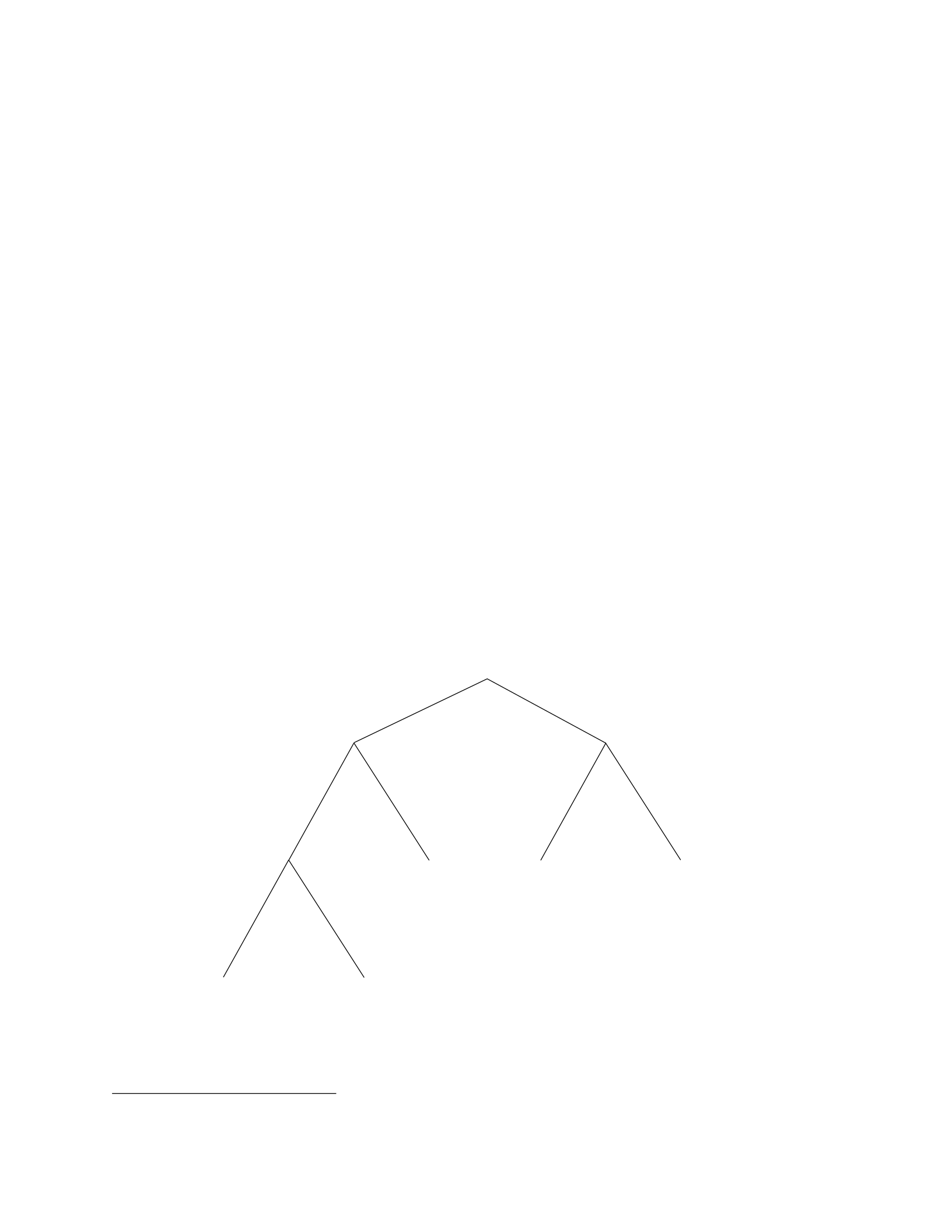
Russian Federation State Policy in the Arctic” (Basics). President Putin signed Basics in
recognition of the Arctic’s economic potential. In 2008, President Dmitri Medvedev signed into
law the “Russian Federation in the Arctic to 2020 and Beyond” (Foundations), establishing the
Arctic Zone as a strategic resource base and framing the Northern Sea Route in terms of strategic
interest.245 Russia continued to sign into law policies to secure the Arctic, but the focus of effort
started to change when President Putin assumed his third term as president in 2012. The focus
shifted toward increasing military capabilities in the Arctic and away from social and economic
development. Increased military development re-emerged as Putin’s priority in the Arctic over
economic growth, emphasizing protecting and defending Russia’s Arctic borders in the 2013
“Developing Strategy of the Arctic Zone of the Russian Federation and National Security for the
period until 2002” document.
NATO
Militarize
Arctic
Russia No Arctic
Militarization
NATO
Russia
Defy Accept No change in
Arctic Resist Revanchist
Actions
Defend Accept
CMP CMP CRP
CGP CMP
Figure 6. Russia-NATO Challenge game.
244. Buchanan, “The overhaul of Russian strategic planning for the Arctic Zone to 2035.”

As Russia initiates the securitization of the Arctic and signs into law policies to increase
military capacity and modernize military capabilities in the Arctic, NATO tends to follow
Russia’s lead. As previously mentioned, ontological security-seeking states are likely to make
decisions with outcomes that may result in physical insecurity. Jennifer Mitzen argues that a
“self-defeating relationship can provide ontological security. However, even a destructive or
self-defeating relationship can conflict with physical security.”246 The Russian strategic
documents demonstrate how Russia initiated the militarization of the Arctic. At first, Russia was
primarily interested in infrastructure development to secure its economic interests. However, as
revealed above, Russia eventually pursued a more aggressive agenda of increasing the
militarization of the Arctic. Russia’s actions in the Arctic resulted in the U.S. and NATO
focusing more on their capabilities to operate in the Arctic.
Referring to figure 6, we see that Russia could choose between increasing the
militarization of the Arctic or not, other than for economic development. Russia, however,
decided to engage in more aggressive militarization, as illustrated by Putin’s 2013 Arctic strategy
document. When Russia chose to increase its Arctic military posture, NATO, more specifically
the U.S., was faced with accepting Russia’s increases in its Arctic military posture or responding
in kind by defying Russia’s actions.
Many factors go into the decision for NATO forces to increase their Arctic military
capabilities. The causes of NATO’s Arctic militarization are varied, but there are indications that
it results from Russia’s aggressive military developments. For instance, NATO exercise Trident
Juncture 18 in 2018 indicates NATO’s reaction to Russia’s aggressive activities and increased
245. Mitzen, "Ontological Security in World Politics: State Identity and the Security Dilemma." European
Journal of International Relations, p. 342.

U.S.-Russian tensions. Trident Juncture 18 is a NATO exercise involving around 50,000
personnel from NATO allies and partner countries.247 The USS Harry S. Truman (CVN-75)
participated in Trident Juncture, and it is the first U.S. aircraft carrier to operate in the Arctic
since September 1991. The last U.S. aircraft carrier to operate in the Arctic was the USS
America (CV-66) during a NATO exercise when the Soviet Union still existed.248
The growing sentiment, common among U.S. defense-related think tanks and
policymakers, is that “Overall, the growing military-security dimension in Arctic affairs requires
NATO to urgently shore up its defense and deterrence posture in the region lest it risks losing
relevance and the ability to protect its members.”249 The recent increase in U.S. Arctic strategies,
including published Arctic strategies for each of the U.S. defense services, and the Department
of Homeland Security, is another indication. As a result, NATO has decided not to accept an
unopposed Russian militarization of the Arctic but to defy Russia. As Arctic securitization and
militarization increase, some consider the situation a security dilemma. As discussed in the
introduction, the conditions in the Arctic do not meet the requirements of a security dilemma at
present. However, in the strictest sense, conditions for a security dilemma, as defined by Robert
Jervis, are “the means by which a state tries to increase its security decreases the security of
others.”250 The argument can be made that Russia’s aggressive actions and resurgent behavior in
246. North Atlantic Treaty Organization, Trident Juncture 18. October 31, 2018.
https://www.nato.int/cps/en/natohq/news_158620.htm (accessed January 14, 2022).
247. Megan Eckstein, "Truman Carrier Strike Group Operating North of the Arctic Circle; First Time for
the US Navy Since 1991." U.S. Naval Institute News, October 19, 2018.
248. Jim Danoy and Marisol Maddox, Set NATO's sights on the High North. October 14, 2020.
https://www.atlanticcouncil.org/content-series/nato20-2020/set-natos-sights-on-the-high-north/ (accessed January
14, 2022).
249. Glaser, "The Security Dilemma Revisted." World Politics, p. 174. Glaser refers to Robert Jervis,
Perception and Misperception in International Politics (Princeton: Princeton University Press, 1976), chap. 3, esp.
62-76; “these pages provide a more thorough discussion of the basic workings of the security dilemma than does
‘Cooperation Under the Security Dilemma.’”

Ukraine, Crimea, Georgia, and possibly Syria create the conditions by which NATO views
Russia’s increased militarization of the Arctic as potentially decreasing the security of NATO
allies’ security partners.
Russia’s evolution in Arctic militarization since at least 2008 is represented in figure 6.
Russia decided to take steps to militarize the Arctic, choosing the left branch in the extended
form game. NATO is then left with the choice to accept Russia’s militarization and the new
status quo, or NATO could choose to defy Russia and increase its Arctic military capabilities to
maintain some balance of power in the Arctic. By matching Russia’s decisions to militarize the
Arctic and Russia’s decision to continue to increase Arctic militarization, NATO contributes to
the spiraling securitization and militarization of the Arctic.
The continuing spiral of Arctic militarization leaves Russia less secure as it increases its
defenses. Jennifer Mitzen argues that this seemingly irrational phenomenon is rational under
specific conditions. As previously shown, those conditions can be abstracted in the game known
as the Prisoners’ Dilemma. Under those conditions, that dominant strategy for each actor leads to
a suboptimal equilibrium. The security dilemma is the suboptimal equilibrium of two rational
actors. However, in the case of the Arctic, the conditions are not the same as those of the security
dilemma. Therefore, by enticing a sort of security dilemma in the Arctic, Russia appears to have
acted irrationally. Russia’s decisions to militarize the Arctic without any threat would seem
irrational, assuming that Russia seeks physical security above all else. In game theory terms, if
we assumed physical security to be Russia’s most preferred outcome, Russia would have had to
come off the equilibrium path, which is, by definition, an irrational act. However, if the
assumption that Russia’s most preferred outcome is not physical security but ontological

security, given the conditions in the second decade of the 21st century, then we might find that
the assumption that Russia is a rational actor holds.
Russia’s decision to militarize the Arctic is not one of an irrational actor but one of an
ontological security seeker. The argument could be made that Russia is only seeking physical
security and that the actions of NATO and its allies cause Russia to perceive the need for other
Arctic defenses. However, examining the timeline shows that NATO, especially the U.S., lagged
far behind Russia in conventional Arctic capabilities. As a result, Russia is the dominant Arctic
power presently.
The U.S. military has operated in the Arctic for decades. However, the military
capabilities were mainly strategic nuclear deterrent assets. Radar early warning systems, ballistic
missile submarines, and strategic bombers were operational in the Arctic throughout the Cold
War era. While some of those capabilities remain, some such as the Distant Early Warning Line,
or DEW Line, a series of early warning radar sites that strung from Alaska, through Canada, and
into Greenland, became obsolete back in the 1980s.251 NATO recognized its lagging efforts in
Arctic military operations capabilities. Preparing for Trident Juncture 18, then commander of
NATO’s Allied Joint Force Command in Italy, U.S. Navy Admiral James Foggo emphasized the
need for an effective deterrent capability in the Arctic and added, “In order to deter, you have to
be present…You’ve got to be there and you’ve got to be there quickly.”252 NATO, especially the
250. Government of Canada, The Distant Early Warning Line: An Environmental Legacy Project.
November 28, 2013. https://www.canada.ca/en/department-national-defence/corporate/video/other/distant-early-
warning-line-an-environmental-legacy-project.html (accessed January 15, 2022).
251. Jim Garamone, NATO's Trident Juncture Exercise Tests Deterrence Capabilities. October 7, 2018.
https://www.defense.gov/News/News-Stories/Article/Article/1656517/natos-trident-juncture-exercise-tests-
deterrence-capabilities/ (accessed January 15, 2022).

U.S., continues to make significant efforts to meet the rising challenges of Russia’s Arctic
militarization.
Russia faces many risks by militarizing the Arctic. First, of course, is that NATO,
especially the U.S., is increasing its ability to operate militarily in the Arctic. The main issue is
that Russia’s northern flank, the thousands of miles of Arctic coastline, has become increasingly
vulnerable. Russia, of course, knows this and must continue developing defenses, not just to
deter other forces by punishment but by denial.
The costs of increasing an anti-access/area denial system are very high, especially
against the U.S. Russia and NATO are now locked into the spiral of Arctic militarization. NATO
is increasing its Arctic capabilities at an increasing rate and creating risk to Russia’s ontological
security. At first, NATO’s reaction to Russia’s Arctic militarization affirms Russia’s status as a
great power. After that, however, NATO may continue to increase its Arctic operational
capabilities and strategies and potentially outpace Russia in the Arctic. If Russia cannot keep
ahead of NATO, it must accept an Arctic dominated by NATO operations, thus becoming further
surrounded by NATO. According to the extensive form game in figure 6, the Russia-NATO
Challenge game, Russia may relent and accepts NATO’s dominance in the Arctic, or Russia may
continue to spend unnecessarily disproportionate amounts on Arctic defenses. Russia must then
accept the lesser major power status. This condition, illustrated in figure 7, shows the left branch
at the point that NATO decides to defy Russia and increase its Arctic capabilities. In the instance
shown in figure 7, Russia then could decide to accept NATO’s increased ability to operate in the
Arctic and accept a new status quo in which the Arctic becomes a contested region, and Russia’s
interests are under continuous threat. If Russia decides to accept NATO’s defiance, Russia is
likely to be perceived as a major power, but not a great power, by the U.S. and much of Europe.
NATO
Figure 7. Great Power Game – Russia relegated to a major power.
Russia prefers major power status to regional power, but it seeks great power status and is
unlikely to accept NATO’s defiance without responding. On the other hand, at the point that
NATO defies Russia, the status quo has been altered, and the conditions changed to the point that
Russia must continue to increase its Arctic militarization to maintain dominance over NATO in
the region. To secure the status of a great power, both domestically and internationally, Russia
cannot choose to accept NATO’s increase in its ability to operate and counter Russia in the
Arctic. Therefore, Russia must rationally decide to defend against NATO’s defiance. In this case,
we get what some might recognize as a security dilemma. The difference is why the Arctic
militarization originated. Russia was under no threat, nor did it ever state that it felt threatened in
the Arctic. Unlike Ukraine, where the Kremlin has used the excuse of NATO expansion (and
denazification) to justify Russia’s invasion of Ukraine, there has been no exogenous cause for
Russia’s militarization of the Arctic. As NATO and the U.S. respond to Russia’s buildup of
Defy
Russia
Defend
Accept
CGP
CMP

Arctic defenses, Russia will have neorealist reasons for defending its Arctic flank. Figure 8
illustrates the equilibrium path after NATO defies Russia.
NATO
Figure 8. Great Power Game – Russia elevated to great power status.
Each player, in the above case Russia and NATO, must be able to judge the risk they
face. Indeed, NATO likely assumes that the neorealist explanations of Russia’s actions are the
main drivers. However, as previously mentioned, Russia likely seeks to fulfill its ontological
needs. The main driver, or at least a significant driver of Russia’s actions in the Arctic, is its
ontological security needs. In a typical game of deterrence, both actors are highly likely to know
the others’ utilities, which the modeler can translate into payoffs. However, in this case, there is
uncertainty about the value Russia sees in securing its identity. NATO may not be clear that
Defy
Russia
Defend
Accept
CGP
CMP

Russia’s efforts in the Arctic are driven more by its ontological needs than by its physical
security needs.
We can consider two different types of Russia to help determine why Russia is
militarizing the Arctic. We know that Russia has suffered a loss of its identity, and it seeks to
regain its great power status. This type of Russia is the ontological security-seeking type. The
other type of Russia is the physical security-seeking type. The two are not mutually exclusive,
but we examine the possibility that one type is more likely than the other type to militarize the
Arctic, creating a security dilemma. NATO is uncertain of the type of Russia it faces. NATO
likely expects a competitive game defined by neorealism’s variables of power and structure.
The U.S. National Security Strategy of 2017 acknowledges that “Russia seeks to restore
its great power status and establish spheres of influence near its borders.”253 However, the
language implies that the spheres of influence are the states that were part of the Soviet Union
and that Russia seeks to prevent the expansion of NATO into those states or have those states
develop stronger ties to the European Union. The National Security Strategy did not imply the
Arctic was a lost sphere of influence because the Russian Arctic was not a contested space, nor
was there ever a loss of Russian influence in the region. Furthermore, Russia has dominated the
Arctic as previously established, so the concept of a sphere of influence does not apply to the
Arctic.
Additionally, the 2017 National Security Strategy alludes to the neorealist tenant of the
balance of power by definitively stating that great power competition has returned
after being dismissed as a phenomenon of an earlier century, great power competition returned. China and
Russia began to reassert their influence regionally and globally. Today, they are fielding military capabilities
252. United States, The national security strategy of the United States of America. Washington: President
of the U.S., 2017, p. 25.

designed to deny America access in times of crisis and to contest our ability to operate freely in critical
commercial zones during peacetime.254
The above statement refers to China and Russia’s threat to U.S. national interests. The threat is
the denial of free access to commercial zones. Therefore, the U.S. conceivably perceives Russia
as a threat to U.S. interests in the Arctic. However, this is likely to mean beyond Russian
territorial waters. The 2017 National Security Strategy describes the importance of international
institutions and their roles in establishing the regimes governing the global commons. The
document explicitly mentions the Arctic and its relation to U.S. prosperity and security, which
are vital U.S. national interests.255 The U.S. makes it clear in the 2017 National Security Strategy
that it perceives Russia as a threat to its national interests due to great power competition. The
U.S. perceives the competition in terms of relative gains. A rising power potentially decreases
the differences in power between it and the status quo power, thus effectively diminishing the
power of the status quo power, a key tenant of neorealist theory.
The U.S. must then perceive Russia’s growing militarization of the Arctic as diminishing
the role and power of the U.S. Russia dominates the Russian Arctic, and it is not a contested
space. However, in seeking great power status, Russia militarized the Arctic and subsequently
generated a tit-for-tat reaction by the U.S. and NATO. The U.S. and NATO may be aware that
Russia seeks ontological security, nor how much risk Russia is willing to accept in its pursuit of
re-establishing its identity.
As previously discussed, two types of Russia are assumed for this model. The first type is
the ontological security-seeking Russia, willing to risk physical security to achieve ontological
253. United States, The national security strategy of the United States of America. Washington: President
of the U.S., 2017, p. 27.
254. United States, The national security strategy of the United States of America. Washington: President
of the U.S., 2017, p. 40.

security. The second type is the neorealist type, which seeks physical security. The U.S. and
NATO are uncertain about which Russia it faces. Moreover, the U.S. and NATO might assume it
is playing against the second type and that Russia seeks physical security. If the U.S and NATO
assume they face one type of Russia but instead are dealing with the other type, then the risk to
U.S. and NATO rises because their strategy does not match the actual situation.
The complexity of the actual situation is reduced unrealistically. International relations
theories, not game theory, inform assumptions. Game theory can help the modeler understand
what evidence separates the different views of Russia’s militarization of the Arctic. James
Morrow argues that “the best test of an individual model is whether it adds to our understanding,
not whether it appeals to some abstract idea of reality.”256 Modeling Russia’s ontological
security-seeking behavior will uncover the strategic interactions of Russia, the U.S., and NATO,
allowing us to understand better how ontological security motivates states to act in harmful
ways.
The Signaling Game
In the following model shown in figure 9, Russia is abstracted into two types. Type I is
the ontological security-seeking Russia, and Type II is the physical security-seeking Russia. The
U.S. and NATO are uncertain about which type of Russia they face. The uncertainty over the
two types of Russia creates an information set (for representation purposes, NATO represents
both NATO military and civilian leadership and U.S. policymakers). The information set
represents NATO’s uncertainty over Russia’s type. In game theory models, an information set
represents a situation in which an actor must make a decision with imperfect information, and it
255. Morrow, Game Theory for Political Scientists, p. 58.
is represented by a dashed line between two decision nodes. In this model, NATO is uncertain
about the type of Russia it faces. As such, NATO does not know the result of the chance move at
the first node. Depending on the type that Russia is, Russia will pursue outcomes that may have
different preference orders of possible outcomes depending on the type. Ordinal values have
been assigned to the preferences for NATO and both types of Russia for each outcome.
Status
Quo,
CMP
(0,4)
Shift in
Arctic
BOP,
CRP
(-2,3)
accept2
demand
Russia I
defy
accept1
Defend
Accept
No
Response,
CMP
(-1,1)
Security
Dilemma,
CGP
(5,1)
NATO
Arctic
expansion,
CMP
(2,0)
Shift in
Arctic
BOP,
CRP
demand
accept1
No
Response,
CRP
(3,1) NATO Arctic
(2,2)
Status
Quo,
CMP
(5,5)
accept2
defy
Accept
Russia II
Defend
expansion,
CMP
(-1,0)
Security
Dilemma,
CGP
(-2,-2)
Figure 9. Signaling game with Russia types I and II.
The possible outcomes associated with this model and the order of preference are indicated
below in table 6.
Nature
No Arctic
Militarization
q
1-p
Militarize
Arctic
Russia II
Russia I
Militarize p
Arctic
No Arctic
Militarization
1-q
NATO
NATO
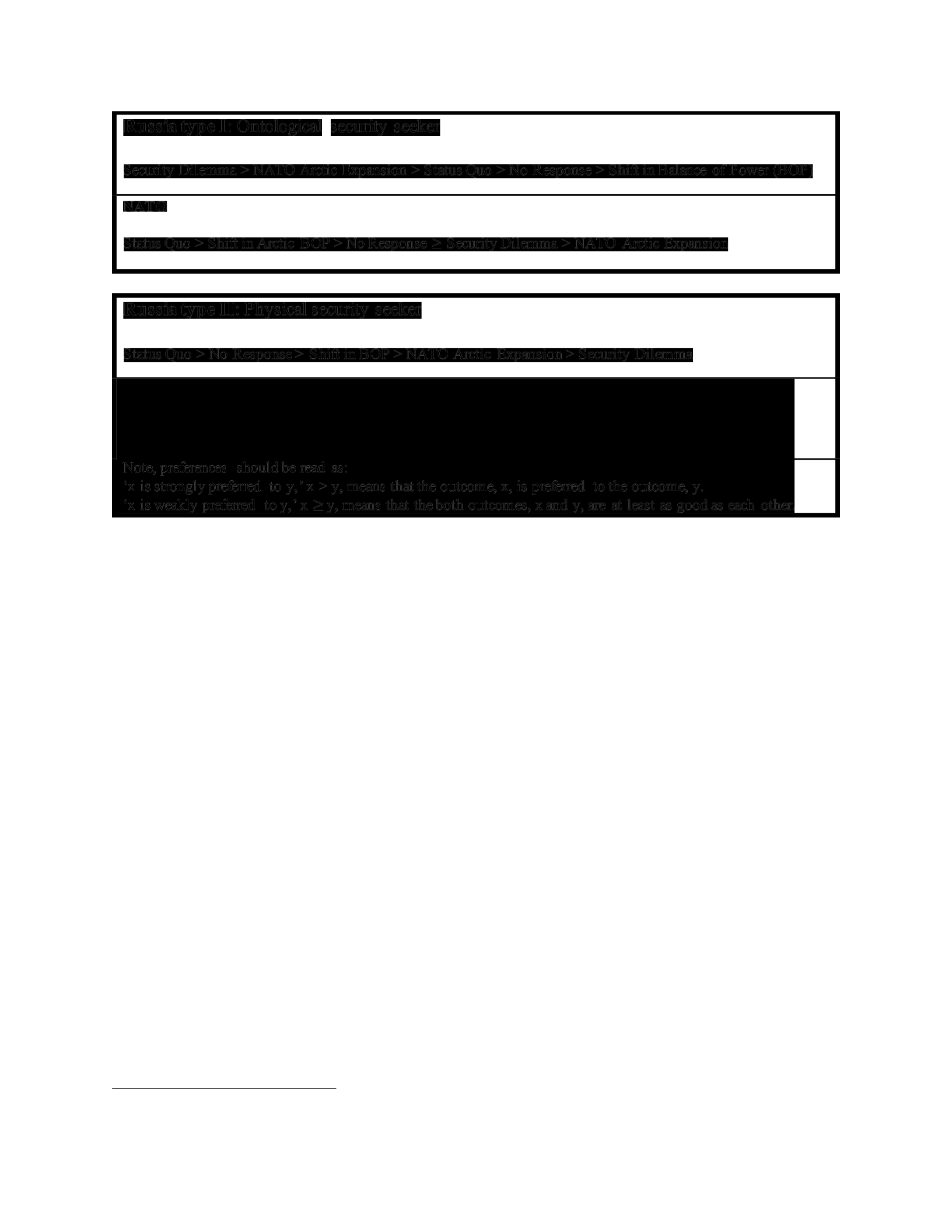
Table 6. Preference orders of Russia types I and II and NATO.
In games of incomplete information, at least one player is uninformed about the type of
the other player. For example, in the game in figure 9, NATO is uninformed about the type of
Russia it faces. The signaling game is called that because of the signal a player can send another
by its actions. If the second player does not know the type of the first player, the second player
can learn the other player's type by observing the first player's decision-making. Separating
equilibria are
equilibria in which each type of player 1 chooses a different action, thus revealing his type in equilibrium
to player 2. Player 2’s beliefs are thus well defined by Bayes’s rule in all the information sets that are
reached with positive probability. If there are more actions than types for player 1, then player 2 must have
beliefs in the information sets that are not reached (the actions that no type of player 1 chooses), which in
turn must support the strategy of player 2. Player 2’s strategy supports the strategy of player 1.257
256. Steven Tadelis, Game Theory, an Introduction. Princeton: Princeton University Press, 2013, p. 319.

If Russia is a type I, the ontological security-seeking actor w, then Russia prefers to
achieve great power status. In doing so, the outcome is a security dilemma. The origin of the
security dilemma is not from NATO’s fear and uncertainty but from NATO’s endogenous urge
to respond. NATO’s response, which gradually occurs over time, eventually results in a spiraling
militarization in the Arctic.
Russia’s following preferred outcome is the result of Russia militarizing the Arctic and
NATO responding by denying Russian hegemony in the Arctic. Russia would then accept
NATO’s response and accept that NATO continues to outspend Russia in military Arctic
capabilities.
On the other hand, if Russia militarized the Arctic in pursuit of ontological security and
NATO were to accept that and not respond, then Russia’s ontological security would not be met.
If NATO were to not respond to Russia’s efforts, it could be because NATO was simply
dismissing Russia as a much weaker, non-threatening regional power. This outcome is Russia’s
second to the least preferred outcome.
Ontological-seeking Russia’s least preferred outcome is that it does not increase its Arctic
defense and operational capability, but instead, NATO does. In this case, the balance of power
may shift in favor of NATO. Because Russia seeks great power status, given the conditions in
which it becomes relatively weaker than NATO in the Arctic, it would constitute a significant
discontinuity in its identity. Reducing Russia’s position as an Arctic power while NATO
increases its influence in the Arctic would undoubtedly constitute an unacceptable Russian
ontological security crisis.
Examining NATO’s preferences, we note that it prefers the status quo above all others.
NATO’s next preference, all else being equal, is that the Arctic balance of power shifts in favor

of NATO. Both preferences over consequences would result from Russia’s decision not to
militarize the Arctic. Any option in which Russia would not militarize the Arctic is favorable to
NATO.
When Russia chooses to militarize the Arctic in this game, NATO’s least preferred
outcome is to continue spending on increasing its Arctic capabilities to counter Russia. This is
because militarizing the Arctic is not a high priority for NATO. However, the Kremlin believes
that NATO will continue to expand its Arctic military operational capabilities, and because
Russia is unlikely to outspend NATO, Russia bows out of the competition. This outcome leaves
NATO with massive spending that its member states are likely not to prefer. As a result, NATO
is left with a needlessly outsized ability to operate in the Arctic. This outcome is unlike the shift
in the Arctic balance of power, where the buildup is limited and provides some deterrent
capabilities and presence in the region.
The first step is determining whether the two types of Russia would choose the same or
different strategies. This means we must first determine if there is a separating equilibrium game
in figure 9. If there is a separating equilibrium, NATO may be able to determine the type of
Russia it faces. In a signaling game, the informed player moves first. Russia knows its type and
moves first and signals to NATO its type. At this game's start, NATO is unaware of Russia’s
type, and the chance move by nature means there is a 50% chance that Russia is either of the two
types. The 50% chance represents NATO’s uncertainty over the type of Russia it faces, but
Russia knows its type. The game in figure 9 is broken into sections. By first looking at the
ontological security seeking, type I Russia’s choice to militarize the Arctic, as shown in Figure
10.
Nature
Figure 10. Separating equilibrium – Russia type I’s decision to militarize the Arctic.
To test the separating equilibrium, we will start with Russia type I with its decision to
militarize the Arctic. The next step will be to evaluate Russia type II’s decision not to militarize
the Arctic. Using figure 10, we can examine the equilibrium path for Russia type 1’s decision to
militarize the Arctic and examine NATO’s response. The previous analysis identifies a Nash
equilibrium at the outcome of the security dilemma. The strategies for NATO and Russia type I
are represented in the normal form matrix of table 7.
In the normal form matrix, the payoff structure reveals three Nash equilibria, noted by the
underline of each payoff for Russia I and NATO. However, only one Nash equilibrium exists on
the Russia type I branch in the extensive form game. The Nash equilibrium is the strategy
(M,D;defy); Russia type I chooses to militarize the Arctic, M, and NATO decides to defy Russia
I, defy, and then Russia I chooses to defend, D.
Defend
Russia I
Security
Dilemma,
CGP
(5,1)
defy
NATO
Accept
Militarize
Arctic
p
Russia I
accept1
No
Response,
CMP
(-1,1)
NATO
Arctic
expansion,
CMP
(2,0)

NATO
defy
accept1
M,D
Russia I
(5,1)
(-1,1)
M,A
(2,0)
(-1,1)
Table 7. Normal form for Russia type I (militarization of the Arctic).
The equilibrium path leads to the Security Dilemma outcome, in which Russia is
recognized as a great power, CGP, with a payoff of 5 for Russia I and 1 for NATO. Something
interesting to note here is that (M,D;defy) and (M,D; accept1) are both outcomes along two
different equilibrium paths. The weakly dominant strategy is (M,D;defy), which is a Nash
equilibrium. The reason is that NATO prefers to accept Russia’s militarization of the Arctic as
much as it does to defy it. The game should be considered to take place over time in reality. As it
took place over time, NATO, particularly the U.S., gradually changed from accepting Russia’s
militarization of the Arctic to responding to it. The slow response is captured in the game’s
NATO choice to defy Russia’s militarization of the Arctic. The gradual response is not a true
security dilemma. Still, if we take a snapshot in the present, the build-up of Arctic forces and
operational capabilities for Russia and NATO forces could arguably be considered a security
dilemma. Therefore, the equilibrium presently is reflected by (M,D;defy), whereby NATO defies
Russia instead of accepting Russia’s militarization.
Russia II
Figure 11. Separating equilibrium – Russia type II’s decision not to militarize the Arctic.
Figure 11 reveals Russia’s type II strategy is not militarizing the Arctic. The best
response for NATO is to accept that Russia has not militarized the Arctic. The result is that the
status quo holds. Russia’s type II and NATO’s strategy is (NM; accept2). The beliefs of NATO
then must be with 100% certainty about the type of Russia they are dealing with, given the
separation equilibrium outcomes. NATO must believe that when Russia decided to militarize the
Arctic, it was dealing with an ontological security-seeking Russia. Therefore, the probability that
NATO believes Russia is type I must be p=1.
Similarly, NATO’s belief that if Russia did not militarize the Arctic must be q=0. For
instance, in figure 9, the beliefs of NATO at the information sets for Russia type I were p=1 if
Russia type I militarized the Arctic, and q=1if Russia type I did not militarize the Arctic.
Because p=1 and q=0, NATO knows that Russia type I would not prefer a strategy of no Arctic
militarization, and Russia type II would not prefer a strategy of militarizing the Arctic.
Nature
Shift in
Arctic
BOP,
CRP
(2,2)
demand
1-q
No Arctic
Militarization
Status
Quo,
CMP
(5,5)
NATO
accept2
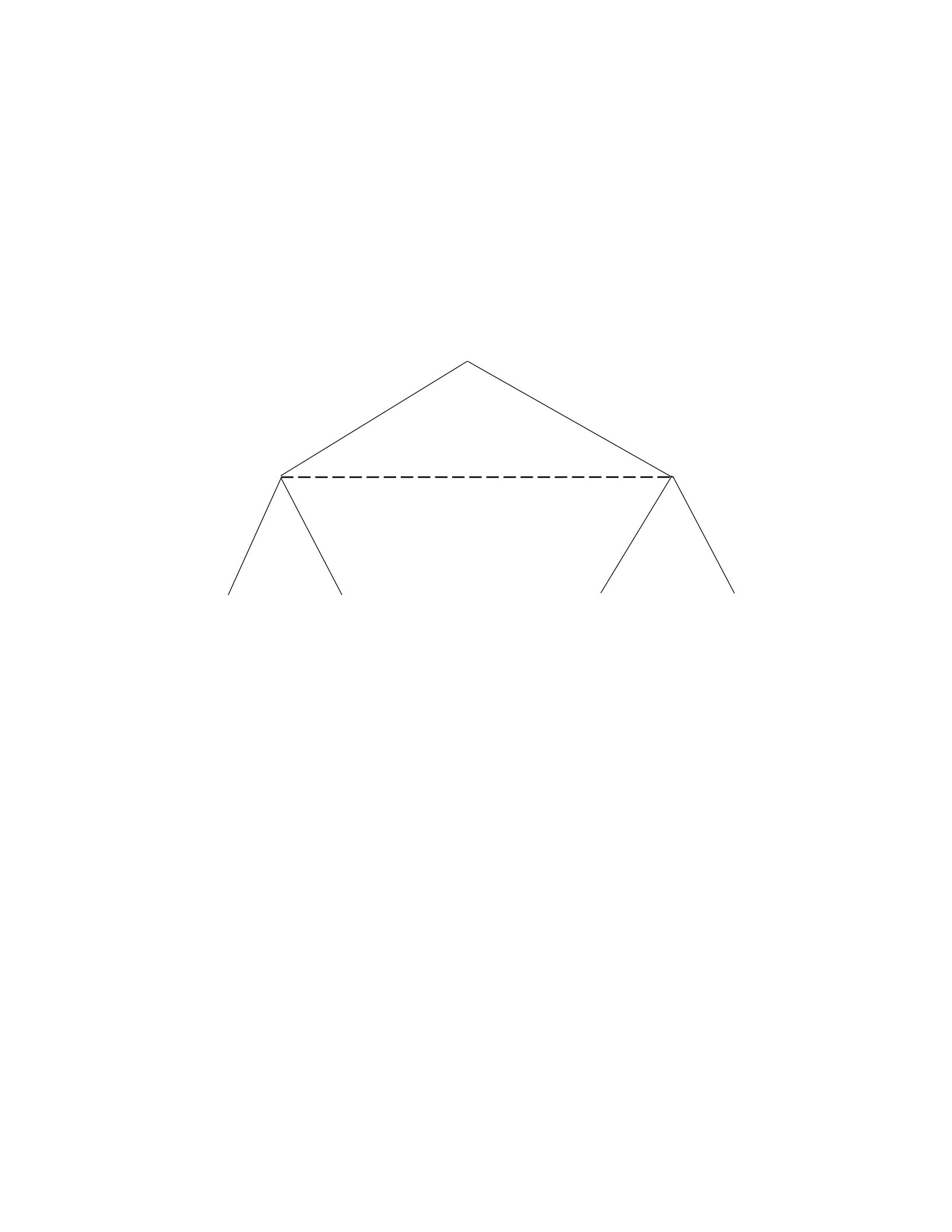
Next, we need to check whether the model has any pooling equilibria. In this case, both
types are taking the same action. Therefore, type I and II are not militarizing the Arctic, as shown
in figure 12.
Nature
Status
Quo,
CMP
(0,4)
Shift in
Arctic
BOP,
CRP
(-2,3)
Shift in
Arctic
BOP,
CRP
(2,2)
Status
Quo,
CMP
(5,5)
Figure 12. Pooling equilibrium – Russia’s decision to not militarize the Arctic.
For the pooling equilibrium, we will start again with nature and the 50% chance that
Russia is either a type I or type II. First, we will look at NATO’s utilities for demand and accept2
if Russia decides not to militarize the Arctic. Recalling the expected utility function,
EUNATO(demand) = .5(3) + .5(2) = 2.5
EUNATO(accept2) = .5(4) + .5(5) = 4.5.
No Arctic
Militarization
Russia I
1-q
NATO
No Arctic
Militarization
Russia II
q
accept2
demand
demand
accept2

The simple calculation shows that NATO has a higher utility for not leading a
militarizing effort and accepting the status quo. The implication is that NATO was not fearful
nor uncertain about Russia’s actions in the Arctic. The model is highly abstract and does not
accurately account for the reality that Russia improved its nuclear weapons arsenal and increased
its ability to monitor the Northern Sea Route under the No Arctic Militarization branch.
However, it is implied in the model that NATO would not have seen this type of action as
threatening, nor would NATO consider it to be a militarization of the Arctic. The result is that
NATO would accept the status quo regardless of the type. That means Russia type I would have
to accept the status quo. The status quo does not allow Russia to achieve its great power status.
Therefore, Russia type I would always militarize the Arctic.
Next, we need to check if a pooling equilibrium exists for Russia’s strategy of
militarizing the Arctic. Figure 13 illustrates Russia's type I and type II militarizing of the Arctic
and NATO’s best response.
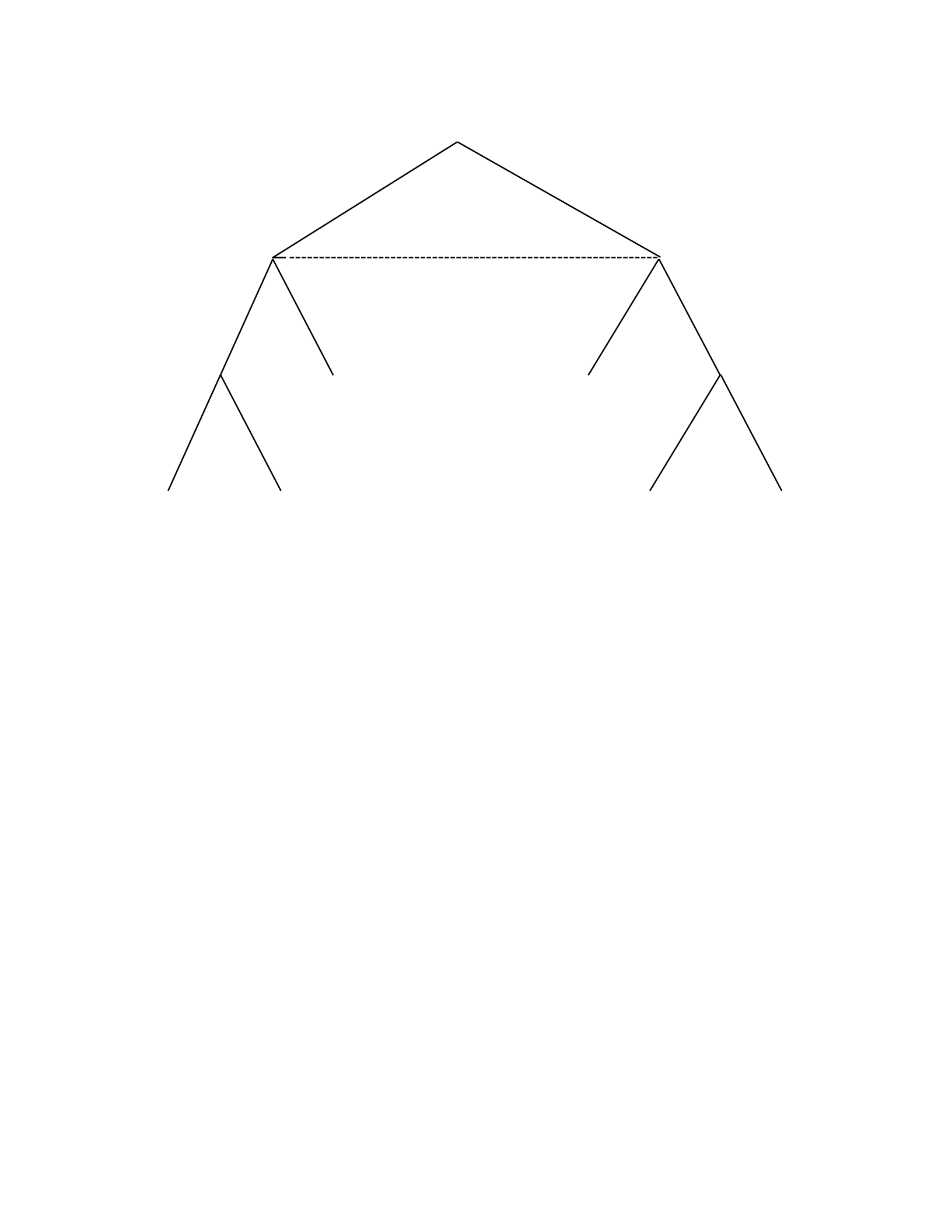
Militarize
Arctic
Russia I
p
Nature
NATO
Militarize
Arctic
Russia II
1-p
defy accept1 accept1 defy
Russia I
Defend Accept
No
Response,
CMP
(-1,1)
No
Response,
CRP
(3,1)
Accept
Russia II
Defend
Security
Dilemma,
CGP
(5,1)
NATO Arctic
expansion,
CMP
(2,0)
NATO Arctic
expansion,
CMP
(-1,0)
Security
Dilemma,
CGP
(-2,-2)
Figure 13. Pooling equilibrium – Russia’s decision to militarize the Arctic.
When Russia decides to militarize the Arctic, NATO is not sure how to respond initially.
That is why NATO’s decision to accept is for an outcome of No Response, CMP is just as likely
as its decision to defy for Russia type I. Russia type I will seek great power status by continuing
to militarize the Arctic. The signaling equilibrium demonstrated that NATO would recognize this
and eventually expand its military capabilities to prevent Russia from operating unconstrained in
the Arctic. Therefore, if NATO had chosen at first to accept during the early stages of Russia’s
militarization, it would eventually defy because Russia would continue to elicit a response from
NATO. Russia type I would not accept the No Response, CMP outcome. Russia type II would

likely accept the No Response CRP outcome because it prioritizes physical security over
ontological security. So there would be no pooling equilibrium for militarizing the Arctic.
Figure 13 illuminates some interesting insights. First, the equilibrium path for both types
of Russia leads to the status quo. As a reminder, this is the status quo ante because we know
Russia has militarized the Arctic, thus altering the status quo. This outcome is somewhat trivial,
but if we look at the differences in payoffs, we can see that Russia I is not very interested in the
status quo. However, it prefers the status quo over NATO becoming stronger in the Arctic.
However, Russia type II is satisfied with the status quo. For Russia I, the Status Quo does
nothing to help it achieve its ontological security. The status quo reinforces Russia’s status as a
major power, but not a great power. Russia type II is less concerned with its ontological security.
Therefore Russia type II prefers the status quo because it means that Russia will continue to
dominate the Arctic, and its physical security, at least in the Arctic, remains secure.
If we take the game as a whole now, we can determine the posterior probabilities and,
therefore, the beliefs of NATO. Referring to figure 9, we could assume the p = 0.5, so there is a
50% chance that Russia is type I and a 50% chance that Russia is type II. If Russia is type I, it
would always militarize the Arctic because, as we have determined, the equilibrium path for
militarizing the Arctic for Russia type I ends with the security dilemma, a payoff of 5, and
achieving the status of a great power (or at least coming closer). On the other hand, if Russia
type I were not to militarize the Arctic, the equilibrium path would end with the status quo, a
payoff of 0, and the status of a major power. Therefore, Russia type I should always militarize
the Arctic to achieve its ontological security.
If Russia is type II, then it should not militarize the Arctic beyond what is necessary to
maintain some ability to secure its infrastructure, natural resources, and its strategic assets on the

Kola peninsula. In other words, Russia type II is satisfied with the status quo. If Russia type II
did militarize the Arctic, it would prefer that NATO did not respond. If NATO does not respond,
Russia’s position will be more secure. However, militarizing the Arctic beyond the status quo
comes at a cost. The cost could be politically, domestically, and internationally. If Russia is
trying to achieve physical security, spending unnecessarily on increasing Arctic defenses at the
expense of spending on the military and defenses elsewhere could cost Putin.
As previously discussed, Bayes’s theorem allows us to take our prior subjective
probabilities of some outcome and then update that subjective probability to a conditional
probability given the occurrence of some event. Given that Russia has militarized the Arctic,
with the prior probability of p=0.5, we can assume the posterior probability is p=1.0, that Russia
is type I and militarized the Arctic due to its pursuit of ontological security. Recalling Bayes’s
rule,
p(A|B) = p(A)p(B|A)
p(𝐵)
We can calculate if NATO’s beliefs are consistent. Substituting the game parameters into the
equation, we get,
p(Russia I |Militarize the Arctic) = p(Russia I)p(Militarize the Arctic|Russia I)
p(Militarize the Arctic)
= p(Russia I)p(Militarize the Arctic|Russia I)
p(Russia I)p(Militarize the Arctic|Russia I) + p(Russia II)p(Militarize the Arctic|Russia II)
= (1 x 0.5) = 1
(1 x 0.5) + (0 x 0.5)
The probability that Russia is an ontological security-seeker, given that Russia militarized the
Arctic beyond the status quo, is 1, demonstrating NATO’s belief that Russia is type I is
consistent.

However, as previously discussed, the game theory model sheds insights into the
motivations and drivers behind Russia’s decision to militarize the Arctic. The game theory model
helps understand nuanced behavior that, through specific lenses, may seem irrational. When, in
fact, the behavior is rational if the correct preferences over outcomes are known. Social science
is a challenging field to study. No one factor is a causal mechanism for an actor, be they an
individual or a state, with agency. Neorealism offers a parsimonious theory about why states
behave the way they do. Shared experiences and culture shape values and ideas, which in turn
shape interests. Constructivism tells us how this occurs within the same structure that neorealism
describes shapes state behavior. To the constructivist, the structure is “what you make of it.” The
idea is that an actor motivated to maintain a sense of self may act in ways counter to the beliefs
of neorealism. The intersubjective nature of ontological security means that identity is not simply
an endogenous phenomenon but relies on exogenous factors that an actor may have little control
over. To say that Russia has militarized the Arctic, invaded Georgia and Ukraine, and remains
belligerent toward the West and the West toward Russia is a matter of ontological security, as the
game theory model did, is inaccurate. As discussed above, the probability that Russia militarized
the Arctic and did the other things because it seeks ontological security over neorealism is either
1, 0.5, or 0. Recall,
P(N) + P(C) = 1
which means that the probabilities from each can be a combination from and including 0 to 1.
We learned from the game theory model that it is likely that if Russia seeks great power
status, then, as ontological security tells us, militarizing the Arctic beyond the status quo is a
rational act. Now, we need to examine what has motivated the U.S. and NATO to choose their

actions in the game or real life. The following section examines the hesitant and gradual response
by the U.S. and NATO to Russia’s seemingly excessive militarization of the Arctic.

CHAPTER V
REPUTATION AND THE COSTS OF NOT INTERVENING
The U.S.’s response to Russia’s increased Arctic militarization was not immediate and, as
discussed, was guided by a clear sense of what U.S. interests were in the Arctic. The U.S.
seemed unsure how to respond to the growing securitization of the Arctic, initiated in large part
by Russia. The well-known security dilemma is not an accurate model for understanding the
cause of the U.S. response to Russia in the Arctic. Russia’s material concerns and its pursuit of
ontological security needs can largely explain Russia’s militarization of the Arctic. However, the
cause of the U.S. response is different.
The U.S. has a vital national interest in the Arctic, mainly in strategic nuclear strike
capability and North American early warning defenses. However, U.S. interests within the
Russian Arctic’s sovereign territory and maritime domains are low. The U.S. and NATO
preferred the status quo in the early 2000s. The status quo was that Russia was interested in
developing regional cooperation and investment. Russia was interested in developing the Arctic
region to exploit natural resources and sought international partners to invest in oil and gas
exploitation. In 2011, during the Obama administration’s attempt to improve relations with
Russia, Exxon Mobil Corp, and Russian-controlled Public Joint Stock Company Rosneft Oil
Company entered an agreement to extract Arctic oil and gas. The venture edged out Chevron
from a faltering deal with Rosneft, which had collapsed. Western oil companies were competing
to partner with Russian oil and gas companies. Former Secretary of State Rex Tillerson was
Exxon’s Chief Executive Officer who led the multi-billion dollar deal. Then Russian Prime

Minister, Vladimir Putin, attended the signing ceremony between Exxon and Rosneft in Sochi,
where Rex Tillerson and Russian Deputy Prime Minister Igor Sechin penned the deal. 258
Western energy companies competed to partner with Russia to exploit Arctic oil and gas
in the Russian polar region. The U.S. had no interest in militarizing the region, potentially
increasing tensions and reducing the likelihood of Western companies partnering with Russia.
Furthermore, the more Russia partnered with Western companies, the less it needed to partner
with China. Reducing Russia’s need to partner with China was in the interest of the U.S.
Therefore, preserving the status quo and keeping the Arctic a zone of cooperation marked by the
efforts of the Arctic Council, the Coast Guard Forum, and business ventures served U.S.
interests. The U.S. had no claims to the Russian Arctic, nor did it pursue a foreign policy for
greater regional access.
The extent to which Russia has militarized the Arctic is indeed a concern to the U.S.
Nevertheless unless the U.S. was threatened by Russia’s military buildup in the high north, its
response was not in line with U.S. interests, nor was it initially a response to feeling less secure.
Instead, it was a likely response to a need to maintain credibility as the U.S. status as the unipole
waned in the decade following the events of September 11th, 2001. Similar to Russia, the U.S. is
concerned with its identity and reputation.
The same question asked at the beginning of this research about Russia can be asked of
the U.S. and NATO. Why would the U.S. and NATO increase their Arctic military capabilities
absent a severe threat to their interests? To further clarify this question, we can ask what U.S.
interests Russia threatens by strengthening the defenses along the Russian Northern Sea Route
257. Darya Korsunskaya and Braden Reddall, "Exxon, Rosneft Tie Up in Russian Arctic, U.S." Reuters,
August 30, 2011.

and on Russia’s sovereign territory in the Arctic. Previously, it was shown that Russia had
significantly increased its militarization of the Arctic. In addition, Russia has increased its ability
to tactically operate conventional forces from Russia’s territory and within the northern expanses
of the Russian Arctic.
Additionally, the Kremlin spent tremendous resources improving Arctic early warning
installations. These early warning systems will detect and monitor activities along the NSR and
any ballistic missiles inbound to Russia. Russia’s military has built modern military garrisons to
house hundreds of Russian soldiers in remote Arctic areas. Russia’s militarization of its Arctic
territory along the NSR alarmed the other Arctic states. However, the other Arctic states seemed
uncertain about how and if they should respond.
In a real sense, Russia was not threatened by the other Arctic states. Russia had, and
maintains, a distinct advantage in operating conventional military forces in the region, especially
along its northern territories. Russia’s advantages mean that its interests in its Arctic territory are
defended if threatened. The U.S. and NATO recognize Russia’s Arctic sovereign territories.
They do not resist Russia’s liberal interpretation of the UNCLOS article 234, the ‘ice clause,’ by
which Russia imposes conditions on access to the NSR. As previously discussed, the U.S. posed
no immediate threat to Russian interests in the Arctic. In other words, the status quo was not
challenged by the West. The U.S. does not have an interest in challenging the status quo.
However, Russia’s decision to militarize the Arctic has paradoxically caused the U.S. to respond.
The U.S. Department of Defense (DOD) has turned its attention to Arctic domain awareness and
security. Nonetheless, The U.S. response has been slow, uncoordinated, and seemingly reluctant.
In 2016 the U.S. DOD issued its first strategy aimed explicitly at Arctic security. In 2019,
the U.S. updated its DOD Arctic strategy with a renewed focus on great power competition. The

2019 DOD Arctic strategy was developed as a result of the 2018 U.S. National Defense Strategy,
which provided broad guidance for framing the U.S. DOD’s Arctic Strategy.259 Two of the three
objectives of the 2019 U.S. DOD Arctic Strategy are the defense of the homeland and ensuring
common domains remain free and open. These two objectives are in line with the previous Arctic
Strategy. The third objective projects ambiguous guidance for the DOD to be prepared to
maintain a favorable balance of power. The Arctic Strategy mentions that competitors of the U.S.
may undertake malign activities to pursue their goals. Therefore the U.S. must be ready to
protect U.S. interests.260 The broad concept of protecting U.S. interests is clear, but what is not
clear is which interests are threatened by the Russian militarization of the Arctic. The DOD
Arctic strategy stresses safeguarding access to the North American Arctic region, which has been
part of the U.S. DOD strategy since the early years of the Cold War. However, it also outlines
risks to U.S. interests in the Arctic. Other than risks to the homeland, the strategy states,
Russia regulates maritime operations in the NSR, contrary to international law, and has reportedly
threatened to use force against vessels that fail to abide by Russian regulations. Russia has generally
followed international law and procedure in establishing the limits of its extended continental shelf. Russia
could choose to unilaterally establish those limits if the procedures prove unfavorable and could utilize its
military capabilities in an effort to deny access to disputed Arctic waters or resources…The Arctic remains
vulnerable to “strategic spillover” from tensions, competition, or conflict arising in these other regions. 261
Undeniably, potential threats to U.S. interests and western led global order exists. However,
Russia’s militarization of the Arctic in its territories has not created an acute response by the U.S.
Instead, the U.S. military services have published discordant individual Arctic strategies
resulting from the 2019 U.S. DOD strategy.
258. Office of the Undersecretary of Defense for Policy, Report to Congress Department of Defense Arctic
Strategy. United States Department of Defense, 2019, p. 6.
259. Office of the Undersecretary of Defense for Policy, Report to Congress Department of Defense Arctic
Strategy. United States Department of Defense, 2019, p. 7.
260. Office of the Undersecretary of Defense for Policy, Report to Congress Department of Defense Arctic
Strategy. United States Department of Defense, 2019, p. 6.

The U.S. is responding to Russia’s militarization of the Arctic, but the U.S. response is
likely a result of declining relations with Russia over the last decade. As great power competition
with Russia has moved to clear rising tensions, the U.S. and NATO feel compelled to deter
Russian aggression toward NATO and actions that could disrupt the western order that threatens
U.S. interests. The threat of Russia’s aggression to the status quo is causing the U.S. to increase
its deterrence, but Russia’s Arctic military buildup has not resulted in a security dilemma.
Russia’s military buildup has grabbed the attention of the U.S. and is forcing it to
determine an appropriate response. Before doing so, the U.S. has had to decide its interests in the
Russian Arctic and which of those interests are threatened by Russia’s actions. The recent
separate U.S. military service Arctic strategies indicate a disjointed uncertainty over how and to
what extent the U.S. should respond to Russia’s Arctic military buildup. Nevertheless, the U.S. is
a great power, and as a great power, the U.S. is compelled to respond to Russia. If the U.S. were
not to respond, then Russia could claim that it is the dominant power of the Arctic and a great
power because the U.S. was not capable of responding. Therefore, the U.S. may suffer a cost
associated with not responding to Russia, even though it remains uncertain about its interests and
threats to its interests in the Russian high north.
The Korean War
The U.S. may perceive its reputation as a great power and suffer from not responding to
Russia. The cost to the U.S. may be to its credibility and how other actors perceive the strength
and resolve of the U.S. However, the U.S.’s perception of itself and the potential cost it may
suffer, not the actual cost or perception by others, may cause its reaction to Russia’s Arctic
militarization. The U.S. has made significant changes to its foreign policy in the past due to its

perception of how others perceive its credibility. For example, U.S. President Harry S. Truman
believed he needed to demonstrate resolve in Korea to deter Soviet expansion in Europe. Truman
chose to fight a limited war against communist North Korea not to defend a vital American
interest but to demonstrate to Stalin and U.S. allies and partners that the U.S. sought to prevent
communist expansion.
In light of the United Nations General Assembly’s official recognition of the Republic
of Korea in 1948, the Soviet-American agreement in both Cairo in 1943, and Potsdam in 1945,
to keep Korea a single, unified country collapsed by 1948 because of Soviet support of Kim-il
Sung’s communist regime in the north. Despite the divided Korean peninsula, the Truman
administration pulled the last American combat soldiers out of Korea in 1949. Stalin removed
Soviet troops in 1947.262 Washington and Moscow’s interest in Korea seemed to be waning
significantly by the end of the 1940s. In 1949, General MacArthur gave a newspaper interview in
which he defined America’s interest in the Pacific, and the area of American interest in the
Pacific did not include Korea.263 Washington’s perceived lack of interest in Korea indicated to
both Mao and Stalin that the U.S. would not intervene if Kim proceeded with his plans to unify
the peninsula.
When Kim presented his plan to unify the Korean peninsula to Stalin and Mao, they
both agreed to the idea because they thought the probability of a U.S. military intervention was
sufficiently low. In Mao’s calculus, he judged that because the U.S. did not intervene in China’s
civil war or the liberation of Taiwan and had pulled out of Korea, it was unlikely that the U.S.
261. Clinton Anderson and Leslie L. Biffle, "The Truth About Korea." Harry S. Truman Library National
Archives. 1950. https://www.trumanlibrary.gov/library/research-files/truth-about-korea (accessed June 30, 2022).
262. Henry Kissinger, Diplomacy. New York: Simon and Schuster, 1994, p. 475.

would intervene in Kim’s war plans. Stalin likewise rationalized that the U.S. had little interest in
Korea and would not intervene, or if it did, the U.S. would have waited too long to stop Kim.
Neither Stalin nor Mao, however, believed that the U.S. was irresolute.264 It was a perception of
U.S. interests, not U.S. resolve, which led Stalin and Mao to conclude that the U.S. would not
intervene.
However, the language in a 1950 memorandum between Truman and White House
Council, Clark M. Clifford, displayed resounding support for military intervention in Korea. For
Truman, stopping Kim was a matter of defending the free world from oppressive communism.
Clark advised Truman to avoid the public message that the Korean conflict was simply a conflict
between two countries. Instead, Clark advised Truman to ensure that the message to the world
and Stalin was that Korea was a conflict between “one aggressor nation and the rest of the peace-
loving world.”265 The correspondence between Clark and Truman only resonated with the
administration’s motivation to military intervene based on principle and to intervene as soon as it
established a U.N. Security Council resolution. Korea was of little national interest, but stopping
the spread of communism had become a top national strategic objective.
Truman felt that a successful communist invasion of the Republic of Korea would shake
the confidence of the free world in America’s ability to defend its freedoms. He feared that the
fabric that bound Western Europe together and all pro-Western states would gradually
disintegrate. If the U.S. could not hold together U.S. alliances, Truman feared that Europe and
Asia would fall to communist totalitarian regimes. He knew the free world had to remain
263. Jonathan Mercer, "Emotion and Strategy in the Korean War." International Organization 67, no. 2
(April 2013), p. 232.
264. Clark M. Clifford, "Memorandum from Clark to Truman," The Truman Library. June 29, 1950.
http://www.trumanlibrary.org/whistlestop/study_collections/korea/large/documents/pdfs/ki-17-6.pdf#zoom=100
(accessed February 2015).

confidently dependent on American leadership to prevent communist incursions. To take
Truman’s points further, he felt that if the U.S. faltered in its leadership, the free world may
develop the impression that the U.S. could not be depended on to protect them. If this were the
case, the poor and destabilized countries would likely turn to the Soviet Union on their terms
instead of waiting to be occupied. Therefore, Truman intervened in Korea to demonstrate resolve
to benefit the free world and deter Moscow from further expansion.
By acting on principle over interest, Truman had departed from Roosevelt’s ways of
acting only in terms of national interest. Truman had also acted contradictory to George
Kennan’s advice on containing the Soviet Union. Kennan had advocated patience because, in
time, he believed the Soviet Union would be unable to sustain its communist practices, and
eventually, the communist regime would collapse. Kennan also advocated that not every Soviet
involvement worldwide constituted a clash of vital interests. The U.S. had to husband resources
and counter Soviet incursions only when they threatened actual vital interests. If Truman felt
compelled to defend all conflicts of principle with the Soviet Union, he needed to deter Stalin in
the first place by demonstrating American resoluteness. However, in the case of the Korean War,
Truman’s resoluteness was not in question by the Soviet regime.
Nonetheless, Truman believed the U.S. would suffer a cost for not intervening. Truman
believed the American credibility and resoluteness would be questioned by its allies, partners,
and the Soviet Union. Therefore, Truman reasoned that if the U.S. did not intervene in Korea, the
Soviets might believe that the security of western Europe was not as strong as they thought.

The Mayaguez Incident
Another example of the U.S. acting with regard to its credibility is the Mayaguez
incident. The Mayaguez Incident is an excellent yet little-known case study for reputation,
resolve, and deterrence. The Incident is also a perfect case study for organizational behavior, one
in which Graham Allison’s models provide a framework for analysis. In this case, Barry
Nalebuff’s examination of the value of reputation as a causal factor for international intervention
offers insights into the U.S. desire to intervene more in the European Arctic security
environment.
The Mayaguez was an American-flagged, forty-year-old freighter that sailed regular
cargo runs between Hong Kong and Singapore. In early May 1975, a Cambodian gunboat came
alongside the Mayaguez, and the Cambodians seized the ship. The Captain transmitted a mayday
message as the Cambodian gunboat crew boarded the Mayaguez. Two hours after the Pentagon’s
National Military Command Center received the mayday message, President Gerald Ford was
notified at his regular 7 a.m. briefing. In the context of the end of the Vietnam War and the wake
of Nixon’s Watergate scandal, President Ford, National Security Adviser/Secretary of State
Henry Kissinger, and Secretary of Defense James Schlesinger regarded the Mayaguez incident as
an opportunity for Ford to “demonstrate decisiveness, resoluteness, and fitness to be
President…to demonstrate the military establishment’s competence…and a last chance for
regaining lost credibility.”266 Motivated by the potential to restore credibility, the administration
authorized and directed an ad hoc mission to rescue the crew.
The crew of the Mayaguez was rescued in a few days without harm. The mission was
hailed as a success. However, the ad hoc nature of the mission and lack of clear command and
265. Richard E. Neustadt and Ernest R. May, Thinking in time: The uses of History for Decision Makers.
New York: The Free Press, 1986, p. 59-60.

control resulted in 42 U.S. service members’ deaths. U.S. Marines onboard U.S. Air Force
helicopters were inserted onto Koh Tang Island to rescue and extract the crew of the Mayaguez.
Koh Tang Island is a small island off the coast of Cambodia, and some reports stated that the
Mayaguez appeared to be heading in the island’s direction. The crew, however, was taken to
mainland Cambodia and released as the Marines and Air Force fought their way onto the island.
U.S. forces met heavy resistance and lost so many helicopters that the Marines and downed Air
Force crew had to wait for reinforcements to extract from Koh Tang. Three U.S. Marines were
left behind and captured and executed by Cambodian forces in the milieu. The military operation
was a debacle at best and operational failure at worst. However, after the Cambodians released
the crew, Ford received praise for his actions. Even the New York Times published approval for
the administration. Ford’s approval ratings went from 39 to 51 percent. However, Congressional
inquiries uncovered the truth about the mission and that 42 lives were ultimately lost to save the
40 crewmembers. Finally, “Neither Ford nor Schlesinger and the military, nor Kissinger
harvested from the Mayaguez incident much of what they hoped for.”267 The mission could have
been better planned, but the Ford administration’s decision to intervene was less about tactical
success and more about signaling resolve and reputation as part of deterrence.
Given both the domestic and international context in May 1975, it seems little could be
done to restore the reputation of the U.S. with one rescue mission. If rescuing the Mayaguez
crew would restore America’s reputation, then doing so is a seemingly small price to pay, the
loss of American lives notwithstanding. Consider the counterfactual event of the U.S. not
intervening in the Mayaguez incident. Barry Nalefbuff points out that improving one’s reputation
is a relative matter. He writes, “Thus we care about the relative effect of intervening on
266. Neustadt and May, Thinking in time: The uses of History for Decision Makers, p. 64.

reputation as compared with not intervening. A country that fails to act could suffer a massive
loss of reputation.”268 Whether a state should intervene or not intervene is a complex calculation.
Neither should be considered in isolation because both answers depend on the other.
Nalebuff offers a model to explain the cost of intervention and applies that model to the
Mayaguez incident. Below is a review of that model, which will help understand the U.S.
decision to react to Russia’s military buildup in the Arctic. It should be evident that the U.S.
intervention in the Mayaguez incident, other crises such as the Cuban missile crisis, or Truman’s
decision to intervene in Korea all occurred under considerably different conditions. Likewise, the
U.S. reaction to Russia’s Arctic militarization has happened under different conditions.
Overlying these conditions are the same motivations and cost-benefit analysis of reputation,
resolve, and deterrence. The U.S. may not have a direct conflict of interest with Russia
expanding its ability to operate militarily in and around an otherwise naturally protected region
of Russian sovereign space. However, the U.S. may suffer a cost by not reacting with its ability
to develop strategies and operational concepts for the Arctic region. Even though the reaction by
the U.S. is not a direct intervention, as with Korea or the Mayaguez, the calculation is based on
similar variables. Nalebuff offers a model to abstract the cost-benefit analysis of intervention so
we can use it to examine the U.S.’s decision to develop its service-level Arctic strategies, no
matter how disparate the strategies appear.
The Cost-Benefit Analysis of Responding
First, we look at a simple cost versus benefit model. If x represents the variable for the
observable payoffs for intervening, then c represents the unobservable intangible payoffs.
267. Barry Nalebuff, "Rational Deterrence in an Imperfect World." World Politics 43, no. 3 (April 1991), p.
317.

Nalebuff defines variable c as the “psychic and other intangible costs and benefits associated
with intervention.” 269 The payoffs for each x and c are the combined cost-benefit for each type
of payoff. So x is the result of the observable cost-benefit calculation, and c is the unobservable
intangible cost-benefit calculation. If the observable cost-benefit assessment is greater than the
intangible cost-benefit assessment, if x > c, then a state is likely to intervene. The reason that the
U.S. wants to intervene is that it cares what others think about it. The U.S. cares about its
reputation among allies, partners, and adversaries.
The U.S. wants others to believe it is resolute because having a reputation for resolve is a
deterrent to others who may prefer to take any action that threatens U.S. interests. Capabilities
clearly indicate the ability to act, which also has a deterrent effect. However, it is the willingness
to act even though there are costs associated with acting. How does one actor know the
willingness of another actor to act? The perception of resolve must be such that an actor would
decide that the payoff for a given action is not worth the cost involved in pursuing its preferred
action. The outcome of any decision in a strategic interaction among actors relies on the likely
action actors will take in response to the other.
Nevertheless, one actor can only have a belief about a given actor and a probability
associated with that belief. Therefore, an actor may hold a very high value on its reputation for
resolve. For example, actor A may place a high value on the perception of actor B’s belief of the
type of actor A and the probability associated with that type. Often the probabilities can be
updated when certain events occur and how one actor may perceive the actions toward those
events. As Danielle Lupton writes in her book Reputation for Resolve, “Reputation for resolve,
268. Nalebuff, "Rational Deterrence in an Imperfect World." World Politics, p. 320.

therefore, is the belief others hold about an actor’s willingness to stand firm and face costs, based
on that actor’s past behavior.”270
The response by the U.S. and NATO has been gradual and seemingly uncoordinated.
Examining why actors are compelled to intervene allows us to examine the factors that led the
U.S. to develop an unprecedented series of service-level strategies for the Arctic. The strategies
are unprecedented because no other service-level strategies exist for any particular region. The
main reason is that regional strategies are the purview of the combatant commands. For the
Arctic region, both U.S. Northern Command and U.S. European Command are responsible for
U.S. military strategies in the Arctic. However, other combatant commands such as U.S. Space
Command, U.S. Strategic Command, and U.S. Cyber Command have supporting roles like any
other region.
Writing strategies for the Arctic is not a direct intervention, as are the examples of the
Mayaguez incident and the Korean war. However, we can draw parallels from these cases with
the U.S. response to the Arctic. The parallels are the cost to the U.S. reputation as a state capable
of responding to any region in the world, including the Arctic. However, that is not the only part
of the reputation with which the U.S. may be concerned. Since 2008, Russia has significantly
increased its conventional military presence and capability to operate in the Arctic.
Additionally, due to climate change, there has been growing global awareness of the
Arctic, and a broad spectrum of issues are becoming increasingly important in the Arctic. For
example, the changing climate impacts infrastructure and makes energy increasingly accessible.
Traffic has increased, and indigenous people are coping with changing conditions and many
more issues. Therefore, when Russia becomes the dominant global power in the Arctic, the U.S.
269. Danielle L. Lupton, Reputation for Resovle: How Leaders Signal Determination in International
Politics. Ithaca: Cornell University Press, 2020, p. 3.

believes it must respond because by not responding, the U.S. could suffer a loss in reputation.
The Arctic strategies published by the U.S. military services inform the national defense budgets.
Each year, the defense budget is enacted as the National Defense Authorization Act (NDAA).
The Arctic strategies require new capabilities and operational presence in the Arctic. Therefore,
the Arctic strategies published by the services indicate a new, higher level of intervention that the
U.S. did not have previously. However, the strategies do not indicate some type of win over
Russia, but they indicate that the U.S. seeks to avoid potential or perceived loss in reputation. As
Nalebuff points out, “Avoiding the loss is what keeps the cost-benefit calculation positive.”271
In this case, a slightly modified version of Nalebuff’s model can be used to examine
reputation’s role in the U.S. decision to intervene in the Arctic. In this case, intervention is not a
direct intervention but the U.S.’s response to Russia’s increased Arctic defenses. The U.S. is
acting strategically by demonstrating its interest in the Arctic to influence how others perceive its
intervention costs. We know from above that
x is the observable elements of the cost-benefit analysis,
c is the unobservable elements of the cost-benefit analysis, and c(0, 1).
A low c value means that a state has a greater propensity to intervene because the
unobserved costs are low. A high c value is indicative that a state is less likely to
intervene because the unobserved costs are too high.
If x > c, then the U.S. is likely to intervene without concern for its reputation because
it would not need to concern itself with what it thought others might perceive as its
unobservable costs. However, the U.S. is concerned with how others perceive its
unobserved costs.
270. Nalebuff, "Rational Deterrence in an Imperfect World." World Politics, p. 317.

Let cavg be the average value that others think c is for the U.S
Let a be the value that a state, in this case the U.S., places on its reputation,
Then a(1-cavg) is the value of a reputation.
Nalebuff uses cavg = ½ as the status quo. Therefore if a > 0, that is that the U.S. places some
positive value on its reputation, then the U.S. wants others to believe the value of c, the
unobserved elements of the cost-benefits of intervention, to be low. If others believe the
unobservable costs for intervention to be low, that signals that the U.S. has a high inclination to
intervene. Given the slow response by the U.S., the value of x may be low, but it is the value of a
that is high. Because the value of the U.S. reputation, a, is high, the U.S. is compelled to
intervene. However, we do not know when the U.S. would or would not intervene. Nalebuff
addresses this problem by defining the types of actors who would intervene and those who would
not. There is an expectation about whether an actor is likely to intervene or not, given its record
of intervention and the value an actor places on its reputation. The expectation by others to
intervene is ci, and the expectation to not intervene is cn. The ci and cn variables represent the
maximum and minimum expectation costs of intervening or not intervening and can be used to
determine the optimal behavior of a state. Substituting ci and cn for cavg gives us,
a(1-ci), the value of a state’s reputation for intervening and,
a(1-cn), the value of a state’s reputation for not intervening.
Returning to the above statement that a state is likely to intervene when the observable cost-
benefit value is greater than the intangible, unobserved cost-benefit value of not intervening, that
is, if x > c, and we add the value of its reputation, we can determine when a state should
intervene. Nalebuff shows that when a state’s true cost is c for intervening, then its payoff is
x – c + a(1- ci).

Whereas, we can substitute cn for ci in the above equation to show the payoff for not intervening
x – c + a(1- cn).
A state should intervene when its intangible, unobserved cost-benefit value is less than the
combined values of its observed cost-benefit value and the observable cost-benefit.
c < x + a(cn - ci).
Nalebuff defines a c* as the critical cost. The critical cost is the point at which a state would
decide to intervene or not. The critical intervention cost is
c* = x + a(cn – ci).
The above expression shows us that the state would likely intervene for any intangible,
unobserved cost that is less than or equal to the critical cost, c c*, where the value of c* falls
between cn and ci. The relationship in the above equation is straightforward and almost trivial. If,
for example, the cost of intervening is higher than that of not intervening, then the product is a
negative number added to the observable cost of intervening. The relationship, in this case,
results in a small critical intervention cost, making it more likely that a state would intervene.
The U.S. Responds to Russia in the Arctic
The conclusion that a state would intervene, given that its payoff is higher for intervening
than not intervening, follows the logic of rationality. A rational actor seeks to maximize its
payoff. The rational act of maximizing a payoff is what drives a state to decide whether to
intervene or not. The U.S. observed Russia begin militarizing the Arctic and had to determine if
the status quo was its maximum payoff. The status quo for the U.S. is the level of strategic and
political effort the government made toward the region up to when President Obama published
the 2013 National Strategy for the Arctic Region. The Obama administration’s Arctic strategy

was not the first document or policy the U.S. published on the Arctic. Since President Nixon
issued the 1971 National Security Decision Memorandum (NSDM-144), the U.S. government
has published several Arctic policies. The purpose of NSDM-144 was to address the U.S.’s
stance on the region. The memorandum stated
The President has decided that the United States will support the sound and rational development of the
Arctic, guided by the principle of minimizing any adverse effects to the environment; will promote
mutually beneficial international cooperation in the Arctic; and will at the same time provide for the
protection of essential security interests in the Arctic, including preservation of the principle of freedom of
the seas and superjacent airspace. 272
NSDM-144 was published in response to a report sent by the ad hoc Interagency Committee on
U.S. Arctic Policy to President Nixon on August 9th, 1971. The report indicated a lack of a
coordinated U.S. Arctic policy and presented “recommendations for an Arctic policy statement,
coordination mechanism, and international Arctic cooperation.”273 The U.S. formally published
its policy over fifty years ago, but it was followed by periodic policies over the decades in
response to the geopolitical conditions of the time.274 Following Nixon’s NSDM, President
Reagan published the National Security Decision Directive (NSDD-90) in 1983. President
George W. Bush’s National Security Presidential Directive 66 and Homeland Security
Presidential Directive 25, published in 2009, established broad guidelines for U.S. Arctic policy.
The Obama 2013 document was a national-level Arctic strategy that provided broad federal
guidance to government agencies and established an interagency Arctic Executive Steering
Committee to advance U.S. national interests.
271. U.S. National Security Council, "National Security Decision Memorandum 144." The Polar
Connection. December 22, 1971. https://polarconnection.org/national-security-decision-memorandum-144-
december-1971/ (accessed May 18, 2022).
272. Samuel E. Fry, "The Arctic and United States Foreign Policy, 1730-1990." Arctic Research of the
United States (National Science Foundation) 4 (Fall 1990), p. 42.
273. Heather A. Conely and Matthew Melino, The Implications of U.S. Policy Stagnation toward the Arctic
Region. Washington: Center for Strategic and International Studies, 2019, p. 1.

The 2013 Arctic strategy begins with a quote from the 2010 National Security Strategy,
which underlines that the U.S. is an Arctic Nation and therefore has fundamental interests in the
Arctic. The interests are broad but cover the typical fidelity of a national-level strategy
document. The U.S. Arctic interests include national security, environmental stewardship,
scientific research, international cooperation, and “account for indigenous communities.”275
Despite these documents, U.S. policy had largely stagnated throughout the Obama administration
and much of the Trump administration. The emphasis of U.S. Arctic policy has primarily
remained on science and international cooperation until the current service level Arctic
strategies. The U.S. Coast Guard (USCG) is an exception because it has published specific
Arctic strategies since 2013. The USCG Arctic strategy is broadly in keeping the roles, strategic
visions, and mission of the USCG in any region or operating environment.276 What makes the
USCG Arctic strategy unique is that it addresses issues specific to the Arctic.
The changing Arctic conditions and the changing geopolitical conditions have caused
Russia, China, and the U.S. to view the Arctic as a region for geopolitical competition. In
response to Russia’s increased military presence in the Arctic, the U.S., Canada, and the Nordic
states have also increased their presence. China’s increased presence and activities in the Arctic
have also caused concern among the other Arctic states. Under the Trump administration, the
U.S. released the 2018 National Defense Strategy and subsequently informed the U.S. DOD
2019 Arctic Strategy. As a result, each U.S. armed service released an Arctic strategy.
274. President of the U.S., "National Strategy For the Arctic Region." May 2013, p. 2. Referencing 2010
U.S. National Security Strategy.
275. United States Coast Guard, "Arctic Strategy." Washington, May 2013.

The U.S. service-level strategies demonstrate a willingness to intervene in the Arctic, but
the broad and uncoordinated nature of the strategies indicates that the U.S. has not clearly
defined its Arctic interests, or at least the interests upon which Russia is impinging.
Nevertheless, the U.S. and NATO continue to increase their operations in the northern regions,
expand their capacity to operate in cold weather environments and execute increasingly complex
multinational exercises in or near the Arctic. Additionally, the U.S. and NATO have increased
their anti-submarine warfare efforts and patrol efforts taking up deployments in Iceland to patrol
the Greenland, Iceland, United Kingdom (GUIK) gap.277
276. Trude Pettersen, U.S. military returns to Iceland. February 10, 2016.
https://thebarentsobserver.com/ru/node/437 (accessed July 13, 2022).

CHAPTER VI
CONCLUSION
As with most complex social and strategic interactions, Putin's decision to invade
Ukraine is likely based on several considerations and possible impulses. Mearsheimer's
proposition that NATO expansion caused Russia to invade clearly has merit, and he does place
responsibility on Putin, but it cannot sufficiently explain the Russian invasion. For evidence,
Putin published an important article, On the Historical Unity of Russians and Ukrainians, seven
months before he sent Russian forces across the Ukrainian border. The following analysis of the
invasion illustrates that Russia's invasion of Ukraine and the current security conditions in the
Arctic are directly related.
Ukraine 2022
On February 24, 2022, Russian forces launched their invasion of the sovereign state of
Ukraine. The neorealists' explanation that NATO expansion is the ultimate cause of the Russian
invasion has been cross-examined by idealists and liberalists and defended by those offensive
realists who sounded the warning, especially after the NATO Bucharest Summit 2008.278 John
Mearsheimer has been advocating that the agreement reached at the Bucharest Summit to accept
Georgia and Ukraine as NATO members at some undefined time in the future forced Russia to
respond. In a 2014 interview with Foreign Affairs’ Gideon Rose, Mearsheimer blamed the
Ukraine crisis at that time on the West and its continuous expansion of NATO. Mearsheimer
277. John J. Mearsheimer, "Why the Ukraine Crisis Is the West's Fault: The Liberal Delusions That
Provoked Putin." Foreign Affairs (Council on Foreign Relations), 2014, p. 78-79.

argues that Russia viewed the expanding NATO membership from 1999 to 2007 as a serious
threat. NATO, Mearsheimer argues, was able to get away with bringing in former Soviet
Republics at the time because Russia was too weak to do anything about it,
But in 2008, when we began to talk about expanding NATO further east and, in effect, expanding that
security community further east, the Russians put their foot down. And by the way, we first announced that
Georgia and Ukraine would become part of NATO in April 2008 at the Bucharest summit. That was a big
NATO summit, April 2008. And it's not surprising that in August 2008, you had a war between Georgia
and Russia over this very issue. The Russians were deeply concerned about the prospect of Georgia
becoming part of NATO, and Georgia did want to become part of NATO. And I believe that was the main
cause of that war. So the Russians early on sent a signal, a very clear signal to us with this conflict that the
incorporation of Georgia and Ukraine into NATO, or into the West more generally, was unacceptable.279
Recently, Mearsheimer has made similar arguments with regard to the 2022 Russian invasion of
Ukraine. As recently as March 19, 2022, Mearsheimer argued that "the trouble over Ukraine
actually started at NATO's Bucharest summit in April 2008,"280 when NATO, at the bidding of
the U.S., announced that Ukraine and Georgia were to become members of NATO. Mearsheimer
acknowledges that the promise of Ukrainian NATO membership may be a cause of the Russian
invasion, but Putin is responsible for it. Mearsheimer argues that the NATO expansion is why
President Putin decided to invade Ukraine.
There are two significant points Mearsheimer makes that need scrutiny. The first issue
that deserves scrutiny is that Russia's invasion of Ukraine can be explained by offensive realism.
The second is that the trouble between Ukraine and Russia began in 2008. Mearsheimer is very
aware of the centuries-long history between Ukraine and Russia, but the problems that are now
the causes of Putin's decision to invade Ukraine are not simply a matter of an ambiguous promise
of Ukrainian NATO membership. President Putin says it best, "To have a better understanding of
278. Foreign Affairs, Conference Call with John Mearsheimer. September 4, 2014.
https://www.foreignaffairs.com/press/2014-09-04/conference-call-john-mearsheimer-ukraine-crisis (accessed May
21, 2022).
279. John J. Mearsheimer, "John Mearsheimer on why the West is principally responsible for the Ukrainian
crisis." The Economist, March 19, 2022.

the present and look into the future, we need to turn to history."281 Putin's own words tells the
world that there is more to his decision to invade Ukraine than just NATO membership.
Unifying the People
In July 2021, Putin published an article arguing that Russians, Belarussians, and
Ukrainians are people with a common ancestry from Ancient Rus. Their ancestral ties bound
them together through the orthodox faith, economic relations, and language. These traditional
ties go back over a thousand years. Putin makes the case that Ukraine became a sovereign state
due to the founding of the Soviet Union in 1922. Putin's position is that the accession of the
regional territories of Ukraine to a republic, equal in status to the other republics, was Vladimir
Lenin's plan that "planted in the foundation of our statehood the most dangerous time bomb,
which exploded the moment the safety mechanism provided by the leading role of the
[Communist Party of the Soviet Union] was gone."282 The issue here is that the Bolshevik
leaders included the right for a republic to secede in the 1924 constitution of the USSR.283 When
the Soviet Union collapsed, Ukraine was allowed its sovereignty, which according to Putin, was
a technical error resulting from the constitution's text. In essence, Putin argues that Ukraine was
never its own country and that its sovereignty is an artificial artifact from the Bolshevik reign.
In contrast to what occurred, Putin argues that the borders between the republics within
the Soviet Union were not considered state borders. His point follows that after the collapse of
the Soviet Union in 1991, "all those territories, and which is more important, people, found
280. Vladimir Putin, "On the Historical Unity of Russians and Ukrainians." President of Russia. July 12,
2021. http://en.kremlin.ru/events/president/news/66181 (accessed May 22, 2022).
281. Putin, "On the Historical Unity of Russians and Ukrainians." President of Russia.
282. Putin, "On the Historical Unity of Russians and Ukrainians." President of Russia.

themselves abroad overnight, taken away, this time indeed from their historical motherland."284
Putin allows for the historical reality that borders change, new countries come and go, and the
status quo has been altered throughout history. However, he also argues that the new
arrangements must be legally legitimate.
Putin's argument over the legitimacy of changing sovereignty is a somewhat convenient
contradiction. The question that arises from his argument is who gets to determine when a state's
sovereignty is legitimate and when does sovereignty begin and end? In the case of Ukraine, Putin
argues that when the republics denounced the 1922 Union Treaty, they must return the
boundaries to what they were before the creation of the Soviet Union. However, to establish
consistency with his acknowledgment of the historical precedent of changing sovereignty, Putin
continues that the Russian Federation helped Ukraine establish itself as an independent country.
As a result, Ukraine benefitted from the traditional economic ties to Russia, and its economy
thrived.
Nevertheless, Ukraine became a geopolitical pawn for western Europe in the new
millennium. As Kyiv's relationship with western Europe strengthened, Ukraine's economy grew
weaker. Putin argues that the West's manipulation of Ukraine has caused considerable damage to
the country. Ukraine's weakened economy and Kyiv's soured relationship with Moscow put
Russia's physical security in a worse position than it was. Putin logically argues that under the
Soviet Union, Russia invested heavily invested in developing Ukrainian infrastructure. The
infrastructure developments helped to make Ukraine an economically viable republic, but when
the Soviet Union dissolved, Russia was cut off from the infrastructure investments. Putin argues
that Ukraine's gains were Russia's losses.
283. Putin, "On the Historical Unity of Russians and Ukrainians." President of Russia.

In keeping with offensive realism, Russia would want to take action that it believes
would improve its security. However, unfortunately, the casual observer can see Russia's
economic and physical security has worsened through the Kremlin's decision to invade Ukraine.
The Kremlin's seemingly poor decision-making does not mean that Russia is an irrational actor,
but it does beg the question of Russia's true motives. Reading Putin's article further, the tone
moves back toward the shared identity and cultural experiences between the people of Ukraine
and Russia. Putin writes,
When the USSR collapsed, many people in Russia and Ukraine sincerely believed and assumed that our
close cultural, spiritual and economic ties would certainly last, as would the commonality of our people,
who had always had a sense of unity at their core. However, events – at first gradually, and then more
rapidly – started to move in a different direction.285
Putin shifts focus from pure security concerns that that align systemic level factors to the internal
factors of cultural and spiritual ties and the commonalities of 'our' people
NATO Expansion 2022
As of this dissertation, Sweden and Finland have submitted their historic applications for
NATO membership, and the ambassadors to NATO signed the Accession Protocols. After the
signing of the Accession protocols, the next step is the NATO members' ratification process.286
Putin's decision to invade Ukraine to unite the people of Russia and Ukraine directly caused
Sweden and Finland to seek NATO membership. Additionally, NATO countries have made
efforts to increase their defenses. Most notably, German Chancellor Olaf Scholz proposed the
creation of a special fund for military procurement of € 100 billion and a pledge to increase
284. Putin, "On the Historical Unity of Russians and Ukrainians." President of Russia.
285. North Atlantic Treaty Organization, NATO Allies sign Accession Protocols for Finland and Sweden.
July 5, 2022. https://www.nato.int/cps/en/natohq/news_197763.htm?selectedLocale=en (accessed July 10, 2022).

Germany's military spending beyond the required 2% of Gross Domestic Product (GDP)
allocated to defense spending.287 These examples illustrate the extent to which many European
countries react to Russia's invasion of Ukraine. The examples above indicate that in a short time,
NATO has collectively decided to increase its defense posture against Russia. For decades many
NATO countries had elected not to spend the minimum 2% of GDP on their defense, prioritizing
those funds elsewhere.
If Russia were acting to increase its security against NATO and, to do so, decided to
invade Ukraine, then an observer must consider what information was available to the Kremlin.
Did the Kremlin have reason to believe that NATO would concede to Russia? Did the Kremlin
think that the U.S. would not place sanctions on Russia? It is hard to imagine that, at a minimum,
the U.S. would not impose sanctions on Russia. The U.S. had done so before for Putin's decision
to invade Ukraine in 2014.
Given that information, it is a reasonable assumption to believe that the U.S. would add
to the existing sanctions. The likelihood that NATO would increase its collective defense posture
seems not too much of a stretch. Of course, that is a posteriori position, but the point is that if the
Kremlin believed that by invading Ukraine its position against NATO would be less secure, then
it would have been an irrational decision.
Putin has made a very calculated decision to invade Ukraine for reasons he gave in his
article describing the unity of the Russian and Ukrainian people. Putin’s reasons for invading
Ukraine appear to be less about security than they do about shared culture and identity. As
mentioned in the previous chapters, the causes of Russia's invasion of Ukraine are a complex
286. Alexandra Marksteiner, Explainer: The proposed hike in German military spending. March 25, 2022.
https://www.sipri.org/commentary/blog/2022/explainer-proposed-hike-german-military-spending (accessed July 7,
2022).

interdependent set of variables. The reactions are no less complex. Russia's actions have
galvanized NATO, which has implications in the Arctic.
First, it is essential to recognize how the search for ontological security can drive a state
to risk its physical security. As shown in previous chapters, treating the state 'as person' with a
need for continuity in its identity is a valid means of understanding international relations,
especially when the decision-makers choose actions that diverge from the assumed preferences
of offensive realism. When a state willingly chooses a set of actions that risk its physical security
to pursue its ontological security, we should not dismiss the decision-makers as either ill-
informed or irrational. For instance, suppose we maintain that Russia is a rational actor and that
the Kremlin's decisions to invade Georgia in 2008 and Ukraine in 2014 and again in 2022 were
not ill-informed. In that case, we can assume that Russia prefers ontological security over
physical security. It is important to note, and something this study has aimed to make clear, that
the pursuit of ontological security over physical security does not imply that the two choices are
mutually exclusive. On the contrary, Russia may indeed seek to improve its physical security,
but it may also seek to secure its identity as a great power domestically and internationally. In
doing so, Russia is willing to risk physical security.
Russia’s Surprise
Russia captured the world's attention with its invasion of Ukraine. For the first few days
of the invasion, Russia was clearly making its mark as a global power. Most observers of
Russian military activity expected Russia's lightning advances to control Kyiv in short order.
However, for reasons that will be analyzed for years, Russia's military failed to perform as
expected. Humiliating images of miles-long Russian military convoys out of gas, ammunition,

and other essential supplies such as food, were played across all types of media. For the most
part, the world was surprised at what professional military operational planners considered
Russia's operation to be amateur, if not negligent. Captured Russian soldiers, mostly conscripts,
gave testimonies about their lack of information about the invasion plans, lack of operational
support, lack of leadership, and lack of motivation. And then things turned even worse.
Soon, images and details of war crimes against civilians emerged in the media. Russia's
military displayed a complete lack of discipline among its ranks. Its leadership corps was
complicit and apathetic to the war crimes and did nothing to prevent the criminal acts against
humanity. Millions of displaced persons sought refuge in western Ukraine and other European
countries. Russia's lack of operational gains and follow-on retreats caused the Russian military to
commence siege tactics on civilian infrastructure, destroying as much as possible because the
military could not attain advances or control any other way.
The poor operational progress and NATO's support to Ukraine led the Kremlin to make
thinly veiled threats of nuclear retaliation.288 NATO considered the threats legitimate and severe.
However, most NATO leaders balanced the severity of Russia's threats with the low likelihood
of occurrence. The U.S. did not even directly respond to the threat. The White House never took
any corresponding measures in U.S. nuclear force posture. The West, for the most part, publicly
dismissed Russia's threats. Russia had become a pariah state, an outcast among the world's
leading countries, and not a great power in the eyes of NATO. Russia's recent actions and
287. Thomas Nilsen, Putin puts nuclear deterrence forces at Kola Peninsula on alert. February 27, 2022.
https://thebarentsobserver.com/en/security/2022/02/putin-puts-nuclear-deterrence-forces-high-
alert#:~:text=The%20Kola%20Peninsula%2C%20near%20Russia's,facilities%20for%20storing%20nuclear%20war
heads. (accessed April 18, 2022).

militarization in the Arctic have given the Arctic states greater motivation to prepare for Arctic
military operations and build a greater conventional deterrence in the region.
Ukraine and the Arctic Connection
The 2022 war in Ukraine impacts the Arctic security climate. Russia has valid reasons for
establishing conventional defense forces along the Northern Sea Route and the Barents Sea. The
Arctic accounts for 20% of Russia's GDP,289 and its northern submarine fleet and second-strike
nuclear force are mainly based in the Arctic's Kola Peninsula. However, Russia’s concern over
NATO's and, to a certain extent, China's ability to operate in the Arctic is becoming greater since
the Kremlin's decision to invade Ukraine. The security conditions in the Arctic have slowly been
increasing over the past decade. Since Russia invaded Ukraine, there has been heightened
tension in the Arctic. Before the invasion, as previously discussed, NATO perceived the Russian
threat in the Arctic as low and there was little U.S. interest in the Arctic region adjacent to
Russia. Given Russia's continued aggressive behavior, especially in 2022, the Chief of the
Norwegian Air Force, Major General Rolf Folland, is advocating a joint Nordic air operations
center that would include the air forces of Sweden and Finland.290 The air forces of the three
countries regularly conduct exercises, but the integration among them was limited. When Finland
and Sweden join NATO, the barriers to full integration will no longer exist, increasing the
288. Mathieu Boulègue, The militarization of Russian polar politics. Research Paper, London: Royal
Institute of International Affairs, 2022, p. 5. Boulègue cites Corentin, L. (2015), ‘Russia in the Arctic: Aggressive
or Cooperative?’, Centre for International Maritime Security, 27 November 2015, http://cimsec.org/ russia-in-the-
arctic-aggressive-or-cooperative/20196; and Khrushcheva, O. and Poberezhskaya, M. (2016), ‘The Arctic in the
political discourse of Russian leaders: the national pride and economic ambitions’, East European Politics, 32(4), pp.
547–66, https://doi.org/10.1080/21599165.2016.1231669.
289. Valerie Insinna, Norwegian air chief wants 'Nordic Air Operations Center' if Sweden, Finland join
NATO. July 8, 2022. https://breakingdefense.com/2022/07/norwegian-air-chief-wants-nordic-air-operations-center-
if-sweden-finland-join-nato/ (accessed July 11, 2022).

operational and strategic strength of NATO's standing Arctic air forces. NATO will be able to
integrate radar and sensor data with Finland and Sweden. By integrating Finnish and Swedish air
bases, the NATO air forces will have greater force distribution and survivability.
Moreover, Denmark, an Arctic state because of Greenland and the Faroe Islands, has
security interests in the region. In the Danish Constitution, security and defense policies remain
the purview of the Danish Government. Like all other Arctic states, Denmark has had an Arctic
Strategy since 2011, and work on an updated strategy is ongoing. A major security interest of the
U.S. and Denmark is the NATO air base in Thule, Greenland. Since Russia's expansion of its
defenses on the Arctic's Nagurskoye Airbase, Thule is vulnerable to an attack.291 Therefore, the
Arctic states are strengthening their ability to operate their combined forces under a joint
headquarters in direct response to Russia's invasion of Ukraine in 2022.
The Arctic security dilemma is upon us. The uncertainty among the Arctic states can be
mitigated through the Arctic Council. Advocates for and against the continuation of the Arctic
Council without Russia have been vocal. However, the opportunity exists to temper the anarchy,
to move from the suboptimal security dilemma to an optimal state of cooperation, at least in the
Arctic, through the Arctic council. The advocates for cooperation with Russia in the Arctic argue
that Russia's participation is necessary to solve ocean governance issues. Norway's Senior
Researcher at the Fridtjof Nansen Institute, Andreas Østhagen, points out two potential sources
of geopolitical tensions and conflict in the Arctic.
290. Andreas Østhagen, and Peter Wilhelm Lund Linde, Why Norway and the Kingdom of Denmark should
work closer together vis-à-vis the United States on security in the Arctic. July 6, 2022.
https://www.wilsoncenter.org/blog-post/no-13-why-norway-and-kingdom-denmark-should-work-closer-together-
vis-vis-united-states (accessed July 11, 2022).

The main concern is that the Arctic becomes a proxy for conflict elsewhere. “Because of
Russia's geographically dominant position in the Arctic, as well as the Arctic’s strategic
importance to the Russian military, there are concerns that non-Arctic disputes could spill over
into the Arctic.”292 However, the other area is ocean governance.
Ocean governance issues—that is, issues relating to managing a rapidly changing maritime environment
and the resources within that environment—represent another potential source of tension. Certain ongoing
disputes, such as the international disagreement over the legal status of the Northwest Passage and
Northern Sea Route or shipping and fishery management disputes in the Bering Sea, are occurring in the
same geographic areas where there is increased military activity and tension between Russia and NATO.
These issues could escalate into more serious conflicts if not addressed.293
A proxy war in the Arctic is well beyond the ability of the Arctic Council to negotiate, but
negotiating Arctic governance issues is precisely what the Arctic Council is designed to do. The
reason for keeping the Arctic Council active with Russia's participation is to limit the potential
for conflict and strengthen cooperation. Elizabeth Buchanan, a polar security studies scholar at
Deakin University, argues, "Morality of state actions aside, the collective benefit of a functioning
Arctic Council ought to be protected…The Ukraine-Russia War isn't the first conflict an Arctic-
rim state is engaged in, nor will it be the last."294 Buchanan goes on to argue that the suspension
of the Arctic Council in light of Russia's invasion of Ukraine has made it "irrelevant for Moscow
and robbed the Arctic of a robust, operation mechanism for Russia-West dialogue."295 Not all
agree that the Arctic Council should continue with Russia. Cornell Overfield at the Center for
Naval Analyses argues that by continuing business as usual, the Arctic Council would have
291. Elizabeth Hanlon, Arctic Ocean Governance: Cooperation with Russia After the Invasion of Ukraine.
July 7, 2022. https://www.belfercenter.org/publication/arctic-ocean-governance-cooperation-russia-after-invasion-
ukraine (accessed July 12, 2022).
292. Hanlon, Arctic Ocean Governance: Cooperation with Russia After the Invasion of Ukraine.
293. Elizabeth Buchanan, The Ukraine War: Arctic Council Steps into Uncharted Territory. March 15,
2022. https://www.arcticcircle.org/journal/arctic-council-steps-into-unchartered-territory (accessed March 20, 2022).
294. Buchanan, The Ukraine War: Arctic Council Steps into Uncharted Territory.

"undermined the values that make the Arctic exceptional…but even more importantly, this move
in concert with other sanctions, reinforces an international order that outlaws war."296 The
arguments over whether or not the Arctic Council should continue are varied. Regardless, the
Arctic Council has formally suspended, but it continues limited work without Russia.297
The Russian-Ukrainian war has impacted the security situation in the Arctic. The threat
of a possible NATO-Russia conflict spilling over as a proxy in the Arctic is genuine.
Additionally, without Russia in the Arctic Council, the threat of intra-Arctic conflict becomes
more likely. The Arctic is a place of many things, but it is undeniably a place of fundamental
strategic importance. Russia's decisions to militarize the Arctic and invade its neighbors have put
Russia, much of Europe, and NATO in less secure positions. Had Russia taken neither of these
actions, the conditions between Russia and Europe and NATO would be more stable and
physically secure. If that were the case, would Russia's ontological security needs be met, and
would the U.S. and Europe treat Russia as a great power?
China in the Arctic
Russia and NATO are not the only actors with national interests in the Arctic. China has
become a key partner of Russia in the Arctic. Anne-Marie Brady, a China and polar expert at the
University of Canterbury in Christchurch, New Zealand, argues that China’s ambitions in the
Arctic are driven mainly by its military interests. However, in what Brady calls the Party-State-
295. Cornell Overfield, Suspending participation in the Arctic Council is tragic, but right. April 8, 2022.
https://www.arctictoday.com/suspending-participation-in-the-arctic-council-is-tragic-but-right/ (accessed April 25,
2022).
296. Reuters, Arctic Council countries to resume limited work excluding Russia. June 8, 2022.
https://www.reuters.com/world/arctic-council-countries-resume-limited-work-excluding-russia-2022-06-08/
(accessed July 10, 2022).

Military-Market nexus, China’s Arctic interests result from a merger of its military and
commercial objectives. China’s military ambitions in the Arctic, and its growing strategic
partnership with Russia are ringing alarm bells in many governments. For example, the U.S.
Department of Defense reported on possible Chinese People’s Liberation Army Navy (PLAN)
submarine activity in the Arctic in May 2019. NATO is concerned about China’s increased
presence in the Arctic because if Chinese nuclear ballistic missile subs operated undetected in the
Arctic, this would alter the strategic balance with U.S. NATO and the wider Pacific. In addition,
China could establish a nuclear deterrence capability to target the U.S. and Europe. If China were
to establish a nuclear deterrent threat with nuclear-armed ballistic missile submarines in the
Arctic, Brady argues, it would bolster China’s status as a global military power. However, a
militarily strengthened China is not in the best interest of Russia, but Moscow must rely on
Beijing to develop the Northern Sea Route.298
Rebecca Pincus from the U.S. Naval War College argues that China’s main objective in
the Arctic is economic. China, Pincus writes, is interested in the natural resources in the Arctic
and the potential shipping lanes that are becoming increasingly accessible. In the context of
economic development, China’s commercial and economic interests align with Russia’s.
Following the 2014 Western economic sanctions, Moscow has turned toward China to seek
investments, as Pincus writes, “to the point of inviting the Belt and Road Initiative (BRI) to
297. Anne-Marie Brady, "Facing Up to China's Military Interests in the Arctic." China Brief (The
Jamestown Foundation) 19, no. 21 (2019).

include Russia’s Northern Sea Route (NSR).”299 Pincus warns, however, that “Russian-Chinese
economic partnership in the Arctic has foundered over issues of control.”300
Finland and Iceland have committed to partnering with China’s BRI, while Denmark,
Norway, and Sweden remain hesitant.301 The U.S. and Canada are not partners with the BRI. The
U.S. tends to view China and Russia as separate strategic issues with regard to great power
competition. Pincus points out that the China-Russia cooperation in the Arctic needs to be
considered when formulating US strategy.302 Brady states that China’s long-term plans for its
Arctic interests fall into three categories: Security, Resources, and Strategic science and
technology. As previously mentioned, the Arctic is crucial for China’s nuclear deterrence, and
the Arctic resources are critical for economic development. In addition, the Arctic is
geographically critical to China’s Beidou’s satellite navigation systems and for its cyber warfare
capabilities.
Moreover, China’s reliance on oil imports makes any disruption a national security crisis.
Finally, the Arctic has the potential to provide alternate sea lines of communication (SLOC). The
degree to which the NSR can be a viable alternate SLOC for Chinese energy imports is likely
small. Still, it does provide some alternative in the event that other chokepoints, i.e., the Malacca
Straits, are not passable due to some form of instability.

