


Chapter 16 - Financial Distress, Managerial Incentives, and Information
16.1 Default and Bankruptcy in a Perfect Market
1)
Which of the following statements is false?
A)
Equity holders expect to receive dividends and the firm is legally obligated to pay them.
B)
A firm that fails to make the required interest or principal payments on the debt is in default.
C)
In the extreme case, the debt holders take legal ownership of the firm's assets through a process called
bankruptcy.
D)
After a firm defaults, debt holders are given certain rights to the assets of the firm.
Answer
:
A
Explanatio
n:
A)
B)
C)
D)
Diff: 1
Topic: 16.1 Default and Bankruptcy in a Perfect Market
Skill: Conceptual
2)
Which of the following statements is false?
A)
An important consequence of leverage is the risk of bankruptcy.
B)
Whether default occurs depends on the cash flows, not on the relative values of the firm's assets and
liabilities.
C)

Economic distress is a significant decline in the value of a firm's assets, whether or not it experiences
financial distress due to leverage.
D)
Modigliani and Miller's results continue to hold in a perfect market even when debt is risky and the firm
may default.
Answer
:
B
Explanatio
n:
A)
B)
C)
D)
Diff: 2
Topic: 16.1 Default and Bankruptcy in a Perfect Market
Skill: Conceptual

Use the information for the question(s) below.
Monsters Incorporated (MI) in ready to launch a new product. Depending upon the success of this
product, MI will have a value of either $100 million, $150 million, or $191 million, with each outcome
being equally likely. The cash flows are unrelated to the state of the economy (i.e. risk from the project is
diversifiable) so that the project has a beta of 0 and a cost of capital equal to the risk-free rate, which is
currently 5%. Assume that the capital markets are perfect.
3)
The initial value of MI's equity without leverage is closest to:
A)
$133 million
B)
$147 million
C)
$140 million
D)
$150 million
Answer
:
C
Explanatio
n:
A)
B)
C)
VU =
1/ 3(100) 1/ 3(150) 1/ 3(191)
1.05
= $140 million
D)
Diff: 1
Topic: 16.1 Default and Bankruptcy in a Perfect Market
Skill: Analytical
4)
Suppose that MI has zero-coupon debt with a $125 million face value due next year. The initial value of
MI's debt is closest to:
A)
$125 million
B)

$111 million
C)
$100 million
D)
$116 million
Answer
:
B
Explanatio
n:
A)
B)
Vdebt =
1/ 3(100) 1/ 3(125) 1/ 3(125)
1.05
= $111.11 million
C)
D)
Diff: 2
Topic: 16.1 Default and Bankruptcy in a Perfect Market
Skill: Analytical

5)
Suppose that MI has zero-coupon debt with a $125 million face value due next year. The yield to maturity
of MI's debt is closest to:
A)
12.5%
B)
7.8%
C)
25.0%
D)
5.0%
Answer
:
A
Explanatio
n:
A)
Vdebt =
1/ 3(100) 1/ 3(125) 1/ 3(125)
1.05
= $111.11 million
YTM =
$125
$111.11
- 1 = .125011 or 12.5%
B)
C)
D)
Diff: 2
Topic: 16.1 Default and Bankruptcy in a Perfect Market
Skill: Analytical
6)
Suppose that MI has zero-coupon debt with a $125 million face value due next year. The expected return
of MI's debt is closest to:
A)
25.0%
B)
12.5%
C)

5.0%
D)
7.8%
Answer
:
C
Explanatio
n:
A)
B)
C)
Vdebt =
1/ 3(100) 1/ 3(125) 1/ 3(125)
1.05
= $111.11 million
Expected Return =
1/ 3(100) 1/ 3(125) 1/ 3(125)
$111.11
= .05 or 5%
D)
Diff: 3
Topic: 16.1 Default and Bankruptcy in a Perfect Market
Skill: Analytical
7)
Suppose that MI has zero-coupon debt with a $125 million face value due next year. The initial value of
MI's equity is closest to:
A)
$30 million
B)
$15 million
C)
$29 million
D)
$24 million
Answer
:
C
Explanatio
n:

A)
B)
C)
VL =
1/ 3(0) 1/ 3(25) 1/ 3(66)
1.05
= $28.89 million
D)
Diff: 2
Topic: 16.1 Default and Bankruptcy in a Perfect Market
Skill: Analytical

8)
Suppose that MI has zero-coupon debt with a $125 million face value due next year. The total value of MI
with leverage is closest to:
A)
$133 million
B)
$140 million
C)
$147 million
D)
$125 million
Answer
:
B
Explanatio
n:
A)
B)
VL =
1/ 3(0) 1/ 3(25) 1/ 3(66)
1.05
= $28.89 million
Vdebt =
1/ 3(100) 1/ 3(125) 1/ 3(125)
1.05
= $111.11 million
Total Value = VL + Vdebt = $28.89 + $111.11 = $140 million
C)
D)
Diff: 2
Topic: 16.1 Default and Bankruptcy in a Perfect Market
Skill: Analytical
Use the information for the question(s) below.
Kinston Enterprises has no debt and a debt obligation of $47 million that is due now. The market value of
Kinston's assets is $102 million, and the firm has no other liabilities. Assume that capital markets are
perfect and that Kinston has 5 million shares outstanding.
9)
Kinston's current share price is closest to:
A)

$20.40
B)
$9.40
C)
$11.00
D)
$10.00
Answer
:
C
Explanatio
n:
A)
B)
C)
Price =
$102M $47M
5M Shares
= $11.00 per share
D)
Diff: 1
Topic: 16.1 Default and Bankruptcy in a Perfect Market
Skill: Analytical

10)
The number of new shares that Kinston must issue to raise the capital needed to pay its debt obligation is
closest to:
A)
4.3 million
B)
4.7 million
C)
5.0 million
D)
4.0 million
Answer
:
A
Explanatio
n:
A)
B)
C)
D)
Price =
$102M $47M
5M Shares
= $11.00 per share
Number of Shares =
$47 million
$11.00
= 4,272,728 shares
Diff: 2
Topic: 16.1 Default and Bankruptcy in a Perfect Market
Skill: Analytical
Use the information for the question(s) below.
Monsters Incorporated (MI) in ready to launch a new product. Depending upon the success of this
product, MI will have a value of either $100 million, $150 million, or $191 million, with each outcome
being equally likely. The cash flows are unrelated to the state of the economy (i.e. risk from the project is
diversifiable) so that the project has a beta of 0 and a cost of capital equal to the risk-free rate, which is
currently 5%. Assume that the capital markets are perfect.
11)
Suppose that MI has zero-coupon debt with a $140 million face value due next year. Calculate the value
of levered equity, the value of debt, and the total value of MI with leverage.
Answer

VL =
1/ 3(0) 1/ 3(10) 1/ 3(51)
1.05
= $19.37 million
Vdebt =
1/ 3(100) 1/ 3(140) 1/ 3(140)
1.05
= $120.63 million
Total Value = VL + Vdebt = $19.37 + $120.63 = $140 million
Diff: 2
Topic: 16.1 Default and Bankruptcy in a Perfect Market
Skill: Analytical

16.2 The Costs of Bankruptcy and Financial Distress
1)
Which of the following statements is false?
A)
When a firm fails to make a required payment to debt holders, it is in bankruptcy.
B)
With perfect capital markets, the risk of bankruptcy is not a disadvantage of debt–bankruptcy simply
shifts the ownership of the firm from equity holders to debt holders without changing the total value
available to all investors.
C)
Bankruptcy is a long and complicated process that imposes both direct and indirect costs on the firm and
its investors that the assumption of perfect capital markets ignores.
D)
Bankruptcy is rarely simple and straightforward–equity holders don’t just “hand the keys” to debt holders
the moment the firm defaults on a debt payment.
Answer
:
A
Explanatio
n:
A)
B)
C)
D)
Diff: 1
Topic: 16.2 The Costs of Bankruptcy and Financial Distress
Skill: Conceptual
2)
Which of the following statements is false?
A)
The U.S. bankruptcy code was created to organize this process so that creditors are treated fairly and the
value of the assets is not needlessly destroyed.
B)
Because the assets of the firm might be more valuable if kept together, creditors seizing assets in a
piecemeal fashion might destroy much of the remaining value of the firm.

C)
Debt holders can then take legal action against the firm to collect payment by seizing the firm’s assets.
D)
Because most firms have multiple creditors, coordination makes it difficult to guarantee that each
creditor will be treated fairly.
Answer
:
D
Explanatio
n:
A)
B)
C)
D)
Diff: 1
Topic: 16.2 The Costs of Bankruptcy and Financial Distress
Skill: Conceptual

3)
Which of the following statements is false?
A)
According to the provisions of the 1978 Bankruptcy Reform Act, U.S. firms can file for two forms of
bankruptcy protection: Chapter 11 or Chapter 13.
B)
The Chapter 11 reorganization plan specifies the treatment of each creditor of the firm. In addition to
cash payment, creditors may receive new debt or equity securities of the firm. The value of cash and
securities is generally less than the amount each creditor is owed, but more than the creditors would
receive if the firm were shut down immediately and liquidated.
C)
In the more common form of bankruptcy for large corporations, Chapter 11 reorganization, all pending
collection attempts are automatically suspended, and the firm’s existing management is given the
opportunity to propose a reorganization plan.
D)
While developing a Chapter 11 reorganization plan, management continues to operate the business.
Answer
:
A
Explanatio
n:
A)
B)
C)
D)
Diff: 2
Topic: 16.2 The Costs of Bankruptcy and Financial Distress
Skill: Conceptual
4)
Which of the following statements is false?
A)
The creditors must vote to accept the Chapter 11 reorganization plan, and the bankruptcy court must
approve it. If an acceptable plan is not put forth, the court may ultimately force a Chapter 7 liquidation of
the firm.
B)
In Chapter 13 liquidation, a trustee is appointed to oversee the liquidation of the firm’s assets through an

auction. The proceeds from the liquidation are used to pay the firm’s creditors, and the firm ceases to
exist.
C)
When a corporation becomes financially distressed, outside professionals, such as legal and accounting
experts, consultants, appraisers, auctioneers, and others with experience selling distressed assets, are
generally hired.
D)
In the case of Chapter 11 reorganization, creditors must often wait several years for a reorganization
plan to be approved and to receive payment.
Answer
:
B
Explanatio
n:
A)
B)
C)
D)
Diff: 2
Topic: 16.2 The Costs of Bankruptcy and Financial Distress
Skill: Conceptual

5)
Which of the following statements is false?
A)
Whether paid by the firm or its creditors, the indirect costs of bankruptcy increase the value of the assets
that the firm’s investors will ultimately receive.
B)
In addition to the money spent by the firm, the creditors may incur costs during the bankruptcy process.
C)
The bankruptcy code is designed to provide an orderly process for settling a firm’s debts.
D)
To ensure that their rights and interests are respected, and to assist in valuing their claims in a proposed
reorganization, creditors may seek separate legal representation and professional advice.
Answer
:
A
Explanatio
n:
A)
B)
C)
D)
Diff: 2
Topic: 16.2 The Costs of Bankruptcy and Financial Distress
Skill: Conceptual
6)
Which of the following statements is false?
A)
The direct costs of bankruptcy are likely to be higher for firms with more complicated business
operations and for firms with larger numbers of creditors, because it may be more difficult to reach
agreement among many creditors regarding the final disposition of the firm’s assets.
B)
In a prepackaged bankruptcy (or “prepack”) a firm will first develop a reorganization plan with the
agreement of its main creditors, and then file Chapter 7 to implement the plan and pressure any creditors
who attempt to hold out for better terms.
C)

A study of Chapter 7 liquidations of small businesses found that the average direct costs of bankruptcy
were 12% of the value of the firm’s assets.
D)
Studies typically report that the average direct costs of bankruptcy are approximately 3% to 4% of the
pre-bankruptcy market value of total assets.
Answer
:
B
Explanatio
n:
A)
B)
C)
D)
Diff: 2
Topic: 16.2 The Costs of Bankruptcy and Financial Distress
Skill: Conceptual

7)
Which of the following statements is false?
A)
Although indirect costs of bankruptcy are difficult to measure accurately, they are typically much smaller
than the direct costs of bankruptcy.
B)
Bankruptcy protection can be used by management to delay the liquidation of a firm that should be shut
down.
C)
Because many aspects of the bankruptcy process are independent of the size of the firm, the costs are
typically higher, in percentage terms, for smaller firms.
D)
Aside from the direct legal and administrative costs of bankruptcy, many other indirect costs are
associated with financial distress (whether or not the firm has formally filed for bankruptcy).
Answer
:
A
Explanatio
n:
A)
B)
C)
D)
Diff: 2
Topic: 16.2 The Costs of Bankruptcy and Financial Distress
Skill: Conceptual
8)
Which of the following statements is false?
A)
The costs of selling assets below their value are greatest for firms with assets that lack competitive,
liquid markets.
B)
Firms in financial distress tend to have difficulty collecting money that is owed to them.
C)

Suppliers may be unwilling to provide a firm with inventory if they fear they will not be paid.
D)
The loss of customers is likely to be large for producers of raw materials (such as sugar or aluminum), as
the value of these goods, once delivered, depends on the seller's continued success.
Answer
:
D
Explanatio
n:
A)
B)
C)
D)
Diff: 2
Topic: 16.2 The Costs of Bankruptcy and Financial Distress
Skill: Conceptual
9)
Which of the following is not an indirect cost of bankruptcy?
A)
Legal Fees
B)
Delayed Liquidation
C)
Costs to Creditors
D)
Loss of Customers
Answer
:
A
Explanatio
n:
A)
B)

C)
D)
Diff: 1
Topic: 16.2 The Costs of Bankruptcy and Financial Distress
Skill: Conceptual

10)
Which of the following is not an indirect cost of bankruptcy?
A)
Loss of Suppliers
B)
Fire Sales of Assets
C)
Costs of Appraisers
D)
Loss of Employees
Answer
:
C
Explanatio
n:
A)
B)
C)
D)
Diff: 1
Topic: 16.2 The Costs of Bankruptcy and Financial Distress
Skill: Conceptual
11)
Which of the following is not a direct cost of bankruptcy?
A)
Costs to Creditors
B)
Investment Banking Costs
C)
Costs of accounting experts
D)
Legal Costs and Fees

A
Explanatio
n:
A)
B)
C)
D)
Diff: 1
Topic: 16.2 The Costs of Bankruptcy and Financial Distress
Skill: Conceptual
12)
List five general categories of indirect costs associated with bankruptcy.
Answer
:
Indirect Costs:
Costs to Creditors
Loss of Customers
Loss of Suppliers
Loss of Employees
Loss of Receivables
Fire Sales of Assets
Delayed Liquidation
Diff: 1
Topic: 16.2 The Costs of Bankruptcy and Financial Distress
Skill: Conceptual

16.3 Financial Distress Costs and Firm Value
1)
Which of the following statements is false?
A)
Debt holders are not foolish—they recognize that when the firm defaults, they will not be able to get the
full value of the assets. As a result, they will pay less for the debt initially.
B)
The costs of financial distress represent an important departure from Modigliani and Miller's assumption
of perfect capital markets.
C)
Levered firms risk incurring financial distress costs that reduce the cash flows available to investors.
D)
When securities are fairly priced, the original shareholders of a firm pay the future value of the costs
associated with bankruptcy and financial distress.
Answer
:
D
Explanatio
n:
A)
B)
C)
D)
Diff: 1
Topic: 16.3 Financial Distress Costs and Firm Value
Skill: Conceptual
Use the information for the question(s) below.
Monsters Incorporated (MI) in ready to launch a new product. Depending upon the success of this
product, MI will have a value of either $100 million, $150 million, or $191 million, with each outcome
being equally likely. The cash flows are unrelated to the state of the economy (i.e. risk from the project is
diversifiable) so that the project has a beta of 0 and a cost of capital equal to the risk-free rate, which is
currently 5%. Assume that the capital markets are perfect.
2)
Assuming that in the event of default, 20% of the value of MI's assets will be lost in bankruptcy costs, the
initial value of MI's equity without leverage is closest to:
A)

$150 million
B)
$147 million
C)
$140 million
D)
$133 million
Answer
:
C
Explanatio
n:
A)
B)
C)
VU =
1/ 3(100) 1/ 3(150) 1/ 3(191)
1.05
= $140 million
D)
Diff: 1
Topic: 16.3 Financial Distress Costs and Firm Value
Skill: Analytical

3)
Assume that in the event of default, 20% of the value of MI's assets will be lost in bankruptcy costs and
suppose that MI has zero-coupon debt with a $125 million face value due next year. The initial value of
MI's debt is closest to:
A)
$110 million
B)
$105 million
C)
$125 million
D)
$111 million
Answer
:
B
Explanatio
n:
A)
B)
Vdebt =
1/ 3(100(1 .20)) 1/ 3(125) 1/ 3(125)
1.05
= $104.76 million
C)
D)
Diff: 2
Topic: 16.3 Financial Distress Costs and Firm Value
Skill: Analytical
4)
Assume that in the event of default, 20% of the value of MI's assets will be lost in bankruptcy costs and
suppose that MI has zero-coupon debt with a $125 million face value due next year. The yield to maturity
of MI's debt is closest to:
A)
13.75%
B)
5.00%
C)

19.25%
D)
12.50%
Answer
:
C
Explanatio
n:
A)
B)
C)
Vdebt =
1/ 3(100(1 .20)) 1/ 3(125) 1/ 3(125)
1.05
= $104.76 million
YTM =
$125
$104.76
- 1 = .193182 or 19.3%
D)
Diff: 2
Topic: 16.3 Financial Distress Costs and Firm Value
Skill: Analytical

5)
Assume that in the event of default, 20% of the value of MI's assets will be lost in bankruptcy costs and
suppose that MI has zero-coupon debt with a $125 million face value due next year. The initial value of
MI's equity is closest to:
A)
$30 million
B)
$29 million
C)
$15 million
D)
$24 million
Answer
:
B
Explanatio
n:
A)
B)
VL =
1/ 3(0) 1/ 3(25) 1/ 3(66)
1.05
= $28.89 million
C)
D)
Diff: 2
Topic: 16.3 Financial Distress Costs and Firm Value
Skill: Analytical
6)
Assume that in the event of default, 20% of the value of MI's assets will be lost in bankruptcy costs and
suppose that MI has zero-coupon debt with a $125 million face value due next year. The total value of MI
with leverage is closest to:
A)
$140 million
B)
$100 million
C)

$125 million
D)
$134 million
Answer
:
D
Explanatio
n:
A)
B)
C)
D)
VL =
1/ 3(0) 1/ 3(25) 1/ 3(66)
1.05
= $28.89 million
Vdebt =
1/ 3(100(1 .20)) 1/ 3(125) 1/ 3(125)
1.05
= $104.76 million
Total Value = VL + Vdebt = $28.89 + $104.76 = $133.65 million
Diff: 2
Topic: 16.3 Financial Distress Costs and Firm Value
Skill: Analytical

7)
Assume that in the event of default, 20% of the value of MI's assets will be lost in bankruptcy costs and
suppose that MI has zero-coupon debt with a $125 million face value due next year. The present value of
MI's financial distress costs is closest to:
A)
$20.0 million
B)
$6.6 million
C)
$6.3 million
D)
$19.0 million
Answer
:
C
Explanatio
n:
A)
B)
C)
PV(Financial Distress Costs) =
1/ 3(20) 1/ 3(0) 1/ 3(0)
1.05
= $6.349 million
D)
Diff: 2
Topic: 16.3 Financial Distress Costs and Firm Value
Skill: Analytical
8)
Assume that in the event of default, 20% of the value of MI's assets will be lost in bankruptcy costs.
Suppose that at the start of the year, MI has no debt outstanding, but has 5.6 million shares of stock
outstanding. If MI does not issue debt, its share price is closest to:
A)
$5.15
B)
$23.75
C)

$23.90
D)
$25.00
Answer
:
D
Explanatio
n:
A)
B)
C)
D)
VU =
1/ 3(100) 1/ 3(150) 1/ 3(191)
1.05
= $140 million
Price per Share = $140M / 5.6 million shares = $25.00
Diff: 1
Topic: 16.3 Financial Distress Costs and Firm Value
Skill: Analytical

9)
Assume that in the event of default, 20% of the value of MI's assets will be lost in bankruptcy costs.
Suppose that at the start of the year, MI has no debt outstanding, but has 5.6 million shares of stock
outstanding. If MI issues debt of $125 million due next year and uses the proceeds to repurchase shares,
the share price following the announcement of the repurchase will be closest to:
A)
$23.90
B)
$23.75
C)
$25.00
D)
$5.15
Answer
:
A
Explanatio
n:
A)
VL =
1/ 3(0) 1/ 3(25) 1/ 3(66)
1.05
= $28.89 million
Vdebt =
1/ 3(100(1 .20)) 1/ 3(125) 1/ 3(125)
1.05
= $104.76 million
Total Value = VL + Vdebt = $28.89 + $104.76 = $133.65 million
Price per Share = $133.65M / 5.6 million shares = $23.87
B)
C)
D)
Diff: 3
Topic: 16.3 Financial Distress Costs and Firm Value
Skill: Analytical
10)
Assume that in the event of default, 20% of the value of MI's assets will be lost in bankruptcy costs and
suppose that MI has zero-coupon debt with a $140 million face value due next year. Calculate the value
of levered equity, the value of debt, and the total value of MI with leverage.
Answer
:

VL =
1/ 3(0) 1/ 3(10) 1/ 3(51)
1.05
= $19.37 million
Vdebt =
1/ 3(100(1 .20)) 1/ 3(140) 1/ 3(140)
1.05
= $114.29 million
Total Value = VL + Vdebt = $19.37 + $114.29 = $133.66 million
Diff: 3
Topic: 16.3 Financial Distress Costs and Firm Value
Skill: Analytical

16.4 Optimal Capital Structure: The Tradeoff Theory
1)
Which of the following statements is false?
A)
The tradeoff theory weighs the costs of debt that result from shielding cash flows from taxes against the
benefits from the effects of financial distress associated with leverage.
B)
Leverage has costs as well as benefits.
C)
According to the tradeoff theory, the total value of a levered firm equals the value of the firm without
leverage plus the present value of the tax savings from debt, less the present value of financial distress
costs.
D)
Firms have an incentive to increase leverage to exploit the tax benefits of debt. But with too much debt,
they are more likely to risk default and incur financial distress costs.
Answer
:
A
Explanatio
n:
A)
B)
C)
D)
Diff: 1
Topic: 16.4 Optimal Capital Structure: The Tradeoff Theory
Skill: Conceptual
2)
Which of the following statements is false?
A)
Calculating the precise present value of financial distress costs is a relatively straightforward process.
B)
Two key qualitative factors determine the present value of financial distress costs: (1) the probability of
financial distress and (2) the magnitude of the costs after a firm is in distress.
C)

Technology firms are likely to incur high costs when they are in financial distress, due to the potential for
loss of customers and key personnel, as well as a lack of tangible assets that can be easily liquidated.
D)
The magnitude of the financial distress costs will depend on the relative importance of the sources of
these costs and is likely to vary by industry.
Answer
:
A
Explanatio
n:
A)
B)
C)
D)
Diff: 1
Topic: 16.4 Optimal Capital Structure: The Tradeoff Theory
Skill: Conceptual

3)
Which of the following statements is false?
A)
Real estate firms are likely to have low costs of financial distress, as much of their value derives from
assets that can be sold relatively easily.
B)
For low levels of debt, the risk of default remains low and the main effect of an increase in leverage is an
increase in the interest tax shield, which has present value τ*D, where τ* is the effective tax advantage of
debt.
C)
Firms whose value and cash flows are very volatile (for example, semiconductor firms) must have much
higher levels of debt to avoid a significant risk of default.
D)
The probability of financial distress depends on the likelihood that a firm will be unable to meet its debt
commitments and therefore default.
Answer
:
C
Explanatio
n:
A)
B)
C)
D)
Diff: 2
Topic: 16.4 Optimal Capital Structure: The Tradeoff Theory
Skill: Conceptual
4)
Which of the following statements is false?
A)
Firms with steady, reliable cash flows, such as utility companies, are able to use high levels of debt and
still have a very low probability of default.
B)
If there were no costs of financial distress, the value of the firm would continue to increase with
increasing debt until the interest on the debt exceeds the firm’s earnings before interest and taxes and
the tax shield is exhausted.

C)
The costs of financial distress reduce the value of the levered firm, VL. The amount of the reduction
decreases with the probability of default, which in turn increases with the level of the debt D.
D)
The tradeoff theory states that firms should increase their leverage until it reaches the level D* for which
VL is maximized.
Answer
:
C
Explanatio
n:
A)
B)
C)
D)
Diff: 2
Topic: 16.4 Optimal Capital Structure: The Tradeoff Theory
Skill: Conceptual

5)
Which of the following statements is false?
A)
The presence of financial distress costs can explain why firms choose debt levels that are too high to fully
exploit the interest tax shield.
B)
With higher costs of financial distress, it is optimal for the firm to choose lower leverage.
C)
Differences in the magnitude of financial distress costs and the volatility of cash flows can explain the
differences in the use of leverage across industries.
D)
At the point D*, where VL is maximized, the tax savings that result from increasing leverage are just
offset by the increased probability of incurring the costs of financial distress.
Answer
:
A
Explanatio
n:
A)
B)
C)
D)
Diff: 2
Topic: 16.4 Optimal Capital Structure: The Tradeoff Theory
Skill: Conceptual
6)
Which of the following industries is likely to have the lowest costs of financial distress?
A)
Airlines
B)
Computer Software
C)
Biotechnology
D)

Electric Utilities
Answer
:
D
Explanatio
n:
A)
B)
C)
D)
Diff: 1
Topic: 16.4 Optimal Capital Structure: The Tradeoff Theory
Skill: Conceptual
7)
Which of the following industries likely to have the highest costs of financial distress?
A)
Grocery store
B)
Semiconductors
C)
Real estate
D)
Utilities
Answer
:
B
Explanatio
n:
A)
B)
C)
D)

Diff: 1
Topic: 16.4 Optimal Capital Structure: The Tradeoff Theory
Skill: Conceptual

Use the information for the question(s) below.
Big Blue Banana (BBB) is a clothing retailer with a current share price of $10.00 and with 25 million
shares outstanding. Suppose that Big Blue Banana announces plans to lower its corporate taxes by
borrowing $100 million and using the proceeds to repurchase shares.
8)
Assuming perfect capital markets, the share price for BBB after this announcement is closest to:
A)
$11.40
B)
$10.85
C)
$10.00
D)
$8.60
Answer
:
C
Explanatio
n:
A)
B)
C)
In perfect capital markets, VL = VU so even with the announcement of the increase in leverage the stock
price won't change.
D)
Diff: 1
Topic: 16.4 Optimal Capital Structure: The Tradeoff Theory
Skill: Analytical
9)
Suppose that BBB pays corporate taxes of 35% and that shareholders expects the change in debt to be
permanent. Assuming that capital markets are perfect except for the existence of corporate taxes, the
share price for BBB after this announcement is closest to:
A)
$10.00
B)

$10.85
C)
$8.60
D)
$11.40
Answer
:
D
Explanatio
n:
A)
B)
C)
D)
VU = $10.00 × 25 million shares = $250 million
VL = VU + τcB = $250 + .35($100) = $285 million / 25 million shares = $11.40
Diff: 2
Topic: 16.4 Optimal Capital Structure: The Tradeoff Theory
Skill: Analytical

10)
Suppose that BBB pays corporate taxes of 35% and that shareholders expects the change in debt to be
permanent. Assume that capital markets are perfect except for the existence of corporate taxes and
financial distress costs. If the price of BBB's stock rises to $10.85 per share following the
announcement , then the present value of BBB's financial distress costs is closest to:
A)
$21.25 million
B)
$35.00 million
C)
$11.40 million
D)
$13.75 million
Answer
:
D
Explanatio
n:
A)
B)
C)
D)
VU = $10.00 × 25 million shares = $250 million
VL = VU + τcB = $250 + .35($100) = $285 million / 25 million shares = $11.40
PV of financial distress costs = ($11.40 - $10.85) × 25 million shares = $13.75 million
Diff: 2
Topic: 16.4 Optimal Capital Structure: The Tradeoff Theory
Skill: Analytical
Use the information for the question(s) below.
Luther Industries has no debt and expects to generate free cash flows of $48 million each year. Luther
believes that if it permanently increases its level of debt to $100 million, the risk of financial distress may
cause it to lose some customers and receive less favorable terms from its suppliers. As a result, Luther's
expected free cash flows with debt will be only $44 million per year. Suppose Luther's tax rate is 40%,
the risk-free rate is 6%, the expected return of the market is 14%, and the beta of Luther's free cash
flows is 1.25 (with or without leverage).
11)
The value of Luther without leverage is closest to:
A)

$315 million
B)
$300 million
C)
$205 million
D)
$340 million
Answer
:
B
Explanatio
n:
A)
B)
RE = rf - β(rM - rf) = .06 + 1.25(.14 - .06) = .16
VU =
E
FCF
r
=
$48
.16
= $300 million
C)
D)
Diff: 2
Topic: 16.4 Optimal Capital Structure: The Tradeoff Theory
Skill: Analytical

12)
The value of Luther with leverage is closest to:
A)
$315 million
B)
$340 million
C)
$205 million
D)
$300 million
Answer
:
A
Explanatio
n:
A)
RE = rf - β(rM - rf) = .06 + 1.25(.14 - .06) = .16
VU =
E
FCF
r
=
$40
.16
= $275 million (using lower cash flow from leverage)
VL = VU + τcD = $275 + .4($100) = $315
B)
C)
D)
Diff: 2
Topic: 16.4 Optimal Capital Structure: The Tradeoff Theory
Skill: Analytical
Use the information for the question(s) below.
Big Blue Banana (BBB) is a clothing retailer with a current share price of $10.00 and with 25 million
shares outstanding. Suppose that Big Blue Banana announces plans to lower its corporate taxes by
borrowing $100 million and using the proceeds to repurchase shares.
13)
Suppose that BBB pays corporate taxes of 40% and that shareholders expects the change in debt to be
permanent. Assume that capital markets are perfect except for the existence of corporate taxes and
financial distress costs. If the price of BBB's stock rises to $10.80 per share following the announcement,
then the present value of BBB's financial distress costs is closest to:
Answer
:

VU = $10.00 × 25 million shares = $250 million
VL = VU + τcB = $250 + .40($100) = $290 million / 25 million shares = $11.60
PV of financial distress costs = ($11.60 - $10.80) × 25 million shares = $20 million
Diff: 2
Topic: 16.4 Optimal Capital Structure: The Tradeoff Theory
Skill: Analytical
16.5 Exploiting Debt Holders: The Agency Costs of Leverage
1)
Which of the following statements is false?
A)
When a firm faces financial distress, creditors can gain by making sufficiently risky investments, even if
they have negative NPV.
B)
When a firm has leverage, a conflict of interest exists if investment decisions have different consequences
for the value of equity and the value of debt.
C)
In some circumstances, managers may take actions that benefit shareholders but harm the firm’s
creditors and lower the total value of the firm.
D)
Agency costs are costs that arise when there are conflicts of interest between stakeholders.
Answer
:
A
Explanatio
n:
A)
B)
C)
D)
Diff: 1
Topic: 16.5 Exploiting Debt Holders: The Agency Costs of Leverage
Skill: Conceptual

2)
Which of the following statements is false?
A)
When a firm faces financial distress, shareholders have an incentive not to invest and to withdraw money
from the firm if possible.
B)
Because top managers often hold shares in the firm and are hired and retained with the approval of the
board of directors, which itself is elected by shareholders, managers will generally make decisions that
increase the value of the firm’s equity.
C)
An over-investment problem occurs when shareholders have an incentive to invest in risky positive-NPV
projects.
D)
A negative-NPV project destroys value for the firm overall.
Answer
:
C
Explanatio
n:
A)
B)
C)
D)
Diff: 1
Topic: 16.5 Exploiting Debt Holders: The Agency Costs of Leverage
Skill: Conceptual
3)
Which of the following statements is false?
A)
The agency costs of debt can arise only if there is no chance the firm will default and impose losses on its
debt holders.
B)
Agency costs represent another cost of increasing the firm’s leverage that will affect the firm's optimal
capital structure choice.
C)

An under-investment problem occurs when shareholders choose to not invest in a positive-NPV project.
D)
When a firm faces financial distress, it may choose not to finance new, positive-NPV projects.
Answer
:
A
Explanatio
n:
A)
B)
C)
D)
Diff: 2
Topic: 16.5 Exploiting Debt Holders: The Agency Costs of Leverage
Skill: Conceptual
4)
Which of the following statements is false?
A)
Creditors often place restrictions on the actions that the firm can take. Such restrictions are referred to
as debt covenants.
B)
Covenants are often designed to prevent management from exploiting debt holders, so they may help to
reduce agency costs.
C)
Agency costs are smallest for long-term debt.
D)
Covenants may limit the firm's ability to pay large dividends or the types of investments that the firm can
make.
Answer
:
C
Explanatio
n:
A)
B)

C)
D)
Diff: 2
Topic: 16.5 Exploiting Debt Holders: The Agency Costs of Leverage
Skill: Conceptual

Use the information for the question(s) below.
JR Industries has a $20 million loan due at the end of the year and under its current business strategy its
assets will have a market value of only $15 million when the loan comes due. JR is considering a new
much riskier business strategy. While this new riskier strategy can be implemented using JR's existing
assets without any additional investment, the new strategy has only a 40% probability of succeeding. If
the new strategy is a success, the market value of JR's assets will be $30, but if the strategy fails the
assets will be worth only $5 million.
5)
What is the overall expected payoff under JR's new riskier business strategy?
A)
$4 million
B)
$11 million
C)
$20 million
D)
$15 million
Answer
:
D
Explanatio
n:
A)
B)
C)
D)
Expected payoff = (.4)$30 + (.6)$5 = $15 million
Diff: 1
Topic: 16.5 Exploiting Debt Holders: The Agency Costs of Leverage
Skill: Analytical
6)
What is the expected payoff to debt holders under JR's new riskier business strategy?
A)
$20 million
B)

$4 million
C)
$15 million
D)
$11 million
Answer
:
D
Explanatio
n:
A)
B)
C)
D)
Expected payoff = (.4)$20 + (.6)$5 = $11 million
Diff: 1
Topic: 16.5 Exploiting Debt Holders: The Agency Costs of Leverage
Skill: Analytical
7)
What is the expected payoff to equity holders under JR's new riskier business strategy?
A)
$15 million
B)
$11 million
C)
$20 million
D)
$4 million
Answer
:
D
Explanatio
n:
A)

B)
C)
D)
Expected payoff = (.4)$10 + (.6)$0 = $4 million
Diff: 1
Topic: 16.5 Exploiting Debt Holders: The Agency Costs of Leverage
Skill: Analytical

Use the information for the question(s) below.
Wildcat Drilling is an oil and gas exploration company that currently operating two active oil fields with a
market value of $200 million dollars each. Unfortunately, Wildcat Drilling has $500 million in debt
coming due at the end of the year. A large oil company has offered Wildcat drilling a highly speculative,
but potentially very valuable, oil and gas lease in exchange for one of their active oil fields. If Wildcat
accepts the trade, there is a 10% chance that Wildcat will discover a major new oil field that would be
worth $1.2 billion, a 15% that Wildcat will discover a productive oil field that would be worth $600
million, and a 75% chance that Wildcat will not discover oil at all.
8)
What is the overall expected payoff to Wildcat from the speculative oil lease deal?
A)
$360 million
B)
$275 million
C)
$85 million
D)
$160 million
Answer
:
A
Explanatio
n:
A)
Expected payoff = (.1)($1200 ) + (.15)($600) + (.75)($200) = $360 million
B)
C)
D)
Diff: 2
Topic: 16.5 Exploiting Debt Holders: The Agency Costs of Leverage
Skill: Analytical
9)
What is the expected payoff to debt holders with the speculative oil lease deal?
A)
$10 million
B)

$275 million
C)
$85 million
D)
$160 million
Answer
:
B
Explanatio
n:
A)
B)
Expected payoff = (.1)($500) + (.15)($500) + (.75)($200) = $275 million
C)
D)
Diff: 2
Topic: 16.5 Exploiting Debt Holders: The Agency Costs of Leverage
Skill: Analytical
10)
What is the expected payoff to equity holders with the speculative oil lease deal?
A)
$10 million
B)
$160 million
C)
$275 million
D)
$85 million
Answer
:
D
Explanatio
n:
A)

B)
C)
D)
Expected payoff = (.1)($1200 - $500) + (.15)($600 - $500) + (.75)($0) = $85 million
Diff: 2
Topic: 16.5 Exploiting Debt Holders: The Agency Costs of Leverage
Skill: Analytical

11)
Rose Industries has a $20 million loan due at the end of the year and its assets will have a market value
of only $15 million when the loan comes due. Currently Rose has $2 million in cash. Rose is considering
two possible alternative uses for this cash. One possibility is to pay the $2 million out to shareholders in
the form of a special dividend. The second possibility is to invest the $2 million into a project that offers
a $4 million NPV. What are the payoffs to the debt and equity holders under each of the two alternatives?
Which alternative would equity holders prefer? Which alternative would debt holders prefer? What is
the economic term that describes this situation?
Answer
:
Case #1 Pay special dividend
Payoff to equity holders = $2 million
Payoff to debt holders = $15 million - $2 million = $13 million
Case #2 Invest in Positive NPV project
Payoff to equity holders = $0
Payoff to debt holders = $15 million + $4 million = $19 million
So debt holders prefer +NPV project and equity holders prefer special dividend.
This is an under investment problem, where a firm does not engage in a + NPV project because of agency
costs between shareholders and debt holders.
Diff: 2
Topic: 16.5 Exploiting Debt Holders: The Agency Costs of Leverage
Skill: Analytical
16.6 Motivating Managers: The Agency Benefits of Leverage
1)
Which of the following statements is false?
A)
One disadvantage of using leverage is that it does not allow the original owners of the firm to maintain
their equity stake.
B)
The separation of ownership and control creates the possibility of management entrenchment; facing
little threat of being fired and replaced, managers are free to run the firm in their own best interests.
C)
Managers also have their own personal interests, which may differ from those of both equity holders and
debt holders.
D)
The costs of reduced effort and excessive spending on perks are another form of agency cost.
Answer
:
A
Explanatio
n:

A)
B)
C)
D)
Diff: 1
Topic: 16.6 Motivating Managers: The Agency Benefits of Leverage
Skill: Conceptual

2)
Which of the following statements is false?
A)
A serious concern for large corporations is that managers may make large, unprofitable investments.
B)
While overspending on personal perks may be a problem for large firms, these costs are likely to be small
relative to the overall value of the firm.
C)
Some financial economists explain a manager's willingness to engage in negative-NPV investments as
empire building.
D)
While ownership is often diluted for small, young firms, ownership typically becomes concentrated over
time as a firm grows.
Answer
:
D
Explanatio
n:
A)
B)
C)
D)
Diff: 1
Topic: 16.6 Motivating Managers: The Agency Benefits of Leverage
Skill: Conceptual
3)
Which of the following statements is false?
A)
Leverage can reduce the degree of managerial entrenchment because managers are more likely to be
fired when a firm faces financial distress.
B)
When a firm is highly levered, creditors themselves will closely monitor the actions of managers,
providing an additional layer of management oversight.
C)

According to the empire building hypothesis, leverage increases firm value because it commits the firm to
making future interest payments, thereby reducing excess cash flows and wasteful investment by
managers.
D)
Managers of large firms tend to earn higher salaries, and they may also have more prestige and garner
greater publicity than managers of small firms. As a result, managers may expand (or fail to shut down)
unprofitable divisions, pay too much for acquisitions, make unnecessary capital expenditures, or hire
unnecessary employees.
Answer
:
C
Explanatio
n:
A)
B)
C)
D)
Diff: 2
Topic: 16.6 Motivating Managers: The Agency Benefits of Leverage
Skill: Conceptual

Use the information for the question(s) below.
You own your own firm and you need to raise $50 million to fund an expansion. Following the expansion,
your firm will be worth $75 million in its unlevered form. You want to go ahead with the expansion, but
you are concerned that you may not be able to maintain ownership of over 50% of your firm's equity. In
other words, you are concerned that if you use equity to finance the expansion, you may loose control of
your firm.
4)
Assume that capital markets are perfect, you issue $30 million in new debt, and you issue $20 million in
new equity. You ownership stake in the firm following these new issues of debt and equity is closest to:
A)
58%
B)
50%
C)
33%
D)
55%
Answer
:
D
Explanatio
n:
A)
B)
C)
D)
Owner's equity = value - debt - new equity = 75 - 30 - 20 = $25 million
Total equity = owners equity + new equity = $25 + $20 = $45 million
Owner's stake =
$25
$45
= .555555 or 55.56%
Diff: 1
Topic: 16.6 Motivating Managers: The Agency Benefits of Leverage
Skill: Analytical
5)
Assume that capital markets are perfect, you issue $25 million in new debt, and you issue $25 million in
new equity. You ownership stake in the firm following these new issues of debt and equity is closest to:
A)

50%
B)
55%
C)
58%
D)
33%
Answer
:
A
Explanatio
n:
A)
Owner's equity = value - debt - new equity = 75 - 25 - 25 = $25 million
Total equity = owners equity + new equity = $25 + $25 = $50 million
Owner's stake =
$25
$50
= .50 or 50.0%
B)
C)
D)
Diff: 1
Topic: 16.6 Motivating Managers: The Agency Benefits of Leverage
Skill: Analytical

6)
Assume that capital markets are perfect except for the existence of corporate taxes. Your firm pays 40%
of earnings in taxes and you decide to issue $25 million in new debt and $25 million in new equity. You
ownership stake in the firm following these new issues of debt and equity is closest to:
A)
58%
B)
55%
C)
33%
D)
50%
Answer
:
A
Explanatio
n:
A)
VU = $75 million
VL = VU + τcD = $75 + .40($25) = $85 million
Owner's equity = value - debt - new equity = 85 - 25 - 25 = $35 million
Total equity = owners equity + new equity = $35 + $25 = $60 million
Owner's stake =
$35
$60
= .5833 or 58.33%
B)
C)
D)
Diff: 2
Topic: 16.6 Motivating Managers: The Agency Benefits of Leverage
Skill: Analytical

7)
Assume that capital markets are perfect except for the existence of corporate taxes and that your firm
pays 40% of earnings in taxes. If you want to maintain ownership of at least a 50%, then the minimum
amount of debt that you must issue to fund the expansion is closest to:
A)
$19 million
B)
$18 million
C)
$16 million
D)
$20 million
Answer
:
B
Explanatio
n:
A)
B)
VU = $75 million
% Ownership =
new debt new equity
new debt
L
L
V
V
Given:
VL = VU + τcD
new equity = $50 million needed for expansion - the amount of new debt:
% Ownership =
$75 .4(debt) debt (50 debt)
$75 .4(debt) debt
% Ownership =
$25 .4(debt)
$75 .6(debt)
= .50 (given we want 50% ownership)
$25 + .4(debt) = .50($75 - .6(debt))
50 + 1.4(debt) = 75
Debt =
25
1.4
= $17.857 million
C)
D)
Diff: 3
Topic: 16.6 Motivating Managers: The Agency Benefits of Leverage
Skill: Analytical


8)
Assume that capital markets are perfect except for the existence of corporate taxes and that your firm
pays 35% of earnings in taxes. If you want to maintain ownership of at least a 50%, then calculate the
minimum amount of debt that you must issue to fund the expansion.
Answer
:
VU = $75 million
% Ownership =
new debt new equity
new debt
L
L
V
V
Given:
VL = VU + τcD
New equity = $50 million needed for expansion - the amount of new debt:
% Ownership =
$75 .35(debt) debt (50 debt)
$75 .35(debt) debt
% Ownership =
$25 .35(debt)
$75 .65(debt)
= .50 (given we want 50% ownership)
$25 + .35(debt) = .50($75 - .65(debt))
50 + 1.35(debt) = 75
Debt =
25
1.35
= $18.52 million
Diff: 3
Topic: 16.6 Motivating Managers: The Agency Benefits of Leverage
Skill: Analytical
16.7 Agency Costs and the Tradeoff Theory
1)
Which of the following statements is false?
A)
The optimal level of debt D*, balances the costs and benefits of leverage.
B)
As the debt level increases, the firm benefits from the interest tax shield (which has present value τ*D).
C)
If the debt level is too large firm value is reduced due to the loss of tax benefits (when interest exceeds
EBIT), financial distress costs, and the agency costs of leverage.
D)
As the debt level increases, the firm faces worse incentives for management, which increase wasteful
investment and perks.
Answer
:
D
Explanatio
n:

A)
B)
C)
D)
Diff: 1
Topic: 16.7 Agency Costs and the Tradeoff Theory
Skill: Conceptual

2)
Which of the following statements is false?
A)
Firms with high R&D costs and future growth opportunities typically maintain high debt levels.
B)
The tradeoff theory explains how firms should choose their capital structures to maximize value to
current shareholders.
C)
With tangible assets, the financial distress costs of leverage are likely to be low, as the assets can be
liquidated for close to their full value.
D)
Proponents of the management entrenchment theory of capital structure believe that managers choose a
capital structure to avoid the discipline of debt and maintain their own job security.
Answer
:
A
Explanatio
n:
A)
B)
C)
D)
Diff: 2
Topic: 16.7 Agency Costs and the Tradeoff Theory
Skill: Conceptual
3)
Which of the following firms is likely to maintain low levels of debt?
A)
An electric utility
B)
A tobacco company
C)
An internet firm
D)

A mature restaurant chain
Answer
:
C
Explanatio
n:
A)
B)
C)
D)
Diff: 1
Topic: 16.7 Agency Costs and the Tradeoff Theory
Skill: Conceptual
Use the information for the question(s) below.
If it is managed efficiently, Luther industries will have assets with market value of $100 million, $300,
million, or $500 million next year, with each outcome being equally likely. Managers may, however,
engage in wasteful empire building which will reduce the firm's market value by $20 million in all cases.
Managers may also increase the risk of the firm, changing the probability of each outcome to 50%, 20%,
and 30% respectively.
4)
If it is managed efficiently, then the expected market value of Luther's assets is closest to:
A)
$300 million
B)
$260
C)
$240
D)
$280 million
Answer
:
A
Explanatio
n:
A)

Expected value =
$100 $300 $500
3
= $300 million
B)
C)
D)
Diff: 1
Topic: 16.7 Agency Costs and the Tradeoff Theory
Skill: Analytical

5)
If its managers engage in empire building, then the expected market value of Luther's assets is closest to:
A)
$260
B)
$280 million
C)
$240
D)
$300 million
Answer
:
B
Explanatio
n:
A)
B)
Expected value =
80 280 480
3
= $280 million
C)
D)
Diff: 1
Topic: 16.7 Agency Costs and the Tradeoff Theory
Skill: Analytical
6)
If its managers increase the risk of the firm, then the expected market value of Luther's assets is closest
to:
A)
$260
B)
$240
C)
$300 million
D)

$280 million
Answer
:
A
Explanatio
n:
A)
Expected value = .5(100) + .2(300) + .3(500) = $260 million
B)
C)
D)
Diff: 1
Topic: 16.7 Agency Costs and the Tradeoff Theory
Skill: Analytical
16.8 Asymmetric Information and Capital Structure
1)
The idea that managers who perceive the firm's equity is under-priced will have a preference to fund
investment using retained earnings, or debt, rather than equity is known as the
A)
signaling theory of debt.
B)
lemons principle.
C)
pecking order hypothesis.
D)
credibility principle.
Answer
:
C
Explanatio
n:
A)
B)
C)

D)
Diff: 1
Topic: 16.8 Asymmetric Information and Capital Structure
Skill: Definition

2)
The idea that claims in one's self-interest are credible only if they are supported by actions that would be
too costly to take if the claims were untrue is known as the
A)
pecking order hypothesis.
B)
credibility principle.
C)
lemons principle.
D)
signaling theory of debt.
Answer
:
B
Explanatio
n:
A)
B)
C)
D)
Diff: 1
Topic: 16.8 Asymmetric Information and Capital Structure
Skill: Definition
3)
The idea that when a seller has private information about the value of good, buyers will discount the
price they are willing to pay due to adverse selection is known as the
A)
pecking order hypothesis.
B)
signaling theory of debt.
C)
lemons principle.
D)

credibility principle.
Answer
:
C
Explanatio
n:
A)
B)
C)
D)
Diff: 1
Topic: 16.8 Asymmetric Information and Capital Structure
Skill: Definition
Use the information for the question(s) below.
Electronic Gaming Incorporated (EGI) is a firm with no debt and its 20 million shares are currently
trading for $16 per share. Based on the prospects for EGI's new hand held video game, management
feels the true value of the firm is $20 per share. Management believes that the share price will reflect
this higher value after the video game is released next fall. EGI has already announced plans to raise
$100 million from investors to build a new factory.
4)
Assume that EGI decides to raise the $100 million through the issuance of new shares prior to the release
of the new video game. The number of new shares that EGI will issue is closest to:
A)
5.0 million
B)
6.25 million
C)
10 million
D)
1.6 million
Answer
:
B
Explanatio
n:
A)

B)
shares =
$100 M
$16 per share
= 6,250,000 new shares
C)
D)
Diff: 1
Topic: 16.8 Asymmetric Information and Capital Structure
Skill: Analytical

5)
Assume that EGI decides to wait until after the release of the new video game before they raise the $100
million through the issuance of new shares. The number of new shares that EGI will issue is closest to:
A)
1.6 million
B)
5.0 million
C)
10 million
D)
6.25 million
Answer
:
B
Explanatio
n:
A)
B)
shares =
$100 M
$20 per share
= 5,000,000 new shares
C)
D)
Diff: 1
Topic: 16.8 Asymmetric Information and Capital Structure
Skill: Analytical
6)
Assume that EGI decides to raise the $100 million through the issuance of new shares prior to the release
of the new video game. EGI's share price following the release of the new video game will be closest to:
A)
$18.00
B)
$19.00
C)
$20.00

D)
$16.00
Answer
:
B
Explanatio
n:
A)
B)
shares =
$100 M
$16 per share
= 6,250,000 new shares
Total shares = 20M (existing) + 6.25M new = 26.25 million.
Total Value = existing value + $100M new factory
Total Value = $20 per share (true value) × 20 million shares + $100 = $500 million
Price per share =
$500
26.25
= $19.05
C)
D)
Diff: 2
Topic: 16.8 Asymmetric Information and Capital Structure
Skill: Analytical

7)
Assume that EGI decides to wait until after the release of the new video game before they raise the $100
million through the issuance of new shares. EGI's share price following the release of the new video
game will be closest to:
A)
$18.00
B)
$20.00
C)
$16.00
D)
$19.00
Answer
:
B
Explanatio
n:
A)
B)
shares =
$100 M
$20 per share
= 5M new shares
Total shares = 20M (existing) + 5M new = 25 million.
Total value = existing value + $100M new factory
Total value = $20 per share (true value) × 20 million shares + $100 = $500 million
Price per share =
$500
25
= $20.00
C)
D)
Diff: 2
Topic: 16.8 Asymmetric Information and Capital Structure
Skill: Analytical
16.9 Capital Structure: The Bottom Line
1)
Which of the following statements is false?
A)

The most important insight regarding capital structure goes back to Modigliani and Miller: With perfect
capital markets, a firm's security choice alters the risk of the firm’s equity, but it does not change its
value or the amount it can raise from outside investors.
B)
When agency costs are significant, short-term debt may be the most attractive form of external financing.
C)
Too much debt can motivate managers and equity holders to take excessive risks or over-invest in a firm.
D)
Of all the different possible imperfections that drive capital structure, the most clear-cut, and possibly the
most significant, is taxes.
Answer
:
C
Explanatio
n:
A)
B)
C)
D)
Diff: 1
Topic: 16.9 Capital Structure: The Bottom Line
Skill: Conceptual
Corporate Finance, 3e (Berk/DeMarzo)
Chapter 18 Capital Budgeting and Valuation with Leverage
18.1 Overview of Key Concepts
1) Which of the following is NOT one of the simplifying assumptions made for the three main methods of
capital budgeting?
A) The firm pays out all earnings as dividends.
B) The project has average risk.
C) Corporate taxes are the only market imperfection.
D) The firm’s debt-equity ratio is constant.
Answer: A
Diff: 1
Section: 18.1 Overview of Key Concepts
Skill: Conceptual
2) Which of the following methods are used in capital budgeting decisions?
A) WACC method
B) APV method

C) FTE method
D) All of the above are used in capital budgeting decisions.
Answer: D
Diff: 1
Section: 17.7 Stock Dividends, Splits, and Spin-offs
Skill: Definition
18.2 The Weighted Average Cost of Capital Method
1) Which of the following statements is FALSE?
A) Because the WACC incorporates the tax savings from debt, we can compute the levered value of an
investment, which is its value including the benefit of interest tax shields given the firm's leverage policy, by
discounting its future free cash flow using the WACC.
B) The WACC incorporates the benefit of the interest tax shield by using the firm's before-tax cost of capital for
debt.
C) When the market risk of the project is similar to the average market risk of the firm's investments, then its
cost of capital is equivalent to the cost of capital for a portfolio of all of the firm's securities; that is, the project's
cost of capital is equal to the firm’s weighted average cost of capital (WACC).
D) A project's cost of capital depends on its risk.
Answer: B
Diff: 1
Section: 18.2 The Weighted Average Cost of Capital Method
Skill: Conceptual

2) Which of the following statements is FALSE?
A) The WACC can be used throughout the firm as the company wide cost of capital for new investments that
are of comparable risk to the rest of the firm and that will not alter the firm’s debt-equity ratio.
B) A disadvantage of the WACC method is that you need to know how the firm's leverage policy is
implemented to make the capital budgeting decision.
C) The intuition for the WACC method is that the firm's weighted average cost of capital represents the average
return the firm must pay to its investors (both debt and equity holders) on an after-tax basis.
D) To be profitable, a project should generate an expected return of at least the firm's weighted average cost of
capital.
Answer: B
Diff: 1
Section: 18.2 The Weighted Average Cost of Capital Method
Skill: Conceptual
3) Which of the following is NOT a step in the WACC valuation method?
A) Compute the value of the investment, including the tax benefit of leverage, by discounting the free cash flow
of the investment using the WACC.
B) Compute the weighted average cost of capital.
C) Determine the free cash flow of the investment.
D) Adjust the WACC for the firm's current debt/equity ratio.
Answer: D
Diff: 1
Section: 18.2 The Weighted Average Cost of Capital Method
Skill: Conceptual
4) Consider the following equation:
rwacc = rE + rD(1 - τc)
the term E in this equation is:
A) the dollar amount of equity.
B) the dollar amount of debt.
C) the required rate of return on debt.
D) the required rate of return on equity.
Answer: A
Diff: 1
Section: 18.2 The Weighted Average Cost of Capital Method
Skill: Conceptual

5) Consider the following equation:
rwacc = rE + rD(1 - τc)
the term D in this equation is:
A) the dollar amount of debt.
B) the required rate of return on equity.
C) the required rate of return on debt.
D) the dollar amount of equity.
Answer: A
Diff: 1
Section: 18.2 The Weighted Average Cost of Capital Method
Skill: Conceptual
6) Consider the following equation:
rwacc = rE + rD(1 - τc)
the term rE in this equation is:
A) the after tax required rate of return on debt.
B) the required rate of return on debt.
C) the required rate of return on equity.
D) the dollar amount of equity.
Answer: C
Diff: 1
Section: 18.2 The Weighted Average Cost of Capital Method
Skill: Conceptual
7) Consider the following equation:
rwacc = rE + rD(1 - τc)
the term rD(1 - τc) in this equation is:
A) the required rate of return on debt.
B) the dollar amount of equity.
C) the after tax required rate of return on debt.
D) the required rate of return on equity.
Answer: C
Diff: 1
Section: 18.2 The Weighted Average Cost of Capital Method
Skill: Conceptual

8) Consider the following equation:
Dt = d ×
the term Dt in this equation is:
A) the firms target debt to value ratio.
B) the firms target debt to equity ratio.
C) the investment's debt capacity.
D) the dollar amount of debt outstanding at time t.
Answer: C
Diff: 2
Section: 18.2 The Weighted Average Cost of Capital Method
Skill: Conceptual
9) Consider the following equation:
Dt = d ×
the term d in this equation is:
A) the firms target debt to value ratio.
B) the dollar amount of debt outstanding at time t.
C) the firms target debt to equity ratio.
D) the investment's debt capacity.
Answer: A
Diff: 2
Section: 18.2 The Weighted Average Cost of Capital Method
Skill: Conceptual

Use the table for the question(s) below.
Consider the information for the following four firms:
Firm Cash Debt Equity rDrEτc
Eenie 0 150 150 5% 10% 40%
Meenie 0 250 750 6% 12% 35%
Minie 25 175 325 6% 11% 35%
Moe 50 350 150 7.50% 15% 30%
10) The weighted average cost of capital for "Eenie" is closest to:
A) 6.0%
B) 6.5%
C) 7.5%
D) 5.5%
Answer: B
Explanation: B) rwacc = rE + rD (1 - τc), where D = net debt = Debt - Cash
Firm Cash Debt Equity rDrEτcWacc
Eenie 0 150 150 5% 10% 40% 6.50%
Meenie 0 250 750 6% 12% 35% 9.98%
Minie 25 175 325 6% 11% 35% 8.76%
Moe 50 350 150 7.50% 15% 30% 8.50%
Diff: 1
Section: 18.2 The Weighted Average Cost of Capital Method
Skill: Analytical
11) The weighted average cost of capital for "Meenie" is closest to:
A) 10.5%
B) 7.4%
C) 10.0%
D) 8.8%
Answer: C
Explanation: C) rwacc = rE + rD (1 - τc), where D = net debt = Debt - Cash
Firm Cash Debt Equity rDrEτcWacc
Eenie 0 150 150 5% 10% 40% 6.50%
Meenie 0 250 750 6% 12% 35% 9.98%
Minie 25 175 325 6% 11% 35% 8.76%
Moe 50 350 150 7.50% 15% 30% 8.50%
Diff: 1
Section: 18.2 The Weighted Average Cost of Capital Method
Skill: Analytical
12) The weighted average cost of capital for "Minie" is closest to:
A) 9.50%
B) 8.75%
C) 6.75%

D) 8.25%
Answer: B
Explanation: B) rwacc = rE + rD (1 - τc), where D = net debt = Debt - Cash
Firm Cash Debt Equity rDrEτcWacc
Eenie 0 150 150 5% 10% 40% 6.50%
Meenie 0 250 750 6% 12% 35% 9.98%
Minie 25 175 325 6% 11% 35% 8.76%
Moe 50 350 150 7.50% 15% 30% 8.50%
Diff: 2
Section: 18.2 The Weighted Average Cost of Capital Method
Skill: Analytical
13) The weighted average cost of capital for "Moe" is closest to:
A) 10.00%
B) 7.75%
C) 8.25%
D) 8.50%
Answer: D
Explanation: D) rwacc = rE + rD (1 - τc), where D = net debt = Debt - Cash
Firm Cash Debt Equity rDrEτcWacc
Eenie 0 150 150 5% 10% 40% 6.50%
Meenie 0 250 750 6% 12% 35% 9.98%
Minie 25 175 325 6% 11% 35% 8.76%
Moe 50 350 150 7.50% 15% 30% 8.50%
Diff: 2
Section: 18.2 The Weighted Average Cost of Capital Method
Skill: Analytical

Use the information for the question(s) below.
Omicron Industries' Market Value Balance Sheet ($ Millions)
and Cost of Capital
Assets Liabilities Cost of Capital
Cash 0 Debt 200 Debt 6%
Other Assets 500 Equity 300 Equity 12%
τc35%
Omicron Industries New Project Free Cash Flows
Year 0 1 2 3
Free Cash Flows ($100) $40 $50 $60
Assume that this new project is of average risk for Omicron and that the firm wants to hold constant its debt to
equity ratio.
14) Omicron's weighted average cost of capital is closest to:
A) 7.10%
B) 7.50%
C) 9.60%
D) 8.75%
Answer: D
Explanation: D) rwacc = rE + rD (1 - τc), where D = net debt = Debt - Cash
rwacc = (.12) + (.06)(1 - .35) = .0876
Diff: 1
Section: 18.2 The Weighted Average Cost of Capital Method
Skill: Analytical
15) The NPV for Omicron's new project is closest to:
A) $23.75
B) $27.50
C) $28.75
D) $25.75
Answer: D
Explanation: D) rwacc = rE + rD (1 - τc), where D = net debt = Debt - Cash
rwacc = (.12) + (.06)(1 - .35) = .0876
NPV = -100 + + + = $25.69
Diff: 2
Section: 18.2 The Weighted Average Cost of Capital Method
Skill: Analytical

16) The Debt Capacity for Omicron's new project in year 0 is closest to:
A) $38.75
B) $75.50
C) $50.25
D) $10.25
Answer: C
Explanation: C) rwacc = rE + rD (1 - τc), where D = net debt = Debt - Cash
rwacc = (.12) + (.06)(1 - .35) = .0876
= + + = $125.69
D0 = d ×
D0 = ($125.69) = $50.28
Diff: 3
Section: 18.2 The Weighted Average Cost of Capital Method
Skill: Analytical
17) The Debt Capacity for Omicron's new project in year 1 is closest to:
A) $38.75
B) $48.25
C) $50.25
D) $58.00
Answer: A
Explanation: A) rwacc = rE + rD(1 - τc), where D = net debt = Debt - Cash
rwacc = (.12) + (.06)(1 - .35) = .0876
= + = $96.70
D1 = d ×
D1 = ($96.70) = $38.68
Diff: 3
Section: 18.2 The Weighted Average Cost of Capital Method
Skill: Analytical

18) The Debt Capacity for Omicron's new project in year 2 is closest to:
A) $55.25
B) $38.75
C) $22.00
D) $33.00
Answer: C
Explanation: C) rwacc = rE + rD(1 - τc), where D = net debt = Debt - Cash
rwacc = (.12) + (.06)(1 - .35) = .0876
= = $55.17
D2 = d ×
D2 = ($55.17) = $22.06
Diff: 2
Section: 18.2 The Weighted Average Cost of Capital Method
Skill: Analytical

Use the information for the question(s) below.
Iota Industries Market Value Balance Sheet ($ Millions) and Cost of Capital
Assets Liabilities Cost of Capital
Cash 250 Debt 650 Debt 7%
Other Assets 1200 Equity 800 Equity 14%
τc35%
Iota Industries New Project Free Cash Flows
Year 0 1 2 3
Free Cash Flows ($250) $75 $150 $100
Assume that this new project is of average risk for Iota and that the firm wants to hold constant its debt to equity
ratio.
19) Iota's weighted average cost of capital is closest to:
A) 8.40%
B) 9.75%
C) 10.85%
D) 11.70%
Answer: C
Explanation: C) rwacc = rE + rD (1 - τc), where D = net debt = Debt - Cash
rwacc = (.14) + (.07)(1 - .35) = .1085
Diff: 3
Section: 18.2 The Weighted Average Cost of Capital Method
Skill: Analytical
20) The NPV for Iota's new project is closest to:
A) $25.25
B) $13.25
C) $9.00
D) $18.50
Answer: B
Explanation: B) rwacc = rE + rD (1 - τc), where D = net debt = Debt - Cash
rwacc = (.14) + (.07)(1 - .35) = .1085
NPV = -250 + + + = $13.14
Diff: 2
Section: 18.2 The Weighted Average Cost of Capital Method
Skill: Analytical

21) The Debt Capacity for Iota's new project in year 0 is closest to:
A) $263.25
B) 87.75
C) $50.25
D) $118.00
Answer: B
Explanation: B) rwacc = rE + rD (1 - τc), where D = net debt = Debt - Cash
rwacc = (.14) + (.07)(1 - .35) = .1085
V0L = + + = $263.14
D0 = d ×
D0 = ($263.14) = $87.71
Diff: 3
Section: 18.2 The Weighted Average Cost of Capital Method
Skill: Analytical
22) Calculate the NPV for Iota's new project.
Answer: rwacc = rE + rD (1 - τc), where D = net debt = Debt - Cash
rwacc = (.14) + (.07)(1 - .35) = .1085
NPV = -250 + + + = $13.14
Diff: 3
Section: 18.2 The Weighted Average Cost of Capital Method
Skill: Analytical
Use the information for the question(s) below.
Omicron Industries' Market Value Balance Sheet ($ Millions)
and Cost of Capital
Assets Liabilities Cost of Capital
Cash 0 Debt 200 Debt 6%
Other Assets 500 Equity 300 Equity 12%
τc35%
Omicron Industries New Project Free Cash Flows
Year 0 1 2 3
Free Cash Flows ($100) $40 $50 $60
Assume that this new project is of average risk for Omicron and that the firm wants to hold constant its debt to
equity ratio.
23) Calculate the debt capacity of Omicron's new project for years 0, 1, and 2.
Answer: rwacc = rE + rD (1 - τc), where D = net debt = Debt - Cash

rwacc = (.12) + (.06)(1 - .35) = .0876
Year 0
= + + = $125.69
D0 = d ×
D0 = ($125.69) = $50.28
Year 1
= + = $96.70
D1 = d ×
D1 = ($96.70) = $38.68
Year 2
= = $55.17
D2 = d ×
D2 = ($55.17) = $22.06
Diff: 3
Section: 18.2 The Weighted Average Cost of Capital Method
Skill: Analytical

24) Suppose Luther Industries is considering divesting one of its product lines. The product line is expected to
generate free cash flows of $2 million per year, growing at a rate of 3% per year. Luther has an equity cost of
capital of 10%, a debt cost of capital of 7%, a marginal tax rate of 35%, and a debt-equity ratio of 2. If this
product line is of average risk and Luther plans to maintain a constant debt-equity ratio, what after- tax amount
must it receive for the product line in order for the divestiture to be profitable?
Answer: rwacc = (.10) + (.07)(1 - .35) = .063667
= = $59.406 million
Diff: 2
Section: 18.2 The Weighted Average Cost of Capital Method
Skill: Analytical
18.3 The Adjusted Present Value Method
1) Which of the following is NOT a step in the adjusted present value method?
A) Deducting costs arising from market imperfections
B) Calculating the unlevered value of the project
C) Calculating the after-tax WACC
D) Calculating the value of the interest tax shield
Answer: C
Diff: 2
Section: 18.3 The Adjusted Present Value Method
Skill: Conceptual
2) Which of the following statements is FALSE?
A) The firm's unlevered cost of capital is equal to its pre-tax weighted average cost of capital–that is, using the
pre-tax cost of debt, rd, rather than its after-tax cost, rd (1 - τc ).
B) A firm's levered cost of capital is a weighted average of its equity and debt costs of capital.
C) When the firm maintains a target leverage ratio, its future interest tax shields have similar risk to the project's
cash flows, so they should be discounted at the project's unlevered cost of capital.
D) The first step in the APV method is to calculate the value of free cash flows using the project's cost of capital
if it were financed without leverage.
Answer: B
Diff: 2
Section: 18.3 The Adjusted Present Value Method
Skill: Conceptual

3) Which of the following statements is FALSE?
A) To determine the project's debt capacity for the interest tax shield calculation, we need to know the value of
the project.
B) To compute the present value of the interest tax shield, we need to determine the appropriate cost of capital.
C) Because we don’t value the tax shield separately, with the APV method we need to include the benefit of the
tax shield in the discount rate as we do in the WACC method.
D) A target leverage ratio means that the firm adjusts its debt proportionally to the project’s value or its cash
flows.
Answer: C
Diff: 2
Section: 18.3 The Adjusted Present Value Method
Skill: Conceptual
4) Which of the following statements is FALSE?
A) The APV approach explicitly values the market imperfections and therefore allows managers to measure
their contribution to value.
B) We need to know the debt level to compute the APV, but with a constant debt-equity ratio we need to know
the project's value to compute the debt level.
C) The WACC method is more complicated than the APV method because we must compute two separate
valuations: the unlevered project and the interest tax shield.
D) Implementing the APV approach with a constant debt-equity ratio requires solving for the project's debt and
value simultaneously.
Answer: C
Diff: 2
Section: 18.3 The Adjusted Present Value Method
Skill: Conceptual

Use the table for the question(s) below.
Consider the information for the following four firms:
Firm Cash Debt Equity rDrEτc
Eenie 0 150 150 5% 10% 40%
Meenie 0 250 750 6% 12% 35%
Minie 25 175 325 6% 11% 35%
Moe 50 350 150 7.50% 15% 30%
5) The unlevered cost of capital for "Eenie" is closest to:
A) 6.0%
B) 5.5%
C) 7.5%
D) 6.5%
Answer: C
Explanation: C) runlevered = rE + rD, where D = net debt = Debt - Cash
Firm Cash Debt Equity rDrEτcrunlevere
d
Eenie 0 150 150 5% 10% 40% 7.50%
Meenie 0 250 750 6% 12% 35% 10.50%
Minie 25 175 325 6% 11% 35% 9.42%
Moe 50 350 150 7.50% 15% 30% 10.00%
Diff: 1
Section: 18.3 The Adjusted Present Value Method
Skill: Analytical
6) The unlevered cost of capital for "Moe" is closest to:
A) 8.25%
B) 7.75%
C) 8.50%
D) 10.00%
Answer: D
Explanation: D) runlevered = rE + rD (1 - τc), where D = net debt = Debt - Cash
Firm Cash Debt Equity rDrEτcrunlevere
d
Eenie 0 150 150 5% 10% 40% 7.50%
Meenie 0 250 750 6% 12% 35% 10.50%
Minie 25 175 325 6% 11% 35% 9.42%
Moe 50 350 150 7.50% 15% 30% 10.00%
Diff: 2
Section: 18.3 The Adjusted Present Value Method
Skill: Analytical
Use the information for the question(s) below.

Suppose Luther Industries is considering divesting one of its product lines. The product line is expected to
generate free cash flows of $2 million per year, growing at a rate of 3% per year. Luther has an equity cost of
capital of 10%, a debt cost of capital of 7%, a marginal tax rate of 35%, and a debt-equity ratio of 2. This
product line is of average risk and Luther plans to maintain a constant debt-equity ratio.
7) Luther's Unlevered cost of capital is closest to:
A) 8.0%
B) 8.5%
C) 9.0%
D) 6.4%
Answer: A
Explanation: A) runlevered = (.10) + (.07) = .08 or 8%
Diff: 2
Section: 18.3 The Adjusted Present Value Method
Skill: Analytical
8) The unlevered value of Luther's Product Line is closest to:
A) $25 million
B) $60 million
C) $45 million
D) $40 million
Answer: D
Explanation: D) runlevered = (.10) + (.07) = .08 or 8%
VU = = $40 million
Diff: 2
Section: 18.3 The Adjusted Present Value Method
Skill: Analytical

Use the information for the question(s) below.
Omicron Industries' Market Value Balance Sheet ($ Millions)
and Cost of Capital
Assets Liabilities Cost of Capital
Cash 0 Debt 200 Debt 6%
Other Assets 500 Equity 300 Equity 12%
τc35%
Omicron Industries New Project Free Cash Flows
Year 0 1 2 3
Free Cash Flows ($100) $40 $50 $60
Assume that this new project is of average risk for Omicron and that the firm wants to hold constant its debt to
equity ratio.
9) Omicron's Unlevered cost of capital is closest to:
A) 8.75%
B) 7.10%
C) 9.60%
D) 7.50%
Answer: C
Explanation: C) runlevered = rE + rD, where D = net debt = Debt - Cash
runlevered = (.12) + (.06) = .096
Diff: 1
Section: 18.3 The Adjusted Present Value Method
Skill: Analytical
10) The unlevered value of Omicron's new project is closest to:
A) $96
B) $124
C) $126
D) $25
Answer: B
Explanation: B) runlevered = rE + rD, where D = net debt = Debt - Cash
runlevered = (.12) + (.06) = .096
VU = + + = $123.70
Diff: 2
Section: 18.3 The Adjusted Present Value Method
Skill: Analytical

11) The interest tax shield provided by Omicron's new project in year 1 is closest to:
A) $3.00
B) $1.05
C) $50.25
D) $17.60
Answer: B
Explanation: B) rwacc = rE + rD (1 - τc), where D = net debt = Debt - Cash
rwacc = (.12) + (.06)(1 - .35) = .0876
= + + = $125.69
D0 = d ×
D0 = ($125.69) = $50.28
So, Interest tax shield in year 1 = 50.28(.06)(.35) = 1.055880 or 1.06
Diff: 3
Section: 18.3 The Adjusted Present Value Method
Skill: Analytical
Use the information for the question(s) below.
Suppose that Rose Industries is considering the acquisition of another firm in its industry for $100 million. The
acquisition is expected to increase Rose's free cash flow by $5 million the first year, and this contribution is
expected to grow at a rate of 3% every year there after. Rose currently maintains a debt to equity ratio of 1, its
marginal tax rate is 40%, its cost of debt rD is 6%, and its cost of equity rE is 10%. Rose Industries will
maintain a constant debt-equity ratio for the acquisition.
12) Rose's unlevered cost of capital is closest to:
A) 8.0%
B) 7.5%
C) 7.0%
D) 9.0%
Answer: A
Explanation: A) runlevered = rE + rD, where D = net debt = Debt - Cash
runlevered = (.10) + (.06) = .08
Diff: 1
Section: 18.3 The Adjusted Present Value Method
Skill: Analytical

13) The unlevered value of Rose's acquisition is closest to:
A) $63 million
B) $50 million
C) $167 million
D) $100 million
Answer: D
Explanation: D) runlevered = rE + rD, where D = net debt = Debt - Cash
runlevered = (.10) + (.06) = .08
VU = = $100 million
Diff: 2
Section: 18.3 The Adjusted Present Value Method
Skill: Analytical
14) Given that Rose issues new debt of $50 million initially to fund the acquisition, the present value of the
interest tax shield for this acquisition is closest to:
A) $24 million
B) $50 million
C) $20 million
D) $15 million
Answer: A
Explanation: A) runlevered = rE + rD, where D = net debt = Debt - Cash
runlevered = (.10) + (.06) = .08
Interest tax shield in first year = $50(.06)(.40) = $1.2 million
PV(tax shield) = = $24 million
Diff: 3
Section: 18.3 The Adjusted Present Value Method
Skill: Analytical

15) Given that Rose issues new debt of $50 million initially to fund the acquisition, the total value of this
acquisition using the APV method is closest to:
A) $100 million
B) $120 million
C) $124 million
D) $115 million
Answer: C
Explanation: C) runlevered = rE + rD (1 - τc), where D = net debt = Debt - Cash
runlevered = (.10) + (.06) = .08
VU = = $100 million
Interest tax shield in first year = $50(.06)(.40) = $1.2 million
PV(tax shield) = = $24 million
VL = VU + PV(interest tax shield) = $100 million + $24 million = $124 million
Diff: 3
Section: 18.3 The Adjusted Present Value Method
Skill: Analytical

Use the information for the question(s) below.
Omicron Industries' Market Value Balance Sheet ($ Millions)
and Cost of Capital
Assets Liabilities Cost of Capital
Cash 0 Debt 200 Debt 6%
Other Assets 500 Equity 300 Equity 12%
τc35%
Omicron Industries New Project Free Cash Flows
Year 0 1 2 3
Free Cash Flows ($100) $40 $50 $60
Assume that this new project is of average risk for Omicron and that the firm wants to hold constant its debt to
equity ratio.

16) Calculate the present value of the interest tax shield provided by Omicron's new project.
Answer: rwacc = rE + rD (1 - τc), where D = net debt = Debt - Cash
rwacc = (.12) + (.06)(1 - .35) = .0876
Year 0
= + + = $125.69
D0 = d ×
D0 = ($125.69) = $50.28
Interest tax shield year 1 = 50.28(.06)(.35) = 1.055880 or 1.06
Year 1
= + = $96.70
D1 = d ×
D1 = ($96.70) = $38.68
Interest tax shield year 2 = 38.68(.06)(.35) = 0.812280 or .81
Year 2
= = $55.17
D2 = d ×
D2 = ($55.17) = $22.06
Interest tax shield year 3 = 22.06(.06)(.35) = 0.463260 or .46
runlevered = rE + rD, where D = net debt = Debt - Cash
runlevered = (.12) + (.06) = .096
PV of tax shield = + + = 1.99
Diff: 3
Section: 18.3 The Adjusted Present Value Method
Skill: Analytical

Use the information for the question(s) below.
Suppose that Rose Industries is considering the acquisition of another firm in its industry for $100 million. The
acquisition is expected to increase Rose's free cash flow by $5 million the first year, and this contribution is
expected to grow at a rate of 3% every year there after. Rose currently maintains a debt to equity ratio of 1, its
marginal tax rate is 40%, its cost of debt rD is 6%, and its cost of equity rE is 10%. Rose Industries will
maintain a constant debt-equity ratio for the acquisition.
17) Given that Rose issues new debt of $50 million initially to fund the acquisition, the total value of this
acquisition using the APV method is equal to?
Answer: runlevered = rE + rD (1 - τc), where D = net debt = Debt - Cash
runlevered = (.10) + (.06) = .08
VU = = $100 million
Interest tax shield in first year = $50(.06)(.40) = $1.2 million
PV(tax shield) = = $24 million
VL = VU + PV(interest tax shield) = $100 million + $24 million = $124 million
Diff: 3
Section: 18.3 The Adjusted Present Value Method
Skill: Analytical
18.4 The Flow-to-Equity Method
1) Which of the following statements is FALSE?
A) In the flow-to-equity valuation method, the cash flows to equity holders are then discounted using the
weighted average cost of capital.
B) In the WACC and APV methods, we value a project based on its free cash flow, which is computed ignoring
interest and debt payments.
C) In the flow-to-equity (FTE) valuation method, we explicitly calculate the free cash flow available to equity
holders taking into account all payments to and from debt holders.
D) The first step in the FTE method is to determine the project’s free cash flow to equity (FCFE).
Answer: A
Diff: 1
Section: 18.4 The Flow-to-Equity Method
Skill: Conceptual

2) Which of the following statements is FALSE?
A) The project's free cash flow to equity shows the expected amount of additional cash the firm will have
available to pay dividends (or conduct share repurchases) each year.
B) The value of the project’s FCFE should be identical to the NPV computed using the WACC and APV
methods.
C) The value of the project’s FCFE represents the gain to shareholders from the project.
D) Because interest payments are deducted before taxes, we adjust the firm's FCF by their before-tax cost.
Answer: D
Diff: 2
Section: 18.4 The Flow-to-Equity Method
Skill: Conceptual
3) Which of the following statements is FALSE?
A) If the debt-equity ratio changes over time, the risk of equity–and, therefore, its cost of capital–will change as
well.
B) The FTE method can offer an advantage when calculating the value of equity for the entire firm, if the firm’s
capital structure is complex and the market values of other securities in the firm’s capital structure are not
known.
C) The FTE approach does not have the same disadvantage associated with the APV approach: We don't need to
compute the project's debt capacity to determine interest and net borrowing before we can make the capital
budgeting decision.
D) The WACC and APV methods compute the firm's enterprise value, so that a separate valuation of the other
components of the firm’s capital structure is needed to determine the value of equity.
Answer: C
Diff: 2
Section: 18.4 The Flow-to-Equity Method
Skill: Conceptual
4) Which of the following is NOT a step in valuation using the flow to equity method?
A) Determine the equity cost of capital, rE.
B) Compute the equity value, E, by discounting the free cash flow to equity using the
equity cost of capital.
C) Determine the free cash flow to equity of the investment.
D) Determine the before-tax cost of capital, rU.
Answer: D
Diff: 1
Section: 18.4 The Flow-to-Equity Method
Skill: Conceptual

Use the information for the question(s) below.
Suppose that Rose Industries is considering the acquisition of another firm in its industry for $100 million. The
acquisition is expected to increase Rose's free cash flow by $5 million the first year, and this contribution is
expected to grow at a rate of 3% every year there after. Rose currently maintains a debt to equity ratio of 1, its
marginal tax rate is 40%, its cost of debt rD is 6%, and its cost of equity rE is 10%. Rose Industries will
maintain a constant debt-equity ratio for the acquisition.
5) The Free Cash Flow to Equity (FCFE) for the acquisition in year 0 is closest to:
A) $5 million
B) $100 million
C) -$100 million
D) -$50 million
Answer: D
Explanation: D) FCFE0 = -100 (cost of acquisition) + 50 (issuance of new debt) = -$50 million
Diff: 1
Section: 18.4 The Flow-to-Equity Method
Skill: Analytical
6) The Free Cash Flow-to-Equity (FCFE) for the acquisition in year 1 is closest to:
A) $4.7 million
B) $6.5 million
C) $8.3 million
D) $6.8 million
Answer: A
Explanation: A) In one year the interest on the debt will be 6% × $50 = $3 million. Because Rose maintains a
constant debt-equity ratio, the debt associated with the acquisition is also expected to grow at a 3% rate, so D1 =
D0(1 + g) = $50(1.03) = $51.5 million, therefore the net borrowing (lending) is $51.5 - 50 = $1.5 million
FCFE1 = FCF from project - after tax interest payments + new borrowing
FCFE1 = +5.0 - (1 - .40)(3) + 1.5 = $4.7 million
Diff: 2
Section: 18.4 The Flow-to-Equity Method
Skill: Analytical
7) Describe the key steps in the flow to equity method for valuing a levered investment.
Answer: The key steps in the flow-to-equity method for valuing a levered investment are as follows:
1. Determine the free cash flow to equity of the investment.
2. Determine the equity cost of capital, rE.
3. Compute the equity value, E, by discounting the free cash flow to equity using the equity cost of capital.
Diff: 2
Section: 18.4 The Flow-to-Equity Method
Skill: Conceptual
18.5 Project-Based Costs of Capital
Use the following information to answer the question(s) below.
Nielson Motors (NM) is a newly public firm with 25 million shares outstanding. You are doing a valuation
analysis of Nielson and you estimate its free cash flow in the coming year to be $40 million. You expect the
firm's free cash flows to grow by 4% per year in subsequent years. Because the firm has only been listed on the

stock exchange for a short time, you do not have an accurate assessment of Nielson's equity beta. However, you
do have the following data for another firm in the same industry:
Equity Beta Debt Beta Debt-Equity Ratio
1.8 0.4 1.5
Nielson has a much lower debt-equity ratio of .5, which is expected to remain stable, and Nielson's debt is risk
free. Nielson's corporate tax rate is 40%, the risk-free rate is 5%, and the expected return on the market portfolio
is 10%.
1) Nielson's estimated equity beta is closest to:
A) 0.95
B) 1.00
C) 1.25
D) 1.45
Answer: D
Explanation: D) βu = βE + βD
Using the comparable firm βu = (1.8) + (0.4) = 0.96
Now plugging in this for Nielson gives us
βu = 0.96 = (βE) + (0) → βE = 0.96 × 1.5 = 1.44
Diff: 2
Section: 18.5 Project-Based Costs of Capital
Skill: Analytical

2) Nielson's equity cost of capital is closest to:
A) 11.3%
B) 12.2%
C) 14.0%
D) 14.4%
Answer: B
Explanation: B) βu = βE + βD
Using the comparable firm βu = (1.8) + (0.4) = 0.96
Now plugging in this for Nielson gives us
βu = 0.96 = (βE) + (0) → βE = 0.96 × 1.5 = 1.44
Plugging into the CAPM = re = rf + βE(rm - rf) = 5% + 1.44(10% - 5%) = 12.2%
Diff: 2
Section: 18.5 Project-Based Costs of Capital
Skill: Analytical
3) Nielson's share price is closest to:
A) $20.80
B) $24.40
C) $27.50
D) $31.20
Answer: A
Explanation: A) βu = βE + βD
Using the comparable firm βu = (1.8) + (0.4) = 0.96
Now plugging in this for Nielson gives us
βu = 0.96 = (βE) + (0) → βE = 0.96 × 1.5 = 1.44
Plugging into the CAPM = re = rf + βE(rm - rf) = 5% + 1.44(10% - 5%) = 12.2%
rwacc = re + rd(1 - Tc) = (.122) + (.05)(1 - .40) = 9.1333%
Value = = = 779.22 of this amount or is equity
Equity = 779.22 × 2/3 = $519.48 million/25 million shares = $20.78 per share
Diff: 3
Section: 18.5 Project-Based Costs of Capital
Skill: Analytical

4) Which of the following statements is FALSE?
A) In the real world, specific projects should differ only slightly from the average investment made by the firm.
B) We can estimate rU for a new project by looking at single-division firms that have similar business risks.
C) The project's equity cost of capital depends on its unlevered cost of capital, rU, and the debt-equity ratio of
the incremental financing that will be put in place to support the project.
D) Projects may vary in the amount of leverage they will support–for example, acquisitions of real estate or
capital equipment are often highly levered, whereas investments in intellectual property are not.
Answer: A
Diff: 1
Section: 18.5 Project-Based Costs of Capital
Skill: Conceptual
5) Which of the following statements is FALSE?
A) For capital budgeting purposes, the project’s financing is the incremental financing that results if the firm
takes on the project.
B) Projects with safer cash flows can support more debt before they increase the risk of financial distress for the
firm.
C) If the positive free cash flow from a project will increase the firm's cash holdings, then this growth in cash is
equivalent to a reduction in the firm’s leverage.
D) The incremental financing of a project corresponds directly to the financing that is directly tied to the
project.
Answer: D
Diff: 1
Section: 18.5 Project-Based Costs of Capital
Skill: Conceptual
6) Consider the following equation:
rwacc = rU - τcdrD
The term d in this equation is:
A) the project's unlevered cost of capital.
B) the project's dollar amount of debt.
C) the firm's unlevered cost of debt.
D) the project's debt to value ratio.
Answer: D
Diff: 1
Section: 18.5 Project-Based Costs of Capital
Skill: Conceptual

7) Consider the following equation:
rwacc = rU - τcdrD
The term rU in this equation is:
A) the firm's unlevered cost of debt.
B) the firm's cost of debt.
C) the project's unlevered cost of capital.
D) the project's debt to value ratio.
Answer: C
Diff: 1
Section: 18.5 Project-Based Costs of Capital
Skill: Conceptual
Use the information for the question(s) below.
The Aardvark Corporation is considering launching a new product and is trying to determine an appropriate
discount rate for evaluating this new product. Aardvark has identified the following information for three single
division firms that offer products similar to the one Aardvark is interested in launching:
Comparable Firm
Equity Cost
of Capital
Debt Cost of
Capital
Debt-to-Value
Ratio
Anteater Enterprises 12.50% 6.50% 50%
Armadillo Industries 13% 6.10% 40%
Antelope Inc. 14% 7.10% 60%
8) The unlevered cost of capital for Anteater Enterprises is closest to:
A) 10.1%
B) 9.5%
C) 9.9%
D) 10.3%
Answer: B
Explanation: B) rU = rE + rD
Comparable Firm
Equity Cost
of Capital
Debt Cost
of Capital
Debt-to-Value
Ratio rU
Anteater Enterprises 12.50% 6.50% 50% 9.50%
Armadillo Industries 13% 6.10% 40% 10.24%
Antelope Inc. 14% 7.10% 60% 9.86%
Diff: 1
Section: 18.5 Project-Based Costs of Capital
Skill: Analytical

9) The unlevered cost of capital for Armadillo Industries is closest to:
A) 10.3%
B) 10.0%
C) 9.5%
D) 9.9%
Answer: A
Explanation: A) rU = rE + rD
Comparable Firm
Equity Cost
of Capital
Debt Cost
of Capital
Debt-to-Value
Ratio rU
Anteater Enterprises 12.50% 6.50% 50% 9.50%
Armadillo Industries 13% 6.10% 40% 10.24%
Antelope Inc. 14% 7.10% 60% 9.86%
Diff: 1
Section: 18.5 Project-Based Costs of Capital
Skill: Analytical
10) The unlevered cost of capital for Antelope Incorporated is closest to:
A) 10.3%
B) 9.9%
C) 10.1%
D) 9.5%
Answer: B
Explanation: B) rU = rE + rD
Comparable Firm
Equity Cost
of Capital
Debt Cost
of Capital
Debt-to-Value
Ratio rU
Anteater Enterprises 12.50% 6.50% 50% 9.50%
Armadillo Industries 13% 6.10% 40% 10.24%
Antelope Inc. 14% 7.10% 60% 9.89%
Diff: 1
Section: 18.5 Project-Based Costs of Capital
Skill: Analytical

Use the information for the question(s) below.
KT Enterprises is considering undertaking a new project. Based upon analysis of firms with similar projects,
KT has determined that an unlevered cost of equity of 12% is suitable for their project. KT's marginal tax rate
is 35%, its borrowing rate is 7%, and KT does not believe that its borrowing rate will change if the new project
is accepted.
11) If KT expects to maintain a debt to equity ratio for this project of 1, then KT's equity cost of capital, rE, for
this project is closest to:
A) 17.0%
B) 5.0%
C) 15.0%
D) 12%
Answer: A
Explanation: A) rE = rU + (rU - rD)
rE = .12 + 1(.12 - .07) = .17 or 17%
Diff: 1
Section: 18.5 Project-Based Costs of Capital
Skill: Analytical
12) If KT expects to maintain a debt to equity ratio for this project of .6 then KT's equity cost of capital, rE, for
this project is closest to:
A) 5.0%
B) 12%
C) 15.0%
D) 17.0%
Answer: C
Explanation: C) rE = rU + (rU - rD)
rE = .12 + .6(.12 - .07) = .15 or 15%
Diff: 1
Section: 18.5 Project-Based Costs of Capital
Skill: Analytical

13) If KT expects to maintain a debt to equity ratio for this project of .6 then KT's project based WACC, rwacc,
for this project is closest to:
A) 10.5%
B) 11.1%
C) 9.6%
D) 10.8%
Answer: B
Explanation: B) rwacc = rU - dτcrD
rwacc = .12 - (.35)(.07) = .1108 or 11.08%
Diff: 2
Section: 18.5 Project-Based Costs of Capital
Skill: Analytical
14) If KT expects to maintain a debt to equity ratio for this project of 1 then KT's project based WACC, rwacc,
for this project is closest to:
A) 11.1%
B) 10.8%
C) 9.6%
D) 10.5%
Answer: B
Explanation: B) rwacc = rU - dτcrD
rwacc = .12 - (.35)(.07) = .107750 or 10.8%
Diff: 2
Section: 18.5 Project-Based Costs of Capital
Skill: Analytical

Use the information for the question(s) below.
The Aardvark Corporation is considering launching a new product and is trying to determine an appropriate
discount rate for evaluating this new product. Aardvark has identified the following information for three single
division firms that offer products similar to the one Aardvark is interested in launching:
Comparable Firm
Equity Cost
of Capital
Debt Cost of
Capital
Debt-to-Value
Ratio
Anteater Enterprises 12.50% 6.50% 50%
Armadillo Industries 13% 6.10% 40%
Antelope Inc. 14% 7.10% 60%
15) Based upon the three comparable firms, calculate that most appropriate unlevered cost of capital for
Aardvark to use on this new product.
Answer: rU = rE + rD
Comparable Firm
Equity Cost
of Capital
Debt Cost
of Capital
Debt-to-Value
Ratio rU
Anteater Enterprises 12.50% 6.50% 50% 9.50%
Armadillo Industries 13% 6.10% 40% 10.24%
Antelope Inc. 14% 7.10% 60% 9.86%
average = 9.87%
Diff: 2
Section: 18.5 Project-Based Costs of Capital
Skill: Analytical

18.6 APV with Other Leverage Policies
Use the following information to answer the question(s) below.
Rearden Metal is evaluating a project that requires an investment of $150 million today and provides a single
cash flow of $180 million for sure one year from now. Rearden decides to use 100% debt financing for this
investment. The risk-free rate is 5% and Rearden's corporate tax rate is 40%. Assume that the investment is fully
depreciated at the end of the year.
1) The NPV of this project using the APV method is closest to:
A) $10 million
B) $13 million
C) $42 million
D) $71 million
Answer: B
Explanation: B) NPV = VL - Investment = VU + - Investment
= + - $150 million
= $12.857 million
Diff: 2
Section: 18.6 APV with Other Leverage Policies
Skill: Analytical
2) The WACC for this project is closest to:
A) 3.0%
B) 5.0%
C) 7.0%
D) 8.2%
Answer: A
Explanation: A) Since this project is totally debt financed at the risk free rate, the risk free rate of 5% is the
before tax WACC. The after tax wacc is the simply rf(1 - Tc) = 5%(1 - 40%) = 3%.
Diff: 1
Section: 18.6 APV with Other Leverage Policies
Skill: Analytical

3) The NPV of this project using the WACC method is closest to:
A) $10 million
B) $13 million
C) $42 million
D) $71 million
Answer: B
Explanation: B) Since this project is totally debt financed at the risk free rate, the risk free rate of 5% is the
before tax WACC. The after tax wacc is the simply rf(1 - Tc) = 5%(1 - 40%) = 3%.
NPV = PV Inflows - Investment = - $150 = 13.11 million
Diff: 2
Section: 18.6 APV with Other Leverage Policies
Skill: Analytical
4) Which of the following statements is FALSE?
A) Rather than set debt according to a target debt-equity ratio or interest coverage level, a firm may adjust its
debt according to a fixed schedule that is known in advance.
B) When we relax the assumption of a constant debt-equity ratio, the equity cost of capital and WACC for a
project will change over time as the debt-equity ratio changes.
C) When we relax the assumption of a constant debt-equity ratio, the APV and FTE methods are difficult to
implement.
D) If a firm is using leverage to shield income from corporate taxes, then it will adjust its debt level so that its
interest expenses grow with its earnings.
Answer: C
Diff: 1
Section: 18.6 APV with Other Leverage Policies
Skill: Conceptual
5) Which of the following statements is FALSE?
A) When we relax the assumption of a constant debt-equity ratio, the FTE method is relatively straightforward
to use and is therefore the preferred method with alternative leverage policies.
B) When debt levels are set according to a fixed schedule, we can discount the predetermined interest tax
shields using the debt cost of capital, rD.
C) With a constant interest coverage policy, the value of the interest tax shield is proportional to the project's
unlevered value.
D) When the firm keeps its interest payments to a target fraction of its FCF, we say it has a constant interest
coverage ratio.
Answer: A
Diff: 2
Section: 18.6 APV with Other Leverage Policies
Skill: Conceptual

6) Which of the following statements is FALSE?
A) As a general rule, the WACC method is the easiest to use when the firm will maintain a fixed debt-to-value
ratio over the life of the investment.
B) The FTE method is typically used only in complicated settings for which the values of other securities in the
firm’s capital structure or the interest tax shield are themselves difficult to determine.
C) For alternative leverage policies, the FTE method is usually the most straightforward approach.
D) When used consistently, the WACC, APV, and FTE methods produce the same valuation for the investment.
Answer: C
Diff: 2
Section: 18.6 APV with Other Leverage Policies
Skill: Conceptual
Use the information for the question(s) below.
Aardvark Industries is considering a project that will generate the following free cash flows:
Year 0 1 2 3
Free Cash Flows ($200) $100 $80 $60
You are also provided with the following market value balance sheet and information regarding Aardvark's cost
of capital:
Assets Liabilities Cost of Capital
Cash 0 Debt 400 Debt 7%
Other Assets 1000 Equity 600 Equity 12%
τc35%
7) Aardvark's unlevered cost of equity is closest to:
A) 10.0%
B) 10.4%
C) 9.5%
D) 9.0%
Answer: A
Explanation: A) rU = rE + rD
rU = .12 + .07 = 10.0%
Diff: 1
Section: 18.6 APV with Other Leverage Policies
Skill: Analytical

8) The unlevered value of Aardvark's new project is closest to:
A) $205
B) $100
C) $164
D) $202
Answer: D
Explanation: B) rU = rE + rD
rU = .12 + .07 = 10.0%
VU = + + = $202.10
Diff: 2
Section: 18.6 APV with Other Leverage Policies
Skill: Analytical
9) Suppose that to fund this new project, Aardvark borrows $120 with the principal to be paid in three equal
installments at the end each year. The present value of Aardvark's interest tax shield is closest to:
A) $5.15
B) $5.00
C) $5.90
D) $5.25
Answer: D
Explanation: D) PV(interest tax shield) = + +
PV(interest tax shield) = + + = $5.2596
Diff: 3
Section: 18.6 APV with Other Leverage Policies
Skill: Analytical

10) Suppose that to fund this new project, Aardvark borrows $120 with the principal to be paid in three equal
installments at the end each year. The levered value of Aardvark's new project is closest to:
A) $210.15
B) $207.35
C) $207.00
D) $210.50
Answer: B
Explanation: B) rU = rE + rD
rU = .12 + .07 = 10.0%
VU = + + = $202.10
PV(interest tax shield) = + +
PV(interest tax shield) = + + = $5.2596
VL = VU + PV(interest tax shield) = $202.10 + $5.26 = $207.36
Diff: 3
Section: 18.6 APV with Other Leverage Policies
Skill: Analytical
11) Suppose that to fund this new project, Aardvark borrows $150 with the principal to be paid in three equal
installments at the end each year. Calculate the present value of Aardvark's interest tax shield.
Answer: PV(interest tax shield) = + +
PV(interest tax shield) = + + = $6.286
Diff: 2
Section: 18.6 APV with Other Leverage Policies
Skill: Analytical
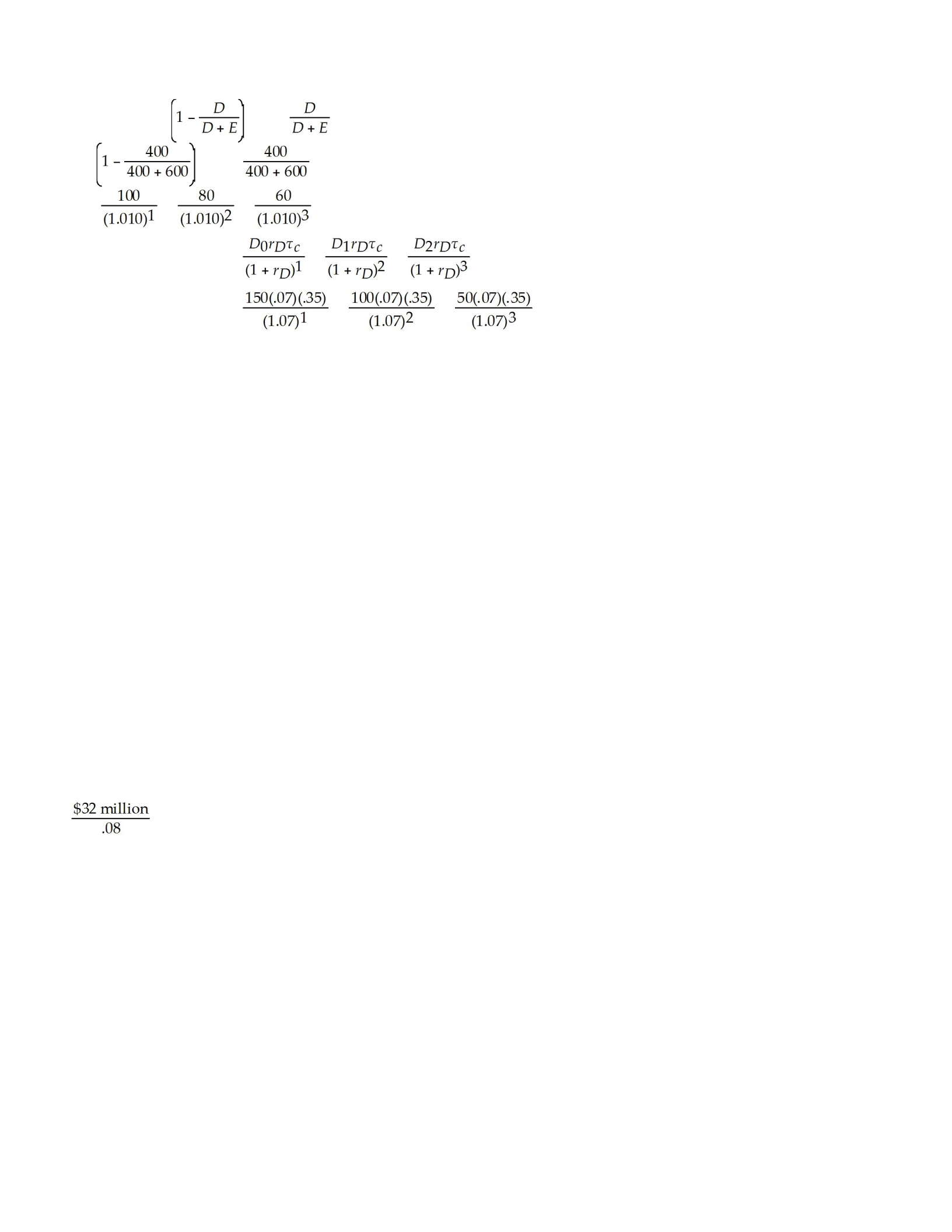
12) Suppose that to fund this new project, Aardvark borrows $150 with the principal to be paid in three equal
installments at the end each year. Calculate the The levered value of Aardvark's new project.
Answer: rU = rE + rD
rU = .12 + .07 = 10.0%
VU = + + = $202.10
PV(interest tax shield) = + +
PV(interest tax shield) = + + = $6.286
VL = VU + PV(interest tax shield) = $202.10 + $6.29 = $208.39
Diff: 3
Section: 18.6 APV with Other Leverage Policies
Skill: Analytical
18.7 Other Effects of Financing
Use the following information to answer the question(s) below.
Taggart Transcontinental is considering a $250 million investment to launch a new rail line. The project is
expected to generate a free cash flow of $32 million per year, and its unlevered cost of capital is 8%. Taggart's
marginal corporate tax rate is 35%.
1) Assuming that to fund the investment Taggart will take on $250 million in permanent debt and ignoring
issuance costs, the NPV of Taggart's new rail line is closest to:
A) $195 million
B) $200 million
C) $235 million
D) $240 million
Answer: D
Explanation: D) NPV = VL - Investment = VU + TcD - Investment
= + (35%)$250 million - $250 million = $237.5 million
Diff: 2
Section: 18.7 Other Effects of Financing
Skill: Analytical

2) Assuming that to fund the investment Taggart will take on $250 million in permanent debt and assuming
Taggart will incur a 2% (after-tax) underwriting fee on the new debt issue, the NPV of Taggart's new rail line is
closest to:
A) $195 million
B) $200 million
C) $235 million
D) $240 million
Answer: C
Explanation: C) NPV = VL - Investment = VU + TcD - Investment - issuance cost
= + (35%)$250 million - $250 million - (2%)($250) = 232.5
Diff: 2
Section: 18.7 Other Effects of Financing
Skill: Analytical
3) Assume that to fund the investment Taggart will take on $150 million in permanent debt with the remainder
of the investment funded by a cut in dividends. Assuming Taggart will incur a 2% (after-tax) underwriting fee
on the new debt issue, the NPV of Taggart's new rail line is closest to:
A) $195 million
B) $200 million
C) $235 million
D) $240 million
Answer: B
Explanation: B) NPV = VL - Investment = VU + TcD - Investment - issuance cost
= + (35%)$150 million - $250 million - (2%)($150) =199.5
Diff: 2
Section: 18.7 Other Effects of Financing
Skill: Analytical

4) Assume that to fund the investment Taggart will take on $150 million in permanent debt with the remainder
of the investment funded through issuance of new equity. Assuming Taggart will incur a 2% (after-tax)
underwriting fee on the new debt issue and a 5% underwriting fee on the issuance of new equity, the NPV of
Taggart's new rail line is closest to:
A) $195 million
B) $200 million
C) $235 million
D) $240 million
Answer: A
Explanation: A) NPV = VL - Investment = VU + TcD - Investment - issuance cost
= + (35%)$150 million - $250 million - (2%)($150)-5%($100) =194.5
(Note that equity issuance costs are not tax deductible.)
Diff: 2
Section: 18.7 Other Effects of Financing
Skill: Analytical
5) Assume that to fund the investment Taggart will take on $150 million in permanent debt with the remainder
of the investment funded through issuance of new equity. Assume Taggart will incur a 2% (after-tax)
underwriting fee on the new debt issue and a 5% underwriting fee on the issuance of new equity. If management
believes Taggart's current share price of $25 is $3 less than its true value, then the NPV of Taggart's new rail
line is closest to:
A) $185 million
B) $195 million
C) $200 million
D) $235 million
Answer: A
Explanation: A) NPV = VL - Investment = VU + TcD - Investment - (1 - Tc)issuance cost
= ($32 million)/(.08) + (35%)$150 million - $250 million - 2%(150) - 5%(100) - 4*3 = 182.5
(Last term is loss from 400 shares at $25 instead of $28).
(Note that equity issuance costs are not tax deductible.)
Diff: 2
Section: 18.7 Other Effects of Financing
Skill: Analytical

6) Which of the following questions is FALSE?
A) With perfect capital markets, all securities are fairly priced and issuing securities is a zero-NPV transaction.
B) The fees associated with the financing of the project are independent of the project's required cash flows and
should be ignored when calculating the NPV of the project.
C) When a firm borrows funds, a mispricing scenario arises if the interest rate charged differs from the rate that
is appropriate given the actual risk of the loan.
D) The WACC, APV, and FTE methods determine the value of an investment incorporating the tax shields
associated with leverage.
Answer: B
Diff: 1
Section: 18.7 Other Effects of Financing
Skill: Conceptual
7) Which of the following questions is FALSE?
A) Sometimes management may believe that the securities they are issuing are priced at less than (or more than)
their true value. If so, the NPV of the transaction, which is the difference between the actual money raised and
the true value of the securities sold, should not be included in the value of the project.
B) An alternative method of incorporating financial distress and agency costs is to first value the project
ignoring these costs, and then value the incremental cash flows associated with financial distress and agency
problems separately.
C) When the debt level—and, therefore, the probability of financial distress—is high, the expected free cash
flow will be reduced by the expected costs associated with financial distress and agency problems.
D) If the financing of the project involves an equity issue, and if management believes that the equity will sell at
a price that is less than its true value, this mispricing is a cost of the project for the existing shareholders.
Answer: A
Diff: 2
Section: 18.7 Other Effects of Financing
Skill: Conceptual

8) Luther Industries is considering borrowing $500 million to fund a new product line. Given investors'
uncertainty regarding its prospects, Luther will pay a 7% interest rate on this loan. The firm's management
knows, that the actual risk of the loan is extremely low and that the appropriate rate on the loan is 5%. Suppose
the loan is for four years, with all principal being repaid in the fourth year. If Luther's marginal corporate tax
rate is 35%, then the net effect of the loan on the value of the new product line is closest to:
A) $22 million
B) $34 million
C) $35 million
D) $24 million
Answer: D
Explanation: D) Luther Industries is paying (7% - 5% = 2%) more for the loan than the risk demands.
However, part of this 2% premium in the interest rate is being offset by the interest tax shield. Therefore the
true cost in any year is the amount of debt × (2%) × (1 - τc).
Cost per year = $500M(.02)(.65) = $6.5M, we need to discount this amount each year by the correct rD of 5%,
this is amount is constant and occurs each year for four years we have an annuity, solving:
PMT = 6.5
I = 5%
FV = 0
N = 4
Compute PV = $23.04 million
Diff: 2
Section: 18.7 Other Effects of Financing
Skill: Analytical
18.8 Advanced Topics in Capital Budgeting
Use the following information to answer the question(s) below.
Wyatt Oil is considering an investment in a new project with an unlevered cost of capital of 11%. Wyatt's
marginal corporate tax rate is 35% and its debt cost of capital is 6%. The project has free cash flows of $25
million per year which are expected to decline by 3% per year.
1) If Wyatt adjusts its debt continuously to maintain a constant debt-equity ratio of 50%, then the appropriate
WACC for this new project is closest to:
A) 7.5%
B) 8.6%
C) 10.3%
D) 10.8%
Answer: C
Explanation: C) rwacc = ru - dTcrd where d = , so rwacc = 11% - (35%)(6%) = 10.3%
Diff: 2
Section: 18.8 Advanced Topics in Capital Budgeting
Skill: Analytical
2) If Wyatt adjusts its debt once per year to maintain a constant debt-equity ratio of 50%, then the appropriate
WACC for this new project is closest to:
A) 7.5%
B) 8.67%
C) 10.27%

D) 10.8%
Answer: C
Explanation: C) rwacc = ru - dTcrd where d = , so rwacc = 11% - (35%)(6%) = 10.267%
Diff: 2
Section: 18.8 Advanced Topics in Capital Budgeting
Skill: Analytical
3) If Wyatt adjusts its debt continuously to maintain a constant debt-equity ratio of 50%, then the value of this
new project is closest to:
A) $188 million
B) $188.5 million
C) $320 million
D) $340 million
Answer: A
Explanation: C) rwacc = ru - dTcrd where d = , so rwacc = 11% - (35%)(6%) = 10.3%
The cash flows from this project follow a growing perpetuity, therefore
value = = = $187.96 million
Diff: 2
Section: 18.8 Advanced Topics in Capital Budgeting
Skill: Analytical

4) If Wyatt adjusts its debt once per year to maintain a constant debt-equity ratio of 50%, then the value of this
new project is closest to:
A) $188 million
B) $188.5 million
C) $320 million
D) $340 million
Answer: B
Explanation: B) rwacc = ru - dTcrd where d = , so rwacc = 11% - (35%)(6%) = 10.267%
The cash flows from this project follow a growing perpetuity, therefore
value = = = $188.44 million
Diff: 2
Section: 18.8 Advanced Topics in Capital Budgeting
Skill: Analytical
Use the following information to answer the question(s) below.
Galt Industries is expected to generate free cash flows of $24 million per year. Galt has permanent debt of $80
million, a corporate tax rate of 40%, and an unlevered cost of capital of 12% and its cost of debt capital is 6%.
5) The value of Galt's equity using the APV method is closest to:
A) $150 million
B) $180 million
C) $230 million
D) $240 million
Answer: A
Explanation: A) APV = VL = VU + TcD = + (40%)$80 million = $232 million
Value of equity = total value - debt = $232 - $80 = $152 million
Diff: 2
Section: 18.8 Advanced Topics in Capital Budgeting
Skill: Analytical

6) Galt's WACC is closest to:
A) 6.0%
B) 9.6%
C) 10.3%
D) 10.7%
Answer: C
Explanation: C) Using APV = VL = VU + TcD = + (40%)$80 million = $232 million
rwacc = ru - dTc[rd + (rϕu - rd)] where = 1 with permanent debt and d = ϕ
rwacc = 12% - (40%)[6% + 1(12% - 6%)] = .103448
or: rwacc = 12%- (40%)(12%) = .103448
Diff: 3
Section: 18.8 Advanced Topics in Capital Budgeting
Skill: Analytical
7) The value of Galt's equity using the WACC method is closest to:
A) $150 million
B) $180 million
C) $230 million
D) $240 million
Answer: A
Explanation: A) Using APV = VL = VU + TcD = + (40%)$80 million = $232 million
rwacc = ru - dTc[rd + (rϕu - rd)] where = 1 with permanent debt and d = ϕ
rwacc = 12% - (40%)[6% + 1(12% - 6%)] = .103448
Using Wacc Method Value = = = $232 million
Value of equity = total value - debt = $232 - $80 = $152 million
Diff: 3
Section: 18.8 Advanced Topics in Capital Budgeting
Skill: Analytical

8) If Galt's debt cost of capital is 6%, then Galt's equity cost of capital is closest to:
A) 11.2%
B) 12.0%
C) 14.8%
D) 15.2%
Answer: D
Explanation: D) Using APV VL = VU + TcD = + (40%)$80 million = $232 million
re = ru + (ru - rd) = 12% + (12% - 6%) = 15.157895%
Diff: 2
Section: 18.8 Advanced Topics in Capital Budgeting
Skill: Analytical
9) Galt's free cash flow to equity (FCFE) is closest to:
A) $19.2 million
B) $20.4 million
C) $21.2 million
D) $24.0 million
Answer: C
Explanation: C) Using APV VL = VU + TcD = + (40%)$80 million = $232 million
re = ru + (ru - rd) = 12% + (12% - 6%) = 15.157895%
FCFE = FCF - (1- TC)DrD = $24 - (1 - 40%)($80)(6%) = $21.12 million
Diff: 3
Section: 18.8 Advanced Topics in Capital Budgeting
Skill: Analytical
10) Consider the following equation for the Project WACC with a fixed debt schedule:
rwacc = rU - dτc[rD + f(rU - rD)]
The term d in this equations represents:
A) a measure of the permanence of the debt level.
B) the annual adjustment percentage to the amount of debt.
C) the debt-to-value ratio.
D) the dollar amount of debt outstanding.
Answer: C
Diff: 1
Section: 18.8 Advanced Topics in Capital Budgeting
Skill: Analytical

11) Consider the following equation for the Project WACC with a fixed debt schedule:
rwacc = rU - dτc[rD + f(rU - rD)]
The term f in this equations represents:
A) the annual adjustment percentage to the amount of debt.
B) a measure of the permanence of the debt level.
C) the dollar amount of debt outstanding.
D) the debt-to-value ratio.
Answer: B
Diff: 2
Section: 18.8 Advanced Topics in Capital Budgeting
Skill: Analytical Corporate Finance, 3e (Berk/DeMarzo)
Chapter 14 Capital Structure in a Perfect Market
14.1 Equity Versus Debt Financing
Use the following information to answer the question(s) below.
Nielson Motors (NM) has no debt. Its assets will be worth $600 million in one year if the economy is strong,
but only $300 million if the economy is weak. Both events are equally likely. The market value today of
Nielson's assets is $400 million.
1) The expected return for Nielson Motors stock without leverage is closest to:
A) -25.0%
B) -17.5%
C) -12.5%
D) 12.5%
Answer: D
Explanation: D) E[rNM] = =
Diff: 1
Section: 14.1 Equity Versus Debt Financing
Skill: Analytical
2) Suppose the risk-free interest rate is 4%. If Nielson borrows $150 million today at this rate and uses the
proceeds to pay an immediate cash dividend, then according to MM, the market value of its equity just after the
dividend is paid would be closest to:
A) $0 million
B) $150 million
C) $250 million
D) $400 million
Answer: C
Explanation: C) Value of equity = Total value - value of debt = $400 - 150 = $250
Diff: 1
Section: 14.1 Equity Versus Debt Financing
Skill: Analytical

3) Suppose the risk-free interest rate is 4%. If Nielson borrows $150 million today at this rate and uses the
proceeds to pay an immediate cash dividend, then according to MM, the expected return of Nielson's stock just
after the dividend is paid would be closest to:
A) -17.5%
B) -12.5%
C) 12.5%
D) 17.5%
Answer: D
Explanation: D) Value of equity = Total value - value of debt = $400 - 150 = $250
E[rNM] = = = 17.6%
Diff: 2
Section: 14.1 Equity Versus Debt Financing
Skill: Analytical
4) Which of the following statements is FALSE?
A) The relative proportions of debt, equity, and other securities that a firm has outstanding constitute its capital
structure.
B) The most common choices are financing through equity alone and financing through a combination of debt
and equity.
C) The project's NPV represents the value to the new investors of the firm created by the project.
D) When corporations raise funds from outside investors, they must choose which type of security to issue.
Answer: C
Explanation: C) The project's NPV represents the value to the existing shareholders of the firm created by the
project.
Diff: 1
Section: 14.1 Equity Versus Debt Financing
Skill: Conceptual
5) Equity in a firm with debt is called:
A) levered equity.
B) riskless equity.
C) unlevered equity.
D) risky equity.
Answer: A
Diff: 1
Section: 14.1 Equity Versus Debt Financing
Skill: Definition

6) Equity in a firm with no debt is called:
A) levered equity.
B) unlevered equity.
C) riskless equity.
D) risky equity.
Answer: B
Diff: 1
Section: 14.1 Equity Versus Debt Financing
Skill: Definition
7) Which of the following statements is FALSE?
A) Modigliani and Miller's conclusion verified the common view, which stated that even with perfect capital
markets, leverage would affect a firm's value.
B) We can evaluate the relationship between risk and return more formally by computing the sensitivity of each
security's return to the systematic risk of the economy.
C) Investors in levered equity require a higher expected return to compensate for its increased risk.
D) Leverage increases the risk of equity even when there is no risk that the firm will default.
Answer: A
Explanation: A) Modigliani and Miller's conclusion went against the common view that even with perfect
capital markets, leverage would affect a firm’s value.
Diff: 2
Section: 14.1 Equity Versus Debt Financing
Skill: Conceptual
8) Which of the following statements is FALSE?
A) Leverage decreases the risk of the equity of a firm.
B) Because the cash flows of the debt and equity sum to the cash flows of the project, by the Law of One Price
the combined values of debt and equity must be equal to the cash flows of the project.
C) Franco Modigliani and Merton Miller argued that with perfect capital markets, the total value of a firm
should not depend on its capital structure.
D) It is inappropriate to discount the cash flows of levered equity at the same discount rate that we use for
unlevered equity.
Answer: A
Explanation: A) Leverage increases the risk of the equity of a firm.
Diff: 2
Section: 14.1 Equity Versus Debt Financing
Skill: Conceptual

Use the information for the question(s) below.
Consider a project with free cash flows in one year of $90,000 in a weak economy or $117,000 in a strong
economy, with each outcome being equally likely. The initial investment required for the project is $80,000,
and the project's cost of capital is 15%. The risk-free interest rate is 5%.
9) The NPV for this project is closest to:
A) $6,250
B) $14,100
C) $10,000
D) $18,600
Answer: C
Explanation: C) NPV = - $80,000 = $10,000
Diff: 2
Section: 14.1 Equity Versus Debt Financing
Skill: Analytical
10) Suppose that to raise the funds for the initial investment, the project is sold to investors as an all-equity firm.
The equity holders will receive the cash flows of the project in one year. The market value of the unlevered
equity for this project is closest to:
A) $94,100
B) $90,000
C) $86,250
D) $98,600
Answer: B
Explanation: B) PV(equity cash flows) = = $90,000
Diff: 2
Section: 14.1 Equity Versus Debt Financing
Skill: Analytical
11) Suppose that to raise the funds for the initial investment the firm borrows $80,000 at the risk free rate, then
the cash flow that equity holders will receive in one year in a weak economy is closest to:
A) $6,000
B) $10,000
C) $0
D) $33,000
Answer: A
Explanation: A) $90,000 - $80,000(1.05) = $6,000
Diff: 2
Section: 14.1 Equity Versus Debt Financing
Skill: Analytical

12) Suppose that to raise the funds for the initial investment the firm borrows $80,000 at the risk free rate, then
the cash flow that equity holders will receive in one year in a strong economy is closest to:
A) $0
B) $6,000
C) $33,000
D) $10,000
Answer: C
Explanation: C) $117,000 - $80,000(1.05) = $33,000
Diff: 2
Section: 14.1 Equity Versus Debt Financing
Skill: Analytical
13) Suppose that to raise the funds for the initial investment the firm borrows $80,000 at the risk free rate, then
the value of the firm's levered equity from the project is closest to:
A) $0
B) $10,000
C) $6,000
D) $8,600
Answer: B
Explanation: B) PV(equity cash flows) = = $90,000 - $80,000 = $10,000
Diff: 2
Section: 14.1 Equity Versus Debt Financing
Skill: Analytical
14) Suppose that to raise the funds for the initial investment the firm borrows $80,000 at the risk free rate, then
the cost of capital for the firm's levered equity is closest to:
A) 45%
B) 25%
C) 15%
D) 95%
Answer: D
Explanation: D) PV(equity cash flows) = = $90,000 - $80,000 = $10,000 (value of
levered equity)
So, $10,000 =
So, 1 + x =
So, x = .95
Diff: 2
Section: 14.1 Equity Versus Debt Financing
Skill: Analytical

15) Suppose that to raise the funds for the initial investment the firm borrows $40,000 at the risk free rate and
issues new equity to cover the remainder. In this situation, the cash flow that equity holders will receive in one
year in a weak economy is closest to:
A) $90,000
B) $0
C) $50,000
D) $48,000
Answer: D
Explanation: D) $90,000 - $40,000(1.05) = $48,000
Diff: 2
Section: 14.1 Equity Versus Debt Financing
Skill: Analytical
16) Suppose that to raise the funds for the initial investment the firm borrows $40,000 at the risk free rate and
issues new equity to cover the remainder. In this situation, the cash flow that equity holders will receive in one
year in a strong economy is closest to:
A) $117,000
B) $75,000
C) $50,000
D) $0
Answer: B
Explanation: B) $117,000 - $40,000(1.05) = $75,000
Diff: 2
Section: 14.1 Equity Versus Debt Financing
Skill: Analytical
17) Suppose that to raise the funds for the initial investment the firm borrows $40,000 at the risk free rate and
issues new equity to cover the remainder. In this situation, the value of the firm's levered equity from the
project is closest to:
A) $0
B) $50,000
C) $90,000
D) $40,000
Answer: B
Explanation: B) PV(equity cash flows) = = $90,000 - $40,000 = $50,000
Diff: 2
Section: 14.1 Equity Versus Debt Financing
Skill: Analytical

18) Suppose that to raise the funds for the initial investment the firm borrows $40,000 at the risk free rate and
issues new equity to cover the remainder. In this situation, the cost of capital for the firm's levered equity is
closest to:
A) 23%
B) 25%
C) 15%
D) 18%
Answer: A
Explanation: A) PV(equity cash flows) = = $90,000 - $40,000 = $50,000 (value of
levered equity)
So, $50,000 =
So, 1 + x =
So, x = .23
Diff: 3
Section: 14.1 Equity Versus Debt Financing
Skill: Analytical
19) Suppose that to raise the funds for the initial investment the firm borrows $45,000 at the risk free rate and
issues new equity to cover the remainder. In this situation, calculate the value of the firm's levered equity from
the project. What is the cost of capital for the firm's levered equity?
Answer: PV(equity cash flows) = = $90,000 - $45,000 = $45,000 (value of levered
equity)
90,000 - 45,000(1.05) = $42,770
117,000 - 45,000(1.05) = $69,750
So, $45,000 =
So, 1 + x =
So, x = .25
Diff: 2
Section: 14.1 Equity Versus Debt Financing
Skill: Analytical

20) Two separate firms are considering investing in this project. Firm unlevered plans to fund the entire
$80,000 investment using equity, while firm levered plans to borrow $45,000 at the risk-free rate and use equity
to finance the remainder of the initial investment. Construct a table detailing the percentage returns to the
equity holders of both the levered and unlevered firms for both the weak and strong economy.
Answer:
Initial
Value
C/F Strong
Economy
C/F Weak
Economy
Returns
Strong
Economy
Returns
Weak
Economy
Debt $45,000 $ 47,250 $47,250 5% 5%
Levered Equity $45,000 $ 69,750 $42,750 55% -5%
Unlevered Equity $90,000 $117,000 $90,000 30% 0%
PV(equity cash flows) = = $90,000
C/F (weak economy) = $90,000 (unlevered) - $45,000(1.05) (debt) = $42,750 (levered)
C/F (strong economy) = $117,000 (unlevered) - $45,000(1.05) (debt) = $69,750 (levered)
Returns =
Diff: 3
Section: 14.1 Equity Versus Debt Financing
Skill: Analytical

21) Two separate firms are considering investing in this project. Firm unlevered plans to fund the entire
$80,000 investment using equity, while firm levered plans to borrow $45,000 at the risk-free rate and use equity
to finance the remainder of the initial investment. Calculate the expected returns for both the levered and
unlevered firm.
Answer:
Initial
Value
C/F Strong
Economy
C/F Weak
Economy
Returns
Strong
Economy
Returns
Weak
Economy
Expected
Return
Debt $45,000 $ 47,250 $47,250 5% 5% 5%
Levered
Equity $45,000 $ 69,750 $42,750 55% -5% 25%
Unlevered
Equity $90,000 $117,000 $90,000 30% 0% 15%
PV(equity cash flows) = = $90,000
C/F (weak economy) = $90,000 (unlevered) - $45,000(1.05) (debt) = $42,750 (levered)
C/F (strong economy) = $117,000 (unlevered) - $45,000(1.05) (debt) = $69,750 (levered)
Returns =
Expected return = .5(strong return) + .5(weak return)
Diff: 3
Section: 14.1 Equity Versus Debt Financing
Skill: Analytical

22) Two separate firms are considering investing in this project. Firm unlevered plans to fund the entire
$80,000 investment using equity, while firm levered plans to borrow $45,000 at the risk-free rate and use equity
to finance the remainder of the initial investment. Calculate the risk premiums for both the levered and
unlevered firm.
Answer:
Initial
Value
C/F Strong
Economy
C/F Weak
Economy
Returns
Strong
Economy
Returns
Weak
Economy
Expected
Return
Debt $45,000 $ 47,250 $47,250 5% 5% 5%
Levered
Equity $45,000 $ 69,750 $42,750 55% -5% 25%
Unlevered
Equity $90,000 $117,000 $90,000 30% 0% 15%
PV(equity cash flows) = = $90,000
C/F (weak economy) = $90,000 (unlevered) - $45,000(1.05) (debt) = $42,750 (levered)
C/F (strong economy) = $117,000 (unlevered) - $45,000(1.05) (debt) = $69,750 (levered)
Returns =
Expected return = .5(strong return) + .5(weak return)
Risk premium = expected return - risk free rate
Diff: 3
Section: 14.1 Equity Versus Debt Financing
Skill: Analytical

14.2 Modigliani-Miller I: Leverage, Arbitrage, and Firm Value
Use the following information to answer the question(s) below.
Galt Industries has 50 million shares outstanding and a market capitalization of $1.25 billion. It also has $750
million in debt outstanding. Galt Industries has decided to delever the firm by issuing new equity and
completely repaying all the outstanding debt. Assume perfect capital markets.
1) The number of shares that Galt must issue is closest to:
A) 15 million
B) 25 million
C) 30 million
D) 40 million
Answer: C
Explanation: C) share price = = $25
number of new shares = = 30 million
Diff: 2
Section: 14.2 Modigliani-Miller I: Leverage, Arbitrage, and Firm Value
Skill: Analytical
2) Suppose you are a shareholder in Galt industries holding 100 shares, and you disagree with this decision to
delever the firm. You can undo the effect of this decision by
A) borrowing $1500 and buying 60 shares of stock.
B) selling 32 shares of stock and lending $800.
C) borrowing $1000 and buying 40 shares of stock.
D) selling 40 shares of stock and lending $1000.
Answer: A
Explanation: A) share price = = $25 → value of equity = 25 × 100 = $2,500
Galt's pre-delevered Debt/Equity = = .60 → for every $1 equity need $0.60 debt, so you need to borrow
$0.60 × $2,500 = $1,500 and then buy $1,500/$25 = 60 more shares of stock.
Diff: 2
Section: 14.2 Modigliani-Miller I: Leverage, Arbitrage, and Firm Value
Skill: Analytical

3) Suppose you are a shareholder in Galt industries holding 600 shares, and you disagree with this decision to
delever the firm. You can undo the effect of this decision by:
A) Borrow $6,000 and buy 240 shares of stock
B) Sell 240 shares of stock and lend $6,000
C) Borrow $9,000 and buy 360 shares of stock
D) Sell 360 shares of stock and lend $9,000
Answer: C
Explanation: C) share price = = $25 → value of equity = 25 × 600 = $15,000
Galt's pre-delevered Debt/Equity = = .60 → for every $1 equity need $0.60 debt, so you need to borrow
$0.60 × $15,000 = $9,000 and then buy $9,000/$25 = 360 more shares of stock.
Diff: 2
Section: 14.2 Modigliani-Miller I: Leverage, Arbitrage, and Firm Value
Skill: Analytical
Use the following information to answer the question(s) below.
d'Anconia Copper is an all-equity firm with 60 million shares outstanding, which are currently trading at $20
per share. Last month, d'Anconia announced that it will change its capital structure by issuing $300 million in
debt. The $200 million raised by this issue, plus another $200 million in cash that d'Anconia already has, will
be used to repurchase existing shares of stock. Assume that capital markets are perfect.
4) The market capitalization of d'Anconia Copper before this transaction takes place is closest to:
A) $800 million
B) $900 million
C) $1,100 million
D) $1,200 million
Answer: D
Explanation: D) Market Cap = 60 million shares × $20 share = $1,200 million
Diff: 1
Section: 14.2 Modigliani-Miller I: Leverage, Arbitrage, and Firm Value
Skill: Analytical
5) The market capitalization of d'Anconia Copper after this transaction takes place is closest to:
A) $800 million
B) $900 million
C) $1,100 million
D) $1,200 million
Answer: A
Explanation: A) Market Cap = 60 million shares × $20 share - $200 Debt - $200 Cash = $800 million
Diff: 1
Section: 14.2 Modigliani-Miller I: Leverage, Arbitrage, and Firm Value
Skill: Analytical
6) At the conclusion of this transaction, the number of shares that d'Anconia Copper will repurchase is closest
to:
A) 5 million
B) 15 million
C) 20 million
D) 40 million

Answer: C
Explanation: C) Number of shares repurchased = = 20 million
Diff: 1
Section: 14.2 Modigliani-Miller I: Leverage, Arbitrage, and Firm Value
Skill: Analytical
7) At the conclusion of this transaction, the number of shares that d'Anconia Copper will have outstanding is
closest to:
A) 5 million
B) 15 million
C) 20 million
D) 40 million
Answer: D
Explanation: D) Number of shares repurchased = = $20 million
Number of Shares outstanding = 60 million - 20 million repurchased = 40 million shares
Diff: 1
Section: 14.2 Modigliani-Miller I: Leverage, Arbitrage, and Firm Value
Skill: Analytical
8) At the conclusion of this transaction, the value of a share of d'Anconia Copper will be closest to:
A) $18.33
B) $20.00
C) $25.00
D) $27.50
Answer: B
Explanation: B) Number of shares repurchased = = $20 million
Number of Shares outstanding = 60 million - 20 million repurchased = 40 million shares
Price per share = ($1,200 million - $300 million - $100 million)/40 million shares = $20 share
Diff: 2
Section: 14.2 Modigliani-Miller I: Leverage, Arbitrage, and Firm Value
Skill: Analytical

9) Suppose you are a shareholder in d'Anconia Copper holding 300 shares, and you disagree with the decision
to lever the firm. You can undo the effect of this decision by
A) borrowing $2,000 and buying 100 shares of stock.
B) selling 100 shares of stock and lending $2,000.
C) borrowing $1,200 and buying 60 shares of stock.
D) selling 60 shares of stock and lending $1,200.
Answer: D
Explanation: D) d'Anconia Copper's = = .20
→ for every $1 invested you need $0.80 in equity and $0.20 in debt
Pre levering your portfolio consisted of 300 shares × $20 = $6000 in stock. Of this you need to sell 20% to
reinvest into bonds so you need to sell ($6,000 × .2 = $1,200/$20 per share = 60 shares of stock and then lend
this money out.
Diff: 2
Section: 14.2 Modigliani-Miller I: Leverage, Arbitrage, and Firm Value
Skill: Analytical
10) Suppose you are a shareholder in d'Anconia Copper holding 500 shares, and you disagree with the decision
to lever the firm. You can undo the effect of this decision by:
A) borrowing $2,000 and buying 100 shares of stock.
B) selling 100 shares of stock and lending $2,000.
C) borrowing $1,200 and buying 60 shares of stock.
D) selling 60 shares of stock and lending $1,200.
Answer: B
Explanation: B) d'Anconia Copper's = = .20
d'Anconia Copper's Debt/Equity = $200/$800 = .20
→ for every $1 invested you need $0.80 in equity and $0.20 in debt
Pre levering your portfolio consisted of 500 shares × $20 = $10,000 in stock. Of this you need to sell 20% to
reinvest into bonds so you need to sell ($10,0000 × .2 = $2,000/$20 per share = 100 shares of stock and then
lend this money out.
Diff: 2
Section: 14.2 Modigliani-Miller I: Leverage, Arbitrage, and Firm Value
Skill: Analytical

11) Which of the following is NOT one of Modigliani and Miller's set of conditions referred to as perfect capital
markets?
A) All investors hold the efficient portfolio of assets.
B) There are no taxes, transaction costs, or issuance costs associated with security trading.
C) A firm's financing decisions do not change the cash flows generated by its investments, nor do they reveal
new information about them.
D) Investors and firms can trade the same set of securities at competitive market prices equal to the present
value of their future cash flows.
Answer: A
Diff: 2
Section: 14.2 Modigliani-Miller I: Leverage, Arbitrage, and Firm Value
Skill: Conceptual
12) Which of the following statements is FALSE?
A) The Law of One Price implies that leverage will affect the total value of the firm under perfect capital market
conditions.
B) In the absence of taxes or other transaction costs, the total cash flow paid out to all of a firm's security
holders is equal to the total cash flow generated by the firm's assets.
C) With perfect capital markets, leverage merely changes the allocation of cash flows between debt and equity,
without altering the total cash flows of the firm.
D) In a perfect capital market, the total value of a firm is equal to the market value of the total cash flows
generated by its assets and is not affected by its choice of capital structure.
Answer: A
Explanation: A) The Law of One Price implies that leverage will not affect the total value of the firm under
perfect capital market conditions.
Diff: 2
Section: 14.2 Modigliani-Miller I: Leverage, Arbitrage, and Firm Value
Skill: Conceptual
13) Which of the following statements is FALSE?
A) As long as the firm's choice of securities does not change the cash flows generated by its assets, the capital
structure decision will not change the total value of the firm or the amount of capital it can raise.
B) If securities are fairly priced, then buying or selling securities has an NPV of zero and, therefore, should not
change the value of a firm.
C) The future repayments that the firm must make on its debt are equal in value to the amount of the loan it
receives up front.
D) An investor who would like more leverage than the firm has chosen can lend and add leverage to his or her
own portfolio.
Answer: D
Explanation: D) An investor who would like more leverage than the firm has chosen can borrow and add
leverage to his or her own portfolio.
Diff: 2
Section: 14.2 Modigliani-Miller I: Leverage, Arbitrage, and Firm Value
Skill: Conceptual

14) Which of the following statements is FALSE?
A) As long as investors can borrow or lend at the same interest rate as the firm, homemade leverage is a perfect
substitute for the use of leverage by the firm.
B) When investors use leverage in their own portfolios to adjust the leverage choice made by the firm, we say
that they are using homemade leverage.
C) The value of the firm is determined by the present value of the cash flows from its current and future
investments.
D) The investor can re-create the payoffs of unlevered equity by borrowing and using the proceeds to purchase
the equity of the firm.
Answer: D
Explanation: D) The investor can re-create the payoffs of levered equity by borrowing and using the proceeds
to purchase the equity of the firm.
Diff: 2
Section: 14.2 Modigliani-Miller I: Leverage, Arbitrage, and Firm Value
Skill: Conceptual
15) Which of the following statements is FALSE?
A) When a firm issues new shares that account for a significant percentage of its outstanding shares, the
transaction is called a leveraged recapitalization.
B) MM Proposition I applies to capital structure decisions made at any time during the life of the firm.
C) By choosing positive-NPV projects that are worth more than their initial investment, the firm can enhance its
value.
D) Holding fixed the cash flows generated by the firm's assets, however, the choice of capital structure does not
change the value of the firm.
Answer: A
Explanation: A) When a firm borrows money to repurchase shares that account for a significant percentage of
its outstanding shares, the transaction is called a leveraged recapitalization.
Diff: 3
Section: 14.2 Modigliani-Miller I: Leverage, Arbitrage, and Firm Value
Skill: Conceptual
16) Which of the following statements is FALSE?
A) Investors can alter the leverage choice of the firm to suit their personal tastes either by borrowing and
reducing leverage or by holding bonds and adding more leverage.
B) On the market value balance sheet the total value of all securities issued by the firm must equal the total
value of the firm's assets.
C) The market value balance sheet captures the idea that value is created by a firm's choice of assets and
investments.
D) One application of MM Proposition I is the useful device known as the market value balance sheet of the
firm.
Answer: A
Explanation: A) Investors can alter the leverage choice of the firm to suit their personal tastes either by
borrowing and increasing leverage or by holding bonds and reducing leverage.
Diff: 3
Section: 14.2 Modigliani-Miller I: Leverage, Arbitrage, and Firm Value
Skill: Conceptual
Use the information for the question(s) below.
Consider two firms, With and Without, that have identical assets that generate identical cash flows. Without is
an all-equity firm, with 1 million shares outstanding that trade for a price of $24 per share. With has 2 million

shares outstanding and $12 million dollars in debt at an interest rate of 5%.
17) According to MM Proposition 1, the stock price for With is closest to:
A) $8.00
B) $24.00
C) $6.00
D) $12.00
Answer: C
Explanation: C) Under MM I, the total value of With and Without must be the same.
Value(Without) = 1,000,000 × $24 = $24 million
Value(levered equity) = value(With) - debt = $24 M - $12M = $12 M
Price per share = = $6.00
Diff: 1
Section: 14.2 Modigliani-Miller I: Leverage, Arbitrage, and Firm Value
Skill: Analytical
18) Assume that MM's perfect capital markets conditions are met and that you can borrow and lend at the same
5% rate as With. You have $5000 of your own money to invest and you plan on buying Without stock. Using
homemade leverage, how much do you need to borrow in your margin account so that the payoff of your
margined purchase of Without stock will be the same as a $5000 investment in With stock?
A) $10,000
B) $5000
C) $2,500
D) $0
Answer: B
Explanation: B) Under MM I, the total value of With and Without must be the same.
Value(Without) = 1,000,000 × $24 = $24 million
Value(levered equity) = value(With) - debt = $24 M - $12M = $12 M
So, the leverage ratio of with is 50% equity to 50% debt. To duplicate this in homemade leverage we need to
have equal proportions in our portfolio, this means we need 50% equity and 50% from a margin loan. So $5000
is our equity, and we need to match it with $5000 in a margin loan.
Diff: 2
Section: 14.2 Modigliani-Miller I: Leverage, Arbitrage, and Firm Value
Skill: Analytical

19) Assume that MM's perfect capital markets conditions are met and that you can borrow and lend at the same
5% rate as with. You have $5000 of your own money to invest and you plan on buying Without stock. Using
homemade leverage you borrow enough in your margin account so that the payoff of your margined purchase of
Without stock will be the same as a $5000 investment in with stock. The number of shares of Without stock
you purchased is closest to:
A) 425
B) 1650
C) 2000
D) 825
Answer: B
Explanation: B) Under MM I, the total value of With and Without must be the same.
Value(Without) = 1,000,000 × $24 = $24 million
Value(levered equity) = value(With) - debt = $24 M - $12M = $12 M
Price per share = = $6.00
So, the leverage ratio of with is 50% equity to 50% debt. To duplicate this in homemade leverage we need to
have equal proportions in our portfolio, this means we need 50% equity and 50% from a margin loan. So $5000
is our equity we need to match it with $5000 in a margin loan. So the total invested is $10,000/$6 per share =
1667 shares
Diff: 3
Section: 14.2 Modigliani-Miller I: Leverage, Arbitrage, and Firm Value
Skill: Analytical
20) Assume that MM's perfect capital markets conditions are met and that you can borrow and lend at the same
5% rate as with. You have $5000 of your own money to invest and you plan on buying With stock. Using
homemade (un)leverage, how much do you need to invest at the risk-free rate so that the payoff of your account
will be the same as a $5000 investment in Without stock?
A) $5000
B) $0
C) $2,500
D) $4,000
Answer: C
Explanation: A) Under MM I, the total value of With and Without must be the same.
Value(Without) = 1,000,000 × $24 = $24 million
Value(levered equity) = value(With) - debt = $24 M - $12M = $12 M
So, the leverage ratio of with is 50% equity to 50% debt. To duplicate this in homemade leverage we need to
have equal proportions in our portfolio, this means we need 50% equity and 50% fin the risk free asset. So
$5000 is our total portfolio we need $2500 in equity (With stock) and $2500 in the risk free asset.
Diff: 2
Section: 14.2 Modigliani-Miller I: Leverage, Arbitrage, and Firm Value
Skill: Analytical
21) Assume that MM's perfect capital markets conditions are met and that you can borrow and lend at the same
5% rate as with. You have $5000 of your own money to invest and you plan on buying With stock. Using
homemade (un)leverage you invest enough at the risk-free rate so that the payoff of your account will be the
same as a $5000 investment in Without stock? The number of shares of With stock you purchased is closest to:
A) 100

B) 425
C) 1650
D) 825
Answer: B
Explanation: B) Under MM I, the total value of With and Without must be the same.
Value(Without) = 1,000,000 × $24 = $24 million
Value(levered equity) = value(With) - debt = $24 M - $12M = $12 M
Price per share = = $6.00
So the leverage ratio of with is 50% equity to 50% debt. To duplicate this in homemade leverage we need to
have equal proportions in out portfolio, this means we need 50% equity and 50% fin the risk free asset. So
$5000 is our total portfolio we need $2500 in equity (With stock) and $2500 in the risk free asset.
= 417 shares
Diff: 3
Section: 14.2 Modigliani-Miller I: Leverage, Arbitrage, and Firm Value
Skill: Analytical
Use the information for the question(s) below.
Luther is a successful logistical services firm that currently has $5 billion in cash. Luther has decided to use
this cash to repurchase shares from its investors, and has already announced the stock repurchase plan.
Currently Luther is an all equity firm with 1.25 billion shares outstanding. Luther's shares are currently trading
at $20 per share.
22) The market value of Luther's non-cash assets is closest to:
A) $20 billion
B) $19 billion
C) $25 billion
D) $24 billion
Answer: A
Explanation: A) = 1.25B × $20 per share = $25 billion - $5 billion cash = $20 billion
Diff: 1
Section: 14.2 Modigliani-Miller I: Leverage, Arbitrage, and Firm Value
Skill: Analytical

23) After the repurchase how many shares will Luther have outstanding?
A) 0.75 billion
B) 1.0 billion
C) 1.1 billion
D) 1.2 billion
Answer: B
Explanation: B) $5 billion/$20 Share = .250 billion shares repurchased.
Shares outstanding = 1.25 - .25 = 1.0 billion
Diff: 1
Section: 14.2 Modigliani-Miller I: Leverage, Arbitrage, and Firm Value
Skill: Analytical
24) With perfect capital markets, what is the market value of Luther's equity after the share repurchase?
A) $15 billion
B) $10 billion
C) $25 billion
D) $20 billion
Answer: D
Explanation: D) = 1.25B × $20 per share = $25 billion - $5 billion cash = $20 billion
Diff: 2
Section: 14.2 Modigliani-Miller I: Leverage, Arbitrage, and Firm Value
Skill: Analytical
25) With perfect capital markets, what is the market price per share of Luther's stock after the share repurchase?
A) $25
B) $24
C) $15
D) $20
Answer: D
Explanation: D) = 1.25B × $20 per share = $25 billion - $5 billion cash = $20 billion/1 billion shares = $20
Diff: 2
Section: 14.2 Modigliani-Miller I: Leverage, Arbitrage, and Firm Value
Skill: Analytical

26) Assume that in addition to 1.25 billion common shares outstanding, Luther has stock options given to
employees valued at $2 billion. The market value of Luther's non-cash assets is closest to:
A) $22 billion
B) $20 billion
C) $25 billion
D) $18 billion
Answer: A
Explanation: A) = 1.25B × $20 per share = $25 billion + $2 billion options - $5 billion cash = $22 billion
Diff: 2
Section: 14.2 Modigliani-Miller I: Leverage, Arbitrage, and Firm Value
Skill: Analytical
27) Assume that in addition to 1.25 billion common shares outstanding, Luther has stock options given to
employees valued at $2 billion. After the repurchase how many shares will Luther have outstanding?
A) 1.0 billion
B) 1.2 billion
C) 0.75 billion
D) 1.1 billion
Answer: A
Explanation: A) $5 billion/$20 Share = .250 billion shares repurchased.
Shares outstanding = 1.25 - .25 = 1.0 billion
Diff: 1
Section: 14.2 Modigliani-Miller I: Leverage, Arbitrage, and Firm Value
Skill: Analytical

Use the information for the question(s) below.
Consider two firms: firm Without has no debt, and firm With has debt of $10,000 on which it pays interest of
5% per year. Both companies have identical projects that generate free cash flows of $1000 or $2000 each year.
Suppose that there are no taxes, and after paying any interest on debt, both companies use all remaining cash
free cash flows to pay dividends each year.
28) Fill in the table below showing the payments debt and equity holders of each firm will receive given each of
the two possible levels of free cash flows:
Without With
Free Cash
Flow
Interest
Payments
Equity
Dividends
Interest
Payments
Equity
Dividends
1000
2000
Answer:
Without With
Free Cash
Flow
Interest
Payments
Equity
Dividends
Interest
Payments
Equity
Dividends
1000 0 1000 500 500
2000 0 2000 500 1500
Diff: 2
Section: 14.2 Modigliani-Miller I: Leverage, Arbitrage, and Firm Value
Skill: Analytical
29) Suppose you own 10% of the equity of Without. What is another portfolio you could hold that would
provide you with the same exact cash flows?
Answer: The cash flows for a 10% ownership stake in With and Without are shown below:
Without With
Free Cash
Flow
Interest
Payments
Equity
Dividends
Interest
Payments
Equity
Dividends
100 0 100 50 50
200 0 200 50 150
To achieve the same payout as Without you would need to invest $1000 in With Bond's paying 5% interest and
purchase a 10% stake in With's equity paying $50 or $150 in dividends.
So your payoff when the firm's FCF is 1000 = 50 (interest) + 50 (dividends) = $100 (same as Without's
dividends)
Payoff when firm's FCF is 2000 = 50 (interest) + 150 (dividends) = $200 (same as Without's dividends)
Diff: 3
Section: 14.2 Modigliani-Miller I: Leverage, Arbitrage, and Firm Value
Skill: Analytical
30) Suppose you own 10% of the equity of With. What is another portfolio you could hold that would provide
you with the same exact cash flows?
Answer: The cash flows for a 10% ownership stake in With and Without are shown below:

Without With
Free Cash
Flow
Interest
Payments
Equity
Dividends
Interest
Payments
Equity
Dividends
100 0 100 50 50
200 0 200 50 150
To achieve the same payout as Without you would need to borrow $1000 at the risk free rate of 5% interest and
purchase a 10% stake in Without's equity paying $100 or $20 in dividends.
So your payoff when the firm's FCF is 1000 = -50 (interest) + 100 (dividends) = $50 (same as With's dividends)
Payoff when firm's FCF is 2000 = -50 (interest) + 200 (dividends) = $150 (same as With's dividends)
Diff: 3
Section: 14.2 Modigliani-Miller I: Leverage, Arbitrage, and Firm Value
Skill: Analytical
31) What is a market value balance sheet and how does it differ from a book value balance sheet?
Answer: One application of MM Proposition I is the useful device known as the market value balance sheet of
the firm. A market value balance sheet is similar to an accounting balance sheet, with two important
distinctions. First, all assets and liabilities of the firm are included–even intangible assets such as reputation,
brand name, or human capital that are missing from a standard accounting balance sheet. Second, all values are
current market values rather than historical costs. On the market value balance sheet the total value of all
securities issued by the firm must equal the total value of the firm’s assets.
The market value balance sheet captures the idea that value is created by a firm’s choice of assets and
investments. By choosing positive-NPV projects that are worth more than their initial investment, the firm can
enhance its value. Holding fixed the cash flows generated by the firm’s assets, however, the choice of capital
structure does not change the value of the firm. Instead, it merely divides the value of the firm into different
securities.
Diff: 2
Section: 14.2 Modigliani-Miller I: Leverage, Arbitrage, and Firm Value
Skill: Conceptual

14.3 Modigliani-Miller II: Leverage, Risk, and the Cost of Capital
1) Suppose that Taggart Transcontinental currently has no debt and has an equity cost of capital of 10%.
Taggart is considering borrowing funds at a cost of 6% and using these funds to repurchase existing shares of
stock. Assume perfect capital markets. If Taggart borrows until they achieved a debt -to-value ratio of 20%,
then Taggart's levered cost of equity would be closest to:
A) 8.0%
B) 9.2%
C) 10.0%
D) 11.0%
Answer: D
Explanation: D) re = ru + (ru - rd) = 10% + (10% - 6%) = 11%
Diff: 2
Section: 14.3 Modigliani-Miller II: Leverage, Risk, and the Cost of Capital
Skill: Analytical
2) Suppose that Rearden Metal currently has no debt and has an equity cost of capital of 12%. Rearden is
considering borrowing funds at a cost of 6% and using these funds to repurchase existing shares of stock.
Assume perfect capital markets. If Taggart borrows until they achieved a debt -to-equity ratio of 50%, then
Rearden's levered cost of equity would be closest to:
A) 10.0%
B) 12.0%
C) 15.0%
D) 16.0%
Answer: C
Explanation: C) re = ru + (ru - rd) = 12% + (12% - 6%) = 15%
Diff: 2
Section: 14.3 Modigliani-Miller II: Leverage, Risk, and the Cost of Capital
Skill: Analytical

Use the following information to answer the question(s) below.
Galt Industries has no debt, total equity capitalization of $600 million, and an equity beta of 1.2. Included in
Galt's assets is $90 million in cash and risk-free securities. Assume the risk-free rate is 4% and the market risk
premium is 6%.
3) Galt's enterprise value is closest to:
A) $90 million
B) $510 million
C) $600 million
D) $690 million
Answer: B
Explanation: B) Enterprise value = equity + debt - cash = $600 million - $90 million = $510 million
Diff: 1
Section: 14.3 Modigliani-Miller II: Leverage, Risk, and the Cost of Capital
Skill: Analytical
4) Galt's asset beta (ie the beta of its operating assets) is closest to:
A) 1.1
B) 1.2
C) 1.3
D) 1.4
Answer: D
Explanation: D) βU = βE + βD - βC
= × 1.2 - × 0 = 1.411765
Diff: 3
Section: 14.3 Modigliani-Miller II: Leverage, Risk, and the Cost of Capital
Skill: Analytical
5) Galt's WACC is closest to:
A) 10.6%
B) 11.2%
C) 11.8%
D) 12.5%
Answer: D
Explanation: D) βU = βE + βD + βC
= × 1.2 + × 0 = 1.411765
rwacc = rf + βu(rm - rf) = 4% + 1.411765(6%) = 12.47%
Diff: 3
Section: 14.3 Modigliani-Miller II: Leverage, Risk, and the Cost of Capital
Skill: Analytical
6) Consider the following equation:
E + D = U = A
The E in this equation represents:

A) the value of the firm's equity.
B) the value of the firm's debt.
C) the value of the firm's unlevered equity.
D) the market value of the firm's assets.
Answer: A
Diff: 1
Section: 14.3 Modigliani-Miller II: Leverage, Risk, and the Cost of Capital
Skill: Conceptual
7) Consider the following equation:
E + D = U = A
The U in this equation represents:
A) the value of the firm's equity.
B) the market value of the firm's assets.
C) the value of the firm's unlevered equity.
D) the value of the firm's debt.
Answer: C
Diff: 1
Section: 14.3 Modigliani-Miller II: Leverage, Risk, and the Cost of Capital
Skill: Conceptual
8) Consider the following equation:
E + D = U = A
The A in this equation represents:
A) the value of the firm's debt.
B) the market value of the firm's assets.
C) the value of the firm's equity.
D) the value of the firm's unlevered equity.
Answer: B
Diff: 1
Section: 14.3 Modigliani-Miller II: Leverage, Risk, and the Cost of Capital
Skill: Conceptual

9) Which of the following statements is FALSE?
A) While debt itself may be cheap, it increases the risk and therefore the cost of capital of the firm's equity.
B) Although debt does not have a lower cost of capital than equity, we can consider this cost in isolation.
C) We can use Modigliani and Miller's first proposition to derive an explicit relationship between leverage and
the equity cost of capital.
D) The total market value of the firm's securities is equal to the market value of its assets, whether the firm is
unlevered or levered.
Answer: B
Explanation: B) Although debt has a lower cost of capital than equity, we can consider this cost in isolation.
Diff: 2
Section: 14.3 Modigliani-Miller II: Leverage, Risk, and the Cost of Capital
Skill: Conceptual
10) Which of the following statements is FALSE?
A) The levered equity return equals the unlevered return, plus an extra "kick" due to leverage.
B) By holding a portfolio of the firm’s equity and its debt, we can replicate the cash flows from holding its
levered equity.
C) The cost of capital of levered equity is equal to the cost of capital of unlevered equity plus a premium that is
proportional to the market value debt-equity ratio.
D) If a firm is unlevered, all of the free cash flows generated by its assets are available to be paid out to its
equity holders.
Answer: B
Explanation: B) By holding a portfolio of the firm's equity and its debt, we can replicate the cash flows from
holding its unlevered equity.
Diff: 2
Section: 14.3 Modigliani-Miller II: Leverage, Risk, and the Cost of Capital
Skill: Conceptual

11) Which of the following statements is FALSE?
A) If we can identify a comparison firm whose assets have the same risk as the project being evaluated, and if
the comparison firm is levered, then we can use its equity cost of capital as the cost of capital for the project.
B) We can calculate the cost of capital of the firm's assets by computing the weighted average of the firm’s
equity and debt cost of capital, which we refer to as the firm’s weighted average cost of capital (WACC).
C) The portfolio of a firm's equity and debt replicates the returns we would earn if the firm were unlevered.
D) When evaluating any potential investment project, we must use a discount rate that is appropriate given the
risk of the project’s free cash flow.
Answer: A
Explanation: A) If we can identify a comparison firm whose assets have the same risk as the project being
evaluated, and if the comparison firm is levered, then we can use its unlevered equity cost of capital as the cost
of capital for the project.
Diff: 2
Section: 14.3 Modigliani-Miller II: Leverage, Risk, and the Cost of Capital
Skill: Conceptual
12) Which of the following statements is FALSE?
A) With no debt, the WACC is equal to the unlevered equity cost of capital.
B) With perfect capital markets, a firm's WACC is dependent of its capital structure and is equal to its equity
cost of capital only the firm it is unlevered.
C) As the firm borrows at the low cost of capital for debt, its equity cost of capital rises, but the net effect is that
the firm's WACC is unchanged.
D) Although debt has a lower cost of capital than equity, leverage does not lower a firm's WACC.
Answer: B
Explanation: B) With perfect capital markets, a firm's WACC is independent of its capital structure and is equal
to its equity cost of capital only the firm it is unlevered.
Diff: 2
Section: 14.3 Modigliani-Miller II: Leverage, Risk, and the Cost of Capital
Skill: Conceptual
13) Which of the following statements is FALSE?
A) Holding cash has the opposite effect of leverage on risk and return.
B) We use the market value of the firm's net debt when computing its WACC and unlevered beta to measure the
cost of capital and market risk of the firm’s business assets.
C) Since the WACC does not change with the use of leverage, the value of the firm's free cash flow evaluated
using the WACC does not change, and so the enterprise value of the firm does not depend on its financing
choices.
D) Even if the firm's capital structure is more complex, the WACC is calculated by computing the weighted
average cost of only the firm’s debt and equity.
Answer: D
Diff: 2
Section: 14.3 Modigliani-Miller II: Leverage, Risk, and the Cost of Capital
Skill: Conceptual
14) Which of the following statements is FALSE?
A) The unlevered beta measures the market risk of the firm’s business activities, ignoring any additional risk
due to leverage.
B) If a firm holds $1 in cash and has $1 of risk-free debt, then the interest earned on the cash will equal the
interest paid on the debt. The cash flows from each source cancel each other, just as if the firm held no cash and
no debt.
C) The unlevered beta measures the market risk of the firm without leverage, which is equivalent to the beta of

the firm's assets.
D) When a firm changes its capital structure without changing its investments, its levered beta will remain
unaltered, however, its asset beta will change to reflect the effect of the capital structure change on its risk.
Answer: D
Explanation: D) When a firm changes its capital structure without changing its investments, its unlevered beta
will remain unaltered, however, its equity beta will change to reflect the effect of the capital structure change on
its risk.
Diff: 2
Section: 14.3 Modigliani-Miller II: Leverage, Risk, and the Cost of Capital
Skill: Conceptual
15) The following equation:
X = rE + rD
can be used to calculate all of the following EXCEPT:
A) the cost of capital for the firm's assets.
B) the levered cost of equity.
C) the unlevered cost of equity.
D) the weighted average cost of capital.
Answer: B
Diff: 2
Section: 14.3 Modigliani-Miller II: Leverage, Risk, and the Cost of Capital
Skill: Conceptual
16) Which of the following equations would NOT be appropriate to use in a firm with risky debt?
A) βE = βU + (βU - βD)
B) βU = βE+ (βU - βD)
C) βE = βU + βU
D) βU = βE + βD
Answer: C
Diff: 2
Section: 14.3 Modigliani-Miller II: Leverage, Risk, and the Cost of Capital
Skill: Conceptual
17) Consider the following equation:
βU = βE + βD
The term in the equation is:
A) the required return on the firm's equity.
B) the same as the beta of the firm's assets.
C) equal to zero if the firm's debt is riskless.
D) the proportion of the firm financed with equity.
Answer: D

Diff: 1
Section: 14.3 Modigliani-Miller II: Leverage, Risk, and the Cost of Capital
Skill: Conceptual
18) Consider the following equation:
βU = βE + βD
The term βD in the equation is:
A) the same as the beta of the firm's assets.
B) the required return on the firm's equity.
C) the proportion of the firm financed with equity.
D) equal to zero if the firm's debt is riskless.
Answer: D
Diff: 2
Section: 14.3 Modigliani-Miller II: Leverage, Risk, and the Cost of Capital
Skill: Conceptual
19) Consider the following equation:
βU = βE + βD
The term βU in the equation is:
A) the same as the beta of the firm's assets.
B) the required return on the firm's equity.
C) the proportion of the firm financed with equity.
D) equal to zero if the firm's debt is riskless.
Answer: A
Diff: 2
Section: 14.3 Modigliani-Miller II: Leverage, Risk, and the Cost of Capital
Skill: Conceptual

Use the information for the question(s) below.
You are evaluating a new project and need an estimate for your project's beta. You have identified the following
information about three firms with comparable projects:
Firm Name Equity Beta Debt Beta
Debt to Equity
Ratio
Lincoln 1.25 0 0.25
Blinkin 1.6 0.2 1
Nod 2.3 0.3 1.5
20) The unlevered beta for Lincoln is closest to:
A) 0.95
B) 1.00
C) 1.05
D) 0.90
Answer: B
Explanation: B)
Firm
Name
Equity
Beta
Debt
Beta
Debt to Equity
Ratio
Percent
Equity
Percent
Debt
Unlevered
Beta
Lincoln 1.25 0 0.25 0.8 0.2 1
Blinkin 1.6 0.2 1 0.5 0.5 0.9
Nod 2.3 0.3 1.5 0.4 0.6 1.1
% equity is calculated as
% debt is calculated as
the unlevered beta is calculated as βU = % equity βE + % debt βD
Diff: 2
Section: 14.3 Modigliani-Miller II: Leverage, Risk, and the Cost of Capital
Skill: Analytical

21) The unlevered beta for Blinkin is closest to:
A) 0.95
B) 1.10
C) 1.00
D) 0.90
Answer: D
Explanation: C)
Firm
Name
Equity
Beta
Debt
Beta
Debt to Equity
Ratio
Percent
Equity
Percent
Debt
Unlevered
Beta
Lincoln 1.25 0 0.25 0.8 0.2 1
Blinkin 1.6 0.2 1 0.5 0.5 0.9
Nod 2.3 0.3 1.5 0.4 0.6 1.1
% equity is calculated as
% debt is calculated as
the unlevered beta is calculated as βU = % equity βE + % debt βD
Diff: 2
Section: 14.3 Modigliani-Miller II: Leverage, Risk, and the Cost of Capital
Skill: Analytical

22) The unlevered beta for Nod is closest to:
A) 1.00
B) 0.90
C) 0.95
D) 1.10
Answer: D
Explanation: A)
Firm
Name
Equity
Beta
Debt
Beta
Debt to Equity
Ratio
Percent
Equity
Percent
Debt
Unlevered
Beta
Lincoln 1.25 0 0.25 0.8 0.2 1
Blinkin 1.6 0.2 1 0.5 0.5 0.9
Nod 2.3 0.3 1.5 0.4 0.6 1.1
% equity is calculated as
% debt is calculated as
the unlevered beta is calculated as βU = % equity βE + % debt βD
Diff: 2
Section: 14.3 Modigliani-Miller II: Leverage, Risk, and the Cost of Capital
Skill: Analytical

23) Based upon the three comparable firms, what asset beta would you recommend using for your firm's new
project?
Answer:
Firm
Name
Equity
Beta
Debt
Beta
Debt to Equity
Ratio
Percent
Equity
Percent
Debt
Unlevered
Beta
Lincoln 1.25 0 0.25 0.8 0.2 1
Blinkin 1.6 0.2 1 0.5 0.5 0.9
Nod 2.3 0.3 1.5 0.4 0.6 1.1
% equity is calculated as
% debt is calculated as
the unlevered beta is calculated as βU = % equity βE + % debt βD
the average unlevered beta for the three comparables = = 1.0, so this is the recommended beta to
use.
Diff: 2
Section: 14.3 Modigliani-Miller II: Leverage, Risk, and the Cost of Capital
Skill: Analytical

Use the information for the question(s) below.
Consider a project with free cash flows in one year of $90,000 in a weak economy or $117,000 in a strong
economy, with each outcome being equally likely. The initial investment required for the project is $80,000,
and the project's cost of capital is 15%. The risk-free interest rate is 5%.
24) Suppose that you borrow $30,000 in financing the project. According to MM proposition II, the firm's
equity cost of capital will be closest to:
A) 21%
B) 15%
C) 20%
D) 25%
Answer: C
Explanation: C) PV(equity cash flows - unlevered) = = $90,000
Given rE = rU + (rU - rD)
rE = .15 + (.15 - .05) = .20 or 20%
Diff: 2
Section: 14.3 Modigliani-Miller II: Leverage, Risk, and the Cost of Capital
Skill: Analytical
25) Suppose that you borrow $60,000 in financing the project. According to MM proposition II, the firm's
equity cost of capital will be closest to:
A) 45%
B) 30%
C) 25%
D) 35%
Answer: D
Explanation: D) PV(equity cash flows - unlevered) = = $90,000
Given rE = rU + (rU - rD)
rE = .15 + (.15 - .05) = .35 or 35%
Diff: 2
Section: 14.3 Modigliani-Miller II: Leverage, Risk, and the Cost of Capital
Skill: Analytical

Use the information for the question(s) below.
Luther Industries has no debt, a total equity capitalization of $20 billion, and a beta of 1.8. Included in Luther's
assets are $4 billion in cash and risk-free securities.
26) What is Luther's enterprise value?
A) $16 billion
B) $10.5 billion
C) $24 billion
D) $20 billion
Answer: A
Explanation: A) Enterprise value = market value - cash = $20 billion - $4 billion = $16 billion
Diff: 1
Section: 14.3 Modigliani-Miller II: Leverage, Risk, and the Cost of Capital
Skill: Analytical
27) Considering the fact that Luther's Cash is risk-free,Luther's unlevered beta is closest to:
A) 1.90
B) 2.25
C) 1.50
D) 1.45
Answer: B
Explanation: B) βU = βE + βD
βU = 1.8 + 0 = 2.25
Diff: 2
Section: 14.3 Modigliani-Miller II: Leverage, Risk, and the Cost of Capital
Skill: Analytical
Use the information for the question(s) below.
Consider a project with free cash flows in one year of $90,000 in a weak economy or $117,000 in a strong
economy, with each outcome being equally likely. The initial investment required for the project is $80,000,
and the project's cost of capital is 15%. The risk-free interest rate is 5%.
28) Suppose that you borrow only $45,000 in financing the project. According to MM proposition II, calculate
the firm's equity cost of capital.
Answer: PV(equity cash flows - unlevered) = = $90,000
Given rE = rU + (rU - rD)
rE = .15 + (.15 - .05) = .25 or 25%
Diff: 2
Section: 14.3 Modigliani-Miller II: Leverage, Risk, and the Cost of Capital
Skill: Analytical
29) Sisyphean Bolder Movers Incorporated has no debt, a total equity capitalization of $50 billion, and a beta of
2.0. Included in Sisyphean's assets are $12 billion in cash and risk-free securities. Calculate Sisyphean's
enterprise value and unlevered cost of equity considering the fact that Sisyphean's cash is risk-free.

Answer: Enterprise value = market value - cash = $50 billion - $12 billion = $38 billion
βU = βE + βD
βU = 2.0 + 0 = 2.631579
Diff: 2
Section: 14.3 Modigliani-Miller II: Leverage, Risk, and the Cost of Capital
Skill: Analytical
14.4 Capital Structure Fallacies
Use the following information to answer the question(s) below.
Nielson Motors is currently an all equity financed firm. It expects to generate EBIT of $20 million over the
next year. Currently Nielson has 8 million shares outstanding and its stock is trading at $20.00 per share.
Nielson is considering changing its capital structure by borrowing $50 million at an interest rate of 8% and
using the proceeds to repurchase shares. Assume perfect capital markets.
1) Nielson's EPS if they choose not to change their capital structure is closest to:
A) $2.00
B) $2.30
C) $2.50
D) $2.90
Answer: C
Explanation: C) EPS = NI/shares outstanding = $20 million/8 million = $2.50 note NI = EBIT in this case
Diff: 1
Section: 14.4 Capital Structure Fallacies
Skill: Analytical

2) Nielson's EPS if they change their capital structure is closest to:
A) $2.00
B) $2.30
C) $2.50
D) $2.90
Answer: D
Explanation: D) Nielson will repurchase $50 million/$20 share = 2.5 million shares
This leaves 8 million - 2.5 million = 5.5 million shares outstanding
NI = EBIT - Interest expense (no taxes) = $20 million - $50 million × 8% = $16 million available to
shareholders. EPS =NI/shares outstanding = $16 million/5.5 million = $2.91
Diff: 2
Section: 14.4 Capital Structure Fallacies
Skill: Analytical
3) Which of the following statements is FALSE?
A) The money taken in by the firm as a result of the share issue exactly offsets the dilution of the shares.
B) Most analysts prefer to use performance measures and valuation multiples that are based on the firm’s
earnings before interest has been deducted.
C) Because the firm’s earnings per share and price-earnings ratio are affected by leverage implies that we can
always reliably compare these measures across firms with different capital structures.
D) In general, as long as the firm sells the new shares of equity at a fair price, there will be no gain or loss to
shareholders associated with the equity issue itself.
Answer: C
Diff: 2
Section: 14.4 Capital Structure Fallacies
Skill: Conceptual

Use the information for the question(s) below.
Assume that Rose Corporation's (RC) EBIT is not expected to grow in the future and that all earnings are paid
out as dividends. RC is currently an all equity firm. It expects to generate earnings before interest and taxes
(EBIT) of $6 million over the next year. Currently RC has 5 million shares outstanding and its stock is trading
for a price of $12.00 per share. RC is considering borrowing $12 million at a rate of 6% and using the proceeds
to repurchase shares at the current price of $12.00.
4) Prior to any borrowing and share repurchase, RC's EPS is closest to:
A) $0.60
B) $1.00
C) $1.20
D) $0.50
Answer: C
Explanation: C) EPS = EBIT/Shares outstanding = $6M/5M shares = $1.20 EPS
Diff: 1
Section: 14.4 Capital Structure Fallacies
Skill: Analytical
5) Prior to any borrowing and share repurchase, the equity cost of capital for RC is closest to:
A) 11%
B) 10%
C) 12%
D) 9%
Answer: B
Explanation: B) EPS = EBIT/Shares outstanding = $6M/5M shares = $1.20 EPS
V =
$12.00 = so rU = .10
Diff: 2
Section: 14.4 Capital Structure Fallacies
Skill: Analytical
6) Following the borrowing of $12 and subsequent share repurchase, the number of shares that RC will have
outstanding is closest to:
A) 4.0 million
B) 6.0 million
C) 4.9 million
D) 4.5 million
Answer: A
Explanation: A) $12 million/$12 per share = 1 million shares repurchased, so 5M shares initially - 1M shares
repurchased = 4M total shares outstanding
Diff: 1
Section: 14.4 Capital Structure Fallacies
Skill: Analytical
7) Following the borrowing of $12 and subsequent share repurchase, the equity cost of capital for RC is closest
to:
A) 12%
B) 9%

C) 11.0%
D) 10%
Answer: C
Explanation: C) EPS = EBIT/Shares outstanding = $6M/5M shares = $1.20 EPS
V =
$12.00 = so rU = .10
rE = rU + (rU - rD)
rE = .10 + (.10 - .06) = .11 or 11%
Diff: 2
Section: 14.4 Capital Structure Fallacies
Skill: Analytical
8) Following the borrowing of $12 and subsequent share repurchase, the expected earnings per share for RC is
closest to:
A) $1.32
B) $1.44
C) $1.40
D) $1.20
Answer: A
Explanation: A) EPS = (EBIT)/Shares outstanding = ($6M)/5M shares = $1.20 EPS (unlevered)
$12 million/$12 per share = 1 million shares repurchased, so 5M shares initially - 1M shares repurchased = 4M
total shares outstanding.
EPS = (EBIT - Interest)/Shares outstanding = ($6M - .06 × $12)/4M shares = $1.32 EPS
Diff: 2
Section: 14.4 Capital Structure Fallacies
Skill: Analytical

9) Following the borrowing of $12 and subsequent share repurchase, the value of a share for RC is closest to:
A) $14.00
B) $13.20
C) $12.00
D) $10.80
Answer: C
Explanation: C) EPS = (EBIT)/Shares outstanding = ($6M)/5M shares = $1.20 EPS (unlevered)
V =
$12.00 = so rU = .10
rE = rU + (rU - rD)
rE = .10 + (.10 - .06) = .11 or 11%
$12 million/$12 per share = 1 million shares repurchased, so 5M shares initially - 1M shares repurchased = 4M
total shares outstanding.
EPS = (EBIT - Interest)/Shares outstanding = ($6M - .06 × $12)/4M shares = $1.32 EPS
V = = $12.00
Diff: 2
Section: 14.4 Capital Structure Fallacies
Skill: Analytical

Use the information for the question(s) below.
Rockwood Enterprises is currently an all equity firm and has just announced plans to expand their current
business. In order to fund this expansion, Rockwood will need to raise $100 million in new capital. After the
expansion, Rockwood is expected to produce earnings before interest and taxes of $50 million per year in
perpetuity. Rockwood has already announced the planned expansion, but has not yet determined how best to
fund the expansion. Rockwood currently has 16 million shares outstanding and following the expansion
announcement these shares are trading at $25 per share. Rockwood has the ability to borrow at a rate of 5% or
to issue new equity at $25 per share.
10) If Rockwood finances their expansion by issuing new stock, what will Rockwood's cost of equity capital
be?
A) 12%
B) 15%
C) 8%
D) 10%
Answer: D
Explanation: D) FIrst, since the project is already announced, any positive NPV is already reflected into
Rockwood's current stock price. So, to raise the needed $100 million at $25 per share, Rockwood will need to
issue = 4 million new shares for a total of 16 + 4 = 20 million shares outstanding. So EPS = $50/20 =
$2.50
V =
$25.00 = , so rU = .10
Diff: 2
Section: 14.4 Capital Structure Fallacies
Skill: Analytical

11) If Rockwood finances their expansion by issuing $100 million in debt at 5%, what will Rockwood's cost of
equity capital be?
A) 11.25%
B) 10.70%
C) 12.50%
D) 12.00%
Answer: A
Explanation: A) First, since the project is already announced, any positive NPV is already reflected into
Rockwood's current stock price. So, to raise the needed $100 million at $25 per share, Rockwood will need to
issue = 4 million new shares for a total of 16 + 4 = 20 million shares outstanding. So EPS per share =
$50/20 = $2.50
V =
$25.00 = , so rU = .10
Now
rE = rU + (rU - rD)
rE = .10 + (.10 - .05) = .1125 or 11.25%
Diff: 2
Section: 14.4 Capital Structure Fallacies
Skill: Analytical

12) Show mathematically that the stock price of Rockwood does not depend on whether they issue new stock or
borrow to fund their expansion.
Answer: First, since the project is already announced, any positive NPV is already reflected into Rockwood's
current stock price. So, to raise the needed $100 million at $25 per share, Rockwood will need to issue
= 4 million new shares for a total of 16 + 4 = 20 million shares outstanding. So EPS per share = $50/20 = $2.50
V =
$25.00 = , so rU = .10
Remember the price here is $25.00 per share.
Now:
rE = rU + (rU - rD)
rE = .10 + (.10 - .05) = .1125 or 11.25%
First, since the project is already announced, any positive NPV is already reflected into Rockwood's current
stock price.
EPS = = = 2.8125
V = = = $25.00 same as all equity option.
Diff: 3
Section: 14.4 Capital Structure Fallacies
Skill: Analytical

Use the information for the question(s) below.
Assume that Rose Corporation's (RC) EBIT is not expected to grow in the future and that all earnings are paid
out as dividends. RC is currently an all equity firm. It expects to generate earnings before interest and taxes
(EBIT) of $6 million over the next year. Currently RC has 5 million shares outstanding and its stock is trading
for a price of $12.00 per share. RC is considering borrowing $12 million at a rate of 6% and using the proceeds
to repurchase shares at the current price of $12.00.
13) Show mathematically that the stock price of RC won't change following the debt issuance and share
repurchase.
Answer: EPS = (EBIT)/Shares outstanding = ($6M)/5M shares = $1.20 EPS (unlevered)
V =
$12.00 = so rU = .10
rE = rU + (rU - rD)
rE = .10 + (.10 - .06) = .11 or 11%
EPS = (EBIT - Interest)/Shares outstanding = ($6M - .06 × $12)/4M shares = $1.32 EPS
V = = $12.00 which equals the original stock.
Diff: 2
Section: 14.4 Capital Structure Fallacies
Skill: Analytical
14.5 MM: Beyond the Propositions
1) Which of the following statements is FALSE?
A) Since the publication of their original paper, Modigliani and Miller’s ideas have greatly influenced finance
research and practice.
B) Proposition I was one of the first arguments to show that the Law of One Price could have strong
implications for security prices and firm values in a competitive market; it marks the beginning of the modern
theory of corporate finance.
C) The conservation of value principle extends far beyond questions of debt versus equity
or even capital structure.
D) The conservation of value principle for financial markets states that with perfect capital markets, financial
transactions neither add nor destroy value, but instead represent a repackaging of risk (and therefore return).
Answer: C
Diff: 2
Section: 14.5 MM: Beyond the Propositions
Skill: Conceptual

2) The beginning of the modern theory of finance was marked by:
A) the approach used by Modigliani and Miller.
B) the approach used by John and Williams.
C) the approach taken by Berk and DeMarzo.
D) the approach taken by Dan Harris.
Answer: A
Diff: 2
Section: 14.5 MM: Beyond the Propositions
Skill: Definition
3) What is the conservation of value principle?
Answer: With perfect capital markets, financial transactions neither add nor destroy value, but instead represent
a repackaging of risk (and therefore return).
Diff: 2
Section: 14.5 MM: Beyond the Propositions
Skill: Definition
Corporate Finance, 3e (Berk/DeMarzo)
Chapter 19 Valuation and Financial Modeling: A Case Study
19.1 Valuation Using Comparables
Use the tables for the question(s) below.
Estimated 2005 Income Statement and Balance Sheet Data for Ideko Corporation
Year 2005 Year 2005
Income Statement ($ 000) Balance Sheet ($ 000)
1 Sales 75,000 Assets
2 Cost of Goods Sold 1 Cash and Equivalents 12,664
3 Raw Materials (16,000) 2 Accounts Receivable 18,493
4 Direct Labor Costs (18,000) 3 Inventories 6,165
5 Gross Profit 1,000 4 Total Current Assets 37,322
6 Sales and Marketing (11,250) 5 Property, Plant, and Equipment 49,500
7 Administrative (13,500) 6 Goodwill ---
8 EBITDA 16,250 7 Total Assets 86,822
9 Depreciation (5,500) Liabilities and Stockholder's Equity
10 EBIT 10,750 8 Accounts Payable 4,654
11 Interest Expense (net) (75) 9 Debt 4,500
12 Pre-tax Income 10,675 10 Total Liabilities 9,154
13 Income Tax (3,736) 11 Stockholder's Equity 77,668
14 Net Income 6,939 12 Total Liabilities and Equity 86,822
The following are financial ratios for three comparable companies:
Ratio Oakley, Inc. Luxottica Group Nike, Inc.
P/E 24.8x 28x 18.2x
EV/Sales 2x 2.7x 1.5x
EV/EBITDA 11.6x 14.4x 9.3x
EBITDA/Sales 17.0% 18.5% 15.9

1) Based upon the average P/E ratio of the comparable firms, Ideko's target market value of equity is closest to:
A) $157 million
B) $155 million
C) $193 million
D) $165 million
Answer: D
Explanation: D) Average P/E = = 23.67
Price = earnings × P/E = 6.939 × 23.67 = $164.22 million
Diff: 1
Section: 19.1 Valuation Using Comparables
Skill: Analytical
2) Based upon the average EV/Sales ratio of the comparable firms, Ideko's target economic value is closest to:
A) $191 million
B) $155 million
C) $165 million
D) $157 million
Answer: B
Explanation: B) Average EV/Sales = = 2.07
EV = EV/Sales × Sales = 2.07 × $75 million = $155.25
Diff: 1
Section: 19.1 Valuation Using Comparables
Skill: Analytical
3) Based upon the average EV/Sales ratio of the comparable firms, if Ideko holds $6.5 million of cash in excess
of its working capital needs, then Ideko's target market value of equity is closest to:
A) $165 million
B) $157 million
C) $193 million
D) $191 million
Answer: B
Explanation: B) Average EV/Sales = = 2.07
EV = EV/Sales + Sales = 2.07 × $75 million = $155.25
EV = Equity + Debt - Cash in excess of NWC needs
Equity = EV - Debt + cash in excess of NWC needs = $155.25 - $4.5 + $6.5 = $157.25 million
Diff: 2
Section: 19.1 Valuation Using Comparables
Skill: Analytical
4) Based upon the average EV/EBITDA ratio of the comparable firms, Ideko's target economic value is closest
to:
A) $191 million
B) $155 million
C) $157 million
D) $193 million
Answer: A

Explanation: A) Average EV/EBITDA = = 11.77
EV = EV/EBITDA × EBITDA = 11.77 × $16.25 million = $191.26 million
Diff: 1
Section: 19.1 Valuation Using Comparables
Skill: Analytical

5) Based upon the average EV/EBITDA ratio of the comparable firms, if Ideko holds $6.5 million of cash in
excess of its working capital needs, then Ideko's target market value of equity is closest to:
A) $155 million
B) $157 million
C) $165 million
D) $193 million
Answer: D
Explanation: D) Average EV/EBITDA = = 11.77
EV = EV/EBITDA × EBITDA = 11.77 × $16.25 million = $191.26 million
EV = Equity + Debt - Cash in excess of NWC needs
Equity = EV - Debt + cash in excess of NWC needs = $191.26 - $4.5 + $6.5 = $193.26 million
Diff: 2
Section: 19.1 Valuation Using Comparables
Skill: Analytical
6) What range for the market value of equity for Ideko is implied by the range of P/E multiples for the
comparable firms?
Answer: Low P/E (Nike) = 18.2
Low Price = earnings × P/E = 6.939 × 18.2 = $126.29 million
High P/E (Luxottica Group) = 28.0
High Price = earnings × P/E = 6.939 × 28.0 = $194.29 million
Diff: 2
Section: 19.1 Valuation Using Comparables
Skill: Analytical
7) What range for the market value of equity for Ideko is implied by the range of EV/Sales multiples for the
comparable firms if Ideko holds $6.5 million of cash in excess of its working capital needs?
Answer: Low EV/Sales (Nike) = 1.5
Low EV = Sales × EV/Sales = $75 million × 1.5 = $112.50 million
Low EV = Equity + Debt - Cash in excess of NWC needs
Low Equity Price = EV - Debt + cash in excess of NWC needs = $112.50 - $4.5 + $6.5 = $114.50 million
High EV/Sales (Luxottica) = 2.7
High EV = Sales × EV/Sales = $75 million × 2.7 = $202.50 million
High EV = Equity + Debt - Cash in excess of NWC needs
High Equity Price = EV - Debt + cash in excess of NWC needs = $202.50 - $4.5 + $6.5 = $204.50 million
Diff: 3
Section: 19.1 Valuation Using Comparables
Skill: Analytical

8) What range for the market value of equity for Ideko is implied by the range of EV/EBITDA multiples for the
comparable firms if Ideko holds $6.5 million of cash in excess of its working capital needs?
Answer: Low EV/EBITDA (Nike) = 9.3
Low EV = EBITDA × EV/EBITDA = $16.25 million × 9.3 = $151.13 million
Low EV = Equity + Debt - Cash in excess of NWC needs
Low Equity Price = EV - Debt + cash in excess of NWC needs = $151.13 - $4.5 + $6.5 = $153.13 million
High EV/EBITDA (Luxottica) = 14.4
High EV = EBITDA × EV/EBITDA = $16.25 million × 14.4 = $234.00 million
High EV = Equity + Debt - Cash in excess of NWC needs
High Equity Price = EV - Debt + cash in excess of NWC needs = $234.00 - $4.5 + $6.5 = $236.00 million
Diff: 3
Section: 19.1 Valuation Using Comparables
Skill: Analytical
19.2 The Business Plan
Use the following information to answer the question(s) below:
Ideko's Planned Debt
Year 2005 2006 2007 2008 2009 2010
Outstanding Debt 100,000 100,000 100,000 115,000 120,000 120,000
1) If Ideko's loans will have an interest rate of 6.8%, then the interest expense paid in 2008 is closest to:
A) $6,800
B) $7,310
C) $7,820
D) $7,990
Answer: A
Explanation: A) Interestt = Interest rate × ending balancet-1 = .068 × 100,000 = $6,800
Diff: 1
Section: 19.2 The Business Plan
Skill: Analytical

2) If Ideko's loans will have an interest rate of 6.8%, then the interest expense paid in 2009 is closest to:
A) $6,800
B) $7,310
C) $7,820
D) $7,990
Answer: C
Explanation: C) Interestt = Interest rate × ending balancet-1 = .068 × 115,000 = $7,820
Diff: 1
Section: 19.2 The Business Plan
Skill: Analytical

Use the table for the question(s) below.
Ideko Sales and Operating Cost Assumptions
Year 2005 2006 2007 2008 2009 2010
Sales Data Growth/Year
1 Market Size (000 units) 5.0% 10,000 10,500 11,025 11,576 12,155 12,763
2 Market Share 1.0% 10.0% 11.0% 12.0% 13.0% 14.0% 15.0%
3 Average Sales Price
($/unit) 2.0% 75.00 76.50 78.03 79.59 81.18 82.81
Cost of Goods Data
4 Raw Materials ($/unit) 1.0% 16.00 16.16 16.32 16.48 16.65 16.82
5 Direct Labor Costs
($/unit) 4.0% 18.00 18.72 19.47 20.25 21.06 21.90
Operating Expense
and Tax Data
6 Sales and Marketing
(% sales) 15.0% 16.5% 18.0% 19.5% 20.0% 20.0%
7 Administrative (% sales) 18.0% 15.0% 15.0% 14.0% 13.0% 13.0%
8 Tax Rate 35.0% 35.0% 35.0% 35.0% 35.0% 35.0%
3) Based upon Ideko's Sales and Operating Cost Assumptions, what production capacity will Ideko require in
2007?
A) 1,505 units
B) 1,323 units
C) 1,914 units
D) 1,115 units
Answer: B
Explanation: B) Production volume each year can be estimated by multiplying the total market size and Ideko's
market share from the table above:
Year 2005 2006 2007 2008 2009 2010
Production Volume
(000 units)
1 Market Size 10,000 10,500 11,025 11,576 12,155 12,763
2 Market Share 10.0% 11.0% 12.0% 13.0% 14.0% 15.0%
3 Production Volume
(1 × 2) 1,000 1,155 1,323 1,505 1,702 1,914
Diff: 1
Section: 19.2 The Business Plan
Skill: Analytical

4) Based upon Ideko's Sales and Operating Cost Assumptions, what production capacity will Ideko require in
2008?
A) 1,702 units
B) 1,323 units
C) 1,505 units
D) 1,914 units
Answer: C
Explanation: C) Production volume each year can be estimated by multiplying the total market size and Ideko's
market share from the table above:
Year 2005 2006 2007 2008 2009 2010
Production Volume
(000 units)
1 Market Size 10,000 10,500 11,025 11,576 12,155 12,763
2 Market Share 10.0% 11.0% 12.0% 13.0% 14.0% 15.0%
3 Production Volume
(1 × 2) 1,000 1,155 1,323 1,505 1,702 1,914
Diff: 1
Section: 19.2 The Business Plan
Skill: Analytical
5) Based upon Ideko's Sales and Operating Cost Assumptions, what production capacity will Ideko require in
2009?
A) 1,505 units
B) 1,115 units
C) 1,323 units
D) 1,702 units
Answer: D
Explanation: D) Production volume each year can be estimated by multiplying the total market size and Ideko's
market share from the table above:
Year 2005 2006 2007 2008 2009 2010
Production Volume
(000 units)
1 Market Size 10,000 10,500 11,025 11,576 12,155 12,763
2 Market Share 10.0% 11.0% 12.0% 13.0% 14.0% 15.0%
3 Production Volume
(1 × 2) 1,000 1,155 1,323 1,505 1,702 1,914
Diff: 1
Section: 19.2 The Business Plan
Skill: Analytical

Use the tables for the question(s) below.
Estimated 2005 Income Statement and Balance Sheet Data for Ideko Corporation
Year 2005 Year 2005
Income Statement ($ 000) Balance Sheet ($ 000)
1 Sales 75,000 Assets
2 Cost of Goods Sold 1 Cash and Equivalents 12,664
3 Raw Materials (16,000) 2 Accounts Receivable 18,493
4 Direct Labor Costs (18,000) 3 Inventories 6,165
5 Gross Profit 1,000 4 Total Current Assets 37,322
6 Sales and Marketing (11,250) 5 Property, Plant, and Equipment 49,500
7 Administrative (13,500) 6 Goodwill ---
8 EBITDA 16,250 7 Total Assets 86,822
9 Depreciation (5,500) Liabilities and Stockholder's Equity
10 EBIT 10,750 8 Accounts Payable 4,654
11 Interest Expense (net) (75) 9 Debt 4,500
12 Pre-tax Income 10,675 10 Total Liabilities 9,154
13 Income Tax (3,736) 11 Stockholder's Equity 77,668
14 Net Income 6,939 12 Total Liabilities and Equity 86,822
6) Ideko's Accounts Receivable Days is closest to:
A) 84 days
B) 95 days
C) 90 days
D) 75 days
Answer: C
Explanation: C) Accounts Receivable Days = × 365 = 90 days
Diff: 1
Section: 19.2 The Business Plan
Skill: Analytical

19.3 Building the Financial Model
Use the following information to answer the question(s) below:
1) The after tax interest expense in 2008 is closest to:
A) 2,380
B) 4,420
C) 6,800
D) 7,820
Answer: B
Explanation: B) After-Tax interest expense = interest expense(1 - Tc) = 6,800(1 - .35) = 4,420
Note Tc = income tax/pre-tax income = 3,748/10,708 = 35%
Diff: 1
Section: 19.3 Building the Financial Model
Skill: Analytical

2) The free cash flow to the firm in 2008 is closest to:
A) -5,005
B) -1,755
C) 5,575
D) 14,995
Answer: A
Explanation: A) After-Tax interest expense = interest expense(1 - Tc) = 6,800(1 - .35) = 4,420
Note Tc = income tax/pre-tax income = 3,748/10,708 = 35%
FCFfirm = NI + after tax interest + Depreciation - ΔNWC - capital expenditures
FCFfirm = 6,960 + 4,420 + 6,865 - 3,250 - 20,000 = -5,005
Diff: 2
Section: 19.3 Building the Financial Model
Skill: Analytical
3) The free cash flow to equity in 2008 is closest to:
A) -5,005
B) -1,755
C) 5,575
D) 9,995
Answer: C
Explanation: C) After-Tax interest expense = interest expense(1 - Tc) = 6,800(1 - .35) = 4,420
Note Tc = income tax/pre-tax income = 3,748/10,708 = 35%
FCFfirm = NI + after tax interest + Depreciation - ΔNWC - capital expenditures
FCFfirm = 6,960 + 4,420 + 6,865 - 3,250 - 20,000 = -5,005
FCFequity = FCFfirm + Net borrowing - after tax interest expense
FCFequity = -5,005 + 15,000 - 4,420 = 5,575
Diff: 2
Section: 19.3 Building the Financial Model
Skill: Analytical
4) The after tax interest expense in 2010 is closest to:
A) 0
B) 2,856
C) 5,304
D) 8,160
Answer: C
Explanation: C) After-Tax interest expense = interest expense(1 - Tc) = 8,160(1 - .35) = 5,304
Note Tc = income tax/pre-tax income = 5,678/16,223 = 35%
Diff: 1
Section: 19.3 Building the Financial Model
Skill: Analytical

5) The free cash flow to the firm in 2010 is closest to:
A) 10,684
B) 11,559
C) 23,698
D) 26,394
Answer: B
Explanation: B) After-Tax interest expense = interest expense(1 - Tc) = 8,160(1 - .35) = 5,304
Note Tc = income tax/pre-tax income = 5,678/16,223 = 35%
FCFfirm = NI + after tax interest + Depreciation - ΔNWC - capital expenditures
FCFfirm = 10,545 + 5,304 + 15,848 - 7,710 - 8,000 = 11,559
Diff: 2
Section: 19.3 Building the Financial Model
Skill: Analytical
6) The free cash flow to equity in 2010 is closest to:
A) 6,255
B) 10,684
C) 11,559
D) 18,394
Answer: A
Explanation: A) After-Tax interest expense = interest expense(1 - Tc) = 8,160(1 - .35) = 5,304
Note Tc = income tax/pre-tax income = 5,678/16,223 = 35%
FCFfirm = NI + after tax interest + Depreciation - ΔNWC - capital expenditures
FCFfirm = 10,545 + 5,304 + 15,848 - 7,710 - 8,000 = 11,559
FCFequity = FCFfirm + Net borrowing - after tax interest expense
FCFequity =11,559 + 0 - 5,304 = 6,255
Diff: 2
Section: 19.3 Building the Financial Model
Skill: Analytical

Use the table for the question(s) below.
Pro Forma Income Statement for Ideko, 2005-2010
Year 2005 2006 2007 2008 2009 2010
Income Statement ($ 000)
1 Sales 75,000 88,358 103,234 119,777 138,149 158,526
2 Cost of Goods Sold
3 Raw Materials (16,000) (18,665) (21,593) (24,808) (28,333) (32,193)
4 Direct Labor Costs (18,000) (21,622) (25,757) (30,471) (35,834) (41,925)
5 Gross Profit 41,000 48,071 55,883 64,498 73,982 84,407
6 Sales and Marketing (11,250) (14,579) (18,582) (23,356) (27,630) (31,705)
7 Administrative (13,500) (13,254) (15,485) (16,769) (17,959) (20,608)
8 EBITDA 16,250 20,238 21,816 24,373 28,393 32,094
9 Depreciation (5,500) (5,450) (5,405) (6,865) (7,678) (7,710)
10 EBIT 10,750 14,788 16,411 17,508 20,715 24,383
11 Interest Expense (net) (75) (6,800) (6,800) (6,800) (7,820) (8,160)
12 Pre-tax Income 10,675 7,988 9,611 10,708 12,895 16,223
13 Income Tax (3,736) (2,796) (3,364) (3,748) (4,513) (5,678)
14 Net Income 6,939 5,193 6,247 6,960 8,382 10,545

7) With the proper changes it is believed that Ideko's credit policies will allow for an account receivables days
of 60. The forecasted accounts receivable for Ideko in 2006 is closest to:
A) $19,690
B) $16,970
C) 22,710
D) $14,525
Answer: D
Explanation: D) Accounts receivable = 60 days ×
Year 2005 2006 2007 2008 2009 2010
Working Capital ($ 000)
Assets
1 Accounts Receivable 18,493 14,525 16,970 19,689 22,709 26,059
2 Raw Materials 1,973 1,534 1,775 2,039 2,329 2,646
3 Finished Goods 4,192 4,967 5,838 6,815 7,911 9,138
4 Minimum Cash Balance 6,164 7,262 8,485 9,845 11,355 13,030
5 Total Current Assets 30,822 28,288 33,067 38,388 44,304 50,872
Liabilities
6 Wages Payable 1,294 1,433 1,695 1,941 2,211 2,570
7 Other Accounts Payable 3,360 4,099 4,953 5,938 6,900 7,878
8 Total Current Liabilities 4,654 5,532 6,648 7,879 9,110 10,448
Net Working Capital
9 Net Working Capital (5 -8) 26,168 22,756 26,419 30,509 35,194 40,425
10 Increase in Net Working
Capital (3,412) 3,663 4,089 4,685 5,231
Diff: 2
Section: 19.3 Building the Financial Model
Skill: Analytical

8) With the proper changes it is believed that Ideko's credit policies will allow for an account receivables days
of 60. The forecasted accounts receivable for Ideko in 2007 is closest to:
A) $14,525
B) $16,970
C) 22,710
D) $19,690
Answer: B
Explanation: B) Accounts receivable = 60 days ×
Year 2005 2006 2007 2008 2009 2010
Working Capital ($ 000)
Assets
1 Accounts Receivable 18,493 14,525 16,970 19,689 22,709 26,059
2 Raw Materials 1,973 1,534 1,775 2,039 2,329 2,646
3 Finished Goods 4,192 4,967 5,838 6,815 7,911 9,138
4 Minimum Cash Balance 6,164 7,262 8,485 9,845 11,355 13,030
5 Total Current Assets 30,822 28,288 33,067 38,388 44,304 50,872
Liabilities
6 Wages Payable 1,294 1,433 1,695 1,941 2,211 2,570
7 Other Accounts Payable 3,360 4,099 4,953 5,938 6,900 7,878
8 Total Current Liabilities 4,654 5,532 6,648 7,879 9,110 10,448
Net Working Capital
9 Net Working Capital (5 -8) 26,168 22,756 26,419 30,509 35,194 40,425
10 Increase in Net Working
Capital (3,412) 3,663 4,089 4,685 5,231
Diff: 2
Section: 19.3 Building the Financial Model
Skill: Analytical

9) With the proper changes it is believed that Ideko's credit policies will allow for an account receivables days
of 60. The forecasted accounts receivable for Ideko in 2008 is closest to:
A) $14,525
B) $19,690
C) 22,710
D) $16,970
Answer: B
Explanation: B) Accounts receivable = 60 days ×
Year 2005 2006 2007 2008 2009 2010
Working Capital ($ 000)
Assets
1 Accounts Receivable 18,493 14,525 16,970 19,689 22,709 26,059
2 Raw Materials 1,973 1,534 1,775 2,039 2,329 2,646
3 Finished Goods 4,192 4,967 5,838 6,815 7,911 9,138
4 Minimum Cash Balance 6,164 7,262 8,485 9,845 11,355 13,030
5 Total Current Assets 30,822 28,288 33,067 38,388 44,304 50,872
Liabilities
6 Wages Payable 1,294 1,433 1,695 1,941 2,211 2,570
7 Other Accounts Payable 3,360 4,099 4,953 5,938 6,900 7,878
8 Total Current Liabilities 4,654 5,532 6,648 7,879 9,110 10,448
Net Working Capital
9 Net Working Capital (5-8) 26,168 22,756 26,419 30,509 35,194 40,425
10 Increase in Net Working
Capital (3,412) 3,663 4,089 4,685 5,231
Diff: 2
Section: 19.3 Building the Financial Model
Skill: Analytical

10) The amount of net working capital for Ideko in 2006 is closest to:
A) $22,750
B) $35,195
C) $30,510
D) $26,420
Answer: A
Explanation: A)
Year 2005 2006 2007 2008 2009 2010
Working Capital ($ 000)
Assets
1 Accounts Receivable 18,493 14,525 16,970 19,689 22,709 26,059
2 Raw Materials 1,973 1,534 1,775 2,039 2,329 2,646
3 Finished Goods 4,192 4,967 5,838 6,815 7,911 9,138
4 Minimum Cash Balance 6,164 7,262 8,485 9,845 11,355 13,030
5 Total Current Assets 30,822 28,288 33,067 38,388 44,304 50,872
Liabilities
6 Wages Payable 1,294 1,433 1,695 1,941 2,211 2,570
7 Other Accounts Payable 3,360 4,099 4,953 5,938 6,900 7,878
8 Total Current Liabilities 4,654 5,532 6,648 7,879 9,110 10,448
Net Working Capital
9 Net Working Capital (5-8) 26,168 22,756 26,419 30,509 35,194 40,425
10 Increase in Net Working
Capital (3,412) 3,663 4,089 4,685 5,231
NWC = CA - CL
Diff: 2
Section: 19.3 Building the Financial Model
Skill: Analytical

11) The amount of net working capital for Ideko in 2007 is closest to:
A) $30,510
B) $26,420
C) $22,170
D) $35,195
Answer: B
Explanation: B)
Year 2005 2006 2007 2008 2009 2010
Working Capital ($ 000)
Assets
1 Accounts Receivable 18,493 14,525 16,970 19,689 22,709 26,059
2 Raw Materials 1,973 1,534 1,775 2,039 2,329 2,646
3 Finished Goods 4,192 4,967 5,838 6,815 7,911 9,138
4 Minimum Cash Balance 6,164 7,262 8,485 9,845 11,355 13,030
5 Total Current Assets 30,822 28,288 33,067 38,388 44,304 50,872
Liabilities
6 Wages Payable 1,294 1,433 1,695 1,941 2,211 2,570
7 Other Accounts Payable 3,360 4,099 4,953 5,938 6,900 7,878
8 Total Current Liabilities 4,654 5,532 6,648 7,879 9,110 10,448
Net Working Capital
9 Net Working Capital (5-8) 26,168 22,756 26,419 30,509 35,194 40,425
10 Increase in Net Working
Capital (3,412) 3,663 4,089 4,685 5,231
Diff: 2
Section: 19.3 Building the Financial Model
Skill: Analytical

12) The amount of net working capital for Ideko in 2008 is closest to:
A) $35,195
B) $26,420
C) $22,170
D) $30,510
Answer: D
Explanation: D)
Year 2005 2006 2007 2008 2009 2010
Working Capital ($ 000)
Assets
1 Accounts Receivable 18,493 14,525 16,970 19,689 22,709 26,059
2 Raw Materials 1,973 1,534 1,775 2,039 2,329 2,646
3 Finished Goods 4,192 4,967 5,838 6,815 7,911 9,138
4 Minimum Cash Balance 6,164 7,262 8,485 9,845 11,355 13,030
5 Total Current Assets 30,822 28,288 33,067 38,388 44,304 50,872
Liabilities
6 Wages Payable 1,294 1,433 1,695 1,941 2,211 2,570
7 Other Accounts Payable 3,360 4,099 4,953 5,938 6,900 7,878
8 Total Current Liabilities 4,654 5,532 6,648 7,879 9,110 10,448
Net Working Capital
9 Net Working Capital (5-8) 26,168 22,756 26,419 30,509 35,194 40,425
10 Increase in Net Working
Capital (3,412) 3,663 4,089 4,685 5,231
Diff: 2
Section: 19.3 Building the Financial Model
Skill: Analytical

13) The amount of the increase in net working capital for Ideko in 2007 is closest to:
A) $4,090
B) $4,685
C) $3,665
D) $5,230
Answer: C
Explanation: C)
Year 2005 2006 2007 2008 2009 2010
Working Capital ($ 000)
Assets
1 Accounts Receivable 18,493 14,525 16,970 19,689 22,709 26,059
2 Raw Materials 1,973 1,534 1,775 2,039 2,329 2,646
3 Finished Goods 4,192 4,967 5,838 6,815 7,911 9,138
4 Minimum Cash Balance 6,164 7,262 8,485 9,845 11,355 13,030
5 Total Current Assets 30,822 28,288 33,067 38,388 44,304 50,872
Liabilities
6 Wages Payable 1,294 1,433 1,695 1,941 2,211 2,570
7 Other Accounts Payable 3,360 4,099 4,953 5,938 6,900 7,878
8 Total Current Liabilities 4,654 5,532 6,648 7,879 9,110 10,448
Net Working Capital
9 Net Working Capital (5-8) 26,168 22,756 26,419 30,509 35,194 40,425
10 Increase in Net Working
Capital (3,412) 3,663 4,089 4,685 5,231
Increase in NWC = NWCt - NWCt - 1
Diff: 3
Section: 19.3 Building the Financial Model
Skill: Analytical

14) The amount of the increase in net working capital for Ideko in 2008 is closest to:
A) $4,685
B) $3,665
C) $4,090
D) $5,230
Answer: C
Explanation: C)
Year 2005 2006 2007 2008 2009 2010
Working Capital ($ 000)
Assets
1 Accounts Receivable 18,493 14,525 16,970 19,689 22,709 26,059
2 Raw Materials 1,973 1,534 1,775 2,039 2,329 2,646
3 Finished Goods 4,192 4,967 5,838 6,815 7,911 9,138
4 Minimum Cash Balance 6,164 7,262 8,485 9,845 11,355 13,030
5 Total Current Assets 30,822 28,288 33,067 38,388 44,304 50,872
Liabilities
6 Wages Payable 1,294 1,433 1,695 1,941 2,211 2,570
7 Other Accounts Payable 3,360 4,099 4,953 5,938 6,900 7,878
8 Total Current Liabilities 4,654 5,532 6,648 7,879 9,110 10,448
Net Working Capital
9 Net Working Capital (5-8) 26,168 22,756 26,419 30,509 35,194 40,425
10 Increase in Net Working
Capital (3,412) 3,663 4,089 4,685 5,231
Increase in NWC = NWCt - NWCt - 1
Diff: 3
Section: 19.3 Building the Financial Model
Skill: Analytical

15) Using the income statement above and the following information:
Year 2006 2007 2008 2009 2010
Increases in NWC 2,250 3,000 3,250 3,600 4,000
Capital Expenditures 5,000 5,000 20,000 15,000 8,000
Net Borrowing 0 0 15,000 5,000 0
Calculate Ideko's Free Cash Flow to the Firm and Free Cash Flow to Equity in 2007.
Answer:
Year 2006 2007 2008 2009 2010
Net Income 5,193 6,247 6,960 8,382 10,545
Plus: After Tax-Interest Expense 4,420 4,420 4,420 5,083 5,304
Unlevered Net Income 9,613 10,667 11,380 13,465 15,849
Plus: Depreciation 5,450 5,405 6,865 7,678 7,710
Less: Increases in NWC (2,250) (3,000) (3,250) (3,600) (4,000)
Less: Capital Expenditures (5,000) (5,000) (20,000) (15,000) (8,000)
Free Cash Flow of Firm 7,813 8,072 (5,005) 2,543 11,559
Plus: Net Borrowing 0 0 15,000 5,000 0
Less: After-Tax Interest Expense (4,420) (4,420) (4,420) (5,083) (5,304)
Free Cash Flow to Equity 3,393 3,652 5,575 2,460 6,255
After Tax interest expense is = interest expense(1 - τc) τc is 35% and can be computed from the income
statement.
Diff: 3
Section: 19.3 Building the Financial Model
Skill: Analytical

16) Using the income statement above and the following information:
Year 2006 2007 2008 2009 2010
Increases in NWC 2,250 3,000 3,250 3,600 4,000
Capital Expenditures 5,000 5,000 20,000 15,000 8,000
Net Borrowing 0 0 15,000 5,000 0
Calculate Ideko's Free Cash Flow to the Firm and Free Cash Flow to Equity in 2009.
Answer:
Year 2006 2007 2008 2009 2010
Net Income 5,193 6,247 6,960 8,382 10,545
Plus: After Tax-Interest Expense 4,420 4,420 4,420 5,083 5,304
Unlevered Net Income 9,613 10,667 11,380 13,465 15,849
Plus: Depreciation 5,450 5,405 6,865 7,678 7,710
Less: Increases in NWC (2,250) (3,000) (3,250) (3,600) (4,000)
Less: Capital Expenditures (5,000) (5,000) (20,000) (15,000) (8,000)
Free Cash Flow of Firm 7,813 8,072 (5,005) 2,543 11,559
Plus: Net Borrowing 0 0 15,000 5,000 0
Less: After-Tax Interest Expense (4,420) (4,420) (4,420) (5,083) (5,304)
Free Cash Flow to Equity 3,393 3,652 5,575 2,460 6,255
After Tax interest expense is = interest expense(1 - τc) τc is 35% and can be computed from the income
statement.
Diff: 3
Section: 19.3 Building the Financial Model
Skill: Analytical

19.4 Estimating the Cost of Capital
Use the table for the question(s) below.
Capital Structure and Unlevered Beta Estimates for Comparable Firms
Firm βEβDβU
Oakley 1.00 0.00 1.50 --- 1.50
Luxottica 0.83 0.17 0.75 0 0.62
Nike 1.05 -0.05 0.60 0 0.63
1) The unlevered beta for Oakley is closest to:
A) 0.70
B) 1.50
C) 1.00
D) 0.60
Answer: B
Explanation: B) βU = βE + βD = 1.00(1.50) + 0(0) = 1.50
Diff: 1
Section: 19.4 Estimating the Cost of Capital
Skill: Analytical
2) If the risk-free rate of interest is 6% and the market risk premium has historically averaged 5%, then the cost
of capital for Oakley is closest to:
A) 13.5%
B) 10.2%
C) 9.1%
D) 14.7%
Answer: A
Explanation: A) βU = βE + βD = 1.00(1.50) + 0(0) = 1.50
rwacc = rf + bU(rM - rf)
rOakley = .06 + 1.50(.05) = .135 or 13.5%
Diff: 2
Section: 19.4 Estimating the Cost of Capital
Skill: Analytical

3) The unlevered beta for Luxottica is closest to:
A) 1.00
B) 0.60
C) 0.70
D) 1.50
Answer: B
Explanation: B) βU = βE + βD = 0.83(0.75) + 0.17(0) = 0.62
Diff: 2
Section: 19.4 Estimating the Cost of Capital
Skill: Analytical
4) If the risk-free rate of interest is 6% and the market risk premium has historically averaged 5%, then the cost
of capital for Luxottica is closest to:
A) 10.2%
B) 13.5%
C) 9.1%
D) 14.7%
Answer: C
Explanation: C) βU = βE + βD = 0.83(0.75) + 0.17(0) = 0.62
rwacc = rf + bU(rM - rf)
rLuxottica = .06 + .62(.05) = .091 or 9.1%
Diff: 2
Section: 19.4 Estimating the Cost of Capital
Skill: Analytical
5) The unlevered beta for Nike is closest to:
A) 0.70
B) 1.00
C) 1.50
D) 0.60
Answer: D
Explanation: D) βU = βE + βD = 1.05(0.60) + -0.05(0) = 0.63
Diff: 2
Section: 19.4 Estimating the Cost of Capital
Skill: Analytical

6) If the risk-free rate of interest is 6% and the market risk premium has historically averaged 5%, then the cost
of capital for Nike is closest to:
A) 14.7%
B) 10.2%
C) 9.1%
D) 13.5%
Answer: C
Explanation: C) βU = βE + βD = 1.05(0.60) + -0.05(0) = 0.63
rwacc = rf + bU(rM - rf)
rLuxottica = .06 + .63(.05) = .0915 or 9.15%
Diff: 2
Section: 19.4 Estimating the Cost of Capital
Skill: Analytical

Pro
Forma
Income
Statement
for
Ideko,
2005-2010
Year
2005 2006
2007
2008 2009 2010
income
Statement
($
000)
1
Sales
75,000 88,358
103,234
119,777
138,149 158,526
2
Cost
of
Goods
Sold
3
Raw
Materials
(16,000) (18,665) (21,593) (24,808) (28,333) (32,193)
4 Direct
Labor
Costs
(18,000) (21,622) (25,757) (30,471) (35,834) (41,925)
5
Gross
Profit
41,000
48,071 55,883 64,498 73,982
_—_—84,407
6
Sales
and
Marketin,
(11,250) (14,579) (18,582) (23,356) (27,630) (31,705)
7
Administrative
(13,500) (13,254) (15,485) (16,769) (17,959) (20,608)
8
EBITDA
16,250
20,238 21,816 24,373 28,393 32,094
9
Depreciation
(5,500) (5,450) (5,405)
(6865)
(7,678)
__(7,710)
10
EBIT
10,750 14,788
16411
(17,508
20,715 24,383
11
Interest
Expense
(net)
(75)
(6,800)
(6800)
(6,800) (7,820)
_(8,160)
12
Pretax
Income
10,675
7,988
_(9,611_~—«10,708-~—=«12,895
«16,223
13
Income Tax
(3,736) (2,796) (3,364) (3,748) (4,513) (5,678)
14
Net Income
6939
5,193
6,247
«6,960
——«8,382_—*10,545
Pro
Forma
Balance
Sheet
for
Ideko,
2005-2010
Year
2005 2006
2007
2008 2009 2010
Assets
1
Cash and
Cash
Equivalents
6164
7,262
«8,485
—9,845——11,355
«13,030
2
Accounts
Receivable
18493 14525
16,970 19,689
22,709 26,059
3 Inventories
6165
6,501
7,613
~—«8,854_
—«:10,240~—«i11,784
4
Total
Current
Assets
30,822 28,288
33,067
«38,388
44,304
50,872
5
Property,
Plant,
and
Equipment
49,500 49,050 48,645
61,781
69,102 69,392
6
Goodwill
72,332 72,332
72,332—*72,382—=«72,332—72,332
7
Total
Assets
152,654 149,670 154,044
172,501
185,738
192,597
Liabilities
8
Accounts
Payable
4654
5,532 6,648
~—7,879
——9,110—S—«10,448
9
Debt
100,000 100,000 100,000 115,000 120,000 120,000
10
Total
Liabilities
104,654 105,532 106,648 122,879 129,110 130,448
Stockholder’s
Equity
11
Starting
Stockholder’s
Equity
48,000 44,138 47,396
«49,621
—«56,628
12
Net Income
5193
6,247
«6,960
«8,382,545
13
Dividends
(2,000) (9,055) (2,989) (4,735) (1,375) (5,024)
14
Capital
Contributions
50,000.
-—-
= = =
---
15
Stockholder’s
Equity
48,000 44,138 47,396
«49,621 «56,628
62,149
16
Total
Liabilities
and
Equity
152,654 149,670 154,044
172,501
185,738
192,597
19.5 Valuing the Investment
Use the following information to answer the question(s) below:

1) If Ideko's future expected growth rate is 5%, then the estimated free cash flow for 2011 is closest to:
A) 6,568
B) 11,151
C) 11,218
D) 12,137
Answer: B
Explanation: B) After-Tax interest expense = interest expense(1 - Tc) = 8,160(1 - .35) = 5,304 (2010)
Note Tc = income tax/pre-tax income = 5,678/16,223 = 35%
Unlevered net income = net income + after tax interest expense = 10,545 + 5,304 = 15,849
NWC = Current assets - current liabilities = 50,872 - 10,448 = 40,424
FCFt+1 = (1 + g) × Unlevered Net IncomeT - g × New Working CapitalT - g × Fixed AssetsT
FCFt+1 = (1 + .05) × 15,849 - .05 × 40,424 - .05 × 69,392 = 11,150.65
Diff: 3
Section: 19.5 Valuing the Investment
Skill: Analytical
2) If Ideko's future expected growth rate is 5% and its WACC is 9%, then the continuation value in 2010 is
closest to:
A) 164,200
B) 278,775
C) 280,450
D) 303,425
Answer: B
Explanation: B) After-Tax interest expense = interest expense(1 -Tc) = 8,160( 1- .35) = 5,304 (2010)
Note Tc = income tax/pre-tax income = 5,678/16,223 = 35%
Unlevered net income = net income + after tax interest expense = 10,545 + 5,304 = 15,849
NWC = Current assets - current liabilities = 50,872 - 10,448 = 40,424
FCFt+1 = (1 + g) × Unlevered Net IncomeT - g × New Working CapitalT - g × Fixed AssetsT
FCFt+1 = (1 + .05) × 15,849 - .05 × 40,424 - .05 × 69,392 = 11,150.65
V = = = 278,766.25
Diff: 3
Section: 19.5 Valuing the Investment
Skill: Analytical

Use the tables for the question(s) below.
Pro Forma Income Statement for Ideko, 2005-2010
Year 2005 2006 2007 2008 2009 2010
Income Statement ($ 000)
1 Sales 75,000 88,358 103,234 119,777 138,149 158,526
2 Cost of Goods Sold
3 Raw Materials (16,000) (18,665) (21,593) (24,808) (28,333) (32,193)
4 Direct Labor Costs (18,000) (21,622) (25,757) (30,471) (35,834) (41,925)
5 Gross Profit 41,000 48,071 55,883 64,498 73,982 84,407
6 Sales and Marketing (11,250) (14,579) (18,582) (23,356) (27,630) (31,705)
7 Administrative (13,500) (13,254) (15,485) (16,769) (17,959) (20,608)
8 EBITDA 16,250 20,238 21,816 24,373 28,393 32,094
9 Depreciation (5,500) (5,450) (5,405) (6,865) (7,678) (7,710)
10 EBIT 10,750 14,788 16,411 17,508 20,715 24,383
11 Interest Expense (net) (75) (6,800) (6,800) (6,800) (7,820) (8,160)
12 Pre-tax Income 10,675 7,988 9,611 10,708 12,895 16,223
13 Income Tax (3,736) (2,796) (3,364) (3,748) (4,513) (5,678)
14 Net Income 6,939 5,193 6,247 6,960 8,382 10,545
Pro Forma Balance Sheet for Ideko, 2005-2010
Year 2005 2006 2007 2008 2009 2010
Balance Sheet ($ 000)
Assets
1 Cash and Cash Equivalents 6,164 7,262 8,485 9,845 11,355 13,030
2 Accounts Receivable 18,493 14,525 16,970 19,689 22,709 26,059
3 Inventories 6,165 6,501 7,613 8,854 10,240 11,784
4 Total Current Assets 30,822 28,288 33,067 38,388 44,304 50,872
5 Property, Plant, and
Equipment 49,500 49,050 48,645 61,781 69,102 69,392
6 Goodwill 72,332 72,332 72,332 72,332 72,332 72,332
7 Total Assets 152,654 149,670 154,044 172,501 185,738 192,597
Liabilities
8 Accounts Payable 4,654 5,532 6,648 7,879 9,110 10,448
9 Debt 100,000 100,000 100,000 115,000 120,000 120,000
10 Total Liabilities 104,654 105,532 106,648 122,879 129,110 130,448
Stockholder's Equity
11 Starting Stockholder's
Equity 48,000 44,138 47,396 49,621 56,628
12 Net Income 5,193 6,247 6,960 8,382 10,545
13 Dividends (2,000) (9,055) (2,989) (4,735) (1,375) (5,024)
14 Capital Contributions 50,000 --- --- --- --- ---
15 Stockholder's Equity 48,000 44,138 47,396 49,621 56,628 62,149
16 Total Liabilities and
Equity 152,654 149,670 154,044 172,501 185,738 192,597
3) Assuming that Ideko has a EBITDA multiple of 8.5, then the continuation enterprise value of Ideko in 2010
is closest to:

A) $152.8 million
B) $272.8 million
C) $301.7 million
D) $181.7 million
Answer: B
Explanation: B) Continuation Enterprise Value = EBITDA × EBITDA Multiple = 32.094 × 8.5 = $272.8 million
Diff: 1
Section: 19.5 Valuing the Investment
Skill: Analytical
4) Assuming that Ideko has a EBITDA multiple of 8.5, then the continuation equity value of Ideko in 2010 is
closest to:
A) $181.7 million
B) $272.8 million
C) $152.8 million
D) $301.7 million
Answer: C
Explanation: C) Continuation Enterprise Value = EBITDA × EBITDA Multiple = 32.094 × 8.5 = $272.8 million
Continuation equity value = continuation enterprise value - debt = $272.8 - $120 = $152.8 million
Diff: 2
Section: 19.5 Valuing the Investment
Skill: Analytical
5) Assuming that Ideko has a EBITDA multiple of 9.4, then the continuation enterprise value of Ideko in 2010
is closest to:
A) $181.7 million
B) $152.8 million
C) $272.8 million
D) $301.7 million
Answer: D
Explanation: D) Continuation Enterprise Value = EBITDA × EBITDA Multiple = 32.094 × 9.4 = $301.7
million
Diff: 1
Section: 19.5 Valuing the Investment
Skill: Analytical

6) Assuming that Ideko has a EBITDA multiple of 9.4, then the continuation equity value of Ideko in 2010 is
closest to:
A) $152.8 million
B) $181.7 million
C) $301.7 million
D) $272.8 million
Answer: B
Explanation: B) Continuation Enterprise Value = EBITDA × EBITDA Multiple = 32.094 × 9.4 = $301.7 million
Continuation equity value = continuation enterprise value - debt = $301.7 - $120 = $181.7 million
Diff: 2
Section: 19.5 Valuing the Investment
Skill: Analytical
7) Assuming that Ideko has a EBITDA multiple of 8.5, then the continuation EV/Sales ratio of Ideko in 2010 is
closest to:
A) 1.7
B) 1.9
C) 1.6
D) 1.8
Answer: A
Explanation: A) Continuation Enterprise Value = EBITDA × EBITDA Multiple = 32.094 × 8.5 = $272.8 million
EV/Sales = = 1.72
Diff: 2
Section: 19.5 Valuing the Investment
Skill: Analytical
8) Assuming that Ideko has a EBITDA multiple of 9.4, then the continuation EV/Sales ratio of Ideko in 2010 is
closest to:
A) 1.9
B) 1.7
C) 1.6
D) 1.8
Answer: A
Explanation: A) Continuation Enterprise Value = EBITDA × EBITDA Multiple = 32.094 × 9.4 = $301.7 million
EV/Sales = = 1.90
Diff: 2
Section: 19.5 Valuing the Investment
Skill: Analytical

9) Assuming that Ideko has a EBITDA multiple of 8.5, then the continuation unlevered P/E ratio of Ideko in
2010 is closest to:
A) 17.6
B) 16.4
C) 14.5
D) 19.0
Answer: A
Explanation: A) Continuation Enterprise Value = EBITDA × EBITDA Multiple = 32.094 × 8.5 = $272.8 million
P/E = = 17.55
Diff: 2
Section: 19.5 Valuing the Investment
Skill: Analytical
10) Assuming that Ideko has a EBITDA multiple of 9.4, then the continuation unlevered P/E ratio of Ideko in
2010 is closest to:
A) 17.2
B) 16.4
C) 14.5
D) 19.4
Answer: D
Explanation: D) Continuation Enterprise Value = EBITDA × EBITDA Multiple = 32.094 × 9.4 = $301.7
million
P/E = = 19.36
Diff: 2
Section: 19.5 Valuing the Investment
Skill: Analytical
11) Assuming that Ideko has a EBITDA multiple of 8.5, then the continuation levered P/E ratio of Ideko in 2010
is closest to:
A) 19.0
B) 17.2
C) 16.4
D) 14.5
Answer: D
Explanation: D) Continuation Enterprise Value = EBITDA × EBITDA Multiple = 32.094 × 8.5 = $272.8
million
Continuation equity value = continuation enterprise value - debt = $272.8 - $120 = $152.8 million
P/E = = 14.50
Diff: 2
Section: 19.5 Valuing the Investment
Skill: Analytical
12) Assuming that Ideko has a EBITDA multiple of 9.4, then the continuation levered P/E ratio of Ideko in 2010
is closest to:
A) 17.2
B) 14.5
C) 19.0
D) 16.4

Answer: A
Explanation: A) Continuation Enterprise Value = EBITDA × EBITDA Multiple = 32.094 × 9.4 = $301.7 million
Continuation equity value = continuation enterprise value - debt = $301.7 - $120 = $181.7 million
P/E= = 17.2
Diff: 2
Section: 19.5 Valuing the Investment
Skill: Analytical
19.6 Sensitivity Analysis
1) What is the purpose of the sensitivity analysis?
Answer: Any financial valuation is only as accurate as the estimates on which it is based. Before concluding
our analysis, it is important to assess the uncertainty of our estimates and to determine their potential impact on
the value of the deal. Once we have developed the spreadsheet model it is straightforward to perform a
sensitivity analysis to determine the impact of changes in different parameters on the deal's value.
Diff: 2
Section: 19.6 Sensitivity Analysis
Skill: Conceptual
Corporate Finance, 3e (Berk/DeMarzo)
Chapter 13 Investor Behavior and Capital Market Efficiency
13.1 Competition and Capital Markets
Use the following information to answer the question(s) below.
Assume that the CAPM is a good description of stock price returns. The market expected return is 8% with
12% volatility and the risk-free rate is 3%. New news arrives that does not change any of these numbers, but it
does change the expected returns of the following stocks:
Stock
Expected
Return Volatility Beta
Taggart Transcontinental 8% 28% 1.2
Rearden Metal 13% 40% 1.7
Wyatt Oil 7% 20% 0.8
Nielson Motors 10% 32% 1.3
1) The expected alpha for Taggart Transcontinental is closest to:
A) -3.00%
B) -1.00%
C) 1.00%
D) 3.00%
Answer: B
Explanation: B) αi = E[rs] - rf - βi(rm - rf), where rf - βi(rm - rf) is the CAPM return
Stock
Expected
Return Volatility Beta
CAPM
Return Alpha
Taggart Transcontinental 8% 28% 1.2 9.00% -1.00%
Rearden Metal 13% 40% 1.7 11.50% 1.50%
Wyatt Oil 7% 20% 0.8 7.00% 0.00%

Nielson Motors 10% 32% 1.3 9.50% 0.50%
Diff: 1
Section: 13.1 Competition and Capital Markets
Skill: Analytical

2) The expected alpha for Wyatt Oil is closest to:
A) -3.00%
B) -1.00%
C) 0.00%
D) 3.00%
Answer: C
Explanation: C) αi = E[rs] - rf - βi(rm - rf), where rf - βi(rm - rf) is the CAPM return
Stock
Expected
Return Volatility Beta
CAPM
Return Alpha
Taggart Transcontinental 8% 28% 1.2 9.00% -1.00%
Rearden Metal 13% 40% 1.7 11.50% 1.50%
Wyatt Oil 7% 20% 0.8 7.00% 0.00%
Nielson Motors 10% 32% 1.3 9.50% 0.50%
Diff: 1
Section: 13.1 Competition and Capital Markets
Skill: Analytical
3) Which of the following stocks represent buying opportunities?
1. Taggart Transcontinental
2. Rearden Metal
3. Wyatt Oil
4. Nielson Motors
A) 1 only
B) 1 and 2 only
C) 2 and 3 only
D) 2 and 4 only
Answer: D
Explanation: D) αi = E[rs] - rf - βi(rm - rf), where rf - βi(rm - rf) is the CAPM return
Stock
Expected
Return Volatility Beta
CAPM
Return Alpha
Taggart Transcontinental 8% 28% 1.2 9.00% -1.00%
Rearden Metal 13% 40% 1.7 11.50% 1.50%
Wyatt Oil 7% 20% 0.8 7.00% 0.00%
Nielson Motors 10% 32% 1.3 9.50% 0.50%
Both Rearden Metal and Nielson Motors represent buying opportunities due to their positive expected alphas.
Diff: 2
Section: 13.1 Competition and Capital Markets
Skill: Analytical

4) Which of the following stocks represent selling opportunities?
1. Taggart Transcontinental
2. Rearden Metal
3. Wyatt Oil
4. Nielson Motors
A) 1 only
B) 1 and 2 only
C) 2 and 3 only
D) 2 and 4 only
Answer: A
Explanation: A) αi = E[rs] - rf - βi(rm - rf), where rf - βi(rm - rf) is the CAPM return
Stock
Expected
Return Volatility Beta
CAPM
Return Alpha
Taggart Transcontinental 8% 28% 1.2 9.00% -1.00%
Rearden Metal 13% 40% 1.7 11.50% 1.50%
Wyatt Oil 7% 20% 0.8 7.00% 0.00%
Nielson Motors 10% 32% 1.3 9.50% 0.50%
Only Taggart Transcontinental represents a selling opportunities due to its negative expected alpha.
Diff: 2
Section: 13.1 Competition and Capital Markets
Skill: Analytical
5) A stock's alpha is defined as the stock's:
A) expected return minus its required return.
B) expected return minus its actual return.
C) nominal return minus its required return.
D) required return minus its actual return.
Answer: A
Diff: 1
Section: 13.1 Competition and Capital Markets
Skill: Definition

13.2 Information and Rational Expectations
1) When all investors correctly interpret and use their own information, as well as information that can be
inferred from market prices or the trades of others, they are said to have:
A) sensation seeking expectations.
B) positive expectations.
C) rational expectations.
D) confident expectations.
Answer: C
Diff: 1
Section: 13.2 Information and Rational Expectations
Skill: Definition
2) The CAPM does not require investors have homogeneous expectations, but rather that they have:
A) rational biases.
B) no biases.
C) heterogenous expectations.
D) rational expectations.
Answer: D
Diff: 1
Section: 13.2 Information and Rational Expectations
Skill: Conceptual
13.3 The Behavior of Individual Investors
1) Investors that suffer from a familiarity bias:
A) prefer not to invest in companies they are familiar with.
B) favor investments in companies they are familiar with.
C) invest in the same stocks that their friends or family recommend.
D) tend to overestimate the precision of their knowledge.
Answer: B
Diff: 1
Section: 13.3 The Behavior of Individual Investors
Skill: Definition
2) The tendency of uninformed individuals to overestimate the precision of their knowledge is known as:
A) overconfidence bias.
B) herd behavior.
C) familiarity bias.
D) disposition bias.
Answer: A
Diff: 1
Section: 13.3 The Behavior of Individual Investors
Skill: Definition

3) If investors have relative wealth concerns, they care most about:
A) the return on their portfolio relative to their overall current wealth.
B) the performance of their portfolio relative to that of their peers.
C) their current portfolio performance relative to their past portfolio performance.
D) the performance of their current wealth relative to their past wealth.
Answer: B
Diff: 1
Section: 13.3 The Behavior of Individual Investors
Skill: Definition
4) An individual's desire for intense risk-taking experiences is known as:
A) phenomenon seeking.
B) herd seeking.
C) sensation seeking.
D) rational expectations seeking.
Answer: C
Diff: 1
Section: 13.3 The Behavior of Individual Investors
Skill: Definition
5) Which of the following is NOT true regarding individual investor behavior?
A) Individual investors fail to diversify their portfolios adequately.
B) A vast majority of individual investors hold fewer than 10 stocks in their portfolio.
C) Employees tend to overinvest in their company's own stock.
D) Individual investors' portfolios consistently outperform the market averages.
Answer: D
Diff: 2
Section: 13.3 The Behavior of Individual Investors
Skill: Conceptual

13.4 Systematic Trading Biases
Use the following information to answer the question(s) below.
Consider the price paths of the following stocks over a six-month period:
Stock January February March April May June
Taggart Transcontinental $15 $18 $21 $18 $20 $24
Rearden Metal $30 $22 $16 $24 $30 $36
Wyatt Oil $20 $21 $23 $24 $26 $26
Nielson Motors $20 $17 $14 $12 $14 $12
None of these stocks pay dividends.
1) Assume that you are an investor with the disposition effect and you bought each of these stocks in January.
Suppose that it is currently the end of March, which stocks are you most inclined to sell?
1. Taggart Transcontinental
2. Rearden Metal
3. Wyatt Oil
4. Nielson Motors
A) 1 only
B) 1 and 3 only
C) 2 only
D) 2 and 4 only
Answer: B
Explanation: B) With the disposition effect investors are likely to sell winners and hold on to losers, so they
would sell the two winners Taggart and Wyatt.
Diff: 1
Section: 13.4 Systematic Trading Biases
Skill: Analytical

2) Assume that you are an investor with the disposition effect and you bought each of these stocks in January.
Suppose that it is currently the end of March, which stocks are you most inclined to hold?
1. Taggart Transcontinental
2. Rearden Metal
3. Wyatt Oil
4. Nielson Motors
A) 1 only
B) 1 and 3 only
C) 2 only
D) 2 and 4 only
Answer: D
Explanation: D) With the disposition effect investors are likely to sell winners and hold on to losers, so they
would hold the two losers Rearden and Nielson.
Diff: 1
Section: 13.4 Systematic Trading Biases
Skill: Analytical
3) Assume that you are an investor with the disposition effect and you bought each of these stocks in January.
Suppose that it is currently the end of June, which stocks are you most inclined to sell?
1. Taggart Transcontinental
2. Rearden Metal
3. Wyatt Oil
4. Nielson Motors
A) 1 only
B) 1 and 3 only
C) 2 only
D) 1, 2, and 3 only
Answer: D
Explanation: D) With the disposition effect investors are likely to sell winners and hold on to losers, so they
would sell the three winners Taggart, Rearden, and Wyatt.
Diff: 1
Section: 13.4 Systematic Trading Biases
Skill: Analytical

4) Assume that you are an investor with the disposition effect and you bought each of these stocks in January.
Suppose that it is currently the end of June, which stocks are you most inclined to hold?
1. Taggart Transcontinental
2. Rearden Metal
3. Wyatt Oil
4. Nielson Motors
A) 1 only
B) 4 only
C) 1 and 3 only
D) 2 and 4 only
Answer: B
Explanation: B) With the disposition effect investors are likely to sell winners and hold on to losers, so they
would hold the only loser: Nielson Motors.
Diff: 1
Section: 13.4 Systematic Trading Biases
Skill: Analytical
5) If investors believe that others have superior information which they can take advantage of by copying their
trades, this can lead to:
A) an informational cascade effect.
B) a disposition effect.
C) a sensation seeking effect.
D) an overconfidence bias.
Answer: A
Diff: 1
Section: 13.4 Systematic Trading Biases
Skill: Definition
6) The tendency to hang on to losers and sell winners is known as the:
A) cascade effect.
B) disposition effect.
C) overconfidence bias.
D) systematic behavior bias.
Answer: B
Diff: 1
Section: 13.4 Systematic Trading Biases
Skill: Definition

7) When investors imitate each other's actions, this is known as ________ behavior.
A) pack
B) flock
C) herd
D) shepherd
Answer: C
Diff: 1
Section: 13.4 Systematic Trading Biases
Skill: Definition
13.5 The Efficiency of the Market Portfolio
Use the following information to answer the question(s) below.
Assume that the economy has three types of people. 20% are fad followers, 75% are passive investors, and 5%
are informed traders. The portfolio consisting of all informed traders has a beta of 1.4 and an expected return of
16%. The market has an expected return of 10% and the risk-free rate is 4%.
1) The alpha for the informed investors is closest to:
A) -2.4%
B) -0.9%
C) 0.0%
D) 3.6%
Answer: D
Explanation: D) αi = E[rs] - rf - βi(rm - rf) = 16% - 4% - 1.4(10% - 4%) = 3.6%
Diff: 1
Section: 13.5 The Efficiency of the Market Portfolio
Skill: Analytical
2) The alpha for the passive investors is closest to:
A) -2.4%
B) -0.9%
C) 0.0%
D) 3.6%
Answer: C
Explanation: C) αi = E[rs] - rf - βi(rm - rf) = 10% - 4% - 1.0(10% - 4%) = 0.0%
Diff: 1
Section: 13.5 The Efficiency of the Market Portfolio
Skill: Analytical

3) The expected return for the fad follower's portfolio is closest to:
A) 11.5%
B) 12.4%
C) 13.6%
D) 16.0%
Answer: A
Explanation: A) Since the passive investors are holding the market, the fad followers must be the counter
parties to the informed investors. The predicted (by CAPM) return on the portfolio they are trading is:
ri = rf - βi(rm - rf) = 4% - 1.4(10% - 4%) = 12.4%
This return will be split between the informed traders and the fad followers. Therefore:
rp = wFF rFF + wIT rIT = 12.4% = rFF + 16% → rFF = 11.50%
Diff: 3
Section: 13.5 The Efficiency of the Market Portfolio
Skill: Analytical
4) The alpha for the fad follower's portfolio is closest to:
A) -0.9%
B) 0.0%
C) 3.6%
D) 6.0%
Answer: A
Explanation: A) Since the passive investors are holding the market, the fad followers must be the counter
parties to the informed investors. The predicted (by CAPM) return on the portfolio they are trading is:
ri = rf - βi(rm - rf) = 4% - 1.4(10% - 4%) = 12.4%
This return will be split between the informed traders and the fad followers. Therefore:
rp = wFF rFF + wIT rIT = 12.4% = rFF + 16% → rFF = 11.50%
αi = E[rs] - rf - βi(rm - rf) = 11.5% - 4% - 1.4(10% - 4%) = -0.9%
Diff: 1
Section: 13.5 The Efficiency of the Market Portfolio
Skill: Analytical

Use the following information to answer the question(s) below.
John Galt is a mutual fund manager at Atlas Asset Management. He can generate an alpha of 2% a year up to
$500 million of invested capital. After that amount his skills are spread too thin, so he cannot add value and his
alpha is zero for all investments over $500 million. Atlas Asset Management charges a fee of 0.80% on the total
amount of money under management. Assume that there are always investors looking for positive alpha
investments and no investor would invest in a fund with a negative alpha. Assume that the fund is in
equilibrium, meaning that no investor either takes out money or wishes to invest new money into the fund.
5) The alpha that investors in Galt's fund expect to receive is closest to:
A) -.80%
B) 0.0%
C) 0.80%
D) 1.8%
Answer: B
Explanation: B) At equilibrium investors will invest to the point where the alpha is driven down to zero. Any
alpha that is greater than zero will force more investment.
Diff: 3
Section: 13.5 The Efficiency of the Market Portfolio
Skill: Analytical
6) The amount of money that Galt's fund will have under management is closest to:
A) $500 million
B) $600 million
C) $1,000 million
D) $1,250 million
Answer: D
Explanation: D) At equilibrium, alpha must equal zero. Therefore:
α = 0 = $500 × 2% - $X × 0.80% → $10 = 0.0080X → $X = $1,250 million
Diff: 2
Section: 13.5 The Efficiency of the Market Portfolio
Skill: Analytical
7) The amount of fee income that Galt's fund will generate is closest to:
A) $3.75 million
B) $8.00 million
C) $10.00 million
D) $25.00 million
Answer: C
Explanation: C) At equilibrium, alpha must equal zero. Therefore:
α = 0 = $500 × 2% - $X × 0.80%
→ $10 = 0.0080X → $X = $1,250 million under management
Total fees = 1,250 million × 0.0080 = $10 million
Diff: 2
Section: 13.5 The Efficiency of the Market Portfolio
Skill: Analytical
8) A stock's ________ measures the stock's return relative to that predicted based on its beta, at the time of some
event.
A) excessive abnormal return
B) cumulative average return

C) excessive predicted return
D) cumulative abnormal return
Answer: D
Diff: 1
Section: 13.5 The Efficiency of the Market Portfolio
Skill: Definition
13.6 Style-Based Anomalies and the Market Efficiency Debate
Use the following information to answer the question(s) below.
Stock
Market
Capitalization
Expected
Liquidating
Dividend Beta
Taggart Transcontinental $800 $920 1.10
Rearden Metal $600 $720 1.20
Wyatt Oil $1,000 $1,100 0.80
Nielson Motors $400 $500 1.40
All amounts are in millions.
1) The correlation between the expected return and the market capitalization of these stocks is
A) negative.
B) positive.
C) zero.
D) Unable to determine with the information given
Answer: A
Explanation: A) As the size increases the return goes down indicating a negative correlation.
Diff: 1
Section: 13.6 Style-Based Anomalies and the Market Efficiency Debate
Skill: Analytical
2) If the risk-free rate is 3% and the market risk premium is 5%, then the CAPM's predicted expected return for
Wyatt Oil is closest to:
A) 7.0%
B) 8.5%
C) 9.0%
D) 9.5%
Answer: A
Explanation: A) ri = rf - βi(rm - rf) = 3% + 0.8(5%) = 7%
Diff: 1
Section: 13.6 Style-Based Anomalies and the Market Efficiency Debate
Skill: Analytical
3) If the risk-free rate is 3% and the market risk premium is 5%, then the CAPM's predicted expected return for
Nielson Motors is closest to:
A) 8.5%
B) 9.0%
C) 9.5%
D) 10.0%
Answer: D
Explanation: D) ri = rf - βi(rm - rf) = 3% + 1.4(5%) = 10%

Diff: 1
Section: 13.6 Style-Based Anomalies and the Market Efficiency Debate
Skill: Analytical
4) Which of the following statements is FALSE?
A) If the market portfolio is efficient, then all securities and portfolios must plot on the SML, not just individual
stocks.
B) For most stocks the standard errors of the alpha estimates are large, so it is impossible to conclude that the
alphas are statistically different from zero.
C) It is not difficult to find individual stocks that, in the past have not plotted on the SML.
D) Small stocks (those with lower market capitalization) have lower average returns.
Answer: D
Explanation: D) Small stocks (those with lower market capitalization) have higher average returns.
Diff: 1
Section: 13.6 Style-Based Anomalies and the Market Efficiency Debate
Skill: Conceptual
5) Which of the following statements is FALSE?
A) The size effect is the observation that small stocks have positive alphas.
B) When considering portfolios formed based on the book-to-market ratio, most of the portfolios plot below the
security market line.
C) The largest alphas occur in the smallest size deciles.
D) When considering portfolios formed based on size, although the portfolios with the higher betas yield higher
returns, most size portfolios plot above the security market line.
Answer: B
Explanation: B) When considering portfolios formed based on the market-to-book ratio, most of the portfolios
plot above the security market line.
Diff: 2
Section: 13.6 Style-Based Anomalies and the Market Efficiency Debate
Skill: Conceptual

6) Which of the following statements is FALSE?
A) Portfolios with high market capitalizations must have positive alphas if the market portfolio is not efficient.
B) The book-to-market is the observation that firms with high book-to-market ratios have positive alphas.
C) If the market portfolio is not efficient, then a portfolio of high book-to-market stocks will likely have
positive alphas.
D) Portfolios with low book-to-market ratios must have zero alphas if the market portfolio is efficient.
Answer: A
Explanation: A) Portfolios with low market capitalizations may have positive or negative alphas if the market
portfolio is inefficient.
Diff: 2
Section: 13.6 Style-Based Anomalies and the Market Efficiency Debate
Skill: Conceptual
7) Which of the following statements is FALSE?
A) A momentum strategy is one where you buy stocks that have had low past returns and (short) sell stocks that
have had high past returns.
B) Over the years since the discovery of the CAPM, it has become increasing clear to researchers and
practitioners alike that forming portfolios based on market capitalization, book-to-market ratios, and past
returns, one can construct trading strategies that have a positive alpha.
C) Portfolios containing firms with the highest realized returns over the previous six months have positive
alphas over the next six months.
D) If the market portfolio is not efficient, then a portfolio of small stocks will likely have positive alphas.
Answer: A
Explanation: A) A momentum strategy is one where you buy stocks that have had high past returns and (short)
sell stocks that have had low past returns.
Diff: 2
Section: 13.6 Style-Based Anomalies and the Market Efficiency Debate
Skill: Conceptual

Use the figure for the question(s) below.
Consider the following graph of the security market line:
8) Portfolio "B":
A) is less risky than the market portfolio.
B) is overpriced.
C) has a positive alpha.
D) falls above the SML.
Answer: B
Diff: 1
Section: 13.6 Style-Based Anomalies and the Market Efficiency Debate
Skill: Conceptual
9) Portfolio "A":
A) has a relatively lower expected return than predicted.
B) has a positive alpha.
C) falls below the SML.
D) is overpriced.
Answer: B
Diff: 2
Section: 13.6 Style-Based Anomalies and the Market Efficiency Debate
Skill: Conceptual
10) Portfolio "C":
A) is less risky than the market portfolio.
B) has a relatively lower expected return than predicted.
C) is underpriced.
D) has a negative alpha.
Answer: A
Diff: 2
Section: 13.6 Style-Based Anomalies and the Market Efficiency Debate
Skill: Conceptual
11) Portfolio "D":
A) falls below the SML.
B) has a negative alpha.

C) is overpriced.
D) offers an expected return equal to the risk-free rate.
Answer: D
Diff: 2
Section: 13.6 Style-Based Anomalies and the Market Efficiency Debate
Skill: Conceptual
12) The market portfolio:
A) is underpriced.
B) has a positive alpha.
C) is overpriced.
D) falls on the SML.
Answer: D
Diff: 1
Section: 13.6 Style-Based Anomalies and the Market Efficiency Debate
Skill: Conceptual
13) Which of the following statements regarding portfolio "A" is/are correct?
1. Portfolio "A" has a positive alpha.
2. Portfolio "A" is overpriced.
3. Portfolio "A" is less risky than the market portfolio.
4. Portfolio "A" should not exist if the market portfolio is efficient.
A) 1 and 2
B) 1, 3, and 4
C) 1 and 3
D) 1, 2, 3, and 4
Answer: B
Diff: 3
Section: 13.6 Style-Based Anomalies and the Market Efficiency Debate
Skill: Conceptual

14) Which of the following statements regarding portfolio "B" is/are correct?
1. Portfolio "B" has a positive alpha.
2. Portfolio "B" is overpriced.
3. Portfolio "B" is less risky than the market portfolio.
4. Portfolio "B" should not exist if the market portfolio is efficient.
A) 2 and 4
B) 4 only
C) 1, 3, and 4
D) 1 and 4
Answer: A
Diff: 3
Section: 13.6 Style-Based Anomalies and the Market Efficiency Debate
Skill: Conceptual
15) Which of the following statements regarding portfolio "C" is/are correct?
1. Portfolio "C" has a negative alpha.
2. Portfolio "C" is overpriced.
3. Portfolio "C" is less risky than the market portfolio.
4. Portfolio "C" should not exist if the market portfolio is efficient.
A) 1 and 3
B) 2 and 4
C) 1, 3, and 4
D) 3 only
Answer: D
Diff: 3
Section: 13.6 Style-Based Anomalies and the Market Efficiency Debate
Skill: Conceptual

Use the information for the question(s) below.
Consider two firms, Chihuahua Corporation and Bernard Industries that are each expected to pay the same $1.5
million dollar dividend every year in perpetuity. Chihuahua Corporation is riskier and has an equity cost of
capital of 15%. Bernard Industries is not as shaky as Chihuahua, so Bernard has an equity cost of capital of
only 10%. Assume that the market portfolio is not efficient. Both stocks have the same beta and the CAPM
would assign them both an expected return of 12% to both.
16) The market value for Chihuahua is closest to:
A) $10.0 million
B) $12.5 million
C) $12.0 million
D) $15 million
Answer: A
Explanation: A) MV = = = $10M
Diff: 1
Section: 13.6 Style-Based Anomalies and the Market Efficiency Debate
Skill: Analytical
17) The market value for Bernard is closest to:
A) $12.0 million
B) $10 million
C) $15.0 million
D) $12.5 million
Answer: C
Explanation: C) MV = = = $15M
Diff: 1
Section: 13.6 Style-Based Anomalies and the Market Efficiency Debate
Skill: Analytical
18) The alpha for Chihuahua is closest to:
A) +2%
B) -5%
C) -3%
D) +3%
Answer: D
Explanation: D) Alpha = expected return - predicted return (from CAPM) = .15 - .12 = .03
Diff: 2
Section: 13.6 Style-Based Anomalies and the Market Efficiency Debate
Skill: Analytical

19) The alpha for Bernard is closest to:
A) +5%
B) -2%
C) -3%
D) +2%
Answer: B
Explanation: B) Alpha = expected return - predicted return (from CAPM) = .10 - .12 = .-.02
Diff: 2
Section: 13.6 Style-Based Anomalies and the Market Efficiency Debate
Skill: Analytical
20) Various trading strategies appear to offer non-zero alphas when we examine real world data. If indeed these
alphas are positive, it could be explained by any of the following EXCEPT:
A) Investors are systematically ignoring positive-NPV investment opportunities.
B) The market portfolio is inefficient, but the market portfolio proxy used to calculate the alphas is efficient.
C) A stock's beta with the market portfolio does not adequately measure a stock's systematic risk.
D) The positive alpha trading strategies contain risk that investors are unwilling to bear but the CAPM does not
capture.
Answer: B
Diff: 2
Section: 13.6 Style-Based Anomalies and the Market Efficiency Debate
Skill: Conceptual
21) Which of the following is NOT an investment likely to be found in any proxy for the market portfolio?
A) Human capital
B) Stocks
C) Bonds
D) Precious metals
Answer: A
Diff: 1
Section: 13.6 Style-Based Anomalies and the Market Efficiency Debate
Skill: Conceptual

22) Which of the following statements is FALSE?
A) If the CAPM correctly computes the risk premium, investors would stop investing only when they expected
the alpha of an investment strategy to be negative.
B) If the CAPM correctly computes the risk premium, an investment opportunity with a positive alpha is a
positive NPV investment opportunity.
C) If the CAPM correctly computes the risk premium, investors should flock to invest in positive alpha stocks.
D) Anyone can implement a momentum trading strategy and therefore generate a positive investment
opportunity.
Answer: A
Diff: 2
Section: 13.6 Style-Based Anomalies and the Market Efficiency Debate
Skill: Conceptual
23) Which of the following statements is FALSE?
A) If indeed alphas are positive, it is possible that the positive alpha trading strategies contain risk that investors
are unwilling to bear but the CAPM does not capture.
B) If indeed alphas are positive, it is possible that the costs of implementing investment strategies are larger
than the NPVs of undertaking them.
C) If indeed alphas are positive, then investors have to be systematically ignoring negative-NPV investments
opportunities.
D) The only way a positive NPV investment opportunity can exist in a market is if some barrier to entry
restricts competition.
Answer: C
Diff: 2
Section: 13.6 Style-Based Anomalies and the Market Efficiency Debate
Skill: Conceptual
24) Which of the following statements is FALSE?
A) The existence of the momentum trading strategy has been widely known for at least ten years.
B) The information required to implement a momentum strategy is not readily available to investors.
C) If the market portfolio is not efficient, then a stock's beta with the market is not an adequate measure of its
systematic risk.
D) If the market portfolio is not efficient, then the so-called profits from a positive alpha trading strategy are
really returns for bearing risk that investors are averse to and the CAPM doesn't capture.
Answer: B
Explanation: B) The information required to implement a momentum strategy is readily available to investors.
Diff: 2
Section: 13.6 Style-Based Anomalies and the Market Efficiency Debate
Skill: Conceptual

25) Which of the following statements is FALSE?
A) A significant fraction of investors might care about aspects of their portfolios other than expected return and
volatility, and so would be unwilling to hold inefficient investment portfolios.
B) Although the true market portfolio of all invested wealth might be efficient, the proxy portfolio might not
track the actual market very well.
C) We might be using the wrong proxy portfolio when we calculate alphas.
D) The true market portfolio consists of all traded investment wealth in the economy.
Answer: A
Diff: 2
Section: 13.6 Style-Based Anomalies and the Market Efficiency Debate
Skill: Conceptual
26) Which of the following statements is FALSE?
A) Nonzero alphas may merely indicate that the wrong market proxy is beings used; they do not necessarily
indicate forgone positive NPV investment opportunities.
B) The true market portfolio contains much more than just stocks, it includes bonds, real estate, art, precious
metals, and any other investment vehicles available.
C) If the true market portfolio is efficient, but the proxy portfolio is not highly correlated with the true market
portfolio, then the true market portfolio will not be efficient and stocks will have nonzero alphas.
D) Much of the investment wealth cannot be included in the proxy for the market portfolio since it does not
trade in competitive markets.
Answer: C
Diff: 3
Section: 13.6 Style-Based Anomalies and the Market Efficiency Debate
Skill: Conceptual
27) Which of the following statements is FALSE?
A) The most important example of non-tradeable wealth is human capital.
B) If investors have a significant amount of non-tradeable wealth, this wealth will be an important part of their
portfolios, but will not be part of the market portfolio of tradeable securities.
C) If the entire portfolio of investments is efficient, then just the tradeable part of the portfolio should be
efficient also.
D) Researchers have found evidence that the presence of human capital can explain at least part of the reason
for the inefficiency of the most commonly used market proxies.
Answer: C
Diff: 3
Section: 13.6 Style-Based Anomalies and the Market Efficiency Debate
Skill: Conceptual

28) What does the existence of a positive alpha investment strategy imply?
Answer: If, indeed, these alphas are positive, we are left to draw one of two conclusions:
1. Investors are systematically ignoring positive-NPV investment opportunities. That is, the CAPM correctly
computes risk premiums, but investors are ignoring opportunities to earn extra returns without bearing any extra
risk, either because they are unaware of them or because the costs to implement the strategies are larger than the
NPV of undertaking them.
2. The positive-alpha trading strategies contain risk that investors are unwilling to bear but the CAPM does not
capture. That is, a stock's beta with the market portfolio does not adequately measure a stock's systematic risk,
and so the CAPM does not correctly compute the risk premium.
Diff: 3
Section: 13.6 Style-Based Anomalies and the Market Efficiency Debate
Skill: Conceptual
29) Explain why the market portfolio proxy may not be efficient.
Answer: The true market portfolio consists of all traded investment wealth in the economy. It therefore contains
much more than just stocks—it includes bonds, real estate, art, precious metals, and any other investment
vehicles available. Yet, we cannot include most of these investments in the market proxy because they do not
trade in competitive markets. Instead, researchers use a proxy portfolio like the S&P 500 and assume that it will
be highly correlated to the true market portfolio.
If the true market portfolio is efficient but the proxy portfolio is not highly correlated with the true market, then
the proxy will not be efficient and stocks will have nonzero alphas. In this case, the alphas merely indicate that
the wrong proxy is being used; they do not indicate forgone positive-NPV investment opportunities.
Another possibility is that the true market portfolio is inefficient—investors might care about characteristics
other than the expected returns and volatility of their portfolios.
Diff: 3
Section: 13.6 Style-Based Anomalies and the Market Efficiency Debate
Skill: Conceptual
13.7 Multifactor Models of Risk
1) A group of portfolios from which we can form an efficient portfolio are called:
A) factor portfolios.
B) semi-efficient portfolios.
C) partially efficient portfolios.
D) characteristic portfolios.
Answer: A
Diff: 1
Section: 13.7 Multifactor Models of Risk
Skill: Definition

Use the equation for the question(s) below.
Consider the following regression model:
Rs - rf = as + (RF1 - rf) + (RF2 - rf) + e
2) The term as is a(n):
A) error term that has an expectation of zero and is uncorrelated with either factor.
B) measure of the expected percent change in the excess return of a security for a 1% change in the excess
return of the first factor portfolio.
C) measure of the expected percent change in the excess return of a security for a 1% change in the excess
return of the second factor portfolio.
D)
constant term.
Answer: D
Diff: 1
Section: 13.7 Multifactor Models of Risk
Skill: Conceptual
3) The term is a(n):
A) measure of the expected percent change in the excess return of a security for a 1% change in the excess
return of the second factor portfolio.
B) error term that has an expectation of zero and is uncorrelated with either factor.
C) constant term.
D) measure of the expected percent change in the excess return of a security for a 1% change in the excess
return of the first factor portfolio.
Answer: D
Diff: 1
Section: 13.7 Multifactor Models of Risk
Skill: Conceptual
4) The term is a(n):
A) measure of the expected percent change in the excess return of a security for a 1% change in the excess
return of the second factor portfolio.
B) constant term.
C) error term that has an expectation of zero and is uncorrelated with either factor.
D) measure of the expected percent change in the excess return of a security for a 1% change in the excess
return of the first factor portfolio.
Answer: A
Diff: 1
Section: 13.7 Multifactor Models of Risk
Skill: Conceptual

5) The term ε is a(n):
A) measure of the expected percent change in the excess return of a security for a 1% change in the excess
return of the first factor portfolio.
B) error term that has an expectation of zero and is uncorrelated with either factor.
C) measure of the expected percent change in the excess return of a security for a 1% change in the excess
return of the second factor portfolio.
D) constant term.
Answer: B
Diff: 1
Section: 13.7 Multifactor Models of Risk
Skill: Conceptual
6) Which of the following statements is FALSE?
A) The risk premium of any marketable security can be written as the sum of the risk premium of each factor
multiplied by the sensitivity of the stock with that factor.
B) The factor betas measure the sensitivity of the stock to a particular factor.
C) If we use more than one portfolio as factors, then together these factors will capture systematic risk, but each
factor captures different components of the systematic risk.
D) When we use more than one portfolio to capture risk, the model is known as a single factor model.
Answer: D
Explanation: D) When we use more than one portfolio to capture risk, the model is known as a multi-factor
model.
Diff: 1
Section: 13.7 Multifactor Models of Risk
Skill: Conceptual
7) Which of the following statements is FALSE?
A) It is not actually necessary to identify the efficient portfolio itself. All that is required is to identify a
collection of portfolios from which the efficient portfolio can be constructed.
B) Although we might not be able to identify the efficient portfolio itself, we know some characteristics of the
efficient portfolio.
C) An efficient portfolio can be constructed from other diversified portfolios.
D) An efficient portfolio need not be well diversified.
Answer: D
Explanation: D) An efficient portfolio needs to be well diversified.
Diff: 2
Section: 13.7 Multifactor Models of Risk
Skill: Conceptual

8) Which of the following statements is FALSE?
A) A portfolio costs nothing to construct is called a self-financing portfolio.
B) The most obvious portfolio to use in a multifactor model is the market portfolio itself.
C) In general, a self-financing portfolio is any portfolio with portfolio weights that sum to one rather than zero.
D) We can construct a self-financing portfolio by going long some stocks, and going short other stocks with
equal market value.
Answer: C
Explanation: C) In general, a self-financing portfolio is any portfolio with portfolio weights that sum to zero
rather than one.
Diff: 2
Section: 13.7 Multifactor Models of Risk
Skill: Conceptual
9) Which of the following statements is FALSE?
A) Rather than relying on the efficiency of a single portfolio (such as the market), multifactor models rely on
the weaker condition that an efficient portfolio can be constructed from a collection of well-diversified
portfolios or factors.
B) A positive alpha in a single factor model means that the portfolios that implement the trading strategy capture
risk that is not captured by the market portfolio.
C) Multifactor models have a distinct advantage over single-factor models in that it is much easier to identify a
collection of portfolios that captures systematic risk than just a single portfolio.
D) Trading strategies based on market capitalization, book-to-market ratios, and momentum have been
developed that appear to have zero alphas.
Answer: D
Explanation: D) Trading strategies based on market capitalization, book-to-market ratios, and momentum have
been developed that appear to have positive alphas.
Diff: 3
Section: 13.7 Multifactor Models of Risk
Skill: Conceptual

10) Which of the following statements is FALSE?
A) Because expected returns are not easy to estimate, each portfolio that is added to a multifactor model
increases the difficulty of implementing the model.
B) The self-financing portfolio made from high minus low book-to-market stocks is called the high-minus-low
(HML) portfolio.
C) The FFC factor specification was identified a little more than ten years ago. Although it is widely used in
academic literature to measure risk, much debate persists about whether it really is a significant improvement
over the CAPM.
D) A trading strategy that each year short sells portfolio S (small stocks) and uses this position to buy portfolio
B (big stocks) has produced positive risk adjusted returns historically. This self-financing portfolio is widely
known as the small minus big (SMB) portfolio.
Answer: D
Explanation: D) A trading strategy that each year buys portfolio S (small stocks) and finances this position by
short selling portfolio B (big stocks) has produced positive risk adjusted returns historically. This self-financing
portfolio is widely known as the small minus big (SMB) portfolio.
Diff: 3
Section: 13.7 Multifactor Models of Risk
Skill: Conceptual
11) Which of the following statements is FALSE?
A) As a practical matter, it is extremely difficult to identify portfolios that are efficient because we cannot
measure the expected return and the standard deviation of a portfolio with great accuracy.
B) The portfolios in a multifactor model can be thought of as either risk factors themselves or portfolios of
stocks correlated with unobservable risk factors.
C) Each factor beta is the expected percent change in the excess return of a security for a 1% change in the
excess return of the factor portfolio.
D) Even if the market portfolio is not efficient, it still must capture all components of systematic risk.
Answer: D
Diff: 3
Section: 13.7 Multifactor Models of Risk
Skill: Conceptual

Use the equation for the question(s) below.
Consider the following factor model:
E[Rs] - rf = (E[RMkt] - rf) + E[RSMB] + E[RHML] + E[RPR1 YR]
12) The term measures the sensitivity of the securities returns to:
A) size.
B) book to market.
C) momentum.
D) the overall market.
Answer: D
Diff: 2
Section: 13.7 Multifactor Models of Risk
Skill: Conceptual
13) The term measures the sensitivity of the securities returns to:
A) momentum.
B) the overall market.
C) book to market.
D) size.
Answer: D
Diff: 2
Section: 13.7 Multifactor Models of Risk
Skill: Conceptual
14) The term measures the sensitivity of the securities returns to:
A) book to market.
B) momentum.
C) size.
D) the overall market.
Answer: A
Diff: 2
Section: 13.7 Multifactor Models of Risk
Skill: Conceptual

15) The term measures the sensitivity of the securities returns to:
A) the overall market.
B) book to market.
C) size.
D) momentum.
Answer: D
Diff: 2
Section: 13.7 Multifactor Models of Risk
Skill: Conceptual
Use the table for the question(s) below.
Consider the following information regarding the Fama French Carhart four factor model:
Factor
Portfolio
Average
Monthly Return
(%)
IBM Factor
Betas
GE Factor
Betas
Wal-Mart
Factor Betas
Rm - rf0.64 0.712 0.937 0.782
SMB 0.17 -0.103 -0.214 0.224
HML 0.53 0.124 0.154 0.123
PR1 YR 0.76 0.276 -0.147 0.247
16) Using the FFC four factor model and the historical average monthly returns, the expected monthly return for
IBM is closest to:
A) 0.79%
B) 0.53%
C) 0.71%
D) 1.01%
Answer: C
Explanation: C)
Factor
Portfolio
Average
Monthly
Return (%)
IBM
Factor
Betas
GE
Factor
Betas
Wal-Mart
Factor
Betas
IBM
Return
Calc.
GE
Return
Calc.
Wal-Mart
Return
Calc.
Rm - rf0.64 0.712 0.937 0.782 0.456 0.600 0.500
SMB 0.17 -0.103 -0.214 0.224 -0.018 -0.036 0.038
HML 0.53 0.124 0.154 0.123 0.066 0.082 0.065
PR1 YR 0.76 0.276 -0.147 0.247 0.210 -0.112 0.188
E[Rs] = 0.714 0.533 0.791
The return calculation involves multiplying the average monthly return by the factor beta.
Diff: 2
Section: 13.7 Multifactor Models of Risk
Skill: Analytical

17) Using the FFC four factor model and the historical average monthly returns, the expected monthly return for
GE is closest to:
A) 0.53%
B) 0.73%
C) 0.79%
D) 0.71%
Answer: A
Explanation: A)
Factor
Portfolio
Average
Monthly
Return (%)
IBM
Factor
Betas
GE
Factor
Betas
Wal-Mart
Factor
Betas
IBM
Return
Calc.
GE
Return
Calc.
Wal-Mart
Return
Calc.
Rm - rf0.64 0.712 0.937 0.782 0.456 0.600 0.500
SMB 0.17 -0.103 -0.214 0.224 -0.018 -0.036 0.038
HML 0.53 0.124 0.154 0.123 0.066 0.082 0.065
PR1 YR 0.76 0.276 -0.147 0.247 0.210 -0.112 0.188
E[Rs] = 0.714 0.533 0.791
Diff: 2
Section: 13.7 Multifactor Models of Risk
Skill: Analytical
18) Using the FFC four factor model and the historical average monthly returns, the expected monthly return for
Wal-Mart is closest to:
A) 0.71%
B) 0.53%
C) 1.38%
D) 0.79%
Answer: D
Explanation: D)
Factor
Portfolio
Average
Monthly
Return (%)
IBM
Factor
Betas
GE
Factor
Betas
Wal-Mart
Factor
Betas
IBM
Return
Calc.
GE
Return
Calc.
Wal-Mart
Return
Calc.
Rm - rf0.64 0.712 0.937 0.782 0.456 0.600 0.500
SMB 0.17 -0.103 -0.214 0.224 -0.018 -0.036 0.038
HML 0.53 0.124 0.154 0.123 0.066 0.082 0.065
PR1 YR 0.76 0.276 -0.147 0.247 0.210 -0.112 0.188
E[Rs] = 0.714 0.533 0.791
Diff: 2
Section: 13.7 Multifactor Models of Risk
Skill: Analytical

13.8 Methods Used in Practice
1) According to a survey of 392 CFOs conducted by John Graham and Campbell Harvey, the most common
method used in corporate America to estimate the cost of capital is
A) the CAPM.
B) multifactor models.
C) characteristic models.
D) the dividend discount model.
Answer: A
Diff: 1
Section: 13.8 Methods Used in Practice
Skill: Conceptual

