biology lab report
 melissa0425
 Week2_MetricUnitsandChromatography.pdf
https://openlab.citytech.cuny.edu/bio-oer/biology-basics/units-of-measure/
The Metric System The metric system is an internationally agreed upon measurement system based on decimals or powers of 10. Scientists use a refined version called the International System of Units (abbreviated SI). In biology, you will often find a need to describe measurements of length, volume, mass, time, temperature or amount of substance.
International System of Units
Jeremy Seto [email protected]
https://openlab.citytech.cuny.edu/bio-oer/biology-basics/units-of-measure/
Metric Units: • length: meter (m) • volume: liter (L) • mass: gram (g) • time: second (s) • temperature: Celsius (°C)
• Kelvin (K) is a unit of thermodynamic temperature and is the SI unit. The Kelvin scale in the same as the Celsius or centigrade scale but offset by 273.16
• Biology uses Celsius predominantly because of the range in which organisms live. • amount of substance: mole (mol)
• A mole is a number representing 6.022x10²³ of something • Just as a pair of shoes equals 2 shoes, a mole of shoes is 6.022x10²³ shoes • Just as a dozen eggs equals 12 eggs, a mole of eggs is 6.022x10²³ eggs
Jeremy Seto [email protected]
https://openlab.citytech.cuny.edu/bio-oer/biology-basics/units-of-measure/
Strategy for conversions 1. What unit is being asked for?
• 500ml = ____L → liters 2. What unit are you starting from?
• 500ml = ____L → milliliters 3. Which unit is larger? By how much is that unit larger?
• Liters are the larger unit. Liters are 1,000X (103) greater than milliliters. 4. Which direction are we moving?
• Since we are moving to a larger unit, our value will be smaller. In this case, the value is smaller by 1,000X
• In other words, the value is 1/1000 or 0.001 the value. • So what is the answer?
Factoring Out Using the idea of factors of ten, you can assess the difference of the two units and cancel out the original unit algebraically to reach the desired final unit.
• 500ml=_____L • OR,
• which states 1000 milliliter in every 1 liter
• • pay attention to the units and how we've canceled out the ml in the
numerator of 500ml and in the denominator in the conversion of 1L in 1000ml
Additional Resources https://youtu.be/w0nqd_HXHPQ
Jeremy Seto [email protected]
https://openlab.citytech.cuny.edu/bio-oer/biology-basics/units-of-measure/
ACCURACY and PRECISION Accuracy refers to how closely a measured value agrees with the correct or target value. Precision refers to how closely individual measurements agree with each other and reflects a repeatability in those measurements.
Instruments have a finite amount of accuracy and it is important to report measurements within that level of accuracy. Significant figures, report the number of digits that are known to some degree of confidence with the measuring device. With increased sensitivity of the equipment , the number of significant figures increases.
Jeremy Seto [email protected]
This illustrates accuracy. Measurements are on target.
This illustrates Accuracy AND Precision. Each measurement is on target and also highly repeatable.
This illustrates precision. Measurements are very close to each other and repeatable.
https://openlab.citytech.cuny.edu/bio-oer/chemistry/chromatography/
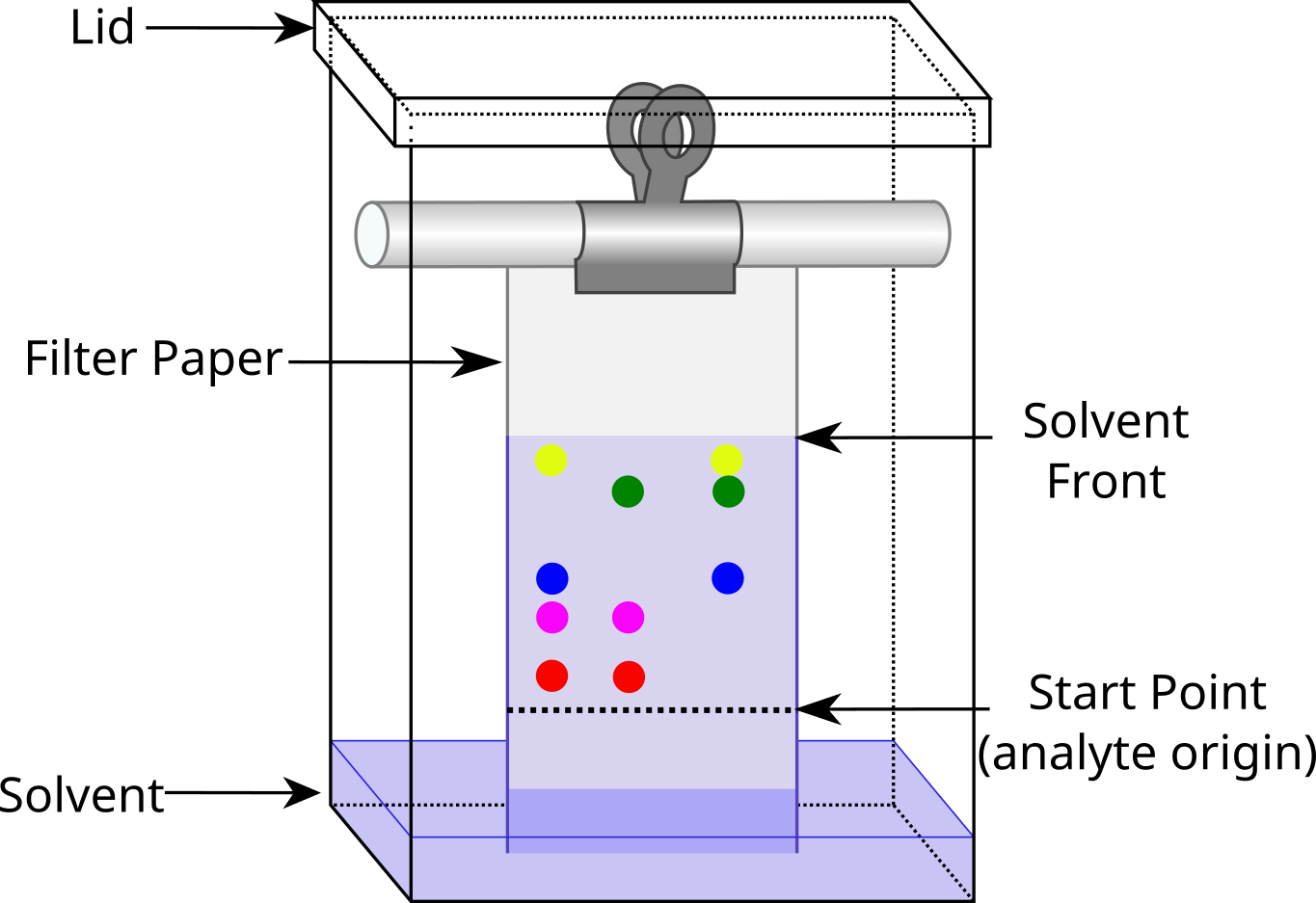
Chromatography Chromatography is a collective term for a set of analytical techniques used to separate mixtures. Chroma means color and graph means to write or draw. Paper chromatography is an analytical technique used to separate mixtures of chemicals (sometimes colored pigments) using a partitioning method. The paper in this method is called the stationary phase because it does not move and serves as a substrate or surface for the separation. Analytes (substances being analyzed) are separated from each other based on a differential affinity to a solvent. The solvent dissolves and carries the analytes along the matrix of the stationary phase. Since the solvent moves through a wicking action, it is called the mobile phase.
The distance that the analyte migrates along the paper related to the total distance that the solvent or mobile phase moves is called the Retention Factor or RF.
Are the food colorings used in colored candy the same as the the FD&C approved chemicals? How many colored spots do you expect to see for each reference standard?
1. Obtain a 25 cm square piece of chromatography paper that will fit into the beaker that will serve as the chromatography chamber.
2. Draw a pencil line across the lower end of the chromatography paper about 2 cm from the bottom.
3. Draw additional vertical tick marks along this line every 2 cm 4. Place colored candy in a flask with 2 ml ethanol until the color dissolves into the solution 5. Using an applicator, create a very small spot on a tick mark and allow to dry 6. repeat application on the spot to make a very small and dark spot
Jeremy Seto [email protected]
Credit: Theresa Knott [CC BY-SA 3.0 or GFDL]
Solvent Front
Start Point (analyte origin)
Solvent
Filter Paper
Lid
https://openlab.citytech.cuny.edu/bio-oer/chemistry/chromatography/
7. Continue to spot reference standards along other tick marks. These reference standards are food coloring.
8. Place approximately 1 cm of mobile phase solution (a very polar salt water solution) into the beaker
9. Roll the filter paper into a cylinder and fix with staples
10. place cylinder into the beaker and cover for 20 minutes or until the mobile phase reaches 2 cm from the top of the paper.
11. Mark the final distance of the mobile phase and dry the filter 12. Measure the distance of each spot from the starting point
1. Each spot is a separate analyte. 2. Some spots separate into multiple analytes. 3. Measure EACH one
13.Measure the distance from the starting point to the final point that the solvent reached. 14.Calculate RF values and tabulate results.
Jeremy Seto [email protected]
https://openlab.citytech.cuny.edu/bio-oer/chemistry/chromatography/
Table of Reference Standards Table of Unknowns
Reflect 1. Compare and average the RF values of each analyte across the entire class 2. Did you predict the number of spots that would appear from each analyte (reference or
candy)? 3. Assuming all the dye molecules are of the same mass, what influenced the migration patterns
of each spot? 4. Were the colors used in the candy the same as the references? 5. What does it mean if the candy color didn't match anything from the food colors from the cake
decorating set used as references?
Jeremy Seto [email protected]
- The Metric System
- International System of Units
- Metric Units:
- Strategy for conversions
- Factoring Out
- Additional Resources
- ACCURACY and PRECISION
- Chromatography
- Are the food colorings used in colored candy the same as the the FD&C approved chemicals?
- Table of Reference Standards Table of Unknowns
- Reflect