


Chapter 15 Discussions
 tigers2019_
 supreme-court-upholds-daca-in-blow-to-trump-administration.html
- Open Navigation Menu
-

- NPR Shop
- Home
- News Expand/collapse submenu for News
- Arts & Life Expand/collapse submenu for Arts & Life
- Music Expand/collapse submenu for Music
- Shows & Podcasts Expand/collapse submenu for Shows & Podcasts Daily Featured
- Search
- NPR Shop
 Morning Edition
 Weekend Edition Saturday
 Weekend Edition Sunday
 All Things Considered
 Fresh Air
 Up First
 Louder Than A Riot
 Throughline
 The NPR Politics Podcast
 Up First
-


- Tiny Desk
- All Songs Considered
- We Insist: A Timeline Of Protest Music In 2020
- Music News
- New Music
- Music Features
- Live Sessions
Supreme Court Rules For DREAMers, Against Trump
Listen · 4:49 4:49 Toggle more options- Download
- Embed Embed <iframe src="https://www.npr.org/player/embed/829858289/881646491" width="100%" height="290" frameborder="0" scrolling="no" title="NPR embedded audio player">
Law
Supreme Court Rules For DREAMers, Against Trump
 Facebook
Twitter
Facebook
Twitter
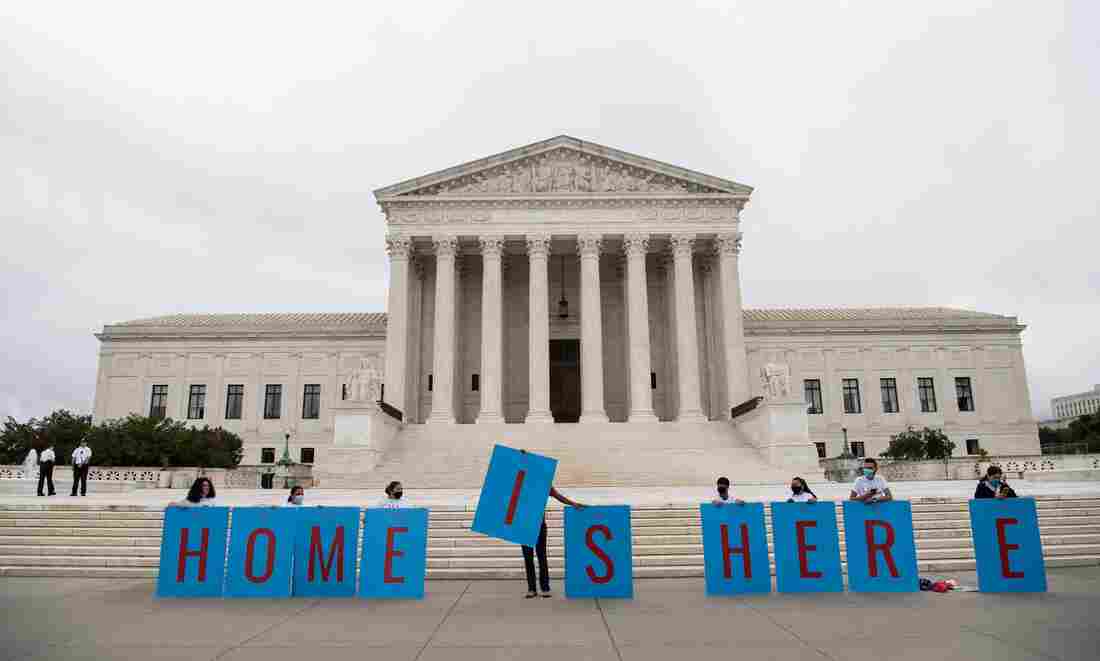 Enlarge this image
Activists demonstrate in front of the Supreme Court in Washington, D.C., on Thursday as the court rejected the Trump administration's move to rescind the Deferred Action for Childhood Arrivals program. Nicholas Kamm/AFP via Getty Images hide caption
toggle caption Nicholas Kamm/AFP via Getty ImagesActivists demonstrate in front of the Supreme Court in Washington, D.C., on Thursday as the court rejected the Trump administration's move to rescind the Deferred Action for Childhood Arrivals program.
Nicholas Kamm/AFP via Getty ImagesUpdated at 6:35 p.m. ET
Supreme Court Rules For DREAMers, Against Trump
Listen · 4:49 4:49 Toggle more options- Download
- Embed Embed <iframe src="https://www.npr.org/player/embed/829858289/881646491" width="100%" height="290" frameborder="0" scrolling="no" title="NPR embedded audio player">
In a major rebuke to President Trump, the U.S. Supreme Court has blocked the administration's plan to dismantle an Obama-era program that has protected 700,000 so-called DREAMers from deportation. The vote was 5-4, with Chief Justice John Roberts writing the opinion.
Under the Obama program, qualified individuals brought to the U.S. as children were given temporary legal status if they graduated from high school or were honorably discharged from the military, and if they passed a background check. Just months after taking office, Trump moved to revoke the program, only to be blocked by lower courts — and now the Supreme Court.
Roberts' opinion for the court was a narrow but powerful rejection of the way the Trump administration went about trying to abolish the program known as Deferred Action for Childhood Arrivals, or DACA.
"We do not decide whether DACA or its rescission are sound policies," Roberts wrote. "The wisdom of those decisions is none of our concern. Here we address only whether the Administration complied with the procedural requirements in the law that insist on 'a reasoned explanation for its action.' "

National
The Original DREAMer Recalls 'All Pervasive' Fear As An Undocumented Child
National
The Original 'Dreamer' Comments On Supreme Court's DACA Decision
The Original 'Dreamer' Comments On Supreme Court's DACA Decision
Listen · 5:22 5:22 Toggle more options- Download
- Embed Embed <iframe src="https://www.npr.org/player/embed/880513704/880513705" width="100%" height="290" frameborder="0" scrolling="no" title="NPR embedded audio player">
- Transcript
In 2017, then-Attorney General Jeff Sessions simply declared DACA illegal and unconstitutional. "Such an open-ended circumvention of immigration laws was an unconstitutional exercise of authority by the executive branch," he said at the time. Sessions argued that the program should be rescinded because he said it was unlawful from the start.
But, as Roberts observed, the attorney general offered no detailed justifications for canceling DACA. Nor did the acting secretary of homeland security at the time, Elaine Duke, who put out a memo announcing the rescission of DACA that relied entirely on Sessions' opinion that the program was unlawful.
As Roberts noted, Duke's memo didn't address the fact that thousands of young people had come to rely on the program, emerging from the shadows to enroll in degree programs, embark on careers, start businesses, buy homes and even marry and have 200,000 children of their own who are U.S. citizens, not to mention that DACA recipients pay $60 billion in taxes each year.

