


PSY 200/SOC 200: Social Psychology//Social Psychology
 castroana
 ResearchonConformitytextexcerpt.html
The typical outcome of social influence is that our beliefs and behaviors become more similar to those of others around us. At times this change occurs in a spontaneous and automatic sense, without any obvious intent of one person to change the other. Perhaps you learned to like jazz or rap music because your roommate was playing a lot of it. You didn’t really want to like the music, and your roommate didn’t force it on you—your preferences changed in passive way. Robert Cialdini and his colleagues (Cialdini, Reno, & Kallgren, 1990) found that college students were more likely to throw litter on the ground when they had just seen another person throw some paper on the ground and were least likely to litter when they had just seen another person pick up and throw paper into a trash can. The researchers interpreted this as a kind of spontaneous conformity—a tendency to follow the behavior of others, often entirely out of our awareness. Even our emotional states become more similar to those we spend more time with (Anderson, Keltner, & John, 2003).
Informational Conformity: Conforming to Be Accurate
Although mimicry represents the more subtle side, conformity also occurs in a more active and thoughtful sense, for instance, when we actively look to our friends’ opinions to determine appropriate behavior, when a car salesperson attempts to make a sale, or even when a powerful dictator uses physical aggression to force the people in his country to engage in the behaviors that he desires. In these cases, the influence is obvious. We know we are being influenced and we may attempt—sometimes successfully, and sometimes less so—to counteract the pressure.
Influence sometimes occurs because we believe that other people have valid knowledge about an opinion or issue, and we use that information to help us make good decisions. When we take our winter coat to school because the weatherman says it’s going to be cold, this is because we think that the weatherman has some good information that we can use. Informational conformity is the change in opinions or behavior that occurs when we conform to people whom we believe have accurate information. We base our beliefs on those presented to us by reporters, scientists, doctors, and lawyers because we believe they have more expertise in certain fields than we have. But we also use our friends and colleagues for information; when we choose a prom gown on the basis of our friends’ advice about what looks good on us, we are using informational conformity—we believe that our friends have good judgment about the things that matter to us.
Informational conformity is often the end result of social comparison, the process of comparing our opinions with those of others to gain an accurate appraisal of the validity of an opinion or behavior (Festinger, Schachter, & Back, 1950; Hardin & Higgins, 1996; Turner, 1991). Informational conformity lead to real, long-lasting, changes in beliefs. The result of informational influence is normally private acceptance: real change in opinions on the part of the individual. We believe that taking the winter coat was the right thing to do and that the prom gown really looks good on us.
Normative Conformity: Conforming to Be Liked and to Avoid Rejection
In other cases we conform not because we want to have valid knowledge but rather to meet the goal of belonging to and being accepted by a group that we care about (Deutsch & Gerard, 1955). When we start smoking cigarettes or buy shoes that we cannot really afford in order to impress others, we do these things not so much because we think they are the right things to do but rather because we want to be liked.
Normative conformity occurs when we express opinions or behave in ways that help us to be accepted or that keep us from being isolated or rejected by others. When we engage in normative conformity we conform to social norms—socially accepted beliefs about what we do or should do in particular social contexts (Cialdini, 1993; Sherif, 1936; Sumner, 1906).
In contrast to informational conformity, in which the attitudes or opinions of the individual change to match that of the influencers, the outcome of normative conformity often represents public conformity rather than private acceptance. Public conformity is a superficial change in behavior (including the public expression of opinions) that is not accompanied by an actual change in one’s private opinion. Conformity may appear in our public behavior even though we may believe something completely different in private. We may obey the speed limit or wear a uniform to our job (behavior) to conform to social norms and requirements, even though we may not necessarily believe that it is appropriate to do so (opinion). We may use drugs with our friends without really wanting to, and without believing it is really right, because our friends are all using drugs. However, behaviors that are originally performed out of a desire to be accepted (normative conformity) may frequently produce changes in beliefs to match them, and the result becomes private acceptance. Perhaps you know someone who started smoking to please his friends but soon convinced himself that it was an acceptable thing to do.
Although in some cases conformity may be purely informational or purely normative, in most cases the goals of being accurate and being accepted go hand-in-hand, and therefore informational and normative conformity often occur at the same time. When soldiers obey their commanding officers, they probably do it both because others are doing it (normative conformity) and because they think it is the right thing to do (informational conformity). It has been argued that the distinction between informational and normative conformity is more apparent than real and that it may not be possible to fully differentiate them (Turner, 1991).
Majority Influence: Conforming to the Group
Although conformity occurs whenever group members change their opinions or behaviors as a result of their perceptions of others, we can divide such influence into two types. Majority influence occurs when the beliefs held by the larger number of individuals in the current social group prevail. In contrast, minority influence occurs when the beliefs held by the smaller number of individuals in the current social group prevail. Not surprisingly, majority influence is more common, and we will consider it first.
In a series of important studies on conformity, Muzafer Sherif (1936) used a perceptual phenomenon known as the autokinetic effect to study the outcomes of conformity on the development of group norms. The autokinetic effect is caused by the rapid, small movements of our eyes that occur as we view objects and that allow us to focus on stimuli in our environment. However, when individuals are placed in a dark room that contains only a single, small, stationary pinpoint of light, these eye movements produce an unusual effect for the perceiver—they make the point of light appear to move.
Sherif took advantage of this effect to study how group norms develop in ambiguous situations. In his studies, college students were placed in a dark room with the point of light and were asked to indicate, each time the light was turned on, how much it appeared to move. Some participants first made their judgments alone. Sherif found that although each participant who was tested alone made estimates that were within a relatively narrow range (as if they had their own “individual” norm), there were wide variations in the size of these judgments among the different participants he studied.
When Solomon Asch (Asch, 1952, 1955) heard about Sherif’s studies, he responded in perhaps the same way that you might have: “Well of course people conformed in this situation, because after all the right answer was very unclear,” you might have thought. Since the study participants didn’t know the right answer (or indeed the “right” answer was no movement at all), it is perhaps not that surprising that people conformed to the beliefs of others.
Asch conducted studies in which, in complete contrast to the autokinetic effect experiments of Sherif, the correct answers to the judgments were entirely unambiguous. In these studies, the research participants were male college students who were told that they were to be participating in a test of visual abilities. The men were seated in a small semicircle in front of a board that displayed the visual stimuli that they were going to judge. The men were told that there would be 18 trials during the experiment, and on each trial they would see two cards. The standard card had a single line that was to be judged. And the test card had three lines that varied in length between about 2 and 10 inches:
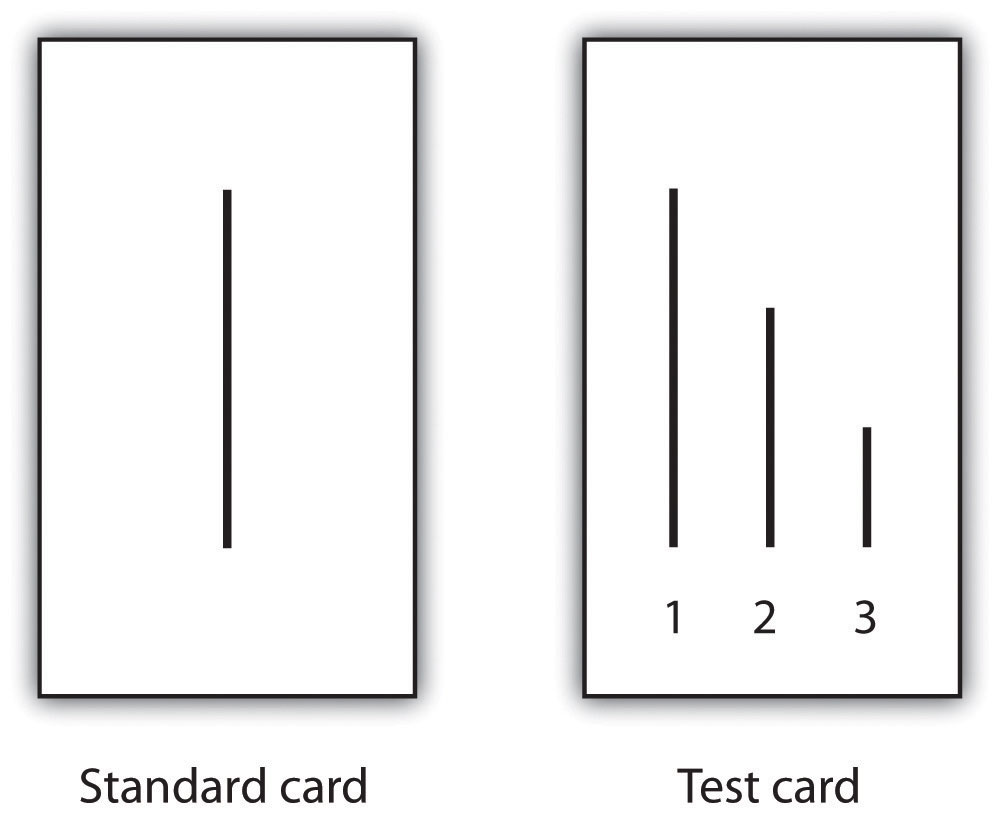
The men’s task was simply to indicate which line on the test card was the same length as the line on the standard card. As you can see from the Asch card sample above, there is no question that correct answer is line 1. In fact, Asch found that people made virtually no errors on the task when they made their judgments alone.
On each trial, the each person answered out loud, beginning with one end of the semicircle and moving to the other end. Although the participant did not know it, the other group members were not true participants but experimental confederates who gave predetermined answers on each trial. Because the participant was seated next to last in the row, he always made his judgment after most of the other group members made theirs. Although on the first two trials the confederates each gave the correct answer, on the third trial, and on 11 of the subsequent trials, they all had been instructed to give the same incorrect answer. For instance, even though the correct answer was Line 1, they would all say it was Line 2. Thus when it became the participant’s turn to answer, he could either give the clearly correct answer or conform to the incorrect responses of the confederates.
Asch found that about 76% of the 123 men who were tested gave at least one incorrect response when it was their turn, and 37% of the responses, overall, were conforming. This is indeed evidence for the power of conformity because the research participants were giving clearly incorrect answers out loud. However, conformity was not absolute—in addition to the 24% of the men who never conformed, only 5% of the men conformed on all 12 of the critical trials.
You might think that Asch’s study shows primarily normative conformity, in the sense that the participants gave the wrong answer not because they thought it was correct but because they wanted to avoid being seen as different. But is it not possible that the participants were also a bit unsure of the correct answer? When I look at the picture of one of the participants in Asch’s studies (see Figure 7.3 “Participants in the Asch Line-Judging Experiment”), it looks to me like he is really unsure about what he is seeing. Perhaps, then, even in Asch’s study some informational influence is occurring. Maybe the participants became unsure of their responses and used the opinions of others to help them determine what was correct. Normative and informational conformity often operate together.

