


1000 word essay due tonight 11:00pm eastern time
 rshem
rshem MughalEmpire.html.zip
Units/Unit 2/Mughal Empire.html
2: Intellectual Change from the 15th to 17th Century
The Mughal Empire
The Mughal Empire
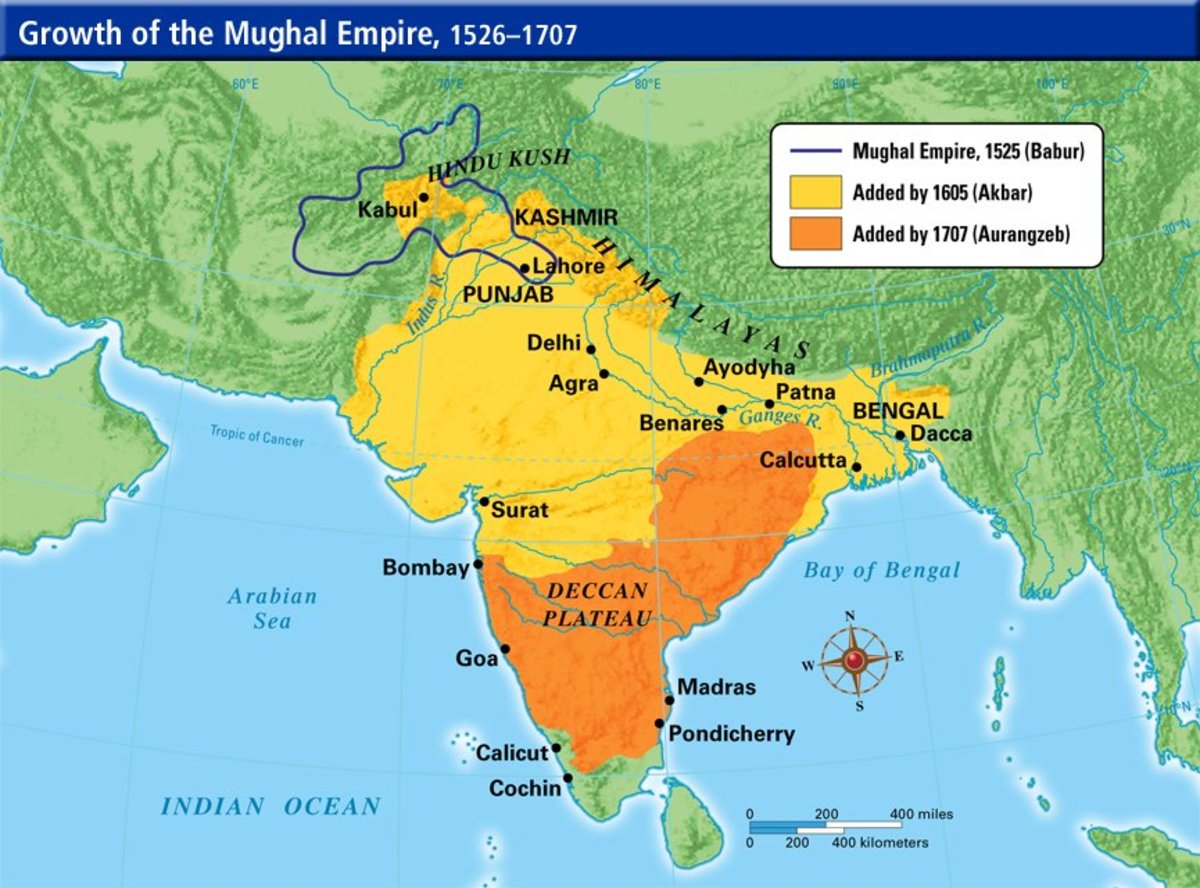
One final Islamic empire, this one even further east, also needs to be discussed. We discussed the founding of the Mughal Empire by Babur in Unit 1, but we should discuss their expansion efforts as they relate to the other empires in the Islamic World. The Mughal rulers were Sunni Muslims like the Ottomans. Babur had been an exceptional military strategist and fighter, but he was not as adept as a ruler, and he struggled to govern effectively and build a strong government during his few years in power. In 1530, he became ill and died, leaving his newly formed kingdom to his son. As we've seen happen in other kingdoms and empires, a dynastic dispute ensued that was not really settled until the ascension of Babur's grandson Akbar in 1556. Like other Muslim rulers that we've discussed, Akbar (1556-1605) took the throne at the young age of thirteen. It was expected that he would be a weak ruler since he was so young, but he quickly silenced his rivals and laid a foundation for a lasting empire in the region. Akbar proved to be an excellent military leader, but he also had a vision for uniting India during his reign. He personally oversaw the reorganization of both the military and the bureaucracy, building what would become the basis of the empire for years to come. He was also a patron of the arts and, though illiterate, became well-educated by having others read to him.
Beginning in the 1560s, Akbar was able to expand the boundaries of his territory through military conquest, but it was his social and administrative policies that made his rule successful. Akbar was what we would call an "Enlightened Ruler" and he was much more progressive than other rulers during this period. Chief among his aims was a policy of reconciliation and cooperation with the Hindu majority in his empire, including the Hindu amirs or princes. For example, instead of using slaves, like the Ottoman Empire, he used the services of the royal amirs and the mansabars, who were warrior aristocrats, and appointed many to high positions within his administration. The status of women also improved under Akbar. Sati was banned under his rule. Sati was an Indian funeral custom where a widow immolated herself on her husband's funeral pyre and was burned alive after the pyre was set ablaze. If she did not die that way, she was expected to commit suicide in another fashion shortly after her husband's death. Market days for women were established. Although a Muslim, Akbar married a Hindu princess and celebrated Hindu holidays.
Previous Islamic kingdoms had been established in India and the Hindus had not forgotten the persecution they faced from Muslims. To try to repair the relationship between the two groups, Akbar encouraged intermarriage between the Mughal nobles and the Hindu leaders, and he ordered Muslims to respect cows, which Hindus held as sacred. He pursued a policy of religious toleration, but he hoped for more. He ruled with universal tolerance and included everyone in his government regardless of their religion. In 1564, he abolished the jizyah, which was the per capita tax levied on non-Muslim subjects. Though this religious unity never materialized, the Mughal Empire prospered economically and politically during Akbar's reign. He succeeded in not only unifying the vast Mughal state, but he was able to preserve peace and order in a religiously and culturally diverse empire with liberal and tolerant policies that won him the support of his non-Muslim subjects.
As a result, Perso-Islamic culture began to merge and blend with indigenous Indian elements, which led to the development of a distinct Indo-Persian culture that was represented through art, literature, and architecture. During his rule, the Mughal empire tripled in size and wealth. In fact, the foundation Akbar established provided stability for the Mughal Empire for more than a century. It was not until after the death of his great-grandson in 1707 that major problems began to emerge for the Mughal rulers. This will be discussed in Unit 3.


