Discussion on service oriented architecture (SOA)
 spluousp
 Module4SOApost1.docx
by Abhinav Kumar Vuppala
Hello Class,
The most essential element regarding SOA to the company is the standardized software that clearly defines the integration and usage of business operations while ensuring security and democracy. Almost all of the company chooses SOA because such services could be used again to build several applications and each service offers a standardized tool accessible to everyone, encourages company interoperability and is easy to manage, change and upgrade without impacting any services (Alkkiomäki 2016). The SOA facilities are open to anyone else on request, in businesses SOA enables the systems to operate on various servers, this improves the interoperability and also enables companies to minimize the degree of contact with all customers and systems by using a common communication protocol.
Link to image 1: https://www.wovenware.com/blog/2014/05/how-to-establish-soa-governance-in-your-organization/#.XoTyo9IzbIU
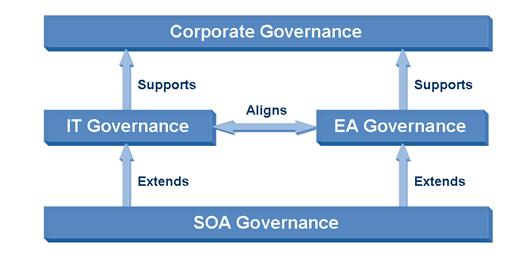
This the picture represents SOA Governance from an online article by The image describes SOA Governance characteristics as described by Carlos, it is a method of placing together all the supportive factors for a company including manufacturing, management, and service handling that minimize the existence of any operational risk. Risk Register, Process Register, SOA Software, Observing Capabilities, Quality Control, Centralized Management of Security, Capabilities of auditing, and continual improvement are all attributes listed hereunder SOA.
Link to the image 2- https://www.techaffinity.com/blog/service-oriented-architecture-soa/
The second picture demonstrates how well the links amid the service users and the service providers are made via the internet services and describe that the services will be accessed & used from any computer or device via a web services and mentions that the PaaS (Platform as a service) might be utilized for extra functions, and the entire information is stored in the application software and provided as data as a service established in the cloud.
Link to image 3- https://www.opengroup.org/soa/source-book/togaf/i12-2.jpg
Image 3: In this diagram, SOA service providers sign up their services in a shared a platform such that clients can utilize the facility that meets specific criteria and offers the customer an endpoint address for the provider (Alkkiomäki 2016).
To explain the non-technical manager about SOA I prefer to choose image 1 as it clearly explains all the characteristics of SOA governance in a clear & simple way.
References
Li, X., & Madnick, S. E. (2015). Understanding the Dynamics of Service-Oriented Architecture Implementation. Journal of Management Information Systems, 32(2), 104–133. https://doi.org/10.1080/07421222.2015.1063284
Alkkiomäki, V. (2016 ). The role of service-oriented architecture as a part of the business model. International Journal of Business Information Systems, 21(3), 368-387. doi:10.1504/IJBIS.2016.074764