


Assign to AllRoundBest Tutor
 hocdoetvay
 L.B.docx
This week you will read and learn about architectural influences from Ancient Greece and the Roman Empire. What are some of the main features of these architectural styles? Use examples from the text or the digital fieldtrip archives to help support your answer. Please remember to provide images and citations to help illustrate your points.
From student: L. B.
Dear Professor and Peers,
One of the most beautiful elements of Greek architecture that is still used today is columns. They are used inside and outside of homes and other structures and often represent a wealth due to the ornamental costs entailed in making them. The columns are styled after the Classical Orders (Sayre, 2013). The columns are said to not just be ornamental but to serve structural purposes as well. Typically, columns would have a base, a shaft, and a capital. The base supports the shaft and the capital, or top, of the column, would have the load-bearing functions. The capital would typically be the ornamental design piece of the structure.
Masonry of all types was used for Ancient Greek buildings, including rubble, but the finest ashlar masonry was usually employed for temple walls, in regular courses and large sizes to minimize the joints. The blocks were roughhewn and hauled from quarries to be cut and bedded very precisely, with mortar hardly ever being used (Fazio, 2003). This being said, it is a natural wonder how they stood so sturdy for so many years. Even buried they still maintained so much of their integrity. If you were to watch today's process in creating columns it would almost definitely include a mold, heavy hauling equipment, and possibly cranes of some sort. To think they were able to accomplish these beautiful creations without today’s technology is mind-boggling.
One of the most famous ancient creations with columns was The Parthenon. Falling under the Doric order, it is characterized by a plain, unadorned column capital and a column that rests directly on the stylobate of the temple without a base (Khan Academy, 2019). To think that columns such as that, tall and thin to today’s standards of support, is impossible to believe.
https://cdn.kastatic.org/ka-perseus-images/7a21688ad2ee2f79ff49b5c337118be177d021fd.jpg
One of the most beautiful, in my opinion, still standing structures would have to be the New York Public Library. I haven’t been there before, but it is definitely on my bucket list. With its beautiful sculptures and columns, it is art in itself.
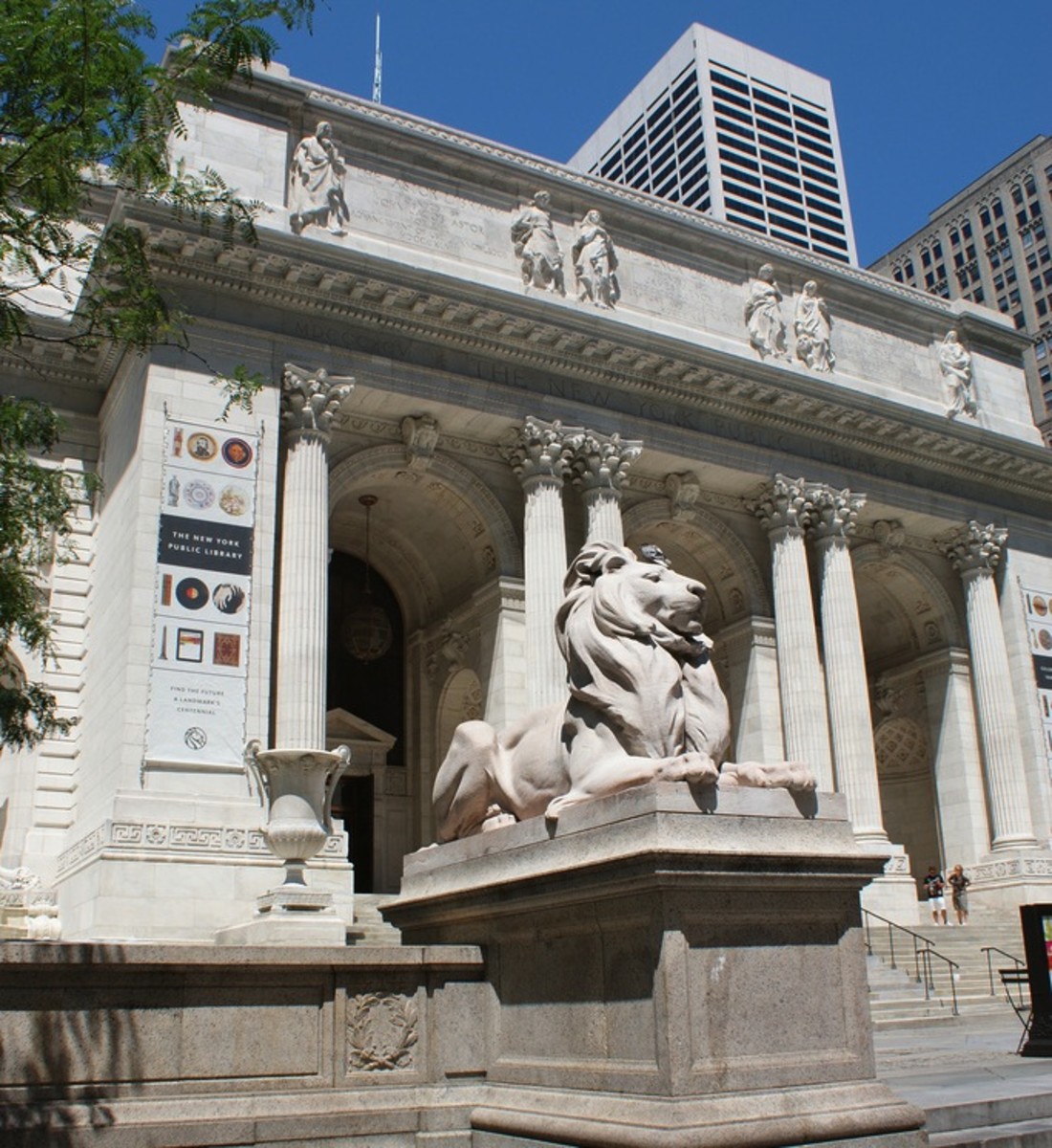
I’m looking forward to discovering new information by reading your posts and writing my paper. Have a good week everyone.
John Boardman, Jose Dorig, Werner Fuchs and Max Hirmer, ‘’The Art and Architecture of Ancient Greece’’, Thames and Hudson, London (1967)
Becker, J. A., Dr. (n.d.). Greek architectural orders. Retrieved July 17, 2019, from https://www.khanacademy.org/humanities/art-history-basics/tools-understanding-art/a/greek-architectural-orders (Links to an external site.)
Marian Moffett, Michael Fazio, Lawrence Wodehouse, A World History of Architecture, Lawrence King Publishing, (2003), ISBN 1-85669-353-8.
Sayre, H. M. (2013). Discovering the humanities (2nd ed.). Upper Saddle River: Prentice Hall.

