HUM-200-Page5.2.1-BehindtheScenesofaPainting.pdf
Applied Humanities
Choices Behind the Scenes of a Painting 5 Module Five: Impact of the Humanities / Page 5.2.1 Behind the Scenes of a Painting On this page: 0 of 8 attempted (0%) | 0 of 6 correct (0%) Objective: Explore an artist’s explanation of what he does and why.
YouTube video. https://youtu.be/13KGlabG0pA. Uploaded September 15, 2016, by Soomo Publishing. To activate captions, first click the play button and then click the CC
button in the embedded player. For a text transcript, follow the link below.
Read Text Transcript
Multiple-Choice Question
According to Tim Rollins, if you don’t have questions when you look at a painting, which of the following is true?
The painting is finished. You’re not looking hard enough. There’s something wrong with you. There’s something wrong with the work of art.
Behind the Scenes of a Painting: Part OneBehind the Scenes of a Painting: Part One
Multiple-Choice Question
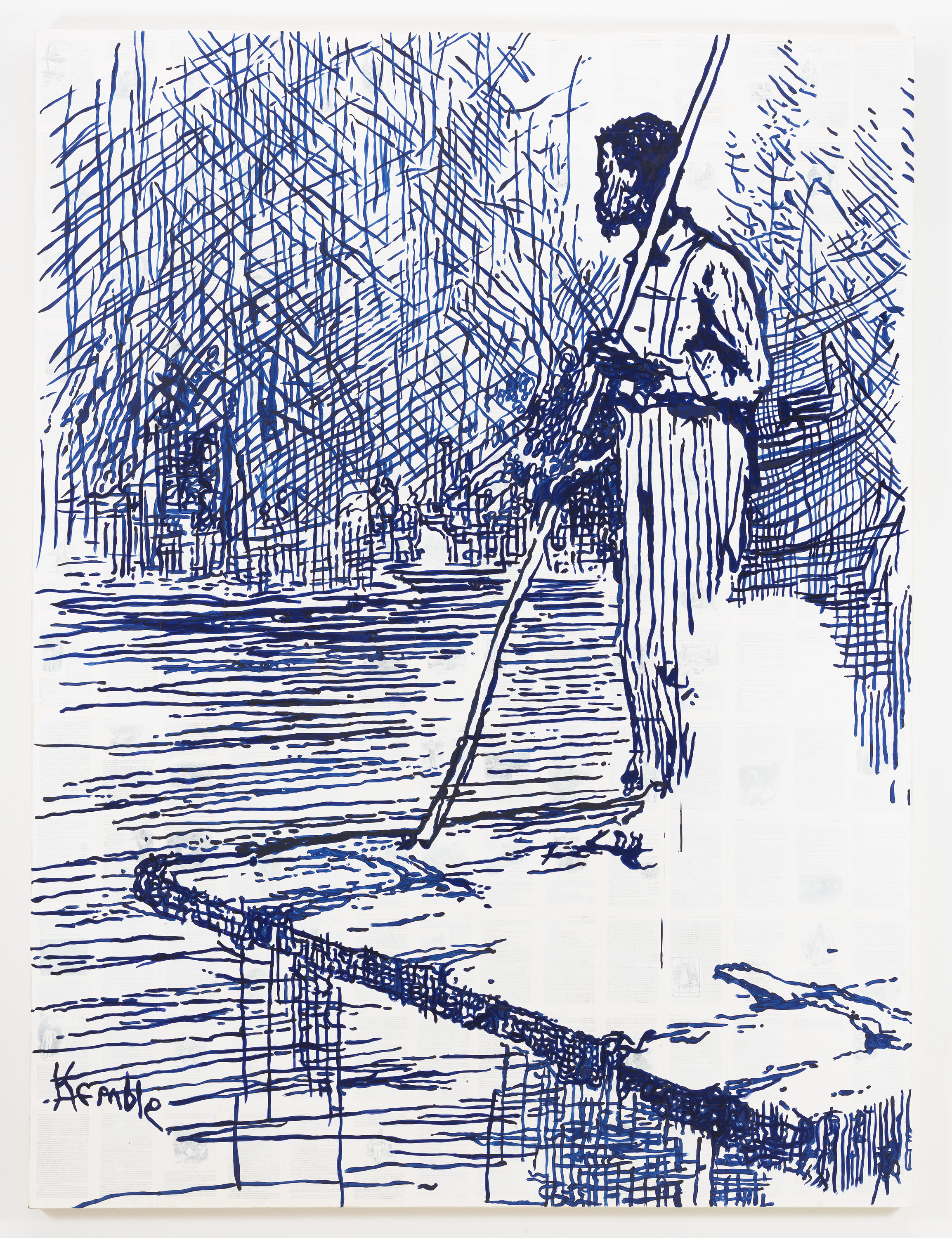
Why is Huckleberry Finn left out of this illustration? Choose the BEST answer.
because Huck was racist to help us see the story as really being about Jim to get us to ask who Huck was to emphasize that by this point in the story, Huck was invisible
Multiple-Choice Question
From a distance, this painting looks like blue on white. What is under that white background?
pages from the book more blue lines, but dimmed by the white the first two attempts at this painting wood paneling
Multiple-Choice Question
Why does Tim Rollins say they chose to reproduce and enlarge an illustration they saw as racist?
to call attention to 19th-century racist illustrations to reposition it as an expression of their perspective to strengthen racist attitudes today to remind us of America’s history of racism
Response Board Tim Rollins says that this was the third attempt at this painting because the first two “didn’t feel right.” What can you think of in your life that you’ve redone because it just “didn’t feel right?”
Share your thoughts with your peers...
No response saved yet.
YouTube video. https://youtu.be/R1vazdGfIcI. Uploaded September 23, 2016, by Soomo Publishing. To activate captions, first click the play button and then click the CC button
in the embedded player. For a text transcript, follow the link below.
Read Text Transcript
Multiple-Choice Question
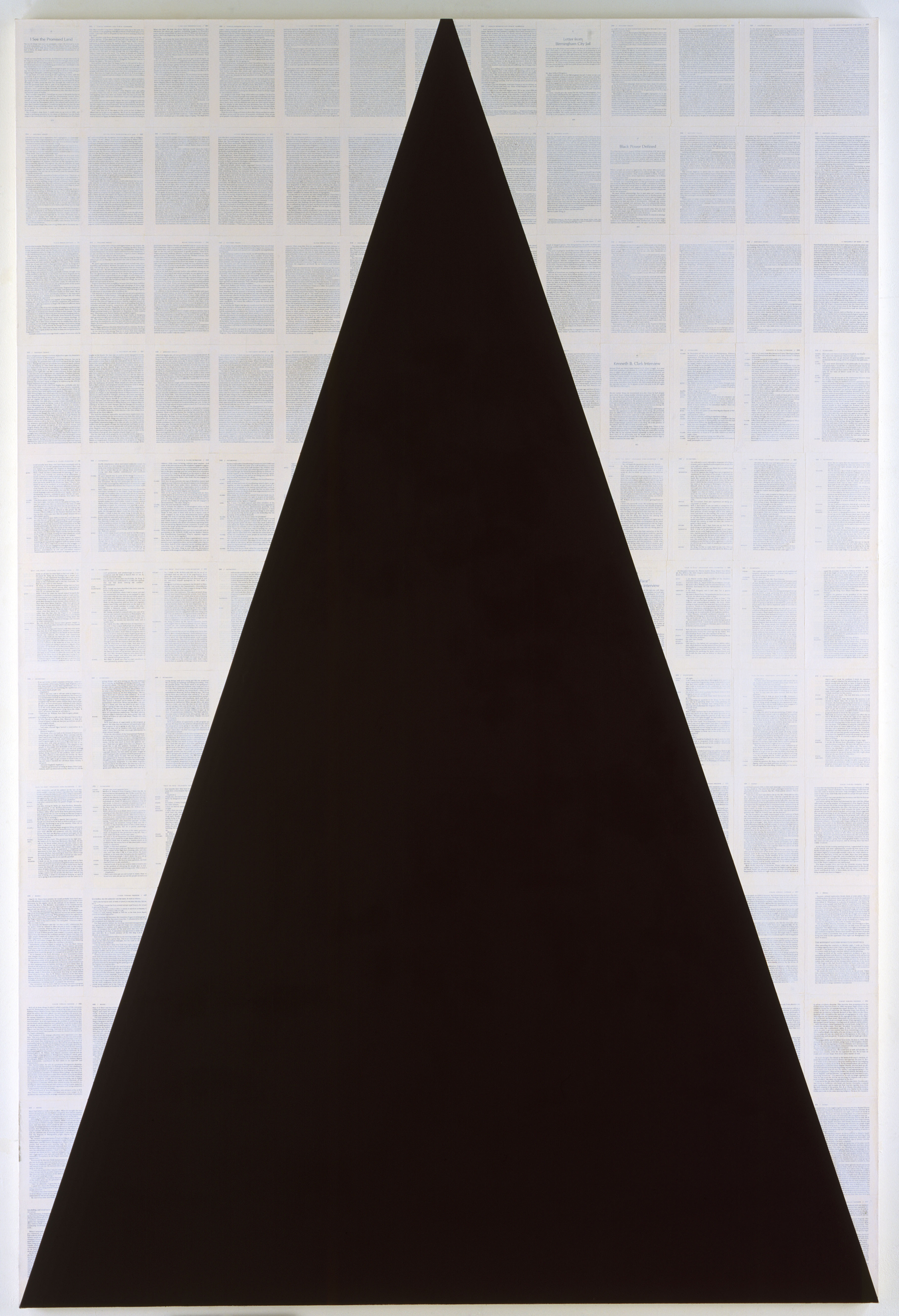
The most prominent element of this painting is the triangle. Why is it included?
This is a misleading question because the shape isn’t important. because this series was based around geometric shapes because the triangle was prominent in Dr. King’s writing and speaking because the up-pointing triangle is inherently optimistic
Multiple-Choice Question
Tim Rollins says art changes the world by doing what?
changing the mentalities of people who then change the world giving us better answers to our deepest questions
Part Two: Behind the Scenes of a PaintingPart Two: Behind the Scenes of a Painting
being memorable; you can’t unsee it providing the iconography of social movements
I See the Promised Land (after the Rev. Dr. M. L. King, Jr.)
This is a painting of a tall black triangle surrounded by small grey rectangles and a lighter grey background.
I See the Promised Land (after the Rev. Dr. M. L. King, Jr.) by Tim Rollins and K.O.S. Matte acrylic and book pages on canvas, 2008. 9′ × 6′.
Click to enlarge
Courtesy of Studio K.O.S., Lehmann Maupin, New York and Hong Kong
Tim Rollins and K.O.S.
I See the Promised Land (after the Rev. Dr. M. L. King, Jr.), 2008
Era/Culture/Movement: Contemporary American
Medium: matte acrylic and book pages on canvas
Dimensions: 9′ × 6′
Location: Lehmann Maupin, New York
Adventures of Huckleberry Finn - On the Raft (after Mark Twain)
This is a black and white line painting of the character Jim from the story The Adventures of Huckleberry Finn on a raft on a river. The background is made indistinct by cross- hatched lines. Jim is an African-American youth wearing striped pants and a plaid shirt. He is holding a pole in both hands.
Adventures of Huckleberry Finn - On the Raft (after Mark Twain) by Tim Rollins and K.O.S. Matte acrylic and book pages on canvas, 2011. 8′ × 6′ × 1.5″.
Click to enlarge
Courtesy of Studio K.O.S., Lehmann Maupin, New York and Hong Kong
Tim Rollins and K.O.S.
Adventures of Huckleberry Finn - On the Raft (after Mark Twain), 2011
Era/Culture/Movement: Contemporary American
Medium: matte acrylic and book pages on canvas
Dimensions: 8′ × 6′ × 1.5″
Location: Lehmann Maupin, New York
Response Board
Please share a time when some kind of art (song, movie, play, etc.) changed the way you thought about some situation or perspective.
No response saved yet.
close
Share your thoughts with your peers...