HUM-200-Page5.1.5-WhatIsItaPictureOf_.pdf
Applied Humanities
What Is Art? What Is It a Picture Of? By James Romaine 5 Module Five: Impact of the Humanities / Page 5.1.5 What Is It a Picture Of? On this page: 0 of 3 attempted (0%) Objective: Understand how minor differences can have major effects on the meaning of an image.
Van Gogh’s Copies and Compositions
In the fall of 1889, Vincent van Gogh began to make painted copies of works by artists he admired, including Rembrandt van Rijn, Eugène Delacroix, and Jean-François Millet. There are many reasons Van Gogh may have decided to do this. For one, in an age before color photography, color reproductions had to be made by hand; throughout art history, artists have made copies of each other’s works as a form of homage or in an attempt to identify with the tradition established by the original artist. Furthermore, artists have long made copies of “masterpieces” in museums as a way of learning (although by the fall of 1889, Van Gogh was a mature painter who had developed his own unique artistic voice).
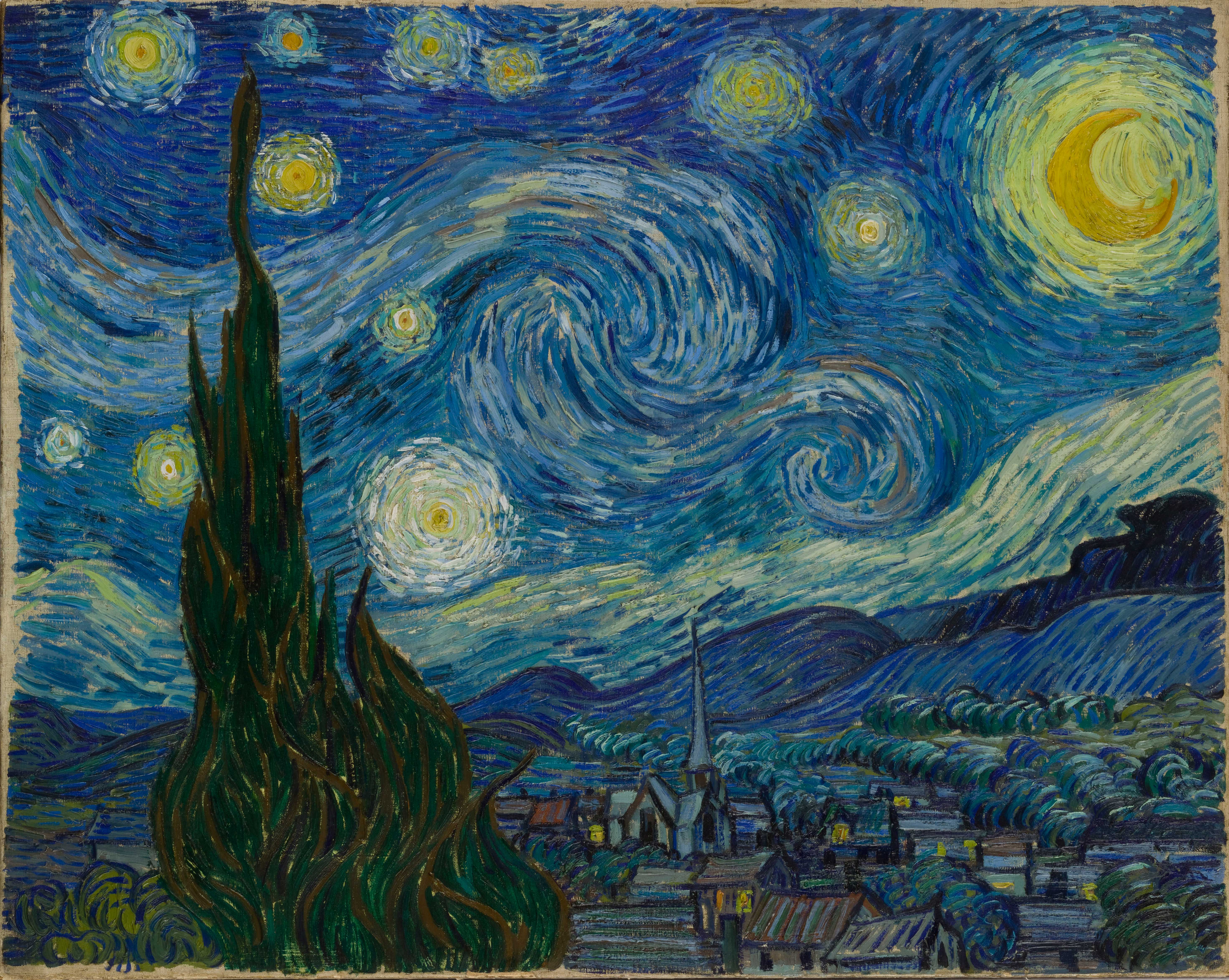
Swirls of blue and yellow make up the night sky in this oil painting. A yellow crescent moon is in the upper right corner. Venus, the morning star, is to the left of center surrounded by rings of yellow and white. Other stars are scattered among the swirls of blue, each surrounded by various sized rings of white and yellow. Under the sky is a village with its church and steeple centered and prominent. Mountains undulate in the background. The mountains are darker shades of blue. In the village, windows in various locations have lights in their windows. There is a green cypress tree in the left foreground reaching almost to the top of the painting.
The Starry Night by Vincent van Gogh. Oil on canvas, 1889. 2′ 5″ × 3′ 0.25″.
Click to enlarge
Digital Image © The Museum of Modern Art/Licensed by SCALA/Art Resource, NY
In works such as The Starry Night, we see a visual language of unmixed colors, often applied to establish visual contrast (most prominently yellows next to blues, colors that are nearly opposite on the color wheel). His brush marks are vigorous and expressive. In fact, the previous 18 months (between February of 1888, when Van Gogh left Paris for the south of France, and the fall of 1889) had been the most artistically successful period of his career. Therefore, one possible motivation for Van Gogh’s project of making creative copies may have been to test or measure his now-mature artistic method against that of some of the artists from whom he had borrowed along the way. What would it look like to repaint a work by Millet in the visual language of Vincent van Gogh? Could he make these images his own by giving new interpretations to inherited subjects?
In addition to the visual delight and historical intrigue that these copies provide, they also allow us to compare two works that depict the exact same subject but employ distinctly different visual methods. In every work of art, there is a relationship between the subject depicted and the visual language that the artist employs. This visual language is composed of elements such as color and composition, the contrast of light and shadow, balance and rhythm. In interpreting the work of art, we should not only consider the subject depicted but also pay attention to how the subject is depicted. The advantage of Van Gogh’s copies of works by Millet and Delacroix is that the subjects remain the same but the visual language, and therefore the content visualized, is changed. Looking at these works, we can ask, “How is our reading of the work shaped by the way in which the subject is depicted?”
Comparing Van Gogh’s paintings with those by Millet and Delacroix, we can see that Van Gogh made different types of modifications to his models. Whereas the copy of Millet’s work is basically unchanged compositionally, only repainted in the colors and technique of Van Gogh’s method, the two copies after Delacroix reverse the composition, creating a mirror image of the original.
First Steps
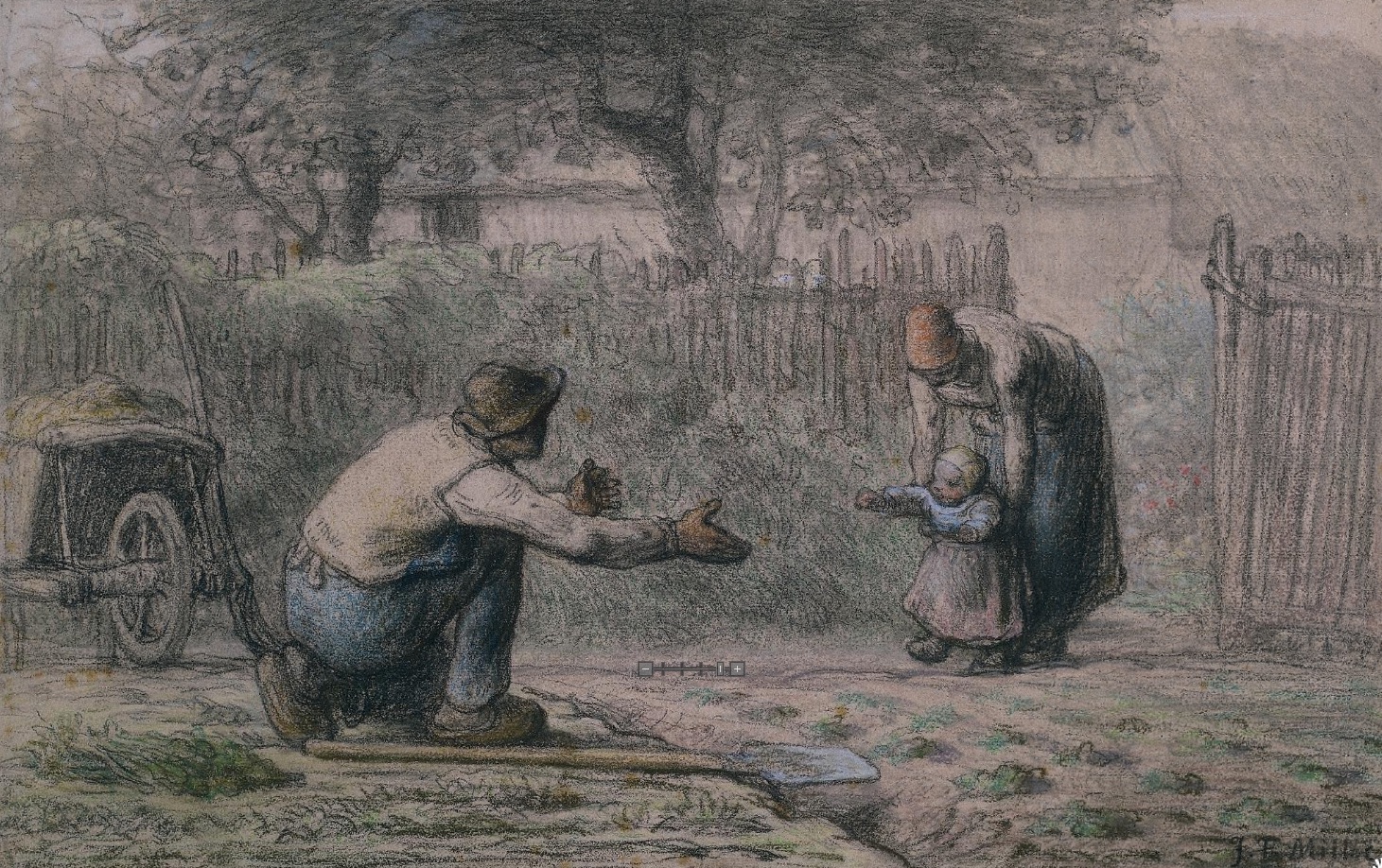
In this painting, a farmer crouches with his arms outstretched toward his baby daughter, who is attempting to walk. The daughter is being supported by the farmer’s wife, who is a few steps away and holding the baby’s arms. All three figures are out in a garden. There is a wheelbarrow behind the farmer and a shovel lying on the ground in front of him. Behind the garden there is a fence, two trees, and a cottage
First Steps by Jean-François Millet. Black chalk and pastel, ca. 1858–1866. 11.5″ × 1′ 6″. The Cleveland Museum of Art, Gift of Mrs. Thomas H. Jones, Sr. 1962.407
Click to enlarge
The Cleveland Museum of Art, Gift of Mrs. Thomas H. Jones, Sr.
Like much of his art, Jean-François Millet’s First Steps valorizes the daily life of agrarian labor. In mid-19th-century France, when art was expected to depict subjects of historical or religious importance, Millet treated everyday events as if they were just as significant.
Millet’s subject is immediately recognizable. A farmer has laid aside a shovel with which he seems to have been filling (or emptying) the wheelbarrow beside him. His wife and child have come out of the house with the exciting news that the toddler has begun to walk. The simplicity of this subject seems almost banal, and in the hands of a lesser artist than Millet it may well have been. The charm of Millet’s work can disguise the carefully constructed composition that guides the viewer’s reading of the motif.
Recognizing that in Western art we read an image from left to right, Millet situates the farmer at the left. He is a surrogate figure—that is, one with whom the viewer might
identify. We naturally read the image moving toward the mother and child. From this point, like the child, we are on our own. It is up to us to imagine, moving from right to left, the child’s walk toward the father’s open arms. Will the child make this journey without falling? Will she stumble and recover? The subtle anticipation built into this image is palpable. Through careful composition, Millet has succeeded in creating a monumental event out of a moment that would ordinarily only be of interest to its participants.
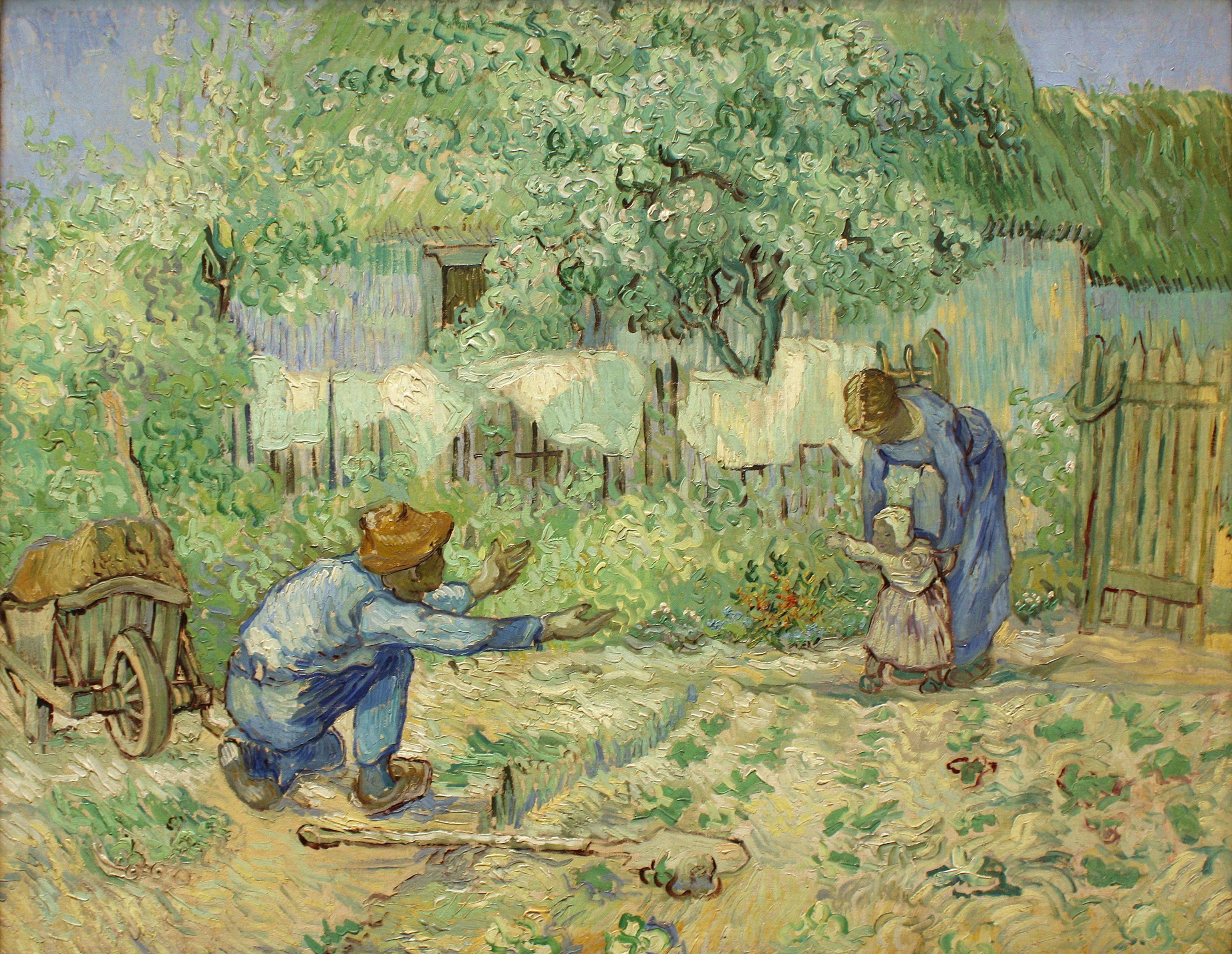
There are two paintings juxtaposed in this image. In the first painting, a farmer crouches with his arms outstretched toward his baby daughter, who is attempting to walk. The daughter is being supported by the farmer’s wife, who is a few steps away and holding the baby’s arms. All three figures are out in a garden. There is a wheelbarrow behind the farmer and a shovel lying on the ground in front of him. Behind the garden there is a fence, two trees, and a cottage. The second painting is nearly identical to the first, but it has been painted with different, brighter colors, and there is laundry hanging over the fence in the background between the farmer and his wife.
First Steps by Jean-François Millet (left) juxtaposed with First Steps, after Millet by Vincent van Gogh (right).
Cleveland Museum of Art/Art Resource, NY
In making Millet’s work his own, Van Gogh made several changes. Most notably, he altered the colors, with the father and mother both appearing dressed in blue. This was one of Van Gogh’s favorite colors, and it causes the figures to stand out against the background of bushes and the house. The two figures are also now visually conjoined; even their poses (the father leans to the right and the mother leans to the left) link them. They act like compositional parentheses for the space that the child must walk. The father and mother are also visually connected by the laundry that hangs behind them. The rhythm created by the repeated visual units of each piece of laundry on the line, with its billowing sheets, acts like a visual surrogate for the child’s steps.
In this painting, a farmer crouches with his arms outstretched toward his baby daughter, who is attempting to walk. The daughter is being supported by the farmer’s wife, who is a few steps away and holding the baby’s arms. All three figures are out in a garden. There is a wheelbarrow behind the farmer and a shovel lying on the ground in front of him. Behind the garden there is a fence, two trees, and a cottage. Laundry hangs over the fence between the farmer and his wife.
First Steps, after Millet by Vincent van Gogh. Oil on canvas, 1890. 2′ 4.5″ × 3′.
Click to enlarge
Art Resource, NY
Van Gogh’s composition is nearly identical to Millet’s, and we read the two works the same way: first across the image from left to right, and then, in our imagination, from right to left. And yet the two works convey opposite impressions of the same moment. In Millet’s work, the space between the father and mother seems expansive, giving a sense of heroic drama to the initial stumblings of a child. By contrast, Van Gogh makes every attempt to visually close the space between the adults, emphasizing intimacy and the bond of a family.
In his letters to his brother Theo, Vincent van Gogh often lamented not having a wife and child. In reinterpreting Millet’s image, he achieved in art what had eluded him in life.
Pietà
Both of these paintings depict the dead body of Jesus Christ leaning against the sloping ground. A white cloth is draped over his body from the waist down. Behind him, the Virgin Mary stands over him with her arms outstretched around and slightly over him. Her palms are open and she stares downward, but not directly at him. Her expression is sad and calm. Christ’s head leans in toward Mary. In the first image, Christ’s body is lightly colored and Mary is dressed in blue. Christ’s body leans to the right and Mary stands slightly to the left. In the second painting, Christ’s upper body is shrouded in shadow, while Mary’s is more in the light. She is also wearing red cloth around her neck. In this version, Christ’s body leans to the left and Mary stands slightly to the right.
Pietà (after Delacroix) by Vincent van Gogh (left) juxtaposed with Pietà by Eugène Delacroix (right).
Art Resource, NY/Wikimedia
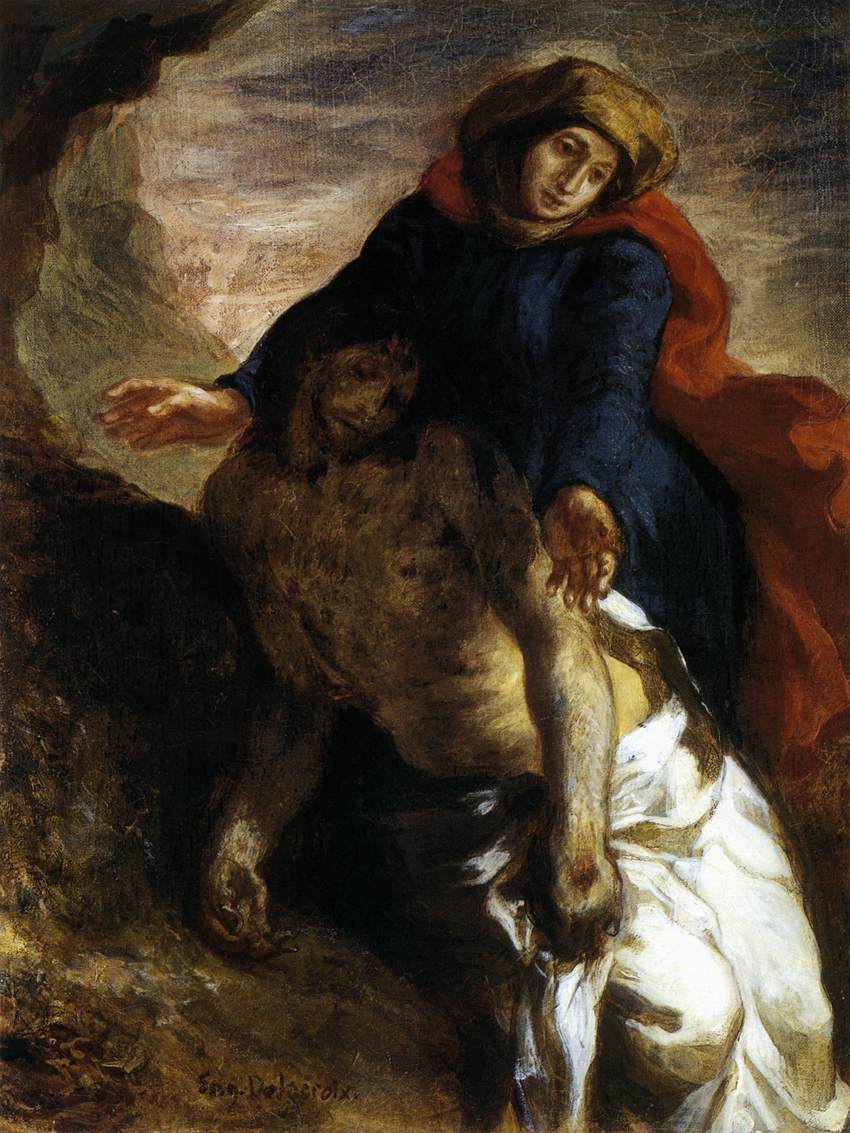
In reinventing Eugène Delacroix’s Pietà, Van Gogh went even further than he did with the Millet painting, actually reversing the composition.1 In Delacroix’s work, the dead body of Christ is framed by the outstretched arms of his mother, Mary. The purpose of the work is to evoke within the viewer a sense of sacred pity for Mary’s suffering. To achieve this end, Delacroix employs both color and composition. Like Millet’s work, this painting is meant to be read from left to right. However, because Christ is in shadow and Mary is in light, we visually leap over him to look at her. Her outstretched arms are what redirect our gaze toward Christ and might even bring to mind Christ’s crucifixion, suggesting how the suffering of the son has become the agony of the mother.
In this painting the dead body of Jesus Christ leans to the left against the sloping ground. A white cloth is draped over his body from the waist down. Behind him, the Virgin Mary stands over him with her arms outstretched around and slightly over him. Her palms are open and she stares downward, but not directly at him. Her expression is sad and calm. Christ’s head leans to the right toward Mary. His upper body is shrouded in shadow, while Mary’s is more in the light.
Pietà by Eugène Delacroix. Oil on canvas, 1850. 1′ 1.75″ × 10.75″.
Click to enlarge
Wikimedia
Delacroix’s use of the color red is strategic. Red is a visually aggressive color, and the red behind Mary visually pushes her toward the viewer. Everything about Delacroix’s visual treatment of the subject aims to connect the viewer and Mary. It is through her that the viewer is then reminded of Christ.
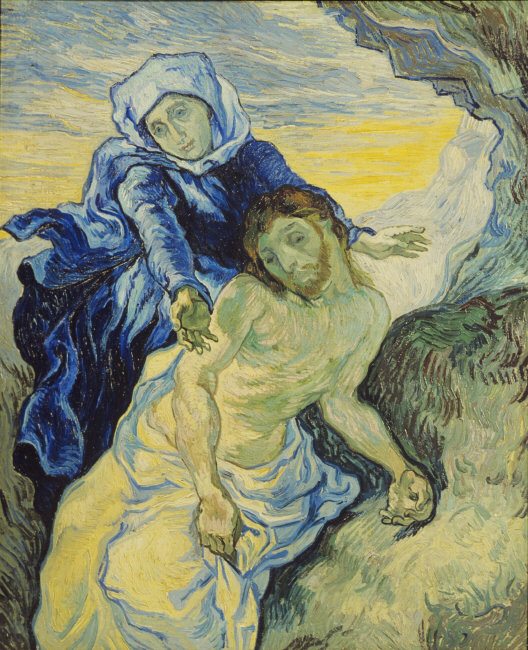
In this painting the dead body of Jesus Christ leans to the right against the sloping ground. A white cloth is draped over his body from the waist down. Behind him, the Virgin Mary stands over him with her arms outstretched around and slightly over him. Her palms are open and she stares downward, but not directly at him. Her expression is sad and calm. Christ’s head leans to the left toward Mary.
Pietà (after Delacroix) by Vincent van Gogh. Oil on canvas, 1889. 2′ 4.75″ × 2′.
Click to enlarge
Art Resource, NY
In mirroring the composition of Delacroix’s painting, Van Gogh also reversed the roles of Mary and Christ. Mary is now in blue, a color that Van Gogh associated with spirituality. But she is now darker, and Christ is in light. As we read Van Gogh’s painting, starting from the lower left corner, we are almost immediately visually drawn to Christ’s body. Mary is a background figure. She is important and treated with respect, but she is not central to Van Gogh’s composition.
One of Van Gogh’s favorite books was The Imitation of Christ by Thomas à Kempis. That 15th-century devotional guide encouraged the reader to identify with the suffering of Christ. This is what Van Gogh’s Pietà achieves—not only for the viewer, but for himself: Christ’s face in the painting is in fact Van Gogh’s own.
As a Roman Catholic, Delacroix had a great reverence for the role of the Virgin Mary as spiritual intercessor. As a Protestant, Van Gogh believed that he could have direct
access to Christ. While the two paintings depict the same motif and are very similar, they visualize very different theological approaches to their subject.
The Good Samaritan
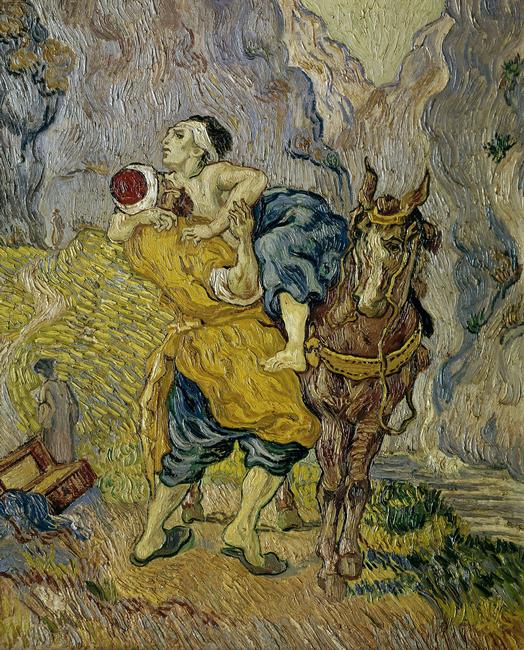
In this painting, the good Samaritan character from a parable told by Christ is helping a hurt man down from a horse. The hurt man leans heavily on the Samaritan and has his arm wrapped around the Samaritan’s neck. The horse stands patiently to the right of the two men, looking slightly toward them. The Samaritan is leaning back under the weight of the hurt man. Behind the men and to the left of them there is a road winding through a field and out of sight over a low hill. Two other vague human figures walk along the road away from the men, one near the men and the other in the distance. There is also an open and empty chest on the ground to the left of the men. The lighting in this painting is very light.
The Good Samaritan (after Delacroix) by Vincent van Gogh. Oil on canvas, 1890. 2′ 4.75″ × 1′ 11.5″.
Click to enlarge
Album/Art Resource, NY
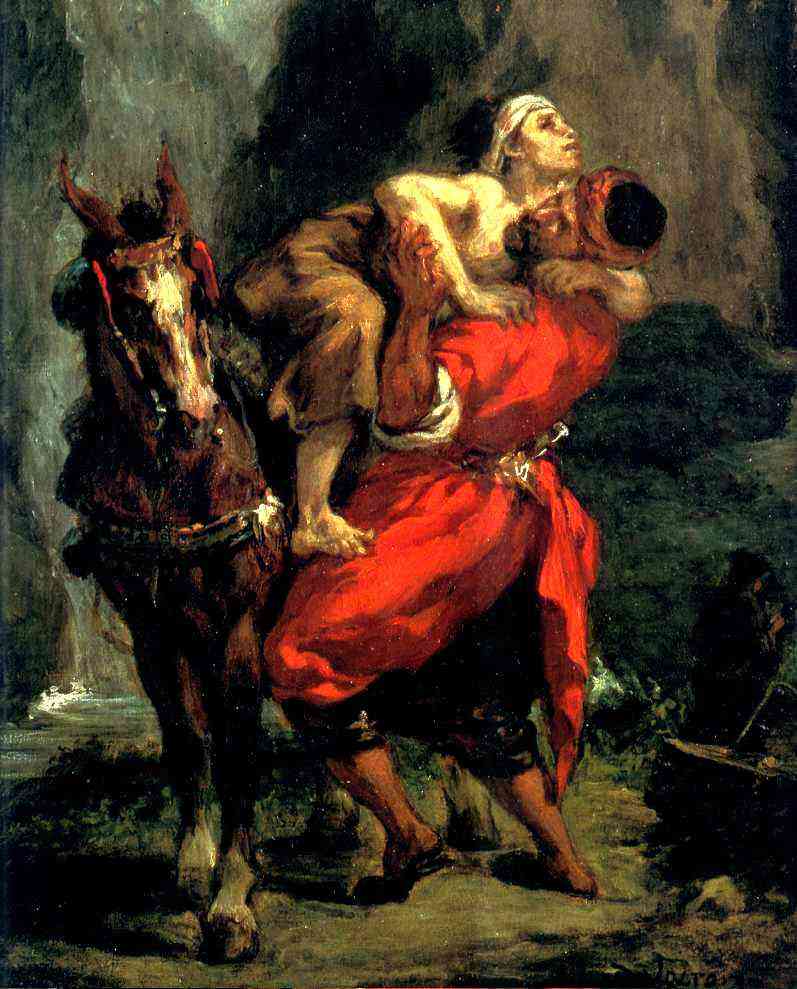
In his version of The Good Samaritan, Van Gogh again mirrored the original composition, reversing the direction of the action (and thereby the identity of the principal actor). In his painting, Delacroix employs composition to visualize weight, which can be difficult to measure by observation alone. The work focuses on the transference of one man’s weight from a horse to another man. As we read the image
from left to right, we follow the movement of one man (who has been attacked by robbers and left for dead) from a horse to the arms of another man (the good Samaritan who has come to his rescue). Note how the Samaritan’s legs are positioned to receive the weight.
Throughout his oeuvre, Delacroix depicted figures in poses suggesting physical strain, including many that show figures wrestling or fighting. If we didn’t have a title or know the story shown in The Good Samaritan, we might wonder if the two men were engaged in some sort of struggle.
In this painting, the good Samaritan character from a parable told by Christ is helping a hurt man down from a horse. The hurt man leans heavily on the Samaritan and has his arm wrapped around the Samaritan’s neck. The horse stands patiently to the left of the two men, looking slightly toward them. The Samaritan is leaning back under the weight of the hurt man. Behind the men and to the right of them there is a road winding through a field and out of sight over a low hill. Two other vague human figures walk along the road away from the men, one near the men and the other in the distance. There is also an open and empty chest on the ground to the right of the men. The lighting in this version of the scene is dark and shadowy.
The Good Samaritan by Eugène Delacroix. Oil on canvas, 1849. 1′ 2.5″ × 11.75″.
Click to enlarge
Wikimedia
Van Gogh transformed Delacroix’s motif from one of understated struggle to one of compassion. In Van Gogh’s composition, the Samaritan is a surrogate for the artist; as with the Christ figure in Pietà, Van Gogh has given the man his own face. The Samaritan is now an active rescuer, pulling the wounded man from the horse rather than simply receiving his weight.
Van Gogh also added two men walking away in the background who are not present in Delacroix’s painting. We can identify these figures from the parable of the good Samaritan as religious leaders who walked by the wounded man without helping him. The point is clear: Compassion must be active to be real. To Van Gogh, Delacroix’s figure of the Samaritan as a receiver may not have been sufficiently proactive.
Vincent van Gogh’s reinterpretation of works by Eugène Delacroix and Jean-François Millet serve as useful examples of the ways compositional structure and color can suggest certain readings of a motif. In art, recognizing what the art depicts (the subject) is only half of what we need to understand the work. We must also look at how the subject is depicted (the visual language) to read the work’s meaning.
Short-Answer Question
Give one example of how Van Gogh’s use of color suggests a new reading of Pietà .
No response saved yet. Short-Answer Question
Give one example of how Van Gogh’s reversal of the image in The Good Samaritan changes how we read the painting.
No response saved yet.
Response Board List some characteristics of Van Gogh’s style or visual language.
No response saved yet.
Share your thoughts with your peers...
1 It is likely that Van Gogh made his painting using a print of Delacroix’s original for reference. Before the widespread use of photography, prints were one way to reproduce an image, but the printmaking process would result in a reversal of the composition. Knowing this, Van Gogh could have used a mirror to correct this reversal; instead, he embraced this new orientation as his own.
close