HUM-200-Page5.1.4-ArtMakesVisible.pdf
Applied Humanities
What Is Art? Art Makes Visible By James Romaine 5 Module Five: Impact of the Humanities / Page 5.1.4 Art Makes Visible On this page: 0 of 3 attempted (0%) | 0 of 3 correct (0%) Objective: Consider three ways this painting can make the invisible visible.
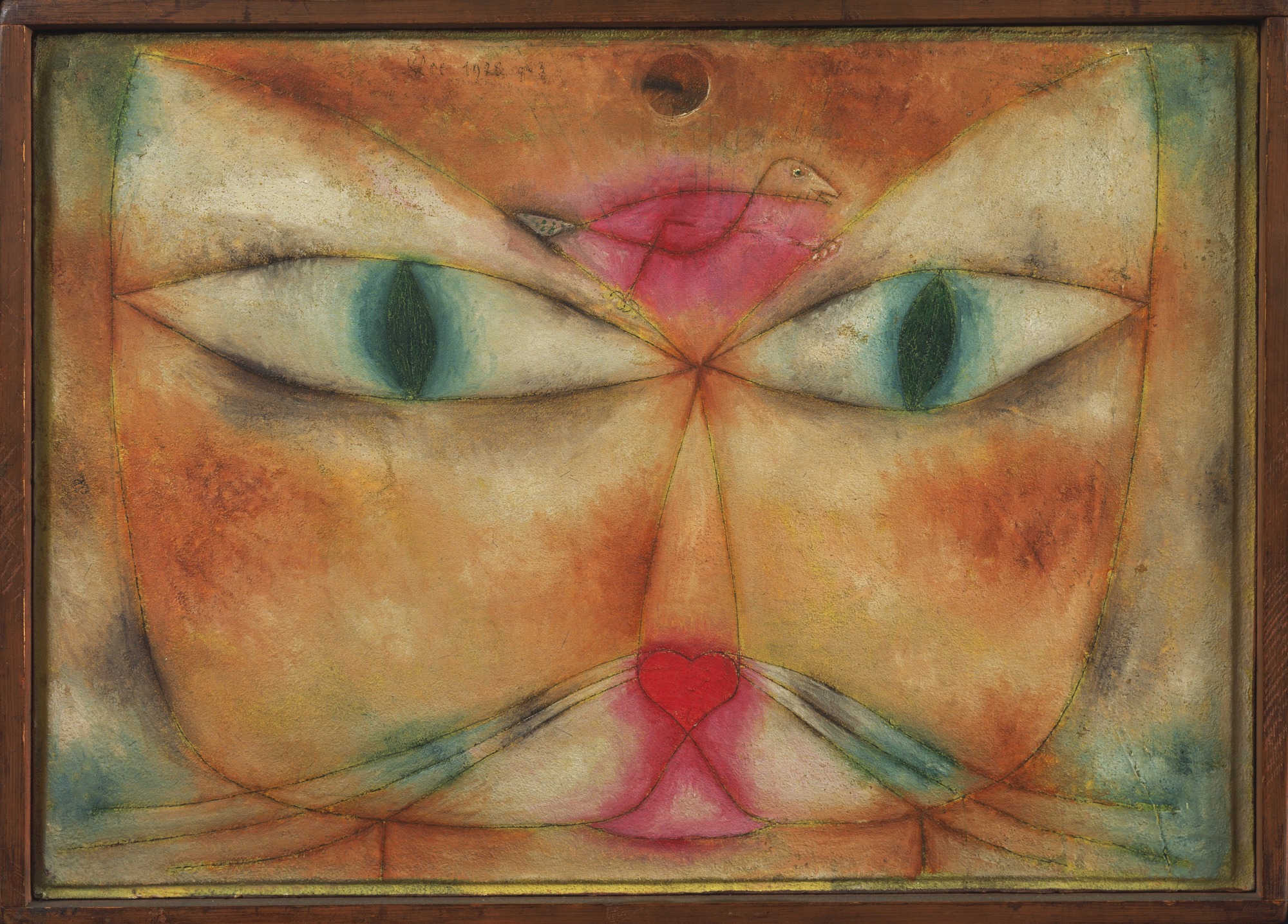
This painting depicts a stylized image of a cat’s face, with a stylized image of a nonspecific bird in profile painted on the cat’s forehead.
Cat and Bird by Paul Klee. Oil and ink on gessoed canvas, mounted on wood, 1928. 1′ 3″ × 1′ 9″.
Click to enlarge
© 2016 Arts Rights Society (ARS), New York. The Museum of Modern Art/Licensed by SCALA/Art Resource, NY.
In a 1920 essay entitled “Creative Credo,” the artist Paul Klee wrote, “Art does not reproduce the visible; rather, it makes visible.” Scholars have dissected and debated this statement ever since. According to some, Klee meant that artists, having a higher degree of sensitivity, observe and call attention to things that already exist but have gone unnoticed, thus making them seen. Others have interpreted Klee’s statement to mean that artists create ex nihilo, or something out of nothing, using only their materials and
their imaginations. Klee’s other references in “Creative Credo” to the Biblical book of Genesis and the creation of the cosmos give some credence to the latter interpretation. Nevertheless, the difference between making things seen and simply making things is smaller than we might think, and in fact artists do a bit of both.
The power of the visual arts lies largely in their ability to visualize and thereby create new reality. Consider the Mona Lisa, for example. In creating this work, Leonardo da Vinci did more than paint a portrait of an individual; he established a new way of looking at the world that has enriched the human experience.
Works of art heighten our sensitivity toward what we see. This mix of observation and imagination is evidenced in Klee’s 1928 painting Cat and Bird. This work, in the MoMA collection, was inspired in part by Klee’s fascination with art created by children. Like many 20th-century artists, Klee was looking for alternatives to the classical model of creativity and picture making. He believed that children created with invention and without inhibition and sought to emulate that method.
At the same time, Klee’s painting evidences a simple sophistication. Looking carefully at Cat and Bird, for example, notice how the cat’s face fills but does not consume the painting’s space. This implies that the cat’s face is very close to the picture plane and our own space. Does such a perspective establish a sense of intimacy between the cat and us?
The size of the painting, 1′ 3″ × 1′ 9″, also comes into play. The painting is not so large as to be visually imposing. A painting that is much larger, such as Leutze’s Washington Crossing the Delaware (12′ 5″ × 21′ 3″), can be imposing to the viewer. In the case of Klee’s painting, however, the viewer is presumably larger than the painting and therefore able to engage the work from a position of power. Nevertheless, the face of Klee’s cat is larger than that of most domesticated cats. If this cat had a body, and if it were an actual cat, it would likely be larger than the viewer. The result—we are bigger than the actual painting, but the depicted subject is (or would be) bigger than us— creates a striking equilibrium between the work and the viewer.
This photograph depicts two men standing just below a very large painting hanging in a museum. The painting depicts George Washington standing in a rowboat. He is wearing black boots which reach just below his knees, yellow pants, a blue jacket, a grey and red cape, and a blue three-cornered hat. There are three men sitting in the boat in front of Washington. They are all rowing. One man, a western rifleman wearing a coonskin cap, faces forward. Two men, one in a Scottish bonnet and one of African descent, sitting next to each other, face backwards. There are three men directly behind Washington. One man, Lieutenant James Monroe, is standing, wearing a blue officer’s coat, and holding an American flag. One is another western rifleman wearing a coonskin cap. One is a soldier. Behind these men are General Edward Hand, who is holding his hat on his head and wearing a blue officer’s coat. There are two farmers with broad-brimmed hats huddling against the cold. One farmer has a bandage around his head. There is an androgynous rower in a red shirt. The last rower in the stern is wearing moccasins, pants, a green shirt, and the hat of a Native American. There are more boats with men and horses crossing behind Washington. The river has chunks of ice floating in it. The opposite shoreline is visible in the distance. The sky appears overcast.
Visitors to the Metropolitan Museum of Art in New York stand in front of the iconic Washington Crossing the Delaware by Emanuel Gottlieb Leutze. Oil on canvas, 1851. 12′
5″ × 21′ 3″.
Mary Jane Lindrum/Soomo Learning
Klee’s composition is slightly off center. The left side (the viewer’s left) of the cat’s face is a bit larger than the right side. Perhaps this implies a small turn in the cat’s head (i.e., one side of the face is minutely closer to us and is therefore larger). If so, then through this implied movement, Klee subtly introduces the possibility of pictorial space within a
largely abstract and visually flat image. Within the pictorially flat composition, the greater visual weight of the left side of the composition balances the viewer’s natural left-to-right visual movement.
This painting depicts a stylized image of a cat’s face, with a stylized image of a nonspecific bird in profile painted on the cat’s forehead.
Cat and Bird by Paul Klee. Oil and ink on gessoed canvas, mounted on wood, 1928. 1′ 3″ × 1′ 9″.
Click to enlarge
© 2016 Arts Rights Society (ARS), New York. The Museum of Modern Art/Licensed by SCALA/Art Resource, NY.
This analysis of Klee’s Cat and Bird brings us to the question of what the artist meant “to make visible.” There are several possibilities. Are we observing a bird sitting on a cat’s head? In that case, does the cat see the bird, or is the bird positioned in a “blind spot” between the cat’s eyes? Or are we seeing into the otherwise invisible realm of a cat’s mind? All of these could be true simultaneously. Each of these readings of Klee’s Cat and Bird implies a different creative process for the artist and purpose of the work for the viewer.
Interpretation One
Perhaps we are observing a cat with a bird sitting on its head. In this case, Klee is engaging in a process of observing and documenting what he sees. In the final painting, we see what Klee saw. This art-as-depiction method is not dissimilar to a portrait by Rembrandt van Rijn. In his Portrait of Jan Six, we see a specific person whom we could have known and observed if we had been in the studio with Rembrandt when he created the work. Rembrandt and Klee’s paintings not only observe and depict what can be seen, they visualize the character of their subject.
Interpretation Two
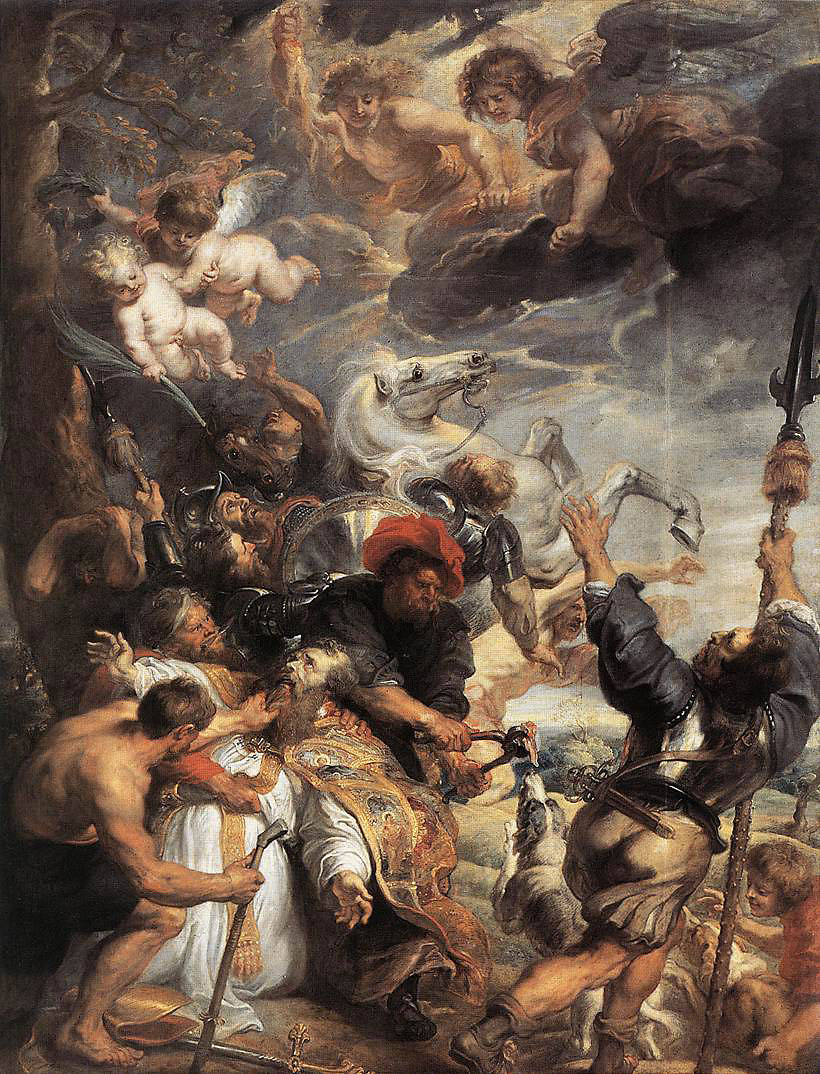
It is possible that Klee’s cat does not see the bird, because the bird is positioned in a “blind spot” between the cat’s eyes or on its head. In this case, Klee’s painting would be participating in a long history of art that presents the viewer with a privileged view of the subject, such as in The Martyrdom of St. Livinus by Peter Paul Rubens. Rubens’s painting is different than Rembrandt’s Portrait of Jan Six in several ways. First, although Rembrandt may have made changes to his painting later, he had personally observed the person whose portrait he painted. By contrast, the subject of Rubens’s painting, Livinus, had been dead for almost a thousand years when the work was created in 1633. Furthermore, the Rubens painting shows angels descending from heaven, yet only some of the other figures can see them. In this way, Rubens’s piece gives us a special vision, just as Klee’s painting might also “make visible” a bird that the cat does not see.
This painting depicts St. Livinus being robbed. Livinus is wearing a white robe with a gold sash belt and colorful cape. Three robbers are prominent. One is pulling downward on Livinus’s beard. The second is holding a pair of tongs with Livinus’s tongue and offering it to a dog. The third is holding a spear and looking upward. There are a group of robbers in the background and surrounding the prominent figures. They are either looking at the scene of mutilation or looking upward with expressions of fear. There is a white horse rearing on its hind legs behind some of the robbers. Above the scene, angels and cherubs look down. The angels are holding lightning bolts and appear to be about to throw them. The clouds are dark.
The Martyrdom of St. Livinus by Peter Paul Rubens. Oil on canvas, 1633. 14′ 11″ × 11′ 4.5″
Click to enlarge
Wikimedia
Interpretation Three
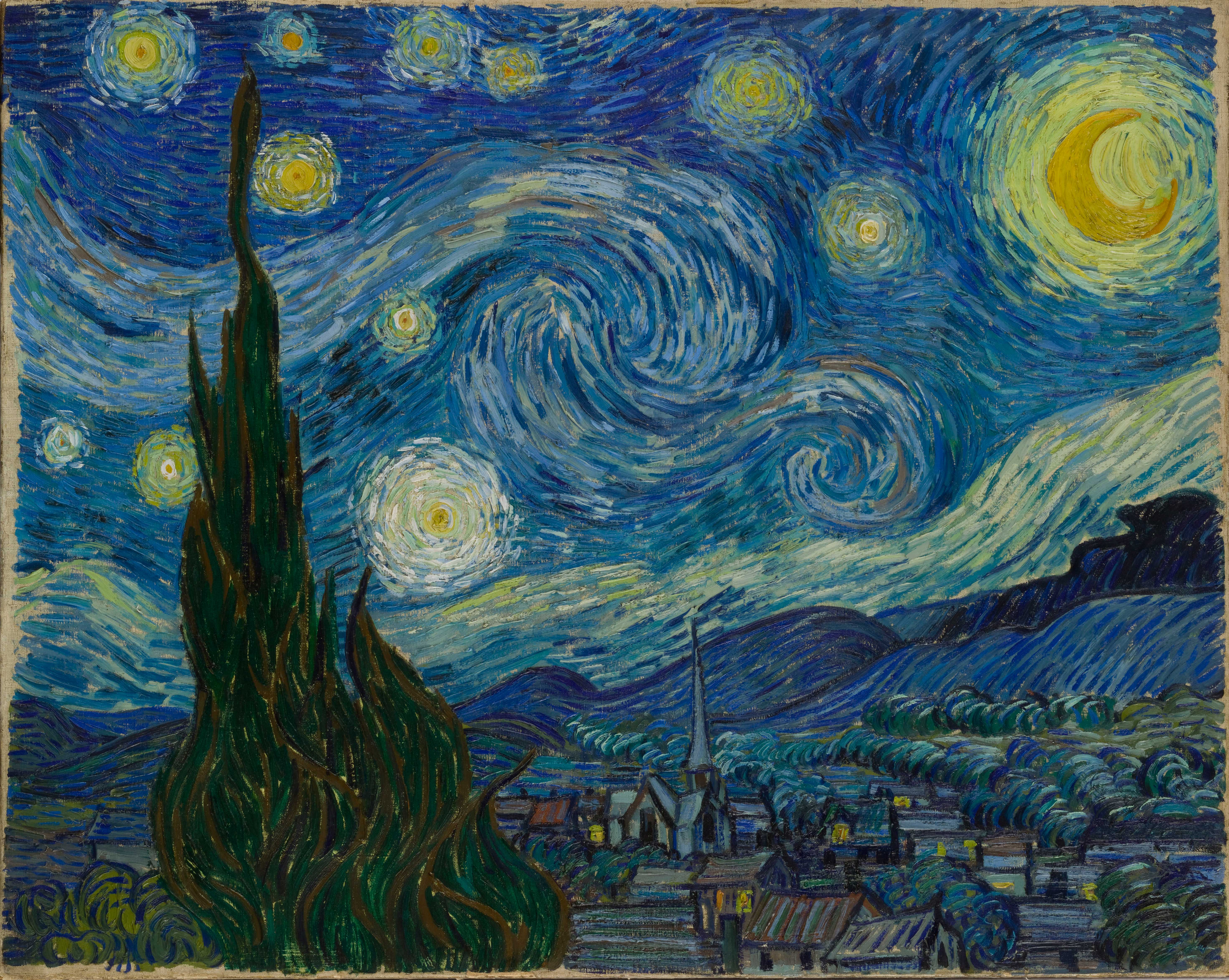
Perhaps Klee’s painting visualizes the otherwise invisible realm of the cat’s mind? While we can see the bird, it nevertheless remains in the cat’s imagination. In Vincent van Gogh’s The Starry Night, we see a vision that is a projection of the artist’s imagination. The world that we see in The Starry Night was never observable with the eye—that is, until Van Gogh made it visible.
Comparing works by Rembrandt, Rubens, and Van Gogh, we identify three different understandings of Paul Klee’s statement that “art does not reproduce the visible; rather,
it makes visible.” Amazingly, Klee’s Cat and Bird unites all three possibilities in one image.
Swirls of blue and yellow make up the night sky in this oil painting. A yellow crescent moon is in the upper right corner. Venus, the morning star, is to the left of center surrounded by rings of yellow and white. Other stars are scattered among the swirls of blue, each surrounded by various sized rings of white and yellow. Under the sky is a village with its church and steeple centered and prominent. Mountains undulate in the background. The mountains are darker shades of blue. In the village, windows in various locations have lights in their windows. There is a green cypress tree in the left foreground reaching almost to the top of the painting.
The Starry Night by Vincent van Gogh. Oil on canvas, 1889. 2′ 5″ × 3′ 0.25″.
Click to enlarge
The Museum of Modern Art/Licensed by SCALA/Art Resource, NY
Multiple-Choice Question
According to the material presented above, what is one of the main reasons the visual arts are so powerful?
They are the best method humans have invented to stir the emotions of others. Everyone from young children to senior citizens can produce visual art. They are open to many different interpretations.
They not only visualize but also create new realities.
Multiple-Choice Question
What was the inspiration for Klee’s painting Cat and Bird?
a desire to artistically represent the evolution of consciousness a lifelong fascination with cats art created by children a documentary he had seen on the mental life of felines
Multiple-Choice Question
If we adopt the second interpretation of Klee’s Cat and Bird, in what way is it similar to Peter Paul Rubens’s The Martyrdom of St. Livinus?
Both paintings make something visible to the viewer that is not visible to figures in the paintings. Both rely on warm, bright colors to evoke certain emotions. Both paintings are about religious subjects. Both paintings fill the frame with a single subject to emphasize their central theme.
close